
Submitted:
16 June 2026
Posted:
17 June 2026
You are already at the latest version
Abstract
Objectives: This study investigated the effects of augmented reality motor training (ARMT) on gait and balance in children with cerebral palsy (CP). Methods: Thirty five children with spastic uni- and bilateral CP, aged 7–12, years were randomly assigned to two groups. One group (n = 20) underwent ARMT while wearing a VR headset, with five 30-min. sessions per week as part of their 4-week conventional rehabilitation. The control group (n = 15) participated in a 4-week conventional rehabilitation without AR exercises. Before and after rehabilitation all children performed a 10-meter walking test with a G-walk sensor, a one-leg balance task from the MABC-2 test, and the Pediatric Balance Scale (PBS). Results: The ARMT group demonstrated a significant decrease in the coefficient of variability (%) for three variables of the stride cycle, an improvement in total PBS score, longer duration of left-leg stance, and longer duration of stance on the less affected side, as compared to the control group. Conclusions: The study suggested that after just 4 weeks, movement training with balance and gait exercises performed in AR could lead to stabilization of gait patterns, accompanied by improved balance.
Keywords:
motor training
; mixed reality technology
; cerebral palsy
; gait
; balance
1. Introduction
Cerebral palsy (CP) is an umbrella term for disorders caused by brain damage or malformation during prenatal, perinatal or early postnatal period, with the defining characteristic of motor and posture impairment that limits activities of daily living. The basic pathophysiological classification of CP distinguishes between the spastic, dyskinetic and atactic forms of CP, with highest incidence of the spastic ones (75-85%).
Walking as a fundamental motor function presents significant difficulties in children with spastic diparesis and hemiparesis. Children with bilateral spastic CP often exhibit noticebly reduced gait speed, shorter step length, excessive co-contraction, and sagittal-plane deviations such as equinus, crouch, or jump gait [1,2]. These patterns often combine with compensatory pelvic and trunk movements that increase energy expenditure.
In hemiparetic CP, asymmetrical lower-limb involvement produces different kinematic strategies between the affected and non-affected sides. Sangeux and Armand [2] described characteristic deviations such as reduced dorsiflexion and knee extension on the paretic side, limb circumduction during swing, and pelvic retraction. These adaptations serve to maintain foot clearance and forward progression but reduce efficiency and symmetry.
Abnormal coordination of the pelvis and trunk is a defining feature of pathological gait in both diparetic and hemiparetic CP [3,4]. Abnormalities in the pelvis and trunk during gait in the step phase in children with unilateral or bilateral spastic cerebral palsy include pelvic tilt double bump, pelvic obliquity up or down, reversed pelvic rotation profile, sustained pelvic protraction or retraction, trunk tilt double bump, sustained trunk obliquity, and excessive trunk obliquity range consistent with a Trendelenburg pattern [2]. These findings highlight that pelvic and trunk dynamics are integral to gait efficiency and should be prioritized as primary therapeutic targets in rehabilitation.
A principal objective of rehabilitation is the enhancement of mobility and ambulatory function. Contemporary practice has shifted from exclusively impairment-based interventions such as isolated strengthening exercises or augmentation of joint range of motion toward approaches that directly target functional components of activity and participation. The integration of virtual reality (VR) environments can further enhance patient engagement, particularly within paediatric rehabilitation settings [5]. Therapeutic interventions employed in this context have included home-based exercise regimens delivered through digital platforms, sit-to-stand training protocols, and task-oriented functional exercises [6].
Rehabilitation programs for children with CP commonly focus on improving functional walking through intensive, task-specific gait training. A review and metaanalysis by Booth et al. [5] found that these interventions consistently improved walking speed, endurance, and gross motor function relative to standard physiotherapy. The duration of the interventions were most often in the range of 30 min. 2-3 times a week for 12 weeks. The review emphasized that functional gait training is most effective when it is repetitive, contextually relevant, and incorporates real-world walking tasks. Paul et al. [7] confirmed significant improvements in cadence, stride length, and velocity across multiple intervention categories, consolidating the importance of task-specific practice for functional mobility gains.
Despite well-documented gains in gross motor outcomes, fewer studies have directly examined how rehabilitation influences pelvic kinematics. However, the available evidence indicates that interventions targeting lower-limb function often produce secondary improvements in pelvic control. Kiernan et al. [4] noted that trunk and pelvic motions are interdependent with lower-limb mechanics; thus, gait training that improves limb alignment may reduce excessive lateral trunk displacement. Swinnen et al. [3] suggested that improving thorax and pelvis coordination could enhance dynamic stability and decrease energy cost. Booth et al. [5] further proposed that functional gait training—by focusing on overground walking and postural transitions—may inherently train proximal control.
Traditional therapy, while effective, can be monotonous and physically demanding. VR, mixed (MR) and augmented reality (AR) alternative, scenes being closer to the real world that sustains motivation and facilitates motor learning. VR interventions resulted in large improvements in postural control, balance, walking performance and gross motor function compared with standard therapy [8,9,10]. The mechanisms underlying these effects include multisensory feedback, enriched environments, and real-time visual reinforcement of correct motor patterns, all of which strengthen sensorimotor integration and cortical reorganization. Collectively, these studies suggest that VR, MR and AR provide a closed-loop training environment where real-time holographic cues guide limb trajectories and pelvic alignment, directly targeting compensatory mechanisms described in diparetic and hemiparetic gait.
Together, these advances demonstrate that the next generation of pediatric gait rehabilitation is moving toward the integration of biomechanical precision, neuroplastic stimulation, and motivational engagement, effectively bridging the gap between laboratory gait analysis and functional, real-world walking. Despite this promising progress, only a limited number of studies have explored the role of AR within this context. Therefore, our study aimed to clarify the effects of AR on gait and balance in children with cerebral palsy.
2. Materials and Methods
2.1. Participants
Forty children were recruited from two pediatric rehabilitation institutions. Inclusion criteria were as follows: (1) diagnosis of spastic CP with hemiplegia and or diplegia completed by a neurologist, (2) age 7-12 years, (3) Gross Motor Function Classification System (GMFCS) I-II, (4) spasticity of grade 2 or less diagnosed with the Modified Ashworth Scale (MAS), (5) ability to walk at least 10 m, (6) no neurological disease other than CP, (7) cognitive ability to communicate, at least with simple language, (8) ability to follow instructions. Exclusion criteria were the following: (1) receiving an injection of anti-spastic medication to reduce rigidity within the last 3 months, (2) undergoing orthopedic surgery within least year, (3) visual impairments preventing testing and intervention with a virtual headset. Using the pocket randomization method children were allocated into a group undergoing augmented reality motor training (ARMT group) or control group (C-group), n = 20 in each group. Table 1 introduces basic clinical characteristics of the groups.
The study was approved by the Institutional Ethical Committee, and the Technology Agency of the Czech Republic. Legal guardians of the children signed informed consent forms after receiving detailed information on walking and balance measurements, and the augmented reality motor training (ARMT).
2.2. Apparatus
For the ARMT, we developed four softwares (SW) for walking exercises and three SWs for balance exercises in AR (Figure 1). The physiotherapists used a tablet with the control software platform to select particular exercises, their difficulty level (1 to 3), and duration (1 to 5 minutes). Each SW provided brief verbal instructions at the beginning of each exercise and verbal encouragement for a participant’s external focus of attention such as focus on intended movement effect, outcome, implement or goal (more details see [11]), or for choice of some aspect of a task to enhance intrinsic motivation [12]. The SWs for practising walking and balance in AR were developed by the authors.
2.2.1. Augmented Reality Motor Training (ARMT)
Both groups underwent a 4-week conventional therapeutic program for stimulation of basic motor and neuromuscular functions. This program included traditional occupational and motor therapy four times a week, mechanotherapy three times a week, manual massage twice a week, swimming exercises twice a week, a whirlpool bath (hydromassage) three times a week, and a pearl bath twice a week. For the ARMT group, motor exercise focused on walking and balance and performed in AR were incorporated into its conventional program, with the total duration of the 4-week therapeutic program remaining the same as that of the C-group. The ARMT involved seven exercises with three difficulty modifications in each exercise, totally 21 particular movement tasks. The difficulty of the tasks increased and varied throughout the 4-week AR training, in accordance with the child’s current abilities.
To practise motor tasks in AR, the participant wore a VR headset Meta Quest 3 (Meta Platforms, Meno Park, California, USA), on which the aforementioned applications are launched. The headset is equipped with four IR cameras (400x400 px) for tracking controllers, hands, and space identification, as well as two 4MP RGB cameras for VR/AR. Each eye’s resolution is 2064 x 2208 pixels, with a refresh rate of 90 Hz, and the inter-pupillary distance of the lenses is adjustable within the range of 53 to 75 mm. The headset weighs 515 grams.
2.2.2. Assessment of Potential Effects
To assess the gait cycle participants performed the 10-m walk test while wearing the G-Walk sensor device (BTS G-Walk BTS Bioengineering Company, Italy). The G-Walk is built with a triaxial accelerometer 16 bit/axes with multiple sensitivity, a triaxial magnetometer 13 bit (±1200 μT) and a triaxial gyroscope 16 bit/axes with multiple sensitivity (±250, ±500, ±1000, ±2000°/s). The device has been placed on an elastic belt and positioned below the line that connects the two dimples of Venus - lumbosacral passage, which corresponds to S1-S2 vertebrae, according to the manual [13]. Then, a child was asked to walk calmly at preferred speed, on a 10-meter track. The boundaries of the track were determined with a yellow tap. A therapist walked alongside a child when necessary to ensure safety and maintain walking velocity. A child performed two trials of the 10-m walk. Data from the second trial were analysed. If unexpected movements such as sneezing, coughing, stumbling or almost stopping of the gait observed a trial was repeated.
The G-Walk through the G-Studio software (BTS G-Walk BTS Bioengineering Company, Italy) provided spatiotemporal parameters of stride cycle, and pelvic movements in sagittal plane (tilt), the coronal plane (obliquity) and the transverse plane (rotation). Cadence (steps/min), velocity (m/s), step length (% height), step duration (s), durations of stance phase (% cycle) and swing phase (% cycle), duration of double support (% cycle), propulsion index, walk quality index, symmetry index, and symmetry indexes of pelvic tilt, obliquity and rotation were used for the study. All data were collected using a sampling frequency of 100 Hz.
To assess balance, Pediatric Balance Scale (PBS) [14] was used. According to the manual, an experienced physiotherapist performed 14 balance tasks of PBS with each child, and based on observations assessed the level of execution on a five-point scale.
In this study, balance was also evaluated using the Balance on a board task of the Movement Assessment Battery for Children-2nd edition Test (MABC-2) [15]. This task involves standing on one leg on a plastic board (length 31.5, width 10.0 cm) placed on the floor with the narrower side (width 3.5 cm). The goal is to hold this position for as long as possible up to 30 seconds. This balance task was carried out in accordance with the MABC-2 Manual [15].
2.3. Data Analysis
Non-parametric analyses were performed given non-normal data distribution, assessed by the Kolmogorov-Smirnov test including skewness and curtosis. A larger number of performance variables showed significant differences from normal distribution. The data was statistically described using median and interquartile range. To examine differences in demographic and basic clinical characteristics between the groups (Table 1) the Mann-Whitney U test was used (a level of α = 0.05).
The Wilcoxon signed-rank test was used to examine significance of pre-post difference of scores for each group. In the case of a significant difference, the standardized effect size r was calculated according to the formula: r = Z/ square root of N, where Z is Z-statistics of the Mann-Whitney U test, N = total sample size, with an interpretation of r = .01, 0.3, and 0.5 as small, medium, and large effect, respectively [16]. A level of α = .10 was set for the non-parametric tests. Data analyses were conducted with the IBM SPSS Statistics (Version 24; IBM, Armonk, NJ, USA).
3. Results
The entire 4-week ARMT program and pre- and post-examinations was completed by all 20 children from the ARMT group. Five from twenty children of the C-group completed their rehabilitation program early or were absent for the post-measurement.
Results showed no significant between-group difference in basic clinical characteristics (age, body height, body weight, total spasticity MAS score), walk and balance performance outcome measures before the rehabilitation program. The exception was significantly higher cadence of the C-group.
Walk performance outcome measures found at baseline and at 4 weeks in both groups are summarized in Table 2 and Table 3. The Wilcoxon signed-rank test showed a significant within-group (pre-post) difference in three gait variables for the ARMT group: intraindividual coefficient of variation (CV%) of stride cycle duration of the left lower limb (LLL) (s), W = 49.0, p = 0.037, CV% of 1st double support of the right lower limb (RLL) (% stride cycle), W = 46.0, p = 0.028, and CV% of propulsion index for LLL, W = 57, p = 0.073. The effect size of the gait variables ranged from – 0.237 to – 0.355 (Table 5).
As regard of the three variables whose CV% significantly decreased, the stride cycle duration of the LLL improved with marginal significance ( p = 0.13) in the ARMT group but not in the C-group. This variable was improved to a clinical norm level (the norms according to the G-Walk Bioengineering for a given ages) in 2 children of the ARMT group and no child of the C-group. The 1st double support duration of the RLL improved to a clinical norm level in 4 children of the ARMT group and 2 children of the C-group. The 1st double support duration of the opposite LLL was changed to a clinical norm level in 5 children while only 2 children of the C-group. Finally, the propulsion index for LLL improved in 11 (55%) children of the ARMT group, and only 5 children (33%) of the C- group, and in addition 10 (67%) children of C-group showed deterioration.
Balance performance outcome measures found at baseline and at 4 weeks in both groups are summarized in Table 4. The PBS score significantly improved in the ARMT group, W = 74.5, p = 0.005, effect size r = 0.203 (Table 5). Eleven children out of 16 children (68.8%) of the ARMT group who showed impaired total PBS scores (< 56) in the pre-assessment, improved this score. The C-group did not show significant change in the PBS score, and 4 children out of 13 children (30.8%) with impaired scores in the pre-measurement improved this measure on balance function.
In the PBS, both groups showed the most serious difficulties in performing one-legged stance, with a mean score of 2.8 points (Mdn = 3.0) and 2.3 points (Mdn = 2.0), respectively. Similarly, in tandem stance, the mean scores were 3.2 points (Mdn = 4.0) for the ARMT group and 2.9 points (Mdn = 4.0) for C-group. Among children who demonstrated difficulties with one-legged stance during the pre-assessment, improvement was observed in 5 children (45.5%) from the ARMT group and 2 children (20%) from the C-group. Also in tandem stance, children in the ARMT group showed a greater improvement compared to the C-group – 7 children (77.8%) versus 2 children (13.3%).
According to ther national norms of the MABC-2 test [17] pre-measurement of one-legged stance on a balance board revealed significant difficulties (≤ 5th percentile) for both the RLL and LLL in 19 (95.0%) children and 17 (85.0%) respectively, of the ARMT group, and 13 (86.7%) and 11 (73.3%) children respectively, of the C-group. One-leg balance duration on LLL assessed with the MABC-2 task improved significantly in the ARMT group, W = 140.5, p = 0.016, with an effect size r = 0.345 (Table 5) while no significant change was found for the C-group.
According to clinical neurokinesiological examination, 17 children (85.0%) in the ARMT group and 10 children (66.7%) in the C-group had one lower limb more affected than the other leg. Those children of the ARMT group and C-group achieved one-leg balance duration on the more affected leg 6 s (both groups) and 20 s and 28 s, respectively, on the less affected leg. The significant improvement after the rehabilitation program was observed only in the ARMT group for one-leg balance on less affected leg, W = 115.5, p = 0.065, with effect size r = 0.276 (Table 5).

Table 4.
Walking performance measures at baseline and at 4 weeks of the control group.
| Pre intervention | Post intervention | ||||||
| Mdn | IQR | Mdn | IQR | ||||
| Pediatric Balance Scale | (total score) | Control group | 53.0 | 7.0 | 54.0 | 5.0 | |
| Intervention group | 53.0 | 3.8 | 55.0 | 3.0 | |||
| MABC Balance R | (s) | Control group | 7.0 | 12.0 | 6.0 | 14.0 | |
| Intervention group | 8.0 | 22.3 | 12.0 | 28.5 | |||
| MABC Balance L | (s) | Control group | 9.0 | 16.0 | 10.0 | 16.0 | |
| Intervention group | 11.5 | 25.5 | 20.0 | 25.3 | |||
| MABC-Balance of affected side | (s) | Control group | 6.0 | 8.8 | 8.0 | 9.5 | |
| Intervention group | 6.0 | 7.0 | 7.0 | 12.3 | |||
| MABC-Balance of less affected side | (s) | Control group | 28.5 | 33.3 | 20.5 | 37.3 | |
| Intervention group | 20.0 | 23.0 | 24.5 | 33.0 | |||
Note. Mdn - median; IQR - interquartile range; R - right leg; L = left leg.
Table 5.
Walking performance measures at baseline and at 4 weeks of the control group.
| effect size r | |
| Stride cycle duration left CV% | -0.237 |
| 1st double support right CV% | -0.355 |
| Propulsion index left CV% | -0.287 |
| Pediatric Balance Scale score | 0.203 |
| MABC-2 Balance left | 0.345 |
| MABC-2 Balance less affected leg | 0.276 |
Note. CV% - coefficient of variation.
4. Discussion
The primary objective of this randomized controlled trial was to determine whether a relatively short-term, 4-week ARMT, implemented within a standard rehabilitation framework, could provide benefits for a walking ability, its consistency, and postural stability in children with spastic CP. At baseline, both groups were well-matched in terms of basic anthropometric and clinical characteristics, including the degree of spasticity across the ankle, knee, elbow, and wrist joints. Furthermore, prior to the rehabilitation program, no significant differences were observed between the ARMT group and the C-group in parameters of gait pattern and balance. Only one exception was a higher step cadence in the C-group.
4.1. ARMT and the Gait Pattern
Following the 4-week intervention, the ARMT group exhibited a significant reduction in gait variability across three parameters: the intra-individual coefficient of variation (CV%) for LLL stride cycle duration, the duration of the first double-support phase of the RLL, and the LLL propulsion index. The propulsion index reflects the capacity to transfer body weight to the stance lower limb following the deceleration phase, subsequently facilitating the acceleration of the contralateral lower limb during the swing phase [13]. The increase in the consistency of the propulsion phase for LLL could be functionally linked to the observed increase in the consistency of the LLL stride cycle duration, of which the included phase is a part and is indicated by the propulsion index. The phase indicated by the propulsion index for LLL influences the swing phase of RLL, followed by its first single-support phase. Increased consistency was also observed for this phase after the ARMT. The aforementioned increases in consistency within the stride cycle suggest a push towards movement automation and improved motor control of gait after the ARMT.
Stride cycle duration for LLL and the first double-support phase for LLL reached clinical norms in a larger number of children in the ARMT group compared to the C-group (2 vs. 0 and 4 vs. 2, respectively). These findings support larger consistency of gait cycle duration concurrently with an improved capacity for weight transfer during walk. Additionally, 35% of the ARMT group achieved normalization of stride length, compared to only 7% in the C-group. Similarly, the first double-support phase of RLL was shortened in five children in the ARMT group versus two in the C-group, and a markedly higher number of children in the ARMT group improved their propulsion index, whereas ten children in the C-group showed deterioration.
These findings support the efficacy of AR exercises in refining gait patterns and mitigating pathological gait variability. Our results align with the broader consensus on VR interventions established by Ghai et al. [18]. In their comprehensive systematic review and meta-analysis of 16 clinical trials, it was established that VR-based training is highly effective when adhering to a specific dose-response protocol. Their pooled data recommended an optimal training duration of 20 to 30 minutes per session, administered 3 to 4 times per week, over a total intervention period of 8 to 12 weeks to achieve sustainable motor learning. This structured dosing is proven to optimize spatiotemporal parameters of walk such as velocity, cadence, and stride length, which are characteristically compromised in CP [19].
While existing studies on walking in children with CP typically measured absolute parameters of stride cycle, we investigated variability of these parameters, too. It is assumed that gait variability is a crucial measure of inconsistency of muscular activities or body segmental movements, and can serve as relevant and sensitive measure to quantify adjustments of walking control [20]. There are more potential resources for intraindividual inconsistency in walking in children with CP. First, the spasticity of upper limbs and impaired trunk control observed in children with CP can disturb balance and gait movements [21,22]. Secondly, children with CP very often possess limited attentional resources and impaired cognitive functioning can increase gait variability [23].
The ARMT could have had a positive impact on gait when explicit multisensory feedback within augmented environments allowed participants to better time and control movement patterns, promoting fluid motion with reduced musculoskeletal co-contraction. For example, Chen et al. [24] implemented a 12-week home-based virtual cycling training program (30 min per session, 3 times a week) focusing on interactive, game-driven lower-limb pedaling to target muscle strengthening, which significantly enhanced isokinetic muscle strength and physical activity levels. Particular tasks in ARMT could be challenged for children (for instance, Fishing, Picking fruit from the tree, Labyrinth, Crossing of a creek, and other tasks). An example could be one child with CP and an autism spectrum disorder, who was able to touch virtual animals in the “Animal petting” tasks thanks to the absence of tactile sensation, successfully completing the movement task that would be very difficult in real life due to hypersensitivity of this child to sensory stimuli.
Further, during performing motor tasks in AR a child was provided a short instruction for his/her adoption of the external focus of attention (EFA) generated by SW applications. Numerous studies demonstrated the advantage of instructions that induce learner’s EFA, i.e. focusing on intended movement effect or outcome, implement or goal of a task for acquisition of motor skills as compared to internal focus of attention (IFA), i.e. concentration on body movements [11,12]. The study by Zorlular et al. [25] reported that EFA-based training was more effective than IFA in improving some parameters of gait and balance in 6-12 years old children with unilateral CP. Focusing externally out off his/her body can support motor automaticity and better effectiveness and efficiency of movements [11,26]. Thus, the ARMT with game-like motor tasks and EFA instructions could support some observed improvement in walk and balance (see below).
4.2. ARMT and Balance
Effects of VR therapy on balance in children with spastic CP were reported in some studies [27,28]. These effects were observed for VR therapy with a typical duration of more than 4 weeks. Our study was aimed to investigate potential changes in a gait pattern and balance after the intensive 4-week AR movement therapy based on the top-down approach.
Children with CP face postural constraints that are functionally intercorrelated with gait disorder [29]. The ARMT group showed an average improvement by 2 points of a total PBS score that covers both static and dynamic balance, while the C-group improved by one point on average. Thus, according to minimal detectable change, MDC = 1.59 points for the total PBS score [24], clinically significant change of balance on average in the ARMT group was found while not in the C-group. More specifically, out of children who showed a decreased total PBS score (<56) before the ARMT, 68.8% of children of the ARMT group improved this score by one point minimally in contrast to 30.8% of children from the C-group. In addition, a significantly higher percentage of children of the ARMT group improved in the single-leg and tandem stance tasks of the PBS compared to the C-group (45.5% vs. 20.0% and 77.8% vs. 13.3%, respectively).
One-legged stance on balance board task of the MABC-2 Test [15] used in this study presents the more objective tool for assessment of posture stability itself as compared to the subjective-based PBS. The on-legged stance performed before ARMT revealed serious abnormalities of postural stability in children with CP as most children (95% and 85% of the ARMT group, 86.7% and 73.3% of the C-group) achieved stance duration corresponding to ≤5th percentile among the population of Czech children of a given age.
Following the intervention, children who participated in the ARMT demonstrated enhanced stability during balance board stance on the LLL, yielding a medium effect size. Concurrently, a significant time elongation of stance on the less affected lower limb was found in the ARMT group. It should be noted that 60% of children of the ARMT group had LLL as the less affected side. These findings suggest that during performing of the AR tasks a child’s neuromotor system could more use a less affected side to compensate for the more impaired side and thus to complete easier a given task. As a consequence of the neuromotor tendency, the ARMT tasks focused on static and dynamic balance and various types of walk could strongly stimulate motor functions of LLL in children of the ARMT group on average. The improvement of balance and specifically balance on LLL could be associated with some average improvement of consistency of stride cycle duration for LLL and propulsion index for LLL, and further, improvement of stride cycle duration for LLL and the first double-support phase for LLL in a larger number of children in the ARMT group compared to the C-group (see above).
In relation to the findings discussed in the preceding paragraph there is the interesting suggestion that rehabilitation of the less-affected side may be warranted [30]. This claim has been supported with demonstration of significantly greater mean difference between hand motor function of RLL and LLL in children with hemiparetic unilateral CP ipsilateral pattern of motor representation than typically development children with contralateral pattern of motor representation [30]. Jovellar-Isiegas et al. [31] reported that unilateral CP children present difficulties in motor performance and somatosensory processing not only in the more-affected hand, but also in the less-affected hand.
A main potential limitation of this study might be a limited sample size that was given by ethical, medical and technical restraints for participation of children with the diagnosis of CP in the study. In addition, to maintain relative homogeneity of a individuals’clinical characteristics we specified the sample to the unilateral and bilateral type of spastic CP and used several exclusive criteria. However, the sample size fairly responded to sample sizes used in the previous intervention studies on children with CP (see [5,27,28]). Secondly, it has been generally recognized the wide variety of anatomical and pathophysiological characteristics and different consequences in particular domains of functioning among children with CP [32]. This fact could have partially contributed to the differing sensitivity of the individual children to the rehabilitation program.
The current study demonstrated that motor training in augmented reality, incorporated regularly into a 4-week conventional rehabilitation program, can lead to stabilization of gait cycle patterns and improvement in balance in children aged 7-12 years with unilateral and bilateral spastic cerebral palsy. The results indicated that the variability of kinematic and spatiotemporal parameters of the gait cycle may serve as a sensitive indicator for detecting the effects of movement therapy based on augmented or virtual reality.
Author Contributions
Conceptualisation, R.P. and J.K.; methodology, R.P., M.Š., J.K. and M.B.; investigation, R.P., M.Š., J.K. and M.B.; resources, M.Š., R.P. and J.K.; data curation, M.Š. and R.P.; writing—original draft preparation, N.C., R.P. and M.Š.; writing—review and editing, R.P., N.C., M.Š. and D.P.; supervision, R.P.; project administration, R.P., M.B. and D.P.; funding acquisition, R.P., J.K. and M.B. All authors have read and agreed to the published version of the manuscript.
Funding
This research was funded by the Technology Agency of the Czech Republic, grant number TQ 01000031 .
Institutional Review Board Statement
This study was conducted in accordance with the Declaration of Helsinki and approved by the Ethical Committee of the College of Physical Education and Sport PALESTRA (approval code VŠP/2151/2024; approval date: 10 April 2024).
Informed Consent Statement
Informed consent was obtained from all subjects involved in the study.
Data Availability Statement
Data are available on request due to privacy and ethical restrictions. The data presented in this study are available on request from the corresponding author. .
Acknowledgments
The authors would like to acknowledge and thank the children, families, management and physiotherapists from medical spas who participated in this study.
Conflicts of Interest
The authors declare no conflict of interest. The funders had no role in the design of the study; in the collection, analyses, or interpretation of data; in the writing of the manuscript; or in the decision to publish the results. .
Abbreviations
The following abbreviations are used in this manuscript:
| AR | Augmented reality |
| ARMT | Augmented reality motor training |
| CP | Cerebral palsy |
| LLL | Left lower limb |
| MABC-2 | Movement Assessment Battery for Children-2nd edition Test |
| MR | Mixed reality |
| PBS | Pediatric Balance Scale |
| RLL | Right lower limb |
| SW | Software |
| VR | Virtual reality |
References
- Gómez-Pérez, C.; Font-Llagunes, J.M.; Martori, J.C.; Vidal Samsó, J. Gait parameters in children with bilateral spastic cerebral palsy: a systematic review of randomized controlled trials. Dev. Med. Child Neurol. 2019, 61, 770–782. [Google Scholar] [PubMed]
- Sangeux, M.; Armand, S. Kinematic Deviations In Children With Cerebral Palsy. In Orthopedic Management of Children with Cerebral Palsy; Canavese, F., Deslandes, J., Eds.; Nova Science Publishers, Inc.: Publisher, 2015; pp. 241–253. [Google Scholar]
- Swinnen, E.; Goten, L.V.; De Koster, B.; Degelaen, M. Thorax and pelvis kinematics during walking, a comparison between children with and without cerebral palsy: A systematic review. NeuroRehabilitation 2016, 38, 129–146. [Google Scholar] [CrossRef] [PubMed]
- Kiernan, D.; O’Sullivan, R.; Malone, A.; O’Brien, T.; Simms, C.K. Pathological Movements of the Pelvis and Trunk During Gait in Children With Cerebral Palsy: A Cross-Sectional Study With 3-Dimensional Kinematics and Lower Lumbar Spinal Loading. Phys. Ther. 2018, 98, 86–94. [Google Scholar] [PubMed]
- Booth, A.T.C.; Buizer, A.I.; Meyns, P.; Oude Lansink, I.L.B.; Steenbrink, F.; van der Krogt, M.M. The efficacy of functional gait training in children and young adults with cerebral palsy: a systematic review and meta-analysis. Dev. Med. Child Neurol. 2018, 60, 866–883. [Google Scholar] [CrossRef] [PubMed]
- Gonzalez, N.A.; Sanivarapu, R.R.; Osman, U.; et al. Physical Therapy Interventions in Children With Cerebral Palsy: A Systematic Review. Cureus 2023, 15. [Google Scholar] [CrossRef] [PubMed]
- Paul, S.M.; Siegel, K.L.; Malley, J.; Jaeger, R.J. Evaluating interventions to improve gait in cerebral palsy: a meta-analysis of spatiotemporal measures. Dev. Med. Child Neurol. 2007, 49, 542–549. [Google Scholar] [CrossRef] [PubMed]
- Chen, Y.; Fanchiang, H.D.; Howard, A. Effectiveness of Virtual Reality in Children With Cerebral Palsy: A Systematic Review and Meta-Analysis of Randomized Controlled Trials. Phys. Ther. 2018, 98, 63–77. [Google Scholar] [PubMed]
- Liu, C.; Wang, X.; Chen, R.; Zhang, J. The Effects of Virtual Reality Training on Balance, Gross Motor Function, and Daily Living Ability in Children With Cerebral Palsy: Systematic Review and Meta-analysis. JMIR Serious Games 2022, 10. [Google Scholar] [CrossRef] [PubMed]
- Warnier, N.; Lambregts, S.; Port, I.V. Effect of Virtual Reality Therapy on Balance and Walking in Children with Cerebral Palsy: A Systematic Review. Dev. Neurorehabil 2020, 23, 502–518. [Google Scholar] [PubMed]
- Wulf, G. Attentional focus and motor learning: A review of 15 years. Int. Rev. Sport Exerc. Psychol. 2013, 6, 77–104. [Google Scholar] [CrossRef]
- Wulf, G.; Lewthwaite, R. Optimizing performance through intrinsic motivation and attention for learning: The OPTIMAL theory of motor learning. Psychon. Bull. Rev. 2016, 23, 1382–1414. [Google Scholar] [CrossRef] [PubMed]
- Bioengineering, B.T.S. G-walk. User manual. Version 9.0.0; BTS Bioengineering: Quincy MA: Garbagnate Milanese, 2018. [Google Scholar]
- Franjoine, M.R.; Gunther, J.S.; Taylor, M.J. Pediatric balance scale: a modified version of the berg balance scale for the school-age child with mild to moderate motor impairment. Pediatr. Phys. Ther. 2003, 15, 114–128. [Google Scholar] [CrossRef] [PubMed]
- Henderson, S.E.; Sugden, D.A.; Barnett, A.L. Movement Assessment Battery for Children-2, 2nd edition; Pearson Education: London, 2007. [Google Scholar]
- Cohen, J. Statistical power analysis for the behavioral sciences, 2nd ed.; Lawrence Erlbaum Associates: Publisher, 1977. [Google Scholar]
- Psotta, R. Movement Assessment Battery for Children-2, Czech version; Hogrefe – Testcentrum: Praha, 2014. [Google Scholar]
- Ghai, S.; Ghai, I. Virtual Reality Enhances Gait in Cerebral Palsy: A Training Dose-Response Meta-Analysis. Front Neurol. 2019, 10, 236. [Google Scholar] [CrossRef] [PubMed]
- Beyaert, C.; Vasa, R.; Frykberg, G.E. Gait post-stroke: Pathophysiology and rehabilitation strategies. Neurophysiol. Clin. 2015, 45, 335–355. [Google Scholar] [CrossRef] [PubMed]
- Padulo, J.; Rampichini, S.; Borrelli, M.; Buono, D.M.; Doria, C.; Esposito, F. Gait variability at different walking speeds. J. Funct. Morphol. Kinesiol. 2023, 8, 158. [Google Scholar] [CrossRef] [PubMed]
- Galli, M.; Cimolin, V.; Albertini, G.; et al. Kinematic analysis of upper limb during walking in diplegic children with Cerebral Palsy. Eur. J. Paediatr. Neurol. 2014, 18, 134–139. [Google Scholar] [CrossRef] [PubMed]
- Malone, A.; Kiernan, D.; French, H.; Saunders, V.; O’Brien, T. Do children with cerebral palsy change their gait when walking over uneven ground? Gait Posture 2015, 41, 716–721. [Google Scholar] [CrossRef] [PubMed]
- Katz-Leurer, M.; Rotem, H.; Meyer, S. Effect of concurrent cognitive tasks on temporo-spatial parameters of gait among children with cerebral palsy and typically developed controls. Dev. Neurorehabil 2014, 17, 363–367. [Google Scholar] [CrossRef] [PubMed]
- Chen, C.L.; Shen, I.H.; Chen, C.Y.; Wu, C.Y.; Liu, W.Y.; Chung, C.Y. Validity, responsiveness, minimal detectable change, and minimal clinically important change of Pediatric Balance Scale in children with cerebral palsy. Res. Dev. Disabil. 2013, 3, 916–922. [Google Scholar] [CrossRef] [PubMed]
- Zorlular, A.; Zorlular, R.; Elbasan, B.; Guzel, N.A. The effect of attention focus instructions on strength and balance in subjects with generalized joint hypermobility. Res. Q. Exerc. Sport 2025, 96, 349–355. [Google Scholar] [CrossRef] [PubMed]
- Kal, E.C.; van der Kamp, J.; Houdijk, H. External attentional focus enhances movement automatization: A comprehensive test of the constrained action hypothesis. Hum. Mov. Sci. 2013, 32, 527–539. [Google Scholar] [CrossRef] [PubMed]
- Liu, W.; Hu, Y.; Li, J.; Chang, J. Effect of virtual reality on balance function in children with cerebral palsy: A systematic review and meta-analysis. Front. Public Health 2022, 10, 865474. [Google Scholar] [CrossRef] [PubMed]
- Warnier, N.; Lambregtsb, S.; Van De Portb, I. Effect of virtual reality therapy on balance and walking in children with cerebral palsy: A systematic review. Dev. Neurorehabil. 2020, 23, 502–518. [Google Scholar] [PubMed]
- Szopa, A.; Domagalska-Szopa, M.; Siwiec, A.; Kwiecień-Czerwieniec, I. Canonical correlation between body-posture deviations and gait disorders in children with cerebral palsy. PLoS ONE 2020, 15, e0234654. [Google Scholar] [CrossRef] [PubMed]
- Rich, T.L.; Menk, J.S.; Rudser, K.D.; Feyma, T.; Gillick, B. Less-affected hand function in children with hemiparetic unilateral cerebral palsy: a comparison study with typically developing peers. Neurorehabil. Neural Repair. 2017, 31, 965–976. [Google Scholar] [CrossRef] [PubMed]
- Jovellar-Isiegas, P.; Cuesta García, C.; Jaén-Carrillo, D.; Palomo-Carrión, R.; Peña Alonso, C.; Roche-Seruendo, L.E. Somatosensation and motor performance in the less-affected and more-affected hand of unilateral cerebral palsy children: a cross-sectional study. Disabil. Rehabil. 2023, 45, 3500–3510. [Google Scholar] [PubMed]
- Rosenbaum, P.; Paneth, N.; Leviton, A.; et al. A report: the definition and classification of cerebral palsy April 2006. Dev. Med. Child Neurol. Suppl. 2007, 109, 8–14. [Google Scholar] [CrossRef]
Figure 1.
Movement task „Picking fruit” to stimulate balance. The child was collecting fruit with one hand from each of the four sides of the tree while two-leg standing, standing with feet together, heel to toe standing, and one-leg standing.
Figure 1.
Movement task „Picking fruit” to stimulate balance. The child was collecting fruit with one hand from each of the four sides of the tree while two-leg standing, standing with feet together, heel to toe standing, and one-leg standing.
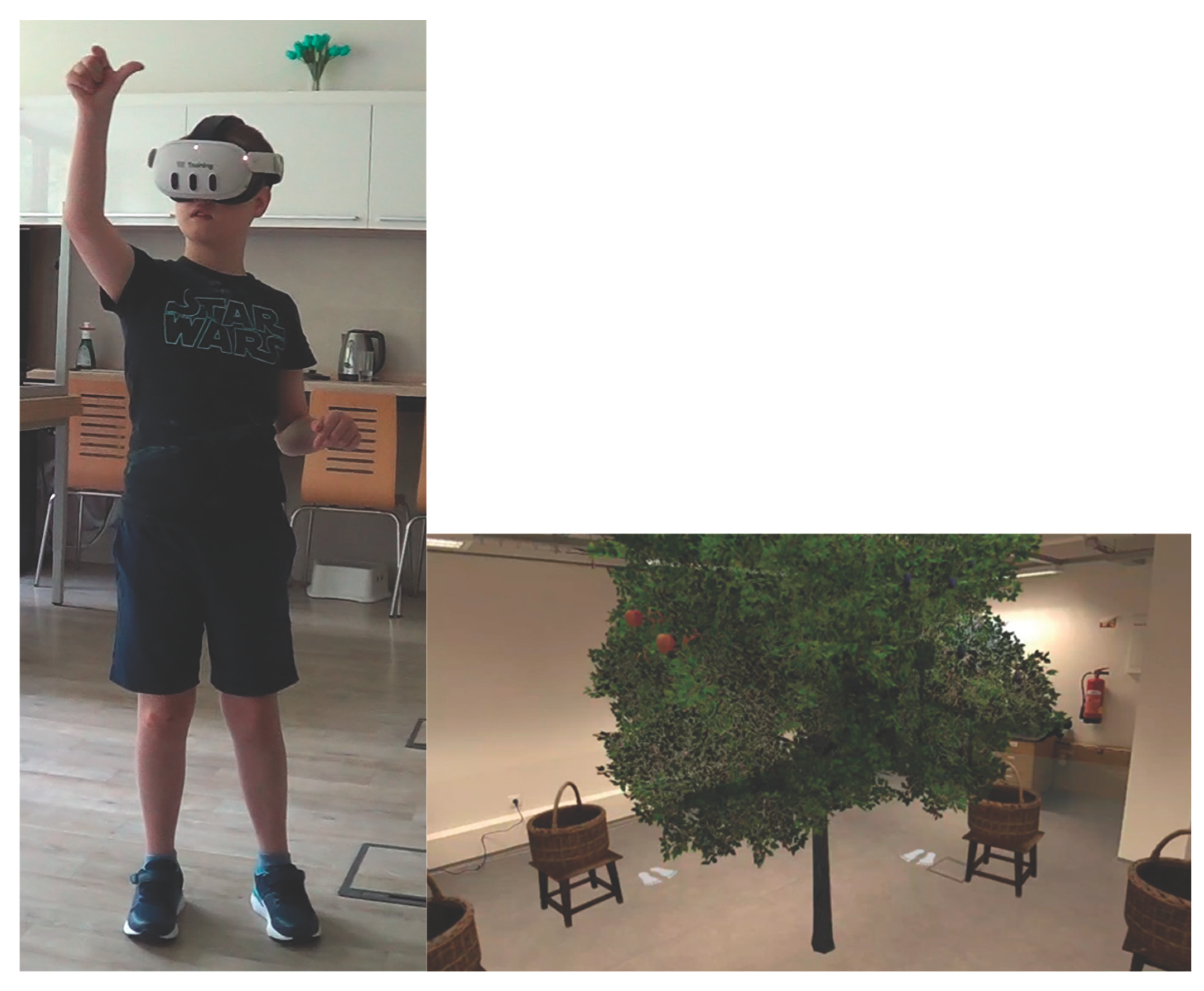
Table 1.
Basic clinical characteristics of the participants.
| ARMT group | Control group | W | p | |
| Age | 9.9 ± 2.9 years | 10.1 ± 2.2 years | 1405.0 | 0.6 |
| Sex | 13 males, 7 females | 6 males, 9 females | ||
| Body height | 140.3 ± 15.1 cm | 135.5 ± 15.6 cm | 390.5 | 0.2 |
| Body weight | 33.2 ± 11.9 kg | 33.5 ± 10.6 kg | 348.5 | 0.6 |
| Unilateral spastic CP | n = 13 (65.0%) | n = 9 (66.7%) | ||
| Bilateral spastic CP | n = 7 | n = 6 | ||
| GMFCS | I - n = 14 (57.1%) | I - n = 9 (33.3%) | 342.0 | 0.8 |
| II - n = 6 | II - n = 6 | |||
| MAS | 4.4 ± 4.2 score | 5.2 ± 5.9 score | 514.5 | 0.5 |
| Gestational age | 35.0 ± 5.9 weeks | 34.4 ± 5.4 weeks | 649.5 | 0.3 |
Note. W - statistics of Wilcoxon rank sum test; p = a probability level; CP - cerebral palsy; GMFCS = Gross motor function classification system; MAS - Modified Ashworth Scale.
Table 2.
Walking performance measures at baseline and at 4 weeks of the ARMT group.
| Intervention group | Pre intervention | Post intervention | ||||||||
| Mdn | IQR | CV % Mdn | CV % IQR | Mdn | IQR | CV % Mdn | CV % IQR | |||
| Cadence | (steps/min) | 114.4 | 22.3 | 15.3 | 10.8 | 116.4 | 17.6 | 9.5 | 7.7 | |
| Speed | (m/s) | 0.95 | 0.5 | 1.5 | 4.8 | 1.0 | 0.3 | 1.1 | 1.4 | |
| Stride length | (m) | 1.00 | 0.4 | 7.3 | 5.7 | 1.1 | 0.2 | 5.9 | 4.3 | |
| Stride length | (% height) | 72.0 | 17.8 | 7.4 | 5.2 | 75.7 | 12.5 | 5.6 | 4.6 | |
| Stride cycle duration – left | (s) | 1.10 | 0.2 | 7.8 | 5.4 | 1.0 | 0.1 | 4.8 | 3.3 | |
| Stride cycle duration – right | (s) | 1.11 | 0.2 | 5.7 | 6.1 | 1.1 | 0.2 | 4.9 | 4.0 | |
| Stance phase – left | (% stride cycle) | 59.7 | 5.0 | 7.0 | 4.6 | 59.7 | 3.9 | 5.2 | 6.1 | |
| Stance phase – right | (% stride cycle) | 59.2 | 4.5 | 6.4 | 4.3 | 59.3 | 4.1 | 6.1 | 2.9 | |
| Swing phase – left | (% stride cycle) | 40.3 | 5.0 | 9.4 | 6.1 | 40.3 | 3.9 | 7.2 | 7.5 | |
| Swing phase – right | (% stride cycle) | 40.8 | 4.5 | 10.0 | 5.4 | 40.7 | 4.1 | 9.8 | 5.3 | |
| 1st double support phase – left | (% stride cycle) | 8.7 | 3.6 | 32.3 | 13.3 | 8.9 | 3.9 | 29.3 | 19.0 | |
| 1st double support phase – right | (% stride cycle) | 9.3 | 3.1 | 32.7 | 23.4 | 9.5 | 2.4 | 26.3 | 15.0 | |
| Single support phase – left | (% stride cycle) | 40.7 | 3.7 | 9.0 | 7.6 | 40.6 | 4.0 | 9.7 | 5.6 | |
| Single support phase – right | (% stride cycle) | 40.4 | 5.5 | 12.7 | 5.8 | 40.4 | 4.5 | 8.5 | 8.7 | |
| Propulsion index – left | 7.8 | 3.1 | 23.9 | 33.4 | 9.5 | 3.6 | 21.4 | 17.9 | ||
| Propulsion index – right | 7.6 | 2.8 | 28.3 | 26.7 | 8.7 | 3.1 | 22.1 | 19.0 | ||
| Walk quality index – left | (%) | 95.2 | 6.9 | 96.1 | 7.6 | |||||
| Walk quality index – right | (%) | 96.4 | 6.1 | 97.0 | 5.6 | |||||
| Symmetry index | (%) | 91.2 | 9.7 | 89.5 | 16.0 | |||||
| Tilt symmetry index | (anterior/posterior) | 53.4 | 26.6 | 51.4 | 36.6 | |||||
| Obliquity symmetry index | (up/down) | 95.2 | 8.1 | 95.5 | 6.7 | |||||
| Rotation symmetry index | (intra/extra) | 95.1 | 4.3 | 95.1 | 4.6 | |||||
Note. Mdn - median, IQR - interquartile range; CV% Mdn - median of coefficient of variation (%) for particular measures; CV% IQR - interquartile range of coefficient of variation (%) for particular measures.
Table 3.
Walking performance measures at baseline and at 4 weeks of the control group.
| Control group | Pre intervention | Post intervention | ||||||||
| Mdn | IQR | CV % Mdn | CV % IQR | Mdn | IQR | CV % Mdn | CV % IQR | |||
| Cadence | (steps/min) | 128.3 | 20.5 | 11.2 | 10.8 | 124.6 | 25.0 | 12.6 | 10.6 | |
| Speed | (m/s) | 1.1 | 0.3 | 1.5 | 8.9 | 1.0 | 0.4 | 2.9 | 4.3 | |
| Stride length | (m) | 1.1 | 0.3 | 7.3 | 7.8 | 1.0 | 0.5 | 7.7 | 4.5 | |
| Stride length | (% height) | 73.1 | 25.9 | 7.3 | 7.7 | 74.7 | 28.6 | 6.0 | 6.7 | |
| Stride cycle duration – left | (s) | 0.9 | 0.1 | 8.0 | 7.7 | 1.0 | 0.2 | 7.6 | 4.0 | |
| Stride cycle duration – right | (s) | 0.9 | 0.1 | 4.3 | 4.2 | 1.0 | 0.2 | 5.3 | 6.4 | |
| Stance phase – left | (% stride cycle) | 59.9 | 4.4 | 5.4 | 6.9 | 60.6 | 2.4 | 5.7 | 8.8 | |
| Stance phase – right | (% stride cycle) | 60.4 | 2.9 | 4.7 | 7.2 | 60.6 | 5.0 | 5.6 | 5.3 | |
| Swing phase – left | (% stride cycle) | 40.1 | 4.4 | 7.2 | 9.6 | 39.5 | 2.4 | 9.4 | 13.5 | |
| Swing phase – right | (% stride cycle) | 39.7 | 2.9 | 8.3 | 10.7 | 39.4 | 5.0 | 8.7 | 5.8 | |
| 1st double support phase – left | (% stride cycle) | 9.7 | 3.8 | 25.2 | 8.2 | 9.8 | 3.1 | 25.6 | 27.9 | |
| 1st double support phase – right | (% stride cycle) | 10.2 | 3.3 | 20.9 | 19.4 | 10.0 | 3.4 | 21.8 | 10.6 | |
| Single support phase – left | (% stride cycle) | 39.3 | 3.0 | 8.8 | 7.6 | 40.8 | 4.4 | 9.0 | 6.3 | |
| Single support phase – right | (% stride cycle) | 40.6 | 5.0 | 11.0 | 14.1 | 39.4 | 3.6 | 12.3 | 9.2 | |
| Propulsion index – left | 13.3 | 4.7 | 18.2 | 16.6 | 9.7 | 6.5 | 16.8 | 17.3 | ||
| Propulsion index – right | 11.9 | 4.1 | 27.7 | 18.2 | 8.6 | 5.6 | 23.0 | 6.7 | ||
| Walk quality index – left | (%) | 94.9 | 4.3 | 98.0 | 5.6 | |||||
| Walk quality index – right | (%) | 97.9 | 5.7 | 96.7 | 8.4 | |||||
| Symmetry index | (%) | 90.0 | 9.1 | 88.8 | 6.1 | |||||
| Tilt symmetry index | (anterior/posterior) | 54.1 | 40.6 | 57.6 | 44.4 | |||||
| Obliquity symmetry index | (up/down) | 92.7 | 10.9 | 95.6 | 17.9 | |||||
| Rotation symmetry index | (intra/extra) | 95.4 | 6.6 | 94.7 | 9.1 | |||||
Note. Mdn - median; IQR - interquartile range; CV% Mdn - median of coefficient of variation(%) for particular measures; CV% IQR - interquartile range of coefficient of variation (%) for particular measures.
Disclaimer/Publisher’s Note: The statements, opinions and data contained in all publications are solely those of the individual author(s) and contributor(s) and not of MDPI and/or the editor(s). MDPI and/or the editor(s) disclaim responsibility for any injury to people or property resulting from any ideas, methods, instructions or products referred to in the content. |
© 2026 by the authors. Licensee MDPI, Basel, Switzerland. This article is an open access article distributed under the terms and conditions of the Creative Commons Attribution (CC BY) license (http://creativecommons.org/licenses/by/4.0/).
Copyright: This open access article is published under a Creative Commons CC BY 4.0 license, which permit the free download, distribution, and reuse, provided that the author and preprint are cited in any reuse.


