

Submitted:
07 June 2026
Posted:
17 June 2026
You are already at the latest version
Abstract
Four clinical literatures — psychedelic-assisted therapy, accelerated transcranial magnetic stimulation, closed-loop deep brain stimulation, and reconsolidation-based trauma therapy — produce durable change from brief, often single, interventions in conditions the current standard of care has not solved. The convergence is not procedural. Each modality transiently induces a high-plasticity brain state — a window with roots in critical-period biology, memory reconsolidation, and the critical-brain literature in statistical physics — and the experience delivered into that state, not the intervention that opened it, is what produces the durable change. Stimulus and experience are co-equal active ingredients: the durable change is their product. Treatments that open the window without controlling what enters it, or deliver the right experience outside it, fail for reasons of timing and context rather than of the intervention itself. Naming the window as a measurable, manipulable variable turns these scattered results into one framework with testable predictions — about when to intervene, what to pair an opener with, and how to sequence treatments — and gives trial design and clinical practice a target the current paradigm does not provide.
Keywords:
neuronal plasticity
; psychotherapy
; transcranial magnetic stimulation
; deep brain stimulation
; hallucinogens
1. The Cracks in Maintenance
Modern psychiatric practice rests on a paradigm: a categorical diagnosis names a chronic dysregulation, and daily medication holds the brain in a more functional configuration for as long as it is taken. Discontinuation produces relapse. Psychotherapy supplements at weekly intervals. The frame has organized the field since the introduction of the DSM-III and the rise of monoaminergic pharmacology.[1,2]
It does not accommodate the results now arriving from four directions at once. Two doses of psilocybin paired with psychological support produce large and stable antidepressant effects through twelve months in roughly half of patients with major depression in open-label follow-up, and a single 25 mg dose produces durable response at twelve weeks in about a fifth of patients with treatment-resistant depression under placebo control;[3,4] the head-to-head trial against escitalopram showed no significant difference on its primary endpoint while favoring psilocybin on most secondary measures.[5] Three sessions of MDMA combined with psychotherapy produce durable PTSD symptom reduction in patients who had failed conventional treatment, replicated across two phase 3 trials.[6,7] A five-day course of accelerated intermittent theta-burst stimulation produces remission rates in treatment-resistant depression that pharmacotherapy reaches only after multiple sequential trials, if at all.[8,9] A patient with severe treatment-resistant depression, implanted with a closed-loop deep brain stimulation device triggered by a patient-specific neural biomarker, achieves rapid and sustained remission.[10,11] Across the trauma literature, propranolol delivered during memory retrieval, EMDR, and the reconsolidation-adjacent effects of MDMA-assisted therapy demonstrate that consolidated memories are not fixed.[12,13]
None of these findings is new. Their simultaneity is. Each produces durable change from a brief intervention, which the maintenance paradigm cannot describe. The drug is not holding the brain in place. Something else is.
The field has noticed. The term “interventional psychiatry” has emerged to group these treatments by their procedural delivery, modeled on interventional cardiology and radiology.[14,15,16] The grouping is real but undertheorized. Textbook treatments of interventional psychiatry list ECT, TMS, ketamine, esketamine, vagus nerve stimulation, deep brain stimulation, and psychedelics together because they are procedures, not because there is a stated account of why they share the same temporal signature. The unstated account is the subject of this paper. Grouping by delivery route predicts nothing; grouping by mechanism predicts where each modality should succeed and fail, and how the modalities should combine.
2. The Framework
We state the model first and derive from there. Four axioms.
A1.
A circumscribed temporal interval of heightened experience-dependent neural malleability — a plasticity window — can be opened in the adult brain by interventions including pharmacological 5-HT2A agonism, NMDA antagonism, accelerated cortical stimulation, electrical modulation during specific neural states, and behavioral memory retrieval.
A2.
The duration of the window is approximately proportional to the duration of the acute perturbation that opens it, with substantial inter-individual variance modulated by age, prior plasticity, and circuit-specific molecular state.
A3.
Durable clinical change is produced by the corrective experience delivered during the window, not by the intervention that opened it. The opener is necessary but not sufficient.
A4.
Closure of the window restores prior dynamics unless the corrective experience has restructured the relevant circuit or memory trace during the interval of openness.
A1 and A2 follow from the critical-period work of Dölen and colleagues[17,18] and the molecular plasticity literature on psychedelics.[19,20,21] A3 is the implicit logic of psychedelic-assisted therapy, of reconsolidation-blockade trials, and of integration-focused protocols across modalities.[22,23,24] A4 is the explanation for why pharmacological openers without paired psychological work produce smaller and less durable effects than the same compounds embedded in therapeutic structure.[25] What is new is the claim that the four axioms generalize across the full interventional spectrum and that the spectrum should be understood as a single phenomenon with multiple openers.
Two of the axioms carry most of the empirical risk, and it is worth saying so plainly. A3 is the load-bearing claim and the one most exposed to falsification: it asserts that timing relative to the opener matters, holding content and dose constant. A4 risks circularity unless “corrective” can be defined independently of outcome, which it cannot yet be — a limitation we return to as the central open problem rather than disguise as a strength.
The axioms have a structure, and the structure is worth writing down. Two quantities determine durable change: the openness of the relevant circuit — the plastic state induced by the opener — and the experience delivered while that state holds. We call their relationship circuit state–experience coupling. Its simplest form is multiplicative:
ΔC = S × E
ΔC is durable change. S is the circuit’s plastic state — how open the window is, and for how long. E is the corrective experience delivered into it, with timing folded in: an experience that arrives after the window has closed is, functionally, a weak experience, and scores low on E. The form is multiplicative rather than additive for a reason that is the whole claim. Addition would let a large enough opener carry a patient with no experiential input, and a rich enough experience work with no opener; either term could go to zero and still yield change. Multiplication forbids that. Neither term alone produces durable change, and a large value of one can compensate for a small value of the other. This is the precise statement of co-equal active ingredients: not that the two contribute equally in every case, but that both are active, neither is decoration, and the product, not the sum, is what the field should be optimizing.
The equation is a statement of form, not a fitted model. We are claiming the shape of the relationship — multiplicative, with timing inside E — not the coefficients, which no one can yet supply because E cannot yet be measured in its own units. Supplying those coefficients is the measurement program of section 8. The honest reading of the equation is that its gap is the research agenda: it says exactly what would have to be measured to complete it.
Written for a single circuit, the relationship generalizes across circuits. A patient is not one value of S and one of E but a profile across the brain’s functional domains, indexed to the domains of the Research Domain Criteria framework:[26]
ΔCi = Si × Ei
The subscript i runs over circuits — the reward circuit, the fear circuit, the cortico-striatal loop, and so on. Plasticity in one circuit can be wide open while another is rigidly closed, and an experience corrective for one domain may be inert for another. This indexed form is what lets the framework speak to diagnosis rather than only to treatment, which we take up in section 6.
2.1. Where This Comes From outside of Psychiatry
The framework is not invented. Three lineages outside of psychiatry have been describing pieces of it for decades, and the framework’s scientific weight comes from how cleanly the four axioms map onto them.
The first is developmental neuroscience. Hubel and Wiesel established in the 1960s that primary visual cortex has a critical period for ocular dominance plasticity that closes with the maturation of inhibitory circuits, specifically parvalbumin-positive GABAergic interneurons.[27] Hensch and colleagues identified the molecular brakes that close the window: perineuronal nets accumulating on the surface of parvalbumin interneurons, Otx2 protein binding into those nets to stabilize them, and the Lynx1 cholinergic brake on plasticity.[28,29,30] Pharmacological or enzymatic removal of perineuronal nets in adult animals reactivates ocular dominance plasticity decades after the critical period has closed.[31,32] Chronic fluoxetine reinstates the same plasticity in adult cortex through reduced intracortical inhibition and increased BDNF, which is the first hint that the most prescribed drug class in psychiatry already operates a weak version of the mechanism.[33] Dölen’s 2023 demonstration that psychedelics reopen a critical period for social reward learning, with a molecular signature involving extracellular matrix reorganization, extends the lineage from sensory to social and affective circuits.[18] A1 and A2 inherit from forty years of developmental work; we are not asking psychiatry to accept a novel biology, only to apply a known one.
The second is memory systems neuroscience. Kandel’s work in Aplysia established the molecular machinery of consolidation.[34] Nader and LeDoux’s 2000 finding that retrieval of a consolidated fear memory makes it transiently labile and dependent on new protein synthesis for re-storage is the experimental foundation of every reconsolidation-based clinical intervention now in trial.[13,35] The clinical trauma literature is not a separate phenomenon; it is the bedside translation of bench work that goes back twenty-five years. Propranolol-during-retrieval works because of the same biology that controls reconsolidation in rodent amygdala. EMDR’s bilateral stimulation interacts with the same retrieval-opened window. MDMA-assisted therapy may operate as a particularly powerful reconsolidation intervention. A4 — the claim that closure of the window restores prior dynamics unless the experience has restructured the trace — is the reconsolidation literature’s central finding restated.
The third lineage is the critical-brain hypothesis from statistical physics. Beggs and Plenz observed in 2003 that bursts of cortical activity in vitro and in vivo follow power-law distributions characteristic of a system near a phase transition.[36] Subsequent work established that these “neural avalanches” are signatures of a brain operating near a critical point — the dynamical regime where small perturbations can produce disproportionate responses, where correlations span arbitrarily large scales, and where information processing is optimized.[37,38] The healthy brain appears to sit near this point. A plasticity window, in this reading, is a transient departure from that baseline: a destabilization that raises susceptibility to perturbation. The direction of the departure is not fixed. Recent DMT work shows the psychedelic state moves alpha and adjacent oscillatory dynamics away from criticality, toward more entropic, subcritical regimes, and that the size of the shift tracks the intensity of self-dissolution.[39] What matters for the framework is not that openers move the brain toward criticality but that they move it off its baseline into a higher-malleability regime measurable in the formal language the critical-brain literature already uses.[40,41,42,43] What the corrective experience does is bias which attractor the system relaxes into when baseline dynamics are restored.
This is the level of theoretical machinery that the rest of biomedicine routinely deploys and that psychiatry has historically resisted. The argument is not that we should invent new physics; it is that psychiatry should use the physics that already exists in its adjacent fields. The framework is a clinical instance of a more general phenomenon, and that is its strength.
3. The Modalities Through the Framework
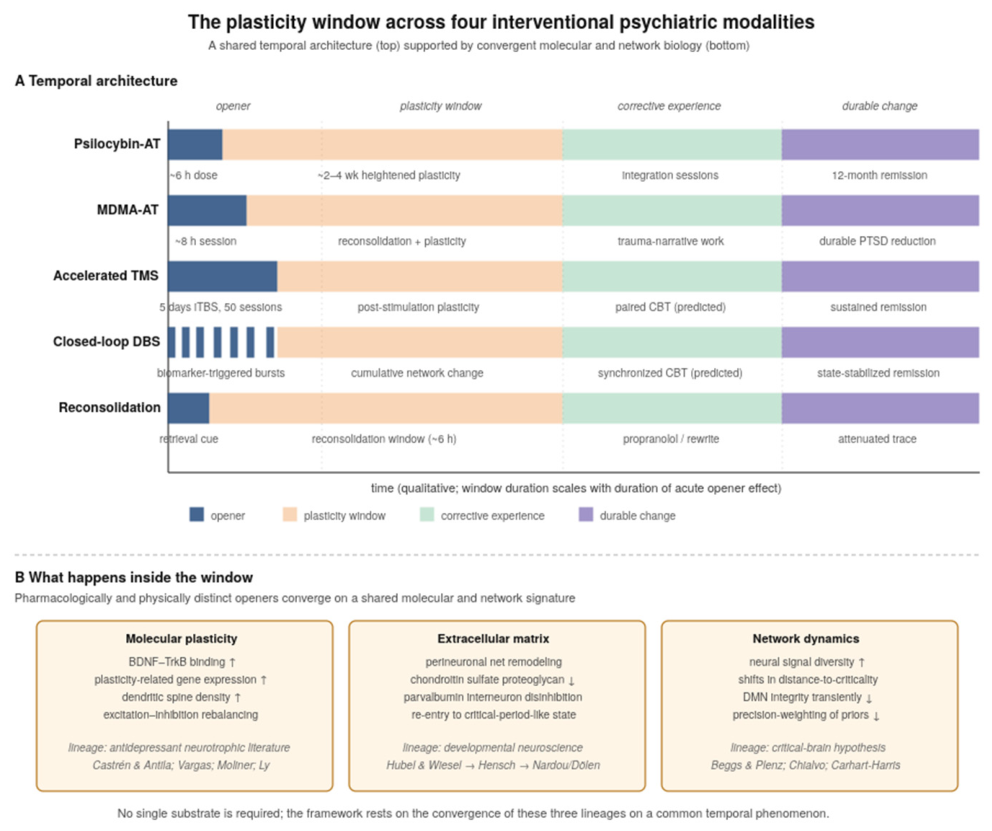
We treat each modality briefly, focusing on what the framework reads and what previous accounts have missed. Figure 1 shows the common temporal architecture across the four modalities (panel A) and the molecular and network biology proposed to operate inside the window (panel B). The figure carries the central argument: pharmacologically and physically distinct openers produce the same temporal phenomenon because they converge on shared downstream biology. That convergence is documented for psychedelics and stands as a prediction, not a finding, for the stimulation-based openers — a distinction the figure marks and the text below keeps.
3.1. Psychedelic-Assisted Therapy
Classical psychedelics act as 5-HT2A agonists and produce a glutamatergic surge in layer V pyramidal neurons with sustained downstream markers of structural plasticity.[19,20,21] Ketamine and MDMA reach the same endpoint through NMDA antagonism and monoamine release respectively.[44,45] The pharmacological diversity converging on shared plasticity signatures is the first evidence that receptor occupancy is not the right level of description.
The drug-versus-therapy debate that intensified after the FDA’s August 2024 rejection of MDMA-assisted therapy for PTSD presupposes a separation the framework rejects.[22,23] The drug opens the window. The therapy delivers the corrective experience. Trials that strip the psychotherapy in pursuit of clean pharmacological signal are not isolating the active ingredient; they are degrading the intervention and then measuring the degradation. The struggle to demonstrate efficacy in blinded pharmacology-only designs is not a problem with the drugs. It is a problem with the design — and the framework predicted the place the design would break before the rejection made it visible.
3.2. Accelerated Brain Stimulation
Stanford Neuromodulation Therapy compresses six weeks of daily TMS into fifty fMRI-personalized sessions delivered across five days. The open-label protocol produced remission approaching ninety percent; the sham-controlled randomized trial, the number that should anchor any claim, produced remission of fifty-seven percent immediately after treatment and forty-six percent at one month, against zero percent under sham, with response near seventy-one percent.[8,46] A subsequent randomized trial replicated the effect at a more conservative magnitude.[9] The remission persists for months after stimulation has stopped, which the maintenance paradigm cannot describe. Under the framework, the five-day protocol is a sustained opener; the post-stimulation interval is a plasticity window; the change that persists is whatever restructured the dorsolateral prefrontal–subgenual cingulate circuit during that interval. Whether that restructuring comes from spontaneous neural activity, from the patient’s lived experience during the window, or from structured intervention delivered in synchrony with it is an open question the field has not seriously asked. The recent FDA clearance of accelerated protocols for adolescent depression extends the same procedural logic to younger patients.[47]
3.3. Closed-Loop Neuromodulation
Open-loop deep brain stimulation for treatment-resistant depression has produced inconsistent results in controlled trials despite striking open-label responses, a pattern that has stalled the field for a decade.[48,49] The framework reads that inconsistency as informative rather than disqualifying: stimulation delivered without regard to neural state is an opener fired at the wrong time. The Scangos approach — multi-day intracranial recording to identify a patient-specific symptom biomarker, then chronic implantation that delivers stimulation only when the biomarker fires — produced rapid and sustained remission in an initial single-patient case and is now being tested at scale.[10,11,50,51] Under the framework, the high-symptom states detected by the biomarker may themselves be windows: intervals of heightened dynamic instability during which intervention produces disproportionate effect. This reading is consistent with the critical-brain literature, in which the most clinically severe states may correspond to the largest departures from healthy baseline dynamics, where the system is most susceptible to small targeted inputs. The framework predicts that closed-loop stimulation paired with synchronized psychological intervention — cognitive-behavioral content delivered during the symptom state — would outperform stimulation alone. This has not been tested.
3.4. Memory Reconsolidation in Trauma
Consolidated memories enter a labile state on retrieval and can be modified before being re-stored.[13,35] Propranolol administered after retrieval produces durable reductions in physiological reactivity and self-reported PTSD symptoms in several trials, while other rigorous trials find no effect.[12,52,53,54] The framework reads the split not as noise but as a timing problem: reconsolidation has a defined molecular window, and protocols that miss it should fail. EMDR’s bilateral stimulation appears to interact with the retrieval-opened window.[55] MDMA-assisted therapy may operate as a particularly potent reconsolidation intervention by reducing amygdala threat-response while preserving the capacity to engage with traumatic content.[56] The trauma literature has been the most explicit about plasticity-window logic; it is also where the framework’s predictions about combination are most directly testable. Propranolol delivered during MDMA-facilitated retrieval, with structured trauma-narrative work, is a combination the framework predicts should outperform any of the three alone. We are not aware that it has been studied.
4. Parallels the Field Has Not Drawn
Two clinical analogies deserve brief treatment, because they suggest the framework is less exotic than its current absence in psychiatric literature would imply.
Stroke rehabilitation operates the framework, in a limited form, and has for decades. The stroke itself opens a plasticity window in motor and premotor cortex; constraint-induced movement therapy works by forcing intensive use of the affected limb during that window, producing durable functional change after the window closes.[57,58] Edward Taub’s work established the principle, and modern rehabilitation neurology treats the post-stroke interval as a time-bounded opportunity in which behavioral intervention has disproportionate effect. The clinical infrastructure, the temporal logic, and the explicit framing of “use it during the window or lose the gain” are already present in a sister specialty. Psychiatry would not be inventing the paradigm. It would be importing one.
Cardiology supplies the structural analogue. Over roughly forty years, cardiology evolved from a medication-maintenance specialty into a procedure-plus-maintenance specialty driven by the technical capacity to intervene at moments of acute pathology and to deliver durable structural change. Daily medication supports rather than constitutes treatment for many patients with coronary artery disease, valvular dysfunction, or arrhythmia. The procedural unit is the catheterization, the ablation, the valve replacement. The conceptual move — procedure paired with integration interval, maintenance medication supporting rather than constituting treatment — is the move psychiatry is being asked to make. Cardiology demonstrates that it can be made, and at what time scale, with what infrastructure, and with what training implications.
5. Consequences
5.1. The Drug-Versus-Therapy Question Is Malformed
Under the framework, asking whether MDMA-assisted therapy works because of the drug or because of the psychotherapy is asking whether a vaccine works because of the antigen or because of the immune response. The question presupposes a separation the biology does not respect. The regulatory implication is that approval pathways requiring clean pharmacological signal independent of psychological context are testing a fiction. The clinical implication is that any window-opening intervention delivered without attention to what is delivered into the window is being under-used.
5.2. State Rather Than Trait
If treatment is delivered into a window, illness should be understood in terms of the dynamics that determine when the window is open or closeable. This is closer to the RDoC framework than to DSM categories,[26] but it differs from RDoC in treating temporal dynamics as primary rather than as features of an underlying dimensional structure. Treatment-resistant depression is not a failed patient. It is a state-dynamics problem that the available openers and experiences have not perturbed. Outcome captured as a single rating-scale score at twelve weeks is poorly matched to an illness understood this way; continuous biomarker-informed measurement, of the kind closed-loop research is already building, is the appropriate target.
5.3. Procedure Rather Than Prescription
The unit of treatment becomes the procedure plus its integration interval, not the daily dose. The cardiology analogue makes the trajectory concrete. The framework supplies the theoretical reason: durable change is produced by what happens in the window, and the window is opened by the procedure.
6. Diagnosis: Which Term Is Failing
The framework so far is a theory of treatment and outcome. It also has an implication for diagnosis that the indexed equation makes unavoidable, and that the field has not drawn. If durable change in a circuit is the product of that circuit’s plastic state and the experience delivered into it, then a patient who does not improve is failing on one of two terms, in one or more specific circuits. Either the state term is the problem — the window will not open, opens too briefly, or the circuit’s adult plasticity is rigidly closed — or the experience term is the problem — the window opens but nothing corrective is delivered into it, or the patient cannot engage with what is delivered. The diagnostic question becomes which term is failing, in which circuit. Diagnosis and treatment selection become the same act: a state-limited circuit needs a stronger or better-timed opener, an experience-limited circuit needs the experience redesigned or delivered while the window is open.
This is a different object from both DSM categories and the Research Domain Criteria. DSM names a syndrome from symptoms and says nothing about mechanism. RDoC improves on this by describing patients dimensionally along circuit-based domains — negative valence, positive valence, cognitive systems, social processes, arousal, sensorimotor — but it remains descriptive, and a recurring criticism is that its domains are too broad to map cleanly onto the underlying circuitry.[26,59] Coupling adds what RDoC lacks: not another way to describe the circuit, but an account of why intervention does or does not produce durable change in it, and what to do about it. RDoC supplies the domains; coupling supplies the failing term and the prescription. The three conditions already in this paper illustrate the move.
Treatment-resistant depression is, in a substantial fraction of patients, a positive-valence problem. Anhedonia and reward-processing deficits localize to the mesolimbic reward circuit and the nucleus accumbens, and they specifically predict non-response to conventional antidepressants.[60,61] Ketamine produces rapid synaptic plasticity in nucleus accumbens reward neurons, and its anti-anhedonic effect outlasts and is partly independent of its general antidepressant effect.[62,63] Read through the framework, treatment resistance of this kind is a state-limited failure in the reward circuit: monoaminergic openers do not open that window, and no amount of generic supportive contact multiplies against a near-zero state term. The prescription the framework writes is not another antidepressant but an opener that reaches the reward circuit, paired with experience that engages reward and motivation specifically.
PTSD is the mirror case. The fear circuit — amygdala, with deficient top-down control from ventromedial prefrontal cortex — is not plasticity-locked; retrieval of a consolidated fear memory opens a reconsolidation window on demand.[64,65] The state term is readily available. What fails is the experience term and its timing: the corrective experience must be delivered into the labile interval, and it frequently is not. This is why propranolol-during-retrieval results split on protocol rather than on whether the drug works — the positive and null trials differ in whether the corrective manipulation landed inside the molecular window.[12,53,54] PTSD is an experience-limited, timing-limited coupling failure in a circuit whose state term is one of the most accessible in psychiatry.
OCD shows the framework operating with both terms supplied. The cortico-striato-thalamo-cortical loop is hyperconnected in OCD, and both deep brain stimulation and dorsomedial prefrontal stimulation reduce that hyperconnectivity and modulate striatal plasticity.[66,67,68] Stimulation is the opener that shifts the circuit state; exposure and response prevention is the corrective experience delivered into the shifted state; symptom reduction on the Yale–Brown scale is the durable change. The framework’s prediction follows directly from the product form: stimulation timed to and paired with exposure work should outperform either delivered alone, and recent evidence that the plasticity effects of cortical stimulation are state-dependent — larger when the target circuit is actively engaged at the time of stimulation — is the first direct support for exactly this.[69] Meta-analysis finds that stimulation combined with structured psychological intervention outperforms stimulation paired with a sham intervention for moderate-to-severe depression, consistent with the claim that what enters the window is doing real work.[70]
None of these reclassifications is established. Each is a worked example of how the framework would diagnose, stated at the level the current evidence supports and no further. What the framework supplies that the symptom-based and dimensional systems do not is a diagnosis that names the failing term and, in naming it, names the intervention.
7. Proxy Observables and Falsification
A framework that cannot be refuted is not a framework. We state predictions whose disconfirmation would weaken or falsify the model, ordered from the most decisive to the most exploratory.
First, and most decisive: structured psychological intervention delivered during the post-opener interval should produce larger and more durable effects than the same intervention delivered outside it. The prediction is specific about time course. Integration sessions within forty-eight hours of ketamine infusion should outperform the same sessions at two weeks; CBT delivered within the week following an accelerated TMS course should outperform CBT delivered at three months; structured trauma-narrative work conducted within hours of MDMA dosing should outperform the same work conducted at weekly intervals. Content and dose held constant, if timing produces no effect, A3 is wrong, and the framework falls with it. This is the experiment that matters most and the one the field can run now.
Second, the duration of the window should be measurable non-invasively. Candidate signatures include increased neural signal diversity on EEG, elevated Lempel–Ziv complexity in resting-state recordings, reduced precision-weighting of high-level priors detectable in mismatch-negativity paradigms, altered functional connectivity within default-mode and salience networks, and changes in distance-to-criticality measures developed in the critical-brain literature.[40,41,42,43] Validation requires convergence: the same temporal window should be detectable by independent modalities, its duration should correlate with the duration of subjective effect for psychedelic openers, and the signature should predict the magnitude of durable change. This is also where the cross-modality claim is tested. The molecular and dynamical signature is established for psychedelics; finding the same signature after accelerated TMS and during biomarker-triggered DBS states is a prediction, and its absence would show the four modalities only resemble one another rather than sharing a mechanism. Absence of convergence across modalities would falsify A2 and force the framework back to a single-modality claim.
Third, openers delivered in rapid succession should produce subadditive effects — the second window does not stack on the first because the first has not yet closed — while openers separated by an interval longer than the first window’s duration should produce additive or superadditive effects. This makes dose-titratable predictions about the optimal sequencing of, for example, ketamine followed by psilocybin, or accelerated TMS followed by psychedelic-assisted therapy. If sequencing produces no effect under controlled comparison, the framework is wrong about A4.
Fourth, and more exploratory: classical maintenance medications should be re-examined for whether they produce transient plasticity windows during initiation that the field has not exploited. The animal evidence that fluoxetine reopens ocular dominance plasticity gives this prediction a mechanism rather than only clinical lore.[33] If the first month of SSRI treatment is when paired psychotherapy yields the largest gains, that is a plasticity-window phenomenon hiding in the most prescribed drug class in psychiatry. If first-month initiation effects do not appear when tested against later intervals, the framework’s generality is weakened, though its core is untouched.
Fifth, illnesses with the most rigidly closed adult plasticity windows in the relevant circuits should be the most chronic and least responsive to brief intervention, while conditions with more naturally fluctuating dynamics should respond more readily to windowed intervention timed to those dynamics. This is a population-scale prediction that does not depend on identifying any single biomarker.
8. The Measurement Problem
Claiming a plasticity window exists is not the same as measuring one. Psychiatry has a long history of constructs whose operational definitions degraded as they traveled from theory into clinical practice. The framework requires three forms of validation that the field has not historically demanded of its constructs.
Convergent validity: independent measurement modalities applied to the same patient during the same interval should agree on whether the window is open. EEG signal-diversity measures, MEG-derived neural-noise estimates, fMRI-derived dynamic functional connectivity, behavioral indices of perceptual flexibility, and distance-to-criticality estimates from neural avalanche statistics should converge. If they diverge systematically, at least one is measuring something other than what the framework specifies. This is the standard statistical physics uses for any latent quantity inferred rather than directly observed; psychiatry has historically operated with weaker standards and has paid the price in constructs that did not survive replication.
Retrodictive validity: the proposed measure should correctly identify windows in cases where the framework already commits to their existence. A measure that fails to register a window during the acute phase of psilocybin dosing, or that fails to detect the post-stimulation interval after accelerated iTBS, is not measuring what we want it to measure, regardless of internal mathematical consistency.
Predictive validity: the measured duration and intensity of the window in an individual patient should predict the durability of clinical response to a corrective experience delivered into it. This is the hardest test and the one most worth designing for. If the measure does not predict outcome at the individual level, it is not clinically useful even if it is theoretically motivated. The framework would survive measurement failure of this kind — the underlying claim is not refuted by a failed measure — but its clinical relevance would not.
9. Open Problems
The framework, if adopted, reorganizes a set of problems currently scattered across subfields and exposes others that have not been formulated at all.
Non-invasive window detection. The clinical translation of every prediction in section 7 depends on the ability to identify, in an awake human, when a plasticity window is open and when it has closed. No such measure currently exists at the precision the framework requires. Candidate approaches combining high-density EEG, MEG, and pharmacological challenge are tractable with existing technology.
A circuit-level taxonomy. The DSM categories were not constructed to map onto plasticity windows or onto the circuits whose dynamics determine when those windows are open. A circuit-level nosology grounded in measurable state dynamics rather than symptom clusters is a multi-decade project. RDoC is the closest existing scaffold. Whether RDoC dimensions can accommodate a temporally dynamic, window-based taxonomy, or whether a successor framework is required, is unresolved.
The biology of the corrective experience. The framework specifies that the corrective experience is the active ingredient. It does not specify what makes an experience corrective. The therapeutic-alliance literature, the placebo literature, and the predictive-processing literature converge on the same intuition — something about expectation, attention, and meaning makes the difference — without operationalizing it. This is the framework’s most serious gap, the point at which A3 and A4 risk circularity, and the work that would turn the framework from a description into a science. An account of what distinguishes a corrective from a non-corrective experience, at the level of the neural and computational processes engaged during the window, is what the framework most needs and least supplies.
Sequencing and combination. Almost no controlled work exists on how multiple openers should be sequenced, how integration should be timed relative to closure, or how pharmacological and stimulation-based openers interact in series. The combinations the framework predicts should outperform monotherapy are testable now with existing approved interventions.
Population-scale delivery. Closed-loop neuromodulation, fMRI-personalized accelerated TMS, and psychedelic-assisted therapy with adequate therapist contact are infrastructure-heavy in ways the maintenance paradigm was not. The patients who would benefit most from rapid, durable remission are not the patients who currently access quaternary academic centers. The framework makes this an equity problem by construction, not by appendix: if the unit of treatment is the procedure plus its integration interval, then access is a function of infrastructure, and infrastructure is unevenly distributed. A non-invasive window-detection measure that requires only consumer-grade EEG would address the technical and the equity problems at once.
10. What Psychiatry Has Cost Itself
Psychiatry has reasons to be suspicious of theory-first frameworks. The disasters that produced the modern field — prefrontal lobotomy administered to tens of thousands of patients on the strength of a theoretical claim about frontal lobe disinhibition, the refrigerator-mother account of autism, the recovered-memory movement — were all theory-first. The reaction was an epistemic culture that privileges symptom-level description, statistical inference from large heterogeneous samples, and incremental change over speculative reorganization.
That caution has been productive in some ways and expensive in others. The cost is visible in the field’s difficulty doing what other domains routinely do: write down a model, derive its consequences, design an experiment whose result could falsify the model, and act on the result. The four literatures synthesized here have each made progress under that discipline within their own confines. None has been read as part of a larger framework, in part because the field does not reward that kind of reading. This paper is an attempt to do it anyway. The framework may be wrong; the predictions in section 7 are stated specifically enough that they could refute it. What is not optional is the willingness to state claims at the level of generality where they could be wrong.
11. Conclusion
Four clinical literatures converge on a structure the field has not named. The plasticity window organizes them, and the lineages from developmental neuroscience, memory systems, and statistical physics supply the basic-science scaffolding the framework rests on. The framework dissolves the drug-versus-therapy question, points toward state-based nosology, reframes psychiatry as a procedural specialty, retrodicts the field’s recent failures as failures of timing rather than of intervention, and generates predictions specific enough to be wrong. It also imposes obligations: measurement standards the field has historically not held itself to, attention to timing that current trial design does not capture, and honesty about what kinds of evidence would refute it. The patients whose treatment is currently optimized against a paradigm that does not describe the durable change being produced are the ones this is for.
References
- Kirsch, I.; Deacon, B.J.; Huedo-Medina, T.B.; et al. Initial severity and antidepressant benefits: a meta-analysis of data submitted to the Food and Drug Administration. PLoS Med. 2008, 5, e45. [Google Scholar] [CrossRef] [PubMed]
- Cipriani, A.; Furukawa, T.A.; Salanti, G.; et al. Comparative efficacy and acceptability of 21 antidepressant drugs for the acute treatment of adults with major depressive disorder: a systematic review and network meta-analysis. Lancet 2018, 391, 1357–66. [Google Scholar] [CrossRef] [PubMed]
- Gukasyan, N.; Davis, A.K.; Barrett, F.S.; et al. Efficacy and safety of psilocybin-assisted treatment for major depressive disorder: prospective 12-month follow-up. J. Psychopharmacol. 2022, 36, 151–8. [Google Scholar] [CrossRef] [PubMed]
- Goodwin, G.M.; Aaronson, S.T.; Alvarez, O.; et al. Single-dose psilocybin for a treatment-resistant episode of major depression. N Engl. J. Med. 2022, 387, 1637–48. [Google Scholar] [CrossRef] [PubMed]
- Carhart-Harris, R.; Giribaldi, B.; Watts, R.; et al. Trial of psilocybin versus escitalopram for depression. N Engl. J. Med. 2021, 384, 1402–11. [Google Scholar] [CrossRef] [PubMed]
- Mitchell, J.M.; Bogenschutz, M.; Lilienstein, A.; et al. MDMA-assisted therapy for severe PTSD: a randomized, double-blind, placebo-controlled phase 3 study. Nat. Med. 2021, 27, 1025–33. [Google Scholar] [CrossRef] [PubMed]
- Mitchell, J.M.; Ot’alora, G. M.; van der Kolk, B.; et al. MDMA-assisted therapy for moderate to severe PTSD: a randomized, placebo-controlled phase 3 trial. Nat. Med. 2023, 29, 2473–80. [Google Scholar] [CrossRef] [PubMed]
- Cole, E.J.; Phillips, A.L.; Bentzley, B.S.; et al. Stanford Neuromodulation Therapy (SNT): a double-blind randomized controlled trial. Am. J. Psychiatry 2022, 179, 132–41. [Google Scholar] [CrossRef] [PubMed]
- van Rooij, S.J.H.; Arulpragasam, A.R.; McDonald, W.M.; Philip, N.S. Accelerated TMS — moving quickly into the future of depression treatment. Neuropsychopharmacology 2024, 49, 128–37. [Google Scholar] [PubMed]
- Scangos, K.W.; Khambhati, A.N.; Daly, P.M.; et al. Closed-loop neuromodulation in an individual with treatment-resistant depression. Nat. Med. 2021, 27, 1696–700. [Google Scholar] [CrossRef] [PubMed]
- Sellers, K.K.; Cohen, J.L.; Khambhati, A.N.; et al. Closed-loop neurostimulation for the treatment of psychiatric disorders. Neuropsychopharmacology 2024, 49, 163–78. [Google Scholar] [PubMed]
- Brunet, A.; Saumier, D.; Liu, A.; Streiner, D.L.; Tremblay, J.; Pitman, R.K. Reduction of PTSD symptoms with pre-reactivation propranolol therapy: a randomized controlled trial. Am. J. Psychiatry 2018, 175, 427–33. [Google Scholar] [CrossRef] [PubMed]
- Nader, K.; Schafe, G.E.; LeDoux, J.E. Fear memories require protein synthesis in the amygdala for reconsolidation after retrieval. Nature 2000, 406, 722–6. [Google Scholar] [CrossRef] [PubMed]
- Trapp, N.T.; Williams, N.R. The future of training and practice in neuromodulation: an interventional psychiatry perspective. Front Psychiatry 2021, 12, 734487. [Google Scholar] [CrossRef] [PubMed]
- Williams, N.R.; Taylor, J.J.; Kerns, S.; et al. Interventional psychiatry: how should psychiatric educators incorporate neuromodulation into training? Acad. Psychiatry 2014, 38, 168–76. [Google Scholar] [CrossRef] [PubMed]
- de Quevedo, J.L.; Brunoni, A.R.; Hamani, C. (Eds.) Interventional psychiatry: road to novel therapeutics; Academic Press/Elsevier: London, 2024. [Google Scholar]
- Lepow, L.; Morishita, H.; Yehuda, R. Critical period plasticity as a framework for psychedelic-assisted psychotherapy. Front Neurosci. 2021, 15, 710004. [Google Scholar] [CrossRef] [PubMed]
- Nardou, R.; Sawyer, E.; Song, Y.J.; et al. Psychedelics reopen the social reward learning critical period. Nature 2023, 618, 790–8. [Google Scholar] [CrossRef] [PubMed]
- Vargas, M.V.; Dunlap, L.E.; Dong, C.; et al. Psychedelics promote neuroplasticity through the activation of intracellular 5-HT2A receptors. Science 2023, 379, 700–6. [Google Scholar] [CrossRef] [PubMed]
- Moliner, R.; Girych, M.; Brunello, C.A.; et al. Psychedelics promote plasticity by directly binding to BDNF receptor TrkB. Nat. Neurosci. 2023, 26, 1032–41. [Google Scholar] [CrossRef] [PubMed]
- Ly, C.; Greb, A.C.; Cameron, L.P.; et al. Psychedelics promote structural and functional neural plasticity. Cell Rep. 2018, 23, 3170–82. [Google Scholar] [CrossRef] [PubMed]
- Zamaria, J.A.; Fernandes-Osterhold, G.; Shedler, J.; Yehuda, R. Psychedelics assisting therapy, or therapy assisting psychedelics? The importance of psychotherapy in psychedelic-assisted therapy. Front Psychol. 2025, 16, 1505894. [Google Scholar] [CrossRef] [PubMed]
- Goodwin, G.M.; Malievskaia, E.; Fonzo, G.A.; Nemeroff, C.B. Must psilocybin always “assist psychotherapy”? Am. J. Psychiatry 2024, 181, 20–5. [Google Scholar] [CrossRef] [PubMed]
- Bathje, G.J.; Majeski, E.; Kudowor, M. Psychedelic integration: an analysis of the concept and its practice. Front Psychol. 2022, 13, 824077. [Google Scholar] [CrossRef] [PubMed]
- Schenberg, E.E. Psychedelic-assisted psychotherapy: a paradigm shift in psychiatric research and development. Front Pharmacol. 2018, 9, 733. [Google Scholar] [CrossRef] [PubMed]
- Insel, T.; Cuthbert, B.; Garvey, M.; et al. Research Domain Criteria (RDoC): toward a new classification framework for research on mental disorders. Am. J. Psychiatry 2010, 167, 748–51. [Google Scholar] [CrossRef] [PubMed]
- Wiesel, T.N.; Hubel, D.H. Single-cell responses in striate cortex of kittens deprived of vision in one eye. J. Neurophysiol. 1963, 26, 1003–17. [Google Scholar] [CrossRef] [PubMed]
- Hensch, T.K. Critical period plasticity in local cortical circuits. Nat. Rev. Neurosci. 2005, 6, 877–88. [Google Scholar] [CrossRef] [PubMed]
- Beurdeley, M.; Spatazza, J.; Lee, H.H.C.; et al. Otx2 binding to perineuronal nets persistently regulates plasticity in the mature visual cortex. J. Neurosci. 2012, 32, 9429–37. [Google Scholar] [CrossRef] [PubMed]
- Morishita, H.; Miwa, J.M.; Heintz, N.; Hensch, T.K. Lynx1, a cholinergic brake, limits plasticity in adult visual cortex. Science 2010, 330, 1238–40. [Google Scholar] [CrossRef] [PubMed]
- Pizzorusso, T.; Medini, P.; Berardi, N.; et al. Reactivation of ocular dominance plasticity in the adult visual cortex. Science 2002, 298, 1248–51. [Google Scholar] [CrossRef] [PubMed]
- Lensjø, K.K.; Lepperod, M.E.; Dick, G.; et al. Removal of perineuronal nets unlocks juvenile plasticity through network mechanisms of decreased inhibition and increased gamma activity. J. Neurosci. 2017, 37, 1269–83. [Google Scholar] [PubMed]
- Maya Vetencourt, J.F.; Sale, A.; Viegi, A.; et al. The antidepressant fluoxetine restores plasticity in the adult visual cortex. Science 2008, 320, 385–8. [Google Scholar] [CrossRef] [PubMed]
- Kandel, E.R. The molecular biology of memory storage: a dialogue between genes and synapses. Science 2001, 294, 1030–8. [Google Scholar] [CrossRef] [PubMed]
- Nader, K.; Hardt, O. A single standard for memory: the case for reconsolidation. Nat. Rev. Neurosci. 2009, 10, 224–34. [Google Scholar] [CrossRef] [PubMed]
- Beggs, J.M.; Plenz, D. Neuronal avalanches in neocortical circuits. J. Neurosci. 2003, 23, 11167–77. [Google Scholar] [CrossRef] [PubMed]
- Chialvo, D.R. Emergent complex neural dynamics. Nat. Phys. 2010, 6, 744–50. [Google Scholar] [CrossRef]
- Shew, W.L.; Plenz, D. The functional benefits of criticality in the cortex. Neuroscientist 2013, 19, 88–100. [Google Scholar] [PubMed]
- Irrmischer, M.; Aqil, M.; Luan, L.; et al. DMT-induced shifts in criticality correlate with self-dissolution. J. Neurosci. 2026, 46, e0344252025. [Google Scholar] [PubMed]
- Schartner, M.M.; Carhart-Harris, R.L.; Barrett, A.B.; Seth, A.K.; Muthukumaraswamy, S.D. Increased spontaneous MEG signal diversity for psychoactive doses of ketamine, LSD and psilocybin. Sci. Rep. 2017, 7, 46421. [Google Scholar] [CrossRef] [PubMed]
- Carhart-Harris, R.L.; Friston, K.J. REBUS and the anarchic brain: toward a unified model of the brain action of psychedelics. Pharmacol. Rev. 2019, 71, 316–44. [Google Scholar] [CrossRef] [PubMed]
- Carhart-Harris, R.L. The entropic brain — revisited. Neuropharmacology 2018, 142, 167–78. [Google Scholar] [CrossRef] [PubMed]
- Timmermann, C.; Roseman, L.; Schartner, M.; et al. Neural correlates of the DMT experience assessed with multivariate EEG. Sci. Rep. 2019, 9, 16324. [Google Scholar] [CrossRef] [PubMed]
- Zanos, P.; Gould, T.D. Mechanisms of ketamine action as an antidepressant. Mol. Psychiatry 2018, 23, 801–11. [Google Scholar] [CrossRef] [PubMed]
- Feduccia, A.A.; Mithoefer, M.C. MDMA-assisted psychotherapy for PTSD: are memory reconsolidation and fear extinction underlying mechanisms? Prog. Neuropsychopharmacol. Biol. Psychiatry 2018, 84 Pt A, 221–8. [Google Scholar] [CrossRef] [PubMed]
- Cole, E.J.; Stimpson, K.H.; Bentzley, B.S.; et al. Stanford Accelerated Intelligent Neuromodulation Therapy for treatment-resistant depression. Am. J. Psychiatry 2020, 177, 716–26. [Google Scholar] [CrossRef] [PubMed]
- Srivastava, A.V.; Nemeroff, C.B.; O’Sullivan, S.J. TMS in adolescent depression: a milestone FDA clearance. Mol. Psychiatry 2026, 31, 3254–6. [Google Scholar] [CrossRef] [PubMed]
- Holtzheimer, P.E.; Husain, M.M.; Lisanby, S.H.; et al. Subcallosal cingulate deep brain stimulation for treatment-resistant depression: a multisite, randomised, sham-controlled trial. Lancet Psychiatry 2017, 4, 839–49. [Google Scholar] [CrossRef] [PubMed]
- Scangos, K.W.; Halpern, C.H. How impactful is deep brain stimulation for depression? Expert Rev. Neurother. 2025, 25, 1381–4. [Google Scholar] [CrossRef] [PubMed]
- Scangos, K.W.; Makhoul, G.S.; Sugrue, L.P.; Chang, E.F.; Krystal, A.D. State-dependent responses to intracranial brain stimulation in a patient with depression. Nat. Med. 2021, 27, 229–31. [Google Scholar] [CrossRef] [PubMed]
- Provenza, N.R.; Sheth, S.A.; Dastin-van Rijn, E.M.; et al. Long-term ecological assessment of intracranial electrophysiology synchronized to behavioral markers in obsessive-compulsive disorder. Nat. Med. 2024, 30, 1180–90. [Google Scholar] [CrossRef] [PubMed]
- Brunet, A.; Orr, S.P.; Tremblay, J.; Robertson, K.; Nader, K.; Pitman, R.K. Effect of post-retrieval propranolol on psychophysiologic responding during subsequent script-driven traumatic imagery in post-traumatic stress disorder. J. Psychiatr. Res. 2008, 42, 503–6. [Google Scholar] [CrossRef] [PubMed]
- Raut, S.B.; Marathe, P.A.; van Eijk, L.; et al. Effects of propranolol on the modification of trauma memory reconsolidation in PTSD patients: a systematic review and meta-analysis. J. Psychiatr. Res. 2022, 150, 246–56. [Google Scholar] [CrossRef] [PubMed]
- Wood, N.E.; Rosasco, M.L.; Suris, A.M.; et al. Pharmacological blockade of memory reconsolidation in posttraumatic stress disorder: three negative psychophysiological studies. Psychiatry Res. 2015, 225, 31–9. [Google Scholar] [CrossRef] [PubMed]
- Landin-Romero, R.; Moreno-Alcázar, A.; Pagani, M.; Amann, B.L. How does Eye Movement Desensitization and Reprocessing therapy work? A systematic review on suggested mechanisms of action. Front Psychol. 2018, 9, 1395. [Google Scholar] [CrossRef] [PubMed]
- Feduccia, A.A.; Jerome, L.; Yazar-Klosinski, B.; Emerson, A.; Mithoefer, M.C.; Doblin, R. Breakthrough for trauma treatment: safety and efficacy of MDMA-assisted psychotherapy compared to paroxetine and sertraline. Front Psychiatry 2019, 10, 650. [Google Scholar] [CrossRef] [PubMed]
- Taub, E.; Uswatte, G.; Pidikiti, R. Constraint-induced movement therapy: a new family of techniques with broad application to physical rehabilitation — a clinical review. J. Rehabil. Res. Dev. 1999, 36, 237–51. [Google Scholar] [PubMed]
- Murphy, T.H.; Corbett, D. Plasticity during stroke recovery: from synapse to behaviour. Nat. Rev. Neurosci. 2009, 10, 861–72. [Google Scholar] [CrossRef] [PubMed]
- Quah, S.K.L.; Jo, B.; Geniesse, C.; et al. A data-driven latent variable approach to validating the Research Domain Criteria framework. Nat. Commun. 2025, 16, 830. [Google Scholar] [CrossRef] [PubMed]
- Russo, S.J.; Nestler, E.J. The brain reward circuitry in mood disorders. Nat. Rev. Neurosci. 2013, 14, 609–25. [Google Scholar] [CrossRef] [PubMed]
- Treadway, M.T.; Zald, D.H. Reconsidering anhedonia in depression: lessons from translational neuroscience. Neurosci. Biobehav Rev. 2011, 35, 537–55. [Google Scholar] [CrossRef] [PubMed]
- Lucantonio, F.; Roeglin, J.; Li, S.; et al. Ketamine rescues anhedonia by cell-type- and input-specific adaptations in the nucleus accumbens. Neuron 2025, 113, 1398–1412. [Google Scholar] [CrossRef] [PubMed]
- Lally, N.; Nugent, A.C.; Luckenbaugh, D.A.; et al. Anti-anhedonic effect of ketamine and its neural correlates in treatment-resistant bipolar depression. Transl. Psychiatry 2014, 4, e469. [Google Scholar] [CrossRef] [PubMed]
- Fenster, R.J.; Lebois, L.A.M.; Ressler, K.J.; Suh, J. Brain circuit dysfunction in post-traumatic stress disorder: from mouse to man. Nat. Rev. Neurosci. 2018, 19, 535–51. [Google Scholar] [CrossRef] [PubMed]
- Marek, R.; Sun, Y.; Sah, P. Neural circuits for a top-down control of fear and extinction. Psychopharmacology (Berl) 2019, 236, 313–20. [Google Scholar] [PubMed]
- Goodman, W.K.; Storch, E.A.; Sheth, S.A. Harmonizing the neurobiology and treatment of obsessive-compulsive disorder. Am. J. Psychiatry 2021, 178, 17–29. [Google Scholar] [CrossRef] [PubMed]
- Dunlop, K.; Woodside, B.; Olmsted, M.; Colton, P.; Giacobbe, P.; Downar, J. Reductions in cortico-striatal hyperconnectivity accompany successful treatment of obsessive-compulsive disorder with dorsomedial prefrontal rTMS. Neuropsychopharmacology 2016, 41, 1395–403. [Google Scholar] [PubMed]
- Provenza, N.R.; Matteson, E.R.; Allawala, A.B.; et al. The case for adaptive neuromodulation to treat severe intractable mental disorders. Front Neurosci. 2021, 15, 644552. [Google Scholar] [CrossRef] [PubMed]
- Bradley, C.; Nydam, A.S.; Dux, P.E.; Mattingley, J.B. State-dependent effects of neural stimulation on brain function and cognition. Nat. Rev. Neurosci. 2022, 23, 459–75. [Google Scholar] [CrossRef] [PubMed]
- He, J.; Tang, Y.; Lin, J.; Faulkner, G.; Tsang, H.W.H.; Chan, S.H.W. Non-invasive brain stimulation combined with psychosocial intervention for depression: a systematic review and meta-analysis. BMC Psychiatry 2022, 22, 273. [Google Scholar] [CrossRef] [PubMed]
Figure 1.
The plasticity window across four interventional psychiatric modalities. Panel A shows the shared temporal architecture across psychedelic-assisted therapy (psilocybin and MDMA), accelerated transcranial magnetic stimulation, closed-loop deep brain stimulation, and reconsolidation-based trauma therapy. Each row depicts an opener (blue), a window of heightened plasticity whose duration scales with the duration of the acute opener effect (orange), an interval during which the corrective experience is delivered (green), and the durable clinical change that follows (purple). Durations are illustrative, not to scale. Panel B shows the convergent molecular and network signature proposed to operate inside the window: pharmacologically and physically distinct openers produce overlapping changes in molecular plasticity, extracellular matrix biology, and network dynamics. The convergence is documented directly for psychedelics and stands as a prediction for the stimulation-based openers. The lineage citations beneath each box ground the framework in established scientific traditions outside psychiatry, from the Hubel–Wiesel–Hensch developmental work to the Beggs–Plenz critical-brain literature.
Figure 1.
The plasticity window across four interventional psychiatric modalities. Panel A shows the shared temporal architecture across psychedelic-assisted therapy (psilocybin and MDMA), accelerated transcranial magnetic stimulation, closed-loop deep brain stimulation, and reconsolidation-based trauma therapy. Each row depicts an opener (blue), a window of heightened plasticity whose duration scales with the duration of the acute opener effect (orange), an interval during which the corrective experience is delivered (green), and the durable clinical change that follows (purple). Durations are illustrative, not to scale. Panel B shows the convergent molecular and network signature proposed to operate inside the window: pharmacologically and physically distinct openers produce overlapping changes in molecular plasticity, extracellular matrix biology, and network dynamics. The convergence is documented directly for psychedelics and stands as a prediction for the stimulation-based openers. The lineage citations beneath each box ground the framework in established scientific traditions outside psychiatry, from the Hubel–Wiesel–Hensch developmental work to the Beggs–Plenz critical-brain literature.
Disclaimer/Publisher’s Note: The statements, opinions and data contained in all publications are solely those of the individual author(s) and contributor(s) and not of MDPI and/or the editor(s). MDPI and/or the editor(s) disclaim responsibility for any injury to people or property resulting from any ideas, methods, instructions or products referred to in the content. |
© 2026 by the authors. Licensee MDPI, Basel, Switzerland. This article is an open access article distributed under the terms and conditions of the Creative Commons Attribution (CC BY) license (http://creativecommons.org/licenses/by/4.0/).
Copyright: This open access article is published under a Creative Commons CC BY 4.0 license, which permit the free download, distribution, and reuse, provided that the author and preprint are cited in any reuse.


