

Submitted:
16 June 2026
Posted:
17 June 2026
You are already at the latest version
Abstract
Background: Psychiatric advance directives (PADs) are essential for upholding human rights, improving access to mental health care, and ultimately achieving universal health coverage. Despite an emerging body of research, there is no prior synthesis that sought to map the evidence on the roles of PADs in addressing mental health disparities in Africa. Methods: A scoping review was conducted according to Arksey and O’Malley’s framework and adhered to the Preferred Reporting Items for Systematic Reviews and Meta-Analyses Extension for Scoping Reviews (PRISMA-ScR) reporting standards. Results: 27 publications published between 2008 and 2026 met the inclusion criteria. The following thematic domains emerged; (1) mental health disparities associated with advance directives; (2) mental health acts and legislation that do not align with PADs; (3) barriers to implementation of PADs; (4) the need for advance directives to align with African values; (5) recommendations for improvement. Conclusions: There is a paucity of studies that address the role of psychiatric advance directives in addressing mental health disparities in the African region indicate the main conclusions or interpretations. The review also highlighted that most of the current mental health acts do not promote human rights in their approach and are archaic.
Keywords:
human rights
; mental health legislation
; mental health disparities
; psychiatric advance directives
; scoping reviews
1. Introduction
The concepts of mental health and human rights are equally important in the global health climate. In fact, according to the World Health Organisation (WHO) [1] (p.2), the world is gearing towards a “rights-based, person-centred, and recovery-oriented mental health” approach to ensure equitable access to quality services to fulfill Universal Health Coverage (UHC). Since many countries have challenges with access to mental healthcare services, embedding mental health in the UHC can assist in closing the huge mental health care gap that exists across the globe [2]. Mental health is considered a human right, and therefore, reforms are necessary. To protect and promote human rights, there is a need for legislation that complies with international human rights instruments [3]. To accomplish this, mental health nurses and other professionals often have to grapple with legal and ethical issues regarding mental healthcare.
People with mental health illnesses still face significant barriers in exercising their rights to participate in decisions regarding their care [4]. The complex situations that arise in the care of the mentally ill have led to the development of legal instruments, culminating in the enactment of the Convention on the Rights of Persons with Disabilities (CRPD) in 2008 [5]. The purpose of the CRPD is “to promote, protect and ensure the full and equal enjoyment of all human rights and fundamental freedoms by all persons with disabilities and to promote respect for their inherent dignity” [6] (p.277). The CRPD has been ratified by over 177 countries, including all of the African countries [7,8]. The role of CRPD is to protect and enforce the rights of people with disabilities, including those with mental illness, often administered with the psychiatric advance directives [5]. Furthermore, the CRPD and the General Comment on its Article 12 advocate for practices that align with the will and preferences of MHCUs [9].
Psychiatric advance directives (PADs) are legal documents that enable mental health service users to specify their treatment preferences in advance for future mental health crises [10,11]. As posited by Pfeiffer and Nicholson [12], the PADs give MHCUs the liberty to choose specific actions regarding their mental healthcare and course of treatment, while upholding patient autonomy. The ultimate goal of PADs is to act as a conduit to empower individuals with mental illness to decide their treatment preferences and minimise coercion in care, which results in increased service user autonomy and improved recovery [13]. As observed by Brooke and Kjervik [14], patients and/ or clients who are concerned about being subjected to an involuntary admission procedure may also opt for a PADs. Advance directives are a salient undertaking that supports a human rights-based approach and should therefore be honoured by mental health professionals across the health sector [14].
The PADs are significant when it comes to addressing mental health disparities, as they can assist in empowering individuals to have autonomy in decisions about their mental healthcare [15]. Furthermore, individuals avoid traumatisation from coerced treatment due to their ability to self-determine in treatment decisions [11]. In a letter to the editor, Frances [16], argues that granting advance permission to impose treatment significantly reduces the anger, mistrust, helplessness, and humiliation that often follow MHCUs’ admissions. Therapeutic alliance can also be enhanced by the utilisation of PADs, resulting in better patient outcomes [17,18]. Whilst mental healthcare is evolving based on empowering MHCUs, there is limited familiarity with PADs [19]. In sum, without PADs, there is psychiatric compulsion that often results in broken therapeutic relationships, lack of trust, and repeated cycles of hospital admissions [20].
According to Kirkbride and others, social determinants, such as human rights, socioeconomic status, housing, and access to healthcare, are a set of structural conditions to which people are exposed across the life course that are linked to psychiatric advance directives (PADs) [21]. For example, evidence abounds that some marginalised communities have limited access to PADs due to factors such as systemic discrimination applied to health, education, and legal domains [22]. The PADs influence mental health outcomes and either create barriers or support the development and implementation of PADs.
Indeed, the PADs have been highlighted to empower MHCUs and reduce coercion into mental healthcare. Still, their role in addressing mental health disparities in Africa has not been synthesised to identify implementation barriers. According to Pollock et al., “scoping reviews map the literature and provide an overview of evidence, concepts, or studies in a particular field” [23] (p.2104). The role of PADs in addressing mental health disparities in Africa has not been synthesised to identify implementation barriers. A preliminary search of databases for existing scoping reviews and/or systematic reviews on this topic was conducted on 05/12/2025 in Cumulative Index to Nursing and Allied Health Literature (CINAHL), Google Scholar, PubMed, and SABINET African journals. The preliminary search showed that the review has not been undertaken previously. This review, therefore, based on the existing literature, sought to explore the role of PADs in addressing mental health disparities in Africa.
2. Materials and Methods
2.1. Design
This study employed a scoping review, which provides a “snapshot” of the evidence in a particular research landscape, allowing researchers to identify gaps and make recommendations for future research [24,25]. A scoping review integrates quantitative and qualitative research findings to address a specific research question. This study was guided by Arksey and O’Malley’s framework [26] and followed the PRISMA Extension for Scoping Reviews (PRISMA-ScR) checklist [27]. The framework involves five steps: (1) Identifying the research question, (2) searching relevant studies; (3) study selection, (4) charting the data;(5) collating, summarizing, and reporting the results.
2.2. Protocol and Registration
Before the literature search was started, the review was registered with the Open Science Framework. The registration can be accessed at the following domain: https://osf.io/tdy5a.
2.3. Eligibility Criteria
In addressing the question, what is the evidence on the role of psychiatric advance directives in addressing mental health disparities in Africa, the following criteria were included for the review in Table 1;
2.4. Identifying the Research Question
The current scoping review addresses the following research questions:
- What is the nature of the evidence of evidence on psychiatric advance directives in Africa?
- What is the role of psychiatric advance directives in addressing mental health disparities in Africa?
2.5. Search for Relevant Studies
To ensure a comprehensive search, several bibliographic electronic databases were explored: Academic Ultimate Search, African Journals Online, Cumulative Index to Nursing and Allied Health Literature CINAHL (CINAHL) (through EBSCOhost), Google Scholar, HeinOnline, MEDLINE, PubMed, Sabinet, SAGE, Science Direct, Springer Link, and Web of Science (Core Collection). Google Scholar was also used to search for articles that have not been indexed [28], as it is effective for grey literature [29]. The phenomenon being explored has not been well explored in Africa; as a result, many documents beyond peer-reviewed articles were examined [30].
Different keyword combinations and search strings were tailored to each database to optimise search results that are from 2008, when the CRPD was first ratified. In the initial searches, the keywords did not yield the expected number of studies on the topic, or no results were returned. The authors decided to use the following terms: “psychiatric advance directives,” “living will,” “mental health disparities”, and “Africa”. The search, using all identified keywords and index terms, was conducted across all the included databases (see Table 2). In the Web of Science database, after the search yielded one relevant publication, its related articles were searched using filters to identify additional publications. The search process took place from 20/01/2026 to 03/04/2026.
Secondly, the authors examined the reference lists of the identified reports and articles to locate additional sources, and one publication was identified in this way. To ensure methodological rigor, the PRISMA extension for scoping reviews was followed, as depicted in the flow diagram (Figure 1), and guided the reporting of search results and the reasons for excluding articles.
2.6. Selecting Eligible Studies
Inclusion criteria were original qualitative, quantitative, and mixed methods research studies that explored the role of psychiatric directives in addressing mental health disparities in Africa. The selection also included dissertations/theses, secondary reports, opinion papers, and any form of literature review. The included papers were published between 2008 and 2025 and written in English. The first and second authors independently checked the full-text articles, abstracts, and titles for eligibility using Rayyan, a web-based screening tool. Any disagreements were discussed and settled by both authors. According to Gottlieb et al., independent screening by multiple reviewers reduces bias [31].
2.7. Charting the Data
Ryyan’s website application was used to select relevant studies [32]. The website helps expedite the initial screening of abstracts and titles [32]. Rayyan provides a platform for researchers to decide whether to include or exclude a paper, with space for clear, concise justifications, and helps blind reviewers understand each other’s inclusion and exclusion decisions [33]. The search results were imported into Rayyan website.
All included articles were conducted in African countries and used various research designs. At different stages, all the authors extracted data from the selected articles and entered them into Table 3. The table used for data extraction and charting was formatted to extract data specifically relevant to the research question and to ensure uniform extraction across the articles. The extracted data included article characteristics such as authors’ names, publication year, country, study aims and objectives, study methods, and findings. Structured summaries were developed to provide a more detailed, context-rich understanding of the extracted data. The approach allowed the organization of studies into more homogeneous categories, facilitating more explicit comparisons across similar research. Moreover, diverse types of research evidence were synthesized, highlighting variation in study designs, methodologies, and contextual settings.
2.8. Data Extraction and Analysis
The results were extracted and mapped descriptively, as in a scoping review; the analysis is not analytical, nor is there thematic synthesis. Qualitative content analysis was undertaken by the first author on articles identified for inclusion. The first author, a senior researcher, reviewed the literature summaries and confirmed the final results.
The data analysis process entailed the utilisation of descriptive qualitative content analysis to organise the findings based on the research questions and to present themes as categories. The inductive analysis approach, which is ideal for topics that are under-theorised and are exploratory, was employed [34]. Before analysis was initiated, the authors read all publications that were included, wherein content that aligns to the aims of the review was highlighted. This led to the first step of open coding, which included capturing codes with similar meanings and subsequently developing them into categories. Moreover, the patterns, trends, and research gaps were identified through organising textual information and developed into final categories. The summary of the conclusions was done through narrative syntheses.
No quality or risk-of-bias assessment was conducted in this review, as such assessments are generally not a standard for scoping reviews [35].
3. Results
3.1. Publications’ Characteristics
According to Pollock et al., scoping reviews are intended to either provide a map or a summary of evidence [23]. In this scoping review, 27 articles, published between 2008 and 2026, were identified from several African countries. The analysed documents were from Western African countries of Nigeria (10), Ghana (6), The Gambia (1), Liberia (1), Cape Verde (1), and Sierra Leone (1). In North Africa, Tunisia and Egypt each had one publication selected, whereas in Southern Africa, South Africa has 7, with Zambia and Malawi each having 1. As for Eastern Africa, Kenya had 3 articles, whilst Uganda and Ethiopia had one. The selected samples used varied methodologies and formats, including qualitative, quantitative, mixed-methods, comparative, and document analysis. Furthermore, there were book chapters and opinion articles from experts.
The findings indicate a glaring scarcity of research that focuses on the role of PADs and their relevance in addressing mental health disparities in Africa. Moreover, the included studies clearly highlight the challenges in integrating and rolling out PADs into mental health systems and legislation, particularly constrained by cultural factors. Several categories spanning across the selected publications emerged.
3.2. Mental Health Disparities Associated with Advance Directives
Most of the selected articles outline the mental health disparities that are linked to PADs or the lack thereof. Human rights violations involving MHCUs have been reported in many countries [8,36,37,38,39,40]. For example, in Nigeria, most MHCUs reported harrowing experiences of being dehumanised, maltreated, and manhandled and flogged by relatives [40].
Several publications reported challenges with informed consent and decision-making capabilities of MHCUs [41,42]. There are significant challenges to preserving patient autonomy in a resource-limited context such as South Africa [43]. One publication reported that no procedures are in place to facilitate informed consent [41]. In contrast, while there is a provision for written consent in voluntary treatment, the impediment may be that it is inaccessible to the illiterate [44].
Involuntary admissions and/or hospitalisations have been found to deprive MHCUs of personal liberties [9,36,39,45,46]. Coercion practices have also been reported (36, 37, 39, 42). In substantiating claims of coercion, one article reported forced admissions, with MHCUs being deceived into involuntary admission [40]. In some West African countries, notably The Gambia and Sierra Leone, the preferences of mental health care users regarding the place and form of treatment were not afforded to them. Furthermore, MHCUs were not given the opportunity to provide informed consent and were instead arbitrarily determined by family members [39]. Furthermore, the requirement under the new Nigerian act that people wait for conditions to worsen before admission is an impediment [44].
3.3. Mental Health Acts and Legislation That Do Not Align with PADs
Most of the selected publications discuss the lack of psychiatric advance directives in Africa [36,40,47,48]. In fact, some publications have attributed the lack of advance directives to outdated mental health legislation [36,45,46,49]. These laws do not adequately address the fundamental human rights of people with mental health conditions [38], which could be a barrier to mental health provision [45]. Despite most countries having ratified the CRPD, there remains a significant lack of laws that support PADs, as they are not addressed in any policy or act [40,47]. The countries of Cape Verde, Egypt, Ghana, Kenya, and Nigeria do not offer PAD services [8].
In most countries, such as Ghana and Nigeria, mental health legislation is outdated and does not conform to WHO standards, lacking provisions for PADs [36,46,49]. Moreover, a policy analysis in Ghana, Uganda, and Zambia highlighted that the laws are inadequate in addressing human rights perspectives [38,46,50].
There are contrasting views regarding mental health legislation on issues of coercion. In a Nigerian study, some professionals argue that the use of coercion is supported by legislation, whereas others maintain that the mental health legislation is obsolete and promotes coercion as a result [36].
3.4. Barriers to Implementation of PADs
Mental health professionals see coercion as a result of deeply held beliefs and stigma towards mental health problems, which results in some families avoiding seeking help because of the stigma [36]. Furthermore, MHCUs’ autonomy is rarely prioritised, often attributed to pervasive stigma [43].
Some African countries lack specific legal frameworks for PADs, making implementation difficult. There is evidence of initial steps towards PADs in some countries, such as South Africa [51], Tunisia [52], and Ghana [9]. In fact, the Mental Health Act of 2002 in South Africa upholds patient autonomy by limiting compulsory detention [53]. Despite South Africa’s acts incorporating human rights, they have limitations in safeguarding against potential violations [38].
3.5. The Need for Advance Directives to Align with African Values
Advance directives have been deemed not to be the way forward for Africa, including Malawi [54]. Several selected publications recognised that racial, ethnic, and sex differences, as well as cultural norms, can influence the use of advance directives [8,55]. In fact, cultural integration remains a barrier to a shift towards human rights approaches [8]. Interestingly, one article reported that in the African value system, individuals’ wishes should be honoured; hence, PADs need to conform to traditional values and concepts [55]. Taking the same viewpoint into account, Kamangila [54] asserts that advance directives, as conceptualized, might not be the way forward for Africa and/or Malawi.
Family involvement is crucial as it can support or complicate the implementation of PADs. For example, MHCSUs were often brought to hospitals without their consent by family members [9,39]. However, for many, cultural reasons, including the higher perceived value of societal norms and family decisions over individual decisions, advance directives are not routinely practiced in Nigeria [56]. There is indeed a strong push to move away from an individual perspective on advance directives and to accommodate communal perspectives in African societies [55]. Notably, in Ethiopia, caregivers are already playing a significant role in decision-making for people diagnosed with schizophrenia when they are not stable [42].
3.6. Recommendations for Improvement
Whilst it is a long way to go, several publications point to an improvement in the situation of personal liberties [52,57,58]. Several suggestions have been reported in the selected articles on addressing coercion in mental healthcare services and the need to respect individual choices of those suffering from mental illnesses [58]. A Nigerian study suggested regulating coercion, including guidelines on its use [59]. Awemva and others have suggested reviewing mental health legislation [49].
4. Discussion
The scoping review has mapped findings from 22 studies, highlighting key issues on PADs and how they can be pivotal in addressing mental health disparities in Africa. highlighting the lack of psychiatric advance directives in the African context.
A consistent pattern emerged: PADs are not universally used in Africa as they have not been embedded in most mental health legislations and are mostly aspirational. It is clear from the review that many mental health laws do not align with the CRPD framework. To ensure that MHCUs’ human rights issues are taken on board, the PADs should be developed and aligned with the mental health legislation.
However, despite the lack of PADs, there have been promising efforts to work towards addressing coercion and human rights abuses. In South Africa, there have been substantial improvements, as the Mental Health Care Act of 2002 aligns with international human rights standards, except for its inability to safeguard against certain violations [38]. To align with the CRPD framework, countries such as Botswana have recently enacted the Mental Health Act of 2023, which includes provisions for PADs. However, regulations are still being developed to ensure implementation. The new legislation in Botswana is a welcome development, as the old Mental Disorders Act of 1969 lacked a “robust human rights-oriented and patient-centred approach” [61] (p. 70).
Several records have revealed different mental health disparities, such as limited human rights protections and persistent stigma, which adversely affect MHCUs. There is also a lack of regulation for involuntary treatment, which often results in coercion. Moreover, in some psychiatric emergencies, restraints and seclusion are overused, which limits MHCUs’ autonomy.
As noted by Zelle et al. [62], there is a challenge in coordinating the use of PADs in care due to the lack of research and evidence; a phenomenon observed in this review. In some regions, cultural expectations are not aligned with PADs, hindering implementation. Globally and in Africa, mental disorders are accustomed to the sociocultural bias that acts as a barrier to seeking care [63]. It is not surprising that this affects PAD administration, as according to Jegede and Adegoke [56], advance directives are not recognised in Nigeria due to cultural factors, and family and societal considerations take precedence over individual decisions. Furthermore, Souraya et al. [64] further posit that decision-making for MHCUs is constrained by cultural norms.
Recommendations have been proposed for countries to reform their mental health legislation to align with human rights approaches. Furthermore, it has been recommended that PADS align with African norms and values. In fact, evidence points to having directives that align with Ubuntu values, whilst also accommodating family values in their administration.
5. Limitations, Strengths, and Future Prospects
The strength of the scoping review is that it has helped unearth an emerging area in psychiatry in Africa by incorporating diverse literature, including non-peer-reviewed sources [33]. However, this scoping review should also be viewed in light of some limitations. First, to make the review more comprehensive and feasible, all article types were included. The multiple papers explored and the heterogeneity of the data compounded the process of analysis. The topic under investigation is emerging, and the terms were not indexed in Medical Subject Headings (MeSH) in most cases, making it difficult to find the published literature. Lastly, there is a lack of linguistic diversity, as only papers published in English were selected and analysed. Countries in West and North Africa are mostly Francophone and thus significant records may have been excluded as only studies in English were considered.
Education for the cadres that work within mental healthcare should emphasise the importance of ensuring the rights of psychiatric patients. In addition, they should be taught about advance directives to enhance mental health practice. Future research is needed to determine the knowledge of mental health policymakers and healthcare professionals on PADs and to help guide them in integrating them into healthcare reforms.
6. Conclusions
The scoping review highlights an important issue of addressing mental health disparities through PADs. It is clear that PADs are not expressly recognised in most African countries, a fact that could be attributable to the failure of most countries to update their mental health legislations and address human rights. Despite PADs not being well adapted or implemented across Africa, their immense potential and benefits have been highlighted. African governments should address barriers such as the lack of awareness of PADs, limitations in legal policies and frameworks, and cultural barriers that impede the adoption of PADs. There is work cut out for the successful adaptation of PADs into the broader healthcare systems of many African countries.
Supplementary Materials
The following supporting information can be downloaded at the website of this paper posted on Preprints.org. Table 3:.
Author Contributions
Conceptualization, DSM; methodology, MMM; formal analysis, DSM; investigation, resources, and data curation, MMM; writing—original draft preparation, DSM; writing—review and editing, MMM. All authors have read and agreed to the published version of the manuscript.
Funding
This research did not receive any specific grant from funding agencies in the public, commercial, or not-for-profit sectors.
Institutional Review Board Statement
Not applicable.
Informed Consent Statement
Not applicable.
Data Availability Statement
All data analysed during this study are included in this article.
Conflicts of Interest
The authors state that they have no potential conflict of interest concerning the investigation, authorship, and/or publication of this article.
References
- World Health Organization. Guidance on mental health policy and strategic action plans: module 1: introduction, purpose, and use of the guidance. 2025. Available online: https://iris.who.int/bitstreams/b11d4d36-6e4b-47bb-977a-16d092c37a3d/download (accessed on 01 June 2026).
- World Health Organisation. Technical Brief: Improving mental health is a priority for public health, human rights, and sustainable development. 2022. Available online: https://cdn.who.int/media/docs/default-source/universal-health-coverage/who-uhl-technical-brief---mental-health.pdf (accessed on 30 October 2025).
- World Health Organization. World mental health report: Transforming mental health for all. 2022. Available online: https://iris.who.int/bitstream/handle/10665/356119/9789240049338-eng.pdf (accessed on 30 October 2025).
- Krist, A.H.; Tong, S.T.; Aycock, R.A.; Longo, D.R. Engaging patients in decision-making and behaviour change to promote prevention. Info Servi Use 2017, 37(2), 105–22. [Google Scholar] [CrossRef]
- Pathare, S.; Sagade, J. Mental Health: A Legislative Framework to Empower, Protect and Care. A Review of Mental Health Legislation in Commonwealth Member States. Commissioned by the Commonwealth Health Professions Alliance; prepared by Centre for Mental Health Law & Policy Indian Law Society: Pune, India, 2013. [Google Scholar]
- Hendriks, A. UN Convention on the Rights of Persons with Disabilities. Eur. J. Health Law. 2007, 14(3), 273–298. [Google Scholar] [CrossRef] [PubMed]
- Mahomed, F.; Stein, M.A.; Patel, V. Involuntary mental health treatment in the era of the United Nations Convention on the Rights of Persons with Disabilities. PLoS Med. 2018, 15(10), e1002679. [Google Scholar] [CrossRef] [PubMed]
- Aluh, D.O.; Igbokwe, W.J.; Quarshie, E.N.; Moniz, A.; Otieno, B.; Saied, A. A. Mental health laws in Africa: Perspectives from Cabo Verde, Egypt, Ghana, Kenya and Nigeria. Camb. Prism. Glob. Ment. Health 2026, 13, e19. [Google Scholar] [CrossRef] [PubMed]
- Moro, M. F.; Pathare, S.; Zinkler, M.; Osei, A.; Puras, D.; Paccial, R. C.; Carta, M. G. The WHO Quality Rights initiative: building partnerships among psychiatrists, people with lived experience, and other key stakeholders to improve the quality of mental healthcare. The BJPsyc 2022, 220(2), 49–51. [Google Scholar] [CrossRef]
- Scholten, M.; Gieselmann, A.; Gather, J.; Vollmann, J. Psychiatric Advance Directives Under the Convention on the Rights of Persons With Disabilities: Why Advance Instructions Should Be Able to Override Current Preferences. Front Psy 2019, 10, 631. [Google Scholar] [CrossRef] [PubMed]
- Schwarz, J.; Meier-Diedrich, E.; Scholten, M.; Stephenson, L.; Torous, J.; Wurster, F.; Blease, C. Integration of Psychiatric Advance Directives into the Patient-Accessible Electronic Health Record: Exploring the Promise and Limitations. J. Med. Internet Res. 2025, 27, e68549. [Google Scholar] [CrossRef] [PubMed]
- Pfeiffer, K.; Nicholson, W. C. Legal issues. In Keltner’s psychiatric nursing, 9th edition; Steele, D., Ed.; Elsevier: St Louis., 2023. [Google Scholar]
- Poremski, D.; Alexander, M.; Fang, T.; Tan, G. M. Y.; Ong, S.; Su, A.; Chua, H. C. Psychiatric advance directives and their relevance to improving psychiatric care in Asian countries. Asia-Pac. Psych. 2020, 12(1), e12374. [Google Scholar] [CrossRef] [PubMed]
- Brooke, P.S.; Kjervik, D.K. Legal and ethical guidelines for safe practice. In Varcarolis’ foundations of psychiatric mental health nursing; Halter, M. J., Ed.; Elsevier Health Sciences., 2014. [Google Scholar]
- Murray, H.; Wortzel, H. S. Psychiatric advance directives: origins, benefits, challenges, and future directions. J. Psychiatr. Pract. 2019, 25(4), 303–307. [Google Scholar] [CrossRef] [PubMed]
- Frances, A. Advance directives reduce friction over involuntary treatment. Lancet Psychiatry 2021, 8(9), 749–750. [Google Scholar] [CrossRef] [PubMed]
- Morrissey, F. E. The introduction of a legal framework for advance directives in the UN CRPD era: the views of Irish service users and consultant psychiatrists. Ethics Med. Public Health 2015, 1(3), 325–338. [Google Scholar] [CrossRef]
- Lequin, P.; Ferrari, P.; Suter, C.; Milovan, M.; Besse, C.; Silva, B.; Favrod, J. The joint crisis plan: a powerful tool to promote mental health. Front. Psyc 2021, 12, 621436. [Google Scholar] [CrossRef] [PubMed]
- Jóhannesdóttir, Í. R.; Fridjónsdóttir, H. S.; Klinke, M. E. Advance Directives in Mental Health Services: A Qualitative Study on Stakeholders’ Perspectives. J. P Men. Hea Nur;Nursing 2025, 32((3) 0), 800-810 1–11. [Google Scholar] [CrossRef] [PubMed]
- Lamberti, J. S.; Russ, A.; Cerulli, C.; Weisman, R. L.; Jacobowitz, D.; Williams, G. C. Patient experiences of autonomy and coercion while receiving legal leverage in forensic assertive community treatment. Harv. Rev. Psychiatry 2014, 22(4), 222–230. [Google Scholar] [CrossRef] [PubMed]
- Kirkbride, J. B.; Anglin, D. M.; Colman, I.; Dykxhoorn, J.; Jones, P. B.; Patalay, P.; Griffiths, S. L. The social determinants of mental health and disorder: evidence, prevention and recommendations. World Psychiatry 2024, 23(1), 58–90. [Google Scholar] [CrossRef] [PubMed]
- Stewart, T. Psychiatric advance directives: privilege, inequity and the path toward justice in psychiatry. Gen. Psyc 2025, 38(5), e102054. [Google Scholar] [CrossRef] [PubMed]
- Pollock, D.; Davies, E.L.; Peters, M.D.; Tricco, A. C.; Alexander, L.; McInerney, P.; Godfrey, C.M.; Khalil, H.; Munn, Z. Undertaking a scoping review: A practical guide for nursing and midwifery students, clinicians, researchers, and academics. J. Adv. Nurs. 2021, 77(4), 2102–13. [Google Scholar] [CrossRef] [PubMed]
- Khalil, H.; Jia, R.; Moraes, E. B.; Munn, Z.; Alexander, L.; Peters, M. D. J.; Evans, C. Scoping reviews and their role in identifying research priorities. J. Cl. Epid 2025, 181, 111712. [Google Scholar] [CrossRef] [PubMed]
- Munn, Z.; Peters, M. D.; Stern, C.; Tufanaru, C.; McArthur, A.; Aromataris, E. Systematic review or scoping review? Guidance for authors when choosing between a systematic or scoping review approach. BMC Med. Res. Methodol. 2018, 18(1), 143. [Google Scholar] [CrossRef] [PubMed]
- Arksey, H.; O’Malley, L. Scoping studies: towards a methodological framework. Int. J. Soc. Res. Methodol. 2005, 8(1), 19–32. [Google Scholar] [CrossRef]
- Tricco, A. C.; Lillie, E.; Zarin, W.; O’Brien, K. K.; Colquhoun, H.; Levac, D.; Straus, S. E. PRISMA extension for scoping reviews (PRISMA-ScR): checklist and explanation. Ann. Intern. Med. 2018, 169(7), 467–473. [Google Scholar] [CrossRef] [PubMed]
- Prieto Gutiérrez, J. J. “Ten years of research on ResearchGate: A scoping review using Google Scholar (2008–2017).” (2019). Available online: https://hdl.handle.net/20.500.14352/13771 (accessed on 01 June 2026).
- Haddaway, N. R.; Collins, A. M.; Coughlin, D.; Kirk, S. The Role of Google Scholar in Evidence Reviews and Its Applicability to Grey Literature Searching. PLoS ONE 2015, 10(9), e0138237. [Google Scholar] [CrossRef] [PubMed]
- Aromataris, E.; Riitano, D. Constructing a search strategy and searching for evidence. Am. J. Nurs. 2014, 114(5), 49–56. [Google Scholar] [CrossRef] [PubMed]
- Gottlieb, M.; Haas, M. R. C.; Daniel, M.; Chan, T. M. The scoping review: A flexible, inclusive, and iterative approach to knowledge synthesis. AEM Educ. Train. 2021, 5(3), e10609. [Google Scholar] [CrossRef] [PubMed]
- Ouzzani, M.; Hammady, H.; Fedorowicz, Z.; Elmagarmid, A. Rayyan—a web and mobile app for systematic reviews. Syst. Rev. 2016, 5(1), 210. [Google Scholar] [CrossRef] [PubMed]
- Mak, S.; Thomas, A. An Introduction to Scoping Reviews. J. Grad. Med. Ed. 2022, 14(5), 561–564. [Google Scholar] [CrossRef] [PubMed]
- Laari, L. Inductive-Deductive Qualitative Data Analysis Logic in Health Sciences Research: A Framework for Analysing Qualitative Data. Int. J. Qual. Methods 2025, 24. [Google Scholar] [CrossRef]
- Peters, M. D.; Godfrey, C.M.; Khalil, H.; McInerney, P.; Parker, D.; Soares, C.B. Guidance for conducting systematic scoping reviews. JBI Evid. Implement. 2015, 13(3), 141–6. Available online: https://journals.lww.com/ijebh/toc/2015/09000. [CrossRef] [PubMed]
- Aluh, D.O.; Ayilara, O.; Onu, J.U.; Grigaitė, U.; Pedrosa, B.; Santos-Dias, M.; Cardoso, G.; Caldas-de-Almeida, J. M. Experiences and perceptions of coercive practices in mental health care among service users in Nigeria: a qualitative study. Int. J. Ment. Health Sys 2022, 16(1), 54. [Google Scholar] [CrossRef] [PubMed]
- Aluh, D. O.; Ayilara, O.; Onu, J. U.; Pedrosa, B.; Silva, M.; Grigaitė, U.; Caldas-de-Almeida, J. M. Use of coercion in mental healthcare services in Nigeria: Service providers’ perspective. J. Ment. Health 2024, 2024(33(1)), 75–83. [Google Scholar] [CrossRef]
- Drew, N.; Funk, M.; Kim, C.; Lund, C.; Flisher, A. J.; Osei, A.; Mayaye, J. Mental health law in Africa: analysis from a human rights perspective. J. Pub Ment. Health 2013, 12(1), 10–20. [Google Scholar] [CrossRef]
- Moro, M. F.; Kola, L.; Fadahunsi, O.; Jah, E. M.; Kofie, H.; Samba, D.; Gureje, O. Quality of care and respect of human rights in mental health services in four West African countries: collaboration between the mental health leadership and advocacy programme and the World Health Organization Quality Rights initiative. BJPsych Open 2022, 8(1), e31. [Google Scholar] [CrossRef] [PubMed]
- Aluh, D.O.; Ayilara, O.; Onu, J.U.; et al. Experiences and perceptions of coercive practices in mental health care among service users in Nigeria: a qualitative study. Int. J. Ment. Health Syst. 2022, 16, 54. [Google Scholar] [CrossRef] [PubMed]
- Muhia, J.; Jaguga, F.; Wamukhoma, V.; Aloo, J.; Njuguna, S. A human rights assessment of a large mental hospital in Kenya. P Afr. Med. J. 40(1). Available online: https://www.ajol.info/index.php/pamj/article/view/233587. [CrossRef] [PubMed]
- Souraya, S.; Hanlon, C.; Asher, L. Involvement of people with schizophrenia in decision-making in rural Ethiopia: a qualitative study. Glob. Health 2018, 14(1), 85. [Google Scholar] [CrossRef] [PubMed]
- Freeman, A. M.; Asmal, L.; Swartz, L. Psychiatrists’ experiences of involuntary care in South Africa: dilemmas for practice in challenging contexts. Med. Humanit. 2025, 51(1), 67–75. [Google Scholar] [CrossRef] [PubMed]
- Akanni, O. O.; Edozien, L. C. The new Nigerian Mental Health Act: A huge leap before looking closely? Nig Med. J. J. Niger. Med. Assoc. 2024, 64(6), 838. [Google Scholar] [CrossRef] [PubMed]
- Abdulmalik, J.; Kola, L.; Gureje, O. Mental health system governance in Nigeria: challenges, opportunities and strategies for improvement. Glob. Ment. Health 2016, 3, e9. [Google Scholar] [CrossRef] [PubMed]
- Juma, P. O.; Ngwena, C. Decolonizing African Mental Health Laws: A Case for Kenya. J. Afr. Law. 2024, 68(1), 73–88. [Google Scholar] [CrossRef]
- Adjei, K.K.; Adjei, I.A.; Anebalogo, L.Y.; Boadu, I. Advance directives in Ghana: a content analysis of three Ghanaian policy documents and their implications for dementia care. Med. Humanit. 2025. [Google Scholar] [CrossRef] [PubMed]
- Aluh, D. O.; Onu, J. U.; Caldas-de-Almeida, J. M. Nigeria’s mental health and substance abuse bill 2019: Analysis of its compliance with the United Nations convention on the rights of persons with disabilities. Int. J. Law. Psych. 2022, 83, 101817. [Google Scholar] [CrossRef] [PubMed]
- Awenva, A. D.; Read, U. M.; Ofori-Attah, A. L.; Doku, V. C. K.; Akpalu, B.; Osei, A. O.; Flisher, A. J. From mental health policy development in Ghana to implementation: What are the barriers? Afr. J. Psy 2010, 13(3). [Google Scholar] [CrossRef] [PubMed]
- Brown, S.; Macnaughton, G.; Sprague, C. A right-to-health lens on perinatal mental health care in South Africa. Health Hum. Rights 2020, 22(2), 125. [Google Scholar] [PubMed]
- Kotzé, C.; Roos, J. L.; Ehlers, R. End-of-life decision-making capacity in older people with serious mental illness. Fron Psych. 2021, 12, 752897. [Google Scholar] [CrossRef] [PubMed]
- Rekhis, M.; Ben Hamouda, A.; Ouanes, S.; Rafrafi, R. Rights of people with mental disorders: Realities in healthcare facilities in Tunisia. Int. J. Soc. Psyc 2017, 63(5), 439–447. [Google Scholar] [CrossRef] [PubMed]
- Davidson, L. Capacity to consent to or refuse psychiatric treatment: an analysis of South African and UK law. SA J. H. Rights 2016, 32(3), 457–489. [Google Scholar] [CrossRef]
- Kamangila, A.E.S. Advance Directives in Mental Health: A Solution That Legitimatises the Problem? Afr. Dis. Rig Yearb. 2020, 10, 62–77. [Google Scholar]
- Omonzejele, P. F. Advance directives in the clinical ethics context: An African perspective. Med. Law. 2010, 29, 11. Available online: https://heinonline.org/HOL/LandingPage?handle=hein.journals/mlv29&div=5&id=&page=. [PubMed]
- Jegede, A.S.; Adegoke, O. O. Advance directive in end of life decision-making among the Yoruba of South-Western Nigeria. BEOnline J. West Afr. Bioeth. Train. Program 2016, 3(3), 41. [Google Scholar] [CrossRef] [PubMed]
- Ozota, G.O.; Sabastine, R.N.; Uduji, F.C.; Okonkwo, V.C. Nigeria mental health law: Challenges and implications for mental health services. SA Jour Psyc 2024, 30, 2134. [Google Scholar] [CrossRef] [PubMed]
- Kotzé, C. Examining the ethical complexities of medical assistance in dying for individuals with serious mental illness. PhD diss., Stellenbosch University, Stellenbosch, 2025. [Google Scholar]
- Aluh, D.O.; Onu, J. U.; de Almeida, J. M. A new era for mental health care in Nigeria. Lanc. Psychiatry 2023, 10(5), 310–311. [Google Scholar] [CrossRef] [PubMed]
- Kotzé, C.; Roos, J.L. Ageism, human rights and ethical aspects of end-of-life care for older people with serious mental illness. Front Psych. 2022, 13, 906873. [Google Scholar] [CrossRef] [PubMed]
- Maphisa, J.M. Mental health legislation in Botswana. BJPsych Int. 2019, 16(3), 68–70. [Google Scholar] [CrossRef] [PubMed]
- Zelle, H.; Kemp, K.; Bonnie, R.J. Advance directives in mental health care: evidence, challenges, and promise. Wor Psy 2015, 14(3), 278. [Google Scholar] [CrossRef] [PubMed]
- Nicholas, A.; Joshua, O.; Elizabeth, O. Accessing Mental Health Services in Africa: Current state, efforts, challenges, and recommendations. Ann. Med. Surg. 2022, 81. [Google Scholar] [CrossRef] [PubMed]
- Souraya, S.; Abyaneh, S.; Hanlon, C.; Asher, L. Involvement of People with Lived Experience of Mental Health Conditions in Decision-Making to Improve Care in Rural Ethiopia. In Mental Health, Legal Capacity, and Human Rights; Stein, M. A., Mahomed, F., Patel, V., Sunkel, Sunkel, C., Eds.; Cambridge University Press: Cambridge, 2021; pp. 396–412. [Google Scholar]
Figure 1.
PRISMA flow diagram describing the inclusion process of the scoping review: Adapted from PRISMA 2020 flow diagram.
Figure 1.
PRISMA flow diagram describing the inclusion process of the scoping review: Adapted from PRISMA 2020 flow diagram.
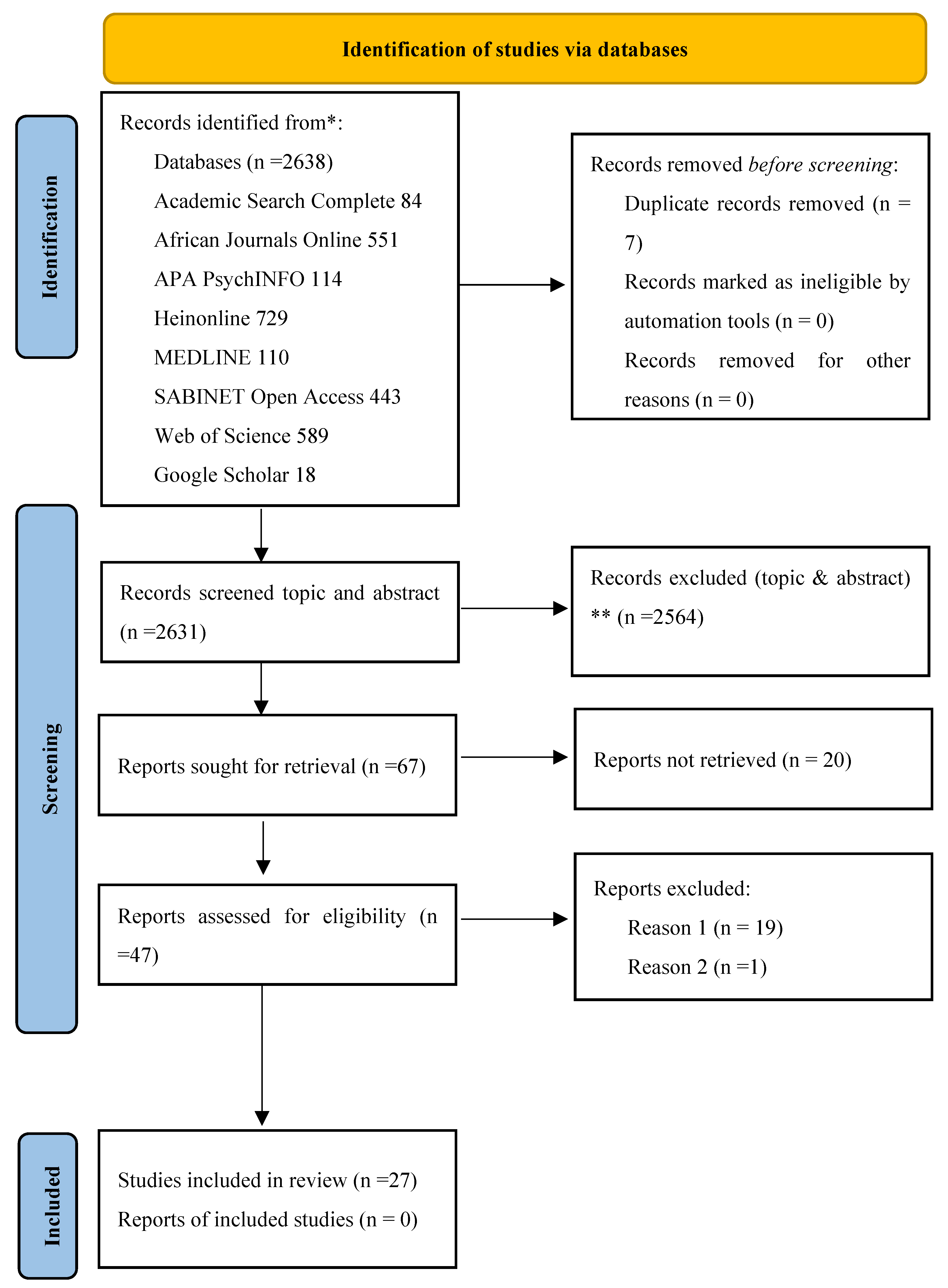

Table 1.
Inclusion and Exclusion Criteria.
| Scoping Review Concepts | Inclusion | Exclusion |
|---|---|---|
| Content |
|
|
| Context |
|
|
| Source Type |
|
|
Table 2.
Research terms and results.
| Databases (Results) | Research Terms | Research date |
|---|---|---|
| Academic Search Complete (126) | “Psychiatric advance directives” OR “Mental health act” AND “Mental health disparities” AND “Africa” | 31/03/2026 |
| African Journals Online (551) | “Psychiatric advance directives” OR “Living will” OR “Mental health act” AND “Mental health disparities” AND “Africa” | 24/03/2026 |
| APA PsychINFO (1044) | “Psychiatric advance directives” OR “Living will” AND “Mental health disparities” AND “Africa” | 28/03/2026 |
| HEINONLINE (4714) | “Psychiatric advance directives” OR “Living will” AND “Mental health disparities” AND “Africa” | 24/01/2026 |
| MEDLINE (148) | “Psychiatric advance directives” OR “Living will” AND “Mental health disparities” AND “Africa” | 25/01/2026 |
| SABINET Open Access (443) | “Psychiatric advance directives” OR “Living will” AND “Mental health disparities” AND “Africa” | 31/03/2026 |
| Web of Science (589) | “Psychiatric advance directives” OR “Living will” AND “Mental health disparities” AND “Africa” | 31/03/2026 |
| Google Scholar | 04/04/2026 |
Disclaimer/Publisher’s Note: The statements, opinions and data contained in all publications are solely those of the individual author(s) and contributor(s) and not of MDPI and/or the editor(s). MDPI and/or the editor(s) disclaim responsibility for any injury to people or property resulting from any ideas, methods, instructions or products referred to in the content. |
© 2026 by the authors. Licensee MDPI, Basel, Switzerland. This article is an open access article distributed under the terms and conditions of the Creative Commons Attribution (CC BY) license (http://creativecommons.org/licenses/by/4.0/).
Copyright: This open access article is published under a Creative Commons CC BY 4.0 license, which permit the free download, distribution, and reuse, provided that the author and preprint are cited in any reuse.


