

Submitted:
16 June 2026
Posted:
17 June 2026
You are already at the latest version
Abstract
Background/Objectives: Infectious complications are frequent in neurological intensive care unit (ICU) patients and may contribute to in-hospital mortality. However, their independent prognostic value in full neurological ICU cohorts remains insufficiently defined. This study evaluated documented infectious complications as predictors of in-hospital mortality in a six-year neurological ICU cohort. Methods: We performed a retrospective, single-center cohort study including all available neurological ICU admission episodes recorded between 1 January 2020 and 31 December 2025. The primary outcome was in-hospital mortality. Infectious variables included pneumonia, COVID-related pneumonia, urinary tract infection, pressure sore or pressure sore-related infection, sepsis-related coding, and any infectious complication. Multivariable logistic regression was used to assess independent associations with mortality. The primary model included individual infectious complications without Glasgow Coma Scale (GCS), while a GCS-adjusted model was used as a sensitivity analysis. Incremental model analysis, model validation/calibration, and COVID-related sensitivity analyses were also performed. Results: The cohort included 5,509 neurological ICU admission episodes; 999 ended in in-hospital death, corresponding to a mortality rate of 18.1%. Any infectious complication was documented in 1,911 episodes (34.7%). Pneumonia was the most frequent infectious complication (22.2%) and remained independently associated with mortality in the primary model (adjusted OR 6.82, 95% CI 5.70–8.18; p < 0.001) and in the GCS-adjusted model (adjusted OR 5.25, 95% CI 4.05–6.80; p < 0.001). Sepsis-related coding, interpreted as a documentation-based marker of severe systemic infectious deterioration rather than formally adjudicated sepsis, showed the strongest adjusted association with death (adjusted OR 12.40, 95% CI 6.53–23.54; p < 0.001). Urinary tract infection and pressure sore-related infection were associated with mortality in unadjusted analyses but not after adjustment. Conclusions: Pneumonia and sepsis-related coding were robust independent predictors of in-hospital mortality. Infectious complications added prognostic information beyond baseline clinical variables and should be integrated into neurological ICU risk assessment and infection-surveillance strategies.
Keywords:
neurological intensive care unit
; healthcare-associated infections
; pneumonia
; sepsis-related coding
; urinary tract infection
; in-hospital mortality
; Glasgow Coma Scale
; retrospective cohort
1. Introduction
Healthcare-associated infections remain a major challenge in intensive care medicine, but their relevance is particularly pronounced in neurological intensive care populations. Patients admitted to neurological intensive care units frequently present with severe acute brain injury, impaired consciousness, dysphagia, reduced cough and airway protection, prolonged immobilization, autonomic and immune dysregulation, and exposure to invasive devices. These factors create a clinical context in which systemic infections are both common and difficult to diagnose, especially because fever, leukocytosis, altered mental status, respiratory deterioration, and inflammatory responses may overlap with the neurological disease process itself (1), (2). Previous neurocritical care surveillance data have shown that pneumonia, urinary tract infection, and device-associated infections are among the most frequent healthcare-associated infections in neurological ICUs, and that these complications contribute substantially to length of stay and resource utilization (3). At the European level, intensive care units continue to represent high-risk environments for healthcare-associated infections, with pneumonia, bloodstream infection, and urinary tract infection forming the principal infection categories under surveillance (4). Large international ICU data have similarly shown that infection is highly prevalent among critically ill patients and is independently associated with hospital mortality (5). In severe neurological ICU populations, in-hospital mortality reflects the combined effect of the primary neurological insult, neurological severity, comorbidity burden, physiological instability, and secondary complications acquired during hospitalization. Among these complications, infections are particularly relevant because they are potentially modifiable and may provide additional prognostic information beyond baseline neurological status (1), (3), (6).
Among neurological patients, stroke-associated infections have received the most sustained attention. A systematic review and meta-analysis by Westendorp et al. estimated that infection complicates approximately 30% of acute stroke cases, with pneumonia and urinary tract infection representing the most frequent infectious complications and pneumonia showing a strong association with death (6). More recent evidence suggests that the pooled prevalence of post-stroke infections may have decreased over time, but pneumonia and urinary tract infection remain the leading infection phenotypes, and post-stroke infections continue to carry clinically important prognostic implications (7). These data support the concept that infection prevention, early recognition, and accurate documentation remain central components of neurological and stroke care.
Pneumonia is especially relevant in neurocritical care because it lies at the intersection between neurological severity, impaired swallowing, reduced airway protection, mechanical ventilation, aspiration risk, and systemic inflammatory response. The Pneumonia in Stroke Consensus Group emphasized the need for standardized terminology and operational diagnostic criteria for lower respiratory tract infections complicating stroke, reflecting the diagnostic uncertainty and clinical heterogeneity of this entity (8). Subsequent PISCES recommendations also highlighted the complexity of antibiotic treatment decisions in stroke-associated pneumonia, where timely therapy must be balanced against diagnostic uncertainty and antimicrobial stewardship (9). Recent meta-analytic evidence confirms that stroke-associated pneumonia is associated with increased in-hospital mortality, longer-term mortality, and worse functional outcomes, reinforcing its relevance as both a clinical complication and a prognostic marker (10).
Urinary tract infection is another common complication in patients with acute stroke and neurological critical illness. Its occurrence is favored by bladder dysfunction, impaired mobility, older age, comorbidities, and urinary catheter exposure. Although urinary tract infection is generally less strongly associated with mortality than pneumonia, it remains clinically relevant because it may be associated with fever, systemic inflammatory response, neurological deterioration, prolonged hospitalization, and increased care complexity (11). Similarly, pressure injuries and pressure sore-related infections represent important complications in immobilized critically ill patients. Large ICU-level data have shown that pressure injuries are common in adult ICU populations and that increasing pressure injury severity is associated with mortality, highlighting the broader importance of immobility-related complications in critical care (12).
Sepsis-related events represent an additional high-risk domain in critically ill patients. In retrospective administrative or clinical databases, however, sepsis may be difficult to adjudicate formally unless standardized organ dysfunction criteria, timing, microbiology, and source-control data are consistently available. For this reason, sepsis-related documentation or coding should be interpreted cautiously, particularly when derived from routine retrospective datasets. Nevertheless, the presence of sepsis-related coding may identify a subgroup of patients with severe systemic infectious deterioration and high mortality risk.
Despite the broad international literature on post-stroke infections and neuro-ICU healthcare-associated infections, several gaps remain. Many studies focus on specific diagnostic groups, such as ischemic stroke, hemorrhagic stroke, or neurosurgical populations; others report surveillance incidence rates without directly modeling in-hospital mortality across the full neurological ICU population. In addition, pneumonia and urinary tract infection have often been considered together as post-stroke infection outcomes, while fewer studies have evaluated individual infectious complications simultaneously in adjusted mortality models. From a methodological perspective, infectious complications occurring during hospitalization are particularly challenging to interpret because they may function both as markers of baseline severity and as hospital-course complications. This makes multivariable adjustment, sensitivity analysis for neurological severity, and careful avoidance of inappropriate time-to-event assumptions essential.
Romanian data on healthcare-associated infections have specific relevance because national surveillance and reporting frameworks have evolved substantially, while under-reporting, infrastructure limitations, and implementation barriers remain recognized challenges (13). In the neurological intensive care setting, Romanian evidence remains limited. A recent retrospective descriptive study from a Romanian neurological ICU described the burden of documented healthcare-associated infections among deceased stroke patients, with pneumonia representing the dominant infectious complication; however, by design, that study was restricted to fatal cases and could not compare survivors with non-survivors or evaluate infectious complications as predictors of mortality in a full cohort (14).
The present study was therefore designed to address this gap by analyzing all available neurological ICU admission episodes recorded over a six-year period, including both survivors and patients who died during hospitalization. The originality of the study resides in its full-cohort neurological ICU design, its survivor-versus-non-survivor analytical framework, and its focus on individual infectious complications as predictors of in-hospital mortality. The study also evaluates whether infectious complications add prognostic information beyond baseline demographic, neurological, and comorbidity variables, and whether the association between pneumonia and mortality is robust after sensitivity analyses including neurological severity and COVID-related pneumonia.
The aim of this study was to evaluate infectious complications as factors associated with in-hospital mortality in a six-year retrospective neurological intensive care cohort. The specific objectives were to describe the burden of documented infectious complications, compare baseline and infectious profiles according to survival status, assess the unadjusted and adjusted associations between individual infectious complications and in-hospital mortality, evaluate the incremental prognostic contribution of infections beyond clinical variables, and test the robustness of the main findings in Glasgow Coma Scale-adjusted and COVID-related sensitivity analyses.
2. Materials and Methods
2.1. Study Design and Setting
This study was designed as a retrospective, single-center cohort study evaluating infectious complications as factors associated with in-hospital mortality among patients admitted to a neurological intensive care unit over a six-year period. The study was based on routinely collected institutional clinical data from neurological intensive care practice.
The analytical design was conceived as a full-cohort analysis of neurological intensive care admission episodes, including both survivors and non-survivors. This approach was selected to allow direct comparison according to in-hospital mortality status and to assess whether documented infectious complications provided prognostic information beyond demographic characteristics, neurological diagnosis, and available comorbidities.
2.2. Study Population and Observation Period
The study population consisted of all available admission episodes recorded in the neurological intensive care unit between 1 January 2020 and 31 December 2025.
The unit of analysis was predefined as the neurological intensive care admission episode. Therefore, each row in the final analytical dataset represented one ICU admission episode rather than one unique patient. Recurrent admissions of the same patient across different calendar years were not actively linked, because the primary outcome was defined at the admission-episode level. This approach was chosen because the primary outcome was defined as in-hospital mortality during the index ICU admission episode, and the study objective was to evaluate episode-level prognostic associations rather than long-term patient-level outcomes. Identical duplicate records were assessed during data cleaning, and no admission episodes were excluded from the final analytical cohort. The final analytical cohort included 5,509 neurological intensive care admission episodes.
2.3. Data Sources and Database Preparation
The source dataset consisted of six annual databases corresponding to the years 2020, 2021, 2022, 2023, 2024, and 2025. These annual files were inspected, harmonized, and merged into a unified working database. The merged database was subsequently cleaned, deidentified, and structured for statistical analysis.
Direct personal identifiers, including patient name and institutional file number, were removed from the clean analytical dataset. Because direct identifiers were removed during anonymization, deterministic linkage of recurrent admissions belonging to the same individual was not performed in the final analytical dataset. A new anonymized study identifier was generated for each record. For technical traceability, the final database retained the source year and source row number, without preserving direct patient identifiers.
Database preparation included harmonization of column names, standardization of categorical variables, binary recoding of clinical variables, correction of clearly identifiable data-entry errors, and documentation of all relevant recoding decisions. Calendar years recorded as 3021 and 3024 were corrected to 2021 and 2024, respectively, because these were considered obvious typographical errors. These corrections were documented in the data-cleaning audit log.
No imputation was performed. Descriptive analyses were conducted using available data for each variable. Multivariable models were fitted as complete-case analyses according to the availability of all covariates included in each model.
2.4. Outcome Definition
The primary outcome was in-hospital mortality. A binary variable was created and coded as 1 for admission episodes ending in in-hospital death and 0 for episodes in which the patient survived to discharge or had no documented in-hospital death.
This variable served as the dependent variable in the univariable and multivariable logistic regression analyses.
2.5. Infectious Complication Variables
The main predictor domain consisted of documented infectious complications during the index hospitalization. The following binary variables were created: pneumonia, COVID-related pneumonia, urinary tract infection, pressure sore or pressure sore-related infection, sepsis-related coding, and any infectious complication.
Pneumonia was coded as present when the source database contained a documented pneumonia-related entry. COVID-related pneumonia was retained as a separate variable when COVID-related wording was documented. Urinary tract infection was coded as present when the database contained urinary infection documentation or pathogen-specific urinary infection wording. Pressure sore or pressure sore-related infection was coded as present when pressure sore, escara, or related documentation was identified. Sepsis-related coding was coded as present when sepsis-related wording appeared in the source dataset.
The sepsis-related variable was interpreted as a documentation or coding category rather than as formally adjudicated sepsis, because the retrospective database did not contain sufficient standardized information to reclassify all cases according to formal sepsis definitions. Accordingly, this variable was used as a pragmatic marker of severe systemic infectious deterioration documented during routine care, and not as a validated Sepsis-3 diagnosis.
A composite variable, any infectious complication, was created and coded as present when at least one of the main infectious complication variables was positive.
COVID-related pneumonia was retained for descriptive and sensitivity analyses. It was not entered as a separate covariate in the primary individual-infection model, in which pneumonia was treated as the main pneumonia variable. Dedicated COVID-related sensitivity analyses were subsequently performed to evaluate whether the association between pneumonia and in-hospital mortality was driven primarily by COVID-related pneumonia.
2.6. Neurological Diagnosis and Comorbidity Variables
Neurological diagnosis variables were derived from the documented source fields and included ischemic stroke, hemorrhagic stroke, transient ischemic attack, and stroke sequelae. These variables were retained as binary indicators. For regression modeling, hemorrhagic stroke was evaluated in relation to ischemic stroke where appropriate, given its clinical relevance and observed association with mortality.
Comorbidity variables were harmonized and coded as binary indicators. These included hypertension, ischemic heart disease and/or previous myocardial infarction, atrial fibrillation, diabetes mellitus, obesity, renal disease, hepatic disease, coagulopathy, previous stroke, malignancy, and anticoagulation. For binary clinical and comorbidity fields structured as presence/absence documentation, negative, absent, or blank entries were coded as 0 when the source format supported this interpretation. Ambiguous entries were reviewed during data cleaning and documented when relevant.
2.7. Severity and Physiological Variables
Available continuous variables included age, initial Glasgow Coma Scale score, initial systolic blood pressure, initial diastolic blood pressure, and length of stay. Initial Glasgow Coma Scale score was considered an important marker of neurological severity. However, because it was available in only approximately 54.6% of the full cohort, it was not included in the primary multivariable model. Instead, a separate Glasgow Coma Scale-adjusted sensitivity model was constructed.
Initial blood pressure values were described in the cohort and compared according to in-hospital mortality status. Length of stay was summarized descriptively but was not included as a primary explanatory variable for mortality because it is influenced by both discharge timing and early death.
2.8. Statistical Analysis
Continuous variables were summarized using median and interquartile range. Mean and standard deviation were also reported where useful for descriptive purposes. Categorical variables were summarized as absolute frequencies and percentages.
Comparisons between survivors and patients who died during hospitalization were performed using appropriate tests according to variable type and distribution. Continuous variables were compared using non-parametric methods when distributional assumptions were not met. Categorical variables were compared using chi-square or equivalent tests, as appropriate. These comparisons were considered descriptive and exploratory.
Annual distributions of admissions, mortality, and infectious complications were reported descriptively. No formal temporal trend model was used.
Unadjusted odds ratios with 95% confidence intervals were calculated for categorical predictors of in-hospital mortality.
Multivariable logistic regression was used to identify factors independently associated with in-hospital mortality. The primary model included individual infectious complications without Glasgow Coma Scale score. This model was selected as the main analytical model because it preserved almost the full cohort and allowed separate assessment of pneumonia, urinary tract infection, pressure sore or pressure sore-related infection, and sepsis-related coding. Covariates included age, sex, calendar year, major neurological diagnosis variables, and clinically relevant comorbidities.
A Glasgow Coma Scale-adjusted sensitivity model was then constructed by adding initial Glasgow Coma Scale score to the individual-infection model. This model was used to evaluate whether the associations between infectious complications and in-hospital mortality persisted after adjustment for neurological severity. Because this model was restricted to episodes with available Glasgow Coma Scale data and complete covariate information, it was interpreted as a sensitivity analysis rather than as the primary model.
All multivariable logistic regression analyses were performed as complete-case analyses. Model results were reported as adjusted odds ratios with 95% confidence intervals and p values. A two-sided p value <0.05 was considered statistically significant. Data preparation, cleaning, and tabulation were performed using Microsoft Excel (Microsoft Corp., Redmond, WA, USA). Statistical analyses were performed using IBM SPSS Statistics version 26 (IBM Corp., Armonk, NY, USA), with additional spreadsheet-based calculations used where appropriate.
2.9. Incremental Model Analysis
To evaluate whether infectious complications added prognostic information beyond baseline clinical variables, an incremental model analysis was performed. A clinical-only logistic regression model including demographic variables, calendar year, neurological diagnosis variables, and comorbidities was compared with a clinical-plus-infections model that additionally included pneumonia, urinary tract infection, pressure sore or pressure sore-related infection, and sepsis-related coding.
Model performance was compared using the area under the receiver operating characteristic curve, McFadden pseudo-R², Akaike information criterion, Bayesian information criterion, and likelihood-ratio testing. This incremental analysis was performed both in the primary cohort without Glasgow Coma Scale score and in the Glasgow Coma Scale-available subset as a sensitivity analysis.
2.10. Model Validation and Calibration
Model discrimination was evaluated using the area under the receiver operating characteristic curve. Predictive accuracy was assessed using the Brier score and log loss. Calibration was evaluated using the calibration intercept, calibration slope, decile-based calibration summaries, and the Hosmer–Lemeshow goodness-of-fit test.
Internal validation was performed using bootstrap resampling. Optimism-corrected estimates were calculated for model discrimination and calibration, including bootstrap-corrected area under the receiver operating characteristic curve, Brier score, and calibration slope. This validation approach was applied to both the primary model and the Glasgow Coma Scale-adjusted sensitivity model.
2.11. COVID-Related Sensitivity Analysis
Because the study period included the COVID-19 pandemic and pneumonia was the main infectious predictor of interest, additional sensitivity analyses were performed to assess whether the association between pneumonia and in-hospital mortality was driven primarily by COVID-related pneumonia.
First, the primary multivariable logistic regression model was repeated after excluding cases with COVID-related pneumonia. Second, pneumonia was separated into non-COVID pneumonia and COVID-related pneumonia within the full-cohort model. These analyses were also repeated in the Glasgow Coma Scale-available subset.
The purpose of these analyses was to determine whether non-COVID pneumonia remained independently associated with in-hospital mortality after accounting for COVID-related pneumonia.
2.12. Rationale for Not Using Cox Regression or Kaplan–Meier Analysis as Primary Analyses
Time-to-event analyses, including Cox proportional hazards regression and Kaplan–Meier curves, were not used as primary inferential analyses for infectious complications. Although length-of-stay and survival-time variables were available, the exact dates of onset of pneumonia, urinary tract infection, pressure sore-related infection, and sepsis-related coding were not consistently available in the source database.
Because infectious complications were hospital-course variables rather than baseline exposures, treating them as fixed covariates from admission would create a risk of immortal time bias. Patients must survive long enough and remain hospitalized long enough for such complications to be documented. Therefore, logistic regression for in-hospital mortality was considered the most appropriate primary analytical framework for the available data.
3. Results
3.1. Study Population and Data Completeness
Across the six annual neurological intensive care unit registers, 5,509 ICU admission episodes, rather than unique patients, were included in the final retrospective cohort. In the overall cohort, the median age was 71.0 years (IQR 62.0–80.0). Among episodes with available GCS data, the median initial GCS was 15.0 (IQR 12.0–15.0). The median length of stay was 8.0 days (IQR 5.0–11.0). No admission episodes were excluded after database harmonisation and anonymisation, and in-hospital mortality status was available for all records. Overall, 999 episodes ended in in-hospital death, corresponding to a crude in-hospital mortality of 18.1%; the remaining 4,510 episodes were classified as survivors. The cohort selection and analytical flow are shown in Figure 1. All percentages and regression models should therefore be interpreted at the admission-episode level.
Data completeness was high for the primary outcome and most binary clinical, comorbidity, and infection variables. Age was available for 5,434 episodes (98.6%), sex for 5,484 episodes (99.5%), systolic blood pressure for 4,991 episodes (90.6%), and diastolic blood pressure for 4,968 episodes (90.2%). Length of stay could be calculated for 5,503 episodes (99.9%). By contrast, initial Glasgow Coma Scale (GCS) was available for 3,007 episodes (54.6%), supporting its prespecified use in a sensitivity model rather than in the primary model. Variable-level completeness is detailed in Supplementary Table S1.
The multivariable models were therefore fitted as complete-case analyses for the variables included in each model. The primary no-GCS model retained 5,395 episodes, whereas the GCS-adjusted sensitivity model retained 2,971 episodes, reflecting the lower availability of initial GCS and the additional complete-case requirement for all covariates.
3.2. Baseline and Clinical Characteristics According to In-Hospital Mortality
Patients who died were older than survivors, with a median age of 75.0 years (IQR 67.0-83.0) compared with 70.0 years (IQR 61.0-79.0) among survivors (p<0.001). Neurological severity differed substantially in the GCS-available subset: the median initial GCS was 10.0 (IQR 5.0-13.0) among patients who died and 15.0 (IQR 14.0-15.0) among survivors (p<0.001). Initial systolic and diastolic blood pressure values did not differ meaningfully between groups. Length of stay showed a statistically significant difference, but this result should be interpreted cautiously because of the skewed distribution and the competing processes of early death and discharge. Length of stay was therefore reported descriptively and was not treated as a primary explanatory variable for mortality (Table 1).
Overall, any infectious complication was documented in 1,911 of 5,509 ICU admission episodes (34.7%). Pneumonia was the most frequent infectious complication, occurring in 1,222 episodes (22.2%), followed by urinary tract infection in 822 episodes (14.9%), pressure sore/pressure sore infection in 202 episodes (3.7%), COVID-related pneumonia in 133 episodes (2.4%), and sepsis-related coding in 85 episodes (1.5%). Infectious complications were markedly more frequent among patients who died. Any infectious complication was documented in 711 deaths (71.2%) compared with 1,200 survivors (26.6%), corresponding to an unadjusted odds ratio (OR) for death of 6.81 (95% CI 5.85-7.93; p<0.001). Pneumonia showed the largest burden among individual infectious complications, being present in 603 deaths (60.4%) and 619 survivors (13.7%) (unadjusted OR 9.60, 95% CI 8.24-11.18; p<0.001). Sepsis-related coding was less frequent in absolute terms but showed the strongest unadjusted association with death (6.3% among deaths vs 0.5% among survivors; unadjusted OR 13.73, 95% CI 8.41-22.42; p<0.001). Urinary tract infection and pressure sore/pressure sore infection were also more frequent among deaths in unadjusted comparisons (Table 2).
The distribution of neurological diagnoses and comorbidities also differed by outcome. Hemorrhagic stroke was more common among deaths than survivors (30.6% vs 8.8%; p<0.001), whereas transient ischemic attack and stroke sequelae were more frequent among survivors. Atrial fibrillation, renal disease, hepatic disease, coagulopathy, malignancy, and anticoagulation were all more frequent among deaths in unadjusted analyses. Male sex, hypertension, obesity, and previous stroke were less frequent among deaths than survivors in unadjusted comparisons, emphasising that crude associations should not be interpreted causally without multivariable adjustment (Table 2).
3.3. Annual Distribution of Mortality and Infectious Complications
The annual number of ICU admission episodes ranged from 605 in 2025 to 1,282 in 2024. Crude in-hospital mortality was highest in 2021 (190/825, 23.0%) and 2020 (158/744, 21.2%), then decreased to 18.4% in 2022, 16.2% in 2023, 15.6% in 2024, and 16.4% in 2025. The prevalence of any infectious complication increased from 27.0% in 2020 to 32.0% in 2021 and 39.0% in 2022, remaining between 35.3% and 37.4% during 2023-2025. These annual comparisons were descriptive, and no formal temporal trend model was used (Table 3).
Pneumonia accounted for the largest infectious burden in each year, ranging from 17.5% in 2020 to 27.7% in 2022 and 27.6% in 2025. COVID-related pneumonia was recorded only during 2020-2023, with the highest annual proportion in 2021 (5.9%). Urinary tract infection ranged from 11.2% in 2020 to 18.0% in 2024, while sepsis-related coding increased in the later years, reaching 2.8% in 2024 and 2.5% in 2025 (Table 3).
3.4. Mortality According to Infectious Complication Status
In unadjusted infection-stratified analyses, mortality was 37.2% among episodes with any infectious complication compared with 8.0% among episodes without documented infection (unadjusted OR 6.81, 95% CI 5.85-7.93; p<0.001). Pneumonia was associated with a mortality rate of 49.3%, compared with 9.2% in episodes without pneumonia (unadjusted OR 9.60, 95% CI 8.24-11.18; p<0.001). COVID-related pneumonia was associated with a mortality rate of 39.1% (unadjusted OR 3.00, 95% CI 2.10-4.28; p<0.001). Because sepsis-related coding was derived from routine documentation and coding fields, it should be interpreted as documented severe systemic infectious deterioration rather than as formally adjudicated sepsis according to Sepsis-3 criteria (Table 4).
Sepsis-related coding identified the highest-risk infectious subgroup: 63 of 85 episodes with sepsis-related coding ended in death, corresponding to a mortality rate of 74.1%, compared with 17.3% among episodes without sepsis-related coding (unadjusted OR 13.73, 95% CI 8.41-22.42; p<0.001). Pressure sore/pressure sore infection was associated with 40.1% mortality, while urinary tract infection was associated with a smaller but statistically significant crude mortality difference (22.3% vs 17.4%; p=0.001) (Table 4).
3.5. Multivariable Predictors of In-Hospital Mortality
In the primary multivariable logistic regression model, which did not include GCS, pneumonia and sepsis-related coding remained independent predictors of in-hospital mortality after adjustment for demographic, neurological, comorbidity, and other infectious variables. The adjusted associations from the primary model are visually summarized in Figure 2. Pneumonia was associated with more than sixfold higher adjusted odds of in-hospital death (adjusted OR 6.82, 95% CI 5.70–8.18; p < 0.001), while sepsis-related coding, used as a documentation-based marker of severe systemic infectious deterioration, showed the strongest independent association (adjusted OR 12.40, 95% CI 6.53–23.54; p < 0.001). In contrast, urinary tract infection (adjusted OR 0.92, 95% CI 0.73–1.16; p = 0.487) and pressure sore/pressure sore infection (adjusted OR 1.17, 95% CI 0.81–1.68; p = 0.407) were not independently associated with mortality in the primary model (Table 5).
Among non-infectious predictors in the primary model, hemorrhagic stroke was independently associated with higher in-hospital mortality compared with ischemic stroke (adjusted OR 3.08, 95% CI 2.46-3.86; p<0.001). Increasing age, atrial fibrillation, renal disease, and hepatic disease also remained independently associated with death. The primary model included 5,395 episodes and 977 deaths, with an AUC of 0.885 and a McFadden pseudo-R² of 0.340 (Table 5).
The GCS-adjusted sensitivity model confirmed the robustness of the main infectious associations. After adding initial GCS, pneumonia remained a strong independent predictor of death (adjusted OR 5.25, 95% CI 4.05-6.80; p<0.001), and sepsis-related coding remained strongly associated with mortality (adjusted OR 10.70, 95% CI 4.89-23.40; p<0.001). Initial GCS was itself a major independent predictor, with each additional point associated with lower odds of death (adjusted OR 0.78, 95% CI 0.75-0.81; p<0.001). Hemorrhagic stroke, age, atrial fibrillation, diabetes mellitus, and renal disease also remained significant in this sensitivity model. The GCS-adjusted model included 2,971 episodes and 591 deaths and achieved an AUC of 0.920 and a McFadden pseudo-R² of 0.448 (Table 5).
3.6. Incremental Prognostic Contribution and Model Validation
Adding individual infectious complications to the clinical-only model substantially improved model performance. In the primary cohort without GCS, the AUC increased from 0.826 to 0.885 (ΔAUC +0.058), McFadden pseudo-R² increased from 0.228 to 0.340 (ΔR² +0.112), and AIC decreased from 3,984.8 to 3,421.2 (ΔAIC -563.6). The likelihood-ratio test strongly supported the incremental contribution of infectious complications (LR χ²=571.6, df=4; p<0.001). In the GCS-available cohort, adding infectious complications increased the AUC from 0.890 to 0.920 (ΔAUC +0.030), improved McFadden pseudo-R² from 0.377 to 0.448, and reduced AIC by 204.8 points (LR χ²=212.8, df=4; p<0.001) (Table 6).
Internal validation and calibration analyses supported the stability of the modelling results. The primary model showed an apparent AUC of 0.8846 and a bootstrap-corrected AUC of 0.8795, with a Brier score of 0.0984 and a bootstrap-corrected calibration slope of 0.9670. The GCS-adjusted sensitivity model showed higher discrimination, with an apparent AUC of 0.9198 and a bootstrap-corrected AUC of 0.9147; the Brier score was 0.0841 and the bootstrap-corrected calibration slope was 0.9505. The Hosmer-Lemeshow test was significant in the primary model but not in the GCS-adjusted sensitivity model; given the large sample size, calibration was interpreted in conjunction with the Brier score, calibration slope, and bootstrap-corrected estimates (Supplementary Table S2).
3.7. COVID-Related Sensitivity Analysis
Because COVID-related pneumonia represented a specific pandemic-era infectious phenotype, a dedicated sensitivity analysis was performed. Mortality was 9.2% among episodes without pneumonia, 50.6% among episodes with non-COVID pneumonia, and 39.1% among episodes with COVID-related pneumonia (Supplementary Table S3).
The association between pneumonia and in-hospital mortality was not explained exclusively by COVID-related pneumonia. After excluding COVID-related pneumonia cases, pneumonia remained independently associated with mortality in the no-GCS model (adjusted OR 7.43, 95% CI 6.15-8.98; p<0.001) and in the GCS-adjusted model (adjusted OR 5.66, 95% CI 4.31-7.42; p<0.001). In models separating pneumonia categories, non-COVID pneumonia remained a strong independent predictor both without GCS (adjusted OR 7.49, 95% CI 6.20-9.04; p<0.001) and with GCS adjustment (adjusted OR 5.67, 95% CI 4.33-7.44; p<0.001). COVID-related pneumonia was also independently associated with mortality, although with lower effect estimates than non-COVID pneumonia, both in the no-GCS model (adjusted OR 3.43, 95% CI 2.25-5.24; p<0.001) and the GCS-adjusted model (adjusted OR 2.57, 95% CI 1.28-5.16; p=0.0077). Across COVID sensitivity models, sepsis-related coding remained independently associated with death, whereas urinary tract infection and pressure sore/pressure sore infection did not show independent mortality associations (Supplementary Table S4).
4. Discussion
4.1. Principal Findings
In this six-year retrospective cohort of neurological intensive care admission episodes, infectious complications were strongly associated with in-hospital mortality. The overall in-hospital mortality rate was 18.1%, while more than one-third of the cohort had at least one documented infectious complication. Pneumonia was the most frequent infection phenotype and represented the dominant infectious predictor of death. It remained independently associated with in-hospital mortality in the primary multivariable model, in the Glasgow Coma Scale (GCS)-adjusted sensitivity model, and in the COVID-related sensitivity analyses. Sepsis-related coding identified a smaller but particularly high-risk subgroup and showed the strongest adjusted association with mortality. By contrast, urinary tract infection and pressure sore or pressure sore-related infection were associated with death in unadjusted analyses but did not remain independent predictors after multivariable adjustment (1), (3), (6), (5), (15).
These findings support three main interpretations. First, infectious complications are not merely descriptive hospital-course events in neurological intensive care, but are associated with clinically meaningful mortality differences. Second, not all infection phenotypes carry the same prognostic weight: pneumonia and sepsis-related coding appear to identify a more severe mortality-risk signal than urinary tract infection or pressure sore-related infection. Third, the association between infection and mortality persisted after adjustment for neurological severity in the GCS-available subset, suggesting that the infection–mortality relationship was not explained solely by baseline neurological impairment (1), (3), (6), (5), (15).
The incremental model analysis further strengthens this interpretation. Adding individual infectious complications to clinical-only models improved discrimination and model fit both in the primary cohort and in the GCS-available subset. This suggests that infectious complications provide additional prognostic information beyond demographic characteristics, neurological diagnosis, comorbidity burden, and, where available, initial GCS. From a clinical standpoint, these findings reinforce the importance of systematic infection surveillance and early recognition of infectious deterioration in neurological intensive care practice (16), (17), (18).
4.2. Pneumonia as the Dominant Infectious Predictor of Mortality
Pneumonia was the most important infectious complication in the present study, both in terms of frequency and adjusted association with in-hospital mortality. This finding is consistent with previous literature showing that pneumonia is one of the leading healthcare-associated infections in neurological ICUs and one of the most clinically consequential infectious complications after acute stroke (1), (3), (6), (8), (10), (19). In the present cohort, pneumonia was associated with markedly higher crude mortality and remained an independent predictor after adjustment for demographic factors, neurological diagnosis, comorbidities, and other infection variables.
The strong mortality signal associated with pneumonia is biologically and clinically plausible in neurocritical care. Patients with severe neurological injury frequently have impaired swallowing, reduced cough reflex, altered consciousness, aspiration risk, mechanical ventilation exposure, immobility, and impaired airway clearance. These factors create a particularly favorable context for lower respiratory tract infection. At the same time, pneumonia may amplify neurological and systemic deterioration through hypoxemia, systemic inflammation, fever, hemodynamic instability, increased metabolic demand, and delayed rehabilitation. Therefore, pneumonia may function both as a consequence of neurological severity and as an active contributor to clinical deterioration (8), (9), (10), (19), (20), (21).
The present findings also align with the stroke-associated pneumonia literature. The Pneumonia in Stroke Consensus Group emphasized that lower respiratory tract infections after stroke require standardized terminology and diagnostic criteria because clinical and radiological interpretation may be difficult in neurologically impaired patients (8). The PISCES recommendations further highlighted the complexity of antibiotic treatment decisions in stroke-associated pneumonia, where the risks of delayed treatment must be balanced against diagnostic uncertainty and antimicrobial stewardship (9). More recent meta-analytic evidence confirms that post-stroke pneumonia is associated not only with increased in-hospital mortality but also with longer-term mortality and worse functional outcomes (10). Although the present study was not limited to stroke-associated pneumonia and included a broader neurological ICU cohort, the persistence of pneumonia as an independent predictor of mortality is consistent with this wider evidence base (6), (8), (9), (10), (19), (20), (21).
An important aspect of the present study is that the pneumonia–mortality association was not explained exclusively by COVID-related pneumonia. Non-COVID pneumonia remained strongly associated with mortality after exclusion of COVID-related pneumonia cases and in models separating non-COVID pneumonia from COVID-related pneumonia. This is clinically relevant because it indicates that the observed pneumonia signal reflects a broader neurocritical care phenomenon rather than only a pandemic-era effect. Pneumonia should therefore remain a central target for surveillance, prevention, early diagnosis, and treatment in neurological ICU populations beyond the specific context of COVID-19 (1), (8), (9), (10), (19), (20), (21).
4.3. Sepsis-Related Coding and Systemic Infectious Deterioration
Sepsis-related coding showed the strongest adjusted association with in-hospital mortality in the present cohort. This finding should not be interpreted as evidence that formally adjudicated sepsis per se was measured in this cohort; rather, the variable captures routine clinical documentation suggestive of severe infection-related systemic deterioration. Although sepsis-related documentation was less frequent than pneumonia or urinary tract infection, it identified a subgroup with very high crude mortality and remained independently associated with death in the primary, GCS-adjusted, and COVID-related sensitivity models. This pattern suggests that sepsis-related coding captured a severe systemic infectious phenotype rather than a simple infection label (22), (23).
This finding should be interpreted carefully. In this retrospective database, sepsis was not formally adjudicated using standardized criteria, organ dysfunction scoring, microbiological confirmation, source-control data, or precise timing of infectious onset. Therefore, the variable was deliberately analyzed and described as “sepsis-related coding” rather than as formally adjudicated sepsis. This distinction is important because contemporary sepsis definitions emphasize life-threatening organ dysfunction caused by a dysregulated host response to infection, which requires clinical and physiological information that may not be uniformly available in routine retrospective datasets (22).
Nevertheless, the strong association between sepsis-related coding and mortality is clinically meaningful. In neurological ICU patients, systemic infectious deterioration may be especially difficult to separate from neurological decline, sedation, impaired consciousness, dysautonomia, or respiratory failure. When sepsis-related wording appears in routine documentation, it may therefore represent advanced systemic deterioration, high clinician concern, or a severe infection phenotype. The high adjusted odds ratios observed in the present study support the use of sepsis-related coding as a high-risk marker, while also emphasizing the need for caution in causal interpretation (22), (23).
Future studies should attempt to validate sepsis-related events prospectively using standardized sepsis definitions, infection source adjudication, organ dysfunction scores, microbiological data, and timing of onset. Such work would help distinguish whether the excess mortality associated with sepsis-related coding reflects infection severity itself, delayed recognition, baseline neurological severity, systemic organ failure, or a combination of these mechanisms (22), (23).
4.4. Urinary Tract Infection and Pressure Sore-Related Infection: Unadjusted Versus Adjusted Associations
Urinary tract infection and pressure sore or pressure sore-related infection were more frequent among patients who died in unadjusted analyses, but neither remained independently associated with in-hospital mortality after multivariable adjustment. This distinction is important. The crude associations suggest that these complications occur more often in patients with worse hospital-course trajectories, but the adjusted models suggest that their apparent mortality relationship may be largely explained by age, neurological diagnosis, comorbidity burden, concurrent infections, and overall clinical severity (11), (12), (24).
Urinary tract infection is common in neurological patients because of bladder dysfunction, reduced mobility, older age, comorbid disease, and urinary catheter exposure (11). In clinical practice, urinary tract infection may contribute to fever, delirium, systemic inflammatory response, prolonged hospitalization, and increased care complexity. However, compared with pneumonia and sepsis-related coding, urinary tract infection may less often represent a direct driver of early in-hospital death, particularly after adjustment for other predictors. The present findings are consistent with this interpretation: urinary tract infection showed a statistically significant unadjusted association with death, but not an independent adjusted association (11).
A similar interpretation applies to pressure sore and pressure sore-related infection. Pressure injuries are clinically important complications of immobility, critical illness, impaired perfusion, nutritional vulnerability, and prolonged care dependency. Large ICU-level data have shown that pressure injuries are common in adult ICU patients and that increasing pressure injury severity is associated with mortality (12). In the present study, pressure sore or pressure sore-related infection was associated with substantially higher crude mortality, but this association was attenuated after adjustment. This suggests that pressure sore-related documentation may operate as a marker of frailty, immobility, prolonged severity, and complex hospital course rather than as an independent mortality predictor in the available model (12), (24).
These findings should not be interpreted as minimizing the clinical importance of urinary tract infection or pressure sore-related infection. Both complications remain relevant for patient comfort, quality of care, antimicrobial use, nursing workload, rehabilitation delay, and institutional infection-prevention programs. Rather, the results indicate that, in this mortality-focused analysis, pneumonia and sepsis-related coding carried a more robust independent association with death than urinary tract infection or pressure sore-related infection (11), (12), (24).
4.5. Neurological Severity, GCS, and Robustness of the Infection–Mortality Signal
Neurological severity is a major determinant of outcome in neurocritical care and represents an essential potential confounder in analyses of infectious complications. Patients with lower consciousness levels are more likely to aspirate, require airway support, remain immobilized, receive invasive devices, and develop infectious complications. At the same time, they are also more likely to die because of the severity of the primary neurological insult. For this reason, evaluating whether infection-related associations persist after adjustment for neurological severity is methodologically important (1), (8), (25).
In the present study, initial GCS was available in approximately half of the cohort and was therefore not included in the primary model. This decision preserved almost the full cohort for the main analysis and avoided restricting the primary conclusions to a subset with available neurological severity data. However, a dedicated GCS-adjusted sensitivity model was performed. As expected, initial GCS was strongly and independently associated with mortality, with higher GCS values corresponding to lower odds of death. This confirms the clinical validity of GCS as a marker of neurological severity in this cohort (25).
Importantly, pneumonia and sepsis-related coding remained independently associated with in-hospital mortality after adding GCS to the model. The effect estimates were attenuated compared with the primary model, which is expected because part of the infection risk is linked to neurological severity. However, the associations remained strong and statistically significant. This supports the robustness of the main finding: the prognostic relevance of pneumonia and sepsis-related coding was not explained solely by impaired consciousness or baseline neurological severity (1), (8), (22), (25).
The GCS-adjusted model also showed improved discrimination compared with the primary model, which is consistent with the importance of neurological severity in mortality prediction. However, because GCS was missing in a substantial proportion of records, this model should be interpreted as a sensitivity analysis rather than as the primary analytical framework. The concordance between the primary and GCS-adjusted models strengthens the internal consistency of the study findings (16), (17), (18), (25).
4.6. Incremental Prognostic Value of Infectious Complications
Beyond the adjusted associations of individual infection variables, the incremental model analysis showed that infectious complications improved mortality risk stratification when added to clinical-only models. In the primary cohort, the inclusion of individual infectious complications increased the area under the receiver operating characteristic curve, improved McFadden pseudo-R², and substantially reduced the Akaike information criterion. A similar pattern was observed in the GCS-available subset, despite the already strong predictive contribution of neurological severity. These findings suggest that infectious complications provide prognostic information that is not fully captured by demographic characteristics, neurological diagnosis, comorbidity burden, calendar year, or GCS (16), (17), (18), (26), (27).
This result is clinically relevant because neurological ICU mortality is often conceptualized primarily through the severity of the initial neurological insult. While neurological severity is clearly central, the present findings indicate that hospital-course infectious complications add measurable prognostic information. Pneumonia and sepsis-related coding were particularly informative in this regard. Their inclusion improved model performance even after accounting for major clinical predictors, supporting the view that infection surveillance is not only a quality-of-care issue but also a prognostic component of neurological intensive care (1), (3), (5), (15), (16).
The internal validation and calibration findings support the stability of the models. The primary model showed high discrimination, and the bootstrap-corrected estimates suggested limited optimism. The GCS-adjusted sensitivity model showed even higher discrimination and acceptable calibration, consistent with the major prognostic role of neurological severity. The significant Hosmer–Lemeshow test in the primary model should be interpreted cautiously because this test is highly sensitive to large sample size; therefore, calibration was more appropriately assessed together with the Brier score, calibration slope, and bootstrap-corrected estimates. Taken together, these analyses suggest that the observed infection–mortality signal was not an artefact of a single model specification (16), (17), (18), (26), (27).
4.7. COVID-Related Sensitivity Analysis
The study period included the COVID-19 pandemic, making it necessary to evaluate whether the association between pneumonia and in-hospital mortality was driven primarily by COVID-related pneumonia. This was particularly important because COVID-related pneumonia represents a distinct infectious phenotype with specific pathophysiological, epidemiological, and healthcare-system implications. If the overall pneumonia signal had been driven mainly by COVID-related cases, the interpretation of the study would have been more limited to the pandemic period (28), (29).
The COVID-related sensitivity analyses showed that this was not the case. Non-COVID pneumonia remained a strong independent predictor of in-hospital mortality after exclusion of COVID-related pneumonia cases and in models separating pneumonia categories. COVID-related pneumonia was also independently associated with mortality, but its effect estimates were lower than those observed for non-COVID pneumonia. This finding supports the robustness of pneumonia as a prognostic marker in neurological ICU patients and indicates that the pneumonia–mortality relationship reflects a broader neurocritical care phenomenon rather than a pandemic-specific artefact (1), (6), (8), (9), (19), (20), (21), (28), (29).
These results are consistent with the general neurocritical care and stroke literature, in which pneumonia has long been recognized as a frequent and clinically consequential complication outside the COVID-19 context (1), (6), (8), (10), (19), (20), (21). The persistence of the pneumonia signal after COVID-related sensitivity analyses strengthens the external relevance of the study findings. It also supports the continued prioritization of pneumonia prevention, aspiration-risk assessment, respiratory monitoring, early diagnosis, and appropriate antimicrobial stewardship in neurological ICU practice beyond pandemic-specific care pathways (2), (9), (23), (24), (28), (29).
4.8. Romanian and Institutional Relevance
The present study has particular relevance in the Romanian healthcare context, where healthcare-associated infection surveillance and reporting have undergone substantial legislative and institutional evolution. Romanian analyses have emphasized that, despite regulatory progress, under-reporting, infrastructure constraints, and implementation barriers continue to affect the surveillance and interpretation of healthcare-associated infections (13). In this context, detailed institutional analyses may provide useful complementary evidence by describing local infection patterns, documentation practices, and outcome associations in specific high-risk clinical settings (13), (14), (30).
Neurological intensive care represents one such high-risk setting. Patients admitted to neurological ICUs may have prolonged immobilization, impaired airway protection, swallowing dysfunction, altered consciousness, and frequent exposure to invasive devices. These vulnerabilities make infection prevention and recognition particularly important. However, Romanian data focusing specifically on neurological ICU infection burden and mortality prediction remain limited. Most available evidence is either general ICU surveillance, general healthcare-associated infection reporting, or stroke-focused literature rather than full-cohort neurological ICU outcome modeling (13), (14), (30).
This study also extends previous institutional work. A recent Romanian neurological ICU study described healthcare-associated infections among deceased stroke patients and found pneumonia to be the dominant infectious complication in that fatal subgroup (14). However, because that analysis was restricted to deceased patients, it could not determine whether infections distinguished survivors from non-survivors or whether individual infectious complications independently predicted mortality. The present study addresses this limitation by analyzing the full available neurological ICU cohort, including both survivors and patients who died during hospitalization. This survivor-versus-non-survivor framework is essential for estimating mortality associations and for evaluating the incremental prognostic value of infections (14).
From an institutional perspective, the findings may support targeted quality-improvement efforts. The strong and robust association between pneumonia and mortality suggests that pneumonia surveillance, dysphagia and aspiration-risk assessment, respiratory care protocols, mobilization when feasible, and early recognition of respiratory deterioration should remain central priorities in neurological ICU care. The high-risk profile associated with sepsis-related coding also indicates the need for timely recognition of systemic infectious deterioration and careful documentation of infection source, organ dysfunction, microbiology, and treatment timing (2), (8), (9), (22), (23).
4.9. Strengths and Limitations
This study has several strengths. First, it included a large six-year cohort of neurological ICU admission episodes, allowing analysis across a substantial institutional experience rather than a narrow diagnostic subgroup. Second, the study used a full-cohort survivor-versus-non-survivor design, which allowed direct evaluation of infectious complications as factors associated with in-hospital mortality. Third, individual infectious complications were analyzed separately, rather than being collapsed only into a composite infection variable. This allowed the study to distinguish the strong independent signals of pneumonia and sepsis-related coding from the more attenuated adjusted associations of urinary tract infection and pressure sore-related infection.
Fourth, the analysis included a prespecified primary model without GCS and a GCS-adjusted sensitivity model. This approach balanced cohort preservation with the need to account for neurological severity. Fifth, the study evaluated the incremental prognostic value of infections beyond baseline clinical variables and performed internal validation and calibration analyses. Finally, the COVID-related sensitivity analysis strengthened the interpretation of the pneumonia signal by showing that it was not driven exclusively by COVID-related pneumonia (16) (17) (18), (26), (27).
Several limitations must also be acknowledged. The study was retrospective and single-center, which limits causal inference and may affect generalizability. Infection variables were derived from routinely collected clinical documentation and coding fields rather than from prospective standardized infection adjudication. As a result, misclassification, under-documentation, and variation in diagnostic thresholds are possible. Some comorbidity variables, including documented obesity, may have been influenced by routine documentation practices and should therefore be interpreted as recorded clinical documentation variables rather than systematically adjudicated comorbidity endpoints. Sepsis was analyzed as sepsis-related coding rather than formally adjudicated sepsis, because the dataset did not consistently contain the standardized information needed to apply formal sepsis definitions retrospectively (22), (23). Therefore, this variable may combine true sepsis, suspected sepsis, clinician-perceived systemic infectious deterioration, and documentation practices, and should be interpreted as a high-risk clinical documentation marker rather than a pathophysiologically confirmed sepsis endpoint.
The study used the ICU admission episode, rather than the unique patient, as the unit of analysis. Recurrent admissions of the same patient across different calendar years were not actively linked in the final anonymized dataset, and the exact number of patients contributing more than one episode could not be reliably determined after deidentification. However, the admission-episode framework was appropriate for the selected outcome, which was in-hospital mortality during the index ICU admission episode, and for the study aim of evaluating episode-level prognostic associations. GCS was available in only approximately half of the cohort. For this reason, it was not included in the primary model, and the GCS-adjusted model was interpreted as a sensitivity analysis. Although the consistency of the findings across both models supports robustness, residual confounding by neurological severity remains possible (25).
Another important limitation is the absence of consistently available timing for infection onset. Infectious complications were hospital-course variables, and their exact onset relative to admission, deterioration, or death could not be reliably reconstructed. Therefore, Cox regression or Kaplan–Meier analysis was not used as a primary analytical framework, because treating infections as fixed baseline exposures would risk immortal time bias. The logistic regression approach was appropriate for evaluating associations with in-hospital mortality, but it does not establish temporal causality (31). Finally, microbiological data, antibiotic exposure, infection source adjudication, ventilatory status, device exposure, dysphagia assessment, and standardized severity scores other than GCS were not uniformly available, limiting mechanistic interpretation.
4.10. Future Directions
Future research should prospectively evaluate infectious complications in neurological ICU populations using standardized definitions, systematic infection surveillance, and consistent timing of infection onset. This would allow more accurate distinction between baseline risk factors, early infection, late hospital-course complications, and terminal events. Prospective designs could also incorporate time-dependent analyses, reducing the risk of immortal time bias and clarifying whether infections independently contribute to mortality or primarily mark clinical deterioration (8), (9), (21), (31).
Further studies should also include standardized neurological and physiological severity measures, such as GCS, stroke severity scales when applicable, organ dysfunction scores, ventilatory status, dysphagia screening results, device exposure, microbiological findings, antimicrobial treatment timing, and source-control data. These variables would allow more precise modeling of the pathways linking neurological injury, infection, systemic deterioration, and death (8), (9), (22), (23), (25).
At the institutional level, the present findings support the development of targeted surveillance and prevention strategies focused particularly on pneumonia and systemic infectious deterioration. Future quality-improvement projects could evaluate aspiration-prevention bundles, early dysphagia assessment, respiratory care protocols, device-use optimization, mobilization strategies, antimicrobial stewardship, and standardized documentation of infection-related organ dysfunction. Multicenter Romanian studies would also be valuable to determine whether the observed findings are reproducible across different neurological ICU settings and to support national benchmarking of infection-related outcomes in neurocritical care (2), (23), (24), (28), (30), (29).
Ultimately, infection surveillance in neurological intensive care should not be viewed only as an administrative or epidemiological requirement. The present findings suggest that infectious complications, especially pneumonia and sepsis-related coding, may provide clinically meaningful prognostic information and should be integrated into outcome assessment, risk stratification, and quality-improvement frameworks for neurological ICU patients (1), (2), (3), (5), (15), (16), (17), (18).
5. Conclusions
In this six-year retrospective cohort of neurological intensive care admission episodes, infectious complications were strongly associated with in-hospital mortality. Pneumonia represented the dominant infectious complication and remained an independent predictor of death after adjustment for demographic characteristics, neurological diagnosis, comorbidities, and, in sensitivity analysis, initial Glasgow Coma Scale score. Sepsis-related coding, interpreted as a documentation-based marker of severe systemic infectious deterioration rather than formally adjudicated sepsis, identified a smaller but particularly high-risk subgroup and showed the strongest adjusted association with in-hospital mortality.
The incremental model analysis demonstrated that infectious complications added meaningful prognostic information beyond baseline clinical and neurological variables. This association was not explained exclusively by COVID-related pneumonia, as non-COVID pneumonia remained a robust independent predictor of mortality in dedicated sensitivity analyses.
These findings support the clinical relevance of systematic infection surveillance, early recognition of pneumonia and sepsis-related deterioration, and integration of infectious complications into mortality risk assessment in neurological intensive care. Given the retrospective, single-center design and the absence of standardized infection-onset timing, the results should be interpreted as evidence of strong prognostic association rather than proof of causality. Future prospective studies should evaluate standardized infection definitions, temporal relationships between infection onset and clinical deterioration, and the impact of targeted prevention and early-treatment strategies on outcomes in neurological intensive care populations.
Supplementary Materials
The following supporting information can be downloaded at the website of this paper posted on Preprints.org, Table S1: Variable completeness and missingness in the analytical database; Table S2. Model validation and calibration analysis; Table S3. Mortality according to pneumonia category in the COVID sensitivity analysis; Table S4. COVID-related sensitivity analysis: adjusted infectious predictors of in-hospital mortality.
Author Contributions
Conceptualization, S.I.A.M. and A.K.; methodology, S.I.A.M. and A.K.; software, A.K.; validation, A.K., C.F.-P. and L.D.N.; formal analysis, A.K.; investigation, S.I.A.M., C.F.-P. and T.G.M.; resources, S.I.A.M., C.F.-P., T.G.M. and L.D.N.; data curation, S.I.A.M. and A.K.; writing—original draft preparation, A.K. and S.I.A.M.; writing—review and editing, A.K., S.I.A.M., C.F.-P., T.G.M. and L.D.N.; visualization, A.K.; supervision, C.F.-P. and L.D.N.; project administration, S.I.A.M. and A.K. All authors have read and agreed to the published version of the manuscript.
Funding
This research received no external funding.
Institutional Review Board Statement
The study was conducted in accordance with the Declaration of Helsinki and was approved by the Ethics Committee for Clinical Studies of the Brasov County Emergency Clinical Hospital (protocol code 9; approval date: 02 April 2026). The study was retrospective and non-interventional and was based on routinely collected clinical data. The final analytical database was anonymized before analysis, direct personal identifiers were removed, and no patient-identifiable information was included in the final dataset or manuscript. Clinical and scientific use of the medical data was covered by the institutional consent framework applicable to patient care and research documentation.
Informed Consent Statement
Informed consent was obtained from all subjects involved in the study through the standard institutional consent signed at hospital admission, which included consent for the use of anonymized medical data for retrospective research purposes.
Data Availability Statement
The data analyzed in this study were derived from routinely collected institutional clinical records. Due to institutional and ethical restrictions, the dataset is not publicly available, but may be made available from the corresponding author on reasonable request and with permission of the hosting institution.
Acknowledgments
The authors would like to thank Luiza-Anca Kraft of “Carol I” National Defense University—Bucharest, Romania, for the language editing work.
Conflicts of Interest
The authors declare no conflicts of interest.
Abbreviations
The following abbreviations are used in this manuscript:
| AIC | Akaike information criterion |
| AUC | Area under the receiver operating characteristic curve |
| BP | Blood pressure |
| CI | Confidence interval |
| COVID | Coronavirus disease |
| df | Degrees of freedom |
| GCS | Glasgow Coma Scale |
| ICU | Intensive care unit |
| IQR | Interquartile range |
| LR | Likelihood ratio |
| OR | Odds ratio |
| SD | Standard deviation |
| TIA | Transient ischemic attack |
| UTI | Urinary tract infection |
References
- Busl KM. Healthcare-Associated Infections in the Neurocritical Care Unit. Curr Neurol Neurosci Rep. 2019 Aug 27;19(10):76. PMID: 31456054. [CrossRef]
- Lord AS, Nicholson J, Lewis A. Infection Prevention in the Neurointensive Care Unit: A Systematic Review. Neurocrit Care. 2019 Aug;31(1):196-210. PMID: 29998427; PMCID: PMC6329681. [CrossRef]
- Abulhasan YB, Rachel SP, Châtillon-Angle MO, Alabdulraheem N, Schiller I, Dendukuri N, Angle MR, Frenette C. Healthcare-associated infections in the neurological intensive care unit: Results of a 6-year surveillance study at a major tertiary care center. Am J Infect Control. 2018 Jun;46(6):656-662. Epub 2018 Feb PMID: 29395511. [CrossRef]
- European Centre for Disease Prevention and Control. Healthcare-associated infections acquired in intensive care units. In: ECDC. Annual Epidemiological Report for Stockholm: ECDC; 2026; Available online: https://www.ecdc.europa.eu/en/publications-data/healthcare-associated-infections-acquired-intensive-care-units-annual-1 (accessed on 01 June 2026).
- Vincent JL, Sakr Y, Singer M, Martin-Loeches I, Machado FR, Marshall JC, Finfer S, Pelosi P, Brazzi L, Aditianingsih D, Timsit JF, Du B, Wittebole X, Máca J, Kannan S, Gorordo-Delsol LA, De Waele JJ, Mehta Y, Bonten MJM, Khanna AK, Kollef M, Human M, Angus DC; EPIC III Investigators. Prevalence and Outcomes of Infection Among Patients in Intensive Care Units in JAMA. 2020 Apr 21;323(15):1478-1487. PMID: 32207816; PMCID: PMC7093816. [CrossRef]
- Westendorp WF, Nederkoorn PJ, Vermeij JD, Dijkgraaf MG, van de Beek D. Post-stroke infection: a systematic review and meta-analysis. BMC Neurol. 2011 Sep 20;11:110. https://doi.org/10.1186/1471-2377-11-PMID: 21933425; PMCID: PMC3185266.
- Awere-Duodu A, Darkwah S, Osman AH, Donkor ES. A systematic review and meta-analysis show a decreasing prevalence of post-stroke infections. BMC Neurol. 2024 Dec 18;24(1):479. https://doi.org/10.1186/s12883-024-03968-PMID: 39696029; PMCID: PMC11653800.
- Smith CJ, Kishore AK, Vail A, Chamorro A, Garau J, Hopkins SJ, Di Napoli M, Kalra L, Langhorne P, Montaner J, Roffe C, Rudd AG, Tyrrell PJ, van de Beek D, Woodhead M, Meisel A. Diagnosis of Stroke-Associated Pneumonia: Recommendations From the Pneumonia in Stroke Consensus Group. Stroke. 2015 Aug;46(8):2335-40. https://doi.org/10.1161/STROKEAHA.115.Epub 2015 Jun PMID: 26111886.
- Kishore AK, Jeans AR, Garau J, Bustamante A, Kalra L, Langhorne P, Chamorro A, Urra X, Katan M, Napoli MD, Westendorp W, Nederkoorn PJ, van de Beek D, Roffe C, Woodhead M, Montaner J, Meisel A, Smith CJ. Antibiotic treatment for pneumonia complicating stroke: Recommendations from the pneumonia in stroke consensus (PISCES) group. Eur Stroke J. 2019 Dec;4(4):318-328. https://doi.org/10.1177/Epub 2019 May PMID: 31903430; PMCID: PMC6921946.
- Weng Y, Shen T. The impact of post-stroke pneumonia on survival and functional outcomes: A systematic review and meta-analysis. Pak J Med Sci. 2025 Oct;41(10):3001-3012. https://doi.org/10.12669/pjms.41.10.PMID: 41244518; PMCID: PMC12616321.
- Poisson SN, Johnston SC, Josephson SA. Urinary tract infections complicating stroke: mechanisms, consequences, and possible solutions. Stroke. 2010 Apr;41(4):e180-4. https://doi.org/10.1161/STROKEAHA.109.Epub 2010 Feb PMID: 20167905.
- Labeau SO, Afonso E, Benbenishty J, Blackwood B, Boulanger C, Brett SJ, Calvino-Gunther S, Chaboyer W, Coyer F, Deschepper M, François G, Honore PM, Jankovic R, Khanna AK, Llaurado-Serra M, Lin F, Rose L, Rubulotta F, Saager L, Williams G, Blot SI; DecubICUs Study Team; European Society of Intensive Care Medicine (ESICM) Trials Group Collaborators. Prevalence, associated factors and outcomes of pressure injuries in adult intensive care unit patients: the DecubICUs study. Intensive Care Med. 2021 Feb;47(2):160-169. https://doi.org/10.1007/s00134-020-06234-Epub 2020 Oct Erratum in: Intensive Care Med. 2021 Apr;47(4):503-520. doi: 10.1007/s00134-020-06327-PMID: 33034686; PMCID: PMC7880913.
- Coman A, Pop D, Muresan F, Oprescu F, Fjaagesund S. Surveillance and Reporting of Hospital-Associated Infections-A Document Analysis of Romanian Healthcare Legislation Evolution over 20 Years. Healthcare (Basel). 2025 Jan 24;13(3):229. https://doi.org/10.3390/healthcarePMID: 39942418; PMCID: PMC11816431.
- Mlendea Gălbineanu SIA, Kraft A, Falup-Pecurariu C, Melicianu TG, Nedelcu LD. Healthcare-Associated Infections in Deceased Stroke Patients in a Romanian Neurological ICU: A Retrospective Descriptive Study. Microorganisms. 2026 May 8;14(5):1062. https://doi.org/10.3390/microorganismsPMID: 42197448; PMCID: PMC13209331.
- Vincent JL, Rello J, Marshall J, Silva E, Anzueto A, Martin CD, Moreno R, Lipman J, Gomersall C, Sakr Y, Reinhart K; EPIC II Group of Investigators. International study of the prevalence and outcomes of infection in intensive care units. JAMA. 2009 Dec 2;302(21):2323-9. https://doi.org/10.1001/jama.2009.PMID: 19952319.
- Collins GS, Reitsma JB, Altman DG, Moons KG. Transparent Reporting of a multivariable prediction model for Individual Prognosis or Diagnosis (TRIPOD): the TRIPOD statement. Ann Intern Med. 2015 Jan 6;162(1):55-63. https://doi.org/10.7326/M14-Erratum in: Ann Intern Med. 2015 Apr 21;162(8):600. doi: 10.7326/L15-0078-PMID: 25560714.
- Van Calster B, McLernon DJ, van Smeden M, Wynants L, Steyerberg EW; Topic Group ‘Evaluating diagnostic tests and prediction models’ of the STRATOS initiative. Calibration: the Achilles heel of predictive analytics. BMC Med. 2019 Dec 16;17(1):230. https://doi.org/10.1186/s12916-019-1466-PMID: 31842878; PMCID: PMC6912996.
- Riley RD, Ensor J, Snell KIE, Harrell FE Jr, Martin GP, Reitsma JB, Moons KGM, Collins G, van Smeden M. Calculating the sample size required for developing a clinical prediction model. BMJ. 2020 Mar 18;368:m441. https://doi.org/10.1136/bmj.mPMID: 32188600.
- Badve MS, Zhou Z, van de Beek D, Anderson CS, Hackett ML. Frequency of post-stroke pneumonia: Systematic review and meta-analysis of observational studies. Int J Stroke. 2019 Feb;14(2):125-136. https://doi.org/10.1177/Epub 2018 Oct PMID: 30346258.
- Grossmann I, Rodriguez K, Soni M, Joshi PK, Patel SC, Shreya D, Zamora DI, Patel GS, Sange I. Stroke and Pneumonia: Mechanisms, Risk Factors, Management, and Prevention. Cureus. 2021 Nov 26;13(11):e19912. https://doi.org/10.7759/cureus.PMID: 34984111; PMCID: PMC8713735.
- de Jonge JC, van de Beek D, Lyden P, Brady MC, Bath PM, van der Worp HB. Temporal Profile of Pneumonia After Stroke. Stroke. 2022 Jan;53(1):53-60. https://doi.org/10.1161/STROKEAHA.120.Epub 2021 Sep Erratum in: Stroke. 2022 Mar;53(3):e129. doi: 10.1161/STR.PMID: 34517764; PMCID: PMC8700305.
- Singer M, Deutschman CS, Seymour CW, Shankar-Hari M, Annane D, Bauer M, Bellomo R, Bernard GR, Chiche JD, Coopersmith CM, Hotchkiss RS, Levy MM, Marshall JC, Martin GS, Opal SM, Rubenfeld GD, van der Poll T, Vincent JL, Angus DC. The Third International Consensus Definitions for Sepsis and Septic Shock (Sepsis-3). JAMA. 2016 Feb 23;315(8):801-10. https://doi.org/10.1001/jama.2016.PMID: 26903338; PMCID: PMC4968574.
- Evans L, Rhodes A, Alhazzani W, Antonelli M, Coopersmith CM, French C, Machado FR, Mcintyre L, Ostermann M, Prescott HC, Schorr C, Simpson S, Wiersinga WJ, Alshamsi F, Angus DC, Arabi Y, Azevedo L, Beale R, Beilman G, Belley-Cote E, Burry L, Cecconi M, Centofanti J, Coz Yataco A, De Waele J, Dellinger RP, Doi K, Du B, Estenssoro E, Ferrer R, Gomersall C, Hodgson C, Møller MH, Iwashyna T, Jacob S, Kleinpell R, Klompas M, Koh Y, Kumar A, Kwizera A, Lobo S, Masur H, McGloughlin S, Mehta S, Mehta Y, Mer M, Nunnally M, Oczkowski S, Osborn T, Papathanassoglou E, Perner A, Puskarich M, Roberts J, Schweickert W, Seckel M, Sevransky J, Sprung CL, Welte T, Zimmerman J, Levy M. Surviving sepsis campaign: international guidelines for management of sepsis and septic shock Intensive Care Med. 2021 Nov;47(11):1181-1247. https://doi.org/10.1007/s00134-021-06506-y. Epub 2021 Oct PMID: 34599691; PMCID: PMC8486643.
- Blot S, Ruppé E, Harbarth S, Asehnoune K, Poulakou G, Luyt CE, Rello J, Klompas M, Depuydt P, Eckmann C, Martin-Loeches I, Povoa P, Bouadma L, Timsit JF, Zahar JR. Healthcare-associated infections in adult intensive care unit patients: Changes in epidemiology, diagnosis, prevention and contributions of new technologies. Intensive Crit Care Nurs. 2022 Jun;70:103227. https://doi.org/10.1016/j.iccn.2022.Epub 2022 Mar PMID: 35249794; PMCID: PMC8892223.
- Teasdale G, Jennett B. Assessment of coma and impaired consciousness. A practical scale. Lancet. 1974 Jul 13;2(7872):81-4. https://doi.org/10.1016/s0140-6736(74)91639-PMID: 4136544.
- Steyerberg EW, Harrell FE Jr, Borsboom GJ, Eijkemans MJ, Vergouwe Y, Habbema JD. Internal validation of predictive models: efficiency of some procedures for logistic regression analysis. J Clin Epidemiol. 2001 Aug;54(8):774-81. https://doi.org/10.1016/s0895-4356(01)00341-PMID: 11470385..
- Wolff RF, Moons KGM, Riley RD, Whiting PF, Westwood M, Collins GS, Reitsma JB, Kleijnen J, Mallett S; PROBAST Group†. PROBAST: A Tool to Assess the Risk of Bias and Applicability of Prediction Model Studies. Ann Intern Med. 2019 Jan 1;170(1):51-58. https://doi.org/10.7326/M18-PMID: 30596875.
- Rosenthal VD, Myatra SN, Divatia JV, Biswas S, Shrivastava A, Al-Ruzzieh MA, Ayaad O, Bat-Erdene A, Bat-Erdene I, Narankhuu B, Gupta D, Mandal S, Sengupta S, Joudi H, Omeis I, Agha HM, Fathallala A, Mohahmed EH, Yesiler I, Oral M, Ozcelik M, Mehta Y, Sarma S, Chatterjee S, Belkebir S, Kanaa A, Jeetawi R, Mclaughlin SA, Shultz JM, Bearman G, Jin Z, Yin R. The impact of COVID-19 on health care-associated infections in intensive care units in low- and middle-income countries: International Nosocomial Infection Control Consortium (INICC) findings. Int J Infect Dis. 2022 May;118:83-88. https://doi.org/10.1016/j.ijid.2022.02.Epub 2022 Feb PMID: 35218928; PMCID: PMC8866162.
- Weiner-Lastinger LM, Pattabiraman V, Konnor RY, Patel PR, Wong E, Xu SY, Smith B, Edwards JR, Dudeck MA. The impact of coronavirus disease 2019 (COVID-19) on healthcare-associated infections in 2020: A summary of data reported to the National Healthcare Safety Network. Infect Control Hosp Epidemiol. 2022 Jan;43(1):12-25. https://doi.org/10.1017/ice.2021.Epub 2021 Sep Erratum in: Infect Control Hosp Epidemiol. 2022 Jan;43(1):137. doi: 10.1017/ice.2022.PMID: 34473013.
- Tiu C, Terecoasă EO, Tuță S, Bălașa R, Simu M, Sabău M, Stan A, Radu RA, Tiu V, Cășaru B, Negrilă A, Panea C. Quality of acute stroke care in Romania: Achievements and gaps between 2017 and Eur Stroke J. 2023 Jan;8(1 Suppl):44-51. https://doi.org/10.1177/Epub 2022 Jul PMID: 36793744; PMCID: PMC9923129.
- Shintani AK, Girard TD, Eden SK, Arbogast PG, Moons KG, Ely EW. Immortal time bias in critical care research: application of time-varying Cox regression for observational cohort studies. Crit Care Med. 2009 Nov;37(11):2939-45. https://doi.org/10.1097/CCM.0b013e3181b7fbbb. PMID: 19770737; PMCID: PMC3365557.
Figure 1.
Cohort flow diagram of neurological ICU admission episodes included in the retrospective cohort study, 2020-2025. Note: Counts refer to ICU admission episodes rather than unique patients. Recurrent admissions were not linked in the final anonymized analytical dataset; therefore, all analyses were performed at the admission-episode level. The primary model used individual infectious complications without GCS; the GCS model was treated as a sensitivity analysis because GCS was not available for the full cohort.
Figure 1.
Cohort flow diagram of neurological ICU admission episodes included in the retrospective cohort study, 2020-2025. Note: Counts refer to ICU admission episodes rather than unique patients. Recurrent admissions were not linked in the final anonymized analytical dataset; therefore, all analyses were performed at the admission-episode level. The primary model used individual infectious complications without GCS; the GCS model was treated as a sensitivity analysis because GCS was not available for the full cohort.
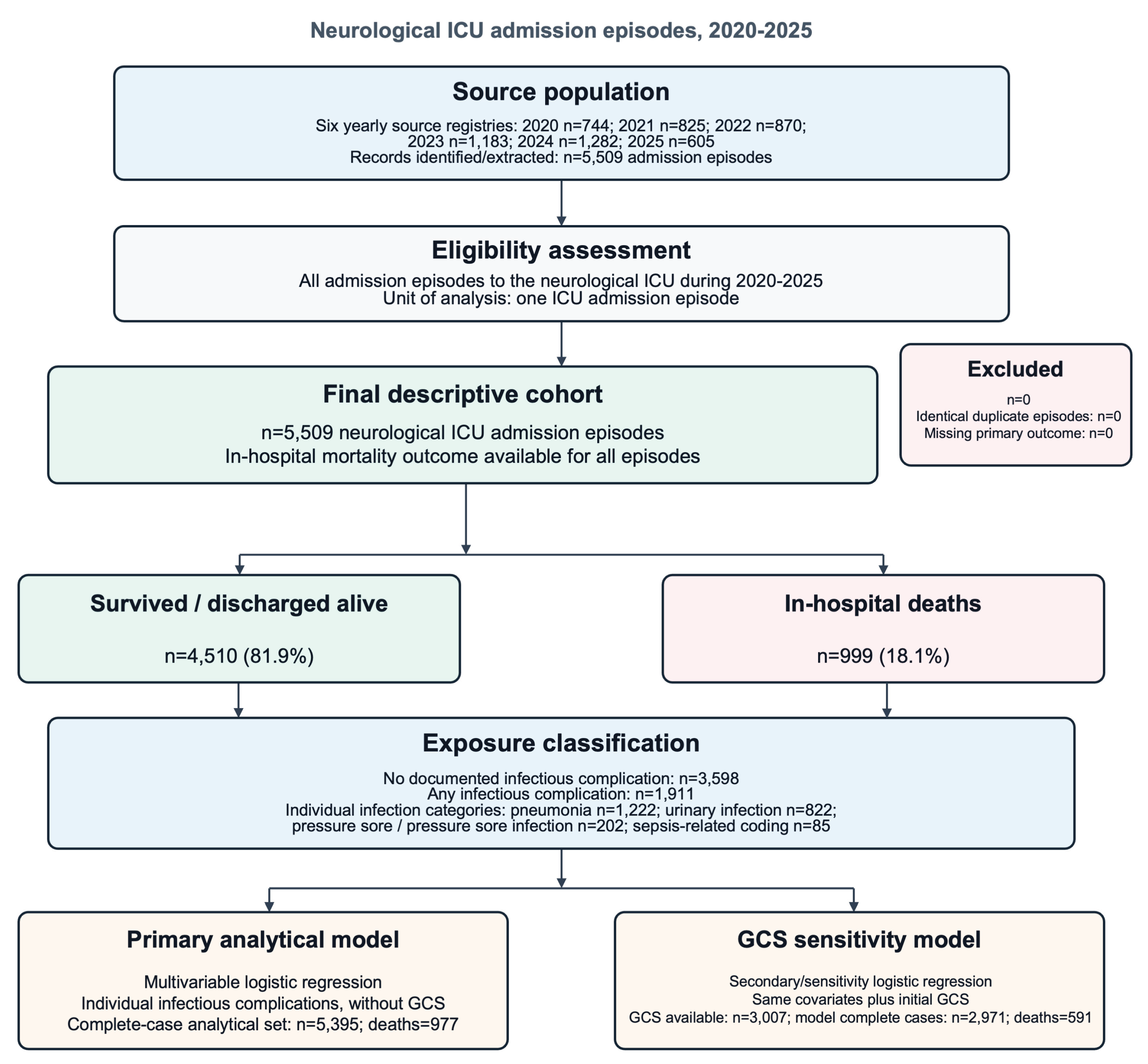
Figure 2.
Forest plot of adjusted predictors of in-hospital mortality in the primary multivariable model. Adjusted odds ratios and 95% confidence intervals are shown for the main infectious and clinical predictors included in the no-GCS multivariable logistic regression model. The vertical reference line indicates an odds ratio of 1. Values above 1 indicate higher adjusted odds of in-hospital death, whereas values below 1 indicate lower adjusted odds. GCS was not included in this primary model to preserve cohort size and was evaluated separately in a sensitivity model. OR, odds ratio; CI, confidence interval; GCS, Glasgow Coma Scale; UTI, urinary tract infection.
Figure 2.
Forest plot of adjusted predictors of in-hospital mortality in the primary multivariable model. Adjusted odds ratios and 95% confidence intervals are shown for the main infectious and clinical predictors included in the no-GCS multivariable logistic regression model. The vertical reference line indicates an odds ratio of 1. Values above 1 indicate higher adjusted odds of in-hospital death, whereas values below 1 indicate lower adjusted odds. GCS was not included in this primary model to preserve cohort size and was evaluated separately in a sensitivity model. OR, odds ratio; CI, confidence interval; GCS, Glasgow Coma Scale; UTI, urinary tract infection.
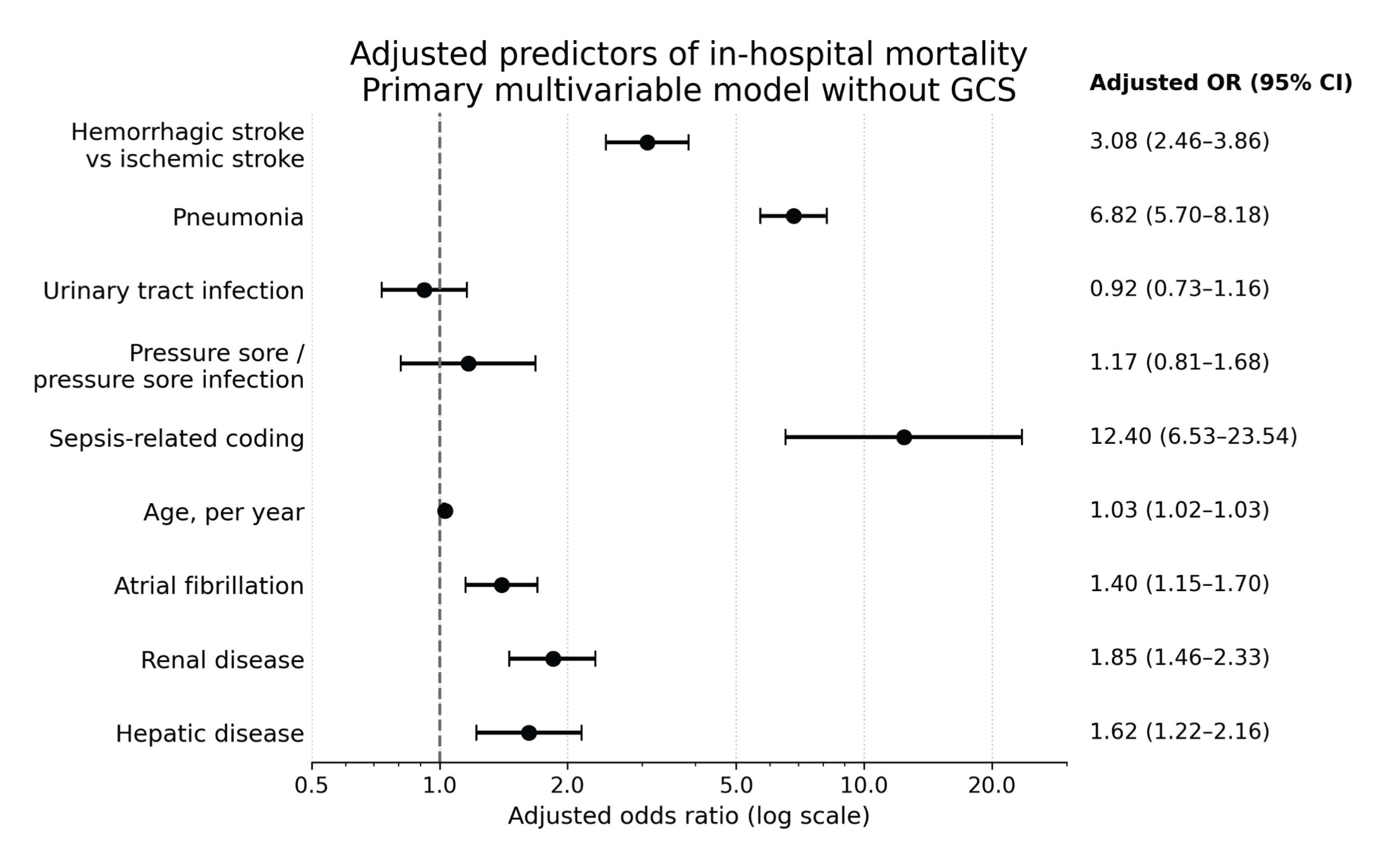

Table 1.
Continuous baseline and clinical variables according to in-hospital mortality status.
| Variable | N available | Survivors | Deaths | p value | Test |
| Age, years | 5434 | N=4447; median (IQR) 70.0 (61.0-79.0); mean ± SD 68.8 ± 13.2 | N=987; median (IQR) 75.0 (67.0-83.0); mean ± SD 73.9 ± 12.3 | <0.001 | Mann-Whitney U |
| Initial GCS | 3007 | N=2408; median (IQR) 15.0 (14.0-15.0); mean ± SD 14.0 ± 3.2 | N=599; median (IQR) 10.0 (5.0-13.0); mean ± SD 9.4 ± 4.3 | <0.001 | Mann-Whitney U |
| Initial systolic BP, mmHg | 4991 | N=4112; median (IQR) 154.0 (136.0-174.0); mean ± SD 155.4 ± 33.9 | N=879; median (IQR) 156.0 (130.0-180.0); mean ± SD 156.1 ± 40.7 | 0.898 | Mann-Whitney U |
| Initial diastolic BP, mmHg | 4968 | N=4094; median (IQR) 84.0 (75.0-96.0); mean ± SD 85.1 ± 19.1 | N=874; median (IQR) 84.0 (72.0-100.0); mean ± SD 85.5 ± 21.6 | 0.829 | Mann-Whitney U |
| Length of stay, days | 5503 | N=4505; median (IQR) 8.0 (5.0-11.0); mean ± SD 9.2 ± 36.4 | N=998; median (IQR) 7.0 (4.0-11.0); mean ± SD 7.5 ± 29.2 | <0.001 | Mann-Whitney U |
Note: Continuous variables are reported as median (interquartile range) and mean ± standard deviation. p values were calculated using the Mann-Whitney U test. Length of stay should be interpreted cautiously because of skewed distribution and the competing processes of early death and discharge.
Table 2.
Categorical baseline, neurological, comorbidity, and infectious variables according to in-hospital mortality status.
Table 2.
Categorical baseline, neurological, comorbidity, and infectious variables according to in-hospital mortality status.
| Variable | N available | Survivors n (%) | Deaths n (%) | Unadjusted OR (95% CI) | p value |
| Male sex | 5484 | 2452 (54.6%) | 489 (49.2%) | 0.80 (0.70-0.92) | 0.002 |
| Any infectious complication | 5509 | 1200 (26.6%) | 711 (71.2%) | 6.81 (5.85-7.93) | <0.001 |
| Pneumonia | 5508 | 619 (13.7%) | 603 (60.4%) | 9.60 (8.24-11.18) | <0.001 |
| COVID-related pneumonia | 5509 | 81 (1.8%) | 52 (5.2%) | 3.00 (2.10-4.28) | <0.001 |
| Urinary tract infection | 5508 | 639 (14.2%) | 183 (18.3%) | 1.36 (1.13-1.63) | 0.001 |
| Pressure sore / pressure sore infection | 5505 | 121 (2.7%) | 81 (8.1%) | 3.21 (2.40-4.30) | <0.001 |
| Sepsis-related coding | 5509 | 22 (0.5%) | 63 (6.3%) | 13.73 (8.41-22.42) | <0.001 |
| Ischemic stroke documented | 5509 | 3050 (67.6%) | 673 (67.4%) | 0.99 (0.85-1.14) | 0.903 |
| Hemorrhagic stroke documented | 5509 | 399 (8.8%) | 306 (30.6%) | 4.55 (3.84-5.39) | <0.001 |
| TIA documented | 5509 | 553 (12.3%) | 7 (0.7%) | 0.05 (0.02-0.11) | <0.001 |
| Stroke sequelae documented | 5508 | 654 (14.5%) | 47 (4.7%) | 0.29 (0.21-0.39) | <0.001 |
| Hypertension | 5508 | 3842 (85.2%) | 805 (80.6%) | 0.72 (0.60-0.86) | <0.001 |
| Ischemic heart disease / prior MI | 5508 | 2423 (53.7%) | 572 (57.3%) | 1.15 (1.00-1.32) | 0.047 |
| Atrial fibrillation | 5508 | 1060 (23.5%) | 379 (37.9%) | 1.99 (1.72-2.30) | <0.001 |
| Diabetes mellitus | 5508 | 1026 (22.8%) | 238 (23.8%) | 1.06 (0.90-1.25) | 0.493 |
| Obesity | 5506 | 2967 (65.8%) | 246 (24.6%) | 0.17 (0.14-0.20) | <0.001 |
| Renal disease | 5509 | 422 (9.4%) | 221 (22.1%) | 2.75 (2.30-3.29) | <0.001 |
| Hepatic disease | 5508 | 346 (7.7%) | 138 (13.8%) | 1.93 (1.56-2.38) | <0.001 |
| Coagulopathy | 5509 | 182 (4.0%) | 91 (9.1%) | 2.38 (1.83-3.10) | <0.001 |
| Previous stroke | 5509 | 1046 (23.2%) | 164 (16.4%) | 0.65 (0.54-0.78) | <0.001 |
| Malignancy | 5509 | 348 (7.7%) | 100 (10.0%) | 1.33 (1.05-1.68) | 0.019 |
| Anticoagulation | 5509 | 30 (0.7%) | 16 (1.6%) | 2.43 (1.32-4.48) | 0.006 |
Note: Categorical variables are reported as n (%). OR values are unadjusted odds ratios for in-hospital death. Adjusted interpretation should rely on the multivariable models.
Table 3.
Annual distribution of admission episodes, in-hospital mortality, and infectious complications.
Table 3.
Annual distribution of admission episodes, in-hospital mortality, and infectious complications.
| Year | Episodes | Deaths n (%) | Any infection n (%) | Pneumonia n (%) | COVID pneumonia n (%) | UTI n (%) | Pressure sore / infection n (%) | Sepsis-related n (%) |
| 2020 | 744 | 158 (21.2%) | 201 (27.0%) | 130 (17.5%) | 26 (3.5%) | 83 (11.2%) | 26 (3.5%) | 1 (0.1%) |
| 2021 | 825 | 190 (23.0%) | 264 (32.0%) | 164 (19.9%) | 49 (5.9%) | 104 (12.6%) | 17 (2.1%) | 16 (1.9%) |
| 2022 | 870 | 160 (18.4%) | 339 (39.0%) | 241 (27.7%) | 40 (4.6%) | 129 (14.8%) | 30 (3.4%) | 0 (0.0%) |
| 2023 | 1183 | 192 (16.2%) | 428 (36.2%) | 259 (21.9%) | 18 (1.5%) | 188 (15.9%) | 47 (4.0%) | 17 (1.4%) |
| 2024 | 1282 | 200 (15.6%) | 453 (35.3%) | 261 (20.4%) | 0 (0.0%) | 231 (18.0%) | 60 (4.7%) | 36 (2.8%) |
| 2025 | 605 | 99 (16.4%) | 226 (37.4%) | 167 (27.6%) | 0 (0.0%) | 87 (14.4%) | 22 (3.6%) | 15 (2.5%) |
Note: Percentages are calculated within each year.
Table 4.
In-hospital mortality according to infectious complication status.
| Infection variable | Exposed N | Deaths among exposed | Mortality exposed | Unexposed N | Deaths among unexposed | Mortality unexposed | Unadjusted OR (95% CI), p value |
| Any infectious complication | 1911 | 711 | 37.2% | 3598 | 288 | 8.0% | 6.81 (5.85-7.93), p<0.001 |
| Pneumonia | 1222 | 603 | 49.3% | 4286 | 395 | 9.2% | 9.60 (8.24-11.18), p<0.001 |
| COVID-related pneumonia | 133 | 52 | 39.1% | 5376 | 947 | 17.6% | 3.00 (2.10-4.28), p<0.001 |
| Urinary tract infection | 822 | 183 | 22.3% | 4686 | 816 | 17.4% | 1.36 (1.13-1.63), p=0.001 |
| Pressure sore / pressure sore infection | 202 | 81 | 40.1% | 5303 | 914 | 17.2% | 3.21 (2.40-4.30), p<0.001 |
| Sepsis-related coding | 85 | 63 | 74.1% | 5424 | 936 | 17.3% | 13.73 (8.41-22.42), p<0.001 |
Note: Mortality comparisons are unadjusted. Adjusted interpretation should rely on the multivariable logistic regression models.
Table 5.
Multivariable logistic regression for in-hospital mortality: primary and GCS-adjusted sensitivity models.
Table 5.
Multivariable logistic regression for in-hospital mortality: primary and GCS-adjusted sensitivity models.
| Model | Predictor | Adjusted OR (95% CI) | p value |
| Primary model, no GCS | Hemorrhagic stroke vs ischemic stroke | 3.08 (2.46-3.86) | <0.001 |
| Primary model, no GCS | Pneumonia | 6.82 (5.70-8.18) | <0.001 |
| Primary model, no GCS | Urinary tract infection | 0.92 (0.73-1.16) | 0.487 |
| Primary model, no GCS | Pressure sore / pressure sore infection | 1.17 (0.81-1.68) | 0.407 |
| Primary model, no GCS | Sepsis-related coding | 12.40 (6.53-23.54) | <0.001 |
| Primary model, no GCS | Age, per year | 1.03 (1.02-1.03) | <0.001 |
| Primary model, no GCS | Atrial fibrillation | 1.40 (1.15-1.70) | <0.001 |
| Primary model, no GCS | Renal disease | 1.85 (1.46-2.33) | <0.001 |
| Primary model, no GCS | Hepatic disease | 1.62 (1.22-2.16) | <0.001 |
| Sensitivity model + GCS | Hemorrhagic stroke vs ischemic stroke | 2.02 (1.46-2.79) | <0.001 |
| Sensitivity model + GCS | Pneumonia | 5.25 (4.05-6.80) | <0.001 |
| Sensitivity model + GCS | Urinary tract infection | 1.04 (0.74-1.46) | 0.816 |
| Sensitivity model + GCS | Pressure sore / pressure sore infection | 0.87 (0.54-1.41) | 0.572 |
| Sensitivity model + GCS | Sepsis-related coding | 10.70 (4.89-23.40) | <0.001 |
| Sensitivity model + GCS | Initial GCS, per point | 0.78 (0.75-0.81) | <0.001 |
| Sensitivity model + GCS | Age, per year | 1.02 (1.01-1.04) | <0.001 |
| Sensitivity model + GCS | Atrial fibrillation | 1.55 (1.17-2.06) | 0.002 |
| Sensitivity model + GCS | Diabetes mellitus | 1.43 (1.06-1.92) | 0.017 |
| Sensitivity model + GCS | Renal disease | 1.67 (1.19-2.36) | 0.003 |
Note: Model performance: primary model N=5,395, AUC=0.885, McFadden pseudo-R²=0.340; GCS sensitivity model N=2,971, AUC=0.920, McFadden pseudo-R²=0.448. GCS, Glasgow Coma Scale; OR, odds ratio; CI, confidence interval.
Table 6.
Incremental prognostic contribution of infectious complications.
| Analysis block | N | Deaths | AUC reduced | AUC full | ΔAUC | McFadden R² reduced | McFadden R² full | ΔR² | AIC reduced | AIC full | ΔAIC | LR χ² | df | LR p value |
| Primary cohort, no GCS | 5395 | 977 | 0.826 | 0.885 | +0.058 | 0.228 | 0.340 | +0.112 | 3984.8 | 3421.2 | -563.6 | 571.6 | 4 | <0.001 |
| Sensitivity cohort with GCS | 2971 | 591 | 0.890 | 0.920 | +0.030 | 0.377 | 0.448 | +0.072 | 1896.3 | 1691.5 | -204.8 | 212.8 | 4 | <0.001 |
Note: Reduced models were clinical-only models. Full models added individual infectious complications to the corresponding clinical model. In the GCS-available subset, both the reduced and full models included GCS. Adding infectious complications significantly improved model fit and discrimination in both analyses. AIC, Akaike information criterion; AUC, area under the receiver operating characteristic curve; LR, likelihood ratio.
Disclaimer/Publisher’s Note: The statements, opinions and data contained in all publications are solely those of the individual author(s) and contributor(s) and not of MDPI and/or the editor(s). MDPI and/or the editor(s) disclaim responsibility for any injury to people or property resulting from any ideas, methods, instructions or products referred to in the content. |
© 2026 by the authors. Licensee MDPI, Basel, Switzerland. This article is an open access article distributed under the terms and conditions of the Creative Commons Attribution (CC BY) license (http://creativecommons.org/licenses/by/4.0/).
Copyright: This open access article is published under a Creative Commons CC BY 4.0 license, which permit the free download, distribution, and reuse, provided that the author and preprint are cited in any reuse.


