
Submitted:
08 June 2026
Posted:
18 June 2026
You are already at the latest version
Abstract
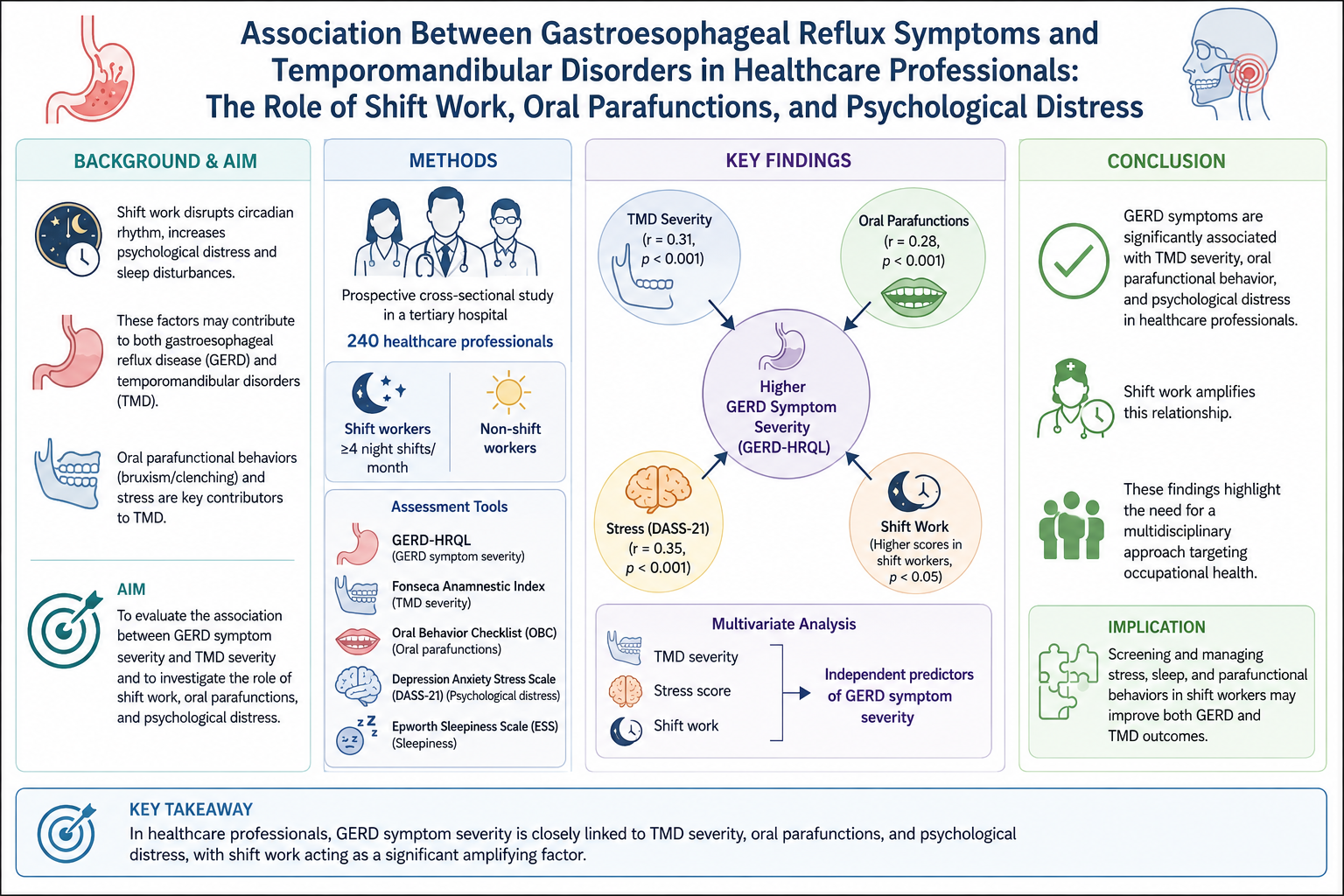
Background: Shift work disrupts circadian rhythm and is associated with sleep disturbances and psychological distress. These factors may contribute to both gastroesophageal reflux disease (GERD) and temporomandibular disorders (TMD). However, the interplay between reflux symptoms, TMD severity, oral parafunctional behavior, and psy-chological distress in healthcare workers remains insufficiently explored. Object: To evaluate the association between GERD symptom severity and TMD severity among healthcare professionals and to investigate the role of shift work, oral parafunctions, and psychological distress in this relationship. Methods: This prospective cross-sectional study included healthcare professionals working at a tertiary hospital. Data were collected using validated questionnaires: GERD-HRQL, Fonseca Anam-nestic Index, Oral Behavior Checklist (OBC), Depression Anxiety Stress Scale (DASS-21), and Epworth Sleepiness Scale (ESS). Participants were categorized as shift workers (≥4 night shifts/month) and non-shift workers. Correlation and multi-variable regression analyses were performed. Results: A total of 240 participants were included. GERD symptom severity was positively correlated with TMD severity (r=0.31, p< 0.001), oral parafunction scores (r=0.28, p< 0.001), and DASS-21 stress scores (r=0.35, p< 0.001). Shift workers had significantly higher GERD-HRQL and TMD scores (p< 0.05). In multivariate analysis, TMD severity, stress score, and shift work remained independent predictors of GERD symptom severity. Conclusion: GERD symptoms in healthcare workers were significantly associated with TMD se-verity, oral parafunctional behavior, and psychological distress. Shift work appears to amplify this relationship. These findings suggest a need for multidisciplinary ap-proaches targeting occupational health.
Keywords:
GERD
; temporomandibular disorder
; shift work
; oral parafunction
; psychological stress
Copyright: This open access article is published under a Creative Commons CC BY 4.0 license, which permit the free download, distribution, and reuse, provided that the author and preprint are cited in any reuse.


