
Submitted:
16 June 2026
Posted:
17 June 2026
You are already at the latest version
Abstract
Artificial intelligence is increasingly expected to raise productivity by automating tasks, augmenting human work, reducing information-processing costs and supporting new forms of economic organisation. Yet productivity gains do not automatically translate into broadly distributed welfare or into output fully absorbed by market demand. This conceptual review develops the notion of the Distributional Absorption Threshold of AI-Induced Productivity, defined as the point beyond which productivity gains associated with AI are no longer accompanied by proportionate increases in broadly distributed real purchasing power and household consumption. The review argues that the macroeconomic significance of AI-induced productivity depends not only on technological efficiency, but also on the distributive transmission of productivity gains through labour income, disposable income, prices, investment, public expenditure, transfers and external demand. The framework distinguishes between a favourable transmission path, in which AI-induced productivity strengthens purchasing power and effective demand, and a critical transmission path, in which productivity gains are weakly transmitted to households and may generate absorption tension. The review formulates conceptual propositions and proposes possible indicators for future empirical research, including the productivity-real labour income gap and an absorption tension indicator. Its contribution is theoretical: it reframes the AI productivity debate beyond automation anxiety by linking technological change, income distribution and effective demand in a single analytical framework.
Keywords:
artificial intelligence
; AI-induced productivity
; labour income
; effective demand
; household consumption
; income distribution
; wage share
; distributional absorption threshold
1. Introduction
Artificial intelligence has become one of the central technologies through which contemporary economies seek to increase productivity, reorganise work and strengthen competitiveness. Recent advances in machine learning and generative AI have intensified this debate because AI systems are no longer confined to narrowly defined routine processes. They increasingly affect prediction, language, coding, design, customer interaction, professional services and knowledge-intensive tasks. For this reason, AI is often discussed as a potentially general-purpose technology whose economic effects depend on complementary innovation, organisational adaptation, skills, data infrastructure and institutional conditions [1,2,3].
The productivity potential of AI is increasingly documented at the level of specific tasks, workers and firms. Experimental and field evidence suggests that generative AI can reduce task completion time, improve output quality and support productivity in activities such as writing, customer support and professional consulting [4,5,6]. At the same time, these effects appear to be heterogeneous. They depend on task characteristics, worker experience, organisational context, capability boundaries and the ability of firms to redesign workflows around AI tools. AI should therefore be approached as a technology with significant productivity potential, but not as a mechanical source of immediate and uniform macroeconomic productivity growth.
A large part of the public debate on AI has focused on the possibility of job displacement. This concern is legitimate, but it is not sufficient for understanding the macroeconomic implications of AI-induced productivity growth. The task-based literature has shown that technological change may substitute some tasks, complement others and create or reinstate new forms of work [7,8,9,10]. AI should therefore not be interpreted only through the lens of technological unemployment. Employment displacement is one possible channel, but productivity gains may also affect labour income through slower wage growth, reduced hours worked, changing bargaining power, labour-market polarisation, declining labour share or the concentration of gains in profits and capital income.
This article starts from a broader macroeconomic question: even if AI increases productivity, under what conditions are the resulting gains transformed into broadly based purchasing capacity and effective demand?
The question matters because productivity growth expands the capacity to produce, but it does not automatically ensure that additional output will be absorbed by the market. The economic realisation of productivity gains depends on demand channels, including household consumption, investment, public expenditure and external demand. It also depends on the distribution of income between labour and capital, the extent of redistribution, price dynamics and the marginal propensity to consume across household groups.
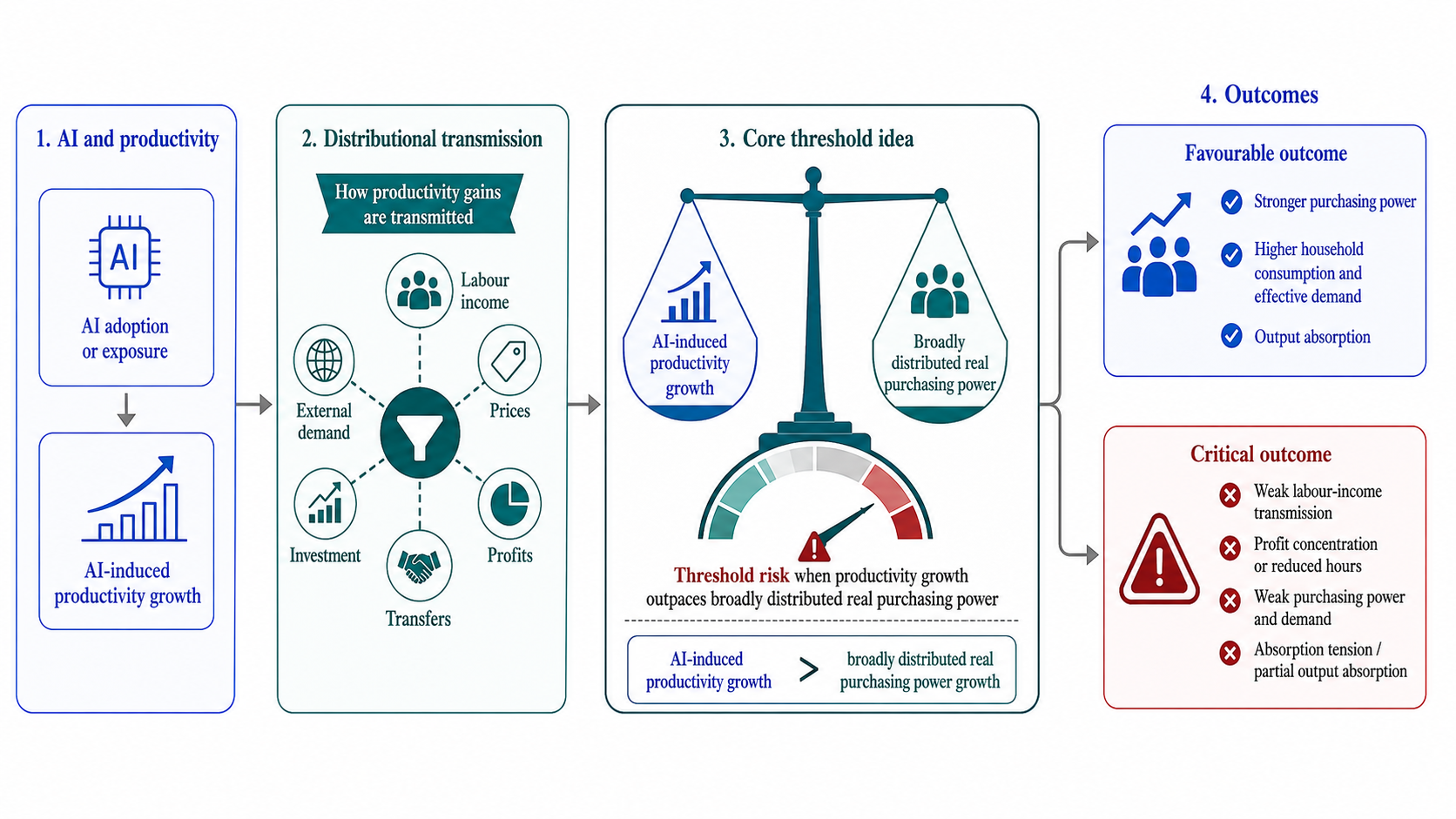
To capture this problem, this conceptual review develops the notion of the Distributional Absorption Threshold of AI-Induced Productivity. The concept refers to the point beyond which productivity gains associated with the adoption or use of AI are no longer accompanied by proportionate increases in broadly distributed real purchasing power and household consumption. In simplified terms, the threshold becomes relevant when the rate of AI-induced productivity growth persistently exceeds the rate of growth in broadly distributed real purchasing power. The concept was initially formulated as a definitional contribution [11], and the present review develops it into a wider theoretical framework.
The contribution of the review is threefold. First, it reframes the debate on AI and productivity by shifting attention from technological efficiency alone to the distributive and demand-side realisation of productivity gains. Second, it distinguishes between a favourable transmission path, in which AI-induced productivity gains support wages, purchasing power, consumption and output absorption, and a critical transmission path, in which productivity gains are weakly transmitted to household income and effective demand. Third, it proposes a conceptual basis for future empirical operationalisation through indicators such as the productivity-real labour income gap and the absorption tension indicator.
This review is theoretical and conceptual in nature. It does not claim that a distributional absorption threshold has already been reached in any specific economy. Nor does it assume that AI necessarily produces mass unemployment or demand weakness. Its purpose is more circumscribed: to identify the conditions under which AI-induced productivity gains may be only partially realised because their distributive transmission into purchasing power and demand is insufficient. This approach allows a more balanced interpretation of AI, situated between technological optimism and automation anxiety.
The review is structured as follows. Section 2 discusses AI as a productivity-enhancing technology and distinguishes between productive capacity and economic realisation. Section 3 examines AI, labour tasks and income distribution. Section 4 develops the link between labour income, household consumption and effective demand. Section 5 defines the Distributional Absorption Threshold of AI-Induced Productivity and presents the favourable and critical transmission paths. Section 6 formulates the conceptual propositions of the article. Section 7 discusses possible indicators and research designs for future empirical operationalisation. Section 8 presents the theoretical and policy implications of the framework, and Section 9 concludes by identifying future research directions.
2. Artificial Intelligence and Productivity: From Technological Capacity to Economic Realisation
2.1. Artificial Intelligence as a General-Purpose and Productivity-Enhancing Technology
Artificial intelligence is increasingly analysed as a technology with the potential to reshape production, work organisation and the structure of economic activity. Its relevance does not derive only from the automation of isolated tasks, but also from its capacity to support prediction, classification, optimisation, coordination, search and decision-making across a wide range of activities. In this respect, AI can be situated within the broader literature on general-purpose technologies, understood as technologies whose economic significance depends on wide applicability, continuous improvement and complementarities with other innovations [1,2,3]. From this perspective, AI is not merely another digital tool. It may become a productivity-enhancing infrastructure that changes how firms process information, allocate resources, organise labour, interact with consumers and generate value.
The productivity potential of AI operates through several channels. AI can automate routine, repetitive or codifiable tasks, thereby reducing the labour time required for specific activities. It can also augment human work by supporting drafting, programming, diagnosis, translation, customer interaction, managerial analysis and knowledge-intensive decision-making. In addition, AI can reduce prediction and information-processing costs, which may improve the speed and quality of decisions in sectors where uncertainty and data complexity are central. Finally, AI may enable new products, services and business models that were not feasible under previous technological conditions. These mechanisms suggest that AI may influence productivity both by saving labour in some tasks and by complementing labour in others.
However, the relationship between AI and productivity should not be interpreted mechanically. The history of general-purpose technologies shows that productivity gains are rarely immediate, uniform or automatically visible in aggregate indicators. They usually require complementary investments in intangible capital, human skills, organisational redesign, managerial capabilities, data infrastructure and institutional adaptation [2]. This is particularly relevant for AI because its value depends not only on access to algorithms, but also on the capacity of firms and institutions to integrate AI into routines, workflows and decision processes. A firm may adopt AI tools without being able to reorganise production around them. Conversely, firms with stronger data systems, complementary skills and better organisational capabilities may obtain larger productivity gains from similar technologies.
For this reason, it is necessary to distinguish between AI as a source of technological potential and AI as a source of realised productivity growth. Adoption alone is not sufficient. Productivity effects depend on the scale of use, the nature of the tasks affected, the quality of implementation, the capacity to redesign work and the broader institutional environment. This distinction is important for the article’s theoretical argument because the distributional absorption problem cannot be understood if AI-induced productivity is treated as an automatic macroeconomic outcome.
2.2. Evidence on AI-Related Productivity Gains and Their Heterogeneity
Recent evidence on generative AI confirms that AI can improve performance in specific tasks, while also showing that its effects are heterogeneous across workers, tasks and organisational contexts. Noy and Zhang [4] show experimentally that generative AI can increase productivity in professional writing tasks by reducing completion time and improving output quality. Brynjolfsson et al. [5] find that a generative AI assistant increased productivity among customer-support agents, with stronger effects for less experienced workers. Dell’Acqua et al. [6] show that AI can improve productivity and quality in knowledge-intensive consulting tasks, while also emphasising that performance depends on whether tasks fall within or outside the technology’s effective capability frontier.
These findings provide concrete evidence that AI may raise task-level productivity. They do not, however, justify the conclusion that aggregate productivity growth will automatically accelerate across the whole economy. Task-level improvements do not necessarily translate into proportional macroeconomic gains. Aggregation depends on the diffusion of AI, the share of affected tasks in total production, complementarities with human labour, the capacity of firms to reorganise production and the distribution of AI adoption across sectors. AI may generate large productivity gains in some firms and limited effects in others, producing an uneven productivity landscape rather than a uniform technological acceleration.
This heterogeneity has also been recognised in broader policy-oriented analyses. Filippucci et al. [12] argue that AI may support productivity growth, while also emphasising uneven adoption, concentration of AI capabilities, complementarities with skills and possible distributional implications. Acemoglu [13] similarly cautions against assuming very large aggregate productivity effects without examining task exposure, cost savings, automation, complementarities and diffusion. These contributions support a prudent interpretation: AI has substantial productivity potential, but the magnitude, timing and distribution of its macroeconomic effects remain conditional.
The implication for the present article is that AI-induced productivity should be treated as a conditional process rather than as a guaranteed outcome. This is not a limitation of the theoretical framework, but one of its starting premises. If productivity gains are heterogeneous and institutionally mediated, then their distribution becomes central. A productivity gain captured by a small number of firms, capital owners or high-income groups has different macroeconomic implications from a productivity gain transmitted broadly through wages, prices, employment income or public revenues.
2.3. From Productive Capacity to Economic Realisation
The key distinction for this article is the distinction between productive capacity and economic realisation. AI may increase the capacity of firms and economies to produce more output with the same or fewer inputs. Yet a rise in productive capacity does not automatically imply that the additional output will be realised through market demand. In macroeconomic terms, the capacity to produce and the capacity of the market to absorb what is produced are related, but they are not identical.
Much of the current debate on AI remains strongly supply-side. AI is often examined through its expected effects on productivity, efficiency, automation, innovation, costs and output per worker. These dimensions are essential, but they do not exhaust the macroeconomic question. Even when productivity rises, the resulting output can be fully realised only if there is sufficient effective demand. Demand may come from household consumption, private investment, public expenditure or external markets. If these channels do not expand in line with productive capacity, part of the productivity potential may remain weakly absorbed.
The demand-side dimension becomes especially important when productivity gains are unevenly distributed. Productivity growth can support economic realisation when it is transmitted into higher real wages, employment income, household disposable income, lower consumer prices or public revenues that finance transfers and services. In these cases, the increase in productive capacity is accompanied by an increase in purchasing power or demand-generating expenditure. By contrast, if productivity gains accrue mainly to profits, capital income or high-saving groups, while real labour income stagnates or grows more slowly, the link between productivity and household demand may weaken. This does not mean that profits or investment are unimportant. It means that the absorption of additional output depends on the composition of income flows and on the channels through which they return to demand.
This article therefore approaches AI-induced productivity as a two-stage problem. The first stage concerns whether AI increases productive efficiency. The second concerns whether the resulting gains are transmitted into the income and expenditure flows required for effective demand. The proposed concept of the Distributional Absorption Threshold of AI-Induced Productivity starts from this second stage. It asks whether, and under what conditions, the economy’s capacity to produce may expand faster than the broadly distributed purchasing power required to absorb additional output.
This formulation does not imply that AI is economically harmful by itself. Rather, it indicates that the macroeconomic significance of AI depends on the institutional and distributive context in which productivity gains are generated, allocated and transformed into demand. If compensating demand channels are sufficiently strong, weak labour-income transmission may not become a macroeconomic constraint. However, if these channels are insufficient and if household purchasing capacity grows persistently more slowly than AI-induced productivity, a distributional absorption problem may emerge.
The contribution of this section is therefore to shift the analytical focus from technological capacity to economic realisation. AI may expand what the economy can produce, but the realisation of that potential depends on whether productivity gains return to the economy as effective demand. This bridge prepares the argument developed in the following sections: AI affects tasks and labour income, labour income shapes household purchasing power, and purchasing power is central to the absorption of additional output.
3. AI, Labour Tasks and Income Distribution
3.1. From Occupations to Tasks: A More Precise View of AI Exposure
A careful analysis of artificial intelligence and labour income should begin with the distinction between occupations and tasks. Occupations are bundles of tasks, and technological change rarely affects all tasks within an occupation in the same way. This distinction is central to the task-based literature, which shows that digital technologies may substitute for some activities, complement others and reshape the composition of work rather than simply eliminate entire occupations [7,8,9]. From this perspective, the relevant question is not whether an occupation is replaced by AI, but which tasks within that occupation become automatable, augmentable or reorganised.
This distinction is particularly important in the case of AI because AI systems do not map neatly onto traditional categories of manual or routine work. Earlier waves of computerisation and automation were often associated with routine cognitive and routine manual tasks. By contrast, recent AI systems, especially machine learning and generative AI, may affect prediction, text production, image recognition, translation, coding, customer interaction, diagnosis, legal drafting, teaching support and managerial analysis. AI exposure may therefore be significant in some non-routine cognitive occupations that were previously considered less exposed to automation [14,15,16].
Exposure, however, should not be confused with displacement. An occupation may be highly exposed to AI because many of its tasks overlap with AI capabilities, but this does not mean that the occupation will necessarily disappear. Exposure may lead to substitution, but it may also lead to augmentation, task reallocation, changes in skill requirements or new forms of human-AI complementarity. The distinction is essential for avoiding an overly deterministic interpretation of AI and work. AI exposure identifies where technological pressure or opportunity may arise; it does not, by itself, determine the labour-market outcome.
Empirical and institutional studies support this more nuanced interpretation. Felten et al. [15] develop an AI Occupational Exposure measure that can be applied across occupations, industries and geographical areas. Georgieff and Hyee [17] find no simple cross-country relationship between AI exposure and employment growth, although their results suggest differentiated effects depending on computer use and occupational conditions. OECD evidence also indicates that current AI use at work can be associated with positive outcomes for some workers, including performance and job satisfaction, while also raising concerns about job loss, work intensity, privacy and bias [18,19]. Taken together, these findings support a conditional interpretation of AI’s labour-market effects.
The task-based approach is useful for the present article because it separates three analytically distinct dimensions: technological capability, labour-market exposure and distributive outcome. Technological capability refers to what AI systems can technically perform. Labour-market exposure refers to the extent to which workers’ tasks overlap with those capabilities. The distributive outcome refers to how the gains, costs and risks associated with that exposure are allocated between workers, firms, consumers and the state. The distributional absorption framework developed in this article depends mainly on the third dimension. AI may raise productivity through exposed tasks, but the macroeconomic relevance of this increase depends on whether the resulting gains support labour income and effective demand.
3.2. Substitution, Complementarity and Task Reinstatement
AI may affect labour income through several mechanisms. The first is task substitution. When AI performs tasks previously carried out by workers, firms may reduce labour demand for those activities, lower the number of hours required or reorganise work around fewer employees. The second is task complementarity. AI may increase workers’ productivity by helping them perform tasks faster or better, potentially supporting higher wages, better job quality or new forms of professional capability if the gains are shared. The third is task reinstatement. New technologies can create new tasks, occupations and organisational functions, including roles related to AI supervision, data governance, model evaluation, human-AI coordination and ethical compliance [10].
The balance between substitution, complementarity and reinstatement is crucial for the distribution of income. If AI primarily replaces labour in existing tasks and if new labour-intensive tasks do not emerge sufficiently, labour income may weaken. If AI mainly complements workers and raises their productivity, labour income may increase, especially where workers have bargaining power, scarce skills or institutional protection. If productivity gains accrue mainly to firms, platforms, capital owners or a limited group of highly skilled workers, the distributional effects may be unequal even without large aggregate employment losses.
Unemployment should therefore not be treated as the only relevant channel. A narrow focus on job loss may obscure other forms of distributive weakening. AI-related productivity gains may fail to support broad purchasing power even if employment remains formally stable. This may occur through slower wage growth, reduced hours, weaker bargaining power, task fragmentation, increased work intensity, labour-market polarisation or a declining labour share. Conversely, AI may support labour income if productivity gains are translated into wage growth, better job design, new occupations or inclusive forms of skill upgrading.
The broader automation literature confirms that labour-market effects are mediated by institutions and adjustment mechanisms. Acemoglu and Restrepo [20] show that industrial robots can have negative effects on employment and wages in local labour markets, while also emphasising the importance of the displacement effect relative to productivity and reinstatement effects. Their framework is relevant not because industrial robots and AI are identical, but because it clarifies that automation affects labour through competing mechanisms. Similarly, evidence on demographics and automation suggests that technology adoption may respond to labour scarcity and institutional conditions, not only to technological opportunity [21]. These insights reinforce a cautious conclusion: the labour-market effects of AI are not technologically predetermined.
Recent analyses of generative AI point in the same direction. Cazzaniga et al. [16] argue that generative AI may affect a large share of jobs in advanced economies, but that exposure may involve both substitution and complementarity. The distributional impact therefore depends on who is exposed, how tasks are reorganised and whether workers can benefit from productivity-enhancing complementarities. OECD evidence also suggests that workers’ experiences with AI may differ from their expectations and fears, with reported benefits in some workplaces and concerns in others [18,19]. This reinforces the argument that AI should be analysed through mechanisms rather than through a single predetermined employment scenario.
3.3. Labour Income, Wage Share and the Distribution of AI-Related Gains
For the theoretical framework developed in this article, the key issue is not only whether AI changes tasks, but how the productivity gains associated with those task changes are distributed. A productivity-enhancing technology can generate different income trajectories depending on bargaining power, ownership structures, wage-setting institutions, skill distribution, market concentration and public policy. AI may raise output per worker, but the income generated by this increase may be transmitted to labour, capital, consumers, the state or external markets in different proportions.
In a favourable trajectory, AI increases productivity and part of the gains is transmitted to workers and households through higher wages, employment income, reduced prices, better job quality or social and fiscal channels. In this case, productivity growth contributes to broadly distributed purchasing power and may support household consumption. In a more critical trajectory, productivity increases but real labour income grows more slowly, working time declines, wage gains are concentrated among a limited group of workers, or profits capture a disproportionate share of the gains. This second trajectory is particularly relevant for the distributional absorption framework because it creates the possibility that productive capacity expands faster than broadly based household purchasing capacity.
This argument does not imply that profits, capital accumulation or firm-level productivity gains are undesirable. They may finance investment, innovation and future growth. The problem arises when the circulation of productivity gains back into demand becomes too weak or too concentrated. If the income generated by AI-induced productivity gains is saved, retained, distributed to high-saving groups or invested in ways that do not sufficiently support demand, household consumption may not expand in proportion to productive capacity. In this sense, labour income and functional income distribution are not secondary to the productivity debate. They are part of the conditions under which productivity gains become economically realised.
This is where the AI productivity debate should connect more explicitly with the literature on income distribution and effective demand. A productivity gain matters macroeconomically not only because it increases output per unit of input, but also because it changes the flow of income in the economy. If that income flow supports household purchasing capacity on a sufficiently broad basis, productivity gains may be absorbed through consumption and other components of demand. If it does not, the economy may face a gap between technological capacity and market absorption.
The next section therefore develops the demand-side foundation of the article. It connects labour income, household disposable income, marginal propensity to consume and final household consumption. This step is necessary because the proposed distributional absorption threshold cannot be understood only from the perspective of productivity or labour-market exposure. It must be understood as a relationship between productivity growth, income distribution and the capacity of demand to absorb additional output.
4. Labour Income, Household Consumption and Effective Demand
4.1. From Labour Income to Household Disposable Income
The previous section showed that AI-related productivity gains may be distributed through different labour-market and income channels. The present section develops the demand-side implication of that argument. A productivity gain becomes macroeconomically relevant not only because it increases output per unit of input, but also because it modifies the income flows through which households, firms and governments finance expenditure. For this reason, the connection between labour income, household disposable income and consumption is central to the proposed distributional absorption framework.
Labour income is particularly important because, in most economies, it represents the main source of income for a large share of households. Wages, salaries, self-employment income and employment-related earnings affect the capacity of households to finance consumption without relying excessively on credit or asset liquidation. When productivity gains are transmitted into labour income, they can strengthen household purchasing power and support the absorption of additional output. When this transmission is weak, the macroeconomic effects of productivity growth may depend more heavily on other channels, such as investment, public expenditure, social transfers, lower prices or external demand.
This does not mean that labour income is the only relevant component of demand. Profits may finance investment, public revenues may finance transfers and services, and external demand may absorb part of domestic production. However, labour income deserves particular attention because it links the production side of the economy to household consumption more directly than many other income flows. If productivity growth raises output potential but does not sufficiently support the income of households with a relatively high propensity to consume, the demand-side realisation of that productivity may become more fragile.
The functional distribution of income is therefore relevant to the analysis. The division of value added between labour and capital affects the composition of income flows and, consequently, the way productivity gains return to demand. Classical and Keynesian-inspired approaches have long recognised that wages, profits and investment interact in shaping demand and growth [22,23,24]. More recent research on the decline of the labour share has also shown that the distribution between labour and capital is not constant and may vary across countries, sectors and time [25,26]. This matters for the present article because AI-induced productivity gains may have different macroeconomic effects depending on whether they strengthen labour income, capital income, prices, investment or public revenues.
Household disposable income provides a broader bridge between production and consumption because it includes not only labour income, but also taxes, transfers, social benefits, property income and other redistributive mechanisms. This is important because weak labour-income transmission may, in some contexts, be partly offset by fiscal redistribution, social protection or public transfers. Conversely, if labour income weakens and redistribution is limited, the capacity of households to absorb additional output through consumption may be reduced. The relevant question is therefore not only whether AI raises productivity, but whether the income generated by that productivity reaches households in forms that support real purchasing power.
This distinction helps avoid a narrow wage-only interpretation. A distributional absorption problem may arise through wages, but also through disposable income, working hours, employment income, debt burdens or the distribution of profits. It may also be mitigated through broader demand-supporting and redistributive channels. The key issue is the strength of the transmission from productivity gains to effective demand. Labour income and household disposable income are not merely social outcomes of technological change. They are macroeconomic channels through which productivity growth can be realised or constrained.
4.2. Consumption Heterogeneity and the Marginal Propensity to Consume
The relationship between income distribution and demand depends crucially on the heterogeneity of household consumption behaviour. If all households spent the same proportion of additional income, the distribution of productivity gains would matter less for aggregate consumption. In practice, however, households differ substantially in their marginal propensity to consume. Lower-income, liquidity-constrained or low-wealth households tend to spend a larger share of additional income, while wealthier households generally save a larger share [27,28]. This insight is central to the distributional absorption framework.
The marginal propensity to consume links distributional outcomes to macroeconomic demand. A productivity gain transmitted to households with high consumption needs and limited financial buffers is more likely to translate into consumption expenditure. A similar gain transmitted to households or entities with a high propensity to save may have a weaker immediate effect on household demand. This does not imply that saving is undesirable. Saving may finance investment and future growth. The point is more specific: the short- and medium-term absorption of additional output depends partly on whether productivity gains are channelled towards groups whose income growth is likely to support consumption.
The same reasoning applies to the distinction between labour income and capital income. Labour income is generally more broadly distributed across households than capital income, although this varies across countries and institutional settings. If AI-induced productivity gains are concentrated in profits, dividends, retained earnings or capital gains, the effect on household consumption may be weaker than if part of those gains is transmitted through wages, employment income or transfers. Mian et al. [29] develop a related argument by showing how differences between borrowers and savers can shape aggregate demand. Their analysis is not about AI, but it is relevant because it highlights how the distribution of income and balance-sheet positions affects demand.
This point is important for avoiding an oversimplified contrast between wages and profits. Profits can support demand if they are invested, taxed and redistributed, or used to finance productive expansion. Wages can fail to support demand if they accrue mainly to high-income households with high saving rates. The issue is not the moral superiority of one income category over another, but the macroeconomic circulation of income. The proposed threshold concerns the point at which the distributional transmission of productivity gains becomes too weak to sustain the demand required for the absorption of additional output.
Consumption heterogeneity also implies that aggregate indicators may conceal important mechanisms. An economy may show rising average income while the income of high-consumption households stagnates. It may show productivity gains while household consumption grows slowly because gains accrue to groups with lower marginal propensities to consume. It may also maintain consumption temporarily through credit, even when labour income growth is weak. Such patterns are analytically important because they suggest that output absorption can be supported, delayed or distorted through different income and financial channels.
For this reason, a theoretical framework on AI-induced productivity should not stop at productivity or wage indicators alone. It must examine how productivity gains affect the distribution of real purchasing power. The relevant concept is not simply average income growth, but broadly distributed real purchasing power. This broader measure is intentionally wider than wages. It includes the purchasing capacity of households after accounting for prices, taxes, transfers, working time, employment income and other income sources. Such a framing is necessary because AI may affect not only wages, but also prices, profits, public revenues, job structures and the need for redistribution.
4.3. Effective Demand and the Absorption of Productivity Gains
The concept of effective demand provides the macroeconomic foundation for the proposed distributional absorption framework. In Keynesian and Kaleckian traditions, output is not determined only by productive capacity, but also by expenditure decisions and by the demand that validates production [22,30]. This perspective is particularly useful for analysing AI because a technology that raises productive efficiency may still require demand-side conditions for its output effects to be realised. AI may make it possible to produce more, faster or at lower cost, but the economic realisation of this potential depends on whether households, firms, governments or foreign buyers are willing and able to purchase the additional output.
Distribution-sensitive models of demand provide a further layer of analysis. Bhaduri and Marglin [24] show that the effects of changes in income distribution depend on the relative responses of consumption, investment and net exports. Later wage-led growth approaches developed this insight by examining whether a higher wage share supports or constrains demand under different institutional and external conditions [31,32]. These approaches are not directly about AI, but they offer a theoretical basis for analysing whether productivity gains are more likely to be absorbed when they are transmitted into wages and household income.
The relevance of this literature for AI lies in its treatment of distribution as a demand condition. If productivity gains reduce costs and prices, households may benefit through higher real purchasing power even without proportional wage increases. If productivity gains support investment, firms may absorb part of the additional output through capital formation. If public revenues rise, governments may support demand through expenditure, transfers or services. If external demand is strong, foreign markets may absorb part of domestic production. These are all possible channels of absorption. The proposed framework does not deny them. It argues more cautiously that when these channels are insufficient and when broadly distributed purchasing power lags behind productivity growth, an absorption tension may emerge.
This formulation also clarifies why the proposed threshold is not equivalent to underconsumption in a simplistic sense. The issue is not that all productivity growth must be matched immediately by household consumption. Modern economies absorb output through multiple components of demand. The issue is whether the total demand structure, including household consumption, investment, public expenditure and external demand, is strong enough to realise the productive capacity enabled by AI. Household consumption remains central because it is a large and relatively stable component of aggregate demand in advanced economies, but it is not the only channel.
A distributional absorption problem may therefore be understood as a mismatch between the pace of productivity expansion and the pace at which purchasing power and demand-generating expenditure expand. If AI-induced productivity growth is accompanied by higher real wages, lower prices, stronger investment, adequate redistribution or external demand, the additional productive capacity may be absorbed. If, however, productivity gains are weakly transmitted to households and are not sufficiently compensated by other demand channels, the economy may become capable of producing more than the market can absorb under existing distributive conditions.
This reasoning prepares the conceptual definition developed in the next section. The Distributional Absorption Threshold of AI-Induced Productivity does not describe a collapse of demand, nor does it assume that AI necessarily reduces employment. It refers to a condition in which the distributional transmission of productivity gains becomes insufficient to sustain proportionate growth in broadly distributed real purchasing power and household consumption. The concept therefore integrates three elements that are often discussed separately: technological productivity, income distribution and effective demand.
This integration is the main theoretical step required for a more balanced discussion of AI and macroeconomic transformation. A purely technological view may overstate the automatic benefits of productivity growth. A purely labour-displacement view may overstate the risk of unemployment while neglecting other distributive channels. A demand-side distributional view allows a more cautious interpretation: AI may generate productivity gains, but the absorption of those gains depends on how the income generated by productivity is distributed, spent, invested, taxed and transferred. This is the analytical space in which the proposed threshold becomes meaningful.
5. The Distributional Absorption Threshold of AI-Induced Productivity
5.1. Conceptual Definition and Theoretical Positioning
The concept of the Distributional Absorption Threshold of AI-Induced Productivity [11] is proposed to capture a specific macroeconomic and distributional condition. It refers to the point beyond which productivity gains associated with the adoption or use of artificial intelligence are no longer accompanied by proportionate increases in broadly distributed real purchasing power and household consumption. Building on this initial definitional formulation, the present review develops the concept into a broader theoretical framework linking AI-induced productivity, labour income, income distribution, household demand and output absorption.
The threshold does not describe a technological limit of artificial intelligence. It does not refer to the maximum capacity of AI systems to automate tasks, process information, support prediction or increase efficiency. Rather, it refers to the macroeconomic conditions under which the productive capacity enabled by AI may fail to be fully realised through demand. In this sense, the threshold is not located inside the technology itself, but in the relationship between technological productivity, distributive transmission and effective demand.
This distinction matters because a technology can expand productive capacity without automatically generating the purchasing power required to absorb additional output. AI may allow firms to produce more efficiently, reduce costs, improve decision-making and reorganise tasks. However, if the gains generated by these improvements are not sufficiently transmitted into household income, lower prices, investment, public expenditure or external demand, the resulting productive capacity may remain only partially realised. The threshold therefore refers to a possible mismatch between the expansion of supply-side capacity and the distributive foundations of demand.
Figure 1 summarises the conceptual sequence proposed in this article. AI adoption or exposure may generate productivity gains, but the macroeconomic realisation of these gains depends on how they are distributed through labour income, prices, profits, transfers, investment and external demand. The sequence may therefore lead either to output absorption or to absorption tension.
The concept builds on demand-constrained interpretations of technological progress. Gries and Naudé [33,34] argue that AI-related automation may expand productive capacity while also affecting income distribution and aggregate demand. Their work is useful because it moves the discussion beyond the expectation that automation necessarily produces either productivity acceleration or mass unemployment. The distributional absorption threshold extends this reasoning by identifying a more specific condition: the point at which the distributive transmission of AI-induced productivity gains becomes too weak to sustain proportionate growth in household purchasing capacity and consumption.
The threshold should therefore be understood as an analytical construct, not as a fixed empirical constant. It is not expected to appear at the same level of AI adoption, productivity growth or wage share in all economies. It is likely to depend on labour-market institutions, wage bargaining, social protection, fiscal redistribution, household indebtedness, price dynamics, investment behaviour, external demand and the sectoral structure of AI adoption. The concept is theoretically useful precisely because it brings these conditions into a common analytical frame.
5.2. What the Threshold Is and What It Is Not
A careful definition requires a clear distinction between what the distributional absorption threshold is and what it is not. First, it is not a claim that AI is inherently harmful. AI may generate substantial benefits by increasing efficiency, reducing costs, improving service quality, supporting innovation and enabling new forms of production. The threshold concept does not deny these benefits. It asks whether the gains generated by AI are distributed and circulated in ways that support effective demand.
Second, the threshold is not equivalent to technological unemployment. Employment displacement may be one channel through which absorption becomes weaker, but it is not the only channel. A distributional absorption problem may also arise when employment remains stable but wage growth is weak, hours worked decline, labour income becomes more concentrated, the labour share falls or productivity gains are captured mainly by capital income. For this reason, the concept avoids a narrow focus on job loss and instead focuses on the broader transmission from productivity to real purchasing power.
Third, the threshold is not determined solely by the rate of AI adoption. A country, sector or firm may have high AI adoption without necessarily experiencing an absorption problem if productivity gains are transmitted into wages, lower prices, investment, public revenues or external demand. Conversely, even moderate AI adoption may raise distributional concerns if its gains are highly concentrated and if demand-supporting channels are weak. The relevant issue is not simply how much AI is used, but how the income generated by AI-related productivity is allocated and recirculated.
Fourth, the threshold is not a productivity slowdown. It refers to a situation in which productivity may increase, but the demand-side capacity to absorb the resulting output does not expand proportionately. In this respect, the concept differs from debates focused only on whether AI will accelerate measured productivity. The proposed framework asks a different question: if productivity increases, under what distributive and demand-side conditions will the resulting productive capacity be economically realised?
Finally, the threshold is not a universal crisis point that can be identified independently of institutions. It is a conditional and context-dependent concept. In economies with strong wage transmission, inclusive labour-market institutions, effective redistribution and robust demand channels, AI-induced productivity gains may be more easily absorbed. In economies where productivity gains are concentrated and household purchasing power grows slowly, the risk of absorption tension may be higher.
Table 1 clarifies these distinctions by showing how the proposed threshold should and should not be interpreted.
5.3. The Favourable Transmission Path
The favourable transmission path describes the conditions under which AI-induced productivity gains can be economically absorbed. In this trajectory, AI raises productivity and part of the resulting gain is transmitted to households, firms and the public sector through channels that support demand. Higher productivity may lead to higher real wages, improved employment income, lower consumer prices, increased household disposable income, stronger investment, higher public revenues or more competitive exports. Under these conditions, the productive capacity enabled by AI is more likely to become demand-realised output.
This path does not require all productivity gains to be transmitted directly to wages. Lower prices can increase real purchasing power even if nominal wages do not rise proportionately. Investment can absorb additional output through capital formation. Public expenditure and social transfers can support household demand. External demand can provide markets for additional production. The favourable path should therefore be understood as a broad demand-supporting configuration, not as a wage-only mechanism.
Labour income nevertheless remains important because it is the main source of purchasing power for many households. If AI-induced productivity growth is accompanied by rising real wages, stable or expanding employment income and adequate social protection, the probability of demand absorption increases. In this case, AI may contribute not only to productive efficiency, but also to broader economic welfare. The key condition is that productivity gains circulate through the economy in ways that sustain expenditure.
5.4. The Critical Transmission Path
The critical transmission path describes the conditions under which AI-induced productivity gains may become weakly absorbed. In this trajectory, AI raises productivity, but the distributive transmission of the gains is insufficient. Productivity may increase while real labour income grows slowly, wage gains are concentrated, working hours decline, employment income weakens or profits capture a disproportionate share of the productivity gain. If these developments are not compensated by lower prices, investment, redistribution, public expenditure or external demand, household consumption may not expand in proportion to productive capacity.
This does not imply that profits are economically unproductive or that capital income is undesirable. Profits may finance innovation, investment and future productive expansion. The problem is more specific. A distributional absorption tension may arise when the income generated by productivity growth does not return to demand with sufficient strength or breadth. If gains are saved, retained, distributed to high-saving groups or invested in ways that do not support demand in the relevant economy, the market may absorb only part of the additional output made possible by AI.
The critical path also does not require a collapse of employment. More relevant for the present framework is the possibility that productivity gains are not sufficiently transmitted to the income groups that sustain consumption. Labour-market stability at the aggregate level may coexist with weak wage growth, reduced working hours, more unequal income distribution or a declining labour share. Under such conditions, output absorption may weaken even without dramatic employment losses.
Figure 2 distinguishes between two ideal-type transmission paths. The favourable path (A) describes a configuration in which AI-induced productivity gains strengthen broadly distributed real purchasing power and effective demand. The critical path (B) describes a configuration in which productivity gains are weakly transmitted to labour income and household purchasing power, thereby increasing the risk of partial output absorption or absorption tension.
5.5. Simplified Representation and Analytical Interpretation
In simplified form, the distributional absorption threshold may be expressed as follows:
Rate of AI-induced productivity growth > Rate of growth in broadly distributed real purchasing power
This inequality should be interpreted carefully. It does not mean that every productivity gain must be matched immediately by household consumption growth. Nor does it imply that household consumption is the only possible demand channel. It indicates a condition in which the supply-side capacity generated by AI expands faster than the demand-side purchasing power broadly available to households. If the difference is temporary or compensated by other demand channels, it may not become a macroeconomic problem. If it is persistent and uncompensated, it may signal a distributional absorption tension.
The term “broadly distributed real purchasing power” is intentionally wider than real wages. It includes household purchasing capacity after taking into account employment income, working hours, prices, taxes, social transfers, disposable income and other relevant income flows. This broader formulation is necessary because AI-induced productivity gains may affect households through multiple channels. A narrow wage measure may miss the effect of lower prices, transfers, taxes, working time or changes in employment income.
The analytical value of the threshold lies in its capacity to connect three debates that are often separated. The first concerns AI and productivity: can AI raise output per worker or reduce production costs? The second concerns distribution: who receives the income generated by productivity gains? The third concerns demand: is there enough purchasing power and expenditure to absorb the additional output? The threshold concept integrates these questions into a single framework.
The Distributional Absorption Threshold of AI-Induced Productivity is therefore best understood as a theoretical lens. It does not predict a single outcome for all economies. It asks whether the productivity gains associated with AI are transmitted into the demand conditions required for their economic realisation. This is the point at which AI productivity becomes not only a technological issue, but also a question of income distribution, purchasing power and macroeconomic absorption.
6. Conceptual Propositions
The theoretical framework developed in the previous sections suggests that AI-induced productivity growth should be analysed not only as a technological or labour-market phenomenon, but also as a distributive and demand-side process. For this reason, the present article formulates conceptual propositions rather than empirical hypotheses. The distinction is important. Hypotheses are normally designed for direct empirical testing within a specified dataset and model. Conceptual propositions, by contrast, organise the theoretical logic of the article and identify relationships that future empirical research may examine.
The propositions below are not intended as deterministic claims. They do not assume that AI necessarily reduces employment, weakens wages or creates demand constraints. They identify the conditions under which AI-induced productivity gains may either support output absorption or generate distributional absorption tension. In this sense, the propositions translate the threshold concept into a more explicit analytical structure.
6.1. Productivity Gains and Broadly Distributed Purchasing Power
P1. AI-induced productivity gains are more likely to support demand-realised output when they are transmitted into broadly distributed real purchasing power.
The first proposition links AI-induced productivity gains to their demand-side realisation. Productivity growth contributes to output absorption when part of the resulting gains strengthens household purchasing capacity through wages, employment income, prices, transfers or other demand-supporting channels.
This proposition does not imply that wages are the only relevant channel, nor that household consumption is the only form of demand. Rather, it emphasises that the macroeconomic relevance of AI-induced productivity depends on the circulation of productivity gains through income and expenditure flows that can sustain demand. This interpretation is consistent with the broader literature on effective demand and distribution-sensitive growth, which emphasises that the composition of income flows matters for aggregate demand [22,24,30,31].
6.2. Productivity-Income Decoupling and Absorption Tension
P2. The risk of distributional absorption tension increases when AI-induced productivity growth persistently exceeds the growth of real labour income and household disposable income.
The second proposition identifies the central condition under which the proposed threshold becomes analytically relevant. A temporary gap between productivity growth and household purchasing power may not be problematic. It may reflect adjustment lags, investment cycles, price changes or temporary changes in income distribution. The concern arises when the gap becomes persistent and when compensating channels are insufficient.
The relevant issue is not whether productivity grows, but whether the income flows that sustain demand grow proportionately. If productivity rises while real labour income, employment income or disposable income stagnates, the connection between productive capacity and household demand may weaken. In such circumstances, the economy may become able to produce more than households can absorb under existing distributive conditions.
This proposition shifts attention from job displacement alone to the broader problem of productivity–income decoupling. Employment losses may contribute to weak income transmission, but absorption tension may also emerge through slower wage growth, reduced working hours, a weakening labour share or limited disposable-income growth. The threshold concept therefore focuses on the relationship between productivity growth and the income flows that sustain demand.
6.3. Employment Displacement as One Channel Among Several
P3. Employment displacement is only one possible channel through which AI-induced productivity gains may become weakly absorbed; wage compression, reduced hours, declining labour share, profit concentration and unequal access to AI complementarities may also weaken demand transmission.
The third proposition clarifies the labour-market logic of the framework. AI may affect work through substitution, complementarity and task reinstatement, as highlighted in the task-based literature [7,8,9,10]. The distributional effect of AI depends on the balance between these mechanisms and on the institutional context in which they operate.
A narrow interpretation focused only on job losses would miss other relevant channels. AI may increase productivity while employment remains relatively stable, but workers may not receive a proportionate share of the gains. Hours may decline, wage growth may be limited, gains may accrue mainly to high-skilled workers, or profits may capture a larger share of value added. In such cases, the absorption problem is better understood as a problem of weak distributive transmission rather than as a purely employment-based outcome.
This proposition also recognises that AI may create new opportunities for workers. In some contexts, AI can complement labour, raise productivity, reduce routine burdens and support better job quality. The key question is not whether AI substitutes or complements labour in the abstract, but whether the resulting productivity gains are distributed in ways that support broadly based purchasing power.
6.4. Compensating Demand Channels
P4. Redistribution, lower prices, public expenditure, investment and external demand may mitigate or delay the emergence of a distributional absorption threshold.
The fourth proposition prevents the framework from becoming overly consumption-centred or wage-reductionist. Household consumption is crucial, but modern economies absorb output through several demand channels. If labour-income transmission is weak, alternative channels may partly compensate by strengthening real purchasing power, supporting expenditure or absorbing additional output through investment and trade.
This proposition is important because the threshold should not be interpreted as a mechanical consequence of every productivity–wage gap. A productivity gain that is not transmitted directly to wages may still be absorbed when other components of demand are sufficiently strong. Conversely, even rising wages may not guarantee absorption if income gains are unevenly distributed or if broader demand conditions weaken.
The distributional absorption threshold should therefore be understood as conditional. It becomes more likely when productivity gains are weakly transmitted to household purchasing power and when compensating demand channels are insufficient. This formulation is deliberately cautious: it identifies the conditions under which demand constraints may become more plausible, without claiming that AI-induced productivity growth will necessarily produce them.
6.5. Institutional and Cross-Country Heterogeneity
P5. The distributional absorption threshold is likely to vary across economies depending on labour-market institutions, welfare systems, wage-setting mechanisms, market structure, fiscal capacity, household indebtedness and exposure to external demand.
The fifth proposition emphasises that the threshold should not be interpreted as universal. The same AI-induced productivity gain may have different macroeconomic effects across countries, sectors and institutional environments. In economies with strong wage bargaining, inclusive social protection and effective fiscal redistribution, productivity gains may be more likely to support household income and demand. In economies with weak labour institutions, high inequality, concentrated market power or limited redistribution, the same gains may be more weakly transmitted to broadly distributed purchasing power.
This proposition is especially relevant for future comparative research in the European Union. EU economies differ in wage-setting institutions, welfare systems, industrial structures, household consumption patterns, digital capacity and exposure to external demand. These differences may shape both the distribution of AI-induced productivity gains and the demand-side absorption of those gains. Consequently, the threshold should be investigated as an institutionally mediated condition rather than as a single numerical point applicable to all economies.
This institutional heterogeneity strengthens the usefulness of the concept. It allows researchers to examine not only whether AI raises productivity, but also why the macroeconomic realisation of productivity may differ across countries. The concept can therefore support future comparative studies on the relationship between AI adoption, productivity growth, income distribution and effective demand.
6.6. Synthesis of the Conceptual Propositions
Taken together, the five propositions clarify the theoretical contribution of the article. The Distributional Absorption Threshold of AI-Induced Productivity is not a prediction of inevitable demand weakness. It is a framework for analysing the conditions under which productivity gains may become weakly absorbed because their distributive transmission into real purchasing power is insufficient.
Taken together, the propositions show that weak absorption may emerge through several labour-income and demand-transmission channels. Job displacement matters, but the more general issue is whether AI-induced productivity gains circulate through the economy in ways that sustain demand. When this circulation is broad, AI-induced productivity growth may support output absorption; when it is weak or concentrated, absorption tension may become more likely.
Table 2 summarises the five conceptual propositions, their core mechanisms and their expected theoretical implications.
7. Operationalising the Concept for Future Empirical Research
7.1. From Theoretical Construct to Empirical Framework
The Distributional Absorption Threshold of AI-Induced Productivity has been developed in this review as a theoretical construct. Nevertheless, the concept is designed to be operationalised in future empirical research. This is important because the value of the framework lies not only in its conceptual clarity, but also in its capacity to guide measurable analysis of the relationship between AI, productivity, income distribution and effective demand.
Operationalising the concept requires a careful distinction between three levels of analysis. The first concerns AI adoption or AI exposure. The second concerns productivity and the distribution of productivity gains. The third concerns the demand-side absorption of those gains through household purchasing power and other components of effective demand. Future empirical research should avoid collapsing these levels into a single indicator. A high level of AI adoption does not necessarily imply high productivity growth, and high productivity growth does not necessarily imply strong output absorption.
A useful empirical strategy would therefore treat the threshold as a relationship rather than as a single variable. The relevant question is not whether a country or sector uses AI, but whether AI-associated productivity growth is accompanied by sufficient growth in this broadly based purchasing capacity. This requires combining indicators of AI adoption or exposure with indicators of productivity, labour income, household disposable income and real household consumption. The concept is thus operationalised through the interaction between technological change, distributive transmission and demand-side realisation.
7.2. Measuring AI Adoption and AI Exposure
The first measurement issue concerns the distinction between AI adoption and AI exposure. AI adoption refers to the actual use of AI technologies by firms, organisations or households. AI exposure refers to the extent to which occupations, tasks or sectors could be affected by AI capabilities, regardless of whether AI is already widely used. These two concepts are related, but they are not equivalent.
For European Union economies, Eurostat provides a direct source for firm-level AI adoption through indicators on enterprises using artificial intelligence technologies, including the dataset on artificial intelligence by size class of enterprise [35,36]. Such data are useful because they provide comparable information across EU Member States and enterprise-size categories. However, they also have limitations. The time series is still relatively short, and the data measure reported use of AI technologies rather than the intensity, quality or productivity impact of that use.
Complementary evidence can be obtained from firm-level and policy-oriented sources. The OECD/BCG/INSEAD report on AI adoption in firms provides survey-based evidence on adoption barriers, firm capabilities and organisational conditions [37]. The Stanford AI Index offers broader contextual information on AI development, investment, technical progress and diffusion [38]. For the European policy context, the European Commission’s AI Continent Action Plan is relevant because it frames AI adoption as a strategic objective for competitiveness, infrastructure, skills and industrial transformation [39].
AI exposure should be measured differently. Occupational exposure indices, such as those developed by Felten et al. [15], Pizzinelli et al. [40] and Gmyrek et al. [41], are useful because they capture the degree to which tasks or occupations overlap with AI capabilities. These measures are especially valuable when actual adoption data are unavailable or too recent. However, exposure indicators should be interpreted cautiously. They measure potential exposure, not actual adoption, job loss or productivity effects. They are best used as indicators of where AI-related productivity and distributive pressures may arise, not as direct measures of realised economic outcomes.
7.3. Productivity, Labour Income and Demand-Side Indicators
The second measurement level concerns productivity and the distribution of productivity gains. Labour productivity can be measured using output per worker, output per hour worked or value added per unit of labour input. For macroeconomic analysis in EU economies, AMECO provides annual data on output, employment, compensation, wage share and related macroeconomic aggregates [42]. For sector-level analysis, EU KLEMS offers industry-level data on productivity, employment, capital formation and technological change [43]. For broader international comparisons, the Penn World Table provides information on output, input and productivity across countries and over time [44,45].
Labour-income transmission can be captured through several indicators, including real compensation of employees, real wages, employment income, hours worked, adjusted wage share and labour share. No single indicator is sufficient. Real wages may capture purchasing power per worker, but may miss changes in employment and hours worked. Compensation of employees may capture aggregate labour income, but may not fully reflect distribution across households. Wage share may capture functional distribution, but may not identify which households receive the income. Future empirical research should therefore use a combination of labour-income indicators rather than relying on a single measure.
Household disposable income is essential because it connects production and distribution to consumption. It incorporates labour income, taxes, transfers, social benefits, property income and other redistributive mechanisms. It is therefore better suited than wages alone for analysing demand-side absorption. Real household final consumption expenditure is also central, because it captures the extent to which household purchasing power is converted into demand. However, consumption must be interpreted carefully. It may be temporarily sustained by credit, wealth effects or savings, even when labour-income growth is weak.
Inequality indicators may also be relevant. The World Inequality Database and the World Income Inequality Database provide sources for analysing income and wealth distribution across countries and over time [46,47]. These sources can help future research examine whether productivity gains are broadly distributed or concentrated. The inclusion of inequality measures is important because the proposed threshold concerns not only average purchasing power, but broadly distributed real purchasing power.
7.4. Possible Operational Indicators: DPI and TA
The first proposed operational indicator is the productivity-real labour income gap:
where DPI_it denotes the productivity-real labour income gap in country or sector i at time t, g(PROD_it) denotes the growth rate of labour productivity, and g(RW_it) denotes the growth rate of real labour income or real wages.
DPI_it = g(PROD_it) − g(RW_it)
A positive DPI value indicates that productivity is growing faster than real labour income. This does not automatically imply a distributional absorption problem. The gap may be temporary, may reflect investment dynamics or may be offset by lower prices, transfers, public expenditure or external demand. However, if positive DPI values are persistent and combined with weak household consumption growth, they may indicate a weakening of the transmission from productivity to demand.
The second proposed indicator is the absorption tension indicator:
where TA_it denotes absorption tension, g(PROD_it) denotes productivity growth, g(CONS_it) denotes real household consumption growth, and z represents standardisation.
TA_it = z[g(PROD_it)] − z[g(CONS_it)]
This indicator compares the standardised growth of productivity with the standardised growth of real household consumption. A positive value suggests that productivity growth is outpacing consumption growth. Again, the interpretation should be cautious. Consumption may not be the only channel of absorption, and weak consumption growth may be compensated by investment, public expenditure or exports. Nevertheless, TA can provide an exploratory signal of whether the demand-side absorption of productivity gains is weakening.
Future empirical research could also combine DPI and TA. The most relevant cases would be those in which productivity grows faster than real labour income and also faster than household consumption. Such cases may indicate stronger absorption tension. Conversely, if productivity grows faster than wages but consumption remains strong because of lower prices, transfers, investment spillovers or external demand, the threshold may not be reached. This is why the concept should be measured through a set of indicators rather than through a single formula.
7.5. Research Designs and Methodological Cautions
Several empirical designs could be used to investigate the concept. A first approach would be descriptive and comparative. Researchers could compare EU economies according to AI adoption, AI exposure, productivity growth, labour-income dynamics, disposable-income growth and consumption growth. This approach would not identify causal effects, but it would help map patterns of potential absorption tension.
A second approach would be sectoral. Since AI adoption and exposure vary substantially across industries, sector-level analysis may be more informative than aggregate country-level analysis. EU KLEMS data [43] could be combined with AI exposure indicators to examine whether more exposed sectors show different patterns of productivity, labour compensation and value-added distribution. This approach would be particularly useful because AI adoption is likely to be uneven across sectors.
A third approach would use panel models. Panel data could examine whether productivity growth is associated with household consumption growth conditional on labour-income transmission, redistribution, prices, investment and external demand. However, such models would face important methodological challenges, including endogeneity, reverse causality, omitted institutional variables and differences in measurement quality across countries.
A fourth approach would be threshold modelling. Hansen’s panel threshold methodology provides a possible econometric framework for testing whether relationships change beyond a certain level of a threshold variable [48]. In this context, the threshold variable could be DPI, the productivity-real labour income gap, or another indicator of distributive decoupling. Nevertheless, such an approach should be treated as a future research possibility rather than as an immediate requirement. Reliable threshold estimation would require sufficiently long and comparable data series, which may be difficult given the recent nature of AI adoption data.
The main methodological caution is that AI adoption, productivity growth and income distribution are jointly determined. Firms may adopt AI because they are already productive. Productive firms may pay higher wages, but they may also have stronger market power. Consumption may respond not only to income, but also to credit, wealth, expectations and public policy. These issues mean that future empirical research should avoid simplistic causal claims. The distributional absorption threshold is best understood as a conceptual and analytical tool that can guide empirical investigation, not as a mechanically observable point.
Table 3 summarises possible indicators for future operationalisation, together with indicative sources and main limitations.
8. Discussion: Theoretical and Policy Implications
8.1. Reframing AI Productivity Beyond Automation Anxiety
The framework developed in this article contributes to the debate on artificial intelligence by shifting attention from automation anxiety alone to the distributive and demand-side realisation of productivity gains. Much of the public and academic discussion on AI has been organised around the question of whether AI will replace jobs. This question is important, but it is not sufficient. A broader macroeconomic interpretation should also ask how AI-induced productivity gains are distributed, whether they strengthen household purchasing power and whether they support the demand required to absorb additional output.
This reframing does not minimise the relevance of labour displacement. The task-based literature shows that automation can displace labour from some activities while also creating or reinstating other tasks [9,10]. The literature on job polarisation further shows that technological change can reshape the structure of employment and wages across occupations and skill groups [51,52]. However, the distributional absorption framework suggests that the central issue is broader than employment levels. Even if aggregate employment does not collapse, productivity gains may still be weakly absorbed if they are not transmitted into broadly distributed real purchasing power.
This perspective is particularly relevant for AI because AI may affect both routine and non-routine cognitive tasks. Its distributive consequences may therefore differ from those of earlier waves of automation. AI may complement some workers, substitute specific tasks performed by others, increase productivity in knowledge-intensive occupations and strengthen the position of firms that control data, models or digital infrastructure. In this context, the more relevant question is not whether AI is simply labour-saving or labour-augmenting, but whether the resulting gains circulate through the economy in ways that sustain effective demand.
The proposed threshold is useful because it does not predict a single outcome. It does not claim that AI will necessarily generate weak demand. Rather, it identifies a condition under which the benefits of AI-induced productivity may remain macroeconomically incomplete. Productivity gains can be substantial at the level of firms, tasks or sectors, but their broader economic significance depends on the channels through which they are distributed and realised.
8.2. Distributional Transmission as a Condition of Inclusive Productivity
The concept of inclusive productivity helps clarify the contribution of the proposed framework. Productivity growth is usually treated as a desirable economic outcome because it can increase output, reduce costs and support higher living standards. Yet productivity growth becomes stronger, both socially and macroeconomically, when it is connected to broad gains in income, purchasing power and welfare. If productivity gains are highly concentrated, their effect on household consumption and effective demand may be weaker.
This does not mean that all productivity gains must be distributed immediately through wages. Such an interpretation would be too narrow. Productivity gains may support demand through several channels, including lower consumer prices, investment, public revenues, transfers, social services and external demand. The relevant issue is whether these channels are strong enough to transform productive capacity into realised output. If they are weak, the economy may experience a form of distributive under-realisation, in which technological capacity expands more rapidly than the purchasing power required for its absorption.
The literature on AI and economic growth recognises that AI may raise productivity and accelerate automation, but also that the distribution of its gains may be uneven [53,54]. Korinek and Stiglitz [55] similarly highlight the distributional challenges associated with AI and worker-replacing technological progress. The present article connects this concern to effective demand. Inequality is not only a social or ethical concern in the context of AI. It may also become a macroeconomic issue if it weakens the demand-side absorption of productivity gains.
This interpretation is consistent with distribution-sensitive approaches to growth. When income growth accrues to groups with relatively high propensities to consume, the demand effect is likely to be stronger. When gains accrue mainly to high-saving groups, retained profits or capital income, the immediate consumption effect may be weaker. This does not make profits undesirable. It places attention on the circulation of income. Productivity gains must either support household purchasing power directly or return to demand through investment, redistribution, public expenditure or exports.
8.3. Institutional Mediation of the Threshold
The distributional absorption threshold should not be understood as a universal point detached from institutions. The same AI-induced productivity gain may have different effects depending on wage-setting systems, collective bargaining, social protection, competition policy, fiscal capacity, public investment and the structure of household balance sheets. For this reason, the threshold is better understood as institutionally mediated.
Labour-market institutions influence whether productivity gains are transmitted into wages, employment income and working conditions. Stronger bargaining mechanisms may increase the likelihood that productivity gains are shared with workers. Skills policies may help workers move from exposed tasks towards complementary tasks. Employment protection and social insurance may reduce the demand-side cost of labour-market transitions. Conversely, weak bargaining power, precarious work and fragmented labour markets may reduce the capacity of workers to capture productivity gains.
Fiscal and social policies also shape absorption. Social transfers, progressive taxation, public services and public investment can support demand when labour-income transmission is weak. In this sense, redistribution is not only a social correction applied after market outcomes. It can also function as a macroeconomic stabiliser that helps transform productivity gains into effective demand. This is particularly important if AI increases the concentration of profits or strengthens the market position of firms that control complementary assets.
Competition and market structure are also relevant. If AI-induced productivity gains are captured by firms with significant market power, the distribution between lower prices, higher wages, profits and investment may differ from a more competitive environment. Strong market power may allow firms to retain a larger share of productivity gains without passing them on to consumers or workers. This could weaken the price and wage channels through which productivity supports real purchasing power. Competition policy and digital market regulation may therefore affect the absorption of AI-induced productivity gains indirectly, but materially.
This institutional view is especially relevant for the European Union. EU economies differ substantially in wage bargaining systems, welfare states, industrial structures, digital capacities and exposure to international trade. These differences mean that AI-induced productivity gains may be absorbed differently across countries. In some economies, stronger redistribution and social protection may mitigate absorption tension. In others, weaker wage transmission and higher inequality may increase the risk that productivity growth becomes less connected to household demand.
8.4. Policy Implications for AI-Induced Productivity
The policy implications of the framework should be formulated cautiously. The article does not argue that AI should be slowed down or discouraged. Nor does it suggest that productivity gains are undesirable. On the contrary, AI-induced productivity may support innovation, competitiveness and welfare. The relevant policy issue is how to strengthen the channels through which productivity gains are translated into broad purchasing power and effective demand.
From this perspective, policy relevance concerns several interconnected channels. Wage-setting and labour-market institutions may influence whether productivity gains reach households through labour income. Redistribution and social protection may support disposable income when labour-income transmission is weak. Competition and market regulation may affect the pass-through of productivity gains into prices and the degree of profit concentration. Public investment may help transform productivity gains into demand-generating expenditure and future productive capacity. External demand may also absorb part of the additional output, although it cannot serve as a universal solution for all economies simultaneously.
Table 4 summarises the main policy-relevant channels through which distributional absorption tension may be reduced or mitigated.
8.5. Limits of the Theoretical Argument
The framework proposed in this article has several limits that should be made explicit. First, it does not provide empirical proof that a distributional absorption threshold has already been reached in any economy. The concept is theoretical and analytical. It identifies a possible condition and offers a way to study it, but it does not claim that the condition is already present.
Second, the framework does not isolate AI from other forms of technological change. In practice, AI adoption interacts with digitalisation, automation, platformisation, global value chains, demographic change and macroeconomic policy. Future empirical research will need to distinguish AI-related effects from broader technological and institutional processes. This is methodologically difficult, especially because AI adoption data are still recent and often incomplete.
Third, the framework does not assume a single demand channel. Household consumption is central, but it is not the only component of effective demand. Investment, public expenditure and external demand may compensate for weak household purchasing power. The proposed threshold becomes relevant when these compensating channels are insufficient or too weakly connected to domestic output absorption.
Fourth, the framework does not deny that AI can generate broad benefits. AI may increase productivity, improve services, create new tasks, reduce costs and support innovation. The article’s argument is more specific: the macroeconomic realisation of these benefits depends on distributive and demand-side conditions. In this sense, the framework should be read as a contribution to a more balanced analysis of AI, not as a pessimistic forecast.
The value of the proposed concept lies precisely in this caution. It allows researchers to move beyond both technological optimism and automation anxiety. It asks how productivity gains are transmitted, who receives the income they generate, and whether demand is sufficient to realise the additional output. These questions are likely to become more important as AI adoption expands and as economies seek to transform technological capacity into broad-based welfare gains.
9. Conclusions and Future Directions
9.1. Main Theoretical Conclusions
This review developed the concept of the Distributional Absorption Threshold of AI-Induced Productivity as a theoretical framework for analysing the relationship between artificial intelligence, productivity, labour income, income distribution, household consumption and effective demand. Its central argument is that AI-induced productivity growth should not be assessed only through technological efficiency, but also through the distributive channels that determine whether productivity gains are transformed into broadly based purchasing capacity and demand-realised output.
The proposed threshold is not a technological limit of AI and does not imply that AI-induced productivity growth is undesirable. It refers to a macroeconomic and distributional condition in which productivity gains may begin to outpace the growth of household purchasing capacity and consumption, without sufficient compensation through other demand channels. In this sense, the framework shifts the debate from whether AI can raise productivity to whether the gains from AI-induced productivity can be economically realised under existing distributive and institutional conditions.
A central contribution of the review is the distinction between favourable and critical transmission paths. The favourable path describes a situation in which AI-induced productivity gains strengthen purchasing power, effective demand and output absorption. The critical path describes a situation in which productivity gains are weakly transmitted to labour income and household demand, increasing the risk of absorption tension. These paths are not predictions, but analytical representations whose relevance depends on wage-setting mechanisms, market structure, redistribution, investment behaviour, price dynamics and external demand.
The review also showed that weak absorption cannot be reduced to employment displacement alone. A distributional absorption problem may arise if wage growth is limited, hours worked decline, labour income becomes more concentrated, the labour share weakens, or productivity gains accrue mainly to capital income and high-saving groups. This broader interpretation allows the AI debate to move beyond employment-centred concerns and to focus on the distributive conditions under which productivity gains become demand-realised.
9.2. Future Research Directions
Future research should first develop empirical strategies for measuring the relationship between AI-induced productivity growth and household purchasing capacity across the income distribution. This requires combining indicators of AI adoption or AI exposure with indicators of labour productivity, real labour income, household disposable income, final household consumption, wage share, investment, public expenditure and external demand. Because AI adoption data are still relatively recent, early empirical work should remain exploratory and cautious.
A second direction concerns the distinction between AI adoption and AI exposure. Adoption indicators capture the actual use of AI technologies, but they often have short time series and may not measure intensity or quality of implementation. Exposure indicators capture the potential relevance of AI capabilities for occupations or tasks, but they do not measure actual adoption or realised productivity effects. Future studies should therefore combine both types of indicators rather than treating either of them as sufficient.
A third direction concerns sector-level research. AI adoption and AI exposure are unlikely to be uniform across the economy. Some sectors may experience stronger productivity gains, while others may experience weaker effects or slower diffusion. Sectoral analysis could clarify whether the distributional absorption problem is more likely to emerge in industries where productivity gains are high but labour-income transmission is weak.
A fourth direction concerns household-level data. The proposed framework emphasises broadly distributed real purchasing power, not only average income. Future research should therefore examine how productivity gains are transmitted across income groups, wealth groups and household types. This would allow researchers to analyse whether gains reach households with higher marginal propensities to consume or remain concentrated in groups with weaker immediate effects on consumption demand.
A fifth direction concerns institutional comparison. The threshold is unlikely to be identical across economies. Comparative research within the European Union could examine how wage bargaining, social protection, taxation, redistribution, competition policy, public investment and external demand shape the absorption of AI-induced productivity gains. Such research would help identify whether some institutional configurations are better able to transform technological productivity into broad-based welfare gains.
Finally, future research could examine whether the proposed operational indicators, such as the productivity-real labour income gap and the absorption tension indicator, can provide useful empirical signals. These indicators should not be treated as final measurements of the threshold. They are exploratory tools that require validation, sensitivity testing and careful interpretation. Their value lies in making the relationship between productivity, income distribution and demand more visible.
Overall, the article suggests that the economic significance of AI will depend not only on what AI can technically do, but also on how societies organise the distribution and circulation of the gains it generates. AI-induced productivity growth may support broad welfare improvements if it is connected to purchasing power and effective demand. If this connection weakens, productivity gains may be less fully realised. The concept of the Distributional Absorption Threshold of AI-Induced Productivity offers a theoretical lens for examining this possibility in a cautious, non-deterministic and policy-relevant manner.
Funding
This research received no external funding. The APC was funded by the author through an MDPI voucher.
Institutional Review Board Statement
Not applicable.
Informed Consent Statement
Not applicable.
Data Availability Statement
No new data were created or analyzed in this study. Data sharing is not applicable to this article.
Conflicts of Interest
The author declares no conflicts of interest.
Abbreviations
The following abbreviations are used in this manuscript:
| AI | Artificial intelligence |
| AMECO | Annual Macro-Economic Database of the European Commission’s Directorate-General for Economic and Financial Affairs |
| APC | Article processing charge |
| CONS | Household final consumption |
| DPI | Productivity–real labour income gap |
| EU | European Union |
| EU KLEMS | European Union database for growth and productivity analysis based on capital, labour, energy, materials and services inputs |
| GDP | Gross domestic product |
| ILO | International Labour Organization |
| IMF | International Monetary Fund |
| MPC | Marginal propensity to consume |
| OECD | Organisation for Economic Co-operation and Development |
| PROD | Labour productivity |
| PWT | Penn World Table |
| RW | Real labour income or real wages |
| TA | Absorption tension indicator |
| WDI | World Development Indicators |
| WID | World Inequality Database |
| WIID | World Income Inequality Database |
References
- Bresnahan, T.F.; Trajtenberg, M. General purpose technologies “Engines of growth”? J. Econom. 1995, 65, 83–108. [Google Scholar] [CrossRef]
- Brynjolfsson, E.; Rock, D.; Syverson, C. The productivity J-curve: How intangibles complement general purpose technologies. Am. Econ. J. Macroecon. 2021, 13, 333–372. [Google Scholar] [CrossRef]
- Goldfarb, A.; Taska, B.; Teodoridis, F. Could machine learning be a general purpose technology? A comparison of emerging technologies using data from online job postings. Res. Policy 2023, 52, 104653. [Google Scholar] [CrossRef]
- Noy, S.; Zhang, W. Experimental evidence on the productivity effects of generative artificial intelligence. Science 2023, 381, 187–192. [Google Scholar] [CrossRef] [PubMed]
- Brynjolfsson, E.; Li, D.; Raymond, L.R. Generative AI at work. Q. J. Econ. 2025, 140, 889–942. [Google Scholar] [CrossRef]
- Dell’Acqua, F.; McFowland, E., III; Mollick, E.R.; Lifshitz-Assaf, H.; Kellogg, K.; Rajendran, S.; Krayer, L.; Candelon, F.; Lakhani, K.R. Navigating the jagged technological frontier: Field experimental evidence of the effects of AI on knowledge worker productivity and quality. Organ. Sci. 2026. [Google Scholar] [CrossRef]
- Autor, D.H.; Levy, F.; Murnane, R.J. The skill content of recent technological change: An empirical exploration. Q. J. Econ. 2003, 118, 1279–1333. [Google Scholar] [CrossRef]
- Acemoglu, D.; Autor, D. Skills, tasks and technologies: Implications for employment and earnings. In Handbook of Labor Economics; Card, D., Ashenfelter, O., Eds.; Elsevier: Amsterdam, The Netherlands, 2011; Volume 4B, pp. 1043–1171. [Google Scholar] [CrossRef]
- Autor, D.H. Why are there still so many jobs? The history and future of workplace automation. J. Econ. Perspect. 2015, 29, 3–30. [Google Scholar] [CrossRef]
- Acemoglu, D.; Restrepo, P. Automation and new tasks: How technology displaces and reinstates labor. J. Econ. Perspect. 2019, 33, 3–30. [Google Scholar] [CrossRef]
- Mitu, N.E. Distributional Absorption Threshold of AI-Induced Productivity. Qeios 2026. [Google Scholar] [CrossRef]
- Filippucci, F.; Gal, P.; Jona-Lasinio, C.; Leandro, A.; Nicoletti, G. The Impact of Artificial Intelligence on Productivity, Distribution and Growth: Key Mechanisms, Initial Evidence and Policy Challenges . In OECD Artificial Intelligence Papers; OECD Publishing: Paris, France, 2024; Volume No. 15. [Google Scholar] [CrossRef]
- Acemoglu, D. The simple macroeconomics of AI. Econ. Policy 2025, 40, 13–58. [Google Scholar] [CrossRef]
- Webb, M. The Impact of Artificial Intelligence on the Labor Market; Stanford University: Stanford, CA, USA, 2020; Available online: https://www.michaelwebb.co/webb_ai.pdf (accessed on 9 June 2026).
- Felten, E.; Raj, M.; Seamans, R. Occupational, industry, and geographic exposure to artificial intelligence: A novel dataset and its potential uses. Strateg. Manag. J. 2021, 42, 2195–2217. [Google Scholar] [CrossRef]
- Cazzaniga, M.; Jaumotte, F.; Li, L.; Melina, G.; Panton, A.J.; Pizzinelli, C.; Rockall, E.J.; Tavares, M.M. Gen-AI: Artificial Intelligence and the Future of Work; IMF Staff Discussion Note, SDN/2024/001; International Monetary Fund: Washington, DC, USA, 2024. [Google Scholar] [CrossRef]
- Georgieff, A.; Hyee, R. Artificial Intelligence and Employment: New Cross-Country Evidence . In OECD Social, Employment and Migration Working Papers; OECD Publishing: Paris, France, 2021; Volume No. 265. [Google Scholar] [CrossRef]
- OECD. OECD Employment Outlook 2023: Artificial Intelligence and the Labour Market; OECD Publishing: Paris, France, 2023. [Google Scholar] [CrossRef]
- Lane, M.; Williams, M.; Broecke, S. The Impact of AI on the Workplace: Main Findings from the OECD AI Surveys of Employers and Workers . In OECD Social, Employment and Migration Working Papers; OECD Publishing: Paris, France, 2023; Volume No. 288. [Google Scholar] [CrossRef]
- Acemoglu, D.; Restrepo, P. Robots and jobs: Evidence from US labor markets. J. Political Econ. 2020, 128, 2188–2244. [Google Scholar] [CrossRef]
- Acemoglu, D.; Restrepo, P. Demographics and automation. Rev. Econ. Stud. 2022, 89, 1–44. [Google Scholar] [CrossRef]
- Kalecki, M. Theory of Economic Dynamics: An Essay on Cyclical and Long-Run Changes in Capitalist Economy; George Allen & Unwin: London, UK, 1954. [Google Scholar]
- Kaldor, N. Alternative theories of distribution. Rev. Econ. Stud. 1955, 23, 83–100. [Google Scholar] [CrossRef]
- Bhaduri, A.; Marglin, S. Unemployment and the real wage: The economic basis for contesting political ideologies. Camb. J. Econ. 1990, 14, 375–393. [Google Scholar] [CrossRef]
- Karabarbounis, L.; Neiman, B. The global decline of the labor share. Q. J. Econ. 2014, 129, 61–103. [Google Scholar] [CrossRef]
- Dao, M.C.; Das, M.; Koczan, Z.; Lian, W. Why Is Labor Receiving a Smaller Share of Global Income? Theory and Empirical Evidence; International Monetary Fund: Washington, DC, USA, 2017; Available online: https://www.imf.org/en/Publications/WP/Issues/2017/07/24/Why-Is-Labor-Receiving-a-Smaller-Share-of-Global-Income-Theory-and-Empirical-Evidence-45102 (accessed on 9 June 2026).
- Jappelli, T.; Pistaferri, L. Fiscal policy and MPC heterogeneity. Am. Econ. J. Macroecon. 2014, 6, 107–136. [Google Scholar] [CrossRef]
- Carroll, C.D.; Slacalek, J.; Tokuoka, K.; White, M.N. The distribution of wealth and the marginal propensity to consume. Quant. Econ. 2017, 8, 977–1020. [Google Scholar] [CrossRef]
- Mian, A.; Straub, L.; Sufi, A. What explains the decline in r*? Rising income inequality versus demographic shifts. In Proceedings of the 2021 Jackson Hole Economic Policy Symposium: Macroeconomic Policy in an Uneven Economy; Federal Reserve Bank of Kansas City: Kansas City, MO, USA, 2021; Available online: https://www.kansascityfed.org/documents/8337/JH_paper_Sufi_3.pdf (accessed on 9 June 2026).
- Keynes, J.M. The General Theory of Employment, Interest and Money; Macmillan: London, UK, 1936. [Google Scholar]
- Lavoie, M.; Stockhammer, E. Wage-led growth: Concept, theories and policies. In Wage-Led Growth: An Equitable Strategy for Economic Recovery; Lavoie, M., Stockhammer, E., Eds.; Palgrave Macmillan: London, UK, 2013; pp. 13–39. [Google Scholar] [CrossRef] [PubMed]
- Onaran, Ö.; Galanis, G. Income distribution and growth: A global model. Environ. Plan. A 2014, 46, 2489–2513. [Google Scholar] [CrossRef]
- Gries, T.; Naudé, W. Artificial Intelligence, Jobs, Inequality and Productivity: Does Aggregate Demand Matter? IZA Institute of Labor Economics: Bonn, Germany, 2018; Available online: https://www.iza.org/publications/dp/12005/artificial-intelligence-jobs-inequality-and-productivity-does-aggregate-demand-matter (accessed on 9 June 2026).
- Gries, T.; Naudé, W. Artificial Intelligence, Income Distribution and Economic Growth; IZA Institute of Labor Economics: Bonn, Germany, 2020; Available online: https://www.iza.org/publications/dp/13606/artificial-intelligence-income-distribution-and-economic-growth (accessed on 9 June 2026).
- Eurostat. Artificial Intelligence by Size Class of Enterprise [isoc_eb_ai]; Eurostat: Luxembourg, 2026; Available online: https://ec.europa.eu/eurostat/databrowser/view/isoc_eb_ai/default/table?lang=en (accessed on 9 June 2026).
- Eurostat. Use of Artificial Intelligence in Enterprises; Statistics Explained; Eurostat: Luxembourg, 2026; Available online: https://ec.europa.eu/eurostat/statistics-explained/index.php?title=Use_of_artificial_intelligence_in_enterprises (accessed on 9 June 2026).
- OECD; BCG; INSEAD. The Adoption of Artificial Intelligence in Firms: New Evidence for Policymaking; OECD Publishing: Paris, France, 2025. [Google Scholar] [CrossRef]
- Maslej, N.; Fattorini, L.; Perrault, R.; Gil, Y.; Parli, V.; Kariuki, N.; Capstick, E.; Reuel, A.; Brynjolfsson, E.; Etchemendy, J.; Ligett, K.; Lyons, T.; Manyika, J.; Niebles, J.C.; Shoham, Y.; Wald, R.; Walsh, T.; Hamrah, A.; Santarlasci, L.; Lotufo, J.B.; Rome, A.; Shi, A.; Oak, S. Artificial Intelligence Index Report 2025. arXiv 2025, arXiv:2504.07139. [Google Scholar] [CrossRef]
- European Commission. The AI Continent Action Plan; European Commission: Brussels, Belgium, 2025; Available online: https://digital-strategy.ec.europa.eu/en/library/ai-continent-action-plan (accessed on 9 June 2026).
- Pizzinelli, C.; Panton, A.J.; Tavares, M.M.; Cazzaniga, M.; Li, L. Labor Market Exposure to AI: Cross-Country Differences and Distributional Implications . In IMF Working Paper, WP/23/216; International Monetary Fund: Washington, DC, USA, 2023. [Google Scholar] [CrossRef]
- Gmyrek, P.; Berg, J.; Bescond, D. Generative AI and Jobs: A Global Analysis of Potential Effects on Job Quantity and Quality . In ILO Working Paper; International Labour Organization: Geneva, Switzerland, 2023; Volume No. 96. [Google Scholar] [CrossRef]
- European Commission. AMECO Database: Annual Macro-Economic Database of the European Commission’s Directorate General for Economic and Financial Affairs; European Commission: Brussels, Belgium, 2026; Available online: https://economy-finance.ec.europa.eu/economic-research-and-databases/economic-databases/ameco-database_en (accessed on 9 June 2026).
- Groningen Growth and Development Centre. EU KLEMS Growth and Productivity Accounts; University of Groningen: Groningen, The Netherlands, 2025; Available online: https://www.rug.nl/ggdc/productivity/eu-klems/ (accessed on 9 June 2026).
- Feenstra, R.C.; Inklaar, R.; Timmer, M.P. The next generation of the Penn World Table. Am. Econ. Rev. 2015, 105, 3150–3182. [Google Scholar] [CrossRef]
- Feenstra, R.C.; Inklaar, R.; Timmer, M.P. Penn World Table Version 11.0; Groningen Growth and Development Centre; University of Groningen: Groningen, The Netherlands, 2025. [Google Scholar] [CrossRef] [PubMed]
- World Inequality Database. World Inequality Database; World Inequality Lab: Paris, France, 2026; Available online: https://wid.world/ (accessed on 9 June 2026).
- UNU-WIDER. World Income Inequality Database (WIID) Companion Dataset (wiidcountry and/or wiidglobal), Version; United Nations University World Institute for Development Economics Research: Helsinki, Finland, 29 April 2025. [Google Scholar] [CrossRef]
- Hansen, B.E. Threshold effects in non-dynamic panels: Estimation, testing, and inference. J. Econom. 1999, 93, 345–368. [Google Scholar] [CrossRef]
- Eurostat. Non-Financial Transactions: Annual Data [nasa_10_nf_tr]; Eurostat: Luxembourg, 2026. [Google Scholar] [CrossRef]
- World Bank. World Development Indicators; World Bank: Washington, DC, USA, 2026; Available online: https://databank.worldbank.org/source/world-development-indicators (accessed on 9 June 2026).
- Autor, D.H.; Dorn, D. The growth of low-skill service jobs and the polarization of the US labor market. Am. Econ. Rev. 2013, 103, 1553–1597. [Google Scholar] [CrossRef]
- Goos, M.; Manning, A.; Salomons, A. Explaining job polarization: Routine-biased technological change and offshoring. Am. Econ. Rev. 2014, 104, 2509–2526. [Google Scholar] [CrossRef]
- Aghion, P.; Jones, B.F.; Jones, C.I. Artificial intelligence and economic growth. In The Economics of Artificial Intelligence: An Agenda; Agrawal, A., Gans, J., Goldfarb, A., Eds.; University of Chicago Press: Chicago, IL, USA, 2018; Available online: https://www.nber.org/books-and-chapters/economics-artificial-intelligence-agenda/artificial-intelligence-and-economic-growth (accessed on 9 June 2026).
- Furman, J.; Seamans, R. AI and the economy. Innov. Policy Econ. 2019, 19, 161–191. [Google Scholar] [CrossRef]
- Korinek, A.; Stiglitz, J.E. Artificial intelligence and its implications for income distribution and unemployment. In The Economics of Artificial Intelligence: An Agenda; Agrawal, A., Gans, J., Goldfarb, A., Eds.; University of Chicago Press: Chicago, IL, USA, 2018; Available online: https://www.nber.org/books-and-chapters/economics-artificial-intelligence-agenda/artificial-intelligence-and-its-implications-income-distribution-and-unemployment (accessed on 9 June 2026).
Figure 1.
Conceptual model of the Distributional Absorption Threshold of AI-Induced Productivity. Note: The figure presents a conceptual sequence from AI adoption or exposure to productivity growth, distributive transmission and possible output absorption or absorption tension. The links may be mediated by labour-market institutions, fiscal redistribution, price dynamics, investment behaviour and external demand.
Figure 1.
Conceptual model of the Distributional Absorption Threshold of AI-Induced Productivity. Note: The figure presents a conceptual sequence from AI adoption or exposure to productivity growth, distributive transmission and possible output absorption or absorption tension. The links may be mediated by labour-market institutions, fiscal redistribution, price dynamics, investment behaviour and external demand.
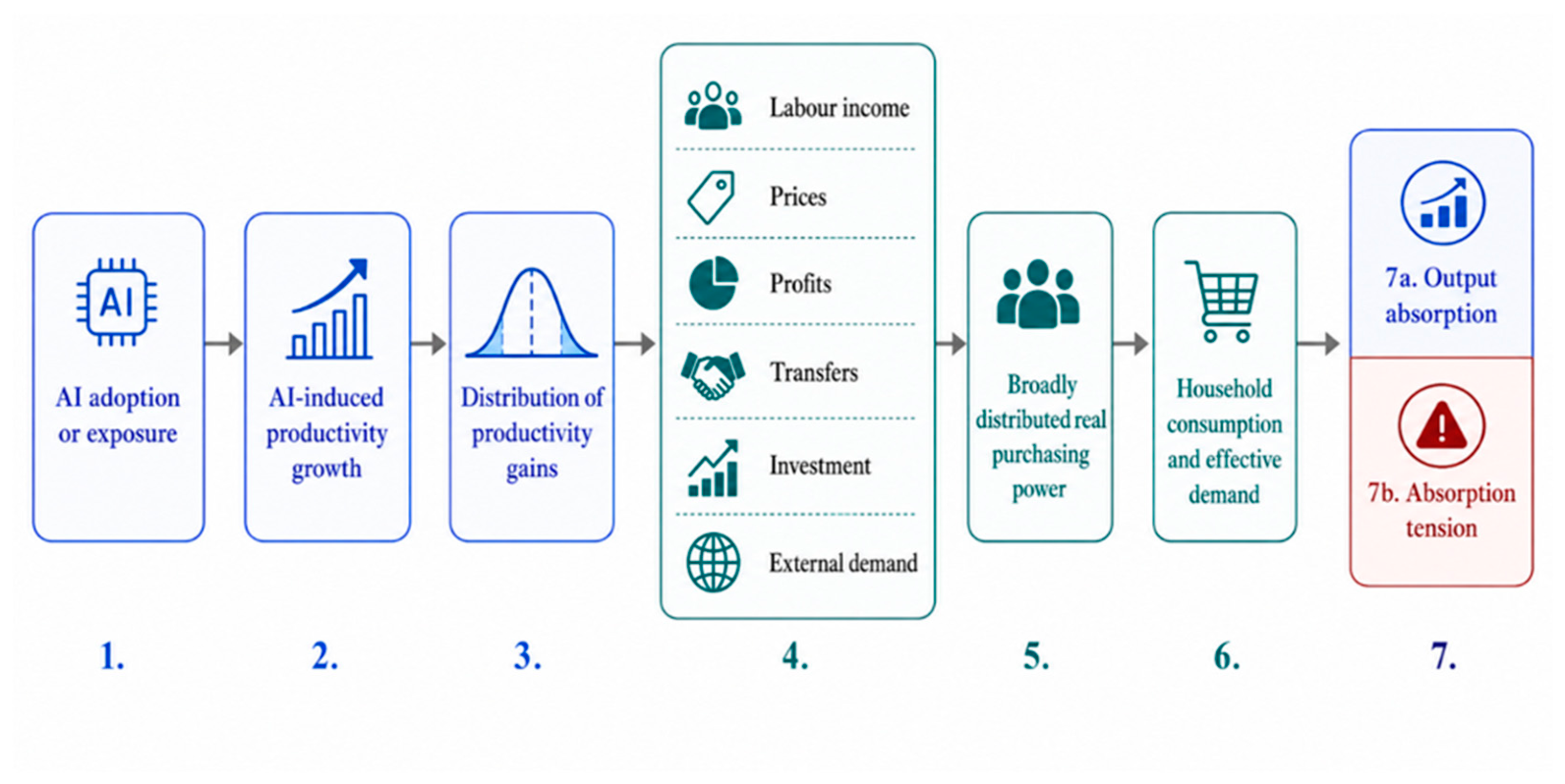
Figure 2.
Favourable and critical transmission paths of AI-induced productivity. Note: The two paths are ideal-type analytical representations. Actual outcomes depend on how productivity gains are distributed, as well as on redistribution, labour-market institutions, price effects, investment behaviour and external demand.
Figure 2.
Favourable and critical transmission paths of AI-induced productivity. Note: The two paths are ideal-type analytical representations. Actual outcomes depend on how productivity gains are distributed, as well as on redistribution, labour-market institutions, price effects, investment behaviour and external demand.
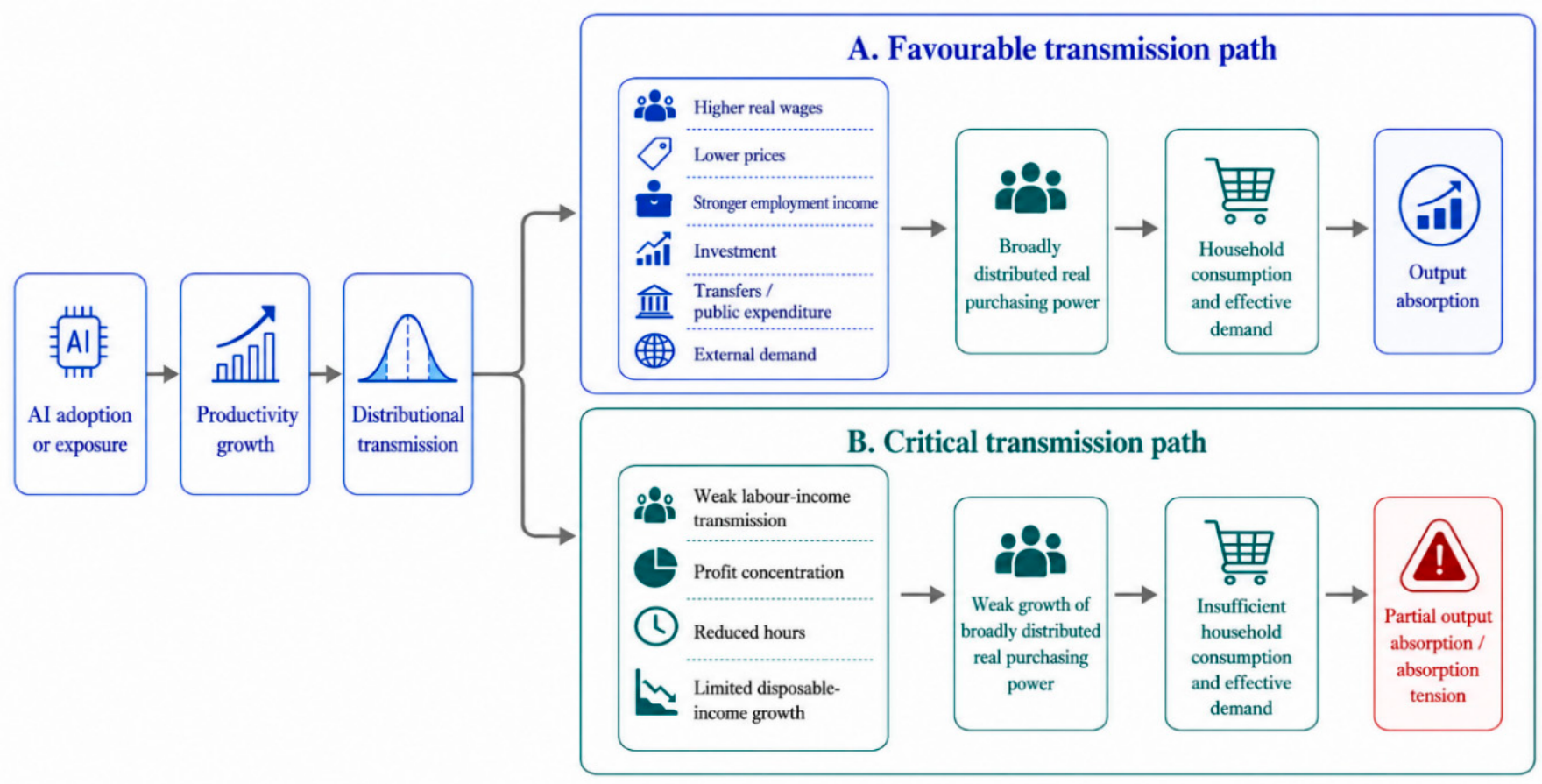

Table 1.
Conceptual clarification of the distributional absorption threshold.
| Dimension | The threshold is | The threshold is not |
|---|---|---|
| Technological meaning | A condition concerning the economic realisation of AI-enabled productive capacity | A technical limit of AI systems |
| Labour-market meaning | A broader distributive mechanism involving wages, hours worked, labour share and household income | A synonym for mass unemployment |
| Measurement meaning | A relationship between productivity growth and broadly distributed real purchasing power | A simple AI adoption rate |
| Macroeconomic meaning | A possible mismatch between productive capacity and effective demand | A standard productivity slowdown |
| Institutional meaning | A context-dependent condition shaped by labour-market institutions, fiscal redistribution, price dynamics and demand conditions | A universal threshold identical across countries |
Source: Authors’ elaboration.
Table 2.
Conceptual propositions and underlying mechanisms.
| Proposition | Core mechanism | Expected theoretical implication |
|---|---|---|
| P1. AI-induced productivity gains support demand-realised output when transmitted into broadly distributed real purchasing power. | Productivity gains strengthen household purchasing power and demand-generating expenditure. | Output absorption becomes more likely. |
| P2. Absorption tension increases when productivity growth persistently exceeds real labour income and disposable-income growth. | Productive capacity expands faster than household demand capacity. | Distributional absorption tension becomes more likely. |
| P3. Employment displacement is only one possible channel of weak absorption. | Wage compression, reduced hours, declining labour share and profit concentration may weaken demand transmission. | AI effects should be analysed beyond unemployment alone. |
| P4. Redistribution, lower prices, public expenditure, investment and external demand may mitigate the threshold. | Alternative demand channels compensate for weak labour-income transmission. | The threshold is conditional, not automatic. |
| P5. The threshold varies across institutional and national contexts. | Labour institutions, welfare systems, fiscal capacity and external demand shape transmission. | Comparative analysis is needed to identify country-specific risks. |
Source: Authors’ elaboration.
Table 3.
Possible indicators for future operationalisation.
| Analytical dimension | Possible indicators | Possible sources | Main limitation |
|---|---|---|---|
| AI adoption | Enterprises using AI technologies; AI use by firm size and sector | Eurostat [35,36]; OECD/BCG/INSEAD [37]; AI Index [38] | Short time series; adoption does not measure intensity or productivity impact |
| AI exposure | Occupational AI exposure; generative AI exposure; complementarity/substitution indicators | Felten et al. [15]; Pizzinelli et al. [40]; ILO/Gmyrek et al. [41] | Measures potential exposure, not actual adoption |
| Productivity | Labour productivity; output per hour; value added per worker; total factor productivity | AMECO [42]; EU KLEMS [43]; Penn World Table [44,45] | Aggregation may hide firm and sector heterogeneity |
| Labour-income transmission | Real wages; real compensation of employees; employment income; hours worked; adjusted wage share | AMECO [42]; Eurostat sector accounts [49]; EU KLEMS [43] | Single indicators may not capture household distribution |
| Disposable income and consumption | Real household disposable income; real household final consumption expenditure | Eurostat sector accounts [49]; AMECO [42]; World Bank WDI [50] | Consumption may be sustained by credit or savings |
| Distributional conditions | Income inequality; wealth inequality; income shares; labour share | WID [46]; WIID [47]; AMECO [42]; PWT [44,45] | Cross-country comparability and frequency may vary |
| Absorption tension | DPI_it; TA_it; productivity-income and productivity-consumption gaps | Authors’ proposed operationalisation based on the conceptual framework developed in this article | Exploratory indicators requiring validation |
Source: Authors’ elaboration.
Table 4.
Policy-relevant channels for reducing distributional absorption tension.
| Policy channel | Analytical role | Relevance for absorption |
|---|---|---|
| Wage-setting and labour institutions | Influence the transmission of productivity gains to labour income | Strengthen household purchasing power |
| Skills and mobility policies | Help workers move towards complementary tasks | Reduce displacement and support income continuity |
| Redistribution and social protection | Convert part of productivity gains into household demand | Stabilise consumption and disposable income |
| Competition and market regulation | Affect price pass-through and profit concentration | Support consumer purchasing power and limit excessive concentration |
| Public investment | Absorb output and raise future productive capacity | Transform productivity gains into demand-generating expenditure |
| External demand | Provides markets for additional output | May compensate domestic demand weakness, but cannot be universal |
Source: Authors’ elaboration.
Disclaimer/Publisher’s Note: The statements, opinions and data contained in all publications are solely those of the individual author(s) and contributor(s) and not of MDPI and/or the editor(s). MDPI and/or the editor(s) disclaim responsibility for any injury to people or property resulting from any ideas, methods, instructions or products referred to in the content. |
© 2026 by the authors. Licensee MDPI, Basel, Switzerland. This article is an open access article distributed under the terms and conditions of the Creative Commons Attribution (CC BY) license (http://creativecommons.org/licenses/by/4.0/).
Copyright: This open access article is published under a Creative Commons CC BY 4.0 license, which permit the free download, distribution, and reuse, provided that the author and preprint are cited in any reuse.


