
Submitted:
15 June 2026
Posted:
17 June 2026
You are already at the latest version
Abstract
The Sinaia Lead Plates constitute a corpus of over one hundred inscribed and illustrated metal plates reportedly discovered in Romania in the late nineteenth century, of which forty-six are currently preserved. Frequently classified as modern forgeries, the assemblage has not previously been subjected to a systematic, corpus-level archaeological analysis. This study presents an integrated reassessment of the plates combining material examination, epigraphic classification, linguistic analysis, iconographic evaluation, and contextual review of historical references. Rather than presupposing either authenticity or fabrication, the article adopts a structural and methodological approach, examining internal coherence, technical parameters, and functional plausibility. The analysis identifies consistent correlations between writing systems, linguistic patterns, iconographic organization, and historical associations across the corpus. Arguments advanced in support of the forgery hypothesis are reassessed within a comparative methodological framework, highlighting both their contributions and their limitations. Although the question of authenticity cannot be resolved conclusively on the basis of currently available evidence, the structural integration and conceptual organization of the corpus challenge simplified explanatory models and underscore the need for sustained interdisciplinary investigation.
Keywords:
Sinaia Lead Plates
; Dacian history
; authenticity debate
; 19th-century forgery
; epigraphy
; Greek-derived scripts
1. Introduction
The Sinaia Lead Plates represent an unusual and controversial corpus associated with the northern Thracian world traditionally identified in classical sources as Getae and Dacians. Consisting of over a hundred inscribed and illustrated metal plates – of which forty-six are currently preserved – the assemblage is reportedly linked to discoveries made in the late nineteenth century in Sinaia, Romania. The plates feature inscriptions written in an unidentified language using scripts derived from the Greek alphabet, complex bas-reliefs depicting figures, buildings, and scenes, and narrative content connected to the Getic–Dacian cultural sphere. Designed for display rather than portability, they form a material and conceptual corpus unlike any other known from the region.
Since their first publication in 2003, the plates have been widely dismissed as modern forgeries, often on the basis of brief remarks or isolated objections rather than sustained analysis. Despite the persistence of this view, no comprehensive academic study has yet examined the corpus as a whole. The debate over authenticity has therefore developed in the absence of a systematic assessment of the plates’ material characteristics, writing systems, language, iconography, and historical references. As a result, the Sinaia Lead Plates have remained marginal to international scholarship, cited primarily as an example of presumed falsification (Marinov 2013, p. 46; Charney 2015, pp. 213-217; Brodersen 2020, pp. 19-20) rather than as a subject of inquiry in their own right. The need for a cautious and detailed epigraphic examination of such materials has also been noted in Romanian scholarship (Bărbulescu, 2016, pp. 166–168).
This article seeks to address that gap. Instead of attempting to resolve the question of authenticity at the outset, it adopts a methodological stance that treats the plates as a coherent corpus requiring integrated analysis. The study brings together epigraphic, linguistic, iconographic, and historical perspectives in order to document the internal structure of the assemblage and to assess how its various components relate to one another. By examining patterns of coherence and variation across multiple analytical domains, the article aims to move beyond fragmented debates based on isolated details.
Various attempts to translate or decipher the inscriptions have been proposed outside academic contexts. Because these interpretations remain methodologically unverified and highly divergent, the present study does not rely on them and instead focuses on structural features of the corpus that can be analysed independently of any proposed decipherment.
The structure of the paper reflects this approach. After outlining the history of the plates’ discovery and reception, the study examines their physical and technical characteristics, writing systems, language, iconography, and historical references. A dedicated chapter then reviews the principal arguments advanced in favour of the forgery hypothesis, evaluating their scope and limitations. These analyses are brought together in a discussion chapter that synthesizes the evidence and considers broader interpretive implications, including questions of function, motivation, and feasibility. The article concludes by outlining the consequences of this reassessment for the ongoing authenticity debate and by identifying priorities for future research.
By presenting the first comprehensive analysis of the Sinaia Lead Plates for an international academic audience, this study does not seek to rehabilitate or to dismiss the corpus a priori. Instead, it argues that the plates – whether ancient or modern – constitute an object of inquiry whose complexity, coherence, and ambition demand rigorous interdisciplinary engagement. In doing so, the article aims to transform a long-marginalized assemblage into a legitimate subject of scholarly investigation and to reopen a debate that has too often relied on assumption rather than analysis.
2. The History of the Discovery and Research
The Sinaia Lead Plates first entered public discourse in 2003 with the publication of Dan Romalo’s volume (Romalo 2003), which featured photographs he had taken in 1947 as a student (Figure 1). Romalo’s book included decipherment proposals, commentaries, and metallographic analyses, prefaced by the distinguished classicist and archaeologist Alexandru Suceveanu. Although Suceveanu leaned towards the view that the plates were forgeries, he supported their publication. Initially published in Romanian, the volume was reissued two years later in a bilingual Romanian-English edition (Romalo 2005).
Romalo documented 71 plates, though the photograph numbering suggested that at least 133 existed in 1947 (Figure 2). Beyond these, two additional pieces – one lead, one silver – were preserved at Sinaia Monastery’s museum, alongside five bronze, brass, and lead artifacts from private collections, all bearing similar inscriptions and iconography. Romalo’s research began in 1984–1985, although nearly half of the photographs he had taken decades earlier were already lost. The initial documentation of the plates dates back to 1947, when medievalist Marioara Golescu, at the request of archaeologist Ion Nestor, then director of the National Museum of Antiquities, commissioned the work. According to Golescu, cited by Romalo, Nestor believed the plates were forgeries, allegedly brought to the museum by a Bulgarian woman and once shown to its former director, Grigore Tocilescu. Nestor thought publishing them might help expose the circulation of forgeries from Russia and the Balkans. Golescu was later imprisoned on political grounds and never published her findings, leaving the plates unstudied until Romalo revisited them after retirement. In the years following the publication of his book, several other artifacts with similar iconography and inscriptions were identified in museums and private collections, expanding the known corpus beyond Romalo’s initial documentation.
At the time of Romalo’s publication, only 35 plates could be found in the collection of the Institute of Archaeology in Bucharest, the successor to the National Museum of Antiquities. They were unregistered and no archival records of their provenance existed. Recently, previously undocumented round plates with double-sided bas-reliefs were discovered in the Institute's deposits, including an exact lead replica of a silver piece at Sinaia Monastery. Although some scholars were aware of the plates, their disclosure in 2003 came as a surprise to the public, which had been previously unaware of their existence (Figure 3). Journalist Dumitru Manolache subsequently investigated their history, seeking to explain their presence in the museum and their century-long neglect (Manolache 2006).
Manolache’s inquiry uncovered oral traditions preserved among residents of Sinaia, including individuals who had served as mayors in the early twentieth century, which associated the plates with discoveries made in the town. According to these accounts, two hoards of gold plates accompanied by coins or medallions were unearthed in the late nineteenth century. One discovery was linked to watercourse diversion works carried out between 1866 and 1872, while the second was reportedly made in 1873 during foundation excavations for Prince Carol’s Peleș Castle. Allegedly acquired by Carol, the artefacts were examined by a commission reportedly including the most important historians of the time. At a time when little was known about the Dacians, the commission would deem them historically insignificant and unrelated to Dacian culture. Carol purportedly ordered lead copies made in Sinaia workshops for study, though the claim that the gold originals were melted down to fund Peleș Castle or Pelișor is improbable. The lead replicas were sent to Bucharest’s museum, while two pieces remained in Sinaia.
In Bucharest, the plates disappeared from academic discourse, remaining unregistered in museum inventories until Manolache’s investigation. The two pieces kept at Sinaia Monastery, publicly displayed, received only sporadic attention. Manolache’s findings, Romalo’s research, media coverage from 2004 to 2006, and analyses of nineteenth-century press reports indicate that nearly all major Romanian archaeologists and historians were aware of the plates and consistently associated them with Sinaia. Despite this awareness, no academic publications followed. This prolonged silence, combined with the absence of earlier museum records and the very late official registration of the objects, remains notable.
A key 19th-century witness, the lawyer Iacob Livescu, documented the Sinaia Lead Plates between 1885 and 1893, claiming first-hand study in articles later republished in contemporary newspapers, the only known written references from that period (Pețan 2024, pp. 33-34). Livescu’s accounts offer critical insights: his mentor, B.P. Hasdeu, suspected by later researchers of being a potential forger, and the Archaeological Committee under G. Tocilescu deemed the plates forgeries, a view shared by the Royal Geographical Society under King Carol I, who was aware of them. In 1885, Livescu mentioned in an article the plates' grayish-green patina, which he interpreted as a sign of age. However, he offered conflicting accounts of their origin. In one passage, he vaguely attributed them to recent excavations conducted by an unnamed society; elsewhere, he claimed that they had been discovered in Deva, Transylvania, with hundreds allegedly kept in the local museum. This latter assertion finds no support in Transylvanian archaeological records: the plates are not mentioned in the archives of the Deva Archaeological Society or in the writings of its active archaeologists, despite their strong interest in Dacian antiquities. Moreover, Deva’s location at that time within the Austro-Hungarian Empire would have made any cross-border transfer unlikely. These inconsistencies suggest that Livescu may have obscured the true provenance, supporting Manolache and Romalo’s suspicions of a sensitive origin. As the only known contemporary witness who left written records, his testimony, despite its gaps, remains an important early reference in the history of the plates.
This prolonged neglect hindered the development of systematic research on the plates and contributed to their marginalisation in Dacian studies. When Romalo’s volume appeared in 2003, the reaction of many established Romanian scholars was immediate skepticism, describing the plates as modern forgeries (Țurcanu 2005; Dana 2008, p. 384; Nemeti 2008a; Nemeti 2008b; Măndescu 2009). A more recent article by archaeologist D. Spânu (2021) reiterates the same interpretation. Although these views have shaped the dominant perception of the plates in Romanian scholarship, they were generally expressed without extended corpus-level analysis. Shortly after the appearance of Romalo’s volume, the plates were also briefly noted in international scholarship (Pețan 2005), though without extended discussion.
3. The Physical and Technical Characteristics of the Corpus
In 1947, D. Romalo photographed at least 130 lead plates at the Institute of Archaeology in Bucharest, though only 72 images survived. By 2005, 35 pieces remained in the institute’s repository, with nine additional pieces discovered since then: seven previously undocumented round plates and two rediscovered pieces. Today, the Institute of Archaeology holds 44 pieces, while two others are preserved at the Sinaia Monastery Museum. Several additional objects bearing similar inscriptions and iconography have been reported in museums and private collections. Throughout this study, the plates are referred to using the numbering system established by Romalo.
3.1. Dimensions and Weight
The pieces fall into two primary categories. Category I comprises lead plates, both rectangular and circular, subdivided as follows:
Subcategory Ia (Figure 4a-c): Larger rectangular plates, inscribed and illustrated on one side only, often bearing attachment marks. Measurements of preserved pieces reveal diverse dimensions, ranging from 354 × 255 mm (thickness 9–14 mm) for the largest to 93 × 98 mm (thickness 4–7 mm) for the smallest, with no two sharing identical proportions. Romalo’s photographs lack scale, limiting analysis to extant examples.
Subcategory Ib (Figure 4d-e): Small, round lead plates, inscribed and illustrated on both sides, forming a homogeneous series of seven pieces.
The 44 preserved pieces include 42 with measured dimensions, collectively estimated to weigh approximately 200 kg based on average thicknesses; the weight of the two recently rediscovered pieces remains uncalculated due to the unavailability of measurements. Among the preserved plates, some reach substantial dimensions and thicknesses. Plate 52 (Figure 4b), preserved only as a fragment representing roughly half of the original piece, would have weighed up to 30.48 kg if complete, based on reconstructed dimensions and a maximum thickness of 24 mm. Plate 17, with a fixed thickness of 16 mm, averages 14.29 kg. The largest intact plate, no. 13 (354 × 255 mm), averages 11.8 kg.
Based on the estimated original size of the assemblage discussed above, the total weight of the complete corpus could have ranged between 610 kg and 940 kg, assuming a similar distribution of sizes and thicknesses.
Category II includes smaller artefacts of silver, bronze, brass, or lead, dispersed across museums and private collections, discovered under unclear circumstances but featuring inscriptions and imagery akin to the ones on the lead plates (Figure 5a-g) (Gramatopol 1982, pp. 94-95 and pl. I/4; Bobi 1999, p. 430, pl. CXVII, figs. 3-5; Iliescu 2000, pl. CI, figs. 3-6; Ursulescu &Tofan 2001; Măndescu 2009).
Antiquarian literature also records several gold and silver coins reportedly discovered in Transylvania between the sixteenth and nineteenth centuries, bearing Greek legends such as ΣAΡΜΙΣ ΒAΣΙΛ and related symbolic imagery (Zamozius 1593, pp. 30–31; Tröster 1666, p. 129; Henne 1836, p. 16 and Figure 2). Although these pieces were later dismissed as forgeries (Arneth 1851, pp. 309-311), they remain noteworthy as early attestations in scholarly literature of a supposed king named Sarmis, also appearing on the Sinaia lead plates, and of an associated iconographic repertoire (Romalo 2005, p. 261; Figure 6).
3.2. Attachment Marks
The Sinaia Lead Plates exhibit various attachment marks, providing clues about how they were displayed and crafted. Several plates feature lateral cutouts designed for sliding onto wall supports, implying a stable and possibly reusable display system. This category includes plates with corner cutouts, which sometimes feature wire reinforcements (e.g. Plate 8, Figure 7; Figure 8a).
Others display symmetrical side cutouts, suggesting careful design for standardised supports, with some exhibiting traces of repairs. There are also plates with single central side cutouts, which are likely designed for mounting on board-like structures, with some displaying elliptical cutouts. Plate 16, for instance, shows significant damage around the lateral cutouts, likely associated with a mounting or clamping system used to fix the plate within a support (Figure 8b-c).
Other plates relied on perforations for attachment, featuring drilled holes near the edges for nails or rivets, with some holes enlarged for reuse. Plate 2, for instance, features round holes that may have been intended for decorative bronze nails (Figure 7d). Rectangular holes are visible on plates, often located at the corners, with some appearing misaligned or reworked for iron nails (Figure 7e).
Some plates were clearly designed for suspension, with one (Figure 7f) or two hanging points. Plate 106 features two symmetrical hanging points with precise perforations, forming a distinctive "butterfly" pattern for specific hanging methods (Figure 7g).
The lateral edges of several plates display deliberately shaped notches forming concave recesses in the margins. Their regular shape and repeated occurrence suggest that they may have functioned as mounting points within a clamping or framing system (Figure 8h).
Several plates display lateral cutouts with a stepped square profile, forming truncated pyramidal recesses that likely served as fixing points within a clamping or framing system (Figure 7i).
Intriguingly, certain plates display pseudo-holes that visually mimic nailed plates without serving any actual attachment function (Figure 7j). This suggests they might be copies of existing panels where the artist graphically rendered the appearance of attachment holes.
A noteworthy aspect is the correlation between the size of the plates and the presence or absence of attachment systems. Larger and heavier plates generally lack perforations, cutouts, or visible mounting devices, suggesting that they could not be suspended or affixed using simple nail-based systems. These heavier items were likely embedded into a frame, displayed flat, or secured using other methods. In contrast, smaller plates exhibit a wide variety of attachment solutions. If the plates are modern forgeries, the forger demonstrated an acute awareness of physical constraints, avoiding unrealistic suspension systems for heavy items and mimicking a range of plausible ancient mounting methods for lighter ones.
3.3. Technical Craftsmanship and Execution
The Sinaia lead plates display exceptional craftsmanship, reflecting the sophisticated techniques and considerable effort involved in producing over a hundred unique artifacts. The plates appear to have been cast in moulds engraved in negative, a technique that demanded advanced planning to ensure that both text and intricate figurative representations emerged in raised relief when molten metal was poured into the mould. The mirrored inscriptions, a hallmark of this method, reflect a precise understanding of reversed lettering and spatial organisation. The complexity of the compositions, often featuring carefully measured spaces and symmetrical arrangements, suggests that the designs were likely sketched in advance before being meticulously transferred onto the moulds, ensuring a harmonious integration of text and imagery.
The relief on the plates is notably high and well-defined, reflecting the careful preparation of the moulds through engraving and punching tools. This precision allowed intricate representations to be transferred into the cast plates with relatively uniform depth and clarity across both textual and figurative elements, suggesting a controlled casting process. Certain features of the plates, such as trimmed edges, occasional adjustments to inscriptions, and the presence of attachment systems, may indicate additional finishing steps carried out after casting.
3.4. Metallographic Analyses
To date, no coordinated research project has been undertaken to investigate the metallurgical composition of the Sinaia lead plates. All available data derive from isolated initiatives, conducted at different moments, using different analytical methods, and without a unified research design. As a result, the evidence remains fragmentary and unevenly published, yet it offers important preliminary insights into the material nature of the corpus.
Analyses have been performed both on selected lead plates and on several smaller metal objects with similar inscriptions and iconography (Category II), primarily using X-Ray Fluorescence (XRF), occasionally complemented by electron probe microanalysis and isotopic measurements.
Peter Northover (University of Oxford) analysed Plate 23 and identified a lead-rich alloy (~97% Pb) with minor tin and antimony and traces of silver (Romalo 2005, p. 291-293). A lead clamp from a secure archaeological context at Sarmizegetusa Regia showed a comparable composition but contained a measurable amount of silver. Northover noted that while such compositions could be compatible with ancient lead derived from galena ores, similar results may also occur in modern recycled lead. In the absence of archaeological context, he concluded that metallurgical data alone cannot establish the plate’s authenticity.
A larger set of analyses was performed in 2005 by Bogdan Constantinescu at the National Institute for Physics and Nuclear Engineering (Măgurele), who examined 35 lead plates using XRF (Romalo 2005, p. 314-315). Four main alloy groups were identified, corresponding to different lead–tin–antimony–zinc combinations and likely reflecting multiple casting batches. However, no consistent correlation emerged between alloy composition and the historical figures, periods, or regions mentioned in the inscriptions. Elements such as zinc and antimony appear across plates associated with different rulers and geographical contexts, which does not conform to expected patterns of chronological or regional differentiation in ancient metallurgy. On this basis, Constantinescu interpreted the plates as products of recycled lead of modern origin.
Analyses of associated small metal objects further illustrate the complexity of the assemblage. The bronze medallion known as Piece 112 shows a highly standardized alloy with elevated nickel content, confirmed by isotopic analyses commissioned in 2025 by Dacica Foundation, indicating a modern origin. In contrast, Pieces 132 and 133 display copper-based alloys rich in trace elements and silver, compatible with unrefined ores and consistent with ancient metallurgical practices (Romalo 2005, pp. 177-178).
Finally, press reports describe the silver piece from the Sinaia Monastery as composed of approximately 83.5% silver and 16.5% copper and assign it an age of ca. 2,000–2,100 years, without specifying the analytical methods (Tonitza 2016).
4. Writing Systems
The Sinaia lead plates bear inscriptions predominantly executed in the Greek alphabet, written in scriptio continua. Rather than displaying a single uniform writing practice, the corpus exhibits a remarkable diversity of graphic solutions, which correlates with the variability observed in the plates’ formats, dimensions, iconographic programs, and attachment systems. This diversity does not appear random. On the contrary, the inscriptions form structured groups, defined by shared graphic and phonological features and consistently associated with specific historical figures and contexts attested within the corpus.
The following classification is based primarily on structural graphic features, that is, the selection and exclusion of specific letters of the Greek alphabet and the introduction of additional signs, rather than on purely stylistic variation. On this basis, three principal writing systems can be distinguished, conventionally designated here as Types A, B, and C. Stylistic variants (regular, rounded/cursive, geometric, decorative) occur within these systems and are treated as secondary.
4.1. Type A: Complete Greek Alphabet (Helis Phase) (Figure 9a)
Type A represents the most conservative writing system attested on the plates. It employs the Greek alphabet in a form closely aligned with early Ionic usage, preserving the full vocalic system, including eta (H) and omega (Ω), as well as theta (Θ). No additional signs are introduced.
Figure 9.
(a) Type A; (b) Type A1; (c) Type B; (d) Type C; (e-g) Stylistic variants; (h) Interlaced script; (i-l) Unknown scripts; (m) Logographic script.
Figure 9.
(a) Type A; (b) Type A1; (c) Type B; (d) Type C; (e-g) Stylistic variants; (h) Interlaced script; (i-l) Unknown scripts; (m) Logographic script.
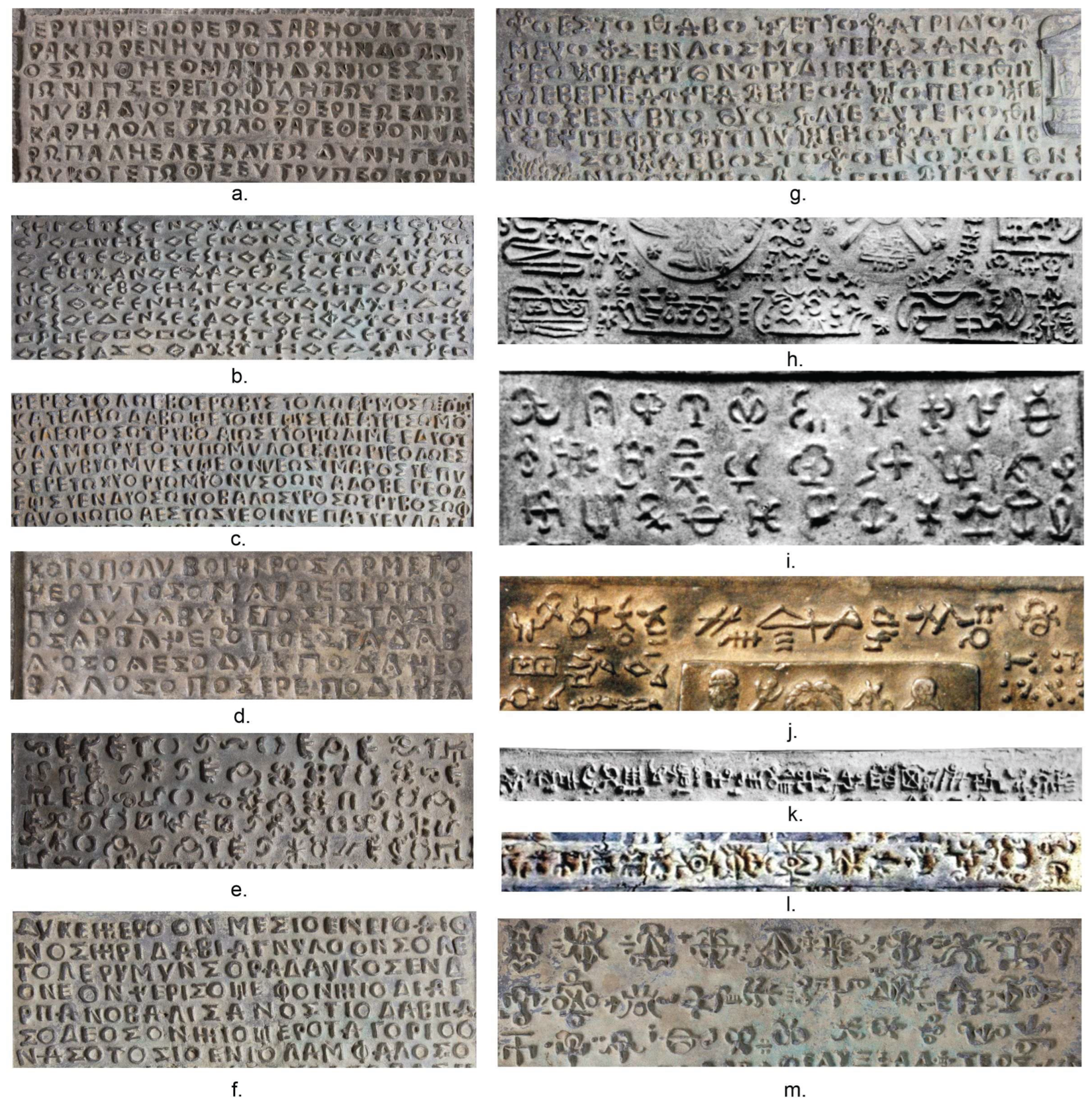
This type is consistently associated with plates linked to the Getic fortress Helis, often reinforced by central circular seals bearing the name of the city (Elyay). The letterforms are generally regular and carefully aligned, with a slight rightward inclination. A notable subvariant (Type A1) adopts a more geometric ductus, characterized by angular forms (Figure 9b).
Type A is associated with the names of otherwise unknown rulers.
4.2. Type B: Augmented Greek Alphabet (Byrebista–Deceneu Phase) (Figure 9c)
Type B constitutes a significant transformation of the writing system. While still grounded in the Greek alphabet, it introduces two additional signs used to render postalveolar affricates conventionally transcribed as /t͡ʃ/ and /d͡ʒ/. These signs have no direct equivalents in the Greek alphabet and reflect an explicit attempt to adapt the script to phonological features not adequately represented by Greek. The two signs, #and @, display a graphic similarity to the later Cyrillic letters Ч and Џ. Their introduction suggests an attempt to represent affricate sounds not adequately rendered by the Greek alphabet, a strategy commonly observed when writing systems are adapted to new phonological environments.
In contrast to Type A, Type B displays selective instability in the use of eta, omega, and theta. While these letters are generally retained, their distribution is no longer systematic, suggesting a reduced functional role, particularly with regard to vowel length and aspiration.
Type B is widely attested across the corpus and is consistently associated with the reign of Byrebista and with the activity of the high priest Deceneu. Many plates written predominantly in Type B include isolated words or signatures executed in a different graphic manner (see below 4.4), indicating controlled internal variation rather than inconsistency.
4.3. Type C: Simplified Augmented Alphabet (Decebal Phase) (Figure 9d)
Type C represents a further stage of graphic rationalization. It preserves the palatal signs introduced in Type B but eliminates eta (H), theta (Θ), and omega (Ω) entirely. The resulting system operates with a reduced alphabet, in which distinctions of vowel length and aspiration are no longer graphically marked.
This system is consistently associated with the reign of Decebal and appears on plates linked to his rule and to that of his predecessor Duras (a minor subvariant). The letterforms tend to be more angular and simplified.
Type C does not coexist with Type A and only rarely overlaps with Type B, suggesting a chronological succession from a complete Greek system to an augmented one, followed by a simplified augmented system.
4.4. Stylistic Variants (Figure 9e-g)
Within Types A, B, and C, several stylistic modes can be identified, including regular, rounded or cursive, geometric, and decorative (interlaced) forms. These variants affect the ductus, curvature, and ornamental treatment of letters but do not alter the underlying alphabetic structure. Rounded or cursive forms frequently coexist with regular scripts on the same plates, and in several cases, plates written in a regular Type B script bear signatures executed in a more cursive variant associated with Deceneu. Decorative interlaced scripts appear on a limited number of plates and seem to prioritize visual effect over legibility (Figure 9h). These stylistic differences may reflect variation in graphic conventions or functional choices rather than the existence of separate scripts.
4.5. Other Scripts and Incised Additions
A small number of plates display signs that cannot be securely assigned to the Greek-derived systems described above. These include alphabetic-looking signs, composite or logographic forms, and symbols with no clear parallels (Figure 9i-l). In some cases, Greek-derived text and non-alphabetic signs appear side by side, as on Plate 116, where a logographic rendering of a word (Figure 9m) is accompanied by its alphabetic counterpart in Type B script. Such instances provide rare internal correspondences between different graphic systems within the corpus.
In addition to the cast inscriptions executed in relief, a limited number of plates preserve incised additions (Figure 10). These appear to represent secondary interventions made after casting. The incised elements include short legends identifying figures, numerical notations, and occasionally longer textual passages. Their placement between lines, along margins, or adjacent to figural representations suggests a supplementary function, although the precise circumstances under which these additions were made remain uncertain.
Across the corpus, certain epigraphic conventions recur irrespective of script type. Most notable is the consistent use of a reversed Z, diverging from both Greek and Latin norms. A striking parallel occurs in a Greek inscription from Histria published in 1959 (IScM I, 8), where the reversed Z appears exclusively in the name of the Getic ruler Zalmodegikos. This coincidence suggests a deliberate graphic convention used to render a native phoneme distinct from Greek /z/.
The writing systems of the Sinaia lead plates reveal a high degree of internal structure and coherence. The progression from a complete Greek alphabet (Type A), through an augmented system (Type B), to a simplified augmented form (Type C), reflects a controlled and systematic approach to writing rather than ad hoc experimentation. Regardless of the ultimate interpretation of the corpus, the complexity, consistency, and contextual anchoring of these graphic systems set the Sinaia plates apart from known patterns of casual or opportunistic fabrication.
5. Linguistic Features
The inscriptions on the Sinaia Lead Plates are written in an unidentified language using graphic systems based on the Greek alphabet. The linguistic material preserved on the plates displays a complex set of phonetic, morphological, and lexical features. This chapter presents the principal characteristics of this linguistic material.
5.1. Phonetic Features
The language of the inscriptions displays a strong preference for open syllables, with a marked avoidance of word-final consonants. This phonotactic tendency is reflected in the systematic adaptation of loanwords and foreign names and suggests a language structure that favours analytic strategies over inflectional morphology.
Unlike Greek and Latin, the language does not appear to distinguish vowel quantity but instead shows sensitivity to vowel aperture. In particular, short i is frequently rendered as e, and short u as o: baseleo (basileus), chilearchio (chiliarchos), Karseu (Carsium), Panoneo (Pannonia), Antegoneo (Antigonos), Iulean (Iulianus), Philepu (Philippos), Sinǧedunu (Singidunum), Lokolo (Lucullus), Kaio (Gaius), Fusko (Fuscus). Comparable variation is attested in ancient sources themselves, for example Cumidava (Roman inscription) versus Komieodabo (Plate 120) and Komidava (Ptolemy), or Napouka (Ptolemy), napucenses (CIL III 7996), and Napokoe (Plate 120). Internal doublets such as Ceneo/Cenio, biseka/bisika, and talepiko/talipiko further highlight a consistent tendency toward vowel openness rather than random fluctuation.
A further phonetic characteristic is the use of the vowel o in contexts where a centralized vowel may be expected. In these cases, o appears to function as a graphic approximation for central unrounded vowel qualities (/ə/, /ɨ/), which fall outside the standard Greek vocalic inventory. This tendency is reinforced by the frequent occurrence of word-final -o in positions where Greek or Latin would normally show -a. Doublets such as talipiko/talipika, dabiko/dabika, bisiko/bisika, and patelo/patela suggest that o and a were used interchangeably to represent a phonetic value distinct from both. Similar substitutions are visible in personal names such as Bisino, recorded by Dio Cassius as Ouezina, and Boerobiseto, attested in Greek sources as Boerebistas or Byrebistas.
Another recurrent feature concerns the graphic representation of velar consonants, particularly in intervocalic position and in loanwords or foreign names. The distribution of the Greek letters κ, χ, and ξ is not random and displays recurrent patterns that differ from standard Greek orthography. In several geographical names traditionally rendered with kappa in Greek, such as Thrakia and Makedonia, the inscriptions employ chi (Trachio, Machedono). Conversely, personal names commonly written with chi in Greek sources appear with xi in the plates, as in Dromixto and Lysimaxo. In earlier graphic phases, words later written with special palatal signs are rendered using chi (Dachio for Dacio). Additional variation is observed in analytic spellings (σχ, ξσ, κσ) and in the rare and inconsistent use of psi, as in the rendering of anepsios with pi–sigma. Overall, these patterns illustrate a flexible use of Greek graphemes that departs from standard Greek orthographic conventions.
Finally, a striking feature of the inscriptions is the pervasive use of word-final -o, a letter that appears to mask two distinct phonetic values. On the one hand, -o frequently replaces the -a ending of Greek or Latin forms (Vezina, Byrebista, Cumidava, Napoca, Dinogetia, Pythagoras), suggesting that the original sound may not have been a true low vowel but an intermediate, centralized one. On the other hand, the same -o also substitutes for Latin -us (Decebalus, Lucullus) or Greek -os (chiliarchos, Antigonos), likely representing a short, open u. This convergence results in a high degree of graphic uniformity. An additional adaptation involves the regular addition of -o to loanwords ending in a consonant, such as megaso (Greek megas), chronoso (chronos), adelphoso (adelphos), yioso (huios), and deniaroso (Latin denarius), reinforcing the preference for open syllables and consistent phonotactic adjustment.
5.2. Morpho-Syntactic Features
The inscriptions show a predominantly analytic inflectional system, resembling Romanian in its use of prepositions for case marking rather than suffixes. The preposition poe/pue (cf. Romanian pe) marks the accusative, while lue/lye (cf. Romanian lui) indicates the dative and possibly genitive, and lo (cf. Romanian la) marks the locative. Derived forms show metaphony, suggesting morphological or lexical derivation: zabelio/zebelato, mato/mateoso.
5.3. Lexical Features and Borrowings
The inscriptions contain numerous Greek and Latin loanwords, phonetically and morphologically adapted, suggesting integration into a distinct linguistic system. Greek terms could be seen in many words from the plates: baseleu, chilearcho, gramatieo, asphalyo, chronoso, kalisteio, sotera, maegaso, dodeka, adelphoso, and others. Latin borrowings are rare and include koroleo, deniaroso, pačeio, natalea, faktio, obolio, katenoe and a few others.
Some phrases show adapted Greek syntax: on plate 45, Mykrynino yioso lye Kytezonio soyo anepsyos lyie Dapieǧio possibly translates as “Mykrynino, son of Kytezonio and(?) cousin of Dapieǧio,” using Greek huios and anepsios in a non-Greek structure; on plate 8, Anaplysiy Tyoso exso noichto probably means “navigation upstream on the Tisa, six nights.” Several lexical forms in the plates may show similarities to Romanian words, some traditionally regarded as being of possible substrate origin, though adapted to the language and writing system of the inscriptions: dârz (“stubborn”), întâlni (“to meet”), apropia (“to approach”), apuca (“to grasp”), grabă (“hurry”), arăta (“to show”), toroipan (“mace”), întâmpina (“to welcome”), merge (“to go”), etc. Among the most frequently used words are mato “king,” kotopolo “priest,” talipiko “fortress?,” zabelio “war,” terms whose origins remain challenging to discern.
5.4. Onomastics
Toponyms include ancient known places with specific spellings: Sarmiǧetuzo (Sarmizegetusa), Elyay (Helis), Napokoe (Napoca), Siǧidonoe (Singidunum), Karseou (Carsium), Ainrubio (Arrubium), Dinoǧeto (Dinogetia) Ǧenioklo (Genucla) and unattested ones like Moleodabo, Ramodabo, Saetopeio, Ermydabo, Polthodabo, Saryapieo, Zidodabo, etc. Other known toponyms: Tolbiako, Bononio, Sirmio, Seǧesta, etc.
Anthroponyms include Dacian names known from ancient literary sources like Boerobiseto (Byrebistas), Dačibalo (Decebalus), Duro (Duras), Kotizonio (Cotys), Droumikto/Dromioxto (Dromichaetes), Besino (Vezina), Dieǧio (Diegis), Orolio (Oroles), Dapiǧeo (Dapyx), Zourazieo (Zyraxes), Čeneo (Dekaineos), and unattested ones like Ateokireno, Bazorio, Karpodo, Demaroe, Moliseio, Sapozoreno and many others. Recognizable Greek anthroponyms: Abariso, Antigoneo, Aristoteio, Amynteo, Kalisteio, Philipou, Lysimaxo, Pietagorio and Roman names such as Fontio Di Agrpa (Fonteius Agrippa), Lokolo (Lucullus), Kaiou Antonieou (Caius Antonius), Fusko (Fuscus), Iulean (Iulianus), Domiteu (Domitianus), Oktabio (Octavianus), Bispaso (Vespasianus), etc.
The texts contain a large number of ethnonyms: Scythians, Sarmatians, Bastarnae, Iazyges, Boii, Dalmatians, Pannonians, Dardanians, Macedonians, Romans, etc.
The Sinaia lead plates exhibit a striking graphic variety in the representation of names, with significant inconsistency in the notation of certain sounds, often using multiple forms for the same words. For instance, the name Byrebista appears in varied forms such as Boerbyseto, Boerbisto, Boerybysto, and Boerobisteo, mirroring the oscillations found in ancient sources. Strabo renders the name in several forms: Βυρεβίστας (Byrebistas), Βοιρεβίστας (Boirebistas), and Βειρεβίστας (Beirebistas) (Geogr. 7.3.5, 7.3.11, 16.2.39); Jordanes records it as Buruista (Getica 67); while a decree from Dionysopolis lists Βυρεβίστα (Byrebista) and Βυραβίστα (Byrabista) (IGB I², no. 13–56, lines 22, 33–34). These variations have often been interpreted as attempts by Greek writers to approximate Dacian sounds absent from their own language. Similarly, the name "Decebal" exhibits notable graphic variation on the Sinaia lead plates, appearing as Dačibalo, Dačebalo, Dačebialo, Dačieobalo, Dačybalo and Dachibalo, reflecting the inconsistent notation of sounds.
5.5. The Question of a Lost Language
The historical Dacian language is generally regarded as an Indo-European idiom closely related to Thracian, though the exact relationship between the two remains debated. It is extremely poorly attested, being known mainly through personal and place names preserved in Greek and Latin sources, a few glosses transmitted by ancient authors, and linguistic reconstruction based on the Balkan substratum in Romanian (Paliga 2024). In this context of limited documentation, the linguistic system reflected in the Sinaia inscriptions poses a particularly complex interpretative problem.
The language’s systematic features such as open syllables, vowel aperture, palatalization, analytic morphology, and adapted loanwords suggest a coherent system. A 19th forger would require advanced linguistic knowledge to create such consistency, integrating phonetic shifts, systematic borrowings, and historical evolution. Inventing a language during that period, or even in general, entails constructing a complete phonological, morphological, and syntactic framework, a process that demands deep understanding of linguistic principles. Known constructed languages, such as Volapük (created in 1879 by Johann Martin Schleyer) and Esperanto (introduced in 1887 by L.L. Zamenhof), typically exhibit uniformity in their rules and limited variation to ensure accessibility and ease of learning. In contrast, the language of the Sinaia plates displays significant variation, as seen in phonetic doublets, adapted loanwords, and apparent diachronic shifts. Contrary to the views of some researchers who dismiss the language of the plates as mere gibberish devoid of meaning, a careful analysis reveals a high degree of coherence in its structure. Even a 20th-century forgery would demand exceptional expertise to achieve such diversity while maintaining internal coherence.
Future statistical analyses, similar to those applied to other undeciphered corpora such as the Indus script and the Voynich Manuscript, may include tests based on Zipf’s law as well as broader probabilistic approaches examining frequency distributions, sign co-occurrence, n-gram structures, and entropy measures (Rao 2010; Montemurro & Zanette 2013; Amancio et al. 2013). Such methods allow researchers to determine whether a corpus displays structural properties characteristic of natural language rather than random or artificially generated sequences.
6. Iconography
Most of the Sinaia Lead Plates are decorated with bas-reliefs that appear to illustrate, complement, or expand upon the inscribed texts. The figurative repertoire is remarkably diverse, including chieftains and deities, often rendered as portraits, animals both real and mythical, architectural structures (temples, palaces, fortifications), infantry and cavalry, weapons and panoplies, trophies, and complex narrative scenes such as meetings, receptions, captures of prisoners, and animal sacrifices. Perimeter decorations further frame and structure the compositions.
Rather than forming a homogeneous visual language, the iconography displays significant internal variation. On the basis of recurring motifs, compositional density, and stylistic treatment, two dominant artistic modes can be distinguished, tentatively associated with different iconographic horizons represented within the plates: an earlier, more elaborate “Getic” style and a later, more restrained “Dacian” style. While this distinction should not be understood as rigid or absolute, it provides a useful framework for interpreting patterns of variation within the corpus.
The “Getic style,” associated primarily with plates referring to early political centres and to figures like King Byrebista, is characterized by visual richness and a strong emphasis on portraiture. Compositions are dense, frequently incorporating multiple zoomorphic symbols, elaborate decorative frames, and a pronounced focus on elite individuals (Figure 11a-c). By contrast, the “Dacian style,” prevalent in plates connected with Decebal and his predecessor Duras, is markedly austere. Portraits of human figures disappear almost entirely, decorative elements are reduced to a minimum, and symbolic language becomes more schematic. This latter mode corresponds closely with the most simplified script type (Type C), suggesting a broader convergence of visual and graphic practices. Several plates display transitional features, indicating that these two styles represent points along a continuum rather than strictly separated phases.
6.1. Portraits and Representations of Figures
Portraits are a defining feature of the “Getic style.” Kings, nobles, priests, and deities are frequently rendered in individualized form, while such representations vanish almost completely in the Dacian style, where only divine figures occasionally retain frontal depiction. A consistent visual convention distinguishes between mortals and deities: human figures are generally shown in profile, whereas divine beings face the viewer directly. A notable exception is Čeneu, who is invariably depicted frontally, a feature that resonates with Strabo’s account (7.3.11) of his exceptional, quasi-divine status.
Getic-style portraits are further distinguished by elaborate headgear or helmets adorned with animal figures such as bulls, snakes, birds, griffins, or horses. These animal emblems are absent from both the Dacian-style plates and the representations on Trajan’s Column, forming a distinctive motif within this group of plates. Certain formal analogies can be observed with iconographic elements such as Celtic winged helmets or the animal-crowned rulers of Egyptian imagery. These comparisons highlight possible parallels in visual language, although the symbolic meaning and cultural associations of these motifs remain uncertain.
Divine figures are represented through a rich array of attributes. These include a beardless uranic deity bearing sun and moon on his chest, crowned and marked with a star or a seven-pronged lightning symbol; a serpent-haired goddess accompanied by an owl and a lamb; a mummiform god associated with death and rebirth, holding staves; and a war god named Zabelio, armed with lance and shield. Multi-faced or janiform deities also occur.
6.2. Armies, Weapons, and Military Scenes
Military imagery is among the most recurrent themes in the corpus, yet battle scenes are rendered in a static and emblematic manner rather than through dynamic combat. Infantry units include archers, spearmen (salčero), and mace-bearers (rotopano), accompanied by cavalry and, in one instance, a Getic fleet composed of five-row galleys with griffin-shaped prows (Plate 134; Figure 11b).
In contrast to Trajan’s Column, where commoners vastly outnumber elites, the plates depict exclusively noble warriors, with no representation of lower-status fighters. This selective focus suggests an elite-oriented visual program.
The repertoire of weapons is extensive: daggers, lances, spears, bows with quivers, maces, shields (both small round and large oval), horns (carnyx, salpinx), and war machines. Dacian military insignia (signa) appear in multiple forms, including the well-known dragon-shaped standards as well as bovine-headed and rectangular variants, alongside captured Roman manipulus insignia (Figure 11d). A particularly elaborate panoply (Plate 091) depicts a lion-skinned warrior equipped with a sica, lance, spear, bow, quiver, shield, carnyx, and salpinx (Figure 11e).
6.3. Animals and Symbols
Animals and symbolic creatures play a central role in the iconographic program. Serpents, often with mammalian heads and knotted tails, and bovids, likely representing aurochs, are the most frequent motifs. These animals appear as tribal or dynastic symbols, particularly on plates associated with Byrebista, where serpent and bovine emblems are paired, possibly alluding to political unification.
Bovids also feature prominently on war standards and in the depiction of the god Zabelio, shown bipedally and armed, combining human posture with animal attributes. Birds frequently accompany sacred buildings, while owls appear as divine attributes in conjunction with serpents. Dogs function as divine companions. Other creatures include turtles, fish, griffins (often anthropomorphic and winged), and rare exotic animals such as the elephant.
Domestic animals as pigs (frequently in sacrificial contexts), goats or kids placed on altars, cows with stylized udders (Figure 11f), donkeys or mules pulling carts, rams, and horses, contribute to the depiction of ritual and everyday activities, reinforcing the plates’ narrative richness.
6.4. Architecture and Environmental Elements
Architectural representations include palaces, temples (Figure 11g), bridges, galleries, roads, walls, towers, and gates, with particular prominence given to Sarmizegetusa (Plates 021, 052, 084; Figure 11a) as well as to sites identified as Genucla or Helis. These structures are embedded within environmental settings that incorporate rocks, rivers, deciduous forests (Plates 021, 072), sacred branches, wreaths, thrones, vessels, and laden carts.
Notably, the representations of Sarmizegetusa appear in a mountainous and forested landscape, a setting that contrasts with the long-standing scholarly assumption—dominant until the early twentieth century—that erroneously located the Dacian capital in the Hațeg region, on the site later occupied by the Roman colony of Ulpia Traiana Sarmizegetusa, rather than in the mountainous zone where it is now securely identified (Pețan 2018, pp. 439-463).
Perimeter decorations vary from simple linear borders to highly elaborate frames and are closely integrated with both the shape of the plates and the complexity of their content (Figure 11h-j). These decorative choices further reinforce the distinction between the dense, symbol-laden compositions of the Getic style and the more restrained visual language of the Dacian style.
6.5. Iconography and Function
The iconography of the Sinaia Lead Plates is highly selective and does not aim to represent society in its entirety. Instead, it consistently privileges kings, warrior aristocrats, and deities, while commoners, women, and aspects of everyday life are largely absent. This pattern suggests a specific function and intended audience, rather than accidental omission.
The emphasis on elite male figures and divine authority points to a symbolic framework centred on sovereignty, warfare, lineage, and ritual legitimacy. Military insignia, panoplies, and scenes involving rulers or high-ranking individuals recur systematically, indicating that the plates operated within an elite, power-oriented visual language. In this context, the absence of commoners and the restriction of human portraiture to aristocratic figures appear deliberate.
The near absence of female figures can be explained within this functional framework. Women do not participate in the martial or political narrative articulated by the plates, and when they do appear, they belong either to the divine sphere or to the royal household.
From a methodological perspective, this selectivity is noteworthy. The iconographic program remains strongly focused on rulers, warriors, and divine authority, while other social categories are largely absent. Such a concentration on elite figures produces a visually coherent corpus centred on themes of power, warfare, and ritual legitimacy. The reasons for this selectivity, however, remain open to interpretation.
7. Historical References and Narrative Contents
The historical references in the Sinaia Lead Plates span a broad chronological range, from the early 3rd century BCE, with the earliest mentions linked to Dromichaetes, to the late 1st century CE, with the latest references associated with the Roman emperor Domitian. The plates contain numerous inscriptions, subject to various decryption and translation attempts. This chapter sidesteps speculative interpretations, focusing solely on non-speculative data: toponyms and anthroponyms. Their recurring associations within specific contexts, often reinforced by figurative representations, suggest historical connections and brief narrative sequences. While some align with ancient literary sources—potentially accessible to a forger—others introduce novel details.
Several associations in the plates correspond to documented historical episodes. On Plates 23, Dromichaetes (Drouomikto) appears alongside Lysimachos (Lysimaxo), mirroring the confrontation between the Getic king and the Macedonian diadoch, as recounted by many ancient authors, among them being Strabo (Geogr. 7.3.8), Pausanias (Perieg. 1.9.6), Diodorus Siculus (Bibl. 19.73), or Plutarch (Demetr. 39).
Similarly, Plate 130 pairs Duras as king with Decebal as general, consistent with Dio Cassius (67.6.1), who notes Decebal succeeded Duras.
Decebal also appears frequently with Emperor Domitian (e.g., Plates 22, 94, 121), reflecting their conflicts in 85–87 CE, a well-attested period of Dacian-Roman warfare. Notably, Emperor Trajan, Decebal’s most famous adversary, is entirely absent. This omission is noteworthy, since Trajan would have been an obvious figure to include in a modern fabrication drawing on Roman–Dacian history.
The plates also present connections absent from or contradictory to literary sources. A striking example is the Roman general Cornelius Fuscus, traditionally recorded as dying in battle against the Dacians (Dio Cassius, 67.6; Jordanes, Get. 13.76). Yet, Plate 94 depicts him as a captive, facing Decebal in Plate 22, and co-signing a peace treaty with Domitian and Tettius Iulianus in Plate 121, an alternative narrative suggesting survival and negotiation.
Plate 11 links King Duras with the Roman general Fonteius Agrippa (Fontio Di Agrpa) and Moesia. Tacitus (Hist., 3.46) records Agrippa’s death fighting Sarmatians in Moesia shortly after 70 CE, while Dio Cassius notes Duras, elderly by 87 CE, ceded power to Decebal. Their association fits chronologically: Duras, still vigorous around 70 CE, could have clashed with Agrippa.
Plate 25 narrates a battle at Ramodava, pitting a Getae-Bastarnae alliance under Byrebista against Caius Antonius (Kaiou Antonieu). Dio Cassius describes Caius Antonius Hybrida, governor of Scythia Minor, facing a coalition of Getae, Bastarnae, and Sarmatians, with historian Vasile Pârvan (1926, pp. 189-190) hypothesizing Byrebista’s leadership, a conjecture the plate supports, though Ramodava remains unattested elsewhere.
Another significant reference involves Byrebista, who appears on Plate 129 alongside a figure named Lokolo, in a context mentioning the toponyms Moesia and Istros. This likely refers to Marcus Terentius Varro Lucullus (116–56 BCE), the governor of Macedonia who led a campaign against the Bessi in 72 BCE and conquered the Greek cities of Histria, Tomis, Callatis, and Apollonia the following year. While no ancient literary sources document a direct confrontation between Byrebista and Lucullus, the chronological alignment is plausible, as Strabo (VII, 3, 11) places Byrebista’s rise to power during the dictatorship of Sulla (82–79 BCE).
On Plate 42, Dromichaetes appears in the same context as a figure named Breno, likely the Celtic leader Brennus, alongside the toponyms Sirmio (Sirmium) and Seǧeta (Segesta); both figures were contemporaries around 280 BCE, as Dromichaetes was active in the early 3rd century BCE and Brennus led the Celtic migration into the Balkans in 280–279 BCE, making an encounter plausible despite the absence of such an event in ancient literary sources.
Plate 120 contains a structured list of fifteen chiliarchoi, each associated with a specific dava or regional centre and assigned a military contingent expressed in rounded thousands (Figure 12). At the top of the hierarchy stands the king, Byrebista, linked to Sarmizegetusa and credited with 15,000 troops. Three of the commanders – Dapiǧeo (at Genucla), Zurazieo (at Moleodabo), and Orolio (at Helis-Carsium) – bear an additional title, eriǧero, suggesting a possible superior rank. The total number of soldiers mentioned reaches 118,000, although the presence of smaller numerical subdivisions, possibly representing hundreds or tens, indicates that this figure may be slightly higher. The geographic distribution of these centres appears to emphasize the Lower Danube frontier and major urban hubs, while peripheral or intracarpathian centers receive smaller forces. The use of the Greek-derived term chiliarchos (commander of a thousand) aligns with a known Hellenistic military title. The reported figures recall the account of Dio Cassius (51.22), who claimed that Byrebista could mobilize up to 200,000 men, although the inscription seems to refer only to a regular command structure, not a full mobilization. Regardless of the authenticity of the plate, the internal coherence of this military hierarchy and its apparent alignment with known strategic priorities suggest a high degree of conceptual organization.
The historical references preserved on the plates display a degree of internal coherence rather than a simple juxtaposition of isolated names. In several cases, parallels with information known from ancient literary sources can be observed. Such correspondences may reflect the use of classical texts available to a modern author, but they could also result from the preservation of historical traditions similar to those recorded in antiquity. At the same time, the corpus contains a number of elements that do not correspond directly to the familiar narratives of classical historiography. Their presence complicates straightforward interpretation: while they may represent creative elaboration by a modern fabricator, they could equally reflect alternative or poorly documented traditions. In either case, the assemblage reveals a structured historical narrative rather than a random accumulation of references.
8. The Forgery Hypothesis
8.1. Theoretical and Methodological Framework
The Sinaia Lead Plates have frequently been described in Romanian scholarship as nineteenth-century forgeries. The use of this term, however, carries specific methodological implications. In recent theoretical discussions, distinctions have been drawn between fake, forgery, copy, and related categories, with particular emphasis on intentionality as the defining criterion of forgery (Hopkins & McGill 2023; Lapatin 2023; Collins 2023). In the strict sense, a forgery presupposes the deliberate intention to deceive and to present an object as something other than it is. This distinguishes forgery from neutral copies, replicas, or later reproductions, which may transmit earlier models without necessarily involving fraudulent intent.
From a methodological standpoint, the chronological status of a physical support does not automatically determine the chronological status of the textual content it bears. As emphasized in broader studies of written artefacts, authentication must address both material and intellectual dimensions, which are analytically distinct though often interconnected (Michel & Friedrich 2020). In the case of the Sinaia corpus, this distinction is particularly relevant: even if the lead supports were produced in the nineteenth century, this would not in itself resolve the separate question of whether the textual and iconographic content represents an entirely modern composition or reflects earlier models, traditions, or adaptations. These constitute distinct hypotheses requiring separate lines of argument.
Modern authentication procedures combine several categories of analysis. Scientific and material investigations, such as metallurgical examination, microscopy, or chemical analysis, can establish the composition and manufacturing techniques of the support. Palaeographic and epigraphic analysis evaluates letter forms, the internal consistency of scripts, and structural coherence. Philological and linguistic examination assesses phonetic patterns, morphology, vocabulary, and textual organization. Finally, provenance and archaeological context remain crucial, since the absence of secure excavation data significantly complicates authentication (Muscarella 2000).
No single method is sufficient in isolation. Scientific testing may demonstrate that an object is modern, but it cannot by itself establish the intellectual status of the text it transmits; conversely, philological coherence does not prove the antiquity of the material support (Michel & Friedrich 2020). Authentication therefore proceeds cumulatively, through the convergence or divergence of independent lines of evidence.
Within this framework, the detection of anachronisms occupies a central place in historical criticism. The identification of linguistic, factual, or conceptual elements that could not belong to the claimed period has long been regarded as one of the most effective tools for exposing fabrication (Grafton 1990). At the same time, the absence of easily identifiable anachronisms does not in itself constitute proof of authenticity; it merely removes one category of objection. The following sections assess the principal arguments advanced in support of the forgery hypothesis within this cumulative methodological framework.
8.2. Linguistic Arguments
Linguistic arguments in support of the forgery hypothesis are based primarily on the observation that the name forms recorded on the Sinaia Lead Plates correspond to variants attested in ancient literary sources available in the nineteenth century, while lacking forms documented only through epigraphic discoveries made in modern times (Țurcanu 2005; Nemeti 2019, p. 85-86). This coincidence has been interpreted as evidence that the texts reflect the limited horizon of a modern forger relying on classical authors.
Such reasoning presupposes that an authentic ancient corpus would necessarily preserve a complete or updated spectrum of name variants, including those attested only through inscriptions that have survived accidentally and were discovered much later. Ancient written traditions, especially those mediated through Greek and Latin authors, are inherently selective and uneven, and cannot be treated as exhaustive repositories of indigenous onomastics. The absence of variants known today only from recent epigraphic finds therefore constitutes an argument from absence rather than positive proof of fabrication.
At the same time, the plates do not consistently employ the most familiar or standardized forms that dominated nineteenth-century scholarship. In several cases, they preserve rare or non-canonical variants of well-known names. Thus, Zarmiǧetouso appears instead of the widely disseminated Sarmizegetusa, and Čeneu instead of the normalized Decaeneus/Dekaineos. Both variants are attested in limited manuscript traditions of ancient authors (Zarmiǧetuso aligns with a thirteenth-century manuscript of Ptolemy as Σαρμιγεθούσα, and the form Čeneu corresponds to variants recorded in some twelfth- to thirteenth-century copies of Strabo), but they remained marginal in comparison with the canonical spellings circulating in modern historical syntheses and Roman epigraphy. The presence of such forms in the plates is noteworthy and raises questions about the sources or conventions underlying the orthography of the corpus.
A further linguistic objection concerns the use of the Greek letters eta (η) and ypsilon (υ) in contexts interpreted as rendering the vowel /i/, a practice regarded as anachronistic and attributed to Byzantine itacism (Nemeti 2019, p. 90-91). This argument assumes that the phonetic values intended by the writers of the plates can be reconstructed with precision. Yet for a non-Greek language written in a borrowed Greek script, such certainty is unattainable. The use of η and υ may reflect attempts to approximate vocalic qualities absent from Greek, rather than a late phonetic stage of Greek itself. Graphic adaptation in contact situations is well attested in antiquity and does not automatically entail chronological displacement.
The presence of two non-Greek characters displaying formal similarities with signs later attested in the Cyrillic script has been considered the most serious linguistic difficulty (Nemeti 2019, p. 82; Spânu 2021, p. 435). Their apparent resemblance to later Cyrillic letters raises legitimate chronological questions. However, defining them as demonstrably impossible requires secure knowledge of the origin, development, and exclusivity of these signs in the early Slavic writing systems. In the absence of an unequivocal terminus post quem for these graphic forms, their status remains problematic but not conclusively anachronistic in the strict sense required by historical criticism.
Overall, the linguistic objections identify areas of tension and uncertainty. However, none has yet been demonstrated to constitute a chronologically impossible feature. They remain dependent on interpretative assumptions and therefore do not, in their present form, satisfy the threshold required for decisive historical disqualification.
8.3. Iconographic Arguments
Iconographic arguments in support of the forgery hypothesis focus on perceived anachronisms in the figurative scenes of the plates. These objections typically rely on the identification of motifs or compositional features considered incompatible with ancient visual conventions.
Spânu (2021, p. 428-430) interprets certain motifs as chronologically incongruent, including the placement of a Dacian draco atop a structure described as domed and church-like, a mounted figure allegedly bearing a skull on a spear, and narrative scenes characterized as overly naturalistic or employing a “bird’s-eye view” perspective (Figure 13) associated with post-Renaissance art.
Closer examination suggests that these interpretations depend on selective readings rather than systematic visual analysis. The structure identified as a dome corresponds to a curved stamping trace observable on other plates without architectural representation. The supposed skull on the rider’s spear appears to result from surface degradation of the relief, as confirmed by early photographic documentation (Pețan 2024, pp. 19-20). The motif of a mounted warrior with spear belongs to a broad ancient repertoire and cannot be assigned a medieval chronology on formal grounds alone.
Claims concerning modern perspective are likewise problematic. The scenes do not exhibit consistent scaling, foreshortening, or linear convergence characteristic of post-Renaissance optical perspective. Figures remain fundamentally bidimensional and arranged according to compositional strategies known from Hellenistic and Roman traditions.
More generally, arguments that interpret specific attributes, such as the pileus, sica, or draco, as exclusively derived from Roman iconography presuppose that such elements could not have existed in local contexts. This assumption overlooks the possibility of shared or overlapping visual vocabularies.
In the absence of a comprehensive, corpus-wide comparative analysis, the iconographic objections remain suggestive but not demonstrably conclusive. The proposed anachronisms rely primarily on interpretative attribution rather than on unequivocal chronological impossibility.
8.4. Technical, Material, and Contextual Arguments
Technical and material arguments have emphasized the uniformity of sand-casting techniques and the chemical composition of the lead, which has been compared to nineteenth-century typographic alloys. Such observations are relevant for assessing the physical support of the inscriptions. However, they do not by themselves determine the intellectual status or chronology of the textual content. The existence within the corpus of lead duplicates corresponding to silver pieces complicates a straightforward reading of lead as definitive evidence of fabrication.
Contextual explanations have situated the plates within nineteenth-century nationalist or protocronist frameworks, proposing ideological motives or attributing authorship to specific intellectual figures (Charney 2015, pp. 213-217; Nemeti 2019, pp. 81-82; Brodersen 2020, pp. 19-20; Spânu 2021; ) N. Charney (2015) distinguishes several possible incentives behind falsification, including genius, pride, revenge, fame, opportunism, money, and power, and places the Sinaia plates in the latter category. These hypotheses remain difficult to substantiate in the absence of documentary or archival confirmation. Moreover, the limited circulation of the plates and the absence of demonstrable political, institutional, or commercial capitalization do not readily support interpretations grounded in clearly identifiable instrumental objectives.
Arguments invoking limited corrosion or unclear discovery circumstances highlight genuine uncertainties. Yet such observations are compatible with multiple scenarios, including secondary copying or later production without necessarily clarifying the origin of the textual content. As studies of written artefacts have emphasized, the identification of forgeries requires the convergence of several independent lines of evidence rather than reliance on a single criterion (Michel & Friedrich 2020).
Technical and contextual arguments identify unresolved issues but do not yet amount to a fully demonstrable explanatory model for the corpus as a whole. They rely largely on circumstantial reasoning rather than on a positive reconstruction of a coherent mechanism of fabrication. Within the cumulative methodological framework outlined above, they therefore point less toward definitive resolution than toward the need for continued interdisciplinary investigation.
9. Discussions
This article has approached the Sinaia Lead Plates through a multidisciplinary framework, integrating material, epigraphic, linguistic, iconographic, and historical analyses alongside a critical review of arguments favouring their classification as modern forgeries. Rather than reiterating individual observations, this discussion synthesizes the results and considers their broader implications for interpreting the corpus.
9.1. Coherence, Scale, and Intended Function
Across analytical domains, the Sinaia Lead Plates display a notable degree of internal coherence. Changes in writing systems correlate with shifts in iconographic treatment and narrative focus, while recurring linguistic features – systematic phonetic variation, analytic tendencies, and adapted loanwords – appear consistently in comparable contexts. Historical references form structured associations rather than arbitrary juxtapositions. Taken together, these converging patterns indicate a high degree of structural integration within the corpus.
The physical characteristics of the plates reinforce this impression. Their weight, the diversity of attachment systems, and traces suggesting planned display indicate objects conceived for fixed visibility rather than portability or exchange. At the same time, their prolonged obscurity and limited documented circulation are not easily reconciled with typical scenarios of commercial exploitation or overt public propaganda. Whether ancient or modern in origin, the plates appear to have been intended for a restricted audience and a specific context of use, possibly institutional, commemorative, or ritual.
9.2. Sinaia Lead Plates in the Context of Forgery Typologies
When assessed against common typologies of archaeological and epigraphic forgery – commercial, scholarly, ideological, or experimental – the Sinaia Lead Plates do not readily align with the most frequently documented profiles in the literature. They do not display clear characteristics of market-oriented production, nor do they resemble erudite hoaxes designed for immediate academic recognition. Their limited circulation also complicates interpretations grounded in broad nationalist dissemination.
A further difficulty concerns feasibility. Producing a corpus of this scale and internal consistency would require more than technical competence in mould-making, casting, and finishing. It would also demand sustained familiarity with Greek epigraphy, the capacity to maintain multiple coherent writing systems, linguistic skill sufficient to generate structured textual variability, and iconographic invention situated within plausible ancient conventions. Even assuming a collaborative workshop context, coordinating such expertise across numerous objects while preserving both consistency and meaningful variation implies a substantial and organized undertaking. At present, no documented historical scenario has yet been demonstrated to account convincingly for this combination of requirements.
9.3. Limits of Interpretation and Implications for the Authenticity Debate
The most persistent obstacle to interpretation remains the corpus’s uniqueness. Neither its scripts nor its iconographic conventions possess direct parallels in securely dated archaeological contexts associated with the Dacian period. This isolation justifies caution and precludes definitive conclusions. At the same time, uniqueness, in itself, cannot function as a decisive criterion of falsification, particularly if the plates belonged to restricted, elite, or specialized practices that rarely survive archaeologically. As documented in several well-known case studies, prolonged scholarly controversy and absence of final resolution are not exceptional in the evaluation of complex written corpora whose production, transmission, or reception remain insufficiently documented.
Several features, such as the recurrent association with priestly authority, the emphasis on elites, the near absence of everyday scenes, and the apparent organization of the assemblage as a coherent display, are compatible with such a restricted function. If so, the lack of close analogies may reflect contingent survival patterns rather than deliberate fabrication; conversely, if modern, the corpus would represent an unusually ambitious and conceptually integrated form of fabrication.
From a broader methodological perspective, this difficulty also reflects the limits of an authenticity-centred approach. As emphasized in studies of cultural memory (Assmann 2011), material artifacts may function as externalized supports for the construction and stabilization of identity and historical imagination, rather than as vehicles of straightforward historical documentation. Viewed through this lens, the Sinaia Lead Plates, regardless of chronological attribution, can be understood as attempts to materialize a coherent vision of the past for a restricted audience, a function that does not necessarily presuppose standardization, wide circulation, or close archaeological parallels.
Studies on constructed and artificial languages have noted the difficulty of maintaining large-scale internal variability and diachronic layering within extended corpora (Eco 1995), a consideration relevant to the evaluation of complex textual assemblages. Whether interpreted as ancient productions or as modern fabrications, the plates display a level of structural organization that warrants detailed and systematic analysis.
The evidence assembled in this article does not permit a definitive resolution of authenticity. It does, however, demonstrate that the Sinaia Lead Plates cannot be dismissed as trivial, careless, or naïve fabrications. Their complexity and internal coherence justify continued interdisciplinary investigation. Future assessments would benefit from comprehensive corpus-level analysis integrating material, epigraphic, linguistic, and iconographic evidence within a clearly articulated methodological framework.
5. Conclusions
The Sinaia Lead Plates constitute a complex and contested corpus that resists straightforward classification. Whether interpreted as modern creations or as artefacts preserving ancient traditions associated with the Getic and Dacian world, their scale, internal organization, and structural consistency distinguish them from ordinary archaeological or epigraphic material.
The analyses presented in this study, covering material characteristics, writing systems, language, iconography, and historical references, indicate a significant degree of internal coherence across multiple analytical domains. Scripts, linguistic features, visual conventions, and narrative elements interact in structured and recurrent ways that require explanation regardless of the corpus’s ultimate attribution. The plates do not conform to patterns typically associated with casual imitation or fragmentary borrowing, but instead reflect a system in which form and content are closely integrated.
At the same time, the corpus presents substantial and unresolved problems. The apparent modern composition of the lead supports, the presence of characters resembling later scripts, and the absence of direct archaeological parallels complicate any straightforward attribution to the ancient Dacian period. These issues remain central to future investigation. However, taken individually or collectively, they do not yet constitute a demonstrable refutation of the corpus as a whole, particularly if the possibility is considered that some lead plates may represent secondary copies of earlier originals executed in precious metals.
If the Sinaia Lead Plates are modern productions, they would represent a highly organized and conceptually unified enterprise, requiring sustained convergence of linguistic, epigraphic, iconographic, and technical competencies. No historically documented scenario has yet been demonstrated that would conclusively account for such a coordinated undertaking. If, conversely, the plates preserve authentic traditions, whether directly or through later mediation, they point to forms of language, writing, representation, and historical memory that remain poorly documented archaeologically, potentially due to restricted, elite, or specialized contexts of use.
This study does not seek to deliver a final verdict on authenticity. Its primary contribution lies in reframing the discussion through an integrated, corpus-level evaluation that distinguishes material support from textual content and assesses arguments within a clearly articulated methodological framework. By documenting structural coherence alongside unresolved tensions, the article argues that the Sinaia Lead Plates, regardless of chronological attribution, constitute a legitimate subject for systematic interdisciplinary research rather than a question to be settled through isolated objections or a priori assumptions.
Acknowledgments
This study was supported by Dacica Foundation (Romania).
Conflicts of Interest
The author declares no conflicts of interest.
Abbreviations
The following abbreviations are used in this manuscript:
| CIL | Corpus Inscriptionum Latinarum |
| IAB | Institute of Archaeology „Vasile Pârvan” in Bucharest |
| IGB | Inscriptiones Grecae in Bulgaria Repertae |
| IScM | Inscriptionesc Scythiae Minoris Graece and Latinae |
References
- Amancio, D.R.; Altmann, E.G.; Rybski, D.; Oliveira, O.N., Jr.; Costa, Ld.F. Probing the Statistical Properties of Unknown Texts: Application to the Voynich Manuscript. PLoS ONE 2013, 8(7), e67310. [Google Scholar] [CrossRef] [PubMed]
- Arneth, J. C. Fortsetzung der archäologischen Analekten von Herrn Regierungsrath Arneth: Die Münzen mit ΣAΡΜΙΣ bezeichnet. Sitzungsberichte Der Philos.-Hist. Cl. Der Kais. Akad. Der Wiss. 1851, 6(4), 307–309. [Google Scholar]
- Assmann, J. Cultural Memory and Early Civilization. Writing, Remembrance, and Political Imagination; New York> Cambridge University Press, 2011. [Google Scholar]
- Bărbulescu, M. Arheologia azi, în România; Idea: Cluj-Napoca, 2016. [Google Scholar]
- Bobi, V. Civilizația geto-dacilor de la curbura Carpaților (sec. VI î.Hr. – II d.Hr.); Institutul Român de Tracologie: București, 1999. [Google Scholar]
- Brodersen, K. Dacia Felix. Das antike Rumänien im Brennpunkt der Kulturen.; Philipp von Zabern: Darmstadt, 2020. [Google Scholar]
- Charney, N. The art of forgery. The minds, motives and methods of master forgers.; Phaidon: New York, 2015. [Google Scholar]
- Collins, J. Epilogue: Beyond Deceit and Beyond: Situating Scholarship on Forgery. In Forgery Beyond Deceit. Fabrication, Value, and the Desire for Ancient Rome.; Hopkins, J.N., McGill, S., Eds.; Oxford University Press, 2023. [Google Scholar] [CrossRef]
- Dana, D. Zalmoxis de la Herodot la Mircea Eliade. Istorii despre un zeu al pretextului.; Polirom: Iași, 2008. [Google Scholar]
- Eco, U. The Search for the Perfect Language; Blackwell: Oxford, 1995. [Google Scholar]
- Grafton, A. Forgers and Critics. Creativity and Duplicity in Western Scholarship.; Collins & Brown: London, 1990. [Google Scholar]
- Gramatopol, M. Dacia Antiqua; Albatros: București, 1982. [Google Scholar]
- Hene, F.-X. Beyträge zur dacischen Geschichte; Hermannstadt, 1836. [Google Scholar]
- Hopkins, J.N.; McGill, S. Introduction. In Forgery Beyond Deceit. Fabrication, Value, and the Desire for Ancient Rome; Hopkins, J.N., McGill, S., Eds.; Oxford University Press, 2023. [Google Scholar] [CrossRef]
- Iliescu, G. La pensée archéologique par „image-symbole” dans l’art pré et protohistorique européen.; Editura Enciclopedică: București, 2000. [Google Scholar]
- Lapatin, K. Prologue: Ideas of Forgery. In Forgery Beyond Deceit. Fabrication, Value, and the Desire for Ancient Rome; Hopkins, J.N., McGill, S., Eds.; Oxford University Press, 2023. [Google Scholar] [CrossRef]
- Măndescu, D. Despre un „pond dacic din plumb descoperit în judeţul Prahova". Analelel Banat. SN. Arheol.-Istor. 2019, XVII, 199–202. [Google Scholar]
- Manolache, D. Tezaurul dacic de la Sinaia. Legendă sau adevăr ocultat? Dacica: București, 2006. [Google Scholar]
- Marinov, T. Ancient Thrace in the Modern Imagination: Ideological Aspects of the Construction of Thracian Studies in Southeast Europe (Romania, Greece, Bulgaria). In Entangled Histories of the Balkans. Volume Three: Shared Pasts, Disputed Legacies.; Daskalov, R., Vezenkov, A., Eds.; Brill: Leiden – Boston, 2013. [Google Scholar]
- Michel, C.; Friedrich, M. Fakes and Forgeries of Written Artefacts: An Introduction. In Fakes and Forgeries of Written Artefacts from Ancient Mesopotamia to Modern China; Michel, C., Friedrich, M., Eds.; De Gruyter, 2020; pp. 1–22. [Google Scholar]
- Montemurro, M. A.; Zanette, D. H. Keywords and co-occurrence patterns in the Voynich manuscript: An information-theoretic analysis. PLoS ONE 2013, 8(6), e66344. [Google Scholar] [CrossRef] [PubMed]
- Muscarella, O.W. The Lie Became Great. The Forgery of Ancient Near Eastern Cultures; Styx: Groningen, 2000. [Google Scholar]
- Nemeti, S. Istorie getică în plumb. Tribuna 2008a, 135, 16–30 aprilie: 22. [Google Scholar]
- Nemeti, S. Regele, Securitatea și Tăblițele. Tribuna 2008b, 139, 16–30 iunie: 20. [Google Scholar]
- Nemeti, S. Mitografii. Inventar parțial al ezoterismelor românești; Mega: Cluj-Napoca, 2019. [Google Scholar]
- Paliga, S. An Etymological Dictionary of the Romanian Language; Peter Lang, 2024. [Google Scholar]
- Pârvan, V. Getica. O protoistorie a Daciei; Cultura Națională: București, 1926. [Google Scholar]
- Pețan, A. A possible Dacian royal archive on lead plates. Antiquity 2005, 79, 3030. [Google Scholar] [CrossRef]
- Pețan, A. Plăcile de plumb de la Sinaia 1. Ipoteza „Hasdeu”. Rapoartele Centrului De Stud. Al Fundației Dacica 2024, 1, 1–40. [Google Scholar]
- Pețan, A. Sarmizegetusa Regia 1. Redescoperriea cetății; Dacica: Alun, 2018. [Google Scholar]
- Rao, R.P.N. Probabilistic Analysis of an Ancient Undeciphered Script. Computer 2010, 43(4), 76–80. [Google Scholar] [CrossRef]
- Romalo, D. Cronică apocrifă pe plăci de plumb? Arvin: București, 2003. [Google Scholar]
- Romalo, D. Cronică getă aprocrifă pe plăci de plumb? With an abridged English version; Alcor Edimpex: București, 2005. [Google Scholar]
- Spânu, D. Ficțiune și istorism sau trecutul ca alchimie. Observații asupra plăcilor de plumb „de la Sinaia”. In Un eseu. Arhitectură – Restaurare – Arheologie. In honorem Monica Mărgineanu Cârstoiu.; București, 2021; pp. 419–446. [Google Scholar]
- Tonitza, L. Misterul tăblițelor scrise de la Sinaia, Evenimentul Zilei, 8.12. 2016. Available online: https://evz.ro/misterul-tablitelor-scrise-de-la-sinaia.html.
- Tröster, J. Das Alt- und Neu-Teutsche Dacia; Johann Kramer: Nürnberg, 1666. [Google Scholar]
- Țurcanu, H. Din tainele istoriei. Misterul tăblițelor de plumb. Formula AS 2005, nr. 649. Available online: http://arhiva.formula-as.ro/2005/649/societate-37/din-tainele-istoriei-5669.
- Ursulescu, N.; Tofan, Ș. O atestare epigrafică a regelui Syrmos. Thraco-Dacica 2001, XXII, 1-2, 21–32. [Google Scholar]
- Zamozius, S. Analecta lapidum vetustorum et nonnullarum in Dacia antiquitatum.; Apud Paulum Meietum: Patavii, 1593. [Google Scholar]
Figure 1.
Dan Romalo in 1947 (Romalo’s personal archive).
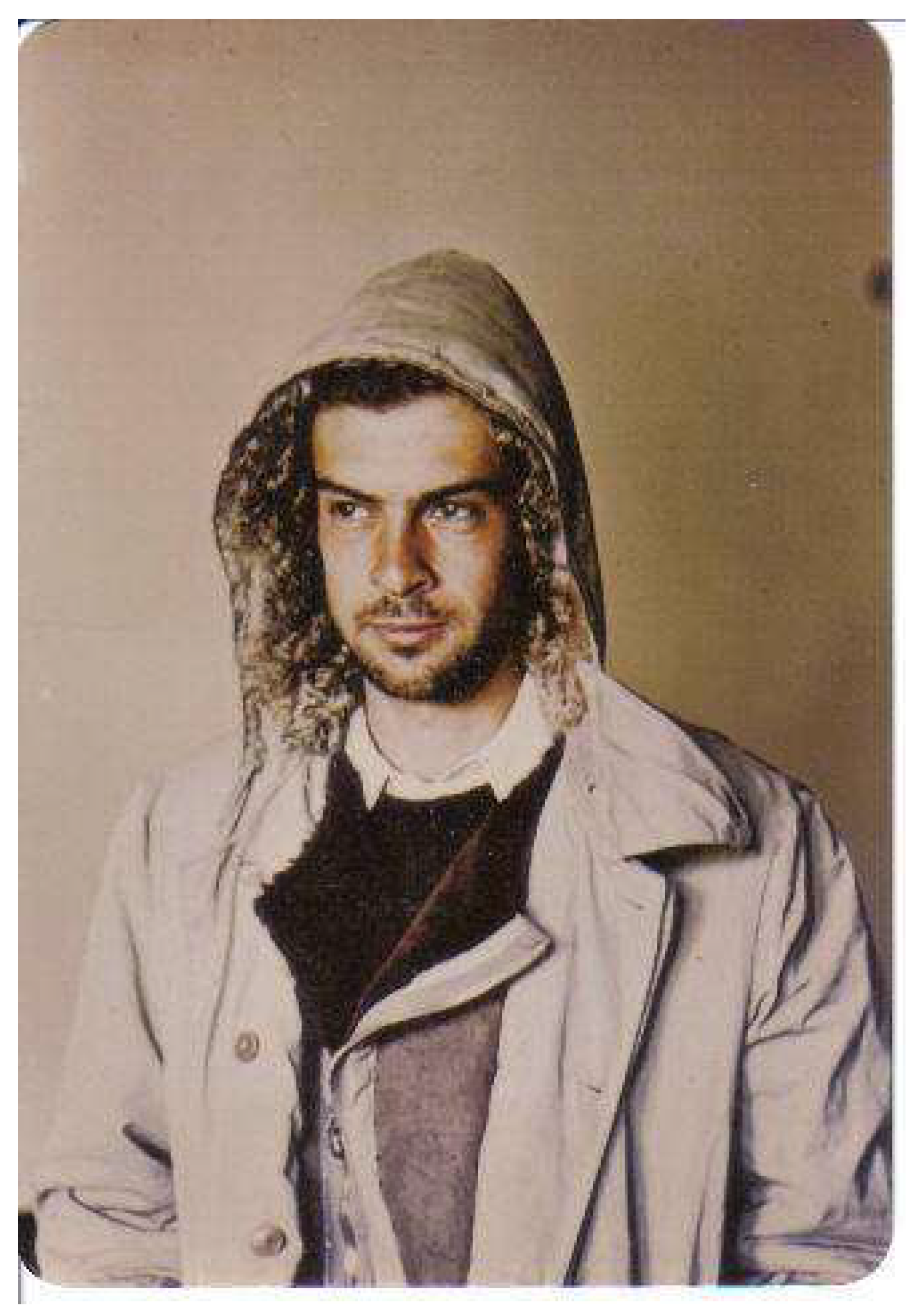
Figure 2.
Dan Romalo’s manuscript, now in the Library of the Romanian Academy.
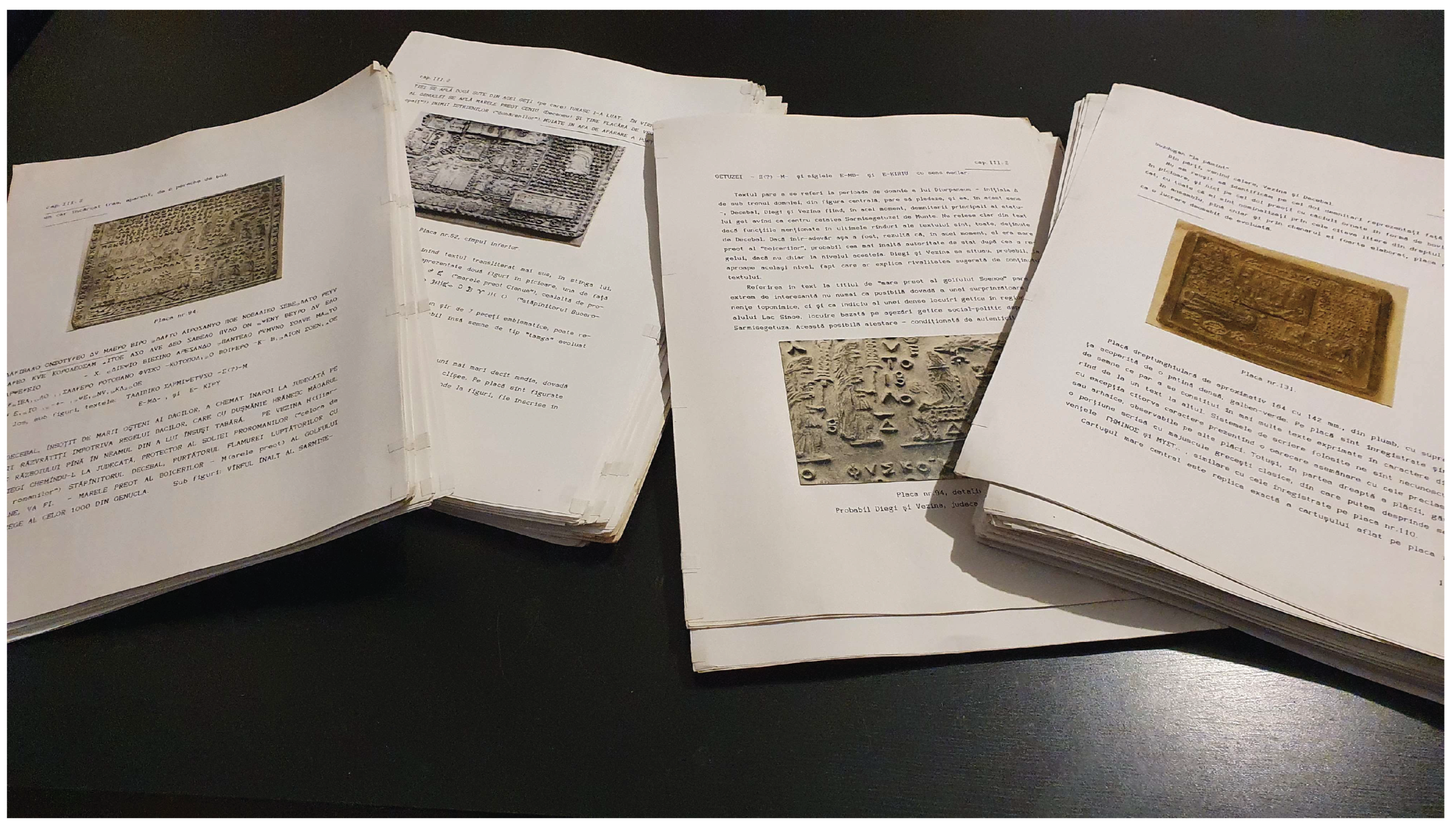
Figure 3.
Plate 11 (Photo M. Coman, 2003).
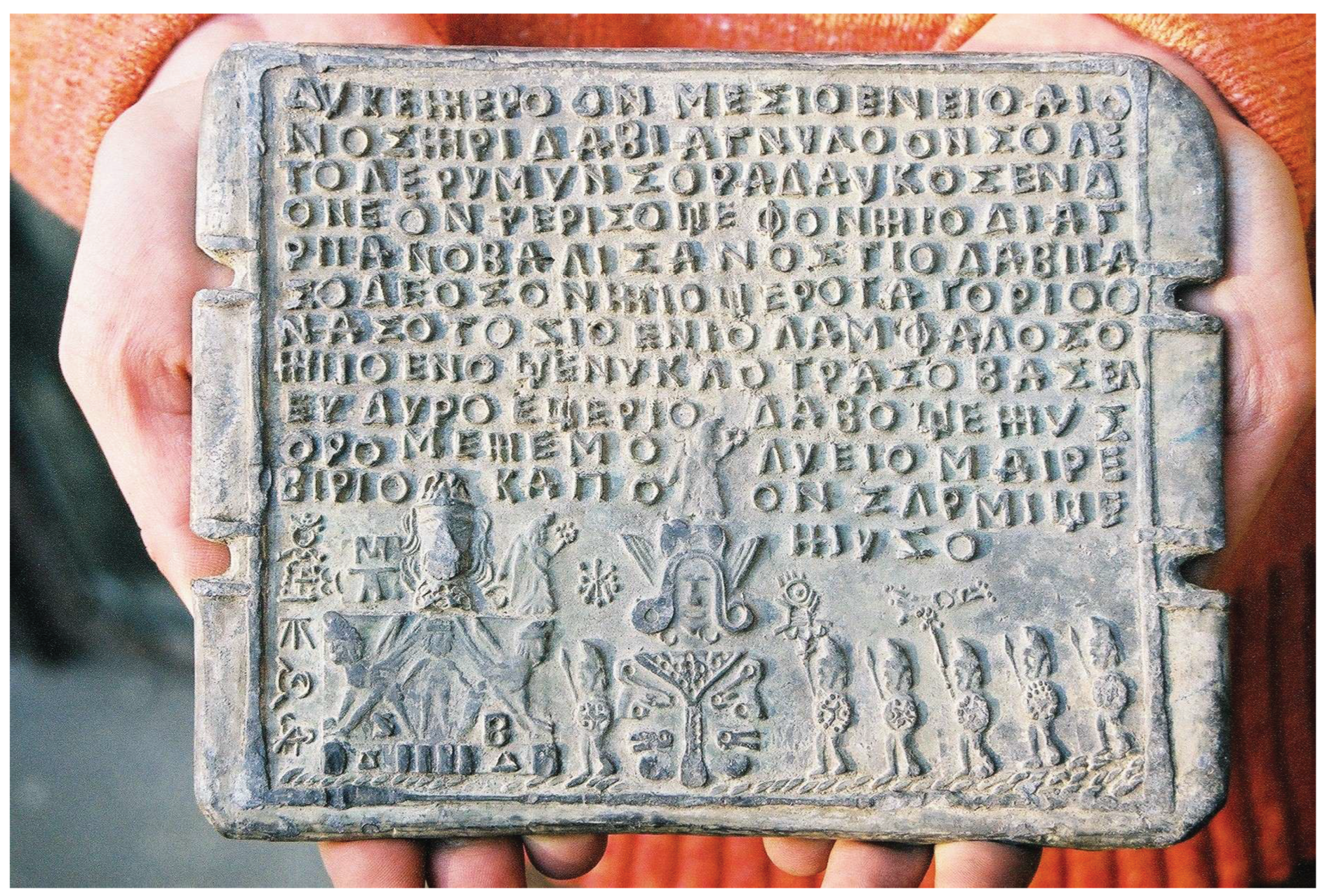
Figure 4.
(a-c) Pieces from the category Ia; (d-e) Pieces from the category Ib (Photos IAB).
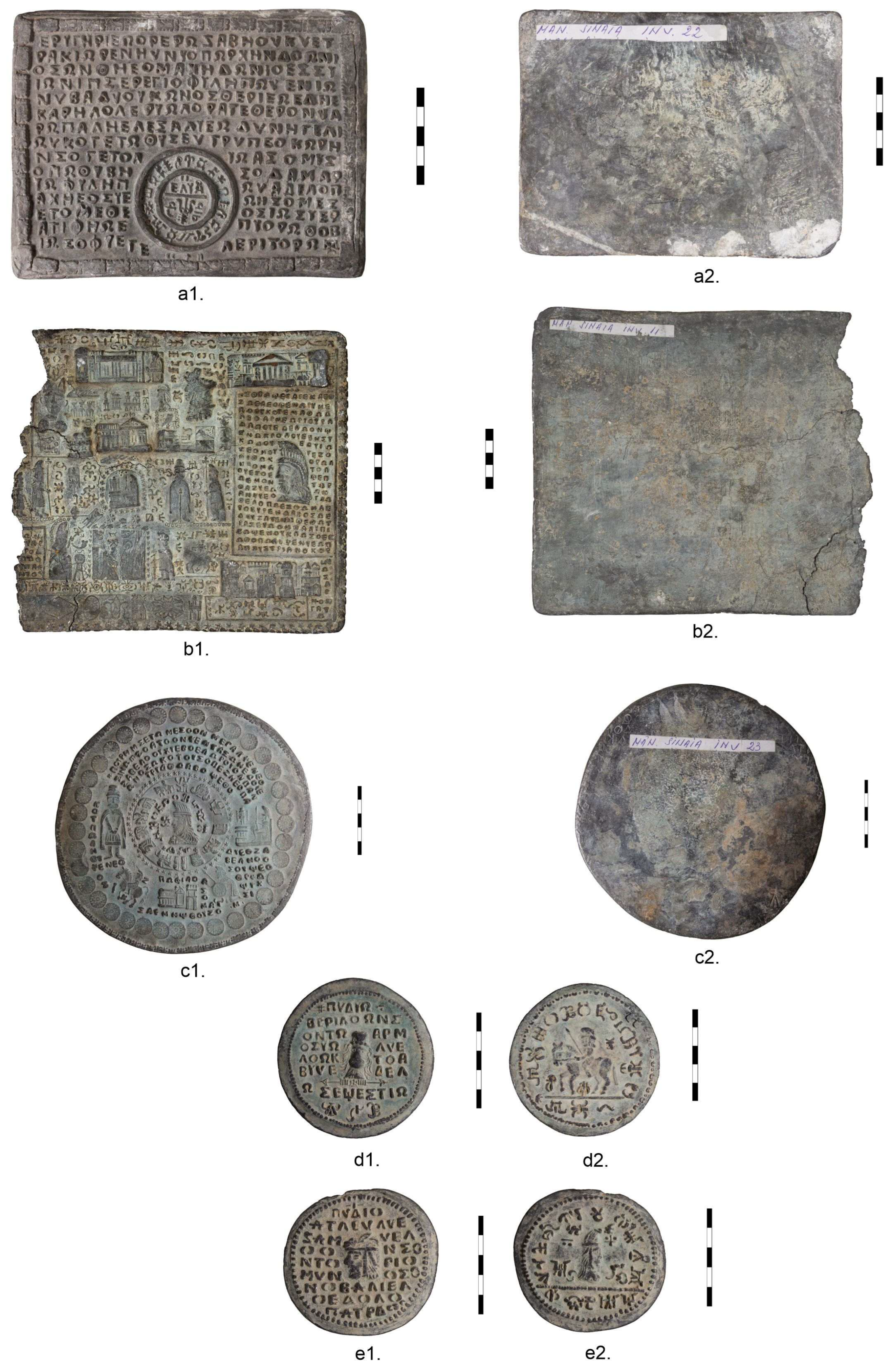
Figure 5.
Pieces from category II: (a-b) Poulopol private collection; (c-d) Museum in Focșani; (e) Severeanu Museum in Bucharest; (f) Murnu/Romalo collection; (g) Sinaia Monastery collection.
Figure 5.
Pieces from category II: (a-b) Poulopol private collection; (c-d) Museum in Focșani; (e) Severeanu Museum in Bucharest; (f) Murnu/Romalo collection; (g) Sinaia Monastery collection.
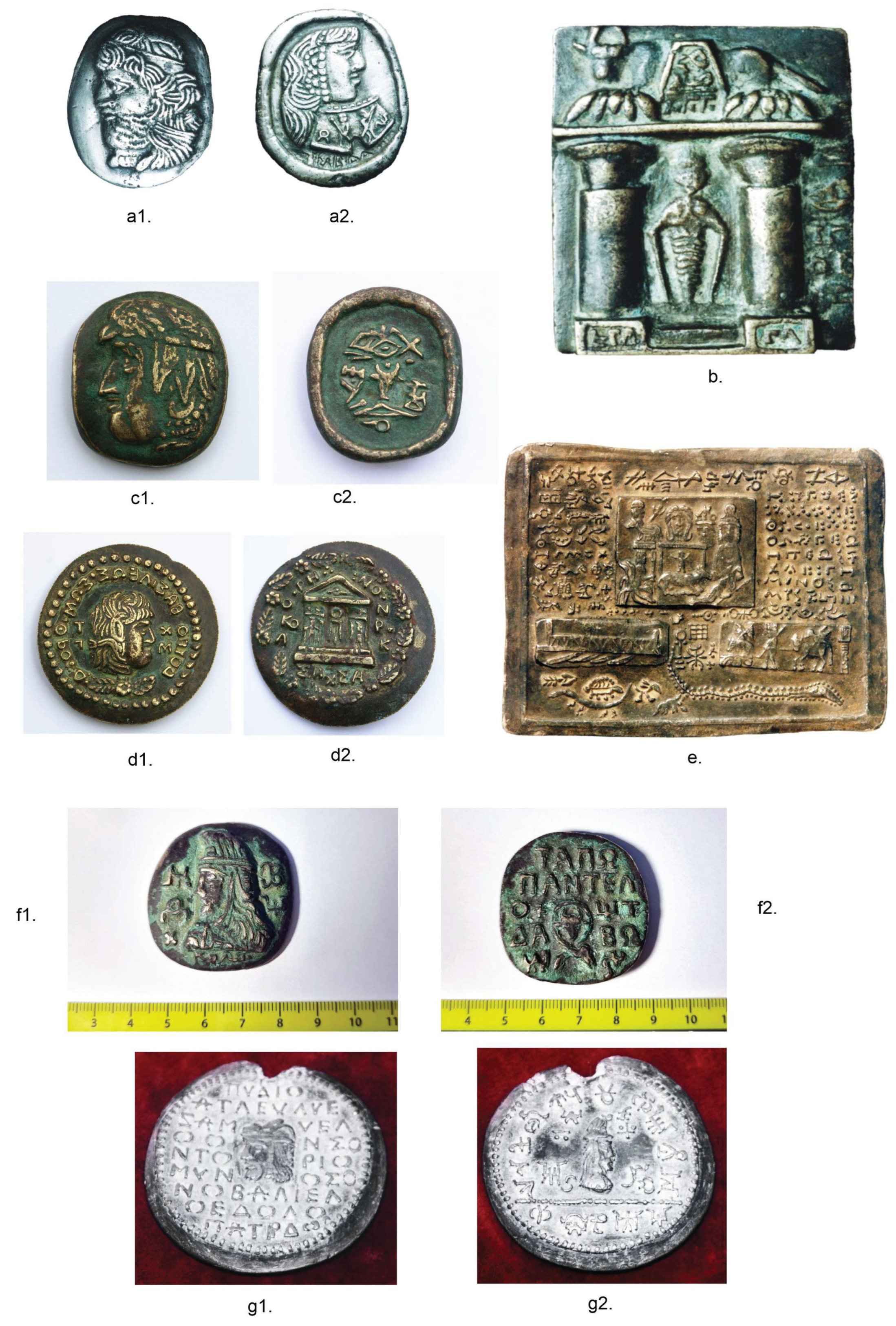
Figure 6.
(a) Coins of King Sarmis (after Henne 1836, Figure 2); (b) Representation of King Sarmis on Plate 58; (c) Janiform figure on Plate 116.
Figure 6.
(a) Coins of King Sarmis (after Henne 1836, Figure 2); (b) Representation of King Sarmis on Plate 58; (c) Janiform figure on Plate 116.
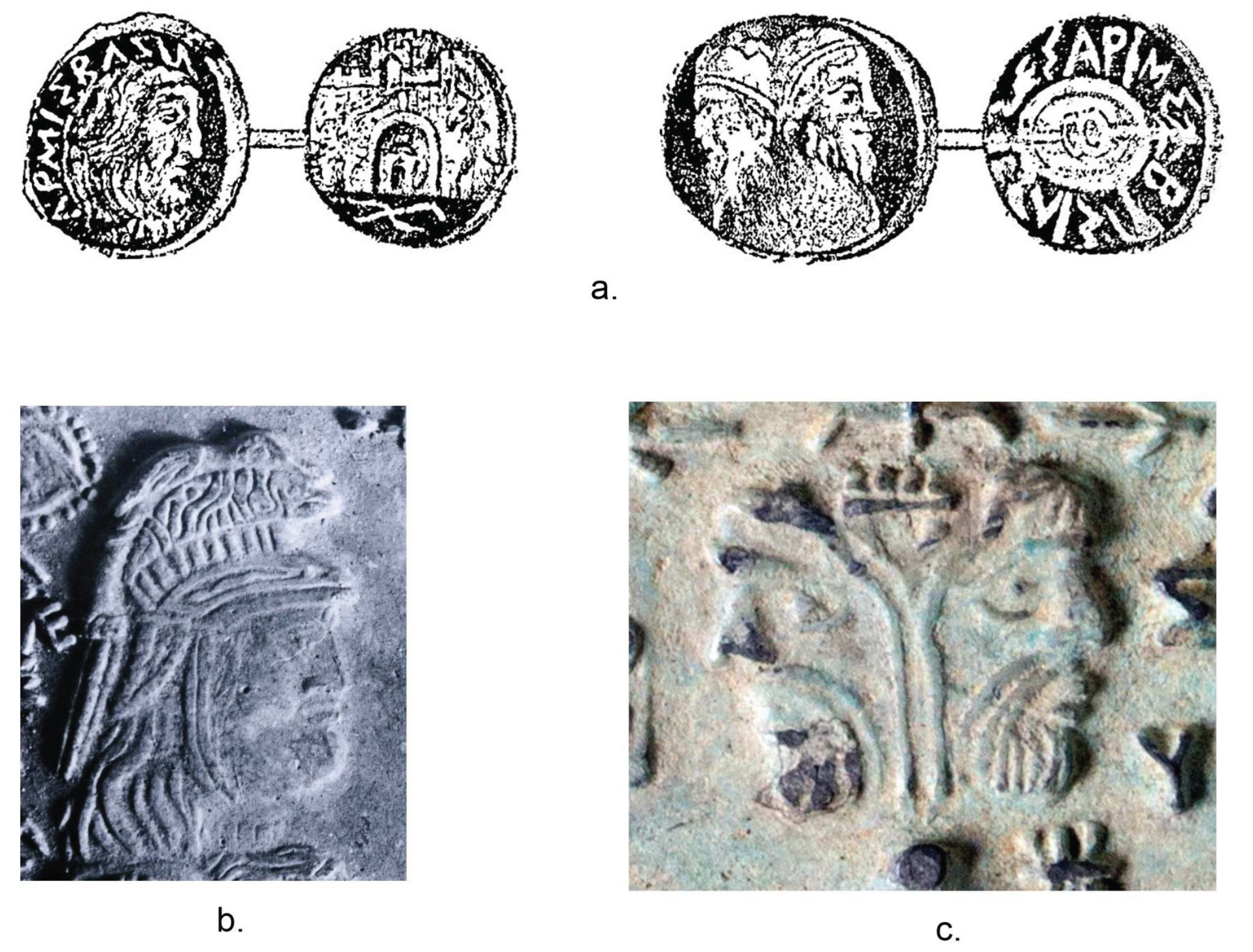
Figure 7.
Plate 8 with corner cutouts and traces of mounting (photo D. Romalo).
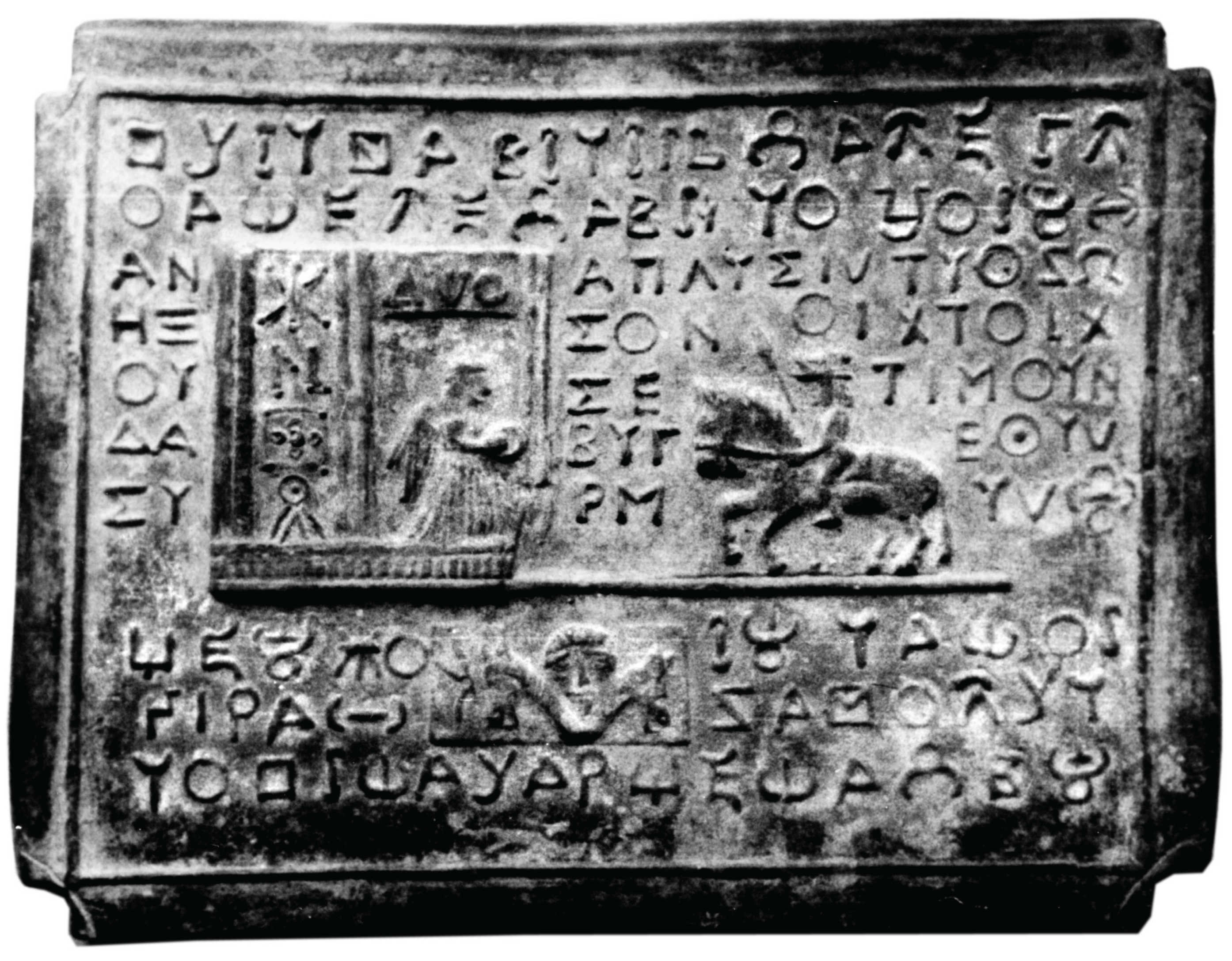
Figure 8.
Attachment marks from: (a) Plate 118; (b-c) Plate 16; (d) Plate 23; (e) Plate 2; (f) Plate 22; (g) Plate 106; (h) Plate 40; (i) Plate 4; (j) Plate 111.
Figure 8.
Attachment marks from: (a) Plate 118; (b-c) Plate 16; (d) Plate 23; (e) Plate 2; (f) Plate 22; (g) Plate 106; (h) Plate 40; (i) Plate 4; (j) Plate 111.
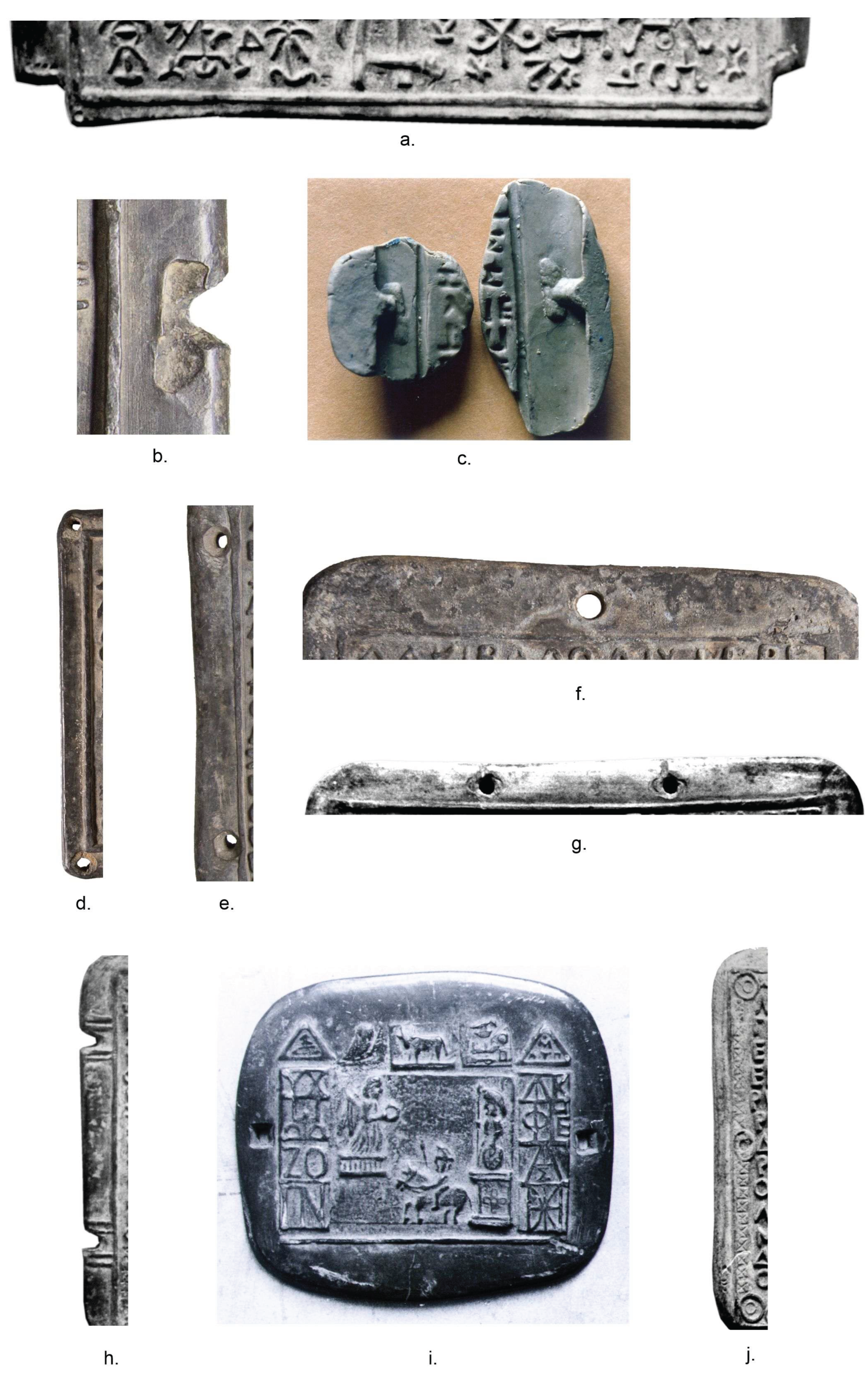
Figure 10.
Close-up of Plate 28 with incised writing and numerals (photo D. Romalo).
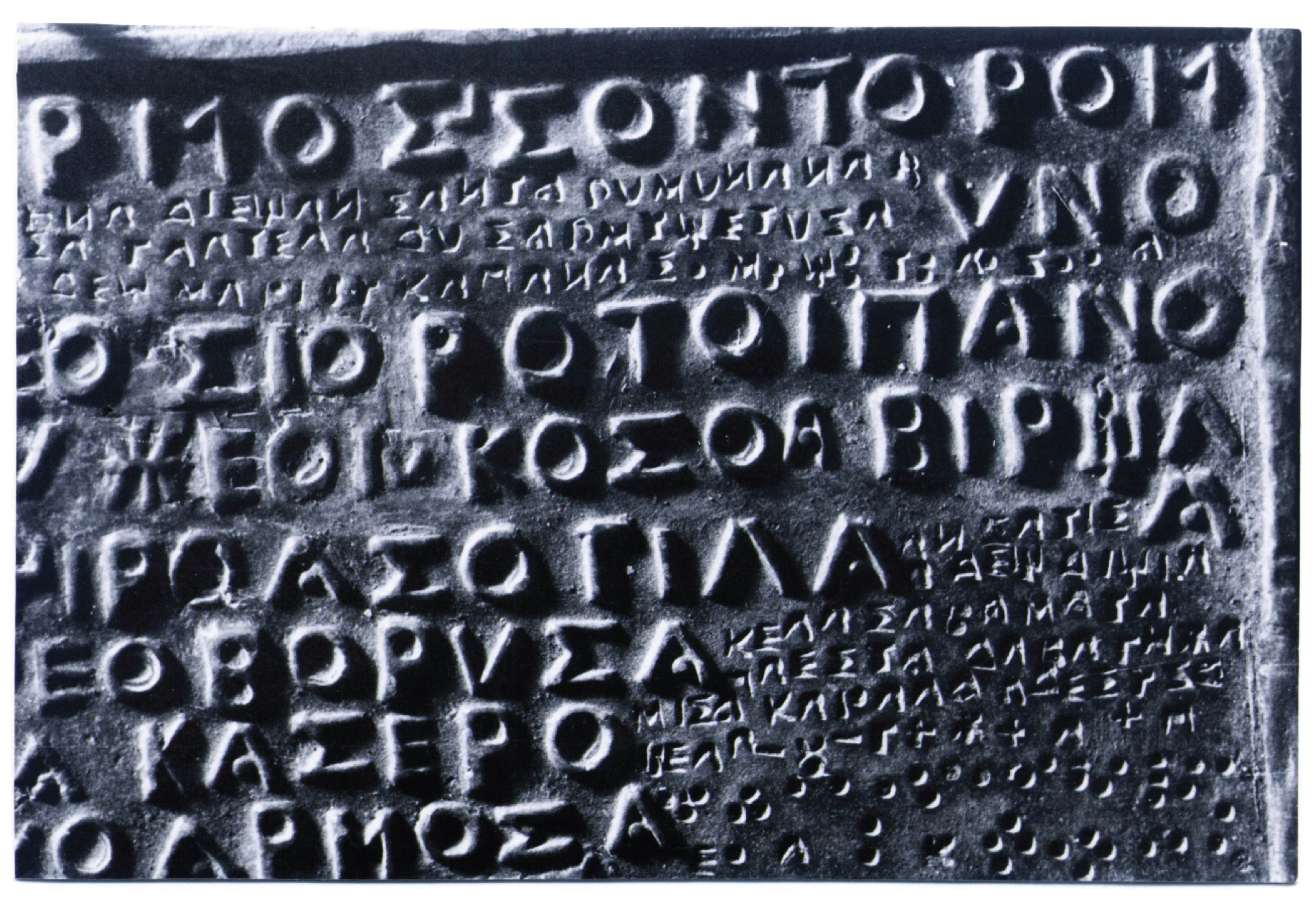
Figure 11.
Iconographic representations: (a) Plate 21 (photo D. Romalo); (b) Plate 9 (photo D. Romalo); (c) Plate 91 (photo M. Coman); (d) detail from the Plate 114; (e). detail from the Plate 91; (f) detail from the Plate 96; (g) detail from the Plate 52; (h-j) perimeter decorations.
Figure 11.
Iconographic representations: (a) Plate 21 (photo D. Romalo); (b) Plate 9 (photo D. Romalo); (c) Plate 91 (photo M. Coman); (d) detail from the Plate 114; (e). detail from the Plate 91; (f) detail from the Plate 96; (g) detail from the Plate 52; (h-j) perimeter decorations.
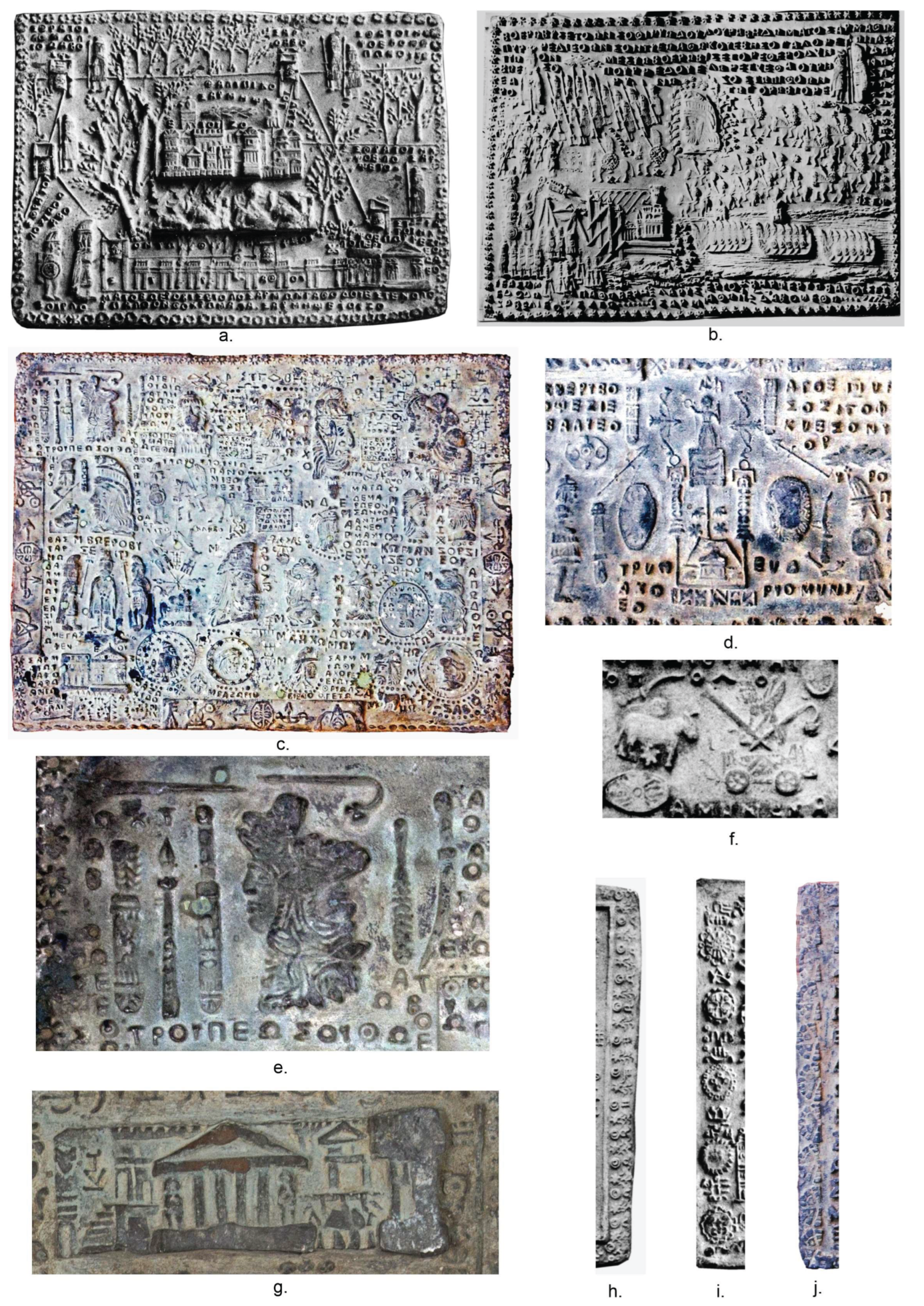
Figure 12.
Plate 120 (photo D. Romalo).
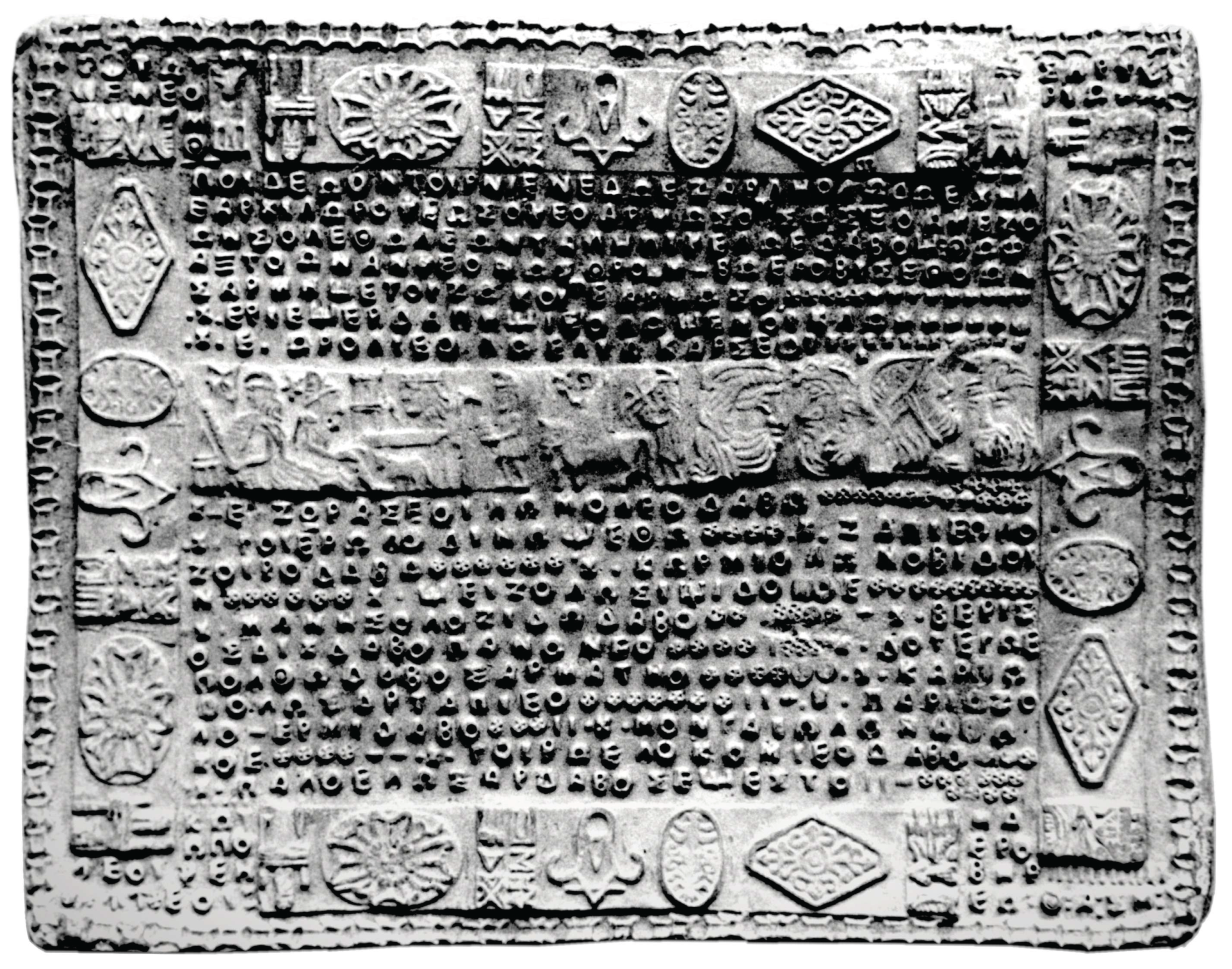
Figure 13.
Plate 128 (photo M. Coman).
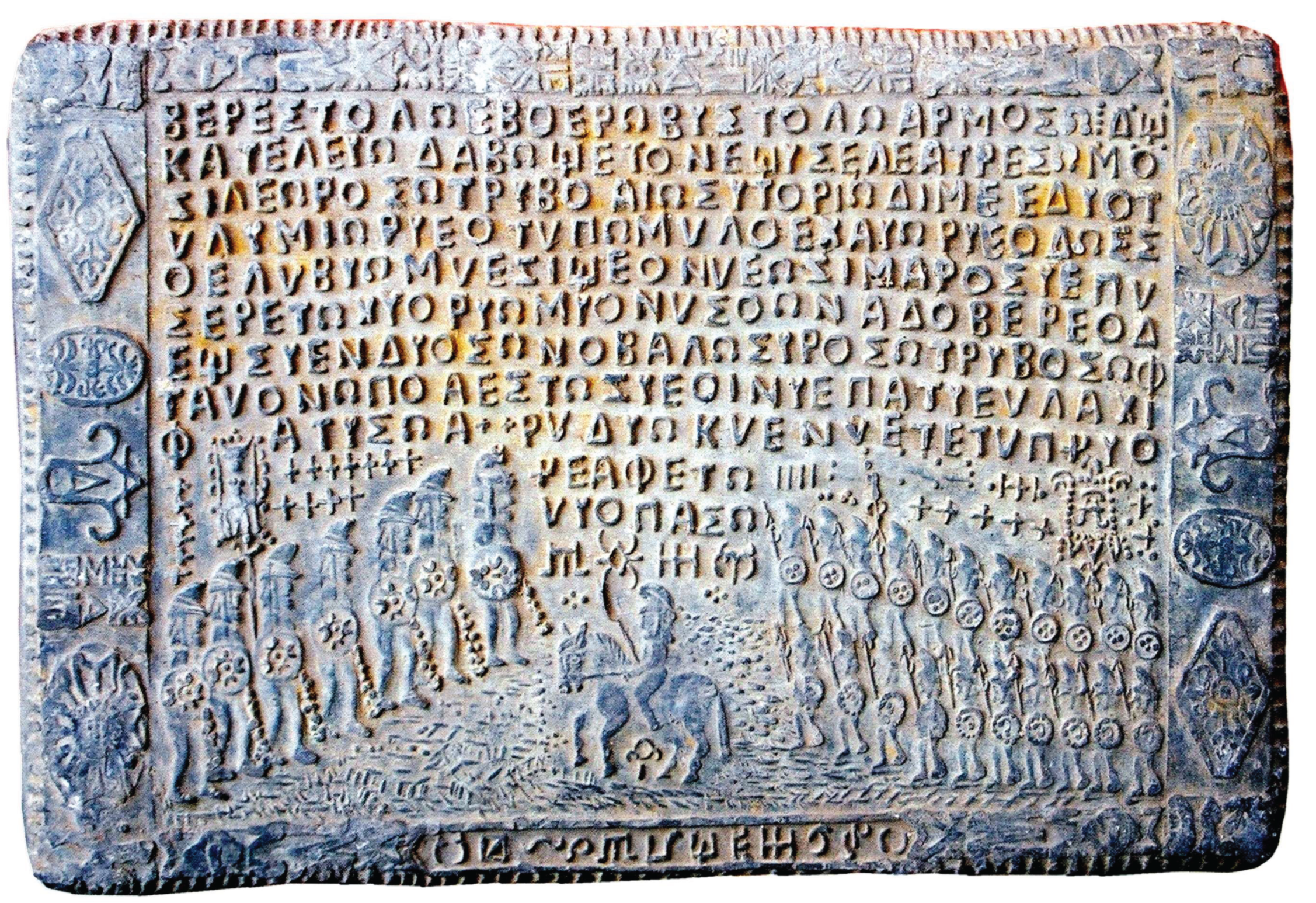
Disclaimer/Publisher’s Note: The statements, opinions and data contained in all publications are solely those of the individual author(s) and contributor(s) and not of MDPI and/or the editor(s). MDPI and/or the editor(s) disclaim responsibility for any injury to people or property resulting from any ideas, methods, instructions or products referred to in the content. |
© 2026 by the authors. Licensee MDPI, Basel, Switzerland. This article is an open access article distributed under the terms and conditions of the Creative Commons Attribution (CC BY) license (http://creativecommons.org/licenses/by/4.0/).
Copyright: This open access article is published under a Creative Commons CC BY 4.0 license, which permit the free download, distribution, and reuse, provided that the author and preprint are cited in any reuse.


