

Submitted:
15 June 2026
Posted:
17 June 2026
You are already at the latest version
Abstract
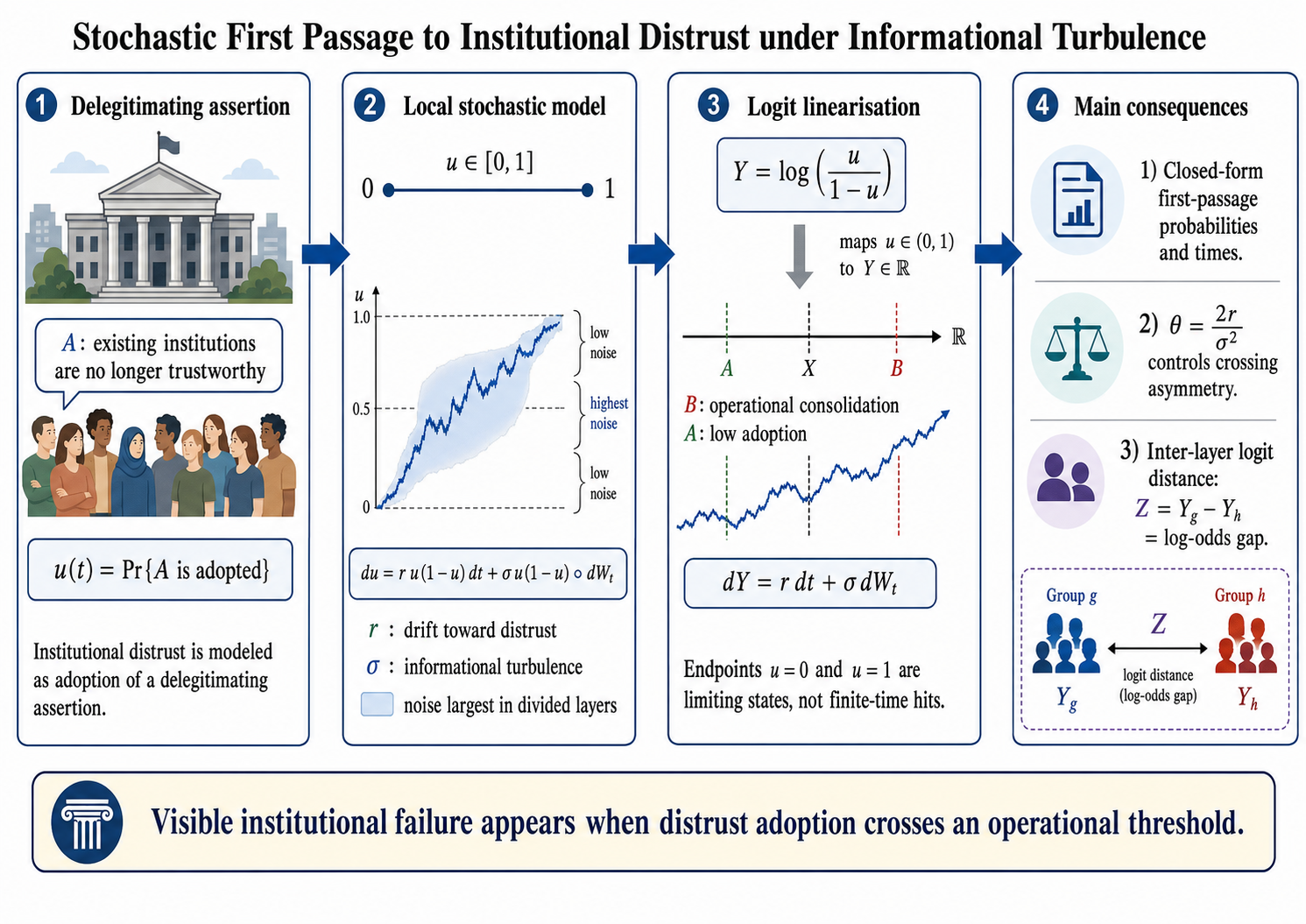
Institutional distrust is treated here not as a low value of trust but as a positive social disposition, the settled expectation that formal procedures and official explanations no longer carry their stated public meaning. The paper studies the consolidation of that disposition as a threshold event. Building on a stochastic trust-phase model, it applies the same multiplicative-noise mechanism to a delegitimating assertion, so the bounded state variable is the probability of adopting institutional distrust. A logit transformation maps the inherited nonlinear diffusion exactly onto Brownian motion with drift and yields closed-form first-passage formulas for the crossing of operational distrust thresholds. The endpoints of the bounded variable are limiting consolidated regimes rather than finite-time targets, so observable institutional failure is threshold passage and not literal absorption at zero trust. The drift-to-turbulence ratio fixes the shape of the crossing probabilities and the noise scale fixes the time scale. The same coordinate measures the distance between social layers facing one assertion. In United States partisan survey data this inter-layer logit distance is large and, on consolidated assertions, stationary, the empirical signature of a completed passage, while valence assertions reset with the change of incumbent.
Keywords:
institutional distrust
; first-passage time
; informational turbulence
; stochastic trust dynamics
; delegitimating assertions
; threshold consolidation
; logit transformation
; partisan polarization
; inter-layer logit distance
MSC: 60J70; 60J60; 60H10; 60G40; 91D30
1. Introduction
Institutional distrust is usually visible before it is formally acknowledged. Elections are held, committees deliberate, courts issue opinions, offices receive complaints, and organizations publish explanations, yet the actors who pass through these forms may no longer treat them as reliable carriers of public, legal, professional, or organizational authority. The social event of interest is not the arrival at a metaphysical zero of trust. It is the crossing of a practical threshold at which distrust becomes the ordinary interpretation of institutional action.
This paper studies the threshold event at which institutional distrust becomes socially operative. The model follows the first passage of a single delegitimating assertion: that existing institutions no longer act as trustworthy carriers of their stated public, legal, professional, or organizational function. The subsequent political order, administrative form, or personal rule that may arise after such a passage lies outside the scope of the model.
The analysis continues a modelling chain. Belief formation was first formulated as probabilistic adoption of a specified assertion rather than as motion of an abstract opinion variable [1]; the description was then extended from network adoption to a degenerate logistic-diffusion account of propagation, pinning, and control in structured social space [2]; and a stochastic trust-phase mechanism was introduced on hierarchical networks, with local multiplicative uncertainty strongest in divided layers and vanishing near consolidated regimes [3]. The present paper keeps that local stochastic mechanism unchanged and applies it to a delegitimating assertion. The variable is still an adoption probability; what is adopted is institutional distrust.
The orientation guards against a frequent misreading. A positive drift here is drift toward acceptance of the distrust-supporting assertion, not repair of trust and not the creation of a successor order. Persistent positive drift consolidates distrust in the local layer; strong turbulence makes the timing of threshold crossings erratic; weak drift with strong turbulence places the institution in a zone of recurrent visible crises. Each of these is a statement about threshold passage rather than about regime replacement.
The local equation is exactly solvable. A logit transformation turns the log-odds of adopting distrust into Brownian motion with drift, which converts the finite-time question into a first-passage problem between interior levels. The endpoints of the bounded variable correspond to the two infinities of the real line and are therefore limiting consolidated regimes, not finite-time targets reached from the interior. Observable institutional events are accordingly expressed as crossings of operational thresholds, ranging from low adoption through contested adoption to consolidated adoption of distrust.
The coordinate that linearises the dynamics also measures the distance between two social layers that face the same assertion, as the difference of their log-odds of adoption. A short empirical illustration reads this inter-layer distance from United States partisan survey data and finds it large and, on assertions that have already consolidated, stationary, which is the observable counterpart of the plateau that the theory places beyond first passage. The illustration measures the coordinate and the plateau and does not calibrate the drift and turbulence, for which matched longitudinal items are required.
Section 2 fixes the social object, distrust as a positive institutional disposition. Section 3 states the inherited one-layer stochastic model under its distrust-oriented reading. Section 4 derives the logit linearisation together with the boundary classification, splitting probabilities, hitting-time formulas, and scale–speed densities, and illustrates the linearisation together with the role of the drift-to-turbulence ratio. Section 5 interprets the formulas as a threshold theory of institutional distrust. Section 6 reads the inter-layer logit distance from partisan survey data as an empirical illustration. Section 7 states the limits and implications of the result.
2. Institutional Distrust as a Threshold Phenomenon
Distrust is not the absence of trust but a positive social disposition, a settled expectation that formal institutions, procedures, and official explanations cannot be taken at face value. In a trusted environment actors may disagree with a decision while still accepting that procedures carry public meaning; in a distrusted environment the same procedures are read as instruments of concealment, coercion, patronage, or managerial self-protection. The outward form persists, since elections are held, committees meet, rules are cited, and reports are issued, while the institution ceases to be treated as a reliable mediator between rule and action.
The paper therefore does not model a vacuum left by the disappearance of trust. It models the adoption of a specific delegitimating assertion,
existing institutions do not work as publicly stated and cannot be relied upon to act in good faith.
The variable studied below is the probability that this assertion is accepted at a representative institutional layer. A state near does not denote a new authority or a post-institutional order; it denotes consolidated distrust toward existing institutions.
The observable signs of such a threshold are familiar. Citizens may continue voting while no longer believing that elections express representation; employees may continue filing reports while assuming that the reporting channel is ceremonial; judges, journalists, civil servants, or corporate officers may continue to use procedural language while privately treating procedures as pre-decided. In each case distrust is not silence, ignorance, or apathy but an organized expectation about how institutions behave.
Electoral politics supplies several configurations of this expectation. In studies of electoral authoritarianism, elections, courts, parties, and constitutional procedures retain a formally recognizable public language while their social meaning is transformed by administrative control, managed competition, and selective enforcement [4,5,6,7]. After the 2020 United States presidential election, disputes over certification, courts, voting technologies, and congressional procedure made institutional trust itself a contested object, so that procedural correction could be read as cover-up and judicial rejection as institutional solidarity [8,9]. In the European Union, distrust may attach less to a single result than to the distance between voters and supranational decision-making, to a perceived democratic deficit, or to technocratic insulation, and may circulate across national and supranational levels [10,11,12]. The common feature, rather than any single national case, is that the delegitimating assertion can become stable while formal participation continues.
The same mechanism operates inside organizations. In a bureaucracy, university, corporation, or public agency, distrust arises when formal procedures are repeatedly experienced as instruments of managerial convenience, so that committees deliberate while outcomes appear fixed and compliance systems exist while complaints appear to disappear. One documented consequence is organizational silence, in which employees withhold negative information because they expect voice to be punished, ignored, or repurposed [13]; exit, defensive compliance, cynicism, and ritual participation are others [14,15,16].
These cases motivate threshold language. Distrust need not reach unanimity in order to matter. An electoral public, a professional bureaucracy, or an online community continues to function formally while a sufficient fraction of actors crosses a practical threshold beyond which institutional signals are no longer interpreted according to their official meaning. Below the threshold distrust remains episodic and reversible; above it, distrust is the default reading of institutional action, and the same official act produces a different social effect because it is received through an already delegitimating frame.
3. Minimal Stochastic Model of Distrust Adoption
Let A denote the delegitimating proposition that existing institutions no longer act as trustworthy carriers of public, legal, professional, or organizational authority. Acceptance of A does not mean that agents know what should replace the institution; it means that they no longer treat the institution as a reliable source of rule, information, or obligation. At a representative layer of a hierarchical or organizational population, define
The adoption semantics are those of [1]. The state variable is the probability of accepting a specified assertion; here is acceptance of A and is its rejection. The mathematics is inherited unchanged, while the substantive content is fixed, the accepted assertion being the claim that the institution has become untrustworthy.
The deterministic part of the dynamics reproduces the one-layer reduction of the matrix-logistic adoption model of [1] and the continuum degenerate logistic-diffusion construction of [2],
The factor u expresses that a delegitimating assertion spreads more effectively once it has local carriers, and the factor expresses saturation as the pool of unconverted agents shrinks. The single coefficient r collects the systematic pressure toward A: repeated procedural failure, visible double standards, selective enforcement, blocked correction, and accumulated evidence that formal rules no longer describe institutional conduct. In the present orientation is drift toward institutional distrust, not toward repair.
Real institutional environments do not transmit delegitimating evidence smoothly. Turbulence is strongest when the layer is divided: if almost nobody accepts A isolated shocks are discounted, and if almost everybody accepts A further shocks change little because distrust is already consolidated, whereas in the unsettled region small signals can shift expectations rapidly. The stochastic amplitude is therefore proportional to , and the inherited one-layer stochastic equation is
Here is a standard Brownian motion and measures informational turbulence, collecting rumors, contradictory announcements, scandals, leaks, media amplification, and uncertainty about institutional conduct. The same multiplicative structure was introduced in the stochastic trust-phase model of [3], where the noise amplitude was tied to the internal variance of a divided layer. The three coefficients thus carry distinct social meanings: r is the systematic drift toward A, is informational turbulence, and the factor is social divisiveness, largest in a split layer and vanishing near either consolidated regime.
Equation (3) is written in Stratonovich form because the fluctuating term is inherited from a state-dependent local adoption mechanism, so the ordinary chain rule applies in Section 4. For generator-based first-passage calculations the same process reads, in Itô form,
with
The second term in (5) is the Stratonovich–Itô correction generated by the state-dependent amplitude; it is technical, and the social content remains that of equation (3). The Itô generator is
and the density solves
These equations only fix the diffusion used below. The event of interest is not absorption at an endpoint but the crossing of an interior threshold at which distrust becomes operationally consolidated.
The natural coordinate for that event is the log-odds of adopting A,
in which equation (3) becomes the constant-coefficient process
The nonlinear bounded equation thus has a simple reading: the log-odds of institutional distrust follow Brownian motion with drift, with r pushing the layer toward adoption of A and scaling the random excursions. Section 4 proves (9) and uses it to compute the first-passage quantities attached to operational thresholds.
4. Logit Linearisation and First Passage
In this paper is the probability that a representative layer accepts the delegitimating assertion A, so large u means consolidation of distrust and small u means that the assertion remains marginal or locally rejected. The calculation below does not ask when an institution is repaired and does not describe any successor form. It asks a narrower question: starting from interior partial acceptance, what are the probability and the expected time for the assertion to cross a visible institutional threshold? Such thresholds are the observable objects, since actors do not witness an endpoint called zero trust but witness changes in conduct, the refusal to credit official explanations, withdrawal from procedures, defensive compliance, exit, or cynical participation. The formulas of this section attach first-passage quantities to those threshold events.
4.1. Exact Logit Linearisation
The multiplicative factor in (3) is not merely a device for keeping the process inside the interval; it is the reciprocal factor that straightens the dynamics under the logit map (8), a smooth increasing bijection , , with inverse
The endpoint is non-adoption of A and is consolidated distrust. In the logit coordinate these endpoints are not finite states,
while finite threshold levels in the adoption variable map to finite levels on the line. For ,
so the finite-time passage of between the interior levels and is equivalent to a first-passage problem for between the finite levels A and B.
Because Stratonovich calculus obeys the ordinary chain rule and
applying the chain rule to (3) gives
The common factor cancels in both terms, leaving , the constant-coefficient process previewed in (9). The degenerate diffusion (3) on the open interval is thus transformed exactly into Brownian motion with constant drift r and constant volatility on the line, where is systematic drift toward institutional distrust.
For any , write . The unique solution of (9) is
and the original adoption variable is the logistic image
Since is finite for every finite t, equation (15) keeps whenever : the apparent degeneracy of the diffusion in u is the statement that the endpoints correspond to infinite logit values.
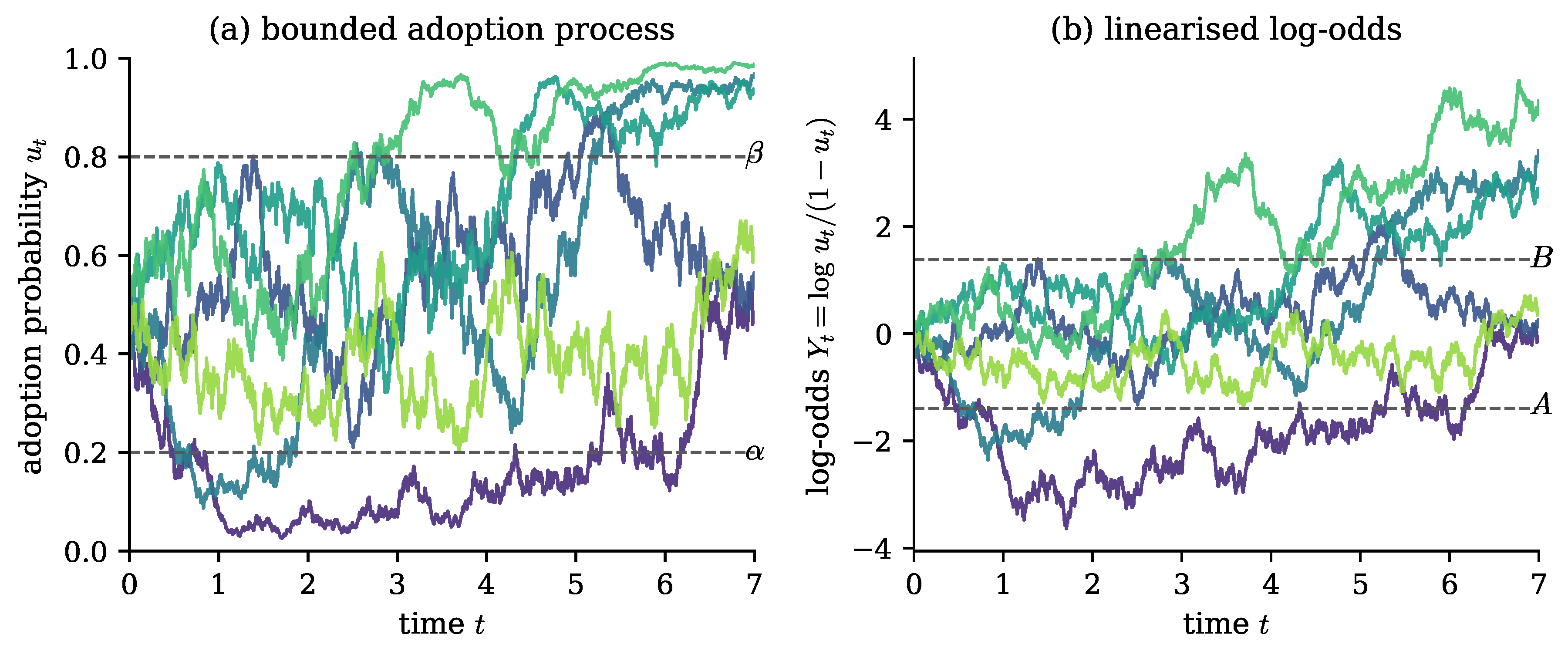
Figure 1.
The logit linearisation. (a) Six realisations of the bounded adoption process in , with operational levels and marked; near either edge the increments shrink as , so the process lingers rather than leaves the interval. (b) The same realisations in the log-odds coordinate , where (9) makes them Brownian motion with drift and volatility between the finite levels A and B. Interior threshold passage in u is exactly threshold passage for Y.
Figure 1.
The logit linearisation. (a) Six realisations of the bounded adoption process in , with operational levels and marked; near either edge the increments shrink as , so the process lingers rather than leaves the interval. (b) The same realisations in the log-odds coordinate , where (9) makes them Brownian motion with drift and volatility between the finite levels A and B. Interior threshold passage in u is exactly threshold passage for Y.
4.2. Boundary Degeneracy and Limiting Consolidated States
In the original coordinate the endpoints look absorbing, because both drift and noise vanish there. In the logit coordinate they are the two infinities of the line, so finite-time accessibility of and would require finite-time explosion of the drifted Brownian motion .
Theorem 1
(Finite-time inaccessibility of the endpoints). Let and let solve (3). Then, for every finite ,
Equivalently, the endpoints and are not reached from the interior in finite time.
Proof.
By the logit linearisation, . For every finite t the variable is finite almost surely, and the inverse logit map sends every finite real number into ,
Hence a process started from stays in for all finite times. Since corresponds to and to , reaching either endpoint in finite time would force to become infinite in finite time, which is impossible for Brownian motion with constant drift. This proves (16). □
The limiting direction is also immediate.
Theorem 2
(Long-time behaviour). Let and let solve (3). If , then
If , then neither endpoint is reached in finite time, and the logit process crosses every finite level infinitely often almost surely.
Proof.
From (14), . Since almost surely, almost surely. For this gives , and the inverse logit map gives , which is (18). For the process is recurrent Brownian motion on the line and crosses every finite level infinitely often; since and correspond to , this recurrence concerns only finite interior thresholds and does not contradict Theorem 1. □
Remark 1
(Direction of the drift). The accepted assertion is delegitimating, so in the main case the continuous interior dynamics is distrust-consolidating in the long run: in the logit coordinate the lower endpoint is repelling and the upper endpoint is attracting as an infinite-time limit. A negative r would reverse the logit drift and describe a layer in which the delegitimating assertion loses force, which is not the case analysed here.
Remark 2
(Consolidated states and finite-time accessibility). The parent trust-phase model describes the endpoints as consolidated regimes, which is natural at the level of limiting configurations since and . The logit representation refines the finite-time statement: and correspond to and are limiting consolidated states rather than finite-time absorbing targets reached from . In Feller terms they are natural boundaries for the interior process. The analysis therefore leaves the inherited equation untouched and only separates its limiting-state reading from the finite-time first-passage classification used below.
4.3. Operational Distrust Thresholds
Since the endpoints are not finite-time targets, a first-passage problem for the continuous interior diffusion must be stated in terms of interior levels, which is also the natural institutional formulation. Distrust becomes socially operative well before , namely when acceptance of A crosses a visible threshold: official explanations stop being credited, formal procedures are treated as instruments rather than safeguards, and actors adjust their conduct to expected institutional failure. Fix two operational thresholds , where marks a level at which the assertion is still marginal and marks operational consolidation. These are reporting levels for finite-time events, not new dynamical parameters.
In the logit coordinate they become the finite points and introduced in (11), and since ℓ is strictly increasing, is equivalent to . Threshold crossing in the adoption coordinate is therefore exactly threshold crossing for between A and B. Define the downward deconsolidation time and the upward consolidation time by
Neither stopping time is an endpoint hit: records the assertion falling below a low operational level, and records operational consolidation of distrust.
4.4. Splitting Probabilities Between Thresholds
First-passage quantities for Brownian motion with drift are classical [17,18,19]. We first compute the probability of reaching the upper threshold before the lower one, which in the logit coordinate is the probability of hitting B before A. Let
and write and , the operational times of (19) and (20), and . The splitting probability is . Since , the generator is , and q is the bounded solution of
For set
Proposition 1
(Splitting probability between operational thresholds). Assume and . The probability of reaching the upper threshold before the lower one is
With , , and , this is the probability that reaches before .
The zero-drift case follows by solving (22) with or by letting ,
so without systematic drift the splitting probability is linear in the logit coordinate. The endpoint intuition is recovered in the threshold limit: if then , and for fixed interior X and fixed B,
which is not finite-time absorption at but the statement that, under positive drift, any fixed interior level of distrust adoption is reached before an arbitrarily low threshold with probability tending to one. Equation (24) also separates two roles: the dimensionless fixes the shape of the splitting probability through the logit distances and , while the physical time scale enters only the passage times below. Socially, is a drift-to-turbulence ratio for the assertion, with systematic failure entering through the drift and rumors, contradictory signals, and ambiguity entering through the turbulence scale. Figure 2(a) shows how bends the splitting probability away from the direction-neutral diagonal.
4.5. Operational Passage Times
Having determined which threshold is reached first, we compute how long the passages take. Throughout, the canonical logit process is on the line, with no boundary at the opposite threshold.
Unconditional upward consolidation.
For in the consolidating regime , the upper level is reached almost surely with mean
No reflecting boundary is imposed at A; this is the canonical time to the operational distrust threshold for the unconfined single-layer process.
Downward passage: probability and unconditional time.
For under positive drift the process may never reach the lower level, with hitting probability
Because on a set of positive probability, the unconditional mean is
This infinity is not a divergence of the calculation but the record that downward movement is not a sure event when the logit drift supports the assertion. A finite time attaches to it only after conditioning, which we do next, or after an external mechanism such as a change in r, an institutional intervention, or a shock outside the one-layer model.
Conditional downward passage.
The informative finite-time statistic for downward passage is the mean time given that the lower threshold is reached.
Proposition 2
(Conditional downward passage time). Let , , and . Conditioned on , the logit process evolves as Brownian motion with reversed drift and the same volatility σ. Under this conditional law the lower level is reached almost surely, and
Proof.
The function is harmonic for , since by , and it equals the downward hitting probability of (29). Conditioning on is the Doob h-transform by this h; the transformed generator keeps the diffusion and has drift . The conditioned process is therefore Brownian motion with drift toward A and reaches A almost surely. Writing for it, is a martingale, and optional stopping at gives , that is (31) [18,19]. □
Proposition 2 locates the asymmetry precisely. Comparing (28) with (31), conditional on occurring the upward and downward passages take mirror-image mean times, and , each the logit distance to the target divided by r. The asymmetry is one of likelihood, not duration: reaching is certain, whereas falling to occurs only with probability . Consolidation is the typical finite-threshold event, and downward escape is rare rather than slow. Figure 2(b) shows the downward hitting probability falling with the distance to the lower threshold and with .
Zero-drift case.
When the logit process is driftless Brownian motion. Both thresholds are then reached almost surely, but the mean hitting time of a single fixed level is infinite, so a finite passage time again requires either conditioning or a two-sided corridor. The symmetric corridor formulas, used only as confined residence-time diagnostics rather than as boundary conditions of the inherited diffusion, are collected in Appendix B.
The single-layer conclusion is strong but bounded. Under positive drift the local continuous model makes consolidation a finite-mean event (28), while downward passage has probability below one and infinite unconditional mean, equations (29)–(30). The reflected formulas (A13) and (A17) are corridor residence diagnostics, not the main physical claim. The model describes threshold consolidation of distrust; it does not describe whatever institutional or political form may follow it.
4.6. Scale and Speed in the Original Coordinate
The logit coordinate is primary, because it turns the inherited diffusion into Brownian motion with drift. It is nonetheless useful to record the scale and speed densities in the original variable, in the standard language of one-dimensional diffusion theory [18,20,21,22], which connects the logit calculation to classical boundary classification and explains the powers that appear near and .
Proposition 3
(Scale and speed densities). Let be the local diffusion (4) and . In the coordinate u, a scale density is
and the corresponding speed density is
Proof.
Remark 3
(Origin of the extra exponent). The extra in the exponents of (32) and (33) is the Jacobian factor of the logit transformation. These powers do not represent a new modelling effect; they appear because the elementary exponential densities of the drifted Brownian motion in Y are written in the degenerate coordinate u.
The scale and speed densities confirm, in the original coordinate, the boundary classification obtained directly from the logit representation: the endpoints correspond to logit infinities, and the singular powers in (32) and (33) are their original-coordinate trace. The full Feller integral checks are not needed for the derivation but provide a verification in classical language; they are recorded in Appendix A.
5. Social Meaning of the Formulas
The formulas describe a narrow and observable event, the passage from unsettled suspicion to an operational threshold at which institutional distrust becomes a working social disposition, with the probability that a representative layer accepts the proposition that the institution is no longer trustworthy. They do not describe a successor order. Once the delegitimating expectation is common, actors may still comply, attend meetings, file reports, vote, teach, or obey instructions, but the meaning of those actions changes: compliance becomes defensive or tactical, silence becomes rational, exit becomes thinkable, and official language loses credibility. In the vocabulary of institutional theory, legitimacy has not merely decreased by a numerical amount; a different interpretive stance has crossed a threshold [14,16,23,24,25,26].
The logit variable is the log-odds of adopting distrust, positive when adoption is more likely than non-adoption. Its linear law (9) separates the two forces acting on the log-odds scale. The drift r is the systematic pressure toward the assertion already identified in Section 3, and the volatility is informational turbulence; the drift carries no moral sign by itself, since under a different coding of the assertion the same sign would mean something else. With the orientation fixed, Theorem 2 states that a persistent positive drift consolidates the assertion at the layer level in the limit, almost surely, which is not the appearance of a new order but the long-run consequence of the inherited continuous dynamics.
The relevant social events are interior crossings rather than endpoint hits. An institution does not need perfect distrust before conduct changes; the observable event is the consolidation time to a reporting threshold , the moment at which distrust becomes visible in behaviour, when complaints no longer seek correction, silence replaces voice, and explanations are discounted in advance. Its mean is the consolidation time (28), : on the log-odds scale, the expected time to visible distrust is the remaining distance to the reporting threshold divided by the systematic drift. The lower threshold has the opposite meaning. It is not loss of trust but the level below which the assertion has failed to consolidate, and the probability of consolidating before retreating to it is the splitting probability (24), governed by the drift-to-turbulence ratio .
That ratio is the central parameter of the threshold picture. A large value means that systematic drift dominates fluctuations; a small value means that the trajectory is governed more by turbulence than by stable accumulation, and in the zero-drift limit the direction of passage is set only by the initial position in the corridor, . The role of is correspondingly subtle. Turbulence does not by itself create a direction or guarantee destruction; it widens fluctuations, lowers , and makes early crossings more dependent on timing. With small r and large the institution occupies a crisis-prone zone in which distrust flares and recedes; with persistently positive r turbulence changes the timing and the competition between thresholds while the asymptotic direction remains consolidation.
The downward side sharpens the same point. Under positive drift the process reaches the lower threshold only with probability (29), the unconditional downward mean is infinite (30), and conditional on occurring the downward time (31) mirrors the upward one. The asymmetry is therefore one of likelihood: consolidation to is the typical event, retreat to a sub-certain fluctuation. Distrust may stay below the visible threshold for a long period while the log-odds drift accumulates beneath ordinary institutional language; when the trajectory crosses , the shift looks sudden, as actors who continued to comply begin to read the same signals through an already consolidated expectation of unreliability.
The model also explains why repeated crises cannot, from observation alone, be read as endpoint collapse. The continuous one-layer model has no finite-time absorption at () or (), only interior threshold passages. A discontinuous social break would require an additional mechanism, such as a jump shock, a sudden change in (r) or (), a network rewiring event, or a spatial front in the depth-dependent continuum theory [2,3]. Those mechanisms lie outside the local calculation. The first-passage model isolates the prior event: persistent institutional failure produces drift toward the adoption of distrust, and the resulting loss of credibility becomes visible when that adoption crosses an operational threshold.
6. Empirical Illustration: Inter-Layer Logit Distance Between Partisan Layers
The single-layer theory describes how one population adopts a delegitimating assertion. The same logit coordinate measures the distance between two layers that face the same assertion. For groups g and h and an assertion A with adoption probabilities and , write
the logarithm of the odds ratio of adoption between the two layers. The operational thresholds and cancel from the difference, so Z is defined without knowing where any polity places its reporting levels. The sign records which layer adopts the assertion more readily, the magnitude records the strength of the separation, and is the odds ratio itself. The quantity is the inter-layer reading of the same coordinate in which the dynamics (9) are linear, so for one assertion observed repeatedly the gap obeys , again Brownian motion with drift, and the slope of its trajectory estimates the differential drift .
6.1. Matched-Panel Data
We illustrate with United States partisan data from the PRRI American Values Survey, 2020 to 2025 [27,28,29]. Two kinds of object must be separated. A repertoire of the most salient assertions changes its content almost completely from year to year, so a battery assembled by current salience tracks the moving content of partisan conflict rather than a fixed quantity, and the size and composition of such a battery shift in every wave. Only assertions repeated with identical wording across waves support a statement about change in time, and the time analysis is restricted to these matched anchors. Eight anchors recur in three or more waves, listed in Table 1. Partisan support proportions are taken from the cited PRRI releases; two anchors, support for political violence and the direction of the country, were checked verbatim against the cited reports, and the extracted series sit inside the partisan ranges that PRRI reports for them. Party subsample sizes are not published in these releases, so the intervals shown in the figures are illustrative, computed under an assumed partisan share of the total sample, and no interval should be read as a published standard error.
6.2. Large Distances and the Consolidated Plateau
The inter-layer distances are large in odds-ratio terms. A gap of is an odds ratio near ten, and a gap of is an odds ratio near thirty, so the assertions in Table 1 do not separate the layers by a few percentage points but by an order of magnitude or more in the odds of adoption. The clearest case is the stolen-election assertion, which sits between and across three waves with no systematic movement, an odds ratio between twenty-seven and forty-seven [30]. Figure 3(a) shows this as a flat band near the top of the diagram. In the language of the model this is the signature of a completed first passage. Once the assertion has consolidated in one layer and been rejected in the other, both layers sit far out on the log-odds scale where the linearised process has already crossed the operational thresholds, and the gap stops moving because neither layer has new ground to cross. The cultural-threat and conspiracy anchors sit at smaller but still large and roughly stationary gaps, between odds ratios of three and fifteen.
6.3. A Plateau Is Not a Valence Reset
The political-violence anchor separates two dynamical types that the single number Z would otherwise blur. PRRI has asked whether true American patriots may have to resort to violence in order to save the country in sixteen waves since March 2021 [31], shown in Figure 4. The inter-layer gap does not drift; it steps. Through the period before the 2024 election the gap holds a mean near , and after the change of incumbent it falls to a mean near . The mechanism is visible in the upper panel. Republican endorsement falls from about twenty-nine to about twenty percent once Republicans hold power, while Democratic endorsement is flat and slightly rising, so the gap closes because the endorsing layer disengages from the grievance rather than because the layers converge in belief. This assertion behaves as an anti-incumbent grievance, and the direction-of-country anchor reverses sign outright between 2022 and 2025 for the same reason. Neither is a consolidated plateau. The logit coordinate keeps the two types apart, since a consolidated assertion such as the stolen election holds its large gap independently of which party governs, whereas a valence assertion resets with the incumbent. Both are visible as values of Z, and only the first is the post-passage plateau predicted by the boundary behaviour of the linearised process.
6.4. What the Illustration Establishes
The illustration shows that the logit coordinate turns partisan separation into measurable distances, that those distances are large, and that on consolidated assertions they are stationary, which is the empirical fingerprint of the plateau the theory predicts after first passage. It does not calibrate the stochastic dynamics. The matched anchors are few, most intermediate waves carry no published field date, and party subsample sizes are unpublished, so a drift with a genuine confidence interval cannot be formed and the parameters r, , and are not estimated here. The slope of an anchor trajectory is at most a finite-difference reading of the differential drift for one assertion. A matched panel of identical items with recorded field dates and partisan subsample sizes would be required to estimate the gap dynamics, and public value surveys do not yet supply it. The empirical content is therefore a reading of the coordinate and of the consolidated plateau, not a fitted model.
7. Discussion and Conclusions
The paper isolates one local mechanism of the broader stochastic trust-phase framework, the first passage of a delegitimating assertion under informational turbulence. The shift relative to the parent model is semantic rather than algebraic: the variable is still an adoption probability, but the adopted assertion is that institutions are no longer trustworthy, so large u represents consolidated distrust. This reading makes the finite-time problem socially meaningful, because institutions are observed through conduct such as withdrawal, defensive compliance, organizational silence, exit, and cynical participation, none of which requires unanimous distrust, only threshold consolidation.
The exact logit linearisation supplies the mathematical core. In log-odds coordinates the inherited diffusion becomes Brownian motion with drift, the endpoints of the bounded coordinate correspond to logit infinities, and they are limiting regimes rather than finite-time targets, so the relevant events are interior crossings. The formulas separate two social forces, the systematic drift r toward the assertion and the informational turbulence , whose combination through the drift-to-turbulence ratio fixes the shape of the crossing probabilities while the noise intensity sets the clock.
An empirical illustration in Section 6 reads the same coordinate between partisan layers. In United States survey data the inter-layer logit distance on delegitimating assertions is large, with odds ratios that reach several tens, and on the stolen-election assertion it holds a high stationary plateau across waves, which is the observable counterpart of the boundary behaviour the model assigns to a completed passage. The illustration also separates that plateau from a valence reset, since support for political violence and judgements about the direction of the country track which party governs and collapse or reverse when the incumbent changes, whereas a consolidated assertion holds its gap regardless. This distinction is a property of the coordinate and not of any fitted parameter.
The limits are deliberate. The model does not represent Caesar, personal rule, regime replacement, reconstruction, or reform, and that subsequent form is not a state variable; the analysis stops at the prior threshold, the point at which the assertion that institutions cannot be trusted becomes socially operative. Several extensions remain open. A spatially extended version would study how distrust fronts move through hierarchical depth and across connected layers; a jump extension would model abrupt scandals, leaks, or external interventions; a time-dependent version would let r and change as institutions deteriorate, reform, or communicate. Each is separate from the result proved here. The empirical illustration measures distances and the consolidated plateau but does not estimate the drift and turbulence, because the matched assertions are few and partisan subsample sizes are not published, so a matched panel of identical items with recorded field dates and subsample sizes would be required to estimate the gap dynamics. The closed single-layer baseline stands: institutional distrust, formulated as adoption of a delegitimating assertion, has an exact first-passage theory under informational turbulence, and its inter-layer reading gives a threshold-free measure of partisan separation.
Funding
This research received no external funding.
Data Availability Statement
The closed-form expressions in this paper are self-contained. The partisan survey proportions used in the empirical illustration are drawn from the public PRRI American Values Survey reports cited in the text. The scripts that generate the figures are available from the author on reasonable request.
Conflicts of Interest
The author declares no conflict of interest.
Appendix A. Scale–Speed Boundary Check
The main text proves finite-time inaccessibility of the endpoints by the exact logit transformation. This appendix records the same conclusion in the classical scale–speed language as a consistency check; it adds no second model and does not change the interpretation. From Proposition 3, the densities are
with . These are the scale and speed densities of Brownian motion with drift in the logit coordinate, written back in the degenerate coordinate.
Near the upper endpoint, with and ,
so the scale tail satisfies
and the Feller characteristic integrand near is
Therefore
and the upper endpoint is not reached from the interior in finite time.
Near the lower endpoint, with ,
The scale measure diverges,
while the speed measure is locally finite for ,
The same characteristic calculation gives an integrand proportional to near , so the integral diverges and the lower endpoint is also inaccessible in finite time. The conclusion is immediate in the logit coordinate, where and correspond to and Brownian motion with constant drift cannot reach either infinity in finite time. Both endpoints are natural limiting boundaries for the interior process: is the limiting consolidation of the assertion and its limiting failure, neither a finite-time hitting target.
Appendix B. Confined Corridor Residence Diagnostics
The main text works with the canonical unconfined logit process
whose first-passage formulas are the physical formulas of the inherited model: for , upward passage to a consolidation threshold is the drift-supported event, while downward passage to a residual-legitimacy threshold is not certain. For completeness, this appendix records two-sided confined diagnostics obtained by reflecting the logit process at the reporting level opposite to the target. They measure residence times inside the corridor and are an analytic device, not boundary conditions of the inherited diffusion, useful for assigning finite residence times to comparisons that otherwise have infinite unconditional means. The thresholds are
with B the upper consolidation threshold and A the lower one.
For the confined upward problem, let be the expected time to reach B from with A reflecting, solving
For ,
Since
one has and , and direct substitution verifies (A12). The integral representation
shows positivity.
For the confined downward problem, let be the expected time to reach A from with B reflecting, solving
For ,
Since
one has and , and the representation
shows positivity. The exponential factor in (A17) records the imposed confinement against the positive drift and should not be confused with the unconfined downward law of the main text.
When the reflected diagnostics remain finite because the auxiliary process is confined,
and they are symmetric under exchange of the thresholds, as expected when the logit process has no preferred direction. These confined formulas are retained as numerical and diagnostic objects. The main reading remains the unconfined one: the model describes stochastic adoption of a delegitimating assertion, and the central finite-time event is crossing an interior threshold of distrust consolidation, not absorption at an endpoint and not replacement by a new institutional order.
References
- Volchenkov, D.; Putkaradze, V. Mathematical theory of social conformity I: Belief dynamics, propaganda limits, and learning times in networked societies. Mathematics 2025, 13, 1625. [Google Scholar] [CrossRef]
- Volchenkov, D. Mathematical theory of social conformity II: Geometric pinning, curvature-induced quenching, and curvature-targeted control in anisotropic logistic diffusion. Dynamics 2025, 5, 27. [Google Scholar]
- Volchenkov, D.; Karunathilaka, N.; Amunugama Walawwe, V.; Mostafa, F. Trust as a stochastic phase on hierarchical networks: Social learning, degenerate diffusion, and noise-induced bistability. Dynamics 2026, 6, 4. [Google Scholar] [CrossRef]
- Schedler, A. The menu of manipulation. J. Democr. 2002, 13, 36–50. [Google Scholar] [CrossRef]
- Levitsky, S.; Way, L.A. Competitive Authoritarianism: Hybrid Regimes after the Cold War; Cambridge University Press: Cambridge, UK, 2010. [Google Scholar]
- Golosov, G.V. The regional roots of electoral authoritarianism in Russia. Eur.-Asia Stud. 2011, 63, 623–639. [Google Scholar] [CrossRef]
- White, S. Understanding Russian Politics; Cambridge University Press: Cambridge, UK, 2011. [Google Scholar]
- Persily, N.; Stewart, C., III. The miracle and tragedy of the 2020 U.S. election. J. Democr. 2021, 32, 159–178. [Google Scholar] [CrossRef]
- Hasen, R.L. Cheap Speech: How Disinformation Poisons Our Politics and How to Cure It; Yale University Press: New Haven, CT, USA, 2022. [Google Scholar]
- Føllesdal, A.; Hix, S. Why there is a democratic deficit in the EU: A response to Majone and Moravcsik. J. Common Mark. Stud. 2006, 44, 533–562. [Google Scholar] [CrossRef]
- Hobolt, S.B. The Brexit vote: A divided nation, a divided continent. J. Eur. Public Policy 2016, 23, 1259–1277. [Google Scholar] [CrossRef]
- Hooghe, L.; Marks, G. Cleavage theory meets Europe’s crises: Lipset, Rokkan, and the transnational cleavage. J. Eur. Public Policy 2018, 25, 109–135. [Google Scholar]
- Morrison, E.W.; Milliken, F.J. Organizational silence: A barrier to change and development in a pluralistic world. Acad. Manag. Rev. 2000, 25, 706–725. [Google Scholar] [CrossRef]
- Hirschman, A.O. Exit, Voice, and Loyalty: Responses to Decline in Firms, Organizations, and States; Harvard University Press: Cambridge, MA, USA, 1970. [Google Scholar]
- Kramer, R.M. Trust and distrust in organizations: Emerging perspectives, enduring questions. Annu. Rev. Psychol. 1999, 50, 569–598. [Google Scholar] [CrossRef] [PubMed]
- Tyler, T.R. Why People Obey the Law; Princeton University Press: Princeton, NJ, USA, 2006. [Google Scholar]
- Redner, S. A Guide to First-Passage Processes; Cambridge University Press: Cambridge, UK, 2001. [Google Scholar]
- Karatzas, I.; Shreve, S.E. Brownian Motion and Stochastic Calculus, 2nd ed.; Springer: New York, NY, USA, 1991. [Google Scholar]
- Borodin, A.N.; Salminen, P. Handbook of Brownian Motion: Facts and Formulae, 2nd ed.; Birkhäuser: Basel, Switzerland, 2002. [Google Scholar]
- Feller, W. The parabolic differential equations and the associated semi-groups of transformations. Ann. Math. 1952, 55, 468–519. [Google Scholar] [CrossRef]
- Karlin, S.; Taylor, H.M. A Second Course in Stochastic Processes; Academic Press: New York, NY, USA, 1981. [Google Scholar]
- Itô, K.; McKean, H.P. Diffusion Processes and Their Sample Paths; Springer: Berlin/Heidelberg, Germany, 1965. [Google Scholar]
- Luhmann, N. Trust and Power; Wiley: Chichester, UK, 1979. [Google Scholar]
- Coleman, J.S. Foundations of Social Theory; Harvard University Press: Cambridge, MA, USA, 1990. [Google Scholar]
- Gambetta, D. Can we trust trust? In Trust: Making and Breaking Cooperative Relations; Gambetta, D., Ed.; Basil Blackwell: Oxford, UK, 1988; pp. 213–237. [Google Scholar]
- Suchman, M.C. Managing legitimacy: Strategic and institutional approaches. Acad. Manag. Rev. 1995, 20, 571–610. [Google Scholar] [CrossRef]
- Public Religion Research Institute. Threats to American Democracy Ahead of an Unprecedented Presidential Election: Findings from the 2023 American Values Survey; PRRI: Washington, DC, USA, 2023. [Google Scholar]
- Public Religion Research Institute. Challenges to Democracy: The 2024 Election in Focus; Findings from the 2024 American Values Survey; PRRI: Washington, DC, USA, 2024. [Google Scholar]
- Public Religion Research Institute. Trump’s Unprecedented Actions Deepen Asymmetric Divides: Findings from the 2025 American Values Survey; PRRI: Washington, DC, USA, 2025. [Google Scholar]
- Public Religion Research Institute. After Three Years and Many Indictments, the Big Lie Is Still Believed by Most Republicans; PRRI Spotlight: Washington, DC, USA, 2023. [Google Scholar]
- Public Religion Research Institute. Political Violence in America: Public Perceptions, Polarization, and Accountability; PRRI: Washington, DC, USA, 2026. [Google Scholar]
Figure 2.
Role of the drift-to-turbulence ratio . (a) The splitting probability (24) against the normalised log-odds position for several ; at it is the direction-neutral diagonal, and increasing bends the curve upward, so consolidation is reached first from ever lower starting positions. (b) The downward hitting probability (29), , against the distance above the lower threshold; larger makes return to the low-adoption level rarer. The ratio fixes these shapes, while the time scale enters only the passage times.
Figure 2.
Role of the drift-to-turbulence ratio . (a) The splitting probability (24) against the normalised log-odds position for several ; at it is the direction-neutral diagonal, and increasing bends the curve upward, so consolidation is reached first from ever lower starting positions. (b) The downward hitting probability (29), , against the distance above the lower threshold; larger makes return to the low-adoption level rarer. The ratio fixes these shapes, while the time scale enters only the passage times.
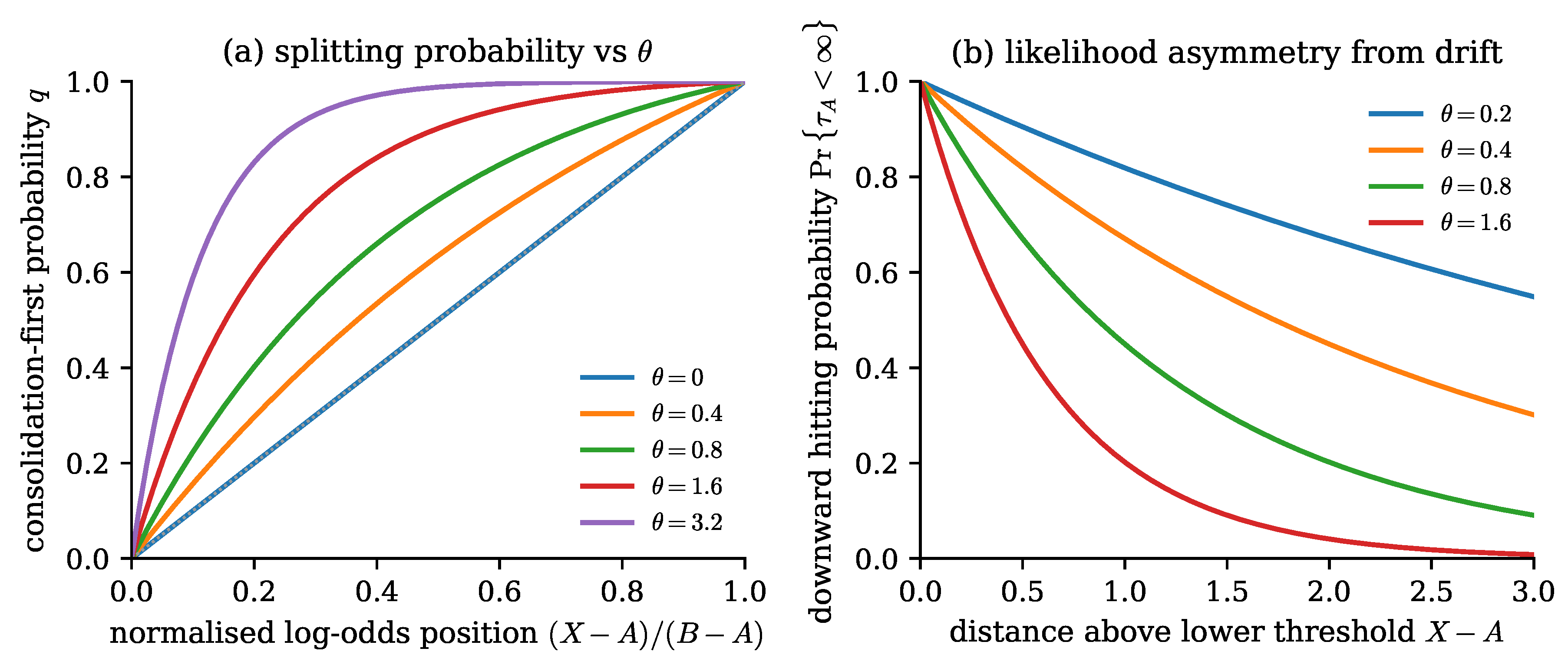
Figure 3.
Inter-layer logit gaps for the matched anchors. (a) Delegitimating-belief anchors; the stolen-election gap holds a high flat plateau, the signature of a completed first passage, while the others are large and roughly stationary. (b) Contrast anchors; the direction-of-country item reverses sign with the incumbent and the immigration-policy items measure a different, pro-policy construct. Error bars are illustrative, computed under an assumed partisan subsample share, since PRRI does not publish party subsample sizes.
Figure 3.
Inter-layer logit gaps for the matched anchors. (a) Delegitimating-belief anchors; the stolen-election gap holds a high flat plateau, the signature of a completed first passage, while the others are large and roughly stationary. (b) Contrast anchors; the direction-of-country item reverses sign with the incumbent and the immigration-policy items measure a different, pro-policy construct. Error bars are illustrative, computed under an assumed partisan subsample share, since PRRI does not publish party subsample sizes.
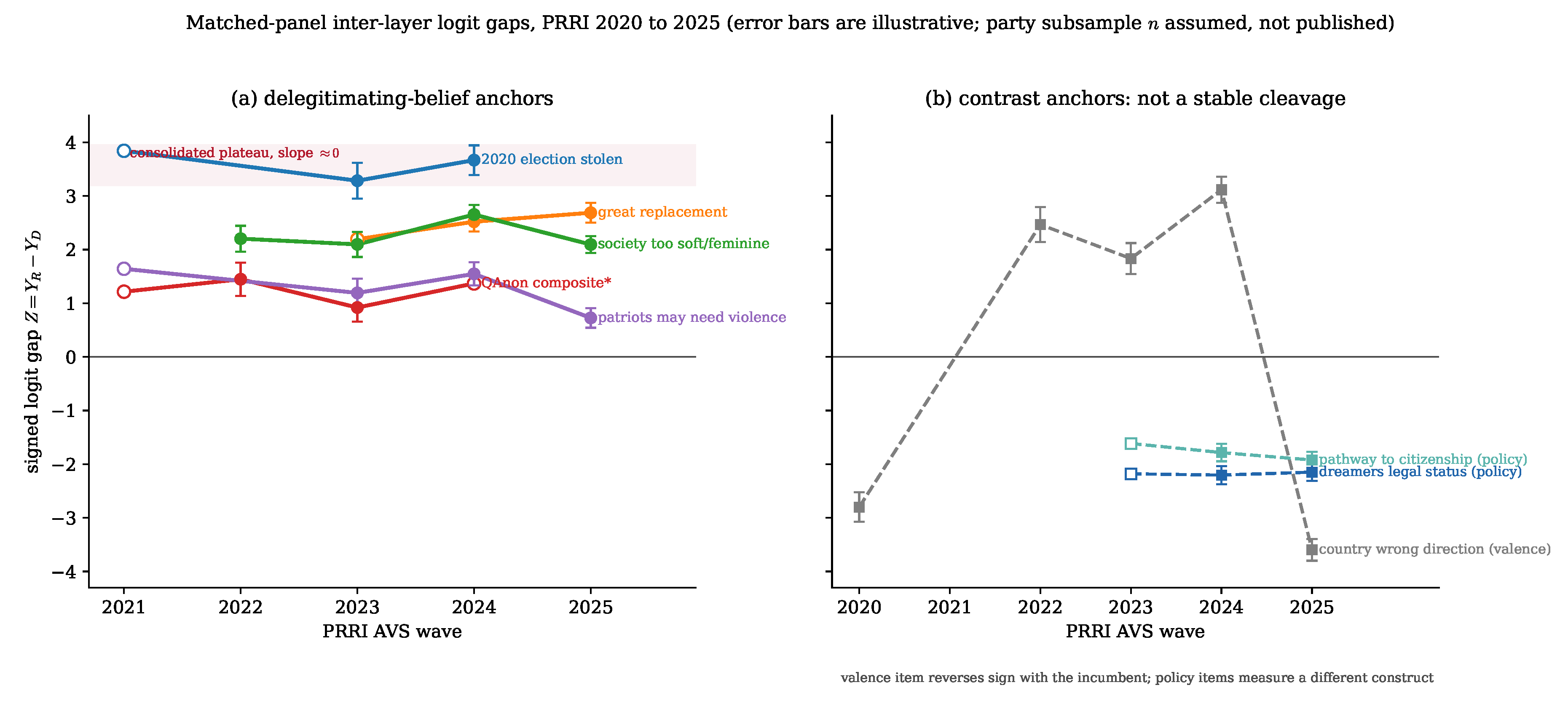
Figure 4.
The political-violence anchor across sixteen PRRI waves, 2021 to 2025. (a) Support by party; Republican endorsement falls once Republicans hold power while Democratic endorsement is flat to rising, with circled points matching the published PRRI text and the others read from the published slide chart. (b) The inter-layer logit gap steps down from a pre-election mean near to a post-election mean near . The gap closes because the endorsing layer disengages, a valence reset rather than the consolidated plateau of Figure 3(a). Party subsample sizes are not published, so no interval is drawn.
Figure 4.
The political-violence anchor across sixteen PRRI waves, 2021 to 2025. (a) Support by party; Republican endorsement falls once Republicans hold power while Democratic endorsement is flat to rising, with circled points matching the published PRRI text and the others read from the published slide chart. (b) The inter-layer logit gap steps down from a pre-election mean near to a post-election mean near . The gap closes because the endorsing layer disengages, a valence reset rather than the consolidated plateau of Figure 3(a). Party subsample sizes are not published, so no interval is drawn.
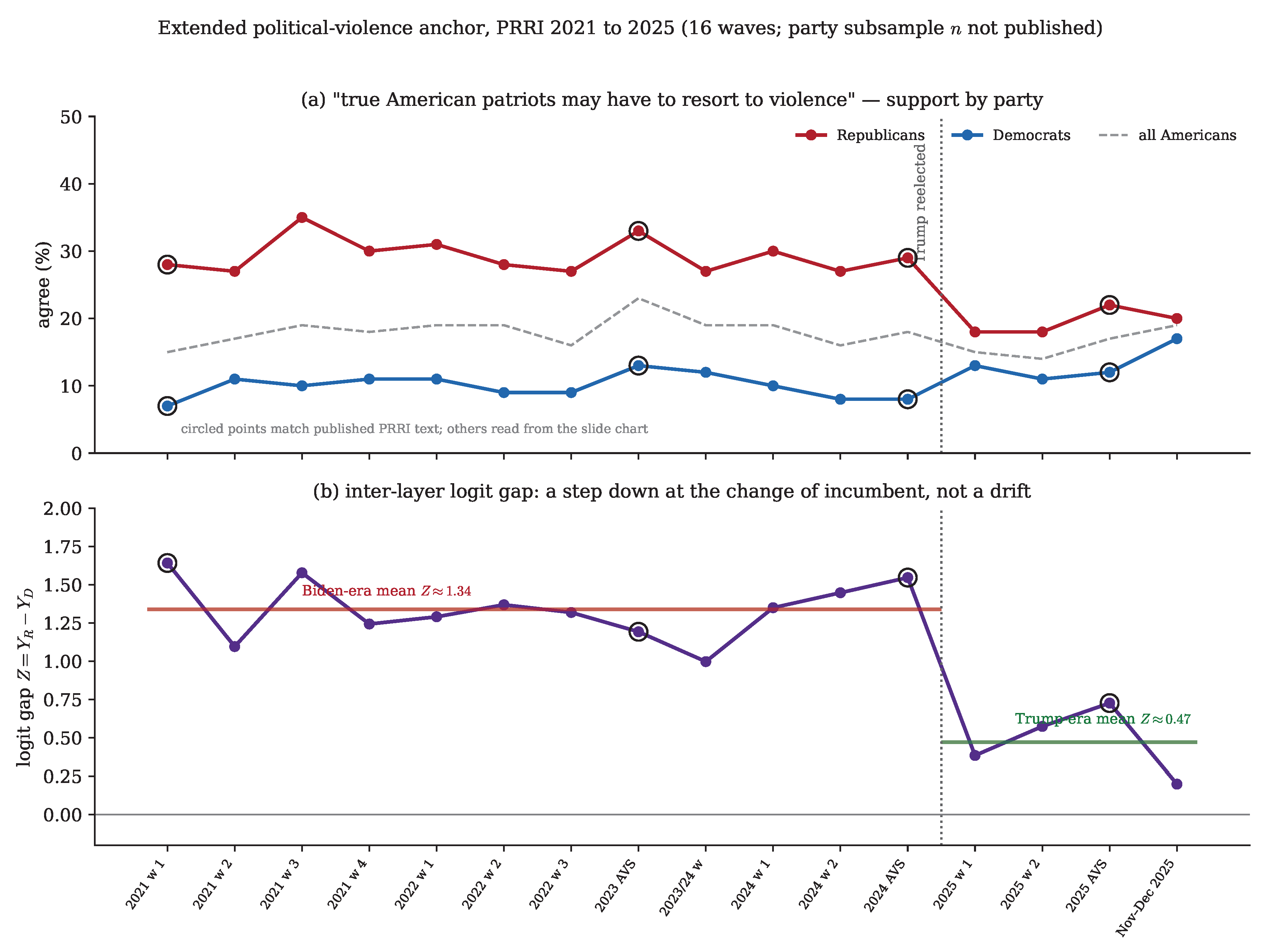

Table 1.
Matched-panel anchors from the PRRI American Values Survey, 2020 to 2025: assertions repeated with identical wording in three or more waves. Here is the inter-layer logit gap, positive when Republicans adopt the assertion more readily. The first five are delegitimating-belief assertions; the last three are contrast items, a valence assertion that reverses sign with the incumbent and two pro-immigration policy items that measure a different construct.
Table 1.
Matched-panel anchors from the PRRI American Values Survey, 2020 to 2025: assertions repeated with identical wording in three or more waves. Here is the inter-layer logit gap, positive when Republicans adopt the assertion more readily. The first five are delegitimating-belief assertions; the last three are contrast items, a valence assertion that reverses sign with the incumbent and two pro-immigration policy items that measure a different construct.
| Assertion | Theme | Waves | Behavior | |
|---|---|---|---|---|
| 2020 election stolen | election | 3 (2021–24) | to | consolidated plateau |
| Great replacement | immigration | 3 (2023–25) | to | high, slight rise |
| Society too soft/feminine | gender/culture | 4 (2022–25) | to | high, stationary |
| QAnon composite | conspiracy | 4 (2021–24) | to | moderate, stationary |
| Patriots may need violence | political violence | 4 (2021–25) | to | thermostatic reset |
| Country wrong direction | country mood | 5 (2020–25) | to | valence reversal |
| Pathway to citizenship | immig. policy | 3 (2023–25) | to | policy contrast |
| Dreamers legal status | immig. policy | 3 (2023–25) | to | policy contrast |
Disclaimer/Publisher’s Note: The statements, opinions and data contained in all publications are solely those of the individual author(s) and contributor(s) and not of MDPI and/or the editor(s). MDPI and/or the editor(s) disclaim responsibility for any injury to people or property resulting from any ideas, methods, instructions or products referred to in the content. |
© 2026 by the authors. Licensee MDPI, Basel, Switzerland. This article is an open access article distributed under the terms and conditions of the Creative Commons Attribution (CC BY) license (http://creativecommons.org/licenses/by/4.0/).
Copyright: This open access article is published under a Creative Commons CC BY 4.0 license, which permit the free download, distribution, and reuse, provided that the author and preprint are cited in any reuse.


