

Submitted:
15 June 2026
Posted:
17 June 2026
You are already at the latest version
Abstract
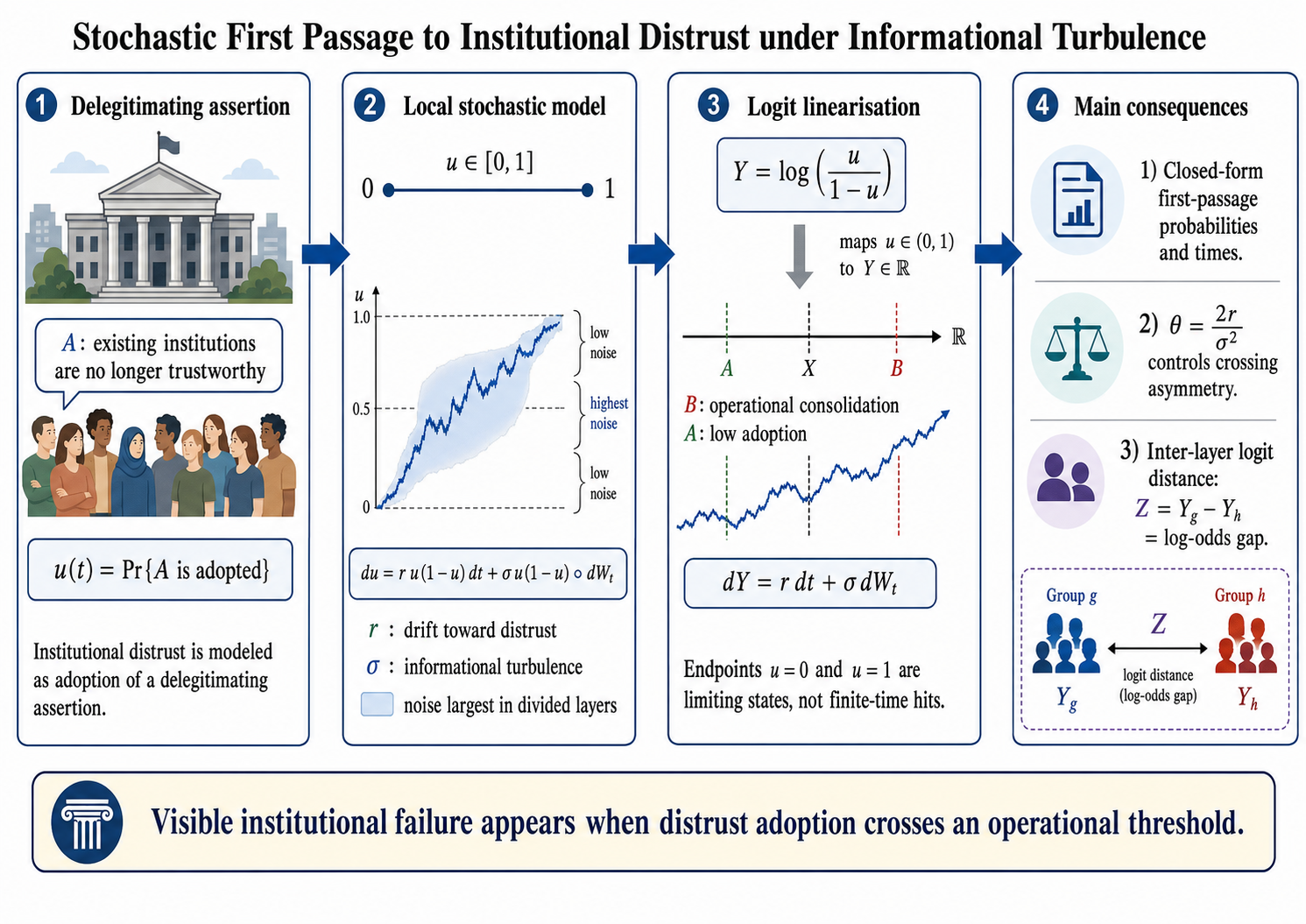
Institutional distrust is treated here not as a low value of trust but as a positive social disposition, the settled expectation that formal procedures and official explanations no longer carry their stated public meaning. The paper studies the consolidation of that disposition as a threshold event. Building on a stochastic trust-phase model, it applies the same multiplicative-noise mechanism to a delegitimating assertion, so the bounded state variable is the probability of adopting institutional distrust. A logit transformation maps the inherited nonlinear diffusion exactly onto Brownian motion with drift and yields closed-form first-passage formulas for the crossing of operational distrust thresholds. The endpoints of the bounded variable are limiting consolidated regimes rather than finite-time targets, so observable institutional failure is threshold passage and not literal absorption at zero trust. The drift-to-turbulence ratio fixes the shape of the crossing probabilities and the noise scale fixes the time scale. The same coordinate measures the distance between social layers facing one assertion. In United States partisan survey data this inter-layer logit distance is large and, on consolidated assertions, stationary, the empirical signature of a completed passage, while valence assertions reset with the change of incumbent.
Keywords:
institutional distrust
; first-passage time
; informational turbulence
; stochastic trust dynamics
; delegitimating assertions
; threshold consolidation
; logit transformation
; partisan polarization
; inter-layer logit distance
Copyright: This open access article is published under a Creative Commons CC BY 4.0 license, which permit the free download, distribution, and reuse, provided that the author and preprint are cited in any reuse.


