

Submitted:
15 June 2026
Posted:
16 June 2026
You are already at the latest version
Abstract
Introduction: Physical activity (PA) is vital during development, yet compliance with the 60-minute daily moderate-to-vigorous (MVPA) recommendation remains low in Chile. This study compared the influence of maternal and paternal support on the PA levels of Chilean youth. Methods: A cross-sectional study was conducted with 246 schoolchildren (ages 9–19) from three cities. PA was assessed via the YAP questionnaire, while parental support was measured through a 5-item scale. Logistic regression models identified associations with meeting PA guidelines. Results: Only 32.1% of students met PA recommendations, with significant gender disparities (boys 47.7% vs. girls 15.3%). Paternal instrumental support was the sole significant predictor: providing transportation (OR=1.52) and financial support (OR=3.36) were positively associated with compliance. Maternal support showed no significant associations. Conclusions: Paternal logistical and financial contributions are decisive for children’s PA, whereas maternal verbal encouragement does not predict behaviour. Public health policies should prioritise instrumental support from both parents.
Keywords:
school
; students
; father
; mother
; active behaviour
1. Introduction
Physical activity (PA) is linked to a wide range of physical and psychological benefits for children and adolescents (Marker et al., 2018). PA is classified as any bodily movement produced by the contraction of skeletal muscles that increases energy expenditure above the resting metabolic rate and is characterised by its modality, frequency, intensity, duration, and practice context (Caspersen et al., 1985). Accordingly, international PA recommendations suggest that children and adolescents should engage in at least 60 minutes of daily moderate-to-vigorous physical activity (MVPA; Bull et al., 2020).
At the global level, current reality deviates from WHO recommendations, as 81% of young people aged 11 to 17 do not meet the established guidelines (Guthold et al., 2020). In Europe, data from 2016 indicated that less than 50% of this group reaches the recommended levels (Van Hecke et al., 2016). Specifically, among 11-year-olds, countries such as Italy (13%), Denmark (15%), and Greece (16%) show the lowest prevalence of compliance, while Finland (41%) and Ireland (38%) report the highest (Inchley et al., 2016). In the United States, only 20% of adolescents meet aerobic and muscle-strengthening guidelines (Physical Activity Guidelines for Americans, 2018). In Chile, more recent estimates the outlook is equally critical; PA levels are alarmingly low, with an average of only 37% of children and adolescents reporting being physically active for 60 minutes at least four days a week (Aguilar-Farias et al., 2024).
Designing effective programs and interventions requires an understanding of the factors that influence PA (Saunders et al., 2024), with the family being considered the most crucial environment (Golan, 2006). In this sense, Social Cognitive Theory (Bandura, 1977) postulates that individuals acquire behaviours by observing and imitating others. Bandura notes that sports practice serves as a significant source of role models, suggesting that parental PA influences that of their children through observational learning (Carter et al., 2022). In this framework, behavioural modelling and parental support toward PA practice constitute a fundamental influence during childhood (Gerards et al., 2021).
Various studies have examined how parental support influences PA. The ENERGY study (Timperio et al., 2013) identified financial, logistical, and emotional support, as well as co-participation, highlighting the relevance of the time parents dedicate to PA (van Stralen et al., 2011). Similarly, research among Chinese schoolchildren identified dimensions that benefit MVPA compliance, including accompaniment and knowledge sharing (Liu et al., 2017).
However, there is a notable lack of evidence in Latin American contexts, where socio-environmental and gender barriers may modulate parental support differently than in the Northern Hemisphere. In Chile, factors such as financial support and transport logistics can be decisive (Xu et al., 2015), especially considering that mothers and fathers often adopt differentiated roles according to cultural gender mandates (Salas et al., 2018). Understanding these influences is relevant for designing effective and culturally adapted interventions within the national context.
Yet, no study to date has simultaneously compared the predictive weight of maternal versus paternal support on PA compliance within the Chilean sociocultural context. Therefore, the present study aims to analyse and compare the influence of direct and indirect support provided by mothers and fathers, independently, on the PA levels of Chilean children and adolescents.
2. Methods
2.1. Study Design
The ACTIve BEhaviour in School Education project (ACTIBESE), funded by the National Agency for Research and Development (ANID) of the Chilean government under code number 1230801, aims to explore effective strategies for enhancing physical activity (PA) levels in schools. This three-year project comprises a cross-sectional study in the first and second years, followed by an intervention study in the third year (Rodriguez-Rodriguez et al., 2025). The intervention study was registered on April 8, 2024, at https://clinicaltrials.gov/study/NCT06362655 with the identifier NCT06362655.
2.2. Recruitment
Invitations were sent to the principals of participating schools, inviting them to join the project. Upon their agreement and selection, a meeting was scheduled with representatives from the administrative management authorities and schoolteachers. During this meeting, the aims and stages of the project were explained in detail.
Following this, an informational session will be conducted for parents and students, categorized by age groups: children from grades 4 to 6 of primary school (9–11 years old) and adolescents from grade 7 of primary school to grade 3 of secondary school (12–19 years old).
2.3. Participants and Sample Selection
The participants were selected from two cities in the Valparaíso Region (Viña del Mar and Los Andes) and one city in the Araucanía Region (Temuco). These cities were chosen for the convenience of researchers due to their proximity to the institutions conducting the study in Chile. The sample included public, subsidised, and private administration schools, as schoolchildren in Chile are typically categorised into these three groups. A total of 152 schools were identified across Viña del Mar (84 schools with 25,176 students), Los Andes (19 schools with 7,401 students), and Temuco (49 schools with 21,647 students) (source: https://reportescomunales.bcn.cl/). For the cross-sectional study, the representative sample size of students will be calculated with parameters set at 95% confidence level, 5% margin of error, 50% variability, and 80% statistical power.
Therefore, from the total population of 54,224 students across these cities, a representative sample of 246 schoolchildren was established using cluster sampling: 85 from Viña del Mar, 110 from Los Andes, 35 from Valparaíso, and 16 from Temuco. Each schoolchild was required to have a father, a mother, or both available to complete the questionnaire. Overall, a total of 315 parents responded to the questionnaire.
School inclusion criteria required that participating schools offer at least two Physical Education and Health (PEaH) classes per week, specifically in the selected grades (from 4th grade of primary to 3rd grade of secondary). Importantly, schoolchildren, parents or guardians must not concurrently participate in other programs promoting physical activity.
2.4. Instruments for Evaluating Interpersonal Factors
2.4.1. Sociodemographic Variables
A multicomponent questionnaire was used to collect information on sociodemographic and physical activity (PA) variables. Sociodemographic parameters included gender, age, school grade, and socioeconomic status, which was assessed using the Family Affluence Scale (FAS III). This scale considers aspects such as ownership of vehicles, household appliances, electronic devices, bathrooms, individual bedrooms, and vacation destinations (Torsheim et al., 2016). Based on the score obtained, socioeconomic status is classified as low (1-4 points), medium (5-8 points), or high (9-12 points).
2.4.2. Physical Activity in Children, Adolescents, and Parents
Physical activity in children and adolescents was assessed using two instruments. The Youth Activity Profile (YAP) questionnaire measured moderate-to-vigorous physical activity (MVPA) and sedentary behaviour. The YAP-SL consists of 15 items divided into three sections: Activity at School, Out-of-School Activity, and Sedentary Habits. Scores range from 1 to 5, reflecting increasing levels of physical activity. The YAP questionnaire showed a moderate-to-high reliability in Chilean children and adolescents and a good quality to be applied in this population (Brand et al., 2024). In addition, the YAP scores were converted to minutes/day of MVPA using Fairclough's equations (Fairclough et al., 2019). A daily MVPA threshold of >60 minutes/day is considered "physically active," while those below this threshold are classified as "physically inactive."
2.4.3. Parental Support
Parental support was assessed using a 5-item scale measuring perceived paternal and maternal support. Participants rated the frequency with which parents engaged in activities that encourage physical activity (PA) and provided support for such activities. This included aspects such as providing transportation, observing and praising PA, and participating in physical activities with their children (Prochaska et al., 2002). The Parental Support for Physical Activity Scale demonstrated acceptable reliability, with Cronbach’s alpha coefficients exceeding 0.70 in the overall sample as well as in analyses stratified by age and sex. In addition, the instrument exhibited strong internal consistency, and four of its five items showed moderate to high reliability (κ = 0.50–0.69) across all analysed subgroups within the Chilean population (Brand et al., 2025).
2.5. Data Analysis
Data normality was assessed using Q-Q plots (quantile-quantile plots), and the interaction between sex and age was examined. Descriptive statistics for study variables were calculated, including mean and standard deviation for continuous variables, and frequency and percentages for categorical variables. To establish the association of dichotomous variables with binary logistic regression models were performed to obtain the odds ratio (OR) with their respective confidence intervals (95% CI). Analyses were conducted using chi-square tests for categorical variables. The analyses were stratified by sex (mothers and fathers). JASP statistical package V 0.18.3 (JASP Team, 2024), a free software interface Version 0.18.3 (Nieuwe Achtergracht 129B, Amsterdam, The Netherlands) was used for analysis. Statistical significance was set up a p < .05.
2.6. Ethical Considerations
Following approval from the participating institutions, informed consent was obtained from teachers and parents for their participation. Students also signed informed consent forms detailing the study's characteristics, objectives, and activities. The project adheres to the principles outlined in the Declaration of Helsinki (World Medical Association, 2013) and has been approved by the Ethics Committee of the Pontifical Catholic University of Valparaíso (Code: BIOEPUCV-H 638-2023).
3. Results
Table 1 presents the sociodemographic characteristics of students and their parents. The sample consists mainly of adolescents (62.6%), with a predominantly middle socioeconomic level (52.0%) and a higher proportion attending public schools (44.5%). Additionally, a large portion of the students do not meet the recommendations for moderate to vigorous physical activity (67.9%). Regarding the parents, there is a diverse educational level, with a considerable proportion holding a university degree (39.2%) or a professional degree (24.1%).
Table 2 describes the distribution of different parental support behaviours for PA reported by mothers and fathers, expressed as absolute frequencies (N) and percentages (%), together with the corresponding p values for comparisons between parental roles.
Regarding observing their offspring practicing PA or sport, all parents reported some level of involvement; however, mothers more frequently reported everyday observation (9.0%) compared with fathers (6.5%), while fathers more often indicated never observing (43.0% vs. 37.9%). These differences were statistically significant (p < 0.001).
In relation to providing transport for PA or sport, fathers reported higher engagement in this behaviour, particularly in the sometimes category (74.9% vs. 59.9%), whereas mothers more frequently reported never providing transport (26.9% vs. 18.5%). The differences between mothers and fathers were statistically significant (p = 0.001).
For co-participation in PA or sport with their offspring, no statistically significant differences were observed between mothers and fathers (p = 0.174). Nevertheless, descriptive data indicate that fathers more often reported sometimes practicing PA with their offspring (51.0%), whereas mothers more frequently reported never doing so (61.1%).
Concerning taking and picking up offspring from PA venues during weekends, mothers more frequently reported always performing this role (30.5% vs. 20.4%), while fathers more often selected the sometimes category (52.7% vs. 34.3%). These differences were statistically significant (p < 0.001).
With respect to practicing PA with offspring during weekends, fathers reported higher participation in the sometimes category (62.0% vs. 51.4%), whereas mothers more often reported never (40.6% vs. 32.4%). The difference between parental roles was statistically significant (p = 0.010).
Finally, for practicing PA with offspring during working days, no significant differences were found between mothers and fathers (p = 0.295). In both groups, the majority reported never engaging in PA with their offspring on weekdays.
Overall, the table highlights distinct parental role patterns, with mothers showing greater involvement in supervisory and logistical support, particularly during weekends, while fathers tend to report higher participation in transport-related support and occasional co-participation in PA.
Table 3 presents the distribution of indirect parental support for PA as reported by mothers and fathers. With respect to encouragement to engage in PA or sport, both mothers and fathers reported high levels of involvement, with similar proportions indicating “Everyday” encouragement (38.7% and 38.0%, respectively). Despite these comparable percentages, the overall distribution differed significantly between parental roles (p < 0.001), mainly due to slight variations in the “Sometimes” and “Never” categories.
Regarding communicating the importance of PA or sport, mothers reported higher daily involvement (39.8%) compared with fathers (26.9%), whereas fathers more frequently reported “Sometimes” providing this information (65.7% vs. 50.7%). These differences were statistically significant (p < 0.001), indicating a more consistent verbal emphasis on PA among mothers.
In terms of explaining the benefits of PA or sport, mothers again reported higher “Everyday” engagement (44.1%) than fathers (30.6%); although this difference did not reach statistical significance (p = 0.063), suggesting broadly similar patterns between parental roles.
Concerning financial support for PA during weekends, mothers more often reported “Always” spending money to support their offspring’s PA (25.4% vs. 19.4%), while fathers more frequently selected the “Sometimes” category (41.7% vs. 31.4%). These differences were statistically significant (p < 0.001). A similar pattern was observed for financial support during working days, with significant differences between mothers and fathers (p < 0.001), although in both groups nearly half reported “Never” providing financial support on weekdays.
Regarding support for PA that does not involve spending money, mothers more frequently reported “Always” providing this type of support (40.8% vs. 36.1%), whereas fathers more often reported “Sometimes” (p < 0.001), highlighting complementary forms of non-economic involvement.
In relation to accompanying offspring to sport or PA spaces during weekends, mothers reported higher “Always” involvement (26.3%), while fathers more often reported “Sometimes” (48.1%). These differences were statistically significant (p < 0.001).
Finally, for encouraging offspring to be physically active during weekends and working days, mothers consistently reported higher “Always” encouragement compared with fathers, with statistically significant differences observed for both time periods (p < 0.001 and p = 0.001, respectively).
Overall, the table indicates that mothers tend to provide more consistent verbal encouragement, supervision, and both economic and non-economic support for PA, whereas fathers are more likely to report intermittent (“sometimes”) forms of involvement. This pattern suggests differentiated but complementary parental roles in supporting children’s physical activity.
Table 4 shows the associations between direct and indirect support of mothers and fathers according to reaching the PA recommendations. Just was found in direct support of fathers when they transport to children to do PA or some sports activity. Also, only once an association of indirect support was shown when fathers spent some money on working days to my offspring’s practice PA. No association was found for direct or indirect maternal support.
Figure 1 illustrates the mean score values for direct and indirect parental support for PA, as reported separately by mothers and fathers. As detailed in the accompanying statistical analysis, mothers reported significantly lower perceptions of direct parental support (Mean = 0.93) compared with indirect support (Mean = 1.99), with this difference reaching statistical significance (p = 0.002). A similar trend was observed among fathers: perceived direct support (Mean = 0.91) was significantly lower than indirect support (Mean = 1.73), also with a statistically significant difference (p = 0.002).
Overall, the figure reinforces the quantitative findings by visually demonstrating that, regardless of parental role, indirect forms of support (e.g., logistical or environmental facilitation) are more prevalent than direct forms of support (e.g., co-participation or direct encouragement). This pattern suggests a systematic preference for indirect involvement in supporting children’s physical activity among both mothers and fathers.
In Table 4, the logistic regression between the levels of support from parents and the adherence to the recommended 60 minutes per day of PA is observed. It is noted that the only statistically significant association between direct parental support in transporting their children to engage in PA or sports and adherence to the recommendations was found. As for indirect support, a statistically significant association was only observed for parents spending some money on sports activities during the week and adherence to PA of their children.
4. Discussion
The present findings reveal that paternal instrumental support, specifically transportation and financial provision, is the primary predictor of PA guideline adherence among Chilean schoolchildren, while maternal verbal encouragement, though more frequent, did not reach statistical significance.
4.1. Physical Activity
According to our findings, within a total sample of 246 children and adolescents, only 32.1% achieved PA levels aligned with WHO recommendations. While this compliance is low, it sits above the reported average for adolescents in Latin America, where the figure reaches barely 15% (Guthold et al., 2020). Notable gender disparities were observed; girls showed a relatively low adherence (15.3%) compared to boys (47.7%). This gender gap is alarming and consistent with global trends (WHO, 2022). At a regional level, physical inactivity is more prevalent in women (43.7%) than in men (34.4%) (Guthold et al., 2018). An analysis of 146 countries showed that, on average, PA participation was 7 percentage points lower in girls than in boys (Guthold et al., 2020). International research suggests that the most significant barriers for girls' participation in PA can be mitigated when family and peer values and support are present, along with perceptions of safety in the built environment and opportunities for activity within schools, including quality and inclusive physical education. In the Chilean context, these findings are particularly relevant, as adherence to the WHO recommendation of 60 daily minutes of PA remains low in the national population (Bull et al., 2020). A meta-analysis of 112 studies on parental influence demonstrated that children and adolescents presented higher PA levels when receiving positive parental support (r = 0.202, p < 0.001; Su et al., 2022), validating the importance of the parental factor in this population.
4.2. Direct and Indirect Parental Support
The results reveal differentiated patterns of parental support for children’s physical activity behaviours, with mothers and fathers exhibiting distinct tendencies across multiple dimensions of support. Specifically, both direct and indirect support—as reflected in the frequency of transport provision, supervision, verbal encouragement, and financial investment—varied systematically by parental role. Mothers reported significantly lower levels of direct support but higher levels of indirect or facilitative behaviours in several domains, such as observing their child’s PA and communicating the importance of PA, compared with fathers. This pattern reflects the persistence of defined gender roles in Latin American families, where women typically assume household responsibilities (Lorenzo-Blanco et al., 2012). It has been observed that women prioritise family needs and traditional roles as mother and caregiver, which can impede regular PA performance by occupying a large part of their free time in domestic work (Pérez-Flores et al., 2023). Fathers, in contrast, tended to report higher engagement in intermittent support behaviours (e.g., providing transport sometimes) and less frequent weekend accompaniment. These patterns are congruent with findings from earlier studies indicating that maternal logistical and supervisory support often predominates in shaping children’s activity environments, whereas fathers may contribute through different forms of engagement or more sporadic involvement (e.g., reinforcement or modelling) depending on context and activity type (An et al., 2021).
The observed differences in motivational support also align with prior research demonstrating that maternal encouragement and communication regarding PA are frequently reported at higher levels than paternal endorsement. This gendered pattern of support has been identified in both objective and self-reported measures, where mothers often prioritise verbal reinforcement and logistical facilitation, such as enrolling children in sports programs or ensuring access to PA opportunities, while fathers may engage in modelling or reinforcement behaviours that are more situationally tied to the child’s interests, e.g., sport-specific skill participation (Hosokawa et al., 2023).
Importantly, the relative predominance of indirect support (e.g., facilitating access, financial investment, and supervision) among mothers likely reflects broader sociocultural and temporal roles within family systems, where maternal figures assume responsibility for organising children’s daily routines and activities (e.g., transport, attendance at PA spaces), particularly on weekends. This pattern echoes existing literature on parental support, where maternal logistical involvement correlates with higher child MVPA, even after accounting for socio-demographic factors (An et al., 2021).
The sex-specific dynamics of parental support observed in the current data may also intersect with differential impacts on children’s PA outcomes reported in the literature. For instance, Beets et al. discuss how distinct forms of parental reinforcement, direct reinforcement (transport, co-participation, supervision) versus indirect reinforcement (role modelling, perceived competence support), can independently shape children’s PA engagement. These authors note that indirect reinforcement (e.g., modelling) can be particularly influential when parents demonstrate active lifestyles themselves (Beets et al., 2010; Cheatom, 2014).
Although our data do not directly link parental behaviours to objectively measured child activity outcomes, extant evidence suggests that greater overall parental support is moderately associated with higher levels of child physical activity across multiple settings. A meta-analysis by Yao & Rhodes found that parental support behaviours have a moderate positive association with children’s activity participation, although the strength of associations varies by measurement method and support type (Yao & Rhodes, 2015).
Taken together, these findings reinforce the need for family-based interventions that consider not only the presence of parental support but also the qualitative differences in how mothers and fathers engage in such support. Interventions that encourage shared parental involvement—where both mothers and fathers actively contribute to promoting PA through both direct and indirect mechanisms—may yield stronger effects on children’s MVPA, similar to observations from mixed-methods research emphasising the benefits of dual-parent support for enhancing children’s activity levels (Solomon-Moore et al., 2018).
4.3. Support Associated with PA
The secondary finding indicates that paternal instrumental support is a significant predictor, whereas maternal support did not show statistical significance. It has been found that direct parental involvement through strategies such as providing transportation or supervision fosters greater commitment to regular PA (Su et al., 2022). Likewise, our results indicated a statistically significant relationship among fathers who transport their children to engage in PA or sports (OR = 1.52). However, no significant associations were found in the case of mothers. This finding aligns with recent research demonstrating that parental instrumental support, such as enrolling children in sports clubs or providing transportation, is significantly associated with higher levels of MVPA during childhood (Hosokawa et al., 2023).
This difference could be explained by traditional gender roles that still prevail in the Latin American context. While maternal support is often perceived as constant care, provided unconditionally regardless of whether the child practices sports, paternal support tends to be more instrumental (Salas et al., 2018). When the father is actively involved in logistics (transportation), he acts as a facilitator by removing physical barriers to access, which is a decisive factor in environments where safety or distances pose an obstacle for adolescents (Hosokawa et al., 2023; Xu et al., 2015). Our results revealed an interesting paradox: mothers reported encouraging and talking about the importance of PA much more frequently than fathers, yet these actions did not predict the child being active. This pattern is consistent with international findings suggesting that behavioural modelling and sedentary behaviour limitation actions are not significantly associated with PA in children (Hosokawa et al., 2023).
From the perspective of Social Cognitive Theory, it is suggested that simple verbal encouragement is insufficient if not accompanied by environmental modifications (Bandura, 1997). While encouragement from both parents is positive, paternal financial support (OR = 3.36) proved to be far more potent than verbal support. Furthermore, perceived self-efficacy acts as a fundamental mediating variable in the relationship between parental support and the practice of PA (Guillén et al., 2007). A parent providing economic resources directly impacts the adolescent's self-efficacy by eliminating the cost barrier, thereby enabling active behaviour (Palma-Quezada et al., 2023). Through instrumental support, parents facilitate the development of beliefs among adolescents regarding their ability to be physically active, which is essential considering that, as Bandura (1977) points out, those who do not perceive their actions as effective do not initiate them.
Future research should employ longitudinal designs and objective measurements to clarify the causal pathways of parental support. In Latin America, these efforts must account for how family cohesion and shared sedentary habits (such as collective television viewing) influence activity levels (Betancourt, 2015; John et al., 2022). This approach is essential for designing culturally pertinent interventions that address the inherent complexity of the Latin American family (Pérez-Flores et al., 2023).
5. Conclusions
Contrary to expectations, no significant associations were found for maternal support, despite mothers being the ones who most frequently provide verbal encouragement. This suggests that public health policies should not treat parental support as a uniform construct. It is necessary to specifically encourage the instrumental commitment (logistical and financial) of fathers and to provide mothers with tools that transcend verbal support to effectively impact active behaviour (Ricardo et al., 2022). Furthermore, it is imperative to design and implement culturally pertinent strategies that promote an equitable distribution of household responsibilities, allowing mothers to overcome domestic barriers and effectively facilitate active behaviour in their children and themselves. Environmental determinants, including ease of access to PA programs and the reduction of economic and logistical barriers, emerge as critical factors. Future studies should further investigate the cultural and psychological mechanisms that promote PA, reduce the gender gap in PA levels, and elucidate why maternal support loses predictive effectiveness in this population, considering the complex interaction between family, sociocultural, and environmental factors.
Funding
This project has been financed by the Fondo Nacional de Investigación para el Desarrollo Científico y Tecnológico, FONDECYT of the Agencia Nacional de Investigación y Desarrollo (ANID) of the Chilean Government. FONDECYT Regular project 2023, Nº 1230801.
Acknowledgments
The authors would like to thank IRyS Group, School of Physical Education, Pontificia Universidad Católica de Valparaíso, Chile; Faculty of Sports, University of Porto, Portugal and the Department of Physical Education, Sports and Recreation, Universidad de La Frontera, Chile for the constant support in research activities. We also thank the participants’ schools, including Instituto Chacabuco, Edén del Niño, Escuela General José Miguel Carrera, Liceo Santa Teresa de Los Andes, Colegio Profesor Hugget, Escuela Adriano Machado Pardo, Complejo Educacional Padre Las Casas and Alonso de Ercilla.
Conflicts of Interest
The authors declare that they have no conflicts of interest.
References
- Aguilar-Farias, N.; Miranda-Marquez, S.; Toledo-Vargas, M.; Sadarangani, K. P.; Ibarra-Mora, J.; Martino-Fuentealba, P.; Carcamo-Oyarzun, J.; Cristi-Montero, C.; Rodríguez-Rodríguez, F.; Guarda-Saavedra, P.; Balboa-Castillo, T.; Von Oetinger, A.; Cortinez-O, A. Results from Chile’s 2022 report card on physical activity for children and adolescents. J. Exerc. Sci. Fit. 2024, 22(4), 390–396. [Google Scholar] [CrossRef] [PubMed]
- An, M.; Chen, T.; Zhou, Q.; Ma, J. Paternal and maternal support of moderate-to-vigorous physical activity in children on weekdays and weekends: a cross-sectional study. BMC Public Health 2021, 21(1), 1776. [Google Scholar] [CrossRef] [PubMed]
- Bandura, A.; Walters, R. H. Social learning theory; Prentice hall: Englewood Cliffs, NJ, 1977; Vol. 1, pp. 141–154. [Google Scholar]
- Bandura, A.; Freeman, W. H.; Lightsey, R. Self-Efficacy: The Exercise of Control. J. Cogn. Psychother. 1999, 13(2), 158–166. [Google Scholar] [CrossRef]
- Beets, M. W.; Cardinal, B. J.; Alderman, B. L. Parental social support and the physical activity-related behaviors of youth: A review. Health Educ. Behav. 2010, 37(5), 621–644. [Google Scholar] [CrossRef] [PubMed]
- Betancourt, H. Investigación Sobre Cultura y Diversidad en Psicología: Una Mirada Desde el Modelo Integrador. Psykhe 2015, 24(2), 1–4. [Google Scholar] [CrossRef]
- Brand, C.; Zurita-Corvalán, N.; Batista Lemes, V.; Villa-González, E.; Aguilar-Farías, N.; Rodríguez-Rodríguez, F. Reliability, reproducibility, and feasibility of youth activity profile (YAP) questionnaire in Chilean children and adolescents. J. Sports Sci. 2024, 42(20), 1959–1966. [Google Scholar] [CrossRef] [PubMed]
- Brand, C.; Zurita-Corvalán, N.; Lemes, V.B.; Aguilar-Farías, N.; Rodriguez-Rodriguez, F. Reliability and internal consistency of scales for parental and peer support for physical activity in children and adolescents in Chile. J. Public Health 2025, 33(9), 2061–2067. [Google Scholar] [CrossRef]
- Bull, F. C.; Al-Ansari, S. S.; Biddle, S.; Borodulin, K.; Buman, M. P.; Cardon, G.; Carty, C.; Chaput, J. P.; Chastin, S.; Chou, R.; Dempsey, P. C.; DiPietro, L.; Ekelund, U.; Firth, J.; Friedenreich, C. M.; Garcia, L.; Gichu, M.; Jago, R.; Katzmarzyk, P. T.; Lambert, E.; Leitzmann, M.; Milton, K.; Ortega, F. B.; Ranasinghe, C.; Stamatakis, E.; Tiedemann, A.; Troiano, R. P.; Van Der Ploeg, H. P.; Wari, V.; Willumsen, J. F. World Health Organization 2020 guidelines on physical activity and sedentary behaviour. Br. J. Sports Med. 2020, 54(24), 1451–1462. [Google Scholar] [CrossRef] [PubMed]
- Carter, J. S.; DeCator, D. D.; Patterson, C.; McNair, G.; Schneider, K. Examining direct and indirect mechanisms of parental influences on youth physical activity and body mass index. J. Child Fam. Stud. 2022, 31(4), 991–1006. [Google Scholar] [CrossRef]
- Caspersen, C. J.; Powell, K. E.; Christenson, G. M. Physical activity, exercise, and physical fitness: definitions and distinctions for health-related research. Public Health Rep. 1985, 100(2), 126–131. [Google Scholar] [PubMed]
- Cheatom, O.; Borden, L. M.; Hawkey, K. R.; Wittcoff Kuhl, M.; Pinna, K. M. Parental influence on children’s physical activity motivation (Research Brief); The University of Minnesota, 2014; Available online: https://reachfamilies.umn.edu/sites/default/files/rdoc/Parental%20Influence%20on%20Children%27s%20Physical%20Activity%20Motivation.pdf.
- Fairclough, S. J.; Christian, D. L.; Saint-Maurice, P. F.; Hibbing, P. R.; Noonan, R. J.; Welk, G. J.; Dixon, P. M.; Boddy, L. M. Calibration and Validation of the Youth Activity Profile as a Physical Activity and Sedentary Behaviour Surveillance Tool for English Youth. Int. J. Environ. Res. Public Health 2019, 16(19), 3711. [Google Scholar] [CrossRef] [PubMed]
- Gerards, S. M.; Van Kann, D. H.; Kremers, S. P.; Jansen, M. W.; Gubbels, J. S. Do parenting practices moderate the association between the physical neighbourhood environment and changes in children’s time spent at various physical activity levels? BMC Public Health 2021, 21, 168. [Google Scholar] [CrossRef] [PubMed]
- Golan, M. Parents as agents of change in childhood obesity - from research to practice. Int. J. Pediatr. Obes. 2006, 1(2), 66–76. [Google Scholar] [CrossRef] [PubMed]
- Guillén García, F. Motivación, autoeficacia y actividad física en la adolescencia. Cuad. De Psicol. Del Deporte 2007, 7(1), 27–42. [Google Scholar] [CrossRef]
- Guthold, R.; Stevens, G. A.; Riley, L. M.; Bull, F. C. Worldwide trends in insufficient physical activity from 2001 to 2016: a pooled analysis of 358 population-based surveys with 1·9 million participants. Lancet Glob. Health 2018, 6(10), e1077–86. [Google Scholar] [CrossRef] [PubMed]
- Guthold, R.; Stevens, G. A.; Riley, L. M.; Bull, F. C. Global trends in insufficient physical activity among adolescents: a pooled analysis of 298 population-based surveys with 1.6 million participants. Lancet Child Adolesc. Health 2020, 4(1), 23–35. [Google Scholar] [CrossRef] [PubMed]
- Hosokawa, R.; Fujimoto, M.; Katsura, T. Parental support for physical activity and children’s physical activities: a cross-sectional study. BMC Sports Sci. Med. Rehabil. 2023, 15(1), 90. [Google Scholar] [CrossRef] [PubMed]
- Inchley, J.; Currie, D.; Young, T.; Samdal, O.; Torsheim, T.; Augustson, L.; Mathison, F.; Aleman-Diaz, A.; Molcho, M.; Weber, M.; Barnekow, V. Growing Up Unequal: Gender and Socioeconomic Differences in Young People’s Health and Well-Being. Health Behaviour in School-Aged Children (HBSC) Study: International Report from the 2013/2014 Survey. In Enlighten: Publications (The University Of Glasgow); 2016. [Google Scholar]
- John, J. C.; Heredia, N. I.; McNeill, L. H.; Hoelscher, D. M.; Schembre, S. M.; Lee, M.; et al. Qualitative Exploration of Family Influences on Physical Activity in Hispanic Families. J. Phys. Act. Health 2022, 19(2), 89–98. [Google Scholar] [CrossRef] [PubMed]
- Liu, Y.; Zhang, Y.; Chen, S.; Zhang, J.; Guo, Z.; Chen, P. Associations between parental support for physical activity and moderate-to-vigorous physical activity among Chinese school children: a cross-sectional study. J. Sport Health Sci. 2017, 6(4), 410–415. [Google Scholar] [CrossRef] [PubMed]
- Marker, A. M.; Steele, R. G.; Noser, A. E. Physical activity and health-related quality of life in children and adolescents: A systematic review and meta-analysis. Health Psychol. 2018, 37(10), 893–903. [Google Scholar] [CrossRef] [PubMed]
- Lorenzo-Blanco, E. I.; Unger, J. B.; Baezconde-Garbanati, L.; Ritt-Olson, A.; Soto, D. Acculturation, Enculturation, and Symptoms of Depression in Hispanic Youth: The Roles of Gender, Hispanic Cultural Values, and Family Functioning. J. Youth Adolesc. 2012, 41(10), 1350–65. [Google Scholar] [CrossRef] [PubMed]
- Palma-Quezada, R., Bruno, N. B., Díaz, N. R., De Val-Martín, P., Giakoni-Ramírez, F., Yáñez-Sepúlveda, R., & Duclos-Bastías, D. (2023). Determinants of physical activity in chilean children and youths aged 5-17 years. Journal of Physical Education and Sport, 23(8), 2164-2173. http://doi.org/10.7752/jpes.2023.08248 Prochaska, J. J., Rodgers, M. W., & Sallis, J. F. (2002). Association of Parent and Peer Support with Adolescent Physical Activity. Research Quarterly for Exercise and Sport, 73(2), 206–210. https://doi.org/10.1080/02701367.2002.10609010.
- Pérez-Flores, N. J.; Pineros-Leano, M.; Damian, K.; Toney, A. M.; Aguayo, L. Barriers and facilitators of physical activity among Latina immigrant and Mexican mothers living in the US and Mexico: A qualitative study. PLoS ONE 2023, 18(8), e0290227. [Google Scholar] [CrossRef] [PubMed]
- Ricardo, L. I. C.; Wendt, A.; Costa, C. D. S.; Mielke, G. I.; Brazo-Sayavera, J.; Khan, A.; Kolbe-Alexander, T. L.; Crochemore-Silva, I. Gender inequalities in physical activity among adolescents from 64 Global South countries. J. Sport Health Sci. Sport Health Sci. 2022, 11(4), 509–520. [Google Scholar] [CrossRef] [PubMed]
- Salas, C.; Espinoza, B.; González, C.; Contreras, I. Apoyo parental para realizar actividad física en escolares de 6 años de edad: Influencia sobre el estado nutricional y fitness. Rev. Chil. De Pediatría 2018, 89(6), 729–736. [Google Scholar] [CrossRef] [PubMed]
- Saunders, R. P.; Dowda, M.; Dishman, R. K.; Pate, R. R. A Longitudinal Examination of Direct and Indirect Influences of Parental Behaviors on Child Physical Activity. J. Child Fam. Stud. 2024, 33, 2262–2270. [Google Scholar] [CrossRef]
- Solomon-Moore, E.; Toumpakari, Z.; Sebire, S. J.; Thompson, J. L.; Lawlor, D. A.; Jago, R. Roles of mothers and fathers in supporting child physical activity: a cross-sectional mixed-methods study. BMJ Open 2018, 8(1), e019732. [Google Scholar] [CrossRef] [PubMed]
- Su, D. L. Y.; Tang, T. C. W.; Chung, J. S. K.; Lee, A. S. Y.; Capio, C. M.; Chan, D. K. C. Parental Influence on Child and Adolescent Physical Activity Level: A Meta-Analysis. Int. J. Environ. Res. Public Health 2022, 19(24), 16861. [Google Scholar] [CrossRef] [PubMed]
- Timperio, A. F.; van Stralen, M. M.; Brug, J.; Bere, E.; Chinapaw, M. J.; De Bourdeaudhuij, I.; Jan, N.; Maes, L.; Manios, Y.; Moreno, L. A.; Salmon, J.; Velde, S. J. T. Direct and indirect associations between the family physical activity environment and sports participation among 10–12 year-old European children. Int. J. Behav. Nutr. Phys. Act. 2013, 10, 15. [Google Scholar] [CrossRef] [PubMed]
- Torsheim, T.; Cavallo, F.; Levin, K. A.; Schnohr, C.; Mazur, J.; Niclasen, B.; Currie, C. Psychometric Validation of the Revised Family Affluence Scale: a Latent Variable Approach. Child Indic. Res. 2016, 9(3), 771–784. [Google Scholar] [CrossRef] [PubMed]
- U.S. Department of Health and Human Services. Physical Activity Guidelines for Americans, 2nd edition; Washington, DC, 2018. [Google Scholar]
- Van Hecke, L.; Loyen, A.; Verloigne, M.; Van Der Ploeg, H.; Van Lakerveld, J.; Brug, J.; De Bourdeaudhuij, I.; Ekelund, U.; Donnelly, A.; Hendriksen, I.; Deforche, B.; DEDIPAC consortium. Variation in population levels of physical activity in European children and adolescents according to cross-European studies. Int. J. Behav. Nutr. Phys. Act. 2016, 13, 70. [Google Scholar] [CrossRef] [PubMed]
- Van Stralen, M. M.; te Velde, S. J. T.; Singh, A. S.; De Bourdeaudhuij, I.; Martens, M. K.; Van Der Sluis, M.; Manios, Y.; Grammatikaki, E.; Chinapaw, M. J.; Maes, L.; Bere, E.; Jensen, J.; Moreno, L.; Jan, N.; Molnár, D.; Moore, H.; Brug, J. EuropeaN Energy balance Research to prevent excessive weight Gain among Youth (ENERGY) project: Design and methodology. BMC Public Health 2011, 11, 65. [Google Scholar] [CrossRef] [PubMed]
- World Medical Association. World Medical Association Declaration of Helsinki: ethical principles for medical research involving human subjects. JAMA 2013, 310(20), 2191–2194. [Google Scholar] [CrossRef] [PubMed]
- World Health Organization. Global status report on physical activity 2022; Geneva, 2022. [Google Scholar]
- Xu, H.; Wen, L. M.; Rissel, C. Associations of parental influences with physical activity and screen time among young children: A systematic review. J. Obes. 2015, Article 546925, 23 pp. [Google Scholar] [CrossRef]
- Yao, C. A.; Rhodes, R. E. Parental correlates in child and adolescent physical activity: a meta-analysis. Int. J. Behav. Nutr. Phys. Act. 2015, 12(1), 10. [Google Scholar] [CrossRef] [PubMed]
Figure 1.
Mean scores of direct and indirect parental support for PA reported by mothers and fathers.
Figure 1.
Mean scores of direct and indirect parental support for PA reported by mothers and fathers.
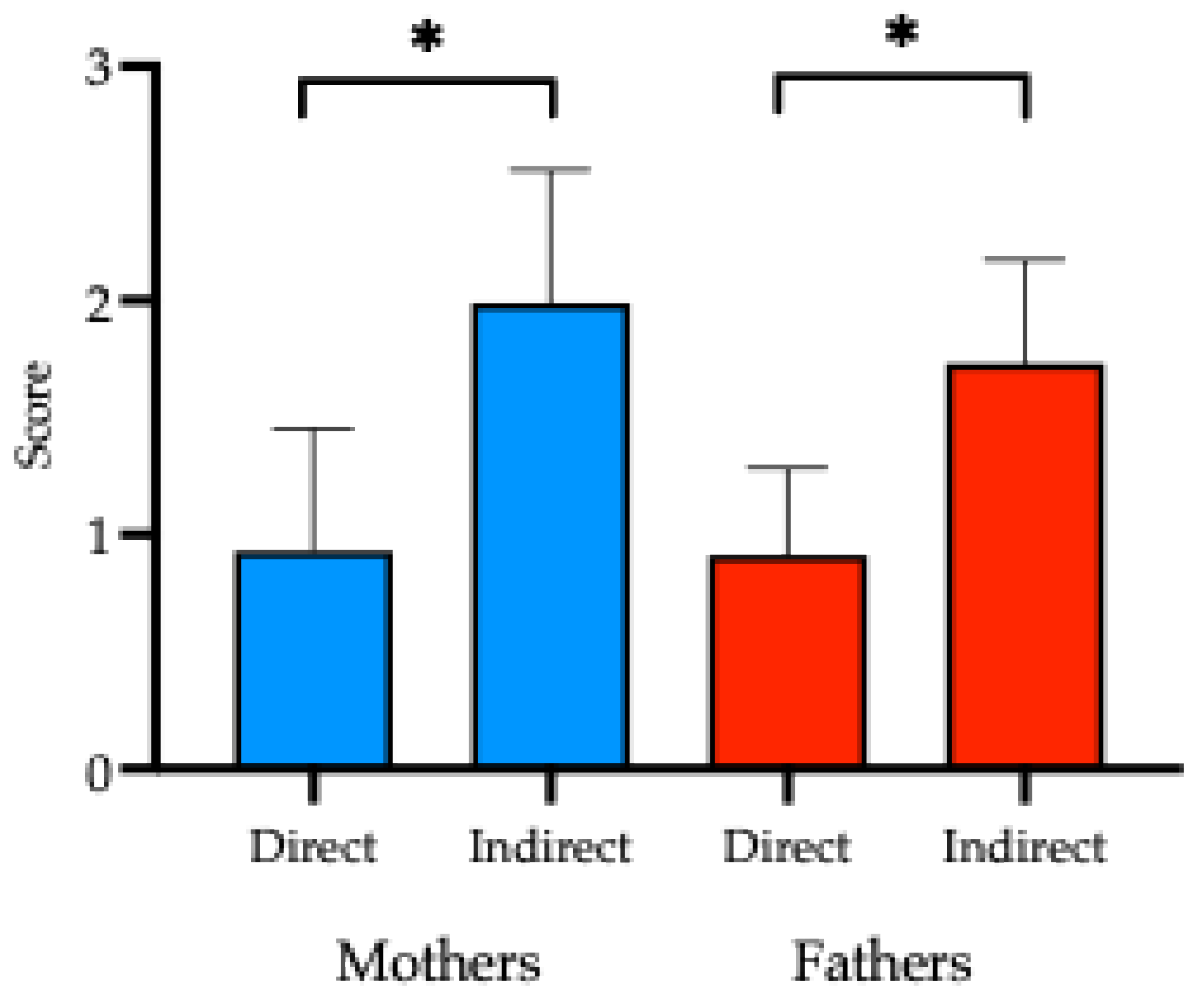

Table 1.
Sociodemographic of students and parents and physical activity of students.
| Students’ variables | Total | Girls | Boys | |||
| N | (%) | N | (%) | N | (%) | |
| Sociodemographic | 246 | (100.0) | 118 | (48.0) | 128 | (52.0) |
| Age (ẋ ±SD) | 12.6 | ± 1.8 | 12.5 | ± 1.9 | 12.7 | ± 1.8 |
| Age category | 246 | (100.0) | 118 | (48.0) | 128 | (52.0) |
| Children | 92 | (37.4) | 51 | (20.7) | 41 | (16.7) |
| Adolescents | 154 | (62.6) | 67 | (27.2) | 87 | (35.4) |
| Socioeconomic level | 152 | (100.0) | 73 | (48.0) | 79 | (52.0) |
| Low | 58 | (38.2) | 24 | (15.8) | 34 | (22.4) |
| Median | 79 | (52.0) | 39 | (25.7) | 40 | (26.3) |
| High | 15 | (9.8) | 10 | (6.5) | 5 | (3.3) |
| Kind of School | 155 | (100.0) | 75 | (48.4) | 80 | (51.6) |
| Public | 69 | (44.5) | 30 | (19.4) | 39 | (25.1) |
| Subsidized | 29 | (18.7) | 12 | (7.7) | 17 | (11.0) |
| Private | 57 | (36.8) | 33 | (21.3) | 24 | (15.5) |
| MVPA (min/day) | 246 | (100.0) | 118 | (100.0) | 128 | (100.0) |
| No Reach Reach |
167 79 |
(67.9) (32.1) |
100 18 |
(84.7) (15.3) |
67 61 |
(52.3) (47.7) |
| Parents variables | Total | Mothers | Fathers | |||
| N | (%) | N | (%) | N | (%) | |
| Sociodemographic | 315 | (100.0) | 209 | (66.3) | 106 | (33.7) |
| Age (ẋ ±SD) | 42.8 | ± 7.6 | 41.9 | ± 7.9 | 44.5 | ± 6.8 |
| Educational level | 311 | (100.0) | 208 | (100.0) | 103 | (100.0) |
| No studies | 4 | (1.3) | 3 | (1.4) | 1 | (1.0) |
| Primary school | 24 | (7.7) | 18 | (8.7) | 6 | (5.8) |
| Secondary school | 86 | (27.7) | 62 | (29.8) | 24 | (23.3) |
| Professional | 75 | (24.1) | 49 | (23.6) | 26 | (25.2) |
| University degree | 122 | (39.2) | 76 | (36.5) | 46 | (44.7) |
ẋ: mean; ±SD: standard deviation; MVPA: moderate-vigorous physical activity.
Table 2.
Direct support by sex of the parents for the practice of physical activity or sports in children and adolescents.
Table 2.
Direct support by sex of the parents for the practice of physical activity or sports in children and adolescents.
| Parental support topics | Mother | Father | pvalue | ||
| N | (%) | N | (%) | ||
| See you practice PA or sport | 211 | (100.0) | 107 | (100.0) | |
| Everyday | 19 | (9.0) | 7 | (6.5) | < 0.001* |
| Sometimes | 112 | (53.1) | 54 | (50.5) | |
| Never | 80 | (37.9) | 46 | (43.0) | |
| Transport to do PA or sports | 212 | (100.0) | 108 | (100.0) | |
| Everyday | 28 | (13.2) | 18 | (16.7) | 0.001* |
| Sometimes | 127 | (59.9) | 70 | (74.9) | |
| Never | 57 | (26.9) | 20 | (18.5) | |
| Does PA or sports with my offspring | 211 | (100.0) | 108 | (100.0) | |
| Everyday | 12 | (5.7) | 5 | (4.6) | 0.174 |
| Sometimes | 70 | (33.2) | 55 | (51.0) | |
| Never | 129 | (61.1) | 48 | (44.4) | |
| During the weekend I take and pick my offspring from the place where he/she does PA | 213 | (100.0) | 108 | (100.0) | |
| Always | 65 | (30.5) | 22 | (20.4) | < 0.001* |
| Sometimes | 73 | (34.3) | 57 | (52.7) | |
| Never | 75 | (35.2) | 29 | (26.9) | |
| Practice PA with my offspring during the weekend | 212 | (100.0) | 108 | (100.0) | |
| Always | 17 | (8.0) | 6 | (5.6) | 0.010* |
| Sometimes | 109 | (51.4) | 67 | (62.0) | |
| Never | 86 | (40.6) | 35 | (32.4) | |
| Practice PA with my offspring during the working days | 212 | (100.0) | 108 | (100.0) | |
| Always | 7 | (3.3) | 1 | (1.0) | 0.295 |
| Sometimes | 82 | (38.7) | 46 | (42.9) | |
| Never | 123 | (58.0) | 60 | (56.1) | |
PA: Physical Activity. * Statistical difference.
Table 3.
Indirect parental support by sex of the parents for the practice of physical activity or sports in children and adolescents.
Table 3.
Indirect parental support by sex of the parents for the practice of physical activity or sports in children and adolescents.
| Parental support topics | Mother | Father | pvalue | ||
| N | (%) | N | (%) | ||
| Encourages you to do PA or sports | 212 | (100.0) | 108 | (100.0) | |
| Everyday | 82 | (38.7) | 41 | (38.0) | <0.001* |
| Sometimes | 117 | (55.2) | 59 | (54.6) | |
| Never | 13 | (6.1) | 8 | (7.4) | |
| Tell about the importance to do PA or sports | 211 | (100.0) | 108 | (100.0) | |
| Everyday | 84 | (39.8) | 29 | (26.9) | < 0.001* |
| Sometimes | 107 | (50.7) | 71 | (65.7) | |
| Never | 20 | (9.5) | 8 | (7.4) | |
| Tell about the benefits to do PA or sports | 211 | (100.0) | 108 | (100.0) | |
| Everyday | 93 | (44.1) | 33 | (30.6) | 0.063 |
| Sometimes | 102 | (48.3) | 66 | (61.1) | |
| Never | 16 | (7.6) | 9 | (8.3) | |
| Spend some money on weekend to my offspring practice PA | 213 | (100.0) | 108 | (100.0) | |
| Always | 54 | (25.4) | 21 | (19.4) | < 0.001* |
| Sometimes | 67 | (31.4) | 45 | (41.7) | |
| Never | 92 | (43.2) | 42 | (38.9) | |
| Support my offspring to participate in PA no spend of money | 213 | (100.0) | 108 | (100.0) | |
| Always | 87 | (40.8) | 39 | (36.1) | < 0.001* |
| Sometimes | 96 | (45.1) | 55 | (50.9) | |
| Never | 30 | (14.1) | 14 | (13.0) | |
| I accompanist my offspring to the sports spaces on the weekend | 213 | (100.0) | 108 | (100.0) | |
| Always | 56 | (26.3) | 26 | (24.1) |
< 0.001* |
| Sometimes | 81 | (38.0) | 52 | (48.1) | |
| Never | 76 | (35.7) | 30 | (27.8) | |
| Spend some money on working days to my offspring practice PA | 213 | (100.0) | 108 | (100.0) | |
| Always | 43 | (20.2) | 22 | (20.4) | < 0.001* |
| Sometimes | 70 | (32.9) | 40 | (37.0) | |
| Never | 100 | (46.9) | 46 | (42.6) | |
| Encourage my son to be physically active during the weekend | 212 | (100.0) | 108 | (100.0) | |
| Always | 87 | (41.0) | 39 | (36.1) | < 0.001* |
| Sometimes | 105 | (49.6) | 59 | (54.6) | |
| Never | 20 | (9.4) | 10 | (9.3) | |
| Encourage my son to be physically active during the working days | 210 | (100.0) | 108 | (100.0) | |
| Always | 84 | (40.0) | 35 | (32.7) | 0.001* |
| Sometimes | 102 | (48.6) | 60 | (56.1) | |
| Never | 24 | (11.4) | 12 | (11.2) | |
PA: Physical Activity. * Statistical difference.
Table 4.
Associations between direct and indirect parental support by sex of the parents and the reach of PA recommendations for their children.
Table 4.
Associations between direct and indirect parental support by sex of the parents and the reach of PA recommendations for their children.
| Mothers | Fathers | ||||||||
| 95% CI | 95% CI | ||||||||
| Direct Support | OR | pvalue | Lower | Upper | OR | pvalue | Lower | Upper | |
| See you practice PA or sport | 1.08 | 0.780 | 0.780 | 1.500 | 0.69 | 0.181 | 0.395 | 1.191 | |
| Transport to do PA or sports | 1.28 | 0.923 | 0.923 | 1.773 | *1.52 | 0.046 | 1.008 | 2.288 | |
| Does PA or sports with my offspring | 1.45 | 0.961 | 0.961 | 2.188 | 0.93 | 0.809 | 0.504 | 1.707 | |
| During the weekend pick from the place where does PA | 1.01 | 0.728 | 0.728 | 1.404 | 1.37 | 0.209 | 0.838 | 2.237 | |
| Practice PA with my offspring during the weekend | 0.70 | 0.425 | 0.425 | 1.154 | 0.59 | 0.229 | 0.249 | 1.394 | |
| Practice PA with my offspring during the working days | 0.81 | 0.474 | 0.474 | 1.396 | 1.14 | 0.784 | 0.452 | 2.865 | |
| Indirect Support | |||||||||
| Encourages you to do PA or sports | 1.10 | 0.553 | 0.807 | 1.494 | 1.42 | 0.158 | 0.874 | 2.293 | |
| Tell about the importance to do PA or sports | 1.06 | 0.826 | 0.653 | 1.705 | 0.91 | 0.826 | 0.383 | 2.150 | |
| Tell about the benefits to do PA or sports | 0.92 | 0.715 | 0.566 | 1.477 | 0.64 | 0.323 | 0.266 | 1.548 | |
| Spend some money on weekend to my offspring practice PA | 1.03 | 0.875 | 0.695 | 1.533 | 0.56 | 0.104 | 0.232 | 1.146 | |
| Support my offspring to participate in PA no spend of money | 1.10 | 0.633 | 0.749 | 1.609 | 1.08 | 0.824 | 0.557 | 2.085 | |
| I accompanist my offspring to the sports spaces on the weekend | 1.00 | 0.909 | 0.673 | 1.423 | 0.68 | 0.324 | 0.309 | 1.475 | |
| Spend some money on working days to my offspring practice PA | 1.05 | 0.817 | 0.712 | 1.538 | *3.36 | 0.002 | 1.584 | 7.082 | |
| Encourage my son to be physically active during the weekend | 1.09 | 0.713 | 0.696 | 1.697 | 1.22 | 0.647 | 0.515 | 2.906 | |
| Encourage my son to be physically active during the working days | 1.08 | 0.754 | 0.679 | 1.707 | 1.02 | 0.960 | 0.442 | 2.363 | |
PA: Physical Activity.
Disclaimer/Publisher’s Note: The statements, opinions and data contained in all publications are solely those of the individual author(s) and contributor(s) and not of MDPI and/or the editor(s). MDPI and/or the editor(s) disclaim responsibility for any injury to people or property resulting from any ideas, methods, instructions or products referred to in the content. |
© 2026 by the authors. Licensee MDPI, Basel, Switzerland. This article is an open access article distributed under the terms and conditions of the Creative Commons Attribution (CC BY) license (http://creativecommons.org/licenses/by/4.0/).
Copyright: This open access article is published under a Creative Commons CC BY 4.0 license, which permit the free download, distribution, and reuse, provided that the author and preprint are cited in any reuse.


