

Submitted:
15 June 2026
Posted:
16 June 2026
You are already at the latest version
Abstract
Background/Objectives: Oxidative stress and low-grade chronic inflammation are implicated in the early pathogenesis of non-communicable diseases (NCDs). Malondialdehyde (MDA), a stable biomarker of lipid peroxidation, may reflect subclinical oxidative stress in apparently healthy young adults. This study aimed to: (1) establish a population-specific reference interval for plasma MDA in healthy Thai undergraduate students; and (2) evaluate associations between plasma MDA levels and lifestyle risk factors. Methods: This cross-sectional study enrolled 141 Thai college students aged 18–27 years. Plasma MDA was measured using the thiobarbituric acid reactive substances (TBARS) assay. A reference interval was determined non-parametrically (P2.5–P97.5) following IFCC recommendations in a healthy reference subgroup (n = 94). The 75th percentile (P75) was used as an exploratory cutoff for elevated MDA. Binary logistic regression identified independent lifestyle predictors of elevated MDA. Results: The plasma MDA reference interval was 1.16–9.23 µmol/L, with P75 = 6.07 µmol/L. Using this cutoff, 24.8% of participants had elevated MDA. High sugar intake (>24 g/day) was the only independent predictor of elevated MDA after multivariate adjustment (adjusted OR = 3.42; 95% CI: 1.08–10.87; p = 0.036). Conclusions: To our knowledge, this study established the first population-specific plasma MDA reference interval for Thai young adults using the TBARS method. High sugar intake was identified as a key modifiable lifestyle predictor of elevated lipid peroxidation, even in apparently healthy individuals. These findings support the use of plasma MDA as a practical, cost-effective screening biomarker for early oxidative stress surveillance and NCD prevention in young populations.
Keywords:
malondialdehyde
; oxidative stress
; reference interval
; young adults
; non-communicable diseases
; low-grade inflammation
; screening biomarker
1. Introduction
Non-communicable diseases (NCDs), particularly metabolic diseases and atherosclerotic cardiovascular disease (ASCVD), remain the foremost global public health challenge of the twenty-first century. In 2021, NCDs killed at least 43 million people, equivalent to 75% of all non-pandemic-related deaths, with approximately 18 million occurring among individuals younger than 70 years, 82% of whom lived in low- and middle-income countries (1). While global age-standardised mortality rates have declined overall, the Global Burden of Disease (GBD) 2023 study highlighted that premature NCD mortality and its burden on youths and young adults remain significant concerns, particularly in low- and middle-income countries (2). NCDs are a major contributor to mortality and the overall disease burden in Thailand, accounting for approximately 76% of all deaths, of which 86% occur among individuals aged below 70 years (3). The burden is escalating: the 7th Thai National Health Examination Survey (NHES VII, 2024–2025) revealed that metabolic syndrome now affects 28% of Thais aged 15 years and above, representing a substantial increase from the 23.2% prevalence reported in the 4th NHES in 2009 (4). Among university students, the prevalence of modifiable NCD risk factors is notably high. A multi-country study across 24 nations found that 15.9% of university students exhibited three or more behavioral NCD risk factors (5), and a cross-sectional study of 485 students found that more than half (51.2%) had four or more concurrent risk factors, with physical inactivity being the most prevalent (89.2%) (6). Thai undergraduate students exhibit analogous patterns, including unhealthy dietary habits, sedentary lifestyles, sleep deprivation, and psychological stress. This constellation of behaviors collectively promotes oxidative stress, a key upstream mechanism in metabolic dysregulation and ASCVD development.
Oxidative stress arises from an imbalance between reactive oxygen species (ROS) production and antioxidant defense mechanisms (7). Lifestyle-related triggers, including diets rich in ultraprocessed foods, saturated fats, and refined sugars; physical inactivity; sleep disorders; and excessive alcohol intake, promote oxidative stress, mitochondrial dysfunction, and release of inflammation-inducing signals, sustaining a state of low-grade chronic inflammation (8). Low-grade chronic inflammation is a persistent, subclinical state arising from failure of the normal inflammatory resolution process, and is strongly associated with obesity, metabolic syndrome, type 2 diabetes mellitus, ASCVD, and chronic kidney disease (9). Importantly, subclinical oxidative stress and early vascular changes, including impaired flow-mediated dilation, have been documented in young adults with unhealthy lifestyle profiles even in the absence of overt metabolic disease (10). Lipid peroxidation is a principal consequence of oxidative stress, generating reactive aldehydes, particularly malondialdehyde (MDA), a stable, sensitive biomarker of lipid peroxidation and oxidative stress (11). Elevated MDA has been reported across cardiometabolic conditions including obesity, metabolic syndrome, diabetes mellitus, hypertension, and cardiovascular disease (12). Beyond its role as a passive marker, MDA actively mediates vascular injury by generating atherogenic MDA-modified LDL, activating pro-inflammatory signaling pathways, and upregulating inflammatory cytokines in lymphocytes, thereby establishing a feedforward loop that sustains low-grade inflammation (13, 14).
Assessment of oxidative stress and low-grade inflammation in clinical and epidemiological settings commonly relies on high-sensitivity C-reactive protein (hsCRP), a widely used marker of systemic inflammation. Although hsCRP correlates with oxidative stress, it reflects downstream inflammatory activation rather than upstream oxidative damage directly, and its levels in apparently healthy young individuals often remain within the normal range. This limits its sensitivity for detecting early subclinical lipid peroxidation in this population (15). Moreover, hsCRP measurement typically requires immunoturbidimetric or high-sensitivity ELISA-based platforms, which may be less accessible in resource-limited settings (16). Unlike hsCRP, MDA directly measures upstream oxidative damage rather than downstream inflammatory activation, providing mechanistically complementary information on cardiometabolic risk (12), while the TBARS-based assay requires only a spectrophotometer and basic reagents, making it simple, cost-effective, and practical for large-scale screening (16). Despite its clinical utility, a critical limitation constraining routine MDA application is the absence of validated, population-specific reference intervals. Existing reference values vary substantially by analytical method and population characteristics (17). The most widely cited plasma MDA reference interval, established in a Danish cohort using HPLC, yielded 0.36–1.24 µmol/L (18), considerably lower than values typically obtained using the TBARS-based spectrophotometric method commonly used in clinical and epidemiological research (19). As reference intervals are not transferable across methods or populations, values from Western or mixed-age cohorts may not apply to young Asian populations with distinct dietary, body composition, and oxidative stress profiles (17). To date, no population-specific reference interval for plasma MDA using the TBARS-spectrophotometric method has been established in Thai young adults.
Modern lifestyle patterns among Thai undergraduate students further heighten these concerns. Studies have demonstrated that Thai university students exhibit a high prevalence of modifiable cardiometabolic risk behaviors. These include frequent consumption of ultra-processed foods and sugar-sweetened beverages, physical inactivity, and prolonged sedentary behavior (3, 20). Despite this, existing Thai studies have focused predominantly on conventional parameters such as body mass index (BMI), waist circumference, fasting blood glucose, lipid profiles, and blood pressure. These parameters do not capture upstream oxidative and inflammatory mechanisms that precede clinically detectable metabolic disease (21). Direct evidence of oxidative stress burden and its relationship with low-grade chronic inflammation in this population therefore remains scarce. Early identification of elevated plasma MDA in relation to specific lifestyle risk factors could provide a timely foundation for risk-targeted health promotion interventions aimed at reducing the future burden of ASCVD among Thai young adults (15).
Therefore, this study aimed to: (1) establish a population-specific reference interval for plasma MDA in healthy Thai undergraduate students following International Federation of Clinical Chemistry and Laboratory Medicine (IFCC) recommendations; and (2) evaluate plasma MDA levels and their associations with lifestyle risk factors, including high-fat diet, high sodium intake, excessive sugar intake, physical inactivity, inadequate sleep duration, smoking, and alcohol consumption. We hypothesized that unhealthy lifestyle behaviors, particularly high-fat and high-sugar dietary patterns, are independently associated with elevated plasma MDA, reflecting increased lipid peroxidation and low-grade chronic inflammation linked to early metabolic alterations and future ASCVD risk. The findings are expected to contribute to evidence-based preventive strategies and university-level health promotion programs for reducing long-term NCD risk in Thai young adults.
2. Materials and Methods
2.1. Study Population and Design
This cross-sectional study enrolled 141 Thai college students aged 18–27 years (20.8 ± 1.7 years). Participants were recruited between August and September 2025 at Nakhon Ratchasima College, Thailand. Informed consent was obtained from all individuals involved in this study. The study protocol was approved by the Nakhon Ratchasima College Ethics Committee (NMCEC-0057/2567). A healthy reference subgroup (n = 94) was selected from the total cohort based on the following inclusion criteria: non-obese (BMI < 25 kg/m²), normal waist circumference (women < 80 cm, men < 90 cm), and normal blood pressure (systolic < 140 mmHg and diastolic < 90 mmHg). Individuals with a history of chronic disease or current use of medications known to influence oxidative stress levels were excluded from this subgroup. Of the 141 enrolled participants, 94 met all criteria and were therefore selected to establish the plasma malondialdehyde (MDA) reference interval.
2.2. Data Collection
Anthropometric measurements (body weight, height, waist circumference) and blood pressure were obtained using standardized procedures. BMI was calculated as weight in kilograms divided by the square of height in meters (kg/m²). A structured questionnaire was administered to collect information on lifestyle factors, including dietary habits such as sugar, salt, fat, and fruit and vegetable intake, physical activity, sleep quality, smoking, and alcohol consumption. Responses were categorized as binary variables based on predefined thresholds: high sugar intake >24 g/day (22), high sodium intake >2 g/day (23) and high-fat dietary intake ≥3 times/week (24). Inadequate fruit and vegetable intake <5 servings/day, inadequate physical activity <150 minutes/week, current smoking, and alcohol consumption within the past 12 months were assessed by self-report based on standard public health survey definitions (25). Inadequate sleep duration was defined as <7 hours/day based on National Sleep Foundation recommendations (26).
2.3. Laboratory Analysis: Plasma MDA Measurement
Venous blood samples were collected into EDTA anticoagulant tubes after a 12-hour fast. Plasma was freshly prepared by centrifugation at 1,500 g for 10 min. Plasma MDA concentration was measured using the thiobarbituric acid reactive substances (TBARS) assay modified from Mihara and Uchiyama (1978) (27). Briefly, 200 µL of plasma was combined with 750 µL 2.98% (v/v) orthophosphoric acid and 250 µL of 1.73% (w/v) thiobarbituric acid (TBA) solution. The mixture was incubated in a boiling water bath (95–100°C) for 45 minutes to develop the MDA-TBA chromogen. Following the heating period, the reaction was stopped by placing the tubes in an ice bath. To remove any precipitated proteins or turbidity that might interfere with light scattering, the samples were centrifuged at 1,500 g for 10 minutes. The absorbance of the clear supernatant was then measured using a spectrophotometer at 532 nm. MDA concentrations were determined against a standard curve generated with 1,1,3,3-tetramethoxypropane and expressed as µmol/L of plasma. All samples were analyzed in triplicate, and the mean value was used for statistical analysis.
2.4. Reference Interval and High-Risk Cutoff Value
Following the International Federation of Clinical Chemistry (IFCC) recommendations, the reference interval for plasma MDA was determined non-parametrically as the 2.5th to 97.5th percentiles (P2.5–P97.5) of the distribution in the healthy reference subgroup (n = 94). In the absence of established outcome-based clinical cutoffs for plasma MDA in this population, participants with MDA levels at or above the 75th percentile (P75) of the reference distribution were defined as the high-risk subgroup. This percentile-based approach was chosen to increase sensitivity for detecting early-phase lipid peroxidation, consistent with exploratory methods widely adopted in epidemiological studies (28, 29).
2.5. Statistical Analysis
All statistical analyses were performed using IBM SPSS Statistics for Windows, version 26.0 (IBM Corp., Armonk, NY, USA). Normality of continuous variables was assessed using the Kolmogorov-Smirnov test. Normally distributed data are presented as mean ± standard deviation (SD), and non-normally distributed data as median with interquartile range (IQR). Categorical variables were compared using the chi-square test (or Fisher’s exact test when expected cell counts were <5). Correlations between MDA levels and continuous variables were assessed using Spearman’s rank correlation coefficient for non-normally distributed data. Binary logistic regression was used to identify independent predictors of elevated MDA (≥ P75). Variables with a p-value < 0.10 in univariate analysis (age, sex, BMI, high sugar intake, high-fat diet) were entered into the multivariate model using the Enter method. Adjusted odds ratios (OR) and 95% confidence intervals (CI) were calculated. Model fit was assessed using the Hosmer-Lemeshow goodness-of-fit test, and the Nagelkerke R² was reported. A two-tailed p-value < 0.05 was considered statistically significant for all tests.
3. Results
3.1. Participant Characteristics and Plasma MDA Levels
A total of 141 college students (103 female, 73.0%; 38 male, 27.0%) with a mean age of 20.8 ± 1.7 years were enrolled. Baseline demographic, clinical, and lifestyle characteristics are summarized in Table 1. The median BMI was 21.2 kg/m² (IQR 19.0–24.3), and the median waist circumference (WC) was 71 cm (IQR 66–80). Systolic and diastolic blood pressures were 121 ± 14.4 mmHg and 75 mmHg (IQR 70–82), respectively. Behavioral questionnaire data indicated that 73.0% of participants consumed more than 24 g of sugar per day, 51.8% reported a high-fat diet, 73.8% had inadequate fruit and vegetable intake, 84.4% engaged in insufficient physical activity, and 75.9% experienced poor sleep quality. The median plasma MDA concentration measured by the TBARS assay in the whole cohort was 4.32 µmol/L. In the healthy reference subgroup (n = 94), the distribution was non-normal (Kolmogorov-Smirnov test, p < 0.05). The 2.5th and 97.5th percentiles defined a reference interval of 1.16–9.23 µmol/L, and the 75th percentile (P75) was 6.07 µmol/L (Table 2). This P75 value was subsequently used as the cutoff to define the high-risk subgroup (elevated MDA) in all further analyses.
3.2. Univariate Associations with Elevated MDA
When the total cohort was divided into normal MDA (<6.07 µmol/L) and elevated MDA (≥6.07 µmol/L), 35 participants (24.8%) were classified into the high-risk subgroup. Chi-square tests revealed that high sugar intake (>24 g/day) and high-fat diet were significantly associated with elevated MDA (p = 0.013 and p = 0.038, respectively). Among participants who consumed more than 24 g of sugar daily, 31.1% had elevated MDA compared with 10.5% of those who did not, corresponding to an odds ratio (OR) of 3.83 (95% CI: 1.28–11.48). Similarly, 32.9% of individuals reporting a high-fat diet had elevated MDA versus 17.6% of those who did not (OR = 2.29; 95% CI: 1.04–5.02). Smoking showed a borderline association with elevated MDA (p = 0.072); however, this finding should be interpreted with caution given the small number of smokers in this cohort (n = 5). No other lifestyle factor (sex, exercise, salt intake, fruit/vegetable consumption, alcohol drinking, or sleep quality) reached statistical significance as shown in Table 3.
3.3. Correlation Analysis
Spearman’s rank correlation coefficients among continuous variables are presented in Table 4. Plasma MDA levels were significantly positively correlated with BMI (ρ = 0.19, p = 0.021; Figure 1). MDA showed no significant correlation with WC (ρ = 0.15, p = 0.076), systolic blood pressure (ρ = 0.05, p = 0.531), or diastolic blood pressure (ρ = 0.05, p = 0.502). As anticipated, BMI was strongly correlated with WC (ρ = 0.76, p < 0.001) and also significantly correlated with both systolic (ρ = 0.33, p < 0.001) and diastolic (ρ = 0.27, p = 0.001) blood pressures.
3.4. Multivariate Logistic Regression Analysis
To identify independent predictors of elevated plasma MDA, a binary logistic regression model was constructed including age, sex, BMI, high sugar intake (>24 g/day), and high fat diet (Table 5). After adjustment for all variables in the model, high sugar intake remained the only statistically significant independent predictor. Participants who consumed more than 24 g of sugar per day had a 3.42 fold higher odds of having elevated MDA compared with those who did not (adjusted OR = 3.42; 95% CI: 1.08–10.87; p = 0.036). Higher BMI showed a trend toward increased risk but did not reach statistical significance (adjusted OR = 1.07 per 1 kg/m²; 95% CI: 0.98–1.17; p = 0.128). Age had a borderline protective effect (adjusted OR = 0.76 per year; 95% CI: 0.55–1.04; p = 0.082). Sex (male vs. female) and high fat diet were not independently associated with elevated MDA (p = 0.766 and p = 0.104, respectively). The Hosmer Lemeshow test indicated good model fit (χ²(8) = 4.226, p = 0.623), and the Nagelkerke R² was 0.142.
4. Discussion
To our knowledge, this is the first study to establish a population-specific reference interval for plasma MDA measured by the TBARS-spectrophotometric method in Thai young adults, addressing a gap previously identified in the literature (17). In this cross-sectional study of 141 Thai college students, a reference interval of 1.16–9.23 µmol/L was determined non-parametrically (P2.5–P97.5) following IFCC recommendations (17), using a healthy reference subgroup (n = 94). Although Nielsen et al. (18) reported a plasma MDA reference interval of 0.36–1.24 µmol/L in a healthy Danish population using HPLC, direct adoption of these limits to our population and method may not be valid due to differences in ethnicity, age distribution, and dietary patterns (17). Additionally, TBARS-based methods consistently yield higher MDA values than HPLC (19), further supporting the need for a method-specific and population-specific reference interval. The 75th percentile (P75 = 6.07 µmol/L) was subsequently used as an exploratory cutoff for high-risk subgroup identification. This approach is consistent with established epidemiological and clinical practice for risk stratification when outcome-based cutoffs are unavailable, as similarly applied in cardiovascular risk assessment (28, 29). Identifying individuals in the upper quartile of MDA distribution enables early detection of subclinical oxidative stress burden before the onset of clinically detectable metabolic disease, providing a rational basis for targeted preventive interventions at a stage when lifestyle modifications are most likely to be effective (15). Using this exploratory cutoff, 24.8% of participants had elevated MDA levels, suggesting a considerable subclinical oxidative stress burden among apparently healthy Thai young adults. This finding is consistent with growing evidence that lifestyle-induced oxidative stress is prevalent even before overt metabolic disease becomes detectable (8, 30). After adjusting for age, sex, BMI, and high-fat diet, high sugar intake (>24 g/day) remained the only independent predictor of elevated MDA (adjusted OR = 3.42; 95% CI: 1.08–10.87; p = 0.036). Although univariate analyses showed significant associations for both high sugar and high-fat diet, the latter lost significance in the multivariate model. These findings highlight that daily sugar intake exceeding 24 g (approximately 6 teaspoons) is independently associated with increased lipid peroxidation in young, generally lean adults, even after adjustment for adiposity and other lifestyle factors.
Our findings are consistent with previous reports linking dietary sugar intake to elevated oxidative stress markers. Cross-sectional evidence has demonstrated that higher dietary sugar intake is an independent factor of elevated plasma MDA concentrations in adults at risk of metabolic syndrome (31). This finding supports the notion that dietary sugar is a modifiable driver of lipid peroxidation, and several plausible mechanisms may underlie this association. In Thai young adults, dietary sugar is largely derived from sucrose-containing beverages and foods, providing both fructose and glucose as oxidative substrates (32). Fructose is rapidly metabolized in the liver independent of insulin, generating uric acid and depleting ATP, which directly stimulates mitochondrial ROS production and subsequent lipid peroxidation, a pathway documented in humans consuming fructose-rich diets regardless of metabolic disease status (33). Additionally, high sugar meals induce postprandial oxidative stress through mitochondrial superoxide overproduction even in non-diabetic individuals (34). Both mechanisms converge on PUFA peroxidation and MDA formation, consistent with our TBARS-based findings, though direct mechanistic evidence was not assessed in this study. Our observation that sugar intake at levels approaching current public health recommendations (>24 g/day) independently predicts elevated MDA suggests that even moderate dietary sugar consumption can trigger measurable oxidative damage in young, apparently healthy individuals. In contrast, the univariate association between high-fat diet and elevated MDA did not survive multivariate adjustment. This is consistent with evidence that the pro-oxidant effect of high-fat diets may be primarily mediated through obesity-induced adipose tissue dysfunction and insulin resistance, rather than representing a direct effect of dietary fat per se (35). In our study, BMI and waist circumference were strongly correlated (ρ = 0.765, p < 0.001), and the inclusion of BMI in the regression model likely captured part of the effect of a high-fat diet. Moreover, the TBARS assay preferentially detects lipid peroxidation from polyunsaturated fatty acids (PUFAs) and is less sensitive to saturated fats, which may also explain the lack of an independent association (18). Despite a significant positive correlation between BMI and plasma MDA (ρ = 0.194, p = 0.021), BMI did not emerge as an independent predictor in the multivariate model, which may be partly attributable to the narrow BMI distribution of our sample (median 21.2 kg/m²; IQR 19.0–24.3), consistent with evidence that BMI-MDA associations are most apparent in studies incorporating wider BMI ranges that include overweight or obese individuals (36). The attenuation of BMI in the multivariate model may also partly reflect its correlation with sugar intake; notably, sugar intake retained independent significance after BMI adjustment (adjusted OR = 3.42; p = 0.036), consistent with previous evidence that dietary sugar is an independent determinant of plasma MDA beyond adiposity (31). The P75-based cutoff provides a practical tool for identifying young adults at higher oxidative risk. No universal clinical decision limit for plasma MDA exists; however, percentile-based risk stratification is widely accepted in epidemiological studies of oxidative stress biomarkers. Cesena et al. demonstrated that Brazilian adults at or above the 75th percentile of 10-year ASCVD risk had 6.6- to 11.6-fold higher estimated long-term cardiovascular risk (29), while Wang et al. confirmed that demographic-specific P75 of coronary artery calcium is a recommended high-risk threshold in clinical guidelines (28). We acknowledge this as an exploratory approach and recommend future prospective studies to validate the clinical utility of this cutoff in larger and more diverse populations. Although the TBARS assay has analytical limitations, including low specificity for MDA due to cross-reactivity with other aldehydes and lipid peroxidation products (37), its simplicity and cost-effectiveness make it feasible for large-scale epidemiological screening. In contrast to hsCRP, which reflects downstream inflammation and may lack sensitivity in apparently healthy populations (15), MDA directly measures upstream oxidative damage and showed significant associations with modifiable lifestyle factors in this study, supporting its utility as a practical screening biomarker in young adults. The World Health Organization recommends limiting added sugar intake to less than 5% of total energy intake, equivalent to approximately 25 g per day, consistent with the threshold adopted in this study (22).
Strengths of this study include: (i) establishment of a population-specific plasma MDA reference interval in Thai young adults following IFCC recommendations, providing a practical foundation for population-based oxidative stress surveillance and NCD prevention strategies targeting young adults at a stage when lifestyle interventions are most effective (15, 30); (ii) use of multivariate logistic regression controlling for multiple lifestyle confounders, with good model fit confirmed by the Hosmer–Lemeshow test (p = 0.623); (iii) the TBARS-based MDA assay offers high sensitivity, reproducibility, and technical simplicity, making it suitable for population-level oxidative stress screening and individual monitoring over time (16), with particular applicability in resource-limited university health settings. These strengths notwithstanding, some limitations of the present study should be considered. First, the TBARS assay has low specificity for MDA and may overestimate values due to interference from other aldehydes and sugar-derived carbonyl compounds (37). Second, the cross-sectional design precludes causal inference, and unmeasured confounders including antioxidant intake and genetic predisposition cannot be fully excluded. Third, the modest sample size and limited number of participants with elevated MDA may have restricted statistical power, potentially contributing to the non-significant findings for BMI and high-fat diet in the multivariate model. Fourth, lifestyle exposures were assessed by self-report, which may be subject to recall bias. Fifth, the predominance of female participants (73.0%) may limit generalizability to male university students. The findings of this study have potential implications for early NCD prevention strategies targeting young adults. If validated prospectively, plasma MDA measured by the TBARS assay could serve as a practical, low-cost screening tool for identifying apparently healthy young adults at elevated oxidative risk, enabling timely lifestyle interventions before irreversible cardiometabolic sequelae develop. Several directions for future research are warranted. First, prospective cohort studies are needed to examine whether elevated plasma MDA independently predicts future metabolic disease development in young adults, thereby establishing the prognostic value of this biomarker beyond cross-sectional associations. Second, longitudinal studies tracking plasma MDA levels in apparently healthy young adults over time would help determine whether persistently elevated MDA predicts the subsequent development of metabolic abnormalities, thereby validating its utility as an early screening biomarker at the individual level. Third, future studies should simultaneously measure oxidative stress and low-grade inflammatory biomarkers alongside MDA to directly confirm the proposed relationship between lipid peroxidation and subclinical inflammation in this population, with preference for accessible and cost-effective markers suitable for large-scale screening. Fourth, replication using more analytically specific methods such as HPLC or GC-MS would help confirm the associations observed with the TBARS assay. Finally, the reference interval established in this study should be validated in larger, geographically diverse Thai populations with sex-stratified analyses, given the predominance of female participants in the present sample. Ultimately, incorporating oxidative stress surveillance into routine university health programs may represent a cost-effective and scalable approach to NCD prevention in young Thai adults.
5. Conclusions
In summary, this study established a population-specific reference interval for plasma MDA of 1.16–9.23 µmol/L in healthy Thai young adults using the TBARS-spectrophotometric method following IFCC recommendations, providing a validated benchmark for oxidative stress assessment in this popula-tion. Using the 75th percentile (P75 = 6.07 µmol/L) as an exploratory cutoff, 24.8% of participants exhib-ited elevated MDA levels, suggesting a considerable subclinical oxidative stress burden in this apparently healthy Thai undergraduate population. High sugar intake exceeding 24 g/day was identified as the only independent predictor of elevated plasma MDA after multivariate adjustment, highlighting dietary sugar as a key modifiable risk factor for lipid peroxidation and potentially early low-grade chronic inflammation in young adults. The TBARS-based MDA assay represents a practical and cost-effective tool for popula-tion-level oxidative stress screening in resource-limited settings. These findings reinforce the importance of limiting added sugar consumption from early adulthood as a preventive strategy for reducing oxidative stress burden and long-term cardiometabolic disease risk. Further research employing more specific as-says, prospective designs, and concurrent inflammatory biomarker measurement is warranted to confirm these findings and establish the clinical utility of plasma MDA as a validated screening marker for early oxidative stress surveillance in young, apparently healthy populations.
Author Contributions
Conceptualization, S.K. and W.W.; Methodology, S.K. and W.W.; Formal Analysis, W.W.; Investigation, S.K., K.C., Ti.C., Th.C., C.P. and P.M.; Data Curation, W.W.; Writing – Original Draft Preparation, W.W.; Writing – Review & Editing, S.K. and W.W.; Visualization, W.W.; Supervision, W.W.; Project Administration, S.K. All authors have read and agreed to the published version of the manuscript.
Funding
This research received no external funding.
Institutional Review Board Statement
The study was conducted in accordance with the Declaration of Helsinki, and approved by the Nakhon Ratchasima College Ethics Committee (No. NMCEC-0057/2567), 28 May 2025.
Informed Consent Statement
Informed consent was obtained from all subjects involved in the study.
Data Availability Statement
The data presented in this study are available on request from the corresponding author due to privacy restrictions.
Acknowledgments
We thank the Faculty of Allied Health Sciences, Nakhon Ratchasima College and the Faculty of Public Health, Mahasarakham University, who provided general support for their support and collaboration throughout the study.
Conflicts of Interest
The authors declare no conflicts of interest.
Abbreviations
The following abbreviations are used in this manuscript:
| MDA | Malondialdehyde |
| NCDs | Non-communicable diseases |
| ASCVD | Atherosclerotic cardiovascular disease |
| TBARS | Thiobarbituric acid reactive substances |
| IFCC | International Federation of Clinical Chemistry and Laboratory Medicine |
| hsCRP | High-sensitivity C-reactive protein |
| ROS | Reactive oxygen species |
| BMI | Body mass index |
| WC | Waist circumference |
| SBP | Systolic blood pressure |
| DBP | Diastolic blood pressure |
| OR | Odds ratio |
| CI | Confidence interval |
| IQR | Interquartile range |
| SD | Standard deviation |
References
- World Health Organization. Noncommunicable Diseases. World Health Organization: Geneva, 2023; Available online: https://www.who.int/news-room/fact-sheets/detail/noncommunicable-diseases.
- Naghavi, M.; Kyu, H.H.; Aalipour, M.A.; Aalruz, H.; Ababneh, H.S.; Abafita, B.J.; Abaraogu, U.O.; Abbafati, C.; Abbasi, M.; Abbaspour, F. Global burden of 292 causes of death in 204 countries and territories and 660 subnational locations, 1990–2023: a systematic analysis for the Global Burden of Disease Study 2023. The Lancet 2025, 406(10513), 1811–1872. [Google Scholar] [CrossRef] [PubMed]
- Vichitkunakorn, P.; Bunyanukul, W.; Apiwan, K.; Tanasanchonnakul, D.; Sittisombut, M. Prevalence of non-communicable disease risk factors and their association with economic status: findings from the 2021 health behaviour of population survey in Thailand. Glob. Health Action. 2025, 18(1), 2485689. [Google Scholar] [CrossRef] [PubMed]
- Aekplakorn, W.; Kessomboon, P.; Sangthong, R.; Chariyalertsak, S.; Putwatana, P.; Inthawong, R.; Nitiyanant, W.; Taneepanichskul, S.; group NIs. Urban and rural variation in clustering of metabolic syndrome components in the Thai population: results from the fourth National Health Examination Survey 2009. BMC Public Health 2011, 11(1), 854. [Google Scholar] [CrossRef] [PubMed]
- Pengpid, S.; Peltzer, K. Prevalence and correlates of multiple behavioural risk factors of non-communicable diseases among university students from 24 countries. J. Public Health 2021, 43(4), 857–866. [Google Scholar]
- Cicekli, I.; Gokce Eskin, S. High prevalence and co-occurrence of modifiable risk factors for non-communicable diseases among university students: a cross-sectional study. Front. Public Health 2025, 12, 1484164. [Google Scholar] [PubMed]
- Sies, H. Oxidative stress: concept and some practical aspects. Antioxidants 2020, 9(9), 852. [Google Scholar] [CrossRef] [PubMed]
- Cifuentes, M.; Verdejo, H.E.; Castro, P.F.; Corvalan, A.H.; Ferreccio, C.; Quest, A.F.; Kogan, M.J.; Lavandero, S. Low-grade chronic inflammation: a shared mechanism for chronic diseases. Physiology 2024. [Google Scholar] [CrossRef] [PubMed]
- Surma, S.; Sahebkar, A.; Banach, M. Nutrition, nutraceuticals and bioactive compounds in the prevention and fight against inflammation. Nutrients 2023, 15(11), 2629. [Google Scholar] [CrossRef] [PubMed]
- Ye, X.; Xiong, Z.; Li, J.; Lin, Y.; Xie, P.; Zhong, X.; Huang, R.; Zhuang, X.; Liao, X. Changes in cardiovascular health during young adulthood and subclinical atherosclerosis in middle age: the CARDIA study. Glob. Heart 2023, 18(1), 14. [Google Scholar] [CrossRef] [PubMed]
- Del Rio, D.; Stewart, A.J.; Pellegrini, N. A review of recent studies on malondialdehyde as toxic molecule and biological marker of oxidative stress. Nutr. Metab. Cardiovasc. Dis. 2005, 15(4), 316–328. [Google Scholar] [CrossRef] [PubMed]
- Hadi, N.; Zaidi, I.A.; Kamal, Z.; Khan, R.U.; Khan, M.H.; Omair, F.; Khan, R.U., Jr. Estimation of serum malondialdehyde (a marker of oxidative stress) as a predictive biomarker for the severity of coronary artery disease (CAD) and cardiovascular outcomes. Cureus 2024, 16(9). [Google Scholar] [CrossRef] [PubMed]
- Lankin, V.Z.; Tikhaze, A.K.; Melkumyants, A.M. Malondialdehyde as an important key factor of molecular mechanisms of vascular wall damage under heart diseases development. Int. J. Mol. Sci. 2022, 24(1), 128. [Google Scholar] [CrossRef] [PubMed]
- Yadav, U.C.; Ramana, K.V. Regulation of NF-κB-Induced Inflammatory Signaling by Lipid Peroxidation-Derived Aldehydes. Oxidative Med. Cell. Longev. 2013, 2013(1), 690545. [Google Scholar]
- Seyedsadjadi, N.; Grant, R. The potential benefit of monitoring oxidative stress and inflammation in the prevention of non-communicable diseases (NCDs). Antioxidants 2020, 10(1), 15. [Google Scholar] [CrossRef] [PubMed]
- De Leon, J.A.D.; Borges, C.R. Evaluation of oxidative stress in biological samples using the thiobarbituric acid reactive substances assay. J. Vis. Exp. JoVE 2020, 159. [Google Scholar] [CrossRef]
- Turcu, V.; Wild, P.; Hemmendinger, M.; Sauvain, J.-J.; Bergamaschi, E.; Hopf, N.B.; Canu, I.G. Towards reference values for malondialdehyde on exhaled breath condensate: a systematic literature review and meta-analysis. Toxics 2022, 10(5), 258. [Google Scholar] [CrossRef] [PubMed]
- Nielsen, F.; Mikkelsen, B.B.; Nielsen, J.B.; Andersen, H.R.; Grandjean, P. Plasma malondialdehyde as biomarker for oxidative stress: reference interval and effects of life-style factors. Clin. Chem. 1997, 43(7), 1209–1214. [Google Scholar] [CrossRef]
- Hong, Y.-L.; Yeh, S.-L.; Chang, C.-Y.; Hu, M.-L. Total plasma malondialdehyde levels in 16 Taiwanese college students determined by various thiobarbituric acid tests and an improved high-performance liquid chromatography-based method. Clin. Biochem. 2000, 33(8), 619–625. [Google Scholar] [CrossRef] [PubMed]
- Amornsriwatanakul, A.; Rahman, H.A.; Katewongsa, P.; Chaiyasong, S.; Charoenwattana, S.; Chupradit, S.; Ivanovitch, K.; Rodjarkpai, Y.; Sriboonma, K.; Sudnongbua, S. Multilevel factors associated with physical activity participation among Thai university students. Prev. Med. Rep. 2023, 36, 102510. [Google Scholar] [CrossRef] [PubMed]
- Aekplakorn, W.; Satheannoppakao, W.; Putwatana, P.; Taneepanichskul, S.; Kessomboon, P.; Chongsuvivatwong, V.; Chariyalertsak, S. Dietary pattern and metabolic syndrome in Thai adults. J. Nutr. Metab. 2015, 2015(1), 468759. [Google Scholar] [CrossRef] [PubMed]
- World Health Organization. Guideline: sugars intake for adults and children; World Health Organization, 2015. [Google Scholar]
- World Health Organization. Guideline: sodium intake for adults and children; World Health Organization, 2012. [Google Scholar]
- World Health Organization. Total fat intake for the prevention of unhealthy weight gain in adults and children: WHO guideline; World Health Organization, 2023. [Google Scholar]
- Riley, L.; Guthold, R.; Cowan, M.; Savin, S.; Bhatti, L.; Armstrong, T.; Bonita, R. The World Health Organization STEPwise approach to noncommunicable disease risk-factor surveillance: methods, challenges, and opportunities. Am. J. Public Health 2016, 106(1), 74–78. [Google Scholar] [CrossRef] [PubMed]
- Hirshkowitz, M.; Whiton, K.; Albert, S.M.; Alessi, C.; Bruni, O.; DonCarlos, L.; Hazen, N.; Herman, J.; Katz, E.S.; Kheirandish-Gozal, L. National Sleep Foundation’s sleep time duration recommendations: methodology and results summary. Sleep Health 2015, 1(1), 40–43. [Google Scholar] [CrossRef] [PubMed]
- Uchiyama, M. Determination of malonaldehyde precursor in tissures by thiobarbituric acid test. Anal. biochem. 1978, 86, 271. [Google Scholar]
- Wang, F.M.; Cainzos-Achirica, M.; Ballew, S.H.; Coresh, J.; Folsom, A.R.; Howard, C.M.; Post, W.S.; Wagenknecht, L.E.; Budoff, M.J.; Blaha, M.J. Defining demographic-specific coronary artery calcium percentiles in the population aged≥ 75: the ARIC study and MESA. Circ. Cardiovasc. Imaging 2023, 16(9), e015145. [Google Scholar] [CrossRef] [PubMed]
- Cesena, F.Y.; Kashiwagi, N.M.; Minanni, C.A.; Santos, R.D. Determining Percentiles of Atherosclerotic Cardiovascular Risk According to Sex and Age in a Healthy Brazilian Population. Arq. Bras. De Cardiol. 2023, 120, e20220552. [Google Scholar] [CrossRef] [PubMed]
- Husain, S.; Hillmann, K.; Hengst, K.; Englert, H. Effects of a lifestyle intervention on the biomarkers of oxidative stress in non-communicable diseases: A systematic review. Front. Aging 2023, 4, 1085511. [Google Scholar] [CrossRef] [PubMed]
- Moreto, F.; de Oliveira, E.P.; Manda, R.M.; Burini, R.C. The higher plasma malondialdehyde concentrations are determined by metabolic syndrome-related glucolipotoxicity. Oxidative Med. Cell. Longev. 2014, 2014(1), 505368. [Google Scholar] [CrossRef] [PubMed]
- Lim, L.; Banwell, C.; Bain, C.; Banks, E.; Seubsman S-a; Kelly, M; Yiengprugsawan, V.; Sleigh, A. Sugar sweetened beverages and weight gain over 4 years in a Thai national cohort–a prospective analysis. PLoS ONE 2014, 9(5), e95309. [Google Scholar] [PubMed]
- Baharuddin, B. The impact of fructose consumption on human health: Effects on obesity, hyperglycemia, diabetes, uric acid, and oxidative stress with a focus on the liver. Cureus 2024, 16(9). [Google Scholar] [CrossRef] [PubMed]
- Dimina, L.; Mariotti, F. The postprandial appearance of features of cardiometabolic risk: acute induction and prevention by nutrients and other dietary substances. Nutrients 2019, 11(9), 1963. [Google Scholar] [CrossRef] [PubMed]
- Furukawa, S.; Fujita, T.; Shimabukuro, M.; Iwaki, M.; Yamada, Y.; Nakajima, Y.; Nakayama, O.; Makishima, M.; Matsuda, M.; Shimomura, I. Increased oxidative stress in obesity and its impact on metabolic syndrome. J. Clin. Investig. 2004, 114(12), 1752–1761. [Google Scholar] [CrossRef] [PubMed]
- Klisic, A.; Malenica, M.; Kostadinovic, J.; Kocic, G.; Ninic, A. Malondialdehyde as an independent predictor of body mass index in adolescent girls. J. Med. Biochem. 2023, 42(2), 224. [Google Scholar] [CrossRef] [PubMed]
- Moselhy, H.F.; Reid, R.G.; Yousef, S.; Boyle, S.P. A specific, accurate, and sensitive measure of total plasma malondialdehyde by HPLC. J. Lipid Res. 2013, 54(3), 852–858. [Google Scholar] [CrossRef] [PubMed]
Figure 1.
Scatter plot showing the correlation between malondialdehyde (MDA, µmol/L) and body mass index (BMI, kg/m²). Spearman’s rank correlation coefficient (ρ) = 0.19, p-value = 0.021 (two-tailed), N = 141.
Figure 1.
Scatter plot showing the correlation between malondialdehyde (MDA, µmol/L) and body mass index (BMI, kg/m²). Spearman’s rank correlation coefficient (ρ) = 0.19, p-value = 0.021 (two-tailed), N = 141.
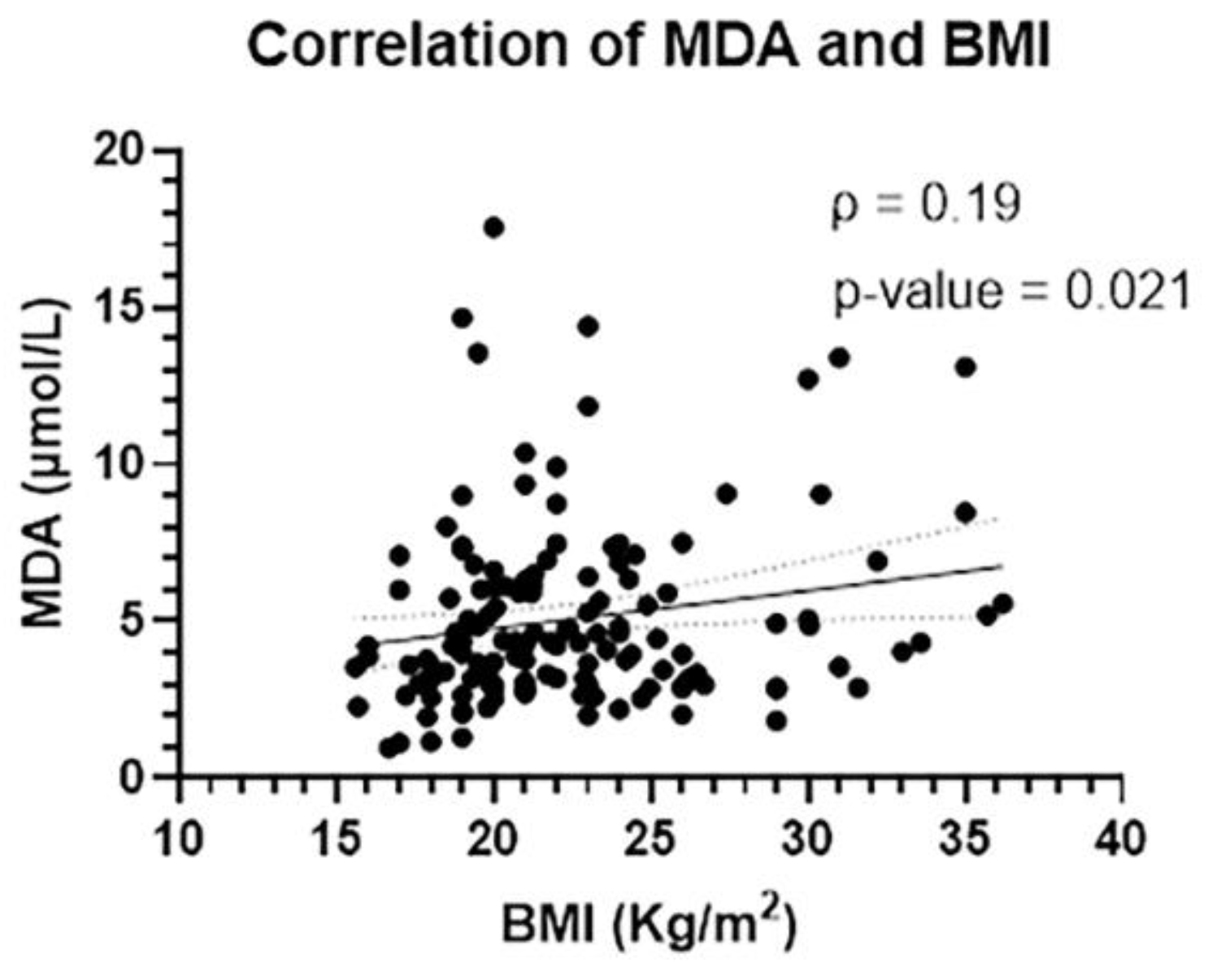

Table 1.
Demographic, clinical, and lifestyle characteristics of enrolled students.
| Parameters | Value |
|---|---|
| Demographic and clinical characteristics | |
| Total enrolled students (n) | 141 |
| Age (years) | 20.8±1.7 |
| Gender, n (%) | |
| Male | 38 (27.0) |
| Female | 103 (73.0) |
| Body mass index (kg/m²) | 21.2 (19.0–24.3) |
| Systolic blood pressure (mmHg) | 121 ± 14.4 |
| Diastolic blood pressure (mmHg) | 75 (70–82) |
| Waist circumference (cm) | 71 (66–80) |
| MDA (µmol/L) | 4.32 (3.12–6.14) |
| Lifestyle factors, n (%) | |
| High-sugar dietary intake (>24 g/day) | 103 (73.0) |
| High-sodium dietary intake (>2 g/day) | 64 (45.4) |
| High-fat dietary intake (>3-4 times/week) | 73 (51.8) |
| Inadequate fruit and vegetable intake | 104 (73.8) |
| Inadequate physical activity | 119 (84.4) |
| Poor sleep quality | 107 (75.9) |
| Smoking | 5 (3.5) |
| Alcohol consumption | 91 (64.5) |
Values are presented as mean ± SD for normally distributed and as median (IQR: 25th–75th percentile) for non-normally distributed variables. Normality was assessed using the Kolmogorov-Smirnov test (p < 0.05). Abbreviations: IQR, interquartile range; SD, standard deviation.
Table 2.
Reference intervals for plasma MDA (N=94).
| Biomarker | Mean±SD | Median (IQR) | P2.5 (90% CI) | P97.5 (90% CI) | Reference intervals |
|---|---|---|---|---|---|
| MDA (µmol/L) | 4.56±2.00 | 4.23 (3.14-6.07) | 1.16 (0.94–1.37) | 9.23 (8.75–9.80) | 1.16-9.23 |
The distribution of the data was found to be non-normal (p < 0.05, Kolmogorov-Smirnov test). Reference intervals were calculated according to the IFCC guidelines using a non-parametric method.
Table 3.
Association between lifestyle factors and high plasma MDA levels (≥75th percentile, cutoff = 6.07 µmol/L).
Table 3.
Association between lifestyle factors and high plasma MDA levels (≥75th percentile, cutoff = 6.07 µmol/L).
| Parameter | Total(N=141) | MDA <6.07n (%) | MDA ≥6.07n (%) | P-value | OR (95%CI) |
|---|---|---|---|---|---|
| Sex | 0.317 | 0.66 (0.29-1.48) | |||
| Male | 38 | 26 (68.4) | 12 (31.6) | ||
| Female | 103 | 79 (76.7) | 24 (23.3) | ||
| High sugar dietary intake (>24 g/day) | 0.013 | 3.83 (1.28–11.48) | |||
| No | 38 | 34 (89.5) | 4 (10.5) | ||
| Yes | 103 | 71 (68.9) | 32 (31.1) | ||
| High sodium dietary intake (>2 g/day) | 0.302 | 1.49 (0.70–3.16) | |||
| No | 77 | 60 (77.9) | 17 (22.1) | ||
| Yes | 64 | 45 (70.3) | 19 (29.7) | ||
| High fat dietary intake | 0.038 | 2.29 (1.04–5.02) | |||
| No (adequate intake) | 37 | 29 (78.4) | 8 (21.6) | ||
| Yes (inadequate) | 104 | 76 (73.1) | 28 (26.9) | ||
| Inadequate physical activity | 0.838 | 0.90 (0.33–2.48) | |||
| No | 119 | 89 (74.8) | 30 (25.2) | ||
| Yes | 22 | 16 (72.7) | 6 (27.3) | ||
| Current smoking | 0.072 | 4.68 (0.74–29.7) | |||
| No | 136 | 103 (75.7) | 33 (24.3) | ||
| Yes | 5 | 2 (40.0) | 3 (60.0) | ||
| Alcohol consumption | 0.925 | 0.97 (0.44–2.12) | |||
| No | 50 | 37 (74.0) | 13 (26.0) | ||
| Yes | 91 | 68 (74.7) | 23 (25.3) | ||
| Poor sleep quality | 0.295 | 1.61 (0.69–3.78) | |||
| No | 34 | 23 (67.6) | 11 (32.4) | ||
| Yes | 107 | 82 (76.6) | 25 (23.4) |
* Data are presented as n (%). P-values were calculated using the Chi-square test for categorical variables. The cutoff for "high" MDA levels was defined as the 75th percentile of the distribution (≥6.07 µmol/L). OR, odds ratio; CI, confidence interval; MDA, malondialdehyde. Odds ratios and 95% CI calculated for the exposure “Yes” vs. “No” (reference = “No”).
Table 4.
Correlation between plasma MDA levels and cardiometabolic parameters.
| Variable | MDA (µmol/L) | BMI (kg/m²) | WC (cm) | SBP (mmHg) | DBP (mmHg) |
|---|---|---|---|---|---|
| MDA (µmol/L) | 1.00 | 0.19 (0.021)* | 0.15 (0.076) | 0.05 (0.531) | 0.06 (0.502) |
| BMI (kg/m²) | 1.00 | 0.77 (<0.001)** | 0.33 (<0.001)** | 0.28 (0.001)** | |
| WC (cm) | 1.00 | 0.35 (<0.001)** | 0.24 (0.004)** | ||
| SBP (mmHg) | 1.00 | 0.43 (<0.001)** | |||
| DBP (mmHg) | 1.00 |
* Values are Spearman's rho (p-value). Abbreviations: MDA, malondialdehyde; BMI, body mass index; WC, waist circumference; SBP, systolic blood pressure; DBP, diastolic blood pressure. Note: Lower triangle of the symmetric matrix is shown; upper triangle (empty cells) is omitted for clarity.
Table 5.
Multiple logistic regression analysis of factors associated with elevated plasma MDA levels (≥75th percentile, cutoff = 6.07 µmol/L) among college students (N = 141).
Table 5.
Multiple logistic regression analysis of factors associated with elevated plasma MDA levels (≥75th percentile, cutoff = 6.07 µmol/L) among college students (N = 141).
| Variable | Adjusted OR | 95% CI | p-value |
|---|---|---|---|
| Age (per year) | 0.76 | 0.55–1.04 | 0.082 |
| Sex (male vs female) | 1.15 | 0.46–2.87 | 0.766 |
| BMI (per kg/m²) | 1.07 | 0.98–1.17 | 0.128 |
| High sugar intake (>24 g/day) (yes vs. no) | 3.42 | 1.08–10.87 | 0.036 |
| High-fat diet (yes vs no) | 2.00 | 0.87–4.61 | 0.104 |
* Abbreviations: OR, odds ratio; CI, confidence interval; MDA, malondialdehyde; BMI, body mass index. Model summary: Nagelkerke R² = 0.142; Hosmer–Lemeshow goodness of fit test p = 0.623. Variables were entered using the Enter method. Reference categories: female, no high sugar intake, no high fat diet. The dependent variable was elevated MDA (≥6.07 µmol/L, 75th percentile).
Disclaimer/Publisher’s Note: The statements, opinions and data contained in all publications are solely those of the individual author(s) and contributor(s) and not of MDPI and/or the editor(s). MDPI and/or the editor(s) disclaim responsibility for any injury to people or property resulting from any ideas, methods, instructions or products referred to in the content. |
© 2026 by the authors. Licensee MDPI, Basel, Switzerland. This article is an open access article distributed under the terms and conditions of the Creative Commons Attribution (CC BY) license (http://creativecommons.org/licenses/by/4.0/).
Copyright: This open access article is published under a Creative Commons CC BY 4.0 license, which permit the free download, distribution, and reuse, provided that the author and preprint are cited in any reuse.


