

Submitted:
15 June 2026
Posted:
16 June 2026
You are already at the latest version
Abstract
The development of bio-based hygiene products offers a sustainable approach to managing infectious topical pathogens while reducing dependence on synthetic antimicrobials. This study evaluated the antibacterial efficacy of soap formulated with Jatropha multifida leaf ethanolic extract (25%, 50%, and 75% v/v) against Staphylococcus aureus and Escherichia coli. Antibacterial activity was determined using the Kirby-Bauer disk diffusion method alongside positive and negative controls. All extract-infused soap formulations exhibited distinct, measurable zones of inhibition (ZOI) ranging from 16.33 mm to 17.67 mm for S. aureus and 16.33 mm to 18.00 mm for E. coli, consistently achieving an "Active" qualitative classification. A one-way Analysis of Variance (ANOVA) demonstrated highly significant differences across the entire dataset (p < 0.001). However, Tukey’s Honestly Significant Difference (HSD) post-hoc test revealed no statistically significant differences in antibacterial performance among the 25%, 50%, and 75% concentrations (p > 0.05). This indicates a performance plateau caused by agar diffusion limits or micellar entrapment within the soap base. J. multifida maintains antibacterial integrity within a soap matrix, offering a viable plant-based antiseptic alternative against S. aureus and E. coli. Formulating at a 25% concentration represents the optimal commercial choice, maximizing antimicrobial performance while minimizing raw material costs.
Keywords:
Jatropha multifida
; antibacterial soap
; Staphylococcus aureus
; Escherichia coli
; phytochemicals
1. Introduction
Microbial infections present a critical challenge to global public health, with Staphylococcus aureus and Escherichia coli identified as primary drivers of sepsis-related mortality [1]. This burden is exacerbated by rising bacterial resistance to conventional antibiotics, which has intensified the search for novel antimicrobial compounds derived from natural matrices [2,3]. Within this context, medicinal plants serve as a vital repository of pharmacologically active natural products capable of treating systemic ailments [4]. Furthermore, these botanical resources function as effective antimicrobial agents for integration into natural hygiene products [5]. Ultimately, prioritizing rigorous sanitation practices across diverse sectors remains a fundamental intervention to mitigate the global transmission and burden of infectious diseases [6].
To address this need for effective microbial agents, attention has turned to botanical candidates with potential therapeutic properties. Among these, Jatropha multifida L. (Coral Bush), traditionally used for wound healing, contains phytochemicals like flavonoids, tannins, and saponins with known antibacterial properties [7,8]. Previous phytochemical studies on the plants within the genus Jatropha have revealed a broad range of isolated secondary metabolites, such as non-conventional coumarino-lignans, alkaloids, coumarins, flavonoids, cyclic peptides, steroids, terpenoids [5], as well as specific isolates including multidione, multifidone, multifolone, and multifidol glucoside [9]. The antibacterial and anti-inflammatory activities exhibited by these compounds are also present in J. multifida. This shared profile validates the plant's traditional use in wound healing and highlights its potential for combating surface infections [7].
By harnessing these protective properties against surface infections, the plant can be integrated into daily preventive care. Preventing infectious diseases proactively relies heavily on practical hygiene measures, such as regular bathing and frequent handwashing. Because plant-based soaps provide an affordable balance of cleansing and therapeutic properties [10], utilizing the recognized potential of J. multifida L. to formulate medicinal hygiene products is a highly promising avenue of research.; hence, this study. To fully understand this potential, this study conducted a qualitative phytochemical screening. It also evaluated the antibacterial efficacy of J. multifida L. leaf extract soap against S. aureus and E. coli. Ultimately, these findings aim to provide concrete scientific evidence for its antimicrobial potential, thereby supporting the development of effective, plant-based natural hygiene products.
2. Materials and Methods
2.1. Research Design
This study utilized an experimental, completely randomized design (CRD) to evaluate the in vitro antimicrobial activity of the plant extract. The independent variable was the treatment group, which consisted of five distinct formulations: 25%, 50%, and 75% concentrations of the plant extract, a positive control, and a negative control. A commercial antibacterial soap was used as the positive control (T+), while untreated soap formulation was utilized as the negative control (T-).
The dependent variable was the diameter of the zone of inhibition measured in millimeters (mm). All experimental treatments and controls were performed in triplicate (N = 15 total observations) to ensure reproducibility and statistical validity.
2.2. Collection and Authentication of Plant Materials
Fresh J. multifida leaves of varying maturities and sizes were harvested from home gardens in Conner, Apayao, Philippines. Taxonomic identification and botanical authentication of the collected plant specimens were officially performed at the Plant Quarantine Laboratory of the Department of Agriculture in Region 2, Cagayan, Philippines.
2.3. Preparation and Ethanolic Extraction of J. multifida Leaves
The harvested leaves were meticulously sorted to isolate healthy, undamaged tissues. To eliminate residual dust and debris without compromising surface trichomes or causing mechanical cell damage, the leaves were gently washed with distilled water without squeezing. The cleaned leaves were subsequently shade-dried at room temperature (30–37 °C) for 72 h. The dried leaves were then pulverized by batch into a coarse powder using a high-speed household blender.
A total of 500 g of ground J. multifida leaves was processed for extraction using 50 g batches to maintain a 1:10 (w/v) sample-to-solvent ratio. For each batch, 50 g of leaf powder was macerated in 500 mL of 80% ethanol for 48 h at room temperature, followed by vacuum filtration. To ensure exhaustive recovery of secondary metabolites, the remaining plant residue (marc) was re-macerated three successive times using 500 mL of fresh solvent per cycle. The resulting ethanolic filtrates were consolidated in a 2 L Erlenmeyer flask and gently swirled for 2 min. The extract was then concentrated via rotary evaporation in three separate 500 mL batches until a dense slurry was formed.
For the first batch, the slurry was dissolved in appropriate volumes of 10% dimethyl sulfoxide (DMSO) to prepare 100 mL working volumes for each of the three test concentrations of 25%, 50%, and 75% (w/v). Quantitative assays targeting flavonoids, tannins, and saponins were systematically carried out in accordance with established protocols [11].
For the remaining batches, the slurry was thinly spread on 25 mL Petri dishes. Each dish was covered in tinfoil and needle-pricked to create 16 tiny ventilation holes. The Petri dishes were placed in a running fume hood for 48 h for further drying. The crude extracts in the Petri dishes were set aside for use in the J. multifida-infused soap.
2.4. Formulation of Extract-Infused Soaps and Controls
2.4.1. Preparation of Extract Treatments
To prepare the treatments, 25 g of J. multifida extract was divided into three equal portions of 8.33 g. Each portion was dissolved in olive oil using a water bath maintained at 40 °C to achieve three distinct concentration gradients. Treatment 1 (25%) consisted of 8.33 g of extract dissolved in 25.0 g of olive oil. Treatment 2 (50%) consisted of 8.33 g of extract dissolved in 8.3 g of olive oil. Treatment (75%) 8.33 g of extract dissolved in 2.8 g of olive oil.
2.4.2. Soap Base Melting and Blending
Four separate batches, each consisting of 275 g of diced melt-and-pour soap base, were liquefied in a water bath maintained at 60 °C. Once fully melted, the additives were incorporated into the soap bases under continuous, gentle stirring to ensure uniform distribution. For the control batch, 3 mL olive oil (containing no extract) was added intermittently to the first soap base batch. For the treatment batches, 3 mL of the 25%, 50%, and 75% J. multifida oil mixtures were added intermittently to the three remaining soap base batches, respectively.
All formulated soap mixtures were subsequently poured into molds and left undisturbed for 5 days at a room temperature of 20 °C until complete solidification was achieved.
2.5. Antimicrobial Susceptibility Testing via Disk Diffusion
2.5.1. Preparation of Soap Solutions (Treatments)
To ensure the soap samples diffused efficiently through the agar matrix, a standardized 10% weight-by-volume (w/v) solution was prepared for each group.
Five distinct groups were analyzed: the three treatment groups (25%, 50%, and 75% J. multifida extract infusions), the positive control (standard commercial bath soap containing sodium palmate, sodium palm kernelate, water, glycerin, fragrance, palm kernel acid, sodium chloride, titanium dioxide, zinc pyrithione, tetrasodium etidronate, zinc sulfate, tetrasodium EDTA, and pentaerythrityl tetra-di-t-butyl hydroxyhydrocinnamate) and the negative control (untreated soap).
For each group, 10.0 g of grated soap flakes was dissolved in 90.0 mL of sterile distilled water under low thermal agitation (35–40 °C) to yield a uniform 10% (w/v) stock solution.
2.5.2. Inoculum Standardization and Inoculation
Antibacterial activity was assessed using the modified Kirby-Bauer disk diffusion method [12,13,14] against Staphylococcus aureus and Escherichia coli.
The target bacterial strains were suspended in sterile normal saline or nutrient broth. The turbidity was adjusted to match a 0.5 McFarland turbidity standard, establishing a microbial concentration of approximately 1 x 10⁸) to 2 x 10⁸ CFU/mL.
A sterile cotton swab was dipped into the standardized microbial suspension. The inoculum was spread evenly across the surface of Mueller-Hinton Agar (MHA) plates in three dimensions to produce a uniform, confluent bacterial lawn. The inoculated plates were left to dry for 5 min at room temperature.
2.5.3. Disk Impregnation and Application
Sterile blank filter paper disks (6 mm diameter) were placed into individual sterile vessels. Each disk was impregnated by pipetting exactly 20 µL of the respective 10% soap solution onto the paper, allowing complete saturation. Using sterile forceps, the treated disks were placed firmly onto respective seeded MHA plates. Disks were spaced at least 24 mm apart and kept well away from the plate margins to prevent overlapping zones of inhibition.
2.5.4. Incubation and Measurement
The prepared Petri dishes were inverted and placed in an incubator maintained at 37 °C for 24 h. Following incubation, the plates were inspected for clear, circular areas around the disks where microbial growth was completely arrested. The diameter of the Zones of Inhibition (ZOI) [11] was measured to the nearest whole millimeter using a calibrated digital caliper ruler against a non-reflective black background.
2.6. Statistical Analysis
3. Results
3.1. Phytochemical Screening
Phytochemical screening of the 100 mL pure ethanolic extract of J. multifida revealed the presence of major secondary metabolites. Qualitative analysis confirmed the positive detection of flavonoids, tannins, and saponins (Table 1).
3.2. Antibacterial activity of J. multifida L. (Coral Bush) leaf extract-based soap against S. aureus
The antibacterial activity of the plant leaf extract-based soap was evaluated quantitatively by measuring the zones of inhibition (ZOI) in millimeters across three independent replicates (R1, R2, and R3). All tested concentrations exhibited "active" antibacterial properties against S. aureus. The raw data, calculated means, and qualitative interpretations for the varying concentrations and control groups against S. aureus are presented in Table 2 As shown in Table 2, all experimental extract concentrations (25%, 50%, and 75%) exhibited measurable zones of inhibition, with mean values ranging from 16.33 mm to 17.67 mm. These treatments consistently fell under the qualitative category of "Active." The positive control produced the highest clearance zone with a mean diameter of 34.67 mm, interpreted as "Very Active." In contrast, the negative control exhibited a constant measurement of 6.00 mm across all three replicates, which corresponds to the qualitative assessment of "Inactive."
A one-way analysis of variance (ANOVA) at a significance level of α = 0.05 was conducted to determine if the concentration of the extract influenced its antimicrobial activity in the soap formulations, as measured by the zone of inhibition (Table 3).
The independent variable consisted of five groups (treatments) : 25% extract, 50% extract, 75% extract, a positive control, and a negative control. The assumption of normality was met, and the assumption of homogeneity of variances was assumed valid for this analysis. The one-way ANOVA revealed a statistically significant difference in the mean zone of inhibition across the treatment groups, F(4, 10) = 154.63, p < 0.001.
In Figure 1, post hoc comparisons using Tukey’s Honestly Significant Difference (HSD) test indicated that all three extract concentrations of 25% (M = 16.33, SD = 1.15), 50% (M = 16.67, SD = 2.08), and 75% (M = 17.67, SD = 1.53) produced significantly larger inhibition zones than the negative control (M = 6.00, SD = 0.00), p < 0 .001. However, there were no statistically significant differences among the extract groups themselves: 25% versus 50% (p = 0.99), 50% versus 75% (p = 0.92), and 25% versus 75% (p = 0.77).
The positive control (M = 34.67, SD = 1.53) demonstrated a significantly larger zone of inhibition than all extract concentrations and the negative control, p < 0.001. These results suggest that while the extract-based soap formulation possesses clear antimicrobial properties, increasing the concentration from 25% to 75% does not yield a statistically meaningful increase in efficacy. The error bars for the 25%, 50%, and 75% extracts heavily overlap on the Y-axis that visually reinforces the ANOVA/Tukey syntax found. While the extracts are highly functional antibacterials compared to the negative control, increasing the concentration from 25% to 75% did not yield a statistically significant boost in performance for this specific trial.
3.3. Antibacterial activity of J. multifida L. (Coral Bush) leaf extract-based soap against E. coli
The antibacterial efficacy of the J. multifida plant leaf extract-based soap against E. coli was quantitatively evaluated by measuring the zones of inhibition (ZOI) in millimeters across three independent replicates (R1, R2, and R3). The raw data, calculated treatment means, and corresponding qualitative interpretations for the varying concentrations and control groups are presented in Table 4.
The experimental data reveal that all tested concentrations of the crude leaf extract (25%, 50%, and 75%) exhibited distinct and measurable zones of inhibition against the test organism. The mean clearance zones grew larger as the extract concentration increased, starting at 16.33 mm for the 25% concentration, rising to 17.33 mm for the 50% concentration, and reaching a maximum of 18.00 mm at the 75% concentration. Across all replicates, all three plant extract treatments consistently maintained a qualitative classification of "Active."
The control groups successfully validated the experimental parameters of the bioassay. The positive control produced a pronounced, broad zone of inhibition with a mean diameter of 33.00 mm, which falls under the qualitative classification of "Very Active." Conversely, the negative control yielded a completely uniform measurement of 6.00 mm across all three replicates, which is qualitatively interpreted as "Inactive." This constant 6.00 mm value corresponds directly to the physical diameter of the paper disc or well boring tool used in the assay, denoting an actual net inhibition zone of 0 mm.
To determine if the differences in the mean zones of inhibition across the various treatment groups and controls were statistically significant, a one-way Analysis of Variance (ANOVA) was performed at a significance level of α = 0.05. The resulting ANOVA summary is presented in Table 5.
The ANOVA results reveal a highly significant difference among the mean zones of inhibition of the tested groups, with an F-value of 161.02 and a p-value less than 0.001 (p < 0.001). Because the calculated p-value is substantially lower than the standard significance threshold α = 0.05), the null hypothesis which posits that all treatment means are equal is confidently rejected. This statistical outcome confirms that variations in the concentration of the crude leaf extract, alongside the controls, exert a highly significant effect on the size of the zones of inhibition. The minimal variation observed within the treatment replicates (SS = 17.33, MS = 1.73) further highlights the reliability and consistency of the experimental trials.
In Figure 2, pairwise comparisons utilizing Tukey’s Honestly Significant Difference (HSD) post hoc test revealed that all three extract concentrations of 25% (M = 16.33, SD = 1.53), 50% (M = 17.33, SD = 2.08), and 75% (M = 18.00, SD = 1.00) produced significantly wider zones of inhibition than the negative control (M = 6.00, SD = 0.00), p < 0.001.
However, no statistically significant differences were observed among the extract concentrations specifically in 25% versus 50% (p = 0.87), 50% versus 75% (p = 0.96), and 25% versus 75% (p = 0.55). Additionally, the positive control (M = 33.00, SD = 1.00) demonstrated a significantly larger inhibition zone than all three extract concentrations and the negative control (p < 0.001). These findings indicate that while the extract possesses robust antimicrobial properties compared to a negative baseline, increasing the concentration beyond 25% does not result in a statistically meaningful increase in performance.
4. Discussion
4.1. Antibacterial Efficacy
The bioassay results demonstrate that the soap formulations integrated with J. multifida L. (Coral Bush) leaf extract possess robust antibacterial properties. Notably, all experimental concentrations (25%, 50%, and 75%) consistently achieved an "Active" qualitative interpretation against both S. aureus (Gram-positive) and E. coli (Gram-negative) bacteria. This broad-spectrum activity highlights the potential of J. multifida leaf extract as a functional, bioactive ingredient in antimicrobial hygiene products.
The distinct clearance zones observed in the treatment groups can be attributed to the rich profile of secondary metabolites typical of the Jatropha genus [17]. Phytochemical screening confirmed that J. multifida leaves contain potent components, including flavonoids, tannins, and saponins (Table 1). Flavonoids are molecules known to disrupt bacterial cell walls and precipitate cytoplasmic proteins [18]. Tannins orm complex linkages with extracellular, soluble proteins and bacterial cell walls, thereby inactivating essential microbial enzymes [19]. Saponins function as surface-active agents that increase the permeability of cell membranes, causing the leakage of critical internal metabolites and subsequent cell lysis [20]. The successful expression of these mechanisms within a soap matrix indicates that the active phytochemical components remained chemically stable and bioavailable, surviving the saponification or blending process during soap preparation.
4.2. The Dynamics of Concentration and Diffusion Limits
A critical finding in this study is that while all extract-based soaps significantly outperformed the negative control (p < 0.001), increasing the extract concentration from 25% to 75% did not yield a statistically meaningful increase in antibacterial performance. For S. aureus, the mean zones ranged from 16.33 to 17.67 mm (Tukey's HSD p = 0.77), and for E. coli, they ranged from 16.33 to 18.00 mm (Tukey's HSD p = 0.55). This lack of statistical differentiation between concentrations suggests a plateau effect, which can be interpreted through two primary scientific phenomena: agar diffusion thresholds [21] and soap base entrapment [22].
Zone sizes in agar diffusion assays depend strictly on phytochemical molecular size and solubility. At a 25% concentration, the agar matrix may have reached saturation, meaning that introducing higher concentrations of 50% and 75% did not expand the inhibition radius or accelerate diffusion. Moreover, the fatty acid salts that form dense micellar networks in saponified matrices can entrap excess lipophilic secondary metabolites, such as specific flavonoids or terpenoids [22]. The increased extract fractions in the 50% and 75% formulations may have been entrapped within the soap matrices, preventing their free release into the aqueous agar testing medium. From an industrial and economic perspective, this plateau is highly advantageous. Because the 25% extract concentration achieves performance parity with the 75% formulation, it represents the most cost-effective and resource-efficient choice for scale-up. This optimization minimizes raw material consumption without compromising product efficacy.
4.3. Comparative Efficacy Against Gram-Positive and Gram-Negative Pathogens
The J. multifida extract-infused soaps demonstrated remarkably similar inhibitory thresholds against both S. aureus (16.33 to 17.67 mm) and E. coli (16.33 to 18.00 mm), corroborating findings from similar studies [23,24]. This outcome is significant considering the structural differences between these two bacterial groups. Gram-positive bacteria (S. aureus) possess a thick, porous peptidoglycan cell wall that is typically highly receptive to plant-derived antimicrobials [25]. Conversely, Gram-negative bacteria (E. coli) feature a complex outer lipid membrane acting as an additional selective barrier that often restricts the influx of hydrophobic foreign compounds [25,26].
The ability of the extract to bypass this complex outer membrane in E. coli and match its performance against S. aureus indicates the presence of highly permeable or amphiphilic agents within the J. multifida leaf matrix. Saponins, for instance, naturally lower surface tension and interact fluidly with lipid bilayers [20]. This structural disruption likely destabilizes the Gram-negative outer membrane, clearing an entry path for companion metabolites like tannins and flavonoids to execute their intracellular mechanisms.
4.4. Validation of the Bioassay Parameters
Finally, the experimental infrastructure was strictly verified by the control groups. The positive control exhibited prominent mean zones of inhibition (34.67 mm for S. aureus and 33.00 mm for E. coli), confirming that both test strains were fully viable and highly susceptible to standard antibiotics. Remarkably, the negative control showed a completely flat, uniform baseline measurement of 6.00 mm across all replicates, which reflects the physical borders of the disc itself. This net-zero zone (0 mm of true clearance) proves that the base soap ingredients and the solvents used did not possess independent antimicrobial traits. Therefore, all antibacterial performance recorded across the 25%, 50%, and 75% groups is attributed to the active phytochemical components of the J. multifida leaf extract.
5. Conclusions
The study successfully demonstrates that soap formulations integrated with J. multifida L. (Coral Bush) leaf extract possess robust, broad-spectrum antibacterial activity against both S. aureus and E. coli. All experimental treatment groups (25%, 50%, and 75% extract concentrations) consistently achieved an "Active" qualitative status, effectively validating the stability and bioavailability of the plant’s secondary metabolites—such as flavonoids, tannins, and saponins—within the saponified soap matrix. This performance plateau suggests that the bioassay system reaches a diffusion and saturation threshold at a 25% inclusion rate. Furthermore, the extract demonstrated remarkable equivalence in inhibiting both Gram-positive and Gram-negative pathways, indicating that its bioactive constituents can effectively destabilize the restrictive outer lipid membrane of E. coli. From a practical and commercial formulation perspective, the 25% extract concentration represents the optimal formulation choice. It delivers maximum antibacterial performance at parity with higher concentrations while minimizing raw material usage, maximizing resource efficiency, and reducing production costs. Ultimately, J. multifida leaf extract holds strong potential as a functional, bio-based ingredient for the development of competitive antimicrobial hygiene products.
Author Contributions
Conceptualization, software, validation, formal analysis, resources, data curation, writing, supervision, funding acquisition, project administration, A.A.; methodology, investigation, writing—original draft preparation, A.A and T.G. All authors have read and agreed to the published version of the manuscript.
Funding
This research was funded by Apayao State College.
Institutional Review Board Statement
Not applicable as this study did not involve humans or animals.
Informed Consent Statement
Not applicable.
Data Availability Statement
The raw data supporting the conclusions of this article is already in the manuscript.
Acknowledgments
The authors would like to thank Apayao State College for the administrative and logistics support in the conduct of this study. During the preparation of this manuscript, the authors used Google Gemini for the purposes of verifying citation and reference formats, composition and grammar. The authors have reviewed and edited the output and take full responsibility for the content of this publication.
Conflicts of Interest
The authors declare no conflicts of interest.
Abbreviations
The following abbreviations are used in this manuscript:
| EDTA | Ethylenediaminetetraacetic acid |
| g | Gram |
| h | Hour |
| g | Gram |
| min | Minutes |
| mL | Milliliter |
References
- 1. GBD 2019 Antimicrobial Resistance Collaborators. Global mortality associated with 33 bacterial pathogens in 2019: a systematic analysis for the Global Burden of Disease Study 2019. Lancet doi.org. 2022, 400, 2221–2248. [PubMed]
- Ventola, C.L. The antibiotic resistance crisis: Part 1: Causes and threats. P T 2015, 40, 277–283. [Google Scholar] [PubMed]
- Hosseinzadeh, S.; Jafarikukhdan, A.; Hosseini, A.; Armand, R. The application of medicinal plants in traditional and modern medicine: a review of Thymus vulgaris. Int. J. Clin. Med. doi.org. 2015, 6, 635–644. [Google Scholar]
- Boy, H.I.A.; Rutilla, A.J.H.; Santos, K.A.; Ty, A.M.T.; Yu, A.I.; Mahboob, T.; Tang, L.Y.; Nissapatorn, V.; Galba, B.; de Lourdes Pereira, M.; et al. Recommended medicinal plants as source of natural products: A review. Digit. Chin. Med. 2018, 1, 131–142. [Google Scholar] [CrossRef]
- Cowan, M.M. Plant products as antimicrobial agents. Clin. Microbiol. Rev. 2009, 12, 564–582. [Google Scholar]
- Lai, Z.F.; Kaur, S. Home hygiene and prevention of infections. Asia Pac. J. Health Manag. 2020, 6 15, 79–84. [Google Scholar]
- Anani, K.; Adjrah, Y.; Améyapoh, Y.; Karou, S.D.; Agbonon, A.; de Souza, C.; Gbeassor, M. Antimicrobial, anti-inflammatory and antioxidant activities of Jatropha multifida L. (Euphorbiaceae). Pharmacogn. Res. doi.org. 2016, 8, 142–146. [Google Scholar] [CrossRef] [PubMed]
- Aiyelaagbe, O.O.; Oguntuase, B.J.; Arimah, B.D.; Adeniyi, B.A. The antimicrobial activity of Jatropha multifida extracts and chromatographic fractions against sexually transmitted infections. J. Med. Sci. doi.org. 2008, 8, 143–147. [Google Scholar] [CrossRef]
- Igbeneghu, O.A. The antimicrobial assessment of some Nigerian herbal soap. Afr. J. Tradit. Complement. Altern. Med. doi.org. 2013, 10, 513–518. [Google Scholar] [CrossRef] [PubMed]
- Carvalho, C.; Mariano, L.V.; Negrão, V.S.; Gonçalves, P.; Marcucci, C. Phenols, flavonoids and antioxidant activity of Jatropha multifida L. collected in Pindamonhangaba, Sao Paulo State, Brazil. J. Anal. Pharm. Res. doi.org. 2018, 7, 581–584. [Google Scholar] [CrossRef]
- Guevara, B.Q. (Ed.) A Guidebook to Plant Screening: Phytochemical and Biological; University of Santo Tomas Publishing House: Manila, Philippines, 2005. [Google Scholar]
- Bauer, A.W.; Kirby, W.M.; Sherris, J.C.; Turck, M. Antibiotic susceptibility testing by a standardized single disk method. Am. J. Clin. Pathol. 1966, 12 45, 493–496. [Google Scholar] [CrossRef]
- Balouiri, M.; Sadiki, M.; Ibnsouda, S.K. Methods for in vitro evaluating antimicrobial activity: A review. J. Pharm. Anal. 2016, 6, 71–79. [Google Scholar] [CrossRef] [PubMed]
- Clinical and Laboratory Standards Institute (CLSI). Performance Standards for Antimicrobial Susceptibility Testing. In CLSI Supplement M100, 31st ed.; CLSI: Wayne, PA, USA, 2021; p. 14. [Google Scholar]
- Cohen, J. Statistical Power Analysis for the Behavioral Sciences, 2nd ed.; Lawrence Erlbaum Associates: Hillsdale, NJ, USA, 1988. [Google Scholar]
- Kim, H.Y. Statistical notes for clinical researchers: post-hoc multiple comparisons. Restor. Dent. Endod. doi.org. 2015, 16 40, 172–176. [Google Scholar]
- Cavalcante, N.B.; Santos, A.D.C.; Almeida, J.R.G.D. The genus Jatropha (Euphorbiaceae): A review on secondary chemical metabolites and biological aspects. Chem. Biol. Interact. 2020, 17 318, 108976. [Google Scholar] [CrossRef] [PubMed]
- Liu, Y.; Zhu, J.; Liu, Z.; Zhi, Y.; Mei, C.; Wang, H. Flavonoids as promising natural compounds for combating bacterial infections. Int. J. Mol. Sci. 2025, 18 26, 2455. [Google Scholar] [CrossRef] [PubMed]
- Govindarajan, R.K.; Revathi, S.; Rameshkumar, N.; Krishnan, M.; Kayalvizhi, N. Microbial tannase: Current perspectives and biotechnological advances. Biocatal. Agric. Biotechnol. 2016, 19 6, 168–175. [Google Scholar] [CrossRef]
- Shakeel, A.; Noor, J.J.; Jan, U.; Gul, A.; Handoo, Z.; Ashraf, N. Saponins, the unexplored secondary metabolites in plant defense: opportunities in integrated pest management. Plants 2025, 20 14, 861. [Google Scholar]
- Flanagan, J.N.; Steck, T.R. The relationship between agar thickness and antimicrobial susceptibility testing. Indian J. Microbiol. 2017, 21 57, 503–506. [Google Scholar] [CrossRef] [PubMed]
- Sharma, M.; Sharma, V.; Majumdar, D.K. Entrapment of \(\alpha \)-amylase in agar beads for biocatalysis of macromolecular substrate. Int. Sch. Res. Not. doi.org. 2014, 2014*, 936129. [Google Scholar]
- Gerald, E.; Alfonse, O. A comparative study of the effects of Jatropha multifida and Euphorbia hirta and their mixture on pathogenic growth rate. Eng. Proc. 2023, 37, 63. [Google Scholar] [CrossRef]
- Ongtengco, D.C. The in vitro antibacterial activity of Jatropha multifida Linn. latex against common bacterial wound isolates. Acta Manil. 1992, 24. 40, 25–28. [Google Scholar]
- Sun, J.; Rutherford, S.T.; Silhavy, T.J.; Huang, K.C. Physical properties of the bacterial outer membrane. Nat. Rev. Microbiol. doi.org. 2022, 25 20, 236–248. [Google Scholar]
- Gutsmann, T.; Seydel, U. Impact of the glycostructure of amphiphilic membrane components on the function of the outer membrane of Gram-negative bacteria as a matrix for incorporated channels and a target for antimicrobial peptides or proteins. Eur. J. Cell Biol. 2010, 89, 11–23. [Google Scholar] [CrossRef] [PubMed]
Figure 1.
Mean zone of inhibition across treatment groups for antibacterial activity of J. multifida soap formulations against S. aureus. Bars represent mean values (n = 3). Error bars indicate ± 1 standard deviation. Columns sharing lowercase letter superscripts (a) do not differ significantly at p > 0.05 based on Tukey's Honestly Significant Difference (HSD) test.
Figure 1.
Mean zone of inhibition across treatment groups for antibacterial activity of J. multifida soap formulations against S. aureus. Bars represent mean values (n = 3). Error bars indicate ± 1 standard deviation. Columns sharing lowercase letter superscripts (a) do not differ significantly at p > 0.05 based on Tukey's Honestly Significant Difference (HSD) test.
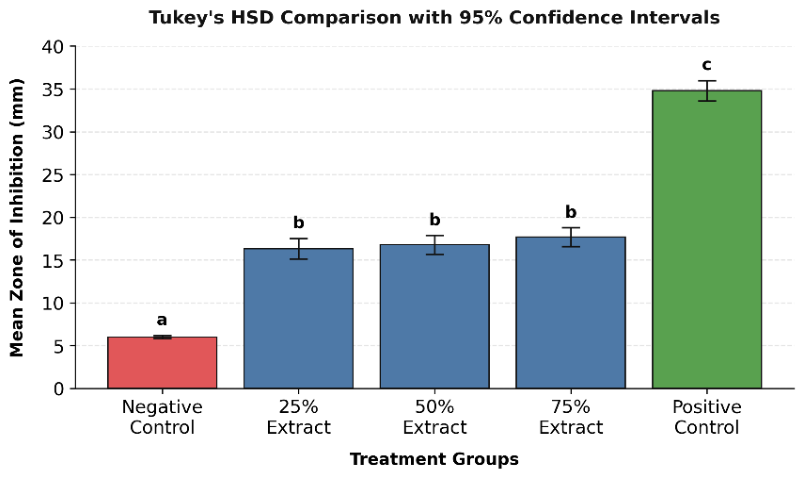
Figure 2.
Mean zone of inhibition across treatment groups for antibacterial activity of J. multifida soap formulations against E. coli. Bars represent mean values (n = 3). Error bars indicate ± 1 standard deviation. Columns sharing lowercase letter superscripts (a) do not differ significantly at p > 0.05 based on Tukey's Honestly Significant Difference (HSD) test.
Figure 2.
Mean zone of inhibition across treatment groups for antibacterial activity of J. multifida soap formulations against E. coli. Bars represent mean values (n = 3). Error bars indicate ± 1 standard deviation. Columns sharing lowercase letter superscripts (a) do not differ significantly at p > 0.05 based on Tukey's Honestly Significant Difference (HSD) test.
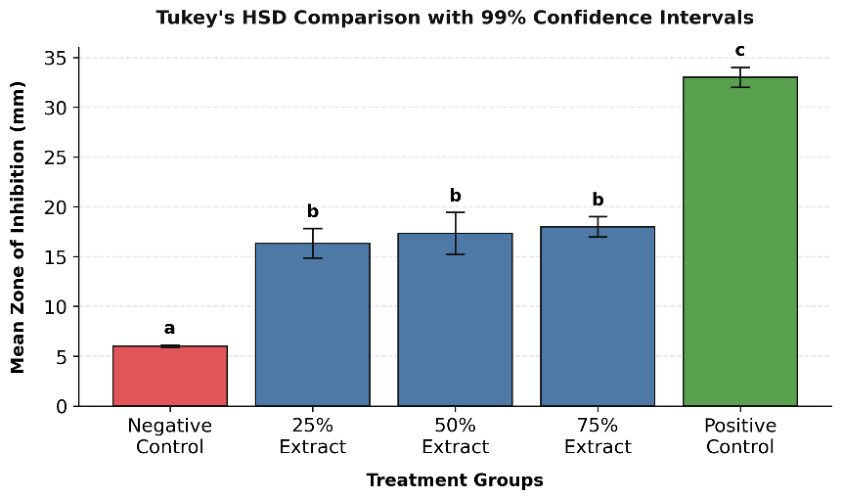

Table 1.
Phytochemical screening profile of J. multifida extract.
| Sample Description |
Parameters | Result | Method Used |
|---|---|---|---|
| 100 % J. multifida ethanolic extract | Flavonoids | Positive (+) | Guevarra (2025) |
| Tannins | Positive (+) | ||
| Saponins | Positive (+) |
Table 2.
Antibacterial activity of J. multifida soap formulations against S. aureus (mean ZOI in mm).
Table 2.
Antibacterial activity of J. multifida soap formulations against S. aureus (mean ZOI in mm).
| Sample | R1 | R2 | R3 | Mean | Interpretation |
|---|---|---|---|---|---|
| 25% Extract | 15 | 17 | 17 | 16.33 | Active |
| 50% Extract | 16 | 15 | 19 | 16.67 | Active |
| 75% Extract | 19 | 18 | 16 | 17.67 | Active |
| Positive Control | 36 | 35 | 33 | 34.67 | Very Active |
| Negative Control | 6 | 6 | 6 | 6.00 | Inactive |
Note: R1, R2, R3: replicates; SD: standard deviation. Qualitative scale: inactive (< 10 mm), active (10–19 mm), very active (> 19 mm).
Table 3.
One-Way ANOVA result for antibacterial activity of J. multifida soap formulations against S. aureus.
Table 3.
One-Way ANOVA result for antibacterial activity of J. multifida soap formulations against S. aureus.
| Source | SS | Df | MS | F | p-value |
|---|---|---|---|---|---|
| Between Groups | 1278.27 | 4 | 319.57 | 154.63 | < 0.001 |
| Within Groups | 20.67 | 10 | 2.07 | ||
| Total | 1298.94 | 14 | |||
| Source | SS | Df | MS | F | p-value |
| Between Groups | 1278.27 | 4 | 319.57 | 154.63 | < 0.001 |
| Within Groups | 20.67 | 10 | 2.07 | ||
| Total | 1298.94 | 14 |
Note: SS: sum of squares; df: degrees of freedom; MS: mean square; F: Fisher's F-ratio. F(4, 10) = 154.63, p < 0.001. The variance indicates a highly statistically significant difference in the zones of inhibition across the treatment groups.
Table 4.
Antibacterial activity J. multifida soap formulations against E. coli (mean ZOI in mm).
| Sample | R1 | R2 | R3 | Mean | Interpretation |
|---|---|---|---|---|---|
| 25% Extract | 16 | 18 | 15 | 16.33 | Active |
| 50% Extract | 18 | 15 | 19 | 17.33 | Active |
| 75% Extract | 18 | 19 | 17 | 18.00 | Active |
| Positive Control | 34 | 33 | 32 | 33.00 | Very Active |
| Negative Control | 6 | 6 | 6 | 6.00 | Inactive |
Note:R1, R2, R3: replicates; SD: standard deviation. Qualitative scale: inactive (< 10 mm), active (10–19 mm), very active (> 19 mm).
Table 5.
One-Way ANOVA result for antibacterial activity of J. multifida soap formulations against E. coli.
Table 5.
One-Way ANOVA result for antibacterial activity of J. multifida soap formulations against E. coli.
| Source | SS | Df | MS | F | p-value |
|---|---|---|---|---|---|
| Between Groups | 1116.40 | 4 | 279.10 | 161.02 | < 0.001 |
| Within Groups | 17.33 | 10 | 1.73 | ||
| Total | 1133.73 | 14 |
Note: SS: sum of squares; df: degrees of freedom; MS: mean square; F: Fisher's F-ratio. F(4, 10) = 161.02, p < 0.001. The variance indicates a highly statistically significant difference in the zones of inhibition across the treatment groups.
Disclaimer/Publisher’s Note: The statements, opinions and data contained in all publications are solely those of the individual author(s) and contributor(s) and not of MDPI and/or the editor(s). MDPI and/or the editor(s) disclaim responsibility for any injury to people or property resulting from any ideas, methods, instructions or products referred to in the content. |
© 2026 by the authors. Licensee MDPI, Basel, Switzerland. This article is an open access article distributed under the terms and conditions of the Creative Commons Attribution (CC BY) license (http://creativecommons.org/licenses/by/4.0/).
Copyright: This open access article is published under a Creative Commons CC BY 4.0 license, which permit the free download, distribution, and reuse, provided that the author and preprint are cited in any reuse.


