
Submitted:
15 June 2026
Posted:
16 June 2026
You are already at the latest version
Abstract
Modern higher education institutions increasingly rely on interconnected digital platforms, including Learning Management Systems (LMS), digital libraries, academic portals, and human resource information systems, creating significant challenges in user authentication management. This study aimed to design and evaluate an Intelligent Single Sign-On (SSO) Framework based on OAuth 2.0/OpenID Connect (OIDC) within a simulated portal ecosystem reflecting Universitas Negeri Medan (UNIMED). A synthetic simulation was conducted using 180 user scenarios representing students (71.1%), lecturers (17.2%), and administrative staff (11.7%) from nine academic units. The proposed framework integrated OAuth 2.0/OIDC protocols with risk-based adaptive authentication and Role-Based Access Control (RBAC). The simulation results indicated a potential 72.3% reduction in login time, from 48.95 seconds to 13.54 seconds, an increase in authentication success rate from 83.75% to 94.14%, and a decrease in login failures from 3.38 to 0.85 per month. The System Usability Scale (SUS) score improved from 66.21, categorized as marginal, to 85.99, categorized as excellent, with 61.7% of user scenarios reaching the highest category under the post-SSO condition. These findings suggest that the proposed OAuth 2.0/OIDC-based framework provides a strong foundation for improving secure, efficient, and user-centered authentication in higher education institutions.
Keywords:
adaptive authentication
; role-based access control
; higher education
; digital identity management
; user authentication
; system usability scale
; academic information systems
1. Introduction
The rapid digital transformation taking place in higher education has led to the proliferation of web-based platforms that support various academic and administrative functions. At Universitas Negeri Medan (UNIMED), users, including students, lecturers, and administrative staff, are required to authenticate separately on each available platform, such as SIAKAD, SIPDA/LMS, digital libraries, academic portals, and institutional email. This situation creates a significant cognitive burden and introduces security gaps that cannot be overlooked.
The phenomenon of password fatigue, which refers to fatigue caused by managing multiple passwords, has long been identified as a major source of security vulnerability in information systems [1,2]. Users who must manage many credential combinations tend to choose weak passwords, reuse the same passwords across multiple platforms, or store passwords in insecure ways. In higher education contexts, the impact of these practices may extend from reduced productivity to the exposure of sensitive academic data.
Single Sign-On (SSO) offers a solution that enables users to authenticate once and gain access to multiple integrated services. It is important to distinguish between two complementary protocols. OAuth 2.0 (RFC 6749) is a delegated authorization framework that allows applications to access resources on behalf of users, while OpenID Connect (OIDC), which is built on OAuth 2.0, adds the identity authentication layer that is essential for SSO implementation [3,4]. The combination of OAuth 2.0 and OIDC has become an industry standard for secure and scalable SSO. However, its implementation in academic environments often continues to overlook the user experience dimension [5].
The literature has highlighted an ongoing debate regarding the balance between security and usability in authentication systems. Stronger mechanisms, such as multi-factor authentication (MFA), have been shown to reduce the risk of unauthorized access, but they often compromise user convenience and lower adoption rates [6,7,8]. This assumption is examined through a risk-based adaptive authentication approach that dynamically adjusts the level of verification according to the access context.
Therefore, this study employs a simulation approach to design and evaluate an OAuth 2.0/OIDC-based SSO framework with three objectives: (1) to design an SSO architecture tailored to UNIMED’s multi-platform ecosystem; (2) to evaluate its simulated impact on authentication performance and user experience; and (3) to analyze the simulated security-related improvement of the system compared with conventional authentication methods.
2. Materials and Methods
2.1. Study Design, Dataset, and Measurement
This study employed a Design Science Research (DSR) approach with quantitative evaluation [9]. This approach combines the design of a system artifact with empirical validation using systematically constructed. Four phases were carried out: (1) requirements analysis through a literature review and an examination of the UNIMED portal ecosystem; (2) design and prototyping of the SSO framework; (3) construction of a synthetic constructed dataset reflecting real user conditions; and (4) quantitative evaluation using inferential statistical tests on performance and user experience metrics.
The use of generative artificial intelligence (GenAI) in this study included assistance in drafting the manuscript, editing grammar, and creating data visualizations. GenAI was not used in constructing the simulation dataset, conducting statistical analysis, or interpreting the findings.
Due to limited direct access to the production authentication system and ethical considerations related to real user data, the dataset was constructed from: (a) publicly available institutional user profiles of UNIMED; (b) reference values from the SSO evaluation literature; and (c) portal usage distributions obtained from the institution’s annual information technology reports.
The use of aggregate institutional information technology reports was conducted with institutional authorization and was limited to non-identifiable summary information.
The dataset consisted of 180 user scenarios representing students (n = 128), lecturers (n = 31), and administrative staff (n = 21) from nine academic units, with the simulated observation period spanning February to March 2026.
The proportion of students, lecturers, and administrative staff was not intended to reproduce the exact institutional population. Instead, it was constructed to reflect the dominant user groups that routinely access academic portals. This choice allowed the simulation to emphasize authentication load across roles rather than institutional demography.
Each scenario contained two sets of values, namely pre-SSO and post-SSO conditions, for eight measurement variables: login time, authentication success rate, login failures per month, password resets per three months, UX score, security score, satisfaction score, and SUS score. The pre-SSO values were calibrated using ranges reported in studies of conventional authentication in higher education settings [9,10] while the post-SSO values were modeled based on expected improvements from the implementation of an industry-standard SSO framework.

Table 1.
Demographic and Usage Characteristics of Simulated User Scenarios
| Category | Group | n | % |
|---|---|---|---|
| Role | Students | 128 | 71.1% |
| Lecturers | 31 | 17.2% | |
| Administrative Staff | 21 | 11.7% | |
| Academic Unit | Graduate School (PPS) | 31 | 17.2% |
| Faculty of Mathematics and Natural Sciences (FMIPA) | 27 | 15.0% | |
| Faculty of Social Sciences (FIS) | 22 | 12.2% | |
| Faculty of Languages and Arts (FBS) | 22 | 12.2% | |
| Faculty of Economics (FE/FEB) | 19 | 10.6% | |
| Faculty of Engineering (FT) | 18 | 10.0% | |
| Faculty of Education (FIP) | 17 | 9.4% | |
| Faculty of Medicine (FK) | 12 | 6.7% | |
| Faculty of Sport Science (FIK) | 12 | 6.7% | |
| Portals Used | 3 Portals | 80 | 44.4% |
| 4 Portals | 100 | 55.6% | |
| Primary Device | Personal Laptop | 75 | 41.7% |
| Personal Smartphone | 74 | 41.1% | |
| Office / Lab Computer | 22 | 12.2% | |
| Shared Device | 9 | 5.0% | |
| Access Location | UNIMED Campus | 74 | 41.1% |
| Home / Boarding House | 73 | 40.6% | |
| School / Workplace | 25 | 13.9% | |
| Outside the City | 8 | 4.4% |
2.2. Proposed SSO Framework and Evaluation Metrics
The proposed SSO framework uses a combination of OAuth 2.0 as the authorization layer and OpenID Connect (OIDC) as the identity authentication layer, in accordance with modern SSO architecture [11]. OIDC adds an ID Token based on JSON Web Token (JWT), which enables clients to cryptographically verify user identity, a capability that OAuth 2.0 does not provide on its own. This framework consists of five components: (1) a Keycloak-based Identity Provider (IdP); (2) an academic RBAC module; (3) a Smart Token Manager; (4) a Risk Assessment Engine that classifies sessions into Low, Medium, or High risk levels; and (5) a responsive single login interface.
The authentication flow implements the Authorization Code Flow with PKCE in accordance with the OAuth 2.0 Security Best Current Practice [12]. Based on the risk classification, the adaptive engine determines the appropriate action: direct access for low risk, lightweight OTP for medium risk, device verification for high risk, or administrator review for very high risk.
Eight variables were measured in the simulation for each user scenario: (1) login time in seconds; (2) authentication success rate (%); (3) login failures per month; (4) password resets per three months; (5) perceived UX score using a 1 to 5 Likert scale; (6) perceived security score using a 1 to 5 Likert scale; (7) overall satisfaction score using a 1 to 5 Likert scale; and (8) SUS score on a scale of 0 to 100. The reference values for the SUS scale followed [12,13]: Excellent ≥ 85.1, Good 72.6 to 85.0, Marginal 51.7 to 72.5, and Poor < 51.7.
A paired-samples t-test was used to compare all pre-SSO and post-SSO metrics. Cohen’s d effect size was reported using the following classification: small (), medium (), and large () [14]. Statistical significance was set at . The analysis was conducted using Python 3.11 with the SciPy and pandas libraries. The simulation dataset is available upon request from the corresponding author.
3. Results
3.1. Authentication Performance
The simulated assessment of the proposed SSO framework indicated a consistent reduction in login time across all user groups. Login time decreased by 72.3%, from seconds () to seconds (), , , . The authentication success rate increased from 83.75% () to 94.14% (), representing an improvement of 10.39 percentage points, , , .
Figure 1 presents the improvement trends by user role. Administrative staff experienced the largest reduction in login time, from 52.9 seconds to 13.4 seconds, a decrease of 74.6%. This was followed by students, whose login time decreased from 49.9 seconds to 13.5 seconds, a reduction of 72.9%, and lecturers, whose login time decreased from 42.5 seconds to 13.7 seconds, a reduction of 67.7%. Lecturers recorded the highest post-SSO authentication success rate at 95.5%, indicating a more consistent access pattern that allowed the risk engine to classify their sessions more frequently as low risk.
Table 2.
Paired-Samples t-Test Results: Pre-SSO vs. Post-SSO Performance Metrics ()
| Metric | Pre-SSO | Post-SSO | Change | t(179) | p | Cohen’s |
|---|---|---|---|---|---|---|
| M (SD) | M (SD) | d | ||||
| Login Time (seconds) | 48.95 (6.76) | 13.54 (3.06) | −72.3% | 64.44 | < .001 | 4.80 |
| Authentication Success Rate (%) | 83.75 (4.22) | 94.14 (2.72) | +10.39 pp | −55.19 | < .001 | 4.11 |
| Failed Logins / Month | 3.38 (1.13) | 0.85 (0.56) | −74.9% | 32.58 | < .001 | 2.43 |
| Password Resets / 3 Months | 2.23 (0.81) | 0.52 (0.50) | −76.7% | 25.57 | < .001 | 1.91 |
Login failures per month decreased by 74.9%, from to , , , . The frequency of password resets decreased by 76.7%, from 2.23 to 0.52 per three months, , , . Figure 2 presents the distribution of both metrics by user group.
3.2. User Experience and System Usability Scale
All dimensions of subjective perception improved significantly. The UX score increased from () to (), , , . The satisfaction score showed the largest improvement, increasing from () to (), , , . The perceived security score increased from () to (), , , .
Table 3.
UX Perception, Security, and Satisfaction Scores Before and After SSO Simulation (Scale 1–5)
Table 3.
UX Perception, Security, and Satisfaction Scores Before and After SSO Simulation (Scale 1–5)
| Dimension | Pre-SSO | Post-SSO | p | d | ||
|---|---|---|---|---|---|---|
| M (SD) | M (SD) | |||||
| User Experience (UX) | 3.08 (0.36) | 4.35 (0.37) | +1.27 | -78.27 | 5.83 | |
| Security Perception | 3.27 (0.32) | 4.25 (0.37) | +0.98 | -59.56 | 4.44 | |
| Overall Satisfaction | 3.04 (0.35) | 4.42 (0.39) | +1.38 | -86.14 | 6.42 |
Note. M = mean; SD = standard deviation; = mean difference; d = Cohen’s effect size. *** .
The overall SUS score increased from (), categorized as marginal, to (), categorized as Excellent, , , . Table 4 provides a detailed breakdown of SUS scores by user role.
The distribution of SUS categories after simulation as showed in Figure 3, a substantial shift. Before simulation, 91.7% of scenarios () were in the marginal category (SUS 51.7–72.5), and 8.3% () were in the Good category (SUS 72.6–85.0). None reached the Excellent category. After simulation, 61.7% () reached the Excellent category (SUS ), and 38.3% () reached the Good category. No scenarios remained below the Good category.
3.3. Adaptive Authentication: Risk Distribution and Actions
The adaptive authentication system produced two related but conceptually distinct distributions: the distribution of session risk levels and the distribution of triggered authentication actions. These two distributions were not always one-to-one because the adaptive engine considered historical session factors in addition to the main risk classification. The cross-tabulation in Table 5 presents the relationship between these two distributions (Post-SSO, ).
4. Discussion
4.1. Interpretation of Findings in Relation to the Working Hypotheses
This simulation study was guided by two working hypotheses: (1) the implementation of an OAuth 2.0/OIDC-based SSO framework can significantly reduce the authentication burden; and (2) a risk-based adaptive authentication mechanism can address the tension between security and convenience without compromising either aspect. The simulation findings consistently support both hypotheses. The 72.3% reduction in exceeded the 20% threshold commonly regarded as meaningful in UX research [15], and the increase in SUS score from the marginal category to the Excellent category represents a practically meaningful categorical shift.
Regarding the second hypothesis, the risk and action cross-tabulation in Table 5 shows that 91.4% of low-risk sessions received direct access, while medium-risk and high-risk sessions received proportional verification. This suggests that adaptive authentication has the potential to be technically effective and acceptable to users in the simulated context, as reflected in the highest satisfaction score (). This finding is consistent with [16], that found that users are more likely to accept additional verification when the risk context is perceived as reasonable.
4.2. Comparison with Previous Studies
The increase in SUS score to 85.99 exceeded the result of a CAS-based SSO study at an Indonesian university, which reported an average post-simulation score of 74.3 in the Good category [17]. This difference was likely due to the integration of OIDC, which simplified the authentication flow, and the responsive single login interface designed for various devices. This is particularly relevant given the nearly balanced proportion of laptop and smartphone users in the simulation, at 41.7% and 41.1%, respectively.
The reductions in login failures () and password resets () are consistent with the meta-analysis by [18], which showed that SSO can reduce password-related technical support requests by up to 70%. This study provides more specific simulation-based evidence for the Indonesian higher education context, which is characterized by high heterogeneity in devices and access locations.
4.3. Theoretical and Practical Implications
This study strengthens two theoretical contributions. First, from a technical perspective, the explicit differentiation between OAuth 2.0 as an authorization layer and OIDC as an authentication layer in an academic SSO framework provides conceptual precision that is often overlooked in the educational SSO literature, where the two terms are frequently used interchangeably. Second, the findings support two constructs of the Technology Acceptance Model: perceived ease of use, represented by the UX improvement of +1.27, and perceived usefulness, represented by the satisfaction improvement of +1.38. These results indicate that user-centered authentication system design is an important determinant of system adoption [19,20].
The proposed Keycloak-based framework is an open-source solution with no licensing cost, making it suitable for the budgetary constraints of Indonesian public higher education institutions. The academic RBAC architecture developed in this study offers an adaptable template for other institutions. The 76.7% reduction in password reset frequency has direct implications for improving the efficiency of institutional information technology teams. The fact that all post-simulation user scenarios were categorized as Good or Excellent provides strong justification for policymakers to invest resources in authentication system modernization.
4.4. Limitations
This study has several limitations that should be considered. First, as a synthetic simulation study, the direct generalization of the results to real-world implementation requires further empirical validation through pilot deployment and the collection of actual user data. The simulation values were constructed based on reference ranges from the literature, but real-world conditions may differ because of network infrastructure, server configuration, and actual user behavior that may not be fully captured in the model. Second, the evaluation did not include penetration testing or a formal security audit, meaning that claims regarding improved security are inferential and based on the reduction in login failure metrics. Third, this study did not measure long-term post-adoption effects. Fourth, the relatively small proportion of administrative staff scenarios () limits the statistical power of subgroup analysis for this category.
4.5. Future Research Directions
Several future research directions can be proposed. First, the framework should be validated through a real pilot deployment at UNIMED by measuring actual authentication data over a period of 6 to 12 months. Second, mobile biometric integration, such as facial recognition or fingerprint authentication, could be explored to further reduce friction for smartphone users. Third, AI-based real-time detection of anomalous login behavior could be implemented to improve the precision of risk classification. Fourth, the framework could be extended to support inter-institutional federation in the context of the MBKM program, which requires cross-university identity portability.
5. Conclusions
This study proposed an Intelligent OAuth 2.0/OpenID Connect-Based SSO Framework for multi-platform higher education portals and assessed its expected performance through a controlled simulation. By distinguishing OAuth 2.0 as the authorization layer and OIDC as the identity layer, the proposed architecture offers a clearer foundation for academic authentication systems than models that treat both protocols interchangeably.
The analysis produced three main findings. First, the proposed framework was associated with shorter login time, higher authentication success, fewer failed logins, and fewer password reset requests across the constructed scenarios. Second, usability indicators improved substantially, with SUS scores moving from the marginal range to the excellent range. Third, the risk-by-action mapping indicated that low-risk sessions could be handled with minimal friction, while higher-risk sessions could receive stronger verification.
These findings should be interpreted as an initial analytical basis rather than evidence from operational deployment. Further work should include pilot testing at UNIMED, collection of actual authentication logs, security testing, and longitudinal evaluation of user adoption.
Author Contributions
Conceptualization, Baharuddin and Mansur AS; methodology, Mansur AS and La Ane; software, Mansur AS; validation, Baharuddin, La Ane, and Angga Warjaya; formal analysis, Mansur AS and Angga Warjaya; investigation, Baharuddin and La Ane; resources, Baharuddin and Mansur AS; data curation, Mansur AS; writing, original draft preparation, Mansur AS; writing, review and editing, Baharuddin, La Ane, and Angga Warjaya; visualization, Mansur AS and Angga Warjaya; supervision, Baharuddin and La Ane; project administration, Mansur AS; funding acquisition, Baharuddin. All authors have read and agreed to the published version of the manuscript.
Funding
This research was funded by PNBP Universitas Negeri Medan, Indonesia, under grant number 0001/UN33.8/PPKM/PKU/2024.
Institutional Review Board Statement
Ethical review and approval were waived for this study because it used a synthetic simulation dataset and did not involve direct interaction with human participants or the collection of personally identifiable data. The aggregate institutional information used in this study was limited to non-identifiable summary information and was used with institutional authorization.
Informed Consent Statement
Not applicable, because this study did not involve direct human participants and did not collect personally identifiable information.
Data Availability Statement
The synthetic simulation dataset used in this study is available from the corresponding author upon reasonable request.
Acknowledgments
During the preparation of this manuscript, the authors used generative artificial intelligence tools, including ChatGPT and DeepSeek, for language refinement, grammar checking, and visualization assistance. The authors reviewed, revised, and validated all outputs generated by these tools and take full responsibility for the content of this publication. The authors gratefully acknowledge the Information and Communication Technology Center (UPA TIK), Universitas Negeri Medan, for providing the simulation data used in this project.
Conflicts of Interest
The authors declare no conflicts of interest.
References
- Mkabe, Z. Strengthening Cybersecurity in a Government Department by Addressing Password Management Challenges and Human Factor Vulnerabilities. Discover Computing 2025, 28, 148. [CrossRef]
- Rodrigues, B.D.C.F.; Emmanuel, D.D.J.; Sharma, B.K. From RockYou to RockYou2024: Analyzing Password Patterns Across Generations, Their Use in Industrial Systems and Vulnerability to Password Guessing Attacks. Journal of Internet Services and Applications 2025, 16. [CrossRef]
- Ilboudo, A.; Bassole, D.; Kouraogo, J.P.; Koala, G.; Sie, O. Towards a Single-Sign-On Authentication Architecture Based on OpenID Connect Protocol and Blockchain Technology. In Proceedings of the Innovations and Interdisciplinary Solutions for Underserved Areas (InterSol 2024). Springer, Cham, 2025, Vol. 610, Lecture Notes of the Institute for Computer Sciences, Social Informatics and Telecommunications Engineering. [CrossRef]
- Hosseyni, P.; Küsters, R.; Würtele, T. Formal Security Analysis of the OpenID FAPI 2.0 Family of Protocols: Accompanying a Standardization Process. ACM Transactions on Privacy and Security 2025, 28, 1–36. [CrossRef]
- Allafi, R.; Darem, A.A. Usability and Security in Online Authentication Systems. International Journal of Advanced and Applied Sciences 2025, 12, 1–12.
- Ferreras-Rodríguez, J.; Carneiro, J.; Di Nocera, F. Usable Security: A Systematic Literature Review. Information 2023, 14, 641. [CrossRef]
- Alhothaily, A.; Alrawais, A.; Song, T.; Cheng, X. Strengthening Cloud Security: An Innovative Multi-Factor Multi-Layer Authentication Framework for Cloud User Authentication. Applied Sciences 2023, 13, 10871. [CrossRef]
- Kowalski, M.; Hüffmeyer, M.; Schwittay, S. Challenges and Potential Improvements for Passkey Adoption—A Literature Review with a User-Centric Perspective. Applied Sciences 2025, 15, 4414. [CrossRef]
- Hevner, A.R.; Parsons, J.; Brendel, A.B.; Lukyanenko, R.; Tiefenbeck, V.; Tremblay, M.C.; vom Brocke, J. Transparency in Design Science Research. Decision Support Systems 2024, 182, 114236. [CrossRef]
- Durity, A.L.; et al. Measuring NIST Authentication Standards Compliance by Higher Education Institutions, 2024, [2409.00546].
- Sakimura, N.; Bradley, J.; Jones, M.B.; de Medeiros, B.; Mortimore, C. OpenID Connect Core 1.0 Incorporating Errata Set 2. Technical report, OpenID Foundation, 2023. OpenID Connect Core Specification.
- Ilboudo, A.; Bassole, D.; Kouraogo, J.P.; Koala, G.; Sie, O. Towards a Single-Sign-On Authentication Architecture Based on OpenID Connect Protocol and Blockchain Technology. In Proceedings of the Innovations and Interdisciplinary Solutions for Underserved Areas (InterSol 2024), Cham, 2025; Vol. 610, Lecture Notes of the Institute for Computer Sciences, Social Informatics and Telecommunications Engineering, pp. 87–99. [CrossRef]
- Fugkeaw, S. Achieving Decentralized and Dynamic SSO-Identity Access Management System for Multi-Application Outsourced in Cloud. IEEE Access 2023, 11, 25480–25491. [CrossRef]
- Cohen, J. Statistical Power Analysis for the Behavioral Sciences, 2nd ed.; Lawrence Erlbaum Associates: Hillsdale, NJ, 1988.
- Wiefling, S.; Jørgensen, P.R.; Thunem, S.; Lo Iacono, L. Pump Up Password Security! Evaluating and Enhancing Risk-Based Authentication on a Real-World Large-Scale Online Service. ACM Transactions on Privacy and Security 2023, 26, 1–36. [CrossRef]
- Wiefling, S.; Dürmuth, M.; Lo Iacono, L. More Than Just Good Passwords? A Study on Usability and Security Perceptions of Risk-based Authentication. In Proceedings of the Annual Computer Security Applications Conference (ACSAC ’20). ACM, 2020. [CrossRef]
- Murti, Y.R.; Afgani, F.A.; Rijanandi, T. Towards an Integrated Authentication System: Single Sign-On (SSO) Architecture for Higher Education Applications. COELITE: Journal of Computer Engineering, Information and Technology 2024.
- Hastings, S.; Moore, T.; Gandal, N. Quantifying Costs of Enhanced Security in Multifactor Authentication. Information Systems Frontiers 2025. [CrossRef]
- Schorr, A. The Technology Acceptance Model (TAM) and its Importance for Digitalization Research: A Review. Journal of Applied Research in Higher Education 2023. Open Access, CC BY-NC-ND 4.0.
- Hosseyni, P.; Küsters, R.; Würtele, T. Formal Security Analysis of the OpenID FAPI 2.0 Family of Protocols: Accompanying a Standardization Process. ACM Transactions on Privacy and Security 2024, 28, 1–36. [CrossRef]
Figure 1.
Login Time (a) and Authentication Success Rate (b) Before and After SSO simulation by User Role.
Figure 1.
Login Time (a) and Authentication Success Rate (b) Before and After SSO simulation by User Role.
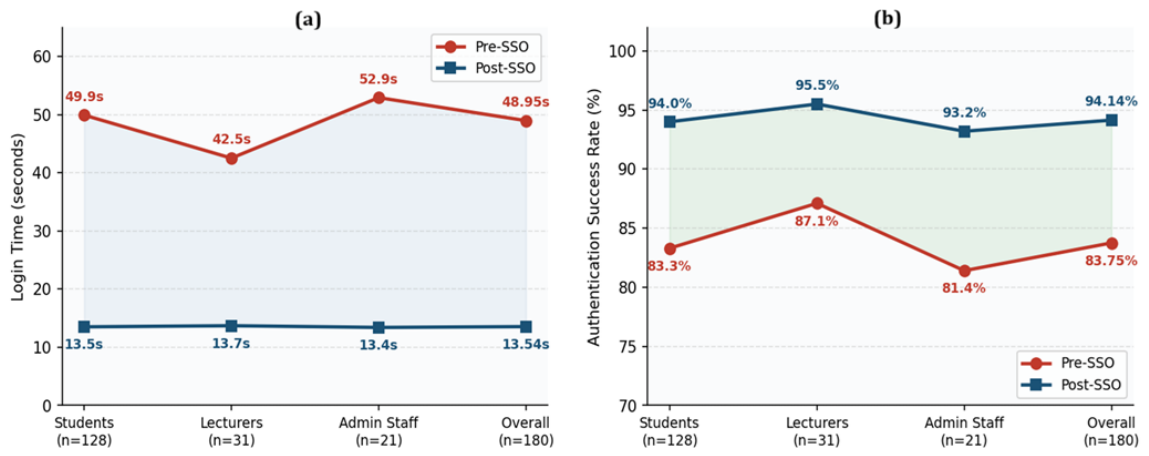
Figure 2.
Failed Login Attempts per Month (a) and Password Reset Frequency per 3 Months (b) by User Role.
Figure 2.
Failed Login Attempts per Month (a) and Password Reset Frequency per 3 Months (b) by User Role.
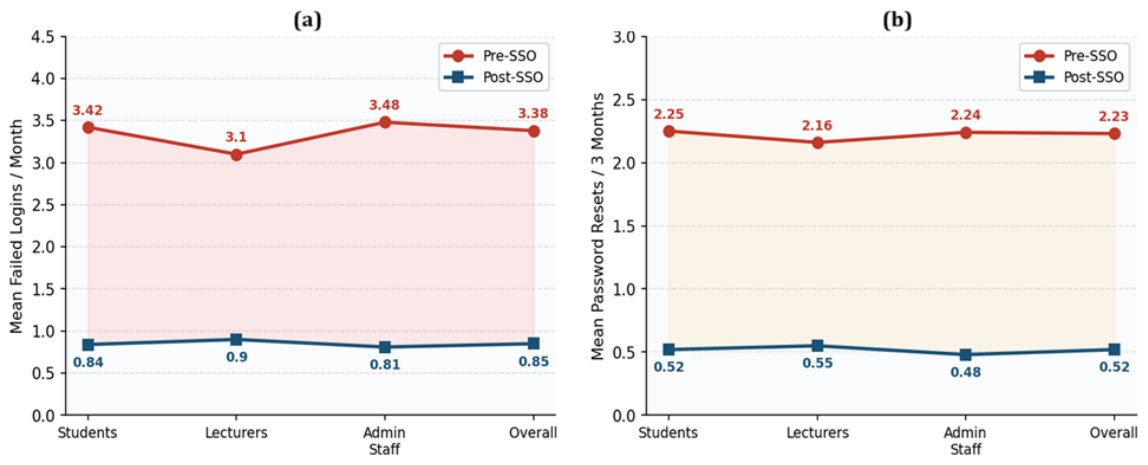
Figure 3.
SUS Score by User Role (a) and Comparison of UX, Security, and Satisfaction Perceptions (b).
Figure 3.
SUS Score by User Role (a) and Comparison of UX, Security, and Satisfaction Perceptions (b).
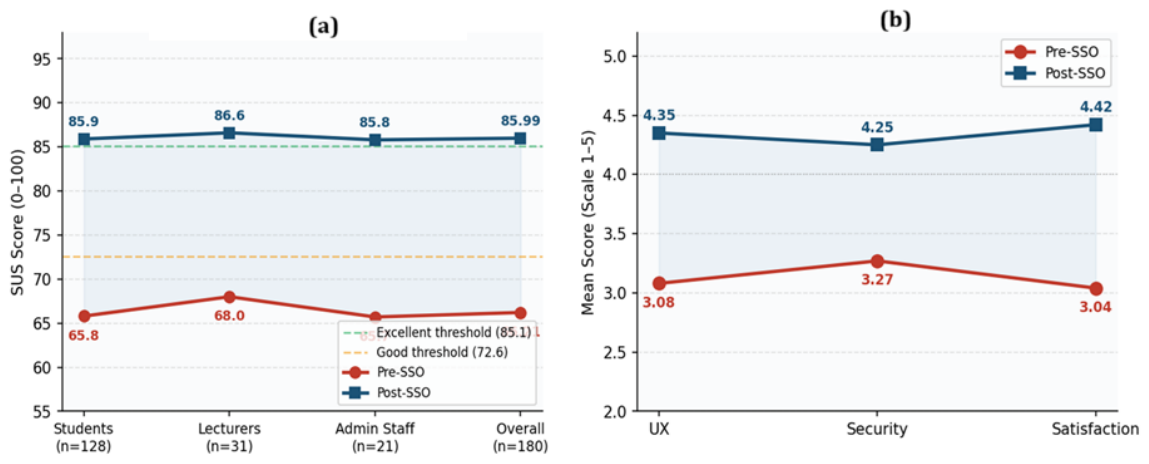
Table 4.
System Usability Scale (SUS) Scores by User Role
| Role | n | Pre-SSO SUS | Post-SSO SUS | Improv. | Post-SSO |
|---|---|---|---|---|---|
| M (SD) | M (SD) | Category | |||
| Students | 128 | 65.8 (4.5) | 85.9 (4.2) | +20.1 | Excellent |
| Lecturers | 31 | 68.0 (5.4) | 86.6 (4.4) | +18.6 | Excellent |
| Administrative Staff | 21 | 65.7 (2.7) | 85.8 (3.5) | +20.1 | Excellent |
| Overall | 180 | 66.21 (4.58) | 85.99 (4.12) | +19.78 | Excellent |
Note. SUS = System Usability Scale; M = mean; SD = standard deviation.
Table 5.
Risk Level and Adaptive Authentication Action
| Risk Level | Direct Access | Light OTP | Device Verif. | Admin Review | Total |
|---|---|---|---|---|---|
| Low | 106 | 10 | 0 | 0 | 116 |
| Medium | 11 | 27 | 10 | 0 | 48 |
| High | 0 | 5 | 6 | 5 | 16 |
| Total | 117 | 42 | 16 | 5 | 180 |
Disclaimer/Publisher’s Note: The statements, opinions and data contained in all publications are solely those of the individual author(s) and contributor(s) and not of MDPI and/or the editor(s). MDPI and/or the editor(s) disclaim responsibility for any injury to people or property resulting from any ideas, methods, instructions or products referred to in the content. |
© 2026 by the authors. Licensee MDPI, Basel, Switzerland. This article is an open access article distributed under the terms and conditions of the Creative Commons Attribution (CC BY) license (http://creativecommons.org/licenses/by/4.0/).
Copyright: This open access article is published under a Creative Commons CC BY 4.0 license, which permit the free download, distribution, and reuse, provided that the author and preprint are cited in any reuse.


