

Submitted:
01 July 2026
Posted:
03 July 2026
You are already at the latest version
Abstract
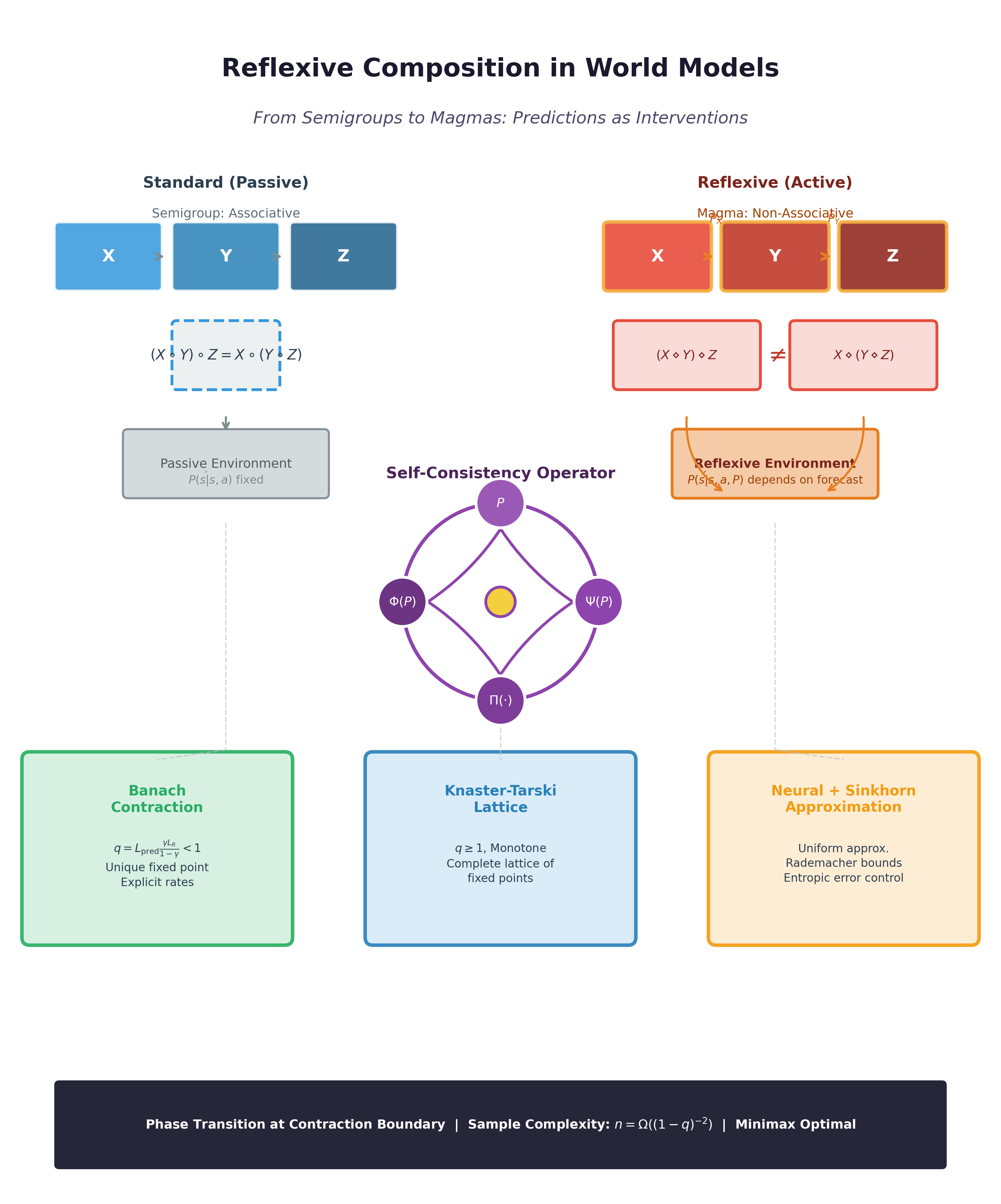
Compositional world models represent complex environments through modular combina- tions of programmatic experts. Their core assumption—that the modeled system pas- sively accepts predictions without altering its own dynamics—breaks down in social set- tings where predictions constitute interventions. The present work develops a rigorous mathematical framework extending compositional world models to reflexive environments, introducing the Reflexive Composition Operator (RCO). We define the Reflexive Successor Measure (RSM), establish dual fixed-point existence under Lipschitz contraction (Banach) and monotone lattice conditions (Knaster–Tarski), and derive explicit, non-asymptotic con- vergence rates for both regimes. A finite-sample complexity bound for the RSM is proved using vector-valued Rademacher complexity and uniform convergence arguments, replacing informal covering-number approaches in prior work. We prove that composition is gener- ally non-associative when response functions are non-linear, quantify this effect through the Composition Sensitivity Index (CSI), and provide rigorous proofs for smooth non-linear and threshold responses. Computational tractability is addressed by proposing neural approxi- mations of the RSM, establishing uniform approximation guarantees under compatible ar- chitectural assumptions, and providing a practical Sinkhorn-based training algorithm with explicit gradient-bias and entropic-error control. We further address the lattice regime via a monotone neural architecture and derive a minimax lower bound confirming the statis- tical phase transition at the contraction boundary. The theoretical framework is validated on an N -state chain, an analytic bank-run model, a high-dimensional reflexive Gaussian chain, a non-linear reflexive pendulum, and comparative benchmarks against performa- tive RL baselines, demonstrating that the loss of associativity is a structural feature of reflexive systems and that our neural approximation achieves favorable sample complexity relative to existing performative prediction methods. These results bridge compositional world modeling, performative prediction, and reflexivity theory within a unified algebraic, probabilistic, and computational framework.
Keywords:
compositional world models
; reflexivity
; performative prediction
; successor measure
; fixed-point theory
; non-associative composition
; Rademacher complexity
; neural approximation
Copyright: This open access article is published under a Creative Commons CC BY 4.0 license, which permit the free download, distribution, and reuse, provided that the author and preprint are cited in any reuse.


