

Submitted:
13 June 2026
Posted:
16 June 2026
You are already at the latest version
Abstract
Fouling on ship hulls increases hydrodynamic drag, fuel consumption, and emissions. This, in turn, necessitates the development of efficient methods for side cleaning and inspection. This work focuses on the application of image-based classification to assess the cleanliness of the surface of the hull in robotic cleaning systems, with respect to the ISO 8501-4 standard. Due to limited data availability, transfer learning techniques using pre-trained convolutional neural networks (ResNet50, EfficientNetB0 and MobileNetV2) were used. Both end-to-end models and hybrid approaches that combine deep feature extraction with XGBoost classification were evaluated. Experiments were carried out on binary classification (cleaned vs. uncleaned surfaces) and multi-class classification of cleanliness levels (WA1, WA2, WA2.5). The results show that transfer learning enables effective recognition of cleaning status, achieving high performance for binary classification despite a small dataset. However, multiclass classification remains challenging due to subtle differences between classes and data limitations. The proposed approach supports automated visual inspection of underwater robotic platforms and represents a step toward objective standards-based assessment of hull cleaning processes.
Keywords:
ship hull cleaning
; classification
; transfer learning
; hull inspection
; underwater robotics
; deep learning
1. Introduction
Marine biofouling, defined as the accumulation of microorganisms, algae and marine organisms on submerged surfaces, significantly affects the performance of the ship by increasing hydrodynamic resistance, fuel consumption, and greenhouse gas emissions [1,2,3]. Recent studies highlight that even moderate fouling can lead to significant increases in energy demand and operating costs, while also contributing to environmental impacts and microplastic emissions during maintenance operations [3]. The underlying mechanism is that biofouling increases hull roughness and introduces additional biological structures on the wetted surface, which raises hydrodynamic resistance during ship operation. As a result, the propulsion system must deliver more power to maintain the same speed, leading to higher fuel consumption and, consequently, higher greenhouse gas emissions. Recent studies indicate that even moderate hull fouling may increase annual fuel consumption and greenhouse gas emissions by approximately 20–30%, while more severe and unmanaged fouling can lead to substantially larger penalties depending on vessel type, operational profile, and maintenance strategy [4,5]. In addition to the energy and emission burden, insufficient cleaning and inspection may also accelerate coating degradation and contribute to corrosion-related deterioration of steel surfaces over time. Therefore, maintaining adequate hull cleanliness has become a key requirement from both an economic and environmental perspective.
Traditional methods of hull cleaning and inspection rely largely on manual or diver-assisted procedures, which are time-consuming, expensive, and limited in scalability. Recent advances in marine engineering indicate a shift towards automated and semi-autonomous robotic systems capable of performing cleaning and inspection tasks directly on ship hulls, improving safety and operational efficiency [6,7]. These systems increasingly integrate advanced sensing, navigation, and perception capabilities, including computer vision methods to monitor surface conditions and guide cleaning operations.
Modern hull cleaning robots are based on a combination of subsystems, including locomotion, traction, navigation, and perception. In particular, precise positioning and navigation have been developed using sensor fusion and machine learning techniques, as demonstrated in recent work on the localization of hull cleaning robots [8]. At the same time, computer vision-based perception systems are gaining importance, enabling real-time detection, classification, and quantification of biological fouling and surface condition. Such capabilities are essential to close the loop between cleaning activities and objective evaluation of their effectiveness.
In industrial practice, surface cleanliness is typically assessed according to standards such as ISO 8501-4, which defines visual cleanliness grades for steel surfaces after high-pressure water jetting, using descriptive criteria and reference images [9]. However, these assessments remain largely qualitative and subject to human interpretation. Automating image-based surface cleanliness classification is therefore an important but challenging task due to subtle differences between classes, environmental variability, and limited availability of labeled datasets.
Recent advances in machine learning and computer vision offer promising tools to address this problem. In particular, deep learning methods, including convolutional neural networks and transformer-based architectures, have demonstrated high performance in automatic detection and classification of biological fouling [10]. Furthermore, data-driven approaches using operational data have been proposed for the early detection of hull fouling and performance degradation [11]. However, these works focus primarily on coarse detection or assessment rather than direct classification according to standardized cleanliness levels.
A key challenge in industrial applications is the limited availability of annotated visual data. Training deep neural networks from scratch in such conditions often leads to overfitting and poor generalization. Recent studies confirm that transfer learning, which uses pre-trained models and adapts them to target tasks, provides an effective solution in scenarios with small datasets, improving accuracy and robustness compared to training from scratch [12,13]. Hybrid approaches that combine deep feature extraction with classical machine learning methods have also demonstrated high performance on limited datasets.
Despite these advances, direct image-based classification of hull surface cleanliness according to ISO standards remains relatively underexplored, especially in the context of robotic cleaning systems. Existing solutions often rely on multi-step processes or intermediate representations such as segmentation or coverage estimation, which increases system complexity and can introduce additional sources of error.
In this paper, we investigate the problem of automatic classification of the surface cleanliness of the hull of a ship based on visual data acquired by a robotic platform. The proposed approach focuses on direct classification into cleanliness classes according to the ISO 8501-4 standard with limited data. To address this challenge, we evaluate knowledge transfer strategies using pre-trained convolutional neural networks, as well as hybrid approaches combining deep feature extraction with classical classifiers. The research is motivated by practical applications in robotic cleaning systems, where an objective and automated assessment of surface condition can support decision-making, improve process control, and reduce the subjectivity of human inspection.
The remainder of the article is organized as follows. Section 2 presents the research context and an overview of hull cleaning technologies. Section 3 provides an overview of the work related to visual inspection and classification of the hull surface. Section 4 describes the dataset and classification scheme. Section 5 presents the experimental setup and results. Section 6 concludes the article and provides directions for future work.
2. Research Context
The accumulation of marine biofouling on ship hulls significantly increases hydrodynamic drag, fuel consumption, and greenhouse gas emissions, while also accelerating hull corrosion. To mitigate these effects, a variety of hull cleaning methods have been developed in recent decades, ranging from manual operations to fully automated robotic systems. These methods can be broadly categorized into manual cleaning, contact-based mechanical cleaning, and contactless cleaning technologies [14].
2.1. Manual Hull Cleaning
Manual hull cleaning is the most traditional method and is still commonly applied to small vessels such as recreational boats and fishing vessels. This approach typically involves divers or snorkelers using handheld tools such as cloths, brushes, or scrapers to remove biofouling manually. Although simple and low-cost, manual cleaning is labor-intensive, time-limited due to diver safety constraints, and generally inefficient for large commercial vessels [15]. In addition, studies have shown that manual brushing often fails to completely remove biofouling, leaving a considerable portion of organisms attached to the hull surface after cleaning. As a result, manual methods are not suitable for the large-scale or frequent cleaning operations required by modern shipping.
2.2. Mechanical Contact-Based Cleaning Methods
Mechanical cleaning methods based on direct contact are widely used for both dry-dock and in-water hull cleaning. These methods mainly rely on rotary brushes or scrapers to physically remove fouling organisms. Rotary brush systems may consist of single, double or multiple brush heads driven hydraulically or electrically, and are effective in removing slime, algae, and even hard debris such as barnacles, depending on the brush material and stiffness [14].
Brush-based cleaning systems can be operated by divers or integrated into remotely operated or autonomous underwater robots, described as magnetically adsorbed underwater cleaning robots equipped with rotating wire brushes designed to clean steel ship hulls efficiently while maintaining stable adhesion through permanent magnets [16]. Although contact-based methods offer high cleaning efficiency, they may cause damage to protective coatings if not carefully controlled, which is a major concern for long-term hull maintenance.
2.3. High-Pressure and Cavitation Water Jet Cleaning
High-pressure water jet cleaning represents a contactless or minimally contact-based approach that removes biofouling using the impact force of pressurized water. When operated at appropriate pressures, water jets can effectively remove slime layers and soft fouling with minimal damage to the hull coatings [17]. Advanced systems can achieve cleaning pressures ranging from tens to several hundreds of bars.
An enhanced version of this technique is cavitation water jet cleaning, which introduces cavitation bubbles into the water jet through specially designed nozzles. The collapse of these bubbles near the surface of the hull generates localized high stresses that significantly improve the removal efficiency of fouling compared to conventional water jets operating at the same pressure [14]. These technologies are increasingly integrated into underwater robotic platforms to improve cleaning effectiveness while reducing mechanical wear.
2.3.1. Ultrasonic Cleaning Technologies
Ultrasonic cleaning methods utilize high-frequency acoustic waves to generate alternating pressure fields in water, leading to the formation and implosion of microscopic cavitation bubbles. The resulting energy release can detach biofilms and fouling organisms from the surface of the hull without direct mechanical contact. Ultrasonic cleaning has been successfully applied in medical and industrial settings and is gaining interest in underwater hull cleaning due to its reduced risk of coating damage [18].
Although promising, ultrasonic systems currently face challenges related to energy efficiency, cleaning range, and integration into mobile underwater platforms. Consequently, their application in large-scale commercial ship cleaning remains limited and largely experimental.
2.3.2. Laser Cleaning Methods
Laser-based hull cleaning is an emerging non-contact technology that uses high-energy laser pulses to ablate biofouling and corrosion products from the hull surface. This method provides high precision, selective material removal, and excellent process controllability compared to mechanical cleaning methods [19]. Experimental systems have demonstrated the feasibility of both dry and underwater laser cleaning.
However, the complexity, high cost, and safety considerations associated with underwater laser systems currently limit their widespread adoption. As such, laser cleaning remains mainly in the research and prototype development stage.
In the practical context of this study, the considered application is related to the SR Robotics magnetic crawler robotic platform MagRob developed for anti-corrosion work on steel surfaces [8]. The robot is designed to support surface preparation and cleaning operations in environments where repeatability, process control, and continuous visual inspection are important. The robotic platform is equipped with two cameras, located in the front and rear of the robot, which allow observation of the working area from different perspectives and provide image data that can be further used for cleanliness assessment.
The classification method investigated in this work is intended primarily for post-process assessment of the cleaned surface, based on images acquired by the robot. In this interpretation, the classifier should be treated as a decision-support component or supervisory process control, after cleaning. Although online automatic classification during the cleaning process is a possible future extension, such a deployment mode is outside the scope of the present study.
3. Related Works
Automated inspection and maintenance of ship hulls have attracted significant attention in recent years, particularly in the context of robotic systems operating in harsh maritime environments. A key component of such systems is the ability to analyze visual data and perform a reliable classification of surface conditions, including corrosion and biofouling. Numerous approaches have been proposed, and most existing works focus on coarse-grained detection or indirect quality assessment rather than direct classification into standardized scales such as ISO-8501-4 [9].
Early approaches to ship hull inspection relied heavily on classical computer vision techniques. For example, histogram-based background subtraction and hand-made feature extraction methods were used to identify corrosion regions [20]. These approaches typically required carefully tuned preprocessing pipelines and were sensitive to illumination changes and noise. Similarly, feature-based methods combined with traditional classifiers, such as Support Vector Machines (SVM), were applied for marine fouling detection, using edge detection and morphological filtering to construct discriminative descriptors [21]. Although these methods demonstrated feasibility, their generalizability remained limited, especially in complex real-world conditions.
With the advancement of machine learning, feedforward neural networks and early deep learning models were introduced for corrosion detection tasks. However, these methods were still primarily focused on binary or coarse classification schemes (e.g., corroded vs. non-corroded), which do not align with industrial standards requiring fine-grained categorization. As highlighted in [22], most inspection systems aim to identify the presence of defects rather than quantify their severity according to standardized scales.
More recent research has shifted towards deep learning-based approaches, particularly convolutional neural networks (CNNs), which have demonstrated strong performance in image classification tasks. In [22], a deep convolutional neural network was used to generate a corrosion heat map of the surface of the shiphull, allowing spatial visualization of degradation levels. However, the classification scheme was limited to qualitative categories such as “bad”, “medium”, and “good”, rather than standardized classes. Furthermore, the generated heatmaps were primarily used for downstream tasks such as path planning and re-blasting optimization, rather than direct compliance assessment with industrial standards.
An alternative line of research focuses on fuzzy logic and heuristic-based classification. For example, a self-organizing fuzzy classifier was proposed to evaluate blasting quality based on visual input [22]. Although this method provides interpretable results, it lacks the precision and scalability required for high-resolution classification tasks. In addition, such approaches often rely on manually defined rules, which limits their adaptability to diverse data sets and environmental conditions.
In underwater environments, image analysis becomes significantly more challenging due to light attenuation, scattering, and color distortion. To address these issues, various image enhancement techniques have been proposed. In [23], a filter-guided inverse dark channel algorithm was introduced to compensate for uneven exposure in underwater images. This preprocessing step improves visibility and contrast, thereby facilitating subsequent analysis. However, these methods focus primarily on improving image quality rather than directly addressing classification.
Beyond preprocessing, semantic segmentation has emerged as a dominant paradigm for fine-grained analysis of underwater imagery. In [23], a pixel-level segmentation model (MFONet) was proposed, combining lightweight CNN architectures with attention mechanisms and multi-scale feature extraction. This approach enables a detailed identification of the biofouling regions and supports downstream estimation of coverage. Nevertheless, the final classification is typically derived indirectly, for example, by mapping segmentation outputs to rough categories such as “soft” or “hard” fouling, rather than directly predicting standardized classes.
Recent studies have also explored classification based on standardized scales, such as the Level of Fouling (LoF). In [10], both convolutional neural networks and transformer-based architectures were evaluated for multi-class classification of biofouling severity. In addition, multimodal large language models (LLMs) were investigated as an alternative approach. Although these methods show promising results, they highlight several challenges, including difficulty distinguishing intermediate classes, data set imbalance, and sensitivity to image quality [10]. Importantly, many approaches rely on intermediate representations, such as segmentation masks or coverage estimation, before assigning a final class label.
A common limitation across the literature is the reliance on multi-stage pipelines. Typically, image enhancement is followed by feature extraction or segmentation, and then only a classification decision is made. Although effective, this approach introduces additional complexity and potential sources of error propagation. Moreover, many existing solutions are tailored to specific classification schemes (e.g., LoF or binary labels) and are not directly transferable to standards such as ISO-8501-4, particularly in the context of water jet cleaning.
In contrast to these approaches, direct classification into standardized classes without intermediate abstractions remains relatively underexplored. Most existing work prioritizes detection, segmentation, or qualitative assessment, rather than end-to-end classification aligned with industrial norms. This gap motivates the development of methods that can directly map raw image data to standardized cleanliness classes, reducing system complexity, and improving interpretability in practical applications.
Furthermore, while deep learning techniques such as CNNs and transfer learning have become dominant in recent years, the literature demonstrates that alternative methods—including fuzzy systems, classical machine learning, and hybrid pipelines—continue to play a significant role. This diversity of approaches highlights the complexity of the problem and underscores the need for robust and generalizable solutions that are capable of operating under varying environmental conditions.
4. Datasets
The dataset used for training and testing the proposed model originates from the international standard ISO 8501-4:2006, which defines the preparation of hulls after cleaning, with a particular focus on water-jetting procedures. The standard provides a structured classification of surface cleanliness levels achieved during the cleaning process using water-jetting methods.
From an application perspective, this classification problem is relevant for a robotic surface preparation system such as MagRob. In such a system, the visual data acquired by the rear camera can be used to evaluate the post-process cleaning effect. Therefore, although the dataset used in this study is based on standardized reference images, the classification task considered is directly motivated by the need for a practical assessment of surface cleanliness in a robotic cleaning process.
In addition to the ISO standard, the dataset was extended using technical specification sheets and catalog materials provided by manufacturers of marine surface cleaning equipment.
4.1. Classification Description
The ISO 8501-4:2006 standard defines multiple cleanliness grades for water-jetted steel surfaces. In this work, the following classes are considered:
- WA1 – Light high-pressure water jetting.When viewed without magnification, the surface shall be free from visible oil and grease, loose or defective paint, loose rust, and other foreign matter. Any residual contamination shall be randomly dispersed and firmly adherent.
- WA2 – Thorough high-pressure water jetting.When viewed without magnification, the surface shall be free from visible oil, grease, and dirt, and most of the rust, previous paint coatings, and other foreign matter. Any residual contamination shall be randomly dispersed and can consist of firmly adherent coatings, firmly adherent foreign matter, and stains of previously existing rust.
- WA2.5 – Very thorough high-pressure water jetting.When viewed without magnification, the surface shall be free from all visible rust, oil, grease, dirt, previous paint coatings and, except for slight traces, all other foreign matter. Discoloration of the surface can be present where the original coating was not intact. The gray or brown/black discoloration observed on pitted and corroded steel cannot be removed by further waterjetting.
4.2. Data Augmentation
The publicly available dataset, related to the above-mentioned ISO norm, characterizes a very small number of images. The number of objects per single class is between 6 and 10 (see Table 1). That makes it very difficult to apply a classic split into 5-fold cross-validation for deep learning classifiers, where the training set is again split into train and validation subsets.
For that reason, we decided to increase the size of the image dataset in an artificial but quite interpretative way. The study intentionally used only conservative geometric augmentation (rotations and flips), as these preserve image content and have a clear physical interpretation (changes in camera/robot orientation). This is particularly important given the very small dataset and the focus on an initial feasibility assessment of ISO 8501-4 classification. More advanced augmentations (e.g., brightness, blur, underwater artifacts) may be useful later, but at this stage they risk introducing assumptions about real-world conditions (e.g., turbidity or lighting) without sufficient data for validation, potentially harming generalization. Although underwater scenarios are relevant, the application also covers dry-dock and controlled environments; thus such augmentations should be treated as scenario-specific extensions, not a baseline requirement. Having a single image of a hull, we performed three rotations, as well as two flips: vertical and horizontal (Figure 1).
In fact, the newly created figures still represent the real images: no new graphical information (marks, noise, etc.) was introduced. Moreover, the rotation reflects the real situation when a cleaning robot reaches the same part of the hull from different directions. In a similar way, we can explain that an image in a mirror still represents the look of the original hull surface.
5. Experiments
The objective of the experimental part of this study was to investigate the feasibility of using image-based classification methods to assess the cleanliness level of the hull surfaces after water jetting. The analysis was conducted under the constraint of a limited number of original images, which is a common challenge in specialized industrial applications where data acquisition is costly, time-consuming, or dependent on specific operational conditions. This limitation was explicitly considered during the design of the modelling approach, as training deep neural networks from scratch on small datasets may lead to poor generalization and an increased risk of overfitting. To address this issue, transfer learning [24] was employed as the primary modeling strategy. This approach enables the reuse of visual representations learned from large-scale source datasets and their adaptation to a target classification task with a substantially smaller dataset. In the context of this study, transfer learning allowed pretrained convolutional neural network architectures to be adapted to the problem of classifying hull surface cleanliness levels, while reducing the amount of task-specific data required for effective model training. Such an approach is particularly suitable for small-data scenarios, as lower-level visual features learned from large image collections can provide a robust starting point for fine-tuning the model to a domain-specific classification problem.
Two classification scenarios were investigated. The first scenario involved binary classification, which aimed to determine whether or not a given hull surface had been cleaned. This distinction was considered relevant from a practical and business perspective, as in many industrial cases, the essential information is whether the surface can be regarded as cleaned, and therefore whether the cleaning process has achieved its basic objective. However, in some applications, a more detailed assessment may also be required. For this reason, a second scenario was defined as a multi-class classification task, in which the model was required to assign the cleaned surface to one of the considered ISO 8501-4 cleanliness grades: WA1, WA2, or WA2.5.
5.1. Experimental Setup
The experimental setup was designed to compare different modeling approaches for the two classification scenarios defined in the previous section. The experiments were based on pre-trained convolutional neural network architectures, which served as the core components of the image analysis pipeline. Their use made it possible to obtain informative representations of hull surface images and to evaluate how different architectures perform in the considered cleanliness assessment problem.
Such an approach is commonly known in the literature. This strategy is particularly important because the available dataset is very small (e.g. medical [25]). Pre-trained networks provide visual representations learned from large-scale image datasets, which can then be transferred to specialized industrial tasks where collecting many labeled images is difficult.
In the experiments, the following convolutional neural network architectures were evaluated:
For each architecture, two learning strategies were considered. In the first strategy, the pre-trained convolutional neural network was fine-tuned by replacing and adapting its final classification layers to the target task. This approach allowed the model to adjust the selected network parameters directly to the hull surface image dataset.
In the second strategy, the convolutional network was used as a fixed feature extractor. The visual representations generated by the pre-trained backbone were then passed to the XGBoost algorithm, which performed the final classification. This configuration was introduced to compare an end-to-end deep learning approach with a hybrid pipeline combining deep feature extraction and a classical machine learning classifier.
All experiments were carried out using 5-fold cross-validation. In each fold, the dataset was divided into training and test subsets using an 80/20 split. During neural network training, 10% of the training subset was also used as a validation set. The reported results are presented as mean values and standard deviations calculated in all folds.
5.2. Binary Classification: Cleaned and Not Cleaned Surfaces
The first experiment concerned the recognition of whether the surface had been cleaned or not. In this case, all images belonging to WA1, WA2, and WA2.5 classes were assigned to a common cleaned class, while images from the initial class were treated as the noncleaned class. This task reflects a practical scenario in which the inspection system needs to determine whether the cleaning process has been performed successfully.
The results obtained for the binary classification task are presented in Table 2.
The best result in this experiment was obtained using the EfficientNetB0-based model. It achieved an accuracy of 0.8778 and a balanced accuracy of 0.8214. This indicates that the model was able to distinguish cleaned and uncleaned surfaces with relatively high effectiveness, despite the limited size of the dataset. The macro F1-score of 0.8324 further confirms that the model maintained a good balance between precision and recall.
The ResNet50 model also achieved strong performance, with an accuracy of 0.8251 and a balanced accuracy of 0.7931. The hybrid approach based on the features extracted from EfficientNetB0 and classified using XGBoost achieved an accuracy of 0.8444, but its balanced accuracy was lower, equal to 0.7583. This suggests that although the model correctly classified many samples in general, its performance across the two classes was less balanced than in the case of the fine-tuned EfficientNetB0 model.
The weakest results in the binary classification task were obtained using MobileNetV2 features combined with XGBoost, where the balanced accuracy reached only 0.6024. This may indicate that the representation of the extracted features was not sufficiently discriminative for this particular task or that the classifier was more sensitive to the limited number of training samples.
In general, the binary classification results show that transfer learning can be used effectively to recognize whether a hull surface has been cleaned. The difference between the initial surface condition and water-jetted surfaces appears to be sufficiently visible for deep convolutional models to capture relevant visual patterns.
5.3. Multi-Class Classification of Cleanliness Grade
The second experiment concerned the recognition of cleanliness grade after cleaning. In this scenario, only cleaned surfaces were considered, and the task was to classify each image into one of the three ISO 8501-4 cleanliness classes: WA1, WA2, or WA2.5. This problem is more difficult than binary classification because the differences between neighboring grades are often subtle and may depend on small residual traces of rust, old coating, discoloration, or surface texture.
The results obtained for the multi-class classification task are presented in Table 3.
The best result in the multi-class classification task was obtained using features extracted from ResNet50 and classified with XGBoost. This method achieved an accuracy of 0.7029 and a balanced accuracy of 0.7111. It also obtained the highest macro F1-score, equal to 0.7100, and the highest macro precision, equal to 0.7622. These results indicate that the hybrid approach was the most effective in distinguishing between the three cleanliness grades.
In contrast to the binary classification task, the fine-tuned neural networks achieved lower performance in the multi-class scenario. EfficientNetB0 obtained a balanced accuracy of 0.4556, MobileNetV2 achieved 0.4778, and ResNet50 achieved 0.5444. This suggests that direct fine-tuning of neural networks may be less stable when the number of training samples per class is very small. In such a situation, the classifier can easily overfit the training data, especially when the visual differences between classes are subtle.
The hybrid approach based on XGBoost improved the results for MobileNetV2 and ResNet50 features. In particular, the ResNet50 feature extractor combined with XGBoost clearly outperformed the remaining methods. This may suggest that the deep feature representation produced by ResNet50 contains useful information to describe the surface condition, while XGBoost is better suited to learning a decision boundary from a small number of samples.
The lower performance observed in this task is expected compared to binary classification. Classes WA1, WA2, and WA2.5 represent gradual changes in cleanliness rather than completely different visual categories. The distinction between WA2 and WA2.5 may be especially difficult, since both classes can contain discoloration, traces of previous corrosion, and visually similar surface irregularities. Therefore, the classification requires the model to detect fine-grained differences in residual contamination and texture.
5.4. Experiments with Manually Designed Features
In addition to transfer learning-based methods, experiments with manually designed image features were also performed. These features were constructed on the basis of the visual descriptions included in the ISO 8501-4 standard. The motivation behind this approach was to transform qualitative ISO descriptions into measurable image descriptors.
According to the ISO 8501-4 classification logic, the most important visual aspects are the amount and distribution of remaining rust, old coating, foreign matter, stains, and discoloration. Therefore, the manually designed feature extraction procedure attempted to describe the image in terms of visible residues and surface cleanliness.
Texture descriptors were also included in the set of characteristics. These descriptors were based on local binary patterns, GLCM/Haralick features, Laplacian response, image gradients, and local variance. Their purpose was to distinguish the remaining rough contamination from acceptable surface profiles or discoloration. In practice, these features were designed to reflect the transition from lower to higher cleanliness grades: decreasing amounts of real residues, smaller and more dispersed traces, and an increasing proportion of exposed substrate.
Despite the interpretability of this approach, the best balanced accuracy obtained using manually designed features in different settings was only 0.46 on the test set. This result was considerably lower than the best result obtained using transfer learning, especially in the multi-class classification task, where the ResNet50 feature extractor combined with XGBoost achieved a balanced accuracy of 0.7111.
The comparison indicates that manually engineered descriptors were not sufficient to fully capture the complex visual variability of hull surface images. Although the features were designed according to the ISO descriptions, the appearance of real surfaces may depend on many additional factors, such as lighting conditions, surface roughness, camera perspective, remaining water, shadows, and local corrosion patterns. Deep neural networks pre-trained on large-scale datasets are able to extract more general and more discriminative visual representations, which explains their better performance in the considered classification problem.
5.5. Summary of Results
The best results obtained in the experimental scenarios considered are summarized in Table 4.
The results obtained show that the difficulty of the classification problem strongly depends on the level of detail required from the model. In the binary scenario, where the model only had to distinguish between cleaned and uncleaned surfaces, the best balanced accuracy was 0.8214. This confirms that the visual difference between the initial surface condition and the cleaned surfaces can be effectively recognized using transfer learning.
The multi-class classification of cleanliness grades was more challenging. The best method, based on ResNet50 feature extraction and XGBoost classification, achieved a balanced accuracy of 0.7111. This result is promising, considering the small number of original images and the subtle visual differences between WA1, WA2, and WA2.5 classes.
In general, the results demonstrate that transfer learning is a suitable approach for automatic classification of hull surface cleanliness levels according to ISO 8501-4. The method is especially effective for recognizing whether the surface has been cleaned. Recognition of the exact cleanliness grade remains more difficult, but the obtained results indicate that deep feature extraction combined with a classical classifier such as XGBoost can provide useful performance even under limited-data conditions.
6. Conclusions and Further Works
This paper addressed the problem of automatic classification of the cleanliness of the surface of the ship hull based on visual data acquired from a robotic cleaning system. The study focused on direct mapping of images to ISO 8501-4 cleanliness grades under conditions of limited dataset size, which is a typical constraint in industrial applications.
Experimental results demonstrated that transfer learning approaches based on pre-trained convolutional neural networks provide effective and robust solutions for this task, significantly outperforming models trained from scratch. In addition, hybrid methods combining deep feature extraction with classical machine learning classifiers proved to be competitive, particularly in scenarios with constrained training data. The findings confirm that the proposed approach enables a reliable and repeatable assessment of the surface condition, supporting the automation of inspection processes in robotic hull cleaning systems. However, the reported results estimate performance under a small-data cross-validation protocol and should not be interpreted as final proof of generalization to all real operational environments.
From a practical point of view, the results obtained indicate two complementary application paths. First, the binary classification scenario (cleaned vs. not cleaned) may support objective verification of whether the cleaning process has achieved its primary operational goal. In turn, the multiclass scenario, based on ISO cleanliness grades, can provide a more detailed assessment of the cleaning outcome and support quality-oriented interpretation of the process result. In this context, the proposed method can be considered as a component of a broader vision-based decision-support framework for the MagRob system.
In the currently considered operating concept, this support is primarly intended for post-process assessment based on images transmitted to the operator station, whereas fully real-time deployment remains a subject for future engineering work. This integration could help the operator evaluate the effectiveness of cleaning, reduce the subjectivity of visual inspection, and support decisions about whether additional treatment is required. The present study should be interpreted as a step towards practical deployment rather than as a fully validated industrial solution. Although the results, particularly for the binary classification task, are promising, further validation on larger and more diverse datasets remains necessary before robust deployment in real operational environments can be considered.
The method is expected to be most reliable in conditions visually similar to the training data and in inspection scenarios where the image acquisition process is reasonably controlled. The binary cleaned vs. not-cleaned task is also expected to be more robust than the fine-grained multi-class grade classification, because the visual separation is stronger.
It should be noted that this study adopts the surface cleanliness classification scheme defined in ISO 8501-4:2006, which remains a widely recognized reference for grading surfaces prepared by water jetting. The cleanliness scale used in the second stage of this work is therefore based on this 2006 edition of the standard.
However, we believe that real-time implementation is a realistic extension, especially because the evaluated architectures include models commonly used in efficient visual recognition pipelines. MobileNetV2, in particular, is designed with computational efficiency in mind, and feature-extraction-based pipelines can also be optimized for deployment.
The paper does not demonstrate real-time inference on the robotic platform. The present contribution is algorithmic and methodological: it evaluates whether the visual classification task is feasible using transfer learning under limited-data conditions. Real-time deployment would require additional work, including inference-time measurement, hardware selection, model optimization, memory and power analysis, and integration with the robot’s image acquisition and decision-support pipeline.
An updated revision of the standard, ISO 8501-4:2020, introduced an additional cleanliness grade, Wa3, corresponding to the highest achievable level of surface cleanliness under water jetting conditions. This modification extends the original classification framework by refining the upper bound of the cleanliness scale.
However, the Wa3 class was not included in the present study due to the limited number of images available that represent this category, which was insufficient for reliable training and evaluation of the classifier.
Future work will address this limitation together with the further extension of the dataset, based on application of new norm images as well as the further develop of augmentation techniques and possible images simulation. With the continued operation of the measurement system and the systematic acquisition of new data, it is planned to extend the classifier to incorporate the Wa3 class introduced in the updated standard.
Author Contributions
Conceptualization, P.Ś., Ł.W., M.M. and D.M.; methodology, Ł.W., M.M. and D.M.; software, D.M.; validation, D.M.; investigation, D.D. and M.M.; resources, P.Ś.; data curation, M.M.; writing—original draft preparation, P.Ś., D.D., M.M. and D.M.; writing—review and editing, P.Ś., D.D., M.M. and D.M.; visualization, M.M.; supervision, M.M., M.S., T.B. and T.H.; project administration, M.S. and T.B.; funding acquisition, M.S. and T.B. All authors have read and agreed to the published version of the manuscript.
Funding
The work was financed within the project “An effective and innovative system for working on ferromagnetic surfaces using pressurized water.” (POIR.01.01.01-00-0863/18).
Data Availability Statement
A simple data augmentation code and pretrained models are available at http://adaa.polsl.pl.
Conflicts of Interest
The authors declare no conflicts of interest.
References
- Hakim, M.L.; Nugroho, B.; et al. Investigation of Fuel Consumption on an Operating Ship due to Biofouling Growth. IOP Conf. Ser. Earth Environ. Sci. 2019, 339, 012037. [Google Scholar] [CrossRef]
- Kawa, M. Enhancing Ship Energy Efficiency and Preventing Pollution through Effective Biofouling Control Measures. TransNav Int. J. Mar. Navig. Saf. Sea Transp. 2025, 19, 1277–1285. [Google Scholar] [CrossRef]
- Soon, Z.Y.; Tamburri, M.N.; Kim, T. Estimating Total Microplastic Loads to the Marine Environment from Ship Biofouling Cleaning. Front. Mar. Sci. 2024, 11, 1502000. [Google Scholar] [CrossRef]
- Kim, Y.; Ozyurt, R. Underestimated Penalty of Hull Fouling: A Scenario-Based Analysis of GHG Emissions from Global Shipping. Appl. Ocean Res. 2025, 165, 104870. [Google Scholar] [CrossRef]
- Unit, G.P.P.C. Analysing the Impact of Marine Biofouling on the Energy Efficiency of Ships and the GHG Abatement Potential of Biofouling Management Measures; Technical report; International Maritime Organization / GloFouling Partnerships, 2022. [Google Scholar]
- Stateczny, A.; Sliwinska, D.; Wierzbicki, P. Modern Methods of Hull Cleaning Using Remote Operated Vehicles. TransNav 2025, 19. [Google Scholar] [CrossRef]
- Cardaillac, A.; Skjetne, R.; Ludvigsen, M. ROV-Based Autonomous Maneuvering for Ship Hull Inspection. J. Intell. Robot. Syst. 2024, 110, 59. [Google Scholar] [CrossRef]
- Chwełatiuk, K.; Kubina, A.; Michalak, M.; Sikora, M.; Ściegienka, P.; Wróbel, L. Algorithm for Determining the Position of a Ship Hull-Cleaning Robot. Appl. Sci. 2025, 15, 5705. [Google Scholar] [CrossRef]
- International Organization for Standardization. ISO 8501-4:2006 Preparation of steel substrates before application of paints and related products Standard ISO 8501-4; 2006.
- Hamilton, B.; Cashmore, T.; Driscoll, P.; Gee, T.; Williams, H. Automated Marine Biofouling Assessment: Benchmarking Computer Vision and Multimodal LLMs on the Level of Fouling Scale. arXiv 2026, arXiv:2601.20196. [Google Scholar]
- Petridis, C.; Vassilakopoulos, M. Detecting Hull fouling using machine learning algorithms trained on ship propulsion data to improve resource management and increase environmental benefits. ISPRS Ann. Photogramm. Remote Sens. Spat. Inf. Sci. 2024, 10, 185–192. [Google Scholar] [CrossRef]
- Rather, I.H.; Kumar, S.; Gandomi, A.H. Breaking the data barrier: a review of deep learning techniques for democratizing AI with small datasets. Artif. Intell. Rev. 2024, 57, 226. [Google Scholar] [CrossRef]
- Mallouk, O.; Joudar, N.E.; Ettaouil, M. A selective model for transfer learning in CNNs: optimization of fine-tuning layers. Int. J. Data Sci. Anal. 2025, 20, 3835–3850. [Google Scholar] [CrossRef]
- Song, C.; Cui, W. Review of Underwater Ship Hull Cleaning Technologies: C. Song, W. Cui. J. Mar. Sci. Appl. 2020, 19, 415–429. [Google Scholar] [CrossRef]
- Floerl, O.; Peacock, L.; Seaward, K.; Inglis, G. Review of biosecurity and contaminant risks associated with in-water cleaning. Aust. Dep. Agric. Fish. For. 2010, 1. [Google Scholar]
- Yuan, F.c.; Guo, L.b.; Meng, Q.x.; Liu, F.q. The design of underwater hull-cleaning robot. J. Mar. Sci. Appl. 2004, 3, 41–45. [Google Scholar] [CrossRef]
- Kalumuck, K.; Chahine, G.; Frederick, G.; Aley, P. Development of a DYNAJET cavitating water jet cleaning tool for underwater marine fouling removal. In Proceedings of the 9th American Waterjet Conference, Dearborn, Michigan, 1997; pp. 23–26. [Google Scholar]
- Erneland, M.B. Ultrasonic Cleaning of Marine Geophysical Equipment, 2014. US Patent App. 13/629,412.
- Kostenko, V.; Bykanova, A.Y.; Tolstonogov, A.Y. Underwater robotics complex for inspection and laser cleaning of ships from biofouling. Proc. IOP Conf. Ser. Earth Environ. Sci. 2019, Vol. 272, 022103. [Google Scholar] [CrossRef]
- Jalalian, A.; Lu, W.F.; Wong, F.S.; Ahmed, S.M.; Chew, C.M. An automatic visual inspection method based on statistical approach for defect detection of ship hull surfaces. In Proceedings of the 2018 IEEE 14th International Conference on Automation Science and Engineering (CASE); IEEE, 2018; pp. 445–450. [Google Scholar]
- Ishizu, K.; Sakagami, N.; Ishimaru, K.; Shibata, M.; Onishi, H.; Murakami, S.; Kawamura, S. Ship hull inspection using a small underwater robot with a mechanical contact mechanism. In Proceedings of the 2012 Oceans-Yeosu. IEEE, 2012; pp. 1–6. [Google Scholar]
- Le, A.V.; Kyaw, P.T.; Veerajagadheswar, P.; Muthugala, M.V.J.; Elara, M.R.; Kumar, M.; Nhan, N.H.K. Reinforcement learning-based optimal complete water-blasting for autonomous ship hull corrosion cleaning system. Ocean Eng. 2021, 220, 108477. [Google Scholar] [CrossRef]
- Zhao, W.; Han, F.; Qiu, X.; Peng, X.; Zhao, Y.; Zhang, J. Research on the identification and distribution of biofouling using underwater cleaning robot based on deep learning. Ocean Eng. 2023, 273, 113909. [Google Scholar] [CrossRef]
- Pan, S.J.; Yang, Q. A Survey on Transfer Learning. IEEE Trans. Knowl. Data Eng. 2010, 22, 1345–1359. [Google Scholar] [CrossRef]
- Salehi, A.W.; Khan, S.; Gupta, G.; et al. A Study of CNN and Transfer Learning in Medical Imaging: Advantages, Challenges, Future Scope. Sustainability 2023, 15, 5930. [Google Scholar] [CrossRef]
- He, K.; Zhang, X.; Ren, S.; Sun, J. Deep Residual Learning for Image Recognition. In Proceedings of the Proceedings of the IEEE Conference on Computer Vision and Pattern Recognition, 2016; pp. 770–778. [Google Scholar]
- Tan, M.; Le, Q.V. EfficientNet: Rethinking Model Scaling for Convolutional Neural Networks. In Proceedings of the Proceedings of the 36th International Conference on Machine Learning, Proceedings of Machine Learning Research , 2019; Vol. 97, pp. 6105–6114. [Google Scholar]
- Sandler, M.; Howard, A.; Zhu, M.; Zhmoginov, A.; Chen, L.C. MobileNetV2: Inverted Residuals and Linear Bottlenecks. In Proceedings of the Proceedings of the IEEE Conference on Computer Vision and Pattern Recognition, 2018; pp. 4510–4520. [Google Scholar]
Figure 1.
Original simple image (above) and five new derived: three rotations and two flips.
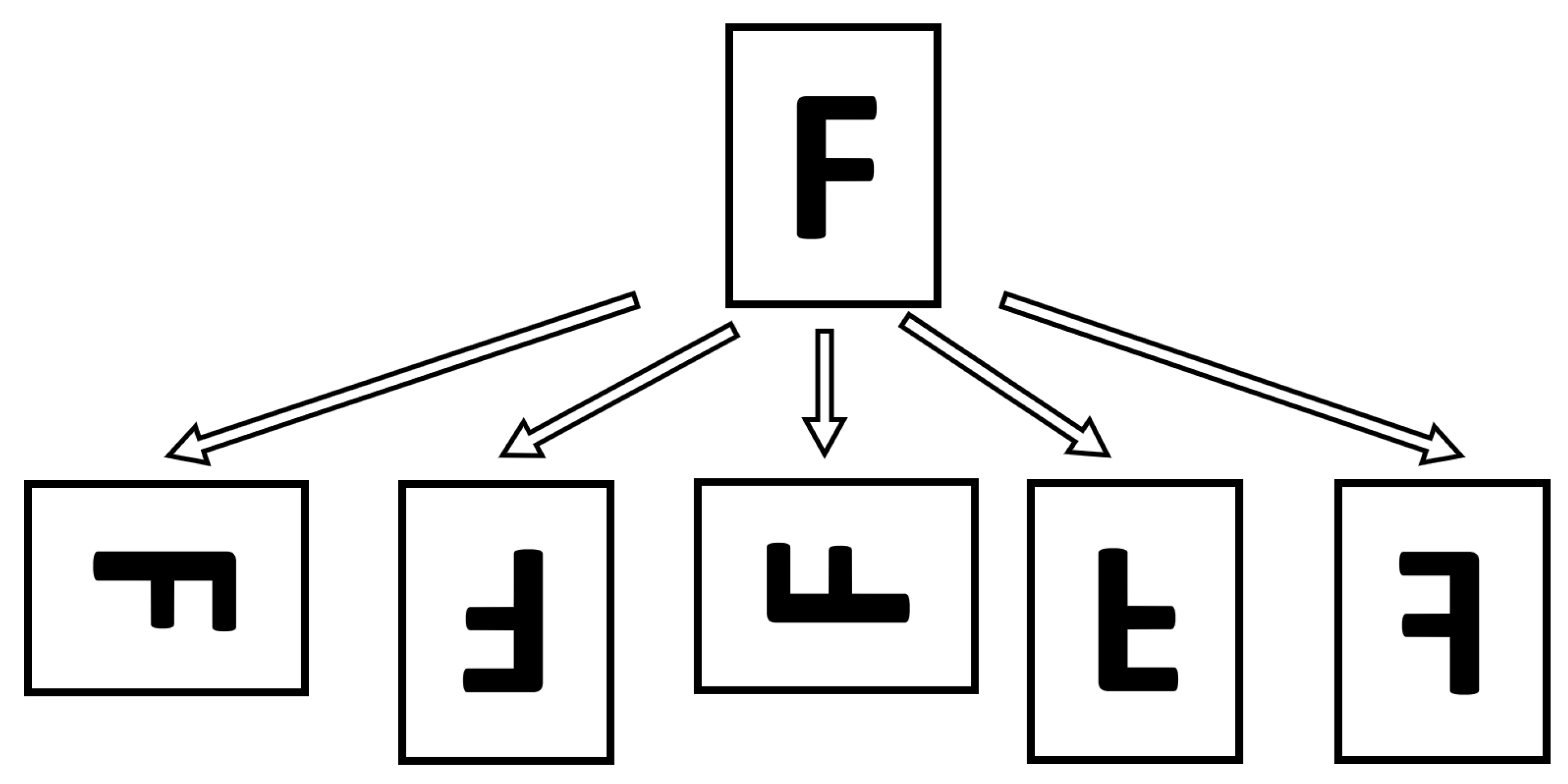

Table 1.
Summary of the dataset.
| Class | Number of images |
|---|---|
| initial | 10 |
| WA1 | 6 |
| WA2 | 9 |
| WA2.5 | 8 |
Table 2.
Results obtained for binary classification: cleaned vs. not cleaned surface.
| Model | Accuracy | Balanced accuracy | Macro F1 | Macro precision | Macro recall |
|---|---|---|---|---|---|
| EfficientNetB0 | 0.878 ± 0.130 | 0.821 ± 0.176 | 0.832 ± 0.170 | 0.865 ± 0.166 | 0.821 ± 0.176 |
| MobileNetV2 | 0.698 ± 0.096 | 0.664 ± 0.079 | 0.645 ± 0.087 | 0.695 ± 0.140 | 0.664 ± 0.079 |
| ResNet50 | 0.825 ± 0.080 | 0.793 ± 0.123 | 0.783 ± 0.111 | 0.795 ± 0.125 | 0.793 ± 0.123 |
| XGBoost features EfficientNetB0 | 0.844 ± 0.111 | 0.758 ± 0.192 | 0.746 ± 0.218 | 0.802 ± 0.260 | 0.758 ± 0.192 |
| XGBoost features MobileNetV2 | 0.725 ± 0.160 | 0.602 ± 0.178 | 0.590 ± 0.221 | 0.616 ± 0.290 | 0.602 ± 0.178 |
| XGBoost features ResNet50 | 0.816 ± 0.073 | 0.766 ± 0.067 | 0.770 ± 0.061 | 0.823 ± 0.112 | 0.766 ± 0.067 |
Table 3.
Results obtained for multi-class classification of cleanliness grade.
| Model | Accuracy | Balanced accuracy | Macro F1 | Macro precision | Macro recall |
|---|---|---|---|---|---|
| EfficientNetB0 | 0.477 ± 0.075 | 0.456 ± 0.047 | 0.431 ± 0.058 | 0.498 ± 0.036 | 0.456 ± 0.047 |
| MobileNetV2 | 0.449 ± 0.153 | 0.478 ± 0.145 | 0.393 ± 0.160 | 0.378 ± 0.206 | 0.478 ± 0.145 |
| ResNet50 | 0.523 ± 0.126 | 0.544 ± 0.149 | 0.490 ± 0.157 | 0.544 ± 0.272 | 0.544 ± 0.149 |
| XGBoost features EfficientNetB0 | 0.506 ± 0.079 | 0.478 ± 0.063 | 0.458 ± 0.089 | 0.478 ± 0.149 | 0.478 ± 0.063 |
| XGBoost features MobileNetV2 | 0.620 ± 0.094 | 0.589 ± 0.101 | 0.561 ± 0.147 | 0.640 ± 0.218 | 0.589 ± 0.101 |
| XGBoost features ResNet50 | 0.703 ± 0.218 | 0.711 ± 0.213 | 0.710 ± 0.215 | 0.762 ± 0.228 | 0.711 ± 0.213 |
Table 4.
Summary of the best results obtained in the considered classification tasks.
| Task | Best method | Balanced accuracy |
|---|---|---|
| Cleaned vs. not cleaned classification | EfficientNetB0 | 0.8214 |
| Cleanliness grade classification | XGBoost features ResNet50 | 0.7111 |
Disclaimer/Publisher’s Note: The statements, opinions and data contained in all publications are solely those of the individual author(s) and contributor(s) and not of MDPI and/or the editor(s). MDPI and/or the editor(s) disclaim responsibility for any injury to people or property resulting from any ideas, methods, instructions or products referred to in the content. |
© 2026 by the authors. Licensee MDPI, Basel, Switzerland. This article is an open access article distributed under the terms and conditions of the Creative Commons Attribution (CC BY) license (http://creativecommons.org/licenses/by/4.0/).
Copyright: This open access article is published under a Creative Commons CC BY 4.0 license, which permit the free download, distribution, and reuse, provided that the author and preprint are cited in any reuse.


