
Submitted:
12 June 2026
Posted:
16 June 2026
You are already at the latest version
Abstract
Hydrometeorological extremes in oceanic island environments are influenced not only by rainfall intensity but also by wet-condition persistence and the interaction of multi-ple atmospheric drivers. This study investigates extreme, persistent, and compound hydrometeorological events at the Chã de Macela station (São Miguel Island, Azores) using a quality-controlled daily dataset for 2011–2023. Compound events were defined as days simultaneously exceeding the precipitation P95 threshold (95 th percentile), wind-speed P90 threshold (90 th percentile), and relative-humidity P90 threshold.
Eight compound events were identified. Results revealed a strong relationship between persistence and hydrometeorological severity, with 75% of compound events and nearly half of all P99 (99 th percentile) precipitation events occurring within persistent wet spells. This indicates that the most severe hydrometeorological conditions gener-ally develop within pre-existing humid regimes rather than as isolated rainfall epi-sodes.
ERA5 reanalysis data were used to analyse mean sea level pressure, total column water vapour, and synoptic circulation patterns. Extreme precipitation events were associ-ated with significantly lower pressure and higher atmospheric moisture than ordinary conditions (Mann-Whitney test, p < 0.001). Synoptic analysis revealed multiple at-mospheric pathways, including cyclonic systems, strong meridional pressure gradi-ents, and developing large-scale disturbances. These findings demonstrate that com-pound hydrometeorological extremes in the Azores arise through different synoptic mechanisms but are consistently linked to strong atmospheric forcing over the North Atlantic.
Keywords:
Azores
; compound hydrometeorological events
; extreme precipitation
; persistence
; synoptic classification
; ERA5 reanalysis
; cyclonic systems
; meridional atmospheric gradients
1. Introduction
Hydrometeorological extremes constitute one of the most significant sources of natural hazards worldwide, affecting ecosystems, infrastructure, water resources, and human activities. Extreme precipitation events have become a major focus of climate research because of their environmental, social, and economic impacts and their expected intensification under climate change [1]. In recent decades, increasing attention has been devoted not only to the magnitude of extreme events but also to their temporal organization, persistence, and interaction with other environmental variables. This shift reflects the growing recognition that severe impacts often arise from prolonged or combined atmospheric conditions rather than from isolated meteorological anomalies [2,3].
Traditionally, hydrometeorological studies have focused on the analysis of individual variables, particularly precipitation, temperature, or wind. However, recent research has demonstrated that multiple drivers frequently interact to produce impacts that exceed those associated with each variable considered separately. Such situations are commonly referred to as compound events, defined as the combination of multiple climatic or meteorological factors that jointly contribute to environmental or societal risk [4,5]. Examples include the simultaneous occurrence of intense precipitation and strong winds, prolonged wet periods followed by extreme rainfall, or combinations of elevated atmospheric moisture and persistent storm activity.
Precipitation persistence represents another critical aspect of hydrometeorological variability. While individual extreme rainfall days can generate significant impacts, the cumulative effects of consecutive wet days may be equally important, particularly in relation to flooding, slope instability, soil saturation, and water-resource management. Persistent wet periods can substantially amplify the consequences of subsequent extreme rainfall episodes by progressively reducing infiltration capacity and increasing antecedent soil moisture conditions [6,7]. Conversely, prolonged dry periods influence water availability, ecosystem functioning, and drought development, highlighting the importance of analysing both wet and dry persistence characteristics.
The importance of persistence is particularly evident in oceanic island environments. Islands located in the North Atlantic are strongly influenced by large-scale atmospheric circulation patterns, including the passage of extratropical cyclones, frontal systems, atmospheric rivers, and variability associated with the North Atlantic Oscillation (NAO) [8,9]. These processes can generate prolonged periods of enhanced moisture transport and sustained precipitation, producing hydrometeorological conditions that differ substantially from those observed in continental regions.
The Azores archipelago occupies a strategically important position in the North Atlantic and is frequently exposed to synoptic-scale systems that modulate precipitation, wind, humidity, and cloud cover. Despite the climatological significance of the region, relatively few studies have investigated the relationship between hydrometeorological persistence and compound-event occurrence using long-term observational datasets. Most previous investigations have focused on individual variables, seasonal climatology, or large-scale circulation patterns, while the combined role of persistence and compound hydrometeorological behaviour remains comparatively underexplored.
In this context, the present study investigates hydrometeorological variability at the Chã de Macela station (São Miguel Island, Azores) using a quality-controlled daily dataset covering the period 2011–2023. Particular emphasis is placed on the identification of extreme rainfall events, wet and dry spell persistence, and compound hydrometeorological events involving precipitation, wind, humidity, and solar radiation. By combining climatological characterization, persistence analysis, and compound-event detection, this work aims to improve understanding of the mechanisms underlying hydrometeorological severity in oceanic island environments and to contribute to the growing literature on compound hydrometeorological hazards.
Although the statistical characterization of extreme precipitation and compound hydrometeorological events provides valuable information on their frequency, magnitude and persistence, understanding the atmospheric mechanisms responsible for their occurrence requires a synoptic-scale perspective. In recent years, atmospheric reanalyses have become fundamental tools for investigating the large-scale circulation patterns associated with hydrometeorological extremes. Among these products, the ERA5 reanalysis developed by the European Centre for Medium-Range Weather Forecasts (ECMWF) provides a physically consistent reconstruction of the global atmosphere by combining numerical weather prediction models with a wide range of observational data [10]. ERA5 has been widely used to investigate extreme precipitation events, atmospheric rivers, cyclonic systems, and compound weather and climate events across different regions of the world [5,10]. Recent studies have further highlighted the growing importance of compound-event research for understanding complex climate hazards and improving risk assessment under changing environmental conditions [11].
Previous studies have shown that extreme precipitation events are frequently associated with large-scale atmospheric circulation features, including persistent cyclonic systems, strong pressure gradients, enhanced moisture transport and anomalous geopotential-height patterns [5,9]. However, relatively little attention has been given to the synoptic mechanisms responsible for compound hydrometeorological events in oceanic island environments, particularly in the North Atlantic and the Azores. Owing to their strategic location between subtropical and mid-latitude circulation regimes, the Azores constitute a natural laboratory for investigating the interaction between large-scale atmospheric forcing, precipitation persistence and compound-event behaviour. To the best of our knowledge, no previous study has systematically examined the relationship between hydrometeorological persistence, compound-event occurrence and synoptic-scale atmospheric forcing at Chã de Macela using a long-term observational dataset combined with ERA5 reanalysis fields.
Consequently, the integration of station observations with ERA5-derived atmospheric fields provides an opportunity to explore not only when compound events occur, but also whether different synoptic pathways can lead to the development of hydrometeorological extremes in oceanic island environments. Accordingly, the objective of this study is to characterise hydrometeorological persistence, identify compound hydrometeorological events, and investigate the synoptic pathways associated with their occurrence in the Azores.
2. Materials and Methods
2.1. Study Area
The study was conducted using observations from the Chã de Macela hydrometeorological station, located on São Miguel Island, Azores Archipelago, in the North Atlantic Ocean. The Azores are situated between approximately 37° and 40°N and 25° and 31°W, occupying a strategic position within the North Atlantic atmospheric circulation system. Owing to their location in the transition zone between subtropical and mid-latitude atmospheric regimes, the islands are frequently influenced by extratropical cyclones, frontal systems, and large-scale moisture transport processes.
São Miguel is the largest island of the archipelago and exhibits marked topographic variability, which strongly influences local climatic conditions. The Chã de Macela station is located in the central part of the island at 37.7°N, 25.3°W, and an elevation of 309 m above mean sea level. Its geographical position and elevation make it particularly suitable for monitoring precipitation variability, atmospheric moisture conditions, and the interaction between synoptic-scale forcing and local hydrometeorological responses, as shown in Figure 1.
The climate of São Miguel is typically temperate oceanic, characterized by mild temperatures throughout the year, relatively high humidity, and abundant precipitation. Seasonal variability is largely controlled by the migration of the North Atlantic storm track, resulting in wetter conditions during autumn and winter and comparatively drier conditions during summer. The island’s exposure to Atlantic weather systems and its complex terrain make it an appropriate natural laboratory for investigating precipitation persistence, hydrometeorological extremes, and compound atmospheric events.
2.2. Data Sources and Quality Control
Two complementary data sources were used in this study: (i) daily observations from the Chã de Macela hydrometeorological station and (ii) ERA5 atmospheric reanalysis fields. The observational dataset was used to characterize local hydrometeorological variability, whereas ERA5 data were employed to investigate the associated large-scale atmospheric conditions.
2.2.1. Station Data and Quality-Control Procedure
The analysis was based on daily observations collected at the Chã de Macela hydrometeorological station (São Miguel Island, Azores) between 1 January 2011 and 31 December 2023. The dataset comprised precipitation, solar radiation, mean air temperature, maximum air temperature, minimum air temperature, wind speed, wind direction, relative humidity, and evaporation. All variables were recorded at daily resolution and subsequently organized into a continuous time series covering the entire study period.
Prior to the statistical analyses, a comprehensive quality-control procedure was applied to assess data completeness, identify missing records, detect transcription errors, and verify the physical consistency of the observations. The completeness of the dataset was evaluated for each variable by comparing the number of valid observations with the total number of days in the study period. All variables exhibited high levels of data completeness (>95%), with precipitation and solar radiation exceeding 98% completeness (Table 1). Such coverage provides a robust basis for the analysis of climatological variability, persistence, extreme events, and compound hydrometeorological conditions throughout the study period.
Initial screening identified a limited number of potentially anomalous observations. Detailed inspection revealed that the extreme wind values corresponded to documented storm events affecting the North Atlantic region and were therefore retained in the final dataset. A small number of transcription errors affecting relative humidity and evaporation were corrected using the original station records. In addition, apparent inconsistencies among mean, maximum, and minimum temperature values were found to be associated with partial missing records rather than physically inconsistent observations. Consequently, no temperature observations were removed from the dataset on physical-consistency grounds.
The final quality-controlled dataset was considered physically consistent and suitable for climatological characterization, extreme-event detection, persistence analysis, and compound hydrometeorological event identification.
To complement the station observations and provide a synoptic-scale perspective, ERA5 atmospheric reanalysis data were used to characterize the large-scale meteorological conditions associated with extreme and compound events.
2.2.2. ERA5 Atmospheric Reanalysis Data
To investigate the large-scale atmospheric conditions associated with extreme and compound hydrometeorological events, atmospheric reanalysis data from the European Centre for Medium-Range Weather Forecasts (ECMWF) ERA5 dataset were used. ERA5 provides a physically consistent reconstruction of the global atmosphere through the assimilation of observational data into a numerical weather prediction framework [10].
Three atmospheric variables were analysed: mean sea level pressure (MSLP), total column water vapour (TCWV), and geopotential height at 500 hPa (Z500). These variables were selected because they provide complementary information on atmospheric forcing (MSLP), moisture availability (TCWV), and mid-tropospheric circulation (Z500). Daily MSLP and TCWV data were extracted for the grid point closest to the Chã de Macela station and used to examine the atmospheric conditions associated with wet days, dry days, extreme precipitation events, and compound hydrometeorological events. Geopotential height at 500 hPa and mean sea level pressure fields were subsequently analysed to investigate the synoptic-scale circulation patterns associated with the eight compound events identified during the study period.
For the synoptic analysis, ERA5 fields were extracted over the North Atlantic domain (45°N–30°N, 40°W–15°W) at 12:00 UTC, covering a seven-day window centred on each compound event (±3 days). This configuration allowed the evolution of large-scale circulation features, including cyclonic systems, pressure gradients, and geopotential-height anomalies, to be examined. The resulting fields were used to classify the dominant synoptic mechanisms associated with compound hydrometeorological events in the Azores.
2.3. Climatological and Extreme-Event Analysis
A climatological characterization of the Chã de Macela station was performed using the quality-controlled daily observations collected between 2011 and 2023. Monthly climatological statistics were calculated for all variables, including precipitation, air temperature, wind speed, relative humidity, solar radiation, and evaporation. For precipitation, monthly totals were derived from the aggregation of daily rainfall amounts, whereas monthly mean values were calculated for the remaining variables. These analyses provided the climatological framework required to identify seasonal patterns and evaluate hydrometeorological variability at the station.
To identify extreme hydrometeorological conditions, a percentile-based approach was adopted. Percentiles were calculated from the complete daily observational record for each variable.
where represents the inverse cumulative distribution function and corresponds to the selected percentile level.
Pq=F−1(q)
The 90th percentile (P90), 95th percentile (P95), and 99th percentile (P99) were used to characterize progressively more severe conditions. For precipitation, the P95 threshold was adopted to define extreme rainfall events, while the P99 threshold was used to identify very extreme rainfall events. This approach is widely used in climatological and hydrometeorological studies because it provides an objective method for identifying events that significantly exceed typical environmental conditions [2,12].
The percentile analysis was subsequently applied to the entire daily series in order to determine the frequency, timing, and magnitude of extreme events. Days exceeding the precipitation P95 threshold were classified as extreme rainfall events, whereas days exceeding the P99 threshold were considered very extreme rainfall events. Similar thresholds were calculated for wind speed, relative humidity, solar radiation, and evaporation to support the identification of compound hydrometeorological conditions.
The resulting extreme-event database provided the basis for subsequent persistence and compound-event analyses. In addition to identifying individual extreme days, the percentile thresholds were used to investigate whether the most severe events occurred as isolated episodes or as components of longer-lasting hydrometeorological regimes.
2.4. Persistence Metrics
To investigate the temporal organization of hydrometeorological conditions, persistence metrics were calculated from the daily precipitation series. Persistence was evaluated through the identification of consecutive wet and dry periods, commonly referred to as wet spells and dry spells.
A wet day was defined as a day with precipitation greater than or equal to 1 mm day⁻¹, whereas a dry day was defined as a day with precipitation below 1 mm day⁻¹. Consecutive wet days were grouped into wet spells, while consecutive dry days were grouped into dry spells. This threshold has been widely used in climatological and hydrological studies to distinguish meaningful precipitation occurrences from trace rainfall amounts.
For each wet and dry spell, the following characteristics were calculated:
- start date;
- end date;
- duration (days);
- accumulated precipitation (wet spells only);
- maximum daily precipitation within the spell;
- mean wind speed;
- mean relative humidity;
- mean solar radiation.
Several persistence indicators were subsequently derived from the identified spells. These included the total number of wet and dry spells, the mean and median spell duration, the maximum spell duration, and the accumulated precipitation associated with each wet spell. In addition, annual persistence indices were computed through the determination of the maximum number of consecutive wet days (CWD) and the maximum number of consecutive dry days (CDD) for each year of the study period.
To investigate the role of persistence in hydrometeorological severity, wet spells lasting five or more consecutive days were classified as persistent wet spells. This threshold was selected to distinguish short-lived precipitation episodes from sustained wet regimes capable of generating cumulative hydrological impacts. The occurrence of extreme precipitation events and compound hydrometeorological events within persistent wet spells was subsequently evaluated to determine whether severe conditions tended to develop as isolated events or as part of longer lasting hydrometeorological regimes.
2.5. Compound Hydrometeorological Events
Compound hydrometeorological events were identified through the simultaneous occurrence of extreme or anomalous conditions in multiple atmospheric variables. Following the compound-event framework proposed by [4,5], the analysis focused on combinations of variables that jointly contribute to hydrometeorological severity rather than on isolated extremes.

Table 2.
Definitions and Thresholds Adopted for Persistence and Compound Hydrometeorological Event Identification.
Table 2.
Definitions and Thresholds Adopted for Persistence and Compound Hydrometeorological Event Identification.
| Category | Definition |
|---|---|
| Wet day | Precipitation ≥ 1 mm day⁻¹ |
| Dry day | Precipitation < 1 mm day⁻¹ |
| Wet spell | Consecutive wet days |
| Dry spell | Consecutive dry days |
| Extreme rainfall event | Precipitation ≥ P95 |
| Very extreme rainfall event | Precipitation ≥ P99 |
| Persistent wet spell | Wet spell ≥ 5 consecutive days |
| Core compound event | Precipitation ≥ P95 + Wind ≥ P90 + Relative Humidity ≥ P90 |
The identification procedure was based on percentile thresholds derived from the complete observational record. Extreme precipitation events were defined using the precipitation P95 threshold, while anomalously high wind (W) and relative humidity (RH) conditions were defined using the corresponding P90 thresholds. These variables were selected because they represent complementary dimensions of hydrometeorological forcing, namely rainfall intensity, atmospheric dynamical forcing, and moisture availability.
A core compound hydrometeorological event was defined as a day simultaneously satisfying the following conditions:
This definition was adopted to identify episodes characterized by the concurrent occurrence of intense rainfall, enhanced atmospheric forcing, and near-saturated atmospheric conditions. Such situations are potentially more hazardous than precipitation extremes occurring in isolation because they involve the interaction of multiple atmospheric drivers.
Additional combinations involving precipitation, relative humidity, wind speed, and solar radiation were also evaluated to characterize the broader spectrum of compound hydrometeorological behaviour. However, the core compound-event definition was retained as the principal criterion for identifying the most severe and meteorologically coherent episodes.
Following event identification, the temporal occurrence of compound events was compared with the persistence metrics described in Section 2.4. Each compound event was assigned to its corresponding wet spell, allowing an assessment of whether compound hydrometeorological conditions preferentially occurred during persistent wet regimes or as isolated atmospheric events.
3. Results
The results are presented in terms of climatological variability, extreme-event occurrence, persistence characteristics, and compound hydrometeorological behaviour. Together, these analyses provide a comprehensive characterization of hydrometeorological conditions at the Chã de Macela station during the 2011–2023 period.
3.1. Climatological Characterization of the Chã de Macela Station
The climatological analysis of the Chã de Macela station revealed a marked seasonal cycle in precipitation, reflecting the strong influence of North Atlantic atmospheric circulation on the Azores. Monthly precipitation totals were highest during the cool season, with the wettest conditions occurring between October and March. December was the wettest month, with mean precipitation exceeding 150 mm, followed by October, March, and February. In contrast, July was the driest month, with mean monthly precipitation of approximately 40 mm, as illustrated in Figure 2.
This seasonal behaviour is consistent with the enhanced influence of extratropical cyclones and frontal systems during autumn and winter, when the North Atlantic storm track is displaced southward and more frequently affects the Azores. During summer, the increased influence of subtropical anticyclonic conditions contributes to reduced precipitation totals and more stable atmospheric conditions.
The observed precipitation regime confirms the strong oceanic character of the study area and provides the climatological context required for the interpretation of extreme, persistent, and compound hydrometeorological events. This seasonal background is particularly important for the subsequent analysis of extreme hydrometeorological conditions.
3.2. Extreme Hydrometeorological Conditions
The percentile-based analysis revealed substantial variability in hydrometeorological conditions throughout the 2011–2023 observational period. For precipitation, the 95th percentile (P95) corresponded to 16.3 mm day⁻¹, while the 99th percentile (P99) reached 36.2 mm day⁻¹. Based on these thresholds, 235 days were classified as extreme rainfall events (P95), whereas 47 days exceeded the P99 threshold and were therefore considered very extreme precipitation events.
The highest daily precipitation recorded during the study period reached 71.7 mm, corresponding to approximately four times the P95 threshold and nearly twice the P99 threshold. Several additional events exceeded 60 mm day⁻¹, highlighting the occurrence of rare but potentially significant hydrometeorological episodes at the station.
The frequency distribution of extreme-event categories is presented in Figure 3. While extreme precipitation events (P95) occurred relatively frequently throughout the observational record, progressively stricter combinations of atmospheric conditions resulted in substantially lower numbers of events. Only 47 days exceeded the P99 threshold, whereas 44 and 46 events simultaneously satisfied the criteria of precipitation ≥ P95 combined with wind speed ≥ P90 and relative humidity ≥ P90, respectively. The largest number of dual-variable events was obtained for the combination of extreme precipitation and reduced solar radiation (precipitation ≥ P95 and radiation ≤ P10), with 80 occurrences.
The most restrictive category corresponded to the core compound hydrometeorological events, defined by the simultaneous occurrence of precipitation ≥ P95, wind speed ≥ P90, and relative humidity ≥ P90. Only eight events satisfied all three criteria, demonstrating that truly compound hydrometeorological extremes were comparatively rare during the study period, as shown in Figure 3.
The marked decrease in event frequency from simple precipitation extremes to compound-event conditions highlights the selectivity of the adopted classification scheme. These results indicate that although intense rainfall events are relatively common within the regional climate context, the simultaneous occurrence of extreme precipitation, strong winds, and near-saturated atmospheric moisture remains uncommon. Consequently, the identified compound events represent a distinct subset of hydrometeorological extremes and provide the basis for the persistence and synoptic analyses presented in the following sections.
3.3. Persistence of Wet and Dry Conditions
Beyond the magnitude of individual precipitation extremes, the temporal persistence of wet and dry conditions constitutes a fundamental component of hydrometeorological variability. The identification and characterization of wet and dry spells provide insight into the duration, frequency, and cumulative effects of precipitation regimes, allowing an assessment of whether hydrometeorological severity is primarily driven by isolated extreme events or by sustained periods of anomalous atmospheric conditions.
3.3.1. Distribution of Wet and Dry Spell Duration
A total of 793 wet spells and 791 dry spells were identified during the 2011–2023 study period using the precipitation threshold defined in Section 2.4. The nearly equal number of wet and dry episodes reflects the highly dynamic nature of hydrometeorological conditions at Chã de Macela, where frequent transitions occur between precipitation and non-precipitation regimes.
The duration distribution of wet and dry spells is presented in Figure 4. Most events were relatively short-lived, with both wet and dry spells typically lasting fewer than five consecutive days. Wet spells exhibited a mean duration of 2.37 days and a median duration of 2 days, whereas dry spells persisted for an average of 3.52 days, also with a median duration of 2 days. These results indicate that dry conditions tend to persist slightly longer than wet conditions, despite the generally humid character of the Azorean climate.
The frequency distribution reveals a pronounced positive skewness, with a large number of short-duration events and a relatively small number of highly persistent episodes. Although most wet spells lasted only one to three days, several episodes exceeded ten consecutive days, demonstrating the capacity of the regional climate system to sustain prolonged precipitation regimes. An even greater persistence was observed for dry spells, including a small number of exceptionally long events.
The maximum wet-spell duration reached 23 consecutive days, whereas the longest dry spell persisted for 110 days. These extreme values highlight the substantial temporal variability of precipitation occurrence in the study area and suggest that hydrometeorological conditions cannot be adequately characterized solely through daily precipitation statistics.
Overall, the distribution of wet and dry spell durations indicates that hydrometeorological variability at Chã de Macela is dominated by short-lived events but punctuated by occasional highly persistent episodes capable of generating substantial cumulative impacts. These persistent events are examined in greater detail in the following subsection.
3.3.2. Most Persistent Wet Episodes
The ranking of wet spells according to accumulated precipitation provides further insight into the hydrometeorological significance of persistent rainfall regimes at the Chã de Macela station. The ten wet spells with the highest accumulated precipitation are presented in Figure 5. The most significant event occurred between 28 February and 22 March 2013, lasting 23 consecutive days and accumulating approximately 304 mm of precipitation. This episode represents the most persistent and hydrologically important wet spell identified during the 2011–2023 period. The accumulated rainfall during this event substantially exceeded that of all other wet spells, highlighting its exceptional character within the observational record.
The second most important event began on 12 January 2016 and accumulated approximately 196 mm of precipitation. Several additional wet spells exceeded 140 mm, including events initiated on 25 January 2020, 17 October 2014, 16 December 2021, and 28 February 2023. These episodes demonstrate that prolonged rainfall accumulation is not restricted to a single season or year but occurs repeatedly throughout the observational period.
A notable feature of Figure 5 is the presence of the wet spell beginning on 28 February 2023 among the most important rainfall episodes. This event is particularly relevant because it also contained one of the core compounds hydrometeorological events identified in the study, illustrating the close relationship between persistence and hydrometeorological severity.
The distribution of accumulated precipitation among the most persistent wet spells indicates that hydrometeorological impacts in the study area are often associated with prolonged periods of sustained rainfall rather than isolated daily extremes. While individual extreme precipitation days contribute substantially to total rainfall accumulation, the cumulative effect of consecutive wet days can produce hydrological conditions of comparable or even greater significance.
Overall, the results highlight the importance of persistence as a fundamental characteristic of hydrometeorological variability at Chã de Macela. The occurrence of several high-impact wet spells with accumulated precipitation exceeding 120 mm suggests that prolonged rainfall regimes constitute a major component of the regional hydrological cycle and provide a favorable context for the development of extreme and compound hydrometeorological events.
3.4. Compound Hydrometeorological Events
The compound-event analysis revealed that the simultaneous occurrence of multiple hydrometeorological extremes was relatively uncommon during the 2011–2023 study period. Although 235 days exceeded the precipitation P95 threshold and 47 days exceeded the P99 threshold, only eight events satisfied the criteria established for core compound hydrometeorological events, namely the concurrent occurrence of precipitation ≥ P95, wind speed ≥ P90, and relative humidity ≥ P90.
The eight core compound events identified during the study period are presented in Table 4. These events occurred between 2019 and 2023 and were characterized by the simultaneous presence of intense rainfall, elevated wind speeds, and near-saturated atmospheric moisture conditions. The relatively small number of events demonstrates that the concurrent occurrence of multiple hydrometeorological extremes is substantially less frequent than the occurrence of precipitation extremes alone.
Among the identified events, the most severe episode occurred on 6 June 2023, when daily precipitation reached 63.3 mm, accompanied by a wind speed of 14.8 km h⁻¹ and relative humidity of 99.3%. Another particularly significant event was recorded on 28 February 2023, with 53.8 mm of precipitation and relative humidity exceeding 98%. These episodes illustrate the capacity of the regional atmosphere to simultaneously sustain intense rainfall, enhanced atmospheric forcing, and exceptionally moist conditions.
The temporal distribution of the compound events indicates that all identified cases occurred during the latter part of the observational period, between 2019 and 2023. This clustering does not necessarily imply a long-term trend, but it highlights the occurrence of several recent episodes characterized by the interaction of multiple hydrometeorological drivers.
In addition to the core compound-event definition, other combinations of atmospheric variables were examined during the analysis. However, the simultaneous occurrence of precipitation, wind speed, and relative humidity exceeding their respective thresholds provided the most restrictive and meteorologically coherent representation of hydrometeorological severity. Consequently, the eight identified events constitute a distinct subset of the extreme-event population and represent the most severe atmospheric conditions observed at the station.
The identification of these events provides the basis for assessing the role of persistence in hydrometeorological severity. In particular, it enables the evaluation of whether compound events occur as isolated episodes or preferentially develop within longer-lasting wet regimes. This relationship is explored in the following section.
3.5. Persistence as a Driver of Hydrometeorological Severity
The analyses presented in the previous sections indicate that hydrometeorological severity at Chã de Macela is influenced not only by the intensity of individual precipitation events but also by the persistence of wet conditions. To investigate this relationship, the occurrence of extreme rainfall events and compound hydrometeorological events was examined within the context of the wet-spell structure identified from the observational record.
A total of 85 wet spells were classified as persistent, corresponding to episodes lasting five or more consecutive days. Although these events represented only a small fraction of the 793 wet spells identified during the study period, they played a disproportionately important role in the occurrence of hydrometeorological extremes.
Of the 235 precipitation events exceeding the P95 threshold, 93 occurred within persistent wet spells, corresponding to approximately 39.6% of all extreme rainfall events. A similar pattern was observed for the most severe precipitation episodes. Of the 47 events exceeding the P99 threshold, 22 occurred during persistent wet spells, representing 46.8% of all very extreme rainfall events. An even stronger relationship emerged for compound hydrometeorological events. Six of the eight core compound events identified in the study occurred within persistent wet spells, indicating that 75% of compound events developed during sustained wet regimes.
The distribution of extreme and compound events according to wet-spell duration classes is presented in Figure 6. Extreme rainfall events were observed across a broad range of wet-spell durations; however, the highest frequencies occurred within spells lasting between four and fourteen days. A similar behaviour was observed for compound events, which were exclusively associated with wet spells lasting between four and fourteen days and were absent from isolated one-day precipitation episodes. This pattern suggests that the development of compound hydrometeorological conditions is favoured by sustained wet regimes rather than by short-lived rainfall events.
The relationship between wet-spell duration and accumulated precipitation is illustrated in Figure 7. In general, longer wet spells tended to produce greater accumulated precipitation totals, reflecting the cumulative effect of sustained rainfall over multiple consecutive days. However, substantial variability was observed among events of similar duration, indicating that persistence alone does not fully determine hydrometeorological severity. Instead, both rainfall intensity and event duration contribute to the total precipitation accumulated during a wet spell.
The most severe hydrometeorological episodes identified in the study were generally associated with a combination of persistence and high intensity of rainfall. The occurrence of extreme and compound events within persistent wet spells demonstrates that prolonged wet conditions provide a favourable environment for the development of hydrometeorological hazards. Consequently, persistence emerges as a key driver of hydrometeorological severity in the study area.
Overall, the results demonstrate that a substantial proportion of both very extreme precipitation events and compound hydrometeorological events are embedded within persistent wet regimes. These findings highlight the importance of considering the temporal organization of precipitation, in addition to rainfall magnitude, when assessing hydrometeorological hazards in oceanic island environments. Furthermore, they provide a physical basis for the synoptic analyses presented in the following section.
3.6. Relationship Between Precipitation, MSLP and TCWV
A relationship between precipitation occurrence, mean sea level pressure (MSLP), and atmospheric moisture availability was investigated using daily observations from Chã de Macela and ERA5-derived estimates of total column water vapour (TCWV) for the period 2011–2023. Pearson and Spearman correlation analyses revealed a consistent inverse relationship between precipitation and MSLP, with coefficients ranging from −0.338 to −0.368. Conversely, precipitation exhibited a weaker but positive association with TCWV, whereas MSLP and TCWV were moderately negatively correlated. These results indicate that lower-pressure conditions are generally associated with enhanced atmospheric moisture content and increased precipitation occurrence.
To further investigate these relationships, days were classified into dry, wet, and extreme precipitation categories. The corresponding mean MSLP and TCWV values are summarized in Table 5. Dry days were characterized by higher atmospheric pressure and lower moisture availability than wet days. This contrast became progressively stronger as precipitation intensity increased, with extreme precipitation events (P95 and P99) occurring under substantially lower MSLP and markedly higher TCWV values than ordinary precipitation conditions.
The progression from dry to extreme precipitation regimes is particularly evident in Table 5. Relative to dry days, P99 events occurred under atmospheric pressure conditions approximately 12 hPa lower and atmospheric moisture contents approximately 35% higher. These results indicate that the most intense precipitation episodes in São Miguel are associated with the simultaneous occurrence of enhanced atmospheric moisture availability and stronger cyclonic forcing.
These findings reveal a clear transition from dry to extreme precipitation conditions. As precipitation intensity increases, MSLP decreases systematically, whereas TCWV increases, as shown in Table 5. This behaviour suggests that extreme rainfall events in São Miguel develop under the combined influence of dynamic and thermodynamic processes, involving both favourable large-scale atmospheric circulation and enhanced moisture supply.
Mann–Whitney U tests were performed to evaluate the statistical significance of the differences in MSLP and TCWV among the precipitation regimes considered. As summarized in Table 6, both variables differed significantly between dry and wet days, as well as between ordinary precipitation days and extreme precipitation events (P95 and P99). All comparisons yielded highly significant p-values (p < 0.001), indicating that the observed differences are unlikely to result from random variability.
These results confirm that extreme precipitation events in São Miguel occur under systematically lower atmospheric pressure and enhanced atmospheric moisture availability. Together, Table 5 and Table 6 provide consistent evidence that both synoptic-scale forcing and moisture supply play a fundamental role in the occurrence of intense precipitation events in the Azores.
Relative to dry days, P99 events occurred under MSLP values approximately 11.9 hPa lower and TCWV values approximately 35% higher. The progressive decrease in atmospheric pressure from dry to extreme precipitation conditions is further illustrated in Figure 8, which summarizes the distribution of MSLP across the different precipitation regimes.
The progressive decrease in MSLP observed from dry days to P99 events indicates an increasing influence of cyclonic forcing. However, intense precipitation requires not only favourable dynamical conditions but also sufficient atmospheric moisture availability. To assess the thermodynamic component of precipitation generation, Figure 9 presents the distribution of TCWV) across the same precipitation regimes. Together, Figure 8 and Figure 9 provide complementary evidence of the dynamic and thermodynamic controls governing precipitation variability at Chã de Macela.
The progressive decrease in MSLP and increase in TCWV from dry conditions to P99 events suggests that extreme precipitation in São Miguel is associated with a combination of enhanced atmospheric moisture availability and large-scale cyclonic forcing. This finding provides the basis for assessing whether compound hydrometeorological events occur under atmospheric conditions distinct from those associated with ordinary extreme precipitation events.
Table 7.
Comparison of mean sea level pressure (MSLP) and total column water vapour (TCWV) associated with compound hydrometeorological events and non-compound extreme precipitation events (P95) at Chã de Macela during 2011–2023. Compound events were defined as days simultaneously exceeding the precipitation P95 threshold, the wind-speed P90 threshold, and the relative-humidity P90 threshold. N denotes the number of observations in each category.
Table 7.
Comparison of mean sea level pressure (MSLP) and total column water vapour (TCWV) associated with compound hydrometeorological events and non-compound extreme precipitation events (P95) at Chã de Macela during 2011–2023. Compound events were defined as days simultaneously exceeding the precipitation P95 threshold, the wind-speed P90 threshold, and the relative-humidity P90 threshold. N denotes the number of observations in each category.
| Group | N | Mean MSLP (hPa) | Mean TCWV (kg m-2) |
|---|---|---|---|
| P95 non-compound events | 227 | 1014.52 | 27.47 |
| Compound events | 8 | 1010.08 | 28.52 |
Although compound events represent a subset of P95 precipitation days, they occurred under lower mean sea level pressure and slightly higher atmospheric moisture content than non-compound extreme precipitation events. However, the differences between the two groups were not statistically significant according to the Mann–Whitney U test (p > 0.05). This result suggests that enhanced atmospheric moisture availability and reduced surface pressure are characteristic of extreme precipitation events in general but are insufficient to explain why only a subset of such events evolves into compound hydrometeorological extremes.
Consequently, the distinction between compound and non-compound extreme events is likely controlled by additional synoptic-scale dynamical mechanisms. This interpretation motivates the subsequent analysis of large-scale atmospheric circulation patterns associated with the identified compound events.
3.7. Synoptic Context of Compound Events
To investigate the synoptic-scale mechanisms associated with compound hydrometeorological events, the evolution of mean sea level pressure (MSLP) and 500-hPa geopotential height (Z500) was analysed for the most intense compound event identified during the study period (6 June 2023). This event was selected as an initial case study because it combined the highest daily precipitation, the strongest wind conditions, and near-saturated atmospheric moisture, as shown in Figure 10.
The compound event of 6 June 2023 was associated with the progressive development of a deep synoptic-scale depression over the central North Atlantic (Figure 10). Between 3 and 5 June, mean sea level pressure decreased steadily while a closed low-geopotential centre became established at 500 hPa. The coincidence of low surface pressure and reduced geopotential heights indicates a vertically coherent cyclonic structure, favouring large-scale ascent and sustained moisture transport towards the Azores.
The event reached maximum intensity on 6 June, when precipitation at Chã de Macela exceeded 63 mm. At this stage, the depression attained its greatest intensity in the vicinity of the Azores, with minimum sea-level pressures close to 992–994 hPa and a well-defined closed circulation at 500 hPa. Following the event peak, the system progressively weakened and migrated eastward between 7 and 9 June, accompanied by a gradual recovery of both pressure and geopotential height fields.
The persistence of cyclonic circulation over several consecutive days suggests that the event was driven by a long-lived synoptic-scale disturbance rather than by isolated local convection. These results provide evidence that the most intense compound hydrometeorological events in São Miguel are associated with persistent and vertically coherent cyclonic systems capable of maintaining favorable dynamic and thermodynamic conditions for prolonged precipitation. The compound event of 6 June 2023 was therefore associated with the development and persistence of a vertically coherent cyclonic system extending from the surface to the middle troposphere.
The synoptic evolution of the 6 June 2023 event highlighted the role of a deep and persistent cyclonic system extending throughout a substantial portion of the troposphere. To determine whether this configuration is representative of compound hydrometeorological events in general, Figure 11 presents the corresponding analysis for the second most intense compound event identified during the study period, which occurred on 28 February 2023.
Figure 11 shows the synoptic evolution associated with the compound hydrometeorological event of 28 February 2023. Between 25 and 28 February, a broad cyclonic circulation developed over the central North Atlantic, characterised by a deep low-pressure system located northwest of the Azores and a pronounced meridional gradient in 500-hPa geopotential height. During this period, the geopotential-height gradient progressively intensified, placing São Miguel near the transition zone between lower geopotential heights to the northwest and higher geopotential heights to the southeast. The maximum precipitation recorded at Chã de Macela (53.8 mm) occurred on 28 February, when the station was situated within a region of enhanced synoptic forcing associated with this large-scale circulation pattern. Unlike the compound event of 6 June 2023, which was characterised by a closed cyclonic centre directly affecting the Azores, the February event appears to have been linked primarily to the strong geopotential-height gradient and the proximity of an intense depression rather than to the passage of a mature closed cyclone over the archipelago. Following the event peak, the circulation gradually weakened and shifted eastward, accompanied by increasing mean sea level pressure and a progressive recovery of geopotential heights over the region.
The synoptic evolution of the 28 February 2023 event revealed that compound hydrometeorological extremes may develop under circulation patterns different from those observed during the 6 June 2023 event. In particular, the February event appeared to be associated with a strong geopotential-height gradient and the proximity of a deep cyclonic circulation rather than with a closed cyclonic centre directly affecting the Azores. To assess whether this configuration is representative of compound events in general, Figure 12 presents the corresponding analysis for the compound event of 3 January 2021, allowing a further comparison of the large-scale atmospheric mechanisms responsible for extreme hydrometeorological conditions in São Miguel.
The synoptic evolution associated with the compound hydrometeorological event of 3 January 2021 is illustrated in Figure 12. Between 1 and 3 January, a cyclonic circulation progressively intensified over the central North Atlantic, accompanied by decreasing mean sea level pressure and lower geopotential heights at 500 hPa. During this period, the Azores became increasingly influenced by the eastern sector of the disturbance, leading to enhanced dynamical forcing over São Miguel.
Maximum precipitation at Chã de Macela (32.2 mm) occurred on 3 January, when the station was located near a well-developed cyclonic system characterised by reduced geopotential heights and low surface pressure. The subsequent evolution between 4 and 6 January revealed the establishment of a closed cyclonic circulation extending from the surface to the middle troposphere. The close correspondence between the pressure and geopotential fields indicates a vertically coherent structure capable of sustaining large-scale ascent and favourable conditions for prolonged precipitation.
Following the mature phase of the event, the disturbance gradually weakened and shifted eastward, with increasing mean sea level pressure and a progressive recovery of geopotential heights evident by 7 January. The persistence of the circulation over several consecutive days suggests that the event was driven by a long-lived synoptic-scale system rather than by short-lived local convective processes.
The overall evolution displayed in Figure 5 closely resembles that observed for the compound event of 6 June 2023, particularly with regard to the development of a persistent and vertically coherent cyclonic structure. This similarity provides further evidence that a substantial proportion of compound hydrometeorological events in São Miguel are associated with deep synoptic-scale disturbances extending throughout a significant portion of the troposphere.
The synoptic evolution of the 3 January 2021 event reinforced the importance of persistent and vertically coherent cyclonic systems in the generation of compound hydrometeorological extremes in São Miguel. However, not all compound events necessarily occur during the mature phase of deep cyclonic disturbances. To investigate whether alternative synoptic pathways may also lead to compound conditions, Figure 13 presents the evolution of mean sea level pressure and 500-hPa geopotential height during the compound event of 28 January 2020, allowing an assessment of the role of developing and intensifying disturbances in the occurrence of extreme precipitation.
Figure 13 shows the synoptic evolution associated with the compound hydrometeorological event of 28 January 2020. In contrast to the events of 6 June 2023 and 3 January 2021, the event did not coincide with the mature phase of a closed cyclonic system centred near the Azores. Between 25 and 27 January, the region was characterised by relatively high surface pressure and a broad geopotential-height gradient, with no well-defined low-pressure centre directly affecting São Miguel.
On 28 January, when maximum precipitation at Chã de Macela reached 28.7 mm, the station was located within a transition zone between lower geopotential heights to the north and higher geopotential heights to the south. Although the surface pressure field did not show a deep closed depression over the archipelago at this stage, the configuration suggests the presence of enhanced synoptic forcing associated with a developing baroclinic environment. This indicates that compound hydrometeorological conditions may occur during the intensification phase of a larger-scale disturbance, before the system reaches its mature stage.
After the event peak, between 29 and 31 January, the synoptic disturbance became more pronounced, with lower geopotential heights and stronger pressure gradients developing to the north and northwest of the Azores. This temporal sequence suggests that the 28 January 2020 event may represent a pre-conditioning or developing-stage mechanism, distinct from the vertically coherent closed-cyclone pattern observed in other compound events. The event therefore provides evidence that compound hydrometeorological extremes in São Miguel may arise from different stages of synoptic disturbance evolution, rather than exclusively from mature cyclonic systems.
The synoptic evolution of the 28 January 2020 event suggested that compound hydrometeorological conditions may develop during the intensification phase of a large-scale disturbance, even before the system reaches maximum maturity. To assess whether this behaviour is representative of compound events in general, Figure 14 presents the corresponding analysis for the compound event of 2 June 2020. This case provides an opportunity to examine whether a more persistent and vertically coherent cyclonic structure, similar to that observed in the events of 6 June 2023 and 3 January 2021, was also present during another summer compound event.
The synoptic evolution of the 28 January 2020 event suggested that compound hydrometeorological conditions may develop during the intensification phase of a large-scale disturbance, even before the system reaches maximum maturity. To assess whether this behaviour is representative of compound events in general, Figure 14 presents the corresponding analysis for the compound event of 2 June 2020. This case provides an opportunity to examine whether a more persistent and vertically coherent cyclonic structure, similar to that observed in the events of 6 June 2023 and 3 January 2021, was also present during another summer compound event.
The synoptic evolution of the 2 June 2020 event highlighted the role of a persistent and vertically coherent cyclonic circulation in the generation of compound hydrometeorological conditions over São Miguel. However, not all compound events necessarily occur in association with mature closed cyclonic systems. To investigate whether alternative large-scale circulation patterns can also favour the occurrence of compound events, Figure 15 presents the synoptic evolution of the compound event of 27 December 2019. This case provides an opportunity to examine the contribution of strong geopotential-height and pressure gradients to the development of extreme hydrometeorological conditions in the Azores.
Figure 15 illustrates the synoptic evolution associated with the compound hydrometeorological event of 27 December 2019. In contrast to the events of 6 June 2023, 3 January 2021 and 2 June 2020, the event was not associated with a well-defined closed cyclonic circulation centred near the Azores. Instead, the synoptic configuration was dominated by a pronounced meridional gradient in 500-hPa geopotential height and a corresponding surface pressure gradient extending across the North Atlantic. Maximum precipitation at Chã de Macela (25.8 mm) occurred on 27 December, when the station was located within a region of enhanced synoptic forcing near the transition zone between lower geopotential heights to the north and higher geopotential heights to the south. Following the event peak, both the pressure and geopotential-height gradients weakened progressively, indicating the gradual dissipation of the large-scale disturbance. This evolution closely resembles that observed during the compound event of 28 February 2023, suggesting that strong synoptic-gradient environments may constitute an alternative pathway for the generation of compound hydrometeorological events in São Miguel.
The synoptic evolution of the 27 December 2019 event demonstrated that compound hydrometeorological conditions can develop in association with strong meridional gradients in geopotential height and surface pressure, even in the absence of a persistent closed cyclonic system over the Azores. To determine whether this circulation pattern represents an isolated case or a recurring mechanism, Figure 16 presents the synoptic evolution of the compound event of 30 December 2022. The comparison of these two events provides an opportunity to assess the role of large-scale atmospheric gradients as an alternative pathway for the generation of compound hydrometeorological extremes in São Miguel.
The synoptic evolution associated with the compound hydrometeorological event of 30 December 2022 is illustrated in Figure 16. Between 27 and 29 December, the Azores were located on the southern flank of a large-scale circulation pattern characterised by high geopotential heights and relatively elevated surface pressure. During this period, a pronounced meridional gradient progressively developed across the North Atlantic, with lower geopotential heights advancing southward and increasing the contrast between northern and southern air masses.
The compound event occurred on 30 December 2022, when precipitation at Chã de Macela reached 17.2 mm. At this stage, the station was situated near the transition zone between lower geopotential heights to the north and higher values to the south, coinciding with enhanced pressure and geopotential-height gradients across the region. Unlike the compound events of 6 June 2023, 3 January 2021 and 2 June 2020, no persistent closed cyclonic circulation was centred over the Azores during the event. Instead, the synoptic forcing was primarily associated with the strengthening of large-scale atmospheric gradients linked to a North Atlantic disturbance located north of the archipelago.
The circulation pattern remained well organised between 31 December and 1 January, maintaining strong meridional gradients over the region before gradually weakening by 2 January. This behaviour closely resembles that observed during the compound event of 27 December 2019, suggesting that strong geopotential-height and pressure gradients represent an alternative mechanism capable of generating compound hydrometeorological conditions in São Miguel. The recurrence of this pattern in multiple events indicates that compound extremes in the Azores may arise through more than one synoptic pathway, highlighting the importance of both persistent cyclonic systems and strong large-scale atmospheric gradients in the development of extreme hydrometeorological conditions.
The synoptic evolution of the 30 December 2022 event provided further evidence that compound hydrometeorological extremes in São Miguel may develop under conditions dominated by strong meridional gradients in geopotential height and surface pressure, rather than through the direct influence of a persistent closed cyclone. To assess whether this circulation pattern represents a recurring mechanism, Figure 17 presents the synoptic evolution of the compound event of 17 December 2019. The comparison of these events allows the consistency of the strong-gradient pathway to be evaluated and provides further insight into the diversity of large-scale atmospheric configurations capable of generating compound hydrometeorological conditions in the Azores.
The evolution of the synoptic-scale circulation during the compound hydrometeorological event of 17 December 2019 is depicted in Figure 17. Between 14 and 16 December, the North Atlantic circulation was characterised by a pronounced meridional gradient in both 500-hPa geopotential height and mean sea level pressure, with lower geopotential heights and lower pressure values located north of the Azores and higher values to the south. During this period, São Miguel was situated near the transition zone between these contrasting atmospheric conditions, leading to progressively enhanced synoptic forcing over the region.
The compound event occurred on 17 December, when precipitation at Chã de Macela reached 18.5 mm. At this stage, the station remained embedded within a region of strong geopotential-height and pressure gradients. Unlike the events of 6 June 2023, 3 January 2021 and 2 June 2020, no persistent closed cyclonic circulation developed in the immediate vicinity of the Azores. Instead, the event appears to have been associated with large-scale atmospheric forcing generated by the strong meridional contrast between subtropical and polar air masses.
The circulation pattern remained broadly unchanged between 18 and 20 December, with the Azores continuing to lie close to the boundary separating lower geopotential heights to the north from higher values to the south. This persistence of strong gradients indicates that the event was embedded within a long-lived synoptic-scale disturbance rather than being generated by local atmospheric processes. The overall evolution closely resembles that observed during the compound events of 27 December 2019 and 30 December 2022, providing further evidence that strong meridional geopotential-height and pressure gradients represent a recurrent mechanism capable of generating compound hydrometeorological events in São Miguel.
3.8. Synoptic Classification of Compound Events
Although all compound hydrometeorological events were associated with enhanced large-scale atmospheric forcing, the synoptic analyses revealed the existence of distinct dynamical pathways leading to their development. Based on the evolution of mean sea level pressure (MSLP) and 500-hPa geopotential height (Z500), the identified events were grouped into three principal synoptic categories. The resulting classification is presented in Table 8.
The analysis of the eight compound hydrometeorological events revealed that no single synoptic configuration was responsible for the occurrence of compound extremes in São Miguel. Instead, the events could be grouped into three distinct categories according to their large-scale atmospheric characteristics (Table 8).
The first and most prominent category comprised persistent and vertically coherent cyclonic systems extending from the surface to the middle troposphere. These events were characterised by the presence of closed low-pressure centres, reduced geopotential heights at 500 hPa, and a persistent cyclonic circulation lasting several days. The compound events of 2 June 2020, 3 January 2021 and 6 June 2023 belonged to this category and were generally associated with the most organised and long-lived synoptic disturbances.
A second category included events associated with strong meridional gradients in both geopotential height and surface pressure. In these cases, compound conditions developed within transition zones separating contrasting air masses, without the direct influence of a mature closed cyclone centred over the Azores. The events of 17 December 2019, 27 December 2019, 28 February 2023 and 30 December 2022 displayed this behaviour. These cases demonstrate that intense atmospheric forcing can arise from large-scale gradients alone, even in the absence of a persistent cyclonic core.
The third category was represented by the event of 28 January 2020, which occurred during the development and intensification phase of a larger-scale disturbance. Unlike the events in the previous categories, the compound conditions were established before the associated circulation reached maximum maturity, suggesting that favourable hydrometeorological conditions may emerge during the pre-conditioning stage of synoptic disturbances.
Overall, the results indicate that compound hydrometeorological events in São Miguel are generated through multiple synoptic pathways. Nevertheless, all identified categories share a common characteristic: the presence of large-scale atmospheric forcing operating over the North Atlantic, reinforcing the importance of regional-scale circulation patterns in the occurrence of compound hydrometeorological extremes in the Azores.
4. Discussion
The results of this study demonstrate that hydrometeorological severity in São Miguel is controlled not only by the magnitude of individual precipitation events but also by the temporal persistence of wet conditions and the large-scale atmospheric circulation patterns operating over the North Atlantic. The combined analysis of station observations and ERA5 reanalysis data revealed that extreme and compound hydrometeorological events emerge through the interaction of local precipitation processes with persistent synoptic-scale forcing.
One of the most important findings is the strong relationship between persistence and hydrometeorological severity. Although persistent wet spells represented only a small fraction of all wet episodes identified during the study period, they accounted for a disproportionate share of extreme precipitation and compound hydrometeorological events. In particular, 75% of the identified compound events occurred within wet spells lasting five or more consecutive days. This result supports the hypothesis that the cumulative effects of sustained rainfall regimes create favourable conditions for the development of severe hydrometeorological episodes. Similar behaviour has been reported in studies highlighting the role of antecedent moisture accumulation and prolonged precipitation regimes in enhancing hydrological impacts and flood risk.
The strong association observed between persistent wet spells and compound hydrometeorological events is also consistent with recent advances in compound-event research. [13] emphasized that persistence constitutes a fundamental characteristic of many compound climate events, as prolonged atmospheric anomalies can create favourable conditions for the interaction of multiple hazards. The present results support this perspective, indicating that sustained wet regimes play a critical role in amplifying hydrometeorological severity in the Azores. [14] showed that prolonged hydrometeorological extremes can arise from recurrent blocking episodes and Rossby wave breaking, which maintain favourable dynamical and moisture conditions for repeated extreme events over several weeks. Similarly, changes in the duration of wet and dry periods have been shown to be closely associated with the evolution of extreme precipitation and drought conditions, highlighting persistence as a key component of hydrometeorological variability [15].
These findings are also consistent with [16], who demonstrated that persistent weather regimes substantially increase the likelihood of hydro-climatic extremes and favour the development of prolonged high-impact conditions. Their analysis further showed that both floods and droughts become more likely under persistent large-scale circulation patterns, highlighting atmospheric persistence as a fundamental driver of hydrometeorological risk.
The dominant contribution of extreme precipitation to overall hydrometeorological severity is consistent with previous studies showing that precipitation extremes tend to respond more strongly to environmental forcing than mean precipitation. Analysing winter climate conditions in China, [17] reported that extreme precipitation increased at a substantially higher rate than total precipitation, highlighting the enhanced sensitivity of precipitation extremes compared with mean precipitation. More recently, a global assessment based on nearly 15,000 meteorological stations confirmed widespread intensification of both daily and multi-day precipitation extremes, with annual maximum precipitation increasing by approximately 6–7% per degree of global warming [18]. Together, these findings support the broader concept that extreme precipitation can represent a disproportionate fraction of total hydrometeorological change and associated impacts.
The relationship between precipitation, atmospheric moisture availability, and synoptic forcing provides additional insight into the mechanisms underlying extreme-event occurrence. Extreme precipitation events were consistently associated with lower mean sea level pressure and higher total column water vapour than ordinary wet days, indicating the combined importance of dynamical and thermodynamical controls. However, compound events did not differ significantly from non-compound P95 events in either MSLP or TCWV. This finding suggests that enhanced moisture availability and reduced surface pressure are necessary but not sufficient conditions for the development of compound hydrometeorological extremes. Instead, the transition from ordinary extreme precipitation to compound-event conditions appears to depend on the broader organisation of atmospheric circulation.
The synoptic analyses revealed that compound hydrometeorological events in São Miguel arise through at least two dominant atmospheric pathways. The first pathway involves persistent and vertically coherent cyclonic systems extending from the surface to the middle troposphere. These events were characterised by closed low-pressure centres, reduced geopotential heights at 500 hPa, and multi-day cyclonic circulation patterns capable of sustaining large-scale ascent and continuous moisture transport. The second pathway is associated with strong meridional gradients in geopotential height and surface pressure. In these cases, compound events developed within transition zones separating contrasting air masses, where enhanced atmospheric forcing was generated by strong large-scale gradients rather than by a mature cyclone directly affecting the Azores. A third, less frequent mechanism was represented by the event of 28 January 2020, which occurred during the development stage of a larger synoptic disturbance.
This finding is consistent with recent studies of compound meteorological hazards, which have demonstrated that extreme compound events can arise through multiple synoptic pathways rather than through a unique atmospheric configuration. For example, [19] identified several distinct synoptic weather patterns associated with compound rainfall–wave events in the northwestern Mediterranean, highlighting the coexistence of different large-scale circulation structures capable of generating severe compound impacts. The present results extend this concept to the North Atlantic island environment of the Azores, where compound hydrometeorological extremes were likewise associated with contrasting synoptic configurations.
The present results further suggest that no single synoptic signature is sufficient to explain compound hydrometeorological extremes in the Azores. Instead, the occurrence of compound events appears to depend on a range of dynamically distinct atmospheric configurations, including persistent cyclonic systems, strong meridional-gradient environments, and developing disturbances. This diversity highlights the complexity of the mechanisms governing extreme hydrometeorological conditions in the North Atlantic.
The coexistence of these mechanisms is closely related to the geographical position of the Azores. Located within the transition zone between subtropical and mid-latitude circulation regimes, the archipelago is simultaneously influenced by the North Atlantic storm track, transient cyclonic systems, and large-scale meridional circulation patterns. This location favours exposure both to mature cyclonic disturbances and to strong atmospheric gradients associated with the interaction of subtropical and polar air masses. Consequently, the Azores constitute a particularly suitable natural laboratory for investigating the diversity of atmospheric pathways leading to compound hydrometeorological extremes. Oceanic islands provide valuable natural laboratories for investigating compound hydrometeorological extremes because their exposure to large-scale atmospheric forcing is only weakly modified by continental influences. Consequently, the mechanisms identified in São Miguel may be relevant to other North Atlantic island environments, including Madeira, the Canary Islands and Bermuda, where transient cyclonic systems, atmospheric moisture transport and persistent circulation regimes similarly interact to produce high-impact hydrometeorological conditions.
The identification of strong meridional-gradient events is particularly noteworthy because it demonstrates that severe hydrometeorological conditions can occur even in the absence of a persistent cyclone centred over the archipelago. While many studies emphasize the role of cyclonic systems and atmospheric rivers in generating extreme precipitation, the present results indicate that large-scale gradient environments may provide an alternative mechanism capable of producing comparable hydrometeorological impacts. A similar diversity of atmospheric mechanisms has been reported in other regions affected by severe hydrometeorological hazards. For example, [20] showed that the most damaging flash-flood-producing storms in Liguria (northwestern Italy) were associated with different combinations of dynamical and thermodynamical ingredients, including persistent convective systems maintained by favourable large-scale circulation and low-level convergence patterns. Although the geographical and climatic settings differ from those of the Azores, both studies indicate that high-impact hydrometeorological events may arise through multiple atmospheric configurations rather than through a unique synoptic mechanism. This finding expands the current understanding of compound-event generation in oceanic island environments and highlights the need to consider multiple forms of atmospheric forcing when assessing regional hydrometeorological risk.
From an operational perspective, the results suggest that monitoring persistence metrics may improve the early identification of periods favourable for compound-event development. The observation that most compound events occurred within persistent wet regimes indicates that the temporal organisation of precipitation contains predictive information beyond that provided by daily rainfall intensity alone. Similarly, the identification of recurring synoptic patterns offers a potential framework for anticipating periods of elevated hydrometeorological risk using atmospheric reanalysis products and numerical weather prediction models.
Some limitations should be acknowledged. The study focuses on a single station and a relatively limited number of compound events, which constrains the statistical robustness of certain comparisons. In addition, the synoptic analyses were based primarily on mean sea level pressure and geopotential height fields. Future work could expand this approach through the inclusion of low-level wind fields, integrated water vapour transport, atmospheric-river diagnostics, and moisture-flux convergence analyses in order to further investigate the dynamical and thermodynamical mechanisms governing compound hydrometeorological extremes in the Azores. Such developments are consistent with recent reviews emphasizing the need to combine observational analyses, atmospheric diagnostics, and advanced modelling approaches to improve understanding of the drivers and mechanisms underlying compound hydrometeorological extremes [21].
Overall, the results indicate that hydrometeorological severity in São Miguel emerges from the interaction of persistence, atmospheric moisture availability, and large-scale circulation dynamics. The identification of multiple synoptic pathways leading to compound hydrometeorological events reinforces the importance of integrating local observations with regional-scale atmospheric analyses when assessing hydrometeorological hazards in oceanic island environments. This conclusion is consistent with recent studies of compound hydrometeorological extremes, which emphasize that severe impacts often arise from the interaction between extreme precipitation and antecedent environmental conditions rather than from precipitation intensity alone [22]. It is also in agreement with recent evidence showing that compound hydrometeorological extremes are strongly influenced by large-scale atmospheric forcing and the interaction of multiple climate and circulation processes operating across different temporal and spatial scales [23]. The present results further demonstrate that persistent wet regimes constitute a key factor in creating favourable conditions for the occurrence of compound hydrometeorological events in the Azores.
5. Conclusions
This study investigated hydrometeorological variability at the Chã de Macela station (São Miguel Island, Azores) using a quality-controlled daily observational dataset covering the period 2011–2023, complemented by ERA5 atmospheric reanalysis data. Particular emphasis was placed on the identification of extreme precipitation events, wet and dry spell persistence, compound hydrometeorological events, and the synoptic-scale mechanisms associated with their occurrence.
The results revealed a pronounced seasonal precipitation cycle characteristic of the Azorean climate, with the wettest conditions occurring during autumn and winter and the driest conditions during summer. Although most wet and dry spells were short-lived, the analysis identified several highly persistent episodes, including a 23-day wet spell that accumulated approximately 304 mm of precipitation. These findings demonstrate the importance of persistence as a fundamental component of hydrometeorological variability in the study area.
A total of 235 extreme precipitation events (P95), 47 very extreme precipitation events (P99), and eight core compound hydrometeorological events were identified. The analysis showed that hydrometeorological severity is strongly associated with persistence. Approximately 39.6% of P95 events, 46.8% of P99 events, and 75% of compound events occurred within persistent wet spells lasting five or more consecutive days. These results indicate that the most severe hydrometeorological conditions in São Miguel generally develop within sustained wet regimes rather than as isolated rainfall episodes.
The integration of station observations with ERA5 reanalysis data revealed a systematic relationship between precipitation occurrence, atmospheric moisture availability, and large-scale circulation. Extreme precipitation events were associated with significantly lower mean sea level pressure and higher total column water vapour than ordinary precipitation days, highlighting the combined importance of dynamical forcing and moisture supply. However, compound events did not differ significantly from non-compound extreme precipitation events in either variable, suggesting that additional atmospheric mechanisms are required to explain the transition from ordinary extremes to compound hydrometeorological conditions.
The synoptic analyses demonstrated that compound hydrometeorological events in São Miguel are generated through multiple atmospheric pathways. Three events were associated with persistent and vertically coherent cyclonic systems extending from the surface to the middle troposphere, four were linked to strong meridional gradients in geopotential height and surface pressure, and one occurred during the development phase of a larger synoptic disturbance. Despite their differences, all identified categories were characterised by strong large-scale atmospheric forcing operating over the North Atlantic.
From an operational perspective, the strong association between persistent wet spells and compound-event occurrence suggests that persistence metrics may provide useful information for early-warning systems and hydrometeorological risk assessment. Future research should expand the analysis through the incorporation of additional atmospheric diagnostics, including low-level moisture transport, integrated water vapour transport, atmospheric-river detection methods, and wind-field analyses, in order to further improve understanding of the physical mechanisms governing compound hydrometeorological extremes in the North Atlantic and the Azores.
These findings highlight the importance of considering persistence, compound-event behaviour, and synoptic-scale circulation patterns simultaneously when assessing hydrometeorological hazards in oceanic island environments. The results further demonstrate that the Azores, owing to their strategic position between subtropical and mid-latitude circulation regimes, are exposed to multiple synoptic pathways capable of generating severe hydrometeorological conditions. More broadly, the present study reinforces the growing recognition that severe climate-related impacts often emerge from the interaction of multiple atmospheric drivers rather than from isolated hazards, a central concept in contemporary compound-event research [24]. Consequently, integrating persistence metrics with synoptic-scale analyses may provide a more comprehensive framework for understanding and anticipating hydrometeorological hazards in the Azores and other oceanic island regions. This perspective is consistent with recent research demonstrating that compound events frequently arise from the interaction between multiple hazards, environmental preconditions, and large-scale atmospheric drivers, often generating impacts that exceed those associated with individual extremes considered separately [25,26].
For the Azores, recent climate projections indicate increasing temperatures, changes in precipitation seasonality, longer dry periods, and modifications in the frequency of climate extremes, including consecutive dry days and heavy precipitation events [27,28]. These findings suggest that the role of persistence and compound-event dynamics may become even more relevant under future climate conditions. More broadly, recent research conducted in the Azores has demonstrated that atmospheric variables such as precipitation, wind speed, and relative humidity exert strong controls on environmental indicators through complex and non-linear interactions [29], reinforcing the importance of adopting integrated approaches when assessing hydrometeorological hazards in oceanic island environments.
Author Contributions
Conceptualization, M.G.M.; methodology, M.G.M. and H.C.V.; software, M.G.M.; validation, M.G.M. and H.C.V.; formal analysis, H.C.V.; investigation, M.G.M.; resources, M.G.M. and H.C.V.; data curation, H.C.V.; writing—original draft preparation, M.G.M.; writing—review and editing, H.C.V.; visualization, M.G.M.; supervision, M.G.M.; project administration, M.G.M. and H.C.V. All authors have read and agreed to the published version of the manuscript.
Funding
This research received no external funding. The article processing charge (APC) was waived by the publisher.
Data Availability Statement
Meteorological data were obtained from the Chã de Macela station of the Azores Hydrometeorological Network, available at https://redehidro.ambiente.azores.gov.pt/ (accessed on 3 November 2025). This data is available upon request from the corresponding regional authorities. ERA5 reanalysis data was obtained from the European Centre for Medium-Range Weather Forecasts (ECMWF) through the Copernicus Climate Data Store (CDS), available at https://cds.climate.copernicus.eu (accessed on 20 November 2025).
Acknowledgments
The authors gratefully acknowledge the Azores Hydrometeorological Network for providing access to the observational data from the Chã de Macela hydrometeorological station used in this study. The authors also acknowledge the European Centre for Medium-Range Weather Forecasts (ECMWF) and the Copernicus Climate Change Service (C3S) for providing access to the ERA5 reanalysis dataset through the Copernicus Climate Data Store (CDS). Their continued efforts in maintaining high-quality observational and reanalysis datasets are essential for advancing research on hydrometeorological variability and extreme events.
Conflicts of Interest
The authors declare no conflicts of interest.
Abbreviations
The following abbreviations are used in this manuscript:
| NAO | North Atlantic Oscillation |
| ERA5 | ECMWF Reanalysis version 5 |
| ECMWF | European Centre for Medium-Range Weather Forecasts |
| MSLP | Mean Sea Level Pressure |
| TCWV | Total Column Water Vapour |
| Z500 | Geopotential height at 500 hPa |
| CWD | Consecutive Wet Days |
| CDD | Consecutive Dry Days |
References
- Gimeno, L.; Sorí, R.; Vázquez, M.; Stojanovic, M.; Algarra, I.; Eiras-Barca, J.; Gimeno-Sotelo, L.; Nieto, R. Extreme precipitation events. WIREs Water 2022, 9(6), e1611. [Google Scholar] [CrossRef]
- Zscheischler, J.; Westra, S.; van den Hurk, B. J. J. M.; Seneviratne, S. I.; Ward, P. J.; Pitman, A.; AghaKouchak, A.; Bresch, D. N.; Leonard, M.; Wahl, T.; Zhang, X. Future climate risk from compound events. Nat. Clim. Change 2018, 8(6), 469–477. [Google Scholar] [CrossRef]
- Intergovernmental Panel on Climate Change. Sixth Assessment Report (AR6), Working Group I . 2021. Available online: https://www.ipcc.ch/assessment-report/ar6/.
- Leonard, M.; Westra, S.; Phatak, A.; Lambert, M.; van den Hurk, B.; McInnes, K.; Risbey, J.; Schuster, S.; Jakob, D.; Stafford-Smith, M. A compound event framework for understanding extreme impacts. Wiley Interdiscip. Rev. Clim. Change 2014, 5(1), 113–128. [Google Scholar] [CrossRef]
- Zscheischler, J.; Martius, O.; Westra, S.; Bevacqua, E.; Raymond, C.; Horton, R. M.; van den Hurk, B.; AghaKouchak, A.; Jézéquel, A.; Mahecha, M. D.; Maraun, D.; Ramos, A. M.; Ridder, N. N.; Thiery, W.; Vignotto, E. A typology of compound weather and climate events. Nat. Rev. Earth Environ. 2020, 1(7), 333–347. [Google Scholar] [CrossRef]
- Lavers, D. A.; Villarini, G.; Allan, R. P.; Wood, E. F.; Wade, A. J. The detection of atmospheric rivers in atmospheric reanalyses and their links to British winter floods and the large-scale climatic circulation. J. Geophys. Res. Atmos. 2012, 117(D20), D20106. [Google Scholar] [CrossRef]
- Trenberth, K. E.; Dai, A.; Rasmussen, R. M.; Parsons, D. B. The changing character of precipitation. Bull. Am. Meteorol. Soc. 2003, 84(9), 1205–1217. [Google Scholar] [CrossRef]
- Hurrell, J. W.; Kushnir, Y.; Ottersen, G.; Visbeck, M. An overview of the North Atlantic Oscillation. In The North Atlantic Oscillation: Climatic significance and environmental impact; Hurrell, J. W., Kushnir, Y., Ottersen, G., Visbeck, M., Eds.; American Geophysical Union, 2003; pp. 1–35. [Google Scholar] [CrossRef]
- Ramos, A. M.; Martins, M. J.; Tomé, R.; Trigo, R. M. Extreme precipitation events in summer in the Iberian Peninsula and its relationship with atmospheric rivers. Front. Earth Sci. 2018, 6, 110. [Google Scholar] [CrossRef]
- Hersbach, H.; Bell, B.; Berrisford, P.; Hirahara, S.; Horányi, A.; Muñoz-Sabater, J.; Thépaut, J. N. The ERA5 global reanalysis. Q. J. R. Meteorol. Soc. 2020, 146(730), 1999–2049. [Google Scholar] [CrossRef]
- Bevacqua, E.; Suarez-Gutierrez, L.; Jézéquel, A.; Lehner, F.; Vrac, M.; Yiou, P.; Zscheischler, J. Advancing research on compound weather and climate events via large ensemble model simulations. Nat. Commun. 2023, 14, 2145. [Google Scholar] [CrossRef] [PubMed]
- Ramos, A. M.; Trigo, R. M.; Liberato, M. L. R. A ranking of high-resolution daily precipitation extreme events for the Iberian Peninsula. Atmos. Sci. Lett. 2014, 15(4), 328–334. [Google Scholar] [CrossRef]
- Messori, G.; Bevacqua, E.; Caballero, R.; Coumou, D.; De Luca, P.; Faranda, D.; Kornhuber, K.; Martius, O.; Pons, F.; Raymond, C.; Ye, K.; Yiou, P.; Zscheischler, J. Compound climate events and extremes in the midlatitudes: Dynamics, simulation, and statistical characterization. Bull. Am. Meteorol. Soc. 2021, 102(4), E774–E781. [Google Scholar] [CrossRef]
- Tuel, A.; Steinfeld, D.; Ali, S. M.; Sprenger, M.; Martius, O. Large-Scale Drivers of Persistent Extreme Weather During Early Summer 2021 in Europe. Geophys. Res. Lett. 2022, 49, e2022GL099624. [Google Scholar] [CrossRef]
- Gan, R.; Li, D.; Chen, C.; Yang, F.; Zhang, X.; Guo, X. Spatiotemporal characteristics of extreme hydrometeorological events and its potential influencing factors in the Huaihe River Basin, China. Stoch. Environ. Res. Risk Assess. 2023, 37(7), 2693–2712. [Google Scholar] [CrossRef]
- Hoffmann, P.; Lehmann, J.; Fallah, B.; Hattermann, F. F. Atmosphere similarity patterns in boreal summer show an increase of persistent weather conditions connected to hydro-climatic risks. Sci. Rep. 2021, 11, 22893. [Google Scholar] [CrossRef] [PubMed]
- Sun, J. Q.; Ao, J. Changes in precipitation and extreme precipitation in a warming environment in China. Chin. Sci. Bull. 2013, 58(12), 1395–1401. [Google Scholar] [CrossRef]
- Sun, Q.; Zhang, X.; Zwiers, F.; Westra, S.; Alexander, L. V. A global, continental, and regional analysis of changes in extreme precipitation. J. Clim. 2021, 34(1), 243–258. [Google Scholar] [CrossRef]
- Sanuy, M.; Peña, J. C.; Assimenidis, S.; Jiménez, J. A. Synoptic weather patterns conducive to compound extreme rainfall–wave events in the NW Mediterranean. Hydrol. Earth Syst. Sci. 2024, 28, 283–302. [Google Scholar] [CrossRef]
- Poletti, M. L.; Parodi, A.; Turato, B. Severe hydrometeorological events in Liguria region: Calibration and validation of a meteorological indices-based forecasting operational tool. Meteorol. Appl. 2017, 24(4), 560–570. [Google Scholar] [CrossRef]
- Zhang, W.; Luo, M.; Gao, S.; Chen, W.; Hari, V.; Khouakhi, A. Compound hydrometeorological extremes: Drivers, mechanisms and methods. Front. Earth Sci. 2021, 9, 673495. [Google Scholar] [CrossRef]
- Poschlod, B.; Zscheischler, J.; Sillmann, J.; Wood, R. R.; Ludwig, R. Climate change effects on hydrometeorological compound events over southern Norway. Weather Clim. Extrem. 2020, 28, 100253. [Google Scholar] [CrossRef]
- Wang, J.; DeFlorio, M. J.; Gershunov, A.; Guirguis, K.; Delle Monache, L.; Ralph, F. M. Association of western US compound hydrometeorological extremes with Madden–Julian oscillation and ENSO interaction. Commun. Earth Environ. 2024, 5, 314. [Google Scholar] [CrossRef]
- Zscheischler, J.; Sillmann, J.; Alexander, L. Introduction to the special issue: Compound weather and climate events. Weather Clim. Extrem. 2022, 35, 100381. [Google Scholar] [CrossRef]
- Xoplaki, E.; Ellsäßer, F.; Grieger, J.; Nissen, K. M.; Pinto, J. G.; Augenstein, M.; Chen, T.-C.; Feldmann, H.; Friederichs, P.; Gliksman, D.; Goulier, L.; Haustein, K.; Heinke, J.; Jach, L.; Knutzen, F.; Kollet, S.; Luterbacher, J.; Luther, N.; Mohr, S.; Mudersbach, C.; Müller, C.; Rousi, E.; Simon, F.; Suarez-Gutierrez, L.; Szemkus, S.; Vallejo-Bernal, S. M.; Vlachopoulos, O.; Wolf, F. Compound events in Germany in 2018: Drivers and case studies. Nat. Hazards Earth Syst. Sci. 2025, 25, 541–564. [Google Scholar] [CrossRef]
- Brunner, M. I.; Van Loon, A. F.; Stahl, K. Moderate and severe hydrological droughts in Europe differ in their hydrometeorological drivers. Water Resour. Res. 2022, 58(10), e2022WR032871. [Google Scholar] [CrossRef]
- Meirelles, M.; Carvalho, F.; Porteiro, J.; Henriques, D.; Navarro, P.; Vasconcelos, H. Climate change and impact on renewable energies in the Azores: Strategic visions for sustainability. Sustainability 2022, 14(22), 15174. [Google Scholar] [CrossRef]
- Carvalho, F. S.; Meirelles, M. G.; Henriques, D.; Porteiro, J.; Navarro, P.; Vasconcelos, H. C. Climate change and extreme events in Northeast Atlantic and Azores Islands region. Climate 2023, 11(12), 238. [Google Scholar] [CrossRef]
- Meirelles, M. G.; Vasconcelos, H. C. Ambient gamma radiation as an atmospheric indicator in a remote oceanic island environment: Long-term variability and meteorological controls. Atmosphere 2026, 17(3), 264. [Google Scholar] [CrossRef]
Figure 1.
Study area. Geographical location of the Azores archipelago in the North Atlantic Ocean. São Miguel Island, located in the Eastern Group of the archipelago, is highlighted as the study area. The position of the Chã de Macela meteorological station is indicated by the star. The station forms part of the Azores Hydrometeorological Network and provides the long-term observational record used in this study.
Figure 1.
Study area. Geographical location of the Azores archipelago in the North Atlantic Ocean. São Miguel Island, located in the Eastern Group of the archipelago, is highlighted as the study area. The position of the Chã de Macela meteorological station is indicated by the star. The station forms part of the Azores Hydrometeorological Network and provides the long-term observational record used in this study.
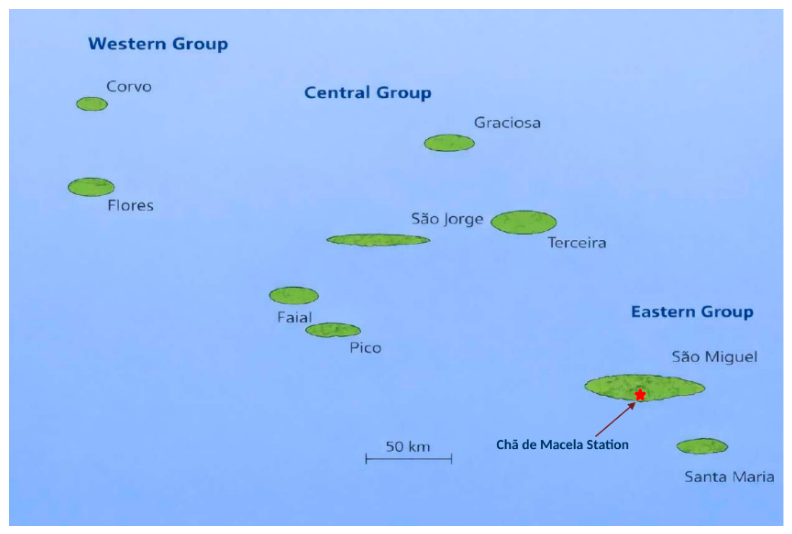
Figure 2.
Monthly precipitation climatology at the Chã de Macela hydrometeorological station during the period 2011–2023. Bars represent mean monthly precipitation totals derived from daily observations, while error bars indicate the interannual standard deviation for each month. The figure highlights the pronounced seasonal cycle characteristic of the Azorean climate, with wetter conditions during autumn and winter and reduced precipitation during summer.
Figure 2.
Monthly precipitation climatology at the Chã de Macela hydrometeorological station during the period 2011–2023. Bars represent mean monthly precipitation totals derived from daily observations, while error bars indicate the interannual standard deviation for each month. The figure highlights the pronounced seasonal cycle characteristic of the Azorean climate, with wetter conditions during autumn and winter and reduced precipitation during summer.
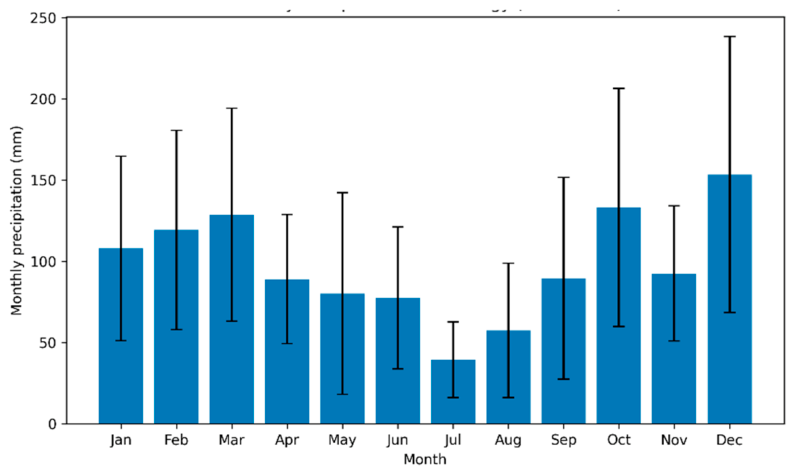
Figure 3.
Frequency of extreme and compound hydrometeorological event categories identified at the Chã de Macela station during 2011–2023. Event categories were defined using percentile thresholds derived from the observational record. The figure illustrates the progressive reduction in event frequency as increasingly restrictive combinations of precipitation, wind speed, relative humidity, and solar radiation conditions are imposed.
Figure 3.
Frequency of extreme and compound hydrometeorological event categories identified at the Chã de Macela station during 2011–2023. Event categories were defined using percentile thresholds derived from the observational record. The figure illustrates the progressive reduction in event frequency as increasingly restrictive combinations of precipitation, wind speed, relative humidity, and solar radiation conditions are imposed.
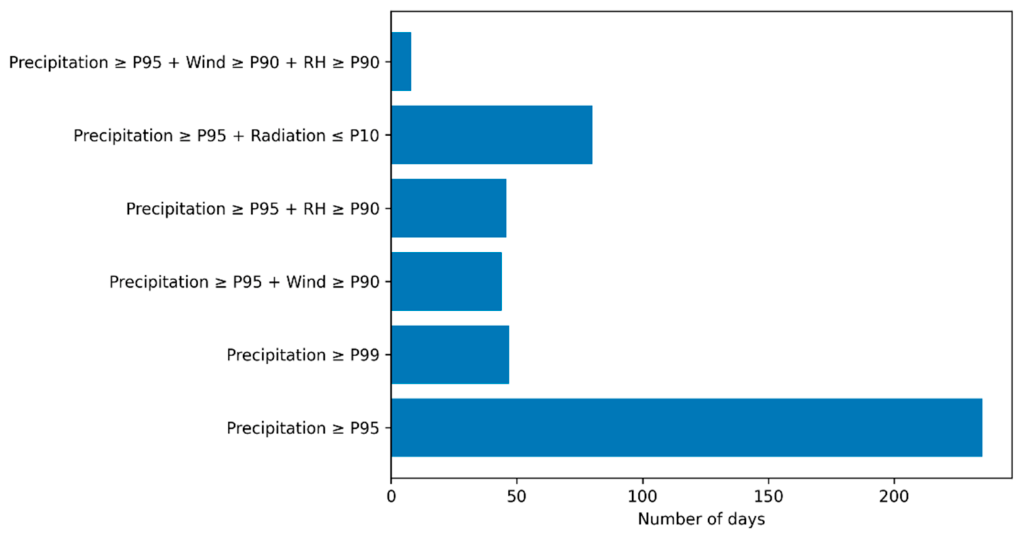
Figure 4.
Distribution of wet- and dry-spell durations at the Chã de Macela hydrometeorological station during the period 2011–2023. Wet spells were defined as consecutive days with precipitation ≥ 1 mm day⁻¹, whereas dry spells corresponded to consecutive days with precipitation < 1 mm day⁻¹. Episodes longer than 30 days were grouped into a single terminal class (>30 days) to improve visualization of the dominant persistence regime.
Figure 4.
Distribution of wet- and dry-spell durations at the Chã de Macela hydrometeorological station during the period 2011–2023. Wet spells were defined as consecutive days with precipitation ≥ 1 mm day⁻¹, whereas dry spells corresponded to consecutive days with precipitation < 1 mm day⁻¹. Episodes longer than 30 days were grouped into a single terminal class (>30 days) to improve visualization of the dominant persistence regime.
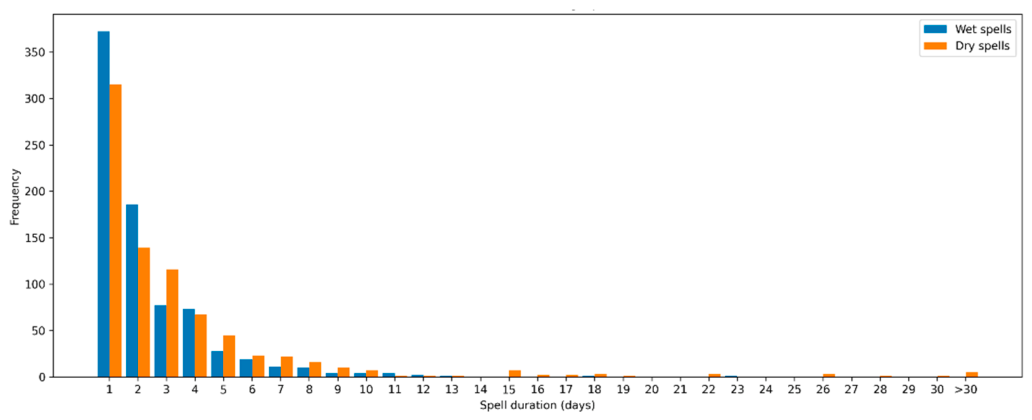
Figure 5.
Top ten wet spells ranked by accumulated precipitation at the Chã de Macela hydrometeorological station during the period 2011–2023. Bars represent the total precipitation accumulated during each wet spell.
Figure 5.
Top ten wet spells ranked by accumulated precipitation at the Chã de Macela hydrometeorological station during the period 2011–2023. Bars represent the total precipitation accumulated during each wet spell.
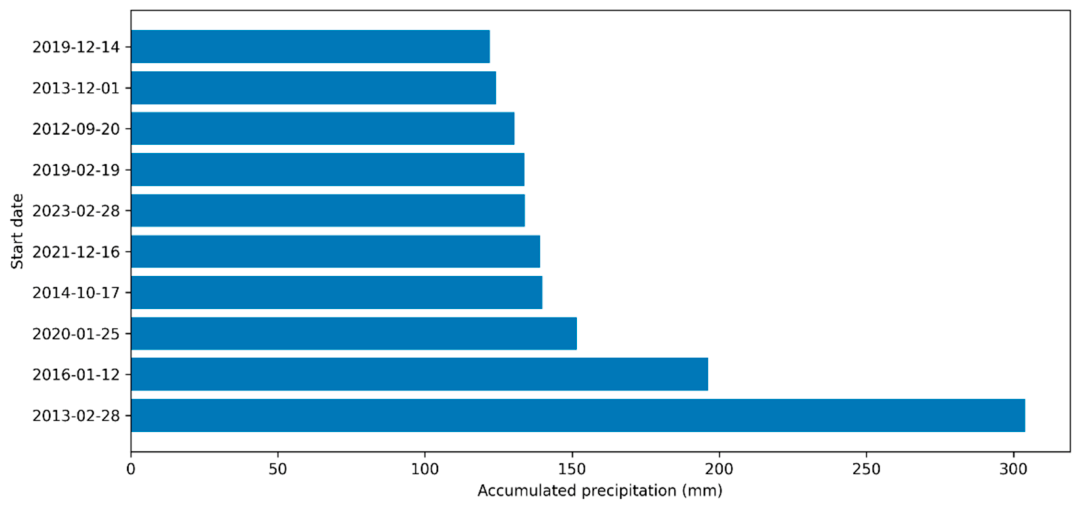
Figure 6.
Distribution of P95 rainfall events, P99 rainfall events, and core compound hydrometeorological events according to wet-spell duration classes at the Chã de Macela station during the period 2011–2023. The figure illustrates the relationship between event severity and the persistence of wet conditions.
Figure 6.
Distribution of P95 rainfall events, P99 rainfall events, and core compound hydrometeorological events according to wet-spell duration classes at the Chã de Macela station during the period 2011–2023. The figure illustrates the relationship between event severity and the persistence of wet conditions.
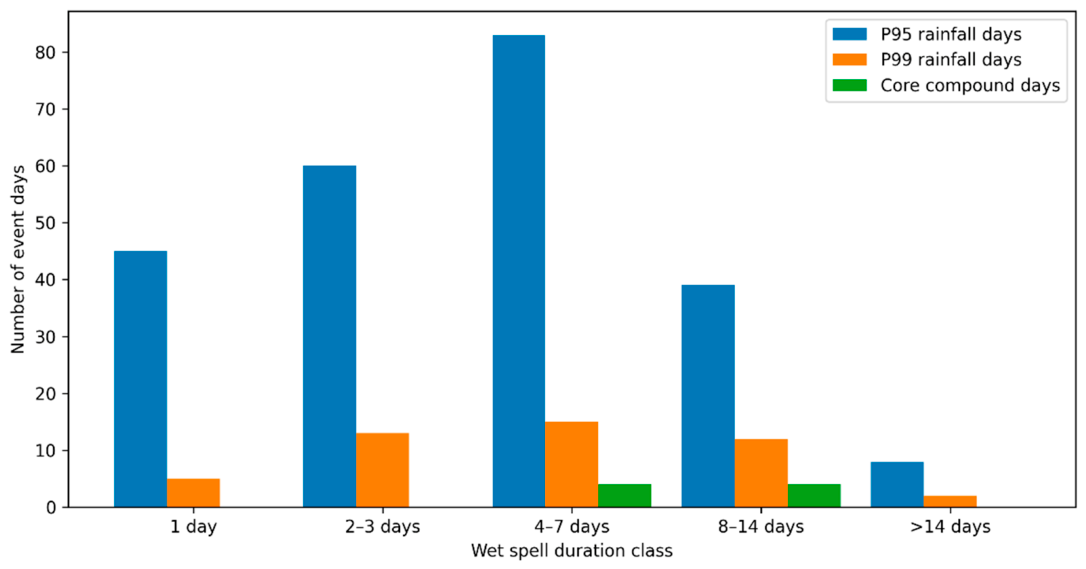
Figure 7.
Relationship between wet-spell duration and accumulated precipitation at the Chã de Macela station during the period 2011–2023.
Figure 7.
Relationship between wet-spell duration and accumulated precipitation at the Chã de Macela station during the period 2011–2023.
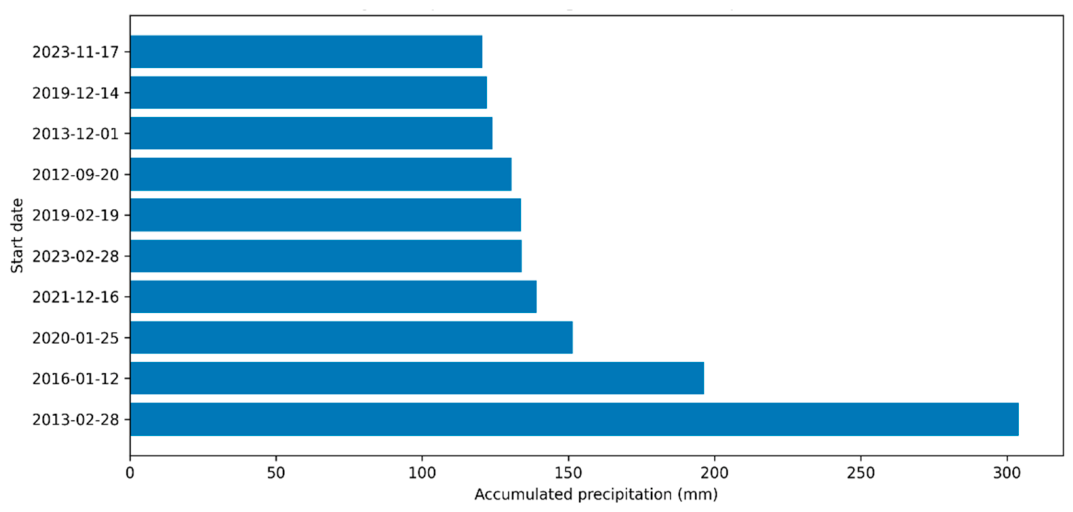
Figure 8.
Boxplots of mean sea level pressure (MSLP) for dry days, wet days, and extreme precipitation events (P95 and P99) at Chã de Macela during 2011–2023. The median MSLP decreases progressively from dry to extreme precipitation conditions, indicating an increasing influence of cyclonic activity.
Figure 8.
Boxplots of mean sea level pressure (MSLP) for dry days, wet days, and extreme precipitation events (P95 and P99) at Chã de Macela during 2011–2023. The median MSLP decreases progressively from dry to extreme precipitation conditions, indicating an increasing influence of cyclonic activity.
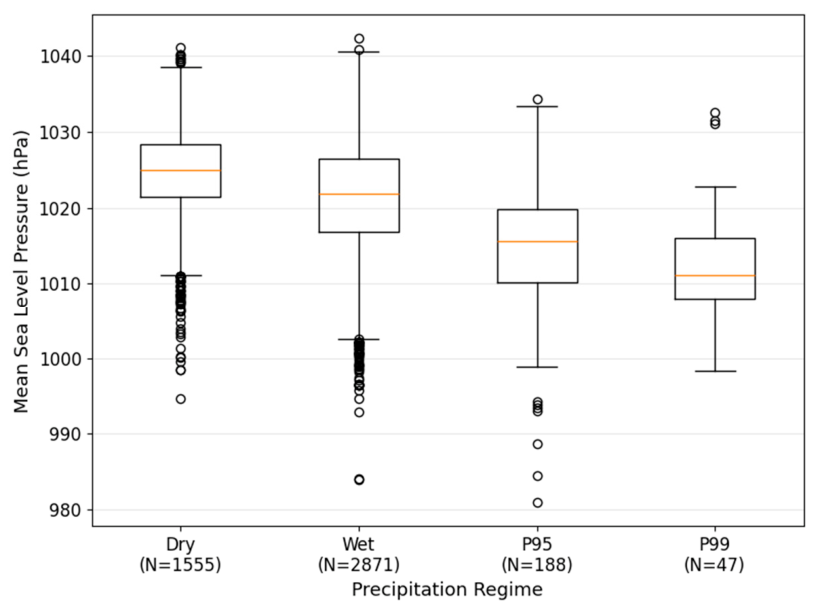
Figure 9.
Boxplots of total column water vapour (TCWV) for dry days, wet days, and extreme precipitation events (P95 and P99) at Chã de Macela during 2011–2023. The distribution of TCWV shifts progressively towards higher values from dry to extreme precipitation conditions. Median TCWV increased from approximately 21 kg m⁻² during dry days to nearly 29 kg m⁻² during P99 events, indicating substantially enhanced atmospheric moisture availability during periods of intense precipitation. The number of observations in each group is indicated below the category labels.
Figure 9.
Boxplots of total column water vapour (TCWV) for dry days, wet days, and extreme precipitation events (P95 and P99) at Chã de Macela during 2011–2023. The distribution of TCWV shifts progressively towards higher values from dry to extreme precipitation conditions. Median TCWV increased from approximately 21 kg m⁻² during dry days to nearly 29 kg m⁻² during P99 events, indicating substantially enhanced atmospheric moisture availability during periods of intense precipitation. The number of observations in each group is indicated below the category labels.
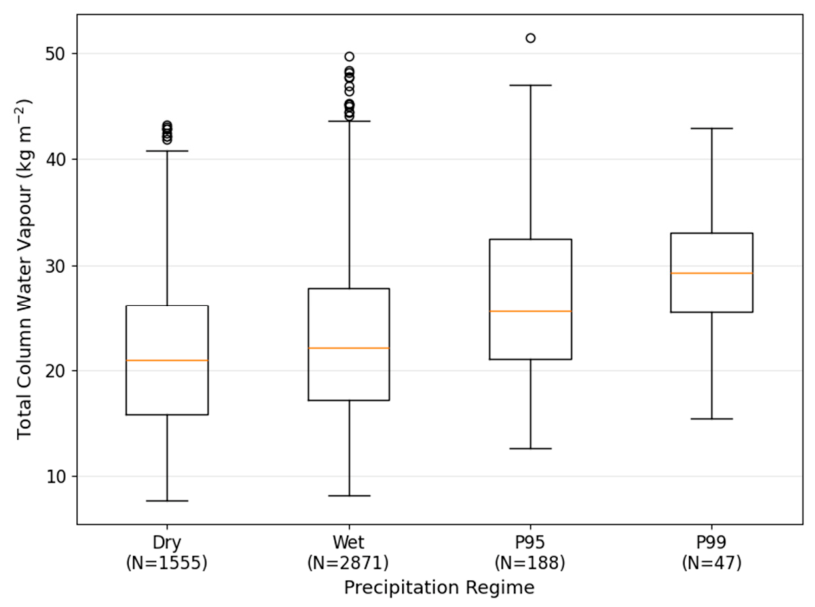
Figure 10.
Evolution of mean sea level pressure (MSLP, black contours; hPa) and 500-hPa geopotential height (Z500, coloured shading; m) during the compound hydrometeorological event of 6 June 2023. Panels show the synoptic conditions from 3 to 9 June 2023 at 12:00 UTC over the North Atlantic sector encompassing the Azores. The location of Chã de Macela is indicated by the black circle.
Figure 10.
Evolution of mean sea level pressure (MSLP, black contours; hPa) and 500-hPa geopotential height (Z500, coloured shading; m) during the compound hydrometeorological event of 6 June 2023. Panels show the synoptic conditions from 3 to 9 June 2023 at 12:00 UTC over the North Atlantic sector encompassing the Azores. The location of Chã de Macela is indicated by the black circle.
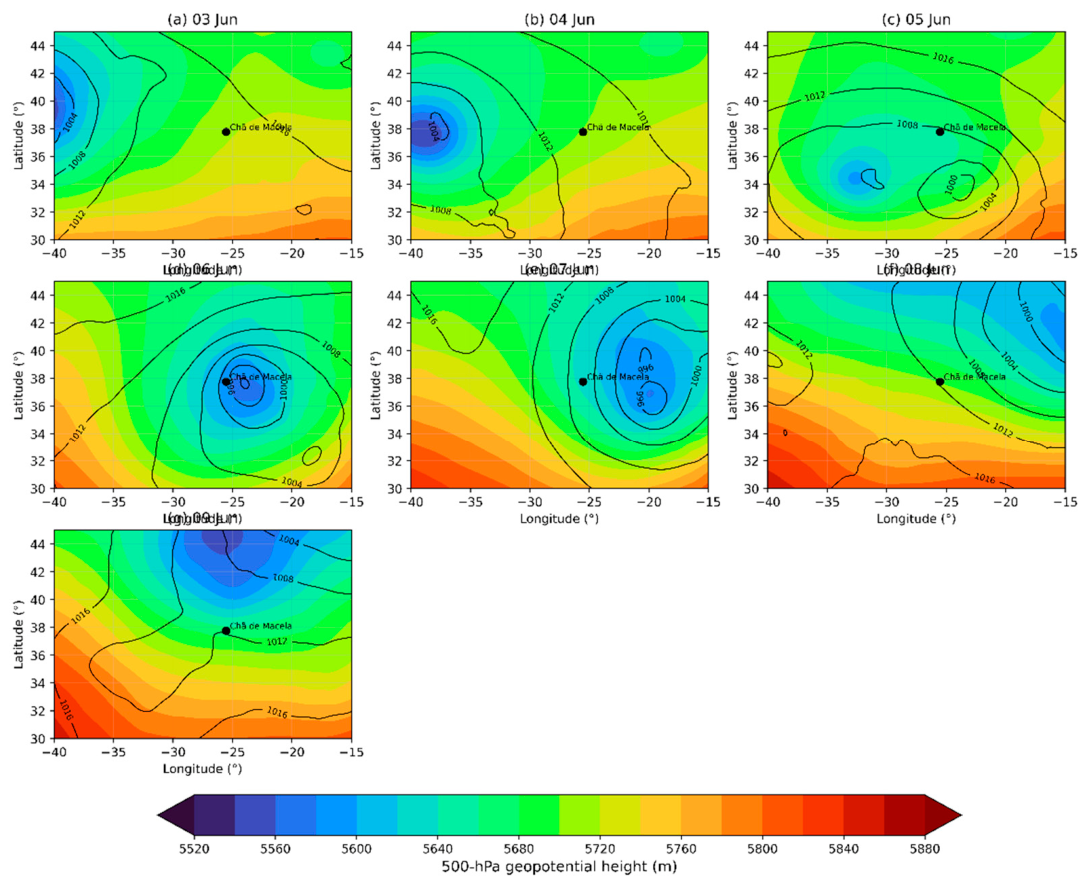
Figure 11.
Evolution of mean sea level pressure (MSLP, black contours; hPa) and 500-hPa geopotential height (Z500, coloured shading; m) during the compound hydrometeorological event of 28 February 2023. Panels show the synoptic conditions from 25 February to 3 March 2023 at 12 UTC over the North Atlantic sector encompassing the Azores. The location of Chã de Macela is indicated by the black circle.
Figure 11.
Evolution of mean sea level pressure (MSLP, black contours; hPa) and 500-hPa geopotential height (Z500, coloured shading; m) during the compound hydrometeorological event of 28 February 2023. Panels show the synoptic conditions from 25 February to 3 March 2023 at 12 UTC over the North Atlantic sector encompassing the Azores. The location of Chã de Macela is indicated by the black circle.
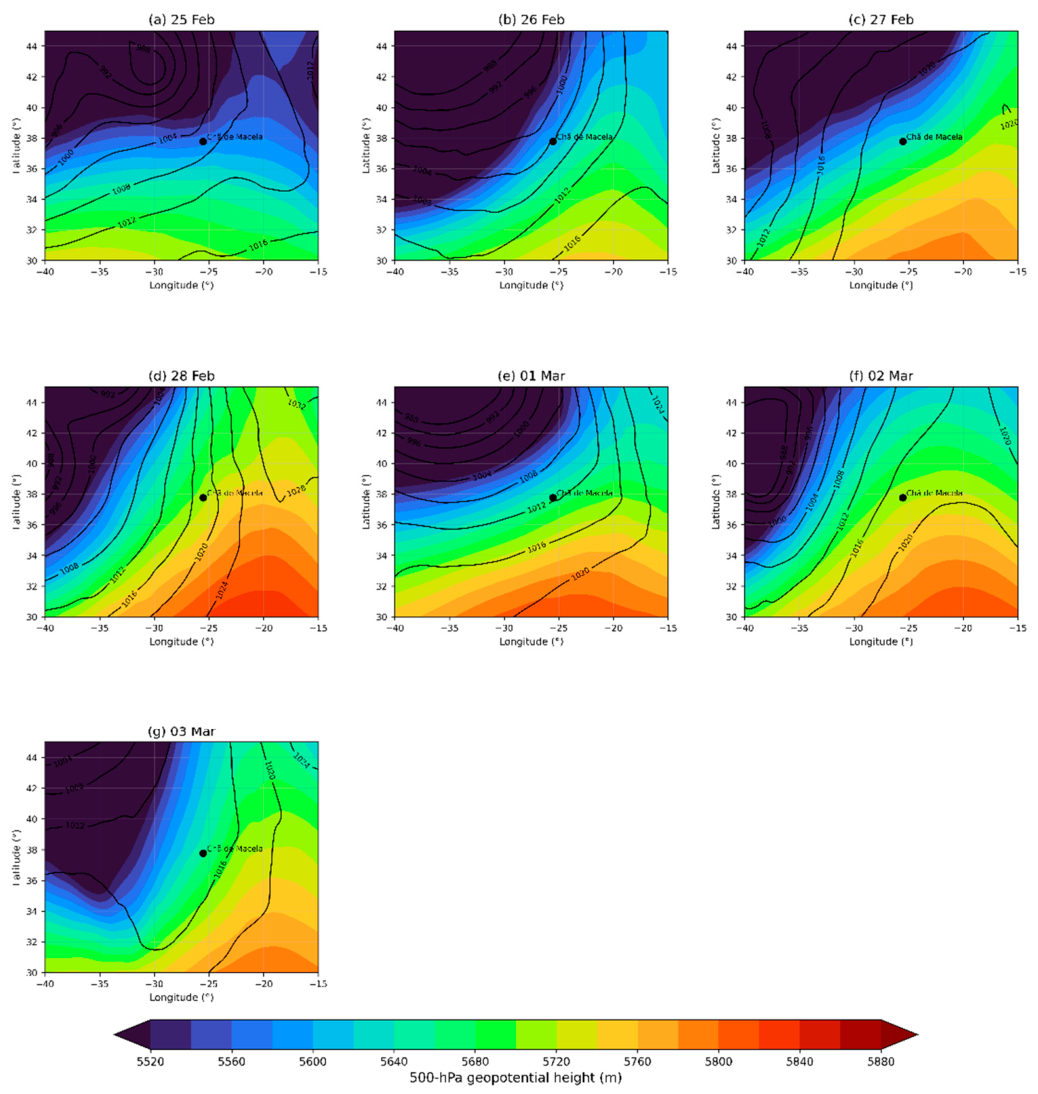
Figure 12.
Evolution of mean sea level pressure (MSLP, black contours; hPa) and 500-hPa geopotential height (Z500, coloured shading; m) during the compound hydrometeorological event of 3 January 2021. Panels show the synoptic conditions from 1 to 7 January 2021 at 12 UTC over the North Atlantic sector encompassing the Azores. The location of Chã de Macela is indicated by the black circle.
Figure 12.
Evolution of mean sea level pressure (MSLP, black contours; hPa) and 500-hPa geopotential height (Z500, coloured shading; m) during the compound hydrometeorological event of 3 January 2021. Panels show the synoptic conditions from 1 to 7 January 2021 at 12 UTC over the North Atlantic sector encompassing the Azores. The location of Chã de Macela is indicated by the black circle.
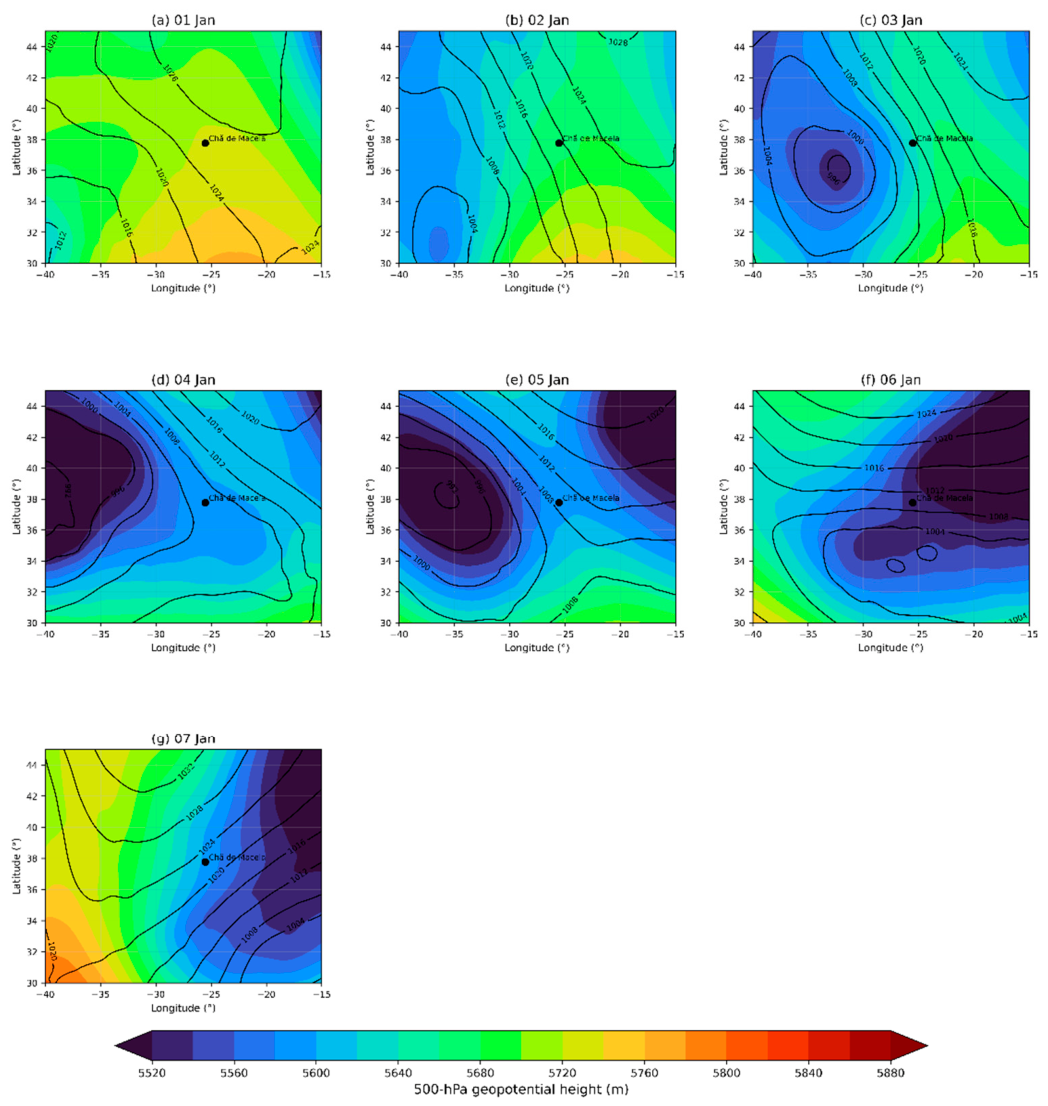
Figure 13.
Evolution of mean sea level pressure (MSLP, black contours; hPa) and 500-hPa geopotential height (Z500, coloured shading; m) during the compound hydrometeorological event of 28 January 2020. Panels show the synoptic conditions from 25 to 31 January 2020 at 12 UTC over the North Atlantic sector encompassing the Azores. The location of Chã de Macela is indicated by the black circle.
Figure 13.
Evolution of mean sea level pressure (MSLP, black contours; hPa) and 500-hPa geopotential height (Z500, coloured shading; m) during the compound hydrometeorological event of 28 January 2020. Panels show the synoptic conditions from 25 to 31 January 2020 at 12 UTC over the North Atlantic sector encompassing the Azores. The location of Chã de Macela is indicated by the black circle.
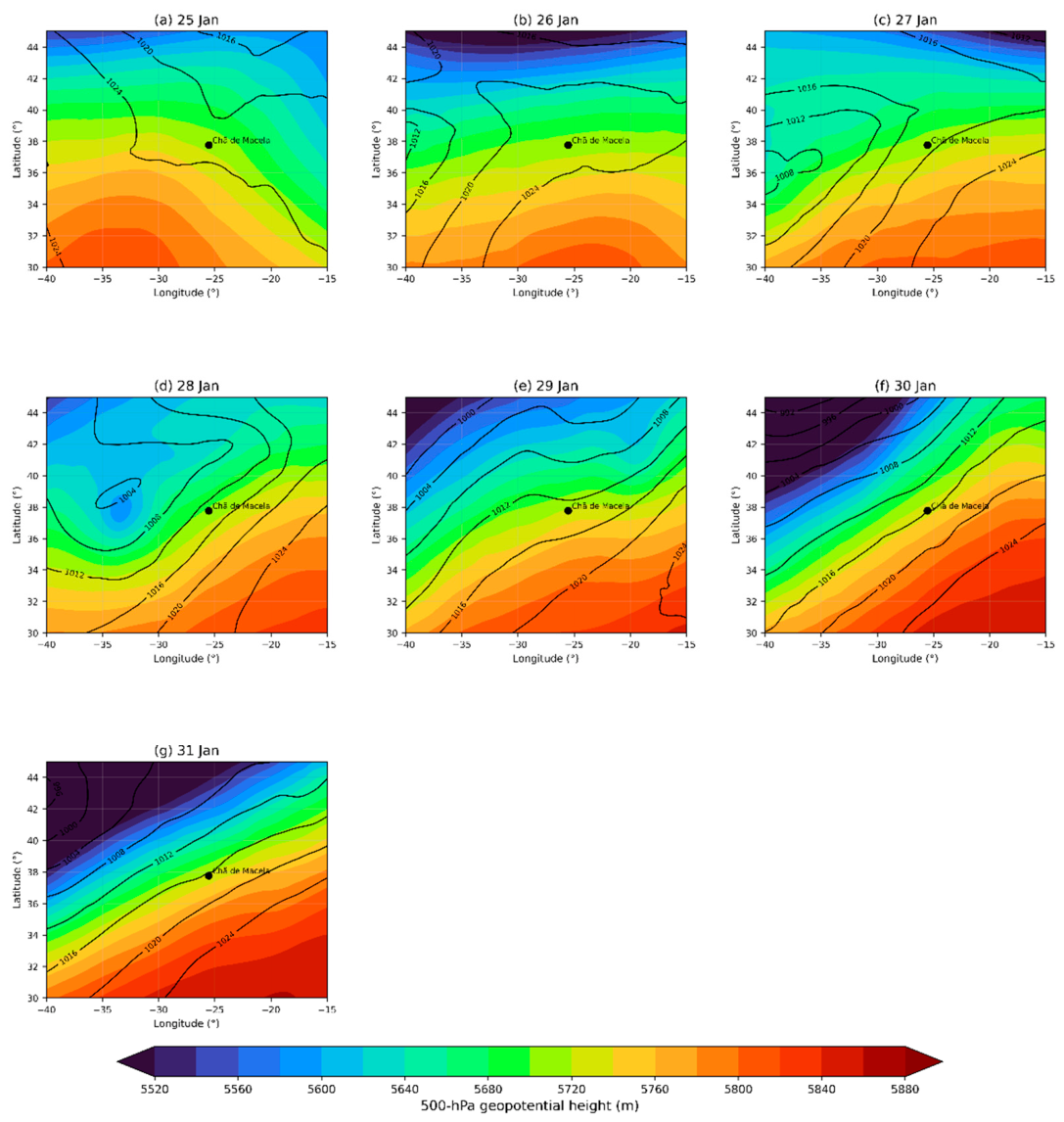
Figure 14.
Evolution of mean sea level pressure (MSLP, black contours; hPa) and 500-hPa geopotential height (Z500, coloured shading; m) during the compound hydrometeorological event of 2 June 2020. Panels show the synoptic conditions from 30 May to 5 June 2020 at 12 UTC over the North Atlantic sector encompassing the Azores. The location of Chã de Macela is indicated by the black circle.
Figure 14.
Evolution of mean sea level pressure (MSLP, black contours; hPa) and 500-hPa geopotential height (Z500, coloured shading; m) during the compound hydrometeorological event of 2 June 2020. Panels show the synoptic conditions from 30 May to 5 June 2020 at 12 UTC over the North Atlantic sector encompassing the Azores. The location of Chã de Macela is indicated by the black circle.
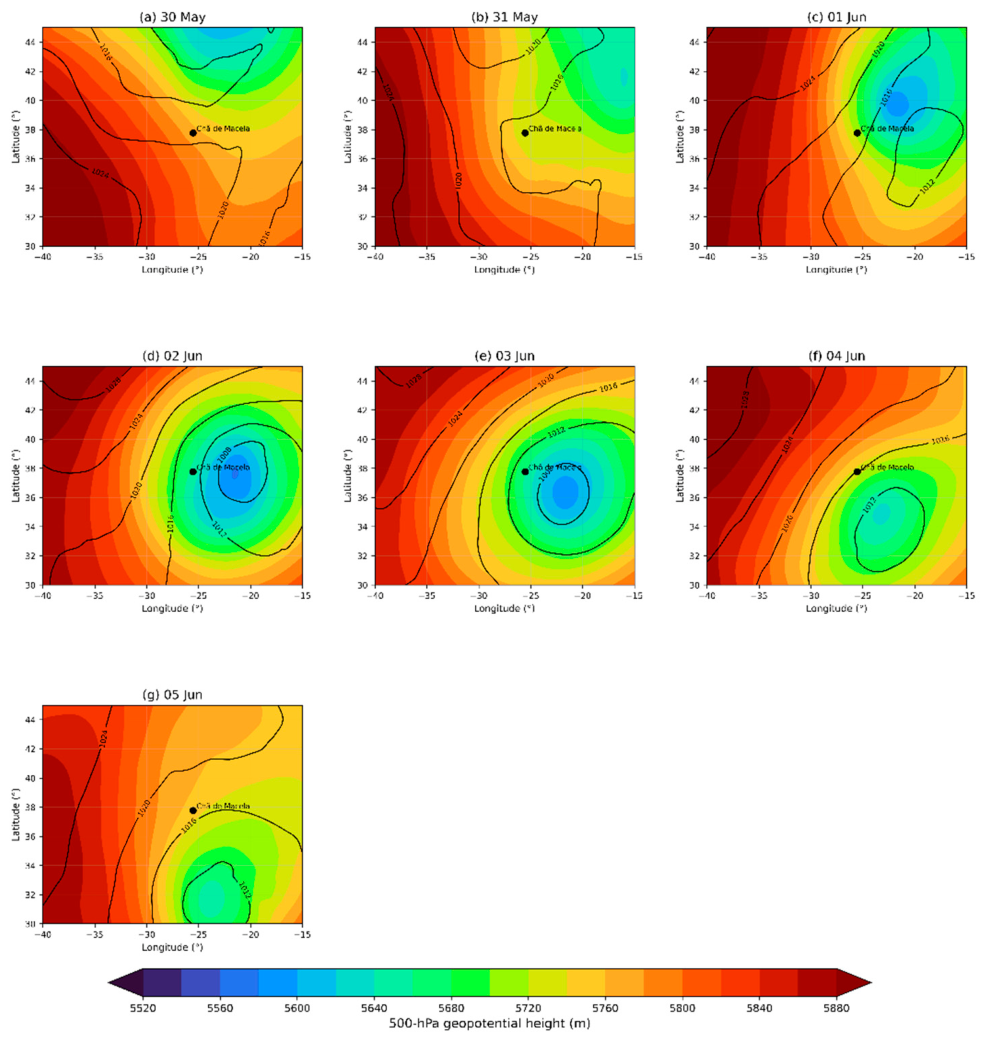
Figure 15.
Evolution of mean sea level pressure (MSLP, black contours; hPa) and 500-hPa geopotential height (Z500, coloured shading; m) during the compound hydrometeorological event of 27 December 2019. Panels show the synoptic conditions from 24 to 30 December 2019 at 12 UTC over the North Atlantic sector encompassing the Azores. The location of Chã de Macela is indicated by the black circle.
Figure 15.
Evolution of mean sea level pressure (MSLP, black contours; hPa) and 500-hPa geopotential height (Z500, coloured shading; m) during the compound hydrometeorological event of 27 December 2019. Panels show the synoptic conditions from 24 to 30 December 2019 at 12 UTC over the North Atlantic sector encompassing the Azores. The location of Chã de Macela is indicated by the black circle.
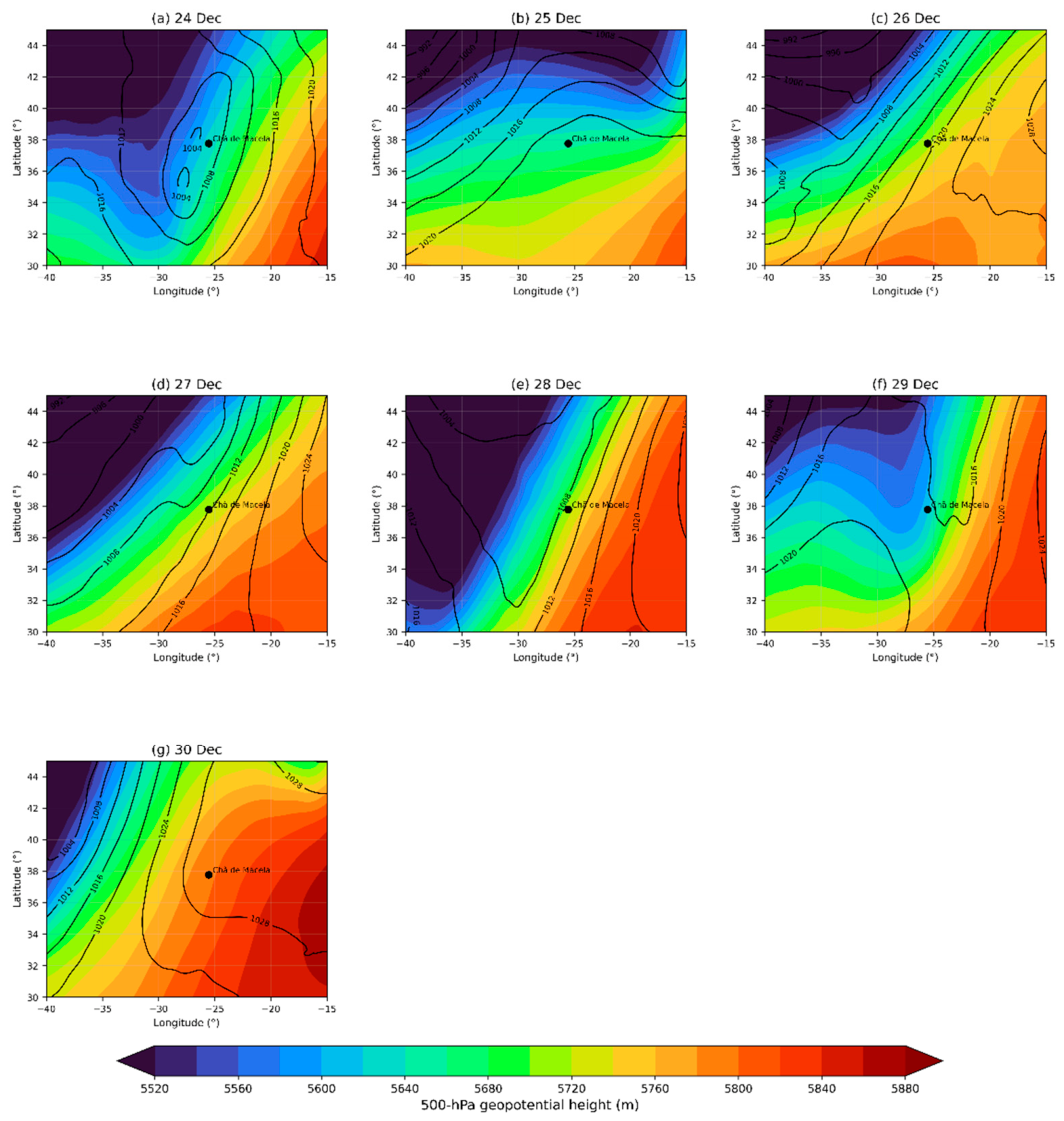
Figure 16.
Evolution of mean sea level pressure (MSLP, black contours; hPa) and 500-hPa geopotential height (Z500, coloured shading; m) during the compound hydrometeorological event of 30 December 2022. Panels show the synoptic conditions from 27 December 2022 to 2 January 2023 at 12 UTC over the North Atlantic sector encompassing the Azores. The location of Chã de Macela is indicated by the black circle.
Figure 16.
Evolution of mean sea level pressure (MSLP, black contours; hPa) and 500-hPa geopotential height (Z500, coloured shading; m) during the compound hydrometeorological event of 30 December 2022. Panels show the synoptic conditions from 27 December 2022 to 2 January 2023 at 12 UTC over the North Atlantic sector encompassing the Azores. The location of Chã de Macela is indicated by the black circle.
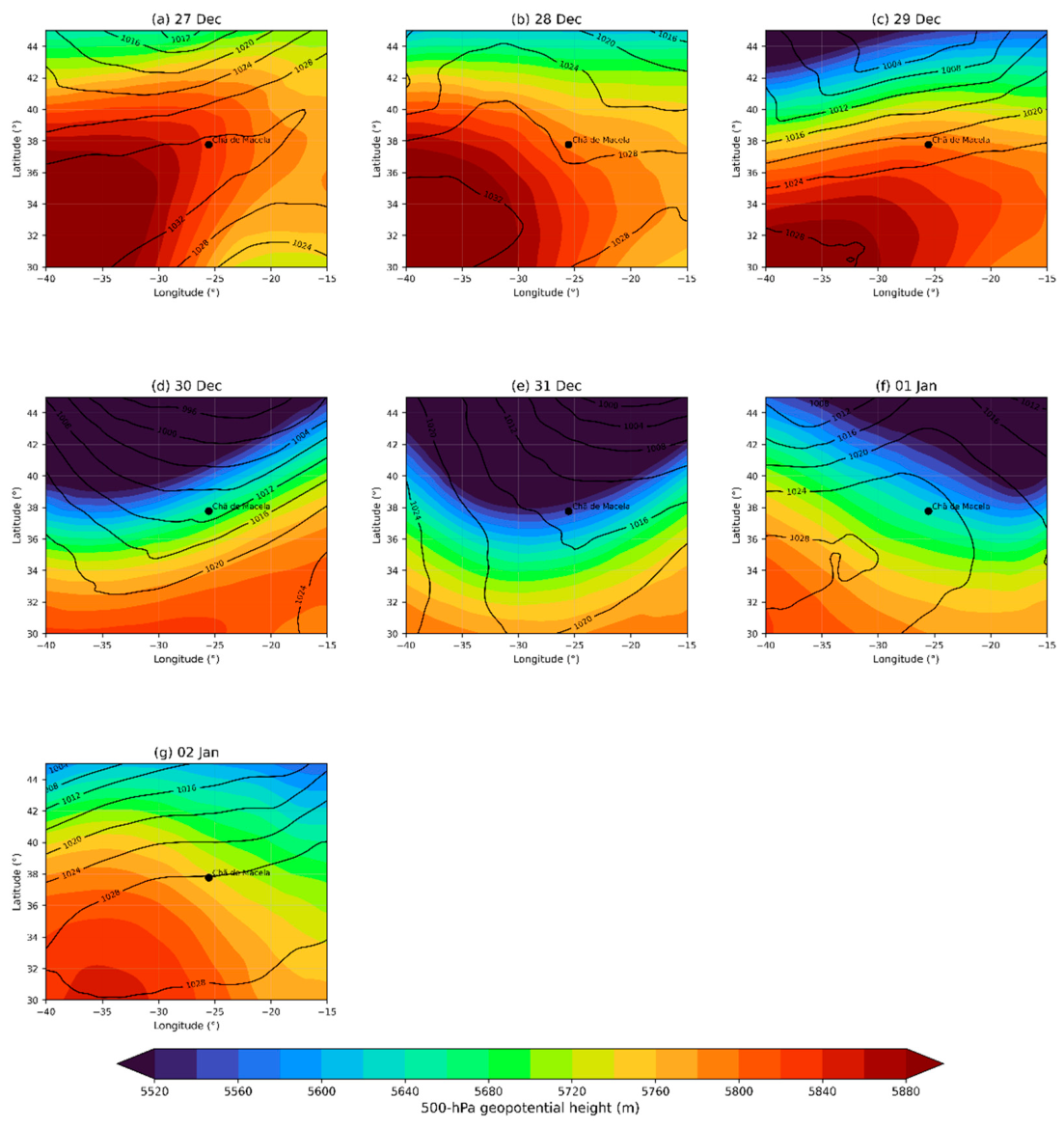
Figure 17.
Evolution of mean sea level pressure (MSLP, black contours; hPa) and 500-hPa geopotential height (Z500, coloured shading; m) during the compound hydrometeorological event of 17 December 2019. Panels show the synoptic conditions from 14 to 20 December 2019 at 12 UTC over the North Atlantic sector encompassing the Azores. The location of Chã de Macela is indicated by the black circle.
Figure 17.
Evolution of mean sea level pressure (MSLP, black contours; hPa) and 500-hPa geopotential height (Z500, coloured shading; m) during the compound hydrometeorological event of 17 December 2019. Panels show the synoptic conditions from 14 to 20 December 2019 at 12 UTC over the North Atlantic sector encompassing the Azores. The location of Chã de Macela is indicated by the black circle.
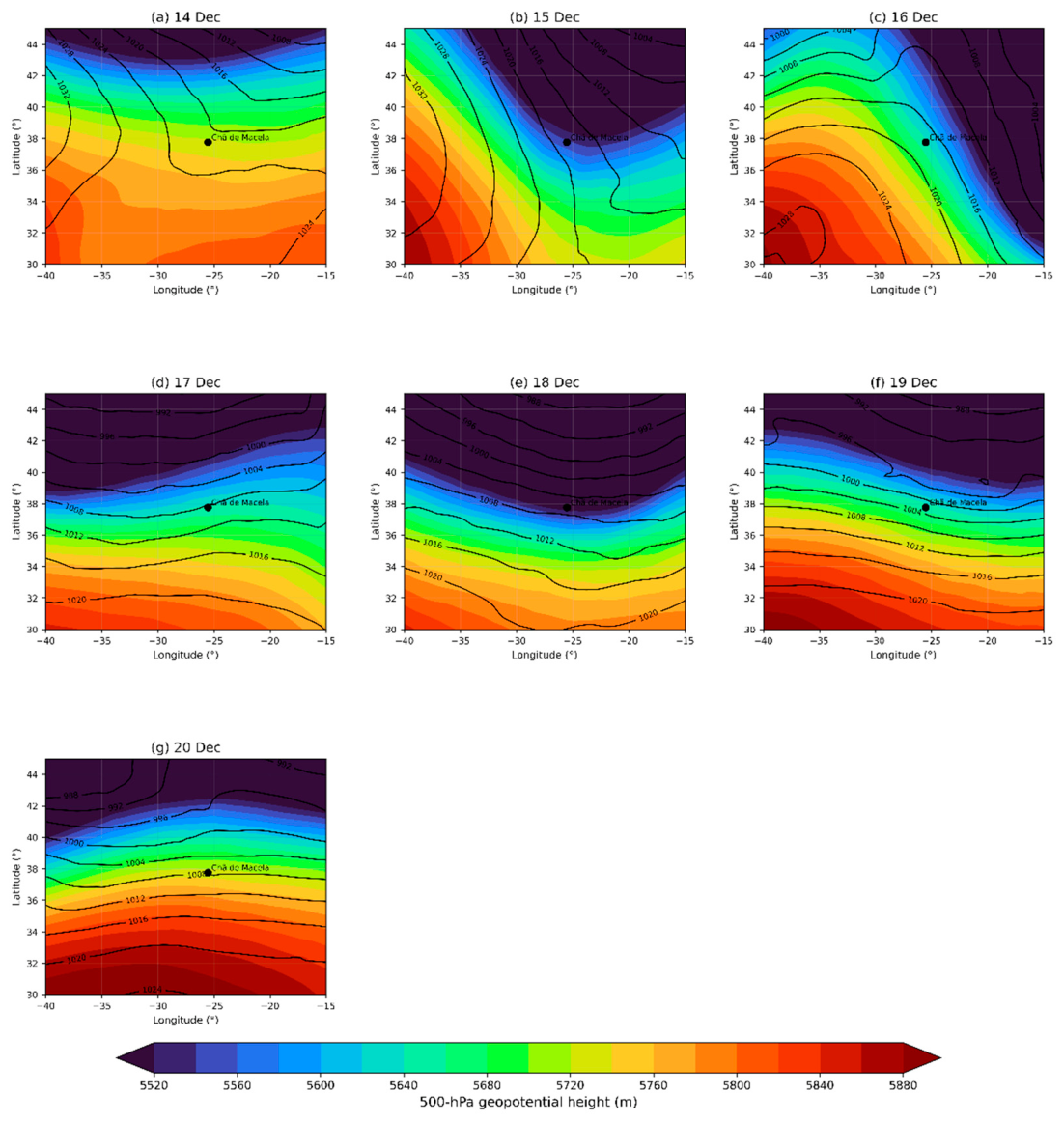
Table 1.
Data Completeness and Quality-Control Assessment of the Hydrometeorological Variables Recorded at the Chã de Macela Station during 2011–2023.
Table 1.
Data Completeness and Quality-Control Assessment of the Hydrometeorological Variables Recorded at the Chã de Macela Station during 2011–2023.
| Variable | Missing Values (n) | Completeness (%) | Minimum | Maximum | Mean | Potential Outliers (n) |
|---|---|---|---|---|---|---|
| Precipitation (mm) | 57 | 98.79 | 0.00 | 71.70 | 3.24 | 0 |
| Solar Radiation (W m⁻²) | 57 | 98.79 | 3.50 | 559.50 | 118.89 | 0 |
| Mean Air Temperature (°C) | 192 | 95.93 | 0.10 | 29.50 | 15.05 | 0 |
| Wind Speed (km h⁻¹) | 160 | 96.61 | 0.62 | 254.79 | 5.66 | 17 |
| Wind Direction (°) | 133 | 97.18 | 9.60 | 332.90 | 176.98 | 0 |
| Relative Humidity (%) | 132 | 97.20 | 0.08 | 100.30 | 71.60 | 2 |
| Evaporation (mm day⁻¹) | 185 | 96.08 | 0.00 | 31.11 | 2.31 | 1 |
Note: Completeness was calculated as the percentage of valid observations relative to the total number of daily records available during the study period (2011–2023). Potential outliers were initially identified using physically plausible thresholds defined for each variable. Subsequent quality-control procedures confirmed that extreme wind observations were associated with documented storm events and were therefore retained, whereas isolated transcription errors affecting relative humidity and evaporation were corrected. The final dataset was considered physically consistent and suitable for hydrometeorological analyses.
Table 4.
Core compound hydrometeorological events identified at the Chã de Macela station during 2011–2023.
Table 4.
Core compound hydrometeorological events identified at the Chã de Macela station during 2011–2023.
| Date | Precipitation (mm) | Wind Speed (km h⁻¹) | Relative Humidity (%) |
|---|---|---|---|
| 2019-12-17 | 18.5 | 10.04 | 97.52 |
| 2019-12-27 | 25.8 | 9.04 | 100.00 |
| 2020-01-28 | 28.7 | 9.10 | 100.00 |
| 2020-06-02 | 18.8 | 12.70 | 97.96 |
| 2021-01-03 | 32.2 | 10.42 | 97.49 |
| 2022-12-30 | 17.2 | 8.60 | 99.70 |
| 2023-02-28 | 53.8 | 8.70 | 98.50 |
| 2023-06-06 | 63.3 | 14.80 | 99.30 |
Table 5.
Relationship between precipitation, mean sea level pressure (MSLP), and atmospheric moisture availability (TCWV) at Chã de Macela during 2011–2023.
Table 5.
Relationship between precipitation, mean sea level pressure (MSLP), and atmospheric moisture availability (TCWV) at Chã de Macela during 2011–2023.
| Metric | N | MSLP (hPa) | TCWV (kg m-²) |
|---|---|---|---|
| Dry days | 1555 | 1024.56 | 21.59 |
| Wet days | 3106 | 1020.79 | 23.26 |
| P95 events | 235 | 1014.37 | 27.50 |
| P99 events | 47 | 1012.67 | 29.14 |
| Correlation with precipitation (Pearson) | - | -0.338 | 0.198 |
| Correlation with precipitation (Spearman) | - | -0.368 | 0.173 |
Table 6.
- Statistical significance of differences in MSLP and TCWV across precipitation regimes.
| Comparison | Variable | Mann–Whitney U | p-value | Significance |
|---|---|---|---|---|
| Dry vs Wet | MSLP | 3,149,339.5 | 1.78×10⁻⁶⁴ | p < 0.001 |
| Dry vs Wet | TCWV | 2,112,978.5 | 3.16×10⁻¹² | p < 0.001 |
| Normal vs P95 | MSLP | 812,141.0 | 7.79×10⁻⁴⁸ | p < 0.001 |
| Normal vs P95 | TCWV | 326,634.0 | 6.45×10⁻²² | p < 0.001 |
| Normal vs P99 | MSLP | 179,669.0 | 8.40×10⁻¹⁵ | p < 0.001 |
| Normal vs P99 | TCWV | 53,535.0 | 2.22×10⁻⁹ | p < 0.001 |
Table 8.
Synoptic classification of compound hydrometeorological events identified at Chã de Macela (2011–2023).
Table 8.
Synoptic classification of compound hydrometeorological events identified at Chã de Macela (2011–2023).
| Event Date | Precipitation (mm) | Synoptic Classification |
|---|---|---|
| 2019-12-17 | 18.5 | Strong meridional gradient |
| 2019-12-27 | 25.8 | Strong meridional gradient |
| 2020-01-28 | 28.7 | Developing / pre-conditioning disturbance |
| 2020-06-02 | 18.8 | Persistent closed cyclonic system |
| 2021-01-03 | 32.2 | Persistent closed cyclonic system |
| 2022-12-30 | 17.2 | Strong meridional gradient |
| 2023-02-28 | 53.8 | Strong meridional gradient |
| 2023-06-06 | 63.3 | Persistent closed cyclonic system |
Disclaimer/Publisher’s Note: The statements, opinions and data contained in all publications are solely those of the individual author(s) and contributor(s) and not of MDPI and/or the editor(s). MDPI and/or the editor(s) disclaim responsibility for any injury to people or property resulting from any ideas, methods, instructions or products referred to in the content. |
© 2026 by the authors. Licensee MDPI, Basel, Switzerland. This article is an open access article distributed under the terms and conditions of the Creative Commons Attribution (CC BY) license (http://creativecommons.org/licenses/by/4.0/).
Copyright: This open access article is published under a Creative Commons CC BY 4.0 license, which permit the free download, distribution, and reuse, provided that the author and preprint are cited in any reuse.


