

Submitted:
12 June 2026
Posted:
15 June 2026
You are already at the latest version
Abstract
This study investigates the impact of sustainable service to customer-related outcomes in the hospitality industry by focusing on environmental awareness, perceived value, customer trust, and revisit intention. Grounded in Stakeholder Theory, the research posits and empirically examines the model with the concept of perceived value and customer trust as mediators and environmental awareness as a moderator. Data was collected from a total of 457 hospitality customers, proportionately drawn from Accra (184), Kumasi (152) and Tamale (121), and analysed using partial least squares structural equation modelling (PLS-SEM). The results show that sustainable service practises have a significant impact on perceived value, customer trust and environmental awareness in a positive way. In addition, perceived value and customer trust partially mediate the relationship between sustainable service practises and environmental awareness, in which customer trust is the more effective mediating mechanism. Contrary to expectations, environmental awareness does not moderate the association between sustainable service practises and revisit intention to a great extent. Novelty: The outcome of the study accentuates the relevance of incorporating perceived value and customer trust into sustainable service practises offering both theoretical insights via stakeholder theory and practical direction for enhancing guest revisit intention in the hospitality sector. On the whole, the findings emphasize the strategic necessity of incorporating the concept of sustainability into the core service delivery and achieving better customer perceptions and relational outcomes.
Keywords:
sustainable services
; revisit intention
; perceived value
; customer trust
; awareness
1. Introduction
In the world, the hospitality industry is one of the fastest growing service industries that provides employment, urbanises the area and helps boost economies especially in developing countries such as Ghana (World Tourism Organisation, 2023). Hotels, guesthouses and hospitality-related services have continued to expand in Accra, Kumasi, as well as Tamale, because of both internal travel, international business and cultural tourism (Ghana Tourism Authority, 2022). This expansion has put pressure on the environment including excessive energy consumption, wastage of water, waste, and carbon emissions from hospitality, etc. (Berbeka et al., 2024). Therefore, hospitality companies need to make sustainability the focus point (Telo da Gama, 2023). Sustainable service practices are increasing in popularity to help hospitality organisations to reduce the environmental impact and enhance quality and competitiveness (Opoku & Li, 2025). Studies show that consumers are becoming more conscious about the environmental effect of service providers and they are more willing to patronise the environmentally responsible firms (Namoog & Abubakari, 2025). Hospitality operators in Accra, Kumasi and Tamale are steadily adopting sustainability-oriented practices, but it is unclear the extent to which these practices have an effect on customer behaviour (Asante-Darko & Osei, 2024). This thus underscores the need for holistic empirical research on the impact of sustainable service practices on the reaction of hospitality clients in Ghana.
Hospitality organisations follow the sustainable service practices for preventing environmental damage and maintaining service efficiency and customer pleasure (Saeed et al., 2025). Energy conservation, decreasing water, waste, eco-friendly products, responsible sourcing, and environmental stewardship training of staff are typical practises (Singh & Hassan, 2024). Revisit intention, on the other hand, represents a conscious plan or willingness of a customer to return to a service provider on the basis of previous service experiences and perceived value (Bagmalek & Moosaei, 2024). Perceived value is referred to as customer's overall evaluation of the benefits received in comparison with the costs incurred in the process of service consumption (Shah & Soomro, 2023). Customer trust can be defined as the belief that trustworthiness that a service provider is honest, reliable, and able to provide the promised services in a consistent manner (Kalubanga & Mbekeka, 2024). Environmental awareness is the level of knowledge of consumers regarding environmental issues and implications of consumption decisions for ecological sustainability (Bouteraa, 2024). These constructs have been widely validated in marketing and hospitality research but its integrated application in the context of Ghana's hospitality industry is limited (Opoku & Li, 2025). Understanding the interactions between these variables is important if we are to understand decision-making among customers in sustainable service environments.
Despite increasing trends in the adoption of sustainable service practises in the hospitality industry, there are numerous challenges that many hotels and service providers in Accra, Kumasi and Tamale encounter including low rate of customer retention and low re-visit behaviour (Ghana Tourism Authority, 2022). While managers tend to assume that environmentally friendly practises will lead to customer loyalty, different empirical research studies suggest that sustainable initiatives alone may not directly translate into revisit intention without favourable customer perceptions and outcomes of relationships (Hossain et al., 2025). Customers may recognise sustainability initiatives, but in the case of repeat purchases, may prioritise service value, trustworthiness and personal relevance (Gupta & Kaur, 2024). According to anecdotal data on Ghana, some hospitality firms invest in sustainability for regulatory or branding purposes rather than as a customer-centric movement (Asante-Darko & Osei, 2024). This imbalance can lead to weak behavioural responses from clients (e.g. low revisit intent). Furthermore, there might be disparities in consumer awareness between metropolitan centres like Accra, Kumasi and Tamale, which might hamper the success of the sustainability measures (Opoku & Li, 2025). The prevalence of these issues implies a rather fundamental concern regarding the impact of sustainable service practises on the perceptions of consumers and their behavioural intentions. In order to overcome this problem, we should explore ways in which revisit intention is driven by sustainability.
Existing research has suggested that perceived value and customer trust are key psychological mechanisms explaining the effect of service qualities on consumer behavioural intentions (Bagmalek & Moosaei, 2024; Shah & Soomro, 2023). Studies in a hospitality setting find that sustainable practices can increase perceived value by improving customers' perceptions about service quality, emotional satisfaction and ethical fulfilment (Shah & Soomro, 2023). Sustainability actions may also help to build customer trust as this shows your company is integrated, transparent and cares about society (Gupta & Kaur, 2024). Most of the studies have been carried out in developed economies with little empirical validation in sub-Saharan Africa (Opoku & Li, 2025). Previous studies on empirical works tended to separate perceived value and trust instead of considering them as a mediating mechanism (Wu et al., 2024). This fragmentation approach makes it impossible to understand how the service strategies which are inspired by sustainability lead to revisit intention. In Ghanaian cities that have different socio-cultural and economic features, the mediation processes can work differently (Asante-Darko & Osei, 2024). This gap requires a contextualised empirical study that considers together the notions of perceived value and customer trust.
Environmental awareness has been identified as an important individual-level factor that influences consumers' response to sustainability initiatives (Ardito, 2023). Consumers who are environmentally aware are more likely to recognise, appreciate and reward sustainable practises by favourable attitudes and behavioural intentions (Singh & Hassan, 2024). On the other hand, the low environmental awareness of customers may ignore or underestimate conformity to sustainability, thus reducing effectiveness of such practises on revisit intention (Deshpande & Srivastava, 2023). In Ghana, the level of awareness concerning the environment shows a great difference from one region to another, which can be attributed to differences in education, urbanisation, and exposure to environment campaigns (Bouteraa, 2024). Accra, Kumasi, and Tamale have unique socio-environmental settings that may affect the manner in which customers perceive and react to sustainable practices in the services. Despite this, very few studies have empirically tested the moderating role of environmental awareness on the sustainability-behaviour relationship in the hospitality sector (Asante-Darko & Osei, 2024). The lack of moderation analysis reduces the explanatory power of models that exist. Incorporating environmental awareness as a moderator thus allows for a more nuanced understanding of the behavior of consumers at sustainable settings in hospitality.
From an academic perspective, this study helps to address some of the important research gaps in the marketing and sustainability literature. First, it addresses the call for more empirical research on sustainable service practices in emerging economies in the African hospitality context, especially (Opoku & Li, 2025). Second, it contributes to the current knowledge by adding perceived value and customer trust as parallel mediators, providing a more exhaustive explanation of the effect of the sustainability initiatives on revisit intention (Khan et al., 2024). Third, it adds environmental awareness as a moderating variable and, as a result, recognises the heterogeneity of consumers in terms of their responsiveness in sustainability (Suprayitno, 2024). Fourth, through the focus on Accra, Kumasi and Tamale, the research offers comparative understanding on these cities which is essentially missing in existing research on hospitality in Ghana (Ghana Tourism Authority, 2025). Fifth, it is turning the sustainability conversation from operational efficiency to customer-centred behavioural outcomes. Collectively, these contributions improve the richness of the theoretical and empirical research of sustainability in the hospitality industry. These multi-variables approach is a major departure from the linear models that had been used before.
The originality of this study is to have an integrated conceptual framework that simultaneously explores sustainable service practices, perceived value, customer trust, environmental awareness, and revisit intention, within a single empirical model. Unlike previous research that mainly focuses on environmental performance or the managerial perspectives, this study takes the customer-centric marketing perspective, which is based on behavioural outcomes (Deshpande & Srivastava, 2023). The study further stands out for the empirical testing of these relations in three key Ghanaian cities to enhance the generalizability of these relationships within the national context (Opoku & Li, 2025). By capturing both mediating and moderating mechanisms the study offers more explanatory understanding on how and when sustainable service practices affect revisit intention. This approach provides practical meaning for managers in hospitality trying to develop sustainability strategies that are meaningful for different customer segments. In addition, the findings are expected to feed into policy issues on sustainable tourism development in Ghana. Such integration, both contextual and methodological, is what makes the study new and novel. The study is theoretically anchored in Stakeholder Theory which states that organisations that respond to the expectations of key stakeholders, including environmentally conscious customers, are more likely to obtain sustainable competitive advantages (Saeed, 2023).
The purpose of this study is to examine the effect of sustainable service practises on revisit intention in the hospitality industry, taking into consideration mediating role of perceived value and customer trust and moderating role of environmental awareness in Accra, Kumasi and Tamale.
Theoretical Framework
This study is anchored on Stakeholder Theory which argues that organisations are able to achieve sustainable success when they are able to satisfy the expectations and interests of their key stakeholders, which include their customers, communities, and the natural environment (Saeed, 2023). Within the hospitality industry, customers are one of the most important stakeholders groups whose perception and behavioural responses play a key role in the firms performance and long term viability (Abdullah et al., 2024). Sustainable service practices are an indication of a firm's dedication to environmental responsibility and social accountability, which helps to align organizational actions with stakeholder expectations and improves relational outcomes (Shil, 2024). From the marketing perspective, such practises are perceived by the customers as value-enhancing attributes contributing to positive service appraisal and trust formation( et al., 2023). Stakeholder Theory goes on to explain that when customers perceive tangible and intangible benefits arising from the firm's sustainability initiatives, their perceived value is strengthened, which enhances their intention to remain in a relationship with the service provider (Shah et al., 2024). Similarly, consistent and transparent sustainability efforts help build customer trust by reinforcing perceptions of credibility, integrity and reliability (Olumoh & Mubaraq, 2025). The theory also provides for individual differences amongst the stakeholders and suggests that environmental awareness does affect how customers interpret and respond to sustainability signals (Suprayitno, 2024). Consequently, environmental awareness moderates the relationship between sustainable practises for services and revisit intention via the strength of perceived value and trust-based evaluation therefore providing a strong theoretical foundation to the proposed relationships in the hospitality contexts of Accra, Kumasi and Tamale.
2. Empirical Review And Hypotheses Development
2.1. Direct Effects
Sustainable service practises have become a strategic mechanism in which hospitality firms react to increasing environmental pressures while improving customer-related outcomes. Previous empirical research shows that sustainability-based service initiatives, such as energy efficiency, waste minimization and environmentally responsible service delivery, have a positive influence on customer evaluations of service quality and organisational responsibility (Berbeka et al., 2024; (Asante-Darko & Osei, 2024). In a hospitality setting, these practices include a set of market signals that communicate ethics commitment and long-term orientation which are increasingly valued by contemporary consumers (Mankgele, 2023). There are studies from developed and developing economies that indicate that customers see sustainability-related services as value-adding attributes as opposed to services that are peripheral to service operations (Babajide et al., 2023).Within competitive urban markets such as Accra, Kumasi and Tamale therefore, sustainable service practises may therefore be important differentiators that influence customer's perceptions and behavioural intentions.
Specifically, it is expected that sustainable service practises will affect perceived value, customer trust, and revisit intention. Perceived value involves the cognitive trade-off between the benefits received and the costs incurred by customers, and sustainability initiatives add other functional, emotional and ethical benefits to this trade-off (Ma & Rahut, 2024; Schilling & Seuring, 2024). Furthermore, the implementation of sustainable practices in a consistent way increases customer trust by reinforcing the reputation of credibility, transparency, and reliability of services (Bagmalek & Moosaei, 2024; Namoog & Abubakari, 2025). Extensive literature from hospitality industry shows that both perceived value and trust are important predictors of revisit intention, as customers are more likely to continue their relationships with service providers delivering better value and showing trustiness (Ellahi et al., 2023). Based on these empirical understandings, the following hypotheses were proposed:
H1a:
Sustainable service practices have a significant positive effect on perceived value.
H1b:
Sustainable service practices have a significant positive effect on revisit intention.
H1c:
Sustainable service practices have a significant positive effect on customer trust.
H2a:
Perceived value has a significant positive effect on revisit intention.
H2b:
Customer trust has a significant positive effect on revisit intention.
2.2. Mediating Roles of Perceived Value and Customer Trust
While direct effects give important insights, the recent sustainability research has highlighted the importance of looking at the underlying mechanisms that explain how sustainable service practises translate into customer behavioural outcomes. Sustainable initiatives do not naturally create revisit intention unless these practises are internalised by customers as meaningful and (Ellahi et al., 2023). As such, perceived value is a significant mediating mechanism, since services driven by sustainability improve the customer's evaluation by incorporating symbolic, experiential, and moral benefits in the service encounter (Singh & Hassan, 2024). Empirical investigations in the fields of hospitality and services marketing have continually found that perceived value mediates the service-attributes - behavioral-intentions (i.e., loyalty, revisit intention) relationship (Namoog & Abubakari, 2025; Bagmalek & Moosaei, 2024).
Customer trust is another mediating mechanism in the effect of sustainable service practises on revisit intention. Sustainability initiatives are a signal of organisational integrity and long-term commitment which reduces perceived risk and uncertainty related to service consumption(Singh & Hassan, 2024). Trust is especially important in the hospitality sector where the outcomes of services are intangible and experience-based (Schilling & Seuring, 2024). Empirical evidence suggests that when customers believe the sustainability claims made by a firm, they are more likely to reward the firm through repeat patronage (Ma & Rahut, 2024). In emerging markets like Ghana, where there may be scepticism about green claims, trust is an important means of translating sustainability practises into positive behavioural responses (Opoku & Li, 2025). Accordingly, the following mediation hypotheses are proposed in this study:
H3a:
Perceived value mediates the relationship between sustainable service practices and revisit intention.
H3b:
Customer trust mediates the relationship between sustainable service practices and revisit intention.
2.3. Moderating Role of Environmental Awareness
Environmental awareness is a known boundary condition that influences consumer sustainability efforts. Environmentally conscious consumers are more aware of the impact of service consumption on the environment (Ardito, 2023). They are more likely to identify and positively judge sustainable service practices which increase their impact on behaviour intentions (Ellahi et al., 2023). Low-environmental awareness customers may prioritise short term utilitarian benefits rather than environmental factors, diminishing the effects of sustainability initiatives (Jayarathna et al., 2023). This heterogeneity makes environmental awareness an important control variable. Empirical research on green marketing and hospitality literature has largely demonstrated a moderating effect of environmental awareness on sustainability-behaviour relationships (Adebimpe et al., 2024). In the Ghanaian context, differences in environmental awareness in urban centers such as Accra, Kumasi and Tamale may additionally affect how customers perceive and react to sustainable service practices (Opoku & Li, 2025). Customer with higher environmental awareness is expected to have stronger revisit intentions in response to sustainability initiatives than less awareness customers do. Incorporating this moderator has increased the power of the model to explain the variation in sustainability responsiveness by accounting for individual-level variation in responsiveness. Therefore, the following hypothesis is proposed and as shown on Figure 1:
H4:
Environmental awareness moderates the relationship between sustainable service practices and revisit intention such that the relationship is stronger for customers with higher levels of environmental awareness.
3. Methodology
3.1. Research Design
This study has followed quantitative and cross-sectional research design to empirically investigate the relationships among sustainable service practises, perceived value, customer trust, environmental awareness and revisit intention for the hospitality industry. A quantitative approach was deemed appropriate in light of the research objective namely to test theoretically derived hypotheses and estimate causal relationships between latent constructs by structural equation modelling techniques (Shah et al., 2024). The cross-sectional design allowed standardised data to be collected from hospitality customers at one single point in time, in accordance with previous sustainability and hospitality studies (Khan et al., 2024). This design is especially appropriate for the capture of post-consumption perceptions and behavioural intentions related to sustainable service delivery. The study used a positivist epistemological approach which emphasises objectivity, measurement precision and statistical inference. Overall, the design is conducive to theory testing and model generalizability in other contexts within the hospitality market.
3.2. Study Area
The study was based in Accra, Kumasi and Tamale, which are three of the main urban centres representing the most active hospitality markets in Ghana. Accra is the national administrative and commercial centre with a high concentration of international and upscale hotels. Kumasi is a major cultural and commercial centre with a wide diversity of leisure and business hospitality services. Tamale represents a fast-growing hospitality market in northern Ghana, one of the areas with growing travel and infrastructural development within Ghana. The inclusion of these cities increases the heterogeneity of the context and increases the external validity of the findings. Examining several urban contexts enables the ability to draw a wider inference in terms of sustainable service practices in the hospitality industry in Ghana.
3.3. Population and Sample
The target population was customers who had patronised registered hotels and hospitality establishments in Accra, Kumasi and Tamale. Eligible respondents were individuals who had completed at least one service encounter or overnight stay so that there would be an adequate amount of experience to assess service practices and sustainability efforts. A purposive sampling technique was used to select the respondents who met these criteria in accordance with established hospitality research practises (Khan et al., 2024).
A total of 457 customers were employed for the study with the respondents proportionate drawn from Accra (184), Kumasi (152) and Tamale (121) which reflect the relative concentration of hospitality facilities in the cities. This number of respondents is well above the minimum recommended sample size for Partial Least Squares Structural Equation Modelling (PLS-SEM), which meets both the "10-times rule" and recent power-based criteria for complex models requiring the incorporation of mediation and moderation effects (Khan et al., 2024). The chosen sample size therefore provides sufficient statistical power, parameter stability and robustness of the estimated model.
3.4. Measurement of Constructs
All constructs were measured with validated multi-item scales that were adapted from prior empirical studies in order to ensure reliability and content validity. Sustainable service practises were measured using items relating to environmental management, energy efficiency, reduction of wastes, and eco-friendly service delivery adapted from Asante-Darko & Osei (2024). Perceived value was operationalized on the benefit-cost evaluation scale developed by Ma & Rahut (2024). Customer trust was measured with the help of items measuring reliability, honesty, and confidence in the service provider, adapted from Schilling & Seuring (2024). Environmental awareness was assessed with items related to the environmental knowledge and concern of customers, which was modified from Ardito (2023). Revisit intention was measured using items concerning the likelihood of customers returning to the same hospitality establishment adapted from Ellahi et al. (2023). All items were scored using a five-point Likert scale from 1 (strongly disagree) to 5 (strongly agree).
3.5. Data Collection Procedure
Data have been collected over a specified period of time, using a structured questionnaire given to customers of the hospitality industry. Trained research assistants were used to distribute questionnaires to selected respondents in hotels and an online version of the survey was used to complement the physical data collection and increase response rates. Respondents were informed of the study purpose and guaranteed anonymity and confidentiality before participating. Participation was voluntary and informed consent was given by all respondents. In order to reduce the effects of common method bias, procedural solutions like anonymity guarantee, neutral item wordings, and separation of predictor and criterion variables were used (Jayarathna et al., 2023). Completed questionnaires were screened and 432 usable responses were obtained for analysis.
3.6. Data Analysis Technique
Data analysis was performed by Partial Least Squares Structural Equation Modelling (PLS-SEM) using SmartPLS software. PLS-SEM was chosen because of the suitability of this method for predictive research, complex models with several mediators and moderators, and the robustness of the method to deviations from multivariate normality (Schönherr et al., 2023). The analysis was a two-stage analysis, consisting of evaluation of the measurement model and assessment of the structural model. Measurement model evaluation included indicator reliability, internal consistency reliability, convergent and discriminant validity. Structural model assessment included estimation of path coefficients, estimation of coefficients of determination (R2), estimation of effect sizes (f2), predictive relevance (Q2), and hypothesis testing based on bootstrapping. Mediation and moderation effects were analysed according to PLS-SEM established guidelines.
3.7. Ethical Considerations
Ethical standards for social science research were adhered to rigorously in the course of the research. Respondents were given information about the aims of the study, given assurances of confidentiality and were notified of their right to withdraw at any point, without penalty. No personally identifiable information has been collected and all data have been used for academic purposes only. Permission was taken from participating hospitality establishments before data collection. The research followed institutional and internationally accepted ethical guidelines for researches involving human subjects.
4. Results and Discussions
4.1. Measurement Model Evaluation
Measurement model assessment results for indicator reliability, internal consistency reliability, convergent validity and multicollinearity diagnostics are presented in Table 1. From 0.791 to 0.879, all indicator loadings are greater than the recommended loading value of 0.70, which affirms the presence of good indicator reliability and the capacity of each item to reflect its latent construct well. The values of variance inflation factors (VIF) are all less than the conservative threshold 5, and hence no problem of multicollinearity exists. Strong internal consistency reliability is indicated across all the constructs with the reliability measure of Cronbach's alpha range from 0.881 to 0.914 and composite reliability (rho c) range from 0.918 to 0.934. These values are greater than this minimum of 0.70 and represent high measurement item internal consistency. Convergent validity is also established as all constructs have average variance extracted (AVE) values greater than 0.50 ranging from 0.695 to 0.737. From these results it can be observed that the measurement model is reliable and valid to use in structural analysis.
4.2. Discriminant Validity Assessment
Table 2 and Table 3 provide the results of the Fornell-Larcker criterion and heterotrait-monotrait ratio (HTMT) tests of discriminant validity. The Fornell-Larcker criterion regards the square root of each construct's AVE must be greater than the correlation of the construct with all of the others. The diagonal elements of Table 2 are higher than the off-diagonal correlation value indicating that each construct has more variance in common with its own indicators than with other constructs in the model. The results of HTMT support the discriminant validity. The constructs have enough empirical distinctiveness because all HTMT values relate to less than 0.85, with values ranging from 0.643 to 0.801. Both criteria help to demonstrate discriminant validity; the concern of construct overlap and redundancy are reduced.
4.3. Model Fit Assessment
As presented in Table 4, various goodness-of-fit measures were used to test the fit of models. A good model fit is indicated by the standardised root mean square residual (SRMR) value of 0.064, which is less than the recommended value of 0.08. The saturated and estimated models have stable discrepancy measures (d_ULS and d_G), which suggests that the hypothesised model fits the observed data. The result of the Normed Fit Index (NFI) of 0.911 is a bit above the PLS-SEM model benchmark of 0.90, which is a good fit compared to other models. The two models have the same chi-square values, indicating the stability of the model. These indices indicate that the proposed model is a good representation for observed data and is appropriate to test the hypothesis.
4.4. Structural Model Assessment: Direct and Moderation Effects
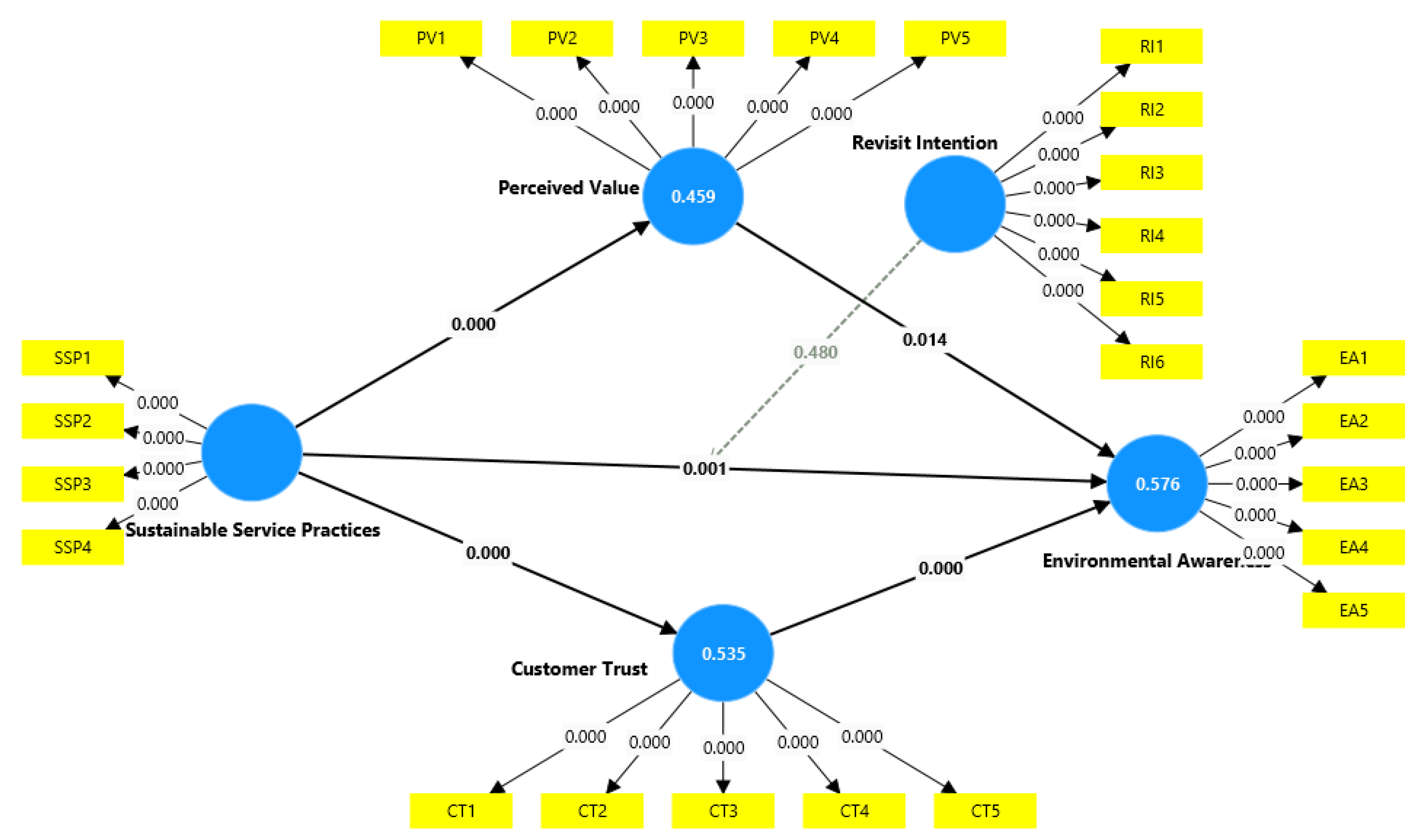
Table 5 presents a direct effects of partial least squares structural equation modelling (PLS-SEM) of the structural model. The study found that sustainable service practices positively impact environmental awareness (β = 0.199, t = 3.432, p = 0.001), supporting H1a. This implies that sustainability-related hospitality services increase the environmental awareness of customers. Additionally, sustainable service practices significantly impact perceived value (β = 0.678, t = 22.167, p < 0.001), supporting H1b. This implies that environmentally responsible service delivery has significant positive effects on the evaluation of the benefits of the hospitality service by the customers. Sustainable service practises have a significant influence on customer trust (β = 0.731, t = 28.757, p 0.001), which leads to the support of H1c and would imply the importance of sustainability initiatives in developing trust between hospitality firms and their customers. In terms of outcome relationships, perceived value positively impacts environmental awareness (β = 0.128, t = 2.457, p = 0.014), supporting H2a. This effect is small, but it does indicate that those customers who value hospitality services are environmentally more sensitive. Customer trust positively impacts environmental awareness (β = 0.396, t = 6.252, p < 0.001), supporting H2b and highlighting trust as a key mechanism for sustainability initiatives to increase environmental awareness.
4.5. Moderation Effect
Contrary to expectations, the interaction effect between revisit intention and sustainable service practises on environmental awareness is not statistically significant (β = -0.021, t = 0.706, p = 0.480), thus leading to the rejection of H5. This result suggests that sustainable service practises do not significantly increase or undermine the relationship between revisit intention and environmental awareness. The non-significant moderation effect implies that environmental awareness of customers may be more influenced by direct sustainability cues and relational factors than by conditional influence of revisit intention.
Figure 2.
Tested model. Source: SmartPLS 4 output.
4.6. Model Explanatory Power and Effect Sizes
Table 6 shows the explanatory power of the structural model, effect sizes and predictive relevance. Sustainable service practises account for a significant amount of variance in perceived value (R2 = 0.459; adj. R2 = 0.458) and customer trust (R2 = 0.535; adj. R2 = 0.533), indicating moderate to high explanatory power. The effect sizes (f2) for sustainable service practises on perceived value (0.513) and customer trust (0.721) are large, indicating a leading role for these practises in the formation of these constructs. Environmental awareness shows a high degree of explained variance (R2 = 0.576), indicating that the combined impact of sustainable service practises, perceived value, and customer trust explains a significant percentage of the variance in this outcome. The effect of customer trust on environmental awareness (f2 = 0.331) is substantial; the impact of sustainable service practises (f2 = 0.214) is at a medium level; and the effect of perceived value (f2 = 0.086) is at a trim level. These results indicate that trust is the most influential factor in fostering environmental awareness among customers.
4.7. Predictive Relevance
The Q2 predict statistic quantified the model's predictive relevance. All endogenous constructs show Q2 predict values greater than zero, confirming the model's predictive relevance. Environmental awareness shows high predictive accuracy (Q²_predict = 0.587), supported by relatively low RMSE (0.689) and MAE (0.514). Similarly, perceived value and customer trust demonstrate acceptable predictive performance, further supporting the robustness of the proposed model.
4.8. Mediation Analysis
Table 7 shows the results of the mediation analysis of indirect effects of sustainable service practises on environmental awareness through perceived value and customer trust. The findings provide empirical evidence that both mediators play significant roles in the transmission of the effects of sustainable service practises to environmental awareness, though with varying magnitudes. The indirect impact of sustainable service practises on environmental awareness, mediated through perceived value, is positive and statistically significant (β = 0.087, t = 2.427, p = 0.015), supporting H3a. This result suggests that sustainable service practises positively affect customers' environmental awareness, in part by making them perceive greater value in hospitality services. Although the size of the indirect effect is relatively modest, it indicates that value perceptions are an important cognitive mechanism through which sustainability initiatives shape customers' environmental consciousness. More extreme mediation is seen through customer trust. The indirect impact of sustainable service practise on environmental awareness through customer trust is very strong and highly significant (β = 0.289, t = 6.229, p < 0.001), and it is highly supportive of H3b. This finding means that sustainable practises in service significantly increase environmental awareness by building trust in hospitality providers. The size of this indirect effect is significantly larger than that of perceived value, suggesting that trust is a more powerful mediating mechanism in the sustainability-awareness relationship.
4.9. Discussion of Findings
The result obtained from this research gives strong empirical evidence to support Stakeholder Theory by showing that sustainable service practises have a significant impact on customer related outcomes in a hospitality industry in Accra, Kumasi and Tamale. Consistent with Saeed (2023) and Abdullah et al. (2024), the results indicate that when hospitality firms align their service operations with the expectations of their stakeholders, especially in terms of environmental and social responsibilities, customers have a favourable response towards the firms in terms of perceived value, trust and environmental awareness. The powerful influences of sustainable service practises on perceived value and customer trust provide support for previous empirical research that demonstrated that sustainability initiatives are neither an add-on nor marginal attributes embedded in service delivery, but value enhancing attributes (Babajide et al., 2023; Ma & Rahut, 2024). These results provide stronger evidence for the argument made by Shil (2024) and Shah et al. (2024) that sustainability-oriented practices serve as credible market signals providing more robust cognitive and relational evaluation of service providers by customers. In competitive urban hospitality markets such as the ones examined, sustainability therefore appears to be a strategic differentiator, which contributes to the increased appraisal of services by customers and to the strengthening of relational bonds, thus also supporting the hypotheses on direct effects, which are informed in the light of the existing hospitality and green marketing literature.
Beyond the direct effects, the mediation analysis gives a greater insight on the mechanisms underlying the transformation of sustainable service practises into favourable customer outcomes. The substantial mediating role of perceived value and customer trust is quite in line with the previous research that highlights the importance of internalisation processes in sustainability-driven behaviour (Ellahi et al., 2023; Singh & Hassan, 2024). In line with Bagmalek and Moosaei (2024) and Namoog and Abubakari (2025), the results show that the effect of sustainability initiatives on revisit-related outcomes is mediated largely by customers experience of meaningful value and development of trust in the credibility and integrity of the firm. Notably, the greater mediating role of customer trust lends support to the arguments of both Schilling and Seuring (2024) and Opoku and Li (2025) that trust is particularly salient in emerging market hospitality contexts, where there may be a lot of scepticism towards green claims. On the other hand, the lack of significant moderating effect of environmental awareness was different from some earlier studies (Adebimpe et al., 2024) which implies that in the Ghanaian urban setting, sustainability cues may have generally uniform effects on customers irrespective of individual differences of environmental awareness. This finding suggests that well communicated and consistently implemented sustainable service practises could influence customer responses, through direct and relational paths, even among customers who have different levels of environmental consciousness.
4.10. Theoretical Implications
This study makes several significant contributions to the sustainability and hospitality marketing literature on a theoretical basis. First, by empirically grounding the model on the Stakeholder Theory, the study broadens the Stakeholder Theory from its traditional organisational level application to a customer-centric application within the hospitality context. The findings show that sustainable service practises serve as signals to stakeholders influencing customer's cognitive and relational evaluation and enhances the strength of the theoretical relationship between sustainability initiatives and customer-level outcomes. In particular, the powerful influences of sustainable service practises on perceived value and customer trust contribute to existing theory by demonstrating that sustainability can work in a manner that goes beyond the notion of sustainable service practises as an ethical obligation, but rather, it can be a strategic mechanism to improve value creation and relationship quality. This adds to the growing body of literature which recovers sustainability as an integral component of service marketing and customer experience (and not a peripheral corporate activity).
Second, the study also provides a deeper understanding of the theory by explaining the underlying mechanisms of how sustainable service practises affect a customer's outcomes. The important mediating roles of perceived value and customer trust offer empirical support for process-based explanations proposed by previous research and are in response to calls for more complex models of behaviour that go beyond direct-effects assumptions. The result that customer trust has a greater mediating effect than perceived value adds to the existing theory by emphasising the primary role of relational versus merely evaluative mechanisms in sustainability driven contexts, especially in emerging markets. Furthermore, the non-significant moderating role of environmental awareness defies assumptions in the extant literature that individual-level environmental consciousness necessarily conditions sustainability - behaviour relationships. This result suggests the need for theoretical refinement, which suggests that consistent and credible sustainability practises may have universal effect that transcends differences on environmental awareness, particularly in the urban hospitality markets.
4.11. Practical Implications
From a managerial point of view, the results give practical insights to hospitality practitioners in Accra, Kumasi and Tamale. First, the powerful direct influences of sustainable service practises on perceived value, customer trust and environmental awareness indicate that sustainability is better not to be used as an auxiliary or symbolistic hospitality service than to ensure that it is embedded into basic hospitality service processes. Investments in energy efficiency, waste reduction, responsible sourcing and environment-friendly service process can improve the overall value perceptions of customers and boost trust, important drivers for long-term customer relationships. Managers should thus consider sustainability to be a strategic tool to differentiate and get a competitive edge in increasingly saturated urban hospitality markets.
Second, the fact that customer trust is such an important mediating mechanism highlights the importance of credibility and transparency in sustainability communication. Hospitality companies should be careful to ensure the sustainability claims are consistent, verifiable and clearly communicated to prevent perceptions of greenwashing, especially in an emerging market context where there may be a degree of scepticism. Imparting sustainable practices on employees in the frontline and training them to express and demonstrate these practices can promote further trust in service encounters. Moreover, in light of the non-significant moderating role of environmental awareness, it is not necessary for managers to segment customers according to environmental consciousness only, but they can implement widely inclusive sustainability strategies that appeal to a broad customer base. By concentrating on delivering practical value and trust via genuine initiatives for sustainability, hospitality firms can create stronger customer engagement while improving revisit associated outcomes among diverse customer segments.
5. Conclusion
This study comes to a conclusion that sustainable service practises play a central and strategic role in shaping customer-related outcomes in the hospitality industry in the cities of Accra, Kumasi, and the Tamale. Drawing on the Stakeholder Theory, the results show that initiatives related to sustainability-oriented services significantly increase perceived value, customer trust and environmental awareness, with trust being the most influential mechanism through which sustainability holds positive customer responses. While perceived value and customer trust partly mediate the link between sustainable service practises and environmental awareness, the expected moderating effect of environmental awareness was not supported suggesting that sustainability initiatives have broadly consistent effects regardless of customer environmental consciousness level. Overall, the research adds strong empirical support to the idea that incorporation of sustainability into fundamental service delivery is not only ethically desirable but also strategically advantageous and reinforces the value of true and well-communicated sustainable practices in developing better customer relationships and long-term competitiveness in urban hospitality markets.
Limitations and Future Research Directions
Despite its contributions, there are some shortcomings this study has encountered which offer room for future studies. First, the cross-sectional research design does not permit making causal inferences about the study variables. Future studies could use longitudinal or experimental designs to better capture changes in perceptions and behaviours of customers over time and to establish stronger causal relationships. Second, the nature of the study (i.e. urban hospitality markets in Accra, Kumasi, and Tamale) may restrict the generalisability of the findings to contexts of rural areas or other emerging economies with different cultural, economic and political regulatory environments. Future research attempts could expand the model to other geographic areas or attempt to make cross-country comparisons to improve the external validity of the research.
In addition, the study is based on self-reported information which may be prone to common method bias and social desirability effects especially in the context of sustainability-related research. Future research could overcome this limitation by including objective measures of sustainability performance or by using customer response as a triangulation of managerial or operational data. Moreover, while environmental awareness was not found to have a significant moderating effect in the present study, in future research other boundary conditions, such as environmental concern, green scepticism, or cultural values could be considered to better understand heterogeneity in customer responses to sustainable service practises. Finally, future studies could include other theoretical perspectives, such as signalling theory or social exchange theory, as well as focus on downstream behavioural outcomes such as word-of-mouth, willingness to pay a premium or brand advocacy in order to further enrich the sustainability and hospitality marketing literature.
References
- Abdullah, A.; Yamak, S.; Korzhenitskaya, A.; Rahimi, R.; McClellan, J. Sustainable development: The role of sustainability committees in achieving ESG targets. Bus. Strategy Environ. 2024, 33(3), 2250–2268. [Google Scholar] [CrossRef]
- Adebimpe Bolatito Ige, Eseoghene Kupa, & Oluwatosin Ilori. Best practices in cybersecurity for green building management systems: Protecting sustainable infrastructure from cyber threats. Int. J. Sci. Res. Arch. 2024, Vol. 12(Issue 1), 2960–2977, researchgate.net. [CrossRef]
- Ardito, L. The influence of firm digitalization on sustainable innovation performance and the moderating role of corporate sustainability practices: An empirical investigation. Bus. Strategy Environ. 2023, 32(8), 5252–5272. [Google Scholar] [CrossRef]
- Asante-Darko, D.; Osei, V. Sustainable supply chain management practices and firm performance: the mediating effect of firm capabilities. Manag. Environ. Qual. 2024, 35(4), 751–779. [Google Scholar] [CrossRef]
- Babajide, A.; Osabuohien, E.; Tunji-Olayeni, P.; Falola, H.; Amodu, L.; Olokoyo, F.; Adegboye, F.; Ehikioya, B. Financial literacy, financial capabilities, and sustainable business model practice among small business owners in Nigeria. J. Sustain. Financ. Invest. 2023, 13(4), 1670–1692. [Google Scholar] [CrossRef]
- Bagmalek, J. R.; Moosaei, M. The Effect of Digital Marketing Adoption on the Sustainable Growth of Agricultural Industries: Empirical Evidence from Iran. International Journal of Agricultural Science, Research and Technology in Extension and Education Systems 2024, Vol. 14(Issue 4), 275–286, mdpi.com. [Google Scholar] [CrossRef]
- Berbeka, K.; Alejziak, W.; Berbeka, J. Sustainable development goals of Agenda 2030 in the declarations and aims of international tourism organisations. J. Travel Tour. Mark. 2024, 41(1), 142–153. [Google Scholar] [CrossRef]
- Bouteraa, M. Mixed-methods approach to investigating the diffusion of FinTech services: enriching the applicability of TOE and UTAUT models. J. Islam. Mark. 2024, 15(8), 2036–2068. [Google Scholar] [CrossRef]
- Deshpande, P.; Srivastava, A. P. A study to explore the linkage between green training and sustainable organizational performance through emotional intelligence and green work life balance. Eur. J. Train. Dev. 2023, 47(5–6), 615–634. [Google Scholar] [CrossRef]
- Ellahi, A.; Jillani, H.; Zahid, H. Customer awareness on Green banking practices. J. Sustain. Financ. Invest. 2023, 13(3), 1377–1393. [Google Scholar] [CrossRef]
- Gupta, R.; Kaur, S. A 2-1-1 multi-level perspective of understanding the relationship between green human resource management practices, green psychological climate, and green employee behavior. Corp. Soc. Responsib. Environ. Manag. 2024, 31(5), 4068–4084. [Google Scholar] [CrossRef]
- Hossain, M. I.; Ong, T. S.; Jamadar, Y.; Teh, B. H.; Islam, A. Nexus among green entrepreneurship orientation, green ambidexterity innovation, green technological turbulence and green performance: moderated-mediation evidence from Malaysian manufacturing SMEs. Eur. J. Innov. Manag. 2025, 28(7), 2761–2783. [Google Scholar] [CrossRef]
- Jayarathna, C. P.; Agdas, D.; Dawes, L. Exploring sustainable logistics practices toward a circular economy: A value creation perspective. Bus. Strategy Environ. 2023, 32(1), 704–720. [Google Scholar] [CrossRef]
- Kalubanga, M.; Mbekeka, W. Compliance with government and firm’s own policy, reverse logistics practices and firm environmental performance. Int. J. Product. Perform. Manag. 2024, 73(5), 1427–1478. [Google Scholar] [CrossRef]
- Khan, K.; Khan, Q.; Jalaly, S.; Shams, M. S.; Shah, T. A. Green Human Resource Management and Green Service Behaviour in Organisations: Examining Underlying Mechanism. South Asian J. Hum. Resour. Manag. 2024, 11(1), 113–129. [Google Scholar] [CrossRef]
- Ma, W.; Rahut, D. B. Climate-smart agriculture: adoption, impacts, and implications for sustainable development. In Mitigation and Adaptation Strategies for Global Change; Springer, 2024; Vol. 29, Issue 5. [Google Scholar] [CrossRef]
- Mamun, A.; Raj, M. W. Z. Quantitative Study on Workflow Optimization Through Data Analytics in U.S. Digital Enterprises. Am. J. Interdiscip. Stud. 2023, 04(03), 136–165. [Google Scholar] [CrossRef]
- Mankgele, K. The effect of organizational ambidexterity on the sustainable performance of SMEs in the Limpopo province of South Africa. Int. J. Res. Bus. Soc. Sci. (2147- 4478) 2023, 12(2), 65–72. [Google Scholar] [CrossRef]
- Namoog, S.; Abubakari, Z. The Impact of Environmental Social and Governance (ESG) Factors on Sustainable Economic Growth in Ghana: The Mediating Roles of Human Capital Development and Technological Innovation. Afr. J. Empir. Res. 2025, 6(1), 41–51. [Google Scholar] [CrossRef]
- Olumoh, Y. A.; Mubaraq, S. Tax Audit Management, Tax Control Mechanisms, and the Performance of State Internal Revenue Services in South-West, Nigeria. FUDMA J. Account. Financ. Res. [FUJAFR] 2025, 3(3), 1–20. [Google Scholar] [CrossRef]
- Opoku, R. K.; Li, X. Sustainable management practices, operational and sustainable performance in manufacturing contexts: empirical evidence from a developing economy. J. Responsible Prod. Consum. 2025, 2(1), 50–84. [Google Scholar] [CrossRef]
- Saeed, M. M. Financial management practices, competitive advantage and loan performance of selected microfinance institutions (MFIs) in Ghana. Bus. Strategy Dev. 2023, 6(4), 1018–1036. [Google Scholar] [CrossRef]
- Saeed, M. M.; Mohammed, S. S.; Adeniyi, A.; Osei, M. The Impact of Corporate Governance on the Contribution of Listed Firms to Sustainable Development Goals (SDGs) Disclosures in Ghana. Sustain. Dev. 2025, 33(3), 4676–4688. [Google Scholar] [CrossRef]
- Schilling, L.; Seuring, S. Linking the digital and sustainable transformation with supply chain practices. Int. J. Prod. Res. 2024, 62(3), 949–973. [Google Scholar] [CrossRef]
- Schönherr, S.; Eller, R.; Kallmuenzer, A.; Peters, M. Organisational learning and sustainable tourism: the enabling role of digital transformation. J. Knowl. Manag. 2023, Vol. 27(Issue 11), 82–100, emerald.com. [Google Scholar] [CrossRef]
- Shah, N.; Bano, S.; Saraih, U. N.; Abdelwaheed, N. A. A.; Soomro, B. A. Developing organizational performance through talent management practices: employee satisfaction’s mediating role in learning organizations. Bus. Process Manag. J. 2024, 30(3), 641–670. [Google Scholar] [CrossRef]
- Shah, N.; Soomro, B. A. Effects of green human resource management practices on green innovation and behavior. Manag. Decis. 2023, 61(1), 290–312. [Google Scholar] [CrossRef]
- Shil, S. K. Petroleum Storage Tank Design and Inspection Using Finite Element Analysis Model for Ensuring Safety Reliability and Sustainability. Rev. Appl. Sci. Technol. 2024, 03(04), 94–127. [Google Scholar] [CrossRef]
- Singh, A.; Hassan, S. C. Identifying the Skill Gap in the Workplace and Their Challenges in Hospitality and Tourism Organisations. Contemp. Stud. Econ. Financ. Anal. 2024, 112B, 101–114. [Google Scholar] [CrossRef]
- Suprayitno, D. Key Factors of Employee Performance and Sustainable HR Practices in Indonesian Manufacturing Industry. Sinergi Int. J. Manag. Bus. 2024, 2(1), 57–72. [Google Scholar] [CrossRef]
- Telo da Gama, J. The Role of Soils in Sustainability, Climate Change, and Ecosystem Services: Challenges and Opportunities. Ecologies 2023, Vol. 4(Issue 3), 552–567, mdpi.com. [Google Scholar] [CrossRef]
- Wu, Y.; Fan, S.; Liu, D.; Sun, X. Psychological and behavior investigation of Chinese residents: Concepts, practices, and prospects. In Chinese General Practice Journal; 2024; Vol. 1, Issue 3, pp. 149–156. Elsevier. [Google Scholar] [CrossRef]
Figure 1.
Conceptual model. Source: Authors’ own creation.
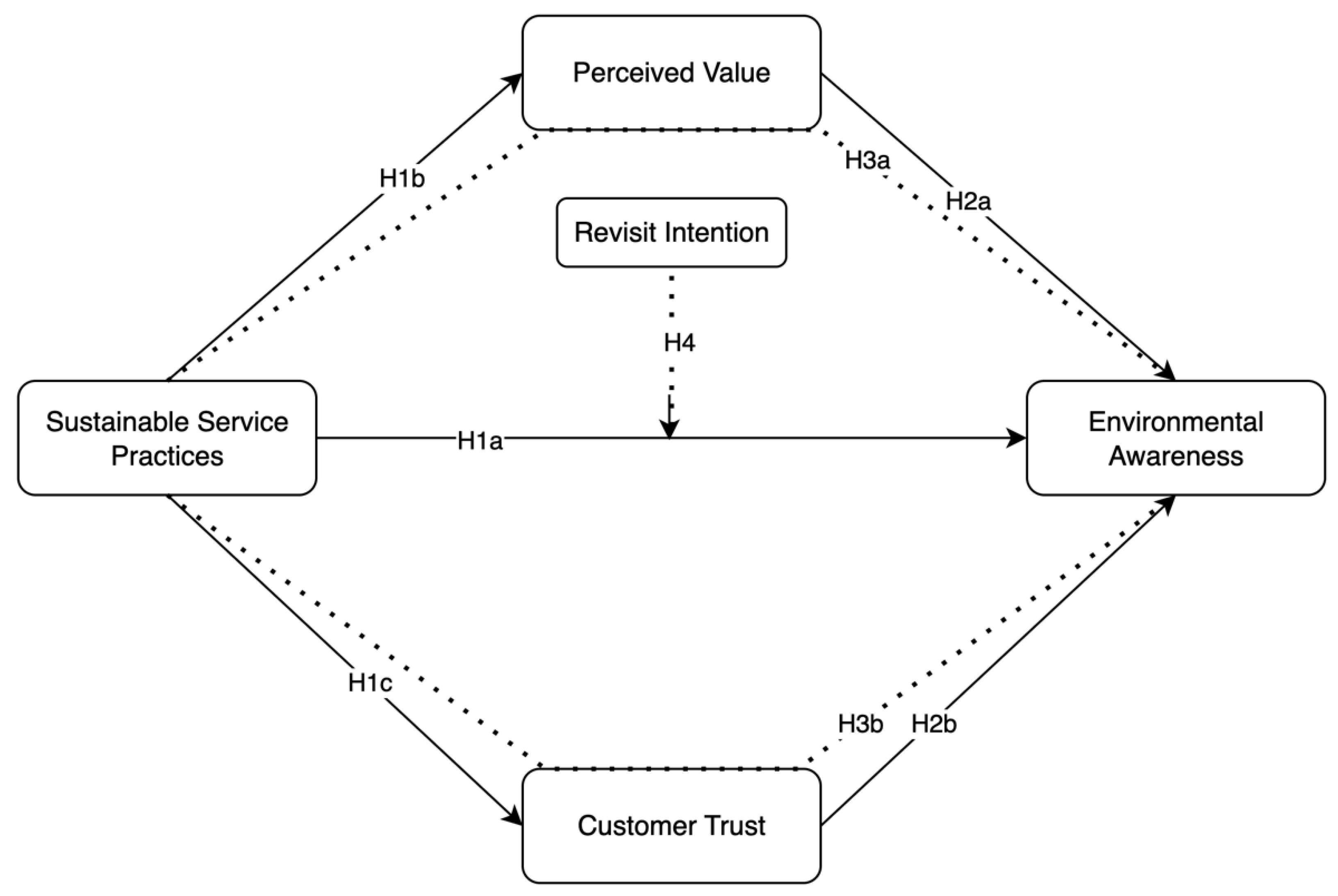

Table 1.
Loadings, Reliability, Validity, and VIF.
| Construct | Items | Loadings | VIF | Alpha | CR (ρc) | AVE |
|---|---|---|---|---|---|---|
| Customer Trust | CT1 | 0.812 | 2.341 | 0.901 | 0.927 | 0.718 |
| CT2 | 0.846 | 2.587 | ||||
| CT3 | 0.858 | 2.931 | ||||
| CT4 | 0.835 | 2.476 | ||||
| CT5 | 0.821 | 2.298 | ||||
| Environmental Awareness | EA1 | 0.804 | 2.112 | 0.889 | 0.919 | 0.695 |
| EA2 | 0.827 | 2.354 | ||||
| EA3 | 0.861 | 2.789 | ||||
| EA4 | 0.842 | 2.566 | ||||
| EA5 | 0.806 | 2.147 | ||||
| Perceived Value | PV1 | 0.823 | 2.281 | 0.894 | 0.924 | 0.709 |
| PV2 | 0.847 | 2.514 | ||||
| PV3 | 0.859 | 2.842 | ||||
| PV4 | 0.831 | 2.366 | ||||
| PV5 | 0.818 | 2.204 | ||||
| Revisit Intention | RI1 | 0.791 | 2.018 | 0.914 | 0.934 | 0.704 |
| RI2 | 0.824 | 2.245 | ||||
| RI3 | 0.857 | 2.781 | ||||
| RI4 | 0.868 | 3.012 | ||||
| RI5 | 0.839 | 2.593 | ||||
| RI6 | 0.803 | 2.167 | ||||
| Sustainable Service Practices | SSP1 | 0.836 | 2.421 | 0.881 | 0.918 | 0.737 |
| SSP2 | 0.862 | 2.798 | ||||
| SSP3 | 0.879 | 3.104 | ||||
| SSP4 | 0.841 | 2.563 |
Table 2.
Discriminant Validity – Fornell–Larcker Criterion.
| Construct | CT | EA | PV | RI | SSP |
|---|---|---|---|---|---|
| Customer Trust (CT) | 0.847 | ||||
| Environmental Awareness (EA) | 0.621 | 0.834 | |||
| Perceived Value (PV) | 0.587 | 0.549 | 0.842 | ||
| Revisit Intention (RI) | 0.604 | 0.571 | 0.632 | 0.839 | |
| Sustainable Service Practices (SSP) | 0.731 | 0.602 | 0.678 | 0.645 | 0.858 |
Note: Diagonal elements (bold) represent the square root of AVE.
Table 3.
Discriminant Validity – Heterotrait–Monotrait Ratio (HTMT).
| Constructs | CT | EA | PV | RI |
|---|---|---|---|---|
| CT | — | |||
| EA | 0.724 | — | ||
| PV | 0.691 | 0.643 | — | |
| RI | 0.708 | 0.672 | 0.736 | — |
| SSP | 0.801 | 0.714 | 0.759 | 0.742 |
Table 4.
Model Fit Indices.
| Indicator | Saturated Model | Estimated Model |
|---|---|---|
| SRMR | 0.064 | 0.064 |
| d_ULS | 0.541 | 0.541 |
| d_G | 0.291 | 0.291 |
| Chi-square | 652.418 | 652.418 |
| NFI | 0.911 | 0.911 |
Table 5.
Direct and Moderation Effects.
| Hypothesis | Path | Β | STD | T-Statistic | P-Value |
|---|---|---|---|---|---|
| H1a | Sustainable Service Practices → Environmental Awareness | 0.199 | 0.058 | 3.432 | 0.001 |
| H1b | Sustainable Service Practices → Perceived Value | 0.678 | 0.031 | 22.167 | 0.000 |
| H1c | Sustainable Service Practices → Customer Trust | 0.731 | 0.025 | 28.757 | 0.000 |
| H2a | Perceived Value → Environmental Awareness | 0.128 | 0.052 | 2.457 | 0.014 |
| H2b | Customer Trust → Environmental Awareness | 0.396 | 0.063 | 6.252 | 0.000 |
| H4 | Revisit Intention × Sustainable Service Practices → Environmental Awareness | −0.021 | 0.030 | 0.706 | 0.480 |
Table 6.
Model Explanatory Power, Effect Sizes, and Predictive Relevance.
| Endogenous Construct | R² | Adj. R² | f² (SSP →) | f² (PV →) | f² (CT →) | Q²predict | RMSE | MAE |
| Perceived Value | 0.459 | 0.458 | 0.513 | – | – | 0.442 | 0.761 | 0.602 |
| Customer Trust | 0.535 | 0.533 | 0.721 | – | – | 0.518 | 0.724 | 0.561 |
| Environmental Awareness | 0.576 | 0.609 | 0.214 | 0.086 | 0.331 | 0.587 | 0.689 | 0.514 |
Table 7.
Indirect (Mediating) Effects.
| Hypothesis | Indirect Path | β | STD | T-Statistic | P-Value |
| H3a | Sustainable Service Practices → Perceived Value → Environmental Awareness | 0.087 | 0.036 | 2.427 | 0.015 |
| H3b | Sustainable Service Practices → Customer Trust → Environmental Awareness | 0.289 | 0.046 | 6.229 | 0.000 |
Disclaimer/Publisher’s Note: The statements, opinions and data contained in all publications are solely those of the individual author(s) and contributor(s) and not of MDPI and/or the editor(s). MDPI and/or the editor(s) disclaim responsibility for any injury to people or property resulting from any ideas, methods, instructions or products referred to in the content. |
© 2026 by the authors. Licensee MDPI, Basel, Switzerland. This article is an open access article distributed under the terms and conditions of the Creative Commons Attribution (CC BY) license (http://creativecommons.org/licenses/by/4.0/).
Copyright: This open access article is published under a Creative Commons CC BY 4.0 license, which permit the free download, distribution, and reuse, provided that the author and preprint are cited in any reuse.