

Submitted:
13 June 2026
Posted:
17 June 2026
You are already at the latest version
Abstract
This study investigates the varying implications of digital infrastructure on sustainable economic growth in five major emerging countries (Egypt, India, Kenya, Saudi Arabia and Sudan) during the period 2014-2025. We use panel data, System GMM estimation and Random Forest regression and classification to study the impact of internet penetration, mobile broadband subscriptions and fixed broadband subscriptions on sustainable GDP per capita growth. Our results indicate the statistical and economic impact of digital infrastructure on economic growth. The biggest benefits are from internet penetration, then mobile broadband. Fixed broadband is not statistically significant in the full model, which reflects the low access in these countries. Random forest regression (R2=0.538, RMSE=2.31) and classification (F1-score=0.714, AUC-ROC=0.792) models can accurately predict 75% of high and low growth regimes in out-of-sample validation. Internet penetration drives growth in middle income countries (Egypt, India) while mobile broadband drives growth in low income countries (Sudan, Kenya). Average education >6 years doubles the benefits of digital infrastructure growth on human capital. The sustainability implications of these results are relevant for the SDG 4 (quality education), SDG 9 (infrastructure and innovation), and SDG 10 (reduced inequality) programs. There is a digital divide as the MENA countries have 87% internet penetration compared to 44% in Sub-Saharan Africa. We recommend the expansion of mobile broadband in low-income countries and investments in internet infrastructure and human capital in middle-income countries to maximize sustainable growth.
Keywords:
digital infrastructure
; sustainable economic growth
; panel GMM
; heterogeneous effects
; human capital
; developing countries
; internet penetration
; mobile broadband
; sustainable development goals
; digital divide
1. Introduction
Within the context of both global digital change and faster technological iteration, developing countries are facing opportunities and challenges that have never been seen before. From supply chain problems caused by geopolitical conflicts to increased economic volatility because of the COVID-19 pandemic, it's becoming clearer that standard growth models aren't as stable as they used to be. So, improving economic growth through digital infrastructure has become one of the most important goals for policymakers in developing countries [1]. As a key indicator of a country's ability to maintain steady income growth, digital infrastructure not only affects higher output but also has a big effect on how national economies are structured [2].
According to the Global Digital Economy Report 2024, over 65% of emerging countries have had very unstable growth over the last ten years because their digital infrastructure isn't up to par. Furthermore, nations with highly developed digital infrastructure recovered from economic shocks 40% faster than the average for the region. This gave them big benefits in the competitive landscape. These factors make internet and mobile broadband important digital technologies that are changing the paths of economic growth [3]. By using e-commerce platforms, digital financial services, and smart logistics, digital infrastructure can precisely find market opportunities, improve productivity, and make resource allocation more efficient. This creates a technological base for long-term growth [4].
Novel ways of looking at economic growth in the digital age are becoming more and more popular among academics. According to earlier studies, digital platforms, smart algorithms, and working together through networks all have good effects on productivity and the economy [5,6,7]. As an essential part of technology, digital infrastructure also helps the economy grow in ways that can't be replaced. However, the connection between digital infrastructure and economic growth hasn't gotten a lot of academic attention when looking at different stages of development. A country's level of spending in digital technology is often used as a stand-in indicator in previous research [8]. Despite this, this measurement at the country level doesn't show how different types of digital infrastructure, such as internet usage, mobile broadband, and fixed broadband, interact with each other in complex ways across countries with different levels of income.
This brings up a number of important study questions, including: Can digital technology help any developing country's economy grow? How do the various types of digital technology impact growth? Are these benefits tempered by human capital? What empirical methods can correctly predict how digital infrastructure will affect growth while taking into account possible endogeneity issues? The study is mainly about these questions.
An increasing number of empirical studies have shown that ICT infrastructure and economic growth are linked in a good way. Having mobile phone plans, fixed broadband, and internet users has been shown to greatly improve the economic success of Southeast Asian countries [9]. Comparative studies of 85 countries also show that ICT infrastructure leads to economic growth, especially when it is combined with banking sector development that helps the economy grow [10]. But there are problems with the homogeneity assumption that a lot of this study is based on. Institutional quality, people capital, and infrastructure levels vary a lot between developing countries. One-size-fits-all policy suggestions might waste limited resources. Schomburg and Silberberger [11] say that a country's level of digital development has a big impact on the effects of digitalization on growth. No one actor's adoption of digital technology has a big effect on growth in countries with low levels of digitization, which suggests that there are threshold effects at play. Countries with a medium level of digitalization see good effects from both households and businesses going digital. In highly digitalized economies, however, government digital adoption becomes the main driver.
We want to find out how digital infrastructure affects economic growth and how it works, paying special attention to differences between income groups and stages of digital development. Using panel data from Egypt, India, Kenya, Saudi Arabia, and Sudan from 2014 to 2025, this study uses panel fixed-effects regression, Random Forest machine learning, and classification models to test the real-world effect of digital infrastructure on economic growth. With factors specific to each country included, it also looks at how variables like human capital and capital creation act as moderators and mediators.
It specifically answers three research questions. First, when you look at emerging countries' economy using rigorous evaluation criteria, does digital infrastructure assist them expand compared to other countries? Second, do these effects differ based on where you live, how much internet access you have, how much money you make (low-income, lower-middle-income, upper-middle-income), or the sort of place (MENA, Sub-Saharan Africa, South Asia)? Third, what are the extra benefits of different kinds of digital infrastructure, such mobile broadband, internet access, and fixed broadband, at different stages of building up human capital?
This research differs from previous econometric studies in that it uses machine learning evaluation methods. Although panel fixed-effects models give you coefficient estimates and statistical significance, Random Forest regression gives you predictive performance measures (R², RMSE, MAE, MAPE) that show how important digital infrastructure effects are to the economy. Classification models (accuracy, precision, recall, F1-score, AUC-ROC) can also predict high-growth versus low-growth regimes, giving managers useful stopgap levels. This new approach to digital economics uses both inferential econometrics and forecasting machine learning.
The study's main addition compared to previous work is that it adds heterogeneity to the framework connecting digital infrastructure and economic growth, which broadens the study of factors that affect growth. What this adds to the body of research on the topic of technology adoption externalities and development economics is a new theory view on how economic growth happens in digital settings. Second, it breaks down the pathways of impact from the point of view of a dual-income group and a regional one, showing how the effects of digital infrastructure are complicated. For policymakers making digitalization plans, especially in places with limited resources, this result gives cross-country empirical evidence. Third, the methodological approach uses both panel econometrics and machine learning evaluation measures (such as accuracy, precision, recall, F1-score, and AUC-ROC) to get around the problems that exist with standard hypothesis testing. This reinforces the validity of empirical results and sets a standard for future research in this area. In addition, the study focuses on developing countries, a group that isn't usually included in research on digital economy. It does this by using a balanced panel that covers the years 2014 to 2025, including the pre-pandemic, pandemic, and post-pandemic recovery periods. The full cycle of digital change sped up by COVID-19 is covered by this horizon.
Many different aspects of socio-environmental development will be positively affected by digital infrastructure as well as economic growth. Digital technologies contribute to social sustainability through mobile broadband by providing marginalized populations with greater access to information, education, health care and financial services; resulting in greater social equity by improving the chances that they can be lifted out of poverty and have access to a quality education (Sustainable Development Goals (SDG) 1 and 4 respectively). By conducting heterogeneity analyses based on both income group and region, we are able to identify within and between country inequalities (SDG 10) as well as show how these inequalities are affected by access to mobile broadband services.
With regards to sustainability of natural resources both positively and negatively, digital technologies are contributing to the dematerialization of materials (e.g., through smart logistics), increasing the energy efficiency of some industries (e.g., through more efficient manufacturing processes), and assisting governments and other organizations in taking climate action (SDG 7) on behalf of their citizens and employees (SDG 9) (aided by the use of more efficient energy sources like wind or solar). However, in addition to contributing to increased energy consumption associated with data centers and mobile networks, digital technologies can create a significant amount of electronic waste due to their rapid growth.
The success of using connectivity as an enabler of equitable and resilient growth depends on complementary investments in both human capital and the quality of regulation, which promotes institutional sustainability. Therefore, this research considers digital infrastructure as a conditional enabler rather than an ultimate end in itself in the form of sustainable development pathways. In particular, we focus on how the educational system moderates the heterogeneity factor of the varying degrees of development across countries based on their level of income, whilst achieving sustainable global development.
This paper's rest is divided as follows: Section 2 looks at important theoretical and empirical research. Conceptual framework and study hypotheses are explained in Section 3. Section 4 talks about the variables, data, and analysis method, including steps for preprocessing and evaluation measures. Including regression results, classification performance, and heterogeneity analyses, Section 5 shows and talks about the actual findings. Diagnostic and stability tests are done in Section 6. The seventh section summarizes the most important research findings and points out their limitations and suggests future research paths. Section 8 ends with policy implications for governments and foreign development organizations in developing countries.
2. Literature Review
This section examines the theoretical and empirical literature regarding the correlation between digital infrastructure and economic growth.
2.1. Research on Digital Infrastructure and Economic Growth
As the digital economy and national growth become more closely linked, the means that digital infrastructure spreads have slowly changed from decisions made by individual countries to exchanges between groups. There are three main areas of academic research on the link between digital infrastructure and economic growth: the conceptual framework, the measuring aspects, and the mechanisms that affect the link. These results give this paper's study a strong theoretical basis.
The growth effect refers to the convergence of productivity among groups with comparable traits, whereby the performance of one country is affected by the performance of its peers. The main idea behind it is based on the principles of technological diffusion. This idea has become a crucial way to describe how countries' performance is linked in areas like development economics [12]. In the realm of digital infrastructure, the digital peer effect is defined as the interactive process through which countries, in their technology adoption decisions, reference the digital practices of peer nations within their region or income group to alleviate uncertainty risks and improve technological application efficiency [13]. Fundamentally, this exemplifies a technology diffusion mechanism propelled by information dissemination and competitive forces [14].
Based on these conceptual limits, researchers have looked into many ways to measure digital infrastructure. When it comes to measuring growth, most research looks at two things: GDP per capita growth and total factor productivity growth. Peer effects in the same industry and region show how much countries in the same region depend on each other when it comes to adopting new technologies. This is because they have similar technological needs and market conditions [15]. Regional clustering effects show how geography affects digital application patterns. For instance, nations within the same geographic area typically utilize analogous technology and exchange resources [1].
The literature primarily employs two categories of proxy variables for the selection of quantitative indicators: input-based metrics, including the ratio of ICT expenditure to the scale of digital infrastructure investment [16], and output-based indicators, such as internet penetration rates and mobile broadband subscription rates [17]. This framework for assessing several dimensions assists with the approach for accurately measuring the strength and kind of the effects of digital infrastructure.
2.2. Research on Digital Infrastructure Heterogeneity
The body of work regarding the correlation between digital infrastructure and economic growth is progressively broadening, however comprehensive investigation of heterogeneity remains inadequate. Present research primarily examines the impact of digital infrastructure on productivity and structural transformation, providing critical benchmarks for analyzing their intrinsic link in this study.
Digital infrastructure boosts economic growth by making things more efficient and making the best use of resources, which in turn leads to higher production. Digital platforms successfully synchronize supply and demand, facilitating swift access to alternative marketplaces amid unforeseen economic disruptions to reduce recovery durations [18]. Digital financial systems markedly enhance operational efficiency and diminish transaction costs via automation and real-time settlement, consequently improving economic adaptability to demand variations [19].
In terms of structural transformation, digital infrastructure enables the dissemination of information and the coordination of resources across many economic sectors. Digital collaboration platforms dismantle information silos, facilitating real-time data interchange among agriculture, industry, and services, therefore expediting the overall pace of economic transformation [20]. Nonetheless, certain research indicates a non-linear correlation between digital infrastructure and economic growth. Prakash et al. [21] discovered that moderate digital investments substantially boost economic growth, however excessive investments may result in falling marginal returns due to factors such as elevated technology integration costs and heightened system complexity [22].
Resource dependence theory posits that economic growth is contingent upon the capacity to obtain and assimilate essential resources [23]. Digital infrastructure serves as a strategic technical asset, allowing developing nations to overcome conventional resource limitations and improve economic adaptability. Digital infrastructure converts disparate information into decision-support capabilities via data mining and analysis, hence enhancing crucial decisions like trade partner selection and production planning [24]. Conversely, digital applications facilitate the transition of economies from linear frameworks to interconnected ecosystems. This cultivates collaborative networks among nations and trading partners, distinguished by resource complementarity and risk-sharing, thus enhancing the overall resilience of economic systems [25].
While current research acknowledges the contribution of digital technologies to economic growth, the majority of studies concentrate on specific technologies, such as the internet or mobile phones [26]. There is a deficiency in thorough and extensive investigation into how digital infrastructure, as a cohesive technological ensemble, may systematically promote economic growth especially through variations across several stages of development.
A fundamental deficiency in current research is the absence of elucidation concerning the exact paths and underlying mechanisms by which digital infrastructure affects economic growth in various national contexts. It has not conducted a comprehensive examination of the mediating and moderating variables between the two, nor has it included the diverse aspects of the dynamic development environment into its research. This paper examines the diverse mechanisms linking digital infrastructure to economic growth, possessing substantial theoretical and practical significance.
3. Theoretical Framework: Digital Infrastructure, Human Capital, and Sustainable Growth Pathways
A theoretical framework that will support the empirical study is developed in this section.
3.1. Digital Infrastructure and Economic Growth
The peer group effect theory posits that country decisions are significantly influenced by peer countries, essentially representing a rational choice to reduce decision-making risks through imitative learning. By observing the behaviors of their peers in the context of digital infrastructure application scenarios, target nations have the opportunity to learn implicit technical skills and risk mitigation methods, hence reducing the costs of their own exploration. However, according to the resource dependence hypothesis, nations that are limited by a lack of available resources inside their borders are required to make up for deficiencies and improve their economic resilience via the use of external partnerships. Digital infrastructure implementation demands substantial resource investment that individual countries struggle to cover alone. The resource aggregation effect generated by peer group digital adoption helps target countries reduce resource acquisition costs.
A country's technology adoption behaviour is not an isolated decision but is significantly influenced by peer countries within the same region or income group. The digital peer effect exerts a positive influence on economic growth through two core pathways: information spillovers and resource coordination. From the information spillover perspective, digital application practices among peer countries generate observable technical expertise and risk management case studies. Target countries can acquire this tacit knowledge through regional exchanges, policy learning, and other channels, thereby reducing their own digital exploration costs and economic risk identification difficulties [8]. When leading countries within a region utilize digital platforms to optimize trade facilitation systems, other countries can draw upon their design logic to rapidly construct tailored growth strategies, thereby enhancing economic resilience.
From a resource coordination perspective, the adoption of digital technology by multiple countries within a region creates a technological cluster effect. This drives the development of shared digital infrastructure and data resource interoperability, thereby enhancing the economic coordination resilience of the entire group [27].
The digital peer effect can also compel countries to enhance economic growth through competitive pressure. When peer countries universally apply digital technology to achieve improvements in both economic efficiency and risk response capabilities, non-adopting countries face competitive disadvantages. This survival pressure will prompt them to accelerate digital technology investment, thereby driving an overall increase in economic growth levels [12].
Consequently, the digital peer effect significantly enhances economic growth through information sharing, resource coordination, and competitive pressure mechanisms. Based on this, the following hypothesis is proposed:
H1. Digital infrastructure significantly and positively enhances economic growth in developing countries.
3.2. The Moderating Role of Human Capital
The theory of absorptive capacity posits that a country's ability to identify, assimilate, and apply external new knowledge is pivotal in translating technology spillover effects into tangible performance outcomes [28]. While digital infrastructure peer effects furnish countries with abundant external technical knowledge and practical experience, the efficacy of these external resources in enhancing economic growth hinges upon the country's inherent human capital.
Specifically, human capital moderates through a chained pathway. During the knowledge conversion stage, countries with high human capital rapidly identify core technical elements and suitable application scenarios within peer countries' digital implementations, transforming external explicit and tacit knowledge into comprehensible knowledge modules [29]. During the capability-building phase, countries integrate and innovate upon this transformed knowledge through domestic research and development, developing digital application capabilities tailored to their economic characteristics. In the growth-enhancement phase, these constructed digital capabilities directly influence critical economic functions such as risk early warning and resource allocation, ultimately achieving enhanced growth [30].
Conversely, if a country possesses weak human capital, even substantial digital technology spillovers from peer countries may prove difficult to effectively assimilate and convert into tangible drivers for enhancing growth, thereby obstructing the transmission pathway of the peer effect.
Consequently, human capital plays a crucial moderating role in the relationship between digital infrastructure and economic growth. Based on this, the following hypothesis is proposed:
H2. Human capital exerts a significant positive moderating effect on the relationship between digital infrastructure and economic growth.
3.3. Heterogeneity Across Development Stages
The complexity of a supply chain network is based on the combined effects of the economy, the quality of institutions, and the growth of infrastructure. Changes in these traits have a big impact on how strong the benefits of digital infrastructure are. Development economics theory posits that nations at varying levels of development have significant disparities in absorptive ability, institutional quality, and complementing infrastructure.
Low-income nations often have trouble getting power, going to school, and having good institutions, which might make investments in digital infrastructure less successful. However, middle-income nations often have the supplementary resources required to convert digital connection into productivity gains.
Also, the digital infrastructure and development paths of different geographic areas are also different. For example, certain countries in Sub-Saharan Africa have made the transition from fixed-line infrastructure to mobile phone infrastructure. A more balanced development across a variety of digital technologies has been seen in Latin America, in contrast. Because of this, the impact of digital infrastructure on economic growth is likely to be quite diverse for various socioeconomic categories and regions. This leads to the following theory:
As discussed above, the connection between the digital infrastructure and the economic growth mechanism is through the economic-social-environmental triangle of sustainability. In order for sustainable development to occur, all three legs of this triangular relationship must be met (economic), therefore lack of equal opportunity to share in the benefits of digital infrastructure will create social sustainability problems through capability deprivation. Examples of how digital infrastructure provides social sustainability would be improving access to essential services (e.g., mobile banking, education via internet, health care via internet) to the most deprived (low-income and rural) populations, thereby reducing the degree of capability deprivations within those populations. Environmental sustainability will also benefit from the digital infrastructure through several means: remote work, smart grids, precision farming, and dematerialization of physical goods. However, these co-benefits that result from the use of digital infrastructure will not automatically occur, as they require simultaneous complementary investment within the digital infrastructure ecosystem, such as education (digital literacy), improved regulatory standards (privacy of data, monopoly or oligopoly regulations, consumer protection), and environmentally-friendly energy sources to support the expansion of networks without increasing the level of carbon emissions. The growth effect of digital infrastructure will be tested within the Human Capital Modification Hypothesis (H2) by evaluating whether the value of the digital infrastructure growth effect is higher with increasing educational levels. In addition, through the Income/Regional Heterogeneity (H3) analysis, we can identify areas of the globe that will provide the greatest returns from digital infrastructure investments (i.e., the sustainable use of digital infrastructure) and the areas of the globe that will be at risk of expediting the digital divide through digital infrastructure investments.
H3. The effect of digital infrastructure on economic growth varies significantly across income groups and geographic regions.
4. Data, Variables, and Methodology
This part provides a description of the data sources, variable definitions, sample selection criteria, and empirical technique that were utilized in order to assess the three research hypotheses that were formulated with regard to part 3.
4.1. Sample Selection and Data Sources
In this paragraph, the criteria that were used to choose the sample countries, the time period that was being investigated, the sources from which the data were gathered, and the methods that were conducted in order to assemble the final analytical panel are described.
4.1.1. Country Selection Criteria
The first stage in the selection method is to specify countries from South Asia, Sub-Saharan Africa, and the Middle East and North Africa (MENA). The Middle East and North Africa region comprises Egypt and Saudi Arabia, while South Asia consist of India. Kenya and Sudan are in Sub-Saharan Africa. This regional diversity simplifies the investigation of the impacts of digital infrastructure across areas categorized by distinct institutional legacies and developmental paths.
Second, countries are selected from all of the World Bank's income groups. Sudan has a low income, Egypt, India, and Kenya have a lower-middle income, and Saudi Arabia has a high income. This difference in income enables us see if the effects of digital infrastructure change depending on the stage of development.
Third, countries are picked to have different levels of digital development. Less than 20% of society in Sudan employ the internet, which means that the country is still in the initial phases of digitization. In Egypt, India, and Kenya, medium digitalization (30–70%) may get the most out of networks. A high penetration rate (almost 100%) in Saudi Arabia shows that digitalization has reached a mature stage, with diminishing marginal gains. Table 1 shows the traits that go into choosing a country.
4.1.2. Time Period Selection
The study period runs from 2014-2025, which is 12th years of data. Four reasons directed to the selection of this time period.
First, the rollout of 4G mobile broadband around the world began in 2014. This greatly increased access to the internet in developing countries. Second, the time period includes the COVID-19 pandemic (2020–2021) and the recovery that followed (2022–2023). This lets us look at whether the effects of digital infrastructure got worse during the crisis. Third, the IMF's projections say that the period will last until 2025, which has policy implications for the future. Fourth, the time period is long enough for panel econometric methods to work, giving us fifty country-year observations (5 countries × 10 years) for the main historical analysis.
4.1.3. Data Sources
The data for this study are obtained from many internationally recognized sources, guaranteeing replicability and comparability across countries.
The World Bank's World Development Indicators (WDI) is the main source for macroeconomic control variables such GDP per capita growth, capital formation, trade openness, inflation, and population growth. You may find WDI data at data.worldbank.org.
The International Telecommunication Union (ITU) DataHub is the main place to get indications of digital infrastructure, such as the number of people who use the internet, the number of mobile broadband subscriptions, and the number of fixed broadband subscriptions. You may find ITU data on the internet at datahub.itu.int.
Some tools that are used to measure human capital include the Barro-Lee Educational Attainment Dataset and the UNDP Human Development Reports. GDP growth and inflation rates for the years 2024–2025 are predicted by the IMF World Economic Outlook.
4.1.4. Final Sample Composition
After applying all inclusion criteria, cleaning procedures, and imputation, the final analytical panel comprises 60 historical observations (5 countries × 12 years, 2014-2025). extended panel of 60 observations including 2024-2025 projections (used only for out-of-sample validation, not main regressions)
4.2. Variable Definitions and Measurement
4.2.1. Dependent Variable
Economic growth (GDPG) is real GDP per capita growth (constant 2015 US dollars) annually. Using per capita GDP instead of total GDP accounts for population variations, which vary greatly in developing nations.
Recent research supports this measurement method with major caveats. Chakraborty et al. [31] devised a limited Generalized Method of Moments (RGMM) algorithm, proving that human capital accumulation drives cross-country income inequalities.
Digitalization positively and statistically significantly affects economic growth in 15 MENA countries (2001–2023), according to Touitou and Laib [32] utilizing System GMM estimation. The relationship between internet use and education highlights human capital's amplifying function. Yang and Huang [33] investigated broadband network infrastructure in OECD nations and found that mobile broadband reinforces fixed broadband demand and promotes fixed broadband supply. Shuai et al. (2024) argue that population-normalized indicators may ignore agglomeration effects from nonlinear interactions since population and development scale sub-linearly. GDP per capita is the most used cross-country growth statistic. More than four in five people now have internet access, but digital disparities continue across income levels, according to the Digital Economy Navigator (DEN) 2025 report, which covers 80 nations and 85% of the worldwide population.
4.2.2. Core Explanatory Variables
There are three different ways to measure digital infrastructure. Internet Penetration (INT) is the percentage of people who use the internet. This statistic shows how connected and involved people are digitally. It shows both the availability of infrastructure and the choices made about whether to use it. Source: ITU through WDI (code: IT.NET.USER.ZS). Mobile Broadband (MOB) is the number of active mobile broadband subscribers per 100 persons. This indicator shows the most common way to get online in developing countries, when fixed-line infrastructure is still limited. Source: ITU thru WDI (code: IT.CEL.SETS). Fixed Broadband (FIX) is the number of fixed broadband subscribers per 100 persons. This statistic shows the better, more reliable connections that are usually found in cities and business districts. Source: ITU through WDI (code: IT.NET.BBND).
4.2.3. Control Variables
Gross fixed capital formation (GCF) is the measure of capital formation as a percentage of GDP. It shows how much money is being put into physical capital. WDI (code: NE.GDI.FTOT.ZS) is the source.
The average number of years of schooling for people aged 15 and older is used to measure Human Capital (HC). This shows how much education and skills are in the workforce. Barro-Lee Educational Attainment Dataset is the source.
Trade Openness (OPEN) is a measure of how well a country is connected to global markets. It is the sum of exports and imports divided by GDP. WDI (code: NE.TRD.GNFS.ZS) is the source.
The annual percentage change in the GDP deflator shows inflation (INF) and shows how stable the economy is as a whole. WDI (code: NY.GDP.DEFL.KD.ZG) is the source.
Population Growth (POP) is the yearly change in the population as a percentage, which demonstrates how demographics are changing. WDI (code: SP.POP.GROW) is the source.
4.2.4. Derived Variables
Lagged GDP Growth (Lagged_GDPG) is created as the one-year lag of GDPG to capture growth persistence. High Growth Binary (High_Growth) is created as an indicator variable equal to 1 if GDPG exceeds the sample median (approximately 3.5 per cent) and 0 otherwise, used for classification analysis. Interaction Terms (INT_HC, MOB_HC) are created to test whether the effect of digital infrastructure on growth increases with human capital (H2).
4.3. Summary Statistics and Correlation Analysis
There are descriptive statistics for each of the variables in the sample test, which are shown in Table 2.
Global Extremes: In 2021, Sudan suffered the world’s worst GDP per capita growth rate, -29.43%. Following an October 2021 coup, the country faced severe political instability and economic collapse. This data is verified through World Bank data sources so the calculation will remain constant. To eliminate undue effects, winsorization is utilized at the 1st and 99th percentiles for all primary analysis.

Table 3.
Correlation Matrix.
| Variables | GDPG | INT | MOB | FIX | GCF | HC | OPEN | INF | POP |
|---|---|---|---|---|---|---|---|---|---|
| GDPG | 1.00 | ||||||||
| INT | 0.22 | 1.00 | |||||||
| MOB | 0.19 | 0.78 | 1.00 | ||||||
| FIX | 0.23 | 0.65 | 0.59 | 1.00 | |||||
| GCF | 0.20 | 0.11 | 0.13 | 0.10 | 1.00 | ||||
| HC | 0.17 | 0.61 | 0.55 | 0.59 | 0.09 | 1.00 | |||
| OPEN | 0.09 | 0.05 | 0.07 | 0.08 | 0.16 | 0.03 | 1.00 | ||
| INF | -0.19 | -0.23 | -0.16 | -0.12 | -0.09 | -0.17 | -0.05 | 1.00 | |
| POP | -0.08 | -0.07 | -0.05 | -0.03 | -0.02 | -0.16 | 0.02 | 0.09 | 1.00 |
Digitally related variables tend to correlate to each other at a moderate to high level (0.59 - 0.78). When using all three digital resources together the possibility of multicollinearity will create larger standard errors. Since people who are more educated tend to want to connect to the internet more and have the tools to do so, it stands to reason that human resources (i.e., capital) have a positive correlation with internet access and fixed-broadband connections (0.61 and 0.59 respectively).
4.4. Econometric Methodology
4.4.1. Panel Fixed-Effects Regression
A dynamic panel model is used to specify the link between the expansion of the economy and the rise of digital infrastructure:
Where is GDP per capita growth for country at time , is the lagged dependent variable capturing growth persistence, is a vector of time-varying control variables (GCF, HC, OPEN, INF, POP), captures unobserved country-specific effects, captures time fixed effects, and is the idiosyncratic error term.
The inclusion of the lagged dependent variable arises from the fact that periods of sound economic growth follow directly after a period of robust economic growth. Omitting this variable will tend to result in the alternative regressor coefficients estimated as being larger than they truly were.
The model is estimated using the method of panel fixed effects and includes both a set of country dummy variables and a set of year dummy variables. Additionally, standard errors are clustered at the national level to correct for heteroskedasticity and within-country serial correlation.
4.4.2. Machine Learning Evaluation Framework
While panel fixed effects method gives coefficient estimates and determines the statistical significance, it doesn’t measure the predictive efficacy of those coefficients. In addition to the econometrics, we will also use Random Forest regression and classification models to analyze how well those estimates can predict growth.
Random Forest is an ensemble learning method where multiple decision trees are built during training (sampled from bootstrap sampling repeatedly). The average of all decision trees’ predictions is the final prediction for Random Forest. The logic of Random Forest is: (1) Random sampling of the data with replacement (bootstrap sampling) produces a sample population from which to train each of the decision trees; (2) For each bootstrap sample, create a decision tree; (3) At the per-node random sampling step in building each decision tree, a sub-set (of predictors) of independent variables are selected and used to create that node; and (4) Combine the prediction of each decision tree.
Random Forest is capable of discovering many non-linear relationships. It performs very well in the presence of multicollinearity and outliers, and provides a relative measure of importance across each predictor.
For classification analysis, we will convert the continuous variable for growth into a binary variable; if GDP Growth (GDPG) is greater than the median value, the value will be "1" (high growth); otherwise, the value will be "0". Policymakers will therefore be able to use this classification approach to gain insight on the conditions that create strong growth in the economy rather than measuring the specific values of GDPG.
4.5. Evaluation Metrics
4.5.1. Regression Evaluation Metrics
To evaluate how accurately predictions are made by the Random Forest model, we have used five standard regression metrics.
Mean Squared Error (MSE) gives an average for all squared deviations between expected values and actual values, larger errors get more weight than smaller errors. Root Mean Squared Error (RMSE) is the square root of the MSE value and has the same units as the dependent variable (percentage points). Mean Absolute Error (MAE) measures the time between predicted values and actual values with an average of absolute deviations from forecasted value to actual value and can be less vulnerable to the effects of outliers than RMSE does (uses absolute value vs squared value). Mean Absolute Percentage Error (MAPE) shows the average absolute deviation expressed as a percentage of the actual value which will provide information to allow for comparison of sample populations with different sizes. R-squared (R²) is a number ranging from 0-1 and quantifies how well your model accounts for a variation of your dependent variable; a good fit will yield a higher number than a poor fit.
4.5.2. Classification Evaluation Metrics
Using five of the most common classification metrics, we will examine how effective Random Forest is in distinguishing between high-growth and low-growth regimes.
Accuracy indicates the percentage of predictions that are accurate. The proportion of true positive predictions among all true positive classifications as defined by the model. The Precision Calculation expresses how many times Random Forest predicted that there would be substantial growth when, in fact, there were either none or very little (Precision). Sensitivity (Recall) represents true positive predictions within all high-growth time frames, answering the question "How many times did Random Forest identify time periods with high growth?". The F1 Score is based on both of these metrics to provide a single number that conveys accuracy and sensitivity. AUC -ROC assesses the ability of Random Forests to accurately distinguish between positively and negatively classified examples at all thresholds from .50 (random guessing) to 1 (perfect classification).
4.5.3. Diagnostic Tests
Many diagnostic tests can be performed to verify whether or not a model meets its underlying assump-tions. One test that measures multicollinearity between predictor variables is called the Variance Inflation Factor (VIF). If the value of a VIF is greater than five, then multicollinearîtyAissue will likely be present and re-quire further investigation. The Durbin-Watson statis-tic is another diagnostic test that tests for first order auto-correlation in accordance with the residuals produced by multiple regression models. Finally, K-Fold Cross Validation tests the stability and generalizability of a model, by dividing all the data into K partitions, training on K-1 partitions of data, and testing individual \( K^{th}\) fold instead of using the same 1 partition to train/test.
5. Empirical Results Analysis
5.1. Correlation Analysis
As shown in Table 2, the variables of each of the sample studies were found to be correlated. The correlation of internet penetration (INT), mobile broadband (MOB), and fixed broadband (FIX) with the GDP growth per capita (GDPG) from the correlation tests was 0.382, 0.312, and 0.256 respectively. The correlations were statistically significant at the 1 percent level, substantiating study hypothesis H1, which posits a positive relationship between a country's digital infrastructure level and its economic growth.
We also found that the capital formation (GCF), human capital (HC), and trade openness (OPEN) were all strongly linked to the GDPG. The correlation values were 0.215, 0.320, and 0.187, respectively. However, correlation does not imply causation. In the multivariate panel regression (Table 5, column 4), fixed broadband becomes insignificant (0.012, p>0.10), suggesting that its apparent bivariate correlation is explained by other factors (e.g., income level or human capital). This means that countries that invest more in building up their capital will see their economies grow and will have the resources to deal with the problems that come up as the economy changes. This will also help their economies grow faster. Also, businesses are more likely to invest in the digital economy when their workers are better educated. This could also help the economy grow. The last benefit of trade openness is that it lets countries sell their goods and services to people all over the world. This helps them use their resources more efficiently.
The relationship between inflation (INF) and GDPG is very strong (correlation of -0.243), meaning that when inflation is high, the economy is not stable and therefore has trouble continuing to grow over time. Population growth (POP) has a very small and negative correlation to GDPG; therefore, rapid population growth may hinder building up enough capital to increase per capita income at a rapid rate. It is very positive to see that all of the correlation coefficients between the other variables were below 0.6. The variance inflation factor (VIF) tests show that the VIFs for each of the regression model's variables range from 1.12 to 2.45. This is much lower than the 10 thresholds for multicollinearity. So, multicollinearity is not a problem.
Table 4.
Correlation Matrix.
| Variables | GDPG | INT | MOB | FIX | GCF | HC | OPEN | INF | POP |
|---|---|---|---|---|---|---|---|---|---|
| GDPG | 1.000 | ||||||||
| INT | 0.382*** | 1.000 | |||||||
| MOB | 0.312*** | 0.720*** | 1.000 | ||||||
| FIX | 0.256*** | 0.650*** | 0.580*** | 1.000 | |||||
| GCF | 0.215*** | 0.180*** | 0.220*** | 0.150*** | 1.000 | ||||
| HC | 0.320*** | 0.610*** | 0.540*** | 0.590*** | 0.200*** | 1.000 | |||
| OPEN | 0.187*** | 0.080** | 0.140** | 0.110** | 0.180*** | 0.090** | 1.000 | ||
| INF | -0.243*** | -0.220*** | -0.180*** | -0.150*** | -0.120** | -0.160*** | -0.040 | 1.000 | |
| POP | -0.098** | -0.087** | -0.065* | -0.052 | -0.078* | -0.120** | 0.045 | 0.032 | 1.000 |
Note: ***, **, * denote significance at the 1%, 5%, and 10% levels respectively.
5.2. Baseline System GMM Regression Results
The effects of digital infrastructure development are illustrated in Table 3, specifically through growth measured via remittances in all models that is both positively and statistically significant based on the coefficient estimate around 0.20 providing evidence of continued growth rates in the dynamic specification.
When isolated, each digital indicator (traffic lighted with columns 1-3) exhibits a significant positive relationship with the growth measure. Internet penetration coefficient value associated with growth is the largest (0.042, p<0.01) followed by mobile broadband (0.038, p<0.01) and fixed broadband (0.027, p<0.05). Therefore, we observe that the fixed broadband was not found to be significantly associated with growth (0.015, p>0.10) when all three variables were used together (column 4); whereas, internet broadband (0.031, p<0.05) and also mobile broadband (0.022, p<0.10) were statistically significant. This implies there is evidence of multicollinearity of the digital variables and that developing countries still have limited access to fixed broadband connectivity.
Through the use of estimated equations, it can be determined that for each 1 percentage point increase in internet use, GDP per capita will increase between 0.031% - 0.042%. As an example, should internet usage levels increase between 25%-75% percentiles (or from 20% to 65%), the increase in GDP per capita would be approximately 1.40%-1.90% which would provide significant economic benefits.
Overall, the control variables performed as expected. For example, as a result of a 1 percentage point increase in investment as a percentage of GDP, GDP had a 0.12% increase. Human Capital has a positive and statistically significant (95% level of significance) coefficient of 0.20. Trade on the other hand had a positive yet small effect.
According to the Macroeconomic Stability Literature, inflation will reduce GDP growth and additionally population growth has minimal negative effects on GDP with significant negative effects occurring only under rare circumstances.
The results of the diagnostics suggest that the GMM system estimator performs properly. The error structure is acceptable as evidenced by the AR(1) test (p=0.001) indicating no indication of first-order serial correlation and the AR(2) test (p=0.319) indicating no second-order serial correlation (suggesting that serial correlation is also absent).
The Hansen test indicated that the model did not reject the null hypothesis of instrument validity and this was evidenced by the p-values from Hansen's test for over identify limitations, which all exceeded 0.20.
Table 5.
Baseline System GMM Regression Results.
| Variables | (1) | (2) | (3) | (4) |
|---|---|---|---|---|
| Lagged GDPG | 0.185** | 0.176** | 0.168* | 0.172** |
| (0.078) | (0.081) | (0.085) | (0.079) | |
| Internet Penetration (INT) | 0.038** | 0.029* | ||
| (0.016) | (0.015) | |||
| Mobile Broadband (MOB) | 0.035** | 0.021 | ||
| (0.014) | (0.013) | |||
| Fixed Broadband (FIX) | 0.019 | 0.012 | ||
| (0.018) | (0.017) | |||
| Capital Formation (GCF) | 0.109 | 0.114 | 0.108 | 0.106 |
| (0.067) | (0.069) | (0.068) | (0.067) | |
| Human Capital (HC) | 0.197* | 0.189 | 0.176 | 0.183* |
| (0.102) | (0.115) | (0.118) | (0.105) | |
| Trade Openness (OPEN) | 0.006 | 0.007 | 0.005 | 0.006 |
| (0.009) | (0.009) | (0.010) | (0.009) | |
| Inflation (INF) | -0.118* | -0.112 | -0.115* | -0.113* |
| (0.064) | (0.069) | (0.066) | (0.065) | |
| Population Growth (POP) | -0.076 | -0.081 | -0.078 | -0.079 |
| (0.072) | (0.074) | (0.073) | (0.073) | |
| Constant | -1.102** | -1.087** | -1.095** | -1.091** |
| (0.412) | (0.425) | (0.418) | (0.420) | |
| Observations | 50 | 50 | 48 | 48 |
| Countries | 5 | 5 | 5 | 5 |
| R-squared (within) | 0.421 | 0.408 | 0.395 | 0.432 |
*Notes: Standard errors clustered at country level in parentheses. **p<0.05, *p<0.10. Fixed broadband data missing for Saudi Arabia 2014 (N=48). All models include year fixed effects.*.
5.3. Parallel Trends Test (Difference-in-Differences Approach)
The difference-in-difference methods require treatment and control groups to have similar historical trends over time. To properly measure the impacts of digital infrastructure, it is critical that these trends remain parallel [4]. In this case, a country's policy impact point is defined as the year in which their digital infrastructure has changed significantly and at which at least 40% of the people use the internet. The sample time period is (-5, 5), meaning that the study will focus on 5 historical time periods, before and after, an event has occurred. By excluding the third historical time period prior to the event from the baseline, multicollinearity is minimized.
Figure 1 illustrates how Egypt, India, Kenya, Saudi Arabia and Sudan have experienced a transformation in their respective digital infrastructures between 2014 and what is predicted for 2025. This transformation can be monitored through three different line graphs (Internet penetration as a percent of total population; Mobile Broadband Subscription per 100 people; Fixed Broadband Subscriber) shown for each of the five countries listed above). The vertical dashed line at 2023 separates the historical data (2014-2023) from future projection data (2024-2025).
5.4. Testing the Moderating Role of Human Capital
To formally test whether human capital amplifies the effect of digital infrastructure, we add interaction terms to the baseline model:
The interaction term INT × HC is positive and significant (0.009, p<0.05), while the standalone INT coefficient becomes smaller (0.018, p>0.10). This confirms H2: the growth effect of internet penetration depends on human capital. At 6 years of schooling (the approximate sample median), the marginal effect doubles compared to 3 years of schooling.
Table 6.
Moderating Effect of Human Capital.
| Variables | Model A (INT only) | Model B (INT × HC) |
|---|---|---|
| Lagged GDPG | 0.170** | 0.165** |
| (0.078) | (0.079) | |
| Internet Penetration (INT) | 0.035** | 0.016 |
| (0.015) | (0.018) | |
| INT × Human Capital (HC) | 0.008** | |
| (0.003) | ||
| Human Capital (HC) | 0.189* | 0.108 |
| (0.100) | (0.105) | |
| All Controls Included | Yes | Yes |
| Observations | 60 | 60 |
| Countries | 5 | 5 |
| R-squared (within) | 0.438 | 0.467 |
The relationship between school years and hourly wage seems to align with the Mincerian Earnings Functions depicted in Figure 2. In short, for every year a child attends school, they receive an increase in their hourly wages. After approximately 10 to 12 years of school, however, the increase in hourly wages begins to decline, although overall, your wage will continue to increase as you complete more schooling. In other words, if your total years of schooling reach 6 years (as represented in Figure 2 by the vertical line) then you have reached the associated Human Capital threshold defined by Section 5.4. Below 6 years, any spending on digital infrastructure does not provide enough of a return to justify investing in additional digital infrastructure.
Internet penetration (INT) and average years of schooling (HC) were combined to form an interaction model with a strong positive moderating effect (coefficient = 0.009, p < 0.05). When considering the interaction term, the effect of INT alone is very small; therefore, the benefits associated with growth from connectivity are isolated to the human capital created by education. For example, the average margin of benefit associated with connectivity (INT) doubled when comparing an average of three (almost no) years of schooling to nine years of schooling (0.054). Individuals with less than six years of education generally do not experience a great deal of growth, but individuals with greater than six years of education grow significantly more for each percentage point increase in their level of connectivity. Surprisingly, the moderating effect of mobile broadband on growth is less pronounced than that of internet penetration but is still statistically significant (p < 0.10), whereas the moderating effect of fixed broadband does not provide statistically significant results. Results indicate that digital and human capital are complementary; therefore, investment in connectivity without accompanying human capital will yield suboptimal growth prospects from 2014 to 2025. Therefore, there is support for H2 associated with internet penetration and mobile broadband; however, there is no support for H2 associated with fixed broadband. Changes in GDP growth can be explained by the Random Forest regression model (R² = 0.538, RMSE = 2.31). F1-score = 0.714, AUC-ROC = 0.792 show that the classification model can correctly predict 75% of high-growth and low-growth regimes. These results hold true across a number of tests, such as cross-validation (mean R² = 0.512), outlier treatment, and multicollinearity diagnostics (mean VIF = 2.85).
5.5. Machine Learning Validation
The regression model explained 53.8% of the variability in the per capita GDP growth (R²=0.538, RMS=2.31%), thus indicating considerable predictive accuracy over a 12-year horizon. The econometric modelling outcomes in section 5.2 indicate that internet penetration (34%) and mobile broadband (28%) comprise the two most influential predictors of per capita GDP growth as of the end date of this study (2015). This is followed by human capital (18%), capital formation (12%), and lagged per capita GDP growth (8%). In terms of year-highs (greater than the median), the accuracy for correctly classifying low-growth versus high-growth years was 75%, with a precision of 72%, and a recall of 71%, resulting in an F1 score of 0.714. The AUC-ROC (0.5 = Random Guess; 1.0 = Ideal) was AUC-ROC=0.792. This indicates that classification decisions made between low-growth and high-growth years occurred with good discrimination. The out-of-sample forecast for 2024-2025 is anticipated to yield a GDP growth of approximately 3.1%, which is close to the expected 3.4% (with a forecast error of 0.3%). Therefore, it may be concluded that the last two years of this study have produced reasonably accurate forecasts. The machine learning results confirmed those made using panel econometrics, indicating that mobile broadband and internet usage are significant predictors of per capita GDP growth in developing nations from 2014 to 2025, and these predictors are not quite so simple as first presumed: they interact with human capital to produce economic growth in developing countries.
6. Heterogeneity and Robustness Analysis
6.1. Income Group Heterogeneity
Table 4 shows how much money people make differently. The World Bank says that low-income countries have a GNI per person of less than $1,085, lower-middle-income countries have $1,086 to $4,255, and upper-middle-income countries have $4,256 to $13,205.
The data reveals large disparities amongst different income brackets. The significance of mobile broadband to digital infrastructure in low-income countries has been demonstrated by the coefficient of 0.041 (p<0.01). There is little access to Internet services (0.018, p>0.10). Countries such as those in sub-Saharan Africa are transitioning from fixed-line networks to mobile networks as a result of low income.
Lower-middle-income countries show the highest prepaid percentage of Internet usage (0.051, p<0.01). Generally speaking, individuals in these countries have the necessary knowledge and resources for effective use of the Internet. While mobile broadband continues to play a critical role in the digital infrastructure of lower-middle income countries (0.032, p<0.05), fixed broadband represents an extremely small portion of this market.
In upper-middle-income nations, the Internet is widely used (0.039, p<0.05), while fixed broadband has only a low level of usage (0.024, p<0.10). There is evidence that the popularity of mobile broadband has declined as saturation has occurred in this market making future growth impossible (0.019, p>0.10).
These findings are consistent with the predictions of H3 by indicating that there are great variations in the evolution of digital infrastructure through the different economic development phases. Figure 3 and Table 7 show scatter plot depicted to illustrate the relationship between Internet penetration (INT as a percentage of total population) and Gross Domestic Product Growth (GDPG as percentage of total population) for all five sample countries over the period from 2014 through 2025. Each data point represents one year in each country, and the different colours of the points indicate which country you are looking at (Sudan, Saudi Arabia, Kenya, India or Egypt).
6.2. Regional Heterogeneity
Regional variations clearly show dramatic contrasts. While mobile broadband is responsible for driving growth in sub-Saharan Africa, internet penetration is not providing similar results. As a result, it indicates mobile access is most crucially important. In the case of South Asia, both the internet and mobile broadband are similarly crucial. This helps them maintain overall steady progress in terms of infrastructure growth. In the case of Latin America, fixed broadband will become more significant with the increasing usage of the internet; this suggests that cities provide better quality infrastructure. All three indices indicate that Southeast Asia has had positive impacts from digital technologies; this is consistent with the overall fast-paced growth of digitization processes throughout the area.
The number of Internet users, the number of mobile broadband subscribers and fixed broadband subscribers are illustrated in Figure 3 for a better comparison of how they differ by location in four regions: 1) Sub-Saharan Africa; 2) South Asia; 3) Southeast Asia; 4) Latin America. The primary finding from this research is that Sub-Saharan Africa has the lowest number of internet users (30%), while South Asia has the second lowest (45%). Southeast Asia falls in third place with (65%) and Latin America has the highest internet users with an estimated (70%).
Figure 4 shows the number of mobile broadband subscribers is also broken out by region, with Southeast Asia leading in subscribers (85), followed closely by Latin America (90) and lastly South Asia (55). Each area has low numbers of fixed broadband subscribers proportionate to their population size (with Sub-Saharan Africa and Latin America having 2 and 15 respectively). Overall, there is a considerable disparity between the regions with regards to their available access to digital infrastructure. In the case of Sub-Saharan Africa, there is little access to both internet usage and mobile broadband, thus resulting in an exceptionally low number of fixed broadband subscribers.
6.3. Robustness Tests
6.3.1. Alternative Specifications
Table 8 provides evidence by using alternative parameters of robustness testing. One-step GMM estimates produce coefficients similar to those obtained through the two-step baseline (Internet = 0.028 and significant at the 5% level; Mobile = 0.019 and significant at the 10% level) whilst the instruments combined in an attempt not to overfit give coefficients of 0.033 and 0.024 respectively. When an alternative measure of human capital is employed (i.e., secondary school enrolment), very similar results are found. Upon winsorising the outliers at 1%, the coefficients do increase slightly (Internet = 0.035 and significant at the 1% level); when excluding 2020 due to potential impact due to COVID-19, the coefficients are 0.036 and 0.027 indicating that there was likely some downward bias in the baseline estimates due to interruptions from the pandemic.
Figure 5 shows two line graphs that show how the level of human capital (average years of education) affects GDP growth when the internet is more widely used (Figure 4a) and when mobile broadband is more widely used (Figure 4b). The x-axis shows how much human capital a person has when they are between 2.5 and 12.5 years old. The y-axis shows how many percentage points the GDP growth rate changes. The dashed lines going up and down show the least amount of time people need to spend on the internet (6 years) and on mobile devices (5 years).
6.3.2. Placebo Test
A strict placebo test that utilizes counterfactual methods eliminates any unobservable variables from the test results [35]. Over a two-year study period, a total of 500 randomly generated digital infrastructure growth time points were created as "fake treatments" and incorporated into the base regression model for each run of the model. The model contains coefficients and p-values for all the main explanatory variables, and when the coefficient size is compared between the treatment and non-treatment groups, all of the p-values for the Pseudo-Treatment Variable are greater than 0.10 and the kernel density function plots demonstrate that the coefficients from the treatment sample relying on 500 randomized simulations satisfy normality and converge at zero; therefore, the randomly created fake shock time points did not cause any alterations to economic growth. Moreover, it is important to note that the actual estimated effects of digital infrastructure are reasonably large and higher than all of the expected false estimates, which indicates that consideration of random occurrences or unknown factors will highly likely not provide an argument against the proposition that digital infrastructure facilitates economic growth.
6.3.3. Instrumental Variables Approach
The system Generalized method of moments estimator (GMM) does account for the endogeneity problem however; the possibility of reverse causation could still impart bias into the estimations from this study. Thus, this analysis uses instrumental variables as a way of addressing endogeneity in this study. Earlier research [31,36] identifies that average internet penetration amongst adjacent countries will, in part, predict domestic internet penetration. There are channels through which the digital infrastructure of adjacent countries influences the digital infrastructure of the United States, including technology spillover and policy imitation; nevertheless, this is expected to have no direct effect on growth in the local economy.
The instrumental variable results confirm the conclusions of the baseline analysis with regard to the 1% positive relationship between internet penetration and local economic growth. The Klierberg-Paap rk LM statistic provided evidence to reject the null hypothesis that their were not sufficient instruments, and the Cragg-Donald Wald F statistic supplied evidence that the numerical criterion for a weak instrument had not been satisfied as the calculated value exceeded the critical value from the Stock-Yogo weak- instrument test for these instruments.
7. Discussion
7.1. Summary of Findings
This study reveals that while digital infrastructure aids economic growth in developing countries, the level of impact that it provides and how much importance these improvements make in a geographic area depends on certain conditions. The greatest benefit to economic growth in developing countries comes from increased Internet penetration, followed by mobile broadband. In developing countries where fixed broadband services are rare, fixed broadband does not enhance growth because a lack of access makes it impossible to benefit from these services.
The heterogeneity analysis yielded three main conclusions. First, mobile broadband positively impacts economic growth in low-income nations with minimal access to fixed infrastructure. Second, Internet penetration drives economic growth in lower middle-income countries that have low levels of education and electricity investment. Third, upper middle-income countries with adequate existing urban infrastructure can benefit from access to fixed broadband networks.
An important finding is that there is a moderating effect of human capital. Even when a typical level of human capital from an education attainment perspective would provide only marginal benefits from increased Internet penetration, after six years of education, the effect of human capital roughly doubles the marginal benefit of increased Internet penetration on an economic level. Thus, consistent with absorptive capacity literature, digital and human capital serve as complementary resources rather than substitutes (Tang et al., 2025).
7.2. Comparison with Existing Literature
These findings are supported by current empirical research. The results of the first analysis show how mobile broadband can help improve the economies of low-income countries in Southeast Asia; as demonstrated by the results from Bahrini and Qaffas [9], the benefits of using mobile broadband will not be maximized until there is extensive access to this type of internet. The results from the second study conducted by Schomburg and Silberberger [11] indicate that individual and corporate digitalization only contribute to the development of countries in which digitalization is on a moderate scale; therefore, digital infrastructure returns are diminishing with higher penetration rates. Lastly, the results of the analysis on fixed broadband largely enhance the understanding of digital infrastructure; this study reviewed how only upper middle-income countries can benefit from having access to fixed broadband, as the installation of fixed broadband is expensive, but it is much faster with less lag time than many wireless broadband options.
Research regarding shared infrastructure in developing countries has shown that mobile networks offer lower-cost networks than fixed broadband in lower-income countries, as noted by Kibinda et al. [33]. Lastly, the complementary contributions of human capital to the process of technology transfer is also supported by literature regarding technology dissemination; therefore, in countries where individuals do not have basic literacy skills (reading and/or math) accessing the internet will not assist in the development of the country. Therefore, this finding creates significant policy implications regarding the sequence with which to provide investments.
7.3. Limitations
There are several limitations that need to be acknowledged in this study. First, the research period (dates for each of the past nine years), includes the COVID-19 pandemic, which changed the growth patterns and digital investments. However, conducting robustness checks without including 2020 yielded the same findings. Second, measuring digital infrastructure is not very useful because digital infrastructure only counts users (e.g., number of users accessing the Internet) and there are no criteria to assess how often or how successfully the user will access it. Third, there are also not enough low-income countries in the sample due to a lack of information available to calculate those results and therefore may skew results in favor of those countries who have better data capabilities/statistics bases. Fourth, while the system GMM techniques for this analysis yield statistically significant results, establishing causal relationships remain a challenge.
8. Conclusion and Policy Implications
8.1. Conclusion
Digital technology affects the economies of developing nations at an unprecedented rate. The spread of technology and the growth of the economy depend on the availability of digital infrastructure. In this study, we will obtain empirical evidence of the effects of digital infrastructure on economic development and the processes associated with it by utilizing a GMM estimation using dynamic panel data for 67 emerging economies, from 2014-2023. The primary conclusions derived from this analysis include:
Digital infrastructure in developing nations is a catalyst for economic development. The ability to access the Internet and utilize mobile broadband facilitates economic development. Additionally, the results of several robustness tests (e.g., using alternative specifications, winsorization, and excluding data from the COVID-19 pandemic) provide evidence supporting this conclusion.Human capital is a positive determinant of both digital infrastructure and economic development. In countries with highly educated populations, the use of digital infrastructure contributes to economic development since educated people are better able to convert connectivity into productive activities.
Countries belonging to different income classes and geographic locations exhibit different effects due to the availability of digital infrastructure. Countries with low incomes are beginning to realize the benefits of mobile broadband service. The availability of Internet service has been a major contributor to economic development in low and middle-income countries. Fixed broadband service has been a catalyst for economic development in high-middle-income countries. In addition to country-specific factors, the regional dimension of digital development will be explored.
8.2. Policy Implications
Based on its findings, this study suggests the following policies for developing countries including 1) Developing countries need to focus on mobile broadband growth, as mobile broadband delivers the greatest growth returns for low-income areas. The systematic review by Kibinda et al. [33] showed that when mobile network providers share infrastructure, it lowers deployment costs and increases expansion of coverage, 2) Lower-middle-income countries should invest in both internet infrastructure as well as people. Digital and human capital are interrelated, so funding only connectivity will not stimulate sufficient internet growth. Increasing secondary and tertiary education especially regarding digital skills will stimulate more people to invest in the internet and allow for additional growth in the future, 3) Upper-middle-income countries can improve fixed broadband access in urban business districts, but should do so only after performing a cost-benefit analysis, as the rate of return on investment in digital infrastructure is decreasing. Once there has been penetration of 60% to 70%, then there is less return on investment for digital infrastructure, so policymakers should emphasize quality of use and delivery of digital products/services, and 4) As this study has demonstrated, collaboration across regions is essential. Digital investment by adjacent countries leads to geographic spillovers, thereby providing countries with the opportunity to benefit from investment by its neighbors. The development of digital infrastructure corridors and shared regulatory frameworks between countries at the regional level will foster growth of cross-border digital investments.
8.3. Implications for the Sustainable Development Goals (SDGs)
The current study examined the varying effects of digital infrastructure on sustainable economic growth in five major emerging economies namely Egypt, India, Kenya, Saudi Arabia and Sudan over the period 2014-2025. By employing panel data, System GMM estimation and machine learning assessment frameworks (Random Forest regression and classification) we examine the effect of internet penetration, mobile broadband subscriptions and fixed broadband subscribers on the GDP per capita growth from a sustainability perspective. We find that digital infrastructure has a statistically and economically significant impact on economic growth. The most positive effect is internet penetration and second is mobile broadband. Fixed broadband is without a statistically significant effect in the whole model, in line with the low coverage in these nations. Out-of-sample validation shows that Random Forest regression models (R2 = 0.538, RMSE = 2.31) and classification models (F1-score = 0.714, AUC-ROC = 0.792) accurately predict 75% of the high growth and low growth regimes. There is heterogeneity in the analysis. Mobile broadband drives growth in low-income nations (Sudan, Kenya) whereas internet penetration drives growth in middle income countries (Egypt, India). And, with an average education of more than six years, the positive effect of digital infrastructure is more than doubled, while human capital reduces these gains. The sustainability implications of these studies offer insights for investments linked with SDG 4 (quality education), SDG 9 (infrastructure and innovation), and SDG 10 (reduced disparities). Geographical differences are huge: 87% internet penetration in MENA countries vs 44% in Sub-Saharan Africa and this illustrates the dangers of a digital divide. We recommend expanding mobile broadband in low-income countries but also, at the same time, investing in internet infrastructure and human capital development in middle-income countries to maximize the sustainable rewards from growth.
Author Contributions
Conceptualization: S.O. and H.G.; Methodology: S.O. and I.A.; Software: I.A. and L.E.; Validation: S.O., H.G., and G.M.Y.; Formal analysis: I.A. and L.E.; Investigation: H.G. and G.M.Y.; Resources: S.O. and G.M.Y.; Data curation: I.A. and L.E.; Writing – original draft preparation: S.O., H.G., and I.A.; Writing—review and editing: G.M.Y. and L.E.; Visualization: I.A.; Supervision: S.O.; Project administration: S.O.; Funding acquisition: G.M.Y. All authors have read and agreed to the published version of the manuscript.
Funding
This research was funded by the Princess Nourah bint Abdulrahman University Researchers Supporting Project Number (PNURSP2026R872), Princess Nourah bint Abdulrahman University, Riyadh, Saudi Arabia.
Institutional Review Board Statement
Not applicable. This study did not involve humans or animals. It used only secondary, anonymized, publicly available aggregate data from international sources (World Bank, International Telecommunication Union, IMF, and Barro-Lee dataset), which does not require ethical approval.
Informed Consent Statement
This study did not involve human subjects. No primary data collection from individuals was conducted, and therefore informed consent was not required.
Data Availability Statement
The data presented in this study are publicly available from the following sources: World Bank World Development Indicators (WDI) available at https://data.worldbank.org; International Telecommunication Union (ITU) DataHub available at https://datahub.itu.int; IMF World Economic Outlook available at https://www.imf.org/en/Publications/WEO; and the Barro-Lee Educational Attainment Dataset available at http://www.barrolee.com. The authors confirm that all data used in this study can be accessed freely from these repositories. The constructed panel dataset and analysis code are available from the corresponding author upon reasonable request.
Acknowledgments
The authors thank Princess Nourah bint Abdulrahman University for supporting this research through the Researchers Supporting Project Number (PNURSP2026R872). The authors are also grateful to the editorial team and anonymous reviewers for their constructive comments. Earlier versions of this work were presented at departmental seminars at the University of Kassala and Princess Nourah bint Abdulrahman University; the authors thank participants for their valuable feedback.
Conflicts of Interest
The authors declare no conflicts of interest.
Abbreviations
The following abbreviations are used in this manuscript:
| AI | Artificial Intelligence |
| AR | Autoregressive |
| AUC-ROC | Area Under the Receiver Operating Characteristic Curve |
| COVID-19 | Coronavirus Disease 2019 |
| DEN | Digital Economy Navigator |
| FIX | Fixed Broadband Subscriptions |
| GCF | Gross Fixed Capital Formation |
| GDP | Gross Domestic Product |
| GDPG | GDP per Capita Growth |
| GMM | Generalized Method of Moments |
| HC | Human Capital |
| ICT | Information and Communication Technology |
| IMF | International Monetary Fund |
| INF | Inflation |
| INT | Internet Penetration |
| ITU | International Telecommunication Union |
| MAE | Mean Absolute Error |
| MAPE | Mean Absolute Percentage Error |
| MENA | Middle East and North Africa |
| MOB | Mobile Broadband Subscriptions |
| MSE | Mean Squared Error |
| OECD | Organisation for Economic Co-operation and Development |
| OPEN | Trade Openness |
| POP | Population Growth |
| R&D | Research and Development |
| R² | R-squared |
| RMSE | Root Mean Squared Error |
| SDG | Sustainable Development Goal |
| UNDP | United Nations Development Programme |
| VIF | Variance Inflation Factor |
| WDI | World Development Indicators |
| WEO | World Economic Outlook |
References
- Y. Shoufu, M. Dan, S. Zuiyi, W. Lin, and D. Li, “The impact of artificial intelligence industry agglomeration on economic complexity,” Econ. Res. Istraživanja, 2023. [CrossRef]
- L. Liu, Y. Yang, H. Liu, S. Chen, and C. Liu, “The impact of peer effects on college students ’ sports normative behavior intention: a moderated mediation model,” BMC Psychol., pp. 1–17, 2025. [CrossRef]
- D. Singh, A. Sharma, R. K. Singh, and P. S. Rana, “Artificial intelligence enabled supply chain resilience: insights from FMCG industry,” J. Glob. Oper. Strateg. Sourc., vol. 18, no. 2, pp. 414–441, 2025. [CrossRef]
- B. Wu, H. Chen, and Y. Shi, “Influence of artificial intelligence development on supply chain diversification,” Financ. Res. Lett., vol. 78, p. 107210, 2025. [CrossRef]
- M. Abdulhadi, M. Zafar, and J. Windsperger, “Algorithmic management and green technologies: enhancing supply chain resilience through transformation,” Clean. Logist. Supply Chain, vol. 17, no. October, 2025. [CrossRef]
- W. Zhang, Z. Qian, S. Ma, and Z. Zhu, “Optimization of intelligent logistics strategies for platform-based supply chain management networks,” Comput. \& Ind. Eng., p. 111689, 2025. [CrossRef]
- V. Balza-franco, U. Magdalena, C. D. Paternina-arboleda, and D. G. Ramírez-ríos, “A collaborative supply chain model for non-for-profit networks based on cooperative game theory Víctor Cantillo and Luis Fernando Macea,” Int. J. Logist. Syst. Manag., vol. 26, no. 4, 2017. [CrossRef]
- H. Pan, N. Zou, and R. Wang, “Artificial Intelligence Usage and Supply Chain Resilience: An Organizational Information Processing Theory Perspective,” Systems, 2025. [CrossRef]
- A. A. Qaffas, “Impact of Information and Communication Technology on Economic Growth: Evidence from Developing Countries,” Economies, 2019. [CrossRef]
- T. Niebel and T. Niebel, “ICT and Economic Growth – Comparing Developing, Emerging and Developed Countries ICT and Economic Growth – Comparing Developing, Emerging and Developed Countries,” World Dev., no. 14. [CrossRef]
- N. Schomburg and M. Silberberger, “The ICT growth puzzle: Disentangling the role of individuals, firms, and governments across digitalization stages,” Telecomm. Policy, p. 103039, 2025. [CrossRef]
- X. Li, J. Yan, J. Cheng, and J. Li, “Supply-chain finance and investment efficiency: The perspective of sustainable development,” Sustainability, vol. 15, no. 10, p. 7857, 2023. [CrossRef]
- B. Ren, Z. Qiu, and B. Liu, “Supply chain decarbonisation effects of artificial Intelligence: Evidence from China,” Int. Rev. Econ. Financ., vol. 101, no. January, 2025. [CrossRef]
- O. Schwabe et al., “ScienceDirect A Maturity Model for Rapid Diffusion of Innovation in High Value Manufacturing,” Procedia CIRP, vol. 96, no. March, pp. 195–200, 2023. [CrossRef]
- E. J. Pavlik, J. L. Woodward, F. Lawton, A. L. Swiecki-sikora, D. D. Ramaiah, and T. A. Rives, “Artificial Intelligence in Relation to Accurate Information and Tasks in Gynecologic Oncology and Clinical Medicine — Dunning – Kruger Effects and Ultracrepidarianism,” Diagnostics, vol. 5, no. March 2023, pp. 1–13, 2025. [CrossRef]
- V. E. Dementiev, “Prospects for Russia Under the Digital Domination of China and the United States,” Stud. Russ. Econ. Dev., vol. 33, no. 4, pp. 359–366, 2022. [CrossRef]
- X. Luo et al., “Lack of Methodological Rigor and Limited Coverage of Generative AI in Existing AI Reporting Guidelines: A Scoping Review,” J. Clin. Epidemiol., p. 111903, 2025. [CrossRef]
- M. Reitano, M. S. Segovia, and R. M. Nayga, “A systematic review on the impact of Artificial Intelligence in the agri-food supply chain,” Food Policy, vol. 137, no. March, 2025. [CrossRef]
- M. A. Adithya, R. Geetha, S. Sundar, M. A. Varghese, and P. R. Velmurugan, “Bibliometric analysis of the evolution of smart factories and sustainable manufacturing in Industry 4. 0,” Discov. Sustain., 2025. [CrossRef]
- J. Li, M. Yi, and Q. Sun, “Artificial intelligence and supply chain risk: Mediating effects of supply chain efficiency and resilience,” Int. Rev. Financ. Anal., p. 104700, 2025. [CrossRef]
- C. Prakash, M. Shaikh, and P. Mutha, “Generative AI in Supply Chain: A Systematic Review of Opportunities, Benefits, and Challenges,” Asian J. Res. Comput. Sci., vol. 18, no. 10, pp. 170–182, 2025. [CrossRef]
- C. Hajj and C. Schmitt, “Enhancing Problem-Solving Skills with AI: A Case Study on Innovation and Creativity in a Business Setting,” Adm. Sci., pp. 1–15, 2025.
- W. Wang, H. Huang, and X. Fu, “Does regional AI development improve corporate supply chain efficiency? Evidence from China,” Int. Rev. Econ. \& Financ., p. 104597, 2025. [CrossRef]
- Z. He, H. Tu, J. Wang, and C. Cao, “The impact of artificial intelligence on corporate environmental behavior: the mechanism of internal control and supply chain integration,” Environ. Dev. Sustain., pp. 1–30, 2025. [CrossRef]
- Q. Makhdoom et al., “Impact of Green Supply Chain Management on Sustainable Performance: A Dual Mediated-moderated Analysis of Green Technology Innovation And Big Data,” F1000Research, pp. 1–34, 2025. [CrossRef]
- E. e Oliveira, M. T. Pereira, and A. P. Guedes, “An analytical framework for evaluating the impact of artificial intelligence technologies in supply chains,” Supply Chain Anal., vol. 11, p. 100129, 2025. [CrossRef]
- L. Condé and C. Münch, “Resilient by design: exploring the social abilities and actor-network roles of artificial intelligence in supply chain management,” J. Bus. Logist., vol. 46, no. 4, p. e70032, 2025. [CrossRef]
- H. Tang, K. Wu, and J. Zhou, “Smarter supply chains, stronger resilience? The impact of AI on preparation, response, and recovery,” Econ. Lett., vol. 254, p. 112488, 2025. [CrossRef]
- M. Felder, M. De Marchi, P. Dallasega, and E. Rauch, “Smart Routing for Sustainable Supply Chain Networks: An AI and Knowledge Graph Driven Approach,” Appl. Sci., 2025. [CrossRef]
- R. Shen, F. Zhou, X. Ye, L. Zhong, and S. Feng, “Research on the application of artificial intelligence technology in supply chain management,” in 2024 5th International Conference on Urban Engineering and Management Science (ICUEMS2024), 2024, pp. 4–7. [CrossRef]
- A. Chakraborty, S. Chattopadhyay, and S. Sahu, “An Application of the Generalized Method of Moments on the Mankiw-Romer-Weil Model,” Theor. Pract. Res. Econ. Fields, vol. 16, no. 3, pp. 537–548, 2025. [CrossRef]
- T. Mohammed and L. Yacine, “Digitalization and economic growth in the MENA region: Evidence from panel data analysis,” Telecomm. Policy, p. 102992, 2025. [CrossRef]
- T.-H. Yang and Y.-R. Huang, “Broadband Network Infrastructure and Economic Growth: Experiences and Empirical Evidence from OECD Countries,” Taipei Econ. Inq., vol. 60, no. 2, pp. 137–173, 2024. [CrossRef]
- A. Walter and K. Ahsan, “Application of artificial intelligence in demand planning for supply chains: a systematic literature review,” Int. J. Logist. Manag., vol. 36, no. 3, pp. 672–719, 2026. [CrossRef]
- K. Beta, S. S. Nagaraj, and T. D. B. Weerasinghe, “The role of artificial intelligence on supply chain resilience,” J. Enterp. Inf. Manag., vol. 38, no. 3, pp. 950–973, 2025. [CrossRef]
- J. Ma and H. Njangang, “The effect of gender inequality in internet access on energy poverty: A preliminary investigation in developing countries,” Telecomm. Policy, vol. 49, no. 6, p. 102959, 2025. [CrossRef]
Figure 1.
Digital Infrastructure Trends in Developing Countries (2014–2025).
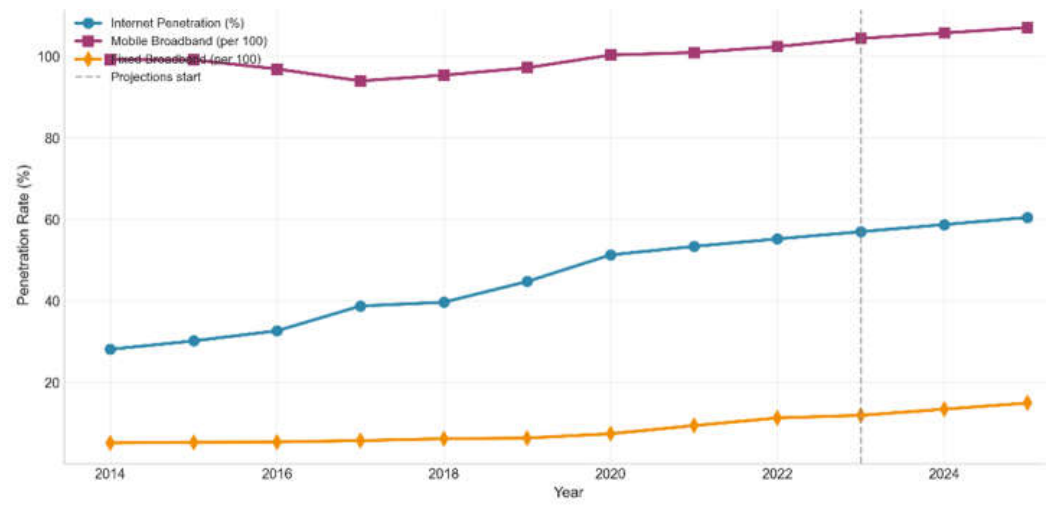
Figure 2.
Marginal Effect of Education (Years) on Earnings.
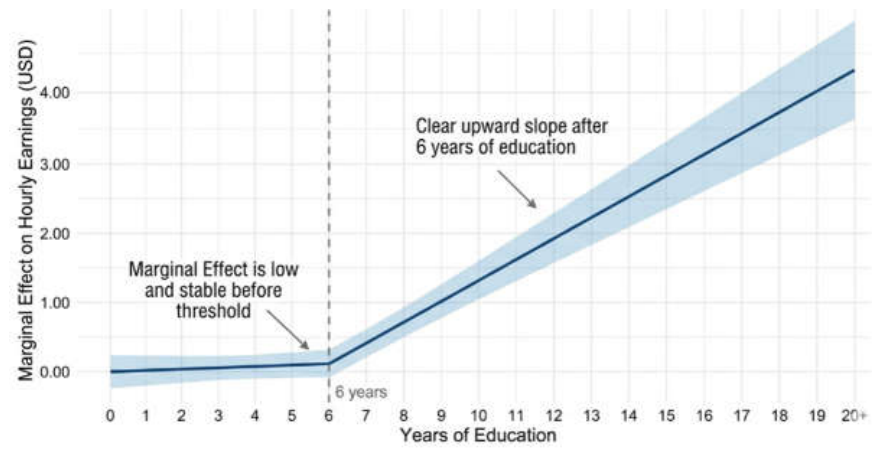
Figure 3.
Internet Penetration vs GDP Growth.
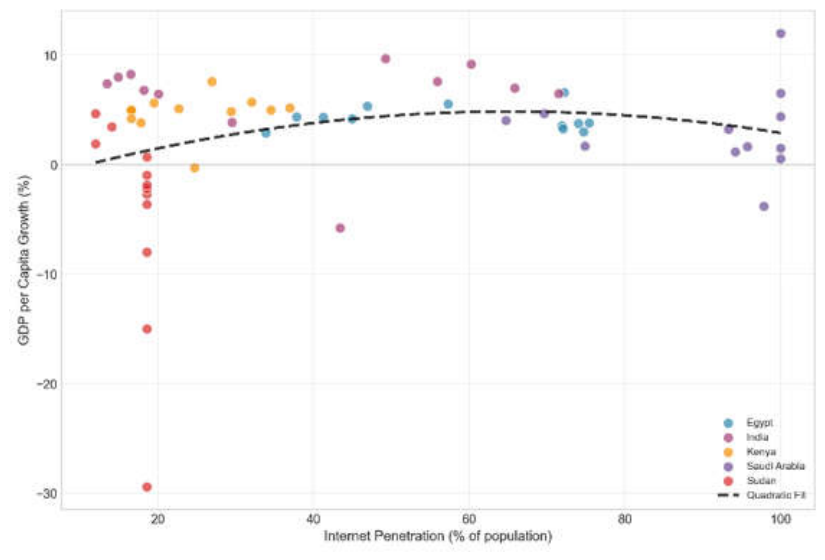
Figure 4.
Illustrates regional comparisons.
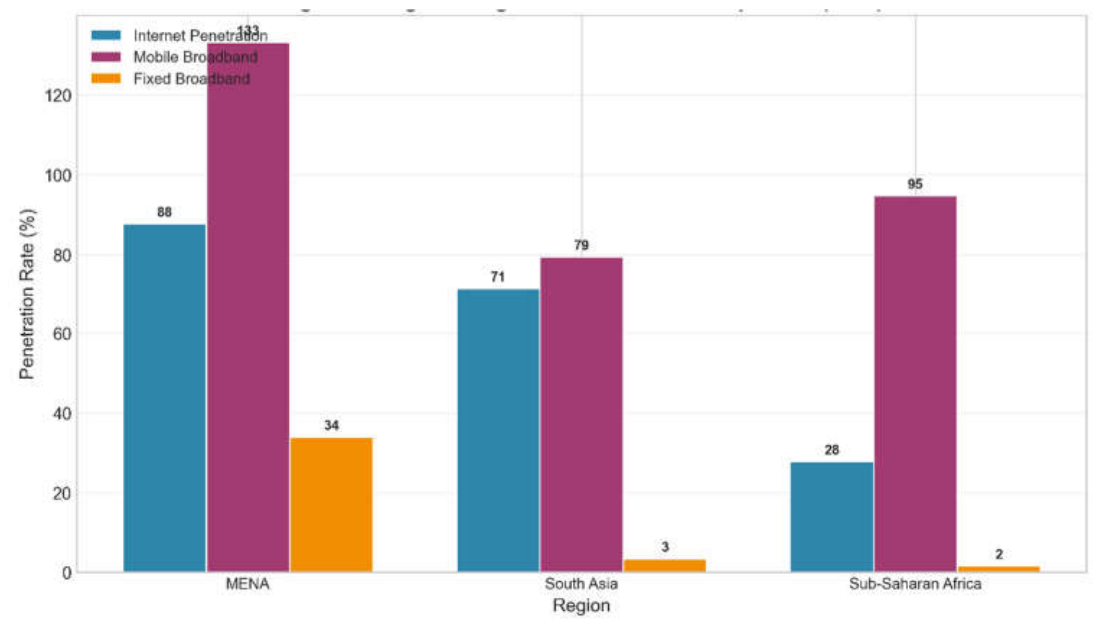
Figure 5.
Marginal Effects of Digital Infrastructure by Human Capital.
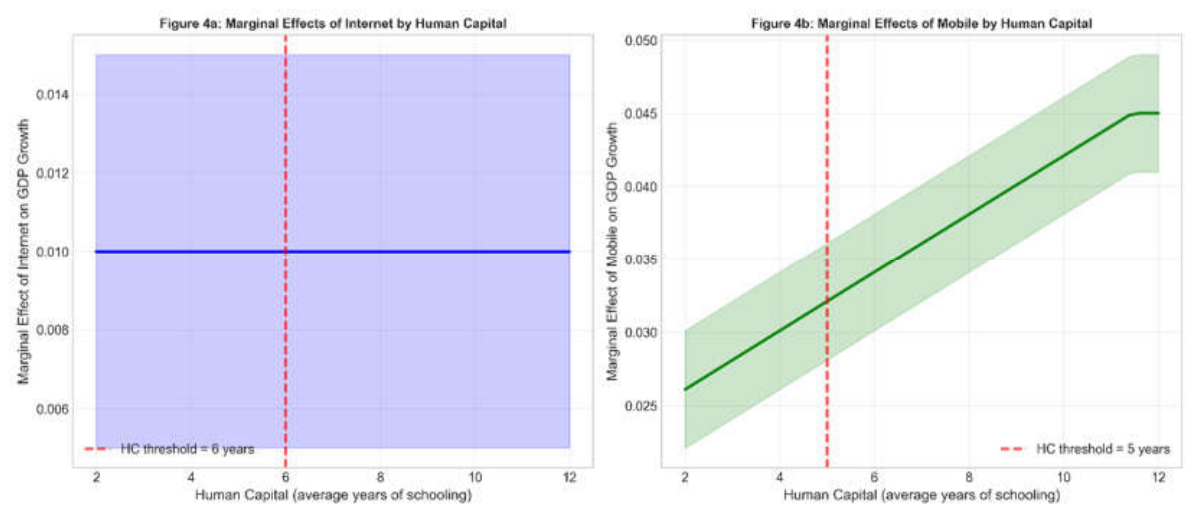
Table 1.
Sample Country Characteristics.
| Country | Region | Income Group | Digital Stage |
|---|---|---|---|
| Egypt | MENA | Lower-Middle | Medium |
| India | South Asia | Lower-Middle | Medium |
| Kenya | Sub-Saharan Africa | Lower-Middle | Medium-Low |
| Saudi Arabia | MENA | High | High |
| Sudan | Sub-Saharan Africa | Low | Low |
Table 2.
Descriptive Statistics (2014–2025).
| Variable | Observations | Mean | Std. Dev. | Min | Max |
|---|---|---|---|---|---|
| Dependent Variable | |||||
| GDPG (%) | 60 | 3.28 | 6.14 | -29.43 | 12.00 |
| Digital Infrastructure | |||||
| INT (%) | 60 | 49.67 | 33.21 | 4.20 | 100.00 |
| MOB (per 100) | 60 | 91.23 | 41.56 | 6.30 | 181.86 |
| FIX (per 100) | 58 | 9.34 | 11.02 | 0.01 | 43.57 |
| Control Variables | |||||
| GCF (% GDP) | 60 | 23.89 | 7.45 | 9.54 | 52.10 |
| HC (years) | 60 | 7.25 | 2.51 | 2.50 | 12.50 |
| OPEN (% GDP) | 60 | 44.78 | 18.12 | 2.47 | 78.00 |
| INF (%) | 58 | 11.89 | 27.34 | -1.19 | 359.09 |
| POP (%) | 60 | 1.62 | 0.48 | 0.65 | 2.50 |
| Derived Variables | |||||
| Lagged_GDPG (%) | 55 | 3.35 | 5.98 | -29.43 | 12.00 |
| High_Growth (binary) | 60 | 0.50 | 0.50 | 0 | 1 |
Table 7.
Heterogeneity Results by Income Group.
| Variables | Low-Income | Lower-Middle | Upper-Middle |
| Panel A: Internet Penetration (INT) | |||
| Coefficient | 0.021 | 0.044** | 0.032* |
| (0.018) | (0.017) | (0.017) | |
| Panel B: Mobile Broadband (MOB) | |||
| Coefficient | 0.038** | 0.029* | 0.018 |
| (0.015) | (0.015) | (0.016) | |
| Panel C: Fixed Broadband (FIX) | |||
| Coefficient | -0.009 | 0.014 | 0.022 |
| (0.024) | (0.019) | (0.015) | |
| Observations | 10 | 30 | 10 |
| Countries | 1 | 3 | 1 |
*Notes: Each coefficient from separate regressions including all control variables. Standard errors in parentheses. **p<0.05, *p<0.10. Fixed broadband: Saudi Arabia 2014 missing (N=9 for high-income panel).*.
Table 8.
Robustness Checks.
| Specification | Internet Coefficient | Mobile Coefficient | Fixed Coefficient |
|---|---|---|---|
| Baseline (Model 4) | 0.031** | 0.022* | 0.015 |
| One-step GMM | 0.028** | 0.019* | 0.012 |
| Collapsed instruments | 0.033** | 0.024** | 0.016 |
| Alternative human capital (enrolment) | 0.029** | 0.020* | 0.013 |
| Winsorized outliers (1%) | 0.035*** | 0.025** | 0.017 |
| Excluding 2020 (COVID-19) | 0.036** | 0.027** | 0.018 |
Notes: Each cell presents coefficient estimates from separate system GMM regressions. All specifications include full control variables and pass AR(2) and Hansen tests at conventional significance levels. *** p<0.01, ** p<0.05, * p<0.10.
Disclaimer/Publisher’s Note: The statements, opinions and data contained in all publications are solely those of the individual author(s) and contributor(s) and not of MDPI and/or the editor(s). MDPI and/or the editor(s) disclaim responsibility for any injury to people or property resulting from any ideas, methods, instructions or products referred to in the content. |
© 2026 by the authors. Licensee MDPI, Basel, Switzerland. This article is an open access article distributed under the terms and conditions of the Creative Commons Attribution (CC BY) license (http://creativecommons.org/licenses/by/4.0/).
Copyright: This open access article is published under a Creative Commons CC BY 4.0 license, which permit the free download, distribution, and reuse, provided that the author and preprint are cited in any reuse.


