
Submitted:
12 June 2026
Posted:
15 June 2026
You are already at the latest version
Abstract
This paper proposes an implementation framework for the effective linkage and integration of forest welfare services within the social service system. Focus group interviews (FGIs) and in-depth interviews (IDIs) were conducted with experts in social and forest welfare, and key components were identified through thematic analysis. The findings identified socially isolated youths, middle-aged adults, and social workers as the primary target groups. Limited accessibility is a central challenge for socially isolated youth, necessitating a phased engagement approach. Middle-aged adults demonstrated a strong need for psychological recovery and social participation, yet faced constraints related to time, cost, and accessibility, underscoring the importance of community-based delivery. Social workers were identified as being at a high risk of burnout, and forest welfare services were recognized as potential preventive and complementary interventions. Based on these findings, an implementation framework comprising three core entities—support, delivery, and supply— was structured across four dimensions: user characteristics, delivery systems, service operations, and policy environments. The key conditions for effective integration include institutional foundations, accessibility enhancement, interagency collaboration, and expansion of the private service base. This study explores the potential for forest welfare services to evolve into sustainable components of the public social service system. Future research should empirically examine the causal mechanisms underlying associated health and social outcomes.
Keywords:
forest welfare services
; social service integration
; implementation framework
; qualitative study
; nature-based social services
1. Introduction
In modern society, demographic changes, including population aging and an increasing number of single-person households, are accelerating, thereby expanding the demand for social services aimed at enhancing social well-being and quality of life. At the international level, the vision of the Korea Forest Service as “a fair and inclusive society in which no one is left behind” has been emphasized as a key policy direction [1]. In line with this trend, Korea has expanded its social service support systems to encompass not only vulnerable populations, such as individuals with chronic illnesses, older adults, and persons with disabilities, but also all citizens in need of assistance.
The definition of social services varies across researchers and according to each country’s level of institutional development [2]. In the United Kingdom, social services generally refer to a range of care and support-related activities intended to help individuals maintain their independent and active lives [3]. In the United States, the concept is often used in a narrower sense, referring to services that support socially vulnerable populations in areas such as social protection, disability, and illness, while excluding sectors such as income support, education, healthcare, and culture [4]. In contrast, Korea adopts a broader definition of social services, defining them as socially provided services aimed at improving the welfare and quality of life of both individuals and society as a whole [5,6].
In Korea, social services are legally defined under Article 3 of the Basic Social Security Act, Korea’s primary legislation governing the integrated national social service framework, as services that support the improvement of citizens’ quality of life through counseling, rehabilitation, care, information provision, access to related facilities, capacity development, and support for social participation across sectors such as welfare, healthcare, education, employment, housing, culture, and the environment [7]. In recent years, the scope of social services has expanded beyond traditional health and welfare domains to include areas such as the environment, culture, and care. In this context, the implementation of integrated community care has increasingly emphasized integrated support models that reflect the local conditions and needs of community residents [8].
Korea became the first country to establish a comprehensive policy framework for the provision of forest welfare services [9]. In Korea, forest welfare services represent a form of nature-based services designed to promote citizens’ well-being by providing economic, social, and emotional support through forest-based resources and activities [7]. Currently, various forest welfare services are provided within this framework. Previous research applied the concept of publicness, an important concept in social services, to forest welfare services and defined it as “the government constructs or supports the use of facilities that allow a broader range of citizens to access forest welfare services” [10].
Specific types of forest welfare services include forest recreation, therapy, education, culture, and sports, with forest welfare professionals providing services tailored to specific purposes and user needs. In addition, forest welfare services seek to reduce disparities among socially disadvantaged groups by establishing a life cycle-based support system through which individuals can access appropriate welfare services from pregnancy to old age [11].
In this context, forest welfare can be characterized as a comprehensive system that provides interpersonal services and performs multiple functions, consistent with the lifelong social safety net proposed in the Basic Social Security Act [12]. Accordingly, as the Korean welfare system expands beyond selective welfare toward a more universal approach, the link between forest welfare services and social services warrants further discussion.
Koo et al. [13] conducted a study on strategies for improving the delivery system of forest welfare services and examined the delivery system from the perspective of social welfare. However, while social welfare services generally exhibit selective characteristics by primarily targeting vulnerable populations, they are characterized by a more universal approach that does not restrict beneficiaries to socially disadvantaged groups [12]. Accordingly, a previous study examining the characteristics of Korea’s forest welfare policy and strategies for its revitalization suggested that forest welfare contains elements of both universal and selective welfare, highlighting the need for further practical discussion regarding its policy direction and implementation [14].
Subsequently, a survey examining social service awareness among forest welfare professionals reported relatively high levels of understanding and the perceived need for social services among experts with experience in both forest welfare and social services [15]. This study also highlights the need for further exploration of long-term cooperation models between forest welfare and social services.
Recently, the international community has increasingly emphasized integrated approaches to social and health services alongside a growing interest in health promotion strategies that utilize natural environments. In particular, nature prescriptions have gained attention as part of nature-based health promotion strategies [16,17,18]. In addition, studies have explored the introduction of interventions using natural environments within healthcare and welfare service systems [19,20,21]. These findings suggest the potential for nature-based forest welfare services to be linked to existing welfare and healthcare services.
However, institutional and operational linkages between forest welfare services and social services remain at an early stage, and research on implementation frameworks applicable to practical settings remains limited.
Therefore, this study aimed to develop an implementation framework for effectively linking forest welfare services with social services through focus group interviews (FGIs) and in-depth interviews (IDIs) with social services and related field experts. This study seeks to create a framework through which forest welfare services may be operationalized within the public social service system based on insights derived from experts in the social service field.
The specific research objectives are as follows.
First, this study examines the current status of social services, perceptions of forest welfare services, and the potential for linkages according to the target groups.
Second, this study derives the core components of an implementation framework through in-depth interviews with experts, which will enable forest welfare services to function within the social service system.
Third, this study proposes an implementation framework based on the findings of the aforementioned analyses.
2. Materials and Methods
2.1. Study Design
This study employed a qualitative research approach to develop an implementation framework that links forest welfare with social services. This study was structured into three stages: exploratory, in-depth, and review phases.
During the exploratory phase, the first FGIs were conducted with six experts in social and forest welfare services to identify target groups with the potential to link forest welfare and social services, as well as to select participants for in-depth interviews. Focus group interviews are a qualitative method used to collect data on specific topics through interactive discussions based on the diverse experiences and perspectives of expert panel members [22,23,24].
During the in-depth phase, semi-structured IDIs were conducted, with nine experts selected based on the results of the first FGIs, to explore their perceptions and experiences regarding forest welfare services and to identify key components for developing an implementation framework. Each interview was conducted either online or via a video conferencing platform (Zoom) and lasted approximately 60–90 min. Detailed perspectives on the potential linkages between forest welfare services, operational approaches, and support systems were collected during the interviews.
During the review phase, a second round of FGIs was conducted with four experts to assess the appropriateness and applicability of the proposed implementation framework.
2.2. Research Participants
All participants were provided sufficient information regarding the purpose of the study and voluntarily agreed to participate. The participants were experts in social services and forest welfare.
The selection criteria for expert participants were established in advance to minimize the potential bias associated with subjective judgment, and the final selection was confirmed through a review by five researchers.
The study participants consisted of experts from academia, and public and private institutions to examine the links between forest welfare services and social services and to collect diverse perspectives regarding operational and support systems. This study included managerial personnel and field practitioners.
The first FGIs included six experts to reflect on diverse perspectives on forest welfare services, social services, policy, and field practice (Table 1).
Based on the primary target groups and related issues identified in the first FGIs, IDIs were conducted with nine experts from relevant fields (Table 2). In addition, at least two experts with substantial experience in each field were included to minimize potential bias toward a specific group.
The second FGIs consisted of a panel of four experts and was conducted to review the validity and field applicability of the implementation framework derived from the primary analysis. To ensure continuity of discussion and consistency of interpretation, two participants also participated in the first FGIs (Table 1).
An expert panel was selected using purposive sampling. The selection criteria were as follows [15]:
(1) At least five years of practical or research experience in the fields of forest welfare, mental health, healthcare, or social services.
(2) Have conducted relevant research or projects within the past five years
(3) Understand the purpose of the study and voluntarily agree to participate.
2.3. Data Collection
Data collection was conducted sequentially across the exploratory, in-depth, and review phases. First, during the FGIs, discussions were conducted regarding the current status of social and forest welfare services, as well as the field operation of forest welfare services. Through these discussions, primary target groups, expected effects, and strategies for service revitalization were identified. Emphasis was placed on selecting participants for the IDIs to derive the key components of the implementation framework for forest welfare services.
The IDIs were conducted using semi-structured interview guides with experts selected based on the results of the first FGIs. Each interview was conducted either face-to-face or via a video conferencing platform (Zoom) and lasted approximately 60–90 min. Nine participants were included in the interviews: two experts specializing in socially isolated youth, two experts related to middle-aged adults, three experts in the field of social welfare, and two specialists from the private sector.
Prior to the interviews, the participants were informed via email about the purpose of the study, key interview questions, and interview procedures. All interviews were audio-recorded with participants’ consent. The collected data were used solely for research purposes, and the participants were informed in advance that they could withdraw from the interview at any time. All procedures were conducted in accordance with research ethics standards.
Finally, an expert review of the implementation framework derived from the second FGIs was conducted. At this stage, the discussion focused on the validity and applicability of the proposed framework.
2.4. Data Analysis and Validity Assurance
Thematic analysis, a flexible and widely used method in qualitative research across various fields, was applied to analyze data collected through the semi-structured interviews [25].
All interview audio-recordings were transcribed. Researchers repeatedly reviewed the transcripts to identify meaningful statements. Thereafter, key concepts were derived through open coding and similar concepts were grouped into categories to identify major themes and subthemes [26,27].
In this study, investigator triangulation was employed to enhance the trustworthiness of qualitative research. During the data analysis process, three researchers independently performed coding and categorization, independently analyzed the data, and subsequently compared and refined the codes and categories through regular meetings to determine the final themes and subthemes [21]. The final results were cross-reviewed by two corresponding authors to enhance consistency and credibility, and to minimize potential bias during the analysis process. Additionally, five researchers involved in the study engaged in ongoing discussions regarding data interpretation through regular feedback exchanges as part of the peer debriefing process.
3. Results
3.1. Primary FGIs: Target Group Identification
In the first FGIs, expert discussions were conducted regarding the primary directions and target groups of social services in relation to forest welfare service linkages. Based on these discussions, the main target groups were identified according to their expected effectiveness and potential for service linkage. Accordingly, experts working with socially isolated youths, experts from institutions serving middle-aged adults, and social workers were selected as participants for the in-depth interviews, reflecting the three perspectives of addressing social isolation, preventive health management, and service expansion. Additionally, forest welfare experts were included to reflect on their practical experiences in service operations.
First, socially isolated youths were identified as a group characterized by weak social networks and insufficient emotional and psychological support. In Korea, the number of young people lacking stable social support systems has increased following the COVID-19 pandemic [28]. At the national level, these individuals have been classified as at-risk youths, and public–private collaborative initiatives have been promoted to support outreach and service linkages [29]. Previous studies have reported that socially isolated youths are likely to experience social isolation, depression, and frustration [30]. Accordingly, experts recognized the need to support their psychological recovery, social reintegration, and independent functioning. International studies have also consistently reported close associations between social isolation and depression, anxiety, and low life satisfaction [31,32]. In addition, previous research has identified a significant association between the frequency of outdoor activities and depression among socially isolated youths [30]. Considering that forest welfare services are primarily delivered in outdoor forest environments, this population was regarded as a target group with strong potential applicability and relevant experts were thus selected for in-depth interviews.
Unstable employment conditions and income insecurity associated with later life may reduce the quality of life of middle-aged adults, particularly during a life stage in which physical and psychological changes occur simultaneously. Experts considered this population likely to experience an increasing demand for social care in the future and emphasized the need for healthcare and social support services. These perspectives are consistent with previous research describing middle adulthood as a critical transitional period characterized by the coexistence of growth and decline, linking earlier and later stages of life as well as younger and older generations [33]. Experts working with middle-aged adults were thus included as participants in the interviews.
Finally, social workers were identified as key intermediaries in the application and dissemination of forest welfare services in practical settings. In particular, experts have emphasized that forest welfare services are likely to be integrated into the social welfare field through a process in which initial service experiences facilitate subsequent dissemination. This perspective is consistent with the theory that new services or innovations are first adopted by early recipients and subsequently diffused through organizations and social networks [34]. Private sector forest welfare experts were included in the in-depth interviews to reflect on the practical constraints and operational conditions associated with the service delivery process.
3.2. In-Depth Interview Results
3.2.1. Socially Isolated Youths
Experts working with socially isolated youths emphasized that the most fundamental challenge lies not in the lack of services themselves but in difficulties reaching individuals in need of support. In other words, the core issue identified was limited accessibility to the target population, rather than a shortage of available services. Forest welfare services were perceived as having potential as complementary interventions because of their associations with rest and recovery; however, various structural and psychological barriers to service access were also identified.
The coding results are presented in Table 3, which summarizes the findings of the interviews with experts working with socially isolated youths.
The most frequently identified challenge was the difficulty of identifying and reaching the target population. Experts also emphasized the positive perceptions that young people hold regarding forest environments and recognized that framing forest welfare services in terms of “rest and restoration” could serve as a strategic advantage.
Regarding service delivery approaches, a phased-entry model was proposed that considered the characteristics of youths experiencing severe social isolation. Specifically, the model initially involved implementing urban-based programs centered on participants’ daily living environments, and subsequently expanding participation in forest welfare service programs operated by specialized institutions, such as forest welfare facilities. A role-based cooperation model is proposed for interagency collaboration. Under this structure, youth-related agencies are responsible for participant outreach and support, forest welfare facilities oversee program operations and safety management, and the private sector provides financial support.
As one expert described:
“Identifying and reaching these individuals is actually the hardest part. There still isn’t a clear system in place, and I think there are far more people who have not been identified at all. Psychological counseling is generally considered necessary, and those services are already being provided to some extent. The problem is that they simply do not come forward. (Expert A)”
Experts also highlighted the strong positive associations that youths held with forest environments, identifying the “rest and recovery” framing as a strategic asset:
“Young people often mention burnout prevention and recovery when they hear words like ‘forest’ or ‘woods.’ In post-program surveys, many participants said they appreciated having a chance to rest. When they think of forests, they immediately associate them with relaxation and recovery. I think that’s one of the biggest strengths and appeals of forest welfare services. (Expert A)”
“It was definitely different from programs conducted in cities or classrooms. The healing power of nature is something you can only truly understand through experience. Even just the sounds of birds, wind, and water can have a completely different effect from listening to an instructor talk over and over again. (Expert B)”
Regarding the appropriate service approach, a staged entry model was proposed to accommodate the high psychological barriers faced by severely socially isolated youths:
“For young people experiencing severe social isolation, even going outside can be extremely difficult. I think a phased approach is necessary, starting with low-threshold programs such as garden prescriptions and gradually moving toward visits to actual forest environments. (Expert A)”
For inter-agency collaboration, experts endorsed a role-based partnership model:
“It’s about making use of each organization’s strengths. Youth support organizations are strong in recruiting and supporting young people, while forest welfare facilities are better equipped for program operation and safety management. It would be even better if private-sector organizations that can provide financial support were also involved. (Expert A)”
These results suggest that forest welfare services may also be an important factor in accessibility issues during the service use phase because of the lack of social interaction among isolated young people [35]. Furthermore, the need for an entry strategy that adjusts the intensity of the intervention according to the stage of the target group or individual is demonstrated.
3.2.2. Middle-Aged Adults
Experts working with middle-aged adults indicated that this population demonstrates a strong need for social participation and personal recovery, while simultaneously experiencing practical constraints related to time, cost, and accessibility.
Experts have emphasized that middle-aged adults tend to seek natural environments for psychological recovery. The forest environment was described as functioning not merely as a place for rest but also as a space for self-reflection. It was also perceived as a meaningful environment that provided individuals with the opportunity to reflect on their lives. Regarding service accessibility, proximity to urban areas has been repeatedly emphasized as an important prerequisite. As a strategy for interagency collaboration, the Community Social Security Council was proposed as a potential linkage organization. This structure includes various welfare institutions as well as public and private organizations and is considered an effective mechanism for participant outreach and program promotion. Table 4 presents the coding results for middle-aged adults.
Experts consistently emphasized that middle-aged adults seek natural environments for psychological restoration:
“In particular, many middle-aged adults seem to have a strong desire to rest in forests or natural environments because they have spent so much of their lives working hard and focusing on their daily responsibilities. (Expert C)”
“I use forests as a space to reflect on why I’ve been living such a busy and exhausting life. That’s why the effects of the forest environment feel so meaningful to me. (Expert D)”
In terms of service access, urban proximity has been repeatedly emphasized as a prerequisite for effective outreach:
“Most people live in urban areas now, especially in large cities, so I think there’s a growing desire to reconnect with nature, experience natural environments, and find opportunities for rest and healing. (Expert C)”
The Community Social Security Council has been proposed as a practical coordination mechanism for interagency linkages:
“There are Community Social Security Councils throughout the country. Because these councils include various welfare organizations as well as public and private institutions, they can be effective for identifying people who may want to participate in forest-related programs and for supporting promotion and collaboration. (Expert D)”
These findings suggest that middle-aged adults experience time-related and economic constraints associated with life-stage characteristics [33]. Accordingly, forest welfare services should be designed as tailored services that reflect accessibility within daily living environments as well as individual needs for social participation and recovery.
3.2.3. Social Workers
Social welfare experts have identified social workers as the priority target group for forest welfare services. This is attributed to their continuous exposure to emotional labor and the structural limitations of existing psychological support systems. Despite the high demand, institutional and practical barriers to service access have been identified.
The psychological burden experienced by social workers arises from structural factors beyond the individual level. Forest welfare services were recognized as preventive interventions that may complement the recovery process following clinical treatment and were perceived as having the potential to bridge the gap between treatment and recovery. Burnout prevention has been consistently emphasized as a key rationale for service linkages. Regarding institutionalization, the inclusion of forest welfare services as evaluation indicators of social welfare facilities has been proposed as a potentially effective policy mechanism. Table 5 presents the coding results for professionals in social work.
The psychological burden borne by social workers was characterized as structurally inevitable:
“In the field of social welfare, issues such as suicide, mental health, and social isolation are all regarded as social welfare concerns within the community. Because of that, there is always a psychological burden associated with having to intervene and help address these problems. (ExpertF)”
Forest welfare services are preventive interventions that address the gap between clinical treatment and psychological recovery:
“Many mental health supporting programs tend to end with counseling or psychotherapy alone. I think there needs to be a continued process connected to healing and rest after treatment, and forest welfare services could play that role. (ExpertE)”
The burnout prevention framing was consistently highlighted as a key rationale for integration:
“Burnout is extremely difficult to recover from once it occurs, so I think it’s important to prevent it in advance through opportunities like this. (ExpertG)”
In terms of institutionalization, embedding forest welfare in national social welfare facility evaluation criteria has been proposed as the most powerful lever:
“The most powerful approach would be to include forest welfare service-related items in the social welfare facility evaluation conducted by the Ministry of Health and Welfare every three years. Once those items are reflected in the evaluation criteria, they are no longer seen as simple recommendations, but become part of the institution’s official business plans and budget allocation. (ExpertF)”
These findings suggest that forest welfare services may function as preventive and complementary interventions to support burnout prevention and psychological recovery among social workers experiencing job stress and emotional labor–related burnout risk.
3.2.4. Private-Sector Forest Welfare Experts
Private-sector forest welfare experts provided perspectives from the service provider’s perspective and indicated that the current expansion of forest welfare services into social services is constrained by structural, financial, and infrastructural limitations.
The most significant operational constraint was the difficulty in securing appropriate locations for program implementation. In addition, the absence of a coordinating body linking service users and providers has been identified as a structural limitation. This finding is consistent with previous research, emphasizing the need to establish a delivery system for forest-healing prescriptions [21]. From a financial perspective, the current profit structure was perceived as lacking sustainability, and the perception of welfare services as “free” was identified as a factor limiting the operational viability of private-sector providers [36].
The coding results from interviews with private-sector forest welfare experts are presented in Table 6.
The most acute operational constraint identified was securing appropriate program venues:
“I think securing forest spaces and appropriate locations is the most important issue. I believe this needs to be addressed before forest welfare services can be integrated into the social service system. (ExpertsH andI)”
The absence of a coordination mechanism connecting the supply and demand has been identified as a fundamental systemic gap:
“People who need these services require some kind of connecting organization that can link service users with providers. Right now, there is no effective intermediary system in place, and that makes things very difficult. (ExpertI)”
Regarding the financial viability of private providers, the current revenue structure is characterized as structurally unsustainable:
“Our organization is structured in a way that makes it very difficult to generate profit. In reality, there is almost no revenue unless the director personally works as an instructor. We also need sustainable business models, but forest welfare services are still often approached only from the perspective of public service or volunteer work. I think that kind of perception needs to change. (ExpertI)”
The above findings suggest that in order to expand the integration of forest welfare services into the social service system, it is necessary to address structural limitations within the service supply base, particularly those related to securing appropriate facilities and establishing demand–supply linkages and support systems.
3.3. Proposed Implementation Framework Derived from the In-Depth Interviews and Second FGIs
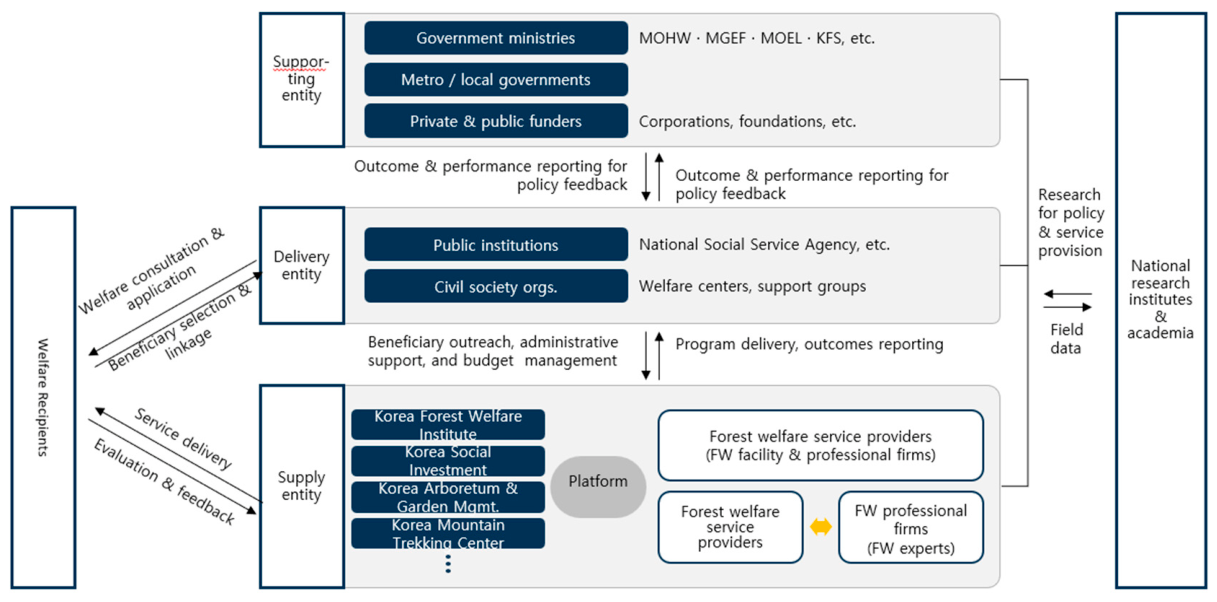
The main components derived from the in-depth interviews were organized and categorized based on participants’ shared perceptions (Table 7). The four dimensions of user characteristics, delivery systems, service operations, and policy environment serve as the basis for constructing the core structure of the implementation framework presented in Figure 1.
The proposed implementation framework comprises three operational entities: (1) a support entity responsible for ensuring service continuity and protecting service rights, (2) a delivery entity responsible for facilitating efficient service access and linkage, and (3) a supply entity responsible for delivering services based on professional expertise and scalability. These three entities are structured to support an integrated and coordinated cooperative system.
A preliminary implementation framework was derived from the in-depth interview findings and subsequently reviewed through a second round of FGIs involving a panel of four experts.
The implementation framework was structured across four dimensions: user characteristics, service delivery systems, service operations, and policy environments. Based on the expert review, four strategic directions were identified: (1) designing tailored services; (2) strengthening community linkages and accessibility; (3) securing public responsibility and sustainability; and (4) promoting private sector participation and activation.
Finally, the expert panel suggested that future efforts should focus on developing pilot program models that specify intermediary organizations, partner organizations, and operational methods as well as establishing pathways through which forest welfare experiences may contribute to health and social outcomes.
The forest welfare service linkage model proposed in this study is based on a horizontal cooperation structure involving public institutions, private sector organizations, and platform-based coordination systems, in contrast to conventional social service delivery systems characterized by public-sector-centered vertical structures. This approach reflects a collaborative governance framework grounded in multi-agency and public–private partnerships [37] and is conceptually aligned with integrated service approaches that emphasize the provision of coordinated, user-centered services [38].
Whereas existing delivery systems operate primarily as institution-centered and segmented service structures, the proposed model supports a more user-centered and integrated approach by strengthening service linkages through platform-based coordination.
In addition, the expert panel review conducted during the second round of FGIs noted that because the model may be implemented incrementally, it may have practical applicability within policy implementation contexts, although empirical validation through pilot implementation remains necessary.
Furthermore, the primary goal of the proposed model is to overcome limitations related to accessibility and the limited scope of existing forest welfare services, while providing stable and continuously tailored welfare services for users through coordinated integration with social service delivery systems.
Figure 2.
Implementation framework for linking forest welfare and social services. Abbreviations: MOHW, Ministry of Health and Welfare; MGEF, Ministry of Gender Equality and Family; MOEL, Ministry of Employment and Labor; KFS, Korea Forest Service.
Figure 2.
Implementation framework for linking forest welfare and social services. Abbreviations: MOHW, Ministry of Health and Welfare; MGEF, Ministry of Gender Equality and Family; MOEL, Ministry of Employment and Labor; KFS, Korea Forest Service.
4. Discussion
This study conducted focus group interviews (FGIs) and in-depth interviews (IDIs) to derive an implementation framework for integrating forest welfare services into the social service system. The main findings and implications of this study are as follows:
4.1. Characteristics of Each Target Group and the Need for Tailored Approaches
Socially isolated youths, middle-aged adults, and social workers were identified as the primary target groups, and each group was found to have distinct needs and constraints. First, among socially isolated youths, the primary challenge was identified not as a lack of services but rather as limited accessibility to available services. Depending on the severity and type of social isolation, individuals may experience difficulties in daily functioning, including the frequency of going outdoors, self-management, and lifestyle patterns [39]. In addition, limited awareness of social relationships and welfare policies may create barriers within the outreach and support processes [40].
These findings are consistent with the “non-user” issue discussed in previous social service research and suggest that strategies aimed at reducing barriers to service entry may be more important than simply expanding service availability [35]. In particular, the proposed phased approach (urban-based → forest-based) resembles the stepped care model commonly used in public health settings and may be interpreted as a strategy for gradually adjusting intervention intensity according to the condition and readiness of the target population [41].
Middle-aged adults appear to experience simultaneous constraints related to time, cost, and accessibility, despite their strong need for social participation and recovery. These findings suggest the need for forest welfare services to function as components of the social service system, as middle-aged adults often face multiple social responsibilities while experiencing physical and cognitive changes associated with aging. In addition, financial difficulties may further increase psychological stress in this population [33]. In particular, the demand for services located in proximity to urban areas has emerged as an important consideration in future policy design. This finding is consistent with previous research indicating that long-distance travel and traffic congestion may reduce the stress-relieving effects associated with forest-healing experiences [42].
Social workers often face dual-role conflicts arising from the need to respond simultaneously to the needs of clients and demands of their organizations [43]. These conditions are likely to manifest as burnout symptoms, including emotional exhaustion, depersonalization toward clients, and reduced personal accomplishment [44,45]. Although central and local governments have expanded their efforts toward burnout prevention, existing approaches remain limited and are often centered on counseling-based interventions. In this study, the structural stress and burnout associated with emotional labor were identified as core concerns, highlighting the limitations of existing treatment-oriented support systems. Accordingly, it has been suggested that forest welfare services function as preventive and restorative social services for social workers.
In other words, “tailored and phased service design according to target group characteristics” was proposed as a core strategy rather than adopting a single model uniformly applied across all target groups.
4.2. The Potential of Forest Welfare Services as Social Services
The findings of this study suggest that forest welfare services have the potential to expand within the social service system in the following ways:
First, forest welfare services may function as a resource for psychological recovery and preventive healthcare. Beyond serving merely as places for rest, forest environments have been associated with various health-related benefits, including stress reduction and improved mental health [46,47]. Additionally, they may have potential preventive functions, such as contributing to burnout prevention. A meta-analysis that comprehensively examined the health effects of exposure to nature-based environments reported significant positive associations with both mental and physical health outcomes [48]. These trends suggest that contact with nature is increasingly being incorporated into preventive health management strategies in the field of public health [49,50].
Second, forest welfare services may be scalable, because integrated services are applicable to diverse target groups, including socially isolated youths, middle-aged adults, and social workers. These services may also be tailored to reflect the specific characteristics and needs of individual users. Accordingly, forest welfare services may support a more user-centered approach rather than a provider-centered service structure, and consequently, may function as more responsive social services.
Third, experts suggested the potential for forest welfare services to function as a medium for service diffusion. Specifically, several experts anticipated that direct service experience among social workers could facilitate subsequent awareness and referrals within their professional networks, a pattern conceptually analogous to the early adopter-driven diffusion processes described in innovation theory [34]. However, this remains an exploratory hypothesis derived from expert perspectives rather than empirical observations, and future studies should examine whether and how such diffusion pathways operate in practice. To respond more effectively to the needs of specific populations, new approaches that integrate knowledge networks and diverse stakeholders have been emphasized [51]. If such diffusion pathways are empirically supported, forest welfare services may have the potential to move beyond conventional experiential programs and be incorporated as functional components of the public social service system.
4.3. Key Conditions for Establishing an Implementation Framework
The implementation framework derived from this study consists of a three-axis structure comprising support, delivery, and supply entities. Several conditions were identified as necessary for its practical application.
First, institutional infrastructure and policy support are required. For forest welfare services to function within the social service system, an institutional foundation that includes legal frameworks, budget allocations, and operational guidelines is essential. In particular, the inclusion of forest welfare services within the evaluation indicators of social welfare facilities was proposed as a policy strategy to promote service dissemination.
Second, improvements in accessibility are necessary. Travel distance, cost, and information accessibility were identified as key barriers common across the target groups. Accordingly, accessibility-oriented policy design is required, including transportation support, financial support, and programs designed around daily living environments.
Third, establishing an interagency collaboration system is essential, particularly through cooperation among public institutions, private sector organizations, and community-based organizations. Furthermore, the findings confirm the need to develop effective delivery systems that utilize existing networks. Cooperation between the public and private sectors has been emphasized as a key strategy for addressing complex social problems [52], and this principle may also play an important role in integrating forest welfare services into the social service system.
Finally, strengthening the service supply base is necessary. Private-sector providers experience structural limitations related to securing operational spaces, maintaining sustainable revenue structures, and the absence of coordinating platforms. Accordingly, it may be necessary to establish supply–demand matching platforms, utilize private forest resources, and design sustainable revenue models. Ultimately, the implementation framework may be understood as centered on the integrated development of four core elements: institutionalization, accessibility, collaboration, and supply-base strengthening.
4.4. Implications and Limitations of the Study
This study has several implications. First, this study has academic implications in that it reinterprets forest welfare services from the perspective of the social service system, rather than within the boundaries of conventional welfare concepts. In particular, the need for an integrated approach encompassing diverse target groups may provide a basis for extending discussions beyond existing healthcare frameworks toward broader concepts of health and well-being across the life course [53].
Second, this study may enhance the practical applicability of policy by proposing an implementation framework based on the experiences of field experts.
Third, this study has policy implications as it actively reflects the perspectives of field experts and proposes ways for nature-based forest welfare services to operate within the public social service system.
However, owing to the qualitative and exploratory nature of this study, there are limitations regarding the generalizability of the findings. In addition, because the actual effects of forest welfare services have not been quantitatively verified, further research is required. Accordingly, we suggest several directions for future research. These include empirical studies based on pilot projects, effectiveness evaluations examining health and social outcomes, development of standardized program modules tailored to specific target groups, and refinement of models linked to specific social challenges identified in future research. In particular, as proposed in this study, further efforts are needed to refine sustainable operational systems through which forest welfare services can function as components of the social service system, rather than as one-time experiential programs.
5. Conclusions
This study conducted a qualitative analysis based on focus group interviews (FGIs) and in-depth interviews to derive an implementation framework through which forest welfare services could function within the social service system.
The findings of this study suggest that forest welfare services may be applicable to diverse target groups, including socially isolated youths, middle-aged adults, and social workers. These services may have potential roles in supporting psychological recovery, preventive health management, and the restoration of social relationships. These findings suggest that forest welfare services function within the public social services system and contribute to the expansion and diversification of social services.
In addition, this study proposes an implementation framework for linking forest welfare services with social service systems. The framework is structured around three operational entities (support, delivery, and supply) and four dimensions (user characteristics, service delivery systems, service operation, and policy environment). This structure can serve as a framework for simultaneously supporting service continuity, accessibility, and operational efficiency.
The findings of this study emphasize several key conditions necessary for the effective implementation of forest welfare services. First, tailored and phased service designs that reflect the characteristics of the target groups are required. Second, accessibility-oriented policies are needed to address practical barriers, such as travel costs and limitations in information accessibility. Third, establishing delivery systems based on public–private collaboration is essential. Fourth, institutionalization, including legal and financial foundations, was identified as a key factor in promoting service dissemination.
However, because this study was based on qualitative research, there are limitations to the generalizability of the findings. In addition, further research is required, as the actual effectiveness of forest welfare services has not yet been quantitatively verified. Future studies should include empirical analyses based on pilot programs as well as investigations into the causal pathways through which forest welfare services may contribute to health and social outcomes.
This study empirically explored the possibility of establishing forest welfare services as sustainable services within the public social service system, and the findings may serve as foundational evidence for future policy design and field implementation. In addition, when tailored approaches and institution-based interagency linkage systems for service users are effectively established, forest welfare services may function as sustainable nature-based social services that contribute to improving citizens’ quality of life.
Author Contributions
Conceptualization, S.K., N.L., and G.M.; methodology, S.K. and N.L.; software, S.K.; validation, S.K., P.Y., and Y.L.; formal analysis, S.K., N.L., and G.M.; investigation, S.K., N.L., and G.M.; resources, Y.L.; data curation, S.K., N.L., and G.M.; writing—original draft preparation, S.K.; writing—review and editing, S.K., P.Y., and Y.L.; visualization, S.K., N.L., and G.M.; supervision, P.Y. and Y.L.; project administration, P.Y.; funding acquisition, P.Y. and Y.L. All authors have read and agreed to the published version of the manuscript.
Funding
This research was funded by the National Institute of Forest Science (NIFoS), Republic of Korea.
Data Availability Statement
The data presented in this study are available upon request from the corresponding author.
Conflicts of Interest
The authors declare no conflicts of interest.
References
- UNDP. What Does It Mean to Leave No One Behind? A UNDP Discussion Paper and Framework for Implementation; UNDP: New York, NY, USA, 2018.
- Lee, M.; Majer, M.; Kim, B. The Social Welfare Service Delivery System to Reinforce Sustainable Social Participation. Soc. Sci. 2019, 8, 258. [CrossRef]
- Korea Institute for Health and Social Affairs (KIHASA). Adult Social Service Reform Trends in the UK; KIHASA: Sejong, Republic of Korea, 2010.
- Kendall, J.; Knapp, M.; Forder, J. Social Care and the Nonprofit Sector in the Western Developed World. In The Nonprofit Sector: A Research Handbook; Yale University Press: New Haven, CT, USA, 2006.
- Jung, I.J. A Critical Perspective on the Integration of Service Delivery Systems in Child-Youth Policy. Korean J. Soc. Welf. Stud. 2009, 40, 297–322.
- Lee, J.S. A Study on the Strategy of Korean Post-NPM Reform. Korean Soc. Public Adm. 2010, 21, 29–47.
- Korea Ministry of Government Legislation. National Law Information Center. Available online: https://www.law.go.kr (accessed on 16 March 2026).
- Bokji Times. Available online: https://www.bokjitimes.com (accessed on 11 March 2026).
- Dodev, Y.; Zhiyanski, M.; Glushkova, M.; Shin, W.S. Forest Welfare Services—The Missing Link between Forest Policy and Management in the EU. For. Policy Econ. 2020, 118, 102249. [CrossRef]
- Chang, C.Y.; Yoo, R.H. A Study on Publicness Assessment of Forest Welfare Services. J. Korean Inst. For. Recreat. 2016, 20, 1–16.
- Korea Forest Welfare Institute. Available online: https://www.fowi.or.kr (accessed on 16 March 2026).
- Jung, J.H.; Kim, K.W.; Mun, C.Y.; Kim, J.J.; Kim, T.I. A Study on the Integrated Welfare Policy System and Forest Welfare Service. J. Korean Inst. For. Recreat. 2016, 20, 43–55.
- Koo, J.C.; An, H.J.; Byeon, S.Y. Ways of Improving the Delivery System of Korean Forest Welfare Services; Korea Rural Economic Institute: Naju, Republic of Korea, 2018. https://repository.krei.re.kr.
- Yeom, D.G.; Ryu, J.S.; Bae, K.; Park, B.J. A Study on the Forest Welfare Policies in Republic of Korea. J. Korean Inst. For. Recreat. 2022, 26, 1–16.
- Lee, M.; Kim, S.; Lee, J.; Jeon, J.; Lee, Y. Analyzing Social Service Provision Experience and Perceptions of Forest Welfare Professionals. Forests 2026, 17, 249. [CrossRef]
- Bassi, I.; Deotto, V.; Pagani, L.; Iseppi, L. Forest Therapy as an Alternative and Sustainable Rehabilitation Practice. Sustainability 2024, 16, 8111. [CrossRef]
- Gobster, P.H.; Henderson, J.; Schultz, C.L.; Kruger, L.E. Developing Guidelines for the Design and Management of Forest Therapy Trails; USDA Forest Service: Evanston, IL, USA, 2020.
- Poulsen, D.V.; Stigsdotter, U.K.; Djernis, D.; Sidenius, U. ‘Everything Just Seems Much More Right in Nature’: How Veterans with PTSD Experience Nature-Based Activities. Health Psychol. Open 2016, 3, 2055102916637090. [CrossRef]
- Kim, G.; Kang, S.; Paek, K.; Seo, Y.; Choi, H.; Park, S.; Yeon, P. Composition of Diagnostic Assessment Sheet Items for Developing a Personalized Forest Therapy Program. Healthcare 2026, 14, 116. [CrossRef]
- Yeon, P.; Lee, N.; Kang, S.; Kim, G.; Seo, Y.; Park, S.; Paek, K.; Choi, S.; et al. Components and Application Plans for Designing a Korean Forest Therapy Prescription Model. Healthcare 2025, 13, 866. [CrossRef]
- You, J.H.; Kim, N.H.; Sim, H.R.; Shin, W.S. Concept and Application of Korean Forest Therapy Prescriptions. J. Korean Inst. For. Recreat. 2024, 28, 115–126.
- Kim, S.J.; Kim, H.J.; Lee, K.J.; Lee, S.O. Focus Group Research Method; Hyunmoon: Seoul, Republic of Korea, 2008.
- Krueger, R.A.; Casey, M.A. Focus Groups: A Practical Guide for Applied Research; SAGE: Thousand Oaks, CA, USA, 2014.
- Stewart, D.W.; Shamdasani, P.N. Focus Groups: Theory and Practice, 3rd ed.; SAGE: Thousand Oaks, CA, USA, 2015.
- Braun, V.; Clarke, V. Using Thematic Analysis in Psychology. Qual. Res. Psychol. 2006, 3, 77–101. [CrossRef]
- Guest, G.; MacQueen, K.M.; Namey, E.E. Applied Thematic Analysis; SAGE: Thousand Oaks, CA, USA, 2012.
- Park, E.Y.; Song, M.K.; An, M.Y. Experiences of Forest Healing Instructors Who Met Cancer Patients. Int. J. Environ. Res. Public Health 2023, 20, 4468. [CrossRef]
- Korea Ministry of Health and Welfare. Available online: https://www.mohw.go.kr (accessed on 11 March 2026).
- Korea Ministry of Health and Welfare. Available online: https://www.mohw.go.kr (accessed on 11 March 2026).
- Lee, H.; Nah, G. Characteristics and Mental Health of Isolated and Reclusive Young Adults. J. Korea Soc. Wellness 2025, 20, 255–261.
- Cacioppo, J.T.; Hawkley, L.C. Social Isolation and Health. Perspect. Biol. Med. 2003, 46, S39–S52.
- Holt-Lunstad, J.; Smith, T.B.; Baker, M.; Harris, T.; Stephenson, D. Loneliness and Social Isolation as Risk Factors for Mortality. Perspect. Psychol. Sci. 2015, 10, 227–237.
- Lachman, M.E.; Teshale, S.; Agrigoroaei, S. Midlife as a Pivotal Period. Int. J. Behav. Dev. 2015, 39, 20–31.
- Rogers, E.M. Diffusion of Innovations, 5th ed.; Free Press: New York, NY, USA, 2003.
- Levesque, J.F.; Harris, M.F.; Russell, G. Patient-Centred Access to Health Care. Int. J. Equity Health 2013, 12, 18.
- Jang, Y.T. Strengthening the Forest Welfare Service Delivery System. For. Cult. 2024, 33, 4–5.
- Ansell, C.; Gash, A. Collaborative Governance in Theory and Practice. J. Public Adm. Res. Theory 2008, 18, 543–571.
- Kodner, D.L.; Spreeuwenberg, C. Integrated Care: Meaning, Logic, Applications, and Implications. Int. J. Integr. Care 2002, 2, e12.
- Korea Institute for Health and Social Affairs (KIHASA). Available online: https://www.prism.go.kr (accessed on 16 March 2026).
- Kim, S.A.; Kim, J.S.; Sung, J.L.; Chung, J.H. Proposal of a Service for Mental Health. J. Korean Soc. Des. Cult. 2024, 30, 81–93.
- Bower, P.; Gilbody, S. Stepped Care in Psychological Therapies. Br. J. Psychiatry 2005, 186, 11–17. [CrossRef]
- Gobster, P.H.; Kruger, L.E.; Schultz, C.L.; Henderson, J.R. Key Characteristics of Forest Therapy Trails. Forests 2023, 14, 186. [CrossRef]
- Boles, J.S.; Johnston, M.W.; Hair, J.F. Role Stress and Work-Family Conflict. J. Pers. Sell. Sales Manag. 1997, 17, 17–28.
- Moon, Y.J. Factors Affecting Social Workers’ Organizational Commitment. Korean J. Soc. Welf. Adm. 2007, 9, 53–81.
- Lee, J.S.; Lee, H.H.; Hwang, J.E. Emotional Capital on Burnout. Korean J. Soc. Welf. Adm. 2012, 14, 79–103.
- Doimo, I.; Masiero, M.; Gatto, P. Forest and Wellbeing. Forests 2020, 11, 791. [CrossRef]
- Wolf, K.L.; Lam, S.T.; McKeen, J.K.; Richardson, G.R.; van den Bosch, M.; Bardekjian, A.C. Urban Trees and Human Health. Int. J. Environ. Res. Public Health 2020, 17, 4371. [CrossRef]
- Twohig-Bennett, C.; Jones, A. The Health Benefits of the Great Outdoors. Environ. Res. 2018, 166, 628–637. [CrossRef]
- Frumkin, H.; Bratman, G.N.; Breslow, S.J.; Cochran, B.; et al. Nature Contact and Human Health. Environ. Health Perspect. 2017, 125, 075001. [CrossRef]
- World Health Organization. Urban Green Spaces and Health; WHO: Copenhagen, Denmark, 2016.
- Merkel, S.; Langer, H. Healthy and Active Aging. Glob. Soc. Secur. Rev. 2022, 22, 17–25. [CrossRef]
- Ansell, C.; Gash, A. Collaborative Governance in Theory and Practice. J. Public Adm. Res. Theory 2008, 18, 543–571.
- Ben-Shlomo, Y.; Kuh, D. A Life Course Approach. Int. J. Epidemiol. 2002, 31, 285–293. [CrossRef]
Figure 1.
Study design.
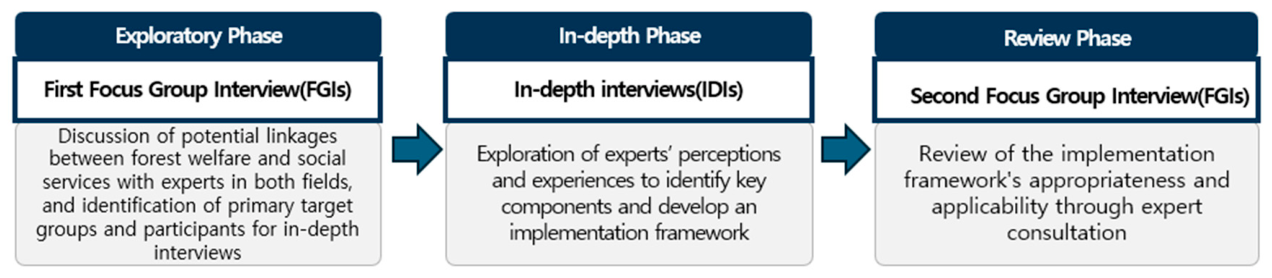

Table 1.
Expert interview panel for the focus group interviews (FGIs).
| FGIs | Experts | Professional Field | Type of Affiliation | Position |
|---|---|---|---|---|
| First FGIs | Expert F | Social welfare | Non-profit organization | Director |
| Expert H | Forest welfare | Private institution | Executive Director | |
| Expert I | Forest welfare | Private institution | Representative | |
| Expert N | Social services | Public institution | Practitioner | |
| Expert O | Health and welfare | Public institution | Practitioner | |
| Expert P | Forest welfare | Public institution | Practitioner | |
| Second FGIs | Expert F | Social welfare | Non-profit organization | Director |
| Expert L | Social welfare | Public institution | Practitioner | |
| Expert M | Forest welfare | Public institution | Practitioner | |
| Expert I | Forest welfare | Private institution | Representative |
Table 2.
Details of the participants of the in-depth interviews (IDIs).
| Experts | Professional Field | Type of Affiliation | Position | Target Group |
|---|---|---|---|---|
| Expert A | Support for socially isolated youth | Public institution | Practitioner | Socially Isolated youth |
| Expert B | Youth policy | Academia | Professor | Socially Isolated youth |
| Expert C | Lifelong education | Public institution | Practitioner | Middle-aged adults |
| Expert D | Support for middle-aged people | Public institution | Practitioner | Middle-aged adults |
| Expert E | Social welfare | Non-profit organization | Practitioner | Social workers |
| Expert F | Social welfare | Non-profit organization | Director | Social workers |
| Expert G | Welfare facilities | Private institution | Director | Social workers |
| Expert H | Forest welfare | Private institution | Executive Director | Suppliers |
| Expert I | Forest welfare | Private institution | Representative | Suppliers |
Table 3.
Coding results from interviews with experts on socially isolated youths.
| Top Categories | Subcategories | Contents |
|---|---|---|
| Challenges to be addressed | Difficulties in identifying and defining target individuals | Identifying target individuals itself is the greatest difficulty, and the fundamental problem is that individuals often do not come forward even when services are available. New outreach methods are needed, such as combining programs for families and linking with external systems. There is no clear standard or reliable measure to determine the degree of isolation. |
| Lack of long-term support systems | Support is focused only on relieving isolation; systems for prevention, economic independence, and long-term social belonging are rarely addressed. | |
| Excessive workload | Executing agencies bear a heavy burden of overall practices such as promotion, recruitment, and management. The competitive bidding process itself is a difficult task. | |
| Expectations for forest welfare services | The healing effects of the natural environment | Natural elements in forests are expected to provide greater healing effects than artificial interventions. |
| Strong associations with “rest” and “recovery” | The words “forest” and “woods” are immediately associated with “rest” and “recovery,” which is the greatest strength. | |
| Healing through escaping everyday urban life | The experience of escaping everyday urban life and the process of traveling itself are perceived as healing elements. | |
| Possibility of providing a safe environment | If a forest is perceived as a cozy, isolated place, it can provide a greater sense of psychological safety. | |
| Entry concerns and barriers | Realistic restrictions on travel distance and cost | Distance and cost due to the geographical location of the facility are the biggest realistic barriers. |
| Low motivation to participate | Simply going out to an unfamiliar environment is psychologically burdensome. It is difficult to motivate participation by explaining healing effects that have not been experienced. | |
| Psychological burdens related to unfamiliar environments and people | Staying in an unfamiliar environment or with strangers is a major source of psychological resistance and anxiety. | |
| Risk of participation bias toward more active youth | Outdoor programs may become concentrated among more active youth, with high-risk individuals excluded. | |
| Requirements for entry | Evidence-based program development | Evidence-based programs designed based on a deep understanding of socially isolated youths are needed to secure the trust of frontline organizations. |
| Institutional and financial basis for mobility support | Fund management guidelines and ordinances to support mobility expenses should be established. | |
| Specificity and convenience of programs | Specific activity details should be presented in a package format that includes transportation assistance. | |
| Training service providers to understand target audience | Facility workers should receive training on understanding and responding to socially isolated youth characteristics. | |
| Entry approaches | Inter-agency cooperation model | A role-sharing cooperation model based on the strengths of each organization (youth centers for recruitment, forest welfare facilities for operation, private companies for funding) was considered effective. |
| Cooperation with existing support organizations | Cooperation with existing support organizations, including government agencies, local governments, and private organizations, was viewed as desirable. Direct collaboration between Korea Forest Service (KFS) and transportation companies was also suggested. | |
| Use of less stigmatizing terms such as “prevention” | To avoid stigma, less stigmatizing terms such as “prevention” should be used. | |
| A phased approach to lower the threshold of engagement | Socially isolated youths in high-risk groups need a phased approach, starting with low-threshold urban programs such as “garden prescription.” | |
| Accompaniment by a trusted person | Being accompanied by a staff member from a trusted organization helps relieve anxiety about unfamiliar environments. |
Table 4.
Coding results from interviews with experts on middle-aged adults.
| Top Categories | Subcategories | Contents |
|---|---|---|
| Middle-aged characteristics and needs | Desire for social participation | Desire to contribute as a member of society; anxiety about social isolation. |
| Desire to learn and grow | The desire for learning and self-development is high before and after retirement. | |
| Time constraints | Although interest in using social services was high, participants reported having limited time in reality. | |
| Forest welfare service awareness and demand | Need for urban accessibility | Demand for programs that allow people to experience nature within urban living areas. |
| The desire for healing and recovery | Strong desires for rest and recovery after years of demanding daily life. | |
| Healing needs of social service workers | High demand among social service workers was anticipated. | |
| Demand for leisure and self-actualization | Economically stable middle-aged people are interested in self-fulfillment and leisure rather than employment-related programs. | |
| Service engagement barriers | Differences in knowledge and understanding | There is a large variation in satisfaction due to differences in individual backgrounds and knowledge. |
| Information and digital divide | Difficulties were reported in using SNS and online reservation systems. | |
| Physical and economic constraints | Burden of distance and cost; perception that access to forests should be free. | |
| Service operation conditions | Green space gaps | Regional differences in green spaces and lack of accessible natural areas. |
| Diversity in program formats | Differences in preferences by gender, age group, and program content exist. | |
| Human and financial resources | One-person multi-role work structure; limitations due to early budget exhaustion. Expansion of voucher issuance is needed. | |
| Influence of agency directors and policies | Service gaps were reported depending on the decisions and tendencies of agency directors. | |
| Central and local government roles | Significant regional differences due to differences in financial capacity and priority policies. | |
| Inter-agency cooperation system | Cooperation with universities and lifelong education institutions | Universities were perceived as open, systematic spaces that could facilitate administrative collaboration. |
| Cooperation with local governments and welfare agencies | Effective cooperation with community social security councils, retirement organizations, etc. | |
| Difficulties in collaboration process | Formal requests and lack of communication with practitioners exist. | |
| Expected effects of social service linkage | Improved information accessibility | Various social services can be accessed through forest welfare links. |
| Promoting physical and mental health | Forest welfare services have a positive impact on health, a major concern for middle-aged adults. | |
| The importance of casual approach | Promoting participation through chance opportunities. | |
| Regular and short-term parallel programs | Long-term experiential programs for career groups; short-term for general middle-aged adults. |
Table 5.
Coding results from interviews with professionals in social work.
| Top Categories | Subcategories | Contents |
|---|---|---|
| Current welfare-related challenges | Inequalities in legal and employment conditions | Wage and treatment disparities existed between statutory and non-statutory facilities, as well as between regular and non-regular workers. |
| Exclusion from human rights and welfare support | Within policies centered on service users’ rights, workers’ own rights and welfare were often overlooked while they endured low wages and significant psychological burdens. | |
| Intense psychological stress | Intense psychological stress stemming from an overwhelming sense of responsibility for social issues; increased user complaints and emotional harassment. | |
| Lack of psychological and emotional healing support systems | Formal rest opportunities are necessary; however, individual leave systems are insufficient for actual recovery. Institution-level healing support systems are needed. | |
| Social services for social workers | Mental health support project | A mental health counseling support service utilized by some social workers; access remained limited to workers in statutory social welfare facilities. |
| Domestic and overseas training programs | Provided opportunities for rest and learning; workers in residential facilities often faced difficulties participating due to staffing shortages. | |
| Promotion of various network meetings | Various small-scale networking activities aimed at improving well-being (age-specific and field-specific groups). | |
| Gaps in social service provision | A lack of specialized healing services that directly address psychological and emotional difficulties was identified. | |
| Forest welfare services | Forest experience partnership program | The forest experience program received positive responses but was implemented only as a short-term project without long-term continuity. |
| Expectations regarding integration into social services | Opportunities for psychological and emotional healing | Important means of relieving emotional exhaustion and preventing burnout by providing time and space for recovery before problems become severe. |
| Possibility of a treatment–healing–recovery linkage model | Expectations that forest welfare services could function as a complementary service within a “treatment–healing–recovery” process. | |
| Improved work efficiency and job satisfaction | Psychological stability was expected to contribute to improved work efficiency and higher job satisfaction. | |
| Improving the quality of family relationships | Positive influence on family roles and relationships, contributing to improvements in individual quality of life. | |
| The spread of forest welfare services | Expanding forest welfare services within local communities while strengthening professional expertise. | |
| Concerns and barriers to integration | Shortage of supply relative to demand | Despite strong interest, concerns remained regarding insufficient service supply and accessibility difficulties. |
| Lack of urgency and direct necessity | The lack of a clear sense of urgency may reduce its priority in policy decision-making. | |
| Conditions for integration into social services | Institutionalization of paid leave | Official paid leave guidelines should be institutionally established when participating in forest welfare services. |
| Agency-level support | Supporting institutional participation in response to the growing emphasis on employee welfare programs. | |
| Cost support | Support for participation-related expenses, including transportation, meals, snacks, and program fees. | |
| Ensuring program quality | Providing professional and high-quality healing programs that go beyond simple rest experiences. | |
| Measures for integration into social services | Strengthening legal and policy support | Official guidelines and financial support from central and local governments; legal foundations through local ordinances. |
| Establishing a collaborative governance system | Collaborative governance structure among KFS, local government, and social workers’ associations; pilot project models utilizing external resources such as the Community Chest of Korea. | |
| Inclusion in agency evaluation indicators | Including forest welfare service-related items in Ministry of Health and Welfare’s social welfare facility evaluation criteria. | |
| Demonstrating the necessity and effectiveness | Clearly demonstrating the positive impacts and effectiveness of forest welfare services within social welfare practice settings. | |
| Linkage with psychological support services | Strengthening positioning through phased collaboration with psychological support services. | |
| Focused targeting model | Establishing a focused targeting model to maximize service effectiveness. |
Table 6.
Coding results from interviews with private-sector forest welfare experts.
| Top Categories | Subcategories | Contents |
|---|---|---|
| Operational realities and limitations of private providers | Short-term and discontinuous contract structure | Programs are often operated through short-term, one-time contracts depending on the interests or priorities of local governments or welfare agencies. |
| Lack of access to supplier information | Requests from officials were directed toward known organizations, making it difficult for new providers to participate; limited experience in reviewing announcements related to vulnerable populations. | |
| Difficulty in securing appropriate spaces | Finding suitable spaces to operate programs was considered one of the most difficult aspects. | |
| Operational inefficiencies due to overlapping schedules | Problems with overlapping program operations along the same forest trail were reported. | |
| Need for institutional support and coordinating platforms | Lack of platforms connecting service providers and users | A coordinating platform such as a community center is needed to connect service users with providers. |
| Proposals for region-based councils | District- and regional-level centers are needed. The scope of responsibilities of the Korea Forest Welfare Institute was perceived as overly broad. | |
| Need to reconsider the role of Korea Forest Welfare Institute | Dedicated departments for actual promotion and service linkage are needed; current approach is overly focused on administration and education. | |
| Need to strengthen promotion and awareness | Promotion and awareness-raising among social welfare organizations and service users is necessary. | |
| Financial structure and cost issues | Challenges related to profitability | Generating profit is difficult under a structure that relies heavily on labor costs. |
| Challenges from the perception of free services | Both service users and organizations perceive welfare services as free, and are reluctant to pay for them. | |
| Exploration of paid service models | Successful transition from free to paid services through a university partnership was noted as a positive case. | |
| Difficulties in calculating allowances and expenses | Transportation costs and preparation time were not adequately compensated. | |
| Proposals for physical environment development | Small-scale private forest utilization models | A model in which private forest owners receive support for creating healing trails and later operate them through rental was proposed. |
| Joint utilization of local forest resources | Opening idle spaces to the private sector; shared daily use by different organizations. | |
| Expansion of service providers and collaboration | Participation of social welfare and healthcare workers | Social workers, caregivers, and nurses could potentially serve as facilitators of forest-based programs. |
| The role of public health centers | Public health centers could be linked with preventive forest-based campaigns and self-help group programs. | |
| Medical institution linkage model | Integrated medical and forest welfare care model, similar to Asan Medical Center’s “With One” program. | |
| Challenges in building consortium and network systems | Limited engagement of welfare professional associations | Activities and communication are limited; greater activation and engagement are needed. |
| Lack of a sustainable operational system | Limited council budgets make it difficult to carry out administration and promotional activities. |
Table 7.
Key components of the implementation framework derived from in-depth interviews.
| Constituents | Detailed Elements | Key Content | Subject of Evidence |
|---|---|---|---|
| User characteristics | Socially isolated youths | Social isolation, psychological withdrawal, need to restore relationships | Experts A, B |
| Middle-aged adults | Needs for health care and social participation, life transition anxiety | Experts C, D | |
| Delivery system | Public–private partnerships | Cooperation between central, local governments, and private institutions is necessary | Expert E |
| Local-based approach | Right-centered accessibility is important | Expert C | |
| Service operation | Program design | Targeted, step-by-step program required | All |
| Staffing roles | Social worker-centered linkage and diffusion function | Expert F | |
| Policy environment | Institutional basis | Budget, legal basis, and operating guidance required | All |
| Accessibility support | Costs, mobility, and information accessibility need to be improved | All |
Disclaimer/Publisher’s Note: The statements, opinions and data contained in all publications are solely those of the individual author(s) and contributor(s) and not of MDPI and/or the editor(s). MDPI and/or the editor(s) disclaim responsibility for any injury to people or property resulting from any ideas, methods, instructions or products referred to in the content. |
© 2026 by the authors. Licensee MDPI, Basel, Switzerland. This article is an open access article distributed under the terms and conditions of the Creative Commons Attribution (CC BY) license (http://creativecommons.org/licenses/by/4.0/).
Copyright: This open access article is published under a Creative Commons CC BY 4.0 license, which permit the free download, distribution, and reuse, provided that the author and preprint are cited in any reuse.


