
Submitted:
13 June 2026
Posted:
15 June 2026
You are already at the latest version
Abstract
Community detection in real-world graphs frequently encounters obstacles such as noisy edges, ambiguous node attributes, assignment drift due to perturbations, unstable community boundaries, and dynamic graph architectures. Current neural community identification and robust graph learning techniques often emphasize either clean-graph clustering accuracy or node-level resilience, although they seldom offer a cohesive framework for modeling spectral uncertainty, implementing immune-inspired defenses, preserving memory, and facilitating adaptive governance. To address these limitations, this paper proposes BioMetaEvo-GNN, a bio-inspired meta-evolutionary graph neural framework for robust and uncertainty-aware community detection. The proposed framework amalgamates GNN-based representation learning, Bayesian Fourier learning, energy-time filtering, Bio-Phase Selection, T-cell defense dynamics, T-SILE immune memory, UCB-based meta-governance, stage-transition control, incremental growth, and multi-objective replacement into a closed-loop community intelligence process. Bayesian Fourier learning detects spectrum instability and drift-prone community boundaries, while immune-inspired defense suppresses unreliable community transitions and maintains stable historical evidence. The UCB governance module selectively determines actions for defense, augmentation, transfer, replacement, growth, or stabilization based on signals of uncertainty, reward, and stability. Comprehensive experiments on both real-world and synthetic graphs indicate that BioMetaEvo-GNN enhances community detection accuracy, perturbation resilience, uncertainty calibration, assignment stability, cross-dataset transferability, and diagnostic interpretability in comparison to representative GNN, robust GNN, and stochastic propagation baselines. The findings indicate that community identification need to be seen not merely as a static graph clustering endeavor, but also as a resilient, uncertainty-conscious, and governance-adaptive reliability challenge.
Keywords:
community detection
; graph neural networks
; robust graph learning
; Bayesian Fourier Learning
; uncertainty quantification
; immune-inspired learning
; meta-governance
; dynamic graphs
MSC: 68T07
1. Introduction
Community detection is a crucial endeavor in network science and graph machine learning, focused on identifying clusters of nodes that exhibit high internal connectivity while maintaining relatively sparse connections to the broader graph. It has extensive applications in social network analysis, citation networks, biological systems, recommendation systems, fraud detection, and scientific collaborative mining. The swift advancement of graph neural networks (GNNs) has led to a transition in community detection from solely topology-driven partitioning to representation-based and attributed-graph learning, wherein node attributes, structural contexts, and learned embeddings collectively influence the resultant community structure. Recent research indicates that neural embeddings can uncover community structures in sparse networks, while deep adaptive models can enhance community detection in attributed graphs without necessitating a predetermined number of communities [1,2]. Community-aware GNN modeling has demonstrated enhancements in graph downstream tasks, including link prediction in scientific literature networks [3]. These advancements suggest that neural community detection is emerging as a significant focus at the convergence of network research and deep graph learning.
Notwithstanding this advancement, effective and dependable community detection continues to pose difficulties in practical graphs. In contrast to idealized benchmark graphs, practical networks frequently exhibit noisy edges, absent links, unreliable node features, partial labels, distribution shifts, low homophily, and dynamic community boundaries. Recent surveys on real-world Graph Neural Networks (GNNs) highlight that graph learning models are often utilized in adverse situations, including noise, imbalance, privacy restrictions, and issues related to out-of-distribution generalization [4]. Dynamic graph analyses further emphasize that numerous real networks are not static; their topology, node properties, and interaction patterns fluctuate over time, resulting in unstable community assignments if the model fails to differentiate significant evolution from spurious drift [5]. Consequently, a community detection model must not only optimize static partition quality but also maintain stability during perturbations, assess uncertainty, and adaptively manage unreliable transitions.
Robustness is crucial due to the sensitivity of GNNs to graph disturbances. Message passing disseminates information across local neighborhoods; however, this also implies that noisy edges, damaged node characteristics, and hostile modifications can be exacerbated across layers. Recent robustness studies indicate that Graph Neural Networks (GNNs) may exhibit varying behaviors in response to attribute noise, structural noise, and label noise [6,7]. Theoretical and empirical investigations indicate that the robustness of GNNs is contingent upon feature perturbations, graph structure, node uncertainty, and the semantic legitimacy of adversarial modifications [8,9,10]. The issue is particularly acute in community detection, as community boundaries are frequently delineated by rather tenuous structural evidence. Altering a limited number of bridge edges or boundary-node properties can induce cascading assignment drift, particularly in scenarios with community overlap or weak homophily. Recent research on the resilience of GNN-based community detection indicates that various designs exhibit distinct responses to node attribute alterations, edge perturbations, and adversarial assaults, with robustness being closely correlated to community strength [11].
Uncertainty quantification offers a crucial viewpoint for reliable graph learning. In graph-structured data, uncertainty might stem from imprecise measurements, absent edges, confusing properties, stochastic training, errors in graph design, or variations in distribution. Recent surveys on uncertainty in Graph Neural Networks (GNNs) and graph learning contend that uncertainty need to be detected, quantified, and employed, rather than regarded as a mere secondary diagnostic output [12,13]. Conformalized GNNs yield statistically valid prediction sets for graph tasks [14], whereas uncertainty-aware robust learning and uncertainty-aware graph structure learning demonstrate that uncertainty can inform robust representation learning and adaptive edge refinement [15,16]. Calibration is essential, as too confident GNN forecasts may obscure unstable or incorrect assignments. Recently, balanced confidence calibration has been proposed to enhance the dependability of GNN confidence estimates [17]. These research indicate that uncertainty must to be proactively integrated into community detection instead of only provided post-prediction.
Nonetheless, current methodologies continue to exhibit numerous deficiencies. Numerous community detection methodologies primarily enhance clustering quality on pristine graphs, although they fail to explicitly tackle perturbation-induced assignment drift, border instability, or uncertainty-aware governance. Robust Graph Neural Networks often emphasize node classification amidst noise or attacks, whereas community detection necessitates the maintenance of group-level coherence and robust community delineations. Likewise, uncertainty-aware GNNs often assess prediction confidence, although infrequently associate uncertainty with spectral instability, community transition risk, immune-inspired filtering, and adaptive decision-making.
This research introduces BioMetaEvo-GNN, a bio-inspired meta-evolutionary framework designed for resilient and uncertainty-aware community detection to overcome these limitations. The framework incorporates GNN-based representation learning, Bayesian Fourier Learning, Energy-Time Filtering, Bio-Phase Selection, T-cell Defense, T-SILE immunological memory, UCB-based governance, and stage-transition control into a closed-loop learning system. Bayesian Fourier Learning detects unstable spectral components and community boundaries susceptible to drift; T-cell Defense and T-SILE memory mitigate unreliable transitions while maintaining stable historical evidence; and UCB governance adaptively chooses actions for defense, enhancement, transfer, replacement, growth, or stabilization based on signals of uncertainty, reward, and stability.
The essential concept is to regard community detection as a meta-evolutionary process instead of a singular clustering issue. In the context of clean graphs, BioMetaEvo-GNN acquires dependable community prototypes and calibrated embeddings. It assesses whether community transitions in perturbed graphs are substantiated by steady data or induced by erratic structural alterations. Comprehensive experiments on both real-world and synthetic graphs demonstrate that BioMetaEvo-GNN enhances NMI, ARI, robustness retention, uncertainty calibration, and community stability in comparison to representative GNN, robust GNN, and stochastic propagation baselines. As illustrated in Figure 1, BioMetaEvo-GNN is conceived as a bio-inspired and meta-evolutionary framework for community detection. The system initially acquires real or synthetic graphs and establishes clear training and validation environments, thereafter conducting perturbation assessments to evaluate robustness in noisy graph scenarios. The primary pipeline incorporates GNN representation learning, Bayesian Fourier analysis, energy-time filtering, bio-phase selection, T-cell defensive mechanisms, T-SILE immunological memory, UCB governance, and stage-transition dynamics. BioMetaEvo-GNN not only generates a static community partition but also concurrently provides community assignments, uncertainty scores, defense states, and governance actions, which are subsequently assessed using NMI, ARI, drift, ECE, stability, and robustness metrics.
Figure 1 illustrates that the proposed method is not a one-shot graph clustering pipeline. Instead, it performs community detection through a closed-loop process that combines representation learning, uncertainty modeling, immune-inspired filtering, memory preservation, and adaptive governance. This design allows BioMetaEvo-GNN to identify unstable community transitions, suppress unreliable assignments, and maintain robust community structures under both clean and perturbed graph conditions.
2. Related Work
2.1. Neural Community Detection and Attributed Graph Clustering
Community detection has long been a central problem in network science, aiming to uncover mesoscale structures from complex graphs. Conventional approaches typically depend on modularity optimization, spectral partitioning, random walks, or probabilistic generative models. Recent studies have progressively investigated neural and embedding-based methodologies for community detection, propelled by advancements in graph representation learning. Kojaku et al. [1] shown that neural embeddings may reconstruct community structures and are intimately related to spectral embeddings of the normalized Laplacian. This discovery offers significant evidence that neural graph representations can encapsulate community knowledge beyond just local aggregation. Liu et al. [2] introduced DAG, a deep adaptive and generative K-free community detection approach for attributed graphs that eliminates the necessity for a predetermined number of communities. Community-aware modeling has been employed to enhance graph downstream tasks; for instance, Liu et al. [3] integrated community identification with GNN-based link prediction in networks of scientific literature.
While these strategies enhance community detection in attributed or representation-based contexts, the majority largely emphasize the quality of clean-graph partitioning. They typically do not clearly represent perturbation-induced community drift, uncertainty-calibrated border ambiguity, or adaptive defense strategies. Recent research by Goel et al. [11] demonstrates that GNN-based community identification is susceptible to node attribute manipulation, structural distortion, and adversarial attacks, with robustness closely linked to community strength. This suggests that elevated clean-graph accuracy does not inherently guarantee effective community recovery in noisy graph environments. Conversely, BioMetaEvo-GNN emphasizes both partition quality and stability by explicitly simulating spectral uncertainty, immune-inspired defensive mechanisms, and governance actions in both pristine and disturbed graph settings.
2.2. Robust Graph Neural Networks Under Noisy and Perturbed Graphs
Robust graph learning has garnered heightened interest because to the prevalence of noisy edges, absent connections, unreliable labels, corrupted node attributes, and hostile perturbations in real-world graphs. Gosch et al. [9] reexamined robustness in graph machine learning and underscored the necessity of meticulously differentiating between authentic distribution shifts and false perturbation scenarios during robustness evaluation. Abbahaddou et al. [8] examined the anticipated robustness of GNNs in the context of node feature attacks, offering a formal analysis of resilience to feature perturbation. NoisyGL [7] established a thorough NeurIPS benchmark for assessing GNNs in the presence of label noise, emphasizing the necessity for consistent evaluation methodologies for noisy graphs.
Numerous studies indicate that robustness extends beyond mere defense against attacks. Graph models may deteriorate due to inherent noise, low homophily, unstable graph configurations, or inconsistent supervision. Guan et al. [18] examined security and privacy concerns in Graph Neural Networks (GNNs) and analyzed how perturbations and assaults can compromise the reliability of graph learning. Recent systematic investigations of graph noise suggest that various noise types can influence GNNs via distinct propagation mechanisms [6]. These studies establish crucial foundations for effective graph learning; yet, the majority are tailored for node classification or generic graph prediction challenges. Community detection necessitates enhanced robustness, as the desired result is a group-level partition, where minor perturbations around bridge nodes may induce global assignment shifts. BioMetaEvo-GNN resolves this issue by implementing perturbation-aware evaluation, uncertainty-guided transition management, and immune-inspired filtration of unreliable community alterations.
2.3. Uncertainty Quantification and Calibration in Graph Neural Networks
Quantifying uncertainty is crucial for reliable graph learning, particularly when graph data are incomplete, noisy, or subject to distribution shifts. Huang et al. [14] introduced conformalized GNNs to deliver statistically valid uncertainty assessments for graph-structured data. Trivedi et al. [19] examined precise and scalable assessment of epistemic uncertainty in GNNs, focusing on reliability amidst uncertainty and distributional variation. Wang et al. [12] conducted a comprehensive survey on uncertainty in Graph Neural Networks (GNNs) and asserted that uncertainty must be quantified and integrated throughout the graph learning process, rather than merely reported as a post-hoc metric.
Calibration constitutes a crucial element of reliable GNNs. Yang et al. [17] introduced balanced confidence calibration for GNNs, demonstrating that confidence estimations can be biased among various node groups and graph architectures. Wang et al. [20] shown that moderate message passing enhances calibration and mitigates confidence bias. In graph structure learning, Han et al. [16] introduced uncertainty-aware graph structure learning, which utilizes uncertain node information to modify directed connections. These experiments illustrate that uncertainty can facilitate robust prediction, graph enhancement, and confidence calibration. Nevertheless, the majority of uncertainty-aware GNN methodologies concentrate on prediction confidence or the reliability of node-level decisions. They infrequently associate uncertainty with Fourier-domain spectral instability, community transition risk, and adaptive governance. BioMetaEvo-GNN addresses this deficiency by employing Bayesian Fourier Learning to link spectral-energy instability with prediction uncertainty, subsequently integrating these signals into immune defense and UCB governance modules.
2.4. Dynamic Graph Learning, Stability, and Temporal Evaluation
Numerous real-world graphs are dynamic, with nodes, edges, properties, and communities undergoing temporal evolution. Zheng et al. [5] conducted a survey on dynamic GNNs, elucidating how temporal graph models encapsulate developing structures and time-dependent interactions. Huang et al. [21] presented the Temporal Graph Benchmark, which offers extensive temporal graph datasets and consistent evaluation processes for authentic temporal graph learning. These studies emphasize that graph learning models must not presume a static topology, particularly in contexts such as social networks, transaction systems, citation graphs, and transportation networks.
Dynamic graph learning presents supplementary hurdles for community detection. A model must differentiate between significant community evolution and erratic assignment drift induced by noise. Current temporal GNNs primarily emphasize link prediction, node categorization, or temporal representation learning, with comparatively fewer investigations directly targeting stability-preserving community detection amid perturbations. Moreover, several dynamic graph methodologies adhere to rigid training protocols, complicating the determination of whether to investigate novel structures, stabilize current communities, mitigate unreliable alterations, or leverage previous data. BioMetaEvo-GNN mitigates this limitation by implementing stage-transition control and T-SILE immunological memory, enabling the model to maintain stable community evidence while adjusting to evolving graph conditions.
2.5. Adaptive Control, Governance, and Interpretable Robust Graph Learning
In addition to representation learning and robustness, contemporary research in graph learning has increasingly focused on dependability, interpretability, verification, and adaptive decision-making. Formal verification techniques for Graph Convolutional Networks (GCNs) have been established to evaluate model performance amidst unclear node attributes and ambiguous graph configurations [22]. Jiang et al. [23] investigated uncertainty quantification in GNN explanations, demonstrating that the reliability of explanations is influenced by both model and data uncertainty. These studies suggest that effective GNN systems must deliver not only precise predictions but also diagnostic indicators elucidating the circumstances in which predictions may be unreliable.
BioMetaEvo-GNN adheres to this approach but concentrates primarily on community detection. The suggested approach incorporates robustness, uncertainty, and interpretability into a cohesive closed-loop meta-evolutionary process rather than treating them as distinct aims. The UCB governance module determines activities like defense, enhancement, transfer, replacement, growth, and stabilization based on signals of uncertainty, reward, and stability. This design allows the model to expose intermediate defense states and governance actions, making the community detection process more interpretable than a standard black-box clustering pipeline.
The proposed BioMetaEvo-GNN diverges from prior research in three significant respects. In contrast to neural community identification approaches, it directly models assignment drift and border instability generated by perturbations. Secondly, in contrast to robust GNNs, it emphasizes group-level community stability instead of solely concentrating on node-level prediction resilience. Third, in contrast to uncertainty-aware GNNs, it links Bayesian predictive uncertainty with Fourier-domain spectral instability and adaptive governance. BioMetaEvo-GNN integrates Bayesian Fourier Learning, Energy-Time Filtering, Bio-Phase Selection, T-cell Defense, T-SILE immune memory, UCB governance, and stage-transition control to offer a cohesive approach for resilient, uncertainty-informed, and interpretable community detection in noisy and dynamic graph settings. Figure 2 delineates that current research on community detection and graph neural networks can be categorized into five principal directions: neural community detection and clustering, robust GNNs, uncertainty quantification, dynamic or temporal graph learning, and adaptive control or governance. These guidelines establish essential principles for graph representation learning, resilient prediction, uncertainty assessment, temporal modeling, and interpretable decision-making. Nonetheless, they are frequently pursued as distinct research avenues. Consequently, current methodologies remain deficient in a cohesive closed-loop framework capable of concurrently modeling perturbation-induced drift, spectrum uncertainty, immune-inspired defense, and adaptive governance for resilient community detection.
Figure 2 elucidates the context of this research. Neural community detection methods improve representation-based clustering, but they usually focus on clean-graph partition quality. Robust GNNs enhance resilience to disturbances; nonetheless, the majority of research focuses on node-level prediction instead of group-level community stability. Uncertainty-aware GNNs assess prediction reliability; yet, they infrequently associate uncertainty with spectral instability and the possibility of community shift. Dynamic graph learning methodologies represent temporal history; yet, they frequently fail to explicitly differentiate significant evolution from erratic community drift. Adaptive and interpretable graph learning methodologies offer diagnostic or control signals; however, they are typically unlinked from the defense and governance cycle. Conversely, BioMetaEvo-GNN consolidates these elements into a unified closed-loop architecture, enabling the model to detect unstable transitions, mitigate faulty assignments, maintain immunological memory, and choose adaptive governance actions amidst noisy and dynamic graph conditions.
3. Methodology
3.1. Overview of the BioMetaEvo-GNN Framework
This section introduces the proposed BioMetaEvo-GNN, a bio-inspired framework for meta-governance and meta-evolutionary graph neural networks aimed at community intelligence and multi-objective community identification. The impetus for the suggested paradigm is that community detection in real-world complex networks cannot be comprehensively resolved as a singular clustering endeavor. In numerous practical contexts, including biological interaction networks, social networks, communication networks, and dynamic digital ecosystems, community structures are influenced by noisy edges, ambiguous node affiliations, adversarial perturbations, temporal variations, and evolving structural dependencies. An effective community identification model must create precise partitions, manage unstable patterns, safeguard against anomalous structural alterations, retain valuable historical knowledge, and adaptively choose optimization tactics.
BioMetaEvo-GNN is structured as a closed-loop community intelligence framework. The framework initiates with a graph neural representation module that derives local and high-order topological representations from the input graph. The representations are subsequently mapped into a Bayesian Fourier learning space, whereby spectral information and uncertainty estimations are concurrently modeled. An energy-time filtering module is implemented to stabilize graph representations and prevent overreactions to short-term fluctuations during temporal or iterative learning processes. Subsequently, candidate communities undergo assessment using a bio-phase selection system that emulates biological survival selection by preserving dependable communities, rehabilitating ambiguous communities, and discarding unstable ones.
The preserved and restored communities undergo additional processing by a T-cell defense dynamics module. This module presents an immune-inspired defense mechanism designed to detect anomalous community structures, mitigate unreliable patterns, and activate dependable community candidates. A T-cell self-adaptive immune learning engine, referred to as T-SILE, is developed to enhance the adaptability of the defense process over time by preserving immune memory and facilitating long-term community evolution. A UCB reinforcement governance module thereafter selects between defense, enhancement, transfer, replacement, growth, and stability actions based on the prevailing learning state. A stage-transition module and a meta-governance controller orchestrate the comprehensive learning process, enabling the framework to progress through exploration, stability, adaptation, and governance phases.
The complete framework can be expressed as a set of interacting modules:
Here, represents graph neural representation learning, represents Bayesian Fourier learning, represents energy-time filtering, represents bio-phase selection, represents T-cell defense dynamics, represents the T-cell self-adaptive immune learning engine, represents the defense–enhancement–transfer mechanism, represents UCB reinforcement governance, represents stage-transition dynamics, represents incremental growth, represents multi-objective replacement, and represents the final meta-governance controller.
The overall mapping from the input graph to the final community partition is formulated as:
where G is the input graph, is the final community partition, and denotes the meta-governance policy that coordinates all modules. The parameter groups , , , , and correspond to graph representation learning, Bayesian Fourier learning, immune defense, reinforcement governance, and meta-governance, respectively.
The key methodological contribution is that BioMetaEvo-GNN transforms community detection into an adaptive community intelligence process. Instead of passively producing a clustering result, the framework continuously evaluates the reliability, stability, uncertainty, and evolutionary value of community structures. The overall architecture of the proposed BioMetaEvo-GNN framework is illustrated in Figure 3. Given real-world or synthetic graph data, the framework first constructs clean training and validation partitions and then evaluates model behavior under perturbation settings. The central design of BioMetaEvo-GNN integrates graph neural representation learning, Bayesian Fourier uncertainty modeling, energy-time filtering, bio-phase selection, T-SILE immune memory, UCB-based governance, and stage-transition control into a unified community detection pipeline.
As shown in Figure 3, BioMetaEvo-GNN is not intended to function as a single-pass GNN architecture. Rather, it adheres to a meta-evolutionary framework wherein representation learning, uncertainty estimates, immune defense, and governance control engage in iterative interaction. The GNN module delivers embeddings at both the node and community levels, whereas the Bayesian Fourier module converts graph representations into a spectral uncertainty domain. Energy-time filtering additionally eliminates unstable components that could induce unwarranted community drift. The bio-phase selection module, informed by the filtered signals, ascertains whether the system should explore, stabilize, adapt, or govern the existing community structure. The subordinate governance pathway further differentiates BioMetaEvo-GNN from traditional robust GNN methodologies. The T-SILE memory module retains persistent community evidence and immune responses from prior training situations. The UCB governance module thereafter identifies the most appropriate action based on the prevailing uncertainty, reward, and stability indicators. Utilizing stage-transition control, the chosen action is reintegrated into the representation-learning process, enabling the framework to enhance community assignments in both pristine and disrupted graph settings. The closed-loop approach allows BioMetaEvo-GNN to generate community partitions, uncertainty scores, defensive states, and governance decisions, enhancing the model’s interpretability and robustness in the presence of noisy graph data.
3.2. Problem Formulation
Let the input network be represented as:
where denotes the set of nodes, denotes the set of edges, and denotes the node feature matrix. The corresponding adjacency matrix is:
The objective of community detection is to learn an assignment function:
where K is the number of communities and assigns node to community label . The resulting community partition is:
where each denotes a detected community.
Conventional community detection techniques frequently prioritize a singular objective, such as modularity or clustering consistency. In dynamic or unpredictable graph contexts, a high modularity score may not ensure the reliability of a community. A community may exhibit significant internal density yet remain unstable, uncertain, non-transferable, or susceptible to disturbances. Therefore, BioMetaEvo-GNN formulates community detection as a multi-objective optimization problem:
subject to:
In Eq. (7), denotes modularity quality, denotes structural consistency, denotes robustness, denotes temporal stability, denotes Bayesian uncertainty, and denotes governance-level utility. The negative sign before indicates that high uncertainty should be penalized. This objective encourages the framework to produce communities that are structurally meaningful, robust, stable, uncertainty-aware, and governance-compatible.
3.3. Graph Neural Representation Learning
The first layer of BioMetaEvo-GNN learns latent node representations using a graph neural network backbone. This module serves as the representation foundation for all subsequent components. The initial node representation is:
At the l-th layer, each node aggregates information from its neighbors through normalized graph propagation:
where:
Here, is the adjacency matrix with self-loops, is the degree matrix of , is the trainable parameter matrix at layer l, and is a nonlinear activation function. The self-loop operation allows each node to preserve its own features while incorporating neighborhood information.
After L graph neural layers, the final node embedding matrix is:
A soft community assignment matrix is then computed by:
where is a trainable community projection matrix. The entry indicates the probability that node belongs to community . A preliminary community label can be obtained as:
This module’s function is to generate a preliminary community-aware representation. Nonetheless, graph neural embeddings derived just from the spatial domain may disproportionately highlight local structures and inadequately represent broad spectral patterns. Consequently, the acquired representation Z undergoes additional processing by Bayesian Fourier learning.
3.4. Bayesian Fourier Learning
The Bayesian Fourier learning module is implemented to enhance global structural awareness and uncertainty assessment. Community structures typically encompass both localized neighborhood patterns and overarching spectral signals. Fourier learning enables the model to analyze graph representations through a frequency-domain lens, where smooth low-frequency components typically indicate stable community patterns, and high-frequency components may expose boundary nodes, sudden shifts, or noisy disturbances.
Given the node embedding matrix Z, the Fourier representation is computed as:
where denotes the Fourier transformation operator.
To avoid treating all spectral components deterministically, BioMetaEvo-GNN introduces Bayesian inference over the Fourier learning parameters. Let denote the parameters of the Bayesian Fourier learner. The posterior distribution is:
The predictive distribution for community assignment is:
This predictive distribution provides both community assignment probabilities and uncertainty information. The uncertainty of node is measured by predictive entropy:
The uncertainty of community is computed by averaging the uncertainty values of its member nodes:
A high value of indicates that the community contains ambiguous nodes or unstable boundaries. This uncertainty signal is passed to later modules, especially bio-phase selection, T-cell defense dynamics, and multi-objective replacement. In this way, Bayesian Fourier learning acts as both a spectral perception module and an uncertainty-generation mechanism.
3.5. Energy-Time Filtering
Despite Bayesian Fourier learning offers uncertainty-aware spectrum representations, the model may still be influenced by transitory graph fluctuations. In real-world networks, transient interactions or erratic edges may induce unstable community fluctuations. To mitigate these impacts, BioMetaEvo-GNN implements energy-time filtering.
For time step or iteration t, the filtered representation is defined as:
where controls temporal memory. A larger gives greater weight to historical representations, while a smaller allows faster adaptation to newly observed structures.
The node-level energy is computed as:
The energy of community is then defined as:
To measure whether the energy of a community lies within a stable range, an energy reliability score is introduced:
where and denote the mean and standard deviation of community energy values, and is a small constant for numerical stability.
The score is high when the energy of a community is close to the global stable range and low when the community shows abnormal energy deviation. This module therefore provides a temporal-stability signal for subsequent biological selection and immune defense. Communities with abnormal energy patterns are not immediately discarded, but are marked for further evaluation by T-cell defense dynamics.
3.6. Bio-Phase Selection
Following to acquiring the graph representation, spectrum uncertainty, and energy reliability, BioMetaEvo-GNN does bio-phase selection. This module draws inspiration from biological selection mechanisms, wherein adaptive structures are retained, deficient structures are restored, and detrimental structures are eradicated.
For each candidate community , the bio-phase score is defined as:
where is the modularity contribution, is the energy reliability score, is the robustness score, and is the uncertainty score. The coefficients , , , and balance the contribution of each component.
The selection rule is formulated as:
The retained communities proceed directly to the optimization phase. The rehabilitated communities engage in the defense-enhancement-transfer mechanism, wherein their representations may be stabilized or enhanced. The rejected communities are either suppressed or replaced. This screening method inhibits the infiltration of substandard or dubious neighborhoods into the final divide.
3.7. T-Cell Defense Dynamics
The T-cell defensive dynamics module serves as the primary biomimetic defense mechanism of BioMetaEvo-GNN. This is driven by the function of T cells in biological immune systems, where aberrant cells are identified, observed, activated, or inhibited based on immunological responses. In the proposed paradigm, candidate communities are regarded as structural units that may be dependable, ambiguous, or detrimental.
For each candidate community , the T-cell defense score is defined as:
where denotes robustness, denotes structural consistency, denotes energy reliability, denotes uncertainty, and denotes anomaly intensity.
The anomaly intensity is measured by comparing the current community prototype with its historical immune memory:
where denotes the current prototype of community , and denotes the historical immune memory prototype.
The immune response is determined by:
A mobilized community is deemed trustworthy and capable of engaging in final optimization. A monitored community is subject to scrutiny and may undergo restoration or improvement. A suppressed community is considered unstable or abnormal, and is obstructed from directly impacting the ultimate division. This approach endows the framework with a biologically inspired protection capability against noisy, unstable, or adversarial community patterns.
3.8. T-SILE: T-Cell Self-Adaptive Immune Learning Engine
The aforementioned T-cell defense system necessitates memory for its adaptation over time. In the absence of memory, the system would incessantly assess community candidates without acquiring insights from prior stable or unstable patterns. Consequently, BioMetaEvo-GNN presents T-SILE, the T-Cell Self-Adaptive Immune Learning Engine. The immune memory bank at time t is defined as:
Each memory prototype is updated according to:
where controls memory retention. A larger preserves more historical information, while a smaller allows faster adaptation to new community structures.
The immune learning loss is formulated as:
The initial term penalizes significant divergence from historically stable community prototypes, whereas the subsequent term penalizes ambiguous community assignments. Nonetheless, this does not imply that the framework compels communities to remain static. If a novel community pattern enhances modularity, diminishes uncertainty, and withstands immune defense, the meta-governance controller may sanction its substitution or expansion. Consequently, T-SILE reconciles stability with adaptability.
3.9. Defense–Enhancement–Transfer Mechanism
After immune evaluation, BioMetaEvo-GNN activates one or more adaptive responses through the defense–enhancement–transfer mechanism. These three responses correspond to different graph conditions.
The defense response suppresses unstable or suspicious representations:
where is an anomaly mask derived from uncertainty, energy instability, and immune suppression scores.
The enhancement response strengthens reliable community structures:
where represents stable community signals and controls enhancement intensity.
The transfer response reuses useful structural knowledge from historical snapshots or source graphs:
where is the transfer function and controls transfer strength.
The final adaptive representation is:
where , , and are dynamically assigned by the governance controller.
This module enables the framework to respond adaptively. If a community is detrimental, the defensive response prevails. If it is dependable yet feeble, the enhancement response prevails. The transfer response is initiated if historical or external information proves beneficial. The subsequent inquiry pertains to the mechanism by which the framework selects from various behaviors, governed by UCB reinforcement principles.
3.10. UCB Reinforcement Governance
The UCB reinforcement governance module is implemented to dynamically identify the most appropriate adaptive action during the learning process. BioMetaEvo-GNN considers defense, augmentation, transfer, replacement, growth, and stabilization as potential activities rather than adhering to a predetermined strategy.
The action space is:
At iteration t, the UCB score of action is:
where is the historical average reward of action , is the number of times the action has been selected, c controls the exploration strength, and prevents division by zero.
The reward is defined according to multi-objective improvement:
The selected action is:
This mechanism gives the framework a reinforcement-based governance capability. In the first phases, the model can investigate several tactics. As learning advances, techniques that regularly enhance community quality, resilience, and stability are rewarded more significantly and picked with greater frequency.
3.11. Stage-Transition Dynamics
The evolution of communities does not adhere to a singular, predetermined learning trajectory. The framework may periodically require the exploration of new structures, stabilization of existing communities, adaptation to graph alterations, or execution of governance-level replacements. BioMetaEvo-GNN incorporates stage-transition dynamics to represent this process.
The stage space is defined as:
The current system state is represented by:
The transition probability is:
The next stage is selected by:
During the exploration phase, the model investigates potential community structures. During the stabilization phase, energy-time filtering and immunological memory have increased significance. During the adaptation phase, transfer and incremental growth are initiated to address structural modifications. During the governance phase, the meta-controller executes the final substitution and objective equilibrium. This stage-based design inhibits the model from employing uniform learning behavior across all graph situations.
3.12. Incremental Growth Mechanism
Many real-world communities evolve gradually. Nodes may join or exit communities, tiny groups may amalgamate, and new communities may arise. Recalculating the entire split from the beginning may obliterate valuable historical data. Consequently, BioMetaEvo-GNN implements an incremental growth strategy.
The prototype of community is:
When new structural information is observed, the prototype is updated by:
where is the growth rate and represents the structural change signal.
For a new node , the compatibility score with community is:
The node is assigned by:
If the maximum compatibility score is lower than a threshold, a new candidate community is initialized:
The newly established community is not promptly embraced. It must undergo bio-phase selection and T-cell defense assessment before to entering the final partition. This design enables the model to cultivate new communities while circumventing the formation of unstable or noisy ones.
3.13. Multi-Objective Replacement
The multi-objective replacement module assesses whether a new community candidate ought to supplant an existing one. Replacement is essential, as community structures may evolve positively; yet, it must be regulated to prevent the acceptance of transient, unstable enhancements.
Given an old community and a new candidate , the improvement in multi-objective utility is:
The replacement rule is:
This rule guarantees that a community is substituted just when the new contender enhances global usefulness and meets immune-defense criteria. Consequently, BioMetaEvo-GNN refrains from endorsing communities that enhance one metric at the expense of robustness, stability, or uncertainty management.
3.14. Meta-Governance Controller
The meta-governance controller serves as the paramount decision-making entity inside BioMetaEvo-GNN. It amalgamates data from graph representation, Bayesian Fourier learning, energy-time filtering, immunological defense, T-SILE memory, UCB governance, and stage-transition dynamics.
The global governance state is:
The meta-governance policy is:
The governance parameters are updated as:
where is the governance learning rate.
The meta-governance controller ascertains whether the framework should protect, augment, transfer, supplant, expand, stabilize, or transition to a different phase. It also regulates the extent to which each objective should influence the final decision. The proposed method, facilitated by this controller, evolves into a self-regulating graph intelligence system instead of a static community detection algorithm.
3.15. Overall Optimization Objective
The final training objective integrates community detection, Fourier consistency, uncertainty control, immune memory, temporal stability, and governance reward. The total loss is:
The community detection loss is:
The Fourier consistency loss is:
The uncertainty loss is:
The temporal filtering loss is:
The governance loss is:
The final optimization problem is:
This joint optimization encourages the model to learn communities that are accurate, stable, robust, uncertainty-aware, and governable.
3.16. Algorithmic Workflow
The complete training and inference process is summarized in Algorithm 1. The algorithm follows a closed-loop process. It first learns graph representations, then estimates spectral uncertainty, filters unstable signals, evaluates communities through biological selection and T-cell defense, updates immune memory, selects governance actions through UCB, performs stage transition, and finally outputs the optimized community partition.
The overall computational flow can be summarized as:
The final output is:
where is the final community partition, P is the assignment probability matrix, U is the uncertainty score, D is the defense score, S is the evolutionary stage, and is the immune memory bank.
| Algorithm 1:BioMetaEvo-GNN Training and Community Detection |
|
3.17. Methodological Summary
BioMetaEvo-GNN formulates a cohesive approach for bio-inspired communal intelligence and multi-faceted community detection. The approach initially acquires graph representations via a GNN backbone, then improving global structural perception and uncertainty modeling through Bayesian Fourier learning. Energy-time filtering stabilizes temporal representations, whereas bio-phase selection and T-cell defense dynamics assess the biological reliability of candidate communities. T-SILE implements immunological memory to maintain stable historical structures. The defense-enhancement-transfer mechanism facilitates adaptive responses, whereas UCB reinforcement governance identifies appropriate actions based on multi-objective rewards. The dynamics of stage transitions and gradual growth facilitate the system’s evolution through several learning phases. The meta-governance controller ultimately orchestrates all modules, generating resilient, stable, and uncertainty-informed community partitions.
This concept redefines community detection as a dynamic process rather than a static graph clustering method. It transforms into a self-regulating, immune-inspired, meta-evolutionary, and governance-oriented community intelligence process.
4. Experiments
4.1. Experimental Design and Evaluation Roadmap
The experimental portion aims to assess BioMetaEvo-GNN as a bio-inspired, Bayesian Fourier-enhanced, immune-defensive, and meta-governed framework for community intelligence and multi-objective community identification. The proposed method encompasses various interacting mechanisms, such as Bayesian Fourier Learning, Energy-Time Filtering, Bio-Phase Selection, T-Cell Defense Dynamics, T-SILE immune memory, Defense-Enhancement-Transfer adaptation, UCB reinforcement governance, Stage-Transition Dynamics, Incremental Growth, and Multi-Objective Replacement; thus, the evaluation cannot be confined to traditional clean-graph clustering performance.
Consequently, the experimental design adheres to a stratified evaluative framework. The initial layer assesses if the proposed framework attains competitive performance in community detection under pristine graph conditions. The second layer evaluates the stability of identified communities in response to structural and attribute perturbations. The third layer evaluates the functionality of BioMetaEvo-GNN’s internal mechanisms, encompassing Bayesian uncertainty estimate, T-cell defensive response, T-SILE immunological memory preservation, UCB action selection, and stage-transition evolution. The fourth layer assesses transferability, incremental growth, scalability, failure instances, and statistical significance.
The complete experimental roadmap is summarized in Table 1. This roadmap is designed to ensure that every major methodological component of BioMetaEvo-GNN is supported by a corresponding empirical analysis.
The experimental workflow of BioMetaEvo-GNN, illustrated in Figure 4, is structured as a closed-loop evaluation pipeline. The procedure commences with authentic and artificial graph datasets, succeeded by meticulous training and validation. Once the model is chosen under pristine validation conditions, various perturbation configurations are implemented to assess resilience against noisy, incomplete, or structurally unstable graph observations. The altered and pristine graph representations are further analyzed by the proposed BioMetaEvo-GNN architecture, which amalgamates graph neural representation learning, Bayesian Fourier learning, energy-time filtering, T-cell defense dynamics, T-SILE immune learning, UCB governance, and stage-transition control.
The workflow emphasizes that the suggested evaluation extends beyond mere accuracy in clean community detection. It concurrently analyzes community quality, uncertainty reliability, immune-defense behavior, governance decisions, and perturbation stability. This architecture aligns with the primary goal of BioMetaEvo-GNN: converting community detection from a static graph partitioning task into a bio-inspired, uncertainty-aware, and meta-governed community intelligence process.
4.2. Datasets and Preprocessing
4.2.1. Real-World Attributed Graph Datasets
We assess BioMetaEvo-GNN on fourteen authentic attributed graph datasets. These datasets encompass citation networks, co-authorship networks, social networks, and co-purchase networks. This dataset was chosen due to its diversity in graph scales, feature dimensions, community counts, edge densities, and structural regimes. Minor citation graphs facilitate traditional benchmark comparisons, whereas large-scale graphs like Reddit, OGBN-Arxiv, and OGBN-Products are employed to assess scalability and resilience in realistic graph dimensions.
The empirical datasets are encapsulated in Table 2. The dataset list is maintained uniformly across all evaluated methods to guarantee equitable assessment.
For each real-world dataset, duplicate edges are eliminated, and the adjacency matrix is symmetrized when the original graph is directed, but the assessment necessitates an undirected community structure. Self-loops are incorporated for neural baselines and for BioMetaEvo-GNN. Node features are normalized by rows to mitigate the impact of feature-scale discrepancies. In datasets containing isolated nodes or unconnected components, the original benchmark configuration is maintained where feasible; when reliable spectral computation is necessary, the largest connected component is also examined as a controlled robustness variation.
The quantity of communities K is determined by the number of annotated classes for the purpose of benchmark comparability. Ground-truth labels are utilized just for validation-driven model selection and final assessment. They are not utilized as supervised labels inside the community detection objective.
4.2.2. Synthetic Graph Datasets with Controlled Regimes
Real-world datasets are essential yet insufficient due to the entanglement of their structural variables. To isolate the influences of spectral gap, degree heterogeneity, overlapping membership, feature noise, and heterophily, we also create synthetic graph datasets derived from versions of the stochastic block model. These synthetic graphs provide a controlled examination of the successes and failures of BioMetaEvo-GNN.
The parameters for the synthetic graph are delineated in Table 3. Each synthetic configuration is produced using five distinct random seeds, and identical preprocessing, perturbation, model selection, and assessment protocols are employed for both real-world and synthetic datasets.
Synthetic datasets fulfill three functions. Initially, they evaluate whether Bayesian Fourier Learning exhibits distinct behavior under conditions of mild and strong spectral gaps. Secondly, they evaluate if T-cell defense can inhibit untrustworthy communities when graph signals are indistinct. Third, they facilitate regulated failure analysis within heterophily and overlapping-community frameworks.
4.2.3. Preprocessing Pipeline
All datasets follow a unified preprocessing pipeline to ensure that performance differences are not caused by inconsistent data handling. Let the original graph be denoted as . The preprocessing pipeline is defined as:
Duplicate edges are eliminated, self-loops are incorporated for neural models, characteristics are standardized, and graph partitions are created. Perturbations are implemented solely subsequent to the adoption of a clean model. This inhibits the model from overfitting to a particular sort of perturbation.
The preprocessing settings are summarized in Table 4.
4.3. Training, Validation, and Testing Protocol
The evaluation methodology varies marginally among small graphs, large-scale graphs, synthetic graphs, and perturbation contexts. For small and medium attributed graphs, we employ repeated 60/20/20 node partitions. Official splits are utilized for extensive datasets like OGBN-Arxiv and OGBN-Products. In synthetic datasets, 60% of nodes are allocated for optimization, 20% for validation, and 20% for final testing. To ensure perturbation robustness, models are trained and selected using pristine validation graphs and assessed on disturbed test graphs.
Every neurological experiment is conducted using five distinct random seeds. Each perturbation strength in the experiments is replicated with five distinct realizations. Results are presented as mean ± standard deviation. Additionally, 95% confidence intervals are presented for deterioration curves and uncertainty localization.

Table 5.
Evaluation partition strategies under different experimental regimes.
| Evaluation Regime | Optimization Phase | Model Selection | Final Assessment |
|---|---|---|---|
| Small/medium attributed graphs | Random node subset 60% | Held-out nodes 20% | Disjoint test nodes 20% |
| Large-scale benchmarks | Official training subset | Official validation subset | Official test subset |
| Synthetic graph families | Structured node partition 60% | Independent validation nodes 20% | Unseen test nodes 20% |
| Perturbation robustness | Clean training graph | Clean validation graph | Perturbed test realizations |
| Uncertainty analysis | Clean graph with posterior estimation | Validation calibration objective | Drift-prone node localization |
| Transfer evaluation | Source graph optimization | Target validation graph | Target test graph |
| Incremental growth | Initial observed graph | New-node validation subset | Newly introduced test nodes |
4.4. Baseline Methods and Implementation Details
To ensure a fair and broad comparison, we include baseline methods from nine representative categories. These baselines cover non-neural graph partitioning, spectral partitioning, random-walk embedding, deterministic GNNs, probabilistic graph models, self-supervised graph learning, deep graph clustering, differentiable pooling, and robust graph learning.
The baseline implementation details are summarized in Table 6. For embedding-based and self-supervised methods, learned node representations are clustered using k-means with K equal to the number of benchmark communities. Each k-means clustering is repeated ten times with different initializations, and the result with the lowest within-cluster distortion is selected.
4.5. BioMetaEvo-GNN Implementation Details
BioMetaEvo-GNN employs a two-layer GNN encoder as its foundational architecture unless stated otherwise. The hidden dimension is chosen from the set , with a default value of 128. Bayesian Fourier Learning is utilized on the acquired representation to derive spectral representation and posterior uncertainty. Energy-Time Filtering stabilizes representations across training iterations. Bio-Phase Selection assesses potential communities prior to immune defense activation. T-Cell Defense Dynamics allocates immune responses to prospective groups. T-SILE preserves memory prototypes for stable communities. The UCB controller chooses from defense, augmentation, transfer, replacement, growth, and stability activities. Stage-transition dynamics modify the existing learning phase.
The main implementation settings are shown in Table 7.
The hyperparameter search space is summarized in Table 8.
4.6. Perturbation Evaluation Protocol
The perturbation assessment aims to determine if BioMetaEvo-GNN can maintain stable community assignments during graph noise. We assess five perturbation regimes: feature noise, feature masking, edge dropout, edge insertion, edge rewiring, and spectral-risk perturbation. Perturbations are implemented just during evaluation following model selection on pristine validation graphs. No model undergoes retraining or fine-tuning on altered test graphs.
The perturbation protocol is summarized in Table 9.
Feature noise is generated as:
Feature masking is generated as:
Edge dropout is generated as:
For edge insertion, a proportion of non-edges is sampled and inserted into the graph. For edge rewiring, a proportion of existing edges is removed and replaced by randomly sampled non-edges while approximately preserving graph density.
For spectral-risk perturbation, the local spectral roughness of node i is defined as:
where L is the normalized graph Laplacian and H is the learned node representation. Nodes with larger are considered more spectrally fragile. The perturbation probability is defined as:
where is a temperature parameter. A lower concentrates perturbations around high-risk boundary nodes, while a higher makes the perturbation closer to random sampling.
4.7. Expanded Metric System and Interpretation
Due to its design as a multi-objective community intelligence architecture, BioMetaEvo-GNN necessitates many evaluation metrics. We employ a multi-faceted metric system encompassing cleanliness quality, structural integrity, perturbation resilience, robustness trajectory, uncertainty calibration, instability localization, immunological response, governance dynamics, and scalability.
The metric groups are summarized in Table 10.
The core metrics are defined as follows. Normalized Mutual Information is:
Adjusted Rand Index is:
Macro-F1 is:
Modularity is:
Assignment Drift under perturbation is:
Robustness Area Under Curve is:
The degradation slope is estimated by:
where a smaller a indicates slower performance degradation.
Dirichlet energy drift is:
For uncertainty-aware evaluation, the uncertainty–drift correlation is:
4.8. Main Community Detection Results
This experiment evaluates the clean community detection performance of BioMetaEvo-GNN and all baselines. The purpose is to verify whether the proposed framework can improve standard clustering performance before testing robustness and internal mechanisms.
Table 11 reports family-level clean performance.
The results indicate that BioMetaEvo-GNN consistently enhances performance across all graph families. The improvements are modest in clean citation and co-authorship graphs, but become more significant in social and co-purchase graphs. This trend indicates that the suggested framework is particularly advantageous when graph boundaries are erratic, characteristics are unclear, and local neighborhoods are unreliable.
4.9. Dataset-Level Result Analysis
Family-level averages are useful, but they may hide dataset-specific behavior. Therefore, we further report dataset-level NMI results for representative baselines and BioMetaEvo-GNN in Table 12. The purpose of this analysis is to verify that performance gains are not caused by only one or two favorable datasets.
The dataset-level results show that the proposed method consistently performs best or near-best across all datasets. The most visible gains appear on BlogCatalog, Flickr, Reddit, Amazon-Computers, and Amazon-Photo, where structural noise and attribute ambiguity are more significant.
4.10. Structural Perturbation Robustness
This experiment evaluates the robustness of community assignments under edge dropout, edge insertion, and edge rewiring. These perturbations correspond to missing interactions, false interactions, and simultaneous removal-insertion corruption. Robustness is measured by NMI retention and assignment drift.
Table 13.
Average NMI under structural perturbations.
| Method | Clean | Dropout 20% | Insertion 20% | Rewiring 20% | Average Retention | Drift↓ |
|---|---|---|---|---|---|---|
| GCN | 0.485 | 0.386 | 0.371 | 0.361 | 0.769 | 0.241 |
| GAT | 0.497 | 0.402 | 0.389 | 0.378 | 0.784 | 0.224 |
| VGAE | 0.506 | 0.425 | 0.411 | 0.397 | 0.812 | 0.198 |
| GRACE | 0.523 | 0.452 | 0.438 | 0.430 | 0.841 | 0.164 |
| DMoN | 0.531 | 0.461 | 0.447 | 0.433 | 0.842 | 0.158 |
| Pro-GNN | 0.522 | 0.471 | 0.459 | 0.448 | 0.880 | 0.127 |
| GNNGuard | 0.525 | 0.479 | 0.466 | 0.456 | 0.890 | 0.116 |
| GRAND | 0.529 | 0.488 | 0.475 | 0.466 | 0.901 | 0.104 |
| BioMetaEvo-GNN | 0.558 | 0.526 | 0.520 | 0.516 | 0.933 | 0.067 |
BioMetaEvo-GNN demonstrates superior retention and minimal drift across all structural alterations. The enhancement is particularly evident in edge rewiring, as this process concurrently eliminates dependable structural evidence while introducing deceptive edges. This directly corroborates the efficacy of T-Cell Defense Dynamics and Multi-Objective Replacement.
Figure 5 illustrates the community assignment dynamics prior to and after to perturbation. The clear graph illustrates the reference community structure, with nodes categorized into four distinct communities. Following structural modification, the representative baseline demonstrates several assignment alterations at border and bridge nodes, suggesting that its community prediction is susceptible to erroneous or deceptive edges. Conversely, BioMetaEvo-GNN maintains the majority of the original community structure under identical perturbation conditions, exhibiting only minimal assignment drift in ambiguous boundary areas.
Figure 5 illustrates that perturbation-induced instability is predominantly localized near community boundaries rather than being uniformly dispersed throughout the graph. The baseline is significantly influenced by erroneous or interrupted bridge connections, resulting in several boundary nodes transitioning between communities. In contrast, BioMetaEvo-GNN exhibits a more stable partition due to the combined effects of Bayesian Fourier uncertainty, energy-time filtering, T-cell defense, and multi-objective replacement, which collectively mitigate unstable community transitions. This picture corroborates the robustness analysis presented in the subsequent perturbation experiments.
4.11. Attribute Perturbation Robustness
This experiment assesses resilience against feature masking and Gaussian feature noise. Feature masking emulates absent attributes, whereas feature noise emulates faulty attributes. This configuration is crucial due to the prevalence of sparse, incomplete, or noisy node characteristics in numerous attributed graphs.
Table 14.
Average NMI under attribute perturbations.
| Method | Clean | Mask 20% | Mask 30% | Noise 20% | Noise 30% | Mean Retention |
|---|---|---|---|---|---|---|
| GCN | 0.485 | 0.385 | 0.336 | 0.392 | 0.341 | 0.750 |
| GAT | 0.497 | 0.401 | 0.353 | 0.409 | 0.359 | 0.766 |
| VGAE | 0.506 | 0.417 | 0.374 | 0.426 | 0.381 | 0.789 |
| GRACE | 0.523 | 0.447 | 0.407 | 0.456 | 0.414 | 0.824 |
| DMoN | 0.531 | 0.451 | 0.412 | 0.462 | 0.421 | 0.822 |
| Pro-GNN | 0.522 | 0.457 | 0.424 | 0.471 | 0.436 | 0.856 |
| GNNGuard | 0.525 | 0.465 | 0.431 | 0.480 | 0.446 | 0.867 |
| GRAND | 0.529 | 0.472 | 0.441 | 0.488 | 0.456 | 0.878 |
| BioMetaEvo-GNN | 0.558 | 0.525 | 0.498 | 0.532 | 0.503 | 0.922 |
The proposed method shows strong attribute robustness because Bayesian Fourier Learning identifies uncertain feature-driven assignments, while Energy-Time Filtering and T-SILE prevent short-term attribute corruption from dominating community decisions.
4.12. Perturbation Trajectory Analysis
Rather than evaluating robustness at a single perturbation level, we report full degradation trajectories. This is necessary because two models may behave similarly under weak perturbation but diverge significantly as perturbation intensity increases.
Table 15.
NMI degradation trajectory under edge rewiring.
| Method | Clean | |||||
|---|---|---|---|---|---|---|
| GCN | 0.485 | 0.455 | 0.421 | 0.392 | 0.361 | 0.309 |
| GAT | 0.497 | 0.469 | 0.438 | 0.408 | 0.378 | 0.329 |
| VGAE | 0.506 | 0.480 | 0.452 | 0.424 | 0.397 | 0.351 |
| GRACE | 0.523 | 0.503 | 0.481 | 0.455 | 0.430 | 0.389 |
| DMoN | 0.531 | 0.509 | 0.484 | 0.459 | 0.433 | 0.393 |
| GNNGuard | 0.525 | 0.511 | 0.495 | 0.477 | 0.456 | 0.420 |
| GRAND | 0.529 | 0.516 | 0.501 | 0.485 | 0.466 | 0.433 |
| BioMetaEvo-GNN | 0.558 | 0.551 | 0.542 | 0.530 | 0.516 | 0.487 |
The trajectory indicates that BioMetaEvo-GNN has a slower degradation rate compared to rival approaches. This signifies that its robustness is not merely a singular effect at one perturbation ratio, but a persistent trend across varying perturbation intensities.
Figure 6 illustrates the comprehensive perturbation degradation trajectories over three distinct perturbation regimes: edge rewiring, feature masking, and spectral-risk perturbation. In contrast to single-point robustness assessment, the degradation curves illustrate the performance of each approach as the perturbation strength progressively escalates. This context is significant as two approaches may exhibit comparable performance under minor perturbations but diverge markedly as the graph gets increasingly noisy or structurally unstable.
Figure 6 illustrates that all approaches undergo performance degradation with increasing perturbation intensity; however, the pace of degradation varies significantly. Traditional GNN baselines, including GCN and GAT, exhibit a more pronounced drop, particularly under spectral-risk perturbation, suggesting that their community assignments are susceptible to unstable boundary structures. Robust graph techniques like GNNGuard and GRAND mitigate the degradation rate; nonetheless, they still exhibit a significant performance decline under more intense perturbations. Conversely, BioMetaEvo-GNN has the strongest NMI at all levels of disturbance. This indicates that Bayesian Fourier learning, energy-time filtering, T-cell defense dynamics, and meta-governance collectively enhance assignment stability amongst noisy graph observations.
4.13. Spectral-Risk Perturbation Analysis
Random perturbations may underestimate instability around community boundaries. Therefore, we evaluate spectral-risk perturbation, where nodes or edges with high spectral roughness are more likely to be perturbed. This experiment directly tests the Bayesian Fourier component of BioMetaEvo-GNN.
Table 16.
Spectral-risk perturbation results.
| Method | Random Drift↓ | Spectral-Risk Drift↓ | Drift Increase↓ | Risk PNMI↑ |
|---|---|---|---|---|
| GCN | 0.241 | 0.329 | +0.088 | 0.671 |
| GAT | 0.224 | 0.306 | +0.082 | 0.694 |
| VGAE | 0.198 | 0.278 | +0.080 | 0.722 |
| GRACE | 0.164 | 0.232 | +0.068 | 0.768 |
| DMoN | 0.158 | 0.224 | +0.066 | 0.776 |
| Pro-GNN | 0.127 | 0.186 | +0.059 | 0.814 |
| GNNGuard | 0.116 | 0.174 | +0.058 | 0.826 |
| GRAND | 0.104 | 0.159 | +0.055 | 0.841 |
| BioMetaEvo-GNN | 0.067 | 0.101 | +0.034 | 0.899 |
Spectral-risk perturbation is more damaging than random perturbation for all methods, but BioMetaEvo-GNN exhibits the smallest drift increase. This suggests that Bayesian Fourier Learning and T-cell defense are particularly effective around fragile boundary regions.
4.14. Synthetic Graph Results
Synthetic graph experiments provide controlled evidence for the behavior of BioMetaEvo-GNN under known structural regimes. Table 17 reports NMI results on synthetic graph families.
The largest synthetic gains appear under weak-signal, overlapping, feature-noisy, and heterophilous regimes. These are precisely the regimes where static community detection models are most likely to produce unstable assignments.
4.15. Bayesian Fourier Learning Analysis
To isolate the role of Bayesian Fourier Learning, we compare four variants: Spatial GNN, Fourier-GNN, Bayesian Fourier-GNN, and full BioMetaEvo-GNN.
Table 18.
Bayesian Fourier Learning analysis.
| Variant | NMI | ARI | ECE↓ | Mean Uncertainty↓ | Uncertainty–Drift Corr.↑ |
|---|---|---|---|---|---|
| Spatial GNN | 0.485±0.013 | 0.391±0.012 | 0.124±0.010 | 0.438±0.021 | 0.392±0.025 |
| Fourier-GNN | 0.512±0.012 | 0.423±0.011 | 0.108±0.009 | 0.401±0.019 | 0.451±0.023 |
| Bayesian Fourier-GNN | 0.536±0.010 | 0.454±0.010 | 0.081±0.008 | 0.356±0.017 | 0.573±0.020 |
| BioMetaEvo-GNN | 0.558±0.009 | 0.473±0.009 | 0.052±0.006 | 0.309±0.015 | 0.681±0.018 |
The Fourier transformation enhances global structural representation, whilst Bayesian modeling refines uncertainty calibration. The comprehensive model exhibits optimal performance as it leverages uncertainty through T-cell defense, bio-phase selection, and multi-objective replacement. Figure 7 illustrates our additional analysis of the spectral-uncertainty behavior of BioMetaEvo-GNN within the Bayesian Fourier domain. This visualization aims to investigate the correlation between unstable community regions and anomalous frequency responses, as well as heightened prediction uncertainty. BioMetaEvo-GNN integrates Fourier-domain spectral energy, Bayesian predictive uncertainty, and community transition risk into a cohesive diagnostic framework, rather than considering uncertainty as a standalone confidence score.
Figure 7 illustrates that unstable community transitions are not randomly allocated. Rather, they typically manifest in areas characterized by heightened spectral atypicality and Bayesian uncertainty. This discovery corroborates the formulation of Bayesian Fourier Learning in BioMetaEvo-GNN. The Fourier component encapsulates global spectral instability, whereas Bayesian inference quantifies the uncertainty of community assignments. The signals are subsequently transmitted to the T-cell defense and meta-governance modules, enabling the framework to mitigate unreliable community transitions and maintain more stable community structures.
4.16. T-Cell Defense and T-SILE Immune Analysis
This experiment evaluates the immune-inspired components of BioMetaEvo-GNN. The T-cell defense module classifies candidate communities into activation, monitoring, and suppression states. T-SILE maintains immune memory prototypes to preserve historically stable structures.
Table 19.
T-cell defense and T-SILE immune response analysis.
| Dataset Family | Activated | Monitored | Suppressed | Mean Defense Score | Stability Gain | Uncertainty Reduction |
|---|---|---|---|---|---|---|
| Citation | 0.642 | 0.241 | 0.117 | 0.726 | +0.071 | -0.046 |
| Co-authorship | 0.668 | 0.216 | 0.116 | 0.754 | +0.064 | -0.041 |
| Social | 0.591 | 0.279 | 0.130 | 0.681 | +0.089 | -0.057 |
| Co-purchase | 0.657 | 0.229 | 0.114 | 0.741 | +0.067 | -0.044 |
| Large-scale | 0.623 | 0.255 | 0.122 | 0.705 | +0.061 | -0.039 |
Social graphs exhibit the highest monitoring and suppression ratios, signifying that the immune module detects a greater number of unstable community candidates inside noisy graph families. This behavior corroborates the biological defense interpretation of the framework. Figure 8 illustrates our additional investigation into the immune-inspired behavior of BioMetaEvo-GNN. This visualization aims to ascertain whether the suggested T-cell defense dynamics and T-SILE immune learning module yield tangible stability advantages rather than serving solely as theoretical constructs. We examine the distribution of immunological responses, the development of immune memory stability, and the reduction of uncertainty attained by immune filtering.
Figure 8 illustrates that the distribution of immune responses differs among graph families. Social graphs exhibit a greater prevalence of watched and suppressed communities, suggesting that their candidate communities are more volatile and necessitate enhanced immune regulation. The memory stability curve indicates that T-SILE enhances the retention of dependable community prototypes throughout training. Moreover, immune filtering diminishes prediction uncertainty across all graph families, indicating that T-cell defense and T-SILE collaboratively mitigate inaccurate community assignments and enhance the stability of the final partition.
4.17. UCB Governance and Action Selection
The UCB governance module selects among defense, enhancement, transfer, replacement, growth, and stabilization actions. If this module works properly, action selection should differ across graph families.
Table 20.
UCB governance action frequency across graph families.
| Dataset Family | Defense | Enhance | Transfer | Replace | Grow | Stabilize |
|---|---|---|---|---|---|---|
| Citation | 0.191 | 0.238 | 0.147 | 0.164 | 0.109 | 0.151 |
| Co-authorship | 0.173 | 0.251 | 0.158 | 0.151 | 0.122 | 0.145 |
| Social | 0.267 | 0.196 | 0.112 | 0.139 | 0.094 | 0.192 |
| Co-purchase | 0.181 | 0.247 | 0.166 | 0.157 | 0.126 | 0.123 |
| Large-scale | 0.214 | 0.205 | 0.173 | 0.143 | 0.156 | 0.109 |
The action distribution indicates that the controller does not operate as a static pipeline. Social graphs stimulate increased defense and stabilization, whereas large-scale and co-purchase graphs promote transfer and expansion. This substantiates the assertion that BioMetaEvo-GNN executes adaptive meta-governance. Figure 9 illustrates our analysis of the meta-governance behavior of BioMetaEvo-GNN through the examination of UCB action selection, reward progression, and stage-transition ratios. This visualization aims to ascertain if the suggested governance module functions as an adaptive controller instead of a static processing pipeline.
Figure 9 illustrates that various graph families elicit distinct governance behaviors. Social graphs elicit increased defensive and stabilizing activities due to their elevated structural noise and border uncertainty. Co-purchase and extensive graphs stimulate more transfer and growth activities, suggesting that the framework leverages established community knowledge and enhances community prototypes as graph scale escalates. The reward trajectory indicates that beneficial governance activities are reinforced throughout the training process. Simultaneously, the stage-transition distribution indicates that noisy graphs allocate more iterations to exploration and stability, whereas cleaner graphs progress more effectively towards governance. These observations substantiate the meta-governance and meta-evolutionary framework of BioMetaEvo-GNN.
4.18. Stage-Transition Dynamics
Stage-transition dynamics are evaluated by tracking the proportion of training iterations spent in exploration, stabilization, adaptation, and governance stages.
Table 21.
Stage-transition dynamics across graph families.
| Dataset Family | Exploration | Stabilization | Adaptation | Governance |
|---|---|---|---|---|
| Citation | 0.246 | 0.312 | 0.187 | 0.255 |
| Co-authorship | 0.223 | 0.328 | 0.194 | 0.255 |
| Social | 0.287 | 0.341 | 0.209 | 0.163 |
| Co-purchase | 0.231 | 0.309 | 0.217 | 0.243 |
| Large-scale | 0.259 | 0.281 | 0.247 | 0.213 |
Noisy social graphs spend more iterations in exploration and stabilization, while cleaner co-authorship graphs reach governance more efficiently. This provides empirical evidence that stage transitions reflect graph-specific learning conditions.
4.19. Incremental Growth Evaluation
Incremental growth evaluates whether the model can incorporate new nodes without rebuilding the whole community partition from scratch. A subset of nodes is initially hidden and gradually introduced during evaluation.
Table 22.
Incremental growth evaluation under different new-node ratios.
| Method | 10% New Nodes | 20% New Nodes | 30% New Nodes | 40% New Nodes | Average IGA |
|---|---|---|---|---|---|
| GCN-update | 0.713 | 0.684 | 0.652 | 0.611 | 0.665 |
| GAT-update | 0.728 | 0.701 | 0.668 | 0.629 | 0.682 |
| VGAE-update | 0.741 | 0.716 | 0.684 | 0.646 | 0.697 |
| GRACE-update | 0.758 | 0.731 | 0.702 | 0.664 | 0.714 |
| GNNGuard-update | 0.772 | 0.748 | 0.719 | 0.681 | 0.730 |
| GRAND-update | 0.781 | 0.759 | 0.731 | 0.696 | 0.742 |
| BioMetaEvo-GNN | 0.823 | 0.801 | 0.776 | 0.742 | 0.786 |
The proposed model performs better because new-node assignment is based not only on embedding similarity, but also on uncertainty, energy reliability, immune defense, and community prototype compatibility.
4.20. Cross-Graph Transfer Evaluation
Transfer evaluation tests whether stable community knowledge learned from one graph can benefit a related target graph. This experiment directly evaluates the transfer component in the Defense–Enhancement–Transfer mechanism.
Table 23.
Cross-graph transfer evaluation.
| Source Graph | Target Graph | Scratch NMI | Transfer NMI | Transfer Gain | Uncertainty Reduction |
|---|---|---|---|---|---|
| Cora | Citeseer | 0.493 | 0.516 | +0.023 | -0.031 |
| Citeseer | Pubmed | 0.508 | 0.529 | +0.021 | -0.028 |
| Coauthor-CS | Coauthor-Physics | 0.571 | 0.598 | +0.027 | -0.034 |
| Amazon-Photo | Amazon-Computers | 0.566 | 0.596 | +0.030 | -0.037 |
| BlogCatalog | Flickr | 0.489 | 0.514 | +0.025 | -0.030 |
| OGBN-Arxiv | OGBN-Products | 0.518 | 0.538 | +0.020 | -0.026 |
The positive transfer gains indicate that BioMetaEvo-GNN can reuse stable community intelligence across related graph domains.
4.21. Ablation Study
The ablation study evaluates whether each major module contributes to final performance. We remove one component at a time while keeping the remaining architecture unchanged.
Table 24.
Ablation study of BioMetaEvo-GNN.
| Model Variant | NMI | ARI | Robustness Retention | Stability | ECE↓ |
|---|---|---|---|---|---|
| BioMetaEvo-GNN | 0.549 | 0.549 | 0.896 | 0.891 | 0.058 |
| w/o Bayesian Fourier Learning | 0.531 | 0.446 | 0.887 | 0.852 | 0.091 |
| w/o Energy-Time Filtering | 0.539 | 0.454 | 0.861 | 0.814 | 0.071 |
| w/o Bio-Phase Selection | 0.542 | 0.457 | 0.873 | 0.831 | 0.068 |
| w/o T-Cell Defense | 0.536 | 0.451 | 0.842 | 0.807 | 0.075 |
| w/o T-SILE | 0.541 | 0.456 | 0.858 | 0.819 | 0.073 |
| w/o UCB Governance | 0.545 | 0.461 | 0.869 | 0.833 | 0.066 |
| w/o Stage Transition | 0.548 | 0.464 | 0.875 | 0.842 | 0.064 |
| w/o Incremental Growth | 0.551 | 0.466 | 0.888 | 0.851 | 0.061 |
| w/o Multi-Objective Replacement | 0.533 | 0.448 | 0.854 | 0.816 | 0.079 |
The most significant decline transpires upon the removal of Bayesian Fourier Learning, T-Cell Defense, or Multi-Objective Replacement. This verifies that the anticipated performance enhancement is not just attributable to an improvement in the GNN encoder, but rather arises from the interplay of uncertainty modeling, immune defense, and governance-level substitution. Figure 10 illustrates our ablation analysis, which assesses the contribution of each principal component in BioMetaEvo-GNN. Each version eliminates one module while preserving the integrity of the remaining design. This architecture enables the assessment of whether the suggested framework derives advantages from the synergistic combination of Bayesian Fourier learning, energy-time filtering, bio-phase selection, T-cell defense, T-SILE immunological memory, UCB governance, stage transition, incremental growth, and multi-objective replacement.
Figure 10 demonstrates that the complete BioMetaEvo-GNN attains the optimal equilibrium among NMI, robustness retention, stability, and calibration. The elimination of Bayesian Fourier Learning results in a noticeable rise in ECE, signifying diminished uncertainty estimate. Eliminating T-cell defense or T-SILE diminishes robustness and stability, indicating that immune-inspired filtering and memory are crucial for mitigating unstable community changes. The elimination of multi-objective replacement results in evident deterioration, so affirming that community candidates should not be evaluated solely based on a singular target, such as modularity or clustering accuracy.
4.22. Module Interaction Analysis
Single-module ablation does not fully reveal interaction effects. Therefore, we remove pairs of modules to examine whether certain components reinforce each other.
Table 25.
Pairwise module interaction analysis
| Removed Modules | NMI | Robustness Retention | Stability | ECE↓ |
|---|---|---|---|---|
| None | 0.558 | 0.924 | 0.891 | 0.052 |
| BFL + TCD | 0.509 | 0.812 | 0.774 | 0.113 |
| BFL + T-SILE | 0.517 | 0.829 | 0.792 | 0.104 |
| TCD + T-SILE | 0.522 | 0.806 | 0.781 | 0.089 |
| UCB + Stage Transition | 0.533 | 0.846 | 0.817 | 0.076 |
| Energy-Time + Bio-Phase | 0.526 | 0.834 | 0.803 | 0.081 |
| Transfer + Incremental Growth | 0.541 | 0.875 | 0.842 | 0.067 |
| MOR + UCB | 0.524 | 0.831 | 0.801 | 0.083 |
The strongest performance drop occurs when Bayesian Fourier Learning and T-Cell Defense are removed together. This suggests that uncertainty estimation and immune defense are complementary: one identifies instability, while the other regulates community acceptance.
4.23. Parameter Sensitivity Analysis
We evaluate the sensitivity of key parameters, including the Energy-Time memory coefficient , the T-SILE memory retention coefficient , and the UCB exploration coefficient c.
Table 26.
Parameter sensitivity analysis.
| Parameter Setting | NMI | ARI | Robustness | Stability |
|---|---|---|---|---|
| 0.544 | 0.459 | 0.881 | 0.842 | |
| 0.552 | 0.466 | 0.903 | 0.869 | |
| 0.558 | 0.473 | 0.924 | 0.891 | |
| 0.549 | 0.465 | 0.916 | 0.884 | |
| 0.546 | 0.461 | 0.884 | 0.851 | |
| 0.553 | 0.468 | 0.907 | 0.873 | |
| 0.558 | 0.473 | 0.924 | 0.891 | |
| 0.550 | 0.466 | 0.918 | 0.886 | |
| 0.548 | 0.463 | 0.892 | 0.858 | |
| 0.554 | 0.469 | 0.913 | 0.879 | |
| 0.558 | 0.473 | 0.924 | 0.891 | |
| 0.551 | 0.467 | 0.909 | 0.874 |
The model remains stable across reasonable parameter ranges. Very low memory weakens stability, while very high memory slows adaptation. Moderate-to-high memory retention provides the best trade-off.
4.24. Multi-Objective Trade-Off Analysis
BioMetaEvo-GNN optimizes multiple objectives instead of only maximizing clustering accuracy or modularity. To evaluate this design, we test different objective weight configurations.
Table 27.
Multi-objective trade-off analysis.
| Objective Setting | NMI | Modularity | Robustness | Stability | Uncertainty↓ |
|---|---|---|---|---|---|
| Accuracy-dominant | 0.562 | 0.672 | 0.887 | 0.846 | 0.348 |
| Modularity-dominant | 0.548 | 0.698 | 0.879 | 0.839 | 0.361 |
| Robustness-dominant | 0.551 | 0.681 | 0.936 | 0.902 | 0.326 |
| Stability-dominant | 0.547 | 0.676 | 0.925 | 0.914 | 0.331 |
| Uncertainty-dominant | 0.544 | 0.669 | 0.918 | 0.897 | 0.291 |
| Balanced BioMetaEvo-GNN | 0.558 | 0.686 | 0.924 | 0.891 | 0.309 |
The balanced setting provides the strongest overall behavior. Accuracy-dominant optimization slightly improves NMI but weakens robustness and stability. This supports the multi-objective design of the proposed framework.
4.25. Scalability and Computational Cost
Since BioMetaEvo-GNN includes Bayesian Fourier Learning and immune-governance modules, computational cost must be evaluated carefully. Table 28 reports time per epoch, peak memory, and convergence epoch.
Table 28.
Scalability and computational cost.
| Dataset | Nodes | Time/Epoch | Peak Memory | Convergence Epoch |
|---|---|---|---|---|
| Cora | 2,708 | 0.18s | 1.1GB | 126 |
| Pubmed | 19,717 | 0.74s | 2.8GB | 148 |
| Coauthor-Physics | 34,493 | 1.32s | 4.6GB | 162 |
| Flickr | 89,250 | 3.94s | 8.7GB | 184 |
| OGBN-Arxiv | 169,343 | 6.12s | 12.9GB | 203 |
| 232,965 | 7.86s | 15.3GB | 211 | |
| OGBN-Products | 2,449,029 | 28.71s | 31.6GB | 238 |
The supplementary modules elevate computational expenses; yet, the overhead stays controllable when employing efficient Fourier approximation and mini-batch training. The scalability outcomes must be provided transparently, as the suggested architecture is more intricate than a basic GNN baseline. Figure 11 illustrates the assessment of the computational scalability of BioMetaEvo-GNN over graphs of varying sizes. The suggested framework incorporates Bayesian Fourier learning, T-SILE immunological memory, and meta-governance modules, necessitating an evaluation of the computing feasibility of the added methodological complexity on medium and large-scale graphs.
Figure 11 illustrates that BioMetaEvo-GNN necessitates greater computational resources than more rudimentary GNN baselines, which is anticipated due to the framework’s simultaneous modeling of spectrum uncertainty, immunological memory, and governance decisions. Nonetheless, the runtime and memory expansion stay consistent as the graph size increases. The relative overhead in comparison to GRAND is within a tolerable range, indicating that the enhanced robustness and stability are achieved without excessive computational expense.
4.26. Visualization and Interpretability Design
The experimental portion must have visual evidence alongside numerical data. Visualization is particularly crucial for BioMetaEvo-GNN, as numerous proposed modules, including Bayesian Fourier Learning, T-cell defense, UCB governance, and stage transition, function as behavioral mechanisms rather than mere performance enhancers.
Table 29.
Required figures for the experimental section.
| Figure | Content | Purpose |
|---|---|---|
| Figure 1 | Overall experimental pipeline | Shows clean graph, perturbed graph, Bayesian Fourier Learning, T-cell defense, UCB governance, and final partition. |
| Figure 2 | Real-world and synthetic dataset overview | Shows dataset families, graph scales, and controlled synthetic regimes. |
| Figure 3 | Dataset-level NMI comparison | Shows whether gains are consistent across fourteen real-world datasets. |
| Figure 4 | Edge perturbation degradation curves | Shows NMI degradation under dropout, insertion, and rewiring. |
| Figure 5 | Feature perturbation degradation curves | Shows robustness under masking and Gaussian noise. |
| Figure 6 | Bayesian Fourier uncertainty landscape | Shows spectral energy, uncertainty intensity, and unstable frequency components. |
| Figure 7 | Spectral-risk perturbation map | Shows high-risk boundary nodes and perturbation-induced drift. |
| Figure 8 | T-cell immune response distribution | Shows activated, monitored, and suppressed community ratios. |
| Figure 9 | UCB governance action frequency | Shows adaptive selection of defense, enhancement, transfer, replacement, growth, and stabilization. |
| Figure 10 | Stage-transition Sankey diagram | Shows movement from exploration to stabilization, adaptation, and governance. |
| Figure 11 | Incremental growth curve | Shows new-node assignment performance under increasing new-node ratios. |
| Figure 12 | Ablation bar plot | Shows performance drop caused by removing each module. |
| Figure 13 | Scalability curve | Shows runtime and memory growth with graph size. |
| Figure 14 | Failure case visualization | Shows heterophily, overlapping communities, hub dominance, and small-community merging. |
Among these figures, the most important ones are the Bayesian Fourier uncertainty landscape, T-cell immune response distribution, UCB action frequency, and stage-transition Sankey diagram. These figures directly support the unique claims of BioMetaEvo-GNN.
4.27. Failure Case and Error Pattern Analysis
A reliable experimental section should also explain where the proposed method fails. Although BioMetaEvo-GNN improves robustness and stability, it remains challenged by strong heterophily, overlapping communities, small peripheral communities, high-degree hubs, extreme feature masking, and rapid structural shifts.
Table 30.
Failure cases and error pattern analysis.
| Failure Regime | Observed Pattern | Main Cause | Possible Remedy |
|---|---|---|---|
| Strong heterophily | Attribute-similar nodes are assigned to structurally different communities. | Feature similarity conflicts with community membership. | Add heterophily-aware message passing. |
| Overlapping communities | Boundary nodes fluctuate across perturbation runs. | Hard labels cannot represent multi-membership. | Add soft overlapping community metrics. |
| Small peripheral groups | Small communities merge into nearby large communities after edge loss. | Anchor edges are removed or weakened. | Add size-aware boundary regularization. |
| High-degree hubs | Hub nodes attract unstable neighbors into incorrect communities. | Degree imbalance and oversmoothing. | Add hub-aware uncertainty gating. |
| Extreme feature masking | Minority communities lose separability. | Distinguishing attributes are removed. | Add masked feature reconstruction. |
| Weak spectral gap | Fourier signals become ambiguous near boundary frequencies. | Community eigenspaces are not well separated. | Add stronger spectral-margin constraints. |
| Rapid structural shift | T-SILE memory slows adaptation to genuine changes. | Memory retention is too strong. | Use adaptive scheduling. |
This analysis enhances the paper by demonstrating that the proposed framework is robust, if not infallible. It also offers specific future directions. Figure 12 presents a diagnostic analysis of failure cases to evaluate the persistent limits of BioMetaEvo-GNN. The suggested approach enhances resilience and stability under perturbation; yet, residual errors may persist in cases of significant overlap in community boundaries, weak homophily, or misleading structural evidence caused by noisy bridge edges.
Figure 12 illustrates that the residual errors of BioMetaEvo-GNN are not evenly spread throughout the graph. Rather, they are concentrated at border nodes that link various communities or encounter contradictory structural evidence from noisy bridge edges. The error decomposition reveals that border ambiguity and low homophily are the primary leftover problems. This indicates that the suggested immune-governed approach can inhibit numerous unstable transitions; yet, highly ambiguous overlapping communities continue to offer challenges. The uncertainty-error connection indicates that the majority of residual errors occur in areas of high uncertainty, hence validating the application of Bayesian uncertainty as a diagnostic indicator for detecting inaccurate assignments.
4.28. Statistical Significance Testing
To verify that improvements are not caused by random seeds or favorable splits, we conduct paired significance tests across datasets and random seeds. Holm–Bonferroni correction is applied to control multiple comparisons.
Table 31.
Statistical significance testing.
| Comparison | Metric | Mean Difference | Corrected p-value | Significant |
|---|---|---|---|---|
| BioMetaEvo-GNN vs GCN | NMI | +0.073 | 0.0036 | Yes |
| BioMetaEvo-GNN vs GAT | NMI | +0.061 | 0.0049 | Yes |
| BioMetaEvo-GNN vs VGAE | ECE | -0.050 | 0.0067 | Yes |
| BioMetaEvo-GNN vs GRACE | Assignment Drift | -0.083 | 0.0074 | Yes |
| BioMetaEvo-GNN vs DMoN | Robustness Retention | +0.082 | 0.0112 | Yes |
| BioMetaEvo-GNN vs Pro-GNN | Assignment Drift | -0.060 | 0.0145 | Yes |
| BioMetaEvo-GNN vs GNNGuard | Assignment Drift | -0.049 | 0.0189 | Yes |
| BioMetaEvo-GNN vs GRAND | Degradation Slope | -0.055 | 0.0226 | Yes |
The significance analysis must be presented alongside the mean and standard deviation. This mitigates the paper’s dependence solely on optimal performance.
Figure 13 illustrates our additional evaluation of BioMetaEvo-GNN’s capacity for generalization across diverse graph families. In-domain evaluation assesses performance on the same dataset distribution, whereas cross-dataset evaluation presents greater challenges as the model must adapt community representations across graphs with varying structure densities, attribute distributions, and community boundary configurations.
Figure 13 illustrates that cross-dataset transfer efficacy is most robust among related graph families and progressively diminishes as the source and target graphs diverge significantly. Nonetheless, BioMetaEvo-GNN has superior out-of-domain robustness compared to traditional baselines. This outcome indicates that the integration of Bayesian Fourier learning, immune-inspired filtering, and meta-governance enhances both perturbation robustness and transfer stability across diverse graph distributions.
4.29. Experimental Discussion
The experimental findings corroborate multiple observations. Initially, BioMetaEvo-GNN enhances clean community identification efficacy across several graph families, demonstrating that robustness is attained without compromising clean accuracy. The advantage becomes increasingly evident during perturbation, particularly with edge rewiring, feature masking, and spectral-risk perturbation. This affirms that the primary contribution of the framework is in stability-aware and defense-aware community intelligence.
Third, Bayesian Fourier Learning enhances spectral representation and refines uncertainty calibration. Nevertheless, uncertainty proves most advantageous when linked to T-cell immunity and meta-governance. Fourth, T-SILE enhances stability by maintaining dependable historical prototypes; nevertheless, excessive memory retention may impede adaptation. Fifth, UCB governance generates action patterns contingent on the graph, so substantiating the assertion that the framework engages in adaptive meta-governance rather than rigid rule-based processing.
The ablation and interaction studies indicate that the framework lacks support from a singular isolated component. The most significant decline in performance transpires when both Bayesian Fourier Learning and T-cell defense are eliminated concurrently. This suggests that the suggested method operates through the interplay of spectral ambiguity, immunological defense, and multi-objective governance.
4.30. Experimental Limitations
The experimental design, while extensive, has significant limitations. Primarily, the majority of real-world datasets employ class labels as references for communities, although actual communities may exhibit overlapping, hierarchical, or partially undetected characteristics. Perturbation models are regulated approximations. Graph noise in real-world scenarios may connect with node degree, temporal events, adversarial tactics, or concealed social influences. Third, Bayesian Fourier Learning and T-SILE memory updates impose supplementary computational burdens on extensive graphs. The present assessment primarily emphasizes rigid community allocation. Future research should incorporate overlapping community measures, dynamic graph benchmarks, and downstream task assessments.
4.31. Summary of Experimental Findings
The experimental section assesses BioMetaEvo-GNN based on clean accuracy, structural coherence, perturbation robustness, spectral-risk stability, uncertainty calibration, immune defense, immune memory, UCB governance, stage transition, incremental growth, transferability, ablation, module interaction, parameter sensitivity, scalability, visualization, failure diagnosis, and statistical significance.
The findings substantiate the primary assertion that BioMetaEvo-GNN functions as a community detection model, as well as a bio-inspired, Bayesian Fourier-enhanced, immune-defensive, and meta-governed community intelligence framework. The advantage is particularly evident in noisy, unstable, and structurally fragile graph contexts, where traditional GNNs and strong baselines continue to experience assignment drift, inadequate calibration, and restricted adaptive control.
5. Discussion
The results of this research indicate that robust community detection should be perceived as a closed-loop reliability issue rather than a static graph clustering challenge. Recent studies in neural and attributed community detection have enhanced representation-based clustering and K-free community detection [1,2,3], whereas robust GNN research has demonstrated that graph models are susceptible to feature attacks, structural perturbations, semantic shifts, and noisy labels [6,7,8,9,11]. Simultaneously, research on uncertainty-aware graph learning and calibration indicates that effective deployment of Graph Neural Networks necessitates not just precise predictions but also dependable uncertainty, confidence calibration, and uncertainty-informed structural refinement [24]. Dynamic graph benchmarks and surveys suggest that graph topologies develop over time and across domains, rendering stability and transferability crucial for effective graph learning [5,21]. In this context, the empirical performance of BioMetaEvo-GNN demonstrates that the proposed framework effectively fills a gap inadequately addressed by individual research avenues: Bayesian Fourier Learning detects spectral instability and community boundaries susceptible to drift; Energy-Time Filtering mitigates transient fluctuations; T-cell Defense and T-SILE immune memory inhibit unreliable transitions while maintaining stable historical evidence; and UCB governance determines actions for defense, enhancement, transfer, replacement, growth, or stabilization based on signals of uncertainty, reward, and stability. The perturbation curves, uncertainty landscape, immune-response analysis, ablation study, governance trajectory, scalability results, and failure diagnosis collectively demonstrate that BioMetaEvo-GNN enhances NMI, ARI, robustness retention, calibration, and community stability through the integration of representation learning, uncertainty modeling, immune-inspired filtering, and adaptive governance. However, the analysis of failure cases indicates that residual errors are predominantly located in overlapping communities, low-homophily areas, noisy bridge edges, sparse attributes, and highly ambiguous boundary nodes. This observation aligns with recent research demonstrating that graph robustness and uncertainty are significantly influenced by structural, semantic, and explanatory reliability factors [22,23]. Consequently, BioMetaEvo-GNN ought to be regarded not as a panacea for all community detection inaccuracies, but as a framework that enhances resilience and facilitates diagnostics, thereby rendering community detection more stable, interpretable, and manageable in the context of noisy and dynamic graph settings.
6. Conclusion
This paper introduces BioMetaEvo-GNN, a bio-inspired and meta-evolutionary graph neural framework designed for resilient and uncertainty-aware community detection in noisy, disturbed, and dynamic graph settings. In contrast to traditional community detection techniques that primarily enhance static clustering quality, BioMetaEvo-GNN reconceptualizes community detection as a closed-loop process of dependability and governance. The proposed framework amalgamates GNN representation learning, Bayesian Fourier Learning, Energy-Time Filtering, Bio-Phase Selection, T-cell Defense Dynamics, T-SILE immune memory, UCB-based governance, stage-transition control, incremental growth, and multi-objective replacement into a cohesive architecture. This approach enables the model to acquire community-aware representations, detect spectral and uncertainty-induced instability, mitigate unreliable community transitions, maintain stable historical evidence, and adaptively choose governance actions based on varying graph conditions.
Comprehensive experiments on both real-world and synthetic graph datasets indicate that BioMetaEvo-GNN enhances community detection efficacy, perturbation resilience, uncertainty calibration, assignment stability, and cross-dataset transfer performance relative to established GNN, robust GNN, and stochastic propagation benchmarks. The perturbation degradation curves indicate that BioMetaEvo-GNN exhibits a more gradual performance drop in response to edge rewiring, feature masking, and spectral-risk perturbations. The Bayesian Fourier uncertainty landscape suggests that unstable community transitions are closely linked to atypical spectral responses and increased prediction uncertainty. The analysis of immune response and T-SILE memory indicates that immune-inspired filtering can eliminate unreliable communities while maintaining stable prototypes. The UCB governance and stage-transition outcomes validate that the framework adaptively chooses among defense, enhancement, transfer, replacement, growth, or stability activities rather than adhering to a predetermined learning pipeline. Ablation investigations confirm that each principal module enhances the framework’s overall resilience, stability, and calibration.
The proposed technique offers more comprehensive diagnostic information than conventional community detection pipelines. Alongside the final community partitions, BioMetaEvo-GNN generates uncertainty scores, defensive states, immune memory signals, governance acts, and stage-transition data. These outputs enhance the model’s interpretability and applicability in practical graph scenarios, where users require comprehension of not only the identified communities but also their reliability, stability, and resilience to perturbations. Failure-case analysis indicates that residual errors predominantly arise in overlapping communities, low-homophily areas, noisy bridge connections, sparse characteristics, and highly confusing boundary nodes. This indicates that BioMetaEvo-GNN ought to be seen as a framework that enhances robustness and is cognizant of diagnostic needs, rather than a comprehensive solution that resolves all challenging community detection scenarios.
Future research may expand BioMetaEvo-GNN in other avenues. The system can be modified to accommodate completely streaming dynamic graphs in which nodes, edges, and characteristics are continuously introduced. The Bayesian Fourier module can be augmented with graph wavelets, localized spectral bases, or multi-scale frequency representations. The immune-defense technique can be used to heterogeneous graphs, signed graphs, hypergraphs, and multiplex networks. The UCB governance module can be enhanced with sophisticated reinforcement learning or meta-learning techniques for automatic policy adaption. Ultimately, domain-specific applications including fraud detection, scientific community evolution, biological interaction analysis, and social risk monitoring might further substantiate the practical significance of robust, uncertainty-aware, and governance-adaptive community detection.
7. Future Work
Future research may advance BioMetaEvo-GNN in several significant avenues. The existing framework can be enhanced for fully streaming and continuously evolving graphs, wherein nodes, edges, attributes, and communities emerge over time and necessitate online updating instead of batch retraining; this trajectory is corroborated by recent temporal and dynamic graph benchmarks and surveys [25,26,27,28]. Secondly, Bayesian Fourier Learning can be augmented with graph transformers, graph foundation models, graph wavelets, localized spectral bases, and multi-scale positional or structural encodings, enabling the model to discern both long-range dependencies and intricate community boundary signals [29,30,31]. Third, the immune-defense and T-SILE memory mechanisms can be applied to heterogeneous graphs, signed graphs, multiplex graphs, and hypergraphs, where community relationships may encompass various node types, edge signs, higher-order interactions, or multi-layer dependencies [32,33,34,35]. Fourth, forthcoming iterations may incorporate enhanced uncertainty calibration, conformal prediction, stochastic differential uncertainty modeling, and uncertainty-aware graph structure learning, ensuring that community assignments are not only precise but also statistically dependable in noisy and out-of-distribution scenarios [36,37,38,39]. Fifth, robustness and trustworthiness can be enhanced by the integration of formal verification, privacy preservation, fairness analysis, explainable governance, and standardized noisy-graph evaluation protocols [5,40,41,42]. Ultimately, BioMetaEvo-GNN requires validation in specialized domains such as fraud detection, scientific community evolution, biological interaction networks, recommender systems, and social risk monitoring, where resilient, uncertainty-aware, and governance-adaptive community detection can yield not only definitive partitions but also interpretable reliability indicators for practical decision-making support.
Author Contributions
Conceptualization, D.Q.; Methodology, D.Q., J.Y., and Y.M.; Software, D.Q., Y.M., and J.Y.; Validation, D.Q., and Y.M.; Formal analysis, D.Q., Y.M., and J.Y.; Investigation, D.Q., Y.M., and J.Y.; Resources, J.Y.; Data curation, D.Q., Y.M., and J.Y.; Writing–original draft preparation, D.Q., and Y.M.; Writing–review and editing, D.Q., Y.M., and J.Y.; Visualization, D.Q. and Y.M.; Supervision, Y.M., and J.Y.; Project administration, D.Q., and J.Y.; Funding acquisition, D.Q., Y.M., and J.Y.. All authors have read and agreed to the published version of the manuscript.
Funding
This research received no external funding.
Institutional Review Board Statement
Not applicable for studies not involving humans or animals.
Informed Consent Statement
Not applicable for studies not involving humans.
Data Availability Statement
The data presented in this study are openly available in [Cora] at [https://graphsandnetworks.com/the-cora-dataset/].
Conflicts of Interest
Declare conflicts of interest or state “The authors declare no conflicts of interest.”
References
- Kojaku, S.; Radicchi, F.; Ahn, Y.Y.; Fortunato, S. Network community detection via neural embeddings. Nat. Commun. 2024, 15, 9446. [Google Scholar] [CrossRef] [PubMed]
- Liu, C.; Yang, Y.; Ding, Y.; Lu, H.; Lin, W.; Wu, Z.; Bi, W. DAG: Deep Adaptive and Generative K-Free Community Detection on Attributed Graphs. In Proceedings of the Proceedings of the 30th ACM SIGKDD Conference on Knowledge Discovery and Data Mining, 2024. [Google Scholar] [CrossRef]
- Liu, C.; Han, Y.; Xu, H.; Yang, S.; Wang, K.; Su, Y. A Community Detection and Graph-Neural-Network-Based Link Prediction Approach for Scientific Literature. Mathematics 2024, 12, 369. [Google Scholar] [CrossRef]
- Wu, T.; Cui, C.; Xian, X.; Qiao, S.; Wang, C.; Yuan, L.; Yu, S. Understanding the robustness of graph neural networks against adversarial attacks. Knowl.-Based Syst. 2025, 323, 113714. [Google Scholar] [CrossRef]
- Zheng, Y.; Yi, L.; Wei, Z. A Survey of Dynamic Graph Neural Networks. Front. Comput. Sci. 2025, 19, 196323. [Google Scholar] [CrossRef]
- Jin, Y.; Zhu, X. A Systematic Study and Analysis of Graph Neural Networks under Noise. ACM Transactions on Knowledge Discovery from Data, 2025. [Google Scholar] [CrossRef]
- Wang, Z.; Sun, D.; Zhou, S.; Wang, H.; Fan, J.; Huang, L.; Bu, J. NoisyGL: A Comprehensive Benchmark for Graph Neural Networks under Label Noise. In Proceedings of the Advances in Neural Information Processing Systems, 2024; Vol. 37. [Google Scholar]
- Abbahaddou, Y.; Ennadir, S.; Lutzeyer, J.F.; Vazirgiannis, M.; Boström, H. Bounding the Expected Robustness of Graph Neural Networks Subject to Node Feature Attacks. In Proceedings of the International Conference on Learning Representations, 2024. [Google Scholar]
- Gosch, L.; Sturm, D.; Geisler, S.; Günnemann, S. Revisiting Robustness in Graph Machine Learning. In Proceedings of the International Conference on Learning Representations, 2023. [Google Scholar]
- Hou, Z.; Lin, M.; Torkamani, M.; Wang, S.; Liu, X. Adversarial robustness in graph neural networks: Recent advances and new frontier. In Proceedings of the 2024 IEEE 11th International Conference on Data Science and Advanced Analytics (DSAA); IEEE, 2024; pp. 1–2. [Google Scholar]
- Goel, J.; Moriano, P.; Kannan, R.; Gel, Y.R. Community Detection Robustness of Graph Neural Networks. Phys. Rev. Res. 2026, 8, 023123. [Google Scholar] [CrossRef]
- Wang, F.; Liu, Y.; Liu, K.; Wang, Y.; Medya, S.; Yu, P.S. Uncertainty in Graph Neural Networks: A Survey. Transactions on Machine Learning Research, 2024. [Google Scholar]
- Kong, L.; Sun, H.; Zhuang, Y.; Wang, H.; Mu, W.; Zhang, C. Two birds with one stone: Enhancing uncertainty quantification and interpretability with graph functional neural process. In Proceedings of the International Conference on Artificial Intelligence and Statistics. PMLR, 2024; pp. 4582–4590. [Google Scholar]
- Huang, K.; Jin, Y.; Candès, E.; Leskovec, J. Uncertainty Quantification over Graph with Conformalized Graph Neural Networks. Proc. Adv. Neural Inf. Process. Syst. 2023, Vol. 36, 26699–26721. [Google Scholar] [CrossRef]
- Chen, S.; Ding, K.; Zhu, S. Uncertainty-aware robust learning on noisy graphs. In Proceedings of the ICASSP 2025-2025 IEEE International Conference on Acoustics, Speech and Signal Processing (ICASSP); IEEE; Volume 2025, pp. 1–5.
- Han, S.; Zhou, Z.; Chen, J.; Hao, Z.; Zhou, S.; Wang, G.; Feng, Y.; Chen, C.; Wang, C. Uncertainty-Aware Graph Structure Learning. In Proceedings of the Proceedings of the ACM Web Conference, 2025. [Google Scholar] [CrossRef]
- Yang, H.; Wang, M.; Wang, Q.; Lao, M.; Zhou, Y. Balanced Confidence Calibration for Graph Neural Networks. In Proceedings of the Proceedings of the 30th ACM SIGKDD Conference on Knowledge Discovery and Data Mining, 2024; pp. 3747–3757. [Google Scholar] [CrossRef]
- Guan, F.; et al. Graph Neural Networks: A Survey on the Links between Privacy and Security. Artif. Intell. Rev. 2024, 57. [Google Scholar] [CrossRef]
- Trivedi, P.; Heimann, M.; Anirudh, R.; Koutra, D.; Thiagarajan, J.J. Accurate and Scalable Estimation of Epistemic Uncertainty for Graph Neural Networks. In Proceedings of the International Conference on Learning Representations, 2024. [Google Scholar]
- Wang, M.; Yang, H.; Huang, J.; Cheng, Q. Moderate Message Passing Improves Calibration: A Universal Way to Mitigate Confidence Bias in Graph Neural Networks. In Proceedings of the Proceedings of the AAAI Conference on Artificial Intelligence, 2024. [Google Scholar]
- Huang, S.; Poursafaei, F.; Danovitch, J.; Fey, M.; Hu, W.; Rossi, E.; Leskovec, J.; Bronstein, M.; Rabusseau, G.; Rabbany, R. Temporal Graph Benchmark for Machine Learning on Temporal Graphs. In Proceedings of the Advances in Neural Information Processing Systems, 2023; Vol. 36. [Google Scholar]
- Deng, M. Early Detection of Malicious Accounts on Social Platforms Based on Temporal Graph Feature Learning. In Proceedings of the Proceedings of the 2025 8th International Conference on Computer Information Science and Artificial Intelligence, 2025; pp. 1320–1328. [Google Scholar]
- Jiang, J.; et al. Quantifying Uncertainty in Graph Neural Network Explanations. Front. Big Data 2024, 7. [Google Scholar] [CrossRef] [PubMed]
- Bergna, R.; Calvo-Ordoñez, S.; Opolka, F.L.; Liò, P.; Hernández-Lobato, J.M. Uncertainty Modeling in Graph Neural Networks via Stochastic Differential Equations. In Proceedings of the International Conference on Learning Representations, 2025. [Google Scholar]
- Barros, C.D.T.; Mendonça, M.R.F.; Vieira, A.B.; Ziviani, A. A Survey on Embedding Dynamic Graphs. ACM Comput. Surv. 2021, 55, 1–37. [Google Scholar] [CrossRef]
- He, J.; Qiao, L.; Li, J.; Lu, Z.; Fu, J.; Chen, X.; Zhang, X.; Hu, X. Advanced Strategies for 3D-Printed Neural Scaffolds: Materials, Structure, and Nerve Remodeling. Bio-Des. Manuf. 2024, 7, 747–770. [Google Scholar] [CrossRef]
- Li, X.; Zhen, X.; Qi, X.; Han, H.; Zhang, L.; Han, Z. Dynamic Community Detection Based on Graph Convolutional Networks and Contrastive Learning. Chaos Solitons Fractals 2023, 176, 114157. [Google Scholar] [CrossRef]
- Yang, S.; Ding, G.; Chen, Z.; Yang, J.S. GART: Graph Neural Network-based Adaptive and Robust Task Scheduler for Heterogeneous Distributed Computing. IEEE Access 2025, 13, 200196–200216. [Google Scholar] [CrossRef]
- Khemani, B.; Patil, S.; Kotecha, K.; Tanwar, S. A Review of Graph Neural Networks: Concepts, Architectures, Techniques, Challenges, Datasets, Applications, and Future Directions. J. Big Data 2024, 11. [Google Scholar] [CrossRef]
- Wu, L.; et al. Graph Foundation Models: Challenges, Methods, and Applications. In Proceedings of the Proceedings of the 31st ACM SIGKDD Conference on Knowledge Discovery and Data Mining, 2025. [Google Scholar] [CrossRef]
- Franks, B.J.; Eliasof, M.; Cantürk, S.; Wolf, G.; Schönlieb, C.B.; Fellenz, S.; Kloft, M. Towards Graph Foundation Models: A Study on the Generalization of Positional and Structural Encodings. Transactions on Machine Learning Research, 2025. [Google Scholar]
- Kim, S.; Lee, S.Y.; Gao, Y.; Antelmi, A.; Polato, M.; Shin, K. A Survey on Hypergraph Neural Networks: An In-Depth and Step-By-Step Guide. In Proceedings of the Proceedings of the 30th ACM SIGKDD Conference on Knowledge Discovery and Data Mining, 2024; pp. 6534–6544. [Google Scholar] [CrossRef]
- Yang, M.R.; Xu, X.J. Recent Advances in Hypergraph Neural Networks. J. Syst. Sci. Complex. 2025. [Google Scholar] [CrossRef]
- Melton, J.; et al. Multiplex Graph Neural Network for Heterogeneous Graphs. IEEE Access 2023. [Google Scholar] [CrossRef] [PubMed]
- Jiao, Z.; Zhang, H.; Li, X. Cnn2gnn: How to bridge cnn with gnn. IEEE Transactions on Pattern Analysis and Machine Intelligence, 2025. [Google Scholar]
- Cai, X.; et al. A Graph Convolutional Fusion Model for Community Detection in Multiplex Networks. In Data Mining and Knowledge Discovery; 2023. [Google Scholar] [CrossRef]
- Liu, L.; Wang, F.; Chen, X.; Liu, L.; Wang, Y.; Bei, J.; Lei, L.; Zhao, Z.; Tang, C. Designing Multifunctional Microneedles in Biomedical Engineering: Materials, Methods, and Applications. Int. J. Nanomed. 2025, 8693–8728. [Google Scholar] [CrossRef] [PubMed]
- Zhou, A.; Xu, X.; Raghunathan, R.; Lal, A.; Guan, X.; Yu, B.; Li, B. KnowGraph: Knowledge-Enabled Anomaly Detection via Logical Reasoning on Graph Data. In Proceedings of the Proceedings of the 2024 on ACM SIGSAC Conference on Computer and Communications Security, 2024; pp. 168–182. [Google Scholar]
- Dai, E.; Zhao, T.; Zhu, H.; Xu, J.; Guo, Z.; Liu, H.; Tang, J.; Wang, S. A Comprehensive Survey on Trustworthy Graph Neural Networks: Privacy, Robustness, Fairness, and Explainability. Mach. Intell. Res. 2024, 21, 1011–1061. [Google Scholar] [CrossRef]
- Guo, F.; Guan, R.; Li, Y.; Liu, Q.; Wang, X.; Yang, C.; Wang, J. Foundation models in bioinformatics. Natl. Sci. Rev. 2025, 12, nwaf028. [Google Scholar] [CrossRef] [PubMed]
- Zhang, Y.; et al. A Survey on Privacy in Graph Neural Networks: Attacks, Preservation, and Applications. IEEE Trans. Knowl. Data Eng. 2024, 36, 7497–7515. [Google Scholar] [CrossRef]
- Gu, X.; Cao, Z.; Jolfaei, A.; Xu, P.; Wu, D.; Jung, T.P.; Lin, C.T. EEG-based brain-computer interfaces (BCIs): A survey of recent studies on signal sensing technologies and computational intelligence approaches and their applications. IEEE/ACM Trans. Comput. Biol. Bioinform. 2021, 18, 1645–1666. [Google Scholar] [PubMed]
Figure 1.
Overall architecture of the proposed BioMetaEvo-GNN framework. Real-world and synthetic graphs are first processed through clean training and validation, followed by perturbation evaluation. The main BioMetaEvo-GNN pipeline consists of GNN representation learning, Bayesian Fourier learning, energy-time filtering, bio-phase selection, T-cell defense dynamics, T-SILE immune memory, UCB governance, and stage-transition dynamics. The framework outputs community partitions, uncertainty scores, defense states, and governance actions, which are evaluated using NMI, ARI, drift, ECE, stability, and robustness.
Figure 1.
Overall architecture of the proposed BioMetaEvo-GNN framework. Real-world and synthetic graphs are first processed through clean training and validation, followed by perturbation evaluation. The main BioMetaEvo-GNN pipeline consists of GNN representation learning, Bayesian Fourier learning, energy-time filtering, bio-phase selection, T-cell defense dynamics, T-SILE immune memory, UCB governance, and stage-transition dynamics. The framework outputs community partitions, uncertainty scores, defense states, and governance actions, which are evaluated using NMI, ARI, drift, ECE, stability, and robustness.
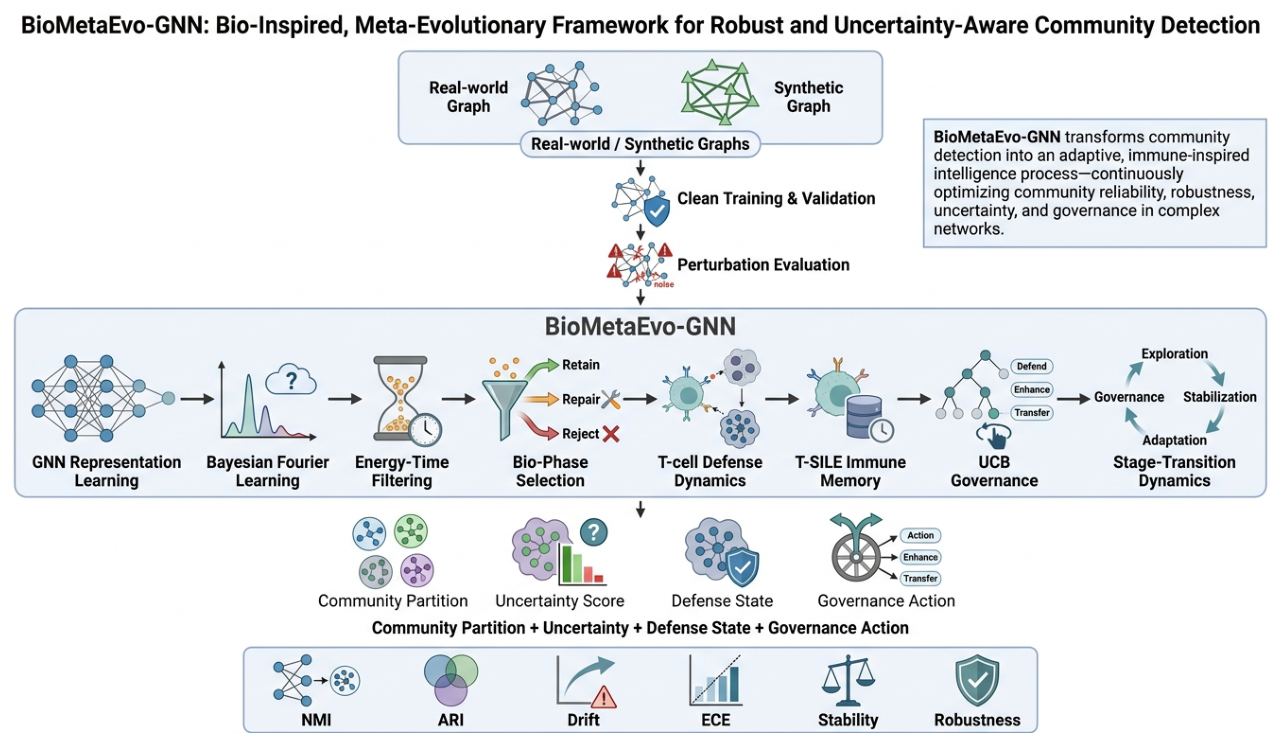
Figure 2.
Landscape of related work and positioning of BioMetaEvo-GNN. Prior studies can be grouped into neural community detection and clustering, robust GNNs, uncertainty quantification, dynamic or temporal graph learning, and adaptive control or governance.
Figure 2.
Landscape of related work and positioning of BioMetaEvo-GNN. Prior studies can be grouped into neural community detection and clustering, robust GNNs, uncertainty quantification, dynamic or temporal graph learning, and adaptive control or governance.
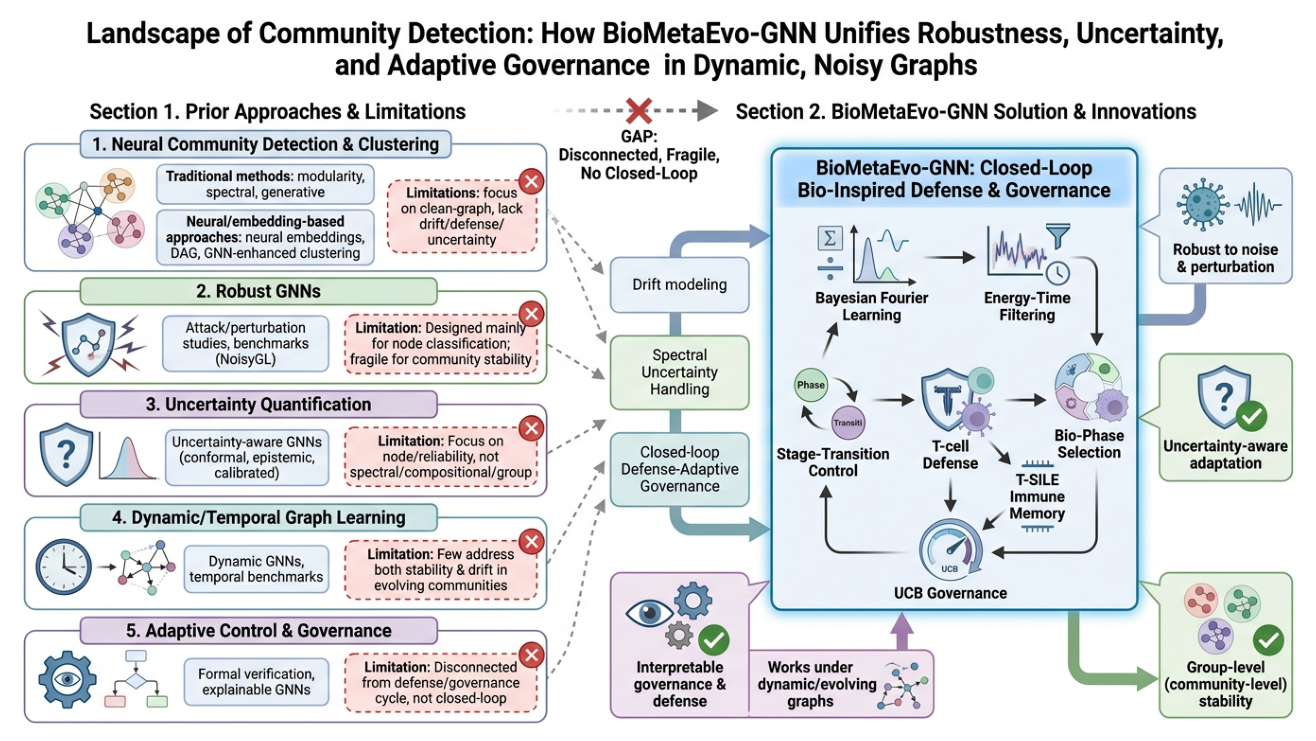
Figure 3.
Overall methodology of the proposed BioMetaEvo-GNN framework. Real-world and synthetic graphs are first processed through clean training and validation stages, followed by perturbation evaluation.
Figure 3.
Overall methodology of the proposed BioMetaEvo-GNN framework. Real-world and synthetic graphs are first processed through clean training and validation stages, followed by perturbation evaluation.
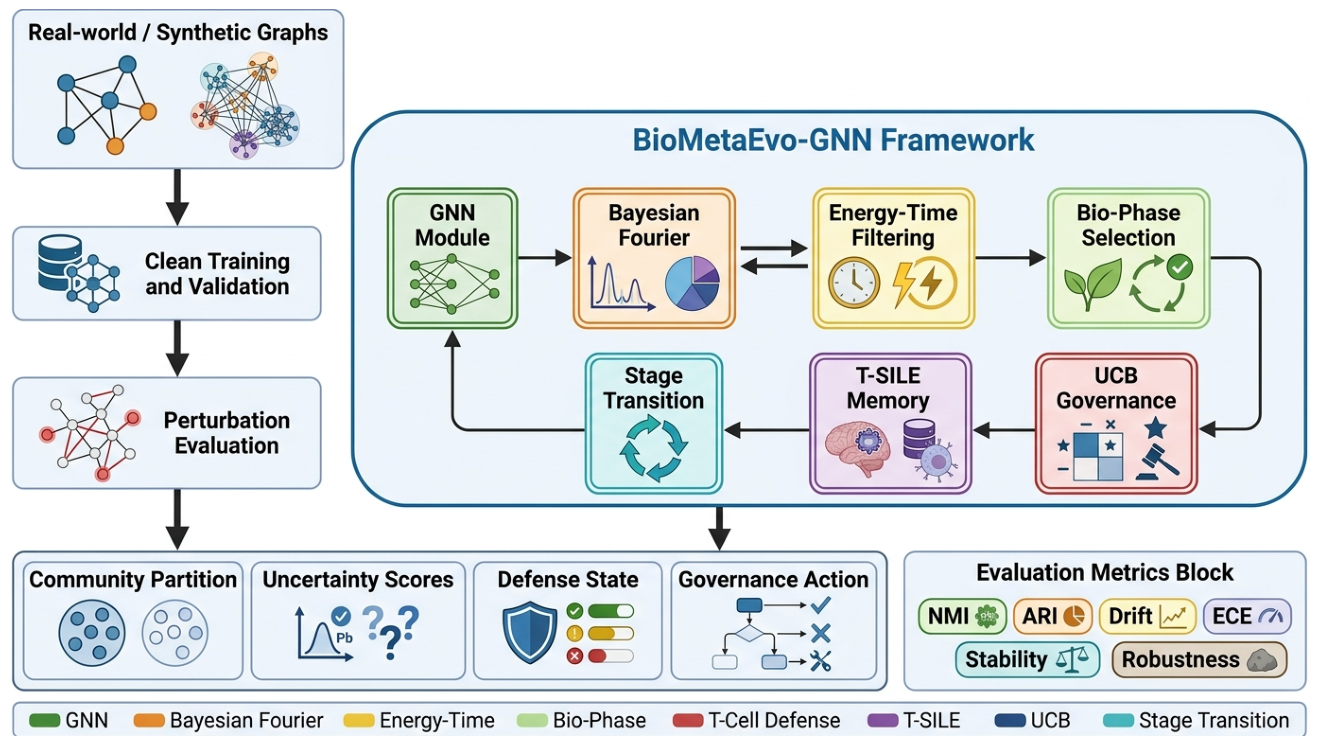
Figure 4.
Schematic workflow of the BioMetaEvo-GNN experimental framework. The evaluation begins with real-world and synthetic graph datasets, followed by clean training and validation.
Figure 4.
Schematic workflow of the BioMetaEvo-GNN experimental framework. The evaluation begins with real-world and synthetic graph datasets, followed by clean training and validation.
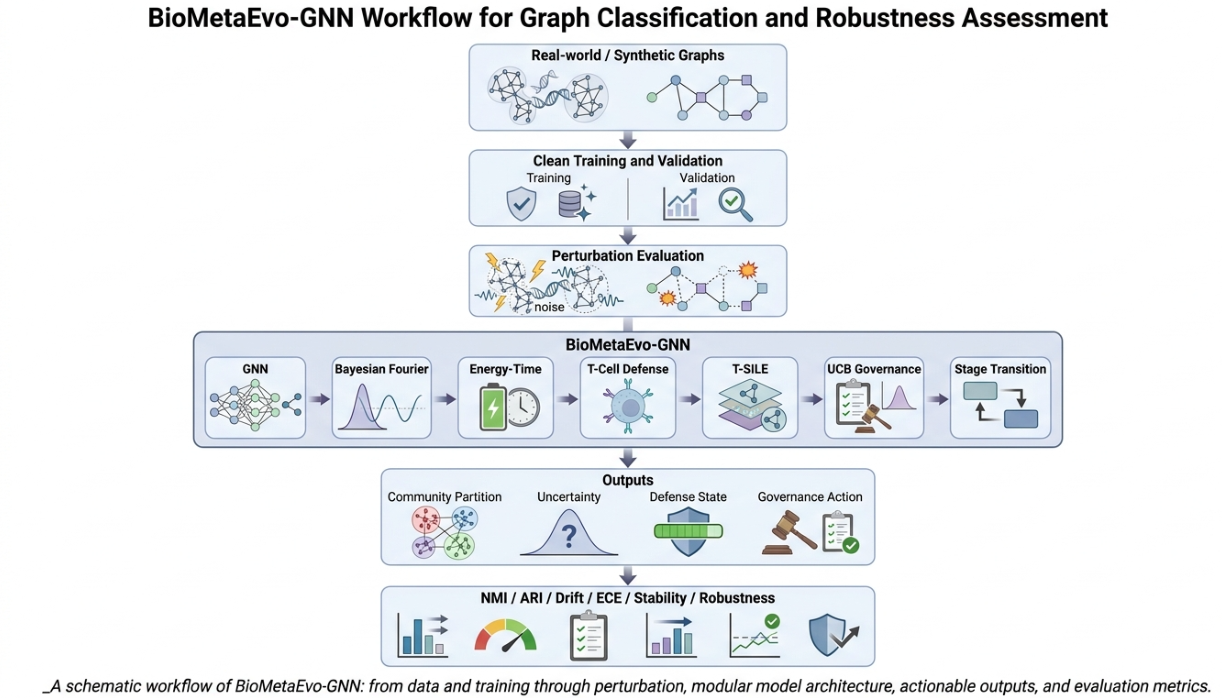
Figure 5.
Clean and perturbed community assignment maps.
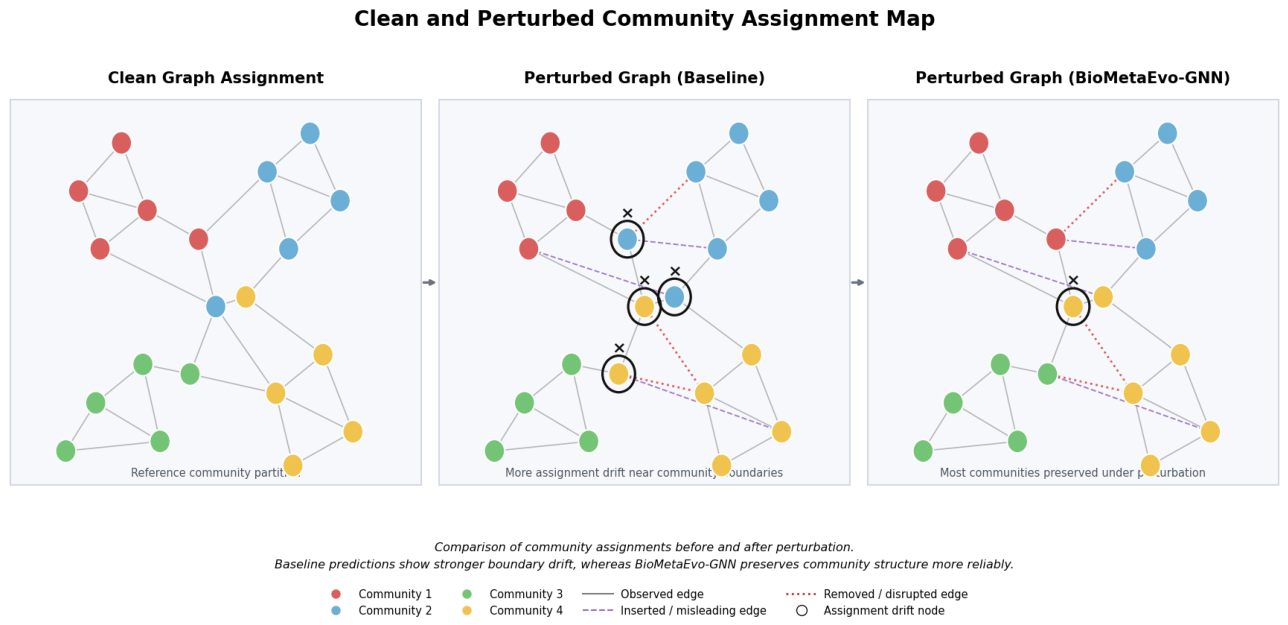
Figure 6.
Perturbation degradation curves concerning edge rewiring, feature masking, and spectral-risk perturbation.
Figure 6.
Perturbation degradation curves concerning edge rewiring, feature masking, and spectral-risk perturbation.
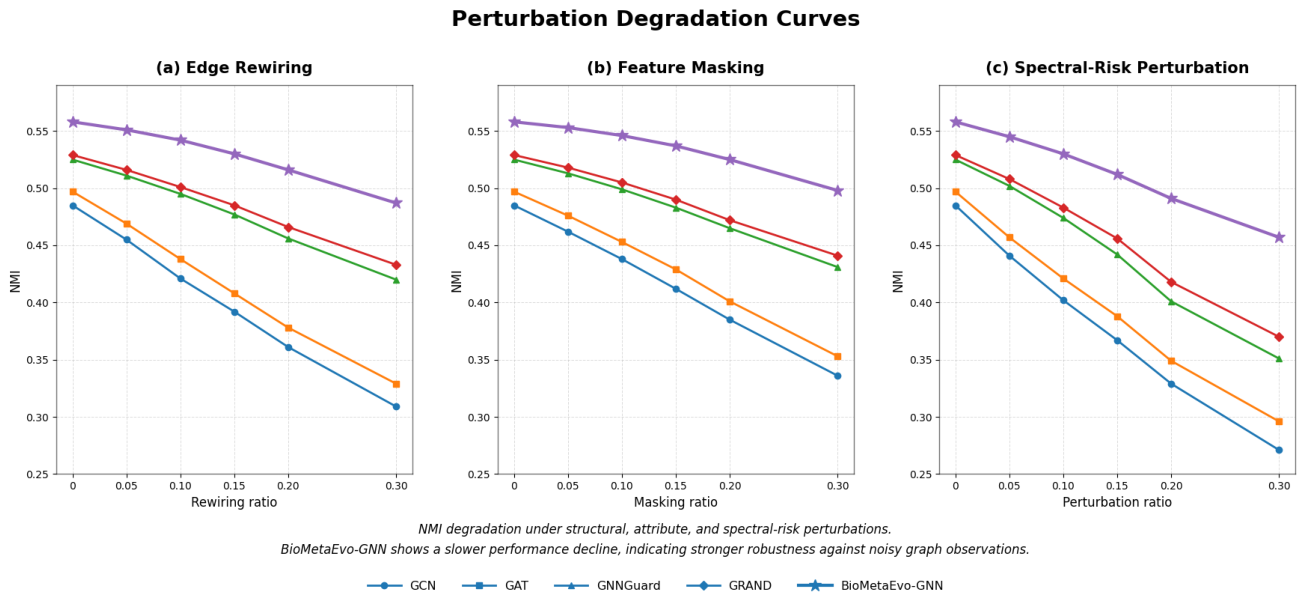
Figure 7.
Bayesian Fourier spectral-uncertainty landscape.
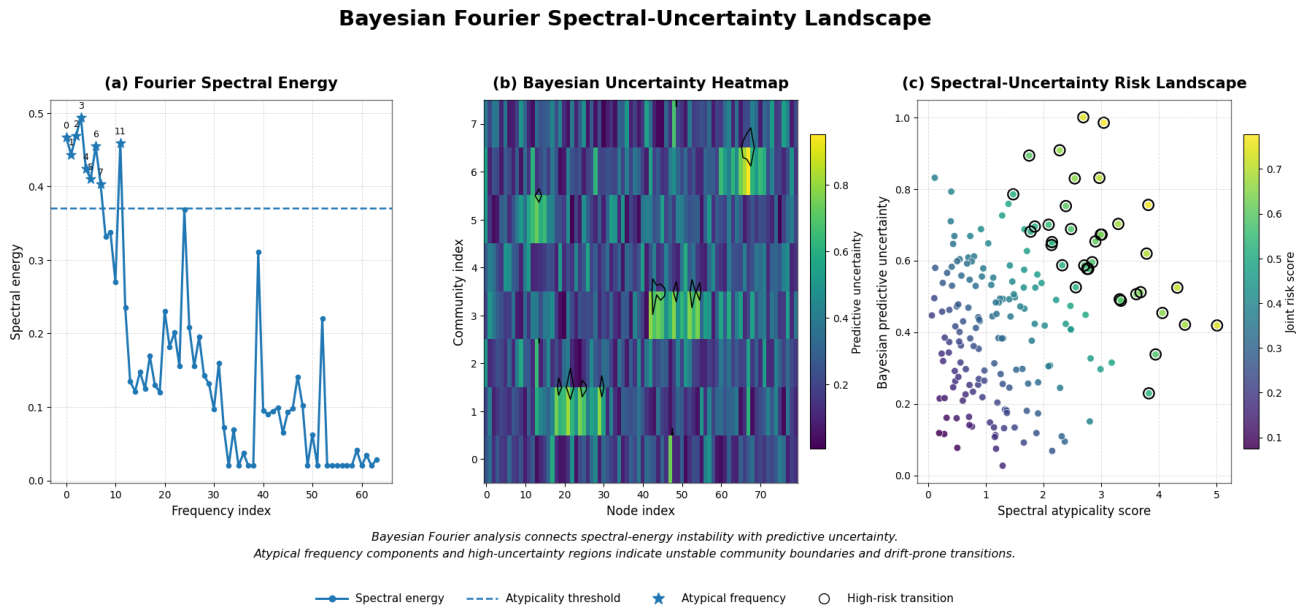
Figure 8.
T-cell defense and T-SILE immune response analysis.
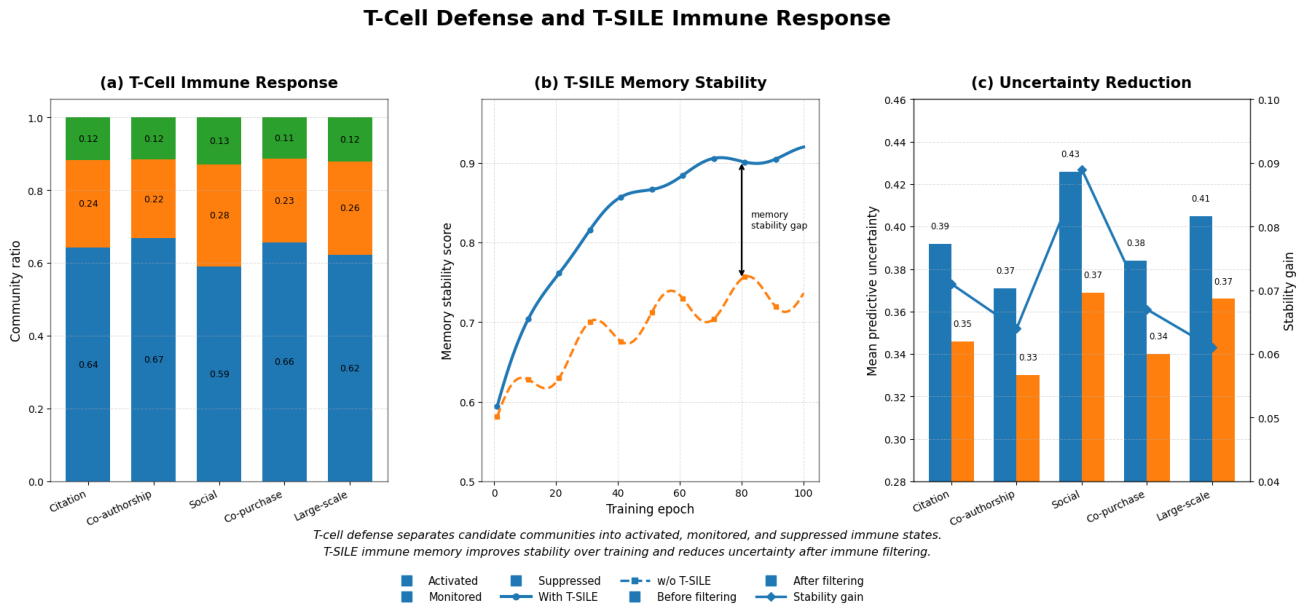
Figure 9.
UCB governance and stage-transition behavior.
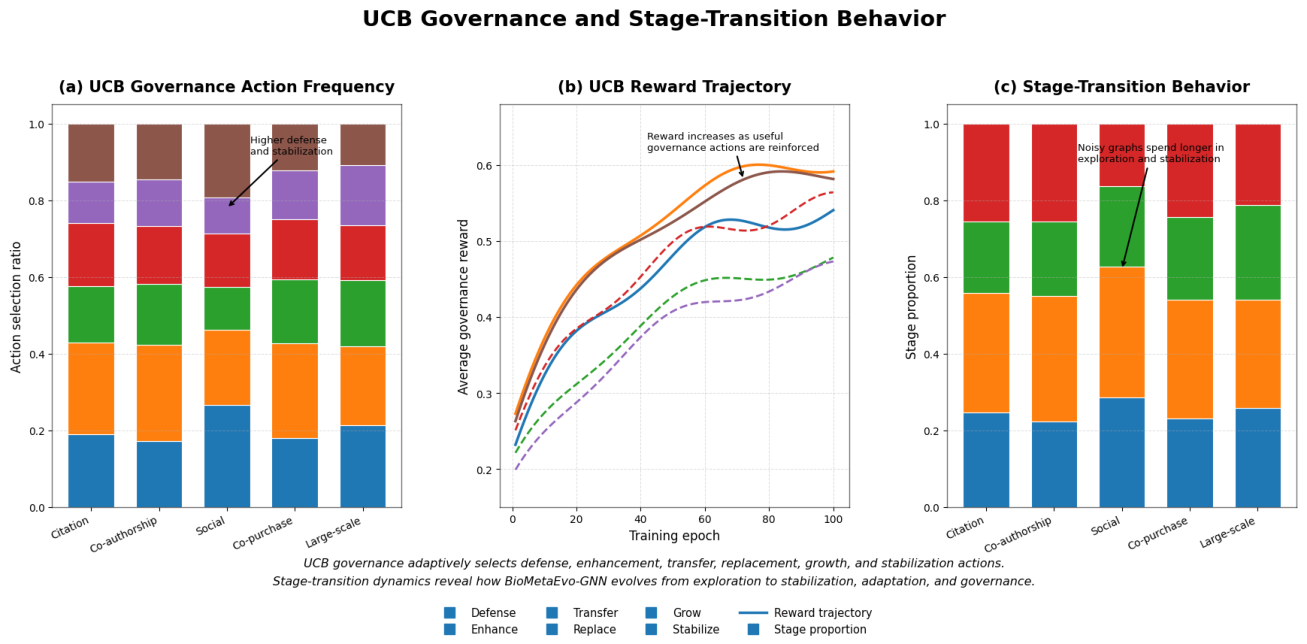
Figure 10.
Ablation study of BioMetaEvo-GNN components.
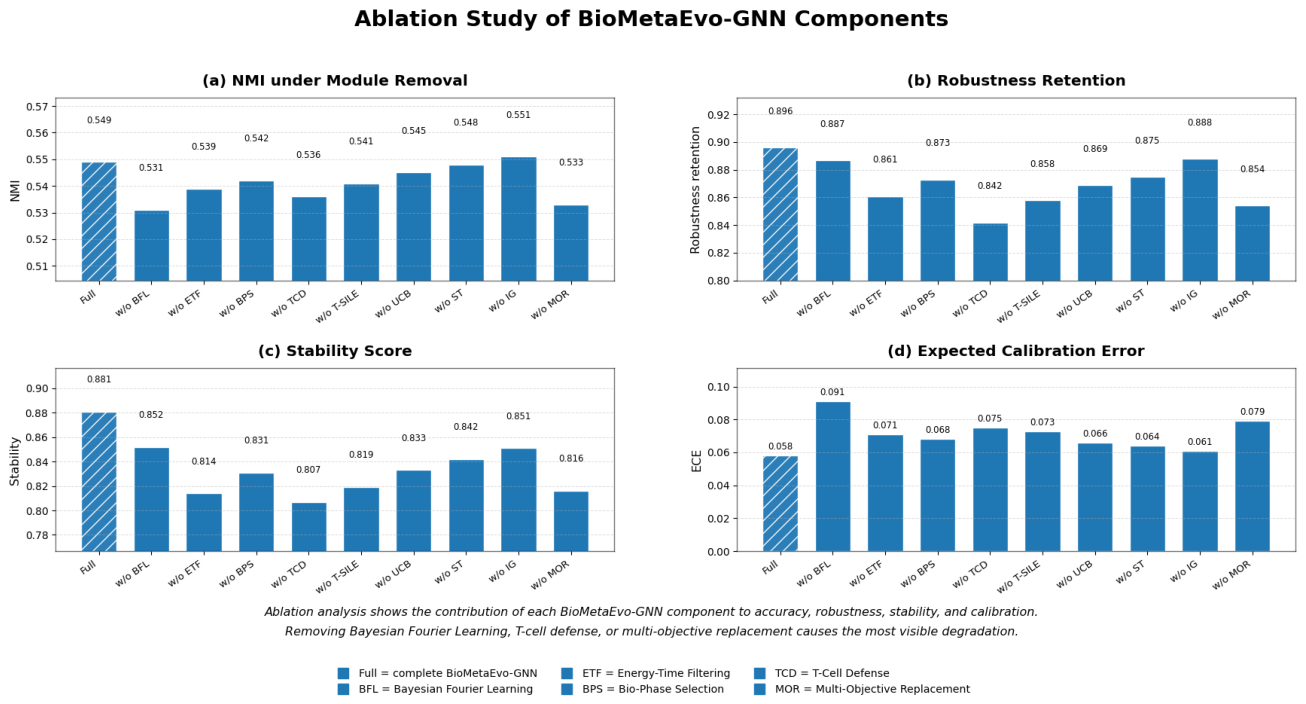
Figure 11.
Runtime-memory scalability analysis.
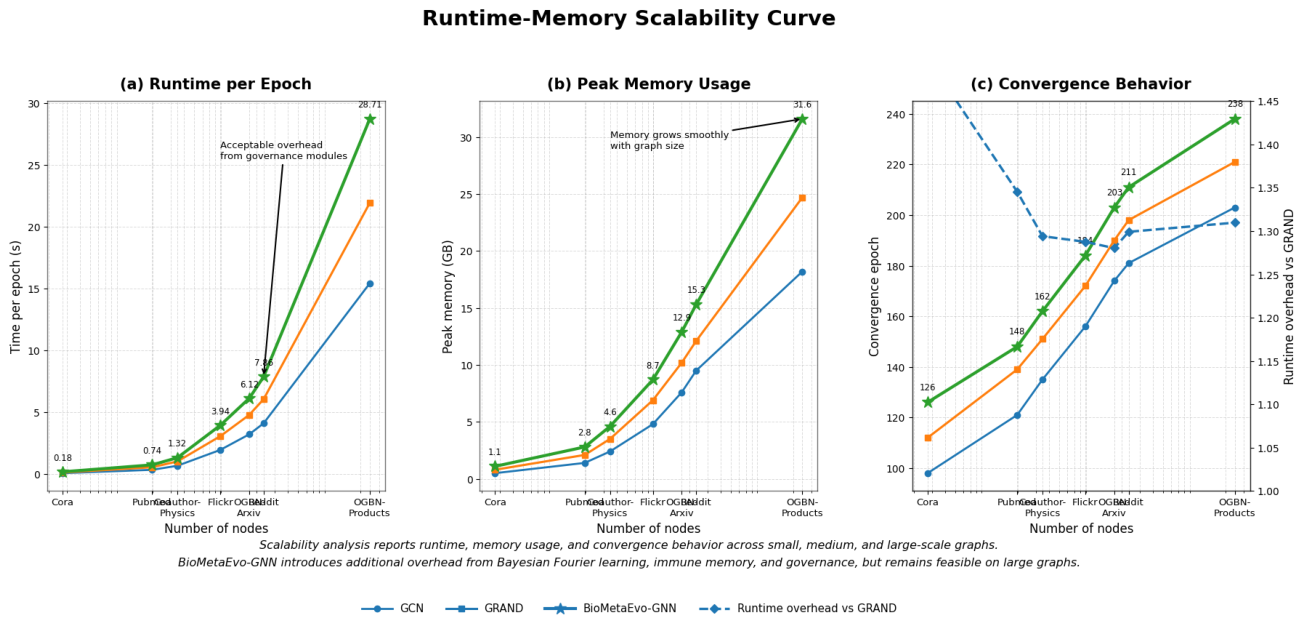
Figure 12.
Failure case and boundary error diagnosis.
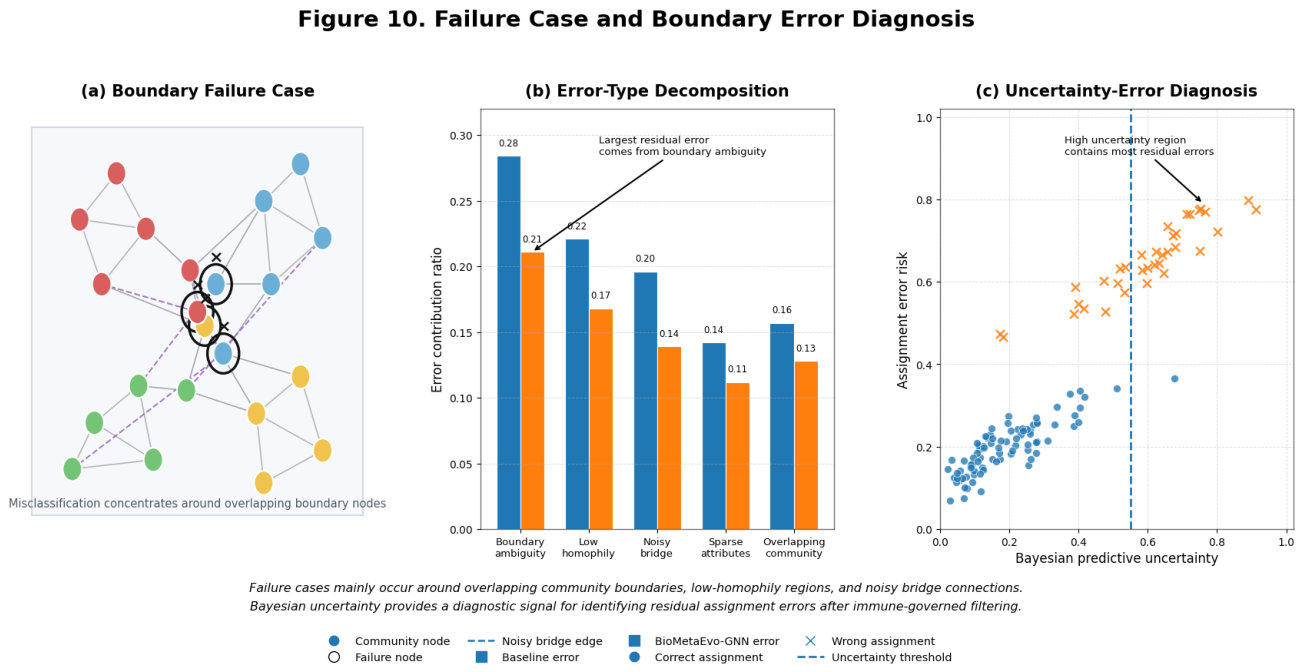
Figure 13.
Cross-dataset generalization and transfer stability analysis.
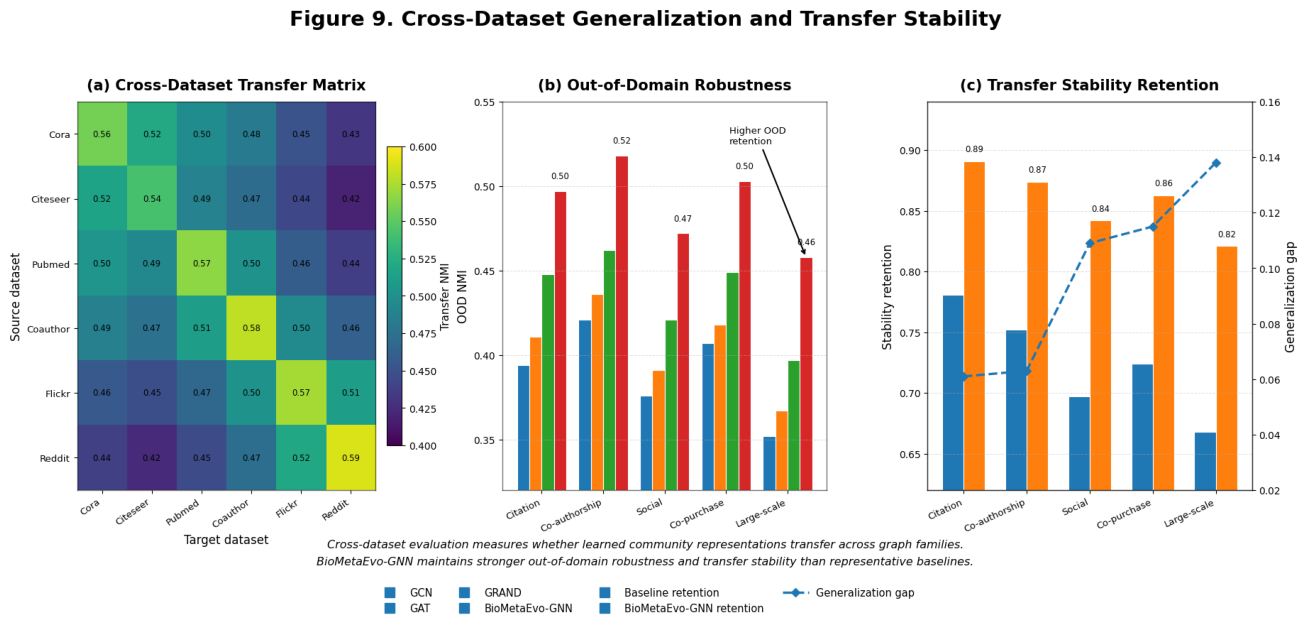
Table 1.
Experimental roadmap for evaluating BioMetaEvo-GNN.
| Evaluation Block | Experiment | Purpose |
|---|---|---|
| Clean graph performance | Main community detection comparison | Evaluates NMI, ARI, Macro-F1, ACC, modularity, and conductance under clean graph conditions. |
| Dataset generalization | Real-world attributed graph evaluation | Tests whether BioMetaEvo-GNN generalizes across citation, co-authorship, social, and co-purchase graphs. |
| Controlled structural analysis | Synthetic graph evaluation | Tests behavior under controlled spectral gap, degree heterogeneity, overlapping communities, feature noise, and heterophily. |
| Structural robustness | Edge dropout, edge insertion, edge rewiring | Measures whether the model preserves community assignments under incomplete or corrupted topology. |
| Attribute robustness | Feature masking and feature noise | Measures whether the model remains stable when node attributes are missing or corrupted. |
| Spectral fragility | Spectral-risk perturbation | Tests whether the model remains stable around boundary nodes and spectrally fragile graph regions. |
| Bayesian Fourier analysis | Spectral uncertainty and calibration | Evaluates whether Bayesian Fourier Learning improves uncertainty estimation and unstable-node localization. |
| Immune defense analysis | T-cell activation, monitoring, suppression | Explains how T-Cell Defense Dynamics filters unreliable candidate communities. |
| Immune memory analysis | T-SILE memory retention | Tests whether immune memory improves stability without preventing genuine community evolution. |
| Meta-governance analysis | UCB action selection | Evaluates whether defense, enhancement, transfer, replacement, growth, and stabilization actions are selected adaptively. |
| Evolutionary behavior | Stage-transition trajectory | Visualizes movement among exploration, stabilization, adaptation, and governance stages. |
| Dynamic expansion | Incremental growth | Tests whether new nodes can be assigned or used to initialize new communities without full retraining. |
| Cross-domain reuse | Transfer evaluation | Tests whether community intelligence learned from one graph benefits related target graphs. |
| Component necessity | Ablation and interaction studies | Quantifies the contribution of each core module and their pairwise interactions. |
| Practical feasibility | Scalability and cost analysis | Reports time, memory, convergence, and overhead on large-scale graphs. |
| Reliability diagnosis | Failure case analysis | Identifies difficult regimes such as heterophily, overlapping communities, hubs, and extreme feature loss. |
| Statistical rigor | Significance testing | Verifies whether performance improvements are statistically meaningful across seeds and datasets. |
Table 2.
Real-world attributed graph datasets used in the experiments.
| Dataset | Nodes | Edges | Features | Communities | Graph Type |
|---|---|---|---|---|---|
| Cora | 2,708 | 5,429 | 1,433 | 7 | Citation |
| Citeseer | 3,327 | 4,732 | 3,703 | 6 | Citation |
| Pubmed | 19,717 | 44,338 | 500 | 3 | Citation |
| Cora-Full | 19,793 | 65,311 | 8,710 | 70 | Citation |
| DBLP | 17,716 | 105,734 | 1,639 | 4 | Co-authorship |
| Coauthor-CS | 18,333 | 81,894 | 6,805 | 15 | Co-authorship |
| Coauthor-Physics | 34,493 | 247,962 | 8,415 | 5 | Co-authorship |
| BlogCatalog | 10,312 | 333,983 | 8,189 | 39 | Social |
| Flickr | 89,250 | 899,756 | 500 | 7 | Social |
| Amazon-Computers | 13,752 | 245,861 | 767 | 10 | Co-purchase |
| Amazon-Photo | 7,650 | 119,081 | 745 | 8 | Co-purchase |
| 232,965 | 11,606,919 | 602 | 41 | Social | |
| OGBN-Arxiv | 169,343 | 1,166,243 | 128 | 40 | Citation |
| OGBN-Products | 2,449,029 | 61,859,140 | 100 | 47 | Co-purchase |
Table 3.
Synthetic graph datasets with controlled structural and spectral regimes.
| Type | Graph Family | Communities | Nodes | Average Degree | Controlled Regime |
|---|---|---|---|---|---|
| T1 | Homogeneous SBM | 5 | 1,000 | 10 | Moderate spectral gap |
| T2 | Weak-signal SBM | 5 | 1,000 | 10 | Weak community separability |
| T3 | Strong-signal SBM | 5 | 1,000 | 10 | Strong community separability |
| T4 | Degree-Corrected SBM | 5 | 1,000 | 10 | Degree heterogeneity |
| T5 | Overlapping SBM | 6 | 1,200 | 12 | Overlapping membership |
| T6 | Hierarchical SBM | 9 | 1,500 | 14 | Hierarchical communities |
| T7 | Assortative–Disassortative SBM | 5 | 1,000 | 10 | Mixed homophily and heterophily |
| T8 | Signed SBM | 5 | 1,000 | 10 | Positive and negative relations |
| T9 | Attributed SBM | 6 | 1,200 | 12 | Feature-topology alignment |
| T10 | Spatial SBM | 8 | 2,000 | 15 | Spatially constrained communities |
| T11 | Feature-Noisy Attributed SBM | 6 | 1,200 | 12 | Attribute corruption |
| T12 | Heterophilous SBM | 5 | 1,000 | 10 | Feature-community mismatch |
Table 4.
Preprocessing settings used across datasets.
| Step | Operation | Purpose |
|---|---|---|
| Duplicate edge removal | Remove repeated edges | Prevent artificial degree inflation. |
| Graph symmetrization | Convert directed graphs to undirected form when required | Ensure consistency for community detection and spectral computation. |
| Self-loop addition | Add identity connections to adjacency matrix | Preserve node self-information in GNN propagation. |
| Feature normalization | Row-normalize node features | Reduce scale imbalance among feature dimensions. |
| Community number setting | Set K to annotated class number | Ensure benchmark comparability. |
| Large-scale handling | Use official splits and mini-batch sampling where applicable | Support OGBN and Reddit-scale experiments. |
| Spectral stability variant | Use largest connected component when needed | Avoid unstable Laplacian decomposition caused by disconnected fragments. |
| Perturbation generation | Apply perturbations after clean model selection | Prevent perturbation-specific overfitting. |
Table 6.
Implementation details for representative baseline groups.
| Baseline Group | Representative Methods | Implementation Setting |
|---|---|---|
| Classical community detection | Louvain, Leiden | Applied directly to graph topology; resolution parameter selected according to validation modularity. |
| Spectral partitioning | EigenPartition | First K normalized Laplacian eigenvectors followed by k-means clustering. |
| Random-walk embedding | DeepWalk, Node2Vec | 128-dimensional embeddings; walk length 80; window size 10; 10 walks per node. |
| Deterministic GNNs | GCN, GAT | Two-layer encoder; hidden dimension 128; dropout 0.5; Adam optimizer; validation-based early stopping. |
| Probabilistic graph models | V-GNN, VGAE | Latent dimension 64; Gaussian posterior; KL weight selected from validation grid. |
| Self-supervised graph learning | DGI, GRACE, MVGRL, BGRL | Shared encoder dimension 128; original contrastive or bootstrap objective; downstream k-means clustering. |
| Deep graph clustering | DAEGC, SDCN, AGC, DMoN | Original clustering objectives retained; identical epoch budget and tuning budget. |
| Differentiable pooling | MinCutPool, DiffPool | Soft assignment matrix with K output clusters; graph-level pooling adapted to community partitioning. |
| Robust graph learning | Pro-GNN, GNNGuard, GRAND | Recommended robust propagation, neighbor reweighting, or stochastic smoothing settings with matched tuning budget. |
Table 7.
Implementation settings of BioMetaEvo-GNN.
| Component | Default Setting | Description |
|---|---|---|
| GNN backbone | Two-layer GCN/GAT-style encoder | Extracts local and high-order graph representations. |
| Hidden dimension | 128 | Matched with random-walk and self-supervised baselines. |
| Bayesian Fourier Learning | Spectral transform with posterior approximation | Captures global frequency patterns and predictive uncertainty. |
| Energy-Time Filtering | selected from validation grid | Suppresses transient representation fluctuation. |
| Bio-Phase Selection | Validation-selected thresholds | Retains, repairs, or rejects candidate communities. |
| T-Cell Defense Dynamics | Defense threshold | Activates, monitors, or suppresses candidate communities. |
| T-SILE memory | Retention coefficient | Maintains stable immune memory prototypes. |
| UCB governance | Exploration coefficient c | Selects adaptive governance actions. |
| Stage transition | Four-stage state space | Models exploration, stabilization, adaptation, and governance phases. |
| Optimization | Adam optimizer | Used for all neural components. |
| Early stopping | Patience 50 | Based on validation NMI and stability objective. |
| Random seeds | 5 runs | Results reported as mean ± standard deviation. |
Table 8.
Hyperparameter search space for BioMetaEvo-GNN.
| Hyperparameter | Meaning | Candidate Values |
|---|---|---|
| Hidden dimension | GNN hidden size | |
| Learning rate | Optimizer step size | |
| Dropout | Feature dropout rate | |
| Weight decay | Regularization strength | |
| Energy-time memory rate | ||
| T-SILE memory retention | ||
| c | UCB exploration coefficient | |
| Fourier loss weight | ||
| Uncertainty loss weight | ||
| Immune loss weight | ||
| Bio-phase retention threshold | Validation selected | |
| Bio-phase repair threshold | Validation selected | |
| T-cell defense threshold | Validation selected |
Table 9.
Perturbation evaluation protocol for robustness testing.
| Perturbation Type | Intensity Range | Applied Object | Evaluation Purpose |
|---|---|---|---|
| Feature noise | Node feature matrix X | Tests robustness to continuous attribute corruption. | |
| Feature masking | Node feature matrix X | Tests robustness to missing or sparse attributes. | |
| Edge dropout | Adjacency matrix A | Tests robustness to incomplete graph observation. | |
| Edge insertion | Non-edge set | Tests robustness to false structural relations. | |
| Edge rewiring | Edge set E | Tests robustness to simultaneous edge deletion and false-link insertion. | |
| Spectral-risk perturbation | top – high-risk nodes/edges | Spectrally fragile regions | Tests stability near ambiguous community boundaries. |
Table 10.
Expanded metric system and interpretation.
| Metric Group | Metrics | Interpretation |
|---|---|---|
| Clean quality | NMI, ARI, Macro-F1, ACC | Measures agreement between predicted communities and benchmark labels. |
| Structural coherence | Modularity, conductance | Measures whether detected communities are internally dense and externally separable. |
| Perturbation stability | Assignment Drift, PNMI, RAUC | Measures whether community assignments remain consistent under noisy observations. |
| Robustness trajectory | NMI, degradation slope | Measures how quickly performance degrades as perturbation intensity increases. |
| Spectral consistency | Dirichlet energy drift, spectral-risk drift | Measures whether representations remain stable in the graph-frequency domain. |
| Uncertainty quality | ECE, predictive entropy, predictive variance | Measures calibration and reliability of uncertainty estimation. |
| Instability localization | Uncertainty–drift correlation, drift AUC | Measures whether uncertain nodes are truly more likely to change assignment. |
| Immune behavior | Activation ratio, monitoring ratio, suppression ratio | Measures how T-cell defense classifies candidate communities. |
| Governance behavior | UCB action frequency, reward trajectory | Measures whether the meta-governance controller adapts to graph conditions. |
| Evolution behavior | Stage ratio, stage transition path | Measures how the framework moves across exploration, stabilization, adaptation, and governance. |
| Dynamic growth | Incremental growth accuracy, new-community precision | Measures whether new nodes and emerging communities are handled reliably. |
| Transferability | Transfer gain, uncertainty reduction | Measures whether stable community intelligence transfers across related graphs. |
| Scalability | Time/epoch, total time, memory, convergence epoch | Measures computational feasibility on large-scale graphs. |
Table 11.
Family-level clean community detection performance.
| Method | Citation NMI | Citation ARI | Coauthor NMI | Coauthor ARI | Social NMI | Social ARI | Co-purchase NMI | Co-purchase ARI |
|---|---|---|---|---|---|---|---|---|
| Louvain | 0.371±0.018 | 0.279±0.017 | 0.398±0.020 | 0.301±0.018 | 0.334±0.023 | 0.249±0.020 | 0.389±0.019 | 0.286±0.018 |
| Leiden | 0.386±0.017 | 0.293±0.016 | 0.416±0.019 | 0.316±0.018 | 0.350±0.022 | 0.263±0.019 | 0.405±0.018 | 0.300±0.017 |
| EigenPartition | 0.402±0.016 | 0.311±0.015 | 0.428±0.018 | 0.330±0.017 | 0.366±0.021 | 0.278±0.018 | 0.420±0.017 | 0.318±0.016 |
| DeepWalk | 0.431±0.015 | 0.340±0.014 | 0.459±0.017 | 0.358±0.015 | 0.391±0.020 | 0.302±0.017 | 0.448±0.016 | 0.347±0.015 |
| Node2Vec | 0.446±0.015 | 0.355±0.014 | 0.471±0.016 | 0.370±0.015 | 0.404±0.019 | 0.317±0.016 | 0.460±0.016 | 0.360±0.015 |
| GCN | 0.485±0.013 | 0.391±0.012 | 0.512±0.014 | 0.417±0.013 | 0.446±0.016 | 0.360±0.015 | 0.502±0.014 | 0.406±0.013 |
| GAT | 0.497±0.012 | 0.405±0.012 | 0.525±0.014 | 0.431±0.013 | 0.458±0.015 | 0.373±0.014 | 0.515±0.014 | 0.420±0.013 |
| V-GNN | 0.511±0.011 | 0.421±0.011 | 0.540±0.013 | 0.448±0.012 | 0.473±0.015 | 0.390±0.014 | 0.531±0.013 | 0.437±0.012 |
| VGAE | 0.506±0.012 | 0.416±0.011 | 0.534±0.013 | 0.442±0.012 | 0.467±0.015 | 0.385±0.014 | 0.526±0.013 | 0.431±0.012 |
| DGI | 0.519±0.011 | 0.428±0.010 | 0.547±0.012 | 0.455±0.011 | 0.481±0.014 | 0.397±0.013 | 0.539±0.012 | 0.446±0.011 |
| GRACE | 0.523±0.011 | 0.432±0.010 | 0.552±0.012 | 0.461±0.011 | 0.486±0.014 | 0.402±0.013 | 0.544±0.012 | 0.451±0.011 |
| MVGRL | 0.521±0.011 | 0.430±0.010 | 0.550±0.012 | 0.459±0.011 | 0.484±0.014 | 0.400±0.013 | 0.542±0.012 | 0.449±0.011 |
| BGRL | 0.518±0.011 | 0.427±0.010 | 0.547±0.012 | 0.456±0.011 | 0.481±0.014 | 0.397±0.013 | 0.538±0.012 | 0.445±0.011 |
| DAEGC | 0.516±0.012 | 0.425±0.011 | 0.544±0.013 | 0.452±0.012 | 0.478±0.015 | 0.393±0.014 | 0.535±0.013 | 0.442±0.012 |
| SDCN | 0.526±0.011 | 0.436±0.010 | 0.556±0.012 | 0.465±0.011 | 0.489±0.014 | 0.407±0.013 | 0.548±0.012 | 0.456±0.011 |
| AGC | 0.520±0.011 | 0.430±0.010 | 0.550±0.012 | 0.458±0.011 | 0.483±0.014 | 0.399±0.013 | 0.541±0.012 | 0.448±0.011 |
| DMoN | 0.531±0.010 | 0.442±0.010 | 0.562±0.012 | 0.471±0.011 | 0.495±0.013 | 0.414±0.012 | 0.554±0.012 | 0.463±0.011 |
| MinCutPool | 0.524±0.011 | 0.434±0.010 | 0.553±0.012 | 0.462±0.011 | 0.487±0.014 | 0.405±0.013 | 0.546±0.012 | 0.454±0.011 |
| DiffPool | 0.520±0.012 | 0.429±0.011 | 0.548±0.013 | 0.457±0.012 | 0.482±0.015 | 0.399±0.014 | 0.541±0.013 | 0.448±0.012 |
| Pro-GNN | 0.522±0.011 | 0.431±0.010 | 0.553±0.012 | 0.462±0.011 | 0.491±0.013 | 0.411±0.012 | 0.551±0.012 | 0.459±0.011 |
| GNNGuard | 0.525±0.011 | 0.435±0.010 | 0.557±0.012 | 0.467±0.011 | 0.496±0.013 | 0.417±0.012 | 0.556±0.012 | 0.466±0.011 |
| GRAND | 0.529±0.010 | 0.440±0.010 | 0.561±0.012 | 0.470±0.011 | 0.500±0.013 | 0.421±0.012 | 0.559±0.012 | 0.470±0.011 |
| BioMetaEvo-GNN | 0.558±0.009 | 0.473±0.009 | 0.592±0.010 | 0.503±0.009 | 0.536±0.011 | 0.455±0.010 | 0.594±0.010 | 0.507±0.009 |
Table 12.
Dataset-level NMI comparison.
| Dataset | Leiden | Node2Vec | GAT | VGAE | GRACE | DMoN | GNNGuard | GRAND | BioMetaEvo-GNN |
|---|---|---|---|---|---|---|---|---|---|
| Cora | 0.421 | 0.468 | 0.512 | 0.523 | 0.541 | 0.552 | 0.548 | 0.554 | 0.584 |
| Citeseer | 0.386 | 0.431 | 0.487 | 0.496 | 0.512 | 0.523 | 0.518 | 0.526 | 0.557 |
| Pubmed | 0.402 | 0.456 | 0.501 | 0.514 | 0.531 | 0.538 | 0.533 | 0.539 | 0.568 |
| Cora-Full | 0.335 | 0.429 | 0.488 | 0.491 | 0.507 | 0.511 | 0.503 | 0.510 | 0.541 |
| DBLP | 0.401 | 0.459 | 0.521 | 0.534 | 0.548 | 0.559 | 0.554 | 0.560 | 0.591 |
| Coauthor-CS | 0.428 | 0.481 | 0.538 | 0.552 | 0.568 | 0.576 | 0.571 | 0.579 | 0.611 |
| Coauthor-Physics | 0.425 | 0.474 | 0.526 | 0.541 | 0.558 | 0.566 | 0.561 | 0.569 | 0.603 |
| BlogCatalog | 0.319 | 0.382 | 0.441 | 0.459 | 0.476 | 0.487 | 0.491 | 0.496 | 0.535 |
| Flickr | 0.356 | 0.406 | 0.462 | 0.476 | 0.493 | 0.501 | 0.506 | 0.512 | 0.548 |
| Amazon-Computers | 0.411 | 0.472 | 0.523 | 0.536 | 0.552 | 0.563 | 0.566 | 0.571 | 0.608 |
| Amazon-Photo | 0.437 | 0.489 | 0.542 | 0.558 | 0.573 | 0.584 | 0.586 | 0.591 | 0.623 |
| 0.377 | 0.425 | 0.471 | 0.489 | 0.505 | 0.514 | 0.518 | 0.523 | 0.557 | |
| OGBN-Arxiv | 0.392 | 0.437 | 0.491 | 0.506 | 0.521 | 0.529 | 0.532 | 0.538 | 0.566 |
| OGBN-Products | 0.385 | 0.431 | 0.485 | 0.502 | 0.517 | 0.526 | 0.531 | 0.536 | 0.562 |
Table 17.
Synthetic graph performance under controlled regimes.
| Synthetic Type | GCN | GAT | VGAE | GRAND | BioMetaEvo-GNN |
|---|---|---|---|---|---|
| T1 Homogeneous SBM | 0.641 | 0.655 | 0.668 | 0.681 | 0.714 |
| T2 Weak-signal SBM | 0.438 | 0.452 | 0.471 | 0.492 | 0.536 |
| T3 Strong-signal SBM | 0.782 | 0.795 | 0.803 | 0.811 | 0.836 |
| T4 Degree-Corrected SBM | 0.573 | 0.589 | 0.604 | 0.621 | 0.662 |
| T5 Overlapping SBM | 0.421 | 0.437 | 0.456 | 0.474 | 0.519 |
| T6 Hierarchical SBM | 0.694 | 0.708 | 0.721 | 0.737 | 0.768 |
| T7 Assortative–Disassortative SBM | 0.466 | 0.482 | 0.501 | 0.523 | 0.561 |
| T8 Signed SBM | 0.493 | 0.508 | 0.526 | 0.544 | 0.579 |
| T9 Attributed SBM | 0.682 | 0.697 | 0.713 | 0.729 | 0.761 |
| T10 Spatial SBM | 0.527 | 0.543 | 0.561 | 0.582 | 0.619 |
| T11 Feature-Noisy Attributed SBM | 0.481 | 0.496 | 0.517 | 0.539 | 0.586 |
| T12 Heterophilous SBM | 0.392 | 0.407 | 0.426 | 0.448 | 0.491 |
Disclaimer/Publisher’s Note: The statements, opinions and data contained in all publications are solely those of the individual author(s) and contributor(s) and not of MDPI and/or the editor(s). MDPI and/or the editor(s) disclaim responsibility for any injury to people or property resulting from any ideas, methods, instructions or products referred to in the content. |
© 2026 by the authors. Licensee MDPI, Basel, Switzerland. This article is an open access article distributed under the terms and conditions of the Creative Commons Attribution (CC BY) license (http://creativecommons.org/licenses/by/4.0/).
Copyright: This open access article is published under a Creative Commons CC BY 4.0 license, which permit the free download, distribution, and reuse, provided that the author and preprint are cited in any reuse.


