

Submitted:
14 June 2026
Posted:
16 June 2026
You are already at the latest version
Abstract
This article reviews several series of peaceful underground nuclear explosions (UNEs) conducted in the Soviet Union and focuses on the radioecological situation in the areas where they were conducted, which has been studied over the past 30 years. It has been shown that the main cause of radioactive contamination of the surface above the site of peaceful UNEs is the presence of underground and groundwater, which facilitate the migration of radionuclides to the surface and their further spread beyond the test area. Using the example of the Moon, it is shown that on celestial bodies considered as objects of future colonization, such as Mars, the moons of Jupiter and minor bodies of the asteroid belt, where hydrodynamic activity near the surface is absent or significantly limited, peaceful UNEs can be used not only for seismic sounding of the subsurface, but also as artificial geothermal energy sources for inhabited bases, capable of ensuring their functioning for decades.
Keywords:
underground nuclear explosion
; radionuclides
; heat flow
; thermoelectric generator
; nuclear warhead
; nuclear charge
1. Introduction
The current international situation indicates the inevitability of the resumption of nuclear testing by leading nuclear powers [1]. Most likely they will start with underground nuclear explosions (UNEs). In this regard, it is of interest to become familiar with the current state of the radioecological situation in areas where UNEs were conducted in the 20th century. Most of the literature devoted to this issue regarding the current radioecological situation in the regions where nuclear explosions were conducted in the USSR is written in Russian and outside the purview of Western researchers.
On the other hand, the creation of military space forces by nuclear powers [2,3] also points to the inevitable deployment of nuclear weapons in space in the distant or near future, despite the ‘Treaty on Principles Governing the Activities of States in the Exploration and Use of Outer Space, including the Moon and Other Celestial Bodies’ of 1967 [4] that was signed when military space forces existed only in science fiction. The current state of affairs on planet Earth, associated with overpopulation, poverty, famine, terrorism, and wars, will lead in the future to a rapid expansion of humanity into space, with the deployment of nuclear technologies [5], including military ones. We base this last assertion on the fact that, despite the creation of the UN in 1945, the world’s leading countries have repeatedly unleashed wars around the world, ignoring the UN charters, and in recent decades this fashion has become the norm [6]. The uselessness of the UN as a legal factor in deterring wars has been repeatedly stated by today’s politicians [7]. The situation is especially aggravated by the world media’s promotion of the concept of a ‘dictator’, who is a global evil, sits in some country and torments its population, and then follows, first by hint, and then in plain text, a statement about a mission, approved almost by God himself, to overthrow him [8]. Subsequent events lead to the destruction of civil, industrial, and administrative infrastructure, civil war, and a humanitarian catastrophe in the region where the ‘dictator’ ruled, with brazen statements from politicians in the countries who had staged a ‘divine mission’ to overthrow the ‘dictator’, that the people are in any case better off now than under the ‘dictator’ [9]. Such blatant, unpunished meanness on the world stage is worsening and will sooner or later lead to another global catastrophe, which humanity endured twice in the first half of the 20th century and is unlikely to survive another one accompanied by thermonuclear tornadoes, no matter what super-sophisticated bunkers the current global elites have acquired [5,10]. There is only one way for the world elites to save themselves and their genes and continue their ‘divine line’ – before the thermonuclear catastrophe that they will cause, they will flee into space to inhabited bases, where they will send all their technologies, including nuclear ones [5].
2. Peaceful UNEs in 20th Century
From 1965 to 1988, 124 peaceful UNEs were carried out at national economic facilities in the USSR, of which 98 nuclear tests were conducted in regions where oil and gas resources were being developed in all oil and gas provinces of the country [11]. UNEs at these fields were carried out to intensify oil and gas production, construct underground storage tanks (UST) for storing hydrocarbon products and to suppress open gas fountains; to shape the terrain during the construction of canals, dams and reservoirs; for deep seismic sounding of the subsoil; and for the disposal of biologically hazardous industrial wastewater [11,12,13]. Nuclear charges at these fields were detonated both directly in productive deposits and beneath them, as well as in the salt-bearing and terrigenous deposits of the caprock of gas and gas condensate fields. The main channels for the migration of radionuclides from the cavity of a nuclear explosion and UST are man-made cracks that unite productive and aquiferous horizons into a single hydrodynamic system; permeable strata; highly permeable collapse columns; behind-the-casing and inter-casing spaces in technological wells in which a nuclear charge was detonated; the shafts of these wells [11,13].
All UNEs had a significant seismic effect. The peaceful UNEs had varying power: from 0.01 to 140 kt, so seismic waves from the strongest of them could be recorded at distances of up to several thousand kilometers [12]. Nuclear charges, the power of which was estimated mainly from units to several tens of kilotons, were detonated at depths from 100 m to 2900 m. The entry of formation water into the cavities of nuclear explosions led to the formation of liquid high- and medium-level radioactive waste, which easily migrated into overlying productive strata, aquifers, zones of active water exchange, and onto the surface [13]. We will demonstrate in this work that peaceful UNEs on the colonized celestials can be an energy sources competitive with nuclear reactors.
2.1. Gnome UNE
The Gnome UNE (USA, 1961) conducted in a rock salt [14]. Special attention in the study [14] is given to the possible influence of the underground nuclear test Gnome, conducted in 1961 within the Salado Formation at the depth is 360.9 m in a layer of rock salt, the power is 3.1 kt, nuclear charge is a weapons-grade plutonium 239Pu. The geological structure of the UNE Gnome is shown in Figure 1. According to the authors, the detonation could have modified the stress state of the surrounding rock mass and potentially enhanced fracture permeability. Nevertheless, the study emphasizes that the primary factor controlling the development of karst processes and the associated risks of water inflow is the presence of water-bearing horizons in adjacent geological layers.
The analysis therefore suggests that the main environmental concern associated with underground nuclear explosions in salt formations is not the explosion itself but the hydrogeological context in which it occurs. If water-bearing strata exist near the explosion horizon, dissolution of salt and subsequent karst development may lead to the formation of pathways for groundwater migration. These processes may ultimately increase the risk of water penetration into underground cavities or engineered repositories. Thus, a study [14] analyzing the activation of salt karst processes and the potential flooding risk for the Waste Isolation Pilot Plant, located at a distance of 7 km from the ‘Gnome’ and at the same depth, emphasizes the importance of hydrogeological conditions in salt formations hosting underground nuclear experiments.
2.2. Halite UNEs
The Halite series – more than 20 UNEs in USSR between 1966 and 1979 years conducted in salt formations (Kazakhstan, Azgir deposit, located in the sands of the Caspian lowland, in the interfluve of the Volga and Ural rivers, closer to the Volga near the border with Astrakhan Oblast), primarily associated with the creation of underground cavities for gas storage and with technological experiments [15]. As a result of these UNE, nine stable underground cavities were formed with a total volume of approximately 1.2 million m3, without noticeable disturbance of the ground surface in the epicentral zones. The nuclear charges were placed at depths ranging from 161 to 1041 m, with power ranging from 0.01 to 103 kt. At depths of 30 to 200 m, there are Pliocene and Neogene deposits consisting of clays interbedded with sands and sandstones containing aquifers. From 200 to 400 m, there are Cretaceous and Jurassic deposits: clays, marls, and occasionally limestones. The salt core is located at depths ranging from 200–400 m to several km; its composition is predominantly halite (rock salt) interbedded with anhydrite, polyhalite, and carnallite. The halite content reaches 90–98%.
Studies conducted at the Halite site in 1991 [15] concluded that significant changes in soils and vegetation were observed primarily within the industrial areas and were absent outside of them; the fauna in the Azgir deposit area is indistinguishable from that of the surrounding area; no adverse effects of nuclear explosions on the biota as a whole or its individual components were detected; and drinking water sources around the Halite site do not contain elevated levels of radioactivity. In the 2000s, at the Halite site, now defunct, almost all the tanks were filled with radioactive brine.
2.3. Crystal UNE
Peaceful underground nuclear explosion “Crystal”, conducted in 1974 in Western Yakutia (USSR), approximately 6.7 km from the town of Udachny, at a depth 98 m with power 1.7 kt within permafrost rocks [16,17]. Experiment aimed at studying the geo-mechanical response of compact geological formations to underground nuclear detonations, obtaining the seismic wave data that allowed the identification of lateral velocity variations within the upper mantle beneath the Siberian craton. From the surface to a depth of 50 m, there are Quaternary deposits + permafrost zone, represented by frozen loose rocks, loams, sands, and diluvial-alluvial deposits with ice inclusions. From a depth of 50 m to 150 m there are carbonate rocks (this is the explosion zone), represented by dense limestones, which are fractured, but with low porosity, frozen. From a depth of 150 m to 300 m there is a carbonate layer, represented by denser and less fractured limestones and dolomites, which partially transition to more ancient platform deposits. In 2006, to improve the radiation situation above the Kristall nuclear explosion well, a mound up to 300 m in diameter and up to 20 m in height was created from waste rock fragments from the Udachnaya kimberlite pipe quarry located nearby.
In 2019, at the combat well site of the Crystal UNE, along with the release of underground brines, the seepage of uranium-containing sulfate drainages from the subsoil was detected for the first time [16]. The uranium concentration in these discharges was up to 30 times higher than the local background level in river water. In modern natural systems of the earth’s crust, the mass ratio 238U/235U is constant and equal to 137.88, which is also true for natural aquatic systems. In 2019, a collection of surface waters (25 samples) was collected from the Crystal site and local watercourses. Analyses showed that the 238U/235U isotope ratios in water samples from the Crystal nuclear explosion site do not differ from local river water and generally correspond to the natural ratio.
The content of man-made radionuclide tritium in surface waters of the area of peaceful UNE Crystal is considered [17]. During the first year after the explosion, the bulk of short-lived isotopes decay. Then, for a long period of time (up to 150 years after the explosion), the main activity carriers are tritium 3H with a half-life T1/2 = 12.3 years, fragmentation radionuclides 90Sr (T1/2 = 29.1 years), 137Cs (T1/2 = 30.0 years) and Pu isotopes with longer half-lives. After 44 years after the explosion, 3H remains one of the main indicators of radionuclide distribution in the geotechnogenic system “UNE cavity - host geological environment - earth’s surface” due to its high aqueous mobility.
The destruction of rock continuity and permafrost degradation led to the formation of a fluid-permeable weakened zone with a radius of up to 200 meters around the Crystal combat borehole. In August 2018, fieldwork was conducted at the Crystal site. Sounding revealed a local hydrogeological anomaly—an upwelling of pressurized underground brines 260-300 meters below the explosion epicenter. Seepage of underground brines containing tritium and radiostrontium was detected within the Crystal epicenter. A total of eight surface water samples were collected at the facility’s process site. It was found that the volumetric activity of tritium in surface waters at the combat well site reached only 12 Bq/l, which is 630 times lower than the intervention level for drinking water (7600 Bq/l) according to current radiation safety standards, but at the same time it is almost 5.5 times higher than the regional background level of tritium in river water (about 2.2 Bq/l).
In 2025, the 3H activity in water runoff from under the embankment was only 4–12 Bq/dm3, 90Sr – 0.004–0.4 Bq/dm3, 238,239,240Pu were not detected (<0.000001 Bq/dm3) [18]. According to these indicators, there is currently no need for additional measures to strengthen or modify the embankment.
2.4. Kraton-3 UNE
The Kraton-3 UNE was detonated in 1978 in the upper reaches of the left tributary of the Vilyuy River (Western Yakutia, USSR) at a depth of 577 m, with a nuclear charge of 22 kt for seismic sounding purposes [19,20]. The charge was placed in a submerged carbonate complex of limestone, dolomite, and marl, containing pressurized brines with a mineralization of 400 g/l at subzero temperatures (cryopegs). This resulted in an emergency radioactive release of 500 R/h over a distance of 3 km. The area of the explosion was exposed to an average radiation level of 10 R.
The radioactive gas-dust cloud moved in a north-easterly direction, which led to the radiation-induced die-off of a taiga forest in the first 3 km of its movement. One year after the explosion, the bulk of short-lived isotopes had decayed [20]. The total activity released onto the earth’s surface during the accident explosion was approximately 4800 Ci after 1 year; after 31 years, by October 2009, as a result of natural decay, according to calculations, it should have decreased to 294 Ci [20]. But all these years, surface activity, under the influence of exogenous and biogenic processes, was subject to redistribution, removal and redeposition both within the dead forest and in adjacent landscapes. To the south of the dead forest, in small areas of living forest, in 2008, areas with a radiation dose rate of 8-12 μR/h were discovered. These areas represent local spots of radioactive contamination formed from matter carried by gusts of wind from the main radioactive cloud moving to the east.
Material for radioisotope analysis was collected in the vicinity of the Craton-3 in August 2004 [19]. Five biotopes were studied in the vicinity of the Craton-3. Samples of soil, plants, the gastrointestinal tract and carcasses of small mammals were taken to determine the content of artificial 137Cs. Embryo resorption was observed in 27% of the collected pregnant female red-backed voles. This is a process in which an embryo that has already formed at an early stage stops developing and is then gradually destroyed and “absorbed” by the mother’s body. Gamma-spectral analysis of the soil samples revealed high contents of 137Cs and 40K. The specific activity of 137Cs is high in the upper soil layers to a depth of 20-40 cm in the immediate vicinity of the Craton-3 UNE epicenter. In the epicenter area, elevated levels of 137Cs were found in lichens, mosses, in the muscle tissue of small mammals and in their gastrointestinal tract compared to the control.
The EDR field is formed due to the presence of 137Cs in the forest litter and humus horizon: the correlation coefficient between the EDR and the 137Cs content was 0.87 in 2015 [20]. During the studies in 2015, it was discovered that in small streams and thermokarst reservoirs around the mouth of the Kraton-3 combat well, the concentrations of Cl− were increased – up to 1550 mg/l, Na+ – up to 155 mg/l, Ca2+ – 430 mg/l, Mg2+ – 250 mg/l, while their usual average concentrations in surface waters of the region are 0.5–5, 3, 50, 15 mg/l, respectively. Tritium was detected in these chloride waters: in 1996, the activities of 3H were established as (700±250) Bq/l, in 2001 – (320 ± 32) Bq/l, in 2008 – (68.2 ± 1.9) Bq/l, in 2015 – (5.1 ± 2) Bq/l.
In 2009, man-made radionuclides were detected in a river water sample near the combat well – 239,240Pu (6 ± 0.24)·10−4, 238Pu (18.6 ± 0.7)·10−3, and the tritium activity was (52.1 ± 2.6) Bq/l [20]. High tritium activities were found in water samples at a distance of up to 3 km from Kraton-3. Based on this, it was assumed that there is an underwater release of radionuclides from the explosion zone. In 2015, a decrease in the 238U/235U isotope ratio to 136 was detected in river water at a distance of up to 4 km from the site, compared to the usual natural ratio of 137.9. That is, the release of underground activity along the fractured fault zone continues. At the same time, radionuclide activity in surface waters near Kraton-3 does not pose an environmental hazard. Tritium activity is significantly reduced due to its short half-life and its dispersibility due to its high-water mobility.
2.5. Vega UNE
The article [15] reviews the environmental and technological consequences of the Vega underground nuclear explosion complex, located in the Astrakhan region (USSR) within the Astrakhan gas-condensate field. The Vega project was implemented between 1980 and 1984 and involved 15 underground peaceful nuclear explosions with nuclear charges ranging from approximately 3.2 to 13.5 kt. The explosions were conducted at depths of roughly 900–1100 m in rock salt formations in order to create underground cavities intended for industrial use, primarily for the storage of gas condensate and related petrochemical products.
The temperature within the underground cavities formed by the Vega nuclear explosions stabilized at 110–126 °C approximately two years after detonation. By 1989, temperatures had decreased almost everywhere to about 76 °C, while in cavity 4T (depth 1050 m, charge 8.5 kT) they dropped to 59 °C, approaching the natural geothermal conditions characteristic of the salt dome at this depth (55.7–57.3 °C). No impact of contaminated surface areas at the peaceful nuclear explosion sites—characterized by locally elevated technogenic gamma radiation background—on the vegetation cover beyond the boundaries of these sites was detected.
The article [15] emphasizes that hydrogeological conditions—particularly the presence and behavior of saline groundwater—are the key factors governing the long-term safety of underground nuclear explosion sites.
2.6. Globus-2, Agat and Rubin-1 UNEs
The article [21] presents the results of studies of the radiation-hygienic and sanitary condition of the territories around the Globus-2, Agat and Rubin-1 peaceful nuclear explosion sites. All three explosions were conducted for geoseismic sounding of the earth’s crust and mantle in a routine manner, that is, without the dynamic release of radioactive products into the atmosphere. The ‘Agat’ peaceful nuclear explosion took place in 1985 in the Arkhangelsk region (USSR), 2 km from the coast of the White Sea. The depth of the charge was 772 m, the power of the nuclear charge was 8.5 kT. The charge of the “Agat” explosion was placed in the rocks of the crystalline basement in intensively dislocated deeply metamorphosed biotite and epidote-biotite gneisses of the Lower Archean, on which lie clay deposits with a thickness of 370 m, siltstones and argillites of the Vendian with a thickness of 167 m. The explosion was carried out on a gently undulating marine plain with ledges of abrasion terraces (moss-lichen and dwarf shrub tundra) in combination with taiga raised bogs on peat-podzolic-gley soils [22].
The Globus-2 explosion occurred in 1971 in the south of the Arkhangelsk region (USSR) 500 km from the White Sea, at a depth of 595 meters, with a nuclear charge of 2.3 kt. The Rubin-1 explosion occurred in 1988, to the east of the Globus-2 facility, approximately 1,300 meters away. The charge was buried at a depth of 820 meters, with a nuclear charge yield of 8.5 kilotons. For these two explosions, the terrain is a glacial-lake plain with mid-taiga pine forests combined with spruce forests and swamps, with a patchy ground cover [22]. The Globus-2 nuclear charge is embedded in a layer at a depth of 400 to 700 m (600 – 900 m for Rubin-1) in dense rocks of the Middle Carboniferous with good acoustic conductivity in the form of limestone, dolomite, and marl.
To identify the impact of radioactivity on the environment in the epicenter zones of the Agat, Globus-2, and Rubin-1 explosions, samples of soil, bottom sediments of lakes, streams, rivers, and vegetation were collected in 2014 [21,22]. The activity of 137Cs, 40K, 226Ra and 232Th in soils, bottom sediment sections, and sphagnum was determined – it corresponds to regional levels. During the studies, it was established that no anomalies in the content of radionuclides in the soil in the territories of the three sites were observed. Thus, gamma spectrometry analysis was performed on 139 soil genetic horizon samples, 10 bottom sediment samples, and 7 moss samples collected in the epicenter zones of the three explosions. Radon volume activity in soil air was measured at 81 points. The activity of 40K, 226Ra, and 232Th isotopes in the soils of the study areas is characteristic of the locality.
Elevated concentrations of 222Rn—up to 10 Bq/l—were observed in the water of the lake near the mouth of the ‘Agat’ blast well. No 222Rn was detected in the water of other lakes, surface waters, or seawater. In the soil air on the lake shore near the water sampling site, 222Rn concentrations reached 560 Bq/m3. It is possible that 222Rn entered the lake water from the lake bed, through cracks formed after the explosion.
The ambient dose equivalent rate near the Agat explosion epicenter ranged from 0.09 to 0.12 μSv/h, while in the vicinity of the Rubin-1 and Globus-2 explosions it ranged from 0.07 to 0.13 μSv/h. A radiation level of approximately 0.5 μSv/h (up to 50 μR/h) is considered safe [22].
It was concluded that the increased activity of 137Cs (137 Bq/kg) in the peat horizon is due to the property of peatlands to accumulate migrating 137Cs that had previously fallen with atmospheric precipitation, and is not associated with the consequences of a nuclear explosion. Dose rate values in all surveyed areas are within the range of natural regional background radiation fluctuations. Tritium specific activity values in water bodies located in the areas affected by these explosions are within the range of natural background radiation fluctuations.
2.7. Pyrite UNE
The Pyrite peaceful nuclear explosion, with a yield of 37.6 kilotons, was conducted in 1981 at a depth of 1.5 kilometers, at the Kumzhinskoye gas condensate field in the Pechora River delta (Nenets National Okrug, USSR) to stop an emergency gas gusher. The hydrocarbon release was over 800,000 cubic meters per day [23]. However, due to technical miscalculations, the emergency could not be resolved, and hydrocarbon emissions increased to 1,700,000 cubic meters per day. In 1987, the flowing well was shut off by drilling inclined wells. The emergency at the field caused environmental contamination with liquid hydrocarbons. In the area of the Pyrite peaceful nuclear explosion, ambient dose equivalent rates range from 0.050 to 0.089 μSv/h (in 2022 year), which corresponds to natural background radiation levels. Tritium levels (less than 5 Bq/kg) in water bodies do not exceed natural background fluctuation levels. Results of field spectral analysis showed that there are no areas of local contamination with man-made radionuclides within the Pyrite peaceful nuclear explosion.
The geological section in the explosion area is classic for the northeast of the Russian platform: Quaternary deposits extend to a depth of 200 m - alluvial and deltaic sands, sandy loams, peat, high water saturation, a highly heterogeneous environment. Further down to a depth of 1 km there are Mesozoic Triassic–Jurassic sandstones, siltstones, clays, interbedded reservoirs and seals. From a depth of 1 km to 2.5 km there are Paleozoic Permian-Carboniferous dense sandstones, limestones, dolomites, and gas condensate layers. From a depth of 2.5 km to 3.0 km there are Devonian carbonates and anhydrites of low porosity.
2.8. Horizont-1, Globus-3, Globus-4, Quartz-2 UNEs
In the Komi Autonomous Soviet Socialist Republic (USSR), between 1971 and 1984, four underground nuclear explosions were carried out for the purpose of seismic sounding of the earth’s crust. Two of these, Horizont-1 and Globus-4, were carried out southwest of Vorkuta at a distance of 30 and 70 km [24]. The underground nuclear test “Globus-4” was conducted in 1971, the charge yield was 2.3 kt, the depth was 542 m. The underground nuclear test “Horizont-1” was conducted in 1974, the charge yield was 7.6 kt, the depth was 583 m. Both charges in terrigenous rocks of the Lower Permian. According to the results of research by the Vorkuta Geological Prospecting Expedition in the period from 1974 to 1977, aquifers located within a radius of 70 m from the technological wells contained tritium (3H), strontium and cesium [24].
The results of the analysis of field spectra and soil in 2024 [18] showed that there are no areas of local contamination with man-made radionuclides on the territory of the UNE “Horizon-1” and “Globus-4”.
Next two UNE are Globus-3 and Quartz-2. The “Globus-3” was carried out in 1971, the charge 2.3 kt, the depth was 465 m. The “Quartz-2” was carried out in 1984, the yield was 8.5 kt, the depth was 760 m. Both explosions were carried out in a terrigenous coal-bearing formation of sandstones, siltstones, clays and coal seams. Analysis of field gamma spectra and soil samples did not reveal any areas of local contamination with man-made radionuclides in the territories where the UNE “Quartz-2” and “Globus-3” were carried out [25].
2.9. Globus-1 UNE
The Globus-1 UNE was conducted in 1971 in the Ivanovo region (370 km at north-east from Moscow, USSR) for the purpose of deep seismic sounding of the Earth’s crust [27], nuclear charge is 2.3 kt, depth is 610 m. The waves from the UNE illuminated the crust and upper mantle to a depth of 150-200 km. The Globus-1 nuclear warhead was placed at a depth of 610 m beneath the Reshem tectonic uplift in a 34-meter-thick Lower Permian carbonate rock sequence (dense limestones and dolomites) near the erosion surface of the underlying Upper Carboniferous limestones. Above the warhead, at a short distance, lay a sulfate sequence of Lower Permian rocks (gypsum and anhydrite). The nuclear warhead was placed between two regional aquicludes. On one side, it was located directly beneath the Lower Permian gypsum and anhydrite aquiclude, and on the other, above the Vereiskian clay aquiclude, approximately 320 m from the roof.
The initial radius of the Globus-1 underground nuclear explosion is estimated to be between 10 and 23 m. The radius of the fracture zone and significant increase in rock permeability is estimated to range from 75-100 m to 160-250 m. Since the thermal conductivity of rocks is very low, then, under the condition of ideal sealing of the cavity of the underground nuclear explosion, as calculations show, its complete cooling to the initial temperature of the environment should continue for at least one hundred or one and a half hundred years.
Contrary to design calculations, this explosion caused an unpredictable emergency release of radioactive products along with a water-gas mixture, sand, and clay. Shortly after the UNE, the gamma radiation dose rate at the technological site exceeded 100 R/hour. The linear dimensions of the contaminated area are approximately 60 m by 100 m.
In 1995, near the epicenter of the Globus-1 nuclear explosion, the gamma radiation dose rate reached 300 μR/hour, while in other locations it did not exceed 50 μR/hour [27]. In 1998, the maximum dose rate in the area of the facility did not exceed 200 μR/hour. As of 2005, the gamma radiation dose rate in the radioactive contamination zone ranged from 8 to 380 μR/hour. In the area adjacent to the Globus-1 site, natural background radiation remains within the range of 5 to 15 μR/hour. Man-made radionuclides from the Globus-1 underground nuclear explosion are present in noticeable concentrations in water supplies of populated areas near the facility.
A meadow plant community has formed within the site, with species composition including grasses (57%), forbs (26%, including 9% legumes), and ruderal species (17%) [27]. Within the survey area (110×50 m) in 2023, EDR levels range from 21 at the embankment to 546 μR/h at the wellhead (102 μR/h at a height of 1 m). Outside this area, EDR values do not exceed 15 μR/h, and on the banks of the Shachi River near site and at the edge of the forest, they correspond to background levels for the area. Radioactive contamination of soils at the Globus-1 site is primarily determined by 137Cs. Vegetation contamination is largely due to 90Sr. Calculations have shown that the conversion rate of 90Sr (28.13 Bq/kg:kBq/m2) into the aboveground phytomass of meadow vegetation is almost an order of magnitude higher than that of 137Cs, and for certain species, these differences reach 60 times.
2.10. Semipalatinsk Test Site
The Semipalatinsk Test Site (STS) is located in the east of Kazakhstan, near the city of Semey (formerly Semipalatinsk), 130 km west of Semey. The area of the test site is 18,000 km2. The polygon is located within the ancient crystalline massif of Central Asia. The Degelen mountain range is the main underground testing area, composed of granite and metamorphic rocks, heavily fractured, and cut by adits (mine workings). A total of 450 nuclear tests (NT) were conducted on the STS territory [28]. NT, along with known man-made radionuclides – 137Cs, 90Sr, 241Am, 239,240Pu – also generated a large amount of tritium (3H), which is one of the main dose-forming radionuclides. All tests at the STS are comparable in the number of explosions, but the types of explosions were different. Therefore, the amount of 3H generated, as well as the routes of its release into the environment, varied significantly in each case. The total amount of 3H depends on the type and power of the explosion, the design features of the device, and the chemical composition of the rock at the test site. The main contribution to tritium contamination of the atmosphere is made by 3H, which is present in the environment in the form of tritiated water. The main mechanisms of 3H release into the atmosphere at the STS are: evaporation from the surface of open water sources; transpiration by plants; evaporation from the soil surface; emanation from adit cavities.
The Degelen site, located in the Degelen mountain range, was created in the early 1960s to conduct UNEs in adits. A total of 209 NTs were conducted in 181 adits within the Degelen mountain range. The specific activity of 3H in the groundwater and surface water at the site is hundreds of thousands of Bq/kg, in vegetation – thousands and tens of thousands of Bq/kg, in the air at and within the adits it varies widely from hundreds to tens of thousands of Bq/m3 [28]. The main sources of 3H entering the air at the Degelen site are surface water, transpiration by vegetation, soil moisture, and adit cavities.
UNEs at the Degelen site were conducted in adits, each of which was a horizontal mine working ranging in length from hundreds of meters to 2 km, with a shaft diameter of approximately 3 m and a length of up to 1 km. Taking into account all the uncertainties, the calculations performed in [28] showed that the total amount of 3H coming from the adits is approximately 1013 Bq per year. All the emission mechanisms are comparable in terms of the amount of 3H and make an equally significant contribution to the 3H release into the air of the STS. However, the process of plant transpiration turned out to be the most significant in relation to the conditions of the studied areas. This is probably due to the close relationship of vegetation with both water bodies and the soil horizon, which suggests that vegetation may be a kind of indicator of tritium contamination of the territory.
2.11. Tavda UNE
Contamination with man-made radionuclides in the Tyumen region resulted from eight underground nuclear explosions, one of which, «Tavda» was detonated in the Nizhnetavdinsky district at 70 km northeast of Tyumen in 1967 (USSR) at a depth of 172 meters with a power of 0.3 kt to create an underground storage tank for petroleum products [29]. The nuclear charge was located in a water-saturated Neogene-Paleogene sedimentary cover of weakly cemented or layered clays, siltstones, and sands.
Radiation monitoring of soils in the area of the Tavda explosion epicenter showed that the content of man-made radionuclides in the soils corresponds to the first group of the ecological-toxicological assessment of radioactivity, which allows the production of any plant products with selective quality control [29]. In the area surveyed in 2013, the concentration of 137Cs in the soil profile decreases exponentially with depth. Migration of radionuclides along the soil profile occurs due to the movement of soil particles containing them, due to the movement of soil moisture containing soluble and colloidal forms of them, as well as sorption and desorption processes. The concentration of 137Cs radionuclide in the upper horizontal layer varied from 35 to 94.4 Bq/kg, with the maximum level observed at the epicenter of the explosion. Gamma radiation dose rates at a height of 1 meter above the ground ranged from 6 to 12.5 μR/h, consistent with natural background radiation and within the established standard for the Tyumen region of 15 μR/h. The levels of 137Cs and 90Sr radionuclides in grain and cattle milk do not exceed established standards.
3. Peaceful UNE on Celestial Bodies
As demonstrated in the review, experience with underground peaceful underground nuclear explosions on Earth shows that the primary mechanism for radionuclide migration is related to groundwater and underground water. After the formation of an explosion cavity, radionuclides largely remain in the glassy melt and in the collapsed rock fragments within the cavity. Their subsequent migration occurs primarily through groundwater infiltration and hydrodynamic transport through fractures and pore spaces. In [26] it is indicated that it takes around 100 – 150 years for the temperature in the explosion cavity to equalize with the temperature of the surrounding soil (for Globus-1 UNE, 610 m depth, 2.3 kt, carbonate strata). This makes you wonder, could this thermal energy be used to supply electricity?
On bodies like the Moon, Mars, and the minor planets of asteroid belt, the situation is fundamentally different—they have no hydrosphere, virtually no atmosphere, and no active hydrogeological cycle. Under such conditions, if we will use UNE there, radionuclides will remain largely localized in the melt and collapse zone, their migration being extremely slow and limited by diffusion. Therefore, large-scale contamination similar to that seen on Earth will not occur. UNEs on these planets may be needed both for seismic sounding of their interiors and for using the thermal energy of a nuclear explosion to supply energy to inhabited bases. Since the Moon will be the first planet on which humanity will build long-term habitable bases, we will describe the possibility of using thermal energy from UNE on this planet.
3.1. Peaceful UNE on Moon for Energy Supply the Habitable Bases
Current plans for the Moon include the creation of automated and long-term habitable bases, resource extraction, and preparation for flights to Mars [30,31]. The Moon has no atmosphere, the surface soil is a dielectric, and its temperature varies greatly during the lunar day (29.5 Earth days) and with latitude: at the equator, the maximum temperature is 390 K, the minimum is approximately 90 K; at a latitude of 89°, the maximum is 180 K, the minimum is approximately 120 K [32]. Daily temperature variations affect a soil layer of only 1 m [33]. The temperature of the soil below a layer 1 m thick is considered constant and equal to T0 = 230 K and is determined by the internal heat flow of the Moon [32]. To a depth of approximately 100 m, the lunar soil is represented by regolith - particles of plagioclase, pyroxene and olivine up to 1 mm in size; deeper than 100 m and up to 2 km, basalt (under the lunar seas) or anorthosite (under the lunar continents) is located [34,35]. Density of lunar soil is changing almost linearly with depth up to around 2 km: from average 1700 kg/m3 at surface to around ρ1km = 1880 kg/m3 at depth 1 km and to around 2040 kg/m3 at depth 2 km (density estimations made in [35]). Geothermal temperature gradient of Lunar soil depends from the site and approximately in average 7.98 K/km [35], and thereby at 1 km depth T1km ≈ 238 K. Thermal conductivity of surface regolith is k0 = 1.10 W/(m·K), thermal conductivity gradient with depth is 0.14 W/(m·K) per 1 km [35], and at depth of 1 km k1km = 1.24 W/(m·K).
Let us assume that nuclear charge with power E = 100 kt is located at depth H = 1 km in lunar rock. Radius of cavity after explosion can be calculated with formular [36]:
where E in kt, H in meters, ρ is a soil density in kg/dm3, and substituting density at 1 km depth 1.88 kg/dm3, then RCE = 47 m. More than half of power of explosion converts into the heat energy [37], let us take the amount of created heat is Q = 0.6·E = 60 kt = 4.184·1012 [J] · 60 [kt] = 25.1·1013 J. Temperature inside the cavity after achieving its radius to RCE is around 1800 K and get to TCE = 1000 K only through year [38]. The temperature decreases to the ambient temperature at a distance of 1–3 cavity radii [38]. Then from solution of heat equation in spherical coordinates, temperature T(r) at distance r from cavity center:
and at distance from cavity boundary in 10 m (r = RCE + 10) we have temperature T10m ≈ 733 K.
RCE = 66.3·E1/3(ρ·H)-1/4,
T(r) = TCE – 2·(TCE - T1km)·( RCE – r)/r,
From Fourier’s law of thermal conductivity, the heat flow qS through the whole surface of cavity per second from a cavity boundary through a lunar rock thickness of L = 10 m:
and substituting all quantities we get qS ≈ 1.35 MW. We took 10 m from boundary of cavity because we will try use thermoelectric elements at this distance, we will return to this moment later.
qS ≈ k1km·4π·(RCE + L)2·(TCE – T10m)/L,
Let us calculate the time τ during which the heat flow from explosion cavity will exist, that is time of temperature equalizing. Let us take a specific heat capacity of lunar soil at 1 km depth, where it is a dense silicate rock, is c1km = 900 J/(kg·K) [39]. Let us use the Fourier criterion [40]:
where a1km is a thermal diffusivity of lunar rock at depth 1 km, which we find over thermal capacity c1km, density ρ1km and thermal conductivity k1km of lunar rock:
F0 = a1km·τ/ RCE2,
a1km = k1km/(c1km·ρ1km) ≈ 7.33·10–7 m2/sec.
Then, taking into account that when F0 = 1 is meaning that temperature is approximately equalized, then:
This result agrees in order of magnitude with the estimate for Earth conditions mentioned in [26], where, unfortunately, the calculation process was not shown.
τ = F0·RCE2/ a1km ≈ 3·109 sec ≈ 95 years.
Let’s consider the possibility of using the heat from an underground nuclear explosion to generate electricity for manned bases. Electric energy consumption for an autonomous off-world base is approximately Pbase = 25 kW per 6 men crew – for life support systems, water recycling, oxygen, lighting, communications, and scientific instruments [41]. Suppose we will use thermoelectric generator with maximal efficiency at present η = 0.15 [42], thermocouples firmed in modules arrange around cavity at 10 m distance from cavity boundary with use drilled shafts. Temperature in that distance from cavity is T10m = 733 K, the lunar surface temperature where cold side of thermocouple is T0 = 230 K and ΔTideal = T10m – T0 ≈ 500 K and this is at first days and months after UNE. And of cause this difference will be approaching during decades of years to the constant value ΔTend = T1km – T0 = 8 K. Let us take working difference of temperatures ΔTwork ≈ 250 K. Let we take maximal at present Seebeck coefficient of thermocouple α = 1000 μV/K [42] of that thermoelectric generator.
Returning to Formula (3) with total heat flow 1.35 MW we obtain the electric power converted from heat flow to feed the base
But this is the most optimistic, ideal estimate since, at first, during equalizing temperature between cavity and surrounding rock the difference ΔTwork will be decreasing; at second, we cannot envelope the whole cavity by the massive of thermocouples. Let we use modules of thermoelectric generators with a contact area 1 m2 with n = 150 thermocouples [43,44]. From area around cavity S = 4π·(RCE + L)2 = 40828 m2 we need cover with modules of thermoelectric generators that part Scover which give 25 kW of electric energy. Voltage output from one module is
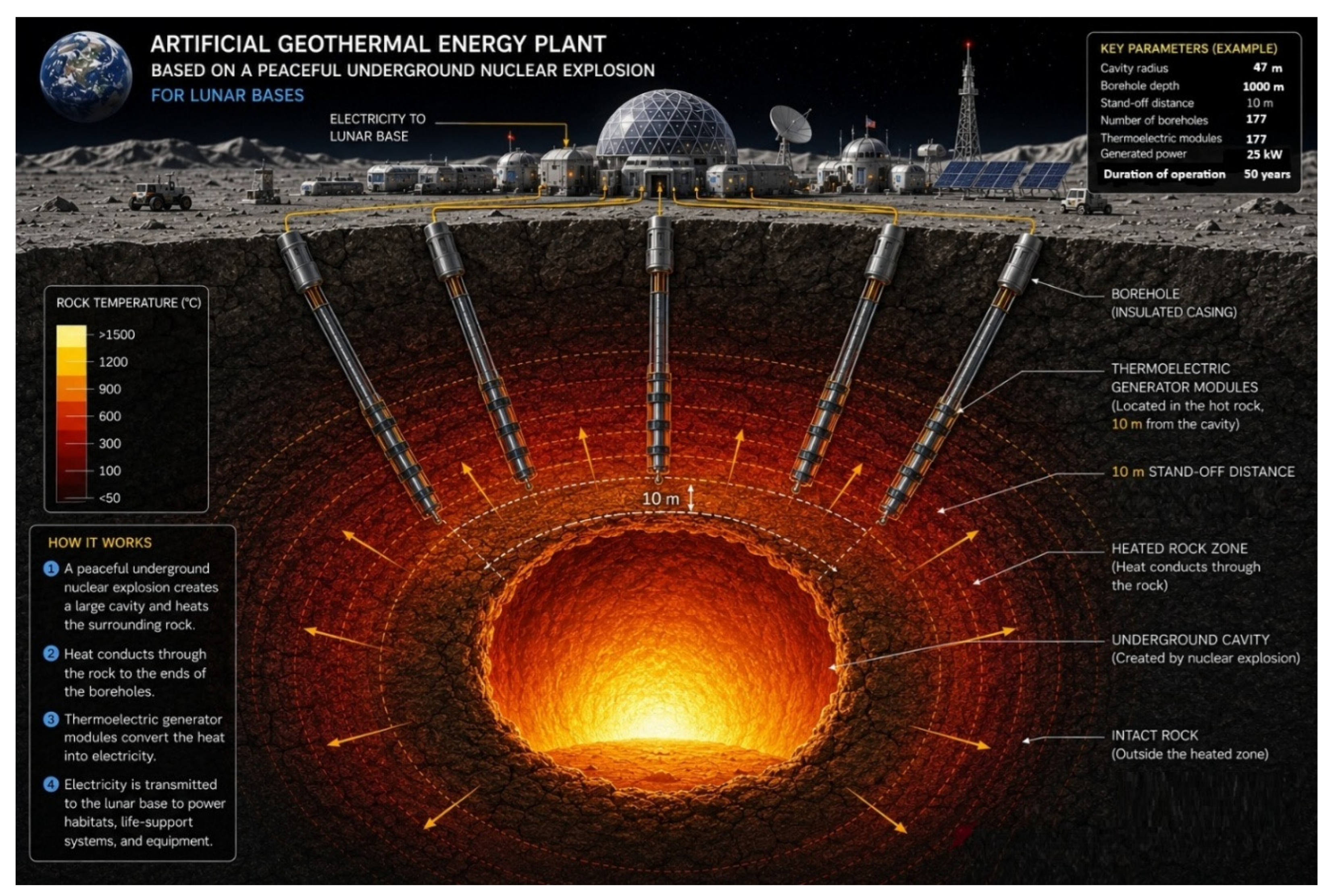
And let we take the external load resistance Rload of thermoelectric generator: Rload = 10 Om. Then electric power of one module is P1module = U2/Rload ≈ 141 W. Thus, we need Pbase/141 = 25 kW/144 ≈ 177 thermoelectric modules which cover Scover = 177 m2 of area at 10 m from boundary of cavity (Figure 2). If each module occupies 1 shaft, then a distance between them is 2 m would be enough at a circle with a radius 57 m with the center for the shaft with the warhead. This energy would be enough for several decades according with (6).
Pbase ideal = 0.15·qs ≈ 200 kW.
U = n·α·ΔTwork = 150·1000[μV/K]·250[K] = 37.5 V,
Low gravitation and lunar environment create a lot of problems for drilling rig [45] - the installation is practically not pressed against the ground by its own weight; there is no well flushing fluid; abrasive regolith quickly wears out the tool; it is impossible to use traditional drilling mud circulation to remove cuttings; it is necessary to transmit a large torque without lifting the installation from the surface. Jet Propulsion Laboratory is currently developing drilling rigs that can reach depths of 1 km or more for work on Mars and the moons of Jupiter; these drilling machines can be used on the Moon [46].
The described use of a nuclear explosion on the Moon using the heat flow from the explosion cavity to supply energy for an inhabited bases can be used on Mars, the satellites of Jupiter, minor planets of the asteroid belt, and so on.
4. Conclusion
We conducted a review of the radioecological situation at regions of several series of peaceful UNEs conducted in the USSR, at one American UNE, and at a soviet nuclear test site where combat UNEs were also conducted. In all cases, the main source of radionuclide penetration to the surface is the hydrodynamic activity of the subsurface, which is absent or greatly hindered on celestial bodies. This led to the idea of using peaceful UNEs not only for seismic sounding of the subsurface of colonized space objects, but also for converting heat from UNE into electrical energy for the long-term supply of inhabited bases for at least several decades. The deployment of nuclear warheads into space for peaceful purposes, in our opinion, will not violate the Treaty on Principles Governing the Activities of States in Outer Space, since the use of underground nuclear explosions for peaceful purposes is envisaged, and the construction of habitable bases on planets will be carried out through international efforts, what will ensure reliable control over the use of nuclear warheads.
Acknowledgments
The work was paid for from the budget of Ukraine: the code of the program classification of expenses and budget lending is 6541030 – scientific and scientific-technical activities of scientific institutions of the National Academy of Sciences of Ukraine.
References
- Peters, Robert. The Necessity of Testing Our Nuclear Weapons url: The Necessity of Testing Our Nuclear Weapons | RealClearDefense. Real Clear Defense site. 2025.
- About the United States Space Force at official site of United States Space Force. Url About Us. [CrossRef]
- Sankaran, Jaganath. Russia’s Anti-Satellite Weapons: A Hedging and Offsetting Strategy to Deter Western Aerospace Forces. Contemp. Secur. Policy 2022, 43(3), 436–463. [Google Scholar] [CrossRef]
- Treaty on Principles Governing the Activities of States in the Exploration and Use of Outer Space, including the Moon and Other Celestial Bodies url: The Outer Space Treaty. 18 U.S.T. 2410, 610 U.N.T.S. 205, 27 Jan 1967.
- O’Brien-Moody, Aobh. Survival of the richest: The billionaires building doomsday bunkers. Gentleman’s Journal site. 2026. url: Survival of the richest: The billionaires building doomsday bunkers Richard Morgan. Life After Earth: Imagining Survival Beyond This Terra Firma. The New York Times site, 2006, url: Life After Earth: Imagining Survival Beyond This Terra Firma - The New York Times John Tierney. A Survival Imperative for Space Colonization. The New York Times site, 2007, url: A Survival Imperative for Space Colonization - The New York Times.
- Cohn, Marjorie. Serial US Violations of the UN Charter url: Serial US Violations of the UN Charter. In International Association of Democratic Lawyers site; Marjorie Cohn | International Association of Democratic Lawyers, 2022; Alican Tekingunduz. Twelve times the UN has failed the world. TRTWorld site, 2018, url: Twelve times the UN has failed the world - TRT World. [Google Scholar]
- The United Nations Correspondent site, 2026, url: World leaders support strengthening the UN to end wars, admit some countries have disregarded international law. The United Nations Correspondent; Baba Umar. Is UN ineffective in ending wars? Top official says dismissing UN’s role in conflicts is misguided. TRTWorld site, 2025, url: Is UN ineffective in ending wars? Top official says dismissing UN’s role in conflicts is misguided - TRT World.
- Kumar, Ravinder. Humanitarian intervention is a breach of the UN Charter. J. Glob. Faultlines 2026, 13(1), 126–129, Liberty Wonford-Scott. Application of Noam Chomsky’s Propaganda Model to the 2003 Iraq War. Preprint ResearchGate 2020, DOI: 10.13140/RG.2.2.17974.93763. [Google Scholar] [CrossRef]
- Bush, George W. The Struggle for Democracy in Iraq: Speech to the World Affairs Council of Philadelphia. Speech in Philadelphia, Pennsylvania, December 12, 2005; Michael E. O’Hanlon. Why the War Wasn’t Illegal. BROOKINGS site, 2004, url: Why the War Wasn’t Illegal | Brookings. Available online: http://www.presidentialrhetoric.com/speeches/12.12.05.html.
- Ward, Tom. The Billionaires and Their Doomsday Bunkers Inside the Doomsday Bunker Craze of Billionaires - InsideHook. INSIDEHOOK site. 2024.
- Shakhidzhanov, Yu.S.; Kiryukhina, N.N. On the organization of geological safety at oil and gas sites exposed to nuclear impact. Proc. Min. Inst. 2005, 166, 135–137. Available online: https://cyberleninka.ru/article/n/ob-organizatsii-geoekologicheskoy-bezopasnosti-na-obektah-neftegazovogo-kompleksa-podvergavshihsya-yadernomu-vozdeystviyu/viewer.
- Dyagilev, R.A.; Butyrin, P.G.; Mackey, K.; Burk, D.; Burkhard, K.; Wheeler, B.; Witte, C.; Dobrynina, A.A. Digitization of soviet peaceful nuclear explosion seismograms. Russ. J. Seismol. in Russ.. 2022, 4(1), 28–40. [Google Scholar] [CrossRef]
- Shakhidzhanov, Yu.S. Development of a methodology and information and analytical system for monitoring the environment of oil and gas-bearing regions in which underground nuclear explosions were conducted. Proc. Min. Inst. 2004, 158, 139–141. Available online: https://cyberleninka.ru/article/n/razrabotka-metodiki-i-informatsionno-analiticheskoy-sistemy-vedeniya-monitoringa-okruzhayuschey-sredy-neftegazonosnyh-regionov-v/viewer.
- Golubov, B. N. Salt Karst Activation and Water Intrusion Threat to Radioactive Waste Underground Storage Facility Waste Isolation Pilot Plant (WIPP) Provoked by Underground Nuclear Explosion ‘Gnome’ in the State of New Mexico, USA. Electronic Scientific Edition Almanac Space and Time. Special Issue ‘The Earth Planet System’ 2013, 4(1). Available online: https://cyberleninka.ru/article/n/aktivizatsiya-solyanogo-karsta-i-ugroza-obvodneniya-podzemnogo-hranilischa-radioaktivnyh-othodov-waste-isolation-pilot-plant-wipp/viewer.
- Chuikov, Yu. S.; Dosmukhamedova, G. G. The Vega Facility and the Consequences of Peaceful Nuclear Explosions (Review). Astrakhan Bull. Environ. Educ. 2006, 1-2(8-9), 46–71. Available online: https://cyberleninka.ru/article/n/obekt-vega-i-posledstviya-yadernyh-vzryvov-v-mirnyh-tselyah-obzor/viewer.
- Artamonova, Svetlana Yu.; Troitskii, Dmitrii Yu.; Ushnitskii, Vladislav E. First results of study of isotope composition of uranium in water samples of the Crystal site in 2019. Interexpo Geo-Sib. 2021, 1(2), 329–334. Available online: https://cyberleninka.ru/article/n/pervye-rezultaty-izucheniya-izotopnogo-sostava-urana-v-vodnyh-probaz-obekta-kristall-v-2019-g/viewer. [CrossRef]
- Artamonova, S.Yu. Spreading of tritium in surface water of the site of the peaceful underground nuclear explosion Crystal in 2018. Interexpo Geo-Sib. 2019, 3(2), 232–238. Available online: https://cyberleninka.ru/article/n/rasprostranenie-tritiya-v-poverhnostnoy-vode-obekta-mirnogo-podzemnogo-yadernogo-vzryva-kristall-v-2018-g/viewer. [CrossRef]
- Artamonova, S.Y.; Shein, A.N. Modern state of the undeveloped near-surface disposal of special radioactive wastes at the epicenter of the peaceful underground nuclear explosion «Crystal» (Yakutia): evidence from electrical resistivity tomography, land geomagnetic survey and water runoff study. Bull. Tomsk Polytech. Univ. Geo Assets Eng. 2025, 336(3), 119–140. Available online: https://cyberleninka.ru/article/n/sovremennoe-sostoyanie-neobustroennogo-pripoverhnostnogo-zahoroneniya-osobyh-radioaktivnyh-othodov-na-epitsentre-mirnogo-podzemnogo/viewer. [CrossRef]
- Kolodeznikov, V.E. Radioecological studies of mass species of mammals in the impact zone of energency underground nuclear explosions in western Yakutia. News Samara Sci. Cent. 2014, 16(№5(1)), 369–372. Available online: https://cyberleninka.ru/article/n/radioekologicheskie-issledovaniya-massovyh-vidov-mlekopitayuschih-v-zone-vozdeystviya-avariynyh-podzemnyh-yadernyh-vzryvov-v-zapadnoy-1/viewer.
- Artamonova, S.Y. Modern radioecological situation on the object of peaceful underground nuclear explosion “KRATON-3” (1978) in Yakutia. Astrakhan Bull. Environ. Educ. 2016, № 3(37), 14–24. Available online: https://cyberleninka.ru/article/n/sovremennaya-radioekologicheskaya-situatsiya-na-obekte-mirnogo-podzemnogo-yadernogo-vzryva-kraton-3-1978-g-v-yakutii/viewer.
- Khramtsov, E.V.; Repin, V.S.; Biblin, A.M.; Varfolomeeva, K.V.; Ivanov, S.A. Radiation-Hygienic characteristic of the protective zones of peaceful nuclear explosions in the Arkhangelsk region. Radiatsionnaya Gygiena Radiat. Hyg. in Russ.. 2021, 14(1), 111–123. [Google Scholar] [CrossRef]
- Kiselev, G.P.; Bazhenov, A.V.; Kiseleva, I.M.; Druzhinin, S.V. Radioactivity of epicentral zones of industrial nuclear explosions in Arkhangelsk region. Arct. Environ. Res. 2014, 4, 21–31. Available online: https://cyberleninka.ru/article/n/radioaktivnost-epitsentralnyh-zon-promyshlennyh-yadernyh-vzryvov-v-arhangelskoy-oblasti/viewer.
- Biblin, A.M.; Khramtsov, E.V.; Repin, V.S.; Ivanov, S.A.; Varfolomeeva, K.V.; Sednev, K.A.; Bogomolova, Y.M. Radiation situation at the “Pirit” peaceful underground nuclear explosion site. Radiatsionnaya Gygiena Radiat. Hyg. 2022, 15(4), 149–161. [Google Scholar] [CrossRef]
- Biblin, A.M.; Varfolomeeva, K.V.; Sednev, K.A.; Ivanov, S.A.; Repin, V.S.; Georgieva, A.G. Modern radiation-hygienic state of the territories of the Globus-4 and Gorizont-1 peaceful nuclear explosions in the Komi Republic. Radiatsionnaya Gygiena Radiat. Hyg. In Russ.. 2024, 17(1), 121–130. [Google Scholar] [CrossRef]
- Varfolomeeva, K.V.; Sednev, K.A.; Biblin, A.M.; Ivanov, S.A.; Zelentsova, S.A.; Repin, V.S.; Georgieva, A.G. Radiation-hygienic characteristics and sanitary condition of the territories of the Globus-3 and the Quartz-2 peaceful nuclear explosions in the Komi Republic. Radiatsionnaya Gygiena Radiat. Hyg. In Russ.. 2025, 18(1), 100–111. [Google Scholar] [CrossRef]
- Golubov, B. N.; Sapozhnikov, Yu. A. ‘Globus-1’ Underground Nuclear Explosion and Its Radionuclides Long-Range Migration to the Underground Drinking Water Sources in Kineshma District of Ivanovo Region. Electron. Sci. Ed. Alm. Space Time 2016, 13(1). Available online: https://cyberleninka.ru/article/n/podzemnyy-yadernyy-vzryv-globus-1-i-dalnyaya-migratsiya-ego-radionuklidov-k-podzemnym-istochnikam-pitievogo-vodosnabzheniya/viewer.
- Tsvetnova, O.B.; Aleksandrov, M.N.; Shcheglov, A.I. Modern radioecological situation at the site “Globus-1”. Bull. Mosc. Univ. Ser. 17. Soil Sci. 2013, 2, 11–16. Available online: https://cyberleninka.ru/article/n/sovremennaya-radioekologicheskaya-obstanovka-na-territorii-obekta-globus-1/viewer.
- Lyakhova, O.N.; Lukashenko, S.N.; Larionova, N.V.; Yakovenko, Yu.Yu.; Tur, E.S. Comparative analysis of main mechanisms of tritium transfer from the Semipalatinsk Test Site to atmosphere. Radiat. Risk 2014, 23(3), 43–56. Available online: https://cyberleninka.ru/article/n/sravnitelnaya-otsenka-osnovnyh-istochnikov-postupleniya-tritiya-v-vozdushnuyu-sredu-na-territorii-semipalatinskogo-ispytatelnogo/viewer.
- Zakharova, E.V.; Gaevaya, E.V.; Burlaenko, V.Z. The impact of technogenic radionuclides on components of the environment in the southern Tyumen region. Fertility 2014, 6, 46–48. Available online: https://cyberleninka.ru/article/n/vozdeystvie-tehnogennyh-radionuklidov-na-komponenty-prirodnoy-sredy-yuga-tyumenskoy-oblasti/viewer.
- ESA - The Moon, Moon to Mars | NASA’s Artemis Program - NASA.
- China to launch Chang’e-8 lunar mission around 2029, collaborating with int’l partners
- Yushkova, O.V. Modeling brightness temperature of lunar soil. Open scientific conference: Modern problems of remote sensing, radar, wave propagation and diffraction Murom 2023, 1, 230–234. Available online: https://cyberleninka.ru/article/n/modelirovanie-radioyarkostnoy-temperatury-grunta-luny/viewer. [CrossRef]
- Shevchenko, V.V.; Moon. Sov. Encycl. 1990, Vol. 2, P. 613–615.
- Feng, Jianqing; Siegler, Matthew. A.; White, Mackenzie N. Dielectric properties and stratigraphy of regolith in the lunar South Pole-Aitken basin: Observations from the Lunar Penetrating Radar. A&A 2022, 661, A47. [Google Scholar] [CrossRef]
- Siegler, M. A.; Smrekar, S. E. Lunar heat flow: Regional prospective of the Apollo landing sites. J. Geophys. Res. Plan. 2014, 119, 47–63. [Google Scholar] [CrossRef]
- Repin, V.S.; Ramzaev, V.P.; Biblin, A.M.; Varfolomeeva, K.V.; Zelentsova, S.A.; Sednev, K.A.; Ilyichev, V.A.; Kasatkin, A.V.; Kasatkin, V.V. Estimation of the protected zone sizes for peaceful nuclear explosions based on quantitative patterns of the Earth’s interior deformation. Radiatsionnaya Gygiena Radiat. Hyg. In Russ.. 2023, 16(4), 134–147. [Google Scholar] [CrossRef]
- Wilmarth, Verl R. Some effects of underground nuclear explosions on tuff. Nuclear Explosions - Peaceful Applications, U. S. Department of the Interior. 1959. Available online: https://pubs.usgs.gov/tei/756/report.pdf.
- Nelson, R. W. Nuclear “Bunker Busters” Would More Likely Disperse Than Destroy Buried Stockpiles of Biological and Chemical Agents. Sci. Glob. Secur. 2004, 12(1–2), 69–89. [Google Scholar] [CrossRef]
- Woods-Robinson, Rachel; Siegler, Matthew A.; Paige, David A. A Model for the Thermophysical Properties of Lunar Regolith at Low Temperatures. JGR Plan. 2019, 124(7), 1989–2011. [Google Scholar] [CrossRef]
- Galkin, A. F. Calculation of the Fourier criterion in forecasting the thermal regime of thawed and frozen dispersed rocks. Arct. Antarct. 2022, 3, 1–9. Available online: https://cyberleninka.ru/article/n/raschet-kriteriya-furie-pri-prognoze-teplovogo-rezhima-talyh-i-merzlyh-dispersnyh-porod/viewer. [CrossRef]
- Saha, D.; et al. “Space Microgrids for Future Manned Lunar Bases: A Review”. IEEE Open Access J. Power Energy 2021, 8, 570–583. [Google Scholar] [CrossRef]
- Bos, Jan-Willem G; et al. 2026 roadmap toward sustainable thermoelectrics. J. Phys. Energy 2026, 8, 011502. [Google Scholar] [CrossRef]
- Ivanov, K.; Aleksandrov, A. Design and Study of an Automotive Thermoelectric Generator. 2020 7th International Conference on Energy Efficiency and Agricultural Engineering (EE&AE), Ruse, Bulgaria, 2020; pp. 1–4. [Google Scholar] [CrossRef]
- Uglah, Aqeel M.; et al. Numerical investigation on optimizing the couple geometry of a thermoelectric generator under various thermal conditions. Case Stud. Therm. Eng. 2025, 75, 107191. [Google Scholar] [CrossRef]
- Polar Resources Ice Mining Experiment 1 (PRIME-1). NASA.
- JPL Robotics: Subsurface Access.
Figure 1.
Schema of the destruction of the rock mass in the Gnome UNE zone and the progressive flooding of the WIPP underground storage facility. 1 - the point of explosion, the flooded cavity of the UNE, as well as the zones of crumpling, crushing and spalling of rocks; 2 - epicentral zone of impact of the shock wave of UNE; 3 - direction of movement and discharge of groundwater from horizons lying above the WIPP; 4 - inflow of pressure groundwater and brines from lenses and layers of the Castile formation and older strata through cracks. The drawing is made by author according to [14].
Figure 1.
Schema of the destruction of the rock mass in the Gnome UNE zone and the progressive flooding of the WIPP underground storage facility. 1 - the point of explosion, the flooded cavity of the UNE, as well as the zones of crumpling, crushing and spalling of rocks; 2 - epicentral zone of impact of the shock wave of UNE; 3 - direction of movement and discharge of groundwater from horizons lying above the WIPP; 4 - inflow of pressure groundwater and brines from lenses and layers of the Castile formation and older strata through cracks. The drawing is made by author according to [14].
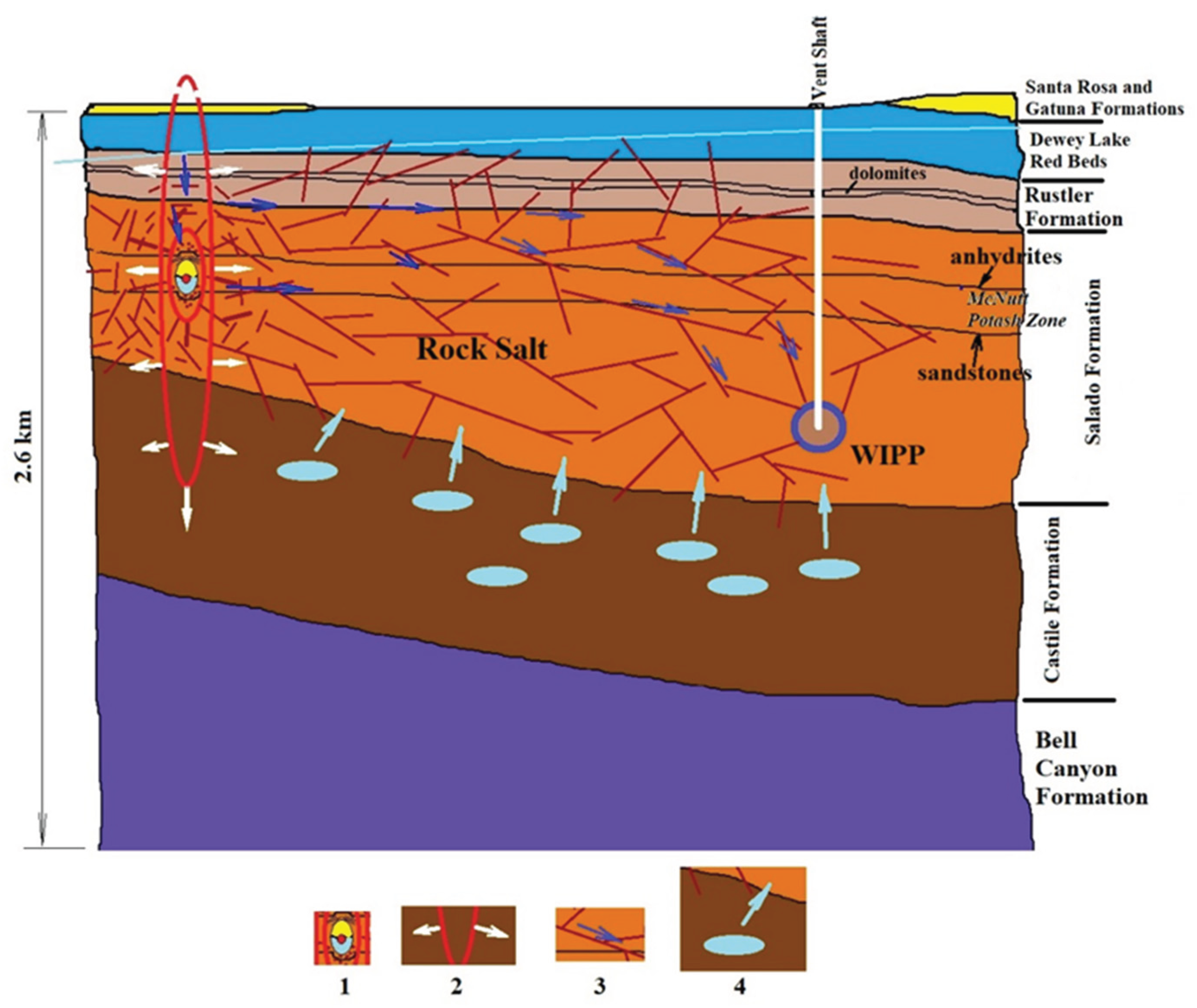
Figure 2.
Schematic diagram of a geothermal power plant based on an underground nuclear explosion (UNE) at a depth of 1 km with a 100 kt nuclear charge in lunar rock, to power a lunar base with 6 personnel for several decades. Picture was made with help of AI image generation tool based on the author specifications and subsequently reviewed and refined by the author.
Figure 2.
Schematic diagram of a geothermal power plant based on an underground nuclear explosion (UNE) at a depth of 1 km with a 100 kt nuclear charge in lunar rock, to power a lunar base with 6 personnel for several decades. Picture was made with help of AI image generation tool based on the author specifications and subsequently reviewed and refined by the author.
Disclaimer/Publisher’s Note: The statements, opinions and data contained in all publications are solely those of the individual author(s) and contributor(s) and not of MDPI and/or the editor(s). MDPI and/or the editor(s) disclaim responsibility for any injury to people or property resulting from any ideas, methods, instructions or products referred to in the content. |
© 2026 by the authors. Licensee MDPI, Basel, Switzerland. This article is an open access article distributed under the terms and conditions of the Creative Commons Attribution (CC BY) license (http://creativecommons.org/licenses/by/4.0/).
Copyright: This open access article is published under a Creative Commons CC BY 4.0 license, which permit the free download, distribution, and reuse, provided that the author and preprint are cited in any reuse.