

Submitted:
13 June 2026
Posted:
15 June 2026
You are already at the latest version
Abstract
In [1], Kulenovi'c, Ladas and Overdeep posed a conjecture asserting that every positive solution of the rational second-order difference equation \[ y_{n+1}=\frac{y_n(1+y_n)^2}{y_n(1+y_n)+(1+y_{n-1})},\qquad n=0,1,\ldots, \] converges to a finite limit. We confirm this conjecture by deriving a short identity showing that the sign of $y_{n+1}-y_n$ is invariant with respect to $n$, so every positive solution is monotone. A simple estimate then gives an explicit initial-data-dependent upper bound in the increasing case, while the decreasing case is bounded below by positivity. Hence every positive solution converges. In addition, we introduce the auxiliary sequence \[ t_n:=\frac{y_n(1+y_n)}{1+y_{n-1}}, \] which is monotone in the direction opposite to that of $y_n$. It yields nested two-sided enclosures of the limit and an exact invariant-series formula. Writing $g_n=t_n-y_n$ and $\rho_n=t_n/(1+t_n)^2$, we prove that \[ I_n=y_n+g_n\sum_{j=0}^{\infty}\frac{1}{1+t_{n+j}} \prod_{m=0}^{j-1}\rho_{n+m} \] is independent of $n$ and satisfies $I_n=L=\lim_{k\to\infty}y_k$. Hence the limiting equilibrium selected by the initial data is determined by the invariant value $I_0$.
Keywords:
rational difference equation
; global convergence
; monotone solutions
; asymptotic behaviour
MSC: 39A10; 39A20
1. Introduction
The qualitative behaviour of rational difference equations has been studied extensively because such equations arise in discrete-time modelling and often exhibit rich global dynamics. A systematic treatment of many second-order rational recurrences can be found in the monograph [2]. Further background on nonlinear difference equations, higher-order rational recurrences, and standard qualitative methods may be found in [3,4]. In a short note of open problems and conjectures, Kulenović, Ladas and Overdeep [1] proposed, among other questions, the following conjecture.
Remark 1
with initial conditions has a finite limit.
A special feature of (1) is that every positive number is an equilibrium. Therefore, a direct passage to the limit in (1) gives only the identity
and does not by itself determine which equilibrium is selected by the initial data. This makes it important to keep track of monotonicity and of quantities that enclose the limiting value along the orbit.
We note that Conjecture 1 asks for global convergence without requiring a closed-form expression for the limit. The argument below is based on a short difference identity that shows the sign of successive increments cannot change with n. This immediately forces monotonicity and, together with a simple estimate on the increments in the increasing case, yields boundedness and convergence. After proving convergence, we introduce an auxiliary sequence that provides nested two-sided enclosures of the limit and, more importantly, an exact invariant-series formula whose value is precisely the selected limiting equilibrium. This gives a rigorous determination of the limit from the initial orbit and supplies a certified stopping criterion for numerical computation.
The purpose of this note is to confirm the conjecture. The proof is elementary: we first show that the sign of equals the sign of for all , which forces monotonicity. The decreasing case then converges immediately by monotone convergence. In the increasing case we prove that the increments decay at least geometrically, which provides an explicit upper bound and yields convergence to a finite limit.
2. Main Result
Throughout we assume and define by (1). Note that positivity is forward invariant: if , then the right-hand side of (1) is positive, so for all . Set
Lemma 1
(Difference identity). For every ,
Consequently,
Lemma 2
(Monotonicity). Every positive solution of (1) is monotone. More precisely: if , then is strictly increasing; if , then it is strictly decreasing; and if , then .
Proof.
If , then (2) gives , and by induction for all n, so the solution is constant.
Assume . Then has the same sign as by Lemma 2.1. Applying Lemma 2.1 iteratively shows that the sign of is constant in n, hence the sequence is strictly monotone. □
Lemma 3
(An initial-data-dependent upper bound in the increasing case). Assume so that is increasing. Let for (so ). Then
and, in particular,
Proof.
Remark 2.
The estimate (4) is not uniform over the whole set of positive initial data. It is an explicit orbitwise bound depending on the chosen initial values and . This is the only meaning in which boundedness is used below: each individual positive solution is bounded.
We now state and prove the main theorem, which confirms Conjecture 1 in [1].
Theorem 1
(Global convergence). Every positive solution of (1) converges to a finite limit.
Proof.
By Lemma 2.2, the sequence is monotone.
If it is decreasing, then for all n and therefore is bounded below; hence it converges to a finite limit by the monotone convergence theorem.
If it is increasing, then Lemma 2.3 provides the explicit upper bound (4), so is increasing and bounded above, and therefore converges to a finite limit. □
Remark 3.
Theorems 3.2 and 3.4 below provide two complementary descriptions of the selected limiting equilibrium. The first gives nested two-sided bounds and an effective stopping criterion. The second gives an exact invariant-series expression for L from the initial orbit. This addresses the limit-selection issue caused by the continuum of equilibria of (1).
3. A Two-Sided Characterisation and an Invariant Formula for the Limit
The proof of Theorem 2.4 guarantees the existence of a finite limit
Because (1) has a continuum of equilibria, the value of L cannot be recovered by solving an equilibrium equation alone. The following auxiliary sequence gives an orbit-based replacement. It first produces nested intervals whose unique common point is precisely L, and then yields an invariant-series formula whose value is exactly the selected equilibrium.
Lemma 4
(An auxiliary sequence). For define
Then, for every ,
and, for every ,
Consequently,
Proof.
Theorem 2 (Two-sided bounds for the limit).
-
If , then is strictly increasing, is strictly decreasing, andMoreover,
-
If , then is strictly decreasing, is strictly increasing, andwith
Proof.
Assume . By Lemma 2.2, is strictly increasing and converges to L by Theorem 2.4. Identity (6) implies for all n. By (7), is strictly decreasing. Since , it is bounded below and hence has a finite limit . Passing to the limit in (5) using and gives
Thus and , proving the claimed inequalities and the extremal characterisation of L.
Theorem 3
(Nested-interval determination of the limit). For , set
Then the intervals are nested, their lengths are
and
Equivalently, L is the unique real number lying in every interval .
Proof.
If , then . By Theorem 3.2, increases to L and decreases to L, so and the intersection is . If , then , with and , and the same conclusion follows. If , then the solution is constant and the assertion is immediate. The formula for follows from the definition of . □
Theorem 4
(An invariant-series formula for the selected equilibrium). Let be a positive solution of (1), and let
Set
Then
and consequently
Since ,
For , define
where the empty product is understood to be 1. Then the series is absolutely convergent,
and
In particular, the limiting equilibrium selected by the initial values is given by
Proof.
By the definition of ,
Substituting this identity into (1) gives
Furthermore,
because . Thus (8) holds. It follows that
Also,
Since , the elementary inequality
shows that the series in (10) is absolutely convergent; indeed, each product is bounded above by .
Let
Then
Using (9), we obtain
Thus is invariant along the orbit.
Remark 4
(A practical stopping criterion). Theorem 3.3 implies that, for any ,
Thus one may approximate L together with an a posteriori error bound by iterating until is below a prescribed tolerance.
Remark 5
(On the nature of the invariant). The invariant in Theorem 3.4 is an exact convergent-series invariant. It plays the same limit-selection role as the elementary invariant for the linear averaging equation : after passing to the limit in the invariant identity, one obtains the selected equilibrium. The formula above is not a finite algebraic first integral; finding an even simpler finite expression would be a further refinement beyond the convergence assertion of Conjecture 1.
4. Numerical Experiments
We briefly illustrate the theoretical conclusions with numerical simulations.
4.1. Trajectories and Convergence of Increments
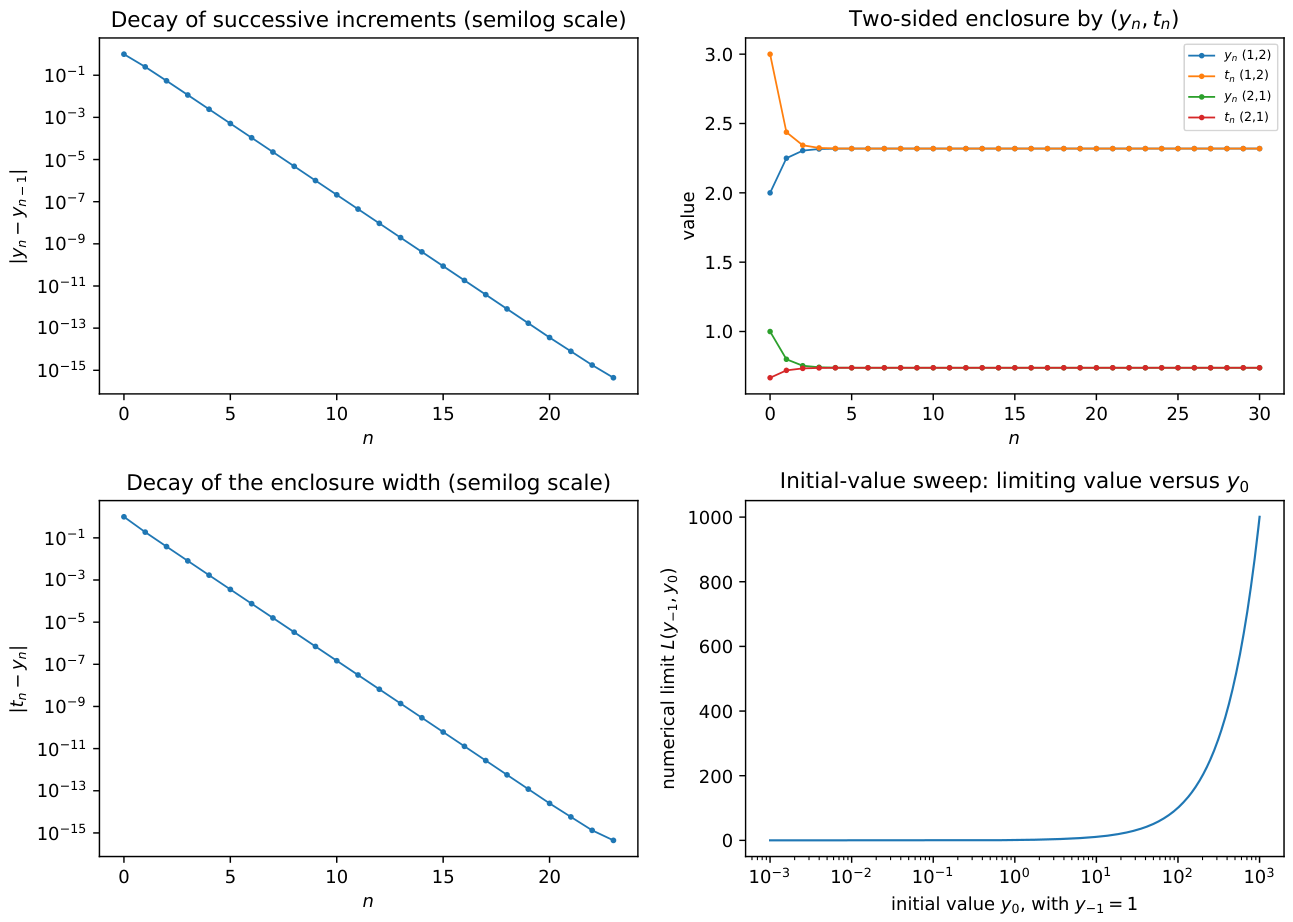
Figure 1 shows representative trajectories for several initial conditions, including a “large-data” example . In each case the solution is monotone and converges quickly. Figure 2(a) plots the successive increments on a semilogarithmic scale for the increasing case , illustrating the geometric decay predicted by Lemma 2.3.
4.2. Two-Sided Bounds and Initial-Value Sweep
Figure 2(b) plots together with the auxiliary sequence for both an increasing example and a decreasing example . In agreement with Theorem 3.2, the two sequences are monotone in opposite directions and rapidly squeeze the common limit. Figure 2(c) shows the gap , which is the width of the rigorous enclosure interval for L.
Although equation (1) has no external parameter, one may view the initial value as a varying input when is fixed. For each in a logarithmic grid on (400 points) and fixed , we computed an approximation of by iterating until the enclosure width (see Remark 3.5) was satisfied, and then taking the midpoint of the resulting enclosure interval. Figure 2(d) shows the resulting initial-value sweep . No qualitative changes are observed over six orders of magnitude, consistent with the global convergence established in Theorem 2.4. All simulations and plots were generated in Python (NumPy/Matplotlib); the script numerics.py included with the source reproduces the figures.
5. Conclusion
We confirmed Conjecture 1 of Kulenović, Ladas and Overdeep [1] by showing that every positive solution of (1) is monotone and bounded, and hence convergent. The boundedness in the increasing case is supplied by an explicit initial-data-dependent estimate. Moreover, the auxiliary sequence provides nested two-sided enclosures whose unique common point is the limit, and Theorem 3.4 supplies an exact invariant-series formula for the selected equilibrium. Thus the limiting value is determined by
and also by the invariant identity
This completes the convergence result and gives an explicit orbit-based determination of the limiting value selected by the initial data.
6. Consequences for Dynamical Systems and Chaos Theory
Equation (1) defines the continuous planar map
on the positive quadrant. This is the standard state-space representation of a second-order difference equation [5]. Theorem 2.4 and Lemma 2.2 imply that every positive forward orbit
converges to a point on the equilibrium diagonal
in the closure of the positive quadrant.
Corollary 1.
For the positive dynamics generated by (1):
- (i)
- the omega-limit set of every orbit is the singleton ;
- (ii)
- there is no positive periodic orbit of prime period greater than one;
- (iii)
- there is no Li–Yorke scrambled pair, and therefore no Li–Yorke chaos in the positive phase space in the sense introduced in [6];
- (iV)
Proof.
The first assertion follows directly from . A periodic orbit that converges must be constant, which proves the second assertion. For two positive initial states whose limits are L and , respectively, the distance between their nth states converges to . Hence the lower and upper limiting distances coincide, so no pair can satisfy the defining separation condition of a Li–Yorke scrambled pair. Finally, the periodic points of F are precisely the fixed points on the equilibrium diagonal. If periodic points were dense in a compact invariant set K, then, because the equilibrium diagonal is closed, one would have K contained in that diagonal. The restriction would then be the identity map, which is not topologically transitive when K contains more than one point. Thus the defining conditions for Devaney chaos cannot hold on such a set. □
Thus the proved conjecture has a direct dynamical interpretation: although (1) is nonlinear and rational and possesses a continuum of non-hyperbolic equilibria, its positive dynamics are globally ordered and asymptotically non-chaotic. These conclusions concern positive initial data only; they do not address sign-changing extensions, parameter perturbations, or nonautonomous variants of the recurrence.
Author Contributions
The proof and solution of the conjecture, the theoretical development, the new section on consequences for dynamical systems and chaos theory, and the preparation of this preprint are due to Rafik Zeraoulia. Pedro Caceres and Simeón Casanova Trujillo contributed to selected numerical computations and to the supporting software used for the numerical experiments.
Funding
Not applicable.
Data Availability Statement
No new data were created or analysed in this study. The numerical experiments and figures are reproducible using the accompanying Python script numerics.py.
Acknowledgments
Rafik Zeraoulia thanks Allah for helping him prove this 20-year-old conjecture. He dedicates this proof to his family and friends and, especially, to his two sons, Zeraoulia Taha AbdelJalil and Taki Abdesalaem, who are his heart and his life. The author also thanks Gerry Ladas and collaborators for compiling open problems that motivated this work, and the referees for comments that improved the clarity of the exposition.
Conflicts of Interest
The author declares no conflict of interest.
References
- Kulenović, M. R. S.; Ladas, G.; Overdeep, C. B. (Eds.) Overdeep, Open Problems and Conjectures: Edited by Gerry Ladas. Journal of Difference Equations and Applications 2003, 9(11), 1053–1056. [Google Scholar] [CrossRef]
- Kulenović, M. R. S.; Ladas, G. Dynamics of Second Order Rational Difference Equations; Chapman & Hall/CRC: Boca Raton, 2001. [Google Scholar]
- Kocić, V. L.; Ladas, G. Global Behavior of Nonlinear Difference Equations of Higher Order with Applications; Kluwer Academic Publishers: Dordrecht, 1993. [Google Scholar]
- Elaydi, S. An Introduction to Difference Equations, 3rd ed.; Springer: New York, 2005. [Google Scholar]
- Kulenović, M. R. S.; Merino, O. Discrete Dynamical Systems and Difference Equations with Mathematica; Chapman & Hall/CRC: Boca Raton, 2002. [Google Scholar] [CrossRef]
- Li, T.-Y.; Yorke, J. A. Period three implies chaos. Am. Math. Mon. 1975, 82(10), 985–992. [Google Scholar] [CrossRef]
- Devaney, R. L. An Introduction to Chaotic Dynamical Systems, 2nd ed.; Addison-Wesley: Redwood City, CA, 1989. [Google Scholar]
- Banks, J.; Brooks, J.; Cairns, G.; Davis, G.; Stacey, P. On Devaney’s definition of chaos. Am. Math. Mon. 1992, 99(4), 332–334. [Google Scholar] [CrossRef]
Figure 1.
Sample trajectories for (1) (plots of versus n for ).
Figure 1.
Sample trajectories for (1) (plots of versus n for ).
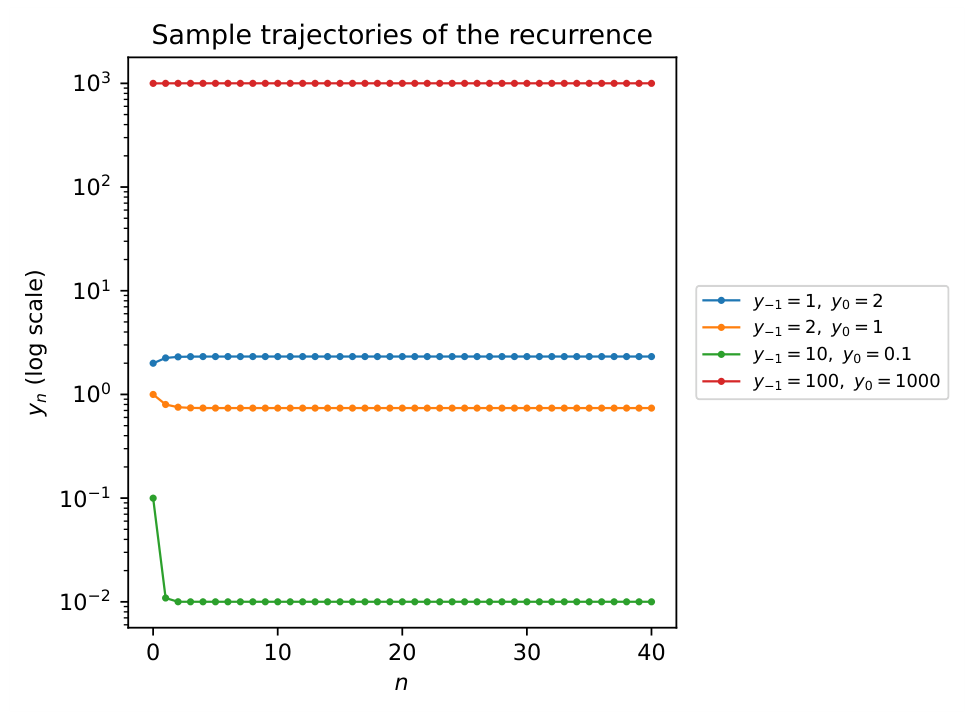
Figure 2.
Compact presentation of the numerical experiments. Panel (a) shows decay of successive increments for . Panel (b) shows the two-sided bounds and in increasing and decreasing cases. Panel (c) shows the enclosure width for . Panel (d) shows the computed limit versus .
Figure 2.
Compact presentation of the numerical experiments. Panel (a) shows decay of successive increments for . Panel (b) shows the two-sided bounds and in increasing and decreasing cases. Panel (c) shows the enclosure width for . Panel (d) shows the computed limit versus .
Disclaimer/Publisher’s Note: The statements, opinions and data contained in all publications are solely those of the individual author(s) and contributor(s) and not of MDPI and/or the editor(s). MDPI and/or the editor(s) disclaim responsibility for any injury to people or property resulting from any ideas, methods, instructions or products referred to in the content. |
© 2026 by the authors. Licensee MDPI, Basel, Switzerland. This article is an open access article distributed under the terms and conditions of the Creative Commons Attribution (CC BY) license (http://creativecommons.org/licenses/by/4.0/).
Copyright: This open access article is published under a Creative Commons CC BY 4.0 license, which permit the free download, distribution, and reuse, provided that the author and preprint are cited in any reuse.


