
Submitted:
12 June 2026
Posted:
17 June 2026
You are already at the latest version
Abstract
This paper examines global equity-market integration, commodity-price exposure, and volatility spillovers in Ghana’s frontier equity market. Using daily data from January 2011 to December 2025, we estimate a multi-factor asset-pricing model within an ARMA–EGARCH specification for the Ghana Stock Exchange Composite Index (GSECI) and the Financial Sector Index (GSEFSI). The model jointly captures first- and second-moment spillovers from a global equity factor and three key global commodity markets: gold, crude oil, and cocoa, while controlling for asymmetric volatility, return serial dependence, and structural shifts associated with banking-sector recapitalization and the Domestic Debt Exchange Programme (DDEP). The Ghanaian equity market is exposed to the global equity factor, indicating measurable but economically modest global integration, with stronger exposure in the financial sector. Commodity-price exposures are selective, with gold and crude-oil exposures concentrated in the financial sector, whereas the cocoa factor is negatively associated with returns on both indices. The variance results show persistent volatility, inverse asymmetric volatility responses, and differentiated volatility spillovers from global equity and commodity markets. The DDEP period is associated with significant equity-market repricing, particularly in the financial sector. These findings indicate that Ghana’s equity-market dynamics are shaped jointly by global equity and commodity market information, frontier-market frictions, and sovereign–bank conditions.
Keywords:
asset pricing
; frontier markets
; global integration
; commodity prices
; market microstructure
; sovereign–bank nexus
; Ghana
1. Introduction
The integration of frontier equity markets into global financial markets remains an important question in international asset pricing literature. In fully integrated markets, expected returns should primarily reflect exposure to common global sources of systematic risk; in segmented or partially segmented markets, local risks, institutional constraints, and market-specific frictions continue to influence asset prices [6,7,20]. Frontier markets in Sub-Saharan Africa are especially relevant in this debate because they may offer international diversification benefits owing to their historically low correlations with developed markets, yet their pricing dynamics are often complicated by thin trading, non-synchronous price adjustment, limited liquidity, and delayed information assimilation [12,22,28,29]. These market microstructure frictions make it difficult to measure global integration using standard models and may obscure the transmission of external information into domestic equity prices. At the same time, frontier markets do not operate in isolation; they are exposed to global financial conditions, commodity-price movements, and shifts in international investor sentiment that may affect both expected returns and conditional volatility [9,15,27].
Among frontier African markets, Ghana provides a useful empirical setting for examining global integration, commodity prices, and the sovereign–bank nexus. The Ghana Stock Exchange (GSE) operates within a relatively small and less liquid equity market embedded in a resource-dependent open economy. Ghana’s international trade is closely linked to gold, crude oil, and cocoa. Movements in these commodity markets may therefore affect domestic equity prices through export earnings, fiscal revenues, exchange-rate expectations, inflationary pressures, and investor risk assessment [19,27,33]. During the sample period, the GSE also operated through major domestic macro-financial shifts, including banking-sector recapitalization and sovereign debt restructuring under the Domestic Debt Exchange Programme (DDEP) [21]. These episodes are relevant for equity pricing because sovereign stress can be transmitted to banks through sovereign-debt holdings, capital impairment, funding conditions, and weakened financial intermediation [1,11,17]. Ghana therefore offers a suitable setting to examine how global equity-market exposure, commodity-price movements, and domestic sovereign–bank conditions jointly shape return and volatility dynamics in a frontier equity market.
Despite the growing importance of African capital markets, the existing empirical literature often examines these markets using broad aggregate indices or focuses on relatively narrow transmission channels. Studies of regional volatility transmission [30] and commodity-market effects [23,25] provide important evidence on African and commodity-dependent markets, but they typically do not jointly model global equity-market integration, commodity-price transmission, market microstructure frictions, and domestic macro-financial breaks within a unified asset pricing framework. Moreover, reliance on broad composite indices may conceal important sectoral differences. This is particularly relevant for Ghana, where the financial sector is more liquid than many non-financial segments of the market and is more directly connected to global financial conditions through the structure of banking, foreign bank participation, cross-border financial relationships, and internationally linked financial intermediation. The financial sector is also more directly exposed to sovereign balance-sheet conditions, bank recapitalization requirements, and domestic financial-sector stress. Since banks often hold significant sovereign claims, sovereign distress can be transmitted to financial institutions through capital impairment, funding conditions, and weakened intermediation capacity [1,11,17]. A comparison between the broader Ghana Stock Exchange Composite Index (GSECI) and the Ghana Stock Exchange Financial Sector Index (GSEFSI) therefore provides a useful way to distinguish aggregate market dynamics from financial-sector-specific transmission channels.
In this study, we address these theoretical and empirical gaps using an International Capital Asset Pricing Model-motivated multi-factor asset pricing framework embedded within an extended Autoregressive Moving Average–Exponential Generalized Autoregressive Conditional Heteroskedasticity (ARMA-EGARCH) specification [5,10]. Using daily data from January 2011 to December 2025, we estimate the model separately for the GSECI and the GSEFSI, allowing us to contrast aggregate market dynamics with financial-sector-specific return and volatility responses. Building on established approaches for modelling asymmetric volatility in emerging and frontier markets [14,15], the empirical framework evaluates both first- and second-moment information spillovers from international equity-markets and global commodity-price movements, while accounting for serial dependence, market microstructure frictions, volatility clustering, asymmetric news effects, and structural macro-financial breaks. This framework allows us to examine Ghana’s global equity-market integration through its exposure to global systematic risk, assess whether commodity price changes affect return and volatility dynamics, and determine whether these effects differ between the broader market and the financial sector.
We document several important findings. First, Ghanaian equity returns are positively exposed to the global equity factor, indicating that the Ghanaian equity market exhibits a measurable, although economically modest, degree of global integration through exposure to global systematic risk. This exposure is stronger for the financial sector than for the broader equity market, suggesting that financial-sector equities are more sensitive to global financial conditions. Second, commodity-factor effects differ sharply across commodities and market segments. Gold and crude-oil exposures are concentrated in the financial sector, whereas cocoa exposure is evident in both the broader equity market and the financial-sector index. Financial-sector equities are positively exposed to the gold factor but negatively exposed to the crude-oil factor, suggesting that gold- and oil-market information is incorporated more strongly in financial-sector valuations than in the aggregate market. By contrast, both aggregate and financial-sector returns are negatively exposed to the cocoa factor, indicating that cocoa-market information is reflected more broadly across Ghanaian equities.
Third, volatility-spillover effects differ across the aggregate market and the financial sector. For the aggregate market, volatility transmission originates mainly from the global equity market, with limited evidence of volatility spillovers from global commodity markets. For the financial sector, however, volatility spillovers are broader and more differentiated. Financial-sector volatility responds not only to global equity-market volatility but also to crude-oil and cocoa volatility, while gold volatility does not appear to transmit significantly. Interestingly, the negative crude-oil and cocoa volatility-spillover effects suggest that heightened volatility in these commodity markets is associated with lower financial-sector volatility, indicating that commodity-volatility transmission is market-segment-specific rather than uniformly volatility-amplifying.
Finally, the return and volatility dynamics of both indices exhibit characteristics broadly consistent with Ghana’s position as a relatively less liquid frontier equity market. Specifically, the return process displays short-run dependence, reflecting delayed price discovery, thin trading, and non-synchronous information assimilation, features commonly documented in frontier markets [22,29]. Furthermore, the market exhibits an inverse asymmetric response, whereby positive shocks induce a greater surge in volatility than negative shocks of equal magnitude.
2. Related Literature
Ghana has a relatively young yet institutionally established securities market. The GSE was incorporated in July 1989 and commenced trading on 12 November 1990 [18]. Since then, the GSE has served as the principal organized market for the issuance and trading of equity and fixed-income securities in Ghana. Beyond its Main Market for larger corporates, GSE now operates the Ghana Alternative Market (GAX) for small and medium-sized enterprises, the Ghana Fixed Income Market (GFIM), the Commercial Paper Market, the Green and Sustainable Bond Market, and an over-the-counter market for public unlisted securities [18]. This institutional architecture reflects Ghana’s broader effort to deepen domestic capital markets and reduce reliance on bank-based financing.
Table 1 provides some fundamental indicators of the Ghana Stock Exchange over the 2011–2025 period. The table shows that the Ghanaian equity market remains relatively small, with about 30 listed firms. Market capitalization declined from about USD 30.4 billion in 2012 to USD 6.2 billion in 2023, before recovering to USD 16.5 billion in 2025. Trading activity remains modest, consistent with the characteristics of a less liquid frontier equity market. Annual trading volume ranges from about 201 million shares to 3.82 billion shares, with a median of about 420 million shares. Trading value ranges from about USD 54 million to USD 358 million, with a median of about USD 113 million. The World Bank measure of listed domestic firms’ market capitalization relative to GDP is available only for selected years; however, the most recent available observations are below 10%, standing at 8.7% in 2022, 7.7% in 2023, and 9.2% in 2024. These features, including a limited number of listed firms, concentrated market capitalization, thin secondary-market liquidity, and non-synchronous price adjustment, are consistent with the GSE’s classification as a frontier equity market [7].
The microstructural frictions carry direct implications for empirical modelling. In thin and illiquid frontier markets, observed index returns may not incorporate external information contemporaneously because transaction costs, low trading frequency, and delayed order execution generate serial dependence and sluggish price discovery [7,28]. A model of Ghanaian equity returns must therefore accommodate short-run return dependence, volatility persistence, and asymmetric volatility adjustment.
A further defining feature of Ghana’s macro-financial environment is its heavy dependence on primary commodity exports. Gold, crude oil, and cocoa together accounted for about 88 percent of Ghana’s total export earnings in 2025, up from 84 percent in 2024; gold alone contributed 67 percent, followed by cocoa beans and products at 12 percent and crude oil at 8 percent [2]. This structure creates direct and indirect transmission channels through which global commodity-price shocks permeate the domestic equity market: through export earnings and foreign-exchange inflows, fiscal revenues and sovereign-risk perceptions, input costs, and inflationary dynamics. The transmission is reinforced by the sovereign–bank nexus, whereby Ghana’s domestic banking sector holds substantial government securities. Consequently, sovereign debt distress—notably during the banking-sector recapitalization and the Domestic Debt Exchange Programme (DDEP)—directly impairs bank balance sheets and financial-sector equity valuations, creating structural breaks in domestic return dynamics that are distinct from generic global shocks.
From the asset-pricing perspective, international equity-market integration predicts that, as capital accounts liberalize, domestic returns should increasingly reflect exposure to common global risk factors [6,20]. Empirical evidence from emerging and frontier markets, however, shows that integration is typically partial, time-varying, and constrained by market openness, liquidity conditions, institutional quality, and information frictions [7,15]. In addition, for commodity-dependent frontier markets, global equity-market exposure alone may not fully capture the relevant external information set. Commodity prices can enter domestic equity returns as additional systematic risk factors, operating through export earnings, fiscal balances, exchange-rate dynamics, broader macro-financial uncertainty, and the increasing financialization of commodity markets [3,4,8,32].
Ghana-specific empirical evidence remains limited but provides useful foundations. Lin et al. [23] examine the dynamic volatility relationship between global oil prices and Ghanaian stock-market returns using VAR-GARCH, VAR-AGARCH, and DCC-GARCH specifications. Their results document significant volatility spillover and interdependence between oil prices and GSE returns, with transmission running more prominently from oil to stocks than in the reverse direction, and confirm multivariate asymmetric effects and time-varying conditional correlations. Ofori-Boateng et al. [25] extend this line of research by examining the heterogeneous effects of commodity-price volatility on stock returns and return volatility for firms listed on the GSE. To the best of our knowledge, no existing study examines Ghana’s global equity-market integration and its exposure to gold, crude oil, and cocoa price factors within a single framework. Prior studies also do not formally link commodity-market transmission with frontier-market microstructure frictions and domestic macro-financial structural breaks, such as the DDEP. This paper addresses this gap in the literature.
3. Empirical Framework
We begin this empirical-framework section with a single-factor international asset-pricing representation and then extend it to a multi-factor framework by incorporating commodity-market factors that are central to Ghana’s international trade. Next, we augment the mean equation with ARMA dynamics and structural break indicators to account for short-run return dependence, market microstructure frictions, and domestic macro-financial episodes. Finally, we embed the mean equation within an EGARCH specification to capture asymmetric volatility, and second-moment spillovers from international equity and commodity markets.
3.1. The Factor Model
Motivated by Arbitrage Pricing Theory [26] and the international asset-pricing literature [10,20], we begin with a single-factor model, a conventional international market-model representation, in which domestic equity returns, , depend on exposure to the global equity-market factor, :
where is the constant term, measures the global systematic risk exposure of the domestic equity market, and captures the component of domestic equity returns not explained by the global equity-market factor. In this framework, captures the degree to which the domestic market is integrated with the global equity market.
For a commodity-dependent frontier economy, however, global equity-market exposure alone may not fully characterize the relevant international information set [4,8,16]. Ghana’s economy is closely linked to three major global commodities: gold, cocoa, and crude oil. We, therefore, extend the single-factor model by incorporating a vector of commodity-market factors:
where is the vector of commodity-market factors for gold, crude oil, and cocoa, respectively, and is the corresponding vector of commodity-factor loadings. The elements of measure the sensitivity of domestic equity returns to commodity-market information.
3.2. ARMA Dynamics and Structural Shifts
The factor representation in Equation (2) describes the contemporaneous relation between domestic equity returns and external information factors. In frontier equity markets, however, observed returns may deviate from this contemporaneous factor-pricing relation because market depth and liquidity constraints can affect both expected returns and measured factor exposures [7]. Thin trading, nonsynchronous price adjustment, stale prices, and gradual information incorporation can induce serial dependence in index returns and weaken the measured contemporaneous response to external information shocks [22,28]. Major Ghana-specific macro-financial episodes may also shift the conditional mean of equity returns by changing investors’ assessment of banking-sector stability, sovereign risk, market liquidity, and the broader macro-financial environment. To account for these features, we augment the factor model with autoregressive and moving-average components and structural-shift indicators as follows:
where the vector contains the structural-shift indicators, and is the corresponding vector of shift coefficients.
3.3. Asymmetric Volatility and Volatility Spillovers
Equity returns commonly exhibit volatility clustering and asymmetric volatility responses, where positive and negative innovations of similar magnitude may have different effects on conditional volatility. These features are especially relevant in frontier and emerging markets, where limited liquidity, trading frictions, and delayed information incorporation can amplify volatility persistence and asymmetric volatility responses [7,22]. To model these dynamics, we embed the mean equation in (3) within an EGARCH specification [24]. The EGARCH model captures volatility persistence and asymmetric news effects without imposing non-negativity restrictions on the variance parameters.
Let , where is the conditional variance of domestic equity returns and is the standardized innovation. The baseline EGARCH variance equation is given by
where is the constant term, captures the magnitude effect of lagged shocks, captures asymmetric volatility responses, and captures volatility persistence.
In addition to these domestic volatility dynamics, uncertainty originating in global equity and commodity markets may be transmitted to the Ghanaian equity market through volatility spillovers [23,25]. We therefore extend the baseline EGARCH specification as follows:
where denotes the conditional variance of the global equity-market factor, and is its corresponding volatility-spillover coefficient. The vector contains the conditional variances of the gold, crude-oil, and cocoa factors, respectively, while denotes the corresponding vector of commodity-volatility-spillover coefficients.
Equations (3) and (5) jointly allow us to distinguish first-moment information effects from second-moment volatility spillovers. The mean equation captures whether global equity-market and commodity-market information is incorporated into Ghanaian equity returns, while the variance equation captures whether uncertainty from international equity and commodity markets is transmitted to the conditional volatility of Ghanaian equity returns.
3.4. Empirical Implementation
Following empirical factor-model applications in the international integration and contagion literature, we implement the latent-factor structure using observable market returns as empirical proxies for the underlying information factors [6,10]. The latent global equity-market factor, , is proxied by daily returns on a broad European equity-market index. This choice reflects the overlap between Ghanaian and European trading hours and the plausibility of contemporaneous information transmission at daily frequency. Although world or US equity-market returns are commonly used as global factor proxies, the European index is more closely aligned with Ghana’s trading window and reduces the need for ad hoc lead–lag or two-day return adjustments (see, for example, Forbes and Rigobon [13]). We avoid such smoothing because it may complicate the interpretation of contemporaneous factor loadings in an ARMA–EGARCH setting, where short-run return dependence and volatility dynamics are modelled explicitly.
The commodity-market factors, , are proxied by daily returns on gold, crude oil, and cocoa prices. For the second-moment spillover analysis, the conditional variances of the global equity-market factor and the commodity-market factors are estimated from univariate volatility models and then included in the domestic EGARCH variance equation. This implementation allows the empirical model to distinguish return-level information effects from volatility spillovers while maintaining a consistent factor-based structure in both the mean and variance equations.
3.5. Sample and Data
The empirical analysis uses daily data from January 18, 2011 to December 31, 2025. The sample window is determined by the availability of Ghanaian equity-index data in Refinitiv Workspace; however, its starting point also coincides with the beginning of major commercial crude-oil production in Ghana. Refinitiv provides two equity index series for Ghana: GSECI and GSEFSI. The external equity-market factor is proxied by a broad European equity-market index, while commodity-market factors are proxied by gold, Brent crude oil, and cocoa price series. Returns are computed as daily percentage log returns. We also include two indicator variables to capture major domestic structural shifts. The DDEP indicator equals one from December 5, 2022 to February 14, 2023, corresponding to the Domestic Debt Exchange Programme period, and zero otherwise. The banking-sector indicator equals one from August 14, 2017 to January 4, 2019, aligning with the banking-sector reform and clean-up actions announced and undertaken by Ghanaian authorities, and zero otherwise. Table 2 summarizes the main data series used in the empirical analysis.
4. Results and Discussion
4.1. Summary Statistics
Table 3 presents the descriptive statistics for the daily return series used in the empirical analysis. The table includes returns on the World, US, and European equity indices to provide a broader global equity-market perspective. The summary statistics reveal several features that motivate our empirical model. The GSECI return () has a small positive daily mean, while the GSEFSI return () has a negative mean over the sample period. Ghanaian equity returns also display higher unconditional volatility than the World, US, and European equity benchmarks, indicating that the domestic market is more volatile in daily-return terms despite being smaller and less liquid. The Ghanaian equity returns are positively skewed, whereas the World, US, European, and commodity returns are negatively skewed. This contrast suggests that the distributional characteristics of Ghanaian equity returns differ from those of larger international markets and commodity-price returns.
Figure 1 plots the total return indices for the World, US, European, Ghanaian aggregate, and Ghanaian financial-sector equity markets, with all series indexed to 100 on January 18, 2011. The figure highlights a divergence between Ghanaian equities and major international equity markets in cumulative performance. Over the sample period, the US equity index increased by almost sevenfold, while the World and European indices increased by approximately 2.7 times and 1.7 times, respectively. By comparison, the GSECI increased by only about 1.5 times, whereas the GSEFSI declined by roughly one-third. Although Ghanaian equities underperformed the major global benchmarks, their movements appear visually more aligned with the European equity index than with the US index, particularly in periods of broad market weakness and recovery. This pattern is consistent with the use of the European equity market as a time-synchronous proxy for external equity-market information relevant to Ghana. The weak performance of the Ghanaian equity indices, particularly the financial-sector index, also coincides with a period of major domestic financial and macroeconomic adjustments, including banking-sector clean-up and recapitalization, sovereign-debt restructuring under the Domestic Debt Exchange Programme, and other corrective policy initiatives undertaken during the sample period.
Figure 2 plots the commodity price indices for gold, Brent crude oil, and cocoa, with all series indexed to 100 at the beginning of the sample period. The figure shows substantial heterogeneity in commodity-price dynamics. Gold prices display a relatively steady upward trend, with stronger increases after 2019 and further acceleration toward the end of the sample. Brent crude oil prices are more cyclical, with a sharp decline during 2014–2016, a pronounced fall around the COVID-19 period, and a strong rebound during 2021–2022 before weakening again. Cocoa prices are comparatively subdued for much of the sample but rise sharply from 2023 onward, reaching exceptional levels in 2024 before partially retreating. These distinct price patterns provide visual motivation for treating gold, cocoa, and crude oil separately in our empirical analysis. Although Ghana’s economy is linked to all three commodities, their price dynamics differ substantially in timing, persistence, and volatility, suggesting that commodity-price information may affect Ghanaian equities through different channels and may be reflected differently in returns and volatility.
4.2. Regression Results
Table 4 and Table 5 present the stepwise ARMA–EGARCH results for the composite-index return series (RGSECI) and the financial-sector-index return series (RGSEFSI), respectively. Each table reports seven model specifications, allowing us to evaluate the incremental roles of international equity-market information, commodity-price factors, and structural macro-financial break indicators in explaining Ghanaian equity returns, while accounting for market microstructure frictions, volatility persistence, asymmetric volatility, and volatility spillovers.
The mean-equation results provide strong evidence of short-run return dependence in both indices. Across all specifications, the first and second autoregressive terms ( and ) are positive and statistically significant, indicating short-horizon return persistence. In a frontier equity market, such persistence is consistent with gradual price adjustment, thin trading, non-synchronous trading, and delayed information assimilation. The first moving-average term () is negative and statistically significant, suggesting partial correction of transitory return innovations. Taken together, the ARMA estimates indicate that GSE equity returns are characterized by short-run continuation and correction dynamics, consistent with market microstructure frictions in the return-generating process.
The estimated coefficient on the global equity factor, (), is positive and statistically significant across all specifications for both the aggregate market and financial sector. For the RGSECI, ranges from approximately 0.025 to 0.033, while for the RGSEFSI it ranges from approximately 0.032 to 0.049. Interpreted as the market’s exposure to global systematic risk, these estimates indicate that Ghanaian equity returns incorporate international equity-market information, but the magnitude of the exposure remains economically modest. The positive but economically modest estimates of are consistent with partial global integration, indicating that Ghanaian equities carry global systematic risk exposure while retaining a substantial domestic component in their return dynamics. The greater sensitivity of the RGSEFSI to the global equity factor suggests that financial-sector equities are more closely linked to global financial conditions than the broader market, reflecting the cross-border linkages of banks and financial institutions.
The commodity-price results for the aggregate index in Table 4 indicate that the RGSECI does not respond uniformly to Ghana’s major globally traded export commodities. In the restricted single-commodity specifications, Specifications (4)–(6), each commodity factor is introduced separately alongside the ARMA terms, the global equity factor, and the structural break indicators. The loading on the gold factor, , is positive in both specifications but lacks statistical significance at conventional levels. The result is plausible because gold-price changes may affect the Ghanaian equity market through export earnings, foreign-exchange liquidity, fiscal revenues, and macroeconomic expectations rather than through a simple contemporaneous cash-flow channel for listed firms. Also, the return effect of gold-price movements may be diluted by sectoral heterogeneity, limited direct representation of gold-producing firms, thin trading, and the dominance of other firm-specific and market-wide influences at daily frequency.
The results are similar for the crude-oil factor, . The coefficient is positive but lacks statistical significance in both specifications. The results suggest that while crude-oil price changes may improve export and fiscal prospects, it may also generate offsetting pressures through fuel costs, inflation, monetary-policy responses, and macro-financial uncertainty.
By contrast, the estimated loading on the cocoa factor, , is negative and statistically significant in both the restricted single-commodity specification, Specification (6), and the full specification, Specification (7), indicating a more stable first-moment relationship with aggregate equity returns. This result should not be interpreted as evidence that cocoa is economically unimportant to Ghana. Rather, it suggests that international cocoa-price changes do not translate mechanically into positive contemporaneous listed-equity returns. One possible explanation is Ghana’s cocoa-pricing structure, in which producer prices are institutionally determined through the Ghana Cocoa Board and the Producer Price Review Committee and are linked to forward-sales arrangements. This structure may weaken the immediate pass-through from international cocoa-price changes to domestic equity valuations [31]. Cocoa-price changes may also affect listed equities through indirect fiscal, foreign-exchange, rural-income, and broader macroeconomic channels that are not immediately reflected in positive daily stock returns. Overall, the aggregate-index results point to selective commodity-price transmission, with stronger evidence for cocoa than for gold or crude oil.
The commodity-price results for the financial-sector index in Table 5 contrast sharply with the aggregate-index evidence, especially for gold and crude oil. GSEFSI returns respond more systematically to commodity-price factors than GSECI returns. The coefficient on the gold factor is positive and highly significant, suggesting that gold-market information is incorporated more strongly into financial-sector equities than into the aggregate equity market. This finding is economically plausible because banks and other financial firms may become indirectly exposed to gold-price changes through their core intermediation functions. As Ghana is one of Africa’s major gold producers and gold is the country’s leading export commodity, gold-price increases can improve foreign-exchange inflows, external balances, liquidity conditions, exchange-rate expectations, and sovereign-risk perceptions. These macro-financial improvements may, in turn, affect banks through deposit growth, credit demand, funding costs, borrower balance sheets, and expectations about loan quality and macroeconomic stability. Thus, the significant gold-factor loading for the financial-sector index suggests that gold-market information is transmitted through the financial intermediation channel rather than through a broad aggregate-market channel.
The crude-oil-price changes are negatively associated with financial-sector returns in both the specifications. At first glance, this result may appear counterintuitive because Ghana is an oil-producing economy and may benefit from favourable oil-price changes. However, higher oil prices can also adversely affect financial-sector equities through fuel-cost pressures, inflationary expectations, monetary-policy tightening, exchange-rate uncertainty, and weaker borrower balance sheets. For the financial sector, cost, inflation, and credit-risk channels therefore appear to outweigh any positive export-revenue or fiscal channel at daily frequency.
Cocoa-price changes are also negatively associated with financial-sector returns, mirroring the evidence for the aggregate index. This suggests that the negative cocoa-price relation is not confined to the broader market but extends to financial-sector equities. Taken together, the results for the financial sector indicate that commodity-price information is incorporated selectively into financial-sector returns: gold carries positive information, whereas crude oil and cocoa are associated with negative first-moment effects.
The structural macro-financial break indicators suggest that major domestic policy and sovereign-financial episodes are associated with equity-market repricing, although the effects differ across market segments. The DDEP indicator is positive and statistically significant in the specifications in which it appears for both indices, with coefficients ranging from approximately 0.58 to 0.62 for the RGSECI and from approximately 0.65 to 0.80 for the RGSEFSI. The somewhat larger financial-sector response is consistent with the sovereign–bank nexus, as banks and other financial institutions are more directly exposed to sovereign-debt holdings, balance-sheet adjustments, credit-risk perceptions, and shifts in financial-sector confidence. However, the positive DDEP coefficient should not be interpreted mechanically as evidence that debt restructuring was beneficial in a welfare sense; rather, it indicates a conditional pricing shift during the DDEP period, possibly reflecting uncertainty resolution, clearer expectations about the restructuring framework, anticipated macroeconomic stabilization, or a rebound from previously depressed valuations. By contrast, the banking-sector recapitalization indicator shows a weaker and less uniform effect: it is positive and statistically significant for the aggregate market, with a full-specification coefficient of 0.146, but positive and statistically insignificant for the financial-sector index, with a corresponding coefficient of 0.105. Overall, the break-indicator results suggest that domestic macro-financial episodes matter for Ghanaian equity pricing, but their effects are market-segment-specific and should be interpreted as conditional pricing shifts rather than direct causal effects.
The variance-equation results provide further evidence on the volatility dynamics of Ghanaian equities. The ARCH and GARCH terms are statistically significant across specifications for both indices, indicating pronounced volatility clustering and persistence. The asymmetric volatility coefficient, , is also positive and statistically significant. Under the EGARCH parameterization used in this study, this implies an inverse asymmetric volatility response, whereby positive return innovations generate stronger volatility responses than negative innovations of comparable magnitude. This pattern differs from the more commonly documented negative-shock asymmetry in mature equity markets, where negative return innovations often generate larger volatility responses. In the Ghanaian context, the positive asymmetry may reflect the trading environment of a thinly traded frontier market, where favourable information can trigger heightened investor attention, return-chasing behaviour, liquidity pressures, and rapid repricing. Conversely, negative information may be absorbed more slowly if loss aversion, limited liquidity, or delayed trading responses dampen immediate selling pressure.
Finally, the second-moment spillover results show that international information transmission operates not only through the mean-return channel but also through the conditional volatility channel. In the aggregate market, volatility spillovers are limited and arise mainly from the global equity market and gold market. For the financial-sector index, however, volatility spillovers are broader and more differentiated. Financial-sector volatility responds to spillovers from the global equity market, the global crude-oil market, and the global cocoa market, but not from the gold market. Importantly, the crude-oil and cocoa volatility-spillover coefficients are negative, suggesting that heightened volatility in these commodity markets is associated with lower conditional volatility in financial-sector returns. This finding points to a dampening volatility effect, highlighting the market-segment-specific nature of commodity-volatility transmission. These findings indicate that volatility spillovers are not uniform across the aggregate market and the financial sector, and that some external information is reflected in Ghanaian equity volatility even when the corresponding mean-return effect is weak or absent.
5. Summary and Conclusion
In this paper, we examine global integration, commodity prices, volatility spillovers, market microstructure frictions, and the sovereign–bank nexus in Ghana’s frontier equity market using a multi-factor ARMA–EGARCH framework. Based on daily data for the GSECI and GSEFSI, we distinguish aggregate market dynamics from financial-sector-specific responses to global equity-market conditions, commodity-market conditions in gold, crude oil, and cocoa markets, and major domestic macro-financial episodes.
We find that Ghanaian equity returns load positively on the global equity factor, indicating a measurable, although economically modest, degree of global integration through exposure to global systematic risk. This exposure is stronger for the financial-sector index than for the broader market, suggesting that financial-sector equities are more sensitive to global financial conditions. We also show that commodity-factor effects vary across commodities and market segments. The coefficient on the gold factor is positive but not statistically significant for the aggregate market, whereas it is positive and highly significant for the financial-sector index. The coefficient on the crude-oil factor is positive but not statistically significant for the aggregate market, but negative and statistically significant for the financial-sector index. By contrast, the coefficient on the cocoa factor is consistently negative and statistically significant for both indices. These findings suggest that commodity-market information affects Ghanaian equities selectively through different macro-financial channels and need not be reflected uniformly or immediately in daily stock returns. The structural break indicators further show that domestic macro-financial episodes, particularly the DDEP period, are associated with equity-market repricing, although these effects should be interpreted as conditional pricing shifts rather than direct causal effects.
We further document persistent conditional volatility, inverse asymmetric volatility responses, and selective volatility spillovers from global equity and commodity markets. Volatility spillovers are limited in the aggregate market and arise mainly from the global gold market, whereas financial-sector volatility responds to spillovers from the global equity, crude-oil, and cocoa markets. These findings show that return-based evidence alone can understate the extent of international information transmission in frontier equity markets. For investors and risk managers, the results highlight the need to account for both commodity-specific exposures and volatility spillovers when allocating to Ghanaian equities. For policymakers, the findings underscore the importance of strengthening market liquidity, improving information dissemination, and reducing the vulnerability of financial institutions to sovereign and commodity-related macro-financial shocks.
Author Contributions
Conceptualization, D.G.; methodology, D.G.; formal analysis, D.G.; data curation, D.G.; writing—original draft preparation, D.G. and A.A.; writing—review and editing, D.G. and A.A. All authors have read and agreed to the published version of the manuscript.
Funding
This research received no external funding.
Institutional Review Board Statement
Not applicable.
Informed Consent Statement
Not applicable.
Data Availability Statement
The data used in this study are available from Refinitiv Workspace and the public sources cited in the manuscript, subject to their access conditions.
Acknowledgments
The authors acknowledge the assistance of artificial intelligence platforms (ChatGPT-5.4, Gemini 3, and Perplexity) for linguistic enhancement.
Conflicts of Interest
The authors declare no conflicts of interest.
References
- Acharya, V. V., Drechsler, I., & Schnabl, P. (2014). A pyrrhic victory? Bank bailouts and sovereign credit risk. The Journal of Finance, 69(6), 2689-2739.
- Bank of Ghana. (2026). Summary of Economic and Financial Data. Bank of Ghana. https://www.bog.gov.gh/wp-content/uploads/2026/01/Summary-of-Economic-and-Financial-Data-January-2026.pdf.
- Basak, S., & Pavlova, A. (2016). A model of financialization of commodities. The Journal of Finance, 71(4), 1539-1586.
- Basher, S. A., and Sadorsky, P. (2006). Oil price risk and emerging stock markets. Global Finance Journal, 17(2), 224–251. [CrossRef]
- Bekaert, G., Ehrmann, M., Fratzscher, M., & Mehl, A. (2014). The global crisis and equity market contagion. The Journal of Finance, 69(6), 2597–2649.
- Bekaert, G., & Harvey, C. R. (1995). Time-varying world market integration. The Journal of Finance, 50(2), 403-444.
- Bekaert, G., Harvey, C. R., & Lundblad, C. (2007). Liquidity and expected returns: Lessons from emerging markets. The Review of Financial Studies, 20(6), 1783-1831.
- Brooks, C., Fernández-Pérez, A., Miffre, J., and Nneji, O. (2016). Commodity risks and the cross-section of equity returns. The British Accounting Review, 48(2), 134–150. [CrossRef]
- Claessens, S., & Forbes, K. J. (2013). International financial contagion. Springer Science & Business Media.
- Dungey, M., & Gajurel, D. (2015). Contagion and banking crisis: International evidence for 2007–2009. Journal of Banking & Finance, 60, 271–283. [CrossRef]
- Farhi, E., & Tirole, J. (2015). Deadly embrace: Sovereign and financial balance sheets doom loops. The Review of Economic Studies, 85(3), 1781-1823.
- Fisher, L. (1966). Some new stock-market indexes. The Journal of Business, 39(1), 191-225.
- Forbes, K. J., and Rigobon, R. (2002). No contagion, only interdependence: Measuring stock market comovements. The Journal of Finance, 57(5), 2223–2261. [CrossRef]
- Gajurel, D. (2019). Asymmetric volatility in the Nepalese stock market. Journal of Comparative International Management, 22(1), 41-59.
- Gajurel, D., and Chawla, A. (2022a). International information spillovers and asymmetric volatility in South Asian stock markets. Journal of Risk and Financial Management, 15(10), 471. [CrossRef]
- Gajurel, D., and Chawla, A. (2022b). The oil price crisis and contagion effects on the Canadian economy. Applied Economics, 54(13), 1527–1543. [CrossRef]
- Gennaioli, N., Martin, A., & Rossi, S. (2014). Sovereign default, domestic banks, and financial institutions. The Journal of Finance, 69(2), 819-866.
- Ghana Stock Exchange. (2025). GSE 2024 Factbook. Ghana Stock Exchange. https://gse.com.gh/wp-content/uploads/2025/12/GSE-2024-FACTBOOK.pdf.
- Harding, T., & Venables, A. J. (2016). The implications of natural resource exports for non-resource trade. IMF Economic Review, 64(2), 268-302.
- Harvey, C. R. (1995). Predictable risk and returns in emerging markets. The Review of Financial Studies, 8(3), 773-816.
- International Monetary Fund. (2025). Ghana: Fourth review under the arrangement under the Extended Credit Facility, request for modification of performance criteria, financing assurances review, and monetary policy consultation–Press release; staff report; and statement by the Executive Director for Ghana. IMF Country Report No. 25/175. Washington, DC: International Monetary Fund.
- Lesmond, D. A. (2005). Liquidity of emerging markets. Journal of Financial Economics, 77(2), 411-452.
- Lin, B., Wesseh Jr, P. K., & Appiah, M. O. (2014). Oil price fluctuation, volatility spillover and the Ghanaian equity market: Implication for portfolio management and hedging effectiveness. Energy Economics, 42, 172-182.
- Nelson, D. B. (1991). Conditional heteroskedasticity in asset returns: A new approach. Econometrica, 59(2), 347-370.
- Ofori-Boateng, K., Agyapong, E. K., Ohemeng, W., & Annor, L. D. J. (2022). Commodity price volatility and stock market returns in an emerging economy. International Social Science Journal, 72(245), 585-601.
- Ross, S. A. (1976). The arbitrage theory of capital asset pricing. Journal of Economic Theory, 13(3), 341-360.
- Sachs, J. D., & Warner, A. M. (1995). Natural resource abundance and economic growth. NBER Working Paper, (5398).
- Scholes, M., & Williams, J. (1977). Estimating betas from nonsynchronous data. Journal of Financial Economics, 5(3), 309-327.
- Schotman, P. C., & Zalewska, A. (2006). Non-synchronous trading and testing for market integration in Central European emerging markets. Journal of Empirical Finance, 13(4-5), 462-494.
- Shettima, M. A., Gambo, A. I., Abraham, O., Adamu, H. D., & Gadanya, B. S. (2019). Return and volatility spillovers between Ghanaian and Nigerian equity markets. International Journal of Economics, Business and Management Research, 3(3), 1-15.
- Staritz, C., Tröster, B., Grumiller, J., & Maile, F. (2023). Price-setting power in global value chains: The cases of price stabilisation in the cocoa sectors in Côte d’Ivoire and Ghana. The European Journal of Development Research, 35, 840–868.
- Tang, K., & Xiong, W. (2012). Index investment and the financialization of commodities. Financial Analysts Journal, 68(6), 54-74.
- UNCTAD (2024). Economic Development in Africa Report 2024. United Nations.
Figure 1.
Equity Indices. Notes: The figure plots equity total return indices for the World, US, European, Ghana Composite, and Ghana Financial Sector indices. All series are measured in U.S. dollars, and indexed to 100 on January 18, 2011.
Figure 1.
Equity Indices. Notes: The figure plots equity total return indices for the World, US, European, Ghana Composite, and Ghana Financial Sector indices. All series are measured in U.S. dollars, and indexed to 100 on January 18, 2011.
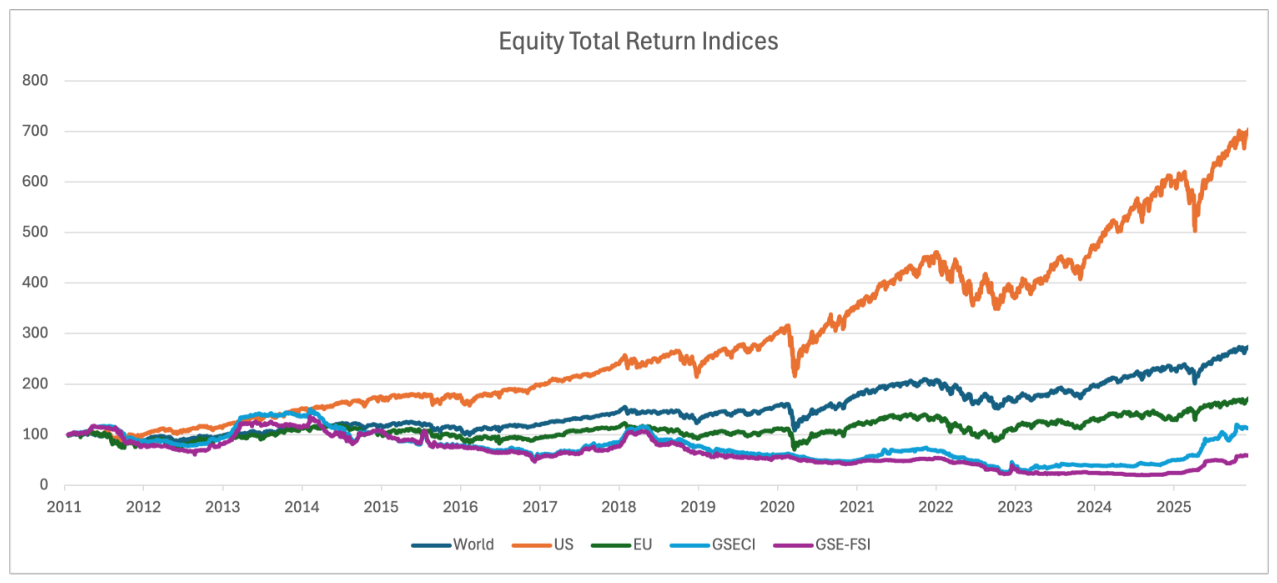
Figure 2.
Commodity Price Indices. Notes: The figure plots commodity price indices for gold, Brent crude oil, and cocoa. All series are indexed to 100 at the beginning of the sample period.
Figure 2.
Commodity Price Indices. Notes: The figure plots commodity price indices for gold, Brent crude oil, and cocoa. All series are indexed to 100 at the beginning of the sample period.
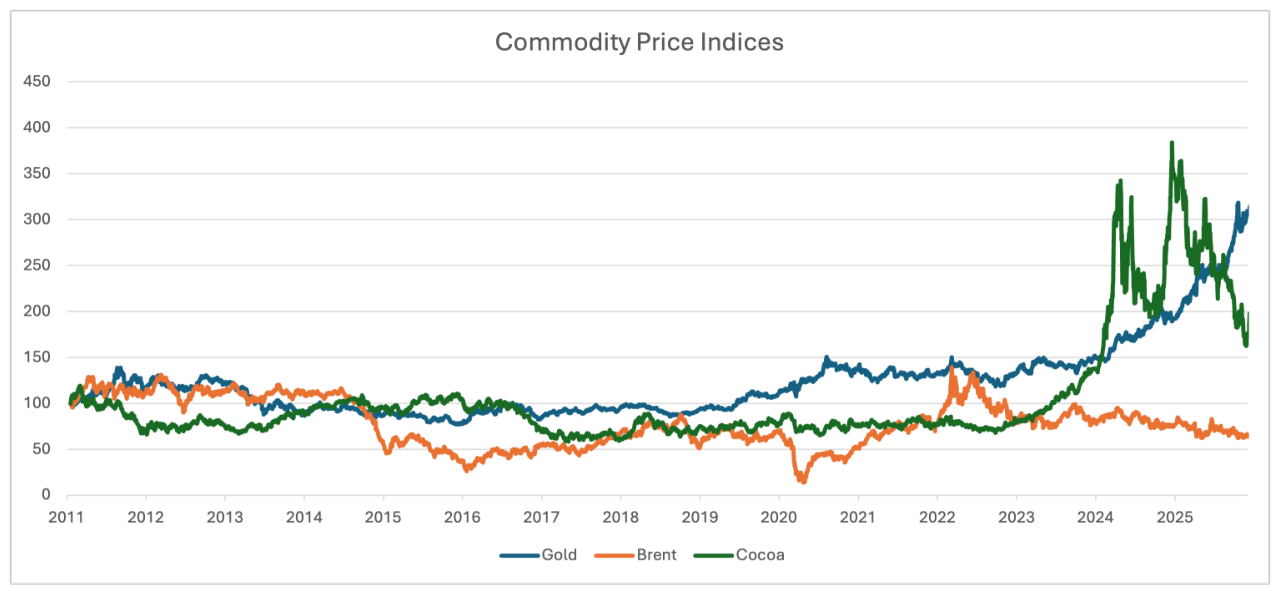

Table 1.
Fundamental Indicators of the Ghana Stock Exchange.
| Year | Market cap. (USD bn) |
Listed firms |
Trading volume (mn) |
Trading value (USD mn) |
Market cap./GDP (%) |
|---|---|---|---|---|---|
| 2011 | 29.89 | 34 | 419.8 | 281.9 | 7.9 |
| 2012 | 30.39 | 34 | 218.1 | 54.2 | – |
| 2013 | 28.29 | 34 | 313.0 | 211.0 | – |
| 2014 | 20.11 | 34 | 207.5 | 108.1 | – |
| 2015 | 15.05 | 35 | 246.4 | 65.3 | – |
| 2016 | 12.54 | 37 | 252.8 | 57.6 | – |
| 2017 | 14.25 | 36 | 322.7 | 117.4 | – |
| 2018 | 12.68 | 34 | 200.6 | 136.8 | – |
| 2019 | 10.26 | 33 | 3,817.0 | 112.8 | 14.6 |
| 2020 | 9.44 | 31 | 695.4 | 99.9 | 13.2 |
| 2021 | 10.74 | 30 | 486.6 | 88.8 | 13.2 |
| 2022 | 7.52 | 30 | 1,335.3 | 191.2 | 8.7 |
| 2023 | 6.22 | 29 | 579.7 | 68.9 | 7.7 |
| 2024 | 7.58 | 30 | 992.2 | 146.5 | 9.2 |
| 2025 | 16.46 | 31 | 771.6 | 358.0 | – |
Notes: Market capitalization is reported in billion U.S. dollars. Trading volume is reported in millions of shares, and trading value is reported in million U.S. dollars. Except for the market-capitalization-to-GDP ratio, all data are extracted from various Market Reports published by the Ghana Stock Exchange and available at https://gse.com.gh/market-reports/. The Market cap./GDP refers to market capitalization of listed domestic firms to GDP ratio and is obtained from the World Bank database, using indicator code CM.MKT.LCAP.GD.ZS. Data for this variable are not available for all years in the sample. A dash indicates that the observation is not available.
Table 2.
Data Series and Refinitiv Symbols.
| Series | Refinitiv Symbol |
|---|---|
| Ghana Stock Exchange Composite Index | .GSECI |
| Ghana Stock Exchange Financial Sector Index | .GSEFSI |
| World equity-market index | .TRXFLDGLPU |
| U.S. equity-market index | .SPXTR |
| European equity-market index | dMIEC00000PUS |
| Gold price | XAU= |
| Brent crude oil price | BRT- |
| Cocoa price | CCUSD-DLY-ICCO |
Table 3.
Summary Statistics of Daily Returns.
| Statistic | RWD | RUS | REU | RGSECI | RGSEFSI | RGOLD | RBRENT | RCOCOA |
|---|---|---|---|---|---|---|---|---|
| Mean | 0.0304 | 0.0539 | 0.0157 | 0.0062 | -0.0112 | 0.0262 | 0.0016 | 0.0114 |
| Median | 0.0689 | 0.0540 | 0.0562 | 0.0098 | 0.0000 | 0.0399 | 0.0623 | 0.0000 |
| Maximum | 7.9068 | 9.0908 | 8.1906 | 17.5727 | 17.3486 | 4.6928 | 22.4283 | 14.9788 |
| Minimum | -9.8130 | -12.7604 | -14.8233 | -16.1198 | -16.2618 | -8.8756 | -35.6602 | -21.6084 |
| Std. Dev. | 0.8789 | 1.0779 | 1.2504 | 1.4314 | 1.4609 | 0.9759 | 2.4751 | 1.8368 |
| Skewness | -1.0558 | -0.6700 | -0.7818 | 0.2387 | 0.2369 | -0.5447 | -0.9921 | -0.6544 |
| Kurtosis | 18.1327 | 18.8176 | 13.1249 | 20.9057 | 21.6298 | 7.9878 | 27.6884 | 15.2983 |
| Observations | 3592 | 3592 | 3592 | 3592 | 3592 | 3592 | 3592 | 3592 |
Notes: This table presents descriptive statistics for daily returns on equity indices and commodity price series over the sample period from January 2011 to December 2025. All series are obtained from Refinitiv Workspace and measured in U.S. dollars. Daily returns are computed as , where denotes the index value or commodity price on day t. RWD, RUS, and REU denote returns on the World, US, and European equity total return indices, respectively. RGSECI and RGSEFSI denote returns on the GSECI and GSEFSI, respectively. RGOLD, RBRENT, and RCOCOA denote returns on gold, Brent crude oil, and cocoa prices, respectively.
Table 4.
ARMA–EGARCH Results for the GSE Composite Index.
| (1) | (2) | (3) | (4) | (5) | (6) | (7) | |
|---|---|---|---|---|---|---|---|
| Mean equation | |||||||
| 0.0219 | 0.0253 | 0.0072 | 0.0006 | 0.0085 | 0.0030 | -0.0007 | |
| (0.0237) | (0.0258) | (0.0259) | (0.0266) | (0.0258) | (0.0275) | (0.0273) | |
| 0.7652*** | 0.7691*** | 0.7704*** | 0.7740*** | 0.7707*** | 0.7766*** | 0.7762*** | |
| (0.0273) | (0.0248) | (0.0255) | (0.0259) | (0.0262) | (0.0248) | (0.0254) | |
| 0.1581*** | 0.1657*** | 0.1633*** | 0.1609*** | 0.1617*** | 0.1623*** | 0.1623*** | |
| (0.0173) | (0.0174) | (0.0173) | (0.0175) | (0.0176) | (0.0176) | (0.0181) | |
| -0.8791*** | -0.8855*** | -0.8902*** | -0.8902*** | -0.8888*** | -0.8931*** | -0.8936*** | |
| (0.0211) | (0.0184) | (0.0188) | (0.0194) | (0.0194) | (0.0176) | (0.0183) | |
| 0.0255** | 0.0266** | 0.0263** | 0.0249** | 0.0331*** | 0.0290** | ||
| (0.0109) | (0.0108) | (0.0112) | (0.0117) | (0.0111) | (0.0117) | ||
| 0.0053 | 0.0011 | ||||||
| (0.0120) | (0.0129) | ||||||
| 0.0035 | 0.0038 | ||||||
| (0.0067) | (0.0066) | ||||||
| -0.0272*** | -0.0274*** | ||||||
| (0.0063) | (0.0062) | ||||||
| 0.1139 | 0.1223* | 0.1118 | 0.1379* | 0.1457** | |||
| (0.0742) | (0.0730) | (0.0737) | (0.0745) | (0.0725) | |||
| 0.5805** | 0.6115** | 0.5848** | 0.5946** | 0.6149** | |||
| (0.2948) | (0.3034) | (0.2938) | (0.2950) | (0.3020) | |||
| Variance equation | |||||||
| -0.2041*** | -0.2124*** | -0.2156*** | -0.2287*** | -0.2158*** | -0.2191*** | -0.2303*** | |
| (0.0067) | (0.0070) | (0.0071) | (0.0077) | (0.0073) | (0.0076) | (0.0083) | |
| 0.3159*** | 0.3111*** | 0.3156*** | 0.3209*** | 0.3160*** | 0.3186*** | 0.3234*** | |
| (0.0108) | (0.0109) | (0.0111) | (0.0112) | (0.0111) | (0.0113) | (0.0115) | |
| 0.0213*** | 0.0278*** | 0.0265*** | 0.0255*** | 0.0265*** | 0.0244*** | 0.0241*** | |
| (0.0067) | (0.0078) | (0.0077) | (0.0080) | (0.0077) | (0.0080) | (0.0083) | |
| 0.9572*** | 0.9573*** | 0.9569*** | 0.9573*** | 0.9567*** | 0.9569*** | 0.9567*** | |
| (0.0024) | (0.0025) | (0.0025) | (0.0025) | (0.0025) | (0.0025) | (0.0026) | |
| 0.0070*** | 0.0070*** | 0.0035* | 0.0069*** | 0.0066*** | 0.0030 | ||
| (0.0009) | (0.0009) | (0.0020) | (0.0010) | (0.0010) | (0.0022) | ||
| 0.0152*** | 0.0140*** | ||||||
| (0.0041) | (0.0044) | ||||||
| 0.00004 | 0.0002 | ||||||
| (0.0004) | (0.0004) | ||||||
| 0.0004 | 0.0001 | ||||||
| (0.0005) | (0.0005) | ||||||
| Log likelihood | -5543.69 | -5536.73 | -5535.15 | -5532.91 | -5535.07 | -5528.64 | -5526.64 |
| Adjusted R-squared | 0.0209 | 0.0190 | 0.0194 | 0.0193 | 0.0195 | 0.0208 | 0.0202 |
| S.E. of regression | 1.4167 | 1.4181 | 1.4178 | 1.4178 | 1.4177 | 1.4168 | 1.4172 |
Notes: This table presents the ARMA(2,1)–EGARCH(1,1,1) estimation results for daily index returns. In the mean equation, denotes the constant term; and denote the autoregressive coefficients; denotes the moving-average coefficient; denotes the coefficient on the global or common equity-market factor; and , , and denote the coefficients on the gold, crude-oil, and cocoa factors, respectively. and denote the coefficients on the banking-sector clean-up/recapitalization dummy and the Domestic Debt Exchange Programme dummy, respectively. In the variance equation, denotes the constant term; , , and denote the EGARCH parameters; and , , , and denote the corresponding conditional variance terms associated with the global/common equity-market, gold, crude-oil, and cocoa factors, respectively. Standard errors are reported in parentheses below the coefficient estimates. ***, **, and * indicate statistical significance at the 1%, 5%, and 10% levels, respectively.
Table 5.
EGARCH regression results for the financial sector index.
| (1) | (2) | (3) | (4) | (5) | (6) | (7) | |
|---|---|---|---|---|---|---|---|
| Mean equation | |||||||
| -0.0786*** | -0.0613** | -0.0754*** | -0.0750*** | -0.0657** | -0.0603** | -0.0052* | |
| (0.0244) | (0.0256) | (0.0273) | (0.0274) | (0.0286) | (0.0279) | (0.0281) | |
| 0.7033*** | 0.7073*** | 0.7137*** | 0.7172*** | 0.7055*** | 0.6918*** | 0.7003*** | |
| (0.0298) | (0.0308) | (0.0308) | (0.0317) | (0.0316) | (0.0331) | (0.0327) | |
| 0.1959*** | 0.1944*** | 0.1947*** | 0.1915*** | 0.1997*** | 0.1995*** | 0.1992*** | |
| (0.0187) | (0.0191) | (0.0193) | (0.0197) | (0.0197) | (0.0201) | (0.0204) | |
| -0.8328*** | -0.8325*** | -0.8392*** | -0.8391*** | -0.8320*** | -0.8204*** | -0.8263*** | |
| (0.0247) | (0.0256) | (0.0249) | (0.0253) | (0.0257) | (0.0276) | (0.0265) | |
| 0.0428*** | 0.0415*** | 0.0325*** | 0.0494*** | 0.0489*** | 0.0421*** | ||
| (0.0105) | (0.0105) | (0.0111) | (0.0116) | (0.0112) | (0.0126) | ||
| 0.0384*** | 0.0387*** | ||||||
| (0.0107) | (0.0109) | ||||||
| -0.0133** | -0.0134** | ||||||
| (0.0068) | (0.0066) | ||||||
| -0.0183*** | -0.0100** | ||||||
| (0.0040) | (0.0049) | ||||||
| 0.1111 | 0.1435* | 0.1165 | 0.1111 | 0.1048 | |||
| (0.0815) | (0.0836) | (0.0829) | (0.0814) | (0.0846) | |||
| 0.7895*** | 0.8016*** | 0.7839*** | 0.6519*** | 0.7745*** | |||
| (0.1947) | (0.1979) | (0.1961) | (0.1844) | (0.1784) | |||
| Variance equation | |||||||
| -0.1710*** | -0.1732*** | -0.1799*** | -0.1771*** | -0.1767*** | -0.1694*** | -0.1723*** | |
| (0.0053) | (0.0053) | (0.0058) | (0.0058) | (0.0059) | (0.0059) | (0.0067) | |
| 0.2849*** | 0.2710*** | 0.2817*** | 0.2814*** | 0.2770*** | 0.3059*** | 0.3105*** | |
| (0.0092) | (0.0088) | (0.0095) | (0.0095) | (0.0094) | (0.0109) | (0.0112) | |
| 0.0237*** | 0.0220*** | 0.0222*** | 0.0221*** | 0.0231*** | 0.0332*** | 0.0348*** | |
| (0.0062) | (0.0060) | (0.0062) | (0.0065) | (0.0062) | (0.0077) | (0.0081) | |
| 0.9459*** | 0.9497*** | 0.9467*** | 0.9491*** | 0.9495*** | 0.9279*** | 0.9293*** | |
| (0.0024) | (0.0024) | (0.0025) | (0.0027) | (0.0026) | (0.0034) | (0.0035) | |
| 0.0063*** | 0.0065*** | 0.0073*** | 0.0088*** | 0.0077*** | 0.0101*** | ||
| (0.0013) | (0.0014) | (0.0017) | (0.0015) | (0.0018) | (0.0023) | ||
| -0.0054 | 0.0015 | ||||||
| (0.0041) | (0.0053) | ||||||
| -0.0008*** | -0.0009*** | ||||||
| (0.0003) | (0.0003) | ||||||
| -0.0073*** | -0.0075*** | ||||||
| (0.0008) | (0.0045) | ||||||
| Log likelihood | -5669.62 | -5661.99 | -5659.69 | -5656.44 | -5656.11 | -5642.14 | -5635.38 |
| Adjusted R-squared | 0.0334 | 0.0340 | 0.0347 | 0.0339 | 0.0346 | 0.0366 | 0.0347 |
| S.E. of regression | 1.4366 | 1.4363 | 1.4357 | 1.4363 | 1.4358 | 1.4343 | 1.4357 |
Notes: This table presents the ARMA–EGARCH estimation results for daily index returns. In the mean equation, denotes the constant term; and denote the autoregressive coefficients; denotes the moving-average coefficient; denotes the coefficient on the global or common equity-market factor; and , , and denote the coefficients on the gold, crude-oil, and cocoa factors, respectively. and denote the coefficients on the banking-sector clean-up/recapitalization dummy and the Domestic Debt Exchange Programme dummy, respectively. In the variance equation, denotes the constant term; , , and denote the EGARCH parameters; and , , , and denote the corresponding conditional variance terms associated with the global/common equity-market, gold, crude-oil, and cocoa factors, respectively. Standard errors are reported in parentheses below the coefficient estimates. ***, **, and * indicate statistical significance at the 1%, 5%, and 10% levels, respectively.
Disclaimer/Publisher’s Note: The statements, opinions and data contained in all publications are solely those of the individual author(s) and contributor(s) and not of MDPI and/or the editor(s). MDPI and/or the editor(s) disclaim responsibility for any injury to people or property resulting from any ideas, methods, instructions or products referred to in the content. |
© 2026 by the authors. Licensee MDPI, Basel, Switzerland. This article is an open access article distributed under the terms and conditions of the Creative Commons Attribution (CC BY) license (http://creativecommons.org/licenses/by/4.0/).
Copyright: This open access article is published under a Creative Commons CC BY 4.0 license, which permit the free download, distribution, and reuse, provided that the author and preprint are cited in any reuse.


