

Submitted:
13 June 2026
Posted:
15 June 2026
You are already at the latest version
Abstract
Testicular torsion is a urological emergency that requires prompt diagnosis and surgical intervention to preserve testicular viability. Bilateral orchidopexy is widely regarded as the definitive treatment for the prevention of recurrence [1,2]. We report two rare cases of recurrent testicular torsion despite prior surgical fixation. Both patients had previously undergone orchidopexy and presented with acute scrotal pain. Surgical exploration confirmed torsion in both cases, despite macroscopically intact fixation sutures. Intraoperative findings suggested that recurrence was not due to suture failure but rather to the insufficient restriction of testicular mobility related to the initial fixation technique. Revision orchidopexy with modified multi-point fixation was performed, resulting in successful detorsion and the preservation of testicular perfusion. These cases highlight that orchidopexy does not universally prevent recurrent torsion and emphasize the critical importance of the surgical technique, including the suture placement, orientation, and number of fixation points. Increased awareness of potential re-torsion is essential, even in previously pexied patients. Improved standardization of fixation techniques may help reduce the risk of recurrence.
Keywords:
case series
; recurrent testicular torsion
; surgical fixation
1. Introduction
Testicular torsion is a time-sensitive surgical emergency that most commonly affects adolescent males, with a peak incidence between 12 and 25 years of age. Surgical detorsion and bilateral orchidopexy remain the standard treatment to avoid testicular loss and prevent contralateral torsion [1,2]. Orchidopexy is considered definitive, with recurrence after fixation being exceptionally rare [3,4,5]. The recent literature has increasingly highlighted the importance of surgical technique in orchidopexy, with a particular focus on the suture material, number of fixation points, and orientation, although high-level evidence and standardized recommendations regarding the optimal fixation technique are still lacking, particularly with respect to the suture configuration and prevention of rotational mobility [6,7,8]. We report two cases of recurrent torsion in previously pexied testicles, raising concern regarding technique-dependent failure.
Both patients provided written consent for the reporting of their cases and the use of intraoperative photographs.
2. Case Presentation
Case 1: A 16-year-old male presented to our hospital in May 2020 with acute left scrotal pain. He reported having experienced right-sided testicular torsion in September 2019, which was surgically managed with bilateral orchidopexy at an outside institution. Operative details of the initial procedure, including the number and placement of sutures, were unavailable at the time. On presentation in May 2020, surgical exploration confirmed left-sided torsion despite visible and two intact lateral sutures from the previous pexy. The findings were documented photographically, and the images demonstrate intact suture placement (Figure 1 and Figure 2). Repeat orchidopexy was performed with reinforced three-point fixation. Testicular perfusion was preserved.
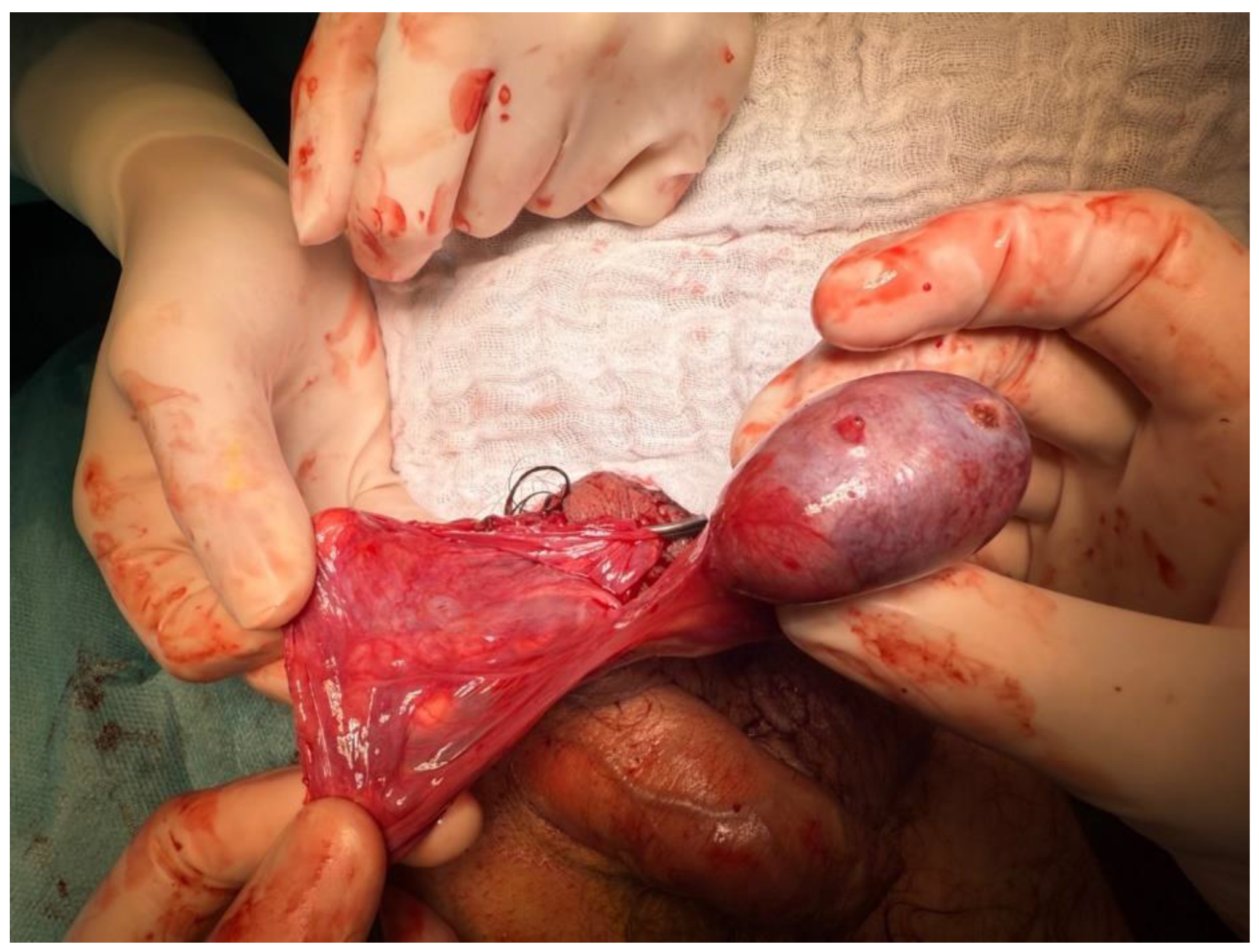
Case 2: A 19-year-old male experienced right-sided torsion in March 2000 and underwent detorsion with contralateral (left-sided) orchidopexy in our hospital. No complications were reported, and follow-up was uneventful. In May 2025, now aged 44, he again presented with left scrotal pain, which had been persisting for three days. An ultrasound of the left testis indicated the absence of blood perfusion, and acute surgical exploration of the testis revealed left-sided torsion with the testis rotated 360 degrees, despite a prior orchidopexy. Interestingly, the left testicle was pexied at two longitudinal points, likely allowing axial rotation. Detorsion was successful, and a new fixation with two-point lateral sutures was performed. The old sutures were still visible, indicating that suture failure was not the cause but rather inadequate anchoring. Intraoperative findings also revealed scarred sites of previous fixation (Figure 3 and Figure 4). Remarkably, despite the pain persisting for three days, the testicle reperfused successfully after detorsion, which is unusual and highlights the potential for salvage even after delayed presentation.
3. Discussion
Recurrent torsion despite prior orchidopexy is exceptionally rare but is has been documented in the literature. It is more likely attributable to the insufficient restriction of testicular mobility due to suboptimal fixation techniques the rather than failure of the suture material itself. A recent systematic review by van Welie et al. identified 46 cases of recurrent torsion post-fixation [7]. Our two cases contribute additional clinical details and support the notion that surgical fixation does not universally prevent recurrence. Technical factors, including the number of suture points, orientation, and suture material, appear to play a critical role. In both cases, failure occurred not due to suture resorption or breakage but due to the insufficient restriction of rotational mobility. The second case is particularly instructive, demonstrating how longitudinally oriented fixation fails to address the pathophysiology of torsion, which typically involves clockwise rotation around the vertical axis of the spermatic cord.
Notably, the occurrence of torsion in a 44-year-old patient is extremely rare. Testicular torsion is predominantly a condition of adolescents and young adults, and its presentation in a middle-aged male more than two decades after the initial fixation further underscores the uniqueness and clinical relevance of this case. It also highlights the importance of maintaining a high index of suspicion even in patients who fall outside the typical age range.
Current guidelines offer little standardization regarding suture placement, number, or technique. Neither the European Association of Urology (EAU) nor the American Urological Association (AUA) guidelines provide explicit recommendations on the choice of suture material or specific fixation technique. However, a consensus document from the British Association of Urological Surgeons (BAUS) and the British Urology Researchers in Surgical Training (BURST) favors the use of non-absorbable sutures and multi-point fixation—preferably three- or four-point fixation—to minimize the risk of recurrence, although robust comparative data remain limited [9]. These cases underscore the need for enhanced surgical awareness and possibly revised technical standards in orchidopexy procedures. We suggest that fixation should not be limited to the longitudinal axis but should also include sutures placed in the transverse axis, thereby restricting axial rotation more effectively and enhancing stability.
4. Conclusions
Recurrent torsion after orchidopexy, although exceedingly rare, can occur and is likely related to suboptimal surgical techniques. These cases reinforce the importance of meticulous multi-point fixation during orchidopexy. A higher degree of suspicion is warranted in patients with prior orchidopexy who present with scrotal pain. Due to the rarity of testicular torsion after prior orchidopexy, the development of prospective studies is likely to be extremely difficult, if not impossible. As such, case reports and retrospective cohort studies play a crucial role in raising awareness among surgeons and patients about the potential for re-torsion and in guiding clinical decision-making. These forms of evidence are essential for informing conclusions regarding the most appropriate surgical techniques for orchidopexy. To reduce the risk of recurrence, future research efforts and surgical guidelines should explicitly address technical aspects of testicular fixation and promote standardized, evidence-based approaches. The main limitation of this paper is its descriptive nature and the small number of cases inherent to case reports.
5. Patents
Author Contributions
Conceptualization and data curation: Julia Peters, Peter Törzsök. Methodology: Maximilian Pallauf. Supervision: Lukas Lusuardi, Peter Törzsök. Writing – original draft: Julia Peters, Philipp Haid. Writing – review and editing: Julia Peters, Philipp Haid, Maximilian Pallauf
Funding
This study did not receive any funding.
Institutional Review Board Statement
This study did not require ethical approval.
Informed Consent Statement
Written informed consent has been obtained from the patients to publish this paper.
Acknowledgments
The authors have reviewed and edited the output and take full responsibility for the content of this publication.
Conflicts of Interest
The author declares no conflicts of interest.
References
- Anderson, J.B.; Williamson, R.C. Testicular torsion in Bristol: a 25 year review. Br. J. Surg. 1988, 75(10), 988–992. [Google Scholar] [CrossRef] [PubMed]
- Kaye, J.D.; Shapiro, E.Y.; Levitt, S.B.; Friedman, S.C.; Gitlin, J.; Freyle, J. Parenchymal atrophy following orchiopexy for unilateral testicular torsion. J. Urol. 2008, 180((4) Suppl, 1714–1717. [Google Scholar]
- Rampaul, R.S.; Hosking, S.; Newton, T. Recurrent testicular torsion after previous fixation. Br. J. Urol. 1997, 80(6), 984. [Google Scholar]
- Liang, T.; Metcalfe, P.; Sevcik, W.; Noga, M. Retorsion of a previously pexed testis: a case report and review of the literature. Can. Urol. Assoc. J. 2014, 8(5-6), E393–E396. [Google Scholar]
- Memon, M.A.; Gollins, S.W.; Fulford, P.E. Recurrent testicular torsion after previous fixation. Br. J. Urol. 1993, 71(3), 372. [Google Scholar]
- Riaz-Ul-Haq, M.; Mahdi, D.E.; Akhtar, M.; et al. Recurrent testicular torsion following previous fixation: A preventable complication. J. Surg. Case Rep. 2017, 2017(10), rjx207. [Google Scholar]
- van Welie, S.; Boellaard, W.P.; Venema, E.J.; Vijftigschild, L.A.W.; Bosch, J.L.H.R.; de Kort, L.M.O. Recurrent testicular torsion after previous fixation: a case report and systematic review. J. Pediatr. Urol. 2022, 18(2), 239.e1–239.e7. [Google Scholar]
- Koochakzadeh, S.; Jain, A.; Franco, I. Recurrent testicular torsion post-orchidopexy: A case report. Urol. Case Rep. 2019, 26, 100998. [Google Scholar]
- Rehfisch, J.; Jones, M.; Baird, A.D.; et al. Orchidopexy Technique for Testicular Torsion: Evidence Review and Recommendations from the British Urology Researchers in Surgical Training (BURST). BJU Int. 2021, 127(5), 576–582. [Google Scholar]
- Rehfisch, J.; Jones, M.; Baird, A.D.; et al. Orchidopexy Technique for Testicular Torsion: Evidence Review and Recommendations from the British Urology Researchers in Surgical Training (BURST). BJU Int. 2021, 127(5), 576–582. [Google Scholar]
Figure 1.
Case 1: Intact sutures from the first orchidopexy.
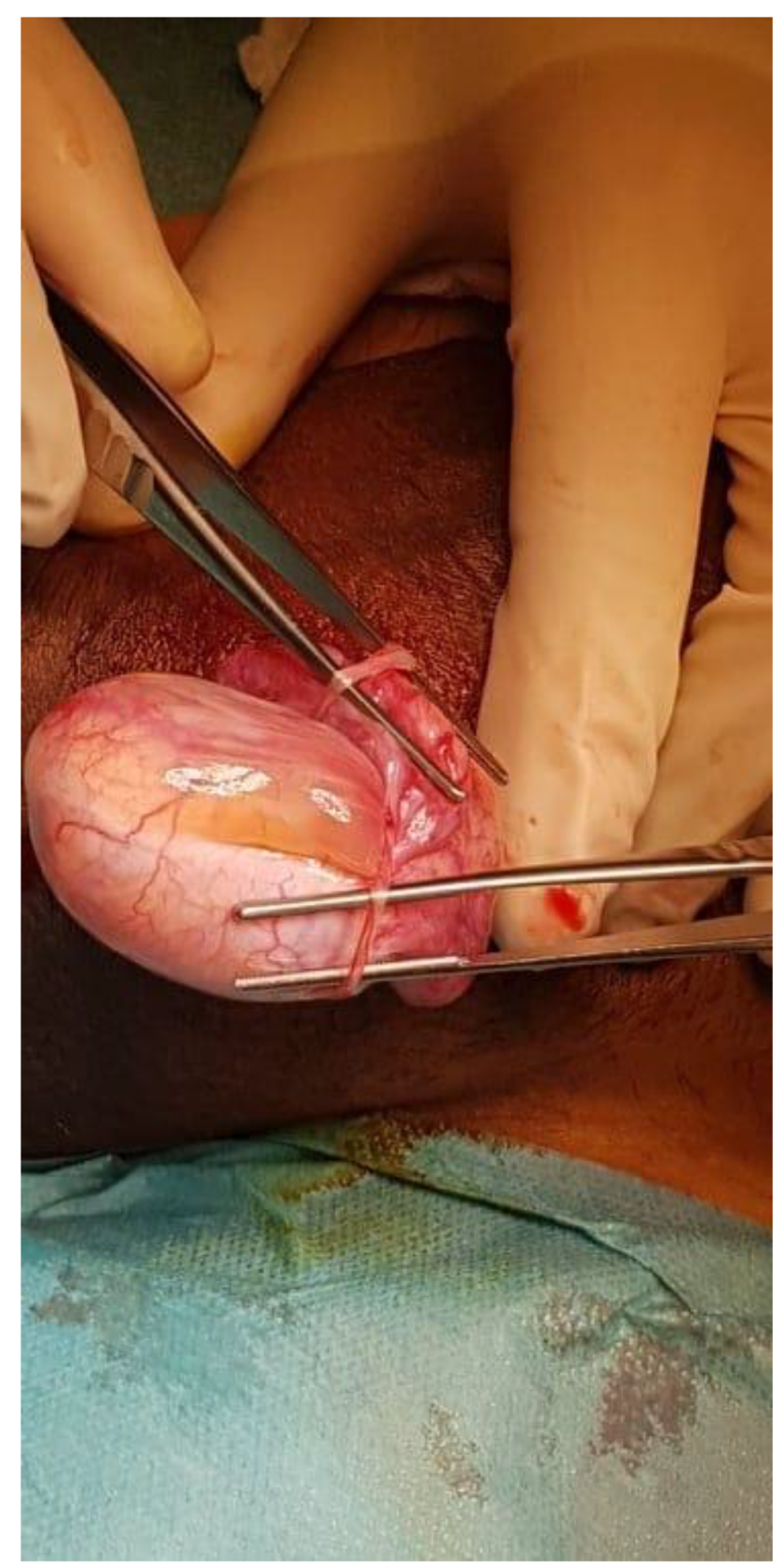
Figure 2.
Case 1: Transected old pexy sutures with visible scar tissue.
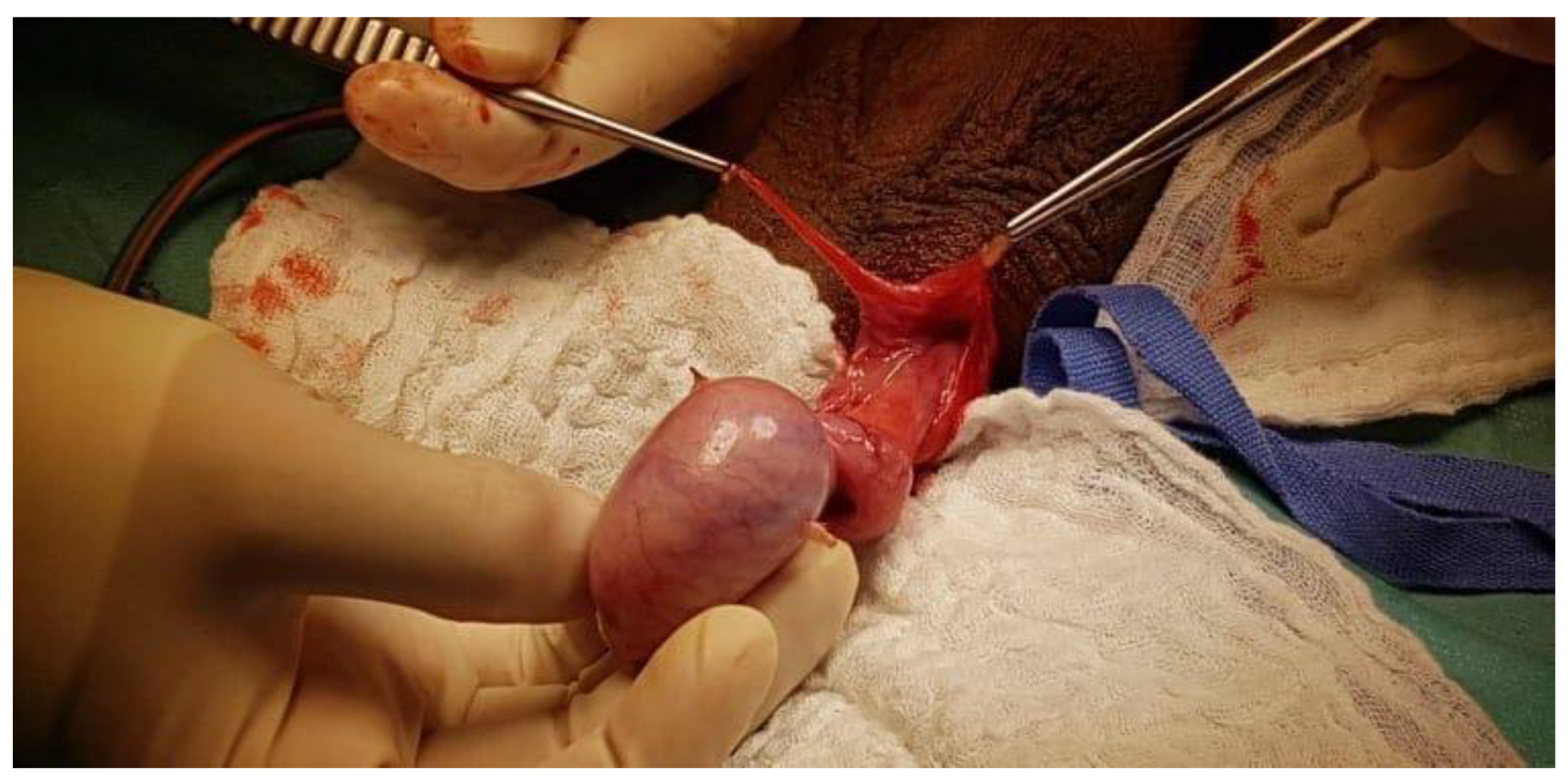
Figure 3.
Case 2: Intraoperative image showing intact longitudinal prior pexy sutures in situ.
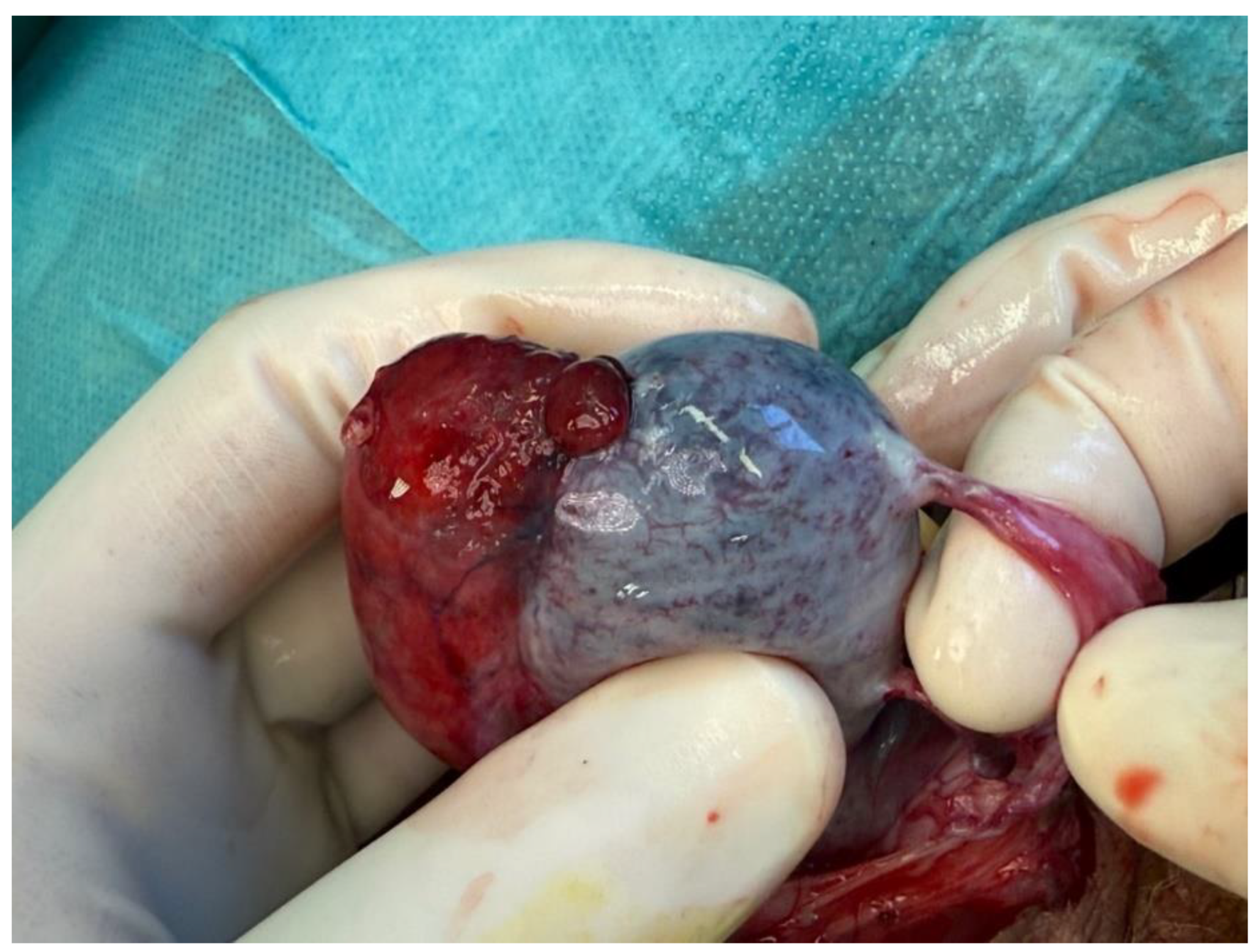
Figure 4.
Case 2: Transected longitudinal sutures with scar tissue and reperfused testis following detorsion.
Figure 4.
Case 2: Transected longitudinal sutures with scar tissue and reperfused testis following detorsion.
Disclaimer/Publisher’s Note: The statements, opinions and data contained in all publications are solely those of the individual author(s) and contributor(s) and not of MDPI and/or the editor(s). MDPI and/or the editor(s) disclaim responsibility for any injury to people or property resulting from any ideas, methods, instructions or products referred to in the content. |
© 2026 by the authors. Licensee MDPI, Basel, Switzerland. This article is an open access article distributed under the terms and conditions of the Creative Commons Attribution (CC BY) license (http://creativecommons.org/licenses/by/4.0/).
Copyright: This open access article is published under a Creative Commons CC BY 4.0 license, which permit the free download, distribution, and reuse, provided that the author and preprint are cited in any reuse.


