

Submitted:
12 June 2026
Posted:
15 June 2026
You are already at the latest version
Abstract
Objective: Patients with D-Transposition of the Great Arteries (TGA) often require prostaglandin E1 (PGE) even after balloon atrial septostomy (BAS). This study builds a computer simulation that analyzes whether or not elevated pulmonary vascular resistance (PVR) could explain the profound hypoxemia seen in some patients after PGE discontinuation.
Methods: We developed a systems-based mathematical model of TGA incorporating systemic and pulmonary circulations, atrial septal defect (ASD), and patent ductus arteriosus (PDA) with bidirectional atrial mixing. The effects of BAS and PGE withdrawal were modeled by altering atrial and ductal resistances, respectively. Using Monte Carlo sampling, 500 virtual patients with variable pulmonary vascular resistance (PVR) and systemic vascular resistance (SVR) were simulated. Key outcomes included relative changes in systemic oxygen saturation (ΔSsa), systemic flow (ΔQs/Qs), effective pulmonary flow (ΔQp,eff/Qp,eff), and oxygen delivery (ΔDO₂/DO₂).
Results: Regression analysis demonstrated that each unit increase in PVR was associated with a 0.4% decrease in ΔSsa, an 8.8% reduction in ΔQs/Qs, an 8.8% reduction in ΔQp,eff/Qp,eff, and a 9.5% reduction in ΔDO₂/DO₂ (all p< 0.01). In contrast, SVR had smaller but favorable effects, with each unit increase associated with a 0.3% improvement in ΔSsa, 0.6% increase in ΔQs/Qs, 1.6% increase in ΔQp,eff/Qp,eff, and 1.0% increase in ΔDO₂/DO₂. Importantly, discontinuation of PGE and ductal closure often resulted in lower systemic oxygen saturation but higher systemic oxygen delivery due to increased systemic blood flow, an effect most pronounced in patients with low PVR.
Conclusions: The effectiveness of BAS in eliminating ductal dependence is strongly influenced by vascular tone. Elevated PVR markedly limits the benefit of atrial decompression, while higher SVR exerts modestly protective effects. These findings explain clinical variability in BAS outcomes and highlight that systemic oxygen delivery—not saturation alone—should guide assessment of post-BAS physiology in neonates with TGA.
Keywords:
transposition of the great arteries
; balloon atrial septostomy
; pulmonary vascular resistance
; prostaglandin E1
; oxygen delivery
1. Introduction
In D-transposition of the great arteries (TGA), a mixing lesion is necessary to shunt oxygen from the pulmonary circulation to the systemic circulation. The three potential mixing lesions are an atrial septal defect (ASD), ventricular septal defect (VSD), and a patent ductus arteriosus (PDA). However, if mixing is insufficient, it can be increased at the ASD by balloon atrial septostomy (BAS) and at the PDA by prostaglandin E1 (PGE). In a previous retrospective analysis, we analyzed the effectiveness that BAS has in the successful discontinuation of PGE by increasing the mixing at the atrial level (1). We were surprised to find that BAS was not effective enough to discontinue PGE in the majority of patients before they underwent the arterial switch operation. Other investigators have also found that approximately 20-60% of patients continue to require PGE after BAS (2-4). The objective of the present study is to implement a mathematical model to explain the interaction between BAS, discontinuation of PGE (closure of PDA), and other hemodynamic parameters including pulmonary vascular resistance (PVR) and systemic vascular resistance (SVR) in order to find hemodynamic conditions that hinder the effectiveness of the BAS.
2. Materials and Methods
2.1. Mathematical Model
We developed a mathematical model of the circulatory system in patients with TGA. This model contains components to represent systemic circulation, pulmonary circulation, cardiac ventricles and atria, the PDA, and the ASD. This model also accounts for the intake of oxygen (O2) in the lungs, the transport of O2 in the circulation, the bidirectional flow through the ASD, and its consumption in the systemic organs. We are able to model the effect of the BAS by modifying the flow resistance through the ASD and the effect of PGE by modifying the flow resistance through the PDA. The model also allows us to simulate high/low PVR and high/low SVR conditions which in clinical practice can be manipulated by vasopressors or vasodilators.
Our model assumes two parallel circulations, one linking the right ventricle (RV) and systemic circulation, and the other connecting the left ventricle (LV) and pulmonary circulation. The two mixing lesions are the PDA, which allows unidirectional blood flow from the systemic to pulmonary circulation, and the ASD, which allows bidirectional flow between the systemic and pulmonary circulation at the atrial level. This bidirectional mixing in the ASD is a key feature of our model which improves accuracy of oxygen saturations. It is parameterized by a variable , which represents the reverse flow through the ASD as a fraction of the forward flow. If there is unidirectional forward flow from the left atrium (LA) to the right atrium (RA), becomes zero.
The oxygen saturation of the blood is influenced by two key junction points in the model, J1 at the pulmonary artery and J2 at the right atrium. At J1, deoxygenated blood from the right ventricle flows through the PDA to join with mostly oxygenated blood from the left ventricle, producing the oxygen saturation of the pulmonary artery. The blood from the left ventricle is mostly oxygenated because it consists primarily of blood from the pulmonary veins, along with some retrograde flow of deoxygenated blood from the ASD. At J2, where oxygenated blood from the pulmonary veins flows through the ASD to mix with deoxygenated blood from the systemic veins before entering the RV.
Below is a complete listing of all equations, whose roots we solved using the optimize function of the SciPy library version 1.9.1. The first equation is
which dictates that the steady cardiac output of the RV is the product of the heart rate () and the stroke volume. Here and represent the flow through the systemic circulation and the PDA, respectively. and denote the compliances of the RV at diastole and systole, and and represent the blood pressure in the systemic veins and systemic arteries, respectively. The blood that exits the RV will either go into the systemic circulation or into the PDA, hence equals the output from the RV. On the right-hand side, the stroke volume is equal to the end-diastolic volume (EDV) minus the end-systolic volume (ESV). In this simplified model, the diastolic pressure of the RV equalizes with the right atrium and by extension the central veins, hence the use of to calculate EDV. Because of transposition, the systolic pressure in the RV equalizes with the systemic arteries, hence the use of to calculate ESV.
The second equation of the system is
Which is analogous to (Eqn. 1) but for the LV. The main differences are that the end-diastolic and end-systolic pressures equalize with the pulmonary vein () and the pulmonary artery () pressures, respectively, and that the volume of blood entering the LV consists of flow to the pulmonary circulation() minus the blood flow that exits through the ASD (). Similarly to the RV, and denote the compliances of the LV at diastole and systole.
The third equation is
which represents Ohm’s law of fluid flow for the systemic vasculature. Similarly, the fourth equation is
which represents Ohm’s law of fluid flow for the pulmonary vasculature. The analogous law for the flow through the ASD is given by a fifth equation
and through the PDA by a sixth equation
where and represent the resistance to flow in the ASD and PDA, respectively.
The seventh equation is
which dictates that, at steady state, the flow through the ASD must equal the flow through the PDA due to conservation of blood mass.
Conservation of mass of oxygen applied at point J1 is given by an eighth equation
where the PDA joins with blood flow from the LV before flowing into the pulmonary circulation. represents the mass of oxygen leaving point J1 toward the lungs. Here denotes the oxygen saturation in the pulmonary arteries. gives the oxygen mass entering point J1 from the PDA, since the PDA draws blood from the systemic arteries whose oxygen saturation is . The rest of the oxygen entering point J1 comes from the LV, which itself consists of a component from the pulmonary veins and another component from the systemic veins via the ASD. represents the volume of blood coming into point J1 from the LV. This quantity is multiplied by the saturation at the LA which in turn is a mix of oxygen contents of the pulmonary and systemic veins due to the bidirectional flow at the ASD. The last equation is
which represents conservation of oxygen mass applied at point J2, where blood from the systemic veins joins with blood from the ASD before entering the RV. represents the total volume of blood leaving point J2 to go into the RV. This blood flows into the systemic arteries with its oxygen saturation denoted by and into the PDA whose flow is assumed to be unidirectional. Thus, the left-hand side of the equation is the total oxygen content flowing from the RV. This oxygen comes from two sources, which are represented on the right-hand side of the equation. gives the oxygen coming into point J2 from the systemic veins whose saturation is , and the second term gives the oxygen coming into point J2 from the ASD. The volume of this blood is , and the saturation of this blood is because the ASD allows oxygenated blood from the pulmonic vein to flow into the RA.
The next equation
represents Fick’s principle rearranged to solve for the rate of oxygen consumption () by systemic tissues. Here denotes the hemoglobin level. It is also useful to define an effective pulmonary flow () that satisfies
from the applying the Fick’s principle to the pulmonary veins and the systemic veins to quantify the volume of blood which starts out deoxygenated in the systemic veins and ends up as oxygenated blood in the pulmonary vein (1). This effective pulmonary blood flow represents the portion of that needs to be oxygenated, excluding recirculating blood that was already oxygenated.
The effect of the BAS procedure was quantified in the mathematical model by reducing the flow resistance at the ASD to half of its baseline value and increasing the mixing parameter by a factor of the square root of 2 (which is consistent with dimensional analysis). The effect of the PGE discontinuation was quantified by increasing the flow resistance at the PDA by a factor of 10.
2.2. Computer Solver
The computer analysis was conducted using the Python computer platform (Python Software Foundation, version 3.8.3) to code all the governing equations (1)-(11) of our TGA model. This system of equations for the blood pressure, blood flow and O2 saturation variables was numerically solved using the “optimize.fsolver” function from the “scipy” package (version 1.9.1) using the following parameters: tolerance for consecutive iterates xtol=10-4, maximum number of function evaluations maxfev=102, and initial step bound factor=0.1. All the runs employed in this study were checked to have a convergent iterative solution within the specified tolerance.
2.3. Monte Carlo Realizations
The Monte Carlo method was employed to generate a virtual cohort of patients with variable characteristics. To do so, the following parameters were sampled independently from random distributions as follows:
We generated 500 realizations, which were enough to generate stable statistical results.
2.4. Key Observables and Statistical tests
The main objective of the study was to quantify the effect of PVR and SVR on arterial oxygen saturation, the systemic flow, the effective pulmonary flow, and the oxygen delivery. Since different patients start at different baseline values for these 4 metrics of flow and oxygenation, we consider the following normalized counterparts:
- a)
- Change in systemic arterial oxygen saturation (DSsa) defined the systemic arterial oxygen saturation when the PGE is discontinued after the performance of BAS (PGE-off post-BAS) minus the systemic arterial oxygen saturation at birth once PGE is administered (PGE-on pre-BAS).
- b)
- Relative change in systemic blood flow (DQs/Qs) defined as the systemic flow when the PGE is discontinued after the performance of BAS (PGE-off post-BAS) minus the systemic flow at birth once PGE is administered (PGE-on pre-BAS) divided by the latter.
- c)
- Relative change in effective pulmonary blood flow (DQp,eff/Qp,eff) defined as the effective pulmonary flow when the PGE is discontinued after the performance of BAS (PGE-off post-BAS) minus the effective pulmonary flow at birth once PGE is administered (PGE-on pre-BAS) divided by the latter.
- d)
- Relative change in oxygen delivery (DO2D/O2D) defined as the oxygen delivery when the PGE is discontinued after the performance of BAS (PGE-off post-BAS) minus the oxygen delivery at birth once PGE is administered (PGE-on pre-BAS) divided by the latter.
The effect PVR and SVR variables on the above 4 metrics was assessed using a linear regression and the Mann-Whitney-U test for patients with high PVR (top one third of the cohort) vs low PVR (bottom one third of the cohort). Statistical significance was asserted when p<0.05.
3. Results
The analysis included 500 virtual patients sampled using the Monte Carlo method as explained above. The hemodynamic characteristics of this cohort are shown in Table 1 for the 3 steps associated with the administration of PGE at birth, the performance of BAS, and the eventual discontinuation of the administration of PGE.
3.1. Effect of Baseline PVR and SVR
We tested the effect of the variation in baseline PVR and SVR on the successfulness or failure of PGE discontinuation after BAS as measured by the 4 metrics of flow and oxygenation defined in Section 2. The regression results are displayed in Table 2 and illustrated as scatter plots in Figure 1. These results imply that for every unit of increment in PVR, DSsa decreases by 0.4% and that for every unit of increment in SVR, DSsa increases by 0.3%. Also, for every unit of increment in PVR, DQs/Qs decreases by 8.8% and for every unit of increment in SVR, DQs/Qs increases by 0.6%. Additionally, for every unit of increment in PVR, DQp,eff/Qp,eff decreases by 8.8% and for every unit of increment in SVR, DQp,eff/Qp,eff increases by 1.7%. Finally, for every unit of increment in PVR, DO2D/O2D decreases by 9.5% and for every unit of increment in SVR, DO2D/O2D increases by 1.0%.
The results from the secondary analysis using box plots and the Mann-Whitney-U tests to compare the 2 groups, high PVR and low PVR, are displayed in Figure 2. In terms of DSsa, there is an increase in O2 saturation after the performance of BAS (PGE-on post-BAS) and a subsequent decrease after the discontinuation of PGE (PGE-off post-BAS). However, the 2 groups exhibit similar behavior in both stages (p=0.2 and p=0.94, respectively). For the DQs/Qs, there is an increase in systemic flow after the discontinuation of PGE (PGE-off post-BAS) for both groups, but the increase is larger in the low-PVR compared to the high-PVR group (p<0.01). For DQp,eff/Qp,eff increases more in the low-PVR group after the discontinuation of PGE (PGE-off post-BAS) than in the high-PVR group (p<0.01). Finally, DO2D/O2D, increases more in the low-PVR group after the discontinuation of PGE (PGE-off post-BAS) than in the high-PVR group (p<0.01).
4. Discussion
The computer simulation implemented in this study allowed us to compare hemodynamic parameters before and after the performance of BAS and discontinuation of PGE (closure of PDA). PVR modulated the effectiveness of the BAS once the PGE was discontinued (closure of PDA). In general, BAS augmented systemic flow (p<0.01), effective pulmonary flow (p<0.01) and systemic oxygen delivery (p<0.01) more for patients with low PVR than for patients with high PVR. However, these effects are not necessarily reflected in the arterial oxygen saturation (p=0.33). See Figure 1 and Figure 2.
Our model demonstrates in Figure 2 that closure of the PDA after BAS is frequently associated with a paradoxical decrease in systemic arterial oxygen saturation despite an increase in total systemic oxygen delivery (DO2). This apparent contradiction can be explained by the redistribution of blood flow (1,7). When the PDA is closed, systemic blood flow is no longer diverted into the pulmonary circuit, and therefore net systemic cardiac output (Qs) increases. Although the proportion of oxygenated blood reaching the systemic circulation (reflected in saturation) decreases because atrial-level mixing becomes relatively less efficient, the absolute volume of blood delivered to the tissues is higher (1,7). Since oxygen delivery is the product of systemic cardiac output and arterial oxygen content (DO2= Qs × CaO2), the larger increase in Qs compensates for the modest fall in saturation, leading to greater overall oxygen availability to systemic organs (1). The effect of shifting flow from the pulmonary to the systemic circulation is magnified when baseline PVR is low (Figure 1 and Figure 2), since pulmonary over circulation allows a larger redistribution of blood flow into the systemic side.
Another insight provided by the model is that when the PVR is low, the trans-pulmonary pressure gradient is low as well, which leads to a relatively high pulmonary venous pressure. Hence, after the BAS is performed, high pulmonary venous pressure induces flow through the ASD which augments the preload to the systemic ventricle (1). As a result, the BAS is more successful in patients with low PVR as both mixing and systemic flow are improved leading to an augmented oxygen delivery.
These observations support our hypothesis that discontinuation of PGE after BAS is safe and potentially beneficial for patients with low PVR but likely less effective for patients with high PVR (3). The regression results displayed in Table 2 reveal that in general the modulation effects due to SVR are opposite to those of PVR, but much smaller in magnitude. Hence, we do not expect differences in SVR to play as prominent a role as differences in PVR in the successful discontinuation of PGE post-BAS.
5. Correlation with Clinical Observations
A previous study tested the hypothesis that with the closure of the PDA, in unrestrictive intra-atrial communication would result in appropriate circulatory mixing and thus prevent hypoxemia (3). It was shown in that study that about two-thirds of patients continued to require PGE following BAS. This number is similar to the 60% PGE reinitiation rate observed by Pacharapakornpong et al. and the 64% PGE reinitiation rate that Finan et al. observed in patients who discontinued PGE early after BAS (4, 5). It has previously been hypothesized that hypoxemia after PGE discontinuation may be due to elevated PVR (4-6). While studies do show that 12-17% of TGA patients have echocardiographic evidence of pulmonary hypertension (7, 8), we were unable to find any studies measuring the PVR in TGA patients quantitatively. Our model suggests that systemic oxygenation after PGE discontinuation is strongly influenced by the interaction between PDA closure and baseline PVR, underscoring the need to evaluate the effectiveness of BAS in the context of clinically measured PVR.
6. Limitations
A limitation of this study is that we used simulation to test our hypothesis rather than experimentation. However, considering the ethical dilemmas of randomized controlled trials on neonates with fragile hemodynamics, we believe that mathematical simulation is an ideal method to explore the physiology of TGA. As for the simulation itself, our model also has its own limitations. First, the assumption that the primary effect of PGE is to maintain a patent PDA, as discussed earlier. However, PGE also acts as a vasodilator at both the systemic and pulmonary vasculature (2). Removal of this vasodilator can increase both PVR and SVR, making the net effect of PGE discontinuation difficult to quantify. Second, unlike the model of the TGA circulation proposed by Sato et al. (9), our model does not consider variation in the time domain. This decision was made because we are interested in steady-state averages that may have a greater impact on survival. Additionally, our model applies only to patients with an intact ventricular septum. A future study might explore whether the current findings generalize to patients with a ventricular septal defect. Our priority was intact ventricular septum since those patients were more likely to require PGE after BAS (3).
7. Educational Benefits
Our model has been made publicly available at https://pedicardiosim.netlify.app for use as an educational tool to help explain the physiology of TGA. Parameters that can be measured or controlled clinically can be put into the website, and then the equations will be solved to calculate the expected hemodynamic outcomes. Re-running the simulation with different states for the ASD and PDA allows users to estimate the effects of BAS and PGE discontinuation.
Author Contributions
Conceptualization, Fabio Savorgnan and Rohit Loomba; Methodology, Fabio Savorgnan and Rohit Loomba; Software, Fabio Savorgnan and Rohit Loomba; Validation, Fabio Savorgnan; Resources, Saul Flores and Rohit Loomba; Data curation, Fabio Savorgnan; Writing—review & editing, Fabio Savorgnan and Saul Flores; Visualization, Saul Flores; Supervision, Rohit Loomba.
Funding
This research received no external funding.
Data Availability Statement
The original contributions presented in this study are included in the article/supplementary material. Further inquiries can be directed to the corresponding author.
Conflicts of Interest
The authors declare no conflicts of interest.
References
- Alakhfash, A.A.; Alhawri, K.A.; Almesned, A.A. Foramen ovale and ductus arteriosus hemodynamics in Dextro Transposition of Great Arteries (D-TGA) with intact ventricular septum, case report, and literature review. Prog. Pediatr. Cardiol. 2020, 57, 101228. [Google Scholar] [CrossRef]
- Rubis, L.J.; Stephenson, L.W.; Johnston, M.R.; etal. Comparison of effects of prostaglandin E1 and nitroprusside on pulmonary vascular resistance in children after open-heart surgery. Ann. Thorac. Surg. 1981, 32, 563–570. [Google Scholar] [CrossRef] [PubMed]
- Gilg, S.; Acosta, S.; Loomba, R.S.; etal. Association between balloon atrial septostomy and prostaglandin E1 therapy until repair of transposition of the great arteries in neonates. Pediatr. Investig. 2024, 8, 135–138. [Google Scholar] [CrossRef] [PubMed]
- Finan, E.; Mak, W.; Bismilla, Z.; etal. Early discontinuation of intravenous prostaglandin E1 after balloon atrial septostomy is associated with an increased risk of rebound hypoxemia. Prog. Pediatr. Cardiol. 2008, 28, 341–346. [Google Scholar] [CrossRef] [PubMed]
- Pacharapakornpong, T.; Edwards, L.; Rathgeber, S.; etal. The Need for Preoperative Prostaglandin E1 for d-Transposition After Balloon Atrial Septostomy. CJC Pediatr. 2024, 3, 214–220. [Google Scholar] [CrossRef] [PubMed]
- Oxenius, A.; Hug, M.I.; Dodge-Khatami, A.; etal. Do Predictors Exist for a Successful Withdrawal of Preoperative Prostaglandin E 1 from Neonates with d-Transposition of the Great Arteries and Intact Ventricular Septum? Pediatr. Cardiol. 2010, 31, 1198–1202. [Google Scholar] [CrossRef] [PubMed]
- Roofthooft, M.T.; Bergman, K.A.; Waterbolk, T.W.; etal. Persistent pulmonary hypertension of the newborn with transposition of the great arteries. 2007, 83, 1446–1450. [Google Scholar] [CrossRef] [PubMed]
- Soongswang, J.; Adatia, I.; Newman, C.; etal. Mortality in potential arterial switch candidates with transposition of the great arteries. 1998, 32, 753–757. [Google Scholar] [CrossRef] [PubMed]
- Sato, K.; Takamizawa, K.; Ogawa, Y.; etal. Hemodynamic simulation of complete transposition of the great arteries for optimal treatment strategies based on its circulatory physiology. Am. J. Physiol.-Heart Circ. Physiol. 2024, 326, H812–H820. [Google Scholar] [CrossRef] [PubMed]
Figure 1.
Scatter plots for changes in key observables as markers of flow and oxygenation after the performance of BAS and discontinuation of PGE relative to their baseline values versus PVR and SVP. Ssa=systemic arterial oxygen saturation. DO2: systemic oxygen delivery. Qs=systemic flow. Qpeff=effective pulmonary flow. SVR=systemic vascular resistance. PVR=pulmonary vascular resistance.
Figure 1.
Scatter plots for changes in key observables as markers of flow and oxygenation after the performance of BAS and discontinuation of PGE relative to their baseline values versus PVR and SVP. Ssa=systemic arterial oxygen saturation. DO2: systemic oxygen delivery. Qs=systemic flow. Qpeff=effective pulmonary flow. SVR=systemic vascular resistance. PVR=pulmonary vascular resistance.
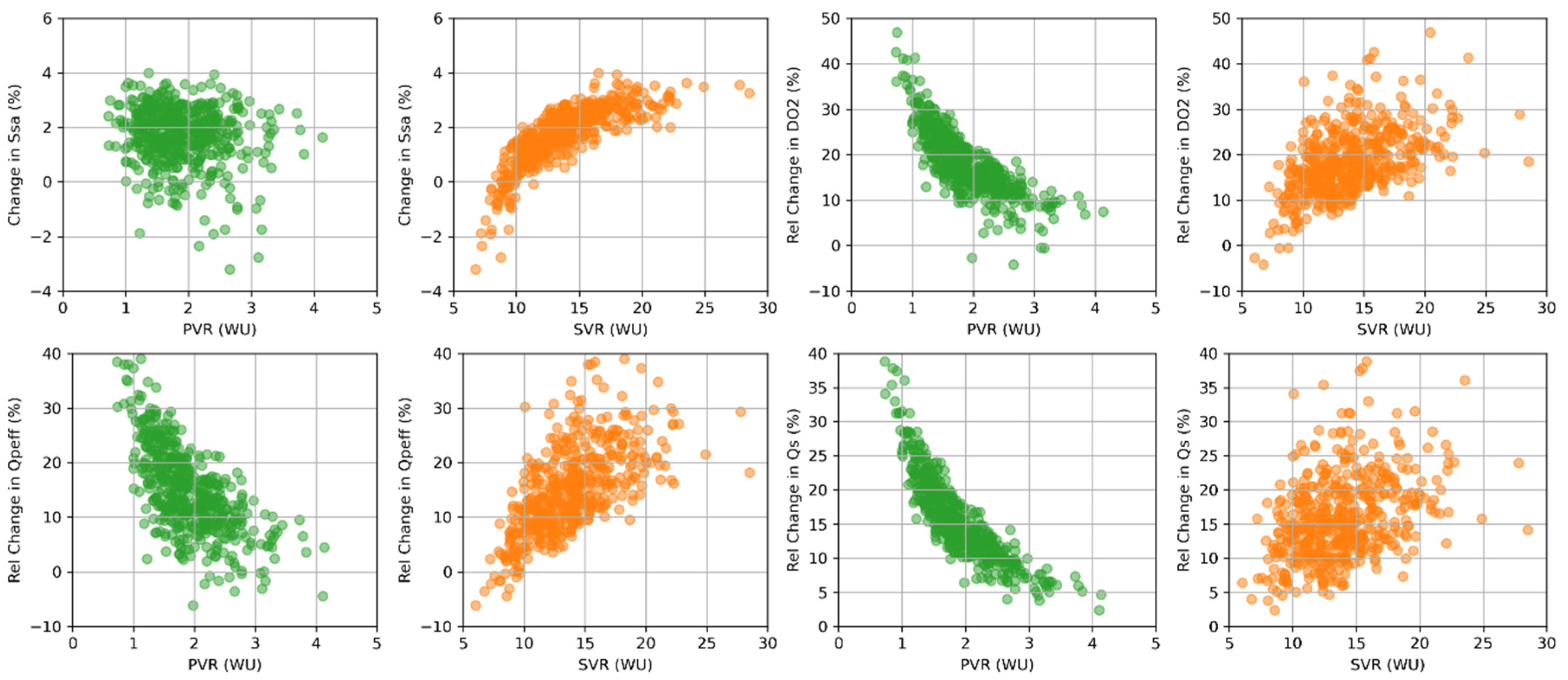
Figure 2.
Box plots for changes in key observables as markers of flow and oxygenation after the performance of BAS (before and after discontinuation of PGE) relative to their baseline values. Ssa=systemic arterial oxygen saturation. DO2: systemic oxygen delivery. Qs=systemic flow. Qpeff=effective pulmonary flow. P-values correspond to the Mann-Whitney-U test to compare the high and low PVR groups.
Figure 2.
Box plots for changes in key observables as markers of flow and oxygenation after the performance of BAS (before and after discontinuation of PGE) relative to their baseline values. Ssa=systemic arterial oxygen saturation. DO2: systemic oxygen delivery. Qs=systemic flow. Qpeff=effective pulmonary flow. P-values correspond to the Mann-Whitney-U test to compare the high and low PVR groups.
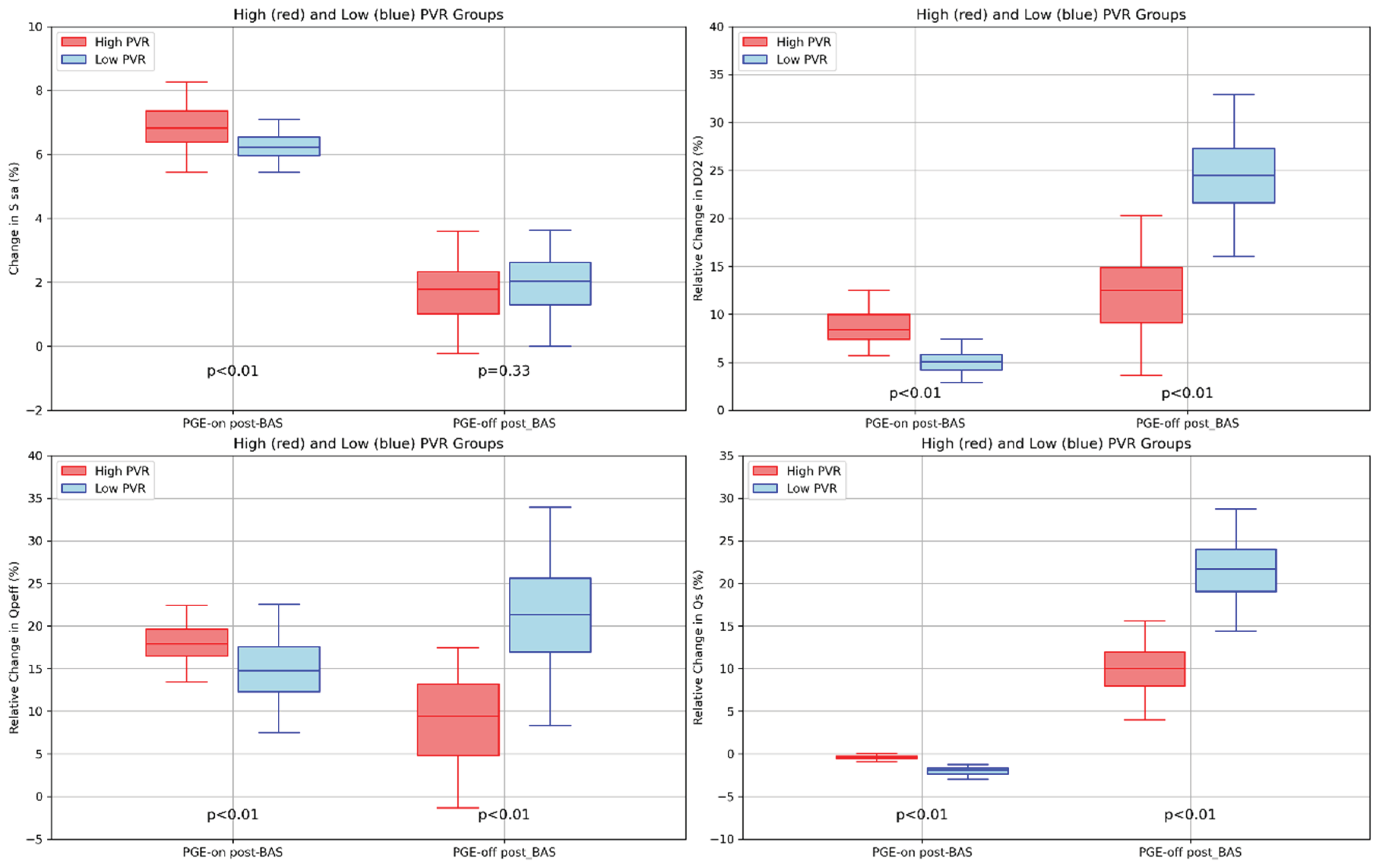

Table 1.
Hemodynamic characteristics of the virtual cohort over the 3 stages of PGE administration, performance of BAS and PGE discontinuation.
Table 1.
Hemodynamic characteristics of the virtual cohort over the 3 stages of PGE administration, performance of BAS and PGE discontinuation.
| PGE-on pre-BAS | PGE-on post-BAS | PGE-off post-BAS | |
|---|---|---|---|
| HR (bpm) | 139.6 (135.2-144.6) | 139.6 (135.2-144.6) | 139.6 (135.2-144.6) |
| SVR (WU) | 13.0 (11.3-15.4) | 13.0 (11.3-15.4) | 13.0 (11.3-15.4) |
| PVR (WU) | 1.84 (1.50-2.22) | 1.84 (1.50-2.22) | 1.84 (1.50-2.22) |
| Rasd (WU) | 0.50 (0.48-0.52) | 0.25 (0.24-0.26) | 0.25 (0.24-0.26) |
| Rpda (WU) | 0.18 (0.18-0.19) | 0.18 (0.18-0.19) | 1.84 (1.77-1.90) |
| G | 0.10 (0.09-0.11) | 0.14 (0.13-0.15) | 0.14 (0.13-0.15) |
| Qs (L/min/m2) | 1.75 (1.51-2.07) | 1.73 (1.48-2.05) | 2.01 (1.79-2.32) |
| Qp (L/min/m2) | 3.49 (3.16-3.81) | 3.57 (3.24-3.92) | 3.29 (2.97-3.57) |
| Qpeff (L/min/m2) | 1.03 (0.98-1.09) | 1.20 (1.13-1.29) | 1.19 (1.10-1.27) |
| Ssa (%) | 82.9 (78.2-86.2) | 89.2 (84.9-92.4) | 84.4 (79.5-88.5) |
| Ssv (%) | 55.7 (53.4-57.9) | 61.7 (59.5-64.2) | 61.3 (58.2-63.7) |
| Spa (%) | 90.0 (88.3-91.4) | 92.7 (90.8-94.2) | 90.8 (88.8-92.4) |
| O2D (mL/min/m2) | 289.5 (258.3-320.3) | 308.4 (273.1-346.0) | 336.7 (311.5-363.5) |
HR=heart rate. SVR=systemic vascular resistance. PVR=pulmonary vascular resistance. Rasd=resistance at atrial septum defect. Rpda=resistance at patent ductus arteriosus. G: bidirectional mixing parameter at atrial septum defect. Qs=systemic flow. Qp=pulmonary flow. Qpeff=effective pulmonary flow. Ssa=systemic arterial oxygen saturation. Ssv=systemic venous oxygen saturation. Spa=pulmonary arterial oxygen saturation. O2D: systemic oxygen delivery. BPM=beats per minute. WU=Wood units. All columns display median (interquartile range).
Table 2.
Linear regressions for observable metrics of interest using PVR and SVR as independent factors.
Table 2.
Linear regressions for observable metrics of interest using PVR and SVR as independent factors.
| coeff | std err | p value | |
| Change in systemic arterial O2 saturation (%) | |||
| Intercept | -1.507 | 0.174 | <0.01 |
| PVR | -0.406 | 0.056 | <0.01 |
| SVR | 0.291 | 0.010 | <0.01 |
| Relative change in oxygen delivery (%) | |||
| Intercept | 21.850 | 0.596 | <0.01 |
| PVR | -9.547 | 0.191 | <0.01 |
| SVR | 1.046 | 0.034 | <0.01 |
| Relative change in systemic flow (%) | |||
| Intercept | 23.889 | 0.532 | <0.01 |
| PVR | -8.823 | 0.170 | <0.01 |
| SVR | 0.627 | 0.031 | <0.01 |
| Relative change in effective pulmonary flow (%) | |||
| Intercept | 10.503 | 0.764 | <0.01 |
| PVR | -8.842 | 0.245 | <0.01 |
| SVR | 1.560 | 0.044 | <0.01 |
SVR=systemic vascular resistance. PVR=pulmonary vascular resistance.
Disclaimer/Publisher’s Note: The statements, opinions and data contained in all publications are solely those of the individual author(s) and contributor(s) and not of MDPI and/or the editor(s). MDPI and/or the editor(s) disclaim responsibility for any injury to people or property resulting from any ideas, methods, instructions or products referred to in the content. |
© 2026 by the authors. Licensee MDPI, Basel, Switzerland. This article is an open access article distributed under the terms and conditions of the Creative Commons Attribution (CC BY) license (http://creativecommons.org/licenses/by/4.0/).
Copyright: This open access article is published under a Creative Commons CC BY 4.0 license, which permit the free download, distribution, and reuse, provided that the author and preprint are cited in any reuse.


