
Submitted:
12 June 2026
Posted:
15 June 2026
You are already at the latest version
Abstract
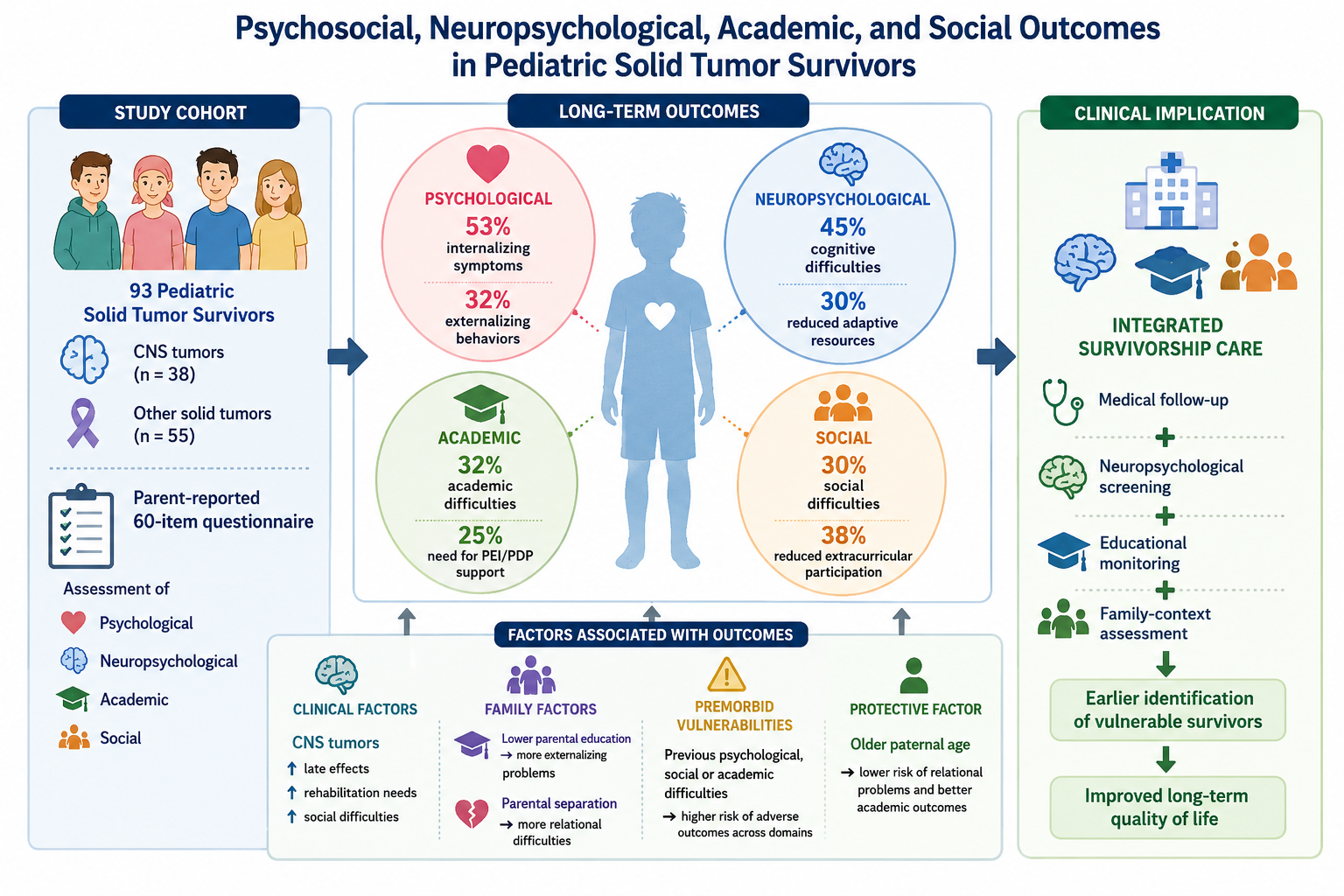
Background/Objectives: Long-term psychosocial/neurocognitive sequelae are frequently observed in survivors of pedi-atric cancer and adversely affect quality of life in adulthood. Although clinical predictors are well established, the con-tribution of familial, cultural, and socio-economic factors has received less attention. Methods: Between November 2022-January 2023, 93 survivors parents of pediatric patients with solid tumors including 38 individuals with central nervous system (CNS) tumors, completed a specifically designed 60-item questionnaire. Outcomes were evaluated across four domains—psychological, neurocognitive, academic, and social—along with a broad range of potential pre-dictors encompassing demographic, clinical, family-related, cultural, socio-economic, and premorbid characteristics. Statistical analyses included Fisher’s exact test and non-parametric methods. Results: New-onset or aggravated inter-nalizing symptoms were reported in 53% of survivors, externalizing behaviors in 32%, neurocognitive impairments in 45%. Academic difficulties were identified in 32%, with 25% requiring an Individualized-Education-Plan. Social chal-lenges affected 30% of participants and were more prevalent among CNS tumor survivors, who also demonstrated greater functional losses and rehabilitation needs. Lower parental educational attainment was associated with exter-nalizing symptoms (p = 0.039), whereas household income, parental occupation, and residential setting were not. Premorbid psychological or learning difficulties were strong predictors of adverse outcomes (all p < 0.01). Older paternal age was protective for relational and academic functioning, while having more siblings was linked to increased cogni-tive risk. Conclusions: Psychosocial and neurocognitive late effects remain common among pediatric cancer survivors. Educational background and premorbid vulnerabilities appear more influential than economic factors, supporting the need for targeted neuropsychological surveillance and family-centered screening strategies.
Keywords:
socio-economic determinants
; pediatric cancer survivors
; solid tumors
Copyright: This open access article is published under a Creative Commons CC BY 4.0 license, which permit the free download, distribution, and reuse, provided that the author and preprint are cited in any reuse.


