
Submitted:
12 June 2026
Posted:
15 June 2026
You are already at the latest version
Abstract
Growing consumer demand for sustainable food packaging has driven research into active packaging systems incorporating natural bioactive extracts into polymer matrices. This study developed bioactive foamed polystyrene (PS) films loaded with hydroxytyrosol (HOxT; 3,4-dihydroxyphenylethanol) and carvacrol (CVC; 5-isopropyl-2-methylphenol) adsorbed onto silica (SiO₂) as a functional filler, fabricated via extrusion and cast-film extrusion methods. The performance of these PS-based bioactive films was evaluated in combination with modified atmosphere packaging (MAP; 60% N₂/40% CO₂) for extending the shelf life of preservative-free, ready-to-eat sliced sponge cakes (SSC) stored at 15 °C for 10 weeks. Physicochemical, microbiological, and sensory attributes were assessed at regular intervals throughout storage. Control samples (air-packed, non-bioactive film) exhibited rapid quality deterioration, with visible mold development after 20 days. MAP-only controls (without bioactive film) delayed mold onset until the end of the storage period (day 70). However, SSC packaged under MAP in HOxT/CVC-loaded bioactive PS films maintained optimal quality throughout storage, including stable color, reduced weight loss, low lipid oxidation indices, softer texture, and superior bacteriostatic efficacy, along with the highest overall sensory acceptability scores.
These results demonstrate that combining 40% CO₂ atmosphere with 0.6% (w/w) bioactive agents (HOxT + CVC) in PS films effectively inhibited mold and bacterial growth while retarding physicochemical and sensory degradation. Under normal atmospheric conditions, the shelf life of preservative-free bakery products is primarily limited by atmospheric oxygen, aerobic microbial spoilage, and lipid oxidation; MAP reduced headspace oxygen concentration to 0.01%. The developed bioactive packaging system extended SSC shelf life from a few days (air-packed control) to over 70 days, representing a promising, clean-label approach for the bakery industry. These findings confirm that integrated bioactive MAP is a technically feasible and effective strategy for preserving SSC quality without chemical preservatives.
Keywords:
ready-to-eat sliced sponge cakes
; carvacrol
; hydroxytyrosol
; bioactive polymer films
; modified atmosphere packaging
; shelf life
1. Introduction
Bakery products such as cakes are popular with people of all ages, and their consumption is increasing worldwide. Pre-packed and ready-to-eat food products such as aerated bakery products are a huge success, representing the perfect answer to consumer expectations in terms of ease of use, new formats, and innovative concepts. Exposing these foods to oxygen (O2) without protection leads to rapid oxidation and the growth of spoilage organisms, which decreases shelf life and enhances the probable growth of microbial pathogens, raising serious health concerns [1]. Ready-to-eat SSC are highly susceptible to cross-contamination or re-contamination by microorganisms (bacteria, yeasts, molds, and viruses) and subsequent spoilage throughout the complete food chain (processing, supermarket retail displays, convenience stores, cafeterias, or home storage). The combined sectors are facing a serious and costly challenge from economic losses resulting from physicochemical interactions and microbiological spoilage. Baked goods (such as bread, cakes, and biscuits) require special attention when it comes to preservation, because storage conditions directly affect their sensory and nutritional properties. The rich nutritive composition of these products also influences their susceptibility to microbial spoilage [2]. Mold commonly grows on the surface of these products. In the food industry, storing and preserving cakes is complicated and affected by various factors, such as the cake’s internal characteristics, external environmental conditions, and packaging technology factors that often limit the shelf life of products such as sponge cakes (SC) [1].
The shelf life of perishable food products, such as bakery products, under normal atmospheric conditions is primarily limited by atmospheric oxygen, the growth of aerobic spoilage microorganisms, and chemical oxidation. Their shelf life can be extended by adjusting the gas concentration inside the packaging. Modified atmosphere packaging (MAP) is a well-established hurdle technology used to reduce O2 levels in the product headspace, thereby limiting aerobic microbial growth and lipid oxidation [1]. Despite the number of studies conducted on MAP in relation to various food categories, limited research has been reported on its application to extend the shelf life of bakery products such as SC. CO2 plays a pivotal role in modern food preservation; thanks to its fungistatic and bacteriostatic properties, it offers an effective way of extending the shelf life of various products. CO2 is also considered safe for food preservation a naturally occurring gas approved by food safety authorities worldwide for use in MAP. A large number of scientific articles have been published on the development of new bio-based packaging materials incorporating bioactive molecules [3]. Thanks to advances in packaging, materials science, and biotechnology, active packaging systems combined with MAP represent a rapidly growing technology [4,5]. Food packaging plays a crucial role in storing and transporting products, ensuring their safety and quality by protecting them from contamination and spoilage [6].
An increasing number of consumers are avoiding foods containing chemical preservatives in favor of natural, organic, and healthier alternatives [7,8,9,10]. Natural bioactive compounds such as hydroxytyrosol (HOxT) and carvacrol (CVC) can effectively address these concerns. Both compounds offer a wide range of industrial applications. HOxT, a polyphenol derived from olive trees, is recognized for its high antioxidant and antimicrobial properties [11], while CVC, a phenolic monoterpenoid constituent of oregano essential oil, exhibits potent antimicrobial and antifungal activity. HOxT and CVC have been incorporated into various packaging materials [12] and are both classified by the FDA as generally recognized as safe (GRAS), making them particularly attractive for use in food contact applications.
The present study aimed to develop PS-based bioactive films containing HOxT and CVC and to evaluate their effectiveness, in combination with MAP (CO2/N2; 40:60), in extending the shelf life of preservative-free SSC stored at 15 °C for up to 10 weeks, based on physicochemical, microbiological, and sensory quality parameters.
2. Materials and Methods
2.1. Raw Materials and Chemicals
All raw materials and ingredients used to prepare the SC were purchased locally, including wheat flour, powdered white sugar, whole fresh eggs, low-fat powdered milk, soybean oil, baking powder, vanilla, and salt. For the active films, commercial polystyrene (PS) Crystal 1160 (TotalEnergies Corbion, Gorinchem, The Netherlands) and silica Ibersil A400 (Industrias Químicas del Ebro, S.A., Zaragoza, Spain) were used. Hydroxytyrosol (HOxT; CAS 10597-60-1; NPO HT-10, Econatur, La Carlota, Córdoba, Spain) and carvacrol (CVC; CAS 499-75-2; >98.0%, Cymit Química, Barcelona, Spain) served as the bioactive agents. The overall experimental methodology is summarized in Figure 1.
2.2. Active Film Preparation
The PS-based bioactive films were produced at the AIMPLAS Plastics Technological Institute (Paterna, Valencia, Spain). When incorporating natural functional biomolecules such as HOxT and CVC into polymer matrices, it is necessary to consider their compatibility as well as the concentration ratios between them. In order to facilitate their incorporation into the extruder and control their subsequent release, the selected HOxT and CVC were first adsorbed onto an inorganic carrier (silica Ibersil A400). To achieve correct adsorption onto silica, the ingredients were mixed in a 10 L turbo-mixer, as shown in Figure 2.
The resulting dry mixtures were obtained in powder form and used for dosing in the formulation process. From the selected polymers and the dry mixtures produced, a series of compounds was obtained using a co-rotating twin-screw extruder (Coperion ZSK 25), with an aspect ratio L/D = 40, a diameter D = 25 mm, and 6 length modules (from Zone 0 to Zone 5). The materials were fed into the extruder using gravimetric feeders, which precisely controlled the material flow (kg/h) of each formulation component. The polymer (PS) was fed through Zone 0 of the extruder, and the dry mixtures through Zone 2. The temperature profiles applied across the extruder heating zones (from Zone 0 to Zone 5) were 190/185/180/175/175/170 °C. PS foam films are characterized by excellent thermal properties, light weight, and rigidity. However, they are generally recognized for their poor gas barrier properties and low resistance to water vapor. For this reason, the PS foam film was used as a carrier for the bioactive compounds, while a separate high-barrier material a polyamide/polyethylene (PA/PE) plastic bag was employed to achieve the modified atmosphere required for long-term preservation. The PS films were manufactured at a thickness of approximately 75 µm, with a density of 1 g/cm3
A screw configuration was designed according to the processing conditions to provide adequate shear and ensure proper mixing within the extruder between the polymer matrix and the dry blend (silica carrier with bioactive compounds). The concentrations of bioactive compounds, ranging from 0.6 to 1%, were determined as optimal for SC preservation in preliminary trials. The strands emerging from the extruder die were continuously cooled in a water bath and cut into 3 mm granules, as shown in Figure 3.
New masterbatch compositions were developed with high concentrations of HOxT and CVC, incorporated either individually or in combination, along with a process for their production and application in bioactive food packaging films. In the present study, four PS foam films were produced: a control film without bioactive compounds and three bioactive test films containing HOxT alone (1%), CVC alone (1%), and a combination of HOxT (0.6%) and CVC (0.6%). The incorporation of HOxT and CVC resulted in only minor changes to the mechanical properties of the films, which retained sufficient structural integrity for their intended use in food packaging applications.
2.3. Sponge Cake Manufacturing, Chemical Composition and Packaging
Based on a preliminary optimization study of the SC batter formulation [1], SCs were prepared according to a standardized industrial recipe using the following ingredients expressed as a percentage of the total cake formulation weight (Table 1):
For this purpose, whole eggs and refined sugar were poured into a bowl and mixed in a vertical mixer (Moulinex, Beijing, China) using a whisk attachment to whip the eggs at high speed for 2 min. Subsequently, soybean oil and water were added and mixed for 1 min at medium speed. Salt was added during whipping. Cake flour, soybean oil, and milk were then gradually blended into the batter. For each SC, cake batter (1200 ± 0.1 g) was poured into non-stick rectangular (28 × 10 cm) metallic pans and baked for 20 min at 200 °C in an electric oven preheated for 15 min (Panasonic, Osaka, Japan). After baking, the SCs were unmolded and left to cool for 1 h at room temperature before being placed in sealed plastic bags to prevent moisture loss. Subsequently, the SC were aseptically cut into portions (95.64–115.68 g each) and randomly divided into five groups: (a) Control (Air): control samples packaged in air; (b) MAP: control samples packaged in MAP (40% CO2 + 60% N2); (c) MAP/HOxT: samples packaged in MAP with film containing 1% HOxT; (d) MAP/CVC: samples packaged in MAP with film containing 1% CVC; and (e) MAP/HOxT/CVC: samples packaged in MAP with film containing 0.6% HOxT plus 0.6% CVC (Figure 4).
For chemical analysis, freshly prepared samples were cut into pieces and homogenized using a grinder. Methods provided by the Association of Official Analytical Chemists were used to determine the chemical composition of the SC, including moisture, crude protein, total ash, total carbohydrates, and lipid content. For moisture determination, 10 g of crushed SC was weighed using an electronic precision balance (Ohaus®, Merck KGaA, Darmstadt, Germany). Sample containers were placed in a drying oven and dried at 130 °C for 1.5 h. After cooling to room temperature, the containers were reweighed to an accuracy of 0.001 g. Moisture content was determined in triplicate and calculated as follows (Eq. 1):
M1 and M2 are the weight of the container and sample before and after drying and M0 is the weight of the sample.
The Soxhlet extraction method was employed to determine the level of crude fat, with petroleum ether (boiling point, 40–60 °C) as the solvent. Crude protein content was determined using the Kjeldahl method, using conversion factors of 6.25 for SC. Ash content was obtained following incineration at 600 °C for 3 h in a muffle furnace until forming a light ash. The ash content was calculated according to the following Equation (Eq. 2):
X1 is ash containing crucible weight and X2 is empty crucible weight and X0 is the weight of the sample
Total carbohydrates were calculated by determining the residual weight after subtracting the water, protein, fat, and ash amounts found by analysis. The total carbohydrate content (%) was calculated using the following Equation (Eq. 3):
Energy values for 100 g (kcal and kJ) were calculated using the conversion factors specified in EU Regulation No 1169/2011 (4 kcal/g and 17 kJ/g for protein and carbohydrates, 9 kcal/g and 37 kJ/g for fat) [13,14,15].
The SSC portions were placed individually in a polystyrene tray and wrapped in a polyamide/polyethylene (PA/PE) plastic bag (Irma, Zaragoza, Spain), which acted as a barrier to create a closed system. Subsequently, the bioactive PS films were placed to cover 50% of the upper inner surface, ensuring a headspace between the bioactive film and the SC portion (Figure 4). All trays, except the air-packed control (Control Air), were filled with a gas mixture of 40% CO2 + 60% N2. The volume injected into the headspace was approximately 2 L, at a product/gas mixture ratio of 1:2 (v/v). All samples were stored in the dark at 15 °C and a relative humidity (RH) of 65% for 10 weeks. Samples for physicochemical, microbiological, and sensory analysis were taken at days 0, 10, 20, 30, 40, 50, 60, and 70 of storage.
2.4. Headspace Gas Analysis into Package
The headspace atmosphere composition of each SSC package was monitored using a Hewlett-Packard 4890 gas chromatograph equipped with a thermal conductivity detector. Samples of 50 µL were injected into a Chrompack CP-CarboPlot P7 column of 0.53 mm inner diameter and 27.5 m length, with helium as the carrier gas at a flow rate of 12.6 mL min−1. The initial oven temperature was set at 40 °C. After 2.5 min, the oven temperature was increased at a rate of 45 °C min−1 to a final temperature of 115 °C. The injection port temperature was set at 59 °C and the detector temperature at 120 °C. A calibration curve was prepared using a certified 40% CO2/60% N2 gas mixture (Abello Linde, S.A.). The total percentage of each gas was calculated from the average of three measurements taken from the chromatogram. Results were expressed as % CO2 and % N2.
2.5. Physicochemical Characteristics of Sponge Cakes
2.5.1. Weight Loss and Water Activity
The initial and final weight of each packaged SC was measured using an electronic precision balance (Ohaus®, Merck KGaA, Darmstadt, Germany; precision: 0.001 g) after equilibrating at room temperature for 15 min following package opening. Calculations accounted for the fact that sampling of cake slices generated portions of different sizes due to their inherent asymmetry, and therefore their varying heights and weights. Weight loss was calculated according to the following equation (Eq. 4):
where W0 is the initial weight (g) on day 0, and Ws is the measured weight (g) of each sample at each sampling point.
For water activity, 5 g of the ground sample was added to the aw meter measuring cuvette (Scharlab S.L. Barcelona, Spain). The reading was then recorded when the equilibration was achieved.
2.5.2. Determination of Thiobarbituric Acid Reactive Substances
Lipid peroxidation was measured by thiobarbituric acid reactive substances (TBA-RS) according to a previously published method with minor modifications, including adjustments to sample weight and centrifugation speed [16]. Briefly, crumb SC samples (10 g) were mixed with 20 mL of 10% trichloroacetic acid and centrifuged in tubes at 2300 g for 30 min at 4 °C, and the supernatants were filtered through MN 640W filter paper (Machinery-Nagel GmbH & Co. KG, Düren, Germany). The collected supernatant (500 µL) was mixed with an equal volume (500 µL) of 20 mM thiobarbituric acid and thoroughly mixed by vortexing. After that, the test tubes were placed in a boiling water bath (≈100 °C) for 20 min and subsequently cooled to room temperature in an ice bath. After cooling, the absorbance was measured at 532 nm using a spectrophotometer. TBA-RS values were calculated from a standard curve of malonaldehyde (0–10 µM) and expressed as mg malonaldehyde/kg of the SC.
2.5.3. CIE Lab Colorimetric Analysis and Total Color Difference
The color of the SC crumb was evaluated by measuring the L* (lightness), a* (redness), and b* (yellowness) parameters (The CIELAB color space, also referred to as L*a*b*, is a color space defined by the International Commission on Illumination: CIE in 1976) using a color difference meter (CR-400, Minolta Co. Ltd. Osaka, Japan). Before the measurements, the colorimeter was calibrated with a white reference plate provided with the instrument. To determine the color difference between the control SC and the SC packed with active films, ΔE* (total color difference) was calculated by Equation (Eq. 5).
where: L0*, a0* and b0*: parameters of control SSC samples measurement and L*, a* and b*: parameters of experimental SSC samples measurement
ΔL* = L*- L0*
Δa* = a*- a0*
Δb* = b*- b0*
The control untreated samples (packed only under MAP) were taken as standard. To determine whether the ΔE* could be detected by the human eye, the following values were used:
ΔE* < 1: The color difference is not obvious to the human eye.
1 < ΔE* < 3: The color difference is not appreciated by the human eye.
ΔE*: > 3: The color difference is obvious to the human eye.
2.5.4. Texture Profile Analysis
Cake firmness was determined using a Texture Analyzer (TA-XT2i, Texture Technologies, Hamilton, MA, USA) equipped with a 100 mm diameter cylindrical probe. The test was performed on cubic pieces of SSC (30 × 30 × 30 mm3) after removing the crust. At least five pieces of randomly selected SSC of similar size were measured per sampling point. A test speed of 2 mm/s and a penetration distance of 15 mm were applied, compressing the sample to 50% of its original height with a hold time of 30 s. Firmness was expressed as the maximum penetration force (N). All measurements were carried out in a temperature-controlled room (20–25 °C), 15 min after opening the packaging to allow temperature equilibration. Results represent the mean of three replicates.
2.6. Microbiological Analysis
SSC samples (10 g) were homogenized in 90 mL of 0.1% peptone water containing 0.85% NaCl using a stomacher for 2 min, and serial decimal dilutions were prepared. To determine total aerobic mesophilic bacteria, yeast, and mold counts, 1 mL of serially diluted samples was pour-plated on plate count agar (PCA) and potato dextrose agar with chloramphenicol (PDAC) plates, respectively. Total viable count plates were incubated aerobically for 48 h at 37 °C, while yeast and mold plates were incubated for 5 days at 25 °C. Colonies were counted and results expressed as log10 CFU (colony-forming units)/g of sample.
2.7. Overall Acceptability
Hedonic test was used to determine the degree of overall acceptability scores for SSC according to the AACC method 10–90 with modifications. For this study, 30 sensory panelists were recruited from the Mouloud MAMMERI University (Algeria). Three portions of each SSC sample were presented in random order and were evaluated for overall acceptability. Participants were asked to evaluate acceptability levels for SSC using a 7-point hedonic scale (7 = like extremely, 6 = like moderately, 5 = like slightly, 4 = neither like nor dislike, 3 = dislike slightly, 2 = dislike moderately, and 1 = dislike extremely). The samples were then placed on plates and assigned random three-digit numbers for identification purposes.
2.8. Statistical Analysis
All analyses (physicochemical, chemical, and microbiological) were performed in triplicate (n = 3) on independent batches of packaged SSC. Statistical analysis was performed with an SPSS computer package Version 16.0 (SPSS Inc. Chicago, IL, USA). The analysis of variance (ANOVA) was performed to evaluate the effect of packaging type, storage time, and their interactions on the quality parameters and microbial levels. Tukey’s multiple range tests were used for a mean comparison at the 95% significance level. The necessary assumptions for the application of ANOVA and Tukey’s tests were previously analyzed by the Shapiro–Wilk test to check for the normality of data, and the Levene’s test for the homogeneity of variances.
3. Results and Discussion
3.1. Proximate Composition Analysis of Freshly Manufactured SSC
The average proximate composition of freshly manufactured SSC with standard deviations is presented in Table 2.
The results showed a carbohydrate content of 54.14%, fat 18.53%, moisture 15.72%, protein 10.62%, ash 0.99%, and an energy value of 425.81 kcal/100 g. These values are consistent with those reported in the literature for similar sponge cake formulations [17,18]. SCs are energy-dense products due to their high fat and sugar content, which may raise nutritional concerns with regular consumption. One approach to improving the nutritional profile of cakes is the partial replacement of wheat flour with alternative flours derived from non-wheat cereals or functional ingredients [19]. Furthermore, the high fat and sugar content of SC, combined with physicochemical changes occurring during storage, can create favorable conditions for bacterial and mold growth. Statistical analysis revealed that the interaction between storage time and packaging type had a significant effect on quality loss. Therefore, the selection of appropriate packaging plays a critical role in maintaining the stability of SCs by minimizing quality deterioration during storage.
3.2. Dynamic Headspace Residual O2 and CO2 Analysis
Lipid-rich products such as SSC are susceptible to oxidative reactions during storage due to the presence of oxygen (O2) in the surrounding atmosphere. To mitigate this, O2 reduction by vacuum packaging (VP) or N2 flushing is commonly employed. However, VP is not recommended for SSC given the product’s structural sensitivity. N2 is an inert gas does not react chemically with product compounds and is used as a filler gas in MAP to compensate for the volume reduction caused by CO2 and O2 absorption, thereby preventing package collapse. MAP of aerated bakery products such as SSC is accomplished using superatmospheric CO2 levels for bacteriostatic and fungistatic activity, balanced with N2, in high-barrier film packaging [1,5]. The composition of headspace gases particularly CO2 and residual O2 concentrations significantly influences the quality and stability of SSC during long-term storage. A modified atmosphere (MA) with high CO2 and low residual O2 effectively controls mold growth and lipid oxidation. However, complete elimination of O2 remains a serious challenge in MAP of bakery products, since the highly porous structure of SSC traps inherent residual O2 that cannot be fully removed by flushing. To achieve extended shelf life, headspace O2 must therefore be reduced to the critical levels necessary to suppress aerobic microbial activity and lipid oxidation, and to counteract O2 ingress through packaging film barriers over the storage period [8,20,21].
The initial headspace composition was set at 40% CO2 and 0.21% residual O2. Significant changes in CO2 concentrations were detected during the first 20 days of storage (p < 0.05). CO2 concentrations decreased by approximately 10% in MAP samples and approximately 5% in all bioactive-packaged samples during the first four weeks. This decline is primarily attributable to CO2 dissolution into the product matrix, with the lipid fraction playing a central role: studies have shown that when high-fat foods are packaged in CO2-enriched MAP, a significant proportion of CO2 is absorbed into the fat phase, reducing headspace concentration and potentially causing package collapse [22,23,24,25]. This absorption underscores the importance of maintaining an adequate gas-to-product ratio. After the initial drop, headspace CO2 stabilized (p < 0.05) at an average of approximately 20% for the remainder of the storage period, likely due to the high gas-to-product ratio (2:1, v/v) used in this study. This is consistent with Rasmussen and Hansen [26], who reported a 2–5% reduction in headspace CO2 relative to initial concentrations. The presence of active molecules in the packaging did not significantly affect headspace CO2 dynamics, and no significant differences (p > 0.05) in atmospheric changes were observed among samples packed in active films (Figure 5).
With respect to residual O2, the dynamic headspace analysis of all packaged SSC showed that concentrations declined progressively but consistently throughout storage. Residual O2 in all packaged samples fell below 0.01% after 40 days, reaching the ultra-low O2 threshold recommended as the critical level for MAP preservation of perishable foods. O2 levels remained stable at 0.01% after day 40, with no statistically significant differences between packaging groups (p > 0.05). The drop in O2 content may be partly related to its consumption by fungal metabolic activity within the package. After 70 days of storage, all packaging variants maintained this minimum O2 level. These results are consistent with those of Janjarasskul et al. [8] and Degirmencioglu et al. [7].
The dynamics of headspace gases inside the package are influenced by storage temperature, microbial growth rate, and the permeability of the packaging material [27]. The main objective of active MAP systems is to minimize residual O2 below the ultra-low threshold (0.01%) while maintaining elevated CO2 concentrations to prevent mold and bacterial growth. Once both conditions were met high CO2 atmosphere combined with very low residual O2 the active packaging components became maximally effective in preserving SSC quality, in line with recommendations for cereal product preservation. Taken together, SSC packed under MAP with active film maintained acceptable quality for 70 days of storage at ambient temperature. In contrast, SSC maintained under aerobic conditions became unmarketable by visual assessment after just 30 days. Notably, the presence of active molecules did not affect headspace CO2, while headspace O2 remained stable at ~ 0.01% from day 40 onwards. This information is essential for determining the time required to reduce headspace residual O2 to critical levels, providing valuable guidance for selecting appropriate MAP preservation systems for perishable baked goods.
3.3. Water Activity and Weight Loss
3.3.1. Water Activity
Water activity (aw) significantly influences multiple aspects of food quality and shelf life, including microbial growth, texture, aroma, taste, moisture migration, and color [28]. The freshly manufactured SSC used in this study had an initial aw of 0.82 and a moisture content of 15.72 ± 0.32%. According to the literature, SC with an aw ranging from 0.75 to 0.90 is considered to have intermediate aw, a range that can support microbial growth and influence the texture and stability of the product [29]. SCs are particularly prone to losing softness and freshness over time, making aw a key indicator of spoilage. Based on studies of baking and moisture dynamics, eggs and sugar form a barrier that inhibits moisture loss, while oil surrounds water molecules and acts as an additional barrier to evaporation; as a result, the decrease in aw observed during storage is mainly attributed to crumb dehydration [1,30,31,32]. Unlike bread, the hardening phenomenon in cakes is less pronounced [33]. Although a gradual decline in aw was observed across all groups, the effect of storage time and packaging type on aw differed markedly (p < 0.05) between aerobic and MAP conditions (Figure 6). In air-packaged samples, aw dropped sharply from 0.82 to 0.70 within the first 20 days of storage, after which the samples became unmarketable and monitoring was discontinued. In contrast, all MAP-packaged groups with and without active films maintained aw values with only slight variations (p > 0.05) around 0.78–0.80 during the same period, declining more gradually to approximately 0.69–0.77 by day 70 (p < 0.05). Among the MAP groups, samples containing active films (MAP/HOxT, MAP/CVC, and MAP/HOxT/CVC) consistently showed higher aw values than MAP alone throughout storage, with MAP/HOxT/CVC retaining the highest values (0.77–0.82) across the entire 70-day period. These differences suggest that active packaging components helped mitigate moisture loss during extended storage.
These results are consistent with previous findings. De La Rosa et al. [2] reported a steady decline in aw of stored SC, with initial values of approximately 0.80 dropping to between 0.68 and 0.78 after four months of storage. Djenane et al. [1] similarly concluded that the combination of MAP and active packaging containing hydroxytyrosol and eugenol effectively preserved SC quality over extended storage. It should be noted, however, that Janjarasskul et al. [8] worked with a considerably higher initial aw (0.926 ± 0.005) and moisture content (26.49 ± 0.59%) than those reported in the present study, reflecting differences in formulation and baking conditions. Despite this, their finding that active packaging is an effective alternative to direct chemical preservatives for extending shelf life aligns with the trends observed here.
3.3.2. Weight Loss
In SCs, moisture content, weight, and texture are closely related, a higher moisture content generally results in a softer texture, while moisture depletion over time leads to increased firmness (hardening) and decreased weight and volume [1,34]. The effect of the bioactive film with MAP on long-term stored SSC weight loss is depicted in Table 3. A gradual increase in weight loss was observed across all samples, and the influence of storage time and packaging type on SC weight loss was significantly different for each treatment (p < 0.05). Similarly, Karaoğlu et al. [35] and Li et al. [36] reported that cake weight loss increased with storage time, attributing this to moisture loss and starch retrogradation, natural deterioration processes that intensify progressively under room temperature storage conditions. In the control sample (air packaging), the average weight loss increased to 11.76%, 18.61%, and 30.90% after 10, 20, and 30 days of storage, respectively. In contrast, SSC samples packed under MAP with HOxT/CVC film exhibited the smallest weight loss (3.07–5.52%) throughout the entire storage period. The role of MAP and active films in maintaining weight stability and overall quality of bakery products is well established [37,38], as these packaging approaches limit moisture transfer and oxidative reactions, which are among the principal factors governing weight stability and the maintenance of product quality during storage.
The present study demonstrates that MAP alone reduced product weight loss by 68.22% during the first 30 days of storage. Combining MAP with a bioactive film containing both biomolecules further reduced SC weight loss by 80.64% after 30 days of storage. This improvement is attributed to the synergistic effect of MAP and bioactive films, which together enable the SC to retain more water, as confirmed by the analysis of other qualitative attributes. At the end of the 70-day storage period, the weight loss of MAP/HOxT and MAP/CVC packaged samples was 5.71% and 5.98%, respectively, reflecting the important long-term role of these packaging methods in minimizing weight loss. As an inert, non-reactive gas, N2 is widely used to create modified atmospheres that restrict moisture migration, inhibit microbial growth, and reduce oxidative spoilage. These properties collectively minimize weight loss in stored cereal products, as MAP maintains higher humidity and lower O2 levels, thereby reducing oxidative stress. This prevents stored SSC from becoming dry and hard, thus maintaining their edibility over an extended period. SSC does experience significant weight loss during storage, primarily due to water evaporation, which is further accelerated by oxidative processes. This phenomenon is more pronounced in air-packaged products than in those under MAP, corroborating the findings of Calligaris et al. [39] and Barden & Decker [40]. Weight loss remained below 9% (8.53%) until day 70, which represents the critical threshold beyond which sensory attributes deteriorate sufficiently to reduce the market value of SC. After 70 days of storage, the maximum recorded weight loss ranged from 5.52% to 10.97%, depending on the packaging type.
The data confirm that weight loss across all treatments increased progressively with storage time. No significant differences (p > 0.05) were observed among the different film treatments up to 70 days of storage. In contrast, weight loss in the control samples (air packaging) increased sharply after the tenth day, diverging markedly from all film-pad treatments and reaching the highest recorded weight loss of 30.90% at day 30. MAP alone recorded a maximum weight loss of 10.97% at day 70. SSC packaged with active film achieved the lowest average weight loss (5.73%) at 70 days of storage, a value significantly lower than both control samples. These results are consistent with previous findings on active packaging for bakery products, including studies on bioactive molecules applied to packaging during storage of sliced soft bread [41,42]. Weight loss negatively impacts product quality, shelf life, and market value [43,44]. While ambient storage temperature and air conditioning conditions may exacerbate weight loss, the present findings highlight that packaging type is the primary determinant of weight retention in SSC during long-term storage.
3.4. Lipid Peroxidation Index: TBA-RS
Lipid peroxidation in stored bakery products is a substantial factor influencing their quality and shelf life, potentially leading to color changes, off-flavors, and reduced nutritional value. Traditional packaging merely protects the food but does not prevent oxidation of its components. In order to delay these processes, bioactive packaging containing natural antioxidants is already being produced [1]. As shown in Figure 7, the lipid peroxidation index (TBA-RS) increased progressively with storage time, which is attributed to the decomposition of triglycerides and the subsequent production of free fatty acids. Among the many secondary products formed during lipid peroxidation, malondialdehyde (MDA) is one of the most commonly monitored aldehydes and serves as a reliable marker of oxidative degradation.
Initial TBA-RS values were very low and equaled approximately 0.33 mg MDA/kg for all samples, which is consistent with previous studies [1,45,46]. After 20 days of storage, the TBA-RS values of the two control samples unpackaged samples and samples packaged under modified atmosphere (MAP) without an active film had risen to 1.55 and 0.76 mg MDA/kg, respectively. By day 30, the TBA-RS of the unpackaged samples exceeded 1.90 mg MDA/kg, well above the detection limit of a sensory panel, while the MAP control samples remained comparatively stable. Lipid peroxidation measurements were subsequently discontinued for the unpackaged control due to visible mold growth observed after 30 days of storage, a finding consistent with observations reported by Nhung et al. [46] for fresh SCs stored at room temperature. After 70 days of storage, the TBA-RS of the MAP samples had increased by approximately 2.3 mg MDA/kg, significantly (p < 0.05) higher than that of the MAP/HOxT, MAP/CVC, and MAP/HOxT/CVC treated samples. In contrast, all bioactive packaging treatments were able to maintain TBA-RS values below 2 mg MDA/kg throughout the entire storage period. The most effective oxidation inhibition was achieved by the film combining 0.6% HOxT and 0.6% CVC, which significantly outperformed the individual HOxT (1%) and CVC (1%) films. The combined MAP and bioactive packaging approach maintained a product TBA-RS of 1.42 mg MDA/kg on day 70, below the sensory detection threshold, in agreement with previous reports on bakery products [47].
The enhanced antioxidant performance of the combined system is attributed to the chemical synergy between HOxT and CVC. Although both are phenolic compounds, their distinct chemical structures enable them to scavenge free radicals through complementary mechanisms, resulting in more efficient radical inhibition than either compound alone. In particular, the presence of a hydroxyl (-OH) group attached to the aromatic benzene ring in the structures of both HOxT and CVC is considered fundamental to their antioxidant activity [48,49]. Since polyphenols are the primary drivers of antioxidant activity, the reduction in TBA-RS observed across bioactive treatments reflects their capacity to preserve oxidative stability in stored SCs.
These findings are supported by several studies in the literature. Wrona et al. [50] incorporated encapsulated CVC into aluminosilicate-LDPE films to protect potato crisps, reporting a 30% reduction in lipid oxidation rate and a 45% lower MDA content compared to control samples after 30 days at 60 °C. Łopusiewicz et al. [51] reported that carvacrol-based bioactive films exhibited strong free radical scavenging activity, with DPPH and ABTS values reaching up to 91.47% and 99.21%, respectively. Ramos et al. [52] demonstrated that CVC incorporated into polypropylene (PP) films was readily released into food simulants while remaining detectable in the polymer after 15 days, confirming its potential as an active antioxidant in packaging systems. Ceci et al. [53] similarly showed that HOxT protects wine from oxidation over six months of bottle storage, highlighting both its known health properties and its ability to act synergistically with other antioxidant compounds. It is also worth noting that incorporating polyphenols and plant-based antioxidants directly into SC dough prior to baking has been shown to enhance the nutritional and antioxidant profile of the final product [54,55]. However, the thermal sensitivity of bioactive molecules means they may undergo partial decomposition or structural alteration during the cooking process. In this context, the use of bioactive packaging offers a complementary and thermally independent strategy for antioxidant delivery. Mousavi Kalajahi et al. [56] confirmed that SCs fortified with encapsulated phenolic compounds retained enhanced polyphenol content and antioxidant capacity relative to controls, despite some degradation during processing, suggesting that encapsulation strategies can help preserve functional integrity.
3.5. Color Difference Measurement
Food color is a key quality factor, influenced by the recipe and baking processes of bakery products. It represents the primary factor in food evaluation and consumer acceptance, whereas inappropriate color can discourage consumption [57,58]. Color variation and color stability of stored foods are therefore important considerations for manufacturers, quality assurance professionals, and end users. The results of color measurement of stored SC are presented in Figure 8. The CIE L*a*b* color space was used in this study, as this model closely approaches human vision by measuring three coordinates: L*, representing lightness, and a* and b*, representing the green-red and blue-yellow color components, respectively. The freshly manufactured SC presented a yellow-bright color, with initial L* and b* values of 69.42 and 29.57, respectively (result not shown). Unlike many fresh food products whose color is largely determined by storage conditions, the color of SSC crumb is primarily influenced by the ingredients used in the formulation, particularly egg yolk, and their oxidative and microbial stability [59,60]. Since cake crumb does not reach temperatures above 100 °C during baking, Maillard and caramelization reactions do not occur in the crumb, meaning its color is essentially determined by egg yolk pigmentation and ingredient interactions [59].
Color changes during storage were influenced by storage conditions and the presence of bioactive molecules acting as antioxidants. During storage, the L* values of control samples decreased, which is attributable to fat oxidation and water loss through evaporation. Conventional air-packaged samples showed the lowest L* and b* values at day 30, recorded at 59.7 and 26.24 respectively, reflecting deteriorated color and reduced aesthetic appeal, largely due to fungal deterioration. Color measurements for these samples were discontinued after 30 days due to visible mold growth. Samples packaged under MAP without active packaging maintained color stability up to day 50 (ΔE* = 2.02), after which color deviation became more pronounced, reaching ΔE* = 3.6 by the end of the monitored period, exceeding the human eye detection limit of 3. In contrast, the maximum ΔE* values of MAP/HOxT, MAP/CVC, and MAP/HOxT/CVC treated samples were 2.47, 2.72, and 1.25, respectively, all below the detectable threshold of 3, indicating that these samples remained visually indistinguishable from freshly baked SC throughout the entire 70-day storage period. Among all treatments, MAP/HOxT/CVC samples exhibited the highest color stability, with ΔE* values that were statistically significant (p < 0.05) compared to control samples. This color stabilization is likely related to the ability of combined MAP and bioactive packaging to inhibit oxidative reactions responsible for color degradation. The antioxidant properties of HOxT and CVC, along with the protective effect of the MAP, appear to collectively delay product deterioration and preserve color stability throughout storage.
Statistical analysis confirmed that the interaction between storage time and packaging type was significant for all color parameters. No significant color differences (p > 0.05) were observed among packaging types during the first 10 days of storage, after which differences gradually became significant (p < 0.05). It is also worth noting that samples with higher aw tended to exhibit higher lightness values, suggesting a link between moisture content and color retention during storage. It should be noted that many other studies have focused on the addition of new ingredients to initial formulations, which directly impacts the color and technological properties of the finished product [61,62,63,64]. In this study, however, no modifications were made to the base formulation, which explains why the chromatic markers across treatments remain numerically close. Nevertheless, ΔE* between packaging treatments are clearly noticeable and statistically meaningful, particularly at later storage time points.
3.6. Antimicrobial Activity
Microbial spoilage is one of the primary factors limiting the shelf life of bakery products, particularly when stored at room temperature. Molds and bacteria are the main spoilage microorganisms responsible for the deterioration of ready-to- eat bakery foods, with mold growth on the surface being especially common. The restricted shelf life of bakery products caused by microbial spoilage represents a serious concern for the industry due to significant economic losses, with an unpreserved shelf life of only a few days (up to 4 days) generally expected [65,66]. Beyond their unsightly appearance, fungi are responsible for changes in taste as well as the production of mycotoxins and allergenic compounds, which may form even before visible mold growth appears and can persist long after the fungi themselves have died [67,68,69]. Bakery products are particularly susceptible to rapid spoilage due to the growth of Penicillium and Aspergillus species, with mold growth typically expected within a few days to a week depending on storage conditions, humidity, and the presence of preservatives or O2 [66,70]. The common spoilage species include Aspergillus (green/black), Penicillium (green/blue), and Rhizopus (white fuzz turning black), which frequently form as a sporadic layer on the crust or exposed parts of the product. SC, characterized by aw values between 0.75 and 0.90, are particularly susceptible to fungal spoilage, as fungal contamination is difficult to avoid given that it occurs after baking and before packaging, when the product is exposed to fungal spores. Under suitable conditions, spore germination and mycelium growth can occur concomitantly, causing visible symptoms of deterioration. The surface of baked goods becomes effectively sterile during baking, as heat inactivates mold spores. However, subsequent slicing, contact with equipment and surfaces, and packaging procedures can rapidly introduce microbial contamination [70]. In the present study, initial microbiological counts of freshly baked SC was at or below the detection limit (< 1 log CFU/g) for all samples, confirming the effectiveness of the baking process in eliminating initial microbial load. de La Rosa et al. [2] similarly reported that mold counts in SCs varied between less than 1 and 6.40 log CFU/g depending on storage conditions and preservative treatments. Gilbert et al. [71] established maximum permissible limits for bakery products including bread, biscuits, and cakes, specifying a total plate count below 105 CFU/g and yeast and mold counts below 104 CFU/g. According to the Microbiological Safety Assessment Guideline, a bakery microbiological safety test result is considered satisfactory when below 104 CFU/g, borderline between 104 and 106 CFU/g, and unsatisfactory when above 106 CFU/g [72,73].
As shown in Figure 9, Air-packaged samples deteriorated most rapidly, with PCA counts reaching 7.04 log10 CFU/g and PDA counts reaching 4.18 log10 CFU/g by day 30, classifying them as microbiologically unsatisfactory. Microbial measurements for these samples were discontinued after day 30 due to visible mold growth. MAP alone significantly slowed microbial growth, with PCA and PDA counts reaching 3.65 and 1.65 log10 CFU/g respectively by day 70, remaining within satisfactory limits throughout the entire storage period. The CO2 in the headspace of MAP samples decreased rapidly, reaching 34.72% after 10 days and 16.57% after 70 days, in parallel with the visual detection of small spots of mold growth on the 60th day, likely due to reduced CO2 levels and residual O2 trapped within the cake’s porous structure. MAP/HOxT samples performed similarly to MAP alone across both PCA and PDA measurements, with values of 3.68 and 1.62 log10 CFU/g respectively at day 70, confirming that HOxT incorporated into the film alone does not contribute significantly to antimicrobial activity in this packaging system. This observation is consistent with the controversial role of HOxT as an antimicrobial agent in model food systems reported in the literature [74]. A direct comparison of MAP and MAP/HOxT samples further supports this conclusion, with PDA counts of 0.95 vs. 0.97, 1.65 vs. 1.46, and 1.65 vs. 1.62 log10 CFU/g at 50, 60, and 70 days of storage respectively, showing no meaningful difference between the two treatments. In contrast, MAP/CVC and MAP/HOxT/CVC samples demonstrated markedly superior microbial inhibition throughout the entire 70-day storage period. PCA counts for these samples reached only 2.14 and 2.09 log10 CFU/g respectively at day 70, while PDA counts remained as low as 0.96 and 0.85 log10 CFU/g respectively, well within satisfactory limits. No visible mold growth was detected on either MAP/CVC or MAP/HOxT/CVC samples throughout the entire study period. Throughout the 70-day study, counts of mesophilic aerobic bacteria, lactic acid bacteria, and yeasts remained below 1 log CFU/g in all bioactive packaging treatments. These results highlight CVC as the primary antimicrobial driver in the active packaging system, with the combined MAP and CVC-based bioactive films extending the mold-free shelf life of preservative-free SC from approximately 20 days in air-packaged controls to more than 70 days, consistent with findings reported by Janjarasskul et al. [8]. Djenane et al. [75,76] previously demonstrated the antimicrobial potential of hydroxytyrosol-rich Olea europaea Subsp. laperrinei and Olea europaea var. sylvestris leaf extracts in camel meat and raw halal minced beef, suggesting that the antimicrobial effectiveness of HOxT may be more pronounced in certain food matrices than others.
The antimicrobial effectiveness of CVC is primarily attributed to the presence of a hydroxyl (-OH) group in its aromatic structure, which enables it to interact with and disrupt microbial cell membranes, ultimately leading to cell death [77]. Gyawali et al. [78] further reported that the ortho position of this hydroxyl group may explain differences in CVC antimicrobial behavior against Gram-positive and Gram-negative bacteria. Canales et al. [79] demonstrated that LDPE films impregnated with CVC inhibited fungal growth by 99% compared to neat LDPE films, while Safakas et al. [66] confirmed that LDPE films reinforced with CVC effectively decreased spore germination and mycelial growth during the stationary phase of mold development. Ju et al. [80] reported that bread packaged in PP, HDPE, and LDPE films containing microencapsulated bioactive molecules showed no colony spots until day 14 and 16 respectively, while control samples presented slight mold spots as early as day 6. Cheng et al. [81] similarly found that mushrooms treated with microencapsulated CVC films exhibited the lowest weight loss, lowest microbial counts, and highest overall acceptability after 12 days compared to all other treatments. Olaimat et al. [82] reported antimicrobial activity of CVC and eugenol at concentrations of 0.125–0.5% against foodborne pathogens including E. coli O157:H7 and Salmonella Enterica in traditional Middle Eastern falafel paste at storage temperatures of 10 and 25 °C. Xiao et al. [83] similarly reported that goat meat packed with CVC films at 1.50% w/v remained stable at a total colony count of 3.95 log CFU/g on day 9 and within acceptable limits until the end of storage, while meat packed with control film reached 8.34 log CFU/g on day 9, exceeding acceptable limits.
The combination of CVC with other bioactive molecules has also been shown to produce synergistic antimicrobial effects. Ben Miri et al. [84] evaluated the antifungal activity of a menthol/eugenol binary mixture against A. ochraceus and A. niger in stored grains, demonstrating synergistic antifungal effects against both species. Campos-Requena et al. [85] and Cid-Perez et al. [86] reported that films incorporating both CVC and thymol exhibited strong antifungal properties against strawberry gray mold as well as antibacterial activity against E. coli and Salmonella serovar Typhimurium in fresh salad. Dammak et al. [87] further demonstrated the antifungal and anti-toxigenic properties of essential oils of Origanum onites and Thymus capitatus, both rich in CVC, against mycotoxigenic fungi isolated from barley. In experiments on sliced soft bread, Noshirvani et al. [42] found that ginger-based films extended shelf life by 20 days compared to controls, while cinnamon-based films completely inhibited fungal growth for over 60 days.
The synergistic combination of a CO2-rich modified atmosphere and the antimicrobial activity of CVC -based active packaging proved highly effective in inhibiting the growth of both spoilage bacteria and fungi without contributing any disagreeable odor to the stored product [8]. Elevated CO2 levels in MAP suppress microbial growth by creating carbonic acid on the food surface, while simultaneously lowering available O2 to levels below 1%, thereby inhibiting aerobic spoilage microorganisms [88,89,90]. However, CO2 levels above 70% are not recommended for bakery products [88]. In our study, the use of N2/CO2 (60/40) MAP did not produce measurable changes in the pH of packaged SSC over the storage period, consistent with findings reported by Gonda et al. [91] using N2/CO2 (50/50) MAP for packaged SC. N2 further contributed by effectively isolating residual O2, additionally inhibiting bacterial and fungal growth and propagation. At the end of the storage period, all SSC samples packaged with active packaging systems were classified as satisfactory quality according to established microbiological criteria [72,73].
3.7. Overall Acceptability of Stored Sponge Cake
All panelists participating in the sensory evaluation reported consuming SC regularly, making their assessments particularly relevant to real consumer preferences. Among the sensory properties evaluated, overall acceptability is a critical quality indicator and was therefore closely monitored throughout the storage period (Figure 10 and Figure 11). Starting with an initial acceptability score of 6.4 points, SSC packaged under conventional air conditions showed a sharp and continuous decline in sensory quality over time, reaching a clearly unacceptable score of 1.20 points after only 30 days of storage. In contrast, SSC packaged with bioactive films maintained significantly higher overall acceptability scores throughout the entire storage period, consistently placing these samples between “like moderately” and “like extremely” on the seven-point hedonic scale (7 = like extremely, 6 = like moderately, 5 = like slightly, 4 = neither like nor dislike, 3 = dislike slightly, 2 = dislike moderately, 1 = dislike extremely).
The MAP-only packaged group maintained overall acceptability scores above 5 points until day 50 of storage. SSC packaged with MAP combined with individual bioactive compounds (MAP/HOxT and MAP/CVC) sustained acceptability scores above 5 points until day 60, after which scores declined slightly below the acceptance threshold. Notably, SSC packaged with MAP/HOxT + CVC films maintained acceptability scores above 5 points throughout the entire 70-day storage period, reaching a final score of 5.75 points, placing these samples firmly in the “like moderately” quality category.
The primary reasons for the reduced scores observed in conventionally packaged SSC were crumb discoloration, loss of uniform structure, and progressive decreases in cake weight, volume, and softness. These findings were consistent with hardness measurements, which confirmed that control SSC were significantly harder than bioactive-film-packaged samples. The firming process was principally driven by moisture loss from the cake crumb, leading to progressive hardening of the crumb structure. It is well established that cake texture undergoes substantial changes during storage due to molecular and biochemical processes that degrade textural attributes, ultimately reducing overall consumer acceptability.
SSC packaged with bioactive films scored above 6 for all sensory attributes at day 30, and remained close to or above the acceptance threshold for freshness, color, odor, volume, firmness, and height at day 70. These results were further supported by weight loss measurements, which showed that bioactive-film-packaged SSC exhibited the lowest average weight loss and the smallest reductions in height and volume during storage, directly contributing to the preservation of overall acceptability. SSC packaged under conventional air, by contrast, received scores below 2.0 from as early as day 20. Importantly, no CVC or HOxT were detected by panelists during the sensory evaluation, confirming that the presence of these bioactive compounds in the packaging film did not alter the perceived flavor or aroma of the product.
The sensory evaluation results demonstrate that SSC stored under modified atmosphere packaging with a CVC/ HOxT -emitting bioactive film at 15 °C can achieve a shelf life of up to 70 days, compared to the 2–3-day shelf life of the unpackaged fresh product. This preservation approach successfully extended microbiological and physicochemical stability, including water activity, weight loss, and texture, without compromising consumer acceptance.
3.8. Texture Profile: Hardness
Texture is an important sensory attribute in cake, and firmness (or hardness) is generally considered an undesirable textural change during storage. Hardness can be described as the force exerted by the mouth on the cake when chewing, representing the peak pressure on the sample when it first deforms the softer the texture, the lower the hardness value. During storage, cakes undergo textural changes primarily due to moisture migration, starch retrogradation, and other biochemical processes, leading to increased firmness and a tendency to harden over time, resulting in deterioration of overall acceptability [8,94,95]. As shown in Table 4, all samples started from the same initial hardness value of 385 g at day 0. Air-packaged samples showed the most rapid hardness increase throughout storage, reaching 499.74 g at day 10, 675.69 g at day 20, and 989.69 g at day 30, more than 2.5 times the initial value corresponding to their end of the measurable storage period due to visible mold growth and unacceptable quality. This rapid hardening behavior is likely due to accelerated moisture loss and starch retrogradation at ambient storage conditions [95,96]. MAP samples without bioactive agents also showed a consistent hardness increase throughout storage, reaching 447.01 g at day 20, 498.12 g at day 30, and 692.63 g by day 70. In contrast, bioactive packaging treatments demonstrated significantly lower hardness values throughout the entire storage period (p < 0.05). MAP/HOxT samples showed an interesting slight decrease in hardness at day 10 (368.14 g), before gradually increasing to 585.47 g by day 70. MAP/CVC samples followed a similar pattern, reaching 583.12 g at day 70. The lowest hardness values throughout the entire storage period were recorded for MAP/HOxT/CVC samples, which reached only 569.78 g at day 70, confirming the synergistic effect of combining both bioactive molecules in the packaging film. Compared with both control groups, the firmness values of MAP/HOxT, MAP/CVC, and MAP/HOxT/CVC samples were significantly lower, indicating that HOxT and CVC, either alone or in combination, effectively retarded the firming of SC during storage. This physical stability is directly linked to the minimal variation in water activity observed over the 70-day storage period, suggesting that the incorporation of bioactive compounds, particularly their combination, helped to better preserve the cake structure and retain its natural moisture compared to control samples.
The primary mechanism driving hardness increase in stored SCs is moisture loss from the crumb structure, which causes hardening as water migrates out of the product [1]. Lipids also play an important role in textural stability by forming a barrier to moisture migration within the crumb, thereby slowing water loss and the associated staling process [95]. When bakery products with a crust are stored, the crust retains the moisture that has migrated from the crumb, leading to crumb dehydration and accelerated staling. The secondary firming process involves starch retrogradation, where starch molecules, particularly amylose reassociate and recrystallize after gelatinization during cooking, resulting in a firmer and less pliable texture, a process commonly referred to as staling [95,96]. Preventing staling is therefore essential to extend the product shelf life and maintain its sensory properties, both of which are crucial for consumer satisfaction. The high-barrier packaging used in this study efficiently prevented moisture loss, resulting in only slight changes in moisture content across all treated cake samples during storage. The increase in hardness observed across all treatments was thus mainly related to the loss of moisture, weight, and volume in these products [97].
The superior textural stability of MAP/HOxT/CVC samples is attributable to the combined effect of the N2/CO2-modified atmosphere and the PS-based bioactive film containing both HOxT and CVC. The gas-filled atmosphere effectively slows oxidative and microbial reactions, while the bioactive film helps preserve the cake’s structural integrity by retaining natural moisture and limiting the biochemical processes involved in staling. Consequently, MAP combined with bioactive films effectively surrounded the SC slices, hindering molecular interactions and preventing key staling processes. Previous studies have confirmed that modifying the atmosphere in a package can slow down the staling process in bakery products, which is strongly linked to changes in firmness [5]. The results of the present study are in full agreement with those of Chen et al. [94], Janjarasskul et al. [8], and Poonnakasem et al. [95], all of which reported a progressive increase in SC hardness with increasing storage time.
3.9. Shelf-Life Determination
The shelf life of SSC was defined as the period between baking and the point at which the product no longer meets acceptable standards of chemical, physical, microbiological, and sensory quality. Given the susceptibility of bakery products to physicochemical and microbiological spoilage particularly mold growth and moisture loss extending shelf life remains a central challenge for the food industry, with direct implications for food waste reduction and consumer satisfaction [66,67].
To determine the shelf life of stored SSC, rejection thresholds were established for each quality parameter. A product was considered to have reached the end of its shelf life when any of the following critical limits were exceeded: total aerobic counts above 6 log10 CFU/g or mold counts above 1 log10 CFU/g (microbiological); texture force above 600 g, color difference ΔL* above 3, a threshold visually perceptible to the human eye or weight loss above 9% (physical); TBA-RS value above 1.5 mg MDA/kg, indicative of significant lipid oxidation and associated sensory deterioration (chemical); and an overall acceptability score below 5 (“like slightly”), below which the product was deemed unfit for sale or consumption (Table 5).
The packaging conditions had a marked effect on SSC quality throughout storage (Table 5). Under air packaging at 15 °C, the shelf life was limited to 10 days, with deterioration driven primarily by mold growth and sensory decline. MAP alone extended this to 50 days, a 400% increase attributable to the inhibitory effect of elevated CO2 concentrations on microbial activity. The incorporation of bioactive compounds, HOxT and CVC applied individually, further extended shelf life to 60 days, reflecting their antioxidant and antimicrobial contributions beyond the gas-modified atmosphere alone (Table 6). The combined MAP/HOxT/CVC treatment yielded the best outcome, maintaining satisfactory quality for over 70 days. The dual antioxidant and antimicrobial functionality of active compounds has been previously demonstrated to be highly consistent across storage conditions, confirming their versatility for long-term packaging applications [1]. This synergistic effect confirms that active packaging systems coupling atmospheric modification with bioactive film components offer a robust, preservative-free strategy for extending the shelf life of bakery products.
These results compare favorably with recent findings in the literature. Noshirvani et al. [42] reported a shelf-life extension of up to 20 days for sliced soft bread using bioactive agent-enriched films, a notable outcome, though considerably shorter than the 70 days achieved in the present study, likely reflecting differences in product water activity and the additive action of MAP and bioactive compounds employed. Janjarasskul et al. [8] similarly demonstrated that polyphenol-based active packaging could extend the shelf life of preservative-free SC from one day to over 42 days, confirming the established efficacy of antioxidant and antimicrobial compounds in packaging systems. The present findings build on this foundation, demonstrating that integrating multiple active mechanisms atmospheric modification and biomolecule-functionalized films yields substantially greater protection than either strategy applied in isolation, and positions active MAP as a viable advanced packaging solution capable of reducing food waste across the distribution, retail, and domestic storage chain.
4. Conclusions
The present study investigated the potential of polystyrene-based bioactive films incorporated with hydroxytyrosol (HOxT) and carvacrol (CVC), in combination with modified atmosphere packaging (MAP, 40% CO2/60% N2), as a preservative-free approach to extend the shelf life of sliced sponge cake (SSC) stored at ambient temperature. The packaging environment established under MAP conditions demonstrated critical to product stability. The progressive decline of residual O2 to the ultra-low threshold necessary for microbial suppression, combined with sustained CO2 levels throughout storage, created conditions unfavorable to both aerobic microbial proliferation and oxidative degradation. Under this controlled atmosphere, the bioactive compounds functioned through complementary mechanisms: CVC emerged as the principal antimicrobial agent, effectively inhibiting mold development across the entire storage period, while the antioxidant activity of both HOxT and CVC significantly retarded lipid peroxidation, maintaining TBA-RS values below the sensory detection limit in the combined treatment. Moisture retention, color stability, and textural integrity were similarly best preserved under the MAP/HOxT/CVC system, with weight loss and color deviation both remaining within commercially acceptable limits over the monitored period.
A particularly relevant finding was that HOxT, while contributing appreciably to antioxidant protection, did not independently confer significant antimicrobial activity, confirming the importance of CVC as the functional antimicrobial component in this system. The absence of any detectable off-flavor or aroma transfer from the bioactive film to the product further supports the suitability of this approach for industrial applications. Regarding shelf life, the MAP/HOxT/CVC treatment extended product acceptability to beyond 70 days, compared to just 10 days under conventional air packaging. Both bioactive compounds are naturally derived and carry regulatory approval, making this strategy fully compatible with consumer safety requirements.
These findings establish that the coupling of atmospheric modification with dual-functional bioactive packaging represents a robust and industrially applicable solution for the long-term preservation of intermediate-moisture bakery products. Future investigations should examine the migration kinetics of HOxT and CVC under variable temperature and humidity conditions, the long-term mechanical performance of the bioactive film, and the transferability of this system to other baked goods differing in water activity, fat content, and crumb structure.
Author Contributions
Conceptualization, D.D., Y.BM., M.A. and N.L.A.; methodology, D.D., Y.BM., M.A. and N.L.A.; formal analysis, D.D., Y.BM., M.A., and N.L.A.; writing—original draft preparation, D.D. and Y.BM; writing—review and editing, D.D., Y.BM and M.A.; visualization, D.D., M.A. and N.L.A.; supervision, D.D., Y.BM. and N.L.A.; project administration, D.D.; funding acquisition, D.D. All authors have read and agreed to the published version of the manuscript.
Funding
The authors are grateful to Direction Générale de la Recherche Scientifique et du Développement Technologique (DGRSDT) of Algeria and Spanish CDTI for financial assistance to this work within the Programme ALGESIP 2021-2024 (Algeria and Spain Innovation Programme), Grant number BAKE4SAFE titled “Extending shelf life of ready-to-eat biscuit products by sustainable innovative technologies guaranteeing food safety”.
Institutional Review Board Statement
Sensory tests (overall acceptability) were conducted by experienced in-house sensory panelists. These tests were designed and carried out in accordance with the guidelines (2020) of the UK Institute of Food Science & Technology (IFST) for ethical and professional practices for the sensory analysis of food. The study involving human participants was approved by the Ethics Committee of the University of Tizi-Ouzou for Food and Beverage Research (FBR) and registered under number FBAS/UMMTO 02-2023-FBR (02 February 2023). Participants gave their informed consent prior to the start of the studies.
Informed Consent Statement
Informed consent was obtained from all subjects involved in the study.
Data Availability Statement
Data is contained within the article.
Conflicts of Interest
The authors declare no conflict of interest.
References
- Djenane, D.; Metahri, M.S.; Aider, M.; Ariño, A.; López Aznar, N. Extension of the shelf life of sliced sponge cake through a combination of modified atmosphere and active packaging with hydroxytyrosol and eugenol. Foods 2025, 14, 4093. [Google Scholar] [CrossRef] [PubMed]
- De La Rosa, P.; Cordoba, G.; Martín, A.; Jordano, R.; Medina, L.M. Influence of a test preservative on sponge cakes under different storage conditions. J. Food Prot. 2005, 68, 2465–9. [Google Scholar] [CrossRef] [PubMed]
- Mačák, L.; Velgosova, O.; Dolinská, S. Impact of two lavender extracts on silver nanoparticle synthesis, and the study of nanoparticles’ antibiofilm properties and their ability to transfer them into a nontoxic polymer. Micro 2023, 3, 879–891. [Google Scholar] [CrossRef]
- Djenane, D.; Beltran, J.A.; Camo, J.; Roncales, P. Influence of vacuum-ageing duration of whole beef on retail shelf life of steaks packaged with oregano (Origanum vulgare L.) active film under high O2. J. Food Sci. Technol. 2016, 53, 4244–4257. [Google Scholar] [CrossRef] [PubMed]
- Wyrwisz, J.; Karp, S.; Kurek, M.A.; Moczkowska-Wyrwisz, M. Evaluation of modified atmosphere packaging in combination with active packaging to increase shelf life of high-in beta-glucan gluten free cake. Foods 2022, 11, 872. [Google Scholar] [PubMed]
- Farrell, R.; Cortese, Y.J.; Devine, M.D.; Gately, N.; Rueda, M.; Rodriguez, L.; Pezzoli, R. The function and properties of common food packaging materials and their suitability for reusable packaging: The transition from a linear to circular economy. Curr. Res. Green Sustain. Chem. 2024, 9, 100429. [Google Scholar] [CrossRef]
- Degirmencioglu, N.; Göcmen, D.; Inkaya, A.N.; Aydin, E.; Guldas, M.; Gonenc, S. Influence of modified atmosphere packaging and potassium sorbate on microbiological characteristics of sliced bread. J. Food Sci. Technol. 2011, 48, 236–241. [Google Scholar] [PubMed]
- Janjarasskul, T.; Tananuwong, K.; Kongpensook, V.; Tantratian, S.; Kokpol, S. Shelf-life extension of sponge cake by active packaging as an alternative to direct addition of chemical preservatives. LWT-Food Sci. Technol. 2016, 72, 166–174. [Google Scholar] [CrossRef]
- Mesías, F.J.; Martín, A.; Hernández, A. Consumers’ growing appetite for natural foods: Perceptions towards the use of natural preservatives in fresh fruit. Food Res. Int. 2021, 150, 110749. [Google Scholar] [CrossRef] [PubMed]
- Islam, F.; Saeed, F.; Imran, A.; Shehzadi, U.; Ali, R.; Nosheen, F.; Chauhan, A.; Asghar, A.; Ojukwu, M. Bio-preservatives and essential oils as an alternative to chemical preservatives in the baking industry: A concurrent review. J. Food Sci. Technol. 2024, 61, 609–620. [Google Scholar] [PubMed]
- Aeschbach, R.; Löliger, J.; Scott, B.C.; Murcia, A.; Butler, J.; Halliwell, B.; Aruoma, O.I. Antioxidant actions of thymol, carvacrol, 6-gingerol, zingerone and hydroxytyrosol. Food Chem. Toxicol. 2014, 32, 31–36. [Google Scholar]
- Kapetanakou, A.E.; Mistriotis, A.; Bozinaki, D.C.; Tserotas, P.; Athanasoulia, I.G.; Briassoulis, D.; Skandamis, P.N. Developing an active biodegradable bio-based equilibrium modified atmosphere packaging containing a carvacrol-emitting sachet for cherry tomatoes. Foods 2024, 13, 3371. [Google Scholar] [CrossRef] [PubMed]
- AOAC International; Latimer, G.W., Jr. Official Methods of Analysis of AOAC International, 21st ed.; AOAC International: Rockville, MD, USA, 2019. [Google Scholar]
- Canadian Food Inspection Agency (CFIA). Food Labelling for Industry. Available online: https://inspection.canada.ca/en/foodlabels/labelling/industry/nutrition-labelling/nutrition-facts-table (accessed on 27 December 2024).
- Food and Drug Administration (FDA). Nutrition Labeling of Food. 21 CFR 101.9. Available online: https://www.ecfr.gov/current/title-21/chapter-I/subchapter-B/part-101/subpart-A/section-101.9 (accessed on 10 March 2024).
- Djenane, D.; Yangüela, J.; Gómez, D.; Roncalés, P. perspectives on the use of essential oils as antimicrobials against Campylobacter jejuni CECT 7572 in retail chicken meats packaged in microaerobic atmosphere. J. Food Saf. 2012, 32, 37–47. [Google Scholar]
- Kowalski, S.; Gumul, D.; Oracz, J.; Rosicka-Kaczmarek, J.; Mikulec, A.; Mickowska, B.; Skotnicka, M.; Zborowski, M. Chemical composition, antioxidant properties and sensory aspects of sponge cakes supplemented with edible insect flours. Antioxidants 2023, 12, 1912. [Google Scholar] [CrossRef] [PubMed]
- Lukasiewicz, M.; Dymińska-Czyż, M.; Szymczyk, B.; Franczyk-Żarów, M.; Kostogrys, R.; Florkiewicz, A.; Ptaszek, P.; Zięć, G.; Filipiak-Florkiewicz, A. From hen nutrition to baking: effects of pomegranate seed and linseed oils on egg white foam stability and sponge cake quality. Foods 2025, 14, 1417. [Google Scholar] [CrossRef] [PubMed]
- Drabińska, N.; Ciska, E.; Szmatowicz, B.; Krupa-Kozak, U. Broccoli by-products improve the nutraceutical potential of gluten-free mini sponge cakes. Food Chem. 2018, 267, 170–177. [Google Scholar] [CrossRef] [PubMed]
- Piergiovanni, L.; Fava, P. Minimizing the residual oxygen in modified atmosphere packaging of bakery products. Food Addit. Contam. 1997, 14, 765–773. [Google Scholar] [CrossRef] [PubMed]
- Martínez, L.; Djenane, D.; Cilla, I.; Beltrán, J.A.; Roncalés, P. Effect of varying oxygen concentrations on the shelf-life of fresh pork sausages packaged in modified atmosphere. Food Chem. 2006, 94, 219–225. [Google Scholar] [CrossRef]
- Gill, C.O. Extending the storage life of raw chilled meats. Meat Sci. 1996, 43, 99–109. [Google Scholar] [CrossRef] [PubMed]
- Jakobsen, M.; Bertelsen, G. Solubility of carbon dioxide in fat and muscle tissue. J. Muscle Foods 2006, 17, 9–19. [Google Scholar]
- Parra, V.; Viguera, J.; Sánchez, J.; Peinado, J.; Espárrago, F.; Gutierrez, J.I.; Andrés, A.I. Modified atmosphere packaging and vacuum packaging for long period chilled storage of dry-cured Iberian ham. Meat Sci. 2010, 84, 760–768. [Google Scholar] [CrossRef] [PubMed]
- Murphy, K.M.; O’Grady, M.N.; Kerry, J.P. Effect of varying the gas headspace to meat ratio on the quality and shelf-life of beef steaks packaged in high oxygen modified atmosphere packs. Meat Sci. 2013, 94, 447–454. [Google Scholar] [CrossRef] [PubMed]
- Rasmussen, P.H.; Hansen, A. Staling of wheat bread stored in modified atmosphere. Leb.-Wiss. Technol. 2001, 34, 487–491. [Google Scholar] [CrossRef]
- Beaudry, R.M. Effect of O2 and CO2 partial pressure on selected phenomena affecting fruit and vegetable quality. Postharvest Biol. Technol. 1999, 15, 293–303. [Google Scholar] [CrossRef]
- Mafe, A.N.; Edo, G.I.; Makia, R.S.; Joshua, O.A.; Akpoghelie, P.O.; Gaaz, T.S.; Jikah, A.N.; Yousif, E.; Isoje, E.F.; Igbuku, U.A.; et al. A review on food spoilage mechanisms, food borne diseases and commercial aspects of food preservation and processing. Food Chem. Adv. 2024, 5, 100852. [Google Scholar] [CrossRef]
- Ardeshir, A.; Fazeli, F.; Khorshidian, N.; Mohammadi, M. Physicochemical, antioxidant, and sensory characteristics of sponge cake fortified with quinoa flour, oolong, and white tea powder. J. Food Qual. 2024, 2024, 6086158. [Google Scholar] [CrossRef]
- Galić, K.; Ćurić, D.; Gabrić, D. Shelf life of packaged bakery goods—A review. Crit. Rev. Food Sci. Nutr. 2009, 49, 405–426. [Google Scholar] [CrossRef] [PubMed]
- Ben Aissa, M.F.; Monteau, J.-Y.; Perronnet, A.; Roelens, G.; Le Bail, A. Volume change of bread and bread crumb during cooling, chilling and freezing, and the impact of baking. J. Cereal Sci. 2010, 51, 115–119. [Google Scholar] [CrossRef]
- Le Bail, A.; Boumali, K.; Jury, V.; Ben-Aissa, F.; Zuniga, R. Impact of baking kinetics on staling rate and mechanical properties of bread crumb and degazed bread crumb. J. Cereal Sci. 2009, 50, 235–240. [Google Scholar] [CrossRef]
- Halim, M.A.; Alharbi, S.A.; Alarfaj, A.A.; Almansour, M.I.; Ansari, M.J.; Nessa, M.J.; Kabir, F.N.A.; Khatun, A.A. Improvement and quality evaluation of gluten-free cake supplemented with sweet potato flour and carrot powder. Appl. Food Res. 2024, 4, 100543. [Google Scholar] [CrossRef]
- Noorlaila, A.; Hasanah, H.N.; Yusoff, A.; Sarijo, S.H.; Asmeda, R. Effects of xanthan gum and HPMC on physicochemical and microstructure properties of sponge cakes during storage. J. Food Sci. Technol. 2017, 54, 3532–3542. [Google Scholar] [CrossRef] [PubMed]
- Karaoğlu, M.M.; Kotancilar, H.G.; Gerçekaslan, K.E. The effect of par-baking and frozen storage time on the quality of cup cake. Int. J. Food Sci. Technol. 2008, 43, 1778–1785. [Google Scholar] [CrossRef]
- Li, C.; Shao, S.; Yi, X.; Cao, S.; Yu, W.; Zhang, B.; Liu, H.; Gilbert, R.G. Influence of storage temperature on starch retrogradation and digestion of chinese steamed bread. Foods 2024, 13, 517. [Google Scholar] [CrossRef] [PubMed]
- Czerwiński, K.; Rydzkowski, T.; Wróblewska-Krepsztul, J.; Thakur, V.K. Towards impact of modified atmosphere packaging (map) on shelf-life of polymer-film-packed food products: challenges and sustainable developments. Coatings 2021, 11, 1504. [Google Scholar] [CrossRef]
- San, H.; Laorenza, Y.; Behzadfar, E.; Sonchaeng, U.; Wadaugsorn, K.; Sodsai, J.; Kaewpetch, T.; Promhuad, K.; Srisa, A.; Wongphan, P.; et al. Functional polymer and packaging technology for bakery products. Polymers 2022, 14, 3793. [Google Scholar] [CrossRef] [PubMed]
- Calligaris, S.; Manzocco, L.; Anese, M.; Nicoli, M.C. Shelf-life assessment of food undergoing oxidation–A review. Crit. Rev. Food Sci. Nutr. 2016, 56, 1903–1912. [Google Scholar] [PubMed]
- Barden, L.; Decker, E.A. Lipid oxidation in low-moisture food: A review. Crit. Rev. Food Sci. Nutr. 2016, 56, 2467–2482. [Google Scholar] [PubMed]
- Noshirvani, N.; Ghanbarzadeh, B.; Mokarram, R.R.; Hashemi, M. Novel active packaging based on carboxymethyl cellulose-chitosan-ZnO NPs nanocomposite for increasing the shelf life of bread. Food Packag. Shelf Life 2017, 11, 106–114. [Google Scholar] [CrossRef]
- Noshirvani, N.; Le Coz, C.; Gardrat, C.; Ghanbarzadeh, B.; Coma, V. Active polysaccharide-based films incorporated with essential oils for extending the shelf life of sliced soft bread. Molecules 2024, 29, 4664. [Google Scholar] [CrossRef] [PubMed]
- Vasile, C.; Baican, M. Progresses in food packaging, food quality, and safety-controlled-release antioxidant and/or antimicrobial packaging. Molecules 2021, 26, 1263. [Google Scholar] [CrossRef] [PubMed]
- Gidado, M.J.; Gunny, A.A.N.; Gopinath, S.C.B.; Ali, A.; Wongs-Aree, C.; Salleh, N.H.M. Challenges of postharvest water loss in fruits: Mechanisms, influencing factors, and effective control strategies – A comprehensive review. J. Agric. Food Res. 2024, 17, 101249. [Google Scholar] [CrossRef]
- Kozlowska, M.; Zbikowska, A.; Szpicer, A.; Połtorak, A. Oxidative stability of lipid fractions of sponge-fat cakes after green tea extracts application. J. Food Sci. Technol. 2019, 56, 2628–2638. [Google Scholar] [CrossRef] [PubMed]
- Nhung, T.T.N.; Chau, N.T.B.; Hien, L.T.M.; Linh, V.T.H.; Le Ha, N.; Dong, D.T.A. Characteristics of sponge cake preserved by green tea extract powder. J. Food Process. Preserv. 2022, 46, e16939. [Google Scholar] [CrossRef]
- Latou, E.; Mexis, S.F.; Badeka, A.V.; Kontominas, M.G. Shelf life extension of sliced wheat bread using either an ethanol emitter or ethanol emitter combined with an oxygen absorber as alternatives to chemical preservatives. J. Cereal Sci. 2010, 52, 457–465. [Google Scholar] [CrossRef]
- Aguado, R.J.; Saguer, E.; Tarres, Q.; Fiol, N.; Delgado-Aguilar, M. Antioxidant and antimicrobial emulsions with amphiphilic olive extract, nanocellulose-stabilized thyme oil and common salts for active paper-based packaging. Int. J. Biol. Macromol. 2024, 279, 135110. [Google Scholar] [CrossRef] [PubMed]
- Bibow, A.; Oleszek, W. Essential oils as potential natural antioxidants, antimicrobial, and antifungal agents in active food packaging. Antibiotics 2024, 13, 1168. [Google Scholar] [CrossRef] [PubMed]
- Wrona, M.; Manso, S.; Silva, F.; Cardoso, L.; Salafranca, J.; Nerín, C.; Caballero, M.Á. New active packaging based on encapsulated carvacrol, with emphasis on its odour masking strategies. Food Packag. Shelf Life 2023, 40, 101177. [Google Scholar] [CrossRef]
- Łopusiewicz, Ł.; Macieja, S.; Bartkowiak, A.; El Fray, M. Antimicrobial, antibiofilm, and antioxidant activity of functional poly(butylene succinate) films modified with curcumin and carvacrol. Materials 2021, 14, 7882. [Google Scholar] [CrossRef] [PubMed]
- Ramos, M.; Beltran, A.; Peltzer, M.; Valente, A.J.M.; Garrigos, M.C. Release and antioxidant activity of carvacrol and thymol from polypropylene active packaging films. LWT-Food Sci. Technol. 2014, 58, 470–477. [Google Scholar] [CrossRef]
- Ceci, A.T.; Darnal, A.; Poggesi, S.; Betnga, P.F.T.; Longo, E.; Nicolodi, R.; Davis, R.; Walsh, M.; O’Connor, K.E.; Altieri, E.A.; et al. Enhancing the stability of a red organic wine through hydroxytyrosol supplementation at bottling: A time-dependent analysis. Appl. Food Res. 2024, 4, 100513. [Google Scholar] [CrossRef]
- Sik, B.; Kovács, K.; Lakatos, E.; Kapcsándi, V.; Székelyhidi, R. Increasing the functionality of sponge cakes by mint, and cocoa powder addition. Heliyon 2023, 9, e20029. [Google Scholar] [CrossRef] [PubMed]
- Karambakhsh, G.; Golmakani, M.T.; Houshmandi, P.; Farahnaky, A.; Majzoobi, M. Upcycling date juice waste: Impact of date press cake on sponge cake quality. Food Chem. X 2024, 24, 102029. [Google Scholar] [CrossRef] [PubMed]
- Mousavi Kalajahi, S.E.; Mohammadi, M.; Soofi, M.; Ghandiha, S.; Sabzichi, M.; Hamishehkar, H. Application of encapsulated phenolic compounds from Hibiscus sabdariffa L. extract using maltodextrin, inulin, and quince seed mucilage to enhance stability and bioavailability in sponge cake. Carbohydr. Polym. Technol. Appl. 2025, 11, 100897. [Google Scholar] [CrossRef]
- Cauvain, S.P.; Young, L.S. Chemical and physical deterioration of bakery products. In Chemical deterioration and physical instability of food and beverages; Skibsted, L.H., Risbo, J., Andersen, M.L., Eds.; Woodhead Publishing: Cambridge, UK, 2010; pp. 381–412. [Google Scholar]
- Berthold, A.; Guion, S.; Siegrist, M. The influence of material and color of food packaging on consumers’ perception and consumption willingness. Food Hum. 2024, 2, 100265. [Google Scholar] [CrossRef]
- Gomez, M.; Oliete, B.; Rosell, C.M.; Pando, V.; Fernandez, E. Studies on cake quality made of wheat-chickpea flour blends. LWT-Food Sci. Technol. 2008, 41, 1701–1709. [Google Scholar]
- Jia, J.; Xiong, D.; Bai, J.; Yuan, Y.; Song, Q.; Lan, T.; Tian, L.; Guo, C.; Liu, X.; Wang, C.; et al. Investigation on flavor and physicochemical properties of angel food cakes prepared by lactic acid fermented egg white. LWT-Food Sci. Technol. 2022, 164, 113659. [Google Scholar] [CrossRef]
- Krupa-Kozak, U.; Płatosz, N.; Bączek, N.; Šimková, K.; Starowicz, M. Increased content of bioactive compounds and health benefits of gluten free sponge cakes resulting from enrichment with freeze-dried berry powders. Food Chem. 2025, 472, 142861. [Google Scholar] [CrossRef] [PubMed]
- Secco, F.; Le Roux, E.; Bosc, V.; Rega, B. Monitoring furanic and dicarbonyl compounds in pea-based and wheat-based sponge cakes during in vitro digestion. Food Res. Int. 2025, 208, 116099. [Google Scholar] [CrossRef] [PubMed]
- Madadi, M.; Roshanak, S.; Shahidi, F.; Varidi, M.J. Optimization of a gluten-free sponge cake formulation based on quinoa, oleaster, and pumpkin flour using mixture design methodology. Food Sci. Nutr. 2024, 12, 2973–2984. [Google Scholar] [CrossRef] [PubMed]
- Quitral, V.; Cueto, M.; Pérez, M.T.; Sepúlveda, M.; Flores, M. Apple peel flour instead of sugar in sponge cake: Nutritional, sensory, physical, and microbiological evaluation. Food Sci. Technol. Int. 2025, 25, 10820132251319935. [Google Scholar]
- Diowksz, A.; Kopeć, P.; Koziróg, A. The inactivation of microscopic fungi in bakery products using hurdle technology—A case study. Appl. Sci. 2024, 14, 10648. [Google Scholar] [CrossRef]
- Safakas, K.; Giotopoulou, I.; Giannakopoulou, A.; Katerinopoulou, K.; Lainioti, G.C.; Stamatis, H.; Barkoula, N.-M.; Ladavos, A. Designing antioxidant and antimicrobial polyethylene films with bioactive compounds/clay nanohybrids for potential packaging applications. Molecules 2023, 28, 2945. [Google Scholar] [CrossRef] [PubMed]
- Avery, S.V.; Singleton, I.; Magan, N.; Goldman, G.H. The fungal threat to global food security. Fungal Biol. 2019, 123, 555–557. [Google Scholar] [CrossRef] [PubMed]
- Mafe, A.N.; Büsselberg, D. Mycotoxins in food: Cancer risks and strategies for control. Foods 2024, 13, 3502. [Google Scholar] [CrossRef] [PubMed]
- Shekhar, R.; Raghavendra, V.B.; Rachitha, P. A comprehensive review of mycotoxins, their toxicity, and innovative detoxification methods. Toxicol. Rep. 2025, 14, 101952. [Google Scholar] [CrossRef] [PubMed]
- Valle Garcia, M.; Sonnenstrahl Bregó, A.; Parussolo, G.; Olivier Bernardi, A.; Stefanello, A.; Venturini Copetti, M. Incidence of spoilage fungi in the air of bakeries with different hygienic status. Int. J. Food Microbiol. 2019, 290, 254–261. [Google Scholar] [CrossRef] [PubMed]
- Gilbert, R.; De Louvois, J.; Donovan, T.; Little, C.; Nye, K.; Ribeiro, C.; et al. Guidelines for the microbiological quality of some ready-to-eat foods sampled at the point of sale. PHLS Advis. Comm. Food Dairy Prod. Commun. Dis. Public Heal.> 2000, 3, 163–167. [Google Scholar]
- Health Canada. Microbial guidelines for ready-to-eat foods – A guide for the conveyances industry and environmental health officers (EHO). accessed on. 2010. (accessed on 21 June 2025). [Google Scholar] [CrossRef]
- UK Health Security Agency. Guidelines for assessing the microbiological safety of ready-to-eat foods placed on the market. 2024. (accessed on 21 June 2025).
- Medina-Martínez, M.S.; Truchado, P.; Castro-Ibáñez, I.; Allende, A. Antimicrobial activity of hydroxytyrosol: A current controversy. Biosci. Biotechnol. Biochem. 2016, 80, 801–810. [Google Scholar] [CrossRef] [PubMed]
- Djenane, D.; Gómez, D.; Yangüela, J.; Roncalés, P.; Ariño, A. Olive leaves extract from algerian oleaster (olea europaea var. sylvestris) on microbiological safety and shelf-life stability of raw halal minced beef during display. Foods 2019, 8, 10. [Google Scholar]
- Djenane, D.; Aboudaou, M.; Djenane, F.; García-Gonzalo, D.; Pagán, R. Improvement of the shelf-life status of modified atmosphere packaged camel meat using nisin and olea europaea subsp. laperrinei leaf extract. Foods 2020, 9, 1336. [Google Scholar] [CrossRef] [PubMed]
- Ultee, A.; Bennik, M.H.; Moezelaar, R. The phenolic hydroxyl group of carvacrol is essential for action against the food-borne pathogen Bacillus cereus. Appl. Environ. Microbiol. 2002, 68, 1561–1568. [Google Scholar] [CrossRef] [PubMed]
- Gyawali, R.; Ibrahim, S.A. Natural products as antimicrobial agents. Food Cont. 2014, 46, 412–429. [Google Scholar] [CrossRef]
- Canales, D.; Montoille, L.; Rivas, L.M.; Ortiz, J.A.; Yanez-S, M.; Rabagliati, F.M.; Ulloa, M.T.; Alvarez, E.; Zapata, P.A. Fungicides films of low-density polyethylene (ldpe)/inclusion complexes (carvacrol and cinnamaldehyde) against Botrytis cinerea. Coatings 2019, 9, 795. [Google Scholar] [CrossRef]
- Ju, J.; Xie, Y.; Yu, H.; Guo, Y.; Cheng, Y.; Qian, H.; Yao, W. A novel method to prolong bread shelf life: Sachets containing essential oils components. LWT-Food Sci. Technol. 2020, 131, 109744. [Google Scholar] [CrossRef]
- Cheng, M.; Wang, J.; Zhang, R.; Kong, R.; Lu, W.; Wang, X. Characterization and application of the microencapsulated carvacrol/sodium alginate films as food packaging materials. Int. J. Biol. Macromol. 2019, 141, 259–267. [Google Scholar] [CrossRef] [PubMed]
- Olaimat, A.N.; Al-Holy, M.A.; Osaili, T.M.; Abughoush, M.H.; Al-Nabulsi, A.A.; Alawneh, M.; Deseh, L.; Abazeed, B.; Shqair, R.; Mutlaq, S.; et al. Antimicrobial activity of eugenol and carvacrol against Salmonella enterica and E. coli O157:H7 in Falafel paste at different storage temperatures. Int. J. Food Microbiol. 2024, 415, 110648. [Google Scholar] [CrossRef] [PubMed]
- Xiao, L.; Kang, S.; Lapu, M.; Jiang, P.; Wang, X.; Liu, D.; Li, J.; Liu, M. Preparation and characterization of chitosan/pullulan film loading carvacrol for targeted antibacterial packaging of chilled meat. Int. J. Biol. Macromol. 2022, 211, 140–149. [Google Scholar] [CrossRef] [PubMed]
- Ben Miri, Y.; Nouasri, A.; Herrera, M.; Djenane, D.; Arino, A. Antifungal activity of menthol, eugenol and their combination against Aspergillus ochraceus and Aspergillus niger in vitro and in stored cereals. Foods 2023, 12, 2108. [Google Scholar] [CrossRef] [PubMed]
- Campos-Requena, V.H.; Rivas, B.L.; Perez, M.A.; Figueroa, C.R.; Sanfuentes, E.A. The synergistic antimicrobial effect of carvacrol and thymol in clay/polymer nanocomposite films over strawberry gray mold. LWT-Food Sci. Technol. 2015, 64, 390–396. [Google Scholar] [CrossRef]
- Cid-Perez, T.S.; Munguia-Perez, R.; Nevarez-Moorillon, G.V.; Ochoa-Velasco, C.E.; Navarro-Cruz, A.R.; Avila-Sosa, R. Carvacrol and thymol effect in vapor phase on Escherichia coli and Salmonella serovar Typhimurium growth inoculated in a fresh salad. Heliyon 2024, 10, e29638. [Google Scholar] [CrossRef] [PubMed]
- Dammak, I.; Hamdi, Z.; Lamine, M.; Hajri, H.; Basiouni, S.; Ntougias, S.; Tsiamis, G.; Yilmaz, M.; Acheuk, F.; Emekci, M.; et al. Antifungal and anti-toxigenic activities of Origanum onites and Thyrus capitatus essential oils and ethanolic extracts against mycotoxigenic fungi isolated from barley. Food Chem. 2025, 145653. [Google Scholar] [CrossRef] [PubMed]
- Guynot, M.E.; Sanchis, V.; Ramos, A.J.; Marin, S. Mold-free shelf-life extension of bakery products by active packaging. J. Food Sci. 2006, 68, 2547–2552. [Google Scholar]
- Heidler von Heilborn, D.; Reinmuller, J.; Yurkov, A.; Stehle, P.; Moeller, R.; Lipski, A. Fungi under modified atmosphere-The effects of CO2 stress on cell membranes and description of new yeast Stenotrophomyces fumitolerans gen. nov. sp. nov. J. Fungi 2023, 19, 1031. [Google Scholar] [CrossRef] [PubMed]
- Li, P.; Mei, J.; Xie, J. The regulation of carbon dioxide on food microorganisms: A review. Food Res. Int. 2023, 172, 113170. [Google Scholar] [CrossRef] [PubMed]
- Gonda, M.; Rufo, C.; Cecchetto, G.; Vero, S. Evaluation of different hurdles on Penicillium crustosum growth in sponge cakes by means of a specific real time PCR. J. Food Sci. Technol. 2019, 56, 2195–2204. [Google Scholar] [CrossRef] [PubMed]
- Djenane, D.; Ben Miri, Y.; Ariño, A. Use of algerian type ras el-hanout spices mixture with marination to increase the sensorial quality, shelf life, and safety of whole rabbit carcasses under low-O2 modified atmosphere packaging. Foods 2023, 12, 2931. [Google Scholar] [CrossRef] [PubMed]
- Turck, D.; Bresson, J.; Burlingame, B.; Dean, T.; Fairweather-Tait, S.; Heinonen, M.; Hirsch-Ernst, K.I.; Mangelsdorf, I.; McArdle, H.J.; Naska, A. Safety of hydroxytyrosol as a novel food pursuant to Regulation (EC) No 258/97. EFSA J. 2017, 15, 4728. [Google Scholar] [CrossRef] [PubMed]
- Chen, B.; Ye, Y.; Roobab, U.; Liu, Z.; Jian, H.; Maqsood, S.; Wang, Z. Innovative techniques for controlling starch retrogradation: insights from physical methods. LWT-Food Sci.Technol. 2026, 119576. [Google Scholar] [CrossRef]
- Poonnakasem, N.; Laohasongkram, K.; Chaiwanichsiri, S.; Prinyawiwatkul, W. Changes in physicochemical properties and starch crystallinity of sponge cake containing HPMC and extra virgin coconut oil during room temperature storage. J. Food Process. Preserv. 2018, 42, e13600. [Google Scholar] [CrossRef]
- Sergiacomo, A.; Bresciani, A.; Marti, A. Properties of sponge cake enriched in sprouted oats (Avena sativa L.). LWT-Food Sci. Technol. 2025, 224, 117791. [Google Scholar] [CrossRef]
- Wang, H.; Liu, W.; Zhang, P.; Lian, X. The mechanism underlying the increase in bread hardness in association with alterations in protein and starch characteristics during room-temperature storage. Foods 2024, 13, 3921. [Google Scholar] [CrossRef] [PubMed]
Figure 1.
Illustrated and simplify scheme of the experimental procedure.
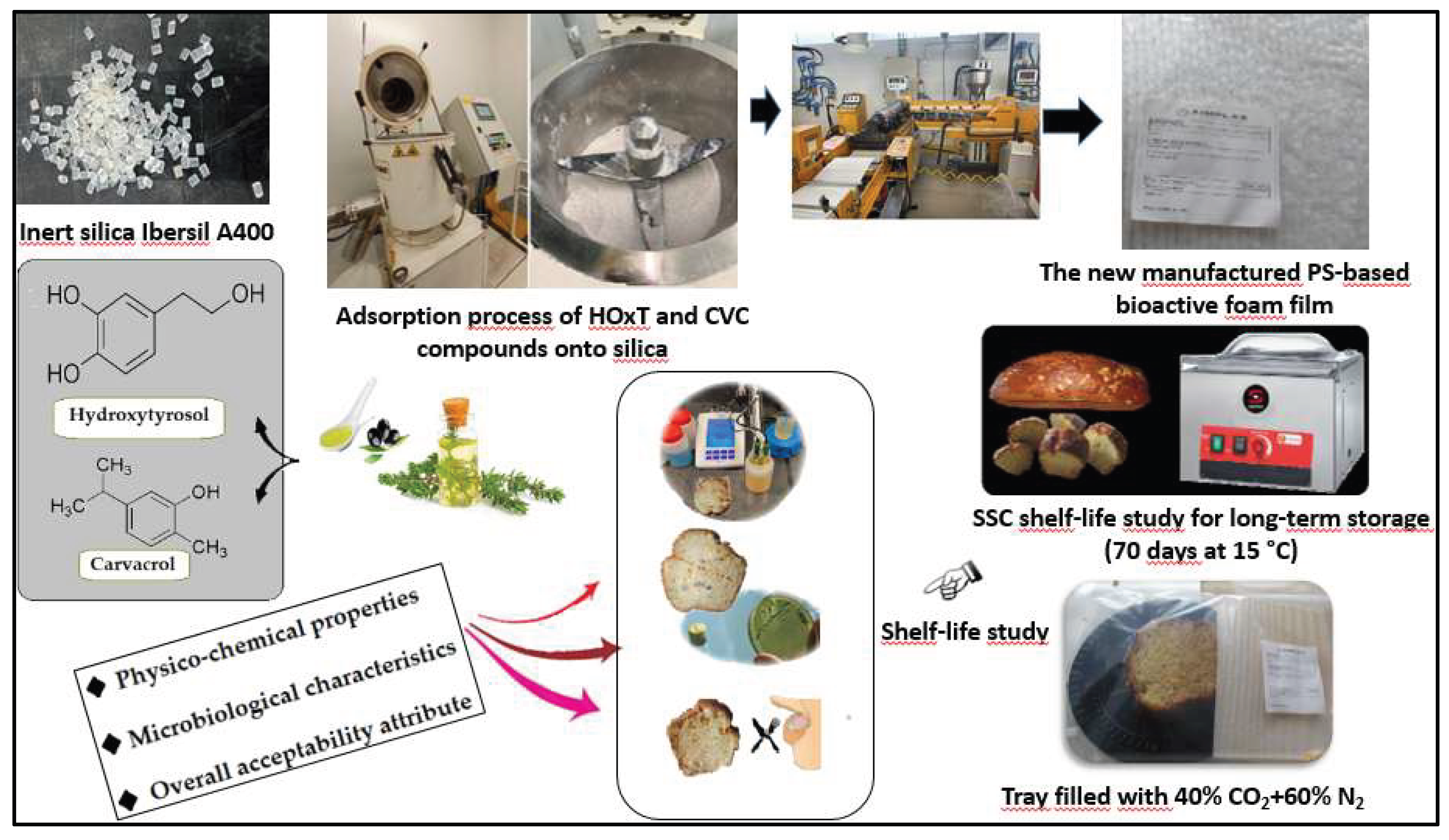
Figure 2.
Turbo-mixer for the adsorption process of natural bioactive agents onto silica.
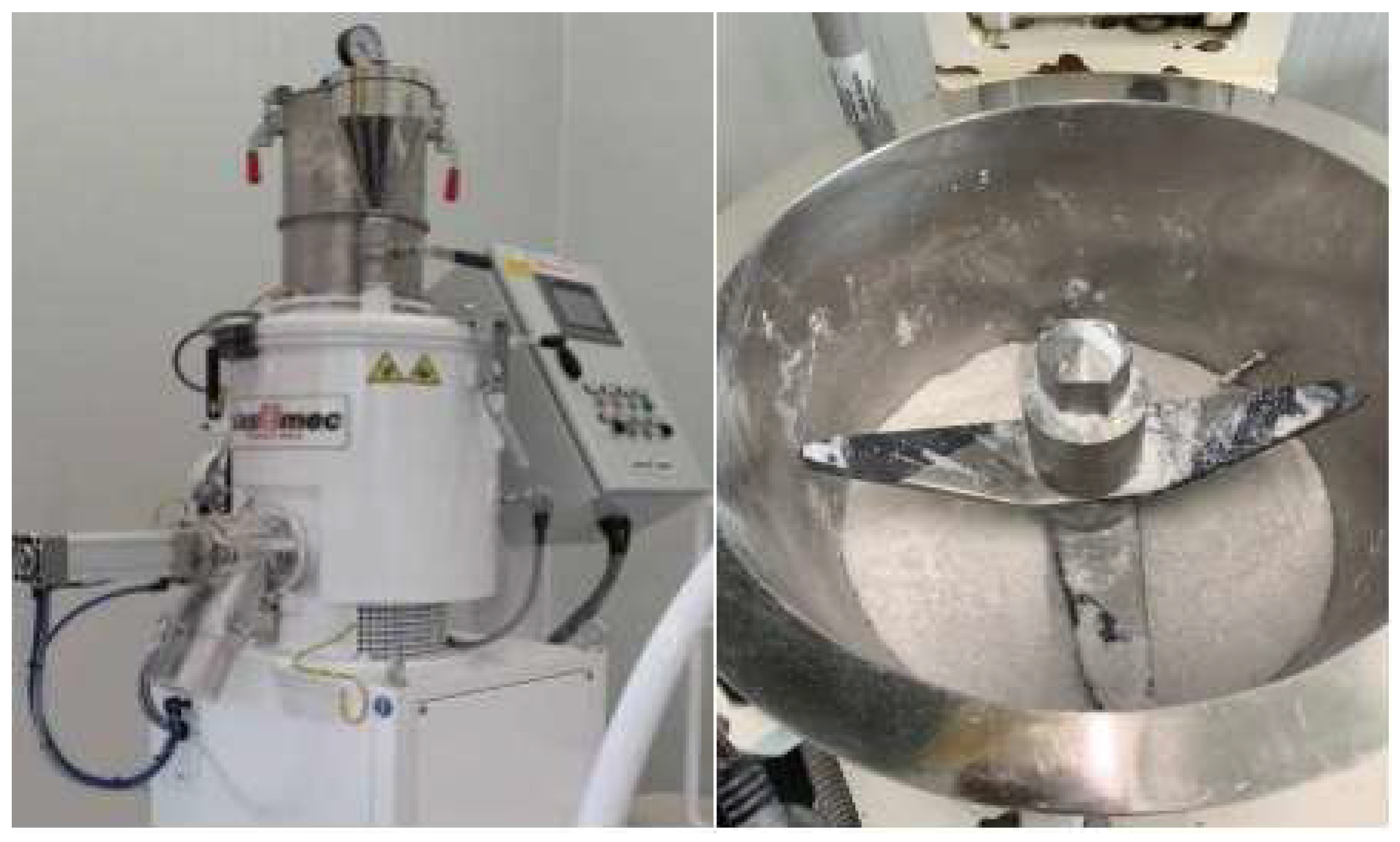
Figure 3.
Pellet granules of (a) PS/neat polystyrene, (b) PS/ CVC, and (c) PS/HOxT.
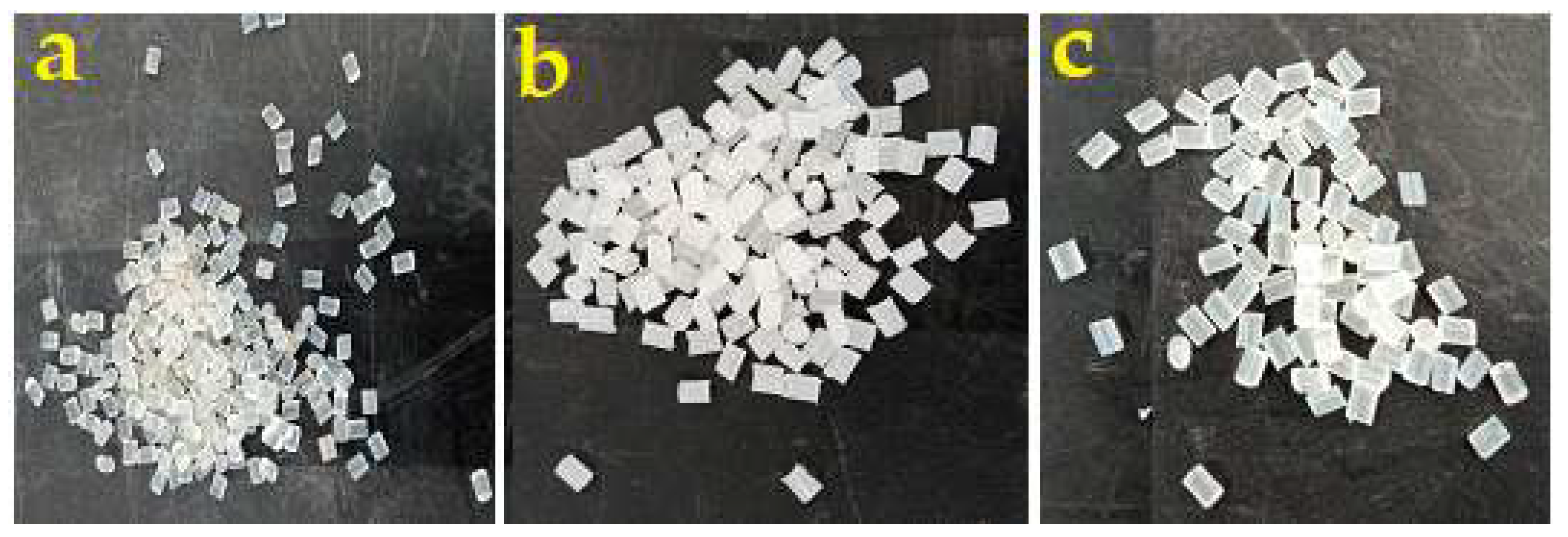
Figure 4.
Appearance of a SSC wrapped in one of the films studied (a) and in the MAP without film (b).
Figure 4.
Appearance of a SSC wrapped in one of the films studied (a) and in the MAP without film (b).
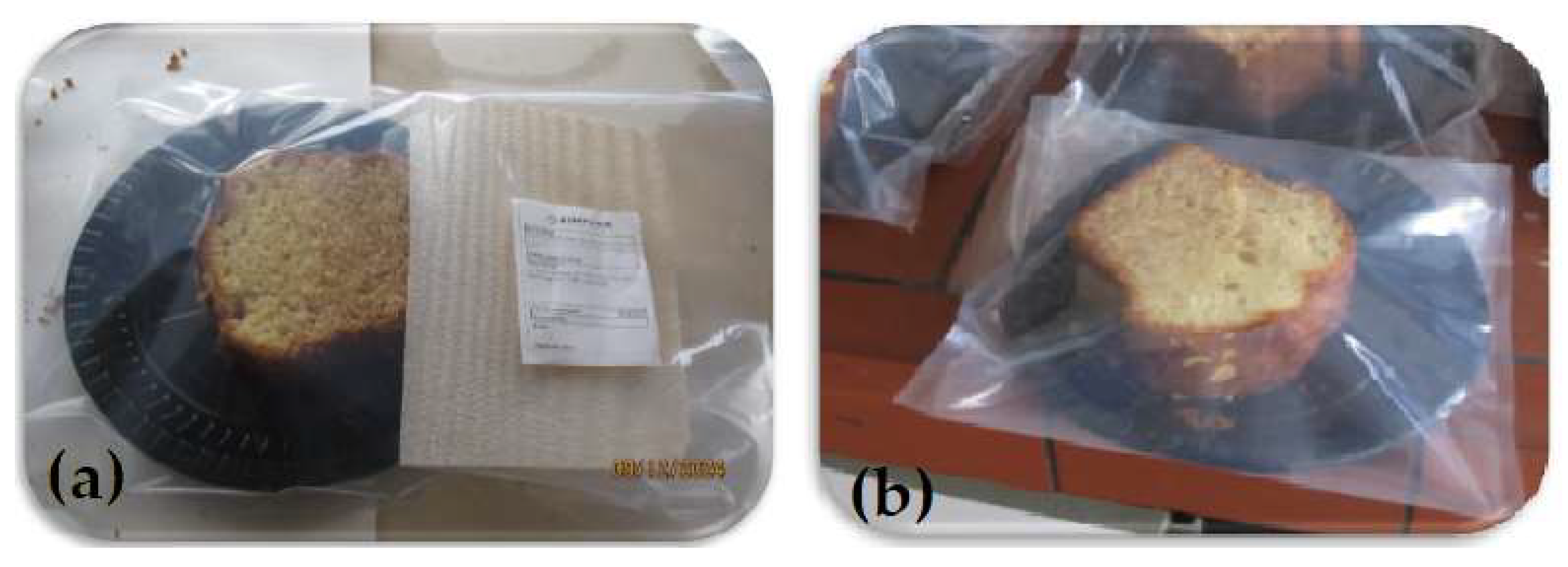
Figure 5.
Dynamic headspace CO2 (a) and residual O2 (b) of packaged SSC under modified atmosphere (MA) of 60% N2/40% CO2 with active packaging in high barrier film (PA/PE) at 15 ± 1 °C and 65 ± 2% humidity. (λ): Samples packed only under MA; (π): Samples packaged with a bioactive film containing HOxT, under MA. (υ): Samples packaged with a bioactive film containing CVC, under MA; (ν): Samples packaged with a bioactive film containing HOxT/CVC combination, under MA. . The vertical bars indicate the standard errors of three replicates.
Figure 5.
Dynamic headspace CO2 (a) and residual O2 (b) of packaged SSC under modified atmosphere (MA) of 60% N2/40% CO2 with active packaging in high barrier film (PA/PE) at 15 ± 1 °C and 65 ± 2% humidity. (λ): Samples packed only under MA; (π): Samples packaged with a bioactive film containing HOxT, under MA. (υ): Samples packaged with a bioactive film containing CVC, under MA; (ν): Samples packaged with a bioactive film containing HOxT/CVC combination, under MA. . The vertical bars indicate the standard errors of three replicates.
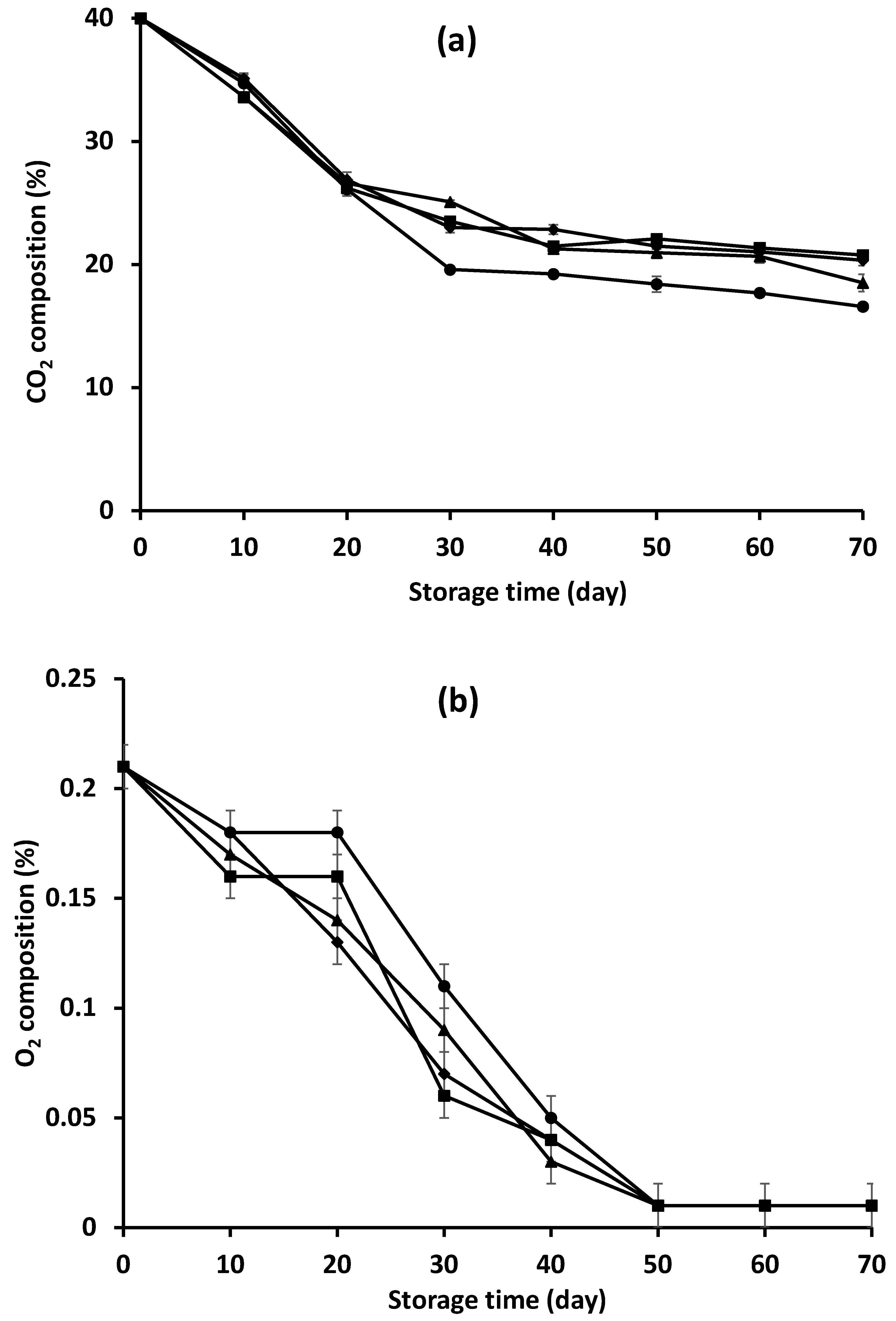
Figure 6.
Water activity (aw) change during storage of packaged SSC under modified atmosphere (MA) of 60% N2/40% CO2 with active packaging in high barrier film (PA/PE) at 15 ± 1 °C and 65 ± 2% humidity. (◯): Samples kept in open air; (λ): Samples packed only under MA; (π): Samples packaged with a bioactive film containing HOxT, under MA. (υ): Samples packaged with a bioactive film containing CVC, under MA; (ν): Samples packaged with a bioactive film containing HOxT/CVC combination, under MA. The vertical bars indicate the standard errors of three replicates.
Figure 6.
Water activity (aw) change during storage of packaged SSC under modified atmosphere (MA) of 60% N2/40% CO2 with active packaging in high barrier film (PA/PE) at 15 ± 1 °C and 65 ± 2% humidity. (◯): Samples kept in open air; (λ): Samples packed only under MA; (π): Samples packaged with a bioactive film containing HOxT, under MA. (υ): Samples packaged with a bioactive film containing CVC, under MA; (ν): Samples packaged with a bioactive film containing HOxT/CVC combination, under MA. The vertical bars indicate the standard errors of three replicates.
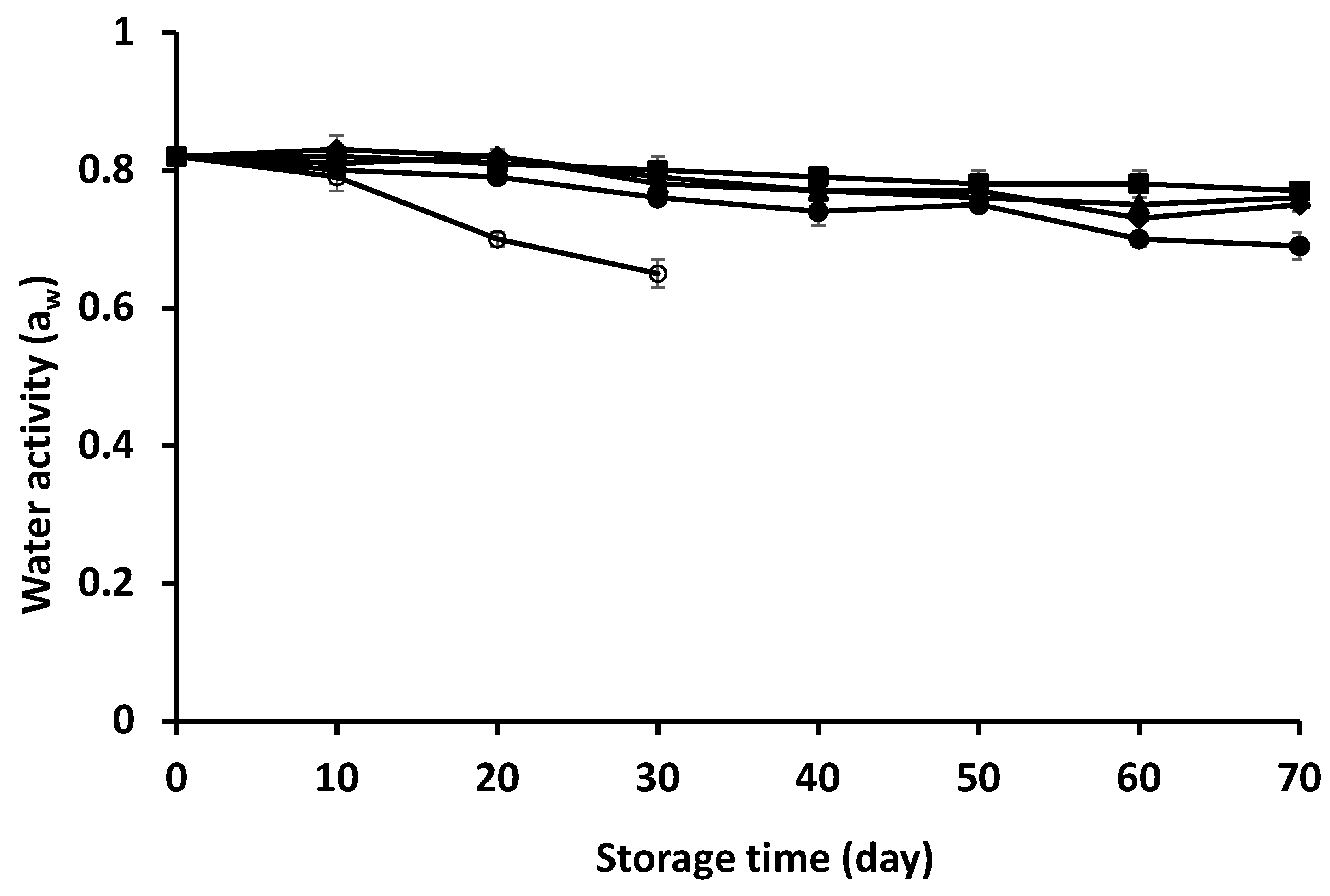
Figure 7.
TBA-RS (mg malonaldehyde/kg meat) in SSC stored SSC under modified atmosphere (MA) of 60% N2/40% CO2 with active packaging in high barrier film (PA/PE) at 15 ± 1 °C and 65 ± 2% humidity. (◯): Samples kept in open air; (λ): Samples packed only under MA; (π): Samples packaged with a bioactive film containing HOxT, under MA. (υ): Samples packaged with a bioactive film containing CVC, under MA; (ν): Samples packaged with a bioactive film containing HOxT/CVC combination, under MA. . The vertical bars indicate the standard errors of three replicates.
Figure 7.
TBA-RS (mg malonaldehyde/kg meat) in SSC stored SSC under modified atmosphere (MA) of 60% N2/40% CO2 with active packaging in high barrier film (PA/PE) at 15 ± 1 °C and 65 ± 2% humidity. (◯): Samples kept in open air; (λ): Samples packed only under MA; (π): Samples packaged with a bioactive film containing HOxT, under MA. (υ): Samples packaged with a bioactive film containing CVC, under MA; (ν): Samples packaged with a bioactive film containing HOxT/CVC combination, under MA. . The vertical bars indicate the standard errors of three replicates.
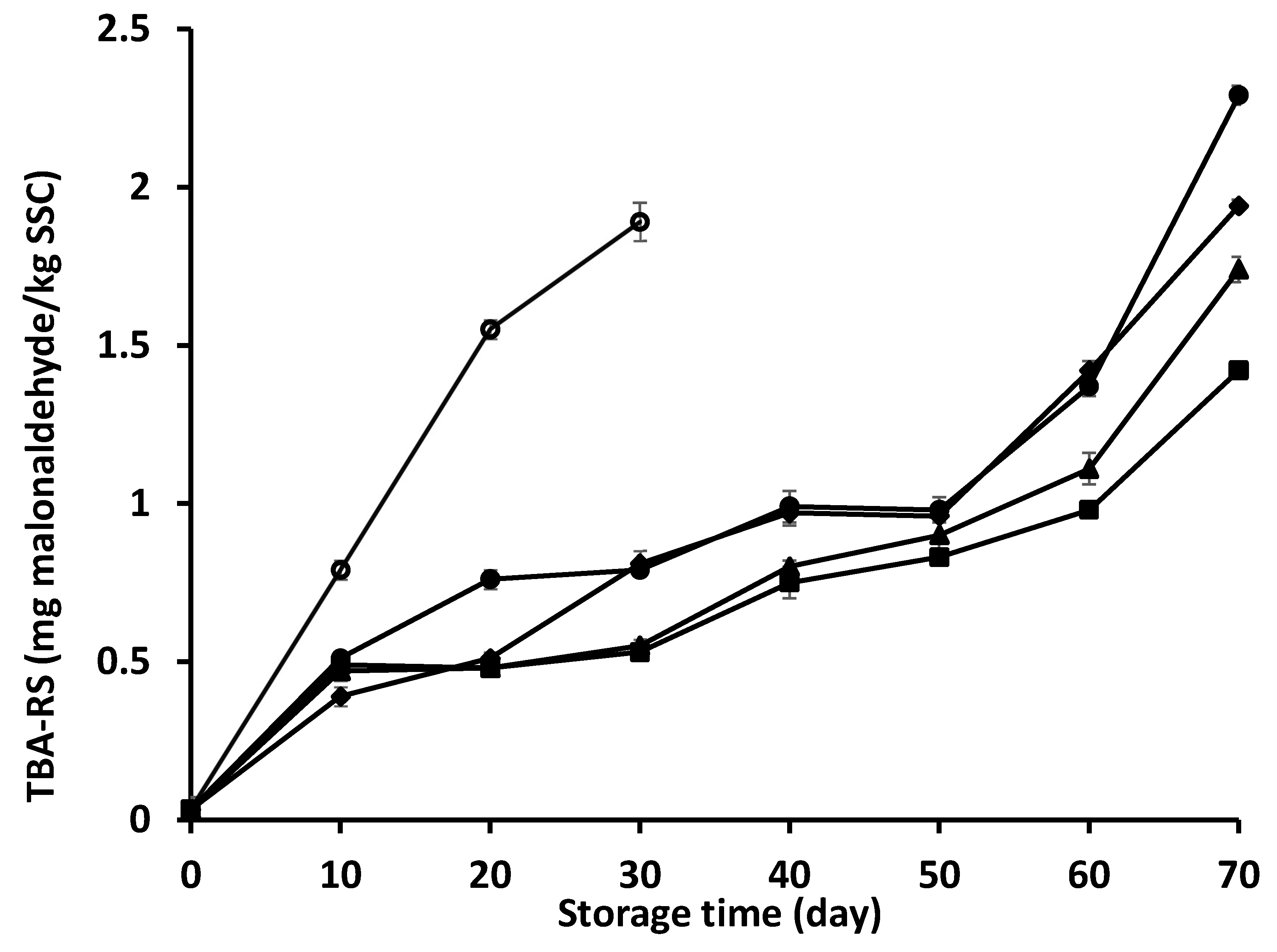
Figure 8.
Color difference (ΔE*: CIE 1976) based on SSC stored under modified atmosphere (MA) of 60% N2/40% CO2 with active packaging in high barrier film (PA/PE) at 15 ± 1 °C and 65 ± 2% humidity; ΔE* > 3 corresponds to just noticeable difference. (◯): Samples kept in open air; (λ): Samples packed only under MA; (π): Samples packaged with a bioactive film containing HOxT, under MA. (υ): Samples packaged with a bioactive film containing CVC, under MA; (ν): Samples packaged with a bioactive film containing HOxT/CVC combination, under MA. . The vertical bars indicate the standard errors of three replicates.
Figure 8.
Color difference (ΔE*: CIE 1976) based on SSC stored under modified atmosphere (MA) of 60% N2/40% CO2 with active packaging in high barrier film (PA/PE) at 15 ± 1 °C and 65 ± 2% humidity; ΔE* > 3 corresponds to just noticeable difference. (◯): Samples kept in open air; (λ): Samples packed only under MA; (π): Samples packaged with a bioactive film containing HOxT, under MA. (υ): Samples packaged with a bioactive film containing CVC, under MA; (ν): Samples packaged with a bioactive film containing HOxT/CVC combination, under MA. . The vertical bars indicate the standard errors of three replicates.
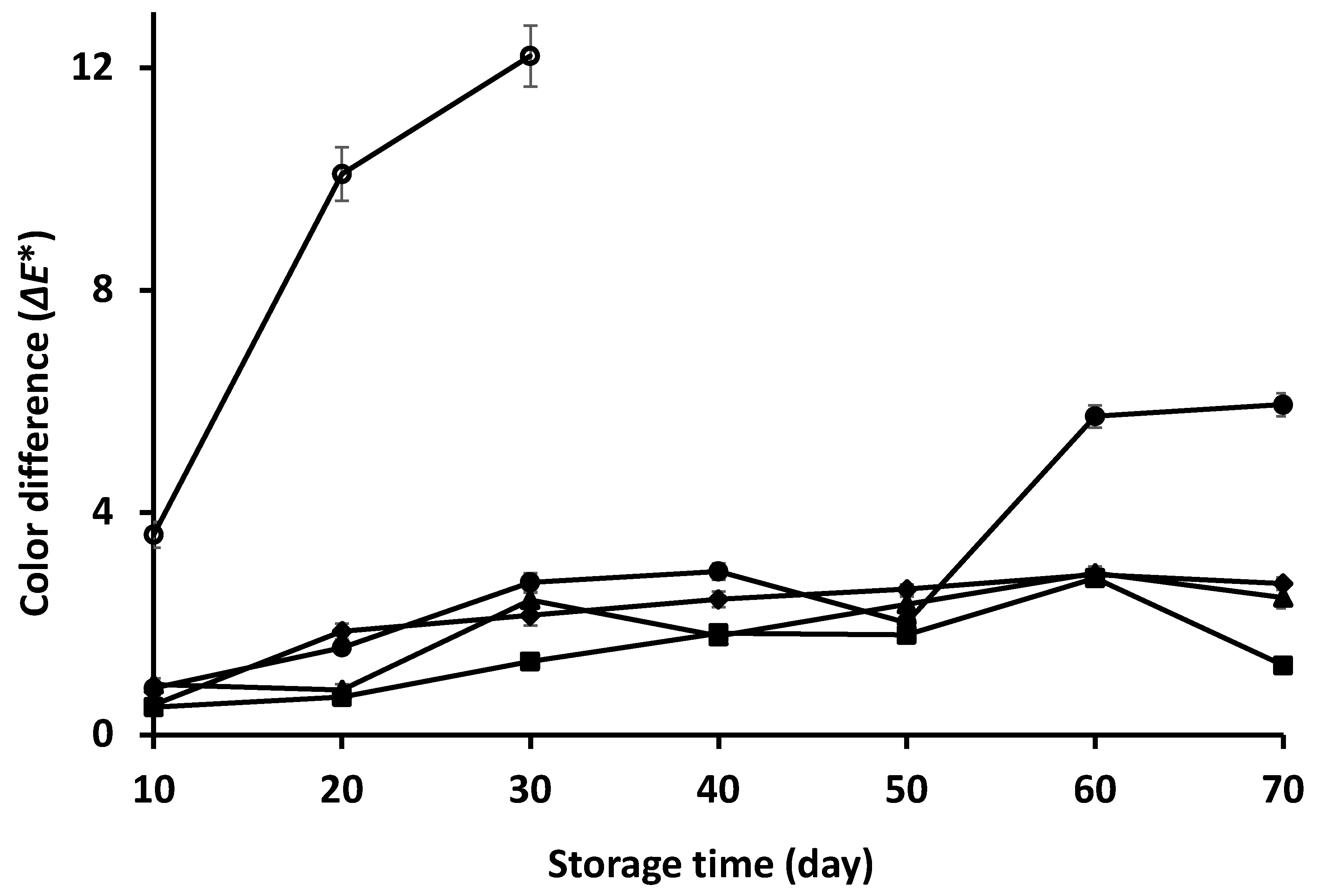
Figure 9.
Numbers (log10 CFU/g) of total aerobic mesophilic bacteria (a) and mold (b) recovered from SSC of packaged SSC under modified atmosphere (MA) of 60% N2/40% CO2 with active packaging in high barrier film (PA/PE) at 15 ± 1 °C and 65 ± 2% humidity. (◯): Samples kept in open air; (λ): Samples packed only under MA; (π): Samples packaged with a bioactive film containing HOxT, under MA. (υ): Samples packaged with a bioactive film containing CVC, under MA; (ν): Samples packaged with a bioactive film containing HOxT/CVC combination, under MA. The vertical bars indicate the standard errors of three replicates.
Figure 9.
Numbers (log10 CFU/g) of total aerobic mesophilic bacteria (a) and mold (b) recovered from SSC of packaged SSC under modified atmosphere (MA) of 60% N2/40% CO2 with active packaging in high barrier film (PA/PE) at 15 ± 1 °C and 65 ± 2% humidity. (◯): Samples kept in open air; (λ): Samples packed only under MA; (π): Samples packaged with a bioactive film containing HOxT, under MA. (υ): Samples packaged with a bioactive film containing CVC, under MA; (ν): Samples packaged with a bioactive film containing HOxT/CVC combination, under MA. The vertical bars indicate the standard errors of three replicates.
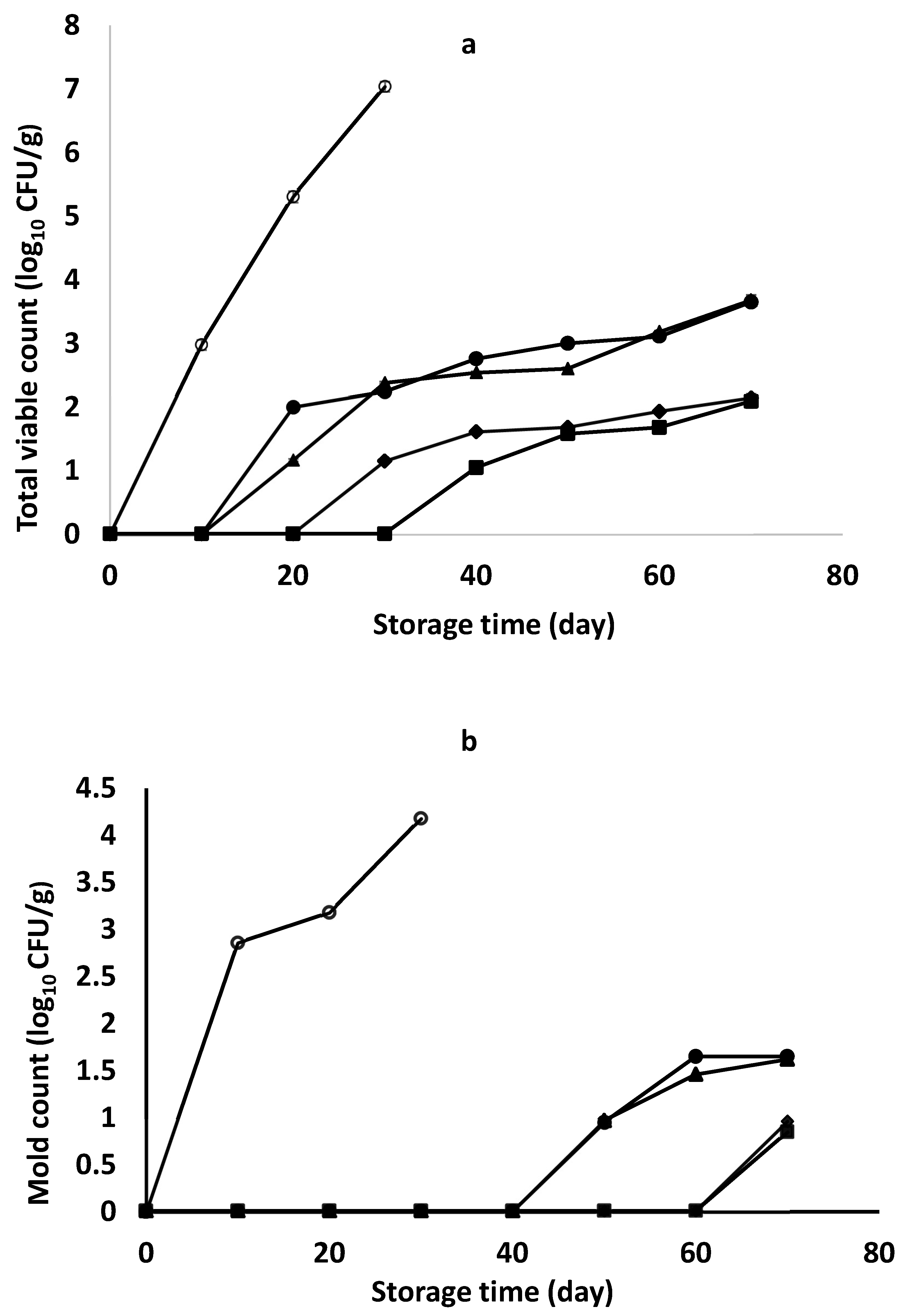
Figure 10.
The sensory quality scores (overall acceptability) of packaged SSC in different package bags and stored under modified atmosphere (MA) of 60% N2/40% CO2 with active packaging in high barrier film (PA/PE) at 15 ± 1 °C and 65 ± 2% humidity for up to 70 days. (◯): Samples kept in open air; (λ): Samples packed only under MA; (π): Samples packaged with a bioactive film containing HOxT, under MA. (υ): Samples packaged with a bioactive film containing CVC, under MA; (ν): Samples packaged with a bioactive film containing HOxT/CVC combination, under MA. The vertical bars indicate the standard errors of three replicates. The sensory analysis of the control sample was not carried out due to the visible mold growth on the packaged cake after 30 days of storage.
Figure 10.
The sensory quality scores (overall acceptability) of packaged SSC in different package bags and stored under modified atmosphere (MA) of 60% N2/40% CO2 with active packaging in high barrier film (PA/PE) at 15 ± 1 °C and 65 ± 2% humidity for up to 70 days. (◯): Samples kept in open air; (λ): Samples packed only under MA; (π): Samples packaged with a bioactive film containing HOxT, under MA. (υ): Samples packaged with a bioactive film containing CVC, under MA; (ν): Samples packaged with a bioactive film containing HOxT/CVC combination, under MA. The vertical bars indicate the standard errors of three replicates. The sensory analysis of the control sample was not carried out due to the visible mold growth on the packaged cake after 30 days of storage.
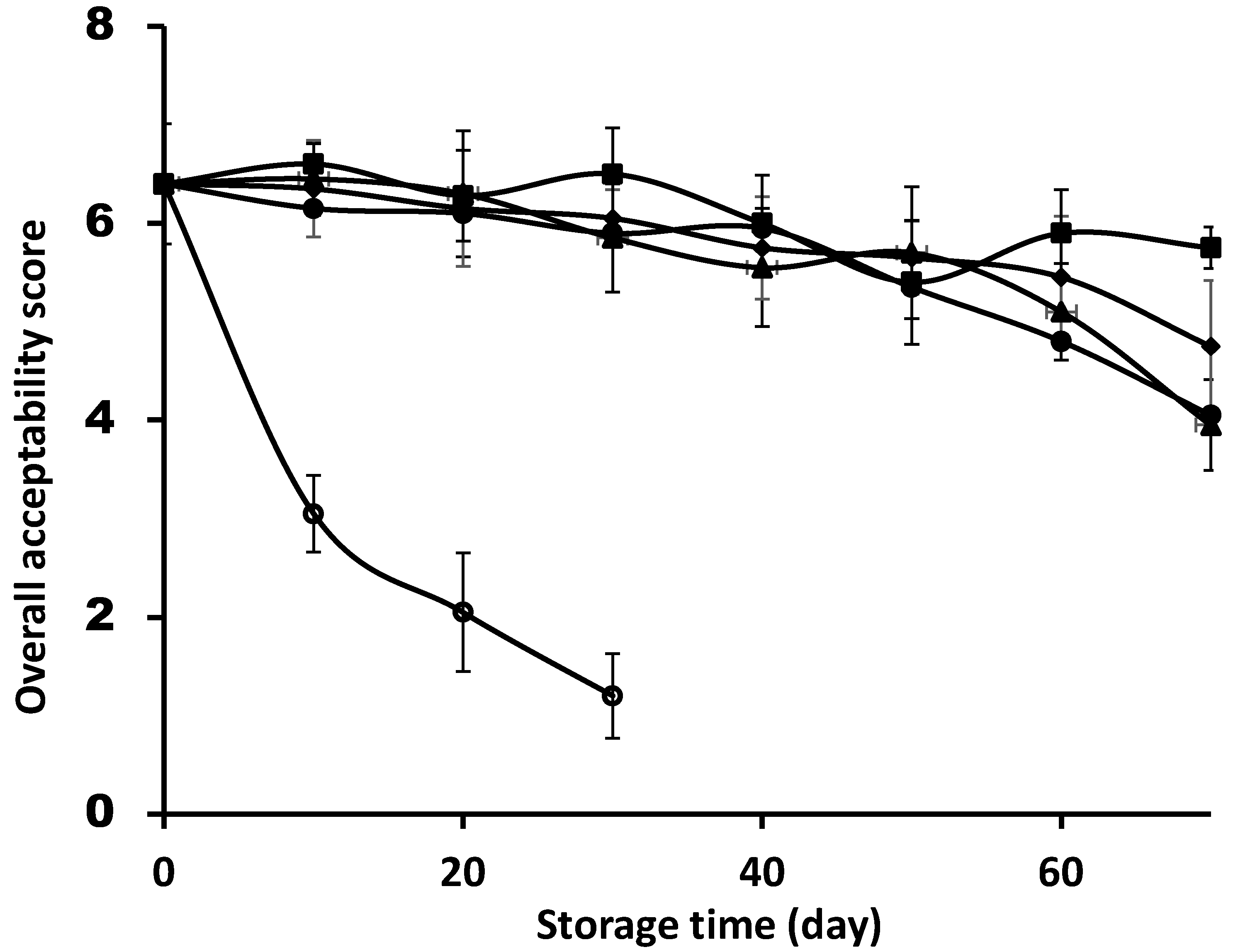
Figure 11.
Visual appearance of SSC packaged under control (conventional air), MAP, and MAP/HOxT/CVC conditions.
Figure 11.
Visual appearance of SSC packaged under control (conventional air), MAP, and MAP/HOxT/CVC conditions.
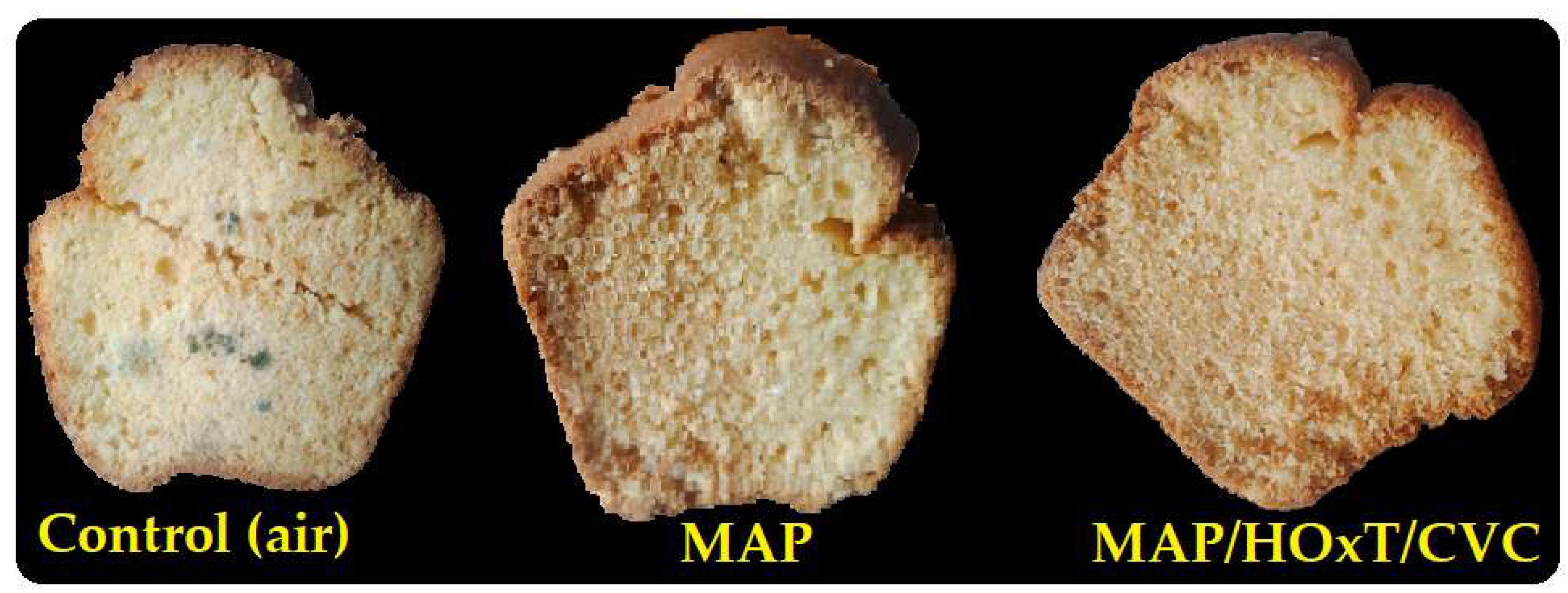

Table 1.
Ingredients for making SC.
| Ingredients | Content | |
|---|---|---|
| (g) | (%) | |
| Refined wheat flour | 100 | 32.15 |
| Pasteurized liquid whole eggs | 60 | 19.29 |
| Refined sugar | 70 | 22.50 |
| Soybean oil | 30 | 09.64 |
| Powder milk | 05 | 01.60 |
| Baking powder | 03 | 00.96 |
| Salt | 02 | 00.64 |
| Vanilla | 01 | 00.32 |
| Water | 40 | 12.86 |
| Total | 311 | 100 |
Table 2.
Proximate composition of freshly manufactured SSC (Values per 100 g).
| Compounds | Moisture | Protein(1) | Fat | Ash | Carbohydrate(2) | Energy (kcal)(3) | Energy (kj)(4) |
|---|---|---|---|---|---|---|---|
| Average value | 15.72 | 10.62 | 18.53 | 0.99 | 54.14 | 425.81 | 1786.53 |
| Standard deviation | 0.32 | 1.21 | 1.32 | 0.11 | 2.42 | 6.13 | 24.47 |
1KJeldahl-N × 6.25 2As difference (100- [Water + Protein + Fat + Ash] in 100 g 3Energy value (kcal) = (%Protein × 4) + (%Fat × 9) + (%Carbohydrate × 4) 4Energy value (kj) = (%Protein × 17) + (%Fat × 37) + (%Carbohydrate × 17).
Table 3.
Weight loss (%)* in the SSC packaged under modified atmosphere (MA) of 60% N2/40% CO2 with active packaging in high barrier film (PA/PE) at 15 ± 1 °C and 65 ± 2% humidity during 70 days of storage.
Table 3.
Weight loss (%)* in the SSC packaged under modified atmosphere (MA) of 60% N2/40% CO2 with active packaging in high barrier film (PA/PE) at 15 ± 1 °C and 65 ± 2% humidity during 70 days of storage.
| Packed samples | Storage time (day) | |||||||
|---|---|---|---|---|---|---|---|---|
| 10 | 20 | 30 | 40 | 50 | 60 | 70 | ||
| Air | 11.76±0.13aC | 18.6±0.18bC | 30.9±0.12cE | na** | na | na | na | |
| MAP | 4.1±0.20aB | 5.25±0.21bB | 9.82±0.11cD | 9.57±0.13cD | 9.39±0.19cC | 9.67±0.18cC | 10.97±0.17dB | |
| MAP/HOxT | 3.59±0.09aA | 4.6±0.18bA | 8.36±0.20deC | 8.29±0.08deC | 7.58±0.13dB | 5.87±0.19cA | 5.71±0.11cA | |
| MAP/CVC | 3.94±0.11aB | 5.16±0.21bB | 6.23±0.16cB | 6.29±0.12cB | 7.01±0.09cdB | 6.6±0.15cB | 5.98±0.14bA | |
| MAP/HOxT/CVC | 3.07±0.08aA | 4.19±0.15bA | 4.9±0.12bA | 5.05±0.17bA | 5.34±0.12bcA | 5.45±0.13bcA | 5.52±0.09bcA | |
*Values are presented as mean ± standard deviation of three replicates.**not analyzed: The lack of data after 30 days of storage for the control air samples is due to excessive mold growth responsible for their deterioration.(a-e)Means of the same row (between days of storage) with different letters differ significantly (p < 0.05).(A-E)Means of the same column (between packed samples) with the same letter no differ significantly (p > 0.05).Abbreviations: Air: Samples kept in open air; MAP: Samples packed only under MA; MAP/HOxT: Samples packaged with a bioactive film containingHOxT, under MA. MAP/CVC: Samples packaged with a bioactive film containing CVC, under MA; MAP/HOxT/CVC: Samples packaged with a bioactive film containing HOxT/CVC combination, under MA.
Table 4.
Changes in textural properties (Hardness)* of SSC crumb samples packaged under modified atmosphere (MA) of 60% N2/40% CO2 with active packaging in high barrier film (PA/PE) at 15 ± 1 °C and 65 ± 2% humidity during 70 days of storage.
Table 4.
Changes in textural properties (Hardness)* of SSC crumb samples packaged under modified atmosphere (MA) of 60% N2/40% CO2 with active packaging in high barrier film (PA/PE) at 15 ± 1 °C and 65 ± 2% humidity during 70 days of storage.
| acked samples | Days of storage | |||||||
|---|---|---|---|---|---|---|---|---|
| 0 | 10 | 20 | 30 | 40 | 50 | 60 | 70 | |
| AIR | 385±4.24aA | 499.74±2.36bB | 675.69±1.43cC | 989.69±0.71dC | na** | na | na | na |
| MAP | 385±4.24aA | 391.32±2.52aA | 447.01±5.12bAB | 498.12±5.24cAB | 601.62±5.46dB | 645.17±4.18dB | 661.93±1.45deB | 692.63±4.29eB |
| MAP/HOxT | 385±4.24aA | 368.14±0.18aA | 379.99±1.02aA | 443.2±0.56bA | 509.92±2.15cA | 512.52±1.22cA | 543.81±0.74cA | 585.51±0.95cdA |
| MAP/CVC | 385±4.24aA | 375.01±0.98aA | 417.05±3.74aA | 438.21±2.77abA | 483.58±1.44bA | 524.15±1.83bA | 565.19±0.94bcA | 583.91±2.13cA |
| MAP/HOxT/CVC | 385±4.24aA | 365.24±1.1aA | 382.98±1.31aA | 441.63±1.9bA | 462.4±0.82bA | 499.25±1.02bcA | 533.57±1.1cA | 569.9±1.28cdA |
*Values are presented as mean ± standard deviation of three replicates.**not analyzed: The lack of data after 30 days of storage for the control air samples is due to excessive mold growth responsible for their deterioration. (a-e)Means of the same row (between days of storage) with different letters differ significantly (p < 0.05). (A-C)Means of the same column (between packed samples) with the same letter no differ significantly (p > 0.05). Abbreviations: Air: Samples kept in open air; MAP: Samples packed only under MA; MAP/HOxT: Samples packaged with a bioactive film containingHOxT, under MA. MAP/CVC: Samples packaged with a bioactive film containing CVC, under MA; MAP/HOxT/CVC: Samples packaged with a bioactive film containing HOxT/CVC combination, under MA.
Table 5.
Criteria used to determine the end of shelf life.
| Guidelines | End of shelf life |
|---|---|
| Microbiological properties | -Total aerobic counts: ~6 log10 CFU/g -PDA: ~1 log10 CFU/g |
| Physical properties | -Texture: maximum limit 600 g -ΔL*: maximum limit > 3 The color difference was visible to the human eye indicating freshness and quality of the product at the point of sale -Weight loss: ~ 9% critical limit for the reduction in the market value of product by reduction in volume and a change in texture that makes the cake less appealing to consumers |
| Overall acceptability | Score > 5 “like slightly” indicates that the SSC samples are suitable for sale or consumption) |
| Chemical properties | TBA-RS value: ~1.5 mg MDA/kg which indicates significant lipid oxidation, often resulting in a rancid taste and, in many cases, product deterioration |
Table 6.
Effect of bioactive packaging and MAP on the total estimated shelf life (days) of SSC during storage at 15 °C.
Table 6.
Effect of bioactive packaging and MAP on the total estimated shelf life (days) of SSC during storage at 15 °C.
| Samples | Shelf life (days)* | Shelf life increase (%)** |
|---|---|---|
| Air | 10 | - |
| MAP | 50 | 400 |
| MAP/HOxT | 60 | 500 |
| MAP/CVC | 60 | 500 |
| MAP/HOxT/CVC | >70 | > 600 |
*The shelf life refers to the period during which the SSC retains satisfactory sensorial quality (Overall acceptability). **Calculated based on overall acceptability parameters (on a scale of 1 to 7).
Disclaimer/Publisher’s Note: The statements, opinions and data contained in all publications are solely those of the individual author(s) and contributor(s) and not of MDPI and/or the editor(s). MDPI and/or the editor(s) disclaim responsibility for any injury to people or property resulting from any ideas, methods, instructions or products referred to in the content. |
© 2026 by the authors. Licensee MDPI, Basel, Switzerland. This article is an open access article distributed under the terms and conditions of the Creative Commons Attribution (CC BY) license (http://creativecommons.org/licenses/by/4.0/).
Copyright: This open access article is published under a Creative Commons CC BY 4.0 license, which permit the free download, distribution, and reuse, provided that the author and preprint are cited in any reuse.


