
Submitted:
12 June 2026
Posted:
15 June 2026
You are already at the latest version
Abstract
Vibration-based sensing systems for deployed industrial fault diagnosis often face incremental fault classes, changing degradation stages, and limited permission to retain historical sensor streams. Static fault classifiers are therefore insufficient for online maintenance settings in which a model must learn new sensor-observed states while preserving previous diagnostic knowledge under a bounded memory budget. This paper proposes ASBR-CL, an adaptive stage-aware balanced replay framework for continual fault diagnosis under a fixed exemplar-memory budget. ASBR-CL combines dataset-adaptive exemplar memory, balanced replay between current data and retained exemplars, and a conditional validation checkpoint module that is enabled only when it improves balanced stage recognition. Experiments on SEU-enhanced92, the 92-dimensional feature construction for SEU, and XJTU-bearing23, the 23-dimensional feature construction for XJTU-SY, compare ASBR-CL with commonly used continual-learning reference baselines, the same-backbone DGGN-RBD baseline, and an offline Joint Training upper bound. On SEU, the selected ASBR-CL A2 variant improves all reported memory-limited metrics under the selected no-validation-checkpoint protocol. On XJTU, the selected ASBR-CL A3 result is validation-assisted continual learning under a fixed exemplar-memory budget; it is not an overall-accuracy maximizer relative to iCaRL, but improves Macro Recall by 12.59 percentage points and reduces Average Forgetting by 10.43 percentage points, supporting balanced degradation-stage recognition. ASBR-CL provides the clearest algorithmic gain over the same-backbone DGGN-RBD baseline, while comparisons with smaller-capacity baselines contextualize performance against common continual-learning strategies. Real timing measurements show that ASBR-CL stays in the same update-time order as DGGN-RBD while providing stronger balanced recognition and forgetting control. The results indicate that continual diagnostic systems for vibration sensor streams should report training-memory, validation-resource, test-resource, accuracy, balanced recognition, forgetting, and cost assumptions together.
Keywords:
vibration-based sensing
; industrial fault diagnosis
; continual learning
; exemplar memory
; balanced replay
; catastrophic forgetting
1. Introduction
Vibration-based sensing has become a practical route for monitoring rotating machinery, bearings, gearboxes, and other industrial assets because sensor signal streams can be collected continuously and transformed into discriminative health-state representations [1,2]. Most deep fault diagnosis studies, however, still evaluate models in a static setting: the available fault classes and operating conditions are assumed to be known before deployment, and historical samples remain accessible for retraining [3,4]. This assumption is restrictive in industrial sensing deployments where new fault modes, degradation stages, or operating domains appear after the diagnostic model has already been installed on a monitoring pipeline.
Continual learning addresses this deployment gap by updating a model from a sequence of tasks while retaining previously learned knowledge [5,6]. In fault diagnosis, this is not only a machine-learning convenience but also an engineering requirement. If a model adapts to new fault states by overwriting old states, it can create unsafe blind spots; this loss is the central catastrophic-forgetting problem measured in continual-learning benchmarks [7,8]. Conversely, if the model preserves old states by storing all historical vibration windows or by retraining from scratch, the update cost, storage load, and data-governance burden can become incompatible with online diagnostic deployment. A deployed diagnostic system therefore needs an incremental update mechanism that is memory-limited, retention-aware, and sensitive to minority or late degradation stages. Recent continual fault diagnosis studies have started to examine class-added and domain-varying settings for motors and rotating machinery [9,10], but the memory-limited replay setting still requires careful control of old-new sample balance, class imbalance, and model-selection bias.
This paper studies continual fault diagnosis for vibration sensor streams under a fixed exemplar-memory budget, where the learner can retain only a bounded training exemplar memory after each incremental step. The setting differs from offline fault classification and from joint training: the model receives new diagnostic sensor data sequentially, cannot revisit all previous training samples, and must preserve balanced recognition across old and new fault states. We distinguish this training-memory limit from validation and test resources: validation data may be retained separately for model selection in the validation-assisted XJTU protocol, while test data are used only for final reporting. Average or final accuracy alone is not sufficient in this setting. In degradation-stage diagnosis, a model can obtain high overall accuracy while failing on minority or late degradation stages, a risk that is consistent with broader studies on imbalanced-domain evaluation [11]. We therefore evaluate not only Average Accuracy and Final Accuracy, but also Macro Recall and Average Forgetting, which better reflect safety-relevant balanced recognition.
We propose ASBR-CL, an adaptive stage-aware balanced replay framework for memory-limited continual fault diagnosis. The method combines three ideas. First, the exemplar memory is selected adaptively according to the dataset structure: random diversity-based replay is used for the stable SEU setting, while stage-aware memory is used for XJTU degradation-stage streams. Second, balanced replay controls the contribution of old exemplars and current-task data so that new learning does not dominate retained knowledge. Third, validation checkpoint selection is treated as a conditional module rather than a mandatory component. It is enabled for the XJTU degradation-stage protocol, where validation macro-recall aligns with the balanced-recognition objective, and disabled for the stable SEU class-incremental protocol.
The experimental interpretation is dataset-specific. On SEU, ASBR-CL A2 is the selected variant and improves all reported memory-limited metrics under the selected protocol. On XJTU, ASBR-CL A3 is not designed as an overall-accuracy maximizer; instead, it improves balanced degradation-stage recognition as reflected by Macro Recall and forgetting under a validation-assisted protocol. The strongest capacity-controlled comparison is ASBR-CL versus DGGN-RBD, because both use the same DGGN/MFF backbone and differ mainly in exemplar selection, balanced replay, and checkpoint protocol. Comparisons with smaller continual-learning reference baselines contextualize performance against common strategies but are not treated as isolated capacity-controlled evidence. The method is therefore positioned as a memory-limited continual diagnosis framework that improves balanced recognition and retention where those metrics matter, rather than as an accuracy-only method.
The contributions are summarized as follows.
- 1.
- We formulate continual fault diagnosis under fixed exemplar-memory retention as a balanced-recognition problem rather than a static fault-classification problem, while explicitly separating training memory, validation resources, and test resources.
- 2.
- We propose ASBR-CL, combining adaptive/stage-aware exemplar memory, balanced replay, and a dataset-conditional validation checkpoint gate.
- 3.
- We provide a two-dataset evaluation on SEU and XJTU with five seeds, significance tests, ablations, memory sensitivity, accuracy matrices, and real timing measurements from the implemented update pipeline, distinguishing the same-backbone DGGN-RBD comparison from broader reference baselines.
- 4.
- We report claim-specific evidence: SEU supports a clean all-metric win, while XJTU supports improved Macro Recall and forgetting control without overstating accuracy superiority over iCaRL.
2. Related Work
2.1. Machinery Fault Diagnosis
Deep models are now common in machinery fault diagnosis. They transform vibration windows into health-state labels with less manual feature engineering than classical feature pipelines. Reviews of machine fault diagnosis and machine health monitoring show the evolution from feature engineering toward deep representation learning and benchmarked diagnostic models [2,3,12]. Open benchmark studies further support reproducible rotating-machinery diagnosis [4,13]. Earlier bearing and rotating-machinery studies established the diagnostic value of vibration analysis for rotating assets [14,15]. Deep CNN-based methods then improved raw-signal and anti-noise diagnosis in industrial settings [16,17].
Public gearbox, bearing, and run-to-failure datasets have supported this progress by enabling reproducible evaluation across static diagnostic protocols. Recent work also extends diagnostic learning to limited-sample and cross-machine settings [18]. Much of this literature still assumes that the training and test label spaces are fixed. The resulting classifiers can be strong in static diagnosis, but the assumption becomes restrictive when new fault states arrive after deployment.
This paper focuses on the continual version of the same engineering problem. The aim is not to replace static diagnostic modeling, but to study how a deployed model can be updated when only a compact exemplar memory is retained. This shift changes the evaluation emphasis: final accuracy remains important, but balanced recognition and forgetting become necessary because a high overall score can hide weak recognition of minority or late degradation stages.
2.2. Continual Learning and Catastrophic Forgetting
Continual learning aims to update a model over a sequence of tasks or data distributions without catastrophic forgetting. Earlier studies identified rehearsal and pseudorehearsal as direct mechanisms for reducing forgetting in connectionist networks [7], and modern surveys distinguish task-, domain-, and class-incremental settings while organizing methods around regularization, distillation, replay, dynamic architectures, and exemplar-free adaptation [5,6,19]. These general categories motivate the baseline set used in this paper, but they do not directly resolve the engineering constraints of fault diagnosis. Mechanical fault streams are often class-imbalanced, stage-ordered, and safety-sensitive. A method that maximizes overall accuracy may still under-recognize minority degradation stages. ASBR-CL therefore uses replay but makes the memory and checkpoint behavior conditional on dataset structure and evaluates balanced metrics in addition to accuracy.
2.3. Continual and Incremental Fault Diagnosis
Continual learning has recently been introduced into fault diagnosis to avoid repeated retraining when new fault types or operating conditions appear. Early lifelong and residual-network studies examine rotating-machinery diagnosis under domain increments and changing operating conditions [20,21]. Self-driven continual learning for class-added motor diagnosis uses unseen-fault detection and propensity distillation to trigger incremental learning [9]. Knowledge-distillation methods have also been used for class-added motor diagnosis, and KDN extends class-added continual learning to cross-machine diagnosis with limited samples [22,23]. Uncertainty-aware continual learning for rotating machinery addresses class, domain, and mixed continual scenarios with pseudo-labeling and prototypical feedback [10], while dynamic branch layer fusion studies continual rotating-machinery diagnosis from an adaptive network-fusion perspective [24]. These works confirm that continual diagnosis is an active engineering problem, but many methods focus on unseen-fault detection, new-fault adaptation, distillation, pseudo-labeling, or architectural adaptation rather than the memory-limited replay balance studied here.
ASBR-CL targets the complementary setting where a small exemplar memory is available and must be allocated carefully. This setting is close to practical maintenance constraints: retaining a compact memory can be more realistic than keeping all historical windows, while still allowing replay to stabilize old decision boundaries. The key design question becomes which exemplars should be retained, how old and new data should be balanced during updates, and whether validation-based checkpoint selection improves balanced recognition on a given dataset.
2.4. Exemplar Replay and Model Selection
Exemplar replay is one of the most direct ways to reduce forgetting when memory is allowed. In diagnostic streams, replay raises two additional questions. First, the retained exemplars should reflect the structure of the fault stream rather than only the majority classes. Second, replay batches should not let current-task samples dominate the small retained memory. Recent continual fault-diagnosis work also shows that limited-sample cross-machine settings need explicit mechanisms for preserving old diagnostic behavior while adapting to new classes [18,23].
Model selection is also non-trivial in continual diagnosis. Selecting a checkpoint by overall validation accuracy may favor majority or easier states, while selecting by a balanced metric can be useful when degradation-stage recognition is the target. ASBR-CL therefore treats validation checkpoint selection as a conditional module. It is enabled with validation macro recall on XJTU, but disabled on SEU because the ablation shows that it reduces final-stage balanced performance there.
2.5. Bearing Degradation, Datasets, and Evaluation Metrics
SEU and XJTU provide complementary public diagnostic settings. SEU supports a stable class-incremental diagnosis setting where the predefined ASBR-CL A2 path focuses on old-class retention without validation checkpointing. XJTU supports a harder degradation-stage setting where class/stage balance is more important than overall accuracy alone. The dataset-specific construction details and source references are given in Section 4, where the diagnostic streams are defined for the continual-learning protocol.
For this reason, the experimental section reports Average Accuracy, Final Accuracy, Macro Recall, and Average Forgetting together. Macro Recall is emphasized on XJTU because it captures balanced degradation-stage recognition, while Average Forgetting captures retention loss after incremental updates. On XJTU, ASBR-CL A3 improves Macro Recall and forgetting relative to iCaRL while remaining competitive, but slightly lower, in overall and final accuracy.
2.6. Balanced and Imbalanced Fault Diagnosis
Fault diagnosis data are frequently imbalanced because normal states or early degradation stages may dominate the data stream, while severe or transitional fault states are rarer. General imbalanced-learning studies show why conventional accuracy can be misleading and why resampling, reweighting, and balanced losses are often needed [11,25,26,27]. Reviews of small and imbalanced diagnostic data argue that this issue is especially important when minority classes are safety-relevant [28]. Recent bearing-diagnosis studies continue to address the same issue with improved convolutional models and imbalance-aware designs [29]. In a continual setting, imbalance interacts with catastrophic forgetting: a model may retain high overall accuracy while losing minority-stage recall or overwriting old states. This motivates the use of Macro Recall and Average Forgetting as main evidence rather than reporting only average accuracy.
The gap addressed here is therefore specific. Existing diagnostic and continual-learning methods often prioritize overall accuracy, new-fault adaptation, or distillation-based forgetting reduction. ASBR-CL instead focuses on memory-limited replay under a fixed exemplar budget, where balanced old-new sampling, dataset-aware memory selection, and conditional checkpointing are evaluated by their effect on balanced recognition and forgetting control.
3. Materials and Methods
3.1. Problem Formulation
We consider a class- or stage-incremental fault diagnosis stream , where incremental step t provides a current training subset and expands the cumulative diagnostic label set to . The learner updates parameters sequentially and is evaluated on cumulative test classes or degradation stages after each step. Historical samples are not fully available during every update. Instead, the learner can retain only a bounded exemplar memory after step t, with
In the main experiments, . This setting differs from offline joint training because the latter has access to all historical training data and is therefore reported only as an upper bound.
The memory budget K counts only training exemplars stored in the replay memory. The validation split is held out from training, is never sampled for replay, is not inserted into the exemplar memory, and is not counted in K. At incremental step t, validation checkpoint selection, when enabled, uses the cumulative validation set for all observed classes or stages, denoted by . This cumulative validation set contains old-task validation data and current-task validation data so that checkpoint selection can evaluate both new-task learning and old-task retention. The test split is used only for final reporting and is not used during epoch-level checkpoint selection.
3.2. Validation Resource and Memory Accounting
The memory budget in this paper is an exemplar-memory budget. It counts only retained training samples in the replay memory . Validation samples are stored separately for model selection and checkpoint selection; they are not replayed, not inserted into exemplar memory, and not used to update model parameters. At incremental step t, the cumulative validation set contains validation samples from the seen classes or stages . The maximum validation resource size is 1020 validation samples for SEU and 14760 validation samples for XJTU-SY. This validation resource is therefore separate from K and should be interpreted as a model-selection resource rather than as training memory.
This accounting also defines the limitation of the memory-limited claim. In stricter deployments, old validation samples may also be storage-constrained or unavailable. Therefore, the XJTU A3 results should be interpreted as validation-assisted continual learning under a fixed exemplar-memory budget, not as a protocol where every labeled validation sample is counted in the same storage budget as retained training exemplars. The corresponding no-validation-checkpoint variant is XJTU A2 in the ablation table. The selected SEU A2 result does not use validation checkpointing, XJTU A2 is the stage-aware plus balanced replay variant without validation checkpointing, and XJTU A3 adds validation macro-recall checkpointing to improve balanced degradation-stage recognition over A2. Stricter resource protocols–including no old-task validation retention, validation samples counted in a total labeled-storage budget, validation-budget sensitivity, and fully validation-free checkpoint rules–are not claimed as completed experiments in this manuscript and are left as follow-up evaluation requirements.
3.3. ASBR-CL Framework
ASBR-CL is built on the DGGN-RBD continual diagnosis pipeline but changes the memory and update behavior according to the dataset structure. Figure 1 gives the overall framework, Figure 2 shows the incremental update flow, and Algorithm 1 lists the implementation-faithful update procedure. The method has three operational components: adaptive/stage-aware exemplar memory, balanced replay, and conditional validation checkpoint selection.
The design is informed by the broader continual-learning literature: regularization, distillation, exemplar memory, and experience replay address forgetting through different mechanisms [30,31,32,33]. Rebalancing methods in class-incremental learning also motivate explicit attention to old-new sampling bias [34,35]. ASBR-CL does not implement all of these mechanisms as new modules; rather, it uses this baseline landscape to motivate a focused replay-based design for fault diagnosis under a fixed memory budget.
| Algorithm 1 ASBR-CL continual update. |
|
3.4. Adaptive/Stage-Aware Exemplar Memory
The exemplar memory is selected after each incremental step under the fixed memory budget. ASBR-CL does not use one selection rule for all streams. After step t, if classes or stages have been observed, the memory is allocated approximately uniformly, with a per-class or per-stage quota of exemplars. For SEU, the selected A2 configuration uses the implemented RBD_RANDOM strategy with a hybrid random ratio of 0.10. This keeps the diversity-oriented behavior of random boundary diversity selection while adding a small random coverage component. This choice is appropriate for the more stable SEU setting, where the main risk is forgetting old fault classes after new-class updates.
For XJTU, the selected A3 configuration uses stage-aware memory. XJTU-SY source order corresponds to degradation progression because the CSV files in each bearing run are named in sampling-time order, such as 1.csv, 2.csv, …, N.csv, and each CSV corresponds to one-minute interval sampling. Within each observed degradation stage, candidate samples are sorted by this source order. The ordered candidates are then partitioned into temporal segments according to the current per-stage memory quota. For and four observed stages at the final step, the quota is approximately 25 exemplars per stage; therefore each final-stage class is represented by about 25 temporal segments and 25 selected exemplars. For each segment, ASBR-CL computes the mean feature representation using the same MFF feature backbone used by DGGN-RBD and ASBR-CL, and selects the candidate closest to that segment mean. This stage-aware memory strategy does not assume perfect monotonic separability of all degradation samples. It uses acquisition order as a practical proxy to preserve coverage across different degradation periods, so that the memory is not dominated by a local degradation interval and late or minority stages remain represented.
3.5. Balanced Replay
After the exemplar set is updated, the current training data and retained exemplars are combined for the next continual update. A standard shuffled loader can over-emphasize the current task when the current subset is much larger than the exemplar memory. ASBR-CL therefore uses the implemented balanced replay sampler when selected by the dataset configuration. For a mini-batch , the old-sample replay ratio is
The sampler assigns probability mass to current samples and old exemplars according to the configured and normalizes sample weights within each group. In the final configurations, SEU uses replay_old_ratio=0.50, while XJTU uses replay_old_ratio=0.30.
This mechanism is intentionally simple: it changes the sampling distribution used during incremental updates without introducing an additional loss term in the final selected method. The ablation results show why this matters. On SEU, balanced replay is the key step from A1 to A2, substantially improving Final Accuracy and Macro Recall while reducing forgetting.
3.6. Validation Checkpoint Selection
Validation checkpoint selection is treated as a conditional module. The implementation supports checkpoint strategies such as validation accuracy and validation macro recall, but ASBR-CL uses the module only when the validation-side evidence and the prespecified ablation protocol support it. When enabled, candidate checkpoints from the update at step t are selected by validation Macro Recall,
In the selected SEU configuration, checkpoint selection is disabled and the A2 variant is retained. In the selected XJTU configuration, the A3 variant enables validation macro-recall checkpoint selection.
The checkpoint module is therefore not an always-on component of ASBR-CL; it is a dataset-conditional model-selection step used when validation macro recall is aligned with the diagnostic objective. Test-set evidence is not used for epoch-level checkpoint selection.
3.7. Variant Selection Protocol
ASBR-CL contains optional modules: adaptive or stage-aware exemplar memory, balanced replay, and validation-based checkpoint selection. The final variant follows a predefined dataset-level protocol rather than post hoc selection from test-set performance. SEU is treated as a stable class-incremental gearbox fault diagnosis setting with balanced classes, where the main risk is old-class forgetting. Therefore, SEU uses the balanced replay path without validation checkpointing: A2, implemented as RBD_RANDOM with random ratio 0.10 and balanced replay with old_ratio=0.50. XJTU-SY is treated as a degradation-stage incremental diagnosis setting with severe class/stage imbalance and adjacent degradation-stage confusion, where Macro Recall is a core objective. Therefore, XJTU-SY allows validation macro-recall checkpointing and uses A3, implemented as stage-aware memory, balanced replay with old_ratio=0.30, and validation macro-recall checkpoint selection. For a new dataset, the same rule would use A2 for a stable and approximately balanced class-incremental stream, use A3 only when a cumulative validation resource is available and balanced stage recognition is the primary objective, and fall back to the no-validation A2 path when old-task validation data cannot be retained.
The test set was never used for epoch-level checkpoint selection or for selecting checkpoints. Test data were used only for final reporting after the dataset-level protocol and model variants had been fixed. The ablation results are reported as evidence for the predefined protocol rather than to define it post hoc.
3.8. Evaluation Metrics
The main metrics are Average Accuracy, Final Accuracy, Average Forgetting, Macro-F1, and Macro Recall. Let denote the accuracy on task or stage j after training has reached step i, with . Average Accuracy is the mean of the cumulative accuracies over the incremental steps, and Final Accuracy is the cumulative accuracy after the last step. Average Forgetting is computed as
Signed backward transfer is reported as
Average Forgetting measures the performance drop from the best historical accuracy of each previous task or stage to the final model, whereas signed BWT measures the final change relative to the accuracy immediately after that task or stage was learned. Therefore, Average Forgetting and BWT are related retention metrics but are not generally equivalent. Higher values are better for the accuracy and balanced-recognition metrics, lower Average Forgetting indicates stronger retention, and a less negative BWT indicates less forgetting. Macro Recall is emphasized for degradation-stage diagnosis because it gives each class or stage equal weight and is less dominated by majority states than overall accuracy. This choice follows the broader evaluation principle that accuracy can be insufficient under class imbalance, where precision-recall and correlation-aware metrics provide complementary evidence [36,37].
4. Experiments
4.1. Datasets and Continual Learning Protocol
Experiments are conducted on two public diagnostic streams with complementary roles. Both datasets are treated as vibration sensor streams rather than static image-style classification tables: the continual protocol emulates an online diagnostic deployment in which new fault classes or degradation stages arrive after the model has already been trained on previous states. SEU-enhanced92 denotes the processed SEU gearbox stream used in this paper, constructed as the 92-dimensional feature construction for SEU from the Southeast University drivetrain dynamics simulator data as a five-class class-incremental stream. XJTU-bearing23 denotes the processed XJTU-SY bearing stream used in this paper, constructed as the 23-dimensional feature construction for XJTU-SY from the run-to-failure bearing data as a four-stage stage-incremental stream. SEU is linked to published SEU gearbox/bearing diagnosis resources [38,39], and XJTU follows the XJTU-SY accelerated life-test benchmark literature [40,41]. The selected ASBR-CL configuration follows the predefined dataset-level protocol in Section 3.7: SEU uses A2, which combines adaptive exemplar memory with balanced replay and no macro-recall checkpointing; XJTU uses A3, which combines stage-aware memory, balanced replay, and validation macro-recall checkpoint selection. Historical training windows are not fully retained after each step; only the bounded exemplar memory is carried forward, matching memory-limited sensor data retention. All main accuracy and forgetting results are reported over five seeds: 42, 66, 2024, 3407, and 6546.
Table 1 summarizes the dataset construction protocol. For SEU, the raw CSV headers indicate a DAQ frequency limit of 2000; the stream is therefore described as sampled at 2 kHz. The original files contain eight channels, and this study uses the three effective vibration channels from the planetary gearbox signals, corresponding to channels 2–4. Non-overlapping windows of length 2048 and stride 2048 are extracted. The final five classes are Health, Chipped, Miss, Root, and Surface under the 20-0 and 30-2 operating conditions. The split is performed within each source file by contiguous non-overlapping windows with a 60/20/20 train/validation/test ratio, giving 3060 training windows, 1020 validation windows, and 1030 test windows.
For XJTU-SY, the raw data contain 15 rolling bearings from accelerated run-to-failure tests under 35 Hz/12 kN, 37.5 Hz/11 kN, and 40 Hz/10 kN. The sampling frequency is 25.6 kHz. Each CSV record contains two vibration channels and 32768 points, corresponding to 1.28 s, and is sampled once per minute. Each CSV is split into eight non-overlapping windows of length 4096 and stride 4096. The final stage-incremental stream contains Normal, Slight, Moderate, and Severe stages. These stage labels are generated by the preprocessing script from a per-bearing RMS health indicator, not from test-set model performance. For each bearing run, source CSV files are sorted by acquisition order. The script smooths per-file RMS with width 5, estimates baseline RMS as the median of the first 10% of the run, estimates failure RMS as the 95th percentile of the last 5%, computes , and enforces monotonicity by a cumulative maximum over source order. Fixed thresholds then assign Normal for , Slight for , Moderate for , and Severe for . XJTU uses a domain-stage stratified file-level split: source CSV files are grouped by operating condition and generated degradation stage, assigned to train/validation/test at a 60/20/20 ratio, and all windows from the same source CSV remain in the same split. This prevents adjacent windows from the same sampled segment from leaking across train, validation, and test. The sample-level stage table and the stage-assignment script should be retained by the authors for audit, and sensitivity to alternative HI thresholds remains a separate robustness requirement.
The feature construction is tabular and window based. For SEU-enhanced92, dimensions 1–81 are three channels times 27 time- and frequency-domain descriptors per channel: mean, standard deviation, root-mean-square (RMS), variance, median, quartiles, interquartile range, minimum, maximum, peak-to-peak amplitude, absolute mean, skewness, kurtosis, crest factor, shape factor, impulse factor, clearance factor, zero-crossing rate, line length, spectral centroid, spectral entropy, spectral flatness, dominant-frequency ratio, and low/mid/high band energies. Dimensions 82–92 are eleven global descriptors: three inter-channel correlations, global mean absolute value, global RMS, global maximum absolute value, global peak-to-peak amplitude, global energy, channel-RMS max/min ratio, channel-RMS entropy, and dominant-channel spectral entropy. Thus . For XJTU-bearing23, dimensions 1–5 are channel-0 mean, standard deviation, RMS, skewness, and kurtosis; dimensions 6–10 are the same five descriptors for channel 1; dimensions 11–15 reserve the same five descriptors for a third channel and are zero-filled because XJTU-SY provides only two vibration channels; and dimensions 16–23 are eight global descriptors: mean absolute value, maximum absolute value, peak-to-peak amplitude, energy, crest factor, shape factor, impulse factor, and dominant-channel spectral entropy. Thus . The zero-filled slots do not encode additional physical measurements; they keep the MFF/DGGN input layout fixed across the local feature pipeline. Table 2 makes the feature dimensions directly auditable.
All features use min-max normalization. The normalization parameters are fitted only on the training features and then applied to validation and test features. Validation and test data are not used to fit preprocessing statistics, which avoids preprocessing leakage. The validation split is used only for model selection and checkpoint selection. At step t, the validation set is cumulative over the observed classes or stages and contains both old-task and current-task validation data. It is not replay memory, is not used for training updates, and is not counted in the exemplar memory budget K. The test split is reserved for final result reporting. The feature list, preprocessing description, split construction, and XJTU stage-assignment rule above are reported to make the feature extraction and stage assignment auditable from the official raw datasets.
4.2. Baselines and Implementation Details
The memory-limited continual-learning reference baselines include Fine-tuning, LwF [31], EWC [30], ER [33], iCaRL [32], and DGGN-RBD. In this manuscript, DGGN-RBD denotes the implemented DGGN-backbone baseline with random-boundary-diversity exemplar memory used as the same-backbone comparison for ASBR-CL. The strongest capacity-controlled comparison is ASBR-CL versus DGGN-RBD, because both use the same DGGN/MFF backbone and differ mainly in exemplar selection, balanced replay, and checkpoint protocol. Fine-tuning, LwF, EWC, ER, and iCaRL are used as commonly used continual-learning reference baselines; they contextualize performance against standard strategies but are not treated as fully capacity-matched mechanisms. Joint Training is reported separately as an offline upper bound because it has joint access to the historical data and is not constrained by the memory-limited continual-learning protocol. All memory-limited methods are evaluated under the same incremental stream definition and fixed exemplar-memory protocol.
All DGGN-backbone methods were trained with Adam using learning rate 0.1 and weight decay , following the implemented DGGN-style training setting used for both DGGN-RBD and ASBR-CL. Each incremental task was trained for 30 epochs. Although the code initializes a MultiStepLR scheduler with milestones 200 and 400 and gamma 0.2, these milestones are not reached within the 30-epoch task training; therefore, the effective learning rate remains constant within each task. The batch size is 512 for SEU and 2048 for XJTU. The default exemplar memory budget is , and K counts only retained training exemplars. Memory is allocated approximately uniformly over the currently observed classes or stages using exemplars when classes or stages have been observed. At the final step, this gives about 20 exemplars per SEU class and 25 exemplars per XJTU stage. The selected old-sample replay ratio is 0.50 for SEU and 0.30 for XJTU.

Table 3.
Implementation details for the DGGN-RBD and ASBR-CL runs.
| Setting | SEU-enhanced92 | XJTU-bearing23 |
| Backbone | MFF feature backbone | MFF feature backbone |
| Optimizer | Adam | Adam |
| Learning rate / weight decay | 0.1 / | 0.1 / |
| Epochs per incremental task | 30 | 30 |
| Scheduler | MultiStepLR milestones 200, 400; ; not triggered within 30 epochs | MultiStepLR milestones 200, 400; ; not triggered within 30 epochs |
| Batch size | 512 | 2048 |
| Random seeds | 42, 66, 2024, 3407, 6546 | 42, 66, 2024, 3407, 6546 |
| Default memory budget | training exemplars; validation excluded | training exemplars; validation excluded |
| Memory allocation | Uniform over observed classes; about 20 exemplars/class at final step | Uniform over observed stages; about 25 exemplars/stage at final step |
| Final ASBR-CL variant | A2: adaptive exemplar memory + balanced replay | A3: stage-aware memory + balanced replay + validation macro-recall checkpoint |
| Old-sample replay ratio | 0.50 | 0.30 |
4.3. Main Results
Table 4 reports the SEU results. ASBR-CL A2 improves all reported memory-limited metrics under the selected no-validation-checkpoint protocol. Compared with the same-backbone DGGN-RBD baseline, ASBR-CL improves Average Accuracy from to , Final Accuracy from to , and Macro Recall from to , while reducing Average Forgetting from to . Comparisons with iCaRL and ER are interpreted as broader continual-learning reference comparisons, and ASBR-CL remains higher in Average Accuracy, Final Accuracy, Macro-F1, and Macro Recall and lower in forgetting. The paired tests support this SEU result pattern: the improvements over iCaRL are significant for Average Accuracy (), Final Accuracy (), Macro Recall (), and Average Forgetting ().
Table 5 reports the XJTU results. The XJTU conclusion is intentionally different from the SEU conclusion, because the selected A3 protocol uses cumulative validation data for macro-recall checkpoint selection. ASBR-CL does not exceed iCaRL in Average Accuracy or Final Accuracy on XJTU-SY: iCaRL has slightly higher Average Accuracy ( versus ) and Final Accuracy ( versus ). The stronger ASBR-CL evidence on XJTU is validation-assisted balanced degradation-stage recognition and retention under a fixed exemplar-memory budget. ASBR-CL improves Macro Recall from to and reduces Average Forgetting from to compared with iCaRL. These differences are significant in the paired tests ( for both Macro Recall and Average Forgetting). Relative to the same-backbone DGGN-RBD baseline and the ER reference baseline, ASBR-CL also improves Macro Recall and forgetting, supporting more balanced degradation-stage recognition in the XJTU degradation-stage setting.
Table 6 gives a more detailed XJTU diagnostic view for the selected ASBR-CL A3 configuration. The values are computed from the final-stage confusion matrices in the five seed logs and are row-normalized percentages averaged over seeds. ASBR-CL keeps high recall on Normal and Severe stages, while the difficult region is the adjacent Slight–Moderate boundary. Slight samples are most often confused as Moderate, and Moderate samples are mainly confused as Slight or Severe. This evidence supports the use of Macro Recall as the central XJTU claim: the method improves balanced degradation-stage recognition, but the middle degradation stages remain the main source of errors.
4.4. Statistical Significance
Table 7 summarizes the paired significance tests for ASBR-CL against the strongest memory-limited replay baselines. Comparisons are paired by random seed: the ASBR-CL result and the baseline result are compared under the same seed for each metric. Positive values indicate an ASBR-CL improvement in percentage points; for Average Forgetting, positive values indicate a reduction in forgetting. The current table reports paired t-test p-values only. It does not report corrected p-values, Wilcoxon signed-rank tests, sign tests, 95% confidence intervals, or paired effect sizes, so the manuscript does not use those unreported quantities as evidence for the main claims. Because only five seeds are available and multiple baselines and metrics are compared, these additional statistics would be needed before stronger inferential claims are desired. The table is therefore interpreted as a compact five-seed paired-test summary: SEU shows broad paired-test support, whereas XJTU shows paired-test support for Macro Recall and forgetting gains over iCaRL without a paired-test gain in Average or Final Accuracy.
4.5. Ablation Study
The ablation study decomposes ASBR-CL into four reported rows: A0 is the same DGGN-RBD baseline row reported in Table 4 and Table 5, A1 adds adaptive or stage-aware exemplar memory, A2 adds balanced replay, and A3 adds macro-recall validation checkpoint selection. Earlier no-checkpoint DGGN-RBD ablation-control logs are not reported as a separate A0 row, because using two different DGGN-RBD values in the main and ablation tables would obscure reproducibility. Table 8 therefore uses one DGGN-RBD baseline value consistently and shows that the final selected ASBR-CL variant follows the predefined dataset-level protocol in Section 3.7. The ablation results are reported as evidence for that protocol rather than to define it post hoc.
On SEU, the predefined protocol uses A2 because the dataset is a stable class-incremental gearbox fault diagnosis setting with balanced classes and old-class forgetting as the main risk. The ablation results verify this choice: moving from A1 to A2 increases Final Accuracy by 11.59 percentage points, Macro-F1 by 11.87 percentage points, and Macro Recall by 11.59 percentage points, while reducing Average Forgetting by 10.75 percentage points. The A3 checkpoint variant slightly improves Average Accuracy but reduces Final Accuracy and Macro Recall relative to A2. Thus, the SEU ablation supports the no-validation-checkpoint balanced replay path rather than defining the selection from test performance.
On XJTU, the predefined protocol allows A3 because the dataset is a degradation-stage incremental diagnosis setting with severe class/stage imbalance and adjacent degradation-stage confusion. The first major improvement comes from stage-aware memory. Moving from A0 to A1 increases Average Accuracy from to and Macro Recall from to . Balanced replay then gives a small Macro Recall gain, and the A3 macro-recall checkpoint increases Average Accuracy, Final Accuracy, Macro-F1, Macro Recall, and forgetting control relative to A2. These results verify the use of validation-assisted A3 for balanced degradation-stage recognition, while XJTU A2 remains the corresponding no-validation-checkpoint stage-aware plus balanced replay variant. Figure 6 summarizes this adaptive selection logic.
4.6. Memory Budget Sensitivity
Figure 5 compares ASBR-CL, iCaRL, and ER under , , and . The selected setting is therefore reported together with neighboring memory budgets to show whether the conclusion depends on a single exemplar capacity.
4.7. Cost Analysis
Cost is evaluated with the same memory-limited continual-learning setting used in the main experiments: seed 42, memory budget , and an RTX 4060 Laptop GPU. Figure 7 visualizes the measured update-time profile. The numeric values in Table 9 are taken from the real timing table and timing logs rather than being inferred from the figure. Because the timing is measured for a single seed and one hardware configuration, it should be interpreted as an exploratory implementation-cost measurement rather than a stable multi-run cost estimate. The reported update time is the total wall-clock time accumulated over continual update stages in the implemented training/evaluation loop for seed 42. It includes the validation checkpoint evaluation executed when the selected protocol enables it, so the XJTU A3 timing includes the implemented cumulative-validation checkpoint-selection pass. It does not separately decompose offline feature extraction, pre-generated data loading, training time, validation checkpointing time, model-selection overhead, final evaluation time, or multi-seed timing variability.
The cost results show that ASBR-CL is not the cheapest method in raw update time or memory footprint. Its DGGN backbone and replay state make it substantially heavier than Fine-tuning, LwF, EWC, ER, and iCaRL in peak GPU memory. This cost must be interpreted together with the diagnostic objective: ASBR-CL is designed to improve balanced recognition and retention under a bounded exemplar memory, not to minimize update time alone.
Compared with DGGN-RBD, however, ASBR-CL stays in the same update-time order. On SEU, ASBR-CL requires 56.92 s versus 63.08 s for DGGN-RBD; on XJTU, it requires 693.68 s versus 695.21 s. The adaptive memory, balanced replay, and conditional checkpoint behavior therefore do not change the method into a low-cost baseline, but they also do not introduce a separate order of computational cost relative to the DGGN-RBD backbone. Joint Training is reported only as an offline upper bound because it has access to the full historical training set and is not a memory-limited continual-learning method.
5. Discussion
The two datasets support different result patterns. SEU provides the stronger overall result: ASBR-CL A2 improves all reported memory-limited metrics under the selected protocol across Average Accuracy, Final Accuracy, Macro-F1, Macro Recall, and Average Forgetting. The strongest algorithmic evidence is the same-backbone comparison with DGGN-RBD and the A0–A3 ablation, because these comparisons keep the DGGN/MFF backbone fixed while changing exemplar selection, balanced replay, and checkpoint protocol. Comparisons with smaller baselines are useful but confounded by backbone capacity, and therefore they should be interpreted as broader reference comparisons rather than fully capacity-controlled isolation of the replay mechanism.
XJTU is more informative as a hard-case study. ASBR-CL A3 does not exceed iCaRL in Average Accuracy or Final Accuracy, and the differences are small and not statistically significant in the paired tests. The ASBR-CL advantage on XJTU lies instead in Macro Recall and Average Forgetting, under a validation-assisted protocol with a fixed training-exemplar memory budget. This distinction matters for safety-critical diagnosis: imbalanced diagnostic and evaluation studies show that conventional accuracy can be misleading when minority or out-of-distribution states are safety-relevant [11,28,36,42,43]. Macro Recall gives each class or stage equal weight, and Average Forgetting reflects how much previously learned diagnostic behavior is lost after later updates. The per-stage evidence in Table 6 further shows that ASBR-CL improves the balanced recognition objective while still confusing adjacent Slight and Moderate degradation stages. This remaining ambiguity is consistent with gradual bearing degradation, where the RMS-HI boundaries between neighboring health stages are less separable than the Normal and Severe endpoints. Because the Normal/Slight/Moderate/Severe labels in XJTU-bearing23 are generated from a local RMS-HI preprocessing rule, the file-level HI table, sample-level stage table, and stage-assignment script are necessary for reproducibility. Sensitivity to alternative HI thresholds or segment definitions remains an additional robustness requirement rather than a completed result in this manuscript.
The cost analysis also narrows the interpretation. ASBR-CL is not a low-cost method compared with the smaller feature-level continual-learning reference baselines. Its update time and peak memory are close to the DGGN-RBD backbone and much larger than those of Fine-tuning, LwF, EWC, ER, and iCaRL. The practical argument is therefore not that ASBR-CL minimizes cost, but that it obtains stronger balanced recognition and retention without moving beyond the update-time order of DGGN-RBD. Whether this trade-off is acceptable depends on the deployment setting. For applications where update latency is the dominant constraint, simpler replay methods may be preferable. For safety-critical degradation diagnosis, balanced recognition and reduced forgetting may justify the additional cost.
- Practical implications.
ASBR-CL is most suitable when a diagnostic model is updated incrementally, historical data cannot be fully retained, and minority or late degradation stages must remain recognizable. Simpler ER or iCaRL variants may be more appropriate when update latency, memory footprint, or implementation simplicity is the dominant deployment requirement and overall accuracy is the main operating metric. When the application is safety-critical and missed recognition of minority degradation stages is costly, the Macro Recall and forgetting gains of ASBR-CL provide a stronger practical motivation, provided that the DGGN-level update cost is acceptable.
The current study has limitations. The evidence is based on two public datasets and a fixed memory-budget protocol centered on , although memory sensitivity is also visualized. The method uses practical exemplar-selection and validation-checkpoint heuristics rather than a formal theoretical guarantee. Sensitivity to alternative segment granularities remains a limitation for XJTU stage-aware memory. The memory-budget analysis with , , and indirectly changes the quota and segment count, but a dedicated segmentation-sensitivity study is left for future work. The validation split is retained outside the replay memory budget and is used only for checkpoint selection; therefore the memory-limited claim applies to retained training exemplars rather than to every labeled sample available for validation. In deployments where cumulative old-task validation labels are unavailable or not representative, the checkpoint module should be disabled, replaced by a validation-free rule, or re-evaluated under the deployment protocol. More restrictive protocols–including no retained old-task validation set, validation data counted in a total labeled-storage budget, validation-budget sensitivity, and fully validation-free checkpointing–remain necessary for future deployment-facing validation. The manuscript reports XJTU A2 as the no-validation-checkpoint ASBR-CL comparator in Table 8, but it does not report reduced-validation-budget or no-old-validation experiments; therefore the XJTU A3 conclusion remains validation-assisted. The SEU split is contiguous within each source file, which avoids overlapping-window leakage but may still leave train, validation, and test windows close in source-file and operating-condition distribution; bearing-level, condition-level, or domain-level holdouts are therefore needed to test generalization to unseen equipment or operating regimes. The XJTU split keeps each raw CSV in one split and stratifies by operating condition and stage, but it does not by itself establish generalization to unseen bearing instances or unseen operating conditions. The cost table is measured for seed 42 only and does not decompose feature extraction, data loading, training, validation checkpointing, model selection, and final evaluation into separate columns; multi-seed cost means and standard deviations are therefore not claimed. The statistical evidence is based on five seeds and the current statistical table reports paired t-test p-values only; confidence intervals, effect sizes, corrected p-values, and non-parametric tests would be needed before stronger inferential claims are made. Finally, ASBR-CL and DGGN-RBD use a larger DGGN-level backbone than the small feature-level baselines, so some performance differences may reflect representation capacity as well as replay strategy. The same-backbone ablation against DGGN-RBD and A0–A3 is the primary evidence for isolating the proposed replay and memory components.
6. Conclusions
This paper presented ASBR-CL, a continual fault diagnosis framework under a fixed training-exemplar memory budget that combines adaptive/stage-aware exemplar memory, balanced replay, and conditional validation checkpoint selection. The method is dataset-aware under a predefined variant selection protocol: SEU uses A2 because stable class-incremental gearbox diagnosis mainly requires old-class retention through balanced replay, while XJTU uses validation-assisted A3 because degradation-stage diagnosis benefits from stage-aware memory and validation macro-recall checkpoint selection.
The experimental evidence supports a bounded but positive conclusion. On SEU, ASBR-CL improves all reported memory-limited metrics under the selected no-validation-checkpoint protocol. On XJTU, validation-assisted ASBR-CL A3 improves balanced degradation-stage recognition and forgetting control under a fixed exemplar-memory budget, although iCaRL remains slightly higher in Average and Final Accuracy. Real timing measurements further show that ASBR-CL is not the cheapest method, but remains in the same update-time order as DGGN-RBD while providing stronger balanced recognition and retention.
Overall, ASBR-CL improves balanced recognition and forgetting control under continual fault diagnosis with a fixed training-exemplar memory budget, while making cost and validation-resource trade-offs explicit. The results suggest that continual fault diagnosis should be evaluated by accuracy, balanced recognition, forgetting, training-memory use, validation-resource use, test-resource separation, and update cost together. Future work should extend this evaluation to more machinery datasets, broader memory budgets, stricter validation-resource protocols, dedicated stage-segmentation sensitivity analysis, and validation-free or weakly supervised checkpoint selection for deployment settings where labeled validation data are scarce.
Author Contributions
Conceptualization, Jiaxin Li and Guanghe Zhu; methodology, Jiaxin Li and Guanghe Zhu; software, Jiaxin Li; validation, Jiaxin Li; formal analysis, Jiaxin Li; investigation, Jiaxin Li; resources, Guanghe Zhu; data curation, Jiaxin Li; writing–original draft preparation, Jiaxin Li; writing–review and editing, Jiaxin Li and Guanghe Zhu; visualization, Jiaxin Li; supervision, Guanghe Zhu; project administration, Guanghe Zhu; funding acquisition, Guanghe Zhu. All authors have read and agreed to the published version of the manuscript.
Funding
This research was funded by the Science and Technology Development Program of Silk Road Economic Belt Innovation-driven Development Pilot Zone and Wuchangshi National Innovation Demonstration Zone (Grant No. 2024LQ03001), the Natural Science Foundation of Xinjiang Uygur Autonomous Region (Grant No. 2023D01A48), and the Young Top Talent Program of Xinjiang Normal University (Grant No. 201032000301).
Institutional Review Board Statement
Not applicable.
Informed Consent Statement
Not applicable.
Data Availability Statement
The data that support the findings of this study are openly available in the following repositories: SEU Mechanical Dataset: https://github.com/cathysiyu/Mechanical-datasets (accessed on 7 June 2026); XJTU-SY Bearing Dataset: https://biaowang.tech/xjtu-sy-bearing-datasets/ (accessed on 7 June 2026).
Acknowledgments
Not applicable.
Conflicts of Interest
The authors declare no conflicts of interest.
References
- Jardine, A.K.S.; Lin, D.; Banjevic, D. A Review on Machinery Diagnostics and Prognostics Implementing Condition-Based Maintenance. Mechanical Systems and Signal Processing 2006, 20, 1483–1510. [CrossRef]
- Zhao, R.; Yan, R.; Chen, Z.; Mao, K.; Wang, P.; Gao, R.X. Deep Learning and Its Applications to Machine Health Monitoring. Mechanical Systems and Signal Processing 2019, 115, 213–237. [CrossRef]
- Lei, Y.; Yang, B.; Jiang, X.; Jia, F.; Li, N.; Nandi, A.K. Applications of Machine Learning to Machine Fault Diagnosis: A Review and Roadmap. Mechanical Systems and Signal Processing 2020, 138, 106587. [CrossRef]
- Zhao, Z.; Li, T.; Wu, J.; Sun, C.; Wang, S.; Yan, R.; Chen, X. Deep Learning Algorithms for Rotating Machinery Intelligent Diagnosis: An Open Source Benchmark Study. ISA Transactions 2020, 107, 224–255. [CrossRef]
- Parisi, G.I.; Kemker, R.; Part, J.L.; Kanan, C.; Wermter, S. Continual Lifelong Learning With Neural Networks: A Review. Neural Networks 2019, 113, 54–71. [CrossRef]
- De Lange, M.; Aljundi, R.; Masana, M.; Parisot, S.; Jia, X.; Leonardis, A.; Slabaugh, G.; Tuytelaars, T. A Continual Learning Survey: Defying Forgetting in Classification Tasks. IEEE Transactions on Pattern Analysis and Machine Intelligence 2021. [CrossRef]
- Robins, A. Catastrophic Forgetting, Rehearsal and Pseudorehearsal. Connection Science 1995, 7, 123–146. [CrossRef]
- Kemker, R.; McClure, M.; Abitino, A.; Hayes, T.; Kanan, C. Measuring Catastrophic Forgetting in Neural Networks. Proceedings of the AAAI Conference on Artificial Intelligence 2018, 32. [CrossRef]
- Ding, A.; Yi, X.; Qin, Y.; Wang, B. Self-Driven Continual Learning for Class-Added Motor Fault Diagnosis Based on Unseen Fault Detector and Propensity Distillation. Engineering Applications of Artificial Intelligence 2024, 127, 107382. [CrossRef]
- Li, J.; Yue, K.; Chen, Z.; Xia, J.; Li, W.; Zhang, X. An Uncertainty-Aware Continual Learning Framework for Fault Diagnosis of Rotating Machinery With Homogeneous-Heterogeneous Faults. IEEE Transactions on Automation Science and Engineering 2026, 23, 3284–3298. [CrossRef]
- He, H.; Garcia, E.A. Learning From Imbalanced Data. IEEE Transactions on Knowledge and Data Engineering 2009, 21, 1263–1284. [CrossRef]
- Khan, S.; Yairi, T. A Review on the Application of Deep Learning in System Health Management. Mechanical Systems and Signal Processing 2018, 107, 241–265. [CrossRef]
- Jiao, J.; Zhao, M.; Lin, J.; Liang, K. A Comprehensive Review on Convolutional Neural Network in Machine Fault Diagnosis. Neurocomputing 2020, 417, 36–63. [CrossRef]
- Antoni, J.; Randall, R.B. The Spectral Kurtosis: Application to the Vibratory Surveillance and Diagnostics of Rotating Machines. Mechanical Systems and Signal Processing 2006, 20, 308–331. [CrossRef]
- Randall, R.B.; Antoni, J. Rolling Element Bearing Diagnostics: A Tutorial. Mechanical Systems and Signal Processing 2011, 25, 485–520. [CrossRef]
- Wen, L.; Li, X.; Gao, L.; Zhang, Y. A New Convolutional Neural Network-Based Data-Driven Fault Diagnosis Method. IEEE Transactions on Industrial Electronics 2018, 65, 5990–5998. [CrossRef]
- Zhang, W.; Peng, G.; Li, C.; Chen, Y.; Zhang, Z. A New Deep Learning Model for Fault Diagnosis With Good Anti-Noise and Domain Adaptation Ability on Raw Vibration Signals. Sensors 2017, 17, 425. [CrossRef]
- Mu, M.; Jiang, H.; Wang, X.; Dong, Y. Adaptive Model-Agnostic Meta-Learning Network for Cross-Machine Fault Diagnosis With Limited Samples. Engineering Applications of Artificial Intelligence 2025, 141, 109748. [CrossRef]
- van de Ven, G.M.; Tuytelaars, T.; Tolias, A.S. Three Types of Incremental Learning. Nature Machine Intelligence 2022, 4, 1185–1197. [CrossRef]
- Zhang, W.; Li, X.; Ding, Q. Deep Residual Learning-Based Fault Diagnosis Method for Rotating Machinery. ISA Transactions 2019, 95, 295–305. [CrossRef]
- Zhang, Y.; Shen, C.; Shi, J.; Li, C.; Lin, X.; Zhu, Z.; Wang, D. Deep Adaptive Sparse Residual Networks: A Lifelong Learning Framework for Rotating Machinery Fault Diagnosis With Domain Increments. Knowledge-Based Systems 2024, 293, 111679. [CrossRef]
- Ding, A.; Qin, Y.; Wang, B.; Jia, L. A Class-Added Continual Learning Method for Motor Fault Diagnosis Based on Knowledge Distillation of Representation Proximity Behavior. In Proceedings of the 2023 IEEE International Conference on Prognostics and Health Management (ICPHM), 2023, pp. 224–231. [CrossRef]
- Li, J.; Yue, K.; Wu, Z.; Jiang, F.; Jiang, C.; Li, W.; Zhang, S. KDN: A Class-Added Continual Learning Framework for Cross-Machine Fault Diagnosis With Limited Samples. Mechanical Systems and Signal Processing 2025, 227, 112379. [CrossRef]
- Shen, C.; He, Z.; Chen, B.; Huang, W.; Li, L.; Wang, D. Dynamic Branch Layer Fusion: A New Continual Learning Method for Rotating Machinery Fault Diagnosis. Knowledge-Based Systems 2025, 313, 113177. [CrossRef]
- Chawla, N.V.; Bowyer, K.W.; Hall, L.O.; Kegelmeyer, W.P. SMOTE: Synthetic Minority Over-Sampling Technique. Journal of Artificial Intelligence Research 2002, 16, 321–357. [CrossRef]
- Cui, Y.; Jia, M.; Lin, T.Y.; Song, Y.; Belongie, S. Class-Balanced Loss Based on Effective Number of Samples. In Proceedings of the Proceedings of the IEEE/CVF Conference on Computer Vision and Pattern Recognition, 2019, pp. 9260–9269. [CrossRef]
- Lin, T.Y.; Goyal, P.; Girshick, R.; He, K.; Dollar, P. Focal Loss for Dense Object Detection. IEEE Transactions on Pattern Analysis and Machine Intelligence 2020, 42, 318–327. [CrossRef]
- Zhang, T.; Chen, J.; Li, F.; Zhang, K.; Lv, H.; He, S.; Xu, E. Intelligent Fault Diagnosis of Machines With Small and Imbalanced Data: A State-of-the-Art Review and Possible Extensions. ISA Transactions 2022, 119, 152–171. [CrossRef]
- Liu, X.; Yang, H. Intelligent Fault Diagnosis Based on Improved Convolutional Neural Network for Small Sample and Imbalanced Bearing Data. Transactions of the Institute of Measurement and Control 2024, 46, 3203–3214. [CrossRef]
- Kirkpatrick, J.; Pascanu, R.; Rabinowitz, N.; Veness, J.; Desjardins, G.; Rusu, A.A.; Milan, K.; Quan, J.; Ramalho, T.; Grabska-Barwinska, A.; et al. Overcoming Catastrophic Forgetting in Neural Networks. Proceedings of the National Academy of Sciences 2017, 114, 3521–3526. [CrossRef]
- Li, Z.; Hoiem, D. Learning without Forgetting. IEEE Transactions on Pattern Analysis and Machine Intelligence 2018, 40, 2935–2947. [CrossRef]
- Rebuffi, S.A.; Kolesnikov, A.; Sperl, G.; Lampert, C.H. iCaRL: Incremental Classifier and Representation Learning. In Proceedings of the Proceedings of the IEEE Conference on Computer Vision and Pattern Recognition, 2017, pp. 2001–2010. [CrossRef]
- Rolnick, D.; Ahuja, A.; Schwarz, J.; Lillicrap, T.; Wayne, G. Experience Replay for Continual Learning. In Proceedings of the Advances in Neural Information Processing Systems, 2019, Vol. 32, pp. 348–358.
- Castro, F.M.; Marin-Jimenez, M.J.; Guil, N.; Schmid, C.; Alahari, K. End-to-End Incremental Learning. In Computer Vision – ECCV 2018; Springer, 2018; pp. 241–257. [CrossRef]
- Hou, S.; Pan, X.; Loy, C.C.; Wang, Z.; Lin, D. Learning a Unified Classifier Incrementally via Rebalancing. In Proceedings of the Proceedings of the IEEE/CVF Conference on Computer Vision and Pattern Recognition, 2019, pp. 831–839. [CrossRef]
- Saito, T.; Rehmsmeier, M. The Precision-Recall Plot Is More Informative Than the ROC Plot When Evaluating Binary Classifiers on Imbalanced Datasets. PLOS ONE 2015, 10, e0118432. [CrossRef]
- Chicco, D.; Jurman, G. The Advantages of the Matthews Correlation Coefficient (MCC) Over F1 Score and Accuracy in Binary Classification Evaluation. BMC Genomics 2020, 21, 6. [CrossRef]
- Cao, P.; Zhang, S.; Tang, J. Preprocessing-Free Gear Fault Diagnosis Using Small Datasets With Deep Convolutional Neural Network-Based Transfer Learning. IEEE Access 2018, 6, 26241–26253. [CrossRef]
- Shao, S.; McAleer, S.; Yan, R.; Baldi, P. Highly Accurate Machine Fault Diagnosis Using Deep Transfer Learning. IEEE Transactions on Industrial Informatics 2019, 15, 2446–2455. [CrossRef]
- Lei, Y.; Li, N.; Guo, L.; Li, N.; Yan, T.; Lin, J. Machinery Health Prognostics: A Systematic Review From Data Acquisition to RUL Prediction. Mechanical Systems and Signal Processing 2018, 104, 799–834. [CrossRef]
- Lei, Y.; Han, T.; Wang, B.; Li, N.; Yan, T.; Yang, J. XJTU-SY Rolling Element Bearing Accelerated Life Test Datasets: A Tutorial. Journal of Mechanical Engineering 2019, 55, 1–6. [CrossRef]
- Lyu, P.; Zheng, P.; Yu, W.; Liu, C.; Xia, M. A Novel Multiview Sampling-Based Meta Self-Paced Learning Approach for Class-Imbalanced Intelligent Fault Diagnosis. IEEE Transactions on Instrumentation and Measurement 2022, 71, 1–12. [CrossRef]
- Han, T.; Li, Y.F. Out-of-Distribution Detection-Assisted Trustworthy Machinery Fault Diagnosis Approach With Uncertainty-Aware Deep Ensembles. Reliability Engineering & System Safety 2022, 226, 108648. [CrossRef]
Figure 1.
Overview of the ASBR-CL framework for memory-limited continual fault diagnosis, emphasizing stage-aware exemplar memory, balanced replay, and dataset-conditional validation checkpoint selection.
Figure 1.
Overview of the ASBR-CL framework for memory-limited continual fault diagnosis, emphasizing stage-aware exemplar memory, balanced replay, and dataset-conditional validation checkpoint selection.
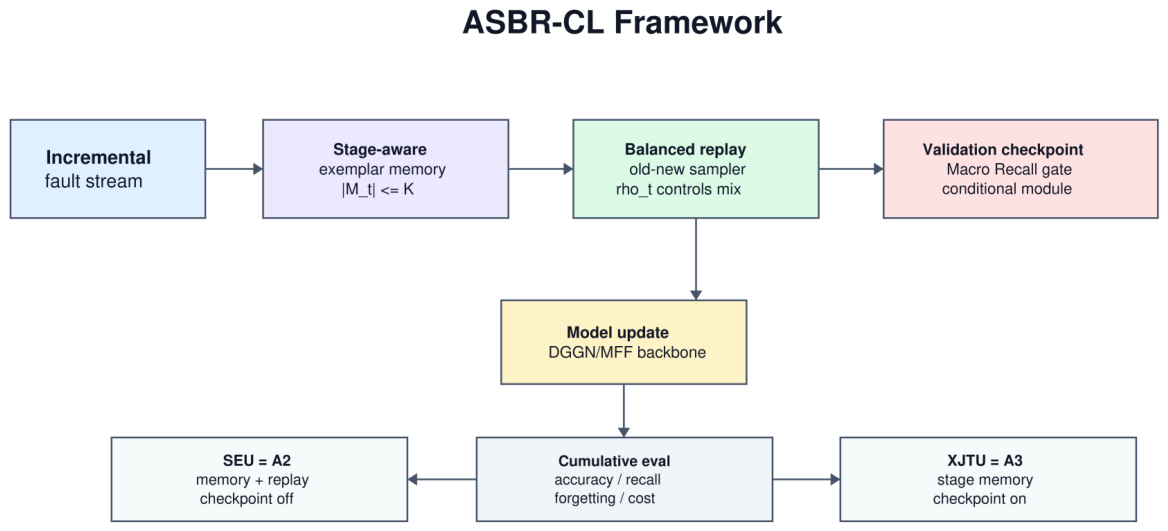
Figure 2.
Incremental learning flow with unified module styling for exemplar update, balanced replay, validation checkpoint selection, and cumulative evaluation.
Figure 2.
Incremental learning flow with unified module styling for exemplar update, balanced replay, validation checkpoint selection, and cumulative evaluation.
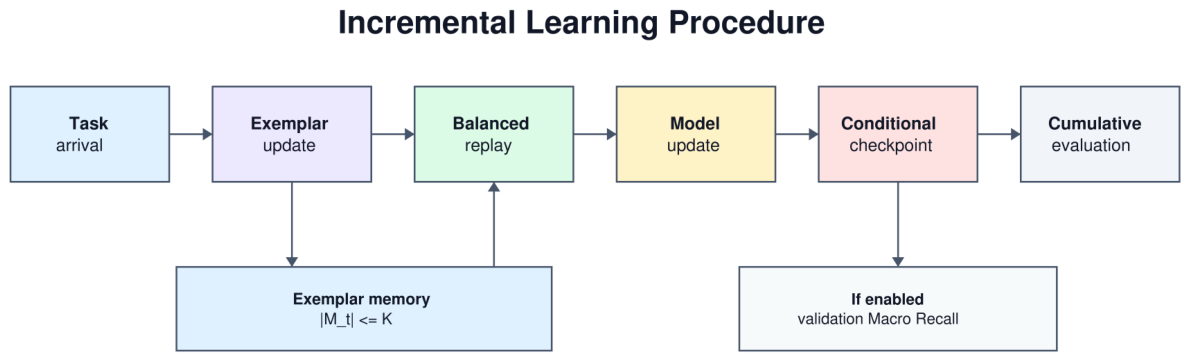
Figure 3.
Accuracy-matrix heatmaps for the continual diagnostic streams. Rows are training stages after each incremental update, columns are evaluated seen tasks or degradation stages, and values are mean accuracies over five seeds.
Figure 3.
Accuracy-matrix heatmaps for the continual diagnostic streams. Rows are training stages after each incremental update, columns are evaluated seen tasks or degradation stages, and values are mean accuracies over five seeds.
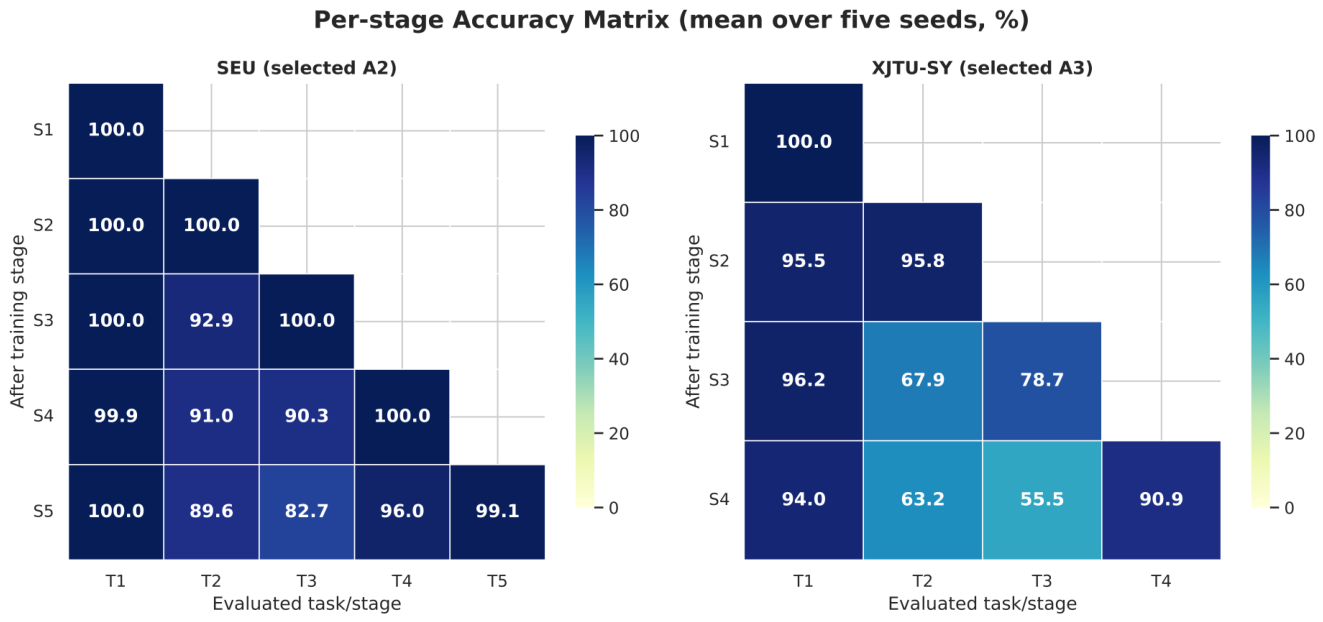
Figure 4.
Macro Recall and Average Forgetting comparison for selected ASBR-CL, DGGN-RBD, iCaRL, and ER under the memory-limited continual-learning protocol. Higher Macro Recall is better and lower Average Forgetting is better.
Figure 4.
Macro Recall and Average Forgetting comparison for selected ASBR-CL, DGGN-RBD, iCaRL, and ER under the memory-limited continual-learning protocol. Higher Macro Recall is better and lower Average Forgetting is better.
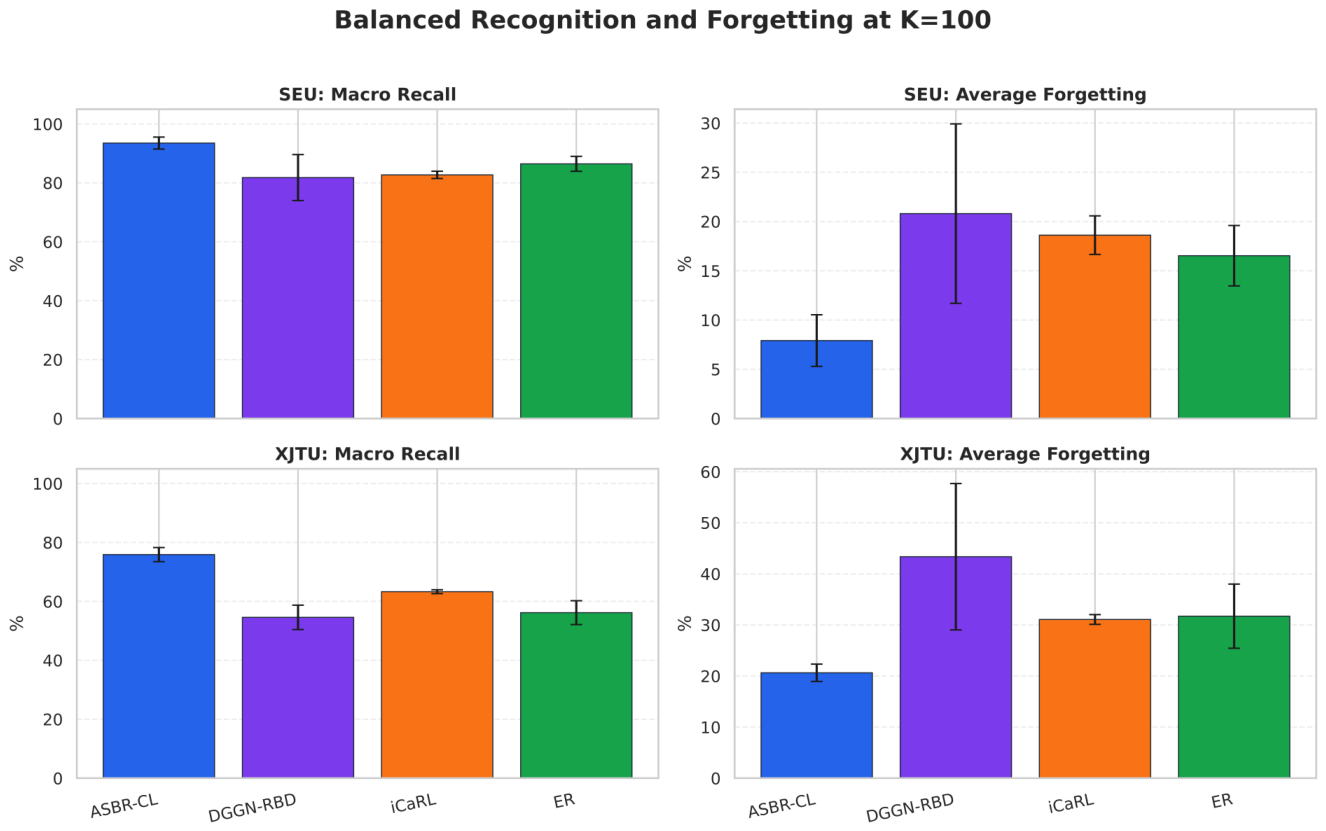
Figure 5.
Memory-budget sensitivity comparison of ASBR-CL, iCaRL, and ER under , , and . The budget K counts only retained training exemplars in replay memory, and plotted values are mean ± standard deviation over five seeds.
Figure 5.
Memory-budget sensitivity comparison of ASBR-CL, iCaRL, and ER under , , and . The budget K counts only retained training exemplars in replay memory, and plotted values are mean ± standard deviation over five seeds.
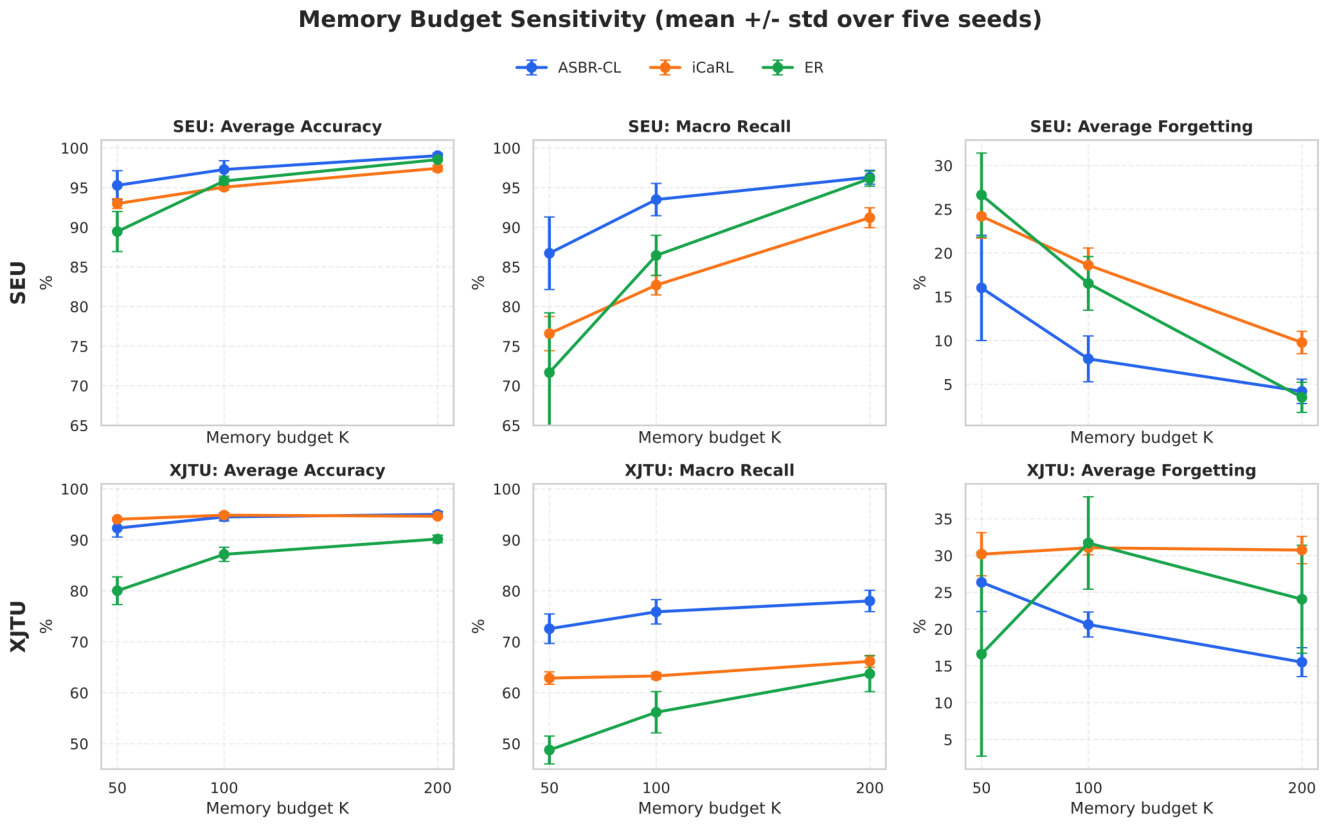
Figure 6.
Adaptive ablation mechanism and dataset-dependent component selection. A0 is the same DGGN-RBD baseline row used in the main result tables, A1 adds adaptive or stage-aware exemplar memory, A2 adds balanced replay, and A3 adds macro-recall validation checkpoint selection. SEU selects A2, while XJTU selects validation-assisted A3 under the predefined variant selection protocol.
Figure 6.
Adaptive ablation mechanism and dataset-dependent component selection. A0 is the same DGGN-RBD baseline row used in the main result tables, A1 adds adaptive or stage-aware exemplar memory, A2 adds balanced replay, and A3 adds macro-recall validation checkpoint selection. SEU selects A2, while XJTU selects validation-assisted A3 under the predefined variant selection protocol.
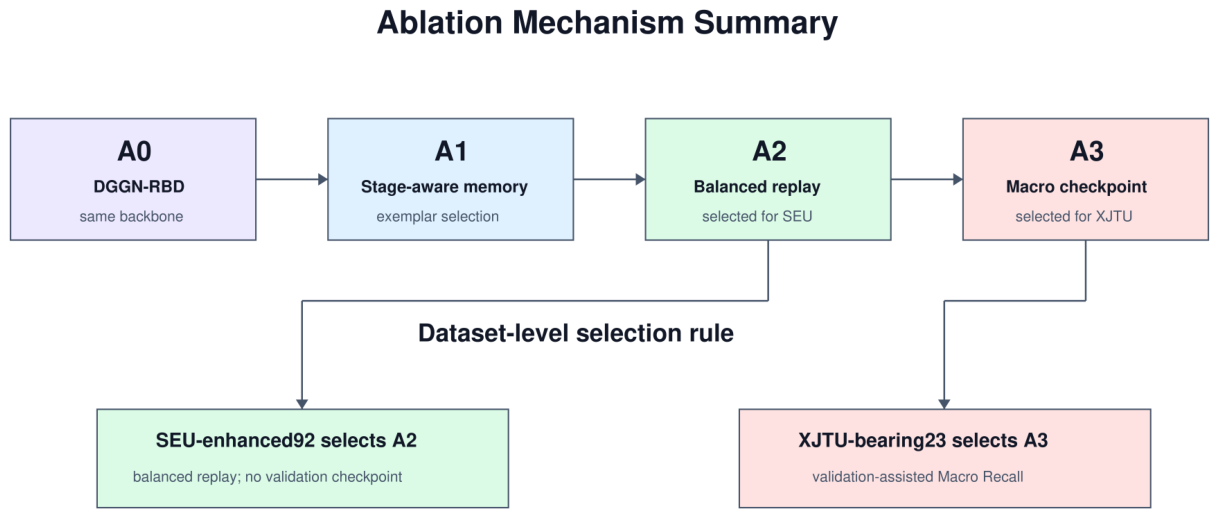
Figure 7.
Measured total incremental update time under seed 42, , and an RTX 4060 Laptop GPU. The update time is the total wall-clock update cost accumulated over the continual stages in the implemented pipeline.
Figure 7.
Measured total incremental update time under seed 42, , and an RTX 4060 Laptop GPU. The update time is the total wall-clock update cost accumulated over the continual stages in the implemented pipeline.
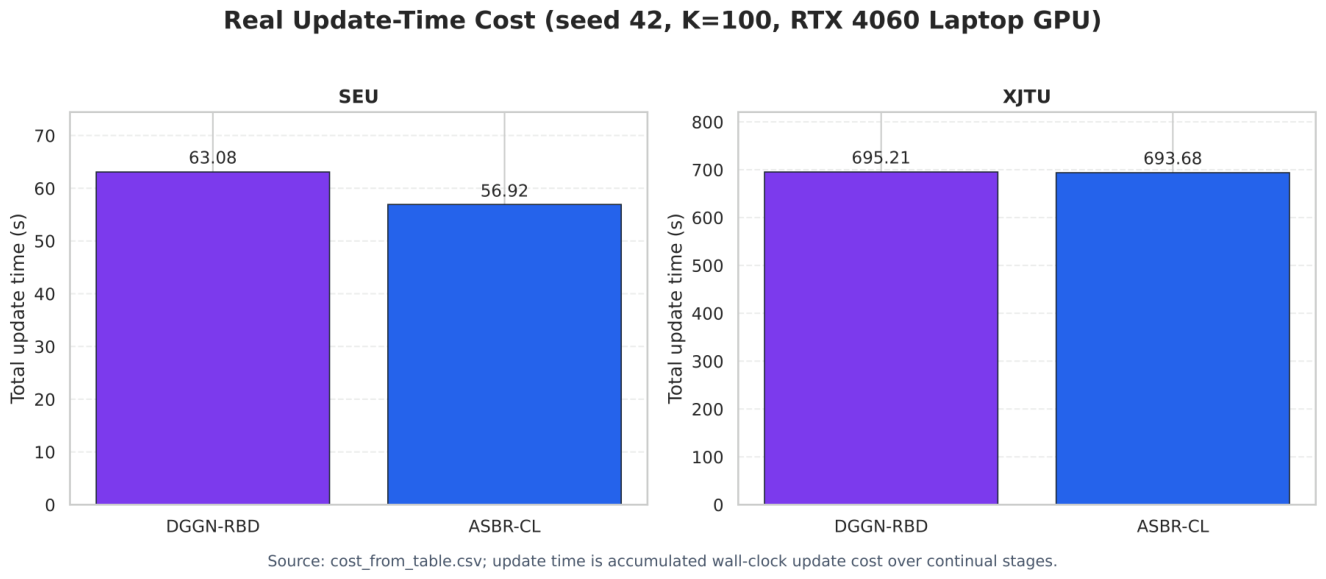
Table 1.
Dataset construction and continual-learning protocol. Splits are reported as train/validation/test counts.
Table 1.
Dataset construction and continual-learning protocol. Splits are reported as train/validation/test counts.
| Dataset | Source and channels | Sampling / window | Split and leakage control | Continual tasks | Task counts |
| SEU | SEU drivetrain; 3 vibration channels, ch. 2–4; domains 20-0 and 30-2 | 2 kHz; length 2048; stride 2048; non-overlapping | 60/20/20 contiguous split within each source file; no overlapping cross-split windows | Class-incremental; T1 Health + Chipped; T2 Miss; T3 Root; T4 Surface | Total 3060 / 1020 / 1030; T1 1224 / 408 / 412; T2–T4 each 612 / 204 / 206 |
| XJTU-bearing23 | XJTU-SY run-to-failure bearings; 2 vibration channels; 35 Hz/12 kN, 37.5 Hz/11 kN, 40 Hz/10 kN | 25.6 kHz; CSV 32768 points; 8 windows per CSV; length 4096; stride 4096 | 60/20/20 domain-stage stratified file-level split; one CSV remains in one split | Stage-incremental; T1 Normal; T2 Slight; T3 Moderate; T4 Severe | Total 44240 / 14760 / 14728; Normal 37608 / 12544 / 12520; Slight 3448 / 1152 / 1144; Moderate 2368 / 792 / 792; Severe 816 / 272 / 272 |
Table 2.
Feature-dimension accounting for the processed tabular inputs.
| Dataset | Dimension range | Source | Descriptors / meaning |
| SEU-enhanced92 | 1–81 | three real vibration channels | 27 time/frequency descriptors per channel |
| SEU-enhanced92 | 82–92 | global features | inter-channel correlation, global amplitude/energy, channel-RMS ratio/entropy, dominant-channel entropy |
| XJTU-bearing23 | 1–5 | horizontal channel | mean, standard deviation, RMS, skewness, kurtosis |
| XJTU-bearing23 | 6–10 | vertical channel | mean, standard deviation, RMS, skewness, kurtosis |
| XJTU-bearing23 | 11–15 | zero-filled alignment slots | reserved third-channel descriptors; no physical third-channel measurement in XJTU-SY |
| XJTU-bearing23 | 16–23 | global features | mean absolute value, maximum absolute value, peak-to-peak amplitude, energy, crest/shape/impulse factors, dominant-channel entropy |
Table 4.
Main results on SEU-enhanced92 over five seeds. Values are mean ± standard deviation in percent. DGGN-RBD is the same-backbone capacity-controlled comparison for ASBR-CL. Fine-tuning, LwF, EWC, ER, and iCaRL are commonly used continual-learning reference baselines. Joint Training is an offline upper bound, not a memory-limited continual-learning baseline.
Table 4.
Main results on SEU-enhanced92 over five seeds. Values are mean ± standard deviation in percent. DGGN-RBD is the same-backbone capacity-controlled comparison for ASBR-CL. Fine-tuning, LwF, EWC, ER, and iCaRL are commonly used continual-learning reference baselines. Joint Training is an offline upper bound, not a memory-limited continual-learning baseline.
| Method | Setting | Avg. Acc. | Final Acc. | Avg. Forgetting | Macro-F1 | Macro Recall |
| ASBR-CL | memory-limited CL | |||||
| DGGN-RBD | memory-limited CL | |||||
| Fine-tuning | memory-limited CL | |||||
| iCaRL | memory-limited CL | |||||
| LwF | memory-limited CL | |||||
| EWC | memory-limited CL | |||||
| ER | memory-limited CL | |||||
| Joint | offline upper bound |
Table 5.
Main results on XJTU-bearing23 over five seeds. Values are mean ± standard deviation in percent. DGGN-RBD is the same-backbone capacity-controlled comparison for ASBR-CL. Fine-tuning, LwF, EWC, ER, and iCaRL are commonly used continual-learning reference baselines. Joint Training is an offline upper bound, not a memory-limited continual-learning baseline.
Table 5.
Main results on XJTU-bearing23 over five seeds. Values are mean ± standard deviation in percent. DGGN-RBD is the same-backbone capacity-controlled comparison for ASBR-CL. Fine-tuning, LwF, EWC, ER, and iCaRL are commonly used continual-learning reference baselines. Joint Training is an offline upper bound, not a memory-limited continual-learning baseline.
| Method | Setting | Avg. Acc. | Final Acc. | Avg. Forgetting | Macro-F1 | Macro Recall |
| ASBR-CL | memory-limited CL | |||||
| DGGN-RBD | memory-limited CL | |||||
| Fine-tuning | memory-limited CL | |||||
| iCaRL | memory-limited CL | |||||
| LwF | memory-limited CL | |||||
| EWC | memory-limited CL | |||||
| ER | memory-limited CL | |||||
| Joint | offline upper bound |
Table 6.
Final-stage XJTU row-normalized confusion matrix for ASBR-CL A3, averaged over five seeds. Rows are true stages and columns are predicted stages. Values are percentages.
Table 6.
Final-stage XJTU row-normalized confusion matrix for ASBR-CL A3, averaged over five seeds. Rows are true stages and columns are predicted stages. Values are percentages.
| True stage | Pred. Normal | Pred. Slight | Pred. Moderate | Pred. Severe | Recall mean ± std |
| Normal | 94.01 | 5.84 | 0.14 | 0.00 | |
| Slight | 2.95 | 63.18 | 31.87 | 1.99 | |
| Moderate | 0.48 | 26.74 | 55.45 | 17.32 | |
| Severe | 0.00 | 0.00 | 9.12 | 90.88 |
Table 7.
Paired significance summary for ASBR-CL against memory-limited continual-learning baselines over five seeds. Each cell reports mean improvement in percentage points with paired t-test p-value. For Average Forgetting, improvement means baseline forgetting minus ASBR-CL forgetting.
Table 7.
Paired significance summary for ASBR-CL against memory-limited continual-learning baselines over five seeds. Each cell reports mean improvement in percentage points with paired t-test p-value. For Average Forgetting, improvement means baseline forgetting minus ASBR-CL forgetting.
| Dataset | Comparison | Avg. Acc. | Final Acc. | Macro Recall | Avg. Forgetting |
| SEU | ASBR-CL vs DGGN-RBD | () | () | () | () |
| SEU | ASBR-CL vs iCaRL | () | () | () | () |
| SEU | ASBR-CL vs ER | () | () | () | () |
| XJTU | ASBR-CL vs DGGN-RBD | () | () | () | () |
| XJTU | ASBR-CL vs iCaRL | () | () | () | () |
| XJTU | ASBR-CL vs ER | () | () | () | () |
Table 8.
ASBR-CL ablation results over five seeds. Values are mean ± standard deviation in percent. A0 is the same DGGN-RBD baseline reported in the main result tables, A1 adds adaptive or stage-aware exemplar memory, A2 adds balanced replay, and A3 adds macro-recall validation checkpoint selection. A1/A2 do not use ASBR-CL validation checkpoint selection; A3 adds macro-recall checkpoint selection. SEU selects A2 and XJTU selects A3 under the predefined dataset-level protocol.
Table 8.
ASBR-CL ablation results over five seeds. Values are mean ± standard deviation in percent. A0 is the same DGGN-RBD baseline reported in the main result tables, A1 adds adaptive or stage-aware exemplar memory, A2 adds balanced replay, and A3 adds macro-recall validation checkpoint selection. A1/A2 do not use ASBR-CL validation checkpoint selection; A3 adds macro-recall checkpoint selection. SEU selects A2 and XJTU selects A3 under the predefined dataset-level protocol.
| SEU-enhanced92: accuracy and retention | |||||
| Variant | Components | Final? | Avg. Acc. | Final Acc. | Avg. Forgetting |
| A0 | DGGN-RBD | No | |||
| A1 | + adaptive memory | No | |||
| A2 | + balanced replay | Yes | |||
| A3 | + macro checkpoint | No | |||
| SEU-enhanced92: balanced-recognition metrics | |||||
| Variant | Components | Final? | Macro-F1 | Macro Recall | |
| A0 | DGGN-RBD | No | |||
| A1 | + adaptive memory | No | |||
| A2 | + balanced replay | Yes | |||
| A3 | + macro checkpoint | No | |||
| XJTU-bearing23: accuracy and retention | |||||
| Variant | Components | Final? | Avg. Acc. | Final Acc. | Avg. Forgetting |
| A0 | DGGN-RBD | No | |||
| A1 | + stage-aware memory | No | |||
| A2 | + balanced replay | No | |||
| A3 | + macro checkpoint | Yes | |||
| XJTU-bearing23: balanced-recognition metrics | |||||
| Variant | Components | Final? | Macro-F1 | Macro Recall | |
| A0 | DGGN-RBD | No | |||
| A1 | + stage-aware memory | No | |||
| A2 | + balanced replay | No | |||
| A3 | + macro checkpoint | Yes | |||
Table 9.
Core real update-cost indicators measured with seed 42, , and an RTX 4060 Laptop GPU. The table is split by dataset for readability. Joint Training is included only as an offline upper bound, not as a same-cost continual-learning baseline. DGGN-RBD and ASBR-CL form the same-backbone comparison; smaller baselines provide broader reference costs.
Table 9.
Core real update-cost indicators measured with seed 42, , and an RTX 4060 Laptop GPU. The table is split by dataset for readability. Joint Training is included only as an offline upper bound, not as a same-cost continual-learning baseline. DGGN-RBD and ASBR-CL form the same-backbone comparison; smaller baselines provide broader reference costs.
| SEU-enhanced92 | |||||
| Method | Setting | Params (M) | Peak GPU (MB) | Update (s) | Infer. (ms/sample) |
| Fine-tuning | memory-limited CL | 0.030 | 19.1 | 4.18 | 0.0159 |
| LwF | memory-limited CL | 0.030 | 20.6 | 3.64 | 0.0122 |
| EWC | memory-limited CL | 0.030 | 19.1 | 3.48 | 0.0099 |
| ER | memory-limited CL | 0.030 | 19.1 | 3.04 | 0.0111 |
| iCaRL | memory-limited CL | 0.030 | 20.6 | 4.90 | 0.0151 |
| Joint | offline upper bound | 0.030 | 19.1 | 4.76 | 0.0100 |
| DGGN-RBD | memory-limited CL | 1.425 | 400.5 | 63.08 | 0.1046 |
| ASBR-CL | memory-limited CL | 1.425 | 409.6 | 56.92 | 0.0981 |
| XJTU-bearing23 | |||||
| Method | Setting | Params (M) | Peak GPU (MB) | Update (s) | Infer. (ms/sample) |
| Fine-tuning | memory-limited CL | 0.021 | 18.9 | 34.84 | 0.0113 |
| LwF | memory-limited CL | 0.021 | 20.3 | 35.65 | 0.0112 |
| EWC | memory-limited CL | 0.021 | 18.9 | 35.71 | 0.0079 |
| ER | memory-limited CL | 0.021 | 18.9 | 34.98 | 0.0084 |
| iCaRL | memory-limited CL | 0.021 | 20.3 | 70.82 | 0.0104 |
| Joint | offline upper bound | 0.021 | 18.9 | 82.97 | 0.0089 |
| DGGN-RBD | memory-limited CL | 1.416 | 1570.2 | 695.21 | 0.0682 |
| ASBR-CL | memory-limited CL | 1.416 | 1570.2 | 693.68 | 0.0669 |
Disclaimer/Publisher’s Note: The statements, opinions and data contained in all publications are solely those of the individual author(s) and contributor(s) and not of MDPI and/or the editor(s). MDPI and/or the editor(s) disclaim responsibility for any injury to people or property resulting from any ideas, methods, instructions or products referred to in the content. |
© 2026 by the authors. Licensee MDPI, Basel, Switzerland. This article is an open access article distributed under the terms and conditions of the Creative Commons Attribution (CC BY) license (http://creativecommons.org/licenses/by/4.0/).
Copyright: This open access article is published under a Creative Commons CC BY 4.0 license, which permit the free download, distribution, and reuse, provided that the author and preprint are cited in any reuse.