

Submitted:
12 June 2026
Posted:
15 June 2026
You are already at the latest version
Abstract
Background: Reliable biomarkers to predict response to immune checkpoint inhibitors (ICIs) in non–small cell lung cancer (NSCLC) remains limited.ABO blood group antigens may influence tumor immunity and response to immunotherapy.
Methods: We retrospectively analyzed patients with advanced NSCLC treated with ICIs between 2019 and 2024. Patients were classified according to ABO blood group. Overall survival (OS), progression-free survival (PFS), and treatment response were evaluated. Results: Patients with blood group O demonstrated significantly longer OS (18.6 vs 11.0 months, p< 0.001) and PFS (9.4 vs 4.2 months, p=0.001).
Conclusion: ABO blood group, particularly blood group O, may serve as a clinically relevant host-related prognostic biomarker in NSCLC immunotherapy.
Keywords:
non–small cell lung cancer
; ABO blood group
; immunotherapy
; immune checkpoint inhibitors
Introduction
Lung cancer is the leading cause of cancer-related deaths worldwide. Breakthroughs in identifying oncogenic mutations have allowed for the development of targeted therapies.
For patients with non-small-cell lung cancer (NSCLC) who do not have actionable oncogenic mutations, immuno therapy has become a part of the standard of care(1)
To date, treatment decisions mostly depend on the expression of PD-L1 on cancer cells, which correlates with the effectiveness of PD-1 and PD-L1 inhibitors in most clinical trials. Alternative biomarkers are under investigation. Tumor mutational burden is another biomarker that is being studied but is not widely used.
Other potential biomarkers include neoantigen prediction,tumour microenvironment immune parameters, co-mutations, epigenetic markers, microbiome variations, and transcriptomic signatures(1)
However, there is still a lack of biomarkers to differentiate which patients have the most likelihood of response to immunotherapy alone or which patient needs a combination of immunotherapy and chemotherapy. Previous studies suggested a correlation between different blood groups and checkpoint inhibitor treatments in patients with various cancers(2)
A major driver of response to immune checkpoint blockage (ICB) is hypothesized to be the diversity and quality of the immunogenic neoantigen repertory. Immunogenic neoantigens are tumor-specific mutated peptides which can be presented to and recognized by the patient’s T-cell receptor repertory.
A second genetic factor that may potentially contribute to immunogenic neoantigen diversity may be blood type, which is a blood classification system based on the presence(3)
ABO blood group antigens can be widely distributed in Red Blood Cell (RBCs), platelets, white blood cells, plasma proteins, certain tissues and various cell surface enzymes found in blood group antigens. The epithelial tissues of the oral cavity, gastrointestinal tract, lungs, bladder, breast, cervix and prostate contain ABO blood group antigens, but malignant tumours of these tissues lack ABO blood group antigen expression(4)
Previous studies showed a relationship between ABO blood groups and malignancies such as hepatocellular carcinoma and gastric and pancreatic cancer(5)
Although previous studies have linked cancer incidence to blood group antigens, there have been very few studies evaluating treatment response.
The aim of this study is to contribute to a more detailed understanding of the host-related factors that may influence immunotherapy outcomes, by evaluating the potential relationship between ABO blood groups and ICB efficacy.
Material and Methods
The data of patients using immunotherapy with a diagnosis of advanced stage, unresectable metastatic non-small cell lung cancer (NSCLC) followed up in medical oncology of Ankara Bilkent City Hospital between 2019 and 2024 were reviewed retrospectively. This study was designed as a single-center retrospective cohort study.
While immunotherapy and chemotherapy combination is a treatment option for non-small cell lung cancer, immunotherapy alone can also be administered. All patients receiving immunotherapy were included in our study, regardless of treatment stage and modality.
Age 18 years or older, histologically proven NSCLC, Eastern Cooperative Oncology Group (ECOG) performance status 0–1 or 2, measurable unresectable metastatic disease according to the Immune Response Evaluation Criteria in Solid Tumors (iRECIST), and ABO blood group known patients were included in the study.
In addition to those who did not meet the inclusion criteria, patients with second primary cancer were excluded from the study.
Age, sex, smoking status, ECOG performance status immunotherapy regimens, BMI, number of metastases, metastatic site localization, treatment line using immunotherapy, immunotherapy regimens, PDL-1 expression, histology, treatment modality, ABO and RH blood groups, and hemogram and biochemical parameters were recorded from the patient files.
All patients underwent a physical examination and hematological and biochemical evaluations each cycle. Tumor response was assessed by computed tomography (CT) or positron emission tomography (PET)/CT every 12 weeks according to iRECIST criteria.
The statistical analysis was performed using the Statistical Package for the Social Sciences Version 22.0 for Windows (SPSS Inc., Chicago, IL, USA).
The patients’ clinical-pathological data, ABO blood group, and neutrophil/lymphocyte ratio (NLR) were recorded. Overall survival (OS) and progression-free survival (PFS) were evaluated using the Kaplan-Meier method. Survival differences between groups were analyzed using the log-rank test. Factors affecting survival were examined using univariate and multivariate Cox regression analyses.
P-value < 0.05 was considered statistically significant. Variables with p < 0.10 in univariate analysis were included in the multivariate Cox regression model. Given that a cut-off value of 5 for NLR has been widely used in previous retrospective studies, we defined the NLR cut-off as 5 in the present study.
PDL-1 expression was evaluated in two separate groups: those with expression <1 was classified as negative, and those with expression >1 was classified as positive. The group with 50% or higher PDL-1 expression was not listed separately due to its small size. However, since this was a retrospective study, the group with unknown PDL-1 expression was recorded separately.
Immunotherapy treatment protocols were documented, and patients receiving treatment across all lines of therapy were included in the analysis.
ChatGPT (OpenAI) was utilized to assist with language editing and drafting of certain sections of the manuscript. The authors retained full responsibility for the study design, data analysis, and interpretation of results, and all outputs were critically reviewed and validated by the authors.
Results
Patient Characteristics
A total of 239 patients were included in the study. The median age of all patients was 64 years (range 25–82), and 84.9% (n = 203) were male. The study found that 81.2% (194) of patients had an ECOG performance status of 0–1, while 18.8% (45) had a status of 2–3.
A balanced distribution was observed when patients were evaluated according to their BMI index. Baseline characteristics were generally well balanced between the groups, except for treatment line and number of treatment cycles. A substantial proportion of patients had unknown PD-L1 status due to the retrospective nature of the study.
Of the patients, 90.4% (216) were active smokers or ex-smokers, while 9.6% (23) were non-smokers. Patients grouped according to histological subtypes, 62.3% (149) were found to have non-squamous histology. PD-L1 expression levels were evaluated using a 1% cut-off point. It was observed that 43.5% (104 patients) had PD-L1 expression of 1% or higher. 92.1% (210) of patients in the study were receiving immunotherapy at the metastatic stage. Examining the number of treatment courses received by patients revealed an average of eight (range 1–85) courses. Patients with blood group O received an average of twelve courses (range 1–60), while those with other blood types received an average of seven courses (range 1–85). It was found that 64.9% (155) of patients received monotherapy.
Of the drugs used in immunotherapy, 44.8% (107 patients) used pembrolizumab, while 40.2% (96 patients) used nivolumab.
The patients whose biochemical results were evaluated, 65.7% (157) were found to have an NLR value of less than 5.
The basal characteristics of the patients are given in Table 1.

| Characteristics |
All patients n=239 (100%) |
Type O n=69 (29%) |
Type Non-O n=170 (71%) |
P* | |
| Age, median, min-max | 64 (25-82) | 64 (25-80) | 63 (30-82) | 0.551 | |
| Age, n(%) | <65 years | 142 (59.4) | 37 (53.6) | 105 (61.8) | 0.245 |
| ≥ 65 years | 97 (40.6) | 32 (46.4) | 65 (38.2) | ||
| Gender, n(%) | Female | 36 (15.1) | 13 (18.8) | 23 (13.5) | 0.298 |
| Male | 203 (84.9) | 56 (81.2) | 147 (86.5) | ||
| ECOG PS, n(%) | 0-1 | 194 (81.2) | 59 (85.5) | 135 (79.4) | 0.275 |
| 2-3 | 45 (18.8) | 10 (14.5) | 35 (20.6) | ||
| BMI(kg/m2),n(%) | <25 | 118 (50.4) | 34 (50.7) | 84 (50.3) | 0.951 |
| ≥ 25 | 116 (49.6) | 33 (49.3) | 83 (49.7) | ||
| Smoking, n(%) | No | 23 (9.6) | 9 (13.0) | 14 (8.2) | 0.253 |
| Yes | 216 (90.4) | 60 (87.0) | 156 (91.8) | ||
| CCI score, median, min-max | 8 (3-14) | 8 (3-14) | 8 (3-13) | 0.689 | |
| CCI score, n(%) | ≤ Median | 126 (52.7) | 35 (50.7) | 91 (53.5) | 0.694 |
| > Median | 113 (47.3) | 34 (49.3) | 79 (46.5) | ||
| Histology, n(%) | Non-squamous | 149 (62.3) | 42 (60.9) | 107 (62.9) | 0.765 |
| Squamous | 90 (37.7) | 27 (39.1) | 63 (37.1) | ||
| PD-L1 expression,n(%) | <1% | 48 (20.1) | 14 (20.3) | 34 (20.0) | 0.999 |
| ≥1% | 104 (43.5) | 30 (43.5) | 74 (43.5) | ||
| Unknown | 87 (36.4) | 25 (36.2) | 62 (36.5) | ||
| Stage, n(%) | 3B-3C | 19 (7.9) | 6 (8.7) | 13 (7.6) | 0.786 |
| Metastatic | 220 (92.1) | 63 (91.3) | 157 (92.4) | ||
| No. of metastatic sites, n(%) | 0-1 | 108 (45.2) | 37 (53.6) | 71 (41.8) | 0.095 |
| ≥2 | 131 (54.8) | 32 (46.4) | 99 (58.2) | ||
| Line of ICI therapy, n(%) | 1L | 118 (49.4) | 42 (60.9) | 76 (44.7) | 0.024 |
| 2L | 121 (50.6) | 27 (39.1) | 94 (55.3) | ||
| No.of ICI treatment cycle, median, min-max | 8 (1-85) | 12 (1-85) | 7 (1-60) | 0.008 | |
| Treatment modality, n(%) | ICI-based threapy wihtout CT | 155 (64.9) | 40 (58.0) | 115 (67.6) | 0.156 |
| ICI-based threapy wiht CT | 84 (35.1) | 29 (42.0) | 55 (32.4) | ||
| ICI regimen, n(%) | Pembrolizumab Nivolumab Nivolumab+İpilimumab Atezolizumab Durvalumab |
107 (44.8) 96 (40.2) 3 (1.3) 28 (11.7) 5 (2.1) |
38 (55.1) 21 (30.4) 1 (1.4) 8 (11.6) 1 (1.4) |
69 (40.6) 75 (44.1) 2 (1.2) 20 (11.8) 4 (2.4) |
0.307 |
| NLR | <5 | 157 (65.7) | 51 (73.9) | 106 (62.4) | 0.088 |
| ≥5 | 82 (34.3) | 18 (26.1) | 64 (37.6) | ||
*p values were calculated using the chi-square or Mann–Whitney U test, as appropriate.
Survival Results
At a median follow-up period of 48.85 months (95% confidence interval [CI], 27.67–70.03), clinical or radiological progression or death occurred in 204 patients (85.4%). Of these patients, 185 (77.4%) had died.
The median overall survival (OS) for all patients was 12.87 months (95% CI: 10.01–15.73) and the median progression-free survival (PFS) was 6.14 months (3.95–8.33).
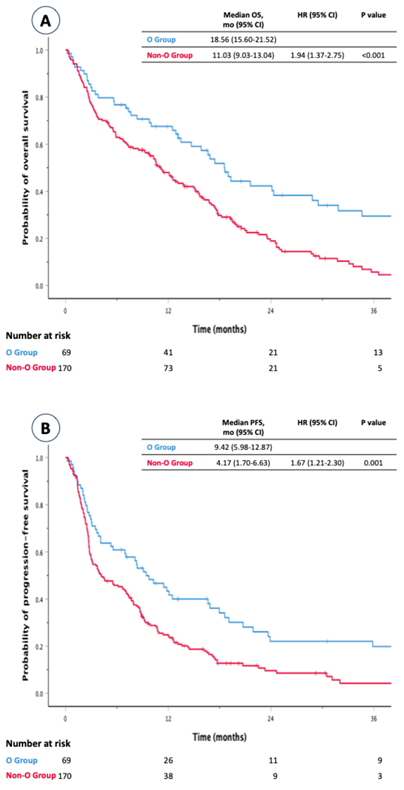
Patients with blood group O had significantly longer OS than patients with other blood groups (median OS: 18.56 vs. 11.03 months; p <0.001) (Figure 1A). Similarly, PFS was significantly longer in the O group (median PFS: 9.42 vs. 4.17 months; p = 0.001) (Figure 1B). In multivariate analysis, blood group O remained an independent predictor of both improved OS and PFS. Patients with blood group O had a 39% reduction in the risk of death compared to non-O blood groups.
Elevated NLR (≥5) was associated with significantly worse survival outcomes and remained an independent prognostic factor for both OS (HR = 1.39, p = 0.036) and PFS (HR = 1.38, p = 0.029). In contrast, PD-L1 expression was not significantly associated with overall survival (p = 0.467) or progression-free survival (p = 0.954).
Response assessment according to iRECIST criteria was performed in 201 patients. Among these patients, two (1.0%) achieved a complete response (CR), 77 (38.3%) achieved a partial response (PR) and 70 (34.8%) had stable disease (SD). Progressive disease (PD) was observed in the remaining 52 patients (25.9%). The objective response rate (ORR) was significantly higher in the 0 group (53.3% vs 33.3%; p = 0.008), as was the disease control rate (DCR) (83.3% vs 70.2%; p = 0.052).
Multivariate analysis, adjusted for ECOG performance status, the Charlson Comorbidity Index (CCI), the number of metastatic sites and NLR variables, showed that having a 0 blood group was associated with both overall survival (OS) (hazard ratio (HR) = 0.61; 95% confidence interval (CI): 0.43–0.88; p = 0.008) and progression-free survival (PFS) (HR = 0.69; 95% CI: 0.50–0.96; p = 0.029).
| Type O | Type Non-O |
p |
|
| Objective response rate (%) | 53.3 | 33.3 | 0.008 |
| Disease control rate (%) | 83.3 | 70.2 | 0.052 |
Table 3.
OS.
| Variables | Univariate | Multivariate | ||
| HR (95% CI) | p value | HR (95% CI) | p value | |
| Age (<65y vs ≥65y) | 1.16 (0.86-1.56) | 0.313 | ||
| Gender (Female vs Male) | 0.94 (0.63-1.41) | 0.780 | ||
| ECOG (0-1 vs 2-3) | 4.72 (3.28-6.79) | <0.001 | 3.99 (2.71-5.88) | <0.001 |
| BMI (<25 vs ≥25) | 1.15 (0.86-1.55) | 0.332 | ||
| Smoking (Yes vs No) | 1.13 (0.70-1.82) | 0.606 | ||
| CCI score (≤ Median vs > Median) | 1.23 (0.92-1.64) | 0.159 | 1.12 (0.83-1.50) | 0.448 |
| Histology (Non-SCC vs SCC) | 0.96 (0.71-1.29) | 0.800 | ||
| PD-L1 expression (<1% vs ≥1%) | 0.86 (0.58-1.27) | 0.467 | ||
| No. of metastatic sites (1 vs ≥2) | 2.01 (1.48-2.72) | <0.001 | 1.51 (1.09-2.09) | 0.012 |
| Blood group (Non-O vs O) | 0.51 (0.36-0.72) | <0.001 | 0.61 (0.43-0.88) | 0.008 |
| NLR (<5 vs ≥5) | 1.39 (1.03-1.88) | 0.029 | 1.39 (1.02-1.91) | 0.036 |
PFS
| Variables | Univariate | Multivariate | ||
| HR (95% CI) | p value | HR (95% CI) | p value | |
| Age (<65y vs ≥65y) | 1.12 (0.85-1.48) | 0.412 | ||
| Gender (Female vs Male) | 0.87 (0.59-1.29) | 0.512 | ||
| ECOG (0-1 vs 2-3) | 4.55 (3.17-6.52) | <0.001 | 3.83 (2.65-5.53) | <0.001 |
| BMI (<25 vs ≥25) | 1.09 (0.83-1.44) | 0.516 | ||
| Smoking (Yes vs No) | 1.21 (0.77-1.91) | 0.392 | ||
| CCI score (≤ Median vs > Median) | 1.17 (0.88-1.54) | 0.267 | 0.98 (0.74-1.30) | 0.907 |
| Histology (Non-SCC vs SCC) | 0.96 (0.72-1.28) | 0.814 | ||
| PD-L1 expression (<1% vs ≥1%) | 0.98 (0.68-1.43) | 0.954 | ||
| No. of metastatic sites (1 vs ≥2) | 2.20 (1.63-2.96) | <0.001 | 1.79 (1.31-2.45) | <0.001 |
| Blood group (Non-O vs O) | 0.59 (0.43-0.82) | 0.002 | 0.69 (0.50-0.96) | 0.029 |
| NLR (<5 vs ≥5) | 1.57 (1.18-2.09) | 0.002 | 1.38 (1.03-1.85) | 0.029 |
Discussion
In the present study, we evaluated the impact of ABO blood group on treatment response in patients with non–small cell lung cancer (NSCLC) receiving immunotherapy and demonstrated that patients with blood group O had significantly longer overall survival (OS) and progression-free survival (PFS). To our knowledge, this is one of the few studies evaluating the prognostic impact of ABO blood groups specifically in NSCLC patients treated with immune checkpoint inhibitors across different PD-L1 expression levels.
Numerous retrospective studies have explored the association between ABO blood groups and cancer incidence. For example, blood group A has been reported to be associated with an increased risk of gastric cancer (5). However, studies investigating the relationship between ABO blood groups and treatment response remain limited.
In a study conducted by Chen et al., patients receiving immunotherapy were evaluated, and it was reported that patients with blood group O had an advantage in terms of time to treatment failure. However, this benefit was not reflected in survival outcomes, likely due to the heterogeneity of the study population (6). In contrast, in our study, blood group O was consistently associated with improved survival and emerged as an independent predictor of immunotherapy response.
Recent studies focusing on immunotherapy-treated lung cancer populations have further supported the prognostic role of ABO blood groups. In one such study, consistent with our findings, blood group O was found to be significantly associated with improved OS and PFS in patients with metastatic NSCLC who had PD-L1 expression ≥50% and were treated with immunotherapy monotherapy (2). However, in that study, all patients were in the metastatic setting with high PD-L1 expression, and this survival advantage was not observed in patients receiving chemoimmunotherapy. In contrast, in our cohort, independent of PD-L1 expression, blood group O was shown to be a potential independent predictor of immunotherapy response in patients with stage III–IV lung cancer.
The biological mechanisms underlying the relationship between ABO blood groups and cancer outcomes have not yet been fully elucidated. ABO antigens are expressed on epithelial and endothelial cells and may influence tumor–immune interactions, inflammation, and immune cell trafficking. Differences in host inflammatory status related to ABO blood group antigens may partially explain the survival advantage observed in patients with blood group O in our cohort (7). Polymorphisms at the ABO gene locus have been associated with circulating levels of inflammatory mediators, including tumor necrosis factor-alpha, soluble intercellular adhesion molecule-1 (ICAM-1), and selectins, all of which play a role in tumor progression and metastasis(8) . Higher ICAM-1 expression observed in non-O blood groups may further support the favorable prognostic impact of blood group O.
In addition to blood group, elevated neutrophil-to-lymphocyte ratio (NLR) was identified as an independent prognostic factor in our study, whereas PD-L1 expression was not associated with survival outcomes. Elevated NLR reflects a pro-inflammatory systemic environment and has been associated with impaired anti-tumor immune response, which may explain its negative impact on survival. In contrast, although PD-L1 expression is widely used as a predictive biomarker in immunotherapy, it was not associated with survival outcomes in our cohort. This finding may be related to the retrospective design, heterogeneity in treatment lines, and the relatively high proportion of patients with unknown PD-L1 status, which may have masked its prognostic significance.
Our findings are consistent with previous reports suggesting that blood group O may confer a survival advantage in patients receiving immunotherapy (3). However, conflicting results have been observed in other tumor types. For instance, Ergun et al. reported improved survival outcomes in patients with blood group B in malignant melanoma, while studies in renal cell carcinoma did not demonstrate a significant association between blood group and treatment response (9). These discrepancies may be explained by tumor-specific biological differences and variations in study populations.
Our study has several strengths, including a relatively large patient cohort, extended follow-up period, and the use of multivariate analyses to adjust for potential confounders, thereby strengthening the validity of our findings. However, several limitations should be acknowledged. First, the retrospective and single-center design may limit the generalizability of the results. Second, the high proportion of patients with unknown PD-L1 status may have influenced the analysis. Third, we were unable to evaluate the underlying biological mechanisms due to the lack of molecular and laboratory data.
To our knowledge, this is the first study evaluating the prognostic impact of ABO blood group across all immunotherapy-based treatment modalities and PD-L1 expression levels in a real-world NSCLC population.
In conclusion, blood group O was associated with improved survival and treatment response in patients with advanced NSCLC receiving immune checkpoint inhibitors. Given its low cost and widespread availability, ABO blood group may represent a simple, cost-effective, and readily available prognostic biomarker that could help refine patient selection in immunotherapy. However, prospective multicenter studies and translational research are needed to validate these findings and to further elucidate the biological mechanisms underlying this association.
Funding
No external funding was received.
Ethics Approval and Consent to Participate
The study was conducted in accordance with the Declaration of Helsinki and approved by the local ethics committee. Due to the retrospective nature of the study, informed consent was waived.
Conflicts of Interest
The authors declare no conflicts of interest.
References
- Meyer, M.L.; Fitzgerald, B.G.; Paz-Ares, L.; Cappuzzo, F.; Jänne, P.A.; Peters, S.; et al. New promises and challenges in the treatment of advanced non-small-cell lung cancer. In The Lancet; Elsevier B.V., 2024; pp. 803–22. [Google Scholar] [CrossRef] [PubMed]
- Certa, F.; Horn, P.A.; Keyl, J.; Mende, B.; Lueong, S.; Hilser, T.; et al. ABO-Blood Group Associates With Survival Outcomes in Patients With Metastatic Non-Small Cell Lung Cancer Treated With Pembrolizumab Monotherapy. Thorac Cancer. 2025, 16(6). [Google Scholar] [CrossRef] [PubMed]
- Chen, R.; Hakimi, K.; Zhang, X.; Messer, K.; Patel, S.P. Patient Blood Type Is Associated With Response to Immune Checkpoint Blockade in Metastatic Cancer. Oncologist 2022, 27(9), e739–45. [Google Scholar] [CrossRef] [PubMed]
- Luo, Q.; Pan, M.; Feng, H.; Wang, L. ABO blood group antigen therapy: a potential new strategy against solid tumors. Sci. Rep. 2021, 11(1). [Google Scholar] [CrossRef] [PubMed]
- Wang, Z.; Liu, L.; Ji, J.; Zhang, J.; Yan, M.; Zhang, J.; et al. Abo blood group system and gastric cancer: A case-control study and meta-analysis. Int. J. Mol. Sci. 2012, 13(10), 13308–21. [Google Scholar] [CrossRef] [PubMed]
- Chen, R.; Hakimi, K.; Zhang, X.; Messer, K.; Patel, S.P. Patient Blood Type Is Associated With Response to Immune Checkpoint Blockade in Metastatic Cancer. Oncologist 2022, 27(9), e739–45. [Google Scholar] [CrossRef] [PubMed]
- Engin, H.; Bilir, C.; Üstün, H.; Gökmen, A. ABO blood group and risk of pancreatic cancer in a Turkish population in Western Blacksea region. Asian Pac. J. Cancer Prev.;PubMed 2012, 13(1), 131–3. [Google Scholar] [CrossRef]
- Franchini, M.; Liumbruno, G.M.; Lippi, G. The prognostic value of ABO blood group in cancer patients. In Blood Transfusion. SIMTI Servizi Sri; 2016; pp. 434–40. [Google Scholar] [CrossRef] [PubMed]
- Ergun, Y.; Esen, S.A.; Bardakci, M.; Ucar, G.; Kalkan, Z.; Urakci, Z.; et al. Predictive and prognostic effect of ABO blood group on immune checkpoint inhibitors. Cancer Biomark. 2022, 34(2), 329–36. [Google Scholar] [CrossRef] [PubMed]
Disclaimer/Publisher’s Note: The statements, opinions and data contained in all publications are solely those of the individual author(s) and contributor(s) and not of MDPI and/or the editor(s). MDPI and/or the editor(s) disclaim responsibility for any injury to people or property resulting from any ideas, methods, instructions or products referred to in the content. |
© 2026 by the authors. Licensee MDPI, Basel, Switzerland. This article is an open access article distributed under the terms and conditions of the Creative Commons Attribution (CC BY) license (http://creativecommons.org/licenses/by/4.0/).
Copyright: This open access article is published under a Creative Commons CC BY 4.0 license, which permit the free download, distribution, and reuse, provided that the author and preprint are cited in any reuse.


