

Submitted:
27 August 2026
Posted:
28 August 2026
You are already at the latest version
Abstract
The notion of a vortex is fundamental in fluid dynamics, where it broadly refers to rotary fluid mo-tions of various forms. Yet a precise, universal definition has remained elusive. Two fundamental challenges persist in the existing definitions of a vortex. The first is the gap between the analytic perspective that adopts a framework of motion decomposition and the synthetic perspective that em-phasizes the geometric patterns of the composite motion. The second is the gap between precisely defined local measures of rotation and intuitive large-scale descriptions of vortices. The author devel-ops a geometric theory of smooth tangent vector fields on oriented closed surfaces that bridges the an-alytic and synthetic perspectives, and provides a nonlocal definition of a vortex core. Working within the frameworks of the irreducible symmetric-antisymmetric decomposition (iSAD), eigenvalue de-composition (EVD) and Helmholtz-Hodge decomposition (HHD), the author proves two principal results concerning these vortex cores. First, all streamlines therein wind in the same direction, indi-cating a nonlocal rotary motion in the entire vortex core. Second, each vortex core can have at most one axis (center or focus). The theory is illustrated with examples on spheres and tori of various cur-vature, demonstrating how geometry and topology influence the shape of vortex cores. The results are purely mathematical and extend naturally to open surfaces, offering a rigorous foundation for vortex identification across disciplines.
Keywords:
definition of vortex
; vortex identification
; discriminant
; singular point
; vector field
1. Introduction
1.1. Background and Motivation
The notion of a vortex is deeply rooted in human history. From the cosmological model by ancient atomists to a fundamental subject in modern fluid dynamics and condensed matter physics, it has continuously shaped and been reshaped by humanity’s quest to understand order, flow, and transformation (cf. [1,2,3]). Our experience and intuition suggest that behind the endless forms of vortex phenomena, there must lie a persistent essence that endows the concept with its enduring vitality. However, our rationality has not yet succeeded in confirming this suggestion, and the precise definition of a vortex remains a challenge to this day.
The earliest scientific study of vortices can be traced back to Aristotle’s investigations of physical causes of whirlwinds, which he identified essentially as circular motions of air. In modern times, the first mathematical theory of vortices in fluids was developed by [4], who defined the concepts of vortex filament, vortex ring and vortex layer. From that point, the notion of a vortex became indispensable in the study of fluid flows. As widely quoted, “today, vortex motions are still described as the sinews and muscles of fluid motions” [5]. Indeed, various notions of vortices are now employed across scientific and engineering disciplines related to fluids, especially in the analysis of computational fluid dynamics (CFD) data.
According to [4], a vortex filament in a 3-dimensional (3D) space is a supporting curve of singular vorticity surrounded by an irrotational flow with finite circulation, modeling a thin vortex tube with infinitesimal cross section and finite strength. A vortex ring is a closed vortex filament, and a vortex layer/sheet is a 2-dimensional (2D) analog of a vortex filament. In a 2D space, the corresponding notion of a vortex filament is a vortex point or point vortex, whose vorticity is a multiple of a Dirac delta function. Thus, the concepts of vortices in [4] are essentially low-dimensional singular distributions of vorticity surrounded by irrotational flows. Hence they can be referred to as singular vortices.
The definitions of the singular vortices in [4] were based on suitable interpretations of two decompositions—the Cauchy-Stokes decomposition (CSD) and Helmholtz decomposition (HD)—of smooth velocity fields. According to the CSD, the vorticity at each point is twice the mean angular velocity of the fluid element at that point. Nonzero vorticity indicates local rotation, and strong vorticity indicates strong local rotation. Thus, it is reasonable to expect that vortices exist in regions of concentrated vorticity. Furthermore, by the HD, each velocity field is a unique superposition of a “potential” velocity field 1 determined by the dilation and a curl field determined by the vorticity 2. Thus, the irrotational velocity field around a singular distribution of vorticity is uniquely determined by the vorticity itself. Furthermore, the dynamical significance of the differentiation between rotational and irrotational motions is supported by three theorems for barotropic ideal fluids under potential forces: 3
- (a)
- Initially irrotational fluid elements are irrotational forever.
- (b)
- Vortex lines are material lines.
- (c)
- The flux of each vortex tube is conserved during a motion.
For such reasons, [4] defined vortex motions as those with nonzero vorticity, and their idealizations include the singular vortex models mentioned above.
These singular vortices are ideal because singularities are not observed in real viscous fluids 4. Moreover, in viscous flows, the above theorems break down, rendering vortex lines and tubes less significant in the fluid motions. Although vorticity is still a well-defined concept, it has only local significance. It diffuses throughout the domain, rendering the distinction between rotational and irrotational regions useless. As a result, there is no clear criterion for identifying axes and boundaries of vortices, and the concept of vortex becomes vague and ambiguous (cf. [10]).
In addition, the concept of vortex motion defined by [4] is subject to a well-known controversy. Take the planar uniform shear flow for example. Its vorticity can be arbitrarily large, yet all streamlines remain straight and parallel. In common sense, the presence of closed or swirling streamlines is an essential characteristic of rotary motions in planar flows. For the definition of vortices, this is as reasonable as the presence of nonzero vorticity. Hence, it is natural to conclude that there is no vortex in uniform shear flows, providing a counterexample to Helmholtz’s definition. It undermines the sufficiency of vorticity in the definition of a vortex. This example was first constructed by Bertrand in his criticisms [11,12,13,14] of [4], reflecting a perspective of characterizing vortices via streamline patterns. While this example exhibits a conflict between different perspectives in defining vortices, Bertrand himself did not explicitly propose a general criterion for identifying vortices.
Although the existence of closed streamlines on a large scale is a difficult problem, the qualitative theory of ordinary differential equations (ODE) introduced by [15] provides an excellent characterization of such streamlines locally. This theory studies the topological types of vector fields near singular points, and we call it the singular point theory hereafter for convenience. It would not be surprising if Poincaré himself had related particular types of singular points, i.e., focus or center, to vortices in some way. However, to our knowledge, the first published application of singular point theory in fluid mechanics was made by [16], who aimed to describ the structure of separation flows near solid boundaries. Later, [17] explicitly referred to the streamline emanating from a saddle-node along its real eigenvector as the axis of vortex. Subsequently, [18] employed singular point theory to define a vortex as a center (point) of a velocity field in planar flows. Let be the velocity gradient tensor of a planar vector field , and ▲ be the discriminant of the characteristic polynomial of . We adopt the convention that indicates the presence of a pair of complex conjugate eigenvalues, which is equivalent to the existence of a focus or center in singular point theory. Thus, the criterion for a singular point of to be a center or focus is called the discriminant (▲) criterion 5. The works [16,17,18] all can be regarded as applications of the ▲-criterion. This is an approach reflecting Bertrand’s synthesis perspective.
As definitions of vortices, Helmholtz’s theory and the singular point theory (▲-criterion) are distinct and conflicting with each other. Helmholtz held an analytic perspective and adopted a framework of motion decomposition, while his rivals held a synthetic perspective and insisted on the geometric patterns of the composite motion. In the analytic perspective, the definition of a vortex is determined by a component of HD of the flow, rather than the flow itself. In contrast, in the synthetic perspective, the definition of a vortex is determined by the flow itself, not merely a component. This conflict leads to different conclusions about the existence of vortices, as in the example of uniform shear flow shows. In another sense, however, they are complementary, not only because they represent two opposite perspectives (synthesis and analysis), but also because they have the potential to overcome each other’s limitations. As mentioned, a major difficulty with Helmholtz’s definition in the context of viscous fluids is the identification of vortex axes and boundaries. At least for planar flows, the singular point theory (▲-criterion) offers a method to overcome this difficulty. On the other hand, the singular point theory has its own issues to be addressed. In particular, it focuses on the vicinity of singular points of the velocity field, and overlooks the geometric structure of the flow at larger scales.
These problems have been considered in special cases by [20]. Denote by a convex planar region of . In his thesis [20], Li proved two results concerning the issue of the ▲-criterion mentioned above. First, can contain at most one axis (i.e., center or focus). Second, all streamlines in turn toward a single side. These properties of qualify it as a vortex core beyond the neighborhood of an axis, thereby providing a solution to the two issues of the ▲-criterion. On the other hand, since ▲ is a (negative) measure of vorticity concentration, these results also suggest a relationship between the analytic and synthetic perspectives, which is a step toward reconciling the two perspectives. However, these results are limited to planar flows, thus are less applicable to more general settings, such as separation flows on the surfaces of solid bodies.
1.2. Objective, Approach, and Outline
The general purpose of this article is to develop a nonlocal theory for smooth tangent vector fields on smooth oriented closed surfaces that bridges the gap between the analytic and synthetic perspectives, and the gap between local and global characterizations of vortex motions. More specifically, let be certain types of domains on a surface, which will be specified later. We prove the following core statements:
- (1)
- Integral curves of vector fields in all turn toward a single side (Theorem 4.1).
- (2)
- Vector fields in can have at most one singular point (Theorem 5.1).
These statements extend the concepts and results of [20] on planar flows to more general surfaces, thereby providing a theoretical foundation for identifying vortex cores on surfaces.
To pursue this objective, our major approach is to first analyze the properties of the determinant and discriminant of —the covariant differential of a vector field, in the framework of motion decompositions, including the irreducible symmetric-antisymmetric decomposition (iSAD), eigenvalue decomposition (EVD) and the Helmholtz-Hodge decomposition (HHD), a modern extended version of the HD. Building on this, we employ theories of stationary points and Riemannian geometry to demonstrate the global properties of domains characterized by the determinant and discriminant of , and prove the above core statements.
Several remarks are in order.
- Although the motivation and objects of this article are the study of vortex identification in fluid mechanics, the results are proved mathematically per se, which are not restricted to any particular physical contexts.
- Although vector fields and their singular points as well as trajectories are typical objects of the classical theory of differentiable dynamical systems, our major concern is the instantaneous pattern and their physical interpretations, which are significantly distinct from the interest and goal of the dynamical system theory.
The outline of the remaining part of this article is as follows. Section 2 introduces the geometric setting and the iSAD/HHD frameworks. As a preparation for later use, the concepts of definiteness and ellipticity are defined in Section 3. Section 4 demonstrates the winding of vector fields. In Section 5, the uniqueness theorems of stationary points are stated and proved. Section 6 illustrates the theory with examples, and Section 7 concludes with the formal definition of a vortex core and a discussion of its implications. Singular point theory is foundational to our theory. For completeness, we include a brief review of stationary points of scalar and vector fields in Section A.
2. Basic Settings and Frameworks
In this section, we first describe the underlying spaces on which the vector fields are defined, and introduce a minimal set of concepts of topology for these spaces. Then we introduce the basic notions of calculus on these spaces, especially the SAD/iSAD and HHD, which are the two basic frameworks for vector field analysis in this article. The SAD/iSAD is a local decomposition of the covariant differential of a vector field, which reflects the local geometric structure of the field, while the HHD is a part of Hodge theory, which encodes the global topological structure of the field. For a more comprehensive introduction to Hodge theory and topology, see [24] and the references therein.
2.1. Surfaces
The underlying spaces in this article are arbitrary smooth oriented closed surfaces. We choose this class of surfaces for three reasons: first, they have rich geometry and topology to manifest the generality and naturalness of the theory; second, they avoid topological complications such as non-orientability, boundaries, and ends at infinity, allowing us to focus on the major issues; third, they are potentially useful in practice, for example, they can serve as boundaries of regions in 3D spaces.
We say that a surface is (path) connected if any two points on can be connected by a path lying completely on . If a surface is not connected, then it has multiple (connected) components, each of which is itself a connected surface. The number of components of will be denoted by . In multiply connected cases, one can consider each component independently. Thus, we can only consider connected surfaces without loss of generality. Furthermore, we assume that all surfaces studied here are smooth, orientable, closed and without boundary, where orientability refers to a surface having two global sides, excluding cases like the Möbius strip. Such a surface is topologically equivalent (i.e. homeomorphic) to a sphere with a certain number of handles, which is called the genus of the surface. See Figure 1 for the first few of them. We choose the outer normal direction of the surface as the positive orientation, unless otherwise specified. A surface of genus has independent, freely moving and non-contractible loops on it, as illustrated in Figure 1. There is also , which is the number of closed surfaces in . In our situation, it is obvious that . The three numbers are called the Betti numbers of . The integer
is called the Euler characteristic of . Clearly, for the class of surfaces under consideration, .
2.2. Vector Calculus on Surfaces
In the following, we introduce the most relevant basics of calculus on surfaces. For a more comprehensive introduction, see [24]. Let be equipped with a metric , which can be induced from the ambient space where is embedded. Let ∇ be the corresponding Levi-Civita connection on . For any scalar function f on , one can define its gradient and rotated gradient or contour, where the operator is defined as a counterclockwise rotation on by . Let be a tangent vector field on , then its covariant differential is a linear operator on each tangent space of , which encodes the information of local variations of at each point . It has the symmetric-antisymmetric decomposition (SAD)
where
Notice that the notion of symmetry of the tensor , which is of mixed type, is only meaningful when it is converted to a pure covariant or contravariant tensor, like or . As an antisymmetric tensor, has only one degree of freedom, which can be represented by its dual , a scalar function on . Here is the 2D curl operator, whose image is a scalar function. It can be understood as the 3D curl projected to the orientation-compatible unit normal of .
Let , and
then is isotropic and is trace-free. Consequently, Equation (2.2) is refined as
which is called the irreducible SAD (iSAD). If is a velocity field, then is the dilation and is the vorticity. These decompositions on surfaces have similar kinematic interpretations as in Euclidean spaces (see Table 1). The Cauchy-Stokes decomposition (CSD) is obtained by simply substituting Equation (2.2) or Equation (2.5) into a 1-st order approximation of . Due to this equivalence, we often use the terms SAD/iSAD and CSD interchangeably.
Let be the eigenvalues of , which are real. In its eigenbasis, there are
where and . Thus, we get
where is the characteristic polynomial of , and is its discriminant. See Section A for details.
The functional space of tangent vector fields on admits an orthogonal decomposition: the Helmholtz-Hodge decomposition (HHD). A tangent vector field is called a Hodge field if it is both divergence-free () and curl-free (). According to Hodge theory, the space of Hodge fields is finite-dimensional, and its dimension is equal to the first Betti number of . For example, a sphere has no nonzero Hodge fields, while a torus can have two independent Hodge fields, each of which corresponds to one of the two independent loops on the torus. If , is said to be parallel, which is the vector counterpart of constant scalar functions. In our situation, no parallel fields exist on because of the nonzero curvature of . For any tangent vector field on , there exist scalar functions and a Hodge field on such that
This is called the HHD of . Here we adopted a convention of minus sign in front of . The gradient field and contour field are determined by local geometry of and the values of and respectively, while the Hodge field is a global component related to the topology of . Obviously, is curl-free, and is divergence-free. Thus, the three HHD components are uniquely determined by and are orthogonal to each other with respect to the -functional inner product induced by . The scalar functions and may be called potentials of , but is more often called a stream function of or . If is the velocity field of a fluid motion on , then the term is usually supposed to be related to the presence of vortices.
3. Definiteness and Ellipticity of Vector Fields
As is well known (cf. Section A), determinant and discriminant are crucial to local patterns of integral curves near singular points of 2D vector fields. We will see later that determinant and discriminant also play key roles in determining nonlocal features of vector fields. In this section, we will define two properties of vector fields—definiteness and ellipticity—using determinant and discriminant, and investigate their validity conditions in the frameworks of iSAD and HHD to grasp a qualitative understanding of their mathematical natures. These properties will be used later in our investigations of integral curves and singular points.
3.1. Definitions of Definiteness and Ellipticity
Let f be a scalar function defined on . It is well known that the definiteness of plays a key role in the classification of its critical points (cf. Section A). Actually, determines some properties of f on a much larger domain. Let . Then f is said to be convex/concave at p if is positive/negative semi-definite at p, respectively; f is said to be strictly convex/concave at p if the Hessian is positive/negative definite at p, respectively. We define the definite domain of f to be the set of points on where is definite. In 2D cases, is definite iff . Thus,
Specifically, the region where f is positive/negative definite is called the positive/negative definite domain of f, respectively. Each connected component of is called a definite patch.
Let be a tangent vector field on . Very similarly, the definiteness of is not only important in classifying its singular points, but also plays a key role in determining certain properties of in a much larger domain. Consider the HHD components of as given by Equation (2.8). When is a gradient field or contour field , its definite domain is defined as the or (note that ), respectively. In general, the definite domain of is defined as the subset of where is definite. In 2D cases, this is equivalent to
Specifically, the region where is positive/negative definite is called the positive/negative definite domain of , respectively. Each connected component of is called a definite patch of . In a similar way, one can define indefinite domain and so on.
We also define
They are called the elliptic, parabolic, and hyperbolic domains of , respectively. Notice that is a subset of the definite domain . Our emphasis is the elliptic domain , which has exceptional properties that will be demonstrated in subsequent sections. A connected component of is called an elliptic patch of .
From Section A, we can see that the singular points of are classified into three types: axis, node, and saddle. A key property of the definite domain and elliptic domain of a vector field is their relationships with singular points of . In general, if a singular point lies in the definite domain , it has a definite state of stability (i.e., stable, neutral, or unstable). If it lies in the elliptic domain , its neighborhood has rotation. For example, a singular point of is an axis or node iff it lies in ; especially, it is an axis iff it lies in . While definiteness and ellipticity are associated with the types of singular points, their geometric natures are not only reflected in such types—though that is their most prominent manifestation. Their geometric natures have wider meanings, which are manifested across the entire domain. This will be explored in the remaining part of this article.
3.2. Definiteness and Ellipticity of iSAD/HHD Components
By Equation (2.7), the determinant of can be decomposed into the sum of the determinants of its three irreducible components :
Hence, the definiteness of depends on the dominance of its components. Among , the distortion is the only degrading component of the positivity of , while the dilation and rotation are enhancing components. Thus, the definiteness of is determined by the competition between the conformal motion 6 () and distortion (). Using the notations in Equation (2.6), if the conformal motion is dominant, i.e., , then is definite; otherwise, if the distortion is dominant, i.e., , then is indefinite. The converse is also true, i.e., if is definite, then the conformal motion is dominant, and if is indefinite, then the distortion is dominant. This is consistent with the types of singular points: a singular point is an axis or node iff the conformal motion is dominant, and it is a saddle iff the distortion is dominant.
For ellipticity, we have
Here the enhancing component is the rotation , and the degrading component is the distortion . Hence, the ellipticity of is a result of the competition between the rotation and distortion. The ellipticity is an indicator of the presence of pure rotation, i.e., the absence of real eigenvalues of . This is independent of whether the point is singular or regular. But it is more pronounced at singular points, where the dominance of rotation leads to the axis type, while the dominance of distortion leads to the saddle type, and a balance between the two results in a node.
If , then , which is symmetric, hence . Since , we have ; thus is non-elliptic over . According to Equation (2.7), is definite iff , and it is indefinite iff . If , then . One can check that and . By Equation (2.7), is definite iff , and it is indefinite iff . In this case, ellipticity is equivalent to definiteness. Finally, let be a Hodge field. Since there are no parallel fields on , we must have . Hence, it has no definite and elliptic domains.
In summary, a gradient field can be either definite or indefinite at a point, but it can never be elliptic; a contour field can be either definite or indefinite at a point, and its ellipticity is equivalent to definiteness; a Hodge field can never be definite or elliptic. Roughly speaking, for a general vector field , one can expect that usually plays a degrading role in the definiteness and ellipticity of , and the enhancing role in the ellipticity can only be played by .
4. Winding of Vector Fields
In the motions of a rigid body, the rotation has a precise mathematical definition and a clear physical meaning. In particular, the analytic perspective of motion decomposition and synthetic pattern of rigid-body rotation are consistent. However, the meaning of rotation becomes vague when it comes to the motions of deformable bodies, such as elastic and fluidic bodies. The controversial example of the uniform shear flow reviewed in Section 1 illustrates the fact that a motion can be rotary in one perspective yet not rotary in another. Nevertheless, the two agree with each other in small neighborhoods of axes. The question is: what is the relationship between the two perspectives in larger regions? This section addresses this question by relating the local transformation of a vector field to the global geometric properties of its streamline patterns.
4.1. The Concept of Winding
Let be a tangent vector field on . At a regular point p, is a tangent vector of its integral curve, say . Denote by t the parameter of . Then . Here, we use the dot notation ˙ to denote the differentiation with respect to t. The arclength parameter s of satisfies . Let . At p, we have
Hence, the geodesic curvature of is given by
Definition 4.1.
If the geodesic curvature of a curve on is nowhere zero, we say that is strictly curved, or simply curved.
Definition 4.2.
If all integral curves of a vector field are curved in a region , we say that is winding in . The winding domain of is the maximal (i.e. non-extendable) region in which is winding. Each connected component of is called a winding patch of .
Clearly, in each winding patch of , the geodesic curvature of integral curves of maintains the same sign, and they bend toward the same side, similar to the trajectories of a rotating rigid body. However, the integral curves in two disconnected subregions of may bend toward different sides. Hence, it is natural to regard winding as a conceptual extension of rigid-body rotation to the motion of deformable bodies. The formula Equation (4.2) shows that the sign of is determined by and . Although both and are determined by , we can consider them as two independent factors that influence the curvature of . Notably, represents the local transformation of the vector field, while represents the pointwise direction of a curve. If is nonzero for all unit tangent vector at a point p, then for any with at p, the integral curve of passing through p is curved at p. In the aforementioned case, we say that is unconditionally curved at p. If is unconditionally curved in a connected region , then is winding in . The converse is not true.
In the following, we investigate conditions under which a tangent vector field on is unconditionally curved or winding in terms of iSAD, EVD, and HHD.
4.2. Winding in iSAD/HHD Framework
Consider the integral curves of a general tangent vector field on . By the representation of iSAD components Equation (2.6) in the orthonormal basis of , we have
Plug this expression and into Equation (4.2), one obtains
where is the orientation angle of relative to . Firstly, one can see that has no influence on . Secondly, attains its extremum iff . Thirdly, if , then is unconditionally nonzero. The converse is also true. Notice that the condition is equivalent to . Therefore, we conclude that
Theorem 4.1.
Let be a tangent vector field on . Then
- (a)
- The geodesic curvature κ attains its extremum when aligns with the diagonals of and , i.e., in a direction of strongest shear.
- (b)
- The vector field is unconditionally curved at p iff . Furthermore, in each elliptic patch, κ maintains the same sign.
In particular, the theorem shows that the unconditional curvedness of a vector field is equivalent to its ellipticity, and is winding in each of its elliptic patches.
A special case is . In this case, , and . One can verify that the formula Equation (4.2) becomes
If , then is definite, so has a definite sign. This directly confirms:
Corollary 4.1.
is winding in each elliptic patch. Specifically, it is left-turning () when is negative-definite and is right-turning () when is positive-definite.
Since the term revolution can be interpreted as the motion around an instantaneous external center, each component of can be viewed as a portion of a generalized revolution, for which the instantaneous center of rotation changes continuously from point to point.
4.3. Winding in EVD Framework
In and , is diagonalizable over and has two eigenvalues . Let and be the corresponding left and right eigenvectors. Denote
By definition,
It follows that
which implies that commutes with . Hence is diagonal. This fact can be utilized to normalize and such that is an orientation-compatible unit basis at p and . Suppose
then
Thus, the matrices
are inverses of each other. Notice that eigenvectors have scaling freedom. Without loss of generality, we can redefine and such that , thus . Equivalently, we have for . Furthermore, we can perform an extra scaling to normalize and such that . But one needs to keep in mind that is generally not orthogonal to . We have the EVD
In , we have , and thus . Assume , then by Equation (4.2),
where is the cross product of and , which is regarded as a scalar in 2D. As , there are and , hence .
In , we have , then has a pair of complex conjugate eigenvalues with and . Denote by and the corresponding left and right eigenvectors, respectively. Then the complex version of Equation (4.12) reduces to
It follows that
where
The equation Equation (4.15) implies that commutes with , hence must have the same form of , say
This fact can be utilized to normalize and . Notice that the forms of and are just matrix representations of complex numbers and , respectively. Thus, a pair of complex scalings can be applied to and such that . Furthermore, an extra scaling can be performed to normalize and such that . Suppose , then by ,
Notice that is nonzero as long as , hence does not change its sign in each elliptic patch of . In particular, the sign of is the same as that of . As , there are and , hence .
In the thesis [20], it is shown that is the minimal angular velocity of line elements emanating from p. Thus, we have demonstrated a direct connection between measures of local rotation of line elements and the geometric property of streamline patterns in .
In , we have . If is diagonalizable, it has a repeated eigenvalue . In this case, any unit vector is an eigenvector of . Hence, and Equation (4.2) implies that .
If is not diagonalizable, it has a single defective eigenvalue with a left eigenvector and a Jordan generator , i.e.,
Here both and are unit vectors, and is a nonzero scalar. In matrix form, they are expressed as
where
Notice that the choices of are not unique. For any , the transformation
yields another pair of valid choices. By setting properly, can be transformed into an orthonormal basis. Without loss of generality, we assume that this normalization has been satisfied by . Then, can be expressed as
Let , then the geodesic curvature can be expressed as
Since , does not change its sign. But as . One can see that for a general vector field restricted to , the non-diagonalizable case is the generic situation, and the diagonalizable case is the exceptional one. The above fact suggests that the winding domain of a general vector field can be extended to the boundary of excluding a negligible subset, even beyond the boundary of . The excluded subset includes the diagonalizable case with repeated eigenvalues, and the non-diagonalizable case with . Notice that the aforementioned boundary subset is negligible only for generic vector fields, but not for some vector fields with special structures (e.g. gradient fields).
5. Uniqueness of Stationary Points in Special Domains
The next question is about the number of singular points in certain domains. For a gradient field with a Morse function , the Morse inequalities Equation (A.14) imply that has at least one maximum and one minimum. Thus, has at least two nodes in . For a general vector field , there is a lower bound given by Equation (A.10) for spheres, which guarantees at least singular points in . However, if , this does not guarantee the existence of singular points in . For , we could ask similar questions, such as existence and number of singular points. The answer to the existence question is generally negative, as one can expect. In the rest of this section, we will primarily consider the uniqueness question. This is particularly relevant to our motivation, because in the synthetic perspective, each axis indicates a vortex.
Our proofs of uniqueness of singular points are carried out in certain sets on a surface.
Definition 5.1.
A (geodesically) convex set is a set in which every pair of points can be joined by a unique minimizing geodesic lying in V.
Definition 5.2.
A set is said to be radially-convex with respect to if any can be joined to p by a unique minimizing geodesic lying in V. The point p is called a base point of V.
Clearly, radially-convex sets are connected sets. It can be seen that a convex set is a radially-convex set with respect to any point in it. On a general Riemannian manifold, every point has a convex neighborhood. In addition, any geodesic without mutually conjugate points is a convex set. For the concepts of Riemannian geometry used in this section, see any textbooks, such as [25].
5.1. Uniqueness of Critical Points of Scalar Functions
Let V be a radially-convex set with respect to p in a Euclidean space. Let f be a strictly convex/concave scalar function on V and p a critical point of f. Then, p is the unique critical point of f in V. This result can be extended to functions on surfaces.
Definition 5.3.
Let be a radially-convex set with respect to . A function f on V is said to be radially-convex/concave with respect to p if is positive/negative on V for the tangent vector of any geodesic in V starting from p. In both cases, f is said to be radially-definite on V, and V is called a radially-definite set of f. If V is maximal (i.e. non-extendable), it is called a radially-definite patch of f.
Similarly, if V is a convex subset of the definite domain of f, we call V a convex definite set of f. If V is maximal (i.e. non-extendable), it is called a convex definite patch of f. Clearly, if V is a convex definite set of f, then f is radially-definite with respect to any point in V. Regarding the critical points of a scalar function on a surface, we have
Lemma 5.1.
Let be a radially-convex set with respect to . Let f be a radially-convex/concave function with respect to p on V, which has p as a critical point. Then, p is the unique critical point of f in V, and it is a minimum/maximum point.
Proof.
It suffices to prove for a radially-convex function f.
Let and . Let be an arclength-parametrized geodesic in V joining and . Then, . Here stands for the derivative of with respect to its arclength parameter s. Since p is a critical point of f, there is at p. Thus,
which implies that for all s. In particular, . Thus, p is the unique critical point of f in V. Moreover,
Thus, p is the unique minimum point of f in V. □
5.2. Uniqueness of Singular Points of Vector Fields
As a direct consequence of Lemma 5.1, one has
Corollary 5.1.
If , then each radially-definite patch of φ can contain at most one singular point of .
Since is a rotation of by , we have
Corollary 5.2.
If , then each radially-definite patch of ψ can contain at most one singular point of .
From Section A.3.2, we know that if has a singular point, it must be a node, and if has a singular point, it must be a center.
The above results can be extended to general vector fields.
Definition 5.4.
Let be a vector field on , and . Let be a curve with . If there exists a vector at p such that is nonzero along , then is said to be monotonic (relative to ) along .
Notice that
where s is the parameter of . Thus, the monotonicity of means that changes monotonically along for some .
Definition 5.5.
Let be a radially-convex set with respect to . Let be a vector field defined on V, and . If is monotonic (relative to some vector at p) along any geodesic in V starting from p, it is said to be radially-monotonic on V with respect to p. The set V is called a radially-monotonic set of . If V is maximal (i.e. non-extendable), it is called a radially-monotonic patch of .
Similar to scalar functions, we have
Theorem 5.1.
Let be a radially-convex set with respect to . Let be a radially-monotonic vector field on V with respect to p, which has p as a singular point. Then, p is the unique singular point of in V.
Proof.
Let q be any other point in V. Join with a geodesic . Denote by the parallel translation operator from p to along . Let be a parallel frame along . Then, for . Let , then
The boundary conditions are
Notice that is the identity. Integrate on both sides of Equation (5.4), we obtain the Newton-Leibniz formula
Taking inner product with , we get
Since parallel translation preserves inner products, we have
Since p is a singular point of , we have . We get
Since is radially-monotonic on V with respect to p, there exists at p such that along , and thus . Therefore, , and p is the unique singular point of in V. □
The radially-monotonicity condition of Definition 5.5 is not easy to verify. Thus, more straightforward conditions are desirable. Here we present two such sufficient conditions for the uniqueness of singular points.
The first one is
Proposition 5.1.
Let be a curl-free field or divergence-free field on . Then each convex definite set of can have at most one singular point.
This proposition includes Corollaries 5.1 and 5.2 as special cases.
Proof.
Let V be a convex definite set of . Suppose is curl-free, say , and for some . Thus, is symmetric in orthonormal basis. Since is definite in V, we have for all , and thus is radially-monotonic in V. By Theorem 5.1, p is the unique singular point of in V.
If is divergence-free, say , then . Since rotation of a Hodge field is still a Hodge field, this reduces to the curl-free case. Thus, p is the unique singular point of and also . □
The second sufficient condition presented here is
Proposition 5.2.
Each convex elliptic set of can have at most one singular point.
Proof.
Let V be a convex elliptic set of . In V, we have
which implies . Thus, maintains the same sign in V. It means that along any geodesic starting from the base point p, keeps away from zero. Thus, is radially-monotonic in V. Then, Theorem 5.1 gives the desired result. □
6. Examples
In this section, we present several examples of tangent vector fields on surfaces to illustrate the concepts and results in previous sections. These vector fields can be interpreted as velocity fields of flows on surfaces, and their integral curves represent the corresponding streamlines.
6.1. Flows on a Sphere
Let be the unit sphere centered at the origin of . Take the spherical coordinates on as the colatitude and longitude . Then
In the following examples of flows on the unit sphere, all figures are oriented with the north pole at the top and the south pole at the bottom. Notice that is a connected surface, which has no nonzero Hodge fields. Thus, any vector field on can be expressed as for some scalar fields and .
Example 6.1.
Let be restricted to and . The streamlines of are shown in Figure 2a. The vector field has two nodes (stars), one source at the north pole and one sink at the south pole. It can be computed in spherical or other coordinates that , where is the tensor field of identity transformations on the tangent planes of . Therefore, and . The flow is isotropically expansive in the north hemisphere and compressive in the south hemisphere. Since , both hemispheres are definite patches of , only leaving out the equator, where . Each hemisphere is a convex definite patch of . (Actually, hemispheres are maximal convex sets on a sphere.) In each of them, has only one singular point. This illustrates Proposition 5.1. has no elliptic patch, because everywhere. All the streamlines of are geodesics.
Example 6.2.
Let and be z restricted to . The streamlines of are shown in Figure 2b. This is the rotated field of in Example 6.1. The vector field has two axes (centers), one counterclockwise at the north pole and one clockwise at the south pole. The flow is a rigid rotation of the sphere. It can be computed in spherical or other coordinates that , where is the tensor field of rotation operator on the tangent planes of , which is defined by . Therefore, and . The definite patches of are the same as those of , hence they are the same as Example 6.1. In particular, each definite patch has only one singular point. It illustrates Proposition 5.1. The elliptic patches of are the same as its definite patches, because . The streamlines in the north hemisphere are counterclockwise circles, which turn left; those in the south hemisphere are clockwise circles, which turn right. This illustrates Theorem 4.1.
Example 6.3.
This example is a combination of Examples 6.1 and 6.2, i.e., with and being the restrictions of to , respectively. See Figure 2c for an illustration of its streamlines. It has two axes (foci), one unstable and counterclockwise at the north pole, and the other stable and clockwise at the south pole. It can be computed in spherical or other coordinates that . Therefore, , and , which implies that the flow is conformal. Since
the definite patches of are the same as those of Examples 6.1 and 6.2. The elliptic patches of are the same as definite patches. Each hemisphere contains only one singular point, illustrating Proposition 5.2. In the north hemisphere, the streamlines turn left and spiral outward; in the south hemisphere, they turn right and spiral inward. This illustrates Theorem 4.1.
Each of the above examples has two singular points of the same type. Next, we present three examples, each with different types of singular points.
Example 6.4.
Let be restricted to and . The streamlines of the gradient field are shown in Figure 3a. A direct calculation verifies that
Hence, has 6 singular points: one saddle at each pole, and 4 nodes equally spaced on the equator. The definite domain of is shown as the golden part in Figure 3a. Each component is a convex patch since its boundary is composed of convex curves turning towards the same side. Within each patch there is a unique singular point (node). This confirms Proposition 5.1. In each definite patch, the flow is either expansion-dominant or compression-dominant, while in the indefinite domain, distortion is dominant. For this flow, globally. Hence, .
Example 6.5.
Let and be restricted to . The streamlines of are shown in Figure 3b. This vector field is the rotated field of Example 6.4. Hence and is the same as in Example 6.4. Thus, . Now, has 6 singular points: one saddle at each pole, and 4 axes (centers) separated equally on the equator. The definite domain of is the same as in Example 6.4. In the current case, it is also ; see Figure 3b. One can see that in each component of , there is a unique singular point, and all streamlines turn toward the same side. This confirms Proposition 5.1 and Theorem 4.1.
Example 6.6.
This example is a combination of Examples 6.4 and 6.5, i.e., with and being the restrictions of to , respectively. See Figure 3c for an illustration of its streamlines. The superpositions of the saddles at poles are still saddles, while the superpositions of nodes and centers result in foci. The definite domain of is the same as Examples 6.4 and 6.5, which are not shown. Figure 3c shows , which still contains four convex patches. But each of them is smaller compared with the definite patches. We can see that in each elliptic patch, there is a unique singular point, and the streamlines in turn toward the same side, confirming Proposition 5.2 and Theorem 4.1.
6.2. Flows on a Flat Torus
Since simply connected surfaces such as spheres have no nonzero Hodge fields, we also present several examples on multiply connected surfaces, among which flat tori are the simplest. They are topological tori, but their metrics are trivial. Hence, they cannot be isometrically embedded in . But they can be presented as planar rectangles with periodic boundary, i.e., the opposite edges are regarded as identical. For simplicity, consider the square with opposite edges identified. The standard Cartesian coordinates on are for any integers . The ∼ means identification. The coordinate basis vectors are and , and we can use component matrices to represent vectors and 2-tensors. Any Hodge field on can be expressed as a linear combination of and with constant coefficients. They have no singular points, and their streamlines are straight. Since these vector fields are parallel, they can be omitted in .
Example 6.7.
Let
Example 6.8.
Let
The vector field is shown in Figure 4b and Figure 4e. This is the rotated field of Example 6.7. It has four singular points: two saddles at and , and two axes (centers) at and . Here
and thus
The definite domain of is the same as in Example 6.7, which is also the elliptic domain of , as shown in Figure 4b and Figure 4e. In each elliptic patch, there is a unique singular point (center), confirming Proposition 5.1. And all streamlines in each elliptic patch turn toward the same side, confirming Theorem 4.1.
Example 6.9.
This example is a combination of Examples 6.7 and 6.8, i.e.,
The vector field is shown in Figure 4c and Figure 4f. It has four singular points: two saddles at and , and two axes (foci) at and . Here
and thus
The definite domain of is the same as in Example 6.7, and each of its two components contains only one singular point (focus), confirming Proposition 5.2. The elliptic domain is a union of two star-shaped patches centered at the foci, shown in blue in Figure 4f. In each elliptic patch, all streamlines turn toward the same side, confirming Theorem 4.1.
Example 6.10.
Let
Example 6.11.
Let
The vector field is shown in Figure 5b and Figure 5e. This is the rotated field of Example 6.10. It has four singular points: two saddles at and , and two axes (centers) at and . Here
which implies that
The definite domain of is the same as in Example 6.10. Each definite patch contains only one singular point (center), confirming Proposition 5.1. The elliptic domain is a union of two convex patches centered at the centers, illustrated in blue in Figure 5. In each elliptic patch, all streamlines turn toward the same side, confirming Theorem 4.1.
Example 6.12.
This example is a combination of , i.e.,
The vector field is shown in . It has four singular points: two saddles at and , and two axes (foci) at . Here
which implies that
The definite domain of is the same as in Example 6.10, and each of its two components contains only one singular point (focus), confirming Proposition 5.2. The elliptic domain is a union of two star-shaped patches centered at the foci, which are shown as the blue parts in Figure 5. In each elliptic patch, the vector field is winding, i.e., all streamlines turn toward the same side, confirming Theorem 4.1.
6.3. Flows on a Curved Torus
Consider a torus embedded in , whose embedding parametrization is given by
where are the major and minor radii of the torus, respectively. Denote . The and are the toroidal and poloidal angles, respectively, both in . The torus is a compact surface with genus 1, and has two-dimensional space of Hodge fields. Since Hodge fields are parallel vector fields, they do not appear in . For comparison, we choose four examples from Section 6.2 and use the same coordinate expressions of and to construct the flows on the curved torus. All the relevant quantities have closed-form expressions, but they are too complex to convey any intuitive insight. Hence, they are not presented here. Each example is shown in two different views, a planar view on the coordinate domain and an embedded view in .
Example 6.13.
Let
which have the same expressions as those of Example 6.7 in local coordinates. The flow is shown in Figure 6. Then has four singular points: two nodes at and , and two saddles at and . It has two definite patches, encompassing the two nodes. Each definite patch contains only one singular point, thus confirming Proposition 5.1. The elliptic domain is empty.
Example 6.14.
Let
which have the same expressions as those of Example 6.8 in local coordinates. The flow is shown in Figure 6. Then has four singular points: two axes (centers) at and , and two saddles at and . It has two definite patches, the same as in Example 6.13. Each definite patch contains only one singular point, confirming Proposition 5.1. Its definite patches are also elliptic patches, each containing an axis, and is winding there. This supports Theorem 4.1.
Example 6.15.
Let
which have the same expressions as those of Example 6.10 in local coordinates. The flow is shown in Figure 7. Then has four singular points: two nodes at and , and two saddles at and . It has a single definite patch . Although it contains two singular points, they cannot be connected by a geodesic lying in . Thus, Proposition 5.1 is not violated. has four elliptic patches, but none of them contains a singular point. Nevertheless, is winding in each elliptic patch, obeying Theorem 4.1.
Example 6.16.
Let
which have the same expressions as those of Example 6.11 in local coordinates. The flow is shown in Figure 7. Then has four singular points: two axes (centers) at and , and two saddles at and . It has a single, multiply connected definite patch . Although it contains two singular points, they cannot be connected by a geodesic lying in . Thus, Proposition 5.1 is not violated. has two elliptic patches, each of which contains a singular point. The vector field is winding in each elliptic patch, illustrating Theorem 4.1.
6.4. A Comparison Between the Tori Examples
This is a short discussion on the comparison between the flat and curved tori presented in respectively. The two tori have the same topology, but their geometries (metric and curvature) are different. Since singular points are topologically invariant, the streamline patterns of the two corresponding examples are similar. However, the topological and geometric structures of the vector fields may differ on larger scales. In general, the shape of definite domains and elliptic domains can change, which will not be discussed in detail. In the following, their topological differences are compared in pairs.
- Examples 6.7 and 6.13: These two vector fields are both gradient fields. Both of them have two saddle points and two nodes, arranged alternately. The definite patches of Example 6.7 are simply connected, but those of Example 6.13 are not. Although their elliptic domains are the same, this is only because both are empty, and thus they provide no information about the differences.
- Examples 6.10 and 6.15: These two vector fields also have two saddle points and two nodes, but they are arranged side by side. Example 6.10 has two adjacent definite patches divided by a line with vanishing , and each of them is simply connected. In contrast, Example 6.15 has a single, multiply connected definite domain. Their elliptic domains are also different in that Example 6.10 has no elliptic domain at all, while Example 6.15 has a four-patch elliptic domain.
- Examples 6.8 and 6.14: The situation for the definite domains is the same as in the comparison between Examples 6.7 and 6.13. For the elliptic domains, Example 6.8 has two simply connected elliptic patches, arranged alternately. Meanwhile, Example 6.14 has two multiply connected elliptic patches.
- Examples 6.11 and 6.16: The situation for the definite domains is the same as in the comparisons between Examples 6.10 and 6.15. For the elliptic domains, both Examples 6.11 and 6.16 have two simply connected elliptic patches arranged side by side.
7. Discussions
As introduced in Section 1, our objective is to extend the concepts and results of [20] on planar flows to more general surfaces. This has been accomplished by proving and illustrating:
- (1)
- every vector field is winding in its elliptic patch (Theorem 4.1); and
- (2)
- can have at most one singular point in its radially-monotonic patch (Theorem 5.1).
For (2), there are two special cases that can be verified more easily, i.e., can be replaced with
- (2.1)
- a radially-convex definite set for curl-free and divergence-free fields (Proposition 5.1); or
- (2.2)
- a radially-convex elliptic set for general vector fields (Proposition 5.2).
These results indicate that the determinant and discriminant (▲) not only classify singular points, but also determine large-scale structures (the definite and elliptic domains) that have identifiable nonlocal features closely related to the definition of a vortex. In particular, the winding of integral lines in an elliptic patch can be interpreted as a coherent, generalized large-scale rotation of deformable bodies. And, the uniqueness of singular point (axis) in an elliptic patch can be interpreted as the uniqueness of vortex axis in a vortex. Moreover, these domains have clearly defined boundaries. Thus, it is desirable to construct a concept of vortex based on these properties. Meanwhile, the results of Section 4.3 suggest that elliptic patches are usually not the maximal (i.e. non-extendable) domain of winding. They are just maximal up to a class of vector field transformations—parallel translations (i.e., addition with parallel vector fields). Although such transformations can change the appearance of streamlines, or even shift the singular point out of the elliptic domain, they leave unchanged, and therefore do not affect the winding of in the elliptic domain. These properties together suggest the following definitions:
Definition 7.1.
A translation-invariant winding region of a flow on a surface is a winding region that is independent of parallel translations and has at most one axis.
Definition 7.2.
A vortex core on a surface is a maximal (i.e. non-extendable) translation-invariant winding region with an axis.
Regarding the presence of singular points, there is a big difference between curved surfaces and flat surfaces (e.g., plane and flat tori). On a flat surface , there are many parallel translations such that for each flow and each point , there exists a parallel translation that makes p a singular point. Therefore, one can always create an axis in each translation-invariant winding region by applying an appropriate parallel translation. However, on a general curved surface, there is no parallel translation at all. Thus, the above approach of creating singular points does not work here. But if the surface lives in a 3D flat space, one can still create singular points through parallel translations of the 3D space.
Regarding Definitions 7.1 and 7.2, our results can be summarized as
Theorem 7.1.
Given a flow on a surface, a radially-convex elliptic patch of the flow is a maximal translation-invariant winding region. If an axis exists, we have a vortex core.
This provides a solution filling the gap between local and global characterizations of vortices.
Moreover, our results arise from the cooperation between the analytic and synthetic perspectives on the nature and definition of a vortex. Our analysis clearly illustrates how different components of iSAD/EVD/HHD with distinct characteristics are synthesized into a flow pattern, rotary or not; and how global structures (i.e., translation-invariant winding region with global properties) emerge from local competitions among different components. For example, in the framework of iSAD, one can see how the dilation, distortion and rotation components are combined to determine the definiteness and ellipticity of the flow, which in turn determine the type of singular points and winding of the flow. In the framework of HHD, we can observe similar but more complicated interactions between the components. For example, the contour component of a vector field generated by vorticity contains all the enhancing ingredients for the ellipticity, while the gradient and Hodge components only contain degrading ingredients. As a result, a vector field dominated by different HHD components exhibits different streamline patterns. In such a way, our study provides an understanding of the connection between the analytic and synthetic perspectives.
Some additional comments on the controversial example of uniform shear flow mentioned in Section 1 are made as follows. According to the EVD analysis (Section 4.3), the uniform shear flow belongs to the generic border case, because the whole plane is the parabolic domain , and is non-diagonalizable. In terms of iSAD, the uniform shear flow is also a border case, because its vorticity is equal to distortion. Thus, even in the analytic perspective, the uniform shear flow is already a debatable example as a vortex. In the synthetic perspective, it is also a degenerate example, because the curvature of streamlines is zero. Instead of forcing a binary classification, our theory provides a rigorous explanation for its ambiguous status: it lies on the boundary of translation-invariant winding region, precisely where the unconditional curvedness stops. We believe that this is a reasonable and better resolution for the controversy. In addition, there are theories specifically treating this border case, such as NND (cf. [23]).
We conclude with several remarks about possible directions for further exploration. The first question is about the possibility of extending a vortex core beyond elliptic patch. Second, the examples of flat and curved tori in Section 6 suggest an influence of curvature of on both geometry and topology of the definite and elliptic domains, which in turn affects the flow patterns such as vortices. It would be interesting to investigate the precise role of curvature in this process. Third, it is desirable to have a dynamical theory of vortex core. Finally, in the framework of iSAD and EVD, the discriminant ▲ plays the role of a measure for the vorticity relative to distortion. This is manifested not only in the local minimal angular velocity of line elements, but also in the geodesic curvature of integral curves in the whole elliptic domain of a vector field. It suggests that different existing vortex criteria (such as the ▲, Q [21], and [22]) should be viewed more as a collection of mutually related and comparable measures for rotation rather than mutually conflict proposals. Thus, investigations on the nonlocal properties of Q, and other quantities are required.
A. Stationary Points on Surfaces
Singular points are the most significant structures of tangent vector fields on a surface. Similarly, critical points are the most significant structures of scalar functions. Both can be called stationary points. They are mathematically identifiable, and their types are differential invariants of tangent vector fields. By differential invariants we mean the properties that are invariant under diffeomorphisms. They are weaker than topological invariants, which are invariant under homeomorphisms. When the vector fields are gradient fields or contour fields, their singular points are critical points of the potentials. In this sense, the theory of the latter can be regarded as a special case of the former.
This section is devoted to a brief review of the established theories of stationary points, including singular point theory of vector fields and Morse theory of scalar functions, followed by a discussion of the relationship between stationary points and the components of iSAD and HHD. It serves as a basis for the development of our own theory in the subsequent sections. For a standard reference of singular point theory, see [27]. For Morse theory, see [28].
A.1. Singular Points of Vector Fields
Let be a tangent vector field on a surface . The ODE
defines a motion
on . Here, is called the velocity of the motion. It can be imagined as a fluid flow on . Hereafter, we will fix the time t and suppress it in the notations for simplicity, and write instead of . For each fixed point with , the map is a curve on that is tangent to for all t, called an integral curve or streamline of .
If , then p is called a singular or zero point of ; otherwise, p is called a regular point of . The pattern of near a singular point p is determined by whenever is non-degenerate, i.e., , at p. In this case, p is called an elementary singular point; otherwise, p is said to be non-elementary. A non-elementary singular point can always be resolved by an arbitrarily small perturbation and becomes elementary. If all singular points of are elementary and isolated, we say that is an elementary vector field. Hereafter, we only consider elementary tangent vector fields, unless specified otherwise.
It is well-known that an elementary planar vector field has three types of structurally stable singular points: focus, node, and saddle (point). This is also true for tangent vector fields on surfaces because the types of singular points are independent of diffeomorphisms. Here we recall their definitions briefly. Figure 8 shows their patterns and locations in the parameter space. When , has a pair of complex conjugate eigenvalues with and . In this case, p is a center or focus, depending on whether is zero or not. We call them both axes. They can also be classified as being counterclockwise and clockwise, depending on the sign of . But this distinction is not represented in Figure 8. When but , has two real eigenvalues with the same sign. In this case, p is a node. Especially, if and is diagonalizable, then p is a star; if is not diagonalizable, then p is an improper node; if , p is a proper node. Axes and nodes can be unstable or stable, depending on whether is positive or negative, respectively. If , they are neither stable nor unstable, and they are said to be neutral. Unstable and stable nodes are also called sources and sinks in some literature, respectively. When , has two real eigenvalues with opposite signs, and p is a saddle.
Denote by the characteristic polynomial of , i.e.,
Its discriminant is 7
Let p be a singular point of . Let be a simple curve around p that does not enclose other singular points of . Let , then
is called the Poincaré-Hopf index of at p. Its intuitive meaning is the number of times rotates around p when we traverse once counterclockwise. For example, if p is an axis or node, then , if p is a saddle, then . Therefore,
Denote by the collection of singular points of . The well-known Poincaré-Hopf theorem states that
where is the Euler characteristic of defined by Equation (2.1). For any tangent vector field on , since the Poincaré-Hopf index of each singular point is , we have
where and are the sets of axes/nodes and saddles of , respectively. Furthermore,
It follows that has at least singular points. If the genus of is not 1, then is nonzero, and every tangent vector field on has at least one singular point. Consequently, such surfaces have no nonzero parallel tangent vector fields. In particular, on a sphere, there are at least 2 singular points with index 1, and on a -torus, there are at least singular points with index -1.
A.2. Critical Points of Scalar Functions
Let f be a scalar function on . A point is called a critical point of f if at p; otherwise, p is called a regular point of f. A singular point p is called elementary or non-degenerate if is non-degenerate, i.e., ; otherwise, p is said to be non-elementary. A non-elementary critical point can always be resolved by an arbitrarily small perturbation. If all critical points of f are elementary and isolated, it is called a Morse function. In the following, we assume the scalar functions are Morse functions, unless specified otherwise. An elementary critical point of f is said to be a saddle if the Hessian is indefinite at p. The point p is said to be an extremum point if is definite at p. More specifically, it is a minimum/maximum point if is positive/negative definite, respectively. One can observe that p is a saddle of iff it is a saddle of , and p is a node/axis of iff it is an axis/node of , respectively.
The Morse index of an elementary critical point p of f is defined as the number of negative eigenvalues of , denoted as . If p is a minimum point, then ; if p is a saddle, then ; if p is a maximum point, then . The Poincaré-Hopf and Morse indices have the following relationship:
Proposition A.1.
Let f be a function on , and p an elementary critical point of f. Then
Let f be a Morse function and be the number of critical points of f with Morse index k. The well-known Morse inequalities say that
Notice that the LHS of the first equality is just . From Equation (A.12), we can easily see that
They are also called Morse inequalities. In particular, for a surface of genus , we have
which means that f has at least 1 minimum point, 1 maximum point, and saddles.
A.3. Singular Points of iSAD and HHD Components
A.3.1. iSAD
We call , , and in Equation (2.7) the classification functions. Let be a singular point of . Various possible types of p for different combinations of are listed in Table 2. It shows a perfect correspondence between the iSAD of and types of singular points of . Each iSAD component corresponds exactly to one type of singular point. The type of a combination is determined by the dominant component, where the classification function of dominance is quite clear. This simplicity is a direct consequence of the fact that the classification functions in Equation (2.7) are in decoupled forms of iSAD components, which is unavailable for 3D flows (see [20]).
A.3.2. HHD
Let be a tangent vector field on . Although HHD is a global decomposition, its components have special local structures that influence the types of singular points of , which are summarized as follows.
- (a)
- If is a gradient field, suppose . Then is symmetric, hence is always diagonalizable and has two real eigenvalues. In this case, the elementary singular points of can only be saddles or nodes. In particular, is a saddle of iff it is a saddle of ; and it is a node of iff it is an extremum point of . By Equation (A.14), has at least one source, one sink, and saddles.
- (b)
- If is a contour field, suppose . Then is obtained by rotating the gradient field clockwise by a right angle. Therefore, the elementary singular points of can only be saddles or axes. Moreover, all axes are centers because . In particular, is a saddle of iff it is a saddle of ; and it is a center of iff it is an extremum point of . By Equation (A.14), has at least one counterclockwise center, one clockwise center, and saddles.
- (c)
-
If is a Hodge field, then and . Thus, is diagonalizable and has two real eigenvalues that are opposite to each other. Hence, the elementary singular points of can only be saddles. Denote by the set of saddles of . According to the Poincaré-Hopf theorem Equation (A.7), there isIt follows that the total number of singular points (i.e. saddles) of is . Notice that simply connected surfaces such as spheres, whose Euler characteristic is 2, have no nonzero Hodge fields.
Acknowledgments
The author would like to express sincere gratitude to Hong Wang for her careful proof reading and valuable discussions, which have significantly improved the writing of this article. We also acknowledge the use of software Mathematica [26] for figure preparation.
Conflicts of Interest
The authors report no conflict of interest.
References
- Lugt, H.J. Vortex Flow in Nature and Technology, first edition ed.; Wiley.
- Wu, J.Z.; Ma, H.Y.; Zhou, M.D. Vorticity and Vortex Dynamics, 2006th edition ed.; Springer.
- Pitaevskii, L.; Stringari, S. Bose-Einstein Condensation and Superfluidity, illustrated edition ed.; Oxford University Press.
- Helmholtz, H. Über Integrale der hydrodynamischen Gleichungen, welche den Wirbelbewegungen entsprechen. 1858, 25–55. [Google Scholar] [CrossRef]
- Küchemann, D. Report on the I.U.T.A.M. Symposium on Concentrated Vortex Motions in Fluids. 21, pp. 1–20.
- Lagrange, J.L. Méchanique analitique; Desaint.
- Cauchy, A.L.B. Théorie de la propagation des ondes à la surface d’un fluide pesant d’une profondeur indéfinie; Académie royale des sciences; T8JmngEACAAJ.
- Stokes, G.G. On the Theories of the Internal Friction of Fluids in Motion, and of the Equilibrium and Motion of Elastic Solids. 8, 75–129. [CrossRef]
- Fefferman, C.L. Existence and smoothness of the Navier-Stokes equation. Millenn. Prize Probl. 2006, 57, 22. [Google Scholar]
- Saffman, P.G.; Baker, G.R. Vortex Interactions. 11, 95–121. [CrossRef]
- Bertrand, J. Théoreme relatif au mouvement le plus général d’un fluide. 66, 1227–1230.
- Bertrand, J. Note relative à la théorie des fluides. Réponse À La Commun. De M. Helmholtz. 67, 267–269.
- Bertrand, J. Observations nouvelles sur un mémoire de M. Helmholtz. 67, 469–473.
- Bertrand, J. Réponse à la note de M. Helmholtz. 67, 773–775.
- Poincaré, H. Les Points Singuliers Des Équations Différentielles. 94, 416–418.
- Legendre, R. Separation de l’ecoulement laminaire tridimensionnel. 54, 3–8.
- Legendre, R. Lignes de Courant d’un Écoulement Continu. (Streamlines in a Steady Flow); pp. 3–9.
- Okubo, A. Horizontal Dispersion of Floatable Particles in the Vicinity of Velocity Singularities Such as Convergences. 17, 445–454. [CrossRef]
- Chong, M.S.; Perry, A.E.; Cantwell, B.J. A General Classification of Three-dimensional Flow Fields. 2, 765–777. [CrossRef]
- Li, Z. “Theoretical Study on the Definition of Vortex”; (in Chinese). Tsinghua University: Beijing, China, 2010. [Google Scholar]
- Hunt, J.C.R.; Wray, A.A.; Moin, P. Eddies, Streams, and Convergence Zones in Turbulent Flows. In Proceedings of the Proceedings of the 1988 Summer Program, Vol. Studying Turbulence Using Numerical Simulation Databases; 2.
- Jeong, J.; Hussain, F. On the Identification of a Vortex. 285, 69–94. [CrossRef]
- Li, Z. Schur Forms and Normal-Nilpotent Decompositions. 45, 1200–1211. [CrossRef]
- Li, Z. Hodge Theory via Orientable Closed Surfaces. Pre-published. 2026, 2026041519. [Google Scholar]
- do Carmo, Manfredo Perdigao. Riemannian Geometry; Flaherty, Francis, Translator; Springer: Boston, 1992; p. 300 pp. [Google Scholar]
- Wolfram Research Inc. Mathematica, Version 14.3; Champaign, IL, 2025. [Google Scholar]
- Arnold, V.I. Ordinary Differential Equations, 1 ed.; Universitext, Springer.
- Milnor, J. Morse Theory; Princeton University Press.
| 1 | In HD, multi-valued harmonic functions are needed to represent the “potential” part of a vector field if the underlying domain is multiply connected. Thus, in modern terminology, the “potential functions” in such cases are not globally well-defined functions. This inconvenience is avoided in the modern version of HD, i.e. HHD. |
| 2 | When boundary presents, the HD of a vector field depends on boundary conditions |
| 3 | |
| 4 | In mathematical theory, the existence of singularity of the Navier-Stokes equation for viscous fluids is still an open problem [9]. But in physical reality, only regular vorticity can be observed. |
| 5 | Chong et al. [19] used it as a definition of 3D vortex core in the sense that rotation dominates deformation pointwisely in this region. |
| 6 | Because the motion represented by the instantaneous velocity field preserves angles between line elements attached to the same particle of the fluid. |
| 7 | Some literature uses different conventions of signature and factors. |
Figure 1.
List of representative connected closed surfaces, sorted by their genus , i.e., the number of handles. The first type () is the sphere, which has no handle; the subsequent types are -tori, which have handles. Each handle contributes two independent loops to the surface.
Figure 1.
List of representative connected closed surfaces, sorted by their genus , i.e., the number of handles. The first type () is the sphere, which has no handle; the subsequent types are -tori, which have handles. Each handle contributes two independent loops to the surface.
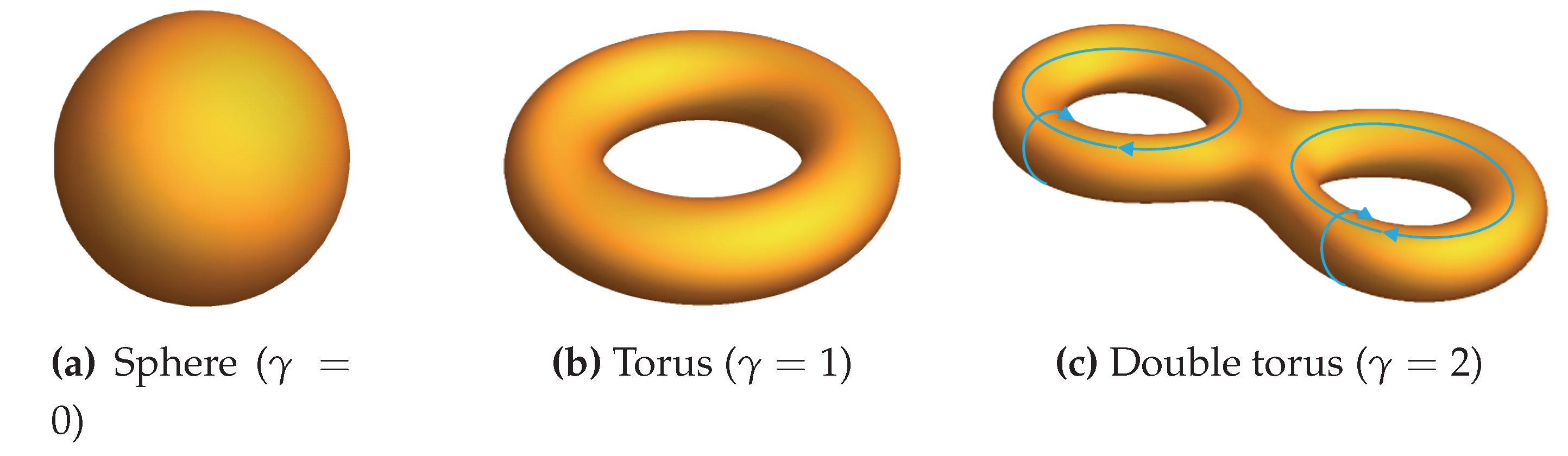
Figure 2.
3D view of tangent vector fields on the unit sphere. Colors indicate the sign of : golden for positive and blue for negative.
Figure 2.
3D view of tangent vector fields on the unit sphere. Colors indicate the sign of : golden for positive and blue for negative.
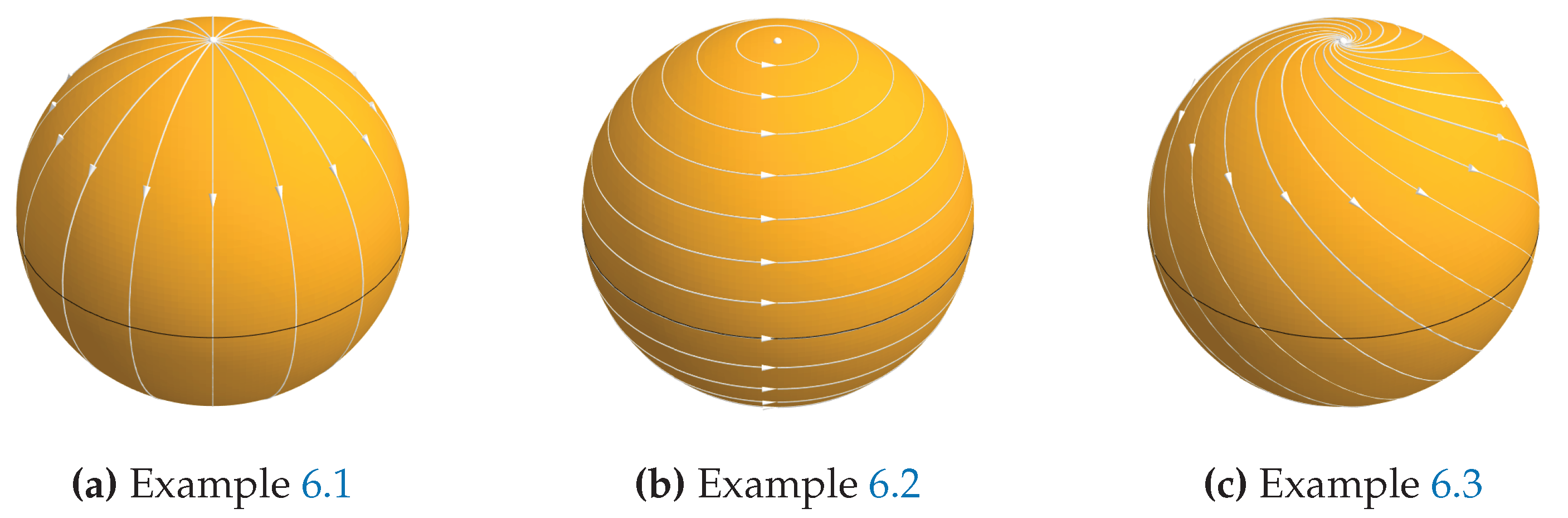
Figure 3.
3D view of tangent vector fields on the unit sphere (continued). Colors indicate the sign of or : golden for positive and blue for negative.
Figure 3.
3D view of tangent vector fields on the unit sphere (continued). Colors indicate the sign of or : golden for positive and blue for negative.
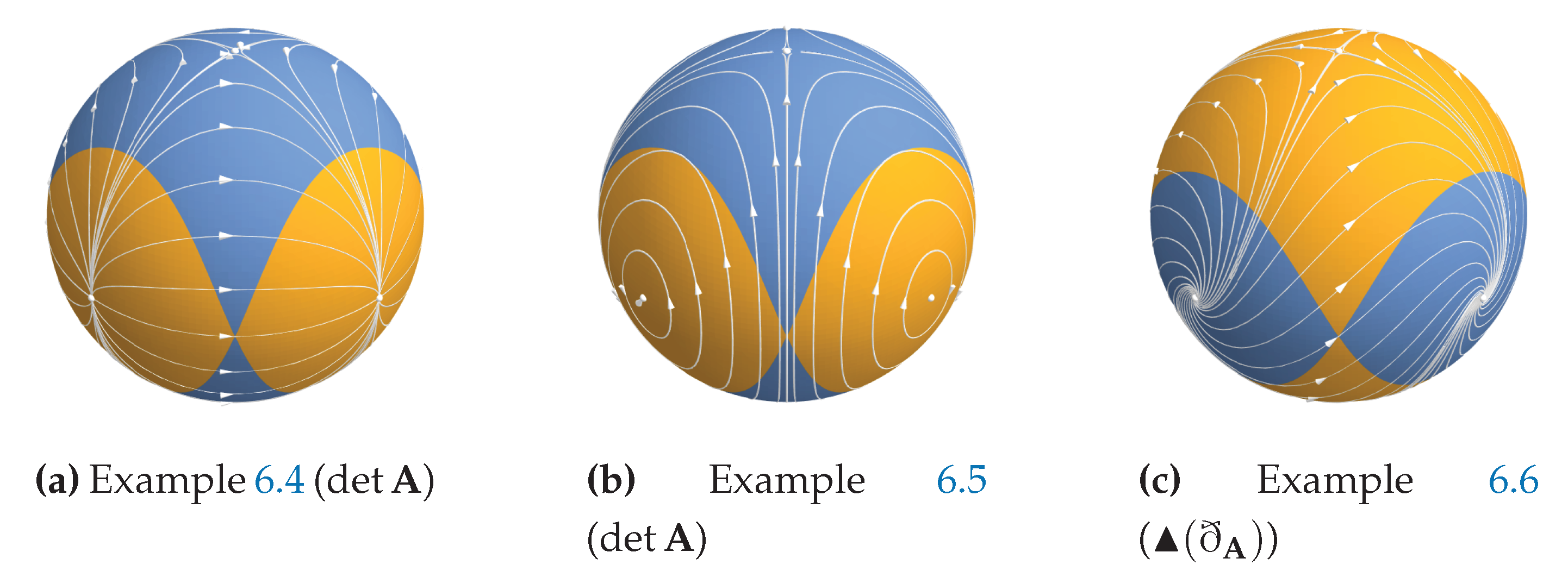
Figure 4.
2D view of tangent vector fields on the flat torus. Colors indicate the sign of or : golden for positive and blue for negative.
Figure 4.
2D view of tangent vector fields on the flat torus. Colors indicate the sign of or : golden for positive and blue for negative.
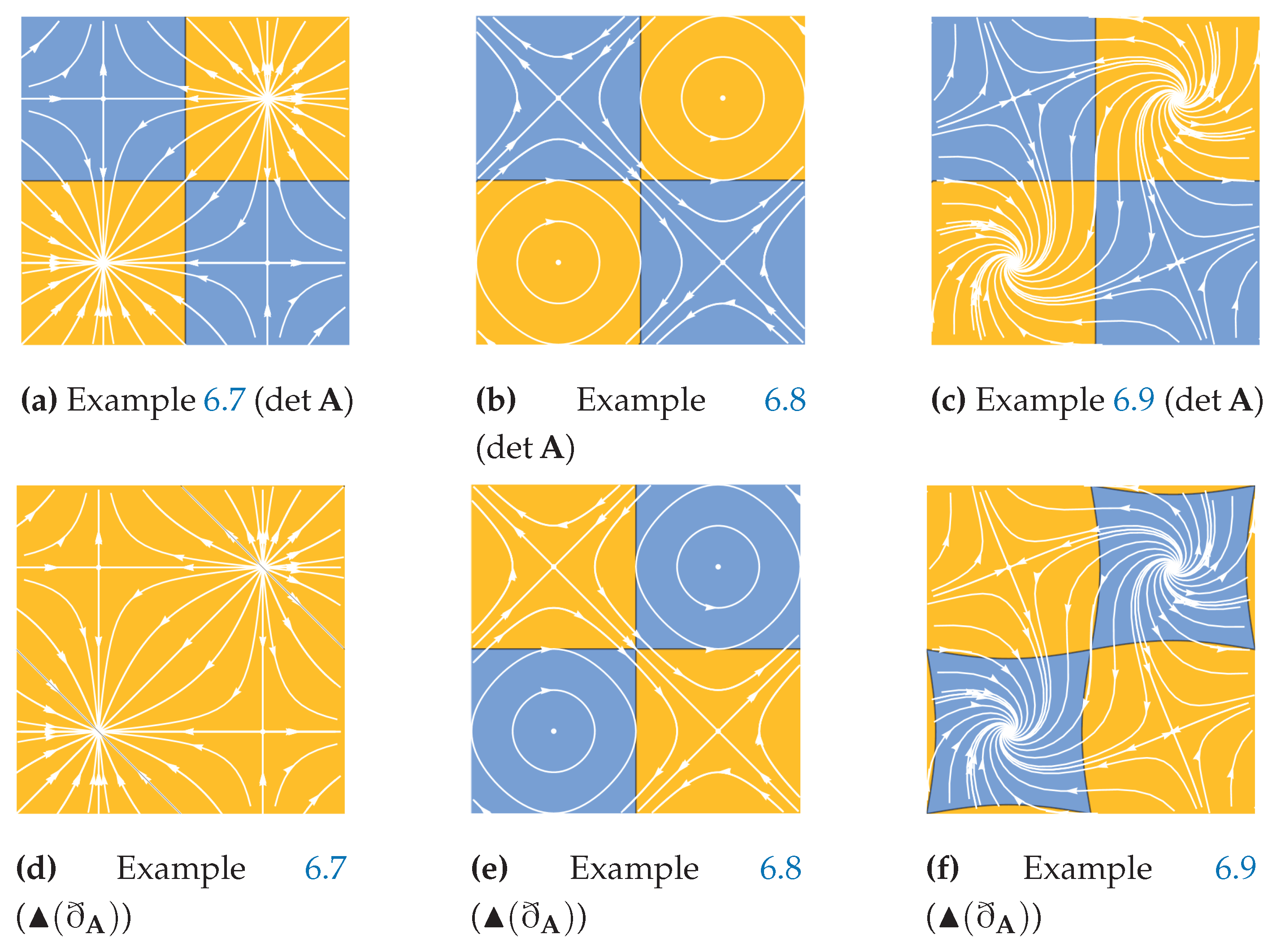
Figure 5.
2D view of tangent vector fields on the flat torus. Colors indicate the sign of or : golden for positive and blue for negative.
Figure 5.
2D view of tangent vector fields on the flat torus. Colors indicate the sign of or : golden for positive and blue for negative.
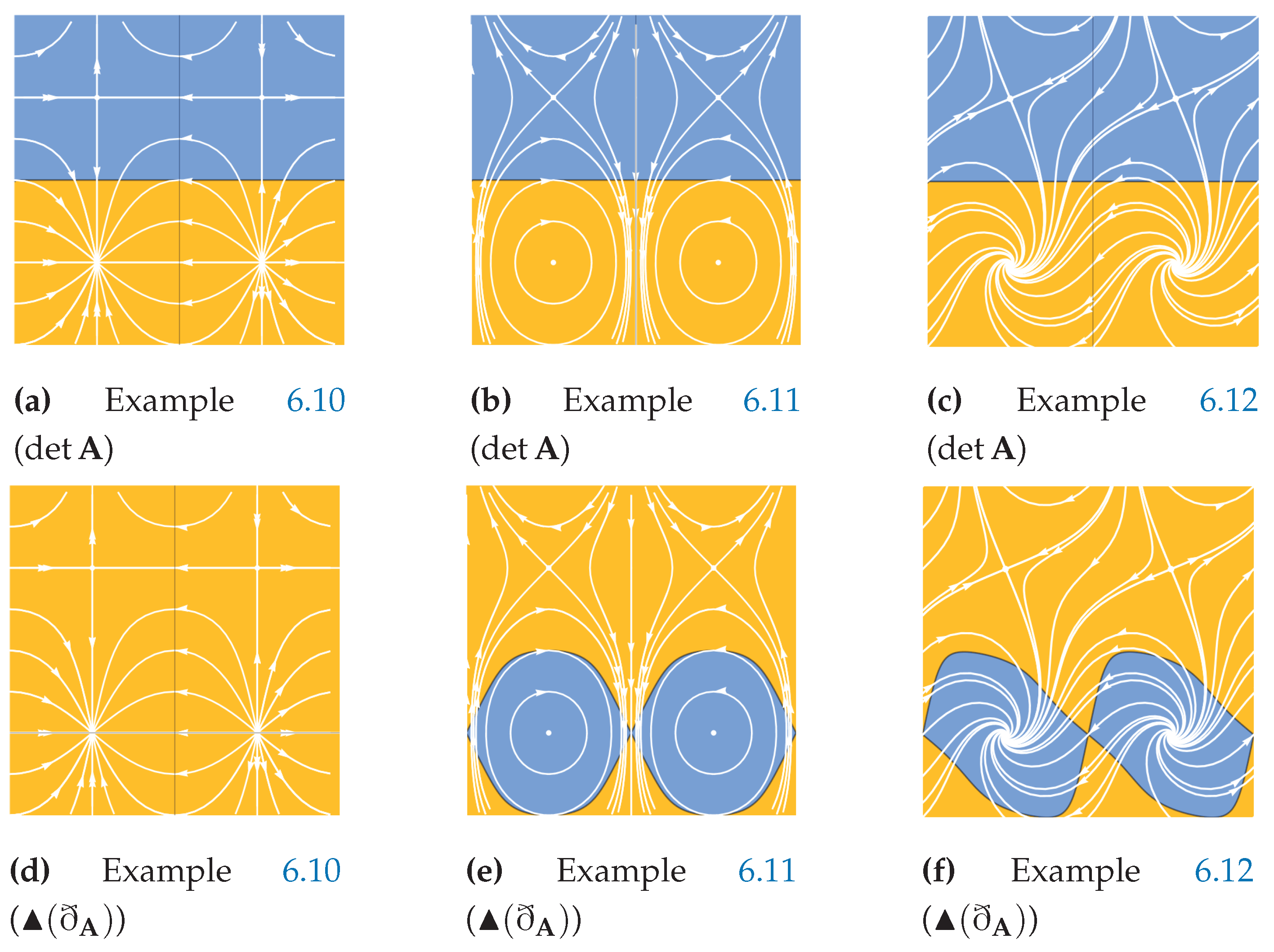
Figure 6.
2D and 3D views of tangent vector fields on the curved torus. The 2D view of each example is the coordinate domain of parameters . Colors indicate the sign of or : golden for positive and blue for negative.
Figure 6.
2D and 3D views of tangent vector fields on the curved torus. The 2D view of each example is the coordinate domain of parameters . Colors indicate the sign of or : golden for positive and blue for negative.
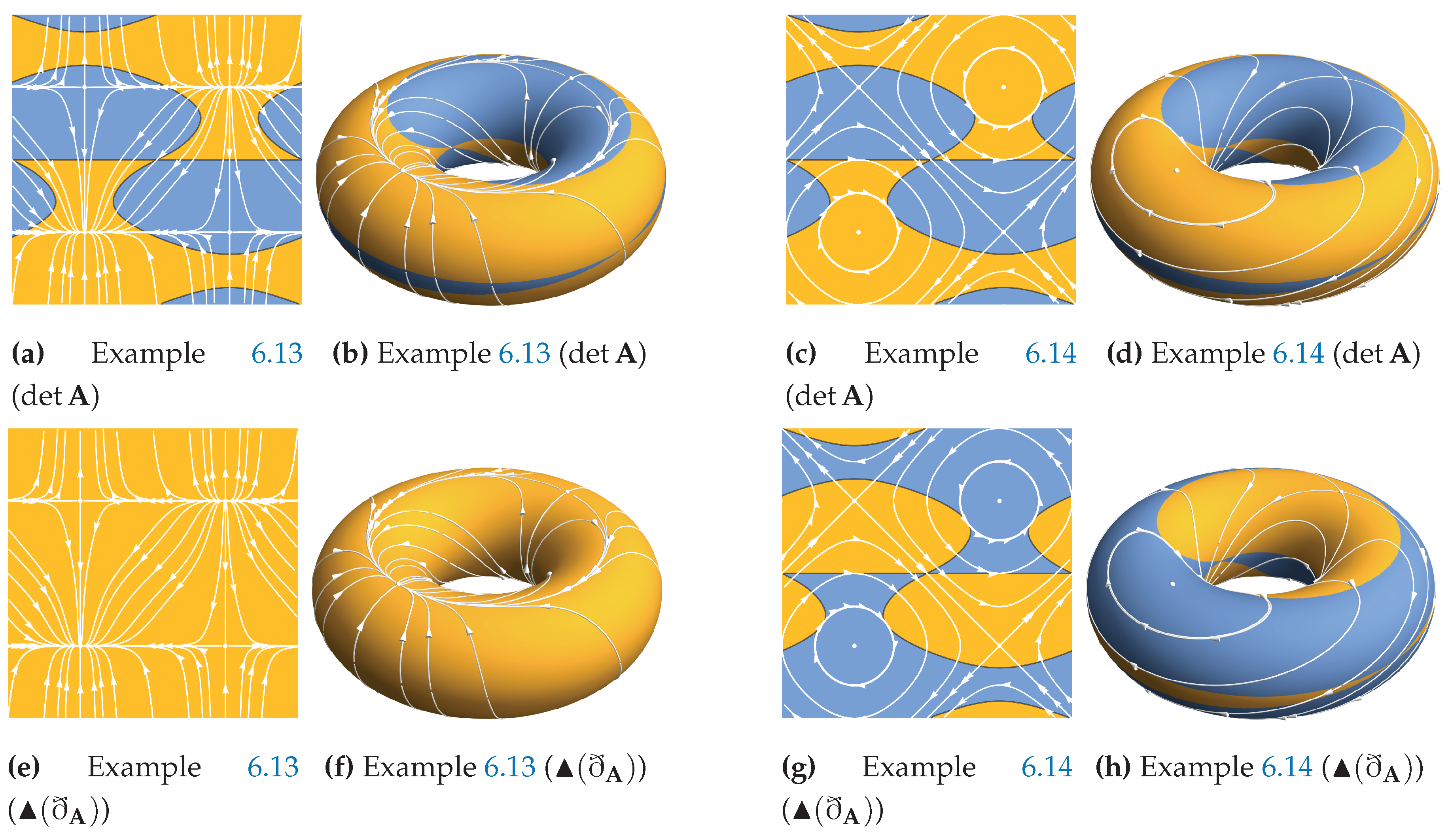
Figure 7.
2D and 3D views of tangent vector fields on the curved torus. The 2D view of each example is the coordinate domain of parameters . Colors indicate the sign of or : golden for positive and blue for negative.
Figure 7.
2D and 3D views of tangent vector fields on the curved torus. The 2D view of each example is the coordinate domain of parameters . Colors indicate the sign of or : golden for positive and blue for negative.
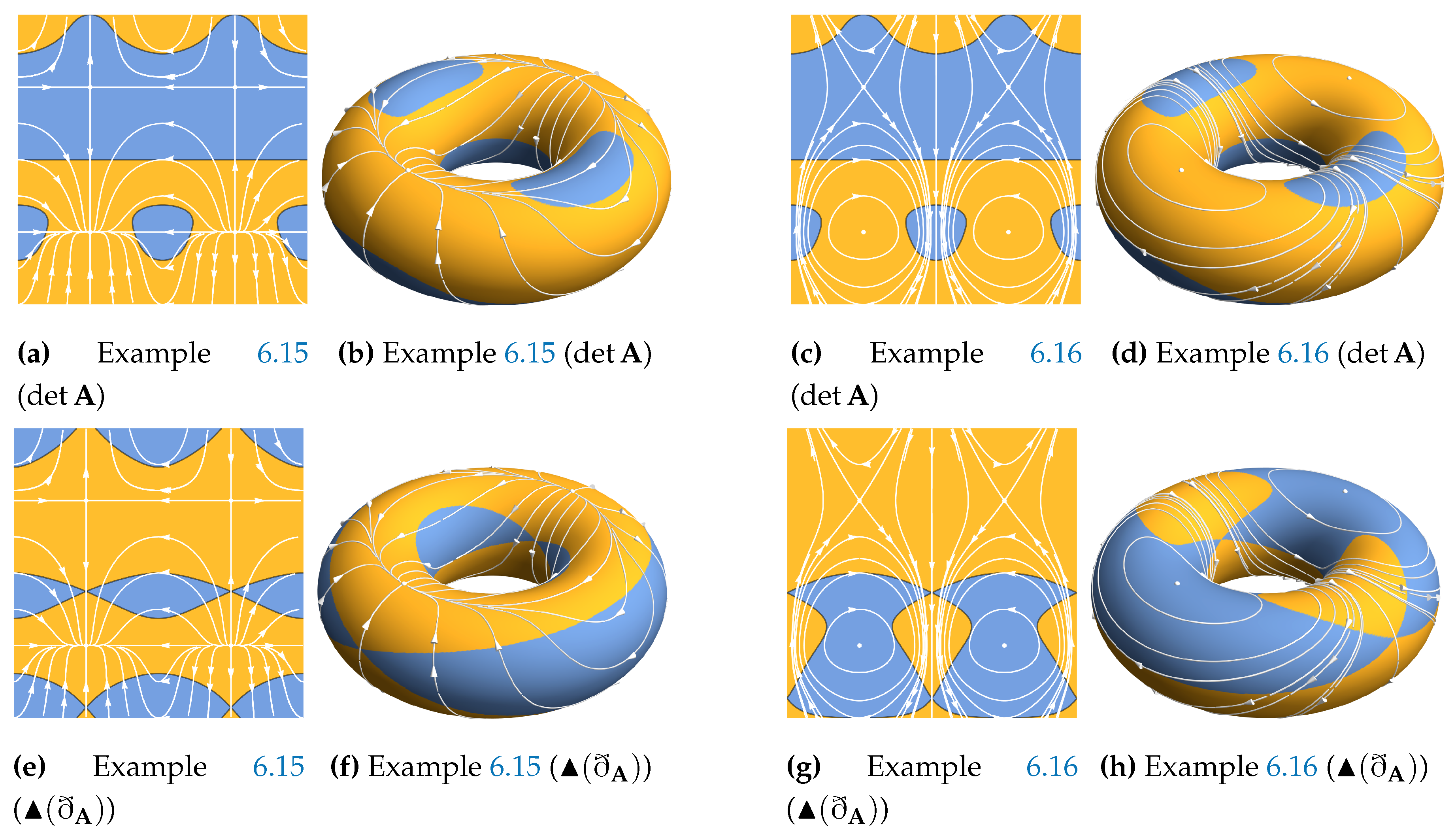
Figure 8.
Reduced parameter space of elementary singular points of 2D vector fields
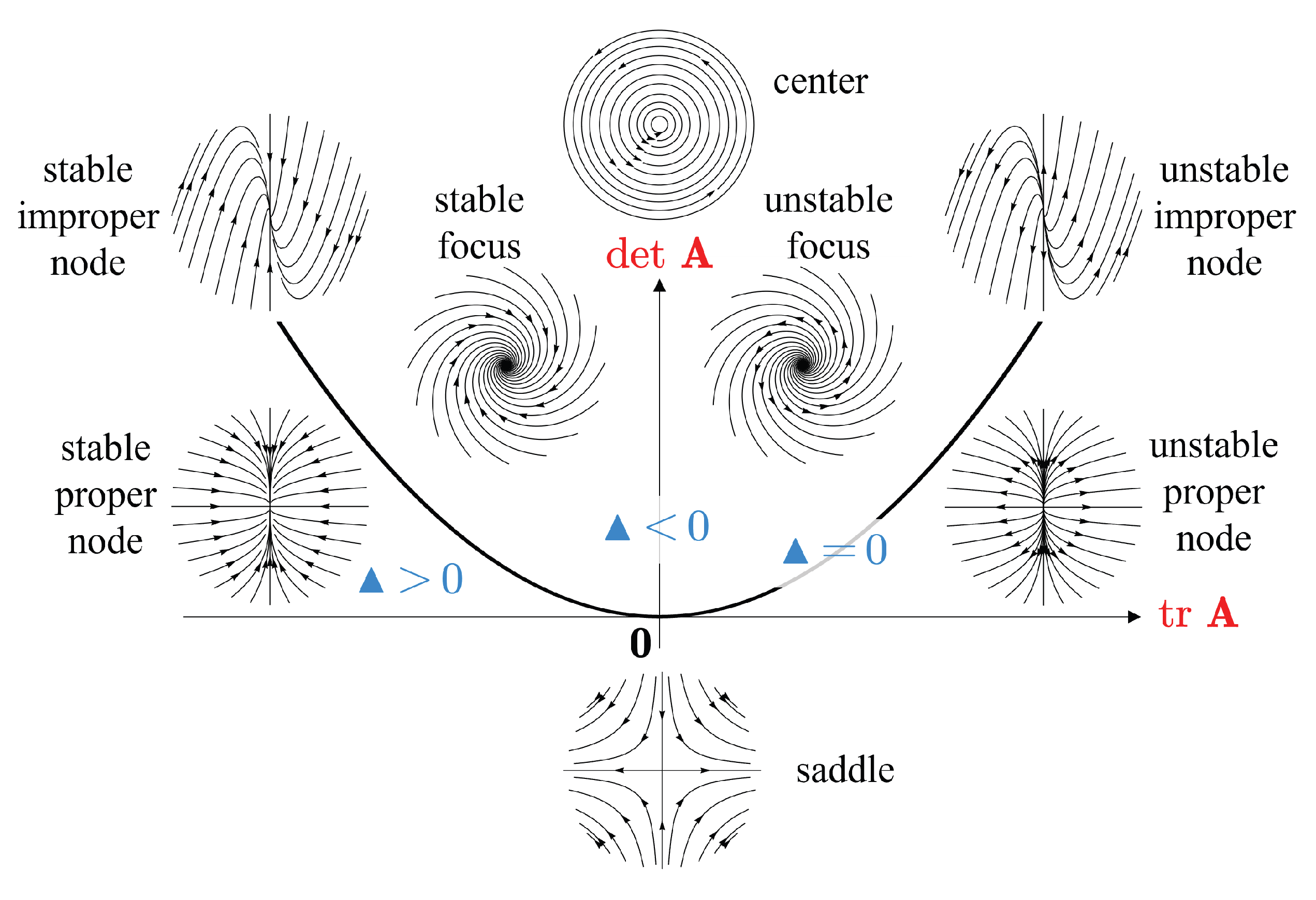

Table 1.
Kinematic interpretations of SAD/iSAD components
| Tensors | Interpretations |
|---|---|
| Local linearized motion | |
| (isotropic) dilation/expansion or compression | |
| distortion/stretch (without expansion or compression) | |
| deformation (without rotation) | |
| (rigid) rotation |
Table 2.
Types of singular points of iSAD components
| A | Interpretations | Types and Conditions |
|---|---|---|
| dilation | node (star) | |
| distortion | saddle | |
| rotation | axis (center) | |
| incompressible | saddle () or axis (center, ) | |
| conformal | node (star, ) or axis () | |
| deformation | saddle () or node () | |
| general |
saddle node axis () |
Disclaimer/Publisher’s Note: The statements, opinions and data contained in all publications are solely those of the individual author(s) and contributor(s) and not of MDPI and/or the editor(s). MDPI and/or the editor(s) disclaim responsibility for any injury to people or property resulting from any ideas, methods, instructions or products referred to in the content. |
© 2026 by the authors. Licensee MDPI, Basel, Switzerland. This article is an open access article distributed under the terms and conditions of the Creative Commons Attribution (CC BY) license (http://creativecommons.org/licenses/by/4.0/).
Copyright: This open access article is published under a Creative Commons CC BY 4.0 license, which permit the free download, distribution, and reuse, provided that the author and preprint are cited in any reuse.