
Submitted:
11 June 2026
Posted:
12 June 2026
You are already at the latest version
Abstract
Background/Objectives: Improved preoperative prediction of nodal metastasis in prostate cancer could refine selection for extended pelvic lymph node dissection, a high-morbidity procedure. Sperm-associated antigen 1 (SPAG1) is a candidate marker of nodal status, but its incremental value beyond clinical staging and the associated transcriptional state remain unevaluated.
Methods: In The Cancer Genome Atlas prostate adenocarcinoma (TCGA-PRAD) cohort (497 patients with matched clinical and RNA-sequencing data), we evaluated the association between SPAG1 expression and pathological N stage by logistic regression with 2000-resample bootstrap optimism correction and sensitivity analyses for missing nodal data and batch effects. Hallmark enrichment analysis compared SPAG1 expression extremes (quartile 4 vs 1) and, separately, N1 versus N0 tumours adjusted for T stage, Gleason grade, and tissue source site; directional concordance was assessed.
Results: N1 rates rose across SPAG1 quartiles from 7.6% to 39.0% (per-quartile odds ratio [OR], 1.83; p = 2.55×10⁻⁵). After adjusting for T stage and Gleason grade, SPAG1 remained an independent predictor (adjusted OR, 2.14; 95% confidence interval [CI], 1.50–3.13; p = 4.8×10⁻⁵), stable across both sensitivity analyses. Adding SPAG1 improved discrimination (area under the receiver-operating characteristic curve, 0.783 to 0.838; ΔAUC, 0.056; paired DeLong p = 3.03×10⁻⁵). The SPAG1 transcriptional programme showed cell-cycle, immune-inflammatory, and mTORC1/TGF-β signalling activation with suppressed differentiation and metabolism; all 15 overlapping Hallmark pathways were directionally concordant with the adjusted N1 signature.
Conclusions: SPAG1 expression in primary prostate tumours is a candidate predictor of pathological lymph node metastasis with statistically robust incremental discrimination beyond clinical staging. Independent external validation and biopsy-based feasibility studies are required before clinical application.
Keywords:
prostate cancer
; lymph node metastasis
; biomarker
; RNA sequencing
; gene set enrichment analysis
; logistic regression
; TCGA
1. Introduction
Pathological lymph node involvement at radical prostatectomy is among the strongest adverse prognostic features in prostate cancer and a key determinant of postoperative management [1]. Patients with pN1 disease are at increased risk for progression and adverse oncological outcomes; therefore, adjuvant systemic therapy, radiotherapy, and clinical trial enrolment are considered [2]. Identification of nodal involvement relies on extended pelvic lymph node dissection at the time of radical prostatectomy; however, this procedure is associated with substantial morbidity that could improve with enhanced patient selection [2]. Primary tumour transcriptional features can capture biological aspects of metastatic potential that are not fully reflected in conventional pathological variables such as the T stage and Gleason grade, thus raising the possibility that molecular markers derived from tumour tissue could complement pathological staging when identifying patients at risk for nodal spread [3].
Sperm-associated antigen 1 (SPAG1) is a testis-selective protein involved in spermatogenesis that is classified as a candidate cancer-testis antigen because of its tumour-associated expression and immunogenicity [4]. Across pancreatic, breast, and haematological malignancies, SPAG1 overexpression has been associated with tumour progression and adverse outcomes, including lymph node involvement in pancreatic cancer and impaired relapse-free survival in breast cancer, and functional studies have supported its role in tumour cell motility [5,6,7]. A machine-learning analysis of The Cancer Genome Atlas prostate adenocarcinoma (TCGA-PRAD) integrating RNA expression and copy number alteration data identified SPAG1 as a candidate gene that discriminates N1 disease from N0 disease (area under the receiver-operating characteristic [ROC] curve [AUC], 0.72, the highest among identified candidates) and found that SPAG1 copy number amplification is associated with reduced survival [8].
Despite these findings, key questions about the association between SPAG1 and nodal metastasis are unresolved. Whether SPAG1 adds discriminative value for the nodal status beyond the T stage and Gleason grade has not been determined. Furthermore, whether the association is robust to institutional batch effects has not been assessed. Additionally, the transcriptional programmes co-expressed with SPAG1 in node-positive disease have not been characterised.
Therefore, we performed a focused analysis of SPAG1 in TCGA-PRAD to achieve the following three objectives: quantify the association between SPAG1 expression and pathological lymph node metastasis after adjusting for the T stage and Gleason grade with sensitivity analyses that address missing nodal data and technical batch effects; evaluate the incremental discriminative value of SPAG1 beyond a clinical baseline model using paired AUC comparisons and bootstrap internal validation; and characterise the SPAG1-associated transcriptional programme and assess its concordance with the molecular signature of node-positive disease. Because this was a discovery and prioritisation study, external validation and experimental validation were not performed; however, they are required to establish clinical applicability.
2. Materials and Methods
2.1. Cohort and Data Sources
Clinical, survival, and RNA-sequencing (RNA-seq) data for the TCGA prostate adenocarcinoma cohort were obtained from the UCSC Xena platform [9,10]. Survival endpoints were based on the harmonised TCGA Pan-Cancer Clinical Data Resource [11]. The analysis cohort comprised 497 patients with matched clinical, survival, and log2-transformed RSEM-normalised RNA-seq data (Illumina HiSeq V2). All patients were male, as prostate cancer is a sex-specific malignancy; therefore, sex-stratified analyses were not applicable. The progression-free interval (PFI) was selected as the primary survival endpoint based on the event count and follow-up completeness.
2.2. Feature Engineering
The pathological T stage was dichotomised as T2 and T3/T4, and the pathological N stage was dichotomised as N0 and N1. Patients who lacked a recorded pathological N stage (n = 73; hereafter referred to as patients missing N) were treated as missing in primary analyses. The Gleason score was dichotomised as ≤7 and ≥8. SPAG1 expression was extracted from the log2 RSEM matrix.
2.3. Statistical Analysis Overview
The following three analyses were performed: a logistic regression analysis that evaluated whether SPAG1 expression predicts the pathological N1 status beyond established clinicopathological variables with internal validation; a parallel Cox survival analysis that extended the signal to disease progression; and a transcriptional analysis that characterised the SPAG1-associated gene expression programme and its concordance with the nodal disease signature. Sensitivity analyses addressed potential sources of bias, including indeterminate nodal status and institutional batch effects.
2.4. Logistic Regression and Incremental Discrimination
Logistic regression was performed on the complete-case dataset (n = 420) to evaluate the association between SPAG1 expression and the N1 status. A primary model comprising the T stage, Gleason grade, and SPAG1 was compared against a clinical baseline of T stage and Gleason grade alone using the Akaike information criterion (AIC) and likelihood ratio test; model assumptions including multicollinearity, convergence, separation, and linearity of the continuous predictor were verified, and no major violations were identified. Discrimination was assessed using the AUC, and the incremental value of SPAG1 over the clinical baseline was evaluated using the paired DeLong test and 2000-resample bootstrap percentile confidence intervals (CIs) for the ΔAUC. Internal validation was performed using 2000-resample bootstrap optimism correction for the AUC and calibration slope, and calibration was assessed using the calibration plot and Hosmer-Lemeshow test.
2.5. Sensitivity Analyses
Robustness of the SPAG1 and N1 association was evaluated under two sensitivity analyses re-fitting the primary logistic model: (i) reclassifying patients with missing N as node-negative (missing data assumption); (ii) additional adjustment for the tissue source site (technical batch).
To assess whether SPAG1 expression co-varied with bulk immune or stromal cell infiltration (factors known to influence bulk RNA-seq signals) Spearman’s correlation coefficients were computed between SPAG1 expression and ESTIMATE-derived ImmuneScore and StromalScore [12] across the full cohort. The correlation between SPAG1 expression and tumour purity in TCGA-PRAD was additionally obtained from TIMER2.0 [13] via the web portal (https://timer.cistrome.org/) using Spearman’s method.
2.6. Survival Analysis
Cox proportional hazards models were fitted to evaluate the association between SPAG1 expression (continuous) and PFI. These models were unadjusted (n = 497; 93 events) and adjusted for the pathological T stage, N stage, and Gleason grade (n = 420 complete cases; 84 events). The proportional hazards assumption was assessed using Schoenfeld residuals. To enable visualisation, Kaplan–Meier curves were generated using median dichotomisation of SPAG1, and curves were displayed up to 10 years. Only four patients had follow-up exceeding this threshold. The median follow-up period was 2.16 years (interquartile range [IQR], 1.16–3.73 years).
2.7. Differential Expression and Pathway Analysis
To characterise the SPAG1-associated transcriptional programme, patients in the highest and lowest SPAG1 expression quartiles (quartile 4 [Q4] and quartile 1 [Q1], respectively) were compared using linear modelling with empirical Bayes moderation (limma) [14] and a gene set enrichment analysis (GSEA) of the Hallmark collection using fgsea [15]. To assess whether tissue source site (TSS) adjustment was warranted in the SPAG1 quartile grouping, TSS distribution was assessed across SPAG1 expression quartile groups using the chi-square test. No significant association was observed (χ2 = 4.15; p = 0.24), indicating that TSS was not a confounder of the SPAG1 quartile grouping. To define the transcriptional signature of nodal metastasis, parallel differential expression and enrichment analyses that compared N1 and N0 tumours were adjusted for the established clinicopathological correlates of nodal disease (T stage and Gleason grade) and tissue source site as a technical batch covariate.
2.8. Pathway-Level Concordance
Pathway-level concordance between the two analyses was assessed by intersecting pathways significant at a false discovery rate (FDR) <0.05 in each analysis, with directional agreement evaluated by the sign of normalised enrichment scores. The concordance analysis paired the SPAG1 Q4 vs Q1 analysis with the adjusted N1 vs N0 signature (T stage, Gleason grade, and tissue source site).
2.9. Software
All analyses were performed in R (version 4.4.3) using established packages including tidyverse, survival, limma, fgsea, ESTIMATE, pROC, car, msigdbr, and ResourceSelection.
3. Results
3.1. Cohort Characteristics
A total of 497 patients with matched clinical and RNA-seq data were included. The median follow-up period was 2.16 years (IQR, 1.16–3.73 years; maximum, 13.75 years). Of these patients, 424 had a documented pathological nodal status (N0 or N1) and 420 comprised the complete-case cohort for the primary logistic regression after excluding four patients with missing T stage information. Seventy-nine (18.8%) patients had nodal metastasis. Seventy-three patients had no recorded pathological nodal status and predominantly lower-stage and lower-grade disease than that of patients who underwent surgical nodal evaluations (Table 1; Supplementary Figure S1), thus reflecting selective omission of pelvic lymph node dissection in clinically lower-risk cases. Therefore, these patients were treated as missing in primary analyses, and robustness was confirmed by conducting a sensitivity analysis and reclassifying patients with missing N as node-negative.
SPAG1 expression was significantly higher in tumours with adverse pathological features (N1, T3/T4, Gleason score ≥8), thus providing initial evidence of an association with the disease extent (Table 1; Supplementary Figure S2).
3.2. Association Between SPAG1 and the PFI Captured by the Clinical Stage
In the univariable Cox regression analysis (n = 497; 93 PFI events), higher SPAG1 expression was associated with a shorter PFI interval (hazard ratio [HR], 1.42; 95% CI, 1.12–1.81; p = 0.004). Additionally, the Kaplan–Meier analysis using median dichotomisation confirmed worse PFI in the high-expression group (log-rank p = 0.011) (Figure 1). After adjusting for the pathological T stage, nodal status, and Gleason grade (n = 420 complete cases; 84 PFI events), the SPAG1 association was attenuated to nonsignificant (adjusted HR, 1.10; 95% CI, 0.82–1.47; p = 0.515), and a high Gleason grade and T3/T4 stage remained the strongest independent predictors. This attenuation indicated that the prognostic signal of SPAG1 is largely encoded within the established clinicopathological stage and does not represent an independent survival effect. The proportional hazards assumption was satisfied for SPAG1 in both unadjusted and adjusted models with nonsignificant Schoenfeld residual tests (unadjusted SPAG1: p = 0.43; adjusted SPAG1: p = 0.21; global: p = 0.57).
3.3. SPAG1 Expression Independently Predicted Lymph Node Metastasis
In the complete-case cohort comprising 420 patients (79 patients with N1; 341 patients with N0), N1 rates increased monotonically across SPAG1 expression quartiles (from 7.6% in Q1 to 39.0% in Q4, indicating a five-fold gradient) (Table 2). In the univariable logistic regression analysis, SPAG1 was strongly associated with nodal metastasis (OR, 2.86; 95% CI, 2.06–4.08; p = 1.5×10⁻⁹). After adjusting for the pathological T stage and Gleason grade, SPAG1 remained an independent predictor (adjusted OR, 2.14; 95% CI, 1.50–3.13; p = 4.8×10⁻⁵); additionally, the T3/T4 stage and high Gleason grade retained significance (Table 3). The wide CI for the T stage reflected the small number of T2 cases among patients with N1 tumours (3 of 79 patients) (Table 1). The clinical plus SPAG1 model showed substantially lower AIC than the clinical baseline (314.4 versus 331.1), an improvement of 16.7 AIC units (likelihood ratio test p = 1.55×10⁻⁵), confirming the incremental contribution of SPAG1 to model fit. The dose–response relationship across quartiles was significant (per-quartile OR, 1.83; 95% CI, 1.39–2.46; p = 2.55×10⁻⁵), and AIC values were comparable across continuous, quartile, and trend parameterisations (Supplementary Table S1).
Adding SPAG1 to clinical variables significantly improved discrimination, as indicated by the AUC increasing from 0.783 to 0.838 (ΔAUC, 0.056; paired DeLong p = 3.03×10⁻⁵; bootstrap 95% CI, 0.031–0.091) (Figure 2). Bootstrap optimism correction (2000 resamples) confirmed minimal overfitting (optimism-corrected AUC, 0.836; optimism, 0.003; calibration slope, 0.942; Hosmer-Lemeshow p = 0.672) (Supplementary Figure S3). The SPAG1 OR was robust across both sensitivity analyses. Reclassification of patients with missing N as node-negative did not change the OR (OR, 2.14; 95% CI, 1.52–3.07); however, additional adjustment for the tissue source site changed the OR by 2.3% (OR, 2.09; 95% CI, 1.45–3.02) this model had borderline events-per-variable [EPV = 9.9], further supporting selection of the more parsimonious primary model (Supplementary Table S2 & S2b). SPAG1 expression showed no significant correlation with immune infiltration, stromal content, or tumour purity (Supplementary Table S3).
3.4. SPAG1 Transcriptional Programmes Were Concordant with the Molecular Signature of Nodal Metastasis
A Hallmark GSEA comparing SPAG1 expression extremes (Q4 vs Q1, n ≈ 125 per group) identified 21 significantly enriched pathways (FDR < 0.05; Supplementary Table S4). The dominant enriched programmes included cell-cycle pathways G2M Checkpoint (normalised enrichment score NES, 2.80), E2F Targets (NES, 2.53), and Mitotic Spindle (NES, 2.31) alongside immune-inflammatory pathways including Interferon-γ Response (NES, 1.66), Inflammatory Response (NES, 1.55), and TNFα Signalling via NFκB (NES, 1.37) and signalling pathways including mTORC1 Signalling (NES, 1.72) and TGF-β Signalling (NES, 1.98). Strong negative enrichment was observed for Myogenesis (NES, −2.59), Oxidative Phosphorylation (NES, −2.10), and Xenobiotic Metabolism (NES, −1.89), reflecting suppression of differentiation and metabolic programmes in SPAG1-high tumours (Figure 3A; Supplementary Table S4).
A differential expression analysis that compared N1 and N0 tumours and adjusted for the T stage, Gleason grade, and tissue source site identified 31 differentially expressed genes at FDR < 0.05, with SPAG1 itself significantly upregulated in N1 tumours (logFC 0.479; padj = 0.013) (Supplementary Table S5A). The adjusted N1 transcriptional signature was dominated by interferon response and inflammatory signalling pathways, alongside upregulation of proliferative programmes including G2M checkpoint and E2F targets (Figure 3B; Supplementary Table S5B). Of the 18 pathways significantly enriched in the adjusted N1 analysis and the 21 in the SPAG1 analysis, 15 overlapped; all 15 were directionally concordant (Figure 3C; Supplementary Table S5C). This complete directional concordance indicated that high SPAG1 expression is associated with the same transcriptional state that characterises node-positive disease after accounting for clinical confounders.
4. Discussion
In this focused analysis of a cohort from TCGA-PRAD, SPAG1 expression in primary tumours was independently associated with pathological lymph node metastasis after adjustment for the T stage and Gleason grade (adjusted OR, 2.14; 95% CI, 1.50–3.13; p = 4.8×10⁻⁵) and provided incremental discrimination beyond clinical staging (ΔAUC, 0.056; bootstrap-corrected AUC, 0.836). The high-SPAG1 transcriptional state in primary tumours was concordant with the adjusted molecular signature of node-positive disease. In the same cohort, however, SPAG1 did not retain prognostic value for the PFI after adjusting for clinicopathological stage, indicating that its association with outcome was largely captured by clinicopathological stage and grade variables and did not represent an independent survival driver.
Our findings build on the prior identification of SPAG1 as a candidate marker of the nodal status in TCGA-PRAD by Shamsara and Shamsara [8] and add several elements that strengthen the evidence base for prioritising this gene. First, we formally quantified the incremental discriminative value of SPAG1 beyond a clinical baseline using a paired AUC comparison with bootstrap CIs (ΔAUC, 0.056; 95% CI, 0.031–0.091) and confirmed minimal overfitting using bootstrap optimism correction (optimism-corrected AUC, 0.836), thus providing estimates that are interpretable in the context of contemporary biomarker development. Second, we demonstrated robustness across sensitivity analyses by reclassifying patients with missing nodal status information and adjusting for the tissue source site. Third, we characterised the SPAG1-associated transcriptional programme and demonstrated complete directional concordance with the adjusted molecular signature of nodal metastasis across all 15 overlapping Hallmark pathways.
Attenuation of the association between SPAG1 and survival with multivariable adjustment merits explicit interpretation. Although the univariable analysis showed that patients with high SPAG1 expression had a shorter PFI, this effect was largely accounted for by the pathological T stage and Gleason grade. Therefore, we interpreted SPAG1 as a molecular correlate of features already encoded within established clinicopathological variables rather than as an independent prognostic biomarker. This interpretation is consistent with our observation that SPAG1 expression tracks both the pathological T stage and Gleason grade (Supplementary Figure S2B, S2C). The independent association between SPAG1 and pathological nodal metastasis in surgical specimens after adjusting for the T stage and Gleason grade established statistical rationales for prioritising SPAG1 as a candidate for further biomarker development. If these findings are confirmed in independent cohorts, then the most clinically relevant application would be the prediction of nodal involvement at the point of treatment planning; in this setting, improved stratification could refine patient selection for extended pelvic lymph node dissection and complement molecular imaging approaches such as PSMA-PET/CT, particularly when imaging access is limited or findings are equivocal [2]. The present analysis used RNA-seq data from resected primary tumours; however, translation to a preoperative or biopsy-based setting would require the demonstration of SPAG1 expression in diagnostic biopsy material reflecting the same biology observed in this study. This necessary next step was not performed in this study, however.
Transcriptional concordance between SPAG1 expression extremes and the adjusted molecular signature of node-positive disease (15 of 15 overlapping pathways were directionally concordant) suggests that SPAG1 expression captures, at least in part, a transcriptional state that is biologically coherent with nodal spread. The SPAG1-associated transcriptional programme was characterised by activation of cell-cycle, immune-inflammatory, and signalling pathways, accompanied by suppression of differentiation and metabolic programmes.
This study had several limitations. First, all analyses were performed in a single cohort (TCGA-PRAD) using bulk RNA-seq of resected radical prostatectomy specimens. External validation in independent cohorts was not feasible; among publicly available prostate cancer gene expression datasets with clinical annotation, the available cohorts (GSE21032, GSE54460, GSE70769, GSE70768) either lacked pathological N stage data or contained insufficient N1 events for adequately powered logistic regression. Replication in cohorts with sufficient nodal annotation, and evaluation of SPAG1 in diagnostic biopsy material by RNA-based assay or immunohistochemistry, are both required before clinical application can be considered. Second, our analyses were observational; functional studies are required to determine whether SPAG1 has a mechanistic role in nodal dissemination or is a passenger marker. Third, the median follow-up was relatively short (2.16 years; IQR, 1.16–3.73 years), which may have limited the ability to detect long-term survival differences independent of established clinicopathological stage variables.
5. Conclusions
SPAG1 expression is independently associated with pathological lymph node metastasis in prostate cancer and provides modest, but statistically robust, incremental discrimination beyond clinical staging variables. The prognostic association of SPAG1 was captured by the established stage and grade, and its potential clinical value, pending biopsy-based validation in independent cohorts, may lie in prediction of nodal involvement rather than independent prognostication after radical prostatectomy.
Supplementary Materials
The following supporting information can be downloaded at the website of this paper posted on Preprints.org. Figure S1: Sample selection flow diagram; Figure S2: SPAG1 expression across clinicopathological features; Figure S3: Calibration of the primary logistic regression model; Table S1: Logistic regression model selection and parameterisation; Table S2 and S2b: Sensitivity analyses (reclassification of missing-N patients; tissue source site adjustment); Table S3: Correlation of SPAG1 expression with ESTIMATE ImmuneScore, StromalScore, and tumour purity; Table S4: Hallmark FGSEA, SPAG1 quartile 4 vs quartile 1; Table S5A: Adjusted N1 vs N0 differentially expressed genes; Table S5B: Adjusted N1 vs N0 Hallmark enrichment; Table S5C: Pathway-level concordance.
Author Contributions
Conceptualization, E.A. and Y.A.; methodology, E.A.; software, E.A.; formal analysis, E.A.; data curation, E.A.; writing-original draft preparation, E.A.; writing-review and editing, E.A. and Y.A.; visualization, E.A. All authors have read and agreed to the published version of the manuscript.
Funding
This research received no external funding.
Institutional Review Board Statement
Ethical review and approval were waived for this study because it used only publicly available, fully de-identified data from The Cancer Genome Atlas (TCGA); no new human data were collected.
Informed Consent Statement
Not applicable. This study analysed publicly available, de-identified data; informed consent was obtained by the original TCGA investigators.
Data Availability Statement
The datasets analysed in this study are publicly available. Clinical, survival, and RNA-sequencing data for TCGA-PRAD were obtained from the UCSC Xena platform (https://xenabrowser.net/datapages/). The analysis code is openly available on GitHub (https://github.com/Ebtihal-abh/SPAG1-lymph-node-metastasis-TCGA-PRAD) and archived on Zenodo (https://doi.org/10.5281/zenodo.20513977).
Acknowledgments
The authors thank The Cancer Genome Atlas Research Network and the UCSC Xena team for providing the data, and Editage for English-language editing. During the preparation of this manuscript, the authors used Claude (Anthropic, Claude Opus 4.8) for language refinement and assistance with R code debugging. The authors reviewed, verified and edited all outputs and take full responsibility for the content of this publication.
Conflicts of Interest
The authors declare no conflicts of interest.
References
- Briganti, A.; Blute, M.L.; Eastham, J.H.; Graefen, M.; Heidenreich, A.; Karnes, J.R.; Montorsi, F.; Studer, U.E. Pelvic lymph node dissection in prostate cancer. Eur. Urol. 2009, 55, 1251–1265. [Google Scholar] [CrossRef] [PubMed]
- Cornford, P.; Tilki, D.; van den Bergh, R.C.N.; Eberli, D.; Fonteyne, V.; Gandaglia, G.; Gillessen, S.; Henry, A.M.; van Leenders, G.J.L.H.; Oldenburg, J.; et al. EAU Guidelines on Prostate Cancer. Available online: http://uroweb.org/guidelines/compilations-of-all-guidelines/.
- Bustos, M.A.; Chong, K.K.; Koh, Y.; Kim, S.; Ziarnik, E.; Ramos, R.I.; Jimenez, G.; Krasne, D.L.; Allen, W.M.; Wilson, T.G.; et al. Transcriptomic miRNA and mRNA signatures in primary prostate cancer that are associated with lymph-node invasion. Clin. Transl. Med. 2025, 15, e70288. [Google Scholar] [CrossRef] [PubMed]
- Siliņa, K.; Zayakin, P.; Kalniņa, Z.; Ivanova, L.; Meistere, I.; Endzeliņš, E.; Abols, A.; Stengrēvics, A.; Leja, M.; Ducena, K.; et al. Sperm-associated antigens as targets for cancer immunotherapy: expression pattern and humoral immune response in cancer patients. J. Immunother. 2011, 34, 28–44. [Google Scholar] [CrossRef] [PubMed]
- Neesse, A.; Gangeswaran, R.; Luettges, J.; Feakins, R.; Weeks, M.E.; Lemoine, N.R.; Crnogorac-Jurcevic, T. Sperm-associated antigen 1 is expressed early in pancreatic tumorigenesis and promotes motility of cancer cells. Oncogene 2007, 26, 1533–1545. [Google Scholar] [CrossRef] [PubMed]
- Lin, S.; Lv, Y.; Zheng, L.; Mao, G.; Peng, F. Expression and Prognosis of Sperm-Associated Antigen 1 in Human Breast Cancer. Onco Targets Ther. 2021, 14, 2689–2698. [Google Scholar] [CrossRef] [PubMed]
- Gu, Y.; Chu, M.Q.; Xu, Z.J.; Yuan, Q.; Zhang, T.J.; Lin, J.; Zhou, J.D. Comprehensive analysis of SPAG1 expression as a prognostic and predictive biomarker in acute myeloid leukemia by integrative bioinformatics and clinical validation. BMC Med. Genom. 2022, 15, 38. [Google Scholar] [CrossRef] [PubMed]
- Shamsara, E.; Shamsara, J. Bioinformatics analysis of the genes involved in the extension of prostate cancer to adjacent lymph nodes by supervised and unsupervised machine learning methods: The role of SPAG1 and PLEKHF2. Genomics 2020, 112, 3871–3882. [Google Scholar] [CrossRef] [PubMed]
- Goldman, M.J.; Craft, B.; Hastie, M.; Repečka, K.; McDade, F.; Kamath, A.; Banerjee, A.; Luo, Y.; Rogers, D.; Brooks, A.N.; et al. Visualizing and interpreting cancer genomics data via the Xena platform. Nat. Biotechnol. 2020, 38, 675–678. [Google Scholar] [CrossRef] [PubMed]
- Network, C.G.A.R. The Molecular Taxonomy of Primary Prostate Cancer. Cell 2015, 163, 1011–1025. [Google Scholar] [CrossRef] [PubMed]
- Liu, J.; Lichtenberg, T.; Hoadley, K.A.; Poisson, L.M.; Lazar, A.J.; Cherniack, A.D.; Kovatich, A.J.; Benz, C.C.; Levine, D.A.; Lee, A.V.; et al. An Integrated TCGA Pan-Cancer Clinical Data Resource to Drive High-Quality Survival Outcome Analytics. Cell 2018, 173, 400–416.e411. [Google Scholar] [CrossRef] [PubMed]
- Yoshihara, K.; Shahmoradgoli, M.; Martínez, E.; Vegesna, R.; Kim, H.; Torres-Garcia, W.; Treviño, V.; Shen, H.; Laird, P.W.; Levine, D.A.; et al. Inferring tumour purity and stromal and immune cell admixture from expression data. Nat. Commun. 2013, 4, 2612. [Google Scholar] [CrossRef] [PubMed]
- Li, T.; Fu, J.; Zeng, Z.; Cohen, D.; Li, J.; Chen, Q.; Li, B.; Liu, X.S. TIMER2.0 for analysis of tumor-infiltrating immune cells. Nucleic Acids Res. 2020, 48, W509–w514. [Google Scholar] [CrossRef] [PubMed]
- Ritchie, M.E.; Phipson, B.; Wu, D.; Hu, Y.; Law, C.W.; Shi, W.; Smyth, G.K. limma powers differential expression analyses for RNA-sequencing and microarray studies. Nucleic Acids Res. 2015, 43, e47. [Google Scholar] [CrossRef] [PubMed]
- Korotkevich, G.; Sukhov, V.; Budin, N.; Shpak, B.; Artyomov, M.N.; Sergushichev, A. Fast gene set enrichment analysis. bioRxiv 2021, 060012. [Google Scholar] [CrossRef]
Figure 1.
Kaplan–Meier analysis of progression-free interval by SPAG1 expression. Patients were stratified by median SPAG1 expression for visualisation only; Cox models used SPAG1 as a continuous variable. Significance was assessed by the log-rank test. Shaded areas represent 95% confidence intervals; tick marks indicate censored observations. n = 497; events = 93.
Figure 1.
Kaplan–Meier analysis of progression-free interval by SPAG1 expression. Patients were stratified by median SPAG1 expression for visualisation only; Cox models used SPAG1 as a continuous variable. Significance was assessed by the log-rank test. Shaded areas represent 95% confidence intervals; tick marks indicate censored observations. n = 497; events = 93.
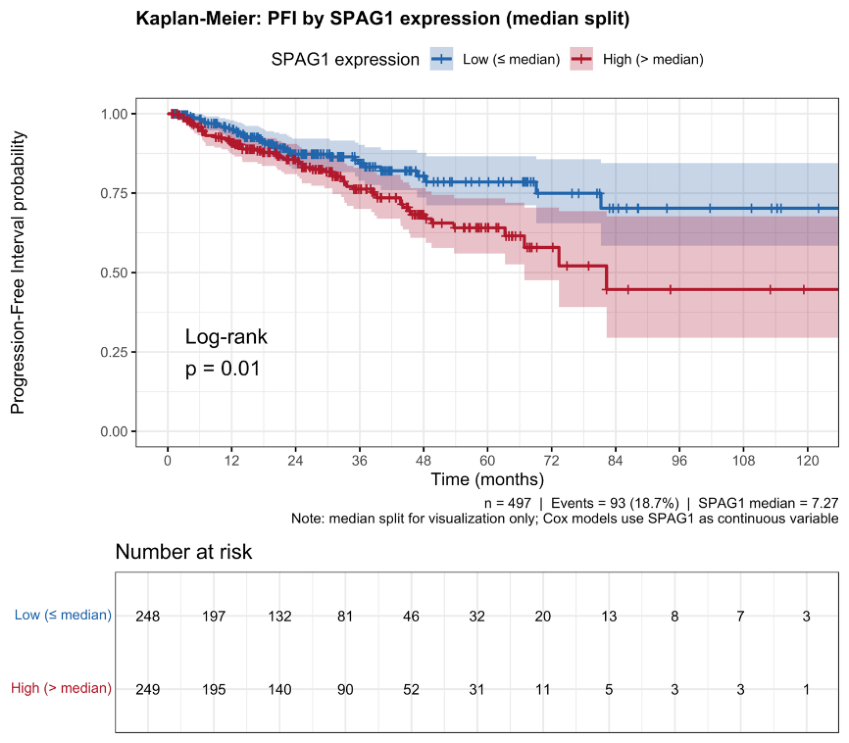
Figure 2.
Receiver operating characteristic curves for prediction of pathological N1 status. The clinical baseline model (T stage + Gleason grade) is compared with the primary model incorporating SPAG1. Incremental discrimination was assessed by the paired DeLong test. The diagonal dashed line represents chance. n = 420; N1 events = 79.
Figure 2.
Receiver operating characteristic curves for prediction of pathological N1 status. The clinical baseline model (T stage + Gleason grade) is compared with the primary model incorporating SPAG1. Incremental discrimination was assessed by the paired DeLong test. The diagonal dashed line represents chance. n = 420; N1 events = 79.
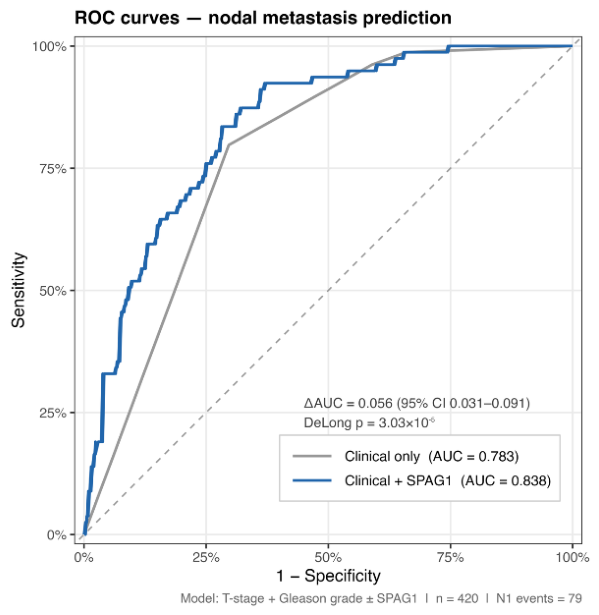
Figure 3.
Hallmark gene set enrichment analysis of the SPAG1-associated and nodal metastasis transcriptional programmes. (A) Enriched Hallmark pathways (FDR < 0.05) comparing SPAG1 expression extremes (Q4 vs Q1). (B) Enriched Hallmark pathways in the N1 vs N0 analysis adjusted for T stage, Gleason grade, and tissue source site. In A and B, dot colour encodes the normalised enrichment score (NES) and dot size encodes—log₁₀(FDR). (C) NES values for the 15 pathways significant in both analyses; all 15 were directionally concordant.
Figure 3.
Hallmark gene set enrichment analysis of the SPAG1-associated and nodal metastasis transcriptional programmes. (A) Enriched Hallmark pathways (FDR < 0.05) comparing SPAG1 expression extremes (Q4 vs Q1). (B) Enriched Hallmark pathways in the N1 vs N0 analysis adjusted for T stage, Gleason grade, and tissue source site. In A and B, dot colour encodes the normalised enrichment score (NES) and dot size encodes—log₁₀(FDR). (C) NES values for the 15 pathways significant in both analyses; all 15 were directionally concordant.
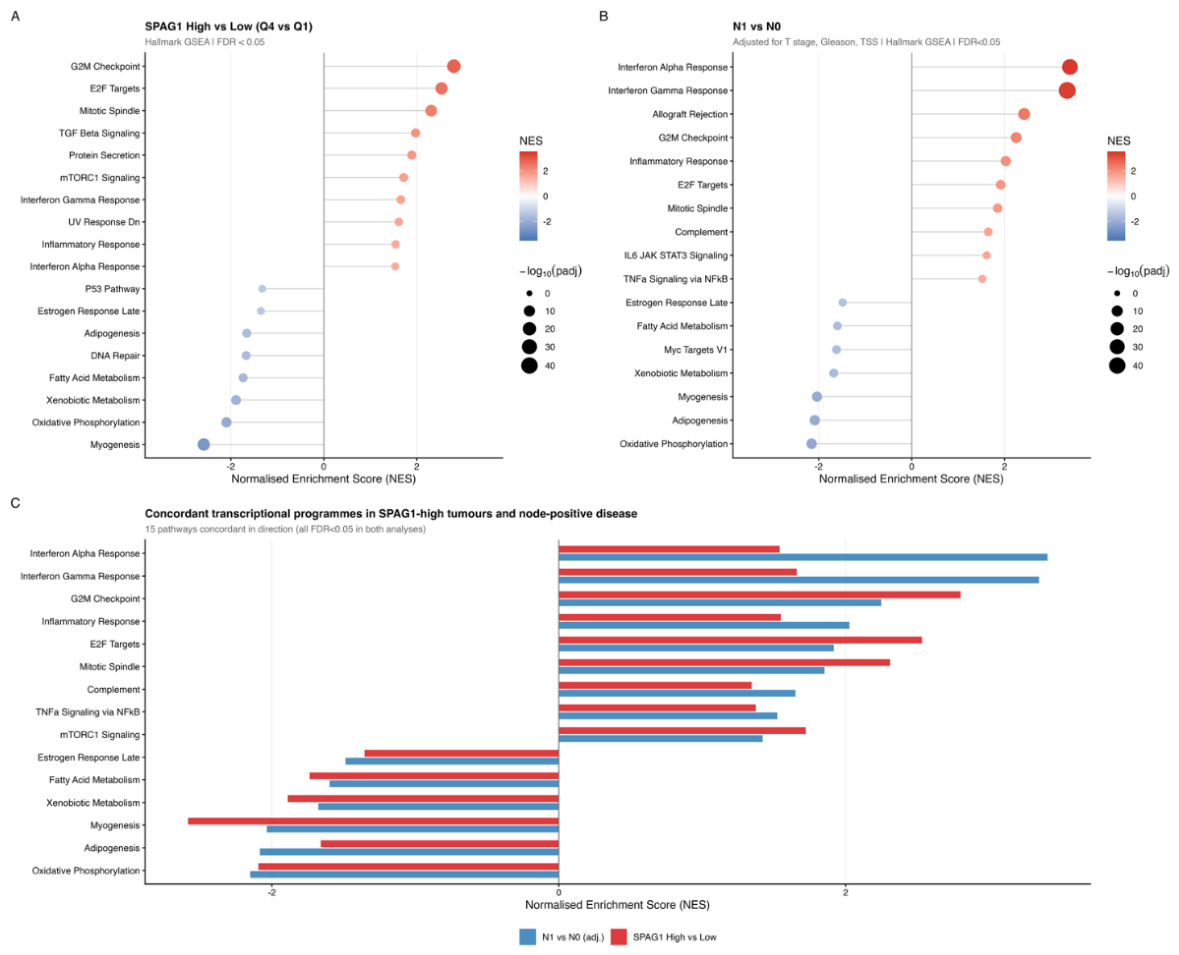

Table 1.
Clinical and pathological characteristics of the TCGA-PRAD analysis cohort by nodal status (N = 497).
Table 1.
Clinical and pathological characteristics of the TCGA-PRAD analysis cohort by nodal status (N = 497).
| Characteristic | N0 (n = 345) | N1 (n = 79) | Missing N (n = 73) | p-valueᵃ |
| Age at diagnosis (years), median (IQR) | 62 (57–66) | 63 (57–68) | 59 (54–66) | 0.715 |
| PSA at sample collection (ng/mL), median (IQR) | 0.10 (0.03–0.11) | 0.10 (0.03–0.60) | 0.04 (0.03–0.10) | 0.187 |
| Pathological T stage, n (%) | 7.0 × 10⁻¹⁰ | |||
| T2 | 140 (40.6%) | 3 (3.8%) | 44 (60.3%) | |
| T3/T4 | 201 (58.3%) | 76 (96.2%) | 26 (35.6%) | |
| Unknown | 4 (1.2%) | 0 (0.0%) | 3 (4.1%) | |
| Gleason grade group, n (%) | 6.1 × 10⁻¹³ | |||
| Gleason ≤ 7 (Low/Intermediate) | 218 (63.2%) | 14 (17.7%) | 60 (82.2%) | |
| Gleason ≥ 8 (High) | 127 (36.8%) | 65 (82.3%) | 13 (17.8%) | |
| Surgical margin, n (%) | 9.0 × 10⁻⁹ | |||
| Negative | 240 (69.6%) | 27 (34.2%) | 48 (65.8%) | |
| Positive | 89 (25.8%) | 46 (58.2%) | 17 (23.3%) | |
| Biochemical recurrence, n (%) | 0.085 | |||
| Yes | 39 (11.3%) | 15 (19.0%) | 4 (5.5%) | |
| No | 266 (77.1%) | 54 (68.4%) | 51 (69.9%) | |
| Vital status, n (%) | 0.378 | |||
| Alive | 339 (98.3%) | 76 (96.2%) | 72 (98.6%) | |
| Deceased | 6 (1.7%) | 3 (3.8%) | 1 (1.4%) | |
| Progression-free interval (months), median (IQR) | 26.9 (15.6–44.9) | 23.9 (11.5–41.0) | 27.3 (12.5–41.6) | 0.145 |
| PFI events, n (%) | 62 (18.0%) | 22 (27.8%) | 9 (12.3%) | |
| SPAG1 expression (log₂ RSEM), median (IQR) | 7.22 (6.74–7.67) | 7.85 (7.39–8.38) | 6.93 (6.57–7.39) | 6.3 × 10⁻¹¹ |
ᵃ p-values compare N0 vs N1 groups: Wilcoxon rank-sum for continuous variables; chi-squared or Fisher exact (where appropriate) for categorical variables. NX patients excluded from comparisons. Abbreviations: IQR, interquartile range; PFI, progression-free interval; PRAD, prostate adenocarcinoma; PSA, prostate-specific antigen; RSEM, RNA-seq by Expectation Maximization; SPAG1, sperm-associated antigen 1; TCGA, The Cancer Genome Atlas.
Table 2.
Pathological N1 status by SPAG1 expression quartile in the complete-case cohort (n = 420).
| SPAG1 quartile | n | N0, n | N1, n | N1 rate (%) |
| Q1 (lowest) | 105 | 97 | 8 | 7.6 |
| Q2 | 105 | 96 | 9 | 8.6 |
| Q3 | 105 | 84 | 21 | 20.0 |
| Q4 (highest) | 105 | 64 | 41 | 39.0 |
Quartiles defined within the n = 420 complete-case cohort (after exclusion of 73 NX patients and 4 patients with missing T stage). Trend across quartiles: p = 2.55 × 10⁻⁵.
Table 3.
Adjusted logistic regression model for pathological N1 status (primary model, n = 420).
| Variable | Reference | Adjusted OR | 95% CI | p-value |
| T stage T3/T4 | T2 | 8.59 | 2.98–36.40 | 4.9 × 10⁻⁴ |
| Gleason grade ≥ 8 (High) | Gleason ≤ 7 | 4.10 | 2.18–8.15 | 2.5 × 10⁻⁵ |
| SPAG1 expression (per log₂ RSEM unit) | — | 2.14 | 1.50–3.13 | 4.8 × 10⁻⁵ |
Logistic regression model with N1 status as the outcome and T stage, Gleason grade, and SPAG1 expression (continuous, per log₂ RSEM unit) as predictors. The wide confidence interval for T stage reflects the small number of T2 cases with N1 disease (3 of 79). Abbreviations: CI, confidence interval; OR, odds ratio; RSEM, RNA-seq by Expectation Maximization; SPAG1, sperm-associated antigen 1.
Disclaimer/Publisher’s Note: The statements, opinions and data contained in all publications are solely those of the individual author(s) and contributor(s) and not of MDPI and/or the editor(s). MDPI and/or the editor(s) disclaim responsibility for any injury to people or property resulting from any ideas, methods, instructions or products referred to in the content. |
© 2026 by the authors. Licensee MDPI, Basel, Switzerland. This article is an open access article distributed under the terms and conditions of the Creative Commons Attribution (CC BY) license.
Copyright: This open access article is published under a Creative Commons CC BY 4.0 license, which permit the free download, distribution, and reuse, provided that the author and preprint are cited in any reuse.


