

Submitted:
11 June 2026
Posted:
12 June 2026
You are already at the latest version
Abstract
Skeletal muscle is increasingly recognized as a dynamic secretory organ capable of translating contractile, metabolic, mechanical and inflammatory stimuli into systemic biological signals. Among these signals, myokines and myokine-associated exerkines mediate communication between skeletal muscle and distant organs, influencing glucose and lipid metabolism, immune regulation, bone remodeling, neuroplasticity, vascular function and tissue regeneration. However, current evidence remains fragmented across individual molecules, exercise modalities, sampling windows, assay platforms and disease contexts. This narrative mechanistic review proposes the concept of the “myokine adaptome” as an integrated, context-dependent signaling network through which skeletal muscle contributes to systemic homeostasis in health and disease. We synthesize evidence on cellular triggers of myokine release, including AMPK-PGC-1α signaling, mTORC1-dependent mechanical sensing, calcium flux, redox signaling, inflammatory pathways and extracellular vesicle-mediated communication. We further examine how exercise modality, aging, obesity, type 2 diabetes, sarcopenia, osteoporosis, cardiovascular disease, COPD, cancer/cachexia and chronic inflammation reshape myokine production and target-organ responsiveness. The central argument is that myokine biology should be interpreted not as a catalogue of isolated mediators, but as a dynamic adaptive code defined by signal amplitude, temporal pattern, molecular composition, delivery route and recipient-tissue sensitivity. This framework may improve biomarker design, disease-specific exercise prescription and therapeutic strategies aimed at restoring adaptive muscle-organ communication. The framework is further strengthened by testable predictions concerning adaptive pulsatility, modality-specific signatures, source attribution, recovery quality, disease-specific decoding and the superiority of multi-marker panels over single-molecule readouts.
Keywords:
myokines
; skeletal muscle
; exercise
; muscle-organ crosstalk
; exerkines
; extracellular vesicles
; AMPK
; mTORC1
; metabolic regulation
; inflammation
; sarcopenia
; chronic disease
; exercise medicine
1. Introduction
Skeletal muscle has traditionally been interpreted through the language of force production, locomotion and energy expenditure. This view has been substantially expanded by the recognition that contracting muscle releases cytokines, peptides, growth factors, metabolites and vesicle-associated cargo with local and systemic biological effects. The concept of skeletal muscle as a secretory organ has therefore become central to understanding how physical activity protects against metabolic, inflammatory, musculoskeletal, cardiopulmonary and neurodegenerative disease [1,2,3].
The term myokine was originally used to describe cytokines and other peptides produced and released by muscle fibers with autocrine, paracrine or endocrine effects. The field has since broadened to include muscle-derived growth factors, extracellular-matrix-associated mediators, metabokines, lipokines and extracellular vesicle cargo. This expansion has improved biological coverage but has also introduced conceptual ambiguity, because many circulating exercise-responsive molecules are not exclusively produced by skeletal muscle and may instead reflect coordinated responses from adipose tissue, liver, immune cells, endothelium or bone [4,5,6,7].
Exercise biology is consequently moving from a molecule-by-molecule description of the muscle secretome toward systems-level models in which contraction is viewed as a complex cellular perturbation. A single bout of exercise simultaneously changes ATP turnover, AMP/ADP ratios, calcium flux, redox tone, glycogen availability, mechanical strain, temperature, pH, perfusion and immune-cell trafficking. These inputs converge on transcriptional, translational and post-translational networks that determine which signals are released, when they appear, how long they persist and which tissues can decode them [8,9,10,11].
Recent conceptual work has framed the skeletal muscle secretome as an integrated endocrine code defined by secretion kinetics, co-released molecular combinations, delivery modalities and target-tissue receptor landscapes [6]. The present review builds on this logic but emphasizes a complementary adaptation-centered perspective. We propose the term myokine adaptome to describe the dynamic, context-dependent signaling network through which skeletal muscle translates energetic, mechanical, redox, calcium-dependent and inflammatory information into systemic metabolic, immune, osteogenic, neurovascular and regenerative outcomes.
The review is organized around five guiding questions:
Q1. Which intracellular sensors and cellular stress inputs determine the release of myokines, myokine-associated exerkines and extracellular vesicle cargo during exercise?
Q2. How do exercise modality, dose, timing and training status shape the amplitude, temporal pattern and molecular composition of the myokine response?
Q3. How do aging, obesity, type 2 diabetes, sarcopenia, osteoporosis, cardiovascular disease, COPD, cancer/cachexia and chronic inflammation distort adaptive muscle-organ communication?
Q4. How can the myokine adaptome be distinguished from the broader muscle secretome and from non-muscle exerkine responses in a biologically rigorous way?
Q5. How can time-resolved myokine profiling be translated into biomarkers, rehabilitation monitoring and personalized exercise medicine without overclaiming single-molecule causality?
By addressing these questions, this review makes a conceptual and translational contribution: it reframes myokine biology from a static catalogue of molecules into a testable model of adaptive communication. The goal is not to rename the muscle secretome, but to provide a disciplined framework for interpreting when a signal is muscle-derived, when it is exercise-responsive but not muscle-exclusive, when it is adaptive or maladaptive, and when it is clinically actionable. This approach is intended to help researchers design better time-resolved studies, help clinicians interpret exercise responses in disease-specific contexts and support the development of personalized exercise prescriptions that restore coordinated muscle-organ communication rather than targeting isolated mediators one by one.
The proposed model is organized around five interacting layers rather than introduced as a fixed biomarker panel: contractile input, energetic state, mechanical state, inflammatory-redox state and recipient-tissue state. Together, these layers specify how exercise dose is converted into a biological message, how fuel availability and loading history shape secretory output, how acute inflammatory-redox signals resolve or become maladaptive, and how target organs determine whether a circulating signal becomes functional adaptation [1,2,3,4,5,6,7,8,9,10,11,12,13,14,15,16,17].
2. Narrative Review Methodology
This article is a narrative mechanistic review rather than a systematic review or meta-analysis. The aim was to synthesize mechanistic, translational and clinical evidence into an integrative framework for understanding exercise-induced muscle-organ communication. The literature was mapped through targeted searches of PubMed/MEDLINE, PubMed Central, publisher databases and citation trails up to June 2026.
Search terms and term combinations included myokines, skeletal muscle secretome, exercise, contraction, muscle-organ crosstalk, inter-organ crosstalk, extracellular vesicles, exerkines, IL-6, irisin, myostatin, follistatin, decorin, BDNF, FGF21, apelin, sarcopenia, osteoporosis, type 2 diabetes, obesity, COPD, cardiovascular disease, chronic inflammation, cancer cachexia and exercise medicine. Citation chaining was used to identify foundational mechanistic studies and recent translational reviews that were not captured by single keyword combinations. Given the conceptual objective of the review, priority was assigned to studies providing mechanistic insight, source attribution, temporal characterization of exercise-responsive signaling, or clinically relevant interpretation of muscle-organ communication. Recent high-impact reviews, consensus statements, translational studies and multi-omics investigations were preferentially included when they contributed directly to the development of the adaptome framework.
Studies were prioritized when they met at least one of the following criteria: direct relevance to skeletal muscle secretion; evidence of exercise responsiveness; mechanistic linkage to intracellular signaling pathways; demonstration of autocrine, paracrine or endocrine effects; relevance to human exercise physiology; or disease-focused interpretation of muscle-organ crosstalk. Human exercise trials and clinical rehabilitation studies were emphasized when available, whereas cell culture and animal studies were included when they clarified causal mechanisms that are difficult to isolate in humans.
Studies were de-emphasized when they measured circulating exercise-responsive molecules without plausible source attribution, when they used poorly characterized assays without methodological caution, when they focused on non-muscle tissues without relevance to muscle-organ communication, or when they supported broad therapeutic claims without functional outcomes. Because this review performs conceptual synthesis rather than effect-size estimation, no pooled estimates were calculated and no formal risk-of-bias scoring was performed.
To reduce conceptual ambiguity, the evidence was organized into three categories: bona fide myokines released by muscle cells; myokine-associated exerkines whose circulating concentration is exercise responsive but not necessarily muscle exclusive; and extracellular vesicle-associated cargo that may participate in muscle-organ communication. Claims about therapeutic relevance were interpreted as strongest when four elements were present together: muscle origin, exercise responsiveness, receptor or target-tissue engagement and a measurable functional effect.
Study selection and evidence synthesis were performed iteratively by the authors, with emphasis on conceptual coherence, mechanistic plausibility and translational relevance to the proposed adaptome framework.
3. Skeletal Muscle as a Secretory and Signal-Integrating Organ
The muscle secretory environment is not generated by myofibers alone. Mature fibers produce contraction-responsive molecules, but the in vivo muscle niche also includes satellite cells, fibro-adipogenic progenitors, endothelial cells, pericytes, motor neurons, Schwann cells, macrophages and extracellular matrix compartments. These cellular sources can amplify, buffer or reinterpret the secretory response to exercise and disease.
This distinction matters because the measured secretory signal reflects both myofiber activity and the condition of the muscle microenvironment. In healthy muscle, repeated exercise bouts tend to produce transient and coordinated secretory pulses. In aged, insulin-resistant, inflamed or immobilized muscle, the same contractile stimulus may occur against a background of mitochondrial dysfunction, extracellular matrix stiffness, capillary rarefaction, immune-cell infiltration or anabolic resistance. The circulating myokine pattern may therefore indicate not only contraction, but also the readiness of the tissue to respond adaptively.
For this reason, the myokine adaptome should be distinguished from related but non-identical terms. The muscle secretome refers to the total set of molecules released by muscle or muscle-resident cells. Exerkines refer more broadly to exercise-responsive circulating factors, regardless of tissue origin. The myokine adaptome, as used here, refers to the adaptive signaling state generated when intracellular exercise inputs are converted into coordinated secretory patterns and interpreted by recipient tissues. It therefore includes source, timing, composition, delivery route and target-organ sensitivity rather than molecular identity alone.
Myokines can be delivered through classical ER-Golgi secretion, non-classical release mechanisms and vesicle-associated transport. Extracellular vesicles are especially relevant because they can carry proteins, lipids, mRNAs and microRNAs, thereby allowing skeletal muscle and other exercise-responsive tissues to communicate through packaged molecular information rather than isolated soluble ligands [18,19,20].
A major caution is that circulating extracellular vesicles after exercise are heterogeneous. Immune, endothelial, platelet, adipose and hepatic sources may contribute substantially to the total plasma vesicle pool. Exercise-induced extracellular vesicle cargo should therefore not automatically be interpreted as muscle-derived unless tissue-specific markers, capture strategies, muscle biopsy correlations or experimental models support that conclusion [18,19,20].
4. Cellular Triggers of Myokine Release
Energetic stress is one of the most powerful triggers of exercise-induced signaling. During contraction, ATP hydrolysis increases AMP and ADP availability, accelerates mitochondrial respiration and changes substrate flux. AMPK functions as a cellular energy sensor and interacts with PGC-1α, SIRT1 and mitochondrial regulatory networks to promote oxidative remodeling, glucose transport, lipid oxidation and secretory adaptation [21,22].
Resistance exercise and eccentric loading impose a different molecular problem: the muscle must sense tension, microdamage, matrix strain and growth requirements. Mechanical loading activates integrins, focal adhesion signaling, mechanosensitive channels and mTORC1-related anabolic pathways. This context favors signals involved in hypertrophy, remodeling, satellite-cell activation and extracellular matrix turnover.
Calcium flux during excitation-contraction coupling activates CaMK, calcineurin and downstream transcriptional programs that influence fiber phenotype and mitochondrial adaptation. Redox signaling adds another layer. Contracting muscle produces reactive oxygen species that can function as physiological messengers, whereas chronic redox imbalance can damage proteins, impair force production and promote inflammatory signaling [23,24].
The IL-6 response illustrates the difference between adaptive and maladaptive interpretation. Acute exercise-induced IL-6 is typically transient and may contribute to glucose homeostasis, lipolysis and anti-inflammatory cascades. Chronically elevated IL-6 in obesity, aging or inflammatory disease reflects a different biological state and is often associated with insulin resistance, catabolism and systemic inflammation.
The intracellular inputs and secretory routes can be interpreted as an encoding layer, as illustrated in Figure 1.
5. Functional Classes of Myokines and Myokine-Associated Exerkines
Immunometabolic myokines connect contraction to substrate mobilization and immune regulation. IL-6 remains the prototype. Human studies established that contracting skeletal muscle can contribute substantially to the exercise-induced rise in circulating IL-6, that the response is influenced by glycogen availability and that IL-6 can participate in glucose homeostasis during contraction [36,37,38].
The interpretation of IL-6 has evolved from a simple inflammatory cytokine model toward a context-specific energy allocation model. Acute muscle-derived IL-6 may support substrate availability and anti-inflammatory signaling, whereas chronic IL-6 elevation from immune and adipose sources may contribute to metabolic dysfunction. This duality has been described as a double-edged sword and remains essential for any serious discussion of myokines in health and disease [39,40,41,42].
IL-15 is another immunometabolic candidate because it has been linked to muscle-adipose crosstalk, immune regulation and metabolic homeostasis. However, the evidence varies across populations and protocols; exercise responsiveness alone is not equivalent to proof of direct muscle origin, receptor engagement or target-organ causality [43,44].
Myostatin, a member of the TGF-β superfamily, is a central negative regulator of skeletal muscle mass. Genetic and experimental studies show that myostatin suppresses muscle growth, while myostatin inhibition or functional loss promotes muscular hypertrophy [45,46]. In disease contexts such as sarcopenia, cachexia and chronic inflammation, excessive catabolic signaling may contribute to muscle wasting and impaired tissue resilience.
Follistatin, decorin and related extracellular-matrix mediators can counterbalance myostatin/activin signaling. Decorin is contraction responsive and has been implicated in resistance training-related hypertrophic signaling, partly through interaction with myostatin pathways [47]. Meta-analytic evidence also suggests that resistance training can modulate circulating myostatin and follistatin, although heterogeneity across protocols and populations remains substantial [48]. Broader morphology-focused synthesis places these mediators within the larger hypertrophy-remodeling continuum [49].
Several myokines and exerkines connect muscle activity to adipose tissue, hepatic metabolism and systemic fuel handling. FNDC5/irisin attracted major attention after being proposed as a PGC-1α-dependent signal capable of promoting brown-fat-like thermogenic features in white adipose tissue [50]. Subsequent analytical work supported the detection of circulating human irisin by tandem mass spectrometry, while also emphasizing the need for rigorous assay validation [51].
Myonectin/CTRP15 has been described as a muscle-derived factor linking skeletal muscle to systemic lipid homeostasis [52]. Meteorin-like and β-aminoisobutyric acid have also been implicated in adipose tissue browning, lipid oxidation and cardiometabolic risk modification [53,54]. FGF21, although not muscle exclusive, can increase after exercise and participates in metabolic stress responses involving liver, adipose tissue and muscle [55,56].
The muscle-brain axis is mediated by several exercise-responsive signals, including BDNF, irisin/FNDC5-related pathways and cathepsin B. Skeletal muscle cells can produce BDNF in response to contraction, and BDNF has been linked to AMPK-mediated fat oxidation in muscle [57]. Exercise-induced PGC-1α/FNDC5 signaling has also been connected to hippocampal BDNF expression in experimental models [58], while cathepsin B has been associated with running-induced systemic signaling and memory function [59]. Circulating irisin has also been implicated in exercise-linked cognitive regulation [60].
The muscle-bone axis is equally important. SPARC has been linked to exercise-related tumor suppression and tissue remodeling [61], and irisin has been reported to increase cortical bone mass in experimental models [62]. More broadly, muscle, bone and fat interact through mechanical loading and endocrine communication involving myokines, osteokines and adipokines [63].
Extracellular vesicle-associated cargo represents a functional class rather than a single myokine. Exercise-responsive vesicles may contain proteins, lipids, mRNAs and microRNAs, and plasma miRNA signatures may also change after acute exercise and training [18,19,20,64]. In the adaptome framework, extracellular vesicles are important because they may encode signal combinations and temporal information that soluble single-molecule assays miss.
At the same time, extracellular vesicle interpretation requires methodological discipline. Changes in circulating vesicle number or cargo after exercise do not automatically prove skeletal muscle origin. Future studies should combine plasma vesicle profiling with muscle tissue markers, cell-specific capture approaches, biopsy-linked transcriptomics or experimental models that can separate muscle-derived cargo from immune, endothelial, platelet, hepatic and adipose contributions.
The representative mediators in Table 1 were selected to separate bona fide myokines from broader exercise-responsive exerkines and EV-associated cargo.
6. Muscle-Organ Crosstalk in Health
Muscle-organ crosstalk is the physiological space in which myokines become clinically meaningful. The muscle-adipose axis links exercise to lipolysis, adipose inflammation, thermogenesis and insulin sensitivity. IL-6, irisin, IL-15, myonectin, meteorin-like and BAIBA all contribute to this conceptual axis, although with different levels of evidence for direct muscle origin and target-tissue causality [77].
The muscle-liver axis is central to exercise-related glucose and lipid regulation. During and after exercise, muscle-derived signals interact with hepatic glucose production, lipid handling, ketone-related metabolism and inflammatory tone. FGF21, IL-6 and myonectin provide examples of factors through which contracting muscle may influence liver-adipose-muscle nutrient coordination.
The muscle-pancreas axis is less mature but important. Improved skeletal muscle glucose uptake reduces pancreatic insulin demand, while exercise-responsive mediators and EV cargo may influence β-cell function, inflammation and metabolic resilience. This axis illustrates a recurring theme: myokines rarely act alone; their effects are embedded in whole-body changes in substrate flux, insulin sensitivity, vascular perfusion and immune regulation.
The muscle-bone unit combines mechanical and endocrine communication. Loading improves bone through strain-dependent mechanisms, but muscle-derived factors such as irisin, myostatin-related pathways, SPARC and decorin may also influence osteoblast and osteoclast biology. Osteosarcopenia can therefore be interpreted as a breakdown of both mechanical loading and endocrine-muscle-bone crosstalk [62,63].
The muscle-brain axis is one of the most attractive areas for translational research. Exercise improves cognition and mood through vascular, inflammatory, metabolic and neurotrophic mechanisms, and muscle-derived factors may contribute to these effects. However, the brain is not a passive target. Local production of neurotrophic factors, blood-brain barrier dynamics and neural activity determine how peripheral signals are interpreted [78].
7. Myokine Dysregulation in Disease
Disease does not merely reduce myokine secretion. It changes the timing, amplitude, composition and target-organ interpretation of the myokine signal. In obesity and type 2 diabetes, skeletal muscle insulin resistance, mitochondrial stress, adipose inflammation and ectopic lipid accumulation can reshape the muscle secretome and reduce the beneficial decoding of exercise-induced signals [79,80,81,82,83].
In these metabolic disease states, the same circulating mediator may carry different information depending on source and timing. A transient post-exercise cytokine pulse can reflect substrate mobilization and inflammatory resolution, whereas chronic low-grade cytokine elevation may indicate adipose-immune activation, impaired metabolic flexibility and reduced target-tissue responsiveness. The adaptome model therefore treats metabolic disease as a disorder of signal generation and signal interpretation, not only as a disorder of single circulating concentrations.
Sarcopenia and aging provide another example of adaptome remodeling. The revised European consensus defines sarcopenia through low muscle strength, low muscle quantity or quality and poor physical performance, emphasizing functional decline as much as tissue loss [84]. In this context, age-associated inflammation, neuromuscular impairment, satellite-cell dysfunction, mitochondrial decline and anabolic resistance may blunt the adaptive secretory response. Apelin has been proposed as an exercise-related factor capable of reversing aspects of age-associated sarcopenia in experimental work [85].
Osteoporosis and osteosarcopenia reflect disrupted muscle-bone communication. Reduced loading decreases mechanical stimulation, while altered myostatin, irisin, decorin, SPARC and extracellular vesicle-mediated signals may impair bone remodeling. This is especially relevant for older adults, immobilized patients and chronic disease populations in whom muscle loss and bone fragility develop in parallel [63].
Cardiovascular disease adds a vascular decoding problem to the adaptome. Endothelial dysfunction, reduced capillary recruitment, chronic inflammation and impaired mitochondrial function may limit both the delivery of muscle-derived signals and the responsiveness of recipient tissues. Exercise training can improve vascular function, oxidative capacity and cardiometabolic risk, but the myokine response in this context should be interpreted together with perfusion, endothelial health, autonomic regulation and functional capacity rather than as an isolated endocrine readout [11,86].
COPD is strategically important for this topic because it combines systemic inflammation, peripheral muscle dysfunction, exercise intolerance and rehabilitation responsiveness. Official statements recognize limb muscle dysfunction as a major extrapulmonary feature of COPD, and pulmonary rehabilitation is an established intervention to improve exercise capacity and symptoms [87,88,89]. A myokine adaptome perspective may help explain how local muscle dysfunction and systemic inflammation interact with lung disease, inactivity and rehabilitation response [90].
Cancer and cachexia represent high-stakes contexts in which the muscle secretome may be both a victim and a mediator of disease. Tumor-driven inflammation, metabolic stress, reduced intake and treatment toxicity promote muscle wasting, while altered myostatin/activin signaling, inflammatory cytokines and extracellular vesicle communication may reinforce catabolic remodeling. Exercise-induced myokines and extracellular vesicles have been investigated as potential mediators of improved treatment tolerance, inflammation resolution and altered tumor biology, but cancer-specific claims require caution because tumor type, disease stage, treatment phase and exercise prescription strongly modify interpretation [20,91,92].
Across these conditions, the central principle is that disease modifies both sides of the communication loop. The contracting muscle may generate a weaker, delayed, exaggerated or compositionally distorted signal, while recipient tissues may lose sensitivity through receptor changes, inflammation, vascular dysfunction or metabolic inflexibility. This dual impairment helps explain why the same exercise protocol can produce different molecular and clinical outcomes across populations.
The disease-specific remodeling patterns summarized in Table 2 synthesize evidence from metabolic disease, aging, sarcopenia, COPD, cardiovascular disease and cancer/cachexia literature.
The adaptive-versus-maladaptive interpretation can be operationalized as a contrast between pulse quality, target-organ sensitivity and inflammatory resolution, as illustrated in Figure 2.
8. Exercise as a Modulator of the Myokine Adaptome
Exercise is the most physiological modulator of the myokine adaptome. Acute exercise produces transient pulses, whereas chronic training reorganizes the baseline capacity to generate, deliver and decode those pulses. A useful distinction is therefore pulse versus remodeling: the former describes the immediate molecular response after a session; the latter describes the longer-term restructuring of muscle, vascular, immune and metabolic systems.
Endurance exercise primarily stresses energetic and mitochondrial pathways. It strongly engages AMPK-PGC-1α signaling, substrate mobilization and oxidative remodeling. Resistance exercise primarily stresses mechanical and anabolic pathways, including mTORC1, extracellular matrix remodeling and myostatin-follistatin-decorin balance. High-intensity interval exercise combines energetic stress, calcium flux, lactate/pH shifts and vascular demand, potentially generating robust but protocol-sensitive secretory patterns [93,94].
Clinical interpretation requires attention to modifiers. Age, sex, training status, nutritional state, obesity, medication, sleep, circadian timing, disease severity and baseline inflammation can all change the myokine response to the same exercise protocol. This helps explain why studies often report inconsistent responses for individual molecules. The adaptome model predicts heterogeneity; it does not treat it as noise.
8.1. Sex-Specific Modulation of the Myokine Adaptome
Emerging evidence suggests that biological sex may influence both the generation and decoding of exercise-induced myokine signals [119,120]. Differences in sex hormones, body composition, substrate utilization, inflammatory regulation and muscle fiber characteristics can alter the amplitude, timing and molecular composition of exercise-responsive signaling patterns [120,121,122,123]. Estrogen-related effects on mitochondrial function, oxidative stress handling and inflammatory regulation may influence the adaptive interpretation of exercise-derived signals, whereas androgenic signaling may modify anabolic-catabolic balance and remodeling responses [119,122,123].
From the adaptome perspective, sex should not be viewed merely as a demographic covariate but as a biological modifier of signal encoding and target-organ sensitivity [119,120]. Two individuals exposed to identical exercise stimuli may therefore generate distinct signaling trajectories because hormonal milieu, receptor expression and tissue responsiveness differ. Future time-resolved studies should incorporate sex-stratified analyses to determine whether adaptive pulsatility, signal resolution and target-organ decoding follow sex-specific patterns across health, aging and chronic disease [119,120,123].
In practical terms, the myokine response to exercise should be interpreted as an interaction between FITT variables (frequency, intensity, time and type) and biological context. For metabolic disease, a prescription may prioritize insulin sensitivity, mitochondrial flexibility and inflammatory resolution. For sarcopenia, it may prioritize anabolic remodeling, neuromuscular recruitment and anti-catabolic signaling. For COPD, it may prioritize peripheral muscle oxidative capacity, dyspnea tolerance and rehabilitation adherence.
This interpretation also cautions against universal “myokine-boosting” claims. A desirable response is not simply a higher concentration of a given mediator, but a signal pattern that is appropriately timed, resolved after the stimulus and decoded by the relevant target organs. Exercise prescription should therefore aim to restore adaptive pulsatility and tissue responsiveness, not only to increase circulating markers.
9. The Myokine Adaptome Model
The myokine adaptome model proposes that muscle-derived signaling should be described along four dimensions: amplitude, temporal pattern, molecular composition and target-organ sensitivity. Amplitude refers to the magnitude of secretion or circulating change. Temporal pattern refers to onset, peak, duration and return to baseline. Molecular composition refers to the coordinated mixture of cytokines, growth factors, metabolites and vesicle cargo. Target-organ sensitivity refers to the ability of recipient tissues to detect, transport, internalize and respond to the signal.
The full generation-encoding-decoding-phenotype sequence is summarized in Figure 3, linking systems-level exercise physiology with source attribution and adaptive information patterns.
A central distinction of the present framework is that the myokine adaptome should not be viewed as a synonym for the muscle secretome. The muscle secretome describes the repertoire of molecules released by skeletal muscle and muscle-resident cells, whereas the adaptome describes the adaptive information encoded within those signals. In this view, biological meaning emerges not from the presence of a molecule alone but from the interaction among signal amplitude, temporal dynamics, molecular composition, delivery route and recipient-tissue responsiveness. Two individuals may therefore display similar circulating concentrations of a given mediator while exhibiting profoundly different adaptive outcomes because the broader signaling context differs. The adaptome is consequently defined by informational organization rather than molecular inventory.
The novelty of the model lies in shifting the analytical focus from molecules to adaptive information patterns. Rather than asking which mediators are present, the adaptome framework asks how biological information is encoded, transmitted and decoded across tissues during exercise, recovery, aging and disease. A mediator is not adaptive or maladaptive in isolation. Its interpretation depends on tissue source, exercise context, kinetics, co-released signals, receptor landscape, disease state and functional outcome.
In this sense, the adaptome differs from a secretome inventory: the secretome asks what is released, whereas the adaptome asks what pattern is produced, why it is produced, which tissue can decode it and whether the final response improves resilience.
To make the conceptual boundary and novelty claim explicit, Table 3 positions the myokine adaptome against related constructs. The key distinction is that the adaptome is not another inventory of released molecules, but a source-aware, time-resolved and function-linked interpretation of adaptive communication.
This model helps resolve apparent contradictions in the literature. A high IL-6 peak after acute exercise in a healthy person may be adaptive, whereas chronically elevated IL-6 in obesity may be maladaptive. A reduction in myostatin after resistance training may favor remodeling, whereas persistent myostatin signaling in cachexia may amplify wasting. A rise in irisin-like immunoreactivity may be biologically meaningful only if assay validity, tissue source and target response are established.
The model is also experimentally testable. A minimal adaptome study would combine standardized exercise stimuli with serial blood sampling, muscle or tissue-informed source attribution, validated assays, extracellular vesicle characterization and functional endpoints such as strength, VO₂max, insulin sensitivity, inflammatory status or patient-reported symptoms. More advanced designs would add proteomics, metabolomics, transcriptomics, receptor profiling and computational network analysis to distinguish secretion, circulation, delivery and biological decoding.
The most important implication is that disease progression may reflect loss of pulsed adaptive communication. In healthy systems, exercise creates temporary stress followed by resolution and overcompensation. In chronic disease, the system may remain trapped in a low-grade stress state with insufficient amplitude for adaptation, insufficient resolution for recovery or reduced target-organ capacity to decode beneficial signals.
Conceptually, the adaptome may be viewed as the communication layer that links exercise physiology to systems adaptation. Whereas the secretome describes the molecular repertoire of skeletal muscle signaling, the adaptome captures the organizational principles through which those signals acquire biological meaning. This distinction may help explain why identical molecules can be associated with divergent outcomes across health, aging and disease.
9.1. Conceptual Distinction Between the Myokine Adaptome and the Muscle Secretome
A central vulnerability of any new conceptual term is the possibility that it merely renames an existing construct. The myokine adaptome avoids this problem only if it is defined by information architecture rather than by molecular membership. In this stricter interpretation, the muscle secretome describes the vocabulary of released molecules, whereas the adaptome describes the grammar of adaptive communication: timing, amplitude, molecular combination, delivery route, source attribution and recipient-tissue decoding [4,5,6,7,12,13,14,15,16,17,71,72,73,74,75,76,124].
The distinction is therefore ontological rather than terminological. The secretome is defined by molecular membership, whereas the adaptome is defined by informational organization. In the secretome framework, biological interpretation begins with the identification of released molecules. In the adaptome framework, biological interpretation begins with the structure of the signal itself, including temporal dynamics, coordinated signal combinations, source attribution, delivery route and target-organ responsiveness. Thus, identical molecular repertoires may carry different biological meanings if their encoding–decoding architecture differs.
The adaptome can therefore be viewed as a biological information-processing framework analogous to communication systems in which signal generation, transmission and decoding collectively determine functional outcomes. In this interpretation, adaptive value emerges from coordinated signaling patterns rather than from the abundance of individual mediators. This distinction allows the framework to generate experimentally testable predictions concerning pulse quality, signal resolution, source specificity and recipient-tissue sensitivity that are not directly addressed by conventional secretome inventories. Consequently, the adaptome is not proposed as an alternative catalogue of exercise-responsive molecules, but as a falsifiable framework for understanding how biological information is encoded, transmitted and interpreted across tissues during exercise, recovery, aging and disease.
This distinction has practical consequences. A secretome study can identify what muscle or muscle-resident cells release under a given condition. An adaptome study must additionally ask whether the signal is pulsed or chronic, whether it resolves after the stimulus, whether it is accompanied by compatible co-signals, whether it reaches the intended tissue and whether the target tissue remains biologically capable of responding [12,18,19,20,65,66,67,68,69,70,125].
The adaptome therefore reframes exercise-induced secretion as a context-sensitive communication system. A single mediator may be adaptive in one context and maladaptive in another. IL-6 after glycogen-depleted endurance exercise, myostatin suppression after resistance training and irisin-like responses after endurance training cannot be interpreted responsibly without timing, source, assay validity and downstream functional effects [13,25,26,27,28,29,30,36,37,38,39,40,41,42,48,50,51,125].
For this reason, the proposed framework should be used conservatively. It should not imply that all exercise-responsive molecules are myokines, that all myokines are therapeutic, or that a single circulating concentration can represent the systemic benefit of exercise. Its added value lies in forcing studies to measure the structure of the response rather than only the abundance of isolated mediators [4,5,6,7,17,31,32,33,34,35,71,72,73,74,75,76,125,126,127,128,129].
9.2. Testable Predictions of the Myokine Adaptome Model
To remain scientifically useful, the adaptome model must generate predictions that can be confirmed, refined or rejected. The predictions below translate the framework into experimentally testable expectations for standardized exercise perturbations, longitudinal training studies, disease-specific rehabilitation trials and multi-omics biomarker designs [12,13,14,15,16,17,25,26,27,28,29,30,35,65,66,67,68,69,70,104,105,106,124,125,130,131,132,133].
The eight core predictions are intentionally phrased around trajectories, source attribution, modality and functional outcomes, because the model predicts that adaptive value is carried by coordinated temporal patterns rather than by maximal elevation of any single molecule.
P1. Adaptive pulsatility. Healthy trained individuals should show larger but faster-resolving post-exercise myokine pulses than sedentary or chronically inflamed individuals. This can be tested with standardized endurance or HIIT bouts, serial sampling from baseline to 24 h recovery and stratification by functional status. The prediction would be weakened if pulse resolution and coordination do not differ after controlling for exercise dose and baseline inflammation.
P2. Disease-decoding deficit. Obesity, type 2 diabetes, COPD and sarcopenia should impair target-organ responsiveness even when circulating mediator concentrations change. Testing should pair plasma profiling with insulin sensitivity, vascular function, strength, VO₂max, symptoms or receptor/uptake markers. The prediction would be weakened if clinical or tissue outcomes track mediator concentration alone without evidence of altered decoding.
P3. Modality-specific signatures. Endurance, resistance and HIIT should generate distinct signal configurations rather than uniform increases in single mediators. Cross-over trials with matched energy expenditure or workload, multi-marker panels and EV cargo profiling would directly test this claim. The prediction would be weakened if modalities produce indistinguishable profiles once workload is standardized.
P4. Recovery-quality trajectory. Adaptive responses should show timely return to baseline together with improved function, rather than persistent elevation. Serial recovery sampling after repeated training sessions should therefore be interpreted alongside performance and inflammatory outcomes. The prediction would be weakened if the highest chronic elevations consistently predict the best adaptation independently of recovery dynamics.
P5. Training remodeling. After 8-12 weeks of training, the same acute exercise challenge should produce a shorter, more coordinated and functionally efficient response. Before-after intervention designs are particularly suitable for this test. The prediction would be weakened if training improves function without any change in pulse coordination, timing or resolution.
P6. Multi-marker superiority. Panels combining soluble myokines, EV cargo, metabolites and clinical function should predict adaptation better than any single marker. Regression or machine-learning models can compare single-marker and multi-layer prediction. The prediction would be weakened if single myokines consistently outperform integrated panels across cohorts.
P7. Source-attribution constraint. Only a subset of exercise-responsive circulating factors should correlate with muscle biopsy transcript/protein changes or tissue-specific EV capture. Concurrent biopsy, plasma proteomics and EV profiling are therefore essential. The prediction would be weakened if most circulating exerkines are strongly attributable to skeletal muscle without tissue-informed evidence.
P8. Maladaptive basal elevation. Chronically elevated basal inflammatory or catabolic signals should predict poor training response unless pulsatility and resolution improve. Rehabilitation studies in chronic disease can test this through baseline and serial follow-up measures. The prediction would be weakened if high basal inflammation or catabolic tone predicts superior adaptation without improved resolution.
9.3. Challenges to the Adaptome Hypothesis
The adaptome hypothesis also creates methodological risks. If used loosely, it could become a persuasive label for heterogeneous biomarker data. The framework is therefore strongest when its claims are restricted to patterns that are time-resolved, source-informed, assay-validated and connected to functional outcomes [33,34,35,65,66,67,68,69,70,96,97,98,99,100,101,102,103,104,105,106,107,108,109,110,111,112,113,114,115,116,117,118,134,135,136,137,138,139,140,141].
The main challenges and safeguards are summarized in Table 4. These safeguards are not cosmetic; they determine whether the adaptome remains a testable systems model or collapses into a descriptive catalogue of exercise-responsive molecules.
10. Biomarkers and Therapeutic Opportunities
Myokines are attractive biomarkers because they sit at the interface of muscle health, exercise dose and systemic disease biology. Potential applications include monitoring training responsiveness, identifying sarcopenic risk, stratifying cardiometabolic disease, evaluating pulmonary rehabilitation and tracking recovery from inflammatory or catabolic states. However, single-molecule biomarkers are unlikely to capture the complexity of the adaptome.
A more realistic strategy is panel-based profiling expressed in prose and experimental design rather than as a fixed universal table. Such a panel would ideally combine immunometabolic mediators such as IL-6, anabolic-catabolic regulators such as myostatin, follistatin and decorin, metabolic stress signals such as FGF21, myonectin, β-aminoisobutyric acid and irisin/FNDC5-related measures, extracellular vesicle cargo and conventional clinical outcomes. These molecular data should be interpreted together with strength, VO₂max or exercise capacity, glucose-insulin indices, inflammatory markers, body composition and disease-specific symptoms.
Longitudinal sampling is essential because timing can change interpretation as much as molecular identity. A pre-exercise value, an immediate post-exercise peak, a 1- to 3-hour recovery value and a longer recovery or training-adaptation measure may tell different stories. The clinically useful biomarker is therefore not simply a concentration, but a trajectory that reflects adaptive pulsatility, resolution and target-organ responsiveness.
Taken together, these considerations support a shift from single-molecule assessment toward integrated, time-resolved and clinically contextualized evaluation of the myokine adaptome. The major translational steps linking mechanistic discovery to personalized exercise medicine are summarized in Figure 4. This translational logic is consistent with exercise-as-medicine, fitness-as-a-vital-sign and personalized exercise frameworks.
Therapeutic targeting is promising but difficult. Anti-myostatin approaches, FGF21 analogues, irisin-related pathways, apelin biology and extracellular vesicle-based interventions have generated interest. Yet the systemic benefits of exercise probably arise from coordinated network effects rather than from a single druggable mediator. This supports a cautious therapeutic philosophy: selected targets may be useful in specific diseases, but they should not be expected to reproduce the full biological complexity of exercise.
Exercise medicine remains the most powerful practical intervention. The myokine adaptome model supports personalized prescription based on disease context, baseline function and adaptation goals. Rather than asking which myokine is good or bad, clinicians and researchers should ask which signal pattern is being produced, whether it is transient or chronic, which organs can respond and whether the pattern improves with training [86,95]. Selected examples of how this interpretive framework may influence clinical decision-making are presented in Box 1.
|
Box 1. Clinical translation: what the adaptome framework changes in practice. |
|
Obesity and type 2 diabetes: prioritize restoration of metabolic flexibility, insulin sensitivity and inflammatory resolution rather than isolated cytokine suppression. Sarcopenia and aging: monitor strength, muscle quality and anabolic-catabolic balance together with molecular pulse recovery. COPD and cardiovascular disease: interpret myokine profiles alongside exercise tolerance, endothelial function, dyspnea burden and rehabilitation adherence. Cancer/cachexia: treat molecular signals as context-dependent indicators of catabolic pressure, treatment phase and functional resilience rather than universal anti-tumor mediators. |
11. Discussion
The myokine adaptome framework reframes exercise-induced muscle secretion as a context-dependent communication system rather than as a simple inventory of circulating mediators. Its central contribution is to integrate source attribution, secretion kinetics, molecular combinations, delivery route and target-organ responsiveness into a single interpretive structure. This is important because the same molecule can have different meanings depending on whether it appears as a transient post-exercise pulse, a chronic inflammatory signal or part of a broader disease-associated secretory profile.
This framework is therefore most useful when applied conservatively. It should not be used to imply that all exercise-responsive molecules are myokines, that all myokines are therapeutic, or that a single concentration can summarize the systemic benefit of exercise. The added value of the adaptome concept lies in its operational demand: studies should describe when a signal appears, where it comes from, which co-signals accompany it, which tissue can decode it and whether the final response improves function, resilience or disease status.
11.1. Alternative Explanations and Conceptual Challenges
A stronger version of the argument must also acknowledge alternative explanations. Some apparent adaptome patterns may reflect whole-body stress responses, hemodilution or hemoconcentration, immune-cell trafficking, platelet activation, hepatic or adipose release, or changes in clearance rather than direct skeletal-muscle secretion. Thus, a post-exercise rise in a mediator should not be equated automatically with a muscle-derived adaptive signal.
A second challenge is conceptual parsimony. The adaptome becomes scientifically useful only if it explains more than the muscle secretome, the exerkine response or generic inter-organ crosstalk. Its added value should therefore be judged by whether it improves prediction of functional adaptation, rehabilitation response or disease-specific decoding beyond single-marker or secretome-only models.
A third risk is therapeutic over-translation. Network-level exercise benefits should not be reduced to replacing training with one candidate molecule, EV cargo class or pharmacological mimic. The framework is most defensible when it guides study design and monitoring rather than when it is used to imply immediate druggability of complex exercise responses.
11.2. Future Research Priorities
Several limitations currently constrain the field. First, the definition of myokine remains inconsistent. Some molecules are clearly produced by contracting muscle, whereas others are exercise-responsive but also derived from liver, adipose tissue, immune cells, endothelium or bone. Second, many studies measure circulating concentrations without proving tissue source, secretion route, receptor engagement or causal target-organ effect. Third, assay variability remains a major issue, especially for molecules such as irisin/FNDC5-related readouts, but also for cytokines, extracellular vesicle cargo and low-abundance proteins.
Timing is another major limitation. Single time-point sampling can miss transient peaks, delayed responses, recovery failure or chronic basal elevation. Exercise protocols also differ widely in intensity, duration, recruited muscle mass, nutritional control, training status and circadian timing. These sources of heterogeneity are not merely methodological noise; they are biologically relevant modifiers of the adaptome response and should be incorporated into study design and statistical interpretation.
Disease states add a further layer of complexity. Age, sex, medication, obesity, inflammatory burden, renal function, sleep, nutrition and vascular access may alter both myokine production and clearance. Animal and cell models provide mechanistic depth, but they do not always reproduce human exercise physiology or clinical disease heterogeneity. A specific limitation of adaptome thinking is that it requires richer experimental designs than single-marker studies. Without serial sampling, tissue-informed source attribution, validated assays and functional outcomes, the model risks becoming a conceptual label rather than a measurable biological framework.
Future research should move toward time-resolved, tissue-informed and disease-specific mapping of the myokine adaptome. Single-cell and spatial transcriptomics can identify which muscle-resident cells contribute to secretory programs under exercise, aging and disease. Proteomics, metabolomics and extracellular vesicle profiling can clarify how soluble and packaged signals differ across exercise modalities, while receptor and uptake profiling can help distinguish signal availability from biological decoding.
Human studies should prioritize repeated sampling before, during and after exercise, with standardized nutrition and careful phenotyping of training status, sex, age and disease severity. Where possible, muscle biopsies, plasma proteomics, extracellular vesicle cargo, receptor expression and functional endpoints should be measured together. This design would allow researchers to distinguish secretion, circulation, delivery, tissue response and clinical adaptation rather than treating all circulating changes as equivalent.
Disease-specific studies are especially needed. Obesity, type 2 diabetes, sarcopenia, osteoporosis, cardiovascular disease, COPD and cancer/cachexia should not be treated as interchangeable chronic disease states. Each condition may distort a different part of the communication loop, including muscle signal generation, vascular delivery, inflammatory background, receptor expression, tissue repair capacity or functional adaptation. This disease-specific decoding is essential before adaptome profiles can be translated into rehabilitation monitoring or personalized exercise prescription.
Computational integration will become increasingly important. Machine-learning and network models could identify multi-marker panels that predict adaptation, rehabilitation response or disease progression. However, these models must remain biologically interpretable. The goal is not merely to classify patients, but to understand how exercise changes communication between skeletal muscle and target organs, and why some individuals show adaptive remodeling whereas others display blunted, persistent or maladaptive signaling.
11.3. Clinical and Translational Implications
Clinically, the most realistic near-term application is not an exercise-mimetic replacement of training, but a better way to monitor whether exercise prescriptions restore adaptive pulsatility and target-organ responsiveness. A practical next step would be to design exercise studies around the five questions stated in the Introduction. Such studies would not only ask whether a molecule changes after exercise, but also when it changes, where it comes from, which signals accompany it, which tissue receives it and whether the person becomes stronger, more metabolically flexible, less inflamed or more functionally resilient.
Several practical priorities follow from this translational logic. First, terminology should remain strict: bona fide myokines, broader exerkines and extracellular-vesicle-associated cargo should be separated explicitly. Second, temporal design is essential, because single sampling points may miss transient peaks, delayed responses or failed resolution. Third, source attribution should be strengthened through muscle biopsies, tissue markers, proteomic strategies, cell-specific extracellular-vesicle capture or arterio-venous sampling. Fourth, disease mapping should be stratified rather than generic, because obesity, type 2 diabetes, sarcopenia, osteoporosis, cardiovascular disease, COPD and cancer/cachexia may distort different parts of the communication loop. Finally, molecular readouts should be integrated with clinical outcomes such as strength, VO₂max, exercise tolerance, body composition, inflammatory status and disease-specific symptoms, so that adaptome panels remain clinically useful rather than merely descriptive [12,13,14,15,16,17,25,26,27,28,29,30,33,34,35,65,66,67,68,69,70,96,97,98,99,100,101,102,103,104,105,106,107,108,109,110,111,112,113,114,115,116,117,118,124,125,130,131,132,134,135,136,137,138,139,140,141,142,143].
Accordingly, the adaptome should be translated through standardized exercise perturbations, serial sampling, validated assays, tissue-informed attribution, multi-omics integration and clinically meaningful endpoints. Figure 5 condenses this logic into a final graphical synthesis linking exercise stimuli, muscle sensing, adaptome encoding, target-organ decoding and the emergence of adaptive or maladaptive outcomes through contextual signal interpretation.
12. Conclusions
Myokines occupy a central position in the biology linking skeletal muscle contraction to systemic health. They connect exercise to metabolism, inflammation, bone remodeling, neuroplasticity, vascular function, immunity and chronic disease prevention. Yet the field will advance more rapidly if myokines are not treated as isolated molecules with fixed meanings.
The myokine adaptome model proposed here frames skeletal muscle as a cellular signal processor that converts energetic, mechanical, redox, calcium-dependent and inflammatory information into coordinated secretory patterns. In health, these patterns are pulsed, adaptive and efficiently decoded by target organs. In disease, aging and inactivity, the pattern may become blunted, chronically elevated, compositionally distorted or poorly interpreted by recipient tissues.
For the Special Issue “Myokines in Health and Diseases”, this framework provides a comprehensive and mechanistic narrative linking cellular signaling to clinical translation. Its main contribution is to move the field from asking whether individual myokines rise or fall toward asking how exercise generates adaptive communication patterns, how disease distorts those patterns and how personalized exercise medicine can restore them. Future work should define disease-specific adaptome signatures, validate time-resolved biomarker panels and develop exercise prescriptions that rebuild coordinated muscle-organ communication.
Validation of this framework will require standardized exercise perturbations, serial sampling, source-aware multi-omics and clinically meaningful endpoints. MoTrPAC-style longitudinal designs, combined with disease-specific rehabilitation trials, can test whether restored pulse quality, signal resolution and target-organ decoding predict improvements in metabolic flexibility, function, symptoms and resilience. In this stricter form, the adaptome is not a new label for the secretome; it is a falsifiable translation framework for exercise medicine.
Author Contributions
Conceptualization, D.C.M., C.D.P., A.Pî., R.D., E.A.F. and A.Po.; Methodology, D.C.M., C.D.P., A.Pî., R.D., E.A.F. and A.Po.; Validation, D.C.M., C.D.P., A.Pî., R.D., E.A.F. and A.Po.; Formal Analysis, D.C.M., C.D.P., A.Pî., R.D., E.A.F. and A.Po.; Investigation, D.C.M., C.D.P., A.Pî., R.D., E.A.F. and A.Po.; Resources, D.C.M., C.D.P., A.Pî., R.D., E.A.F. and A.Po.; Data Curation, D.C.M., C.D.P., A.Pî., R.D., E.A.F. and A.Po.; Writing—Original Draft Preparation, D.C.M., C.D.P., A.Pî., R.D., E.A.F. and A.Po.; Writing—Review and Editing, D.C.M., C.D.P., A.Pî., R.D., E.A.F. and A.Po.; Visualization, D.C.M., C.D.P., A.Pî., R.D., E.A.F. and A.Po.; Supervision, D.C.M., C.D.P., A.Pî., R.D., E.A.F. and A.Po.; Project Administration, D.C.M., C.D.P., A.Pî., R.D., E.A.F. and A.Po. The authors contributed equally to this work and share equal responsibility for its content and conclusions. All authors have read and agreed to the published version of the manuscript.
Funding
This research received no external funding.
Institutional Review Board Statement
Not applicable.
Informed Consent Statement
Not applicable.
Data Availability Statement
No new data were created or analyzed in this study. Data sharing is not applicable to this article.
Conflicts of Interest
The authors declare no conflicts of interest.
Abbreviations
| AMPK | AMP-activated protein kinase |
| BAIBA | β-aminoisobutyric acid |
| BDNF | brain-derived neurotrophic factor |
| CaMK | calcium/calmodulin-dependent protein kinase |
| COPD | chronic obstructive pulmonary disease |
| ECM | extracellular matrix |
| EVs | extracellular vesicles |
| FGF21 | fibroblast growth factor 21 |
| FITT | frequency, intensity, time and type |
| FNDC5 | fibronectin type III domain-containing protein 5 |
| GLUT4 | glucose transporter type 4 |
| HIIT | high-intensity interval training |
| IL-6 | interleukin-6 |
| IL-15 | interleukin-15 |
| miRNAs | microRNAs |
| mTOR | mechanistic target of rapamycin |
| mTORC1 | mechanistic target of rapamycin complex 1 |
| NF-κB | nuclear factor kappa B |
| PGC-1α | peroxisome proliferator-activated receptor gamma coactivator 1-alpha |
| ROS | reactive oxygen species |
| SIRT1 | sirtuin 1 |
| STAT3 | signal transducer and activator of transcription 3 |
| T2D | type 2 diabetes |
| TGF-β | transforming growth factor beta |
| VO₂max | maximal oxygen uptake |
References
- Pedersen, B.K.; Febbraio, M.A. Muscles, exercise and obesity: Skeletal muscle as a secretory organ. Nat. Rev. Endocrinol. 2012, 8, 457–465. [Google Scholar] [CrossRef]
- Pedersen, B.K.; Febbraio, M.A. Muscle as an endocrine organ: Focus on muscle-derived interleukin. Physiol. Rev. 2008, 88, 1379–1406. [Google Scholar] [CrossRef]
- Pedersen, B.K.; Akerstrom, T.C.A.; Nielsen, A.R.; Fischer, C.P. Role of myokines in exercise and metabolism. J. Appl. Physiol. 2007, 103, 1093–1098. [Google Scholar] [CrossRef]
- Severinsen, M.C.K.; Pedersen, B.K. Muscle-organ crosstalk: The emerging roles of myokines. Endocr. Rev. 2020, 41, 594–609. [Google Scholar] [CrossRef]
- Whitham, M.; Febbraio, M.A. The ever-expanding myokinome: Discovery challenges and therapeutic implications. Nat. Rev. Drug Discov. 2016, 15, 719–729. [Google Scholar] [CrossRef] [PubMed]
- Hah, Y.S.; Hwang, J.; Lee, S.J.; Kwag, S.J. Decoding the endocrine code of skeletal muscle: Myokines, exerkines, and inter-organ crosstalk in metabolic health and disease. Cells 2026, 15, 318. [Google Scholar] [CrossRef]
- Hoffmann, C.; Weigert, C. Skeletal muscle as an endocrine organ: The role of myokines in exercise adaptations. Cold Spring Harb. Perspect. Med. 2017, 7, a029793. [Google Scholar] [CrossRef] [PubMed]
- Hawley, J.A.; Hargreaves, M.; Joyner, M.J.; Zierath, J.R. Integrative biology of exercise. Cell 2014, 159, 738–749. [Google Scholar] [CrossRef]
- Egan, B.; Zierath, J.R. Exercise metabolism and the molecular regulation of skeletal muscle adaptation. Cell Metab. 2013, 17, 162–184. [Google Scholar] [CrossRef]
- Smith, J.A.B.; Murach, K.A.; Dyar, K.A.; Zierath, J.R. Exercise metabolism and adaptation in skeletal muscle. Nat. Rev. Mol. Cell Biol. 2023, 24, 607–632. [Google Scholar] [CrossRef] [PubMed]
- Shero, J.A.; Lindholm, M.E.; Sandri, M.; Stanford, K.I. Skeletal muscle as a mediator of interorgan crosstalk during exercise: Implications for aging and obesity. Circ. Res. 2025, 136, 1407–1432. [Google Scholar] [CrossRef] [PubMed]
- Neufer, P.D.; Bamman, M.M.; Muoio, D.M.; Bouchard, C.; Cooper, D.M.; Goodpaster, B.H.; Booth, F.W.; Kohrt, W.M.; Gerszten, R.E.; Mattson, M.P.; et al. Understanding the cellular and molecular mechanisms of physical activity-induced health benefits. Cell Metab. 2015, 22, 4–11. [Google Scholar] [CrossRef]
- Contrepois, K.; Wu, S.; Moneghetti, K.J.; Hornburg, D.; Ahadi, S.; Tsai, M.S.; Metwally, A.A.; Wei, E.; Lee-McMullen, B.; Quijada, J.V.; et al. Molecular choreography of acute exercise. Cell 2020, 181, 1112–1130.e16. [Google Scholar] [CrossRef]
- MoTrPAC Study Group. Temporal dynamics of the multi-omic response to endurance exercise training. Nature 2024, 629, 174–183. [Google Scholar] [CrossRef] [PubMed]
- MoTrPAC Study Group; Jakicic, J.M.; Kohrt, W.M.; Houmard, J.A.; Miller, M.E.; Radom-Aizik, S.; Rasmussen, B.B.; Ravussin, E.; Serra, M.; Stowe, C.L.; et al. Molecular Transducers of Physical Activity Consortium (MoTrPAC): Human studies design and protocol. J. Appl. Physiol. 2024, 137, 473–493. [Google Scholar] [CrossRef]
- Keller, P.; Vollaard, N.B.J.; Gustafsson, T.; Gallagher, I.J.; Sundberg, C.J.; Rankinen, T.; Britton, S.L.; Bouchard, C.; Koch, L.G.; Timmons, J.A. A transcriptional map of the impact of endurance exercise training on skeletal muscle phenotype. J. Appl. Physiol. 2011, 110, 46–59. [Google Scholar] [CrossRef]
- Catoire, M.; Mensink, M.; Kalkhoven, E.; Schrauwen, P.; Kersten, S. Identification of human exercise-induced myokines using secretome analysis. Physiol. Genom. 2014, 46, 256–267. [Google Scholar] [CrossRef]
- Whitham, M.; Parker, B.L.; Friedrichsen, M.; Hingst, J.R.; Hjorth, M.; Hughes, W.E.; Egan, C.L.; Cron, L.; Watt, K.I.; Kuchel, R.P.; et al. Extracellular vesicles provide a means for tissue crosstalk during exercise. Cell Metab. 2018, 27, 237–251.e4. [Google Scholar] [CrossRef]
- Jia, J.; Wang, L.; Zhou, Y.; Zhang, P.; Chen, X. Muscle-derived extracellular vesicles mediate crosstalk between skeletal muscle and other organs. Front. Physiol. 2025, 15, 1501957. [Google Scholar] [CrossRef]
- Pinto, A.C.; Tavares, P.; Neves, B.; Oliveira, P.F.; Vitorino, R.; Moreira-Gonçalves, D.; et al. Exploiting the therapeutic potential of contracting skeletal muscle-released extracellular vesicles in cancer: Current insights and future directions. J. Mol. Med. 2024, 102, 617–628. [Google Scholar] [CrossRef] [PubMed]
- Spaulding, H.R.; Yan, Z. AMPK and the adaptation to exercise. Annu. Rev. Physiol. 2022, 84, 209–227. [Google Scholar] [CrossRef] [PubMed]
- Lira, V.A.; Benton, C.R.; Yan, Z.; Bonen, A. PGC-1alpha regulation by exercise training and its influences on muscle function and insulin sensitivity. Am. J. Physiol. Endocrinol. Metab. 2010, 299, E145–E161. [Google Scholar] [CrossRef]
- Powers, S.K.; Jackson, M.J. Exercise-induced oxidative stress: Cellular mechanisms and impact on muscle force production. Physiol. Rev. 2008, 88, 1243–1276. [Google Scholar] [CrossRef]
- Powers, S.K.; Radak, Z.; Ji, L.L. Exercise-induced oxidative stress: Past, present and future. J. Physiol. 2016, 594, 5081–5092. [Google Scholar] [CrossRef]
- Hawley, J.A.; Lundby, C.; Cotter, J.D.; Burke, L.M. Maximizing cellular adaptation to endurance exercise in skeletal muscle. Cell Metab. 2018, 27, 962–976. [Google Scholar] [CrossRef]
- Granata, C.; Jamnick, N.A.; Bishop, D.J. Training-induced changes in mitochondrial content and respiratory function in human skeletal muscle. Sports Med. 2018, 48, 1809–1828. [Google Scholar] [CrossRef]
- Ruas, J.L.; White, J.P.; Rao, R.R.; Kleiner, S.; Brannan, K.T.; Harrison, B.C.; Greene, N.P.; Wu, J.; Estall, J.L.; Irving, B.A.; et al. A PGC-1alpha isoform induced by resistance training regulates skeletal muscle hypertrophy. Cell 2012, 151, 1319–1331. [Google Scholar] [CrossRef]
- Baar, K. Nutrition and the adaptation to endurance training. Sports Med. 2014, 44, S5–S12. [Google Scholar] [CrossRef]
- Camera, D.M.; Smiles, W.J.; Hawley, J.A. Exercise-induced skeletal muscle signaling pathways and human athletic performance. Free Radic. Biol. Med. 2016, 98, 131–143. [Google Scholar] [CrossRef] [PubMed]
- Robinson, M.M.; Dasari, S.; Konopka, A.R.; Johnson, M.L.; Manjunatha, S.; Esponda, R.R.; Carter, R.E.; Lanza, I.R.; Nair, K.S. Enhanced protein translation underlies improved metabolic and physical adaptations to different exercise training modes in young and old humans. Cell Metab. 2017, 25, 581–592. [Google Scholar] [CrossRef] [PubMed]
- Handschin, C.; Spiegelman, B.M. The role of exercise and PGC1alpha in inflammation and chronic disease. Nature 2008, 454, 463–469. [Google Scholar] [CrossRef]
- Narkar, V.A.; Downes, M.; Yu, R.T.; Embler, E.; Wang, Y.X.; Banayo, E.; Mihaylova, M.M.; Nelson, M.C.; Zou, Y.; Juguilon, H.; et al. AMPK and PPARdelta agonists are exercise mimetics. Cell 2008, 134, 405–415. [Google Scholar] [CrossRef]
- He, C.; Bassik, M.C.; Moresi, V.; Sun, K.; Wei, Y.; Zou, Z.; An, Z.; Loh, J.; Fisher, J.; Sun, Q.; et al. Exercise-induced BCL2-regulated autophagy is required for muscle glucose homeostasis. Nature 2012, 481, 511–515. [Google Scholar] [CrossRef]
- Vainshtein, A.; Tryon, L.D.; Pauly, M.; Hood, D.A. Role of PGC-1alpha during acute exercise-induced autophagy and mitophagy in skeletal muscle. Am. J. Physiol. Cell Physiol. 2015, 308, C710–C719. [Google Scholar] [CrossRef]
- Deng, Q.; Huang, J.; Wang, C.; Liang, J. Exercise-Induced Exerkines Modulate Autophagy: Implications for Interorgan Crosstalk in the Hallmarks of Ageing. Int. J. Mol. Sci. 2026, 27, 2746. [Google Scholar] [CrossRef] [PubMed]
- Steensberg, A.; van Hall, G.; Osada, T.; Sacchetti, M.; Saltin, B.; Klarlund Pedersen, B. Production of interleukin-6 in contracting human skeletal muscles can account for the exercise-induced increase in plasma interleukin-J. Physiol. 2000, 529, 237–242. [Google Scholar] [CrossRef] [PubMed]
- Steensberg, A.; Febbraio, M.A.; Osada, T.; Schjerling, P.; van Hall, G.; Saltin, B.; Pedersen, B.K. Interleukin-6 production in contracting human skeletal muscle is influenced by pre-exercise muscle glycogen content. J. Physiol. 2001, 537, 633–639. [Google Scholar] [CrossRef]
- Febbraio, M.A.; Hiscock, N.; Sacchetti, M.; Fischer, C.P.; Pedersen, B.K. Interleukin-6 is a novel factor mediating glucose homeostasis during skeletal muscle contraction. Diabetes 2004, 53, 1643–1648. [Google Scholar] [CrossRef]
- Petersen, A.M.W.; Pedersen, B.K. The anti-inflammatory effect of exercise. J. Appl. Physiol. 2005, 98, 1154–1162. [Google Scholar] [CrossRef] [PubMed]
- Munoz-Canoves, P.; Scheele, C.; Pedersen, B.K.; Serrano, A.L. Interleukin-6 myokine signaling in skeletal muscle: A double-edged sword? FEBS J. 2013, 280, 4131–4148. [Google Scholar] [CrossRef]
- Nash, D.; Hughes, M.G.; Butcher, L.; Aicheler, R.; Smith, P.; Cullen, T.; Webb, R. IL-6 signaling in acute exercise and chronic training: Potential consequences for health and athletic performance. Scand. J. Med. Sci. Sports 2023, 33, 4–19. [Google Scholar] [CrossRef]
- Kistner, T.M.; Pedersen, B.K.; Lieberman, D.E. Interleukin 6 as an energy allocator in muscle tissue. Nat. Metab. 2022, 4, 170–179. [Google Scholar] [CrossRef] [PubMed]
- Nadeau, L.; Aguer, C. Interleukin-15 as a myokine: Mechanistic insight into its effect on skeletal muscle metabolism. Appl. Physiol. Nutr. Metab. 2019, 44, 229–238. [Google Scholar] [CrossRef]
- Quinn, L.S.; Anderson, B.G.; Strait-Bodey, L.; Stroud, A.M.; Argiles, J.M. Oversecretion of interleukin-15 from skeletal muscle reduces adiposity. Am. J. Physiol. Endocrinol. Metab. 2009, 296, E191–E202. [Google Scholar] [CrossRef]
- McPherron, A.C.; Lawler, A.M.; Lee, S.J. Regulation of skeletal muscle mass in mice by a new TGF-beta superfamily member. Nature 1997, 387, 83–90. [Google Scholar] [CrossRef]
- Lee, S.J.; McPherron, A.C. Regulation of myostatin activity and muscle growth. Proc. Natl. Acad. Sci. USA 2001, 98, 9306–9311. [Google Scholar] [CrossRef]
- Kanzleiter, T.; Rath, M.; Gorgens, S.W.; Jensen, J.; Tangen, D.S.; Kolnes, A.J.; Kolnes, K.J.; Lee, S.; Eckel, J.; Schurmann, A.; et al. The myokine decorin is regulated by contraction and involved in muscle hypertrophy. Biochem. Biophys. Res. Commun. 2014, 450, 1089–1094. [Google Scholar] [CrossRef] [PubMed]
- Khalafi, M.; Aria, B.; Symonds, M.E.; Rosenkranz, S.K. The effects of resistance training on myostatin and follistatin in adults: A systematic review and meta-analysis. Physiol. Behav. 2023, 269, 114272. [Google Scholar] [CrossRef]
- Mănescu, A.M.; Hangu, S.Ș.; Mănescu, D.C. Nutritional Supplements for Muscle Hypertrophy: Mechanisms and Morphology-Focused Evidence. Nutrients 2025, 17, 3603. [Google Scholar] [CrossRef] [PubMed]
- Bostrom, P.; Wu, J.; Jedrychowski, M.P.; Korde, A.; Ye, L.; Lo, J.C.; Rasbach, K.A.; Bostrom, E.A.; Choi, J.H.; Long, J.Z.; et al. A PGC1-alpha-dependent myokine that drives brown-fat-like development of white fat and thermogenesis. Nature 2012, 481, 463–468. [Google Scholar] [CrossRef]
- Jedrychowski, M.P.; Wrann, C.D.; Paulo, J.A.; Gerber, K.K.; Szpyt, J.; Robinson, M.M.; Nair, K.S.; Gygi, S.P.; Spiegelman, B.M. Detection and quantitation of circulating human irisin by tandem mass spectrometry. Cell Metab. 2015, 22, 734–740. [Google Scholar] [CrossRef] [PubMed]
- Seldin, M.M.; Peterson, J.M.; Byerly, M.S.; Wei, Z.; Wong, G.W. Myonectin (CTRP15), a novel myokine that links skeletal muscle to systemic lipid homeostasis. J. Biol. Chem. 2012, 287, 11968–11980. [Google Scholar] [CrossRef]
- Rao, R.R.; Long, J.Z.; White, J.P.; Svensson, K.J.; Lou, J.; Lokurkar, I.; Jedrychowski, M.P.; Ruas, J.L.; Wrann, C.D.; Lo, J.C.; et al. Meteorin-like is a hormone that regulates immune-adipose interactions to increase beige fat thermogenesis. Cell 2014, 157, 1279–1291. [Google Scholar] [CrossRef]
- Roberts, L.D.; Bostrom, P.; O’Sullivan, J.F.; Schinzel, R.T.; Lewis, G.D.; Dejam, A.; Lee, Y.K.; Palma, M.J.; Calhoun, S.; Georgiadi, A.; et al. beta-Aminoisobutyric acid induces browning of white fat and hepatic beta-oxidation and is inversely correlated with cardiometabolic risk factors. Cell Metab. 2014, 19, 96–108. [Google Scholar] [CrossRef]
- Kim, K.H.; Kim, S.H.; Min, Y.K.; Yang, H.M.; Lee, J.B.; Lee, M.S. Acute exercise induces FGF21 expression in mice and in healthy humans. PLoS ONE 2013, 8, e63517. [Google Scholar] [CrossRef]
- Tanimura, Y.; Aoi, W.; Takanami, Y.; Kawai, Y.; Mizushima, K.; Naito, Y.; Yoshikawa, T. Acute exercise increases fibroblast growth factor 21 in metabolic organs and circulation. Physiol. Rep. 2016, 4, e12828. [Google Scholar] [CrossRef]
- Matthews, V.B.; Astrom, M.B.; Chan, M.H.; Bruce, C.R.; Krabbe, K.S.; Prelovsek, O.; Akerstrom, T.; Yfanti, C.; Broholm, C.; Mortensen, O.H.; et al. Brain-derived neurotrophic factor is produced by skeletal muscle cells in response to contraction and enhances fat oxidation via AMPK. Diabetologia 2009, 52, 1409–1418. [Google Scholar] [CrossRef]
- Wrann, C.D.; White, J.P.; Salogiannnis, J.; Laznik-Bogoslavski, D.; Wu, J.; Ma, D.; Lin, J.D.; Greenberg, M.E.; Spiegelman, B.M. Exercise induces hippocampal BDNF through a PGC-1alpha/FNDC5 pathway. Cell Metab. 2013, 18, 649–659. [Google Scholar] [CrossRef] [PubMed]
- Moon, H.Y.; Becke, A.; Berron, D.; Becker, B.; Sah, N.; Benoni, G.; Janke, E.; Lubejko, S.T.; Greig, N.H.; Mattison, J.A.; et al. Running-induced systemic cathepsin B secretion is associated with memory function. Cell Metab. 2016, 24, 332–340. [Google Scholar] [CrossRef] [PubMed]
- Islam, M.R.; Valaris, S.; Young, M.F.; Haley, E.B.; Luo, R.; Bond, S.F.; Mazuera, S.; Kitchen, R.R.; Caldarone, B.J.; Bettio, L.E.B.; et al. Exercise hormone irisin is a critical regulator of cognitive function. Nat. Metab. 2021, 3, 1058–1070. [Google Scholar] [CrossRef]
- Aoi, W.; Naito, Y.; Takagi, T.; Tanimura, Y.; Takanami, Y.; Kawai, Y.; Sakuma, K.; Hang, L.P.; Mizushima, K.; Hirai, Y.; et al. A novel myokine, secreted protein acidic and rich in cysteine (SPARC), suppresses colon tumorigenesis via regular exercise. Gut 2013, 62, 882–889. [Google Scholar] [CrossRef]
- Colaianni, G.; Cuscito, C.; Mongelli, T.; Oranger, A.; Mori, G.; Brunetti, G.; Colucci, S.; Cinti, S.; Grano, M. The myokine irisin increases cortical bone mass. Proc. Natl. Acad. Sci. USA 2015, 112, 12157–12162. [Google Scholar] [CrossRef]
- Kirk, B.; Feehan, J.; Lombardi, G.; Duque, G. Muscle, bone, and fat crosstalk: The biological role of myokines, osteokines, and adipokines. Curr. Osteoporos. Rep. 2020, 18, 388–400. [Google Scholar] [CrossRef]
- Nielsen, S.; Åkerström, T.; Rinnov, A.; Yfanti, C.; Scheele, C.; Pedersen, B.K.; Laye, M.J. The miRNA plasma signature in response to acute aerobic exercise and endurance exercise training. PLoS ONE 2014, 9, e87308. [Google Scholar] [CrossRef]
- Frühbeis, C.; Helmig, S.; Tug, S.; Simon, P.; Krämer-Albers, E.M. Physical exercise induces rapid release of small extracellular vesicles into the circulation. J. Extracell. Vesicles 2015, 4, 28239. [Google Scholar] [CrossRef]
- Bei, Y.; Xu, T.; Lv, D.; Yu, P.; Xu, J.; Che, L.; Das, A.; Tigges, J.; Toxavidis, V.; Ghiran, I.; et al. Exercise-induced circulating extracellular vesicles protect against cardiac ischemia-reperfusion injury. Basic Res. Cardiol. 2017, 112, 38. [Google Scholar] [CrossRef]
- D’Souza, R.F.; Woodhead, J.S.T.; Zeng, N.; Blenkiron, C.; Merry, T.L.; Cameron-Smith, D.; Mitchell, C.J. Circulatory exosomal miRNA following intense exercise is unrelated to muscle and plasma miRNA abundances. Am. J. Physiol. Endocrinol. Metab. 2018, 315, E723–E733. [Google Scholar] [CrossRef]
- Rome, S.; Forterre, A.; Mizgier, M.L.; Bouzakri, K. Skeletal muscle-released extracellular vesicles: State of the art. Front. Physiol. 2019, 10, 929. [Google Scholar] [CrossRef]
- Vechetti, I.J., Jr.; Valentino, T.; Mobley, C.B.; McCarthy, J.J. The role of extracellular vesicles in skeletal muscle and systematic adaptation to exercise. J. Physiol. 2021, 599, 845–861. [Google Scholar] [CrossRef]
- Safdar, A.; Saleem, A.; Tarnopolsky, M.A. The potential of endurance exercise-derived exosomes to treat metabolic diseases. Nat. Rev. Endocrinol. 2016, 12, 504–517. [Google Scholar] [CrossRef]
- Nielsen, A.R.; Pedersen, B.K. The biological roles of exercise-induced cytokines: IL-6, IL-8, and IL-Appl. Physiol. Nutr. Metab. 2007, 32, 833–839. [Google Scholar] [CrossRef]
- Raschke, S.; Eckel, J. Adipo-myokines: Two sides of the same coin-mediators of inflammation and mediators of exercise. Mediat. Inflamm. 2013, 2013, 320724. [Google Scholar] [CrossRef]
- Huh, J.Y. The role of exercise-induced myokines in regulating metabolism. Arch. Pharm. Res. 2018, 41, 14–29. [Google Scholar] [CrossRef]
- Bay, M.L.; Pedersen, B.K. Muscle-organ crosstalk: Focus on immunometabolism. Front. Physiol. 2020, 11, 567881. [Google Scholar] [CrossRef]
- So, B.; Kim, H.J.; Kim, J.; Song, W. Exercise-induced myokines in health and metabolic diseases. Integr. Med. Res. 2014, 3, 172–179. [Google Scholar] [CrossRef]
- Pedersen, B.K. Muscles and their myokines. J. Exp. Biol. 2011, 214, 337–346. [Google Scholar] [CrossRef]
- Leal, L.G.; Lopes, M.A.; Batista, M.L., Jr. Physical exercise-induced myokines and muscle-adipose tissue crosstalk. Front. Physiol. 2018, 9, 1307. [Google Scholar] [CrossRef]
- Pedersen, B.K. Physical activity and muscle-brain crosstalk. Nat. Rev. Endocrinol. 2019, 15, 383–392. [Google Scholar] [CrossRef]
- Stanford, K.I.; Goodyear, L.J. Exercise and type 2 diabetes: Molecular mechanisms regulating glucose uptake in skeletal muscle. Adv. Physiol. Educ. 2014, 38, 308–314. [Google Scholar] [CrossRef]
- Richter, E.A.; Hargreaves, M. Exercise, GLUT4, and skeletal muscle glucose uptake. Physiol. Rev. 2013, 93, 993–1017. [Google Scholar] [CrossRef]
- Eckardt, K.; Gorgens, S.W.; Raschke, S.; Eckel, J. Myokines in insulin resistance and type 2 diabetes. Diabetologia 2014, 57, 1087–1099. [Google Scholar] [CrossRef]
- Garneau, L.; Aguer, C. Role of myokines in the development of skeletal muscle insulin resistance and related metabolic defects in type 2 diabetes. Diabetes Metab. 2019, 45, 505–516. [Google Scholar] [CrossRef]
- Balakrishnan, R.; Thurmond, D.C. Mechanisms by which skeletal muscle myokines ameliorate insulin resistance. Int. J. Mol. Sci. 2022, 23, 4636. [Google Scholar] [CrossRef]
- Cruz-Jentoft, A.J.; Bahat, G.; Bauer, J.; Boirie, Y.; Bruyere, O.; Cederholm, T.; Cooper, C.; Landi, F.; Rolland, Y.; Sayer, A.A.; et al. Sarcopenia: Revised European consensus on definition and diagnosis. Age Ageing 2019, 48, 16–31. [Google Scholar] [CrossRef] [PubMed]
- Vinel, C.; Lukjanenko, L.; Batut, A.; Deleruyelle, S.; Pradere, J.P.; Le Gonidec, S.; Dortignac, A.; Geoffre, N.; Pereira, O.; Karaz, S.; et al. The exerkine apelin reverses age-associated sarcopenia. Nat. Med. 2018, 24, 1360–1371. [Google Scholar] [CrossRef]
- Pedersen, B.K.; Saltin, B. Exercise as medicine-evidence for prescribing exercise as therapy in 26 different chronic diseases. Scand. J. Med. Sci. Sports 2015, 25, 1–72. [Google Scholar] [CrossRef] [PubMed]
- Maltais, F.; Decramer, M.; Casaburi, R.; Barreiro, E.; Burelle, Y.; Debigare, R.; Dekhuijzen, P.N.R.; Franssen, F.; Gayan-Ramirez, G.; Gea, J.; et al. An official American Thoracic Society/European Respiratory Society statement: Update on limb muscle dysfunction in chronic obstructive pulmonary disease. Am. J. Respir. Crit. Care Med. 2014, 189, e15–e62. [Google Scholar] [CrossRef] [PubMed]
- Jaitovich, A.; Barreiro, E. Skeletal muscle dysfunction in chronic obstructive pulmonary disease. What we know and can do for our patients. Am. J. Respir. Crit. Care Med. 2018, 198, 175–186. [Google Scholar] [CrossRef]
- Spruit, M.A.; Singh, S.J.; Garvey, C.; Zuwallack, R.; Nici, L.; Rochester, C.; Hill, K.; Holland, A.E.; Lareau, S.C.; Man, W.D.; et al. An official American Thoracic Society/European Respiratory Society statement: Key concepts and advances in pulmonary rehabilitation. Am. J. Respir. Crit. Care Med. 2013, 188, e13–e64. [Google Scholar] [CrossRef]
- Zhang, L.; Sun, Y. Muscle-bone crosstalk in chronic obstructive pulmonary disease. Front. Endocrinol. 2021, 12, 724911. [Google Scholar] [CrossRef]
- Park, S.Y.; Hwang, B.O.; Song, N.Y. The role of myokines in cancer: Crosstalk between skeletal muscle and tumor. BMB Rep. 2023, 56, 365–373. [Google Scholar] [CrossRef] [PubMed]
- Piccirillo, R. Exercise-induced myokines with therapeutic potential for muscle wasting. Front. Physiol. 2019, 10, 287. [Google Scholar] [CrossRef]
- Zunner, B.E.M.; Wachsmuth, N.B.; Eckstein, M.L.; Scherl, L.; Schierbauer, J.; Haupt, S.; Stumpf, C.; Reusch, L.; Moser, O. Myokines and resistance training: A narrative review. Int. J. Mol. Sci. 2022, 23, 3501. [Google Scholar] [CrossRef] [PubMed]
- Domin, R.; Dadej, D.; Pytka, M.; Zybek-Kocik, A.; Ruchala, M.; Guzik, P. Effect of various exercise regimens on selected exercise-induced cytokines in healthy people. Int. J. Environ. Res. Public Health 2021, 18, 1261. [Google Scholar] [CrossRef]
- Benatti, F.B.; Pedersen, B.K. Exercise as an anti-inflammatory therapy for rheumatic diseases-myokine regulation. Nat. Rev. Rheumatol. 2015, 11, 86–97. [Google Scholar] [CrossRef]
- DeFronzo, R.A.; Tripathy, D. Skeletal muscle insulin resistance is the primary defect in type 2 diabetes. Diabetes Care 2009, 32, S157–S163. [Google Scholar] [CrossRef] [PubMed]
- Petersen, K.F.; Shulman, G.I. Etiology of insulin resistance. Am. J. Med. 2006, 119, S10–S16. [Google Scholar] [CrossRef]
- Samuel, V.T.; Shulman, G.I. Mechanisms for insulin resistance: Common threads and missing links. Cell 2012, 148, 852–871. [Google Scholar] [CrossRef]
- Coen, P.M.; Goodpaster, B.H. Role of intramyocellular lipids in human health. Trends Endocrinol. Metab. 2012, 23, 391–398. [Google Scholar] [CrossRef]
- Booth, F.W.; Roberts, C.K.; Laye, M.J. Lack of exercise is a major cause of chronic diseases. Compr. Physiol. 2012, 2, 1143–1211. [Google Scholar] [CrossRef]
- Fiuza-Luces, C.; Garatachea, N.; Berger, N.A.; Lucia, A. Exercise is the real polypill. Physiology 2013, 28, 330–358. [Google Scholar] [CrossRef] [PubMed]
- Ross, R.; Blair, S.N.; Arena, R.; Church, T.S.; Després, J.P.; Franklin, B.A.; Haskell, W.L.; Kaminsky, L.A.; Levine, B.D.; Lavie, C.J.; et al. Importance of assessing cardiorespiratory fitness in clinical practice: A case for fitness as a clinical vital sign. Circulation 2016, 134, e653–e699. [Google Scholar] [CrossRef]
- Garber, C.E.; Blissmer, B.; Deschenes, M.R.; Franklin, B.A.; Lamonte, M.J.; Lee, I.M.; Nieman, D.C.; Swain, D.P. Quantity and quality of exercise for developing and maintaining cardiorespiratory, musculoskeletal, and neuromotor fitness in apparently healthy adults. Med. Sci. Sports Exerc. 2011, 43, 1334–1359. [Google Scholar] [CrossRef]
- Bouchard, C.; Blair, S.N.; Church, T.S.; Earnest, C.P.; Hagberg, J.M.; Häkkinen, K.; Jenkins, N.T.; Karavirta, L.; Kraus, W.E.; Leon, A.S.; et al. Adverse metabolic response to regular exercise: Is it a rare or common occurrence? PLoS ONE 2012, 7, e37887. [Google Scholar] [CrossRef]
- Buford, T.W.; Roberts, M.D.; Church, T.S. Toward exercise as personalized medicine. Sports Med. 2013, 43, 157–165. [Google Scholar] [CrossRef]
- Fielding, R.A.; Vellas, B.; Evans, W.J.; Bhasin, S.; Morley, J.E.; Newman, A.B.; Abellan van Kan, G.; Andrieu, S.; Bauer, J.; Breuille, D.; et al. Sarcopenia: An undiagnosed condition in older adults. J. Am. Med. Dir. Assoc. 2011, 12, 249–256. [Google Scholar] [CrossRef]
- Mănescu, D.C. Training Load Oscillation and Epigenetic Plasticity: Molecular Pathways Connecting Energy Metabolism and Athletic Personality. Int. J. Mol. Sci. 2026, 27, 792. [Google Scholar] [CrossRef]
- Bonaldo, P.; Sandri, M. Cellular and molecular mechanisms of muscle atrophy. Dis. Model. Mech. 2013, 6, 25–39. [Google Scholar] [CrossRef] [PubMed]
- Cohen, S.; Nathan, J.A.; Goldberg, A.L. Muscle wasting in disease: Molecular mechanisms and promising therapies. Nat. Rev. Drug Discov. 2015, 14, 58–74. [Google Scholar] [CrossRef] [PubMed]
- Argilés, J.M.; Busquets, S.; Stemmler, B.; López-Soriano, F.J. Cancer cachexia: Understanding the molecular basis. Nat. Rev. Cancer 2014, 14, 754–762. [Google Scholar] [CrossRef] [PubMed]
- Fearon, K.; Strasser, F.; Anker, S.D.; Bosaeus, I.; Bruera, E.; Fainsinger, R.L.; Jatoi, A.; Loprinzi, C.; MacDonald, N.; Mantovani, G.; et al. Definition and classification of cancer cachexia: An international consensus. Lancet Oncol. 2011, 12, 489–495. [Google Scholar] [CrossRef]
- Hojman, P.; Gehl, J.; Christensen, J.F.; Pedersen, B.K. Molecular mechanisms linking exercise to cancer prevention and treatment. Cell Metab. 2018, 27, 10–21. [Google Scholar] [CrossRef]
- Christensen, J.F.; Simonsen, C.; Hojman, P. Exercise training in cancer control and treatment. Compr. Physiol. 2018, 9, 165–205. [Google Scholar] [CrossRef]
- Elmas, S.; Fındık, M.; Kıyak, R.; Taşkın, G.; Cîrțînă, D.; Dîrnu, R.; Guță, N.; Mecu, R.-M.; Bîcă, M.-D. Anticancer Potential of Whey Proteins—A Systematic Review of Bioactivity and Functional Mechanisms. Int. J. Mol. Sci. 2025, 26, 10406. [Google Scholar] [CrossRef] [PubMed]
- Gea, J.; Agustí, A.; Roca, J. Pathophysiology of muscle dysfunction in COPD. J. Appl. Physiol. 2013, 114, 1222–1234. [Google Scholar] [CrossRef]
- Gielen, S.; Adams, V.; Möbius-Winkler, S.; Linke, A.; Erbs, S.; Yu, J.; Kempf, W.; Schubert, A.; Schuler, G.; Hambrecht, R. Anti-inflammatory effects of exercise training in the skeletal muscle of patients with chronic heart failure. J. Am. Coll. Cardiol. 2003, 42, 861–868. [Google Scholar] [CrossRef]
- Nieman, D.C.; Wentz, L.M. The compelling link between physical activity and the body’s defense system. J. Sport Health Sci. 2019, 8, 201–217. [Google Scholar] [CrossRef]
- Gleeson, M.; Bishop, N.C.; Stensel, D.J.; Lindley, M.R.; Mastana, S.S.; Nimmo, M.A. The anti-inflammatory effects of exercise: Mechanisms and implications for the prevention and treatment of disease. Nat. Rev. Immunol. 2011, 11, 607–615. [Google Scholar] [CrossRef] [PubMed]
- Velez, L.M.; Van, C.; Moore, T.; Zhou, Z.; Johnson, C.; Hevener, A.L.; Seldin, M.M. Genetic variation of putative myokine signaling is dominated by biological sex and sex hormones. eLife 2022, 11, e76887. [Google Scholar] [CrossRef] [PubMed]
- Landen, S.; Hiam, D.; Voisin, S.; Jacques, M.; Lamon, S.; Eynon, N. Physiological and molecular sex differences in human skeletal muscle in response to exercise training. J. Physiol. 2023, 601, 419–434. [Google Scholar] [CrossRef]
- Devries, M.C. Sex-based differences in endurance exercise muscle metabolism: Impact on exercise and nutritional strategies to optimize health and performance in women. Exp. Physiol. 2016, 101, 243–249. [Google Scholar] [CrossRef]
- Velders, M.; Diel, P. How sex hormones promote skeletal muscle regeneration. Sports Med. 2013, 43, 1089–1100. [Google Scholar] [CrossRef]
- Fortino, S.A.; Wageh, M.; Pontello, R.; McGlory, C.; Kumbhare, D.; Phillips, S.M.; Parise, G. Sex-based differences in the myogenic response and inflammatory gene expression following eccentric contractions in humans. Front. Physiol. 2022, 13, 880625. [Google Scholar] [CrossRef]
- Gabriel, B.M.; Zierath, J.R. Circadian rhythms and exercise-re-setting the clock in metabolic disease. Nat. Rev. Endocrinol. 2019, 15, 197–206. [Google Scholar] [CrossRef]
- Mănescu, D.C.; Voinea, A.; Plăstoi, C.D.; Iacobini, A.R.; Vulpe, A.A.; Pîrvan, A.; Dinciu, C.C.; Vulpe, B.I.; Băltărețu, C.; Iacobini, A. Molecular Biomarkers of Training Responses: A Systems Framework for Exercise Adaptation and Athlete Monitoring. Int. J. Mol. Sci. 2026, 27, 3601. [Google Scholar] [CrossRef] [PubMed]
- Lourenco, M.V.; Frozza, R.L.; de Freitas, G.B.; Zhang, H.; Kincheski, G.C.; Ribeiro, F.C.; Gonçalves, R.A.; Clarke, J.R.; Beckman, D.; Staniszewski, A.; et al. Exercise-linked FNDC5/irisin rescues synaptic plasticity and memory defects in Alzheimer’s models. Nat. Med. 2019, 25, 165–175. [Google Scholar] [CrossRef] [PubMed]
- Trejo, J.L.; Carro, E.; Torres-Aleman, I. Circulating insulin-like growth factor I mediates exercise-induced increases in the number of new neurons in the adult hippocampus. J. Neurosci. 2001, 21, 1628–1634. [Google Scholar] [CrossRef] [PubMed]
- Vaynman, S.; Ying, Z.; Gomez-Pinilla, F. Hippocampal BDNF mediates the efficacy of exercise on synaptic plasticity and cognition. Eur. J. Neurosci. 2004, 20, 2580–2590. [Google Scholar] [CrossRef]
- Stoian, M.; Mănescu, D.C. Training-Fuel Coupling (TFC): A Molecular Sports Nutrition Framework for Energy Availability, Chrono-Nutrition, and Performance Optimization. Nutrients 2026, 18, 693. [Google Scholar] [CrossRef]
- Mănescu, D.C.; Stoian, M.; Rădulescu, M.L.; Dinciu, C.C.; Mărgărit, I.R.; Năstase, M.; Mănescu, C.O. Exercise Timing in Sport: Molecular and Physiological Mechanisms Linking Performance, Recovery, and Biological Cost. Int. J. Mol. Sci. 2026, 27, 4415. [Google Scholar] [CrossRef]
- Sato, S.; Basse, A.L.; Schönke, M.; Chen, S.; Samad, M.; Altıntaş, A.; Laker, R.C.; Dalbram, E.; Barrès, R.; Baldi, P.; et al. Time of exercise specifies the impact on muscle metabolic pathways and systemic energy homeostasis. Cell Metab. 2019, 30, 92–110.e4. [Google Scholar] [CrossRef]
- Ezagouri, S.; Zwighaft, Z.; Sobel, J.; Baillieul, S.; Doutreleau, S.; Ladeuix, B.; Golik, M.; Verges, S.; Asher, G. Physiological and molecular dissection of daily variance in exercise capacity. Cell Metab. 2019, 30, 78–91.e4. [Google Scholar] [CrossRef]
- Mănescu, D.C.; Plăstoi, C.D.; Petre, R.L.; Mărgărit, I.R.; Mănescu, A.M.; Pîrvan, A. Metabolic Overdrive in Elite Sport: A Systems Model of AMPK-mTOR Oscillation, NAD+ Economy, and Epigenetic Drift. Int. J. Mol. Sci. 2026, 27, 1817. [Google Scholar] [CrossRef]
- Barrès, R.; Yan, J.; Egan, B.; Treebak, J.T.; Rasmussen, M.; Fritz, T.; Caidahl, K.; Krook, A.; O’Gorman, D.J.; Zierath, J.R. Acute exercise remodels promoter methylation in human skeletal muscle. Cell Metab. 2012, 15, 405–411. [Google Scholar] [CrossRef]
- Lindholm, M.E.; Marabita, F.; Gomez-Cabrero, D.; Rundqvist, H.; Ekström, T.J.; Tegnér, J.; Sundberg, C.J. An integrative analysis reveals coordinated reprogramming of the epigenome and the transcriptome in human skeletal muscle after training. Epigenetics 2014, 9, 1557–1569. [Google Scholar] [CrossRef]
- Seaborne, R.A.; Strauss, J.; Cocks, M.; Shepherd, S.; O’Brien, T.D.; van Someren, K.A.; Bell, P.G.; Murgatroyd, C.; Morton, J.P.; Stewart, C.E.; et al. Human skeletal muscle possesses an epigenetic memory of hypertrophy. Sci. Rep. 2018, 8, 1898. [Google Scholar] [CrossRef]
- Davidsen, P.K.; Gallagher, I.J.; Hartman, J.W.; Tarnopolsky, M.A.; Dela, F.; Helge, J.W.; Timmons, J.A.; Phillips, S.M. High responders to resistance exercise training demonstrate differential regulation of skeletal muscle microRNA expression. J. Appl. Physiol. 2011, 110, 309–317. [Google Scholar] [CrossRef]
- Horak, M.; Novak, J.; Bienertova-Vasku, J. Muscle-specific microRNAs in skeletal muscle development. Dev. Biol. 2016, 410, 1–13. [Google Scholar] [CrossRef]
- Mănescu, D.C.; Tudor, A.; Mănescu, A.M.; Mărgărit, I.R.; Mănescu, C.O.; Prisăcaru, C.; Păun, L.; Tudor, V. Antioxidants and Exercise: A Redox-Informed Framework for Training Adaptation, Performance, and Recovery. Antioxidants 2026, 15, 456. [Google Scholar] [CrossRef]
- McCarthy, J.J. The myomiR network in skeletal muscle plasticity. Exerc. Sport Sci. Rev. 2011, 39, 150–154. [Google Scholar] [CrossRef]
- Zacharewicz, E.; Lamon, S.; Russell, A.P. MicroRNAs in skeletal muscle and their regulation with exercise, ageing, and disease. Front. Physiol. 2013, 4, 266. [Google Scholar] [CrossRef]
- Wolfe, R.R. The underappreciated role of muscle in health and disease. Am. J. Clin. Nutr. 2006, 84, 475–482. [Google Scholar] [CrossRef]
- Wackerhage, H.; Schoenfeld, B.J.; Hamilton, D.L.; Lehti, M.; Hulmi, J.J. Stimuli and sensors that initiate skeletal muscle hypertrophy following resistance exercise. J. Appl. Physiol. 2019, 126, 30–43. [Google Scholar] [CrossRef]
Figure 1.
Cellular triggers and secretory routes of exercise-induced myokines. Energetic stress, mechanical loading, calcium signaling, and redox–immune pathways converge within a secretory decision hub that integrates signal timing, amplitude, and composition. This multidimensional encoding process determines the relative contribution of classical secretion, non-classical release, and extracellular vesicle-mediated communication, thereby shaping the kinetics, cargo profile, and biological actions of exercise-induced signaling. Conceptual synthesis informed by energetic-stress, mechanotransduction, redox and autophagy/exerkine literature [12,21,22,23,24,25,26,27,28,29,30,31,32,33,34,35].
Figure 1.
Cellular triggers and secretory routes of exercise-induced myokines. Energetic stress, mechanical loading, calcium signaling, and redox–immune pathways converge within a secretory decision hub that integrates signal timing, amplitude, and composition. This multidimensional encoding process determines the relative contribution of classical secretion, non-classical release, and extracellular vesicle-mediated communication, thereby shaping the kinetics, cargo profile, and biological actions of exercise-induced signaling. Conceptual synthesis informed by energetic-stress, mechanotransduction, redox and autophagy/exerkine literature [12,21,22,23,24,25,26,27,28,29,30,31,32,33,34,35].
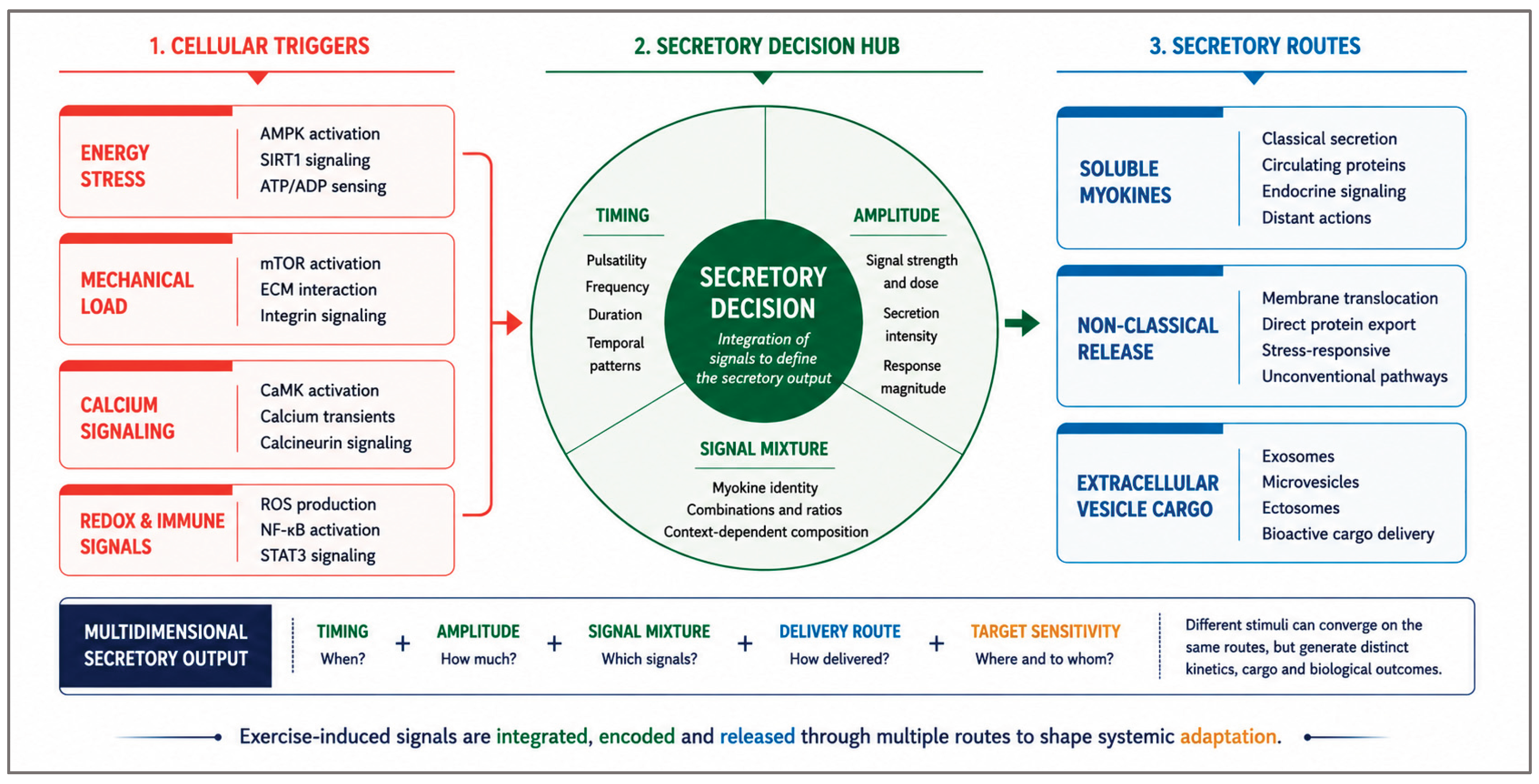
Figure 2.
Adaptive versus maladaptive myokine signatures. Healthy trained muscle generates transient, coordinated and efficiently decoded signaling patterns, whereas aging and chronic disease may produce blunted, chronically elevated or compositionally distorted signals accompanied by impaired target-organ responsiveness. Conceptual synthesis informed by immunometabolic, aging, sarcopenia, cardiopulmonary and cachexia evidence [39,40,41,42,79,80,81,82,83,84,85,86,87,88,89,90,91,92,93,94,95,96,97,98,99,100,101,102,103,104,105,106,107,108,109,110,111,112,113,114,115,116,117,118].
Figure 2.
Adaptive versus maladaptive myokine signatures. Healthy trained muscle generates transient, coordinated and efficiently decoded signaling patterns, whereas aging and chronic disease may produce blunted, chronically elevated or compositionally distorted signals accompanied by impaired target-organ responsiveness. Conceptual synthesis informed by immunometabolic, aging, sarcopenia, cardiopulmonary and cachexia evidence [39,40,41,42,79,80,81,82,83,84,85,86,87,88,89,90,91,92,93,94,95,96,97,98,99,100,101,102,103,104,105,106,107,108,109,110,111,112,113,114,115,116,117,118].
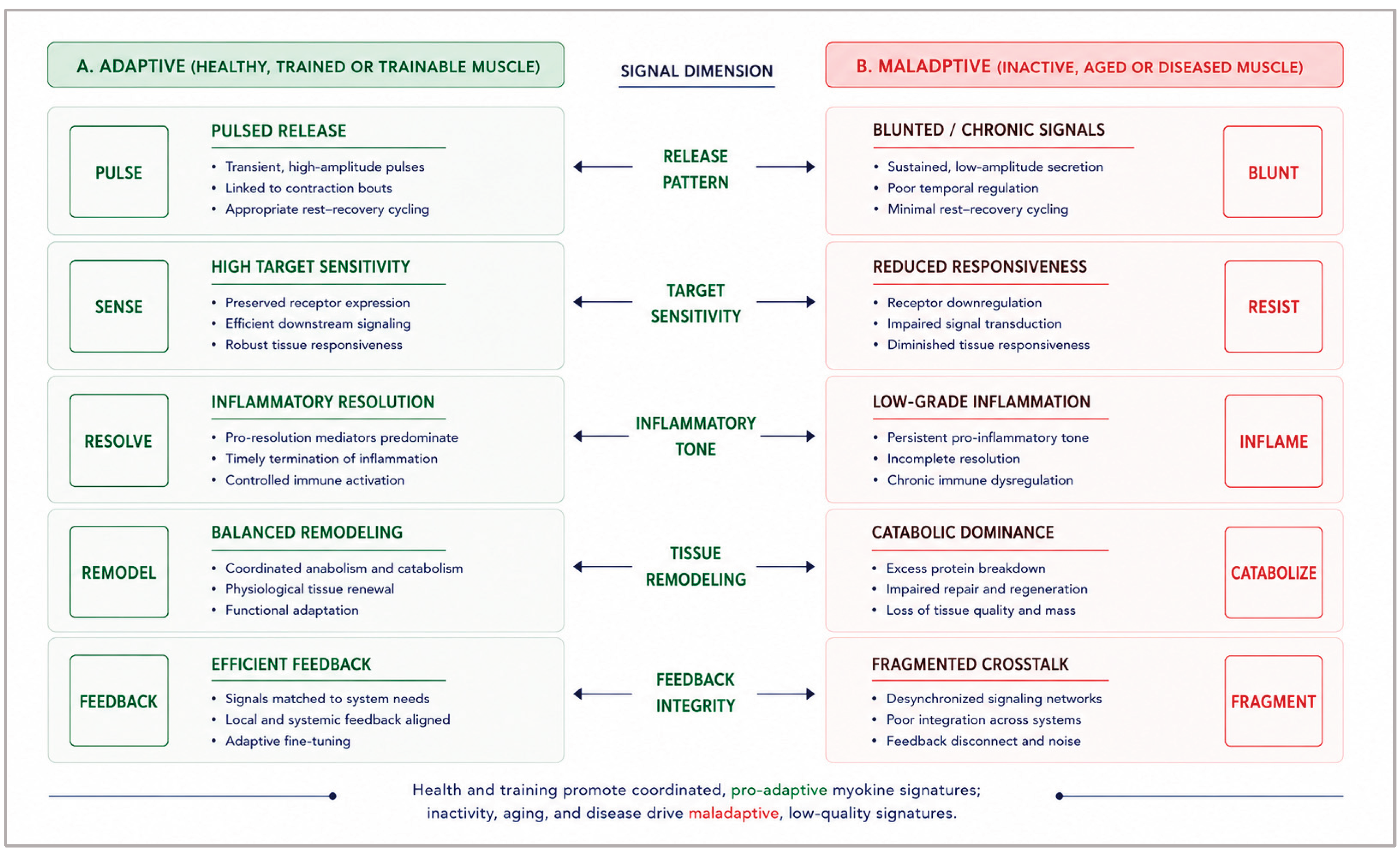
Figure 3.
The myokine adaptome: from contractile stimuli to systemic adaptation. Exercise-derived inputs and contextual modifiers are integrated by intracellular sensing networks and encoded into multidimensional myokine signals defined by amplitude, timing, composition, delivery route, and target-organ sensitivity. These signals are decoded across multiple tissues and organs, ultimately shaping adaptive phenotypes related to metabolism, inflammation, remodeling, and resilience. Conceptual synthesis informed by systems physiology, molecular biomarker and multi-omics exercise literature [4,5,6,8,9,10,11,12,13,14,15,16,17,124].
Figure 3.
The myokine adaptome: from contractile stimuli to systemic adaptation. Exercise-derived inputs and contextual modifiers are integrated by intracellular sensing networks and encoded into multidimensional myokine signals defined by amplitude, timing, composition, delivery route, and target-organ sensitivity. These signals are decoded across multiple tissues and organs, ultimately shaping adaptive phenotypes related to metabolism, inflammation, remodeling, and resilience. Conceptual synthesis informed by systems physiology, molecular biomarker and multi-omics exercise literature [4,5,6,8,9,10,11,12,13,14,15,16,17,124].
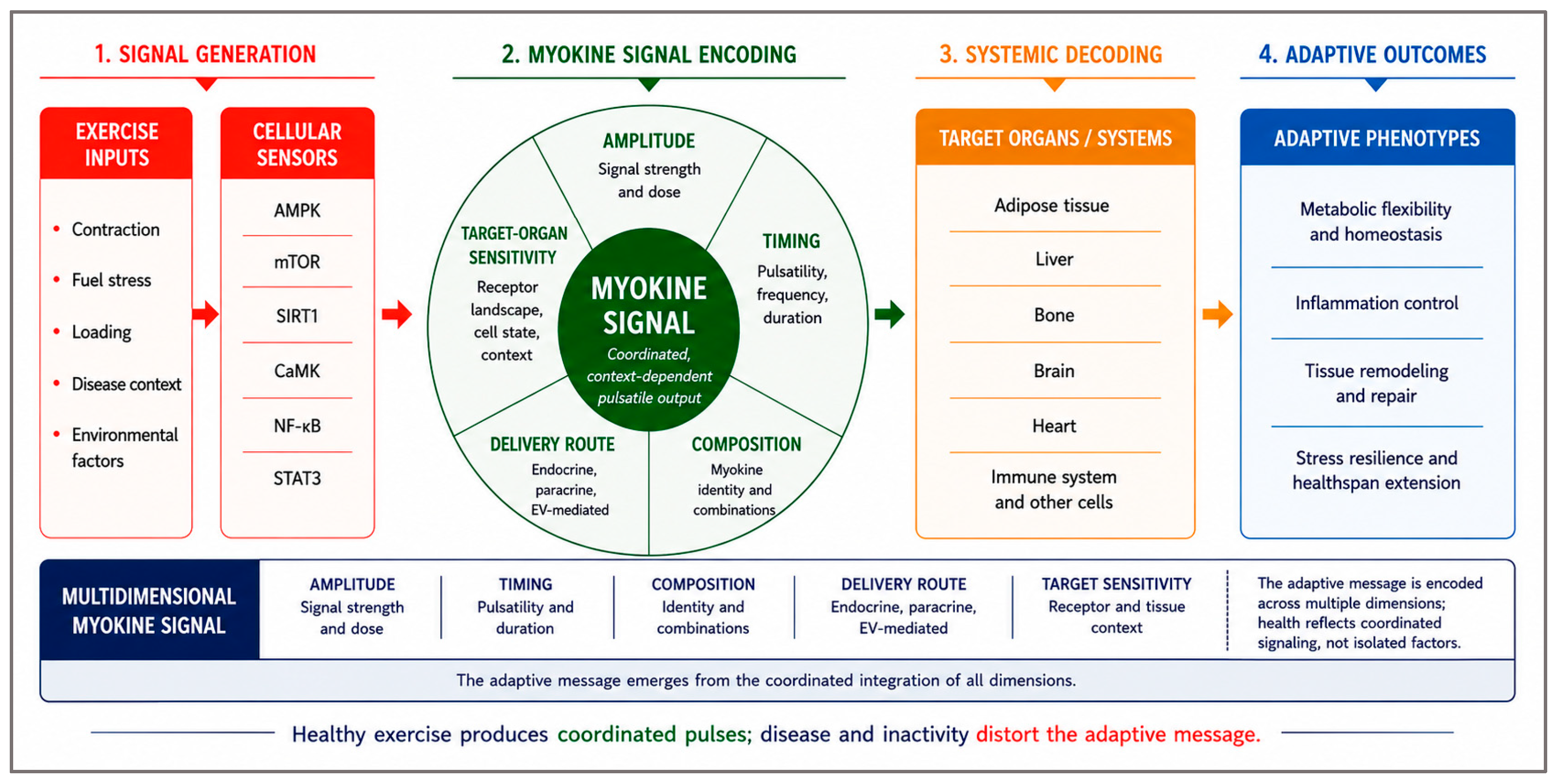
Figure 4.
Translational pipeline from myokine biology to exercise medicine. Biomarker discovery and therapeutic translation require phenotyping, time-resolved profiling, mechanistic interpretation, individualized exercise prescription and longitudinal monitoring. Conceptual synthesis informed by exercise medicine, biomarker, immune-function and clinical exercise-prescription literature [86,95,102,103,104,105,113,117,118].
Figure 4.
Translational pipeline from myokine biology to exercise medicine. Biomarker discovery and therapeutic translation require phenotyping, time-resolved profiling, mechanistic interpretation, individualized exercise prescription and longitudinal monitoring. Conceptual synthesis informed by exercise medicine, biomarker, immune-function and clinical exercise-prescription literature [86,95,102,103,104,105,113,117,118].
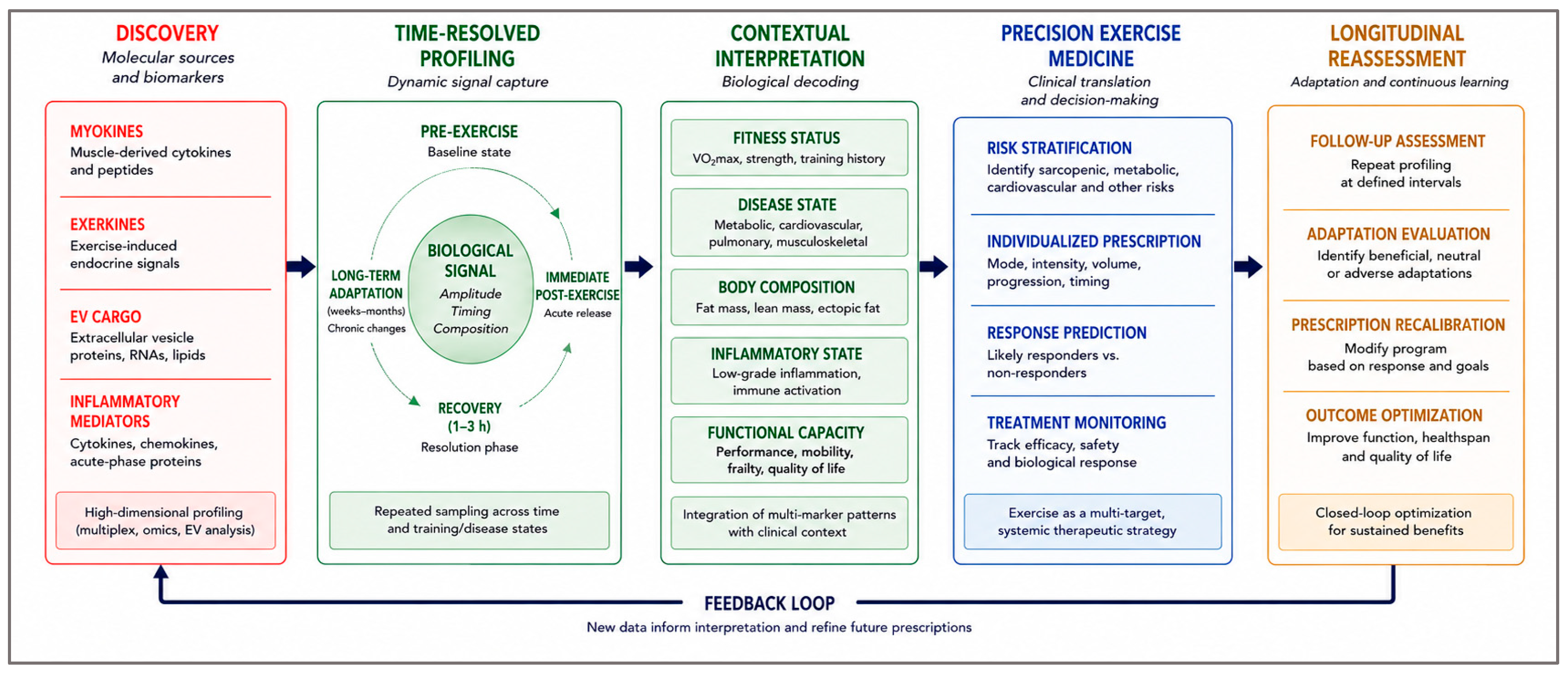
Figure 5.
The myokine adaptome: an adaptive biological information-processing framework. Exercise stimuli are integrated by skeletal-muscle sensing networks and encoded into multidimensional signaling patterns defined by amplitude, timing, composition, delivery route and target sensitivity. The biological meaning of these signals is further shaped by source attribution, temporal dynamics and disease context before being decoded across metabolic, musculoskeletal, neurovascular and immune systems. Adaptive or maladaptive outcomes emerge from decoding quality rather than from the abundance of individual mediators alone, emphasizing that biological meaning is jointly determined by signal generation, contextual encoding and target-organ responsiveness.
Figure 5.
The myokine adaptome: an adaptive biological information-processing framework. Exercise stimuli are integrated by skeletal-muscle sensing networks and encoded into multidimensional signaling patterns defined by amplitude, timing, composition, delivery route and target sensitivity. The biological meaning of these signals is further shaped by source attribution, temporal dynamics and disease context before being decoded across metabolic, musculoskeletal, neurovascular and immune systems. Adaptive or maladaptive outcomes emerge from decoding quality rather than from the abundance of individual mediators alone, emphasizing that biological meaning is jointly determined by signal generation, contextual encoding and target-organ responsiveness.
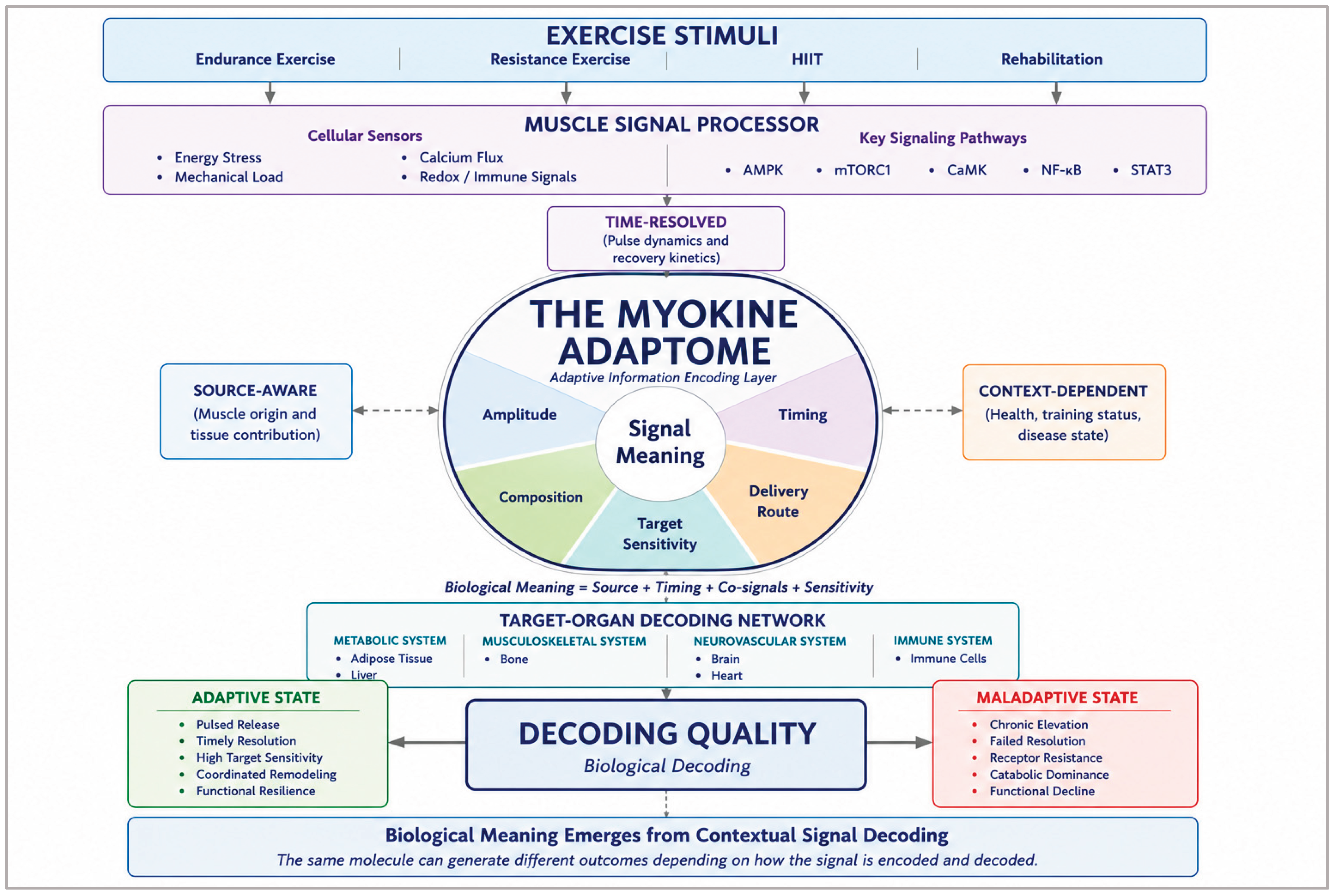

Table 1.
Major myokines and myokine-associated exerkines relevant to the myokine adaptome.
| Mediator or class | Exercise or disease context | Main targets | Proposed function | Interpretive note |
| IL-6 | Acute endurance or glycogen-depleted exercise; chronic inflammation | Liver, adipose tissue, immune cells, muscle | Fuel mobilization, glucose homeostasis, anti-inflammatory cascade | Meaning depends strongly on timing and source |
| IL-15 | Exercise-responsive immunometabolic signaling | Adipose tissue, immune cells, muscle | Muscle-adipose crosstalk and immune regulation | Mechanistic certainty varies across protocols |
| Myostatin | Aging, disuse, cachexia; training modulation | Muscle, bone, connective tissue | Negative regulation of muscle growth | Central catabolic/remodeling signal |
| Follistatin/decorin | Resistance exercise, ECM remodeling | Muscle fibers, ECM, myostatin pathways | Counter-regulation of myostatin and hypertrophic remodeling | Relevant for resistance training adaptation |
| FNDC5/irisin | Endurance exercise, PGC-1α signaling | Adipose tissue, bone, brain, muscle | Thermogenic, bone and possible neuroplasticity signaling | Requires rigorous assay validation |
| FGF21 | Exercise and fasting-like metabolic stress | Liver, adipose tissue, muscle | Fuel stress response and lipid/glucose metabolism | Not muscle exclusive |
| Myonectin/CTRP15 | Exercise and lipid flux | Liver, adipose tissue | Systemic lipid homeostasis | Representative metabolic myokine |
| BDNF/cathepsin B | Exercise-neuroplasticity pathways | Brain, muscle and metabolic tissues | Fat oxidation, memory and neuroplasticity links | Peripheral-to-brain causality remains complex |
| SPARC/irisin-bone axis | Exercise, ECM and bone contexts | Colon tissue, bone, muscle-bone unit | Tissue remodeling, bone effects and possible tumor-related effects | Illustrates muscle-bone/tissue crosstalk |
| Extracellular vesicle cargo | Acute exercise, chronic training, disease contexts | Multiple organs | Packaged proteins, lipids and RNAs | Source attribution is essential |
Table 2.
Disease-specific remodeling of the myokine adaptome.
|
Disease context |
Adaptome distortion |
Mechanistic interpretation |
Clinical consequence |
Exercise relevance |
|
Obesity/ type 2 diabetes |
Inflammatory background and impaired insulin signaling | Adipokine-myokine imbalance and reduced target sensitivity | Insulin resistance and low metabolic flexibility | Aerobic/resistance training may restore glucose uptake and responsiveness |
| Sarcopenia/aging | Anabolic resistance and higher catabolic tone | Myostatin/activin dominance, mitochondrial decline, impaired regenerative niche | Weakness, frailty and reduced resilience | Progressive resistance and multimodal exercise are central |
|
Osteoporosis/ osteosarcopenia |
Reduced loading plus altered muscle-bone endocrine communication | Impaired balance among irisin, SPARC, decorin and myostatin-related pathways | Fracture risk and coupled muscle-bone decline | Resistance and impact-loading programs may improve crosstalk |
|
Cardiovascular disease |
Reduced vascular responsiveness and chronic inflammation | Endothelial dysfunction limits signal delivery and decoding | Lower functional capacity and cardiometabolic risk | Aerobic and interval training improve vascular and mitochondrial profiles |
| COPD | Peripheral muscle dysfunction, systemic inflammation, inactivity cycle | Muscle-lung-immune crosstalk becomes maladaptive | Exercise intolerance, dyspnea and reduced quality of life | Pulmonary rehabilitation can be framed as adaptome retraining |
| Cancer/cachexia | Tumor-driven inflammation and catabolism | Muscle secretome may influence immune tone and tumor microenvironment | Muscle loss, fatigue and reduced treatment tolerance | Exercise oncology requires disease-specific prescription |
Note. The table interprets disease as a distortion of both signal generation and signal decoding. The proposed patterns should be tested with standardized exercise stimuli, serial sampling and functional endpoints [79,80,81,82,83,84,85,86,87,88,89,90,91,92,93,94,95,96,97,98,99,100,101,102,103,104,105,106,107,108,109,110,111,112,113,114,115,116,117,118].
Table 3.
Novelty and positioning of the myokine adaptome relative to related exercise-signaling concepts.
Table 3.
Novelty and positioning of the myokine adaptome relative to related exercise-signaling concepts.
| Existing concept | Primary focus | Main limitation | Adaptome perspective |
|
Muscle secretome |
Molecular repertoire released by skeletal muscle and muscle-resident cells. | Often interpreted as a static inventory or abundance profile. | Treats secretion as adaptive information defined by timing, source, composition and decoding. |
| Exerkines | Exercise-responsive circulating factors from muscle and non-muscle tissues. | Exercise responsiveness alone does not establish skeletal-muscle origin. | Separates bona fide myokines from broader exercise-responsive signals through source-aware interpretation. |
| Inter-organ crosstalk | Communication among muscle, adipose tissue, liver, bone, brain, immune and vascular systems. | Often describes organ links without a clear temporal encoding-decoding structure. | Adds a generation-encoding-decoding sequence and explicitly includes target-organ sensitivity. |
|
Biomarker panels |
Multi-marker prediction of training response, recovery or disease status. | Can remain descriptive if not connected to tissue source and function. | Requires serial sampling, validated assays, source attribution and clinically meaningful endpoints. |
|
Myokine adaptome |
Adaptive signaling state produced and decoded during exercise, recovery, aging and disease. | Still requires prospective validation in standardized human perturbation studies. | Provides a falsifiable framework for personalized exercise medicine and rehabilitation monitoring. |
Note. The table clarifies why the adaptome is presented as an information-processing and decoding framework rather than as a renamed secretome. The distinction must be operationalized through timing, source attribution, multi-marker profiles and functional outcomes [4,5,6,7,12,13,14,15,16,17,18,19,20,71,72,73,74,75,76].
Table 4.
Critical challenges, falsification risks and methodological safeguards for adaptome studies.
Table 4.
Critical challenges, falsification risks and methodological safeguards for adaptome studies.
| Challenge | Why it threatens interpretation | Recommended safeguard |
| Source attribution | Circulating factors may originate from liver, adipose tissue, immune cells, endothelium, platelets or bone rather than skeletal muscle. | Use muscle biopsies, tissue-specific markers, cell-specific EV capture, arterio-venous sampling or experimental source models. |
| Timing heterogeneity | Single time points can miss transient peaks, delayed responses or resolution failure. | Use serial sampling before exercise, immediately after, during early recovery and after longer recovery/training periods. |
| Assay variability | ELISA kits, sample handling, serum/plasma choice and EV isolation methods can change apparent concentrations. | Use validated assays, report pre-analytics, include technical replicates and apply orthogonal confirmation where possible. |
| EV heterogeneity | Total plasma EV cargo is a mixed signal from multiple tissues and cell types. | Combine size/exclusion or immunocapture strategies with cargo validation and tissue-informed interpretation. |
| Causality versus association | Mediator changes may accompany exercise without driving functional adaptation. | Pair biomarker profiling with receptor engagement, pathway activation and functional endpoints. |
| Disease confounding | Age, obesity, medications, nutrition, sleep and inflammation can distort both secretion and clearance. | Stratify cohorts, standardize nutrition and medication timing where possible and model baseline inflammatory state. |
| Target-organ decoding | Adaptive meaning depends on receptor landscape, perfusion, uptake and tissue sensitivity. | Measure downstream tissue function, receptor/transport markers, vascular access or clinical response, not only circulating concentrations. |
Note. These safeguards are designed to prevent overclaiming single-molecule causality. They draw on epigenetic, miRNA, EV, autophagy, metabolic disease, sarcopenia, cardiopulmonary, cancer/cachexia and personalized-exercise literature [33,34,35,65,66,67,68,69,70,96,97,98,99,100,101,102,103,104,105,106,107,108,109,110,111,112,113,114,115,116,117,118,134,135,136,137,138,139,140,141].
Disclaimer/Publisher’s Note: The statements, opinions and data contained in all publications are solely those of the individual author(s) and contributor(s) and not of MDPI and/or the editor(s). MDPI and/or the editor(s) disclaim responsibility for any injury to people or property resulting from any ideas, methods, instructions or products referred to in the content. |
© 2026 by the authors. Licensee MDPI, Basel, Switzerland. This article is an open access article distributed under the terms and conditions of the Creative Commons Attribution (CC BY) license (http://creativecommons.org/licenses/by/4.0/).
Copyright: This open access article is published under a Creative Commons CC BY 4.0 license, which permit the free download, distribution, and reuse, provided that the author and preprint are cited in any reuse.


