

Submitted:
10 June 2026
Posted:
12 June 2026
You are already at the latest version
Abstract
Background/Objectives: Advanced maternal age (≥35 years) significantly increases the risk of fetal chromosomal abnormalities, particularly trisomies 21, 18, and 13. Non-invasive prenatal testing (NIPT) based on cell-free fetal DNA (cffDNA) in maternal plasma has substantially improved the accuracy and safety of prenatal screening. Methods: We previously developed and clinically validated a multiplex droplet digital PCR (ddPCR)-based NIPT assay for detecting fetal trisomies 21, 18, and 13 in Mongolia. The assay targeted specific loci on chromosomes 21, 18, and 13, using chromosome 1 as an internal reference. A Z-score threshold >3 indicated high risk, and all positive results were confirmed by invasive karyotyping. Results: In this study we collected 74 pregnant women of advanced maternal age and samples were successfully analyzed, with high technical performance (mean >100,000 accepted droplets per reaction and clear signal separation). Ten high-risk pregnancy cases were identified (8 trisomy 21 and 2 trisomy 18), all of which showed complete concordance with confirmatory karyotyping. Complete concordance with available reference standard results were observed in this limited cohort. No trisomy 13 cases were detected. Conclusions: This ddPCR-based NIPT assay exhibited excellent diagnostic accuracy and reproducibility in a Mongolian cohort of advanced maternal age pregnancies. Its technical simplicity, relatively low cost, and minimal infrastructure requirements make it a promising tool for implementation in resource-limited settings. However, the small sample size limits generalizability, and larger multicenter studies are needed to confirm clinical utility across broader populations, including low-risk pregnancies.
Keywords:
NIPT
; ddPCR
; advanced maternal age
; trisomy 21
; cell-free fetal DNA
; prenatal diagnosis
1. Introduction
Chromosome abnormalities are a major contributor to perinatal morbidity and mortality and the leading cause of congenital diseases worldwide. Among these, the most frequently detected conditions in prenatal screening are the common autosomal aneuploidies such trisomy 21 (Down syndrome), trisomy 18 (Edwards syndrome), and trisomy 13 (Patau syndrome) [1,2]. The incidence of fetal aneuploidy is strongly associated with maternal age, with a marked increase observed in women aged 35 years and older, and commonly defined as advanced maternal age (AMA) [3].
Women of AMA are considered a high-risk group for chromosomal abnormalities, and therefore require more accurate and reliable prenatal screening strategies. Traditional prenatal testing for fetal chromosomal aneuploidies includes both invasive diagnostic procedures like amniocentesis and chorionic villus sampling (CVS) and non-invasive screening methods using maternal serum and ultrasound scanning. Although invasive tests have a high degree of accuracy, there is a risk of miscarriage because of the procedures [4,5,6].
The identification of cell-free fetal DNA (cffDNA) in maternal plasma has enabled the development of non-invasive prenatal testing (NIPT). Maternal plasma consists of cfDNA which may be composed from 4% - 20% of the fetal fraction after 10 weeks of pregnancy and these originate from the placenta’s trophoblast cells [7,8]. In the last decade, NGS based NIPT has excellent clinic performance and is applied gradually. However, despite these advantages, NGS-based methods are not without limitations. They require specialized equipment, complex bioinformatics analysis, and relatively long processing times. In addition, the associated costs may limit their routine use, especially in laboratories with constrained resources [9,10].
Digital droplet PCR (ddPCR) may allow a partitioned reaction and absolute quantitation through Poisson statistics and no standard curves, for very accurate measurements of small chromosomal changes in a low-fraction sample: faster, simpler and less expensive than NGS [11,12]. Recent studies have confirmed the usefulness of ddPCR for non-invasive screening for common aneuploidies. Multiplex assay designs targeting multiple regions on chromosomes 21, 18, and 13 have achieved high levels of sensitivity and specificity. In several validation studies, excellent concordance between ddPCR results and invasive test results has been reported [13,14,15].
Despite these advantages, the clinical application of ddPCR-based NIPT in high-risk populations, particularly among women of advanced maternal age, remains limited and requires further validation. Building on our previous work, in which we developed and validated a ddPCR-based NIPT protocol and established the z-score thresholds and cut-off values in a cohort of 100 pregnant women [16], the present study seeks to extend this framework to a clinically relevant high-risk group. Accordingly, this study aims to evaluate the diagnostic performance of a ddPCR-based non-invasive prenatal testing approach for the detection of common fetal aneuploidies specifically trisomy 21, trisomy 18, and trisomy 13 in pregnant women aged 35 years and older, using cell-free fetal DNA extracted from maternal plasma.
2. Materials and Methods
2.1. Study Population Study Design and Sample Collection
This study was conducted to evaluate the performance of a digital droplet PCR (ddPCR)-based non-invasive prenatal testing (NIPT) approach for the detection of fetal trisomy 21, 18, and 13 using clinical plasma samples collected at the National Center for Maternal and Child Health (NCMCH), Mongolia. All participants received both verbal and written information regarding the study objectives and procedures, and written informed consent was obtained prior to sample collection in accordance with institutional ethical guidelines.
Peripheral blood samples were collected into cell-free DNA (cfDNA) stabilization tubes and processed within six hours of collection to minimize maternal cell lysis and contamination. Plasma was separated by a two-step centrifugation protocol and stored at −80 °C until further analysis.
2.2. cfDNA Purification of Plasma Samples
cffDNA was extracted from 1 to 4 mL of maternal plasma using the QIAamp® MinElute® ccfDNA Mini Kit (Qiagen, Germany), following the manufacturer’s instructions. Extracted DNA was quantified and stored at −20 °C until further analysis.
2.3. Droplet Digital PCR Assay
A multiplex droplet digital PCR (ddPCR) assay was performed using the iSAFE™ NIPT Kit (Atila Biosystems, USA), which targets chromosome-specific regions on chromosomes 21, 18, and 13, along with chromosome 1 as an internal reference. The reaction mix included QIAcuity Probe PCR Mix, primers and hydrolysis probes for the target chromosomes, fetal fraction determination primers, and Buffer I. For each reaction, 25 ng of cfDNA was added to the mixture, incubated at room temperature for five minutes, and then loaded in quadruplicate into a 96-well plate with 40 µL per well. Droplet generation and PCR amplification were performed using the QIAcuity One Digital PCR System (Qiagen, Germany). The thermal cycling protocol consisted of an initial enzyme activation step at 95 °C for 2 minutes, followed by 10 cycles of 95 °C for 15 seconds and 66 °C for 3 minutes, and an additional 40 cycles of 95 °C for 15 seconds and 70 °C for 60 seconds. Each assay included negative (no-template) controls and a synthetic positive control containing 4% fetal fraction with trisomy 21 to ensure assay validity. Data analysis was performed using the manufacturer’s proprietary algorithm based on chromosome-specific target-to-reference signal ratios. A population Z-score threshold of >3 was considered indicative of high risk for fetal aneuploidy, consistent with our previous study [16].
2.4. Data Analysis
Data analysis was performed using the QIAcuity® Software Suite for droplet counting, concentration calculation, and quality control. Final aneuploidy classification was conducted with the Atila Biosystems proprietary software. All 74 clinical plasma samples yielded high-quality data with sufficient droplet counts for reliable quantification. Diagnostic performance metrics, including sensitivity, specificity, positive predictive value (PPV), and negative predictive value (NPV), were calculated using standard 2 × 2 contingency tables with 95% confidence intervals (CI). Descriptive statistics are presented as mean ± standard deviation (SD). Correlation analyses between fetal fraction, maternal age, and gestational age were performed using Pearson’s correlation test. Statistical significance was defined as p < 0.05. All statistical analyses were performed using GraphPad Prism version 8 (GraphPad Software, San Diego, CA, USA).
3. Results
3.1. Demographic Characteristics and Technical Performance
A total of 74 pregnant women of advanced maternal age (≥35 years) were included in this study. The maternal age ranged from 35 to 47 years, with a mean age of 39.00 ± 2.91 years. The majority of participants (63.51%) were between 35–39 years, while 36.49% were older than 40 years.
Body Mass Index (BMI) ranged from 20.70 to 36.30, with a mean BMI of 27.08 ± 3.64. The gestational age (GA) ranged from 10+4 to 18+6 weeks, with a mean GA of 13.57 ± 2.805 weeks. All pregnancies were singleton. The primary clinical indication for testing was positive serum screening (56.76%), followed by abnormal ultrasound findings (13.51%) and adverse reproductive history (1.35%) (Table 1)
From a technical perspective, all cfDNA samples were successfully analyzed using the ddPCR platform. Each sample was processed in quadruplicate, with a mean of 101,772 accepted droplets per reaction (range: 100,849–101,956), which passed the QIAcuity software’s quality filters for reliable quantification. All maternal plasma samples met the assay quality-control criteria, with fetal fractions exceeding 2% in all cases. Statistical analysis showed no significant association between fetal fraction and maternal age or gestational age within the study cohort (p > 0.05). These findings suggest that fetal fraction variability did not substantially influence assay performance in this study population.
Clear separation between positive and negative droplets was observed for all target and reference chromosomes, indicating high signal quality and minimal background noise. No-template controls consistently showed no amplification, confirming the absence of contamination. In addition, the synthetic positive control (4% fetal fraction with trisomy 21) was reliably detected in all runs, demonstrating assay stability and reproducibility.
3.2. Detection of Fetal Aneuploidies
Based on ddPCR analysis of cfDNA, 10 cases of fetal aneuploidy were identified, including T21 (n=8), T18 (n=2), and T13 (n=0). All cases were further confirmed by invasive diagnostic testing (CVS or amniocentesis), and complete concordance between ddPCR-NIPT results and karyotyping was observed (Table 2).
Z-score analysis demonstrated that all confirmed T21 cases had values above the predefined threshold (>3), ranging from 3.37 to 17.74. Similarly, T18 cases showed elevated z-scores (4.14–5.07), while no abnormal z-scores were observed for chromosome 13(Figure 1.).
3.3. Diagnostic Performance
The eight positive NIPT results for T21 were all confirmed by karyotyping; therefore, the sensitivity and specificity were both 100% (95% CI: ~63–100% and ~94.6–100%, respectively). The false-positive rate (FPR) and false-negative rate (FNR) were 0%, and the positive predictive value (PPV) was 100%. For T18, the sensitivity and specificity were also 100% (95% CI: ~34–100% and ~95–100%, respectively), the FPR and FNR were 0%, and PPV was 100%. During the study period, no 13 chromosome anomalies were detected by NIPT or karyotyping in this cohort.
4. Discussion
In this study, we evaluated the performance of a ddPCR based NIPT approach in a cohort of pregnant women of AMA. The assay exhibited remarkable diagnostic accuracy, achieving 100% sensitivity and 100% specificity for both trisomy 21 and trisomy 18, and showed complete agreement with conventional karyotyping.
Among 74 high-risk pregnancies, the detection of eight cases of trisomy 21 and two cases of trisomy 18 aligns with the established epidemiological distribution of autosomal aneuploidies, where trisomy 21 is the most common, followed by trisomy 18 and trisomy 13 [6].Given its comparatively lower occurrence, the lack of trisomy 13 instances in our sample was therefore not surprising and is consistent with trends found in recent cfDNA based screening studies [7,17].
One of this study’s main advantages is the complete agreement between invasive diagnostic techniques and ddPCR-based NIPT results. These findings are consistent with previous ddPCR validation studies. Dai et al. [11] found excellent concordance using multiplex ddPCR, but D’Aversa et al. [14] and Tan et al. [13] showed strong analytical performance using droplet-based methods. Furthermore, trisomy 21 can be accurately identified even in samples with a low fetal fraction, as demonstrated by Laššáková et al. [9]. Also, digital PCR-based NIPT techniques offer sensitivity and specificity comparable to established cfDNA procedures, according to a meta-analysis by Parsaei et al. [12]. Our results contribute to the increasing body of research demonstrating the accuracy of ddPCR in prenatal screening.
The women of AMA, a cohort known to have a markedly increased risk of fetal chromosomal abnormalities due to age-related increases in meiotic nondisjunction, were the specific focus of this investigation. For instance, the likelihood of having trisomy 21 rises from roughly 1 in 1,480 at age 20 to 1 in 353 at age 35 and finally to 1 in 35 at age 45. In order to avoid needless invasive procedures like amniocentesis or chorionic villus collection, which carry a small but quantifiable risk of miscarriage (0.1–0.5%), current clinical guidelines from organizations like ACOG and SMFM recommend using highly accurate screening technologies in this group [1,4,18].
This study has several limitations. First, the relatively small sample size (n=74, with only 10 aneuploid cases) resulted in wide confidence intervals and may overestimate diagnostic performance. Second, although all samples demonstrated fetal fractions above 2%, broader evaluation across diverse clinical settings is still required. Third, the study was conducted in a single center and focused exclusively on high-risk pregnancies; therefore, generalizability to low-risk or unselected populations remains unknown. Finally, no trisomy 13 cases were observed, so the assay’s performance for this aneuploidy could not be evaluated.
This AMA cohort’s exceptional diagnostic performance indicates that ddPCR-based NIPT may be a useful first-line screening method for this high-risk group, thereby eliminating the need for invasive testing while preserving high detection rates for common trisomies. As Mongolia’s national maternal health system continues to develop, this assay represents a technically feasible and cost-conscious option that could be integrated into existing screening pathways with relatively modest investment. Wider implementation, supported by prospective multicenter validation, could meaningfully improve early detection of fetal chromosomal abnormalities across the country.
5. Conclusions
In conclusion, this study demonstrates that the ddPCR-based NIPT assay using the iSAFE™ kit provides highly accurate and reproducible detection of fetal trisomies 21 and 18 in maternal plasma, with complete concordance to invasive karyotyping in a Mongolian cohort of advanced maternal age pregnancies. Its technical simplicity, relatively low cost, and minimal infrastructure requirements position it as a promising screening option, particularly in resource-limited settings. Larger prospective studies are needed to confirm these findings and evaluate performance in broader populations.
Author Contributions
Conceptualization, Khaliunaa Tuvshinjargal, Gerelsuren Batbayar, Nomuun Oyunbat and Dolgion Damdinbazar; methodology, Khaliunaa Tuvshinjargal, Gerelsuren Batbayar, Nomuun Oyunbat and Dolgion Damdinbazar; investigation, Khaliunaa Tuvshinjargal, Gerelsuren Batbayar, Nomuun Oyunbat and Dolgion Damdinbazar; formal analysis, Khaliunaa Tuvshinjargal; data curation, Khaliunaa Tuvshinjargal; validation, Gantulga Davaakhuu, Oyunsuren Tsendsuren and Jamiyan Purevsuren; writing—original draft preparation, Khaliunaa Tuvshinjargal, Gerelsuren Batbayar ; writing—review and editing, Gantulga Davaakhuu, Oyunsuren Tsendsuren and Jamiyan Purevsuren; supervision, Gantulga Davaakhuu and Jamiyan Purevsuren; project administration, Gantulga Davaakhuu; resources, Gerelsuren Batbayar, Khaliunaa Tuvshinjargal; funding acquisition, Gantulga Davaakhuu. All authors contributed substantially to the conception, design, acquisition, analysis, or interpretation of data, approved the final version of the manuscript, and agreed to be accountable for all aspects of the work.
Funding
This research was funded by the Ministry of Health of Mongolia and the Mongolian Foundation for Science and Technology through the project entitled “Digital PCR-Based Non-Invasive Prenatal Diagnosis of Fetal Abnormalities” (Grant No. ShUUZ-2023/298). The APC was funded by the Institute of Biology, Mongolian Academy of Sciences.
Institutional Review Board Statement
The present study was approved by the Ethics Committee of the Ministry of Health of Mongolia on June 26, 2024 (Ethical approval no.24/059).
Informed Consent Statement
Informed consent was obtained from all subjects involved in the study.
Data Availability Statement
The data presented in this study are available from the corresponding author upon reasonable request. The data are not publicly available due to privacy and ethical restrictions related to the clinical information of the study participants.
Acknowledgments
We would like to acknowledge the Ministry of Health and Mongolian Foundation for Science and Technology for supporting the project “Digital PCR-Based Non-Invasive Prenatal Diagnosis of Fetal Abnormalities” (ShUUZ-2023/298).
Conflicts of Interest
The authors declare no conflicts of interest. The funders had no role in the design of the study; in the collection, analyses, or interpretation of data; in the writing of the manuscript; or in the decision to publish the results.
Abbreviations
The following abbreviations are used in this manuscript:
| NIPT | Non-invasive prenatal testing |
| cffDNA | cell-free fetal DNA |
| ddPCR | droplet digital PCR |
| AMA | advanced maternal age |
| NCMCH | National Center for Maternal and Child Health |
| cfDNA | cell-free DNA |
References
- Benn, P.; Borrell, A.; Chiu, R. W. K.; Cuckle, H.; Dugoff, L.; Faas, B.; Gross, S.; Huang, T.; Johnson, J.; Maymon, R.; Norton, M.; Odibo, A.; Schielen, P.; Spencer, K.; Wright, D.; Yaron, Y. Position statement from the Chromosome Abnormality Screening Committee on behalf of the Board of the International Society for Prenatal Diagnosis. Prenat. Diagn. 2015, 35(8), 725–734. [Google Scholar] [CrossRef] [PubMed]
- Carbone, L.; Cariati, F.; Sarno, L.; Conforti, A.; Bagnulo, F.; Strina, I.; Pastore, L.; Maruotti, G. M.; Alviggi, C. Non-invasive prenatal testing: Current perspectives and future challenges. Genes 2020, 12(1), 15. [Google Scholar] [CrossRef] [PubMed]
- Heffner, L. J. Advanced maternal age—how old is too old? N. Engl. J. Med. 2004, 351(19), 1927–1929. [Google Scholar] [CrossRef] [PubMed]
- Akolekar, R.; Beta, J.; Picciarelli, G.; Ogilvie, C.; D’Antonio, F. Procedure-related risk of miscarriage. Ultrasound Obstet. Gynecol. 2015, 45(1), 16–26. [Google Scholar] [CrossRef] [PubMed]
- Abedalthagafi, M.; Bawazeer, S.; Fawaz, R. I.; Heritage, A. M.; Alajaji, N. M.; Faqeih, E. Non-invasive prenatal testing: A revolutionary journey in prenatal testing. Front. Med. 10 2023, 1265090. [Google Scholar] [CrossRef] [PubMed]
- Taylor-Phillips, S.; Freeman, K.; Geppert, J.; et al. Accuracy of non-invasive prenatal testing using cell-free DNA for detection of Down, Edwards and Patau syndromes: A systematic review and meta-analysis. BMJ Open 6 2016, e010002. [Google Scholar] [CrossRef]
- Moufarrej, M. N.; Bianchi, D. W.; Shaw, G. M.; Stevenson, D. K.; Quake, S. R. Noninvasive prenatal testing using circulating DNA and RNA: Advances, challenges, and possibilities. Annu. Rev. Biomed. Data Sci. 6 2023, 397–418. [Google Scholar] [CrossRef] [PubMed]
- Norton, M. E.; Jacobsson, B.; Swamy, G. K.; Laurent, L. C.; Ranzini, A. C.; Brar, H.; Tomlinson, M. W.; Pereira, L.; Spitz, J. L.; Hollemon, D.; Cuckle, H.; Musci, T. J.; Wapner, R. J. Cell-free DNA analysis for noninvasive examination of trisomy. N. Engl. J. Med. 2015, 372(17), 1589–1597. [Google Scholar] [CrossRef] [PubMed]
- Laššáková, S.; Šenkyřík, P.; Pazourková, E.; Hořínek, A.; Calda, P.; Břešťák, M.; Světnicová, K.; Neužil, P.; Korabečná, M. Rapid non-invasive prenatal screening test for trisomy 21 based on digital droplet PCR. Sci. Rep. 13 2023, 22948. [Google Scholar] [CrossRef]
- Guo, Y.; Charoenkwan, P.; Traisrisilp, K.; Piyamongkol, W.; Tongprasert, F. Application of digital polymerase chain reaction (dPCR) in non-invasive prenatal testing (NIPT). Biomol. 15 2025, 360. [Google Scholar] [CrossRef]
- Dai, P.; Yang, Y.; Zhao, G.; Gu, Z.; Ren, H.; Hu, S.; Liu, N.; Jiao, W.; Li, J.; Kong, X. A dPCR-NIPT assay for detections of trisomies 21, 18 and 13 in a single-tube reaction—could it replace serum biochemical tests as a primary maternal plasma screening tool? J. Transl. Med. 20 2022, 269. [Google Scholar] [CrossRef]
- Parsaei, M.; Dashtkoohi, M.; Salmani, T. A.; Najafi, M. S.; Haddadi, M.; Ghaemi, M.; Hantoushzadeh, S. Potential efficacy of digital polymerase chain reaction for non-invasive prenatal screening of autosomal aneuploidies: A systematic review and meta-analysis. BMC Pregnancy Childbirth 24 2024, 472. [Google Scholar] [CrossRef] [PubMed]
- Tan, C.; Chen, X.; Wang, F.; Wang, D.; Cao, Z.; Zhu, X.; Lu, C.; Yang, W.; Gao, N.; Gao, H.; Guo, Y.; Zhu, L. A multiplex droplet digital PCR assay for non-invasive prenatal testing of fetal aneuploidies. Analyst 2019, 144(7), 2239–2247. [Google Scholar] [CrossRef] [PubMed]
- D’Aversa, E.; Breveglieri, G.; Boutou, E.; Balassopoulou, A.; Voskaridou, E.; Pellegatti, P.; Guerra, G.; Scapoli, C.; Gambari, R.; Borgatti, M. Droplet digital PCR for non-invasive prenatal detection of fetal single-gene point mutations in maternal plasma. Int. J. Mol. Sci. 23 2022, 2819. [Google Scholar] [CrossRef]
- Nykel, A.; Woźniak, R.; Gach, A. Clinical validation of novel chip-based digital PCR platform for fetal aneuploidies screening. Diagn. 11 2021, 1131. [Google Scholar] [CrossRef] [PubMed]
- Tuvshinjargal, K.; Batbayar, G.; Oyunbat, N.; Damdinbazar, D.; Purevsuren, J.; Bayarsaikhan, T.; Gombodorj, S.; Buriad, A.; Davaakhuu, G. Development and clinical implementation of a digital PCR-based method for non-invasive prenatal test of trisomy 21 in Mongolia. In Proceedings of the International Biological Conference in Mongolia 2025 (IBCM 2025); Atlantis Press, 2025; pp. 187–198. [Google Scholar] [CrossRef] [PubMed]
- Moser, T.; Kühberger, S.; Lazzeri, I.; Vlachos, G.; Heitzer, E. Bridging biological cfDNA features and machine learning approaches. Trends Genet. 2023, 39(4). [Google Scholar] [CrossRef] [PubMed]
- American College of Obstetricians and Gynecologists (ACOG). Pregnancy at age 35 years or older. Obstet. Gynecol. 2022, 140(2), 348–366. [Google Scholar] [CrossRef] [PubMed]
Figure 1.
Scatter plot of Z-scores for fetal aneuploidies with a cutoff at Z-score= 3. The Z-scores of chromosomes 21, 18 and 13 are represented on the Y-axis. The solid line represents the high risk cutoff value, and the dotted line represents the intermediate risk cutoff value for each aneuploidy test. T, trisomy.
Figure 1.
Scatter plot of Z-scores for fetal aneuploidies with a cutoff at Z-score= 3. The Z-scores of chromosomes 21, 18 and 13 are represented on the Y-axis. The solid line represents the high risk cutoff value, and the dotted line represents the intermediate risk cutoff value for each aneuploidy test. T, trisomy.
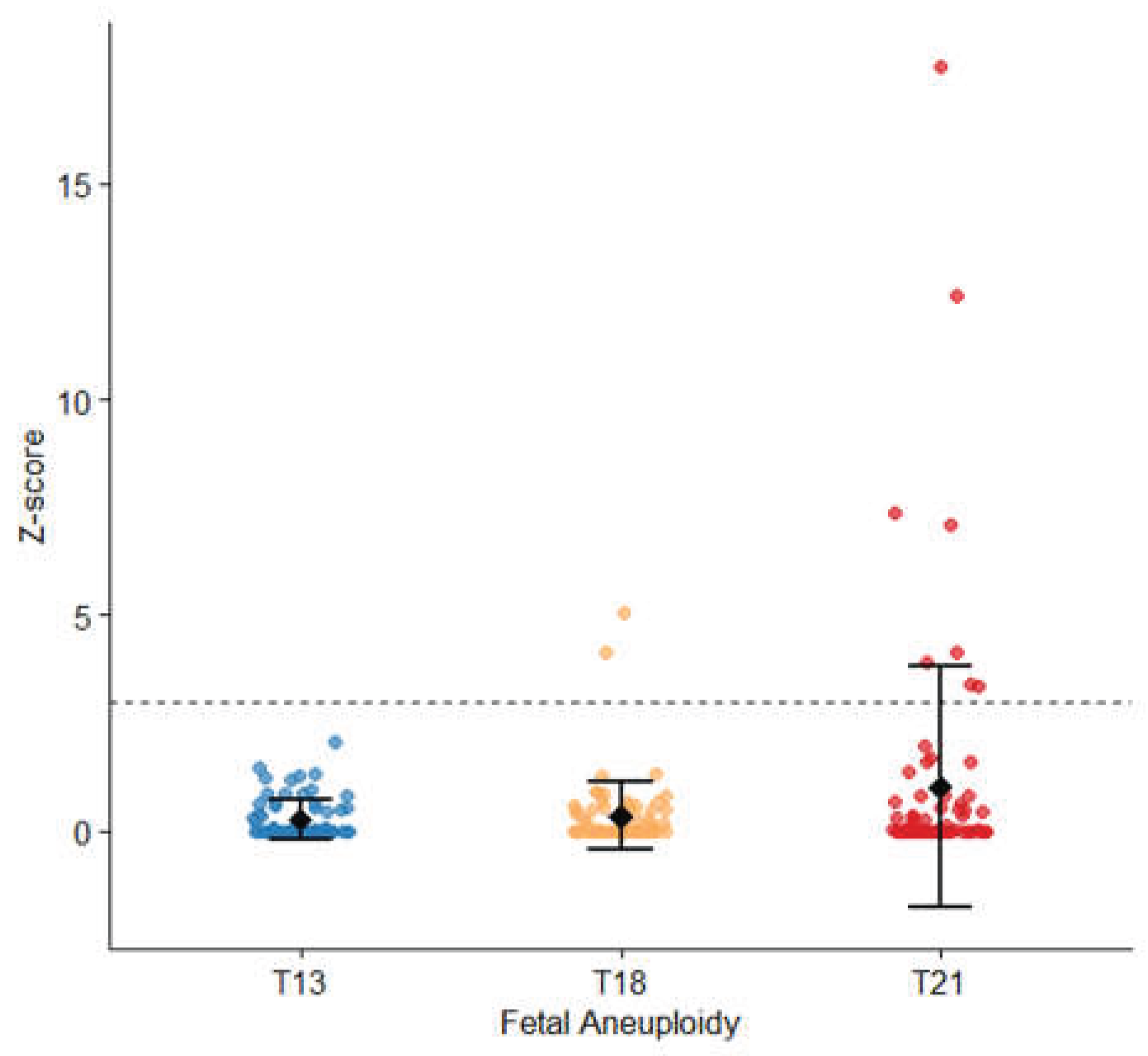

Table 1.
Demographic characteristics (n=74).
| Characteristic | Number | Percent, % | mean ± SD |
| Maternal age (years) | 39.00 ± 2.905 | ||
| 35-39 | 47 | 63.51 | |
| >40 | 27 | 36.49 | |
| BMI | 27.08 ± 3.64 | ||
| <20.9 | 1 | 1.35 | |
| 21 – 23.9 | 12 | 16.22 | |
| 24 – 27.9 | 40 | 54.05 | |
| 28 – 31.9 | 10 | 13.51 | |
| >32 | 11 | 14.86 | |
| GA (weeks) | 13.57 ± 2.805 | ||
| <12+6 | 25 | 33.78 | |
| 13+0–15+6 | 14 | 18.92 | |
| 16+0–18+6 | 35 | 47.30 | |
| Type of pregnancy | |||
| Singleton pregnancy | 74 | 100.00 | |
| Twin pregnancy | 0 | 0.00 | |
| Clinical indications | |||
| Serum biochemical test – High | 42 | 56.76 | |
| Serum biochemical test – Low | 32 | 43.24 | |
| Abnormal ultrasound soft indexes | 10 | 13.51 | |
| Adverse reproductive history | 1 | 1.35 |
Table 2.
Table 2. Comparison between NIPT and clinical results.
| № | Sample information | Clinical results | ddPCR-NIPT results | Final call | |||||||||
| MA (Yrs) | GA (WKs) | BMI | 1st&2nd Tri-scrn | CVS/AC | FF% | Total copy number | z-score 21 | z-score 18 | |||||
| chr21 | chr18 | chr1 | |||||||||||
| 1 | 39 | 12 | 23.0 | SBT HR | T21 | 5.76 | 51187.91 | 52567.38 | 52920.62 | 4.13 | 1.27 | 47, XX, +21 | |
| 2 | 44 | 17 | 24.8 | SBT HR | T21 | 2.4 | 44686.72 | 42961.67 | 48229.36 | 3.89 | 0 | 47, XY, +21 | |
| 3 | 40 | 16 | 29.8 | SBT HR | T21 | 3.74 | 389476.4 | 351636.1 | 361941.2 | 17.74 | 0 | 47, XX, +21 | |
| 4 | 38 | 16 | 28.3 | SBT HR | T21 | 3.52 | 69253.36 | 68154.3 | 69521.82 | 3.37 | 0 | 47, XY, +21 | |
| 5 | 40 | 16 | 28.2 | SBT HR | T21 | 4.88 | 81410.01 | 76078.51 | 77048.76 | 12.41 | 0 | 47, XX, +21 | |
| 6 | 45 | 16 | 23.0 | SBT HR | T21 | 4.02 | 90298.35 | 85436.74 | 90990.44 | 7.103 | 0 | 47, XY, +21 | |
| 7 | 41 | 16 | 29.4 | SBT HR | T21 | 2.73 | 61502.04 | 60284.18 | 60776 | 3.414 | 0 | 47, XY, +21 | |
| 8 | 41 | 17 | 22.6 | SBT HR | T18 | 5.5 | 44187.9 | 46042.05 | 46950.3 | 0 | 5.071 | 47, XX, +18 | |
| 9 | 46 | 16 | 27.3 | SBT HR | T18 | 3.02 | 68470.05 | 69878.88 | 71059.73 | 0 | 4.144 | 47, XX, +18 | |
| 10 | 45 | 16 | 25.2 | SBT HR | T21 | 4.79 | 174956.2 | 169612.7 | 172737.9 | 7.379 | 0 | 47, XX, +21 | |
| MA maternal age, Yrs years, GA gestational age, WKs weeks, BMI Body mass index, 1st&2nd Tri-scrn, first and second trimester screens; SBT serum biochemical test, HR high risk, E Eupoidy, FF fetal fraction, T21 Trisomy 21, T18 Trisomy 18, chr chromosome | |||||||||||||
Disclaimer/Publisher’s Note: The statements, opinions and data contained in all publications are solely those of the individual author(s) and contributor(s) and not of MDPI and/or the editor(s). MDPI and/or the editor(s) disclaim responsibility for any injury to people or property resulting from any ideas, methods, instructions or products referred to in the content. |
© 2026 by the authors. Licensee MDPI, Basel, Switzerland. This article is an open access article distributed under the terms and conditions of the Creative Commons Attribution (CC BY) license (http://creativecommons.org/licenses/by/4.0/).
Copyright: This open access article is published under a Creative Commons CC BY 4.0 license, which permit the free download, distribution, and reuse, provided that the author and preprint are cited in any reuse.


