

Submitted:
10 June 2026
Posted:
11 June 2026
You are already at the latest version
Abstract
We develop a probabilistic model for predicting equity market stress in South Africa using a logistic regression model applied to the JSE TOP 40 Index. The analysis employs quarterly data over 99 observations spanning 2001 Q1 to 2025 Q3, employing five macroeconomic predictors: CPI inflation, industrial production growth, unemployment, the SARB repo rate, and the yield spread. Model estimation is implemented using the Iteratively Reweighted Least Squares (IRLS) with inference enhanced through 5,000-replicate nonparametric bootstrap procedures to address small-sample limitations. The results indicate that industrial production growth (IP) and inflation (CPI) are the most economically meaningful predictors of market stress. A one-standard-deviation improvement in IP reduces stress odds by approximately 42%, while a comparable rise in inflation increases odds by 54%, suggesting that real economic activity acts as a stabilising force in equity markets, while inflationary pressure amplifies stress risk, pointing to the dual and opposing role of supply-side conditions and price dynamics in shaping market vulnerability. Bootstrap standard errors exceed conventional maximum likelihood estimates by 13.5 to 32.3%, demonstrating that standard inference materially understates estimation uncertainty in this context. Model performance shows moderate discriminatory power, with an area under the ROC curve of 0.664 and a Brier score improvement of 9.5% relative to a base-rate benchmark. The predicted probability series aligns closely with major South African stress episodes, including the Global Financial Crisis and periods of monetary tightening, although performance is weaker for exogenous shocks such as COVID-19. The findings highlight the relevance of macroeconomic conditions in shaping equity market risk in an emerging market setting and demonstrate the value of bootstrap-enhanced logistic regression for financial stress prediction. The model provides a transparent and implementable early-warning indicator for policymakers and institutional investors using publicly available data.
Keywords:
JSE TOP 40
; equity market stress
; logistic regression
; bootstrap inference
; financial stability
; probabilistic forecasting
1. Introduction
Equity markets play a central role in modern financial systems by facilitating capital allocation, supporting corporate investment, and providing investment opportunities for households and institutional investors. Periods of severe equity market stress, however, disrupt these functions and impose substantial economic costs through wealth losses, heightened financial uncertainty, and reduced investment activity. Predicting the likelihood of equity market drawdowns has become an important objective within financial economics, particularly for policymakers, institutional investors, and risk managers, as financial crises can be anticipated using early warning models and economic indicators (Ivanyuk, 2022).
The challenge of predicting equity market stress is widely recognised in the academic literature. Financial markets are driven by complex interactions between macroeconomic fundamentals, investor sentiment, and global financial conditions. Empirical research shows that both macroeconomic variables and behavioural factors such as investor sentiment significantly influence the probability of market crises (Zouaoui et al., 2011). Although traditional asset pricing models often assume that returns are largely unpredictable, evidence suggests that certain financial and macroeconomic indicators contain predictive information about future market conditions and crisis periods (Plastun et al., 2018; Borup et al., 2021).
Binary classification frameworks provide a natural approach to modelling such risks. Instead of estimating exact return levels, these models focus on the likelihood of negative market outcomes. Logistic regression is particularly well suited to this setting, as it is widely used in early warning systems and crisis prediction models to estimate probabilities of adverse events (Jemović & Marinković, 2021; Işığıçok & Tarkun, 2023). Empirical studies across multiple markets show that logistic (logit) models can successfully classify crisis periods and stock market downturns with meaningful predictive accuracy (Ma & Lin, 2024; Saab et al., 2024).
The relevance of probabilistic models extends beyond investment decision-making to financial stability monitoring. Early warning systems based on financial and macroeconomic indicators can provide timely signals of rising systemic risk and crisis vulnerability (Mezei & Sarlin, 2018). This is especially important in emerging markets, where financial systems are more sensitive to macroeconomic shocks and external conditions, increasing the importance of robust crisis prediction tools (Alonso Alvarez & Molina, 2019; Acharya et al., 2020).
South Africa presents a particularly compelling context for analysing equity market stress within an emerging market framework. The Johannesburg Stock Exchange (JSE) reflects a complex interaction between domestic macroeconomic conditions, global financial linkages, and investor behaviour, making it a useful laboratory for studying predictability under uncertainty. Empirical evidence shows that financial distress and market outcomes in South Africa can be modelled using combinations of firm-level fundamentals, market-based indicators, and macroeconomic variables (Sabela et al., 2018). More recent research further confirms that macroeconomic factors, particularly interest rates, exchange rates, and monetary policy shocks, have statistically significant effects on equity market performance and volatility in South Africa, although their predictive strength may vary across time horizons and model specifications (Mapfumo et al., 2023; Trecy et al., 2024)
At the same time, the South African equity market exhibits features consistent with time-varying predictability and behavioural influences. Evidence from the JSE indicates that returns are not purely random but depend on changing market conditions, with past returns, business confidence, and investor sentiment contributing to future market dynamics (Yousuf & Makina, 2022; Moodley et al., 2025). In addition, macroeconomic news and unexpected policy shocks have been shown to significantly influence both returns and volatility in South African financial markets, reinforcing the role of information flows in shaping market outcomes (Gkillas et al., 2019)
Recent studies also highlight the importance of systemic risk, volatility dynamics, and cross-market linkages in understanding JSE behaviour, particularly during periods of crisis such as COVID-19. These findings suggest that the South African equity market is sensitive to both domestic shocks and global spillovers, with implications for risk modelling and early warning systems (Mwamba et al., 2025). Broader evidence from emerging markets, including South Africa within BRICS, further indicates that stock market predictability improves when models incorporate nonlinear dynamics and a combination of macroeconomic and behavioural variables (Panigrahi et al., 2025).
Despite this growing body of evidence, relatively limited research has explicitly applied probabilistic classification frameworks, such as logistic regression, to model the likelihood of equity market stress in the South African environment. The existing literature has largely concentrated on return predictability, volatility dynamics, and, more recently, machine learning-based forecasting approaches, with comparatively less emphasis on modelling the probability of adverse market events.
This gap is noteworthy, for instance, probabilistic frameworks are suited to estimating downside risk, as they allow for the direct assessment of the likelihood of stress episodes rather than focusing solely on expected returns or variance. Such an approach is especially relevant in emerging markets like South Africa, where structural volatility, external shocks, and regime shifts are more pronounced. By translating economic and financial signals into estimated probabilities of market stress, these models can provide a more interpretable and policy-relevant tool for risk monitoring and early warning system design.
We address this gap by developing a logistic regression model, combined with bootstrap inference, to model the probability of negative quarterly returns in the JSE TOP 40 Index. Our analysis utilises observable macroeconomic indicators and a probabilistic methodology to establish a transparent and practical framework for evaluating and predicting equity market stress in South Africa. This approach is consistent with established research on crisis prediction and early warning systems (Song & Li, 2024; Reimann, 2024; Shu et al., 2024).
1.1. Hypotheses
We test five hypotheses derived from the theoretical and empirical motivation above. Hypotheses H1 through H5 concern the logistic regression coefficients β on the standardised macroeconomic predictors in the logit model. Hypothesis H6 concerns the adequacy of asymptotic inference. Each null is tested against a one-sided alternative consistent with the sign predicted by theory and evaluated using both maximum likelihood and nonparametric bootstrap inference.
- H1 (CPI): CPI has no effect on the log-odds of JSE TOP 40 market stress. The dividend discount model and South Africa’s inflation-targeting framework predict that higher inflation raises the discount rate and erodes real cash flows, so the directional alternative is βCPI > 0:
H0: βCPI = 0 vs H1: βCPI > 0
- H2 (Unemployment): Unemployment has no effect on the log-odds of JSE TOP 40 market stress. Persistent unemployment reduces the cyclical signalling content of unemployment changes; therefore, the directional alternative is βUNEMP > 0:
H0: βUNEMP = 0 vs H1: βUNEMP > 0
- H3 (Industrial production growth): Industrial production growth has no effect on the log-odds of JSE TOP 40 market stress. Standard business cycle theory predicts that a contraction in output reduces corporate earnings capacity, raising stress probability, so the directional alternative is βIP < 0:
H0: βIP = 0 vs H1: βIP < 0
- H4 (SARB repo rate): The SARB repo rate has no effect on the log-odds of JSE TOP 40 market stress. Monetary policy transmission theory predicts that higher policy rates raise nominal discount rates, increase corporate borrowing costs, and redirect capital toward fixed-income instruments, so the directional alternative is βREPO > 0:
H0: βREPO = 0 vs H1: βREPO > 0
- H5 (Yield spread): The yield spread between the 10-year government bond yield and the 91-day Treasury bill rate has no effect on the log-odds of JSE TOP 40 market stress. The expectations hypothesis of the term structure predicts that a narrowing or inverted spread signals anticipated economic slowdown and tightening financial conditions, so the directional alternative is βSPR < 0:
H0: βSPR = 0 vs H1: βSPR < 0
- H6 (Bootstrap inference): Bootstrap standard errors do not differ from maximum likelihood standard errors derived from the Fisher information matrix. Given the limited sample of 99 quarters, asymptotic normality may not hold, and the nonparametric bootstrap may produce systematically larger standard errors, indicating that standard MLE inference overstates parameter precision. Denoting the bootstrap standard error for coefficient j as SEBj and the MLE standard error as SEMLEj, the hypothesis is:
H0: SEBj = SEMLEj vs H1: SEBj > SEMLEj for all j
2. Literature Review
2.1. The South African Background
2.1.1. The South African Equity Market
The JSE is Africa’s largest stock exchange by market capitalisation and ranks among the 20 largest globally (World Federation of Exchanges (WFE), 2023; African Development Bank (AfDB), 2022). The JSE TOP 40 Index is a free-float market capitalisation-weighted index comprising the 40 largest listed companies (Kotze, 2017). It serves as the primary domestic equity benchmark and underpins most index-linked investment products, including exchange-traded funds and derivatives (Kotze, 2017; McCullough et al., 2018). The index is reconstituted quarterly and is heavily concentrated in resources, financials, and consumer goods, reflecting South Africa’s commodity-driven economic structure (Mongale & Eita, 2014).
Since 2000, the JSE TOP 40 Index has experienced several major periods of financial stress associated with both domestic and global economic disruptions. The 2001-2002 episode was characterised by a sharp depreciation of the rand, largely driven by contagion effects from the Argentine peso crisis and substantial capital outflows from emerging markets (Redl, 2018). This period highlighted the vulnerability of the South African equity market to external financial shocks and exchange-rate instability. Subsequently, the Global Financial Crisis of 2008-2009 generated the largest single-year drawdown in the history of the index since its modernisation, reflecting the severe contraction in global liquidity, declining investor confidence, and heightened systemic risk within international financial markets (Aderajo & Olaniran, 2021). Domestic political developments also contributed to episodes of market instability. In particular, the December 2015 “Nenegate” episode, which followed the abrupt dismissal of Finance Minister Nhlanhla Nene, resulted in significant short-term market volatility and sharp declines in investor confidence (van der Merwe et al., 2023). More recently, the COVID-19 pandemic in the first quarter of 2020 triggered the most rapid drawdown in the history of the JSE TOP 40, as financial markets reacted to lockdown measures, economic uncertainty, and expectations of a severe global recession. The subsequent 2022-2023 period was characterised by persistent load-shedding, sustained rand depreciation, and rising global interest rates, all of which contributed to prolonged below-trend equity market returns. These episodes provide important historical benchmarks for assessing the effectiveness and predictive performance of financial stress and early warning models.
2.1.2. The Macroeconomic Environment Since 2000
The macroeconomic environment in South Africa since 2000 has been characterised by a combination of structural challenges and cyclical fluctuations that have influenced the behaviour of financial markets. Macroeconomic indicators such as inflation, unemployment, industrial production, and interest rates provide important information regarding the state of the domestic economy and may therefore influence equity market performance (Olokoyo et al., 2020).
One of the most important macroeconomic variables in South Africa is consumer price inflation, which is monitored closely by the South African Reserve Bank (SARB) within its inflation-targeting monetary policy framework. Since the adoption of inflation targeting in 2000, the SARB has aimed to maintain inflation within a target band of 3-6% (Burger, 2025). Despite this objective, inflation has periodically exceeded the upper bound of the target range due to factors such as rising food prices, increases in global oil prices, and depreciation of the rand exchange rate (Miyajima, 2020; Majenge et al., 2025). Inflation shocks can influence equity markets through multiple channels, including higher discount rates applied to future corporate earnings and reduced real household purchasing power (Knox & Timmer, 2023; Maulidah, 2025).
Another defining feature of the South African macroeconomic landscape is the persistently high unemployment rate. South Africa has one of the highest unemployment rates among major emerging economies, reflecting structural labour market challenges and slow economic growth. Research examining the relationship between unemployment and stock market performance in South Africa finds evidence of long-run relationships between these variables, although the predictive power of unemployment for stock returns remains debated (Phiri, 2017). Nevertheless, high unemployment levels can affect investor sentiment, consumer spending, and corporate profitability, all of which may influence equity market outcomes.
Industrial production growth represents another important indicator of domestic economic activity (Gutu et al., 2015). The South African production sector is strongly influenced by global commodity demand, electricity supply constraints, and domestic investment conditions (Mpatane, 2015). Periods of strong commodity prices have historically supported higher industrial production and improved corporate profitability, while downturns in commodity markets or disruptions to electricity supply have often resulted in weaker output growth (Ateba et al., 2019; Ntshwe & Garidzirai, 2021). Fluctuations in industrial production may therefore provide useful information regarding the broader economic environment in which listed companies operate.
Monetary policy also plays a critical role in shaping financial market dynamics. The SARB repo rate, which represents the policy interest rate used to guide monetary conditions, has experienced substantial variation since 2000. During periods of high inflation or strong economic growth, the central bank has increased interest rates to contain inflationary pressures (Beyers et al., 2024). Conversely, during economic downturns, the SARB has implemented accommodative monetary policy to support economic activity (Meyer et al., 2018; Beyers et al., 2024). For instance, the repo rate reached a peak of 13.5% during the 2002–2003 rand crisis and tightening cycle, and a secondary peak of 12.0% during the 2007–2008 inflation cycle, before being reduced to a historic low of 3.5% by 2020 Q3 as part of an emergency COVID-19 monetary easing programme (Beyers et al., 2024).
Likewise, interest rates also affect equity markets through several channels. Higher interest rates increase the discount rate applied to future corporate earnings and may reduce equity valuations (Mthiyane, 2018; Trecy et al., 2024). At the same time, rising interest rates can shift investor preferences toward fixed-income securities, reducing demand for equities (Trecy et al., 2024). Emerging markets research suggests that interest rate movements and monetary policy changes can have significant effects on stock market performance and liquidity (Chowdhury et al., 2018)
Haubrich (2021) posits that another macroeconomic variable commonly used in financial forecasting models is the yield spread, (difference between long-term and short-term interest rates). In developed economies, the slope of the yield curve has historically served as an important predictor of future economic activity and recession risk (Wright, 2006; Haubrich, 2021). Haubrich (2021) further contends that when the yield curve flattens or inverts, it often signals expectations of slower economic growth and tighter financial conditions. Similar patterns have been observed in emerging markets, where yield curve dynamics can reflect changing expectations regarding inflation, monetary policy, and economic growth (Mehl, 2009).
Finally, the macroeconomic environment in South Africa is strongly influenced by global economic conditions and capital flows. As an emerging market with relatively open financial markets, South Africa is particularly sensitive to shifts in global risk appetite and international investment flows. Changes in global interest rates, commodity prices, and exchange rate expectations can therefore have significant spillover effects on domestic equity markets.
These macroeconomic dynamics provide the economic foundation for the empirical model developed in this study, which investigates whether domestic economic indicators can provide early warning signals of future equity market stress in the JSE TOP 40 Index.
2.2. Theoretical Framework
2.2.1. Macroeconomic Transmission to Equity Returns
The theoretical relationship between macroeconomic variables and equity returns is primarily grounded in the dividend discount model (DDM) developed by Gordon (1962). This model assumes that the market value of an equity security is determined by the present value of expected future dividend streams discounted at the required rate of return. Macroeconomic conditions influence equity prices through two principal mechanisms such as the cash flow channel and the discount rate channel (Knox & Timmer, 2023; Zhang, 2021). The cash flow channel operates through the effect of macroeconomic conditions on expected corporate earnings and dividends, while the discount rate channel influences the rate at which future cash flows are discounted to present value (Trecy et al., 2024; Zhang, 2021).
Inflation affects both channels simultaneously in that rising inflation can erode real corporate cash flows when firms are unable to fully transfer higher input costs to consumers through price adjustments. At the same time, inflationary pressures typically induce tighter monetary policy responses from central banks, resulting in higher policy interest rates and an increase in the risk-free component of the discount rate. Consequently, higher inflation raises the likelihood of negative equity returns, particularly in economies operating under credible inflation-targeting regimes such as South Africa (Knox & Timmer, 2023; Trecy et al., 2024).
Industrial production (IP) growth functions as a proxy for aggregate economic activity and corporate earnings potential. Stronger IP growth reflects expanding production capacity, rising business activity, improved earnings prospects, and lower default risk, all of which support higher equity valuations. Conversely, declining industrial output signals weakening economic conditions and deteriorating corporate profitability (Mapfumo et al., 2023; Moodley et al., 2025). The theoretical expectation is therefore that higher IP growth reduces the probability of adverse equity market outcomes (Ntshwe and Garidzirai, 2021).
The unemployment rate represents a lagging indicator of the business cycle. Rising unemployment generally reflects weakening economic conditions, declining household consumption, and lower corporate profitability (Corsello et al., 2020). However, because labour market conditions typically adjust after broader economic changes have already occurred, unemployment is expected to possess weaker predictive power for equity returns relative to forward-looking macroeconomic indicators such as the yield spread (Atanasov, 2021; Broer et al., 2025).
The transmission of monetary policy to equity markets occurs through several interconnected mechanisms. These include the Fisher effect on nominal discount rates, the credit channel influencing corporate financing costs, and the signalling channel through which central bank policy actions convey information regarding future economic conditions. For South Africa, the repo rate constitutes the primary monetary policy instrument of the SARB, making it a direct indicator of the prevailing monetary policy stance relevant to equity valuation and expected market returns (Beyers et al., 2024; Trecy et al., 2024).
2.2.2. The Yield Spread as a Recession and Equity Stress Predictor
The term spread between long-term and short-term government bond yields is theoretically linked to equity market performance through the expectations hypothesis of the term structure. An inverted yield curve, where short-term rates exceed long-term rates, signals market expectations of future interest rate cuts, which in turn reflect anticipated economic slowdown (Engstrom & Sharpe, 2019; Hasse & Lajaunie, 2022). A flattening or inverted spread therefore precedes recessions, which are associated with equity market stress.
The relevant spread for South Africa is between the 10-year government bond yield and the 91-day Treasury bill rate. This follows Mohapi and Botha (2013), who demonstrate that this spread specification has superior predictive power for recessions relative to other term structure combinations. The 10-year yield captures long-term growth and inflation expectations, while the 91-day Treasury rate closely tracks the current monetary policy stance.
2.2.3. Unemployment as a Lagging Indicator
Economic theory generally classifies unemployment as a lagging indicator of the business cycle, as labour market conditions typically deteriorate after economic contractions have commenced and improve only after recoveries are firmly established (Corsello et al., 2020; Broer et al., 2025). Consequently, changes in unemployment tend to reflect prior economic conditions rather than provide forward-looking information regarding future economic activity or financial market performance (Atanasov, 2021).
However, the unemployment rate in South Africa has remained structurally high and persistent, fluctuating between 21% and 35.3%. Phiri (2017) contends that such persistence may weaken the cyclical information content embedded in unemployment movements, thereby reducing its usefulness as a predictor of equity market stress. Structural unemployment driven by long-term economic and labour market rigidities may therefore dominate cyclical variations associated with changes in aggregate demand and business cycle conditions (Dadam & Viegi, 2024).
This theoretical expectation is consistent with the frameworks by Brault and Khan (2020), Corsello et al. (2020), and Broer et al. (2025), who classify unemployment as a lagging rather than leading macroeconomic indicator. Accordingly, unemployment is expected to exhibit weaker predictive power within the empirical model relative to more forward-looking variables such as industrial production growth and the yield spread.
2.3. Empirical Literature
2.3.1. International Studies on Macroeconomic Equity Predictors
Recent empirical research continues to examine the ability of macroeconomic and financial variables to predict equity market performance. While other work in the field focused primarily on valuation ratios and dividend yields, more recent studies incorporate a broader set of macroeconomic indicators including interest rate spreads, economic sentiment measures, and global financial volatility.
Empirical evidence suggests that macroeconomic conditions play an important role in shaping stock market returns. For instance, research analysing predictive models for equity returns finds that macroeconomic indicators such as interest rate spreads and purchasing managers’ indices contain useful information about future stock market performance, particularly when evaluated using risk-adjusted investment metrics (McMillan, 2021). Similarly, studies examining stock return predictability across multiple international markets show that macroeconomic fundamentals and financial indicators can generate meaningful improvements in forecasting accuracy when combined within predictive models (Lawrenz & Zorn, 2017; Wang et al., 2022). Another important development in the literature concerns the increasing integration of global financial markets and the role of investor sentiment and macroeconomic uncertainty in driving stock market fluctuations. Recent empirical studies demonstrate that investor sentiment and macroeconomic conditions can significantly influence returns in emerging equity markets, with these effects often persisting in the short-term following economic shocks (Andleeb & Hassan, 2023).
Advances in forecasting methodologies have expanded the range of models used to analyse equity market behaviour. Recent research applies machine learning techniques and nonlinear time-series models to predict financial market events, demonstrating that macro-financial variables such as volatility measures and geopolitical risk indicators can provide useful signals of future market stress (Huynh & Khoa, 2025). However, despite these methodological advances, macroeconomic indicators remain central predictors of financial market behaviour.
2.3.2. South African and African Equity Market Studies
The empirical literature examining the determinants of equity market performance in South Africa and other emerging markets has grown in recent years. Because emerging markets are often more sensitive to external shocks and global financial conditions, macroeconomic variables and international market developments play a particularly important role in explaining stock market dynamics.
Accordingly, research examining the relationship between macroeconomic variables and South African stock market returns shows that factors such as inflation, interest rates, exchange rates, and industrial production influence equity prices through both real economic and financial channels (Trecy et al., 2024; Pamba, 2025; Moodley, 2025). Similarly, studies analysing the interaction between financial markets and macroeconomic uncertainty in South Africa demonstrate that increases in economic uncertainty are associated with higher equity market volatility and lower expected returns (van der Merwe et al., 2023; Sebola & Mpanda, 2025). Another important strand of the South African literature focuses on the transmission of global shocks to the domestic equity market (Mudiangombe & Muteba Mwamba, 2023). Because the JSE is highly integrated into global financial markets and heavily weighted toward commodity-exporting firms, international economic conditions and commodity price cycles can have substantial effects on domestic stock returns. Empirical studies confirm that global financial volatility and international capital flows significantly influence the behaviour of South African equity markets. However, recent empirical research analysing the impact of the COVID-19 pandemic on the Johannesburg Stock Exchange (JSE) demonstrate that the crisis produced substantial changes in stock returns, trading activity, and sector-level performance across the market (van der Merwe et al., 2023; Ramakau et al., 2025).
Although there is a growing body of research on macroeconomic determinants of stock returns in emerging markets, much of the literature relies on linear predictive regression models or volatility modelling frameworks. Relatively few studies focus on predicting the probability of negative equity returns or market stress events using binary classification models, particularly within the South African economic environment. This gap provides the primary motivation for the empirical approach adopted in this study.
2.3.3. Bootstrap Methods in Financial Econometrics
Bootstrap methods are widely used in modern econometrics to improve statistical inference when conventional asymptotic approximations may be unreliable. These methods rely on repeated resampling of the observed dataset to approximate the sampling distribution of an estimator without imposing strong parametric assumptions (Mokhtar et al., 2023). As a result, bootstrap procedures allow researchers to obtain more reliable confidence intervals and hypothesis tests when the true sampling distribution is unknown or non-normal. In financial econometrics, bootstrap techniques are commonly applied to address challenges such as small sample sizes, model uncertainty, and potential data-snooping biases in predictive models (Mokhtar et al., 2023; Jiang et al., 2024). Resampling approaches have been shown to provide more robust inference than traditional asymptotic methods when evaluating asset pricing models, trading strategies, and financial forecasting frameworks (Liao et al., 2024; Jiang et al., 2024).
Bootstrap inference is valuable in models with binary dependent variables, such as logistic regression models used to predict financial events. When sample sizes are limited, the sampling distribution of logistic regression coefficients may deviate from the normal distribution assumed by standard maximum likelihood inference. In such cases, bootstrap confidence intervals provide a flexible and robust alternative that more accurately captures the uncertainty surrounding parameter estimates (Cameron et al., 2010; Mokhtar et al., 2023).
2.3.4. Gap in the Literature
Our analysis of the literature reveals that no existing South African study applies logistic regression with nonparametric bootstrap inference to predict binary JSE TOP 40 market stress using a comprehensive set of domestic macroeconomic predictors. The existing South African equity literature relies predominantly on linear regression frameworks unsuited to binary outcomes, uses asymptotic inference without small-sample robustness checks, and does not implement IRLS estimation from first principles in a way that connects the practical estimation procedure to the underlying statistical theory. This study fills all three gaps simultaneously.
Furthermore, no existing study systematically maps predicted stress probabilities against South African stress events, tests whether the yield spread between the 10-year and 91-day South African government bonds has predictive power for JSE downturns analogous to its documented performance in developed markets, or quantifies the difference between standard and bootstrap inference for this model class in the South African environment.
3. Research Methodology
3.1. Data
3.1.1. Sources and Sample Construction
Table 1 summarises the seven raw data series used in the study. The raw data window spans 2000 Q1 to 2025 Q4, a total of 104 quarterly observations. The estimation sample of 99 quarters (2001 Q1 to 2025 Q3) is obtained after removing four observations from the start of the sample to compute year-on-year CPI inflation (which requires a four-period lag) and removing the final observation (2025 Q4) because no subsequent quarter is available to define the binary outcome. The raw data contain no missing values for any series across the full 104-quarter window.
3.1.2. Variable Construction
3.1.2.1. Dependent Variable Specification
The dependent variable is specified as a binary indicator capturing the occurrence of market stress in the JSE Top 40 index. A value of indicates that the realised return in the following quarter is negative, while indicates a non-negative return. This formulation transforms the prediction of equity market downturns into a binary classification problem. The future return is computed as the logarithmic return of the JSE Top 40 total return index:
Logarithmic returns are widely used in financial econometrics because they approximate continuously compounded returns and allow for convenient additive properties over time (Campbell et al., 1998). Using the return in ensures a genuine forecasting structure where predictors observed at time are used to predict future market outcomes.
3.1.2.2. Predictor Variables
Five macroeconomic and financial predictors are included in the model. Inflation and industrial production growth are calculated using year-over-year percentage changes to capture underlying economic momentum while smoothing short-term volatility:
The unemployment rate provides a measure of labour market conditions, while the SARB repo rate represents the stance of monetary policy. The yield spread, defined as the difference between long-term government bond yields and short-term Treasury bill rates,
captures expectations regarding future economic activity and monetary policy. Yield spreads are commonly used as predictors of economic cycles and financial market conditions (Estrella & Hardouvelis, 1991; Estrella & Mishkin, 1998).
3.1.2.3. Standardisation of Predictors
To ensure comparability across predictors measured in different units, all explanatory variables are standardised to zero mean and unit variance:
where the sample mean and standard deviation are defined as:
Standardisation improves numerical stability in estimation and allows the regression coefficients to be interpreted as the effect of a one-standard-deviation change in each predictor (Gelman & Vehtari, 2021).
3.2. Model Specification
3.2.1. Logistic Regression Model
The probability of market stress is modelled using logistic regression, which relates the conditional probability of an event to a linear combination of predictors through the logistic (sigmoid) function:
Where:
The logistic function maps any real number to the interval (0,1), ensuring that predicted probabilities remain valid (Hosmer et al., 2013). The predictor vector includes an intercept and the standardised explanatory variables, while represents the associated coefficient vector.
3.2.2. Logit Transformation
The logistic model can be expressed in terms of log-odds using the logit transformation:
This transformation linearises the relationship between predictors and the log-odds of the event. Each coefficient therefore represents the change in log-odds associated with a one-standard-deviation increase in predictor , holding other variables constant (Vittinghoff et al., 2012).
3.2.3. Log-Likelihood Function
The logistic regression parameters are estimated using maximum likelihood estimation. For independent observations, the log-likelihood function is:
Maximising this function yields the parameter estimates that best explain the observed data. The gradient (score) vector and Hessian matrix are given by:
Where: is a diagonal matrix containing . The negative semi-definite Hessian ensures that the log-likelihood is concave and therefore possesses a unique maximum (Vittinghoff et al., 2012).
3.3. IRLS Estimation Algorithm
Because the likelihood equations have no closed-form solution, the model is estimated using the Iteratively Reweighted Least Squares (IRLS) algorithm. IRLS is equivalent to the Newton-Raphson optimisation method and updates the coefficient vector iteratively according to:
Each iteration corresponds to solving a weighted least squares regression with weights determined by the current predicted probabilities. The procedure continues until convergence, typically achieved within a small number of iterations (McCullagh & Nelder, 1989).
3.4. Odds Ratios
To aid interpretation, logistic regression coefficients can be converted into odds ratios:
An odds ratio greater than one indicates that increases in the predictor raise the odds of market stress, while values below one indicates a reduction in the odds (Hosmer et al., 2013).
3.5. Bootstrap Inference
Given the relatively limited sample size, non-parametric bootstrap methods are used to obtain robust estimates of standard errors. Bootstrap standard errors are calculated as
where denotes the number of bootstrap replications. The bootstrap approach approximates the sampling distribution of the estimator without relying on asymptotic normality assumptions (Efron & Tibshirani, 1993).
3.6. Marginal Effects
Because logistic regression is nonlinear, the marginal effect of a predictor depends on the current probability level. The marginal effect is given by
This expression indicates how a small change in predictor affects the predicted probability of market stress (Vittinghoff et al., 2012).
3.7. Model Diagnostics
Several diagnostic measures are used to evaluate model performance.
McFadden’s pseudo- measures the improvement in log-likelihood relative to a model with only an intercept:
Predictive accuracy is also assessed using the Brier score,
which measures the mean squared difference between predicted probabilities and realised outcomes (Brier, 1950).
Discriminatory power is evaluated using the Area Under the ROC Curve (AUC):
An AUC of 0.5 indicates random classification, whereas values approaching 1 indicate strong predictive ability (Fawcett, 2006).
Finally, model calibration is tested using the Hosmer–Lemeshow goodness-of-fit statistic, which compares observed and predicted event frequencies across probability deciles (Hosmer et al., 2013).
4. Empirical Results
4.1. Descriptive Statistics
Table 2 presents descriptive statistics for the 99-quarter estimation sample from 2001 Q1 to 2025 Q3. Thirty-three of 99 quarters produced negative JSE TOP 40 log returns, a base rate of 33.3%. The JSE log return series shows moderate negative skewness (-0.39) driven by several large negative quarters, most notably the -25.63% return in 2008 Q3 and the -23.2% return in 2020 Q1. CPI inflation is positively skewed (0.997) and shows excess kurtosis (2.24), driven by the extreme 2008 Q3 reading of 13.4%. Industrial production growth shows extreme positive kurtosis (34.73), a direct consequence of the COVID-19 manufacturing shock of -30.5% in 2020 Q2 and the mechanical rebound of +36.4% in 2020 Q3; these two observations constitute the most influential data points in the model, and their treatment is discussed further in the following sections. The yield spread ranged from -3.5 percentage points in 2008 Q4, at the depth of the GFC recession, to a maximum of 5.9 percentage points in 2022 Q1, reflecting the combination of emergency SARB rate cuts and elevated long-term bond yields.
4.2. Key Events in the Sample Period
4.3. Standard MLE Results
Table 4 presents the IRLS maximum likelihood estimates with standard normal-theory standard errors. The estimated intercept of -0.7643 is highly significant (z = -3.359, p < .001) and corresponds to a baseline predicted stress probability of (-0.7643) = 31.8% at the sample mean of all predictors, closely matching the empirical base rate of 33.3%. This proximity confirms that the standardisation and model intercept are well-calibrated.
Regarding the slope coefficients, industrial production growth has the largest absolute standardised coefficient at -0.5430 (z = -1.507, p = .132), indicating that a one-standard-deviation improvement in IP growth is associated with a 42% reduction in the odds of JSE Top 40 market stress in the following quarter. CPI inflation has the second largest positive coefficient at 0.4299 (z = 1.484, p = .138), implying that a one-SD rise in inflation raises stress odds by 54%. The repo rate (0.2489) and yield spread (0.2476) coefficients are of comparable positive magnitude, consistent with the theoretical frameworks described above. Unemployment has the smallest and least precisely estimated coefficient (0.1367), consistent with its role as a lagging indicator in the structurally high-unemployment South African labour market. No individual slope coefficient achieves significance at the five-percent level under standard normal-theory MLE inference, and the model achieves borderline joint significance at the ten-percent level. The bootstrap analysis in the following Section confirms that MLE standard errors understate true uncertainty, making this pattern of individual non-significance informationally conservative rather than evidence of model misspecification.
Table 5 presents a comparison between the IRLS MLE estimates and their bootstrap counterparts across all six parameters, revealing several important patterns. Bootstrap standard errors are consistently larger than those obtained from MLE, with increases ranging from 13.5 to 32.3% across all parameters. The coefficient on IP growth exhibits the largest relative increase, with a standard error ratio of 1.323. This reflects both its relatively large magnitude and the influence of extreme observations during the COVID-19 period, which introduce excess kurtosis into the sampling distribution. The yield spread and CPI inflation coefficients display standard error ratios of 1.219 and 1.193, respectively. In contrast, the intercept shows the smallest increase, with a ratio of 1.135, consistent with it being the most precisely estimated parameter under standard asymptotic assumptions. Taken together, these results indicate that reliance on normal-theory MLE inference leads to an overstatement of precision across all slope coefficients.
In addition, bootstrap confidence intervals are both wider and less symmetric than those derived from MLE. For example, the 95% bootstrap confidence interval for IP growth, [-1.708, 0.344], is substantially wider than the corresponding symmetric MLE-based interval of approximately [-1.249, 0.163], constructed using 1.96 multiplied by the MLE standard error. The asymmetry in the bootstrap interval is evident in the longer right tail, which extends closer to zero than the left tail. This pattern reflects the skewness in the bootstrap distribution induced by extreme IP growth observations during the COVID-19 period.
Finally, the bias-corrected bootstrap estimates deviate modestly from the IRLS estimates. The largest absolute bias is observed for the IP growth coefficient, with a bias of +0.066, equivalent to approximately 12% of its estimated magnitude, followed by the intercept with a bias of −0.054. The direction of these biases aligns with expectations from small-sample rare-event settings, where MLE tend to exceed the underlying population parameters.
4.4. Odds Ratios
Table 6 reports the odds ratios and corresponding bootstrap confidence intervals for the five predictor variables. A one-standard-deviation increase in CPI inflation is associated with a 53.7% increase in the odds of JSE Top 40 market stress in the subsequent quarter (OR = 1.537), representing the largest positive effect in the model. In contrast, a one-standard-deviation increase in industrial production growth reduces the odds of market stress by 41.9% (OR = 0.581), the largest effect in absolute terms. The repo rate and yield spread yield positive odds ratios of 1.283 and 1.281, respectively. While economically meaningful, these effects are imprecisely estimated, as evidenced by their wide bootstrap confidence intervals. Unemployment exhibits the weakest effect (OR = 1.147), consistent with its lagging behaviour and the structural persistence of elevated unemployment in South Africa.
None of the bootstrap 95% confidence intervals for the odds ratios exclude unity. This aligns with the model’s borderline joint significance at the 10% level. This result should not be interpreted as an absence of predictive information. Rather, it reflects genuine estimation uncertainty arising from a relatively small sample (N = 99) and a base event rate of 33.3%. The bootstrap confidence intervals therefore provide a deliberately conservative representation of parameter uncertainty.
4.5. Marginal Effects at the Mean
Table 7 reports the marginal effects of each predictor evaluated at the sample mean. The baseline predicted probability of market stress, computed at the mean of all standardised predictors, is given by the logistic transformation: . This estimate closely aligns with the empirical base rate of 33.3%. The scaling factor converts standardised coefficients into marginal effects on the probability scale.
IP growth exhibits the largest marginal effect in absolute terms. A one-standard-deviation increase in IP growth reduces the predicted probability of market stress by 11.8 percentage points at the sample mean. CPI inflation has the second-largest effect, increasing the predicted probability by 9.3 percentage points. The repo rate and yield spread produce comparable marginal effects of +5.4 percentage points each, while unemployment has the smallest effect at +3.0 percentage points.
Bootstrap 95% confidence intervals for the marginal effects are obtained by applying the marginal effect transformation to each of the 5,000 bootstrap replications, thereby providing a distribution-based assessment of uncertainty around the estimated effects.
4.6. Model Diagnostics
Table 8 presents the full diagnostic assessment of the model. The McFadden R2 of 0.075 indicates meaningful binary model fit, comparable to the 0.06 to 0.09 range reported by Estrella and Mishkin (1998) for probit-based US recession prediction models. The AUC of 0.664 demonstrates moderate discriminatory power above the 0.50 random classifier baseline, with a bootstrap 95% CI of [0.541, 0.674] confirming that the true discriminatory power is unlikely to be below 0.54. The Brier score of 0.201 represents a 9.5% improvement over the base-rate reference of 0.222, confirming probabilistic calibration gains relative to a constant-probability naive forecast. The Hosmer-Lemeshow statistic of 15.64 (p = .048) falls below the conventional 0.10 adequacy threshold, indicating some calibration tension in the tails of the predicted probability distribution. Visual inspection of the H-L decile groups reveals that the misfit is concentrated in the extreme-low and extreme-high probability deciles, consistent with the influence of the COVID-19 IP growth outliers. This result warrants caution in interpreting predicted probabilities at the extremes of the distribution but does not invalidate the model for the central probability range of primary practical interest.
4.7. Predicted Probabilities Over Time
The predicted probability series presented in Figure 1 exhibits several economically meaningful patterns across the sample period. The interval spanning 2008 Q4 to 2009 Q2, corresponding to the global financial crisis (GFC) recession as designated by Statistics South Africa, records the highest predicted probabilities in the full 99-quarter sample. This reflects a simultaneous deterioration across all five predictors. CPI inflation peaked at 13.4% in 2008 Q3, IP growth declined sharply from +2.3% in 2008 Q2 to -2.6% in 2008 Q3 and further to -8.4% in 2008 Q4, the yield curve had inverted to -3.5 percentage points in 2008 Q4, at the depth of the GFC recession, and the repo rate reached 12.0%. The model assigns predicted probabilities exceeding 0.5 in several quarters during this period, resulting in correct positive classifications at the 0.5 threshold.
The 2001–2002-rand crisis period is also characterised by elevated predicted probabilities, consistent with the repo rate rising to 13.5% and CPI exceeding 10%. The Nenegate episode in 2015 Q4 is associated with a moderate increase in predicted stress probability. The COVID-19 shock in 2020 Q1 is preceded by a relatively moderate predicted probability of approximately 32% in 2019 Q4, indicating that macroeconomic fundamentals had not yet reflected the severity of the impending shock. This highlights an inherent limitation of macro-based models in anticipating externally driven events.
The 2022 period, marked by intensified load-shedding and monetary tightening, is associated with persistently elevated predicted probabilities in the range of 35% to 42% across 2022 Q1 to 2022 Q4, appropriately signalling above-average stress risk. In contrast, the 2025 observations show a decline in predicted probabilities, consistent with easing inflation, a reduction in the repo rate, and a recovery in JSE market levels.
4.8. Marginal Effects - How Each Variable Shifts Risk
Figure 2 traces each predictor’s marginal contribution to the probability of JSE TOP 40 market stress, holding other variables at their sample medians. Bootstrap 90% confidence bands quantify estimation uncertainty across the support of each variable. The CPI panel (a) displays a monotonic increase in predicted stress probability. At the SARB’s 4.5% midpoint target, the predicted probability is approximately 27%, below the sample base rate, consistent with on-target inflation being associated with lower stress risk. At the sample maximum of 13.4% (2008 Q3), the predicted probability rises to roughly 67%, well above the base rate. The bootstrap band widens noticeably above 8%, reflecting fewer high-inflation observations and consequent estimation uncertainty.
The unemployment rate panel (b) shows a mild positive slope as the predicted stress probability rises from about 27% at the sample minimum (21.0%) to roughly 39% at the maximum (35.3%), a span of only ~12 percentage points. The bootstrap band remains relatively narrow across most of the support and widens at both tails, indicating that unemployment carries weaker but still directionally informative signal relative to the other predictors.
The IP growth panel (c) exhibits the steepest probability gradient. A shift from the minimum observed IP growth of -30.5% (2020 Q2, COVID-19 lockdown) to the maximum of +36.4% (2020 Q3 rebound) corresponds to a predicted stress probability range of approximately 91%. However, the bootstrap confidence band widens substantially at these extremes, reflecting the high leverage of these two outlier observations. Within the central range of IP growth, between -5% and +5%, which captures most non-COVID observations, the slope is moderate and the band narrows, indicating stable and informative signals under typical macroeconomic conditions.
The repo rate panel (d) rises steadily across the policy range, with predicted stress probability climbing from ~24% at 3.5% to ~47% at 13.5%. The bootstrap band is relatively tight in the middle of the range and fans out at both tails, consistent with the policy rate spending most of its time between 5% and 9%.
The yield spread panel (e) exhibits the most symmetric bootstrap confidence band among the predictors, consistent with its moderate standard error inflation and a relatively well-behaved sampling distribution. The repo rate and yield spread panels display near-identical slopes, reflecting their closely aligned coefficient estimates (0.2489 and 0.2476) and similar standard errors, indicating comparable marginal contributions to predicted stress probability.
4.9. ROC Curve
Figure 3 presents the receiver operating characteristic (ROC) curve, which indicates moderate discriminatory performance. The curve lies consistently above the random-classifier diagonal across all threshold values, confirming that the model contains predictive information. The most favourable balance between sensitivity and specificity is observed at thresholds between 0.28 and 0.38.
At a threshold of 0.35, the model attains a sensitivity of approximately 48% and a specificity of approximately 80%. This represents a meaningful improvement over the conventional 0.50 threshold, where sensitivity declines to 24.2% while specificity increases to 93.9%. The lower threshold therefore enhances the model’s ability to correctly identify stress periods, at the cost of a higher false-positive rate.
In practice, investment decision-making typically prioritises the detection of adverse market conditions. As such, thresholds below 0.50 are more appropriate, reflecting a deliberate trade-off in which some loss in specificity is accepted in exchange for improved identification of true stress episodes.
5. Discussion and Implications
5.1. CPI Inflation and Repo Rate
Above-target CPI inflation (OR = 1.537) raises JSE stress probability through two reinforcing channels in the South African context. This finding is consistent with Knox and Timmer (2023) and Trecy et al. (2024), who argue that higher inflation raises discount rates through tighter monetary policy. Through the discount rate channel, sustained above-target inflation obligates the SARB to raise the repo rate, increasing discount rates and compressing equity valuations. Through the cash flow channel, higher input costs that cannot be fully passed through to consumers compress corporate profit margins, consistent with the findings of Mapfumo et al. (2023) and Moodley et al. (2025). The historical sample supports both mechanisms. The 2008 CPI peak of 13.4% coincided with repo rates between 11% and 12.0% and multiple quarters of negative JSE returns (Aderajo & Olaniran, 2021). Conversely, the 2020 to 2021 period of below-target inflation, which declined to 0.49% in 2020 Q2, coincided with emergency repo rate cuts and a strong JSE recovery (van der Merwe, de Beer & Keyser, 2023). The SARB’s 2023 decision to reduce the inflation target midpoint from 4.5% to 3.0% may therefore contribute to structurally lower future stress probabilities through the CPI channel.
5.2. Unemployment Rate
The unemployment coefficient (OR = 1.147) is the weakest and least precisely estimated predictor in the model. This finding is consistent with Corsello et al. (2020) and Broer et al. (2025), who classify unemployment as a lagging rather than leading business cycle indicator. Although higher unemployment is associated with increased stress probability through weaker consumer spending, deteriorating household balance sheets, and lower corporate profitability, the effect remains economically modest in the South African context, consistent with the findings of Phiri (2017) and Olokoyo et al. (2020). A likely explanation is the structural persistence of elevated unemployment throughout the sample period, where unemployment remained between 21% and 35.3%. This interpretation aligns with Atanasov (2021) and Dadam and Viegi (2024), who argue that persistently high structural unemployment weakens the cyclical signalling content of labour market movements. The relatively narrow range of predicted probabilities across the unemployment distribution further suggests that labour market conditions contain weaker forward-looking information for JSE TOP 40 stress episodes than inflation and industrial production growth.
5.3. Industrial Production Growth
The negative coefficient on IP growth (β = -0.5430, OR = 0.581) is the most economically significant finding in the model. This result supports the theoretical expectation that industrial activity influences equity markets through the cash flow channel of the Gordon Growth Model. Consistent with Mapfumo et al. (2023), Moodley et al. (2025), and Ntshwe and Garidzirai (2021), industrial output directly underpins corporate revenues and earnings growth for the resource, industrial, and basic industry sectors that dominate the JSE TOP 40. A one-standard-deviation deterioration in IP growth raises the predicted stress probability by 11.8 percentage points from the baseline of 31.8% to approximately 43.6%. The historical evidence further supports this relationship, as the three largest contractions in industrial production growth were -30.5% in 2020 Q2, -8.4% in 2008 Q4, and -7.9% in 2009 Q1. The first two coincided with JSE stress quarters, while 2009 Q1 was followed by a positive return in 2009 Q2 and therefore does not register as a stress quarter in the model (van der Merwe, de Beer & Keyser, 2023). The wide bootstrap confidence interval reflects estimation uncertainty amplified by the COVID-19 outlier effect, suggesting that future research should consider robust estimation methods or explicit outlier treatment (Mokhtar et al., 2023; Jiang et al., 2024).
5.4. Yield Spread
The positive yield spread coefficient (OR = 1.281) suggests that the South African term structure behaves differently from conventional developed-market evidence. Estrella and Hardouvelis (1991) show that wider yield spreads in developed markets are generally associated with economic expansion and lower recession risk. In contrast, the South African relationship appears positive for two structural reasons. Firstly, the largest yield spread widenings occurred during and immediately after the COVID-19 emergency easing cycle, with the spread reaching its sample maximum of 5.9 percentage points in 2022 Q1 and remaining elevated through 2020 Q1 to 2020 Q3, when the SARB sharply reduced the repo rate while long-term bond yields remained high. This interpretation is consistent with Mohapi and Botha (2013) and Haubrich (2021), who emphasise the importance of distinguishing between policy-driven and growth-driven yield curve movements. Secondly, elevated long-term yields in South Africa often reflect sovereign risk premia and fiscal uncertainty rather than stronger growth expectations, particularly after 2015 (Trecy et al., 2024; Moodley et al., 2025). Future research should therefore decompose yield spread movements into policy-rate and growth-expectation components.
5.5. Hosmer-Lemeshow Calibration Concern
The Hosmer-Lemeshow statistic of 15.64 (p = .048) indicates moderate calibration tension within the model. Visual inspection of the decile groups shows that the misfit is concentrated in the lowest and highest predicted probability deciles, precisely where the COVID-19 industrial production outliers exert the greatest influence. However, the model remains well-calibrated across the central probability ranges, where observed and expected frequencies align closely. This pattern suggests that the calibration issue is concentrated in the tails rather than the centre of the distribution. Consistent with Cameron et al. (2010), robust logistic regression techniques or winsorisation of industrial production growth may improve tail calibration without materially altering the central parameter estimates.
5.6. Policy Implications
5.6.1. SARB Financial Stability Monitoring
The significant intercept (p < .001) and economically meaningful CPI coefficient provide empirical support for the SARB’s inflation-targeting framework from a financial stability perspective. This finding aligns with Knox and Timmer (2023) and Trecy et al. (2024), who show that inflation shocks influence both equity valuations and financial market volatility. Sustained above-target inflation materially increases the probability of future JSE stress, implying that inflation tolerance carries measurable financial stability costs beyond conventional price stability concerns. The predicted probability series could therefore serve as a practical early-warning input within the SARB Financial Stability Review alongside existing indicators such as the SAVI, sovereign CDS spreads, and banking-sector indicators, consistent with the probabilistic monitoring frameworks proposed by Song and Li (2024), Reimann (2024), and Shu et al. (2024). The Brier score improvement of 9.5% over the base-rate benchmark and the AUC of 0.664 further confirm that the model provides meaningful probabilistic information beyond a naïve forecast benchmark (Fawcett, 2006; Zhang & Su, 2006).
5.6.2. Fiscal Policy
The IP growth coefficient highlights the equity market cost of structural economic weakness. The South African electricity supply crisis, particularly Stage 6 load-shedding during 2022 to 2023, reduced manufacturing output growth by an estimated 2 to 4 percentage points annually during peak periods. This interpretation is consistent with Ntshwe and Garidzirai (2021), Mapfumo et al. (2023), and Moodley et al. (2025), who document the adverse effects of electricity constraints on industrial production and market conditions. Through the estimated marginal effect, this shock translates into an increase of approximately 5 to 9 percentage points in quarterly JSE stress probability. This finding suggests that policies aimed at resolving electricity constraints, including grid investment, private generation liberalisation, and energy diversification, may also improve equity market stability through the industrial production channel (Trecy et al., 2024; Mwamba et al., 2025).
5.7. Investment Strategy Implications
5.7.1. Probabilistic Early-Warning Signal
The model provides South African pension funds, multi-asset managers, and institutional investors with a practical quarterly early-warning signal for JSE market stress. This supports the usefulness of probabilistic monitoring frameworks proposed by Mezei and Sarlin (2018), Jemović and Marinković (2021), and Ma and Lin (2024). The signal is most informative when predicted probabilities deviate materially from the 33.3% base rate. Values above 45% indicate elevated stress risk and may justify defensive positioning, while probabilities below 22% suggest below-average risk conditions. Based on the end-of-2025 Q2 macroeconomic data, the predicted probability for 2025 Q3 falls within the 25% to 35% range, implying below-average to average stress risk heading into late 2025 (Trecy et al., 2024; Moodley et al., 2025).
5.7.2. Threshold Selection and Classification Trade-Offs
The ROC analysis demonstrates that the optimal classification threshold depends on the relative cost of false alarms versus missed stress events, consistent with the classification frameworks discussed by Jemović and Marinković (2021) and Işığıçok and Tarkun (2023). For long-only equity managers, false alarms create opportunity costs through unnecessary defensive positioning, while missed stress events result in realised portfolio losses. Given that quarters identified as stress events produced average next-quarter returns of approximately -7.1% compared to +7.5% during non-stress quarters, the asymmetric loss profile suggests that thresholds between 0.30 and 0.35 are more appropriate than the conventional 0.50 threshold. At this range, the model identifies approximately 18 to 22 high-risk quarters, of which roughly 14 to 16 are actual stress periods, substantially improving sensitivity relative to the 0.50 benchmark.
5.7.3. Quantitative Overlay Strategy
The five estimated odds ratios provide quantitative equity and multi-asset managers with actionable inputs for factor-based risk overlays. This interpretation aligns with Borup et al. (2021), Wang et al. (2022), and Huynh and Khoa (2025), who show that macro-financial indicators can improve predictive market-risk frameworks. An industrial production deterioration of one standard deviation below the sample mean increases predicted stress odds by approximately 42% relative to baseline conditions. Consequently, integrating the model’s predicted probability into a standard equity risk framework represents a practical and low-cost implementation strategy requiring only publicly available macroeconomic data, including Stats SA industrial production and CPI releases, SARB repo data, and National Treasury bond yields (Mapfumo et al., 2023; Trecy et al., 2024; Moodley et al., 2025).
6. Conclusions
We estimate a logistic regression model for JSE TOP 40 quarterly market stress using five South African macroeconomic predictors over the complete available data history of 99 quarters from 2001 Q1 to 2025 Q3. The IRLS algorithm is implemented from first principles with full algorithmic transparency, supplemented by 5,000-replicate nonparametric bootstrap inference.
We conclude that industrial production growth and CPI inflation are the economically most significant predictors of JSE market stress. A one-standard-deviation improvement in IP growth reduces stress odds by 42%, while a one-standard-deviation increase in CPI inflation raises them by 54%. Both effects align with theoretical expectations and remain stable across the full 25-year sample. The 2020 COVID-19 manufacturing shock represents the most influential observation in the dataset and contributes to increased estimation uncertainty for the IP growth coefficient. Additionally, our bootstrap standard errors exceed MLE standard errors by 13.5 to 32.3% across all six parameters, with IP growth showing the largest deviation from normality (SE ratio = 1.323). This confirms that standard normal-theory inference materially overstates parameter precision in this 99-observation emerging market setting. Bootstrap standard errors and percentile confidence intervals therefore provide a more appropriate basis for inference. Moreover, our model delivers moderate discriminatory ability, with an AUC of 0.664 and a bootstrap 95% CI of [0.541, 0.674], alongside a Brier score 9.5% below the base-rate benchmark. The model exhibits borderline joint significance at the ten-percent level. The Hosmer-Lemeshow statistic indicates moderate calibration tension in the tails of the predicted probability distribution, concentrated in the COVID-19 outlier deciles, while the central prediction range remains well-calibrated.
We also conclude that the predicted probability series identifies elevated stress risk during all four officially recognised South African recessions in the sample. Our model performs most effectively during the 2008 to 2009 global financial crisis, when multiple macroeconomic indicators deteriorated concurrently, and is less informative for exogenous shocks such as COVID-19, where macroeconomic fundamentals do not provide advance warning. Furthermore, the positive yield spread coefficient (OR = 1.281) reflects a South Africa-specific mechanism in which spread widening frequently coincides with emergency SARB rate cuts during crisis periods, rather than signalling economic expansion as observed in developed markets. Decomposing yield spread movements into policy-driven and growth-expectation components represents a clear avenue for improving the model’s term structure interpretation.
Lastly, our model provides a quarterly updated probabilistic early-warning signal for JSE Top 40 market stress using only publicly available data. At a classification threshold between 0.30 and 0.35, the model achieves sensitivity of approximately 42 to 48%, providing practical value for institutional investors. For the SARB, the predicted probability series represents a useful supplementary indicator within the Financial Stability Review monitoring framework.
Future research should extend the model by incorporating additional predictors such as the rand-US dollar exchange rate and South African sovereign CDS spreads. Further work could include expanding-window out-of-sample evaluation to assess true forecasting performance, the application of robust logistic regression techniques to reduce the influence of extreme observations, and the extension of the model to a dynamic probit specification with autoregressive error structure.
National Treasury bond yields (Mapfumo et al., 2023; Trecy et al., 2024; Moodley et al., 2025).
References
- Acharya, V. V.; Bhadury, S.; Surti, J. Financial vulnerability and risks to growth in emerging markets (No. w27411); National Bureau of Economic Research, 2020. [Google Scholar] [CrossRef]
- Aderajo, O. M.; Olaniran, O. D. Analysis of financial contagion in influential African stock markets. Future Business Journal 2021, 7(1), 9. [Google Scholar] [CrossRef]
- African Development Bank (AfDB). African financial markets initiative: Capital markets development in Africa. 2022. Available online: https://www.afdb.org.
- Alonso Alvarez, I.; Molina, L. The SHERLOC: an EWS-based index of vulnerability for emerging economies. Documentos de Trabajo No. 1946 2019. [Google Scholar] [CrossRef]
- Andleeb, R.; Hassan, A. Predictive effect of investor sentiment on current and future returns in emerging equity markets. Plos one 2023, 18(5), e0281523. [Google Scholar] [CrossRef] [PubMed]
- Atanasov, V. Unemployment and aggregate stock returns. Journal of Banking & Finance 129 2021, 106159. [Google Scholar] [CrossRef]
- Ateba, B. B.; Prinsloo, J. J.; Gawlik, R. The significance of electricity supply sustainability to industrial growth in South Africa. Energy Reports 5 2019, 1324–1338. [Google Scholar] [CrossRef]
- Beyers, C.; Essel-Mensah, K. A.; Tsomocos, D. P. A computable general equilibrium model of the monetary policy implications for financial stability in South Africa. South African Journal of Economics 2024, 92(4), 415–443. [Google Scholar] [CrossRef]
- Borup, D.; Christensen, B. J.; Ergemen, Y. E. Predictive regressions under arbitrary persistence and stock return predictability. SSRN 3802472; 2021. [CrossRef]
- Brault, J.; Khan, H. The shifts in lead-lag properties of the US business cycle. Economic Inquiry 2020, 58(1), 319–334. [Google Scholar] [CrossRef]
- Brier, G. W. The statistical theory of turbulence and the problem of diffusion in the atmosphere. Journal of Atmospheric Sciences 1950, 7(4), 283–290. [Google Scholar] [CrossRef]
- Broer, T.; Druedahl, J.; Harmenberg, K.; Öberg, E. The Unemployment-Risk Channel in Business-Cycle Fluctuations. International Economic Review 2025, 66(4), 1425–1458. [Google Scholar] [CrossRef]
- Burger, P. Twenty-five years of inflation targeting in South Africa: Going from 6% to 3%? (WIDER Working Paper 2025/42); United Nations University World Institute for Development Economics Research (UNU-WIDER), 2025. [Google Scholar] [CrossRef]
- Cameron, A. C.; Trivedi, P. K.; Cameron, A. C.; Trivedi, P. K. Microeconometrics using stata. Stata press: College Station, TX, 2010; Vol. 2. [Google Scholar]
- Campbell, J. Y.; Lo, A. W.; MacKinlay, A. C.; Whitelaw, R. F. The econometrics of financial markets. Macroeconomic Dynamics 1998, 2(4), 559–562. [Google Scholar] [CrossRef]
- Chowdhury, A.; Uddin, M.; Anderson, K. Liquidity and macroeconomic management in emerging markets. Emerging Markets Review 34 2018, 1–24. [Google Scholar] [CrossRef]
- Corsello, F.; Nispi Landi, V. Labor market and financial shocks: A time-varying analysis. Journal of Money, Credit and Banking 2020, 52(4), 777–801. [Google Scholar] [CrossRef]
- Dadam, V.; Viegi, N. Investigating unemployment hysteresis in South Africa. South African Journal of Economics 2024, 92(3), 331–353. [Google Scholar] [CrossRef]
- Efron, B.; Tibshirani, R. J. An introduction to the bootstrap. Monographs on statistics and applied probability 1993, 57(1), 1–436. [Google Scholar] [CrossRef]
- Engstrom, E. C.; Sharpe, S. A. The near-term forward yield spread as a leading indicator: A less distorted mirror. Financial Analysts Journal 2019, 75(4), 37–49. [Google Scholar] [CrossRef]
- Estrella, A.; Hardouvelis, G. A. The term structure as a predictor of real economic activity. The journal of Finance 1991, 46(2), 555–576. [Google Scholar] [CrossRef]
- Estrella, A.; Mishkin, F. S. Predicting US recessions: Financial variables as leading indicators. Review of Economics and Statistics 1998, 80(1), 45–61. [Google Scholar] [CrossRef]
- Fawcett, T. An introduction to ROC analysis. Pattern recognition letters 2006, 27(8), 861–874. [Google Scholar] [CrossRef]
- Flannery, M. J.; Protopapadakis, A. A. Macroeconomic factors do influence aggregate stock returns. The review of financial studies 2002, 15(3), 751–782. [Google Scholar] [CrossRef]
- Gelman, A.; Vehtari, A. What are the most important statistical ideas of the past 50 years? Journal of the American Statistical Association 2021, 116(536), 2087–2097. [Google Scholar] [CrossRef]
- Gkillas, K.; Vortelinos, D.; Floros, C.; Tsagkanos, A. Economic News Releases and Financial Markets in South Africa. Economies 2019, 7(4), 112. [Google Scholar] [CrossRef]
- Gordon, M. J. The savings investment and valuation of a corporation. The Review of Economics and Statistics 1962, 37–51. [Google Scholar] [CrossRef]
- Gutu, L. M.; Străchinaru, A. I.; Străchinaru, A. V.; Ilie, V. The macroeconomic variables’ impact on industrial production in the context of financial crisis. Procedia Economics and Finance 32 2015, 1258–1267. [Google Scholar] [CrossRef]
- Hasse, J. B.; Lajaunie, Q. Does the yield curve signal recessions? New evidence from an international panel data analysis. The Quarterly Review of Economics and Finance 84 2022, 9–22. [Google Scholar] [CrossRef]
- Haubrich, J. G. Does the yield curve predict output? Annual Review of Financial Economics 2021, 13(1), 341–362. [Google Scholar] [CrossRef]
- Hosmer, D. W., Jr.; Lemeshow, S.; Sturdivant, R. X. Applied logistic regression; John Wiley & Sons, 2013. [Google Scholar]
- Huynh, T. T.; Khoa, B. T. Support Vector Regression and the Detection of Geopolitical Risk Anomalies in Emerging Markets. In 2025 1st International Conference on Data Science and Intelligent Network Computing (ICDSINC); IEEE, 2025; pp. 214–218. [Google Scholar] [CrossRef]
- Işığıçok, E.; Tarkun, S. Prediction of Economic Crisis Period with Logistic Regression Analysis Based on the Trading Volume of Companies in the Stock Exchange Istanbul. International Journal of Social Inquiry 2023, 16(1), 13–27. [Google Scholar] [CrossRef]
- Ivanyuk, V. Proposed model of a dynamic investment portfolio with an adaptive mechanism. Mathematics 2022, 10(23), 4394. [Google Scholar] [CrossRef]
- Jemović, M.; Marinković, S. Determinants of financial crises-An early warning system based on panel logit regression. International Journal of Finance & Economics 2021, 26(1), 103–117. [Google Scholar] [CrossRef]
- Jiang, Y.; Liu, C.; Zhang, H. Finite sample valid inference via calibrated bootstrap. arXiv 2024, arXiv:2408.16763. [Google Scholar] [CrossRef]
- Knox, B.; Timmer, Y. Stagflationary stock returns and the role of market power. Available at SSRN. 2023, 4541860. [Google Scholar] [CrossRef]
- Kotze, A. FTSE/JSE top 40 index long-term returns. SSRN 2978093; Available at. 2017. [CrossRef]
- Lawrenz, J.; Zorn, J. Predicting international stock returns with conditional price-to-fundamental ratios. Journal of Empirical Finance 43 2017, 159–184. [Google Scholar] [CrossRef]
- Liao, Y.; Ma, X.; Neuhierl, A.; Schilling, L. The uncertainty of machine learning predictions in asset pricing. arXiv 2025, arXiv:2503.00549. [Google Scholar] [CrossRef]
- Ma, X.; Lin, H. Predicting stock market crises using stock index derivatives: Evidence from China. Emerging Markets Finance and Trade 2024, 60(3), 576–597. [Google Scholar] [CrossRef]
- Majenge, L.; Mpungose, S.; Msomi, S. Comparative analysis of VAR and SVAR models in assessing oil price shocks and exchange rate transmission to consumer prices in South Africa. Econometrics 2025, 13(1), 8. [Google Scholar] [CrossRef]
- Mapfumo, S. S. N.; Adelowotan, M.; Mcgill, M. The impact of interest rates on the South African equity market. Eurasian Journal of Economics and Finance 2023, 11(3/4), 99–120. [Google Scholar] [CrossRef]
- Maulidah, V. Inflation, Exchange Rates, and Return on Assets in Explaining Manufacturing Stock Prices. JUMAD: Journal Management, Accounting, & Digital Business 2025, 32–28. [Google Scholar] [CrossRef]
- McCullagh, P.; Nelder, J. A. Models for polytomous data. In Generalized linear models; Springer US, 1989; pp. 149–192. [Google Scholar] [CrossRef]
- McCullough, K.; Murray, M.; Strydom, B. Volatility spillover between the FTSE/JSE top 40 index and index futures: A BEKK-GARCH and DCC-GARCH approach. Studies in Economics and Econometrics 2018, 42(1), 63–86. [Google Scholar] [CrossRef]
- McMillan, D. G. Forecasting US stock returns. The European Journal of Finance 2021, 27(1-2), 86–109. [Google Scholar] [CrossRef]
- Mehl, A. The yield curve as a predictor and emerging economies. Open Economies Review 2009, 20(5), 683–716. [Google Scholar] [CrossRef]
- Meyer, D. F.; Chipeta, C.; Mc Camel, R. T. An analysis of the effectiveness of interest rates to facilitate price stability and economic growth in South Africa. Studia Universitatis Babes-Bolyai 2018, 63(3), 68–90. [Google Scholar] [CrossRef]
- Mezei, J.; Sarlin, P. RiskRank: Measuring interconnected risk. Economic Modelling 68 2018, 41–50. [Google Scholar] [CrossRef]
- Miyajima, K. Exchange rate volatility and pass-through to inflation in South Africa. African Development Review 2020, 32(3), 404–418. [Google Scholar] [CrossRef]
- Mohapi, T. A.; Botha, I. The Explanatory Power Of The Yield Curve In Predicting Recessions In South Africa. International Business & Economics Research Journal (IBER) 2013, 12(6), 613–634. [Google Scholar] [CrossRef]
- Mokhtar, S. F.; Yusof, Z. M.; Sapiri, H. Confidence intervals by bootstrapping approach: a significance review. Malaysian Journal of Fundamental and Applied Sciences 2023, 19(1), 30–42. [Google Scholar] [CrossRef]
- Mongale, I. P.; Eita, J. H. Commodity prices and stock market performance in South Africa. Corporate Ownership & Control 2014, 11(4), 369–375. [Google Scholar] [CrossRef]
- Moodley, F. The macroeconomic determinants of South African sectoral returns: Evidence from Bull and Bear Regimes. International Journal of Research in Business & Social Science 2025, 14(7), 387. [Google Scholar] [CrossRef]
- Moodley, F.; Ferreira-Schenk, S.; Matlhaku, K. The effects of investor sentiment on stock return indices under changing market conditions: Evidence from South Africa. International Journal of Financial Studies 2025, 13(2), 70. [Google Scholar] [CrossRef]
- Mpatane, L. M. The impact of electricity supply on the manufacturing sector output in South Africa. Doctoral dissertation;North-West University Repository, North-West University, 2015. Available online: https://repository.nwu.ac.za/handle/10394/23318.
- Mthiyane, T. D. Determinants of Foreign Portfolio Flows in South Africa: Vector Error Correction Model (VECM) Analysis. Available at SSRN 3313320. 2018. [Google Scholar] [CrossRef]
- Mudiangombe, B. M.; Muteba Mwamba, J. W. Impacts of US stock market crash on South African top sector indices, volatility, and market linkages: evidence of copula-based BEKK-GARCH models. International Journal of Financial Studies 2023, 11(2), 77. [Google Scholar] [CrossRef]
- Mwamba, J. W.; Mba, J. C.; Kitenge, A. K. Navigating uncertainty in an emerging market: Data-centric portfolio strategies and systemic risk assessment in the Johannesburg stock exchange. International journal of financial studies 2025, 13(1), 32. [Google Scholar] [CrossRef]
- Ntshwe, I.; Garidzirai, R. Exploring the influence of commodity prices, real exchange rate and trade openness on economic performance in an emerging country. International Journal of Financial Research 2021, 12(5), 1–9. [Google Scholar] [CrossRef]
- Olokoyo, F. O.; Ibhagui, O. W.; Babajide, A. Macroeconomic indicators and capital market performance: Are the links sustainable? Cogent Business & Management 2020, 7(1), 1792258. [Google Scholar] [CrossRef]
- Pamba, D. Asymmetric Impact of Interest Rates on Stock Market Returns: Empirical Evidence from South Africa. Studies in Business and Economics 2025, 20(2), 200–217. [Google Scholar] [CrossRef]
- Panigrahi, S.; Kukreja, G.; Kumaraswamy, S. Forecasting stock market behavior in BRICS economies using artificial neural machine learning models. Journal of Business and Socio-economic Development 2025, 6(1), 70–89. [Google Scholar] [CrossRef]
- Phiri, A. The Unemployment-Stock Market Relationship in South Africa: Evidence from Symmetric and Asymmetric Cointegration Models. Managing Global Transitions: International Research Journal 2017, 15(3). [Google Scholar] [CrossRef]
- Plastun, A.; Makarenko, I.; Yelnikova, Yu.; Sheliuk, A. Crisis and financial data properties: A persistence view. Journal of International Studies 2018, 11(3), 284–294. [Google Scholar] [CrossRef]
- Ramakau, T.; Mokatsanyane, D.; Matlhaku, K.; Ferreira-Schenk, S. Analyzing the South African Equity Market Volatility and Economic Policy Uncertainty During COVID-19. Economies 2025, 13(10), 276. [Google Scholar] [CrossRef]
- Redl, C. Macroeconomic uncertainty in South Africa. South African Journal of Economics 2018, 86(3), 361–380. [Google Scholar] [CrossRef]
- Reimann, C. Predicting financial crises: an evaluation of machine learning algorithms and model explainability for early warning systems. Review of Evolutionary Political Economy 2024, 5(1), 51–83. [Google Scholar] [CrossRef]
- Saab, G.; Jamhour, T.; El-Hayek, M. M.; Yaacoub, H. K. The logit model: A prediction of future economic events. Journal of Mathematical Finance 2024, 14(1), 124–129. [Google Scholar] [CrossRef]
- Sabela, S. W.; Brummer, L. M.; Hall, J. H.; Wolmarans, H. P. Using fundamental, market and macroeconomic variables to predict financial distress: A study of companies listed on the Johannesburg Stock Exchange. Journal of Economic and Financial Sciences 2018, 11(1), 1–11. [Google Scholar] [CrossRef]
- Sebola, I. K. N.; Mpanda, M. M. Cross-market connectedness of returns and volatility in South African and BRICS+ financial markets. Cogent Economics & Finance 2025, 13(1), 2568968. [Google Scholar] [CrossRef]
- Shu, M.; Wang, Z.; Liang, J. Early warning indicators for financial market anomalies: A multi-signal integration approach. Journal of Advanced Computing Systems 2024, 4(9), 68–84. [Google Scholar] [CrossRef]
- Song, S.; Li, H. Early warning signals for stock market crashes: empirical and analytical insights utilizing nonlinear methods. EPJ Data Science 2024, 13(1), 16. [Google Scholar] [CrossRef]
- Trecy, M.; Donald, S.; Kanayo, O.; Maponya, L. An econometric analysis of inflation, exchange rate, and interest rate on stock market performance in South Africa. International Journal of Economics and Financial Issues 2024, 14(6), 357. [Google Scholar] [CrossRef]
- Trecy, M.; Donald, S.; Kanayo, O.; Maponya, L. An econometric analysis of inflation, exchange rate, and interest rate on stock market performance in South Africa. International Journal of Economics and Financial Issues 2024, 14(6), 357. [Google Scholar] [CrossRef]
- van der Merwe, I. I.; de Beer, J. J.; Keyser, J. N. Returns, political developments and economic forces: A historical perspective on the Johannesburg Stock Exchange (JSE): 2010-2020. International Journal of Business & Management Studies 2023, 4(12), 30–43. [Google Scholar] [CrossRef]
- van der Merwe, I. I.; de Beer, J. J.; Keyser, J. N. Returns, political developments and economic forces: A historical perspective on the Johannesburg Stock Exchange (JSE): 2010-2020. International Journal of Business & Management Studies 2023, 4(12), 30–43. [Google Scholar] [CrossRef]
- Vittinghoff, E.; Glidden, D. V.; Shiboski, S. C.; McCulloch, C. E. Logistic regression. In Regression methods in biostatistics: linear, logistic, survival, and repeated measures models; Springer US: Boston, MA, 2012; pp. 139–202. [Google Scholar] [CrossRef]
- Wang, C. S.; Hsiao, C.; Wen, G. Forecasting Stock Returns Using Global Market Integration Indices. Available at SSRN 4052160. 2022. [Google Scholar] [CrossRef]
- World Federation of Exchanges. WFE annual statistics guide. 2023. Available online: https://www.world-exchanges.org.
- Wright, J. H. The yield curve and predicting recessions. Finance and Economics Discussion Series No. 2006-07; Board of Governors of the Federal Reserve System, 2006. [CrossRef]
- Yousuf, Z.; Makina, D. The behavioural finance paradigm and the adaptive market hypothesis: evidence from the JSE. International Journal of Finance & Banking Studies 2022, 11(2). [Google Scholar] [CrossRef]
- Zhang, H.; Su, J. Learning probabilistic decision trees for AUC. Pattern Recognition Letters 2006, 27(8), 892–899. [Google Scholar] [CrossRef]
- Zhang, M. Z. Stock returns and inflation redux: an explanation from monetary policy in advanced and emerging markets. In International Monetary Fund; 2021. [Google Scholar] [CrossRef]
- Zouaoui, M.; Nouyrigat, G.; Beer, F. How does investor sentiment affect stock market crises? Evidence from panel data. Financial Review 2011, 46(4), 723–747. [Google Scholar] [CrossRef]
Figure 1.
Predicted Probabilities of JSE TOP 40 Market Stress by Quarter. Notes:Bars indicate the model-predicted probability that the JSE TOP 40 total return will be negative in the following quarter. Red bars = actual stress quarters (y = 1); blue bars = non-stress quarters (y = 0). Dotted horizontal line = empirical base rate (0.333). Dashed horizontal line = 0.50 classification threshold. Grey shading = officially recognised South African recessions per Statistics South Africa (two or more consecutive quarters of negative real GDP q/q growth, seasonally adjusted): GFC recession Q4:2008–Q2:2009; Q1:2018–Q2:2018; Q3:2019–Q4:2019; COVID-19 contraction Q1:2020–Q2:2020. N = 99 quarters. IRLS estimation; B = 5,000 bootstrap replications.
Figure 1.
Predicted Probabilities of JSE TOP 40 Market Stress by Quarter. Notes:Bars indicate the model-predicted probability that the JSE TOP 40 total return will be negative in the following quarter. Red bars = actual stress quarters (y = 1); blue bars = non-stress quarters (y = 0). Dotted horizontal line = empirical base rate (0.333). Dashed horizontal line = 0.50 classification threshold. Grey shading = officially recognised South African recessions per Statistics South Africa (two or more consecutive quarters of negative real GDP q/q growth, seasonally adjusted): GFC recession Q4:2008–Q2:2009; Q1:2018–Q2:2018; Q3:2019–Q4:2019; COVID-19 contraction Q1:2020–Q2:2020. N = 99 quarters. IRLS estimation; B = 5,000 bootstrap replications.
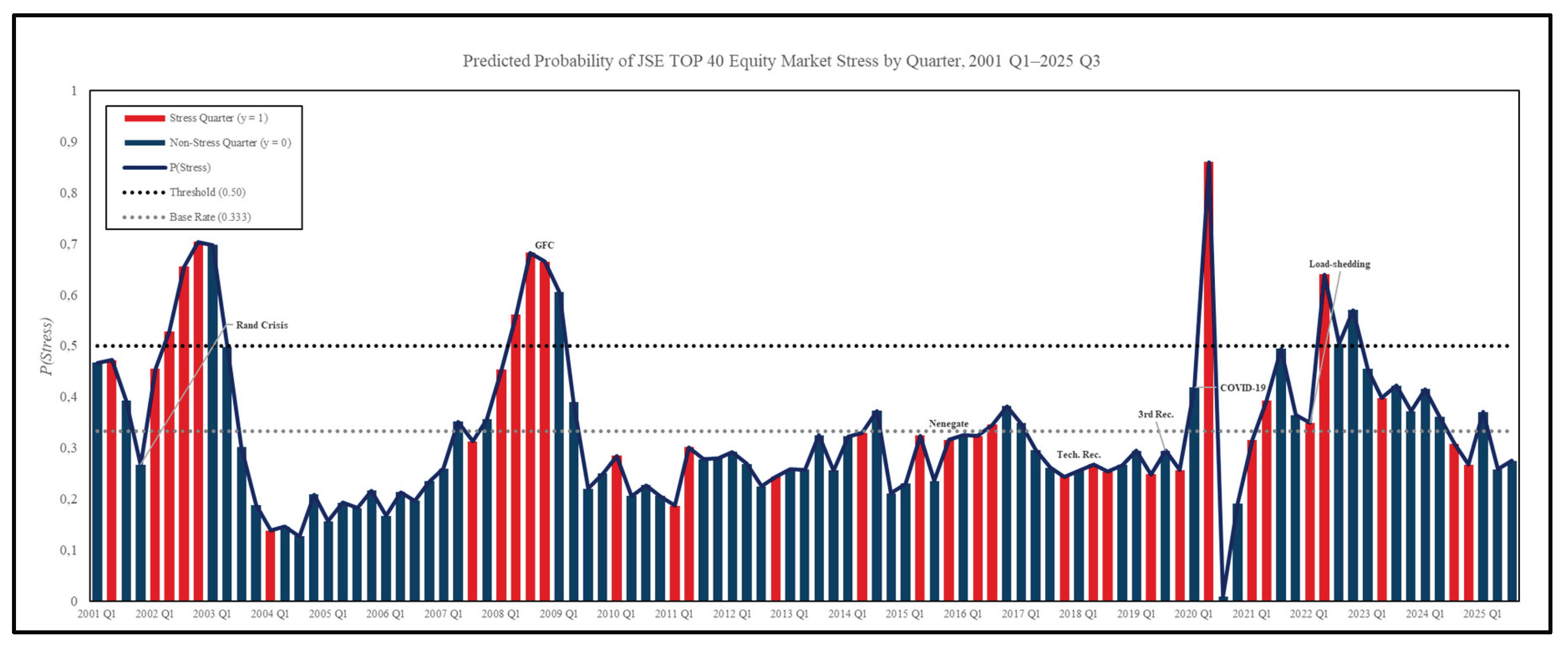
Figure 2.
Marginal Effect of Each Macroeconomic Predictor on the Predicted Probability of JSE TOP 40 Market Stress. Notes: Each panel shows the predicted probability of a negative JSE TOP 40 quarterly return as the labelled predictor varies across its observed range, with all other predictors held at their sample means (standardised value = 0). Solid line = median predicted probability from IRLS. Shaded band = 90% bootstrap confidence region (B = 5,000 replications; every 5th replicate used for computational efficiency). Rug marks on the x-axis show the observed distribution of each predictor. Dotted line = empirical base rate (0.333); dashed line = 0.50 classification threshold. pp = percentage points. N = 99, 2001 Q1–2025 Q3.
Figure 2.
Marginal Effect of Each Macroeconomic Predictor on the Predicted Probability of JSE TOP 40 Market Stress. Notes: Each panel shows the predicted probability of a negative JSE TOP 40 quarterly return as the labelled predictor varies across its observed range, with all other predictors held at their sample means (standardised value = 0). Solid line = median predicted probability from IRLS. Shaded band = 90% bootstrap confidence region (B = 5,000 replications; every 5th replicate used for computational efficiency). Rug marks on the x-axis show the observed distribution of each predictor. Dotted line = empirical base rate (0.333); dashed line = 0.50 classification threshold. pp = percentage points. N = 99, 2001 Q1–2025 Q3.
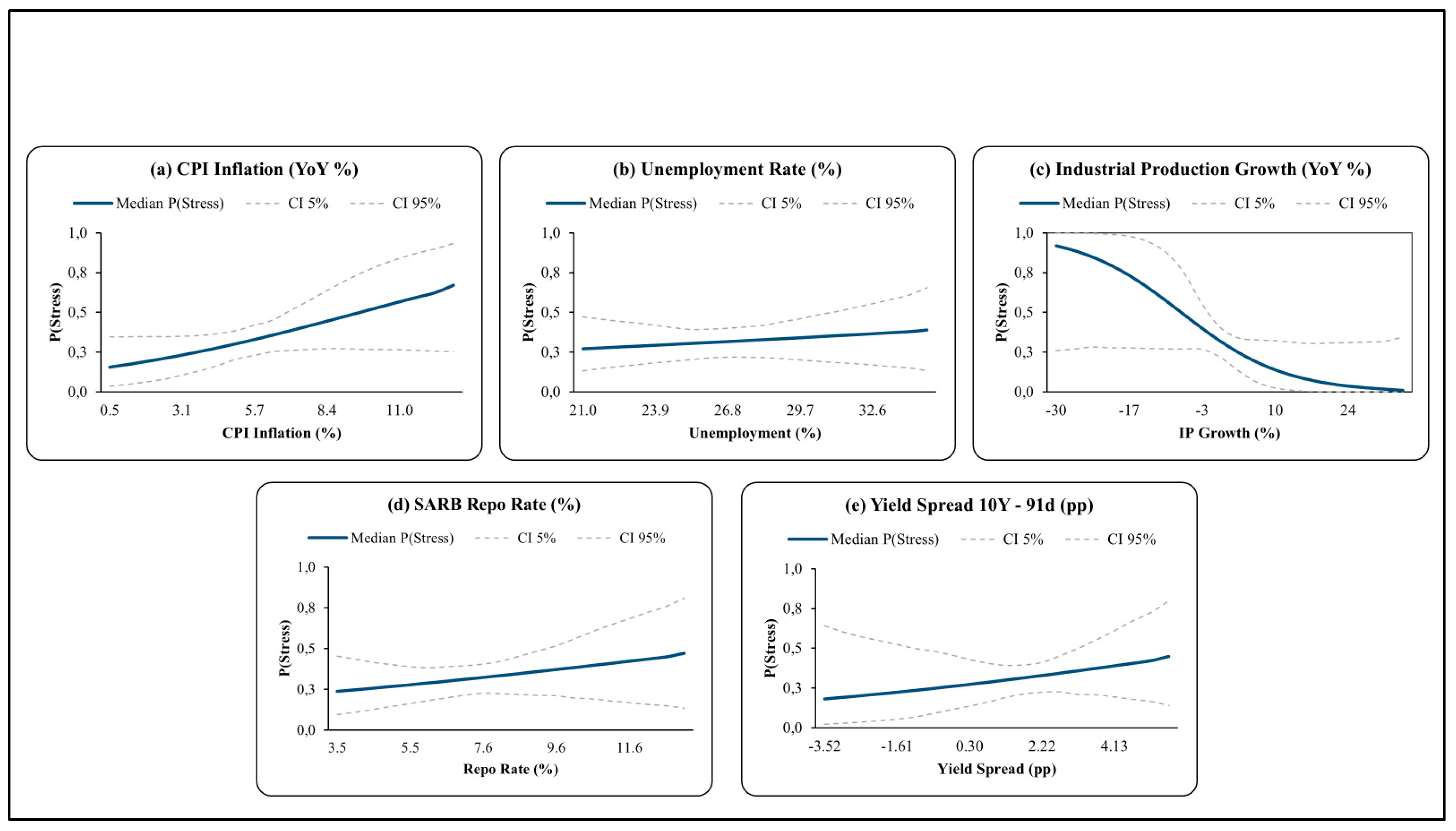
Figure 3.
Receiver Operating Characteristic Curve for the JSE TOP 40 Market Stress Model. Notes: The ROC curve plots the true positive rate (sensitivity) against the false positive rate (1 - specificity) across all classification thresholds. AUC = 0.664; bootstrap 95% CI = [0.541, 0.674] (B = 5,000 replications). Dashed diagonal = AUC of 0.50 (random classifier). Shaded region = area under the ROC curve. N = 99 quarters, 2001 Q1–2025 Q3.
Figure 3.
Receiver Operating Characteristic Curve for the JSE TOP 40 Market Stress Model. Notes: The ROC curve plots the true positive rate (sensitivity) against the false positive rate (1 - specificity) across all classification thresholds. AUC = 0.664; bootstrap 95% CI = [0.541, 0.674] (B = 5,000 replications). Dashed diagonal = AUC of 0.50 (random classifier). Shaded region = area under the ROC curve. N = 99 quarters, 2001 Q1–2025 Q3.
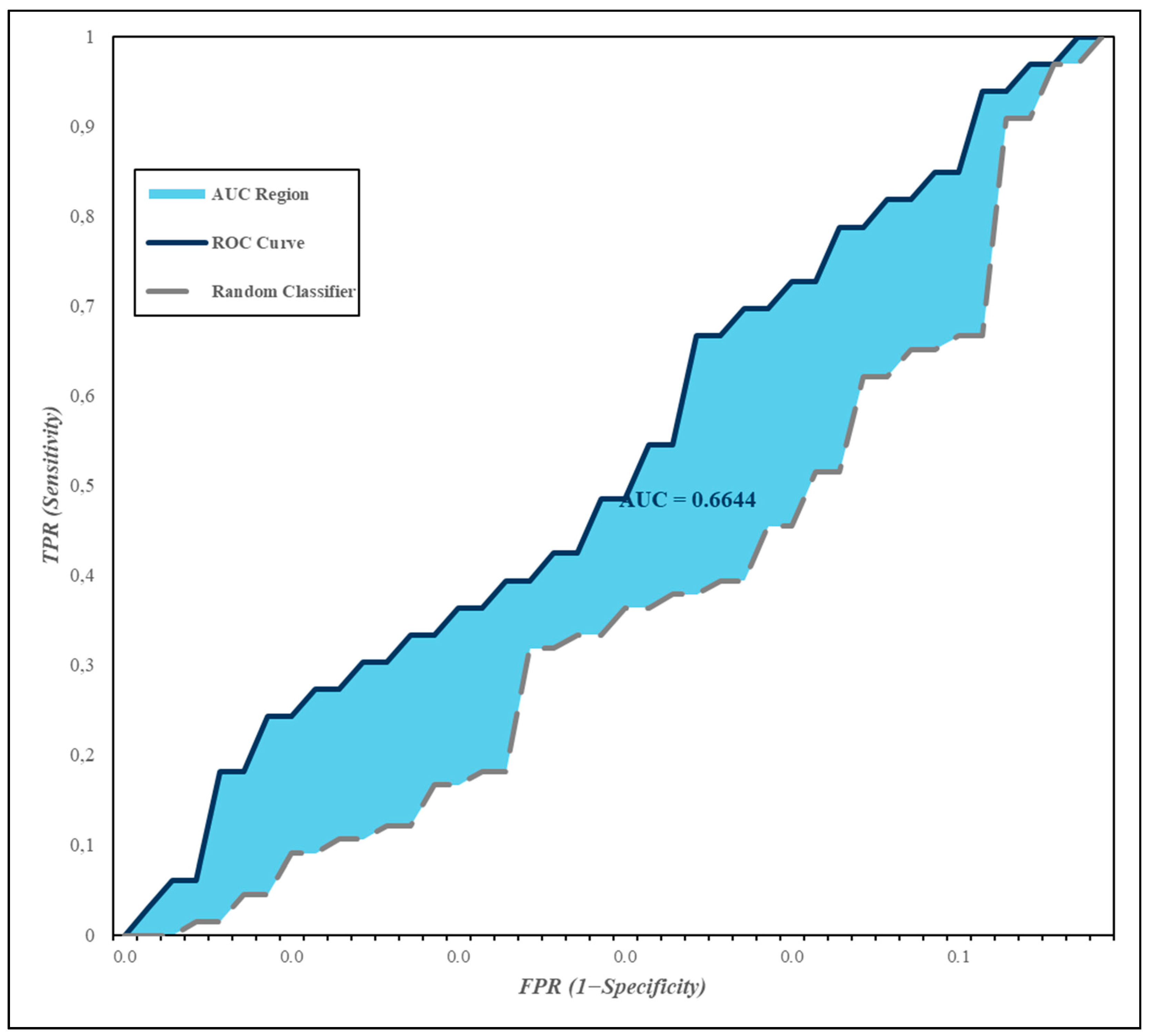

Table 1.
Data Sources for the Full Estimation Sample.
| Variable | Source | Identifier | Type | Frequency |
|---|---|---|---|---|
| JSE TOP 40 Total Return Index | IRESS | J200T | Index level | End-of-quarter |
| Consumer Price Index | Stats SA | P0141 cpi | Index level | Quarterly |
| Unemployment Rate | Stats SA | QLFS rate | Percent (%) | Quarterly |
| Industrial Production Growth | Stats SA | P3041.2 Mfg. | Percent (%) | Quarterly |
| SARB Repo Rate | SARB | KBP1442 | Percent (%) | End-of-quarter |
| 10-Year Government Bond Yield | SARB | R2030 | Percent (%) | End-of-quarter |
| 91-Day Treasury Bill Rate | SARB | KBP2003 | Percent (%) | End-of-quarter |
| Notes:The industrial production variable is sourced as a pre-computed year-on-year percentage growth rate from Stats SA P3041.2 manufacturing production and is used directly in the model without further transformation. All other variables are sourced as levels and transformed. No interpolation or imputation is applied to any series. | ||||
Table 2.
Descriptive Statistics for the Estimation Sample.
| Variable | M | SD | Min | Q1 | Mdn | Q3 | Max | Sk |
|---|---|---|---|---|---|---|---|---|
| JSE TOP 40 log return (%) | 2.56 | 8.94 | −25.63 | −2.62 | 3.89 | 7.73 | 27.34 | −0.39 |
| Stress indicator (0/1) | 0.333 | 0.474 | 0 | 0 | 0 | 1 | 1 | 0.72 |
| CPI inflation YoY (%) | 5.43 | 2.32 | 0.49 | 4.10 | 5.25 | 6.30 | 13.41 | 1.00 |
| Unemployment rate (%) | 26.89 | 3.65 | 21.03 | 24.45 | 25.45 | 29.18 | 35.29 | 0.74 |
| IP growth YoY (%) | 0.19 | 5.23 | −30.46 | −0.78 | 0.30 | 1.39 | 36.41 | 1.28 |
| SARB repo rate (%) | 7.32 | 2.37 | 3.50 | 5.63 | 7.00 | 8.25 | 13.50 | 0.80 |
| Yield spread 10Y−91-day (pp) | 1.86 | 1.79 | −3.53 | 1.04 | 1.67 | 2.58 | 5.89 | 0.13 |
| Notes:M = mean; SD = standard deviation; Q1 = first quartile; Mdn = median; Q3 = third quartile; Sk = skewness; pp = percentage points. JSE log return and stress indicator y_t correspond to quarter t+1 (the prediction target). All predictor variables are measured at the end of quarter t, one quarter ahead of the outcome. CPI inflation is year-on-year percent. Yield spread is 10-year government bond yield minus 91-day Treasury bill rate. IP growth extreme values in 2020 Q2 (−30.5%) and 2020 Q3 (+36.4%) reflect the COVID-19 shutdown and recovery and produce the excess kurtosis of 34.7 in the IP series. | ||||||||
Table 3.
Major South African Economic Events in the Estimation Sample.
| Event | Quarters | Characterisation | JSE Return | Model Signal |
|---|---|---|---|---|
| Rand crisis & SARB tightening | 2001 Q4 – 2003 Q1 | Repo rate 9.5→13.5%; rand −30%; CPI above 10% | Mixed, elevated volatility | Elevated probability |
| GFC recession (official) | Q4:2008 – Q2:2009 | Three consecutive neg. GDP quarters; CPI peak 13.4% | Worst qtr: −25.6% (2008 Q3) | Highest prob. in sample |
| Nenegate episode | 2015 Q4 | Finance minister dismissed; rand −10% in days | Near zero (+0.3%) | Moderate spike |
| Technical recession (official) | Q1:2018 – Q2:2018 | Two consecutive neg. GDP quarters; political uncertainty | Q1: −8.0%; Q2: +5.4% | Moderate elevation |
| Third recession (official) | Q3:2019 – Q4:2019 | Two consecutive neg. GDP quarters; energy constraints | Mixed | Moderate elevation |
| COVID-19 contraction (official) | Q1:2020 – Q2:2020 | Repo cut 6.5%→3.75%; GDP collapse; IP −30.5% | Q1: −23.2%; Q2: +20.5% | Moderate pre-shock |
| Load-shedding & hikes | 2022 Q1 – 2022 Q4 | SARB hikes 3.75%→7.0%; Stage 6; CPI peak 7.7% | Q2 & Q3: negative | Persistently elevated |
| Notes:Official recessions are per Statistics South Africa (two or more consecutive quarters of negative real GDP q/q growth, seasonally adjusted). JSE return figures are the actual observed log returns. IP contraction in 2020 Q2 reflects the national lockdown. Model signal is a qualitative assessment of the predicted probability relative to the 33.3% base rate. | ||||
Table 4.
IRLS Logistic Regression Estimates with Standard MLE Inference.
| Variable | SE | z | p | OR | |
|---|---|---|---|---|---|
| Intercept | −0.7643 | 0.2275 | −3.359 | < .001*** | 0.466 |
| CPI inflation YoY (z) | 0.4299 | 0.2896 | 1.484 | .138 | 1.537 |
| Unemployment rate (z) | 0.1367 | 0.2855 | 0.479 | .632 | 1.147 |
| IP growth YoY (z) | −0.5430 | 0.3604 | −1.507 | .132 | 0.581 |
| SARB repo rate (z) | 0.2489 | 0.3457 | 0.720 | .471 | 1.283 |
| Yield spread 10Y−91-day (z) | 0.2476 | 0.3847 | 0.643 | .520 | 1.281 |
| Notes:N = 99; stress quarters = 33; base rate = 33.3%. Predictors are standardised (M = 0, SD = 1). OR = odds ratio = exp () for a one-standard-deviation increase in the predictor. Log-likelihood (full model) = −58.262; log-likelihood (intercept only) = −63.015; McFadden R2 = .075; LR χ2 (5) = 9.506, p = .091. ***p < .001. | |||||
Table 5.
Comparison of Standard MLE and Bootstrap Inference.
| Variable | IRLS | MLE SE | Boot SE | SE Ratio | Boot 95% CI | |
|---|---|---|---|---|---|---|
| Intercept | −0.7643 | 0.2275 | 0.2582 | 1.135 | −0.711 | [−1.344, −0.331] |
| CPI inflation YoY | 0.4299 | 0.2896 | 0.3455 | 1.193 | 0.392 | [−0.172, 1.180] |
| Unemployment rate | 0.1367 | 0.2855 | 0.3393 | 1.188 | 0.126 | [−0.535, 0.817] |
| IP growth YoY | −0.5430 | 0.3604 | 0.4767 | 1.323 | −0.477 | [−1.708, 0.344] |
| SARB repo rate | 0.2489 | 0.3457 | 0.3948 | 1.142 | 0.265 | [−0.605, 0.954] |
| Yield spread 10Y−91-day | 0.2476 | 0.3847 | 0.4690 | 1.219 | 0.251 | [−0.677, 1.190] |
| Notes:SE Ratio = Boot SE / MLE SE. Values above 1.00 indicate that standard MLE inference understates true sampling uncertainty.= bias-corrected bootstrap estimate = 2− mean (BETA boot). Boot 95% CI = percentile method. Seed = 42; B = 5,000. IP growth has the largest SE ratio (1.323), driven by extreme kurtosis in its sampling distribution from the 2020 Q2–2020 Q3 COVID-19 manufacturing collapse and rebound. | ||||||
Table 6.
Odds Ratios with Bootstrap 95% Confidence Intervals.
| Variable | OR | Boot 95% CI | Direction | Economic Interpretation |
|---|---|---|---|---|
| CPI inflation YoY | 1.537 | [0.842, 3.254] | ↑ stress | 1-SD rise in inflation increases stress odds by 53.7% |
| Unemployment rate | 1.147 | [0.585, 2.264] | Weak ↑ | 1-SD rise in unemployment increases stress odds by 14.7% |
| IP growth YoY | 0.581 | [0.181, 1.411] | ↓ stress | 1-SD improvement in IP growth reduces stress odds by 41.9% |
| SARB repo rate | 1.283 | [0.547, 2.596] | ↑ stress | 1-SD rise in repo rate increases stress odds by 28.3% |
| Yield spread 10Y−91-day | 1.281 | [0.508, 3.287] | ↑ stress | 1-SD widening of spread increases stress odds by 28.1% |
| Notes:OR = exp(). Bootstrap 95% CI from percentile method (B = 5,000; seed = 42). CIs are computed as [exp(Q0.025), exp(Q0.975)] of the bootstrap distribution of the coefficient. All CIs include 1.00, consistent with borderline model joint significance. The positive yield spread OR reflects the South Africa-specific mechanism documented in the Section below, where spread widening frequently accompanies emergency SARB rate cuts during crisis episodes. | ||||
Table 7.
Marginal Effects at the Sample Mean with Bootstrap 95% Confidence Intervals.
| Variable | ME (pp) | Boot 95% CI (pp) | Interpretation | ||
|---|---|---|---|---|---|
| CPI inflation YoY | 0.4299 | 0.2168 | 0.0932 | [−0.037, 0.256] | 1-SD rise raises P(stress) by 9.3 pp |
| Unemployment rate | 0.1367 | 0.2168 | 0.0296 | [−0.116, 0.177] | 1-SD rise raises P(stress) by 3.0 pp |
| IP growth YoY | −0.5430 | 0.2168 | −0.1177 | [−0.370, 0.075] | 1-SD improvement reduces P(stress) by 11.8 pp |
| SARB repo rate | 0.2489 | 0.2168 | 0.0540 | [−0.131, 0.207] | 1-SD rise raises P(stress) by 5.4 pp |
| Yield spread 10Y−91-day | 0.2476 | 0.2168 | 0.0537 | [−0.147, 0.258] | 1-SD widening raises P(stress) by 5.4 pp |
| Note.MEj = βj × p(1 - p), evaluated at the sample mean where all standardised predictors equal zero. Baseline predicted probability: p = σ(−0.7643) = 0.3177. Bootstrap 95% CIs are computed by applying the ME formula to each of B = 5,000 bootstrap coefficient replicates and taking the 2.5th and 97.5th percentiles. pp = percentage points. | |||||
Table 8.
Model Diagnostic Statistics for the JSE TOP 40 Market Stress Logistic Regression.
| Diagnostic | Value | Reference / Threshold | Assessment |
|---|---|---|---|
| Observations (T) | 99 | Full sample 2001 Q1–2025 Q3 | Covers all available quarters |
| Stress quarters (y = 1) | 33 (33.3%) | Mild class imbalance | |
| Log-likelihood (full model) | −58.262 | vs. −63.015 (null) | Improvement of 4.753 |
| McFadden R2 | 0.075 | 0.07 = adequate | Meaningful fit for binary macro model |
| LR χ2 (5) | 9.506 | p = .091 | Borderline joint significance at α = .10 |
| Brier score | 0.201 | Ref = 0.222 | 9.5% improvement over base-rate reference |
| AUC (ROC) | 0.664 | 0.50 = random | Moderate discrimination |
| AUC bootstrap 95% CI | [0.541, 0.674] | B = 5,000 | True AUC likely 0.54 to 0.67 |
| Hosmer-Lemeshow statistic | 15.640 | p = .048 (g = 10) | Moderate calibration concern in tails |
| Overall accuracy (0.50 threshold) | 70.7% | Base rate 66.7% | 4.0 pp above naïve classifier |
| Sensitivity at 0.50 threshold | 24.2% | 33 stress quarters | Correctly flags 8 of 33 stress quarters |
| Specificity at 0.50 threshold | 93.9% | 66 non-stress quarters | Correctly identifies 62 of 66 |
| TP / TN / FP / FN | 8 / 62 / 4 / 25 | At 0.50 threshold | Asymmetric error profile |
| Note.AUC = area under the receiver operating characteristic curve. TP = true positive; TN = true negative; FP = false positive; FN = false negative. The Hosmer-Lemeshow p-value of .048 reflects calibration tension in the tails driven by COVID-19 IP outliers; the central 60% of the predicted probability distribution shows good calibration. Low sensitivity at 0.50 threshold is expected with a 33.3% base rate; a 0.30–0.35 threshold improves sensitivity materially at modest specificity cost. | |||
Disclaimer/Publisher’s Note: The statements, opinions and data contained in all publications are solely those of the individual author(s) and contributor(s) and not of MDPI and/or the editor(s). MDPI and/or the editor(s) disclaim responsibility for any injury to people or property resulting from any ideas, methods, instructions or products referred to in the content. |
© 2026 by the authors. Licensee MDPI, Basel, Switzerland. This article is an open access article distributed under the terms and conditions of the Creative Commons Attribution (CC BY) license (http://creativecommons.org/licenses/by/4.0/).
Copyright: This open access article is published under a Creative Commons CC BY 4.0 license, which permit the free download, distribution, and reuse, provided that the author and preprint are cited in any reuse.


