

Submitted:
11 June 2026
Posted:
12 June 2026
You are already at the latest version
Abstract
Gut‑associated lymph nodes (GALNs) constitute an important anatomical reservoir during early and chronic human immunodeficiency virus (HIV)/simian immunodeficiency virus (SIV) infection, but the fate of this compartment during terminal AIDS remains unclear. This study investigated viral persistence and lymph node injury in a rhesus macaque with long‑term SIVmac239 infection and end-stage AIDS, characterized by profound CD4+ T cell depletion (30 cells/μL) and persistent viremia (1 192 copies/mL). At necropsy, GALNs, including mesenteric, paracolic, and ileocecal lymph nodes, and non‑gut‑associated lymph nodes (NGALNs), including hepatic hilar, common iliac, and inguinal lymph nodes, were collected for viral RNA/DNA quantification, histopathology, immunofluorescence, and transcriptomics. SIV DNA was markedly lower in GALNs than in NGALNs, whereas SIV RNA was detectable only in NGALNs. GALNs exhibited extensive fibrotic remodeling, paracortical collapse, severe CD4+ T cell loss across B cell and paracortical regions, and pronounced CD8+ T cell accumulation within B cell zones. Transcriptomic profiling further revealed an exhaustion signature in GALNs, with reduced DNA replication and repair, impaired cell-cycle activity, and suppressed RNA processing, accompanied by activation of innate immune programs and attenuation of adaptive immune responses. These findings indicate that, during terminal AIDS, GALNs no longer serve as the predominant viral reservoir but instead undergo preferential and severe structural and functional exhaustion. This case highlights marked anatomical heterogeneity in lymph node vulnerability during advanced disease and supports a model in which collapse of the gut‑associated immune barrier contributes to disease progression toward terminal AIDS.
Keywords:
AIDS
; SIVmac239
; nonhuman primate
; gut-associated lymph node
; viral reservoir
; lymphoid exhaustion
1. Introduction
Combination antiretroviral therapy (cART) durably suppresses human immunodeficiency virus (HIV) replication but does not eradicate infection, primarily due to the persistence of replication-competent virus within anatomical reservoirs. Secondary lymphoid tissues, including the spleen, tonsils, and lymph nodes, are central sites of HIV/simian immunodeficiency virus (SIV) persistence because they contain abundant CD4+ T cells and provide cellular and stromal niches that support viral maintenance [1]. Among these compartments, gut-associated lymph nodes (GALNs) represent a distinct and highly vulnerable reservoir. Unlike superficial or peripheral lymph nodes, GALNs are continuously exposed to dietary antigens and microbial products, creating a state of physiological immune activation that increases CCR5 and CXCR4 expression on CD4+ T cells and enhances susceptibility to HIV/SIV infection [2]. Consequently, viral reservoirs are established earlier in GALNs, reach greater burdens, and persist more readily under cART than those in superficial lymph nodes [3,4].
Chronic HIV/SIV infection progressively remodels lymphoid tissues through fibrosis, architectural disorganization, and CD4+ T cell depletion [1,5]. As this damage advances, the same microenvironment that initially favors viral persistence may lose the cellular and structural capacity required to maintain active viral reservoirs. This uncertainty defines a central question in terminal acquired immunodeficiency syndrome (AIDS): do GALNs remain the predominant viral reservoir after prolonged infection, or does severe structural and functional exhaustion eliminate their capacity to sustain viral persistence? To address this question, GALNs and non-gut-associated lymph nodes (NGALNs) were comparatively analyzed in a rhesus macaque with long-term SIVmac239 infection and progression to AIDS. Viral RNA and DNA burdens, histopathological injury, immune cell distribution, and transcriptomic profiling were integrated to determine the terminal fate of GALNs during advanced disease.
2. Materials and Methods
An adult female Chinese rhesus macaque (Macaca mulatta) was intravenously inoculated with 4 000 TCID50 of SIVmac239 (GenBank: M33262.1). Peripheral blood was collected from the posterior tibial vein to longitudinally monitor CD4+ T cell counts and plasma viral load. Following euthanasia overdose of Zoletil 50 (Virbac, France), the macaque was transcardially perfused with precooled phosphate-buffered saline (PBS). Multiple GALNs, comprising mesenteric, paracolic, and ileocecal lymph nodes, and NGALNs, comprising hepatic hilar, common iliac, and inguinal lymph nodes, were collected for downstream analyses. All animal procedures were approved by the Ethics Committee of the Kunming Institute of Zoology, Chinese Academy of Sciences (Approval No.: IACUC-PE-2021-06-001).
Total RNA from plasma was isolated using a High Pure Viral RNA Kit (11858882001, Roche, Switzerland), whereas total RNA from lymph nodes was extracted using TRIzol Reagent (9109, Takara, Japan). Genomic DNA was purified using a TIANamp Genomic DNA Kit (DP304, TIANGEN, China). Viral RNA and DNA were quantified using previously reported primers and probes targeting the SIVmac239 gag gene [6]. RNA quantification was performed on a QuantStudioTM 5 Real-Time Polymerase Chain Reaction (PCR) Instrument (Thermo, USA) using the Evo M-MLV One-Step RT-qPCR Kit (AG11715, Accurate Biotechnology, China), and DNA quantification was performed using the Premix Ex Taq™ (RR390A, Takara, Japan). Standard curves were generated from serial dilutions of the pGEM-4Z-SIVgag357 plasmid. Flow cytometry was performed as described previously [7]. Absolute T cell counts were determined using fresh EDTA-K2-anticoagulated peripheral blood. The anti-human antibodies used for flow cytometry were cross-reactive with rhesus macaque antigens and included anti-CD3 BV421 (clone SP34-2, BD Biosciences, USA), anti-CD8 PE-Cy7 (clone PRA-T8, BD Biosciences, USA), and anti-CD4 PerCP/Cy5.5 (clone OKT4, BioLegend, USA).
For histopathological analysis, lymph node tissues were fixed in 4% paraformaldehyde, dehydrated through a graded ethanol series, embedded in paraffin, and sectioned at 4 μm. Tissue sections were stained with hematoxylin-eosin (H&E) and Masson’s trichrome, and brightfield images were captured using a BX53 microscope (Olympus, Japan). Immunofluorescence was performed as described previously [8]. Paraffin sections were incubated with primary antibodies: rabbit anti-CD4 (ab133616, Abcam, UK), rabbit anti-CD8 (ab237709, Abcam, UK), and mouse anti-CD20 (14-0202-82, Invitrogen, USA). After washing, sections were incubated with secondary antibodies: goat anti-rabbit Alexa Fluor™ 555 (ab150078, Abcam, UK) and goat anti-mouse Alexa Fluor™ 488 (ab150117, Abcam, UK). Nuclei were counterstained with 4′,6-diamidino-2-phenylindole (DAPI). Immunohistochemical staining was performed using a MaxVision HRP-Polymer anti-Mouse IHC Kit (Maixin, China). Fluorescence images were acquired using a stimulated emission depletion microscope (STEDYCON, Abberior, Germany).
Bulk RNA sequencing (RNA-seq) was conducted on total RNA extracted from all lymph nodes following established protocols [9]. Briefly, sequencing libraries were generated and sequenced on the Illumina NovaSeq 6000 platform (Illumina, USA). Clean reads were aligned to the rhesus macaque reference genome (Mmul_10). Gene expression differences were analyzed using DESeq2, and differentially expressed genes (DEGs) were defined using |log2 fold change| > 1 and P < 0.05. Gene set enrichment analysis (GSEA) was performed with the clusterProfiler R package (v4.6.2) using the MSigDB C5 biological process gene set (v7.1; c5.bp.v7.1.symbols). Significantly enriched pathways were defined by adjusted P < 0.05.
3. Results
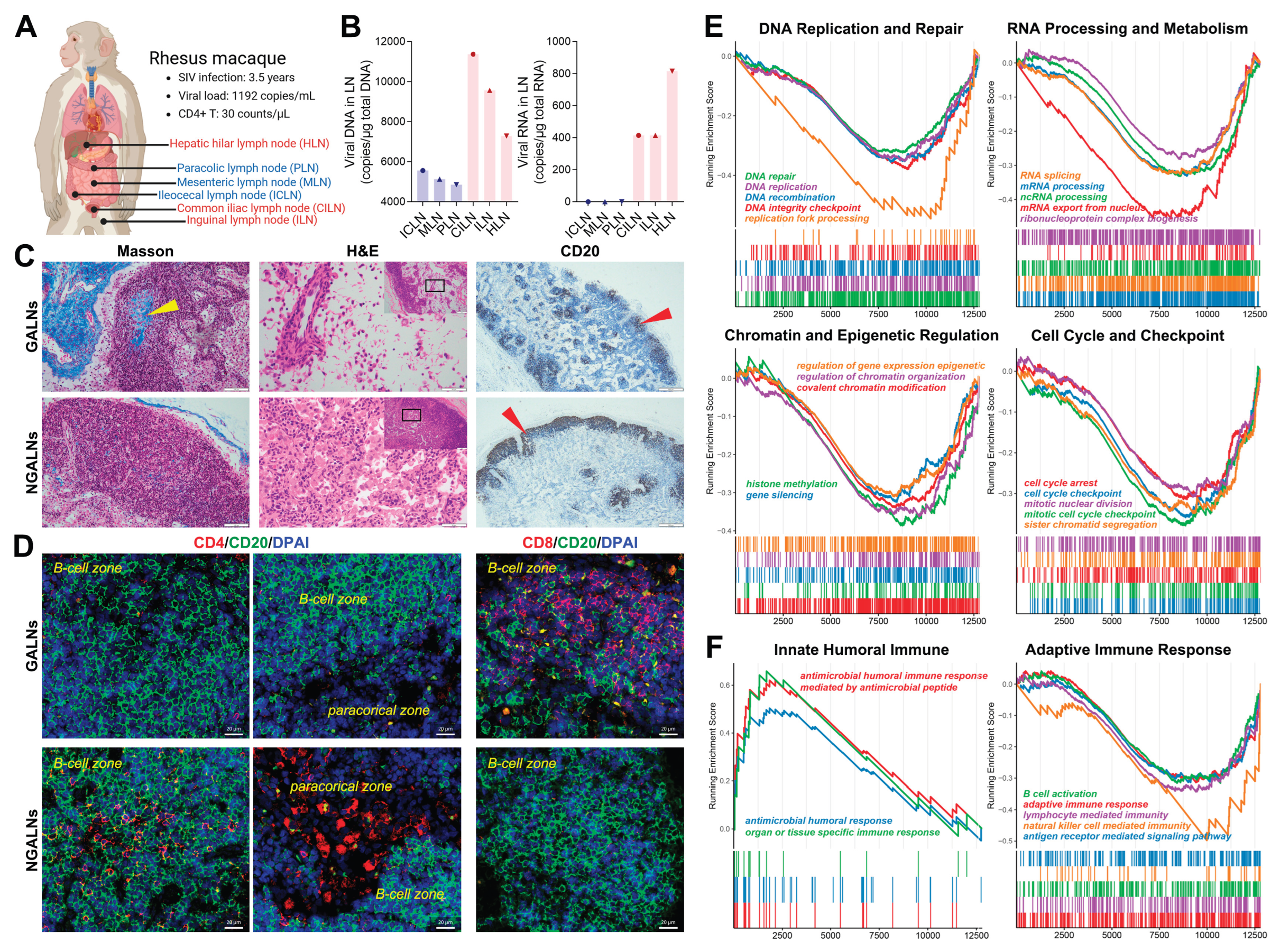
The rhesus macaque remained viremic throughout the 3.5 years of SIVmac239 infection and had progressed to terminal AIDS by necropsy, with persistent diarrhea for more than 2 weeks, severe weight loss, lethargy, plasma viral load of 1 192 copies/mL, CD4+ T cell count of 30 cells/μL, CD8+ T cell count of 136 cells/μL, and a CD4/CD8 ratio of 0.22. Lymph nodes were classified as GALNs (mesenteric, paracolic, ileocecal lymph nodes) or NGALNs (hepatic hilar, common iliac, inguinal lymph nodes) (Figure 1A). Quantification of viral DNA and RNA loads revealed a marked anatomical shift in reservoir distribution at the terminal stage (Figure 1B). SIV DNA was substantially lower in GALNs than in NGALNs, whereas viral RNA was detected only in NGALNs, indicating that NGALNs, rather than GALNs, represented the dominant viral reservoir compartment during terminal AIDS.
Histopathological and immunofluorescence analyses identified profound structural divergence between GALNs and NGALNs (Figure 1C,D). Masson’s trichrome staining showed extensive fibrosis in the superficial cortex, corresponding to B cell zones, in GALNs, whereas NGALNs exhibited minimal fibrotic remodeling. H&E staining further revealed severe paracortical (T cell zone) destruction and extensive cellular loss in GALNs, in contrast to the relatively preserved architecture of NGALNs, despite swollen paracortical cells. CD20 immunostaining confirmed pronounced atrophy of B cell zones in GALNs compared with NGALNs, demonstrating more severe structural disruption in the gut-associated compartment. Multiplex immunofluorescence for CD4 and CD20 showed near-complete loss of CD4+ T cells in GALN B cell zones, where these cells largely correspond to follicular helper T cells (TFH) and important HIV/SIV reservoir cells, and in the paracortex. In contrast, NGALNs retained detectable CD4+ T cells in both regions, although paracortical CD4+ T cells exhibited abnormal swelling. This profound depletion of CD4+ T cells in GALNs likely accounts for their loss of predominant viral reservoir status. CD8 and CD20 co-staining further revealed massive infiltration of CD8+ T cells into GALN B cell zones, a pattern not observed in NGALNs. This ectopic CD8+ T cell infiltration into B cell follicles is consistent with follicular injury and lymphoid tissue exhaustion.
Transcriptomic profiling further distinguished GALNs from NGALNs at the functional level. Differential expression analysis identified 174 upregulated and 39 downregulated genes in GALNs relative to NGALNs. Given the limited number of individual DEGs, GSEA was subsequently performed to capture coordinated pathway-level changes. Four major pathway categories were significantly downregulated in GALNs relative to NGALNs: DNA replication and repair, RNA processing and metabolism, chromatin and epigenetic regulation, and cell-cycle and checkpoint control (Figure 1E). Broad suppression of these core cellular processes suggests a state of profound tissue exhaustion in GALNs. Immune pathway analysis further showed activation of innate humoral immune pathways but marked downregulation of adaptive immune response pathways in GALNs (Figure 1F). This transcriptomic shift is consistent with CD4+ T cell depletion and architectural collapse in GALNs, supporting the interpretation that GALNs transition from a major reservoir compartment to a structurally damaged and functionally exhausted immune compartment during terminal AIDS.
4. Discussion
This case report of a rhesus macaque with long-term SIVmac239 infection and terminal AIDS reveals a marked anatomical redistribution of viral persistence at the end stage of disease. Although GALNs are recognized as early and durable reservoirs during HIV/SIV infection, terminal-stage GALNs in this animal showed substantially lower SIV DNA than NGALNs and no detectable SIV RNA, indicating loss of predominant reservoir activity. This virological shift occurred alongside severe fibrotic remodeling, paracortical destruction, depletion of CD4+ T cells in both follicular and paracortical regions, and extensive CD8+ T cell accumulation within B cell follicles. Transcriptomic profiling further identified broad repression of pathways involved in DNA replication and repair, RNA processing, cell-cycle regulation, and checkpoint control, along with activation of innate immune programs and attenuation of adaptive immune responses, a signature consistent with tissue exhaustion.
Terminal-stage GALNs displayed profound disruption of the B cell zone, with several coordinated features consistent with impaired humoral immunity. First, marked fibrosis and follicular atrophy disrupted B cell zone architecture, likely compromising GC organization and B cell survival [1,10]. Second, extensive TFH cell depletion indicated loss of essential GC support, with likely consequences for B cell maturation, antibody production, and antiviral humoral responses [11]. Third, extensive CD8+ T cell infiltration into B cell follicles further exacerbated follicular injury, as functionally exhausted CD8+ T cells have limited capacity to eliminate infected targets, whereas regulatory CD8+ T cell subsets suppress TFH-derived IL-21 production and B cell IgG responses [12,13]. Collectively, B cell zone fibrosis, TFH cell depletion, and intrafollicular CD8+ T cell accumulation indicate that the humoral immune niche in terminal-stage GALNs is structurally and functionally compromised, consistent with profound suppression of humoral immunity.
The T cell compartment in GALNs was also severely damaged. Profound depletion of CD4+ T cells in the paracortex and B cell follicles reduced the major cellular targets for productive HIV/SIV infection, providing a plausible explanation for the low SIV DNA burden and absence of detectable viral RNA in GALNs. This loss also reflects collapse of cellular immune capacity within the GALN compartment. Transcriptomic analysis corroborated these findings: compared with NGALNs, GALNs showed significant downregulation of adaptive immune pathways, including B cell activation, lymphocyte-mediated immunity, and antigen receptor signaling (adjusted P < 0.05). This molecular signature aligns with the histological evidence of CD4+ T cell depletion and architectural collapse, indicating coordinated failure of both humoral and cellular immunity in end-stage GALNs.
The preferential exhaustion of GALNs is highly relevant to gut barrier failure during advanced HIV/SIV disease. The gut is continuously exposed to microbial and dietary antigens and relies on both epithelial integrity and gut-associated lymphoid tissues, including GALNs, to maintain immune containment. During HIV/SIV infection, viral replication disrupts epithelial barriers and depletes CD4+ T cells across mucosal, submucosal, and lymphoid compartments, thereby promoting microbial translocation into the circulation and driving persistent systemic immune activation that fuels disease progression [14,15]. In this terminal-stage macaque, severe GALN exhaustion reflects a failure of this gut-associated immunological barrier. Upregulation of antimicrobial humoral immune pathways in GALNs also suggests ongoing microbial exposure or invasion within this compartment. These observations indicate that exhaustion of GALNs, together with loss of gut barrier integrity, may allow persistent microbial translocation to drive systemic immunopathology, thereby accelerating progression toward terminal AIDS.
Several limitations should be considered. First, this was a single-animal case report; therefore, interindividual variation cannot be excluded, and validation in additional terminal-stage SIV models is required. Second, the animal did not receive antiretroviral therapy, which differs from most clinical reservoir studies conducted under cART. Nevertheless, untreated infection provides a direct view of terminal AIDS pathology without pharmacological suppression of viral replication. Third, bulk RNA-seq cannot resolve the specific cell populations responsible for the observed exhaustion signature. As such, single-cell and spatial transcriptomic approaches will be needed to define the cellular sources and anatomical organization of these transcriptional changes.
In conclusion, this case demonstrates that long-term SIV infection can drive preferential structural and functional exhaustion of GALNs during terminal AIDS, leading to the loss of predominant viral reservoir status relative to NGALNs. These findings reveal that lymph node compartments at different anatomical sites follow distinct pathological trajectories during advanced HIV/SIV infection and highlight gut-associated immune barrier collapse as a central feature of progression to terminal AIDS.
Author Contributions
Conceptualization, T.Z.S., Y.T.Z., and L.M.Y.; methodology, C.J.B. and Y.Z.; software, T.Z.S.; validation, C.J.B., Y.Z., Z.R.D., Y.Q.W., and M.X.S.; formal analysis, T.Z.S.; investigation, T.Z.S.; resources, Y.T.Z.; data curation, T.Z.S., C.J.B., and Y.Z.; writing—original draft preparation, T.Z.S.; writing—review and editing, Y.T.Z. and L.M.Y.; visualization, T.Z.S.; supervision, Y.T.Z. and L.M.Y.; project administration, Y.T.Z. and L.M.Y.; funding acquisition, T.Z.S., Y.T.Z., and L.M.Y. All authors have read and agreed to the published version of the manuscript.
Funding
This research was funded by Prevention and Control of Emerging and Major Infectious Diseases-National Science and Technology Major Project, grant number 2025ZD01904400, 2025ZD01900700, and 2026ZD01911700.
Institutional Review Board Statement
All animal procedures were approved by the Ethics Committee of the Kunming Institute of Zoology, Chinese Academy of Sciences (Approval No.: IACUC-PE-2021-06-001, date of approval 1 June 2021).
Informed Consent Statement
Not applicable.
Conflicts of Interest
The authors declare no conflicts of interest.
Abbreviations
The following abbreviations are used in this manuscript:
| AIDS | Acquired immunodeficiency syndrome |
| cART | Combination antiretroviral therapy |
| DAPI | 4′,6-diamidino-2-phenylindole |
| DEGs | Differentially expressed genes |
| GALNs | Gut-associated lymph nodes |
| GCs | Germinal centers |
| GSEA | Gene set enrichment analysis |
| H&E | Hematoxylin-eosin |
| HIV | Human immunodeficiency virus |
| NGALNs | Non-gut-associated lymph nodes |
| PBS | Phosphate-buffered saline |
| RNA-seq | RNA-sequencing |
| SIV | Simian immunodeficiency virus |
| TFH | Follicular helper T cells |
References
- Estes, J.D. Pathobiology of HIV/SIV-associated changes in secondary lymphoid tissues. Immunol. Rev. 2013, 254, 65–77. [Google Scholar] [CrossRef] [PubMed]
- Lau, J.S.Y.; Lewin, S.R.; Telwatte, S. HIV and the gut: implications for HIV persistence, immune dysfunction and cure strategies. Front. Immunol. 2025, 16, 1650852. [Google Scholar] [CrossRef] [PubMed]
- Siddiqui, S.; Perez, S.; Gao, Y.; Doyle-Meyers, L.; Foley, B.T.; Li, Q.; Ling, B. Persistent viral reservoirs in lymphoid tissues in SIV-infected rhesus macaques of Chinese-origin on suppressive antiretroviral therapy. Viruses 2019, 11, 105. [Google Scholar] [CrossRef] [PubMed]
- Rabezanahary, H.; Moukambi, F.; Palesch, D.; Clain, J.; Racine, G.; Andreani, G.; Benmadid-Laktout, G.; Zghidi-Abouzid, O.; Soundaramourty, C.; Tremblay, C.; Silvestri, G.; Estaquier, J. Despite early antiretroviral therapy effector memory and follicular helper CD4 T cells are major reservoirs in visceral lymphoid tissues of SIV-infected macaques. Mucosal Immunol. 2020, 13, 149–160. [Google Scholar] [CrossRef] [PubMed]
- Zeng, M.; Smith, A.J.; Wietgrefe, S.W.; Southern, P.J.; Schacker, T.W.; Reilly, C.S.; Estes, J.D.; Burton, G.F.; Silvestri, G.; Lifson, J.D.; Carlis, J.V.; Haase, A.T. Cumulative mechanisms of lymphoid tissue fibrosis and T cell depletion in HIV-1 and SIV infections. J. Clin. Investig. 2011, 121, 998–1008. [Google Scholar] [CrossRef] [PubMed]
- Lu, Y.; Zhang, M.X.; Pang, W.; Song, T.Z.; Zheng, H.Y.; Tian, R.R.; Zheng, Y.T. Transcription factor ZNF683 inhibits SIV/HIV replication through regulating IFNγ secretion of CD8+ T Cells. Viruses 2022, 14, 719. [Google Scholar] [CrossRef] [PubMed]
- Zheng, H.Y.; Wang, X.H.; He, X.Y.; Chen, M.; Zhang, M.X.; Lian, X.D.; Song, J.H.; Hu, Y.; Pang, W.; Wang, Y.; Hu, Z.F.; Lv, L.B.; Zheng, Y.T. Aging induces severe SIV infection accompanied by an increase in follicular CD8+ T cells with overactive STAT3 signaling. Cell Mol. Immunol. 2022, 19, 1042–1053. [Google Scholar] [CrossRef] [PubMed]
- Zhang, L.T.; Tian, R.R.; Zheng, H.Y.; Pan, G.Q.; Tuo, X.Y.; Xia, H.J.; Xia, X.S.; Pang, W.; Zheng, Y.T. Translocation of microbes and changes of immunocytes in the gut of rapid- and slow-progressor Chinese rhesus macaques infected with SIVmac239. Immunology 2016, 147, 443–452. [Google Scholar] [CrossRef] [PubMed]
- Song, T.Z.; Li, Q.; Zhang, L.R.; Hu, Y.; Lu, Y.; Zheng, Y.T. Development of a progressive HIV-1-Like infection model in northern pig-tailed macaques using stHIV-1sv/G53D. Emerg. Microbes Infect. 2026, 15, 2648891. [Google Scholar] [CrossRef] [PubMed]
- Estes, J.D.; Wietgrefe, S.; Schacker, T.; Southern, P.; Beilman, G.; Reilly, C.; Milush, J.M.; Lifson, J.D.; Sodora, D.L.; Carlis, J.V.; Haase, A.T. Simian immunodeficiency virus-induced lymphatic tissue fibrosis is mediated by transforming growth factor beta 1-positive regulatory T cells and begins in early infection. J. Infect. Dis. 2007, 195, 551–561. [Google Scholar] [CrossRef] [PubMed]
- Crotty, S. T follicular helper cell differentiation, function, and roles in disease. Immunity 2014, 41, 529–542. [Google Scholar] [CrossRef] [PubMed]
- Petrovas, C.; Ferrando-Martinez, S.; Gerner, M.Y.; Casazza, J.P.; Pegu, A.; Deleage, C.; Cooper, A.; Hataye, J.; Andrews, S.; Ambrozak, D.; Del Río Estrada, P.M.; Boritz, E.; Paris, R.; Moysi, E.; Boswell, K.L.; Ruiz-Mateos, E.; Vagios, I.; Leal, M.; Ablanedo-Terrazas, Y.; Rivero, A.; Gonzalez-Hernandez, L.A.; McDermott, A.B.; Moir, S.; Reyes-Terán, G.; Docobo, F.; Pantaleo, G.; Douek, D.C.; Betts, M.R.; Estes, J.D.; Germain, R.N.; Mascola, J.R.; Koup, R.A. Follicular CD8 T cells accumulate in HIV infection and can kill infected cells in vitro via bispecific antibodies. Sci. Transl. Med. 2017, 9, eaag2285. [Google Scholar] [CrossRef] [PubMed]
- Miles, B.; Miller, S.M.; Folkvord, J.M.; Levy, D.N.; Rakasz, E.G.; Skinner, P.J.; Connick, E. Follicular regulatory CD8 T Cells impair the germinal center response in SIV and ex vivo HIV infection. PLoS Pathog. 2016, 12, e1005924. [Google Scholar] [CrossRef] [PubMed]
- Moretti, S.; Schietroma, I.; Sberna, G.; Maggiorella, M.T.; Sernicola, L.; Farcomeni, S.; Giovanetti, M.; Ciccozzi, M.; Borsetti, A. HIV-1-host interaction in gut-associated lymphoid tissue (GALT): effects on local environment and comorbidities. Int. J. Mol. Sci. 2023, 24, 12193. [Google Scholar] [CrossRef] [PubMed]
- Brenchley, J.M.; Douek, D.C. The mucosal barrier and immune activation in HIV pathogenesis. Curr. Opin. HIV AIDS 2008, 3, 356–361. [Google Scholar] [CrossRef] [PubMed]
Figure 1.
Virological, histopathological, immunological, and transcriptomic differences between gut-associated lymph nodes (GALNs) and non-gut-associated lymph nodes (NGALNs) in a rhesus macaque with terminal AIDS after long-term SIVmac239 infection. (A) Anatomical distribution of sampled GALNs (mesenteric, paracolic, ileocecal lymph nodes), shown in blue, and NGALNs (hepatic hilar, common iliac, inguinal lymph nodes), shown in red. (B) SIV DNA and RNA levels in GALNs and NGALNs, quantified by real-time PCR. (C) Histopathological and immunohistochemical assessment of GALNs and NGALNs using Masson’s trichrome staining (left), H&E staining (middle), and CD20 immunostaining (right). Yellow arrows indicate fibrosis and red arrows indicate B cell zones. (D) Multiplex immunofluorescence analysis of GALNs and NGALNs. Left panels: CD4 (red) and CD20 (green) co-staining. Right panels: CD8 (green) and CD20 (red) co-staining. Nuclei were counterstained with DAPI (blue). (E) Gene set enrichment analysis (GSEA) showing downregulated pathways in GALNs compared with NGALNs. Adjusted P < 0.05. (F) GSEA showing immune-related pathways differentially enriched between GALNs and NGALNs. Adjusted P < 0.05.
Figure 1.
Virological, histopathological, immunological, and transcriptomic differences between gut-associated lymph nodes (GALNs) and non-gut-associated lymph nodes (NGALNs) in a rhesus macaque with terminal AIDS after long-term SIVmac239 infection. (A) Anatomical distribution of sampled GALNs (mesenteric, paracolic, ileocecal lymph nodes), shown in blue, and NGALNs (hepatic hilar, common iliac, inguinal lymph nodes), shown in red. (B) SIV DNA and RNA levels in GALNs and NGALNs, quantified by real-time PCR. (C) Histopathological and immunohistochemical assessment of GALNs and NGALNs using Masson’s trichrome staining (left), H&E staining (middle), and CD20 immunostaining (right). Yellow arrows indicate fibrosis and red arrows indicate B cell zones. (D) Multiplex immunofluorescence analysis of GALNs and NGALNs. Left panels: CD4 (red) and CD20 (green) co-staining. Right panels: CD8 (green) and CD20 (red) co-staining. Nuclei were counterstained with DAPI (blue). (E) Gene set enrichment analysis (GSEA) showing downregulated pathways in GALNs compared with NGALNs. Adjusted P < 0.05. (F) GSEA showing immune-related pathways differentially enriched between GALNs and NGALNs. Adjusted P < 0.05.
Disclaimer/Publisher’s Note: The statements, opinions and data contained in all publications are solely those of the individual author(s) and contributor(s) and not of MDPI and/or the editor(s). MDPI and/or the editor(s) disclaim responsibility for any injury to people or property resulting from any ideas, methods, instructions or products referred to in the content. |
© 2026 by the authors. Licensee MDPI, Basel, Switzerland. This article is an open access article distributed under the terms and conditions of the Creative Commons Attribution (CC BY) license (http://creativecommons.org/licenses/by/4.0/).
Copyright: This open access article is published under a Creative Commons CC BY 4.0 license, which permit the free download, distribution, and reuse, provided that the author and preprint are cited in any reuse.


