

Submitted:
10 June 2026
Posted:
11 June 2026
You are already at the latest version
Abstract
This paper researches how economic downturns and currency movements affect the quality of bank loans in Central, Eastern, and Southeastern Europe. The analyzed dataset includes annual data for 14 national banking systems covering 2008–2023. We estimate a bias-corrected dynamic fixed-effects model and check robustness with Driscoll-Kraay and cluster-robust standard errors. Further, we extend the analysis by specifying profitability-based thresholds and conducting forward-looking scenario simulations. Credit risk is very persistent. Following an initial deterioration, the quality of bank loans recovers slowly, and our estimated bias-corrected autoregressive coefficient of 0.944 implies a half-life of 12.0 years. Among the macro-financial drivers, lower real GDP per capita growth and exchange rate depreciation predict higher non-performing loan (NPL) ratios. The exchange-rate coefficient is significant only with selected inference approaches. After adjusting the depreciation series for breaks due to the euro adoption, the exchange-rate result remains, suggesting it is not solely a measurement artifact. The threshold test indicates that linearity is not supported at the 5 percent level and that a profitability cutoff is estimated at a 1.80 percent return on equity. However, the low regime only has 32 observations, so regime-specific precision is limited. No significant interaction between depreciation and institutional quality is found between the 14 countries. A severe, combined adverse situation increases the NPL ratio from 6.54 to 12.32 percent over 5 years. These findings may interest policymakers designing macro-prudential frameworks in emerging Europe, central banks conducting stress tests, and researchers studying the international transmission of financial shocks under institutional quality conditions.
Keywords:
non-performing loans
; banking-sector credit risk
; institutional quality
; exchange-rate depreciation
; dynamic panel
; threshold model
; CESEE
1. Introduction
Banking sector credit risk is one of the key ways through which macroeconomic shocks are passed down to financial instability. When the economy enters a recession, contracting economic activity and an increased real cost of borrowing greatly reduce the ability of companies and households to service debt obligations. Significant depreciation can magnify this effect in countries that have direct or indirect foreign-currency exposure. Non-performing loans (NPL) under these conditions decrease profitability and reduce the availability of new credit, and support a self-reinforcing dynamic of financial fragility and macroeconomic weakness [1,2,3,4]. These dynamics are especially serious in Central, Eastern, and Southeastern Europe (CESEE), where banking systems are operating in an environment with uneven institutional conditions, recurrent external shocks, and a high cross-country variation in the dynamics of credit and post-crisis adjustment [5,6,7].
The choice of CESEE as the regional focus of this paper is therefore not incidental. Banking sectors in this region have been impacted by the combination of several shocks over the past few years: the global financial crisis, government debt crises, the sudden exchange rate adjustments, the economic disruption triggered by the Covid-19 pandemic, and a cycle of inflation and money supply tightening. Yet these shocks did not have the same consequences in observed CESEE countries. In some cases, the quality of loans deteriorated rapidly, and the impact was long-lasting, while in others, similar stress was absorbed through more limited increases in non-performing loans. That cross-country heterogeneity suggests that transmission of adverse shocks to credit risk is not only dependent on the shocks, but also on the structural and institutional conditions in which they occur [8,9,10].
This study is motivated by an important gap in the regional non-performing loans literature. The majority of the existing research identifies average macroeconomic or banking-sector determinants of credit risk, but, at the same time, leaves three issues insufficiently explored. The treatment of institutional quality is one. In most CESEE studies, governance variables either do not appear or are used as additive controls [1,5,11,12]. Nevertheless, institutional quality should matter, not because it correlates with financial development in cross-section, but because there is a possibility that it may alter the rate at which adverse shocks pass through to credit risk. A stricter rule of law and more effective regulation should improve supervisory responsiveness, restructuring capacity, and the credibility of financial intermediation [10,13,14]. The few CESEE studies that include institutional variables, such as Tanaskovic and Jandric [8], Bayar [9], Shala et al. [15], and Tatarici et al. [6], do not test whether institutions condition the slope of shock transmission. It is this distinction that makes a fundamental part of our research design.
The functional form is another underexplored issue, as the vast majority of evidence at the regional level is based on linear specifications [16,17,18]. Under the conditions of already weak profitability in the banking sector, a moderate macroeconomic worsening may trigger a disproportionate response in an increase in credit risk than it would in a more resilient environment. This possibility requires formal threshold tests, which, although there is mounting evidence of state-dependent banking vulnerabilities in other countries, are still rare in the research presented on non-performing loans in CESEE.
Beyond these empirical issues, there is an issue of interpretation. Policymakers and institutions operate outside the coefficient space and are not concerned with it. Any moderate one-time shock to a highly persistent system can cumulate and compound over a few years. Papers that stop at reporting signs and significance leave part of the policy-relevant story untold.
This paper answers these issues within an integrated framework. We construct an annual country-level panel for 14 CESEE and comparator banking systems from 2008 to 2023 and lag construction is based on the entire 2007 to 2024 window of source data. Banking-sector credit risk is implemented as a logit model. A dynamic panel model with year and country fixed effects is considered the baseline specification, which is estimated using a bias-corrected fixed-effects (BC-FE) estimator with block-bootstrap inference. We also add to that specification Driscoll-Kraay and cluster-robust standard errors, a threshold specification using lagged profitability, and a scenario module that transforms the estimated sensitivities into modeled credit-risk paths. The design also has a clear correction of the exchange-rate series around years of euro-adoption, which is necessary due to the fact that raw data may generate artificial values of depreciation that would pollute the estimated FX channel.
The paper has three important contributions. Instead of taking institutional quality as a passive control, we test for a conditioning effect of institutional quality on the transmission of macroeconomic shocks to credit risk. We go beyond the standard linear model by testing for the existence of a threshold of profitability below which the relationship between economic conditions and credit risk may change. And we link the regression estimates to a scenario simulation that illustrates what occurs to non-performing loan ratios over a five-year period when several adverse shocks occur at once.
The results unraveled the following empirical patterns. The credit risk in the banking sector is highly persistent, as it is evident from the bias-corrected autoregressive coefficient, exceeding 0.94, which implies a half-life of 12.02 years. Reduced real income growth and depreciation of the exchange rate are associated with significantly greater future credit risk, with the growth coefficient between -0.014 and -0.018 and the FX coefficient between 0.008 and 0.012 across estimators. Under a severely adverse combined scenario over the 5-year period, the ratio of non-performing loans grows to 12.02 percent, as compared to approximately 6.5 percent. Exchange rate depreciation and institutional quality interaction fail to achieve standard levels of significance in the small panel, and the simple linear moderation of the FX channel is not conclusively found in this sample. This is a limitation that must be considered in the balance of the theoretical relevance of the institutional channel and not simply viewed as an indication of its irrelevance. The threshold analysis rejects the null of a fully linear specification at the 5 percent level (bootstrap p = 0.045). However, since the regime-specific coefficients are not entirely consistent with the simplest amplification story, and the number of observations in the low regime is small, we interpret these results with caution.
These results accentuate the international dimension of financial vulnerability. Exchange-rate shocks are a primary channel of international monetary and financial transmission [3,19]. Their impact on the credit risk in the banking sector depends on the institutional environment of the receiving economy and the prevailing level of banking-sector resilience [3,19]. It is the interaction among these dimensions that this paper aims to explain.
The rest of the paper is designed to present reviews of the related literature and develop the hypotheses, followed by the description of the data, variables, and empirical strategy. Further, the paper reports the baseline results and presents the nonlinear, robustness, and scenario evidence. Finally, in conclusion, we summarize the findings, discuss their implications for macro-prudential policy in the CESEE region, and note the limitations of the analysis.
2. Literature Review and Hypothesis Development
The literature that is relevant to this paper can be structured around the following four questions: what macroeconomic shocks are most closely linked to banking sector credit risk; what does the CESEE evidence imply for this relationship; do institutional quality effects modify the transmission of shocks to credit quality; and are these effects stable across states of the world? The section ends with four hypotheses that relate directly to the empirical design.
2.1. Macroeconomic Determinants of Banking-Sector Credit Risk
The growth channel is one of the most consistent determinants of non-performing loans dynamics [3,19]. Weaker real GDP growth leads to reduced household and corporate cash flows, a decline in the value of the collateral, and a higher probability of deterioration in performing exposures [3]. This finding holds consistently across CESEE-specific panels [1,2,5], larger European samples [10,20,21], transition-economy research articles [7,22,23], and global designs [3,24]. Some Western Balkan GMM studies show unusual positive signs for GDP-NPLs [25,26], which seem to reflect sample-specific endogeneity rather than a real reversal of the repayment-capacity mechanism.
The interest-rate channel is also well documented, but the estimates are more heterogeneous [6]. An increase in real rates increases the cost of debt service and can accelerate the transition process from payment difficulty to outright impairment [6,7,20,27]. The magnitude is generally less than the growth effect and is dependent on the maturity structure of credit and the prevalence of floating rate contracts [2,11].
The exchange rate channel is particularly outstanding in emerging and transition economies [3]. Currency depreciation can negatively impact the quality of credit due to foreign currency mismatches, imported inflation, and tighter external financing [3,19]. Beck et al. [3] demonstrate that this effect is highly conditional upon the share of foreign-currency lending. Jakubik and Reininger [2] affirm that FX-weighted depreciation is one of the notable predictors of non-performing loan developments in CESEE. Similar associations are reported by Tatarici et al. [6] and Tanaskovic and Jandric [8]. This channel is the focus of the current analysis as it connects the vulnerability of domestic banking to the transmission of the problem to other countries.
A consistent pattern across the literature is the persistent nature of credit risk. Once the quality of assets declines, resolution tends to become a long process [1,3,27,28]. Huljak et al. [4] go even further by demonstrating that high levels of non-performing loans hinder bank lending and real economic activity in the euro area, thereby reinforcing the macro-financial feedback loop. As a result, macroeconomic shocks not only increase current credit risk but also interact with pre-existing weaknesses in the banking sector, and the deterioration that comes may take many years, and even decades.
Banking-sector controls also find their way into literature in a systematic way. Better-capitalized and more profitable systems tend to be associated with less future credit risk, while aggressive credit expansion is often correlated with future credit deterioration [9,29,30,31]. Credit risk is a measure of the magnitude of external stress and the absorptive capacity of the financial system receiving such stress.
2.2. Emerging Europe and CESEE Evidence
Table 1 brings together the most important characteristics of 27 existing studies that are directly relevant to the empirical context, and is organized to point to the locations where the coverage is dense and where there is a lack of material.
Three gaps are evident in the accumulated evidence. The majority of CESEE research studies either omit institutional variables entirely or include them as additive controls, and only Tanaskovic and Jandric [8], Lee et al. [10], Tatarici et al. [6], Shala et al. [15], Bayar [9], and Erdinc and Abazi [12] include institutional measures, and none test whether institutional quality conditions the slope of macroeconomic shock transmission. Of the studies reviewed, only Pop et al. [16] use a formal threshold framework, and their threshold variable is bank-level liquidity, not system-level profitability. The vast majority of the studies model the NPL (non-performing loan ratio in levels or logs, and only Moinescu [27] and Tatarici et al. [6] use the logit transformation that respects the bounded support of the variable. Taken together, the CESEE literature supports an empirical design organized around macroeconomic shocks, banking-sector resilience characteristics, and institutional conditions, while leaving unresolved whether institutions operate additively or as shock transmitters and whether transmission is state dependent.
2.3. Institutional Quality, Enforcement, and Regulatory Transmission
For the purposes of this paper, institutional quality has been defined as the legal and regulatory environment in which macroeconomic stress is converted into banking outcomes: the quality of regulation, the enforceability of contracts, the credibility of the rule of law, and the predictability of the operating environment.
Tanaskovic and Jandric [8] show that institutional conditions still maintain explanatory power in addition to macroeconomic factors in a CEEC/SEE panel. Bayar [9] finds that economic freedom indices are associated with lower non-performing loan ratios even after macro and bank-specific controls are included. Lee et al. [10] associate certain WGI dimensions with non-performing loan outcomes in 28 EU countries. Goyal et al. [14] document similar associations in the BRICS, and Agyapong demonstrate that governance facilitates financial institution development in sub-Saharan Africa, and macroeconomic volatility acts as a negative moderator. Kanapickiene et al. [36] find that institutional environment factors are risk-decreasing for consumer loan credit risk in 11 CEE economies.
Most of these studies, however, focus on whether institutions are important for the level of credit risk. The more important question is whether institutional quality affects the speed with which adverse shocks convert into banking outcomes. A better rule of law can help improve the enforcement of contracts and reduce strategic default. Similarly, improved regulation may improve the responsiveness of supervision and facilitate early intervention. Moreover, better insolvency frameworks can help resolve such cases more quickly rather than letting impaired assets pile up [34,37]. Beirne and Panthi [13], working with 12 Asian economies, find that high-quality institutions help to support macrofinancial resilience in times of stress, while the buffering effect disappears in countries with weaker governance. Kawalec [38], in an earlier assessment of the transition economy banking crisis, noted that institutional capacity for crisis resolution was a key differentiator between countries that stabilized quickly and those that did not.
An additive specification cannot test for the moderating effect of institutions on the transmission of shocks. What is needed is an interaction design in which the marginal effect of exchange rate depreciation is allowed to vary with the level of institutional quality. That is the approach adopted in this paper.
2.4. Nonlinear and Threshold Dynamics
If the marginal impact of macroeconomic shocks is affected when the level of resilience in the banking sector falls below a critical level, a linear specification could underestimate the risk amplification precisely when financial stability is an issue of concern. The economic logic behind this is straightforward: low profitability means low capacity for a banking system to absorb deterioration, to provision without straining the balance sheet, and to resolve impaired assets in a timely manner. Under such conditions, a shock that in a high-profitability environment might be manageable can lead to a disproportionately large increase in non-performing loans.
Hansen [39] gives the canonical framework of the threshold for panel data. Gong and Seo [40] are an extension of the bootstrap treatment of dynamic panel threshold models. In the non-performing loan literature, Pop et al. [16] find a liquidity-based threshold in emerging European banks of around 0.95 for the loan-to-deposit ratio. Bardhan et al. [17] find that capital adequacy has a nonlinear effect on impaired assets below 10-12 percent capital adequacy. Bolarinwa et al. [18] report thresholds in the NPL-profitability relationship of 3.5 percent ROAA and 5.0 percent ROAE. Despite this accumulating evidence, formal threshold tests remain rare in the CESEE non-performing loan literature. The current analysis helps to fill that gap by employing lagged return on equity as the regime variable, based on the fact that it is directly related to the banking system’s ability to absorb losses without impairment to its balance sheet.
2.5. Hypotheses
The theoretical arguments and empirical evidence reviewed above lead to four testable hypotheses.
H1 (Growth channel).
H2 (Interest-rate and exchange-rate channels).
Higher real interest rates and exchange-rate depreciation increase banking-sector credit risk, operating through the debt-servicing and external-balance-sheet channels, respectively. The exchange-rate component is especially relevant in CESEE economies with significant foreign-currency exposure [2,3,6,27].
H3 (Institutional moderation).
Stronger institutional quality moderates the pass-through of macroeconomic shocks, particularly exchange-rate depreciation, to banking-sector credit risk. The claim is not that institutions improve outcomes on average, but that they reduce the marginal sensitivity of credit risk to adverse conditions [8,10,13,14].
H4 (Threshold amplification).
H1 and H2 test the standard macro-financial transmission channels in a dynamic environment that takes account of persistence. Meanwhile, H3 goes one step further in the analysis by moving the institutional variable from being additive to being conditioning. Finally, H4 tests whether the data support regime-dependent behavior. The scenario module then converts the estimated coefficients into paths of projected credit risks under standardized adverse conditions, which converts the statistical evidence to be directly interpretable from a macro-financial surveillance perspective. Operationally, H1 to H4 imply a specification with macroeconomic shock variables, banking-sector controls, and a profitability threshold variable, and institutional quality entering both as a level term and as an interaction with exchange-rate depreciation.
3. Data, Variables, and Empirical Strategy
The empirical design of this paper is determined by the two features of the setting. The cross-sectional dimension is small, which enforces the discipline on the number and choice of regressors and the estimators, respectively. Meanwhile, the research questions require a framework that supports persistence, institutional interaction, threshold nonlinearity, and scenario projection within an integrated structure. This section outlines the sample and construction of the variables, specifies the baseline and augmented models, justifies the estimator, and sets out the threshold and scenario designs.
3.1. Sample, Country Coverage, and Data Sources
The empirical analysis is carried out on the banking systems of 14 countries in Central, Eastern, and Southeastern Europe, on an annual basis. The estimation window extends from 2008 to 2023, so that lags can be constructed consistently and time-series continuity can be verified before fixing the estimation sample. The balanced baseline panel includes 224 country-year observations (N = 14 countries observed over T = 16 years). The estimation sample of complete cases with the restriction that all lagged regressors are available at the same time includes 192 observations (85.7 percent of the baseline panel) and has an average usable time dimension of 13.7 years per country.
The unit of analysis is the banking sector for each country observed on an annual basis. The paper does not deal with fluctuations in loan performance at individual institutions but rather with how macroeconomic shocks are transmitted to aggregate credit risk. Country-level aggregation is also consistent with the institutional quality variables, which differ across countries as well as over time but not across banks within a single jurisdiction.
The dataset is constructed from four groups of publicly available sources. Banking-sector indicators are drawn from the IMF Financial Soundness Indicators (FSI) database and include the non-performing loan ratio, regulatory capital to risk-weighted assets, the liquidity ratio, return on equity, and total banking-sector assets. Macroeconomic variables are obtained primarily from the World Bank’s World Development Indicators (WDI) database and include real GDP per capita growth, exchange-rate change, and the real interest rate. The real interest rate is defined as the lending rate adjusted for the GDP deflator inflation. Where the WDI series is incomplete or yields implausible observations for particular CESEE countries, the relevant nominal rate or exchange-rate observations are taken from national central bank publications and reconstructed using a uniform definition across countries. Institutional variables, namely Rule of Law and Regulatory Quality, are taken from the World Bank’s Worldwide Governance Indicators (WGI). Financial deepening is measured by private sector credit to GDP from the World Bank’s Global Financial Development Database (GFDD).
3.2. Variable Construction
Consistent with these hypotheses, the explanatory variables are organized into macroeconomic, banking-sector, and institutional blocks. The dependent variable is banking-sector credit risk, which is measured as the ratio of non-performing loans to the total of all gross loans. Since this ratio is bounded on [0, 100] and typically right-skewed, the baseline analysis is conducted using a logit transformation:
where npli,t is the NPL ratio in percent for country i at time t.
This transformation can be used to map the bounded ratio onto the real line, and deemphasize the extreme observation in the tails, which is also compatible with the transformation used by Moinescu [27] and Tatarici et al. [6] in the CESEE samples. The econometric analysis is presented with results in logit space and then transformed back to non-performing loan ratios, where econometric interpretation is required.
The explanatory variables are separated into three blocks. Table 2 presents all the variables, their precise definitions, origins, and roles in the construction of the empirical study.
The macroeconomic block is comprised of three variables which addressing a transmission channel in H1 and H2. The income and repayment-capacity channel is represented by Real GDP per capita growth, whereas the debt-servicing channel is represented by the real interest rate. The channel of international transmission that works via currency pressure, balance-sheet effects, and global financial tightening, on the other hand, is reflected in exchange-rate depreciation. These will be the core mechanisms of transmission to be studied and in harmony with the channels found in the CESEE literature [1,2,3].
The block that deals with the banking industry holds five variables. The internal resilience is captured by return on equity, which is also used as the threshold variable in the nonlinear analysis (Section 3.6). Also, the ratio of the credit cycle and the extent of financial deepening is represented by the ratio of private credit to GDP, and the banking-sector assets are introduced in the logarithmic form to absorb the scale effect.
The institutional composite is constructed as the mean of two World Governance Indicator dimensions that are standardized and these are rule of law and regulatory quality. T Each component is standardized to zero mean and unit variance before averaging. The resulting variable is the legal and regulatory environment in which financial intermediation operates. Its major purpose is to precondition the estimated projection of transmissions of exchange-rate shocks to credit risk as congruent with H3. The augmented specification, then, consists of a level term to the institutional composite and an interaction of the composite, exchange-rate depreciation.
The explanatory variables are all introduced in the baseline specification with a one-period lag. Construction of the lag is done using the entire source window of 2007–2024, and then the panel is filtered to the estimation period of 2008–2023 so that the 2008 observations maintain valid lagged information of 2007. The one-period lag minimizes the possibility that the present credit risk is described by contemporaneous changes in the jointly determined variables and is indicative of the economic rationality according to which asset quality in the banking sector is usually sensitive to macroeconomic factors with a lag. Table 3 presents descriptive statistics of the analysis panel.
Figure 1 displays the pairwise correlations among all baseline variables.
Empirical design is supported in the sample by the descriptive characteristics of the sample at a number of points. The average non-performing loan ratio stands at 9.94 percent, with a median of 6.53 percent, which validates the tight-skewed distribution based on the occurrence of distressing episodes in a few countries. The maximum is over 54 percent, which means that this panel has areas of severe sector-wide impairment, and the bounded and skewed character of this distribution is just why we want to apply the logit transformation. The growth in real GDP per capita is between approximately -22.75 and 15.66 percent the deep contractions of the global financial crisis and the pandemic, as well as rapid recoveries. The FX depreciation is 4.45 percent, and the standard deviation is 12.61, which is in line with the high exchange rate volatility that is a typical feature of the region. The institutional composite varies between 2.32 and -1.74, which allows concluding on strong heterogeneity in governance across the sample, which is critical in establishing the interaction effects in H3.
3.3. FX Correction Procedure
Before estimation, the exchange-rate series needed an explicit correction. Four countries in the sample adopted the euro during the observation window: Estonia (2011), Latvia (2014), Lithuania (2015), and Croatia (2023). In raw official exchange-rate data, these transitions produce mechanical discontinuities in the computed year-on-year depreciation because the reporting unit changes abruptly. If left untreated, the resulting series might contain values exceeding 80 percent in absolute terms, which are not a real representation of the macro-economic or financial stress. Since the exchange-rate variable is central to the paper’s contribution on international financial transmission, this problem cannot be dealt with informally. Corrections applied are reported in Table 4.
The correction replaces the unadjusted depreciation value for the euro-adoption year with a value derived from the pre-adoption exchange-rate trajectory, which preserves the underlying macro-financial signal while at the same time removing the accounting discontinuity. Specifically, the corrected value is derived from the percentage change in the local currency per USD over the 12 months preceding the final pre-adoption observation, thus preserving the underlying macro-financial signal while removing the accounting discontinuity caused by the change in reporting unit. The corrected value for Lithuania (19.69 percent) remains large because genuine depreciation of the litas against the USD was occurring during 2014–2015, independent of the euro-adoption event; the correction removes only the mechanical break, not the real currency movement. According to Beck et al. [3] and Jakubik and Reininger [4], exchange-rate movements play a crucial role in the evolution of non-performing loans, particularly in financially exposed systems. That argument is economically meaningful only if the series in depreciation reflects actual currency stress as opposed to a change in reporting convention. The current correction does exactly that.
3.4. Baseline Dynamic Specification
Credit risk in the banking sector is very persistent, and once non-performing loan ratios rise, resolution is typically slow, especially in banking systems with poor coping frameworks or uncertain legal environments. Without this persistence in our specification, we would risk confounding inherited banking distress with the effect of current macroeconomic conditions. The baseline model is thus dynamic and links current credit risk to its own lag, lagged macroeconomic shocks, lagged banking sector controls, and institutional quality:
where
- yi,t is the logit-transformed NPL ratio for country i in year t;
- αi denotes country fixed effects;
- λt denotes year fixed effects;
- yi,t-1 is the lagged dependent variable with autoregressive parameter rho;
- g, r, and f are real GDP per capita growth, the real interest rate, and FX depreciation, respectively;
- Xi,t-1 is a vector of lagged banking-sector controls (regulatory capital, liquidity, return on equity, private credit to GDP, and log bank assets);
- Insti,t-1 is the institutional quality composite, and
- ui,t is the idiosyncratic error.
Country fixed effects control for all stable, long-run differences between banking systems, including well-established institutional features and financial structures that are not reflected by the variables that change over time. Year fixed effects absorb common shocks that affect all countries at the same time, such as deterioration in global financial conditions, region-wide macroeconomic stress, or changes in the external risk environment. The joint significance of year fixed effects is formally tested in the diagnostic analysis in Section 5.
The specification recognizes variation over time rather than cross-sectional differences in levels within selected countries. It poses the question of how changes in macroeconomic and institutional conditions are associated with changes in future credit risk, accounting for persistence and common shocks.
To test H3, whether institutional quality changes the pass-through of exchange-rate shocks, the baseline is supplemented with an interaction term:
The parameter theta is central to our H3, and its negative value would indicate that stronger institutional quality dampens the pass-through of exchange-rate depreciation to banking-sector credit risk, while a zero or imprecisely estimated value of theta would show that the linear moderation channel is weak or difficult to identify in the available sample. The introduction of institutional quality as a transmission modifier, rather than as a passive background control, is driven by the theoretical argument developed in Section 2 and by empirical evidence that governance conditions influence the propagation of adverse shocks to financial performance [8,10,13,41].
3.5. Estimation Strategy
The primary specification is a bias-corrected dynamic panel fixed-effects estimator. The motivation for this is based on the data’s dimensions. The standard within-groups estimator for a dynamic specification with N = 14 and T = 16 is subject to Nickell bias [42], which is of order O(1/T) and can be non-negligible when T is moderate. Moreover, GMM estimators developed for large-N panels, whether in the difference form of Arellano and Bond [43] or the system form of Blundell and Bond [44], are not necessarily preferable in a setting with a small cross-sectional dimension. The bias-corrected LSDV, which builds on analytical correction derived by Kiviet [45] and extended to unbalanced panels by Bruno [46], offers a disciplined treatment that addresses the dynamic-panel bias, but is still appropriate for the scale of the sample. Judson and Owen [47] provide Monte Carlo evidence that bias-corrected fixed-effects estimators perform well compared to GMM alternatives in panels with small N and moderate T, which is exactly the configuration encountered here.
The baseline model uses country block bootstrap inference with 500 replications (B=500). The block structure preserves the serial dependence within a country and results in interval estimates that do not depend on large-sample approximations to the distributions. In this setting, bootstrap-based inference is essential rather than optional, because standard asymptotic formulas show signs of reduced reliability when the cross-sectional dimension is small.
The baseline results are complemented by two alternative inferential approaches that have the same within-groups point estimates but under different standard error corrections. Driscoll-Kraay standard errors [48] are valid under general forms of cross-sectional and temporal dependence, and the applicability of this correction is confirmed empirically through the Pesaran CD Test [49], resulting in a statistic of -2.34 (p = 0.019), indicating that cross-sectional dependence in the residuals is not negligible. Country-clustered standard errors serve as a conventional benchmark. Reporting these alternatives is supposed to demonstrate that the main interpretation of the core coefficients does not depend upon one specific inferential convention.
Dynamic-panel GMM is retained as a diagnostic exercise rather than as a competing estimator. With only N = 14 cross-sectional units and a highly persistent dependent variable, GMM estimators developed for large-N panels face well-documented finite-sample problems: instrument proliferation, singular weighting matrices, and weak over-identification test behavior [50]. In our implementation, System GMM produced a singular two-step weighting matrix and could not be estimated; we therefore report a parsimonious one-step Difference GMM diagnostic in Table A1 of the Appendix, restricted to a lagged dependent variable and the two most theoretically central macroeconomic regressors (real GDP per capita growth and FX depreciation) with lags 2–3 of the logit NPL ratio as instruments. The purpose of this diagnostic is to illustrate the small-N instability that motivates our choice of the bias-corrected fixed-effects estimator as the primary specification, not to propose GMM as a competing estimator.
There are no serious multicollinearity issues in the baseline set of regressors. The maximum variance inflation factor is 2.06, comfortably below conventional thresholds [28]. This means that the interaction term and the institutional composite enter the system without creating a mechanical identification problem.
3.6. Threshold Design
The threshold analysis is used to test H4, that is, whether the slope of the macro–credit-risk relationship changes when banking-sector profitability falls below a critical level. Our specification is based on the panel threshold framework of Hansen [39,51], and adapted for a dynamic setting with inference based on the bootstrap procedures developed by Gong and Seo [40]:
where
- qi,t-1 is the threshold variable (lagged return on equity);
- γ is the threshold parameter to be estimated;
- I (∙) is the indicator function;
- Mi,t-1 contains the macroeconomic shock variables whose coefficients are allowed to differ across regimes (GDP growth and FX depreciation), and
- Wi,t-1 contains the remaining controls whose coefficients are constrained to be equal across regimes.
By minimizing the concentrated sum of squared residuals over a grid of 300 candidate values, we estimated the threshold γ (gamma). Additionally, we have used a 15 percent parameter to ensure adequate observations in each regime.
The reason for using return on equity as a threshold variable is its direct link with the ability to absorb shocks. A banking system operating with weak profitability has less room to absorb asset-quality deterioration through retained earnings, less capacity to provision against losses without balance-sheet impairment, and weaker incentives to resolve impaired exposures promptly [18]. The threshold model does not replace the linear baseline. It tests whether the average relationship estimated in Equation (1) masks a steeper transmission mechanism in low-profitability states.
Inference for the threshold parameter and the test of linearity against the threshold alternative is performed using 399 replications (B=399), following the recommendation in Hansen [51] for bootstrap-based p-values in threshold models.
3.7. Scenario Simulation Design
The final element of our empirical strategy is to translate the estimated coefficients into scenario-based projections of credit risk. The scenario module is an interpretive extension of the baseline dynamic panel, which aims to show what the estimated macro-financial sensitivities would suggest for the path of credit risk in the banking sector under alternative adverse conditions.
The scenario recursion operates in the same logit space as the econometric model:
where
- is the projected logit NPL at horizon h;
- and are the estimated persistence and shock parameters from Equation (1);
- Sh is the scenario-specific vector of macroeconomic conditions, and
- is the intercept calibrated so that the baseline no-shock path remains anchored at its observed starting level rather than drifting mechanically.
Projected values are translated back into non-performing loan ratios using the inverse logit transformation.
There are six scenarios that are analyzed over a five-year projection horizon. The baseline path assumes all macroeconomic variables are at their sample means. This baseline path is complemented by three single-shock scenarios, including a one-standard-deviation decline in GDP growth, an increase in the real interest rate, or a depreciation of the exchange rate. We also assume a combined adverse scenario where all three shocks happen simultaneously at one standard deviation, and a severe combined scenario in which all occur at two standard deviations. Uncertainty around the projected paths is captured using the bootstrap distribution of estimated coefficients from the BC-FE procedure, ensuring internal consistency between the scenario projections and the inferential framework applied to the baseline model.
This module is driven by the fact that coefficient estimates convey direction and average magnitude, but policy institutions operate in a different register. The financial stability authorities and central banks make their reasoning based on the projected vulnerabilities and medium-run asset-quality paths. The results of Huljak et al. [4] show that elevated non-performing loan ratios depress bank lending and real activity in the euro area, which means that the medium-run dynamics of credit risk have consequences well beyond the banking sector itself. In systems with high persistence, even relatively small single-period shocks may accumulate considerably across multiple years. The scenario module renders this accumulation explicit by transforming econometric estimates into outputs that are readily interpretable from a macro-financial surveillance viewpoint.
The combination of data construction, estimator hierarchy, threshold design, and scenario module constitutes a cohesive empirical strategy adapted to the scale and configuration of the panel dataset.
4. Baseline Results
The baseline results indicate four core findings. The observed credit risk in the banking sector is found to be highly persistent, while the core macro-financial channels, economic growth, real borrowing costs, and exchange-rate depreciation, are empirically relevant in the used panel. The preferred dynamic specification produces a coherent and consistent set of coefficient estimates amongst the various estimators used. Meanwhile, the manner in which the institutional quality influences the transmission mechanism requires careful interpretation. Section 5 discusses threshold dynamics, robustness diagnostics, and scenario analysis.
4.1. Stylized Facts
The descriptive data in Section 3 (Table 3) show that the credit risk in the banking sector is both persistent and unevenly distributed. Specifically, the mean non-performing loan ratio of 9.94 percent is higher than the median of 6.53 percent, which proves a right-skewed distribution, influenced by periods of extreme shocks in a subset of countries. The timeline of the non-performing loan ratio for each country is shown in Figure 2. The analysis identified the following patterns. Primarily, the panel shows substantial cross-country divergence during the years after the global financial crisis. Moreover, the pace of improvement in credit quality after the mid-2010s varied significantly across banking systems. Finally, severe shocks in the banking sector were mainly limited to a group of countries where the non-performing loan ratio increased sharply and maintained persistency for years, while, in comparison, others remained stable throughout. These trajectories are in accordance with the strong macro-financial interconnections and asymmetric post-shock adjustment documented in CESEE by Klein [1] and Jakubik and Reininger [2], highlighting why a dynamic specification with country fixed effects is the appropriate starting point.
4.2. Baseline Dynamic Panel Results
The complete set of baseline estimates across four specifications is presented in Table 5. The preferred specification is a bias-corrected fixed-effects (BC-FE) model estimated with block-bootstrap inference. We then consider an augmented BC-FE version that includes an interaction term between exchange-rate movements and institutional quality. In addition, two standard fixed-effects specifications were reported that are identical in all respects except for how the standard errors are computed, and one applies Driscoll-Kraay corrections (FE-DK), while the other uses clustering at the country level (FE-Cluster). All specifications include country and year fixed effects and the full set of lagged regressors. The BC-FE and BC-FE+Interaction columns report bias-corrected point estimates with bootstrap standard errors; the FE-DK and FE-Cluster columns share the same within-groups point estimates but differ in the standard error correction applied. Figure 3 compares the macro-financial channel coefficients across all four estimators, and Figure 4 plots the BC-FE estimates with 95 percent bootstrap confidence intervals.

Table 5.
Baseline estimation results (dependent variable: logit NPL ratio).
| Variable | BC-FE | BC-FE + Int. | FE-DK | FE-Cluster | ||||
|---|---|---|---|---|---|---|---|---|
| Coef. | SE | Coef. | SE | Coef. | SE | Coef. | SE | |
| Lagged NPL (logit) | 0.944*** | (0.108) | 0.926*** | (0.090) | 0.802*** | (0.049) | 0.802*** | (0.061) |
| Real GDP p.c. growth | -0.014* | (0.008) | -0.018** | (0.007) | -0.014*** | (0.005) | -0.014** | (0.007) |
| Real interest rate | 0.004 | (0.009) | 0.002 | (0.010) | 0.004 | (0.007) | 0.004 | (0.008) |
| FX depreciation | 0.009 | (0.006) | 0.012** | (0.006) | 0.009 | (0.007) | 0.009** | (0.004) |
| Regulatory capital/RWA | 0.001 | (0.022) | 0.000 | (0.024) | 0.001 | (0.016) | 0.001 | (0.017) |
| Liquidity ratio | 0.004 | (0.005) | 0.005 | (0.005) | 0.004 | (0.004) | 0.004 | (0.003) |
| Return on equity | 0.002 | (0.003) | 0.002 | (0.003) | 0.002 | (0.005) | 0.002 | (0.003) |
| Private credit/GDP | 0.003 | (0.005) | 0.004 | (0.004) | 0.003 | (0.003) | 0.003 | (0.003) |
| Log bank assets | -0.089 | (0.209) | -0.160 | (0.221) | -0.089 | (0.094) | -0.089 | (0.108) |
| Institutional composite | 0.140 | (0.175) | 0.110 | (0.167) | 0.140 | (0.125) | 0.140 | (0.114) |
| FX x Inst. quality | - | - | 0.003 | (0.003) | - | - | - | - |
| Country FE | Yes | Yes | Yes | Yes | ||||
| Year FE | Yes | Yes | Yes | Yes | ||||
| Observations | 192 | 192 | 192 | 192 | ||||
Notes:* BC-FE denotes the bias-corrected fixed-effects estimator with country block bootstrap (B = 500). BC-FE + Int. adds the FX-institutional quality interaction. FE-DK uses Driscoll-Kraay standard errors. FE-Cluster uses country-clustered standard errors. Standard errors in parentheses. Significance: *** p < 0.01, ** p < 0.05, * p < 0.10. All regressors are lagged one period.
Figure 3.
Multi-estimator comparison of macro-financial channel coefficients. Source: Authors’ calculations.
Figure 3.
Multi-estimator comparison of macro-financial channel coefficients. Source: Authors’ calculations.
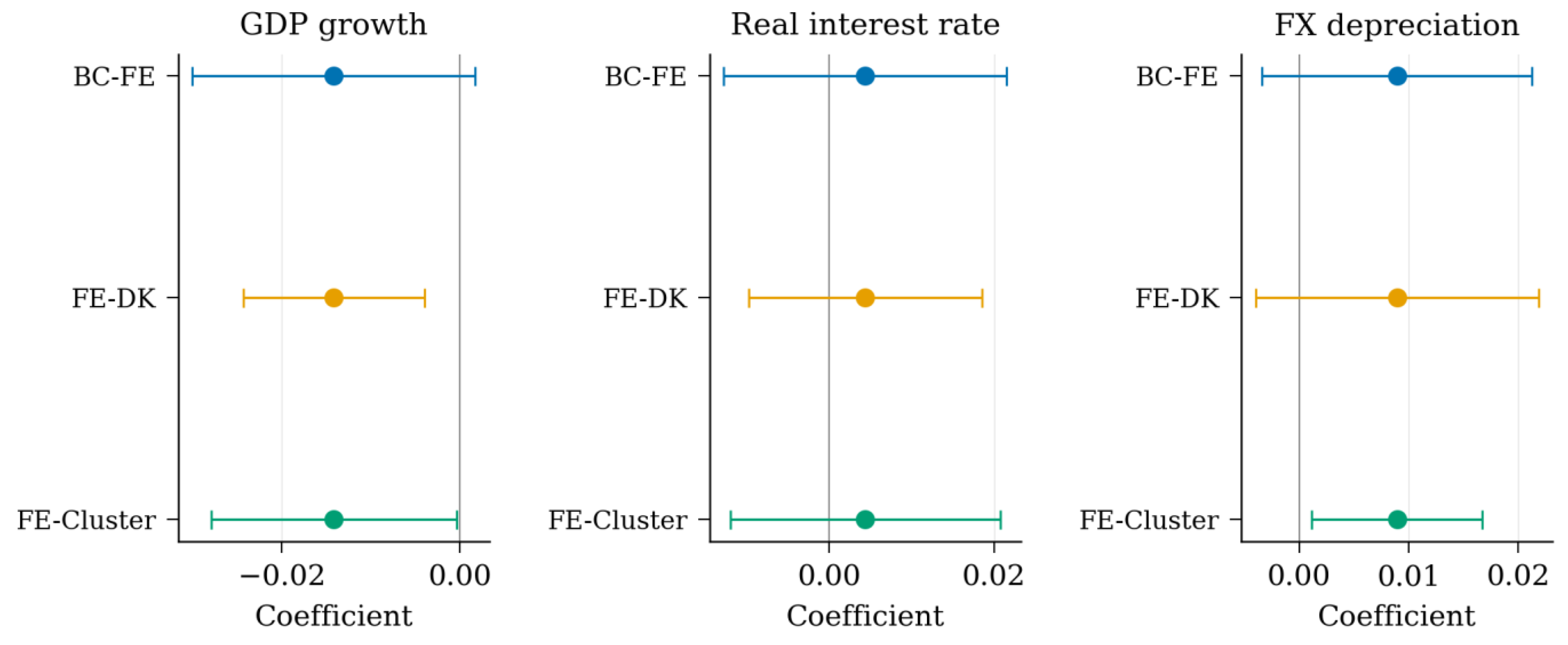
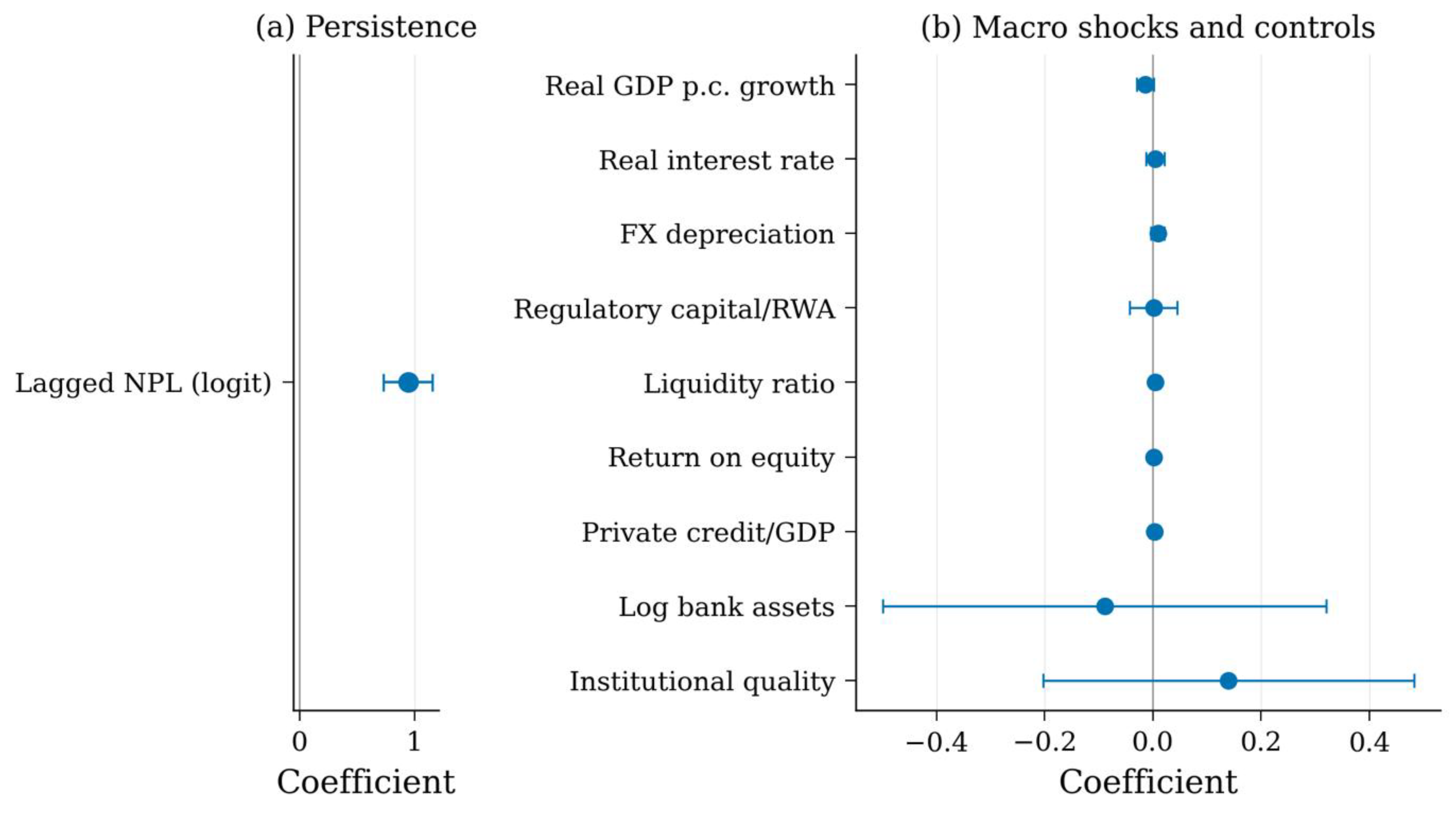
Figure 4 complements this multi-estimator comparison by reporting the BC-FE point estimates for the full coefficient vector together with their bootstrap confidence intervals.
Figure 4.
BC-FE coefficient estimates with 95% bootstrap confidence intervals. Source: Authors’ calculations.
Figure 4.
BC-FE coefficient estimates with 95% bootstrap confidence intervals. Source: Authors’ calculations.
4.3. Persistence and the Macro-Financial Channels
The dominant characteristic of the estimates is the magnitude of persistence. The BC-FE autoregressive coefficient of 0.944 (SE = 0.108) shows that the current credit risk is being carried forward to the next period at a rate of approximately 94 percent.
This corresponds to a half-life of 12.0 years. Even the lower estimates (FE-DK and FE-Cluster) of a persistence coefficient of 0.802 correspond to a half-life of 3.1 years. This reflects the degree of the system’s persistence. The inertia of banking sector credit risk under both sets of estimates means that the effects of macroeconomic shocks persist well after the year in which they occurred. The high degree of persistence is consistent with the slow loan resolution dynamics documented in CESEE by Klein [1], Tatarici et al. [6], and Milenkovic et al. [28], and with the broader evidence that elevated stocks of non-performing loans can depress bank lending and real activity for extended periods [4].
The growth channel is negative and stable across all four specifications. The BC-FE estimate of −0.014 (p = 0.081) becomes more precisely estimated in the interaction model (−0.018, p = 0.012) and attains conventional significance under both FE-DK (p = 0.006) and FE-Cluster (p = 0.044) inference. A 5-percentage-point decline in real GDP per capita growth is associated with an increase of about 0.07 in the logit credit-risk measure in the preferred specification. Due to the persistence of the system, this one-period effect compounds over time. The long-run multiplier implied by the BC-FE estimates is −0.252, which means that a permanent one-percentage-point decline in growth would eventually raise the logit NPL by approximately 0.25 units. The results are consistent with the repayment-capacity channel emphasized across the CESEE literature [1,3,7,21,22].
The coefficient on the real interest rate is positive in all specifications, which is in line with the debt-servicing channel and indicates that tighter real borrowing conditions are associated with higher future credit risk. The impact is relatively weak, and the coefficient is estimated with low precision in all four models (p-values from 0.545 to 0.870), which means that the interest-rate channel is present but less precisely estimated than the growth and exchange-rate channels in this sample. This is reasonable in a regional panel with heterogeneity in the pass-through of interest rates, which depends on the refinancing structure, contract structure, and the distribution of existing balance-sheet stresses across regions. The result is consistent with Szarowska [11], Jakubik, and Reininger [2], who also find that the interest-rate effect is present but smaller and less stable than the growth effect in CEE panels. The exchange-rate channel produces economically significant estimates. The BC-FE coefficient of 0.009 increases to 0.012 (p = 0.030) in the interaction model, and is significant at the 5 percent level under cluster-robust inference (p = 0.025). A 10-percentage-point depreciation is associated with an increase of 0.09 to 0.12 in the logit credit-risk measure, depending on specification. The long-run multiplier implied by the BC-FE estimates is 0.159, suggesting that exchange-rate pressure can have significant long-term effects on banking-sector credit risk. These effects arise after the exchange-rate series has been adjusted for euro-adoption breaks, which reinforces the argument that the estimated coefficient captures genuine macro-financial transmission through the channels identified by Beck et al. [3] and Jakubik and Reininger [2], rather than a measurement error.
The banking-sector controls, such as regulatory capital, liquidity, profitability, private credit to GDP, and banking-sector scale, do not individually reach significance in the baseline specification. This does not mean that these variables are not important, but that in a dynamic model dominated by a lagged dependent variable with a coefficient near unity, the marginal explanatory contribution of additional regressors is compressed. The banking-sector controls have a conditioning function. They absorb variation in banking system structures across countries that could otherwise distort the estimated effects of the macro-financial channels. This function is more pronounced in the threshold analysis (Section 5), where the profitability of banks, in particular, determines the regime in which macro shocks are multiplied.
4.4. Institutions as a Moderator of FX Transmission
The enhanced specification (Equation 2 in Section 3) tests H3, which posits an interaction of exchange-rate depreciation and the institutional quality composite. The estimated interaction coefficient is 0.003 (SE = 0.003, p = 0.253). This is not the dampening pattern that a simple reading of H3 might suggest. A negative interaction would have indicated that stronger institutional quality reduces the pass-through of exchange-rate shocks to credit risk. However, the positive but insignificant estimate does not support that interpretation in this particular specification.
This finding requires a careful discussion rather than an outright dismissal, given several relevant considerations. First, the institutional composite is a broad measure of governance that changes slowly over time. In a panel with N = 14 and country fixed effects already absorbing permanent cross-country institutional differences, the within-country variation available to identify the interaction effect is limited. The institutional channel can also operate through mechanisms that cannot be described by a single linear interaction term, such as supervisory responsiveness, restructuring capacity, or the credibility of the legal environment, rather than a fixed proportional decrease in the FX coefficient. Bischof et al. [34] found that legal efficiency has different importance depending on the stage of the economic cycle, suggesting that the institutional channel may be state-dependent, and not always linear.
The baseline model and the interaction model have a main-effect coefficient of 0.140 (SE = 0.175) and 0.110 (SE = 0.167), respectively, which are imprecisely estimated. Without considering the broader context, these coefficients should not be over-interpreted. In small annual panels, level effects for broad institutional variables are inherently noisy [8,9]. This is why the paper does not base its institutional argument on these coefficients. Instead, the institutional dimension enters the analysis at several points: through the direct term, the interaction term, the threshold design (where profitability proxies a dimension of institutional and balance-sheet resilience), and the scenario interpretation. The evidence from the baseline interaction is that the simple linear moderation of the FX channel by institutional quality is not decisively identified in this sample. This should be interpreted as a limitation of our specification and the size of the panel, rather than as evidence that institutions do not matter for transmission.
The results of the baseline model can be summarized concisely in the following way. Banking-sector credit risk is highly persistent, with an implied half-life that ranges from 3.1 to 12.0 years depending on the estimator. Greater future credit risk is always linked to weaker real income growth and exchange-rate depreciation, and both are consistent across the correction of the exchange-rate series of euro-adoption breaks. Real interest rates carry the expected sign but lack precision. The direct linear relationship between the FX channel and institutional quality is not found to be significant, though the institutional dimension remains theoretically and empirically relevant to the broader analysis. These findings are the basis for the nonlinear, diagnostic, and scenario-based evidence developed in Section 5.
5. Nonlinearities, Robustness, and Scenario Analysis
The baseline model results point to a linear transmission mechanism dominated by persistence, output growth, and exchange-rate depreciation. The question is how stable those findings are and what they suggest once nonlinearity, specification sensitivity, and adverse scenarios are introduced into the analysis.
5.1. Threshold Results
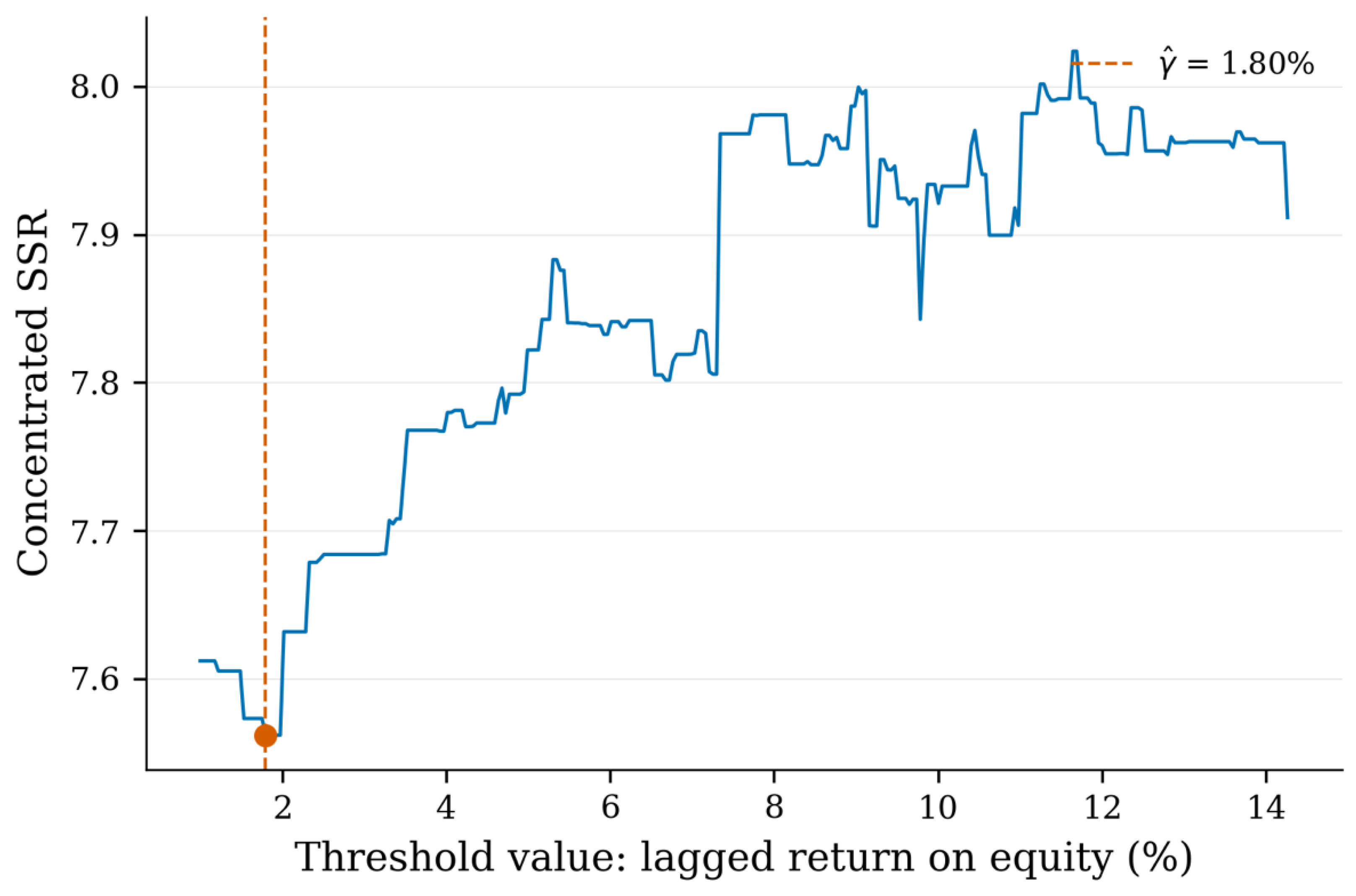
The threshold analysis utilizes lagged banking-sector profitability, measured by return on equity, as the conditioning variable. The rationale is that a banking system that enters a shock episode with weak profitability may have less capacity to absorb losses, less room to provision without balance-sheet strain, and weaker incentives to resolve impaired exposures promptly. The threshold model allows the slopes of the macroeconomic shock variables to vary across regimes of low and high-profitability while holding the remaining controls to be equal across regimes, as described in Equation (3) of Section 3. Table 6 presents the threshold test summary, and Figure 5 traces the concentrated sum of squared residuals across the candidate threshold grid.
The bootstrap p-value of 0.045 rejects the null of a fully linear specification at the 5 percent level. The threshold is estimated at approximately 1.80 percent return on equity, which separates 32 low-profitability observations from 160 high-profitability observations. The concentrated sum of squared residuals decreases from 8.055 under the linear model to 7.562 under the threshold specification, a reduction consistent with the estimated likelihood-ratio statistic. This result supports the hypothesis (H4) that macro-financial transmission is not uniform across profitability states, and the data provide evidence of regime heterogeneity in how macroeconomic shocks translate into banking-sector credit risk.
However, the result should not be overstated. The low-profitability regime has only 32 observations, which means that it limits the precision of regime-specific coefficient estimates and means that the threshold finding is informative rather than definitive. Hansen [51] points out that threshold inference is inherently contingent on the relative size of the regimes, and the present configuration is not generous in that respect. The correct reading is that the data support a regime split at a conventional significance level, not that the paper has identified a universally stable structural breakpoint.
Figure 5.
Threshold SSR profile and estimated profitability cutoff. Source: authors’ calculations.
5.2. Regime-Specific Coefficients
Table 7 reports the regime-specific coefficient estimates from the threshold model with cluster-robust standard errors.
The regime contrast requires careful interpretation. The growth effect is more negative in the high-profitability regime (-0.018, SE = 0.009) than in the low-profitability regime (-0.004, SE = 0.011). The exchange-rate effect follows the same pattern, being larger in the high-profitability regime (0.014, SE = 0.004) than in the low-profitability regime (0.005, SE = 0.003). This is not the simple amplification narrative that the strongest version of H4 might suggest, in which weak profitability mechanically magnifies every shock coefficient.
The pattern is, however, consistent with an alternative reading that the replication report identifies as the most defensible interpretation. In the low-profitability regime, banking systems are already in a state of accumulated distress. The stock of impaired loans is elevated, workout dynamics are ongoing, and the marginal response of the non-performing loan ratio to additional macroeconomic deterioration may be compressed by reporting inertia, restructuring delays, or the fact that the most vulnerable exposures have already migrated into non-performing status. In the high-profitability regime, the system operates closer to normal transmission: shocks hit a portfolio that still contains performing loans with the capacity to deteriorate, and the standard macro-financial channels, repayment capacity, and balance-sheet effects are more clearly measurable.
This interpretation is not unprecedented in the literature. Pop et al. [16] identify a liquidity-based threshold that separates different risk regimes in emerging European banks, with the more liquid regime exhibiting distinct sensitivity to risk factors. Bolarinwa et al. [18] document nonlinearities in the NPL-profitability relationship that do not reduce to a simple monotonic story. Bardhan et al. [17] find that the effect of capital adequacy on impaired assets changes character once a critical level is breached. The common thread is that threshold effects in banking outcomes can take forms more nuanced than uniform amplification. What the present data reject is not the importance of profitability for the transmission process, but rather the assumption that the macro-credit-risk relationship is constant across profitability states. That rejection, confirmed at the 5 percent level, is the empirically grounded result.
5.3. Robustness and Referee Diagnostics
The baseline findings are subjected to four categories of specification checks: alternative inference, coefficient stability across robustness specifications, leave-one-out sensitivity, and formal diagnostic tests. Table 8 consolidates the key results.
Figure 6 summarises coefficient stability across the four logit-DV specifications.
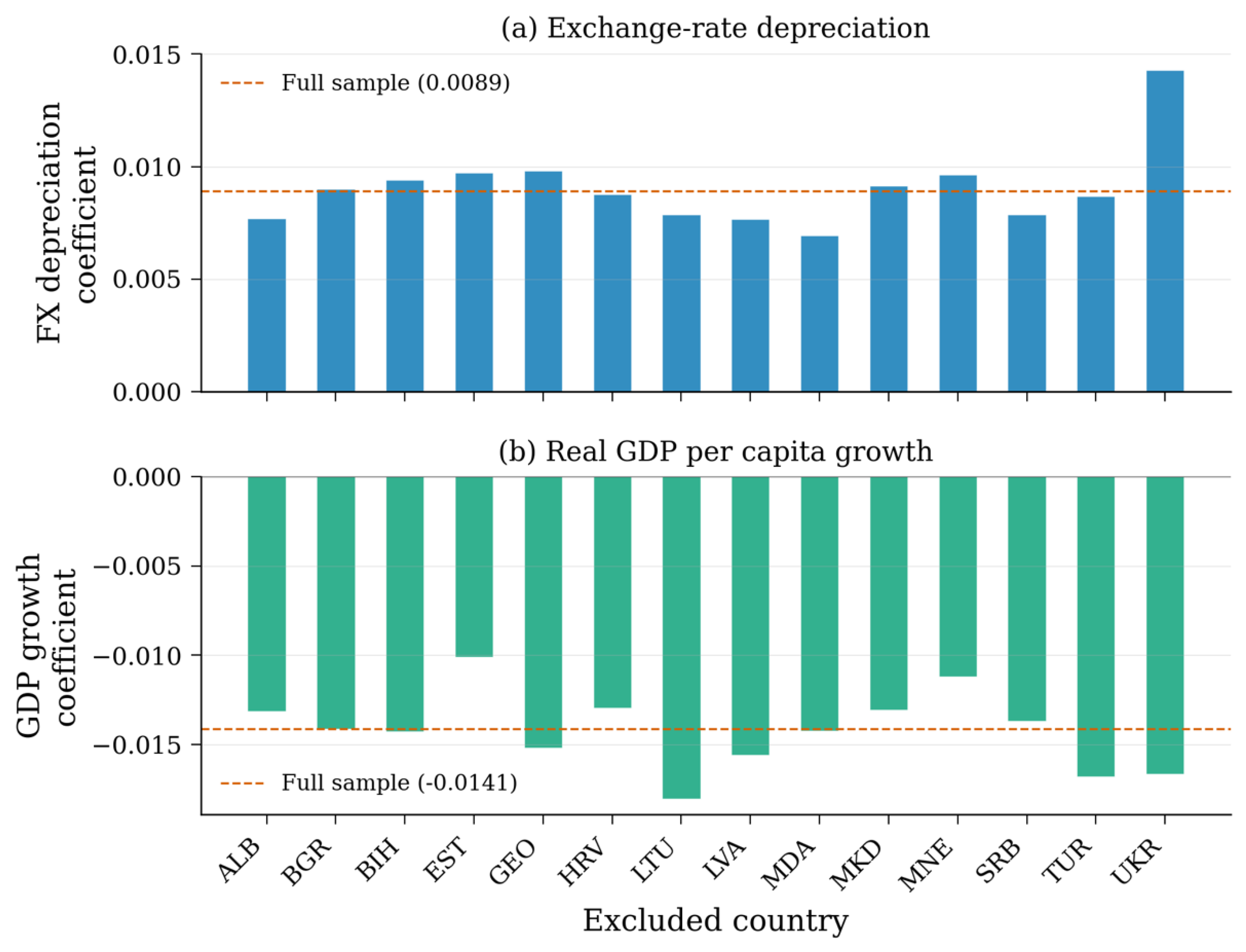
Three patterns were maintained through all checks. The persistence coefficient remains large and positive across every specification and every country exclusion (range: 0.726 to 0.823). The growth coefficient remains negative throughout (range: -0.018 to -0.010). The FX depreciation coefficient remains positive throughout (range: 0.007 to 0.014). These three sign patterns, the empirical core of the paper, are not an artifact of a single estimator, a single inferential convention, or a single influential country.
The Pesaran [49] CD test confirms cross-sectional dependence in the residuals (statistic = -2.34, p = 0.019), which validates the use of Driscoll-Kraay inference as a complement to the bootstrap-based BC-FE baseline. The maximum variance inflation factor of 2.06 is well below conventional concern thresholds [35], indicating that multicollinearity does not compromise the coefficient estimates. The year fixed effects are jointly significant (F = 6.78, p < 0.001), confirming that common time shocks matter in the panel and should be retained. The unit-root evidence is mixed: only 1 of 14 country-level ADF tests rejects at the 10 percent level, which is not unusual in short annual panels with a highly persistent dependent variable but does mean that the paper should avoid claiming more time-series certainty than the panel can support.
The leave-one-out exercise provides the strictest single-country influence check. No country exclusion reverses the sign of either the growth or the FX depreciation coefficient. The FX coefficient ranges from 0.007 to 0.014, and the growth coefficient from -0.018 to -0.010, across all 14 exclusions. This matters because small regional panels are always vulnerable to the criticism that one or two influential units may drive the results. That criticism is not supported by the evidence.
A parsimonious one-step Difference GMM specification is reported in Table A1 of the Appendix as a diagnostic benchmark. The estimator produces a lagged dependent variable coefficient effectively at unity (1.005, p < 0.001) and macro-financial coefficients that lose all precision (p = 0.984 for GDP per capita growth and p = 0.138 for FX depreciation). System GMM was attempted with the same regressor set but could not be estimated because the two-step weighting matrix was singular. The Difference GMM specification is deliberately restricted to three lagged regressors because, with N = 14, augmenting the instrument set with additional controls or year fixed effects magnifies the instrument-proliferation problem identified by Roodman [50]. This pattern clarifies why the primary estimator was chosen rather than undermining the baseline findings.
Figure 7.
Leave-one-country-out sensitivity of the growth and FX depreciation coefficients. Source: authors’ calculations.
Figure 7.
Leave-one-country-out sensitivity of the growth and FX depreciation coefficients. Source: authors’ calculations.
5.4. Scenario Simulation
The scenario analysis translates the estimated coefficients into forecasted credit-risk paths in standardized adverse conditions. The simulation horizon is five years, and the shocks are set to one and two standard deviations of the respective macroeconomic variables. The baseline path is intercept-calibrated so that, in the absence of shocks, the projected non-performing loan ratio is anchored at its observed starting level. Uncertainty around projected paths is propagated using the bootstrap distribution of estimated coefficients from the BC-FE procedure. The projected results at the 5-year horizon are reported in Table 9.
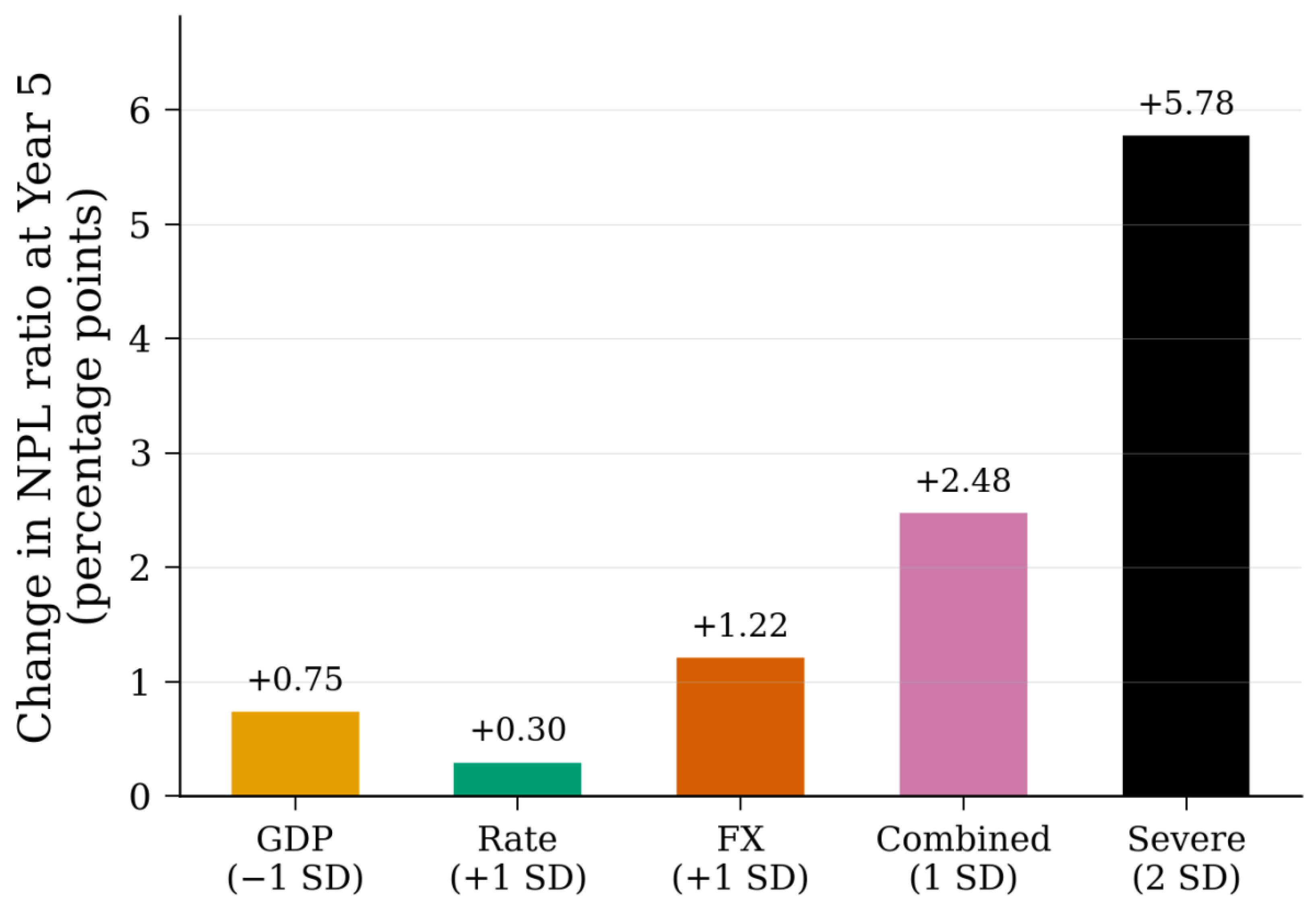
The scenario ranking is a reflection of the coefficient structure. The exchange-rate shock produces a larger medium-run effect (+1.22 pp) than either the GDP shock (+0.75 pp) or the interest-rate shock (+0.30 pp) in isolation, consistent with the relative magnitudes of the baseline coefficients. The combined negative scenario increases the projected non-performing loan ratio to 9.02 percent, which represents a 38 percent increase over the baseline. Under the severe combined scenario, the projected ratio nearly doubles to 12.32 percent. Figure 8 plots the projected non-performing loan trajectories in each scenario in the five-year horizon.
Two features of the scenario output are economically consequential. The first is the part that persistence plays. Even though the one-period macro coefficients are individually modest, their impacts are compounded by the autoregressive nature of the system over multi-year horizons. The 5.78 percentage-point deterioration in the severe combined scenario is not driven by large one-period shocks to the non-performing loan ratio. It is driven by the interaction between moderate annual shocks and a persistence coefficient near 0.94. Huljak et al. [4] demonstrate that high non-performing loan ratios depress bank lending and real economic activity in the euro area, and the scenario projections demonstrate the extent of deterioration that can set such feedback mechanisms in motion.
The second feature is the dominance of the exchange-rate channel. The FX shock has a bigger impact on the medium-run than the GDP shock, and it explains a significant proportion of the combined-scenario deterioration. This result reinforces the international-finance dimension of the paper. Exchange-rate movements are not a secondary feature of the macro-financial environment in CESEE, they are actually a primary transmission channel through which external monetary and financial conditions affect domestic banking-sector credit risk [2,3]. Figure 9 decomposes the five-year impact by scenario.
Figure 8.
Projected NPL paths under baseline, single-shock, and combined adverse scenarios. Source: authors’ calculations.
Figure 8.
Projected NPL paths under baseline, single-shock, and combined adverse scenarios. Source: authors’ calculations.
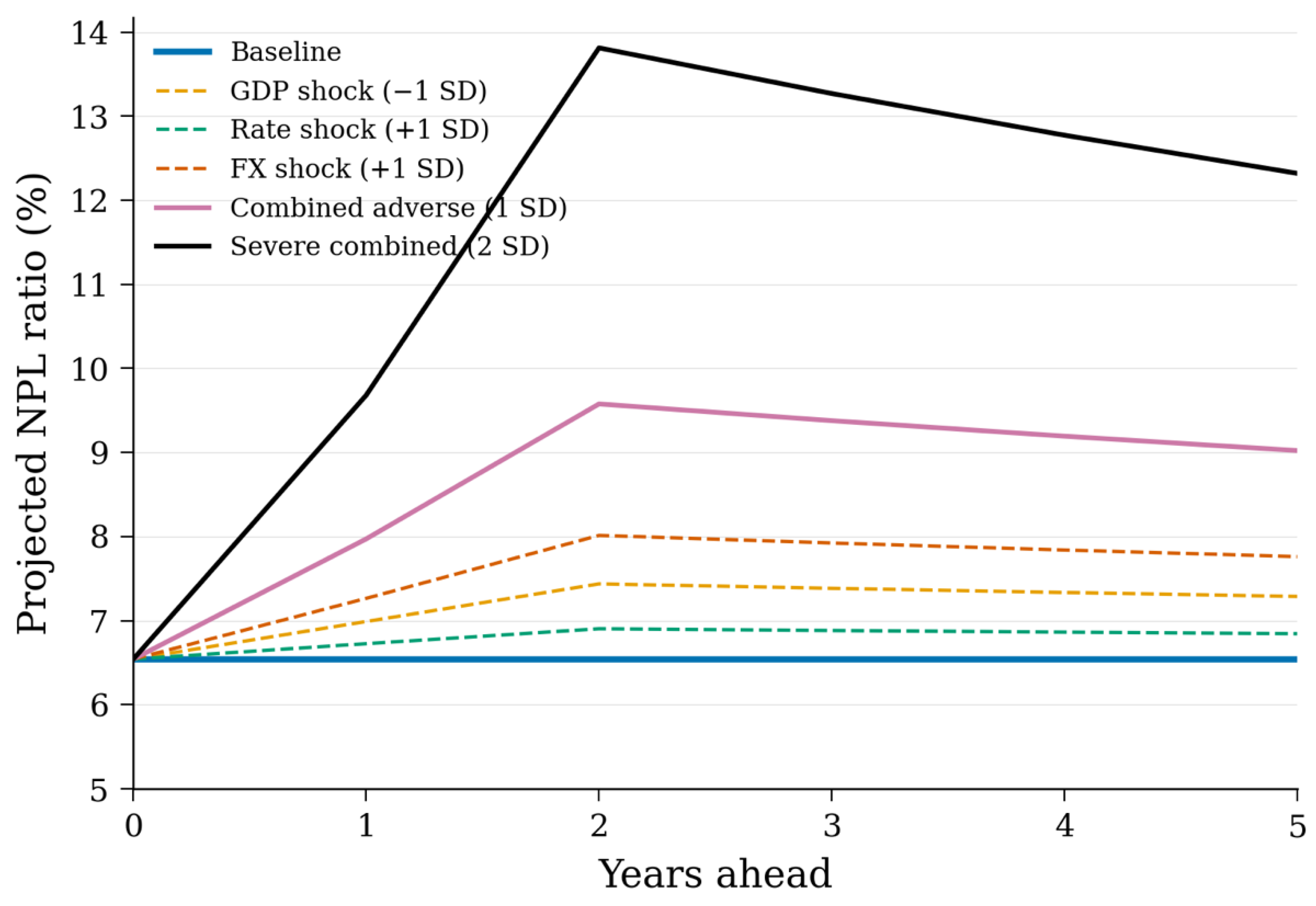
Figure 9 isolates the five-year impact of each scenario relative to the baseline, expressed in percentage points, to make the relative magnitudes more directly comparable.
Figure 9.
Scenario impact relative to baseline at the five-year horizon. Source: authors’ calculations.
Figure 9.
Scenario impact relative to baseline at the five-year horizon. Source: authors’ calculations.
5.5. Policy Implications
The combined evidence of the threshold model, robustness exercises, and scenario simulations have three implications for macro-financial surveillance.
The exchange-rate channel is to be considered as a core financial stability mechanism in emerging Europe. The baseline estimates, the robustness checks, and the scenario projections all lead to the same conclusion that the exchange-rate depreciation is a quantitatively significant driver in the banking-sector credit risk in the region, and its medium-run impact are enhanced by the persistence and continuity of the non-performing loans process. For regulatory authorities, this means that exchange-rate stress is not just an external-price event. It is a banking-sector vulnerability channel that requires monitoring alongside the more conventional growth and interest-rate indicators [3,8].
Persistence suggests that delayed intervention is costly. Once banking-sector credit risk increases, it remains elevated for an extended period [34]. The scenario simulations show that a severe adverse shock can approximately double the non-performing loan ratio within five years. The policy implication is that resolution, provisioning, and restructuring frameworks need to operate early and effectively when deterioration sets in. In banking systems where workout capacity is limited or where insolvency frameworks are weak, the persistence mechanism converts short-term shocks into medium-run balance-sheet problems [34,37].
The institutional environment belongs within macro-financial surveillance rather than outside it. The baseline interaction term is not significant, and the threshold regime contrast does not follow the simplest amplification story. But the broader pattern, that institutional quality is theoretically relevant to the transmission mechanism, that the threshold test rejects linearity, and that the scenario projections illustrate how macro-financial sensitivities compound over time, is consistent with the view that governance conditions shape the environment in which shocks propagate [10,13]. The evidence is suggestive rather than definitive on the precise institutional channel, which is an honest limitation. It does not, however, support the conclusion that institutions are irrelevant to macro-financial transmission in CESEE.
Taken together, the evidence from the baseline estimates, robustness exercises, threshold analysis, and scenario simulations reinforces the paper’s central argument. The baseline results are robust, withstanding alternative inference procedures, sample perturbations, and diagnostic scrutiny. Threshold analysis confirms nonlinearity in the transmission process, while scenario exercises demonstrate that the estimated sensitivities imply substantial medium-run consequences once persistence and joint shocks are accounted for.
6. Conclusion
This paper examined the cross-border transmission of macroeconomic shocks to credit risk in the banking sector in a panel of fourteen CESEE and comparator banking systems over 2008–2023. The empirical design combined a bias-corrected dynamic panel specification with threshold analysis, alternative inferential approaches, and a scenario simulation module. The analysis is based on three key findings.
The credit risk in the banking sector is highly persistent. The bias-corrected autoregressive coefficient is 0.944, which means that the half-life is 12.0 years. Even under the more conservative Driscoll-Kraay estimates, the persistence coefficient remains at 0.802, with a half-life of 3.1 years. Such a level of inertia means that macroeconomic shocks do not simply raise credit risk in the period they occur, but rather they interact with a legacy of banking-sector weaknesses, and the resulting deterioration can extend over many years. The finding is consistent with the slow loan-workout dynamics documented across CESEE by Klein [1] and Tatarici et al. [6], with the larger body of evidence that high NPL ratios reduce bank lending and real activity in the long run [4].
The most evident macro-financial factors that drive future credit risk are lower real income growth and exchange-rate depreciation. The growth coefficient lies between -0.014 and -0.018 across specifications, with the FX depreciation coefficient between 0.008 and 0.012, which, when compounded with time, is multiplied many times over the years. The exchange-rate effect survives the test of the explicit correction of the depreciation series breaks, which confirms the argument that it is the manifestation of the actual macro-financial transmission via the balance-sheet and competitiveness channels, and not a measurement error. The real interest-rate channel works in the anticipated direction but is not as precisely predicted. The scenario simulations illustrate the practical implications of these relationships: in a combined adverse scenario calibrated at one standard deviation, the estimated ratio of non-performing loans increases from 6.54 percent to 9.02 percent at the five-year horizon, and in a severe combined scenario, it nearly doubles to 12.32 percent. Only the exchange-rate shock has a larger medium-run effect than the growth shock or the interest-rate shock, which underscores the international aspect of the banking-sector susceptibility in the region.
The paper is a contribution to the international financial markets and institutions literature in the following ways. It shifts the emphasis from average determinants of non-performing loans to the transmission of macroeconomic shocks in a dynamic cross-country environment, with persistence being explicitly modeled, not captured in residual structure. Further, it considers institutional quality as a conditioning aspect of the transmission process, which examines whether governance changes the pass-through of exchange-rate shocks to credit risk, rather than a country characteristic. It also expands the linear panel evidence with a threshold design and a scenario module that can convert econometric estimates into a form that can be directly read in the light of macro-financial surveillance.
However, several limitations must be acknowledged. The cross-sectional dimension of the panel is small (N = 14), which constrains the precision of all estimates and particularly affects the identification of interaction effects involving slowly moving institutional variables. The baseline interaction between exchange-rate depreciation and institutional quality does not reach conventional significance, and the simple linear moderation of the FX channel is not conclusively determined in this sample. Such a finding should be weighed against the theoretical relevance of the institutional channel instead of being taken as evidence that governance is irrelevant to macro-financial transmission. The threshold test rejects the null of full linearity at the 5 percent level, but the regime-specific coefficients do not conform to the simplest amplification narrative in which weak profitability mechanically magnifies every macroeconomic effect. The data suggest state dependence of a more complex kind, and the limited number of observations in the low-profitability regime (n = 32) means that the evidence should be viewed as informative but not conclusive. The annual frequency of the data restricts the possibility of capturing within-year adjustment dynamics. The mixed unit-root evidence, with only 1 of 14 country-level ADF tests rejecting at the 10 percent level, indicates that the high persistence estimates are to be viewed with due caution as to the difference between slow adjustment and near-unit-root behavior. Dynamic-panel GMM, which might in principle address some of these concerns, does not perform well in the present configuration: System GMM fails because of a singular two-step weighting matrix, and a parsimonious Difference GMM fallback (reported in Appendix Table A1) yields a persistence coefficient of 1.005 with macro coefficients that lose precision, consistent with the small-N instability documented by Roodman [50].
These limitations indicate the natural directions of future research. At the bank-level, panels would enhance the cross-sectional aspect and allow identification of within-country heterogeneity in the response of individual institutions to macroeconomic stress. Incorporating foreign-currency lending shares directly into the estimation would allow a more precise test of the balance-sheet mechanism captured by the FX coefficient in reduced form. Higher-frequency data would help distinguish contemporaneous from lagged adjustment dynamics. Regime-switching models that allow the threshold to vary over time or across countries would provide a more flexible treatment of nonlinearity. On the institutional side, exploiting specific governance reforms as quasi-natural variation, rather than relying on broad composite indices with limited within-country movement, would offer a more credible identification strategy for the institutional moderation channel.
For CESEE banking sectors, the broader implication is that macro-financial surveillance must consider exchange-rate pressure, output weakness, and balance-sheet persistence as interdependent, not independent risks. In a persistent credit-risk process, even moderate disturbances can accumulate into lasting impairment [52]. The policy focus should fall not only on shock prevention, but also on supervisory responsiveness, resolution capacity, and the institutional conditions that determine how quickly banking systems absorb or prolong stress.
Declaration of generative AI and AI-assisted technologies in the manuscript preparation process
During the preparation of this manuscript, the authors used Grammarly for grammar, spelling, and punctuation checking. No generative AI tools were used to draft, analyze, or interpret any substantive content. The authors take full responsibility for the content of the publication.
Data availability
The replication data and code supporting the findings of this study are openly available in the Mendeley Data repository.
Appendix
Table A1.
Diagnostic dynamic-panel GMM estimates.
| Regressor | Coefficient | Std. Error | z-value | p-value |
|---|---|---|---|---|
| Lagged NPL (logit) | 1.005 | 0.051 | 19.83 | <0.001 |
| Real GDP per capita growth (lag) | −0.0001 | 0.006 | −0.02 | 0.984 |
| FX depreciation (lag) | 0.003 | 0.002 | 1.48 | 0.138 |
Notes: One-step Difference GMM (Arellano–Bond) estimated via the plm package in R with robust standard errors. The dependent variable is the logit-transformed non-performing loan ratio. Instruments for the lagged dependent variable: lags 2–3 of the logit NPL ratio. Panel dimensions: N = 14 countries, T = 16 years. Sargan test of over-identifying restrictions: p = 0.947; this high p-value is not interpreted as strong evidence of instrument validity because the two-step weighting matrix was singular and a generalised inverse was used. System GMM was attempted with the same regressor set but did not converge because the two-step weighting matrix was singular. Year fixed effects and the remaining banking-sector and institutional controls from Equation (1) are omitted to avoid further instrument proliferation in this small-N setting. The diagnostic is reported to document, rather than to challenge, the choice of the bias-corrected fixed-effects framework as the primary estimator.
References
- N. Klein, Non-Performing Loans in CESEE: Determinants and Impact on Macroeconomic Performance, SSRN Electronic Journal (2013). [CrossRef]
- P. Jakubík, T. Reininger, What are the key determinants of nonperforming loans in CESEE, Econstor (Econstor) (2014). http://hdl.handle.net/10419/120422 (accessed March 2026).
- R. Beck, P. Jakubík, A. Piloiu, Key Determinants of Non-performing Loans: New Evidence from a Global Sample, Open Economies Review 26 (2015) 525. [CrossRef]
- I. Huljak, R. Martin, D. Moccero, C. Pancaro, Do non-performing loans matter for bank lending and the business cycle in euro area countries?, Journal of Applied Economics 25 (2022) 1050. [CrossRef]
- B. Škarica, Determinants of non-performing loans in Central and Eastern European countries, Financial Theory and Practice 38 (2014) 37. [CrossRef]
- L. Tătărici, M. Kubinschi, D. Barnea, Determinants of Non-Performing Loans for the EEC Region. A Financial Stability Perspective, Management & Marketing 15 (2020) 621. [CrossRef]
- M. Ćurak, S. Pepur, K. Poposki, Determinants of non-performing loans – evidence from Southeastern European banking systems, SHILAP Revista de Lepidopterología (2013). https://doaj.org/article/d524cd361f7f4c97ad642765654e4eb2 (accessed March 2026).
- S. Tanasković, M. Jandrić, Macroeconomic and Institutional Determinants of Non-performing Loans, Journal of Central Banking Theory and Practice 4 (2015) 47. [CrossRef]
- Y. Bayar, Macroeconomic, Institutional and Bank-Specific Determinants of Non-Performing Loans in Emerging Market Economies: A Dynamic Panel Regression Analysis, Journal of Central Banking Theory and Practice 8 (2019) 95. [CrossRef]
- Y.Y. Lee, M.H. Yahya, M.S. Habibullah, Z.M. Ashhari, Non-performing loans in European Union: country governance dimensions, Journal of Financial Economic Policy 12 (2019) 209. [CrossRef]
- I. Szarowská, Effect of macroeconomic determinants on non-performing loans in Central and Eastern European countries, International Journal of Monetary Economics and Finance 11 (2018) 20. [CrossRef]
- D. Erdinç, E. Abazi, The Determinants of NPLs in Emerging Europe, 2000–2011, KSP Journals - Journal of Economics Bibliography 1 (2014) 112. [CrossRef]
- J. Beirne, P. Panthi, Institutional Quality and Macrofinancial Resilience in Asia, 2022. [CrossRef]
- S. Goyal, N. Singhal, J.M. Prosad, N. Mishra, Impact of Institutional Environment on Banks’ Non-Performing Loans: Evidence from BRICS Countries, Finance Theory and Practice 27 (2023) 67. [CrossRef]
- A. Shala, V. Toçi, A. Mustafa, Macroeconomic, Structural, and Bank-specific Determinants of Non-performing Loans in Central and Eastern Europe, Ekonomický Časopis 70 (2022) 411. [CrossRef]
- I.D. Pop, C.-O. Cepoi, D.G. Anghel, Liquidity-threshold effect in non-performing loans, Finance Research Letters 27 (2018) 124. [CrossRef]
- S. Bardhan, R. Sharma, V. Mukherjee, Threshold Effect of Bank-specific Determinants of Non-performing Assets: An Application in Indian Banking, Journal of Emerging Market Finance 18 (2019). [CrossRef]
- S.T. Bolarinwa, R.O. Olayeni, X.V. Vo, Is there a nonlinear relationship between nonperforming loans and bank profitability? Evidence from dynamic panel threshold, Managerial and Decision Economics 42 (2021) 649. [CrossRef]
- R. Beck, P. Jakubík, A. Piloiu, Non-Performing Loans: What Matters in Addition to the Economic Cycle?, SSRN Electronic Journal (2013). [CrossRef]
- G. Sfakianakis, G. Agiomirgianakis, M. Ioakimidis, S. Arvanitis, Determinants of NPLS Revisited: The Aftermath of Two Crises and the Case of Greece, Theoretical Economics Letters 12 (2022) 1577. [CrossRef]
- V. Makri, A. Tsaganos, A. Bellas, Determinants of non-performing loans: The case of Eurozone, Panoeconomicus 61 (2014) 193. [CrossRef]
- I. Bilan, A. Roman, Effects of Macroeconomic Factors on Bank Loans Quality: Evidence from Central and Eastern European Countries, in: Eurasian Studies in Business and Economics, Springer International Publishing, 2016, 571. [CrossRef]
- Mazreku, F. Morina, V. Misiri, J. Jonathan, S. Grima, Determinants of the Level of Non-Performing Loans in Commercial Banks of Transition Countries, European Research Studies Journal (2018) 3. [CrossRef]
- F. Ayhan, M.T. Kartal, The Macro Economic Drivers of Non-Performing Loans (NPL): Evidence from Selected Countries with Heterogeneous Panel Analysis, MANAS Sosyal Araştırmalar Dergisi 10 (2021) 986. [CrossRef]
- A. Beka, A.-A. Hyrije, The Impact of Economic Growth on Non-Performing Loans in Western Balkan Countries, InterEULawEast Journal for the International and European Law Economics and Market Integrations 10 (2023) 117. [CrossRef]
- A. Gashi, S. Tafa, R. Bajrami, The Impact of Macroeconomic Factors on Non-performing Loans in the Western Balkans, Emerging Science Journal 6 (2022) 1032. [CrossRef]
- B.-G. Moinescu, Determinants Of Nonperforming Loans In Central And Eastern European Countries: Macroeconomic Indicators And Credit Discipline, Review of Economic and Business Studies (2012) 47. https://econpapers.repec.org/RePEc:aic:revebs:y:2012:i:10:moinescub (accessed March 2026).
- N. Milenković, B. Kalaš, V. Mirović, J. Andrašić, Static and Dynamic Modeling of Non-Performing Loan Determinants in the Eurozone, Mathematics 12 (2024) 3323. [CrossRef]
- C. Radosław, K. Kil, Determinants of the non-Performing Loan Ratio in the European Union Banking Sectors with a High Level of Impaired Loans, Economics and Business Review/The Poznań University of Economics Review (2020) 22. [CrossRef]
- S. Ahmed, M.K. Majeed, E. Thalassinos, Y. Thalassinos, The Impact of Bank Specific and Macro-Economic Factors on Non-Performing Loans in the Banking Sector: Evidence from an Emerging Economy, Journal of Risk and Financial Management 14 (2021) 217. [CrossRef]
- K. Kil, R. Ciukaj, O. Druhov, N.V. Hrytsenko, Determinants of the Non-Performing Loan Ratio in the Banking Sectors of Central and Eastern Europe Countries, Financial and Credit Activity Problems of Theory and Practice 2 (2020) 23. [CrossRef]
- A. Çifter, Bank Concentration and Non-Performing Loans in Central and Eastern European Countries, Journal of Business Economics and Management 16 (2014) 117. [CrossRef]
- R. Maja, Determinants of non-performing loans and the relationship with macroeconomic factors: Evidence from Southeastern Europe, Econstor (Econstor) (2020). https://hdl.handle.net/10419/298734 (accessed March 2026).
- J. Bischof, N. Rudolf, W. Schmundt, How Do Non-Performing Loans Evolve Along the Economic Cycle? The Role of Macroeconomic Conditions and Legal Efficiency, European Accounting Review 31 (2022) 1149. [CrossRef]
- Q. Tmava, M.J. Spahiu, Banking and Macroeconomic Drivers Effects on Non-Performing Loans: Insights from Western Balkan Countries, Financial and Credit Activity Problems of Theory and Practice 2 (2025) 40. [CrossRef]
- R. Kanapickienė, G. Keliuotytė-Staniulėnienė, D. Vasiliauskaitė, R. Špicas, A. Neifaltas, M. Valukonis, Macroeconomic Factors of Consumer Loan Credit Risk in Central and Eastern European Countries, Economies 11 (2023) 102. [CrossRef]
- C.B. Zoller, Corporate Restructuring Laws Under Stress: Policy-Making in Uncertain Times, European Business Organization Law Review 24 (2023) 387. [CrossRef]
- S. Kawalec, Banking Sector Systemic Risk in Selected Central European Countries: Review of Bulgaria, Czech Republic, Hungary, Poland, Romania and Slovakia, CASE Network Reports No. 23, CASE - Center for Social and Economic Research, Warsaw, 1999.
- B.E. Hansen, Sample Splitting and Threshold Estimation, Econometrica 68 (2000) 575. [CrossRef]
- W. Gong, M.H. Seo, Bootstraps for Dynamic Panel Threshold Models, arXiv (Cornell University) (2022). [CrossRef]
- R. Abaidoo, E.K. Agyapong, Governance, regulatory quality and financial institutions: emerging economies perspective, Journal of Economic and Administrative Sciences. (2023). [CrossRef]
- S. Nickell, Biases in Dynamic Models with Fixed Effects, Econometrica 49 (1981) 1417. [CrossRef]
- M. Arellano, S. Bond, Some Tests of Specification for Panel Data: Monte Carlo Evidence and an Application to Employment Equations, The Review of Economic Studies 58 (1991) 277. [CrossRef]
- R. Blundell, S. Bond, Initial conditions and moment restrictions in dynamic panel data models, Journal of Econometrics 87 (1998) 115. [CrossRef]
- J.F. Kiviet, On bias, inconsistency, and efficiency of various estimators in dynamic panel data models, Journal of Econometrics 68 (1995) 53. [CrossRef]
- G. Bruno, Approximating the bias of the LSDV estimator for dynamic unbalanced panel data models, Economics Letters 87 (2005) 361. [CrossRef]
- R. Judson, A.L. Owen, Estimating dynamic panel data models: a guide for macroeconomists, Economics Letters 65 (1999) 9. [CrossRef]
- J.C. Driscoll, A. Kraay, Consistent Covariance Matrix Estimation with Spatially Dependent Panel Data, The Review of Economics and Statistics 80 (1998) 549. [CrossRef]
- M.H. Pesaran, General Diagnostic Tests for Cross Section Dependence in Panels, SSRN Electronic Journal (2004). [CrossRef]
- D. Roodman, A Note on the Theme of Too Many Instruments*, Oxford Bulletin of Economics and Statistics 71 (2009) 135. [CrossRef]
- B.E. Hansen, Threshold effects in non-dynamic panels: Estimation, testing, and inference, Journal of Econometrics 93 (1999) 345. [CrossRef]
- P. Jakubík, T. Reininger, Determinants of Nonperforming Loans in Central, Eastern and Southeastern Europe, Focus on European Economic Integration (2013) 48. https://econpapers.repec.org/article/onboenbfi/y_3a2013_3ai_3a3_3ab_3a3.htm (accessed March 2026).
Figure 1.
Pairwise correlation heatmap for baseline variables. Cell entries are Pearson correlation coefficients computed on the full estimation sample of 14 CESEE banking systems over 2008–2023. The dependent variable (NPL) is shown in its logit transformation. Source: Authors’ calculations based on data from the IMF Financial Soundness Indicators, World Bank World Development Indicators, World Bank Worldwide Governance Indicators, and central-bank statistical databases.
Figure 1.
Pairwise correlation heatmap for baseline variables. Cell entries are Pearson correlation coefficients computed on the full estimation sample of 14 CESEE banking systems over 2008–2023. The dependent variable (NPL) is shown in its logit transformation. Source: Authors’ calculations based on data from the IMF Financial Soundness Indicators, World Bank World Development Indicators, World Bank Worldwide Governance Indicators, and central-bank statistical databases.
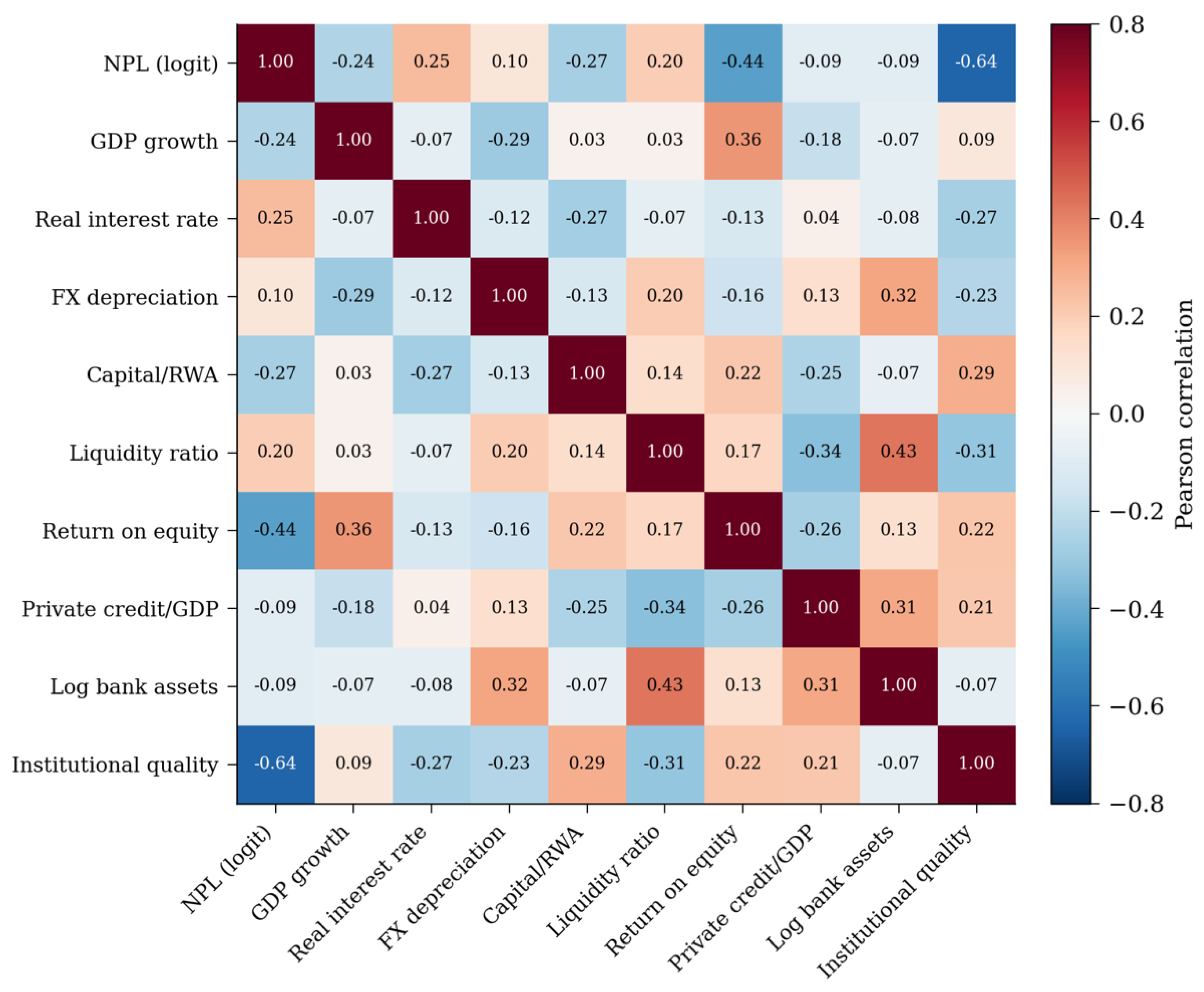
Figure 2.
Banking-sector NPL ratio by country, 2008–2023. Source: Authors’ compilation from the IMF Financial Soundness Indicators and national central-bank publications.
Figure 2.
Banking-sector NPL ratio by country, 2008–2023. Source: Authors’ compilation from the IMF Financial Soundness Indicators and national central-bank publications.
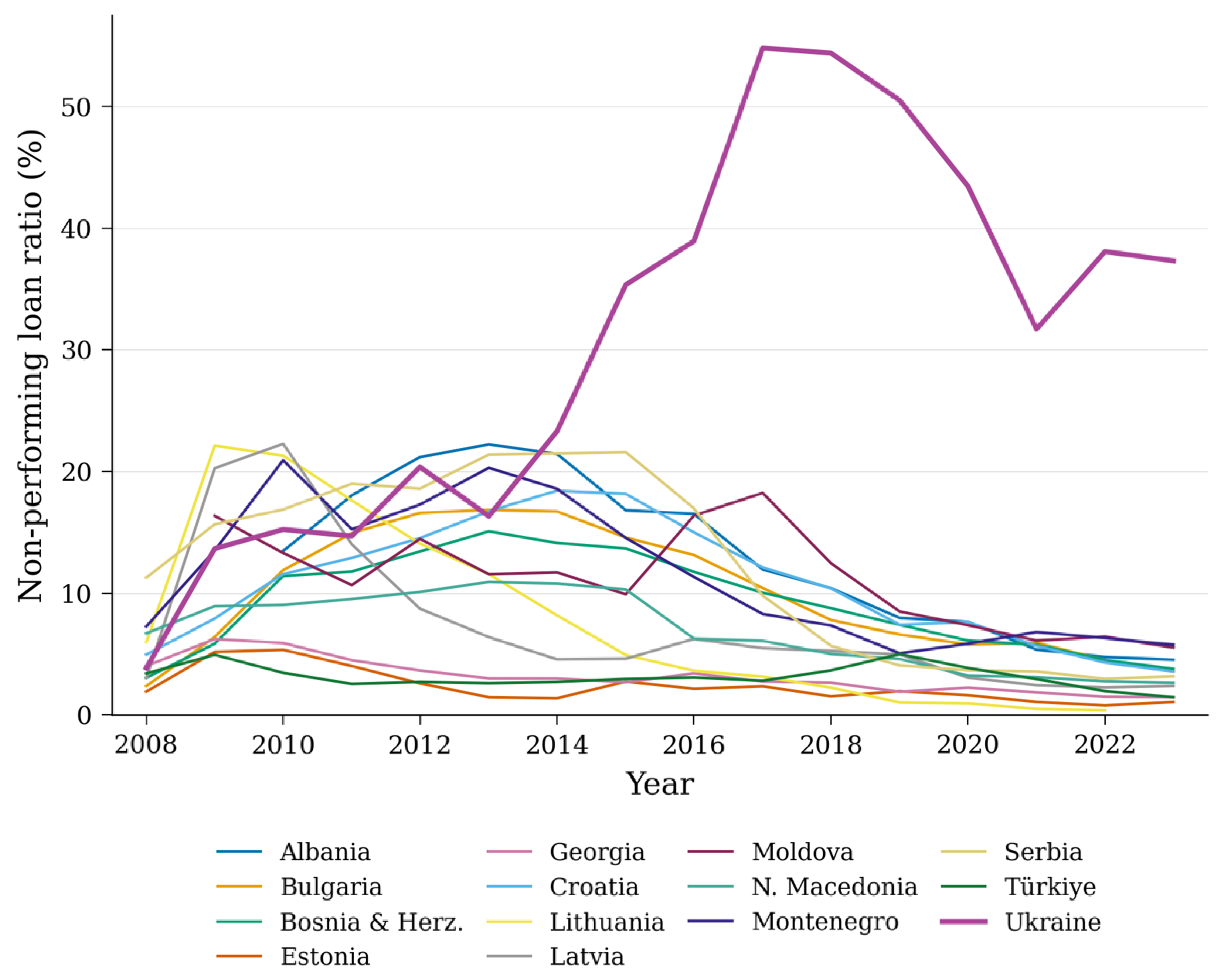
Figure 6.
Coefficient stability across four dynamic logit-DV specifications. Panel (a) shows the persistence coefficient ρ; Panel (b) shows the macro-financial channel coefficients (real GDP per capita growth, real interest rate, FX depreciation). Blue bars indicate the min–max range across thefour specifications; orange markers show the mean. Source: authors’ calculations based on the panel summarised in Table 8.
Figure 6.
Coefficient stability across four dynamic logit-DV specifications. Panel (a) shows the persistence coefficient ρ; Panel (b) shows the macro-financial channel coefficients (real GDP per capita growth, real interest rate, FX depreciation). Blue bars indicate the min–max range across thefour specifications; orange markers show the mean. Source: authors’ calculations based on the panel summarised in Table 8.
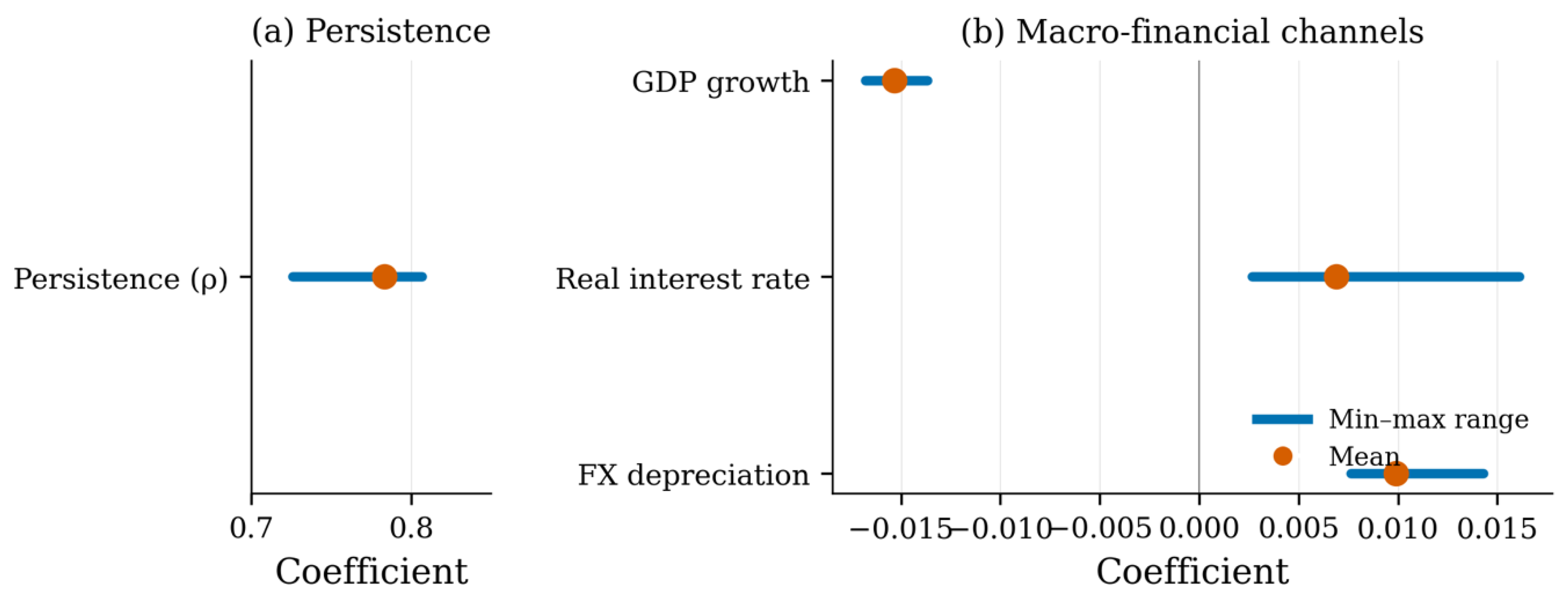
Table 1.
Selected empirical studies on NPL determinants in emerging Europe and comparator panels.
| Study | Region | Period | Estimation | DV form | GDP | IR | FX | Inst. | Threshold |
|---|---|---|---|---|---|---|---|---|---|
| Klein [1] | CESEE | 1998–2011 | FE, Diff-GMM, Sys-GMM, PVAR | Ratio | (-) | . | (-) | . | No |
| Moinescu [27] | 10 CEE | 2003–2011 | Dynamic FE | Logit | (-) | (+) | (+) | . | No |
| Jakubik and Reininger [2] | 9 CESEE | 2004–2012 | Sys-GMM, FE | Ratio | (-) | (+) | (+) | . | No |
| Skarica [5] | 7 CEE | 2007–2012 | OLS-FE | Change | (-) | . | n.s. | . | No |
| Makri et al. [21] | 14 Eurozone | 2000–2008 | Diff-GMM | Ratio | (-) | . | . | . | No |
| Erdinc and Abazi [12] | 20 emerging European | 2000–2011 | Sys-GMM, Diff-GMM | Log | (-) | (+) | n.s. | n.s. | No |
| Tanaskovic and Jandric [8] | CEEC/SEE | 2006–2013 | Static FE | Log | (-) | (-) | (+) | (-) | No |
| Beck et al. [3] | 75 countries | 2000–2010 | Diff-GMM, FE | Ratio | (-) | (+) | (+) | . | No |
| Cifter [32] | 10 CEE | 2000–2009 | Sys-GMM, IV, FMOLS | Ratio | (-) | . | (-) | n.s. | No |
| Bilan and Roman [22] | 11 CEE | 2000–2013 | FE (time + country) | Ratio | (-) | . | n.s. | . | No |
| Curak et al. [7] | 8 SEE | 2003–2010 | GMM | Ratio | (-) | (+) | n.s. | . | No |
| Szarowska [11] | 11 CEE | 1999–2015 | Dynamic FE | Ratio | (-) | (+) | (-) | . | No |
| Mazreku et al. [23] | 10 transition | 2006–2016 | OLS, FE, RE, GMM | Ratio | (-) | . | . | . | No |
| Pop et al. [16] | 7 emerging European | 2007–2016 | PSTR | Ratio | . | (+) | . | . | Yes |
| Bayar [9] | Emerging markets | 2000–2013 | Sys-GMM | Ratio | (-) | (+) | . | (-) | No |
| Lee et al. [10] | 28 EU | 2007–2016 | Sys-GMM | Ratio | (-) | (+) | . | (-) | No |
| Ciukaj and Kil [29] | 7 high-NPL EU | 2011–2017 | Static FE | Ratio | (-) | (+) | . | (+) | No |
| Kil et al. [31] | CEE (EU) | 2008–2017 | Sys-GMM, RE | Ratio | (-) | . | . | . | No |
| Tatarici et al. [6] | 12 EEC | 2005–2017 | FE, Sys-GMM, BVAR | Logit | (-) | (+) | (+) | (-) | No |
| Ristevska [33] | 5 SEE | 2008–2017 | Diff-GMM, DOLS, VECM | Ratio | (-) | (+) | . | . | No |
| Ayhan and Kartal [24] | 23 countries | 2006–2018 | AMG | Ratio | (-) | . | n.s. | . | No |
| Shala et al. [15] | 17 CEE | 2006–2017 | FE | Ratio | n.s. | . | . | (-) | No |
| Sfakianakis et al. [20] | 51 OECD/EU | 2005–2020 | Panel EGLS-FE | Ratio | (-) | (+) | n.s. | . | No |
| Bischof et al. [34] | 16 European | 2007–2016 | FE-OLS, RE-logit, DiD | Ratio | (-) | . | . | (-) | No |
| Milenkovic et al. [28] | 18 Eurozone | 2015–2020 | FE, PMG | Ratio | (-) | . | (+) | . | No |
| Tmava and Spahiu [35] | 6 Western Balkans | 2012–2023 | OLS, Sys-GMM | Ratio | (-) | (+) | . | . | No |
| This paper | 14 CESEE | 2008–2023 | BC-FE, FE-DK, Threshold | Logit | (-) | (+) | (+) | n.s. | Yes |
Notes:* (-) = negative and significant; (+) = positive and significant; n.s. = tested but not significant; (.) = not tested or not reported. “DV form” denotes the transformation applied to the NPL ratio: Ratio = untransformed level; Log = natural logarithm; Logit = log-odds transformation; Change = first difference or growth rate. Column headers “GDP” refers to a real GDP growth measure, “IR” to the real or nominal interest rate, and “FX” to an exchange-rate depreciation measure. “Inst.” refers to whether an institutional or governance variable was included and found significant. “Threshold” indicates whether a formal threshold or regime-switching test was conducted.
Table 2.
Variable definitions, sources, and empirical roles.
| Block | Variable | Definition | Source | Role |
|---|---|---|---|---|
| Dependent | NPL ratio (logit) | ln [NPL/(100 − NPL)], where NPL = non-performing loans to total gross loans (%) | IMF FSI | Dependent variable |
| Macro shock | Real GDP p.c. growth | Annual growth rate of real GDP per capita (%) | World Bank WDI | Core regressor (H1) |
| Macro shock | Real interest rate | Lending rate adjusted for GDP deflator inflation (%) | World Bank WDI | Core regressor (H2) |
| Macro shock | FX depreciation | Year-on-year depreciation of local currency per USD, corrected for euro-adoption breaks (%) | World Bank WDI, national sources | Core regressor (H2) |
| Banking resilience | Regulatory capital/RWA | Regulatory capital to risk-weighted assets (%) | IMF FSI | Lagged control |
| Banking resilience | Liquidity ratio | Liquid assets to total assets (%) | IMF FSI | Lagged control |
| Banking resilience | Return on equity | Net income to average equity (%) | IMF FSI | Lagged control; threshold variable (H4) |
| Banking structure | Private credit/GDP | Domestic credit to the private sector as a share of GDP (%) | World Bank GFDD | Lagged control |
| Banking structure | Log bank assets | Natural logarithm of total banking-sector assets (local currency) | IMF FSI | Lagged control |
| Institutions | Institutional composite (z) | Standardized mean of rule of law and regulatory quality | World Bank WGI | Level term; interaction with FX (H3) |
| Interaction | FX depreciation x Inst. quality | Product of lagged FX depreciation and lagged institutional composite | Derived | Tests H3 directly |
Table 3.
Descriptive statistics (analysis panel, 2008–2023).
| Variable | N | Mean | SD | Min | Median | Max |
|---|---|---|---|---|---|---|
| NPL ratio (%) | 220 | 9.94 | 9.17 | 0.40 | 6.53 | 54.82 |
| NPL logit | 220 | -2.57 | 1.00 | -5.50 | -2.66 | 0.19 |
| Real GDP p.c. growth (%) | 224 | 2.78 | 5.02 | -22.75 | 3.51 | 15.66 |
| Real interest rate (%) | 224 | 2.12 | 6.76 | -45.27 | 2.55 | 20.44 |
| FX depreciation (%) | 224 | 4.45 | 12.61 | -14.40 | 0.32 | 86.98 |
| Regulatory capital/RWA (%) | 224 | 19.53 | 4.18 | 11.00 | 18.76 | 35.65 |
| Liquidity ratio (%) | 223 | 32.11 | 13.19 | 7.30 | 28.50 | 72.28 |
| Return on equity (%) | 224 | 7.91 | 11.47 | -53.10 | 8.86 | 42.23 |
| Private credit/GDP (%) | 209 | 50.81 | 15.56 | 18.65 | 49.99 | 101.38 |
| Log bank assets | 223 | 23.71 | 1.37 | 21.48 | 23.66 | 27.37 |
| Institutional composite (z) | 224 | 0.02 | 0.98 | -1.74 | -0.19 | 2.32 |
Table 4.
FX break corrections for euro-adoption years.
| Country | Year | Raw FX depreciation (%) | Corrected FX depreciation (%) |
|---|---|---|---|
| Estonia | 2011 | -93.92 | -4.80 |
| Latvia | 2014 | 42.19 | 0.04 |
| Lithuania | 2015 | -65.34 | 19.69 |
| Croatia | 2023 | -87.08 | -2.75 |
Table 6.
Threshold model summary.
| Item | Value |
|---|---|
| Threshold variable | Lagged return on equity (%) |
| Estimated threshold (γ (gamma)) | 1.80 |
| Linear-model SSR | 8.055 |
| Threshold-model SSR | 7.562 |
| Likelihood-ratio statistic | 12.527 |
| Bootstrap replications | 399 |
| Bootstrap p-value | 0.045 |
| Low-regime observations (ROE <= 1.80%) | 32 |
| High-regime observations (ROE > 1.80%) | 160 |
Table 7.
Threshold regime coefficients (dependent variable: logit NPL ratio).
| Variable | Coefficient | SE (cluster) |
|---|---|---|
| Lagged NPL (logit) | 0.788*** | (0.066) |
| Real interest rate | 0.006 | (0.008) |
| Regulatory capital/RWA | -0.000 | (0.017) |
| Liquidity ratio | 0.004 | (0.003) |
| Private credit/GDP | 0.004 | (0.004) |
| Log bank assets | -0.147 | (0.154) |
| Institutional composite | 0.192* | (0.110) |
| Regime-varying coefficients | Low ROE | High ROE |
| Real GDP p.c. growth | -0.004 (0.011) | -0.018** (0.009) |
| FX depreciation | 0.005 (0.003) | 0.014*** (0.004) |
Notes:* Low-ROE regime: ROE <= 1.80% (n = 32). High-ROE regime: ROE > 1.80% (n = 160). The persistence parameter, the real interest rate, the banking-sector controls, and the institutional composite are constrained to be equal across regimes. Standard errors (cluster-robust) in parentheses. Significance: *** p < 0.01, ** p < 0.05, * p < 0.10.
Table 8.
Robustness and diagnostic summary.
| Panel A: Coefficient stability across logit-DV specifications (4 specifications) | |||
| Variable | Min | Mean | Max |
| Persistence (lagged NPL) | 0.726 | 0.783 | 0.807 |
| Real GDP p.c. growth | -0.017 | -0.015 | -0.014 |
| Real interest rate | 0.003 | 0.007 | 0.016 |
| FX depreciation | 0.008 | 0.010 | 0.014 |
| Panel B: Leave-one-country-out sensitivity (14 exclusions) | |||
| Coefficient | Min | Median | Max |
| FX depreciation | 0.007 | 0.009 | 0.014 |
| Real GDP p.c. growth | -0.018 | -0.014 | -0.010 |
| Persistence (lagged NPL) | 0.726 | 0.806 | 0.823 |
| Panel C: Diagnostic tests | |||
| Test | Statistic | Interpretation | |
| Pesaran CD | -2.34 (p = 0.019) | Cross-sectional dependence present; supports FE-DK inference | |
| Maximum VIF | 2.06 | No multicollinearity concern | |
| Year FE joint F-test | 6.78 (p < 0.001) | Common time shocks are jointly significant | |
| Country-level ADF rejections at 10% | 1 of 14 | Mixed unit-root evidence; persistence should be discussed carefully | |
Table 9.
Scenario outcomes at the five-year horizon.
| Scenario | Projected NPL ratio (%) | Change vs. baseline (pp) |
|---|---|---|
| Baseline | 6.54 | - |
| GDP shock (-1 SD) | 7.29 | +0.75 |
| Real-rate shock (+1 SD) | 6.84 | +0.30 |
| FX shock (+1 SD) | 7.76 | +1.22 |
| Combined adverse (1 SD) | 9.02 | +2.48 |
| Severe combined (2 SD) | 12.32 | +5.78 |
Disclaimer/Publisher’s Note: The statements, opinions and data contained in all publications are solely those of the individual author(s) and contributor(s) and not of MDPI and/or the editor(s). MDPI and/or the editor(s) disclaim responsibility for any injury to people or property resulting from any ideas, methods, instructions or products referred to in the content. |
© 2026 by the authors. Licensee MDPI, Basel, Switzerland. This article is an open access article distributed under the terms and conditions of the Creative Commons Attribution (CC BY) license (http://creativecommons.org/licenses/by/4.0/).
Copyright: This open access article is published under a Creative Commons CC BY 4.0 license, which permit the free download, distribution, and reuse, provided that the author and preprint are cited in any reuse.


