

Submitted:
10 June 2026
Posted:
11 June 2026
You are already at the latest version
Abstract
Per- and polyfluoroalkyl substances (PFAS) are persistent environmental contaminants increasingly associated with cardiovascular disease. Identifying early manifestations of vascular aging before the onset of overt disease is essential for improving cardiovascular risk stratification and prevention.
Emerging evidence suggests that PFAS exposure contributes to early vascular and atherosclerotic alterations detectable by imaging techniques, including increased carotid intima–media thickness (CIMT), arterial stiffness, and endothelial dysfunction. In contrast, evidence for associations with coronary artery calcium progression and coronary stenosis remains scarce. Mechanistically, PFAS exposure promotes endothelial dysfunction, oxidative stress, chronic inflammation, lipid dysregulation, and genetic and epigenetic modifications, all of which contribute to premature vascular aging and metabolic disturbances.
The integration of imaging and molecular biomarkers may provide complementary insights into the structural, functional, and biological processes underlying PFAS-related vascular damage; however, to date, this field remains largely unexplored.
This narrative review summarizes current evidence on imaging and molecular biomarkers of PFAS-induced vascular aging and discusses their potential role in cardiovascular risk assessment. It also highlights key knowledge gaps and the need for robust epidemiological and multi-omics studies to validate these biomarkers, clarify causal mechanisms, and support their application in cardiovascular and environmental health surveillance.
Keywords:
PFAS
; vascular aging
; atherosclerosis
; imaging biomarkers
; molecular biomarkers
1. Introduction
Per- and polyfluoroalkyl substances (PFAS) are a large class of synthetic chemicals widely used over recent decades in industrial and consumer applications, including firefighting foams, solvents, personal care products, textile coatings, non-stick cookware, and food packaging materials [1,2]. Because many of these applications are considered proprietary and not public, it is often difficult to determine which specific PFAS were used and in what amounts [2]. Owing to the strength of their carbon–fluorine bonds, PFAS are highly persistent and resistant to degradation, leading to their accumulation in the environment and in human tissues [1]. Accordingly, measurable concentrations of PFAS are now detected across multiple human biological matrices, reflecting widespread exposure through contaminated food and drinking water, inhalation of indoor air and dust, and dermal contact with treated materials [3,4,5]. Among these compounds, long-chain PFAS such as perfluorooctanoic acid (PFOA) and perfluorooctane sulfonate (PFOS) have raised particular concern due to their high-volume production, long biological half-lives in humans, bioaccumulation, and toxicity [6].
A growing body of toxicological and epidemiological evidence has linked PFAS exposure to a broad range of adverse health outcomes, including cardiovascular disease, reproductive and developmental toxicity, adverse pulmonary outcomes including asthma, allergies, infections, and cancer [7,8,9]. Findings from cross-sectional and longitudinal epidemiological and experimental studies increasingly support an association between PFAS exposure and elevated increased cardiovascular risk and mortality, with early vascular alterations emerging as a key mediating link [10,11]. PFAS are thought to promote atherosclerosis through interconnected biological mechanisms, including endothelial dysfunction, oxidative stress, chronic low-grade inflammation, and dysregulation of lipid metabolism, processes that converge to accelerate vascular aging [12].
Consistent with these mechanisms, early manifestations of PFAS-related vascular injury have been documented at both structural and functional levels. Imaging-based studies have reported associations with increased carotid intima–media thickness (CIMT) [13], arterial stiffness [14] and impaired endothelial function [15], both well-established biomarkers of subclinical atherosclerosis. Although direct evidence linking PFAS exposure to coronary artery calcium progression remains limited [16], indirect effects mediated by dyslipidemia and systemic inflammation have been suggested [17,18].
Complementing these observations, molecular studies indicate that PFAS exposure is associated with genetic and epigenetic alterations [19], as well as key pathways involved in vascular damage. These include disruptions in lipid metabolism driven by the activation of peroxisome proliferator-activated receptor alpha, nuclear factor κappa -light-chain-enhancer of activated B cells (NF-κB), and liver X receptor α [20,21], along with increased vascular inflammation [22], reactive oxygen species (ROS) generation [23], and endothelial dysfunction [15], ultimately contributing to vascular injury and atherogenesis.
Taken together, these observations underscore the need for integrated strategies capable of capturing the early, multi-level impact of PFAS on the vascular system. Non-invasive vascular imaging techniques enable the detection of preclinical structural and functional changes, while molecular biomarkers provide insight into early cellular and subcellular perturbations. As these approaches reflect complementary dimensions of vascular damage, their integration offers a promising framework for improving early risk identification in PFAS-exposed populations, although such combined strategies have not yet been systematically evaluated.
In this narrative review, we aim to analyse current evidence on vascular imaging and cellular and molecular biomarkers for the detection of early PFAS-induced vascular aging and to assess their potential integration into cardiovascular risk stratification models. It highlights the importance of longitudinal, population-based studies that integrate multi-omics approaches to validate these tools, elucidate causal relationships, and facilitate their incorporation into cardiovascular risk assessment. Advancing these efforts will be essential to mitigate the long-term burden of PFAS-related vascular disease and to inform effective preventive and regulatory strategies.
2. Materials and Methods
A comprehensive literature search was conducted in PubMed and Scopus to identify studies investigating the association between PFAS exposure and biomarkers of vascular aging. The search was performed on 20 May 2026 and covered two complementary domains: (i) imaging-based biomarkers of vascular aging and (ii) molecular biomarkers implicated in vascular aging, atherosclerosis, and cardiovascular disease. Detailed information about the search strategy is reported in the Supplementary File (S1).
No restrictions were applied regarding publication date, language, population characteristics, or study design. Consequently, studies conducted in human populations across all age groups, including paediatric populations, as well as experimental studies in animal models and cell culture systems, were considered eligible. Both cross-sectional and longitudinal studies were included.
Study selection was performed through title and abstract screening followed by full-text assessment of potentially eligible articles. Eligible studies were required to: (i) assess one or more PFAS compounds, including PFAS mixtures; (ii) evaluate at least one imaging or molecular biomarker relevant to vascular aging, atherosclerosis, or cardiovascular disease; and (iii) provide an adequate description of biomarker measurement, acquisition or processing procedures, and statistical methods used to investigate PFAS–biomarker associations. Review articles, editorials, conference abstracts, case reports, and studies lacking relevant biomarker outcomes were excluded. Reference lists of eligible studies and relevant reviews were additionally screened to identify further articles not captured by the electronic database search.
For imaging biomarkers, eligible outcomes included arterial stiffness, typically assessed by pulse wave velocity (PWV), CIMT, endothelial function measured by flow-mediated dilation (FMD), coronary and aortic calcifications assessed by computed tomography (CT) or dual-energy X-ray absorptiometry (DXA), and coronary stenosis evaluated by coronary angiography. Molecular biomarkers included markers of oxidative stress and redox imbalance, inflammation, mitochondrial dysfunction, endothelial dysfunction, DNA damage and genotoxicity, telomere biology, epigenetic regulation (including DNA methylation, microRNAs, and histone modifications), and lipid metabolism.
3. Results
A total of 62 records were identified through PubMed (26) and Scopus (36) considering imaging biomarkers. Following the removal of 23 duplicates, 39 records underwent title and abstract screening. Of these, 17 articles were assessed for full-text eligibility, resulting in 16 articles included in the final review (Figure 1).
A total of 268 records were identified through PubMed (115) and Scopus (153) considering molecular biomarkers. Following the removal of 82 duplicates, 186 records underwent title and abstract screening. Of these, 23 articles were assessed for full-text eligibility, resulting in 21 articles included in the final review (Figure 1). Four studies overlapped between the two searches.
3.1. Imaging Biomarkers
Of the 16 selected studies, 12 are cross-sectional, one is longitudinal [13], one is prospective [16], and the remaining two [24,25] are controlled experimental studies conducted in animal models. Among the 14 studies conducted in humans, two include paediatric cohorts [26,27]. Furthermore, some epidemiological studies are based on data derived from the same population-based research projects. Two studies used data from the Prospective Investigation of the Vasculature in Uppsala Seniors (PIVUS) cohort [13,28], while two others were based on data from the National Health and Nutrition Examination Survey (NHANES) [29,30].
Regarding imaging techniques, 75% of the studies use ultrasound to assess CIMT, PWV (measured at the carotid or abdominal aortic level), or endothelial function through FMD. Dual-energy X-ray absorptiometry (DXA) was used in 12.5% of the studies, while CT and coronary angiography were each used in 6.25% of the studies.
Most studies use standard statistical software (e.g., R or SPSS) and apply a range of regression-based approaches, from conventional linear and logistic models to more advanced methods such as structural equation models, Bayesian kernel machine regression, weighted quantile sum regression, quantile g-computation, restricted cubic splines, mixed-effects models, and principal component analysis (PCA). Analyses are typically adjusted for demographic, socioeconomic, lifestyle, and clinical confounders, and several studies also perform sensitivity analyses and account for multiple testing using methods such as Bonferroni correction, the Holm procedure, or false discovery rate control.
3.1.1. CIMT
Ten studies assessed CIMT by ultrasound; eight of them report a positive association between serum or plasma PFAS concentrations and CIMT. In contrast, the study by Wang et al. [26], conducted on 957 mother-child pairs recruited from six hospitals in Shanghai, reported that higher maternal plasma PFAS concentrations during the first trimester of pregnancy are associated with lower CIMT values in offspring at four years of age. Ultrasound images were analysed using Qlab v10.5 software, yielding a mean CIMT value of 0.41 mm. Notably, the study did not account for PFAS exposure during the early years of the children’s lives.
In the study by Khalil et al. [31], no association emerged between serum levels of 12 PFAS and CIMT in a cohort of 38 Arizona firefighters aged approximately 50 years with more than five years of service. The authors applied linear models adjusted for age and cardiometabolic risk factors, although no correction for multiple testing was performed. The cohort was compared with a control sample of similar size representing the United States population within the same age range and derived from the 2009–2010 NHANES survey.
In the study by Lind et al. [28], carotid ultrasound images from 1,016 Swedish individuals aged 70 years were analysed using the Artery Measurement Software (AMS). A mean CIMT value of 0.88 mm and a median grayscale median value of 79 were obtained. Plaque presence and vascular wall echogenicity were also evaluated. The authors hypothesized a possible role of female sex in the relationship between the eight PFAS detected in blood and atherosclerosis, considered one of the main manifestations of vascular aging.
The paediatric study by Gump et al. [27] included 291 children aged 9–11 years living in Syracuse, New York, and recruited between 2013 and 2017. CIMT was measured both at baseline and during acute psychological stress and is found to be greater in subjects with higher serum perfluorodecanoic acid (PFDA) concentrations. Associations were evaluated using generalized linear models and Bayesian kernel machine regression for PFAS mixture analysis while accounting for potential confounding variables. The authors suggested that PFAS may act as cardiovascular disruptors already during childhood.
In the study by Lin et al. [32], a positive association between PFOS and CIMT was reported in 1,425 individuals from two Taiwanese cohorts aged between 12 and 63 years. The two cohorts differed significantly in terms of demographic characteristics. Associations were evaluated through linear regression and structural equation models, adjusted for major confounding variables. CIMT measurements were performed bilaterally, and the average value of both carotid arteries was considered for the analysis.
A positive association between PFOS and CIMT also emerged in the study by Lin et al. [33], in which only four PFAS (PFOA, PFOS, PFDA, and perfluorononanoic acid (PFNA) exceeded the detection threshold in a cohort of 848 Taiwanese students. The study used data derived from a large-scale urinary screening conducted between 1992 and 2000. CIMT was again measured bilaterally at the common carotid artery. Analyses were performed using logistic regression, with adjustment for confounding variables and correction for multiple testing.
A non-linear relationship between PFOS and CIMT was also reported in the study by Lin et al. [34], which included 664 Taiwanese young adults aged 12–30 years selected from participants in a mass urinary screening conducted in Taipei between 1992 and 2000. Between 2006 and 2008, participants underwent interviews and cardiovascular check-ups. CIMT was measured bilaterally at the common carotid artery over a 10-mm segment. Associations were evaluated through linear and logistic regression models, with adjustment for confounding variables and Bonferroni correction. The association between PFOS and CIMT appeared stronger in women, non-smokers, individuals aged 12–19 years, and subjects with body mass index lower than 24 kg/m2.
The longitudinal study by Lind et al. [13] was conducted on a cohort of 1,016 Swedish individuals aged 70 years living in the community of Uppsala. During a 10-year follow-up, measurements of eight plasma PFAS and CIMT were performed every five years. Over the observation period, CIMT increased on average by 0.058 mm, with a greater increase during the first five years; a similar trend was also observed for plasma PFAS concentrations. No association between PFAS and CIMT emerged at baseline, where the median CIMT value was 0.89 mm. However, longitudinal analysis of repeated measurements within the same subjects revealed a positive association between six PFAS and CIMT. Relationships were evaluated using mixed-effects models and do not appear to be mediated by traditional cardiovascular risk factors. The authors therefore suggested that PFAS may contribute to the atherosclerotic process.
In the study by Liberda et al. [35], a cohort of 535 Indigenous individuals from northern Québec (Canada), aged between 15 and 87 years and originating from nine communities, was analysed. The study was conducted between 2002 and 2009. Serum levels of PFOA, PFOS, and perfluorohexanesulfonic acid (PFHxS) were considered, and carotid ultrasounds were analysed using the Carotid Analyzer for Research software. Since the study included additional pollutants, PCA was applied to reduce data dimensionality, yielding a principal component mainly driven by PFOA, PFOS, and PFHxS. The resulting components were subsequently included in linear regression models. The analysis showed a positive association between PFOA, PFOS, PFHxS, and CIMT. The reported mean CIMT value was 0.673 mm.
3.1.2. PWV
In the experimental animal study by Wang et al. [25], PWV and CIMT were assessed in ApoE−/− mice divided into four groups: one control group and three groups exposed to increasing equivalent doses of PFOS calculated according to corresponding human exposure levels. Oral administration was performed for 12 weeks, whereas ultrasound measurements are repeated every four weeks and analysed using Vevo 2100 software. The results showed a dose-dependent increase in CIMT and carotid PWV, suggesting a possible pro-atherogenic role of PFOS.
In the controlled experimental study by Lv et al. [24], abdominal aortic ultrasound was performed to assess arterial stiffness through PWV. The study included 28 seven-week-old male C57BL/6J mice divided into four groups: control, 6:2 Cl-PFESA exposure, polystyrene nanoparticle exposure, and combined exposure to both substances. Images were analysed using the Vevo 2010 imaging system, and statistical analysis conducted through ANOVA demonstrated reduced aortic elasticity in exposed groups compared with controls. The results also suggested a possible synergistic effect between the two pollutants on the vascular system.
3.1.3. FMD
The study by Wittkopp et al. [15] is the only one assessing endothelial function through FMD, measured using the brachial artery reactivity test, in a cohort of 94 middle-aged U.S. adults without diagnosed cardiovascular disease and representative of the general population. Ten PFAS with a prevalence higher than 50% were detected in the sample, and the median FMD value was 3.6%. Statistical analyses, including linear regression, weighted quantile sum regression, Bayesian kernel machine regression, and sensitivity analyses, showed an inverse association between PFAS mixtures and FMD. Higher perfluoroheptanoic acid (PFHpA) levels were associated with impaired endothelial function.
3.1.4. Calcifications
Three studies investigating the association between serum PFAS levels and coronary or aortic calcifications were identified. In the study by Osorio-Yáñez et al. [16], conducted on 666 U.S. participants enrolled in the Diabetes Prevention Program, concentrations of six PFAS were measured at baseline and after two years, assigning each participant the average value of the two measurements. CT scans were performed 13–14 years after baseline and allow the assessment of coronary and aortic calcifications, both in the ascending and descending tract, using the Agatston score, which was subsequently categorized for the analysis. Logistic regression models adjusted for major confounding variables, although not for multiple testing, revealed a positive association between plasma PFAS levels and the risk of coronary and aortic calcifications, whereas no association emerged when PFAS mixtures were considered.
The other two studies [29,30], based on cohorts extracted from NHANES 2013–2014, exclusively assess aortic calcifications through dual-energy X-ray absorptiometry. In both cases, calcification scores were derived and subsequently categorized. In the study by Yang et al. [29], involving 1,005 middle-aged and older individuals, PFHxS, PFDeA, and PFNA were detected in more than 80% of samples. Analyses conducted using logistic regression, restricted cubic splines, quantile g-computation, and machine learning methods demonstrated a positive association between PFHxS, PFDeA, PFAS mixtures, and calcification risk. Conversely, in the study by Koskela et al. [30], conducted on 913 individuals aged between 40 and 80 years, logistic regression adjusted for covariates and corrected for multiple testing did not reveal significant associations between PFAS and aortic calcifications.
3.1.5. Coronary Stenosis
Finally, the study by Li et al. [36] evaluated the association between PFAS and coronary stenosis, both in terms of disease severity and prognosis, in a cohort of 571 individuals aged between 18 and 80 years diagnosed with coronary stenosis and recruited in 2022 at a hospital in Hebei, China, without known occupational exposure to PFAS. After a one-year follow-up from enrolment, blood sample collection, and coronary angiography, participants underwent interviews and medical record review to assess the occurrence of adverse cardiovascular events. Six PFAS detected in more than 80% of samples were considered in the analysis. Coronary stenosis severity was quantified using the Gensini score and the number of lesioned vessels, both subsequently categorized. Statistical analyses adjusted for major confounding variables and corrected for multiple testing demonstrated a positive association between PFOS and coronary stenosis, both in terms of disease severity and unfavourable prognosis.
Table 1 summarizes included studies investigating the associations between PFAS exposure and imaging biomarkers of vascular aging.
3.2. Molecular Biomarkers
3.2.1. Oxidative Stress, Inflammation and Endothelial Dysfunction
Nine studies indicate that PFAS exposure contributes to vascular injury through interconnected mechanisms involving oxidative stress, endothelial dysfunction, and inflammation, ultimately promoting atherosclerotic disease progression.
In vitro studies primarily demonstrated that PFAS directly induced oxidative stress and inflammatory activation in endothelial cells. In human umbilical vein endothelial cells (HUVECs), Liao et al. [37] showed that PFOS exposure induced a dose- and time-dependent increase in intracellular ROS production, accompanied by upregulation of pro-inflammatory mediators, including interleukin 1β (IL-1β), IL-6, cyclooxygenase-2 (COX-2), intercellular adhesion molecule-1 (ICAM-1), and P-selectin. PFOS also enhanced THP-1 monocyte adhesion to endothelial cells, a key early event in atherogenesis, indicating that oxidative stress promotes endothelial activation and vascular inflammation.
Additional mechanistic evidence was provided by Cui et al. [38], who demonstrated that PFOS exposure induced ferroptosis-related endothelial injury in HUVECs. Specifically, PFOS increased lipid ROS accumulation and expression of acyl-CoA synthetase long-chain family member 4, while reducing glutathione peroxidase 4, ferritin heavy chain 1, heme oxygenase-1, and nitric oxide levels, supporting activation of ferroptotic pathways and oxidative endothelial damage.
More recent transcriptomic analyses further clarified the molecular pathways linking PFAS exposure to endothelial inflammation. Vajeethaveesin et al. [39] demonstrated that PFOS activates the heme-regulated inhibitor/eukaryotic initiation factor 2α/activating transcription factor 4 branch of endoplasmic reticulum stress (ERS) in endothelial cells, resulting in NF-κB- and JAK2/STAT3-mediated upregulation of COX-2, ICAM-1, and IL-6.
Similarly, Zhang et al. [40] showed that exposure to sodium p-perfluorous nonenoxybenzene sulfonate, an emerging PFOS substitute, induced ROS generation and activated the PERK–eIF2α–ATF4 branch of ERS in HUVECs. Sequential inhibition experiments revealed that ROS accumulation occurs upstream of ERS activation, which subsequently triggered NF-κB signaling, inflammatory responses, monocyte adhesion, impaired endothelial migration, and endothelial barrier dysfunction.
Using a prenatal rat exposure model, Dangudubiyyam et al. [41] demonstrated that maternal PFOS exposure induced persistent hypertension and impaired vascular relaxation in adult offspring, indicating long-term endothelial dysfunction following developmental exposure. Endothelium-dependent vasodilation was significantly reduced in both sexes, while females additionally exhibited impaired endothelium-independent relaxation. Mechanistically, PFOS exposure decreased endothelial nitric oxide synthase (eNOS) activity in males and reduced both eNOS expression and activation in females, suggesting sustained disruption of NO signaling and vascular homeostasis.
In ApoE−/− mice, vascular alterations induced by PFOS were accompanied by macrophage polarization toward the pro-inflammatory M1 phenotype, characterized by increased inducible nitric oxide synthase, tumor necrosis factor alpha, IL-6, and IL-1β expression together with suppression of anti-inflammatory M2 markers, including cluster of differentiation 206, arginase-1, and IL-10. The inflammatory effects were mediated by activation of NF-κB signaling pathway, and pharmacological inhibition of NF-κB significantly attenuated PFOS-induced inflammatory responses [25].
Lv et al. [24] demonstrated that co-exposure to the PFOS substitute F-53B and polystyrene nanoplastics induced endothelial dysfunction and vascular remodeling through the activation of NF-κB/NLR family pyrin domain containing 3 (NLRP3) inflammasome pathways. Increased expression of NLRP3, apoptosis-associated speck-like protein containing a CARD, cleaved caspase-1 (CASP1), gasdermin D, and IL-1β was associated with endothelial pyroptosis, whereas NF-κB inhibition markedly attenuated inflammasome activation and endothelial cell death. Similarly, Zhang et al. [40] confirmed in ApoE−/− mice that OBS exposure induces endothelial injury, oxidative stress, collagen deposition, and vascular inflammation. Overall, animal studies consistently demonstrated that PFAS exposure promotes vascular remodeling and atherosclerosis through persistent endothelial dysfunction, oxidative stress, and inflammatory activation.
Human studies supported the clinical relevance of these experimental findings by linking PFAS exposure to biomarkers of endothelial injury and cardiovascular risk. In a cohort of 848 adolescents and young adults, Lin et al. [33] reported positive associations between serum PFOS concentrations and circulating endothelial and platelet microparticles, including CD31+/CD42a− and CD31+/CD42a+, biomarkers of endothelial and platelet apoptosis. These findings suggested that PFOS-induced endothelial injury may contribute to early vascular remodeling and subclinical atherosclerosis. Further epidemiological evidence was provided by Zhao et al. [42], who reported associations between PFAS mixture exposure and hypercholesterolemia, elevated LDL cholesterol, hypertension, and hyperuricemia. The analyses demonstrated that inflammatory biomarkers, particularly high-sensitivity C-reactive protein and serum ferritin, explain a substantial proportion of these associations, in some cases accounting for more than 80% of the observed effect. These findings support chronic low-grade inflammation as a major biological pathway, linking PFAS exposure to cardiometabolic and vascular disease in human populations.
3.2.2. Lipid Metabolism Dysregulation
Experimental studies provide mechanistic evidence supporting PFAS-induced disruption of lipid metabolism. Specifically, Connolly et al. investigated the effects of PFOS and PFOA in human U937-derived macrophages and demonstrated a marked increase in intracellular lipid and cholesterol accumulation, a hallmark of foam cell formation involved in early atherosclerotic plaque development. Both PFOS and PFOA activate PPAR signaling, and pharmacological inhibition of this receptor partially reversed PFAS-induced lipid accumulation, indicating a direct role for PPARγ signaling in macrophage lipid dysregulation. This group further showed that PFOS and PFOA alter the expression of multiple genes involved in lipid metabolism and inflammation. PFAS exposure increased IL-1β, COX-2, AKR1C3, plasminogen activator inhibitor-2, and matrix metalloproteinase (MMP) 1 and MMP-12, while reducing CYP8B1 and LSS, both involved in cholesterol and bile acid metabolism. These molecular changes were accompanied by activation of nuclear factor erythroid 2-related factor 2 signaling and oxidative stress responses, suggesting that PFAS-induced lipid accumulation occurs within a broader inflammatory and redox imbalance that promotes plaque formation and progression [43]. Further mechanistic support was provided by Chai et al., who identified key molecular targets linking PFAS exposure to lipid metabolism and atherosclerosis, including albumin, carbonic anhydrase 2 (CA2), PPARγ, AKT1, STAT3, MMP-9, CASP1, CASP3, and IL-10, reinforcing a network-level connection between PFAS exposure and cardiovascular disease [44].
In vivo evidence consistently shows that PFAS exposure disrupts systemic lipid metabolism and accelerates atherogenesis. Roth et al. investigated hyperlipidemic LDLr−/− mice fed an atherogenic diet and demonstrated that exposure to a mixture of five PFAS (PFOA, PFOS, PFNA, PFHxS, and GenX) increases circulating cholesterol concentrations. Total cholesterol increased modestly by approximately 10%, but lipoprotein distribution shifted more dramatically, including a 25% increase in intermediate-density lipoproteins and a 206% increase in the highly atherogenic LDL7 subfraction.
Roth et al. further showed that transcriptomic profiling of isolated aortic macrophages reveals extensive metabolic reprogramming, with more than 900 genes differentially expressed following PFAS exposure. Upregulated pathways were enriched for lipid metabolism, fatty acid synthesis, cholesterol handling, and foam cell development. Strongly induced genes included fatty acid-binding protein 4 and fatty acid synthase, together with inflammatory chemokines such as C-X-C motif chemokine ligand (CXCL) 2 (CXCL2) and CXCL17. These changes collectively resemble a foam-cell macrophage phenotype, indicating that PFAS exposure promotes both systemic dyslipidemia and vascular lipid accumulation during early atherogenesis [45].
Zhang et al. further demonstrated that in ApoE−/− mice, chronic exposure to PFOS or the replacement compound OBS accelerates dyslipidemia and atherosclerosis. Although PFOS showed greater tissue accumulation, OBS induced faster increases in circulating lipid abnormalities and stronger vascular inflammatory responses. Mechanistically, OBS activated NF-κB and MAPK/ERK signaling pathways and increases endothelial permeability, suggesting that replacement PFAS compounds retain or even enhance vascular toxicity [46]. Moreover, Du et al. performed integrative toxicogenomic analyses and showed that lipid metabolism and atherosclerosis are among the most consistently enriched biological pathways following mixed PFAS exposure. Transcriptomic profiling further revealed enrichment of lipid handling, inflammatory signaling, and apoptosis, and JAK-STAT pathways, indicating that PFAS-induced metabolic disruption occurs within a broader network of immune and cardiovascular regulatory alterations [47].
In a recent analysis of NHANES data from 2005–2018, Pan et al. demonstrated that serum concentrations of PFOS, PFOA, and PFNA are positively associated with LDL-C, total cholesterol, triglycerides, and the atherogenic index of plasma in adolescents. They further showed that mixture analyses confirm a cumulative effect of PFAS exposure on lipid abnormalities, supporting the hypothesis that PFAS contribute to early metabolic alterations preceding overt cardiovascular disease. Interestingly, red blood cell folate partially attenuated several of these associations, particularly those involving triglycerides and atherogenic index of plasma, suggesting that one-carbon metabolism modulates PFAS-related lipid disturbances.
Network toxicology analyses in the same study identified several molecular targets involved in lipid regulation and atherosclerosis, including PPARγ, IL-10, CASP1, CA2, and albumin, further supporting a mechanistic link between PFAS exposure and cardiovascular risk [48].
3.2.3. Epigenetic Modulation
Lin et al. [32] provided some of the first epidemiological evidence supporting a role for DNA methylation in PFAS-associated vascular injury. In a cross-sectional study including 1,425 young and middle-aged Taiwanese individuals, serum PFOS concentrations were positively associated with global DNA methylation levels, assessed using the 5-methyl-2′-deoxycytidine/deoxyguanosine (5mdC/dG) ratio. Structural equation modelling suggested that PFOS exposure may influence vascular aging both directly and indirectly through alterations in DNA methylation, highlighting a potential mediating role of epigenetic regulation in PFAS-related vascular effects.
Liu et al. [49] expanded these observations through a longitudinal epigenome-wide association study investigating prenatal PFAS exposure and DNA methylation at birth and during adolescence. Among mother–child pairs from the HOME cohort, the authors identified 435 cytosine-phosphate-guanine dinucleotide (CpG) sites significantly associated with gestational PFAS exposure, including 413 CpGs associated with PFNA, twelve with PFOA, eight with PFHxS and two with PFOS. Importantly, many of these methylation signatures were detectable both in cord blood and in peripheral blood collected at 12 years of age, suggesting long-term persistence of PFAS-induced epigenetic modifications. Several affected CpGs mapped to genes involved in cardiovascular disease, metabolic regulation, cognitive function and kidney disease, while pathway enrichment analyses indicated alterations in biological processes related to cellular development and disease susceptibility. These findings support the hypothesis that prenatal PFAS exposure may induce durable epigenetic programming effects with potential long-term cardiometabolic consequences.
In addition to DNA methylation, increasing evidence indicates that PFAS may influence cardiovascular risk through dysregulation of miRNAs, key post-transcriptional regulators of gene expression. Xu et al. [50] investigated women from the highly PFAS-exposed Ronneby cohort in Sweden, where drinking water contamination had resulted in exceptionally elevated serum PFOS and PFHxS concentrations. Using next-generation sequencing followed by qPCR validation, the authors identified significant downregulation of miR-101-3p, miR-144-3p, and miR-19a-3p with increasing PFAS exposure. Functional enrichment analyses linked these miRNAs to cardiovascular disease, vascular function, and inflammatory pathways. Furthermore, predicted target genes include PPARα, DNA methyltransferase 3 alpha (DNMT3A), 3-hydroxy-3-methylglutaryl-CoA reductase, prostaglandin-endoperoxide synthase 2, and epidermal growth factor receptor, suggesting potential interactions between PFAS exposure, epigenetic regulation, lipid metabolism, and inflammatory signaling. Particularly noteworthy is the identification of DNMT3A, a key DNA methyltransferase, which provides a mechanistic connection between PFAS-associated miRNA dysregulation and DNA methylation pathways.
More recently, Li et al. [51] examined associations between PFAS exposure and circulating miRNA profiles in two independent cohorts from the United States and Greece. PFAS concentrations were associated with altered expression of hundreds of circulating miRNAs, with miR-148b-3p and miR-29a-3p emerging as the most consistently downregulated transcripts across both cohorts. Pathway analyses demonstrated enrichment of cardiovascular disease, inflammatory, and carcinogenesis-related pathways among PFAS-associated miRNAs. Notably, members of the miR-29 family have previously been implicated in extracellular matrix remodeling, fibrosis, and vascular aging, suggesting that PFAS-induced miRNA alterations may contribute to long-term vascular dysfunction through modulation of tissue remodeling and inflammatory processes.
Karakuş et al. [52] employed network toxicology and bioinformatic approaches to identify molecular pathways linking PFAS exposure and cardiovascular disease. Their analyses identified several PFAS-associated microRNAs, including miR-130b-3p, miR-130a-3p, and miR-129-5p, as potential mediators of cardiovascular toxicity. Functional enrichment analyses revealed significant involvement of pathways related to lipid metabolism, fatty acid processing, and cardiovascular regulation, reinforcing the concept that epigenetic mechanisms may integrate PFAS exposure with downstream cardiometabolic dysfunction.
Consistent with these findings, Zhang et al. [53] reported that exposure to the PFOS-substitute OBS induced widespread alterations in endothelial miRNA-mRNA regulatory networks, identifying several cardiovascular disease-associated targets and further supporting the role of post-transcriptional epigenetic mechanisms in PFAS-related vascular toxicity. Table 2 summarizes studies investigating the associations between PFAS exposure and molecular biomarkers of vascular aging.
4. Discussion
This narrative review synthesizes current evidence on the relationship between PFAS exposure and early vascular aging, integrating findings from both imaging-based and molecular biomarkers. Overall, the available literature suggests a possible association between PFAS exposure and subclinical vascular damage, likely mediated by complex and interconnected biological mechanisms. A total of 37 original studies were included in our analysis, of which 4 were common to both the imaging-based and molecular biomarker categories.
From an imaging perspective, the strongest evidence concerns CIMT, which was evaluated in 10 of the 16 included studies. Most studies reported a positive association between circulating PFAS concentrations and increased CIMT. These findings were observed across heterogeneous populations, including both adults and children, suggesting that PFAS-related vascular alterations may begin early in life. Nevertheless, some inconsistencies remain. A limited number of studies reported null or inverse associations, potentially reflecting differences in study design, timing of exposure assessment (e.g., prenatal versus postnatal), sample size, or residual confounding. The study by Wang et al. assessed maternal PFAS concentrations and did not account for postnatal exposure of the offspring during the first four years of life, which may have introduced exposure misclassification during a critical developmental window [26]. Notably, the longitudinal study by Lind et al. demonstrated that associations became evident when repeated measurements were analysed, underscoring the importance of considering temporal dynamics and cumulative exposure in the assessment of PFAS-related vascular effects [13].
Evidence for other imaging biomarkers, such as PWV, FMD, and vascular calcifications, is more limited but tendentially consistent with a detrimental vascular effect. Experimental animal studies provide robust support for increased arterial stiffness following PFAS exposure [24,25], while the single human study assessing FMD suggests impaired endothelial function in relation to PFAS mixtures [15]. Findings on calcifications and coronary stenosis are suggestive but heterogeneous, and further large-scale longitudinal studies are needed to clarify their role in PFAS-related cardiovascular risk.
From a molecular perspective, a substantial body of experimental and epidemiological evidence supports multiple converging pathways linking PFAS exposure to vascular injury. Oxidative stress, inflammation, and endothelial dysfunction emerge as central mechanisms. In vitro and in vivo studies consistently demonstrate activation of pro-inflammatory signalling pathways and increased ROS production. These alterations promote endothelial activation and vascular remodelling, both of which are key processes in early atherogenesis.
In parallel, dysregulation of lipid metabolism represents another major pathway. PFAS exposure has been shown to alter lipid metabolism both at the cellular level, promoting foam cell formation, and at the systemic level, inducing dyslipidaemia and atherogenic lipoprotein profiles. These effects are largely mediated through nuclear receptor signalling and are supported by both experimental models and human epidemiological data, including large population-based studies.
Emerging evidence also highlights the role of epigenetic mechanisms in mediating PFAS-induced vascular effects. DNA methylation and microRNA dysregulation appear to link environmental exposure to long-term changes in gene expression relevant to vascular function, inflammation, and lipid metabolism. Notably, some epigenetic alterations are detectable from birth and persist into adolescence, supporting the hypothesis of early-life programming effects. Although promising, these findings remain largely exploratory and require validation in longitudinal and multi-omics frameworks.
To date, only four studies have integrated imaging and molecular biomarkers to assess PFAS-related vascular injury, with findings suggesting that PFAS exposure may be associated with both structural vascular alterations and underlying molecular mechanisms of disease. Specifically, experimental evidence indicates that PFOS and related compounds induce arterial wall thickening, reduced vascular elasticity, endothelial dysfunction, and inflammatory activation. In animal models, these cellular changes are accompanied by increased arterial stiffness, IMT, and atherosclerotic plaque burden. Human studies further support these findings, linking higher PFOS exposure to endothelial injury, increased circulating endothelial and platelet-derived microparticles, elevated CIMT, and alterations in DNA methylation. Collectively, these studies suggest mechanistic links between upstream molecular perturbations with downstream structural vascular changes.
Despite the growing body of evidence linking PFAS exposure to early vascular aging, several important limitations remain. The current literature is largely dominated by cross-sectional studies, which limit the assessment of temporal relationships and preclude robust causal inference. Furthermore, PFAS exposure is often characterized through single time-point measurements, potentially failing to capture long-term exposure patterns or critical windows of susceptibility. Considerable heterogeneity across studies in terms of study populations, exposure assessment methods, PFAS compounds investigated, vascular outcomes evaluated, and analytical approaches further complicates comparisons and synthesis of findings. Another major challenge is that environmental exposure typically occurs as complex PFAS mixtures and in combination with other contaminants, whereas many studies continue to focus on individual compounds. Although advanced statistical methods for mixture analysis are increasingly being adopted, their application remains inconsistent. These methodological concerns are reflected in the risk-of-bias assessment, which indicated a moderate-to-high susceptibility to bias across most included studies, largely driven by study design limitations, potential exposure misclassification, and variability in outcome measurement.
Taken together, the available evidence supports a biologically plausible association between PFAS exposure and early vascular aging. However, further research is needed to strengthen causal inference, identify susceptible populations, and validate clinically relevant biomarkers. Future studies should prioritize large-scale longitudinal and multicenter designs integrating advanced vascular imaging, human biomonitoring, and multi-omics approaches—including epigenomics, transcriptomics, proteomics, metabolomics, and lipidomics. Such integrated strategies may improve our understanding of the biological mechanisms underlying PFAS-related vascular damage and facilitate the development of sensitive biomarkers for early detection and cardiovascular risk prediction in exposed populations.
5. Conclusions
PFAS are persistent environmental contaminants that have been increasingly linked to a higher risk of CVD and cardiovascular mortality. Given the long latency between exposure and the onset of overt clinical disease, identifying early markers of vascular aging is essential for effective cardiovascular risk stratification. However, sensitive and integrative approaches for detecting preclinical PFAS-related vascular injury remain poorly defined.
Current evidence from this narrative review suggests that PFAS exposure is associated with early vascular alterations detectable at both structural and molecular levels, supporting the role of these compounds as environmental determinants of cardiovascular risk. Imaging biomarkers, particularly CIMT, consistently indicate subclinical vascular remodelling, while molecular studies have identified key biological pathways involved in PFAS-related vascular damage, including oxidative stress, inflammation, endothelial dysfunction, dysregulated lipid metabolism, and epigenetic modifications.
Together, these findings highlight the potential value of integrating imaging and molecular biomarkers to capture both the underlying biological mechanisms and the early vascular manifestations of PFAS exposure, thereby improving the early detection of vascular injury and cardiovascular risk prediction. Building on this premise, future research is increasingly oriented toward multi-modal analytical frameworks that combine heterogeneous data sources, including exposure assessment, imaging phenotypes, molecular signatures, and clinical outcomes. In this context, machine learning and other data-driven approaches may offer important advantages by improving pattern recognition in complex exposure mixtures, identifying high-risk subgroups, and enhancing predictive performance beyond traditional statistical models.
However, the application of these approaches requires validation in large, well-designed longitudinal studies. Future investigations should also prioritize standardized PFAS exposure assessment, more accurate characterization of real-world mixture exposures, and the identification of sensitive biomarkers across different life stages. The integration of multi-omics data with advanced imaging modalities will be particularly important to strengthen mechanistic understanding and support more robust risk stratification.
Overall, this integrated framework points toward a broader vision of precision environmental health, in which the combined use of imaging and molecular biomarkers enables earlier identification of susceptible individuals and supports targeted prevention strategies, ultimately contributing to improved cardiovascular risk prediction and reduction of the long-term burden of PFAS-related vascular disease.
Supplementary Materials
The following supporting information can be downloaded at the website of this paper posted on Preprints.org.
Author Contributions
Conceptualization, A.B., F.F. and F.M.; methodology, L.S. and C.S.; writing—original draft preparation, A.B., F.F., F.M., L.S., and C.S., writing—review and editing, A.B., F.F., L.S., M.P., C.S., C.C., G.D., E.B., S.M., F.G., and F.M. All authors have read and agreed to the published version of the manuscript.
Funding
This research was partially funded by the Ministry of Health as part of the National Plan for Complementary Investments— “Health, Environments, Biodiversity, and Climate”, project name PNC INSINERGIA, project code (National Research Council) PRR.AP015.165.
Data Availability Statement
No new data was created or analyzed in this study. Data sharing is not applicable to this article.
Acknowledgments
We acknowledge the use of AI assistance, specifically ChatGPT (version 5.3), to enhance language quality, clarity, and conciseness.
Abbreviations
The following abbreviations are used in this manuscript:
| AKR1C3 | Aldo-keto reductase family 1 member C3 |
| AKT1 | RAC-alpha serine/threonine-protein kinase |
| AMS | Artery Measurement Software |
| ANOVA | Analysis of variance |
| ApoE | Apolipoprotein E |
| ATF4 | Activating transcription factor 4 |
| CA2 | Carbonic anhydrase 2 |
| CASP | Caspase |
| CD | Cluster of differentiation |
| cfPWV | Carotid-femoral pulse wave velocity |
| CIMT | Carotid intima–media thickness |
| CNV | Copy number variation |
| COX-2 | Cyclooxygenase-2 |
| CT | Computed tomography |
| CXCL | C-X-C motif chemokine ligand |
| CYP | Cytochrome P450 |
| DNA | Deoxyribonucleic acid |
| DNMT3A | DNA methyltransferase 3 alpha |
| DXA | Dual-energy X-ray absorptiometry |
| eIF2α | Eukaryotic translation initiation factor 2α |
| eNOS | Endothelial nitric oxide synthase |
| ERK | Extracellular signal-regulated kinase |
| ERS | Endoplasmic reticulum stress |
| FMD | Flow-mediated dilation |
| GenX | hexafluoropropylene oxide dimer acid |
| HUVECs | Human umbilical vein endothelial cells |
| ICAM-1 | Intercellular adhesion molecule-1 |
| IL | Interleukin |
| IMT | Intima-media thickness |
| JAK | Janus Kinase |
| LDL-C | Low-density lipoprotein cholesterol |
| LDLr | Low-density lipoprotein receptor |
| MAPK | Mitogen-activated protein kinase |
| miRNA/miR | MicroRNA |
| MMP | Matrix metalloproteinase |
| NF-κB | Nuclear factor κappa -light-chain-enhancer of activated B cells |
| NHANES | National Health and Nutrition Examination Survey |
| NLR | Nod-like receptors |
| NLRP3 | NLR family pyrin domain containing 3 |
| PCA | Principal component analysis |
| PERK | Protein kinase R (PKR)-like endoplasmic reticulum kinase |
| PFAS | Per- and polyfluoroalkyl substances |
| PFDA | Perfluorodecanoic acid |
| PFDeA | Perfluorodecanoic acid |
| PFHpA | Perfluoroheptanoic acid |
| PFHxS | Perfluorohexanesulfonic acid |
| PFNA | Perfluorononanoic acid |
| PFOA | Perfluorooctanoic acid |
| PFOS | Perfluorooctane sulfonate |
| PIVUS | Prospective Investigation of the Vasculature in Uppsala Seniors |
| PPAR | Peroxisome proliferator-activated receptor |
| PWV | Pulse wave velocity |
| ROS | Reactive oxygen species |
| STAT | Signal transducer and activator of transcription |
References
- Brunn, H.; Arnold, G.; Körner, W.; Rippen, G.; Steinhäuser, K.G.; Valentin, I. PFAS: Forever chemicals—Persistent, bioaccumulative and mobile. Reviewing the status and the need for their phase out and remediation of contaminated sites. Environ. Sci. Eur. 2023, 35, 20. [Google Scholar] [CrossRef]
- Gaines, L.G.T. Historical and current usage of per- and polyfluoroalkyl substances (PFAS): A literature review. Am. J. Ind. Med. 2023, 66, 353–378. [Google Scholar] [CrossRef] [PubMed]
- Botelho, J.C.; Kato, K.; Wong, L.Y.; Calafat, A.M. Per- and polyfluoroalkyl substances (PFAS) exposure in the U.S. population: NHANES 1999–March 2020. Environ. Res. 2025, 270, 120916. [Google Scholar] [CrossRef] [PubMed]
- Sunderland, E.M.; Hu, X.C.; Dassuncao, C.; Tokranov, A.K.; Wagner, C.C.; Allen, J.G. A review of the pathways of human exposure to poly- and perfluoroalkyl substances (PFASs) and present understanding of health effects. J. Expo. Sci. Environ. Epidemiol. 2019, 29, 131–147. [Google Scholar] [CrossRef] [PubMed]
- Jian, J.M.; Chen, D.; Han, F.J.; Guo, Y.; Zeng, L.; Lu, X.; Wang, F. A short review on human exposure to and tissue distribution of per- and polyfluoroalkyl substances (PFASs). Sci. Total Environ. 2018, 636, 1058–1069. [Google Scholar] [CrossRef] [PubMed]
- Rosato, I.; Bonato, T.; Fletcher, T.; Batzella, E.; Canova, C. Estimation of per- and polyfluoroalkyl substances (PFAS) half-lives in human studies: A systematic review and meta-analysis. Environ. Res. 2024, 242, 117743. [Google Scholar] [CrossRef] [PubMed]
- Fenton, S.E.; Ducatman, A.; Boobis, A.; DeWitt, J.C.; Lau, C.; Ng, C.; Smith, J.S.; Roberts, S.M. Per- and polyfluoroalkyl substance toxicity and human health review: Current state of knowledge and strategies for informing future research. Environ. Toxicol. Chem. 2021, 40, 606–630. [Google Scholar] [CrossRef] [PubMed]
- Ferguson, E.J.; Tessmann, J.W.; Zaytseva, Y.Y. Impact of PFAS exposure on lipid metabolic pathways: Mechanisms and implicatins in carcinogenesis. Front. Toxicol. 2026, 8, 1768277. [Google Scholar] [CrossRef] [PubMed]
- Dameris, L.; Carberry, V.; Seifert, C.; Sherman, J.; Hu, Y.; Rebuli, M.E.; Turpin, B.J.; Surratt, J.D.; Smith, G.; Rager, J.E. Current status of per- and poly-fluoroalkyl substances (PFAS) exposure on lung cell biology and pulmonary outcomes along human health risk assessment steps. Curr. Allergy Asthma Rep. 2026, 26, 30. [Google Scholar] [CrossRef] [PubMed]
- Yang, X.; Li, X.; Li, X.; Zhang, H.; Wang, C.; Chen, X. Per- and polyfluoroalkyl substances and cardiovascular disease: A mechanistic and epidemiological synthesis. Ecotoxicol. Environ. Saf. 2026, 313, 119901. [Google Scholar] [CrossRef] [PubMed]
- Wen, Z.J.; Wei, Y.J.; Zhang, Y.F.; Zhang, Y.F. A review of cardiovascular effects and underlying mechanisms of legacy and emerging per- and polyfluoroalkyl substances (PFAS). Arch. Toxicol. 2023, 97, 1195–1245. [Google Scholar] [CrossRef] [PubMed]
- Meneguzzi, A.; Fava, C.; Castelli, M.; Minuz, P. Exposure to perfluoroalkyl chemicals and cardiovascular disease: Experimental and epidemiological evidence. Front. Endocrinol. 2021, 12, 706352. [Google Scholar] [CrossRef] [PubMed]
- Lind, P.M.; Salihovic, S.; Stubleski, J.; Kärrman, A.; Lind, L. Changes in plasma levels of perfluoroalkyl substances (PFASs) are related to increase in carotid intima-media thickness over 10 years—A longitudinal study. Environ. Health 2018, 17, 59. [Google Scholar] [CrossRef] [PubMed]
- Chen, W.; Qiu, C.; Yang, Z.; Nash, H.; Karim, R.; Chen, Z. Per- and polyfluoroalkyl substances: A novel risk factor for cardiovascular disease. Ecotoxicol. Environ. Saf. 2026, 312, 119955. [Google Scholar] [CrossRef] [PubMed]
- Wittkopp, S.; Wu, F.; Windheim, J.; Robinson, M.; Kannan, K.; Katz, S.D.; Chen, Y.; Newman, J.D. Vascular endothelium as a target for perfluoroalkyl substances (PFAS). Environ. Res. 2022, 212, 113339. [Google Scholar] [CrossRef] [PubMed]
- Osorio-Yáñez, C.; Sanchez-Guerra, M.; Cardenas, A.; Lin, P.D.; Hauser, R.; Gold, D.R.; Kleinman, K.P.; Hivert, M.F.; Fleisch, A.F.; Calafat, A.M.; Webster, T.F.; Horton, E.S.; Oken, E. Per- and polyfluoroalkyl substances and calcifications of the coronary and aortic arteries in adults with prediabetes: Results from the diabetes prevention program outcomes study. Environ. Int. 2021, 151, 106446. [Google Scholar] [CrossRef] [PubMed]
- Wang, X.; Cao, Y.; Chen, X.; Jian, G.; Ma, F.; Zhang, H.; Wang, Q.; Xiao, W. Per- and polyfluoroalkyl substances (PFAS) exposure and cardiovascular risk: Lipid profile as a mediator. Lipids Health Dis. 2025, 24, 393. [Google Scholar] [CrossRef] [PubMed]
- Dunder, L.; Salihovic, S.; Lind, P.M.; Elmståhl, S.; Lind, L. Plasma levels of per- and polyfluoroalkyl substances (PFAS) are associated with altered levels of proteins previously linked to inflammation, metabolism and cardiovascular disease. Environ. Int. 2023, 177, 107979. [Google Scholar] [CrossRef] [PubMed]
- Gorini, F.; Tonacci, A.; Palazzo, M.; Bustaffa, E.; Minichilli, F.; Borghini, A. Per- and polyfluoroalkyl substances exposure and ischemic heart disease: Emerging evidence from the literature. Antioxidants 2026, 15, 718. [Google Scholar] [CrossRef] [PubMed]
- Brieger, A.; Bienefeld, N.; Hasan, R.; Goerlich, R.; Haase, H. Impact of perfluorooctanesulfonate and perfluorooctanoic acid on human peripheral leukocytes. Toxicol. In Vitro 2011, 25, 960–968. [Google Scholar] [CrossRef] [PubMed]
- Qazi, M.R.; Bogdanska, J.; Butenhoff, J.L.; Nelson, B.D.; DePierre, J.W.; Abedi-Valugerdi, M. High-dose, short-term exposure of mice to perfluorooctanesulfonate (PFOS) or perfluorooctanoate (PFOA) affects the number of circulating neutrophils differently, but enhances the inflammatory responses of macrophages to lipopolysaccharide (LPS) in a similar fashion. Toxicol. 2009, 262, 207–214. [Google Scholar] [CrossRef] [PubMed]
- Zota, A.R.; Geller, R.J.; Romano, L.E.; Coleman-Phox, K.; Adler, N.E.; Parry, E.; Wang, M.; Park, J.S.; Elmi, A.F.; Laraia, B.A.; Epel, E.S. Association between persistent endocrine-disrupting chemicals (PBDEs, OH-PBDEs, PCBs, and PFASs) and biomarkers of inflammation and cellular aging during pregnancy and postpartum. Environ. Int. 2018, 115, 9–20. [Google Scholar] [CrossRef] [PubMed]
- Omoike, O.E.; Pack, R.P.; Mamudu, H.M.; Liu, Y.; Strasser, S.; Zheng, S.; Okoro, J.; Wang, L. Association between per- and polyfluoroalkyl substances and markers of inflammation and oxidative stress. Environ. Res. 2021, 196, 110361. [Google Scholar] [CrossRef] [PubMed]
- Lv, J.; Tan, Z.; An, Z.; Xu, R.; Zhang, H.; Guo, M.; Xiao, F.; Zhao, M.; Guo, Y.; Liu, Y.; Liu, X.; Ma, J.; Guo, H. Co-exposure to polystyrene nanoplastics and F-53B induces vascular endothelial cell pyroptosis through the NF-κB/NLRP3 pathway. J. Hazard. Mater. 2025, 486, 137114. [Google Scholar] [CrossRef] [PubMed]
- Wang, D.; Tan, Z.; Yang, J.; Li, L.; Li, H.; Zhang, H.; Liu, H.; Liu, Y.; Wang, L.; Li, Q.; Guo, H. Perfluorooctane sulfonate promotes atherosclerosis by modulating M1 polarization of macrophages through the NF-κB pathway. Ecotoxicol. Environ. Saf. 2023, 249, 114384. [Google Scholar] [CrossRef] [PubMed]
- Wang, J.; Du, B.; Wu, Y.; Li, Z.; Wang, H.; Niu, Y.; Ye, Y.; Chen, Q.; Wang, Q.; Wu, Y.; Chen, S.; Zhang, X.; Zhang, J.; Sun, K. Maternal plasma perfluoroalkyl substances concentrations in early pregnancy and cardiovascular development in offspring: A prospective cohort study. Environ. Int. 2023, 173, 107748. [Google Scholar] [CrossRef] [PubMed]
- Gump, B.B.; Hill, D.T.; Robinson, M.; Kannan, K.; Heffernan, K.; Atallah-Yunes, N.H.; Brann, L.; Parsons, P.J.; Palmer, C.D.; MacKenzie, J.A.; Goodrich, J.M.; Bendinskas, K. Perfluoroalkyl substances (PFAS) and lead (Pb) as “cardiovascular disruptors” in 9–11-year-old children living in Syracuse, New York, United States. Environ. Res. 2023, 236, 116758. [Google Scholar] [CrossRef] [PubMed]
- Lind, P.M.; Salihovic, S.; van Bavel, B.; Lind, L. Circulating levels of perfluoroalkyl substances (PFASs) and carotid artery atherosclerosis. Environ. Res. 2017, 152, 157–164. [Google Scholar] [CrossRef] [PubMed]
- Yang, J.; Wang, T.; Li, K.; Wang, Y. Associations between per- and polyfluoroalkyl chemicals and abdominal aortic calcification in middle-aged and older adults. J. Adv. Res. 2025, 70, 203–222. [Google Scholar] [CrossRef] [PubMed]
- Koskela, A.; Ducatman, A.; Schousboe, J.T.; Nahhas, R.W.; Khalil, N. Perfluoroalkyl substances and abdominal aortic calcification. J. Occup. Environ. Med. 2022, 64, 287–294. [Google Scholar] [CrossRef] [PubMed]
- Khalil, N.; Ducatman, A.M.; Sinari, S.; Billheimer, D.; Hu, C.; Littau, S.; Burgess, J.L. Per- and polyfluoroalkyl substance and cardiometabolic markers in firefighters. J. Occup. Environ. Med. 2020, 62, 1076–1081. [Google Scholar] [CrossRef] [PubMed]
- Lin, C.Y.; Lee, H.L.; Chen, C.W.; Wang, C.; Sung, F.C.; Su, T.C. Global DNA methylation mediates the association between serum perfluorooctane sulfonate and carotid intima-media thickness in young and middle-aged Taiwanese populations. Ecotoxicol. Environ. Saf. 2022, 241, 113782. [Google Scholar] [CrossRef] [PubMed]
- Lin, C.Y.; Chen, P.C.; Lo, S.C.; Torng, P.L.; Sung, F.C.; Su, T.C. The association of carotid intima-media thickness with serum level of perfluorinated chemicals and endothelium-platelet microparticles in adolescents and young adults. Environ. Int. 2016, 94, 292–299. [Google Scholar] [CrossRef] [PubMed]
- Lin, C.Y.; Lin, L.Y.; Wen, T.W.; Lien, G.W.; Chien, K.L.; Hsu, S.H.; Liao, C.C.; Sung, F.C.; Chen, P.C.; Su, T.C. Association between levels of serum perfluorooctane sulfate and carotid artery intima-media thickness in adolescents and young adults. Int. J. Cardiol. 2013, 168, 3309–3316. [Google Scholar] [CrossRef] [PubMed]
- Liberda, E.N.; Zuk, A.M.; Tsuji, L.J.S. Complex contaminant mixtures and their associations with intima-media thickness. BMC Cardiovasc. Disord. 2019, 19, 289. [Google Scholar] [CrossRef] [PubMed]
- Li, H.; Yang, M.; Zhao, J.; Tan, Z.; Li, L.; An, Z.; Liu, Y.; Liu, X.; Zhang, X.; Lu, J.; Li, A.; Guo, H. Association of per- and polyfluoroalkyl substance exposure with coronary stenosis and prognosis in acute coronary syndrome. Environ. Health 2024, 3, 291–307. [Google Scholar] [CrossRef] [PubMed]
- Liao, Y.; Wang, J.; Huang, Q.S.; Fang, C.; Kiyama, R.; Shen, H.; Dong, S. Evaluation of cellular response to perfluorooctane sulfonate in human umbilical vein endothelial cells. Toxicol. In Vitro 2012, 26, 421–428. [Google Scholar] [CrossRef] [PubMed]
- Cui, J.; Wang, P.; Yan, S.; Liang, Y.; Liu, D.; Ren, S. Perfluorooctane sulfonate induces dysfunction of human umbilical vein endothelial cells via ferroptosis pathway. Toxics 2022, 10, 503. [Google Scholar] [CrossRef] [PubMed]
- Vajeethaveesin, N.; Kanitwithayanun, J.; Suriyo, T.; Chujan, S.; Satayavivad, J. Perfluorooctane sulfonic acid: A possible risk factor of endothelial dysfunction based on in silico and in vitro studies. Arch. Toxicol. 2025, 99, 2975–2991. [Google Scholar] [CrossRef] [PubMed]
- Zhang, B.; et al. Endoplasmic reticulum stress mediates oxidative stress-driven endothelial impairment and atherogenesis induced by sodium perfluorononenoxybenzene sulfonate exposure. Environ. Res. 2026, 124344. [Google Scholar] [CrossRef] [PubMed]
- Dangudubiyyam, S.V.; Mishra, J.S.; Zhao, H.; Kumar, S. Perfluorooctane sulfonic acid (PFOS) exposure during pregnancy increases blood pressure and impairs vascular relaxation mechanisms in the adult offspring. Reprod. Toxicol. 2020, 98, 165–173. [Google Scholar] [CrossRef] [PubMed]
- Zhao, Y.; Wang, H.; Hu, Y.; Li, Z.; Kang, X.; Su, C.; et al. Serum perfluoroalkyl and polyfluoroalkyl substances and the risk of cardiometabolic diseases: Unraveling the mediating role of inflammatory markers. Eco-Environ. Health 2026, 5, 100210. [Google Scholar] [CrossRef] [PubMed]
- Connolly, J.C.; Ishihara, Y.; Sawaya, E.; Whitfield, V.; Garrity, N.; Sohata, R.; et al. Per- and polyfluoroalkyl substances (PFAS) enhance cholesterol accumulation and dysregulate inflammatory responses in macrophages. Cardiovasc. Toxicol. 2025, 25, 1455–1470. [Google Scholar] [CrossRef] [PubMed]
- Chai, J.; Wang, Y.; Zhang, C.; Wang, Y.; Xue, A.; Jie, W. Mechanistic insights into PFAS derivatives-induced coronary heart disease and atherosclerotic renal artery stenosis via integrated network toxicology and molecular modeling. Toxicol. Res. 2026, 15, tfaf190. [Google Scholar] [CrossRef] [PubMed]
- Roth, K.; Yang, Z.; Agarwal, M.; Gurdziel, K.; Petriello, M.C. Exposure to a PFAS mixture alters cholesterol lipoprotein subfractions and induces a foam cell-like aortic macrophage expression profile in hyperlipidemic LDLr−/− mice. Toxicol. Appl. Pharmacol. 2026, 507, 117683. [Google Scholar] [CrossRef] [PubMed]
- Zhang, B.; Li, Q.; Wang, W.; Tian, M.; Xu, D.; Xie, Y. PFOS and its substitute OBS cause endothelial dysfunction to promote atherogenesis in ApoE−/− mice. Environ. Health 2025, 3, 526–538. [Google Scholar] [CrossRef] [PubMed]
- Du, X.; Xu, X.; Dong, X.X.; Liang, X.; Wu, Y.; Du, Z.; et al. Integration of animal, population, and toxicogenomic evidence on the hematotoxic and immunosuppressive effects of environmental exposure to PFAS mixtures in adolescents. Environ. Sci. Technol. 2025, 59, 10841–10853. [Google Scholar] [CrossRef] [PubMed]
- Pan, Y.; Du, Z.; Ma, Y.; Chen, C.; He, S.; Zhang, M.; et al. Suppression effect of folate on poly- and perfluoroalkyl substance-induced alterations in lipids and the atherogenic index of plasma in adolescents. Lipids Health Dis. 2025, 24, 213. [Google Scholar] [CrossRef] [PubMed]
- Liu, Y.; Eliot, M.N.; Papandonatos, G.D.; Kelsey, K.T.; Fore, R.; Langevin, S.; et al. Gestational perfluoroalkyl substance exposure and DNA methylation at birth and 12 years of age: A longitudinal epigenome-wide association study. Environ. Health Perspect. 2022, 130, 037010. [Google Scholar] [CrossRef] [PubMed]
- Xu, Y.; Jurkovic-Mlakar, S.; Li, Y.; Wahlberg, K.; Scott, K.; Pineda, D.; et al. Association between serum concentrations of perfluoroalkyl substances (PFAS) and expression of serum microRNAs in a cohort highly exposed to PFAS from drinking water. Environ. Int. 2020, 136, 105446. [Google Scholar] [CrossRef] [PubMed]
- Li, Y.; Baumert, B.O.; Stratakis, N.; Goodrich, J.A.; Wu, H.; Liu, S.H.; et al. Exposure to per- and polyfluoroalkyl substances and alterations in plasma microRNA profiles in children. Environ. Res. 2024, 259, 119496. [Google Scholar] [CrossRef] [PubMed]
- Karakuş, F.; Kuzu, B. Predicting the molecular mechanisms of cardiovascular toxicity induced by per- and polyfluoroalkyl substances: An in silico network toxicology perspective. Toxicol. Res. 2024, 13, tfae206. [Google Scholar] [CrossRef] [PubMed]
- Zhang, B.; Li, Q.; Ding, X.; Tian, M.; Xu, D. Exposure to OBS induces endothelial dysfunction via miRNA–mRNA regulatory networks: Implications for cardiovascular disease risk. Comp. Biochem. Physiol. C Toxicol. Pharmacol. 2026, 306, 110534. [Google Scholar] [CrossRef] [PubMed]
Figure 1.
Flowchart illustrating the literature search and study selection process for articles investigating imaging and molecular biomarkers linking PFAS exposure to vascular aging and atherosclerosis.
Figure 1.
Flowchart illustrating the literature search and study selection process for articles investigating imaging and molecular biomarkers linking PFAS exposure to vascular aging and atherosclerosis.
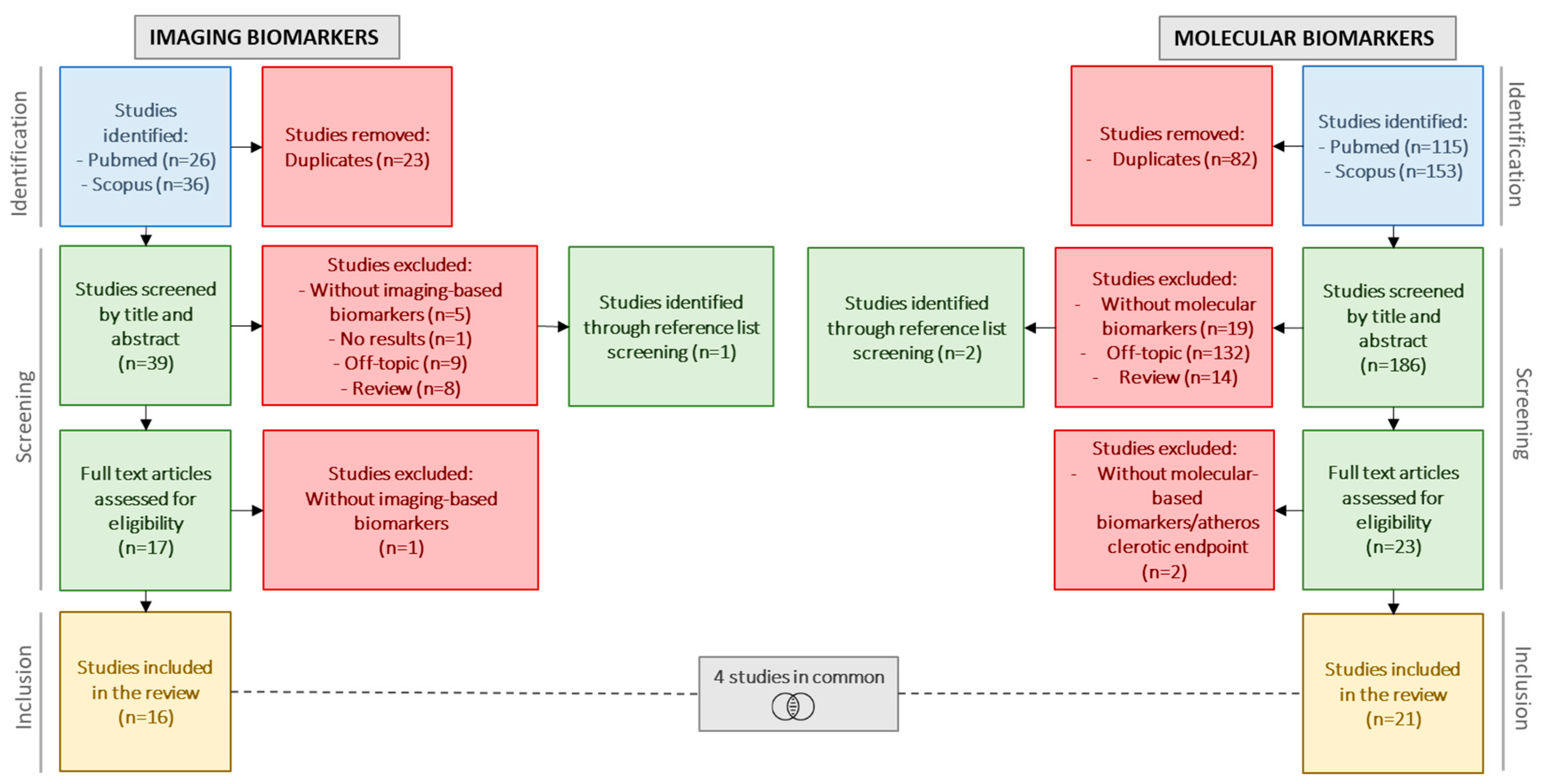

Table 1.
Summary of studies investigating the associations between PFAS exposure and imaging biomarkers of vascular aging, including carotid intima-media thickness, pulse wave velocity, endothelial function, coronary and aortic calcifications, and coronary stenosis.
Table 1.
Summary of studies investigating the associations between PFAS exposure and imaging biomarkers of vascular aging, including carotid intima-media thickness, pulse wave velocity, endothelial function, coronary and aortic calcifications, and coronary stenosis.
| First author and Year | Study type | Population | PFAS | Imaging biomarker | Statistical analysis | Effect modifiers | Main findings |
|---|---|---|---|---|---|---|---|
|
Lind et al., 2017 [28] |
Cross-sectional | 1,016 Swedish 70-year-olds | PFHpA PFHxS L-PFOS PFOA PFNA PFDA PFOSA PFUnDA |
CIMT | Linear and logistic regression, structural equation models | Sex, BMI, smoking status, BP, exercise habits, energy and alcohol intake, LDL-C, HDL-C, triglycerides, diabetes, educational level | Certain PFAS positively associated with CIMT and GSM-CIMT; possible influence of female sex |
|
Wang J et al., 2023 [26] |
Prospective | 957 mother-child pairs recruited from six hospitals in Shanghai | PFOA PFOS PFNA PFDA PFUA PFHxS PFDoA PFBS PFHpA PFOSA | CIMT | Linear regression, BKMR | Maternal age, pre-pregnancy BMI, household income, educational level, offspring sex | Maternal PFAS concentrations inversely associated with offspring CIMT |
|
Gump et al., 2023 [27] |
Cross-sectional | 291 children aged 9–11 years from Syracuse, New York | PFOS PFOA PFNA PFHxS PFDA | CIMT | General linear modelling, BKMR | Age, sex, BMI, ethnicity, blood mercury levels, urinary total arsenic, parental household income, occupation, educational level | PFDA positively associated with CIMT |
|
Lin et al., 2022 [32] |
Cross-sectional | 1,425 Taiwanese individuals aged 12–63 years from two cohorts | PFOS | CIMT | Linear regression, structural equation models | Age, sex, BMI, smoking status, alcohol consumption, household income, hypertension, diabetes, hyperlipidaemia | PFOS positively correlated with mean CIMT |
|
Lin et al., 2016 [33] |
Cross-sectional | 848 Taiwanese students aged 12–30 years | PFOA PFOS PFNA PFUA | CIMT | Logistic regression, Bonferroni correction | Age, sex, BMI, smoking status, systolic BP, LDL-C, HDL-C, triglycerides, HOMA-IR, hs-CRP | Positive association between PFOS and CIMT |
|
Lin et al., 2013 [34] |
Cross-sectional | 664 Taiwanese individuals aged 12–30 years from the Taipei area | PFOA PFOS PFNA PFUA | CIMT | Linear regression, logistic regression, Bonferroni correction | Age, sex, BMI, smoking status, systolic BP, LDL-C, triglycerides, hs-CRP, HOMA-IR | PFOS levels positively associated with mean CIMT |
|
Lind et al., 2018 [13] |
Longitudinal | 1,016 Swedish 70-year-olds at baseline | PFHpA PFHxS PFOS PFOA PFNA PFDA PFOSA PFUnDA | CIMT | Mixed-effects models, Bonferroni correction | Sex, BMI, smoking status, systolic BP, baseline PFAS levels, HDL-C, LDL-C, fasting glucose, triglycerides, statin use | Positive association between six PFAS and CIMT over 10 years |
|
Khalil et al., 2020 [31] |
Cross-sectional | 38 male firefighters from Arizona aged 49–54 years with >5 years of service; 49 controls aged 49–54 years from the 2009–2010 NHANES study | PFBuS PFDeA PFDoA PFHpA PFHxS PFNA PFOSA Et-PFOSA-AcOH Me-PFOSA-AcOH PFOS PFOA PFUA | CIMT | Linear models | Age, smoking status, exercise habits, family history of heart disease, HDL-C, triglycerides, fasting glucose, sICAM-1, hs-IL-6 | No association between PFAS and CIMT |
|
Liberda et al., 2019 [35] |
Cross-sectional | 535 Indigenous individuals from nine communi-ties in northern Quebec, aged 15–87 years | PFOA PFOS PFHxS | CIMT | PCA, linear regression, sensitivity analysis, Holm method | Age, sex, BMI, smoking status, systolic BP, LDL-C, Apo-B, triglycerides, TNF-α, hs-CRP, ox-LDL | PFOA, PFOS, and PFHxS positively associated with CIMT |
|
Wang D et al., 2023 [25] |
Controlled experimental | Male ApoE−/− mice aged 7 weeks at baseline | PFOS | CIMT, left common carotid artery PWV |
ANOVA, LSD test, Dunnett’s test | ns | PFOS exposure associated with increased CIMT, arterial stiffness, aortic plaque burden, and plaque vulnerability |
|
Lv et al., 2025 [24] |
Controlled experimental | 28 adult male C57BL/6J mice | 6:2 Cl-PFESA (trade name F-53B) | Abdominal aortic PWV | One-way ANOVA, LSD test, Dunnett’s test, factorial ANOVA | ns | Exposure associated with increased abdominal aortic PWV |
|
Wittkopp et al., 2022 [15] |
Cross-sectional | 94 adults with a mean age of 55 years from the United States without known cardiovascular disease | PFPeA PFHxA PFHpA PFOA PFNA PFDA PFUnDA PFBS PFHxS PFOS | FMD | Linear regression, WQS, BKMR, sensitivity analysis | Age, sex, BMI, smoking status, ethnicity, HbA1c, hypertension, hypercholesterolemia, waist circumference, systolic BP, diastolic BP | PFHpA inversely associated with FMD |
|
Osorio-Yanez et al., 2021 [16] |
Prospective | 666 prediabetic adults from 27 centres in the United States, enrolled in the Diabetes Prevention Program | PFOS PFOA PFHxS EtFOSAA MeFOSA-A PFNA |
Coronary and thoracic aortic calcifications | Logistic regression, sensitivity analysis | Age, sex, BMI, ethnicity, educational level, smoking status, treatment assignment, statin use | Positive association between PFOS, n-PFOS, and Et-FOSAA and coronary/aortic calcifications over 13–14 years |
|
Yang et al., 2025 [29] |
Cross-sectional | 1,005 middle-aged and older adults from the United States enrolled in the 2013–2014 NHANES study | PFDeA PFHxS PFNA | Abdominal aortic calcifications | Logistic regression, sensitivity analysis, RCS, QGC, XGBoost with SHAP, mediation analysis | Age, sex, BMI, ethnicity, smoking status, education, household income, phosphorus, vitamin B12, TC, total calcium, AST, ALT, HbA1c, total 25-hydroxyvitamin D, uric acid, eGFR, hypertension, diabetes | PFHxS, PFDeA, and PFAS mixtures associated with increased calcification risk |
|
Koskela et al., 2022 [30] |
Cross-sectional | 913 subjects aged 40–80 years enrolled in the 2013–2014 NHANES study | PFOA PFOS PFHxS PFNA | Abdominal aortic calcifications | Logistic regression, Bonferroni correction | Age, sex, ethnicity, cotinine, household income | No significant association between PFAS and abdominal aortic calcifications |
|
Li et al., 2025 [36] |
Cross-sectional | 571 subjects with acute coronary syndrome aged 18–80 years from Hebei, China | PFOA PFOS PFNA PFHxS PFUnDA PFDA | Coronary stenosis | Logistic regression, Cox regression, RCS, threshold effect model, BKMR, QGC, sensitivity analysis, FDR | Age, sex, BMI, smoking status, drinking, educational level | Positive association between PFOS and coronary stenosis |
Abbreviations: 6:2 Cl-PFESA (F-53B): 6:2 chlorinated polyfluoroalkyl ether sulfonic acid; ANOVA: analysis of variance; Apo-B: apolipoprotein B; AST: aspartate aminotransferase; BKMR: Bayesian kernel machine regression; BMI: body mass index; BP: blood pressure; CIMT: carotid intima-media thickness; eGFR: estimated glomerular filtration rate; EtFOSAA: N-ethyl perfluorooctane sulfonamidoacetic acid; Et-PFOSA-AcOH: N-ethyl perfluorooctane sulfonamidoacetic acid; FDR: false discovery rate; FMD: flow-mediated dilation; GSM-CIMT: grayscale median carotid intima-media thickness; HbA1c: glycated haemoglobin A1c; HDL-C: high-density lipoprotein cholesterol; HOMA-IR: homeostasis model assessment of insulin resistance; hs-CRP: high-sensitivity C-reactive protein; hs-IL-6: high-sensitivity interleukin-6; ICAM-1: Intercellular adhesion molecule-1; LDL-C: low-density lipoprotein cholesterol; LSD: least significant difference; LT: alanine aminotransferase; L-PFOS: linear perfluorooctane sulfonate; MeFOSAA: N-methyl perfluorooctane sulfonamidoacetic acid; Me-PFOSA-AcOH: N-methyl perfluorooctane sulfonamidoacetic acid; NHANES:National Health and Nutrition Examination Survey; ns: not specified; ox-LDL: oxidized low-density lipoprotein; PCA: principal component analysis; PFAS: per- and polyfluoroalkyl substances; PFBS: perfluorobutane sulfonic acid; PFBuS: perfluorobutane sulfonate; PFDA: perfluorodecanoic acid; PFDeA: perfluorodecanoic acid; PFDoA: perfluorododecanoic acid; PFHpA: perfluoroheptanoic acid; PFHxA: perfluorohexanoic acid; PFHxS: perfluorohexane sulfonic acid; PFOA: perfluorooctanoic acid; PFNA: perfluorononanoic acid; PFOS: perfluorooctane sulfonic acid; PFOSA: perfluorooctane sulfonamide; PFPeA: perfluoropentanoic acid; PFUA: perfluoroundecanoic acid; PFUnDA: perfluoroundecanoic acid; PWV: pulse wave velocity; QGC: quantile g-computation; RCS: restricted cubic spline; SHAP: SHapley additive explanations; sICAM-1: soluble intercellular adhesion molecule-1; TC: total cholesterol; TNF-α: tumour necrosis factor-α; WQS: weighted quantile sum; XGBoost: extreme gradient boosting.
Table 2.
Summary of studies investigating the associations between PFAS exposure and molecular biomarkers of vascular aging, including inflammatory, oxidative stress, epigenetic, proteomic, lipid-related, and endothelial dysfunction markers.
Table 2.
Summary of studies investigating the associations between PFAS exposure and molecular biomarkers of vascular aging, including inflammatory, oxidative stress, epigenetic, proteomic, lipid-related, and endothelial dysfunction markers.
| First author and Year | Study type | Model/ Population |
PFAS | Molecular biomarker | Statistical analysis | Effect modifiers | Main findings |
|---|---|---|---|---|---|---|---|
| Oxidative stress, inflammation and endothelial dysfunction | |||||||
|
Liao et al., 2012 [37] |
In vitro | HUVECs, THP-1 cells | PFOS | Intracellular ROS, IL-1β, IL-6, COX-2, NOS3, ICAM-1, P-selectin, PPARγ, ERα, AHR | One-way ANOVA, Tukey test | ns | PFOS increased ROS and upregulated IL-1β, IL-6, COX-2, ICAM-1 and P-selectin, enhancing THP-1 adhesion. |
|
Lin et al., 2016 [33] |
Cross-sectional | 848 Taiwanese adolescents and young adults | PFOS PFOA PFCs | CD31+/CD42a− EMPs, CD31+/CD42a+ PMPs, HDL, LDL, 8-OHdG, CD62E, TG, CRP | Multiple linear and logistic regression | Age, gender, smoking status, BMI, SBP, LDL-C, HDL-C, TG, HOMA-IR, hs-CRP. | PFOS was associated with endothelial and platelet microparticles; elevated microparticles strengthened the association with increased CIMT (OR=2.86, 95% CI 1.69–4.84). |
|
Dangudubiyyam et al., 2020 [41] |
In vivo animal model | Offspring of PFOS-exposed pregnant rats | PFOS | eNOS, phospho-eNOS | ANOVA, Dunnet’s post hoc test, unpaired Student’s t-test non-parametric Kruskal-Wallis test, Dunn’s multiple comparisons | ns | Prenatal PFOS exposure increased blood pressure, impaired acetylcholine-induced relaxation, and reduced eNOS activation/expression. |
|
Cui et al., 2022 [38] |
In vitro | HUVECs | PFOS | Lipid ROS, NO, GPX4, ACSL4, FTH1, HO-1 | ANOVA | ns | PFOS induced ferroptosis, increased lipid ROS levels and ACSL4 expression, and reduced GPX4, FTH1, HO-1 expression and NO content. |
|
Wang et al., 2023 [25] |
In vivo and in vitro | ApoE−/− mice and RAW264.7 macrophages | PFOS | TC, TG, LDL-C, HDL-C, NF-κB, iNOS, TNF-α, IL-6, IL-1β, CD206, Arg-1, IL-10 | ANOVA, LSD test, Dunnett’s test | ns | PFOS promoted M1 macrophage polarization, thereby increasing TNF-α, IL-6, IL-1β, and iNOS expression, while suppressing M2 polarization by reducing CD206, Arg-1, and IL-10 promoting atherosclerosis in mice. |
|
Vajeethaveesin et al., 2025 [39] |
In vitro and transcriptomics | HMEC-1 cells | PFOS | ATF4, C/EBPβ, COX-2, ICAM-1, IL-6, NF-κB, JAK2/STAT3 | ANOVA, Dunnett’s test | ns | PFOS activated HRI/eIF2α/ATF4 ER-stress signaling and increased COX-2, ICAM-1, and IL-6 expression. |
|
Lv et al., 2025 [24] |
In vivo and in vitro | C57BL/6J mice and HUVECs | F-53B (6:2 Cl-PFESA) | NF-κB, NLRP3, ASC, CASP1, GSDMD, IL-1β, ICAM-1, VCAM-1 | ANOVA, LSD test, Dunnett’s test | ns | F-53B plus nanoplastics activated NF-κB/NLRP3 signaling, increasing IL-1β, CASP1 and GSDMD, and inducing endothelial pyroptosis. |
|
Zhang et al., 2026 [40] |
In vivo and in vitro | ApoE−/− mice and HUVECs | OBS | ROS, PERK, IκBα, eIF2α, ATF4, NF-κB, ICAM-1, VCAM-1, IL-1β, IL-6, TNF-α, ZO-1, occludin, claudin-1, VE-cadherin | ANOVA, unpaired Student’s t-test, Kruskal-Wallis test | ns | OBS exposure → ROS accumulation, PERK–eIF2α–ATF4 ER stress and NF-κB activation; NAC and 4-PBA attenuated these effects. In vivo experiments: OBS exposure → endothelial impairment, collagen deposition, oxidative stress, ↑ ER stress markers, ↑ inflammation-related markers. |
|
Zhao et al., 2026 [42] |
Cross-sectional | 8100 Chinese adult subjects | PFAS mixture | hs-CRP, serum ferritin | t-test, Wilcoxon, χ2 test, Spearman correlation analysis, multivariable linear/logistic regression, QGC and WQS mixture analyses, BKMR and RCS exposure, mediation analysis, FDR correction | Age, gender, residence, education, household income, tobacco, alcohol, physical activity, total energy intake, total fat intake, total cholesterol intake, BMI for non-obesity outcomes, BMI and serum creatinine for hyperuricemia | PFAS mixtures were associated with hypercholesterolemia (OR=1.20), high LDL-C (OR=1.13), hypertension (OR=1.10) and hyperuricemia (OR=1.31); both inflammatory markers mediated the associations. |
| Lipid metabolism dysregulation | |||||||
|
Pan et al., 2025 [48] |
Cross-sectional | 1,099 adolescents aged 12–19 (US), enrolled in the 2005–2018 NHANES study |
PFOA PFOS PFHxS PFNA | LDL-C, TC, TG, AIP, serum folate, ALB, PPARγ, IL-10 (network), CASP1, CA2 (shared targets) | Weighted linear regression, Pearson correlation, BKMR, WQS, Mediation | Age, gender, race, family income-to-poverty ratio, albumin, uric acid, BMI, serum cotinine (tobacco exposure), diabetes, vitamin D | PFOS was positively associated with LDL-C and TC; PFNA, PFOS, and PFOA were associated with TG and AIP. PPAR signaling was identified as a core pathway. |
|
Connolly et al., 2025 [43] |
In vitro | Human U937-derived macrophages | PFOS PFOA | PPARγ, Nrf2, IL-1β, PAI-2, COX-2, AKR1C3, MMP-1, MMP-12, total cholesterol | Two-tailed unpaired t-test, one-way ANOVA, post-hoc Dunnett, post-hoc Tukey | ns | PFOS/PFOA increased lipid accumulation and induced PPARγ/Nrf2 signaling, IL-1β, PAI-2, MMP-1, and MMP-12 expression. |
|
Roth et al., 2026 [45] |
In vivo animal model | 40 LDLr−/− mice | PFAS mixture (PFOA, PFOS, PFNA, PFHxS, GenX) | Total cholesterol, IDL, LDL subfractions, HDL, LDL7 (densest subfraction), oxLDL, Fabp4, Fasn (foam cell markers), Cxcl2, Cxcl17 (chemokines), Plin1, Plin5 (perilipins), Abca1, Abcg1 (cholesterol efflux) | t-test Mann-Whitney, Shapiro-Wilk, Brown-Forsythe, RNA-seq (edgeR), FDR Benjamini-Hochberg, GO enrichment (DAVID) | ns | PFAS increased total cholesterol (+10%), IDL (+25%) and LDL7 (+206%), while upregulating foam-cell-associated genes. |
|
Zhang et al., 2025 [46] |
In vivo and in vitro | ApoE−/− mice, HUVECs | PFOS OBS | TG, TC, LDL-C, HDL-C, IL-6, TNF-α, IL-1β, NF-κB and MAPK/ERK signaling, ZO-1, occludin, claudin-5, VE-cadherin, endothelial permeability and LDH release | Student’s t-test, one-way ANOVA, Kruskal–Wallis test | ns | OBS induced more rapid dyslipidemia and stronger vascular inflammatory responses than PFOS. OBS induced stronger endothelial barrier disruption and inflammation than PFOS, with activation of NF-κB and MAPK/ERK pathways. |
|
Du et al., 2025 [47] |
Epidemiological, in vivo, toxicogenomic analyses | 2,014 University students (CN), 120 C57BL/6J mice, toxicogenomics database | PFAS mixtures | Hematologic and lipid-metabolism-related pathways | One-way ANOVA, BKMR, WQS, toxicogenomic pathway enrichment analyses | Age, gender ethnicity, smoking, and BMI | Toxicogenomic analyses linked PFAS exposure to lipid metabolism, inflammation, apoptosis, and JAK-STAT signaling pathways. |
|
Chai et al., 2026 [44] |
In silico study | Network toxicology and molecular docking | PFHpA PFOA PFNA PFDA | STAT3, MMP9, NFκB1, CASP3, AKT1, PPARγ | PPI analysis, GO/KEGG; molecular docking | ns | PPARγ and lipid metabolism pathways emerged among the principal mechanisms linking PFAS exposure to cardiovascular disease. |
| Epigenetic modulation | |||||||
|
Xu et al., 2020 [50] |
Human observational study | 292 exposed women in Sweden | PFOS PFHxS PFOA | miR-101-3p, miR-144-3p, miR-19a-3p | EdgeR differential expression analysis, pairwise t-tests, FDR correction, 2−ΔΔCq analysis, IPA functional analysis, Fisher’s exact test | ns | PFAS exposure was associated with downregulation of miR-101-3p, miR-144-3p, and miR-19a-3p. |
|
Liu et al., 2022 [49] |
Longitudinal EWAS | HOME mother–child cohort | PFOA PFOS PFNA PFHxS | CpG DNA methylation | GEE, interaction analysis, FDR correction, GO enrichment analysis, linear regression analyses, Spearman correlation analysis, t-test, χ2, Wilcoxon | Age, gender, household income, maternal race/ethnicity, maternal smoking during pregnancy, serum cotinine, cell-type composition. | PFAS exposure was associated with 435 differentially methylated CpG sites at birth and at 12 years of age. |
|
Lin et al., 2022 [32] |
Cross-sectional | 1,425 Taiwanese participants | PFOS | Global DNA methylation (5mdC/dG) | Linear regression analysis, structural equation modelling (SEM) | Age, gender, BMI, alcohol, hyperlipidemia, hypertension, diabetes, smoking, household income | PFOS was positively associated with 5mdC/dG, suggesting a direct contribution to arteriosclerosis through DNA methylation. |
|
Karakuş et al., 2024 [52] |
In silico study | Network toxicology | Multiple PFAS | PPARα, PPARγ, miR-130b-3p, miR-130a-3p, miR-129-5p | GO/KEGG enrichment, PPI analysis | ns | PPARα, and PPARγ were identified as core PFAS-CVD genes together with several PFAS-associated miRNAs. |
|
Li et al., 2024 [51] |
Human cohort study | 176 Teen-LABs subjects (US), 64 Rhea Study subjects (GR) | Multiple PFAS, PFAS mixture | miR-148b-3p, miR-29a-3p | Linear regression analysis, pathway enrichment | Age, BMI, race, weight loss prior to surgery, parents’ income, clinical site of surgery; Rhea Study: age, BMI, sex, parental education |
PFAS exposure was associated with altered circulating miRNA profiles; miR-148b-3p and miR-29a-3p were consistently downregulated. |
| Zhang et al., 2026 [53] | In vitro transcriptomic study | HUVECs | OBS | 74 DEMs, 685 DEGs, miRNA–mRNA pairs, ROS | ANOVA, Tukey’s test, Kruskal–Wallis test | ns | OBS altered miRNA–mRNA networks associated with endothelial dysfunction and increased intracellular ROS. |
Abbreviations: 6:2 Cl-PFESA (F-53B): 6:2 chlorinated polyfluoroalkyl ether sulfonic acid; 8-OHdG: 8-hydroxy-2′-deoxyguanosine; Abca1: ATP-binding cassette subfamily A member 1; Abcg1: ATP-binding cassette subfamily G member 1; ACSL4: Acyl-CoA synthetase long-chain family member 4; AHR: aryl hydrocarbon receptor; ALB: albumin; Arg-1: arginase-1; ANOVA: analysis of variance; ASC: apoptosis-associated speck-like protein containing a CARD; ATF4: activating transcription factor 4; BKMR: Bayesian kernel machine regression; BMI: body mass index; C/EBPβ: CCAAT/enhancer-binding protein beta; CD62E: E-selectin; CIMT: carotid intima-media thickness; COX-2: Cyclooxygenase-2; DEGs: differentially expressed genes; DEMs: differentially expressed miRNAs; DNA: Deoxyribonucleic acid; EMPs: endothelial microparticles; eNOS: endothelial nitric oxide synthase; ER: endoplasmic reticulum; ERα: estrogen receptor alpha; FDR: false discovery rate; FTH1: ferritin heavy chain 1; GenX: hexafluoropropylene oxide dimer acid (HFPO-DA); GPX4: Glutathione peroxidase 4; GSDMD: Gasdermin D; HDL: high-density lipoprotein; HDL-C: high-density lipoprotein cholesterol; HMEC-1: Human microvascular endothelial cell line-1; HO-1: heme oxygenase-1; HOMA-IR: homeostasis model assessment of insulin resistance; hs-CRP: high-sensitivity C-reactive protein; HUVECs: Human umbilical vein endothelial cells; IL: interleukin; IκBα: inhibitor of nuclear factor kappa B alpha; LDH: lactate dehydrogenase; LDL-C: low-density lipoprotein cholesterol; miRNA: microRNA; NF-κB: nuclear factor κappa -light-chain-enhancer of activated B cells; NHANES: National Health and Nutrition Examination Survey; NLRP3: NLR family pyrin domain containing 3; NO: nitric oxide; NOS3: nitric oxide synthase 3; ns: not specified; oxLDL: oxidized low-density lipoprotein; PAI-2: plasminogen activator inhibitor-2; PFAS: per- and polyfluoroalkyl substances; PFDA: perfluorodecanoic acid; PFHpA: perfluoroheptanoic acid; PFHxS: perfluorohexane sulfonic acid; PFNA: perfluorononanoic acid; PFOA: perfluorooctanoic acid; PFOS: perfluorooctane sulfonic acid; phospho-eNOS: phosphorylated endothelial nitric oxide synthase; Plin1: perilipin-1; Plin5: perilipin-5; PMPs: platelet microparticles; PPARα: peroxisome proliferator-activated receptor alpha; OBS: sodium p-perfluorononenoxybenzene sulfonate; QGC: quantile g-computation; RCS: restricted cubic spline; ROS: reactive oxygen species; TC: total cholesterol; TNF-α: tumour necrosis factor-α; VCAM-1, vascular cell adhesion molecule-1; ZO-1: zonula occludens-1.
Disclaimer/Publisher’s Note: The statements, opinions and data contained in all publications are solely those of the individual author(s) and contributor(s) and not of MDPI and/or the editor(s). MDPI and/or the editor(s) disclaim responsibility for any injury to people or property resulting from any ideas, methods, instructions or products referred to in the content. |
© 2026 by the authors. Licensee MDPI, Basel, Switzerland. This article is an open access article distributed under the terms and conditions of the Creative Commons Attribution (CC BY) license (http://creativecommons.org/licenses/by/4.0/).
Copyright: This open access article is published under a Creative Commons CC BY 4.0 license, which permit the free download, distribution, and reuse, provided that the author and preprint are cited in any reuse.


