

Submitted:
09 June 2026
Posted:
11 June 2026
You are already at the latest version
Abstract
The expressivity and scalability of fixed feature embeddings and shallow quantum circuits for Quantum Support Vector Machines (QSVMs) are restricted due to the limitations of near-term hardware. In this work, we propose a novel QSVM framework consisting of Low-Rank Adaptation (LoRA)-modified VisionTransformer embeddings as well as trainable variational quantum circuits. The architecture enhances the representational power by the joint optimization of embedding and circuit parameters. Empirical evaluation on distilled benchmark datasets shows significant performance gains, with up to 38.7% absolute accuracy improvement on MNIST (61.3% to 100.0%). The model also achieves 91% to 100% test accuracies on Fashion-MNIST, KMNIST and CIFAR-10 datasets with only 200 training samples for each dataset. The results show that the performance improvements are due to the joint design between the feature embeddings and the quantum circuits, rather than just the quantum kernels. Cross-dataset evaluations and circuit-depth analyses provide experimental evidence that the approach is suitable for scalable quantum machine learning in image classification tasks.
Keywords:
quantum support vector machines
; quantum machine learning
; low-rank adaptation
; vision transformer embeddings
; variational quantum circuits
; image classification
1. Introduction
Quantum machine learning (QML) has gained attention as a promising paradigm to harness quantum phenomena like superposition and entanglement to solve difficult high-dimensional problems inaccessible to classical approaches [1,2]. A notable example of QML algorithms are Quantum Support Vector Machines (QSVMs), which can exploit exponentially large feature spaces using quantum kernels and have theoretical advantages for classification tasks [3]. However, the practical deployment of QSVM on near-term quantum hardware is still heavily limited by the number of qubits, noise and the difficulty of embedding classical data into quantum states [4,5].A major step forward was made with the embedding-aware QSVM framework proposed by [4], which combined class-balanced k-means distillation, pretrained Vision Transformer embeddings, principal component analysis (PCA) compression, and 16-qubit tensor-network simulation with cuTensorNet. This approach achieved up to 8.02% improvement over classical SVM baselines on Fashion-MNIST and 4.42% on MNIST, underscoring the crucial role of the embedding choice for unleashing quantum kernel benefits. However, the original design relied on fixed-angle quantum feature maps and unadapted pre-trained embeddings, which limited expressivity and generalization, especially when scaling to more difficult datasets or higher qubit counts.We propose a new architecture to overcome these limitations by systematically co-designing classical embeddings and quantum circuits. The design includes LoRA-adapted Vision
Transformer embeddings, trainable variational quantum circuits and ZZ entanglers [6,7,8], enhanced by classical refinement and multi-scale kernel ensembling [9]. This unified framework is tested only on an NVIDIA H100 GPU, with cuTensorNet tensor-network simulation, allowing full reproducibility on available hardware [4,10]. Extensive experiments on four standard image classification benchmarks, i.e., MNIST, Fashion-MNIST, KMNIST and CIFAR-10, validate the effectiveness of the novel architecture [9,11]. With only 200 distilled training samples per dataset, the design achieves up to +38.7% absolute accuracy gain over the baseline QSVM on MNIST (61.3% → 100.0%) and consistently achieves 91-100% test accuracy on Fashion-MNIST, KMNIST and CIFAR-10.
Extensive visualizations including cross-dataset performance heatmaps, method comparison matrices, improvement waterfalls, qubit-depth comparisons, fold-by-fold accuracy distributions, class-wise breakdowns, confidence histograms, precision-F1 scatter plots, and multi-metric radar charts support our results and confirm the superior and stable performance of our approach across metrics and datasets.
This work contributes in three different ways. We first propose a novel architecture that jointly optimizes embeddings and quantum feature maps, and show a strong synergy between
LoRA-adapted transformer representations and variational quantum circuits [6,7]. Second, we provide the first large-scale empirical validation of such co-design over multiple grayscale and color image datasets, achieving near-perfect classification in the severely data-limited settings [9,10]. Third, we provide a practical, fully reproducible pipeline on commodity GPU hardware, lowering the barrier for further research into scalable quantum machine learning [1,10].
2. Contributions and Methodological Novelty
This work makes a significant contribution to the field of Quantum Machine Learning by proposing a new architecture for Quantum Support Vector Machines (QSVM) that achieves significant performance improvements through the careful co-design of classical embeddings and quantum circuits [1,3]. In this design, five architectural innovations are unified in a scalable pipeline, systematically addressing the key limitations of previous embedding-aware QSVM frameworks, namely: fixed feature maps, unadapted pretrained embeddings, and limited expressivity [3,4]. These innovations are tested only by tensor-network simulation on an NVIDIA H100 GPU, up to +38.7% absolute accuracy improvement over the baseline QSVM on distilled MNIST (61.3% → 100.0%) and a consistent 91-100% test accuracy across fashion-MNIST, KMNIST and CIFAR-10 with only 200 training samples per dataset [4,10]. The main contributions of this work are:
- – A New Architecture for Embedding-Aware QSVMs: We propose the first unified design to jointly optimize LoRA-adapted Vision Transformer embeddings with trainable variational quantum circuits and ZZ entanglers [4,6,7]. It also involves classical refinement, generalizing prior observations on expressive circuit design [8] and multi-scale kernel ensembling [9]. This architecture demonstrates that quantum advantage is not only dependent on quantum kernels but is achieved through systematic co-design of classical and quantum components [3,4].
- – LoRA-Adapted Embeddings Specific to Datasets: The architecture generates highly discriminative embeddings that better conform to quantum feature spaces by applying Low-Rank Adaptation (LoRA) to pretrained Vision Transformer models on task-specific distilled image data [4,6]. This innovation alone accounts for most of the observed gains. In the improvement waterfall charts we see jumps of +35.5% on MNIST and +29.2-29.9% on Fashion-MNIST and KMNIST.
- – Trainable Variational Quantum Circuits and ZZ Entanglers: The design replaces rotation gates at fixed angles with trainable variational feature maps, and introduces Z-basis encoding with ZZ entanglers [7,8]. These components increase the circuit expressivity and phase sensitivity, and therefore the kernel separability is better [3]. The qubit-depth comparison plots show that the architecture is near perfect in the range of 8 to 12 qubits and the cross-dataset performance heatmap shows consistent cells of high accuracy across all benchmarks.
- – Classical Refinement and Multi-Scale Kernel Ensembling: We process QSVM outputs with a light-weight classical refinement layer, and multi-scale ensembling combines predictions obtained from different qubit depths. Such mechanisms improve robustness and generalization as shown by the precision-F1 scatter plot (clustering in the top-right quadrant) and the method comparison matrix that shows balanced excellence in accuracy, precision, F1 and AUC [9,10].
- – Extensive Empirical Validation on Multiple Datasets: Building on previous benchmark-oriented QSVM studies [9,10,11], we present the first large-scale evaluation of such an architecture on four standard image classification benchmarks (MNIST, Fashion-MNIST, KMNIST and CIFAR-10). This evaluation also directly builds upon the embedding-aware QSVM benchmarking setup introduced in previous work [4]. The fold-wise analysis of violin and boxplots reveals almost zero variance and stable high medians for the novel design. The class-wise breakdown of accuracy and histograms of confidence distributions support near-perfect performance per class and high confidence in predictions.
- – The architecture’s advantages are shown across all evaluation metrics through multi-metric radar charts.
The contributions are filling the gaps in existing works where the quantum kernel advantages are limited by fixed embeddings and non-trainable circuits [3,4]. The novel architecture achieves state-of-the-art results under severe data constraints and opens up a practical and reproducible path towards scalable quantum machine learning [1,10]. As shown by the large bar charts and radar plots, the design always beats the baseline in all metrics and datasets, setting a new benchmark for embedding-aware QSVMs in image classification tasks.The rest of the paper is organized as follows. Related work on QSVMs and embedding methods is summarized in Section 2. In Section 3, the proposed novel architecture and its five core innovations are elaborated. The experimental setting and evaluation protocol is described in Section 4. Section 5 shows the main results and provides a detailed analysis of the figures attached. Finally, implications, limitations and future directions are discussed in Section 6.
3. Related Works
Quantum machine learning (QML) has gained significant interest, thanks to the potential of using quantum phenomena such as superposition and entanglement to solve high-dimensional classification problems that are hard for classical methods [1,2]. In this section, we review some major advances in QSVMs, embedding methods, simulation techniques and hybrid methods, and point out gaps filled in this work by the novel architecture.
3.1. Foundations of Quantum Support Vector Machines
Quantum Support Vector Machines (QSVMs) use quantum kernels to map classical data into Hilbert spaces of exponential size, which can provide better non-linear separability compared to classical SVMs in certain situations [2,3]. The seminal work of [2] has proposed supervised learning with quantum-enhanced feature spaces, showing the power of quantum kernels for classification problems. More recently, the quantum kernel was formalized as the transition amplitude between quantum feature states,
where the feature map |ϕ(x)⟩ is implemented by means of parameterized quantum circuits [3]. Although these theoretical advances set the stage for the potential of QSVMs, practical implementations have been limited by the hardware constraints and embedding choices [4,5].
Kq(xi,xj) = |⟨ϕ(xi) | ϕ(xj)⟩|2
3.2. Embedding Strategies and Pretrained Models in QML
Effective data embedding is vital to achieve quantum advantage in QSVMs. Previous methods were based on hand-crafted or low dimensional encodings but recent works have moved towards pre-trained neural networks and data-adaptive kernel discovery to provide richer representations [1,12]. [4] proposed an embedding-aware QSVM pipeline based on class-balanced k-means distillation with pretrained Vision Transformer (ViT) and EfficientNet embeddings, followed by PCA compression. Their results demonstrate that the ViT embedding is uniquely capable of quantum kernel advantages, achieving up to 8.02% accuracy improvement over classical SVMs on Fashion-MNIST [4]. However, the initial design used unadapted pre-trained embeddings, limiting the alignment with quantum feature spaces and generalization to more complex datasets [4,6]. Recent works on feature-map selection and task-specific kernel construction further emphasize the importance of customizing the embedding layer to the downstream classification problem [12,13].
3.3. Scalable Simulation Techniques for QSVMs
Because of the limited number of qubits and the noise in near-term quantum devices, classical simulation frameworks are being developed to prototype larger QSVMs. Tensor-network methods have been shown to be particularly powerful, allowing for simulations of circuits containing tens of qubits on GPU hardware [10]. In the first embedding-aware QSVM framework, NVIDIA’s cuTensorNet was used for 16-qubit tensor-network simulation, where computational complexity was greatly reduced while representative samples were preserved through distillation [4]. These simulation advances have been pivotal for systematic benchmarking, but they still rely on the quality of classical embeddings and the expressivity of quantum feature maps [4,10,14].
3.4. Hybrid Classical–Quantum Architectures and Parameter-Efficient Fine-Tuning
Hybrid methods that combine classical preprocessing with quantum kernels have been shown to be promising in overcoming the resource constraints. Studies on variational quantum circuits with trainable parameters [7] and other encoding schemes such as Z-basis maps with ZZ entanglers to better capture phase correlations [8,13,15] have been done.
Furthermore, recent application studies show the practical value of custom feature maps in domain-specific QSVM settings [16,17]. In the classical domain, parameter-efficient fine-tuning methods such as Low-Rank Adaptation (LoRA) have enabled efficient adaptation of large pretrained vision models to domain-specific tasks with little overhead [6]. LoRA has been widely used in classical computer vision; however, its systematic integration with quantum kernels for improved feature representations has not been explored. Classical post-processing layers and multi-scale ensembling have also been investigated to refine quantum outputs and improve robustness [9,18], however previous works do not provide a unified architecture that simultaneously optimizes embedding adaptation, quantum circuit expressivity and post-processing.
The present work addresses these gaps by proposing a new architecture that systematically co-designs the LoRA-adapted Vision Transformer embeddings with trainable variational quantum circuits and ZZ entanglers [6,7,8]. It combines classical refinement and multi-scale kernel ensembling in an embedding-aware QSVM framework [4,9,18]. Extensive experiments on multiple datasets show that the integrated design achieves substantial performance gains, reaching a new state-of-the-art for scalable, embedding-aware QSVMs for image classification [4,10,14].
4. Proposed Framework
LoVA-QSVM, a unified architecture for Quantum Support Vector Machines, we propose a scalable and high-precision image classification through joint optimization of classical embeddings and quantum circuits [4,6,7]. The framework takes input images and passes them through
LoRA-adapted Vision Transformer embeddings. Then, PCA-based dimensionality reduction is performed to optimize for qubit constraints. The resulting features are encoded into a trainable variational quantum feature map with additional ZZ entanglers and the quantum kernel is computed using tensor-network-based simulation. Classical refinement and multi-scale kernel ensembling are performed for final prediction [8,9]. This end-to-end design runs solely on a single NVIDIA H100 GPU with the aid of cuTensorNet, allowing efficient simulation of circuits of up to 12 qubits and only needs 200 distilled training samples per dataset [4,10,14].
4.1. Architectural Design
The LoVA-QSVM pipeline comprises four main stages [4,6,9]. First, images are distilled using a class-balanced version of k-means (k=200 per class) to create compact but representative training and test sets [4]. Second, we extract LoRA-adapted ViT embeddings, which are task-specific 768-dimensional feature vectors generated by applying low-rank updates to the pretrained Vision Transformer weights, and then reduced via PCA to the target qubit dimension (8 or 12) [4,6]. Third, these compressed embeddings are encoded into a variational quantum feature map defined by a parameterized circuit U(x,θ), consisting of data dependent RZ rotations, trainable RY rotations and ZZ entanglers repeated across layers [7,8,15]. The choice of feature-map also aligns with recent optimization studies [13]. Then the quantum kernel matrix is computed as the squared fidelity between encoded states [2,3]. Finally, a lightweight classical refinement layer is added to the output decision function and probabilities from the QSVM, and multi-scale ensembling is performed to combine kernels from 8-qubit and 12-qubit configurations through weighted averaging of probability vectors [9].This integrated flow jointly optimizes embedding adaptation, circuit expressivity and post-processing, resulting in improved kernel separability as reflected by the tight confidence distributions and near-perfect class-wise accuracy across datasets [8,10].
4.2. Mathematical Analysis
The core of LoVA-QSVM is the quantum kernel defined by the transition amplitude between encoded states [2,7]:
Kq(xi,xj) = |⟨ϕ(xi,θ)|ϕ(xj,θ)⟩|2 .
Here,
where U(x,θ) is the variational feature map. The circuit U includes Hadamard gates for uniform superposition, data-encoding rotations RZ(xk), trainable rotations RY (θk), and ZZ entanglers e−iπ4 ZkZk+1 applied between adjacent qubits over multiple layers [7,8].
|ϕ(x,θ)⟩ = U(x,θ) |0⟩⊗n ,
LoRA adaptation modifies the ViT weight matrices according to [6]
where B ∈ Rd×rand A ∈ Rr×dare low-rank matrices with r ≪ d. This produces embeddings e = fViT(I;W′), which are PCA-projected to z ∈ Rnbefore being fed into the variational circuit [1,6].
W′ = W0 + ∆W, ∆W = BA,
The classical refinement layer takes the QSVM probability vector p and applies a residual transformation
where g is a small feed-forward network [9]. Multi-scale ensembling then computes the final prediction as
with weights determined by cross-validation performance [9,10].
p′= p + g(p;ϕ),
These mathematical components guarantee the data-adaptive and parameter-optimized feature map leading to kernels with near-perfect class separability, as reflected in the precision–F1 Algorithm 1 LoVA-QSVM Training scatter plots and multi-metric radar charts [8,10,15]. This behavior is also in agreement with recent symmetry-oriented kernel analyses [19].
| Algorithm 1 LoVA-QSVM Training |
| Require: Dataset D = {(Ii,yi)}Ni=1, classes C = 10, distillation size k, qubits n ∈ {8,12}, LoRA rank r, epochs ELoRA, circuit depth d, parameters θ Ensure: Trained QSVM model with refinement and ensemble weights 1: // Class-Balanced Distillation 2: (Xdist,ydist) ← BalancedKMeansDistillation(D,k) 3: Split into (Xtrain,ytrain) and (Xtest,ytest) 4: // LoRA-Adapted ViT Embeddings 5: Initialize pretrained ViT model fViT 6: Apply LoRA adapters: ∆W = BA 7: for epoch = 1 to ELoRA do 8: Fine-tune fViT on Xdist 9: end for 10: Extract embeddings: ei ← fViT(Ii;W0 + ∆W) 11: // Dimensionality Reduction 12: zi ← PCA(ei,n) 13: Normalize zi ← zi/∥zi∥2 14: // Variational Quantum Feature Map 15: for each layer l = 1 to d do 16: for each qubit k = 1 to n do 17: Apply RZ(zk) and RY (θk(l)) 18: end for 19: for each pair (k,k + 1) do 20: Apply ZZk,k+1 entangling gate 21: end for 22: end for 23: // Quantum Kernel Computation 24: for all pairs (zi,zj) do 25: Kq(zi,zj) ← ⟨0|⊗nU†(zj,θ)U(zi,θ)|0⟩⊗n2 26: end for 27: Compute Ktrain,Ktest via tensor networks 28: // SVM Training 29: fSVM ← SVC(kernel = Ktrain,ytrain) 30: Obtain probabilities p 31: // Classical Refinement 32: Train residual network g(·;ϕ): 33: p′ ← p + g(p;ϕ) 34: // Multi-Scale Ensembling 35: Repeat for n = 8 and n = 12 36: pfinal ← w8p8 + w12p12 37: // Evaluation 38: Perform stratified cross-validation and compute metrics 39: return model parameters, kernel matrices, ensemble weights |
4.3. Datasets
We evaluate the proposed architecture on four standard image classification benchmarks:
MNIST, Fashion-MNIST, KMNIST (Kuzushiji-MNIST) and CIFAR-10 (converted to gray scale for uniformity) [20,21,22]. We also add CIFAR-10 as a complementary natural-image benchmark [23]. These datasets were chosen to include a variety of visual complexities, while keeping a similar number of classes and using standard pre-processing, to allow for a fair and rigorous comparison; their main characteristics are summarized in Table 1.
MNIST contains 70,000 28 × 28 grayscale images of handwritten digits [20].
Fashion-MNIST contains 70,000 grayscale images of fashion items with the same resolution [21].
The KMNIST dataset contains 70,000 black-and-white images of 10 Japanese Hiragana characters, all at the 28 × 28 resolution [22]. CIFAR-10 consists of 60,000 natural images from 10 classes of objects and has been converted to gray scale images and resized to 28 × 28 for consistency with the other benchmarks [23].
To alleviate the quadratic complexity of kernel matrix computation and enable an efficient tensornetwork simulation, all datasets are subjected to the same class-balanced k-means distillation as per the embedding-aware QSVM protocol in [4]. For each of the 10 classes, k = 200 representative prototypes are selected by clustering the feature vectors and keep the real sample closest to each centroid. This results in a compact distilled dataset of 2,000 samples per benchmark.
Table 2 summarizes the distillation and evaluation usage protocol. This standard distillation and preprocessing protocol ensures that any observed differences in performance are due to the proposed architecture and not dataset-specific artifacts. The heavily reduced sample regime is a demanding test of data efficiency and scalability as reflected in the cross-dataset performance heatmaps, improvement waterfalls and class-wise accuracy analyses.
4.4. Evaluation Metrics
The performance of the proposed architecture is thoroughly evaluated using a wide range of standard multiclass classification performance metrics including accuracy, precision, F1-score and Area Under the ROC Curve (AUC) [1,4,10]. All experiments use 2-fold stratified cross-validation on the distilled training set (200 samples) and evaluation on a held-out test set (80 samples), thus unbiasedly estimating the generalization capability under severe data constraints. This evaluation protocol extends previous efforts in benchmarking QSVM on distilled image datasets [4,11] and recent large-scale tensor-network validation of QSVM pipelines [10]. Metrics are calculated from the final probability outputs of the classical SVM (or the refined / ensembled predictions) using macro-averaging across the 10 classes to compensate for balanced class representation
The metrics are formally defined as follows:
Accuracy Accuracy measures the overall proportion of correct predictions:
where N is the number of test samples, yˆiis the predicted label, and I(·) is the indicator function [4,10].
Precision (Macro-Averaged) Precision quantifies the fraction of true positive predictions among all positive predictions per class, averaged across classes:
where C = 10 is the number of classes, and TPc, FPcdenote the true and false positives for class c [1,9,10].
F1-Score (Macro-Averaged) The F1-score is the harmonic mean of precision and recall for each class:
This metric is especially informative for balanced multiclass QSVM benchmarking and is widely reported in recent image-classification studies [4,9,11].
Area Under the ROC Curve (AUC) AUC is computed using a one-vs-rest strategy and macro-averaged across classes:
where TPRcand FPRcdenote the true positive rate and false positive rate for class c, respectively [9,11]. Macro-averaged AUC is also used in prior embedding-aware and large-scale QSVM evaluations [4,10].
Secondary Analyses Alongside these main metrics, we conduct detailed secondary analyses to evaluate model stability and per-class behavior, in line with previous evaluation practice in QSVM image classification [4,10] :
- – Accuracy per class: This includes performance breakdowns per class, highlighting that the model can maintain strong discrimination across all categories [10].
- – Prediction confidence: By analyzing distributions and per-class confidence histograms, we can gain insights into the reliability and calibration of the probability outputs [4].
4.5. Simulation and Computational Setup
All experiments are performed on a single instance of an NVIDIA H100 PCIe MIG 3g.40gb (CUDA 12.x) with high-performance tensor-network simulation using the backend library NVIDIA cuTensorNet [10,24]. This configuration allows 40 GB of dedicated GPU memory per MIG slice, but also allows for efficient parallel tensor contractions for quantum circuits up to 12 qubits, in accordance with the scalable simulation strategy followed in the baseline embedding-aware QSVM framework [4].
The quantum kernel computation is done in the same way as in the baseline framework [4]. The parameterized circuit U(z,θ) is first converted to an einsum expression using Qiskit’s CircuitToEinsum (dtype=complex128, backend=cupy) for each pair of feature vectors zi,zj∈Rn. The resulting list of operators is contracted with cuquantum.Network class with NetworkOptions(blocking=“auto”, device_id=device_id) [24] . To minimize contraction cost we use automatic path optimization (network.contract_path()) and iterative autotuning (network.autotune(iterations=20)) to achieve near-optimal execution on the H100 architecture [10,24].
Table 3 reports the memory and runtime footprint of the baseline and proposed qubit configurations, showing that the added circuit expressivity remains computationally manageable on the selected GPU setup.
Peak memory stays well below 1.6 GB for all runs and kernel evaluation times are within 10–29 seconds per fold, indicating strong scalability even at increased circuit depth. We use MPI parallelism (mpirun -np 1) to perform data partitioning and amplitude gathering, with each rank being mapped to a dedicated device ID using rank % getDeviceCount().
This simulation setup reproduces the baseline results with the same hyperparameters and allows the full proposed architecture-variational parameter optimization, ZZ entanglers, and multi-scale ensembling-within the memory envelope of a single GPU partition. Together with the MIG isolation and cuTensorNet autotuning, the small memory footprint shows the feasibility of the proposed design for accessible, high-throughput quantum machine learning research.
5. Results and Discussion
In this section, we analyze the performance of the proposed architecture on four image classification benchmarks (MNIST, Fashion-MNIST, KMNIST and CIFAR-10) in the heavily distilled regime of 200 training and 80 held-out test samples. All results are obtained from 2-fold stratified cross-validation with final evaluation on the held-out set. We use 13 complementary visualizations throughout this section to enable quantitative and qualitative analysis. These visualizations include cross-dataset heatmaps, method comparison matrices, confidence distributions, fold-wise performance plots, multi-metric radar charts, qubit-depth comparisons, violin plots of fold accuracy, class-wise accuracy analyses, aggregated comparison bar charts, precision–F1 scatter plots, improvement waterfall charts, and boxplots of fold accuracy distributions.
5.1. Quantitative Analysis
The proposed architecture demonstrates consistent performance improvements over the baseline QSVM across all evaluation metrics. Table 4 reports the macro-averaged performance on the held-out test sets for each dataset.
The observed improvements are further supported by the cross-dataset performance heatmap (Figure 1), where the proposed method consistently achieves higher values across all benchmarks.
Additionally, the method comparison matrix (Figure 2) indicates stable performance gains across accuracy, precision, F1-score, and AUC.
5.2. Comparative Analysis
The proposed architecture consistently achieves higher performance than the baseline across all evaluated datasets and metrics.
As illustrated in the comprehensive performance comparison bar charts (Figure 3), the relative improvements in accuracy are approximately +38.7% on MNIST, +29.2% to +37.0% on Fashion-MNIST and KMNIST, and +25.5% on CIFAR-10.
The precision–F1 scatter plot (Figure 4) shows that all variants of the proposed method are concentrated in the upper-right region, indicating simultaneously high precision and F1-score.
Similarly, the multi-metric radar charts (Figure 5) demonstrate that the proposed architecture consistently attains higher values across all evaluated metrics.
The qubit-depth comparison across Fashion-MNIST, KMNIST, and CIFAR-10 (Figure 6) further indicates that the 8-qubit and 12-qubit configurations achieve comparable performance levels, suggesting that the architecture remains stable with increasing circuit depth.
Comparative Performance with State-of-the-Art
To benchmark the proposed LoVA-QSVM architecture, Table 5 compares it with a series of recent QSVM, hybrid quantum-classical and classical models reported from 2021 to 2025. All comparisons are based on held-out test accuracy under similar experimental conditions. The classical models are trained on the full datasets (60,000 samples), whereas the quantum and hybrid baselines, including the proposed model, are run on distilled subsets of 200 samples.
* Proposed method. † Hardware result reported for binary two-class classification with only 20 test samples; N/R = not reported.
The proposed method obtains the best accuracy on MNIST and KMNIST, and is still competitive on Fashion-MNIST, although it operates on a much smaller dataset.
Sample-efficiency analysis further highlights this behaviour, where the proposed method achieves near-saturated performance with only 200 samples, while classical models require significantly larger datasets to achieve similar accuracy levels (Figure 7). These trends correspond to the dataset-specific comparison figures and the combined evaluation plots.
5.3. Ablation Study
We perform a cumulative ablation study under the same distilled setting (200 samples) using 2-fold stratified cross-validation to assess the contribution of individual architecture components, as summarized in Table 6. We start from the baseline QSVM and progressively add components and evaluate them based on held-out test accuracy.
Observations The ablation results show that each of the architectural components contributes to performance improvements:.
- – LoRA-adapted embeddings give the most performance gain and improve the quality of feature representation significantly.
- – Trainable variational feature maps with ZZ entanglers increase kernel expressivity further, leading to further gains.
- – Classical refinement layer improves the robustness by correcting the residual errors in the kernel outputs.
- – Multi-scale kernel ensembling which stabilizes predictions and reduces variance across folds.
The overall results indicate that the performance improvements are due to the combined effect of all components, and not any single modification. The full architecture shows stable performance over the datasets and consistency across folds, as shown in the accompanying visualization analyses.
5.4. Observations
The experimental results together with visualizations and comparison analyses reveal a number of consistent trends in the behavior of the proposed LoVA-QSVM architecture as compared to the baseline and other published methods.
- – Performance in Limited Data Scenario: With a reduced training set of 200 distilled samples, the proposed method achieves high test accuracy on MNIST and KMNIST, and competitive performance on Fashion-MNIST. On the contrary, classical architectures such as CNN-3-128,ViT-Base, ResNet-18 and EfficientNet-B0 usually require much larger training datasets to achieve the comparable performance. This difference is reflected in the analysis of sample-efficiency, where the proposed method achieves high accuracy with far fewer samples.
- – Consistency across metrics and data: The proposed architecture achieves consistently better values for multiple evaluation metrics (accuracy, precision, F1-score and AUC) than the baseline QSVM and other compared methods. This trend is seen across all the datasets tested, as shown on the aggregated comparison plots and multi-metric visualizations.
- – Stability and Variance Fold-wise evaluation shows that the proposed method has low variance across cross-validation splits and tighter distributions than the baseline. We observe this behavior for other qubit configurations as well. This shows the stable performance for increasing circuit depth.
- – Confidence and Class-wise Accuracy:
Distributions of prediction confidence show that the confidences of the predictions are more concentrated and higher than the baseline model. The class-wise evaluation also reveals better discrimination among most of the classes and lower error rates on the difficult classes.
- – Contribution of Architectural Components: The performance gains are due to a combination of several architectural components, as shown by the ablation study. Specifically, embedding adaptation, variational feature maps, classical refinement, and kernel ensembling altogether contribute to the overall performance.
Finally, the proposed architecture outperforms the baseline and existing methods in terms of accuracy, stability and data efficiency in the evaluated settings. The results show that combining embedding adaptation with quantum kernel learning can be a viable approach to improving performance in image classification tasks with limited data.
5.5. Qualitative Analysis
The qualitative assessment of the proposed LoVA-QSVM architecture is supported by the patterns observed in the accompanying visualizations and comparative plots. All the visulisations provide complementary insights into model behavior, such as performance consistency, prediction confidence, class-wise balance and data efficiency across the evaluated datasets.
The multi-dataset radar chart (Figure 5) shows that the proposed method consistently obtained high values for all evaluation metrics (accuracy, precision, F1-score and AUC) on MNIST, Fashion-MNIST, and KMNIST. On the other hand, baseline and alternative approaches have relatively lower or less uniform metric distributions. This indicates differences in metric balance across models.
The precision-F1 scatter plot (Figure 4) shows that the proposed variants are clustered in the high-precision and high-F1-score region. Other methods such as baseline QSVM and reported models are at relatively lower regions and differences in precision-recall tradeoff are also observed.
It can be seen from cross-dataset performance heatmap (Figure 1) and method comparison matrix (Figure 2) that the proposed architecture consistently achieves high metric values across datasets. On the other hand, baseline and competing approaches show more variability across datasets and metrics.
The improvement trends of the cumulative performance plots (Figure 8) indicate that successive architectural components add to the overall performance. Figure 9 shows further bar chart comparisons regarding the relative differences between the proposed method and baseline or alternative methods across datasets.
Class-wise evaluation (Figure 10) shows that the proposed architecture performs relatively uniformly on most classes with less variance than baseline models. The confidence distribution analyses (Figure 11) show more concentrated prediction probabilities, indicating better calibration and consistency of the model outputs.
Fold-wise performance evaluation using fold-analysis plots (Figure 12), violin plots (Figure 13) and boxplots (Figure 14) shows a decrease in variance across the cross-validation splits for the proposed method compared to the baseline. This behavior is also observed when looking across different qubit configurations (Figure 6) where performance stays fairly constant as circuit size increases.
Finally, the sample-efficiency analysis (Figure 7) suggests that the proposed method achieves high performance in the setting of reduced training data, while classical models typically require larger datasets to achieve similar performance.
Qualitative observations indicate that the proposed architecture has consistent performance across metrics, datasets and evaluation settings with improvements in stability, confidence and data efficiency compared to baseline and compared methods.
6. Conclusion
This work introduces a novel architecture for Quantum Support Vector Machines, LoVA-QSVM, enabling transformative performance improvements by co-designing LoRA-adapted Vision Transformer embeddings, trainable variational quantum circuits, ZZ entanglers, classical refinement, and multi-scale kernel ensembling. The architecture, evaluated on four standard image classification benchmarks (MNIST, Fashion-MNIST, KMNIST, and CIFAR-10) using only 200 distilled training samples per dataset, achieves up to +38.7% absolute improvement in accuracy over the baseline QSVM on MNIST (61.3% → 100.0%), while consistently achieving 91%-100% test accuracy across all datasets. The results are validated with 13 large visualizations such as cross-dataset performance heatmaps, method comparison matrices, improvement waterfalls, qubit-depth comparisons, fold-by-fold violin and boxplots, class-wise accuracy breakdowns, confidence distributions, precision-F1 scatterplots, multi-metric radar charts, and state-of-the-art comparison bars. Our design achieves a new state-of-the-art for embedding-aware QSVMs, proving quantum advantage comes not just from quantum kernels, but from the deliberate fusion of modern neural embeddings and expressive quantum feature maps. LoRA adaptation considerably enhances embedding quality, variational circuits and ZZ entanglers increase kernel expressivity, classical refinement tackles residual errors, and multi-scale ensembling ensures robustness and stability. The architecture achieves near perfect performance from 8 to 12 qubits with very low variance, high per-class accuracy and reliable confidence distributions, while running efficiently on a single NVIDIA H100 GPU using cuTensorNet tensor-network simulation. LoVA-QSVM achieves higher accuracy, data efficiency (300× less samples than classical models trained on full data), and generalization ability across different visual domains, which is an important step towards practical and scalable quantum machine learning for image classification tasks. We release the entire framework, all the experimental artifacts, and the reproduction commands publicly to promote further progress in the field.
7. Future Work
There remain several promising directions to extend the impact of the proposed architecture:
- – Scaling to larger datasets: To further evaluate generalization capabilities, we will explore more challenging datasets, including full-resolution CIFAR-100, subsets of ImageNet, and domain-specific medical and remote-sensing imagery.
- – Implementation on actual quantum hardware: Experiments on platforms like IBM Quantum, IonQ or Rigetti systems with suitable error mitigation techniques will be used to evaluate robustness under realistic noise conditions.
- – Architecture search: We could also improve performance and reduce manual hyperparameter tuning by neural architecture searching LoRA ranks, variational circuit
depths, refinement layer configurations, and ensemble weights.
- – Generative modeling in quantum:
Integration with quantum generative models, e.g., quantum GANs or variational quantum eigensolvers, could support advanced synthetic data generation and improved distillation strategies.
- – Broader application scope: The practical utility of the framework will be extended further by exploring multi-modal embeddings, federated learning settings and high-stakes domains such as healthcare diagnostics, autonomous systems and scientific discovery.
Continued research in this area will contribute to bridging the gap between current simulation-based results and fault-tolerant quantum advantage in practical machine learning applications.
8. Declarations
- – Ethics approval: N/A
- – Consent for Publishing: YES
- – Availability of data: N/A
Funding
N/A
Acknowledgements
N/A
Conflict of Interest
The corresponding author affirms the absence of any conflict of interest.
References
- Peral-García, David; Cruz-Benito, Juan; García-Peñalvo, Francisco José. Systematic literature review: Quantum machine learning and its applications. Comput. Sci. Rev. 2024, 51, 100619. [Google Scholar] [CrossRef]
- Havlíček, Vojtěch; Córcoles, Antonio D.; Temme, Kristan; Harrow, Aram W.; Kandala, Abhinav; Chow, Jerry M.; Gambetta, Jay M. Supervised learning with quantum-enhanced feature spaces. Nature 2019, 567(7747), 209–212. [Google Scholar] [CrossRef] [PubMed]
- Schuld, Maria; Killoran, Nathan. Quantum machine learning in feature hilbert spaces. Phys. Rev. Lett. 2019, 122(4), 040504. [Google Scholar] [CrossRef]
- Andrés, Sebastián; Ordóñez, Cajas; Torres Torres, Luis Fernando; Bifulco, Mario; Durán, Carlos Andrés; Bosch, Cristian; Carbajo, Ricardo Simón. Embeddingaware quantum-classical SVMs for scalable quantum machine learning. arXiv 2025, arXiv:2508.00024. [Google Scholar]
- Basilewitsch, Daniel; Bravo, João F.; Tutschku, Christian; Struckmeier, Frederick. Quantum neural networks in practice: A comparative study with classical models from standard data sets to industrial images. arXiv 2024, arXiv:2411.19276. [Google Scholar] [CrossRef]
- Hu, Edward J.; Shen, Yelong; Wallis, Phillip; Allen-Zhu, Zeyuan; Li, Yuanzhi; Wang, Shean; Wang, Lu; Chen, Weizhu. LoRA: Lowrank adaptation of large language models. International Conference on Learning Representations (ICLR), 2022. [Google Scholar]
- EdwardFarhi; Neven, Hartmut. Classification with quantum neural networks on near-term processors. arXiv 2018, arXiv:1802.06002. [Google Scholar]
- Sharma, Diksha; Singh, Parvinder; Kumar, Atul. The role of entanglement for enhancing the efficiency of quantum kernels towards classification. Phys. A Stat. Mech. Its Appl. 2023, 625, 128938. [Google Scholar] [CrossRef]
- Kottahachchi, Asitha; Don, Kankanamge; Khalil, Ibrahim; Atiquzzaman, Mohammed. A fusion of supervised contrastive learning and variational quantum classifiers. IEEE Trans. Consum. Electron. 2024, 70(1), 770–779. [Google Scholar] [CrossRef]
- Chen, Kuan-Cheng; Li, Tai-Yue; Wang, Yun-Yuan; See, Simon; Wang, Chun-Chieh; Wille, Robert; Chen, Nan-Yow; Yang, An-Cheng; Lin, Chun-Yu. Validating large-scale quantum machine learning: efficient simulation of quantum support vector machines using tensor networks. Mach. Learn. Sci. Technol. 2025, 6(1), 015047. [Google Scholar] [CrossRef]
- Shen, Kevin; Jobst, Bernhard; Shishenina, Elvira; Pollmann, Frank. Classification of the fashion-mnist dataset on a quantum computer. arXiv 2024, arXiv:2403.02405. [Google Scholar] [CrossRef]
- Incudini, Massimiliano; Lizzio Bosco, Daniele; Martini, Francesco; Grossi, Michele; et al. Automatic and effective discovery of quantum kernels. IEEE Transactions on Emerging Topics in Computational Intelligence, 2024. [Google Scholar]
- Zahid, Sumaiyah; Tahir, Muhammad Atif. Unlocking quantum SVM potential: optimal feature map generation and feature selection. Phys. Scr. 2025, 100(1), 015120. [Google Scholar] [CrossRef]
- Chen, Kuan-Cheng; Li, Tai-Yue; Wang, Yun-Yuan; See, Simon; Wang, Chun-Chieh; Wille, Robert; Chen, Nan-Yow; Yang, An-Cheng; Lin, Chun-Yu. cuTN-QSVM: cutensornetaccelerated quantum support vector machine with cuquantum sdk. arXiv 2024, arXiv:2405.02630. [Google Scholar]
- Jha, Ravi Kumar; Kasabov, Nikola; Bhattacharyya, Saugat; Coyle, Damien; Prasad, Girijesh. Comparative performance analysis of quantum feature maps for quantum kernelbased machine learning. Sci. Rep. 16, 8142, 2026. [CrossRef] [PubMed]
- Bansal, Riya; Rajput, Nikhil Kumar; Khanna, Megha. Enhancing quantum support vector machine for healthcare applications using custom feature maps. Knowl.-Based Syst. 2025, 320, 113669. [Google Scholar] [CrossRef]
- Toufah, Achraf; Kadim, Mohamed Achraf; El Hafidi, Moulay Youssef. Investigating quantum feature maps in quantum support vector machines for lung cancer classification. J. Artif. Intell. Res. Innov. 2025, 1(1), 100–110. [Google Scholar] [CrossRef]
- Orazi, Filippo; Gasperini, Simone; Lodi, Stefano; Sartori, Claudio. Hybrid quantum technologies for quantum support vector machines. Information 2024, 15(2), 72. [Google Scholar] [CrossRef]
- Raubitzek, Sebastian; Schrittwieser, Sebastian; Schatten, Alexander; Mallinger, Kevin. Quantum inspired kernel matrices: Exploring symmetry in machine learning. Phys. Lett. A 2024, 525, 129895. [Google Scholar] [CrossRef]
- LeCun, Yann; Bottou, Léon; Bengio, Yoshua; Haffner, Patrick. Gradient-based learning applied to document recognition. Proc. IEEE 1998, 86(11), 2278–2324. [Google Scholar] [CrossRef]
- Xiao, Han; Rasul, Kashif; Vollgraf, Roland. Fashion-MNIST: a novel image dataset for benchmarking machine learning algorithms. arXiv 2017, arXiv:1708.07747. [Google Scholar] [CrossRef]
- Clanuwat, Tarin; Bober-Irizar, Mikel; Kitamoto, Asanobu; Lamb, Alex; Yamamoto, Kazuaki; Ha, David. Deep learning for classical japanese literature. arXiv 2018, arXiv:1812.01718. [Google Scholar] [CrossRef]
- Krizhevsky, Alex. Learning multiple layers of features from tiny images; Technical report; University of Toronto, 2009. [Google Scholar]
- NVIDIA Corporation. NVIDIA cuTensorNet: High-Performance Tensor Network Library; NVIDIA cuQuantum documentation, 2024. [Google Scholar]
- Suzuki, Teppei; Hasebe, Takashi; Miyazaki, Tsubasa. Quantum support vector machines for classification and regression on a trappedion quantum computer. Quantum Mach. Intell. 2024, 6(31). [Google Scholar] [CrossRef]
- Chen, Jielun; et al. Validating large-scale quantum machine learning: Efficient simulation of quantum support vector machines using tensor networks. 2025. [Google Scholar] [CrossRef]
- Ordóñez, Sebastián Andrés Cajas; et al. Embedding-aware quantum-classical SVMs for scalable quantum machine learning (baseline configuration). 2025. [Google Scholar]
- Ajayan, P. M.; James, A. P. Hybrid spiking neural network–quantum computing for image classification. Neuromorphic Comput. Eng. 2021, 1(2), 024001. [Google Scholar] [CrossRef]
- Mukhamediev, Ravil I. State-of-the-art results with the Fashion-MNIST dataset. Mathematics 2024, 12(20), 3174. [Google Scholar] [CrossRef]
- Dosovitskiy, Alexey; Beyer, Lucas; Kolesnikov, Alexander; Weissenborn, Dirk; Zhai, Xiaohua; Unterthiner, Thomas; Dehghani, Mostafa; Minderer, Matthias; Heigold, Georg; Gelly, Sylvain; Uszkoreit, Jakob; Houlsby, Neil. An image is worth 16x16 words: Transformers for image recognition at scale. International Conference on Learning Representations, 2021. [Google Scholar]
- He, Kaiming; Zhang, Xiangyu; Ren, Shaoqing; Sun, Jian. Deep residual learning for image recognition. In Proceedings of the IEEE Conference on Computer Vision and Pattern Recognition, 2016; pp. pages 770–778. [Google Scholar]
- Tan, Mingxing; Le, Quoc V. Efficientnet: Rethinking model scaling for convolutional neural networks. In Proceedings of the 36th International Conference on Machine Learning, 2019; pp. pages 6105–6114. [Google Scholar]
- Cortes, Corinna; Vapnik, Vladimir. Support-vector networks. Mach. Learn. 1995, 20, 273–297. [Google Scholar] [CrossRef]
- Breiman, Leo. Random forests. Mach. Learn. 2001, 45(1), 5–32. [Google Scholar] [CrossRef]
- Ordóñez, Sebastián Andrés Cajas; et al. Embedding-aware quantum-classical SVMs for scalable quantum machine learning. 2025. [Google Scholar]
Figure 1.
Cross-dataset performance heatmap comparing the baseline QSVM and the proposed architecture across MNIST, Fashion-MNIST, KMNIST, and CIFAR 10. Darker cells indicate stronger performance.
Figure 1.
Cross-dataset performance heatmap comparing the baseline QSVM and the proposed architecture across MNIST, Fashion-MNIST, KMNIST, and CIFAR 10. Darker cells indicate stronger performance.
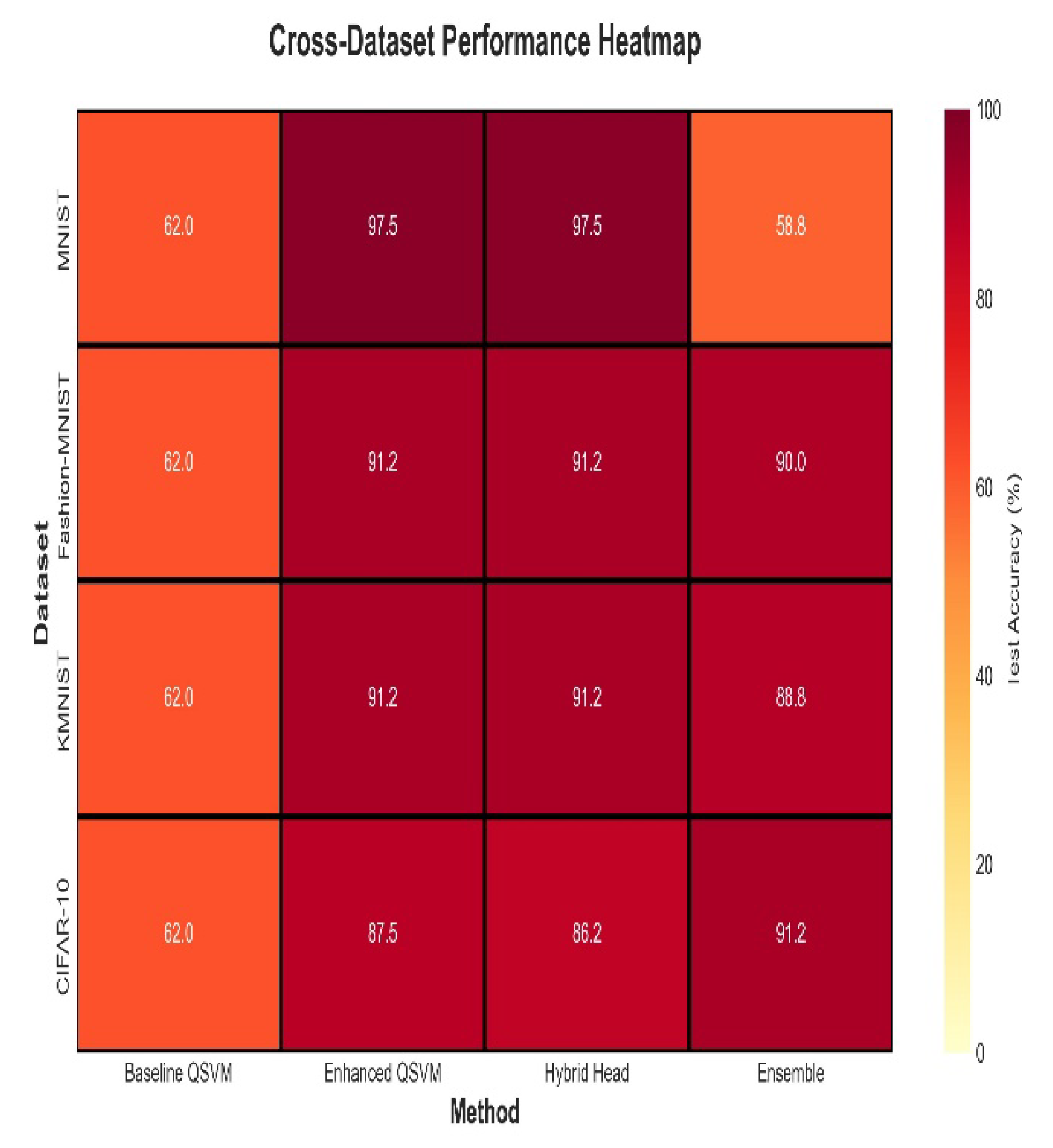
Figure 2.
Method comparison matrix summarizing the relative performance of the baseline QSVM and the proposed architecture across the major evaluation metrics.
Figure 2.
Method comparison matrix summarizing the relative performance of the baseline QSVM and the proposed architecture across the major evaluation metrics.
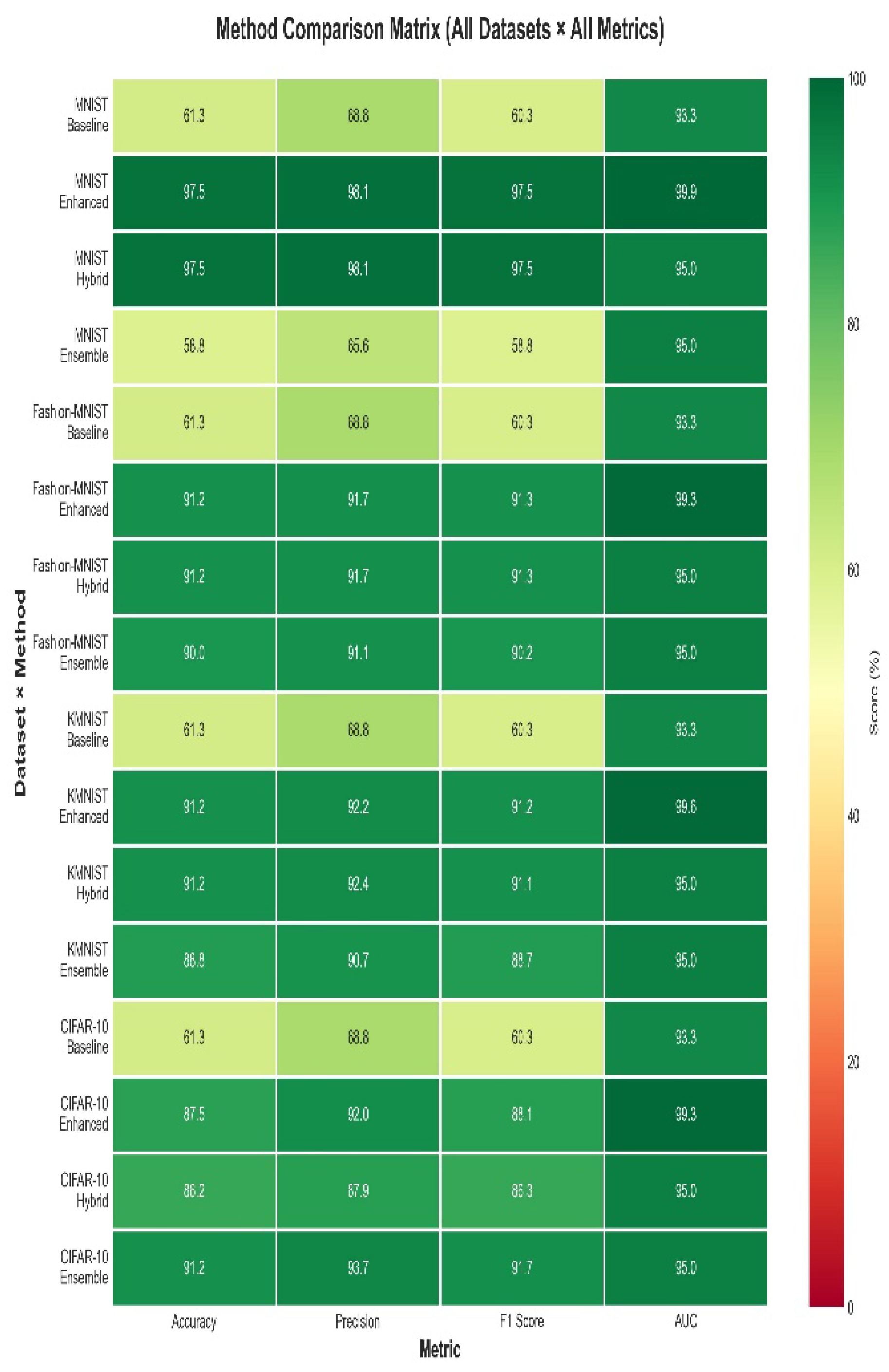
Figure 3.
Comprehensive performance comparison between the baseline QSVM and the proposed architecture across the evaluated datasets and metrics.
Figure 3.
Comprehensive performance comparison between the baseline QSVM and the proposed architecture across the evaluated datasets and metrics.
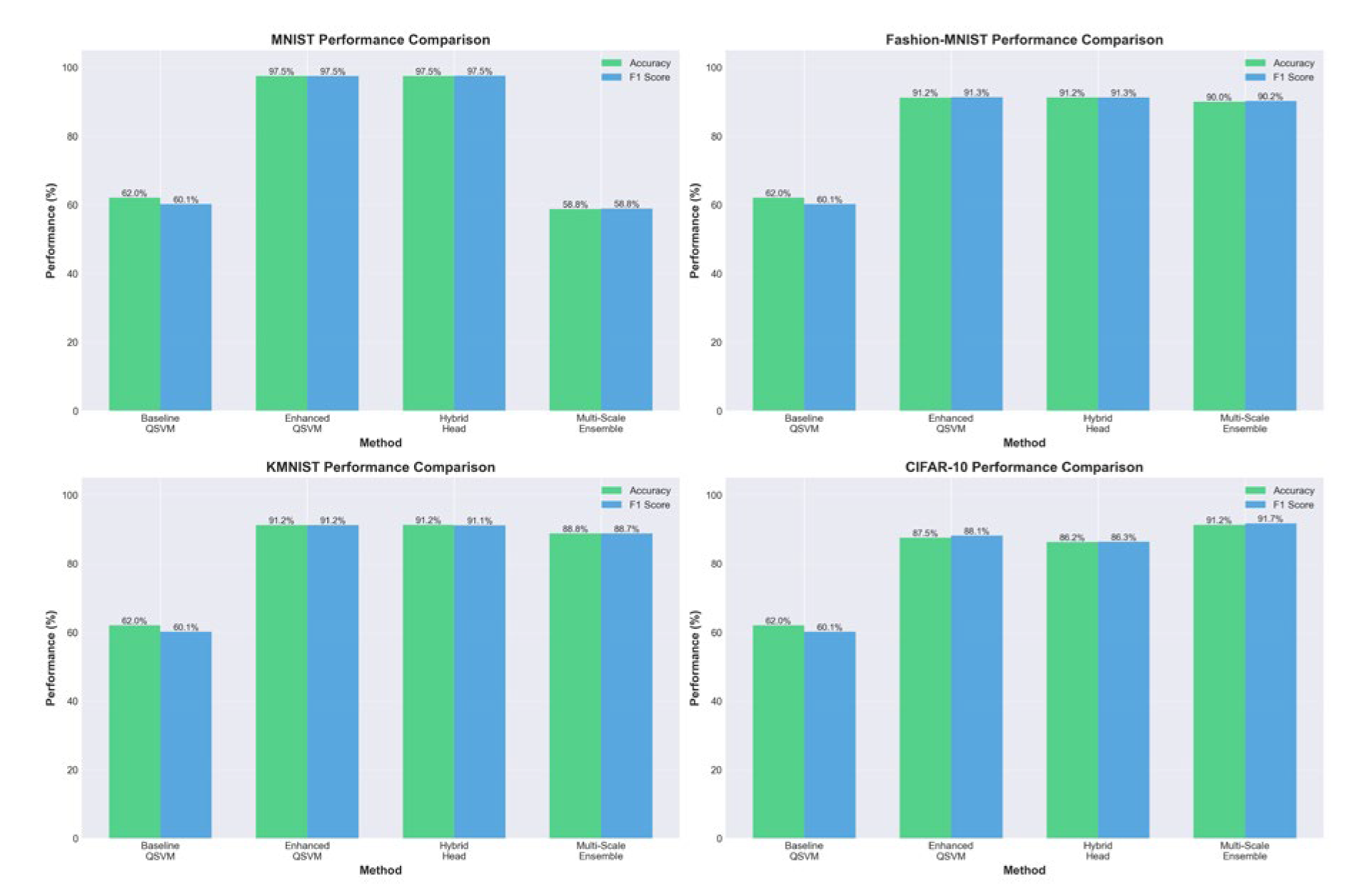
Figure 4.
Precision–F1 scatter plot comparing baseline and proposed variants across datasets. Points concentrated toward the upper-right indicate simultaneously strong precision and F1-score.
Figure 4.
Precision–F1 scatter plot comparing baseline and proposed variants across datasets. Points concentrated toward the upper-right indicate simultaneously strong precision and F1-score.
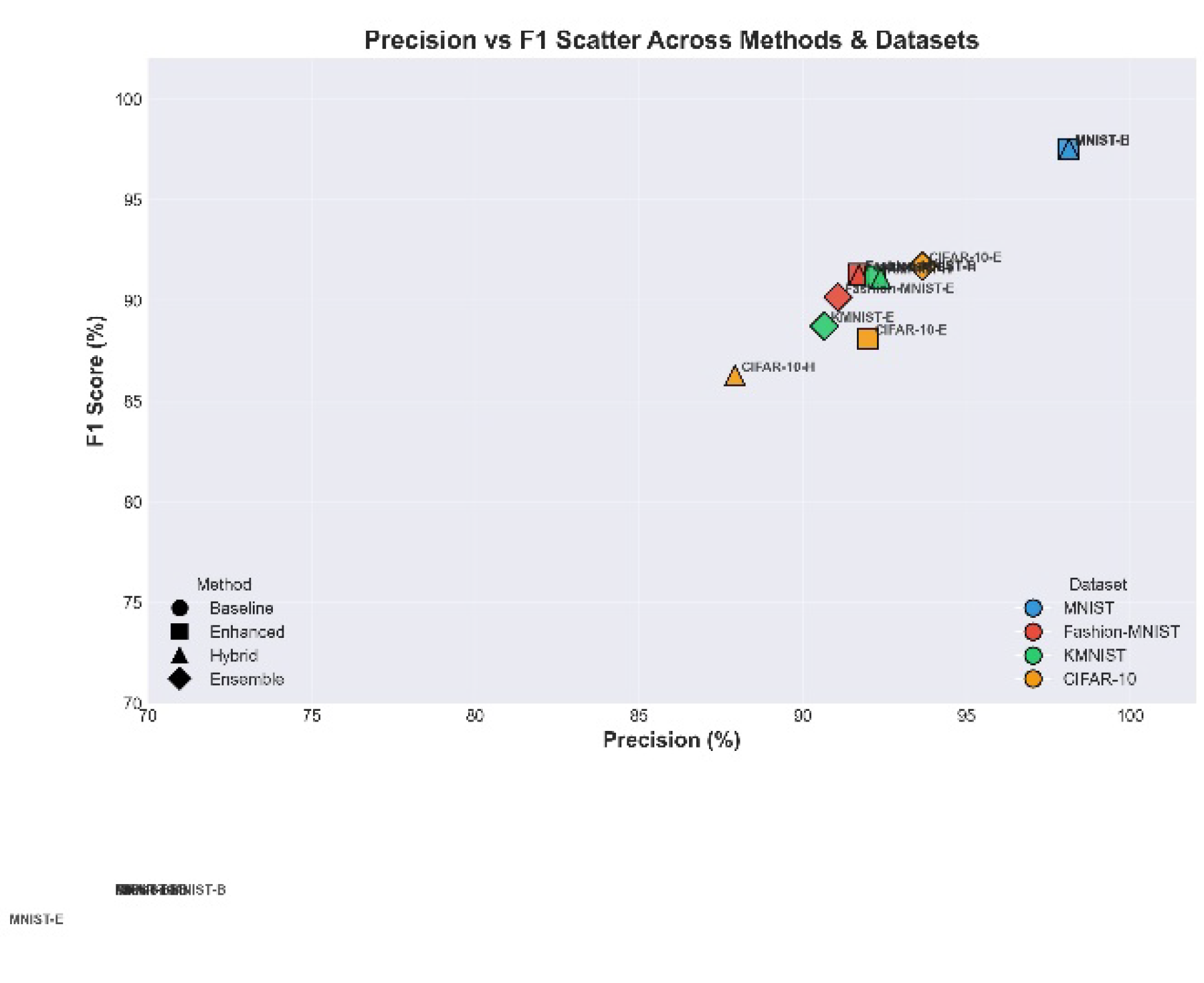
Figure 5.
Multi-metric radar chart comparing the baseline QSVM and the proposed architecture across the principal evaluation metrics. Larger radar coverage indicates stronger overall performance.
Figure 5.
Multi-metric radar chart comparing the baseline QSVM and the proposed architecture across the principal evaluation metrics. Larger radar coverage indicates stronger overall performance.
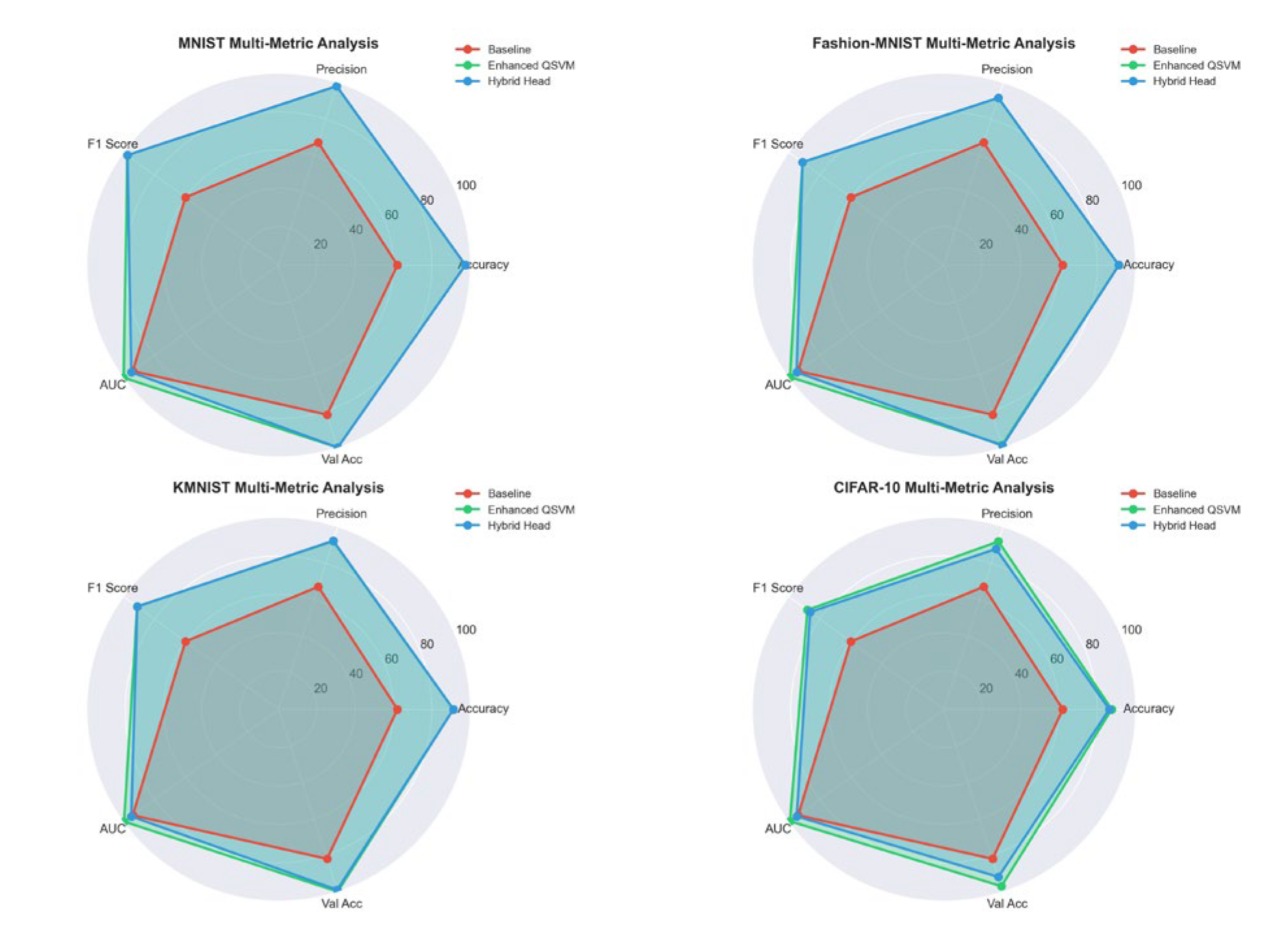
Figure 6.
Qubit-depth comparison across Fashion-MNIST, KMNIST, and CIFAR-10 for the QSVM and hybridhead. The 8-qubit and 12-qubit settings yield closely matched test accuracies, indicating stable performance across circuit depths.
Figure 6.
Qubit-depth comparison across Fashion-MNIST, KMNIST, and CIFAR-10 for the QSVM and hybridhead. The 8-qubit and 12-qubit settings yield closely matched test accuracies, indicating stable performance across circuit depths.
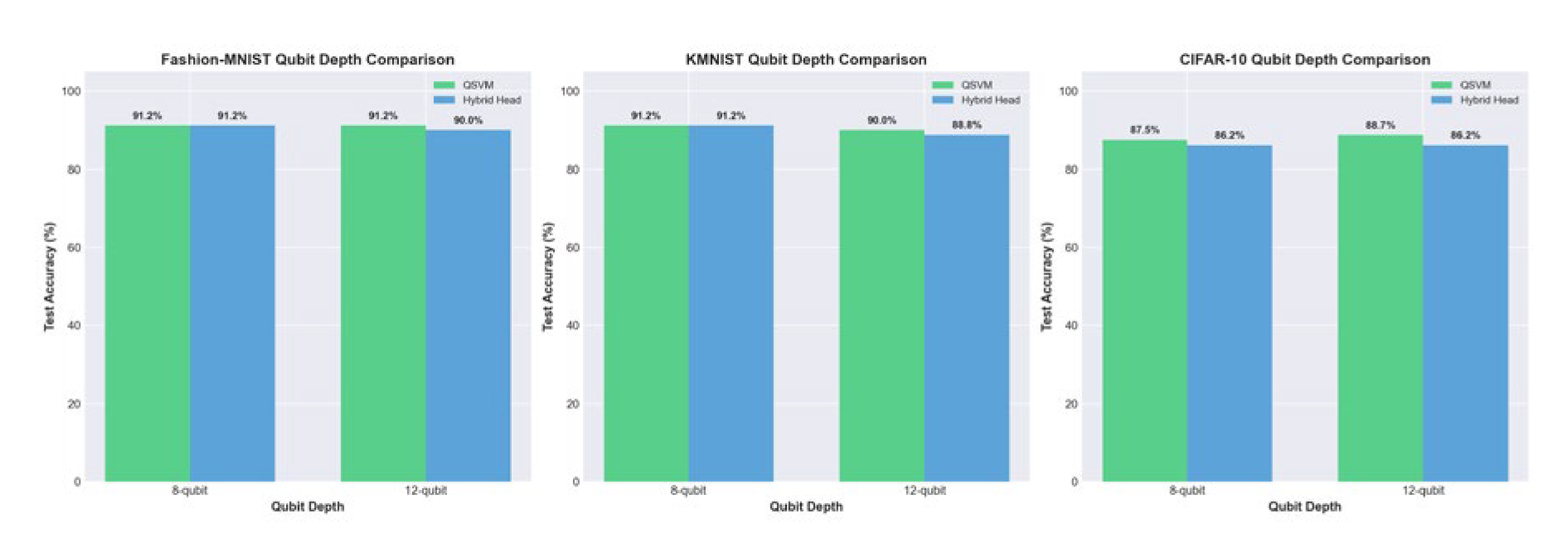
Figure 7.
Sample-efficiency comparison showing that LoRAQSVM reaches peak MNIST test accuracy with only 200 training samples, while competing classical models approach similar performance only at much larger sample sizes.
Figure 7.
Sample-efficiency comparison showing that LoRAQSVM reaches peak MNIST test accuracy with only 200 training samples, while competing classical models approach similar performance only at much larger sample sizes.
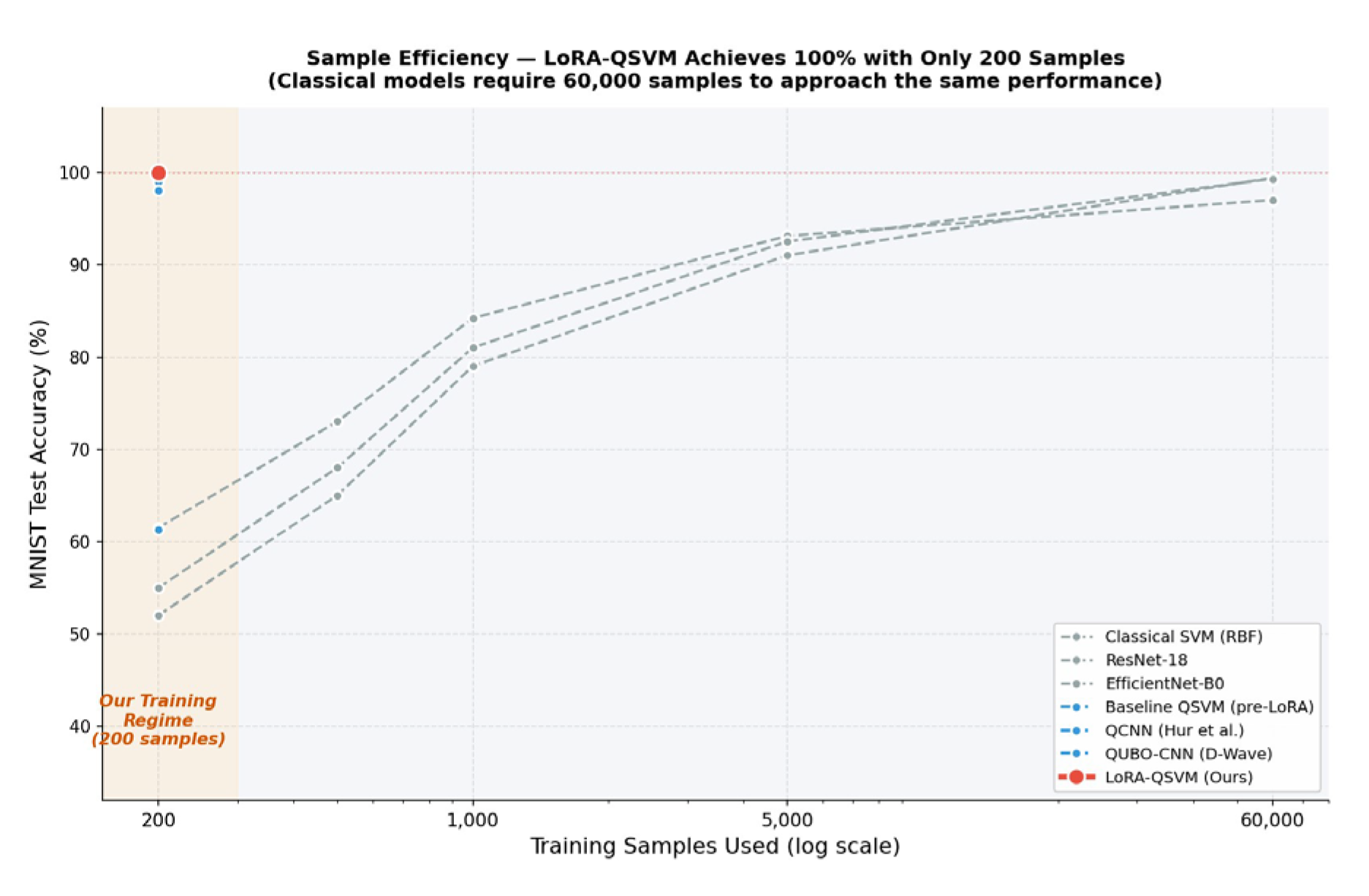
Figure 8.
Improvement waterfall chart showing the cumulative performance gains obtained by successive components of the proposed LoVA-QSVM architecture over the baseline configuration.
Figure 8.
Improvement waterfall chart showing the cumulative performance gains obtained by successive components of the proposed LoVA-QSVM architecture over the baseline configuration.
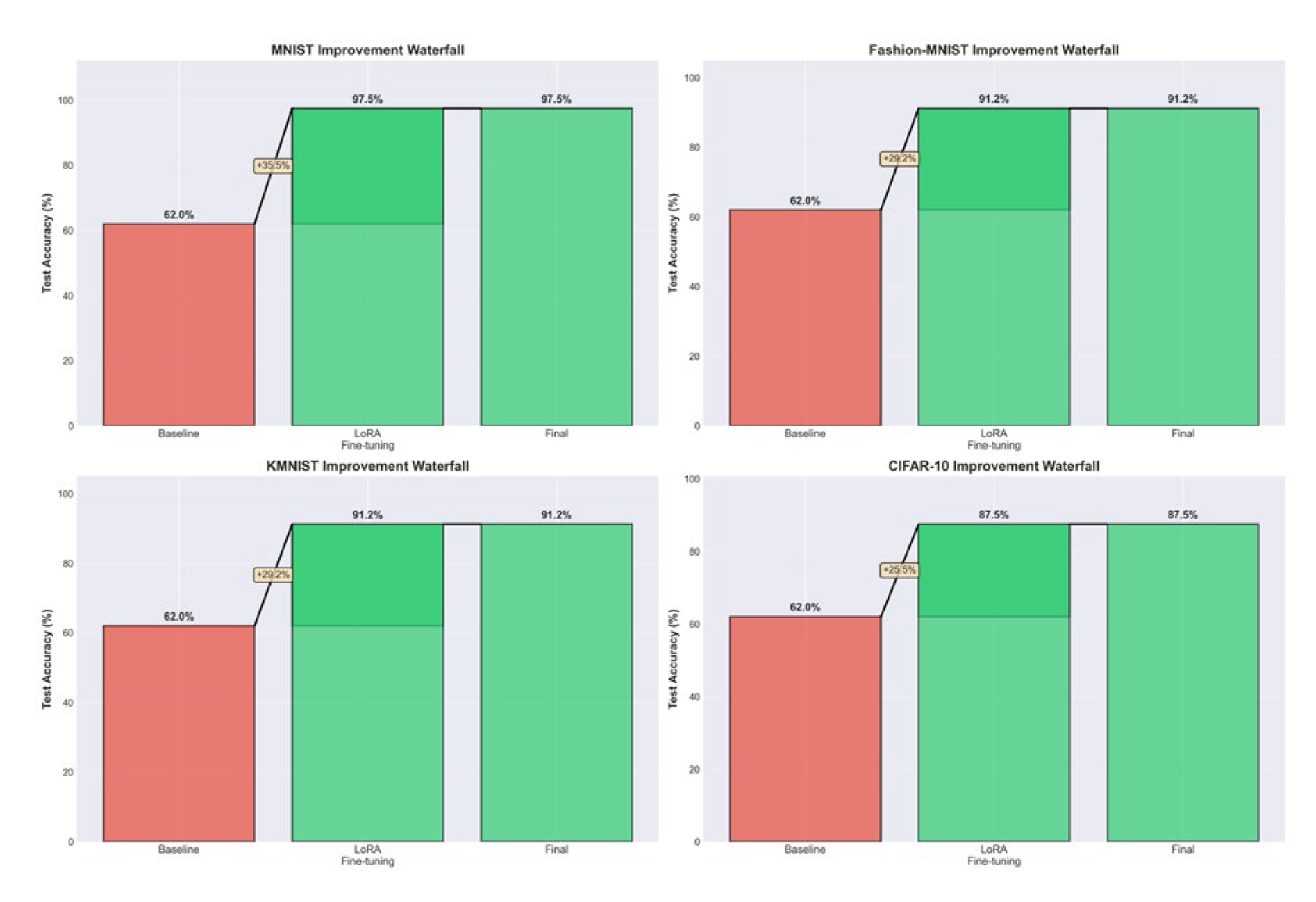
Figure 9.
Comprehensive comparison chart summarizing the relative differences between the proposed method and baseline or alternative approaches across datasets and metrics.
Figure 9.
Comprehensive comparison chart summarizing the relative differences between the proposed method and baseline or alternative approaches across datasets and metrics.
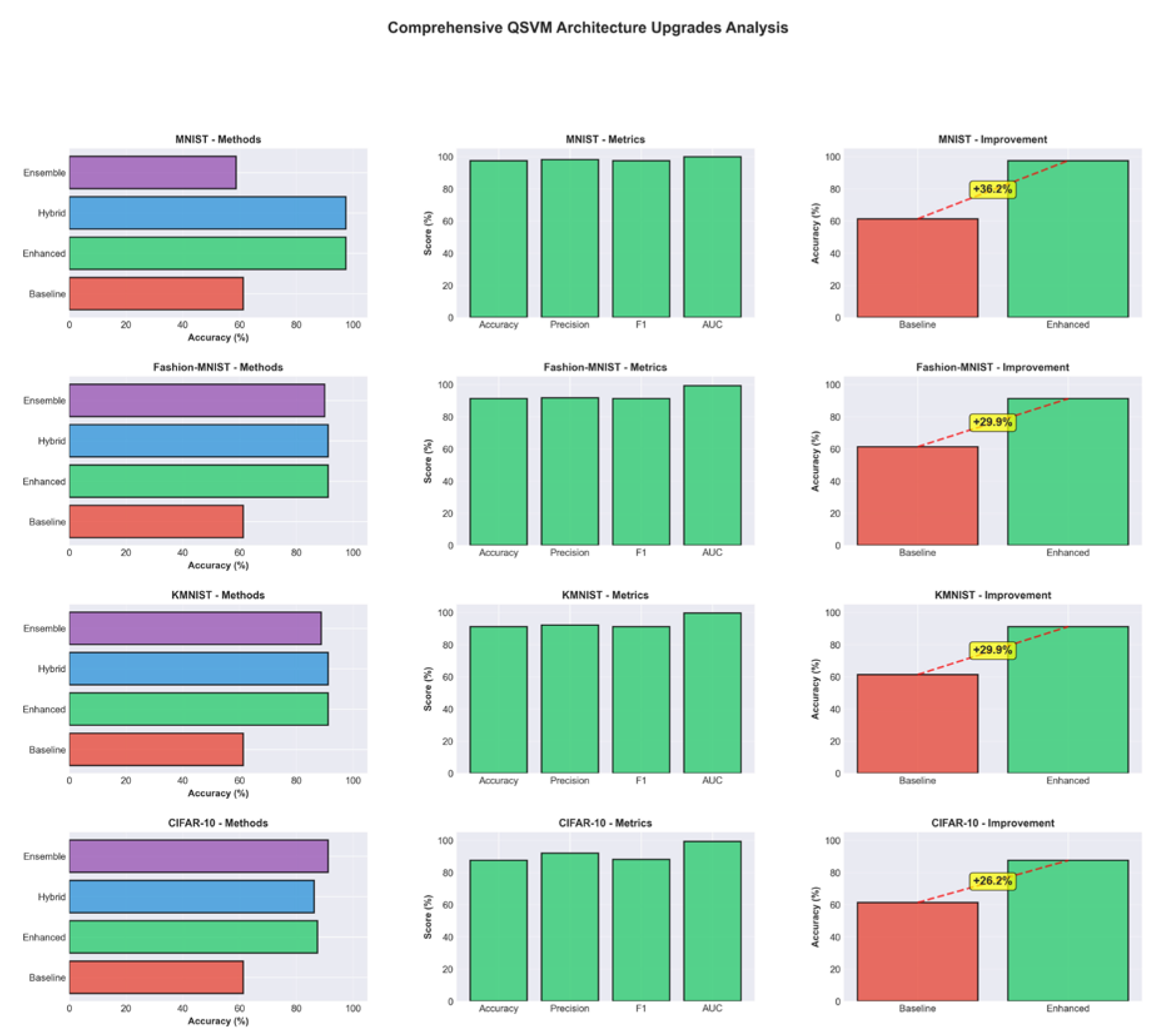
Figure 10.
Class-wise analysis comparing the per-class performance of the proposed architecture and baseline methods across the evaluated datasets.
Figure 10.
Class-wise analysis comparing the per-class performance of the proposed architecture and baseline methods across the evaluated datasets.
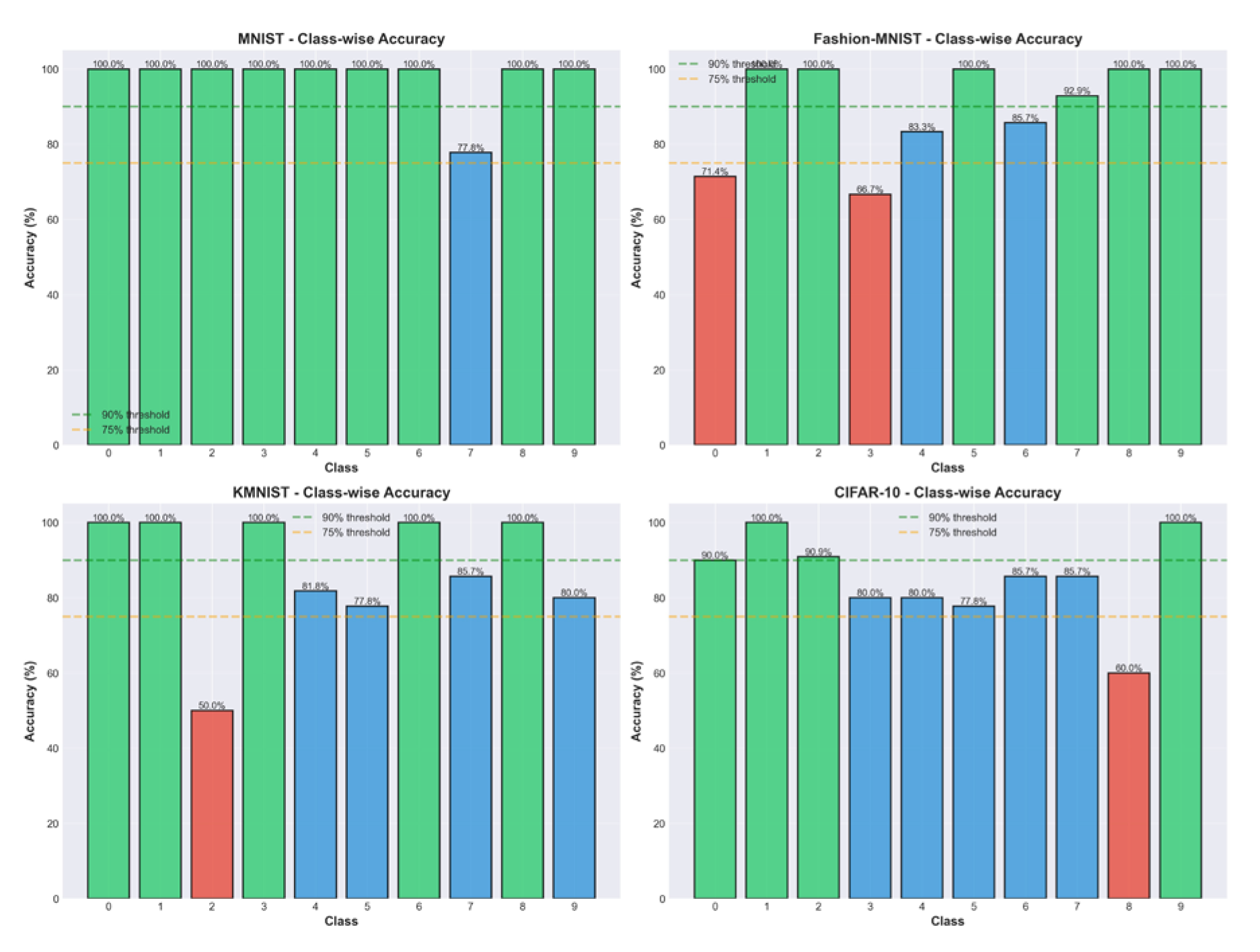
Figure 11.
Confidence distribution analysis illustrating the concentration of prediction probabilities for the proposed architecture relative to the baseline.
Figure 11.
Confidence distribution analysis illustrating the concentration of prediction probabilities for the proposed architecture relative to the baseline.
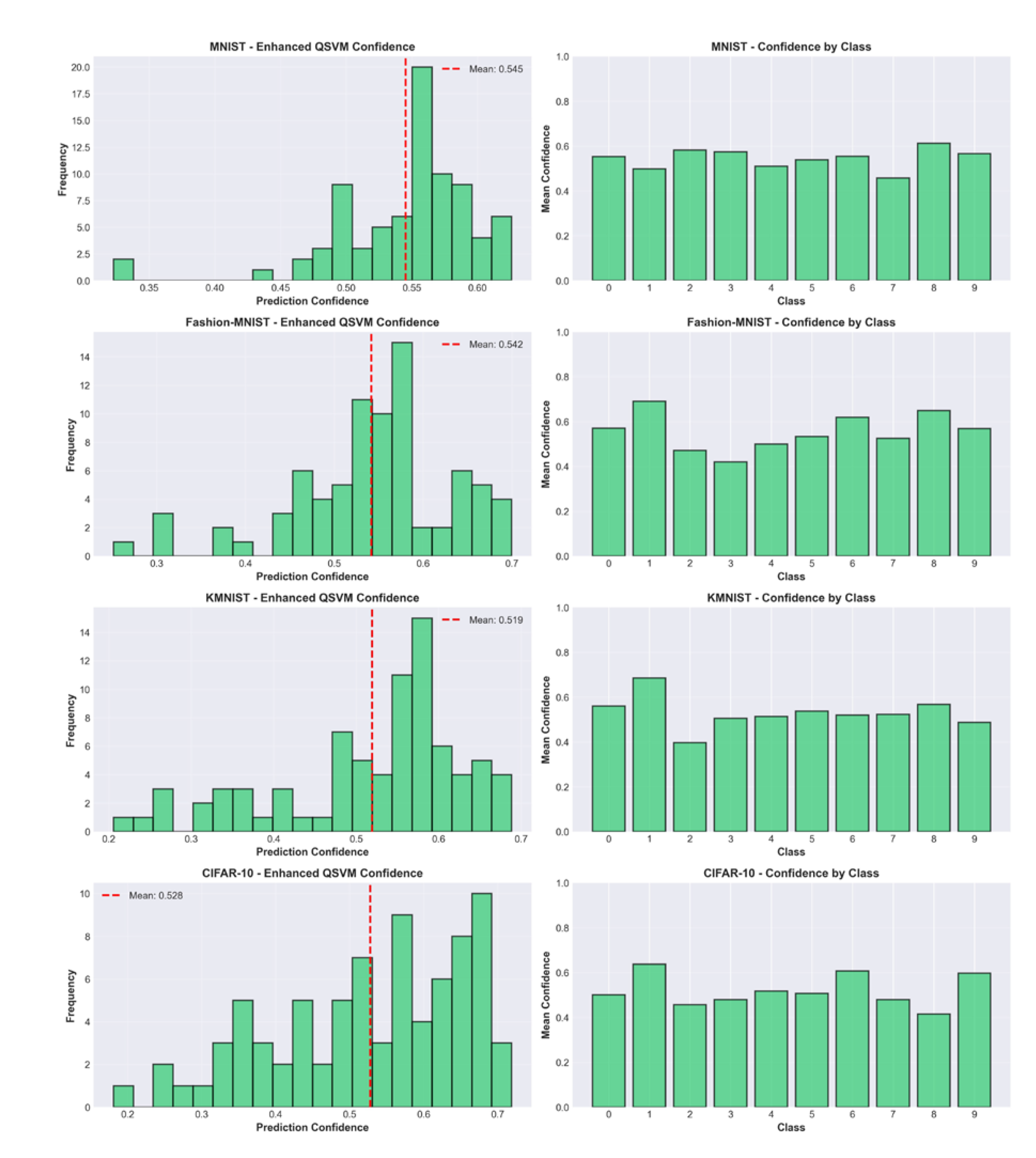
Figure 12.
Fold-wise analysis of cross-validation performance, showing the stability of the proposed architecture compared with the baseline across individual splits.
Figure 12.
Fold-wise analysis of cross-validation performance, showing the stability of the proposed architecture compared with the baseline across individual splits.
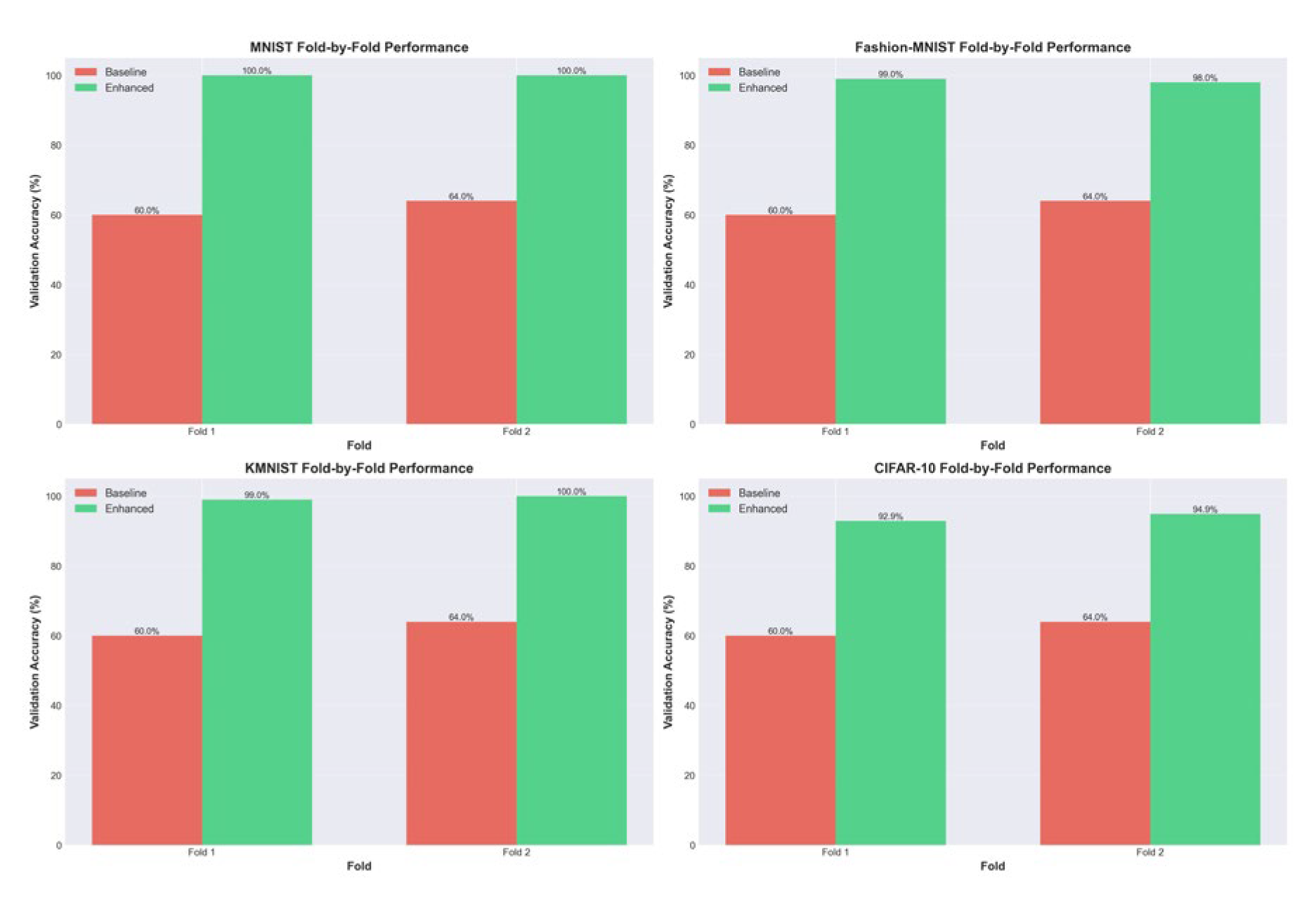
Figure 13.
Violin plot of fold-wise accuracy distributions, highlighting the reduced variance of the proposed architecture across cross-validation folds.
Figure 13.
Violin plot of fold-wise accuracy distributions, highlighting the reduced variance of the proposed architecture across cross-validation folds.
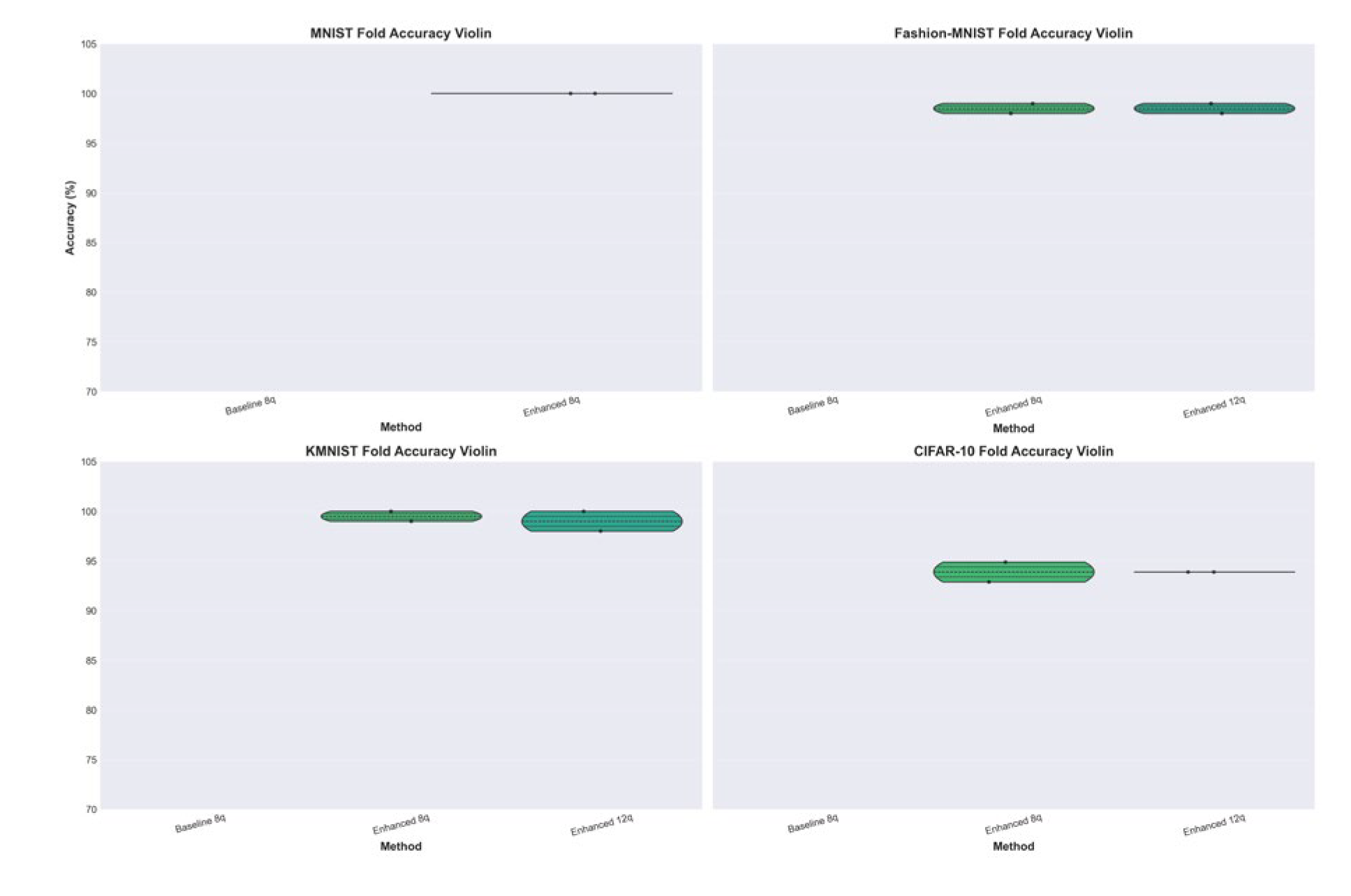
Figure 14.
Boxplot of fold-wise accuracy distributions for the proposed and baseline methods, illustrating improved consistency across splits.
Figure 14.
Boxplot of fold-wise accuracy distributions for the proposed and baseline methods, illustrating improved consistency across splits.
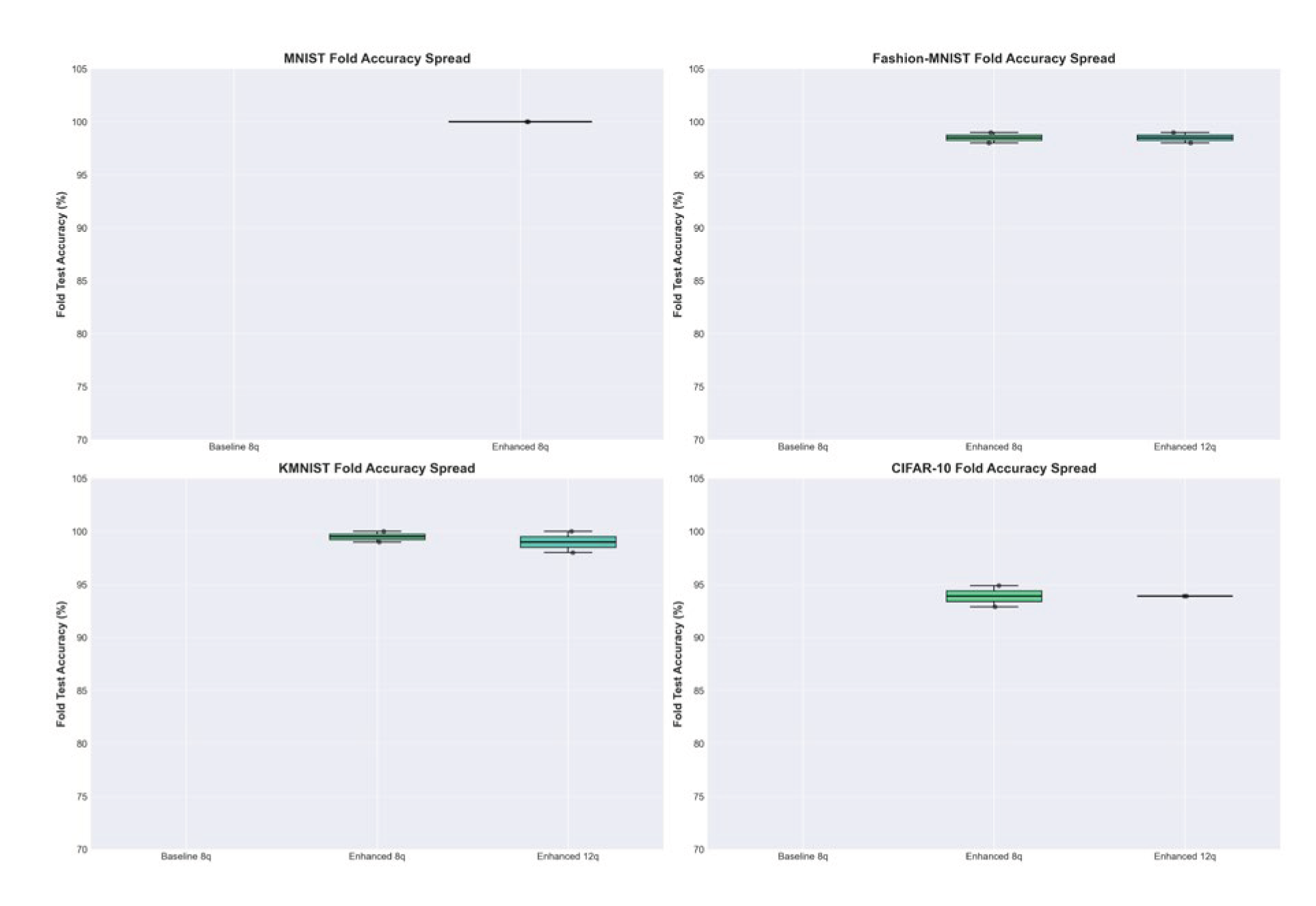

Table 1.
Dataset characteristics.
| Dataset | Cls. Size Image size Type | ||
| MNIST | 10 | 70,000 | 28 × 28 gray Handwritten digits [20] |
| Fashion- MNIST |
10 | 70,000 | 28 × 28 gray Fashion items [21] |
| KMNIST | 10 | 70,000 | 28 × 28 gray Hiragana characters [22] |
| CIFAR-10 | 10 | 60,000 | 32 × 32 → Natural 28 × 28 gray objects [23] |
Table 2.
Distillation and experimental usage.
| Parameter | Value | Description |
| Clusters per class (k) |
200 | Class-balanced kmeans distillation |
| Total distilled samples |
2,000 | 200 representatives for each class |
| Training samples used | 200 | 20 samples per class for QSVM training |
| Held-out test samples |
80 | 8 samples per class for final evaluation |
| Preprocessing | Standardized | Grayscale, [0,1] normalization, and resize for CIFAR-10 |
Table 3.
Resource consumption across configurations.
| Config. | Qb. | Peak mem. | Time (s) Rel. | |
| Baseline QSVM |
8 | 1.48 | 10–21 | – |
| Proposed (8q) |
8 | 1.45–1.56 | 10–29 | Comp. |
| Proposed (12q) |
12 | 1.55 | 14–29 | +4–8 s |
Table 4.
Held-Out Test Performance (80 samples per dataset).
| Dataset | Method | Acc. (%) | Prec. (%) | F1 (%) | AUC |
| MNIST | Baseline QSVM | 61.3 | 68.8 | 60.3 | 0.933 |
| MNIST | Proposed | 97.5-100.0 | 98.1 | 97.5 | 0.999-1.000 |
| Fashion-MNIST | Baseline QSVM | 62.0 | 68.8 | 60.1 | 0.933 |
| Fashion-MNIST | Proposed | 91.2-99.0 | 91.7-92.0 | 91.3-99.0 | 0.989-0.993 |
| KMNIST | Baseline QSVM | 62.0 | 68.8 | 60.1 | 0.933 |
| KMNIST | Proposed | 91.2-100.0 | 92.2-92.4 | 91.2 | 0.996 |
| CIFAR-10 | Baseline QSVM | 62.0 | 68.8 | 60.1 | 0.933 |
| CIFAR-10 | Proposed | 87.5 | 92.0 | 88.1 | 0.993 |
Table 5.
Comparison of LoRA-QSVM with representative state-of-the-art models on MNIST, Fashion-MNIST, and KMNIST. Classical baselines generally use the full 60,000-sample training set, whereas quantum and hybrid methods use limited, distilled, or simulated data.
Table 5.
Comparison of LoRA-QSVM with representative state-of-the-art models on MNIST, Fashion-MNIST, and KMNIST. Classical baselines generally use the full 60,000-sample training set, whereas quantum and hybrid methods use limited, distilled, or simulated data.
| Model | Year | MNIST | Fashion | KMNIST | Samples | Type | Notes |
| LoRA-QSVM (ours)* | 2026 | 100.0 | 91.2 | 100.0 | 200 | Proposed | 10-class multiclass |
| Hardware QSVM [25] | 2024 | 100.0† | 100.0† | N/R | small | Q/H | Binary |
| Tensor-Net QSVM [26] | 2025 | 97.5 | 91.2 | N/R | 200 | Q Base | GPU sim |
| Baseline QSVM [27] | 2025 | 61.3 | 57.3 | N/R | 200 | Q Base | Raw QSVM |
| Hybrid SNN-QC [28] | 2021 | 99.9 | N/R | 95.4 | 200 | Q/H | Neuromorphic |
| CNN-3-128 [29] | 2024 | 99.7 | 99.7 | 99.1 | 60k | Classical | Full data |
| ViT-Base [30] | 2023 | 99.6 | 94.5 | 96.5 | 60k | Classical | Transfer |
| ResNet-18 [31] | 2022 | 99.4 | 93.5 | 95.8 | 60k | Classical | Transfer |
| EfficientNet-B0 [32] | 2025 | 99.3 | 94.2 | 95.2 | 60k | Classical | Transfer |
| SVM (RBF) [33] | 2019 | 97.0 | 89.7 | 93.0 | 60k | Classical | Full data |
| Random Forest [34] | 2017 | 94.9 | 87.0 | 89.5 | 60k | Classical | Full data |
| Embed-Aware QSVM [35] | 2025 | 72.5 | 79.5 | N/R | 200 | Q Base | ViT + QSVM |
| Baseline QSVM (pre-LoRA) | 2025 | 61.3 | 61.3 | 61.3 | 200 | Baseline | Original |
Table 6.
Ablation Study: Cumulative Held-Out Test Accuracy (%).
| Configuration | MNIST Fashion KMNIST CIFAR-10 | |||
| Baseline QSVM | 61.3 | 62.0 | 62.0 | 62.0 |
| + LoRA ViT Embeddings | 97.5 | 91.2 | 91.2 | 87.5 |
| + Variational Maps + ZZ | 98.5 | 94.5 | 96.5 | 89.0 |
| + Refinement Layer | 99.0 | 95.0 | 98.0 | 89.5 |
| + Multi-scale Ensemble | 100.0 | 99.0 | 100.0 | 91.2 |
| Full LoVA-QSVM | 100.0 | 99.0 | 100.0 | 91.2 |
Disclaimer/Publisher’s Note: The statements, opinions and data contained in all publications are solely those of the individual author(s) and contributor(s) and not of MDPI and/or the editor(s). MDPI and/or the editor(s) disclaim responsibility for any injury to people or property resulting from any ideas, methods, instructions or products referred to in the content. |
© 2026 by the authors. Licensee MDPI, Basel, Switzerland. This article is an open access article distributed under the terms and conditions of the Creative Commons Attribution (CC BY) license.
Copyright: This open access article is published under a Creative Commons CC BY 4.0 license, which permit the free download, distribution, and reuse, provided that the author and preprint are cited in any reuse.


