

Submitted:
10 June 2026
Posted:
12 June 2026
You are already at the latest version
Abstract
Functional dyspepsia and related disorders of gut–brain interaction are still managed without mechanism-based stratification, and trials of vagal neuromodulation have rarely measured the microbiome alongside autonomic and symptomatic endpoints. We argue that the obstacle is conceptual rather than technical: what is missing is a framework in which these readouts are coupled, not a new technology. Borrowing the logic of the cardiac stress test, we treat the gut–brain axis as a coupled, bidirectional reactivity system whose functional properties surface only under controlled perturbation. Perturbing the system in both directions yields an individual reactivity profile. Three composite indices capture overall system reactivity, vagal arc engagement, and acute modulation. A fourth coordinate, the Neural–Peripheral Dominance Index, weighs trait neural vulnerability against acute peripheral reactivity, while a fifth, the microbial Substrate Index, fixes the trait-level compositional context of the gut. Autonomic engagement is read out not from any single signal but from a sign-aligned composite of paced-breathing heart rate variability, electrodermal activity, and pupillometry. We position the profile as a mechanistic layer beneath Rome IV classification, meant to explain the heterogeneity that persists within symptom-defined subtypes, and we outline a two-phase strategy for testing mechanism-aligned therapeutic responses prospectively.
Keywords:
functional dyspepsia
; disorders of gut–brain interaction
; transcutaneous vagus nerve stimulation
; gut microbiome
; brain–gut axis
; precision medicine
Introduction
Functional dyspepsia is a good example of the difficulties that disorders of gut–brain interaction (DGBI) pose. It affects around 10% of adults worldwide and drives heavy healthcare use, and its postprandial distress syndrome (PDS) subtype, as defined by the Rome IV criteria, varies widely from patient to patient in symptom course and treatment response — variation that current diagnostic workup does not predict. There is no approved disease-modifying therapy, and the choice between pharmacological, dietary, and neuromodulatory treatment is made largely by elimination. Dynamic physiological testing is not missing from the field: nutrient drink tests, postprandial heart rate variability (HRV) monitoring, and electrogastrography have all probed gut function under demand. What is missing is a framework that couples these dynamic readouts instead of collecting them separately, and that brings microbiome composition in as the natural complement to autonomic and symptomatic measurement.
The vagus nerve is what makes that integration possible. About 80% of cervical vagal fibres are afferent1,2, carrying microbially derived signals to the brainstem through receptor-mediated routes: short-chain fatty acids via FFAR2/3 and serotonin from enterochromaffin cells3–5; on the efferent side, vagal acetylcholine acts on α7 nicotinic acetylcholine receptors on intestinal macrophages, dampening pro-inflammatory cytokine release through the cholinergic anti-inflammatory pathway6–9, and indirectly shaping the microbial niche10,11 (FIG. 1). Subdiaphragmatic vagotomy abolishes microbiome-dependent behavioural and neurochemical phenotypes in rodent models12–21, which marks the vagus as required — within the limits of preclinical lesion paradigms — for these effects. In humans, the work relies mainly on transcutaneous auricular vagus nerve stimulation (tVNS), which is mechanistically distinct from subdiaphragmatic lesioning; whether it actually engages the downstream microbial and immune effectors is still an open question22.
Figure 1.
Bidirectional vagal–microbiome signalling and its disruption by subdiaphragmatic vagotomy. a, Under intact vagal anatomy, afferent fibres (~80% of vagal fibres) transduce luminal microbial signals to the nucleus tractus solitarius (NTS) via three principal receptor pathways: short-chain fatty acids (SCFAs, predominantly butyrate) acting through FFAR2 and FFAR3; secondary bile acids signalling via TGR5; and serotonin (5-HT) released from enterochromaffin cells (ECC). Efferent vagal fibres release acetylcholine (ACh), engaging α7 nicotinic acetylcholine receptors (α7nAChR) on intestinal immune cells, suppressing TNF-α through the cholinergic anti-inflammatory pathway. Reported net outcomes in intact preparations include balanced microbiota composition, attenuated systemic inflammation, and behavioural improvement. b, Subdiaphragmatic vagotomy (SDV) severs both afferent and efferent limbs below the diaphragm, abolishing bidirectional signalling. Reported consequences across the ten preclinical vagotomy studies summarised in Table 1 include gut dysbiosis, depletion of Bifidobacterium and butyrate-producing taxa, lipopolysaccharide (LPS) translocation, and elevated pro-inflammatory cytokines (TNF-α, IL-6) — although specific phenotypes vary by study. Figure created with BioRender.com (licensed at 600 dpi).
Figure 1.
Bidirectional vagal–microbiome signalling and its disruption by subdiaphragmatic vagotomy. a, Under intact vagal anatomy, afferent fibres (~80% of vagal fibres) transduce luminal microbial signals to the nucleus tractus solitarius (NTS) via three principal receptor pathways: short-chain fatty acids (SCFAs, predominantly butyrate) acting through FFAR2 and FFAR3; secondary bile acids signalling via TGR5; and serotonin (5-HT) released from enterochromaffin cells (ECC). Efferent vagal fibres release acetylcholine (ACh), engaging α7 nicotinic acetylcholine receptors (α7nAChR) on intestinal immune cells, suppressing TNF-α through the cholinergic anti-inflammatory pathway. Reported net outcomes in intact preparations include balanced microbiota composition, attenuated systemic inflammation, and behavioural improvement. b, Subdiaphragmatic vagotomy (SDV) severs both afferent and efferent limbs below the diaphragm, abolishing bidirectional signalling. Reported consequences across the ten preclinical vagotomy studies summarised in Table 1 include gut dysbiosis, depletion of Bifidobacterium and butyrate-producing taxa, lipopolysaccharide (LPS) translocation, and elevated pro-inflammatory cytokines (TNF-α, IL-6) — although specific phenotypes vary by study. Figure created with BioRender.com (licensed at 600 dpi).
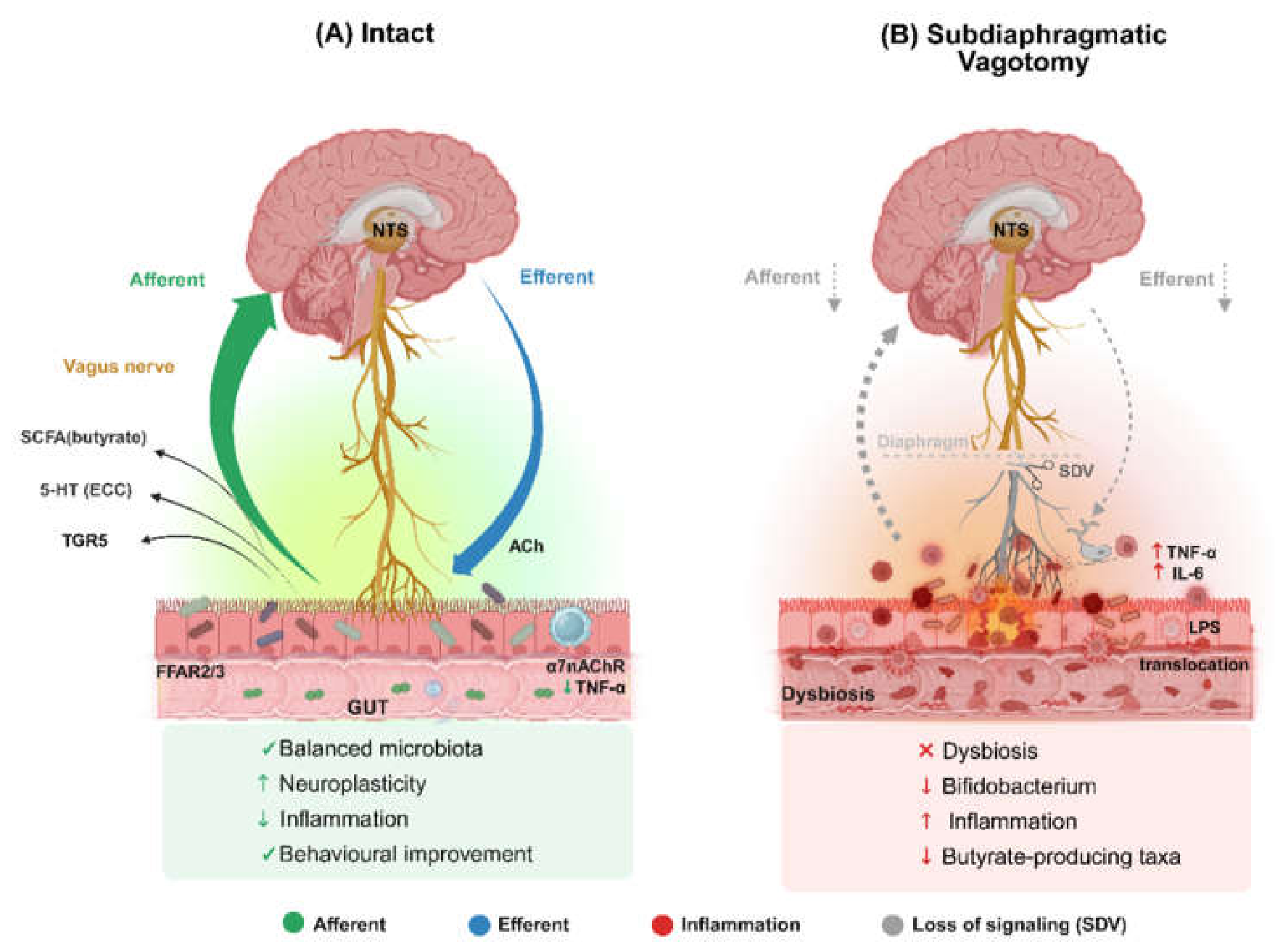
Abbreviations: 5-HT, serotonin; ACh, acetylcholine; ECC, enterochromaffin cells; FFAR2/3, free fatty acid receptor 2/3; IL-6, interleukin-6; LPS, lipopolysaccharide; NTS, nucleus tractus solitarius; SCFA, short-chain fatty acid; SDV, subdiaphragmatic vagotomy; TGR5, Takeda G-protein-coupled receptor 5; TNF-α, tumour necrosis factor-α; α7nAChR, α7 nicotinic acetylcholine receptor.
A recent systematic review identified seven published randomised controlled trials of vagal neuromodulation in gastrointestinal disorders23; none measured the microbiome as a pre-specified outcome, and the one trial that did22 appeared only afterward. That gap is telling: what separates mechanistic knowledge from therapeutic stratification is the lack of an integrative framework, not a methodological barrier.
Cardiology faced the same problem half a century ago. A resting electrocardiogram says little about coronary disease, because at rest the system runs well within its reserve; the exercise stress test solved this by imposing a controlled physiological demand. Function under demand reveals what rest cannot. We use this as an organising idea rather than a measurement template: gut–brain biomarkers are noisier than cardiac ischaemic endpoints, and the right analogue here is reactivity, not reserve in the strict cardiac sense. The framework is a structured way to organise coupled physiological measurements under controlled perturbation, and the specific formulas below are one way to operationalise it, open to refinement.
The protocol exposes the system to two perturbations at once: a controlled mixed-macronutrient meal and counterbalanced sham or active vagal stimulation (Fig. 2). From this it derives three composite reactivity indices and a dominance contrast that pull together symptom dynamics, multi-modal autonomic reactivity, and inflammatory response, alongside a microbial Substrate Index that captures the trait-level compositional context of the gut. The five coordinates measure overall system reactivity, vagal arc capacity, the acute effect of vagal stimulation, the dominant axis of neural versus peripheral reactivity, and the microbial substrate the reactivity plays out against. The framework sits as a mechanistic layer beneath Rome IV symptom-based classification and is tested through pre-registered, falsifiable predictions.
Figure 2.
Schematic of the perturbation protocol and derivation of the five framework coordinates.
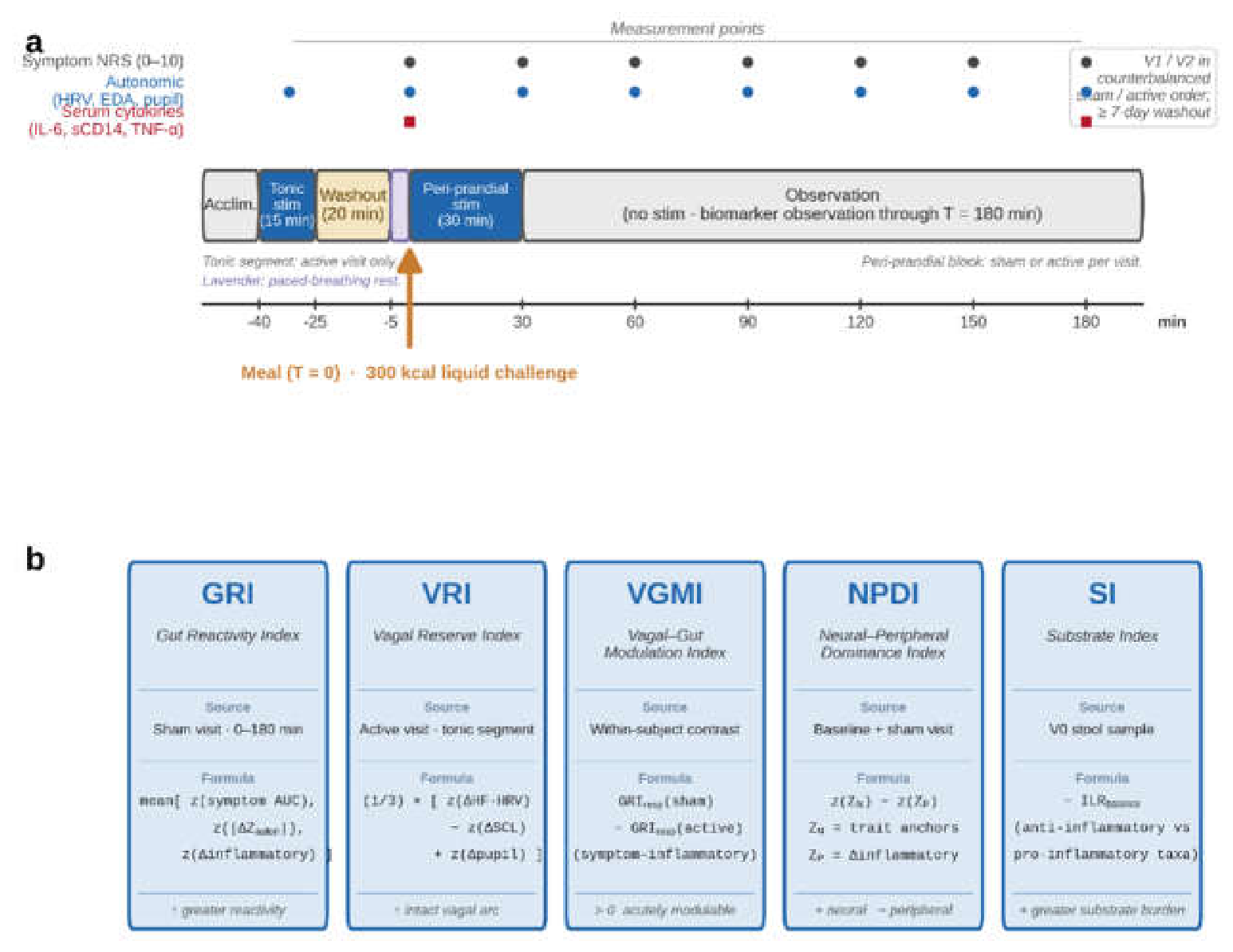
Two challenge visits in counterbalanced sham/active order deliver a standardised 300 kcal mixed-macronutrient meal with a 30-min peri-prandial stimulation block (T = 0 to T = 30 min, sham or active at perception-based titrated amplitude) followed by observation through T = 180 min. The sham visit yields GRI(sham); the active visit additionally includes a 15-minute tonic taVNS segment before the meal (with a 20-min washout before meal) that yields VRI; the within-subject difference in the symptom–inflammatory response composite (GRIresp) between sham and active yields VGMI. NPDI is computed from the partitioning of trait neural anchors (Visceral Sensitivity Index, PHQ-9, GAD-7) against acute peripheral Δ inflammatory composite under sham conditions. SI is computed once at the baseline visit from the V0 stool sample. Together, the five coordinates (GRI, VRI, VGMI, NPDI, SI) characterise the individual reactivity profile operationalised in Fig. 3 for therapeutic stratification.
Abbreviations: GAD-7, Generalised Anxiety Disorder 7-item; GRI, Gut Reactivity Index; NPDI, Neural–Peripheral Dominance Index; PHQ-9, Patient Health Questionnaire 9-item; SI, Substrate Index; taVNS, transcutaneous auricular vagus nerve stimulation; VGMI, Vagal–Gut Modulation Index; VRI, Vagal Reserve Index; V0, baseline visit.
1. Vagal–Microbial Integration
1.1. Preclinical Evidence: Vagal Manipulation Abolishes Microbiome-Dependent Phenotypes
Ten independent rodent studies that use subdiaphragmatic vagotomy (SDV) as the main perturbation show the same pattern: with the vagus intact, microbiome-targeted interventions produce the expected behavioural, neurochemical, or inflammatory effects; once it is severed, those effects disappear or are sharply attenuated. The evidence falls into three lines.
The single-strain probiotic studies are the cleanest test. Bravo et al.12 showed that Lactobacillus rhamnosus JB-1 increased hippocampal GABA-receptor expression and produced anxiolytic behaviour in BALB/c mice — effects entirely abolished by SDV. Sgritta et al.18 replicated this dependency in an autism-relevant context: Lactobacillus reuteri rescued social behaviour deficits in Shank3B knockout mice only when the vagus was intact. Wang et al. (2020)14 demonstrated SDV blocked anhedonia phenotypes induced by Lactobacillus intestinalis and L. reuteri in antibiotic-treated mice.
Faecal microbiota transplantation (FMT) extends the same dependency to community-level interventions. Pu et al.16 showed FMT from depression-associated donors (Chrna7 knockouts) induced depression-like behaviour in recipients — an effect blocked by SDV. Siopi et al.17 demonstrated SDV abolished FMT-transferred behavioural and neurogenic phenotypes from chronically stressed donors.
Inflammatory and metabolic challenges round out the picture. Zhang J et al.13 showed SDV prevented lipopolysaccharide (LPS)-induced Lactobacillus depletion and depression-like behaviour. Wang et al. (2021)15 (Ephx2 knockouts), Yang Y et al.19 (Chrna7 knockouts), and Yue C et al.20 (CFA chronic inflammatory pain) all demonstrated SDV blocked microbiome-dependent neurobehavioural phenotypes. Zhang Y et al.21 extended this to organ-specific manipulation: hepatic-branch vagotomy in murine cirrhosis altered Bacteroidetes:Firmicutes ratio and reduced neuroinflammatory markers. Across these ten studies (Table 1), microbiome-mediated phenotypes do not emerge when vagal signalling is disrupted in the relevant arc.
One boundary case is worth noting. Bercik et al.24 showed antimicrobial-induced behavioural changes in adult mice were not abolished by vagotomy or sympathectomy, indicating that not all microbiome–behaviour effects are vagally mediated. The abolition seen above applies to interventions where the vagal arc is the main afferent route; antimicrobial effects seem to work through other pathways.
1.2. Human Observational Evidence: Vagal Tone and Microbiome Composition Co-Vary
Two human cohort studies, one large and cross-sectional, the other a smaller community sample, show that vagal tone and microbiome composition co-vary at the population level. Tsubokawa et al.25 studied 950 Japanese adults and found higher heart rate variability (SDNN) correlated with greater microbial diversity (Shannon index) and enrichment of Lachnospiraceae and Bifidobacterium after multivariable adjustment. Ravenda et al.26 studied 75 Italian community participants and demonstrated that lower vagal tone was associated with altered β-diversity (PERMANOVA P = 0.006), Prevotella enrichment, and Faecalibacterium prausnitzii depletion. The two cohorts differ in size, geography, and methods, yet point the same way: parasympathetic activity tracks anti-inflammatory commensal abundance.
1.3. Human Interventional Evidence: tVNS Shifts Microbiome Composition
Liu et al.22 published the first randomised controlled trial of transcutaneous vagus nerve stimulation in a gastrointestinal disorder with pre-specified microbiome outcomes — irritable bowel syndrome with constipation (IBS-C), n = 40. Active taVNS (25 Hz, 30 min daily, 4 weeks) produced significant increases in Bifidobacterium abundance (P = 0.038) and faecal butyrate (P = 0.011) compared with sham. The change in HF-HRV during the intervention period correlated with symptom improvement (r = −0.54, 95% CI −0.73 to −0.27), providing the first human evidence of a quantitative link between vagal engagement and clinical response in a tVNS–microbiome trial of disorders of gut–brain interaction.
The auricular branch targeted by transcutaneous stimulation is anatomically distinct from the subdiaphragmatic vagal branches manipulated in the rodent vagotomy paradigms summarised in Section 1.1; whether transcutaneous stimulation effectively engages downstream gastrointestinal and immune effectors in humans remains an open empirical question. The framework introduced in Section 3 addresses this question through a within-subject index of vagal arc engagement.
2. The Translational Gap
The mechanistic case for the vagal–microbial axis is strong (Section 1), yet clinical neuromodulation has not taken up microbiome readout, which is largely absent from vagal neuromodulation trials in DGBI. A recent systematic review by Veldman et al.23 identified seven randomised controlled trials of non-invasive vagus nerve stimulation in gastrointestinal disorders (alongside earlier pilot work of chronic implanted vagal stimulation in Crohn's disease27). Microbiome assessment was not a pre-specified outcome in any of them; the only RCT in a gastrointestinal disorder to include it — the Liu trial in IBS-C22 — was published subsequently. The seven reviewed trials measured symptomatic, autonomic, or inflammatory endpoints in isolation, despite the conceptual complementarity of all four readouts and the now-routine availability of 16S rRNA sequencing.
This omission has consequences. Without paired microbiome and autonomic data, a positive trial can be read only at the level of the proximate physiological response, and whether the clinical benefit works through, despite, or independently of microbial change cannot be answered. Recent preclinical work — Pan et al.28 using multi-omics profiling, and Zhang X et al.29 in a chronic unpredictable mild stress rat model — demonstrates tVNS-induced microbial composition shifts toward anti-inflammatory profiles with concurrent normalisation of inflammatory cytokines and behavioural outcomes, supporting biological plausibility. Recent translational reviews have similarly highlighted this gap in neurodegenerative disease contexts30,31.
The barrier is conceptual, not methodological. Stool microbiome sequencing is cheap relative to trial budgets; consensus methods exist for microbiome analytical pipelines32 and stool sample handling33,34, and tVNS parameter standardisation is established35; and disorders of gut–brain interaction are exactly the indication where the four readouts are most tightly coupled. What is missing is a framework that makes microbiome assessment the natural complement to autonomic and symptomatic measurement.
3. A Framework for Reactivity Phenotyping
3.1. The Clinical Problem
Three patients with Rome IV postprandial distress syndrome come through clinic in turn. Their symptom diaries look alike, endoscopy is normal, and all three test Helicobacter pylori negative. One improves on a proton pump inhibitor, the second on a tricyclic antidepressant, the third on neither. Baseline measurements — fasting microbiome composition, resting heart rate variability, serum inflammatory markers, validated questionnaires — give partial signals, but none of them reliably predicts which patient will respond to what. In functional dyspepsia, that choice is still made largely by trial and error.
The framework operationalises the demand-reveals-reactivity principle through bidirectional perturbation. An ascending challenge — a standardised 300 kcal mixed-macronutrient liquid meal, chosen to evoke a controlled postprandial response in functional dyspepsia — engages the gut-to-brain limb through enteroendocrine, immune, and visceral-afferent pathways. A descending challenge — transcutaneous auricular vagus nerve stimulation delivered as a 30-min peri-prandial block (T = 0 to T = 30 min) at perception-based titrated amplitude (typically perception threshold + 0.5 mA, 25 Hz, 250 μs, left cymba conchae) with consensus-standard parameters35 — engages the brain-to-gut limb through cholinergic and anti-inflammatory effectors. The combination, delivered across two visits in counterbalanced sham/active order with biomarker observation continuing through T = 180 min postprandial, is intended to reveal how the coupled system responds to demand and to what extent the vagus can regulate that response.
3.2. Three Indices of Reactivity and Modulation
Each index is designed to answer a distinct clinical question (Box 1). Like Rome IV, KDIGO staging, and RECIST response criteria, the architecture is constructed a priori from theory and then tested empirically. No one of the three indices can be fully derived from the others; together they describe a reactivity surface that no existing assessment captures.
Autonomic readout enters all three indices through a sign-aligned multi-modal composite rather than any single physiological signal. Heart rate variability — the most accessible non-invasive correlate of cardiac vagal activity36 — is shaped by respiration, baroreflex tone, posture, and attentional state, so reading vagal engagement off a single HRV value is unreliable. The framework therefore combines three complementary readouts: paced-breathing high-frequency HRV (recorded during a 0.25 Hz cued protocol that fixes the respiration confound), electrodermal activity as a marker of sympathetic outflow, and pupillometric reactivity as a central autonomic readout whose taVNS response has been reported in locus coeruleus–linked paradigms. Each enters as an absolute change from baseline, with a sign fixed by the literature: HF-HRV usually rises under vagal engagement and enters positively; electrodermal activity usually falls and enters negatively; pupil reactivity, whose direction under taVNS is less settled, enters positively under the locus coeruleus–activation hypothesis that Phase 1 tests. Combining the three reduces reliance on any one signal and lets the parasympathetic, sympathetic, and central readouts triangulate.
The Gut Reactivity Index (GRI) measures the size of the system's response to nutritional challenge under sham stimulation. It combines symptom burden as the area under the curve of the Numeric Rating Scale (NRS), magnitude of autonomic engagement, and acute inflammatory amplification over the full 0–180 min postprandial window — covering both the during-stim phase (0–30 min) and the post-stim cascade (30–180 min) — with each component z-standardised within the cohort. A high GRI flags a system that responds disproportionately to demand. The index plays two roles: a descriptive summary of overall reactivity reported at Phase 1, and the input to the within-subject contrast that defines the Vagal–Gut Modulation Index. GRI on its own does not direct therapy.
The Vagal Reserve Index (VRI) is a prerequisite check on the auriculo-vagal reflex arc, read from the multi-modal autonomic response to a 15-minute tonic taVNS segment given before the meal on the active visit. For each subject, VRI is the sign-aligned mean of three z-standardised absolute changes — in paced HF-HRV, electrodermal activity, and pupil diameter — between the stimulation segment and the rest period just before it. A low VRI marks a patient whose autonomic response to stimulation is blunted, which we read as a candidate marker of weak auriculo-vagal arc engagement — much like confirming that a target organ is reachable before predicting a drug response.
The Vagal–Gut Modulation Index (VGMI) is the within-subject change in the symptom–inflammatory response composite (GRIresp) between sham and active visits, measured under counterbalanced visit order. The autonomic-magnitude term is left out of this contrast because active stimulation is expected to raise vagal engagement, which would otherwise pull the difference against the symptom and inflammatory attenuation it is meant to detect. Each visit delivers a 30-min peri-prandial stimulation block (T = 0 to T = 30 min, sham or active) with biomarker observation continuing through T = 180 min, so that VGMI tests whether a defined peri-prandial taVNS dose modifies the 180-min cascade response to the same nutritional challenge. At the individual level, VGMI is a direct subtraction of within-subject indices; at the cohort level, hypothesis testing uses a mixed-effects model with subject as random effect and condition as fixed effect, exploiting within-subject pairing to suppress between-subject noise. A positive VGMI is interpreted as evidence that peri-prandial taVNS attenuates the response to the same challenge that produced the GRI; a near-zero VGMI indicates that the system's reactivity is, on this acute timescale and at the chosen dose, vagally unmodifiable. Because acute vagal accessibility and longer-term neuroplastic adaptation are distinct constructs, VGMI is interpreted as estimating an upper bound on acute modulability rather than as a deterministic gate on chronic response; sustained tVNS efficacy may exceed the acute prediction in patients with low VGMI. This distinction is reflected in the analytic role assigned to VGMI in Phase 2 as a continuous moderator rather than as an inclusion criterion (Section 4.2).
These three indices answer three distinct questions: how reactive is the system, how intact is the vagal arc, and how acutely modifiable is the response by vagal activation. Together they characterise whether and how strongly the system responds — but not why. Two patients with identical GRI and VGMI may require opposite first-line therapies, and existing measurements cannot tell them apart.
3.3. The Neural–Peripheral Dominance Index and the microbial Substrate Index
Take two patients with high GRI and high VGMI. Both respond acutely to vagal stimulation, yet the source of their reactivity differs. In one it is rooted in trait neural sensitisation — long-standing visceral hypersensitivity and affective comorbidity. In the other, peripheral processes dominate: acute postprandial inflammation and peripheral motor dysfunction. The first is a candidate for sustained vagal neuromodulation. The second responds acutely to taVNS but is liable to relapse without concurrent gut-directed therapy, especially against an unfavourable microbial substrate.
The clinical question is not whether the system responds, but along which axis the response is propagating — and against what microbial substrate.
The Neural–Peripheral Dominance Index (NPDI) casts this axis as a contrast between trait neural vulnerability and acute peripheral reactivity. The neural sub-score ZN combines three trait anchors of central neural loading: visceral sensitisation (Visceral Sensitivity Index, VSI) and limbic–affective loading (Patient Health Questionnaire 9-item, PHQ-9, and Generalised Anxiety Disorder 7-item, GAD-7)37. These are clinically accessible proxies for central vulnerability, not direct neural measurements; external anchoring through neuroimaging and vagal-evoked potentials is a validation priority (Section 5). The peripheral sub-score ZP is computed from acute Δ measures across the standardised challenge under sham conditions: change in serum interleukin-6 (IL-6), tumour necrosis factor-α (TNF-α), and soluble CD14 (sCD14). In the Extended formulation, ZP additionally incorporates a gastric motility marker. NPDI is defined as the difference of the standardised sub-scores, NPDI = z(ZN) − z(ZP); each sub-score is z-standardised before subtraction so that the contrast is balanced across sub-scores of unequal component count. Direction: positive NPDI = predominant trait neural loading relative to acute peripheral reactivity; negative NPDI = predominant peripheral reactivity.
This is a deliberate departure from earlier reactivity-only formulations. The autonomic engagement signal already sits in GRI, VRI, and VGMI; assigning trait neural anchors to ZN gives NPDI a separate role: it captures the long-standing central context against which acute peripheral reactivity plays out, rather than re-summarising the same Δ inputs. The contrast is deliberate — chronic central susceptibility against acute peripheral reactivity — and follows the idea that symptoms arise from the interaction between predisposition and provocation, not from processes on a single timescale. Throughout, 'neural' and 'peripheral' name predominant loading profiles defined by their component measures, not direct anatomical or causal sites. Anchoring these labels to neuroimaging or transabdominal vagal-evoked potentials is a multi-centre validation priority (Section 5).
The Substrate Index (SI) captures the trait-level microbial context in which acute reactivity occurs. It is computed at V0 — the baseline visit, separate from the challenge visits — as an isometric log-ratio balance between pre-specified anti-inflammatory commensal and pro-inflammatory taxa (Box 1). Because microbiome composition shifts from day to day, a single-sample SI is best read as a baseline coordinate rather than a strict trait, and its test–retest reliability is reported as a Phase 1 feasibility outcome. SI is reported alongside NPDI, and the clinical implications come from the joint (NPDI, SI) coordinate rather than NPDI alone: two patients with the same NPDI but different SI map to mechanistically distinct profiles. Keeping SI as a parallel coordinate, rather than folding it into NPDI, keeps dynamic acute reactivity and stable microbial substrate dimensionally separate.
Together the framework yields five coordinates: three reactivity indices (GRI, VRI, VGMI), one dominance contrast (NPDI), and one substrate coordinate (SI). Although the indices share some component variables, contrast and mean constructions are intended to extract orthogonal information from overlapping inputs. Non-redundancy is operationalised as a pre-registered hypothesis that the partial correlations of NPDI with each of GRI, VRI, VGMI and SI — controlling for the Δ inflammatory composite that NPDI and GRI share by construction — fall below 0.50, with parallel principal component analysis reported as a sensitivity check. A value at or above this threshold triggers pre-specified post-hoc review of the formula.
The framework makes a directly testable joint prediction: matching treatment to the (NPDI, SI) coordinate by mechanism outperforms mismatched pairing, with VGMI moderating the response so that acute vagal modulability scales the size of any taVNS effect. NPDI-positive patients are expected to respond to vagal neuromodulation, with effect size scaled by VGMI; NPDI-negative patients with low SI are expected to need motility- and symptom-directed therapy; and NPDI-negative patients with high SI are expected to need microbiome-directed therapy, as primary or adjunct treatment (Fig. 3). Phase 2 tests this joint prediction through a stratified factorial design (Section 4).
Figure 3.
Joint (NPDI, SI) coordinate and mechanism-concordant therapy assignment. Two-dimensional phenotype map combining the Neural–Peripheral Dominance Index (NPDI; x-axis) and the microbial Substrate Index (SI; y-axis). Positive NPDI indicates predominant trait neural loading (visceral sensitisation, affective comorbidity); negative NPDI indicates predominant acute peripheral reactivity (postprandial inflammatory and motor loading). Positive SI indicates greater microbial substrate burden (relative depletion of anti-inflammatory commensals); negative SI indicates a more favourable substrate. The three mechanism-concordant predictions tested in Phase 2 are: (i) neural-dominant (NPDI+) regardless of SI — vagal neuromodulation as primary therapy, with treatment effect scaled by VGMI; (ii) peripheral-reactive with low substrate burden (NPDI−, SI−) — motility- and symptom-directed therapy; (iii) peripheral-reactive with high substrate burden (NPDI−, SI+) — microbiome-directed therapy (low-FODMAP + soluble fibre) as primary or adjunct intervention. Quadrant boundaries are cohort-referenced zero-crossings of the standardised indices; their stability against published clinical cut-offs is evaluated as a sensitivity analysis, and concordance between categorical and continuous NPDI analyses is pre-registered as a confirmatory criterion. The therapeutic implications shown are pre-registered predictions for prospective Phase 2 testing, not validated treatment assignments. Abbreviations: NPDI, Neural–Peripheral Dominance Index; SI, Substrate Index; taVNS, transcutaneous auricular vagus nerve stimulation; VGMI, Vagal–Gut Modulation Index.
Figure 3.
Joint (NPDI, SI) coordinate and mechanism-concordant therapy assignment. Two-dimensional phenotype map combining the Neural–Peripheral Dominance Index (NPDI; x-axis) and the microbial Substrate Index (SI; y-axis). Positive NPDI indicates predominant trait neural loading (visceral sensitisation, affective comorbidity); negative NPDI indicates predominant acute peripheral reactivity (postprandial inflammatory and motor loading). Positive SI indicates greater microbial substrate burden (relative depletion of anti-inflammatory commensals); negative SI indicates a more favourable substrate. The three mechanism-concordant predictions tested in Phase 2 are: (i) neural-dominant (NPDI+) regardless of SI — vagal neuromodulation as primary therapy, with treatment effect scaled by VGMI; (ii) peripheral-reactive with low substrate burden (NPDI−, SI−) — motility- and symptom-directed therapy; (iii) peripheral-reactive with high substrate burden (NPDI−, SI+) — microbiome-directed therapy (low-FODMAP + soluble fibre) as primary or adjunct intervention. Quadrant boundaries are cohort-referenced zero-crossings of the standardised indices; their stability against published clinical cut-offs is evaluated as a sensitivity analysis, and concordance between categorical and continuous NPDI analyses is pre-registered as a confirmatory criterion. The therapeutic implications shown are pre-registered predictions for prospective Phase 2 testing, not validated treatment assignments. Abbreviations: NPDI, Neural–Peripheral Dominance Index; SI, Substrate Index; taVNS, transcutaneous auricular vagus nerve stimulation; VGMI, Vagal–Gut Modulation Index.
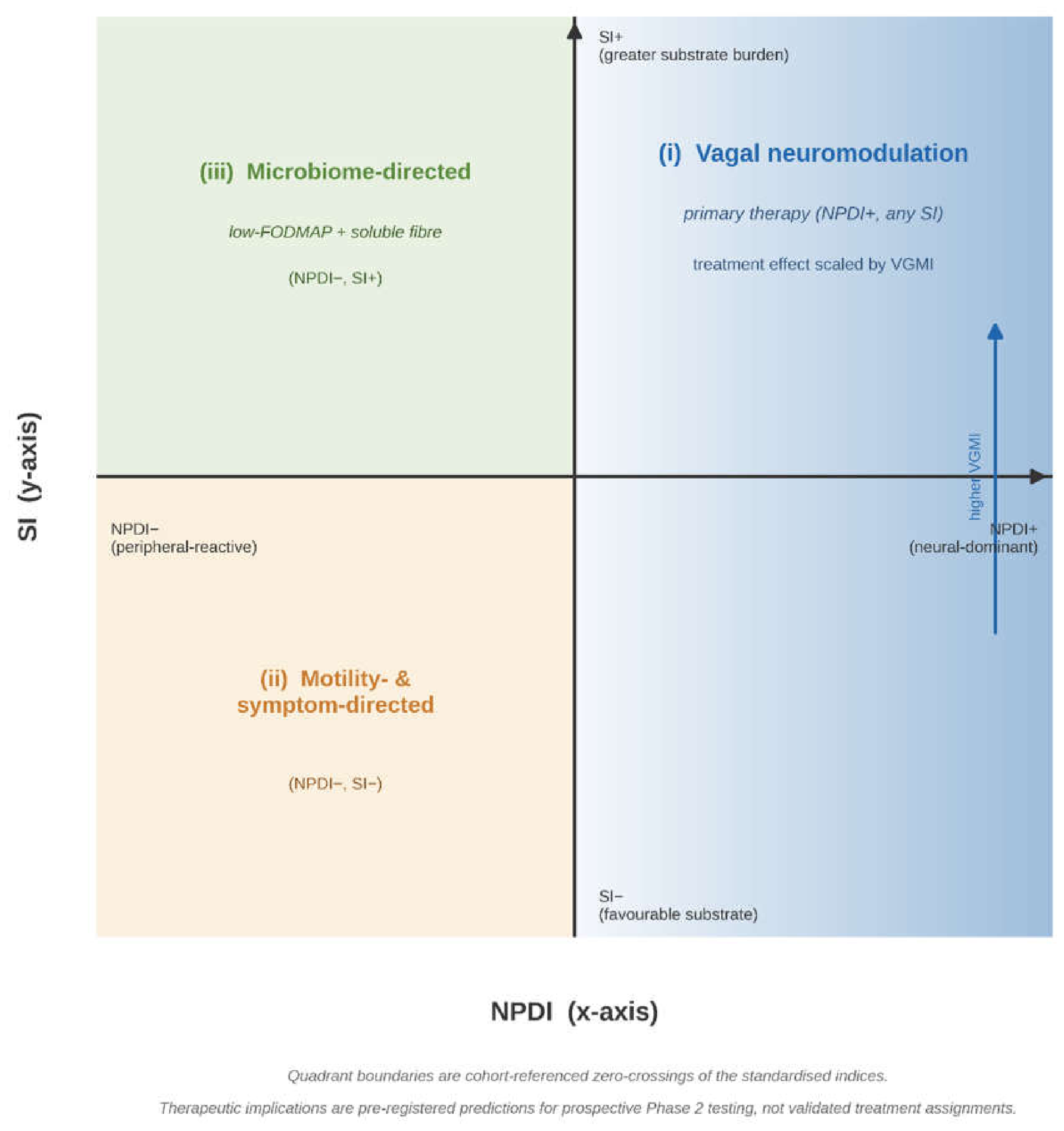
The (NPDI, SI) coordinate sits as a mechanistic layer beneath Rome IV, not a replacement for it. Rome IV sorts patients by symptom pattern, which is reliable for epidemiology and regulatory use but is not designed to separate underlying mechanisms. The pre-registered Phase 1 hypothesis is that, within Rome IV PDS, the variance in NPDI explained by PDS-defining items alone falls below R² = 0.25, and that the joint (NPDI, SI) coordinate predicts response to mechanism-specific therapy. Extension to epigastric pain syndrome and other DGBI is planned for later phases. If the joint coordinate fails to pick out mechanistically distinct treatment-response profiles in Phase 2, the central premise of the framework is in doubt — because predictive value under perturbation is exactly what sets this apart from static stratification.
3.4. Design Principles
Three commitments are fixed before data collection.
First, tiered portability. The framework is specified at two tiers, so its validity does not depend on how well-resourced a centre is. Tier 1 (Core) uses measurements computable without specialised neurophysiology or motility infrastructure: standard ECG patch for paced-breathing HRV, an electrodermal sensor, and a desktop pupillometer. Pupillometry is research-grade equipment — inexpensive and portable, but not yet routine in secondary-care gastroenterology; Core deployment is therefore feasible in research settings and in centres with established autonomic-testing capacity. Tier 2 (Extended) additionally incorporates gastric motility (electrogastrography or ¹³C-octanoic acid breath test) in the peripheral sub-score and serum cortisol time-course as an HPA-axis (hypothalamic–pituitary–adrenal axis) anchor. Both tiers are pre-registered as comparable through a common base.
Second, compositional rigour. Microbiome relative abundances are inherently compositional and require log-ratio treatment for valid statistical inference32. The Substrate Index is computed as an isometric log-ratio balance with Bayesian multiplicative replacement of zero counts38. The numerator and denominator taxa sets (Box 1) are locked prior to Phase 1 data collection. All composite-index inputs are first winsorised at ±3 SD on raw values, then z-standardised within the cohort before averaging — an order pre-registered to ensure replicability.
Third, reactivity over baseline, with trait anchoring where required. The framework is principally perturbation-based: GRI, VRI, VGMI, and the peripheral sub-score of NPDI enter as Δ values across the standardised challenge. Trait anchors (VSI, PHQ-9, GAD-7 in the neural sub-score of NPDI; SI as the substrate coordinate) are incorporated where transient challenge dynamics alone are insufficient to identify stable mechanistic loading. This division — acute reactivity in GRI/VRI/VGMI and ZP, trait loading in ZN and SI — is deliberate, preserving the framework's commitment to measuring how the system responds while acknowledging that mechanism-discriminating contrasts require both response and predisposition information.
The five-coordinate architecture (GRI, VRI, VGMI, NPDI, SI) is deliberately over-complete at the proof-of-concept stage, so that it can be falsified along several dimensions at once; later phases are expected to drop the dimensions that do not contribute, leaving a clinically minimal version. Pre-registration limits analytical freedom and backs the claim that the framework is predictive, not just descriptive.
4. A Two-Phase Validation Strategy
4.1. Phase 1—Proof-of-Concept
Phase 1 asks whether the framework can be computed reliably in real patients and whether its pre-registered structural predictions hold within a single Rome IV subtype. A proof-of-concept cohort of patients with Rome IV postprandial distress syndrome and demographically matched healthy controls (n = 20 per group) completes a baseline visit followed by two experimental visits in counterbalanced randomised order. Each experimental visit follows the same timeline: pre-meal acclimatisation, 15-min tonic stimulation segment (sham or active depending on visit assignment) yielding the VRI input, 20-min physiological washout, 5-min paced-breathing reference for autonomic baseline, then a standardised 300 kcal mixed-macronutrient meal at T = 0. Stimulation is delivered as a 30-min peri-prandial block from T = 0 to T = 30 min (matching the visit's sham/active assignment), with biomarker observation continuing through T = 180 min. Stimulation amplitude is individualised by perception-based titration at each visit and recorded as a covariate. The sham visit yields GRI(sham) and the input measures to NPDI; the active visit yields GRI(active) and, by within-subject difference, VGMI. SI is computed from a baseline stool sample at the baseline visit. Preclinical evidence underpinning the framework was selected against contemporary methodological reporting standards39 to ensure mechanistic claims rest on adequately powered, bias-controlled models.
Phase 1 reports six pre-registered hypotheses through descriptive statistics with confidence intervals (not formal hypothesis tests, which require Phase 2 power) covering distributional spread of NPDI within Rome IV PDS and balanced representation of NPDI signs (H1), non-redundancy of NPDI against the other reactivity indices and SI (H2), within-subtype orthogonality against Rome IV PDS items (H3), external convergent validity (H4), feasibility of predictive validity testing (H5; formal predictive testing is reserved for Phase 2), and substrate–reactivity interaction (H6). Sample size justification, hypothesis thresholds, blinding and stimulation parameter specifications, the reliability criterion for repeat measurement of GRI under sham conditions, the multi-modal autonomic acquisition protocol, adverse-event reporting standards, and go/no-go criteria for progression to Phase 2 are pre-registered in the Supplementary Protocol prior to recruitment (OSF registration DOI 10.17605/OSF.IO/46X9F), with adjudication by an independent data monitoring committee.
4.2. Phase 2—Factorial Validation
Phase 2 tests the framework's central clinical claim — that the joint (NPDI, SI) coordinate predicts mechanism-specific treatment response — in an independent multi-centre cohort of about 120 patients with Rome IV PDS. The design is a 2 × 2 factorial: participants are first phenotyped using the Phase 1 perturbation protocol, then stratified by NPDI sign and randomised within stratum to either home-based taVNS35 or a structured low-FODMAP diet supplemented with soluble fibre over twelve weeks. SI enters the primary model as a continuous covariate and VGMI as a continuous moderator of the treatment × NPDI interaction, so that acute vagal modulability scales the expected magnitude of taVNS-driven effect (Section 3.3).
The dietary arm targets the peripheral and substrate axes through complementary mechanisms: low-FODMAP restriction reduces fermentable substrate available to gas-producing taxa40, and soluble fibre supports butyrate-producing commensal abundance41. The combination is selected over single-strain probiotic comparators evaluated in adjacent DGBI42 on grounds of mechanism alignment with the peripheral and substrate coordinates. The pre-specified directional prediction is that mechanism-concordant treatment cells outperform discordant cells on a composite primary outcome combining the PAGI-SYM and the FD-specific Nepean Dyspepsia Index, with convergent improvement on both instruments above their established minimal clinically important differences reported as a co-primary responder analysis.
Treatment dosing parameters, sample-size justification, randomisation and blinding procedures, primary and secondary statistical models, durability and responder endpoints, continuous-predictor sensitivity analyses, and pre-registered out-of-sample validation are detailed in the Supplementary Protocol. Subsequent empirical calibration through regularised regression may refine relative component weighting; this refinement complements the a priori Phase 1 architecture rather than replacing it, with concordance between the a priori and empirically calibrated formulations required for full claim of phenotype-guided stratification.
5. Research Priorities
5.1. Microbiome Embedding in tVNS Trials
The most immediately feasible priority is to embed microbiome assessment as a secondary outcome in ongoing and planned tVNS trials. The marginal cost of 16S rRNA stool sequencing (US$50–150 per sample) is small compared with the trial budget33, and biological plausibility is supported both by the Liu trial demonstrating Bifidobacterium and butyrate shift over four weeks22 and by recent preclinical multi-omics work demonstrating tVNS-induced anti-inflammatory microbial shifts in chronic stress models28. Minimum reporting standards developed jointly between the bioelectronic medicine and microbiome communities, modelled on existing tVNS methodology consensus35, would convert the current ad-hoc landscape into systematic evidence.
5.2. Cross-Disorder Extension
Beyond Phase 1 and Phase 2, three cross-disorder extensions are tractable: IBS-D, where motility–microbiome interaction provides a distinct test of the (NPDI−, SI+) coordinate40; IBD–DGBI overlap presentations, where the vagal anti-inflammatory mechanism has direct therapeutic relevance and validated inflammatory markers anchor the peripheral sub-score independently of subjective symptoms43,44; and major depressive disorder with prominent gastrointestinal comorbidity, where the framework's bidirectional logic intersects with an established clinical population45. Cross-disorder application tests whether the joint (NPDI, SI) coordinate captures a partially transdiagnostic dimension or whether mechanism-specific phenotypes are more disorder-bound than the framework's logic anticipates.
5.3. Neurobiological Validation Priorities
The framework's 'neural' and 'peripheral' labels rest on operational definitions; their mapping to anatomically distinct subsystems is empirically open. Four strategies would close the gap between these operational labels and a direct mechanistic readout. First, functional neuroimaging during the nutritional challenge — with regions of interest including the insular cortex, the nucleus tractus solitarius, and the limbic regions co-activated in visceral perception — would test whether NPDI-positive patients show differential central engagement relative to NPDI-negative patients. Second, transabdominal or cervical vagal-evoked potentials would provide a direct electrophysiological readout of vagal arc engagement, complementing the indirect multi-modal autonomic composite. Third, time-resolved measurement of autonomic–central coupling (for example, brain–HRV coherence during challenge) would test whether the trait psychometric anchors in ZN track moment-to-moment central modulation as predicted. Fourth, integration of stimulation-amplitude dose-response with central engagement readouts is now tractable: a recent study using 4-min taVNS in sleep-deprived healthy participants demonstrated that higher self-titrated stimulation amplitudes (range 12–26 mA at the tragus) were associated with smaller decrements in vigilance and mood under conditions of high physiological pressure46, consistent with dose-dependent vagal fibre recruitment in that setting. Because this evidence comes from a different electrode site, a much higher amplitude range, and a non-gut task, whether the same relationship operates in a postprandial gut-brain paradigm and links to NPDI stratum in disorders of gut-brain interaction is an open Phase 3 priority. These four priorities define a neurobiological validation track that would convert the framework's mechanistic claims from operational to anatomical.
5.4. Phase 3 Confirmatory Programme
Phase 3 is conceived as a multi-centre confirmatory programme integrating three priorities: external validation of the (NPDI, SI) stratification across additional sites with diverse cohorts; external anchoring of the framework's mechanistic labels through the neurobiological measurements outlined in Section 5.3; and sample-size recalibration to detect clinically meaningful but smaller treatment × NPDI interactions than Phase 2 is powered to identify. Mechanistic dissection of the cholinergic anti-inflammatory pathway and short-chain fatty acid signalling — through targeted antagonists of α7 nicotinic acetylcholine receptors9 or FFAR2/3 blockade47 alongside tVNS — would assign causal weight to each candidate mediator, alongside formal causal mediation analysis48. Integration with existing tVNS–microbiome efforts, including an obesity protocol combining tVNS with 16S rRNA profiling49, would accelerate cross-indication evidence.
5.5. Limitations
Methodological. The autonomic composite, although designed to mitigate single-signal dependence, depends on equipment — pupillometry in particular — not yet routine in clinical gastroenterology; broader translation will require simplified implementations using only HRV and electrodermal channels. Sham control in tVNS is methodologically imperfect, since sub-threshold electrical stimulation is not biologically inert; blinding fidelity is reported as a feasibility outcome at both phases. Phase 2 lacks a no-treatment or waitlist arm, so absolute treatment effects relative to natural history are not directly estimable; the test of mechanism-concordance through the treatment × NPDI interaction is, however, robust to this limitation by design.
Design and scope. The cohort selectivity of proof-of-concept will limit early generalisability, and explicit external validation is required before clinical claims extend beyond research deployment. The dietary comparator combines low-FODMAP restriction and soluble fibre on mechanism-specificity grounds; the relative contribution of each component is a Phase 2 secondary analysis rather than an established prior. Stimulation dose-finding remains an active research question: the 30-min peri-prandial paradigm at perception-based titrated amplitude reflects current parameter consensus while permitting individualisation, but whether longer or repeated stimulation blocks would amplify acute modulability remains to be tested. Recent dose-response evidence in a healthy population subjected to sleep deprivation46 reports that higher self-titrated amplitudes are associated with smaller vigilance and mood decrements during periods of greatest physiological pressure. This is hypothesis-generating only: it comes from a different electrode site (tragus), an amplitude range far above this protocol's titrated dose, and a non-gut paradigm, and it concerns delivered amplitude whereas the protocol delivers a fixed PT + 0.5 mA, so MCA reflects tolerance capacity rather than dose. MCA is therefore carried as an exploratory moderator of taVNS response in Phase 2, not a pre-registered confirmatory one (see Supplementary Protocol). Whether tVNS-induced microbiome effects are stimulation-frequency dependent — Li et al. demonstrated 20 Hz effects in a rodent chronic stress model50 — remains unresolved in humans. Paediatric and elderly populations, cross-cultural microbiome calibration, and integration with pharmacological treatment strata define the scope of work that follows Phase 2.
Statistical and framework status. Power calculations for Phase 2 assume a moderate-to-large treatment × NPDI interaction (Cohen's f = 0.30); since clinical interaction effects are often smaller, Phase 2 is powered as a proof-of-signal for a sizeable interaction rather than a definitive test, and smaller but clinically meaningful effects would not be reliably detected at n = 120. A null result there would not by itself rule the framework out; definitive testing of smaller effects is deferred to an adequately powered Phase 3. The framework is not yet validated; what is offered here is a structured pathway to validation, with pre-specified criteria for both progression and abandonment. If the pathway is travelled and the criteria met, precision medicine in functional dyspepsia — and, in time, across the broader landscape of disorders of gut–brain interaction — moves from aspiration to instrument.
Conclusions
In disorders of gut–brain interaction, dynamic measurements of the gut–brain axis already exist, but they are usually taken in isolation, which leaves the coupled behaviour of the system poorly characterised. Three lines of evidence point the same way: the vagus nerve is necessary for a defined class of microbiome-mediated effects on the brain; the human gut microbiome responds to non-invasive vagal stimulation; and patients who share a Rome IV phenotype respond differently to mechanism-specific therapy. What has been studied as biology and treated as symptom needs a third frame — a coupled physiological system whose response to controlled perturbation reveals what neither isolated readouts nor a symptom inventory can predict.
The framework set out here begins to turn that frame into a candidate instrument. Its five coordinates — three reactivity indices (GRI, VRI, VGMI), the Neural–Peripheral Dominance Index, and a microbial Substrate Index — come from a sign-aligned multi-modal autonomic readout and a two-visit perturbation protocol with pre-registered, falsifiable hypotheses, and together they form an individual reactivity profile. The joint (NPDI, SI) coordinate is meant to answer a question current approaches leave open: among patients with comparable reactivity and comparable acute vagal modulability, which mechanism-specific therapy matches the dominant axis of neural versus peripheral reactivity and the microbial substrate it plays out against. This is not a new theory of functional dyspepsia. It is a structured path from mechanistic knowledge to therapeutic stratification.
If the framework's central predictions hold — that NPDI variance within Rome IV PDS is non-redundant with PDS-defining items (Phase 1), and that mechanism-concordant treatment assignment by the (NPDI, SI) coordinate outperforms discordant assignment (Phase 2) — precision neuromodulation in disorders of gut–brain interaction becomes empirically testable in a way it has not been. The structural predictions in Phase 1 are the sharper falsification test; Phase 2 is powered for a sizeable interaction, so a null there would not on its own rule the framework out, and definitive testing of smaller effects is deferred to an adequately powered Phase 3. Either way, the pre-registered criteria define in advance what would count as success and what would count as abandonment, for clinicians who have, for two decades, selected therapy empirically.
Box 1. Composite Indices, Autonomic Readout, and Microbiome Taxa Specifications.
Box 1 provides the explicit computational form of the multi-modal autonomic engagement composite, the three reactivity indices (GRI, VRI, VGMI), the dominance contrast (NPDI), and the microbial Substrate Index (SI). Acute physiological inputs to the reactivity indices and to the peripheral sub-score of NPDI enter as Δ values across the standardised 300 kcal nutritional challenge, after winsorisation of raw values at ±3 SD and z-standardisation within the cohort. The trait anchors in the neural sub-score of NPDI (VSI, PHQ-9, GAD-7) enter as cross-sectional measures, consistent with the framework's principal commitment to perturbation-based assessment supplemented by trait anchors where transient challenge dynamics alone are insufficient to identify stable mechanistic loading (Section 3.4). SI is computed from the V0 stool sample.
A. Sign-Aligned Multi-Modal Autonomic Engagement Composite
Autonomic inputs to the reactivity indices enter through a multi-modal composite rather than any single signal, with each channel sign-aligned to its expected direction under vagal arc engagement:
Zauton = (1/3) × [ z(ΔHF-HRVpaced) − z(ΔSCL) + z(Δpupil) ]
ΔHF-HRVpaced = absolute change in high-frequency HRV power (0.15–0.40 Hz) acquired during a paced 0.25 Hz (15 breaths/min) auditory-cued breathing protocol that fixes the respiration-rate confound; typically increases under vagal engagement and entered with positive sign.
ΔSCL = absolute change in skin conductance level (μS) from a 5-minute pre-meal baseline through the postprandial window, reflecting sympathetic outflow; typically decreases under vagal engagement and entered with a negative sign so that vagal-aligned signal contributes positively to Zauton.
Δpupil = absolute change in tonic pupil diameter (mm) under controlled luminance, included as a central autonomic readout whose response to taVNS has been reported in locus coeruleus–linked paradigms. Direction under taVNS is less determinate than for HF-HRV or SCL: pupil dilation can reflect LC-noradrenergic activation, sympathetic arousal, or attentional load. The component is entered positively under the LC-activation hypothesis evaluated in Phase 1; the empirical sign-alignment of pupil with HF-HRV across the cohort is reported as a sensitivity outcome, and the composite is reported both with and without the pupil component.
The signed composite Zauton captures coherent vagal arc engagement when entering VRI. For GRI, autonomic reactivity to the meal challenge under sham conditions is direction-agnostic, so the absolute value |ΔZauton| is used to capture engagement magnitude regardless of polarity. Each component is z-standardised within the cohort after winsorisation; sub-component contributions are reported alongside the composite at Phase 1.
B. Index Formulas (Tier 1, Core)
GRI = mean[ z(symptom AUCNRS), z(|ΔZauton|0–120), z(Δinflammatory composite) ]; Δinflammatory composite = mean[ z(ΔIL-6), z(ΔsCD14), z(ΔTNF-α) ] over 0–180 min postprandial. Stimulation (sham in the GRI(sham) computation, active in the GRI(active) computation) is delivered as a 30-min peri-prandial block (T = 0 to T = 30 min); biomarker observation continues through T = 180 min, capturing both the during-stim window and the post-stim cascade. Direction: higher = greater system reactivity. Trait endotoxemia (serum lipopolysaccharide-binding protein at V0) is reported descriptively but not entered in the acute composite, given its longer plasma half-life and weak responsiveness within the 0–180 min postprandial window.
VRI = (1/3) × [ z(ΔHF-HRVpaced) − z(ΔSCL) + z(Δpupil) ] during the 15-minute tonic active taVNS segment relative to the immediately preceding 5-minute paced rest period. VRI is a per-subject index. Higher VRI = intact auriculo-vagal arc; the threshold for low-VRI flagging is the 25th percentile of the combined Phase 1 sample.
VGMI = GRIresp(sham) − GRIresp(active), within-subject, where GRIresp is the symptom–inflammatory response composite (the autonomic-magnitude term of GRI is excluded, as vagal engagement is expected to rise under active stimulation). At the individual level, VGMI is a direct subtraction of within-subject indices. At the cohort level, hypothesis testing uses a mixed-effects model with subject as random effect and condition (sham vs active) as fixed effect, exploiting within-subject pairing to suppress between-subject noise. Direction: positive = vagally modulable on this acute timescale. VGMI estimates an upper bound on acute modulability and is treated in Phase 2 as a continuous moderator of treatment effect rather than as an inclusion criterion, since chronic taVNS response may exceed acute modulability through neuroplastic adaptation.
NPDI = z(ZN) − z(ZP), with each sub-score z-standardised before subtraction so that the contrast is balanced across sub-scores of unequal component count. Direction: positive = predominant trait neural loading; negative = predominant acute peripheral reactivity.
ZN = mean[ z(VSI), z(PHQ-9), z(GAD-7) ] — three trait anchors of central neural loading: visceral sensitisation (Visceral Sensitivity Index) and limbic–affective loading (Patient Health Questionnaire 9-item and Generalised Anxiety Disorder 7-item). PHQ-9 and GAD-7 enter as separate components rather than as a combined index, so that affective loading contributes proportional weight consistent with the conceptual distinctness of depression and anxiety constructs despite their empirical correlation.
ZP = z(Δinflammatory composite) in Tier 1 (Core), with Δinflammatory composite as defined for GRI. In Tier 2 (Extended), ZP = mean[ z(Δinflammatory composite), z(Δgastric motility) ], where Δgastric motility is derived from electrogastrography or ¹³C-octanoic acid breath test across the postprandial window. ZP is computed from sham visit data, parallel to GRI.
This architecture differs deliberately from earlier formulations that mixed acute autonomic measures into the neural sub-score: the autonomic engagement signal is captured in GRI, VRI, and VGMI, and assigning trait neural anchors to ZN gives NPDI a non-overlapping mechanistic role. Throughout this Perspective, 'neural' and 'peripheral' designate predominant loading profiles defined operationally by their constituent measures, not anatomical localisation.
SI = −ILRbalance. The negative sign converts the underlying log-ratio balance — defined such that higher values indicate greater anti-inflammatory commensal abundance — into a substrate-burden coordinate aligned in interpretive direction with the peripheral sub-score of NPDI. SI is computed from the V0 stool sample; SI does not enter NPDI directly.
C. Microbiome Taxa Sets for the ILR Balance
The isometric log-ratio balance is computed as:
where gm(·) denotes the geometric mean of relative abundances within each set. Zero counts are replaced by Bayesian multiplicative substitution prior to log-transformation38. Sample collection, storage, and processing follow established standards for fecal microbiome studies33,34, and analytical pipelines follow consensus best practice32.
ILRbalance = √(n₁n₂/(n₁+n₂)) · ln[ gm(N) / gm(D) ]
Numerator set N (anti-inflammatory commensals; n1 = 5): Bifidobacterium; Faecalibacterium; Roseburia; [Eubacterium] rectale group; Coprococcus.
Denominator set D (pro-inflammatory taxa; n2 = 2): family Enterobacteriaceae; family Veillonellaceae.
Set membership draws on convergent depletion (numerator) and convergent enrichment (denominator) across the Liu trial22, the two HRV–microbiome cohorts25,26, and the broader DGBI literature. The taxa sets are intended as biologically constrained priors rather than definitive microbial signatures; their stability across populations is an empirical question that Phase 1 and Phase 2 are designed to inform. All members are defined at genus or family level as disjoint, equal-rank parts, so no clade is counted twice in the balance. Both sets are locked prior to Phase 1 data collection; sensitivity to single-taxon influence is assessed through Monte Carlo Dirichlet resampling and leave-one-taxon-out reanalysis, with the latter required to retain |r| ≥ 0.85 against the full-set SI; any post-hoc adjustment is reported as exploratory.
D. Interpretation and Sign Conventions
All indices are unitless after z-standardisation. NPDI: positive = predominant trait neural loading, negative = predominant acute peripheral reactivity, near-zero = balanced; because both sub-scores are standardised within the cohort, the NPDI = 0 boundary is a cohort-referenced zero-crossing rather than an absolute threshold, and a sensitivity analysis using NPDI as a continuous predictor and against published clinical cut-offs is pre-registered. SI: positive = greater microbial substrate burden, negative = lower burden, near-zero = neutral. Cross-phase comparison uses Phase 1 cohort means and standard deviations as reference; within-FD z-standardisation is reported separately to avoid case–control mixing artefacts in NPDI estimation. Tier 1 (Core) and Tier 2 (Extended) outputs are pre-registered as comparable through the common base component.
Ethics Statement
This study is a narrative review of previously published and publicly available studies and did not involve new human or animal participants; therefore, ethical approval and informed consent were not required.
Artificial Intelligence Statement
AI-assisted language editing tools were used during manuscript preparation.
Declaration of Competing Interest
The authors declare that they have no known competing financial interests or personal relationships that could have appeared to influence the work reported in this paper.
Supplementary Materials
The following supporting information can be downloaded at the website of this paper posted on Preprints.org.
Funding
No external funding was received for this research.
Data Availability Statement
This research used previously published and publicly available datasets. All data supporting the findings of this review are available within the article and its reference list.
References
- Berthoud, H. R.; Neuhuber, W. L. Functional and chemical anatomy of the afferent vagal system. Auton. Neurosci. 2000, 85, 1–17. [Google Scholar] [CrossRef] [PubMed]
- Breit, S.; Kupferberg, A.; Rogler, G.; Hasler, G. Vagus nerve as modulator of the brain–gut axis in psychiatric and inflammatory disorders. Front. Psychiatry 2018, 9, 44. [Google Scholar] [CrossRef] [PubMed]
- Jameson, K. G.; et al. Select microbial metabolites in the small intestinal lumen regulate vagal activity via receptor-mediated signaling. iScience 2025, 28, 111699. [Google Scholar] [CrossRef] [PubMed]
- Bellono, N. W.; et al. Enterochromaffin cells are gut chemosensors that couple to sensory neural pathways. Cell 2017, 170, 185–198.e16. [Google Scholar] [CrossRef] [PubMed]
- Dalile, B.; Van Oudenhove, L.; Vervliet, B.; Verbeke, K. The role of short-chain fatty acids in microbiota–gut–brain communication. Nat. Rev. Gastroenterol. Hepatol. 2019, 16, 461–478. [Google Scholar] [PubMed]
- Tracey, K. J. The inflammatory reflex. Nature 2002, 420, 853–859. [Google Scholar] [CrossRef] [PubMed]
- Pavlov, V. A.; Tracey, K. J. The vagus nerve and the inflammatory reflex—linking immunity and metabolism. Nat. Rev. Endocrinol. 2012, 8, 743–754. [Google Scholar] [CrossRef] [PubMed]
- Borovikova, L. V.; et al. Vagus nerve stimulation attenuates the systemic inflammatory response to endotoxin. Nature 2000, 405, 458–462. [Google Scholar] [CrossRef] [PubMed]
- Wang, H.; et al. Nicotinic acetylcholine receptor α7 subunit is an essential regulator of inflammation. Nature 2003, 421, 384–388. [Google Scholar] [PubMed]
- Forsythe, P.; Bienenstock, J.; Kunze, W. A. Vagal pathways for microbiome–brain–gut axis communication. In Microbial Endocrinology: The Microbiota-Gut-Brain Axis in Health and Disease; Lyte, M., Cryan, J. F., Eds.; Springer, 2014; pp. 115–133. [Google Scholar]
- Bonaz, B.; Bazin, T.; Pellissier, S. The vagus nerve at the interface of the microbiota-gut-brain axis. Front. Neurosci. 2018, 12, 49. [Google Scholar] [CrossRef] [PubMed]
- Bravo, J. A.; et al. Ingestion of Lactobacillus strain regulates emotional behavior and central GABA receptor expression in a mouse via the vagus nerve. Proc. Natl. Acad. Sci. USA 2011, 108, 16050–16055. [Google Scholar] [CrossRef] [PubMed]
- Zhang, J.; et al. A key role of the subdiaphragmatic vagus nerve in the depression-like phenotype and abnormal composition of gut microbiota in mice after lipopolysaccharide administration. Transl. Psychiatry 2020, 10, 186. [Google Scholar] [CrossRef] [PubMed]
- Wang, S.; et al. Ingestion of Lactobacillus intestinalis and Lactobacillus reuteri causes depression- and anhedonia-like phenotypes in antibiotic-treated mice via the vagus nerve. J. Neuroinflammation 2020, 17, 241. [Google Scholar] [CrossRef] [PubMed]
- Wang, S.; et al. Ingestion of Faecalibaculum rodentium causes depression-like phenotypes in resilient Ephx2 knock-out mice: a role of brain–gut–microbiota axis via the subdiaphragmatic vagus nerve. J. Affect. Disord. 2021, 292, 565–573. [Google Scholar] [CrossRef] [PubMed]
- Pu, Y.; et al. A role of the subdiaphragmatic vagus nerve in depression-like phenotypes in mice after fecal microbiota transplantation from Chrna7 knock-out mice with depression-like phenotypes. Brain Behav. Immun. 2021, 94, 318–326. [Google Scholar] [CrossRef] [PubMed]
- Siopi, E.; et al. Gut microbiota changes require vagus nerve integrity to promote depressive-like behaviors in mice. Mol. Psychiatry 2023, 28, 3002–3012. [Google Scholar] [CrossRef] [PubMed]
- Sgritta, M.; et al. Mechanisms underlying microbial-mediated changes in social behavior in mouse models of autism spectrum disorder. Neuron 2019, 101, 246–259.e6. [Google Scholar] [CrossRef] [PubMed]
- Yang, Y.; et al. A role of gut–microbiota–brain axis via subdiaphragmatic vagus nerve in depression-like phenotypes in Chrna7 knock-out mice. Prog. Neuropsychopharmacol. Biol. Psychiatry 2023, 120, 110652. [Google Scholar] [CrossRef] [PubMed]
- Yue, C.; et al. The role of the gut-microbiota-brain axis via the subdiaphragmatic vagus nerve in chronic inflammatory pain and comorbid spatial working memory impairment in complete Freund's adjuvant mice. J. Psychiatr. Res. 2023, 166, 61–73. [Google Scholar] [CrossRef] [PubMed]
- Zhang, Y.; et al. Hepatic branch vagotomy modulates the gut–liver–brain axis in murine cirrhosis. Front. Physiol. 2021, 12, 702646. [Google Scholar] [CrossRef] [PubMed]
- Liu, J.; et al. Efficacy and safety of transcutaneous auricular vagus nerve stimulation in patients with constipation-predominant irritable bowel syndrome: a single-centre, single-blind, randomised controlled trial. Am. J. Gastroenterol. 2025, 120, 2139–2153. [Google Scholar]
- Veldman, F.; Hawinkels, K.; Keszthelyi, D. Efficacy of vagus nerve stimulation in gastrointestinal disorders: a systematic review. Gastroenterol. Rep. 2025, 13, goaf009. [Google Scholar] [CrossRef] [PubMed]
- Bercik, P.; et al. The intestinal microbiota affect central levels of brain-derived neurotrophic factor and behavior in mice. Gastroenterology 2011, 141, 599–609. [Google Scholar] [CrossRef] [PubMed]
- Tsubokawa, M.; et al. Association of gut microbial genera with heart rate variability in the general Japanese population: the Iwaki cross-sectional research study. Metabolites 2022, 12, 730. [Google Scholar] [CrossRef] [PubMed]
- Ravenda, S.; et al. Heart rate variability, daily cortisol indices and their association with psychometric characteristics and gut microbiota composition in an Italian community sample. Sci. Rep. 2025, 15, 8584. [Google Scholar] [CrossRef] [PubMed]
- Bonaz, B.; et al. Chronic vagus nerve stimulation in Crohn's disease: a 6-month follow-up pilot study. Neurogastroenterol. Motil. 2016, 28, 948–953. [Google Scholar] [CrossRef] [PubMed]
- Pan, D.; et al. Multi-omics reveals associations between the microbiota–gut–brain axis and antidepressant effects of vagus nerve stimulation. Neurobiol. Stress 2025, 30, 100777. [Google Scholar]
- Zhang, X.; et al. Transcutaneous auricular vagus nerve stimulation regulates gut microbiota mediated peripheral inflammation and metabolic disorders to suppress depressive-like behaviours in CUMS rats. Front. Microbiol. 2025, 16, 1576686. [Google Scholar] [CrossRef] [PubMed]
- Yang, L.; et al. The role of vagus nerve stimulation in modulating Parkinson's disease via the microbiota-gut-brain axis: a comprehensive review. Front. Neurol. 2025, 16, 1643305. [Google Scholar] [CrossRef] [PubMed]
- Yan, L.; et al. Transcutaneous vagus nerve stimulation: a new strategy for Alzheimer's disease intervention through the brain-gut-microbiota axis? Front. Aging Neurosci. 2024, 16, 1334887. [Google Scholar] [CrossRef] [PubMed]
- Knight, R.; et al. Best practices for analysing microbiomes. Nat. Rev. Microbiol. 2018, 16, 410–422. [Google Scholar] [CrossRef] [PubMed]
- Costea, P. I.; et al. Towards standards for human fecal sample processing in metagenomic studies. Nat. Biotechnol. 2017, 35, 1069–1076. [Google Scholar] [CrossRef] [PubMed]
- Choo, J. M.; Leong, L. E.; Rogers, G. B. Sample storage conditions significantly influence faecal microbiome profiles. Sci. Rep. 2015, 5, 16350. [Google Scholar] [CrossRef] [PubMed]
- Farmer, A. D.; et al. International consensus based review and recommendations for minimum reporting standards in research on transcutaneous vagus nerve stimulation (version 2020). Front. Hum. Neurosci. 2021, 14, 568051. [Google Scholar] [CrossRef] [PubMed]
- Task Force of the European Society of Cardiology and the North American Society of Pacing and Electrophysiology. Heart rate variability: standards of measurement, physiological interpretation, and clinical use. Circulation 1996, 93, 1043–1065. [Google Scholar] [CrossRef]
- Pellissier, S.; et al. Relationship between vagal tone, cortisol, TNF-alpha, epinephrine and negative affects in Crohn's disease and irritable bowel syndrome. PLoS ONE 2014, 9, e105328. [Google Scholar] [CrossRef] [PubMed]
- Martín-Fernández, J. A.; Barceló-Vidal, C.; Pawlowsky-Glahn, V. Dealing with zeros and missing values in compositional data sets using nonparametric imputation. Math. Geol. 2003, 35, 253–278. [Google Scholar] [CrossRef]
- Hooijmans, C. R.; et al. SYRCLE's risk of bias tool for animal studies. BMC Med. Res. Methodol. 2014, 14, 43. [Google Scholar] [CrossRef] [PubMed]
- Cheng, X.; et al. Gut microbiota and irritable bowel syndrome: status and prospect. Front. Med. 2024, 11, 1429133. [Google Scholar] [CrossRef] [PubMed]
- Vazquez Bucheli, J. E.; Todorov, S. D.; Holzapfel, W. H. Role of gastrointestinal microbial populations, a terra incognita of the human body in the management of intestinal bowel disease and metabolic disorders. Benef. Microbes 2022, 13, 295–317. [Google Scholar] [CrossRef] [PubMed]
- Pinto-Sanchez, M. I.; et al. Probiotic Bifidobacterium longum NCC3001 reduces depression scores and alters brain activity: a pilot study in patients with irritable bowel syndrome. Gastroenterology 2017, 153, 448–459.e8. [Google Scholar] [CrossRef] [PubMed]
- Lloyd-Price, J.; et al. Multi-omics of the gut microbial ecosystem in inflammatory bowel diseases. Nature 2019, 569, 655–662. [Google Scholar] [CrossRef] [PubMed]
- Li, Y. Gut microbiota in the pathogenesis and treatment of inflammatory bowel disease: a critical review of mechanisms and therapeutic advances. Front. Med. 2026, 13, 1738292. [Google Scholar] [CrossRef] [PubMed]
- Hemmings, S. M. J.; et al. The microbiome in posttraumatic stress disorder and trauma-exposed controls: an exploratory study. Psychosom. Med. 2017, 79, 936–946. [Google Scholar] [CrossRef] [PubMed]
- Passi, T.; et al. The effect of transcutaneous auricular vagus nerve stimulation on vigilance, cognition, and mood during military exercise with acute sleep deprivation. Cogn. Res. Princ. Implic. 2026, 11, 32. [Google Scholar] [CrossRef] [PubMed]
- Nøhr, M. K.; et al. GPR41/FFAR3 and GPR43/FFAR2 as cosensors for short-chain fatty acids in enteroendocrine cells vs FFAR3 in enteric neurons and FFAR2 in enteric leukocytes. Endocrinology 2013, 154, 3552–3564. [Google Scholar] [CrossRef] [PubMed]
- VanderWeele, T. J. Mediation analysis: a practitioner's guide. Annu. Rev. Public Health 2016, 37, 17–32. [Google Scholar] [CrossRef] [PubMed]
- Chen, X.; et al. Investigating the microbiota–gut–brain axis mechanisms of transcutaneous auricular vagus nerve stimulation as a potential therapy for obesity: a randomized controlled trial protocol. Diabetes Metab. Syndr. Obes. 2025, 18, 3895–3904. [Google Scholar] [PubMed]
- Li, S.; et al. Transcutaneous auricular vagus nerve stimulation at 20 Hz improves depression-like behaviors and down-regulates the hyperactivity of HPA axis in chronic unpredictable mild stress model rats. Front. Neurosci. 2020, 14, 680. [Google Scholar] [CrossRef] [PubMed]

Table 1.
Ten preclinical vagotomy studies establishing vagal necessity for microbiome-mediated brain effects.
Table 1.
Ten preclinical vagotomy studies establishing vagal necessity for microbiome-mediated brain effects.
| Study | Model / species | Vagal intervention | Microbiome paradigm | Key finding | Quality |
|---|---|---|---|---|---|
| Bravo et al. (2011) 12 | BALB/c mice (healthy) | SDV | L. rhamnosus JB-1 probiotic | Vagotomy abolished probiotic effects on hippocampal GABA receptor expression and anxiolytic behaviour (P < 0.05) | SYRCLE / High |
| Sgritta et al. (2019) 18 | Shank3B knockout mice (autism model) | SDV | L. reuteri probiotic | Probiotic rescue of social behaviour deficits required intact vagus | SYRCLE / High |
| Wang et al. (2020) 14 | Antibiotic-treated mice | SDV | L. intestinalis + L. reuteri | Vagotomy blocked anhedonia-like depressive phenotypes (P < 0.05); altered Firmicutes/Bacteroidetes ratio | SYRCLE / High |
| Zhang J et al. (2020) 13 | Mice, LPS challenge | SDV | LPS-induced dysbiosis | SDV prevented LPS-induced Lactobacillus depletion and neuroinflammation (P < 0.01) | SYRCLE / High |
| Pu et al. (2021) 16 | Mice, FMT recipients | SDV | FMT from Chrna7 KO donors | FMT-induced depression-like phenotype blocked by SDV; Firmicutes/Bacteroidetes shift | SYRCLE / High |
| Wang et al. (2021) 15 | Resilient Ephx2 KO mice | SDV | Faecalibaculum rodentium ingestion | Vagotomy attenuated bacterially induced depression-like phenotypes (P < 0.05) | SYRCLE / High |
| Zhang Y et al. (2021) 21 | Murine cirrhosis | Hepatic-branch vagotomy | Gut-liver axis profiling | Hepatic vagotomy altered Bacteroidetes:Firmicutes ratio and reduced neuroinflammatory markers (P < 0.05) | SYRCLE / High |
| Yang Y et al. (2023) 19 | Chrna7 knockout mice | SDV | Endogenous gut microbiota composition | SDV blocked depression-like phenotypes mediated through gut-microbiota-brain axis | SYRCLE / High |
| Siopi et al. (2023) 17 | UCMS mice | SDV + FMT | FMT from chronically stressed donors | Gut microbiota changes required vagal integrity to promote depressive-like behaviours and reduced hippocampal neurogenesis (P < 0.001) | SYRCLE / High |
| Yue C et al. (2023) 20 | CFA chronic inflammatory pain mice | SDV | Endogenous gut microbiota composition | SDV blocked microbiota-dependent comorbid spatial working memory impairment | SYRCLE / High |
Notes: Studies are listed chronologically. Quantitative results represent significant differences (P < 0.05) as reported in the original publications. Vagal-dependent abolition of microbiome-mediated phenotypes is observed across single-strain probiotic, faecal microbiota transplantation, lipopolysaccharide, genetic-knockout and chronic inflammatory pain paradigms; the boundary observation by Bercik et al.24 indicates that antimicrobial-induced behavioural changes operate through alternative (non-vagal) pathways. Abbreviations: CFA, complete Freund's adjuvant; FMT, faecal microbiota transplantation; KO, knockout; LPS, lipopolysaccharide; SDV, subdiaphragmatic vagotomy; SYRCLE, Systematic Review Centre for Laboratory Animal Experimentation risk-of-bias tool; UCMS, unpredictable chronic mild stress.
Disclaimer/Publisher’s Note: The statements, opinions and data contained in all publications are solely those of the individual author(s) and contributor(s) and not of MDPI and/or the editor(s). MDPI and/or the editor(s) disclaim responsibility for any injury to people or property resulting from any ideas, methods, instructions or products referred to in the content. |
© 2026 by the authors. Licensee MDPI, Basel, Switzerland. This article is an open access article distributed under the terms and conditions of the Creative Commons Attribution (CC BY) license (http://creativecommons.org/licenses/by/4.0/).
Copyright: This open access article is published under a Creative Commons CC BY 4.0 license, which permit the free download, distribution, and reuse, provided that the author and preprint are cited in any reuse.


