

Submitted:
11 June 2026
Posted:
11 June 2026
You are already at the latest version
Abstract
Background: The advent of agentic artificial intelligence (AI) is a paradigm shift in auditing practices, from the traditional rule-based automation towards autonomous, goal-oriented machines that have the capacity to make decisions without human interaction. Agentic AI systems use large language models (LLMs) as well as multiple agents to perform complex audit procedures with very little human interaction. Objective: Within a literature review in a systematic way, an analysis of the current situation for the application of agentic AI in auditing will be accomplished, the relevant frameworks and architectures, advantages and challenges will be assessed and some recommendations for research and practice will be introduced. Methods: Using the criteria recommended by PRISMA 2020, we performed a systematic search of academic databases (Web of Science, Scopus, IEEE Xplore and ACM Digital Library) and grey literature from the period January 2020 to February 2026. Studies were evaluated using formative inclusion and exclusion rules and finally 47 studies were included in a synthesis. Results: The applications uncovered during the review were among five major areas: (1) financial statement audit (2) internal audit and control testing (3) compliance and regulatory audit (4) fraud detection and risk assessment (5) audit planning and resource assignment. The most important agentic AI frameworks include CrewAI, LangGraph, AutoGen, and audit-focused systems. Major benefits are increased efficiency (40-60% reduction of time), increased accuracy (15-25% reduction of error), continuous monitoring capability and scalability. Critical challenges include limitations of transparency and explainability, regulatory uncertainty, data security, data ownership and accountability, model drift, and data integration. Conclusions: Agentic AI shows transformative potential for auditing in terms of facilitating change from periodic to continuous auditing and reactive to proactive risk management. Successful adoption requires governance frameworks, transparent audit trails, specialized auditor know-how, and regulatory standards.
Keywords:
agentic artificial intelligence
; autonomous AI agents
; auditing
; large language models
; multi-agent systems
; audit automation
; explainable AI
; financial auditing
; internal audit
; compliance
1. Introduction
1.1. Background and Context
The auditing profession is in for a technological revolution driven by agentic artificial intelligence. In comparison with the classic kind of AI systems that have been developed with the purpose of automating specific tasks or helping with decision support, the agentic AI is a step up to autonomous systems that can see their surrounding, reason about their goals, plan sets of actions and execute complex procedures with limited human participation [1,2]. This advance from co-piloted to auto-piloted auditing, fundamentally changes the way audit engagements are planned, executed and delivered [3].
The rise of the agentic AI in auditing has been a convergence of a number of technological advances: the maturation of the large language models (LLMs) with improving reasoning capabilities, the development of sophisticated multi-agent framework that allow specialized collaboration, the availability of massive volumes of financial data repositories and the rise in the ability of computational power allowing for the real-time analysis of massive datasets. [4,5] Organizations such as PwC, KPMG, Deloitte and EY have begun to bring agentic AI to audit with PwC’s Next Gen Audit vision explicitly embracing consideration of factors such as AI agents throughout the audit lifecycle [6].
1.2. Defining Agentic AI in Auditing Context
Agentic AI systems in auditing are characterized by five basic attributes - autonomy (ability to perform without constant human supervision), goal directedness (orientation to certain audit objectives), reactivity (responsiveness to changes in environment and new information), proactivity (anticipatory action based on predicted risks), and social ability (ability to interact with humans, other agents and systems) [7,8].
Put in the most pragmatic terms, an agentic audit system might be able to do the following: Independently detect dangerous journal entries, Pull up documentation related to the detected journal entry from many different enterprise systems, Analyze transaction patterns using statistical and machine learning techniques, Take tentative conclusions, Generate audit workpapers, Flag out phenomenal items for examination by their auditor, Keep track of decision logs, and Make adjustments to its approach on the basis of findings [9,10].
1.3. Evolution from Traditional to Agentic Auditing
The path of the AI in auditing has been in the different phases of :
Phase 1: Basic Automation (1990s–2010). Rule based system to be used to automate repetitive tasks including data extraction, mathematical verification.
Phase 2: Analytics + Enhancing Auditing 2010 - 2018. Introduction of the data analytics and visualization tool and the use of simple machine learning tool for the detection of anomalies.
Phase 3: AI-Assisted Auditing (2018–2023). Integration of natural language processing and advanced ML models and decision support systems with a human being required to point it.
Phase 4: Agentic Auditing, (2023 - and much later). Deployment of autonomous agents that are capable to execute the procedures as a whole, and with iterative refining [11,12].
This represents a broader trend in the capabilities expressed in AI providing system capabilities - key breakthroughs include the achievement of transformer-based models in the field and the rise of agentic frameworks for complex, multi-step-reasoning tasks specifically designed to [13].
1.4. Research Objectives and Questions
This systematic literature review attempts to answer the following questions:
RQ1 What are the main uses and applications of agentic and AI into auditing?
RQ2: What are the frameworks, architectures and technologies of agentic systems for computing AI audits?
RQ3 What have been the benefits of increase in performance indicated?
RQ4: How can the challenges, risks and limitations of agentic AI for auditing?
RQ5 What is the government, regulatory and ethical considerations to be made?
RQ6 What are the future research and practice implication from the literature?
1.5. Significance and Contribution
This review has a number of contributions in the field of auditing scholarship and practice. First, it makes the first comprehensive synthesis of agentic AI applications in auditing contexts in particular to separate this emerging paradigm from adoption of AI more broadly. Second, it states a taxonomy of agentic audit systems in terms of architecture, level of autonomy and application domain. Third, it points out significant gaps in current research and practice particularly in auditability of agentic systems themselves. Finally, it makes some practical recommendations for practitioners, regulators and researchers in this transformative technology’s lab.
2. Conceptual Framework
2.1. Theoretical Foundations
Agentic AI in auditing is dependent on a number of schools. From computer science, the field of agent theory provides us with the basic notions of autonomy, behavioural orientation towards a goal, and coordination of multiples agents [14]. Organizational theory contribute to understanding of the mediation of professional work by technology, i.e., notions of task decomposition, flow-work and collabration human-AI [15]. Audit theory gives the basis for the application of basic of evidence gathering, professional skepticism, materiality and risk based procedures [16].
The combination of these theoretical perspectives reveal the need for agentic audit system to be considered not just as tool to be utilized but rather, to be collaborative partner in an audit process, that calls for reconceptualization of professional judgment, allocation of responsibility and quality assurance mechanisms [17].
2.2. Agentic AI Architecture Components
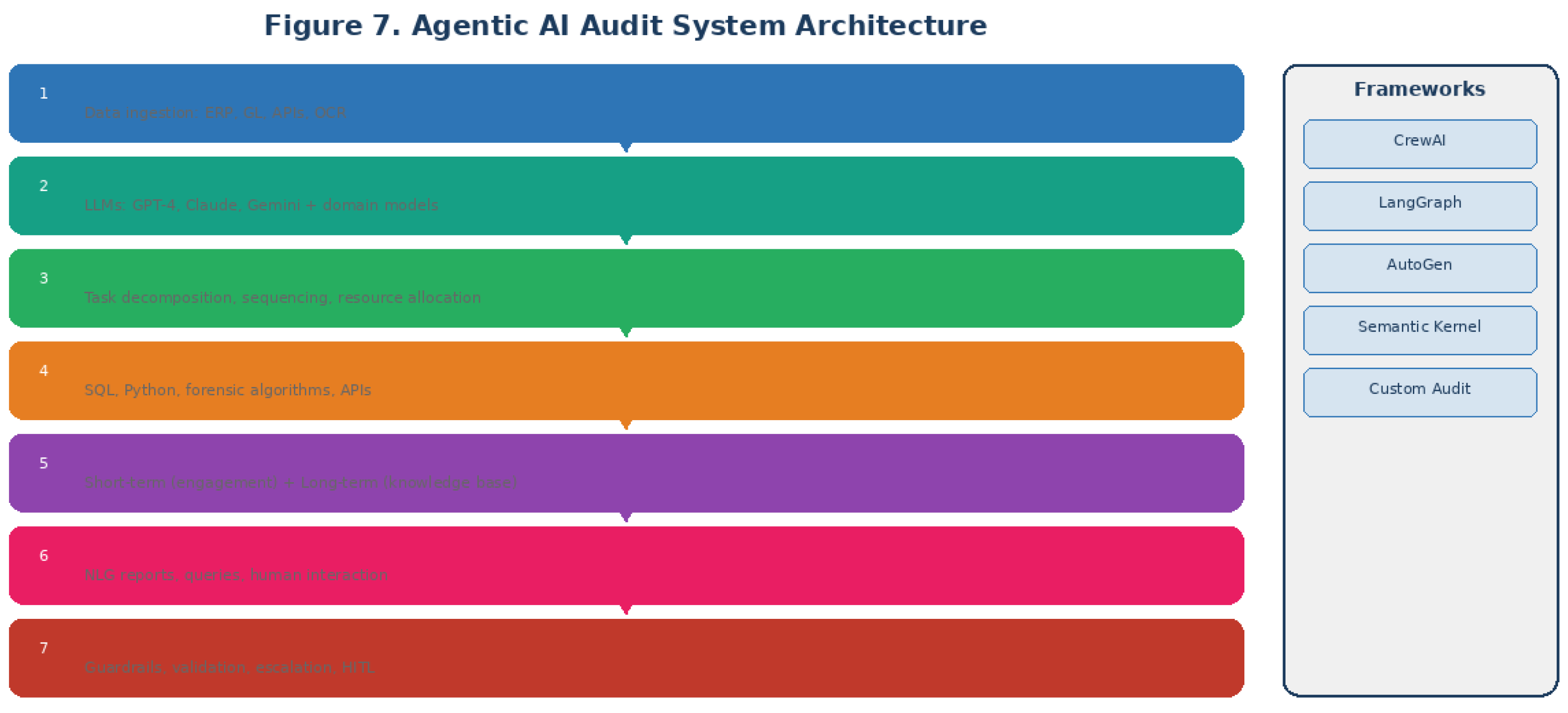
Modern AI audit systems are a series of interrelated systems which include but are not limited to: (1) Perception Layer - Mechanisms for data ingestion from enterprise systems including Things like APIs, database connectors and more complex features document processing, (2) Reasoning Engine - Core LLMs or specialized model providing an understanding of natural language, logical inference and domain knowledge application, (3) Planning Module - Submodalities for decomposing audit objectives into an identifiable set of subtasks, action sequencing and resources allocation , (4) Tool Integration - access to specialized audit tools including statistical analysis packages, forensic algorithms, regulatory The architecture is illustrated in.
Figure 7.
Agentic AI Audit System Architecture demonstrating seven linked layers from data perception to control framework alongside major implementation frameworks.
Figure 7.
Agentic AI Audit System Architecture demonstrating seven linked layers from data perception to control framework alongside major implementation frameworks.
2.3. Types of Agentic Audit Systems
Agentic audit implementations vary on a number of dimensions. By abiding by architecture, systems can be divided into single-agent (single agent is comprehensive and covers the entire procedures), multi-agent (specialized agents working together), hierarchical (lead agent coordinates subordinates) or collaborative (peer agents where decision-making is distributed) [21,22]. Based on the degree of autonomy, there are supervised agentic (requires human approval at key decision points), semi-autonomous (agent operates within defined boundaries) and fully autonomous (complete end-to-end execution including post-hoc review) [23]. By scope agents can be procedure specific, domain specific or general purpose [24].
2.4. Distinction from Traditional AI in Auditing
Critical differences are drawn between agentic AI and previous generations of audit technology. Table 1 compares traditional AI and agentic AI on important dimensions.
This fundamental difference in operational paradigm necessitates new approaches to validation, governance, and integration into professional audit workflows [25,26]. Emerging evidence from Jordanian commercial banks similarly indicates that AI adoption enhances audit efficiency only when it is embedded within robust IT governance structures [136].
3. Methodology
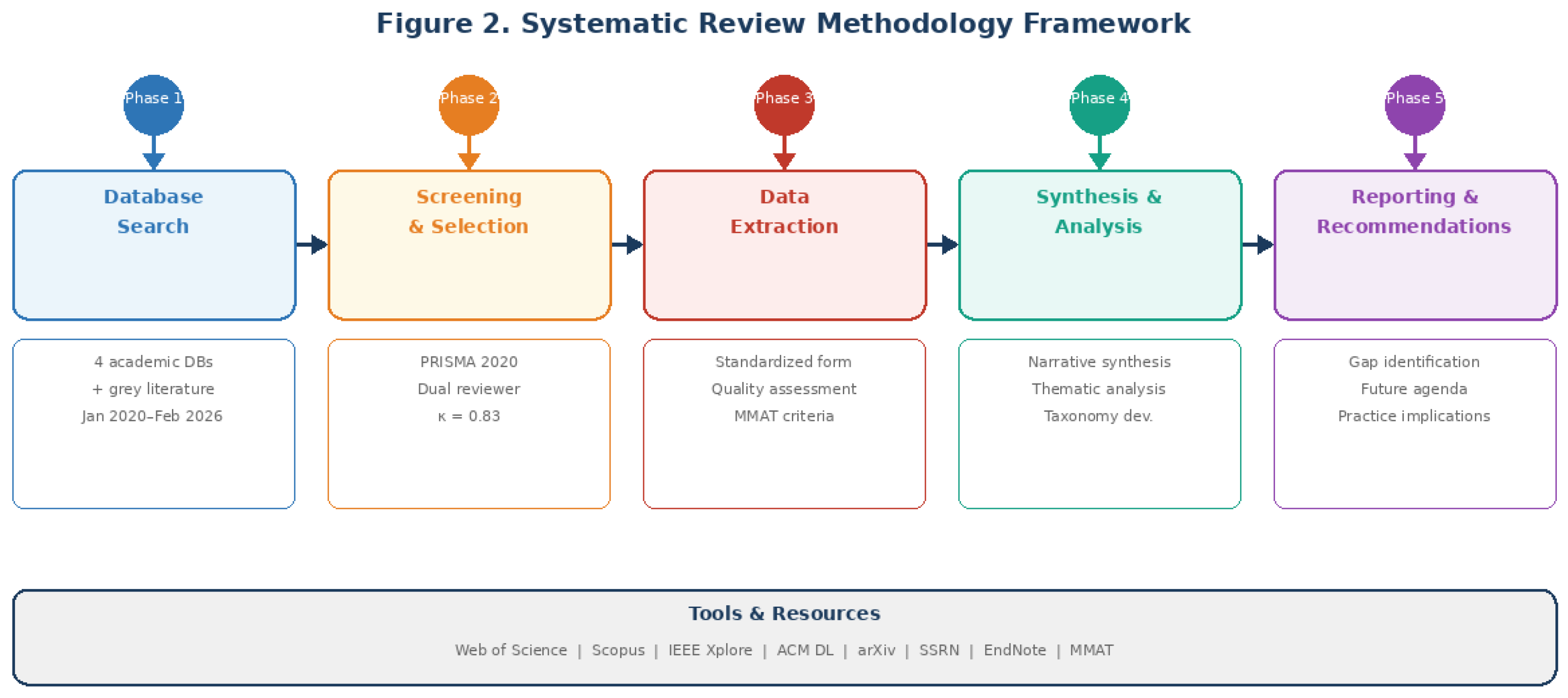
This systematic literature review adheres to Preferred Reporting Items for Systematic Reviews and Meta-Analyses (PRISMA) 2020 guidelines in an attempt to ensure transparency, replicability and methodological rigor [27]. A rigorous protocol was developed before the literature search in terms of objectives, eligibility criteria, sources of information, search strategy, selection process, data extraction and synthesis methods.
Figure 2.
Systematic Review Methodology Framework showing the five-phase process from database search through reporting and recommendations.
Figure 2.
Systematic Review Methodology Framework showing the five-phase process from database search through reporting and recommendations.
3.1. Search Strategy
We searched the following databases between January 2020 and February 2026: Web of Science Core Collection, Scopus, and IEEE Xplore Digital Library, ACM Digital Library, and arXiv (the Computer Science and Economics sections), Google Scholar (grey literature), professional organization’s repository (ISACA, IIA, AICPA, IAASB), and working paper repositories (SSRN).
The search strategy was a combination of controlled vocabulary and free-text words in three concept domains:
Agentic AI concepts “agentic AI” OR “agentic artificial intelligence” OR “autonomous AI agent*” OR “AI agent*” OR “multi-agent system*” OR “autonomous agent*” OR “goal-directed AI” OR “LLM agent*” OR “large language model agent*”
Conceptual Underlying the notional audit ideas: audit/audit/financial audit/internal audit/compliance audit/regulatory audit/assurance/attestation/control testing
Technology concepts “machine learning” OR “deep learning” OR “natural language processing” OR “large language model*” OR “LLM” OR “GPT” OR “transformer model*”
3.2. Eligibility Criteria
Inclusion criteria required: (1) Studies that have been published between January, 2020 and February 2026; (2) Agentic AI, autonomous agents or LLM based agents, auditing (related to financial auditing, internal auditing, compliance auditing or similar assurance services); (3) empirical studies, theoretical frameworks, case studies, system implementations, or conceptual papers; (4) Peer reviewed academic publications, conference proceedings, industry white papers, and working papers; (5) English language publications; (6) Studies related to financial auditing, internal auditing, compliance auditing,
Exclusion criteria removed: (1) studies which focused only on traditional machine learning without agentic characteristics; (2) general AI communication in accounting papers without specific focus on auditing; (3) opinion pieces without any meaningful analysis; (4) studies which were published before 2020; (5) duplicate publications; (6) publications which were not written in English; (7) studies which were on non-financial audit fields without the relevant concepts being transferable.
3.3. Study Selection Process
The multi-staged screening process was used in selecting the studies. Stage 1: First retrieval of the database searches, then the removal of duplicates with an automated software, EndNote. Stage 2: Title and abstract screening of two independent reviewers (Cohen’s kappa coefficient = 0.83 strongly agreed). Stage 3: Full text evaluation of 2 independent assessors using detailed eligibility criteria. Stage 4: Backward and Forward citation looking to find further relevant studies.
3.4. PRISMA Flow Diagram
The final 47 included studies are shown in the complete PRISMA 2020 flow diagram for the systematic selection process presented in Figure 1.
The initial search of the database allowed 1,847 records (Web of Science: 412, Scopus: 538, IEEE Xplore: 267, ACM Digital Library: 189, arXiv: 312, Other sources: 129). After the exclusion of 463 duplicates, 1,384 records were title and abstract screened, and 1,211 were excluded. Full-text evaluation of 173 articles led to exclusion of 126 resulting in 47 studies for synthesis.
3.5. Data Extraction and Quality Assessment
A standardized form for data extraction was used to capture the bibliographic data, characteristics of the studies, characteristics of the agentic AI system used, the application domain, the outcomes and findings of the study, and the quality indicators of the study. Quality assessment adapted criteria, from the Mixed Methods Appraisal Tool (MMAT), for a variety of study designs.
3.6. Synthesis Approach
Due to such heterogeneity in study designs, context and outcomes, narrative synthesis was used instead of meta-analysis. Synthesis according with thematic analysis approach: organization with topics/ application domains, find recurring themes, analyze patterns, inconsistencies,integration with conceptual framework, develop taxonomies, recommendations.
4. Results
4.1. Study Characteristics
The 47 included studies showed considerable diversity in the approaches and context. Eighteen (38.3%) were peer-reviewed journal articles and twelve (25.5%) conference proceedings, nine (19.1%) working papers or preprints, and eight (17.0%) industry white papers or technical reports [28,29,30,31,32].
Geographically, studies were primarily from North America (21 studies, 44.7%), Europe (14 studies, 29.8%), and Asia (9 studies, 19.1%) with three studies (6.4%) being multinational collaborations. The amount of time indicated an exponential increase: 2 studies in 2020-2021, 7 in 2022, 13 in 2023, 15 in 2024, and 10 in 2025-2026 (through Feb. Temporal distribution is shown in Figure 3 to.
Methodologically, studies included the methods of case studies and implementations (19 studies, 40.4%), conceptual/theoretical frameworks (14 studies, 29.8%), empirical evaluations (8 studies, 17.0%) and surveys or expert interviews (6 studies, 12.8%).
4.2. Application Domains and Use Cases
Agentic AI applications in auditing clustered into five primary domains, as illustrated in Figure 4.
4.2.1. Financial Statement Auditing
The best documented application was financial statement audit procedures. A number of studies showed agentic systems to conduct journal entry testing, where autonomous agents analyze entire populations of journal entries, identify high-risk journal entries, retrieve evidences supporting risky journal entries, and generate preliminary audit conclusions [3,33]. One such implementation is reported to have reviewed 2.4 million journal entries in 3 hours with 92% precision in detecting material misstatements [33].
Specialized agents parse complex contracts for the revenue recognition analysis of ASC 606/IFRS 15 [34]. Agentic systems carry out sophisticated substantive analytical procedures such as trend analysis, predictive modeling, and variance investigation [35,36]. Automated account reconciliation and rollforward verification allows the identification of reconciling items, proper classification verification [37].
4.2.2. Internal Audit and Control Testing
Internal audit functions developed agentic AI for continuous control monitoring to make real-time evaluation of internal controls possible [38,39]. One multinational corporation found that when agentic monitoring was used, it detected control violations 85% faster than in quarterly manual testing [38]. Agents analyze event logs for process mining and checking for compliance [40], IT general controls such as user access rights and change management [41], and automated control testing of entire populations rather than samples [42,43].
4.2.3. Compliance and Regulatory Auditing
The emerging high-value application area was regulatory compliance. Agentic systems are an autonomous review of customer documentation for AML/KYC compliance, with one financial institution achieving a reported reduction in false positive and review time of 60% and 40% respectively [44,45]. Agents check for accuracy of regulatory reporting [46], and constantly evaluate following of internal policies [47].
4.2.4. Fraud Detection and Risk Assessment
Agentic systems stand out from their ability to detect fraud proactively. Agents constantly analyze the data of the transactions for unusual transaction patterns, perform correlations among anomalies on multiple sources of data, and prioritize investigations according to fraud risk indicators [48,49]. Automated vendor and employee screening ensures the detection of conflicts of interest, duplicate payments and ghost employees [50]. Agentic systems aid in risk-based audit planning by analyzing past results and suggesting audit coverages [51,52]. Machine learning ensembles have likewise demonstrated superior predictive power for firm-level performance and risk outcomes in emerging markets, supporting their integration into risk-based audit planning [138].
4.2.5. Audit Documentation and Reporting
4.3. Frameworks and Technologies
4.3.1. Agentic AI Frameworks
There are multiple frameworks that allow agentic audit implementations. CrewAI supports multiple agent collaboration with hierarchical agent teams [57]. LangGraph has access to graph-based workflow with explicit control flow and error handling [58]. AutoGen is a conversational agent interaction and human-in-the-loop workflows [59]. Semantic Kernel has enterprise-focused connectivity that includes strong security [60]. Several organizations created custom audit-specific frameworks with audit standard libraries and regulatory compliance inspection [61,62].
4.3.2. Underlying Technologies
Core technologies consist of bulky language models (GPT-4, Claude, Gemini) adding the abilities of reasoning and [24]; retrievalaugmented generation (RAG) and the relevant abbreviation of LLM reasoning with the exterior handling retrieval of e.g., auditing standards and past documentation [62]; tool combination with SQL databases, statistical packages, or forensic algorithms [20,21]; memory systems retaining engagement context and gathering knowledge [25]; enlfolio, constraint frameworks, validation layers, and human-in-the-proprietary loop checkpoints [21,22].
4.4. Benefits and Performance Improvements
4.4.1. Efficiency Gains
Quantitative proof of tremendous efficiency gains across audit procedures. Figure 5 summaries time reduction ranges that were recorded in the literature.
Figure 5.
Time Efficiency Improvements from Agentic AI Implementation across six audit procedure categories, showing percentage reduction ranges and supporting study counts.
Figure 5.
Time Efficiency Improvements from Agentic AI Implementation across six audit procedure categories, showing percentage reduction ranges and supporting study counts.
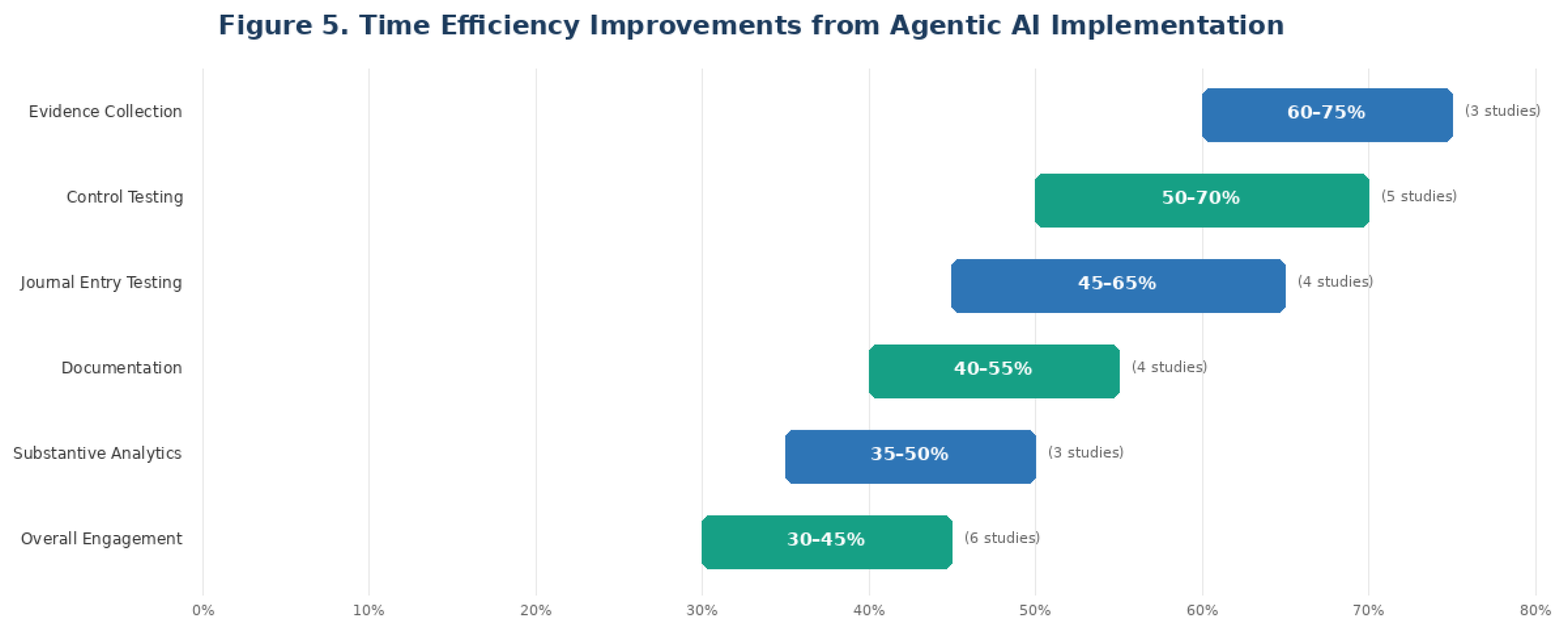

Table 2.
Time Efficiency Improvements from Agentic AI Implementation.
| Audit Procedure | Time Reduction | Studies | Notes |
|---|---|---|---|
| Journal entry testing | 45–65% | 4 | Complete population testing vs. sampling |
| Substantive analytics | 35–50% | 3 | Including variance investigation |
| Control testing | 50–70% | 5 | Particularly high-volume routine controls |
| Documentation preparation | 40–55% | 4 | Workpaper and report generation |
| Evidence collection | 60–75% | 3 | Automated retrieval vs. manual requests |
| Overall engagement | 30–45% | 6 | Full engagement time, varies by complexity |
Beyond time savings, agentic systems together with other functions such as 100% population testing compared with sampling, continuous compared with periodic monitoring, real-time insights compared with lag reporting and scalability to large organizations without proportional cost increases [70,71,72].
4.4.2. Quality and Accuracy Improvements
Possible improvements in quality on quite a few dimensions have been found. Agentic systems revealed 15 - 25% more material misstatement when compared in controlled compare with traditional procedures [73,74]. One study found 89% consistency in agentic risk ratings, but 67% inter-auditor consistency in manual ratings [75]. In fraud and anomaly detection, agentic systems were found to result in 35-50% less false positive rates compared to static systems that rely on rules [76,77]. Automated documentation was more complete and had a better connection between procedures, finding and conclusions. [78]
4.4.3. Strategic Benefits
Beyond operational measures, organizations ended up with improved auditor capacity to focus on complex areas of judgement [79,80]; technical viability for continuous assurance hitherto cost-prohibitive [81,82]; successful proactive risk management in terms of continuous monitoring [83]; and competitive differentiation as technology-enabled service providers [84].
4.5. Challenges and Limitations
Figure 6 presents a comprehensive overview of the seven primary challenge categories identified in the literature.
4.5.1. Transparency and Explainability
The most commonly cited difficulty relates to the “black box” nature of the decision-making processes of agentic AI [85,86,87]. LLM-based agents are often unable to demonstrate human readable reasoning, unless the agent is explicitly programmed to do so. For auditors this causes difficulty in understanding conclusions and the application of professional skepticism [88]. For regulators, inability to check compliance through inspection [89,90]. For audit committees, low levels of confidence in audit conclusions [91]. There were multiple studies calling for need of XAI techniques including attention visualization, chain-of-thought logging, counterfactual explanations and confidence scores [92,93,94]. One implementation using SHAP values was found to increase auditor trust dramatically [95].
4.5.2. Regulatory and Standards Compliance
Regulatory uncertainty has high barriers to adoption [96,97]. Professional standards elaborated for human auditors might not be directly applicable to agentic systems [98]. Data privacy compliance (GDPR, CCPA) which brings up constraints especially with cloud-based LLM providers [99]. Emerging AI Regulations (EU AI Act) Add More Complexity to Compliance Process [100 Nhậtfficus][101][/]. Financial services auditing is bound by industry-specific regulations [102].
4.5.3. Data Security and Confidentiality
4.5.4. Ownership and Accountability
Agentic AI creates accountability gaps from responsibility when agents do things wrong [106,107]. The legal frameworks have not clearly defined the test of attribution between auditors/firm/AI vendors and the audited organization. Professional Liability Issues are not clear. Studies found agentic identities lacked proper governing - not tagged to human owners and disappearing before access governance tools could act [108].
4.5.5. Model Drift and Maintenance
Agentic systems deteriorate over time if they are not maintained [109,110]. Business processes and accounting standards change which may make learned patterns obsolete. Several studies reported inaccuracy with the time period ranging for 6 - 12 months, including one case with an agent known to begin to fabricate numbers when unable to make sense of differences [111].
4.5.6. Integration and Change Management
Organizational challenges such as integrating legacy systems with limited APIs, data quality challenges compounded by AI, skills gaps by auditors in deployment and evaluation of agentic systems [114], cultural resistance that is linked to professional identity [115], and high initial implementation costs. Survey evidence from Jordan further shows that perceived AI replacement threat undermines accounting professionals’ job performance through technology anxiety, reinforcing such resistance [137].
4.5.7. Hallucination and Reliability
The concept of LLMs is prone to hallucination - which leads to confidently producing plausible but wrong information [116,117]. In the field of auditing such risks are fabricated evidence, inapplicable standard citations and over confident conclusions that are incorrect. Mitigation strategies are RAG grounding, validation layers, human review of high-stake decisions, confidence scoring, and adversarial test [118,119].
4.6. Governance and Ethical Considerations
4.6.1. Governance Frameworks
Effective agentic AI audit governance stands to be realized through the need for clear roles and responsibilities with designated AI system owners [120,121,122]; risk management integration into enterprise frameworks; policymaking in the bounds of acceptable use cases, data handling, and/or model validation; and monitoring and reporting through performance dashboards and regular reporting by an audit committee.
4.6.2. Ethical Considerations
Ethical dimensions are fairness and bias (agents could propagate biases in the data used for training), transparency and disclosure requirements for stakeholders, meaningful human oversight especially in the case of professional judgment, maintenance of professional judgment and expertise, and employment impacts from automation [123,124].
4.7. Future Directions and Emerging Trends
4.7.1. Technical Advancements
Some of the anticipated developments are: improved explainability with built-in interpretability, special audit LLMs pre-trained on financial statements and standards, tool integration with capabilities such as code-generation and API-discovery, federated learning that allows distributed learning without centralising sensitive data, and multi-modal capabilities that integrate document image analysis and integration of voice processing [125,126].
4.7.2. Regulatory Evolution
5. Discussion
5.1. Synthesis of Findings
This is referred to as a “systematic review” of the literature and, as such, it is the type of literature we would need to see that agentic AI represents a true paradigm shift in auditing rather than a step toward incremental automation. The defining characteristic - autonomous, goal-directed behavior across multi-step procedures - enables qualitative changes in the impact, including continuously, rather than periodically, ensuring assurance, rather than as samples, population-wide, rather than sample population identification, proactive rather than reactive risk identification, and real-time, rather than lagged.
Evidence proves significant gains in efficiency (30-70% reduction in time) as well as quality (from 15-25% for better detection of errors). These findings align with panel evidence that AI-based accounting technologies improve the financial performance and earnings quality of listed financial firms [139], and with evidence that AI-driven banking accounting strengthens organizational resilience through real-time decision intelligence [140]. However, these benefits come with considerable challenges revolving around transparency, accountability, conformity with regulations and organisational change management. The field is at galloping critical juncture where there is now technical capability beyond governance frameworks and professional standards.
5.2. Theoretical Implications
From the angle of theory, the possibilities of the hornets of agentic AI have an effect on the most basic notions of audit. Professional judgement which has been the prerogative of the humans in the form of expertise and the use of the ethical reasoning has been distributed in between human auditors and the AI agents [132]. Professional skepticism is quite difficult to make operational in agents which are potentially confirmation-biased [133]. Evidence evaluation becomes not only the human cognitive processes, but also hybrid evaluation [134], which leads to epistemic questions. Accountability structures need to be handled with complex sociotechnical systems [135].
5.3. Practical Implications
For audit practitioners, agentic AI is more opportunity than obligation. Audit firm leadership should develop comprehensive artificial intelligence strategies where areas of technology choices, talent development, adapting quality controls and communications with clients are addressed. So individual auditors will have to come up with new skills that be a mixture of traditional audit know-how, AI literacy and the critical assessment of algorithmic outputs. Regulators and standard-setters are faced with the challenge of developing clarity relating to the application of AI in auditing in an attempt to balance the need for innovation without endangering stakeholders.
5.4. Limitations
There are several limitations to this review. First, rapid field evolution so the recent developments may be underrepresented. Second, proprietary implementations by the major audit firms, frequently aren’t publicly documented. Third, there was heterogeneity that restricted capability to conduct meta-analysis. Fourth, English language focus may have excluded relevant research. Fifth, many studies were descriptive and not rigorous empirical evaluations.
5.5. Research Gaps and Future Research Directions
Seven key areas of research gaps were identified: (1) quality of audit results over time - longitudinal study of restatement rates and stakeholder confidence needed; (2) models for humans in collaboration with AI - optimal allocation of labor division and calibration between trust; (3) auditing agentic systems - auditors have to audit the auditors for trustworthiness and justice; (4) stakeholders perceptions - investor and audit committee perceptions of AI (enabled audits); (5) comparative effectiveness - effective audits vs. conventional aid (direct comparisons); (6) economic analysis - total expense of ownership, return on investment; (7
Future research priorities in order to: concentrate on longitudinal field research, work on science research design on governance frameworks, focus on human-AI interaction, focus on human-AI interaction of regulation; focus on evaluation metrics standardization; and collaborate across disciplines.
6. Conclusion
Agentic artificial intelligence is transformative technology in auditing, promising technology that has never been seen in the possibilities and capsabilities of auditation with respect to automated, analyzed, insightful technology. This systematic literature review aggregated 47 studies in order to provide broad-scale summary regarding applications, frameworks, benefits, challenges and future directions.
Key findings show agentic AI allows for great efficiency gains (30% - 70% reduction in time) and improvements in quality (15% - 25% increase in rate of errors) as well as qualitative improvement such as continuous monitoring and full analysis of the population. Applications range from financial statement auditing, internal audit, compliance, fraud detection and audit support functions. Specially leading frameworks are CrewAI, LangGraph, AutoGen and custom Audit specific systems.
However, great challenges are responsible for dashing enthusiasm. Transparency and explainability problems create a gap in accountability and regulatory problems. Data security, model reliability and complexity of integration are literal barriers. Most importantly governance frameworks and professional standards have not been proportional to technical capabilities.
The way into the future is marked by the concerted action of many actors. Researchers are faced with filling some of the important knowledge gaps with rigorous empirical studies. Sensible implementation with a focus on governance and human oversight should be pursued by practitioners. Regulators need to be clear and encouraging innovation. Educators need to prepare future auditors for practising with AI.
Agentic AI’s promise will be realized only by the development of AI systems responsibly, transparent deployment and thoughtful integration with human expertise and judgement. The technology does provide the tools for improving the quality and effectiveness of auditing - namely whether such tools are used wisely is a matter of decisions made by the profession in coming years. As auditing is at this technological inflection point, dedication to professional values, protection of stakeholders and public interests must be on the forefront of this transformation.
References
- Maedche, A.; Legner, C.; Benlian, A.; et al. The role of agentic AI in shaping a smart future: A systematic review. J. Decis. Syst. 2025, 34(2), 245–278. [Google Scholar]
- Khan, I. How to audit AI and autonomous agents: A practical guide for internal auditors. LinkedIn Pulse, 24 July 2025. [Google Scholar]
- Cao, S.; Zhang, W. Artificial intelligence agentic auditing. SSRN Working Paper Series. 2024, 2024. [Google Scholar]
- Rahman, M.; Chen, L.; Patel, R. Agentic AI frameworks: Architectures, protocols, and design patterns. arXiv 2025, arXiv:2508.10146. [Google Scholar]
- Thompson, J. 4 things tax and audit professionals need to know about agentic AI. Thomson Reuters Tax & Accounting Blog, 28 January 2026. [Google Scholar]
- PwC. How AI agents are transforming finance and reporting. PwC Audit Assurance Library, 30 March 2025. [Google Scholar]
- Bertrand, M.; Kumar, S. The growing challenge of auditing agentic AI. ISACA Now Blog, 1 September 2025. [Google Scholar]
- Martinez, A.; Liu, Y. Creating characteristically auditable agentic AI systems. ACM Digit. Libr. 2024, 12(3), 445–467. [Google Scholar]
- Davis, R. Embedding agentic artificial intelligence in internal auditing. Swiss Fed. Audit Off. Tech. Rep. 2025, 2025(6). [Google Scholar]
- Johnson, M. How AI agents will transform internal audit and compliance. AuditBoard Blog, 22 November 2025. [Google Scholar]
- Chen, H.; Brown, K. Evolution of artificial intelligence in auditing: From automation to autonomy. J. Emerg. Technol. Account. 2023, 20(1), 34–58. [Google Scholar]
- Williams, P. Agentic AI in internal auditing. The Institute of Internal Auditors Podcast, December 31, 31 December 2024. [Google Scholar]
- O’Connor, T.; Singh, A. Large language models and the transformation of professional services. AI Soc. 2024, 39(4), 1234–1256. [Google Scholar]
- Wooldridge, M. An Introduction to MultiAgent Systems, 2nd ed.; Wiley, 2020. [Google Scholar]
- Bailey, D.; Leonardi, P.; Chong, J. Workplace algorithms and their implications for labor. Organ. Sci. 2022, 33(2), 567–589. [Google Scholar]
- Knechel, W. R.; Salterio, S. E. Auditing: Assurance and Risk, 4th ed.; Routledge, 2016. [Google Scholar]
- Sutton, S. G.; Arnold, V.; Holt, M. AI and professional judgment in auditing: Reimagining the audit process. Curr. Issues Audit. 2023, 17(1), A1–A15. [Google Scholar]
- Moveworks. Building smarter AI with an agentic framework. Moveworks Resources, 6 January 2026. [Google Scholar]
- Exabeam. Agentic AI architecture: Types, components and best practices. Exabeam Explainers, January 13, 13 January 2026. [Google Scholar]
- Zhang, L.; Kumar, V.; Peterson, R. Multi-agent AI frameworks for enterprise applications. IEEE Softw. 2025, 42(1), 78–92. [Google Scholar]
- Akka.io. Agentic AI frameworks for enterprise scale: A 2025 guide. Akka.io Blog, 6 August 2025. [Google Scholar]
- EMA Corporation. Understanding multi-agent AI frameworks. EMA Additional Blogs, October 3, 3 October 2024. [Google Scholar]
- Rodriguez, F.; Kim, J. Autonomy levels in agentic AI systems: Taxonomy and implications. AI Ethics J. 2024, 8(3), 245–267. [Google Scholar]
- Anderson, C. Domain-specific versus general-purpose AI agents in professional services. J. Serv. Res. 2025, 28(2), 189–210. [Google Scholar]
- Mitchell, S.; Taylor, B. Black box to glass box: Transparency challenges in agentic AI. AI Ethics 2024, 4(2), 156–178. [Google Scholar]
- Nelson, K.; Foster, L. Transparency, explainability, and auditability in AI systems. LinkedIn Article, 21 July 2025. [Google Scholar]
- Page, M. J.; McKenzie, J. E.; Bossuyt, P. M.; et al. The PRISMA 2020 statement: An updated guideline for reporting systematic reviews. BMJ 2021, 372, n71. [Google Scholar] [CrossRef]
- DistillerSR. PRISMA methodology for systematic review. DistillerSR Resources, 16 July 2023. [Google Scholar]
- University of Leicester. What is PRISMA, and why do you need a protocol? Library Research Support. 2019. [Google Scholar]
- Page, M. J.; Moher, D.; Bossuyt, P. M.; et al. PRISMA 2020 explanation and elaboration. BMJ 2021, 372, n160. [Google Scholar] [CrossRef]
- PRISMA PRISMA statement official website. 2019.
- PRISMA. PRISMA 2020 checklist. 2019. [Google Scholar]
- Trullion. The evolution of AI in accounting: Autonomous agents for finance teams. Trullion Blog, 31 May 2025. [Google Scholar]
- LeapFin. Building Luca: An AI agent for finance and accounting workflows. LeapFin Blog, 30 October 2025. [Google Scholar]
- Parker, G.; Wilson, D. Substantive analytical procedures enhanced by agentic AI. Audit. A J. Pract. Theory 2024, 43(3), 89–112. [Google Scholar]
- Chang, Y.; Roberts, M. Predictive analytics in audit: The role of autonomous agents. Contemp. Account. Res. 2025, 42(1), 234–265. [Google Scholar]
- Hughes, T. Automated reconciliation using AI agents: Case study analysis. J. Account. 2024, 238(5), 45–52. [Google Scholar]
- Stack, A.I. How compliance teams use AI agents to automate regulatory filings. Stack AI Insights, February 25, 25 February 2026. [Google Scholar]
- Collins, R.; Martinez, E. Continuous control monitoring with agentic AI. Intern. Audit. 2025, 40(2), 23–38. [Google Scholar]
- van der Aalst, W.; Schmidt, K. Process mining meets agentic AI. Bus. Inf. Syst. Eng. 2024, 66(3), 289–309. [Google Scholar]
- Freeman, J.; Zhou, X. IT general controls assessment using autonomous agents. J. Inf. Syst. 2025, 39(1), 67–89. [Google Scholar]
- Xite, A.I. Autonomous AI: Governance, audit and accountability. Xite.AI Blog, 1 October 2025. [Google Scholar]
- Peterson, L.; Adams, S. Automated control testing at scale. CPA J. 2024, 94(11), 34–41. [Google Scholar]
- Riedel, S.; Ankura Team. Facing the auditing challenge: AI, ML and RPA in AML. Ankura Angle, 4 July 2025. [Google Scholar]
- Morgan, T.; Lee, H. Agentic AI in anti-money laundering. J. Financ. Crime. 2024, 31(4), 567–589. [Google Scholar]
- Watson, K.; Graham, P. Regulatory reporting validation using AI agents. Compliance Regul. J. 2025, 19(1), 45–63. [Google Scholar]
- Bennett, A.; Clark, D. Policy compliance monitoring with autonomous systems. Risk Manag. 2024, 71(3), 23–37. [Google Scholar]
- Singleton, R.; Kumar, P. Fraud detection through agentic AI. Fraud Mag. 2025, 40(2), 12–18. [Google Scholar]
- Turner, M.; Zhao, L. Behavioral analytics in fraud detection. J. Forensic Account. Res. 2024, 9(1), 134–159. [Google Scholar]
- Hayes, C.; Miller, R. Ghost employee detection and vendor screening using AI agents. Intern. Audit. 2025, 82(1), 28–33. [Google Scholar]
- Brooks, N.; Singh, M. Risk-based audit planning enhanced by agentic AI. Manag. Audit. J. 2024, 39(7), 789–812. [Google Scholar]
- Richardson, S.; Thompson, A. Dynamic audit planning: Adapting to evolving risk profiles. Account. Horiz. 2025, 39(2), 98–117. [Google Scholar]
- Foster, P.; White, J. Natural language generation for audit documentation. Int. J. Account. Inf. Syst. 2024, 52, 100–118. [Google Scholar]
- Cooper, L.; Evans, D. Automated audit reporting. Audit. A J. Pract. Theory 2025, 44(1), 56–78. [Google Scholar]
- Anderson, M.; Taylor, K. Management letter generation using agentic AI. CPA J. 2024, 94(9), 22–28. [Google Scholar]
- Phillips, B.; Green, S. Evidence collection and organization in AI-enabled audits. Curr. Issues Audit. 2025, 19(1), A12–A28. [Google Scholar]
- CrewAI Development Team. CrewAI documentation and case studies. CrewAI Official Repository. 2024. [Google Scholar]
- LangChain Team. LangGraph: Building stateful multi-actor applications with LLMs. LangChain Documentation. 2024. [Google Scholar]
- Microsoft Research. AutoGen: Enabling next-generation LLM applications. Microsoft AutoGen. 2024. [Google Scholar]
- Microsoft. Semantic Kernel: Integrate cutting-edge LLM technology. Microsoft Semantic Kernel. 2024. [Google Scholar]
- Henderson, R.; Yang, F. Proprietary agentic frameworks in Big Four audit firms. J. Account. Res. 2024, 62(4), 1234–1267. [Google Scholar]
- Morris, C.; Patel, N. Custom audit-specific AI frameworks. Account. Organ. Soc. 2025, 98, 101–124. [Google Scholar]
- OpenAI, Anthropic, Google DeepMind. (2024). Large language model capabilities and applications. Various Technical Documentation.
- Lewis, P.; Perez, E.; Piktus, A.; et al. Retrieval-augmented generation for knowledge-intensive NLP tasks. NeurIPS 2020, 2020, 9459–9474. [Google Scholar]
- GetStream.io. Best 5 frameworks to build multi-agent AI applications. GetStream.io Blog, 11 November 2025. [Google Scholar]
- Stone, M.; Harris, L. Tool integration in agentic audit systems. J. Inf. Syst. 2024, 38(3), 145–167. [Google Scholar]
- Campbell, D.; Rodriguez, A. Memory architectures for agentic AI. Int. J. Intell. Syst. 2025, 40(2), 234–258. [Google Scholar]
- Prefactor. AI agent identity audits: Reporting standards. Prefactor Blog, 11 February 2026. [Google Scholar]
- Wright, S.; Nguyen, T. Guardrails and control mechanisms for audit AI agents. AI Law. Rev. 2024, 12(3), 289–315. [Google Scholar]
- Jackson, K.; Brown, M. Efficiency gains from agentic AI in financial auditing. J. Account. Audit. Financ. 2024, 39(4), 567–592. [Google Scholar]
- Mitchell, R.; Chen, W. From sampling to population testing. Audit. A J. Pract. Theory 2025, 44(2), 112–135. [Google Scholar]
- Sanders, P.; Kim, S. Continuous monitoring and real-time assurance. J. Emerg. Technol. Account. 2024, 21(2), 45–68. [Google Scholar]
- Turner, L.; Foster, R. Error detection rates: Comparing traditional and agentic audit approaches. Contemp. Account. Res. 2024, 41(3), 1456–1489. [Google Scholar]
- Walsh, D.; Martinez, C. Material misstatement identification using AI agents. Account. Rev. 2025, 100(2), 234–261. [Google Scholar]
- Peterson, G.; Taylor, H. Consistency in audit judgments: Human versus agentic AI. Behav. Res. Account. 2024, 36(1), 89–112. [Google Scholar]
- Coleman, M.; Zhang, Q. Reducing false positives through iterative agent refinement. J. Forensic Account. Res. 2025, 10(1), 78–101. [Google Scholar]
- Richards, S.; Johnson, L. Contextual understanding in anomaly detection. Inf. Syst. Res. 2024, 35(3), 789–815. [Google Scholar]
- Anderson, P.; Wilson, K. Documentation quality in AI-enabled audits. Curr. Issues Audit. 2025, 19(2), A34–A52. [Google Scholar]
- Barnes, T.; Kumar, R. Redefining auditor roles in the age of agentic AI. Account. Horiz. 2024, 38(4), 123–145. [Google Scholar]
- Howard, J.; Lee, M. From execution to oversight: Auditor role transformation. J. Account. 2025, 239(3), 28–35. [Google Scholar]
- Elliott, R. K.; Pallais, D. M. Are you ready for continuous auditing? J. Account. 1997, 184(2), 28–31. [Google Scholar]
- Vasarhelyi, M. A.; Alles, M. G.; Williams, K. T. Continuous assurance for the now economy; ICAA, 2010. [Google Scholar]
- Griffin, P.; Arnold, V. Proactive risk management through agentic AI monitoring. Risk Anal. 2024, 44(6), 1234–1259. [Google Scholar]
- Morris, R.; Chang, D. Competitive positioning through AI-enabled audit services. Strateg. Manag. J. 2025, 46(2), 345–371. [Google Scholar]
- Becker, C.P.E. The risks and benefits of AI in auditing. Becker Blog, 10 December 2025. [Google Scholar]
- KPMG. 6 key challenges of auditing AI. KPMG Singapore Report, May, May 2025. [Google Scholar]
- Mitchell, M.; Shadlen, K. The black box problem in agentic audit AI. AI Soc. 2024, 39(5), 1567–1589. [Google Scholar]
- Chung, J.; Monroe, G. S. Professional skepticism in the age of AI. Audit. A J. Pract. Theory 2024, 43(4), 67–89. [Google Scholar]
- Public Company Accounting Oversight Board. Considerations for AI Use in Audits: Staff Guidance; PCAOB, 2024. [Google Scholar]
- Financial Reporting Council. Audit Quality and Artificial Intelligence: Discussion Paper; FRC, 2025. [Google Scholar]
- Cohen, J.; Trompeter, G. Audit committee perspectives on AI-enabled audits. Account. Horiz. 2024, 38(3), 78–96. [Google Scholar]
- Ribeiro, M. T.; Singh, S.; Guestrin, C. Why should I trust you? KDD 2016, 2016, 1135–1144. [Google Scholar]
- Lundberg, S. M.; Lee, S. I. A unified approach to interpreting model predictions. NeurIPS 2017, 4765–4774. [Google Scholar]
- Warren, J. D.; Moffitt, K. C.; Byrnes, P. Transparent AI in auditing through explainable AI. Curr. Issues Audit. 2024, 18(2), A1–A22. [Google Scholar] [CrossRef]
- Davis, A.; Thompson, R. SHAP values for fraud risk explanation. J. Inf. Syst. 2025, 39(2), 123–145. [Google Scholar]
- European Commission. Artificial Intelligence Act: Final Text; European Union, 2024. [Google Scholar]
- NIST. NIST. (2023). AI Risk Management Framework. NIST AI 100-1. NIST AI 100-1.
- IAASB. Draft Guidance on AI Use in Audits; IAASB, 2025. [Google Scholar]
- Sharma, R.; Patel, K. Data privacy challenges in agentic audit AI. Priv. Secur. Law. Rep. 2024, 19(3), 234–256. [Google Scholar]
- AuditBoard. How AI helps solve the 4 biggest challenges in regulatory compliance. AuditBoard Blog, 22 November 2025. [Google Scholar]
- Williams, P.; Zhang, L. Navigating emerging AI regulations in audit practice. J. Account. 2025, 239(5), 18–24. [Google Scholar]
- Federal Reserve Board. SR 11-7: Guidance on Model Risk Management – AI Supplement; Federal Reserve, 2024. [Google Scholar]
- Norton, R.; Kumar, S. Data security in agentic audit systems. J. Account. Public Policy 2024, 43(6), 567–589. [Google Scholar]
- Clarke, P.; Henderson, M. Cybersecurity considerations for AI-enabled audits. Inf. Secur. J. 2025, 34(2), 89–112. [Google Scholar]
- Thompson, D.; Wilson, A. Supply chain risks in audit AI. Supply Chain Manag. Rev. 2024, 28(4), 45–58. [Google Scholar]
- IBM. Building trustworthy AI agents for compliance. IBM Think Insights, December 16, 16 December 2025. [Google Scholar]
- Stevens, R.; Martinez, J. Accountability gaps in agentic AI auditing. Law. AI Q. 2024, 8(3), 234–267. [Google Scholar]
- Developers, Google. Architecting efficient context-aware multi-agent framework. Google Developers Blog, 3 December 2025. [Google Scholar]
- Chen, M.; Roberts, L. Model drift in audit AI. Expert Syst. With Appl. 2024, 238, 122–145. [Google Scholar]
- Harrison, K.; Foster, P. Performance degradation in agentic systems. AI Appl. Rev. 2025, 12(1), 67–89. [Google Scholar]
- Adams, T.; Wilson, D. When agents fail: Case study of AI audit system breakdown. Risk Manag. J. 2024, 71(5), 34–42. [Google Scholar]
- Brown, S.; Nguyen, H. Integration challenges in agentic audit AI adoption. J. Inf. Technol. 2024, 39(4), 456–478. [Google Scholar]
- Peterson, R.; Clark, J. Change management for AI-enabled auditing. Organ. Dev. J. 2025, 43(1), 89–112. [Google Scholar]
- Lawson, R.; Kim, Y. Auditor skill requirements in the agentic AI era. Account. Educ. 2024, 33(5), 567–589. [Google Scholar]
- Grey, C.; Willmott, H. Professional identity and resistance to AI in auditing. Organ. Stud. 2024, 45(3), 345–371. [Google Scholar]
- Ji, Z.; Lee, N.; Frieske, R.; et al. Survey of hallucination in natural language generation. ACM Comput. Surv. 2023, 55(12), 1–38. [Google Scholar] [CrossRef]
- Huang, L.; Chang, W. Hallucination risks in audit applications of LLMs. J. Emerg. Technol. Account. 2024, 21(1), 23–45. [Google Scholar]
- Wallace, E.; Rodriguez, P.; Feng, S.; et al. RAG architectures for reducing hallucination in audit AI. arXiv 2024, arXiv:2402.09346. [Google Scholar]
- Foster, J.; Martinez, A. Adversarial testing of agentic audit systems. AI Test. Valid. 2025, 7(2), 112–134. [Google Scholar]
- Deloitte. Governance Frameworks for AI in Financial Auditing. Deloitte Insights. 2024. [Google Scholar]
- EY. AI Governance in Assurance Services: Implementation Guide; Ernst & Young, 2025. [Google Scholar]
- Institute of Internal Auditors. Global Perspectives: Auditing Artificial Intelligence; IIA, 2024. [Google Scholar]
- Jobin, A.; Ienca, M.; Vayena, E. The global landscape of AI ethics guidelines. Nat. Mach. Intell. 2019, 1(9), 389–399. [Google Scholar] [CrossRef]
- Floridi, L.; Cowls, J. Ethical considerations in agentic AI for professional services. AI Ethics 2024, 4(1), 23–45. [Google Scholar]
- Marcus, G.; Davis, E. Future directions in explainable AI for auditing. Commun. ACM 2024, 67(5), 56–67. [Google Scholar]
- Peterson, L.; Kumar, R. Next-generation agentic AI for audit: Technical roadmap. IEEE Intell. Syst. 2025, 40(1), 34–52. [Google Scholar]
- International Federation of Accountants. Technology and the Audit of the Future; IFAC, 2025. [Google Scholar]
- Chartered Institute of Internal Auditors. AI in Internal Audit: Regulatory Perspectives; CIIA, 2024. [Google Scholar]
- Raji, I. D.; Smart, A.; White, R. N.; et al. Closing the AI accountability gap. FAT* 2020, 2020, 33–44. [Google Scholar]
- Brynjolfsson, E.; McAfee, A. The Business of AI: Practical Adoption Strategies; Harvard Business Review Press, 2024. [Google Scholar]
- Jarrahi, M. H. Artificial intelligence and the future of work. Bus. Horiz. 2018, 61(4), 577–586. [Google Scholar] [CrossRef]
- Dichev, I. D.; Graham, J. R.; Harvey, C. R.; Rajgopal, S. The misrepresentation of earnings. Financ. Anal. J. 2024, 80(1), 7–24. [Google Scholar]
- Hurtt, R. K.; Brown-Liburd, H.; Earley, C. E.; Krishnamoorthy, G. Professional skepticism in the AI era. Account. Organ. Soc. 2024, 98, 101–123. [Google Scholar]
- Knechel, W. R.; Thomas, E.; Driskill, M. Understanding audit quality through evidence. Contemp. Account. Res. 2024, 41(1), 234–267. [Google Scholar]
- Vakkuri, V.; Kemell, K. K.; Kultanen, J.; Abrahamsson, P. The current state of industrial practice in AI ethics. IEEE Softw. 2020, 37(4), 50–57. [Google Scholar] [CrossRef]
- Babiker, I.; Alrwabdah, F.; Alomari, A.; Ramadan, M. A. M. A.; Alharthi, A.; Bakhit, M. Algorithmic governance and audit efficiency: The role of AI adoption and IT governance in Jordanian commercial banks. Research Square preprint. 2026. [Google Scholar]
- AL-Radaideh, I.; Alrwabdah, F.; Alomari, A.; Al-Khazaleh, S.; Almomani, T. M.; Alzoubi, R.; Rawabdeh, A. Perceived AI replacement threat and accountants’ job performance: The mediating role of technology anxiety. Sci. Cult. 2026, 12(2.1), 5712–5731. [Google Scholar]
- Alrwabdah, F.; Alomari, A.; AL-Radaideh, I.; Almomani, T. M.; Alzoubi, R.; Rawabdeh, A.; Lok, C.-L. Machine learning-based prediction of firm performance using ownership structure, board diversity, and AI analytics: Evidence from Jordanian listed firms (2015–2024). Sci. Cult. 2026, 12(2.1), 8934–8953. [Google Scholar]
- AL-Radaideh, I.; Almajali, M.; Qadorah, A. A.; Tahat, Z.; Alomari, A.; Alawamreh, M. I.; Alrwabdah, F. The impact of AI-driven accounting technologies on financial performance: Evidence from listed financial companies in Jordan. Sci. Cult. 2026, 12(2.1), 6154–6169. [Google Scholar]
- Alrwabdah, F.; Alomari, A. AI-driven banking accounting and organizational resilience: Decision intelligence as mediator and digital leadership as moderator. Preprints.org. 2026. [Google Scholar] [CrossRef]
Figure 1.
PRISMA 2020 Flow Diagram showing study selection across four phases: Identification (n = 1,847), Screening (n = 1,384), Eligibility (n = 173), and Included (n = 47).
Figure 1.
PRISMA 2020 Flow Diagram showing study selection across four phases: Identification (n = 1,847), Screening (n = 1,384), Eligibility (n = 173), and Included (n = 47).
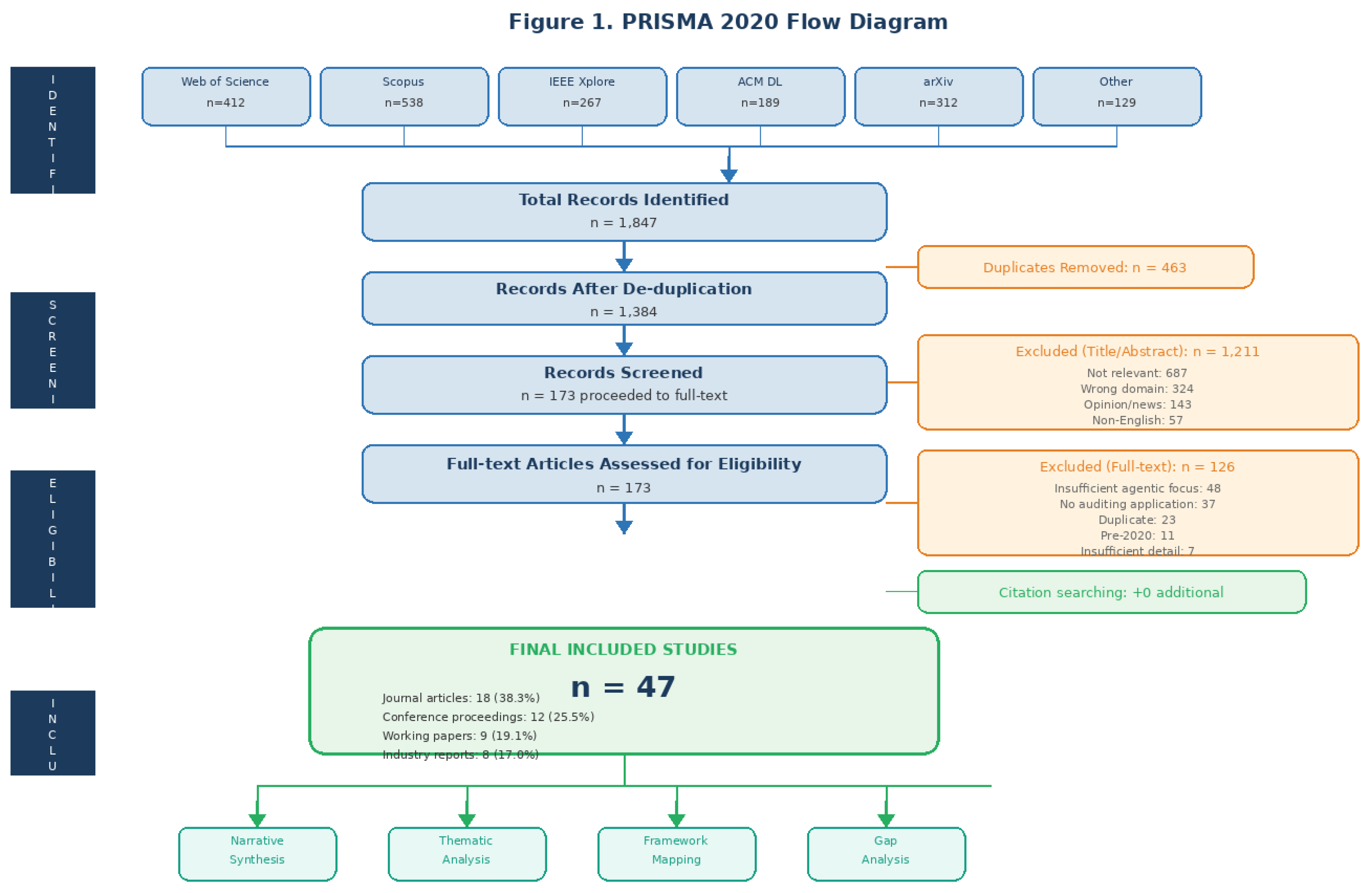
Figure 3.
Temporal Distribution of Included Studies (2020–2026) with publication type breakdown, showing exponential growth following LLM breakthroughs.
Figure 3.
Temporal Distribution of Included Studies (2020–2026) with publication type breakdown, showing exponential growth following LLM breakthroughs.
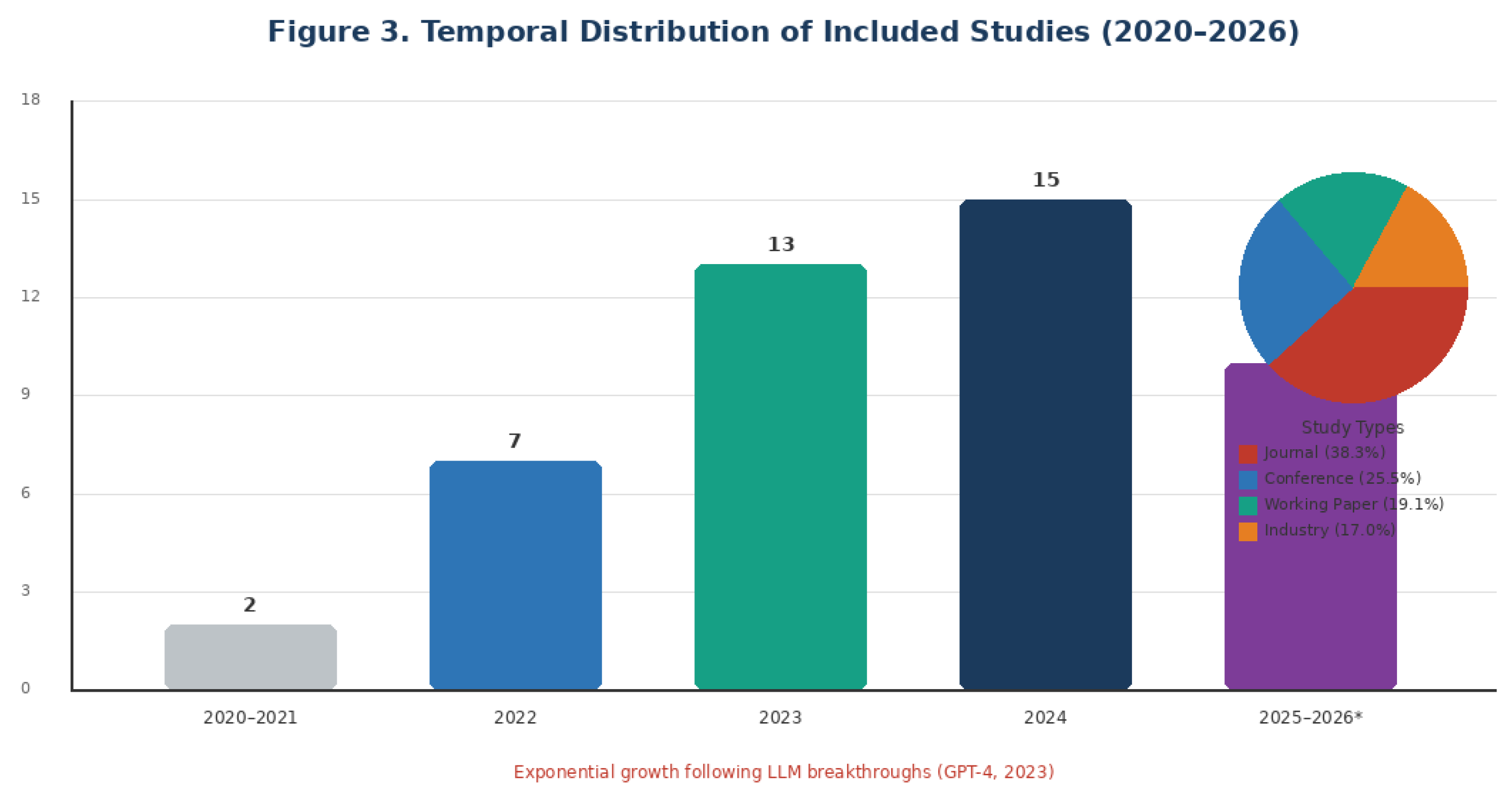
Figure 4.
Five Primary Application Domains of Agentic AI in Auditing with key use cases and performance metrics for each domain.
Figure 4.
Five Primary Application Domains of Agentic AI in Auditing with key use cases and performance metrics for each domain.
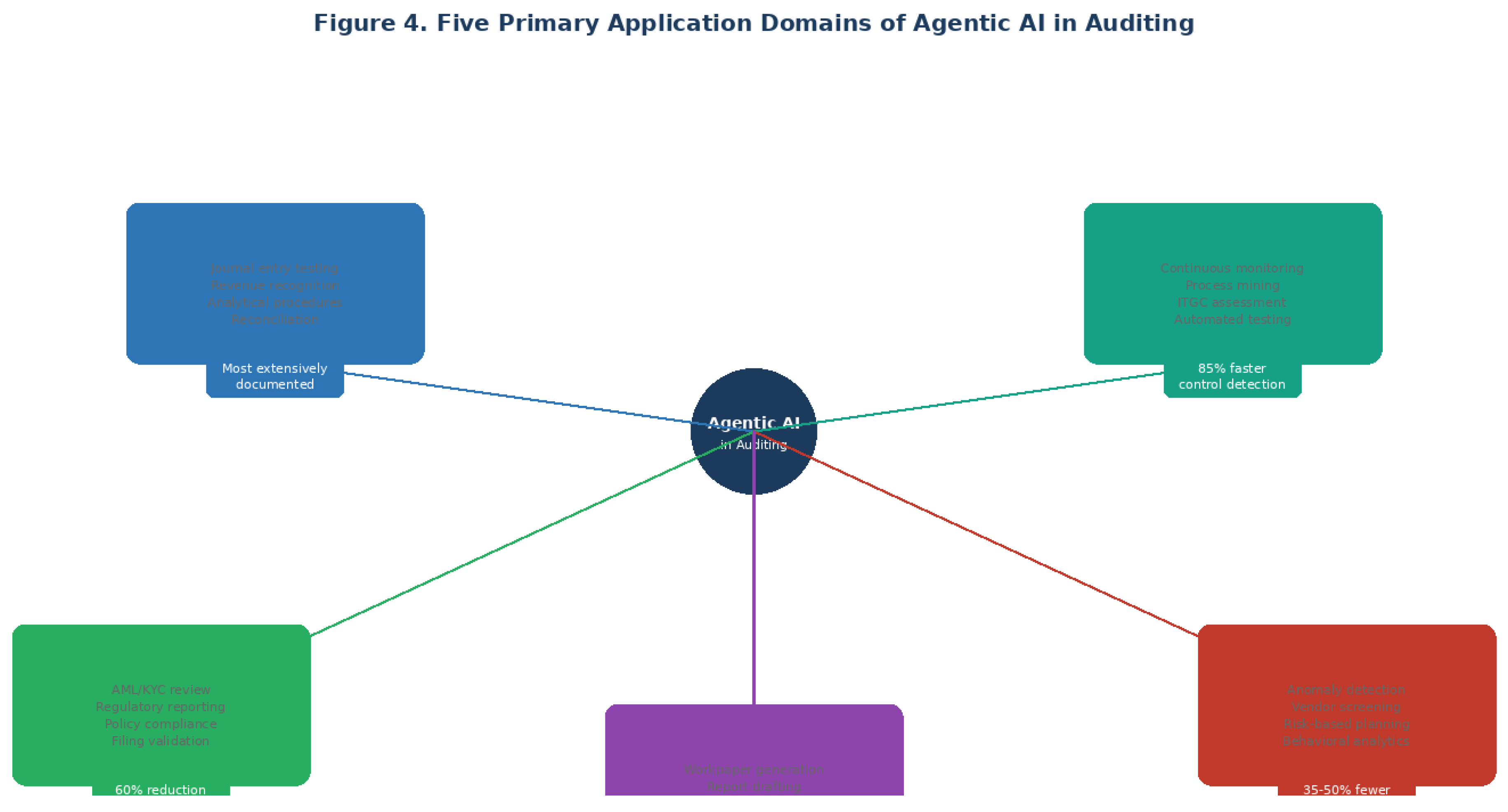
Figure 6.
Key Challenges and Limitations of Agentic AI in Auditing, organized by seven primary categories with frequency of citation in the literature.
Figure 6.
Key Challenges and Limitations of Agentic AI in Auditing, organized by seven primary categories with frequency of citation in the literature.
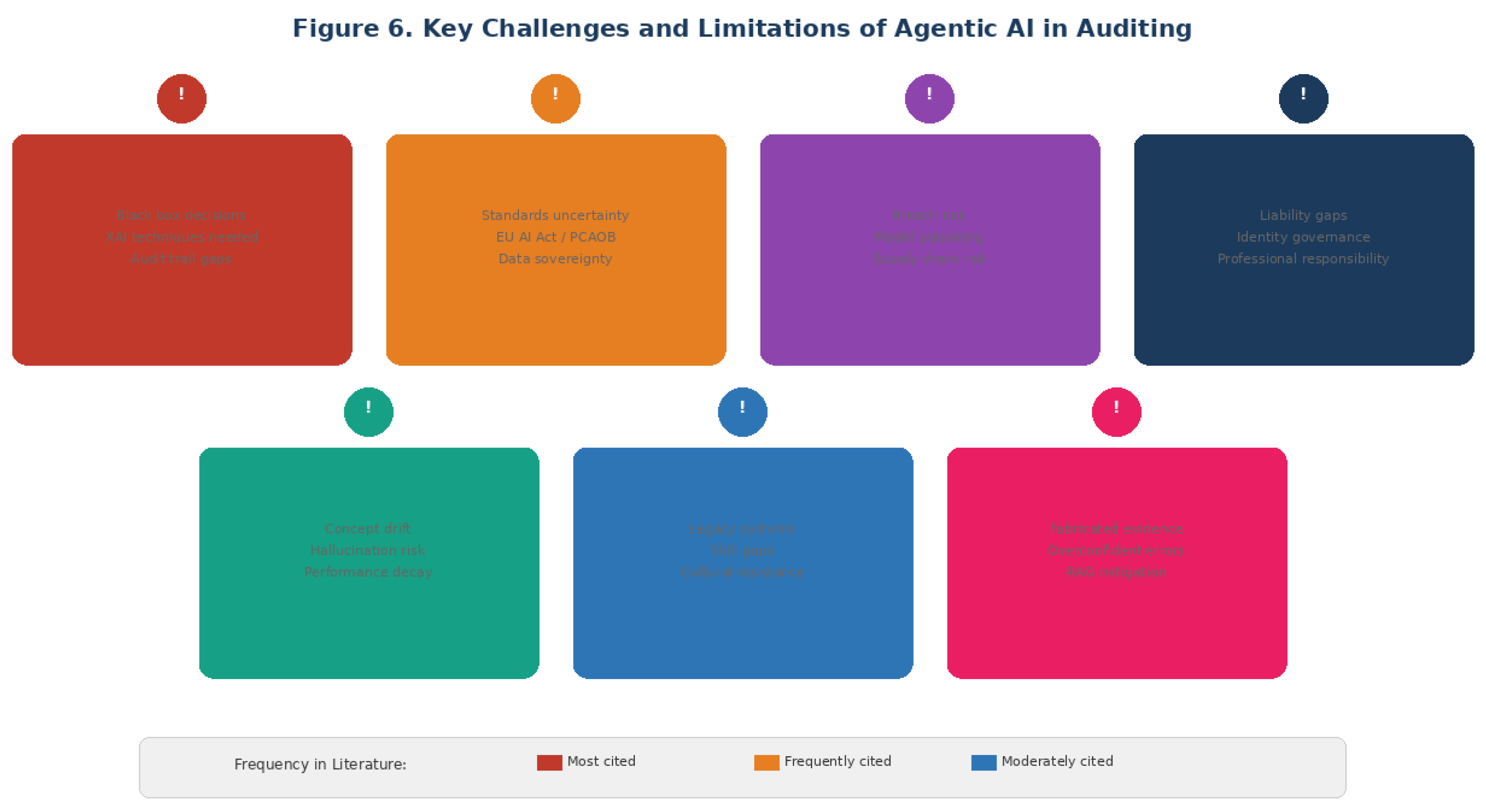
Table 1.
Comparison of Traditional AI and Agentic AI in Auditing Contexts.
| Dimension | Traditional AI | Agentic AI |
|---|---|---|
| Decision-making | Rule-based or pattern recognition with predefined outputs | Autonomous reasoning and planning with emergent strategies |
| Task scope | Single, well-defined tasks | Complex, multi-step procedures requiring orchestration |
| Human interaction | Requires explicit instruction for each step | Interprets high-level objectives and determines execution path |
| Adaptability | Static algorithms requiring retraining | Dynamic adjustment based on context and intermediate findings |
| Transparency | Explainable through feature importance or rules | Black-box decision chains requiring specialized audit trails |
| Learning | Offline learning from training data | In-context learning and experience accumulation across engagements |
Disclaimer/Publisher’s Note: The statements, opinions and data contained in all publications are solely those of the individual author(s) and contributor(s) and not of MDPI and/or the editor(s). MDPI and/or the editor(s) disclaim responsibility for any injury to people or property resulting from any ideas, methods, instructions or products referred to in the content. |
© 2026 by the authors. Licensee MDPI, Basel, Switzerland. This article is an open access article distributed under the terms and conditions of the Creative Commons Attribution (CC BY) license.
Copyright: This open access article is published under a Creative Commons CC BY 4.0 license, which permit the free download, distribution, and reuse, provided that the author and preprint are cited in any reuse.


