

Submitted:
10 June 2026
Posted:
11 June 2026
You are already at the latest version
Abstract
A pair of recent case–control studies (Bittoni et al., 2024, 2026) reported that dual use of combustible cigarettes (CC) and electronic cigarettes (EC) carries a substantially elevated risk of lung cancer relative to smoking alone, including for early-onset lung disease. We argue that these findings are likely strongly influenced by differential exposure ascertainment. In both studies, lung cancer cases were identified through hospital encounters in which risk-factor documentation was likely systematic, whereas EC use among controls was captured through routine outpatient records, where EC exposure was incomplete. The documented prevalence of EC use among controls was several-fold lower than contemporaneous U.S. and Ohio population estimates matched by age and geography, while cigarette smoking prevalence was high. This pattern is consistent with under-ascertainment of EC use in controls and consequent inflation of the reported dual-use odds ratios. In contrast, the ratio of dual use to cigarette smoking among cases was not elevated relative to comparable CDC general-population estimates. National SEER trends also do not support the hypothesis that EC use has produced an emerging signal of early-onset lung cancer: incidence has declined across major histologic subtypes and age strata since 2000, with the steepest declines observed among adults under 50 during the period of greatest EC market growth. Future studies should validate electronic medical record–based EC exposure capture and more precisely characterize EC use prevalence, timing, duration, intensity, former smoking, and exclusive EC use before drawing causal inferences about lung cancer risk.
Keywords:
lung cancer
; smoking
; vaping
; electronic cigarettes
; exposure misclassification
1. Introduction
We read with interest two case‒control analyses by Bittoni and colleagues, linking the dual use of cigarette (CC) smoking and electronic cigarette (EC) use with a substantially elevated risk of lung cancer relative to smoking alone. In the first study, which included 4,975 lung cancer cases in adults of all ages and 27,294 controls, the authors reported a comorbidity-adjusted dual-use odds ratio of 38.7 compared with 9.6 for cigarette smokers, an approximately fourfold difference in the odds ratios [1].
In a subsequent analysis restricted to early-onset lung cancer cases, defined as those diagnosed before 50 years of age, the authors reported an odds ratio of 13.8 for dual users versus 5.0 for exclusive cigarette smokers among 257 cases and 2,921 controls. They also reported higher odds of pulmonary adenocarcinoma among dual users than among exclusive cigarette smokers [2].
These findings, if valid and causal, have important implications for tobacco harm reduction policy and EC product regulation. Specifically, such findings suggest that dual use is not a transitional or reduced-risk pattern of use but may instead confer greater lung cancer risk than smoking alone [3,4,5]. However, both case‒control analyses raise substantial concerns regarding the differential measurement of EC exposure between cases and controls, which could bias the estimated association. This commentary identifies a likely source of exposure misclassification common to both studies and assesses the plausibility of the reported control-group prevalence of EC use using contemporaneous U.S. and Ohio population data. This finding contrasts with the early-onset lung cancer hypothesis advanced in the 2026 paper, with national trends showing greater recent reductions in pulmonary cancers in younger adults than in older adults. Finally, recommendations for future studies are provided, including the need to more precisely and accurately characterize the prevalence, timing and duration of EC use.
2. Differential ascertainment of e-cigarette exposure
Cases in Bittoni et al. were drawn from hospital encounters (2013–2021) at the Ohio State University Medical Center, where pathologically confirmed lung cancer would have triggered comprehensive case documentation, including systematic coding of candidate risk factors. Controls, by contrast, were ascertained from outpatient annual checkups, where documentation of EC use depended on either the patient’s self-report or the clinician’s asking a forced-choice response regarding current vaping and recording the response in the electronic medical record (EMR). These ascertainment methods are not equivalent measures of EC exposure, and a nontrivial fraction of EC use among controls is likely to be undocumented rather than absent. Differential exposure ascertainment between cases and controls is a recognized source of bias in case‒control analyses, with odds ratios biased upward when exposure is more completely recorded for cases than for controls. In the present study, the magnitude of this bias can be assessed by comparing documented EC prevalence among controls with external population-based estimates.
3. Evidence of e-cigarette undercount in the control sample
In the 2024 case‒control study (n=4,975 lung cancer cases of all ages; n=27,294 controls; median control age in the mid-60s), the documented prevalence of current cigarette smoking in the electronic medical records among controls was 37.6%, whereas the documented prevalence of current vaping was 0.80% [1]. The ratio of vaping to cigarette smoking in the control group was therefore approximately 2.1% (219/10,255). The authors describe their data as concordant with U.S. population estimates. However, MMWR surveillance data for the relevant calendar window (2013–2021) and age strata indicate that the ratio of current EC use to current cigarette use was approximately 7–13% in adults aged 65+ and 15–19% in adults aged 45–64 over that time period [6,7,8,9,10,11,12,13]. Ohio-specific surveillance data (2017–2021) yield 9.1–11.7% and 14.6–19.0% for these strata, respectively [14,15]. The control sample of Bittoni et al. (2024) therefore exhibits approximately one-tenth to one-fourth the rate of EC use observed in age- and geography-matched population data (Figure 1A).
This disjoint persisted in the 2026 follow-up, which was restricted to early-onset cases, in which ~80% of the control sample was 40–50 years old and the remainder was younger.2 In that study, the prevalence of cigarette smoking among controls was 39.4% (1,150/2,921), while the prevalence of vaping was 1.5% (45/2,921), yielding an EC-to-CC ratio of 3.9% (45/1,150). The corresponding MMWR ratios are approximately 15–19% among adults aged 45–64 and 21–52% among adults aged 25–44, with Ohio-specific ratios of 14.6–19.0% and 35–75% for these strata, respectively [14,15,16].
EC use among controls in both studies appears to be undercounted by a factor of three to five relative to population benchmarks (Figure 1B). Both studies reported no exclusive EC users in the control sample, a finding more consistent with under-ascertainment than with a true zero prevalence of exclusive EC use. If the control group exposure prevalence is depressed by a factor of three to five, the dual-use odds ratio is correspondingly inflated. Recovery of an unbiased estimate would require either validation of EMR exposure capture at the annual physical encounter or substitution of a corrected reference distribution.
4. Compared with the national CDC data of the general population, the dual-use rates of the cases did not appear to be elevated
While the prevalence of vaping appeared artificially low in the control group of Bittoni et al., dual use did not appear to be elevated in the case samples relative to what was seen in the general population in comparable age ranges in the CDC data.
In the Bittoni 2024 study, 89.3% of the case sample smoked cigarettes (including dual use), and 6.3% vaped (only dual use was reported). The ratio of DU to CC prevalence was thus 7.1%. This population had a median age in the mid-60s (see Table 1). Strikingly, the CDC data indicate that this ratio is consistent with patterns seen in the general (noncancer) population. In 2017, this ratio was 10% for those aged 45–64 years and 4% for those aged 65+ [17].
Similarly, in the case sample of the Bittoni 2026 study, 77.7% smoked cigarettes (including dual use), and 7.8% vaped. The ratio of DU to CC prevalence was thus 10.0%. This population was primarily 40–50 years old, with <20% being under 40 years old. In the corresponding CDC data, this ratio was 10% for those aged 45–64 years and 14% for those aged 25–44 years.
5. Population trends indicate that the incidence of lung cancer has declined, particularly in younger populations
If EC use was a meaningful contributor to lung carcinogenesis at the magnitudes implied by Bittoni et al. (2024), with dual-use increasing risk by ~40-fold across the full adult age range, a measurable inflection in U.S. lung cancer incidence should have begun to emerge as EC market penetration accelerated after the mid-2010s. The 2026 follow-up further advances the specific hypothesis that EC use contributes to an increase in early-onset pulmonary adenocarcinoma. National surveillance data are not consistent with either claim. SEER incidence rates have declined steadily across all four major histologic subtypes (adenocarcinoma, squamous cell, large cell, and small cell) and across all three age strata (under 50, 50–65, and 65 and older) from 2000 through 2023, with the steepest declines observed in the stratum under 50 years of age (Figure 2). Pulmonary adenocarcinoma in adults under age 50 declined from approximately 2.0 to 1.2 per 100,000 between 2000 and 2022, with the average annual percentage change accelerating from −1.2% during 2000–2012 to −3.9% during 2013–2022 [18]. The acceleration of the decline during the period of greatest EC market penetration, in every age stratum and every cell type, is the opposite of what a population-level carcinogenic signal from EC use would be expected to produce.
6. Limited exposure characterization: absence of exclusive EC use and former smoking in the database
Beyond the question of the validity of EC use metrics in the outpatient sample, an important limitation of both studies is the limited characterization of EC use exposure, which was acknowledged by the authors. Lung cancer risk from cigarette smoking is strongly related to cumulative exposure, including duration and intensity of use (i.e., cigarette pack-years), age at initiation, and time since cessation. The same principles would be expected to apply when evaluating lung cancer risk from EC use. [19,20] Without information on cumulative EC exposure, it was not possible to determine whether the duration of exposure to EC toxicants was sufficient to be biologically plausible, or whether EC use occurred too recently to have meaningfully exacerbated lung cancer development.
These exposure details are important because lung cancer risk reflects cumulative exposure over time. If EC use was recent, intermittent, or initiated in response to smoke-related illness, it would be unlikely to explain incident lung cancer and could instead reflect reverse causation or attempts to quit smoking [21]. Similarly, without a separate analysis of exclusive EC users, these studies cannot determine whether EC use contributes independently to lung cancer risk or whether the observed associations among dual users reflect residential confounding by cigarette smoking history. There was also a notable absence of information about former smoking, which is critical for fully understanding the impact of tobacco use on lung cancer.
7. Discussion
The internal validity of a case‒control study rests on the equivalent measurement of exposure across the case and control samples. Across both Bittoni et al.’s analyses, EC use in cases was likely captured through systematic risk-factor coding accompanying a cancer diagnosis, whereas EC use in controls was captured through routine outpatient documentation. The resulting control-group prevalence is implausibly low relative to age- and geography-matched population estimates. This differential is consistent with the inflation of the reported odds ratios for the dual-use category in both the 2024 and 2026 reports, with the larger 2024 dataset accounting for the more striking absolute effect sizes.
In the literature, the strongest apparent evidence for a multiplicative effect of smoking and vaping comes from a recent pair of population-based meta-analyses [22,23]. A close look at their methods, however, reveals a critical circularity of logic. For 55 of the references, the disease odds ratios (ORs) for dual use were not measured but imputed: the authors multiplied the CC-use OR by the EC-use OR reported in each original study. A key figure then plots the ratio (OR_DU)/(OR_CC). Because OR_DU was defined as OR_CC × OR_EC, this ratio is algebraically forced to equal the EC odds ratio. The figure therefore circularly reproduces an assumption rather than testing one. A recent reanalysis revealed that this approach overstates the effect of dual use by as much as fourfold because multiplying the component ORs presupposes that the EC and CC use patterns are independent—an assumption that does not hold [19,20,24]. Furthermore, many of the underlying references did not quantify duration and intensity of use across all tobacco products, which limited the accuracy and interpretability of the results.
Additionally, a recent observational study in Korea reported a higher incidence of lung cancer in people who smoked who switched to e-cigarettes vs. quit using other means [25]. This study, with its large sample size and longitudinal data, could have been an important adjunct to the Bittoni studies, however its imprecisions render it uninterpretable, and a more precise replication study is warranted. Key concerns include category errors (misclassifying heated tobacco product users as e-cigarettes users), lack of quantification of time quit, lack of verification of sustained cigarette quitting between waves that were 5 years apart, and lack of tracking product use during a ~3 year prospective period. The criticisms of the second reviewer of this study are available as supplementary materials and provide more details of limitations in the interpretability of the study.
These observations should not be read as exoneration of EC use as a health concern. EC use clearly has pulmonary and cardiovascular effects relative to nonuse, and prevention of initiation in nicotine nonusers is an important and relevant goal. The proliferation of unregulated EC products outside the FDA premarket review framework warrants continued surveillance, and the question of absolute and relative cancer risk attributable to EC use, particularly among long-term initiators, remains open and clinically important. Moreover, if ECs are risk reducing for those who switch away from smoking, that message could benefit millions of adults who still smoke [19,20]. The authors are encouraged to undertake a validation study of EMR exposure capture, ideally by comparing forced-choice EC use questions administered through a research-grade intake against the corresponding annual-physical EMR coding for the same individuals. Such validation would permit re-estimation of the relevant odds ratios under a corrected exposure distribution and would materially strengthen the inference base for regulatory and clinical recommendations.
Institutional Review Board Statement
This research was conducted in accordance with the Declaration of Helsinki and the Belmont Report. IRB review and further consent agreements were not applicable because only publicly available deidentified data were used (exempt under the U.S. Office of Human Research Protections requirement 45 CFR 46.104(d)(2)).
Informed Consent Statement
Not applicable.
Acknowledgments
A preliminary comment was also posted on PubPeer, a peer review forum [25].
Conflicts of Interest
G.C. is a salaried employee of the Rose Research Center (RRC), an independent contract research organization that performs studies pertaining to smoking cessation and tobacco harm reduction. The founder of the RRC, Dr. Jed Rose, invented the nicotine patch and performed foundational research leading to varenicline/Chantix. Research support for other projects has been received from the National Institute on Drug Abuse; Global Action to End Smoking, Inc. (formerly Foundation for a Smoke-Free World, Inc.), a U.S. nonprofit 501(c)(3) private foundation; Nicotine BRST LLC; JUUL Labs; Altria; Embera Neurotherapeutics, Inc.; Otsuka Pharmaceutical; Swedish Match; and Philip Morris International. G.C. was previously a Principal Scientist at JUUL Labs and was employed at Nektar Therapeutics, whose pipeline included an inhaled nicotine replacement therapy (NRT). G.C. holds stock in Qnovia, a developer of an inhaled NRT, and in JUUL Labs. This critique was not commissioned or instigated by any external entity. S.C.’s research contribution was supported by NIH/FDA grant U54 CA229972. The content is solely the responsibility of the authors and does not necessarily represent the official views of the NIH or the FDA.
References
- Bittoni, Marisa A.; Carbone, D.P.; Harris, R.E. Vaping, Smoking and Lung Cancer Risk. J. Oncol. Res. Ther. 2024, 9(3). [Google Scholar] [CrossRef]
- Bittoni, M.A.; Carbone, D.P.; Harris, R.E. Vaping, smoking and risk of early onset lung cancer. Front Oncol. 2026, 15, 1741978. [Google Scholar] [CrossRef] [PubMed]
- Jackson, S.E.; Shahab, L.; McNeill, A.; Rigotti, N.A.; Bullen, C.; Brown, J. To regulate vaping we need pragmatic, evidence-based policy. Nat. Hum. Behav. 2026, 10(5), 828–30. [Google Scholar] [CrossRef] [PubMed]
- Ling, P.M.; Glantz, S.A. E-cigarettes increase harm and should be discouraged. Nat. Hum. Behav. 2026, 10(5), 831–3. [Google Scholar] [CrossRef] [PubMed]
- Stewart, B.W.; Marshall, H.; Bonevski, B.; Griffin, H.J.; Hopkins, A.M.; Itchins, M.; et al. The carcinogenicity of e-cigarettes: a qualitative risk assessment. Carcinogenesis 2025, 47(1), bgag015. [Google Scholar] [CrossRef] [PubMed]
- Hu, S.S.; Neff, L.; Agaku, I.T.; Cox, S.; Day, H.R.; Holder-Hayes, E.; et al. Tobacco Product Use Among Adults — United States, 2013–2014. MMWR Morb. Mortal. Wkly. Rep. 2016, 65(27), 685–91. [Google Scholar] [CrossRef] [PubMed]
- Phillips, E.; Wang, T.W.; Husten, C.G.; Corey, C.G.; Apelberg, B.J.; Jamal, A.; et al. Tobacco Product Use Among Adults — United States, 2015. MMWR Morb. Mortal. Wkly. Rep. 2017, 66(44), 1209–15. [Google Scholar] [CrossRef] [PubMed]
- Jamal, A.; Phillips, E.; Gentzke, A.S.; Homa, D.M.; Babb, S.D.; King, B.A.; et al. Current Cigarette Smoking Among Adults — United States, 2016. MMWR Morb. Mortal. Wkly. Rep. 2018, 67(2), 53–9. [Google Scholar] [CrossRef] [PubMed]
- Wang, T.W.; Asman, K.; Gentzke, A.S.; Cullen, K.A.; Holder-Hayes, E.; Reyes-Guzman, C.; et al. Tobacco Product Use Among Adults — United States, 2017. MMWR Morb. Mortal. Wkly. Rep. 2018, 67(44), 1225–32. [Google Scholar] [CrossRef] [PubMed]
- Creamer, M.R.; Wang, T.W.; Babb, S.; Cullen, K.A.; Day, H.; Willis, G.; et al. Tobacco Product Use and Cessation Indicators Among Adults — United States, 2018. MMWR Morb. Mortal. Wkly. Rep. 2019, 68(45), 1013–9. [Google Scholar] [CrossRef] [PubMed]
- Cornelius, M.E.; Wang, T.W.; Jamal, A.; Loretan, C.G.; Neff, L.J. Tobacco Product Use Among Adults — United States, 2019. MMWR Morb. Mortal. Wkly. Rep. 2020, 69(46), 1736–42. [Google Scholar] [CrossRef] [PubMed]
- Cornelius, M.E.; Loretan, C.G.; Wang, T.W.; Jamal, A.; Homa, D.M. Tobacco Product Use Among Adults — United States, 2020. MMWR Morb. Mortal. Wkly. Rep. 2022, 71(11), 397–405. [Google Scholar] [CrossRef] [PubMed]
- Cornelius, M.E.; Loretan, C.G.; Jamal, A.; Davis Lynn, B.C.; Mayer, M.; Alcantara, I.C.; et al. Tobacco Product Use Among Adults—United States, 2021. MMWR Morb. Mortal. Wkly. Rep. 2023, 72(18), 475–83. [Google Scholar] [CrossRef] [PubMed]
- Explore E-Cigarette Use in Ohio | AHR [Internet]. 29 May 2026. Available online: https://www.americashealthrankings.org/explore/measures/eciguse/eciguse_45_64%2FOH.
- Explore Smoking in Ohio | AHR [Internet]. 29 May 2026. Available online: https://www.americashealthrankings.org/explore/measures/Smoking/Smoking_45_64_C%2FOH.
- Hu, S.S. Tobacco Product Use Among Adults — United States, 2013–2014. MMWR Morb. Mortal. Wkly. Rep. 2016, 65. [Google Scholar] [CrossRef] [PubMed]
- Arrazola, R.A. Notes from the Field: Tobacco Product Use Among Adults — United States, 2017–2023. MMWR Morb. Mortal. Wkly. Rep. 2025, 74. [Google Scholar] [CrossRef] [PubMed]
- NIH; National Cancer Institute. SEER*Explorer Application [Internet]. 29 May 2026. Available online: https://seer.cancer.gov/statistics-network/explorer/application.html.
- Cohen, G.; Cook, S.; Selya, A. Comprehensive Dose–Response Assessment Can Improve the Precision and Accuracy of Cross-Sectional Studies of Dual Use. Nicotine Tob. Res. 2026, ntag017. [Google Scholar] [CrossRef]
- Cohen, G.; Cook, S. Observational studies of exposure to tobacco and nicotine products: Best practices for maximizing statistical precision and accuracy. iScience 2025, 28(3), 111985. [Google Scholar] [CrossRef] [PubMed]
- Stokes, A.; Collins, J.M.; Berry, K.M.; Reynolds, L.M.; Fetterman, J.L.; Rodriguez, C.J.; et al. Electronic Cigarette Prevalence and Patterns of Use in Adults with a History of Cardiovascular Disease in the United States. JAHA 2018, 7(9), e007602. [Google Scholar] [CrossRef] [PubMed]
- Glantz, S.A.; Nguyen, N.; Oliveira Da Silva, A.L. Population-Based Disease Odds for E-Cigarettes and Dual Use versus Cigarettes. NEJM Evid. 2024, 3(3). [Google Scholar] [CrossRef] [PubMed]
- Glantz, S.A.; Oliveira Da Silva, A.L. Comparison of e-Cigarette and Cigarette Use and Dual Use Associations With Disease: Updated Systematic Review and Meta-Analysis. Public Health Rep. 2026, 00333549251403349. [Google Scholar] [CrossRef] [PubMed]
- Wang, R.J.; Bhadriraju, S.; Glantz, S.A. E-Cigarette Use and Adult Cigarette Smoking Cessation: A Meta-Analysis. Am. J. Public Health 2021, 111(2), 230–46. [Google Scholar] [CrossRef] [PubMed] [PubMed Central]
- Cohen, G. Pubpeer [Internet] Comments on: Vaping, smoking and risk of early onset lung cancer. 2026. Available online: https://pubpeer.com/publications/AFD42D658210D7A783DFD555A62EE0.
Figure 1.
Ratio of electronic cigarette use to combustible cigarette use, 2013–2021. (a) The EC-to-CC ratio observed in the control group of Bittoni et al. (2024) (~2.1%; outpatient medical record; median age in the mid-60s, 40% <60 years) is approximately fivefold lower than the CDC NHIS estimates for age-comparable U.S. adults (45–64 and 65+ years) over the same period. (b) The same pattern is observed by Bittoni et al. (2026), whose control group is primarily 40–50 years old (>80%), with the remainder being under 40 years old. The observed control-group ratio (~3.9%) is again approximately fivefold lower than the CDC NHIS estimates for the corresponding age strata (25–44 and 45–64 years). Both studies relied on passive EMR documentation of EC use during outpatient encounters rather than a forced-choice tobacco use questionnaire, the standard NHIS instrument.
Figure 1.
Ratio of electronic cigarette use to combustible cigarette use, 2013–2021. (a) The EC-to-CC ratio observed in the control group of Bittoni et al. (2024) (~2.1%; outpatient medical record; median age in the mid-60s, 40% <60 years) is approximately fivefold lower than the CDC NHIS estimates for age-comparable U.S. adults (45–64 and 65+ years) over the same period. (b) The same pattern is observed by Bittoni et al. (2026), whose control group is primarily 40–50 years old (>80%), with the remainder being under 40 years old. The observed control-group ratio (~3.9%) is again approximately fivefold lower than the CDC NHIS estimates for the corresponding age strata (25–44 and 45–64 years). Both studies relied on passive EMR documentation of EC use during outpatient encounters rather than a forced-choice tobacco use questionnaire, the standard NHIS instrument.
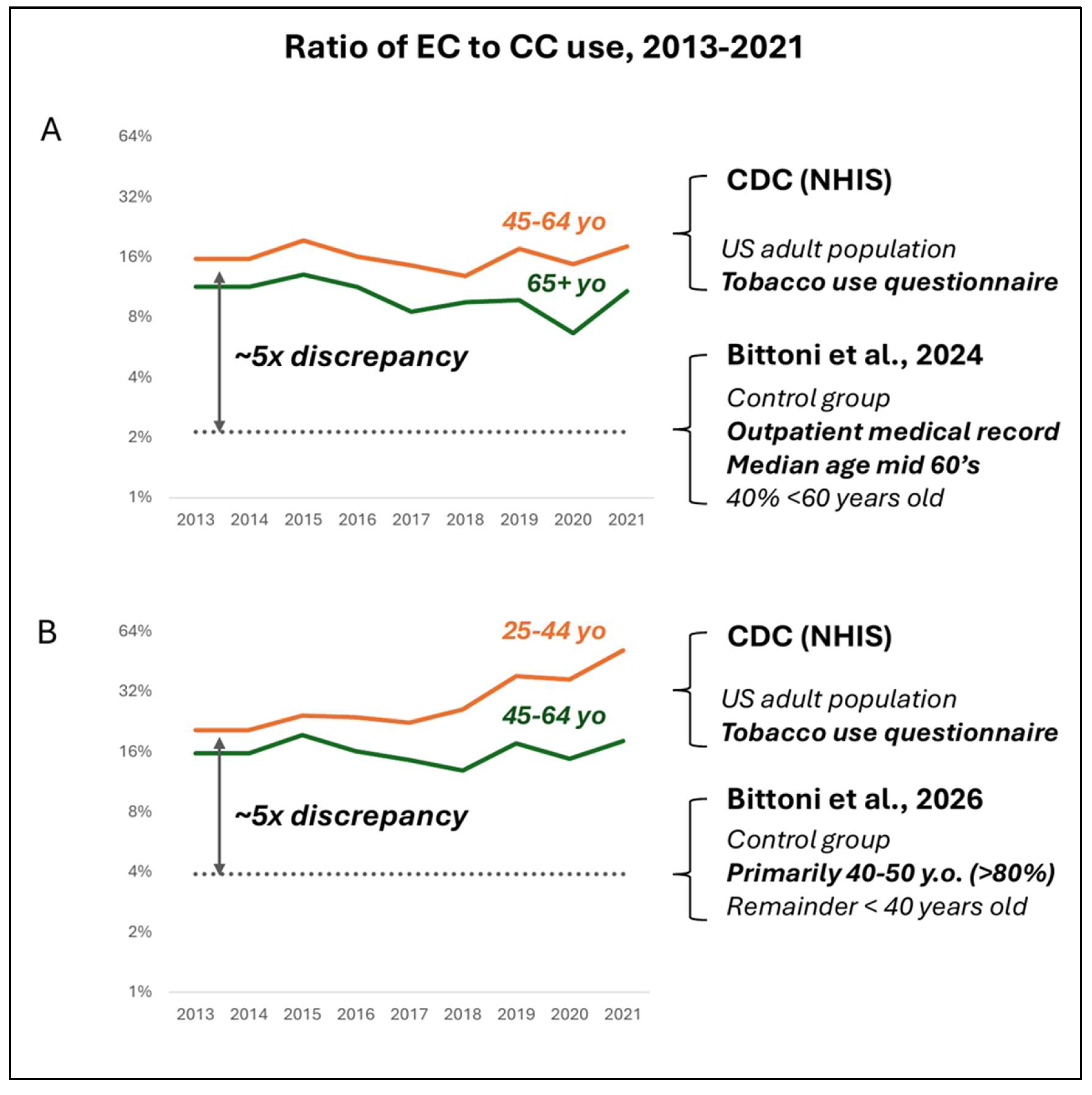
Figure 2.
Pulmonary carcinoma incidence in the United States, 2000–2023 (SEER, NIH). (a) Incidence relative to the year 2000 (indexed to 100%) for adenocarcinoma, squamous cell, large cell, and small cell carcinoma, stratified by age group (65+, 50–65, and <50 years). (b) Corresponding age-stratified incidence rates per 100,000 people plotted on a log scale. Across all four histologic subtypes and all three age strata, the incidence declines steadily over the observation window, with the steepest declines observed in the stratum under 50 years (red, dotted).
Figure 2.
Pulmonary carcinoma incidence in the United States, 2000–2023 (SEER, NIH). (a) Incidence relative to the year 2000 (indexed to 100%) for adenocarcinoma, squamous cell, large cell, and small cell carcinoma, stratified by age group (65+, 50–65, and <50 years). (b) Corresponding age-stratified incidence rates per 100,000 people plotted on a log scale. Across all four histologic subtypes and all three age strata, the incidence declines steadily over the observation window, with the steepest declines observed in the stratum under 50 years (red, dotted).
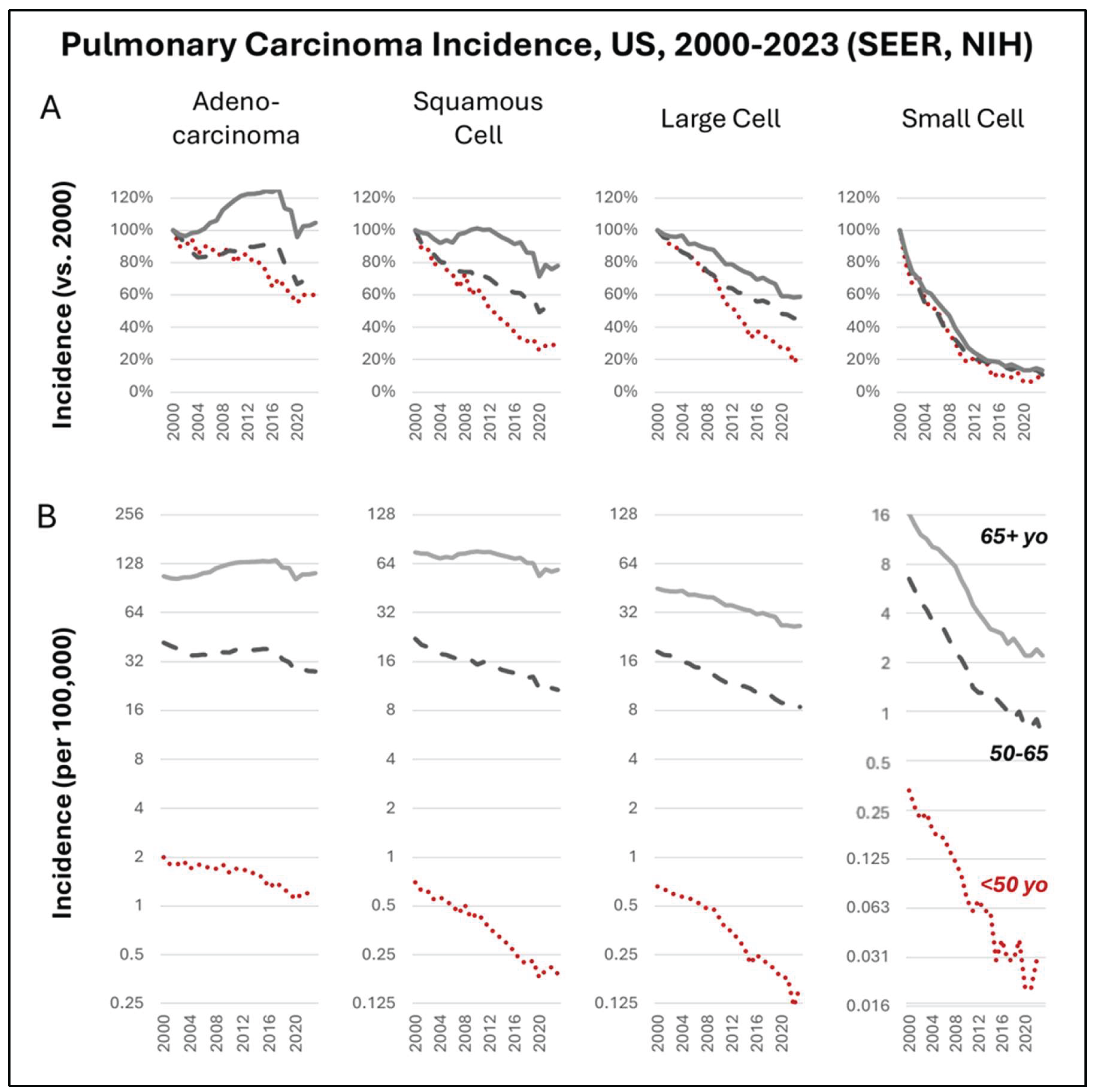

Table 1.
The ratio of dual-use to smoking prevalence was comparable in the case samples of Bittoni et al. and in the general population.
Table 1.
The ratio of dual-use to smoking prevalence was comparable in the case samples of Bittoni et al. and in the general population.
| Sample | Age range | CC use prevalence | Dual use prevalence | Ratio of DU to CC |
|---|---|---|---|---|
| NHIS, US Population, 2017 | 25-44 | 13.9% | 1.9% | 14% |
| 45-64 | 14.7% | 1.5% | 10% | |
| 65+ | 7.5% | 0.3% | 4% | |
| Bittoni 2024, Cases | Median mid-60’s | 89.3% | 6.3% | 7.1% |
| Bittoni 2026, Cases | Primarily 40-50 | 77.7% | 7.8% | 10.0% |
Disclaimer/Publisher’s Note: The statements, opinions and data contained in all publications are solely those of the individual author(s) and contributor(s) and not of MDPI and/or the editor(s). MDPI and/or the editor(s) disclaim responsibility for any injury to people or property resulting from any ideas, methods, instructions or products referred to in the content. |
© 2026 by the authors. Licensee MDPI, Basel, Switzerland. This article is an open access article distributed under the terms and conditions of the Creative Commons Attribution (CC BY) license (http://creativecommons.org/licenses/by/4.0/).
Copyright: This open access article is published under a Creative Commons CC BY 4.0 license, which permit the free download, distribution, and reuse, provided that the author and preprint are cited in any reuse.


