

Submitted:
10 June 2026
Posted:
12 June 2026
You are already at the latest version
Abstract
Smart cities increasingly depend on chip-centered digital infrastructure, whose resilience is closely constrained by the upstream supply of semiconductor manufacturing equipment. Disruptions in lithography equipment trade may propagate downstream and threaten the security of urban digital systems. Existing studies on semiconductor trade networks have paid limited attention to the timing of long-term structural shifts and the mechanisms through which external shocks reshape network organization. Drawing on UN Comtrade data of lithography equipment from 2010 to 2024, this study employs complex network analysis to develop an integrated topological–spatial analytical framework. It combines break detection, event mapping, community evolution analysis, node role identification, and critical channel assessment. The results show that the global lithography equipment trade network has evolved into a structure characterized by core concentration, alliance-based community differentiation, and increasing dependence on critical cross-community channels. The findings suggest that, to enhance the resilience of chip-centered urban digital infrastructure, smart-city risk governance should: (1) be extended upstream to critical manufacturing equipment, (2) monitor high-leverage cross-community trade pathways as systemic-risk indicators, (3) prioritize alternative pathways and redundant configurations involving emerging brokerage nodes and upgrading core nodes. From the perspective of global high-end equipment, this study provides an empirical basis for assessing the resilience of smart-city digital infrastructure, particularly in identifying upstream critical dependencies, structural vulnerabilities, and potential systemic risks under external shocks.
Keywords:
lithography equipment trade network
; topological structure analysis
; spatial structure evolution
; smart-city supply-chain resilience
; complex network analysis
1. Introduction
Smart cities increasingly rely on chip-centered digital infrastructure, including Internet of Things devices, intelligent transportation systems, urban sensing networks, edge-computing facilities, and data centers[1]. This dependence improves urban operational efficiency, but it also brings the infrastructure vulnerability [2]: disruptions in upstream digital-technology supply chains may be transmitted downstream and affect the stable operation of smart-city systems. Among the upstream foundations of smart-city digital infrastructure, semiconductors are particularly critical. They support not only computing and communication systems, but also sensors, intelligent terminals, automated-control systems. Industry reports by the Semiconductor Industry Association and Boston Consulting Group suggest that the global semiconductor supply chain is shifting from a purely efficiency-oriented configuration toward a resilience-oriented configuration under heightened geopolitical and regulatory pressures[3]. Recent studies on semiconductor supply-chain resilience show that geopolitical tensions, export controls, and capacity shortages have become major risk sources. Xiong et al.[4] synthesized the evidence on semiconductor supply-chain disruptions and point out that vulnerabilities are embedded in the highly specialized and globally distributed structure of the industry. Moktadir et al.[5] identified geopolitical tensions as one of the most influential factors affecting semiconductor supply-chain resilience.
Lithography equipment occupies a particularly strategic position in the semiconductor supply chain. As a critical manufacturing technique, advanced lithography directly shapes wafer-fabrication capability and influences the performance and technological upgrading of chips[6]. Recent trade network evidence further shows that the global trade of lithography machine is highly concentrated among a small number of core economies, with strong path dependence and significant institutional constraints such as the Wassenaar Arrangement[7]. Therefore, risks of lithography equipment trade networks may represent upstream technological bottlenecks that affect semiconductor manufacturing capacity and the security of downstream digital infrastructures. Recent research on semiconductor supply networks has increasingly shifted from firm-level or product-level analysis to network-level vulnerability assessment. Yu et al.[8] constructed a directed weighted network of semiconductor materials and assessed its structural resilience and vulnerability. Liu et al. [9] examined the robustness of chip trade networks by incorporating topology and cascading risk propagation. These studies suggest that semiconductor-related risks should be understood not only as isolated supply interruptions, but also as systemic risks that may diffuse through trade networks.
Existing research has provided important insights into the structure of semiconductor trade networks. Using complex network analysis, scholars have examined network features, community structure, and node role changes in the global semiconductor industry. Ou et al. [10] analyzed the patterns of the global semiconductor productions (involving raw materials, mechanical equipment, and finished products) based on trade networks. It shows that semiconductor productions are embedded in a complex international division of labor. Li et al. [11] constructed a global semiconductor trade network covering raw materials, equipment, and components, revealing the structural features and robustness of semiconductor trade networks from an industry-chain perspective. Furthermore, Zhang and Zhu[12] examined that the equipment trade network exhibits a pronounced core-periphery hierarchy, with trade linkages highly concentrated among a small number of technological countries. Policy-oriented studies have also mapped cross-country dependencies in semiconductor value chains[13]. These studies demonstrate that the semiconductor trade system is not evenly distributed, but is shaped by concentration, hierarchy, and differentiated dependence across industrial-chain segments.
Related studies have also shown that semiconductor trade networks are increasingly shaped by alliance formation and geopolitical fragmentation[14][15]. Indicators such as modularity, the trade proportion of intra or inter community , and block-network sparsification are commonly used to characterize community differentiation and spatial agglomeration. Further studies have applied Exponential Random Graph Models (ERGMs), considering explanatory variables such as geographical distance, institutional ties, and geopolitical shocks, to reveal the evolutionary mechanisms of trade networks[16]. Fu and Ding’s study shown that the community structure of the chip trade network exhibits a multi-centric hierarchical pattern characterized by “core-subcore-periphery”[17]. Some studies have examined the propagation mechanisms of external shocks within trade networks[18], and investigated how factors such as national economic development, international market openness, and technological innovation capacity shape semiconductor trade structures[19]. These studies provide useful references for understanding the spatial structure of high-technology equipment trade networks.
Nevertheless, two limitations remain in the existing literature. First, existing studies often describe network structure through static or cross-sectional indicators, while paying less attention to the timing and mechanisms of long-term structural change. In particular, it remains unclear when significant structural breaks occur in the lithography equipment trade network, how these breaks correspond to external shocks such as geopolitical tensions, institutional linkages, or export-control constraints, and how such changes alter the network’s vulnerability. Second, existing studies have not sufficiently identified the dynamic shifts in network power centers and changes in critical trade channels. There remains a lack of systematic explanation of how external shocks jointly shape alliance formation, fragmentation, and restructuring in the lithography equipment trade network.
From a topological perspective, a highly centralized network may offer coordination advantages under normal conditions, but it may also increase systemic vulnerability when critical hubs, suppliers, or intermediary links are disrupted[20]. Therefore, topological analysis is useful for identifying structural dependence. This is particularly relevant for smart-city infrastructure risk management, because disruptions in upstream semiconductor manufacturing equipment may reduce chip supply stability and delay the upgrading of digital infrastructure. From a spatial-structural perspective, chip trade robustness indicates that trade relationships are not only determined by market efficiency, but also by geographical proximity, technological capability, institutional ties, and policy shocks[21][22]. In this context, community detection and role classification can be used to examine whether the trade network is evolving toward more cohesive communities, whether power centers are shifting among major economies, and whether bridge countries or critical channels are becoming more important. Such analysis can reveal the spatial logic of network restructuring.
Against this background, lithography equipment as a highly strategic upstream segment, which may differ from general semiconductor trade networks because of its stronger technological exclusiveness, higher market concentration, and greater sensitivity to export-control constrains. This study investigates the structure of global lithography equipment trade network from both topological and spatial perspectives. First, it characterizes the long-term evolution of the network’s topological structure and identify potential structural breaks. Second, it examines the spatial restructuring of the network through community detection, node-role classification, and changes in critical trade channels. Third, it interprets how geopolitical shocks, institutional linkages, and export-control constraints may jointly restructure the network.
The main contributions are as follows. First, this study develops a topological analysis framework that integrates structural break detection with event mapping. Unlike conventional cross-sectional comparisons across selected years, this study identifies structural breakpoints in the trade network over a continuous time series, thereby providing temporal evidence for characterizing the evolutionary process. Second, this study develops a dynamic explanatory mechanism for the reconfiguration of the spatial pattern of trade networks. Specifically, it examines community restructuring and power shifts in the lithography equipment trade network. By integrating the timing of structural breaks with the process of spatial pattern adjustment, this study deepens the explanation of spatial reconfiguration mechanisms from three dimensions: alliance adjustment, node-role evolution, and critical channel change.
The contribution of this study to smart-city infrastructure risk management lies in its upstream perspective. By revealing the concentration, dependence, community structure, and possible restructuring mechanisms of the lithography equipment trade network, this study provides empirical evidence for identifying upstream supply-chain vulnerabilities that may affect the resilience of chip-centered digital infrastructure. This perspective can support more forward-looking risk assessment and resilience-oriented planning for smart-city infrastructure systems.
2. Methodology
Based on global trade data of lithography equipment, this study constructs both weighted directed and weighted undirected networks. It develops an integrated three-step analytical framework, as illustrated in Figure 1. First, a static topological analysis is conducted to characterize the network in terms of scale, connectivity, reachability, and concentration. Second, structural break detection is applied to identify years in which the network undergoes significant topological change. Third, a stage-wise spatial analysis is performed to trace changes in community structure, member migration, and power shifts. Through this stepwise design, the analysis connects network topology, temporal transition, and spatial reconfiguration, thereby providing the methodological basis for evaluating how upstream trade dynamics may affect the resilience of chip-centered smart-city digital infrastructure.
2.1. Data Sources and Preprocessing
Global trade data of lithography equipment (HS code: 848620) are obtained from the United Nations Commodity Trade Statistics Database (https://comtrade.un.org/) for the period 2010-2024. Records with missing values are removed, and annual country-level trade networks are constructed accordingly.
2.2. Network Construction
(1) Weighted Directed Network
Based on the trade import-export relationships in the lithography industry among countries, this study designs a weighted directed network G = (V, E, W) using graph theory. The node set represents all countries participating in the global trade of the lithography industry. The edge set consists of ordered pairs of nodes, denoted as , representing the export trade relationship from country to country . The weight function quantifies the trade volume for each edge. For example, indicates the export volume from country to country .
- (2)
- Weighted Undirected Network
To characterize the overall intensity of trade linkages, this study further constructs a weighted undirected network. For any pair of nodes in the network, the export value from country to country and the export value from country to country are summed to define the edge weight of the node pair .
2.3. Network Topological Metrics
This study characterizes the topological features of the global lithography equipment trade network from four dimensions: network scale, structural connectivity, network reachability, and trade concentration. The definitions are presented in Table 1. Network scale serves as a indicator of whether the trade network is expanding or contracting. Structural connectivity reflects the richness of connections among nodes. Network reachability captures the efficiency of which resources or shocks can spread through the network. Trade concentration helps identify potential single-point vulnerabilities and major sources of systemic risk.
2.4. Spatial Evolution Analysis
First, this study identifies the structural breaks of the global lithography equipment trade network based on the time series of topological indicators. Second, it analyzes the community structure, member migration, and power shifts of the trade network across different break stages, revealing the evolutionary process of the spatial pattern within the global lithography equipment trade network.
2.4.1. Change-Point Detection
First, all the topological indicators are standardized using z-score normalization to eliminate scale effects. Principal component analysis is applied to extract the first three principal components. Based on the resulting principal-component score series, structural break detection is performed using the Pruned Exact Linear Time (PELT) algorithm with an L2 cost function[23].
2.4.2. Community Detection
To avoid interference from incidental fluctuations in a single year, this study constructs observation windows covering the three years for each break point, and builds weighted directed networks for each window. Following Traag et al.[24], the Leiden algorithm is adopted as the primary method of community detection , while the Louvain algorithm is used for robustness checks. Normalized Mutual Information (NMI) is employed to quantify the consistency of the community partitions obtained from the two algorithms.
Considering the community labels generated by the Leiden and Louvain algorithms are random, this study applies the Hungarian Algorithm to optimally align community labels across adjacent windows. It enables the tracking of cross-window migration among community members.
2.4.3. Spatial Structural Metrics
As shown in Table 2, the community structure indicators characterize the alliance formation in the network and the dependency relationships among alliances. The member migration indicators capture the temporal stability of community, while the power shift indicators characterize the process of network power reconfiguration at both the node and edge levels.
To systematically reveal the underlying mechanisms of network power reconfiguration, following Guimerà and Amaral[25], this study classifies nodes into different topological roles using the within-module degree z-score (Z) and the participation coefficient (PC). Considering several node roles are rarely observed in the empirical network and are unlikely to form meaningful trade linkages, this study defines five types of edges, as shown in Table 3.
2. Experiments
2.1. Topological Structure Analysis
(1) Trade value is becoming concentrated in core nodes and channels.
Figure 2 shows that, in the early stage (2010-2015), both the number of nodes and edges in the global lithography equipment trade network increased steadily. This indicates that an increasing number of countries were incorporated into the trade system, accompanied by a simultaneous expansion of trade linkages. Thereafter, both the number of nodes and edges generally declined from their previous high levels and entered a phase of fluctuating adjustment, suggesting that the network did not continue along a path of broad expansion but shifted toward structural contraction and relational reconfiguration.
In contrast, total trade value continued to grow rapidly in the middle and later stages, with a particularly marked acceleration after 2019. Notably, in 2020, both the number of nodes and edges declined, while total trade value increased significantly. This indicates that, under external shocks, trade became further concentrated among a small number of core countries and critical channels. By 2023-2024, both total trade value and the number of edges had declined, suggesting that intensified geopolitical constraints and export controls had begun to exert substantive effects on the global lithography equipment trade.
(2) The network remains stably connected while evolving toward more efficient transmission.
Figure 3 shows that, during the sample period, both the proportion of the largest weakly connected component and network density remained at relatively high levels, with only slight declines in a few individual years. This indicates that the network remains connected and stable structure. Meanwhile, the average shortest path length generally declined, and global efficiency improved overall, suggesting a continuous enhancement in network reachability and transmission efficiency. Notably, since 2022, the network has demonstrated higher operational efficiency while maintaining overall connectivity. This suggests that the global lithography equipment trade network has not become fragmented under external shocks; it has gradually evolved into a structural configuration characterized by strong connectivity and high transmission efficiency.
(3) Network concentration gradually disperses over the long term.
Figure 4 shows that, before 2018, the concentration level of the global lithography equipment trade network remained relatively high. This indicates that trade relationships were largely concentrated among a small number of core countries and critical channels, with network control exhibiting a clear core-dominated pattern. Thereafter, the HHI continued to decline, with a more pronounced decrease during 2018-2023, suggesting that the global trade pattern shows the diversification tendency while maintaining the core-dominated structure. In 2024, the HHI rebounded significantly, indicating that against the intensified geopolitical constraints and export controls, the previously dispersing trade pattern became reconcentrated among a small number of core countries.
2.1. Spatial Evolution Analysis
Based on the loading matrix of all the topological indicators, this study extracts the first three principal components, whose cumulative variance reaches 88.36%, indicating that the original information is sufficiently retained. Meanwhile, the penalty parameter of the change-point detection algorithm is set as ln(N) according to the standard Bayesian Information Criterion . Given a sample length of N=15, the corresponding penalty parameter is 2.71.
Four change points are identified. (1) 2013 is the only year during the sample period in which the network exhibits signs of fragmentation, reflecting the lagged impact of the cyclical downturn in the global semiconductor industry in 2012 on lithography equipment trade. (2) 2015 marks a significant expansion in network scale, reflecting the effects of the global investment boom in the semiconductor industry. In particular, China launched Phase I of the National Integrated Circuit Industry Investment Fund, while emerging economies in Southeast Asia and the Middle East accelerated the development of semiconductor packaging and testing capabilities. (3) 2017 is characterized by the large-scale withdrawal of peripheral participants while the total trade value was increased, indicating that the global lithography equipment trade network began to shift toward high-value concentration. This change is highly consistent with the commercialization of ASML’s Extreme Ultraviolet(EUV) Lithography equipment. (4) 2020 witnessed continued growth in trade value but a marked decline in concentration, suggesting that the network had formed a new balance characterized by “high trade value and low concentration”. On the one hand, the COVID-19 pandemic triggered a global chip shortage, significantly amplifying demand for semiconductor equipment. On the other hand, countries accelerated the development of domestic semiconductor production capacity, contributing to greater diversification in export sources. Given that the United States further tightened semiconductor export controls against China starting in October 2022, and considering the transmission of such policy shocks has a clear time lag, this study also treats 2023 as a change point.
This study constructs observation windows covering the three years before and after each change point: 2012-2014, 2014-2016, 2016-2018, 2019-2021, and 2022-2024. As shown in Table 4, the number of communities identified by the Leiden and Louvain algorithms, as well as their NMI values, remain highly consistent across the observation windows, indicating that the community detection results are generally reliable. It should be noted that the relatively lower NMI values in 2012-2014 and 2014-2016, which are associated with the unstable community affiliation. They are caused by a large number of peripheral nodes during these stages, which do not affect the identification of the core community structure.
3.2.1. Community Structure Characteristics
(1) The community structure shifts from high concentration toward relative differentiation.
Figure 5a shows that the number of communities remains 2-3 across all observation windows, indicating that the global lithography equipment trade network is dominated by a limited number of core communities. Figure 5b shows a continuous decline of R_LC(the proportion of nodes in the largest community), suggesting that the control exerted by a single dominant community over global trade is weakening. This change is not merely the result of spontaneous market differentiation. Rather, it is closely associated with intensifying geopolitical competition, strengthened institutional constraints, and the continued technology controls in recent years.
(2) The trade network shifts from industrial division toward alliance configuration.
Figure 5c shows that, during the first three periods before 2018, the modularity continued to decline, indicating that community boundaries were not yet clearly defined. This period coincided with the commercialization of EUV lithography equipment, during which core equipment supply, component provision, and end-market demand remained strongly interconnected at the global scale, giving the trade network an integrated structure. In the fourth period, the modularity increased significantly and remained at a high level in the fifth period. Meanwhile, T_inter (the proportion of inter-community trade value) continued to rise as shown in Figure 5d. This indicates that community boundaries were increasingly reinforced while inter-community linkages were also more intensive. This shift is highly consistent with the escalation of U.S.-China technological competition since 2018. In particular, after allies such as the Netherlands and Japan successively introduced related restrictions, the global lithography equipment trade network began to shift from the industrial division of labor toward a reorganized configuration jointly shaped by geopolitical competition, institutional constraints, and technology controls.
(3) Communities become more internally cohesive, while inter-community increasingly relies on critical channels.
Figure 5e shows that R_ID (the ratio of intra to inter community edge density) is greater than 1 across all observation windows, indicating that intra-community linkages are consistently stronger than inter-community linkages. During the first three periods before 2018, R_ID continued to increase, while T_inter (the proportion of inter-community trade value) remained relatively low. This suggests that early network evolution was primarily characterized by the stable internal coordination relationship. In the fourth period, R_ID declined slightly, where T_inter increased markedly, indicating that under global shocks such as the escalation of U.S.-China technological competition, the COVID-19 pandemic, and the global chip shortage, the lithography equipment trade network maintained operation by strengthening inter-community linkages. In the fifth period, both R_ID and T_inter increased simultaneously, suggesting that the lithography equipment trade network entered a new stage characterized by stronger internal cohesion and more critical external linkages. This indicates that, after the United States further tightened semiconductor export controls against China in October 2022, followed by allies such as the Netherlands and Japan, the lithography equipment trade network did not become genuinely fragmented, but maintained connectivity through more critical high-value channels.
3.2.2. Member migration Process
Figure 6 illustrates the member migration process between adjacent observation windows. The horizontal axis represents the community labels in the next window, while the vertical axis represents the community labels in the preceding window. The value in each cell indicates the number of same community members in adjacent windows (N_S). Lighter colors indicate a larger scale of migration.
Figure 6 shows that the community reconfiguration of the global lithography equipment trade network underwent three stages: from “stable continuity” to “local adjustment” and then to “deep restructuring.”
(1) Structural consolidation under the dominance of global industrial division
Stage 1 (Figure 6a,b): both the community composed of importing countries and the supply-oriented community dominated by Japan, the United States, South Korea, and the Netherlands retained a high proportion of stable members. This indicates that, during this stage, the global lithography equipment trade network primarily operated around a structure of “import demand-core supply-peripheral attachment”. This pattern is consistent with the deep globalization of the semiconductor industrial chain, in which countries greatly emphasized on efficiency allocation and market coordination.
(2) Local supply-chain adjustment under U.S.-China technological competition
Stage 2 (Figure 6c): the number of stable members declines markedly in both the “Europe and importing countries” community and the “Asia-Pacific supply region”. In particular, a large number of countries originally belonging to the European community migrated into the Asia-Pacific supply region, forming the most pronounced one-way migration. At the same time, China was grouped for the first time into the same community with Japan, the United States, South Korea, and Singapore, indicating strengthened trade linkages between China and core exporting countries. This stage suggests that, against the background of strengthened regional supply-chain linkages, the lithography equipment trade network began to shift toward regional agglomeration.
(3) Alliance restructuring under escalating export controls
Stage 3 (Figure 6d): the number of stable members in the original two dominant communities, namely the European and Asia-Pacific communities, continued to decline. These members were absorbed by the previously very small third community, which rapidly expanded into a new community. In particular, the United States, South Korea, and the Netherlands formed an “export-control alliance community”. This marks the transformation of the lithography equipment trade network from a “bipolar dominance and peripheral attachment” structure toward a tripartite configuration of “Europe, Asia-Pacific, U.S.-South Korea-Netherlands alliance”, indicating that the global trade system is shifting from functional integration toward institutional differentiation.
3.2.3. Power shift
(1) Power structure: the rise of East Asia, functional differentiation in Europe.
Table 5 shows that the United States and Germany consistently maintained dual-core positions across all observation windows, while China and Japan rose to dual-core status, indicating a gradual shift in the center of the global network toward East Asia. In the last period, the Netherlands, France, and Italy simultaneously rose to dual-core positions. Meanwhile, the United Kingdom, Switzerland, and Belgium became small-scale brokerage nodes, suggesting that the direct control of some traditional European core countries weakened, while brokerage nodes began to play the supplementary brokerage role.
South Korea declined from a dual-core position to an intra-community peripheral node, reflecting that, after being incorporated into a community dominated by stronger core countries, it was overshadowed by leading countries such as the United States and therefore moved to a secondary position. China’s Taiwan region remained for a long period as an intra-community peripheral node, indicating that although it is a significant manufacturing hub, it has not been able to maintain a stable core position in the network. Singapore and Malaysia rose to dual-core status in certain observation periods, suggesting that some countries can achieve stage-specific upward mobility by leveraging trade opportunities.
(2) Edge roles: a shift from “regional diffusion” to “cross-community corridors” since 2019.
Figure 7a shows the number and proportion of different edge types across observation windows, while Figure 7b shows the corresponding trade value and its proportion.
E1(channels between intra-community hubs) existed only during 2014-2018, which carried a trade value far exceeding their numerical share of edges. It exhibited a very high trade-value leverage ratio. This indicates that, during this stage, network control was highly concentrated in a small number of intra-community linkages. Since 2019, as community core nodes such as Japan, South Korea, and China were upgraded from R5 to R6, these linkages began to assume cross-community connectivity and global bridging functions. As a result, E1 edges were reclassified as E2 edges (channels between inter-community hubs), marking the transition of high-value core linkages from intra-community connections to cross-community brokerage channels. At the same time, network vulnerability shifted from localized agglomeration risk to systemic corridor risk.
E3 (channels connecting hubs and peripheral nodes), consistently accounted for the largest share of edges across all observation windows, stably carrying 44%-52% of the total trade value. This reflects the hub-and-spoke structure of the global lithography equipment trade network. Since 2019, E2 edges have expanded rapidly, indicating that cross-community corridors have become a key backbone with the highest leverage and vulnerability.
E4 (channels connecting hubs andbrokerage nodes) and E5 (channels between brokerage nodes), both gradually emerged after 2019 with limited scale. This indicates that the brokerage network functions only as a supplementary mechanism formed after the backbone network was exposed to external shocks.
(3) Critical channels: intensified core-to-core links among leading countries.
Table 7 shows the top three edges by trade value across observation windows. Overall, the critical channels underwent a upgrading process from E3 to E1 then to E2, with trade value increasing by 3.6 times. This indicates that the most important trade linkages have evolved from “the supply of core countries to ordinary manufacturing nodes” into “high-intensity connections among core countries”.
Specifically, during 2012-2016, edges such as USA→Taiwan, China, USA→South Korea, and Japan→Taiwan, China jointly supported a hub-spoke network backbone dominated by the United States, and East Asia serving as the main absorption region. During 2016-2018, the absorptive capacity of South Korea in the network increased rapidly, enabling to develop a demand center for advanced manufacturing. During 2019-2021, the key edge shifted from USA→Korea to Japan→China, and its role upgraded from E1 to E2, indicating that the diffusion relationship had transformed into a cross-community core corridor. During 2022-2024, Japan→China, Netherlands→China, and USA→China jointly constituted the most important trade channels, suggesting that the core supply channels for lithography equipment were re-established around the Chinese market. In particular, Japan→China accounted for as much as 10.5% of the total trade value, implying that any disruption to this channel would have a significant impact on the global trade, meaning that the core risk lies in the single-point disruption of a few cross-community corridors.
2.1. Spatial Evolution Mechanisms
(1) Alliance formation: shaped by core supply capabilities and stable trade-absorption relationships.
The empirical results show that, before 2018, the lithography equipment trade network did not exhibit clear alliance structure. Instead, it formed a relatively stable functional structure around a small number of core supplying countries and major demand markets. The member-migration results further indicate that, both the demand-oriented communities and the supply-oriented communities retained a high proportion of stable members, suggesting strong continuity in the early network structure. Role changes of nodes and edges show that alliance formation in the lithography equipment trade network was not determined simply by geographical proximity. Rather, it reflected the long-term trade interactions among core supplying countries and advanced manufacturing centers. This process represents the continuous consolidation of high-value equipment supply relationships. As a result, the global lithography equipment trade network gradually developed a spatial organization characterized by pronounced technological capability, institutional selection, and path dependence.
(2) Alliance adjustment: driven by member migration, role transformation, and the cross-community channels strengthen.
The empirical results indicate that, from 2016 to 2021 the lithography equipment trade network entered a distinct adjustment stage. Its spatial structure began to shift from a relatively stable functional pattern toward a configuration with stronger regional agglomeration. This adjustment was also reflected in role changes of nodes and edges.
Therefore, the alliance adjustment mechanism should not be understood as the simple changes in trade scale. Rather, it consists of three interrelated processes. First, community members migrated across adjacent periods, altering the original community boundaries. Second, the status of key nodes shifted from intra-community cores to cross-community cores, reshaping the power structure. Third, high-value edges shifted from connecting regional cores to cross-community cores, changing the organization of trade flows. These findings indicate that, the lithography equipment trade network achieved functional rebalancing mainly through community restructuring, role transformation, and the reconfiguration of critical channels.
(3) Alliance fragmentation: characterized by sharpening community boundaries and increasing dependence on the limited channels.
The empirical results of this study do not support the conclusion that the lithography equipment trade network has undergone overall fragmentation. On the contrary, the network shows an increasing dependence on critical channels. This potential fragmentation risk is mainly reflected in two aspects. First, community boundaries have become more pronounced, indicating stronger intra-community cohesion and increasing reliance on a small number of high-value channels to maintain inter-community linkages. Second, the concentration of critical channels has increased, with a few cross-community corridors playing a significant role in sustaining network operation. It reflects the growing dependence on a small number of core countries and limited critical channels.
2. Conclusion
2.1. Implications
Based on global trade data for lithography equipment from 2010 to 2024, this study characterizes its evolutionary features and formation mechanisms at two levels of topological structure and spatial configuration. During this period, the global lithography equipment trade network did not undergo overall fragmentation. Instead, while maintaining basic connectivity and improving transmission efficiency, it exhibited structural features with core concentration, community differentiation, and increasing dependence on critical channels. These findings provide the following implications for risk management in smart-city digital infrastructure.
- (1)
- Supply-chain risk identification for smart cities should be extended to critical manufacturing equipment. Supply-chain risk assessment for smart-city infrastructure should not remain limited to terminal equipment, system integrators, or chip products, but should further incorporate the trade network structure of upstream critical manufacturing equipment. In particular, core supplying countries, major importing markets, cross-community core channels should be included in the risk identification framework, so as to improve the ability to detect the risk transmission of upstream equipment constraints to downstream digital infrastructure.
- (2)
- A channel-monitoring mechanism for critical equipment trade networks should be established. The empirical results indicate that high-value trade in lithography equipment is increasingly dependent on a small number of cross-community core channels. For risk management in smart-city infrastructure, a monitoring list of critical equipment trade channels can be established to continuously track cross-community corridors involving core countries and trade. This would help identify potential supply risks in advance when channel concentration rises rapidly, critical edges upgrade their roles, or the trade share of a single channel increases abnormally.
- (3)
- The development of smart-city digital infrastructure should more emphasis on alternative pathways and redundant configurations. In the construction of smart-city digital infrastructure, the supply of critical equipment should not be excessively tied to a single source or channel. Based on role changes in trade network, it is advisable to identify brokerage nodes, upgrading nodes, and newly emerging cross-community core nodes that may provide supplementary connectivity. These nodes can serve as important references for supply substitution, backup procurement, and resilience-oriented configuration, thereby enhancing the continuity and recovery capacity of smart-city digital infrastructure under external shocks.
2.1. Further work
This study mainly focuses on the structural evolution and formation mechanisms of the global lithography equipment trade network. However, two important issues remain underexplored. First, this study has not yet systematically identified the specific risks embedded in the lithography machine trade network. Second, it has not examined how such risks may be transmitted, diffused, amplified across the network. In particular, when core nodes fail, critical bridging edges contract, or institutional shocks occur, how the specific risks propagate along the supply chain from upstream to downstream and further affect the operational security of smart-city-related digital infrastructure, which remain to be further revealed.
Future research will incorporate multi-agent behavioral modeling and coupled multi-risk propagation models to examine how local shocks evolve into systemic vulnerabilities. It will also identify critical risk transmission paths and their amplification mechanisms, thereby providing more targeted theoretical support and decision-making evidence for enhancing smart-city resilience.
References
- Dahmane, W.M.; Ouchani, S.; Bouarfa, H. Smart cities services and solutions: A systematic review[J]. Data Inf. Manag. 2025, 9, 100087. [Google Scholar] [CrossRef]
- Umeike, R.; Dao, T.; Crawford, S. State-of-the-art review of resilient smart cities: Progress and challenges. Urban Gov. 2025, 5(2). [Google Scholar] [CrossRef]
- SIA; BCG. Emerging resilience in the semiconductor supply chain; 2024. [Google Scholar]
- Xiong, W.; Wu, D.D.; Yeung, J.H.Y. Semiconductor supply chain resilience and disruption: insights, mitigation, and future directions. Int. J. Prod. Res. 2025, 63, 3442–3465. [Google Scholar] [CrossRef]
- Moktadir, M. A.; et al. Global semiconductor supply chain resilience challenges and mitigation strategies. Int. J. Prod. Econ. 2024. [Google Scholar] [CrossRef]
- Kazazis, D.; Garcia Santaclara, J.; van Schoot, J.; Mochi, I.; Ekinci, Y. Extreme ultraviolet lithography. Nat. Rev. Methods Prim. 2024, 4, 84. [Google Scholar] [CrossRef]
- Peng, B.W.; Wu, J.W.; Yang, Q.Q.; et al. Characteristics of change and driving factors of global lithography trade networks. Prog. Geogr. 2026, 45, 44–61. [Google Scholar] [CrossRef]
- Yu, Y.; Ma, D.; Wang, Y. Structural resilience evolution and vulnerability assessment of semiconductor materials supply network in the global semiconductor industry. Int. J. Prod. Econ. 2024, 270, 109174. [Google Scholar] [CrossRef]
- Liu, Y.; Du, C.; Shi, L. Establishing the robustness of chip trade networks by dynamically considering topology and risk cascading propagation. Sci. Rep. 2024, 14, 20863. [Google Scholar]
- Ou, S.; Yang, Q.; Liu, J. The global production pattern of the semiconductor industry: an empirical research based on trade network. Humanit. Soc. Sci. Commun. 2024, 11, 1–13. [Google Scholar] [CrossRef]
- Li, L.; Wang, H.; Li, Z.; et al. Analysis of the structure and robustness of the global semiconductor trade network. PLoS ONE 2025, 20, e0313162. [Google Scholar] [CrossRef] [PubMed]
- Zhang, Y.; Zhu, X. Analysis of the global trade network of the chip industry chain: Does the US-China tech war matter? Heliyon 2023, 9. [Google Scholar] [CrossRef] [PubMed]
- Haramboure, A.; et al. Vulnerabilities in the semiconductor supply chain. In OECD Science, Technology and Industry Working Papers; 2023. [Google Scholar]
- Kang, I.; Seo, E.Y.; Lee, D.H. The effects of knowledge network characteristics on R&D alliance formation. Technol. Anal. Strateg. Manag. 2025, 37, 1679–1693. [Google Scholar]
- Song, K.; Li, Y.; Wang, H. The Wedge Strategy and China’s Response to the US-ROK Semiconductor Alliance. Chin. J. Int. Rev. 2025, 7, 2550004. [Google Scholar] [CrossRef]
- Yan, J.; Guo, Y.; Zhang, H. The dynamic evolution mechanism of structural dependence characteristics in the global oil trade network. Energy 2024, 303, 131914. [Google Scholar] [CrossRef]
- Fu, L.; Ding, X. Restructuring of the Global Chip Trade Network: Characteristic Evolution and Driving Factors. Systems 2026, 14, 149. [Google Scholar] [CrossRef]
- Zheng, X.; Li, H.; Liu, X.; et al. Supply risk propagation in international trade networks of the tungsten industry chain. Humanit. Soc. Sci. Commun. 2025, 12, 54. [Google Scholar] [CrossRef]
- Weinan, Gu; Xinyan, Fan; Yawen, Ren; et al. The evolution and influencing factors of global semiconductor trade network. Geogr. Res. 2024, 43, 2194–2214. [Google Scholar]
- Habibi, F.; Chakrabortty, R. K.; Abbasi, A.; Ho, W. Investigating disruption propagation and resilience of supply chain networks: interplay of tiers and connections. Int. J. Prod. Res. 2025, 63(17), 6229–6251. [Google Scholar] [CrossRef]
- Wong, C.-Y.; Yeung, H. W.-C.; Huang, S.; Song, J.; Lee, K. Geopolitics and the changing landscape of global value chains and competition in the global semiconductor industry: Rivalry and catch-up in chip manufacturing in East Asia. Technol. Forecast. Soc. Change 2024, 209, 123749. [Google Scholar] [CrossRef]
- Ren, Y.; Yang, Y.; Wang, Y.; Liu, Y. Dynamics of the global semiconductor trade and its dependencies. J. Geogr. Sci. 2023, 33(6), 1141–1160. [Google Scholar] [CrossRef]
- Truong, C.; Oudre, L.; Vayatis, N. ruptures: change point detection in Python. arXiv 2018, arXiv:1801.00826. [Google Scholar] [CrossRef]
- Traag, V. A.; Waltman, L.; van Eck, N. J. From Louvain to Leiden: Guaranteeing well-connected communities. Sci. Rep. 2019, 9, 5233. [Google Scholar] [CrossRef] [PubMed]
- Guimerà, R.; Amaral, L. A. N. Functional cartography of complex metabolic networks. Nature 2005, 433(7028), 895–900. [Google Scholar] [CrossRef] [PubMed]
Figure 1.
The integrated topological–spatial analytical framework.
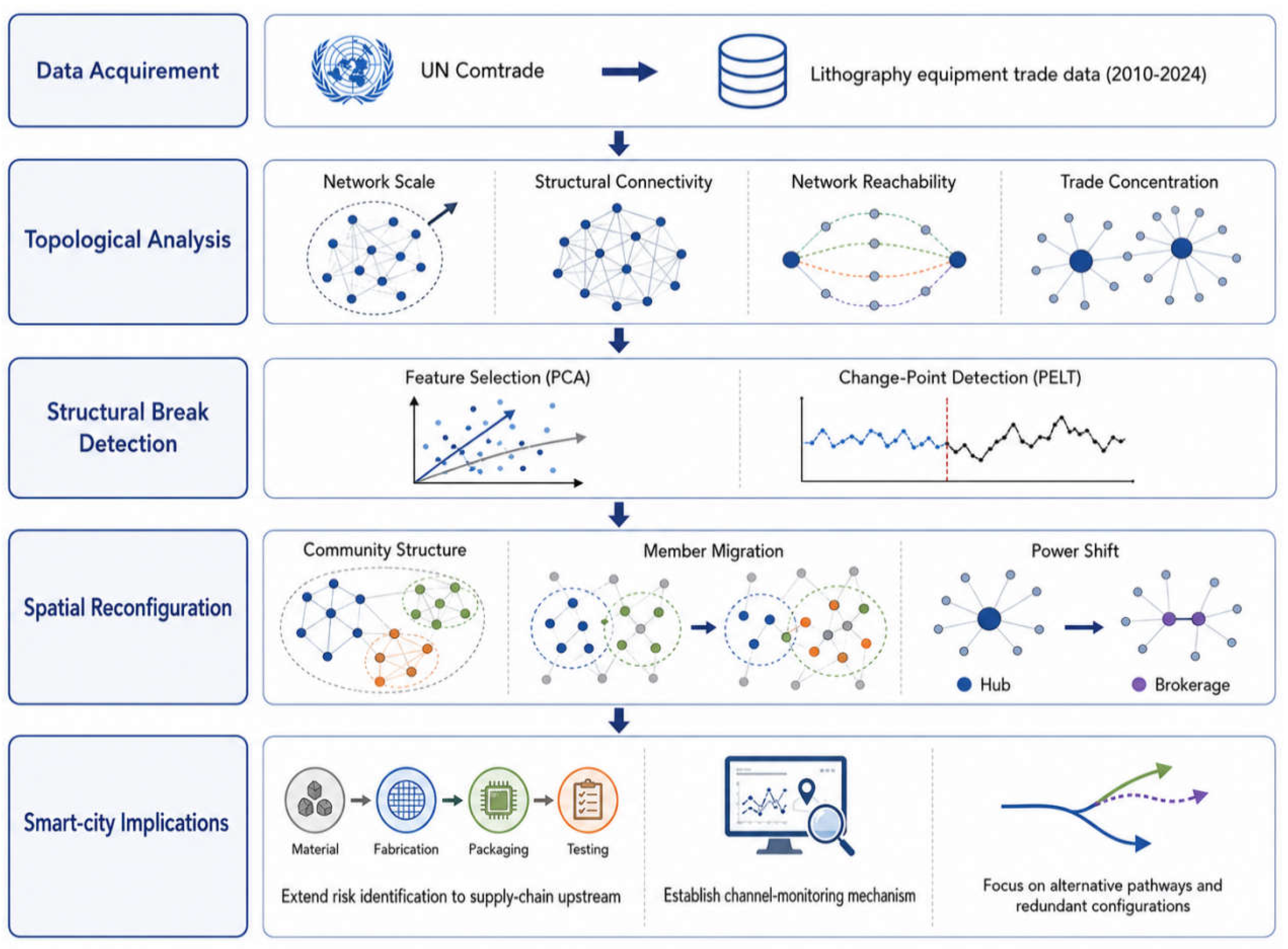
Figure 2.
Changes in the scale of the global lithography equipment trade network from 2010 to 2024.
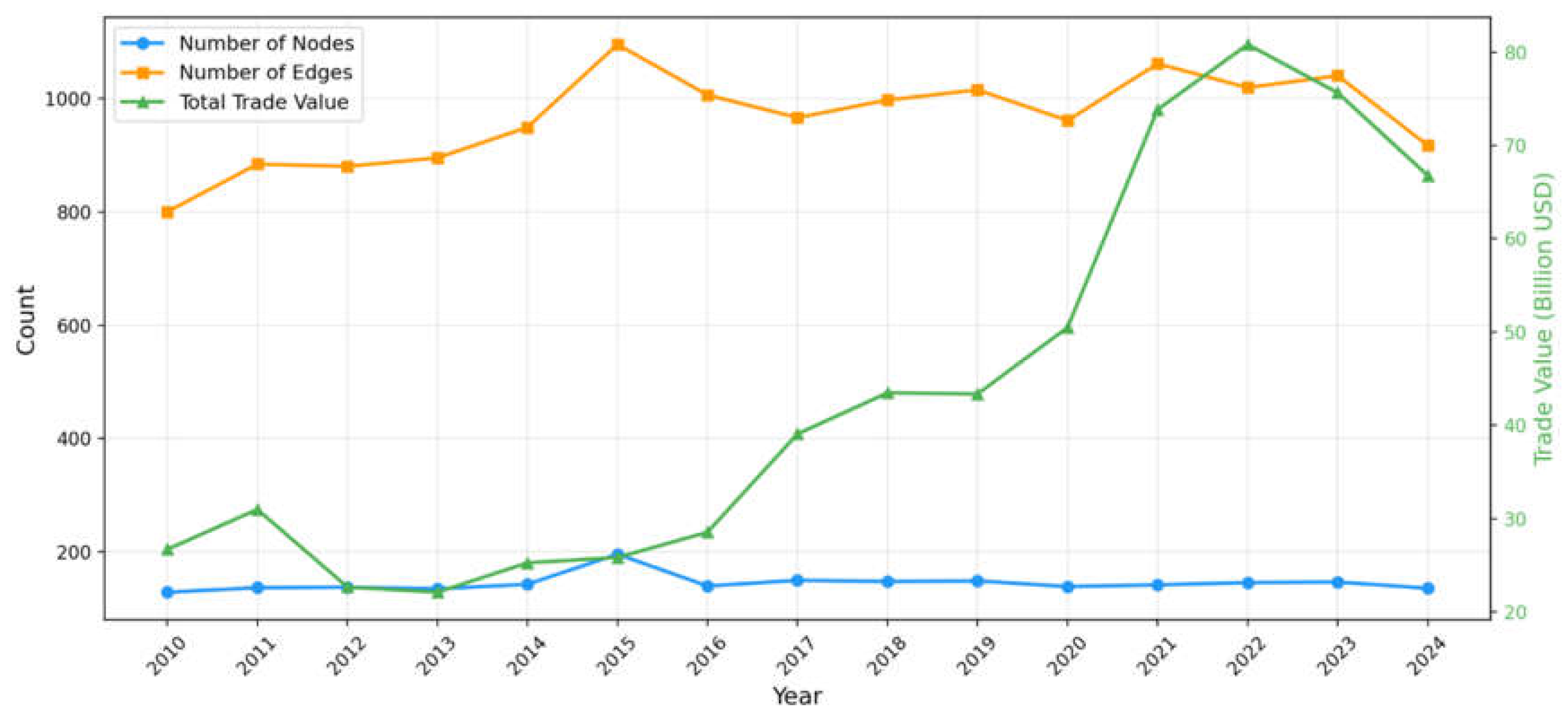
Figure 3.
Changes in the connectivity of the lithography equipment trade network from 2010 to 2024.
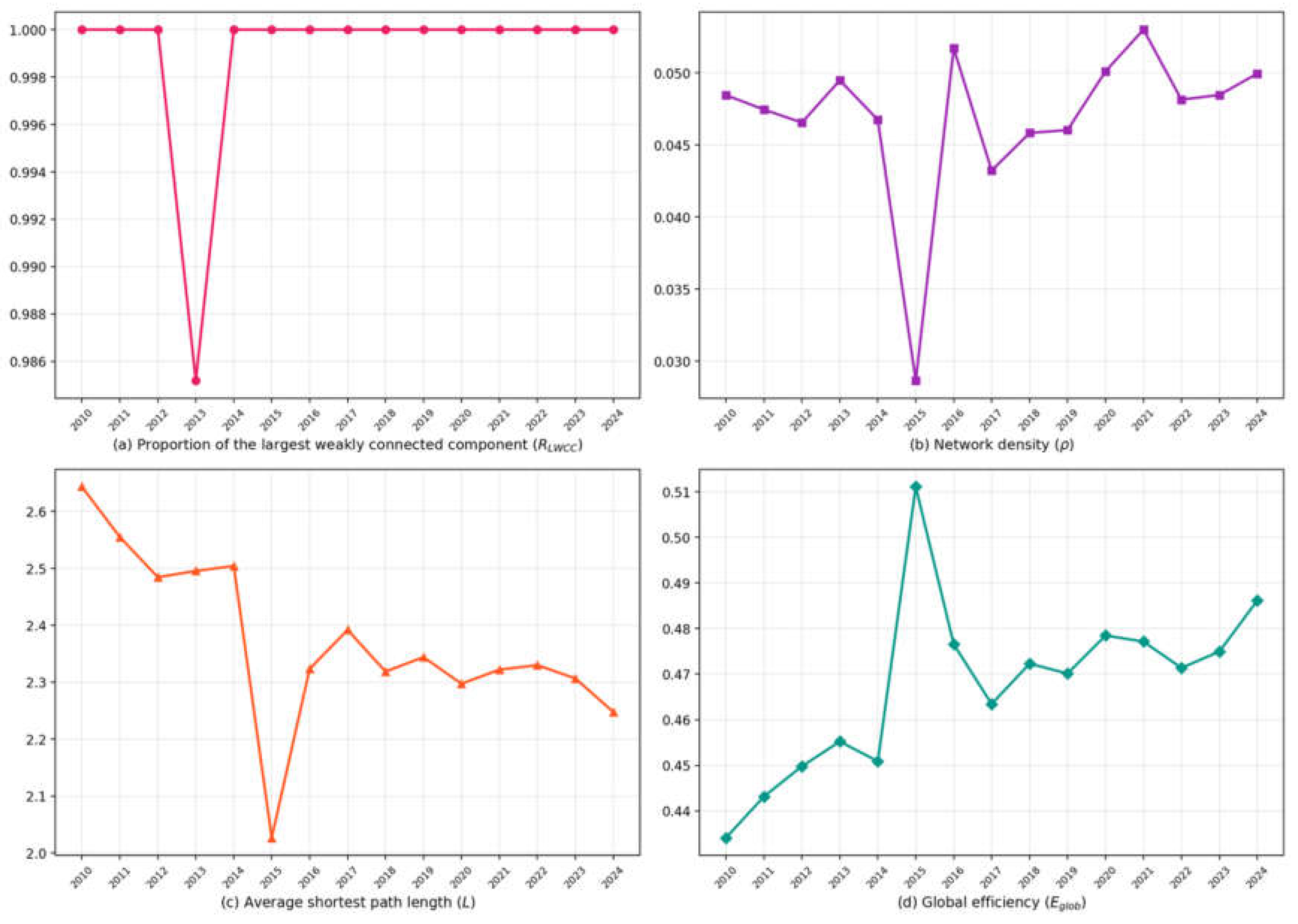
Figure 4.
Changes in the concentration of the lithography equipment trade network from 2010 to 2024.
Figure 4.
Changes in the concentration of the lithography equipment trade network from 2010 to 2024.
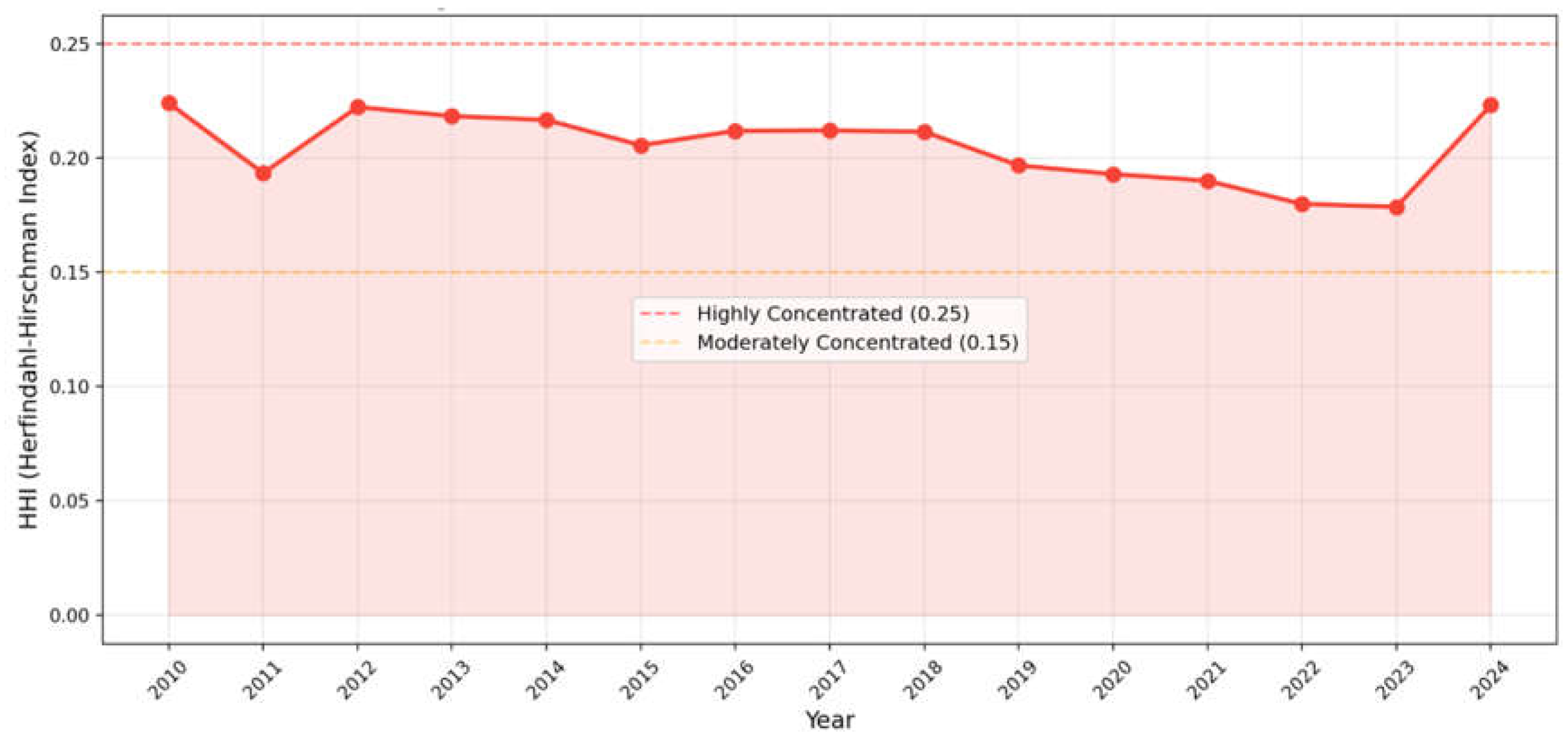
Figure 5.
Community structure changes of the lithography machine trading network during the change period.
Figure 5.
Community structure changes of the lithography machine trading network during the change period.
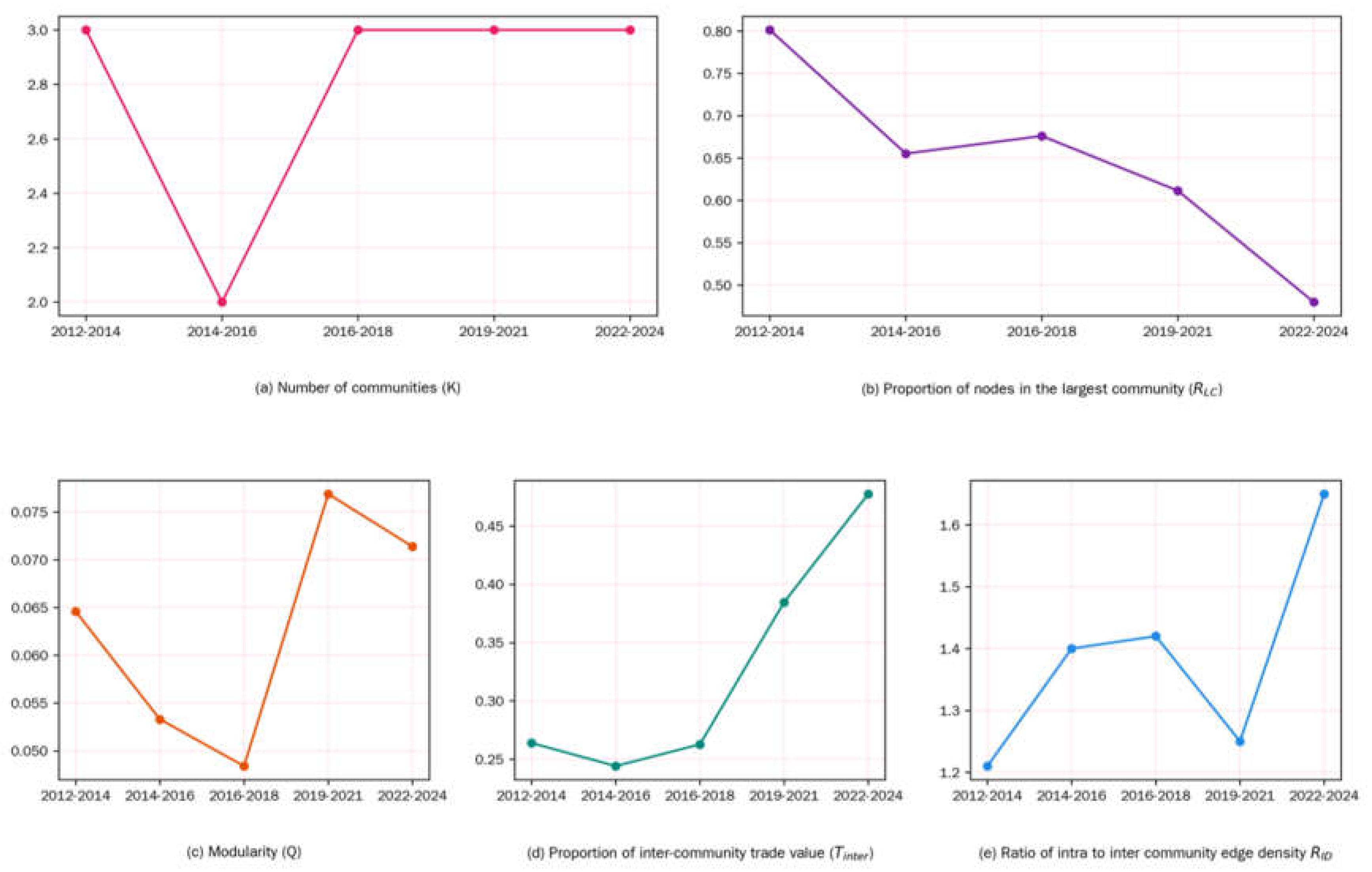
Figure 6.
Migration process of community members in adjacent windows.
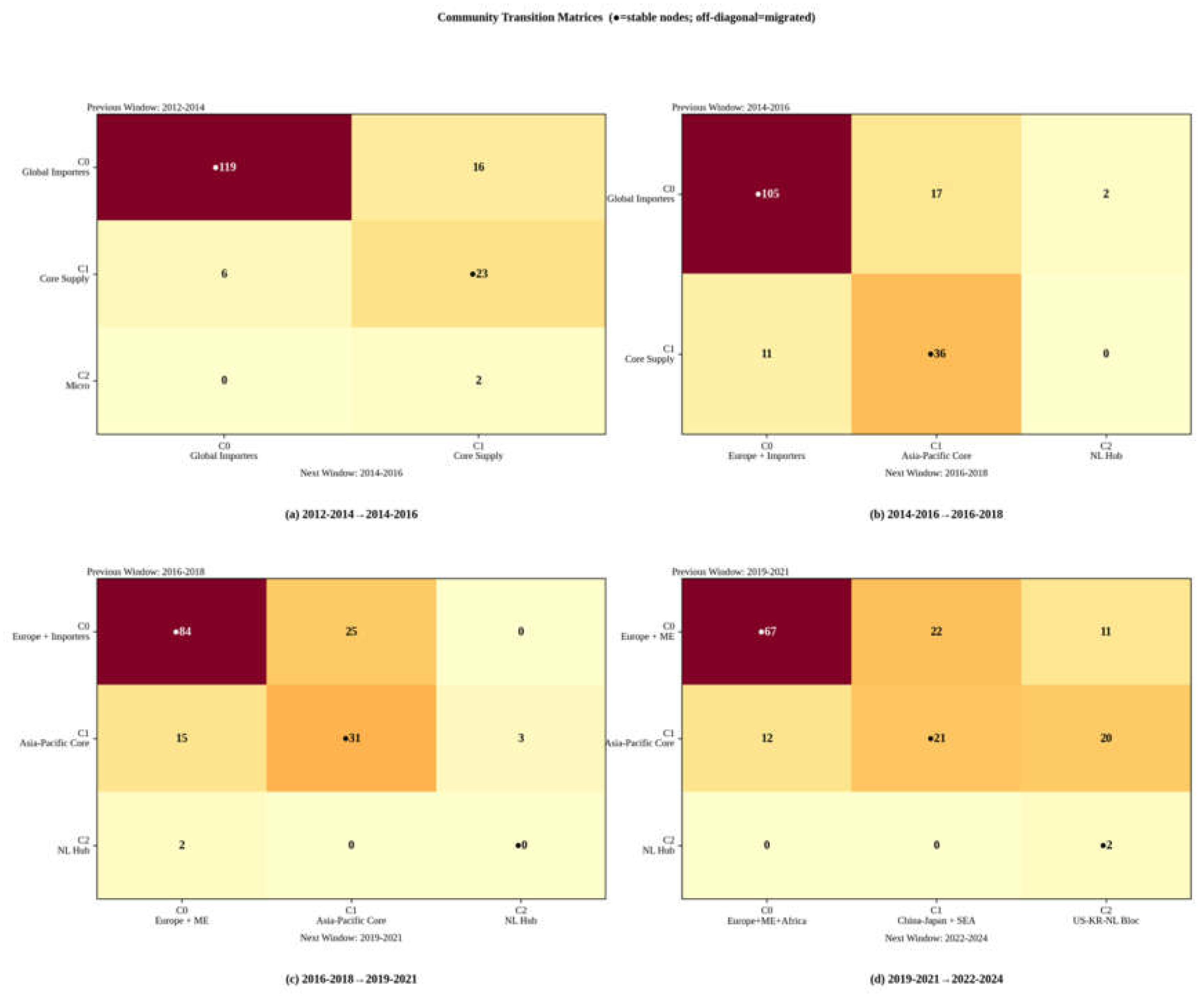
Figure 7.
(a). The number and proportion of different edge types across observation windows.
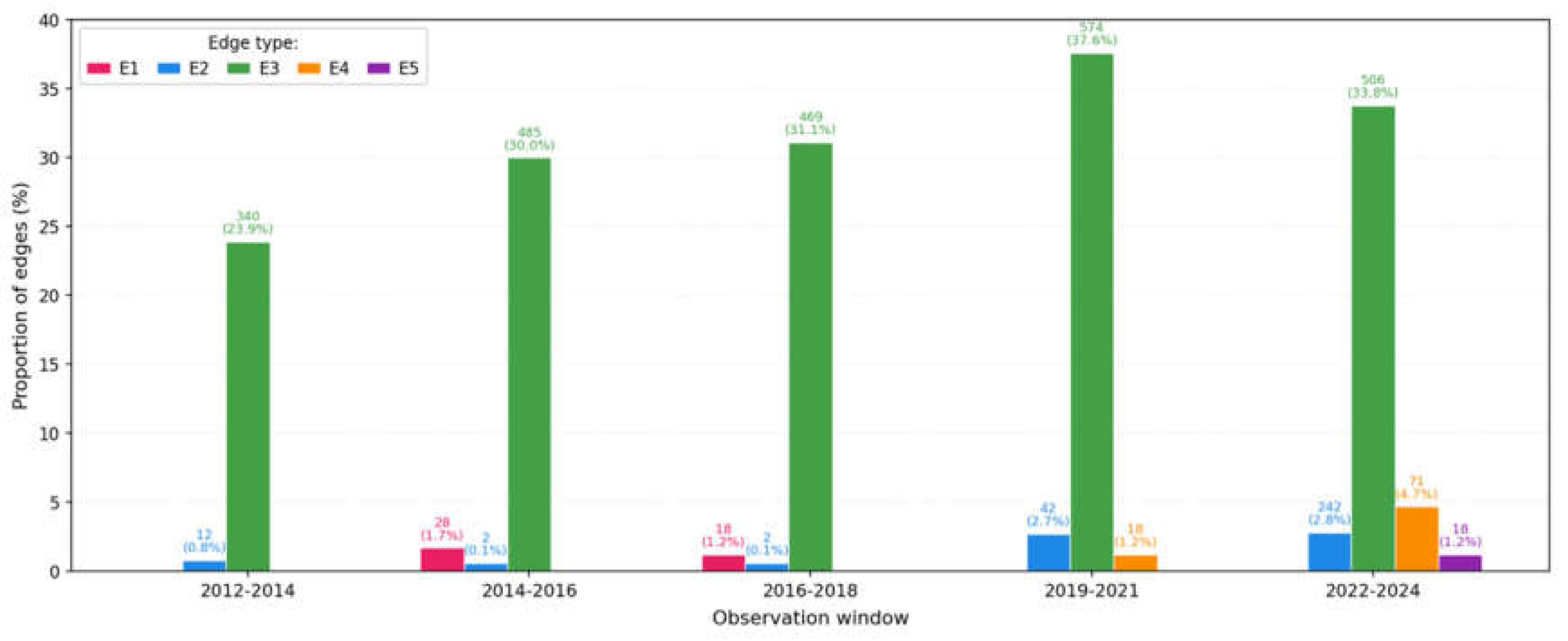
Figure 7.
(b). The trade value (USD 100 million) and proportion of different edge types across observation windows.
Figure 7.
(b). The trade value (USD 100 million) and proportion of different edge types across observation windows.
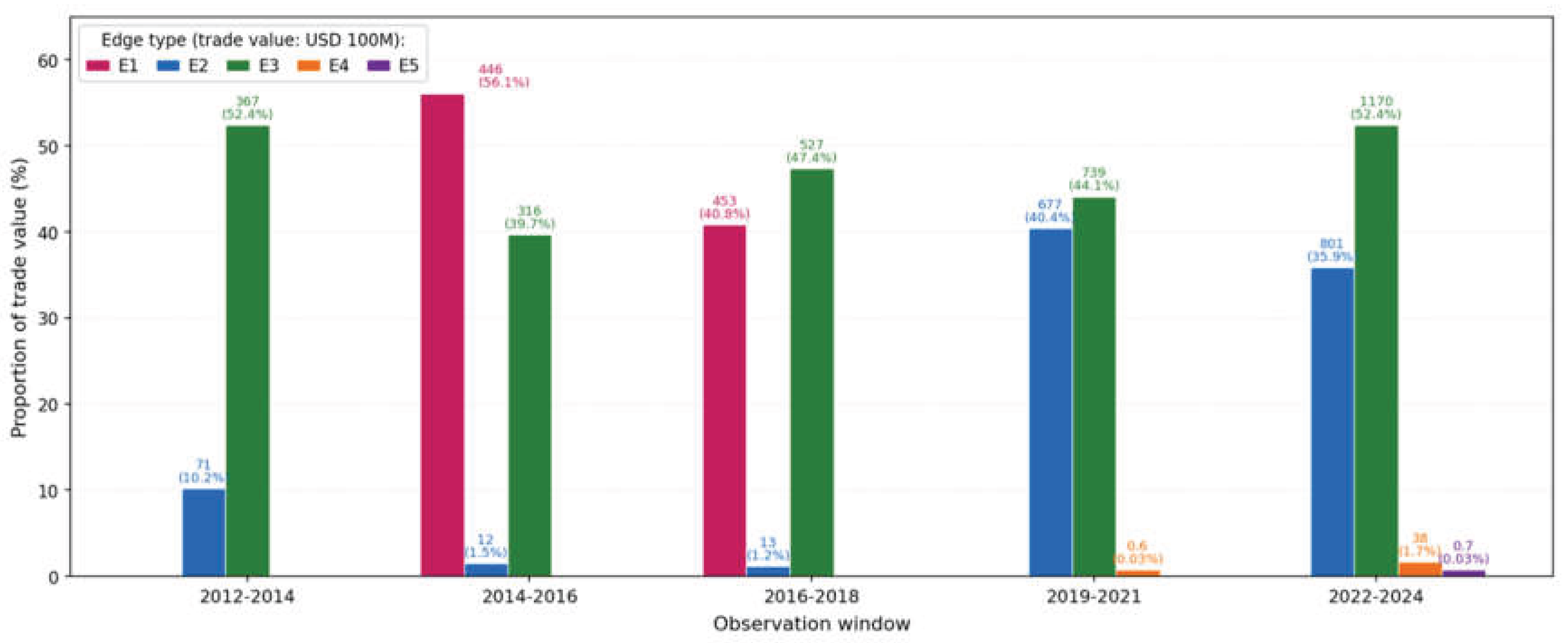

Table 1.
Explanation of Network Topology Indicators.
| Primary indicators | Secondary indicators | Statistical meaning |
| Network scale | Number of nodes N | The scale of countries participating in the global lithography equipment trade. |
| Number of edges M | The diversity and richness of trade relationships within the network. | |
| Total trade volume W | The overall economic scale of the trade network. | |
| Structural connectivity | Proportion of the largest weakly connected component R_LWCC | Whether the network is connected as an integrated whole. A value closer to 1 indicates a higher degree of integration. |
| Network density ρ | The proportion of actual trade relationships among all possible relationships, reflecting the closeness of trade linkages among countries. | |
| Network reachability | Average shortest path length L | The average trade transfer distance between any two countries. A smaller value indicates a more compact network. |
| Global efficiency E_glob | The efficiency of resource circulation within the network | |
|
Trade concentration |
Herfindahl-Hirschman Index (HHI) |
The degree to which trade value is concentrated among a few countries. A higher value indicates a stronger dependence of the network on a few core countries. |
Table 2.
Explanation of Network Spatial Indicators.
| Primary indicators | Secondary indicators | Statistical meaning |
| Community Structure | Number of communities K | The total number of communities identified in the network within a given observation window |
| Proportion of nodes in the largest community R_LC | The proportion of countries contained in the largest community relative to the total number of countries in the network. | |
| Modularity Q | Measuring the significance of community partitioning. | |
| Proportion of inter-community trade value T_inter | The proportion of trade value occurring between different communities relative to the total trade value of the network, measuring the strength of inter-community dependence. | |
| Ratio of intra to inter community edge density R_ID | Measuring the relative difference between the density of intra-community and inter-community linkages. A larger value indicates stronger relative community cohesion. | |
| Community membership overlap O | The proportion of nodes that remain in the same community across adjacent windows, measuring the stability of community structure. | |
| Member migration | Number of same community members in adjacent windows N_S | The number of nodes assigned to the same community across adjacent windows. |
| Power shifts | Within-module degree z-score Z |
The deviation of a node’s degree from its community average level, used to identify core nodes within communities. |
| Participation coefficient PC |
the extent to which a node’s degree is evenly distributed across different communities, used to identify cross-community brokerage nodes. |
|
| Trade value leverage ratio L_v | Measuring whether a given type of edge contributes more to trade volume than its share of edges. |
Table 3.
Definitions of Topological Role Framework.
| Type | Role | Name | Definition |
| node | R1 | Ultra-peripheral nodes |
Peripheral nodes whose links are almost entirely confined within their own community. |
| R2 | Peripheral nodes | Nodes whose links are mainly located within their own community, with only a small number of inter-community connections. | |
| R3 | Non-hub connector nodes | Non-hub nodes with a few of inter-community connections, serving a brokerage function. |
|
| R4 | Non-hub kinless nodes |
Non-hub nodes whose links are relatively evenly distributed across multiple communities, making them difficult to assign clearly to a single community. | |
| R5 | Provincial hubs |
Internal hubs within their own communities. | |
| R6 | Connector hubs |
Inter-community hubs. |
|
| R7 | Kinless hubs | Hub nodes whose links are widely distributed across communities, making them difficult to assign to a single community. | |
| edge | E1 | R5↔R5 / R6 | Channels between intra-community hubs |
| E2 | R6 ↔ R6 | channels between inter-community hubs | |
| E3 | R6/R5 ↔ R2 | channels connecting hubs and peripheral nodes | |
| E4 | R6 ↔ R3 | channels connecting hubs and brokerage nodes | |
| E5 | R3 ↔ R3 | channels between brokerage nodes |
Table 4.
Consistency check of Leiden and Louvain algorithms.
| K(Leiden) | K( Louvain ) | NMI | |
| 2012-2014 | 3 | 2 | 0.81 |
| 2014-2016 | 2 | 2 | 0.74 |
| 2016-2018 | 3 | 3 | 0.97 |
| 2019-2021 | 3 | 3 | 1.0000 |
| 2022-2024 | 3 | 3 | 0.82 |
Table 5.
Topological Roles of nodes across observation windows.
| role | country | 2012-2014 | 2014-2016 | 2016-2018 | 2019-2021 | 2022-2024 |
| Permanent dual-core nodes | USA | R6 | R6 | R6 | R6 | R6 |
| Germany | R6 | R6 | R6 | R6 | R6 | |
| Persistent core nodes | China | R6 | R5 | R5 | R6 | R6 |
| Japan | R2 | R5 | R5 | R6 | R6 | |
| Rose to core nodes | Netherlands | R2 | R2 | R2 | R2 | R6 |
| France | R2 | R2 | R2 | R2 | R6 | |
| Italy | R2 | R2 | R2 | R2 | R6 | |
| Transit to brokerage nodes | United Kingdom | R2 | R2 | R2 | R6 | R3 |
| Switzerland | R2 | R2 | R2 | R2 | R3 | |
| Belgium | R2 | R2 | R2 | R2 | R3 | |
| nodes that exited core status | South Korea | R2 | R5 | R5 | R6 | R2 |
| Taiwan, China | R2 | R5 | R2 | R2 | R2 | |
| Singapore | R6 | R2 | R2 | R2 | R2 | |
| Malaysiz | R2 | R2 | R2 | R6 | R2 |
Table 7.
Critical channels within each window.
| Window | Tradevalue (USD 100 million)and share of the most importantedges | Edgetype |
| 2012-2014 | USA → Taiwan,China (64.11, 9.2%) | E3 |
| 2014-2016 | USA → Taiwan,China (73.78, 9.3%) Japan → Taiwan,China (72.46, 9.1%) USA → South Korea (60.2%, 7.6%) |
E1 |
| 2016-2018 | USA→ South Korea (100.36, 9.0%) Japan → South Korea (96.11, 8.7%) |
E1 |
| 2019-2021 | Japan → China (134.97, 8.0%) | E2 |
| 2022-2024 | Japan → China (233.27, 10.5%) Netherlands→ China (184.58, 8.3%) USA→ China (109.24, 4.9%) |
E2 |
Disclaimer/Publisher’s Note: The statements, opinions and data contained in all publications are solely those of the individual author(s) and contributor(s) and not of MDPI and/or the editor(s). MDPI and/or the editor(s) disclaim responsibility for any injury to people or property resulting from any ideas, methods, instructions or products referred to in the content. |
© 2026 by the authors. Licensee MDPI, Basel, Switzerland. This article is an open access article distributed under the terms and conditions of the Creative Commons Attribution (CC BY) license.
Copyright: This open access article is published under a Creative Commons CC BY 4.0 license, which permit the free download, distribution, and reuse, provided that the author and preprint are cited in any reuse.


