

Submitted:
10 June 2026
Posted:
26 June 2026
You are already at the latest version
Abstract
Background/Objectives: Alpha-gal syndrome (AGS) is a tick-induced, IgE-mediated hypersensitivity to the oligosaccharide galactose-α-1,3-galactose (α-gal), which is expressed on glycoproteins and glycolipids of non-primate mammals but absent in humans. Gastrointestinal (GI) symptoms dominate the clinical presentation in a substantial proportion of patients yet remain systematically under-recognized, frequently being attributed to irritable bowel syndrome (IBS), non-celiac gluten sensitivity (NCGS), or lactose intolerance. This narrative review synthesizes the current evidence on the epidemiology, GI and systemic phenotype, immunological mechanisms, diagnostic strategies, management approaches, quality-of-life burden, and multi-level public health interventions for AGS, and it identifies critical knowledge gaps as of 2026. Methods: We searched PubMed/MEDLINE, Embase, and Web of Science from database inception through 31 March 2026, and synthesized the evidence narratively in accordance with the Scale for the Assessment of Narrative Review Articles (SANRA). Results: GI symptoms occur in 47–69% of patients with AGS, with abdominal pain (58%), diarrhea (42%), nausea (39%), and vomiting (31%) as the cardinal manifestations. A characteristic 2–6 h delay between the ingestion of mammalian-derived food and symptom onset—explained by the glycolipid–chylomicron delivery mechanism—drives diagnostic confusion with functional GI disorders. Among 295,400 tested individuals in the United States, 30.5% were α-gal IgE positive, and an estimated 96,000–450,000 Americans were affected between 2010 and 2022. Despite this burden, 42% of U.S. healthcare providers had never heard of AGS. Strict avoidance of mammalian meat improves symptoms in 53–86% of adherent patients, although the condition carries a meaningful risk of anaphylaxis even among GI-predominant presenters. Conclusions: AGS is a prevalent, frequently misdiagnosed, and clinically morbid condition whose GI phenotype lies squarely within the gastroenterologist’s domain. A coordinated response that integrates clinician education, institutional diagnostic algorithms, and national surveillance infrastructure is urgently needed.
Keywords:
alpha-gal syndrome
; galactose-α-1
; 3-galactose
; tick-borne allergy
; gastrointestinal
; Lone Star tick
; irritable bowel syndrome
; misdiagnosis
; mammalian meat allergy
; mast cell
; public health
; quality of life
; Amblyomma americanum
1. Introduction
Alpha-gal syndrome (AGS) is an acquired, tick-induced allergy to the carbohydrate epitope galactose-α-1,3-galactose (α-gal), a sugar expressed on the glycoproteins and glycolipids of virtually all non-primate mammals but entirely absent in humans and other Old World primates. It was first formally described by Commins et al. in 2009 through the investigation of delayed hypersensitivity reactions to the anti-cancer drug cetuximab, and the condition was rapidly recognized to extend far beyond drug hypersensitivity to encompass broad dietary exposure [12,13]. Sensitization arises when tick saliva, which is rich in α-gal-containing proteins and immunomodulatory compounds, is injected into the host dermis during feeding, priming a class-switched IgE response directed against α-gal [3,12,14].
The discovery of AGS unfolded through a convergence of independent observations. In 2008, Chung et al. reported that severe hypersensitivity reactions to cetuximab were mediated by pre-existing IgE antibodies directed against α-gal and that these reactions clustered geographically in the southeastern United States [23]. Almost simultaneously, Commins, Platts-Mills, and colleagues described patients with delayed anaphylaxis, angioedema, and urticaria occurring 3–6 h after red meat ingestion, all of whom carried IgE specific for α-gal [24]. Van Nunen et al. independently reported an association between tick bites and red meat allergy in Australian patients, implicating Ixodes holocyclus as the regional vector [25]. The causal role of tick bites was subsequently cemented by Commins et al. [26] and was later consolidated by an NIAID expert workshop [16].
In the United States, the Lone Star tick (Amblyomma americanum) is the dominant vector, and its historical range encompasses the southeastern and south-central states—a range that is actively expanding northward and westward, driven by warming winters, reforestation, and increasing deer-population density [3,14,15]. In Europe and Australia, Ixodes ricinus and Ixodes holocyclus, respectively, carry a similar sensitizing potential [3,14].
What distinguishes AGS clinically from virtually every other IgE-mediated food allergy is the characteristic 2–6 h delay between the ingestion of mammalian-derived food and symptom onset [1,4,13]. This delay reflects the time required for the digestion of mammalian fats, the incorporation of α-gal-bearing glycolipids into chylomicrons, chylomicron transit through the intestinal lymphatics, and the eventual delivery of antigen to circulating basophils and submucosal mast cells capable of cross-linking anti-α-gal IgE [4,13,19]. Because this process frequently culminates during sleep, both patients and clinicians are deprived of the temporal association between food and symptoms that is the cornerstone of allergic diagnosis [4,7].
The gastrointestinal tract bears a disproportionate and underappreciated burden of AGS pathology. Many patients present exclusively with recurrent abdominal pain, diarrhea, nausea, bloating, or vomiting—symptoms that, in isolation, are indistinguishable from those of IBS, NCGS, or lactose intolerance [4,7,8,16]. A national survey of U.S. healthcare providers conducted in 2022 found that 42% had never heard of AGS, and a further 35% were not confident in their ability to diagnose or manage it [6]. At the population level, laboratory surveillance of 295,400 individuals identified α-gal IgE positivity in 30.5%, and an estimated 96,000–450,000 Americans were affected between 2010 and 2022 [5]. Against this backdrop, the American Gastroenterological Association (AGA) issued a Clinical Practice Update in 2023 that explicitly called on GI clinicians to incorporate AGS into the differential diagnosis of unexplained, food-triggered GI symptoms in tick-endemic regions [17]. Drawing on the published clinical, epidemiological, and mechanistic evidence available as of 2026, this review synthesizes the GI phenotype of AGS in depth, examines the diagnostic barriers that sustain misdiagnosis at scale, reviews current management evidence and its limitations, and builds the case that AGS warrants recognition as an emerging public health priority requiring a coordinated, multi-level response.
1.1. Literature Search Strategy and Study Selection
This is a narrative review, the reporting of which was guided by the Scale for the Assessment of Narrative Review Articles (SANRA). It was not conducted as a systematic review: no protocol was registered, no formal risk-of-bias meta-analysis was performed, and study selection involved an element of expert judgment in weighting the most informative sources. We searched PubMed/MEDLINE, Embase, and Web of Science from database inception through 31 March 2026, and the reference lists of included articles and relevant prior reviews were hand-searched to capture additional sources. Search strategies combined controlled vocabulary and free-text terms, including “alpha-gal syndrome,” “galactose-α-1,3-galactose,” “alpha-gal allergy,” “mammalian meat allergy,” “red meat allergy,” “tick-borne allergy,” and “Amblyomma americanum,” combined (using the Boolean operator AND) with “gastrointestinal,” “abdominal pain,” “diarrhea,” “anaphylaxis,” “diagnosis,” “management,” and “epidemiology.” No language restriction was applied. Sources were eligible for inclusion if they were peer-reviewed human studies of any observational design, population-level surveillance reports, systematic reviews or meta-analyses, professional-society practice guidance, or seminal mechanistic studies directly relevant to AGS; single case reports (other than the seminal historical descriptions that established the syndrome) were generally excluded. The final evidence base comprised 30 sources. Both authors (A.E. and Y.O.) independently reviewed candidate articles against these criteria, and disagreements were resolved by discussion until consensus was reached. Given the predominantly observational, heterogeneous, and frequently single-center nature of the underlying literature, the data were synthesized narratively; this approach, and the selection and emphasis bias it entails relative to a systematic review, is acknowledged as a limitation (Section 10).
2. Epidemiology: The Making of a Tick-Borne Epidemic
2.1. Geographic Distribution and Temporal Trends
The epidemiological architecture of AGS in the United States was most rigorously characterized by Thompson et al. in a landmark 2023 MMWR report [5]. Among 295,400 individuals tested for α-gal-specific IgE between January 2017 and December 2022, 90,018 (30.5%) returned positive results. Geographic clustering was pronounced: suspected cases occurred predominantly in counties of the southern, midwestern, and mid-Atlantic United States—including Arkansas, Kentucky, Missouri, Tennessee, and Virginia—all of which are areas with dense Amblyomma americanum activity [5]. Critically, positivity rates increased in each successive year across the six-year surveillance window, a pattern consistent with an epidemic trajectory driven by tick-range expansion rather than by improved detection alone [5]. Aggregating longitudinal data from 2010 through 2022, CDC investigators estimated that between 96,000 and 450,000 Americans may have been affected during that period [5,6].
International data, although less systematic, corroborate this pattern. A systematic review by Wilson et al. identified 236 documented post-tick AGS cases from 20 countries, with European cases clustering in regions of high Ixodes ricinus exposure—particularly France, Germany, Scandinavia, and the Iberian Peninsula [3]. In Poland’s Podlasie region, Rutkowski et al. documented meaningful rates of α-1,3-galactose sensitization among tested residents [15]. Climate-driven range expansion is the single most important epidemiological variable to watch in the coming decades: warming winters, earlier spring tick activity, the reforestation of former agricultural land, and expanding deer populations are all projecting Amblyomma americanum northward into the Great Lakes states, New England, and the upper Midwest [3,14,15].
2.2. Provider Knowledge and the Awareness Gap
A structural amplifier of AGS underdiagnosis is the documented failure of medical education to keep pace with epidemiological reality. In a nationally representative survey of U.S. healthcare providers conducted by Carpenter et al. between March and May 2022, 42% of respondents reported never having heard of AGS [6]. A further 35% were not confident in their ability to diagnose or manage AGS, and only approximately 22% felt confident in doing so [6]. These gaps were not restricted to primary care; specialty physicians, including allergists, gastroenterologists, and infectious disease specialists, demonstrated broadly comparable knowledge deficits, although variability by specialty and geographic region was noted [6]. This knowledge deficit translates directly into patient harm: patients with AGS frequently consult three or more providers over months to years before receiving a correct diagnosis, and many undergo unnecessary endoscopy, abdominal imaging, and empiric dietary-elimination protocols in the interim [4,7,16,17].
3. Immunological Mechanisms: From Tick Bite to Gut Mast Cell
3.1. Tick-Mediated Sensitization
The immunological cascade that initiates AGS begins at the skin. Tick saliva contains a rich mixture of immunomodulatory compounds—prostaglandins, interleukins, and complement inhibitors—that actively suppress host immune surveillance and prolong feeding attachment [3,12,14]. Critically, tick saliva also contains α-gal-bearing glycoproteins derived from the tick’s own mammalian blood meals, which are delivered directly into the host dermis in a context of immune dysregulation that strongly favors IgE class-switching over tolerogenic responses [3,12,14]. The precise tick salivary protein(s) responsible for initiating this class switch have not been definitively identified, which represents a fundamental gap in mechanistic understanding [14,18].
Following sensitization, the resulting anti-α-gal IgE binds to high-affinity FcεRI receptors on circulating basophils and tissue-resident mast cells throughout the body, including those in the gut submucosa and lamina propria [3,12]. This armed mast-cell population constitutes the effector mechanism for all subsequent α-gal-triggered reactions. The magnitude of sensitization is measurable through serum α-gal-specific IgE quantification, and higher titers correlate broadly—though imperfectly—with greater clinical reactivity and a lower threshold for reaction [2,12,13].
3.2. The Glycolipid–Chylomicron Delay Mechanism
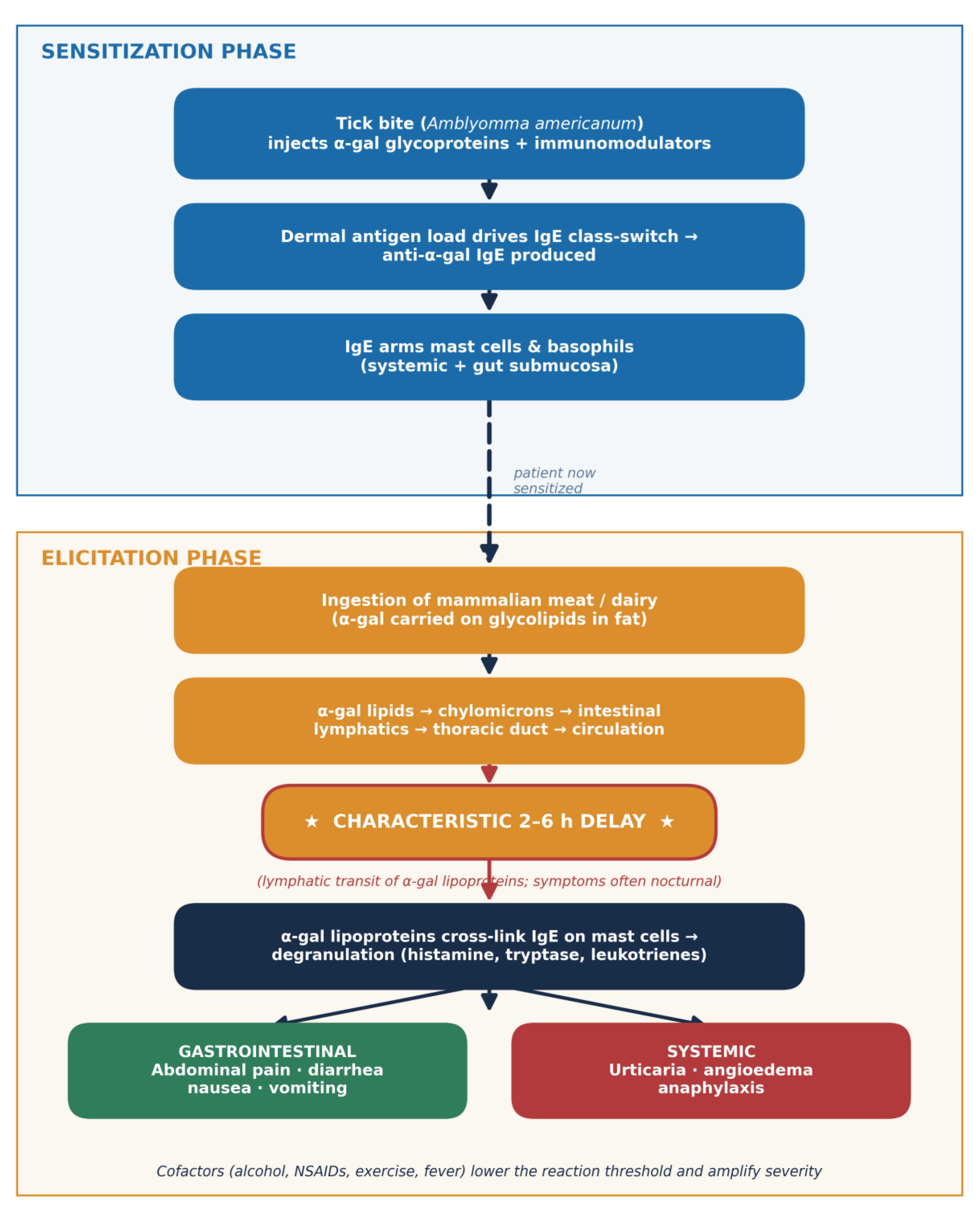
The defining clinical feature of AGS—delayed symptom onset 2–6 h after ingestion—is a direct mechanistic consequence of how α-gal reaches systemic mast cells following oral ingestion. α-Gal is carried predominantly on the glycolipids and glycoproteins of mammalian fat. When mammalian-derived food is ingested, these α-gal-bearing lipids undergo slow lipolysis and re-esterification in the small-intestinal lumen, are incorporated into chylomicrons within enterocytes, and are secreted into the intestinal lymphatics (lacteals) rather than directly into the portal circulation [4,13]. In an elegant ex vivo demonstration, Román-Carrasco et al. showed that only α-gal bound to lipids—and not α-gal bound to protein—is transported across enterocytes as an intact, IgE-reactive molecule capable of activating effector cells [19]. Chylomicrons transit through the lymphatic system, enter the thoracic duct, and reach the systemic circulation only after 2–6 h, at which point α-gal-bearing lipoprotein particles cross-link IgE on basophils and submucosal gut mast cells, triggering degranulation [4,13,19]. This glycolipid–lymphatic route, rather than the rapid portal-venous absorption of protein allergens, explains why AGS reactions occur during sleep rather than at the dinner table.
Figure 1.
The two-phase pathophysiology of alpha-gal syndrome—the skin–gut axis. During the sensitization phase, tick salivary α-gal and immunomodulators injected into the dermis drive an IgE class-switch that arms systemic and gut-resident mast cells. During the elicitation phase, ingested α-gal carried on mammalian-fat glycolipids is incorporated into chylomicrons and transits the lymphatic system, producing the characteristic 2–6 h delay before mast-cell degranulation generates gastrointestinal and/or systemic symptoms. Cofactors lower the reaction threshold. α-gal, galactose-α-1,3-galactose; NSAIDs, non-steroidal anti-inflammatory drugs.
Figure 1.
The two-phase pathophysiology of alpha-gal syndrome—the skin–gut axis. During the sensitization phase, tick salivary α-gal and immunomodulators injected into the dermis drive an IgE class-switch that arms systemic and gut-resident mast cells. During the elicitation phase, ingested α-gal carried on mammalian-fat glycolipids is incorporated into chylomicrons and transits the lymphatic system, producing the characteristic 2–6 h delay before mast-cell degranulation generates gastrointestinal and/or systemic symptoms. Cofactors lower the reaction threshold. α-gal, galactose-α-1,3-galactose; NSAIDs, non-steroidal anti-inflammatory drugs.
3.3. Cofactors and Phenotypic Variability
A critical and clinically underappreciated feature of AGS is the role of augmentation cofactors—concurrent exposures that lower the threshold for mast-cell degranulation and can transform a subclinical or mild reaction into systemic anaphylaxis. The best-documented cofactors include alcohol, non-steroidal anti-inflammatory drugs (NSAIDs), physical exercise in proximity to mammalian-food ingestion, intercurrent viral infections, and elevated body temperature [4,9,12,30]. Cofactor dependence is a major driver of diagnostic confusion: when reactions occur only in the presence of cofactors, the apparent inconsistency convinces both patient and physician that food cannot be the explanation, thereby reinforcing functional-disorder attributions [4,7]. The mechanisms governing phenotypic heterogeneity between GI-predominant and anaphylaxis-predominant AGS are incompletely elucidated; plausible determinants include serum IgE titer, the balance between gut-resident and systemic mast-cell populations, mucosal-barrier integrity, and the relative glycolipid-versus-glycoprotein load of the triggering food [4,10,18,19].
4. Clinical Presentation: The GI-Dominant Phenotype
4.1. Frequency and Pattern of GI Symptoms
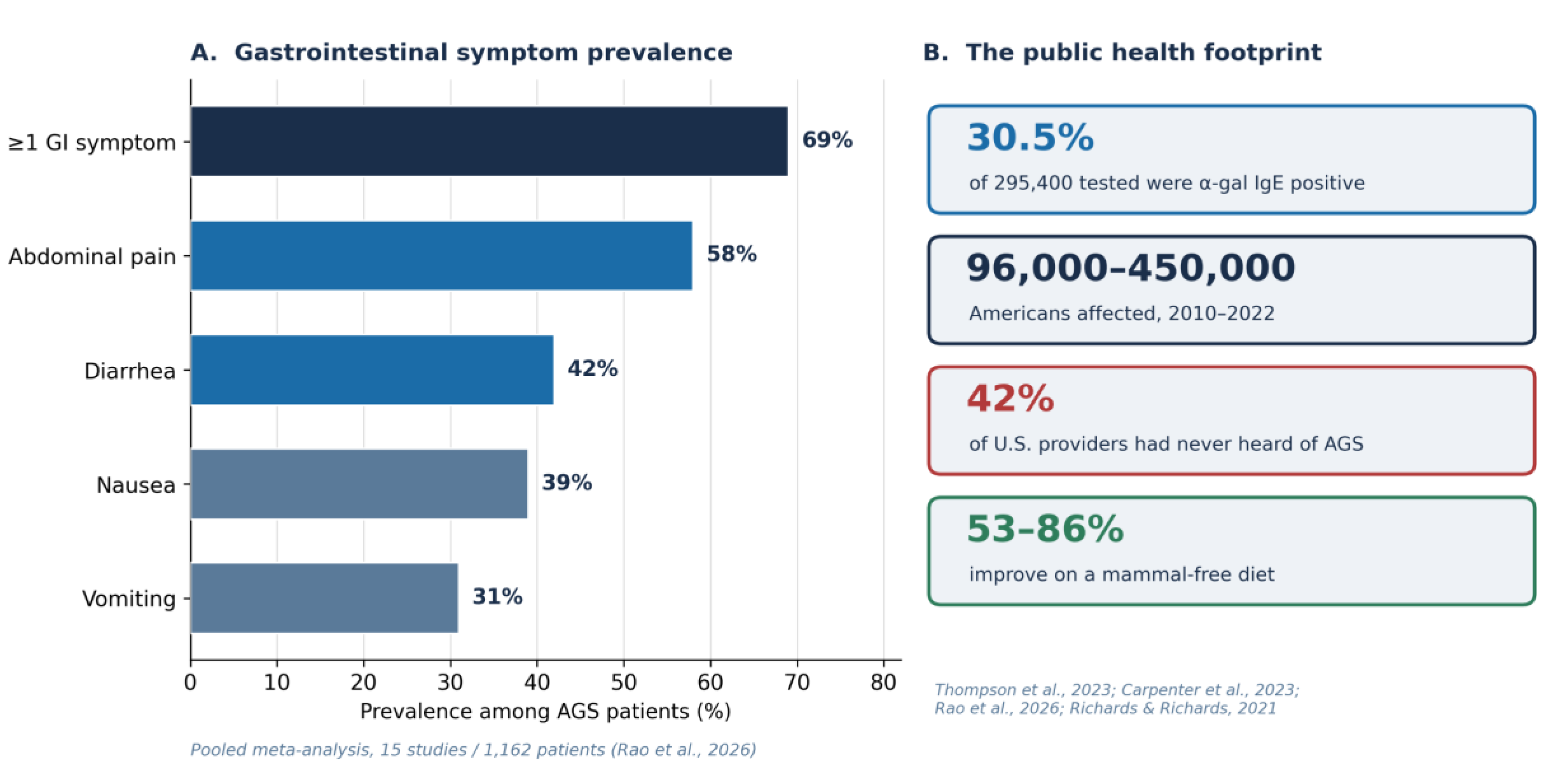
The centrality of GI symptoms to the clinical picture of AGS has been established across multiple study designs. Rao et al.’s 2026 systematic review and meta-analysis, which pooled 1,162 patients across 15 studies, found that at least one GI symptom was present in approximately 69% of patients with AGS, with abdominal pain as the leading complaint (58%), followed by diarrhea (42%), nausea (39%), and vomiting (31%) [1]. The large Mayo Clinic retrospective cohort reported by Lesmana et al. found GI symptoms in 47% of all seropositive patients, with isolated GI presentations significantly more prevalent in women than in men [2]. In a community-based GI practice cohort reported by Richards and Richards, 32% of patients referred for evaluation of unexplained GI complaints were α-gal IgE positive on targeted testing, and 82% of those seropositive patients improved substantially on a mammal-free diet [8].
Several symptom characteristics distinguish AGS-related GI complaints from those of functional disorders. First, the symptoms are episodic rather than continuous, corresponding to the consumption of mammalian-derived foods rather than occurring daily or on an empty stomach [4,7,17]. Second, the characteristic onset delay of 2–6 h—which frequently places symptoms in the late evening or overnight—is a historical red flag that functional-disorder diagnoses cannot explain [4,7,8,17]. Third, although the symptoms may overlap with those of IBS in quality, they do not follow the morning-predominant pattern of IBS with diarrhea or the stress-triggered flares of functional dyspepsia [4,7]. Fourth, strict avoidance of mammalian-derived foods characteristically produces complete or near-complete resolution, a response that is rarely achieved by the dietary manipulations attempted in IBS or NCGS [4,7,8].
A practically important point for the gastroenterologist is that endoscopic evaluation in AGS is characteristically unremarkable. Patients typically have grossly normal mucosa, and random biopsies usually show no specific diagnostic abnormality [4,7,17]. This dissociation between symptom burden and endoscopic findings is itself a diagnostic clue: it should prompt the clinician to reconsider the working diagnosis rather than to escalate invasive testing. Recognizing that AGS produces a “normal scope” should redirect the evaluation toward serum α-gal-specific IgE testing rather than toward repeated endoscopy, thereby sparing patients unnecessary procedural risk, cost, and continued diagnostic delay.
Figure 2.
The clinical and public health burden of alpha-gal syndrome. (A) Pooled prevalence of gastrointestinal symptoms among patients with AGS, derived from a meta-analysis of 15 studies (1,162 patients) [1]. (B) Key population-level indicators of disease burden and the diagnostic gap [5,6], alongside the proportion of patients improving on dietary avoidance [1,2,7,8]. AGS, alpha-gal syndrome; GI, gastrointestinal; IgE, immunoglobulin E.
Figure 2.
The clinical and public health burden of alpha-gal syndrome. (A) Pooled prevalence of gastrointestinal symptoms among patients with AGS, derived from a meta-analysis of 15 studies (1,162 patients) [1]. (B) Key population-level indicators of disease burden and the diagnostic gap [5,6], alongside the proportion of patients improving on dietary avoidance [1,2,7,8]. AGS, alpha-gal syndrome; GI, gastrointestinal; IgE, immunoglobulin E.
4.2. The GI-Only Phenotype and Why It Is Especially Dangerous
A subset of patients with AGS—whose proportion is difficult to quantify precisely, given the ascertainment bias toward systemic reactors in allergy-center cohorts—presents exclusively with GI symptoms, without urticaria, angioedema, or respiratory involvement at any point in the disease course. Commins, drawing on experience with 2,500 patients, identified this GI-only phenotype as a distinct and underappreciated clinical entity that is more common in older patients, women, and those with lower serum α-gal IgE titers [12]. Richards and Richards found this presentation in the majority of their community GI practice cohort [8]. Awosika and Balaji described it as the “primary diagnostic blind spot for clinicians”—the presentation most likely to result in erroneous functional-disorder labeling [7].
The clinical danger of the GI-only phenotype is that it is not static. Patients who have experienced only GI reactions to date carry an ongoing risk of progression to systemic anaphylaxis with future exposures, particularly if those exposures involve a higher α-gal load (a fattier meal), a higher cofactor burden, or a new tick bite that re-sensitizes and boosts IgE titers [12,13,17]. Across cohorts that include both GI-predominant and anaphylaxis-predominant patients—which are largely drawn from allergy-referral settings and therefore likely to overestimate systemic risk in unselected GI populations—51–75% meet criteria for anaphylaxis at some point during follow-up [1,9,10]. A clinician who labels a patient as having a “functional GI disorder” and returns them to a diet that includes regular mammalian meat is not merely missing a diagnosis; they are leaving the patient exposed to an escalating systemic risk.
4.3. Systemic Manifestations and Anaphylaxis Risk
When AGS reactions extend beyond the gut, the systemic manifestations are those of IgE-mediated hypersensitivity: urticaria, angioedema, rhinorrhea, bronchospasm, hypotension, and loss of consciousness [9,10,12,13]. The temporal delay is preserved across all reaction phenotypes, so even anaphylaxis in AGS typically occurs hours after eating rather than within minutes—a fact that confuses patients and first responders alike and delays recognition and treatment [12,13]. Binder et al., analyzing a CDC registry of patients with AGS from 2010 to 2019, documented anaphylaxis in a significant proportion of confirmed cases, with epinephrine required in many episodes and emergency care sought repeatedly by most enrolled patients before a diagnosis was established [9].
4.4. AGS in Special Populations
4.4.1. Pediatric Patients
AGS occurs in children, although pediatric data remain comparatively sparse [29]. Work in pediatric cohorts has suggested that the ratio of α-gal-specific IgE to total IgE may carry predictive value for clinical reactivity and challenge outcomes [21]. Clinicians managing children with unexplained recurrent GI episodes or nocturnal allergic reactions in endemic regions should include AGS in the differential diagnosis regardless of the patient’s age [29].
4.4.2. Occupational and High-Exposure Populations
Farmers, ranchers, hunters, military personnel, outdoor workers, and recreational hikers face a disproportionately high risk of tick exposure. Welch et al.’s 2026 cross-sectional study specifically examined AGS symptom profiles among farmers and ranchers, finding abdominal cramping, diarrhea, itchy skin, and nausea to be the dominant symptom cluster, with an average of approximately three provider visits before a correct diagnosis and with significant occupational disruption following dietary restriction [11].
4.4.3. α-Gal in Medications and Biologics
Beyond dietary exposure, patients with AGS face α-gal-mediated reactions from non-food sources. The monoclonal antibody cetuximab carries α-gal on the Fab portion of its heavy chain and causes hypersensitivity reactions in AGS-sensitized patients—the original observation that led to the discovery of the syndrome [12,13]. Gelatin-containing vaccines, certain colloid plasma expanders, heparin derived from porcine intestinal mucosa, and biologic medications with mammalian-derived excipients can all trigger reactions in sensitized patients [12,13].

Table 1.
Differentiating alpha-gal syndrome from common gastrointestinal mimics.
| Feature | Alpha-Gal Syndrome | IBS | NCGS | Lactose Intolerance |
|---|---|---|---|---|
| Symptom onset after trigger | 2–6 h (up to 12 h) | Variable; stress-related | Variable; 30 min–2 h | 30 min–2 h |
| Dietary trigger | Mammalian meat, dairy, gelatin | Fatty, spicy, high-FODMAP foods | Gluten-containing grains | Lactose-containing dairy |
| Nocturnal symptoms | Frequent; reaction during sleep | Uncommon | Uncommon | Uncommon |
| Urticaria / angioedema | May be present (absent in GI-only phenotype) | Absent | Absent | Absent |
| Anaphylaxis risk | Yes; 51–75% in referral cohorts [1,9,10] | None | None | None |
| Diagnostic test | α-gal-specific IgE (≥0.1 kU/L) | Rome IV criteria; exclusion | Wheat/gluten challenge; exclusion | Hydrogen breath test; lactase gene |
| Response to avoidance | 53–86% improve [1,2,7,8] | Partial in some; variable | Gluten-free diet partially effective | Lactose-free diet effective |
| Tick-exposure history | Characteristic; often endemic region | None | None | None |
5. Diagnosis: How to Find What You Are Looking For
5.1. History: The Art of Asking the Right Questions
The diagnosis of AGS begins not with a laboratory test but with a well-constructed history. The key historical elements are (1) a temporal relationship between GI symptom onset and the consumption of red meat, pork, lamb, venison, or mammalian dairy products, with specific emphasis on the 2–6 h delay; (2) nocturnal occurrence of symptoms, particularly cramping and diarrhea that awaken the patient; (3) prior tick exposure, including recent outdoor activities in tick-endemic regions; (4) potential cofactor involvement—whether alcohol, an NSAID, exercise, or illness preceded the symptomatic episodes; and (5) variable reproducibility across exposures, which reflects cofactor dependence rather than a non-allergic cause [4,7,12,13,17]. Proactive food-diary review focused specifically on the consumption of mammalian-derived ingredients in the 6–12 h preceding symptomatic episodes is recommended as part of the initial AGS evaluation [4,12,17].
5.2. Laboratory Diagnosis: Serum α-Gal-Specific IgE
Serum α-gal-specific IgE measured by ImmunoCAP or an equivalent quantitative allergen-specific IgE assay is the cornerstone of laboratory diagnosis [1,2,8,12,13,17,21]. A threshold of ≥0.1 kU/L is generally accepted as indicating sensitization, although higher titers—particularly those above 1.0–2.0 kU/L—correlate with greater clinical reactivity, a lower reaction threshold, and a higher risk of anaphylaxis [12,13]. The McGill et al. AGA Clinical Practice Update (2023) explicitly endorsed integrating α-gal IgE testing into the diagnostic workup of patients with unexplained, food-triggered GI symptoms in tick-endemic regions [17].
Assay limitations must be acknowledged. False-negative results occur in patients who have achieved partial tolerance following prolonged dietary avoidance prior to testing, as IgE titers can decline—sometimes below the detection threshold—in the absence of continued tick bites or dietary α-gal stimulation [12,21]. Conversely, a proportion of seropositive individuals may be clinically asymptomatic [1,12,21]. Basophil activation testing (BAT), which directly measures basophil degranulation upon α-gal stimulation ex vivo, offers a complementary diagnostic tool with high sensitivity but limited availability outside specialized academic centers [13,18].
5.3. Skin Testing and Oral Challenge
Skin-prick testing with fresh mammalian-meat extract or commercially available α-gal reagents can serve as a diagnostic adjunct in equivocal cases and is typically performed at allergy/immunology centers [12,13]. Supervised oral food challenges with mammalian meat represent the most definitive diagnostic confirmation, particularly when the serology is borderline and the clinical history remains ambiguous. However, these challenges carry significant risk: both Vaz-Rodrigues et al. and Commins document that 15–20% of challenge procedures result in reactions requiring epinephrine or emergency care [12,13]. Oral challenges are therefore strictly reserved for appropriately equipped allergy centers with immediate anaphylaxis-management capability [12,13].
Table 2.
Stepwise diagnostic approach for suspected alpha-gal syndrome in the gastroenterology clinic.
Table 2.
Stepwise diagnostic approach for suspected alpha-gal syndrome in the gastroenterology clinic.
| Step | Action | Key Details | Rationale |
|---|---|---|---|
| 1 | Structured dietary and tick history | Onset delay 2–6 h; nocturnal symptoms; tick-endemic exposure; cofactors (ethanol, NSAIDs, exercise); food-diary review | AGS begins with the history, not the laboratory |
| 2 | Serum α-gal-specific IgE | ImmunoCAP; ≥0.1 kU/L is positive; higher titers correlate with severity; may be low after prolonged avoidance | Central to diagnosis; available at most reference laboratories |
| 3 | Mammal-free dietary trial | Strict avoidance for ≥6–8 weeks; structured dietitian review; track symptom response systematically | Both therapeutic and diagnostic; most patients improve substantially |
| 4 | Total serum IgE and tryptase | Elevated total IgE supports an atopic background; tryptase rises acutely during a reaction; elevated baseline tryptase prompts a mastocytosis workup | Contextualizes AGS within atopic and mast-cell biology |
| 5 | Skin-prick test (A/I referral) | Fresh meat extract; useful when serology is equivocal; standardized reagents are limited | Useful adjunct; an A/I center is preferred |
| 6 | Refer to allergy/immunology | Anaphylaxis history, systemic reactions, complex phenotype, or consideration of oral challenge | Ensures epinephrine prescription, structured management, and follow-up |
| 7 * | Supervised oral food challenge | Only at specialized centers; 15–20% require epinephrine [12,13]; not for routine GI practice | Reserved for equivocal cases with high diagnostic stakes |
* Oral challenges carry a significant risk of anaphylaxis and must be performed only in facilities with full resuscitative capability. NSAIDs, non-steroidal anti-inflammatory drugs; A/I, allergy/immunology; AGS, alpha-gal syndrome; GI, gastrointestinal; IgE, immunoglobulin E. References [4,7,8,12,13,17,22].
Figure 3.
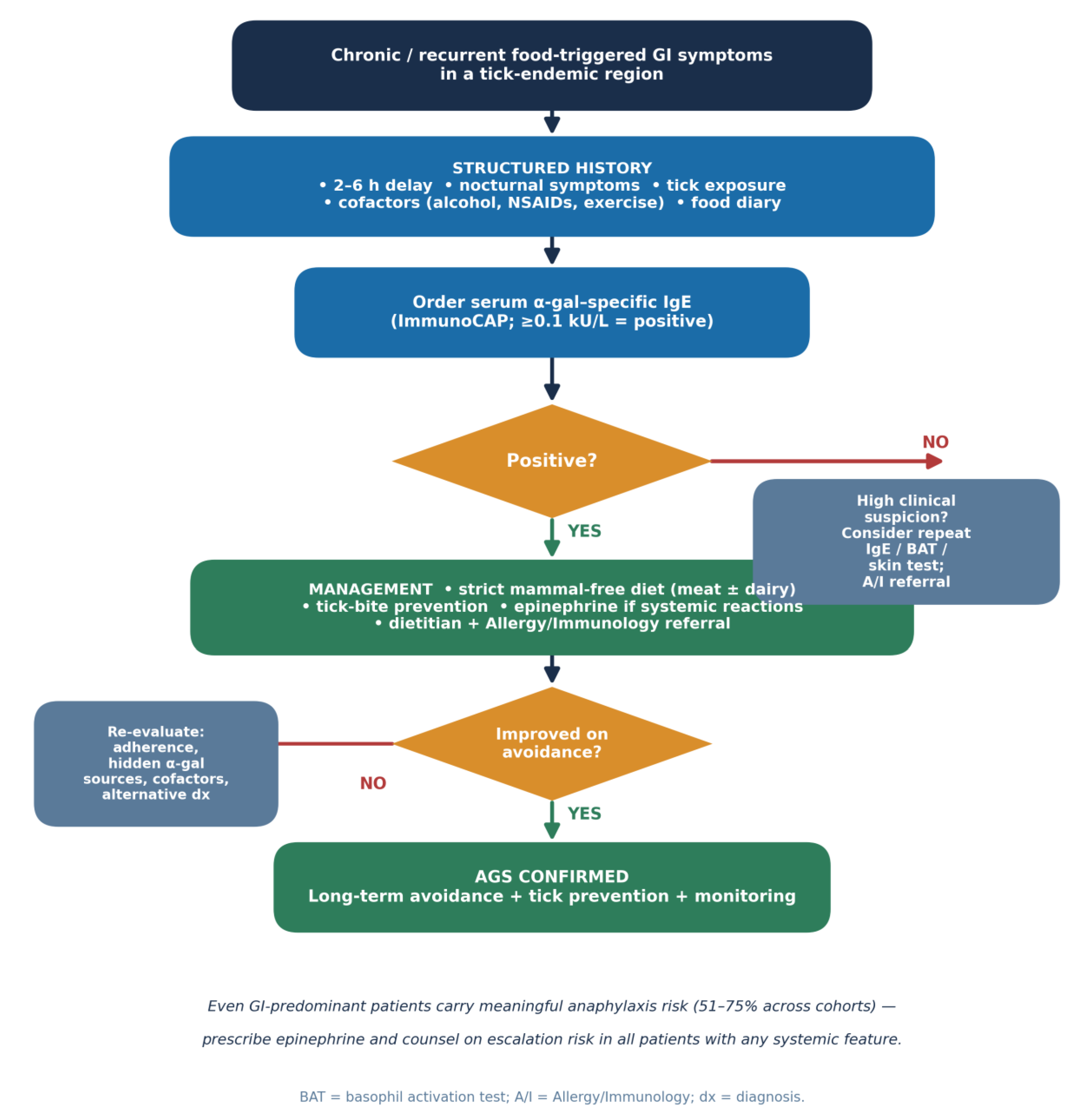
Proposed diagnostic and management algorithm for suspected alpha-gal syndrome in gastroenterology practice. A structured history establishes the pre-test probability; serum α-gal-specific IgE confirms sensitization; and a monitored mammal-free dietary trial serves as both therapy and diagnostic confirmation. Persistently high clinical suspicion despite negative serology warrants repeat testing, basophil activation testing, or allergy/immunology referral. Epinephrine and anaphylaxis counseling are indicated for all patients with any systemic feature. BAT, basophil activation test; A/I, allergy/immunology; IgE, immunoglobulin E.
Figure 3.
Proposed diagnostic and management algorithm for suspected alpha-gal syndrome in gastroenterology practice. A structured history establishes the pre-test probability; serum α-gal-specific IgE confirms sensitization; and a monitored mammal-free dietary trial serves as both therapy and diagnostic confirmation. Persistently high clinical suspicion despite negative serology warrants repeat testing, basophil activation testing, or allergy/immunology referral. Epinephrine and anaphylaxis counseling are indicated for all patients with any systemic feature. BAT, basophil activation test; A/I, allergy/immunology; IgE, immunoglobulin E.
6. Management: What Works, What Does Not, and What We Need
6.1. Dietary Avoidance: The Foundation
The mainstay of AGS management is strict dietary elimination of mammalian-derived foods, anchored by the avoidance of red meat in all its forms: beef, pork, lamb, venison, bison, and any other terrestrial non-primate mammal [1,2,7,8,12,13,17]. Commins, with experience from 2,500 patients, reports that the majority of patients who achieve strict dietary adherence experience substantial symptom reduction or complete resolution [12]. Rao et al.’s meta-analysis quantified improvement rates at 53–86% across the included studies [1].
The extension of avoidance to mammalian dairy products is a frequent clinical question. Although α-gal is present in dairy at lower concentrations than in red meat, a meaningful proportion of patients with AGS—particularly those with higher IgE titers—react to dairy as well [12,13]. The standard approach is to recommend dairy elimination for all patients at initial diagnosis and then to assess individual dairy tolerance cautiously once mammalian-meat avoidance has been established and baseline symptoms have resolved [12,13]. Patients must also be counseled about mammalian-derived α-gal sources in processed foods (lard, tallow, gelatin, and animal-derived broths), medications (gelatin-containing capsules, certain vaccines, and gelatin-based plasma expanders), and biologic agents (cetuximab and porcine-derived heparin) [12,13].
6.2. Tick-Bite Prevention
Tick-bite prevention is co-equal with dietary management and, in the long view, may be more important, because ongoing tick bites continuously re-sensitize patients and boost IgE titers [3,12,14,15]. Patients should receive specific, actionable guidance on the use of DEET-containing or permethrin-treated repellents during outdoor activities; the wearing of long protective clothing with tucked-in extremities in tick habitats; prompt tick inspection and removal after outdoor exposure; and awareness of peak tick-activity seasons [3,14,15]. The potential for spontaneous tolerance to develop when tick bites are successfully prevented is clinically important. Commins documents declining α-gal IgE titers in patients who maintain strict dietary avoidance and prevent new tick bites, with some patients eventually tolerating small amounts of mammalian-derived food without reaction [12].
6.3. Epinephrine and Anaphylaxis Preparedness
All confirmed AGS patients with any history of systemic reactions should be prescribed a self-injectable epinephrine device and educated on its indications and technique [12,13,17]. The threshold for epinephrine prescription in AGS should, in practice, be lower than the threshold in classic immediate-onset food allergy, because the delayed onset, nocturnal timing, and cofactor-dependent severity amplification of AGS create conditions in which patients may under-react to early warning signs of anaphylaxis [12,13]. Even patients whose current clinical picture is GI-predominant should be counseled about the risk of anaphylaxis and provided with an emergency action plan, given the documented risk of phenotypic escalation [9].
6.4. Pharmacological Adjuncts and Emerging Therapies
Beyond dietary avoidance and epinephrine, evidence-based pharmacological treatments for AGS are virtually absent. Antihistamines and corticosteroids may attenuate mild reactions but provide no protection against anaphylaxis [12,21]. The potential role of omalizumab (an anti-IgE monoclonal antibody) has attracted theoretical interest given the central, IgE-dependent mechanism of the syndrome; however, no controlled trial data exist, and the high-titer IgE responses common in AGS may partially circumvent omalizumab’s mechanism of action [18,21]. Erickson et al.’s 2025 review identified antigen-specific immunotherapy targeting tick salivary sensitizing proteins as the conceptually most appealing long-term approach, while noting that the specific tick salivary antigen(s) responsible for α-gal sensitization have not been definitively identified [18]. The therapeutic landscape of AGS in 2026 is, honestly, best characterized as nascent.
7. Quality of Life, Occupational Impact, and Psychological Burden
The burden of AGS on quality of life encompasses the cumulative impact of chronic dietary restriction, fear of inadvertent exposure, repeated healthcare encounters, and—for many patients—years of misdiagnosis. Multiple case series document patients who restrict social activities, avoid restaurants, decline travel, and experience interpersonal conflict related to their dietary requirements [4,7,11,12].
Welch et al.’s 2026 cross-sectional study provided the most granular available data on the occupational and social dimensions of the condition [11]. Participants reported abdominal cramping, diarrhea, itchy skin, and nausea as their dominant symptom cluster, averaging approximately three provider visits before a correct diagnosis [11]. Following diagnosis and dietary restriction, respondents described significant occupational disruption: in agricultural communities where beef and pork production are both dietary staples and the basis of livelihood, avoiding mammalian meat requires a fundamental reorientation of daily food access and meal culture [11].
Formal, validated measurement of quality of life in AGS remains conspicuously absent from the literature, and no AGS-specific patient-reported outcome (PRO) instrument exists. The economic burden of AGS—including the direct costs of diagnostic delay, emergency care for anaphylaxis, and the indirect costs of lost productivity and occupational disruption—has not been formally quantified in any study [4,12,22].
8. Alpha-Gal Syndrome as a Public Health Priority: The Case
8.1. Criteria for a Public Health Concern
A condition warrants designation as a public health concern when it satisfies several converging criteria: high prevalence, rising incidence, significant preventable morbidity, documented failure of existing healthcare systems to manage it adequately, and the availability of effective preventive or management interventions that are not reaching the affected population. AGS meets every criterion. Prevalence is substantial: laboratory surveillance identifies 30.5% seropositivity among tested individuals, and an estimated 96,000–450,000 Americans were affected across a 12-year period [5]. Incidence is rising, with year-on-year increases in confirmed cases across the 2017–2022 surveillance window, driven by expanding tick habitats [5]. Healthcare-system failure is documented and quantified: 42% of U.S. providers had never heard of AGS in 2022 [6]. Finally, effective interventions exist: dietary avoidance is inexpensive and highly effective, tick-bite prevention is feasible and well-understood, and epinephrine is accessible [1,2,7,8,12].
8.2. Clinician-Level Interventions
The most immediate and scalable public health intervention is improving clinician awareness and diagnostic competency. Every gastroenterologist, primary care physician, allergist, and emergency physician practicing in a tick-endemic region should be able to take a dietary and tick-exposure history that identifies AGS as a candidate diagnosis, order α-gal-specific IgE appropriately, counsel patients on dietary avoidance and tick-bite prevention, prescribe epinephrine to patients at risk of anaphylaxis, and facilitate timely allergy/immunology referral for complex cases [6,12,17,22]. The AGA Clinical Practice Update by McGill et al. (2023) established the formal mandate for GI clinicians specifically [17].
8.3. Institutional-Level Interventions
Health systems operating in tick-endemic regions should embed AGS recognition into their institutional clinical infrastructure. Electronic health record (EHR)-based clinical decision support tools—triggered by diagnostic codes for IBS, NCGS, or functional GI disorder in patients with geographic risk factors for tick exposure—can prompt consideration of AGS testing without requiring recall from busy clinicians [6,17]. Structured referral pathways from gastroenterology to allergy/immunology for confirmed AGS with a history of systemic reactions formalize the interdisciplinary care model that the complexity of AGS requires. Boyce et al.’s case series illustrated the interdisciplinary nature of AGS presentations, with patients arriving through multiple specialty portals before any single clinician connected the clinical picture [20].
8.4. Public Health and Surveillance Infrastructure
At the public health system level, the absence of national AGS surveillance infrastructure is the single most important structural gap. AGS is not a nationally notifiable condition in the United States, which means that all population-level prevalence and incidence data must be inferred from commercial laboratory positivity rates and voluntary clinical reporting [5,6]. Thompson et al. advocated explicitly for a structured AGS sentinel surveillance system that uses existing tick-borne disease reporting frameworks as a model [5]. Geographically targeted tick-bite prevention campaigns—analogous to decades of Lyme disease prevention messaging—should explicitly name AGS as a tick-borne consequence for which no pharmacological protection exists and the dietary consequences of which can be severe [3,14,15].
Table 3.
Multi-level intervention framework for alpha-gal syndrome as a public health priority.
| Level | Specific Actions | Supporting Evidence |
|---|---|---|
| Frontline clinician | Add AGS to the differential for food-triggered GI symptoms; order α-gal IgE in endemic regions; provide dietary and tick counseling; prescribe epinephrine; refer to A/I | McGill [17]; Commins [12]; Carpenter [6]; Lesmana [2]; Shishido & Wormser [22] |
| Specialty / GI clinic | Embed an AGS testing algorithm for unexplained food-triggered GI symptoms; create a structured A/I referral pathway; integrate dietitians; adopt food-diary protocols | Awosika & Balaji [7]; Propst & Thompson [4]; Vongsavath [10]; McGill [17]; Boyce [20] |
| Health system / hospital | Implement EHR clinical decision support (IBS/NCGS codes in endemic-region patients); run CME programs; convene interdisciplinary AGS working groups; include AGS in anaphylaxis protocols | Carpenter [6]; Thompson [5]; McGill [17]; Shishido & Wormser [22] |
| State / regional health dept. | Run tick-bite prevention campaigns that name AGS; integrate AGS into tick-borne disease education; conduct occupational-health outreach (farmers, hunters, military) | Thompson [5]; Wilson [3]; Young [14]; Rutkowski [15]; Welch [11] |
| Federal / national | Establish an AGS sentinel surveillance system; assess national notifiability; fund dedicated research; include AGS in the Healthy People framework | Thompson [5]; Carpenter [6]; Erickson [18]; Wilson [3] |
A/I, allergy/immunology; CME, continuing medical education; EHR, electronic health record; GI, gastrointestinal; AGS, alpha-gal syndrome; IBS, irritable bowel syndrome; NCGS, non-celiac gluten sensitivity; IgE, immunoglobulin E.
Figure 4.
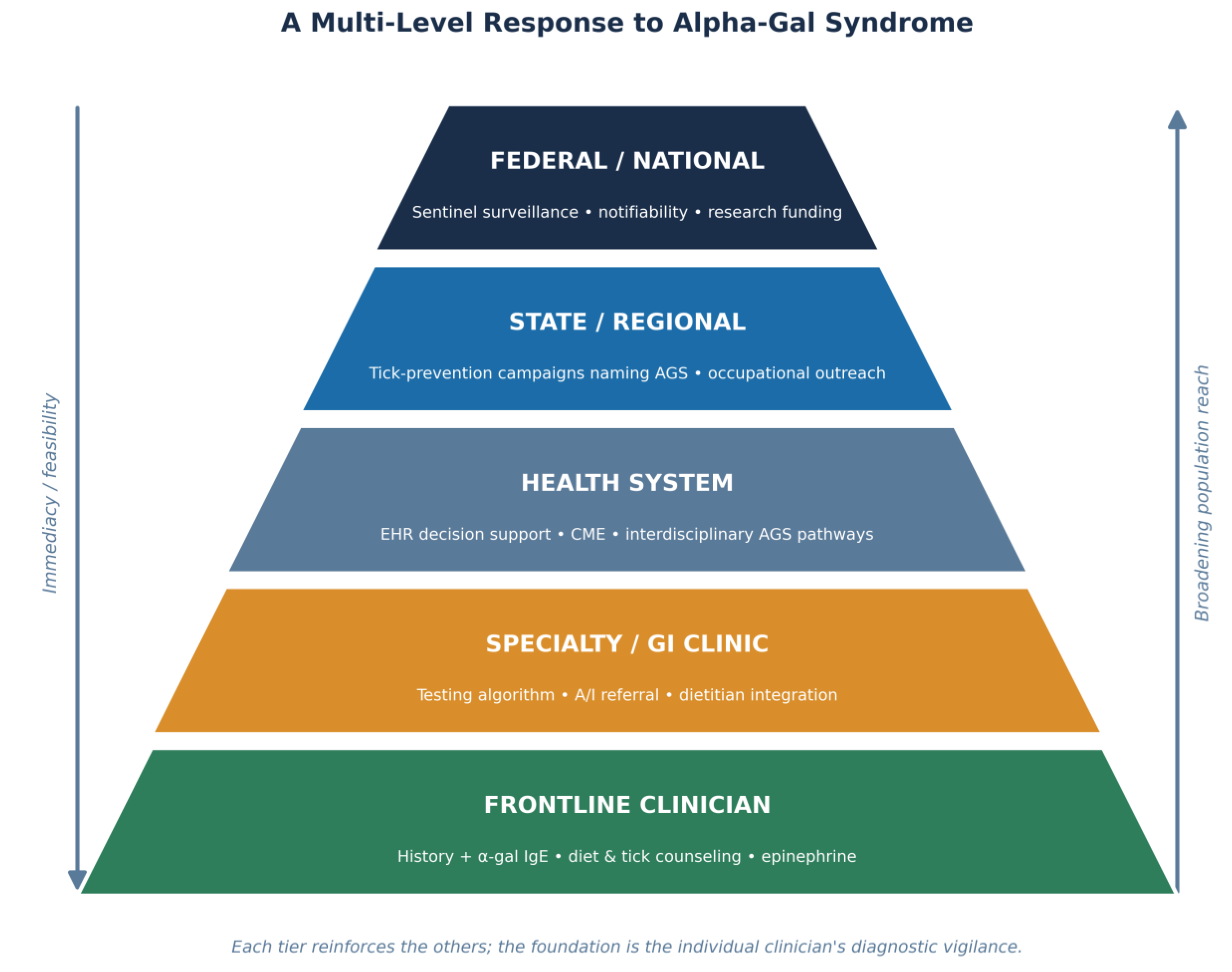
A multi-level intervention framework for alpha-gal syndrome as a public health priority. Interventions are organized from the individual clinician (the foundation) to federal public health infrastructure (the apex). Lower tiers are the most immediately actionable and feasible; higher tiers achieve the broadest population reach. The tiers are mutually reinforcing, and effective control of AGS at scale requires coordinated action across all levels. AGS, alpha-gal syndrome; A/I, allergy/immunology; CME, continuing medical education; EHR, electronic health record; α-gal, galactose-α-1,3-galactose.
Figure 4.
A multi-level intervention framework for alpha-gal syndrome as a public health priority. Interventions are organized from the individual clinician (the foundation) to federal public health infrastructure (the apex). Lower tiers are the most immediately actionable and feasible; higher tiers achieve the broadest population reach. The tiers are mutually reinforcing, and effective control of AGS at scale requires coordinated action across all levels. AGS, alpha-gal syndrome; A/I, allergy/immunology; CME, continuing medical education; EHR, electronic health record; α-gal, galactose-α-1,3-galactose.
9. Critical Knowledge Gaps in 2026
9.1. True Community Prevalence and Natural History
Laboratory surveillance data provide α-gal IgE positivity rates among tested individuals, but not the true community seroprevalence in unselected populations, and certainly not the disease prevalence [1,5,12,22]. Population-based seroepidemiological studies that use random-sampling designs in tick-endemic and non-endemic regions, with structured clinical follow-up to determine the ratio of symptomatic to asymptomatic seropositive individuals, are urgently needed. Similarly, the natural history of AGS—including rates of spontaneous tolerance, predictors of IgE-titer decline, and the long-term clinical course in adherent patients who prevent further tick bites—has not been studied prospectively in any longitudinal cohort [12,18,22].
9.2. Tick Salivary Sensitizing Factors and the Skin–Gut Immunological Axis
Despite mechanistic advances, the specific tick salivary protein(s) responsible for initiating the IgE class switch against α-gal remain unidentified [3,14,18]. This is not merely an academic gap: identification of the sensitizing antigen is a prerequisite for the development of any antigen-specific immunotherapy. The immunological pathway connecting dermal sensitization at the tick-bite site to gut mast-cell activation—the “skin–gut axis” of AGS—is incompletely characterized [3,18].
9.3. Diagnostic Standardization
Current α-gal IgE assays are not standardized across commercial platforms, and no validated quantitative threshold has been established that applies consistently across different assay systems and clinical settings [1,16,21]. A multicenter prospective validation study of a standardized diagnostic algorithm—enrolling patients through gastroenterology, allergy, emergency medicine, and primary care settings with structured phenotyping—would substantially advance the field.
9.4. Evidence-Based Dietary Management
No randomized clinical trial has ever examined any aspect of dietary management in AGS [4,7,22]. Every dietary recommendation—from which specific animal products to avoid, to the optimal duration of avoidance, to evidence-based reintroduction protocols, to the dairy-management strategy—is based on expert experience and observational series [12,13]. These are answerable empirical questions that prospective clinical trials could address.
9.5. Quality of Life and Economic Burden
The development and validation of a disease-specific AGS PRO instrument—one that captures dietary-restriction burden, anaphylaxis anxiety, social participation, and occupational functioning alongside traditional GI symptom severity—is a foundational methodological priority [2,4,7,11,12]. A formal health-economic analysis of the costs of diagnostic delay, emergency utilization, lost productivity, and unnecessary procedures attributable to undiagnosed AGS would provide the quantitative evidence base needed to justify investment in surveillance and education infrastructure [5,6,11].
9.6. Therapeutic Innovation
Omalizumab represents the most clinically proximate candidate pharmacological intervention, and a placebo-controlled Phase II trial in patients with persistent symptoms despite dietary adherence would be a tractable, high-value research investment [13,18]. Antigen-specific tick-salivary-protein-based immunotherapy, analogous to Hymenoptera venom immunotherapy, remains a longer-term goal contingent on identification of the sensitizing antigen [18].
Table 4.
Priority knowledge gaps and recommended research designs for alpha-gal syndrome.
| Knowledge Gap | Specific Unanswered Question | Recommended Study Design |
|---|---|---|
| True community prevalence | What proportion of the general population in endemic regions is sensitized, and what fraction of sensitized individuals are symptomatic? | Population-based, random-sample seroepidemiology with structured clinical follow-up |
| Natural history | What are the rates and predictors of spontaneous tolerance, and the long-term course in adherent patients? | Prospective longitudinal cohort with serial IgE titers and standardized phenotyping |
| Sensitizing tick antigen | Which tick salivary protein(s) initiate the IgE class-switch against α-gal? | Mechanistic immunology; tick-challenge animal models; proteomic analysis of saliva |
| Diagnostic standardization | What quantitative IgE threshold and complementary biomarkers best identify clinically reactive disease? | Multicenter prospective diagnostic-accuracy study with cross-platform assay harmonization |
| Dietary management | What avoidance strategy, dairy approach, and reintroduction protocol are optimal, and what are the cofactor thresholds? | Randomized controlled dietary-intervention trials; controlled cofactor-challenge studies |
| Quality of life and cost | What is the validated quality-of-life burden and the economic cost of diagnostic delay and acute care? | Development and validation of an AGS-specific PRO instrument; health-economic modeling |
| Therapeutics | Is omalizumab (or another biologic) efficacious for patients with persistent symptoms despite avoidance? | Placebo-controlled Phase II randomized trial; antigen-specific immunotherapy development |
AGS, alpha-gal syndrome; IgE, immunoglobulin E; PRO, patient-reported outcome; α-gal, galactose-α-1,3-galactose.
10. Limitations
This review reflects the limitations inherent in the underlying literature. First, the predominance of retrospective, single-center, and tertiary-care cohort studies means that the reported GI symptom prevalences and dietary-response rates are subject to significant ascertainment and referral bias [1,2,8,12]. Second, no randomized trial evidence exists for any management question; all dietary and pharmacological recommendations rest on observational data [4,7,13,22]. Third, the global literature is heavily weighted toward North American and Western European populations, which limits its generalizability [3,14,15]. Fourth, the natural history of AGS is incompletely described, because few prospective longitudinal cohort studies have been conducted [12,18]. Fifth, as a narrative review, this synthesis draws on the authors’ judgment in selecting and weighting the literature, which introduces potential selection and emphasis bias that is not present in systematic reviews with pre-specified search strategies and eligibility criteria.
11. Conclusions
Alpha-gal syndrome is a tick-induced, IgE-mediated allergy whose clinical expression is dominated by gastrointestinal symptoms and whose true prevalence in tick-endemic regions is far greater than current clinical recognition suggests. The characteristic 2–6 h delay between the ingestion of mammalian-derived food and GI symptom onset—a direct consequence of the glycolipid–chylomicron delivery mechanism—renders AGS uniquely susceptible to misattribution as IBS, NCGS, or functional dyspepsia, trapping patients in diagnostic loops that may persist for years while they remain exposed to an ongoing risk of anaphylaxis.
The epidemiological case for urgency is unambiguous. Seropositivity rates of 30.5% among tested individuals in endemic regions [5], an estimated 96,000–450,000 affected Americans between 2010 and 2022 [5], year-on-year increases in confirmed cases, a climate-driven expansion of the tick range that will bring AGS into new geographic territories, and a healthcare workforce that is 42% unaware of the condition’s existence [6] together satisfy the criteria for an emerging public health priority.
The clinical case for GI ownership is equally clear. AGS belongs in the gastroenterologist’s diagnostic armamentarium, alongside celiac disease, inflammatory bowel disease, and functional bowel disorders, as a cause of chronic, recurrent, food-triggered GI complaints. Incorporating α-gal-specific IgE testing into the workup of unexplained, food-triggered GI symptoms—in any patient with a history of tick exposure or residence in an endemic region—is a straightforward, inexpensive, and potentially diagnosis-changing clinical act. A properly resourced research agenda addressing natural history, diagnostic standardization, evidence-based dietary management, and therapeutic innovation would transform care for the hundreds of thousands of Americans, and the growing international population, living with undiagnosed or undertreated AGS.
Because tick habitats continue to expand and provider awareness remains low, the burden of AGS is likely to grow rather than recede. A coordinated response—from the individual clinician ordering an α-gal IgE test that might previously not have been considered, to the health system embedding an AGS diagnostic algorithm within its electronic health record, to public health agencies establishing structured surveillance—is both achievable and, on the present evidence, warranted.
Author Contributions
Conceptualization, A.E.; literature search and screening, A.E. and Y.O.; writing—original draft preparation, A.E.; writing—review and editing, A.E. and Y.O.; visualization, A.E.; supervision, A.E. All authors have read and agreed to the published version of the manuscript.
Funding
This research received no external funding.
Institutional Review Board Statement
Not applicable. This review synthesizes previously published literature and did not involve human subjects or animals.
Informed Consent Statement
Not applicable.
Data Availability Statement
No new data were created or analyzed in this study. All data discussed are available in the cited published literature.
Acknowledgments
The authors thank the Department of Gastroenterology and Hepatology at Marshall University, Joan C. Edwards School of Medicine, for institutional support.
Conflicts of Interest
The authors declare no conflicts of interest.
Abbreviations
The following abbreviations are used in this manuscript:
| AGA | American Gastroenterological Association |
| AGS | Alpha-gal syndrome |
| α-gal | Galactose-α-1,3-galactose |
| BAT | Basophil activation test |
| CDC | Centers for Disease Control and Prevention |
| CME | Continuing medical education |
| EHR | Electronic health record |
| GI | Gastrointestinal |
| IBS | Irritable bowel syndrome |
| IgE | Immunoglobulin E |
| NCGS | Non-celiac gluten sensitivity |
| NSAID | Non-steroidal anti-inflammatory drug |
| PRO | Patient-reported outcome |
| SANRA | Scale for the Assessment of Narrative Review Articles |
References
- Rao, S.; Rathore, S.; Goyal, R.; Narakornpichit, A.; Karkra, R.; Al-Khazraji, A.; Grover, M. Understanding alpha-gal syndrome: A systematic review and meta-analysis of clinical manifestations and outcomes. Neurogastroenterol. Motil. 2026, 38, e70245. [Google Scholar] [CrossRef] [PubMed]
- Lesmana, E.; Rao, S.; Keehn, A.; Edwinson, A.L.; Makol, A.; Grover, M. Clinical presentation and outcomes of alpha-gal syndrome. Clin. Gastroenterol. Hepatol. 2024. [Google Scholar] [CrossRef] [PubMed]
- Wilson, J.M.; Erickson, L.D.; Levin, M.; Ailsworth, S.M.; Commins, S.P.; Platts-Mills, T.A.E. Tick bites, IgE to galactose-alpha-1,3-galactose and urticarial or anaphylactic reactions to mammalian meat: The alpha-gal syndrome. Allergy 2024, 79, 1440–1454. [Google Scholar] [CrossRef] [PubMed]
- Propst, S.B.H.; Thompson, D.K. Alpha-gal syndrome and the gastrointestinal reaction: A narrative review. Front. Allergy 2025, 6, 1535103. [Google Scholar] [CrossRef] [PubMed]
- Thompson, J.M.; Carpenter, A.; Kersh, G.; Wachs, T.; Commins, S.P.; Salzer, J. Geographic distribution of suspected alpha-gal syndrome cases—United States, January 2017–December 2022. MMWR Morb. Mortal. Wkly. Rep. 2023, 72, 815–820. [Google Scholar] [CrossRef] [PubMed]
- Carpenter, A.; Drexler, N.A.; McCormick, D.; Thompson, J.; Kersh, G.; Commins, S.P.; Salzer, J. Health care provider knowledge regarding alpha-gal syndrome—United States, March–May 2022. MMWR Morb. Mortal. Wkly. Rep. 2023, 72, 809–814. [Google Scholar] [CrossRef] [PubMed]
- Awosika, A.; Balaji, P. Misdiagnosis of alpha-gal syndrome as non-celiac gluten sensitivity or lactose intolerance: A diagnostic blind spot for clinicians. World J. Gastroenterol. 2026, 32, 116350. [Google Scholar] [CrossRef] [PubMed]
- Richards, N.E.; Richards, R. Alpha-gal allergy as a cause of intestinal symptoms in a gastroenterology community practice. South. Med. J. 2021, 114, 169–173. [Google Scholar] [CrossRef] [PubMed]
- Binder, A.; Cherry-Brown, D.; Biggerstaff, B.; Jones, E.; Amelio, C.L.; Beard, C.B.; Petersen, L.; Kersh, G.; Commins, S.P.; Armstrong, P.A. Clinical and laboratory features of patients diagnosed with alpha-gal syndrome, 2010–2019. Allergy 2022, 78, 477–487. [Google Scholar] [CrossRef] [PubMed]
- Vongsavath, T.; Tun, K.; Haque, L.; Manne, V. The diagnosis and treatment of alpha-gal syndrome: A review. Am. J. Gastroenterol. 2024, 119, S224. [Google Scholar] [CrossRef]
- Welch, A.M.; Beseler, C.L.; Cross, S.T. Alpha-gal syndrome symptom profiles and diagnostic experiences among farmers and ranchers. medRxiv 2026. [Google Scholar] [CrossRef] [PubMed]
- Commins, S.P. Diagnosis and management of alpha-gal syndrome: Lessons from 2,500 patients. Expert Rev. Clin. Immunol. 2020, 16, 667–677. [Google Scholar] [CrossRef] [PubMed]
- Vaz-Rodrigues, R.; Mazuecos, L.; de la Fuente, J. Current and future strategies for the diagnosis and treatment of the alpha-gal syndrome (AGS). J. Asthma Allergy 2022, 15, 957–970. [Google Scholar] [CrossRef] [PubMed]
- Young, I.; Prematunge, C.; Pussegoda, K.; Corrin, T.; Waddell, L. Tick exposures and alpha-gal syndrome: A systematic review of the evidence. Ticks Tick. Borne Dis. 2021, 12, 101674. [Google Scholar] [CrossRef] [PubMed]
- Rutkowski, K.; Sowa, P.; Mroczko, B.; Pancewicz, S.; Rutkowski, R.; Czupryna, P.; Groblewska, M.; Lukaszewicz-Zajac, M.; Moniuszko-Malinowska, A.M. Sensitisation and allergic reactions to alpha-1,3-galactose in Podlasie, Poland, an area endemic for tick-borne infections. Infect. Dis. 2022, 54, 572–579. [Google Scholar] [CrossRef] [PubMed]
- Platts-Mills, T.A.E.; Commins, S.P.; Biedermann, T.; van Hage, M.; Levin, M.; Beck, L.A.; Diuk-Wasser, M.; Jappe, U.; Apostolovic, D.; Minnicozzi, M.; et al. On the cause and consequences of IgE to galactose-α-1,3-galactose: A report from the NIAID Workshop on Understanding IgE-Mediated Mammalian Meat Allergy. J. Allergy Clin. Immunol. 2020, 145, 1061–1071. [Google Scholar] [CrossRef] [PubMed]
- McGill, S.K.; Hashash, J.G.; Platts-Mills, T.A.E. AGA Clinical Practice Update on alpha-gal syndrome for the GI clinician: Commentary. Clin. Gastroenterol. Hepatol. 2023, 21, 891–896. [Google Scholar] [CrossRef] [PubMed]
- Erickson, L.D.; Wilson, J.M.; Cramton, K.; Rival, C.M. Pre-clinical strategies and emerging technologies driving advances in the alpha-gal syndrome. Allergol. Int. 2025, 74, 397–405. [Google Scholar] [CrossRef] [PubMed]
- Román-Carrasco, P.; Lieder, B.; Somoza, V.; Ponce, M.; Szépfalusi, Z.; Martin, D.; Hemmer, W.; Swoboda, I. Only α-Gal bound to lipids, but not to proteins, is transported across enterocytes as an IgE-reactive molecule that can induce effector cell activation. Allergy 2019, 74, 1956–1968. [Google Scholar] [CrossRef] [PubMed]
- Boyce, R.; Schulz, A.; Mansour, O.; Giandomenico, D.A.; Farel, C.E.; Commins, S.P. Alpha-gal syndrome in the infectious diseases clinic: A series of 5 cases in central North Carolina. Open Forum Infect. Dis. 2022, 9, ofac663. [Google Scholar] [CrossRef] [PubMed]
- Mabelane, T.; Basera, W.; Botha, M.; Thomas, H.F.; Ramjith, J.; Levin, M.E. Predictive values of alpha-gal IgE levels and alpha-gal IgE:total IgE ratio and clinical outcomes following a negative red meat challenge. Pediatr. Allergy Immunol. 2018, 29, 841–849. [Google Scholar] [CrossRef] [PubMed]
- Shishido, A.A.; Wormser, G.P. A review of alpha-gal syndrome for the infectious diseases practitioner. Open Forum Infect. Dis. 2025, 12, ofaf430. [Google Scholar] [CrossRef] [PubMed]
- Chung, C.H.; Mirakhur, B.; Chan, E.; Le, Q.T.; Berlin, J.; Morse, M.; Murphy, B.A.; Satinover, S.M.; Hosen, J.; Mauro, D.; et al. Cetuximab-induced anaphylaxis and IgE specific for galactose-α-1,3-galactose. N. Engl. J. Med. 2008, 358, 1109–1117. [Google Scholar] [CrossRef] [PubMed]
- Commins, S.P.; Satinover, S.M.; Hosen, J.; Mozena, J.; Borish, L.; Lewis, B.D.; Woodfolk, J.A.; Platts-Mills, T.A.E. Delayed anaphylaxis, angioedema, or urticaria after consumption of red meat in patients with IgE antibodies specific for galactose-α-1,3-galactose. J. Allergy Clin. Immunol. 2009, 123, 426–433. [Google Scholar] [CrossRef] [PubMed]
- van Nunen, S.A.; O’Connor, K.S.; Clarke, L.R.; Boyle, R.X.; Fernando, S.L. An association between tick bite reactions and red meat allergy in humans. Med. J. Aust. 2009, 190, 510–511. [Google Scholar] [CrossRef] [PubMed]
- Commins, S.P.; James, H.R.; Kelly, L.A.; Pochan, S.L.; Workman, L.J.; Perzanowski, M.S.; Kocan, K.M.; Fahy, J.V.; Nganga, L.W.; Ronmark, E.; et al. The relevance of tick bites to the production of IgE antibodies to the mammalian oligosaccharide galactose-α-1,3-galactose. J. Allergy Clin. Immunol. 2011, 127, 1286–1293. [Google Scholar] [CrossRef] [PubMed]
- Steinke, J.W.; Platts-Mills, T.A.E.; Commins, S.P. The alpha-gal story: Lessons learned from connecting the dots. J. Allergy Clin. Immunol. 2015, 135, 589–596. [Google Scholar] [CrossRef] [PubMed]
- Commins, S.P.; Platts-Mills, T.A.E. Tick bites and red meat allergy. Curr. Opin. Allergy Clin. Immunol. 2013, 13, 354–359. [Google Scholar] [CrossRef] [PubMed]
- Wilson, J.M.; Platts-Mills, T.A.E. Red meat allergy in children and adults. Curr. Opin. Allergy Clin. Immunol. 2019, 19, 229–235. [Google Scholar] [CrossRef] [PubMed]
- Fischer, J.; Yazdi, A.S.; Biedermann, T. Clinical spectrum of α-Gal syndrome: From immediate-type to delayed immediate-type reactions to mammalian innards and meat. Allergo J. Int. 2016, 25, 55–62. [Google Scholar] [CrossRef] [PubMed]
Disclaimer/Publisher’s Note: The statements, opinions and data contained in all publications are solely those of the individual author(s) and contributor(s) and not of MDPI and/or the editor(s). MDPI and/or the editor(s) disclaim responsibility for any injury to people or property resulting from any ideas, methods, instructions or products referred to in the content. |
© 2026 by the authors. Licensee MDPI, Basel, Switzerland. This article is an open access article distributed under the terms and conditions of the Creative Commons Attribution (CC BY) license (http://creativecommons.org/licenses/by/4.0/).
Copyright: This open access article is published under a Creative Commons CC BY 4.0 license, which permit the free download, distribution, and reuse, provided that the author and preprint are cited in any reuse.


