

Submitted:
10 June 2026
Posted:
11 June 2026
You are already at the latest version
Abstract
Pediatric autoimmune disorders are increasingly common, but outcomes are poor due to delayed diagnosis. Immune system dysfunctions typically cause these in the presence of essential micronutrient deficiencies, especially vitamin D. Besides, vitamin D deficiency contributes to both immune and endocrine imbalances that may trigger or exacerbate autoimmunity in children. This review highlights the role of micronutrients, cofactors, and mechanisms, especially vitamin D, in regulating immune responses, maintaining hormonal equilibrium, and disease progression. It explores the complex interactions between vitamin D, zinc, selenium, probiotics, and omega-3 fatty acids and the immune and endocrine systems in pediatric autoimmune pathophysiology. The article underscores the importance of early diagnosis, effective interventions, and targeted micro-nutritional strategies to reduce the incidence and severity of these disorders. Proactive supplementation—especially with vitamin D3 and complementary micronutrients—can strengthen immune function, reduce inflammation and oxidative stress, and mitigate the development of childhood autoimmune diseases. Understanding the interconnected roles of different micronutrients, gut microbiota, and immune dysregulation is essential to preventing and effectively managing these conditions. The review encourages pediatricians and other healthcare professionals to adopt integrative approaches, including holistic, orthomolecular, and personalized nutritional therapies, to prevent these disorders and associated complications. Such cost-effective approaches improve clinical outcomes and guide future research and public health strategies. Optimizing micronutrient levels may significantly enhance pediatric well-being and long-term quality of life.
Keywords:
vitamin D
; 25(OH)D
; 1
; 25(OH)2D
; childhood
; disease prevention
; epidemiology
; public health
1. Introduction
The endocrine and immune systems interact, which is crucial for health, particularly in pediatric autoimmune diseases. There is a significant interplay between the endocrine and immune systems throughout life. This relationship becomes critical during rapid growth and development, marked by the rapid maturation of body systems, including the immune system. Autoimmunity occurs when the immune system erroneously targets and attacks the body’s own tissues, leading to chronic diseases like Type 1 diabetes mellites (T1DM), Hashimoto’s thyroiditis, and autoimmune adrenalitis, which are increasingly diagnosed in pediatric populations [1]. As with immunosenescence in aging and having comorbidities, the vulnerability to autoimmune conditions also increases during childhood.
In children, the developing immune system continues to learn to distinguish self-antigen from non-self, while antigen-sensing systems like Toll-like receptors remain active [2,3]. Disruption of this process can result in the immune system mounting an attack against the body’s cells. This vulnerability is enhanced when serum 25(OH)D concentration drops below critical levels like 12 ng/mL―severe vitamin D deficiency [4].
However, factors other than vitamin D also increase vulnerability to immune disruption, including environmental triggers (e.g., infections, pollutants, etc.), genetic predisposition, and deficiencies in key cofactors and micronutrients like zinc, selenium, and omega-3 fatty acids [5]. The three most pertinent micronutrients modulating the immune system are vitamin D, zinc, and selenium [6], maintaining hormonal balance and receptor activity, and preventing autoimmune tendencies [1,6]. Deficiencies in these nutrients would disrupt immune and endocrine systems, heightening the risk of autoimmune diseases in children. Micronutrient supplementation, especially vitamin D, helps regulate immune function and mitigate autoimmune diseases [7]. This review examines micronutrient roles, particularly vitamin D’s interaction with immune and endocrine systems, focusing on pediatric autoimmune conditions.
1.1. Restoring Balance: The Importance of Understanding Micronutrient Interactions to Alleviate Pediatric Disorders
Micronutrients, nutraceuticals, functional foods, and orthomolecular medicine focus on personalized medicine to restore the body’s optimal microenvironment (milieu) by correcting deficiencies and imbalances based on individual biochemistry. These approaches address health issues by restoring balance and targeting root causes using natural substances and nutrients. Micronutrients come from a balanced diet that promotes better health. Though introduced in lesser amounts, they are essential for growth, health maintenance, and preventing autoimmune conditions in children. This review discusses key micronutrients for children’s growth: vitamin D, zinc, selenium, iron, folic acid, and polyunsaturated essential fatty acids.
In addition to being aware and suspecting, understanding the complex interactions between the immune and endocrine systems is crucial for early detection. In addition, interventions focusing on natural foods and micronutrients (not expensive patented medications) are cost-effective and essential to prevent autoimmune diseases [8]. The latter is crucial in childhood due to their increased vulnerability. Addressing root causes of autoimmunity, such as severe vitamin D deficiency, is key to restoring endocrine and immune balance. This balance can be achieved with minimal costs by properly using micronutrients—vitamins, minerals, trace elements, and essential fatty acids (see below) [8]. Additionally, inherent vulnerabilities from hereditary or genetic defects and environmental pollutants [9] influence physical, mental, and biochemical characteristics.
In studying illnesses, biochemical pathways—comprising enzymatic reactions and other factors—are particularly important. Research indicates that identifying specific biochemical abnormalities can contribute to or even cause disease. These abnormalities may respond to targeted supplementation and natural treatments. Advances in nutritional science, particularly personalized nutrition, provide strategies based on metabolic profiles to prevent or slow childhood autoimmune disorders [10]. Ensuring nutrient sufficiency through a balanced diet, food fortification, and targeted supplementation are cost-effective ways to improve children’s health outcomes [11].
1.2. The Endocrine System
The endocrine system comprises specialized glands that secrete hormones into the bloodstream. These include pituitary, thyroid, adrenal glands, pancreas, ovaries, and testes, which produce hormones essential for maintaining homeostasis, metabolism, growth, and reproductive functions. Calcitriol, secreted into the bloodstream from distal renal tubular cells, acts as a hormone for the musculoskeletal system. Parathyroid glands regulate numerous physiological processes, including growth and mineral balance. Modulating calcium homeostasis relies on calcium-sensing receptors in parathyroid glands [12], controlling intestinal calcium absorption, renal tubular re-absorption, and skeletal mineralization and demineralization [13].
A functional endocrine system is essential for maintaining homeostatic bodily functions and appropriate biological and physiological responses. Notably, micronutrients—such as vitamins, minerals, and other cofactors—are indispensable for the proper functioning of the endocrine system (so as for the immune system, as described below). These micronutrients modulate and support biochemical pathways and hormone-receptor interactions (e.g., calcitriol and its receptors, VDR/CTR), hormone synthesis, activation, release, and regulation [14,15]. These also need co-factors like magnesium, omega-3 fatty acids, etc. [16,17].
For instance, vitamin D, a fat-soluble vitamin, is well known for its role in calcium and mineral metabolism [18]. However, it also significantly influences immune system modulation and the function of various endocrine glands, including the thyroid and pancreas [19]. Vitamin D deficiency increases the risks of autoimmune diseases and metabolic disorders, demonstrating its essential role in endocrine-immune interactions [7]. Additionally, trace minerals such as zinc and selenium are critical antioxidants, needed as co-factors for enzymatic reactions and maintaining thyroid functions. Deficiencies in these minerals often lead to thyroid endocrine dysfunctions, imbalances in metabolic processes, and energy metabolism [20].
1.3. The Immune System
The immune system comprises innate and adaptive immune responses, which protect the body from pathogens and foreign microbial invaders [21,22]. Innate immunity is the first line of defense, providing a rapid response through mechanisms like phagocytosis and cytotoxic damage to pathogens [22]. In contrast, adaptive immunity is developed over time. The responses from the latter are more specific, involving the activation of lymphocytes (B cells and T cells) and memory cells for prompt and targeted responses based on previous encounters with pathogens [23]. The responses from adaptive immunity affect cells (lymphocytes and white blood cells), tissues (lymph nodes), and organs (spleen) [22].
Regulatory mechanisms ensure T-cell and B-cell tolerance and prevent attacks on the body’s tissues. When these fail, such as after acute viral infections cause cellular and membrane damage, immune tolerance could be compromised [24], triggering dysfunctional immune responses against self-antigens, leading to autoimmune disorders [25,26,27]. As a response, the immune system produces pro-inflammatory cytokines, causing diffuse inflammation, oxidative stress, pathological reactions, and tissue damage [1]. In vulnerable individuals with comorbidities and low 25(OH)D, it can also disrupt the hypothalamic-pituitary-thyroid (HPT) axis. This reversible process that depends on vitamin D sufficiency illustrates how a dysfunctional immune system causes autoimmunity and influences endocrine glands [28].
1.4. Interactions Between the Endocrine and Immune Systems
The endocrine and immune systems are interconnected, affecting each other through molecules, receptors, and the paracrine system. Endocrine hormones modulate immunity, while immune cells release cytokines affecting endocrine function. Cortisol, produced by the adrenal glands, manages stress and inflammation [29]. It prevents immune overactivation and tissue damage.
Understanding endocrine-immune interactions is crucial for uncovering disease mechanisms, progression, and treatments in children. Severe vitamin D deficiency leads to immune dysregulation, increasing susceptibility to severe infections, autoimmunity, and multi-system disorders [30]. The latter life-threatening autoimmune disorders [30] include multi-system inflammatory syndrome (MIS) and Kawasaki-like disease [31,32], as seen during the SARS-CoV-2 pandemic [32,33]. Notably, early immune responses, including inflammation and oxidative stress, are physiological responses to overcome infections that are natural defenses directed to eliminate infections, similar to rising body temperature during infection [34].
1.5. Autoimmune Mechanisms
In addition to micronutrient deficiency, genetic and environmental factors contribute to developing autoimmune diseases. Genetic predisposition, often involving the presence of human leukocyte antigen (HLA) alleles, increases the likelihood of developing autoimmune conditions [35]. However, these genetic factors alone are typically insufficient to trigger disease onset without other risk factors, exposures, and vulnerabilities [9]. Environmental factors, such as infections and exposure to toxins, can interact in those with predispositions, and epigenetic and genetic interactions change immune dysfunction and cause autoimmune diseases [36].
Childhood autoimmune disorders have multiple causes. As in this case, the interplay between genetic susceptibility and environmental exposures is critical in vulnerable children (i.e., those with hypovitaminosis D), enabling the pathogenesis and triggering autoimmune diseases [9]. For example, viral infections can trigger immune dysfunction, activating the immune response against cells and intracellular components, as in pancreatic beta cells, precipitating T1DM in susceptible children [37,38]. Similarly, environmental factors like pollutants, ultraviolet light exposure, and infections are linked to the onset of SLE [39] and intra-uterine exposure to paracetamol and maternal hypovitaminosis D increased the risks for autism spectrum disorders [40].
Critical reviews have addressed genetic [41] and environmental factors [42] related to complex interactions in developing autoimmune diseases [43,44]. These mechanisms provide evidence of their contributions through epidemiological studies and molecular research [45]. These studies highlight how genetic and environmental links and risk factors affect immune regulation [9,43]. Environmental exposures can act as catalysts for autoimmune conditions [9,42]. Understanding these mechanisms is crucial for developing strategies for prevention, early detection, and targeted treatments for autoimmune disorders (see below) [46,47].
1.6. Common Pediatric Autoimmune Conditions
Autoimmune disorders occur when they harm cells or cellular components (like β-cells), causing inflammation, tissue damage, and organ dysfunction. Common autoimmune disorders in children include T1DM, juvenile idiopathic arthritis (JIA), systemic lupus erythematosus (SLE), and autoimmune thyroid disorders (AITD) [48,49]. These conditions arise from the immune system’s failure to distinguish self from non-self-antigens, leading to auto-antibody or autoreactive T-cell production that targets specific cell components or tissues.
1.7. Pathological Process Involved in Endocrine Gland-Related Autoimmunity
As discussed, pediatric autoimmune disorders often disrupt immune and endocrine functions. In AITDs, like Hashimoto’s thyroiditis and Graves’ disease, the immune system targets thyroid tissue, causing thyroid dysfunction and abnormal hormone levels. Hashimoto’s thyroiditis usually results in hypothyroidism, characterized by insufficient thyroid hormone production, while Graves’ disease leads to hyperthyroidism, marked by excessive hormone production [50]. Vitamin D deficiency is significantly associated with a higher risk of autoimmune diseases, including AITDs and T1DM [51,52].
In Type 1 diabetes, autoimmune destruction of pancreatic beta cells impairs insulin production, disrupting blood glucose regulation and requiring lifelong insulin therapy. Similarly, in Addison’s disease, autoimmune adrenalitis damages the adrenal glands, reducing cortisol and aldosterone production essential for stress responses, electrolyte balance, and blood pressure regulation [1]. These diseases underscore the endocrine system’s susceptibility to immune-mediated damage, disrupting hormonal balance and causing lifelong health challenges [51,52]. Micronutrients, including vitamin D, magnesium, and other cofactors, profoundly affect the endocrine and immune systems and the development of autoimmune disorders [53].
2. Impact of Other Micronutrients on Autoimmune and Endocrine Disorders
Micronutrient deficiencies, especially vitamin D, can initiate autoimmune conditions such as AITDs—Hashimoto’s thyroiditis and Graves’ disease- causing hypothyroidism and hyperthyroidism, IDDM, etc. [54]. In TIDM, the immune system attacks pancreatic β-cells and their constituents, resulting in antibodies against cellular proteins, further destroying islet cells, and reducing insulin synthesis and secretion. This cascade of events could require lifelong insulin therapy [51,52]. Whereas autoimmune adrenalitis (Addison’s disease) impairs the ability to produce cortisol from adrenal glands, causing life-threatening adrenal insufficiency [55]. These disorders highlight the close connection between autoimmune dysfunction and endocrine dysregulation.
2.1. Impact of Trace minerals on Autoimmune and Endocrine Disorders
As illustrated above, autoimmune disorders directly impact hormone production, leading to hormonal imbalances and dysregulated immune responses, which can be interlinked [56]. For instance, SLE can lead to endocrine issues like hypoadrenalism and hypothyroidism [57]. A deficiency of vitamin D and other micronutrients can cause diffuse inflammation. Combined with the impairment of ACE-2 synthesis, hypovitaminosis D disrupts the renin-angiotensin-aldosterone system/axis (RAAS) [58].
Overactive RAAS and suppression of ACE-2 [59] lead to cytokine dysregulation, which increases the risk of cytokine storms following acute viral infections like SARS-CoV-2 [58], worsening autoimmune disorders, and endocrine abnormalities. Considering the above, understanding mechanisms related to autoimmune endocrinopathies is essential for developing effective treatments and improving patients’ clinical outcomes.
2.2. Micronutrient and Co-Factor Deficiencies Increase the Risks of Autoimmune Disorders
Although the anti-inflammatory properties of various micronutrients play a crucial role in autoimmune diseases, they are not the primary focus of this research. Chronic inflammation is a key driver of autoimmune disorders, metabolic disorders, and cardiovascular abnormalities [55]. Micronutrients, including vitamin D, omega-3 fatty acids (see below), and antioxidants, have been shown to modulate inflammatory pathways significantly [55]. These nutrients positively regulate immune responses and reduce excessive inflammation, oxidative stress, and disease progression.
Despite their importance, the precise mechanisms by which micronutrients exert anti-inflammatory effects are beyond the scope of this review. However, future research should investigate their impact on cytokine production, immune cell function, and controlling oxidative stress in autoimmune conditions [60]. Exploring these pathways offers insight into novel therapeutic strategies for managing pediatric autoimmune disorders more effectively.
The impact of micronutrients on the endocrine system is extensive. Maintaining Other cofactors, such as magnesium, zinc, and iodine, play crucial roles in hormone production, regulation, and secretion. They are crucial for endocrine regulation and the maintenance of immune functions [61]―enhancing the immune system’s response to threats while supporting the optimal function of the endocrine glands [51,52,55]. Deficiencies contribute to conditions like hypothyroidism or adrenal insufficiency [62,63]. Maintaining a balanced intake of micronutrients is essential for hormonal homeostasis, controlling inflammation and oxidative stress, and suppressing autoimmunity [55]. Deficiencies or imbalances can disrupt this finely tuned system, causing metabolic and immune functions. Environmental pollutants aggravate existing diseases [64,65], including autoimmune disorders [66,67]. Table 1 outlines how vitamins and essential micronutrients influence immune activity, providing an overview of their role in immune and endocrine health.
Recent studies highlight how deficiencies in essential vitamins and minerals are linked to increased risks and severity of autoimmune diseases (Table 1) [18,63]. These deficiencies impair immune cell activity, weaken immune responses, and disrupt immune tolerance [96]. For instance, conditions like multiple sclerosis (MS) [57], rheumatoid arthritis, and T1DM [42,97], sustained hypovitaminosis D increases the incidence of autoimmunity. Similarly, zinc and selenium deficiencies can cause immune dysregulation, promote inflammation, and increase susceptibility to autoimmune disorders [55,63].
2.3. Polyunsaturated Fatty Acids: Key Modulators of Inflammation and Autoimmune Responses
Many chronic diseases, such as coronary artery disease, systemic lupus erythematosus (SLE), rheumatoid arthritis (RA), and neurodegenerative disorders, are driven by underlying inflammation [98]. In addition to vitamin D (calcitriol), studies have reported that polyunsaturated fatty acids (PUFAs) [99], particularly the long-chain omega-3 PUFAs (n-3 LC-PUFAs), eicosapentaenoic acid (EPA) and docosahexaenoic acid (DHA) [100,101], possess significant anti-inflammatory and immunomodulatory properties [55,98].
Essential PUFAs and micronutrients help mitigate inflammatory conditions―especially autoimmune disorders, including RA, Alzheimer’s, inflammatory bowel diseases, and SLE [101,102], and other neurodegenerative disorders [55,102]. The anti-inflammatory effects of micronutrients promote protective cytokines and suppress inflammatory cytokines, suppressing autoimmune diseases [61,100]. Mechanisms are partly due to the modulation of inflammatory responses by reducing pro-inflammatory eicosanoids derived from omega-6 fatty acids. They also generate pro-resolving mediators such as resolvins and protectins. Consequently, it reduces inflammation and associated tissue damage in autoimmune conditions [98]. Patients receiving omega-3 supplements reduced symptoms of joint pain and morning stiffness and reliance on non-steroidal anti-inflammatory drugs. These findings suggest that incorporating omega-3 fatty acids into the diet will likely benefit adjunct therapy for managing autoimmune diseases [100,101].
Vitamin D supplementation reduces complications of T1DM in children [103]. Meanwhile, omega-3 fatty acids are known for their anti-inflammatory effects, such as reducing inflammation and improving outcomes in autoimmune conditions such as T1DM [47,104,105]. Vitamins A, B, C, E, and K2, as well as minerals (zinc, iron, and selenium), offer complementary benefits for immune health and endocrine functions (Table 1). Integrating clinical judgment with advanced diagnostics, a multidisciplinary approach, and artificial intelligence (AI) would increase the accuracy and precision of diagnoses and improve the management of pediatric autoimmune diseases [106].
2.4. Role of Probiotics and Gut Microbiota in Autoimmune Diseases
The role of gut microbiota in immune homeostasis is an expanding field of science. When dysregulated, it increases the risk for autoimmune diseases [64]. Substantial evidence suggests that probiotics and prebiotics support gut microbiota and immune functions [107]. Probiotics—live microorganisms benefiting health—modulate gut microbiome composition, influencing immune responses and promoting overall health [107]. Proper supplementation restores microbial balance, strengthens the intestinal barrier, and reduces systemic inflammation, thus lowering autoimmune diseases [108].
Clinical trials support probiotics’ efficacy in managing autoimmune conditions [109]. A meta-analysis of 80 randomized trials found that gut microbiota-based therapies, including probiotics [107] reported that they are effective and safe for autoimmune and rheumatic diseases [108]. Probiotics modulate immune function by regulating cytokine production and enhancing T-cell activity; these are crucial for controlling autoimmunity [45,109]. Findings suggest probiotics can be a valuable addition to prevent, suppress, and treat autoimmune diseases [107,108].
Changes in gut microbiota led to an over-representation of diabetogenic microbes that may share beta-cell epitopes. If so, they could trigger insulitis and contribute to developing T1DM in genetically susceptible individuals [9,110]. The lack of exposure of the fetus to maternal flora resulting from cesarean sections has been linked as a cause for the increased risk of T1DM in these individuals [111,112,113,114,115]. Exposure to antibiotics in infancy has been linked to a higher risk of T1DM later in life [116]. Environmental factors, such as exposure to high ozone concentrations both in utero and postnatally, are also proposed to contribute to the heightened risk of T1DM in recent years [65,116,117].
2.5. Recent Advances in Nutritional Immunology
Recent advances in nutritional immunology highlight the intricate link between diet, immune function, and health [118]. Immuno-metabolism explores how nutrients and metabolic processes shape immune cell responses and inflammation [119]. Understanding these interactions enables targeted nutritional interventions for effectively managing disease [120]. These emerging fields examine various aspects of immune regulation. An example is inefficient glucose utilization via aerobic glycolysis, which produces excess lactate in effector immune cells [121]. Additionally, immune stressing focuses on how the immune system utilizes nutrition and metabolism to combat infections [118,119].
2.6. Complexities Associated with Childhood Autoimmune Disorders
HLA gene variations [9] may heighten susceptibility to T1DM and JIA [44,171,172]. Environmental triggers like viral infections, dietary imbalances, exposure to pollutants and carcinogens, smoking, and viral infections increase the risk of autoimmune endocrine disorders [64,176]. Acute stress also can precipitate autoimmune responses [1], particularly in genetically vulnerable individuals [173,174]. Dysregulated cytokine activity creates a vicious cycle with elevated pro-inflammatory cytokines (e.g., IL-6, TNF-α) and suppressed anti-inflammatory cytokines (e.g., IL-10), perpetuating chronic oxidative stress and inflammation. These are crucial in several autoimmune diseases [175].
Additionally, integrating multi-omics technologies—such as genomics, transcriptomics, proteomics, and metabolomics enabled a more comprehensive understanding of how nutrition affects the immune system at the molecular level [118,120]. These approaches facilitate the identification of biomarkers and pathways that can be targeted through personalized nutrition strategies to enhance immune function and prevent disease [120].
2.7. Increasing Incidences of Environment-Induced Autoimmune-Endocrine Disorders
Research shows that combining polyphenols with essential micronutrients can suppress autoimmune activity and inhibit viral infections, such as those caused by influenza and SARS-CoV-2 [122,123,124]. Additionally, severe vitamin D deficiency (<12 ng/mL) has been linked to a 14-fold increased risk of harmful outcomes and higher mortality in SARS-CoV-2 infections, highlighting the interactions and critical role of micronutrient status in immune and endocrine health [125].
3. Vitamin D as a Protective Factor Against Pediatric Autoimmune Disorders
Vitamin D has become the most prevalent global micronutrient deficiency [126]. The increasing prevalence of indoor lifestyles, sun-avoidance behaviors, and urban air pollution further exacerbate this issue. Limited ultraviolet B (UVB) exposure, particularly in temperate climates and higher latitudes, and darker skin pigmentation reduce the skin’s ability to synthesize vitamin D [127]. Fear of skin cancer from sun exposure and the widespread overuse of sunscreens further aggravate the situation. These factors have led to a rising prevalence of hypovitaminosis D, contributing to a global pandemic of vitamin D deficiency [128,129]. Through multiple mechanisms (outlined below), vitamin D deficiency increases the risk of various diseases, including heightened susceptibility to infections [130,131] and autoimmune disorders [67].
Over the past five decades, many countries reported a gradual decline in mean serum 25-hydroxyvitamin D [25(OH)D] levels [132,133]. This trend parallels the rising incidence of infections, sepsis, autoimmune diseases, metabolic disorders, and increased complications and mortality related to COVID-19 [134,135]. Severe vitamin D deficiency, defined as serum 25(OH)D levels below 12 ng/mL, is strongly associated with increased risks of cancer [136], obesity, diabetes, infections, and sepsis [137,138,139,140], with sepsis alone accounting for over 11 million deaths annually [141]. These outcomes were influenced by governmental recommendations and vitamin D guidelines from scientific societies that may not have reflected current best practices (see below).
3.1. Definitions of Vitamin D Statuses
Vitamin D Sufficiency: Recent studies have shown that a serum 25(OH)D concentration exceeding 50 ng/mL, with a physiologic range of 40–80 ng/mL, is the optimum for individuals [34,142] to effectively address metabolic disorders, infection, autoimmune diseases, and cancer. The minimum serum 25(OH)D concentration in a population/community to mitigate most disorders is 40 ng/mL [34,143,144]. The current vitamin D guidelines and recommendations are outdated and only focus on the skeletal effects of vitamin D [145]― the prevention of rickets in children and osteomalacia in adults [146,147].
Hypovitaminosis D: Hypovitaminosis D encompasses vitamin D deficiency and vague terminology of insufficiency—a serum 25(OH)D concentration less than 40 ng/mL [143,148]. Serum 25(OH)D concentrations below 40 ng/mL are suboptimal for their biological and physiological functions in all extra-skeletal and renal tissues [142]. Besides, hypovitaminosis D exacerbates most health disorders and increases susceptibility to infections and autoimmune disorders [67], illustrating the need for higher circulating D3 and 25(OH)D concentrations [78].
Vitamin D Deficiency: Serum 25(OH)D levels below 20 ng/mL [149] are considered vitamin D deficiency. Below this, serum parathyroid hormone (PTH) levels increase, with additional metabolic disorders and increasing susceptibility to non-skeletal disorders. Notably, those with vitamin D deficiency respond well to proper supplementation. Consequently, this is the ideal group of subjects for recruiting clinical trials [150].
Severe Vitamin D Deficiency: Severe vitamin D deficiency is a 25(OH)D concentration below 12 ng/mL. However, some studies use a cut-off value of 10 ng/mL as the threshold. Individuals with severe deficiency show signs and symptoms of neuromuscular and skeletal dysfunction [126]. In addition, vitamin D deficiency worsens several diseases, increases their complications and mortality, and causes premature deaths [78].
3.2. Using Serum 25(OH)D Levels as a Guidance for Managing Patients
The biological and physiological functions of vitamin D are dependent on its circulatory levels [78]. Recent data confirmed the existence of tissue thresholds for D3 and 25(OH)D [144], such as overcoming infections [142,151,152,153] and autoimmune disorders [67]. The only reliable way to assess vitamin D status is to measure circulatory 25(OH)D concentrations [154]. There is no scientific evidence that the minimum adequate vitamin D levels vary across ages and population groups [155,156]. Meanwhile, the minimum serum 25(OH)D concentrations vary based on tissues (thresholds) and diseases [67,142,149]. When the minimum level (the threshold) is taken as 50 ng/mL, it applies to all individuals—all ethnic groups and conditions [149], preventing over 99% of human disorders [78,126,144,150].
The Institute of Medicine [157,158] and the Endocrine Society guidelines (2024) [145] focused on the vitamin D requirements primarily on healthy people’s skeletal systems, not on extraskeletal systems, vulnerable groups, or sick patients. Therefore, such recommendations are impractical and should not be used for designing clinical studies related to extra-skeletal tissues, policy-making, or clinical practice [144,159].
3.3. Vitamin D Deficiency Enhances The Risks for Infections and Autoimmunity
Observational studies have shown that exposure to a nutrient like vitamin D changes the risk: a key public health principle—an intervention reduces the risk of disease or disease [149]—indicating a causal link [160]. Mechanisms of action of vitamin D include genomic [161,162], membrane [163,164,165], and intracrine/paracrine signaling pathways in target cells (described below) [34,163,164,166,167]. In addition, vitamin D protects against tissue damage caused by overactive T-cells and prevents the development of autoimmune reactions [168,169,170].
Ethnicity, genetics, skin, personal habits, and location significantly affect vitamin D status [171]. Individuals with darker skin synthesize less vitamin D due to filtering UVB rays by higher melanin pigment and sun avoidance behavior in populations such as Middle Eastern and other equatorial regions and temperate climatic countries [149,172]. However, current guidelines focus on bone health while neglecting vitamin D’s broader roles in immune modulation and chronic disease prevention [149,173]. These outdated recommendations fail to reflect a modern understanding of systemic health impacts [144,150,174,175]. Vitamin D sufficiency prevents many chronic disorders and eliminates autoimmune conditions [67,78].
4. Consequences of Vitamin D Deficiency on the Immune System
Immune system regulation depends on sufficient D3 and 25(OH)D availability in the circulation [78,176] to synthesize calcitriol within them, which is essential for optimal immune functions. Consequently, its deficiency increases the susceptibility to infections, chronic inflammation, and increased risk for autoimmune diseases [67,99]. Mechanisms include modulating innate and adaptive immunity, enhancing antimicrobial peptide production, generating neutralizing antibodies [64], reducing pro-inflammatory cytokines, and supporting regulatory T-cell function to prevent excessive immune activation [122].
Vitamin D deficiency increases the risk of respiratory infections, such as influenza and SARS-CoV-2 [177,178]. Impaired macrophage and dendritic cell functions also increase the risk of intracellular bacterial infections like tuberculosis [179]. Besides, hypovitaminosis D and Vitamin D deficiency also increase the risk of autoimmune diseases, as illustrated above [180]. These can be mitigated by maintaining serum 25(OH)D concentration above 50 ng/mL [34,142], which is feasible through daily vitamin D3 supplements and/or sufficient sun exposure [47].
4.1. Hypovitaminosis D Impairs Innate and Adaptive Immunity
Intracellular-generated calcitriol in immune cells [99] upregulates mRNAs of antimicrobial peptides, like cathelicidin, in immune cells and the production of antimicrobial peptides [181], including targeting Pseudomonas aeruginosa [182]. However, the circulatory calcitriol and even externally administered calcitriol concentrations in the circulation are 900-fold less than D3 and 25(OH)D; consequently, they do not diffuse/enter immune cells [67,78]. While in vitro studies with very high doses of calcitriol have increased cathelicidin production in macrophages [103], such levels are unattainable (and toxic) in humans [78,183]. Consequently, calcitriol and its analogs should not be used for treating autoimmunity and infections (e.g., to activate its genomic functions [67,126]. Instead, it is recommended to use higher doses of vitamin D3 (100–200 IU/kg) or calcifediol (0.014 mg/kg) to overcome these disorders [34,142].
4.2. Vitamin D Deficiency Increases Susceptibility to Autoimmune Diseases
In addition to treating immune-mediated skin disorders [184], such as psoriasis, calcitriol-receptor (CTR) agonists benefit Th1-mediated autoimmune skin diseases [105]. When calcitriol binds to the CTR, the resulting complex interacts with DNA, regulating approximately 2,000 genes across various cell types, including immune cells [185]. These genes are critical in immune tolerance and modulating responses associated with autoimmune disease risk [186]. These data underscore the significance of calcitriol and its cofactors in regulating immune responses and mitigating autoimmune conditions [186]. Figure 1 illustrates micronutrient interactions within the endocrine and immune systems, focusing on vitamin D and its cofactors.
5. Activation of Immune System Through Physiological Mechanisms
Immune regulation by vitamin D plays a distinct role in [187] through genomic and non-genomic signaling [188,189] in immune cells such as macrophages, dendritic cells, and monocytes [190], modulating immune responses [190,191]. As discussed, these cells depend on generating calcitriol within [99,181]. This localized production allows immune cells to self-regulate, responding dynamically to pathogens and autoantigens as needed [142,191]. These cells are primarily dependent on calcitriol; thus, severe vitamin D deficiency leads to impaired immune function, increasing the risk for autoimmune diseases such as T1DM, SLE [192,193,194,195,196], MS [197], and rheumatoid arthritis [198,199].
Hypovitaminosis D impairs immune cell activation, particularly T-helper cells, macrophages, and dendritic cells-the pathogen defense system and immune tolerance [191]. Meanwhile, the activation of T-helper-2 cells releases IL10 (an anti-inflammatory cytokine), which dampens the innate responses and prevents the overactivation of the adaptive immune system, thus suppressing autoimmunity [200]. IL-10 also enhances pathogen clearance and ameliorates immunopathology [201].
5.1. Common Autoimmune Disorders Associated with Vitamin D Deficiency
Vitamin D supplementation reduces risk and improves clinical outcomes in most autoimmune diseases and inflammatory conditions [190]. Studies on MS, chronic fatigue syndrome, inflammatory bowel disease (IBD—Crohn’s disease, ulcerative colitis), and RA have shown that vitamin D supplementation can lower their incidence and severity [202,203,204]. However, variability in doses, individual responses to vitamin D, differences in baseline vitamin D levels, genetic variations, and 25(OH)D levels achieved following supplementation explain conflicting results across poorly designed clinical trials [192,193,194,195,196].
It is critical to consider vitamin D or calcifediol dose alongside the resultant concentrations of 25(OH)D as a marker for vitamin D sufficiency to ensure its effectiveness, as different tissues require different levels of vitamin D to elicit optimal immune responses [190,205,206]. Additionally, calcitriol augments immune tolerance and suppresses inflammation, offering therapeutic potential for autoimmune diseases. However, further research might facilitate an understanding of optimizing the immune system to manage patients better [207].
5.2. Activation of Immune Cells by Vitamin D
Low vitamin D levels strongly correlate with cytokine storms in vulnerable populations—a hyper-inflammatory response worsening disease severity and mortality in viral infections like SARS-CoV-2 [208] (Figure 1). Evidence shows a robust inverse relationship between vitamin D levels, cytokine generation, and autoimmunity [45], where lower serum 25(OH)D concentrations increase the risk and severity of autoimmune diseases [209]. Figure 2 highlights the adverse outcomes of chronic vitamin D deficiency.
5.3. The Importance of Maintaining Physiological Levels of 25(OH)D
Circulating calcitriol generated by renal tubular cells (the endocrine component) is about 900-fold less concentrated than D3 and 25(OH)D than needed to enter immune cells. Therefore, calcitriol does not diffuse/enter in meaningful amounts into immune cells [34,78]. Meanwhile, activating the 1α-hydroxylase enzyme within immune cells depends on signals these cells receive from antigen-recognition cells like Toll-like receptor-4 [2,210]. Calcitriol synthesis in immune cells occurs only on demand—based on signals they receive from outside—an essential evolutionary biological step.
Immune cells express the enzyme CYP27B1 hydroxylase, which converts calcifediol [25(OH)D] into its active form, calcitriol. They also express CTR, a key stimulus (via genomic functions) for immune system activation [211]. These interactions lead to the production of anti-microbial peptides, such as cathelicidin and β-defensin 2. The Optimization of the responses from monocytes and macrophages through micronutrients, especially calcitriol, utilizes its intracrine and paracrine signaling and genomic functions (see next section) [67,144,150,176], which boosts their anti-microbial activity [190].
The above-mentioned highlights the importance of maintaining adequate circulatory vitamin D and 25(OH)D concentration for a robust immune system. In addition, this explains the rationale for taking vitamin D daily or once a week rather than monthly or at a lesser frequency [144,150,212,213]. This cascade of physiological actions reduces susceptibility to infections and autoimmunity and mitigates the severity of acute and chronic conditions [45,214,215].
5.4. Intracrine and Paracrine Signaling System
Vitamin D also plays a critical role in intracellular signaling (intracrine/autocrine and genomic functions) and modulates nearby cells (paracrine signaling) [142]. Calcitriol’s intracrine signaling switches T helper cell 1 (Th1) to T helper cell 2 (Th2) and Th17 to Treg cells [200], which transforms a pro-inflammatory status to an anti-inflammatory status [216,217]. The failure of this switching helps maintain the inflammatory status of Th1 and Th17 cells. In vulnerable individuals, severe viral infections such as SARS-CoV-2 can initiate cytokine storms and the development of ARDS [218,219].
Induction of CTR and 1α-hydroxylase (from the CYP27B1 gene) within immune cells initiates the critical anti-inflammatory Th1 responses, allowing their transition from a pro-inflammatory interferon-γ+ status to Th2 cells that secrete interleukin-10 [220]. This process facilitates changes in CD4+ T cells and T-regulated transcription factors [109], such as c-JUN, BACH2, and STAT3, modulating CTR transcription [221]. Vitamin D deficiency dampens the expression of interleukin-10 and Th1 cells [140], leaving them in an inflammatory status. Consequently, insufficient vitamin D sustains a hyper-inflammatory status in severe infections like SARS-CoV-2 [222].
5.5. Vitamin D―a Key Modulator of Intracrine and Paracrine Signaling Pathways
When serum 25(OH)D concentrations exceed 50 ng/mL, intracellular calcitriol synthesis reaches a plateau, ensuring a robust immune system [223,224]. Thus, a serum 25(OH)D concentration of 50 ng/mL is considered the minimum necessary for optimal immune cell functions, including preventing autoimmunity [67] as well as cancer prevention [225,226]. Serum 25(OH)D above 50 ng/mL also shifts inflammatory T-helper cell 1 (Th1) responses to anti-inflammatory T-helper cell 2 (Th2) and T-helper cell 17 (Th17) responses to regulatory T (Treg) cells [227]. The transition of Th1 to Th2 is vital to maintain an anti-inflammatory environment [216,217]. Like other immune cells, T cells also have CTR, activated through locally produced calcitriol [99,181]. Vitamin D status is also critical for Toll-like receptor signaling TLR and related immune surveillance against infections and autoimmune/inflammatory diseases [228].
6. Mechanisms of Vitamin D Modulating Childhood Autoimmune Disorders
Pediatric autoimmune diseases often result from complex interactions among micronutrient deficiencies, environmental factors, infections, and immune dysregulation in genetically predisposed individuals. Among these factors, vitamin D plays a predominant role in increasing susceptibility. This research primarily focuses on interactions, underlying mechanisms, and potential strategies to mitigate autoimmune diseases.
6.1. How Vitamin D Mitigates Autoimmune Disorders
Vitamin D reduces the risk of autoimmune reactions through multiple mechanisms, including intracrine signaling and genomic functions via CTR [229,230]. As detailed in section 5.0, intracellular calcitriol potently suppresses hyper-inflammatory responses [160] and enhances anti-inflammatory processes. It re-establishes the balance between T cells, promoting immune tolerance [230,231,232]. In contrast, vitamin D deficiency increases the risk of initiating and the severity of autoimmune diseases like MS [197], RA and T1DM [176,233,234,235,236]. Therefore, it is unsurprising that proper vitamin D supplementation mitigates the progression of autoimmune diseases.
6.2. Vitamin D Deficiency Aggravates Childhood Autoimmune Disorders
Chronic inflammation and acute exacerbations are hallmarks of childhood immune dysfunctions affecting vital organs. They cause significant impairment of quality of life. For example, T1DM involves the autoimmune destruction of pancreatic beta cells, causing insulin deficiency and hyperglycemia [237,238]. JIA manifests persistent joint inflammation, causing pain, swelling, and potential damage [239]. AITD, encompassing Hashimoto’s thyroiditis and Graves’ disease, targets the thyroid gland, leading to hypo- or hyperthyroidism [240,241].
Celiac disease, a less common condition, results from an immune-mediated response to gluten, damaging the intestinal lining and causing malabsorption and gastrointestinal issues [239,242]. Early diagnosis and management of the above-mentioned disorders are critical for preventing long-term complications. The aforementioned disorders are exacerbated by the presence of hypovitaminosis D. Table 2 summarizes common examples of these conditions, their pathological features, and the intricate interplay between genetic and environmental factors, underscoring the need for targeted interventions.
6.3. Vitamin D Prevents Pediatric Autoimmune Disorders
As discussed below, hypovitaminosis D is strongly linked to autoimmune thyroiditis in pediatric and adult populations, highlighting its role in thyroid health and autoimmunity [45,240]. Vitamin D enhances intestinal defense mechanisms by regulating the mucosal immune system and suppressing harmful microbiota proliferation [246,247]. Its importance in gut health is significant, as vitamin D deficiency increases the risk of IBD. Individuals with hypovitaminosis D who develop IBD experience more severe disease, progression, and poorer outcomes compared to those with adequate vitamin D levels [129,130]. These findings underscore vitamin D’s critical role in gut-immune homeostasis and mitigating inflammation [246,248].
Monitoring 25(OH)D levels helps early identification of severe vitamin D deficiencies, allowing rectification to reduce risks of immune dysfunction, infections, and autoimmune disorders [144,150,249]. It is especially vital for children with underlying comorbid conditions like obesity, as deficiency heightens susceptibility to infections and autoimmune diseases [144,150]. Proper supplementation supports innate and adaptive immune responses [67,176], reducing immune-related disorders and infections while improving long-term pediatric health [250]. Section 6 provides details of common pediatric autoimmune disorders.
7. Hypovitaminosis Aggravated Childhood Autoimmune Disorders D
Incomplete clinical evaluations and inadequate laboratory testing could lead to misdiagnosed, underdiagnosed, or delayed diagnosis of pediatric autoimmune diseases [251]. Key diagnostic tools include using specific autoantibodies indicative of cell or tissue destruction, assessing hormonal levels to evaluate endocrine gland function, and utilizing imaging studies to identify tissue damage [252]. Examples of specific pediatric autoimmune disorders are described below.
7.1. Type 1 Diabetes Mellitus(T1DM)
Type 1 Diabetes Mellitus (T1DM) results from the autoimmune-mediated destruction of insulin-producing pancreatic β-cells [253], causing insulin deficiency [111], one the most clinically significant pediatric endocrine diseases. The incidence of which is increasing globally. Recent studies have highlighted several early life factors that influence the development of T1DM in children [111,254]. Infants born by cesarean section and those not breastfed or breastfed for a shorter duration, infants of mothers with hypovitaminosis D, have a higher likelihood of developing T1DM later in life [111]. This suggests the role of early immune system development and microbiome exposure in disease onset [255,256].
In addition to genetic factors and viral infections, exposure to unhealthful environmental factors and micronutrient deficiencies during early childhood increase susceptibility to autism and autoimmune diseases like T1DM [9,112]. During the COVID-19 pandemic, a notable rise in TIDM among children was observed [257]. Nevertheless, the exact interplay between them remains complex and uncertain. These require further investigation [254,257]. Early-life interventions, such as breastfeeding, are reported to have a protective effect―reducing the incidence of autoimmune diseases [112], including T1DM. However, whether these benefits are due to sufficient micronutrients, modulating immune responses, minimizing harmful exposure, or fostering gut microbiota balance is unclear [257].
Several studies are ongoing to explore how vitamin D’s role in respiratory infections [258] reduces or even halts the progression of T1DM and autoimmunity [259] and improves islet transplant survival [260]. Vitamin D is vital in genes affecting insulin secretion and action [261]. Besides, vitamin D supplementation and exposure to UVB rays were reported to reduce the incidence of T1DM in children [262,263]. Evidence suggests that seasonal variations in T1DM incidence and geographic regions with higher vitamin D deficiency rates (less sun exposure and colder climates) are interconnected. Such data supports the hypothesis of the role of vitamin D in preserving β-cells [264] through helpful immune-modulatory actions [105,238,253].
Studies show that children migrating from low socio-economic regions to higher socio-economic areas show an increased tendency to develop T1DM [265], suggesting that environmental factors, such as changes in diet, lifestyle, and exposure to infections, etc., trigger the autoimmune destruction of β-cells in susceptible individuals. Studies also have linked these environmental shifts to altered immune regulation and increased autoimmune responses, contributing to T1DM onset [253,266,267]. These findings emphasize the complex interplay between genetics [6] and environmental factors contributing to developing autoimmune diseases like T1DM [65].
7.2. Autoimmune Thyroid Disease (AITD)
Autoimmune thyroid diseases (AITDs) include Hashimoto’s thyroiditis and Graves’ disease, with Hashimoto’s being the most common cause of acquired immune-mediated hypothyroidism in pediatric patients [268]. While rare in children under three, peak incidence during pubertal years shows a female preponderance [269]. The pathogenesis of Hashimoto’s thyroiditis involves the immune system targeting specific thyroid auto-antigens, including thyroglobulin (Tg) [268], thyroid peroxidase (TPO) antibodies, and the thyrotropin receptor (TSHR). These autoantibodies play a crucial role in the autoimmune destruction of the thyroid gland, leading to hypothyroidism. Studies have shown that these auto-antigens are critical in the autoimmune response, and their detection is vital for diagnosing and understanding the disease’s progression [270].
Thyroid autoantibodies can also be displayed in children with a family history of AITD [271]. Chronic hypovitaminosis D elevates the risk of developing AITDs, highlighting the critical role of adequate vitamin D status in mitigating AITD [52]. Circulating autoantibodies, such as TPO and anti-thyroglobulin antibodies (TgAb), are strongly associated with the onset of hypo- or hyperthyroidism later [271].
A rising prevalence of AITD was reported during the COVID-19 pandemic, which further supports that viral infections can trigger autoimmune responses, including thyroid disorders [272,273]. However, this is not a new phenomenon, as viral infections have long been recognized as potential triggers for autoimmune conditions for many years, such as Hashimoto’s thyroiditis and Graves’ disease [274]. Additionally, growing evidence highlights the role of gut microbiota imbalance in developing AITD [97,233].
Synbiotic supplementation (a combination of prebiotics and probiotics) has been shown to reduce TSH levels and decrease the required dose of thyroxine in patients with hypothyroidism [275]. Furthermore, medicine, like amiodarone and chemical-induced thyroiditis, underscores the vigilance needed of pharmacological agents on thyroid autoimmunity [45]. Patients with anti-TPO or anti-Tg antibodies are at a higher risk of developing amiodarone-induced hypothyroidism, highlighting the complex interplay between genetic, environmental, and pharmacological factors in AITD [276].
7.3. Autoimmune Impact on T4 Conversion
Higher tiers of thyroid autoimmune antibodies can disrupt the conversion of T4 to active T3, favoring reverse T3 (rT3) production that competes/blocks T3 receptors and causes cellular resistance [277]. This imbalance may result in persistent hypothyroid symptoms despite normal thyroid hormone levels. T3 augmentation strategy can address this issue by passing the T4-to-rT3 conversion, directly reducing TSH and T4 production, and limiting rT3 formation [278]. However, T3 supplementation significantly impacts TSH levels and biological actions, thus requiring careful monitoring to avoid potential adverse effects. This is partly due to its potency and shorter half-life than T4 [240]. Daily divided doses are given to maintain consistent therapeutic effects and prevent adverse effects.
7.4. Autoimmune Addison’s Disease
Adrenal insufficiency can be a life-threatening condition characterized by impaired secretion of glucocorticoids and mineralocorticoids. It can be congenital or acquired—autoimmune adrenal insufficiency (Addison’s disease) being the most common cause of acquired adrenal insufficiency in younger patients [279]. This occurs when autoantibodies target three zones of the adrenal cortex.
Genetic factors, such as the HLA DRB1 gene variant, represent a common risk factor for developing Addison’s disease [35]. It also highlighted the impact of epigenetic modifications, which can further elevate the risk of autoimmune endocrine disorders by modulating gene expression and transcription [45,280]. Understanding these mechanisms is critical for advancing the development of targeted therapies for autoimmune diseases [279].
8. Prevention and Treatment of Childhood Autoimmune Disorders
8.1. Core Treatment Strategies for Pediatric Autoimmune Disorders
The current approach to treating pediatric autoimmune diseases focuses on symptom management, inflammation control, and disease progression prevention. As discussed above, vitamin D and omega-3 fatty acid supplementation [47] have been shown to have potential benefits in T1DM [104,105]. Such benefits of vitamin D are derived from modulating immune functions, enhancing tolerance, and reducing autoimmune β-cell destruction [104,105]; collectively, these actions slow the progression of T1DM [103,281]. Further clinical research is needed to elucidate fundamental mechanisms and develop agents (or repurposed existing approved drugs) that are more focused and have fewer adverse effects in children.
In addition to vitamin D and omega-3 fatty acids supplementation, dietary strategies like reducing arachidonic acid intake and following a Mediterranean diet have also been investigated [17,282]. Studies on the combined effects of these interventions in T1DM [228] suggest potential benefits in reducing inflammation and improving disease remission [89,227,229]. A combination approved is likely more beneficial than treating with individual components. However, the long-term effectiveness of the current regimens remains uncertain, emphasizing the need for rigorous trials to confirm their clinical impact on pediatric autoimmune diseases [282].
8.2. Role of Immunosuppressive and Immunomodulatory Therapy
Immunosuppressive like corticosteroids and more specific immunomodulatory therapies (i.e., biologics) and co-stimulatory blockers have been used to reduce the progression of autoimmune diseases, especially T1DM [283]. In addition, Teplizumab injections (immunomodulatory agent approved for T1DM) may delay the onset of Stage 3 TIDM in patients with Stage 2 who have tested positive for two or more T1DM-related autoantibodies [283]. These agents could help manage pediatric autoimmune diseases like T1DM and AITD.
Teplizumab targets the CD3 receptor, delay the onset of T1DM in at-risk individuals and retard the autoimmunity process [237], an important addition to prevent autoimmunity [284,285]. Other biologics, like rituximab, targeting β-cells, have also been investigated in autoimmune conditions [281]. They have successfully reduced disease flare-ups and enhanced remissions [237] and B cell depletion [286].
Evidence suggests preventive strategies may yield better outcomes than treatments in autoimmune diseases [287]. Early immune modulation using vitamin D, omega-3 fatty acids, and probiotics can reduce disease incidence and progression [281]. Studies on pre-symptomatic treatment with immune modulators like teplizumab [287] show that modifying immune responses before clinical onset can delay or prevent T1DM progression [238,280,288]. Early identification and treatment are the key to managing these disorders, which is crucial for high-risk populations [281,287].
8.3. Preventing Childhood Autoimmune Diseases Through Lifestyle, Nutritional, and Orthomolecular Intervention
Lifestyle modifications are essential to reduce not only chronic diseases but also autoimmune diseases. Diet, physical activity, stress management, and environmental factors influence immune function and contribute to preventing the onset and or exacerbating autoimmune disorders [47]. Studies suggest that diets rich in anti-inflammatory foods and omega-3 fatty acids, like the Mediterranean diet, may reduce the risk of autoimmune diseases, including T1DM, RA, and MS [197,289].
Regular physical activity and good sleep help maintain physiological balance and lower systemic inflammation and immune regulation, thus reducing autoimmune disease risk [290]. Chronic stress disrupts immune function and heightens inflammation [47]. Therefore, managing stress without accumulating it is equally crucial. Pollution prevention [65] and mindfulness meditation, yoga, and relaxation techniques can also help reduce stress, strengthen immune health, and potentially lower autoimmune disease risk [291,292].
Environmental factors such as pollutant exposure and minimizing infections by maintaining a robust immune system prevent autoimmune diseases. Therefore, adopting a healthy lifestyle—dietary adjustments, healthful foods, regular exercise, stress reduction, and minimizes exposure to the environmental toxins that trigger autoimmunity - is essential [47] and supports overall health and immune function [1,65], particularly when combined with early genetic screening and intervention [293].
Knowledge gaps persist in understanding interactions between micronutrients and autoimmune disease and the role of personalized nutrition in managing pediatric autoimmune disorders. Advances in micronutrient research could offer valuable insights for improved management. Exploring integrative medicine, functional foods, orthomolecular holistic approaches, and personalized nutrition presents promising opportunities for future treatments with less cost [294,295].
8.4. Future Research and Therapeutic Approaches
Future therapeutic strategies for pediatric autoimmune‒related endocrine disorders need to focus on prevention rather than solely symptomatic treatments, as practiced currently [45]. As with most chronic diseases, lifelong, symptom-based treatments for these disorders are highly profitable; consequently, curing aspects are neglected. Considering these, physicians should focus on maintaining the good health of children—improved nutrition, public health, and holistic approaches, including vitamin D sufficiency during pregnancy and lactation, balanced diets, and ensuring micro-nutrient sufficiency and preventing harmful exposure in childhood [296]. Identifying genetically susceptible populations and implementing preventative actions are vital to achieving this goal.
Recently introduced immune modulators, such as teplizumab, are one promising approach to delaying the progression of T1DM in children [284,297]. Additionally, vitamin D supplementation has shown potential in preventing or slowing the progression of autoimmune destruction in pediatric autoimmune disorders, such as T1DM and autoimmune thyroiditis [97]. Some studies indicate that vitamin D may play a role in reducing the risk and preventing the onset of T1DM [238,298]. Assessing the costs, cost-benefits, and ethical considerations of treating pre-symptomatic patients is necessary. These emerging therapies hold promise but will require careful examination in the context of long-term outcomes and ethical implications in pediatric care.
8.5. Recommendations of Vitamin D to Mitigate Childhood Autoimmune Diseases
Adequate nutrient intake, including calcium, protein, and micro-nutrients, is critical during childhood due to growth-related demands [122,187,299]. Since human breast milk has too little vitamin D (between 10 and 40 IU/liter, all breastfed infants should receive 600 IU/day of vitamin D supplementation [300]. The American Academy of Pediatrics Food and Nutrition Board [301,302] recommends 400 IU/day for infants under 12 months, 600 IU/day for children, and 600 IU/day for adults. Most guidelines were based on the Institute of Medicine (IoM) report from 2011, which may no longer be current. A significant statistical error in the IoM report led to its vitamin D recommendations being set ten times lower than necessary [303].
Beyond infancy, most government recommendations and clinical guidelines remain inadequate [150], focusing solely on bone health while ignoring vitamin D’s extra-skeletal benefits [149,159]. In contrast, extra-skeletal physiological systems require at least ten times the government’s recommended daily dose of vitamin D [67,150]. Evidence-based research suggests that maintaining a physiological 25(OH)D concentration above 40 ng/mL requires vitamin D, which is approximately 6000 IU/day (for a 70 kg person). Nevertheless, the recommended daily intake by most guidelines and governments is only 600 IU/day—ten times lower than needed [304]. For example, the vitamin D (and also several other micronutrients) recommendations by the National Institutes of Health [305], the Endocrine Society [145] in the USA, and the National Institute for Health and Care Excellence (NICE) in the UK [306] are grossly outdated [150].
Government recommendations were construed to alleviate rickets in children [301,302] and osteomalacia in adults [304]. Extrapolating such to other body systems and for disease prevention is erroneous [144,149]. Besides, the above-mentioned significant calculation errors by the IoM [304] and the inferior recommendations have been published [157,307,308]. Recent data from multiple sources confirm that the minimum circulating 25(OH)D level is 40 ng/mL, which covers over 80% of the common disorders [144,150], with an optimal range of 40 to 80 ng/mL, irrespective of age [67,176]. Furthermore, concentrations exceeding 50 ng/mL are necessary to enhance resistance to infections, cancer, and autoimmune diseases and to reduce all-cause mortality [78,151,152,309].
8.6. Sun Exposure and Vitamin D Dose Recommendations
For those living near the equator with darker skin, between 20 and 45 minutes of daily direct sun exposure (depending on the darkness of the skin), with one-third of the upper body uncovered, and eye protection is sufficient for adequate vitamin D production [310]. Those with lighter skin color could generate the same amount of vitamin D in the skin from half that exposure. After exposure, it is advisable to apply sunscreen if continuing to stay in the sun to protect against skin damage [5,314]. Skin conditions, including scarring, melanin density, indirect sun exposure, clothing, and sunscreens, reduce vitamin D synthesis. Additionally, certain medications, including anti-epileptics and antiretrovirals, accelerate vitamin D breakdown, while comorbidities such as obesity[34,142] and malabsorption syndromes can further impair vitamin D status, even in children.
In temperate climates, at least during winter, individuals should adjust vitamin D intake based on body weight or serum 25(OH)D levels [67,142]. Meanwhile, vulnerable people and those with comorbidities should take vitamin D supplements throughout the year. The daily dose can be calculated based on the serum 25(OH)D concentration, BMI, or body weight [34,142]. However, testing for 25(OH)D is often inaccessible or costly. To address this, based on many published datasets, the senior author developed tables to calculate the precise amounts of vitamin D to be taken by individuals to maintain serum 25(OH)D concentrations above 50 ng/mL [142]. These calculations, provided as tables, cover daily doses and bolus doses, based on body weight and body mass index (BMI) as well as serum 25(OH)D concentrations.
The above-mentioned tables were subsequently simplified to a three-body-weight-group/BMI formula with ranges [67] that would maintain serum 25(OH)D concentrations above 50 ng/mL [34]. These provide an easily calculable, flexible vitamin D range tailored to all individual needs, regardless of ethnicity, location, skin color, or age [67,78].
- I.
- Not obese (average wt.: BMI, <29): 70-90 IU/kg BW
- II.
- Moderately obese (BMI, 30-39): 100-130 IU/kg BW
- III.
- Morbid obesity (BMI, over 40): 140-180 IU/kg BW
Age, BMI, diet, sun exposure, supplement dosage, health status, and genotype influence circulatory vitamin D levels, necessitating personalized dosing. Maintaining serum 25(OH)D above 40 ng/mL (optimal range: 40–80 ng/mL) strengthens immunity, reduces hospitalizations and mortality, and considerably lowers healthcare costs. For non-obese children, ~70 IU/kg maintains 25(OH)D at 50–80 ng/mL. These safe, cost-effective doses aid disease prevention and improve clinical outcomes.
Along with adequate vitamin D intake, lifestyle modifications can help reduce autoimmune disease risk in children. A balanced diet rich in anti-inflammatory foods, such as fruits, colored vegetables, and omega-3 fatty acids [311] supports immune health [187]. Regular exercise, sufficient sleep, and stress management techniques like mindfulness meditation or yoga enhance well-being and may lower the likelihood of autoimmune response [312].
8.7. Optimizing Micronutrient Intake to Reduce Childhood Autoimmunity Risk
Adequate micronutrient intake during childhood is vital for immune development and may reduce autoimmune disorder risk. While a balanced diet is ideal, supplementation may be necessary for deficiencies or increased physiological demands. Proper micronutrient interventions with vitamins, antioxidants, and minerals [18] enhance immune tolerance [313] and may lower autoimmune disease risk [311]. However, with any other compound, excessive supplementation can cause toxicity [312]. Micro-nutrient quantities for managing autoimmunity are documented in other sources and not covered here [316]. Key micronutrients essential for immune function are summarized below.
Vitamin D—It plays a pivotal role in modulating the immune response. Over two-thirds of immune functions rely on vitamin D sufficiency [78,176]. As described above, deficiency in vitamin D has been associated with an increased risk of autoimmune diseases such as T1DM and other disorders of autoimmune origin. Supplementation with vitamin D, as recommended above, leads to a robust immune system and reduces the risk of autoimmune diseases [312].
Omega-3 Fatty Acids—are known for their anti-inflammatory properties [98]. They influence immune regulation. Incorporating omega-3-rich foods and supplements modulates immune responses positively and reduces the risk of autoimmune conditions [311,312].
Zinc—essential for immune function: zinc deficiency impairs immune responses and facilitates viral entry into human cells [314]. Along with other micronutrients, zinc sufficiency protects epithelial barriers and prevents viral entry into human cells. Besides, sufficient levels are necessary to maintain immune homeostasis and tolerance [313] and prevent autoimmune reactions [311].
Probiotics—gut microbiota plays a significant role in immune system development [107,108]. Probiotic supplementation can help maintain a healthy gut flora balance, which is crucial for immune regulation and prevents autoimmune diseases [312,313].
While supplementation can be beneficial, excessive intake of certain micronutrients can cause adverse effects. Therefore, it should be tailored to individual needs, ideally under the guidance of a healthcare professional, including a pediatric dietitian. Further research is needed to establish definitive recommendations for specific micronutrient supplementation in preventing autoimmune disorders and promoting children’s health [311]. Figure 3 summarizes key orthomolecular and micronutrients essential for minimizing autoimmunity.
8.8. Maintaining Optimal Health Through Balanced Micronutrient and Mineral Intake
Minerals are vital for physiological functions [18], including bone health, enzymatic reactions, nerve signaling, and immune regulation [315]. Deficiencies in macro minerals like calcium, magnesium, and phosphate can lead to osteoporosis [18], cardiovascular issues, immune dysfunction [316] and neuromuscular disorders [317,318]. Similarly, as discussed above, inadequate iron, zinc, and selenium intake (Table 1) can impair oxygen transport, weaken immunity, and delay wound healing, increasing inflammation and susceptibility to infections and autoimmune diseases [319]. Selenium deficiency also elevates inflammatory cytokines via the iNOS/NF-kB pathway [316,320]. A well-balanced diet, targeted supplementation, and public health initiatives are essential to prevent long-term health consequences [18].
On the other hand, excessive mineral intake can have serious adverse effects [18]. For instance, hypercalcemia, often due to excessive calcium intake (and exceptionally rarely with prolonged mega-doses of vitamin D), can lead to kidney stones, cardiovascular abnormalities [18] and neurological dysfunction [315]. Similarly, excessive iron levels can cause oxidative stress and tissue depositions (hemochromatosis), leading to tissue and organ damage [317], particularly affecting the liver, testis, pancreas, and heart, and weakening the immune system [316]. These findings emphasize the importance of maintaining mineral intake within an optimal range to prevent both deficiencies and toxicities [18].
Dietary diversity, responsible supplementation, and population-specific public health policies are necessary to achieve balanced vitamin and mineral intake. Educational initiatives and food fortification programs can help mitigate mineral imbalances, especially in vulnerable groups such as children [316]. Additionally, individualized assessments based on children’s dietary habits and genetic predispositions can provide more precise mineral intake recommendations. These approaches can reduce the risk of both deficiency-related disorders and toxicity. Ensuring appropriate mineral consumption is key to promoting overall health and preventing chronic diseases across populations [18].
9. Discussion
Micronutrients, particularly vitamin D, are essential for maintaining endocrine and immune system health. These nutrients and cofactors regulate immune responses, support hormonal balance, and enhance metabolic pathways. Deficiencies, especially in vitamin D, can weaken immunity, exacerbate autoimmune diseases, and disrupt endocrine function. Understanding the interactions between micronutrients, the immune system, and endocrine pathways is crucial for early intervention, therapeutic advancements, and improved health outcomes in children.
Key vitamins such as D, A, C, and E, as well as minerals like zinc, iron, and selenium, play significant roles in immune and endocrine regulation [18]. Vitamin D modulates immunity by regulating T-cells, and pro-inflammatory cytokines are critical in autoimmune diseases like T1DM and AITD [321,322]. Maintaining adequate 25(OH)D levels reduce autoimmune disease risk, emphasizing the pivotal role of micronutrients in immune and endocrine health [51].
Modern medicine should recognize the value of nutraceuticals, which offer more natural alternatives with fewer adverse effects for disease prevention. Additionally, many individuals either lack access to or cannot afford fresh, nutritious fruits and vegetables, making it challenging to maintain a balanced diet and a healthy lifestyle that includes proper exercise. Most health issues, including autoimmune disorders, can be improved with proper education, affordable nutritious food, and targeted supplements. It is time to integrate holistic and orthomolecular medicine into mainstream medicine for the nation’s benefit.
The impact of micronutrients extends beyond simple nutritional support, as they play complex roles in regulating the immune system and endocrine function, often acting in concert to prevent or mitigate autoimmune disease development in children [323]. Zinc and selenium regulate thyroid hormone metabolism and immune system balance, with deficiencies linked to an increased risk of AITDs and impaired immune function. Additionally, retinoic acid and vitamin A also influence immune responses through their active form. It helps regulate gene expression in immunity, potentially protecting against developing autoimmune disorders [324].
The rising incidence of autoimmune diseases in children underscores the need for population-based strategies to mitigate their impact [45]. In addition to nutrient supplementation, identifying environmental triggers is crucial for reducing risks in pediatric populations [325]. Expanding public health initiatives to educate pediatricians and parents on autoimmune disease mechanisms and risk factors will enhance prevention efforts and improve child health.
Targeted nutritional interventions to correct micronutrient deficiencies could effectively manage pediatric autoimmune diseases. Vitamin D supplementation reduces autoimmune disease incidence in children and halts the progression of conditions like T1DM and AITD [97]. Similarly, omega-3 fatty acids, which influence immune and endocrine functions, show promise in managing autoimmune diseases by modulating inflammation and promoting immune tolerance [51,323]. However, awareness among healthcare workers (and the public) remains insufficient. Further research is needed to understand how new hypothesis-driven research, synergistic interactions, and the potential for personalized nutrition use are needed to understand the optimal ways of using micronutrients to modulate immune and endocrine systems in children [51].
The rising micronutrient deficiencies affecting the endocrine system and immune responses in pediatric autoimmune diseases underscore the need to address proper nutritional needs in clinical practice and eliminate (or minimize) food additives and preservatives to reverse this trend. Informed healthcare providers can improve health outcomes and slow disease progression in children with autoimmune disorders by incorporating micronutrient supplementation and lifestyle modifications. Advances in this field will help ensure that children receive the support needed to maintain immune and endocrine health, reduce infections, and mitigate autoimmune disorders, leading to better long-term health outcomes.
Vitamin D is the most important micronutrient for the immune system. Understanding the interplay between the endocrine and immune systems is crucial to helping vulnerable children. Its deficiency leads to significant immune dysfunction, predisposing individuals to major disorders in children. It is essential to inform parents, school administrators, and teachers about the significance of safe sun exposure to reduce the risk of hypovitaminosis D in children. Maintaining adequate 25(OH)D levels through diet, supplementation, targeting food fortification programs, and lifestyle interventions like daily safe sun exposure is crucial to keeping children healthy. Scientists and pediatricians must undertake these vital tasks to translate this knowledge to pediatric healthcare workers and the public to provide more practical advice to improve children’s health outcomes.
10. Conclusion
Pediatric autoimmune disorders are a significant challenge in healthcare, affecting various systems in the body, particularly the endocrine and immune systems. In these conditions, the immune system mistakenly attacks the body’s own tissues, causing serious chronic health issues in children. Understanding the connection between the endocrine and immune systems and the importance of micronutrients for health is crucial, so early diagnosis and intervention in these diseases improve clinical outcomes for affected children.
Micronutrients, including vitamins and minerals, are essential for maintaining health, particularly a strong immune system. Future research should focus on understanding the mechanisms of interactions between the endocrine and immune systems and their role in pediatric autoimmune diseases. This review emphasizes the complex relationship between micronutrients, especially vitamin D, and the endocrine system in the context of autoimmune disorders in children. Micronutrient deficiencies, particularly vitamin D, zinc, selenium, and omega-3 fatty acids, contribute to the development of autoimmune diseases in children. Such deficiencies cause immune dysregulation and interfere with interaction between the immune and endocrine systems. This emphasizes the impact of micronutrient deficiencies and the potential for targeted nutritional interventions to help manage autoimmune disorders in pediatric patients.
Funding
This research received no funding or aid from funding agencies or commercial or non-profit sectors.
Institutional Review Board Statement
Not applicable.
Informed Consent Statement
Not applicable.
Data Availability Statement
The data referenced in the article or supplementary material is included within the text.
Acknowledgments
None.
Conflicts of interest
Neither of the authors has a conflict of interest. No author received funding or assistance in professional writing for this review.
Glossary/Abbreviations Box
| 1,25(OH)2D | 1,25-dihydroxyvitamin D |
| 25(OH)D | 25-hydroxy vitamin D |
| ANA | Anti-nuclear antibodies |
| AITD | Autoimmune thyroid disease |
| GD | Graves’ disease |
| HLA | Human leukocyte antigen |
| HPA | Hypothalamic-pituitary-adrenal |
| IU | International Units |
| IBD | Inflammatory bowel disease |
| JIA | Juvenile idiopathic arthritis |
| MS | Multiple sclerosis |
| MIS-C | Multi-system inflammatory syndrome in children |
| RCTs | Randomized controlled trials |
| RF | Rheumatoid factor |
| SLE | Systemic lupus erythematosus |
| SR | Systematic reviews |
| T1DM | Type 1 Diabetes Mellitus |
| TLR | Toll-like receptor |
| TPoA | Thyro-peroxidase antibodies |
| UVB | Ultraviolet-B |
| VDR/CTR | Vitamin D (calcitriol) receptor |
References
- Stojanovich, L.; Marisavljevich, D. Stress as a trigger of autoimmune disease. Autoimmun. Rev. 2008, 7, 209–213. [Google Scholar] [CrossRef]
- Valdes-Lopez, J.F.; Velilla, P.; Urcuqui-Inchima, S. Vitamin D modulates the expression of Toll-like receptors and pro-inflammatory cytokines without affecting Chikungunya virus replication, in monocytes and macrophages. Acta Trop. 2022, 232, 106497. [Google Scholar] [CrossRef] [PubMed]
- Wicherska-Pawlowska, K.; Wrobel, T.; Rybka, J. Toll-Like receptors (TLRs), NOD-like receptors (NLRs), and RIG-I-like receptors (RLRs) in innate immunity. TLRs, NLRs, and RLRs ligands as immunotherapeutic agents for hematopoietic diseases. Int. J. Mol. Sci. 2021, 22. [Google Scholar] [CrossRef]
- Smaha, J.; Kuzma, M.; Brazdilova, K.; Nachtmann, S.; Jankovsky, M.; Pastirova, K.; Gazova, A.; Jackuliak, P.; Killinger, Z.; Kyselovic, J.; et al. Patients with COVID-19 pneumonia with 25(OH)D levels lower than 12 ng/ml are at increased risk of death. Int. J. Infect. Dis. 2022, 116, 313–318. [Google Scholar] [CrossRef] [PubMed]
- Wimalawansa, S.J. Fighting against COVID-19: Boosting the immunity with micronutrients, stress reduction, physical activity, and vitamin D. Nutr. Food Sci. J. (Sci Literature) 2020c, 3(1), 1–4. [Google Scholar]
- Agmon-Levin, N.; Blank, M.; Zandman-Goddard, G.; Orbach, H.; Meroni, P.L.; Tincani, A.; Doria, A.; Cervera, R.; Miesbach, W.; Stojanovich, L.; et al. Vitamin D: an instrumental factor in the anti-phospholipid syndrome by inhibition of tissue factor expression. Ann. Rheum. Dis. 2011, 70, 145–150. [Google Scholar] [CrossRef]
- Vatanen, T.; Kostic, A.D.; d’Hennezel, E.; Siljander, H.; Franzosa, E.A.; Yassour, M.; Kolde, R.; Vlamakis, H.; Arthur, T.D.; Hamalainen, A.M.; et al. Variation in microbiome LPS immunogenicity contributes to autoimmunity in humans. Cell 2016, 165, 1551. [Google Scholar] [CrossRef]
- Savarino, G.; Corsello, A.; Corsello, G. Macronutrient balance and micronutrient amounts through growth and development. Ital. J. Pediatr. 2021, 47, 109. [Google Scholar] [CrossRef]
- Wasniewska, M.G.; Bossowski, A. Special Issue: Autoimmune disease genetics. Genes 2021, 12. [Google Scholar] [CrossRef]
- Rozga, M.; Latulippe, M.E.; Steiber, A. Advancements in personalized nutrition technologies: Guiding principles for registered dietitian nutritionists. J. Acad. Nutr. Diet. 2020, 120, 1074–1085. [Google Scholar] [CrossRef]
- Neufeld, L.M.; Ho, E.; Obeid, R.; Tzoulis, C.; Green, M.; Huber, L.G.; Stout, M.; Griffiths, J.C. Advancing nutrition science to meet evolving global health needs. Eur. J. Nutr. 2023, 62, 1–16. [Google Scholar] [CrossRef]
- Richard, C.; Huo, R.; Samadfam, R.; Bolivar, I.; Miao, D.; Brown, E.M.; Hendy, G.N.; Goltzman, D. The calcium-sensing receptor and 25-hydroxyvitamin D-1alpha-hydroxylase interact to modulate skeletal growth and bone turnover. J. Bone Min. Res. 2010, 25, 1627–1636. [Google Scholar] [CrossRef]
- Cicatiello, A.G.; Di Girolamo, D.; Dentice, M. Metabolic effects of the intracellular regulation of thyroid hormone: Old players, new concepts. Front Endocrinol. 2018, 9, 474. [Google Scholar] [CrossRef]
- Barker, T.; Rogers, V.E.; Henriksen, V.T.; Aguirre, D.; Trawick, R.H.; Rasmussen, G.L.; Momberger, N.G. Serum cytokines are increased and circulating micronutrients are not altered in subjects with early compared to advanced knee osteoarthritis. Cytokine 2014, 68, 133–136. [Google Scholar] [CrossRef] [PubMed]
- Souberbielle, J.C.; Body, J.J.; Lappe, J.M.; Plebani, M.; Shoenfeld, Y.; Wang, T.J.; Bischoff-Ferrari, H.A.; Cavalier, E.; Ebeling, P.R.; Fardellone, P.; et al. Vitamin D and musculoskeletal health, cardiovascular disease, autoimmunity and cancer: Recommendations for clinical practice. Autoimmun. Rev. 2010, 9, 709–715. [Google Scholar] [CrossRef] [PubMed]
- Bahramian, H.; Sherafatmanesh, S.; Asadi, N.; Bakhshi, A.; Hassan Eftekhari, M.; Ekramzadeh Comma, M. Effects of single-dose and co-supplementation of vitamin D and omega-3 on metabolic profile in women with polycystic ovary syndrome: An RCT. Int. J. Reprod. BioMed 2023, 21, 541–550. [Google Scholar] [CrossRef]
- Cadario, F.; Pozzi, E.; Rizzollo, S.; Stracuzzi, M.; Beux, S.; Giorgis, A.; Carrera, D.; Fullin, F.; Riso, S.; Rizzo, A.M.; et al. Vitamin D and omega-3 Supplementations in Mediterranean Diet During the 1st Year of Overt Type 1 Diabetes: A Cohort Study. Nutrients 2019, 11. [Google Scholar] [CrossRef]
- Razzaque, M.; Wimalawansa, S.J. Minerals and human health: From deficiency to toxicity. Nutrients 2025, 17, 454. [Google Scholar] [CrossRef]
- Fleet, J.C. The role of vitamin D in the endocrinology controlling calcium homeostasis. Mol. Cell Endocrinol. 2017, 453, 36–45. [Google Scholar] [CrossRef]
- Zhou, Q.; Xue, S.; Zhang, L.; Chen, G. Trace elements and the thyroid. Front Endocrinol. 2022, 13, 904889. [Google Scholar] [CrossRef] [PubMed]
- Yavropoulou, M.P.; Sfikakis, P.P.; Chrousos, G.P. Immune System Effects on the Endocrine System. In Endotext; Feingold, K.R., Anawalt, B., Blackman, M.R., Boyce, A., Chrousos, G., Corpas, E., de Herder, W.W., Dhatariya, K., Dungan, K., Hofland, J., et al., Eds.; South Dartmouth (MA), 2000. [Google Scholar]
- Poland, G.A.; Quill, H.; Togias, A. Understanding the human immune system in the 21st century: the Human Immunology Project Consortium. Vaccine 2013, 31, 2911–2912. [Google Scholar] [CrossRef] [PubMed]
- Quast, I.; Tarlinton, D. B cell memory: understanding COVID-19. Immunity 2021, 54, 205–210. [Google Scholar] [CrossRef]
- Howard, F.H.N.; Kwan, A.; Winder, N.; Mughal, A.; Collado-Rojas, C.; Muthana, M. Understanding immune responses to viruses-do underlying Th1/Th2 cell biases predict outcome? Viruses 2022, 14. [Google Scholar] [CrossRef]
- Rydzewska, M.; Jaromin, M.; Pasierowska, I.E.; Stozek, K.; Bossowski, A. Role of the T and B lymphocytes in pathogenesis of autoimmune thyroid diseases. Thyroid Res. 2018, 11, 2. [Google Scholar] [CrossRef]
- Sawicka, B.; Sulewska, A.; Kulczynska-Przybik, A.; Bossowski, F.; Dulewicz, M.; Borysewicz-Sanczyk, H.; Mroczko, B.; Niklinski, J.; Bossowski, A. Potential role of selected miRNAs in the pathogenesis of autoimmune thyroid diseases in children and adolescents. Biomedicines 2024, 12. [Google Scholar] [CrossRef]
- Li, Q.; Wang, B.; Mu, K.; Zhang, J.A. The pathogenesis of thyroid autoimmune diseases: New T lymphocytes - Cytokines circuits beyond the Th1-Th2 paradigm. J. Cell Physiol. 2019, 234, 2204–2216. [Google Scholar] [CrossRef] [PubMed]
- Wenzek, C.; Boelen, A.; Westendorf, A.M.; Engel, D.R.; Moeller, L.C.; Fuhrer, D. The interplay of thyroid hormones and the immune system - where we stand and why we need to know about it. Eur. J. Endocrinol. 2022, 186, R65–R77. [Google Scholar] [CrossRef] [PubMed]
- de Souza, P.R.; Sales-Campos, H.; Basso, P.J.; Nardini, V.; Silva, A.; Banquieri, F.; Alves, V.B.; Chica, J.E.; Nomizo, A.; Cardoso, C.R. Adrenal-derived hormones differentially modulate intestinal immunity in experimental colitis. Mediat. Inflamm. 2016, 2016, 4936370. [Google Scholar] [CrossRef]
- Tangpricha, V.; Smith, E.M.; Binongo, J.; Judd, S.E.; Ziegler, T.R.; Walker, S.; Tirouvanziam, R.; Zughaier, S.M.; Lee, M.J.; Chesdachai, S.; et al. The vitamin D for enhancing the Immune system in cystic fibrosis (DISC) trial: Rationale and design of a multi-center, double-blind, placebo-controlled trial of high dose bolus administration of vitamin D3 during acute pulmonary exacerbation of cystic fibrosis. Contemp. Clin. Trials Commun. 2017, 6, 39–45. [Google Scholar] [CrossRef]
- Panupattanapong, S.; Brooks, E.B. New spectrum of COVID-19 manifestations in children: Kawasaki-like syndrome and hyperinflammatory response. Cleve Clin. J. Med. 2020. [Google Scholar] [CrossRef]
- Pouletty, M.; Borocco, C.; Ouldali, N.; Caseris, M.; Basmaci, R.; Lachaume, N.; Bensaid, P.; Pichard, S.; Kouider, H.; Morelle, G.; et al. Paediatric multisystem inflammatory syndrome temporally associated with SARS-CoV-2 mimicking Kawasaki disease (Kawa-COVID-19): a multicentre cohort. Ann. Rheum. Dis. 2020, 79, 999–1006. [Google Scholar] [CrossRef]
- Shahbaz, F.F.; Martins, R.S.; Umair, A.; Ukrani, R.D.; Jabeen, K.; Sohail, M.R.; Khan, E. A review of coronaviruses associated with Kawasaki disease: possible implications for pathogenesis of the multisystem inflammatory syndrome associated with COVID-19. Clin. Med. Insights Pediatr. 2022, 16, 11795565221075319. [Google Scholar] [CrossRef]
- Wimalawansa, S. Overcoming infections including COVID-19, by maintaining circulating 25(OH)D concentrations above 50 ng/mL. Pathol. Lab. Med. Int. 2022, 14, 37–60. [Google Scholar] [CrossRef]
- Gombos, Z.; Hermann, R.; Kiviniemi, M.; Nejentsev, S.; Reimand, K.; Fadeyev, V.; Peterson, P.; Uibo, R.; Ilonen, J. Analysis of extended human leukocyte antigen haplotype association with Addison’s disease in three populations. Eur. J. Endocrinol. 2007, 157, 757–761. [Google Scholar] [CrossRef]
- Khan, M.F.; Wang, H. Environmental exposures and autoimmune diseases: Contribution of gut microbiome. Front Immunol. 2019, 10, 3094. [Google Scholar] [CrossRef]
- Alves Abrantes, J.J.P.; Verissimo de Azevedo, J.C.; Fernandes, F.L.; Duarte Almeida, V.; Custodio De Oliveira, L.A.; Ferreira de Oliveira, M.T.; Galvao De Araujo, J.M.; Lanza, D.C.F.; Bezerra, F.L.; Andrade, V.S.; et al. Viruses as a potential environmental trigger of type 1 diabetes mellitus (Review). BioMed Rep. 2024, 20, 81. [Google Scholar] [CrossRef] [PubMed]
- Op de Beeck, A.; Eizirik, D.L. Viral infections in type 1 diabetes mellitus--why the beta cells? Nat. Rev. Endocrinol. 2016, 12, 263–273. [Google Scholar] [CrossRef] [PubMed]
- Parks, C.G.; de Souza Espindola Santos, A.; Barbhaiya, M.; Costenbader, K.H. Understanding the role of environmental factors in the development of systemic lupus erythematosus. Best Pract. Res. Clin. Rheumatol. 2017, 31, 306–320. [Google Scholar] [CrossRef]
- Khan, F.Y.; Kabiraj, G.; Ahmed, M.A.; Adam, M.; Mannuru, S.P.; Ramesh, V.; Shahzad, A.; Chaduvula, P.; Khan, S. A systematic review of the link between autism spectrum disorder and acetaminophen: A mystery to resolve. Cureus 2022, 14, e26995. [Google Scholar] [CrossRef] [PubMed]
- Pisetsky, D.S. Pathogenesis of autoimmune disease. Nat. Rev. Nephrol. 2023, 19, 509–524. [Google Scholar] [CrossRef]
- Ye, J.; Stefan-Lifshitz, M.; Tomer, Y. Genetic and environmental factors regulate the type 1 diabetes gene CTSH via differential DNA methylation. J. Biol. Chem. 2021, 296, 100774. [Google Scholar] [CrossRef]
- Shaw, E.A.; Stevens, A.M. Are pediatric autoimmune diseases primarily genetic diseases? Curr. Opin. Rheumatol. 2008, 20, 589–594. [Google Scholar] [CrossRef]
- Wang, T.J.; Zhang, F.; Richards, J.B.; Kestenbaum, B.; van Meurs, J.B.; Berry, D.; Kiel, D.P.; Streeten, E.A.; Ohlsson, C.; Koller, D.L.; et al. Common genetic determinants of vitamin D insufficiency: a genome-wide association study. Lancet 2010, 376, 180–188. [Google Scholar] [CrossRef]
- Miller, F.W. The increasing prevalence of autoimmunity and autoimmune diseases: an urgent call to action for improved understanding, diagnosis, treatment, and prevention. Curr. Opin. Immunol. 2023, 80, 102266. [Google Scholar] [CrossRef]
- Mazzone, R.; Zwergel, C.; Artico, M.; Taurone, S.; Ralli, M.; Greco, A.; Mai, A. The emerging role of epigenetics in human autoimmune disorders. Clin. Epigenet. 2019, 11, 34. [Google Scholar] [CrossRef] [PubMed]
- Song, Y.; Li, J.; Wu, Y. Evolving understanding of autoimmune mechanisms and new therapeutic strategies of autoimmune disorders. Signal Transduct. Target Ther. 2024, 9, 263. [Google Scholar] [CrossRef]
- Gale, E.A.; Bingley, P.J.; Eisenbarth, G.S.; Redondo, M.J.; Kyvik, K.O.; Petersen, J.S. Reanalysis of twin studies suggests that diabetes is mainly genetic. BMJ 2001, 323, 997–998. [Google Scholar] [CrossRef]
- Skov, J.; Hoijer, J.; Magnusson, P.K.E.; Ludvigsson, J.F.; Kampe, O.; Bensing, S. Heritability of Addison’s disease and prevalence of associated autoimmunity in a cohort of 112,100 Swedish twins. Endocrine 2017, 58, 521–527. [Google Scholar] [CrossRef] [PubMed]
- Toro-Tobon, D.; Stan, M.N. Graves’ disease and the manifestations of thyrotoxicosis. In Endotext; Feingold, K.R., Anawalt, B., Blackman, M.R., Boyce, A., Chrousos, G., Corpas, E., de Herder, W.W., Dhatariya, K., Dungan, K., Hofland, J., et al., Eds.; South Dartmouth (MA), 2000. [Google Scholar]
- Zhao, R.; Zhang, W.; Ma, C.; Zhao, Y.; Xiong, R.; Wang, H.; Chen, W.; Zheng, S.G. Immunomodulatory function of vitamin D and its role in autoimmune thyroid disease. Front Immunol. 2021, 12, 574967. [Google Scholar] [CrossRef] [PubMed]
- Czarnywojtek, A.; Florek, E.; Pietronczyk, K.; Sawicka-Gutaj, N.; Ruchala, M.; Ronen, O.; Nixon, I.J.; Shaha, A.R.; Rodrigo, J.P.; Tufano, R.P.; et al. The role of vitamin D in autoimmune thyroid diseases: A narrative review. J. Clin. Med. 2023, 12. [Google Scholar] [CrossRef]
- Pecora, F.; Persico, F.; Argentiero, A.; Neglia, C.; Esposito, S. The role of micronutrients in support of the Immune response against viral infections. Nutrients 2020, 12. [Google Scholar] [CrossRef] [PubMed]
- McLachlan, S.M.; Nagayama, Y.; Pichurin, P.N.; Mizutori, Y.; Chen, C.R.; Misharin, A.; Aliesky, H.A.; Rapoport, B. The link between Graves’ disease and Hashimoto’s thyroiditis: a role for regulatory T cells. Endocrinology 2007, 148, 5724–5733. [Google Scholar] [CrossRef]
- Jia, M.J.; Yin, H.F.; Liang, Y.C.; Jiang, F.; Li, H.L. Effect of trace elements and nutrients on 21 autoimmune diseases: a Mendelian randomization study. Front Immunol. 2024, 15, 1462815. [Google Scholar] [CrossRef] [PubMed]
- Desai, M.K.; Brinton, R.D. Autoimmune sisease in women: endocrine transition and risk across the lifespan. Front Endocrinol. 2019, 10, 265. [Google Scholar] [CrossRef]
- Bhat, R.; Khan, I.; Mir, T.; Khan, I.; Wani, M. Systemic lupus erythematosus presenting as acute adrenal insufficiency: a rare clinical presentation. Ann. Med. Health Sci. Res. 2014, 4, 140–142. [Google Scholar] [CrossRef]
- Wimalawansa, S.J. Unveiling the interplay-vitamin D and ACE-2 molecular interactions in mitigating complications and deaths from SARS-CoV-2. Biology 2024, 13. [Google Scholar] [CrossRef]
- Wimalawansa, S.J. ACE inhibitors and angiotensin receptor blockers reduce the complications associated with COVID-19 infection. World J. Pharma Res. 2021, 10, 2579–2600. [Google Scholar] [CrossRef]
- Bhol, N.K.; Bhanjadeo, M.M.; Singh, A.K.; Dash, U.C.; Ojha, R.R.; Majhi, S.; Duttaroy, A.K.; Jena, A.B. The interplay between cytokines, inflammation, and antioxidants: mechanistic insights and therapeutic potentials of various antioxidants and anti-cytokine compounds. BioMed Pharmacother. 2024, 178, 117177. [Google Scholar] [CrossRef]
- Story, M.J. Essential sufficiency of zinc, omega-3 polyunsaturated fatty acids, vitamin D and magnesium for prevention and treatment of COVID-19, diabetes, cardiovascular diseases, lung diseases and cancer. Biochimie 2021, 187, 94–109. [Google Scholar] [CrossRef]
- Blazewicz, A.; Wisniewska, P.; Skorzynska-Dziduszko, K. Selected essential and toxic chemical elements in hypothyroidism-A literature review (2001-2021). Int. J. Mol. Sci. 2021, 22. [Google Scholar] [CrossRef]
- Sanna, A.; Firinu, D.; Zavattari, P.; Valera, P. Zinc status and Autoimmunity: A systematic review and meta-analysis. Nutrients 2018, 10. [Google Scholar] [CrossRef]
- Zhao, C.N.; Xu, Z.; Wu, G.C.; Mao, Y.M.; Liu, L.N.; Qian, W.; Dan, Y.L.; Tao, S.S.; Zhang, Q.; Sam, N.B.; et al. Emerging role of air pollution in autoimmune diseases. Autoimmun. Rev. 2019, 18, 607–614. [Google Scholar] [CrossRef]
- Lester, T. The role of lifestyle factors in autoimmune disease management. Available online: https://www.rupahealth.com/post/the-role-of-lifestyle-factors-in-autoimmune-disease-management?utm_source=chatgpt.com (accessed on 2 February 2025).
- Lampousi, A.M.; Lofvenborg, J.E.; Ahlqvist, E.; Tuomi, T.; Wolk, A.; Carlsson, S. Antioxidant nutrients and risk of latent autoimmune diabetes in adults and type 2 diabetes: A Swedish case-control study and Mendelian Randomization analysis. Nutrients 2023, 15. [Google Scholar] [CrossRef] [PubMed]
- Wimalawansa, S.J. Infections and autoimmunity-The immune system and vitamin D: A systematic review. Nutrients 2023, 15. [Google Scholar] [CrossRef] [PubMed]
- Goverse, G.; Olivier, B.J.; Molenaar, R.; Knippenberg, M.; Greuter, M.; Konijn, T.; Cook, E.C.; Beijer, M.R.; Fedor, D.M.; den Haan, J.M.; et al. Vitamin A metabolism and mucosal immune function are distinct between BALB/c and C57BL/6 mice. Eur. J. Immunol. 2015, 45, 89–100. [Google Scholar] [CrossRef]
- Bos, A.; van Egmond, M.; Mebius, R. The role of retinoic acid in the production of immunoglobulin A. Mucosal Immunol. 2022, 15, 562–572. [Google Scholar] [CrossRef] [PubMed]
- Lyon, P.; Strippoli, V.; Fang, B.; Cimmino, L. B vitamins and one-carbon metabolism: Implications in human health and disease. Nutrients 2020, 12. [Google Scholar] [CrossRef]
- Wintergerst, E.S.; Maggini, S.; Hornig, D.H. Contribution of selected vitamins and trace elements to immune function. Ann. Nutr. Metab. 2007, 51, 301–323. [Google Scholar] [CrossRef]
- Mikkelsen, K.; Stojanovska, L.; Prakash, M.; Apostolopoulos, V. The effects of vitamin B on the immune/cytokine network and their involvement in depression. Maturitas 2017, 96, 58–71. [Google Scholar] [CrossRef]
- Carr, A.C.; Maggini, S. Vitamin C and immune function. Nutrients 2017, 9. [Google Scholar] [CrossRef]
- De la Fuente, M.; Sanchez, C.; Vallejo, C.; Diaz-Del Cerro, E.; Arnalich, F.; Hernanz, A. Vitamin C and vitamin C plus E improve the immune function in the elderly. Exp. Gerontol. 2020, 142, 111118. [Google Scholar] [CrossRef]
- Gombart, A.F.; Luong, Q.T.; Koeffler, H.P. Vitamin D compounds: activity against microbes and cancer. Anticancer Res. 2006, 26, 2531–2542. [Google Scholar]
- Charoenngam, N.; Holick, M.F. Immunologic effects of vitamin D on human health and disease. Nutrients 2020, 12. [Google Scholar] [CrossRef]
- Jomova, K.; Makova, M.; Alomar, S.Y.; Alwasel, S.H.; Nepovimova, E.; Kuca, K.; Rhodes, C.J.; Valko, M. Essential metals in health and disease. Chem.-Biol. Interact. 2022, 367, 110173. [Google Scholar] [CrossRef] [PubMed]
- Wimalawansa, S.J. Physiological Basis for Using Vitamin D to Improve Health. Biomedicines 2023, 11. [Google Scholar] [CrossRef]
- Ashique, S.; Kumar, S.; Hussain, A.; Mishra, N.; Garg, A.; Gowda, B.H.J.; Farid, A.; Gupta, G.; Dua, K.; Taghizadeh-Hesary, F. A narrative review on the role of magnesium in immune regulation, inflammation, infectious diseases, and cancer. J. Health Popul Nutr. 2023, 42, 74. [Google Scholar] [CrossRef] [PubMed]
- Mocchegiani, E.; Romeo, J.; Malavolta, M.; Costarelli, L.; Giacconi, R.; Diaz, L.E.; Marcos, A. Zinc: dietary intake and impact of supplementation on immune function in elderly. Age 2013, 35, 839–860. [Google Scholar] [CrossRef] [PubMed]
- Wong, C.P.; Ho, E. Zinc and its role in age-related inflammation and immune dysfunction. Mol. Nutr. Food Res. 2012, 56, 77–87. [Google Scholar] [CrossRef] [PubMed]
- Jin, D.; Wei, X.; He, Y.; Zhong, L.; Lu, H.; Lan, J.; Wei, Y.; Liu, Z.; Liu, H. The nutritional roles of zinc for immune system and COVID-19 patients. Front Nutr. 2024, 11, 1385591. [Google Scholar] [CrossRef]
- Schomburg, L.; Kohrle, J. On the importance of selenium and iodine metabolism for thyroid hormone biosynthesis and human health. Mol. Nutr. Food Res. 2008, 52, 1235–1246. [Google Scholar] [CrossRef]
- Rayman, M.P. The importance of selenium to human health. Lancet 2000, 356, 233–241. [Google Scholar] [CrossRef]
- Nairz, M.; Weiss, G. Iron in infection and immunity. Mol. Asp. Med. 2020, 75, 100864. [Google Scholar] [CrossRef]
- Weiss, G. Iron and immunity: a double-edged sword. Eur. J. Clin. Invest 2002, 32 Suppl 1, 70–78. [Google Scholar] [CrossRef]
- Horning, K.J.; Caito, S.W.; Tipps, K.G.; Bowman, A.B.; Aschner, M. Manganese Is essential for neuronalhealth. Annu Rev. Nutr. 2015, 35, 71–108. [Google Scholar] [CrossRef]
- Pizzorno, L. Nothing boring about boron. Integr. Med. 2015, 14, 35–48. [Google Scholar]
- Beattie, J.H.; Peace, H.S. The influence of a low-boron diet and boron supplementation on bone, major mineral and sex steroid metabolism in postmenopausal women. Br. J. Nutr. 1993, 69, 871–884. [Google Scholar] [CrossRef] [PubMed]
- Agarwal, P.; Ayton, S.; Agrawal, S.; Dhana, K.; Bennett, D.A.; Barnes, L.L.; Leurgans, S.E.; Bush, A.I.; Schneider, J.A. Brain copper may protect from cognitive decline and Alzheimer’s disease pathology: a community-based study. Mol. Psychiatry 2022, 27, 4307–4313. [Google Scholar] [CrossRef]
- Latrofa, F.; Fiore, E.; Rago, T.; Antonangeli, L.; Montanelli, L.; Ricci, D.; Provenzale, M.A.; Scutari, M.; Frigeri, M.; Tonacchera, M.; et al. Iodine contributes to thyroid autoimmunity in humans by unmasking a cryptic epitope on thyroglobulin. J. Clin. Endocrinol. Metab. 2013, 98, E1768-1774. [Google Scholar] [CrossRef] [PubMed]
- Kalarani, I.B.; Veerabathiran, R. Impact of iodine intake on the pathogenesis of autoimmune thyroid disease in children and adults. Ann. Pediatr. Endocrinol. Metab. 2022, 27, 256–264. [Google Scholar] [CrossRef]
- Adami, G.; Pontalti, M.; Cattani, G.; Rossini, M.; Viapiana, O.; Orsolini, G.; Benini, C.; Bertoldo, E.; Fracassi, E.; Gatti, D.; et al. Association between long-term exposure to air pollution and immune-mediated diseases: a population-based cohort study. RMD Open 2022, 8. [Google Scholar] [CrossRef]
- Lee, S.; Ma, X.; Lee, W. Association between exposure to external airborne agents and autoimmune disease. Ecotoxicol. Environ. Saf. 2023, 263, 115334. [Google Scholar] [CrossRef]
- Tchounwou, P.B.; Yedjou, C.G.; Patlolla, A.K.; Sutton, D.J. Heavy metal toxicity and the environment. Exp. Suppl. 2012, 101, 133–164. [Google Scholar] [CrossRef]
- Bleakley, A.S.; Licciardi, P.V.; Binks, M.J. Vitamin D modulation of the innate immune response to paediatric respiratory pathogens Associated with acute lower respiratory Infections. Nutrients 2021, 13. [Google Scholar] [CrossRef]
- He, L.P.; Song, Y.X.; Zhu, T.; Gu, W.; Liu, C.W. Progress in the relationship between vitamin D deficiency and the Incidence of Type 1 diabetes mellitus in children. J. Diabetes Res. 2022, 2022, 5953562. [Google Scholar] [CrossRef]
- Lorente-Cebrian, S.; Costa, A.G.; Navas-Carretero, S.; Zabala, M.; Laiglesia, L.M.; Martinez, J.A.; Moreno-Aliaga, M.J. An update on the role of omega-3 fatty acids on inflammatory and degenerative diseases. J. Physiol. Biochem 2015, 71, 341–349. [Google Scholar] [CrossRef]
- Hollis, B.W.; Wagner, C.L. Clinical review: The role of the parent compound vitamin D with respect to metabolism and function: Why clinical dose intervals can affect clinical outcomes. J. Clin. Endocrinol. Metab. 2013, 98, 4619–4628. [Google Scholar] [CrossRef]
- Akabas, S.R.; Deckelbaum, R.J. Summary of a workshop on n-3 fatty acids: current status of recommendations and future directions. Am. J. Clin. Nutr. 2006, 83, 1536S–1538S. [Google Scholar] [CrossRef]
- Adam, O.; Beringer, C.; Kless, T.; Lemmen, C.; Adam, A.; Wiseman, M.; Adam, P.; Klimmek, R.; Forth, W. Anti-inflammatory effects of a low arachidonic acid diet and fish oil in patients with rheumatoid arthritis. Rheumatol. Int. 2003, 23, 27–36. [Google Scholar] [CrossRef]
- Belluzzi, A.; Brignola, C.; Campieri, M.; Pera, A.; Boschi, S.; Miglioli, M. Effect of an enteric-coated fish-oil preparation on relapses in Crohn’s disease. N Engl. J. Med. 1996, 334, 1557–1560. [Google Scholar] [CrossRef]
- Cadario, F.; Savastio, S.; Ricotti, R.; Rizzo, A.M.; Carrera, D.; Maiuri, L.; Ricordi, C. Administration of vitamin D and high dose of omega 3 to sustain remission of type 1 diabetes. Eur. Rev. Med. Pharmacol. Sci. 2018, 22, 512–515. [Google Scholar] [CrossRef]
- Cadario, F.; Savastio, S.; Rizzo, A.M.; Carrera, D.; Bona, G.; Ricordi, C. Can Type 1 diabetes progression be halted? Possible role of high dose vitamin D and omega 3 fatty acids. Eur. Rev. Med. Pharmacol. Sci. 2017, 21, 1604–1609. [Google Scholar] [PubMed]
- Ricordi, C.; Clare-Salzler, M.; Infante, M.; Baggerly, C.; Aliano, J.; McDonnell, S.; Chritton, S. Vitamin D and omega 3 field study on progression of type 1 diabetes. CellR4 Repair Replace Regen. Reprogram 2019, 7. [Google Scholar] [CrossRef]
- Cellucci, T.; Van Mater, H.; Graus, F.; Muscal, E.; Gallentine, W.; Klein-Gitelman, M.S.; Benseler, S.M.; Frankovich, J.; Gorman, M.P.; Van Haren, K.; et al. Clinical approach to the diagnosis of autoimmune encephalitis in the pediatric patient. Neurol. Neuroimmunol. Neuroinflamm 2020, 7. [Google Scholar] [CrossRef]
- Liu, Y.; Wang, J.; Wu, C. Modulation of gut microbiota and Immune system by probiotics, pre-biotics, and post-biotics. Front Nutr. 2021, 8, 634897. [Google Scholar] [CrossRef]
- Zeng, L.; Yang, K.; He, Q.; Zhu, X.; Long, Z.; Wu, Y.; Chen, J.; Li, Y.; Zeng, J.; Cui, G.; et al. Efficacy and safety of gut microbiota-based therapies in autoimmune and rheumatic diseases: a systematic review and meta-analysis of 80 randomized controlled trials. BMC Med. 2024, 22, 110. [Google Scholar] [CrossRef]
- Scheinecker, C.; Goschl, L.; Bonelli, M. Treg cells in health and autoimmune diseases: New insights from single cell analysis. J. Autoimmun. 2020, 110, 102376. [Google Scholar] [CrossRef] [PubMed]
- Liu, Y.; Lou, X. Type 2 diabetes mellitus-related environmental factors and the gut microbiota: emerging evidence and challenges. Clinics (Sao Paulo) 2020, 75, e1277. [Google Scholar] [CrossRef]
- Chiang, J.L.; Maahs, D.M.; Garvey, K.C.; Hood, K.K.; Laffel, L.M.; Weinzimer, S.A.; Wolfsdorf, J.I.; Schatz, D. Type 1 diabetes in children and Adolescents: A position statement by the american diabetes association. Diabetes Care 2018, 41, 2026–2044. [Google Scholar] [CrossRef]
- Hummel, S.; Weiss, A.; Bonifacio, E.; Agardh, D.; Akolkar, B.; Aronsson, C.A.; Hagopian, W.A.; Koletzko, S.; Krischer, J.P.; Lernmark, A.; et al. Associations of breastfeeding with childhood autoimmunity, allergies, and overweight: The Environmental Determinants of Diabetes in the Young (TEDDY) study. Am. J. Clin. Nutr. 2021, 114, 134–142. [Google Scholar] [CrossRef]
- Tanoey, J.; Gulati, A.; Patterson, C.; Becher, H. Risk of Type 1 diabetes in the offspring born through elective or non-elective caesarean section in comparison to vaginal delivery: a meta-analysis of observational studies. Curr. Diab Rep. 2019, 19, 124. [Google Scholar] [CrossRef]
- Waernbaum, I.; Dahlquist, G.; Lind, T. Perinatal risk factors for type 1 diabetes revisited: a population-based register study. Diabetologia 2019, 62, 1173–1184. [Google Scholar] [CrossRef] [PubMed]
- Tsaitlin-Mor, L.; Cahen-Peretz, A.; Bentov, Y.; Ben-Shushan, T.; Levine, H.; Walfisch, A. Long-term risk for type 1 diabetes and obesity in early term born offspring: A systematic review and meta-analysis. J. Clin. Endocrinol. Metab. 2024, 109, 1393–1401. [Google Scholar] [CrossRef]
- Elten, M.; Donelle, J.; Lima, I.; Burnett, R.T.; Weichenthal, S.; Stieb, D.M.; Hystad, P.; van Donkelaar, A.; Chen, H.; Paul, L.A.; et al. Ambient air pollution and incidence of early-onset paediatric type 1 diabetes: A retrospective population-based cohort study. Environ. Res. 2020, 184, 109291. [Google Scholar] [CrossRef] [PubMed]
- Malmqvist, E.; Larsson, H.E.; Jonsson, I.; Rignell-Hydbom, A.; Ivarsson, S.A.; Tinnerberg, H.; Stroh, E.; Rittner, R.; Jakobsson, K.; Swietlicki, E.; et al. Maternal exposure to air pollution and type 1 diabetes--Accounting for genetic factors. Environ. Res. 2015, 140, 268–274. [Google Scholar] [CrossRef]
- LeGrand, E.K. Beyond nutritional immunity: Immune-stressing challenges basic paradigms of immunometabolism and immunology. Nutr. Immunol. 2025, 12. [Google Scholar] [CrossRef]
- Zmora, N.; Bashiardes, S.; Levy, M.; Elinav, E. The role of the immune system in metabolic health and disease. Cell Metab. 2017, 25, 506–521. [Google Scholar] [CrossRef]
- Ramal-Sanchex, M.; Trippetta, C.B.; Antonio, V.A.; Covaglia, E.; Kempfer, A.A.M.; Schins, R.P.F.; Serafini, M.; Angelino, D. Development and assessment of an intestinal tri-cellular model to investigate the pro/anti-inflammatory potential of digested foods. Front. Immunol. 2025, 16. [Google Scholar] [CrossRef]
- Wang, Z.H.; Peng, W.B.; Zhang, P.; Yang, X.P.; Zhou, Q. Lactate in the tumour microenvironment: From immune modulation to therapy. EBioMedicine 2021, 73, 103627. [Google Scholar] [CrossRef]
- Aranow, C. Vitamin D and the immune system. J. Investig. Med. 2011, 59, 881–886. [Google Scholar] [CrossRef] [PubMed]
- Hewison, M. Vitamin D and the immune system: new perspectives on an old theme. Endocrinol. Metab. Clin. North Am. table of contents. 2010, 39, 365–379. [Google Scholar] [CrossRef]
- De Angelis, M.; Della-Morte, D.; Buttinelli, G.; Di Martino, A.; Pacifici, F.; Checconi, P.; Ambrosio, L.; Stefanelli, P.; Palamara, A.T.; Garaci, E.; et al. Protective role of combined polyphenols and micronutrients against influenza A virus and SARS-CoV-2 infection in vitro. Biomedicines 2021, 9. [Google Scholar] [CrossRef]
- Dror, A.A.; Morozov, N.; Daoud, A.; Namir, Y.; Yakir, O.; Shachar, Y.; Lifshitz, M.; Segal, E.; Fisher, L.; Mizrachi, M.; et al. Pre-infection 25-hydroxyvitamin D3 levels and association with severity of COVID-19 illness. PLoS ONE 2022, 17, e0263069. [Google Scholar] [CrossRef]
- Wimalawansa, S.J. Physiology of Vitamin D-Focusing on Disease Prevention. Nutrients 2024, 16. [Google Scholar] [CrossRef]
- Charoenngam, N.; Sriussadaporn, S. Darker skin color measured by Von Luschan Chromatic Scale and increased sunlight exposure time are independently associated with decreased odds of vitamin D deficiency in Thai ambulatory patients. J. Nutr. Metab. 2021, 2021, 8899931. [Google Scholar] [CrossRef] [PubMed]
- Hardy, A. Commentary: bread and alum, syphilis and sunlight: rickets in the nineteenth century. Int. J. Epidemiol. 2003, 32, 337–340. [Google Scholar] [CrossRef] [PubMed]
- Zhang, M.; Shen, F.; Petryk, A.; Tang, J.; Chen, X.; Sergi, C. “English disease”: historical notes on rickets, the bone-lung link and child neglect issues. Nutrients 2016, 8. [Google Scholar] [CrossRef]
- Islamoska, S.; Petersen, J.H.; Benfield, T.; Norredam, M. Socioeconomic and demographic risk factors in COVID-19 hospitalization among immigrants and ethnic minorities. Eur. J. Public Health 2022, 32, 302–310. [Google Scholar] [CrossRef]
- Singh, B.M.; Bateman, J.; Viswanath, A.; Klaire, V.; Mahmud, S.; Nevill, A.; Dunmore, S.J. Risk of COVID-19 hospital admission and COVID-19 mortality during the first COVID-19 wave with a special emphasis on ethnic minorities: an observational study of a single, deprived, multiethnic UK health economy. BMJ Open 2021, 11, e046556. [Google Scholar] [CrossRef]
- NHANES. Analytical note for 25-hydroxyvitamin D data analysis using NHANES III (1988-1994), NHANES 2001-2006, and NHANES 2007-2010.
- Yu, G.; Lin, Y.; Dai, H.; Xu, J.; Liu, J. Association between serum 25-hydroxyvitamin D and osteoarthritis: A national population-based analysis of NHANES 2001-2018. Front Nutr. 2023, 10, 1016809. [Google Scholar] [CrossRef]
- Alloubani, A.; Akhu-Zaheya, L.; Samara, R.; Abdulhafiz, I.; Saleh, A.; Altowijri, A. Relationship between vitamin D deficiency, diabetes, and obesity. Diabetes Metab. Syndr. 2019, 13, 1457–1461. [Google Scholar] [CrossRef] [PubMed]
- Li, Y.X.; Zhou, L. Vitamin D Deficiency, Obesity and Diabetes. Cell Mol. Biol. (Noisy-le-grand) 2015, 61, 35–38. [Google Scholar] [PubMed]
- Brenner, H.; Kuznia, S.; Laetsch, C.; Niedermaier, T.; Schottker, B. Prevention of advanced cancer by vitamin D(3) supplementation: interaction by body mass index revisited. Nutrients 2021, 13. [Google Scholar] [CrossRef]
- Rhodes, A.; Evans, L.E.; Alhazzani, W.; Levy, M.M.; Antonelli, M.; Ferrer, R.; Kumar, A.; Sevransky, J.E.; Sprung, C.L.; Nunnally, M.E.; et al. Surviving Sepsis Campaign: International Guidelines for Management of Sepsis and Septic Shock: 2016. Intensive Care Med. 2017, 43, 304–377. [Google Scholar] [CrossRef]
- Watkins, R.R.; Yamshchikov, A.V.; Lemonovich, T.L.; Salata, R.A. The role of vitamin D deficiency in sepsis and potential therapeutic implications. J. Infect. 2011, 63, 321–326. [Google Scholar] [CrossRef]
- Malinverni, S.; Ochogavia, Q.; Lecrenier, S.; Scorpinniti, M.; Preiser, J.C.; Cotton, F.; Mols, P.; Bartiaux, M. Severe vitamin D deficiency in patients admitted to the emergency department with severe sepsis is associated with an increased 90-day mortality. Emerg. Med. J. 2022. [Google Scholar] [CrossRef] [PubMed]
- Martineau, A.R.; Hanifa, Y.; Witt, K.D.; Barnes, N.C.; Hooper, R.L.; Patel, M.; Stevens, N.; Enayat, Z.; Balayah, Z.; Syed, A.; et al. Double-blind randomised controlled trial of vitamin D3 supplementation for the prevention of acute respiratory infection in older adults and their carers (ViDiFlu). Thorax 2015, 70, 953–960. [Google Scholar] [CrossRef]
- Rudd, K.E.; Johnson, S.C.; Agesa, K.M.; Shackelford, K.A.; Tsoi, D.; Kievlan, D.R.; Colombara, D.V.; Ikuta, K.S.; Kissoon, N.; Finfer, S.; et al. Global, regional, and national sepsis incidence and mortality, 1990-2017: analysis for the Global Burden of Disease Study. Lancet 2020, 395, 200–211. [Google Scholar] [CrossRef]
- Wimalawansa, S.J. Rapidly Increasing Serum 25(OH)D Boosts the Immune System, against Infections-Sepsis and COVID-19. Nutrients 2022, 14. [Google Scholar] [CrossRef] [PubMed]
- McDonnell, S.L.; Baggerly, C.; French, C.B.; Baggerly, L.L.; Garland, C.F.; Gorham, E.D.; Lappe, J.M.; Heaney, R.P. Serum 25-hydroxyvitamin D concentrations. PLoS ONE 2016, 11, e0152441. [Google Scholar] [CrossRef]
- Grant, W.; Wimalawansa, S.J.; Pludowski, P.; Cheng, R. Vitamin D: Evidence-based health benefits and recommendations for population guidelines. Nutrients 2025, 17, 277. [Google Scholar] [CrossRef]
- Demay, M.B.; Pittas, A.G.; Bikle, D.D.; Diab, D.L.; Kiely, M.E.; Lazaretti-Castro, M.; Lips, P.; Mitchell, D.M.; Murad, M.H.; Powers, S.; et al. Vitamin D for the prevention of disease: An endocrine society clinical practice guideline. J. Clin. Endocrinol. Metab. 2024. [Google Scholar] [CrossRef] [PubMed]
- Boucher, B.J. Vitamin D deficiency in British South Asians, a persistent but avoidable problem associated with many health risks (including rickets, T2DM, CVD, COVID-19 and pregnancy complications): the case for correcting this deficiency. Endocr. Connect 2022, 11. [Google Scholar] [CrossRef]
- Michigami, T. Rickets/osteomalacia. consensus on vitamin D deficiency and insufficiency in children. Clin. Calcium 2018, 28, 1307–1311. [Google Scholar] [PubMed]
- McDonnell, S.L.; Baggerly, K.A.; Baggerly, C.A.; Aliano, J.L.; French, C.B.; Baggerly, L.L.; Ebeling, M.D.; Rittenberg, C.S.; Goodier, C.G.; Mateus Nino, J.F.; et al. PLoS ONE 2017, 12, e0180483. [CrossRef]
- Wimalawansa, S.J.; Weiss, S.T.; Hollis, B.W. Integrating Endocrine, Genomic, and Extra-Skeletal Benefits of Vitamin D into National and Regional Clinical Guidelines. Nutrients 2024, 16. [Google Scholar] [CrossRef]
- Wimalawansa, S.J. Enhancing the design of nutrient clinical trials for disease prevention—A focus on vitamin D: A systematic review. Nutr. Rev. 2025, 83, 1–41. [Google Scholar] [CrossRef]
- Quraishi, S.A.; De Pascale, G.; Needleman, J.S.; Nakazawa, H.; Kaneki, M.; Bajwa, E.K.; Camargo, C.A., Jr.; Bhan, I. Effect of cholecalciferol supplementation on vitamin D status and cathelicidin levels in sepsis: A randomized, placebo-controlled trial. Crit. Care Med. 2015, 43, 1928–1937. [Google Scholar] [CrossRef]
- Quraishi, S.A.; Bittner, E.A.; Blum, L.; Hutter, M.M.; Camargo, C.A., Jr. Association between preoperative 25-hydroxyvitamin D level and hospital-acquired infections following Roux-en-Y gastric bypass surgery. JAMA Surg. 2014, 149, 112–118. [Google Scholar] [CrossRef]
- Charoenngam, N.; Shirvani, A.; Holick, M.F. Vitamin D and Its Potential Benefit for the COVID-19 Pandemic. Endocr. Pract. 2021, 27, 484–493. [Google Scholar] [CrossRef]
- Sempos, C.T.; Durazo-Arvizu, R.A.; Binkley, N.; Jones, J.; Merkel, J.M.; Carter, G.D. Developing vitamin D dietary guidelines and the lack of 25-hydroxyvitamin D assay standardization: The ever-present past. J. Steroid Biochem Mol. Biol. 2016, 164, 115–119. [Google Scholar] [CrossRef] [PubMed]
- Wimalawansa, S.J. Biology of vitamin D. J. Steroids Horm. Sci. 2019, 10, 1–8. [Google Scholar] [CrossRef]
- Wimalawansa, S.J. Non-musculoskeletal benefits of vitamin D. J. Steroid Biochem Mol. Biol. 2018, 175, 60–81. [Google Scholar] [CrossRef]
- Food and Nutrition Board, I.o.M. Dietary reference intakes for calcium and vitamin D. Available online: https://books.google.com/books?hl=en&lr=&id=ZsMPp6I59VwC&oi=fnd&pg=PR1&ots=Bj8aw34dhb&sig=J-h2sZXnybJVIY9SXD1Y4_3HN98#v=onepage&q&f=false (accessed on 20 February 2023).
- Institute of Medicine. Scientific Evaluation of Dietary reference intakes for calcium and vitamin D. Available online: http://www.iom.edu/Reports/2010/Dietary-Reference-Intakes-for-Calcium-and-Vitamin-D.aspx.
- Holick, M.F. Revisiting vitamin D guidelines: A critical appraisal of the literature. Endocr. Pract. 2024, 30, 1227–1241. [Google Scholar] [CrossRef] [PubMed]
- Wimalawansa, S.J. Vitamin D deficiency meets Hill’s criteria for causation in SARS-CoV-2 susceptibility, complications, and mortality: A systematic review. Nutrients 2025, 17. [Google Scholar] [CrossRef]
- Hii, C.S.; Ferrante, A. The non-genomic actions of vitamin D. Nutrients 2016, 8, 135. [Google Scholar] [CrossRef]
- Zmijewski, M.A. Nongenomic activities of vitamin D. Nutrients 2022, 14. [Google Scholar] [CrossRef]
- Ledderose, C.; Bao, Y.; Zhang, J.; Junger, W.G. Novel method for real-time monitoring of ATP release reveals multiple phases of autocrine purinergic signalling during immune cell activation. Acta Physiol. (Oxf) 2015, 213, 334–345. [Google Scholar] [CrossRef] [PubMed]
- Chauss, D.; Freiwald, T.; McGregor, R.; Yan, B.; Wang, L.; Nova-Lamperti, E.; Kumar, D.; Zhang, Z.; Teague, H.; West, E.E.; et al. Autocrine vitamin D signaling switches off pro-inflammatory programs of TH1 cells. Nat. Immunol. 2022, 23, 62–74. [Google Scholar] [CrossRef]
- Jomova, K.; Raptova, R.; Alomar, S.Y.; Alwasel, S.H.; Nepovimova, E.; Kuca, K.; Valko, M. Reactive oxygen species, toxicity, oxidative stress, and antioxidants: chronic diseases and aging. Arch. Toxicol. 2023, 97, 2499–2574. [Google Scholar] [CrossRef]
- Zhang, Y.; Zhou, J.; Hua, L.; Li, P.; Wu, J.; Shang, S.; Deng, F.; Luo, J.; Liao, M.; Wang, N.; et al. Vitamin D receptor (VDR) on the cell membrane of mouse macrophages participates in the formation of lipopolysaccharide tolerance: mVDR is related to the effect of artesunate to reverse LPS tolerance. Cell Commun. Signal 2023, 21, 124. [Google Scholar] [CrossRef]
- Guo, Y.; Li, X.; Geng, C.; Song, S.; Xie, X.; Wang, C. Vitamin D receptor involves in the protection of intestinal epithelial barrier function via up-regulating SLC26A3. J. Steroid Biochem Mol. Biol. 2023, 227, 106231. [Google Scholar] [CrossRef] [PubMed]
- Sun, L.; Arbesman, J.; Piliang, M. Vitamin D, autoimmunity and immune-related adverse events of immune checkpoint inhibitors. Arch. Dermatol. Res. 2021, 313, 1–10. [Google Scholar] [CrossRef]
- Athanassiou, L.; Kostoglou-Athanassiou, I.; Koutsilieris, M.; Shoenfeld, Y. Vitamin D and autoimmune rheumatic diseases. Biomolecules 2023, 13. [Google Scholar] [CrossRef] [PubMed]
- Zhang, H.L.; Wu, J. Role of vitamin D in immune responses and autoimmune diseases, with emphasis on its role in multiple sclerosis. Neurosci. Bull. 2010, 26, 445–454. [Google Scholar] [CrossRef]
- Bahrami, A.; Sadeghnia, H.R.; Tabatabaeizadeh, S.A.; Bahrami-Taghanaki, H.; Behboodi, N.; Esmaeili, H.; Ferns, G.A.; Mobarhan, M.G.; Avan, A. Genetic and epigenetic factors influencing vitamin D status. J. Cell Physiol. 2018, 233, 4033–4043. [Google Scholar] [CrossRef]
- Martin, C.A.; Gowda, U.; Renzaho, A.M. The prevalence of vitamin D deficiency among dark-skinned populations according to their stage of migration and region of birth: A meta-analysis. Nutrition 2016, 32, 21–32. [Google Scholar] [CrossRef]
- Munns, C.F.; Shaw, N.; Kiely, M.; Specker, B.L.; Thacher, T.D.; Ozono, K.; Michigami, T.; Tiosano, D.; Mughal, M.Z.; Makitie, O.; et al. Global consensus recommendations on prevention and management of nutritional rickets. J. Clin. Endocrinol. Metab. 2016, 101, 394–415. [Google Scholar] [CrossRef]
- Agostoni, C.; Buonocore, G.; Carnielli, V.P.; De Curtis, M.; Darmaun, D.; Decsi, T.; Domellof, M.; Embleton, N.D.; Fusch, C.; Genzel-Boroviczeny, O.; et al. Enteral nutrient supply for preterm infants: commentary from the European Society of Paediatric Gastroenterology, Hepatology and Nutrition Committee on Nutrition. J. Pediatr. Gastroenterol. Nutr. 2010, 50, 85–91. [Google Scholar] [CrossRef]
- Saggese, G.; Vierucci, F.; Prodam, F.; Cardinale, F.; Cetin, I.; Chiappini, E.; De’ Angelis, G.L.; Massari, M.; Miraglia Del Giudice, E.; Miraglia Del Giudice, M.; et al. Vitamin D in pediatric age: consensus of the Italian Pediatric Society and the Italian Society of Preventive and Social Pediatrics, jointly with the Italian Federation of Pediatricians. Ital. J. Pediatr. 2018, 44, 51. [Google Scholar] [CrossRef]
- Wimalawansa, S.J. Controlling chronic diseases and acute Infections with vitamin D sufficiency. Nutrients 2023, 15. [Google Scholar] [CrossRef] [PubMed]
- Grant, W.B.; Lahore, H.; McDonnell, S.L.; Baggerly, C.A.; French, C.B.; Aliano, J.L.; Bhattoa, H.P. Evidence that vitamin D supplementation could reduce risk of Influenza and COVID-19 infections and deaths. Nutrients 2020, 12, 1626. [Google Scholar] [CrossRef] [PubMed]
- Urashima, M.; Mezawa, H.; Noya, M.; Camargo, C.A., Jr. Effects of vitamin D supplements on influenza A illness during the 2009 H1N1 pandemic: a randomized controlled trial. Food Funct. 2014, 5, 2365–2370. [Google Scholar] [CrossRef] [PubMed]
- Sassi, F.; Tamone, C.; D’Amelio, P. Vitamin D: Nutrient, hormone, and immunomodulator. Nutrients 2018, 10. [Google Scholar] [CrossRef] [PubMed]
- Frazzei, G.; van Vollenhoven, R.F.; de Jong, B.A.; Siegelaar, S.E.; van Schaardenburg, D. Preclinical autoimmune disease: a comparison of rheumatoid arthritis, systemic Lupus erythematosus, multiple sclerosis and type 1 ciabetes. Front Immunol. 2022, 13, 899372. [Google Scholar] [CrossRef]
- Hollis, B.W.; Wagner, C.L.; Drezner, M.K.; Binkley, N.C. Circulating vitamin D3 and 25-hydroxyvitamin D in humans: An important tool to define adequate nutritional vitamin D status. J. Steroid Biochem Mol. Biol. 2007, 103, 631–634. [Google Scholar] [CrossRef]
- Wang, T.T.; Nestel, F.P.; Bourdeau, V.; Nagai, Y.; Wang, Q.; Liao, J.; Tavera-Mendoza, L.; Lin, R.; Hanrahan, J.W.; Mader, S.; et al. Cutting edge: 1,25-dihydroxyvitamin D3 is a direct inducer of antimicrobial peptide gene expression. J. Immunol. 2004, 173, 2909–2912. [Google Scholar] [CrossRef]
- Wimalawansa, S.J. Prophylactic use of vitamin D to maintain a robust immune system against infections like SARS-CoV-2. Glob. J. Endocrinol. Metab. GJEM. 000571 2023, 3, 1–9. [Google Scholar] [CrossRef]
- Ambagaspitiya, S.S.; Appuhamillage, G.A.; Wimalawansa, S.J. Impact of vitamin D on skin aging, and age-related dermatological conditions. Front Biosci. (Landmark Ed) 2025, 30, 25463. [Google Scholar] [CrossRef]
- Jeong, S.P.; Sharma, N.; An, S.S.A. Role of Calcitriol and Vitamin D Receptor (VDR) Gene Polymorphisms in Alzheimer’s Disease. Int. J. Mol. Sci. 2024, 25. [Google Scholar] [CrossRef]
- Booth, D.R.; Ding, N.; Parnell, G.P.; Shahijanian, F.; Coulter, S.; Schibeci, S.D.; Atkins, A.R.; Stewart, G.J.; Evans, R.M.; Downes, M.; et al. Cistromic and genetic evidence that the vitamin D receptor mediates susceptibility to latitude-dependent autoimmune diseases. Genes Immun. 2016, 17, 213–219. [Google Scholar] [CrossRef]
- Ghaseminejad-Raeini, A.; Ghaderi, A.; Sharafi, A.; Nematollahi-Sani, B.; Moossavi, M.; Derakhshani, A.; Sarab, G.A. Immunomodulatory actions of vitamin D in various immune-related disorders: a comprehensive review. Front Immunol. 2023, 14, 950465. [Google Scholar] [CrossRef]
- Pludowski, P.; Holick, M.F.; Pilz, S.; Wagner, C.L.; Hollis, B.W.; Grant, W.B.; Shoenfeld, Y.; Lerchbaum, E.; Llewellyn, D.J.; Kienreich, K.; et al. Vitamin D effects on musculoskeletal health, immunity, autoimmunity, cardiovascular disease, cancer, fertility, pregnancy, dementia and mortality-a review of recent evidence. Autoimmun. Rev. 2013, 12, 976–989. [Google Scholar] [CrossRef]
- Specker, B.L.; Tsang, R.C.; Hollis, B.W. Effect of race and diet on human-milk vitamin D and 25-hydroxyvitamin D. Am. J. Dis. Child 1985, 139, 1134–1137. [Google Scholar] [CrossRef] [PubMed]
- Song, L.; Papaioannou, G.; Zhao, H.; Luderer, H.F.; Miller, C.; Dall’Osso, C.; Nazarian, R.M.; Wagers, A.J.; Demay, M.B. The Vitamin D Receptor Regulates Tissue Resident Macrophage Response to Injury. Endocrinology 2016, 157, 4066–4075. [Google Scholar] [CrossRef] [PubMed]
- van Etten, E.; Mathieu, C. Immunoregulation by 1,25-dihydroxyvitamin D3: basic concepts. J. Steroid Biochem Mol. Biol. 2005, 97, 93–101. [Google Scholar] [CrossRef]
- Khan, H.; Kunutsor, S.; Franco, O.H.; Chowdhury, R. Vitamin D, type 2 diabetes and other metabolic outcomes: a systematic review and meta-analysis of prospective studies. Proc. Nutr. Soc. 2013, 72, 89–97. [Google Scholar] [CrossRef] [PubMed]
- Takiishi, T.; Gysemans, C.; Bouillon, R.; Mathieu, C. Vitamin D and diabetes. Rheum. Dis. Clin. North Am. 2012, 38, 179–206. [Google Scholar] [CrossRef]
- Garg, M.; Rosella, O.; Rosella, G.; Wu, Y.; Lubel, J.S.; Gibson, P.R. Evaluation of a 12-week targeted vitamin D supplementation regimen in patients with active inflammatory bowel disease. Clin. Nutr. 2017. [Google Scholar] [CrossRef]
- Wasse, H.; Cardarelli, F.; De Staercke, C.; Hooper, C.; Veledar, E.; Guessous, I. 25-hydroxyvitamin D concentration is inversely associated with serum MMP-9 in a cross-sectional study of African American ESRD patients. BMC Nephrol. 2011, 12, 24. [Google Scholar] [CrossRef]
- Wöbke, T.K.; Sorg, B.L.; Steinhilber, D. Vitamin D in inflammatory diseases. Front. Physiol. 2014, 5, 244. [Google Scholar] [CrossRef]
- Miclea, A.; Bagnoud, M.; Chan, A.; Hoepner, R. A brief review of the effects of vitamin D on multiple sclerosis. Front Immunol. 2020, 11, 781. [Google Scholar] [CrossRef] [PubMed]
- Attar, S.M. Vitamin D deficiency in rheumatoid arthritis. Prevalence and association with disease activity in Western Saudi Arabia. Saudi Med. J. 2012, 33, 520–525. [Google Scholar] [CrossRef]
- Furuya, T.; Hosoi, T.; Tanaka, E.; Nakajima, A.; Taniguchi, A.; Momohara, S.; Yamanaka, H. Prevalence of and factors associated with vitamin D deficiency in 4,793 Japanese patients with rheumatoid arthritis. Clin. Rheumatol. 2013, 32, 1081–1087. [Google Scholar] [CrossRef]
- Ng, T.H.; Britton, G.J.; Hill, E.V.; Verhagen, J.; Burton, B.R.; Wraith, D.C. Regulation of adaptive immunity; the role of interleukin-10. Front Immunol. 2013, 4, 129. [Google Scholar] [CrossRef]
- Couper, K.N.; Blount, D.G.; Riley, E.M. IL-10: the master regulator of immunity to infection. J. Immunol. 2008, 180, 5771–5777. [Google Scholar] [CrossRef]
- Mascitelli, L.; Pezzetta, F.; Goldstein, M.R. Inflammatory bowel disease and the vitamin D endocrine system. Intern Med. J. 2011, 41, 369–370. [Google Scholar] [CrossRef] [PubMed]
- Raman, M.; Milestone, A.N.; Walters, J.R.; Hart, A.L.; Ghosh, S. Vitamin D and gastrointestinal diseases: inflammatory bowel disease and colorectal cancer. Ther. Adv. Gastroenterol. 2011, 4, 49–62. [Google Scholar] [CrossRef]
- Ardizzone, S.; Cassinotti, A.; Bevilacqua, M.; Clerici, M.; Porro, G.B. Vitamin D and inflammatory bowel disease. Vitam. Horm. 2011, 86, 367–377. [Google Scholar] [CrossRef]
- Rossini, M.; Maddali Bongi, S.; La Montagna, G.; Minisola, G.; Malavolta, N.; Bernini, L.; Cacace, E.; Sinigaglia, L.; Di Munno, O.; Adami, S. Vitamin D deficiency in rheumatoid arthritis: prevalence, determinants and associations with disease activity and disability. Arthritis Res. Ther. 2010, 12, R216. [Google Scholar] [CrossRef]
- Ishikawa, L.L.W.; Colavite, P.M.; Fraga-Silva, T.F.C.; Mimura, L.A.N.; Franca, T.G.D.; Zorzella-Pezavento, S.F.G.; Chiuso-Minicucci, F.; Marcolino, L.D.; Penitenti, M.; Ikoma, M.R.V.; et al. Vitamin D Deficiency and Rheumatoid Arthritis. Clin. Rev. Allergy Immunol. 2017, 52, 373–388. [Google Scholar] [CrossRef] [PubMed]
- Garland, C.F.; French, C.B.; Baggerly, L.L.; Heaney, R.P. Vitamin D supplement doses and serum 25-hydroxyvitamin D in the range associated with cancer prevention. Anticancer Res. 2011, 31, 607–611. [Google Scholar]
- DiNicolantonio, J.; O’Keefe, J. Magnesium and vitamin D deficiency as a potential cause of immune dysfunction, cytokine storm and disseminated intravascular coagulation in covid-19 patients. Mo. Med. 2021, 118, 68–73. [Google Scholar] [PubMed]
- Yang, C.Y.; Leung, P.S.; Adamopoulos, I.E.; Gershwin, M.E. The implication of vitamin D and autoimmunity: a comprehensive review. Clin. Rev. Allergy Immunol. 2013, 45, 217–226. [Google Scholar] [CrossRef]
- Yazdanpanah, E.; Mahmoudi, M.; Sahebari, M.; Rezaieyazdi, Z.; Esmaeili, S.A.; Tabasi, N.; Jaberi, S.; Sahebkar, A.; Rastin, M. Vitamin D3 alters the expression of Toll-like receptors in peripheral blood mononuclear cells of patients with systemic lupus erythematosus. J. Cell Biochem 2017, 118, 4831–4835. [Google Scholar] [CrossRef]
- Bikle, D.D. Vitamin D metabolism, mechanism of action, and clinical applications. Chem. Biol. 2014, 21, 319–329. [Google Scholar] [CrossRef]
- Bader, D.A.; Abed, A.; Mohammad, B.A.; Aljaberi, A.; Sundookah, A.; Habash, M.; Alsayed, A.R.; Abusamak, M.; Al-Shakhshir, S.; Abu-Samak, M. The Effect of Weekly 50,000 IU Vitamin D(3) Supplements on the Serum Levels of Selected Cytokines Involved in Cytokine Storm: A Randomized Clinical Trial in Adults with Vitamin D Deficiency. Nutrients 2023, 15. [Google Scholar] [CrossRef]
- Goonewardene, I.M.R.; Senadheera, D.I. Randomized control trial comparing effectiveness of weekly versus daily antenatal oral iron supplementation in preventing anemia during pregnancy. J. Obstet. Gynaecol. Res. 2018, 44, 417–424. [Google Scholar] [CrossRef]
- Caccamo, D.; Ricca, S.; Curro, M.; Ientile, R. Health risks of hypovitaminosis D: A review of new molecular insights. Int. J. Mol. Sci. 2018, 19. [Google Scholar] [CrossRef] [PubMed]
- Colotta, F.; Jansson, B.; Bonelli, F. Modulation of inflammatory and immune responses by vitamin D. J. Autoimmun. 2017, 85, 78–97. [Google Scholar] [CrossRef]
- McGregor, E.; Kazemian, M.; Afzali, B.; et al. An autocrine Vitamin D-driven Th1 shutdown program can be exploited for COVID-19. 2020. Available online: https://www.biorxiv.org/content/10.1101/2020.07.18.210161v1.
- Chauss, D.; Freiwald, T.; McGregor, R.; Yan, B.; Wang, L.; Nova-Lamperti, E.; Kumar, D.; Zhang, Z.; Teague, H.; West, E.E.; et al. Autocrine vitamin D signaling switches off pro-inflammatory programs of T(H)1 cells. Nat. Immunol. 2022, 23, 62–74. [Google Scholar] [CrossRef]
- Zheng, J.; Miao, J.; Guo, R.; Guo, J.; Fan, Z.; Kong, X.; Gao, R.; Yang, L. Mechanism of COVID-19 Causing ARDS: Exploring the Possibility of Preventing and Treating SARS-CoV-2. Front Cell Infect. Microbiol. 2022, 12, 931061. [Google Scholar] [CrossRef]
- Bui, L.; Zhu, Z.; Hawkins, S.; Cortez-Resendiz, A.; Bellon, A. Vitamin D regulation of the immune system and its implications for COVID-19: A mini review. SAGE Open Med. 2021, 9, 20503121211014073. [Google Scholar] [CrossRef]
- Mehrani, Y.; Morovati, S.; Tieu, S.; Karimi, N.; Javadi, H.; Vanderkamp, S.; Sarmadi, S.; Tajik, T.; Kakish, J.E.; Bridle, B.W.; et al. Vitamin D influences the activity of mast cells in allergic manifestations and potentiates their effector functions against pathogens. Cells 2023, 12. [Google Scholar] [CrossRef] [PubMed]
- Lee, S.M.; Pike, J.W. The vitamin D receptor functions as a transcription regulator in the absence of 1,25-dihydroxyvitamin D(3). J. Steroid Biochem Mol. Biol. 2016, 164, 265–270. [Google Scholar] [CrossRef] [PubMed]
- Jain, A.; Chaurasia, R.; Sengar, N.S.; Singh, M.; Mahor, S.; Narain, S. Analysis of vitamin D level among asymptomatic and critically ill COVID-19 patients and its correlation with inflammatory markers. Sci. Rep. 2020, 10, 20191. [Google Scholar] [CrossRef] [PubMed]
- Hollis, B.W.; Johnson, D.; Hulsey, T.C.; Ebeling, M.; Wagner, C.L. Vitamin D supplementation during pregnancy: double-blind, randomized clinical trial of safety and effectiveness. J. Bone Min. Res. 2011, 26, 2341–2357. [Google Scholar] [CrossRef]
- Wagner, C.L.; Hollis, B.W. The implications of vitamin D status during pregnancy on mother and her developing child. Front Endocrinol. 2018, 9, 500. [Google Scholar] [CrossRef]
- Henn, M.; Martin-Gorgojo, V.; Martin-Moreno, J.M. Vitamin D in cancer prevention: gaps in current knowledge and room for hope. Nutrients 2022, 14. [Google Scholar] [CrossRef]
- Martin-Moreno, J.M.; Martin-Gorgojo, A. The role of vitamin D in cancer prevention”: Some new clues on a fascinating subject. Nutrients 2023, 15. [Google Scholar] [CrossRef]
- Sloka, S.; Silva, C.; Wang, J.; Yong, V.W. Predominance of Th2 polarization by vitamin D through a STAT6-dependent mechanism. J. Neuroinflammation 2011, 8, 56. [Google Scholar] [CrossRef]
- Gallo, D.; Baci, D.; Kustrimovic, N.; Lanzo, N.; Patera, B.; Tanda, M.L.; Piantanida, E.; Mortara, L. How does vitamin D affect immune cells crosstalk in autoimmune diseases? Int. J. Mol. Sci. 2023, 24. [Google Scholar] [CrossRef]
- McPherson, S.W.; Heuss, N.D.; Gregerson, D.S. Regulation of CD8(+) T Cell responses to retinal antigen by local FoxP3(+) regulatory T cells. Front Immunol. 2012, 3, 166. [Google Scholar] [CrossRef] [PubMed]
- Pandolfi, F.; Franza, L.; Mandolini, C.; Conti, P. Immune modulation by vitamin D: special emphasis on its tole in prevention and treatment of cancer. Clin. Ther. 2017, 39, 884–893. [Google Scholar] [CrossRef]
- Ascherio, A.; Munger, K.L.; White, R.; Kochert, K.; Simon, K.C.; Polman, C.H.; Freedman, M.S.; Hartung, H.P.; Miller, D.H.; Montalban, X.; et al. Vitamin D as an early predictor of multiple sclerosis activity and progression. JAMA Neurol. 2014, 71, 306–314. [Google Scholar] [CrossRef]
- Munger, K.L.; Zhang, S.M.; O’Reilly, E.; Hernan, M.A.; Olek, M.J.; Willett, W.C.; Ascherio, A. Vitamin D intake and incidence of multiple sclerosis. Neurology 2004, 62, 60–65. [Google Scholar] [CrossRef] [PubMed]
- Franks, S.J.; Dunster, J.L.; Carding, S.R.; Lord, J.M.; Hewison, M.; Calder, P.C.; King, J.R. Modelling the influence of vitamin D and probiotic supplementation on the microbiome and immune response. Math. Med. Biol. 2024. [Google Scholar] [CrossRef]
- Wimalawansa, S.J. Decoding the paradox: Understanding elevated hospitalization and reduced mortality in SARS-CoV-2 variants. Int. J. Front. Sci. Technol. Res. 2024, 6, 1–20. [Google Scholar] [CrossRef]
- Kalichuran, S.; van Blydenstein, S.A.; Venter, M.; Omar, S. Vitamin D status and COVID-19 severity. S Afr. J. Infect. Dis. 2022, 37, 359. [Google Scholar] [CrossRef]
- Ebrahimzadeh, A.; Mohseni, S.; Narimani, B.; Ebrahimzadeh, A.; Kazemi, S.; Keshavarz, F.; Yaghoubi, M.J.; Milajerdi, A. Association between vitamin D status and risk of covid-19 in-hospital mortality: A systematic review and meta-analysis of observational studies. Crit. Rev. Food Sci. Nutr. 2023, 63, 5033–5043. [Google Scholar] [CrossRef] [PubMed]
- Herold, K.C.; Bundy, B.N.; Long, S.A.; Bluestone, J.A.; DiMeglio, L.A.; Dufort, M.J.; Gitelman, S.E.; Gottlieb, P.A.; Krischer, J.P.; Linsley, P.S.; et al. An Anti-CD3 Antibody, Teplizumab, in Relatives at Risk for Type 1 Diabetes. N Engl. J. Med. 2019, 381, 603–613. [Google Scholar] [CrossRef]
- Infante, M.; Ricordi, C.; Sanchez, J.; Clare-Salzler, M.J.; Padilla, N.; Fuenmayor, V.; Chavez, C.; Alvarez, A.; Baidal, D.; Alejandro, R.; et al. Influence of Vitamin D on Islet Autoimmunity and Beta-Cell Function in Type 1 Diabetes. Nutrients 2019, 11. [Google Scholar] [CrossRef] [PubMed]
- Naddei, R.; Di Gennaro, S.; Guarino, A.; Troncone, R.; Alessio, M.; Discepolo, V. In a large Juvenile Idiopathic Arthritis (JIA) cohort, concomitant celiac disease is associated with family history of autoimmunity and a more severe JIA course: a retrospective study. Pediatr. Rheumatol. Online J. 2022, 20, 31. [Google Scholar] [CrossRef] [PubMed]
- Sonmezgoz, E.; Ozer, S.; Yilmaz, R.; Onder, Y.; Butun, I.; Bilge, S. Hypovitaminosis D in children with Hashimoto’s thyroiditis. Rev. Med. Chil. 2016, 144, 611–616. [Google Scholar] [CrossRef] [PubMed]
- Jiang, X.; Huang, Y.; Li, Y.; Xia, Y.; Liu, L.; Lin, F.; Shi, Y. Therapeutic effect of vitamin D in Hashimoto’s thyroiditis: a prospective, randomized and controlled clinical trial in China. Am. J. Transl. Res. 2023, 15, 6234–6241. [Google Scholar]
- Sarna, V.K.; Lundin, K.E.A.; Morkrid, L.; Qiao, S.W.; Sollid, L.M.; Christophersen, A. HLA-DQ-Gluten tetramer blood test accurately identifies patients with and without Celiac disease in absence of gluten consumption. Gastroenterology 2018, 154, 886–896 e886. [Google Scholar] [CrossRef]
- American Diabetes, A. Standards of medical care in diabetes-2016 abridged for primary care providers. Clin. Diabetes 2016, 34, 3–21. [Google Scholar] [CrossRef]
- Giancane, G.; Consolaro, A.; Lanni, S.; Davi, S.; Schiappapietra, B.; Ravelli, A. Juvenile idiopathic arthritis: diagnosis and treatment. Rheumatol. Ther. 2016, 3, 187–207. [Google Scholar] [CrossRef]
- Dilas, L.T.; Icin, T.; Paro, J.N.; Bajkin, I. Autoimmune thyroid disease and other non-endocrine autoimmune diseases. Med. Pregl. 2011, 64, 183–187. [Google Scholar] [CrossRef]
- Gubatan, J.; Moss, A.C. Vitamin D in inflammatory bowel disease: more than just a supplement. Curr. Opin. Gastroenterol. 2018, 34, 217–225. [Google Scholar] [CrossRef]
- Fletcher, J.; Cooper, S.C.; Ghosh, S.; Hewison, M. The role of vitamin D in inflammatory bowel disease: mechanism to management. Nutrients 2019, 11. [Google Scholar] [CrossRef]
- Vernia, F.; Valvano, M.; Longo, S.; Cesaro, N.; Viscido, A.; Latella, G. Vitamin D in inflammatory bowel diseases. Mechanisms of action and therapeutic implications. Nutrients 2022, 14. [Google Scholar] [CrossRef] [PubMed]
- Cuppari, L.; Garcia-Lopes, M.G. Hypovitaminosis D in chronic kidney disease patients: prevalence and treatment. J. Ren. Nutr. 2009, 19, 38–43. [Google Scholar] [CrossRef]
- Antony Dhanapal, A.C.T.; Vimaleswaran, K.S. Vitamin D supplementation and immune-related markers: An update from nutrigenetic and nutrigenomic studies - CORRIGENDUM. Br. J. Nutr. 2023, 129, 552. [Google Scholar] [CrossRef]
- Lovell, D.J.; Huang, B.; Chen, C.; Angeles-Han, S.T.; Simon, T.A.; Brunner, H.I. Prevalence of autoimmune diseases and other associated conditions in children and young adults with juvenile idiopathic arthritis. RMD Open 2021, 7. [Google Scholar] [CrossRef] [PubMed]
- Kahn, S.E.; Chen, Y.C.; Esser, N.; Taylor, A.J.; van Raalte, D.H.; Zraika, S.; Verchere, C.B. The beta cell in diabetes: Integrating biomarkers with functional measures. Endocr. Rev. 2021, 42, 528–583. [Google Scholar] [CrossRef] [PubMed]
- Serrano-Rios, M.; Goday, A.; Martinez Larrad, T. Migrant populations and the incidence of type 1 diabetes mellitus: an overview of the literature with a focus on the Spanish-heritage countries in Latin America. Diabetes Metab. Res. Rev. 1999, 15, 113–132. [Google Scholar] [CrossRef]
- Craig, M.E.; Kim, K.W.; Isaacs, S.R.; Penno, M.A.; Hamilton-Williams, E.E.; Couper, J.J.; Rawlinson, W.D. Early-life factors contributing to type 1 diabetes. Diabetologia 2019, 62, 1823–1834. [Google Scholar] [CrossRef]
- Gregory, G.A.; Robinson, T.I.G.; Linklater, S.E.; Wang, F.; Colagiuri, S.; de Beaufort, C.; Donaghue, K.C.; International Diabetes Federation Diabetes Atlas Type 1 Diabetes in Adults Special Interest; G.; Magliano, D.J.; Maniam, J.; et al. Global incidence, prevalence, and mortality of type 1 diabetes in 2021 with projection to 2040: a modelling study. Lancet. Diabetes Endocrinol. 2022, 10, 741–760. [Google Scholar] [CrossRef]
- Liu, J.; Ren, Z.H.; Qiang, H.; Wu, J.; Shen, M.; Zhang, L.; Lyu, J. Trends in the incidence of diabetes mellitus: results from the Global Burden of Disease Study 2017 and implications for diabetes mellitus prevention. BMC Public Health 2020, 20, 1415. [Google Scholar] [CrossRef]
- Lund-Blix, N.A.; Dydensborg Sander, S.; Stordal, K.; Nybo Andersen, A.M.; Ronningen, K.S.; Joner, G.; Skrivarhaug, T.; Njolstad, P.R.; Husby, S.; Stene, L.C. Infant feeding and risk of type 1 fiabetes in two large Scandinavian birth cohorts. Diabetes Care 2017, 40, 920–927. [Google Scholar] [CrossRef]
- Fabbri, A.; Infante, M.; Ricordi, C. Editorial - Vitamin D status: a key modulator of innate immunity and natural defense from acute viral respiratory infections. Eur. Rev. Med. Pharmacol. Sci. 2020, 24, 4048–4052. [Google Scholar] [CrossRef]
- Ricordi, C.; Pacifici, F.; Lanzoni, G.; Palamara, A.T.; Garaci, E.; Della-Morte, D. Dietary and protective factors to halt or mitigate progression of autoimmunity, COVID-19 and Its associated metabolic diseases. Int. J. Mol. Sci. 2021, 22. [Google Scholar] [CrossRef]
- Infante, M.; Ricordi, C.; Padilla, N.; Alvarez, A.; Linetsky, E.; Lanzoni, G.; Mattina, A.; Bertuzzi, F.; Fabbri, A.; Baidal, D.; et al. The role of nitamin D and omega-3 PUFAs in islet transplantation. Nutrients 2019, 11. [Google Scholar] [CrossRef] [PubMed]
- Kanta, A.; Lyka, E.; Koufakis, T.; Zebekakis, P.; Kotsa, K. Prevention strategies for type 1 diabetes: a story of promising efforts and unmet expectations. Hormones 2020, 19, 453–465. [Google Scholar] [CrossRef] [PubMed]
- group, E.S. Vitamin D supplement in early childhood and risk for Type I (insulin-dependent) diabetes mellitus. The EURODIAB Substudy 2 Study Group. Diabetologia 1999, 42, 51–54. [Google Scholar] [CrossRef]
- Mohr, S.B.; Garland, C.F.; Gorham, E.D.; Garland, F.C. The association between ultraviolet B irradiance, vitamin D status and incidence rates of type 1 diabetes in 51 regions worldwide. Diabetologia 2008, 51, 1391–1398. [Google Scholar] [CrossRef]
- Koufakis, T.; Karras, S.N.; Mustafa, O.G.; Zebekakis, P.; Kotsa, K. The effects of high altitude on glucose homeostasis, metabolic control, and other diabetes-related parameters: From animal studies to real life. High Alt. Med. Biol. 2019, 20, 1–11. [Google Scholar] [CrossRef]
- Puett, R.C.; Lamichhane, A.P.; M, D.N.; Lawson, A.B.; D, A.S.; Liu, L.; Dabelea, D.; Liese, A.D. Neighborhood context and incidence of type 1 diabetes: the SEARCH for Diabetes in Youth study. Health Place 2012, 18, 911–916. [Google Scholar] [CrossRef]
- Petersen, C.; Round, J.L. Defining dysbiosis and its influence on host immunity and disease. Cell Microbiol. 2014, 16, 1024–1033. [Google Scholar] [CrossRef]
- Tai, N.; Peng, J.; Liu, F.; Gulden, E.; Hu, Y.; Zhang, X.; Chen, L.; Wong, F.S.; Wen, L. Microbial antigen mimics activate diabetogenic CD8 T cells in NOD mice. J. Exp. Med. 2016, 213, 2129–2146. [Google Scholar] [CrossRef]
- Vukovic, R.; Zeljkovic, A.; Bufan, B.; Spasojevic-Kalimanovska, V.; Milenkovic, T.; Vekic, J. Hashimoto thyroiditis and dyslipidemia in childhood: A review. Front Endocrinol. 2019, 10, 868. [Google Scholar] [CrossRef] [PubMed]
- Cappa, M.; Bizzarri, C.; Crea, F. Autoimmune thyroid diseases in children. J. Thyroid Res. 2010, 2011, 675703. [Google Scholar] [CrossRef]
- McLachlan, S.M.; Rapoport, B. Breaking tolerance to thyroid antigens: changing concepts in thyroid autoimmunity. Endocr. Rev. 2014, 35, 59–105. [Google Scholar] [CrossRef]
- Jonsdottir, B.; Clasen, J.L.; Vehik, K.; Lernmark, A.; Lundgren, M.; Bonifacio, E.; Schatz, D.; Ziegler, A.G.; Hagopian, W.; Rewers, M.; et al. Early appearance of thyroid autoimmunity in children followed from birth for type 1 diabetes risk. J. Clin. Endocrinol. Metab. 2024. [Google Scholar] [CrossRef]
- Bahreiny, S.S.; Ahangarpour, A.; Amraei, M.; Mansouri, Z.; Pirsadeghi, A.; Kazemzadeh, R.; Javidan, M.; Karamali, N.; Bastani, M.N.; Dabbagh, M.R. Autoimmune thyroid disorders and polycystic ovary syndrome: Tracing links through systematic review and meta-analysis. J. Reprod. Immunol. 2024, 163, 104215. [Google Scholar] [CrossRef]
- Rossini, A.; Cassibba, S.; Perticone, F.; Benatti, S.V.; Venturelli, S.; Carioli, G.; Ghirardi, A.; Rizzi, M.; Barbui, T.; Trevisan, R.; et al. Increased prevalence of autoimmune thyroid disease after COVID-19: A single-center, prospective study. Front Endocrinol. 2023, 14, 1126683. [Google Scholar] [CrossRef]
- Knack, R.S.; Hanada, T.; Knack, R.S.; Mayr, K. Hashimoto’s thyroiditis following SARS-CoV-2 infection. BMJ Case Rep. 2021, 14. [Google Scholar] [CrossRef]
- Talebi, S.; Karimifar, M.; Heidari, Z.; Mohammadi, H.; Askari, G. The effects of synbiotic supplementation on thyroid function and inflammation in hypothyroid patients: A randomized, double-blind, placebo-controlled trial. Complement Ther. Med. 2020, 48, 102234. [Google Scholar] [CrossRef]
- Wiersinga, W.M. Advances in treatment of active, moderate-to-severe Graves’ ophthalmopathy. The lancet. Diabetes Endocrinol. 2017, 5, 134–142. [Google Scholar] [CrossRef]
- Moura Neto, A.; Zantut-Wittmann, D.E. Abnormalities of thyroid hormone metabolism during systemic Illness: The low T3 syndrome in different clinical settings. Int. J. Endocrinol. 2016, 2016, 2157583. [Google Scholar] [CrossRef] [PubMed]
- Frohlich, E.; Wahl, R. Physiological role and use of thyroid hormone metabolites - potential utility in COVID-19 patients. Front Endocrinol. 2021, 12, 587518. [Google Scholar] [CrossRef]
- Mourinho Bala, N.; Goncalves, R.S.; Serra Caetano, J.; Cardoso, R.; Dinis, I.; Mirante, A. Autoimmune primary adrenal insufficiency in children. J. Clin. Res. Pediatr. Endocrinol. 2022, 14, 308–312. [Google Scholar] [CrossRef]
- Dankers, W.; Colin, E.M.; van Hamburg, J.P.; Lubberts, E. Vitamin D in autoimmunity: molecular mechanisms and therapeutic potential. Front Immunol. 2016, 7, 697. [Google Scholar] [CrossRef]
- Ludvigsson, J.; Linkoping Diabetes Immune Intervention Study, G. The role of immunomodulation therapy in autoimmune diabetes. J. Diabetes Sci. Technol. 2009, 3, 320–330. [Google Scholar] [CrossRef]
- Gioia, C.; Lucchino, B.; Tarsitano, M.G.; Iannuccelli, C.; Di Franco, M. Dietary habits and nutrition in rheumatoid arthritis: Can diet influence disease development and clinical manifestations? Nutrients 2020, 12. [Google Scholar] [CrossRef]
- Thakkar, S.; Chopra, A.; Nagendra, L.; Kalra, S.; Bhattacharya, S. Teplizumab in type 1 diabetes mellitus: An updated review. touchREV Endocrinol. 2023, 19, 22–30. [Google Scholar] [CrossRef]
- Herold, K.C.; Gitelman, S.E.; Gottlieb, P.A.; Knecht, L.A.; Raymond, R.; Ramos, E.L. Teplizumab: A disease-modifying therapy for type 1 diabetes that preserves beta-cell function. Diabetes Care 2023, 46, 1848–1856. [Google Scholar] [CrossRef]
- Kokori, E.; Olatunji, G.; Ogieuhi, I.J.; Aboje, J.E.; Olatunji, D.; Aremu, S.A.; Igwe, S.C.; Moradeyo, A.; Ajayi, Y.I.; Aderinto, N. Teplizumab’s immunomodulatory effects on pancreatic beta-cell function in type 1 diabetes mellitus. Clin. Diabetes Endocrinol. 2024, 10, 23. [Google Scholar] [CrossRef]
- Lee, D.S.W.; Rojas, O.L.; Gommerman, J.L. B cell depletion therapies in autoimmune disease: advances and mechanistic insights. Nat. Rev. Drug Discov. 2021, 20, 179–199. [Google Scholar] [CrossRef]
- Jung, S.M.; Kim, W.U. Targeted Immunotherapy for autoimmune disease. Immune Netw. 2022, 22, e9. [Google Scholar] [CrossRef]
- Park, C.Y.; Shin, S.; Han, S.N. Multifaceted roles of vitamin D for diabetes: From immunomodulatory functions to metabolic regulations. Nutrients 2024, 16. [Google Scholar] [CrossRef]
- Munger, K.L.; Levin, L.I.; Hollis, B.W.; Howard, N.S.; Ascherio, A. Serum 25-hydroxyvitamin D levels and risk of multiple sclerosis. JAMA 2006, 296, 2832–2838. [Google Scholar] [CrossRef]
- Nieman, D.C.; Wentz, L.M. The compelling link between physical activity and the body’s defense system. J. Sport Health Sci. 2019, 8, 201–217. [Google Scholar] [CrossRef]
- Black, D.S.; Slavich, G.M. Mindfulness meditation and the immune system: a systematic review of randomized controlled trials. Ann. N Y Acad. Sci. 2016, 1373, 13–24. [Google Scholar] [CrossRef]
- Gautam, S.; Kumar, M.; Kumar, U.; Dada, R. Effect of an 8-week yoga-based lifestyle intervention on psycho-neuro-immune axis, disease activity, and perceived quality of life in rheumatoid arthritis patients: A randomized controlled trial. Front Psychol. 2020, 11, 2259. [Google Scholar] [CrossRef]
- Anderson, M.S.; Bluestone, J.A. The NOD mouse: a model of immune dysregulation. Annu Rev. Immunol. 2005, 23, 447–485. [Google Scholar] [CrossRef]
- Bland, J.S. Functional medicinepast, present, and future. Integr. Med. 2022, 21, 22–26. [Google Scholar]
- Seetharaman, M.; Krishnan, G.; Schneider, R.H. The future of medicine: Frontiers in integrative health and medicine. Medicina 2021, 57. [Google Scholar] [CrossRef]
- Dawodu, A.; Wagner, C.L. Mother-child vitamin D deficiency: an international perspective. Arch. Dis. Child 2007, 92, 737–740. [Google Scholar] [CrossRef]
- Ilany, J. Teplizumab in Relatives at Risk for Type 1 Diabetes. N Engl. J. Med. 2019, 381, 1879. [Google Scholar] [CrossRef]
- Aljabri, K.S.; Bokhari, S.A.; Khan, M.J. Glycemic changes after vitamin D supplementation in patients with type 1 diabetes mellitus and vitamin D deficiency. Ann. Saudi Med. 2010, 30, 454–458. [Google Scholar] [CrossRef]
- O’Brien, M.A.; Jackson, M.W. Vitamin D and the immune system: beyond rickets. Vet. J. 2012, 194, 27–33. [Google Scholar] [CrossRef]
- Dura-Trave, T.; Gallinas-Victoriano, F. Pregnancy, breastfeeding, and vitamin D. Int. J. Mol. Sci. 2023, 24. [Google Scholar] [CrossRef]
- Wagner, C.L.; Greer, F.R.; American Academy of Pediatrics Section on, B.; American Academy of Pediatrics Committee on; N. Prevention of rickets and vitamin D deficiency in infants, children, and adolescents. Pediatrics 2008, 122, 1142–1152. [Google Scholar] [CrossRef]
- Corsello, A.; Spolidoro, G.C.I.; Milani, G.P.; Agostoni, C. Vitamin D in pediatric age: Current evidence, recommendations, and misunderstandings. Front Med. 2023, 10, 1107855. [Google Scholar] [CrossRef]
- Veugelers, P.J.; Pham, T.M.; Ekwaru, J.P. Optimal Vitamin D Supplementation Doses that Minimize the Risk for Both Low and High Serum 25-Hydroxyvitamin D Concentrations in the General Population. Nutrients 2015, 7, 10189–10208. [Google Scholar] [CrossRef]
- Ross, A.C.; Manson, J.E.; Abrams, S.A.; Aloia, J.F.; Brannon, P.M.; Clinton, S.K.; Durazo-Arvizu, R.A.; Gallagher, J.C.; Gallo, R.L.; Jones, G.; et al. The 2011 report on dietary reference intakes for calcium and vitamin D from the Institute of Medicine: what clinicians need to know. J. Clin. Endocrinol. Metab. 2011, 96, 53–58. [Google Scholar] [CrossRef]
- Anonymous-NIH. Vitamin D: Fact Sheet for Health Professionals. Available online: https://ods.od.nih.gov/factsheets/VitaminD-HealthProfessional/.
- Alamri, S.H.; Kennedy, C.C.; Marr, S.; Lohfeld, L.; Skidmore, C.J.; Papaioannou, A. Strategies to overcome barriers to implementing osteoporosis and fracture prevention guidelines in long-term care: a qualitative analysis of action plans suggested by front line staff in Ontario, Canada. BMC Geriatr. 2015, 15, 94. [Google Scholar] [CrossRef]
- Heaney, R.P. Assessing vitamin D status. Curr. Opin. Clin. Nutr. Metab. Care 2011, 14, 440–444. [Google Scholar] [CrossRef]
- Grant, W.B. Is the Institute of Medicine report on calcium and vitamin D good science? Biol. Res. Nurs. 2011, 13, 117–119. [Google Scholar] [CrossRef]
- Polonowita, A.; Wimalawansa, S.J. The impact of withholding cost-effective early treatments, such as vitamin D, on COVID-19: An analysis using an innovative logical paradigm. World J. Adv. Pharma Life Sci. 2023, 5, 013–034. [Google Scholar] [CrossRef]
- Nimitphong, H.; Holick, M.F. Vitamin D status and sun exposure in southeast Asia. Dermatoendocrinol 2013, 5, 34–37. [Google Scholar] [CrossRef]
- Collaborators, W.D.e.a.-G.I. Global, regional, and national incidence of six major immune-mediated inflammatory diseases: findings from the global burden of disease study 2019. EClinicalMedicine 2023, 64, 102193. [Google Scholar] [CrossRef]
- Low, C.E.; Loke, S.; Chew, N.S.M.; Lee, A.; Tay, S.H. Vitamin, antioxidant and micronutrient supplementation and the risk of developing incident autoimmune diseases: a systematic review and meta-analysis. Front Immunol. 2024, 15, 1453703. [Google Scholar] [CrossRef] [PubMed]
- Ring, G.H.; Lakkis, F.G. Breakdown of self-tolerance and the pathogenesis of autoimmunity. Semin Nephrol. 1999, 19, 25–33. [Google Scholar] [PubMed]
- Read, S.A.; Obeid, S.; Ahlenstiel, C.; Ahlenstiel, G. The role of zinc in antiviral immunity. Adv. Nutr. 2019, 10, 696–710. [Google Scholar] [CrossRef]
- Ali, A.A.H. Overview of the vital roles of macro minerals in the human body. J. Trace Elem. Miner. 2023, 4, 100076. [Google Scholar] [CrossRef]
- Stefanache, A.; Lungu, I.I.; Butnariu, I.A.; Calin, G.; Gutu, C.; Marcu, C.; Grierosu, C.; Bogdan Goroftei, E.R.; Duceac, L.D.; Dabija, M.G.; et al. Understanding how minerals contribute to optimal immune function. J. Immunol. Res. 2023, 2023, 3355733. [Google Scholar] [CrossRef]
- Weyh, C.; Kruger, K.; Peeling, P.; Castell, L. The role of minerals in the optimal functioning of the immune system. Nutrients 2022, 14. [Google Scholar] [CrossRef]
- Jackson, R.D.; LaCroix, A.Z.; Gass, M.; Wallace, R.B.; Robbins, J.; Lewis, C.E.; Bassford, T.; Beresford, S.A.; Black, H.R.; Blanchette, P.; et al. Calcium plus vitamin D supplementation and the risk of fractures. N Engl. J. Med. 2006, 354, 669–683. [Google Scholar] [CrossRef]
- Lin, P.H.; Sermersheim, M.; Li, H.; Lee, P.H.U.; Steinberg, S.M.; Ma, J. Zinc in wound healing modulation. Nutrients 2017, 10. [Google Scholar] [CrossRef] [PubMed]
- Zhang, Y.; Cui, J.; Lu, Y.; Huang, C.; Liu, H.; Xu, S. Selenium deficiency induces inflammation via the iNOS/NF-kappaB pathway in the brain of pigs. Biol. Trace Elem. Res. 2020, 196, 103–109. [Google Scholar] [CrossRef]
- Jeffery, L.E.; Wood, A.M.; Qureshi, O.S.; Hou, T.Z.; Gardner, D.; Briggs, Z.; Kaur, S.; Raza, K.; Sansom, D.M. Availability of 25-hydroxyvitamin D(3) to APCs controls the balance between regulatory and inflammatory T cell responses. J. Immunol. 2012, 189, 5155–5164. [Google Scholar] [CrossRef] [PubMed]
- Rosen, Y.; Daich, J.; Soliman, I.; Brathwaite, E.; Shoenfeld, Y. Vitamin D and autoimmunity. Scand. J. Rheumatol. 2016, 45, 439–447. [Google Scholar] [CrossRef] [PubMed]
- Gombart, A.F.; Pierre, A.; Maggini, S. A review of micronutrients and the immune system-working in harmony to reduce the Risk of infection. Nutrients 2020, 12. [Google Scholar] [CrossRef]
- Huang, Z.; Liu, Y.; Qi, G.; Brand, D.; Zheng, S.G. Role of vitamin A in the immune system. J. Clin. Med. 2018, 7. [Google Scholar] [CrossRef]
- Van Loveren, H.; Vos, J.G.; Germolec, D.; Simeonova, P.P.; Eijkemanns, G.; McMichael, A.J. Epidemiologic associations between occupational and environmental exposures and autoimmune disease: report of a meeting to explore current evidence and identify research needs. Int. J. Hyg. Environ. Health 2001, 203, 483–495. [Google Scholar] [CrossRef]
Figure 1.
The top portion of the figure illustrates vitamin D synthesis, its interaction with essential cofactors like magnesium, and its pivotal role in maintaining health. Blue ovals indicate hypovitaminosis D, which leads to endocrine and immune dysfunctions, contributing to the disorders and vulnerabilities highlighted in red circles. This interplay exacerbates disease burdens, increases complications, hospitalizations, and mortality, and significantly escalates healthcare costs.
Figure 1.
The top portion of the figure illustrates vitamin D synthesis, its interaction with essential cofactors like magnesium, and its pivotal role in maintaining health. Blue ovals indicate hypovitaminosis D, which leads to endocrine and immune dysfunctions, contributing to the disorders and vulnerabilities highlighted in red circles. This interplay exacerbates disease burdens, increases complications, hospitalizations, and mortality, and significantly escalates healthcare costs.
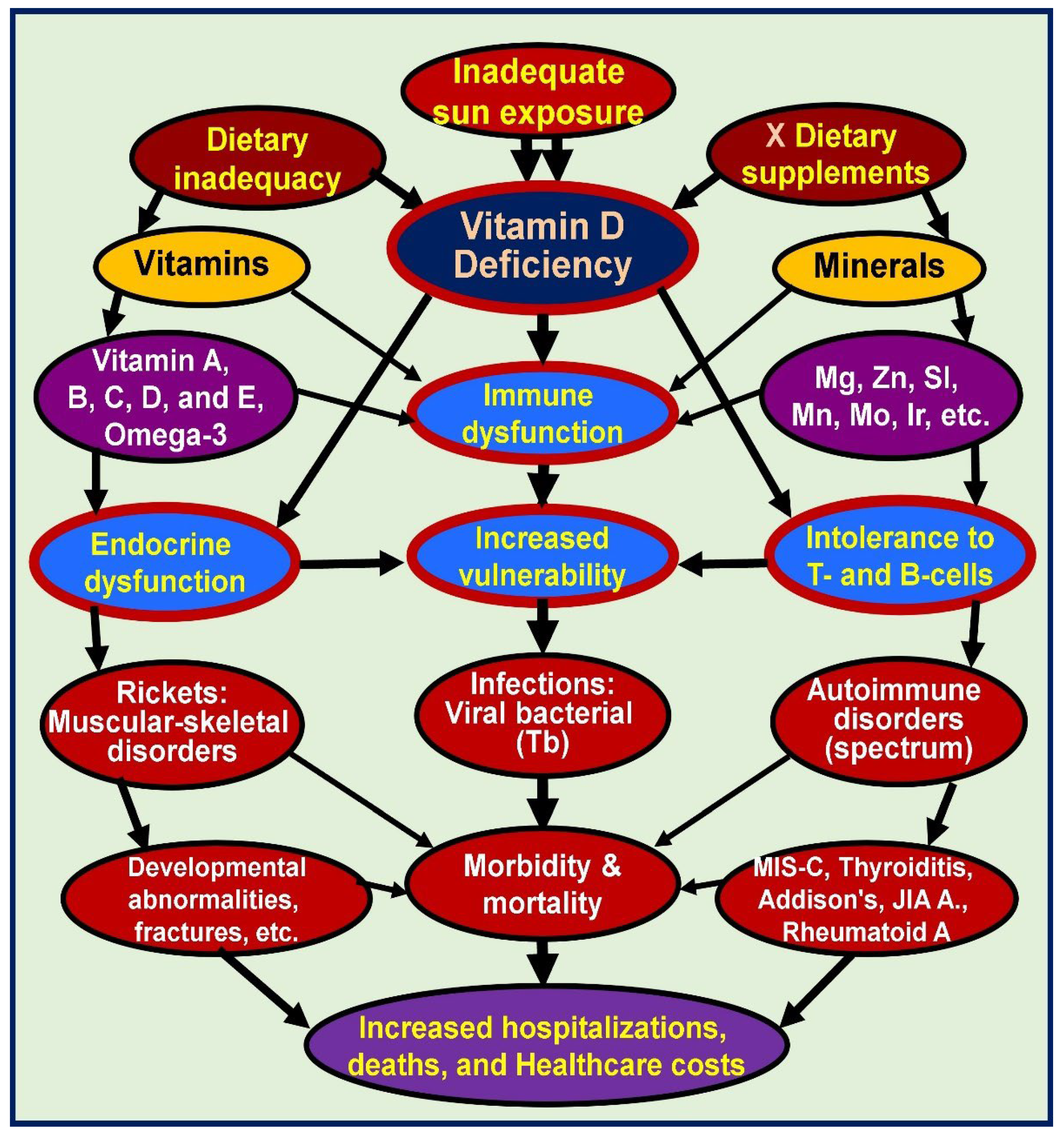
Figure 2.
Major negative consequences are categorized into groups of chronic vitamin D deficiency (after Wimalawansa, 2022) [67].
Figure 2.
Major negative consequences are categorized into groups of chronic vitamin D deficiency (after Wimalawansa, 2022) [67].
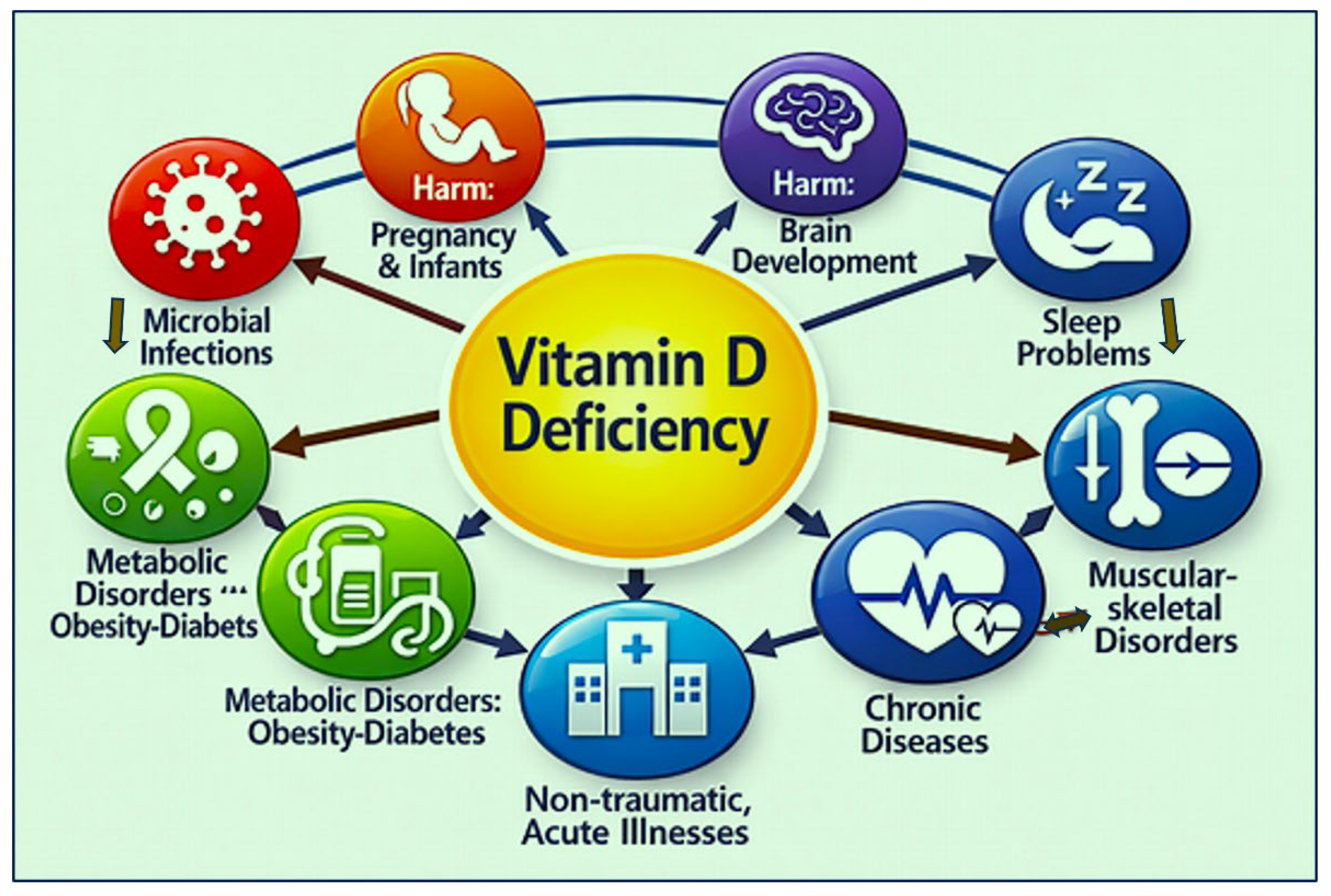
Figure 3.
Infographic summarizing the key micronutrients essential for a robust immune system to minimize developing autoimmunity.
Figure 3.
Infographic summarizing the key micronutrients essential for a robust immune system to minimize developing autoimmunity.
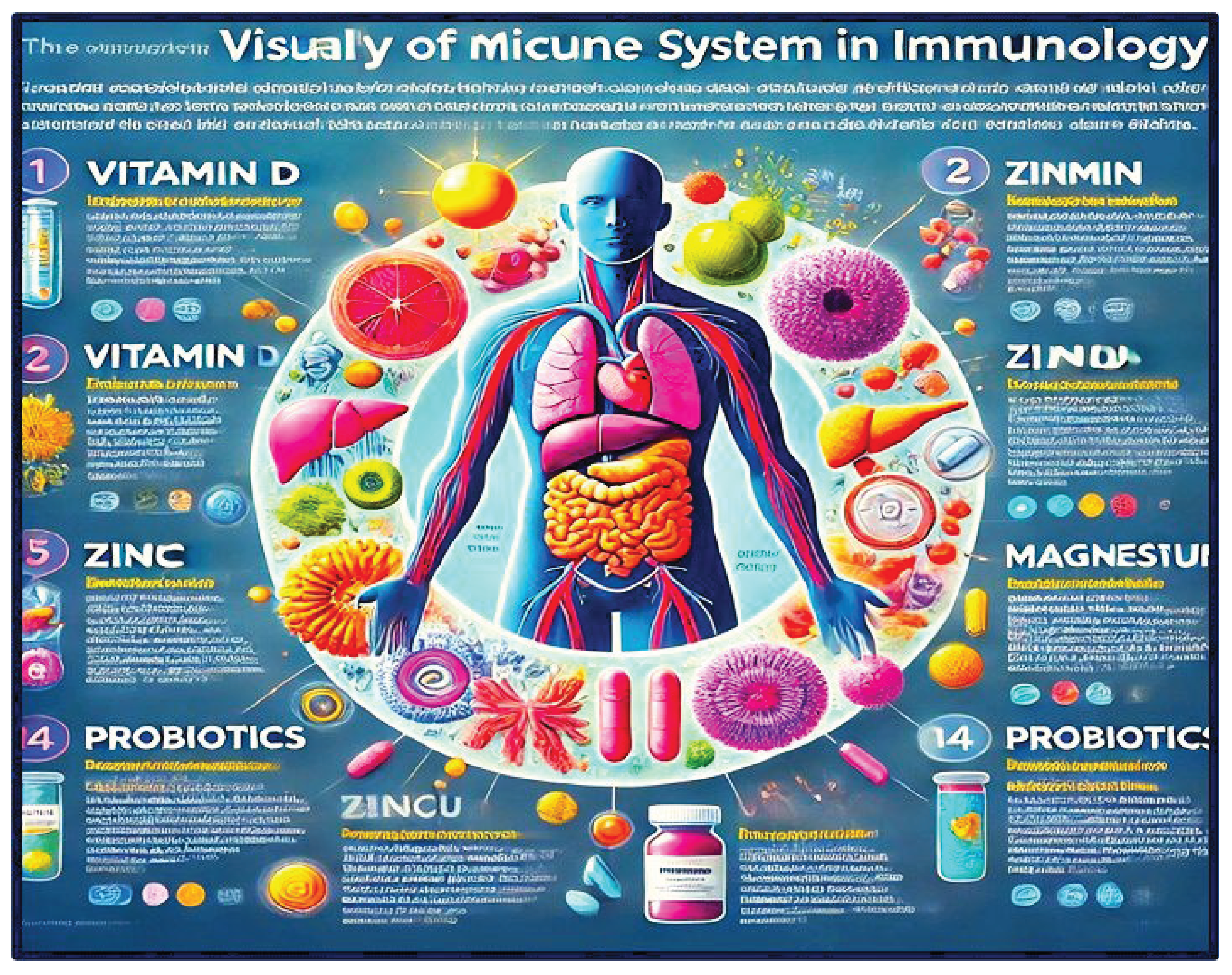

Table 1.
Interactions of vitamins and minerals on the immune system.
| Vitamins & Cofactors | Vitamins and minerals on the immune system | Reference |
|---|---|---|
| Vitamin A | It plays a vital role in maintaining mucosal immunity, supporting epithelial integrity, and regulating the immune system’s response to pathogens. It also aids in differentiating T-cells and is essential for producing immune mediators like cytokines. | [68,69] |
| Vitamin B | This group of vitamins, particularly B6, B9 (folate), and B12, are critical for enzymatic reactions that support immune cell function, production, and differentiation. These vitamins are cofactors in DNA synthesis and essential for cellular energy metabolism and immune responses. | [70,71,72] |
| Vitamin C | Vitamin C is known for its antioxidant properties and protects immune cells from oxidative stress. It also enhances the function of neutrophils, macrophages, and T-cells, and it helps maintain the integrity of the skin and mucosal barriers. | [73,74] |
| Vitamin D | It influences immune detection and surveillance by modulating T-cell function, enhancing pathogen recognition, and maintaining immune tolerance. Deficiency in vitamin D is associated with an increased risk of autoimmune diseases. | [67,75][76] |
| Vitamin E | It acts as a powerful antioxidant that modulates oxidative stress and inflammation. It enhances immune cell function, including the proliferation of T-cells and the activity of natural killer cells. | |
| Minerals | ||
| Magnesium (Mg) | Mg functions as a cofactor in various enzymes: it is essential for releasing hormones from endocrine cells, CTR functions, and immune cell activity, and it helps regulate inflammation. Magnesium is also necessary for maintaining a healthy immune system. | [20,63,77,78,79] |
| Zinc (Zn) | Essential for developing and functioning immune cells such as neutrophils and T-cells and their activities. Zinc is key in regulating immune responses, inflammatory processes, apoptosis in immune cells, and proper immune response against infections. | [20,61,80,81,82] |
| Selenium (Sl) | It acts as a cofactor for antioxidant enzymes and regulates immune responses, particularly by promoting the activity of T-cells and macrophages. Selenium also supports thyroid function, which is integral to immune regulation, | [55,83,84] |
| Iron (Ir) | It is necessary for immune cell proliferation and function, particularly for generating reactive oxygen species in pathogen killing. Iron deficiency can impair immune responses, while excess iron can promote inflammation and oxidative stress. | [20,85,86] |
|
Manganese (Mn) |
Functions as a cofactor in various enzymes necessary for immune cell activity; Mn regulates inflammation. It is also involved in brain health and mitigating autoimmunity in childhood. | [20,55,87] |
| Boron | It improves cognitive performance and brain functions, as well as antioxidant functions. In addition, boron modulates endocrine functions. | [88,89] |
| Copper | Copper is essential for enzyme functions and iron metabolism. In addition, it prevents brain function decline. It prevents demyelination and autoimmune reactions. However, excess has the opposite effects and reduces endocrine functions. | [55,90] |
| Iodine | Excess iodine can induce thyroid autoimmunity. This relates to TgAb; unmasking Tg epitopes triggers autoimmunity. However, low iodine intake causes its deficiency and leads to an increased incidence of endemic goiter and hypothyroidism. | [45,91,92] |
| Silicon | Long-term over-exposure increases the risk of autoimmune diseases, especially rheumatoid arthritis. | [93,94] |
| Other trace elements | Lithium (Li), cadmium (Cd), and molybdenum (Mo), etc. | [20,77,95] |
Table 2.
Common pediatric autoimmune diseases.
| Condition | Description | Reference |
|---|---|---|
| Type 1 Diabetes Mellitus (T1DM) | T1DM involves the autoimmune destruction of insulin-producing beta cells in the pancreas. The pathological process includes T-cell-mediated autoimmune responses and significant genetic and environmental contributions. Studies have shown the presence of autoantibodies against beta-cell antigens and the prominent role of T-cells in disease onset and progression. | [9,237,238,243] |
| Juvenile Idiopathic Arthritis (JIA) | JIA is characterized by persistent joint inflammation in children. Autoimmunity is critical to T-cell activation and cytokine dysregulation, particularly involving interleukin-6 (IL-6) and tumor necrosis factor-alpha (TNF-α). Current treatments target these pathways to reduce inflammation and prevent joint damage. | [45,239,244] |
| Autoimmune Thyroid Disease (AITD) | This group includes Hashimoto’s thyroiditis and Graves’ disease, where the immune system erroneously targets thyroid antigens. Studies highlight the importance of genetic susceptibility (e.g., HLA alleles) and environmental triggers of AITDs. | [9,240,241,245] |
| Celiac Disease | This condition is driven by an immune-mediated reaction to gluten, leading to small intestinal damage. The presence of HLA-DQ2 or HLA-DQ8 genes significantly increases susceptibility. Gluten exposure triggers an abnormal T-cell response, leading to villous atrophy in the intestine. | [239,242] |
Disclaimer/Publisher’s Note: The statements, opinions and data contained in all publications are solely those of the individual author(s) and contributor(s) and not of MDPI and/or the editor(s). MDPI and/or the editor(s) disclaim responsibility for any injury to people or property resulting from any ideas, methods, instructions or products referred to in the content. |
© 2026 by the authors. Licensee MDPI, Basel, Switzerland. This article is an open access article distributed under the terms and conditions of the Creative Commons Attribution (CC BY) license (http://creativecommons.org/licenses/by/4.0/).
Copyright: This open access article is published under a Creative Commons CC BY 4.0 license, which permit the free download, distribution, and reuse, provided that the author and preprint are cited in any reuse.