

Submitted:
10 June 2026
Posted:
11 June 2026
You are already at the latest version
Abstract
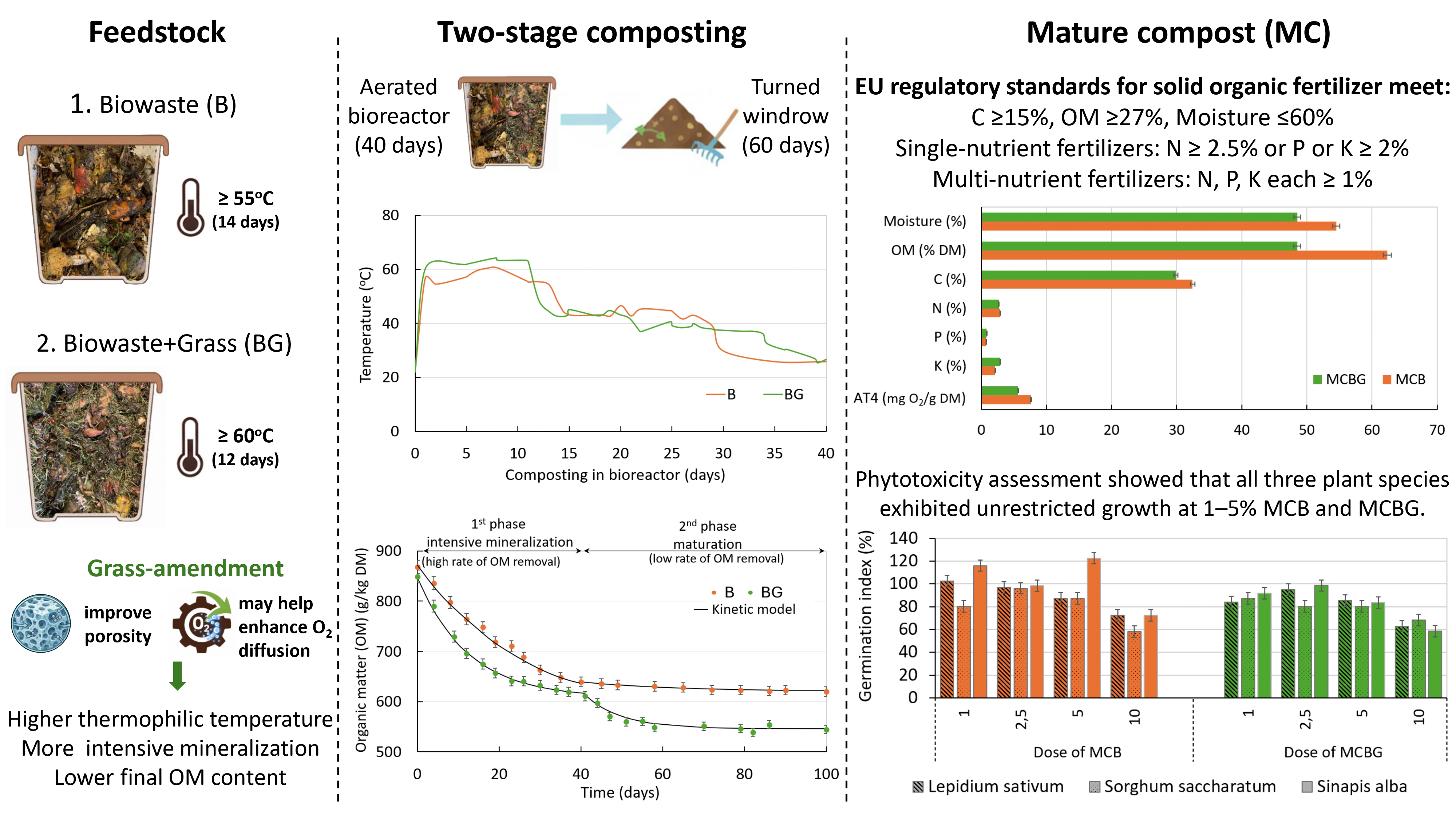
To improve biowaste recycling efficiency, this study evaluated the effect of a low-dose grass amendment (BG) on the composting performance of biowaste (B) in a pilot-scale two-stage system. The incorporation of a low-dose grass amendment increased feedstock porosity, thereby enhancing O2 diffusion and reducing the formation of anaerobic micro-zones during composting. Consequently. BG composting proceeded more intensively than with B, with higher initial OM degradation rates in both kinetic phases (BG: 19.03 and 7.32 g/(kg DM·d) versus B: 11.42 and 0.77 g/(kg DM·d)). Enhanced mineralization in the amended composting also promoted a more intensive thermophilic phase (BG: 60°C for 12-day; B: 55°C for 14-day). After 40 days in the bioreactor, the relative volume decreased to 50% and 58.2% of the initial volume for composted BG and B, respectively. Overall mass reductions in two-stage composting were 39.20% and 50.76%, respectively. Both mature composts exhibited high stability with AT4 values of 7.6 and 5.6 mg O2/g DM for B and BG, respectively. Phytotoxicity tests showed no inhibitory effects at application rates of 1–5%, with germination indices exceeding 80%, confirming compost maturity and a stimulatory effect on seed growth. Overall, co-composting of biowaste with seasonal grass improves composting performance and process efficiency.
Keywords:
organic recycling rate
; real biowaste
; kinetics of OM removal
; mature compost
; biofertilizer
; phytotoxicity
1. Introduction
Global municipal solid waste (MSW) generation has increased rapidly and is projected to reach 3.88 billion tons by 2050, an 81% increase over 2023 levels [1,2,3]. In 2023, Poland generated 13.8 million tonnes of MSW, while the EU generated 229.2 million tonnes [4]. The Landfill Directive in the EU requires reducing landfilling of biodegradable MSW, bans untreated MSW disposal, and caps MSW landfilling at 10% by 2035. In parallel, the revised Waste Framework Directive sets a 65% MSW recycling rate by 2035 [5]. Compliance with the EU’s recycling target depends on the effective recycling of organic waste (biowaste), which constitutes ~37% of MSW [6]. In most mechanical-biological treatment (MBT) systems, the organic fraction of MSW (OFMSW) is recovered as an undersieve fraction and aerobically stabilized via processes similar to composting. Although this treatment reduces biodegradability and improves material stability, the resulting stabilizate is typically contaminated and does not meet compost-quality standards [7]. As a result, stabilizate does not contribute to official MSW recycling targets. Meeting EU targets, therefore, requires source-separated biowaste and treatment such as composting or anaerobic digestion. The utilization of existing MBT infrastructure to treat biowaste offers a practical pathway to enhance organic waste recycling rates, because aerobic stabilization, commonly employed at MBT plants for treating OFMSW, is essentially identical in nature to composting. Given the high moisture content and abundance of readily biodegradable organic compounds in biowaste, composting is an effective, sustainable option for converting organic waste into compost, which can be used as a soil amendment, fertilizer, or growing medium [8,9,10,11].
Beyond waste management, the EU has established a policy framework to promote the conversion of organic waste into biofertilizers [12]. In particular, the EU aims to expand organic farming to 25% of total agricultural land by 2030 [13], thereby increasing demand for safe, high-quality organic waste-derived fertilizers. Accordingly, compost quality criteria aim to ensure safety and purity for agricultural use. At the same time, rising mineral fertilizer costs [14] and environmental concerns are further increasing the demand for biofertilizers, strengthening the role of source-separated biowaste composting. Consequently, composting selectively collected biowaste can produce nutrient-rich biofertilizers, support soil health, reduce reliance on synthetic fertilizers, and advance environmental and agricultural sustainability [6]. In Poland, soils are often relatively coarse and low in organic matter (OM), resulting in lower nitrogen content in topsoil. National surveys also indicate low to very low available phosphorus and potassium, which can limit crop growth [15].
Using immature compost can inhibit seed germination and plant growth due to phytotoxic compounds and unfavourable growth conditions [16,17]. These effects are largely attributed to its high biological activity (aerobic 4-day respiration test (AT4)) and readily biodegradable OM. This activity can increase oxygen demand in the soil and immobilize mineral nitrogen, reducing plant-available N [18,19]. Additionally, immature compost may release phytotoxic organic acids, particularly acetic acid, which can inhibit seed germination and early seedling growth [20,21,22], although other metabolites may also contribute to toxicity. Reduced germination and plant growth have likewise been associated with elevated salinity and organic-acid accumulation [23]. Assessing compost maturity and phytotoxicity is therefore essential before its application as an organic fertilizer. Compost maturity can be evaluated using AT4 and phytotoxicity tests, such as the germination index (GI). Although phytotoxicity tests do not identify specific toxic compounds, they provide an effective integrative measure of compost suitability for plant growth [24].
Generally, MSW-derived biowaste consists predominantly of household food waste, with a smaller proportion of plant residues, and these fractions are typically collected together by residents. In most cases, this material could be processed in composting systems. During the growing season, substantial quantities of grass clippings are temporarily generated from lawns, roadsides, and public green spaces, and they may enter household biowaste management streams. Despite their seasonal availability, and the fact that grass biomass typically constitutes only a minor proportion of the total biodegradable household (food) waste generated in the EU, it could potentially be co-treated with kitchen waste. Grass, with its fibrous structure and relatively high lignocellulosic content, can influence the physical properties of composting feedstock, particularly its porosity. Nevertheless, excessive addition of lignocellulosic amendments may reduce biodegradation efficiency because of the recalcitrant nature of lignin and cellulose. Although bulking agents are commonly applied in composting systems, it remains unclear how low-dose structural amendments affect the balance between improved air diffusion, substrate biodegradability, and compost maturation. Therefore, this study aimed to evaluate the effect of a low grass amendment on kitchen biowaste composting performance by assessing structural characteristics, the kinetics of organic matter degradation, nutrient dynamics, and final product maturity.
2. Materials and Methods
2.1. Characteristics of Composting Feedstock
Two composting experiments were conducted: biowaste alone (B), and B amended with 10% grass clippings (G) (90:10 w/w of DM) (BG). Biowaste, comprising over 90% kitchen waste with the remainder green waste, was randomly collected from selective collection containers in a city in northeastern Poland. Biowaste was characterized by high OM and moisture contents, and low structural porosity (Table 1), which collectively can impair air diffusion, inhibit microbial activity, and consequently reduce the efficiency and stability of the composting process. To address this limitation, air-dried and shredded grass (2–3 cm) was incorporated as a lignocellulosic amendment. Importantly, the low G dose was intentionally selected as the minimum effective addition capable of improving porosity and free air space (FAS) without excessive accumulation of recalcitrant lignocellulosic compounds. This strategy allowed BG to achieve more favorable aeration conditions while maintaining high biodegradability. Recommended ranges include 45–65% for porosity [25] and 30–60% for free air space [26]. Notably, Jeris and Regan [27] and Madejón et al. [28] suggested that a free air space of 30–36% is optimal for composting, based on oxygen demand across a wide range of residues with varying moisture contents. This amendment level also reflects practical constraints, as grass is typically less available than biowaste in real-world applications.
2.2. Experimental Setup
The 100-day composting process was carried out in a two-stage system consisting of a 136-liter aerated bioreactor (40 days of intensive mineralization) and a periodically (twice weekly) turned windrow (60 days of maturation). The bioreactor was made of acid-resistant steel, surrounded by a water jacket that maintained a stable temperature of 20°C, and was equipped with a fan that supplied air to the aerated bottom platform at a rate of 1.0 L/(kg·min). The upper part of the bioreactor was equipped with a top cover that allowed for feeding and sampling of the composted material. Temperature sensors (accuracy ±0.1°C) (PC THERM REM 84 m) were installed at depths of 30 cm and 70 cm below the top cover.
2.3. Analytical Procedures
Temperature profiles of composted B (CB) and composted BG (CBG) were monitored online. The volume and mass were measured daily. Porosity was measured using the water pycnometry method to determine the solid and void volumes. Subsamples were taken from the top, middle, and bottom layers of the bioreactor, combined, and thoroughly homogenized to obtain representative composite samples. Feedstock (once) and 0.5 kg homogenized samples of CB and CBG were collected every 2–4 days. The DM content was determined by drying the samples at 105°C for 24 h. Dried samples were subsequently milled to 0.5 mm. The OM content was quantified by incineration at 550°C for 4–5h. Aqueous extracts were prepared by mixing fresh feedstock or homogenized compost samples with tap water (1:10, w/w) and shaking for 3 h. After centrifugation, they were filtered to separate the supernatant and the VFA and N-NH4 (direct distillation method), P-PO4 (ascorbic acid method), N-NO2 (diazotization method), pH, and TA (using a TitroLine 6000 device) were measured according to APHA [29]. Nitrate concentrations were quantified using Hach-Lange cuvette test LCK 340.
Analyses in dried feedstocks, composted materials, and mature composts (MCB, MCBG) elemental composition (C, H, and N) using a FLASH 2000 elemental analyzer (Thermo Scientific, MA, USA), cellulose, hemicellulose, and lignin using the Van Soest method [30], water-soluble carbohydrate using the anthrone colorimetric method, lipid content via Soxhlet extraction with petroleum ether, protein content was calculated from total organic nitrogen, organic phosphorus using the distillation method, potassium (K) content according to PN-Z-15011-3 standard.
The AT4 in fresh MCB and MCBG was determined using a manometric Oxi-Top Control system (WTW, Weiheim, Germany) at 35°C [31]. The analyses were carried out in triplicate. AT4 measurements were performed in 1 L reaction jars equipped with a pressure-sensor data-logging head and a small container containing NaOH, which absorbed the generated CO2, to ensure a measurable pressure decrease that reflects oxygen uptake. Data from the heads were subsequently transferred to a spreadsheet using the manufacturer’s software (Achat OC, version 2.03).
Phytotoxicity of MCB, MCBG, and commercial organic compost (CC) was evaluated using seed germination and early growth tests with Lepidium sativum (L.SAT), Sorghum saccharatum (S.SAC), and Sinapis alba (S.ALBA), following the Ghent University (Belgium) Phytotoxkit® protocol. The reference soil (RS) was the OECD artificial soil (provided in the Phytotoxkit®), served as the control [32]. It consists of 85% sand, 10% kaolin, and 5% peat, a standardized composition that ensures reproducible and comparable results in soil ecotoxicity tests and is recommended by ISO for plant toxicity assessments. The phytotoxicity of a commercially available compost from organic waste (CC) purchased from a Polish supermarket was assessed and compared with that of MCB and MCBG. Stalk and root lengths were used as sensitive indicators of compost maturity and potential inhibitory effects. Compost phytotoxicity and maturity were quantitatively evaluated by calculating the GI (see equation below). Compost samples were mixed with reference soil at concentrations of 1, 2.5, 5, and 10% (w/w, based on DM) (1% corresponding to ratios such as 1:99 of MCB:OECD). The mixtures were moistened with distilled water to reach 65% water-holding capacity within 2–3 days, as calculated according to the manufacturer’s instructions. Controls consisted of RS OECD amended with 32 mL of distilled water. Ten seeds of each test species were placed at equal distances on filter paper on the surface of the hydrated soil-compost mixture in the test plates. The plates were closed, placed vertically in a holder, and incubated in darkness at 25°C for 3 days. After incubation, the number of germinated seeds was recorded, and the root and stalk length were measured. Photos of the test plates were taken after three days, and root and stalk length measurements were performed using Image Tool 3.0 software (UTHSCSA, San Antonio, USA).
2.4. Calculations
The rate constant of OM removal and the maximal amount of OM removed during composting were determined from the first-order kinetics equation (1):
where:
OMrem – the amount of OM removed due to mineralization (g OM/kg DM)
OM – the maximal amount of OM removed (g OM/kg DM)
k – the rate constant of OM removal in the bioreactor and windrow (d–1)
t – the composting time (d)
The initial rate of OM removal (rOM; g/(kg DM·d)) was calculated as a product of k and OM.
Effectiveness of biodegradation OM (EOMbiodeg, %) during composting of B and BG was calculated according to the equation (2) of Paredes et al. [33]:
where:
Mineral0 – the content of mineral matter in feedstock (%)
Mineralt – the content of mineral matter in composted material over time (%)
Carbon loss (Closs, %) and nitrogen loss (Nloss, %) during composting of B and BG were calculated according to the equation (3) of Paredes et al. [33]:
where:
C0 or N0 – the C or N content in feedstock (%)
Ash0 – the ash content in feedstock (%)
Ct or Nt – the C or N in composted material over time (%)
Asht – the ash content in composted material over time (%)
Germination index (GI, %) was calculated with the equation (4) [34]:
where:
germination – the number of seeds that germinated in the test or in the control
root length – the average root length (mm) in the test or in the control
Porosity () was calculated with the equation (5) [35]:
where:
VV – the void volume of the sample
VS – the total volume of the sample (including air and water filled voids)
Free air space (FAS) was calculated with the equation (6) [36]:
where:
– the wet bulk density of sample
– the estimated densities of water, equal 1000 kg/m3
– the estimated densities of organic matter, equal 1600 kg/m3
– the estimated densities of ash, equal 2500 kg/m3
2.5. Statistical Analysis
In this study, all parameters were measured in triplicate and expressed as mean ± standard deviation. Data were statistically analyzed and visualized using Microsoft Excel 2010.
3. Results and Discussion
3.1. Organic Matter Removal and Temperature Profiles
Composting temperature reflects microbial activity, which is optimal at 40–65°C [37]. A rapid, several-day increase in temperature from mesophilic levels indicates that OM is being intensively mineralized, and the heat released during mineralization creates thermophilic conditions. When temperature returns to near-ambient levels (cooling phase), mineralization is generally considered to have ended. However, complete maturation requires additional weeks at ambient temperature, during which mesophilic microorganisms further transform residual OM into humus [38].
Generally, temperature profiles during composting of B and BG (Figure 1) meet commonly used EU standards for fertilizer production derived from composting of organic or secondary raw materials. According to EU guidance [39], sanitization is demonstrated when the compost meets one of the following temperature-time criteria: ≥70°C for a minimum of 3 days, ≥65°C for at least 5 days, ≥60°C for at least 7 days, or ≥55°C for a minimum of 14 days. However, temperatures >70°C can inhibit microbial activity, whereas remaining above 55°C for a sufficient time supports pathogenic microorganism inactivation [40,41]. Overall, the composting temperatures in this study increased rapidly in both series on the first day (Figure 1), reaching approximately 55–60°C at the middle and upper layers, indicating the onset of the thermophilic phase and intensive mineralization. This phase lasted for ~2 weeks, during which the temperatures in both series stabilized between 55 and 65°C. Under identical operating conditions in the bioreactor (aeration, water-jacket temperature, mixing frequency), composting temperatures with BG were higher than with B (>60°C for the first 12 days vs. ~55°C for the first 14 days). Afterwards, both series stabilized at ~40°C, marking the end of the thermophilic phase. After 40 days, the composted material was transferred to the windrow, where the ambient temperature was 20–25°C during the two-month maturation.
Temperature differences during composting are primarily driven by variations in feedstock composition, particularly N availability and C/N ratio, which influence microbial activity and OM decomposition. Optimal C/N ratios (20:1–25:1) provide sufficient carbon for energy and nitrogen for microbial growth. Grass addition increased nitrogen availability because the grass itself had a higher N content (3.52% DM), while the C/N ratio in BG remained at ~19.5, close to the optimal ratio. Grass increased readily degradable substrates (e.g., soluble carbohydrates, amino acids), which promote rapid microbial growth, respiration, and heat generation [42,43]. N-enriched feedstocks (and particularly protein-enriched ones) further accelerate early microbial proliferation and heat production [44,45,46]. The G contained 17.53% DM protein and 6.57% DM soluble carbohydrates, 44% and 12% higher than in biowaste, respectively (Table 1), resulting in protein and carbohydrate contents in BG (14.24 and 6.11% DM) higher than in B (11,56 and 5.63% DM).
Grass contributed substantial amounts of cellulose and hemicellulose (Table 1), which degrade gradually and sustain microbial activity and heat production. Consequently, BG temperature quickly exceeded 60°C and remained elevated for 12 days, whereas in B, only 4 days (Figure 1). Because cellulose is relatively recalcitrant and hemicellulose degrades more slowly than soluble substrates, microbial activity may be sustained, contributing to an extended thermophilic phase (55–65°C) [37,43]. This prolonged thermophilic period effectively hygienizes compost, inactivates pathogens, and destroys weed seeds [16]. Previous reports indicate that fresh grass typically contains 6–15% protein, 20–55% water-soluble extractives, and a significant proportion of structural carbohydrates, including cellulose (20–30%) and hemicellulose (15–25%) [47], and provides approximately 47% more protein than food waste, together with higher cellulose and hemicellulose contents [48].
Grass, particularly when dry, improves feedstock chemistry and physical structure by increasing porosity and air permeability (Table 1). This increases oxygen diffusion and prevents anaerobic microzones that can suppress thermophilic activity. In contrast, biowaste alone often has excessive moisture and high bulk density (0.9 kg/L), promoting compaction, limiting oxygen transfer, and constraining temperature development. Numerous studies have reported that adding bulking agents (e.g., grass, straw, wood chips) accelerates the transition to thermophilic conditions (>55°C) and can prolong the thermophilic period compared to composting biowaste [48,49,50,51,52]. Thus, adding grass enhances aerobic decomposition and supports sustained thermophilic activity. These improvements arise from (i) greater availability of nitrogen and readily degradable organic substrates, accelerating microbial proliferation and heat generation, and (ii) improved feedstock porosity and structural integrity, which sustain oxygen diffusion and optimal aerobic conditions.
Feedstock composition affects temperature and, consequently, moisture dynamics. In both series, moisture followed two phases corresponding to the main composting stages. During mineralization, water is produced but can evaporate at high temperatures; when evaporation predominates, moisture declines initially and then stabilizes during the windrow stage. In CB, moisture content decreased from 77.88% to 59% in the bioreactor and subsequently stabilized at approximately 55% as temperature approached ambient (Figure 2a). In CBG, moisture declined to a greater extent in the bioreactor (70.31% to 54.61%) and then remained at ~50% until the end of the process (Figure 2b). The greater moisture loss in CBG likely reflected higher, more sustained thermophilic temperatures that increased evaporation. Overall, moisture remained at levels recommended for efficient composting (50–70%) [53,54]. Moreover, both composts attained moisture levels consistent with standards; notably, CBG closely matched the 40–60% moisture range for mature compost [55].
The OM degradation was accompanied by moisture losses and decreases in volume (as relative volume, initially as 100%) and mass (Figure 1 and Figure 2), which indicate high microbial activity and overall process efficiency, especially during intensive mineralization. In both series, relative volume and mass declined sharply during the first five days, coinciding with the sharp temperature increase resulting from OM mineralization and intensive microbial activity. Subsequently, the relative volume declined more gradually, reaching ~66.7% (CB) and 58.1% (CBG) of the initial volume after two weeks, while temperatures remained thermophilic. After 40 days, relative volume was markedly larger with BG than with B: BG retained 49.7% of its initial volume, whereas B remained 58.2%. Over the same period, mass decreased by 36.5% (B) and 45.4% (BG) of the initial feedstock mass. BG consistently lost more mass than B throughout the process, indicating more efficient biodegradation. Moreover, in the first 25 days, EOMbiodeg, which is calculated based on Paredes et al. [33], was higher for BG than for B (33–68% vs. 22–66%) (Figure 1c-d).
As composting progresses, the rate of OM removal (OMrem) decreases gradually as readily available carbon is depleted during intensive mineralization; during maturation, humification tends to prevail over mineralization. The OM content in B and BG was similar (860 g OM/kg DM). The OMrem (described using a first-order kinetic model (Figure 2 a,b)) followed two distinct phases: an initial intensive decomposition phase in the bioreactor (1st phase of OMrem) and a subsequent maturation phase in the windrow (2nd phase of OMrem) with a slower rate of OMrem. Notably, the intensive OMrem phase was completed within 40 days to ~640 and ~610 g/kg DM, for CB and CBG, respectively. The differences in the estimated k during the 1st phase (0.05 and 0.08 d⁻1) resulted in differences in rOM in CB and CBG (11.40 and 19.03 g/(kg DM·d, respectively). In the 2nd phase, rOM decreased to 0.77 g/(kg DM·d) in CB, ~10 times lower than in CBG (7.32 g/(kg DM·d)), consistent with a higher k (0.04 vs. 0.11 d⁻1). Although mineralization of OM occurred in BG during 2nd phase, process intensity was low enough that it did not lead to heat accumulation or a noticeable increase in temperature. The OMrem in the 2nd phase occurred after 100 days, resulting in OM contents in MCBG that were lower than in MCB, at 545 and 620 g/kg DM, respectively. These results indicate that grass addition increased the overall extent of OMrem by the end of composting, contributing to a lower final OM content. There are a few reports concerning the kinetic constants for OM degradation during biowaste composting. However, other authors have also reported that OMrem during the composting of various substrates follows first-order reaction kinetics. For example, Kulikowska and Bernat [56] investigated composting municipal sewage sludge with lignocellulosic materials (bark and grass). During 21 days of composting in a bioreactor, k was 0.134 d⁻1, and rOM was 12.6 g/ (kg DM·d). In a windrow, the kinetic constants were 5.2-fold and 16.7-fold lower, respectively. Kulikowska et. [57] also reported that, during sewage sludge composting with different amendments (wood chips, wheat straw, energy willow, pine bark, and conifer sawdust), k and rOM in bioreactors (0.102–0.104 d⁻1 and 7.8–10.1 g/(kg DM·d), respectively) were higher than in windrows. Similarly, the OMrem rates in the bioreactors were several times higher than those in the windrows.
C loss (Closs) increased rapidly during 20–30 days, reaching ~60–75%, consistent with intensive OM mineralization in the thermophilic phase, as observed in CB and CBG. The sharp initial increase in Closs in CBG within the first few days reflects high microbial metabolic activity and enhanced oxidative degradation of readily biodegradable substrates under favorable aeration, leading to higher temperatures during the thermophilic phase. In contrast, nitrogen was lost (Nloss) more slowly than C, suggesting differential transformation dynamics between carbon and nitrogen during composting. During composting of B, Nloss increased immediately after process initiation, remained relatively stable until approximately day 15, and then continued to rise. In BG, Nloss started to increase after 10 days and accelerated markedly until day 20. Nloss may be attributed to intensified ammonification and ammonia volatilization under thermophilic conditions. The rapid decline in the C/N ratio during the early stage was mainly driven by intensive organic carbon mineralization, followed by stabilization during compost maturation (Figure 2 c,d).
OM decomposition during composting is driven by diverse microbial communities [58], whose composition shifts with temperature across process stages [59]. Bacteria dominate early phases, while fungi persist throughout but are less active above 65°C. In turn, Actinomycetes are capable of growing under both mesophilic and thermophilic conditions, and some taxa can tolerate up to 50–70°C, and neutral to alkaline pH. Owing to their physiological traits, they are especially effective producers of extracellular hydrolytic enzymes (e.g., α-amylase, glucoamylase, glucose isomerase, proteases, and lignin-modifying enzymes) that degrade complex organic compounds, including lignocellulosic substrates and resistant cellulose fractions [58,60,61,62,63]. They may enhance compost hygienization by suppressing pathogens through the production of antimicrobial compounds [64]. Thus, they play a key role in OM degradation, humus formation, reduction of phytotoxicity, and overall compost quality and stability.
White to grayish filamentous structures, most likely attributable to Actinomycetes, were observed on the surface of composted material (Figure 3). They appeared at an early stage of BG composting (day 4) and remained visible until day 10 (Figure 3b). In contrast, B composting exhibited limited and late-stage visible development of Actinomycetes, which appeared only between days 13 and 16 (Figure 3a). The enhanced growth of Actinomycetes in CBG may be attributed to the presence of G, which, by improving porosity, increased oxygen diffusion in the composted material and, as a lignocellulosic material, increased the cellulose, hemicellulose, and lignin content in the feedstock. The gradual decline in Actinomycetes during composting may indicate a transition from the active degradation phase to the maturation phase as substrate availability and temperature change over time. Overall, the feedstock composition strongly influences microbial succession, including the dynamics of Actinomycetes, thermal behavior, and overall composting performance.
3.2. Associations Between pH, VFA, and Nitrogen Transformation During Composting
During composting in bioreactors, the pH in CB and CBG increased significantly from ~5.5 to ~7 (in the first 16 and 12 days, respectively) (Figure 4a,b). This increase is likely related to proteolytic activity, ammonia accumulation, and the degradation of organic acids. Notably, an increase in pH was observed even in the first days, when intense mineralization was accompanied by a transient accumulation of VFAs (~80 and ~60 g/kg DM in CB and CBG, respectively). This pattern suggests a relatively high buffering capacity, as reflected by alkalinity. Subsequently, pH changes were driven by ammonification of organic nitrogen, reduced ammonia volatilization, and hydrogen-ion production during nitrification [62]. In CB, pH increased slowly between day 15 and day 50, before increasing to ~8.3 at compost maturity (Figure 4a). In contrast, pH in CBG peaked at 8.5 around day 40 and then stabilized until compost maturity (Figure 4b). The buffering capacity of lignocellulosic materials helps stabilize pH and supports microbial activity [65]. Their functional groups (e.g., carboxyl, hydroxyl, and phenolic) and mineral components (e.g., ash, carbonates, and silicates) allow them to absorb or release H⁺, moderating pH fluctuations caused by organic acid formation or ammonium release, particularly within pH 5–8 [62]. Similar pH trends were reported by Ravindran et al. [66] during composting of food waste, swine manure, and sawdust (2:2:1), where pH increased rapidly from 5.5 to 9.0 during the thermophilic phase and stabilized at 8.5 by the end. The rise was attributed to ammonification during OM degradation, accompanied by increased N-NH4 from nitrogen mineralization, followed by Nloss via nitrification, denitrification, and ammonia volatilization. In contrast, Kulikowska [67] reported a different pH pattern during sewage sludge composting in a bioreactor, where pH rapidly increased from ~7.5 to 9.1 within the first few days, coinciding with VFA accumulation (up to 15 g/kg DM), followed by a decline. Ammonia losses were also most intensive during the early stage of the process.
A pH range of 5.5–9.0 is generally favorable for microbial activity and OM degradation [37,68,69]. Since B is a readily biodegradable substrate, biodegradation begins during collection, leading to VFA formation and initially slightly acidic conditions (pH ~5.5, Table 1). VFA concentration is a sensitive indicator of OM degradation driven by microbial activity (Figure 4). During B composting, VFA concentration rapidly accumulated to ~70 g/kg DM by day 10 and remained high for nearly 20 days (Figure 4c). In contrast, BG composting showed a smaller VFA peak (~62 g/kg DM at day 20), followed by rapid depletion to ~10 g/kg DM by day 35 (Figure 4d). Changes in VFA concentration during intensive composting reflect the balance between OM mineralization (associated with VFA production) and VFA oxidation. The lower VFA accumulation in BG composting, despite greater OMrem, may result from improved aeration and higher porosity after G addition, which enhanced oxygen distribution and promoted VFA oxidation.
Both pH and temperature strongly influence nitrogen transformations during composting by regulating ammonium oxidation and ammonia volatilization [70,71]. Elevated pH values (>8) favor ammonia volatilization [72]. Changes in N-NH4 concentration were mainly driven by readily mineralizable nitrogen, pH, and temperature, which govern ammonification, volatilization, and nitrification. As mentioned, G contains a considerable amount of readily mineralizable nitrogen (mainly proteins and amino acids), which undergo ammonification as microbial activity intensifies (Figure 3). Thus, BG composting exhibited a pronounced increase in N-NH4 concentration during initial thermophilic phase, from ~2 to 9 g/kg DM (Figure 4h), likely due to enhanced ammonification driven by intensified microbial metabolism and higher temperatures. During this phase, the concurrent increases in temperature, pH, and N-NH4 concentrations were consistent with rapid microbial growth and intensified organic nitrogen mineralization. Enhanced microbial activity likely accelerated the decomposition of readily biodegradable OM, generating substantial heat. When the rate of nitrogen mineralization exceeded microbial assimilation demand, transient ammonium accumulation was observed, particularly in BG composting (Figure 4). Moreover, thermophilic conditions promote protein degradation but inhibit nitrification, limiting ammonium oxidation and contributing to higher N-NH4 concentrations in BG composting. The onset of nitrification coincided with a decline in N-NH4 concentrations during BG composting. The transient accumulation of nitrite observed during BG composting in maturation phases provides evidence of nitrifying microorganism activation and indicates a progressive transition toward compost stabilization. In contrast, during composting B, the N-NH4 concentration peaked at a lower value (3.5 g/kg DM on day 4) and subsequently decreased gradually until day 72 (Figure 4g).
Compared with CBG, CB exhibited a lower temperature peak and slower microbial turnover, as reflected by prolonged ammonium persistence and delayed nitrite formation. Although no marked differences in nitrate change were observed between CB and CBG, the combined evolution of ammonium, nitrite, and pH suggests more rapid nitrogen transformation during BG composting. According to Zucconi and de Bertoldi [73], mature MSW compost typically contains less than 0.04% N-NH4, while Bernal et al. [74] proposed an N-NH4/N-NO3 ratio below 0.16 as a reliable maturity indicator. N-NH4 was not detected in MCB and MCBG, resulting in an N-NH4/N-NO3 ratio of 0, which is consistent with advanced maturity. These criteria appeared to be met earlier in BG than in B, supporting improved compost stabilization via faster nitrogen transformation.
3.3. Compost Quality
The elemental composition of MCB and MCBG was compared with values reported for composts produced from various organic waste streams and with the minimum requirements for solid organic fertilizers established under EU regulations (Table 2). The carbon content of MCB was higher than that of MCBG (32.45 vs 29.88% DM). This difference can be attributed to greater OM degradation and Closs during BG composting than with B (Figure 2), which would increase carbon mineralization and conversion to CO2, and to the higher initial carbon content of B relative to BG.
Although the nitrogen contents of B and BG were similar, the nitrogen content in MCB was higher than in MCBG (2.90 and 2.71 % DM, respectively). This difference is likely related to nitrogen transformations during CBG composting, including increased ammonium volatilization, denitrification, and Nloss. Consequently, C/N ratios of MCB and MCBG were comparable (11.53 and 11.16, respectively). Both values fall within the optimal C/N range of 10–15 reported for mature composts [74,75] and are consistent with the literature on composts from fruits/vegetables [77]. Previous studies reported lower nitrogen contents: 0.34% DM in vegetable waste compost [76], 0.61% and 0.32% DM in mixed MSW and fruit waste compost, respectively [77], and 1.45–1.49% DM in compost from kitchen waste mixed with fallen leaves [52]. Notably, although the initial fruit and vegetable wastes used by Parihar and Choudhary [77] had relatively high initial nitrogen content (1.85–2.39% DM), the resulting composts showed much lower nitrogen content, likely due to Nloss during composting influenced by process conditions and feedstock composition. Phosphorus content in MCB (0.78% DM) and MCBG (0.91% DM) was above the range reported for kitchen waste mixed with leaves or sawdust composts (0.95–1.14% DM) [52] and fruit/vegetable waste composts (0.06–0.08%) [77] (Table 2). The higher phosphorus concentrations observed in this study are likely resulting from OM degradation and mass loss during composting, which concentrates P in DM.

Table 2.
The characteristic of mature composts derived from different substrates.
| Feedstock used in composting process |
Mature composts characteristic | ||||||||
| C | N | P | K | K2O | OM | Moisture content | C/N ratio* |
References | |
| % DM | % | – | |||||||
| B | 32.45 | 2.90 | 0.78 | 2.13 | 2.56 | 62.31 | 54.5 | 11.19 | The present study |
| BG | 29.88 | 2.71 | 0.91 | 2.89 | 3.48 | 55.42 | 48.5 | 11.03 | |
| Kitchen waste+fallen leaves (5–10 mm) | – | 1.48 | 0.99 | 1.54 | 1.86 | – | 19.56 | – | [52] |
| Kitchen waste+fallen leaves (1–3 mm) | – | 1.45 | 1.14 | 1.61 | 1.94 | – | 18.25 | – | |
| Kitchen waste+sawdust (5–10 mm) |
– | 1.45 | 0.95 | 1.54 | 1.86 | – | 19.34 | – | |
| Kitchen waste+sawdust (1–3 mm) |
– | 1.49 | 0.97 | 1.59 | 1.92 | – | 18.25 | – | |
| Fruit waste+dey leaves+straw | – | 0.61 | 0.17 | 0.73 | 0.88 | – | – | – | [76] |
| Fruits waste | – | 0.32 | 0.06 | 0.22 | 0.26 | – | – | 11 | [77] |
| Vegetable waste | – | 0.34 | 0.08 | 0.27 | 0.32 | – | – | 11 | |
| Solid organic fertiliser | ≥15 | ≥2.51 | ≥0.871 | ≥1.661 | ≥2.01 | ≥26.79 | ≤60% | – | [78] |
| ≥1.02 | ≥0.442 | ≥0.832 | ≥1.02 | ||||||
1,2 the nutrient content meets the minimum requirements specified in the Regulation on EU fertilising products for solid organic fertilisers containing (1) a single declared primary nutrient and (2) multiple declared primary nutrients, with the sum of those nutrient contents being at least 4% by mass * an optimal C/N ratio in the range of 10–15 for mature compost has been reported by Bernal et al. [74] and Chefetz et al. [75].
Moreover, MCB contained 2.13% DM K, whereas G amendment markedly increased K content to 2,89% DM in MCBG. These values were substantially higher than those reported for fruit waste composts (0.22% DM, [77]) and comparable to or exceeding those of kitchen waste composts amended with lignocellulosic bulking agents (1.54–1.61% DM, [52]). Grass is rich in soluble K [79], which is rapidly released during composting because it is non-structural in plant tissues, making grass amendment particularly beneficial for K-demanding crops. Overall, the NPK content (as multiple declared primary nutrients) in MCB and MCBG meets the minimum requirements that are reported for composts derived from single-stream organic wastes and satisfied EU nutrient requirements for solid organic fertilizers, confirming their agricultural suitability. Notably, only MCBG fulfilled the stricter criteria for solid organic fertilizers with a single declared primary nutrient, further highlighting its enhanced nutrient quality.
3.4. Compost Maturity and Stability Assessment
The effectiveness of lignocellulosic material degradation is a key indicator of composting efficiency. Hemicellulose exhibited the greatest degradation, decreasing by 56% in MCB and 69% in MCBG, followed by cellulose, which was reduced by 38% and 46%, respectively. In contrast, lignin showed the lowest degradation, with reductions of 11% in MCB and 19% in MCBG (Figure 3). The preferential degradation of hemicellulose over cellulose and lignin reflects its greater accessibility to microbial enzymes despite its amorphous structure. Cellulose, although a polysaccharide, is more crystalline and thus more resistant to biodegradation. Lignin, with its complex amorphous structure, is generally recalcitrant under composting conditions and exhibits limited degradation. The overall decrease in lignocellulosic materials after composting, together with the relative increase in lignin content in the mature compost, reflects the progressive humification and stabilization of OM characteristic of mature compost. Notably, higher degradation of all three lignocellulose fractions in MCBG indicates that grass addition increased microbial activity and promoted more effective lignocellulose breakdown. The presence of grass likely improved compost structure and aeration, facilitating aerobic conditions and favoring the development of cellulolytic and ligninolytic microorganisms.
Changes in the physico-chemical properties of CB and CBG were closely linked to compost maturity and stability. In particular, biological stability assessed by the AT4 test showed more advanced OM stabilization in MCBG than in MCB, with the AT4 values (5.66 vs. 7.62 mg O2/g DM), corresponding to well-stabilized and moderately stable compost, respectively, according to commonly used stability criteria (AT4 <6 and 6–10 mg O2/g DM) [79,80]. The reduced AT4 value observed in MCBG is consistent with greater lignocellulosic degradation, which depleted the readily and moderately biodegradable OM pool available for microbial respiration. Overall, these results demonstrate that amending B with G significantly enhances the degradation of lignocellulosic components and the biological stability of the mature compost, resulting in a more stable compost product compared to MCB.
The results of phytotoxicity tests of MCB and MCBG at application rates of 1–5% showed that all three test plant species (L.SAT, S.SAC, and S.ALBA) exhibited GI ≥80% and similar growth (root and shoot) in RS and CC, indicating the absence of phytotoxic effects (Figure 5). Only at the highest compost application rate (10%) did all species demonstrate growth inhibition and moderate phytotoxicity (GI >50%), suggesting that excessive compost loading may negate the benefits of fertilizing. A GI ≥80% indicates compost maturity, effective stabilization, and possible stimulation of seed growth, while a GI ≤80% suggests insufficient stabilization and potential phytotoxicity [81].
Low MCB application rates (1–2.5%) stimulated growth in L.SAT and S.ALBA, as indicated by longer roots and shoots than in RS. Increasing MCB doses to 5% and 10% progressively reduced root and shoot length in L.SAT, with root length dropping below that of RS and CC. In contrast, S.ALBA maintained root and shoot lengths similar to or greater than those of RS and CC at most MCB doses, except at 10%. S.SAC showed reduced growth at MCB doses of 1–5%, with marked inhibition at 10%. At 1–5% doses of MCBG, L.SAT, and S.ALBA showed growth comparable to or exceeding RS and CC, while 10% caused moderate inhibition. In contrast, S.SAC had shorter roots and shoots than RS and CC at all doses; however, no clear dose-dependent effect was observed, as the lengths remained similar across doses.
These species-specific responses reflect differences in nutrient demand and sensitivity during germination. L.SAT has low nutrient requirements and high sensitivity to salinity and phytotoxins, making it a reliable indicator of compost maturity; S.ALBA shows moderate demand and sensitivity, whereas S.SAC, with higher nutrient needs (especially N and K), is more tolerant of phytotoxicity and driven more by nutrient availability than residual toxicity. Siles-Castellano et al. [82] evaluated the phytotoxicity of composts derived from different feedstocks using L.SAT. Their results showed that composted agri-food waste achieved the highest GI (>80%), indicating the absence of phytotoxicity. In contrast, composts from vegetal residues and MSW were phytotoxic, with GI ≤40%. Intermediate and acceptable phytotoxicity levels were observed for olive mill waste and sewage sludge, with GI ≥60%. Maxianova et al. [83] reported that biodegradable canteen waste compost, when applied at 25%, 50%, and 100% rates mixed with OECD soil, completely inhibited root development of S.ALBA. These results indicate that high compost proportions strongly suppressed root growth, suggesting pronounced phytotoxic effects at elevated application rates. Taken together, the combination of low AT4 values, advanced degradation of lignocellulosic materials, and GI values exceeding the phytotoxicity threshold confirms that both MCB and MCBG reached maturity, with MCBG exhibiting superior stabilization.
4. Conclusions
Efficient composting of biowaste is important for supporting high recycling rates in waste management. The incorporation of seasonally available grass increases the pool of organic waste that can contribute to recycling targets, and its combined composting with biowaste may offer potential benefits for the process. In this study, both the composting of biowaste alone and of biowaste amended with the grass, the process proceeded efficiently and resulted in a stable compost that met EU standards for organic fertilizers at maturity (in terms of NPK content, moisture, and OM). The addition of grass ensured modification of the structural properties of the composting feedstock, such as porosity and free air space, was associated with faster organic matter degradation and higher germination index values. These observations suggest that structural optimization, rather than nutrient content alone, play a key role in influencing composting performance.
Author Contributions
Conceptualization, T.C.T.L., K.B. and D.K, methodology, T.C.T.L. and K.B, validation, T.C.T.L. and K.B, Resources, T.C.T.L; investigation, T.C.T.L, data curation, T.C.T.L, writing-original draft preparation, T.C.T.L. and K.B, writing-review and editing, T.C.T.L., K.B. and D.K, visualization, T.C.T.L, supervision, K.B, funding acquisition, T.C.T.L. and K.B. All authors have read and agreed to the published version of the manuscript.
Funding
This study was supported by the Ministry of Science and Higher Education of Poland (statutory project No. 29.610.024-110).
Conflicts of Interest
The authors declare no conflicts of interest.
References
- The World Bank. 2024. Available online: www.worldbank.org/en/topic/urbandevelopment/brief/solid-waste-management (accessed on 01/06/2026).
- Silpa, K.; Lisa, C.Y.; Perinaz, B.T.; Frank, V.W. What a waste 2.0: a global snapshot of solid waste management to 2050 2018; Urban Development: Washington, DC, USA.
- Wang, Z.; Lv, J.; Gu, F.; Yang, J.; Guo, J. Environmental and economic performance of an integrated municipal solid waste treatment: A Chinese case study. Sci. Total. Environ. 2020, 709, 136096. [Google Scholar] [CrossRef]
- Eurostat. Municipal waste by waste management operations. European Commission. 2025. Available online: https://ec.europa.eu/eurostat/databrowser/view/env_wasmun/default/table?lang=en&category=env.env_was.env_wasst. (accessed on 01/06/2026).
- European Parliament. Directive 2008/98/EC of the European Parliament and of the Council of 19 November 2008 on waste and repealing certain Directives. Off. J. Eur. Union L312 2024. [Google Scholar]
- European Court of Auditors. special report 23/2025: “Municipal waste management: Despite gradual improvement, challenges remain for the EU’s progress towards circularity”; Publications Office of the European Union, 2025. [Google Scholar]
- Defra. Mechanical biological treatment of municipal solid waste. 2013. Available online: www.defra.gov.uk.
- Pai, S.; Ai, N.; Zheng, J. Decentralized community composting feasibility analysis for residential food waste: A Chicago case study. Sustain. Cities Soc. 2019, 50. [Google Scholar] [CrossRef]
- Manu, M.; Kumar, R.; Garg, A. Decentralized composting of household wet biodegradable waste in plastic drums: Effect of waste turning, microbial inoculum and bulking agent on product quality. J. Clean. Prod. 2019, 226, 233–241. [Google Scholar] [CrossRef]
- Komilis, D.P.; Tziouvaras, I.S. A statistical analysis to assess the maturity and stability of six composts. Waste Manag. 2009, 29, 1504–1513. [Google Scholar] [CrossRef]
- Li, Z.; Lu, H.; Ren, L.; He, L. Experimental and modeling approaches for food waste composting: A review. Chemosphere 2013, 93, 1247–1257. [Google Scholar] [CrossRef]
- Keng, Z.X.; Chong, S.; Ng, C.G.; Ridzuan, N.I.; Hanson, S.; Pan, G.-T.; Lau, P.L.; Supramaniam, C.V.; Singh, A.; Chin, C.F.; et al. Community-scale composting for food waste: A life-cycle assessment-supported case study. J. Clean. Prod. 2020, 261. [Google Scholar] [CrossRef]
- European Commission. The European Green Deal (COM(2019) 640 final). Publications Office of the European Union 2019 Available online: commission.europa.eu/strategy-and-policy/priorities-2019-2024/european-green-deal_en.
- European Commission. “Fertiliser Prices.” Directorate-General for Agriculture and Rural Development 2026. Available online: agridata.ec.europa.eu/extensions/DashboardFertiliser/FertiliserPrices.html. (accessed on 03/03/2026).
- Ballabio, C.; Lugato, E.; Fernández-Ugalde, O.; Orgiazzi, A.; Jones, A.; Borrelli, P.; Montanarella, L.; Panagos, P. Mapping LUCAS topsoil chemical properties at European scale using Gaussian process regression. Geoderma 2019, 355, 113912. [Google Scholar] [CrossRef] [PubMed]
- Bernal, M.; Alburquerque, J.; Moral, R. Composting of animal manures and chemical criteria for compost maturity assessment. A review. Bioresour. Technol. 2009, 100, 5444–5453. [Google Scholar] [CrossRef]
- Campitelli, P.; Ceppi, S. Chemical, physical and biological compost and vermicompost characterization: A chemometric study. Chemom. Intell. Lab. Syst. 2008, 90, 64–71. [Google Scholar] [CrossRef]
- Selim, Sh.M.; Zayed, M.S.; Houssam, M.A. Evaluation of phytotoxicity of compost during composting process. Nat. Sci. 2012, 10. [Google Scholar]
- Tiquia, S. Reduction of compost phytotoxicity during the process of decomposition. Chemosphere 2010, 79, 506–512. [Google Scholar] [CrossRef]
- Ibrahim, H.A.K.; Balah, M.A.A. Study the Use of Compost Tea in Weed Suppression. Int. J. Environ. Res. 2018, 12, 609–618. [Google Scholar] [CrossRef]
- Ozores-Hampton, M. Compost as an Alternative Weed Control Method. HortScience 1998, 33, 938–940. [Google Scholar] [CrossRef]
- Tsabedze, S.A.; Otieno, B.; Thomas, A.R.; Getahun, S.T. Phytotoxicity and quality in compost: a concise review of Sewage Sludge and Green Waste applications. J. Mater. Cycles Waste Manag. 2025, 27, 4041–4058. [Google Scholar] [CrossRef]
- Adetunji, D.A.; Obideyi, O.A.; Evinemi, O.T.; Adetunji, O.A. Phytotoxicity assessment of compost-type Biofertilizer using Co-Composting and Post Composting Fortification Methods. Asian J. Agric. Food Sci. 2020, 8. [Google Scholar] [CrossRef]
- Jagadabhi, P.S.; Wani, S.P.; Kaushal, M.; Patil, M.; Vemula, A.K.; Rathore, A. Physico-chemical, microbial and phytotoxicity evaluation of composts from sorghum, finger millet and soybean straws. Int. J. Recycl. Org. Waste Agric. 2018, 8, 279–293. [Google Scholar] [CrossRef]
- Ho, T.T.K.; Tra, V.T.; Le, T.H.; Nguyen, N.-K.; Tran, C.-S.; Nguyen, P.-T.; Vo, T.-D.; Thai, V.-N.; Bui, X.-T. Compost to improve sustainable soil cultivation and crop productivity. Case Stud. Chem. Environ. Eng. 2022, 6. [Google Scholar] [CrossRef]
- Soares, M.A.; Quina, M.J.; Quinta-Ferreira, R. Prediction of free air space in initial composting mixtures by a statistical design approach. J. Environ. Manag. 2013, 128, 75–82. [Google Scholar] [CrossRef]
- Jeris, J.S.; Regan, R.W. Controlling environmental parameters for optimum composting. COMPOST SCI. 1973, 14. [Google Scholar]
- Madejón, E.; Dı́az, M.J.; López, R.; Cabrera, F. New approaches to establish optimum moisture content for compostable materials. Bioresour. Technol. 2002, 85, 73–78. [Google Scholar] [CrossRef] [PubMed]
- Greenberg, A.E.; Clesceri, L.S.; Eaton, A.D. Standard methods for the examination of water and wastewater, 18th ed; American Public Health Association (APHA): Washington, DC, USA, 1992. [Google Scholar]
- Moller, J. Animal feeding stuff: global standard for the determination of acid detergent fibre ( ADF ) and Lignin. 2008. [Google Scholar]
- Binner, E.; Böhm, K.; Lechner, P. Large scale study on measurement of respiration activity (AT4) by Sapromat and OxiTop. Waste Manag. 2012, 32, 1752–1759. [Google Scholar] [CrossRef]
- Edwards, C.A. Report of the second stage in development of a standardized laboratory method for assessing the toxicity of chemical substances to earthworms; Commission of the European Communities.: Luxembourg, 1984. [Google Scholar]
- Paredes, C.; Roig, A.; Bernal, M.P.; Sánchez-Monedero, M.A.; Cegarra, J. Evolution of organic matter and nitrogen during co-composting of olive mill wastewater with solid organic wastes. Biol. Fertil. Soils 2000, 32, 222–227. [Google Scholar] [CrossRef]
- Yang, Y.; Wang, G.; Li, G.; Ma, R.; Kong, Y.; Yuan, J. Selection of sensitive seeds for evaluation of compost maturity with the seed germination index. Waste Manag. 2021, 136, 238–243. [Google Scholar] [CrossRef]
- Ruggieri, L.; Gea, T.; Artola, A.; Sánchez, A. Air filled porosity measurements by air pycnometry in the composting process: A review and a correlation analysis. Bioresour. Technol. 2009, 100, 2655–2666. [Google Scholar] [CrossRef]
- Richard, T.L.; Veeken, A.H.M.; Dewilde, V.; Hamelers, H.V.M. (. Air-Filled Porosity and Permeability Relationships during Solid-State Fermentation. Biotechnol. Prog. 2004, 20, 1372–1381. [Google Scholar] [CrossRef]
- Debertoldi, M.; Vallini, G.; Pera, A. The biology of composting: A review. Waste Manag. Res. J. A Sustain. Circ. Econ. 1983, 1, 157–176. [Google Scholar] [CrossRef]
- Jurado, M.; López, M.J.; Suárez-Estrella, F.; Vargas-García, M.C.; López-González, J.A.; Moreno, J. Exploiting composting biodiversity: Study of the persistent and biotechnologically relevant microorganisms from lignocellulose-based composting. Bioresour. Technol. 2014, 162, 283–293. [Google Scholar] [CrossRef] [PubMed]
- Vlaco, E.V. Hygienisation requirements for composting process. 2019. Available online: northsearegion.eu/media/16203/hygienisation_-for-soilcomher.pdf. (accessed on 01/06/2026).
- Liang, C.; Das, K.; McClendon, R. The influence of temperature and moisture contents regimes on the aerobic microbial activity of a biosolids composting blend. Bioresour. Technol. 2003, 86, 131–137. [Google Scholar] [CrossRef]
- Antizar-Ladislao, B.; Beck, A.J.; Spanova, K.; Lopez-Real, J.; Russell, N.J. The influence of different temperature programmes on the bioremediation of polycyclic aromatic hydrocarbons (PAHs) in a coal-tar contaminated soil by in-vessel composting. J. Hazard. Mater. 2007, 144, 340–347. [Google Scholar] [CrossRef]
- Li, Z.; Lu, H.; Ren, L.; He, L. Experimental and modeling approaches for food waste composting: A review. Chemosphere 2013, 93, 1247–1257. [Google Scholar] [CrossRef] [PubMed]
- Haug, R.T. The Practical Handbook of Compost Engineering; Routledge: Boca Raton, FL, USA, 2018. [Google Scholar] [CrossRef]
- Li, X.-X.; Wang, S.-P.; Sun, Z.-Y.; Wang, S.-T.; Shuai, W.-L.; Shen, C.-H.; Tang, Y.-Q. Performance and microbial community dynamics during rice straw composting using urea or protein hydrolysate as a nitrogen source: A comparative study. Waste Manag. 2021, 135, 130–139. [Google Scholar] [CrossRef]
- Sun, L.; Guan, W.; Tai, X.; Qi, W.; Zhang, Y.; Ma, Y.; Sun, X.; Lu, Y.; Lin, D. Research Progress on Microbial Nitrogen Conservation Technology and Mechanism of Microorganisms in Aerobic Composting. Microb. Ecol. 2025, 88, 1–14. [Google Scholar] [CrossRef]
- Zhang, X.; Ge, J.; Zhang, S.; Zhao, Y.; Cui, H.-Y.; Wei, Z.; Luo, S.; Cao, J. Bioavailability Evaluation of Dissolved Organic Matter Derived from Compost-Amended Soils. J. Agric. Food Chem. 2019, 67, 5940–5948. [Google Scholar] [CrossRef]
- Funke, A.; Ziegler, F. Hydrothermal carbonization of biomass: A summary and discussion of chemical mechanisms for process engineering. Biofuels Bioprod. Biorefin. 2010, 4, 160–177. [Google Scholar] [CrossRef]
- Bernat, K.; Cydzik-Kwiatkowska, A.; Zielińska, M.; Wojnowska-Baryła, I.; Wersocka, J. Valorisation of the selectively collected organic fractions of municipal solid waste in anaerobic digestion. Biochem. Eng. J. 2019, 148, 87–96. [Google Scholar] [CrossRef]
- Adhikari, B.K.; Barrington, S.; Martinez, J.; King, S. Characterization of food waste and bulking agents for composting. Waste Manag. 2008, 28, 795–804. [Google Scholar] [CrossRef]
- Yun, M.; Li, C.; Duan, Y.; Chi, X.; Zhu, X.; Ma, J.; Shen, B.; Feng, S.; Zhang, Z. Classification of bulking agents and their regulations on composting: A review. J. Environ. Chem. Eng. 2025, 13. [Google Scholar] [CrossRef]
- Zhang, L.; Sun, X. Influence of bulking agents on physical, chemical, and microbiological properties during the two-stage composting of green waste. Waste Manag. 2016, 48, 115–126. [Google Scholar] [CrossRef] [PubMed]
- Mussa, S.; Farhan, M.; Ahmad, S.; Zahra, K.; Kanwal, A.; Khan, Q.F.; Afzaal, M.; Wahid, A.; Sarker, P.K.; El-Sheikh, M.A.; et al. Exploring the utility of different bulking agents for speeding up the composting process of household kitchen waste. Sci. Rep. 2025, 15, 1–15. [Google Scholar] [CrossRef]
- Richard, T.L.; Hamelers, H. (; Veeken, A.; Silva, T. Moisture Relationships in Composting Processes. Compos. Sci. Util. 2002, 10, 286–302. [Google Scholar] [CrossRef]
- Imbeah, M. Composting piggery waste: A review. Bioresour. Technol. 1998, 63, 197–203. [Google Scholar] [CrossRef]
- Agricultural Analytical Services Laboratory. Compost Analysis Report. Pennsylvania State University, 2020. Available online: www.ag-choice.com/_assets/library/2021/03/Penn-State-Lab-Ag-Choice-Compost-Analysis-Sept-Dec-2020.pdf.
- Kulikowska, D.; Bernat, K. Composting of Municipal Sewage Sludge and Lignocellulosic Waste: Nitrogen Transformations and Humic Substances Molecular Weight. Energies 2022, 16, 376. [Google Scholar] [CrossRef]
- Kulikowska, D.; Bernat, K.; Zaborowska, M.; Zielińska, M. Municipal Sewage Sludge Composting in the Two-Stage System: The Role of Different Bulking Agents and Amendments. Energies 2022, 15, 5014. [Google Scholar] [CrossRef]
- Ryckeboer, J.; Mergaert, J.; Vaes, K.; Klammer, S.; De Clercq, D.; Coosemans, J.; Insam, H.; Swings, J. A survey of bacteria and fungi occurring during composting and self-heating processes. Ann. Microbiol. 2003, 53. [Google Scholar]
- Keener, H.M.; Dick, W.A.; Hoitink, H.A.J.; Power, J.F.; Kashmanian, R.M.; Sims, J.T.; Wright, R.J.; Dawson, M.D.; Bezdicek. [PubMed]
- Tuomela, M. Biodegradation of lignin in a compost environment: a review. Bioresour. Technol. 2000, 72, 169–183. [Google Scholar] [CrossRef]
- Kausar, H.; Sariah, M.; Saud, H.M.; Alam, M.Z.; Ismail, M.R. Isolation and screening of potential actinobacteria for rapid composting of rice straw. Biodegradation 2010, 22, 367–375. [Google Scholar] [CrossRef] [PubMed]
- Zhao, X.; Xu, K.; Wang, J.; Wang, Z.; Pan, R.; Wang, Q.; Li, S.; Kumar, S.; Zhang, Z.; Li, R. Potential of biochar integrated manganese sulfate for promoting pig manure compost humification and its biological mechanism. Bioresour. Technol. 2022, 357, 127350. [Google Scholar] [CrossRef]
- Cuesta, G.; García-De-La-Fuente, R.; Abad, M.; Fornes, F. Isolation and identification of actinomycetes from a compost-amended soil with potential as biocontrol agents. J. Environ. Manag. 2012, 95, S280–S284. [Google Scholar] [CrossRef]
- Quinn, G.A.; Banat, A.M.; Abdelhameed, A.M.; Banat, I.M. Streptomyces from traditional medicine: sources of new innovations in antibiotic discovery. J. Med. Microbiol. 2020, 69, 1040–1048. [Google Scholar] [CrossRef] [PubMed]
- Rich, N.; Bharti, A.; Kumar, S. Effect of bulking agents and cow dung as inoculant on vegetable waste compost quality. Bioresour. Technol. 2018, 252, 83–90. [Google Scholar] [CrossRef]
- Ravindran, B.; Awasthi, M.K.; Karmegam, N.; Chang, S.W.; Chaudhary, D.K.; Selvam, A.; Nguyen, D.D.; Milon, A.R.; Munuswamy-Ramanujam, G. Co-composting of food waste and swine manure augmenting biochar and salts: Nutrient dynamics, gaseous emissions and microbial activity. Bioresour. Technol. 2022, 344, 126300. [Google Scholar] [CrossRef]
- Kulikowska, D. Kompostowanie komunalnych osadów ściekowych jako forma recyklingu organicznego (Sewage sludge composting as form of organic recycling). Monogr. Kom. Inżynierii ŚRodowiska Pol. Akad. Nauk (in Polish). 2012, Nr 101. [Google Scholar]
- Miller, F.C. Composting as a process based on the control of ecologically selective factors. In Soil Microbial Ecology; 1993. [Google Scholar]
- Zhang, L.; Sun, X. Influence of bulking agents on physical, chemical, and microbiological properties during the two-stage composting of green waste. Waste Manag. 2016, 48, 115–126. [Google Scholar] [CrossRef]
- Awasthi, M.K.; Selvam, A.; Lai, K.M.; Wong, J.W. Critical evaluation of post-consumption food waste composting employing thermophilic bacterial consortium. Bioresour. Technol. 2017, 245, 665–672. [Google Scholar] [CrossRef]
- Cai, L.; Cao, M.-K.; Chen, T.-B.; Guo, H.-T.; Zheng, G.-D. Microbial degradation in the co-composting of pig manure and biogas residue using a recyclable cement-based synthetic amendment. Waste Manag. 2021, 126, 30–40. [Google Scholar] [CrossRef]
- Misra, R.V.; Roy, R.N.; Hiraoka, H. On-farm Composting Methods, Land and Water Discussion Paper 2. 2003. [Google Scholar]
- Zucconi, F.; de Bertoldi, M. Compost specifications for the production and characterization of compost from municipal solid waste. In Compost: Production, Quality and Use; de Bertoldi, M., Ferranti, M.P., L'Hermite, P., Zucconi, F., Eds.; Elsevier Applied Science: London, 1987. [Google Scholar]
- Bernai, M.; Paredes, C.; Sánchez-Monedero, M.; Cegarra, J. Maturity and stability parameters of composts prepared with a wide range of organic wastes. Bioresour. Technol. 1998, 63, 91–99. [Google Scholar] [CrossRef]
- Chefetz, B.; Hatcher, P.G.; Hadar, Y.; Chen, Y. Chemical and Biological Characterization of Organic Matter during Composting of Municipal Solid Waste. J. Environ. Qual. 1996, 25, 776–785. [Google Scholar] [CrossRef]
- ∙ Olukanni, D.; O Ogedengbe, V.; Ogundare, O.J. Examining the Potential Recovery of Compost from Mixed Fruit Wastes from a Campus Eatery Wastes; CONFERENCE NAME, LOCATION OF CONFERENCE, COUNTRYDATE OF CONFERENCE; p. 012065.
- Parihar, P.; Choudhary, R. Influence of Organic Waste on Nutrient Composition of Compost and the Impact of Sawdust on Composting Process. Curr. World Environ. J. 2022, 17. [Google Scholar] [CrossRef]
- EU. 2019/1009 of the European Parliament and of the Council of 5 June 2019 laying down rules on the making available on the market of EU fertilising products, amending Regulations (EC) No 1069/2009 and (EC) No 1107/2009 and repealing Regulation (EC) No 2003/2003, 2019 O.J. (L 170) 1.
- Cherney, D.J.; Cherney, J.H. Grass Forage Quality and Digestion Kinetics as Influenced by Nitrogen Fertilization and Maturity. J. Appl. Anim. Res. 1997, 11, 105–120. [Google Scholar] [CrossRef]
- Gómez, R.B.; Lima, F.V.; Ferrer, A.S. The use of respiration indices in the composting process: a review. Waste Manag. Res. J. A Sustain. Circ. Econ. 2006, 24, 37–47. [Google Scholar] [CrossRef]
- Kebibeche, H.; Khelil, O.; Kacem, M.; Harche, M.K. Addition of wood sawdust during the co-composting of sewage sludge and wheat straw influences seeds germination. Ecotoxicol. Environ. Saf. 2019, 168, 423–430. [Google Scholar] [CrossRef] [PubMed]
- Siles-Castellano, A.B.; López, M.J.; López-González, J.A.; Suárez-Estrella, F.; Jurado, M.M.; Estrella-González, M.J.; Moreno, J. Comparative analysis of phytotoxicity and compost quality in industrial composting facilities processing different organic wastes. J. Clean. Prod. 2020, 252. [Google Scholar] [CrossRef]
- Maxianova, A.; Adamcova, D.; Vaverkova, M.D. Determination of phytotoxicity of compost from biodegradable waste from canteen. MendelNet, Brno, Czech Republic, 7-8 November 2018. [Google Scholar]
Figure 1.
Temperature profiles and changes in volume (in Liter) of the composting material (a, b); changes in the relative volume (initially as 100%) and in composting mass, the effectiveness of OM biodegradation (EOMbiodeg) (c, d) during composting of B (a, c) and BG (b, d) in the bioreactor.
Figure 1.
Temperature profiles and changes in volume (in Liter) of the composting material (a, b); changes in the relative volume (initially as 100%) and in composting mass, the effectiveness of OM biodegradation (EOMbiodeg) (c, d) during composting of B (a, c) and BG (b, d) in the bioreactor.
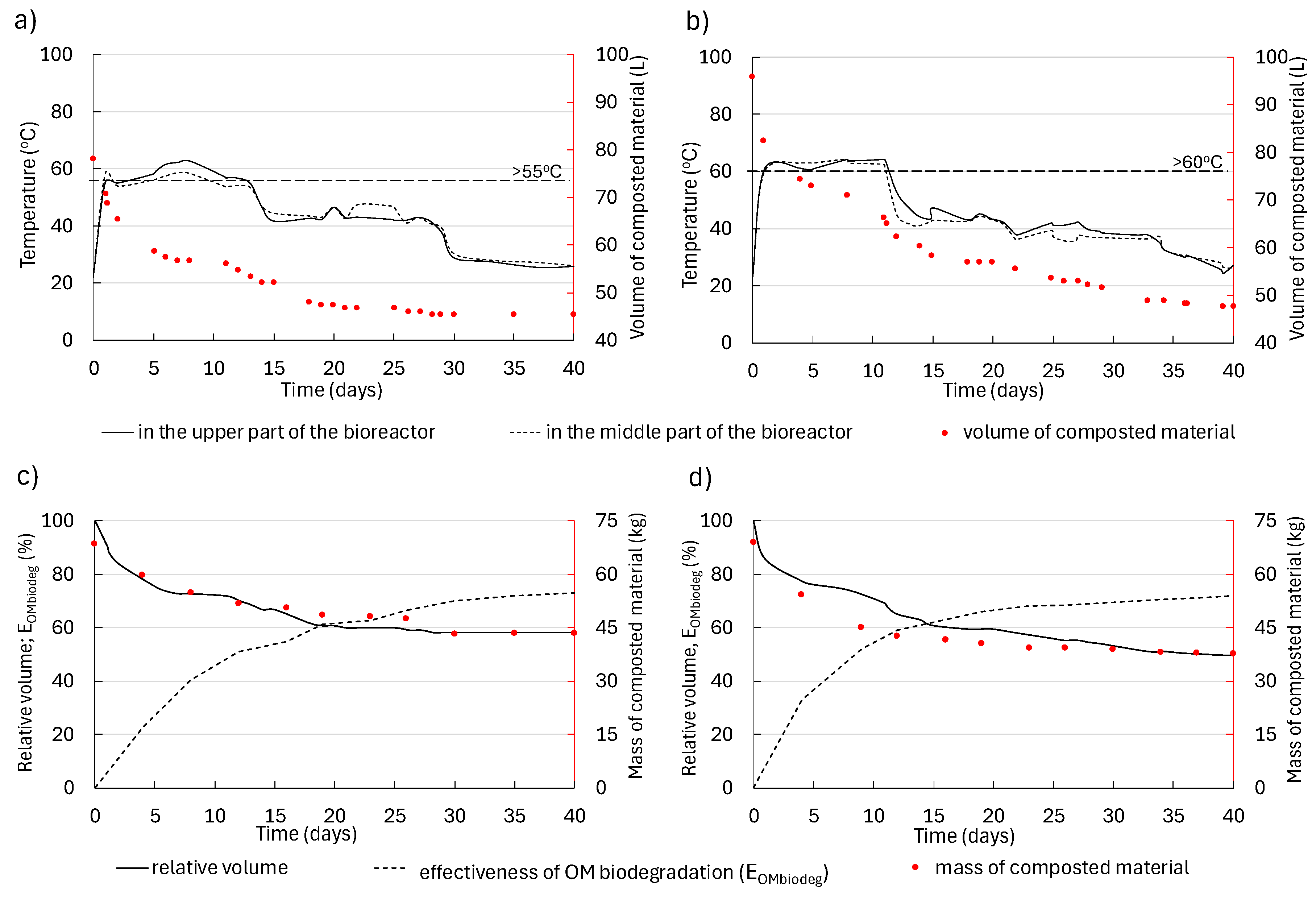
Figure 2.
Changes in contents of OM and MM (a, b), the grey areas indicate the time of composting in the bioreactor (dark grey indicates thermophilic conditions), C loss (Closs), N loss (Nloss) (% of the initial value) and changes in C/N ratio (c, d) during composting of B (a, c) and BG (b, d).
Figure 2.
Changes in contents of OM and MM (a, b), the grey areas indicate the time of composting in the bioreactor (dark grey indicates thermophilic conditions), C loss (Closs), N loss (Nloss) (% of the initial value) and changes in C/N ratio (c, d) during composting of B (a, c) and BG (b, d).
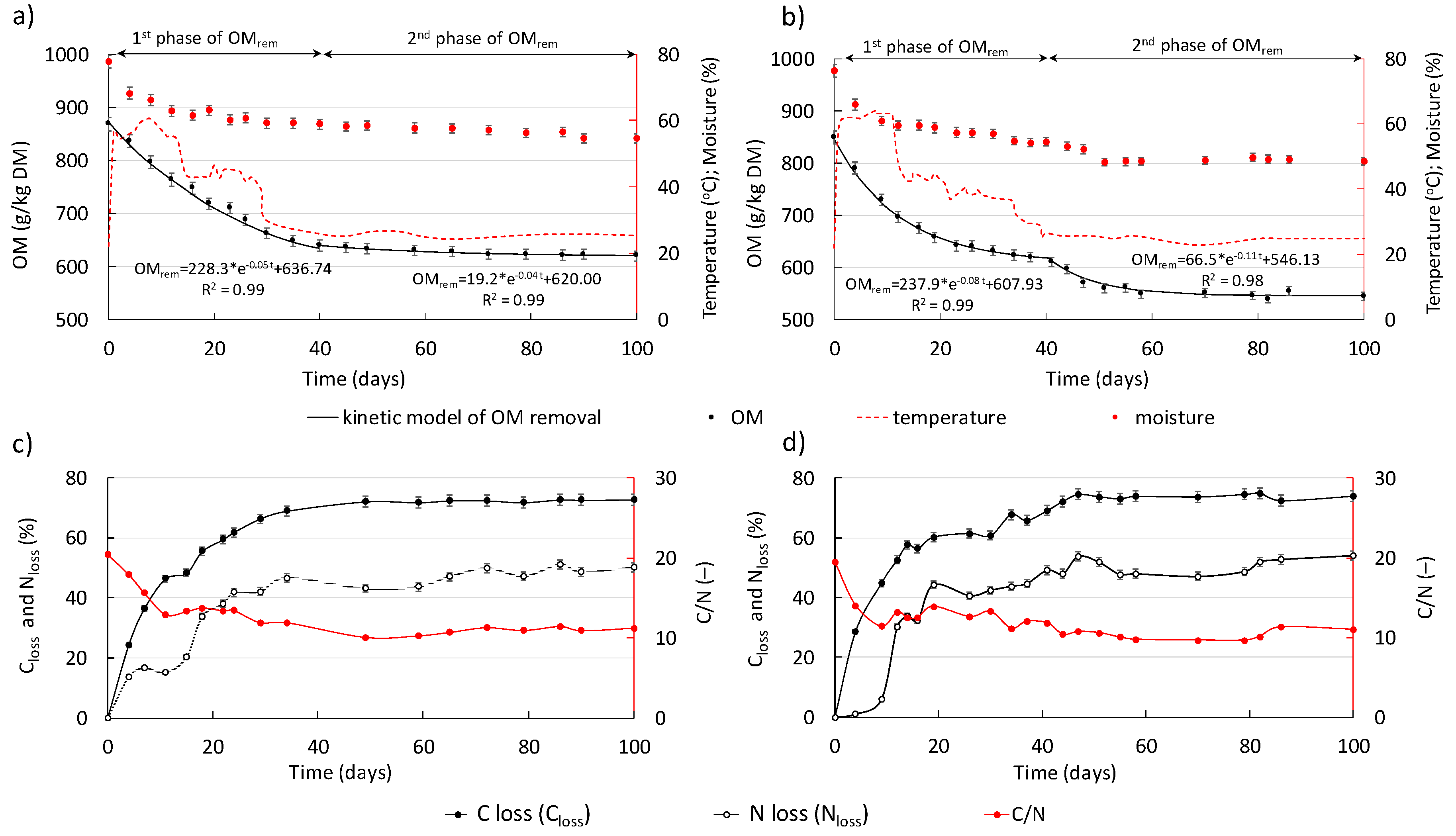
Figure 3.
Changes in the fractions of cellulose (Cel), hemicellulose (H_Cel), and lignin (Lig) in the feedstock and in MCB, and MCBG, and the appearance of grayish filamentous structures (most likely Actinomycetes) during the composting of B (a) and BG (b) (the red lines indicate average temperature during composting).
Figure 3.
Changes in the fractions of cellulose (Cel), hemicellulose (H_Cel), and lignin (Lig) in the feedstock and in MCB, and MCBG, and the appearance of grayish filamentous structures (most likely Actinomycetes) during the composting of B (a) and BG (b) (the red lines indicate average temperature during composting).
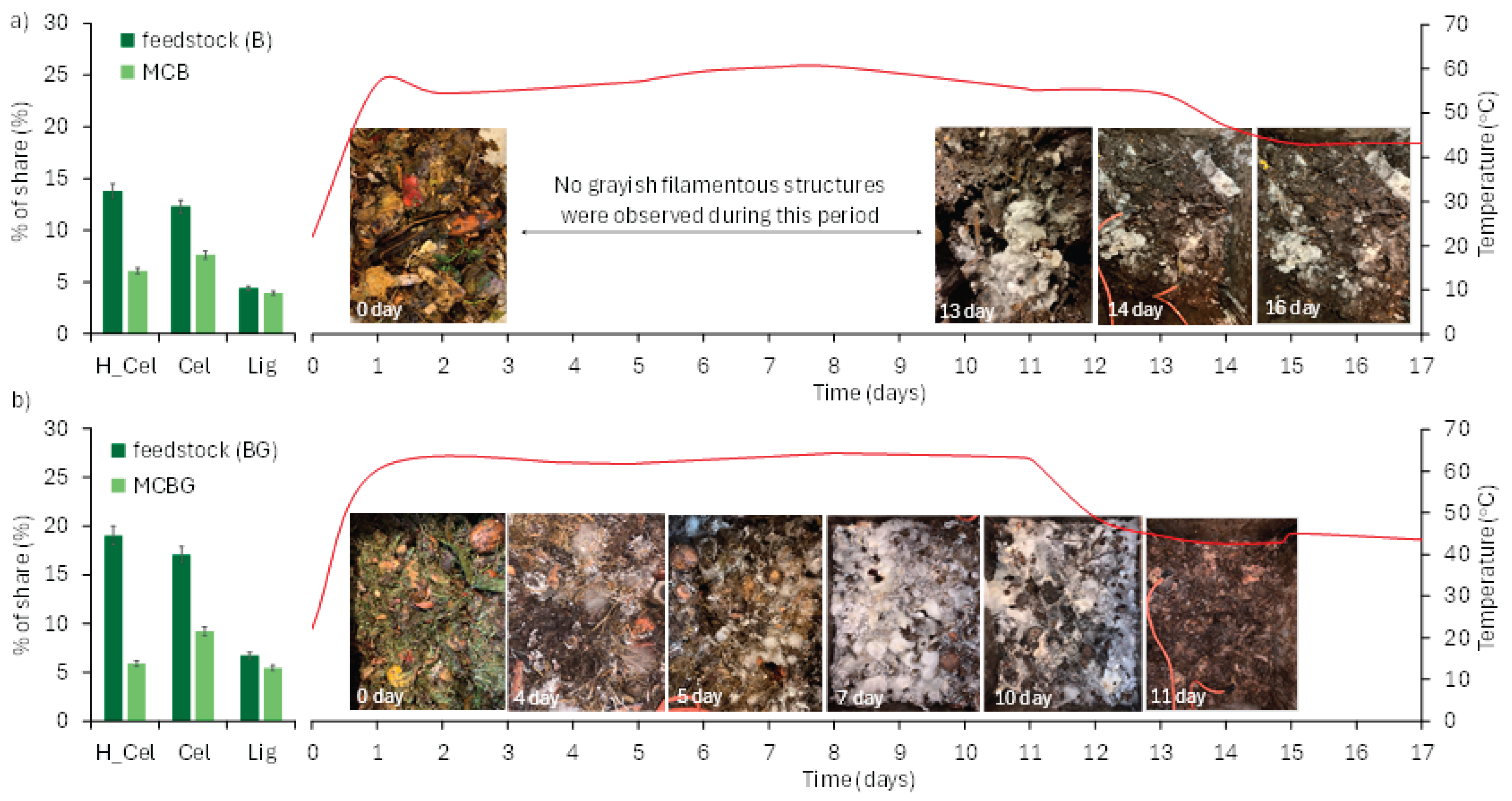
Figure 4.
Changes in pH, TA, and the concentrations of VFA, P-PO4, and nitrogen forms (N-NH4, N-NO2, N-NO3) during composting of B (a, c, e, g) and BG (b, d, f, h) (the red line indicates average temperature during composting.
Figure 4.
Changes in pH, TA, and the concentrations of VFA, P-PO4, and nitrogen forms (N-NH4, N-NO2, N-NO3) during composting of B (a, c, e, g) and BG (b, d, f, h) (the red line indicates average temperature during composting.
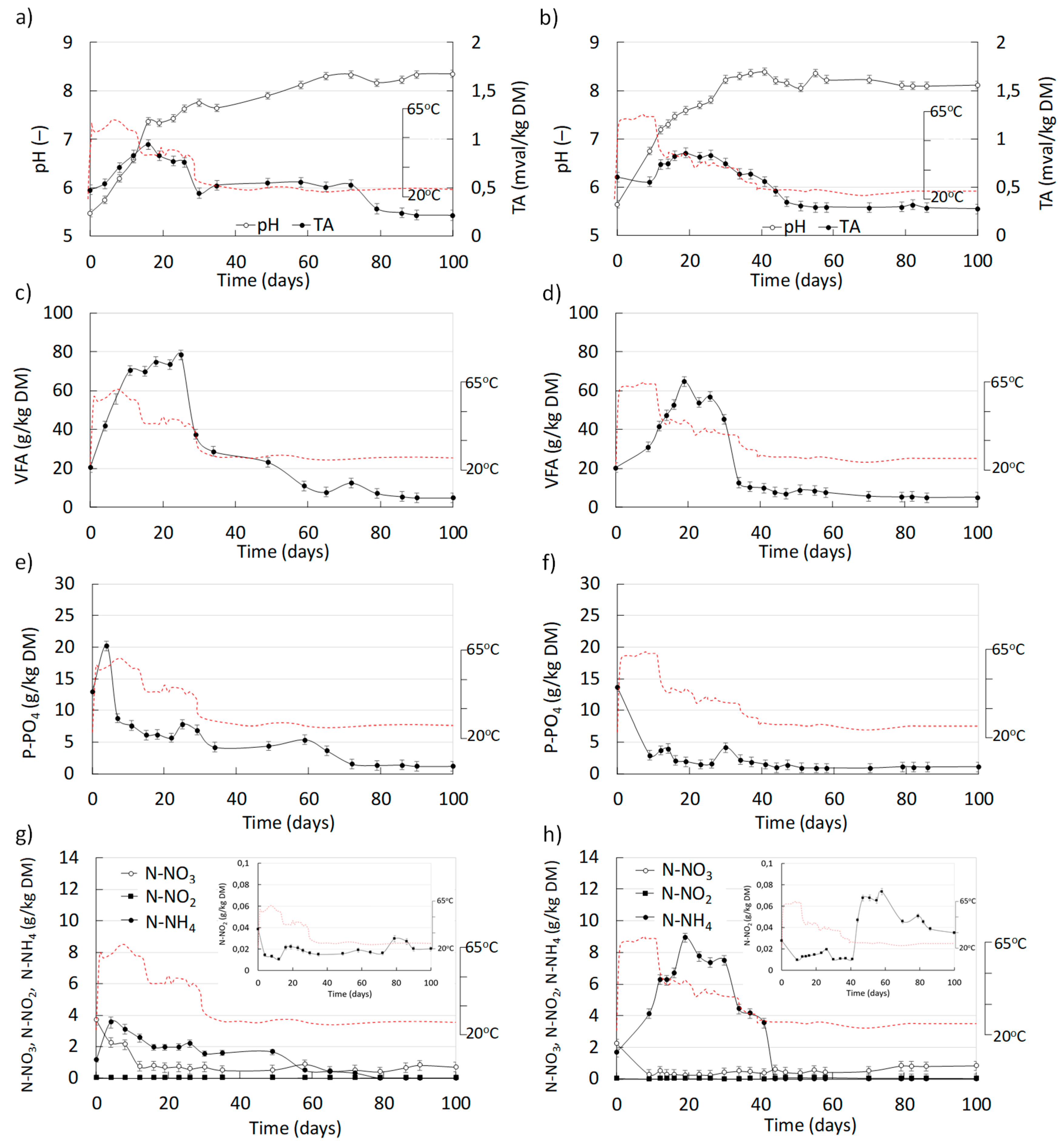
Figure 5.
Shoot length, root length, and GI of three test plant species (a) L.SAT, (b) S.SAC, and (c) S.ALBA, were tested under different application rates of MCB, MCBG, and CC compared with RS.
Figure 5.
Shoot length, root length, and GI of three test plant species (a) L.SAT, (b) S.SAC, and (c) S.ALBA, were tested under different application rates of MCB, MCBG, and CC compared with RS.
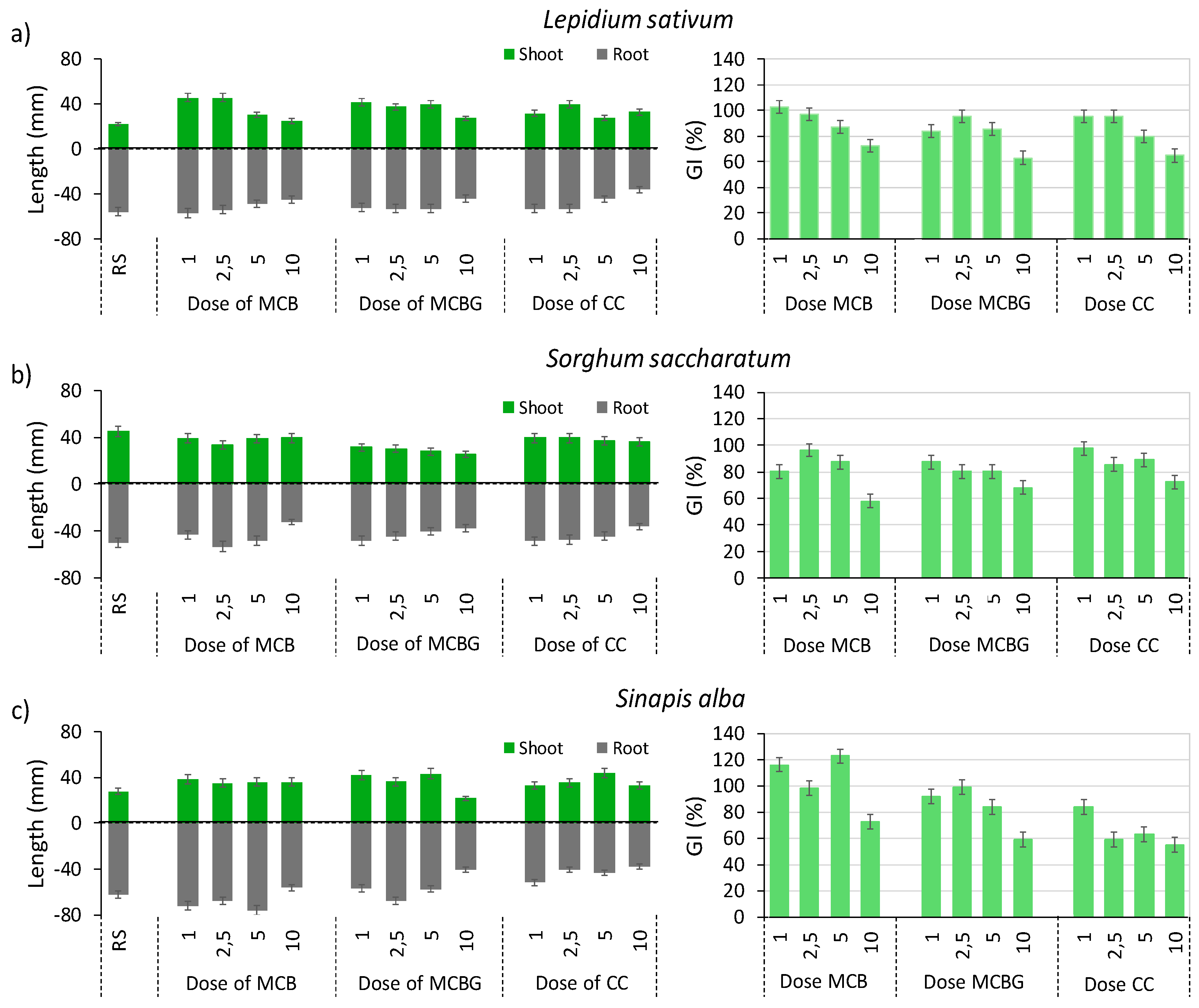
Table 1.
The characteristics of composting feedstocks.
| Characteristics | Unit | B | air-dried G | BG |
| Basic analyses | ||||
| Dry matter (DM) | % | 22.12 ±0.7 | 87.65 ±2.1 | 29.69 ±0.8 |
| Moisture | % | 77.88 ±2.0 | 12.35 ±0.5 | 70.31 ±1.5 |
| OM | % DM | 86.81 ±1.8 | 87.67 ±2.3 | 84.89 ±1.3 |
| Carbon | % DM | 40.05 ±1.3 | 38.95 ±1.1 | 39.94 ±1.2 |
| Hydrongen | % DM | 5.44 ±0.1 | 5.60 ±0.1 | 5.46 ±0.1 |
| Nitrogen | % DM | 1.93 ±0.1 | 3.52 ±0.1 | 2.05 ±0.1 |
| Phosphorus | % DM | 0.29 ±0.1 | 0.39 ±0.1 | 0.29 ±0.1 |
| C/N | – | 20.75 ±1.4 | 11.06 ±0.8 | 19.48 ±1.2 |
| Carbohydrates | % DM | 5.63 ±0.3 | 6.57 ±0.3 | 6.11 ±0.3 |
| Fats | % DM | 3.44 ±0.1 | 1.48 ±0.1 | 3.97 ±0.1 |
| Proteins | % DM | 11.56 ±0.5 | 17.53 ±0.5 | 14.24 ±0.5 |
| Hemicellulose | % DM | 13.82 ±0.3 | 30.95 ±1.1 | 19.04 ±0.5 |
| Cellulose | % DM | 13.32 ±0.5 | 28.48 ±1.1 | 17.03 ±0.5 |
| Lignin | % DM | 4.42 ±0.2 | 9.53 ±0.8 | 6.71 ±0.6 |
| Bulk density | kg/m3 | 876.18 ±6.8 | 98.00 ±2.3 | 719.63 ±6.3 |
| Porosity | % | 45.24 ±1.6 | 95.48 ±2.0 | 55.02 ±1.4 |
| Free air space | % | 19.65 ±1.2 | 95.15 ±1.8 | 34.44 ±1.6 |
| Aqueous extract after filtration | ||||
| pH | – | 5.58 ± 0.4 | 5.62 ±0.3 | 5.65 ±0.4 |
| Total alkalinity (TA) |
mval/L mval/kg DM |
11.15 ±0.6 0.43 ±0.1 |
80.00 ±0.9 0.89 ±0.1 |
18.53 ±0.5 0.60 ±0.1 |
| Volatile fatty acids (VFA) |
mg/L g/kg DM |
474.86 ±3.6 18.54 ±0.7 |
188.57 ±2.5 2.10 ±0.1 |
514.29 ±3.4 16.74 ±0.5 |
| Orthophosphate (P-PO4) |
mg/L g/kg DM |
307.38 ±3.2 11.82 ±1.3 |
78.26 ±1.8 0.87 ±0.1 |
302.23 ±2.7 9.66 ±0.8 |
| Nitrite (N-NO2) |
mg/L g/kg DM |
0.70 ±0.1 0.03 ±0.1 |
2.92 ±0.1 0.03 ±0.1 |
0.85 ±0.1 0.03 ±0.1 |
| Nitrate (N-NO3) |
mg/L g/kg DM |
67.40 ±1.3 2.98 ±0.1 |
199.20 ±2.3 2.21 ±0.1 |
67.98 ±1.5 2.21 ±0.1 |
| Ammonium (N-NH4) |
mg/L g/kg DM |
38.42 ±0.9 1.42 ±0.1 |
53.2 ±1.6 0.59 ±0.1 |
51.8 ±1.7 1.69 ±0.1 |
Disclaimer/Publisher’s Note: The statements, opinions and data contained in all publications are solely those of the individual author(s) and contributor(s) and not of MDPI and/or the editor(s). MDPI and/or the editor(s) disclaim responsibility for any injury to people or property resulting from any ideas, methods, instructions or products referred to in the content. |
© 2026 by the authors. Licensee MDPI, Basel, Switzerland. This article is an open access article distributed under the terms and conditions of the Creative Commons Attribution (CC BY) license (http://creativecommons.org/licenses/by/4.0/).
Copyright: This open access article is published under a Creative Commons CC BY 4.0 license, which permit the free download, distribution, and reuse, provided that the author and preprint are cited in any reuse.


