

Submitted:
10 June 2026
Posted:
11 June 2026
You are already at the latest version
Abstract
Despite being discovered over a century ago, lathyrane diterpenoids have only recently attracted significant attention from the organic chemistry community due to their distinctive carbon framework, characterized by a 5/11/3 tricyclic system. The conformational rigidity of these scaffolds promotes close spatial proximity between functional groups, making transannular reactions a powerful tool for the construction of new complex polycyclic architectures. In parallel, compounds from the genus Euphorbia have emerged as privileged scaffolds in medicinal chemistry, exhibiting a wide range of biological activities, including cytotoxic, antiviral, and neuroprotective effects. This review summarizes recent advances in the field, with particular emphasis on synthetic strategies, structural diversity, and medicinal chemistry aspects of this intriguing class of secondary metabolites.
Keywords:
natural products
; secondary metabolites
; lathyrane diterpenoids
; transannular rearrangements
; bioactive compounds
1. Introduction
Secondary metabolites have always fascinated both chemists and pharmacologists due to the complexity of their structures along with interesting pharmacological profiles [1,2]. Among the various classes of natural compounds, terpenes constitute the largest and most structurally diverse family. This vast structural complexity derives from very simple biosynthetic roots characterized by a “cyclase phase” in which cationic polyene cyclizations produce a myriad of products that typically contain multiple fused rings and several stereocenters [3]. The high structural complexity of terpenes is responsible for their ability to interact with different biological targets, to the extent that some of these structures can be defined as ‘privileged’ from a medicinal chemistry point of view. Their ability to perturb different molecular targets is probably the result of the ‘natural evolution’ that occurred in living organisms in order to obtain ‘functional molecules’ with antagonistic, antifeedant purposes and in mutual interaction with the environment [4].
Lathyrane diterpenoids are members of the large family of terpenes characterized by a twenty-carbon atoms structure organized in a 5/11/3 tricyclic system decorated with various oxygenated functions. They represent the main chemical components in the genus Euphorbia, that comprise more than 2000 recognized species that have been used as remedies in different traditional medicines [5]. Despite the first lathyrane has been discovered by Tahara in 1890 [6], only with this century this class of secondary metabolites really attracted the attention of the scientific community and several derivatives from different sources have been isolated. From a biogenetic point of view, it is generally speculated that they arise from the electrophilic cyclization of geranylgeranyl pyrophosphate (GGPP) through the formation of an allyl cation catalyzed by casbene synthase. The cyclase phase starts with the generation of the cembrane cation that eventually is transformed into the lathyran scaffold first through the installation of the cyclopropane ring and then with the formation of a bond between C4 and C15 [7,8]. Once assembled, the polycyclic architecture undergoes an oxidative phase where the terpene skeleton is oxidatively decorated with the insertion of alcoholic groups (mainly in positions 3, 5 and 15), the introduction of a ketone moiety in position 14, a conjugated endocyclic double bond with trans geometry, and an exocyclic double bond in position 6 that in some derivatives can be epoxidized. Moreover, structural complexity is increased through the esterification of hydroxyl groups with both aliphatic and aromatic acids (Scheme 1).
The tricyclic system of lathyrane diterpenoids, owing to its intrinsic rigidity and dense functionalization, seems to have been forged by nature to interact with different biological systems to such an extent that it can be defined as a privileged structure in medicinal chemistry. Many natural derivatives have been tested on different biological targets, and some of them have shown cytotoxic, anti-inflammatory, and antiviral activities [9,10]. The modulation of MDR has been extensively studied, highlighting how this class of compounds is able to modulate the action of glycoprotein-P in different tumor cell lines [5], and furthermore, the ability of some lathyranes to stimulate NPC proliferation in both in-vitro and in-vivo assays has recently emerged, opening new possibilities in the development of new drugs for the treatment of diseases related to reduced neurogenesis [11].
While the biological aspects of natural lathyranes have been extensively reviewed [5,9,10,12], to the best of our knowledge, a comprehensive review about their chemical behavior is still lacking. The possibility of duplicating the efficiency and the selectivity of the natural processes under laboratory conditions, in a sort of “cyclase-phase in the flask”, has stimulated the organic chemistry community to explore the chemical space of these natural macrocycles, resulting in the discovery of new rearrangements and new carbon architectures. In light of the growing interest in this class of secondary metabolites, this highlight aims to cover the literature regarding the chemical transformations, the rearrangements and the biological activity of semisynthetic derivatives. The paper is organized by first addressing the reactivity of the tricyclic scaffold, classified according to the type of activation (acidic, photochemical, or basic conditions), and subsequently focusing on medicinal chemistry aspects.
2. Chemistry of Lathyranes
2.1. Acid Catalyzed Reactions
The first member of euphorbiasteroid, the archaic name for, was isolated in 1890 [6], but only in 1970 a couple of papers were published, reporting the x-ray analysis and the complete structural elucidation of two new compounds named epoxylathyrol (1) and euphorbia factor L1 (2) (Figure 1) [13]. In the attempt to determine the position of the functional groups grafted onto the terpene skeleton, the authors described the first trans-annular cyclization of the tricyclic system.
The treatment of compound 2 with formic acid yielded two tetracyclic products 3 and 4, in which the cyclopropane ring has been replaced with a cyclobutane, while the macrocyclic system has been transformed in two bicyclic systems [4.4.0] and [4.4.1], respectively. The reaction works in the same manner in other acidic systems such as AcOH/HClO4 and CF3COOH. Compounds 3 and 4 could derived from an intramolecular alkylation of C13 on both the ends of the protonated epoxide (A), followed by the ring expansion of the cyclopropyl carbonium ions (B and C) (Scheme 2) [13].
In 1973, Takemoto reported the transannular cyclization induced by the exposure of euphorbia factor L1 (2) to an acidic system formed by oxalic acid in glacial acetic acid. The rearranged product 5 shares the same framework of compound 4 with the replacement of the formyl moiety at C11 with an acetyl one (Figure 2) [14].
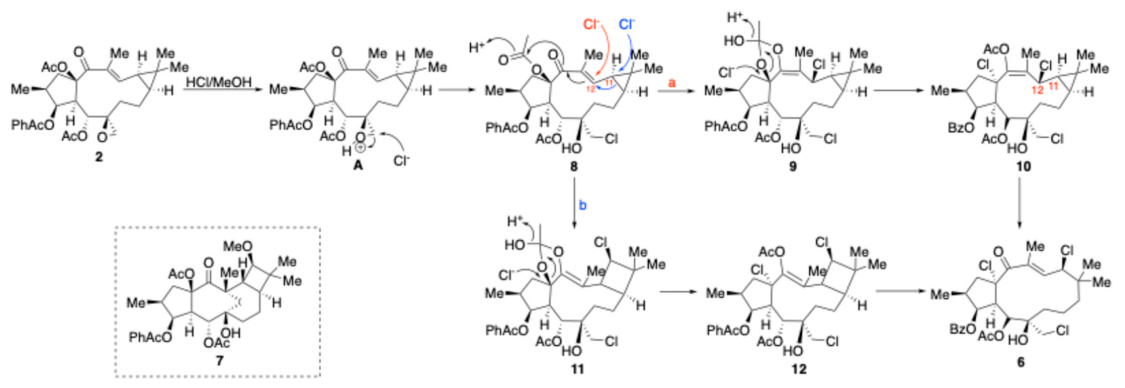
Two years later, a methanolic solution of euphorbia factor L1 (2) (incorrectly named in the original article as epoxylathyrol 1) was treated with an excess of mineral acids (HCl, H2SO4) in methanol, leading two main rearranged products 6 (treated with HCl) and 7 (treated with H2SO4) [15]. While compound 7 has the same structure of 4 with a methyl ether moiety in place of the formyl ester, compound 6, obtained in 45% yield, was characterized by a 5/12 bicyclic system with the incorporation of three chlorine atoms. The proposed mechanism behind the formation of trichloro derivative started with the protonated epoxide A, which was opened by a chloride attack leading to the corresponding halohydrin 8, that according to the authors could follow two possible pathways. In the first pathway (in red in Scheme 3), the insertion of the second chlorine atom could happen through a Michael type reaction at C12, forming intermediate 9. The latter, after protonation, underwent a third chloride attack to give compound 10. The loss of an acetyl moiety, the migration of the chlorine atom from C12 to C11 and the opening of the cyclopropane ring, eventually, led to the final product 6. The second pathway (in blue in Scheme 3) involved the attack of the chloride at C11 of 8, resulting in the formation of intermediate 11 with the installation of the cyclobutane ring. The latter, after protonation and the concerted replacement of the acetyl group with the third chlorine, led to intermediate 12 that eventually evolved into the final product [15].
Afterwards, 1984 Yamamura described a biomimetic approach for the interconversion of the lathyrane scaffold into the jatropholane one. Jatropholane-type diterpenes are a group of rare secondary metabolites characterized by a unique 5/6/7/3 system, present in some plants of genus Euphorbia [16]. In order to mimic nature in the interconversion of latyranes into jatropholanes, compound 14, deriving from euphohelioscopin A (13), was manipulated to give the diketo-derivative 15 that in presence of AlCl3 underwent to a transannular cyclization with the formation of a new bond between C5 and C12, leading a C13 epimeric mixture of derivatives (16) as main compounds (45% yield) (Scheme 4).
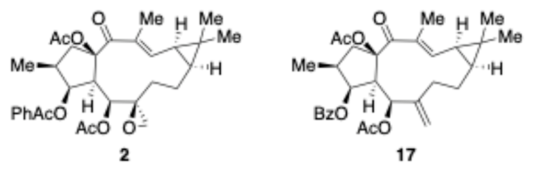
While the projects described above were limited to a superficial study of the reactivity of lathyranes, with the advent of the new century, several groups began to study the chemical behavior of this group of secondary metabolites more systematically. The first paper that led to a turning point was published in 2001 by Appendino et al., in which the rearrangements induced by both Bronsted and Lewis acids on euphorbia factors L1 (2) and L3 (17) were described in detail [17]. The two natural compounds share the same skeleton, and the main structural difference lies in the nature of the C6-C17 bond: in L1 (2) the two carbons are linked through a sigma bond inserted in an epoxide ring, while in L3 (17) they are involved in a double bond. A further difference, less significant from the point of view of reactivity, is that while L1 (2) has a phenylacetic ester in position C3, L3 (17) has a benzoic ester (Figure 3).
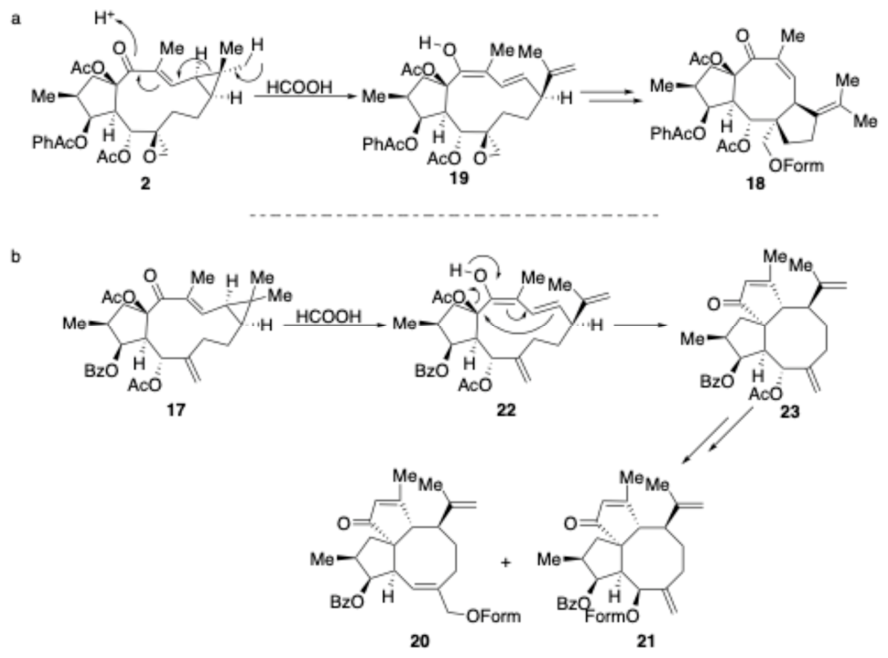
The authors decided to use formic acid and Yb(OTf)3 to exploit the captodative nature of the endocyclic alkene. In formic acid euphorbia factor L1 (2) confirmed its reactivity leading compounds 3 (42%) and 4 (33%) as main products, and the cyclooctanoid derivative 18 as minor derivative (6%) (Scheme 5a). Although compounds 3 and 4 were already known, the authors noted that the stereochemistry of the bridgeheads of the central bicyclic system was incorrect and therefore proceeded with a complete redefinition of the spatial rearrangement of the molecules. Otherwise, L3 (17) shown a completely different behavior leading compounds 20 and 21, with a proposed mechanism based on the cleavage of the cyclopropyl moiety that led intermediate 23 through the formation of a new bond between C11 and C15 with the loss of an acetyl moiety. Eventually, the obtained intermediate underwent to solvolysis replacing the 5-acetyl with a formyl, giving the final isomeric products 20 (19%) and 21 (11%) (Scheme 5b) [17].
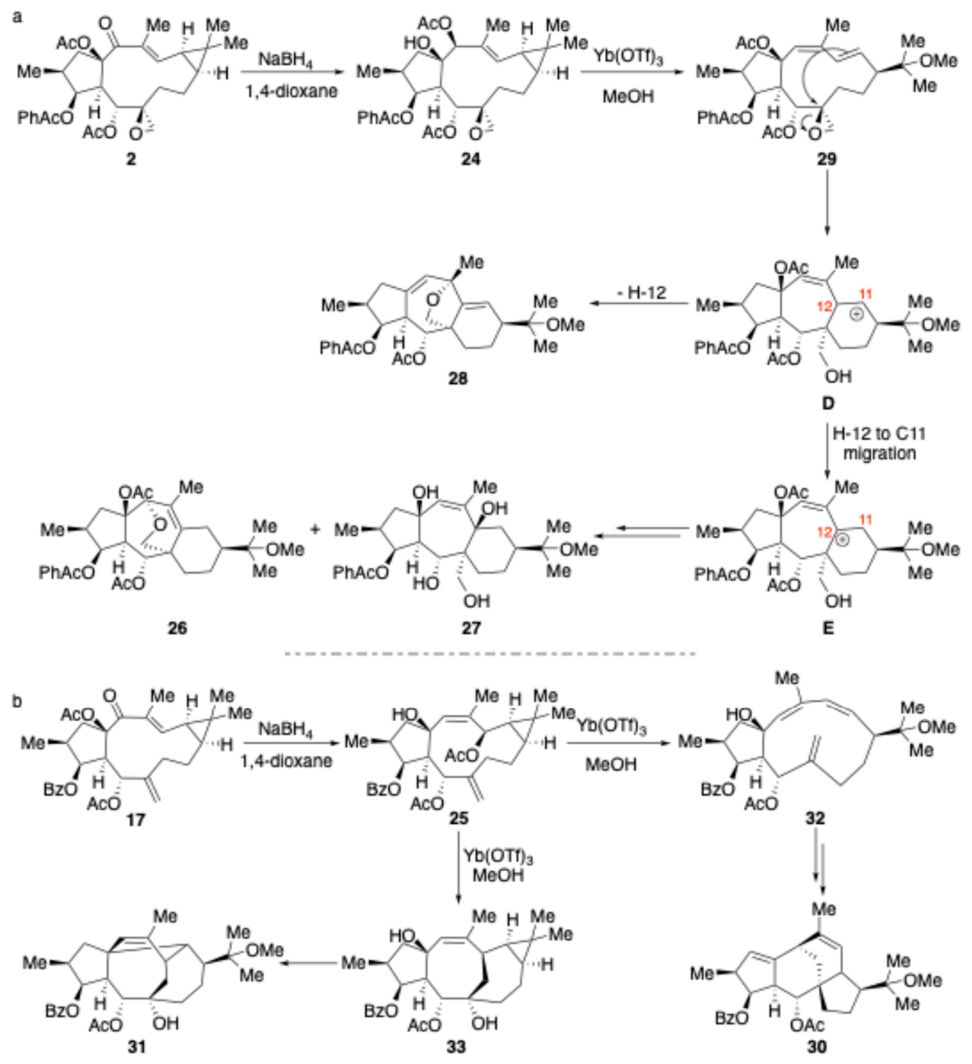
In order to increase the nucleophilicity of the endocyclic double bond and to exploit new avenues of reaction, the authors decided to reduce the enone-carbonyl of L1 (2) and L3 (17), obtaining compounds 24 and 25 that were reacted under Lewis acids conditions, in presence of Yb(OTf)3 in MeOH. Compound 24 underwent to a complete rearrangement of the scaffold with the interconversion of the lathyrane architecture in the abeomyrsane one, leading the formation of compounds 26 (21%), 27 (19%) and 28 (35%). It has been proposed that the latter were derived from the rearrangement of a common intermediate characterized by a C-seco-lathyradiene motif (29), that after a transannular cyclization with the exo-opening of the epoxide ring, led the carbocation D. After a series of hydride shifts, the positive charge was eventually quenched through an intermolecular oxygen trapping leading the mixture of the final products (Scheme 6a).
On the other hand, compound 25 under the same conditions, led to the formation of two main compounds 30 (22%) and 31 (15%), arising from two proposed key intermediates 32 and 33. The triene 32, thanks to the proximity of alkenes, could undergo to a sort of Diels-Alder reaction, furnishing the tetra fused carbon architecture of compound 30. Differently, intermediate 33 with the loss of a molecule of water induced by the attack of a mole of MeOH on C10, led to the final compound 31 (Scheme 6b) [17].
In 2019 and 2020 the group of Zhou published two papers describing the reactivity of euphorbia factor L1 (2) in presence of BF3*Et2O as catalyst in non protic solvents such as EtOAc and AN. In both the papers they were able to interconvert the lathyrane scaffold into the euphoractane and myrsinane ones, and in addition they described a new unnatural 5/7/7/4 fused-ring diterpene skeleton [18,19]. While EtOAc acted mainly as a source of acetate moiety incapsulated in the final products [18], AN was able to interact with the activated enone moiety leading an unprecedent euphoractine B type pseudo-alkaloid (34) never describe before. The authors suggested as possible mechanism that the activated intermediate F could be attacked by AN at C12 through a Michael type reaction leading zwitterion G that eventually could evolve into the final product 34 (Scheme 7) [19].
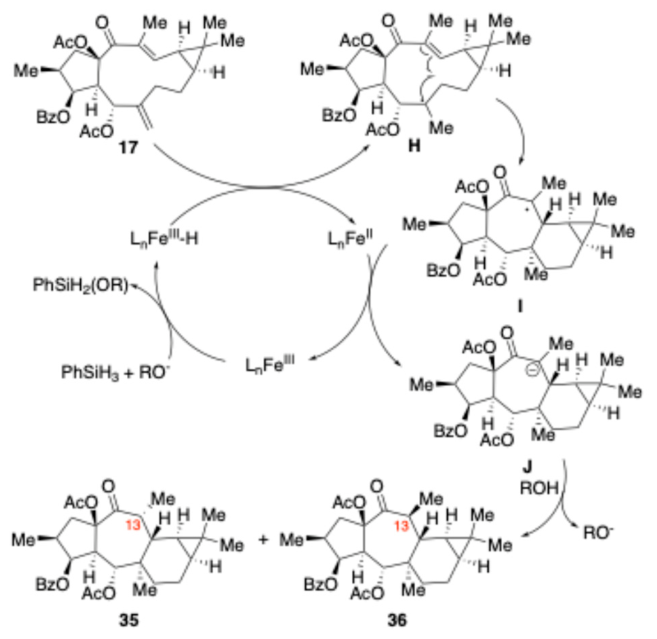
In 2021, Gao investigated the biogenetic relationship among lathyranes and premyrsinanes, two structurally related diterpenoid skeletons commonly isolated from Euphorbia species. To probe whether these frameworks were biosynthetically interconnected, the authors subjected euphorbia factor L3 (17) to radical reductive conditions using PhSiH3 as hydrogen donor and Fe(acac)3 as radical mediator [20]. The reaction furnished a C13 epimeric mixture of compounds 35 and 36, in which the lathyrane architecture was effectively reorganized into the premyrsinane one, through a radical-mediated skeleton rearrangement. The proposed mechanism started with the formation of an iron (III) hydride species, that underwent to a hydrogen atom transfer (HAT) generating the C-6 radical intermediate H, that after a C6-C12 cyclization led to the radical I with the installation of the 5/7/6/3 system. A subsequent single-electron transfer (SET) furnished intermediate J, that eventually could be quenched by proton abstraction from the reaction medium (Scheme 8).
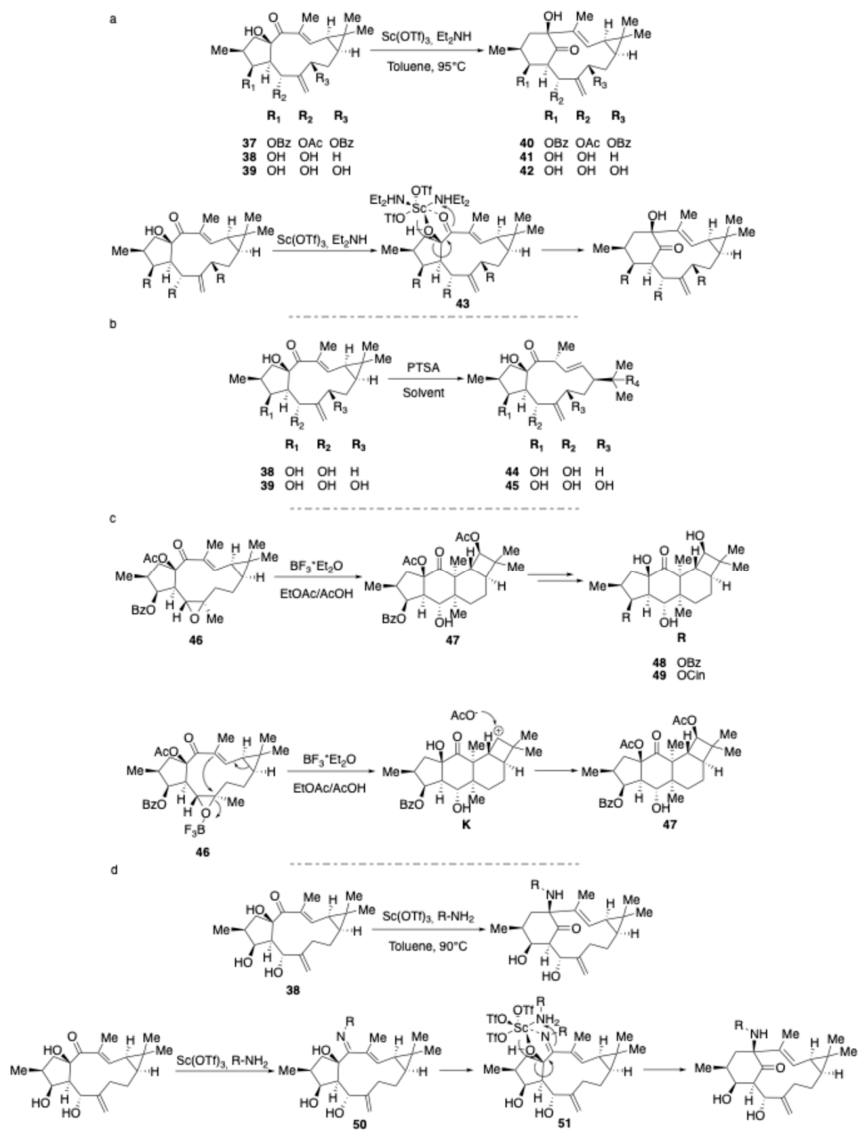
Following their initial study, the group of Gao initiated a systematic investigation into the reactivity of lathyrane scaffold, aiming to develop new biomimetic strategies for reorganizing the 5/11/3 tricyclic system into other natural diterpene skeletons. In the first attempt of the series, a small set of lathyranes (37, 38, 39) was treated with catalytic amounts (10 mol% each) of Sc(OTf)3 and Et2NH obtaining lathyranones (40, 41, 42) as products in yields of approximately 90% on milligram scale [21]. The authors postulated that the formation of a metal–chelate complex (43) was the key intermediate favoring the interconversion of the starting material to the lathyrone scaffold. Upon coordination of Sc(OTf)₃ to the carbonyl and neighboring C-15 hydroxyl group, an a-ketol rearrangement took place with the migration of the C1-C15 bond to the C1-C14 bond (Scheme 9a). After the results obtained with Sc(OTf)₃, the authors explored the potential of PTSA in promoting structural rearrangements of lathyrol (38) and 7-hydroxylathyrol (39). Under the optimized conditions, both substrates underwent selective and complete conversion into the corresponding 10,11-seco-derivatives [22]. 10,11-Seco-lathyrane diterpenes constitute a small and rare group of secondary metabolites isolated from Jatropha species characterized by a distinctive and uncommon bicyclo [9.3.0]tetradecane skeleton, which differentiates them structurally from classical lathyrane diterpenes. The extreme rarity of these sesquiterpenes (only five isolated derivatives), combined with the acidity of the soil in which these plants grow, led the authors to speculate that this small group of molecules might actually be artifacts formed during the storage and extraction process of the plant material. In support of this theory, lathyrol (38) and 7-hydroxylathyrol (39) were heated to 60 °C in the presence of PTSA, confirming that Brønsted acids could exert a positive influence on product formation (Scheme 9b). The authors indeed characterized a small library of variously functionalized seco-derivatives that could derive from the protonation of the carbonyl system followed by the opening of the epoxide ring to give a tertiary carbocation, subsequently trapped by the solvent.
The same research group, inspired by Zhou's previous work, explored the reactivity of euphorbia factor L12 (46) in the presence of BF₃*Et₂O [23]. The presence of the epoxide ring embedded in the macrocyclic system proved to be crucial, allowing the authors to identify a highly efficient and selective pathway for reorganizing the lathyrane skeleton into the euphoractane framework. Specifically, using BF₃*Et₂O in the presence of AcOH resulted in the exclusive formation of euphoractine A skeleton (47) (94%). The developed approach proved to be sufficiently robust and tunable to allow the synthesis of euphoractines M (48) and N (49) in high yield on a gram scale (Scheme 9c). In parallel, an alternative approach was explored to synthesize a new class of lathyranone alkaloids exploiting the potential of Voigt condensation [24]. In this reaction, discovered in 1886, a α-hydroxy ketone reacting with a primary or secondary amine under acidic conditions leads to α-amino ketone as the main product [25]. Specifically, under optimized conditions, lathyrol (38) was heated to 90 °C in toluene in presence of Sc(OTf)₃ and a primary amine as nitrogen source. In this way, through mechanism analogous to that previously reported, the incorporation of a nitrogen atom and the remodeling of the carbon skeleton were achieved in a single step (Scheme 9d) [24].
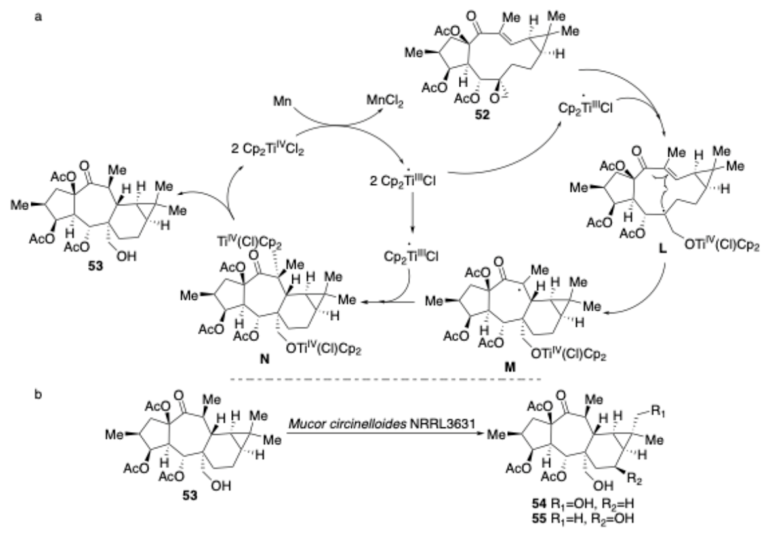
In 2024 the group of Duran-Patron, inspired by the postulated biogenetic relationship between 6,17-epoxylathyranes and premyrsinanes proposed by Appendino’s group, described a new biomimetic approach based on the action of Cp2TiIIICl as radical mediator [26]. The latter has emerged as a versatile reagent in the induction of SET reactions, and of particular interest is its ability to open epoxide moieties through a homolytic cleavage, leading to the formation of b-titanoxyl radicals [27,28,29]. By starting from an easily available lathyrane derivative such as epoxyboetirane A (52), the authors were able to install the 5/7/6/3 tetracyclic system typical of premyrsinanes, obtaining compound 53 in very good yields (79%). The proposed mechanism started with the generation of Cp2TiIIICl by reducing Cp2TiIVCl2 with Mn powder. The obtained catalyst, by reacting with the epoxide of compound 52, produced the corresponding b-titanoxyl radical L, that eventually could undergo to a transannular cyclization giving the carbon radical M trapped by a second equivalent of Cp2TiIIICl leading to the alkyltitanium species N. The final product 53 arose from the reaction of intermediate N with the 2,4,6-trimethylsilylpyridinium chloride thereby regenerating the Cp2TiIVCl2 (Scheme 10a). In order to introduce new structural complexity, in the same paper the authors subjected the premyrsinane-type derivative 53 to biotransformation through the action of mucor circinelloides NRRL3631, known for its ability to biotrasform the macrocyclic triterpene skeleton, obtaining two new hydroxylated derivatives (54, 55) in moderate yields (Scheme 10b) [26].
2.2. Photochemical Reactions
To trace the earliest studies on the photoreactivity of the lathyrane skeleton, it is necessary to go back to 1971, when Ourisson identified the compounds formed upon irradiation of epoxylathyrol (1) and L1 (2) under UV light (254 nm). The main product was a seco-furan (56) arising from the formation of a resonance-stabilized carbene intermediate (P), which was generated through the trans-cis isomerization of the conjugated double bond, followed by the cleavage of the C10–C11 bond [30]. Eventually, this key intermediate underwent cyclization reacting with the carbonyl oxygen to afford the final furan (56) in quantitative yield. In 1975, another group of French researchers confirmed the results reported by Ourisson, not only reporting a full characterization of the obtained lumi-products, but also by thoroughly investigating the reaction mechanism, thereby confirming carbene P as the key intermediate in the formation of the final product (Scheme 10) [31].
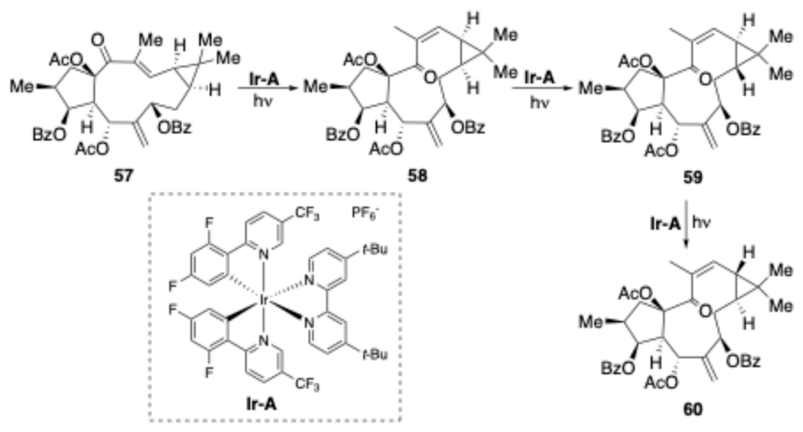
After these pioneering studies, the photochemistry of lathyranes was largely neglected by the organic chemistry community for nearly forty-seven years, until the advent of photocatalysis. In 2022, Gao’s group investigated the reactivity of L2 (57) under photocatalytic conditions (Ir catalyst, blue and purple LEDs), discovering an efficient biomimetic route to obtain a class of lathyranes characterized by the presence of a trans-cyclopropane moiety [32]. Some members of this rare group of secondary metabolites were first isolated by Ghisalberti [33] and then by Chen [34], who proposed as possible biogenetic pathway, a light-induced process involving the activation of the enonic system followed by the isomerization of the cyclopropane moiety. To explore this hypothesis, the authors exposed L2 (57) to blue LEDs resulting in the isomerization of the enone system to give the corresponding cis isomer 58, that underwent a further isomerization of the cyclopropane moiety, with the inversion of configuration at C-9, affording the natural trans isomer L2a (59). These results supported the previous hypotheses of the key role played by light in the biogenetic pathway of these compounds. Compound 59, after further irradiation (12 h, purple LEDs), eventually furnished a new trans derivative 60 featuring inversion of configuration at both C-9 and C-11. The authors proposed, as driving force of the rearrangement, the fact that the initial isomerization of the enone system increases the ring strain of the molecule, which is subsequently released by the isomerization of the cyclopropane moiety (Scheme 11).
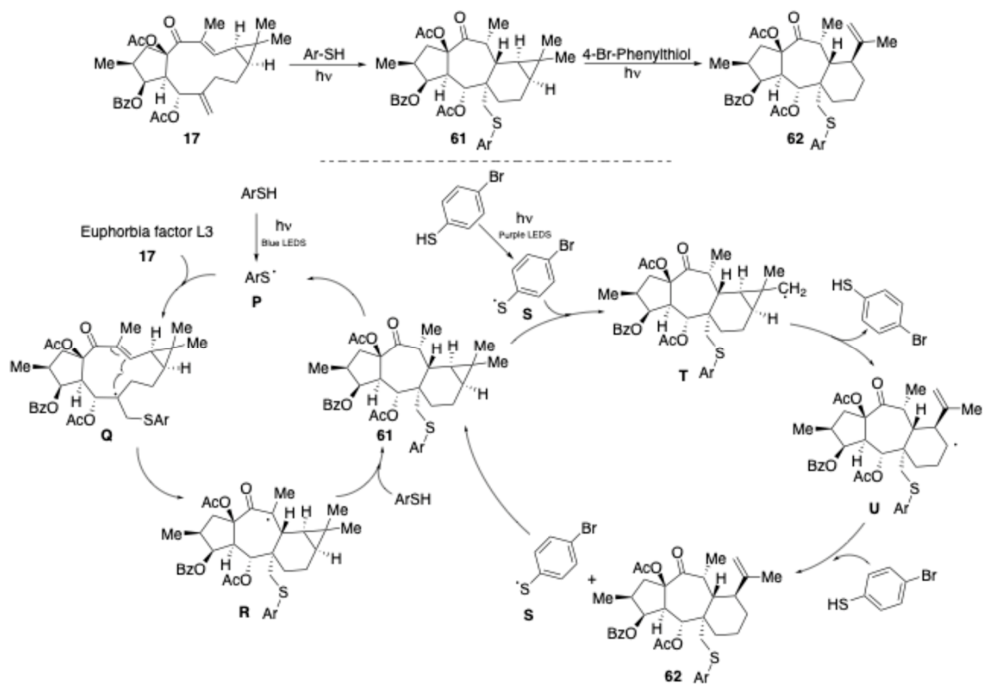
The exploration of the chemical space of a class of compounds can lead not only to the discovery of new rearrangements and reactions but also to allow the decoration of the starting framework with new functional groups. In the continuation of its studies on the reactivity of the lathyrane architecture, Gao’s group exploited the flexibility of the terpenic system toward transannular cyclizations to synthesize premyrsinane and myrsinane derivatives containing an aromatic thioether functionality. More specifically, the exposure of euphorbia factor L3 (17) in the presence of an equimolar amount of thiophenol under blue LEDs irradiation led to compound 61, characterized by a premyrsinane scaffold bearing a thioether group at C17. The subsequent exposure of the latter to purple LEDs in the presence of a catalytic amount of 4-bromothiophenol (10%) resulted in the opening of the cyclopropane system, generating the corresponding myrsinane thioether 62. The authors proposed a mechanism in which thiophenol played a key role in the activation and propagation of the reaction. In particular, the thiol group was activated by light producing a reactive radical (P) that could attach the lathyrane scaffold at C17 leading a tertiary radical (Q) that could undergo to a transannular cyclization establishing a new bond between C6-C12 generating a tertiary radical (R) that eventually could be quenched with the abstraction of a hydrogen from another thiol group. The last part of the mechanism has been confirmed by using a deuterated thio-phenol generating the corresponding C13 deuterated product. The interconversion of compound 61 into 62 was made possible, in this case as well, by the activation of the thiol group which led to the opening of the cyclopropane ring with the formation of myrsinane scaffold (Scheme 12). The authors tested the generality of the reaction with different aromatic thiols, obtaining a small library of derivatives in good to moderated yields with good dr ratios.
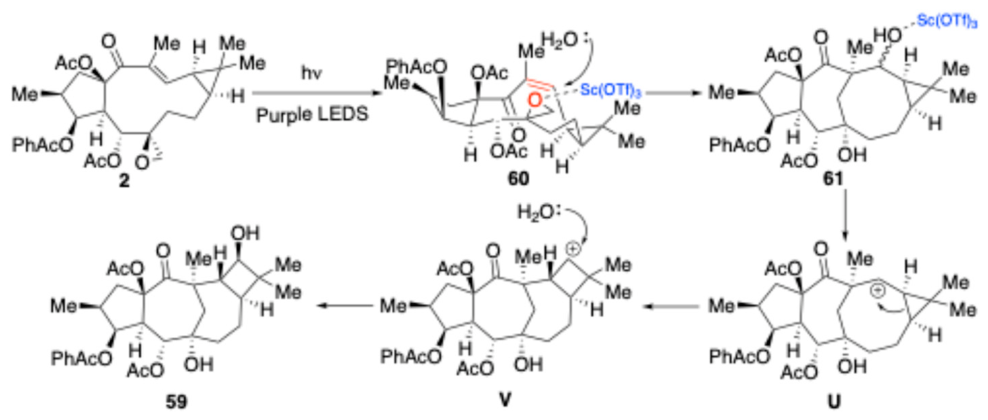
Plants of the Euphorbia genus produce a wide variety of diterpenes, some in considerable amounts, while others, such as eupholathones, are present only in trace quantities. Euphornin E (59) [35] is a member of this small family of lathyrane-type diterpenes, characterized by a 5/7/7/4 tetracyclic system, which is speculated to derive from a remodeling of the classical lathyrane architecture through transannular reactions.
In their ongoing attempts to discover new biosynthetically inspired approaches to interconvert highly abundant lathyrane diterpenes into much rarer ones, Gao and co-workers combined the acidic properties of Sc(OTf)₃ with the activating effects of photochemistry [36]. This strategy enabled the efficient conversion of the abundant euphorbia factor L1 (2) into the much rarer euphornin E (59) in high yields. Photochemistry plays a crucial role in the reaction pathway promoting a rapid and complete isomerization of the enone double bond, inducing a configurational change bringing the epoxide group into close proximity to the double bond. Subsequently, the intermediate 60 could undergo an intramolecular cyclization induced by Sc(OTf)₃ with the installation of the tetracyclic 5/7/8/3 system (61). The formation of a carbocation at C12, followed by a Wagner-Meerwein rearrangement, gives rise to the cationic intermediate V, which is eventually trapped by a molecule of water affording the final product 59 (Scheme 13).
2.3. Base Induced Reactions
Exploration of the reactivity of the tricyclic system of lathyranes has led to the discovery of novel biomimetic approaches toward several classes of secondary metabolites that are scarce in nature. Whereas acid-catalyzed and photochemical transformations have been extensively investigated, the use of basic conditions remains comparatively underexplored, with only limited precedent reported to date. Recently, Gao and co-workers demonstrated that treatment of compound 62, obtained from euphorbia factor L3 (17), under aldol conditions triggered a transannular cyclization, forming a new C8–C14 bond and thereby furnishing the tetracyclic core typical of tigliane diterpenoids [37]. Notably, the nature of the base plays a decisive role in dictating the reaction outcome: treatment with LiHMDS afforded compound 63 in 65% yield, whereas the use of K₂CO₃ in methanol provides a 1:1 mixture of compounds 64 and 65, characterized by a fully conjugated ring B, in an overall yield of 90%. Furthermore, compound 63 can be further elaborated to yield compounds 66 and 67, corresponding to ingenane- and rhamnofolane-type skeletons, respectively (Scheme 14).
3. Medicinal Chemistry of Lathyranes
Since their discovery, lathyranes have attracted considerable interest in medicinal chemistry due to their significant therapeutic potential. Their complex polycyclic framework, combined with a high level of oxygenation and multiple ester functionalities, offers a highly tunable and readily derivatizable three-dimensional scaffold. This structural versatility enables fine modulation of key determinants of bioactivity, such as lipophilicity and the incorporation of aromatic moieties, making the lathyrane core an excellent platform and privileged scaffold for the development of new bioactive compounds.
3.1. P-Glycoprotein Inhibitors
Multidrug resistance is one of the major challenges in cancer chemotherapy, as tumors that exhibit resistance to a specific molecule often develop cross-resistance to drugs from unrelated classes. One of the key mechanisms for the development of MDR is related to the overexpression of ABC transporters, membrane proteins involved in the active transport of various substrates: among these, the most studied and characterized is P-glycoprotein (P-gp, ABC1B1), which plays a fundamental role in reducing intracellular levels of chemotherapeutic agents through their active extrusion via ATP-dependent mechanisms [38,39,40]. The development of P-gp inhibitors is therefore a fundamental weapon in countering the development of MDR-related diseases, although its application is currently still in its infancy due to the significant side effects and toxicity of currently available inhibitors [41].
A critical contribution to the development of novel natural product-based P-gp inhibitors was provided by Sousa et al., who established a QSAR framework for macrocyclic diterpenes as modulators of P-gp-mediated MDR. By analyzing a dataset of more than 50 lathyrane- and jatrophane-type compounds, this study identified the key molecular determinants governing P-gp inhibition and represented one of the first systematic efforts to rationalize their activity, thereby laying the groundwork for subsequent drug development. The analysis revealed that lipophilicity is the dominant driver of activity, strongly correlating with enhanced MDR-reversal effects, while an excessive number of polar functionalities negatively impacts performance. In parallel, descriptors related to charge distribution and molecular polarity highlighted the need for a delicate balance between hydrophobicity and electrostatic interactions to achieve optimal target engagement [42].
In this context, Ferreira et al. investigated a series of jolkinol D derivatives obtained through selective acylation at C-3, identifying jolkinoate K (68) as one of the most potent P-gp modulators [43]. This compound exhibited remarkable MDR-reversal activity, with FAR values exceeding 100 at 20 μM, significantly outperforming the reference modulator verapamil (VPR). Biological assays further demonstrated that 68 was able to restore drug sensitivity in a large fraction of resistant cells, reverting up to ~95% of the MDR population to a chemosensitive phenotype in a dose-dependent manner. From a structural standpoint, aromatic acyl substituents at C-3 play a key role in enhancing activity, likely through improved hydrophobic and π–π interactions within the P-gp drug-binding pocket. In contrast, non-aromatic or overly flexible aliphatic chains were generally less effective, underscoring the importance of both electronic and steric factors in modulating activity (Figure 4).
The same group later investigated a series of epoxy-lathyrane metabolites isolated from the methanolic extract of Euphorbia boetica aerial parts, highlighting how the acylation pattern plays a key role in modulating their biological activity [44]. Among the synthesized derivatives, epoxyboetirane J (69) emerged as the most promising compound, exhibiting strong P-gp inhibitory activity (FAR= 83.7 at 20 μM), followed by epoxyboetirane M (70, FAR= 80.6 at 20 μM), both outperforming VPR. Structure-activity relationship analysis suggests that the enhanced activity of 63 is primarily associated with the presence of bulky alkanoyl substituents, which likely improve membrane permeability and promote more effective interactions with the large hydrophobic binding pocket of P-gp, while 70 supports the beneficial presence of aromatic substituents, suggesting a more efficient binding through π-interactions within the transporter (Figure 4).
In his their continuing studies on the same topic, Ferreira et al. identified methoxyboetirane B (71) as a promising multitarget lead for further development, displaying remarkably high P-gp inhibitory activity and retaining strong modulation in combination with doxorubicin (5:1 ratio) on ABCB1-transfected L5178Y cells even at submicromolar concentrations (IC50= 0.057 ± 0.020 μM) [45]. The enhanced activity is strictly related to the 3,17-diaromatic acylation pattern, which seems to optimize interactions within the hydrophobic drug-binding pocket of the transporter through π–π stacking. A favorable balance between lipophilicity and molecular size also contributes to efficient membrane permeation and effective target engagement (Figure 4).
In another comprehensive SAR study on lathyrol derivatives, Jiao et al. identified 72 and 73 as the most potent modulators of ABCB1-mediated multidrug resistance [46]. Both compounds highlight the importance of aromatic substitution on the lathyrane scaffold, which enhances hydrophobic interactions within the large and flexible P-gp binding cavity. Notably, 73 further demonstrates how fine tuning of substituent size can modulate activity and optimize target engagement. Both compounds outperformed the reference inhibitor VRP in reversing adriamycin resistance in MCF-7/ADR cells, with 72 achieving up to a 4.8-fold improvement over VRP (Figure 4).
In a complementary approach, Wu et al. explored the use of biocatalysis using the fungi Mortierella ramanniana, Mucor circinelloides and the actinomycete Nocardia iowensis to access structurally novel lathyrane derivatives through regioselective hydroxylation at non-activated positions [47]. Despite the most hydroxylated metabolites showed dramatically loss of citotoxity, the acylation of the novel hydroxy intermediates with lipophylic acyl chlorides brought to marked increase in activity, as exemplified by compound 74 (FAR = 4.9 at 20 μM), reinforcing the central role of hydrophobic and aromatic interactions for the activity of lathyrane based P-gp inhibitors (Figure 5).
Reis et al. investigated a series of jolkinol D-derived lathyranes as modulators of ABCB1-mediated multidrug resistance, identifying jolkinoate P (75) as a potent P-gp inhibitor, with FAR values reaching 33.3 at 2 μM. 75 directly interacts with the transporter, exhibiting a concentration-dependent modulation of ATPase activity consistent with a dual role as both a slowly transported substrate and an inhibitor [48]. Moreover, in combination studies, it displayed very strong synergism with doxorubicin (CI = 0.09), effectively restoring drug sensitivity in resistant cancer cells. Overall, this compound exemplifies how fine tuning of aromatic substitution on the lathyrane scaffold can enhance activity through optimized hydrophobic and π–π interactions within the flexible P-gp binding cavity (Figure 5).
Liu and Cheng explored instead the chemical and microbial (Mucor polymorphosporus and Cunninghamella elegans) transformation of Euphorbia factor L1 (2) to generate structurally diversified lathyrane derivatives, identifying the biotransformed compound 76 as the most active modulator of P-gp [49]. This derivative exhibited enhanced inhibitory activity compared to the parent compound, with an IC₅₀ of 15.50 μM (vs 34.97 μM for 2). Mechanistic investigations revealed that 76 exerts its activity primarily through down-regulation of P-gp expression at the protein level, rather than acting at the transcriptional level of MDR1, highlighting a distinct mode of action compared to classical efflux inhibitors (Figure 5).
Gao et al. investigated an alternative drug discovery strategy by synthesizing a small library of Euphorbia factor L3 (17) derivatives obtained through configuration inversion at C-3 [50]. This approach enabled access to derivatives bearing the less common 3R configuration (H-3β), allowing a systematic evaluation of stereochemical effects on both antiproliferative and MDR-reversal activities. Biological screening revealed that several compounds displayed significant cytotoxicity, with derivative 77 emerging as the most potent antiproliferative agent with an IC₅₀= 1.3 μM on HepG2 cells. Notably, the same compound emerged as the most effective MDR modulator when co-administered with paclitaxel in resistant MCF-7/Tax cells, achieving a reversal fold of up to 16.1 and outperforming the reference inhibitor VRP. These results suggest that configuration inversion can introduce new biological features while preserving strong P-gp inhibitory activity (Figure 5).
In a recent study, Zhan et al. expanded the chemical space of lathyrane diterpenes through a combinatorial modification strategy targeting both the core scaffold and the ester side chains [51]. This approach enabled the generation of a large and structurally diverse library of derivatives, allowing a comprehensive assessment of the structural features governing MDR-reversal activity. Among the synthesized compounds, compound 78 emerged as the most potent modulator of P-gp-mediated multidrug resistance, exhibiting an exceptional reversal fold of 151.3 and an IC50= 0.54± 0.71 μM on MCF-7/ADM cells, far exceeding previously reported analogues: this remarkable activity can be attributed to its favorable physicochemical profile, characterized by increased molecular weight, large molecular volume, and elevated lipophilicity (clogP ~6.2), consistent with the general requirements for effective P-gp modulators. SAR analysis of the whole library further highlighted the importance of key structural elements of the standard lathyrane core, including the presence and positioning of double bonds (C-6/17 and C-12/13) and the nature of ester substituents. Notably, the unusual 5/7/7/4 fused-ring skeleton of 78 suggests that significant rearrangements of the core scaffold are well tolerated and may even enhance biological activity (Figure 5).
3.2. Treatment of Alzheimer’s Disease
Alzheimer's Disease is a chronic neurodegenerative disorder and the most common form of senile dementia [52]. While the exact mechanisms of AD are not entirely identified, oxidative stress has been ascribed in part as responsible for its development. For this reason, antioxidants and acetylcholinesterase (AChE) inhibitors have been evaluated as a promising option for this treatment. Several natural products have antioxidant action; among these, Euphorbia (Euphorbiaceae) diterpenes are known for their antioxidant properties [53], including certain myrsanane-type Euphorbia diterpenes that have demonstrated neuroprotective properties [54]. Gao et al. described the synthesis of lathirane-type Euphorbia L3 factor diterpene derivatives, which are found in nature [55]. This synthesis involved an elegant multi-step chemical process combining a concise reductive olefin coupling with visible-light-triggered regioselective cyclopropane ring opening. Among the synthesized compounds, derivative 79 displayed stronger anti-AChE activity with an IC₅₀ of 8.3 μM, with respect to the positive control (tacrine), with an IC₅₀ of 11.6 μM (Figure 6).
In another study, the same group reported thirty-two derivatives of naturally premyrsinanes, along with thirty-two derivatives of lathyranes, originating from the naturally abundant lathyrane euphorbia factor L3 (17) through a multi-step chemical approach utilizing bioinspired skeleton conversion strategies [56]. The cholinesterase inhibitory and neuroprotective activities of the synthesized lathyrane and premyrsinane derivatives were examined to assess the potential of these two diterpene classes for treating AD. Results showed that the lathyrane derivatives exhibited strong AChE inhibitory activity. Proper esterification at the lathyrane C5 position enhances anti-AChE activity, while acylation at the C3 position reduced the effect. Among the examined lathyrane derivatives, compound 80, having the 3-dimethylaminobenzoyl group, demonstrated the most potent anti-AChE activity, with an IC50 of 7.1 μM, which is 1.5 times lower than the positive control tacrine. Compound 81 also showed remarkable neuroprotective effects, with a cell viability rate of 113.5% at 12.5 μM, more than double the model group's rate of 51.2% (Figure 6).
3.3. Amticholestatic Derivatives
Cholestasis is a condition in which bile flow is impaired, leading to the accumulation of bile acids in the liver. As the condition progresses, it causes liver damage and may lead to primary biliary cholangitis and primary sclerosing cholangitis. The main therapeutic goal is to remove excess BAs or maintain normal bile flow. Currently, only two drugs have been approved by the FDA for the treatment of cholestasis: UDCA and OCA, but only 50−60% of patients respond to these treatments [57]. Pregnane X receptor is a nuclear receptor that alters the intricate network of metabolism. Several studies reported the key role of PXR signaling in the maintenance of BA homeostasis. Activated-PXR could promote BA detoxification by activating hydroxylation and conjugation pathways, converting BAs into their hydroxyl derivatives with the assistance of enzymes (CYP3A and CYP2B), whereas the latter further transforms these hydroxyl derivatives to more hydrophilic conjugates. Meanwhile, the activation of PXR upregulates P-glycoprotein, which finally transports the detoxified BA metabolites into the bile or urine. Thus, PXR has emerged as a therapeutic target in cholestasis. Huang et al. generated a lathyrane diterpenoid library of the human PXR (hPXR) agonist from structural modification of bioassay-guided isolation of Euphorbia lathyrism [58]. The structure−activity relationships (SARs) and molecular modeling studies indicate that acyloxy at C-7 and the 14-carbonyl groups were essential for the high activity of the most active compound 82 which activates hPXR, evidenced by the hPXR reporter gene activity (6.9-fold), and up-regulates the expressions of PXR downstream genes CYP3A4, CYP2B6, and MDR1. Moreover, the presence of 7-ONic is fundamental for the activity: the substitution with another acyl derivative (i.e., Bz group) is detrimental for the activity (Figure 7).
3.4. Anti-Inflammatory Lathyrane Diterpenoids
Cholestasis is a condition in which bile flow is impaired, leading to the accumulation Inflammation is a protective immune response triggered by trauma or pathogens. However, severe and systemic acute inflammation can cause pathologies, organ failure, and death. Current clinical treatments for inflammation include anti-inflammatory steroids, non-steroidal anti-inflammatory drugs, cyclooxygenase-2 inhibitors, and biological agents. Natural products, such as terpenoids, have achieved recognition as compounds with remarkable anti-inflammatory properties, and some of them have been used to treat inflammation. Certain lathyrane diterpenoids can inhibit NO production, leading to a reduction in inflammatory factors, and also decrease the expression of iNOS and NF-κB, as well as the phosphorylation of IκBα [59].
Wang et al. synthesized two series of euphorbia factor L3 (17) derivatives with fatty and aromatic acids [60]. Among these, compound 83 exhibited the most potent inhibitory activity, with an IC₅₀ value of 3.38 ± 1.03 μM and no cytotoxicity. The earliest SARs revealed that the anti-inflammatory activity is dependent on a hydroxy group at the C-7 position. Esterification of the C-5 hydroxy group with aromatic acids enhances the anti-inflammatory activity of the lathyrol scaffold (Figure 8).
In their ongoing research into the derivatization of lathyrane diterpenoids, the same authors reported three series of epoxylathyrol and lathyrol derivatives incorporating pyrazole, thiazole, and furoxan units [61]. The pharmacological profile of compound 84 was evaluated showing an excellent inhibitory activity on LPS-induced NO production in RAW264.7 cells (IC50 = 0.38 ± 0.18 μM). Preliminary SAR analysis indicated that the phenylsulfonyl-substituted furoxan moiety exhibited the greatest potential to enhance the anti-inflammatory activity of lathyrane diterpenoids. Furthermore, compound 84 significantly reduced ROS levels. This was found to be related to the inhibition of the transcriptional activation of the Nrf2/HO-1 pathway (Figure 8).
The effectiveness of several anti-inflammatory drugs, including NSAIDs, corticosteroids and colchicine, in treating gout has been studied. Gout is a chronic autoinflammatory disease that causes arthritis and long-term multisystemic damage, including cardiovascular and renal disorders. Zhuang et al. were the first to report on synthetic lathyrane-based diterpenoids for gouty arthritis. They observed that euphorbia factor L3 (17) and compound 85, which still present the acyloxy group at C-15 together with a hydrophobic aryl structure at C-3 and C-5, strikingly inhibited IL-1β production related to inflammasome activation [62]. Euphorbia factor L3 (17), as model compound, was injected intraperitoneally for the treatment of the acute paw gout model in C57BL/6 mice, showing a significant inflammatory retarding effect (Figure 8).
3.5. Diterpenoids-Based HIV Inhibitors
Recent studies have reported on some derivatives of Euphorbia diterpenoids with anti-AIDS activity. AIDS is a severe infectious disease caused by the HIV, which compromises the body’s immune system, resulting in a loss of human immune function and has resulted in ~40 million deaths [63,64]. Among the natural compounds studied for their anti-HIV activities, Gao et al exploited the abundant lathiran-type diterpene, euphorbia factor L3 (17), as starting material. The lathirane scaffold was functionalized exploiting a sigmatropic rearrangement [3,3], to finally obtain new derivatives containing a C17-thioloformate [65]. The incorporation of the sulfur atom in the skeleton of the terpenic core improved the pharmacological properties in terms of binding affinity and metabolic stability. Among all the compounds listed, the sulfur-containing lathyrane diterpene 86, presenting the O-(p-tolyl) carbonothioate at C-17, exhibited the best anti-HIV potency, with an EC50 value of 11.3 μM against HIV-1 NL 4.3 and an EC50 value of 6.6 μM against HIV-2 ROD (Figure 9).
In a more recent work, Gao’s group reported the structural modification of three naturally rare classes of euphorbia diterpenoids (including 5/7/7/4 eupholathones, 6/11/3 lathyranones, and 5/11 integerrimenes) via a biomimetic skeleton conversion strategy to identify novel potential anti-HIV agents [66]. Of these three groups, compounds based on an eupholathone-type skeleton exhibited interesting antiviral potency. Analysis of the structure-activity relationship revealed that the hydroxyl group at position 6 of the eupholathone scaffold plays a pivotal role in enhancing anti-HIV potency, in particular aromatic esters proved to be particularly favorable. Notably, the eupholathone ester 87 demonstrated the most effective anti-HIV-1 activity, exhibiting an EC50 value of 1.51 μM and a selectivity index of more than 66.2 (Figure 9).
3.6. Antifungal Derivatives
Over the past few decades, there has been a noticeable increase in fungal infections, mainly due to the growing number of immunocompromised patients and the widespread use of corticosteroids and immunosuppressants. The most prevalent fungal pathogens are Cryptococcus, Aspergillus, Candida, and Pneumocystis species. Triazoles, the antifungal agents used in clinical settings, have emerged as the primary drugs for systemic mycoses treatment. Fluconazole is one of the most widely used antifungals thanks to its oral availability, efficacy, and reduced side effects. However, the extensive use of azoles in recent years has led to the emergence of secondary resistance. In particular, azole resistance in Candida albicans is caused by several mechanisms, including the overexpression of efflux pump proteins that actively expel drugs from the cell [67].
Some diterpenes extracted from the roots of Euphorbia lathyrus have been reported to exhibit strong antifungal activity [68]. In particular, macrocyclic diterpenes derived from Euphorbia species bearing the lathyrane and jatrophane scaffolds, have shown promise as modulators of the human ABCB1 efflux pump in multidrug-resistant cancer cells [69]. In a work by Ferreira et al., the authors evaluated the ability of several lathyrol and epoxylathyrol derivatives to inhibit the Cdr1p and Mdr1p efflux pumps of Candida albicans, using a Saccharomyces cerevisiae model to identify active structures and possible mechanisms of modulation against resistance to antifungal drugs [70]. In the transport assays, synergistic effects were revealed by compounds epoxyboetirane K (88) and euphoboetirane N (89) when used in combination with fluconazole in the AD-CDR1 yeast strain, which overexpresses the Cdr1p transporter. The effective concentration of the antifungal drug was reduced by 23- and 52-fold, respectively, by these compounds. Compound 89 contains a 3-trifluoromethylbenzoyl group, and it is characterized by the absence of the endocyclic double bond and by the presence of an extra hydroxyl function at C-13 (Figure 10).
3.7. PROTACs
Proteolysis Targeting Chimeras have recently emerged as a novel strategy for the selective degradation of specific proteins through the activity of endogenous proteasome [71]. PROTACs do not require high-affinity binding to exert their activity, paving the way to exciting innovation in drug discovery: in this context, their application as chemical biology tools for target identification has begun to attract attention, as reported in a recent study where previously unrecognized non-kinase targets of the multi-kinase inhibitor sorafenib were identified through PROTAC technology [72]. These results have encouraged scientists to further explore the potential of PROTACs for the elucidation of the molecular targets of natural products, including lathyranes.
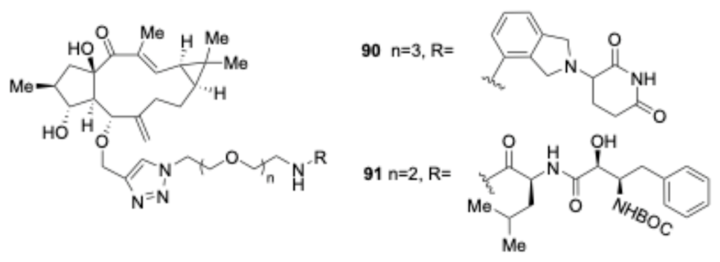
In this context, an elegant strategy based on PROTAC technology has recently been applied by Chen et al. to elucidate the biological target of these compounds: by designing a lathyrol-derived PROTAC (90), researchers were able to exploit targeted protein degradation as a functional readout, leading to the identification of MAFF (V-maf musculoaponeurotic fibrosarcoma oncogene homolog F) as a primary cellular target of lathyranes. Mechanistically, 90 modulates MAFF dimerization dynamics, inhibiting the formation of transcriptionally repressive homodimers while promoting the formation of MAFF–Nrf2 heterodimers; this shift results in the activation of the Nrf2/HO-1 axis, ultimately leading to pronounced antioxidant and anti-inflammatory effects [73] . These findings not only provide a molecular rationale for the anti-inflammatory activity associated with lathyrane diterpenoids but also underscore the versatility of their polyoxygenated scaffold in engaging protein–protein interaction networks, highlighting a previously unrecognized link between this class of natural products and the regulation of oxidative stress pathways (Figure 11).
The same group further focused on the creation of new lathyrol-based PROTACs to enhance their anti-inflammatory potential: a series of structurally diversified PROTACs were synthesized by systematically varying both the nature of the E3 ligase ligand (including CRBN, VHL, cIAP, and MDM2 recruiters) and the linker composition and length, while preserving the lathyrol core as the protein-targeting moiety. Among the synthesized compounds, 91 emerged as the most potent analogue, displaying improved inhibition of LPS-induced nitric oxide production (IC50 ≈ 5 μM) and low cytotoxicity, retaining the ability to induce MAFF degradation in a time- and concentration-dependent manner. Further mechanistic investigations indicated that 91 exerts its biological effects through modulation of key inflammatory and oxidative stress pathways, by activating the Keap1/Nrf2 signaling axis, while concurrently suppressing NF-κB signaling by inhibition of both its expression and nuclear translocation. Moreover, 91 promotes the upregulation of autophagy-related processes, suggesting a multifaceted mode of action that integrates redox regulation, inflammatory signaling, and cellular homeostasis.
Overall, these results shows how the lathyrane framework welcomes PROTAC-based enhancements, and that targeted protein degradation can open new paths not only for target identification but also for enhancement and tuning of the biological activity of complex natural products as lathyranes; however, despite the promising activity, the SAR remain relatively preliminary, and further optimization is required to fully exploit the potential of lathyrol-based PROTACs as drug-like entities.
4. Conclusions
In conclusion, in this review we have summarized approximately five decades of intensive research on the chemistry of lathyrane diterpenoids. Although these compounds were first identified more than a century ago, they have only recently attracted the attention of the scientific community due to their unique carbon architectures and interesting pharmacological profile. Their inherent structural rigidity has enabled the discovery of novel rearrangements, inspiring new biomimetic strategies for obtaining rare secondary metabolites. Furthermore, lathyrane diterpenoids have emerged as privileged scaffolds in medicinal chemistry, thanks to their ability to interact with multiple biological targets.
To date, a significant number of members of this class of secondary metabolites have been isolated and characterized, with new compounds isolated every year, underscoring that the chemical space of the Euphorbiaceous family is far from exhausted. Looking ahead, the integration of synthetic chemistry, medicinal chemistry, and pharmacology will be essential to unlock the potential of these metabolites. In particular, a deeper understanding of structure-activity relationships and how these compounds interact with different molecular targets could enable the rational design of simplified analogues with improved pharmacological properties.
Overall, lathyrane diterpenoids represent a dynamic and expanding field at the interface between natural product chemistry and drug discovery, where ongoing interdisciplinary efforts are expected to yield both fundamental insights and concrete therapeutic opportunities
Conflicts of Interest
The authors declare no conflicts of interest.
Abbreviations
The following abbreviations are used in this manuscript:
| GGPP | Geranylgeranyl pyrophosphate |
| MDR | Multi drug resistance |
| NPC | Neural Progenitor Cells |
| AN | Acetonitrile |
| PTSA | p-Toluensulfonic acid |
| SET | Single electron transfer |
| FAR | Fluorescence activity ratio |
| VPR | Reference modulator verapamil |
| AD | Alzheimer's Disease |
| Bas | Bile acids |
| UDCA | Ursodeoxycholic acid |
| OCA | Obeticholic acid |
| ABC | ATP-binding cassette |
| QSAR | Quantitative structure–activity relationship |
| SAR | Structure-activity relationship |
| PBC | Primary biliary cholangitis |
| PSC | Primary sclerosing cholangitis |
| PXR | Pregnane X receptor |
| NSAIDs | Non-steroidal anti-inflammatory drugs |
| AIDS | Acquired Immune Deficiency Syndrome |
| HIV | Human immunodeficiency virus |
| PROTACs | Proteolysis Targeting Chimeras |
References
- Cragg, G.M.; Newman, D.J. Biochimica et Biophysica Acta Natural products: A continuing source of novel drug leads ☆. BBA-Gen. Subj. 2013, 1830, 3670–3695. [Google Scholar] [CrossRef]
- Khanam, S.; Mishra, P.; Faruqui, T.; Alam, P.; Albalawi, T.; Z, F.S.; Rafi, E.; Khan, S. Plant-based secondary metabolites as natural remedies: a comprehensive review on terpenes and their therapeutic applications. Front. Pharmacol. 2025, 16, 1–19. [Google Scholar] [CrossRef]
- Abe, I.; Rohmer, M.; Prestwich, G.D. Enzymatic Cyclization of Squalene and Oxidosqualene to Sterols and Triterpenes. Chem. Rev. 1993, 93, 2189–2206. [Google Scholar] [CrossRef]
- Bennett, R.N.; Wallsgrove, R.M. Secondary metabolites in plant defence mechanisms. New Phytol. 1994, 127, 617–633. [Google Scholar] [CrossRef] [PubMed]
- Wang, X.; Xu, Y.; Wang, Y.; Lin, F.; Li, H.; Chen, L. Diterpenoids from Euphorbia lathyris L.: a comprehensive review update. Phytochem. Rev. 2025, 24, 5961–5993. [Google Scholar] [CrossRef]
- Tahara, Y. Ueber krystallisirende Bestsndtheile von Semen Ceteputiae minoris. Chem. Ber. 1890, 3347–3351. [Google Scholar] [CrossRef]
- Shi, Q.; Su, X.; Kiyota, H. Chemical and Pharmacological Research of the Plants in Genus Euphorbia. Chem. Rev. 2008, 108, 4295–4327. [Google Scholar] [CrossRef]
- Rentzea, M.; Hecker, E. a-Ketol-umlagerung von myrsinol zum iso-myrsinol und mugliche biogenese des myrsinan-gerdstes. Tetrahedron Lett. 1982, 23, 1785–1788. [Google Scholar] [CrossRef]
- Vela, F.; Ezzanad, A.; Hunter, A.C.; Macías-Sánchez, A.J.; Rosario, H.-G. Pharmacological Potential of Lathyrane-Type Diterpenoids from Phytochemical Sources. Pharmaceuticals 2022, 15, 780. [Google Scholar] [CrossRef]
- Kemboi, D.; Siwe-noundou, X.; Krause, R.W.M.; Langat, M.K.; Tembu, V.J. Pharmacological Activities and Structure – Activity Relationship. Molecules 2021, 26, 5055. [Google Scholar] [CrossRef]
- Flores-Giubi, E.; Geribaldi-Doldán, N.; Murillo-Carretero, M.; Castro, C.; Durán-Patrón, R.; Macías-Sánchez, A.J.; Hernández-Galán†, R. Lathyrane, Premyrsinane, and Related Diterpenes from Euphorbia boetica: Effect on in Vitro Neural Progenitor Cell Proliferation. J. Nat. Prod. 2019, 82, 2517–2528. [Google Scholar] [CrossRef]
- Zhao, H.; Sun, L.; Kong, C.; Mei, W.; Dai, H.; Xu, F.; Huang, S. Phytochemical and pharmacological review of diterpenoids from the genus Euphorbia Linn ( 2012 – 2021 ). J. Ethnopharmacol. 2022, 298, 115574. [Google Scholar] [CrossRef]
- Adolf, W.; Hecker, E.; Balmain, A.; Lhomme, M.F.; Nakatani, Y.; Ourisson, G.; Ponsinet, G.; Pryce, R.J.; Santhanakrishnan, T.S.; Matyukhina, L.G.; et al. EUPHORBIA STEROID (Epoxy-lathyrol) A new tricyclic diterpene from Euphorbia lathyris L. Tetrahedron Lett. 1970, 26, 3071–3073. [Google Scholar]
- Shiguro, T.; Kondo, Y.; Takemoto, T. On Constituents of Caper-Spurge Seed (Lathyridis Seed). I. Isolation and Reactions of Epoxylathyrol. Yakugaku Zasshi 1973, 93, 1052–1057. [Google Scholar] [CrossRef] [PubMed]
- Ishiguro, T.; Kondo, Y.; Takemoto, T. CONSTITUENTS OF COPER-SPURGE SEED (LATHYRIDIS SEED)-II NOVEL ACID-CATALYZED REACTIONS OF EPOXYLATHYROL. Tetrahedron 1975, 31, 305–309. [Google Scholar] [CrossRef]
- Shizuri, Y.; Ohtsuka, J.; Kosemura, S.; Terada, Y.; Yamamura, S. Biomimetic reactions of some macrocyclic diterpenes. Tetrahedron Lett. 1984, 25, 5547–5550. [Google Scholar] [CrossRef]
- Appendino, G.; Tron, G.C.; Jarevång, T.; Sterner, O. Unnatural Natural Products from the Transannular Cyclization of Lathyrane Diterpenes. Org. Lett. 2001, 3, 1609–1612. [Google Scholar] [CrossRef]
- Wang, J.; Zheng, L.; Gao, F.; Zhou, X. Lewis acid-mediated skeleton transformation of Euphorbia diterpenes: From lathyrane to euphoractane and myrsinane. Fitoterapia 2019, 133, 212–218. [Google Scholar] [CrossRef]
- Wang, J.; Li, X.; Gao, F.; Zhou, X. An unexpected Lewis acid-mediated structural conversion of a Euphorbia Diterpene: From a Lathyrane skeleton to diterpene pseudo-alkaloids. Fitoterapia 2020, 146, 104710. [Google Scholar] [CrossRef] [PubMed]
- Xiao, Y.; Wang, N.; Wan, L.; Zhou, X.; Li, X.; Gao, F. Iron-Catalyzed Skeletal Conversion of Lathyrane to Premyrsinane Euphorbia Diterpenes and Their Cytotoxic Activities. J. Nat. Prod. 2021, 84, 1338–1342. [Google Scholar] [CrossRef] [PubMed]
- Cheng, W.; Xu, J.-B.; Wang, N.; Wen, P.; Zhou, X.-L.; Feng, G. Scandium-Catalyzed Skeleton Conversion of Lathyrane to Lathyranone-Type. J. Org. Chem. 2022, 87, 13411–13415. [Google Scholar] [CrossRef]
- Cheng, W.; Ji, W.; Li, Y.; Li, X.; Chen, F.; Xu, J.; Gao, F. Brønsted Acid-Mediated Conversion of Naturally Abundant Lathyrane Diterpenes: Are Rare 10,11-. J. Org. Chem. 2024, 87, 113–120. [Google Scholar] [CrossRef]
- Deng, S.; Wang, J.; Ouyang, Y.; Tang, F.; Li, X.; Xu, J.; Gao, F. Biomimetic Skeleton Conversion from Lathyrane into Euphoractine A - Type Euphorbia Diterpenes: Semisynthesis of Natural Diterpenes Euphoractins M and N. Org. Lett. 2025, 27, 6947–6952. [Google Scholar] [CrossRef]
- Cheng, W.; Song, P.; Sun, L.; Shan, L.; Xu, J.; Li, X.; Gao, F. Scandium-Catalyzed Voigt Condensation Enables One-Step Synthesis of Lathyranone-Type Nitrogen-Containing Euphorbia Diterpenoids from Lathyranes. J. Org. Chem. 2025, 90, 16891–16896. [Google Scholar] [CrossRef] [PubMed]
- Wang, Z. Comprehensive Organic Name Reactions and Reagents. In Voigt Reaction (Voigt Condensation); John Wiley & Sons, Inc., 2010. [Google Scholar]
- Escobar-Montaño, F.; Macías-Sánchez, A.J.; Botubol-Ares, J.M.; Durán-Patrón, R.; Hernández-Galán, R. A Biomimetic Approach to Premyrsinane-Type Diterpenoids: Exploring Microbial Transformation to Enhance Their Chemical Diversity. Plants 2024, 13, 842. [Google Scholar] [CrossRef]
- José Manuel, B.-A.; María Jesús, D.-P.; Hanson, J.R.; Hernández-Galán, R.; Collado, I.G. Cp2Ti(III)Cl and Analogues as Sustainable Templates in Organic Synthesis. Synthesis (Stuttg) 2018, 50, 2163–2180. [Google Scholar]
- Rosales, A.; Rodríguez-García, I.; Muñoz-Bascón, J.; Roldan-Molina, E.; Padial, N.M.; Pozo Morales, L.; García-Ocaña, M.; Oltra, J.E. The Nugent Reagent: A Formidable Tool in Contemporary Radical and Organometallic Chemistry. Eur. J. Org. Chem. 2015, 4567–4591. [Google Scholar] [CrossRef]
- Martínez, A.R.; Morales, L.P.; Ojeda, E.D.; Rodríguez, M.C.; Rodríguez-García, I. The Proven Versatility of Cp2TiCl. J. Org. Chem. 2021, 86, 1311–1329. [Google Scholar] [CrossRef]
- Balmain, A.; Ourisson, G. Photochemistry of the Extended Conjugated System 3- Oxoprop-1 -enylcyclopropane of the Diterpene, Epoxylathyrol. Chem. Commun. 1971, 268–270. [Google Scholar] [CrossRef]
- Balmain, A. Photochemical Cleavage of the Cyclopropane Ring of 6,20-Epoxy- lathyrol {1,11- Diacetoxy-3,6,6,14-tetramethyl-l3-phenylacetoxy(tricyclo- [ 10.3.0.0] pentadec-3-ene-1O-spiro-2’-oxiran)-2-one). J. Chem. Soc. Perkin Trans. 2 1975, 1253–1256. [Google Scholar] [CrossRef]
- Wang, N.; Xu, J.; Li, X.; Zhou, X.; Gao, F. Ir-Catalyzed Biomimetic Photoisomerization of Cyclopropane in Lathyrane-Type Euphorbia Diterpenes. Org. Lett. 2022, 24, 8598–8602. [Google Scholar] [CrossRef]
- Ghisalberti, E.L. J.; Efferies, P.R.; Mori, T.A.; Skelton, B.W.; White, A.H. No Title. Tetrahedron 1985, 41, 2517–2526. [Google Scholar] [CrossRef]
- Li, L.W.; Huang, J.N.; Lyu, H.; Guan, F.Q.; Li, P.R.; M., T.; Xu, S.; Zhao, X.Z.; Liu, F.; Paetz, C.; et al. No Title. RSC Adv. 2021, 11, 3183–3189. [Google Scholar] [CrossRef]
- Zuo, Q.; Mu, H.Y.; Gong, Q.; Ding, X.; Wang, W.; Zhang, H.Y.; Zhao, W.M. No Title. Fitoterapia 2021, 150, 104834. [Google Scholar] [CrossRef]
- Xu, J.; Wen, P.; Wang, N.; Li, X.; Li, J.; De Jonghe, S.; Schols, D.; Chen, F.; Gao, F. Photo-induced scandium-catalyzed biomimetic skeleton conversion of lathyrane to naturally rare eupholathone Euphorbia diterpenes. Chem. Commun. 2023, 59, 12290–12293. [Google Scholar] [CrossRef]
- Wang, N.; Wan, L.; Li, X.; Xu, J.; Gao, F. Rapid Access to Tigliane, Ingenane, and Rhamnofolane Diterpenes from a Lathyrane Precursor via Biomimetic Skeleton Transformation Strategy. J. Nat. Prod. 2024, 87, 1479−1486. [Google Scholar] [CrossRef] [PubMed]
- Gottesman, M.M.; Fojo, T.; Bates, S.E. Multidrug resistance in cancer: role of ATP-dependent transporters. Nat. Rev. Cancer 2022, 2, 48–58. [Google Scholar] [CrossRef]
- Baird, R.D.; Kaye, S.B. Drug resistance reversalAre we getting closer? Eur. J. Cancer 2003, 39, 2450–2461. [Google Scholar] [CrossRef] [PubMed]
- Sarkadi, B.; Homolya, L.; Szakacs, G.; Varadi, A. Human multidrug resistance ABCB and ABCG transporters: participation in a chemoimmunity defense system. Physiol. Rev. 2006, 1179–1236. [Google Scholar] [CrossRef]
- Ambudkar, S.V.; Kimchi-Sarfaty, C.; Sauna, Z.E.; Gottesman, M.M. P-glycoprotein: from genomics to mechanism. Oncogene 2003, 22, 7468–7485. [Google Scholar] [CrossRef] [PubMed]
- Sousa, Ai.J.; Ferreira, M.-J.U.; Molnár, J.; Fernandes, M.X. QSAR studies of macrocyclic diterpenes with P-glycoprotein inhibitory activity. Eur. J. Pharm. Sci. 2013, 48, 542–553. [Google Scholar] [CrossRef] [PubMed]
- Reis, M.; Ferreira, R.J.; Santos, M.M.M.; Santos, D.J.V.A.; Molna, J.; Ferreira, M.U. Enhancing Macrocyclic Diterpenes as Multidrug-Resistance Reversers: Structure − Activity Studies on Jolkinol D Derivatives. J. Med. Chem. 2013, 56, 748–760. [Google Scholar] [CrossRef]
- Vieira, C.; Duarte, N.; Reis, M.A.; Spengler, G.; Margarida, A.; Molnár, J.; Ferreira, M.U. Improving the MDR reversal activity of 6, 17-epoxylathyrane diterpenes. Bioorg. Med. Chem. 2014, 22, 6392–6400. [Google Scholar] [CrossRef]
- Matos, A.M.; Reis, M.; Spengler, G.; Molna, J. Epoxylathyrol Derivatives: Modulation of ABCB1-Mediated Multidrug Resistance in Human Colon Adenocarcinoma and Mouse T - Lymphoma Cells. J. Nat. Prod. 2015, 78, 2215–2228. [Google Scholar] [CrossRef]
- Wang, J.; Pu, S.; Huang, X.; Gao, H.; Shao, H. Lathyrol Diterpenes as Modulators of P - Glycoprotein Dependent Multidrug Resistance: Structure − Activity Relationship Studies on Euphorbia Factor L 3 Derivatives. J. Med. Chem. 2015, 58, 3720–3738. [Google Scholar] [CrossRef]
- Wu, Y.; Yin, C.; Cao, Y.; Liu, X.; Yu, J.; Zhang, J.; Yu, B. Regioselective hydroxylation of lathyrane diterpenoids biocatalyzed by microorganisms and its application in integrated synthesis. J. Mol. Catal. B Enzym. 2016, 133, S352–S359. [Google Scholar] [CrossRef]
- Reis, M.A.; Ahmed, O.B.; Spengler, G.; Molna, J.; Lage, H. Exploring Jolkinol D Derivatives To Overcome Multidrug Resistance in Cancer. J. Nat. Prod. 2017, 80, 1411–1420. [Google Scholar] [CrossRef]
- Liu, X.; Zhihong, C. Microbial and chemical transformations o f euphorbia factor L1 and the P-glycoprotein inhibitory activity i n zebrafishes. Nat. Prod. Res. 2023, 37, 871–881. [Google Scholar] [CrossRef]
- Xiao, Y.; Ji, W.; Jin, W.; Wen, P.; Shan, L.; Hou, Z.; A, X.-H.L.; Zhou, X.-L.; Liu, Y.-J.; A, J.-B.X.; et al. Synthesis, antiproliferative and anti-MDR activities of lathyrane diterpene derivatives based on configuration inversion strategy. Bioorg. Chem. 2023, 131, 106329. [Google Scholar] [CrossRef] [PubMed]
- Zhan, Z.; Liu, X.; Cheng, Z. Enhancing lathyrane structural diversity and MDR activity by combinatorial modification of lathyrane nucleus and ester side chain: A case study of Euphorbia Factor L1 and Euphorbia Factor L3. Fitoterapia 2024, 174, 105854. [Google Scholar] [CrossRef]
- Duggan, M.; Torkzaban, B.; Ahooyi, T.M.; Khalili, K.; Gordon, J. Age-related neurodegenerative diseases. J. Cell. Physiol. 2020, 235, 3131–3141. [Google Scholar] [CrossRef] [PubMed]
- Barla, A.; Öztürk, M.; Kültür, Ş.; Öksüz, S. Screening of antioxidant activity of three Euphorbia species from Turkey. Fitoterapia 2007, 78, 423–425. [Google Scholar] [CrossRef]
- Xu, J.; Guo, Y.; Xie, C.; Li, Y.; Gao, J.; Zhang, T.; Hou, W.; Fang, L.; Gui, L. Bioactive Myrsinol Diterpenoids from the Roots of Euphorbia prolifera. J. Nat. Prod. 2011, 74, 2224–2230. [Google Scholar] [CrossRef]
- Xiao, Y.; Zhang, Y.; Ji, W.; Jia, X.; Shan, L.; Li, X.; Liu, Y.-J.; Jiang, T.; Gao, F. Discovery of myrsinane-type Euphorbia diterpene derivatives through a skeleton conversion strategy from lathyrane diterpene for the treatment of Alzheimer ’ s disease. Bioorg. Chem. 2023, 138, 106595. [Google Scholar] [CrossRef]
- Sun, L.; Wang, X.; Tang, Q.; Xiao, Y.; Xu, J.; Zhang, T.; Liu, Y.; Li, X.; Gao, F. Lathyrane and premyrsinane Euphorbia diterpenes against Alzheimer ’ s disease: Bioinspired synthesis, anti-cholinesterase and neuroprotection bioactivity. Bioorg. Chem. 2024, 147, 107377. [Google Scholar] [CrossRef]
- Goldstein, J.; Levy, C. Novel and emerging therapies for cholestatic liver diseases. Liver Int. 2018, 38, 1520–1535. [Google Scholar] [CrossRef]
- Huang, D.; Wang, R.; Li, W.; Zhao, Y.; Yuan, F.; Yan, X.; Chen, Y.; Tang, G.; Bi, H.; Yin, S. Lathyrane Diterpenoids as Novel hPXR Agonists: Isolation, Structural Modi fi cation, and Structure − Activity Relationships. ACS Med. Chem. Lett. 2021, 12, 1159–1165. [Google Scholar] [CrossRef] [PubMed]
- Zhang, C.-Y.; Wu, Y.-L.; Zhang, P.; Chen, Z.-Z.; Li, H.; Chen, L.-X. Anti-in ammatory Lathyrane Diterpenoids from Euphorbia lathyris. J. Nat. Prod. 2019, 82, 756–764. [Google Scholar] [CrossRef]
- Wang, W.; Wu, Y.; Li, C.; Yang, Y.; Li, X.; Li, H.; Chen, L. Synthesis of New Lathyrane Diterpenoid Derivatives from Euphorbia lathyris and Evaluation of Their Anti-Inflammatory Activities. Chem. Biodivers. 2020, 17, e1900531. [Google Scholar] [CrossRef] [PubMed]
- Wang, W.; Xiong, L.; Li, Y.; Song, Z.; Sun, D.; Li, H.; Chen, L. Synthesis of lathyrane diterpenoid nitrogen-containing heterocyclic derivatives and evaluation of their anti-inflammatory activities. Bioorg. Med. Chem. 2022, 56, 116627. [Google Scholar] [CrossRef]
- Zhuang, Y.; Pan, B.; Zhang, Y.; Tang, Z.; Ji, X.; Zhang, S.; Yao, L.; Li, T.; Ma, W.; Tan, C.; et al. Structure-activity relationships of natural and synthetic lathyrane-based diterpenoids for suppression of NLRP3-driven inflammation and gouty arthritis. Bioorg. Chem. 2024, 150, 107558. [Google Scholar] [CrossRef]
- Bekker, L.; Beyrer, C.; Mgodi, N.; Lewin, S.R.; Delany-moretlwe, S.; Taiwo, B.; Masters, M.C.; Lazarus, J. V HIV infection. Nat. Rev. Dis. Prim. 2023, 9, 42. [Google Scholar] [CrossRef]
- Al Amin, M.; Nafady, M.H.; Zehravi, M.; Sweilam, S.H.; Kumar, K.P.; Haque, M.A.; Unnisa, A.; Singh, L.P.; Sayeed, M.; Alshehri, M.A.; et al. Bird’s eye view of natural products for the development of new anti-HIV agents: Understanding from a therapeutic viewpoint. Anim. Model. Exp. Med. 2025, 8, 441–457. [Google Scholar] [CrossRef]
- Ji, L.; Deng, S.; Xu, J.; Li, X.; De Jonghe, S.; Schols, D.; Gao, F. Synthesis of Thioloformate-Containing Lathyrane Diterpene Derivates via a [3,3] Sigmatropic Rearrangement and Their Anti-HIV Activity. J. Nat. Prod. 2025, 88, 1091–1097. [Google Scholar] [CrossRef]
- Cheng, W.; Wen, P.; Song, P.; Zhang, Y.; Xu, J.; De Jonghe, S.; Schols, D.; Gao, F. Biomimetic semi-synthesis, structural optimization and anti-HIV activity of naturally scarce eupholathone-, lathyranone- and integerrimine-type Euphorbia diterpenoids. Bioorg. Med. Chem. 2026, 133, 118516. [Google Scholar] [CrossRef] [PubMed]
- Keniya, M. V.; Fleischer, E.; Klinger, A.; Cannon, R.D.; Brian Monk, C. Inhibitors of the Candida albicans Major Facilitator Superfamily Transporter Mdr1p Responsible for Fluconazole Resistance. PLoS ONE 2015, 0126350. [Google Scholar] [CrossRef] [PubMed]
- Yiwei, W.; Xu, S.; Zhang, G.; Li, P.; Liu, C.; Zhou, J.; Feng, X.; Li, L.; Chen, Y. Targeted discovery of unusual diterpenoids with anti-fungal activity from the root of Euphorbia lathyris. Phytochemistry 2024, 225, 114193. [Google Scholar] [CrossRef] [PubMed]
- Nim, S.; Mónico, A.; Rawal, M.K.; Duarte, N.; Prasad, R.; Di Pietro, A.; Ferreira, M.-J.U. Overcoming Multidrug Resistance in Candida albicans: Macrocyclic Diterpenes from Euphorbia Species as Potent Inhibitors of Drug Efflux Pumps. Planta Med. 2016, 82, 1180–1185. [Google Scholar] [CrossRef]
- Mónico, A.; Nim, S.; Duarte, N.; Kaur, M.; Prasad, R.; Di, A.; Ferreira, M.U. Lathyrol and epoxylathyrol derivatives: Modulation of Cdr1p and Mdr1p drug-efflux transporters of Candida albicans in Saccharomyces cerevisiae model. Bioorg. Med. Chem. 2017, 25, 3278–3284. [Google Scholar] [CrossRef]
- Wanga, Y.; Jiangd, X.; Liua, F.F.W.; Sun, H. No Degradation of proteins by PROTACs and other strategies. Acta Pharm. Sin. B 2020, 10, 207–238. [Google Scholar] [CrossRef]
- Li, Y.; Meng, Q.; Wang, P.; Liu, X.; Fu, Q.; Xie, Y.; Zhou, Y.; Qi, X.; Huang, N. Identification of PDE6D as a potential target of sorafenib via PROTAC technology. biorxiv 2020, 079947. [Google Scholar]
- Wua, Y.; Yanga, Y.; Wanga, W.; Suna, D.; Lianga, J.; Zhua, M.; Lia, H.; Chena, L. PROTAC technology as a novel tool to identify the target of lathyrane diterpenoids. Acta Pharm. Sin. B 2022, 12, 4262–4265. [Google Scholar] [CrossRef]
Scheme 1.
Proposed biosynthetic pathway of lathyrane diterpenoids.
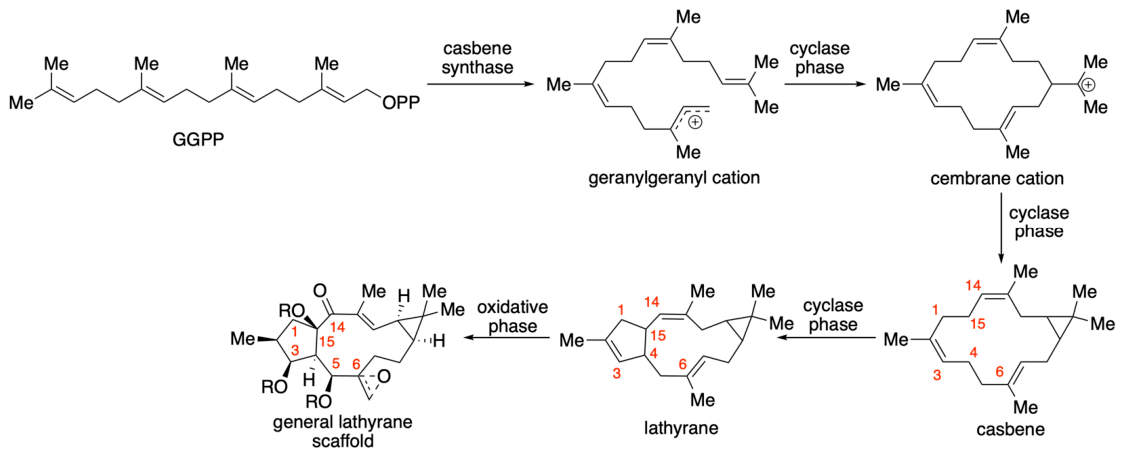
Figure 1.
Structures of epoxylathyrol (1) and euphorbia factor L1 (2).
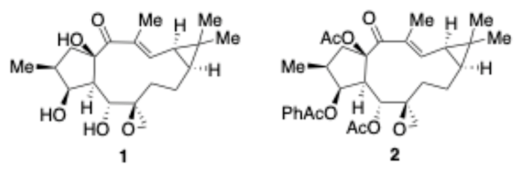
Scheme 2.
Mechanism of acid-catalyzed cyclization of euphorbia factor L1 (2) with the production of compounds 3 and 4.
Scheme 2.
Mechanism of acid-catalyzed cyclization of euphorbia factor L1 (2) with the production of compounds 3 and 4.
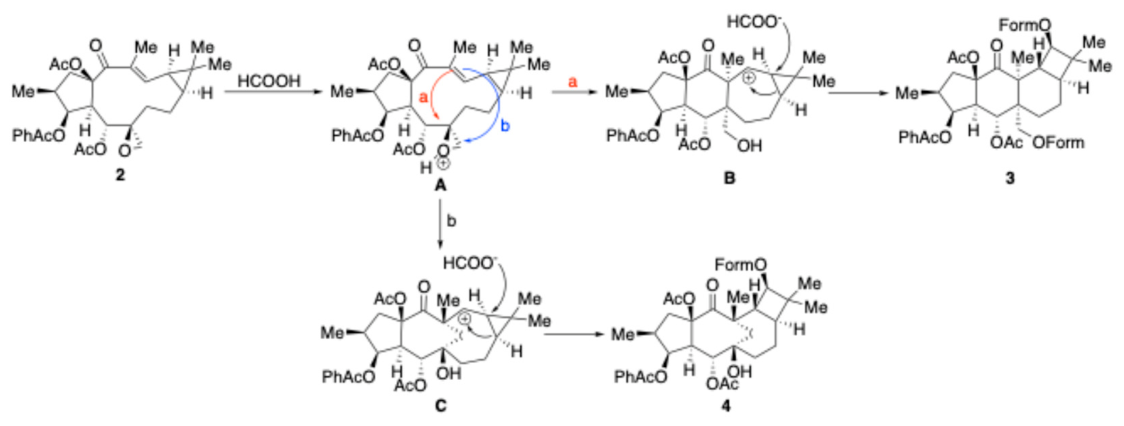
Figure 2.
Structure of compound 5.
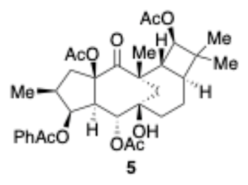
Scheme 3.
Mechanism of acid-catalyzed cyclization of euphorbia factor L1 (2) with the production of compounds 6 and 7.
Scheme 3.
Mechanism of acid-catalyzed cyclization of euphorbia factor L1 (2) with the production of compounds 6 and 7.
Scheme 4.
Synthesis of compound 16 from euphohelioscopin A (13).

Figure 3.
Structures of compounds 2 and 17.
Scheme 5.
Mechanism of acid-catalyzed cyclization of euphorbia factor L1 (2) with the production of compound 18 (a); mechanism of acid-catalyzed cyclization of euphorbia factor L3 (17) with the production of compounds 20 and 21 (b).
Scheme 5.
Mechanism of acid-catalyzed cyclization of euphorbia factor L1 (2) with the production of compound 18 (a); mechanism of acid-catalyzed cyclization of euphorbia factor L3 (17) with the production of compounds 20 and 21 (b).
Scheme 6.
Mechanism of acid-catalyzed cyclization of euphorbia factor L1 (2) with the production of compounds 26, 27 and 28 (a); mechanism of acid-catalyzed cyclization of euphorbia factor L3 (17) with the production of compounds 30 and 31 (b).
Scheme 6.
Mechanism of acid-catalyzed cyclization of euphorbia factor L1 (2) with the production of compounds 26, 27 and 28 (a); mechanism of acid-catalyzed cyclization of euphorbia factor L3 (17) with the production of compounds 30 and 31 (b).
Scheme 7.
Mechanism of acid-catalyzed cyclization of euphorbia factor L1 (2) with the production of compound 34.
Scheme 7.
Mechanism of acid-catalyzed cyclization of euphorbia factor L1 (2) with the production of compound 34.

Scheme 8.
Mechanism of radical-reductive cyclization of euphorbia factor L3 (17) with the production of compounds 35 and 36.
Scheme 8.
Mechanism of radical-reductive cyclization of euphorbia factor L3 (17) with the production of compounds 35 and 36.
Scheme 9.
Mechanism of acid-catalyzed cyclization of compounds 37-39 with the production of compounds 40-42 (a); mechanism of acid-catalyzed cyclization of compounds 38 and 39 with the production of compounds 44 and 45 (b); mechanism of acid-catalyzed cyclization of compound 46 with the production of compounds 47-49 (c); mechanism of acid-catalyzed cyclization of compound 38 with the production of lathyranone alkaloids (d).
Scheme 9.
Mechanism of acid-catalyzed cyclization of compounds 37-39 with the production of compounds 40-42 (a); mechanism of acid-catalyzed cyclization of compounds 38 and 39 with the production of compounds 44 and 45 (b); mechanism of acid-catalyzed cyclization of compound 46 with the production of compounds 47-49 (c); mechanism of acid-catalyzed cyclization of compound 38 with the production of lathyranone alkaloids (d).
Scheme 10.
Mechanism of titanium-catalyzed cyclization of compound 52 with the production of compounds 53 (a); microbial hydroxylation of compound 53 with the production of compounds 54 and 55 (b).
Scheme 10.
Mechanism of titanium-catalyzed cyclization of compound 52 with the production of compounds 53 (a); microbial hydroxylation of compound 53 with the production of compounds 54 and 55 (b).
Scheme 10.
Mechanism of photoinduced synthesis of compound 56 from epoxylathyrol (1).

Scheme 11.
Photoinduced interconversion of L2 (53) into L2a (55) and synthesis of compound 56.
Scheme 12.
Synthesis of compounds 61 and 62 from euphorbia factor L3 (17).
Scheme 13.
Synthesis of compounds 59 from euphorbia factor L1 (2).
Scheme 14.
Synthesis of compounds 63-67 from euphorbia factor L3 (17).
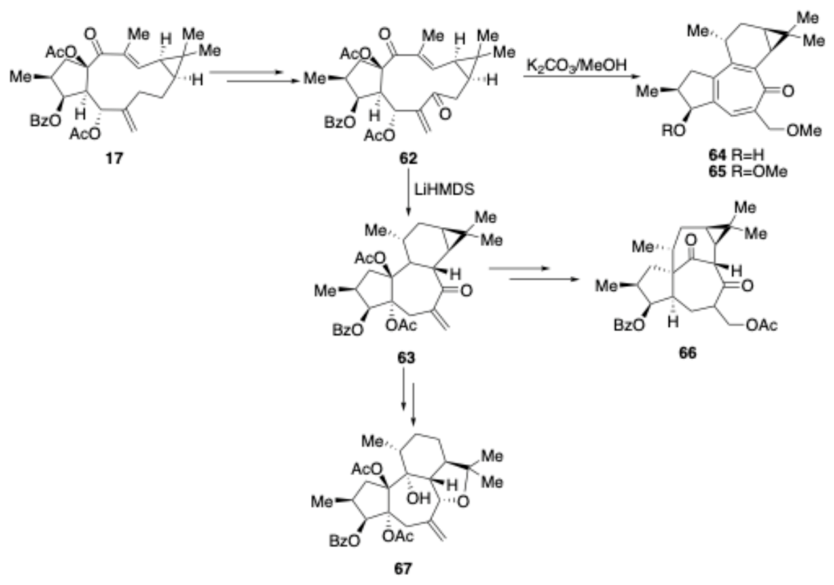
Figure 4.
Structures of P-gp inhibitors 68-73.
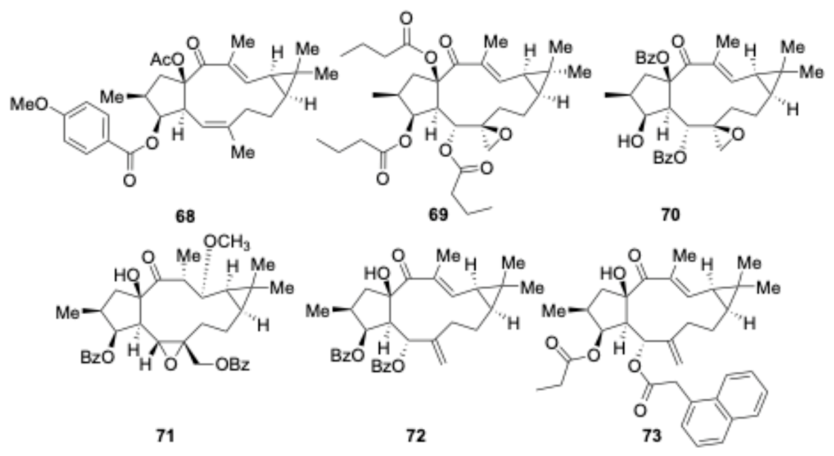
Figure 5.
Structures of P-gp inhibitors 74-78.
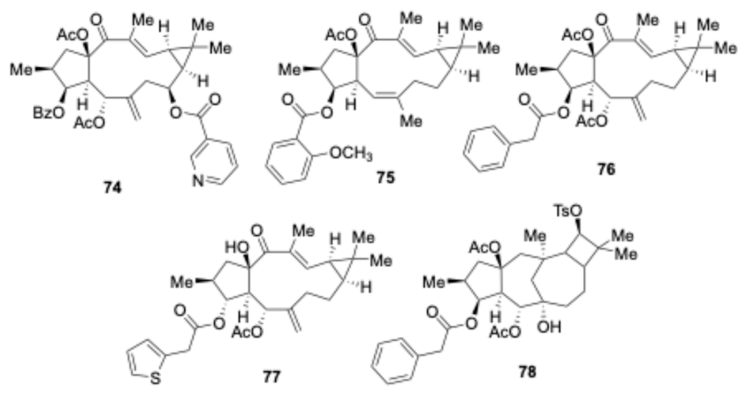
Figure 6.
Structures of AChE inhibitors 79-81.
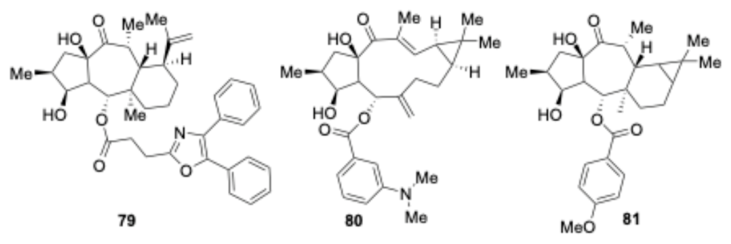
Figure 7.
Structure of anticholestatic derivative 82.
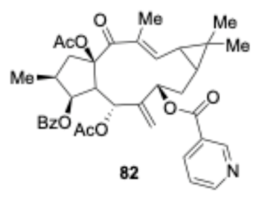
Figure 8.
Structures of antinflammatory derivatives 83-85.
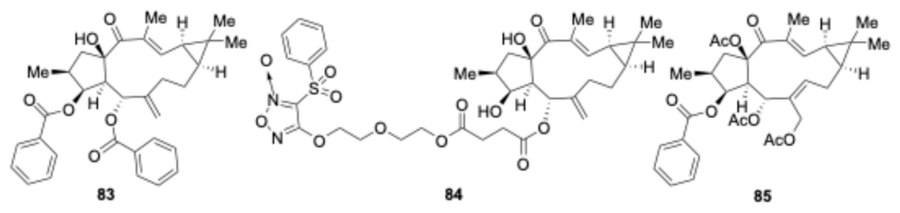
Figure 9.
Structures of anti-HIV derivatives 86 and 87.
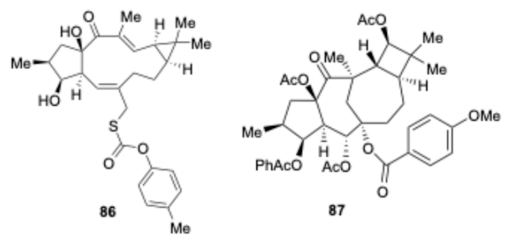
Figure 10.
Structures of antifungal derivatives 88 and 89.
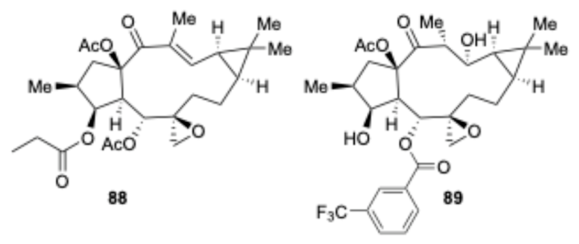
Figure 11.
Structures of PROTAC derivatives 90 and 91.
Disclaimer/Publisher’s Note: The statements, opinions and data contained in all publications are solely those of the individual author(s) and contributor(s) and not of MDPI and/or the editor(s). MDPI and/or the editor(s) disclaim responsibility for any injury to people or property resulting from any ideas, methods, instructions or products referred to in the content. |
© 2026 by the authors. Licensee MDPI, Basel, Switzerland. This article is an open access article distributed under the terms and conditions of the Creative Commons Attribution (CC BY) license (http://creativecommons.org/licenses/by/4.0/).
Copyright: This open access article is published under a Creative Commons CC BY 4.0 license, which permit the free download, distribution, and reuse, provided that the author and preprint are cited in any reuse.


