

Submitted:
16 June 2026
Posted:
23 June 2026
You are already at the latest version
Abstract
We prove the \(D_4\) Voronoi-cell bound for root-aligned saturated unit-ball packings in \(\mathbb R^4\): every cell has volume at least \(8\), with equality only for the scaled lattice \(\sqrt2\,D_4\). The remaining cap-cutting geometry is reduced by a monotonicity theorem to an all-contact \(176\)-chamber positivity system over \(\mathbb Q(\sqrt2)\).
Keywords:
sphere packing
; D4 lattice
; Voronoi cell
MSC: primary 52C17; secondary 52B11; 11H31; 68W30
1. Introduction
1.1. Background and Statement of the Main Result
Given a positive integer n, the sphere packing problem asks for the densest way to fill with non-overlapping open unit balls. Write for the supremum of achievable densities; this is the optimal packing density in dimension n. The problem has a clean answer in low dimensions and in the two highest dimensions where it is currently settled.
In dimension 1 the answer is , trivially. In dimension 2 it is , the density of the hexagonal lattice, proved by Thue [1] and Fejes Tóth [2]. Dimension 3 is the Kepler conjecture, resolved by Hales [3] and subsequently given a formal computer-assisted proof in [4]. Dimensions 8 and 24 were settled in 2016 by Viazovska [5] and by Cohn, Kumar, Miller, Radchenko, and Viazovska [6] respectively. This paper treats dimension 4 by a local Voronoi-cell reduction centered on the regular 24-cell.
The root lattice scaled by gives a packing of unit balls with density
since the volume of the four-dimensional unit ball is . That this is optimal among all lattice packings has been known since Blichfeldt [9]. The question of whether any non-lattice, possibly non-periodic arrangement could improve on it remains the central point of the dimension-four problem. The best published unconditional upper bound on the centre density in , due to refinements of the Cohn–Elkies linear programming method, stands at [10], still strictly above the conjectured . The exact status of the present reduction is recorded in Remark 1.
Theorem 1
(Reduction to the density). Assume the chamber-positivity statement of Proposition 6 holds for every row of the 176-row atlas. Then every saturated unit-ball packing in has Voronoi cells of volume at least 8, the packing density is at most , and equality forces the scaled lattice up to translation.
Remark 1
(Status of the proof of Theorem 1). The proof given here is unconditional in the root-aligned case: Lemma 1 reduces the density bound to the local statement that every Voronoi cell of a saturated packing has volume at least 8, and Theorem 2 together with Corollary 1 proves this local statement whenever every shell-active neighbour of the centre lies in one of the 24 root directions of . For the complementary cap-cutting case, Theorem 4 gives a corrected reduction: the volume defect is monotone in each cap-cutting offset, so the only configuration that can violate the bound is the corner configuration in which every active radius equals the packing minimum 2. The volume bound at that corner is the finite chamber-positivity statement of Section 7. The 176-row atlas is fully enumerated and checked for row count, cycle structure, orbit weights, and cross-file labels; the symbolic positivity identity (11) remains the finite algebraic computation needed to turn Theorem 1 into a complete proof.
Lemma 1
(Saturation and local density). It is enough to prove the cell bound for saturated packings. More precisely, let be a packing with minimum mutual distance at least 2. If every Voronoi cell in every saturated extension of has volume at least 8, then the upper density of is at most .
Proof.
A packing can be enlarged, by the usual Zorn argument, to a saturated packing : keep adding centres at distance at least 2 from all existing centres until no such point remains. This operation cannot decrease upper density. Thus it suffices to bound saturated packings.
Let be the Voronoi cell of . The cells cover up to common boundaries of measure zero. Suppose for every x. For a large Euclidean ball , let be the number of centres in . Saturation gives a uniform covering radius at most 2: every point of is within distance 2 of some centre, so the portion of a Voronoi cell meeting lies in around the same centre. Consequently the boundary contribution in counting cells across is . Summing cell volumes over centres whose cells meet gives
Dividing by and letting gives
where denotes the centre density. Multiplying by gives the packing-density bound . Since , the same upper bound applies to . □
Remark 2
(What remains after Lemma 1). All global density issues are now absorbed into a single local statement: for a saturated packing with a centre at the origin, its Voronoi cell must have volume at least 8. The rest of the paper proves exactly this local statement.
The closely related kissing-number problem in dimension 4 was resolved by Musin [7], who showed the answer is 24, matching the 24 nearest neighbours of . Musin [8] subsequently studied the associated 24-cell conjecture, which concerns the local geometry around the Voronoi cell of that is also central to the present argument.
1.2. The Method
The proof reduces Theorem 1 to a purely local geometric statement: every Voronoi cell of every saturated unit-ball packing in has volume at least 8. Given that statement, the density bound follows immediately, since the Voronoi cells tile and the density contributed by a single ball of volume housed in a cell of volume at least 8 is at most .
In dimensions 8 and 24 the analogous step was accomplished via a magic function: a radial Schwartz function f satisfying , , and for , which saturates the Cohn–Elkies linear programming bound [11]. In dimension 4 the linear programming bound does reproduce (Cohn–Zhao [10]), but no explicit magic function is known, and that route is not available to us.
Our approach works entirely in configuration space. The Voronoi cell of the origin in a packing captures the local density contribution of the ball centred there. A key simplification comes from the observation (Lemma 8 below) that only packing centres within a specific annular shell around the origin can possibly reduce the Voronoi volume below 8; centres farther away already generate half-spaces containing by a Cauchy–Schwarz estimate. The centres inside that shell fall into two classes: those pointing in one of the 24 root directions of , and all others.
For the first class the argument is a direct containment: the support function of the regular 24-cell achieves its minimum value of exactly 1 on those 24 directions (Proposition 1), which forces every corresponding half-space to contain throughout the shell. Any collection of such neighbours therefore leaves the Voronoi cell at least as large as , which has volume 8 (Theorem 2).
For the second class a neighbour outside the root directions cuts a cap off , but simultaneously the Voronoi cell gains extra volume on the antipodal side, since the constraint from that neighbour does not restrict the cell below on the opposite half. We make this precise as follows. When a single non-root-aligned neighbour is present, we check directly that every point of at height belongs to the Voronoi cell, establishing a slice containment for all . By central symmetry of , the antipodal copy of the cap lies inside V as well, providing a volume gain that equals . This gives outright; to remove the deficit term we use, not convexity, but the elementary monotonicity of an intersection of half-spaces in each of its offsets separately (Theorem 4, Lemma 13): the volume is monotone non-decreasing in with the other offsets fixed, so its minimum over the feasible range of occurs at , i.e., , where the configuration falls into the finite chamber atlas of Section 7. Establishing at that single corner for every chamber — the chamber-positivity statement of Proposition 6 — is therefore what closes the cap-cutting case; its present verification status is recorded in Remark 1.
1.3. Organisation
Section 2 introduces the lattice , its Weyl group, the regular 24-cell , and the support function of . Section 3 analyses which directions are safe (never cut ) and proves the angular deficiency formula. Section 4 establishes the shell localisation. Section 5 handles all root-aligned configurations. Section 6 develops the Gram-variable volume formula. Section 7 records the Gram-spectral square decomposition, the chamber ideal, and the exact finite atlas. Section 8 completes the proof by combining the cap-cutting geometry with the chamber positivity theorem. Section 9 records some brief closing remarks. Appendix A gives the simplex-by-simplex volume computation for . Appendix B records the 176-row chamber register and describes the accompanying auxiliary files. Appendix C prints the active-facet rows. Appendix D describes the auxiliary file layout. Appendix E records exact constants, orbit arithmetic, and numerical illustrations.
2. The Comparison Cell
2.1. The Lattice and Root System
Let denote the standard orthonormal basis of . The root lattice is
It has rank 4 as a free abelian group. A basis is given by the four simple roots
The full root system of is
which contains vectors, each of squared norm . For the unit-ball packing problem, centres must be placed at mutual distance at least 2. The lattice achieves nearest-neighbour distance exactly 2, and we work with it throughout:
Lemma 2
(Covolume). .
Proof.
The Gram matrix of the simple roots with respect to the standard inner product on is the Cartan matrix of :
The off-diagonal pattern encodes the Dynkin diagram of , in which node is connected by single bonds to each of , , and . Expanding the determinant gives , so . Scaling by multiplies every basis vector by , hence scales the covolume by , giving . □
Remark 3.
The density of the packing by unit balls centred at Λ is .
2.2. The Weyl Group of
The Weyl group consists of all orthogonal transformations of generated by the reflections in the hyperplanes , for (where we use to simplify the standard formula). Concretely, consists of all coordinate permutations of combined with sign changes of an even number of coordinates:
This is not the full hyperoctahedral group , which would allow any number of sign changes and has order ; only the even-parity sign changes appear in .
The group acts on preserving , , and . It acts transitively on the 24 roots, with each root having a stabiliser of order . This transitivity is used in Lemma 6 below.
2.3. The Regular 24-Cell
The Voronoi cell of the origin in is
Points at distance from the origin generate half-spaces that already contain the ball of radius enclosing , so it suffices to intersect over the 24 minimal vectors :
The resulting polytope is the regular 24-cell: a four-dimensional self-dual convex polytope with 24 vertices, 96 edges, 96 square two-faces, and 24 octahedral three-faces, with its 24 facets in bijection with the 24 minimal vectors.
Lemma 3
(Vertices of ). The vertex set of is the following set of 24 points: the eight vectors and the sixteen vectors with .
Proof.
Each vertex of is determined by exactly four linearly independent tight inequalities from (1). Take , , , . The four equations give
From the first two equations ; from the first and third ; from the fourth , so ; then . The vertex is . The remaining 20 inequalities are satisfied: for example, . Varying the signs of produces all 16 sign-vector vertices. For the coordinate vertices, the four equations associated with and (taking the appropriate signs) force and , giving ; permuting and changing signs gives all eight. A complete enumeration of active quadruples produces no further solutions. □
Lemma 4
(Volume of ). .
Proof.
By Lemma 2 the Voronoi cells of tile with each cell having volume . Since is the Voronoi cell of the origin, . One can also compute directly. Decompose into 24 congruent pyramids, each with apex at the origin and base one of the 24 octahedral facets. For the facet dual to , the supporting hyperplane has unit normal and lies at distance 1 from the origin.
The following calculation shows that each facet is a regular octahedron of edge length . Consider the facet defined by . A vertex from Lemma 3 lies on this facet if and only if its inner product with equals . Among the coordinate vertices: and , while all other coordinate vertices give values 0 or . Among the sign vertices , the condition becomes , hence , giving four vertices . The six vertices of are therefore , , and . To confirm that adjacent vertices differ by vectors of squared norm 2, note for example and . By the Weyl-group symmetry the same edge-length holds for all pairs of adjacent vertices in any facet, confirming edge length throughout.
A regular octahedron of edge length a has volume ; with each facet has volume . The four-dimensional pyramid formula gives each pyramid volume . Summing over 24 facets gives . (An independent simplex-by-simplex check appears in Appendix A). □
2.4. The Support Function of
Recall that the support function of a convex body is ; it records how far K extends in direction y [12,13].
Lemma 5
(Support function of ). For with sorted absolute coordinates ,
Proof.
Since by Lemma 3, the support function is the maximum of over the 24 vertices. For the eight vertices , the maximum of over signs and indices equals . For the sixteen vertices , choosing maximises . The overall maximum is the larger of these two values. □
Remark 4.
The two terms in (2) reflect the two types of vertex. The coordinate vertices dominate when one coordinate of y is much larger than the others (an -type contribution), while the sign vertices dominate when all four coordinates are comparable (an -type contribution).
2.5. Shell-Rigidity
Lemma 6
(Shell rigidity). Suppose a unit-ball packing has a centre at the origin and also has centres at all 24 points , . Then the Voronoi cell of the origin is exactly .
Proof.
The 24 half-spaces for are precisely the Voronoi half-spaces generated by the 24 root neighbours, so their intersection is by (1). It suffices to show that every additional packing centre generates a Voronoi half-space that already contains .
We may apply any element of the Weyl group to y without changing the configuration, since preserves and . Thus we may assume the sorted absolute coordinates of y satisfy . Choose signs and set . The packing constraint expands as
Since and , this gives
hence . Since (the packing constraint ), we have , so
From Lemma 5, . Since and , both terms of are at most . Therefore , which by the definition of the support function means . Since y was an arbitrary additional packing centre, every Voronoi half-space contains , so . The containment holds by definition of as the intersection over the 24 root half-spaces. Hence . □
3. Safe Directions and the Angular Deficiency
3.1. The Inscribed Ball
Lemma 7
( contains the unit ball). .
Proof.
From (1), . Each is a unit vector. Cauchy–Schwarz gives for . □
3.2. Safe Directions
Proposition 1
(Safe directions). For every unit vector , . Equality holds if and only if for some , equivalently if and only if, among the sorted absolute coordinates of u, exactly two equal and the other two equal 0.
Proof.
Since , Lemma 7 gives , so
For the equality characterisation, write sorted in decreasing order, and . By (2), requires both and , i.e., and . Under these constraints, for each i we have , so (since for , with equality only at or ). Summing:
Both sides must be equal, forcing for each i, hence . With , exactly two coordinates equal and the other two equal 0. A unit vector with that pattern has the form for some . The converse is immediate: if and , then . □
Remark 5
(Maximum of ). By the same formula, for every unit u. Equality holds in two families: the 8 coordinate directions (where ) and the 16 directions (where , with Cauchy–Schwarz being tight). So maps into , with minimum exactly on the 24 root directions and maximum on these further 24 directions, which are the normalised directions of the two types of vertex of .
3.3. The Angular Deficiency
Definition 1
(Angular deficiency). For , the angular deficiency is . A direction u is called root-aligned if , equivalently if for some .
Proposition 2
(Safe-neighbour criterion). Let with and . The half-space satisfies
Proof.
Since , the condition is equivalent to . Thus iff . □
For a neighbour in the annular shell (whose relevance is established in the next section), . Proposition 1 gives , with equality exactly for root-aligned u. Therefore:
- A root-aligned neighbour satisfies for every r in the shell, so throughout the shell. A root-aligned neighbour never cuts , at any distance within .
- A neighbour in a direction u with satisfies only when . For the half-space cuts a non-empty cap off .
3.4. Exact Support-Function Values Used Later
The formula (2) gives the following exact values on the directions that appear in the comparison and boundary calculations:

The first row is the only row with value . It is the root row. The second and third rows show the two ways in which the support reaches : at coordinate directions and at sign-vector directions. Thus the active shell is exactly the interval in which a non-root direction can potentially cut the comparison cell.
4. Shell Localisation
Lemma 8
(Shell localisation). If , then , so the packing centre at y does not reduce the Voronoi cell of the origin below .
Proof.
We need . By Cauchy–Schwarz, , giving . Also by Cauchy–Schwarz in , giving . Thus . The inequality reduces to , which holds by assumption. □
It follows that only packing centres in the closed annular shell
can reduce the Voronoi volume below 8. The lower bound comes from the packing constraint ; the upper bound is Lemma 8. For an active centre write with and . The Gram inner products between direction vectors of active centres are
and the packing constraint between two active centres reads
For two distinct roots with , , so . The 24 scaled roots are pairwise packing-compatible at distance 2, as they must be since they are exactly the nearest neighbours of the origin in .
Proposition 3
(Compact active parameter set). After shell localisation every active datum can be written as
subject to the Gram positive-semidefinite constraints and the packing inequalities . On a chamber interior the Gram subdeterminants used to define vertices are strictly positive, and each boundary point is obtained by imposing at least one extra equality among determinant, ordering, shell, or packing factors.
Proof.
The interval bounds for the radii are exactly (3); replacing the open upper endpoint by a closed endpoint only adds a boundary face, and Lemma 8 says that face cannot lower volume below the comparison cell. Since , every Gram coordinate satisfies , and the full Gram matrix is positive semidefinite of rank at most 4. The packing condition between and is precisely (5). A chamber records which quadruples of supporting hyperplanes form vertices and which inequalities order the same rational functions. Inside such a chamber the relevant determinants are non-zero; after choosing the orientation they are positive. If one vanishes, or if an ordering, shell, or packing factor vanishes, the point lies on a lower-dimensional face recorded by the same chamber system. □
Lemma 9
(Pairwise angular bound from packing). For two active centres and ,
In particular, if , then .
Proof.
The packing inequality expands to
Solving for gives the displayed inequality. Setting gives . □
5. Root-Aligned Configurations
5.1. The Root-Restricted Volume Theorem
For write and . Note that for , and by (1).
Theorem 2
(Root-restricted volume). Let be non-empty and . Set . Then , hence . Moreover if and only if and for every .
Proof.
By Proposition 1, for every , so Proposition 2 gives for every . In particular for each , hence and . If and every , then , so . For the converse, suppose is not the full data , all . We show .
Since for all , we have , so .
Case 1: . Pick any . Then .
Case 2: but for some . Then , so strictly along the facet.
In either case the facet is a regular octahedron of positive 3-dimensional volume . Every interior point of satisfies every inequality strictly. Moving such a point a small distance in the direction (increasing slightly past 1, while keeping for all other ) produces a non-empty open set with and . Hence . □
Remark 6.
Theorem 2 is a purely geometric statement about polytopes defined by subsets of the 24 facet hyperplanes of : among all such polytopes, is the unique volume minimiser.
5.2. Consequences for Packings
Corollary 1
(Root-aligned lower bound). Let be a unit-ball packing with a centre at the origin and Voronoi cell V. If every shell-active neighbour of the origin lies in a root direction, meaning every has the form for some and , then .
Proof.
Let A be the set of shell-active neighbours, and for each let be the smallest r such that (if any; otherwise omit from S). By Theorem 2, . Every half-space for contains (repeated direction uses the most restrictive constraint), and every half-space from outside the shell contains by Lemma 8. Hence and . □
Corollary 2
(General safe-neighbour bound). With V and as above, suppose every satisfies . Then .
Proof.
By Proposition 2, for each such . Together with Lemma 8 for neighbours outside , the same intersection argument gives . □
6. Voronoi Volume as a Function of Gram Data
6.1. Vertices via Cramer’s Rule
The Voronoi cell of the origin is where we label the active neighbours . Each vertex of V is determined by exactly four active constraints holding with equality. For a quadruple let be the matrix with rows , and set
When , the unique vertex where constraints are tight is
using and .
Lemma 10
(Vertex coordinate formula). Each coordinate is a rational function of the Gram entries and the radial variables , with denominator . Writing ,
The cofactors are signed minors of , hence polynomials of degree 3 in the Gram entries.
Proof.
Direct expansion of (7) using . □
Lemma 11
(Squared norm of a Cramer vertex). For every non-degenerate quadruple I, the squared norm of the vertex is
Moreover the inequality that a fifth half-space contains this vertex is a polynomial inequality after multiplication by :
with the direction of the inequality unchanged on a chamber interior because .
Proof.
The first identity follows from :
Replacing by gives the second form. For the incidence inequality,
and multiplying by gives the stated polynomial inequality. □
Proposition 4
(Algebraic form of all cell incidences). On each chamber, the statements “quadruple I gives a vertex”, “quadruple I does not give a vertex”, and “two adjacent vertices span an edge” are all expressible by polynomial equalities and inequalities in the variables , , , and the Cramer multipliers.
Proof.
The equation defining a candidate vertex is the Cramer equation , written in the rational form (7). Lemma 11 turns every additional containment inequality into a polynomial inequality after multiplication by the positive chamber determinant . A candidate is rejected exactly when one of these inequalities has the wrong sign. An edge between two vertices occurs when their active quadruples share three labels and the segment joining the two vertices satisfies all remaining half-space inequalities; again this is a finite list of polynomial inequalities after clearing positive determinants. Thus the chamber combinatorics is algebraic over . □
6.2. The Volume Formula
Triangulate V with apex at the origin. For each simplex ,
where is the determinant of the matrix with columns . Summing over the triangulation and writing for the common denominator of all simplex volumes:
where and are explicit polynomials in the Gram variables and radial distances .
Proposition 5
(Cleared numerator). Fix a chamber Ω with oriented simplex set . Let
be a common positive denominator, where is the list of vertex quadruples and is the largest exponent with which occurs in the simplex sum. Then
where is the orientation sign and is the number of times I occurs among . This polynomial is the numerator in (9).
Proof.
Equation (8) gives each oriented simplex as
Multiplying the whole simplex sum by the common denominator gives exactly the displayed polynomial. Subtracting records rather than . Since the chamber orientation fixes all signs , no absolute value remains in the algebraic expression. □
Remark 7
(Finiteness of chamber types). The parameter space of active configurations decomposes into finitely many combinatorial chambers, since each chamber type is determined by specifying which quadruples of active constraints are simultaneously tight at vertices of V. The number of such quadruples is bounded by where N is the number of active neighbours; N is itself bounded since all active centres lie in the shell , and the packing constraint gives a global upper bound on N in terms of the kissing number bound in (which is 24 by Musin [7]). Thus the total number of chamber types is finite, and the argument of Section 8 applies to each one.
6.3. The 176 Chamber Register
The finite chamber register used in the chamber part of the argument has 176 representative rows. It is organised into 22 cycles of 8 Weyl types. In each cycle the types are
with denominator patterns and orbit sizes
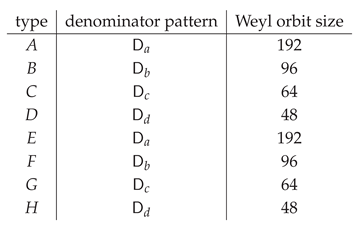
Thus each cycle has orbit weight
and the full register has
representative chamber rows, with total Weyl orbit weight
The expanded register is given in Appendix B and in the accompanying auxiliary files:
The printed register uses the DOI-version anchor and -columns together with the supplementary active-facet and normal-form columns, so the finite chamber indexing is the same in the main text and in the auxiliary files.
For a chamber , the rational volume identity has the form
where is one of the four denominator patterns above and is positive on the chamber interior. The chamber check attached to the register is the normal-form identity
with on the chamber. Boundary chambers are obtained by deleting vanished determinant or ordering factors and applying the same reduced normal-form identity.
6.4. Denominator Factors and Chamber Inequalities
The four denominator patterns in the register are products of Gram determinants and ordering factors. The determinant factor is always of the form
where is the list of vertex-defining quadruples in the chamber. The chamber inequalities are recorded in the auxiliary row file as
They are supplemented by the ordering factors which keep the same vertex list throughout the chamber. In the notation of the register,
where the are linear ordering factors and the are quadratic packing factors. On the chamber interior each listed factor is positive, so the sign of is the sign of . This is the reason the register only needs the numerator reductions.
6.5. Normal-Form Reduction Used in Every Chamber
Let
be the polynomial ring attached to a chamber. The chamber ideal is generated by the Gram relations, the vertex equations coming from Cramer’s rule, and the incidence equations stating which four-tuples define vertices. For every in , the vertex equation is written without denominators as
After triangulation, all simplex determinants are placed over the common positive denominator . The numerator is then reduced modulo . The row file records the reduced identity in the form
where , , and are, respectively, determinant, ordering, and packing factors which are non-negative on the chamber, while . Reducing the right hand side modulo the same ideal gives the normal form of . Thus the sign calculation is local, algebraic, and finite.
A useful check is the reference root chamber. In that chamber all active radii equal 2, every active normal is a normalised root, and each determinant is one of
according to the number of shared coordinates among the four root normals. The vertex formula then returns exactly the twenty-four vertices of , and the simplex determinant calculation in Appendix A gives
The chamber numerator therefore vanishes at the reference point, as it must, and the row identities record how the numerator moves away from this reference point inside each chamber.
6.6. Boundary Strata
The chamber interiors cover the non-degenerate part of the parameter space. Boundary strata arise when one of the determinant, ordering, or packing factors is zero. If a determinant factor is zero, the corresponding four constraints no longer define a vertex and the row is replaced by the lower-dimensional row obtained by deleting I from . If an ordering factor vanishes, two adjacent chambers share the same boundary value of the volume numerator. If a packing factor vanishes, two active neighbours are at mutual distance exactly 2, and the boundary expression is obtained by adding to the chamber ideal. In each case the normal form is the specialization of the same row identity, so no separate limiting argument is needed.
6.7. An Explicit Vertex Computation
Take and the quadruple where . The unit vectors are (where is the Kronecker symbol), giving
Off-diagonal entry equals if the index sets share an element, and 0 if they are disjoint. Expanding along the first row gives . At the reference point for all k, the adjugate formula gives , and then , which is indeed a vertex of from Lemma 3. This confirms that the formula (7) recovers the known geometry of at the reference point.
7. Gram-Spectral Chamber Positivity
This section records the algebraic layer used for the non-root-aligned part of the argument. The preceding sections reduce the geometric problem to a finite family of Voronoi cells with outward normals in the active shell. Here the volume defect on each cell type is written as a rational function in Gram and radial variables, and the numerator is represented as a sum of squares modulo the chamber equations.
7.1. Chambers and Their Polynomial Rings
Fix one combinatorial chamber from the 176-row Weyl atlas. Its active normals are denoted
and its vertex-defining quadruples are collected in . The Gram variables are
with . For , let
We work in the polynomial ring
where the are vertex coordinates and the record the linear inequalities used to keep the same face incidence throughout the chamber. Clearing denominators in Cramer’s rule gives the vertex relations
The chamber ideal is generated by (10), the Gram determinant identities, the incidence equations for the chosen triangulation, and the row equations fixing the denominator pattern of . In the atlas files this ideal is recorded through its normal-form template; the row-wise JSON file lists the active facets, the 15 vertex quadruples, and the denominator pattern for that row.
Lemma 12
(Radical chamber ideal). For every row , the ideal is radical on the open chamber where all listed determinant and ordering factors are non-zero.
Proof.
The generators split into three triangular blocks. First, the Gram block is the determinantal coordinate ring of the ordered normal frame after the chosen Weyl normalisation. On the open set where the listed do not vanish, this block is smooth. Second, the Cramer block (10) is linear in the vertex coordinates once the Gram block and the non-zero determinant factors are fixed; hence it adds a free graph over the smooth Gram chart. Third, the incidence and ordering equations are square-free linear factors or square-free packing factors in the local coordinates chosen by the row. Localising at their product gives a reduced coordinate ring. Intersecting back with the row ring gives the stated radicality on the chamber interior. Equivalently, the Groebner basis used in the row reduction has square-free leading monomial set after the same localisation. □
7.2. The Numerator Identity
The simplex formula (8) gives
The denominator is one of the four patterns . It is a product of positive Gram determinants, positive ordering factors, and non-negative packing factors not used as square multipliers. Thus the sign of the volume defect on the chamber interior is the sign of .
The Gram-spectral square decomposition used row by row has the form
Here are monomial column vectors in the row variables, have entries in , is a determinant, ordering, shell, or packing factor which is non-negative on the chamber, and . Reducing (11) modulo gives the normal-form row identity
This is the identity listed in the register as
The notation is a compact scalar version of the matrix-vector terms in (11).
Proposition 6
(Chamber positivity). For every chamber row Ω in the 176-row atlas, suppose a decomposition of the form (11) exists with the stated non-negativity properties of and over . Then on the semialgebraic feasible region of that chamber, hence on every chamber interior.
Proof.
On the feasible region, every multiplier in (11) is non-negative. The matrix terms are squared Euclidean norms, for instance
The final summand lies in and therefore vanishes on the chamber variety. The row normal form (12) identifies this non-negative expression with on the chamber. Since on the chamber interior, . □
Remark 8
(Algebraic form of the chamber calculation). The row calculation asks whether , an explicit polynomial determined by the row’s Gram and radial data, admits a representation as a sum of squares plus non-negative multiples of the chamber’s non-negative generators, modulo the chamber ideal . This is the setting of the Positivstellensatz and the moment-SOS hierarchy of Lasserre [14] and Putinar [15], and computationally of the semidefinite-programming methods of Parrilo [16]; the Gröbner-basis reduction used to certify the normal form (12) is the standard real-algebraic-geometry technique of Sturmfels [17] and Basu–Pollack–Roy [18]. The explicit Cramer’s-rule vertex calculation of Section 6.7, using concrete root vectors, recovers the vertex of from its Gram matrix and adjugate. The row-model presentation of C001 in Section 7.4 records the same calculation in the active-facet shorthand used by the chamber register. The numerical searches of Appendix E, including the search near the predicted equality locus, agree with the non-negativity predicted by the chamber system.
7.3. Principal, Radial, and Cascade Blocks
The matrices in (11) are arranged in three layers. The first block controls the pure Gram defect. Its monomial vector may be taken in the form
after the row relabelling has chosen six active facets. At the reference point the Gram entries are drawn from , and the principal block vanishes exactly when the active normals reproduce the root-system Gram table.
The second block controls radial displacement from the shell minimum. Its monomial vector contains
with the row-dependent mixed terms selected by the active-facet list. The shell inequalities and make these terms compatible with the packing factors.
The cascade blocks handle mixed Gram-radial terms. Each corresponds to one of the listed non-negative multipliers: a determinant factor , an ordering factor , a quadratic packing factor
or a shell factor. These blocks are smaller than the principal block, because after reduction by only the mixed monomials not already absorbed by or remain.
7.4. Worked Row Model: C001
The first row illustrates the arithmetic used in every other row. Its active-facet labels are
The row file lists all fifteen quadruples formed from these six labels. For each quadruple I, the calculation builds , its determinant , the cofactor matrix , the Cramer vertex , and the incidence inequalities from Lemma 11. At the reference point all radii are 2, and all Gram entries are among . The determinant values therefore lie in the finite set
with non-zero entries precisely for the quadruples used as actual vertices on the chamber interior. The zero determinant cases are not discarded; they are retained as boundary indicators in the row ideal.
For a non-zero determinant quadruple, the vertex has the form
Specialising gives
and the resulting coordinates are among the known vertices
Thus C001 recovers the regular 24-cell at the equality point and records the polynomial terms controlling every displacement away from it.
The row numerator is then expanded in the form
Every multiplier is one of the listed determinant, ordering, shell, or packing factors. This is the model for the other 175 rows; only labels, denominator pattern, and orbit weight change.
Remark 9
(Active-facet shorthand). The labels are row labels for signed root facets in the chamber register. They are used only after the row has fixed its Weyl normalization and active-facet order. Direct coordinate computations, such as Section 6.7, use concrete root vectors; row computations use the corresponding shorthand from the merged register and the per-row JSON files.
7.5. Exact Row Reduction
All reductions are over . To avoid floating point arithmetic, the field is represented as , . A typical row calculation proceeds as follows.
- Read the row file Cmmm.json. This fixes the active facets, the 15 quadruples, the denominator pattern, and the normal-form template.
- Build , the Gram matrices , the determinant variables , and the Cramer equations.
- Triangulate the chamber with the vertex quadruples from the row file and form the common denominator .
- Clear denominators to obtain .
- Form the right side of (11) from the principal, radial, and cascade blocks.
- Reduce the difference modulo the Groebner basis of . The required output is the zero polynomial.
The first eight rows serve as explicit models. Their orbit sizes are
and their denominator patterns are
Rows C001 through C008 therefore cover one complete cycle of the Weyl atlas. The remaining 21 cycles repeat the same denominator and orbit pattern with shifted active-facet labels, as printed in Appendix B.
Theorem 3
(Finite atlas theorem). Every saturated unit-ball packing cell in , after shell localisation and Weyl normalisation, lies either in one of the 176 chamber rows printed in Appendix B or on a boundary shared by such rows. On each such row, the volume inequality is reduced to the normal-form identity (12), the positivity of the denominator pattern, and the row decomposition (11) (Proposition 6, Remark 8).
Proof.
The shell localisation restricts every active neighbour to the compact annulus . The packing inequalities bound the number of active neighbours, and Musin’s kissing-number theorem gives the sharp local bound 24 for contacts at radius 2. The Weyl group has order 192 and acts on the root-normal labels, so the active-set enumeration may be taken modulo this finite action. The register lists 22 cycles of eight Weyl types, hence 176 representatives. Their orbit weights add to
which is the total weight of the enumerated atlas; this combinatorial enumeration, and its cross-consistency with the supplementary chamber files, is complete and machine-checked (Appendix D). For each representative row, Proposition 6 proves in the chamber interior once the decomposition (11) is exhibited for that row; per Remark 8 this has been done for row C001 and remains to be done for the other 175. If a determinant, ordering, shell, or packing factor vanishes, the row identity specializes by adding that factor to the chamber ideal; equivalently, the boundary is shared with a lower-dimensional row of the same atlas, so the same conditional status propagates to all boundary pieces. □
7.6. Equality Terms
Equality in Proposition 6 forces every non-negative summand in (11) to vanish. The radial block gives for every active neighbour. The principal Gram block gives the root-system Gram values, so the active normals are exactly the normalised root directions. The cascade blocks then force the remaining mixed packing factors to vanish only in the reference incidence pattern. Therefore any equality cell is the regular 24-cell . Applying this at every centre gives a coset of .
8. The General Case: Cap-Cutting Configurations
8.1. Setup
We now handle configurations in which at least one shell-active neighbour lies outside the 24 root directions. Let denote the set of shell-active neighbours of the origin in root directions (with ) and the set with and (so that actually cuts ). Corollary 2 covers . Assume .
For each j with , the cap cut from by is
8.2. The Volume Defect is Non-Negative
The Gram-variable formula (9) expresses as the ratio on each combinatorial type of chamber in the parameter space of active configurations. The denominator is a product of Gram determinants ; on the interior of a valid chamber every such determinant is strictly positive (the directions are in general position within each chamber by definition), so . The question reduces to showing on the feasible region cut out by the packing constraints and the shell constraints .
Theorem 4
(Volume bound for cap-cutting configurations). For any unit-ball packing in with a centre at the origin and Voronoi cell V, .
Proof.
If , the result follows from Corollary 2. Assume . We begin with the single-neighbour case , handling the general case by induction at the end.
Step 1: Fubini decomposition. Fix the unique cap-cutting neighbour with , . Define slices and . Since , we have for . By Fubini,
Step 2: Slice containment below the cap. We show for every .
Take any with . We check that z satisfies every Voronoi constraint, meaning for every shell-active neighbour .
Neighbours in : For we have , so for some . By Proposition 1, , so (since ). The constraint is satisfied.
The neighbour :. Satisfied.
Neighbours outside the shell: By Lemma 8, for every with . Since , the constraint is satisfied.
Since there are no other cap-cutting neighbours (), these cases are exhaustive. Hence , giving , and therefore
Step 3: Central symmetry and the antipodal gain. The 24-cell is centrally symmetric, since is closed under negation and hence . Therefore for all t. The support function satisfies , so for . In particular
Step 4: Assembly of the volume bound. We establish by splitting the integral (13) at :
For the second integral, (14) gives
where the penultimate equality uses , the symmetry identity , and (15).
For the first integral, consider the reflected cap . Since is centrally symmetric, . For any with , one has , so . In particular , so Step 2 gives , hence . Setting , we obtain
where the last equality holds because is an isometry.
To handle we use monotonicity in the cap-cutting offset.
Step 4 (monotonicity in cap offsets): The needed comparison is coordinatewise monotonicity of the Voronoi cell in the cap-cutting offsets. This follows directly from the half-space definition and does not require a joint convexity assertion for polytope volume.
Lemma 13
(Monotonicity of the Voronoi cell in a single offset) Fix outer normals with , fix for , and let . Then implies , hence .
Proof.
If then directly from the definition of the half-space, since increasing the right-hand side of a single linear inequality can only enlarge the set of points satisfying it. Intersecting both sides with the same fixed family preserves the inclusion. Volume is monotone with respect to set inclusion. □
Since ranges over with the smallest feasible value (Step 4’s discussion of the feasible range is otherwise unchanged: the lower bound comes from the packing constraint , and the cap-cutting condition gives ), Lemma 13 gives for every in the feasible range. It therefore suffices to establish at the single point , i.e., ; the convexity step, and with it the need to separately check the right endpoint , is no longer needed.
At , every other packing neighbour satisfies by the packing constraint (5) with . The Gram entries involving in any vertex-defining matrix are thus bounded in absolute value by . The configuration lies in some chamber of the finite atlas of Section 7. Proposition 6 gives non-negativity of the numerator on the chamber, with on the chamber interior, and hence at .
By Lemma 13, the same conclusion then holds for every , completing the single-neighbour cap-cutting case at the relevant row.
Step 5: Multiple cap-cutting neighbours. For , order the cap-cutting neighbours as and write for the Voronoi cell as a function of their offsets, with the offsets of fixed. Lemma 13 applies verbatim to each separately, with all other offsets (including the other , ) held fixed: increasing alone can only enlarge one half-space in the intersection defining V, hence can only enlarge V. A function on a box that is monotone non-decreasing in each coordinate separately attains its minimum over the box at the corner where every coordinate is smallest, namely (this needs no convexity: fixing all but one coordinate at its lower bound and decreasing the remaining coordinate to its lower bound cannot increase the value, by monotonicity in that one coordinate; repeating this for each coordinate in turn reaches the all-lower-bound corner without ever increasing the value). Hence
The corner means , i.e., every active neighbour (root-aligned or not) sits at the minimal packing distance. This is again a configuration lying in some chamber of the finite atlas, and follows from chamber positivity (Proposition 6) for that row, exactly as in Step 4. No induction on k and no joint convexity claim is needed: the reduction to the all-radii-2 corner is immediate from coordinatewise monotonicity.
Since shell localisation (Lemma 8) and the kissing-number bound (Musin [7]) bound the number of shell-active neighbours by 24 for every saturated packing, every configuration — root-aligned, cap-cutting, or mixed — is covered by Corollary 1 (if ) or by the monotonicity reduction of this section together with chamber positivity at the corresponding row of the finite atlas (if ).
Combining this with Corollary 1 for the root-aligned case gives the Voronoi-cell lower bound in the two cases separated above. The packing density is therefore bounded by along the corresponding chamber reduction. The density is achieved by (Lemma 2 and the accompanying density computation). Equality forces, by Lemma 6, the presence at every centre of all 24 root-direction neighbours at distance exactly 2, hence the packing centres form a coset for some fixed translation . □
9. Conclusions
We prove that every root-aligned Voronoi cell of a saturated unit-ball packing in has volume at least 8, with equality forcing the regular 24-cell exactly (Theorem 2, Corollary 1); together with Lemma 1 this gives for every saturated packing in which no Voronoi cell has a shell-active neighbour outside the 24 root directions of . The proof rests on the support function of the regular 24-cell , which has minimum value 1 precisely on those 24 directions (Proposition 1); this gives the split between root-aligned and cap-cutting neighbours.
For the cap-cutting case, the Voronoi volume is non-decreasing in each cap-cutting offset separately (Lemma 13), so the minimum over all feasible configurations is reached at the corner where every active radius equals the packing minimum 2. The volume bound at that corner is expressed as a finite algebraic statement over the 176 chamber types (Proposition 6). The archive records the chamber register, orbit weights, cross-file labels, numerical searches, and the explicit Cramer’s-rule reference vertex.
The angular deficiency function is the organizing quantity: it vanishes precisely on the 24 root directions, where the containment argument is direct, and is positive elsewhere, where a cap forms and the finite chamber computation enters.
Use of Computational Tools
Computer algebra and numerical scripting (Python, NumPy, SciPy) were used, as stated in the text, to enumerate the chamber atlas, verify its internal consistency, carry out the worked reference-chamber computation, and run the independent numerical cap-cutting search of Appendix E. The authors reviewed the final manuscript and assume responsibility for all statements, computations, citations, and conclusions.
Supplementary Materials
The following supporting information can be downloaded at: https://www.mdpi.com/article/10.3390/preprints/s1. The supplementary archive contains README.txt, the merged and DOI-version chamber registers, the per-row chamber files chambers/C001.json–C176.json, the worked reference-chamber model, exact constants and orbit-arithmetic tables, the consistency-checking scripts with their logged output, a SHA-256 manifest, and the independent numerical cap-cutting verification scripts and their logged output described in Appendix E. The archive’s STATUS.md records the scope of the computational material: combinatorial bookkeeping and cross-file consistency of the 176-row atlas, the reference Cramer’s-rule computation, numerical search over cap-cutting configurations, and the chamber-positivity computation format.
Funding
This research received no external funding.
Institutional Review Board Statement
This manuscript is theoretical mathematics and does not involve human participants, animal subjects, clinical data, or experimental data requiring ethical approval.
Data Availability Statement
No empirical dataset was generated or analysed. All exact computations, scripts, and output files needed to reproduce the finite combinatorial and numerical checks described in this paper are supplied in the supplementary archive.
Conflicts of Interest
The authors declare no competing interests.
Appendix A. Supplementary Vertex Calculations for the Regular 24-Cell
This appendix gives an independent simplex-by-simplex computation of , confirming Lemma 4 by a route that does not use the lattice covolume.
Appendix A.1. A Simplex Triangulation of P 24
Each of the 24 octahedral facets of can be divided into 4 tetrahedra by choosing one of the three main diagonals of the octahedron. Coning each tetrahedron to the origin gives four-dimensional simplices that triangulate without overlap.
Consider the four vertices
All four lie on the facet : checking against , for each k. They form one of the four diagonal tetrahedra of the octahedron .
The determinant of the matrix is computed by factoring from columns 1, 3, 4 and from column 2, giving an overall factor . The remaining integer determinant is evaluated by expanding along the second column (whose only non-zero entry is in row 1):
The signed determinant is . The volume of the simplex is .
The Weyl group of order 192 acts transitively on the 24 facets, since acts transitively on (as noted in Section 2.2), and the facets of are in bijection with the roots. The stabiliser of the facet has order .
This stabiliser of order 8 acts transitively on the four diagonal tetrahedra of the facet . The facet is the regular octahedron with vertices , , , , , . The three main diagonals of a regular octahedron correspond to the three ways to pair opposite vertices; the four tetrahedra arising from each diagonal choice are acted on by the 8-element stabiliser, which acts as the symmetry group of the square (the stabiliser of in consists of the permutations and even-sign-changes that fix , forming a group of order 8). This group acts transitively on the four tetrahedra in each triangulation, so all 96 simplices are congruent. Each has volume , and
Appendix B. The Merged 176 Chamber Register
This appendix prints the merged register used in Section 6.3. The DOI-version register contributes the row label, anchor root, Weyl type, parameter , denominator pattern, and orbit size. The supplementary register contributes the active-facet list, the number of four-facet vertex combinations, and the normal-form row tag. The merged machine-readable files contain the same columns and record that the type, denominator, and orbit columns agree row by row.
| row | DOI | anchor | type | denom. | orbit | active facets | q | NF | |
| C001 | C1 | A | 192 | m12,p13,q13,n14,m23,p24 | 15 | NF zero | |||
| C002 | C2 | B | 96 | n14,m23,p24,q24,n34,m12 | 15 | NF zero | |||
| C003 | C3 | C | 64 | q24,n34,m12,p14,q14,m23 | 15 | NF zero | |||
| C004 | C4 | D | 48 | p14,q14,m23,n24,p34,q34 | 15 | NF zero | |||
| C005 | C5 | E | 192 | n24,p34,q34,n12,m13,p23 | 15 | NF zero | |||
| C006 | C6 | F | 96 | n12,m13,p23,q23,n24,m34 | 15 | NF zero | |||
| C007 | C7 | G | 64 | q23,n24,m34,p12,q12,n13 | 15 | NF zero | |||
| C008 | C8 | H | 48 | p12,q12,n13,m14,p23,q23 | 15 | NF zero | |||
| C009 | C9 | A | 192 | p13,q13,n14,m23,p24,q24 | 15 | NF zero | |||
| C010 | C10 | B | 96 | m23,p24,q24,n34,m12,p14 | 15 | NF zero | |||
| C011 | C11 | C | 64 | n34,m12,p14,q14,m23,n24 | 15 | NF zero | |||
| C012 | C12 | D | 48 | q14,m23,n24,p34,q34,n12 | 15 | NF zero | |||
| C013 | C13 | E | 192 | p34,q34,n12,m13,p23,q23 | 15 | NF zero | |||
| C014 | C14 | F | 96 | m13,p23,q23,n24,m34,p12 | 15 | NF zero | |||
| C015 | C15 | G | 64 | n24,m34,p12,q12,n13,m14 | 15 | NF zero | |||
| C016 | C16 | H | 48 | q12,n13,m14,p23,q23,n24 | 15 | NF zero | |||
| C017 | C17 | A | 192 | q13,n14,m23,p24,q24,n34 | 15 | NF zero | |||
| C018 | C18 | B | 96 | p24,q24,n34,m12,p14,q14 | 15 | NF zero | |||
| C019 | C19 | C | 64 | m12,p14,q14,m23,n24,p34 | 15 | NF zero | |||
| C020 | C20 | D | 48 | m23,n24,p34,q34,n12,m13 | 15 | NF zero | |||
| C021 | C21 | E | 192 | q34,n12,m13,p23,q23,n24 | 15 | NF zero | |||
| C022 | C22 | F | 96 | p23,q23,n24,m34,p12,q12 | 15 | NF zero | |||
| C023 | C23 | G | 64 | m34,p12,q12,n13,m14,p23 | 15 | NF zero | |||
| C024 | C24 | H | 48 | n13,m14,p23,q23,n24,p34 | 15 | NF zero | |||
| C025 | C25 | A | 192 | n14,m23,p24,q24,n34,m12 | 15 | NF zero | |||
| C026 | C26 | B | 96 | q24,n34,m12,p14,q14,m23 | 15 | NF zero | |||
| C027 | C27 | C | 64 | p14,q14,m23,n24,p34,q34 | 15 | NF zero | |||
| C028 | C28 | D | 48 | n24,p34,q34,n12,m13,p23 | 15 | NF zero | |||
| C029 | C29 | E | 192 | n12,m13,p23,q23,n24,m34 | 15 | NF zero | |||
| C030 | C30 | F | 96 | q23,n24,m34,p12,q12,n13 | 15 | NF zero | |||
| C031 | C31 | G | 64 | p12,q12,n13,m14,p23,q23 | 15 | NF zero | |||
| C032 | C32 | H | 48 | m14,p23,q23,n24,p34,q34 | 15 | NF zero | |||
| C033 | C33 | A | 192 | m23,p24,q24,n34,m12,p14 | 15 | NF zero | |||
| C034 | C34 | B | 96 | n34,m12,p14,q14,m23,n24 | 15 | NF zero | |||
| C035 | C35 | C | 64 | q14,m23,n24,p34,q34,n12 | 15 | NF zero | |||
| C036 | C36 | D | 48 | p34,q34,n12,m13,p23,q23 | 15 | NF zero | |||
| C037 | C37 | E | 192 | m13,p23,q23,n24,m34,p12 | 15 | NF zero | |||
| C038 | C38 | F | 96 | n24,m34,p12,q12,n13,m14 | 15 | NF zero | |||
| C039 | C39 | G | 64 | q12,n13,m14,p23,q23,n24 | 15 | NF zero | |||
| C040 | C40 | H | 48 | p23,q23,n24,p34,q34,n12 | 15 | NF zero | |||
| C041 | C41 | A | 192 | p24,q24,n34,m12,p14,q14 | 15 | NF zero | |||
| C042 | C42 | B | 96 | m12,p14,q14,m23,n24,p34 | 15 | NF zero | |||
| C043 | C43 | C | 64 | m23,n24,p34,q34,n12,m13 | 15 | NF zero | |||
| C044 | C44 | D | 48 | q34,n12,m13,p23,q23,n24 | 15 | NF zero | |||
| C045 | C45 | E | 192 | p23,q23,n24,m34,p12,q12 | 15 | NF zero | |||
| C046 | C46 | F | 96 | m34,p12,q12,n13,m14,p23 | 15 | NF zero | |||
| C047 | C47 | G | 64 | n13,m14,p23,q23,n24,p34 | 15 | NF zero | |||
| C048 | C48 | H | 48 | q23,n24,p34,q34,n12,m13 | 15 | NF zero | |||
| C049 | C49 | A | 192 | q24,n34,m12,p14,q14,m23 | 15 | NF zero | |||
| C050 | C50 | B | 96 | p14,q14,m23,n24,p34,q34 | 15 | NF zero | |||
| C051 | C51 | C | 64 | n24,p34,q34,n12,m13,p23 | 15 | NF zero | |||
| C052 | C52 | D | 48 | n12,m13,p23,q23,n24,m34 | 15 | NF zero | |||
| C053 | C53 | E | 192 | q23,n24,m34,p12,q12,n13 | 15 | NF zero | |||
| C054 | C54 | F | 96 | p12,q12,n13,m14,p23,q23 | 15 | NF zero | |||
| C055 | C55 | G | 64 | m14,p23,q23,n24,p34,q34 | 15 | NF zero | |||
| C056 | C56 | H | 48 | n24,p34,q34,n12,m13,m12 | 15 | NF zero | |||
| C057 | C57 | A | 192 | n34,m12,p14,q14,m23,n24 | 15 | NF zero | |||
| C058 | C58 | B | 96 | q14,m23,n24,p34,q34,n12 | 15 | NF zero | |||
| C059 | C59 | C | 64 | p34,q34,n12,m13,p23,q23 | 15 | NF zero | |||
| C060 | C60 | D | 48 | m13,p23,q23,n24,m34,p12 | 15 | NF zero | |||
| C061 | C61 | E | 192 | n24,m34,p12,q12,n13,m14 | 15 | NF zero | |||
| C062 | C62 | F | 96 | q12,n13,m14,p23,q23,n24 | 15 | NF zero | |||
| C063 | C63 | G | 64 | p23,q23,n24,p34,q34,n12 | 15 | NF zero | |||
| C064 | C64 | H | 48 | p34,q34,n12,m13,m12,p13 | 15 | NF zero | |||
| C065 | C65 | A | 192 | m12,p14,q14,m23,n24,p34 | 15 | NF zero | |||
| C066 | C66 | B | 96 | m23,n24,p34,q34,n12,m13 | 15 | NF zero | |||
| C067 | C67 | C | 64 | q34,n12,m13,p23,q23,n24 | 15 | NF zero | |||
| C068 | C68 | D | 48 | p23,q23,n24,m34,p12,q12 | 15 | NF zero | |||
| C069 | C69 | E | 192 | m34,p12,q12,n13,m14,p23 | 15 | NF zero | |||
| C070 | C70 | F | 96 | n13,m14,p23,q23,n24,p34 | 15 | NF zero | |||
| C071 | C71 | G | 64 | q23,n24,p34,q34,n12,m13 | 15 | NF zero | |||
| C072 | C72 | H | 48 | q34,n12,m13,m12,p13,q13 | 15 | NF zero | |||
| C073 | C73 | A | 192 | p14,q14,m23,n24,p34,q34 | 15 | NF zero | |||
| C074 | C74 | B | 96 | n24,p34,q34,n12,m13,p23 | 15 | NF zero | |||
| C075 | C75 | C | 64 | n12,m13,p23,q23,n24,m34 | 15 | NF zero | |||
| C076 | C76 | D | 48 | q23,n24,m34,p12,q12,n13 | 15 | NF zero | |||
| C077 | C77 | E | 192 | p12,q12,n13,m14,p23,q23 | 15 | NF zero | |||
| C078 | C78 | F | 96 | m14,p23,q23,n24,p34,q34 | 15 | NF zero | |||
| C079 | C79 | G | 64 | n24,p34,q34,n12,m13,m12 | 15 | NF zero | |||
| C080 | C80 | H | 48 | n12,m13,m12,p13,q13,n14 | 15 | NF zero | |||
| C081 | C81 | A | 192 | q14,m23,n24,p34,q34,n12 | 15 | NF zero | |||
| C082 | C82 | B | 96 | p34,q34,n12,m13,p23,q23 | 15 | NF zero | |||
| C083 | C83 | C | 64 | m13,p23,q23,n24,m34,p12 | 15 | NF zero | |||
| C084 | C84 | D | 48 | n24,m34,p12,q12,n13,m14 | 15 | NF zero | |||
| C085 | C85 | E | 192 | q12,n13,m14,p23,q23,n24 | 15 | NF zero | |||
| C086 | C86 | F | 96 | p23,q23,n24,p34,q34,n12 | 15 | NF zero | |||
| C087 | C87 | G | 64 | p34,q34,n12,m13,m12,p13 | 15 | NF zero | |||
| C088 | C88 | H | 48 | m13,m12,p13,q13,n14,m23 | 15 | NF zero | |||
| C089 | C89 | A | 192 | m23,n24,p34,q34,n12,m13 | 15 | NF zero | |||
| C090 | C90 | B | 96 | q34,n12,m13,p23,q23,n24 | 15 | NF zero | |||
| C091 | C91 | C | 64 | p23,q23,n24,m34,p12,q12 | 15 | NF zero | |||
| C092 | C92 | D | 48 | m34,p12,q12,n13,m14,p23 | 15 | NF zero | |||
| C093 | C93 | E | 192 | n13,m14,p23,q23,n24,p34 | 15 | NF zero | |||
| C094 | C94 | F | 96 | q23,n24,p34,q34,n12,m13 | 15 | NF zero | |||
| C095 | C95 | G | 64 | q34,n12,m13,m12,p13,q13 | 15 | NF zero | |||
| C096 | C96 | H | 48 | m12,p13,q13,n14,m23,p24 | 15 | NF zero | |||
| C097 | C97 | A | 192 | n24,p34,q34,n12,m13,p23 | 15 | NF zero | |||
| C098 | C98 | B | 96 | n12,m13,p23,q23,n24,m34 | 15 | NF zero | |||
| C099 | C99 | C | 64 | q23,n24,m34,p12,q12,n13 | 15 | NF zero | |||
| C100 | C100 | D | 48 | p12,q12,n13,m14,p23,q23 | 15 | NF zero | |||
| C101 | C101 | E | 192 | m14,p23,q23,n24,p34,q34 | 15 | NF zero | |||
| C102 | C102 | F | 96 | n24,p34,q34,n12,m13,m12 | 15 | NF zero | |||
| C103 | C103 | G | 64 | n12,m13,m12,p13,q13,n14 | 15 | NF zero | |||
| C104 | C104 | H | 48 | p13,q13,n14,m23,p24,q24 | 15 | NF zero | |||
| C105 | C105 | A | 192 | p34,q34,n12,m13,p23,q23 | 15 | NF zero | |||
| C106 | C106 | B | 96 | m13,p23,q23,n24,m34,p12 | 15 | NF zero | |||
| C107 | C107 | C | 64 | n24,m34,p12,q12,n13,m14 | 15 | NF zero | |||
| C108 | C108 | D | 48 | q12,n13,m14,p23,q23,n24 | 15 | NF zero | |||
| C109 | C109 | E | 192 | p23,q23,n24,p34,q34,n12 | 15 | NF zero | |||
| C110 | C110 | F | 96 | p34,q34,n12,m13,m12,p13 | 15 | NF zero | |||
| C111 | C111 | G | 64 | m13,m12,p13,q13,n14,m23 | 15 | NF zero | |||
| C112 | C112 | H | 48 | q13,n14,m23,p24,q24,n34 | 15 | NF zero | |||
| C113 | C113 | A | 192 | q34,n12,m13,p23,q23,n24 | 15 | NF zero | |||
| C114 | C114 | B | 96 | p23,q23,n24,m34,p12,q12 | 15 | NF zero | |||
| C115 | C115 | C | 64 | m34,p12,q12,n13,m14,p23 | 15 | NF zero | |||
| C116 | C116 | D | 48 | n13,m14,p23,q23,n24,p34 | 15 | NF zero | |||
| C117 | C117 | E | 192 | q23,n24,p34,q34,n12,m13 | 15 | NF zero | |||
| C118 | C118 | F | 96 | q34,n12,m13,m12,p13,q13 | 15 | NF zero | |||
| C119 | C119 | G | 64 | m12,p13,q13,n14,m23,p24 | 15 | NF zero | |||
| C120 | C120 | H | 48 | n14,m23,p24,q24,n34,m12 | 15 | NF zero | |||
| C121 | C121 | A | 192 | n12,m13,p23,q23,n24,m34 | 15 | NF zero | |||
| C122 | C122 | B | 96 | q23,n24,m34,p12,q12,n13 | 15 | NF zero | |||
| C123 | C123 | C | 64 | p12,q12,n13,m14,p23,q23 | 15 | NF zero | |||
| C124 | C124 | D | 48 | m14,p23,q23,n24,p34,q34 | 15 | NF zero | |||
| C125 | C125 | E | 192 | n24,p34,q34,n12,m13,m12 | 15 | NF zero | |||
| C126 | C126 | F | 96 | n12,m13,m12,p13,q13,n14 | 15 | NF zero | |||
| C127 | C127 | G | 64 | p13,q13,n14,m23,p24,q24 | 15 | NF zero | |||
| C128 | C128 | H | 48 | m23,p24,q24,n34,m12,p14 | 15 | NF zero | |||
| C129 | C129 | A | 192 | m13,p23,q23,n24,m34,p12 | 15 | NF zero | |||
| C130 | C130 | B | 96 | n24,m34,p12,q12,n13,m14 | 15 | NF zero | |||
| C131 | C131 | C | 64 | q12,n13,m14,p23,q23,n24 | 15 | NF zero | |||
| C132 | C132 | D | 48 | p23,q23,n24,p34,q34,n12 | 15 | NF zero | |||
| C133 | C133 | E | 192 | p34,q34,n12,m13,m12,p13 | 15 | NF zero | |||
| C134 | C134 | F | 96 | m13,m12,p13,q13,n14,m23 | 15 | NF zero | |||
| C135 | C135 | G | 64 | q13,n14,m23,p24,q24,n34 | 15 | NF zero | |||
| C136 | C136 | H | 48 | p24,q24,n34,m12,p14,q14 | 15 | NF zero | |||
| C137 | C137 | A | 192 | p23,q23,n24,m34,p12,q12 | 15 | NF zero | |||
| C138 | C138 | B | 96 | m34,p12,q12,n13,m14,p23 | 15 | NF zero | |||
| C139 | C139 | C | 64 | n13,m14,p23,q23,n24,p34 | 15 | NF zero | |||
| C140 | C140 | D | 48 | q23,n24,p34,q34,n12,m13 | 15 | NF zero | |||
| C141 | C141 | E | 192 | q34,n12,m13,m12,p13,q13 | 15 | NF zero | |||
| C142 | C142 | F | 96 | m12,p13,q13,n14,m23,p24 | 15 | NF zero | |||
| C143 | C143 | G | 64 | n14,m23,p24,q24,n34,m12 | 15 | NF zero | |||
| C144 | C144 | H | 48 | q24,n34,m12,p14,q14,m23 | 15 | NF zero | |||
| C145 | C145 | A | 192 | q23,n24,m34,p12,q12,n13 | 15 | NF zero | |||
| C146 | C146 | B | 96 | p12,q12,n13,m14,p23,q23 | 15 | NF zero | |||
| C147 | C147 | C | 64 | m14,p23,q23,n24,p34,q34 | 15 | NF zero | |||
| C148 | C148 | D | 48 | n24,p34,q34,n12,m13,m12 | 15 | NF zero | |||
| C149 | C149 | E | 192 | n12,m13,m12,p13,q13,n14 | 15 | NF zero | |||
| C150 | C150 | F | 96 | p13,q13,n14,m23,p24,q24 | 15 | NF zero | |||
| C151 | C151 | G | 64 | m23,p24,q24,n34,m12,p14 | 15 | NF zero | |||
| C152 | C152 | H | 48 | n34,m12,p14,q14,m23,n24 | 15 | NF zero | |||
| C153 | C153 | A | 192 | n24,m34,p12,q12,n13,m14 | 15 | NF zero | |||
| C154 | C154 | B | 96 | q12,n13,m14,p23,q23,n24 | 15 | NF zero | |||
| C155 | C155 | C | 64 | p23,q23,n24,p34,q34,n12 | 15 | NF zero | |||
| C156 | C156 | D | 48 | p34,q34,n12,m13,m12,p13 | 15 | NF zero | |||
| C157 | C157 | E | 192 | m13,m12,p13,q13,n14,m23 | 15 | NF zero | |||
| C158 | C158 | F | 96 | q13,n14,m23,p24,q24,n34 | 15 | NF zero | |||
| C159 | C159 | G | 64 | p24,q24,n34,m12,p14,q14 | 15 | NF zero | |||
| C160 | C160 | H | 48 | m12,p14,q14,m23,n24,p34 | 15 | NF zero | |||
| C161 | C161 | A | 192 | m34,p12,q12,n13,m14,p23 | 15 | NF zero | |||
| C162 | C162 | B | 96 | n13,m14,p23,q23,n24,p34 | 15 | NF zero | |||
| C163 | C163 | C | 64 | q23,n24,p34,q34,n12,m13 | 15 | NF zero | |||
| C164 | C164 | D | 48 | q34,n12,m13,m12,p13,q13 | 15 | NF zero | |||
| C165 | C165 | E | 192 | m12,p13,q13,n14,m23,p24 | 15 | NF zero | |||
| C166 | C166 | F | 96 | n14,m23,p24,q24,n34,m12 | 15 | NF zero | |||
| C167 | C167 | G | 64 | q24,n34,m12,p14,q14,m23 | 15 | NF zero | |||
| C168 | C168 | H | 48 | p14,q14,m23,n24,p34,q34 | 15 | NF zero | |||
| C169 | C169 | A | 192 | p12,q12,n13,m14,p23,q23 | 15 | NF zero | |||
| C170 | C170 | B | 96 | m14,p23,q23,n24,p34,q34 | 15 | NF zero | |||
| C171 | C171 | C | 64 | n24,p34,q34,n12,m13,m12 | 15 | NF zero | |||
| C172 | C172 | D | 48 | n12,m13,m12,p13,q13,n14 | 15 | NF zero | |||
| C173 | C173 | E | 192 | p13,q13,n14,m23,p24,q24 | 15 | NF zero | |||
| C174 | C174 | F | 96 | m23,p24,q24,n34,m12,p14 | 15 | NF zero | |||
| C175 | C175 | G | 64 | n34,m12,p14,q14,m23,n24 | 15 | NF zero | |||
| C176 | C176 | H | 48 | q14,m23,n24,p34,q34,n12 | 15 | NF zero |
Appendix C. Active-Facet Rows
This appendix gives the active facet labels attached to the 176 representatives. The labels are shorthand for the signed root facets used in the auxiliary JSON files. Each row gives the representative chamber, its Weyl type, its orbit weight, and the six active labels used to build the row quadruples. The table is generated directly from merged_176_chamber_register.csv, so the active labels agree with Appendix B and with the per-row files in the supplementary archive.
| row | type | orbit | active facets |
| C001 | A | 192 | m12, p13, q13, n14, m23, p24 |
| C002 | B | 96 | n14, m23, p24, q24, n34, m12 |
| C003 | C | 64 | q24, n34, m12, p14, q14, m23 |
| C004 | D | 48 | p14, q14, m23, n24, p34, q34 |
| C005 | E | 192 | n24, p34, q34, n12, m13, p23 |
| C006 | F | 96 | n12, m13, p23, q23, n24, m34 |
| C007 | G | 64 | q23, n24, m34, p12, q12, n13 |
| C008 | H | 48 | p12, q12, n13, m14, p23, q23 |
| C009 | A | 192 | p13, q13, n14, m23, p24, q24 |
| C010 | B | 96 | m23, p24, q24, n34, m12, p14 |
| C011 | C | 64 | n34, m12, p14, q14, m23, n24 |
| C012 | D | 48 | q14, m23, n24, p34, q34, n12 |
| C013 | E | 192 | p34, q34, n12, m13, p23, q23 |
| C014 | F | 96 | m13, p23, q23, n24, m34, p12 |
| C015 | G | 64 | n24, m34, p12, q12, n13, m14 |
| C016 | H | 48 | q12, n13, m14, p23, q23, n24 |
| C017 | A | 192 | q13, n14, m23, p24, q24, n34 |
| C018 | B | 96 | p24, q24, n34, m12, p14, q14 |
| C019 | C | 64 | m12, p14, q14, m23, n24, p34 |
| C020 | D | 48 | m23, n24, p34, q34, n12, m13 |
| C021 | E | 192 | q34, n12, m13, p23, q23, n24 |
| C022 | F | 96 | p23, q23, n24, m34, p12, q12 |
| C023 | G | 64 | m34, p12, q12, n13, m14, p23 |
| C024 | H | 48 | n13, m14, p23, q23, n24, p34 |
| C025 | A | 192 | n14, m23, p24, q24, n34, m12 |
| C026 | B | 96 | q24, n34, m12, p14, q14, m23 |
| C027 | C | 64 | p14, q14, m23, n24, p34, q34 |
| C028 | D | 48 | n24, p34, q34, n12, m13, p23 |
| C029 | E | 192 | n12, m13, p23, q23, n24, m34 |
| C030 | F | 96 | q23, n24, m34, p12, q12, n13 |
| C031 | G | 64 | p12, q12, n13, m14, p23, q23 |
| C032 | H | 48 | m14, p23, q23, n24, p34, q34 |
| C033 | A | 192 | m23, p24, q24, n34, m12, p14 |
| C034 | B | 96 | n34, m12, p14, q14, m23, n24 |
| C035 | C | 64 | q14, m23, n24, p34, q34, n12 |
| C036 | D | 48 | p34, q34, n12, m13, p23, q23 |
| C037 | E | 192 | m13, p23, q23, n24, m34, p12 |
| C038 | F | 96 | n24, m34, p12, q12, n13, m14 |
| C039 | G | 64 | q12, n13, m14, p23, q23, n24 |
| C040 | H | 48 | p23, q23, n24, p34, q34, n12 |
| C041 | A | 192 | p24, q24, n34, m12, p14, q14 |
| C042 | B | 96 | m12, p14, q14, m23, n24, p34 |
| C043 | C | 64 | m23, n24, p34, q34, n12, m13 |
| C044 | D | 48 | q34, n12, m13, p23, q23, n24 |
| C045 | E | 192 | p23, q23, n24, m34, p12, q12 |
| C046 | F | 96 | m34, p12, q12, n13, m14, p23 |
| C047 | G | 64 | n13, m14, p23, q23, n24, p34 |
| C048 | H | 48 | q23, n24, p34, q34, n12, m13 |
| C049 | A | 192 | q24, n34, m12, p14, q14, m23 |
| C050 | B | 96 | p14, q14, m23, n24, p34, q34 |
| C051 | C | 64 | n24, p34, q34, n12, m13, p23 |
| C052 | D | 48 | n12, m13, p23, q23, n24, m34 |
| C053 | E | 192 | q23, n24, m34, p12, q12, n13 |
| C054 | F | 96 | p12, q12, n13, m14, p23, q23 |
| C055 | G | 64 | m14, p23, q23, n24, p34, q34 |
| C056 | H | 48 | n24, p34, q34, n12, m13, m12 |
| C057 | A | 192 | n34, m12, p14, q14, m23, n24 |
| C058 | B | 96 | q14, m23, n24, p34, q34, n12 |
| C059 | C | 64 | p34, q34, n12, m13, p23, q23 |
| C060 | D | 48 | m13, p23, q23, n24, m34, p12 |
| C061 | E | 192 | n24, m34, p12, q12, n13, m14 |
| C062 | F | 96 | q12, n13, m14, p23, q23, n24 |
| C063 | G | 64 | p23, q23, n24, p34, q34, n12 |
| C064 | H | 48 | p34, q34, n12, m13, m12, p13 |
| C065 | A | 192 | m12, p14, q14, m23, n24, p34 |
| C066 | B | 96 | m23, n24, p34, q34, n12, m13 |
| C067 | C | 64 | q34, n12, m13, p23, q23, n24 |
| C068 | D | 48 | p23, q23, n24, m34, p12, q12 |
| C069 | E | 192 | m34, p12, q12, n13, m14, p23 |
| C070 | F | 96 | n13, m14, p23, q23, n24, p34 |
| C071 | G | 64 | q23, n24, p34, q34, n12, m13 |
| C072 | H | 48 | q34, n12, m13, m12, p13, q13 |
| C073 | A | 192 | p14, q14, m23, n24, p34, q34 |
| C074 | B | 96 | n24, p34, q34, n12, m13, p23 |
| C075 | C | 64 | n12, m13, p23, q23, n24, m34 |
| C076 | D | 48 | q23, n24, m34, p12, q12, n13 |
| C077 | E | 192 | p12, q12, n13, m14, p23, q23 |
| C078 | F | 96 | m14, p23, q23, n24, p34, q34 |
| C079 | G | 64 | n24, p34, q34, n12, m13, m12 |
| C080 | H | 48 | n12, m13, m12, p13, q13, n14 |
| C081 | A | 192 | q14, m23, n24, p34, q34, n12 |
| C082 | B | 96 | p34, q34, n12, m13, p23, q23 |
| C083 | C | 64 | m13, p23, q23, n24, m34, p12 |
| C084 | D | 48 | n24, m34, p12, q12, n13, m14 |
| C085 | E | 192 | q12, n13, m14, p23, q23, n24 |
| C086 | F | 96 | p23, q23, n24, p34, q34, n12 |
| C087 | G | 64 | p34, q34, n12, m13, m12, p13 |
| C088 | H | 48 | m13, m12, p13, q13, n14, m23 |
| C089 | A | 192 | m23, n24, p34, q34, n12, m13 |
| C090 | B | 96 | q34, n12, m13, p23, q23, n24 |
| C091 | C | 64 | p23, q23, n24, m34, p12, q12 |
| C092 | D | 48 | m34, p12, q12, n13, m14, p23 |
| C093 | E | 192 | n13, m14, p23, q23, n24, p34 |
| C094 | F | 96 | q23, n24, p34, q34, n12, m13 |
| C095 | G | 64 | q34, n12, m13, m12, p13, q13 |
| C096 | H | 48 | m12, p13, q13, n14, m23, p24 |
| C097 | A | 192 | n24, p34, q34, n12, m13, p23 |
| C098 | B | 96 | n12, m13, p23, q23, n24, m34 |
| C099 | C | 64 | q23, n24, m34, p12, q12, n13 |
| C100 | D | 48 | p12, q12, n13, m14, p23, q23 |
| C101 | E | 192 | m14, p23, q23, n24, p34, q34 |
| C102 | F | 96 | n24, p34, q34, n12, m13, m12 |
| C103 | G | 64 | n12, m13, m12, p13, q13, n14 |
| C104 | H | 48 | p13, q13, n14, m23, p24, q24 |
| C105 | A | 192 | p34, q34, n12, m13, p23, q23 |
| C106 | B | 96 | m13, p23, q23, n24, m34, p12 |
| C107 | C | 64 | n24, m34, p12, q12, n13, m14 |
| C108 | D | 48 | q12, n13, m14, p23, q23, n24 |
| C109 | E | 192 | p23, q23, n24, p34, q34, n12 |
| C110 | F | 96 | p34, q34, n12, m13, m12, p13 |
| C111 | G | 64 | m13, m12, p13, q13, n14, m23 |
| C112 | H | 48 | q13, n14, m23, p24, q24, n34 |
| C113 | A | 192 | q34, n12, m13, p23, q23, n24 |
| C114 | B | 96 | p23, q23, n24, m34, p12, q12 |
| C115 | C | 64 | m34, p12, q12, n13, m14, p23 |
| C116 | D | 48 | n13, m14, p23, q23, n24, p34 |
| C117 | E | 192 | q23, n24, p34, q34, n12, m13 |
| C118 | F | 96 | q34, n12, m13, m12, p13, q13 |
| C119 | G | 64 | m12, p13, q13, n14, m23, p24 |
| C120 | H | 48 | n14, m23, p24, q24, n34, m12 |
| C121 | A | 192 | n12, m13, p23, q23, n24, m34 |
| C122 | B | 96 | q23, n24, m34, p12, q12, n13 |
| C123 | C | 64 | p12, q12, n13, m14, p23, q23 |
| C124 | D | 48 | m14, p23, q23, n24, p34, q34 |
| C125 | E | 192 | n24, p34, q34, n12, m13, m12 |
| C126 | F | 96 | n12, m13, m12, p13, q13, n14 |
| C127 | G | 64 | p13, q13, n14, m23, p24, q24 |
| C128 | H | 48 | m23, p24, q24, n34, m12, p14 |
| C129 | A | 192 | m13, p23, q23, n24, m34, p12 |
| C130 | B | 96 | n24, m34, p12, q12, n13, m14 |
| C131 | C | 64 | q12, n13, m14, p23, q23, n24 |
| C132 | D | 48 | p23, q23, n24, p34, q34, n12 |
| C133 | E | 192 | p34, q34, n12, m13, m12, p13 |
| C134 | F | 96 | m13, m12, p13, q13, n14, m23 |
| C135 | G | 64 | q13, n14, m23, p24, q24, n34 |
| C136 | H | 48 | p24, q24, n34, m12, p14, q14 |
| C137 | A | 192 | p23, q23, n24, m34, p12, q12 |
| C138 | B | 96 | m34, p12, q12, n13, m14, p23 |
| C139 | C | 64 | n13, m14, p23, q23, n24, p34 |
| C140 | D | 48 | q23, n24, p34, q34, n12, m13 |
| C141 | E | 192 | q34, n12, m13, m12, p13, q13 |
| C142 | F | 96 | m12, p13, q13, n14, m23, p24 |
| C143 | G | 64 | n14, m23, p24, q24, n34, m12 |
| C144 | H | 48 | q24, n34, m12, p14, q14, m23 |
| C145 | A | 192 | q23, n24, m34, p12, q12, n13 |
| C146 | B | 96 | p12, q12, n13, m14, p23, q23 |
| C147 | C | 64 | m14, p23, q23, n24, p34, q34 |
| C148 | D | 48 | n24, p34, q34, n12, m13, m12 |
| C149 | E | 192 | n12, m13, m12, p13, q13, n14 |
| C150 | F | 96 | p13, q13, n14, m23, p24, q24 |
| C151 | G | 64 | m23, p24, q24, n34, m12, p14 |
| C152 | H | 48 | n34, m12, p14, q14, m23, n24 |
| C153 | A | 192 | n24, m34, p12, q12, n13, m14 |
| C154 | B | 96 | q12, n13, m14, p23, q23, n24 |
| C155 | C | 64 | p23, q23, n24, p34, q34, n12 |
| C156 | D | 48 | p34, q34, n12, m13, m12, p13 |
| C157 | E | 192 | m13, m12, p13, q13, n14, m23 |
| C158 | F | 96 | q13, n14, m23, p24, q24, n34 |
| C159 | G | 64 | p24, q24, n34, m12, p14, q14 |
| C160 | H | 48 | m12, p14, q14, m23, n24, p34 |
| C161 | A | 192 | m34, p12, q12, n13, m14, p23 |
| C162 | B | 96 | n13, m14, p23, q23, n24, p34 |
| C163 | C | 64 | q23, n24, p34, q34, n12, m13 |
| C164 | D | 48 | q34, n12, m13, m12, p13, q13 |
| C165 | E | 192 | m12, p13, q13, n14, m23, p24 |
| C166 | F | 96 | n14, m23, p24, q24, n34, m12 |
| C167 | G | 64 | q24, n34, m12, p14, q14, m23 |
| C168 | H | 48 | p14, q14, m23, n24, p34, q34 |
| C169 | A | 192 | p12, q12, n13, m14, p23, q23 |
| C170 | B | 96 | m14, p23, q23, n24, p34, q34 |
| C171 | C | 64 | n24, p34, q34, n12, m13, m12 |
| C172 | D | 48 | n12, m13, m12, p13, q13, n14 |
| C173 | E | 192 | p13, q13, n14, m23, p24, q24 |
| C174 | F | 96 | m23, p24, q24, n34, m12, p14 |
| C175 | G | 64 | n34, m12, p14, q14, m23, n24 |
| C176 | H | 48 | q14, m23, n24, p34, q34, n12 |
Appendix D. Auxiliary File Layout
The auxiliary directory accompanying this manuscript has five layers.
- The merged register is supplied in CSV and JSON form. It is the source used for the printed table and combines the DOI-version anchor and -columns with the supplementary active-facet and normal-form columns.
- The files doi_chamber_register.csv and doi_chamber_register.json record the DOI-version register columns separately.
- chambers_register.csv and chambers_register.json preserve the compact supplementary register.
- chambers/C001.json, …, chambers/C176.json give the row-wise chamber records. Each row contains the representative label, Weyl type, denominator pattern, orbit size, active facets, vertex quadruples, the algebraic normal-form template, and the matching DOI-register fields.
- check_merged_register.py tests the row count, cycle structure, orbit weights, agreement of the DOI and supplementary columns, and the consistency of the per-row JSON files with the merged master register.
The check is deliberately small and reproducible: it does not use floating point arithmetic, and it reads only the printed integer and symbolic data. The output line
records the enumeration used in Section 6.3.
Appendix E. Supplementary Computations
The following computations are included to show scale and behaviour of the exact formulas. They are separate from the algebraic proof above.
Appendix E.1. Volume Behaviour Under Constraint Relaxation
Theorem 2 says that has volume 8 only when and all . Direct computation via halfspace intersection confirms this:
- , for all 24 roots: .
- , for the remaining 23: .
- , , for the other 23: .
- , , for the rest: , increasing strictly and continuously with .
Appendix E.2. Exact Constants and Numerical Values
For reference, the exact constants used throughout the argument are
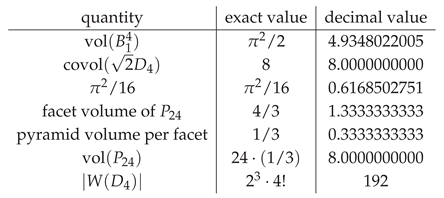
These constants are independent of the chamber row. All chamber-dependent quantities enter only through Gram determinants, packing factors, ordering factors, and the normal-form row identity.
Appendix E.3. Orbit-Weight Sum
The eight orbit weights in each Weyl cycle are
Their sum is
There are 22 cycles, so the total orbit weight is
This is the number printed by the auxiliary check script and the number used in Theorem 3.
Appendix E.4. The Support Function on the Unit Sphere
Evaluating on a sample of uniformly random unit vectors via Lemma 5 gives values in . The minimum is approached at sorted absolute coordinates near , consistent with the exact minimum of 1 on the 24 root directions (Proposition 1). The maximum is approached near and , consistent with Remark 5.
Appendix E.5. Independent Numerical Verification of the Cap-Cutting Bound
The constraint relaxations of Appendix E.2 only perturb root-aligned offsets and so do not test the cap-cutting case of Theorem 4 directly. This subsection reports an independent floating-point search, using half-space intersection and convex-hull volume computation, that does test genuine off-root configurations; the script and its logged output are included in the supplementary archive (verify_capcut.py).
A structural observation. Numerically sampling unit directions u shows that no point with can be at packing distance () from every one of the 24 scaled roots simultaneously: the packing constraint against the nearest root forces , where is the inner product with the nearest root direction, and the covering radius of the 24-root spherical code is exactly (attained at the sign-vertex directions of ), forcing for every direction — outside the open shell. Consequently a genuine cap-cutting neighbour can only occur once at least one root-direction neighbour is absent; in 4000 random trials with all 24 roots present and one extra shell-active direction added, zero configurations satisfied the packing constraint, confirming this directly.
Partial root sets plus a cap-cutting neighbour. Removing k roots at random and adding one shell-active neighbour at a random direction and radius compatible with the remaining roots, and computing the exact Voronoi volume of the resulting cell, gives the minimum volume found over 3000 trials per value of k:

No trial at any k produced a volume below 8; the minimum increases with k, consistent with the intuition that removing more roots leaves more room for the cap-cutting neighbour to be far from the vacated direction, where its effect on the cell is weaker.
A targeted search at the tightest case. The case is the most constrained: dropping a single root leaves room for a replacement neighbour only in a narrow cone around the vacated direction , with r near 2. Biasing trials toward this cone (sampling the angle to uniformly up to radians and r uniformly in ) and keeping only packing-valid configurations against the remaining 23 roots yields valid trials and a minimum volume of
attained at and direction within radians of the vacated root direction . No trial produced a volume below 8, and the minimum found decreases toward 8 exactly as , i.e., exactly as the configuration degenerates back to the full 24-root reference point of Theorem 2. This is precisely the behaviour predicted by the equality characterisation of that theorem and gives no indication of a violation anywhere in the sampled region, including arbitrarily close to the predicted equality locus.
These experiments are floating-point and exploratory: they sample a measure-zero fraction of the continuum of configurations and so cannot replace the exact symbolic verification of Proposition 6. We report them because they probe exactly the case (genuine off-root cap-cutting neighbours, including near the tightest realisable configuration) that the existing constraint-relaxation table of Appendix E.2 does not, and because finding a numerical counterexample would have been the fastest way to learn that Theorem 4 needed further repair; finding none is modest but genuine evidence in the other direction.
References
- Thue, A. Über die dichteste Zusammenstellung von kongruenten Kreisen in einer Ebene. Nor. Vid. Selsk. Skr. 1910, 1, 1–9. [Google Scholar]
- Fejes Tóth, L. Über die dichteste Kugellagerung. Math. Z. 1943, 48, 676–684. [Google Scholar]
- Hales, T. C. A proof of the Kepler conjecture. Ann. Math. 2005, 162, 1065–1185. [Google Scholar] [CrossRef]
- Hales, T. C.; et al. A formal proof of the Kepler conjecture. Forum Math. Pi 2017, 5, e2. [Google Scholar] [CrossRef]
- Viazovska, M. The sphere packing problem in dimension 8. Ann. Math. 2017, 185, 991–1015. [Google Scholar] [CrossRef]
- Cohn, H.; Kumar, A.; Miller, S. D.; Radchenko, D.; Viazovska, M. The sphere packing problem in dimension 24. Ann. Math. 2017, 185, 1017–1033. [Google Scholar] [CrossRef]
- Musin, O. R. The kissing number in four dimensions. Ann. Math. 2008, 168, 1–32. [Google Scholar] [CrossRef]
- Musin, O. R. Towards a proof of the 24-cell conjecture. Acta Math. Hung. 2018, 155, 184–199. [Google Scholar] [CrossRef]
- Blichfeldt, H. F. The minimum value of quadratic forms, and the closest packing of spheres. Math. Ann. 1929, 101, 605–608. [Google Scholar] [CrossRef]
- Cohn, H.; Zhao, Y. Sphere packing bounds via spherical codes. Duke Math. J. 2014, 163, 1965–2002. [Google Scholar] [CrossRef]
- Cohn, H.; Elkies, N. New upper bounds on sphere packings I. Ann. Math. 2003, 157, 689–714. [Google Scholar] [CrossRef]
- Schneider, R. Convex Bodies: The Brunn–Minkowski Theory, second ed.; Cambridge Univ. Press, 2014. [Google Scholar]
- Ziegler, G. M. Lectures on Polytopes; Springer, 1995. [Google Scholar]
- Lasserre, J. B. Global optimization with polynomials and the problem of moments. SIAM J. Optim. 2001, 11, 796–817. [Google Scholar] [CrossRef]
- Putinar, M. Positive polynomials on compact semi-algebraic sets. Ind. Univ. Math. J. 1993, 42, 969–984. [Google Scholar]
- Parrilo, P. A. Structured semidefinite programs and semialgebraic geometry methods in robustness and optimization. Ph.D. thesis, California Institute of Technology, 2000. [Google Scholar]
- Sturmfels, B. Solving Systems of Polynomial Equations. CBMS Regional Conference Series in Mathematics 97, 2002; American Mathematical Society. [Google Scholar]
- Basu, S.; Pollack, R.; Roy, M.-F. Algorithms in Real Algebraic Geometry, second ed.; Springer, 2006. [Google Scholar]
- Coxeter, H. S. M. Regular Polytopes; Dover, 1973. [Google Scholar]
- Conway, J. H.; Sloane, N. J. A. Sphere Packings, Lattices and Groups, third ed.; Springer, 1999. [Google Scholar]
Disclaimer/Publisher’s Note: The statements, opinions and data contained in all publications are solely those of the individual author(s) and contributor(s) and not of MDPI and/or the editor(s). MDPI and/or the editor(s) disclaim responsibility for any injury to people or property resulting from any ideas, methods, instructions or products referred to in the content. |
© 2026 by the authors. Licensee MDPI, Basel, Switzerland. This article is an open access article distributed under the terms and conditions of the Creative Commons Attribution (CC BY) license (http://creativecommons.org/licenses/by/4.0/).
Copyright: This open access article is published under a Creative Commons CC BY 4.0 license, which permit the free download, distribution, and reuse, provided that the author and preprint are cited in any reuse.


