
Submitted:
09 June 2026
Posted:
10 June 2026
You are already at the latest version
Abstract
This paper develops a local complement-topological formulation of codimension selection for primary homotopy linking obstructions. Let D ⊂ Md be a closed embedded submanifold of codimension c. Rather than attempting to classify all homotopy classes of M \ D, the paper focuses on primary local defect-generated classes arising from the punctured normal complement of D. By the tubular neighborhood model, a punctured normal fiber has the homotopy type of Sc−1. Hence the primary local linking sphere associated with a codimension-c defect has dimension c −1, and primary k-sphere detection selects the relation c = k + 1. The paper also introduces an explicit tubular neighborhood model of admissible modification. In this model, when modification is supported near the portion of D inside a region of scale R, there exists a tubular modification whose support is bounded above by O(Rd−c), yielding a subextensive upper bound for the minimal admissible modification cost relative to ambient volume Rd. Worked examples for a codimension-two line defect, a codimension-three defect, and the general product model verify the hypotheses explicitly. Finally, the paper recalls the standard abelianization constraint on abelian loop-valued invariants: in the loop-detectable case, globally composable abelian holonomy-type invariants factor through first homology. The result is not a classification of all homotopies of complements, but a precise local formulation of primary defect-generated linking obstructions and their subextensive tubular admissible-modification behavior.
Keywords:
codimension
; complement topology
; homotopy obstruction
; linking
; tubular neighborhood
; admissible modification
; defect-generated class
; abelianization
; holonomy
1. Introduction
1.1. Motivation
Topological obstructions often arise not from a space itself, but from the topology of the complement of a distinguished subset. If M is a smooth d-dimensional manifold and is a closed embedded submanifold, then the complement
may contain homotopy classes that detect the presence of D. Familiar examples include loops encircling a line defect, spheres surrounding a point or higher-codimension support, and more general linking phenomena in complement topology. Such phenomena are standard in algebraic and differential topology, where homotopy, homology, transversality, and tubular-neighborhood methods provide tools for studying the topology of complements [1,2,3,4,5].
These examples suggest a local complement-topological question: if an embedded defect support is detected by a primary sphere in its complement, which codimension of the support is being detected? Equivalently, one may ask which part of the complement topology is generated by the local normal geometry of the removed submanifold, and how this local class differs from homotopy classes arising from the global topology of the ambient space.
This question must be formulated carefully. The homotopy groups may contain classes arising from several sources. Some classes may be generated locally by the removed defect support D. Others may be inherited from the ambient topology of M, from global features of the embedding of D, from the topology of D itself, or from secondary homotopy phenomena not directly associated with the primary local linking sphere [1,6]. Therefore, a statement about “defect-generated” homotopy cannot be made precise merely by saying that a class belongs to .
The present paper focuses on a restricted but mathematically well-defined case: primary local linking classes generated by the punctured normal complement of D. In this setting, the relevant local object is not the entire complement , but the punctured normal fiber around the defect. This local formulation separates the primary defect-generated contribution from arbitrary homotopy classes of the complement and avoids claiming a classification of all of .
A second motivation is to connect this local complement-topological classification with a controlled modification question. If a primary local obstruction is generated near D, one may ask whether it can be trivialized by a modification supported near the relevant portion of D, rather than by a modification spread throughout the ambient region. This leads naturally to the tubular modification model studied below, where the support of one admissible trivialization is bounded by the size of a fixed-radius tubular neighborhood of . Thus the paper combines two elementary but useful questions: which codimension supports a primary detecting sphere, and when is the associated local obstruction compatible with subextensive admissible modification?
1.2. Main Idea
The central observation is local. If has codimension c, then a normal fiber of D is modeled on . Removing the defect corresponds locally to removing the origin from this normal fiber. Hence the punctured normal fiber has the homotopy type
This is the elementary local complement model supplied by the tubular neighborhood theorem and radial deformation retraction [4,5,7]. Thus the primary normal linking object associated with a codimension-c defect is a sphere of dimension .
It follows that if a primary local defect-generated obstruction is represented as detection by a sphere , then the detecting dimension is not an independent parameter. It is fixed by the codimension of the defect:
This relation is the codimension-selection statement proved below. It should be understood as a statement about primary local linking classes arising from the normal complement, not as a statement about all homotopy groups of .
The paper also introduces a concrete tubular-neighborhood model for admissible modification. In this model, trivializing a primary local obstruction means replacing the admissible structure inside a fixed-radius tubular neighborhood of the relevant portion of D. If is a region of scale R and the portion has controlled -dimensional volume growth, then there exists a tubular modification whose support is bounded above by . Since the ambient d-dimensional volume grows like , this gives a subextensive upper bound for the admissible modification cost.
1.3. What Is New, and What Is Not Claimed
The novelty of the paper is not the tubular-neighborhood theorem by itself, nor the standard universal property of abelianization. Both are classical results [4,5,8,9]. The contribution is instead the way these standard tools are organized into a precise codimension-selection framework for primary local defect-generated linking obstruction under an explicit subextensive admissible-modification model.
More specifically, the paper contributes the following points. First, it formalizes the notion of a defect-generated class by restricting attention to classes represented by the image of the normal linking sphere
Second, it derives the critical relation
from the local punctured normal complement, rather than from an informal dimension-counting argument alone. Third, it separates the topological codimension-selection result from the scaling estimate for admissible modification. Fourth, it provides an explicit tubular model in which the subextensive scaling condition can be checked directly.
Several claims are deliberately not made. The paper does not classify all groups . It does not claim that vanishes outside the critical relation . It does not claim that all homotopy classes of the complement are generated by the defect. It also does not claim that every possible admissible modification model has the same scaling behavior. The theorem concerns primary local linking classes, and the scaling result concerns a concrete tubular modification model.
This restricted formulation is intentional. It makes the theorem less broad but more precise: the result identifies the detecting dimension of the primary normal linking sphere associated with a codimension-c embedded defect and shows that, in a natural tubular model, the corresponding admissible modification cost admits a subextensive upper bound relative to ambient volume.
1.4. Relation to Reconstruction and Admissibility
The language of admissible modification is motivated by structural approaches in which only admissible configurations are compared. In such settings, one does not need to imagine a temporal repair process that passes through non-admissible intermediate states. Instead, one compares admissible configurations directly and asks for the minimal support of an admissible replacement that trivializes a given obstruction. This viewpoint is related to the earlier codimension-two admissible-reconstruction framework developed in Ref. [10].
The present paper formulates this idea in a purely topological and geometric setting. The results do not depend on any particular physical reconstruction theory. Nevertheless, the framework is compatible with reconstruction-based approaches in which persistent local obstruction, admissibility, and geometric support are treated as structural rather than dynamical notions. In that broader context, the present result provides a controlled mathematical example of how localized defect structures may be selected through complement topology and admissible modification constraints, without assuming an additional dynamical repair mechanism.
1.5. Organization
Section 2 introduces defect supports, tubular neighborhoods, normal linking spheres, primary local defect-generated classes, and admissible modification cost. Section 3 establishes the local complement model and identifies the punctured normal fiber with . Section 4 proves the primary local codimension-selection theorem. Section 5 introduces the tubular modification model and proves the corresponding subextensive upper-bound estimate. Section 6 gives worked examples in which the hypotheses are checked explicitly. Section 7 recalls the standard abelianization constraint for abelian loop invariants and explains its interpretation in the codimension-two case. Section 8 clarifies the relation between the present paper and the earlier codimension-two framework. Section 9 states the scope and limitations of the result, and Section 10 concludes.
2. Preliminaries: Defects, Local Classes, and Modification Cost
This section fixes the notation and definitions used throughout the paper. The main purpose is to make precise the sense in which a homotopy class is “defect-generated.” Rather than using this phrase informally, we restrict attention to classes represented by the normal linking sphere in the punctured normal complement of an embedded defect support. This restriction is essential: the complement may contain many homotopy classes unrelated to the local presence of D, and these are not the subject of the main theorem. The distinction between local complement topology and global complement topology is standard in algebraic topology and differential topology [1,2,3,4].
2.1. Manifolds and Defect Supports
Definition 1
(Defect support). Let M be a connected smooth d-dimensional manifold without boundary. A defect support is a closed embedded submanifold of pure codimension c, so that
The word “defect” is used here in a topological sense. It does not imply a particular physical mechanism, singular dynamics, or field equation. It means only that the subset D is removed from the ambient manifold and that the homotopy of the complement may contain classes detecting the presence of this removed support.
Unless stated otherwise, the main homotopy-detection results below concern the case
This assumption ensures that the normal linking sphere has positive dimension and therefore corresponds to ordinary sphere detection with . The codimension-one case leads instead to -type separation phenomena and is not the focus of this paper.
Remark 1.
The assumption that D is smooth and embedded is made to keep the local complement model transparent. Singular, stratified, or non-smooth defect supports are natural extensions, but they require additional local models and are not treated here.
2.2. Tubular Neighborhoods and Punctured Normal Complements
Let denote a tubular neighborhood of D in M. By the tubular neighborhood theorem, is locally modeled on the normal bundle of D [4,5,7]. Thus, over a sufficiently small coordinate patch on which the normal bundle is trivial, one may write
Under this local identification, the defect support corresponds to
Definition 2
(Punctured normal complement). The punctured normal complement of D is
Locally, over a trivializing patch , it is modeled by
The punctured normal complement is the local object responsible for primary defect-generated linking. It isolates the homotopy created by removing the normal zero section from the homotopy of the full complement . This distinction is important because may also contain classes coming from the ambient topology of M, the topology of D, or global features of the embedding.
Remark 2.
The full complement is generally larger and more complicated than the punctured normal complement. The present paper uses the punctured normal complement only to define primary local defect-generated classes. It does not claim that all homotopy classes of arise in this way.
2.3. Normal Linking Spheres
For each point , the normal fiber is a c-dimensional real vector space. Removing the origin gives the punctured fiber
A small sphere around the origin in this normal fiber is the local sphere that links the defect. This is the local geometric source of the usual linking intuition in complement topology [1,3,11].
Definition 3
(Normal linking sphere). Let . A normal linking sphere at p is a small sphere
It is included into the complement by the composition
The normal linking sphere is the canonical local detector associated with a codimension-c defect. The main codimension-selection theorem below derives the detecting dimension from this normal-sphere construction. Thus the dimension is not inserted as an additional assumption; it follows from the local model of a punctured normal fiber.
Remark 3.
For , the normal linking sphere is , giving the familiar case of loop detection around a codimension-two support. For , the normal linking sphere is , giving two-sphere detection around a codimension-three support. The general case is the same local construction in dimension c.
2.4. Primary Local Defect-Generated Classes
We now make precise the sense in which a class is defect-generated in this paper. The definition is deliberately local and restrictive. It uses the image of the normal linking sphere in the complement, rather than an informal comparison between all classes in .
Definition 4
(Primary local defect-generated class). A class in is called primary local defect-generated if, up to the appropriate choice of basepoint and change of basepoint isomorphism, it is represented by the image of a normal linking sphere under the inclusion
This definition is not meant to classify all elements of . It singles out the class produced directly by the punctured normal complement of D. In particular, if has additional homotopy classes arising from ambient topology, global linking, or secondary homotopy groups, those classes are not automatically primary local defect-generated in the sense used here.
2.5. Ambient-inherited and Nonlocal Classes
Let
be the inclusion. The induced map
provides one way to distinguish local defect-generated classes from classes visible in the ambient manifold.
Definition 5
(Ambient-visible class). A class is called ambient-visible if
An ambient-visible class is not, merely by virtue of belonging to , a primary local defect-generated class. The main theorem below concerns classes arising from the normal linking sphere, not classes whose nontriviality is inherited from the global topology of M.
Remark 5.
The condition is not used here as a complete definition of being defect-generated. A class may lie in the kernel of for reasons that are not purely local. For this reason, the primary notion used in this paper is the more restrictive normal-sphere image condition in Section 2.4.
2.6. Admissible Modification Cost
The second ingredient of the paper is a large-scale cost condition. The purpose of this condition is to distinguish obstructions that can be trivialized by a localized admissible replacement from obstructions whose trivialization would require modification on the scale of the whole ambient region.
Definition 6
(Admissible modification). An admissible modification is a replacement of one admissible configuration by another admissible configuration, supported in a specified region, such that a chosen obstruction class becomes trivial. No intermediate non-admissible state is assumed.
This definition is structural rather than dynamical. It compares admissible configurations directly. The term “modification” should therefore not be read as a time-dependent process in which a configuration evolves through non-admissible intermediate states. This usage follows the admissible modification viewpoint introduced in the earlier codimension-two framework [10].
Definition 7
(Modification cost). Let be a large scale parameter, and let the obstruction under consideration be represented in a region of scale R. The admissible modification cost is the minimal measure of a region in which an admissible modification must be supported in order to trivialize the obstruction at scale R.
The measure used in may be chosen according to the setting. In smooth geometric examples, it may be ordinary Riemannian volume or the volume of a controlled tubular neighborhood. In combinatorial or simplicial models, it may be replaced by the number of cells or another monotone large-scale measure. The only feature needed below is its asymptotic scaling with R.
Definition 8
(Subextensive modification). A modification cost is subextensive relative to ambient d-volume if
or equivalently
Subextensivity means that the support required to trivialize the obstruction is negligible compared with the full ambient d-dimensional volume at large scale. The paper will verify this condition explicitly in the tubular modification model introduced next.
2.7. Tubular Modification Model
The admissible modification framework is intentionally abstract, but the main scaling claim of the paper is not left abstract. We use a concrete tubular model in which the modification is supported near the defect itself.
Definition 9
(Tubular modification model). Let denote a region of diameter comparable to R. In the tubular modification model, an admissible modification trivializing a primary local linking obstruction is supported in a fixed-radius tubular neighborhood of
Definition 10
(Tubular trivialization operation). In the tubular modification model, trivializing a primary local linking class means replacing the admissible structure inside a fixed-radius tubular neighborhood of by a local defect-free model, so that the corresponding normal sphere no longer encloses a removed defect support.
This model captures the idea that a primary local linking obstruction is localized around the defect support. If the obstruction is generated by the normal complement of D, then a natural trivializing replacement is one supported near the relevant portion of D, rather than throughout the full ambient region.
Remark 6.
The tubular modification model is not asserted to be the only possible admissible modification model. It is introduced because it is explicit and its scaling behavior can be checked directly. Other admissible modification models may have different costs and would require separate analysis.
3. Local Complement Topology
This section records the local complement-topological facts used in the codimension-selection theorem. The goal is not to compute the full homotopy type of . Instead, the purpose is to identify the local homotopy type produced by removing the defect support from its normal neighborhood. This local computation gives the primary linking sphere associated with a codimension-c embedded defect. The relevant tools are standard: tubular neighborhoods, punctured vector spaces, radial deformation retraction, and elementary homotopy theory [1,3,4,5,7].
3.1. The Punctured Normal Fiber
Let be a closed embedded submanifold of codimension c. For each point , the normal fiber is a c-dimensional real vector space. After choosing a linear identification
the defect point in the normal fiber corresponds to the origin. Removing the defect from the normal direction therefore gives the punctured vector space
Proposition 1
(Punctured normal fiber). Let be a closed embedded submanifold of codimension c. For each , the punctured normal fiber has the homotopy type
Proof.
The normal fiber is a c-dimensional real vector space. After choosing a linear identification with , removing the origin gives . The radial projection
defines a deformation retraction onto the unit sphere. Hence
Therefore the punctured normal fiber has the homotopy type of . □
This proposition is the local source of the codimension-selection relation. The primary detector associated with a codimension-c defect is not chosen arbitrarily. It is the sphere obtained by radially retracting the punctured normal fiber. The argument is elementary, but it is important because it fixes the detecting dimension from the local normal geometry rather than introducing it as an independent assumption.
3.2. Local Punctured Normal Complement
The previous proposition describes a single punctured normal fiber. We now extend this to a local patch of the defect support. Let be a coordinate patch over which the normal bundle is trivial. By the tubular neighborhood theorem, the tubular neighborhood of U may be written as
with U itself corresponding to the zero section . Removing the defect support inside this local neighborhood gives
Proposition 2
(Local punctured normal complement). Let be a coordinate patch over which the normal bundle is trivial. Then
and therefore
If U is contractible, then
Proof.
Over a trivializing patch U, the tubular neighborhood is identified with , and the defect support corresponds to the zero section . Removing this zero section gives
By Proposition 1, the second factor deformation retracts onto . Therefore
If U is contractible, then is homotopy equivalent to . □
Remark 7.
This is a local statement. The global homotopy type of may depend on the topology of D, on the topology of the normal bundle, and on how local trivializations are patched together. The main theorem uses only the primary local normal-sphere class, not a full classification of the global punctured normal bundle or of the full complement .
3.3. Primary Local Linking as Normal-Sphere Detection
The preceding propositions show that the local complement of a codimension-c defect contains a canonical sphere of dimension . This sphere is the normal linking sphere. It is the local object that detects the presence of the removed defect support.
In the simplest local product model,
one has
Thus the primary local homotopy class is represented by the identity class of the normal sphere . In particular, the primary local detector belongs naturally to degree homotopy.
This observation provides the topological core of the codimension-selection theorem. If a primary local obstruction is described as detection by a sphere , then the sphere being used is the normal linking sphere. Its dimension is therefore . This is the source of the relation
Remark 8.
The phrase “primary” is used to distinguish the normal linking sphere itself from secondary homotopy groups of . For example, may be nonzero for values of [1,6]. Such classes can occur in homotopy theory, but they are not the primary normal linking class considered in the codimension-selection theorem.
Remark 9.
The local normal-sphere construction also explains why the theorem below is not a statement about arbitrary homotopy of . A class in the full complement may arise from ambient topology, global features of the embedding, twisting of the normal bundle, or secondary homotopy phenomena. The present paper isolates the primary local class generated by the punctured normal complement.
Figure 1 schematically illustrates this local construction: the defect support , a tubular neighborhood near , the punctured normal fiber , and its deformation retraction onto the normal linking sphere .
4. Primary Local Codimension Selection
This section states and proves the main codimension-selection result. The result is deliberately local. It does not classify all homotopy classes of , nor does it assert that the complement has no other k-dimensional homotopy outside the critical case. Instead, it identifies the detecting dimension of the primary local class represented by the normal linking sphere in the punctured normal complement of D.
The proof uses the local complement computation of Section 3. The essential point is that a codimension-c embedded defect has punctured normal fiber
Thus the primary local detector is not an arbitrary k-sphere. It is the normal linking sphere, whose dimension is fixed by the codimension of the defect. The point of the theorem is not that this deformation retraction is new, but that once defect-generated obstruction is restricted to the image of the punctured normal complement, the detecting dimension is fixed by codimension and is not an independent assumption.
4.1. Statement of the Theorem
Theorem 1
(Primary local codimension selection). Let M be a smooth d-dimensional manifold, and let be a closed embedded submanifold of pure codimension . Suppose that an obstruction in is primary local defect-generated, in the sense that it is represented by the image of a normal linking sphere in the punctured normal complement of D. If this primary local obstruction is described as detection by a k-sphere with , then
Equivalently,
Proof.
Let . Since D has codimension c, the normal fiber is modeled on . By Proposition 1, the punctured normal fiber deformation retracts onto the normal linking sphere:
By Section 2.4, the obstruction is represented by the image of this normal linking sphere under the inclusion
Therefore the primary detecting sphere has dimension . If the same primary local obstruction is described as detection by a sphere , then the detecting sphere dimensions must agree:
Equivalently,
or
□
Remark 10.
The assumption ensures that the normal linking sphere has positive dimension and therefore corresponds to ordinary homotopy detection by spheres with . The codimension-one case leads to -type separation rather than the higher homotopy linking phenomena studied here.
4.2. Relation to General-Position Intuition
The theorem is consistent with the usual dimension-counting intuition from general position and transversality [4,5,7]. If
is a generic smooth map and is a codimension-c embedded submanifold, then the expected dimension of the intersection is
This estimate suggests three regimes.
First, if , then , and a generic k-sphere tends to meet D. In this regime, the relevant phenomenon is not pure complement linking by a sphere avoiding the defect, but rather direct intersection or a model-dependent intersection-removal problem.
Second, if , then . A generic k-sphere can avoid D, but it is still of the correct dimension to appear as the normal linking sphere around a codimension-c support:
This is the critical primary linking case identified in Theorem 1.
Third, if , then . A k-sphere is below the primary normal-linking dimension . Such a sphere may still represent a homotopy class in the full complement for other reasons, but it is not the primary normal linking sphere generated by the punctured normal fiber of D.
Remark 11.
This general-position discussion is explanatory rather than the proof of Theorem 1. The theorem is proved from the local punctured normal complement and the normal linking sphere. The dimension-counting argument is included only to connect the local result with the standard geometric intuition about intersections and linking.
4.3. Why the Statement Is Local
The local nature of the theorem is essential. The full complement may have homotopy groups that are much richer than the local normal model. For example, global topology of M, topology of D, twisting of the normal bundle, or secondary homotopy groups of spheres may contribute additional classes [1,3,6]. These classes are not excluded by Theorem 1.
The theorem instead applies to classes represented by the normal linking sphere
In this restricted setting, the detecting dimension is fixed by the local normal geometry. This is why the conclusion
should be read as a codimension-selection result for primary local linking, not as a universal statement about all elements of .
4.4. What the Theorem Does Not Assert
Theorem 1 does not assert that all of is trivial outside the relation . It also does not assert that every nontrivial class in is defect-generated. Nor does it rule out secondary homotopy classes, global linking classes, or classes inherited from the ambient manifold.
The theorem identifies only the dimension of the primary local normal-linking class associated with a codimension-c embedded defect. This restricted formulation is the reason the result can be stated without relying on an informal distinction between “defect-generated” and “inherited” homotopy. The relevant class is specified by its source: the normal linking sphere in the punctured normal complement.
5. Subextensive Admissible Modification in the Tubular Model
The preceding sections identified the primary local linking sphere associated with a codimension-c defect. This section addresses the second part of the framework: the scaling of admissible modification cost. The purpose is to give an explicit model in which the subextensive condition can be verified directly, rather than treated as a purely abstract assumption.
The model considered here is deliberately simple. A primary local linking obstruction is assumed to be trivialized by modifying the admissible structure only inside a fixed-radius tubular neighborhood of the relevant portion of the defect. In such a model, the size of the modification region is controlled by the size of the defect support inside the region under consideration, not by the full ambient d-dimensional volume. This gives a subextensive upper bound whenever the defect has controlled -dimensional volume growth. The geometric estimates used here are standard consequences of tubular neighborhood geometry and large-scale volume comparison in smooth manifolds [4,5,7,12].
5.1. Volume Growth Along the Defect
Let denote a region of diameter comparable to R, measured with respect to an auxiliary Riemannian metric. This metric is used only to organize large-scale asymptotics; the local complement-topological result of Theorem 1 does not depend on the particular choice of metric.
Assume that the portion of the defect contained in satisfies the growth estimate
This is the standard growth rate for an approximately flat or uniformly controlled -dimensional defect support. For example, in the product model
the portion of D inside a ball of radius R has -dimensional volume of order .
The estimate above should not be read as a universal theorem about all embedded submanifolds in all metrics. It is a regularity assumption defining the controlled large-scale regime considered in this section. More singular growth behavior, fractal supports, or highly distorted embeddings would require separate estimates.
5.2. Tubular Cost Estimate
We now prove the subextensive scaling estimate in the tubular modification model. Since the admissible modification cost is defined as a minimal cost, the existence of one tubular trivialization gives an upper bound on , not necessarily an exact asymptotic equality.
Proposition 3
(Tubular modification upper bound). Let be a codimension-c embedded defect. Suppose that a primary local linking obstruction can be trivialized by a tubular trivialization operation supported in a fixed-radius tubular neighborhood of . Suppose also that
Then there exists an admissible tubular modification with support of size bounded above by
Consequently, the minimal admissible modification cost satisfies
and hence
Thus the tubular modification model is compatible with subextensive admissible modification.
Proof.
By assumption, the tubular trivialization operation is supported in a fixed-radius tubular neighborhood of . Let the radius of this tubular neighborhood be fixed independently of R. Since the radius does not grow with R, the size of the modification region is controlled, up to a constant depending on the chosen radius and local geometry, by the -dimensional volume of . Therefore there exists a tubular modification whose support has measure bounded above by
Using the assumed growth estimate gives
Since is the minimal admissible modification cost, the existence of this tubular modification implies
Dividing by the ambient volume scale , one obtains
Because , the right-hand side tends to zero as . Hence the modification cost is subextensive relative to ambient d-dimensional volume. □
Remark 12.
The estimate is stated as an upper bound because the tubular model constructs one admissible way to trivialize the primary local obstruction. It does not claim that all possible trivializations have this cost, nor that is always the sharp lower bound.
5.3. Compatibility with Primary Local Linking
The preceding estimate is compatible with the interpretation of primary local linking developed in Section 3 and Section 4. A primary local linking class is generated by the punctured normal complement of D. Therefore a natural way to trivialize that class is to replace the local admissible structure near the portion of D responsible for the normal linking sphere. In the tubular model, this replacement is localized near , so its cost is bounded above by the size of a controlled tubular neighborhood of the defect support rather than by the full ambient region.
In the critical case , the estimate becomes
Relative to the ambient scale , this gives
Thus primary k-sphere detection in codimension is naturally compatible with subextensive admissible modification in the tubular model.
5.4. Model-Dependent Extensive Regimes
The result above should be contrasted with possible non-primary or forced-intersection regimes. If a k-dimensional detecting object is not the primary normal linking sphere, or if a proposed trivialization requires modifying a positive-density portion of the ambient region, then the cost may scale extensively. However, such behavior depends on additional assumptions about the admissible modification model and is not derived here as a universal geometric theorem.
This distinction is important. The present paper does not assume extensive cost in non-critical regimes in order to prove subextensivity in the critical case. Instead, it proves a direct subextensive upper bound in an explicit tubular model. Extensive-cost behavior, if relevant in a different setting, must be justified separately from the geometry or admissibility rules of that setting.
Therefore, the rigorous scaling result established in this section is the following limited claim: for a primary local linking obstruction that can be trivialized by a fixed-radius tubular modification near , and for a defect support satisfying
the admissible modification cost has a subextensive upper bound relative to ambient d-volume.
Figure 2 schematically illustrates the tubular modification model: the admissible replacement is supported only in a fixed-radius neighborhood of , so its size is controlled by the -dimensional growth of the defect rather than by the full ambient volume.
6. Worked Examples
This section gives explicit models in which the objects appearing in the preceding sections can be checked directly. Each example specifies the ambient manifold M, the defect support D, the complement , the primary detecting sphere, and the tubular modification upper bound. The examples are elementary, but they are included to make clear that the definitions and scaling assumptions are not merely formal.
6.1. Codimension-Two Line Defect and Loop Detection
Example 1
(Line defect in ). Let
Then D is a closed embedded submanifold of dimension 1 and codimension . Its complement is
Since is contractible and deformation retracts onto , one obtains
Therefore
The generator is represented by a loop encircling the line defect in the normal fiber. This is precisely the primary normal linking sphere . Hence
Now let be a ball, or any comparable region, of diameter of order R. The portion has length . In the tubular modification model, a fixed-radius tubular trivialization is supported near this portion of the line defect. Hence there exists an admissible tubular modification with support bounded above by . Therefore the minimal modification cost satisfies
The ambient volume scale is , so
Thus the primary local codimension-selection relation and the tubular subextensive upper bound are both explicitly verified in this model.
6.2. Codimension-Three Defect and Two-Sphere Detection
Example 2
(Codimension-three defect in ). Let
Then D is a closed embedded submanifold of dimension 2 and codimension . Its complement is
Since is contractible and deformation retracts onto , one has
Consequently,
The generator is represented by a two-sphere surrounding the origin in the normal fiber. This is the primary normal linking sphere . Hence
If is a region of diameter comparable to R, then the relevant portion has two-dimensional area . A fixed-radius tubular trivialization supported near therefore has support bounded above by . Hence
The ambient volume scale is , and therefore
This verifies explicitly the codimension relation and the subextensive tubular modification bound in the first higher-sphere case beyond loop detection.
6.3. General Product Model
Example 3
(General product defect). Let , and let
Then D is a closed embedded submanifold of codimension c. The complement is
Since is contractible and deformation retracts onto , one obtains
Thus the primary local homotopy group is
The primary local detector is the normal linking sphere . Setting
gives
If is a region of diameter comparable to R, and if has -dimensional volume , then a fixed-radius tubular trivialization supported near has support bounded above by . Hence
Dividing by the ambient scale , one obtains
Therefore the general product model verifies both the local codimension-selection relation and the subextensive tubular modification upper bound.
Remark 13.
These examples are not intended to exhaust the possible topology of . They demonstrate the primary local mechanism in its simplest form. More complicated complements may contain additional global or secondary homotopy classes, but those are not part of the primary normal-linking classification used in Theorem 1.
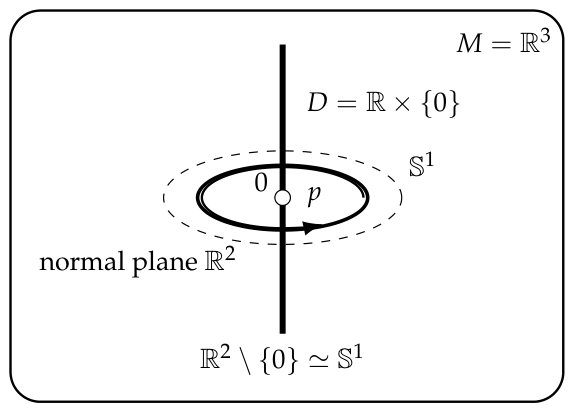
Figure 3 illustrates the codimension-two case: a line defect in has punctured normal plane , whose primary local detector is the linking loop .
7. Standard Abelianization Constraint for Abelian Loop Invariants
The preceding sections established the local codimension-selection result for primary homotopy linking. This section records a separate algebraic point that is relevant only in the loop-detectable case . When the detecting objects are loops and the obstruction values are required to compose in an abelian target, only the abelianized part of the fundamental group can be detected.
The result used here is completely standard: any homomorphism from a group to an abelian group factors through the abelianization of the source group [8,9]. It is included only to clarify the algebraic information visible to abelian holonomy-type loop invariants. It is not part of the proof of the codimension-selection theorem and is not claimed as a new algebraic theorem.
7.1. Loop Detection and Composability
In the case , the detecting objects are loops in the complement
and the relevant homotopy group is the fundamental group
where is a chosen basepoint. In the codimension-two case, the primary local detector is a loop encircling the defect support. This is the familiar situation in which a loop avoids the defect but detects it by linking with it.
Suppose that an obstruction invariant assigns to each loop class an element of a target group A. If this assignment is compatible with loop concatenation, then it is a homomorphism
The composability condition means that for loop classes ,
When A is abelian, this condition imposes a strong restriction: the invariant cannot distinguish commutator information in .
7.2. The Standard Abelianization Fact
Lemma 1
(Standard abelianization fact). Let G be a group and let A be an abelian group. Any homomorphism factors uniquely through the abelianization
where is the commutator subgroup of G. Equivalently, there exists a unique homomorphism
such that
where
is the quotient map.
Proof.
This is the standard universal property of abelianization. Since A is abelian, every commutator in G lies in the kernel of H. Therefore , and H descends uniquely to the quotient . The induced map is unique because is surjective. □
Remark 14.
Lemma 1 is a classical result in elementary group theory. It is recalled only to clarify what information can be detected by globally composable abelian loop invariants. The mathematical contribution of the present paper lies in the local codimension-selection framework and the tubular modification model, not in this standard algebraic fact.
7.3. Interpretation for Codimension-Two Linking
Applying Lemma 1 to
shows that any globally composable abelian loop invariant factors through
By the degree-one Hurewicz theorem, this abelianization is naturally identified with the first homology group [1,2]:
Thus, in the codimension-two case, abelian holonomy-type invariants detect the homological component of loop linking. They do not detect non-commutative commutator information in the fundamental group. If the complement has a non-abelian fundamental group, such non-abelian information may be present, but it is invisible to any invariant that is both globally composable and abelian valued.
This interpretation separates two questions. The first is the geometric question of which codimension supports primary loop detection. That question is answered by the local codimension-selection theorem: loop detection corresponds to , hence to codimension . The second is the algebraic question of what part of the loop structure can be seen by abelian invariants. Lemma 1 answers this second question: globally composable abelian invariants see only the first homology class of the loop.
Remark 15
(Minimal abelian target). If one additionally requires the target to be continuous, compact, connected, and one-dimensional, then is the standard minimal example of such an abelian target. This observation is interpretive and is not used in the codimension-selection theorem.
8. Relation to Previous Work
The present paper is a refinement and higher-dimensional local extension of the earlier codimension-two framework developed in Ref. [10]. Because the terminology and scope of the present paper differ from that earlier work, this section clarifies which elements are inherited, which elements are reformulated, and which results are new here.
The earlier framework focused on loop-detectable obstruction and codimension-two support. The present paper no longer frames the result as a broad statement about all persistent homotopy obstruction in . Instead, it restricts the theorem to primary local defect-generated linking classes represented by normal linking spheres in the punctured normal complement of D. This narrower formulation is mathematically more precise and allows the codimension relation to be derived directly from the local normal model.
8.1. Elements Inherited from the Previous Codimension-Two Framework
The earlier codimension-two framework studied loop-detectable obstruction associated with the complement of a defect support [10]. Its central motivation was that a loop may avoid a codimension-two subset while still detecting it by linking. In local form, this is the familiar situation in which the punctured normal plane
deformation retracts onto
Thus a codimension-two defect naturally supports loop detection. This local picture is consistent with standard complement-topological and tubular-neighborhood reasoning [1,3,4].
The present paper inherits three basic ideas from that framework. First, it retains the idea that complement topology can detect the presence of a defect support. Second, it retains the emphasis on persistent obstruction under large-scale extension. Third, it retains the language of admissible modification: rather than allowing arbitrary deformation, one asks whether an obstruction can be trivialized by a replacement supported in a controlled region.
However, the present paper reformulates these ideas in a more local and explicit manner. In particular, admissible modification is used structurally rather than dynamically. An admissible modification is a comparison between admissible configurations, not a temporal repair process passing through non-admissible intermediate states. This reformulation is intended to make the present argument self-contained and to separate the topological content from any broader reconstruction interpretation.
8.2. New Contributions of the Present Paper
The present paper revises and extends the earlier framework in several ways.
First, it gives a formal local definition of defect-generated classes. Instead of treating “defect-generated” as an informal distinction between classes created by D and classes inherited from M, the present paper restricts attention to classes represented by the image of the normal linking sphere
This makes the scope of the theorem precise and avoids conflating local normal-complement classes with arbitrary classes in .
Second, the paper generalizes the loop-detectable case to primary k-sphere detection. The earlier codimension-two case corresponds to and . The present paper shows that the same local normal-fiber logic gives
so that the primary detecting sphere has dimension . Hence primary k-sphere detection gives
Third, the proof of the codimension relation is no longer based primarily on a three-regime scaling argument. Instead, it is based on the local complement topology of the punctured normal fiber. The general-position discussion is retained only as explanatory intuition, not as the main proof. This shift is important because the theorem is now proved from the source of the local class itself: the normal linking sphere in the punctured normal complement.
Fourth, the present paper provides an explicit tubular modification model in which the subextensive scaling condition can be checked directly. If
then a tubular trivialization supported near gives the upper bound
and therefore
Thus subextensivity is verified in a concrete model rather than assumed as an abstract condition. This is a significant narrowing of the claim: the paper does not assert a universal cost law for all admissible modification models.
Fifth, the paper includes worked examples in which the manifold, defect support, complement homotopy, detecting sphere, and cost estimate are all specified explicitly. These examples include a line defect in , a codimension-three defect in , and the general product model
They are included to make clear that the hypotheses of the theorem and the tubular modification estimate can be checked directly.
Finally, the present paper reframes the abelianization discussion. The fact that a homomorphism from a group to an abelian group factors through abelianization is a standard algebraic result [8,9], not a new theorem. It is therefore used only as a standard lemma clarifying the information visible to globally composable abelian loop invariants.
8.3. Why the Revised Formulation Is Narrower
The narrower formulation is intentional. A broad statement about arbitrary classes in would have to account for ambient topology, global embedding effects, twisting of normal bundles, secondary homotopy groups, and other phenomena not generated solely by the local normal complement [1,3,6]. Such a statement would be much stronger than what is needed for the codimension-selection result proved here.
By focusing on primary local linking classes, the present paper isolates the part of the complement topology that is directly generated by the removed defect support. In this restricted setting, the detecting sphere is fixed by the punctured normal fiber, and the codimension relation follows cleanly:
This narrower formulation also makes the admissible modification framework more concrete. Instead of asserting a universal extensive or subextensive cost law, the paper proves a subextensive upper bound in a specific tubular model. Other modification models may be possible, but they require separate analysis.
Thus the present work should be understood not as a replacement for the previous codimension-two framework, but as a sharper local formulation of its central topological mechanism and a higher-dimensional extension of its primary linking principle. The result is narrower than the original broad formulation, but it is also more precise: it identifies exactly which local class is being studied and verifies the corresponding subextensive cost behavior in an explicit model.
9. Scope and Limitations
This section summarizes the scope of the preceding results and clarifies the limitations of the framework. These limitations are not incidental. They are part of the intended formulation of the paper. The main theorem is a local codimension-selection result for primary normal linking classes, not a global classification theorem for all homotopy classes of complements. The distinction between local normal-complement topology and global complement topology is standard in algebraic and differential topology [1,2,3,4].
9.1. Primary Classes Only
Theorem 1 concerns primary local linking classes represented by the normal sphere
It does not classify all classes in . This restriction is essential because the full complement may contain classes that are not generated by the local normal geometry of the defect.
Thus the conclusion
should be read as a statement about the primary local detector associated with the punctured normal fiber. It should not be read as a statement that all k-dimensional homotopy in must arise from codimension supports.
9.2. Global Topology
The ambient manifold M, the defect support D, and the global embedding of D in M may contribute additional homotopy classes to the complement. For example, nontrivial topology already present in M may remain visible after removing D. Similarly, global features of the embedding of D, the topology of D itself, or the topology of the normal bundle may influence the homotopy type of [1,3,11].
Such classes are outside the scope of the main theorem unless they are represented by the primary local normal-linking sphere. The present framework therefore separates local defect-generated linking from global complement topology. This separation is useful precisely because it avoids conflating local codimension selection with a full computation of the homotopy type of the complement.
9.3. Secondary Homotopy Phenomena
Higher homotopy groups of spheres may contain nontrivial secondary classes. For example,
may be nonzero for values of [1,6]. Such classes may be important in other homotopy-theoretic settings, but they are not the primary normal linking class considered here.
The primary class is the class represented by the normal linking sphere itself. Therefore its detecting dimension is . Secondary classes, if present, would require a separate analysis. They may depend on unstable or stable homotopy groups of spheres, on additional structure in the complement, or on composition phenomena not captured by the primary local detector.
9.4. Modification Models
The tubular modification model is one explicit setting in which subextensive cost can be verified. In that model, a primary local linking obstruction is trivialized by a replacement supported in a fixed-radius tubular neighborhood of . Under the controlled growth assumption
this gives the upper bound
and hence
Other admissible modification models may have different scaling behavior. For example, a model may impose additional constraints requiring modification away from the defect support, or it may impose global compatibility conditions that increase the required support. Such possibilities are not ruled out by the present paper. The result proved here is the more limited statement that the primary tubular model is compatible with a subextensive upper bound on admissible modification cost.
9.5. No Universal Extensive-Cost Theorem
The paper does not prove a universal extensive lower bound for non-primary, forced-intersection, or non-critical regimes. Such a lower bound may hold in particular admissibility models, but it would require additional assumptions about what must be changed in order to trivialize an obstruction.
This point is important for the logical structure of the paper. The subextensive result in Proposition 3 is not obtained by assuming that all other regimes are extensive. It is obtained by constructing an explicit tubular modification whose support has subextensive size. Any extensive-cost claim in a different regime must be justified separately from the geometry or admissibility rules of that setting.
9.6. Abelianization
The abelianization result used for loop invariants is classical [8,9]. It is included only to clarify the algebraic content visible to abelian holonomy-type invariants. In particular, the statement that a homomorphism from a group to an abelian group factors through abelianization is not a new theorem of the present paper.
The role of this observation is interpretive. In the loop-detectable case, globally composable abelian invariants detect only the first-homology component of loop structure. They do not detect non-commutative commutator information in the fundamental group. This algebraic observation is independent of the codimension-selection theorem, which is proved from the local punctured normal complement.
9.7. Smooth Embedded Supports
Finally, the paper assumes that the defect support D is a closed smooth embedded submanifold of pure codimension. This assumption ensures that the tubular-neighborhood model is available and that the punctured normal fiber is locally modeled by
Singular defects, stratified supports, self-intersecting supports, or defects with varying local codimension may require different local models. Extending the present framework to such settings is a natural direction for future work, but it lies outside the scope of the present paper.
10. Conclusions
This paper has formulated a local complement-topological codimension-selection result for primary homotopy linking obstructions. The central point is that, for a closed embedded codimension-c defect , the punctured normal fiber has the homotopy type
This standard local complement model follows from tubular-neighborhood geometry and radial deformation retraction [4,5,7]. Therefore the primary local linking obstruction generated by D is detected by a sphere of dimension . Equivalently, if a primary local obstruction is described as k-sphere detection, then
The result should be understood in its intended local sense. It does not classify all homotopy classes of , nor does it imply that vanishes outside the relation . The theorem concerns the primary local class represented by the normal linking sphere in the punctured normal complement. This restriction separates local defect-generated linking from ambient topology, global embedding effects, normal-bundle structure, and secondary homotopy phenomena [1,3,6].
The paper also introduced a concrete tubular-neighborhood model of admissible modification. In this model, a primary local linking obstruction can be trivialized by a replacement supported near the portion of D contained in a region of scale R. Under the controlled growth assumption
there exists a tubular modification whose support is bounded above by . Thus the minimal admissible modification cost satisfies the subextensive upper bound
This provides an explicit setting in which the admissible modification framework can be checked directly.
Worked examples illustrate the construction for a line defect in , a codimension-three defect in , and the general product model
These examples verify the local complement model, the detecting sphere, and the subextensive tubular modification upper bound explicitly.
Finally, the loop-detectable case was supplemented by the standard abelianization constraint: any globally composable abelian loop invariant factors through the abelianization of the fundamental group, equivalently through first homology [1,8,9]. This observation clarifies the algebraic content visible to abelian holonomy-type detection, but it is not part of the codimension-selection proof and is not claimed as a new algebraic result.
Future work may extend the present framework in several directions. One direction is to replace smooth embedded defect supports by singular, stratified, or variable-codimension supports. Another is to study secondary higher-homotopy obstruction and non-abelian or higher-categorical invariants. A third is to develop more detailed admissible modification models, including models motivated by geometric or physical reconstruction frameworks. The present paper provides the local complement-topological core for these extensions: primary defect-generated linking is carried by the punctured normal fiber, and its detecting dimension is selected by codimension.
Funding
This research received no external funding.
Data Availability Statement
The original contributions presented in this study are included in the article. Further inquiries can be directed to the corresponding author.
Conflicts of Interest
The author declares no conflicts of interest.
References
- Hatcher, A. Algebraic Topology; Cambridge University Press: Cambridge, UK, 2002. [Google Scholar]
- Spanier, E.H. Algebraic Topology; McGraw-Hill: New York, NY, USA, 1966. [Google Scholar]
- Bredon, G.E. Topology and Geometry; Springer: New York, NY, USA, 1993. [Google Scholar]
- Hirsch, M.W. Differential Topology; Springer: New York, NY, USA, 1976. [Google Scholar]
- Guillemin, V.; Pollack, A. Differential Topology; Prentice-Hall: Englewood Cliffs, NJ, USA, 1974. [Google Scholar]
- Whitehead, G.W. Elements of Homotopy Theory; Springer: New York, NY, USA, 1978. [Google Scholar]
- Milnor, J.W. Topology from the Differentiable Viewpoint; University Press of Virginia: Charlottesville, VA, USA, 1965. [Google Scholar]
- Lang, S. Algebra, Revised 3rd ed.; Springer: New York, NY, USA, 2002. [Google Scholar]
- Rotman, J.J. An Introduction to the Theory of Groups, 4th ed.; Springer: New York, NY, USA, 1995. [Google Scholar]
- Li, B. Topological Classification of Admissible Reconstruction Operations. Int. J. Topol. 2026, 3(2), 8. [Google Scholar] [CrossRef]
- Bott, R.; Tu, L.W. Differential Forms in Algebraic Topology; Springer: New York, NY, USA, 1982. [Google Scholar]
- Munkres, J.R. Analysis on Manifolds; Addison-Wesley: Redwood City, CA, USA, 1991. [Google Scholar]
- Pontryagin, L.S. Topological Groups; Gordon and Breach: New York, NY, USA, 1966. [Google Scholar]
- Hewitt, E.; Ross, K.A. Abstract Harmonic Analysis; Springer: Berlin, Germany, 1979; Vol. I. [Google Scholar]
- Fuchs, L. Abelian Groups; Springer: Cham, Switzerland, 2015. [Google Scholar]
- Lee, J.M. Introduction to Smooth Manifolds, 2nd ed.; Springer: New York, NY, USA, 2013. [Google Scholar]
- Massey, W.S. A Basic Course in Algebraic Topology; Springer: New York, NY, USA, 1991. [Google Scholar]
Figure 1.
Primary local linking from the punctured normal complement. A codimension-c defect support has a normal fiber at each point . Removing the defect corresponds locally to puncturing the normal fiber at the origin. The punctured normal fiber deformation retracts onto the normal linking sphere . Thus the primary local detector associated with a codimension-c defect has dimension .
Figure 1.
Primary local linking from the punctured normal complement. A codimension-c defect support has a normal fiber at each point . Removing the defect corresponds locally to puncturing the normal fiber at the origin. The punctured normal fiber deformation retracts onto the normal linking sphere . Thus the primary local detector associated with a codimension-c defect has dimension .
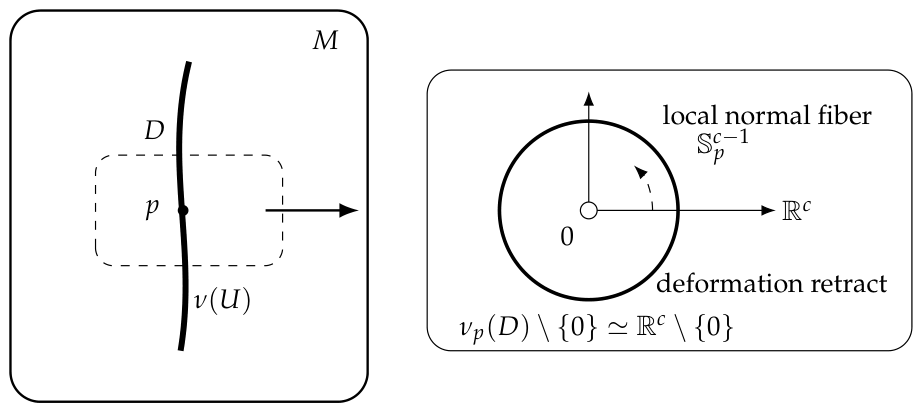
Figure 2.
Tubular modification upper bound. In the tubular modification model, trivialization of a primary local linking class is supported inside a fixed-radius tubular neighborhood of . If the defect portion satisfies , then there exists a tubular modification whose support is bounded above by . Since the ambient region has volume scale , this yields the subextensive upper bound .
Figure 2.
Tubular modification upper bound. In the tubular modification model, trivialization of a primary local linking class is supported inside a fixed-radius tubular neighborhood of . If the defect portion satisfies , then there exists a tubular modification whose support is bounded above by . Since the ambient region has volume scale , this yields the subextensive upper bound .
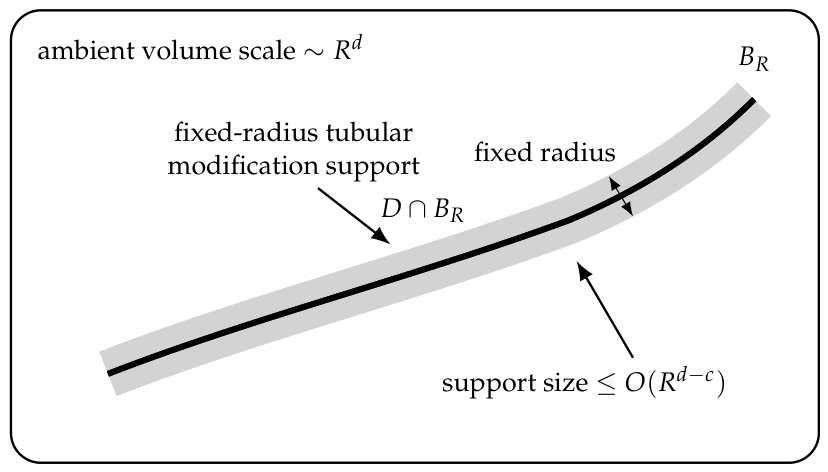
Figure 3.
Codimension-two line defect and loop detection. For the defect support , the normal fiber at each point is . Removing the defect punctures the normal plane, giving , which deformation retracts onto the linking loop . Thus the primary local detector is a loop encircling the defect, corresponding to and .
Figure 3.
Codimension-two line defect and loop detection. For the defect support , the normal fiber at each point is . Removing the defect punctures the normal plane, giving , which deformation retracts onto the linking loop . Thus the primary local detector is a loop encircling the defect, corresponding to and .
Disclaimer/Publisher’s Note: The statements, opinions and data contained in all publications are solely those of the individual author(s) and contributor(s) and not of MDPI and/or the editor(s). MDPI and/or the editor(s) disclaim responsibility for any injury to people or property resulting from any ideas, methods, instructions or products referred to in the content. |
© 2026 by the authors. Licensee MDPI, Basel, Switzerland. This article is an open access article distributed under the terms and conditions of the Creative Commons Attribution (CC BY) license (http://creativecommons.org/licenses/by/4.0/).
Copyright: This open access article is published under a Creative Commons CC BY 4.0 license, which permit the free download, distribution, and reuse, provided that the author and preprint are cited in any reuse.


