

Submitted:
09 June 2026
Posted:
10 June 2026
You are already at the latest version
Abstract
This essay discusses feminist ideas in connection to the occulture present in opera, musical theatre, and film, focusing on femme fatales, tricksters and ‘wicked women’ in a transcultural approach to religion, (Western) esotericism, and the performing arts. A culturally critic debate is facilitated here via the spiritual-scientific embodiment of Afro-Brazilian traditions, as seen through the figure of Pombagira — a Brazilian occultural creation of a female enchantress with mystical powers connected to healing and sex, often placed in patriarchal opposition to her male counterpart, Exu. Drawing on Christopher Partridge’s notions of occulture and Walter Mignolo’s understanding of decoloniality, the Western gendering imposed on Pombagira as a purveyor of Evil is discussed as both mythology and potential epistemicide. The thesis statement presented here is that the Pombagira episteme is an underlying emblem throughout art and scholarship invested in queering essential binary categories of womanhood, as seen in staged adaptations of Verdi’s La forza del destino (1862), Bizet’s Carmen (1875), and numerous cinematic Lola incarnations — Marlene Dietrich’s in Der blaue Engel (1930), Gwen Verdon’s in Damn Yankees (1958), Almodóvar’s in Todo sobre mi madre (1999). This indisciplinary reading connects Gloria Anzaldúa's queer feminist practice of spiritual mestizaje with the Pombagira as an occultural anti-patriarchal force.
Keywords:
Pombagira
; Afro-Brazilian traditions
; spiritual mestizaje
; opera
; film
; feminism
; intersectionality
1. Introduction
As an author and practicing esotericist, I have often pondered on how the modern western disciplinary thinking has often created differentiations between certain alleged diametrically opposed binaries: human/subhuman, developed (North)/underdeveloped (South), masculine/feminine, sacred/profane, private/public, divine/demonic, etc. My work over the past ten years has explored feminist intersectional readings of ‘occulture’ [1]— Partridge's term for the re-enchantment of art, popular culture, and everyday life through esoteric and spiritual currents – from mantra chanting in Dakṣiṇācāra-tantra read through the dissipative structures theory of Nobel laureate Ilya Prigogine [2], to the present occultural inquiries into Pombagira's anti-patriarchal force [3]. This positionality is not incidental to the research — it is the research; the same ‘lack of nuance’ and ‘insider orientation’ often flagged by reviewers in religious studies and esotericism journals when trying to publish my hypotheses is, I would argue, the epistemic intimacy that patriarchal disciplinary gatekeeping has historically penalized [4].
In my master’s thesis at the Humboldt University of Berlin, paramount to the existence of this essay, I have roamed exactly the academic journey in correlating not merely the birth of western modern science with Christianity [5], but also with the disciplinary capitalist patriarchal structures which led to sixteenth- and seventeenth century witch hunts [6], and to the modern historical demarcation of esoteric currents into what Wouter Hanegraaff has defined as rejected knowledge [7]. According to my own ethico-onto-epistemology [8] as an occultural scholar and artist, I have always defined myself through what Hanegraaff has cited as the not necessarily taken path of ‘direct and explicit’ self-identification by Western esotericists [7] (p. 145). My intention with this academic rapport, beyond an identity politics of performative nature, has had the purpose to make perfectly clear how I define myself and my work through an indisciplinary way of thinking [9,10,11].
This conception is perhaps more than embodied as not only an epistemology of thinking, but also as means to relate to the modern disciplinary boundaries in a transgressive manner. I would argue here that the Pombagira, in her syncretic and transcultural meaning – one which I have been approximating in my work to the concept of ‘spiritual mestizaje’ [12], explored by North American queer feminist Gloria Anzaldúa (1942–2004) – embodies exactly this transgressive female power feared by the disciplinary patriarchal body of modernity.
To be spiritually mestiza, in Anzaldúa's worldview, means to be exiled from every homeland and therefore heir to all of them — to carry within oneself the unresolved, the unmappable, the creature of darkness and the creature of light who refuses to choose between them and instead tears open the very distinction [13]. Mestiza consciousness does not reconcile opposites; it kneads them, alchemizes them, lets them coil around each other like the quickening serpent that knows movement itself is home [12,13]. It is a morphogenesis [12] — not arrival, but perpetual unfolding, the great work of a soul that was never meant to be still.
Pombagira knows this restlessness from within. She too was never meant to fit, never meant to be legible to the world that named her “wicked” [14,15,16] for refusing its terms. Western modernity and its patriarchal inheritance [17] could not absorb her — could only misname her, fear her, exile her to the margins of the profane — and in doing so, unknowingly preserved the very wildness they sought to contain. She moves where categories break down, where the binary between virtue and transgression loses its footing, where the serpent leaps and the goddess laughs. That Pombagira has survived centuries of colonial and patriarchal misrepresentation not as a diminished figure but as an ever-proliferating one suggests that what the Western modern episteme cast out, it could never fully extinguish — and that her occultural force draws its power precisely from the uncontainable threshold she has always inhabited [18].
To call Pombagira “empowered” as a female figure is to undermine her own capacity to obliterate patriarchal disciplinary categorization. Her power lies in being both harlot and saint, Mary Magdalene and Mother Mary, concubine and spouse – a duality that lies beyond the rule of men.
1.1. The (Un)Holy Streetwalker
Pombagira has been the object of fascination and fear for many believers, non-believers, scholars of religion and spirituality, ethnologists, anthropologists, as well as artists such as the author. She is considered by many to be the “prototype of a prostitute” [19], often acting as the ‘patron saint of sex workers’ [20], and she ‘embodies transgressive femininity, is sexually independent, unsubduable, and the antithesis of a docile and maternal housewife’ [19] (p. 73). To some white European women, Pombagira might not seem emblematic of a feminist deity — particularly within a tradition of bourgeois feminism that locates women's emancipation primarily in intellectual and rational agency, and that, in doing so, reproduces the Cartesian split between mind and body, severing erotic power from its lived, bodily knowledge. As a transgressive female enchantress, her might lies not in the pen, but in her body.
It is precisely this severing that Audre Lorde identifies in her landmark essay "Uses of the Erotic: The Erotic as Power" [21], where she theorizes the erotic not as sexuality in the reductive sense, but as a deep and irreducible knowledge rooted in the body — a source of power that patriarchal and Western rationalist structures have systematically suppressed in women, and particularly in Black women, by relegating it to the pornographic or the shameful. For Lorde, reclaiming the erotic means reclaiming a form of knowing that operates below and beyond the Cartesian hierarchies of mind over body, reason over feeling, culture over nature. It is from this position — embodied, diasporic, and uncontainable by Western moral taxonomies — that the Pombagira becomes legible not as a figure of transgression to be explained away, but as a sovereign epistemic force in her own right.
She, as one of the main figures of spiritual and religious practices from the Afro-Brazilian diasporic occulture observed in Candomblé, Umbanda and Quimbanda (also spelled as Kimbanda), is often described by scholars of religion, sociology and anthropology as the “wife of Exú” or “female persona of Exú” [22] — Exu being the spiritual entity responsible for mediating between the physical and spiritual worlds, and the guardian of crossroads and thresholds in Afro-Brazilian traditions. While this description serves its ethnological and anthropological purpose, such a disciplinary delimitation genders the Pombagira not only under western patriarchal stratagems but also renders this spiritual entity as a potential matrimonial female subaltern of a hierarchically superior male one. In this essay, I hope to establish how an intersectional queer feminist reading of the Pombagira archetypical force can eviscerate both the ‘abyssal lines’ [23] of western epistemological thinking exposed by the Portuguese sociologist Boaventura de Sousa Santos in his fundamental Epistemologies of the South: Justice against Epistemicide, as well as the ethnocentric – and sometimes blatantly racist – views which connect this female enchantress to problematic concepts such as that of “black magic” [24].
Pombagira’s chicane form of knowledge, embodied by her ‘ambiguous’ power [25], commonly regarded by both laymen and scholars as being located outside of the domestic realm and, consequently, external to familial reproductive work, has been observed in gendered and racialized interpretations of that spiritual entity by both popular and scholarly cultures through the patriarchal disciplinary idea of a “bad woman” — those who, as Silvia Federici defines it, 'refuse these roles' of mother and housewife and are consequently 'not treated as workers on strike but as bad women' [17] (p. 176) — something which this author has been noticing in some scholarly renderings of the Pombagira as a medium of wicked femininity [14]. While this might not have been purposefully intended in a patriarchal categorization, it has de facto operated a westernized evaluation of this Afro-Brazilian deity under notions of representing a “dark side of femininity” and her supposed wickedness, casting on the Pombagira a ‘patriarchalizing gaze’ [26,27] consistent with what some psychoanalytical thought, such as Sigmund Freud’s and Jacques Lacan’s, has defined as ‘castration anxiety’ [28,29]. The queering of this interpretation by some scholars, nonetheless, has helped understand Pombagira’s wittiness – instead of wickedness – outside of a western phallic castration complexity [30].
Pombagira and Exu appear in some scholarly texts from a highly racialized and historically ethnocentric interpretation of their occultural readings, mainly from a modern westernized point of view inside and outside of Brazil. To undo their patriarchal renderings by engaging in dialogic discourse with the Pombagira episteme cannot be achieved, in this vein, without first undoing a few patriarchal myths that have perpetuated the binaries of “white” and “black” magic, “right-hand spiritual path” (i.e. good) and “left-hand spiritual path” (i.e. evil), and so on. In this regard, while I have no intention of letting professor of religious studies at Indiana University-Indianapolis Kelly E. Hayes hang for writing on Pombagira as being connected to “black magic” – especially since Hayes has authored one of the most comprehensive academic books on this intermediary being in English up to date —, it is still of my interest to question her understanding of this problematic term and propose decolonial readings of the binaries that continue to produce the lines of abyssal thinking explored in this essay.
These abyssal lines — the invisible epistemic boundaries that divide legitimate from illegitimate knowledge, rendering entire traditions invisible or demonic to the Western gaze, as theorized by Santos [23] — are not merely theoretical constructs. They are operative in the very language used to describe the Pombagira, and it is precisely their decolonial undoing that this essay proposes as its central methodological gesture. The connection between this epistemic violence and Mignolo's understanding of dewesternization will be explored more fully in Section 3.
If I can now invoke my own place of speech [31,32,33] as a Brazilian émigré thinker and practicing esotericist, it is important to once again reaffirm the idea that binary ways of thinking uphold disciplined, deterministic and gendered views on nature and culture, as well as contribute to what Italian Marxist theorist Antonio Gramsci (1891–1937) has defined as the cultural demarcation of a bourgeois intellectual hegemony responsible for preventing the ‘emancipation of the subaltern classes’ [34,35]. What I hope to demonstrate with this essay is that Pombagira’s indiscipline as onto-epistemology represents precisely the erotic and intellectual movement towards a re-enchantment of the West that operates not merely as a scholarly reclaiming of rejected fields of knowledge, but precisely as embodiment of spiritual-scientific thinking — the indisciplinary entanglement of embodied knowledge, esoteric practice, and critical inquiry.
2. Re-Enchanting Scholarship: Towards a Spiritual Mestizaje
There is a moment in every encounter with the sacred — whether in a terreiro (an Afro-Brazilian ritual space), a darkened opera house, or the flickering light of a cinema screen — when the boundary between the known and the unknowable dissolves, and something older and wilder than doctrine briefly surfaces. It is in precisely these liminal thresholds that the re-enchantment of the West, as theorized by Christopher Partridge [1], becomes not merely a cultural phenomenon but an epistemological rupture — a crack in the armor of Cartesian modernity through which suppressed knowledge systems return, uninvited and untamed. Partridge's concept of occulture names the process by which esoteric, spiritual, and magical currents re-enter art, popular culture, and everyday life not as relics of a pre-modern past but as living, generative forces that refuse the secularizing narrative of Western modernity. What Partridge maps culturally, Anzaldúa enacts bodily: her spiritual mestizaje is not a theory of re-enchantment so much as its lived practice — the serpent movement of a consciousness that weaves together the severed threads of indigenous, diasporic, and marginalized knowledge into something that cannot be contained by any single disciplinary framework [12,13]. It is at the intersection of these two currents — Partridge's occulture and Anzaldúa's mestiza consciousness — that the Pombagira becomes fully legible as a figure of scholarly re-enchantment: not an object of study to be explained, but a force that explains, one whose ‘chthonian’ and ‘daemonic’ ambivalence, in Camille Paglia's sense [36], has always already exceeded the categories Western modernity built to contain her.
Anzaldúa's serpent is not merely a metaphor. It belongs to a much older current of embodied, non-western knowledge in which the serpent figures not as the agent of original sin — as Christian doctrine would have it — but as the very force of life, transformation, and feminine power — "feminine" here signifying an operative and generative principle rather than a gender designation — coiling at the base of existence itself. This serpentine consciousness, which mestiza epistemology recovers from the margins of colonial erasure, finds a striking resonance in what Western Indologists and scholars of Tantra have documented under the Sanskrit concept of kundalinī-shakti — literally ‘coiled power’ — the dormant operative energy understood in yogic and tantric traditions as the fundamental force of spiritual awakening. That two such geographically and culturally distant traditions — one rooted in the borderlands of the American Southwest and Mesoamerica, the other in the esoteric currents of South Asian practice — should arrive at the same serpentine image for the power that patriarchal and colonial structures most urgently seek to suppress is not, I would argue, coincidental. It is occultural.
This serpentine current has been extensively documented in Western esotericism and Indology through the work of Georg Feuerstein (1947–2012) [37] and Arthur Avalon — the pseudonym of Sir John Woodroffe (1865–1936) — [38], whose scholarship on kundalinī-shakti as a feminine cosmological force residing at the base of the human body and awakened through tantric practice remains foundational to any cross-cultural understanding of serpentine power as spiritual epistemology. The “serpent power”, thus, connects this daemonic creature to the realms of both the sacred and the profane, and helps it gain a different spiritual meaning [13] (pp. 1–38).
If kundalinī-shakti names the serpent's upward movement toward enlightenment in South Asian tradition, it is Camille Paglia's concept of the chthonian that names its darker, earthbound twin in the Western imagination — the daemonic feminine that civilization has always feared and never successfully buried [36]. For Paglia, the chthonian is not evil but amoral: it is nature's own indifference to human order, the swamp beneath the city, the body beneath the mind. It is precisely here that the Pombagira becomes legible as a figure of mestiza consciousness — she who carries the serpent's knowledge in both directions at once, upward toward the sacred and downward toward the earth, refusing the Christian separation of the two, and embodying in her very indiscipline the occultural force that Western modernity has spent centuries trying to name, contain, and ultimately failed to extinguish.
2.1. A mestiza Consciousness in Play: Pombagira Maria Padilha
Of the many figures within the Pombagira constellation, it is Maria Padilha — the most widely invoked and culturally visible of her manifestations — who most acutely crystallizes the tensions between daemonic feminine power and patriarchal misrepresentation explored in this essay.
In Afro-Brazilian priesthood, Babalorixá and scholar Rodney William defines Pombagira as a liminal female figure that walks the fine line between the beautiful, demure and homely daytime womanhood, and who in the shadows or at night becomes something else: a purveyor of mystery imbued with both facets of good and evil [18] (16:28–17:30). Thus, the sexual and gendered dichotomies of the modern western patriarchal disciplinary thinking could be relativized by the powerful occultural influence of this female spiritual entity. Furthermore, this connection that the Babalorixá describes of the Pombagira within the realm of the mysterious resonates with both Camille Paglia’s views on the female body as a sacred, secret space — the temenos of the daemonic nature [36] (p. 9) — as well as with Kocku von Stuckrad's readings evoking the thoughts of German philosopher and biographer Rüdiger Safranski on the concept of das Ungeheure — the monstrous or uncanny power that exceeds rational containment [39] (p. 32) — in the European cultural history of the soul around 1900. These aspects of the occulture are especially important for understanding Rodney William’s comparison and criticism of Pombagira with the Christendom figure of Eve as Adam’s subaltern. In this author’s understanding, this can be seen in the dialectic movement between being woman (Eve), and becoming woman (Lilith) — or vice-versa — in an occultural take on French existentialist philosopher Simone de Beauvoir's (1908–1986) The Second Sex [40] maxim 'one is not born, but rather becomes, a woman' — a becoming that, in Pombagira's case, refuses any fixed direction, moving as fluidly from Lilith toward Eve as from Eve toward Lilith.
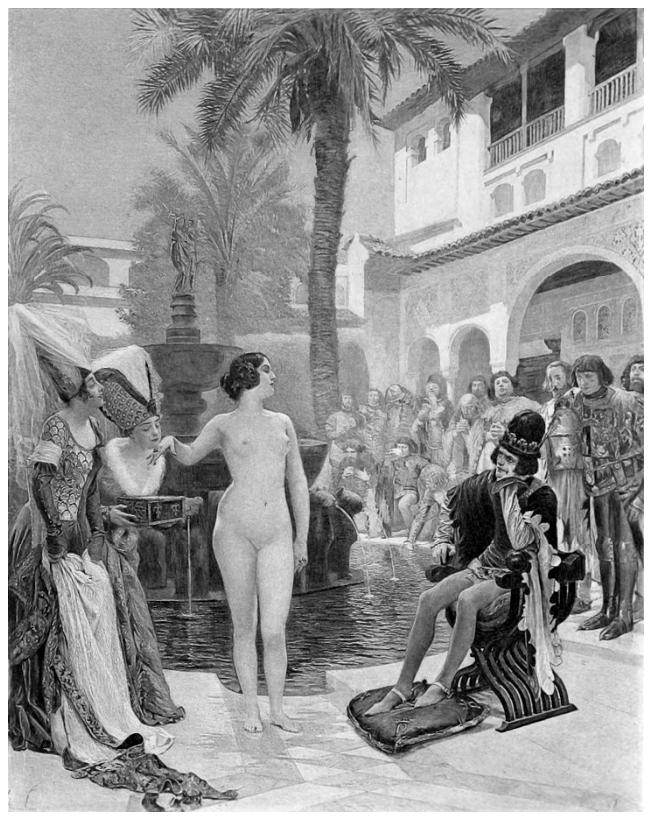
In accordance, Maria Padilha’s imaginary evokes the occultural echelon of a high sorceress: considered popularly as the queen of the Pombagiras, her name is usually used as a metonym for all the other Pombagira incarnations [41]. She has even been compared by Western esotericists to great European witch figures such as Herodias and Aradia, and is regarded by spiritually mestiza thinkers, such as Aníbal Mejía, as a ‘witch queen’ [30] (p. 84). An atemporal inspiration for many creative and artistic creations, María de Padilla (The Spanish 'María de Padilla' refers to the historical medieval figure (1334–1361), mistress of King Peter I of Castile, whose name and legend subsequently entered the Afro-Brazilian spiritual tradition. The Brazilian Portuguese 'Maria Padilha' designates the Pombagira entity derived from and inspired by this historical figure, and should be understood as a distinct cultural and spiritual creation rather than a direct transposition) (1334–1361), the historic medieval figure turned immortal whose mysterious spiritual cult in the New World allegedly sparked from her actual earthly existence, was the source for an 1837 opera by French composer Pierre-Alexandre-Joseph Doche (1799–1849) and another one in 1841 by Italian composer Gaetano Donizetti (1797–1848). Padilla also graced the verses of German poet Heinrich Heine (1797–1856) in his poem “Spanische Atriden” (1851) and appeared as the gipsy queen Bari Crillisa whose incantation song is invoked by the titular character of 1845 novella Carmen by French writer Prosper Mérimée (1803–1870) [41] (pp. 117-120). Moreover, perhaps more widely known, the Pombagira-Padilla historical and gypsyological connection to opera Carmen (1875) by Georges Bizet (1838–1875), adapted from Mérimée’s homonymous work, is a subject which has attracted the attention of scholars and artists alike [3,42,43,44], including notably [19] (pp. 76–77) and [41] (p. 117). Pombagira Maria Padilha thus embodies an indisciplinary queer ethico-onto-epistemology — a spiritual mestizaje, in Anzaldúa's terms — of trickster wise women who transit liminal spaces, embodying in-between-ness, and creating fissures in patriarchal notions on citizenship, national identity, imperial power, and fixed gender roles.
Figure 1.
Paul-Jean-Louis Gervais, María de Padilla at the Baths, 1895. Oil on canvas. Centre national des arts plastiques, Paris, France. Public domain. The historical figure's association with the ritual of the baths became central to the legend of her mystical and erotic powers, prefiguring the spiritual transmission of her name and story into the Afro-Brazilian Pombagira tradition — and enacting, under the patriarchal gaze of the male artist, precisely the daemonic feminine that Western modernity would simultaneously desire and seek to contain.
Figure 1.
Paul-Jean-Louis Gervais, María de Padilla at the Baths, 1895. Oil on canvas. Centre national des arts plastiques, Paris, France. Public domain. The historical figure's association with the ritual of the baths became central to the legend of her mystical and erotic powers, prefiguring the spiritual transmission of her name and story into the Afro-Brazilian Pombagira tradition — and enacting, under the patriarchal gaze of the male artist, precisely the daemonic feminine that Western modernity would simultaneously desire and seek to contain.
3. Methodology: Spiritual Mestizaje as Indisciplinary Practice
If the preceding sections have established what spiritual mestizaje is as a theoretical and epistemological position, this section addresses what it means to practice it as a research methodology — that is, to bring it to bear on the specific materials, readings, and interpretive moves that constitute this essay's analytical work. Indisciplinary practice, as this author understands it, is not a method in the conventional sense of a set of replicable procedures, but rather an onto-epistemological orientation: a way of approaching sources, bodies of knowledge, and artistic objects that refuses the disciplinary separations between the sacred and the scholarly, the embodied and the analytical, the practitioner and the researcher.
The material culture of the author's own ritual practice offers a concrete entry point into the indisciplinary methodology this essay enacts. Figure 2, Figure 3 and Figure 4 — Figure 2 presenting the physical ritual objects of the author's practice, Figure 3 a Brazilian collaborative performatic embodiment of the Pombagira archetype, and Figure 4 a European artistic interpretation — materialize the non-dual relationship between Pombagira and Exu in ways that resist purely textual analysis. The trident of Exu, seen physically in Figure 2a, is straight and each of its three spiked ends points to the sky, whilst the trident of Pombagira is curved, and only the middle-spiked end points to the sky, as the other two curve toward the center. This formal distinction is not merely aesthetic but cosmologically significant. According to Brazilian religious scholar, astrologer and writer Ricardo Hida [45] (p. 13), the visual grammar of the pontos riscados — sacred drawings normally made by a medium on the ground, on a stone or on fabric with a pemba, a limestone chalk used in different colors — follows a consistent symbolic logic: straight lines convey power, curves indicate flexibility and awareness, spirals translate vibrational movement, and crosses mark the conjoining of the sacred and material worlds. Within this grammar, the circle surrounding a ponto riscado delimits a bounded universe, while half circles signal absorption or magnetization. It is precisely this symbolic system that accounts for the formal difference between the two tridents — the former straight and upward-pointing, expressing raw power and vertical force, the latter curved and turned inward, expressing receptivity, flexibility, and the coiling awareness we have already encountered in Anzaldúa's quickening serpent.
These drawings work like mandalas, opening or closing portals, or helping to settle certain energetic manifestations — and to engage with them as analytical objects is itself an indisciplinary gesture, one that refuses the separation between the scholar's desk and the medium's circle.
The two artistic collaborations that follow — produced in the context of this research and documented in Figure 3 and Figure 4 — extend this indisciplinary practice beyond the solitary ritual space into the domain of creative and artistic exchange, enacting across national, cultural, and aesthetic boundaries precisely the transcultural mestizaje this essay theorizes. In this author's understanding of spiritual mestizaje, as developed throughout this essay, the Pombagira archetypical force can be understood beyond its strictly religious or spiritual meaning and into occulture — not through an act of secularization, but through what might be called an ethical expropriation: one that preserves her spiritual-scientific prowess while refusing the patriarchal and colonial frameworks that have historically contained it. Central to this methodological commitment is the recognition of Pombagira's Black and African diasporic essence as the irreducible foundation of any occultural reading — an essence that this essay seeks to honor by privileging her embodiment within Brazilian Candomblé and Umbanda over the French spiritist epistemology with which Umbanda has often been identified in the scholarly literature [46]. This shift — from a Eurocentric spiritist framing toward an occulturally mestiza one — constitutes not merely an interpretive choice but an ethical movement in the direction of decolonial, spiritual-scientific understanding. It is from this triple positionality — practitioner, researcher, and collaborative artist — and with full awareness of the responsibilities it entails, that the close readings of Section 4 proceed.
4. Readings: Pombagira Across Traditions and Stages
4.1. Carmen (Bizet, 1875): The Unsubduable Enchantress
A brief occultural study of recent stagings of Georges Bizet's (1838–1875) Carmen (1875) illuminates how the connection between an empowered, transgressive femininity and its patriarchal coding as "evil" is currently undergoing a visible transformation in the Western performing arts imaginary. The opera's premise is well known: Carmen, a Romani factory worker whose erotic sovereignty and refusal of domestication make her illegible — and therefore threatening — to the patriarchal order embodied by the sergeant Don José, is stabbed to death by him outside a bullring after her choosing the bullfighter Escamillo over her former lover. The original libretto, adapted by Henri Meilhac and Ludovic Halévy from Prosper Mérimée's 1845 novella of the same name, encodes Carmen's death as the inevitable consequence of her indomitability — the "bad woman" who refuses the roles of mother and housewife must, in Federici's terms, be punished [17] (p. 176). She is, in the Pombagira episteme, the enchantress who was never meant to survive the patriarchal libretto written for her.
In January 2018, Florence's Teatro del Maggio Musicale staged a production directed by Leo Muscato in which Carmen does survive — by snatching Don José's pistol and shooting him dead. Cristiano Chiarot, head of the Teatro del Maggio Musicale, posed the question publicly: "At a time when our society is having to confront the murder of women, how can we dare to applaud the killing of a woman?" [47]. The production was timed explicitly to align with the global #MeToo movement and the Italian national conversation about femicide, noting that over 100 women are killed by men in Italy every year, in most cases by current or former partners. [48] The rewritten ending drew widespread criticism from within the opera world.
The former Artistic Director and Chief Director of the Komische Oper Berlin from 2012 to 2022, Barrie Kosky’s own response to the same conundrum, premiered at the Royal Opera House shortly after the Florence controversy, and offers a more nuanced and, from the perspective of this essay's argument, more occulturally resonant solution. Rather than rewriting the libretto, Kosky left the text intact and transformed the staging: the entire opera was performed on a minimalist staircase, framed as a vaudeville performance or a manifestation of Carmen's own consciousness. At the moment of Don José's fatal blow, Carmen does not stay dead — she rises, dusts herself off, and walks away. [49] The staging reframes Carmen not as a mortal victim of domestic violence, but as what she has always been in the Pombagira episteme: an indestructible, mythic force that patriarchal violence can wound but never extinguish. Kosky's Carmen does not need the libretto rewritten because she exceeds it — she is, like Pombagira herself, an ever-proliferating figure that the Western modern episteme cast out and could never fully suppress.
The connection between Carmen and the historical María de Padilla has been noted in the gypsiology literature [42], but its occultural significance — the transmission of a medieval Castilian noblewoman's spiritual legend into the body of a Romani factory worker whose musical characterization by Bizet encodes precisely the daemonic feminine that Paglia theorizes — has received less sustained attention. This is in part a consequence of the methodological limits of feminist opera criticism's most influential intervention: Catherine Clément's Opera, or the Undoing of Women (1988) [50], which offers a powerful indictment of the operatic canon's systematic destruction of its female protagonists but confines its analysis almost exclusively to the libretto as literary text. Clément's argument — that opera is a machine for the repeated, aestheticized killing of women — is not entirely wrong, but it is incomplete and reductive. Opera is not a literary form with musical accompaniment; it is a systemic art form in which meaning is generated at the intersection of musical-dramaturgy, vocal embodiment, staging, and text, and in which these elements frequently work in tension with or even against each other. Carmen's indomitability, for instance, is not merely a function of what the libretto says about her — it is encoded in Bizet's harmonic language, in the modal inflections of the Habanera, in the rhythmic instability of her musical phrases that resist resolution in the same way her character resists containment. To read Carmen through the Pombagira episteme is to read her musically as well as textually — to hear in her vocal line the same coiling, threshold-dwelling force that the tridents on the altar materialize, and that no patriarchal libretto has yet succeeded in silencing.
Underlying both the historical Carmen of Mérimée's novella and Bizet's operatic incarnation is a genealogical thread that gypsiology has begun to trace but that the occultural perspective of this essay allows us to read more fully: the figure of María de Padilla (1334–1361), whose legend we encountered in Section 2.1, resurfaces in Mérimée's text as the gypsy queen Bari Crillisa, whose incantation Carmen invokes [41] (pp. 117–120). The transmission is not merely literary but spiritual — the same feminine force that the medieval Castilian court could not contain, that inspired a cult in the New World and was eventually absorbed into the Afro-Brazilian Pombagira tradition as Maria Padilha, reappears in nineteenth-century French Romanticism as a Romani woman whose erotic sovereignty the patriarchal libretto must punish with death. That she keeps surviving — in Muscato’s and Kosky's staging, in the feminist rewritings, in the ever-proliferating incarnations of the Pombagira constellation — is the essay's argument made visible in the history of Western performance itself. Carmen does not die because the Pombagira does not die. She is, as Kosky's staging intuited without naming it, an indestructible mythic force: the enchantress who was exiled to the margins of the profane and kept returning, laughing, to the center of the stage.
4.2. La Forza del Destino (Verdi, 1862): Mestiza Consciousness on the Operatic Stage
If Carmen encodes the Pombagira episteme in the figure of a Romani woman whose erotic sovereignty the patriarchal libretto must punish with death, Verdi's La forza del destino (1862) stages it across an entire dramaturgy of racial, gendered, and spiritual liminality. Donna Leonora — separated from her lover Don Alvaro after a gun accidentally discharges and kills her father, the Marchese di Calatrava, then pursued across continents by her vengeance-seeking brother Don Carlo — disguises herself as a man and retreats to live as a hermit in a secluded cave, close to a convent. Her trajectory is one of radical unbelonging: she refuses the domestic roles assigned to her by class and gender, crosses the boundary between masculine and feminine, sacred and profane, and ultimately pays for that crossing with her life. Don Alvaro himself embodies a parallel liminality — a man of mixed heritage, frequently described in the libretto as carrying Inca ancestry, whose racial indeterminacy places him permanently outside the fixed categories of eighteenth-century Seville. Together, Leonora and Alvaro constitute a mestiza consciousness avant la lettre: two figures whose love is not merely romantically impossible but epistemically threatening, because it connects across every boundary — racial, gendered, spiritual — that the patriarchal colonial order depends on maintaining.
Frank Castorf's 2019 production at the Deutsche Oper Berlin injected this latent postcolonial and queer potential into the staging with characteristic provocation. Castorf set the opera in the Spanish Civil War for the first two acts, leading into the US-led liberation of Naples in World War Two for the second half, with a revolving set offering varied locations including a church, a field hospital, and the home of the Marchese di Calatrava, augmented by live action cameras projecting onto a large screen. [51] Most strikingly for the purposes of this essay, Castorf added the character of "Der Indio" — a Brazilian indigenous Revuetänzer played by Afro-Brazilian performer Ronni Maciel — who gyrated acrobatically around the set in a diamond thong, seemingly a reflection of Leonora's spirit, as well as a representation of the Marchese’s repressed, alternative side. [51] This almost naked, gender-bending Brazilian figure — visually evoking the Pombagira archetype in its queerness, its corporeality, and its refusal of the Western moral taxonomies that the opera's other characters inhabit — functioned as a living ponto riscado drawn across the stage: a liminal presence that opened a portal between the opera's nineteenth-century colonial world and the Afro-Brazilian spiritual tradition that this essay has been tracing throughout.
The audience reaction was extraordinary — isolated boos and whistles during the spoken interjections exploded when Maciel's Indio repeated his monologue, an extract from Heiner Müller's Der Auftrag (The Mission, 1979) [52], first in German and then in Brazilian Portuguese with a Carioca accent – foreign to the Deutsche Oper’s audience. [53,54] Müller's text — a meditation on the betrayal of the Haitian Revolution and the failure of European Enlightenment promises of liberation to reach the colonized world — could not have been more precisely chosen: spoken by a gender-fluid Brazilian body on the stage of one of Germany's most avant-garde opera houses, it transformed Castorf's already provocative staging into an explicitly postcolonial indictment of the same Western episteme that the Pombagira, in this essay's reading, has always already exceeded. Castorf's use of "Der Indio" was deliberate on multiple levels: the character served simultaneously as a reflection of Leonora's spirit, a visual exploration of South American colonialism and indigenous identity, and a corporeal interruption of the Eurocentric operatic frame — a Brazilian, sequin-spangled, almost naked body inserted into the heart of a canonical German opera house as both provocation and postcolonial commentary. That Castorf chose a Brazilian revue dancer specifically, rather than a generic exotic figure, connects the staging directly to the Afro-Brazilian and indigenous South American traditions that the opera's own libretto suppresses in its treatment of Don Alvaro's Inca heritage.
The anger of the Deutsche Oper's traditional opera-going public at precisely the moment when the Afro-Brazilian, Portuguese-speaking, gender-fluid body made itself most audible and present on their stage is not, from the perspective of this essay, merely a sociological observation about opera audiences. It is an enactment of the same patriarchal and colonial epistemological reflex that has historically exiled Pombagira to the margins of the profane — the same disciplinary gatekeeping, relocated from the academic journal to the opera house, that punishes the uncontainable feminine for refusing its terms. That Maciel's Indio, like Kosky's Carmen, kept returning to the stage regardless — kept dancing, kept speaking in Portuguese, kept occupying the center of a European canonical space that had not invited him — is the Pombagira episteme made flesh.
4.3. Der blaue Engel (Sternberg, 1930) and Damn Yankees (Donen, 1958): Lola's Ethnic Drag and the Pombagira Constellation
Before turning to the cinematic Lolas, it is worth pausing on the name itself — and on the constellation of names that the Pombagira inhabits. Among her many Maria incarnations are Pombagira Maria Padilha, Pombagira Maria Baiana (Mary from the Brazilian state of Bahia), Pombagira Maria Bonita (Mary, the Beautiful), Pombagira Maria Navalha (Mary Razor Blade), Pombagira Maria Mulambo da Lixeira (Mary Wretched of the Garbage), and Pombagira Maria Farrapo (Mary Rags), among many others [55] (pp. 96–97). The prevalence of the name Maria across this constellation resonates with the tradition of the Black Madonna [56,57] — suggesting a syncretic absorption of Catholic Marian devotion into Afro-Brazilian spiritual practice that itself enacts the transcultural mestizaje this essay theorizes. Each Maria name is a different threshold, a different incarnation of the same uncontainable force — and it is in precisely this logic of proliferating, threshold-dwelling incarnations that the figure of Lola becomes legible as an occultural extension of the Pombagira archetype in European and North American cinema.
The first to take the name Lola was Elizabeth Gilbert (1821–1861), an Irish woman who erased her past entirely when she became Lola Montez — fashioning herself as ‘Maria Dolores de Porris y Montez, the proud and beautiful daughter of a noble Spanish family’ [58] (p. 15) in what film scholar Simon Richter has called a performance of ethnicity ‘as a kind of drag’ [58] (p. 137). Though Lola Montez's name was never transliterated into the Pombagira tradition as happened with Maria Padilha, her trajectory enacts the same indisciplinary logic: an uncontainable feminine force exiled from every fixed homeland — Irish, English, Spanish, Bavarian, American — and therefore, in Anzaldúa's terms, heir to all of them. Like the mestiza, Lola Montez refused every fixed direction of becoming; like Pombagira, she proliferated across cultures and centuries, generating a cinematic lineage that extends from Marlene Dietrich's Lola Lola in Der blaue Engel (1930) to Gwen Verdon's parodic Señorita Lolita Hernando in Damn Yankees (1958). As Richter argues, ‘from the beginning, Lola names a space for the play not only of gender and desire but also of ethnicity and possibly race’ [58] (p. 138) — a space that, in the reading proposed here, is precisely the occultural threshold that the Pombagira has always inhabited.
Marlene Dietrich's Lola Lola in Josef von Sternberg's Der blaue Engel is, in Richter's formulation, the ‘Ur-Lola’ [58] (p. 25) — the paradigmatic incarnation from which all subsequent cinematic Lolas derive. Her power, like Pombagira's, resides not in the libretto written for her but in what she does with and beyond it: she is a cabaret performer whose erotic sovereignty destroys a bourgeois professor not through malice but through the simple fact of her unsubduability, her refusal to perform the roles of mother, wife, and domestic anchor that patriarchal modernity assigns to women. Sternberg's film encodes this from the opening scene, where Lola Lola's existence is structured entirely around her stage persona — her bedroom, kitchen, and dressing room connected by a spiral staircase that makes her private and public selves indistinguishable, her "real" name and past entirely unknown [58] (p. 14). She is, like Pombagira, a threshold figure: present and powerful precisely because she cannot be located, fixed, or named from outside her own terms.
Gwen Verdon's Lola in Damn Yankees extends this into explicit ethnic and racial drag: introduced in the Broadway musical as ‘Señorita Lolita Banana’ and in the film as ‘Señorita Lolita Hernando, the former Miss West Indies’ [58] (p. 137), she performs a Latinized femininity that parodies the Ur-Lola's Spanish-inflected origins while simultaneously deploying them to disrupt the clean-cut moral universe of American baseball culture. Verdon's Lola, as Richter notes, is ‘warmhearted’ in her parody [58] (p. 30) — she is not a villain but a trickster, one who plays the patriarchal game with full awareness of its rules and refuses to be defeated by them. In this, she is perhaps the cinematic figure closest in spirit to the Pombagira's wittiness — the "wicked woman" who was never wicked, only ungovernable.
4.4. Todo Sobre Mi Madre (1999)—The Transgender Body, Queer Kinship, and the Pombagira as Sacred Feminine
Pedro Almodóvar's Todo sobre mi madre (All About My Mother, 1999) has received sustained scholarly attention for its treatment of transgender identity, queer kinship, and the melodramatic tradition. Scholars have noted how the film proposes queer matrilineal genealogies as an alternative to institutional motherhood, incorporating friends, lovers, and strangers into networks of care that obtain a spontaneous and improvised quality rather than reflecting normative family structures [59]. The presence of transgender characters Agrado and Lola has been read as highlighting the constructed, performative nature of gender roles [60], and the film's matrifocal solidarity has been described as enacting the subversive and utopian power of walking together [59,60]. What this scholarship has not yet done — and what this section proposes — is to read the film through the lens of the Pombagira episteme and the framework of occultural mestiza consciousness developed throughout this essay. That reading is offered here not as a claim about Almodóvar's conscious intentions, but as an indisciplinary encounter between a film saturated with the sacred feminine and a theoretical framework capable of receiving it on its own terms.
The film's transgender Lola — played by Toni Cantó — is the absent center around whom all the other characters orbit. She appears late, already diminished by illness, walking with a cane, imperious but nearing death [58] (p. 132). Yet her absence structures everything: she is, unwittingly, the father of two sons by two different women — one of whom died in a car accident on the night he was trying to get an actress's autograph, the other infected with HIV and born to a nun who worked with drug addicts in the sex trade. Lola's body has been everywhere and touched everything, and the film's entire network of queer kinship is organized around the wake of her passage. She is, in the Pombagira episteme, the enchantress who generates life and transformation precisely through her uncontainability — a figure whose erotic and spiritual force exceeds every category that the patriarchal and Catholic moral order attempts to impose on it: gender, parenthood, sanctity, transgression. Like Pombagira herself, Lola is not a villain but an overwhelming force of nature — "wicked" only in the eyes of those who cannot absorb her terms.
This excess is enacted most visibly in Almodóvar's treatment of the sacred feminine. The film's final image — Sister Rosa's HIV-positive baby, miraculously free of the virus, held up like an offering — resonates with the iconography of both the Black Madonna and the Pombagira: a dark, diasporic, transgressive sacred feminine that produces life from the margins of respectability, from the intersection of sex work, religious vocation, and queer desire. That the child survives where his mother did not, mirrors the Pombagira's own logic of proliferation — the enchantress who was supposed to be contained keeps generating new life, new kinship, new meaning beyond the patriarchal scripts written for her. Almodóvar does not name this force occultural. But the film enacts it — in Lola's imperious walk, in the candles and altars that recur throughout his visual vocabulary, in the way his women and transgender characters inhabit the threshold between the sacred and the profane with the same sovereign ease that Pombagira has always inhabited the crossroads.
What Todo sobre mi madre ultimately offers the argument of this essay is a confirmation that the Pombagira episteme is not confined to the Afro-Brazilian religious context from which it originates, nor to the explicitly Latinized or racialized figures of Carmen and the cinematic Lolas. It is present wherever a cultural imaginary has reached, however unconsciously, for the figure of an uncontainable, queer, generative feminine force that patriarchal and colonial epistemology has repeatedly tried to name, punish, and extinguish — and repeatedly failed. The goddess does not die. She proliferates. In Almodóvar's Barcelona, as in Bizet's Seville, Verdi's eighteenth-century Spain, and Sternberg's Weimar Berlin, she dusts herself off and walks away — carrying with her, each time, the seed of the other half of the dyad, the Exu force that was never her opposite but always her complement, the trickster who laughs at the boundary between life and death, sacred and profane, wicked and wise.
5. The Pombagira Episteme as Occultural Anti-Patriarchal Force: Discussion
The close readings undertaken in Section 4 — across opera, musical theatre, and film, from nineteenth-century Seville to Weimar Berlin to contemporary Barcelona — converge on a single, recurring observation: that wherever Western modernity's patriarchal and colonial imagination has reached for the figure of the uncontainable, transgressive, erotically sovereign feminine, it has produced a figure that exceeds its own framing. Carmen survives her libretto. Leonora's transgression generates the very dramatic force that the opera cannot contain. Marlene Dietrich’s Lola Lola outlasts the professor she destroys. Gwen Verdon's Lola defeats the devil's own game with a warmth the patriarchal script did not anticipate. Almodóvar's Lola proliferates across two generations and multiple bodies, infecting everything she touches with life. This persistence is not accidental. It is, this essay has argued, the signature of the Pombagira episteme — an occultural force that operates as what the author's earlier research identified as an ‘indisciplinary onto-epistemology,’ a spiritual-scientific practice of knowing and being that patriarchal disciplinary thinking has repeatedly sought to name, contain, and extinguish, and repeatedly failed to do so [3].
Walter Mignolo argues that coloniality is the darker side of Western modernity — a complex matrix of power created and controlled by Western men and institutions from the Renaissance through the late twentieth century — and that two forces are now challenging this order: dewesternization, an irreversible shift in struggles over knowledge and politics, and decoloniality, which requires delinking from the colonial matrix of power underlying Western modernity to imagine global futures no longer organized around the relentless accumulation of wealth, and the exploitation of human beings and the natural world. [61] It is within this framework that the Pombagira–Exu dyad becomes fully legible not merely as a religious or cultural phenomenon but as an epistemological intervention: a non-Western, non-dual cosmological pairing whose very existence challenges the binaries — masculine/feminine, sacred/profane, good/evil, rational/occult — upon which the colonial matrix of power depends. To read Pombagira through the performing arts, as this essay has done, is to perform dewesternization in the domain of cultural criticism: to insist that the knowledge embedded in Afro-Brazilian spiritual tradition is not a footnote to Western modernity but a force that has been actively shaping its artistic imagination from within, whether or not that modernity has been willing to acknowledge it.
This is precisely the argument that the author's master's thesis, At the Crossroads of Knowledge: Undoing the Patriarchy with the Pombagira (Humboldt-Universität zu Berlin, 2023), developed through a dialogical and artistic approach — proposing an embodied spiritual mestizaje as the decolonial alternative to what Max Weber called ‘die Entzauberung der Welt’ (the dis-enchanting of the world) [62], and arguing that the re-enchantment of Western scholarship requires not merely the inclusion of non-Western knowledge systems but their epistemological rehabilitation as legitimate forms of knowing [3]. The present essay extends that argument into the specific domain of the performing arts, proposing that the Pombagira–Exu dyad functions as an occultural archetype whose transcultural network — spanning Afro-Brazilian spiritual traditions, Western esotericism, feminist theory, and the performing arts — constitutes a living counter-epistemology to the abyssal lines that Santos identified as the structural mechanism by which Western modernity renders other knowledges invisible [23].
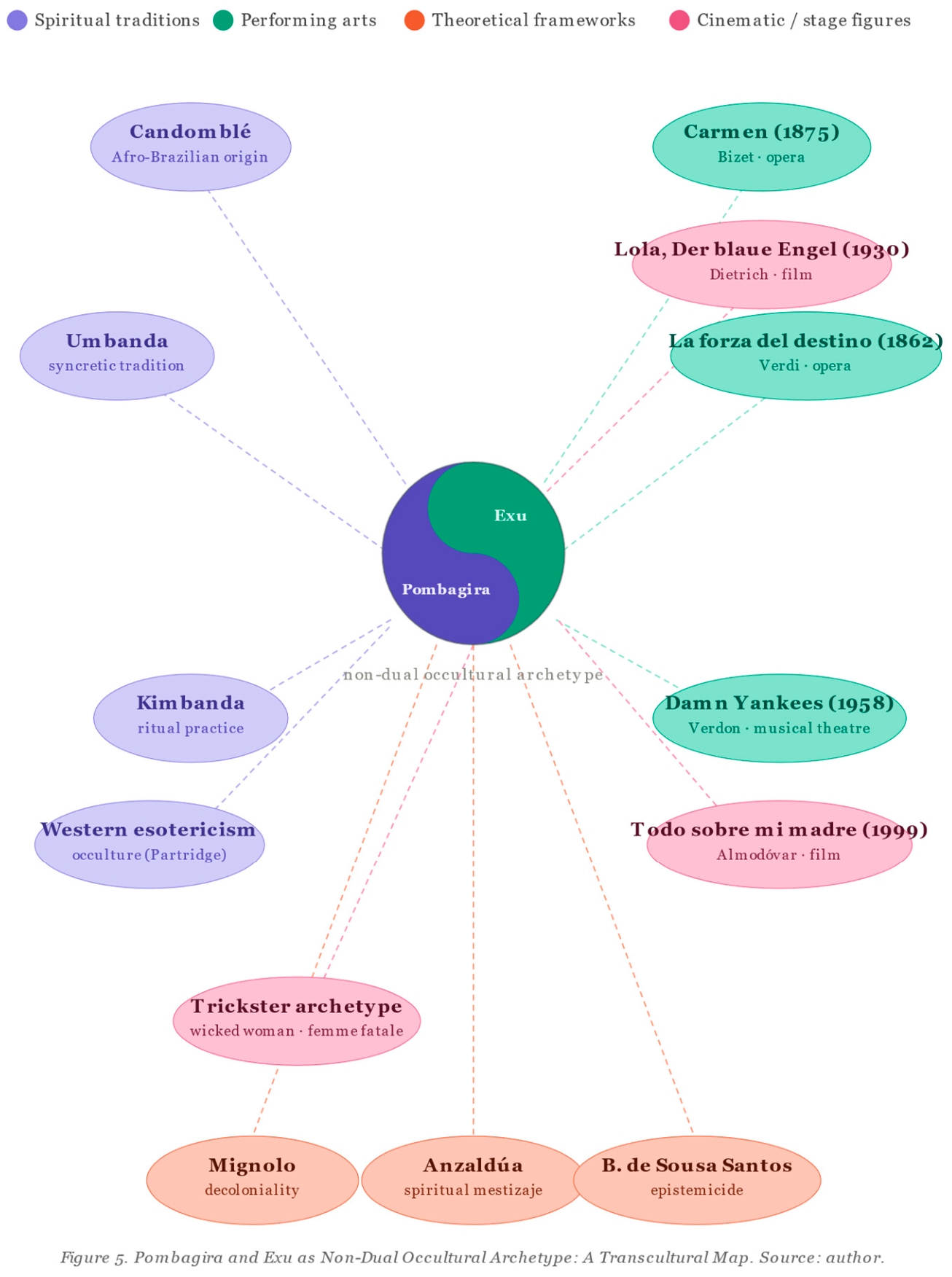
As Figure 5 illustrates, the Pombagira–Exu dyad operates not as a gendered binary but as a non-dual occultural archetype — a cosmological pairing whose sovereign indivisibility is precisely what patriarchal epistemology, in both religious and scholarly contexts, has historically sought to fracture, subordinate, and misname. The network of traditions, art forms, and critical frameworks mapped here traces the pathways through which this archetype persists, proliferates, and continues to resist containment. The yin-yang form at the center is not decorative: it is a structural argument. The dyad cannot be split without losing its meaning — and it is precisely the Western patriarchal impulse to split it, to assign Pombagira to the demonic and Exu to the satanic [63], to make one subordinate to the other, that this essay has been undoing throughout its readings. What remains when the splitting is undone is the threshold itself: the crossroads, the coiling serpent, the goddess who laughs, the force that was never contained and never will be.
The implications of this reading extend beyond the specific works examined here. If the Pombagira episteme is indeed an underlying emblem across art and scholarship invested in queering essential binary categories — as this essay has proposed — then it offers cultural studies and performance studies a productive analytical framework for reading other figures, other traditions, other artistic works in which the uncontainable feminine has been simultaneously invoked and misnamed. The mestiza consciousness that Anzaldúa theorized, the erotic knowledge that Lorde recovered, the chthonian force that Paglia named, the occulture that Partridge mapped, the epistemicide that Santos diagnosed, the dewesternization that Mignolo proposes — all of these converge in the Pombagira as a figure who was never merely a religious entity, never merely a cultural curiosity, never merely a "bad woman." She is, as this essay has argued from its first page, a sovereign epistemic force — and the performing arts have known this, in their own indisciplinary way, for longer than scholarship has been willing to admit.
6. Conclusions
This essay has traced a single, persistent force across five centuries of Western cultural production — from the Afro-Brazilian terreiros where Pombagira first took shape as a sovereign spiritual entity, through the opera houses of nineteenth-century Europe where her archetype was encoded into the bodies of Carmen and Leonora, to the cinemas of Weimar Berlin, mid-century Broadway, and contemporary Barcelona where Lola, in her many incarnations, kept surviving the patriarchal scripts written for her death. It has done so indisciplinarily — refusing the clean boundaries between religious studies and cultural criticism, between feminist theory and spiritual practice, between the scholar's desk and the medium's circle. Much has necessarily been left aside: a fuller treatment of the gypsiology literature on Carmen's Romani heritage, a deeper engagement with the musicological dimensions of Verdi's harmonic language, a more sustained reading of Almodóvar's broader filmography, a comparative analysis of Pombagira's reception across different Brazilian regional traditions, and even her own anthropological and ethnographic origins. These are not gaps but invitations — pathways that this essay opens and does not close, consistent with the indisciplinary, mestiza epistemology it has proposed throughout.
What this essay does close — or rather, what it proposes as a foundation for future work — is the framework itself: the Pombagira episteme as an analytical lens for reading the uncontainable feminine across cultural traditions, art forms, and historical periods. If the readings undertaken here are persuasive, they suggest that the performing arts have long been doing decolonial, anti-patriarchal epistemological work that scholarship has been slow to name — encoding in the bodies of their most transgressive female figures a knowledge that exceeds the Western moral taxonomies their librettos, scripts, and screenplays attempted to impose. The Pombagira–Exu non-dual dyad, as Figure 5 has mapped, offers cultural studies and performance studies a transcultural framework for identifying this work wherever it appears: in the figures that patriarchal cultural imagination simultaneously desires and destroys, simultaneously names "wicked" and cannot stop invoking, simultaneously exiles to the margins of the profane and finds returning, again and again, to the center of the stage. Future research might extend this framework to other traditions — to the figure of Kali in South Asian performance, to the Lilith archetype in Western literary and operatic history, to the femme fatale in non-Western cinematic traditions — tracing the pathways through which the Pombagira episteme, or something structurally equivalent to it, has been independently generated by cultures that patriarchal modernity has attempted to silence. The serpent, as Anzaldúa knew, moves in all directions at once.
It is fitting, then, that an essay arguing for the epistemological power of embodied, ritual, and incantatory knowledge should close not with an argument but with an incantation — one that has been sung at crossroads and in terreiros long before this essay was written and will be sung long after:
Tentaram me matar com um copo de veneno/Se quiser matar me mata, que beber eu bebo mesmo [They tried to kill me with a glass of poison. If you want to kill me, kill me — I'll drink it myself].
This ponto cantado — the ritual incantation sung to summon Pombagira in Afro-Brazilian spiritual practice, equivalent in function to a mantra — condenses everything this essay has argued into a single act of sovereign defiance. Cited by Brazilian theologian, historian, and LGBTQ+ activist Gregory Rodrigues Roque as an expression of queer resistance and survival [64], it crosses the threshold between the terreiro and the political square, between spiritual practice and decolonial struggle — enacting, in sung lines, the indisciplinary mestiza consciousness this essay has traced across five centuries of patriarchal misrepresentation. It is the voice of a chthonian female power that can be dimmed but never extinguished, the mestiza consciousness that kneads darkness and light together and refuses to choose between them. Pombagira assumes the form of every woman the patriarchal order has tried to silence: Hypatia (c. 360–415 CE), the Neoplatonist philosopher and mathematician of Alexandria murdered by a Christian mob for the threat her knowledge posed; Joan of Arc (c. 1412–1431), the French peasant who led armies and was burned at the stake for heresy and cross-dressing, later canonized as a saint; Marielle Franco (1979–2018), the Black, LGBTQ+ Brazilian activist and councilor assassinated by militia-linked politicians whose murder exposed the deep corruption of patriarchal political power; Mahsa "Jina" Amini (2000–2022), the Iranian Kurdish woman whose murder by the morality police ignited the global movement Jin, Jiyan, Azadî — Women, Life, Freedom. And so many others, visible and invisible, who carry the weight of patriarchy in their everyday existence. In each of them, Pombagira is present — not as metaphor, but as the living, unextinguishable force this essay has traced from the terreiros of Brazil to the opera houses of Europe, from the crossroads of Afro-Brazilian cosmology to the screens of world cinema. She was never a "bad woman." She was always the one who drank the poison and survived.
Laroyê, Pombagira!
Funding
This research received no external funding.
Data Availability Statement
No new data were created or analyzed in this study. Data sharing is not applicable to this article.
Acknowledgments
During the preparation of this manuscript, the author used Claude (Anthropic, claude.ai), for purposes of text editing, abstract revision, and the generation of Figure 5. The author has reviewed and edited the output and takes full responsibility for the content of this publication.
Conflicts of Interest
The author declares no conflicts of interest.
References
- Partridge, C. The Re-Enchantment of The West Volume 1: Alternative Spiritualities, Sacralisation and Popular Occulture. T&T Clark International: London, UK, 2004; pp. 62–86.
- Kuna, M. O Som da Consciência: prática do mantra Baba Nam Kevalam como atrator, na organização do sistema artista-criador durante o processo criativo [The Sound of Consciousness: Practice of the Baba Nam Kevalam Mantra as Attractor in the Organization of the Artist-Creator System during the Creative Process]. Unpublished Monograph. Departamento de Linguagens do Corpo, FAFICLA, Pontifícia Universidade Católica de São Paulo (PUC-SP): São Paulo, Brazil, 2015.
- Kuna, M. At the Crossroads of Knowledge: Undoing the Patriarchy with the Pombagira. Master's Thesis, Humboldt-Universität zu Berlin, Berlin, Germany, 2023. [CrossRef]
- Haraway, D. Situated Knowledges: The Science Question in Feminism and the Privilege of Partial Perspective. Feminist Studies, 1988, 14, 575–599. [CrossRef]
- Nicolescu, B. From Modernity to Cosmodernity: Science, Culture, and Spirituality. State University of New York Press: Albany, US, 2014; pp. 3–9.
- Federici, S. Witches, Witch-Hunting, and Women. BTL Books: Toronto, Canada, 2018.
- Hanegraaff, W. Rejected knowledge… So you mean that esotericists are the losers of history? In Hermes Explains: Thirty Questions about Western Esotericism; Hanegraaff, W., Forshaw, P., Pasi, M., Eds.; Amsterdam University Press: Amsterdam, Netherlands, 2019; pp. 145–152.
- Barad, K. Meeting the universe halfway: Quantum physics and the entanglement of matter and meaning. Duke University Press: Durham, US, 2007.
- Greiner, Christine, O Corpo: Pistas para Estudos Indisciplinares. Annablume: São Paulo, Brazil, 2005; p. 126.
- Rancière, J. Jacques Rancière and Indisciplinarity. Art & Research: A Journal of Ideas, Contexts and Methods 2008, 2, 1. Available online: https://pure.uva.nl/ws/files/4285124/63487_298522.pdf (accessed on 30 May 2026).
- Nicolescu, B. Multidisciplinarity, Interdisciplinarity, Indisciplinarity, and Transdisciplinarity: Similarities and Differences. RCC Perspectives 2014, 2, 19–26. Available online: http://www.jstor.org/stable/26241230 (accessed on 29 May 2026).
- Anzaldúa, G. Borderlands = La Frontera: The New Mestiza. Spinsters/Aunt Lute: San Francisco, CA, USA, 1987; pp. 80–82.
- Delgadillo, T. Spiritual Mestizaje: Religion, Gender, Race, and Nation in Contemporary Chicana Narrative. Duke University Press: Durham, US, 2011. [CrossRef]
- Hayes, K.E. Wicked Women and Femmes Fatales: Gender, Power, and Pomba Gira in Brazil. History of Religions 2008, 48, 1–21. [CrossRef]
- Hayes, K.E. The Dark Side of the Feminine: Pomba Gira Spirits in Brazil. In Gendering Global Transformations: Gender, Culture, Race and Identity; Korieh, C.J., Okeke-Ihejirika, P., Eds.; Routledge: New York, NY, USA, 2009; pp. 119–132.
- Auga, U.; Bruns, C.; Dornhof, D.; Jähnert, G. (Eds.) Dämonen, Vamps und Hysterikerinnen = Geschlechter- und Rassenfigurationen in Wissen, Medien und Alltag um 1900 [Demons, Vamps and Hysterics = Gender and Race Figurations in Knowledge, Media and Everyday Life around 1900]. Transcript Verlag: Bielefeld, Germany, 2014.
- Federici, S. Re-Enchanting the World: Feminism and the Politics of the Commons. PM Press: Oakland, CA, USA, 2019.
- William, R. POMBAGIRA | Arreda, homem, que aí vem mulher [POMBAGIRA | Stand Aside, Man, for a Woman Comes]. YouTube. August 19, 2021. https://youtu.be/Pt3B1F4HPng (accessed on 29 May 2026), 16:28–17:30.
- Oleszkiewicz-Peralba, M. Fierce Feminine Divinities of Eurasia and Latin America: Baba Yaga, Kālī, Pombagira, and Santa Muerte. Palgrave Macmillan: New York, NY, USA, 2015.
- Bahia, J. Where do the Prostitutes Pray? On Travestis, Mães de Santo, Pombagiras, and Postcolonial Desires. In Global Trajectories of Brazilian Religion; Oosterbaan, M.; van de Kamp, L.; Bahia, J., Eds.; Bloomsbury: London, UK, 2020; pp. 101–116.
- Lorde, A. Uses of the Erotic: The Erotic as Power. In Sister Outsider: Essays and Speeches. Crossing Press: Freedom, CA, USA, 1984; pp. 53–59.
- Bastide, R. The African Religions of Brazil: Toward a Sociology of the Interpenetration of Civilizations. Translated by Helen Sebba. Johns Hopkins University Press: Baltimore, MD, USA, 2007; p. 479.
- Santos, B. Epistemologies of the South: Justice against Epistemicide. Paradigm Publishers: Boulder, CO, USA, 2014.
- Hayes, K.E. Holy Harlots: Femininity, Sexuality, and Black Magic in Brazil. University of California Press: Berkeley, CA, USA, 2011.
- Lagos, N.M.L. Arreda homem que aí vem mulher: representações de gênero nas manifestações da Pombagira [Stand Aside, Man, for a Woman Comes: Gender Representations in the Manifestations of Pombagira]. Master's Thesis, Universidade Metodista de São Paulo, São Bernardo do Campo, Brazil, 2007.
- Oyěwùmí, O. The Invention of Women: Making an African Sense of Western Gender Discourses. University of Minnesota Press: Minneapolis, MN, USA, 1997.
- Arnfred, S. Simone de Beauvoir in Africa: Woman = The Second Sex? Issues of African feminist thought. Jenda: A Journal of Culture and African Women Studies 2002, 2, 1–20. Available online: https://www.africaknowledgeproject.org/index.php/jenda/article/view/69 (accessed on 29 May 2026).
- Freud, S. The Dissolution of the Oedipus Complex, In On Sexuality. Vol. 7, Penguin Freud Library. Penguin: Harmondsworth, UK, 1976; pp. 313–322.
- Lacan, J. Le Séminaire, Livre X: L’angoisse (1962-1963). Le Seuil: Paris, France, 2004.
- Conner, R.P.; Sparks, D.H. (Eds.) Queering Creole Spiritual Traditions: Lesbian, Gay, Bisexual, and Transgender Participation in African-Inspired Traditions in the Americas. Routledge: New York, NY, USA, 2013; pp. 81–84, 104–105.
- Collins, P.H. Black Feminist Thought: Knowledge, Consciousness and the Politics of Empowerment. Routledge: New York, NY, USA; London, UK, 1990.
- Hooks, B. From Margin to Center. South End Press: Boston, MA, USA, 1984.
- Ribeiro, D. O que é lugar de fala? [What Is the Place of Speech?]. Letramento: Belo Horizonte, Brazil, 2017.
- Gramsci, A. Selections from the Prison Notebooks of Antonio Gramsci. International Publishers: New York, NY, USA, 1971.
- Del Roio, M. Gramsci and the Emancipation of the Subaltern Classes. Palgrave Macmillan: Cham, Switzerland, 2022.
- Paglia, C. Sexual Personae: Art and Decadence from Nefertiti to Emily Dickinson. Yale University Press: New Haven, CT, USA, 1990.
- Feuerstein, G. Tantra – The Path of Ecstasy. Shambhala: Boston, MA, USA, 1998.
- Avalon, A. The Serpent Power: The Secrets of Tantric and Shaktic Yoga. Dover Books: Mineola, NY, USA, 1974.
- von Stuckrad, K. A Cultural History of the Soul: Europe and North America from 1870 to the Present. Columbia University Press: New York, NY, USA, 2022.
- de Beauvoir, S. The Second Sex. Vintage Books: New York, NY, USA, 1973.
- Thiele, Maria. Trickster, Transvestiten und Ciganas - Pombagira und die Erotik in der afrobrasilianischen Religionen. Leipziger Universitätsverlag: Leipzig, Germany, 2006.
- Bennahum, N. Carmen, a Gypsy Geography. Wesleyan University Press: Middletown, CT, USA, 2013.
- Meyer, M. Caminhos do imaginário no Brasil [Pathways of the Imaginary in Brazil]. Editora da Universidade de São Paulo: São Paulo, Brazil, 2001; p. 227.
- Meyer, M. Maria Padilha e toda sua quadrilha: de amante de um rei de Castela à Pombagira de Umbanda [Maria Padilha and All Her Gang: From Mistress of a King of Castile to the Pombagira of Umbanda]. Livraria Duas Cidades: São Paulo, Brazil, 1993.
- Hida, R. Laroyê!: Exus e Pombagiras [Laroyê! (A Ritual Greeting): Exus and Pombagiras]. Haikai Editora: São Paulo, Brazil, 2022.
- Schmidt, B.E.; Engler, S. (Eds.) Handbook of Contemporary Religions in Brazil. Brill: Leiden, The Netherlands; Boston, MA, USA, 2016.
- Davis, L. Ending of 'Carmen' Re-Written to Highlight Violence against Women. Classic FM. January 3, 2018. https://www.classicfm.com/music-news/carmen-new-ending-violence-women/ (accessed on 31 May 2026).
- CBC News. Florence Opera Rewrites Carmen's Ending so She Kills Her Attacker Instead. CBC News. January 5, 2018. https://www.cbc.ca/news/entertainment/florence-italy-change-carmen-1.4482413 (accessed on 31 May 2026).
- Rowden, C.; San Martín Arbide, L. Final féministe: les défis de la mise en scène au XXIème siècle. In Carmen revisitée; Lozier, C., Marc, I., Eds.; Peter Lang: Bern, Switzerland, 2020; pp. 150–174.
- Clément, C. Opera or the Undoing of Women. University of Minnesota Press: Minneapolis, MN, USA, 1988.
- Opera Traveller. I Predict a Riot: La Forza del Destino at the Deutsche Oper Berlin. Opera Traveller. September 9, 2019. https://operatraveller.com/2019/09/09/i-predict-a-riot-la-forza-del-destino-at-the-deutsche-oper-berlin/ (accessed on 31 May 2026).
- Müller, H. Der Auftrag [The Mission]. In Herzstück. Rotbuch Verlag: Berlin, Germany, 1983.
- Felber, G. “Heut gibt's wieder Schlachteplatte.” Frankfurter Allgemeine Zeitung, September 11, 2019, 12. Available online: https://fazarchiv.faz.net/document?id=FAZ__81bf8853e99bfe8a8d0ea95c76727be07b142c2f (accessed on 29 May 2026).
- Lange, J. Die Macht der Assoziationen [The Power of Associations]. Die Deutsche Bühne. September 9, 2019. https://www.die-deutsche-buehne.de/kritiken/die-macht-der-assoziationen/ (accessed on 29 May 2026).
- Omotobàtálá, B. The Kingdom of Kimbanda. Lulu Publishing: Morrisville, NC, USA, 2010.
- Moss, L.W.; Cappannari, S.C. The Black Madonna: An Example of Culture Borrowing. Scientific Monthly 1953, 76, 319–324.
- Scheer, M. From Majesty to Mystery: Change in the Meanings of Black Madonnas from the Sixteenth to Nineteenth Centuries. American Historical Review 2002, 107, 1412–1440.
- Richter, S. Women, Pleasure, Film. Palgrave Macmillan: New York, NY, USA, 2013.
- Middleton, M. The Queer Effect of Matrilineal Genealogies in Pedro Almodóvar's Todo sobre mi madre (1999). Revista 2i: Estudos de Identidade e Intermedialidade 2024, 6, 87–98. Available online: https://dialnet.unirioja.es/descarga/articulo/9857380.pdf (accessed on 31 May 2026).
- Pridgeon, S.; Ostrom, K. 'The Kindness of Strangers': Kinship and Intertextuality in Todo sobre mi madre and Una suerte pequeña. Bulletin of Contemporary Hispanic Studies 2020, 2, 69–84. Available online: https://scarab.bates.edu/cgi/viewcontent.cgi?article=1514&context=faculty_publications (accessed on 31 May 2026). [CrossRef]
- Mignolo, W.D. The Darker Side of Western Modernity: Global Futures, Decolonial Options. Duke University Press: Durham, NC, USA, 2011.
- Storm, J.Ā.J. The Myth of Disenchantment: Magic, Modernity and the Birth of the Human Sciences. The University of Chicago Press: Chicago, IL, USA, 2017.
- Fayemi, A. K, ‘Philosophical problem of Evil: Response to E. O. Oduwole’, Philosophia: An International Journal of Philosophy, 41:1 (2012).
- Silva, M.F.; Fonseca, A.D. Diálogos sobre fé, religião e direitos: entrevista com Gregory Rodrigues Roque [Dialogues on Faith, Religion and Rights: Interview with Gregory Rodrigues Roque]. Revista COR LGBTQIA+ 2022, 1, 177–189.
Figure 2.
(a) Altar dedicated to Pombagira and Exu. Photograph by the author, 2023. Visible are the tridents of Exu (straight, three upward points) and Pombagira (curved, central point upward), alongside ritual objects including a cigar, a red candle, and a champagne bottle — traditional offerings and attributes of both entities in Afro-Brazilian spiritual practice. (b) Altar dedicated to Pombagira and Exu. Photograph by the author, 2026. Visible in the foreground is Pombagira's trident alongside perfume boxes bearing her image, a lit red candle, and a framed ponto riscado — a sacred Afro-Brazilian diagram channeled and drawn by medium and therapist Bia Paiva — depicting Pombagira's and Exu’s spiritual signature. Together, both images document the evolution of the author's personal ritual practice between 2023 and 2026, enacting the lived, embodied methodology of spiritual mestizaje that this essay theorizes. Source: author.
Figure 2.
(a) Altar dedicated to Pombagira and Exu. Photograph by the author, 2023. Visible are the tridents of Exu (straight, three upward points) and Pombagira (curved, central point upward), alongside ritual objects including a cigar, a red candle, and a champagne bottle — traditional offerings and attributes of both entities in Afro-Brazilian spiritual practice. (b) Altar dedicated to Pombagira and Exu. Photograph by the author, 2026. Visible in the foreground is Pombagira's trident alongside perfume boxes bearing her image, a lit red candle, and a framed ponto riscado — a sacred Afro-Brazilian diagram channeled and drawn by medium and therapist Bia Paiva — depicting Pombagira's and Exu’s spiritual signature. Together, both images document the evolution of the author's personal ritual practice between 2023 and 2026, enacting the lived, embodied methodology of spiritual mestizaje that this essay theorizes. Source: author.
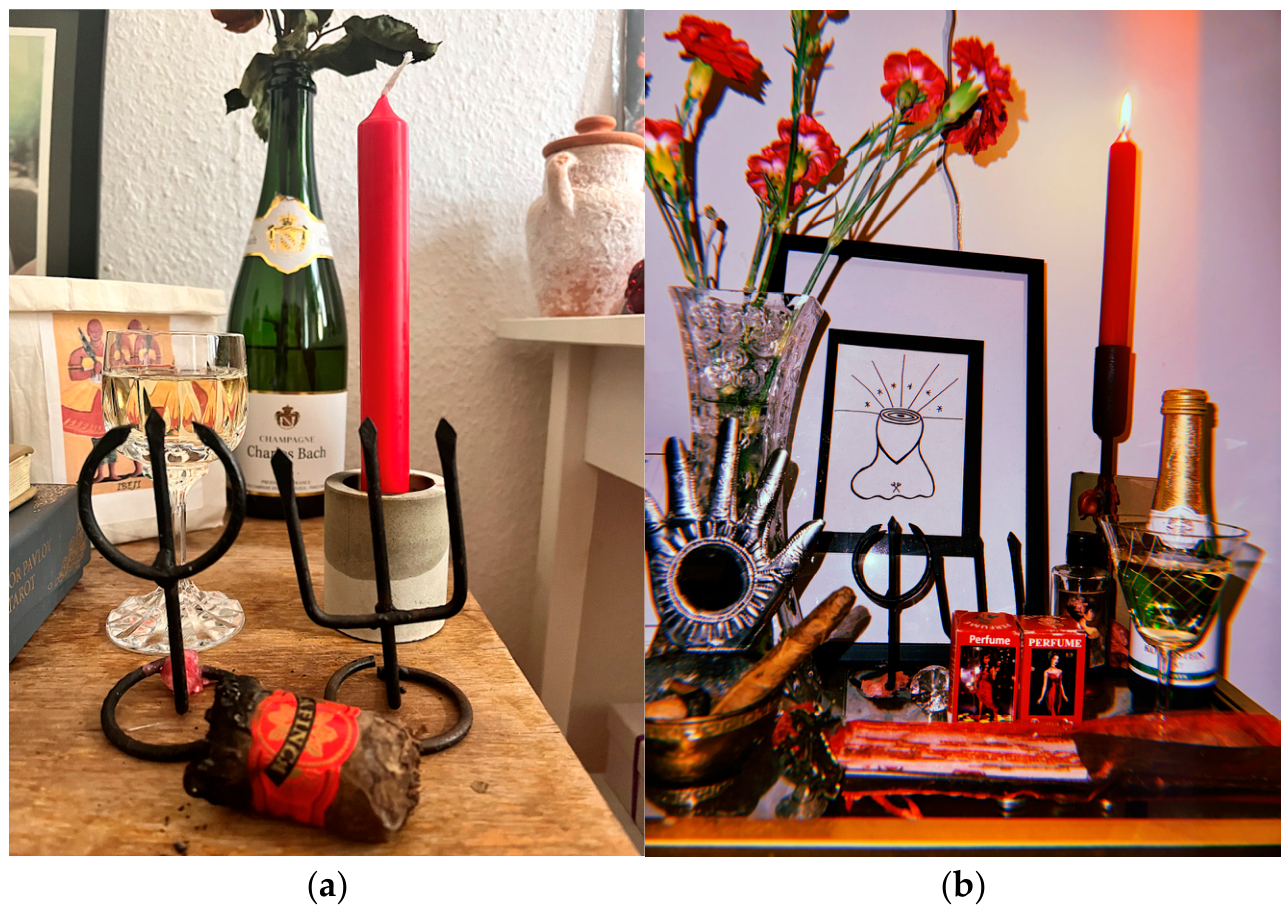
Figure 3.
gabi de luca, [Pombagira Invocation], 2022. Photograph. Created in collaboration with the author for the master's thesis At the Crossroads of Knowledge: Undoing the Patriarchy with the Pombagira, Humboldt University of Berlin, March 2023. The photograph captures an embodied invocation of Pombagira's occultural force — the blurred motion, red garments, gold chains, and pearl crown evoking her sovereign erotic power and liminal presence between worlds. Reproduced with permission of the photographer, Gabi de Luca.
Figure 3.
gabi de luca, [Pombagira Invocation], 2022. Photograph. Created in collaboration with the author for the master's thesis At the Crossroads of Knowledge: Undoing the Patriarchy with the Pombagira, Humboldt University of Berlin, March 2023. The photograph captures an embodied invocation of Pombagira's occultural force — the blurred motion, red garments, gold chains, and pearl crown evoking her sovereign erotic power and liminal presence between worlds. Reproduced with permission of the photographer, Gabi de Luca.
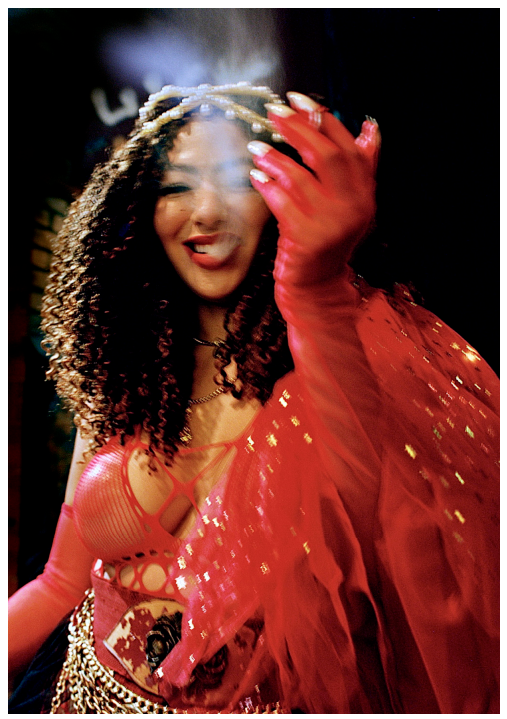
Figure 4.
Stefan Brock, Pomba Gira, 2022. Oil on canvas, 80 × 110 cm. Private collection. Painted in collaboration with the author's research and embodied practice, the work depicts the author as a re-enactment of the Pombagira occulture, surrounded by her traditional attributes — candles, wine bottles, the trident, the occult elements, and flowers — set against a lush natural backdrop that evokes the liminal threshold between the sacred and the profane. The androgynous rendering of the figure enacts the non-dual, uncontainable femininity explored in this essay. Reproduced with permission of the artist.
Figure 4.
Stefan Brock, Pomba Gira, 2022. Oil on canvas, 80 × 110 cm. Private collection. Painted in collaboration with the author's research and embodied practice, the work depicts the author as a re-enactment of the Pombagira occulture, surrounded by her traditional attributes — candles, wine bottles, the trident, the occult elements, and flowers — set against a lush natural backdrop that evokes the liminal threshold between the sacred and the profane. The androgynous rendering of the figure enacts the non-dual, uncontainable femininity explored in this essay. Reproduced with permission of the artist.
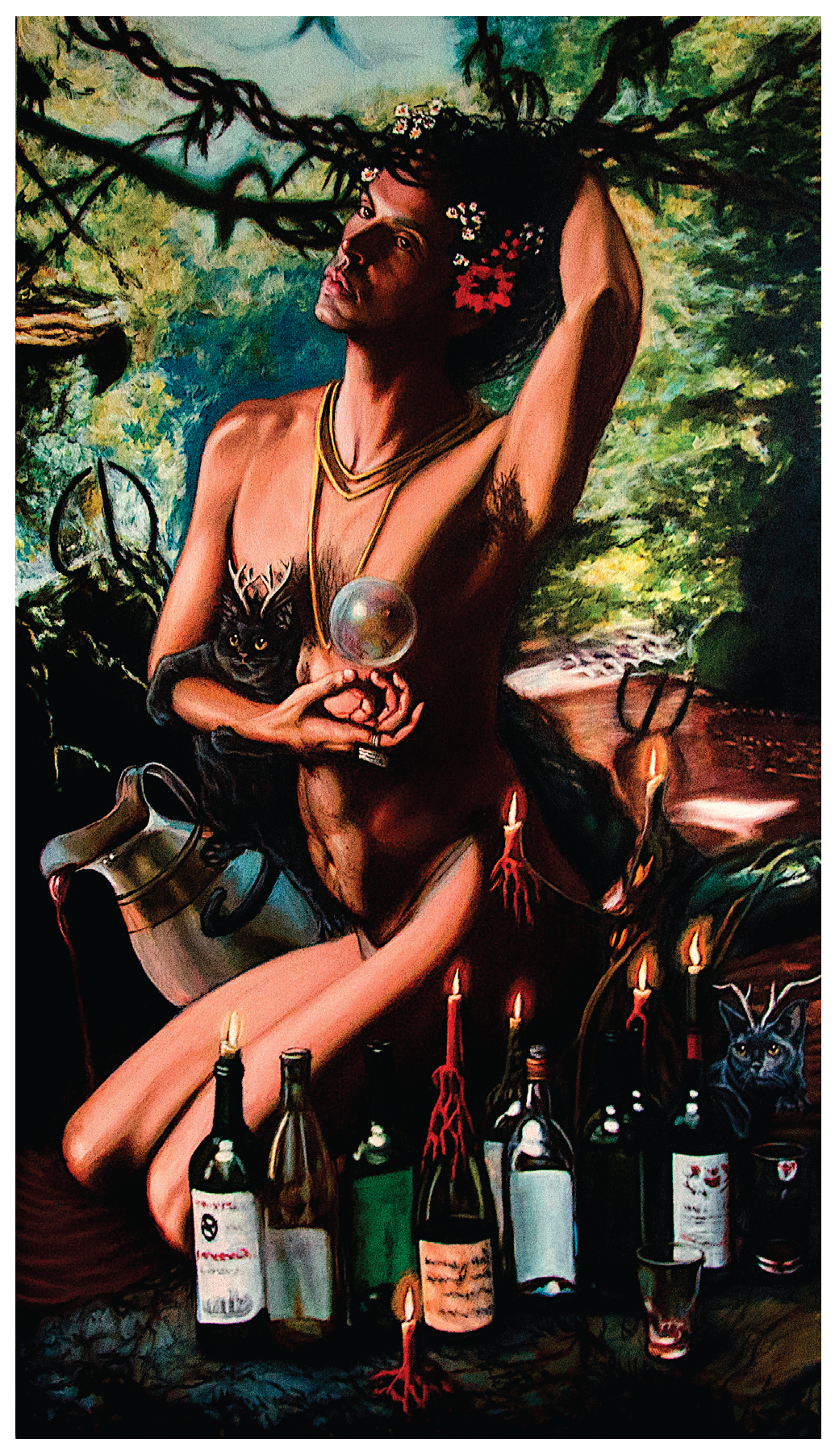
Figure 5.
Pombagira and Exu as Non-Dual Occultural Archetype: A Transcultural Map. The yin-yang form at the center represents Pombagira and Exu not as binary opposites but as complementary, indivisible expressions of a single cosmological force — each carrying the seed of the other, neither legible without the other's presence. The network radiating outward maps the spiritual traditions (Candomblé, Umbanda, Kimbanda, Western esotericism), performing arts (Bizet's Carmen, Verdi's La forza del destino, Damn Yankees), theoretical frameworks (Mignolo, Boaventura de Sousa Santos, Anzaldúa), and cinematic and stage figures (Dietrich's Lola, Almodóvar's Todo sobre mi madre, the trickster/femme fatale archetype) in which this non-dual anti-patriarchal force is transmitted and transformed across cultures and centuries. Source: author. Diagram generated with the assistance of Claude (Anthropic), claude.ai, 2026.
Figure 5.
Pombagira and Exu as Non-Dual Occultural Archetype: A Transcultural Map. The yin-yang form at the center represents Pombagira and Exu not as binary opposites but as complementary, indivisible expressions of a single cosmological force — each carrying the seed of the other, neither legible without the other's presence. The network radiating outward maps the spiritual traditions (Candomblé, Umbanda, Kimbanda, Western esotericism), performing arts (Bizet's Carmen, Verdi's La forza del destino, Damn Yankees), theoretical frameworks (Mignolo, Boaventura de Sousa Santos, Anzaldúa), and cinematic and stage figures (Dietrich's Lola, Almodóvar's Todo sobre mi madre, the trickster/femme fatale archetype) in which this non-dual anti-patriarchal force is transmitted and transformed across cultures and centuries. Source: author. Diagram generated with the assistance of Claude (Anthropic), claude.ai, 2026.
Disclaimer/Publisher’s Note: The statements, opinions and data contained in all publications are solely those of the individual author(s) and contributor(s) and not of MDPI and/or the editor(s). MDPI and/or the editor(s) disclaim responsibility for any injury to people or property resulting from any ideas, methods, instructions or products referred to in the content. |
© 2026 by the authors. Licensee MDPI, Basel, Switzerland. This article is an open access article distributed under the terms and conditions of the Creative Commons Attribution (CC BY) license (http://creativecommons.org/licenses/by/4.0/).
Copyright: This open access article is published under a Creative Commons CC BY 4.0 license, which permit the free download, distribution, and reuse, provided that the author and preprint are cited in any reuse.


