

Submitted:
09 June 2026
Posted:
10 June 2026
You are already at the latest version
Abstract
Hong Kong's architectural culture is characterized by the systematic reproduction of Western visual languages, despite the availability of other spatial traditions. This article argues that this condition represents "aesthetic internalisation" — a process wherein colonial hierarchies of taste become structurally embedded in professional formation and the semi-conscious perceptual field of architects. Drawing on Bourdieu's habitus, Bhabha's colonial mimicry, Quijano's coloniality of power, and Fanon's account of subjectivity, the study posits that the dominance of Western architectural forms in postcolonial Hong Kong is structural rather than preferential. To counter this, the article proposes the Spatial Cipher methodology, integrating the Neo-Confucian concept of Li (理, inherent organising principles). This methodology extracts deep organisational logics rather than superficial visual forms from suppressed spatial traditions, translating them into contemporary material decisions. The argument is developed through case analysis of 46FLT, a mixed-use building in Kowloon City (2014–2017) designed by the author. The project operationalises Spatial Cipher by engaging with the spatial memory of the former Kowloon Walled City. Furthermore, drawing on situated epistemology, the article reflects on the diasporic architect's position as a productive vantage point from which colonial aesthetic inheritance can be observed and contested. The study demonstrates that decolonial architectural practice is viable within standard commercial and regulatory constraints, offering an actionable framework beyond theoretical discourse.
Keywords:
postcolonial architecture
; Hong Kong
; kowloon walled city
; habitus
; colonial mimicry
; spatial memory
; decolonial practice
; aesthetic internalisation
; diaspora
; informal architecture
1. Introduction
When architects in Hong Kong’s development sector select facade systems, material palettes, or resolve mass-street relationships, these decisions typically appear technical, market-driven, or practical. However, the cumulative effect of these decisions has produced a cityscape legible almost entirely in the visual language of Western modernism and its post-modern derivatives. This language arrived not through the local sedimentation of spatial culture, but through the institutional infrastructure of colonial professional formation [1,2].
This article examines the systematic marginalisation of Chinese spatial traditions — specifically the absence of sustained engagement with Cantonese vernacular building, Hakka communal typology, and the collective architecture of the Kowloon Walled City. It argues that this absence is not the outcome of open aesthetic competition, but of a colonial structuring of professional taste that continues post-handover via curricula, award cultures, peer networks, and the embodied dispositions of practitioners trained within British-established epistemological frameworks [3,4]. A necessary clarification is required to pre-empt common misreadings of decolonial architectural discourse: this article is neither anti-modern nor nostalgic. It does not argue for the preservation of historical forms, but rather addresses the source of architectural language. It posits that contemporary Chinese spatial practice should evolve from within its own philosophical tradition, responding to contemporary life with contemporary means, rather than importing a ready-made visual grammar. The distinction lies between modernity and modernity on borrowed terms [5].
Underlying this methodology is the Neo-Confucian concept of Li (理) — the inherent organising principle or pattern of a thing: not its surface appearance but the deep structural logic that generates its characteristic qualities. Classical Chinese craftsmen described Li as the grain in jade or wood — the natural pattern already present in the material, which a skilled maker follows rather than overrides. A settlement, like a piece of jade, has a Li: an organisational logic that persists beneath and beyond its physical fabric, remaining available to a sufficiently attentive practitioner even after the physical settlement has been demolished. This article proposes that the design practice of reading, extracting, and re-expressing a suppressed settlement’s Li in contemporary material form can be understood as Spatial Cipher: a methodology in which the architect decodes the inherent pattern of a spatial tradition and recodes it in new built form — not as replication or quotation, but as a living continuation of a spatial intelligence that colonial erasure has interrupted but not destroyed. Western discourse approximates this concept through the biological notion of morphogenesis, but Li is the more precise and culturally appropriate term for a methodology that is itself an argument for building architectural discourse from within Eastern philosophical tradition.
The broader context is the unresolved gap between postcolonial historiography and professional practice. While the “global turn” has decentred Western architectural knowledge historically, it has not transformed practice in cities where colonial structures remain intact [6]. Lin’s concept of “display-ness” — where cultural identity is performed rather than inhabited in Asian postcolonial architecture [1,2] — diagnoses this condition precisely. This article extends that diagnosis toward practice. If display-ness describes the postcolonial trap, Spatial Cipher proposes a methodology for escaping it — a way of recovering the Li of a suppressed spatial tradition without reproducing it as spectacle. Hong Kong, two decades after the handover, offers a particularly concentrated site for testing that methodology.
2. Theoretical Framework: Aesthetic Internalisation and Colonial Architecture of Taste
Dominant accounts of postcolonial urban morphology emphasize economic drivers: land value, developer preference, and global capital. While valid, this is insufficient to explain why trained professionals consistently produce work within colonial aesthetic conventions when alternatives exist. A more adequate explanation requires analysing the deeper structure of professional formation through the lens of aesthetic internalisation.
Bourdieu’s concept of habitus [3] — durable, transposable dispositions produced by social conditioning — reveals that aesthetic taste in professional contexts is an embodied schema rather than conscious preference. Architectural education in colonial Hong Kong transmitted a system of judgement structured around European modernist precedent. Consequently, Western forms are experienced not as culturally specific choices, but as the unmarked norm against which other approaches appear as departures requiring justification.
This is exacerbated by Bhabha’s theory of colonial mimicry, which produces subjects who are “almost the same, but not quite” [5]. Architecturally, this manifests as hybrid practices reproducing Western modernism’s visual language while maintaining surface distance through ornamental “Asian” elements. This is not synthesis, but the reproduction of dependence under the sign of stylistic choice. Morton’s analysis of “hybrid modernities” at the 1931 International Colonial Exposition demonstrates that such blending represents a controlled staging of colonial difference, absorbing the non-Western into a Western representational framework [7]. The “Asian-inflected” towers of Hong Kong perform a parallel operation: making local cultural difference visible as decoration while retaining Western spatial logic. Structurally, Quijano’s “coloniality of power” posits that colonial hierarchies persist post-decolonisation through institutional forms [8]. In architecture, what might be called a coloniality of taste is maintained via the distribution of cultural authority: credentials, publications, award cultures that determine what counts as architectural excellence.
Subjectively, Fanon’s account of language reveals that adopting the coloniser’s language restructures self-perception [9]. Translated spatially, the architect trained in Western conventions internalises a perceptual orientation where those techniques feel like the natural form of thought, rendering other traditions as “regional” or “minor.” Supported by cognitive research on accessibility effects [10], aesthetic internalisation is defined as the process by which colonial hierarchies of spatial culture become embedded in the semi-conscious perceptual field governing material decisions.
This spatial mechanism operates in structural analogy to sociolinguistic processes of language attrition under colonial institutional pressure — an analogy developed further in the Discussion section.
2.1. The Spatial Cipher Methodology
To counter aesthetic internalisation, this article formalises the Spatial Cipher methodology. Operating on the concept of Li, the methodology functions as a systematic three-step process:
- Decoding: Analysing a suppressed or demolished settlement’s documented structure to extract the deep organisational logics (Li) beneath surface appearance.
- Abstraction: Stripping away context-specific physical constraints to isolate the pure spatial logic — the inherent organising pattern that persists beyond the physical fabric.
- Recoding: Translating these logics into contemporary material decisions within current regulatory and commercial constraints.
The result is a building that does not “look like” the historical source, but “thinks” like it. The Spatial Cipher methodology operates in two complementary registers: the sectional and programmatic — internal organisation, vertical use relationships, occupation boundaries — and the tectonic and visual — facade grammar, material presence, and colour language. Both are legitimate expressions of the source’s Li. This two-register distinction pre-empts the reductive reading of Spatial Cipher as merely a facade language: the methodology claims spatial organisation as its primary register and material expression as its secondary one.
3. Case Study: 46FLT Kowloon City
3.1. The Kowloon Walled City as Suppressed Resource
Before analysing the case study, the specific spatial tradition utilised must be contextualised. The standard postcolonial account of Hong Kong — British colonial administration imposing Western institutional frameworks on a Chinese population, producing a hybrid culture caught between East and West — requires an important qualification. British culture in Hong Kong was never dominant at the level of lived culture. It was dominant at the level of institutions: law, education, professional formation, administrative language. But the Cantonese cultural substrate — the cinema, the popular music, the colloquial language, the grassroots social life of the streets and markets — continued with extraordinary vitality underneath and alongside the colonial institutional framework. The colonial imposition was superficial in the literal sense: it operated on the surface of institutional life without penetrating the deep cultural substrate.
The evidence for this is precise. Cantonese humour produced in Hong Kong resonates across the entire Cantonese-speaking world because it operates from within a living language tradition with the full depth of cultural intelligence that entails. Hong Kong has become in some respects the primary custodian of Cantonese cultural life — more so than Guangzhou, the dialect’s geographical origin. This distinction — between institutional colonisation and cultural colonisation — is important for understanding the Walled City. The tragedy of aesthetic internalisation is not that the culture was destroyed. It is that professional formation trained architects not to see or value what their own culture had produced. The resource was always there. The institutional framework was structured to make it invisible.
The Kowloon Walled City — demolished in 1993 after the relocation of its approximately 33,000 residents — occupied an exceptional position in Hong Kong’s spatial history. Existing in a zone of administrative ambiguity: claimed by China, nominally governed by Britain, and effectively ungoverned by either, residents built what they needed without reference to planning regulations, professional standards, or external aesthetic authority. The architectural result was not chaos. It was a complete and internally coherent spatial system that solved problems of density, mixed use, natural light, ventilation, and communal organisation through accumulated collective intelligence. Its demolition represented an erasure of a spatial tradition. The site was converted into a public park, preserving only the former Yamen building — the administrative hall that had stood at the centre of the settlement, serving at various points as a customs house and a temple. Its central position within the former Walled City mirrors the role of the ancestral hall within a Hakka tulou: the communal centre around which collective life organises itself. What replaced the broader settlement fabric was not more sophisticated, but more legible to administrative systems. The Walled City’s spatial intelligence was excluded from professional curricula and award cultures, treated as an embarrassment rather than a resource.
46FLT is a mixed-use building at 46 Fuk Lo Tsun Road, Kowloon City, completed in 2017. The site — the location of a former electrical substation, within walking distance of the former Walled City — concentrated the design problem: how to build in a district saturated with spatial memory without either ignoring it or reproducing it nostalgically. Crucially, 46FLT is not an iconic, philosophically commissioned monument. It is a commercial project (560 sqm, seven storeys — ground, first and second floor retail, residential units above, and two upper-floor terrace apartments) subject to standard Hong Kong developer expectations and regulatory frameworks. Its significance lies in demonstrating that Spatial Cipher remains operative under everyday professional constraints. A decolonial methodology that functions only at the scale of exceptional commissions is not a methodology — it is a privilege.
3.2. The Five Ciphers: Decoding and Recoding the Walled City’s Li
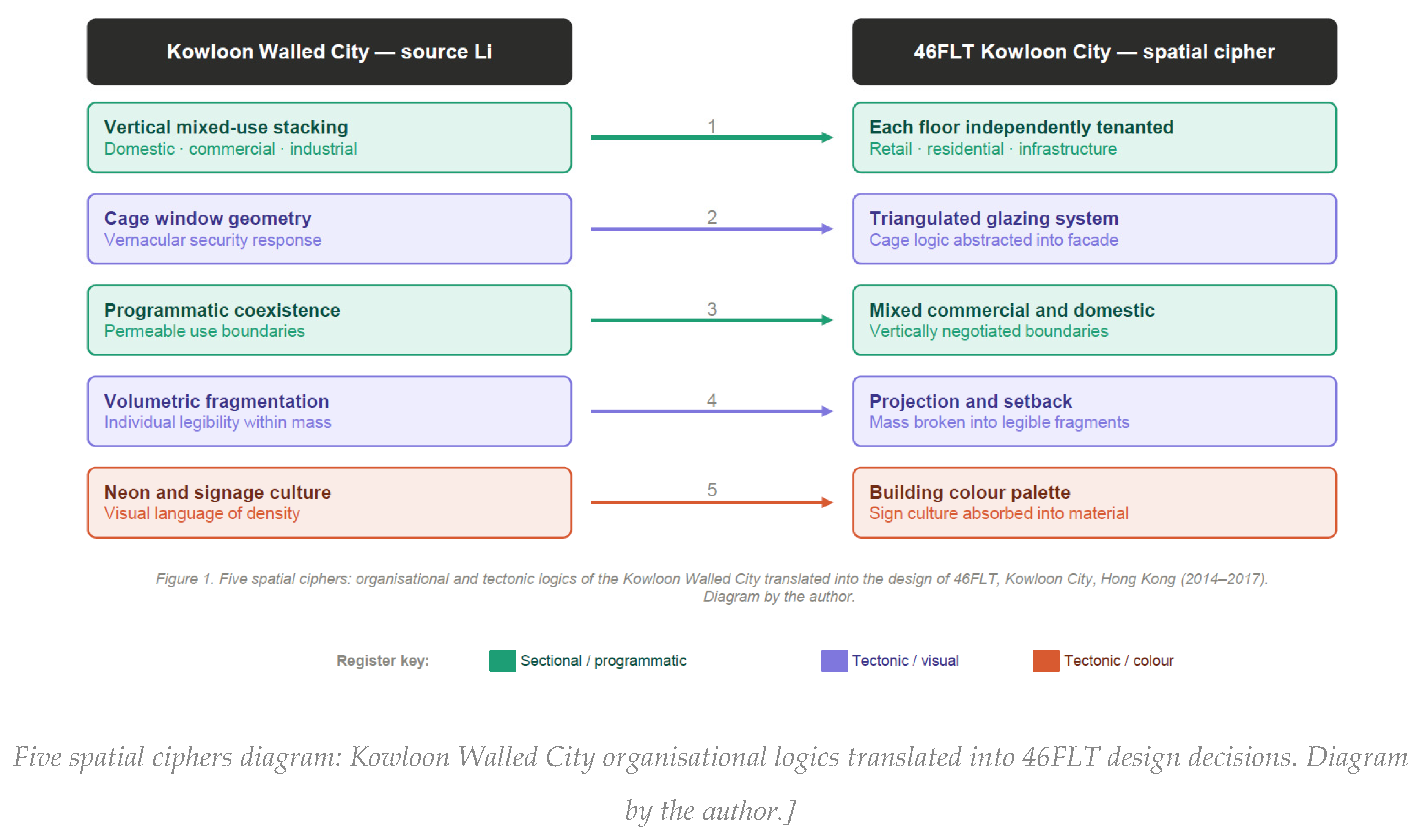
The design of 46FLT avoided the “mimicry trap” of quoting the Walled City’s visual characteristics — exposed pipes, accumulated facade accretion — without engaging with the spatial intelligence those characteristics expressed. Instead, five ciphers were identified through analytical study of the Walled City’s documented structure, photographic record, and accounts of former residents. Each found a direct, specific material translation in the design of 46FLT — not as metaphor or approximation, but as a precise operational decision. [See Figure 1]
- 4.
- Vertical Mixed-Use Stacking (Sectional Register): The Walled City co-located domestic, commercial, industrial, and service functions vertically. At 46FLT, each floor serves a distinct tenant and programme, replicating this fine-grained vertical diversity rather than the standard “retail podium/residential tower” typology.
- 5.
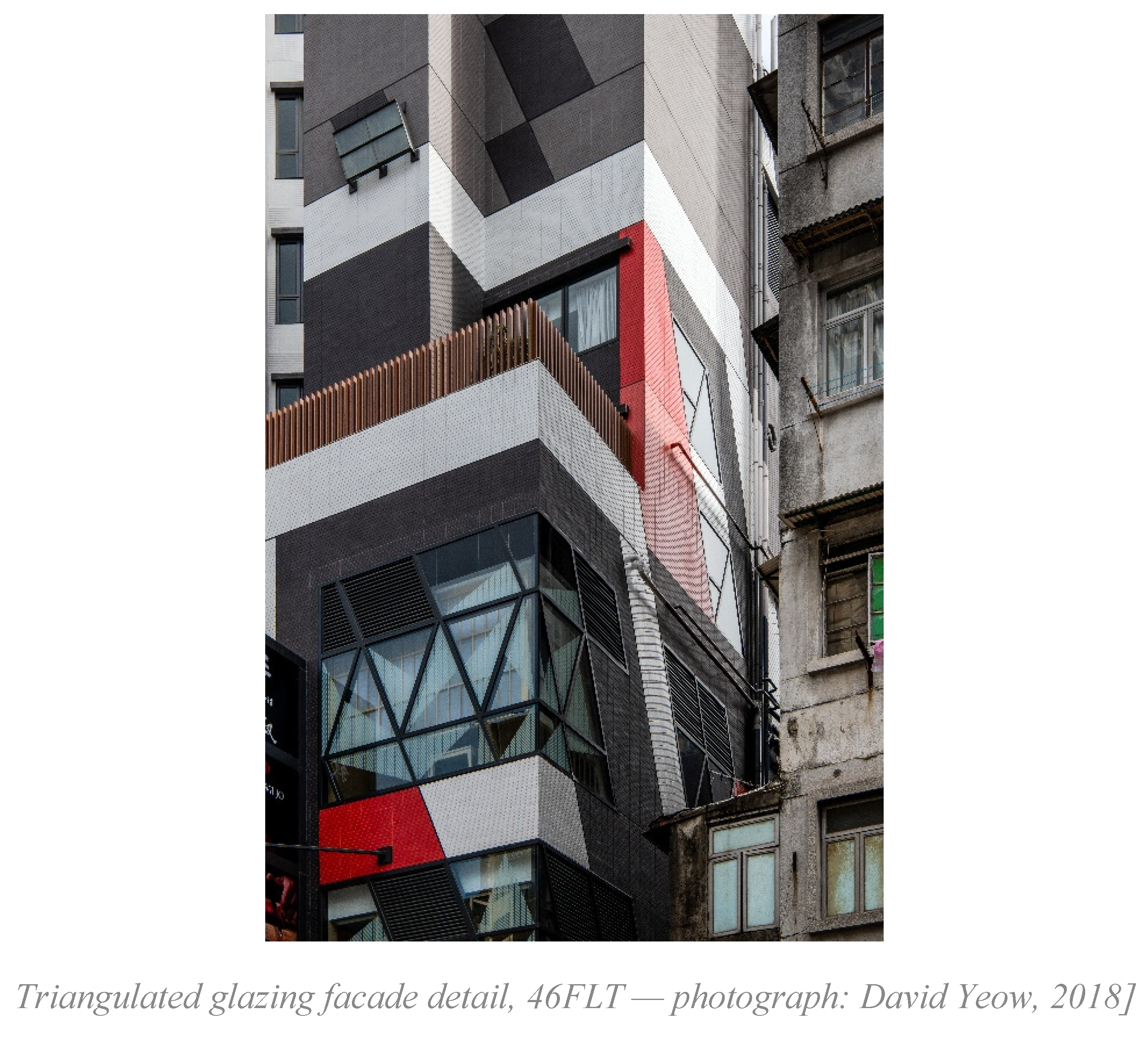
- Individualised Aperture Expression (Tectonic Register): The Walled City’s cage-like security windows were a vernacular response to the absence of institutional protection. At 46FLT, this geometry becomes the generative logic of the facade system — the grid abstracted from its security function into architectural language. The surface appearance has changed completely. The Li is continuous.
Figure 2.
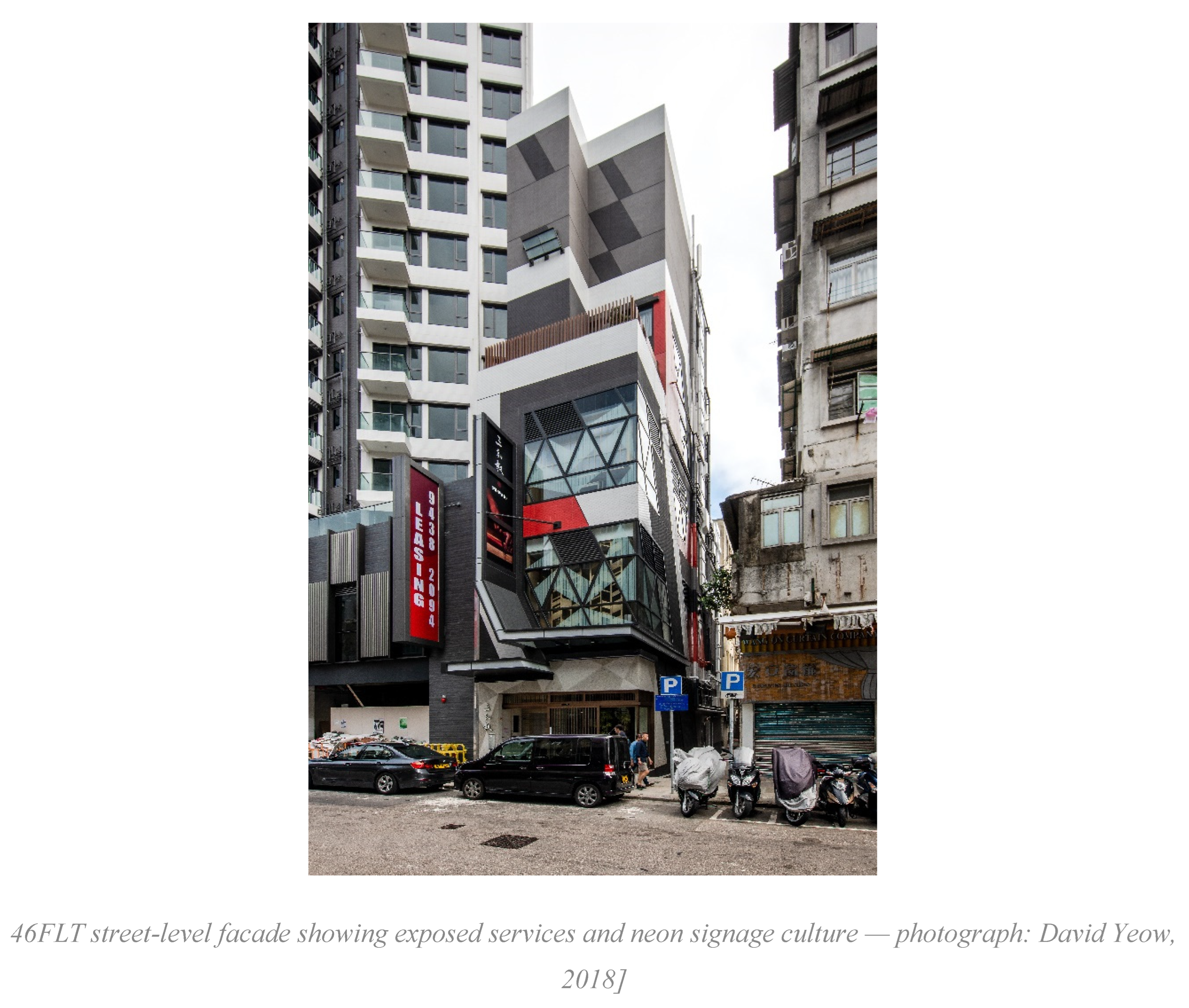
46FLT, Fuk Lo Tsun Road, Kowloon City, Hong Kong — street-level facade showing exposed service elements integrated into the architectural language and the district's neon and signage culture. Photograph: David Yeow, commissioned by the author, 2018.
Figure 2.
46FLT, Fuk Lo Tsun Road, Kowloon City, Hong Kong — street-level facade showing exposed service elements integrated into the architectural language and the district's neon and signage culture. Photograph: David Yeow, commissioned by the author, 2018.
- 6.
- Programmatic Coexistence (Sectional Register): Mirroring the Walled City, 46FLT does not strictly segregate uses. Vertical sequencing produces permeable boundaries between commercial and domestic spheres.
- 7.
- Volumetric Fragmentation (Tectonic Register): The Walled City read as a collection of legible sub-volumes within a unified mass. At 46FLT, volumetric projection and setback breaks the overall mass into fragments, maintaining individual identity within a unified order.
- 8.
- Colour from Neon and Signage Culture (Tectonic Register): The monumental neon signage of Kowloon City was a visual language of density and individual commercial assertion. 46FLT’s colour palette translates this sign culture into material identity — vivid, saturated, unapologetic. Not nostalgic quotation: an insistence that the visual intelligence of the district deserves continuation.
Figure 3.
Triangulated glazing facade detail, 46FLT, Kowloon City, Hong Kong. Photograph: David Yeow, commissioned by the author, 2018.
Figure 3.
Triangulated glazing facade detail, 46FLT, Kowloon City, Hong Kong. Photograph: David Yeow, commissioned by the author, 2018.
3.3. Double Erasure: The Kai Tak Cipher
The design of the building’s upper floors introduces a second layer of spatial memory that the five-cipher framework alone does not fully account for. The top two storeys of 46FLT are configured as terrace apartments whose terraces open toward the view corridor once defined by the Kai Tak Airport approach path.
Kai Tak Airport closed in 1998, five years after the Walled City was cleared. The airport’s approach over Kowloon City — aircraft descending through dense urban fabric at what felt like rooftop level, the city rushing past at close range before the runway materialised over the harbour — was one of the most extraordinary spatial experiences that any urban environment produced in the twentieth century. It belonged entirely to this district: the people of Kowloon City lived with it, accommodated it, organised the height of their buildings around it, and experienced the city’s relationship to the sky through it. When Kai Tak closed, that spatial relationship was erased along with the airport itself.
The terrace apartments at the top of 46FLT do not restore the Kai Tak approach. They recover the spatial orientation that the approach defined: the habit of looking up and outward from Kowloon City rooftops, the understanding that the sky above this district was not empty but inhabited by a specific relationship between urban density and movement. Kowloon City is therefore a site of double erasure: the Walled City cleared in 1993, the airport closed in 1998, both leaving spatial voids that subsequent development has not addressed. 46FLT works within both voids simultaneously, carrying the Walled City’s Li in its section, programme, facade grammar, and colour vocabulary, while recovering the Kai Tak spatial orientation in its upper-floor configuration — demonstrating the capacity to embed double erasure within a single built form. What the site and its surroundings have lost, this building carries forward.
3.4. Memory as Resistance
It is worth noting the structural parallel between the Walled City and the Hakka tulou. Both are architectures produced by communities that could not rely on institutional protection, and both encode the same underlying intelligence: that collective spatial organisation, oriented inward and toward self-sufficiency, is more durable than dependence on external authority. The tulou operated on a cognate logic: an organisationally complete collective settlement, self-sufficient within its perimeter, refusing to organise its internal spatial and social order according to frameworks imposed from without. Neither the tulou nor the Walled City refused the outside world — both maintained necessary connections to it. Both refused dependency on it. At 46FLT, this logic operates at the scale available: each floor independently tenanted and organisationally distinct, the building’s spatial order determined by the memory of what occupied this ground rather than by imported conventions of standard Hong Kong development. Legitimacy from within — that is the line from tulou to Walled City to this building.
4. Discussion: Situated Epistemology and the Hakka Lineage
The argument developed in this article raises the question of who is positioned to make it. The condition of aesthetic internalisation affects practitioners differently depending on their relation to the colonial heritage in question. This section argues that the diasporic architectural position — the position of the practitioner formed by and against multiple cultural systems simultaneously — constitutes a specific epistemological resource for decolonial practice.
A practitioner educated in Western architectural institutions from a position outside their implicit norms encounters the conventions of that formation not as ‘how things are done’ but as ‘how things are done within this specific cultural assumption.’ What remains habitual and invisible to the insider becomes visible and questionable to the outsider. This critical distance is the epistemological purchase that makes Spatial Cipher available as a methodology.
The pattern this article theorises was visible long before it became theoretical. Growing up in Malaysia, attending Chinese-medium school in a community where Chinese was the natural language of thought, one observed a specific social phenomenon: ethnic Chinese who had absorbed the colonial language performing it as prestige, directing contempt toward Chinese-educated compatriots, reproducing a hierarchy of cultural value that the British had established and then physically departed — leaving it to operate without them, maintained by the colonised themselves. Many of these communities had direct economic ties to British plantation enterprises; the colonial master had left, but the language, the institutional hierarchy, and the social prestige that came with English proficiency remained as the primary currency of status. This is colonial mentality at street level — Bhabha’s mimicry lived not as architectural style but as daily social relation, with contempt directed at those who refused the performance.
Lee Kuan Yew (LKY), Singapore’s founding Prime Minister, named this danger with unusual precision in his National Day Rally address of 13 August 1978 [14]:
“A person who gets deculturalised — and I nearly was, so I know this danger — loses his self-confidence. He suffers from a sense of deprivation. For optimum performance a man must know himself and the world. He must know where he stands. I speak the English language better than the Chinese language because I learnt English early in life. But I will never be an Englishman in a thousand generations and I have not got the Western value system inside; mine is an Eastern value system. Nevertheless, I use Western concepts, Western words because I understand them. But I also have a different system in my mind.” [14] (Note: The National Archives of Singapore retains the Mandarin/Hokkien simultaneous translation telecast of this speech [Accession No. 1997002307]; the English text quoted here follows Foo [15, p. 35], which reproduces the passage from Ministry of Culture records.)
What makes the LKY example theoretically significant, however, is not the warning but what followed it. Despite naming deculturalisation as a personal danger, the institutional structures subsequently entrenched the colonial language as the dominant medium of Singapore’s public and professional life. Consequently, a generation of diasporic Chinese operates with English as the language of public and professional mobility while Chinese dialects are reduced to the language of private sentiment. The architectural parallel is precise: architects in postcolonial Asian cities often recognise their aesthetic defaults as culturally borrowed, yet are constrained by an institutional inheritance — accreditation systems, award cultures, client expectations — that makes acting on that awareness professionally costly. Intellectual recognition is insufficient without the structural transformation of the institutions governing professional life.
The mechanism of aesthetic internalisation proposed in this article operates in structural analogy to a well-documented process in sociolinguistics: language attrition. Language attrition describes the gradual erosion of a speaker’s capacity in a language — typically their mother tongue — under the sustained dominance of another, institutionally privileged linguistic system [11]. At the individual level, it manifests as reduced fluency, domain retreat, and the progressive displacement of the mother tongue from the natural medium of thought. At the community level, it follows a generational arc: the first generation code-switches between the mother tongue and the dominant language; the second generation uses the dominant language as primary; the third generation loses the mother tongue entirely, retaining it at most as a ceremonial remnant.
Singapore provides the most extensively documented instance of institutionally engineered language attrition in the postcolonial world — and its consequences extended equally across all ethnic communities. The Speak Mandarin Campaign (1979) and the subsequent closure of Chinese-medium Nanyang University (1980) systematically displaced Hokkien, Cantonese, Hakka, and Teochew within two generations [12]. Malay received constitutional recognition as Singapore’s national language while being functionally marginalised in education and commerce — what sociolinguists term symbolic recognition with functional displacement. Tamil was designated the sole representative Indian language, erasing the linguistic diversity of communities whose actual mother tongues included Malayali, Telugu, Punjabi, and Bengali. The result, across all three communities, was what Fishman terms domain loss: the progressive retreat of indigenous languages from public, institutional, and eventually domestic use [11].
What makes Singapore’s case analytically significant for architectural theory is not simply its scale but its mechanism. Singapore’s language engineering constitutes, in its cumulative effect, an effectively complete cultural and linguistic revolution — one achieved not through political coercion but through institutional precision: education policy, media regulation, and economic incentive operating across generations. Community languages that survived political persecution elsewhere did not survive three generations of institutional displacement in Singapore. Hakka, spoken continuously in Meizhou despite successive upheavals in mainland China, became functionally extinct as a community language in Singapore within two generations of independence. This demonstrates that the most effective erasure of cultural intelligence operates not through dramatic rupture but through the slow, semi-conscious restructuring of what counts as the natural medium of thought — precisely the mechanism this article identifies as aesthetic internalisation in the professional formation of architects. The same institutional logic that displaced the spoken mother tongue displaced the spatial mother tongue: domain loss in language and domain loss in spatial tradition are not merely analogous processes — they are expressions of the same colonial restructuring of cultural legitimacy.
The spatial parallel follows the same three-generation arc. The first generation of colonial-era architects code-switched spatially, producing shop houses with Western institutional facades and Chinese interior logics. The second generation shifted to Western spatial conventions as the professional default while retaining indigenous spatial instincts as private knowledge. The third generation lost the spatial mother tongue entirely, leaving indigenous traditions available only as quotation or ornament. Without conscious resistance — what linguists call language maintenance, and what this article proposes as Spatial Cipher methodology — spatial attrition, like linguistic attrition, advances toward the effective displacement of the spatial mother tongue.
The consequences of this process extend beyond vocabulary loss into what may be termed cognitive displacement: the gradual erosion of the capacity to think within one’s native cultural framework. Language is not a neutral container for thoughts that exist independently of it; it is the structure through which certain thoughts become possible. The Sapir-Whorf principle of linguistic relativity holds that the categories available in a language shape what can be readily conceived within it [13]. In architectural terms, this means that the loss of terms such as 天井 (tianjing, the courtyard open to sky), 围 (wei, communal enclosure as spatial act), or 巷 (xiang, the intimate inhabited lane) is not merely a terminological impoverishment. Each of these words encodes a spatial philosophy — a way of organising the relationship between enclosure and sky, between collective and individual, between movement and dwelling — that has no precise equivalent in the Western architectural lexicon. When these terms are displaced from the natural medium of a practitioner’s thought by an institutionally dominant language that lacks them, the spatial intelligence they carry becomes inaccessible not because it has been forgotten, but because the cognitive infrastructure through which it could be activated has been restructured. Fanon’s insight that adopting the coloniser’s language restructures self-perception [9] operates at precisely this level: the architect trained to think in Western spatial categories does not simply apply those categories — he inhabits them, and the indigenous spatial tradition appears, if it appears at all, as an object of nostalgic contemplation rather than a living resource for design thought.
Singapore’s trajectory illustrates the institutional completion of this cognitive displacement. Despite formal independence in 1965, Singapore retained the colonial institutional apparatus intact — the legal system, the civil service structure, the educational framework, the language of public and professional life — constituting what postcolonial theorists describe as a transfer of power without a transfer of epistemology [5]. The vernacular languages were formally acknowledged as “mother tongues” in the bilingual education policy, but their functional reduction to second-language status — taught as heritage subjects rather than used as primary cognitive media — effectively confined them to celebratory and ceremonial functions. A language that a community cannot think in is not a living language; it is a cultural exhibit. The Speak Mandarin Campaign compounded this displacement by substituting the living dialect communities with a standardised Mandarin identity — not decolonisation but a transfer of cultural authority from an external coloniser to an internally administered substitute, bypassing the actual speech communities whose cognitive and spatial traditions those dialects carried. The architectural consequence is precise: a generation of Singapore architects was produced who could not think spatially in the traditions encoded in the languages their grandparents spoke. The spatial mother tongue was lost not because it was attacked, but because the cognitive infrastructure that sustained it — the living language — was systematically redirected toward institutional ends. This is aesthetic internalisation at its most complete: not the imposition of foreign forms by force, but the restructuring of the native cognitive medium until indigenous spatial intelligence becomes literally unthinkable.
4.1. The Hakka Lineage and the Strategy of Withdrawal
Within this diasporic condition, specific sub-cultural lineages offer distinct spatial philosophies. The author’s Hakka descent — a lineage within the broader Chinese cultural formation — is not incidental to the methodology applied at 46FLT. The Hakka (客家, “guest families”) are historically a people of structural displacement: migrating southward across China under pressure over many centuries, consistently settling marginal land, and building collective spatial forms that encoded resilience, self-sufficiency, and the long memory of a people who could not rely on external protection. The most documented spatial expression of this lineage is the tulou. The tulou is frequently misread primarily as a fortress; its primary spatial logic is, however, organisational completeness. The enclosing wall is a consequence of this self-sufficiency, not its purpose. What the tulou structurally refuses is not the outside world, but dependency upon it. This represents a strategy of resilient withdrawal: an active spatial position determining internal order while engaging the outside world strictly on its own terms.
It is theoretically productive to contrast this with the spatial logic of the Cantonese shop house. The shop house exemplifies a strategy of accommodation: it presents a compliant Western colonial facade — conforming to five-foot way regulations and the European arcade typology required by colonial urban administration — while organising its interior around entirely Chinese spatial logic: the open-air courtyard well, the ancestral altar, the sequential relationship between front commercial space and back domestic life. The building code-switches spatially just as the Cantonese speaker code-switched linguistically — English at the office, Cantonese at home. While a brilliant survival strategy, it gradually risks eroding the capacity to think in indigenous terms at the institutional level, as the spatial intelligence is hidden behind a borrowed face. The tulou makes no such compromise; its intelligence operates from the full depth of the tradition without performing compliance for external institutional frameworks.
These two strategies — accommodation and withdrawal — produce different architectures and different qualities of cultural expression. A culture that uses a borrowed language or borrowed spatial grammar as its primary public medium gradually loses the capacity to think in its own terms at the institutional level, even when the vernacular culture remains vital. The design move of Spatial Cipher at 46FLT belongs to the withdrawal tradition: the building does not perform for external authority, finds its coherence inward rather than outward, and carries the logic of Hakka spatial intelligence — building that is honest about its own construction, that does not present a composed face to the institutional gaze.
5. Conclusions
This article has argued that the dominance of Western visual languages in postcolonial Hong Kong architecture is not primarily a matter of market preference or technical constraint, but of aesthetic internalisation — a structural mechanism wherein colonial hierarchies of spatial culture become embedded in professional formation and semi-conscious perceptual practice, persisting through the coloniality of power long after political decolonisation.
To counter this, the study proposed the Spatial Cipher methodology, grounded in the Neo-Confucian concept of Li (理). By shifting the architectural focus from the replication of historical visual forms to the extraction and recoding of deep organisational logics, Spatial Cipher provides a mechanism for recovering the spatial intelligence of suppressed traditions without falling into the traps of nostalgic reproduction or spectacular display-ness. The case study of 46FLT demonstrates that this methodology is operationally viable within the stringent constraints of standard professional practice, proving that a decolonial methodology need not rely on exceptional patronage or the suspension of economic reality.
The model this article proposes is not the rejection of modernity but modernity on one’s own terms. The Japanese case is instructive because Japan has already navigated, with considerable success, the question this article is asking of Chinese spatial practice. After the Meiji Restoration, Japan absorbed Western technology, industrial systems, and democratic institutions without surrendering the philosophical foundations of its spatial culture. Tadao Ando builds with concrete — the most universal of modern materials — in a way that is unmistakably formed by a Japanese understanding of light, threshold, and the productive tension between enclosure and nature; and in the use of materials in their most natural, undecorated form, continuous with the age-old wabi-sabi aesthetic of Zen philosophy. Together these form a coherent Japanese architectural tradition that is continuous at the core. Kengo Kuma thinks about the relationship between material and landscape in a way that no architect trained exclusively within the Western tradition thinks. Japanese contemporary culture is among the most technologically advanced in the world, and among the most distinctly itself. It did not achieve this by rejecting modernity. It achieved it by refusing to accept that modernity had only one source.
Wang Shu [16] and Lu Wenyu at Amateur Architecture Studio demonstrate that this is already underway within Chinese architectural practice. They do not position their work in relation to Western discourse. Their architecture thinks from within Chinese spatial philosophy. The reclaimed tiles and stone of the Ningbo History Museum are not a sustainability gesture — they are an argument that demolished buildings carry civilisational information, that the material itself is a form of Li that deserves to be carried forward. In 2012, Wang Shu received the Pritzker Architecture Prize individually — though the jury citation explicitly acknowledged that the work was produced in partnership with Lu Wenyu at Amateur Architecture Studio. He received it not by making his work legible to Western aesthetic expectations, but by making work so deeply rooted in Chinese spatial intelligence that the global establishment had to come to it. That is the inversion this article argues for.
The deeper implication extends beyond Hong Kong. The mechanism of aesthetic internalisation described herein is a general condition of postcolonial professional culture wherever colonial institutions remain structurally intact. Consequently, architecture — in its selection of spatial languages and organisational logics — functions as a civilisational statement. The systematic recovery of marginalised spatial Li is not merely an architectural task, but a necessary structural intervention in the ongoing project of decolonisation. It is a contribution that has not yet been made at scale. The argument of this article is that it can be.
Author Statement: Vui Choong (鍾祥尉) is a Fellow of the Australian Institute of Architects (FRAIA) and founder of Archiculture LLC (GK Kenchiku Bunka/合同会社建築文化), based in the Niseko area, Japan. A Chinese Malaysian of Hakka descent, with ancestral roots in Meixian, Guangdong province and historically as far as Henan province, he was educated at Victoria University of Wellington and the University of Auckland, New Zealand. A Registered Architect in Australia, he has practised for over two decades across Australia, Hong Kong, and mainland China. His research examines how colonial language hierarchies produce distinct spatial and aesthetic conditions in postcolonial Asian cities, and how East Asian spatial philosophy — grounded in Song aesthetics, the Hakka tradition of resilient withdrawal, and the cosmological ordering of earth, human occupation, and sky — can be recovered as a living design methodology.
Author Contributions
Conceptualization, V.C.; Methodology, V.C.; Investigation, V.C.; Formal Analysis, V.C.; Writing — Original Draft Preparation, V.C.; Writing — Review & Editing, V.C. The author has read and agreed to the published version of the manuscript.
Funding
This research received no external funding.
Data Availability Statement
No new data were created or analysed in this study. Data sharing is not applicable to this article.
Acknowledgments
During the preparation of this manuscript, the author used Claude Sonnet 4.6 (Anthropic, claude.ai) to assist with manuscript drafting, structural organisation, reference verification, and editorial refinement; and GLM-5 (Z.ai, Zhipu AI) to assist with critical theoretical review, pressure-testing of the framework’s philosophical foundations, and structural editing. All intellectual content, theoretical positions, design decisions, case study material, and scholarly arguments are the author’s own. The author has reviewed and edited all AI-assisted output and takes full responsibility for the content of this publication.
Conflicts of Interest
The author declares no conflict of interest. The 46FLT project analysed in this article was designed by A.Lead Architects, a practice in which the author was the principal designer. This relationship is disclosed in accordance with MDPI’s research ethics guidelines.
References
- Lin, F.C.H. The Postcolonial Condition of Architecture in Asia: A Lead from Display-ness; Lexington Books: Lanham, MD, USA, 2022; ISBN 9781793614032. [Google Scholar]
- Lin, F.C.H. Theorising the Postcoloniality of Contemporary Architecture: A Perspective from Urban Maritime Asia. J. Asian Archit. Build. Eng. 2023. [Google Scholar] [CrossRef]
- Bourdieu, P. Outline of a Theory of Practice; Cambridge University Press: Cambridge, UK, 1977. [Google Scholar]
- Bourdieu, P. Distinction: A Social Critique of the Judgement of Taste; Harvard University Press: Cambridge, MA, USA, 1984. [Google Scholar]
- Bhabha, H.K. The Location of Culture; Routledge: London, UK, 1994. [Google Scholar]
- Said, E. Orientalism: Western Representations of the Orient; Routledge & Kegan Paul: London, UK, 1978. [Google Scholar]
- Morton, P.A. Hybrid Modernities: Architecture and Representation at the 1931 International Colonial Exposition in Paris; MIT Press: Cambridge, MA, USA, 2000. [Google Scholar]
- Quijano, A. Coloniality of Power, Eurocentrism, and Latin America; Views from South 2000: Nepantla; Volume 1, pp. 533–580.
- Fanon, F. Black Skin, White Masks; Grove Press: New York, NY, USA, 1967. [Google Scholar]
- Kahneman, D. Thinking, Fast and Slow; Farrar, Straus and Giroux: New York, NY, USA, 2011. [Google Scholar]
- Fishman, J.A. Reversing Language Shift: Theoretical and Empirical Foundations of Assistance to Threatened Languages; Multilingual Matters: Clevedon, UK, 1991. [Google Scholar]
- Rubdy, R. Englishisation and the de-ethnicisation of language use in Singapore. In Proceedings of the Annual Review of South Asian Languages and Linguistics; Mouton de Gruyter: Berlin, Germany, 2001. [Google Scholar]
- Whorf, B.L. Language, Thought, and Reality: Selected Writings of Benjamin Lee Whorf; MIT Press: Cambridge, MA, USA, 1956. [Google Scholar]
- Lee, K.Y. National Day Rally Speech. National Theatre, Singapore, 13 August 1978. English text of quoted passage cited from Foo (2017, p. 35). Original Mandarin/Hokkien translation telecast, Accession No. 1997002307, National Archives of Singapore, Singapore.
- Foo, L.A. A Matter of National (In)security: English Language Policy in Singapore. MA thesis, Nanyang Technological University, Singapore, 2017. [Google Scholar]
- Wang, S. Imagining the House; Lars Müller Publishers: Baden, Switzerland, 2012. [Google Scholar]
Figure 1.
Five spatial ciphers: organisational and tectonic logics of the Kowloon Walled City translated into the design of 46FLT, Kowloon City, Hong Kong (2014–2017). Diagram by the author.
Figure 1.
Five spatial ciphers: organisational and tectonic logics of the Kowloon Walled City translated into the design of 46FLT, Kowloon City, Hong Kong (2014–2017). Diagram by the author.
Disclaimer/Publisher’s Note: The statements, opinions and data contained in all publications are solely those of the individual author(s) and contributor(s) and not of MDPI and/or the editor(s). MDPI and/or the editor(s) disclaim responsibility for any injury to people or property resulting from any ideas, methods, instructions or products referred to in the content. |
© 2026 by the authors. Licensee MDPI, Basel, Switzerland. This article is an open access article distributed under the terms and conditions of the Creative Commons Attribution (CC BY) license (http://creativecommons.org/licenses/by/4.0/).
Copyright: This open access article is published under a Creative Commons CC BY 4.0 license, which permit the free download, distribution, and reuse, provided that the author and preprint are cited in any reuse.


